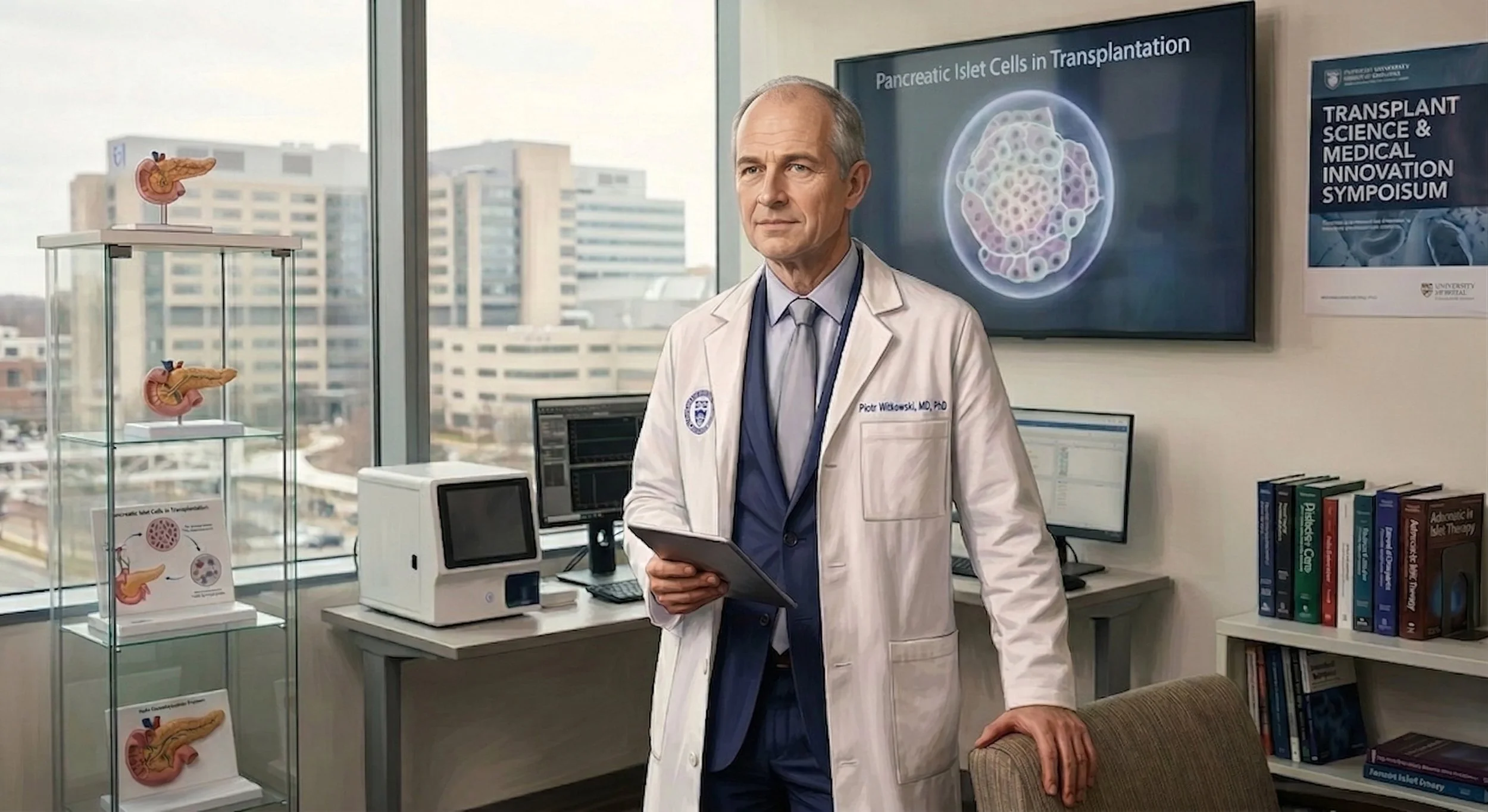
#1817 Transplanting Islet Cells with Piotr Witkowski, MD, PhD
Scott talks with transplant surgeon Dr. Piotr Witkowski about islet transplantation, early results with tegoprubart, regulatory roadblocks, realistic timelines, and where this research could lead. Learn more (Best on a laptop or desktop).

























Companies that Support Juicebox









Key Takeaways
- Regulatory Hurdles: Pancreatic islet transplantation is currently restricted in the US because the FDA regulates islets as a drug, requiring rigorous phase trials, unlike other countries where it is treated as an organ transplant.
- A New Breakthrough: A novel anti-rejection medication, tegoprubart (delivered via IV), is showing remarkable success in protecting transplanted islets without the severe toxic side effects of traditional immunosuppressants like tacrolimus.
- Advocacy is Crucial: Efforts led by Breakthrough T1D (formerly JDRF) and patients aim to urge the Department of Health and Human Services (HHS) to adjust regulations, unlocking insurance reimbursement and making the procedure a standard of care.
- Managing Expectations: While current trials show promise for desperate patients—especially those suffering from severe hypoglycemia unawareness—this procedure is not yet a widespread "cure" and is not currently available for children.
- The Ladder to a Cure: The eventual goal of islet transplantation research is to refine the procedure to a point where no long-term immunosuppression is necessary, paving the way for future unlimited stem cell-derived islet therapies.
Resources Mentioned
- Dr. Piotr Witkowski's Clinical Trial Info: pwitkowski.org
- Contour Next Gen Blood Glucose Meter: contournext.com/juicebox
- Medtronic Diabetes (MiniMed 780G): medtronicdiabetes.com/juicebox
- Breakthrough T1D (formerly JDRF): breakthrought1d.org
- The Human Trial (Documentary): Mentioned as a highly recommended watch to understand the clinical trial process.
- Defining Diabetes Series: juiceboxpodcast.com (Click on Series)
- Wrong Way Recording (Podcast Editing): wrongwayrecording.com
Introduction & Meet Dr. Piotr Witkowski
Scott BennerHello, friends, and welcome back to another episode of the Juice Box podcast.
Piotr Witkowski, MD, PhDDoctor Piotr Witkowski, I'm a I'm a transplant surgeon and professor of surgery at University of Chicago.
As attending surgeon, as a director of pancreatic islets transplantation surgeon.
I've been doing kidney and pancreas transplant and running clinical trials in islets transplantation optimizing the procedure.
Scott BennerAt the end of this episode, the doctor will share a website where you can learn more about his trial and if you are eligible.
He asked me to let you know that the website is best viewed on a computer or a laptop.
Doesn't really work too well on a cell phone.
So when you head over there, use your computer, your laptop, stay off that cell phone.
While you're listening, please remember that nothing you hear on the Juice Box podcast should be considered advice, medical or otherwise.
Always consult a physician before making any changes to your health care plan or becoming bold with insulin.
Today's episode of the juice box podcast is sponsored by the Kontoor next gen blood glucose meter.
This is the meter that my daughter has on her person right now.
It is incredibly accurate and waiting for you at kontoornext.com/juicebox.
Today's episode is also sponsored by Medtronic Diabetes, who is making life with diabetes easier with the MiniMed seven eighty g system and their new sensor options, which include the Instinct sensor made by Abbott.
Would you like to unleash the full potential of the MiniMed seven eighty g system?
You can do that at my link, medtronicdiabetes.com/juicebox.
Piotr Witkowski, MD, PhDI'm doctor, Piotr Witkowski.
I'm a I'm a transplant surgeon and professor of surgery at University of Chicago.
I was, educated and trained in Poland as a general surgeon, and I came to United States to do some research.
Initially, I I was involved in in research related to transplantation, different way to develop, the way to transplant organs without immunosuppression.
We call it tolerance.
I did my research at Columbia University in New York.
At the same time, I was involved in, in islets transplantation.
My mentor got a grant, and and we've been developing islets transplantation procedure or operate operation over there.
And then, after that, I accomplished training in in in a in a surgical training in transplantation, Columbia Presbyterian.
And after that, it was seventeen years ago when I came to Chicago as attending surgeon, as a director of pancreatic islets transplantation, surgeon.
I've been doing kidney and pancreas transplant and running clinical trials in islets transplantation optimizing the procedure.
So it's been seventeen years at the University of Chicago.
Scott BennerHow many iterations do you imagine that that procedure has gone through in that time?
Piotr Witkowski, MD, PhDHow many alternations?
Scott BennerHow many times has it been improved or updated or changed from where you started?
The Regulatory Hurdle of Islet Transplantation
Piotr Witkowski, MD, PhDSo this been a problem because pancreatic islets, which we isolate from deceased donor organs from pancreas, has been regulated in The United States as as a drug.
So, it was twenty six years ago when they they optimized eyelid isolation technique and eyelid transplantation procedure in Edmonton, Canada, achieving great results.
We wanted to adopt it right away, but then FDA said, no.
You have to test it as any other new drug in control environment and perform phase one, phase two, phase three clinical trials.
And when you do clinical trials, you have to do everything the same way because you testing the islets as a drug, which should be manufactured every time the same way.
And it took us over fifteen, eighteen years to accomplish those trials.
And over this time, we couldn't really modify anything only because it's been regulated as a drug.
Scott BennerThat time there was you trying to satisfy the FDA's ask?
Piotr Witkowski, MD, PhDRight.
Scott BennerOkay.
Piotr Witkowski, MD, PhDRight.
Over this time, the islet isolation technique hasn't changed.
Actually, it hasn't changed for twenty six years because we couldn't do it.
We have to do it in the one standardized way
Scott BennerMhmm.
Piotr Witkowski, MD, PhDTo satisfy FDA.
We've been changing and optimizing clinical part, the, you know, changing immunosuppression, replacing one immunosuppression with the other to to to achieve better results, but we couldn't really optimize.
And then because it was still all these years, it was clinical research, very expensive clinical research, the number of the patients which we were enrolling was was low, and therefore, we couldn't even modify the clinical part much.
Learn I mean, change a lot because of of limitation in in in in funding and and then in in patient number.
So the regulations which we apply in The United States and only in The United States has been not really helping the progress in the field.
In other countries, Canada, Europe, Australia, ILETS has been regulated as any other organ for transplantation, And and and it it means that every procedure is driven by the physicians, and and it can be developed changed all the time, optimized all the time for the optimal outcomes.
Scott BennerAre there other people around the world doing the same work and and able to move and iterate more quickly?
Piotr Witkowski, MD, PhDRight.
So for example, in Edmonton and Canada, they've done, over 700 eyeless transplant over the last twenty years.
In Europe, they did over thousand transplants, and they have this approved in England, in UK, in France, in in, in Switzerland.
It's a standard of care procedure based on the results from our clinical trials.
And we in The United States still cannot still have it approved because, again, it's a it's regulated as a drug, and it requires special conditions, validations, funding, liability, and it's it's way beyond the capability of of academic institutions.
Scott BennerTo reach that.
I I mean, I hear how frustrated you are.
I mean, did you go back to the FDA and explain to them why and what Yes.
Piotr Witkowski, MD, PhDSo for the last five years, we've been talk we've been publishing.
We've been presenting scientific data and advocating for adjustment in the regulations since for last five, six years.
First, it was COVID, which was the obstacle.
FDA was was focused on COVID.
After COVID, the regulators were not keen on any changes Mhmm.
Despite the fact that there is no no transplants as a standard of care.
No islets are available outside the clinical trials, and there was no progress.
So we've been publishing articles.
We've been we voice our concerns, and there was no really traction until recently when breakthrough t one d, the major foundation supporting type one diabetes got involved and now and our patients and social media, and now there is a hope that this this regulatory adjustment may happen.
Based on current law and regulations, the secretary of HHS has authority to adjust the regulations himself based on the feedback from FDA and HRSA, but but it can be done quickly and efficiently.
We are ready to work with regulators on proper adjustments, which will allow islets transplantation to be, on the one hand, available to patient as a standard of care, but still safe and an effective procedure.
So all the safeguards are are in place to reassure that it's done in the safe way.
Scott BennerIf health and human services made that change for you, how would that change what you're doing right now?
Piotr Witkowski, MD, PhDSo the major change would be this, that if islets are regulated as organ based on covered results, we can go to insurance and and show them the results.
And I know that they will, they like them because I already showed them to several medical directors of the insurance, and they said we will pay as long as regulations allows for this that your product is it's approved for clinical use.
So once the islets are regulated as organ, our product would be approved, and then it can be reimbursed.
Once it's reimbursed, we can do many more patients.
I mean, we can offer this procedure to many more patients, and then we can do many more studies and enroll patients faster and learn faster and progress the field.
And we can test the new ways, optimize the islet isolation, optimize the clinical protocols much faster, much more efficient, and and create progress.
Scott BennerSo right now, you're kind of stuck doing a clinical trial.
But if they changed it, you could just start doing the procedures, it would work for people?
Piotr Witkowski, MD, PhDOn one hand, we can start doing the procedure based on the our current experience
Scott BennerMhmm.
Piotr Witkowski, MD, PhDUsing approved medication.
At the same time, we can start continue doing clinical trials, and we will be testing new medication, less toxic, more effective medication is still clinical trials, but only a small fraction of those procedures will be paid by the research and everything else, the core of the procedure, which is standard of care, will be paid by the insurance.
Yeah.
So for example, with the same funding which we're getting from breakthrough t one d to transplant 10 patients, we can transplant 100 patients with the same funding.
So this will be a major change.
Scott BennerBe a little cynical for a second and tell me why you think set up like this and why it hasn't changed.
Piotr Witkowski, MD, PhDPeople who we talked to, were not focused on this.
They were always like, there are there are so many different problems.
We have to focus on something else.
I mean, what can I tell you?
Yeah.
There was no traction so far, but now there is traction.
And I think also that what's trigger changes now that we testing new medication, less toxic, patients are doing much, much better than before.
Mhmm.
So before was the general feeling is that Eyle's transplantation, well, they can help some patients, but there is so much side effects of of immunosuppression that the end of the day, it's not so beneficial.
So people were skeptic about the Ehlers transplant.
Now seeing how seeing patients with improved with reverse diabetes without side effects patients, people are excited about it.
So I think we brought it to the different level of efficacy and safety, and this triggers that that people are interested into this and see this as a chance for on the path to the cure.
Yeah.
And the ultimate goal is to to remove the need for immunosuppression.
But to get there, we have to go step by step.
We have to use better medication and then and then less medication, lower doses and and stopping the medication.
But it requires, you know, clinical testing before we are completely can can do it without immunosuppression.
Tegoprubart: A Breakthrough in Immunosuppression
Scott BennerSo is what you're saying is that the the tego prubart is that how do you say it?
Tego prubart?
Piotr Witkowski, MD, PhDTego I don't know why they come in with those names.
Tego prubart.
Yes.
Scott BennerTego prubart.
The understanding is that could be used in your procedure changes the feeling to people.
Piotr Witkowski, MD, PhDYes.
Scott BennerTaking it from, like, well, sure, we can do it, but you're gonna just trade one problem for a different problem.
Exactly.
Right?
Exactly.
And now it doesn't feel like that anymore.
Piotr Witkowski, MD, PhDRight.
Right.
Exactly.
So with with the tacrolimus, which is great medication, allowing us to keep the organ transplantation working for many, many years, but the trade off was that there was toxicity to the kidney, to the brain, to the nerves, to causing hypertension, causing diabetes.
So there there was a a trade off.
But we didn't have better medication over the last thirty years.
And now with tegoprobar again, these are the very preliminary results.
We have only 12 patients and and short observation, but all the patients do not have those side effects.
They don't have any side effects so far.
And they have, Ehlers transplant successful, and they they reverse diabetes.
So that's why you hear from patients that they feel cured because they don't feel burden of this therapy so far.
Scott BennerYeah.
What is the Tego doing that's allowing it to target this situation without suppressing the rest of your immune system so much?
Piotr Witkowski, MD, PhDRight.
Right.
So it is still suppressing the rest of the immune system, but the way it's suppressing is is more selective.
It's it's more accurate.
It's not, let's say, it's not as global as as the other medication.
The other medication, they're targeting many differ entire immune system and and many different checkpoints.
And then this medication, it's it's just one one main still main mechanism of rejection, but only one.
So the other is still working and and protecting patients and not causing the side effects.
So it's it's much more selective.
Okay.
And therefore, toxicity is so far, it's negligible.
Scott BennerMhmm.
But now this medication's being delivered every twenty one days through an IV.
Is that right?
Unlike other systems that will wait until your blood sugar is a 180 before delivering corrections, The MiniMed seven eighty g system is the only system with meal detection technology that automatically detects rising sugar levels and delivers more insulin as needed to help keep your sugar levels in range even if you're not a perfect carb counter.
Today's episode of the Juice Box podcast is sponsored by Medtronic Diabetes and their MiniMed seven eighty g system, which gives you real choices because the MiniMed seven eighty g system works with the Instinct sensor made by Avid, as well as the Simplera Sync and Guardian four sensors, giving you options.
The Instinct sensor is the longest wear sensor yet, lasting fifteen days and designed exclusively for the MiniMed seven eighty g.
And don't forget, Medtronic diabetes makes technology accessible for you with comprehensive insurance support, programs to help you with your out of pocket costs, or switching from other pump and CGM systems.
Learn more and get started today with my link, medtronicdiabetes.com/juicebox.
Contournext.com/juicebox.
That's the link you'll use to find out more about the Kontoor Next Gen blood glucose meter.
When you get there, there's a little bit at the top.
You can click right on blood glucose monitoring.
I'll do it with you.
Go to meters.
Click on any of the meters.
I'll click on the Next Gen, and you're gonna get more information.
It's easy to use and highly accurate.
Smart light provides a simple understanding of your blood glucose levels.
And, of course, with second chance sampling technology, you can save money with fewer wasted test strips.
As if all that wasn't enough, the Kontoor Next Gen also has a compatible app for an easy way to share and see your blood glucose results.
Contournext.com/juicebox.
And if you scroll down at that link, you're gonna see things like a buy now button.
You could register your meter after you purchase it.
Or what is this?
Download a coupon.
Oh, receive a free Kontoor Next Gen blood glucose meter?
Do tell.
Kontoornext.com/juicebox.
Head over there now.
Get the same accurate and reliable meter that we use.
Piotr Witkowski, MD, PhDSo far.
Right.
So far.
And, again, we had to start with something.
Right?
Mhmm.
So the the delivery is inter intervene intravenous infusion.
It's reliable.
This is something is done, you know, here in in in our infusion center, so we know is the liver properly.
But moving on, you know, the company is already working on subcutaneous infusion I mean, injection by the patients.
Mhmm.
And then the frequency on injection can change.
The dose was was just the with was just a start was was actually, the dose was just proposed.
We're using the proposed dose.
We can based on experience, we can learn that the dose might be too high.
Right?
And we may go with lower dose.
So the dose might be adjusted or needs to be higher.
We'll see.
But that's why I'm saying it's just the beginning.
But, eventually, the there is a a good chance that this medication will be given by the patients themselves at home.
Scott BennerMaybe no differently than how people give them GLP shots.
Piotr Witkowski, MD, PhDYeah.
Exactly.
Like, once a week or once a month.
Exactly.
Yes.
Scott BennerWhat do you think the time frame is for that?
Has has that company given you any idea?
Piotr Witkowski, MD, PhDNow the company
Scott BennerIs that Eladon?
Is that the name of it?
Piotr Witkowski, MD, PhDYeah.
The the company is Eladon, and they're working on this.
They know about it.
They're working on this.
They're getting ready.
It's hard for me to say when, but but it's not far.
It's not far.
Scott BennerIs it I know that it's not your company, but can I ask you, is there a way to you know, with people who have so many different autoimmune issues, RA, for example, do you think there'll be injections that maybe we'll be able to more surgically target other autoimmune issues?
Piotr Witkowski, MD, PhDYes.
Yes.
As you said, actually, the this medication was the first tested with other immuno ALS, other autoimmune disease.
And any immunosuppression used for autoimmunity we test in transplantation or anything developed for transplantation is tested there because the mechanism is is very similar.
So definitely very similar.
Maybe this way, the drug with the same mechanism developed by Sanofi, and they're testing this for autoimmunity, and now they're thinking to come back to transplant.
So it's not only Eladon.
It's gonna be Sanofi with very similar medication.
And they already has sub q formulation.
Scott BennerOkay.
Oh, do they?
Sanofi does.
Yeah.
Yeah.
So this could really change, like, the face of transplantation to
Piotr Witkowski, MD, PhDI feel that this is this is a major change after thirty years because this is what I exactly feel comparing when I see patients on tacrololus on daily basis after kidney, pancreas transplant.
I see those pay after the heart transplant, amount of work on us and the patients to adjust the dose.
And the patient needs frequent blood test to change and control the level of the medication, and then we're changing the dose up, down.
Mhmm.
Patient's getting confused.
And despite change those changes, patient experience side effects.
It's a lot of a lot of work, a lot of frustration.
And now in the study with tegoprubar, there is no adjustment in dose.
There is nothing.
Yeah.
We just shake hands.
We hug.
How is everything?
Everything is fine.
From this perspective, it can change.
Less toxicity, less side effects, less less work on the patient and physician side to adjust the the dose of medication to to to treat or prevent the the side effects.
So this will change not only islet, it will change the transplantation.
Of course, assuming that nothing bad will happen.
Right?
There there will be no sudden unexpected adverse event.
And I can tell you historically, this medication was developed twenty five years ago in animals, and the results in animals were amazing.
But when it was used for kidney transplant in first three patients, all of them develop blood clots, which immediately the study was closed, and this was something nobody predicted.
So it took twenty five years for this the same medication to be modified not to cause cause the blood clots, SSI defects, and now we can we can we can use it.
So this is just example that despite, you know, extensive testing in animals, something may happen in humans which we couldn't we couldn't predict.
So far, it's good.
Scott BennerRight.
Piotr Witkowski, MD, PhDSo we have patient the the the first patient, the longest follow-up, almost two years.
Wow.
And there is patients beyond two years in the kidney trials, and so far, so good.
For our patients, we will be extending the the tegoprobar therapy for the third year for the and watch them longer to get more experience and learn more.
Scott BennerBut it's a miracle that the company kept going for all that time after the blood clots.
Piotr Witkowski, MD, PhDRight.
Right.
I mean, they were persistent.
Scott BennerYeah.
Somebody really believed in what they saw.
Yeah.
Piotr Witkowski, MD, PhDYes.
And the reason is because we saw amazing things which we never seen before in animals.
So that's why we were so excited.
And and and the company and we and others believe that if we overcome the side effects, we can still benefit from this mechanism and and for low toxicity.
The Future of Islet Supply and Encapsulation
Scott BennerYou get over these humps.
Let's just say it's an approved thing and you can start doing as many of them if you want.
I mean, how many islet cells are actually available?
Like, how many people could you actually accommodate if it got to that point?
Piotr Witkowski, MD, PhDYou mean from deceased donors.
Right?
Before the stem cells.
Because we still, need as yeah.
This is the question where you're going.
Right?
The the limited, number of deceased donors, limited number of islets.
The goal to have the updated regulation and keep doing disease donor islets transplant is to help the most desperate patients improve their life, reverse diabetes, and learn and learn a lot and progress the field in order to to minimize immuno or eliminate immunosuppression.
Now in the meantime, of course, we want to help patients.
Now how many patients?
We are able to do do I mean, we are limited by the funding and the money.
There is a 1,000 pancreas transplant done every every year in The United States, and they're using the best organs from one perspective.
The organs the pancreas which we use for islets are different than organs used for whole organ transplantation, so it's not competitive.
So let's say I mean, you know, nothing will happen overnight.
Right?
But, like, today, we are the only active center.
City of Hope is another one doing one or two transplant, and we do 30 transplants.
So today, it's like 40 transplant a year in the entire country.
Yeah.
But we can do, let's say, a thousand.
Right?
So thousand is much more than than than 40.
Right.
It will progress the field, oh, extremely
Scott BennerMhmm.
Piotr Witkowski, MD, PhDIf we can do a thousand.
It's not as a solution for every type one diabetic.
Scott BennerRight.
Piotr Witkowski, MD, PhDBut we can sort it out the way to minimize immunosuppression when the cells when when the stem cells islets are available.
We can just combine this new stem cells islets, which are in unlimited supply with minimal immunosuppression or or no immunosuppression, which we will work out using disease on our islands.
Scott BennerSo if to paint a picture for people, if you kind of go back to where the doctor was talking about starting twenty five years ago and think of this as a ladder to an eventual cure, which is when people talk about it, you know, in everyday life, that's what they're talking about.
They're like, give me a pill that shuts this off and right and it ends.
Right.
This thing that you're doing right now is huge.
It's a big deal.
It's amazing at how well it's working.
But even if you perfect it, it's just another step on the ladder.
Is that right?
Piotr Witkowski, MD, PhDIt's another step on the ladder.
But what I want to highlight in this medication in animals Mhmm.
We were able to maintain the kidney and islets function only with one medication.
In the tegoprobar trials, we're using thymoglobulin.
We're using my my my 40 additional medication.
So that is more than tegoprobar to protect the islets.
We saw in animals that just tegoprobar can protect it, so there is space to minimize immunosuppression.
Now once we stop tegoprobar in animals, the organs will keep going for several months.
So tegoprobot provides some kind of modulation which may allow for tolerance for no immunosuppression, let's say, after a year or two.
Understood.
But in order to to do that, we need develop a new monitoring system of the islets gram function.
So once we start reducing the dose, we need to know if islets are being compromised or not before they're gone.
Mhmm.
We don't want to expose patients to lose islets overnight only because we lower the dose.
So in order to do it, we we need more.
We need tools to money better monitor islets function, which we don't have today.
But this is the ultimate goal just to do it the way that no immunosuppression in the long term is necessary.
Scott BennerIf there's an eventual end to this, do you think it's found through medication, or do you think it's found through encapsulation?
What do you think is the best way to put
Piotr Witkowski, MD, PhDSo, yeah, how I'm gonna put it.
Today, for cadaveric islets, they need a lot of blood supply instantly in order to survive.
Any encapsulation, any additional layer separating the islets from blood supply, and this is what capsules do Mhmm.
It's just killing the it's it's just compromising their survival.
So I do not believe that encapsulation is the solution.
Okay.
Because they need blood supply.
Now for the stem cells derived islets, they might be more resistant.
They may need less blood supply.
Maybe there are new materials.
Maybe it will happen.
But I know from the theoretical perspective, you are doing something opposite than you should.
Islets needs a lot of blood supply, and you should improve blood supply rather than limit the blood supply.
Therefore, I don't believe in an encapsulation immunosuppression.
Now genetic modification, people are trying to modify them so they're invisible to immune system and avoid this.
I think it's gonna be difficult because we know only small part of of biology, of human physiology, immunology.
We know something, but we don't know everything.
And e and we can overcome some obstacles which we know about, but there might be another pathway which we don't know today, which will be causing the rejection and destruction.
Scott BennerRight.
Piotr Witkowski, MD, PhDFor example, today, all this immunogenetic modification to make them invisible to immune system is basically targeting the the rejection, but not really helping from to protect from autoimmunity, which kill the islets at the very beginning.
So we're not sure how to gen what would genetically modify to protect them from autoimmunity.
Scott BennerRight.
Piotr Witkowski, MD, PhDSo it's not close.
It's far in my mind.
Yeah.
It doesn't mean we shouldn't try.
Scott BennerNo.
No.
Piotr Witkowski, MD, PhDOf course.
That's why I'm focused on on on tegoprobar because this is something we can have today and tomorrow to help the the most desperate patient.
Scott BennerFeels like a more quicker, more direct path to you.
Piotr Witkowski, MD, PhDYeah.
Yeah.
Yeah.
I mean, it's something something we can do now Tangible.
Before before the other stuff is developed and stuff.
Defining a Cure and Setting Expectations
Scott BennerAnd good for everybody else doing that other work.
But like you said, that's if you find a way to protect the cell but don't shut down the immune response, you could just end up with type one diabetes again with the new cells.
Yeah.
Yeah.
Yeah.
My gosh.
Let's shift gears for half a second.
I wanna ask you more of a kind of a big picture question.
Your work is getting shared online a lot right now.
And I think it's exciting, and I love that people are sharing what's going on.
But from my perspective, I'm a person who's been making this podcast for twelve years, and it's focused on helping people take good care of themselves.
I get worried sometimes that people see this and think, oh, it's all done.
They fixed it.
I don't have to take very good care of myself.
It's almost over.
I wanna know if you have that concern or and if you can speak to directly to those people and tell them what's the the realistic timeline between what's happening right now on your bench and that random person who is not having dire health issues right now showing up in an office, getting this procedure, not having to take insulin anymore.
Piotr Witkowski, MD, PhDNo.
No.
Absolutely.
Absolutely.
Patients should take care of themselves and keep themselves as healthy as possible that when one day the real cure is available, they will not have problems.
Right?
They will be still seeing, have a vision, don't have amputations, don't require amputation or heart attacks.
So no.
No.
Definitely, patients should should do the best they can to stay as healthy as possible when the cure comes one day.
What we do, I want to highlight, it will help the most desperate patients in a limited number until we get there.
And it's still I'm not saying five years.
It might be much longer.
Yeah.
So, no, this is just what you're seeing and hearing is just impression from patients who feel great.
Right?
Mhmm.
But we can apply it to everyone today.
Yeah.
We cannot.
We don't have the the means and and technology, and it's not safe for everybody.
Right?
Scott BennerWell, I thought I was gonna say, it's a small group of people from a highly curated group of people too.
Right?
Piotr Witkowski, MD, PhDYes.
Yes.
Yes.
So the outcomes are better and the patients are happy, but it doesn't mean we can offer this to everyone.
Definitely not.
And I'm not sure when, and and people should stay as healthy as possible.
Right.
Definitely.
Scott BennerThere is even even a world where if their health has waned and this becomes easy and plentiful, you could get your health outside of a range where you wouldn't be eligible for it if that was Yeah.
Piotr Witkowski, MD, PhDYeah.
Yeah.
And and and and you will not even if you get it, you will not benefit, know.
Scott BennerRight.
Piotr Witkowski, MD, PhDThe way you could, you know, without secondary complications.
Scott BennerMhmm.
What do you consider a cure?
Like, what would you be comfortable not saying functional cure or this is better than it was before?
No.
Piotr Witkowski, MD, PhDI mean, I would think the same way as as as most people think that, you know, take a one magic pill or one magic injection infusion, whatever it it is.
And be sure that I will never had diabetes anymore, and it will never come back, and I don't need have to worry about some side effects.
Right?
So so in my mind, this is cure.
Right?
So I'm I'm a surgeon.
Right?
So if I remove the gallbladder, I know there will be no gallbladder disease For hundred percent, there might be other problems in the disease, but no disease.
So yeah.
No.
In my mind, the ultimate cure is something which can reverse diabetes in the consistent way forever without any side effects.
Scott BennerRight.
And that's what a cure is to you.
Piotr Witkowski, MD, PhDYeah.
Scott BennerYeah.
I agree.
Piotr Witkowski, MD, PhDBut then I'm sorry.
But I don't want to diminish what patients are saying.
Right?
They feel cured because they were diabetic with all the downside of this, and now they don't have diabetes.
And today, they feel cured, but they fully understand that tomorrow it may come back.
Right?
So but they're just describing the moment of happiness.
Scott BennerDo you think the work you're doing will lead to a broader understanding of the immune system in general and maybe help us to quell it to keep autoimmune issues down in people in general?
Piotr Witkowski, MD, PhDDefinitely.
Definitely, we would we can we can learn how to how to manage.
But to me, it's still hard to comprehend that in twenty first century, despite all those things, we don't know why autoimmunity happens.
Yeah.
And it's not only type one, any type of autoimmunity.
We don't know why people has Crohn disease, why there is theory.
There is, you know, this and that, but nobody can pin can pinpoint one one reason.
Right?
So I think this would be a major breakthrough if somebody will figure out why autoimmunity happens in the first place.
Because if we know the reason, we can prevent it rather than, you know, finding a cure how to reverse it.
Scott BennerYeah.
That would be lovely.
I talk to a lot of people every I mean, every day I record with somebody and and, you know, ask them about other autoimmune issues in their life or in their family line, and you can see it plagues families sometimes, you know, for all
Piotr Witkowski, MD, PhDdifferent Yeah.
Scott BennerYeah.
There there
Piotr Witkowski, MD, PhDis genetic factor for sure, but it's not only.
Scott BennerNot only.
No.
Of course.
Piotr Witkowski, MD, PhDThe best example in my mind is the ulcer.
Right?
The ulcer, this in the stomach for many, you know, thousands of years or hundreds of years, it's been the disease, untreatable.
And people were saying, oh, you have ulcer stomach because you're stressed.
Right?
Who is not stressed?
And people are trying to explain and treat it until the bacteria was suddenly discovered, which is causing this.
And we treat the bacteria, there is no ulcer disease.
I just hope that there's one thing which can be discovered and removed, and we don't have autoimmunity.
This is my hope.
Scott BennerRight.
Piotr Witkowski, MD, PhDI know people look into bacteria, viruses, and genetics, and diet, and and that, and and it doesn't look like it's a one single thing.
Maybe there is, and we cannot see it or find it yet.
Scott BennerMhmm.
I mean, it's it's interesting when you're trying to figure these things out.
I find it helpful to remember that we can use general anesthesia to put a person unconscious and that science doesn't understand exactly how it works.
That that that makes me some that puts a lot of things in perspective for me while we're trying to figure this stuff out.
You know?
Piotr Witkowski, MD, PhDYeah.
Yeah.
No.
No.
And and again, I I I'm in, you know, research and and medicine and stuff.
And the more I'm learning, the more I know that we don't know stuff.
Yeah.
The more we we we don't know.
Scott BennerCan I ask you a couple of bigger questions?
So you're how old are you?
Piotr Witkowski, MD, PhDI'm, how old I am?
57.
Scott Benner57.
How do you set your lab up so that your work continues on after you?
Is there a process in place for that, and how much of new AI models are you employing in the lab?
Those are kind of my two, like, questions about how you get to the end.
Piotr Witkowski, MD, PhDSo you see, I can do too many things.
Right?
I have to focus on something.
So my focus is clinical trials, execution of the clinical trials, optimizing clinical trials, and patient care, the patients who participate in clinical trials.
Mhmm.
So I do not work in, in my lab in basic I don't have a basic science research.
I don't develop, you know, something completely out of nothing.
The thing which will stay, I mean, after me is my experience Mhmm.
Based on patient treatment and adjustment in pay.
We're learning every days.
We are yeah.
New things about it.
And my role is to, you know, share with others, publish, and so that others can can benefit and take it to the next level.
Scott BennerYou're sort of a an artistic mechanic.
You take the parts that are available right now in the world, and you go into the machine and do your best to put it back together.
Piotr Witkowski, MD, PhDYeah.
Exactly.
Scott BennerYeah.
Yeah.
That's interesting.
Do you think that there's a way to pass your knowledge on to other people?
Do you have, like, people working with you who are learning from you?
Piotr Witkowski, MD, PhDOh, yeah.
Yeah.
Definitely.
This is especially in surgery, this is how he's been, you know, traditionally that we learn from our mentors, especially in surgery because, you know, there's a lot of details which is not in the books, you have to see and experience, and you learn a certain way.
And it's funny.
When when I was learning from my mentor during my fellowship how to do the kidney transplant, he was obsessed with the details.
Mhmm.
And I was always like, come on.
We can do a different or easier way.
Every time I deviated from his technique, his, you know, elements of the surgery, every time I got into trouble.
And I was developing discovering, oh, that's why he was doing this way.
Right?
Yeah.
He already went through this and optimized this procedure, and to me, it was that without any sense why he's doing this until I learned hard way that this was just based on the experience of he say, oh, personal experience, and I guess his mentor.
Scott BennerRight?
Yeah.
Yeah.
Piotr Witkowski, MD, PhDSo so so I'm going back, and I'm teaching my fellows in obsessed way.
I'm telling you, do this way.
You can choose your way, but I'm telling you this is better.
And you can do what you want with that.
Scott BennerIt's a classic parenting problem.
How do I get them to just believe me and move on?
Piotr Witkowski, MD, PhDThey need to get burned at least once.
Right?
Scott BennerThat just seems to be the human way.
Yeah.
Yeah.
To the artificial intelligence, do you have a feeling that it can move the understanding we have of how medications work or what we're seeing in labs?
Like, do you think it'll speed it up?
Is the bottleneck human beings somehow?
Piotr Witkowski, MD, PhDI think so.
I think so.
I think it will it provides additional tool beyond our comprehension.
This AI has has enormous power better than our brain so they can discover some connections which we don't see or cannot see.
So so definitely, it has potential to to extend the our vision,
Scott Benneryou know,
Piotr Witkowski, MD, PhDvision where we are and where it can be.
Scott BennerYeah.
I'm excited for that really to for us to be able to dump the collective knowledge of this kind of thing into one place and have something considerate that is maybe more likely to consider something we haven't figured out before or be able to think it through to a different end or something like that.
Piotr Witkowski, MD, PhDAnd there will be always people who will look outside the box and discover something by chance or by mistake.
Right.
And and and this is great.
Right?
This is this is the nature.
Sure.
Or discover something by chance.
But having this this special power of analysis beyond our regular, you know, power, this is this is amazing, and I think it will be helpful.
Scott BennerYeah.
Also, not having to eat, sleep, go home, talk to your spouse, take care
Piotr Witkowski, MD, PhDof your
Scott Bennerkids, like all the other things.
Right?
Piotr Witkowski, MD, PhDYeah.
Yeah.
The Cost and Realities of Clinical Trials
Scott BennerCan I ask you?
You said how ex that it's expensive to do the procedure, and you only have so much money to do so many.
Is there a way to generally tell me what the bill is on doing one of these for somebody?
Piotr Witkowski, MD, PhDYeah.
If you count everything.
Right?
Everything.
Like, if there is a program which want to start doing transplants and support the facility, the personnel with one source of money.
Right?
It's a lot of money.
So and, of course, the more you do, the cost per procedure is lower, right, because of the a lot of common costs.
800,000.
Scott BennerOkay.
Piotr Witkowski, MD, PhDThis is the for one trial one patient.
Scott BennerAnd that would cover everything Everything.
Soup and nuts.
Piotr Witkowski, MD, PhDAnd everything.
Right?
Yeah.
So if there is a center who wants to start running the program and do 10 transplants, they need 8 millions.
Scott BennerJeez.
That's something.
That's a lot to go going.
Piotr Witkowski, MD, PhDEvery because if you think about it, everything cost, and it's not only people, it has to be clinical grade reagents.
And they cost 10 times more than regular reagents.
Right?
Mhmm.
And then and then there has to be oversight, quality control, and there is so many elements.
Cell processing, and then in patient care, and then hospital, and then the medication are extremely expensive.
Right.
So this is all adding up.
But, again but I'm not saying that this is how much insurance should pay for one transplant.
This is not what I'm saying.
Because then, again, if you do more, the cost is lower and stuff.
Right?
I'm just saying for somebody who is starting and and and or doing on the small scale This is how you need this money.
Yeah.
To do to do a few patients.
Right.
To do a few patients.
Scott BennerIf you wanna open up your own McDonald's, this is what's gonna start to get it going.
Yeah.
Yeah.
Yeah.
And and to do and to do 10 patients.
Piotr Witkowski, MD, PhDRight.
So So your your your first hamburgers will cost a $100.
Scott BennerRight?
Right.
Yeah.
And eventually, you'll get it down to to scale.
Piotr Witkowski, MD, PhDYeah.
Yeah.
Eventually, you can you can take everything down and yeah.
Scott BennerYou have how many people on the trial right now?
Is yeah.
Are you on your thirteenth right now or you up to 12?
Piotr Witkowski, MD, PhDNo.
So so we got funding only for 12 patients.
Scott BennerOkay.
Piotr Witkowski, MD, PhDWe could do more, but the funding is was 12, and we transplant 12.
Scott BennerOkay.
Piotr Witkowski, MD, PhDWe are waiting for ethics committee, our IRB approval to start the second trial sponsored by breakthrough t one d for 10 patients, type one diabetes with kidney dysfunction with tegoprova.
Right.
So today, because of tacrolimus toxicity nephrotoxicity, we cannot do patients with kidney partial kidney dysfunction because then we will kill their kidney completely.
Mhmm.
So we cannot help patients with kidney dysfunction today at all.
So those poor patients, they have poor diabetes, and they have already kidney dysfunction, and they cannot get pancreas or islets transplant at all.
So this will be first time because of no toxicity of tegoprobar that we will be offering this group of patients islet transplantation.
We hope that the reversal of diabetes will stop the progress of the kidney disease.
And who knows?
Maybe it will reverse.
Maybe the kidney function will improve as it's been suggested by by some scientists.
Scott BennerInteresting.
Piotr Witkowski, MD, PhDSo this is coming for 10 patients.
Yeah.
Scott BennerYeah.
The first round is about proving it out in relatively healthy, you know Right.
Specific candidates.
Now you're gonna
Piotr Witkowski, MD, PhDrelatively healthy kidney and other elements.
Right.
But still with the hypoglycemia unawareness and severe hypoglycemia.
Scott BennerMhmm.
Then you move on to a a different group of people who have another issue.
If it works with them, then that's even more
Piotr Witkowski, MD, PhDexciting.
Proof that we can reverse diabetes in consistent way, more consistent than before.
Because before with tacrolimus, depending on the center, eighty percent of patients were 60 of patients were completely off insulin.
So the benefit was to prevention from hypoglycemia.
But once we prove that we can reverse everyone Mhmm.
For at least one year, then we I think we can offer the the procedure to patient without hypoglycemia unawareness.
For example, with a one c over seven, when we know that the the they have a higher risk of secondary complication and reversing diabetes will be beneficial for them even if there are some potential side effects from immunosuppression.
Eligibility and Managing Expectations
Scott BennerWhat's the youngest person you've helped so far?
Piotr Witkowski, MD, PhDSo yeah.
So we have two we have, you know, one patient in the study who is 19, and I have another 19 year old.
So the problem with teenagers is that they usually, you know, they not compliant with oral medication.
Right?
So you do transplant.
They're doing fine.
You ask them to take pills, and then they decide not to do it.
And they have rejection.
They're losing.
So, traditionally, we wait until 26 and older when they're mature, and we can rely on them taking the medication.
Now this this specific patient has a tremendous family support.
And also what convinced me that this tegopropart is IV.
So I'm rely I'm relying that the family will bring bring the patient to us, and and the patient will be safe getting the medication in the right way.
Scott BennerAnd if they're not there, you'll know they're not there.
You can get them there.
Piotr Witkowski, MD, PhDRight?
Then we know if something is wrong, we are alarming patient with the parents and and stuff.
So the fact that this is IV, and it's a it's a main medication, and there's, you know, devoted parents.
And the patient is also dedicated.
Don't get me wrong.
Yeah.
Scott BennerHe has the support structure.
Right?
He's not college student somewhere living in a dorm somewhere alone without Mhmm.
Supervision, and and then he may he may just just lose it.
Piotr Witkowski, MD, PhDRight?
So so so not yet.
Scott BennerAs much as that is about their health, it's also about you and your trial and getting back the information that you need.
Piotr Witkowski, MD, PhDYeah.
Yeah.
No.
Of course.
We want good outcomes.
But what really pushed me was that this particular patient had no life.
He because of severe hypos and poor glucose control, he had no social life.
He didn't go to college.
He's just sitting at home with no life.
Yeah.
So the life was so severely compromised that that I decide to to help him and and, you know, his parents and him.
And
Scott BennerIs the tego pro bart, is it eligible to be used in children, like, or
Piotr Witkowski, MD, PhDis I mean, no.
No.
No.
It's still under development.
Okay.
So in gen as a general rule, the medication are tested in adults first.
Scott BennerOkay.
Piotr Witkowski, MD, PhDAnd once they approve in adults, then depending on the profile and risk benefit, they can be, you know, considered for children testing in children.
Yeah.
But it's a it's a separate path, separate testing after approval for the adult.
Scott BennerAnd that's a time in the future.
But for you personally, have you seen enough to feel comfortable using it in kids, or have you not seen enough yet?
Piotr Witkowski, MD, PhDNo.
Not yet.
No.
I have to highlight that as much as we have great preliminary results, it's still under rejection medication.
Yeah.
So we don't have toxicity on daily basis, which we see with other medication.
But there is still potential for skin cancer in the long term.
The long term overall immunosuppression side effects, which is the skin cancer or the the blood disease like leukemia.
So, no, there is still potential risk in the future.
And until we don't have real experience and data, definitely, we shouldn't go to children.
Scott BennerYeah.
I ask you some of these questions just so the people listening can understand.
Piotr Witkowski, MD, PhDThe people are.
No.
No.
We're having, you know, emails every day from desperate parents and asking when and how because they're desperate.
We understand this.
But but the message is it's not for children yet.
Eyelid transplantation, yeah, is not for children because we're using toxic immunosuppression.
Scott BennerRight.
Piotr Witkowski, MD, PhDAnd then, it's not justified yet.
The Human Element of Clinical Trials
Scott BennerTaking the science out of it for a second, can you tell me a little bit personally how it feels to see somebody have this burden lifted from them?
Piotr Witkowski, MD, PhDOh, this is amazing.
This is what's driving all of us entire our team, you know, when we best reward is when we can tell patients you can stop the the pump.
And I don't know if you saw the post from yesterday because we stopped the part the the the insulin on on patients few days ago.
And every time is the same is the same excitement when they telling us, you know, some patients, they they were one year old.
They don't they don't know life without insulin.
Scott BennerSure.
Piotr Witkowski, MD, PhDAnd and suddenly, they can live without.
And one of the first patient when we told her, she was, like, 57, all life diabetic, and we told her she was so so emotional about this, and we were then we will let her go.
And she was running on the stairs, she fell, and she broke her arm.
So we felt so bad about it, and we blame ourselves that
Scott BennerShe was so excited she fell?
Piotr Witkowski, MD, PhDThat she was yeah.
She was so excited that she fell and she broke her arm and she needed surgery.
Scott BennerOh.
Piotr Witkowski, MD, PhDSo we decide to keep the patient in the bed, in the room for some time or tell them over the phone.
Scott BennerOne of those, is everybody sitting down?
Yeah.
Yeah.
Yeah.
Piotr Witkowski, MD, PhDSitting down and and then sitting down for a while and not just let them go right away.
Yeah.
No.
No.
I mean, on the one hand, telling patients over the phone, it's a safe way to do it.
Mhmm.
But then we're missing the, you know, the celebration and the the excitement.
And and it's all it's rewarding for our entire team because I don't know if you know, when we bringing the the pancreas, the seasonal pancreas to us, it usually arrives midnight, 1AM, 3AM, 4AM.
And my team is working usually at night, isolating whole night, eight hours, ten hours, sometimes two pancreas in a row.
So so there's a lot of dedication in the team.
Yeah.
And they do on they do it on weekends as well.
When the good organ comes, we are twenty four seven, and these are the same people.
I have only one team.
So there is a lot of dedication here, but but, again, it's all stimulated by by seeing our patients happy.
And that's why that's why we share our our joy with others.
And then what was triggered at the beginning was that I understood that the general perception of Eyelis transplant is that they don't work.
They just hurt patients, and we shouldn't do it.
That's why we start posting that this is not true, and it can be helpful, and it it can be a path for better therapy or cure in the future.
Scott BennerI can't imagine how busy you are.
You and I have been scheduled to do this since November, and it's it's April 1.
And November, December, January, February, March yeah.
Piotr Witkowski, MD, PhDNo.
Don't be
Scott Bennerdon't be sorry.
Piotr Witkowski, MD, PhDSomething.
Right?
Scott BennerYeah.
Know.
But I'm just saying there's a varied nature and a and a hurried nature to what you're doing, and it's a lot of effort.
I genuinely appreciate it.
I'm sure everybody listening does too.
Advocacy: How You Can Help
Scott BennerCan I ask you, is there something who people are politically minded?
Is there something that they could do or you need them to do to help with these cells and their availability, or is that being taken care of by the lobbying that breakthrough is doing?
Piotr Witkowski, MD, PhDThe breakthrough is doing.
Right?
But, but it's not done deal yet.
Right?
So so so definitely, we've we've been voicing our concerns to FDA first now to HHS directly.
In the meantime, since we didn't get attention, we couldn't get attention, we reach out to senators, and senator Mike Lee responded.
But now the the shortest path is through HHS.
And there is some attention, but it's just the beginning.
So Right.
I think, you know, if people can express support for what we're asking for for regulatory adjustments so it can be done safe and effective and available to to patients, this will definitely help.
Scott BennerI see.
That's excellent.
Piotr Witkowski, MD, PhDBecause HHS are are watching watching social media, watching what's going on.
Today, we don't live in vacuum.
I mean, for me, I knew social media is powerful, but I never thought that this will be the the the breakthrough through social media.
Scott BennerYou didn't think you'd be a guy being on podcast.
Piotr Witkowski, MD, PhDWe wrote papers for five years.
Yeah.
And we were writing about this for five years, and it's like any other news.
I mean, nobody's seen it.
Scott BennerNobody
Piotr Witkowski, MD, PhDpaid attention.
But now there is attention, and it's a good moment to to have it fixed.
Scott BennerThat's excellent.
Well, I wanna say that I have been for well over a decade when people would ask me why are you supportive of JDRF and now breakthrough t one d?
I would always say, am very excited about having an entity with lobbyists Yeah.
In government to know how to get to people.
Like, I think that's incredibly important.
I'm glad to see I was right because Yes.
This is fantastic news.
Piotr Witkowski, MD, PhDNo.
Definitely.
Definitely.
There is a gap, and they're filling the gap, and they it's critical.
It's critical to have stuff done in the right way.
And and Breakthrough t one d, it's it's a great advocate for this, and and we hope that this this issue will be also resolved.
Scott BennerCan I ask you a question that I'm sure some people listening are asking?
Why didn't you just leave America and do it somewhere else?
Piotr Witkowski, MD, PhDSo first of all, the America I mean, we in America have amazing infrastructure.
Mhmm.
So my advantage over European countries is that I, doing this, I have all deceased donors in the country available with, you know, over, what, two nearly 300,000,000 people.
I have so many organs available.
And living in Chicago, we have infra that you have flights.
We can bring the we have to bring the pancreas within twelve hours.
And living in Chicago, I can bring the almost from everywhere
Scott BennerOkay.
Piotr Witkowski, MD, PhDWithin twelve hours here.
So I have huge number of donors, which they don't have in the small small countries.
So I can do much more.
And, you know, infrastructure is is here.
Yeah.
I'm from Poland, so I help my university to develop the program, IELTS program in Poland, but they have own limitations, so it didn't really take off.
Scott BennerOkay.
Piotr Witkowski, MD, PhDBut they had the chance to do it.
So each country has only limitation.
More some of them are more or less successful.
But I believe I mean, this is the best place to do it.
Scott BennerOkay.
Piotr Witkowski, MD, PhDOnce we have the right frame, we can do it.
And we were leaders in the field when we were doing the trials sponsored by by NIH and and JDRF.
We were leaders.
We were doing there were, like, eight centers in The States doing this 300 transplants.
We've been optimized I mean, we've been doing stuff, and we were teaching others.
It's just that once the trials were finished, there was no system for support.
Scott BennerOkay.
Piotr Witkowski, MD, PhDThere were no reimbursement and no more funding for research, and all the centers just closed.
People who had experience in this disappear, and and then we lost a lot.
We lost not only time, but experience.
So now we have to rebuild it.
Scott BennerWe'll build that again.
Piotr Witkowski, MD, PhDWe will be leaders again.
We just need this as chance.
Scott BennerI believe that.
You just said something that has a question in my head.
I don't know how much it fits here, but you said the pancreas is often come in late at night.
Is that because they're donors and people have accidents later in the evening?
Piotr Witkowski, MD, PhDRight.
Because the the organ donation happens in the regular hospitals
Scott BennerOkay.
Piotr Witkowski, MD, PhDUsually after hours.
Right?
So first, they are got the the elective cases goes, and then the procurement happens in the afternoon or or at night.
Scott BennerI see.
Piotr Witkowski, MD, PhDAnd then it arrives to us at night.
Scott BennerOkay.
So if health and human services makes this adjustment to how this thing is designated, you can move forward as quickly as there's nothing standing in your way anymore.
So this
Piotr Witkowski, MD, PhDI mean, we would need to talk to the insurance and, you know, show them the data and convince them to pay.
Mhmm.
The argument from, from medical chief medical officer of one of the insurance, when he saw the data, he's like, this is no brainer for me.
Patients are not in the ICU.
Stay in the hospital for three days.
Go home.
They back at work after one week without diabetes.
Yeah.
This is a no brainer.
Scott BennerCan you speak to the to the people out there who would say, well, they don't want us cured because they're selling us insulin and pumps and all this other stuff.
Can you explain to them why that's not the case or is the case in your opinion?
The tinfoil hat, can you can you tell them how to take it off?
Piotr Witkowski, MD, PhDOh, no.
No.
How I'm gonna say it.
I mean I mean, we all know there is a pharmaceutical business.
Right?
There is pharmaceutical business.
How it interacts with political decisions?
Yeah.
I want to believe that everybody wants the best for the patients.
Okay.
Scott BennerThere's part of me that that I should be wondering a little bit if this stalling for the last twenty five years isn't somebody else's lobbyist being better than our lobbyist.
Is that about right?
Maybe.
You're not that you maybe you don't wanna say.
I'm not sure.
Scott BennerYeah.
Piotr Witkowski, MD, PhDI mean
Scott BennerWe got somebody on our side.
That's what I should think.
Piotr Witkowski, MD, PhDFor some reason, we are here twenty five later.
Twenty five years later.
Scott BennerI see.
Yeah.
Okay.
Well, so then the people listening to this, I mean, the call to action here is to contact health and human services and tell them tell actually, say it again.
Tell me exactly what you would need from them to make this valuable for you.
Piotr Witkowski, MD, PhDSo I think my understanding is that that HHS should hear from everybody that this is the right thing to do, not only us physicians and experts in the field, from patients, from endocrinologists, from everyone Mhmm.
And that that this is what is expected, and we all believe that is the right thing to do.
And and their job is to analyze it and frame it in the proper way that we all will benefit from this.
Scott BennerYeah.
The benefit there is to the insurance companies because if they can get somebody off of all those devices and those and then then they don't have to pay anymore.
Yeah.
You just have to create a Yes.
A benefit somewhere else.
Piotr Witkowski, MD, PhDAnd then my my message is is that we're not gonna remove need for devices.
The insulin pumps, closed loops, getting getting better, and they're helping majority of the patients.
And we will treat still treat the minority Mhmm.
Of the patients.
So we're not replacing islets transplantation.
We're not replacing the CGMs and pumps yet.
No.
Not not at all.
We'd offer this today for all those poor deaf desperate patients who suffer despite using, and they don't have, you know, life normal life despite using the pumps.
Scott BennerHelp the people who are suffering the most.
And hopefully, we we learn something along the way that allows us to help more people easier.
Piotr Witkowski, MD, PhDYeah.
Yeah.
Definitely.
Scott BennerOkay.
Because the procedure you have right now, even if everybody was out of the way, you're not able to stand up and say, okay.
There's two million of you out there with type one diabetes.
Everybody get in line.
We're all done.
You know what mean?
Piotr Witkowski, MD, PhDRight.
Right.
Absolutely not.
Right?
This is what we hope for, but no.
No.
No.
Scott BennerWe're not there.
Piotr Witkowski, MD, PhDI'm telling you, if we do a transplant, a thousand transplants a year
Scott BennerThat would be amazing.
Piotr Witkowski, MD, PhDI would be happy.
Right?
Of course, it may change.
Right?
Yeah.
Of course, it may change if suddenly we start doing a thousand and we optimize.
We develop new technique of isolation.
We figure out many different things.
It may it may scale up.
Right?
But we don't have it today.
I can't promise anyone that we will do, you know, unlimited amount.
Definitely not.
Scott BennerSomething almost unforeseen at this moment needs to change before you can scale like that.
Mhmm.
Okay.
Piotr Witkowski, MD, PhDOh, yeah.
Scott BennerYeah.
Yeah.
Piotr Witkowski, MD, PhDYeah.
So changing the regulation is the first step.
First step.
And and then it will be right environment and framework for people to do stuff.
Right?
And then we'll see.
Because if the stem cells therapy comes soon, right, we're not gonna have time to scale up disease donors.
The let's say, Vertex cells will will replace them.
They will be better, available, more consistent, and and available right away.
Scott BennerWell, that's very it's valuable.
And it it's important to me to to be very just transparent and honest with people because like I said, I Oh,
Piotr Witkowski, MD, PhDyeah.
Yeah.
Yeah.
No.
The I
Scott Bennerthink it's fantastic that people are sharing their stories.
I really enjoy seeing it.
But for everyone like me who sees it and says, that's amazing.
I think that's a great step, but we're not that that doesn't mean that three weeks from now, it's over.
Piotr Witkowski, MD, PhDNo.
No.
No.
For
Scott Bennerevery person Absolutely.
There's a lot more people out there who see that and just think, oh, gosh.
Piotr Witkowski, MD, PhDAs and if you look even this, you know, we're using tegoprobot in ten, twelve patients, but this is gonna take years again before tegoprobot is approved for everyone.
Scott BennerRight.
So And that's on the other thing.
Piotr Witkowski, MD, PhDHappens overnight.
It's just the beginning, and and and it's a good beginning.
Sure.
Scott BennerSure enough.
Piotr Witkowski, MD, PhDAnd the progress with with people I mean, with disappointment comes that they heard that in five years, we're gonna do this on that, or we're gonna get somewhere.
The progress, it's never linear.
Right?
It's not one line going up.
It's just like a step.
Yeah.
You're trying, trying, trying, and then you take a a step up.
Right?
And but you don't know when is your next step.
Scott BennerRight.
Piotr Witkowski, MD, PhDThere is a hope that we that the steps will be, you know, on a regular basis to get to the heaven Yeah.
In five years, but this is not how it works.
Scott BennerIt's not how it works.
Well
Piotr Witkowski, MD, PhDAnd I can't believe it because, you know, I've been I've been I've been here in this country and involved in Ireland for last twenty six years, and it's like yesterday.
Right?
So you you you're saying in five years, but how many five years I already haven't seen the progress.
Scott BennerSure.
Well, they've been telling people they've been telling people five years for fifty years.
Yeah.
Yeah.
I always imagine it's because the person working on at that time actually really is hopeful and thinks they see a an end to it.
I also think they probably want their research funded, so you say positive things while you're doing that.
Piotr Witkowski, MD, PhDOh, yeah.
No.
This is another thing that that people and companies, they they need the funding, and they sometimes exaggerate.
Right?
Scott BennerRight.
Piotr Witkowski, MD, PhDAnd people reading this, they really think and the one one thing just came to my mind, which is also related, is that when in in 2000 in the year 2000, when Edmonton group, they described seven patients of insulin for one year after eyeless transplant.
All of them of insulin.
Right?
Mhmm.
Is the moment when expectations were like, oh, come on.
This is what you say.
Oh, we have it.
Scott BennerYep.
Piotr Witkowski, MD, PhDOh, now now we're gonna roll.
Right?
In five years, everybody.
But then the immunosuppression was not sufficient, and they were gradually losing the insulin independence.
And and that's this is when the disappointment came.
Few years later, they were not more anymore.
Only only 7% were on the of insulin.
Right?
So people were saying, oh, no.
No.
You see?
I listen no.
I listen to
Scott Bennerwork and stuff.
Yeah.
Piotr Witkowski, MD, PhDBut this was all about the expectation.
The expectation were huge when it happened, and then it didn't meet the expectation, and then there was a huge disappointment.
Scott BennerAnd sometimes time just has to pass and different minds have to get set on problems and
Piotr Witkowski, MD, PhDRight.
But setting the expectations is important.
Right?
So when we talk to the patients, I'm I'm promising that we will work hard to get them there.
I can't guarantee that we will get them with every patient because every patient is different and and and and and some unexpected thing happen.
But I'm promising that we will work hard to and do everything we can to keep them safe and and get them off insulin.
But, but sometimes it's too much for some patients.
Right?
The the amount of adjustment and and oversight and going to the labs and this and that and experiencing complications, sometimes it's too much.
And they're saying, no.
No.
No.
This is too much for me.
Yeah.
So we are warning that this is a commitment on both sides, and it would require and you see, even the first patient from Tecoprubar, I don't know if if you've seen my presentation.
So the first patient was off insulin, and then she decided this is too much for her, come to Chicago every three weeks.
Mhmm.
And then she decide to switch to tacrolimus knowing that it's more toxic.
But regardless, traveling to Chicago was too much for her, which she didn't know before.
Yeah.
And you would think, come on.
I mean, you are off insulin.
You really want to risk being diabetic anymore?
But for her, it was too much.
It was too
Scott BennerAnd why could you not do the infusion where she was?
Piotr Witkowski, MD, PhDBecause this is experimental medication.
It has to be given here for the safety.
Scott BennerOkay.
Piotr Witkowski, MD, PhDIn the future, once it's approved, as we discussed, it can be infused at home.
It can be given sub q.
Definitely in the future, but not yet.
Scott BennerNot yet.
So almost like when I go get a an iron infusion, I go to an infusion center.
There are people there getting all different kinds of medications at that time.
Piotr Witkowski, MD, PhDYeah.
And then I don't know about the iron, but we have another medication, belatacept, which we're using in a which is approved medication, and then patients are getting them either in infusion center, as you said, or at home.
And then just come come to patient home, put IV, one hour infusion done.
Scott BennerI see.
Piotr Witkowski, MD, PhDSo we have similar medication, belatacept, which we which we use as well outside this trial for for our different trial, and it's it's working as well.
But the tacrolimus is given just in the lower dose.
So this medication cannot replace tacrolimus.
Can I mean, allows to lower the dose and minimize the side effects?
So, like, halfway what the the goprobar is allowing for.
Scott BennerAre you looking for trial participants right now, or do you have your next group?
Piotr Witkowski, MD, PhDNo.
No.
So so we look we're still looking for patients with kidney dysfunction.
Scott BennerHow can they get ahold of you?
Piotr Witkowski, MD, PhDSo on our website, there is a there is a link to the Eladon, the GoPruvat study, and they can follow the prompts to enroll into the study.
There is a questionnaire.
Mhmm.
They can fill up the questionnaire, and there is instruction where to send the questionnaire.
My nurses are reviewing every questionnaire, and they segregating the patients, those with normal kidney function and kidney dysfunction.
And we will be inviting patient with kidney dysfunction one after another until all the spots are filled, but we still have open spots.
Scott BennerAnd don't lie.
They can tell.
They're gonna check.
So Right.
No.
Piotr Witkowski, MD, PhDI mean I mean, again, it's it doesn't help because if they if they lie, they come here and the result is here.
So we cannot qualify patients with the results outside the range.
Scott BennerWhat's that web address?
Is it is it actually pwackowski.org?
Piotr Witkowski, MD, PhDYeah.
Yeah.
Yeah.
This is the website.
Scott BennerOkay.
I'll put it I'll put a link in here for you, see if we can get you those people.
Mhmm.
Yeah.
That that would be awesome.
Is there anything that I should have asked you about that I didn't?
Anything that you'd like to say that I just didn't get to?
Piotr Witkowski, MD, PhDIt was really comprehensive.
It was really good, and I appreciate everything you're doing promoting, you know, everything for for patients with type one diabetes.
Scott BennerThank you.
Piotr Witkowski, MD, PhDAnd and giving us a chance to to tell patients about about us.
I think, again, I'm not our patients, they posting what they feelings.
Mhmm.
It's not moderated by me.
I'm not involved what they're saying.
I'm not clarifying.
I'm not because I I don't think it's yeah.
So there might be, you know, some misunderstandings and stuff.
And at the end of the day, you know, we, you know, we are providing comprehensive information.
But the the bottom line is it is still anti rejection medication.
It's just less toxic than everything else we used before.
Mhmm.
And the patient tolerated tolerating this much better than everybody before, and the outcomes are better than every everything before.
But it's all preliminary all preliminary, and it's not final.
So we're still evaluating this.
Scott BennerBut a lot of reasons to be excited.
Piotr Witkowski, MD, PhDOh, yeah.
Oh, definitely.
No.
No.
We are so we are so excited.
Right.
And especially, I want to highlight that we as a scientist, we're testing new things.
And then often, it doesn't work.
Right?
So there is a lot of stress and and and disappointment on patient's side and our side.
Mhmm.
But this time, we are just lucky that the staff which we the approach which we testing is working better than anything else.
So this is this is extremely rewarding, stimulating.
And I don't know if you if you've seen the documentary, the the human trial.
Scott BennerI know of it.
I have not seen it.
No.
Piotr Witkowski, MD, PhDYeah.
I I I highly recommend it to to everyone to watch it.
It's a documentary about the patients who who participate in the ViaCyte stem cells islets transplantation trial when the stem cells islets were implanted in the plastic pouch and abdominal wall.
Mhmm.
But but the documentary is made by the director who is also type one diabetic, following the camera not only medical team, but patients at home.
And it allows us to better understand all these emotions and and everything related to to be a participant in the study.
Sure.
And it didn't work.
It didn't work.
So the the documentary shows, you know, the the pain, right, and disappointment.
Although they all highlighting the patients and physicians.
Yes.
Physicians told us it may not work.
We knew it may not work, but they still, you know, sacrifice years of laughs, of dry of emotions, and and and then and they it shows disappointment.
It shows disappointment that it may not be successful.
Scott BennerPeople's kindness supports this a lot.
I had a a woman on one time.
She I think was it Veritex, the one pouch or Viacyte?
Maybe.
I'm not sure I remember.
She was in a trial.
They couldn't even tell her she was for sure getting actual stem cells.
They just they needed to do it was a blind it was double blinded.
Piotr Witkowski, MD, PhDIt was blinded.
So She
Scott Bennerstill did it to help, which I thought was amazing.
Piotr Witkowski, MD, PhDIn this trial, they were not telling them if there is NSC peptide, if the islets are working.
They were not telling them.
Yeah.
So they were guessing.
Right?
And seeing those emotions, like, I feel like islets are working.
Oh, I feel better.
I feel but the uncertainty is still is still not allowing them to celebrate.
Scott BennerRight?
Sure.
Piotr Witkowski, MD, PhDAnd at the end, they learned that there's nothing.
Nothing works.
This was this was the hard part.
Right?
So I'm glad that we can tell patients, where they are, what's going on, and what they're getting, and and we can share it with others and and and go together along the way.
So
Scott BennerYeah.
So this is You threw something against the wall and it stuck.
Yeah.
That's awesome, Mike.
Piotr Witkowski, MD, PhDI can give you I can give you another example.
Scott BennerPlease.
So we've been testing, the Eilish transplantation into the the Cervova pouch, which is a a new experimental, and we were not sure if it's if it's gonna work.
Mhmm.
And patients require surgery, implantation, explantation, several surgeries.
So we were aware that this requires a lot of sacrifice.
So I was able to convince the the funding agency and the sponsors to add additional transplant into the liver if regardless, if the islets and the pouch doesn't work so they can get the benefit of participation in the study, but being off insulin with the islets and the liver.
And and then, and this is what happened.
The the results in the pouch were, you know, suboptimal, and they all received the islets and the liver, and most of them are off insulin enjoy enjoying the living without the without this.
Right.
Piotr Witkowski, MD, PhDAfter the sacrifice.
So this is what we learned from this documentary.
Right?
That we should provide patients more benefit rather than just telling them, I'm sorry.
It didn't work.
Scott BennerYeah.
No.
The living with diabetes is already a lot of mental and physical stress.
You don't need extra, you know, especially when in this situation.
Well, I I wanted to thank you too.
It was nice of you to say that the conversation was comprehensive, but I wanna mention that listeners of the podcast sent in a lot of questions for you, and I synthesized those questions down into the the road map that we followed today when we were talking.
And you were lovely to come on.
You weren't you did not have these questions ahead of time.
You're just sitting there listening and answering, and I thought you did such a wonderful job of outlining what all this is and and what it isn't.
I definitely feel very good about about the direction and and moreover that you're in charge of it because your passion and time, it looks like it's really starting to pay off.
And I I can't thank you enough.
You don't know this about me.
I don't have diabetes.
My daughter will be 22 this summer, and she was diagnosed when she was two, and she has type one.
Piotr Witkowski, MD, PhDOh, I'm really sorry.
Scott BennerThank you.
I appreciate it.
She's doing well, but I but I really do appreciate it.
Piotr Witkowski, MD, PhDBut no.
But, yeah, we all know how much, you know, how much work and how how challenging how much harder is life, basically.
Scott BennerIt really does reshape your life in a way that you would like for it not to have.
That that's for certain.
Piotr Witkowski, MD, PhDBut one more thing if I can share with you.
Please.
So all the patients when we telling them, now you're diabetes free, you're insulin free, go and enjoy your life.
Right?
Mhmm.
So they're happy.
Right?
But the next day they come, they're not happy.
I'm like, what's going on?
Oh, I have problem with my car.
I'm like, so so this happiness, which I thought gonna stay forever.
Right?
No.
These are regular people who has regular pro problems, and they have just new problems.
Right?
And and they're manageable problems.
Of course, they have perspective.
Of course, they do remember how life was miserable before.
Actually, many of them are forgetting.
And I and it's funny when I'm when I'm observing some of the patients when they when they're giving interviews, when they're being asked how was the life, they it's became, like, so distant.
They're not getting into details anymore.
Scott BennerDoctors like, listen.
Maybe I'm working too hard here.
I don't know.
Piotr Witkowski, MD, PhDI mean, one message is that that, you know, we you know, everybody has own problems.
Eventually, if it's not diabetes, there are other problems.
And then people what I also learned that people with diabetes Mhmm.
They more resilient after after that.
I mean, after being off insulin, they're also you know, the the regular life challenges are not not as stressful for many of them.
I But for for some of them, they they are.
Scott BennerComes right back.
I have to tell you doctor, I feel like I have the perspective of a 200 year old man.
Like, you know, seriously, like, my daughter being two years old and being diagnosed was was really through
Piotr Witkowski, MD, PhDa lot.
Scott BennerYeah.
It's something else.
And for her too, I she she sometimes seems to have the wisdom of somebody three times her age.
Piotr Witkowski, MD, PhDYeah.
And then I I can't even imagine how hard it is, you know, having a a child with diabetes.
It's challenging for others, but for children and
Scott BennerRight.
Piotr Witkowski, MD, PhDYou know, childhood, teenager, I mean, it must be.
Scott BennerWell So I'll say this.
This podcast exists because I taught myself how to manage insulin, and it turned out that it worked really well for her.
And then I realized that I had a way of communicating that information that allowed other people to just hear it and then kind of replicate it for themselves.
And this podcast over the last twelve years has close to 22,000,000 downloads.
Piotr Witkowski, MD, PhDWow.
Congratulations.
Scott BennerYeah.
Thank you.
And I'll tell you right now, the the feeling you get when you hear somebody say, you know, my a one c's in the fives or I haven't been in
Piotr Witkowski, MD, PhDlove you.
Scott BennerOh, it's it's just wonderful.
Right?
But at the same time, they do disappear.
They stop listening, you know, because they go they go back to their lives.
And and in the end, you know, what I wanted to share with you about it was I've come to think of that as, like, graduation, and I'm happy when when they're gone.
You know what I mean?
So Yeah.
Yeah.
Yeah.
Yeah.
If I was you, I'd be thrilled that they're worried about their car and they're upset about it.
Piotr Witkowski, MD, PhDOf course.
Of course.
Of Of course.
Yeah.
It was just surprise to me.
But I'm saying it was surprise which I I learned that yeah.
No.
This is and this is all of us.
I mean, when you're sick, your sickness is the most important.
Once you are healthy, you you can just Yeah.
Have other problems.
Right?
Outro & Resources
Scott BennerYeah.
Well, it's nice that they don't have to worry about it anymore.
Who you know, you you can't control what happens next.
Yeah.
I will say this.
This was fantastic.
If the people from Eladon are listening, and I'm sure you are, I would love to interview you too.
And if you ever wanna come back or you have new news, you are you're welcome back here anytime.
You please just let me know.
Piotr Witkowski, MD, PhDThank you very much.
I really appreciate it.
Scott BennerAbsolutely.
I
Piotr Witkowski, MD, PhDappreciate be opportunity to meet again with something exciting to share.
Scott BennerYeah.
Will you be at ADA?
Piotr Witkowski, MD, PhDYes.
I think I was invited to give it to update on on the study.
Yes.
Scott BennerI'm gonna find you and say hello.
I'll be there.
Piotr Witkowski, MD, PhDYeah.
Let's let's let's meet.
Scott BennerThat would be lovely.
Lovely.
Absolutely.
Okay.
Go ahead.
I'm sure you have a thousand things you haven't been doing while you were talking to me.
Piotr Witkowski, MD, PhDThank you.
Scott BennerThank you
Piotr Witkowski, MD, PhDvery much.
Scott BennerTake care.
Having an easy to use and accurate blood glucose meter is just one click away.
Contournext.com/juicebox.
That's right.
Today's episode is sponsored by the Contour NextGen blood glucose meter.
I'd like to remind you again about the MiniMed seven eighty g automated insulin delivery system, which of course anticipates, adjusts, and corrects every five minutes twenty four seven.
It works around the clock so you can focus on what matters.
The Juice Box community knows the importance of using technology to simplify managing diabetes.
To learn more about how you can spend less time and effort managing your diabetes, visit my link, medtronicdiabetes.com/juicebox.
Okay.
Well, here we are at the end of the episode.
You're still with me?
Thank you.
I really do appreciate that.
What else could you do for me?
Why don't you tell a friend about the show or leave a five star review?
Maybe you could make sure you're following or subscribe in your podcast app, go to YouTube and follow me or Instagram, TikTok.
Oh, gosh.
Here's one.
Make sure you're following the podcast in the private Facebook group as well as the public Facebook page.
You don't wanna miss please, do you not know about the private group?
You have to join the private group.
As of this recording, it has 74,000 members.
They're active talking about diabetes.
Whatever you need to know, there's a conversation happening in there right now.
And I'm there all the time.
Tag me.
I'll say hi.
When I created the defining diabetes series, I pictured a dictionary in my mind to help you understand key terms that shape type one diabetes management.
Along with Jenny Smith, who, of course, is an experienced diabetes educator, we break down concepts like basal, time and range, insulin on board, and much more.
This series must have 70 short episodes in it.
We have to take the jargon out of the jargon so that you can focus on what really matters, living confidently and staying healthy.
You can't do these things if you don't know what they mean.
Go get your diabetes defined.
Juiceboxpodcast.com.
Go up in the menu and click on series.
If you have a podcast and you need a fantastic editor, you want Rob from Wrong Way Recording.
Listen.
Truth be told, I'm, like, 20% smarter when Rob edits me.
He takes out all the, like, gaps of time and when I go, and stuff like that.
And it just I don't know, man.
Like, I listen back and I'm like, why do I sound smarter?
And then I remember because I did one smart thing.
I hired Rob at wrongwayrecording.com.

#1816 Bolus 4 - The Movies
Going to the movies doesnt have to be a disaster. Jenny and Scott bolus 4 the snack bar.
Companies that Support Juicebox
Key Takeaways
- Estimate by the Handful: If you don't have nutrition facts, a good rule of thumb is that one handful (or one cup) of popcorn contains about 5 grams of carbohydrates.
- Portion Control is Key: In a dark movie theater, it's easy to mindlessly eat handful after handful. Ask for a small empty cup to portion out your popcorn from a shared bucket so you can accurately count your carbs.
- Account for High Fat: Movie theater popcorn is popped in oil and often topped with "buttery flavored topping," adding massive amounts of fat and calories that can cause delayed, stubborn blood sugar spikes.
- Pre-bolus and Extend: Because of the high carb and fat load, pre-bolusing is important. However, you may want to give a portion of the insulin upfront and extend the rest (or correct later) to match the slower digestion caused by the fat.
- Beware the Candy Combo: Mixing high-sugar candy (like Junior Mints or Raisinets) with high-fat popcorn creates a complex digestion scenario: an immediate spike from the sugar combined with a prolonged rise from the fatty popcorn.
Resources Mentioned
- Juicebox Podcast Meal Bolt: juiceboxpodcast.com/meal-bolt
- Able Now (Sponsor): ablenow.com
Introduction & Meal Bolt Roadmap
Scott BennerWelcome back, friends, to another episode of the Juice Box podcast.
In every episode of bolus four, Jenny Smith and I are gonna take a few minutes to talk through how to bolus for a single item of food.
Jenny and I are gonna follow a little bit of a road map called meal bolt.
Measure the meal, evaluate yourself, add the base units, layer a correction, build the bolus shape, offset the timing, look at the CGM, tweak for next time.
Having said that, these episodes are gonna be very conversational and not incredibly technical.
Scott BennerWe want you to hear how we think about it, but we also would like you to know that this is kind of the pathway we're considering while we're talking about it.
So while you might not hear us say every letter of Mielbolt in every episode, we will be thinking about it while we're talking.
If you wanna learn more, go to juiceboxpodcast.com/meal-bolt.
But for now, we'll find out how to bowl us for today's subject.
While you're listening, please remember that nothing you hear on the Juice Box podcast should be considered advice, medical or otherwise.
Scott BennerAlways consult a physician before making any changes to your health care plan or becoming bold with insulin.
This episode is sponsored by Able Now, tax advantaged savings accounts for eligible individuals with disabilities.
If you or your child lives with diabetes, you may qualify for an ABLE account because of ongoing medical needs, and many people in the diabetes community do.
With ABLE now, you can save for future expenses without affecting eligibility for certain disability benefits such as Medicaid.
Learn more and check your eligibility at ablenow.com.
The Movie Theater Popcorn Dilemma
Scott BennerYou spell that ablenow.com.
Alright, Jenny.
Do you know the song Let's All Go to the Lobby?
Jenny SmithNo.
Scott BennerNo.
It's like this.
I used to play in front of, like, drive in movies.
It's like like dancing popcorn and candy would come out and be like, let's all go to the lobby.
Let's all go.
Jenny SmithI'm I've never I've never heard that song
Scott Bennerbefore.
Okay.
Well, you should go to I don't know.
Are there drive in movie theaters anymore?
Are there movie theaters?
Jenny SmithThere are.
There's actually one that's not too far from us.
I have not been to a drive in in a long time.
Scott BennerYeah.
Jenny SmithThey are they're super fun.
I think the last what's the movie with Cameron Diaz and What About Mary?
Scott BennerSomething About Mary?
Something About Mary?
That's the last thing you saw at a drive in?
Jenny SmithLast thing I saw at a drive in.
Yeah.
Scott BennerReference a movie nobody listening even knows about.
When when Kelly and I were first married, we would go to the drive in on on during the summer almost every Friday night.
She'd come home, get off the train, we would drive right to the theater, sit in the back of our we have an SUV.
We sit in the back of it and watch movies.
But I bring that up because I've been asked to talk about how to bowl us for popcorn.
Scott BennerOh.
But I wanted to expand that a little bit.
So I do wanna talk about popcorn first, but then maybe we'll talk a little bit at the end about how to blend it together if you're at the movies and having with other stuff.
Jenny SmithOkay.
Scott BennerAlright?
There are a number of different kinds of popcorn because I said to people, like, what do you like, when they said popcorn to me, I just assumed they meant movie theater popcorn.
But then people were like, well, what about, like, the kind you make at home, and what about, like, the Jiffy Pop, and what about popcorn in a bag?
And I was like, alright.
Well, I'll Jenny and I will look into it and try to figure out if there's a big difference, but let's start with the most difficult one, which I have to believe is movie theater popcorn.
Scott BennerRight?
Jenny SmithI would expect so.
Honestly, I it's kinda funny because I was gonna say, but we're not gonna bowl this for Chinese popcorn.
We're clearly bolusing for something.
A charger.
Scott BennerWhat does your popcorn taste like?
Air?
Jenny SmithNo.
My popcorns, I usually use I have a burly cup.
It's like you put it on your stovetop, and you put in like a little bit of oil.
And then you put your your kernels in, and the top closes, and it's got a little crank on the side.
Mhmm.
Jenny SmithAnd so you crank it, the thing in the bottom spins the kernels, and then it pops.
And it's awesome.
Like, I've had it for a very I'm not gonna say how long, but for a very long time.
And it is the thing when when my boys have their friends over, they're always like, missus Smith, will you make popcorn?
Scott BennerLike, they
Jenny Smithwant my popcorn.
Scott BennerSo I used to have that thing, but I kept burning it on the bottom because I Oh.
So now I just make it in a pot.
Jenny SmithAnd and you just shake?
Scott BennerI've used coconut oil.
Uh-huh.
And then popcorn, give it a little shake, pops out every time.
It's perfect.
Jenny SmithYep.
I usually put, nutritional yeast, kind of has, a cheesy flavor.
So I'll use nutritional yeast, and I'll use a little bit of a little bit of sea salt.
And then flavorings, I usually let my boys pick out whatever flavorings.
Sometimes they like dill.
Jenny SmithSometimes they like it spicy.
Sometimes they just want salt.
So Martin's
Scott Bennera a fan of, like, some fake cheese powder that we put over top of it.
You know, it's so funny.
Jenny SmithThere you go.
Scott BennerWe talk all the time while we're making these bolus four episodes about, like, what do people understand about the impacts of their food.
And I'm trying to look up movie theater popcorn nutrition now, and I see a Reddit thread that says, will movie theater popcorn seriously hinder my weight loss journey?
Yeah.
It will.
Jenny SmithHow often is this person eating popcorn?
Scott BennerI mean, that's a first of all, a valuable question.
But I'm looking here at large tub size, 600 to 1,200 calories, 27 to 48 grams of fat, saturated fat 19 to 34 grams often from coconut oil, total carbs 41 to a 148, and the sodium 1,500.
Jenny SmithYeah.
Scott BennerYeah.
Yeah.
Like, yeah, it's it's it's gonna hinder your weight loss journey for sure.
Jenny SmithRight.
And I'm assuming the difference in calorie there is very likely relative to whether you add the this isn't butter, but we call it butter sauce on the top.
Scott BennerYes.
Yeah.
Yeah.
I'm gonna go to is Regal Cinemas throughout the country?
Jenny SmithThe AMC is usually
Scott BennerYeah.
Jenny SmithThroughout the country too.
Scott BennerRegal popcorn nutritional estimate, refillable large tub, is approximately 20 cups with butter, but we all know it's not actually butter.
It's called buttery flavored topping.
1,200 plus calories.
That's a day's worth of calories.
Jenny SmithThat's a lot of calories.
Scott BennerYeah.
60 to 66 grams total fat, 126 grams carbohydrate, between a 101 and a 126.
So so let's say we're just going to the movies, and we're just having a popcorn.
Jenny SmithOkay.
Scott BennerOkay.
How do you do you pre bolus for it?
Do you I tell Arden to pre bolus while we're in line getting the tickets usually.
Jenny SmithYes.
Pre bolus would be valuable.
And then, you know, you bring up, gosh, I'm looking up the nutrition facts.
Right?
Mhmm.
Estimating Carbs and Fat
Jenny SmithWell, let's say you're not going to look up nutrition facts.
What is one of the bigger hitters with popcorn?
It's carbohydrate.
Right?
Scott BennerRight.
Jenny SmithA good estimate is that a handful of popcorn is about five grams of carb per handful.
Scott BennerOkay.
Jenny SmithSo if you aren't going to look any nutrition facts up and really all you're gonna do is initially cover carbohydrates, you could say, okay.
That large bucket is 20.
Right?
So 20 handfuls is about 20 cups at about five grams per handful.
Scott BennerOkay.
20 cups at five grams per handful.
A hun a 100?
Mhmm.
Okay.
Jenny SmithIf that's a large tub, you said it was 20.
Yeah.
Scott BennerRight?
Mhmm.
And then that's not you squirting the grease on top of it.
Jenny SmithCorrect.
That's just the popcorn.
However, they made it in the kettle with the fat already there.
Scott BennerIt was in yeah.
Whatever that stuff is that I guarantee that's not butter either.
I bet you there's not butter in a movie theater is what I'm trying to I'm probably Yeah.
So with I've got my my estimator up.
So with an insulin to carb ratio of 10 and insulin sensitivity of 50, I'm targeting 90.
Scott BennerA 100 carbs, no consideration for fat is 10 units.
Oh my gosh.
You're gonna bowl this that much for for I don't oh my god.
I'm sorry.
I know that's not how these are supposed that shocked me.
Scott BennerNow I know how people feel when they're like, that seems like a lot of insulin.
That's crazy.
Is that Mhmm.
Okay?
If I put the fat into it and just, like don't know.
Scott BennerIf you just snip like, I don't know.
Say the fat's 50.
Mhmm.
Oh my gosh.
Then it's a
Jenny SmithThat's a lie.
I and you're using your calculator.
Right?
Scott BennerYou're using your calculator.
Telling me that would be 10 units up front.
You need a pre bolus.
It's saying at least of, like, nine minutes, and then a Warsaw wave that could last up to eight hours of another four and a half units of insulin.
As I told you earlier, Able Now is sponsoring this episode.
Scott BennerAble Now, of course, tax advantaged Able accounts for eligible individuals with disabilities.
If you or your child lives with diabetes, you may qualify for an Able account because of ongoing medical needs.
Many people in the diabetes community do.
With Able Now, you can save for future expenses without affecting eligibility for certain disability benefits such as Medicaid.
And thanks to updates to federal law, ABLE accounts are now available to more people than ever before.
Scott BennerThat means more individuals and families can use ABLE Now to save and invest.
Funds in an AbleNow account can be used for a wide range of everyday needs, including education, transportation, health care, assistive technology, and more.
There's no enrollment fee, and you can open an AbleNow account with a small initial contribution and build from there.
Learn more and check your eligibility at ablenow.com.
That's ablenow.com, ablenow.com.
Jenny SmithYes.
Now the other consideration here too is what do you know about how your body processes this load at a time that's also a large amount of fat?
My initial recommendation for a meal, I'm gonna call it a meal because quite honestly, the calorie content of this is like several meals.
Scott BennerYeah.
Jenny SmithYeah.
But right.
So my consideration is there's a lot of fat.
Yes.
It's carby.
Jenny SmithTen units is a large amount of insulin to bolus at a time Mhmm.
For a food that has a fair amount of fat in it.
So you may even potentially use this as a tool to say, okay.
Ten units, but, gosh, I'm in a pre bolus.
Let's say you know your pre bolus is usually fifteen or twenty minutes.
Jenny SmithMhmm.
They're gonna apply that.
My consideration would be maybe bolus for only 70% of this upfront
Scott BennerOkay.
Jenny SmithWith the other 30%.
If you have a pump that allows extended boluses or you have a pump that allows a slower drip over a certain amount of time, etcetera, you might even do that over the initial hour possibly with a consideration then as the bolus four for protein and fat comes in that extra units when you finish the popcorn.
Scott BennerYeah.
I would
Jenny SmithThat's likely when you would push that in.
Scott BennerI'm glad you said that because I was about to say, like, I don't think I would do that.
No.
Yeah.
I don't think I would just throw in 10 units and be like popcorn time.
Like, it's because also I mean, that's a lot of popcorn.
Scott BennerLike, you could get halfway through it and be like, I ain't eating this anymore.
Jenny SmithCorrect.
Portion Control at the Theater
Scott BennerI know you're in the theater and you're trying to sit and have an immersive experience, but I think a movie theater visit is get ahead, stay ahead, keep bolusing if you keep eating.
Yep.
Like, that's sort of my my theory.
Plus, if you have a sugary candy that you're missing with mixing with this, then suddenly, I don't mind being even more ahead because then you can almost eat to the drop Yeah.
If you're gonna snack on sugary candy too.
Scott BennerBut it's a lot about go ahead.
Jenny SmithOh, no.
I was gonna say another trick is that, right, you're going to a movie theater probably with other people, and maybe you're there with a parent.
And the parent is like, sure.
I'll buy the large tub, but we're all gonna share it.
Mhmm.
Jenny SmithAnd there are three of you all dipping your hands into the one large bucket.
Well, great.
That's a 100 grams of carb, but you're not the only one eating it.
And so what makes it a little bit easier to count up and as you're saying, bolus as you consume, ask the theater for a small container that's empty.
Scott BennerYeah.
Jenny SmithFill up your child or your container.
You know, that small container is how many handfuls did you put in?
Maybe it's three handfuls, three cups.
Right?
That's 15 grams of carb.
Jenny SmithYeah.
Ebola is for the 15.
Oh, I'm gonna go back for more.
Great.
Fill it.
Jenny SmithBecause then you really have a little bit more ability to navigate.
Okay.
I'm in a bolus for more now.
I'm in a bolus for more now.
Scott BennerSo maybe movie theaters aren't such an issue because I mean, the food's not it's not great food, but, like, it's not so much about the food.
It's more about the you don't really know how much you're eating because of the snacking and the passing and all that other stuff.
Jenny SmithRight.
Scott BennerIf you can just kinda hold them aside I'll tell you when Arden was little, she would go she'd get a Slurpee at a movie.
And I have to tell you, it was kinda great because you just throw in a bunch of insulin up front and then just modulate it backwards
Jenny SmithIt's just sugar.
Scott BennerWith the Slurpee.
Like, oh, you're getting low.
Take another sip of the Slurpee.
And then you'd leave the theater without, like, a high blood sugar because I'm telling you right now, you could leave a theater with a three fifty no problem if you throw in not enough food and that snacking.
So do you think that when people say they struggle with popcorn, do you think it's more about, like, that part?
Scott BennerBecause I'm looking at SmartFood as an example.
Mhmm.
I mean, SmartFood popcorn, I know you can get that anywhere.
Yep.
13 carbs for two and a half cups, 11 servings.
Scott BennerSo that means that if you grab the bag of SmartFood popcorn and just did it in, you'd be on 140 or or so, like, carbs.
And that is the idea.
Right?
It's about this.
I'm making a back and forth with my hand.
Jenny SmithAnd you're Yeah.
You're bringing up the point that I was gonna say is, what is popcorn?
It's a snackable.
Scott BennerYeah.
Jenny SmithRight?
It's not usually something that you're going to sit down and really consciously pay attention unlike sitting down to a steak dinner with broccoli.
Right?
Yeah.
You're enjoying it.
Jenny SmithYou're chewing it.
You're probably having conversation, but still really paying attention in a slow manner.
Mhmm.
When we're talking about a movie theater and popcorn, one, we're in a dark environment.
Our brain is entirely focused on the movie or the previews that we're watching.
Jenny SmithYep.
There's no conscious accounting of how many handfuls you're stuffing in your face because you're not paying attention.
So that's why that at least start with a known amount, that small empty cup, dip it in, take your portion, bolus for it, and then acknowledge if you can pay enough attention.
Right?
Scott BennerKettle corn is actually less impactful than movie theater popcorn.
It's got much less fat in it if you
Jenny SmithOh, it's more sugar, but it's less.
Mhmm.
Scott BennerBut sodium's lower.
That's interesting because it's more that so they the the popcorn is a delivery system.
Jenny SmithOh, yeah.
Scott BennerYeah.
Yeah.
Yeah.
And for whatever else is is is Chinese like Duh.
Jenny SmithYes.
Thanks.
Scott BennerWhat's that what's the one Cracker Jacks.
Right?
Jenny SmithOh, Cracker Jacks.
Scott BennerI don't like them.
Funny.
Because they put
Jenny Smithpeanuts in like that either.
Scott BennerWhy would you put peanuts in food?
It's ridiculous.
Jenny SmithAnd I was always I remember as a kid, like, always came with that silly little dumb prize in the box.
Scott BennerIt was never a good prize.
Jenny SmithIt was never good.
Yeah.
I was always disappointed.
Like I and never even ate the like, shook the whole box out just to get the dumb prize, and I was like, two pieces of Cracker Jacks, I got a dumb prize.
I'm done.
Scott BennerThey didn't learn from McDonald's.
McDonald's knew to put, a decent toy in there.
Right.
Yeah.
Cracker Jacks.
Scott BennerWell, I'll tell you, gotta give it to Amazon.
They do a good job with the nutrition labels.
Cracker Jack's total carbs, 23 per serving.
Serving's about a half a cup.
Sugar's 14 grams.
Scott BennerTwo grams of fat.
It's it's a lot of it's a lot of sugar on popcorn.
Jenny SmithRight.
Scott BennerSo I I've never looked up food labels on so many different popcorns before in my life.
Like, popcorn doesn't seem like it should be difficult to bowl us for.
Jenny SmithIt's pretty carb.
Scott BennerIt's It's the delivery system, isn't it?
It's how you're eating it, not what you're eating.
Right.
In the scenario.
Jenny SmithYou brought up what SmartPop.
There's also SkinnyPop.
Scott BennerMhmm.
Jenny SmithI'm trying to think of the lesser evil is one as well.
Scott BennerIs that actually called lesser evil?
Jenny SmithIt's lesser evil.
It's usually made with avocado or coconut oil instead of, like, all the processed refined types of oils.
Yeah.
Thus, lesser evil.
Scott BennerSkinny pop total carbs nine grams for
Jenny SmithA bag.
Scott BennerThis bag.
Yeah.
Yeah.
The small, like, be a grabbable bag.
No sugar.
More fat than you would think.
Scott BennerSix grams of fat.
Sodium is pretty low at 50.
Yeah.
Okay.
Lesser evil popcorn?
Jenny SmithYeah.
It's a name brand of of popcorn.
Scott BennerNice.
Okay.
Adding Candy to the Mix
Scott BennerBut let's go back to the movies for a
Jenny Smithsecond.
Scott BennerYes.
Now we've got our popcorn.
Let's hope we're we've measured it out.
I don't know.
We have some aside, but now we're gonna get candy too.
Scott BennerSo Oh.
You said you have one candy.
You were telling me before we started.
What is it?
Jenny SmithSo the funny thing is that when my husband and I first started dating, movies were definitely a thing that we did.
Right?
And his go to always, without knowledge too much about, like, my diabetes like, knew I had diabetes, but, like, not really what was good
Scott Benneror good there.
Jenny SmithNot as focused.
His had always been Raisinets
Scott BennerOkay.
Jenny SmithAnd Junior Mints.
Scott BennerOh, Junior Mints.
Nice.
Jenny SmithSo both of those are and, you know, again, I could really care less about them, but I did know in terms of my management that I absolutely had to use, you know, a fair amount of insulin.
This is really just sugar.
Scott BennerWas a young Jenny Smith on a date?
Did you feel like, oh, I should grab a couple mints out of here so I don't seem weird?
Jenny SmithOh, no.
No.
I was willing to share a couple.
Scott BennerOkay.
Jenny SmithBut I've never like a sweet eater, I've never been give me the whole big that's why, like, gummy bears don't do like, can't
Scott BennerYou hit a number.
You oh, I can't do anymore.
Jenny SmithPick one gummy bear, and I'm I'm good.
Even if it's for a low, I'll eat the whole thing if I absolutely needed to, but, like, just well, like, it's a sugar overload to me.
So something like, I'll have one or two knowing he was totally gonna eat that.
Scott BennerTake take care of the
Jenny Smithrest of them.
Of right here.
Scott BennerTo make you feel old, but the top return on Google is do junior mints still exist?
Jenny SmithI've seen them at the
Scott BennerThey do, by the way.
Jenny SmithBut that's just like I've seen them at the grocery.
Scott BennerThere's no reason to make old people feel like that.
Junior mints, 26 carbs for 12 pieces.
So over a
Jenny Smithlittle It's about two grams
Scott Bennerof cheese.
Two a piece.
Mhmm.
And so that's the next thing.
So now I have I should get a piece of paper for a second.
Jenny SmithSo now we're adding candy on top.
Thank you for using my candy, by the way.
Scott BennerOh, of course.
Please.
Jenny SmithYou know one of my favorite things about junior mince was this is kinda weird, but, like, I didn't need many, and I could enjoy them because I like the shape and how it felt when it melted in my mouth.
Scott Benner100%.
Jenny SmithIt's a little dome, and it's got a little divot in the bottom of it.
Scott BennerI know.
And I just feel the divot with your tongue.
Jenny SmithLike, you can feel it.
Yeah.
And, like, it just melted lovely in my mouth.
Scott BennerI prefer a slightly stale ginger mint.
I like it when it's a little stiff.
I also like gummy bears better when they're stale and peeps.
Jenny SmithOh.
Scott BennerWhen do you know what Peeps are?
Yeah.
Peeps come into the house.
I take a knife.
Jenny SmithIn the pack?
Scott BennerI slice it open, and I let them sit for a day or two, and then I eat them.
And they're almost hard and gummy, and I don't know why
Jenny Smiththat's like
Scott BennerI like them that way.
But hold on.
How many so let's say I don't know.
What's reasonable?
Handfuls of popcorn.
Scott Benner10?
Jenny SmithI'd say at least 10 handfuls.
I mean, think about how easy it is to mindlessly
Scott BennerYeah.
Jenny SmithGrab handful after hand.
I would say 10 is a reasonable number of handfuls to expect somebody would eat.
Scott BennerWeird question.
Do you put the popcorn in your mouth or throw it in your mouth?
Jenny SmithOh, I I I put it in my mouth.
I it drives me crazy.
People were like, like, they shove it and then it's falling.
Like, it drives me crazy.
Like, just put it nicely in your mouth and chew.
Scott BennerAt my funeral, I believe Kelly will stand up and go, that son of a bitch threw popcorn in his mouth at a movie theater.
I am like a like, I bounce it, get it into a kind of and I just toss it in.
That's funny.
I'm also not putting like a I'm not shoving it across my face while I'm doing it.
It's not I'm not on fear factor small child.
Scott BennerTrying to get a, scorpion pie down or something like that, which should tell you what I watched on TV last night.
It's just it's a little a little, like, toss.
Jenny SmithIt's like a little game.
Scott BennerOh, she hates it.
She's funny.
It's like, just put the vodka in your mouth.
I'm like, I don't know why I do it like this.
So 10 cups, five carbs a piece.
Final Calculations and Fat Content
Scott BennerThat's what you said.
Right?
Yep.
So we get 50 from that.
Jenny SmithYes.
Scott BennerAnd that's carbs.
I'm gonna take the 12 pieces.
It feels silly, like isn't it funny?
It feels silly saying junior mince 12 pieces, but okay.
Right.
Scott Benner26 carbs because no one eats that way.
And then I wanna go back to the fat for the movie theater popcorn.
Jenny SmithOkay.
Scott BennerSo 20 cups with butter is about 60 or six listen.
I also this is the Internet.
I'm not sure about this.
I don't know.
I don't even know where you'd figure this out because you're drizzling the butter on yourself afterwards.
Scott BennerSo I don't know how you're gonna
Jenny SmithWhich is why I'm expecting it's an estimate of what they've
Scott BennerYeah.
There's a big range estimate here.
Yeah.
Jenny SmithYeah.
So I would take the middle.
Scott BennerThe middle's 60.
Yeah.
That's right?
Okay.
Alright.
Scott BennerWe're gonna see fat.
And then it's gonna be something else.
You want Twizzler?
Jenny SmithI'm curious.
How much fat is there without drizzling the extra yellow syrup on?
Scott BennerIt's not that easy.
Hold on.
Popcorn Nutrition, Regal Theaters.
I god.
Is this the I mean, trust me.
Scott BennerThey can barely get people to come to the movies.
They're not putting great information online for this.
Jenny SmithI'd expect a large has to already have 25 or so grams.
Scott BennerI'm gonna try to find the nutrition facts just for the the butter.
Jenny SmithOh.
Scott BennerI don't know if I can do that.
Yeah.
Oh, wait.
Movie theater butter.
No.
Scott BennerThat's Orville Redenbacher.
Jenny SmithThat's the pop it in your microwave and
Scott BennerThere's a food data website.
Movie theater popcorn movie theater with added butter.
I mean, if we take this at its word, I guess, a kid size order, 84 grams, do one cup.
One cup, yeah, 4.4 carbs, it's saying it's saying 8.2 fat for a cup.
See, if you took that number, then we're at 80 for 10 cup or for for 10 cups.
Jenny SmithTrue.
Scott BennerYou know?
So, I mean, I think the answer here is good luck getting a good nutritional count on movie theater popcorn with your butter on it.
But, like, just think of it as either five grams of carbs per cup, and if there's butter on it and you're a person counting fat, count some fat.
Right.
And if not, don't act surprised ninety minutes later when your blood sugar's two fifty and it won't move no matter what you do.
Scott BennerThat's pretty much and by the way, if you're gonna add the junior mints, good luck just being two fifty.
Because then you're gonna basically, you're gonna take the popcorn carbs, you're gonna stretch the digestion out with the buttery flavored topping, and then you're gonna supercharge the whole thing with a rocket made out of junior mints.
Jenny SmithCorrect.
Scott BennerThat's where the high comes from at the at the movie theater.
Jenny SmithAnd if you're like a friend of mine, she put raisinets in the popcorn and then took handfuls of both of them at the same time to eat together.
There there's something else that's
Scott BennerI like a milk dud, I wanna say, the theater.
Oh.
Yeah.
Yeah.
Jenny SmithI never liked
Scott Bennerthat.
No.
I used to like the cookie dough bites before they ruined them.
Started making them, but they had all egg in them.
I guess people got sick.
Scott BennerBunch of lightweights.
I could handle it.
And then they changed it to make it safer for you, now they're not good anymore.
So that's what you get with your safety.
You nerf the world, now cookie dough bites suck.
Scott BennerGood for you.
So sorry.
I really didn't care.
I was just like, I just won't get this ever again.
I'm a more of a, like, mix my popcorn with pretzel bites kind of person
Jenny SmithOh.
Scott BennerNow that I'm an adult.
But at the same point, like, even they suck.
You know what I mean?
You don't know, Jenny.
But let me tell you something.
Scott BennerYou pay a thousand dollars for seven pretzel bites.
By the time you get to your seat, they're cold already, and they're hard.
Jenny SmithAnd they're they're probably really, like, stiff.
Right?
Scott BennerIt's like going to McDonald's.
If you don't eat it piping hot, like, ten minutes later, you're like, what is what am I putting in my mouth exactly?
You you know what I mean?
At least the popcorn.
The popcorn's the popcorn.
Scott BennerI do wanna try to find buttery flavored popcorn topping.
It's almost one time.
Oh, okay.
Jenny SmithDid you find it?
Scott BennerOh, it comes in jugs that would horrify you.
Hold on a second.
This one's made by Amish Country Popcorn Buttery Topping, I have to say.
Jenny SmithAre these, Costco sized tubs?
Scott BennerI mean, it's it's a 128 fluid ounce.
It's a gallon.
I'm gonna just say earlier when I said about the cheesy flavored popcorn, we use the Amish country cheesy flavored popcorn is the one we actually use.
Jenny SmithOh, the the flavoring that
Scott BennerI'm so embarrassed.
Jenny SmithThat.
That's so funny.
Yeah.
Scott BennerThere you company in Indiana.
I'm sure they're doing good work out there.
There is no nutrition label on this.
Yeah.
Oh, wait.
Scott BennerNo.
There is.
God bless the world.
Alright.
No carbs.
Scott BennerNo cholesterol.
14 grams of fat per serving.
Jenny SmithCholesterol, which means that this does not have butter in it.
Scott BennerYes.
Well, that's why they call it buttery flavored topping, but I'm gonna flip you out right now.
There is 14 grams of fat in a serving.
What's the serving size?
Because everybody just heard that and thought, oh, in a cup of it, there's 14 grams of fat.
Scott BennerBut no, Jenny.
There's 14 grams of fat
Jenny SmithA tablespoon?
Scott BennerIn a tablespoon of it.
Jenny SmithYeah.
Scott BennerIn a tablespoon of it.
So when you're standing over at that machine and you're going, and you're spinning your popcorn and jostle it up and down, it probably would be safer to run out in front of a car.
So so anyway, if you're wondering why movie theater popcorn is hitting you like this, this is the conversation right here.
Mhmm.
Let's tie this one up with just making popcorn with coconut oil.
Jenny SmithOkay.
Scott BennerLike, so I would tell you, just from a personal experience, I don't really Arden boluses for it pretty much just like a carb.
Like, she
Jenny Smithpretty That's all I do.
Scott BennerYeah.
Yeah.
Yeah.
Jenny SmithI I bolus for it as if it's a carbohydrate.
I give it a pre bolus, and I eat my popcorn.
Scott BennerYeah.
That's it.
Right?
You're not really doing more or less than that.
So No.
Scott BennerSo in a nutshell, in a raisin nutshell, if you when people ask about popcorn, popcorn, popcorn, popcorn is, in your opinion, it's more about what's on top of it.
Yes.
And that could be topping, like, buttery flavor topping at the theater.
It could be, you know, sugar in the form of kettle corn.
It could be anything like that.
Scott BennerBut it's the impact probably comes more from either not understanding the fat content if you're at the theater and probably the mix of something else in there and or the kind of chaotic way that you take it in over time.
Jenny SmithCorrect.
Yeah.
Yeah.
Absolutely.
I mean, I've had random people who've said, you know, I have popcorn like the skinny pop or the smart pop or whatever and have said, you know, I feel like I also get a little blip up in blood sugar later on from it.
Jenny SmithDigestively, we are all a little bit different.
I can say my n of one is that that doesn't happen to me.
Scott BennerYeah.
Jenny SmithEbola is cover it.
I don't end up having anything else happen after that I have to cover sometimes in this yeah.
Scott BennerThe skinny crop did have more fat in it than something else, but it's probably trying to make up for the flavor of not having whatever it is they did to cut the carbs down on it.
Jenny SmithRight.
Scott BennerYeah.
Yeah.
God.
What did they do to to cut the carbs down on it?
Jenny SmithI don't
Scott BennerI I can't anyway, I love popcorn.
I don't like, I don't like getting the kernel stuck in my teeth afterwards, but don't forget to get those out.
If you like a sore, like, if your gum gets sore and you realize, like, two days later, there's a popcorn kernel in there, It's very upsetting.
Jenny SmithIt is upsetting or that it's, like, worked its way out, and you can finally feel it along the side of your tooth.
And you're like, I wasn't there before.
Scott BennerI know.
But there's, something you're like, what is that?
Jenny SmithI did this three days ago.
Scott BennerAnd then you do that thing where you go, like, oh, I had popcorn the other night while we're watching a movie.
Is that what this
Jenny SmithUh-huh.
Yes.
Scott BennerDo you feel like we covered this pretty well?
Jenny SmithNo.
That was it's a great one to bring up.
Scott BennerYeah.
Okay.
Cool.
Alright.
Well, I appreciate it.
Scott BennerI'll talk to you later.
Jenny SmithCool.
Outro
Scott BennerA huge thanks to today's sponsor, AbleNow.
AbleNow offers tax advantaged able accounts for eligible individuals with disabilities.
If you or your child lives with diabetes, you may qualify because of ongoing medical needs.
With Able Now, you can save for a wide range of disability related expenses without affecting eligibility for certain disability benefits such as Medicaid.
And thanks to recent federal law updates, more people are eligible than ever before.
Scott BennerLearn more and check your eligibility at ablenow.com.
You spell that ablenow.com.
There's links in the show notes and links at juiceboxpodcast.com.
Hey.
Thanks for listening all the way to the end.
Scott BennerI really appreciate your loyalty and listenership.
Thank you so much for listening.
I'll be back very soon with another episode of the juice box podcast.
#1815 Mr. Pibb
Julie, a pharmacist, diabetes educator, and mom, shares her son’s diagnosis story and a candid conversation about type 1, type 2, food, movement, and real-world diabetes care.
Companies that Support Juicebox
Key Takeaways
- Trust Your Instincts: Even healthcare professionals can overlook the early signs of Type 1 diabetes in their own children. Pay close attention to subtle symptoms like excessive thirst, frequent urination, and unexplained weight loss.
- Take Small Steps for Big Changes: When addressing Type 2 diabetes or overall health, do not try to change everything overnight. Small, sustainable modifications—like short daily walks or minor dietary tweaks—yield the best long-term results.
- The Power of Pre-Bolusing: A little bit of effort upfront, such as correctly timing your pre-bolus, can prevent massive blood sugar spikes and save you from hours of frustrating diabetes management later in the day.
- GLP-1 Medications are Transformative but Complex: While GLP-1s can greatly aid in weight loss and managing insulin resistance for both Type 2 and Type 1 patients, they come with high costs, pharmacy reimbursement challenges, and potential side effects like muscle and bone density loss.
- Community and Connection Matter: Group education and shared experiences often lead to better health outcomes. Patients learn valuable real-world tips from one another and realize they aren't alone in their struggles.
Resources Mentioned
- Cozy Earth: cozyearth.com (Use code: juice box)
- Omnipod 5: omnipod.com/juicebox
- Dexcom G7: dexcom.com/juicebox
- Touched by Type 1: touchedbytype1.org
- Tandem Mobi: tandemdiabetes.com/juicebox
- Eversense 365: eversensecgm.com/juicebox
- US Med: usmed.com/juicebox or call (888) 721-1514
- Contour Next Gen Meter: contournext.com/juicebox
- Medtronic Diabetes (MiniMed 780G): medtronicdiabetes.com/juicebox
- Juice Cruise 2026: juiceboxpodcast.com/juicecruise
- Wrong Way Recording: wrongwayrecording.com
Welcome & Sponsor Messages
Scott Benner Friends, we're all back together for the next episode of the Juice Box podcast. Welcome.
Julie Hi. My name is Julie. I am a pharmacist at Medical Arts Pharmacy in Fayetteville, Arkansas, and, I'm also a diabetes educator and the mom of a type one diabetic son.
Scott Benner If your loved one is newly diagnosed with type one diabetes and you're seeking a clear practical perspective, check out the Bold Beginnings series on the Juice Box podcast. It's hosted by myself and Jenny Smith, an experienced diabetes educator with over thirty five years of personal insight into type one. Our series cuts through the medical jargon and delivers straightforward answers to your most pressing questions. You'll gain insight from real patients and caregivers and find practical advice to help you confidently navigate life with type one. You can start your journey informed and empowered with the Juice Box podcast.
Scott Benner The bold beginning series and all of the collections in the Juice Box podcast are available in your audio app and at juiceboxpodcast.com in the menu. While you're listening, please remember that nothing you hear on the Juice Box podcast should be considered advice, medical or otherwise. Always consult a physician before making any changes to your health care plan or becoming bold with insulin. This episode is sponsored by Cozy Earth. You can use my offer code juice box at checkout to save 20% off of your entire order at cozyearth.com.
Scott Benner Everything from the joggers that I'm actually wearing right now to the sheets I sleep on, the towels I use to dry myself with, and whatever else is available at cozyearth.com. Just use the offer code juice box at checkout. Today's episode is also sponsored by Omnipod five. Omnipod five is a tube free automated insulin delivery system that's been shown to significantly improve a one c and time and range for people with type one diabetes when they've switched from daily injections. Learn more and get started today at omnipod.com/juicebox.
Scott Benner At my link, you can get a free starter kit right now. Terms and conditions apply. Eligibility may vary. Full terms and conditions can be found at omnipod.com/juicebox. The podcast is also sponsored today by the Dexcom g seven, the same CGM that my daughter wears.
A Shocking Diagnosis for a Pharmacist Mom
Scott Benner Check it out now at dexcom.com/juicebox.
Julie Hi. My name is Julie. I am a pharmacist at Medical Arts Pharmacy in Fayetteville, Arkansas. And, I'm also a diabetes educator and the mom of a type one diabetic son.
Scott Benner Wow. Julie, that's a lot going on. Let's figure it out. How old is how old is that son, and how many other kids, if any, do you have?
Julie So he is 19, diagnosed when he was 15 just before his sixteenth birthday. And, then I also have an older son who is 22.
Scott Benner Okay. And, any other autoimmune issues in the family?
Julie Not really on my side of the family. My, my husband, has an aunt who had autoimmune issues. He has a half brother who, had, type one diabetes. So I think it comes from his side of the family. Yeah.
Scott Benner I mean, listen, Julie, it's fair. Go ahead and blame him for a second.
Julie Get let's get that
Scott Benner let's get that killed off you if we can. Okay?
Julie Well, he he he would agree. So
Scott Benner Oh, listen. Still, it's worth saying if it makes you feel better. So the, the aunt with issues, do you know what they are?
Julie Not in total. I mean, I think she had I wanna say she had type two diabetes. She's other than that, I'm not exactly sure.
Scott Benner Oh, so autoimmune wise, like, she doesn't like celiac or thyroid or anything like that?
Julie I I'm honestly not sure.
Scott Benner For sure.
Julie No. We we she lives, she lived in Michigan. She she's actually passed away, but she lived in Michigan. We we barely saw her, so I didn't know the extent of it. But it was his half brother that he had several autoimmune.
Scott Benner Oh, okay.
Julie Type type one being the the main one, but he also had some, I think, psoriasis and and things like that.
Scott Benner Gotcha. A half brother on his father or mother's side?
Julie Mother's.
Scott Benner Mother's side. Okay. And let's see. You were two kids, type one diabetes with the youngest, but nothing else?
Julie Yeah. I mean, my my husband has some autoimmune things, but not anything well
Scott Benner What's he have? Yeah.
Julie He does he does have autoimmune issues as well. Not diabetes, but yeah.
Scott Benner We would you share with me what they are?
Julie We just discovered actually that he has, thyroid hypothyroidism, and then, he also has sort of colitis.
Scott Benner And is that something he it's been throughout his life?
Julie Since he's been about 22, I believe.
Scott Benner Okay.
Julie 22, 23.
Scott Benner So a lot of bathroom visits throughout his life, but we just, like
Julie Unfortunately, a lot lots of colonoscopies, which, he's not
Scott Benner Thrilled about?
Julie Enjoyed very much. Yeah.
Scott Benner It's it's all about your frame of mind, Julie.
Julie So Yeah.
Scott Benner The thyroid, how did you figure it out? Was his did his mood change? Was he having trouble getting rested? What what
Julie No. Yeah. He did, feel like he, more than anything, just was low on energy, but, you know, it wasn't something that he sought out lab work for. He just you know, we went for annual wellness checkup, and it it he tested low. And so it was like, oh, well, that may be part of the explanation.
Julie So
Scott Benner Awesome. Did it help the Synthroid?
Julie Yeah. I I believe so. Yeah.
Scott Benner Yeah. Did you notice anything, you know, like, personally personally about about him change or is it more about his his energy?
Julie I think it was mostly about his energy. Okay.
Scott Benner Yeah. Okay. Well, I appreciate you sharing that with me. So let's see. Your son was diagnosed about three years ago.
Julie Yes.
Scott Benner How did you notice that? What what were the, signs?
Julie Yeah. So that was it was kind of crazy because he's he was 15. I didn't know that he was going to the bathroom probably a lot more than he, was before and drinking a lot more water. I noticed that he was tired a lot. And my my husband, we took, you know, the first day of school picture, and he was like, he looks so skinny.
Julie And I was like, well, you know, he's he's had a growth spurt. So, you know, he'll fill out. It'll it'll be fine. And in the midst of this, I was literally becoming accredited to be a diabetes educator. So
Scott Benner Seriously?
Julie Seriously. Yes. So then I don't I can't tell you what prompted it. But one night, I came home from work, and I said of course, I'm I had a I had a glucometer at home because I'm a a pharmacist nerd and, you know, I just test everybody's blood sugar once in a while just for the heck of it. And so I I said, let's let's just check your blood sugar.
Julie And we checked it, and it was 578. So I said, okay. Let's check it again because I think maybe that's a mistake. And so we checked it again, and it just said high because it only goes to 600
Scott Benner Mhmm.
Julie I suppose. I said, well, let me check mine. And it was one nineteen. We just eaten. So we checked this again.
Scott Benner High.
Julie Julie Julie's like, then I checked this blood sugar 63 more times. Was truly in denial. I I mean, I knew the first time I was like, this explains a lot. And but I didn't wanna really admit it to myself. And so after after checking it three or four times, and we headed to the local children's hospital ER.
Scott Benner After you yelled through the house, hey, poop boy. See what your aunt did? Right.
Julie Right. No.
Scott Benner But but
Julie but Yeah. No. I was like, he was we were we were both we were all in shock. But, yeah, we went to the ER, and he wasn't in DKA, thankfully.
Scott Benner We He did catch him pretty quick.
Julie Yeah. He was I mean, he was close. And, I mean, looking back, you know, in retrospect, I think that he had had COVID, in June and, of that year, and this was October. And I think that was sort of the trigger. If it hadn't have been that, it probably would have been something else.
Julie Something else. Know that, but that's just my best guess.
Scott Benner Let me ask you the the things that you said. You said that explains it. Explains what what had you been seeing.
Julie So mainly the the tiredness and the just he looks very skinny.
Scott Benner Yeah. Nothing else for that.
Julie I had tried to, you know
Scott Benner Justify. Because you said nature's been stretching him. This is makes this makes a ton of sense.
Julie Yes. And then I started remembering I would take him to tennis, and he said, well, I've gotta stop and fill up my water bottle and go to the bathroom first before I even get on the tennis court.
Scott Benner And I
Julie was like, we just got here from home.
Scott Benner And
Julie it it didn't ring any bells at that time, but then later, you know, in looking back
Scott Benner You start putting the pieces together.
Julie I started putting the pieces together. Yes. Like, he had never come home with an empty water bottle from high school before.
Scott Benner I know. You're praying they'll drink water, and they never go the point.
Julie And and every day, it was completely empty.
The Dual Role: Pharmacist and Diabetes Educator
Scott Benner Tell me something. You, you know, been a pharmacist. Can you tell me how old you are now?
Julie I am 50.
Scott Benner Okay. So you've been a pharmacist since you I'm guessing you got out of college?
Julie Yeah. So pharmacy school. So I I graduated pharmacy school in 2001. So
Scott Benner Okay.
Julie Yeah. So it'll be my coming up on twenty five years as a pharmacist.
Scott Benner But that makes it your silver anniversary. Is that right?
Julie Yeah. I know.
Scott Benner I think you're I think you get a tea set.
Julie Yeah.
Scott Benner So so you're doing that for twenty five years. Right. What prompted you to wanna be a diabetes educator?
Julie You know, it's interesting because it wasn't obviously, that when I decided to do that, I had no idea that my son had diabetes. Yeah. But my my pharmacy, actually, we sort of stumbled into actually getting involved in in the Omnipod world because we are a pharmacy that does medical billing, and and Omnipod was running into some roadblocks with getting it covered through pharmacy benefit for some patients. And so they asked us, can you medical bill it? And we said, hey.
Julie We'll give it a shot. And, we did, and then we just started working with the Omnipod rep. And so we were we were very started getting very involved in the diabetes community, and then I it just was sort of a good fit, we felt like, for our pharmacy to kind of make that a focus. Right. So yeah.
Scott Benner Was it a business decision, or did you feel some sort of kindred spirit towards it as well?
Julie I think it was a little of both. Diabetes has always been a very interesting disease state to me. One that I felt I I thought one that I thought I knew a lot about, and I felt really comfortable in that space, of course, until he was diagnosed. And then I I didn't know what I didn't know. It was that was that was really interesting.
Scott Benner Pee people used to come up to you and be like, Julie, tell me about diabetes. You say, well, let me just sit back and explain it to you. And then your son was diagnosed, and you're like, I don't know. Don't ask me.
Julie Right. Yeah. It was very humbling. And, you know, when they they roll in the whiteboard with all the carb counting and correction factor calculations, I was like, I gotta I gotta go for a walk.
Scott Benner He's old enough. He'll be okay. I gotta I mean, I'm good.
Julie Yeah. No. Well yeah. And and honestly, like, he he was like he took one look at it, and he's like, I got this. So he was he really took it in stride way more than his dad and I did.
Julie Like, we we were, our our worlds were turned upside down, I feel like. I felt like I was bringing home a newborn newborn baby from the hospital, truly.
Scott Benner Even though you're a bit of a veteran parent at that point. Right? I mean, because if he if he's 16, that means your other son was is three years older already. Right?
Julie Yeah. Yeah. He's uh-huh.
Scott Benner Yeah. You're, like, two kids are, like, you're like, these kids are going to college and, like, we're gonna go live our lives. This is a whole thing that's happening. Right? And then you're, I don't know what I'm doing anymore and we're starting over.
Julie Yes.
Scott Benner Oh, jeez.
Julie Yeah.
Scott Benner Did it hit your husband and you differently?
Julie I think so. He's my husband is a a physician and not in the diabetes world, but, he's a physician. And so he you know, everything was from a medical perspective. He starts thinking about, okay, you know, complications. We gotta we gotta make sure you're on a routine.
Julie We gotta you know, he was worried about just all of the the medical side of things. Think and I was too, of course. I'm in the medical field, but I think it was possibly a little more emotional for me as a mom. Just, you know, the the the the worry, the worry dial gets cranked up quite a bit. It's already there, but it definitely, got cranked up quite a bit.
Scott Benner Would you, talk a little more about that for me? Tell me how you were feeling and what you did to get through it.
Julie Well, yeah. So I I mean, it was almost kind of a sense of grief, I would say. You know, grief for him because this is like, you know, he's not gonna and and my husband felt a sense of that too. Like, he can't just be a regular kid anymore or a regular teenager, that he has to, you know, now be thinking about this all the time. And and and so that was part of it.
Julie And then just for me, as soon as he was discharged being a pharmacist, I went straight to my pharmacy, and I was like, I'm putting him on a Dexcom. I'll worry about the prior authorization stuff later, but I wanna continue his glucose monitor. I they wanted us to do finger sticks for two weeks. I'm like, I'll do that, but I've gotta have a Dexcom and the follow app and all of the things. And yeah.
Julie No. I just mostly worry and and sadness for him and just not being able to be a regular kid and and and also just, it just felt overwhelming.
Scott Benner Yeah. Okay. So you said there he was. He's not gonna have a normal life anymore, but it's three years later. Did any of that prove out to be true?
Scott Benner Or where are you at today? Like, does it feel like he doesn't have a normal life, or does it feel like you figured something out?
Sponsor Break: Dexcom & Omnipod
Scott Benner The Dexcom g seven is sponsoring this episode of the Juice Box podcast, and it features a lightning fast thirty minute warm up time. That's right. From the time you put on the Dexcom g seven till the time you're getting readings, thirty minutes. That's pretty great. It also has a twelve hour grace period, so you can swap your sensor when it's convenient for you.
Scott Benner All that on top of it being small, accurate, incredibly wearable, and light, these things, in my opinion, make the Dexcom g seven a no brainer. The Dexcom g seven comes with way more than just this. (14:55) Up to 10 people can follow you. You can use it with type one, type two, or gestational diabetes. It's covered by all sorts of insurances and, this might be the best part.
Scott Benner It might be the best part. Alerts and alarms that are customizable so that you can be alerted at the levels that make sense to you. Dexcom.com/juicebox. Links in the show notes. Links at juiceboxpodcast.com to Dexcom and all the sponsors.
Scott Benner When you use my links, you're supporting the production of the podcast and helping to keep it free and plentiful. Today's episode is also sponsored by Omnipod. We talk a lot about ways to lower your a one c on this podcast. Did you know that the Omnipod five was shown to lower a one c? That's right.
Scott Benner Omnipod five is a tube free automated insulin delivery system, and it was shown to significantly improve a one c end time and range for people with type one diabetes when they switched from daily injections. My daughter is about to turn 21 years old, and she has been wearing an Omnipod every day since she was four. It has been a friend to our family, and I think it could be a friend to yours. If you're ready to try Omnipod five for yourself or your family, use my link now to get started. Omnipod.com/juicebox.
Scott Benner Get that free Omnipod five starter kit today. Terms and conditions apply. Eligibility may vary. Full terms and conditions can be found at omnipod.com/juicebox.
Navigating the Teenage T1D Years
Julie No. I mean, I I would say that, you know, just like when you have a baby and and you feel like you're never gonna sleep again, same thing here. Like, I felt like we're gonna be spending thirty minutes calculating insulin doses before every meal, and he's taken it in stride for the most part. You know, it's not easy. And and, you know, I would like to say as a diabetes educator and pharmacist that I I've got it all figured out and and and that he doesn't have highs and lows, and he just coast along with a 100% time and range every day.
Julie But, no, not so much. For the most part, yeah, he lives a normal life. He's he's a freshman in college now. He enjoys, you know, the the the things that normal teenagers enjoy, video games and all that. He enjoys playing tennis still.
Julie He all of those things. So I would say, yeah. He has a normal life, but but it's still always at the back of my mind, and I'm sure it's back of his to some degree, although sometimes not as much as it should be. I get frustrated with him sometimes.
Scott Benner Yeah. No. Listen. You would have gotten frustrated with him even if he didn't have diabetes, I bet you.
Julie Oh, yeah. Definitely. Very true.
Scott Benner How does this experience of seeing him live with it, watching the things that your husband went through, experiencing what you went through, is that helping you in your job? Like, you say you're a diabetes educator, but, like, day to day, what is it you do, and and has your experience been valuable in that?
Julie Absolutely. Yeah. So I I think that it goes both ways. I think it makes me, more empathetic as a as a pharmacist in general, but also working with diabetes patients. I'm like, I I get it.
Julie I did not get it before. I could talk about all the, you know, the medications and the technical things, but and the eating and and exercise and everything. But in terms of, you know, just the coping and emotional side of it, like, I I didn't get that part. So it definitely puts a different spin on that. But it it on the on the flip side of that, I learn a lot from the patients that I have worked with.
Julie The the the groups that I've gotten involved with, Breakthrough t one d is great, and other mom, other parents, just all of that. I think I've I've I've learned ways to help him. In fact, I was listening to a few of I went back and listened to to your Omnipod episodes because I was like, he has a lot of lows in the middle of the night still, and it it but it's because he's 19 and he stays up till 4AM and gets hungry and eats and then takes an insulin dose and goes to bed. Goes to sleep. Because I don't fix this high blood sugar.
Julie Do what?
Scott Benner He said, I'll fix this high blood sugar. Gives himself a bunch of insulin and goes to bed. Right?
Julie Yeah. Or or he'll eat something and, you know, I've, from less you know, it's like that time of night, you know, he's gonna be more sensitive to the insulin, and so he's he doesn't probably doesn't need as much. And so you wouldn't think you would need a insulin to carb ratio difference at, you know, between 10PM and 4AM. But you know what? I set one for one to fourteen.
Scott Benner Yeah.
Julie And during the day, his is, like, one to eight or one to nine.
Scott Benner When you say you wouldn't think you'd need a different one, why would you think you wouldn't need a different one?
Julie Well, because most people aren't sleeping or aren't eating in the middle of the night.
Scott Benner So maybe they all need it. They just don't know because they don't eat in the middle of the night.
Julie Maybe. Oh, but, yeah, I I just did that, like, three days ago. I I didn't do it. I told I told him, please do let's just try this and see what happens.
Scott Benner Yeah.
Julie So far so good. So I don't know. I think maybe that might be at least something that that helps all of us get some more sleep.
Scott Benner Right.
Julie I haven't been able to turn the the the follow-up off just yet. So I don't know.
Scott Benner Why would you want to?
Julie I don't know. I mean, I guess I I don't know. Part of me says he's an adult, and I I want I want him to be able to manage it. But part of me says, you know, nobody else is looking out for him other than him, and and he might sleep through. And so
Scott Benner So let me say this. I've talked to adults who Uh-huh. You know, vary in every decade of age, and, you know, they all mostly tell me, I wish somebody could watch my blood sugar for me. It's funny. The people who have somebody watching their blood sugar for them Uh-huh.
Scott Benner Will say, I don't need anyone's help. And Right. You know, and bought and, you know, it's a I don't want people watching me and blah blah blah. The people who don't have somebody helping them are like, oh, I wish somebody would help me.
Julie Right.
Scott Benner People are fickle. That's what They are.
Julie You always want what you can't have.
Scott Benner Well, you know what? I think that's the saying for a reason, probably.
Julie Yeah. I think you're right. I think you're right. Because we, you know, we bug them. We'll we'll we'll text them at 03:00.
Julie Hey. Are you up getting something to eat or drink? And he'll you know, I'm surprised he didn't send us just a bunch of eye roll emojis. Do
Scott Benner you seem to have a good relationship? Like, are you comfortable with the back and forth that's going on with it? Friends, I just placed my order at cozyearth.com. They're today's sponsor, and I'm here to tell you about them. Use my offer code juice box at checkout when you buy, and you'll save 20% off of your entire order.
Scott Benner That's everything in your cart at cozyearth.com. Save 20% with the offer code juice box. Now why am I excited? Well, I just ordered the cozy earth blanket. It's the viscose bamboo blanket.
Scott Benner I'm super excited about it. It looks comfy as can be, it's gonna go so well with the sheets that we already have from Cozy Earth. Now, yeah, I'm a bit of a a Cozy Earth convert, I guess. I'm sitting here in my joggers. I used my towels coming out of the shower this morning.
Scott Benner I slept on my sheets last night. Slept like a baby, by the way. Cozyearth.com. They pretty much have everything you want. Use the offer code juice box to save 20% at checkout on skin care, women's and men's clothing, bath and sleeping accessories.
Scott Benner And don't forget, Valentine's Day is coming up quickly. Get those pajamas. Cozyearth.com. Use the offer code juice box at checkout to save 20% off of your entire order.
Julie Yes. And and I think that he understands the why behind what we're doing. Obviously, you want you want your kids to listen to you whether they have diabetes or not. Right? But when they're teenagers, they they think they know everything.
Julie I took him to a a diabetes educator that's not me because I wanted someone else to echo what I was saying so he would not think that I'm an idiot, basically.
Scott Benner What were you telling him?
Julie Well, just the that he needed to to eat more real food, that he needed to have a routine, that he needed to have more balance in his in his meals in terms of carbs and vegetables and proteins and all of that. He he's he's always super picky. You know, it's it's hard to get him to to eat a lot of different things. But yeah. Just
Scott Benner Is his biggest issue the quality of the food that he eats?
Julie I think that's a lot of it. Yeah.
Scott Benner How long has that been the issue?
Julie With his diabetes or just in in his life?
Scott Benner However whatever amount of time that occurs to you to say that. Like, you so because Forever. So then can I ask a difficult question?
Julie Sure.
Scott Benner Who buys the food?
Julie Well, that's that's a fair point. Yeah. That being said, in college, I have no control over it. And and and at home, at least for dinners, I always made the point of and and even lunches. I packed his lunch, and it was I feel like I packed him a fairly healthy, balanced lunch.
Julie And and and I always, you know, for the most part was the at dinner was like, okay. This is what we're having. And if you don't like it, then you need to learn to cook something else for yourself because I'm not gonna cook, you know, multiple meals at dinner. But I have I mean, I have modified things to make it to more plain, I guess. Yeah.
Julie But but yeah. No. I I do at least try to get him to to eat healthy and and and put the food in front of him, and I've always said that.
Scott Benner Do you eat that way?
Julie Yeah. For the most part. I mean, I I can't say I'm I eat perfectly, but, yeah, I feel like I eat pretty healthily, and I've always it's it's been important to model that for our
Scott Benner That's why I was wondering. Like, are you you're modeling that behavior, it's just he's just not picking it up. Does your husband eat similarly, or does your husband not well?
Julie He probably he honestly probably eats healthier than me. Gotcha.
Scott Benner But the damn kid won't listen, you tell him.
Julie Right. Yeah. But no. Yeah. We've I'm I'm the primary cook, and so it's always been yeah.
Julie It was like, okay. You know, I'll make you some mac and cheese. I was that mom who would I would puree squash and spinach and
Scott Benner You're trying hard.
Julie To get in there, yeah, to get some vegetables in them. So
Scott Benner Well So let me ask you a different question then. Sure. If that's just how he eats Yeah. Then what is the outcome that you're like, you know, you're telling him, please don't eat that way. You're telling him, I'm assuming, a, for nutrition and just quality of food, but b, it's Right.
Scott Benner It's difficult with his diabetes. Right? Mhmm. Yeah. What makes it difficult?
Scott Benner Because, you know, my kid doesn't always eat very well, but, like, we kinda bolus around it and everything. Is he not doing something else that would lead to success even with that food?
Julie I think he's pretty good at, you know if if he's gonna sit down and eat, you know, half a bag of marshmallows or something, just get
Scott Benner Has that happened?
Julie Which I mean, probably. Yeah. I mean, where, you know, he he does he doesn't he goes all in when he eats something, you know, or or, you know, half a bag of chips, whatever it is. Like, he does a pretty good job of of, you know, pre bolusing and with time, you know, earlier if he's just gonna have carbs and and and counting the carbs pretty well. So so he he he does a pretty good job of managing for what he eats.
Julie It it's more just the quality of it, and, like, it would be easier and we feel like if if he would you know? And just better for him if he would just eat better food.
Scott Benner Well, I mean, listen. I agree with you. I'm not saying that. Yeah. Yeah.
Scott Benner What what what I'm interested in is, you know I mean, listen. It's a so it's an interesting juxtaposition. Right? You're a diabetes educator.
Julie Right.
Scott Benner I'm jumping to the the conclusion that you know how to handle, like, carby or, you know, processed foods as as a, you know, as a person bolusing for them and that you guys so is it a situation where if he's bolusing for it, it doesn't go well, but if you were to bolus for it, it would go well? Or is it just physiological where, like, no matter what you do, you kinda can't make it work? By work, I mean, no big spike in a meal, no low later. That that's all I'm talking about.
Julie I think he probably, honestly, does better than I would in terms of pre bola thing instead. I think it's more about, you know, the physiologically and, you know, I as you know and, yeah, as I've learned that there's so many you know, he's a teenager with hormones and all that.
Scott Benner And It's a lot.
Julie There's just lots going on. Stress, school stress, and so it's hard to I'm trying to learn. I'm actually listening to that that that thing like a pancreas right now on audio audible. But just trying to factor all those different things in. I I don't I think we're both sort of fig trying to figure that out.
Scott Benner So Have you heard the pro tip series in the podcast?
Julie Some of it. Oh. But I I need to work my way through it more. Yeah.
Scott Benner Yeah. Has he? Or did you show him
Julie Well, I have I have I have shared it. Believe believe me. I've I've I share episodes with him all the time. I I tell him, go listen to this podcast. Listen to this book on Audible.
Julie I don't know if he listens to any follow this person on Instagram because they really have a lot of good advice. I don't know if he listens to anything I say.
Scott Benner Have you have you tried saying, hey. Listen to this series podcast, and if you do, I'll pay your tuition? Or you could come home and
Julie ship a sale, baby. I we're already paying his tuition. So Oh, let's But, yo, I could probably make it. I could come up with another deal though.
Scott Benner I I swipes his card for food and there's no money there and you go, oh. Oh. Oh, did you want money? Right.
Julie Right. Did you want me to pay for your gas maybe for for the next six months?
Scott Benner Oh, yeah. Yeah. Yeah. How would you like to drive again?
Julie Yeah.
Scott Benner No. But but seriously, like, what a tough time, like, diagnosed at 16.
Julie Yes.
Scott Benner Right in the middle of high school towards ending high school off to college. Did he go away to school or is he at least local?
Julie He is local. So that that gives me a little more peace of mind for sure.
Scott Benner Local sleeping away or local comes back to the house every day?
Julie Well, I know he's in the dorm. He comes home a lot of weekends, but but he does mostly he's in the dorm.
Scott Benner He come home with his laundry?
Julie You know, he doesn't come home with like
Scott Benner He might like you then. That's nice.
Julie He has yet to bring his sheets home with the so I'm like, please tell me that's not because you haven't washed them. And he assures me because he's texted me on how to how to manage it. But he assures me he's watched them at least a couple of times. So
Scott Benner At least a couple of times. That's right. He's a senior. Right? No.
Scott Benner I'm just kidding.
Julie Freshman. Yeah. Right.
The Pharmacy & The Truth About GLP-1s and Type 2 Diabetes
Scott Benner Well, it's I mean, it's all it's very, very interesting. So when you do your job, are you doing it in a health care facility? Are you doing it for a company? Like, how do how do you like, what does your job entail?
Julie My pharmacy has a, actually has a class room. And so we have a a a space to to to offer the education. And so we just we depend on referrals from physicians, and we've sort of made the rounds to let them know we do this. And it it kind of ebbs and flows in terms of having patients to to provide the education. But, yeah, we have we actually have the facility there there in the pharmacy.
Scott Benner How'd you get your 10,000 isn't it I don't know how many hours this How many hour how many hours you need to become a a diabetes educator? But how did you get those hours? Did you work where like, where'd you do the work?
Julie So there's a certified diabetes educator, which you have to get, like, I I believe a thousand hours and take a test, to be a certified diabetes educator.
Scott Benner Mhmm.
Julie Recently, I don't know, in the last couple of years, they've decided pharmacists, like, have the knowledge base to educate on diabetes, but we still need to be accredited. So I didn't have to get all those a thousand hours to be a certified diabetes educator. So I'm like, I think it's just like a diabetes care and education specialist, but I'm not a certified diabetes educator. Okay.
Scott Benner So I see. So your Yeah. Your previous schooling made up for some of it, then you do what? Did you do classroom work, or how did you get the rest of it?
Julie Well no. So it was all, just there's an accreditation process where you just kind of work through, like, what are the different modules you need to teach when you're teaching someone about diabetes? And then and I and I have to and I get I have to get fifteen hours of continuing education every year that are diabetes focused for this to and just to keep up with with, you know, all the all the changes and everything. Right.
Scott Benner I would like someone to send me that accreditation in the mail right now.
Julie I can email you my certificate.
Scott Benner No. No. I want my own. I I want people to listen to the podcast and go, okay. And then just give it to me.
Julie Probably earned it. I I think you have enough hours that you definitely earned it. And and, like, you you really truly give, some great advice and have some great guests. So I
Scott Benner You're very nice.
Julie I
Scott Benner I would not do the fifteen hours of continuing education. I would lose it the first year. Well,
Julie what what stinks is, like, I have to get fifteen hours for pharmacy too. And and, anyway, it doesn't and and some of it doesn't have it has to be another thing. So I end up getting, like, twice as much as I have to, which is really
Scott Benner Oh, is it valuable though? Do you find it to be valuable, or is it part
Julie of the do find it to be valuable. I do. Definitely. And and so and I'm also I also am doing the insurance. I have an insurance licensed insurance agent as well, and that's I know that sounds crazy, but it actually help our patients understand insurance more, mostly Medicare.
Julie But we do a lot of helping people jump through the hoops of getting things covered, which is a huge problem in diabetes as I'm sure you're aware. That's one of the reasons why, like, we're we try to be kind of a go to place because we chains tells you they can't fill something, we'll just come to us, and we'll we'll problem solve it to death to make it work.
Scott Benner So else is going on in the back of that farm? Is you guys got cock fighting and card games back there too? Or what what else? Jeez.
Julie Yeah. We've got all kinds of stuff. Yeah. We do a little bit of everything. Yeah.
Scott Benner My god. There's a dice I think there's a dice game back there for sure. Yeah. But is that a byproduct of, like, small town, like, living, like, trying to put a lot of services in one place for people?
Julie I would say so. And and just part of it is, independent pharmacy or local pharmacy is a is becoming a dying breed for a lot of reasons that would take me hours to explain, and you and you'd probably fall asleep listening to it. But we have to be creative and innovative in what we do to to stay alive and and get the privilege of of doing that in something that I enjoy. So so, yeah, it's it's not just about dispensing medications. It's it's more to us about taking care of our patients.
Julie And so that means, you know, educating them on diabetes. That means helping them pick an insurance plan. That means helping them problem solve insurance issues, getting their Omnipods or CGMs covered and teaching them how to use it, whatever, you know, whatever they need. So yeah.
Scott Benner So it's almost like a community center, but for for health issues. Right? Yeah. Yeah. Because I guess once they're done, what is the real finding here?
Scott Benner Like, let's be honest for a second, Joy. They go to the hospital, they get a basic overview that's probably not very valuable, then they go to a doctor who's what not as not very valuable too, who then passes them off to you and says, hey, try to help these people. Is that the is that the process?
Julie Yeah. I mean, generally, of course, in the setting that I'm in, I'm mainly seeing type two people with type two diabetes.
Scott Benner Okay.
Julie You're automatically gonna be seeing an endocrinologist. Not everybody gets fabulous care when you're they're type one, but you get more attention for sure. In type two, it's like, stop eating the white stuff, get some exercise, and, you know, here's a prescription for metformin. Have a nice day.
Scott Benner Wow. It's no cookies, crackers, or cake. Here's your metformin. Good luck.
Julie Yeah. No no cookies, cake, pasta, or bread. Stop eating that stuff and and have yeah. I mean, they they it's it's very, very limited. Partly because they just don't have time.
Julie Yeah. I mean, there's just only so much they can fit in, and so that's where I try to come in and and and be more thorough and and really give them some more tools.
Scott Benner Are you seeing doctors talking to type twos about GLPs, or is that not even commonplace at this point?
Julie Oh, yeah. A type twos or type
Scott Benner Type twos?
Julie Oh, yeah. Yeah. We yes. We very commonplace. Okay.
Julie We yep. I see I see GLPs a lot.
Scott Benner Are people using them? Are they staying on them? Are they having success with them?
Julie For the most part, yeah. I mean, unless you have the you you we have some people who you you can't tolerate them because of the nausea and whatnot. But, I would say with especially people that want to lose weight, they love them, and they never want to get off of them. The the biggest the biggest hurdle is the expense. And then with pharmacies, believe it or not, we actually struggle because we insurance companies often pay us literally $100 less than what it costs us to buy it.
Julie So
Scott Benner How does that work?
Julie Don't get me started. They that's a good question, but
Scott Benner that's that's that's that's
Julie that's that's the way that our health system works. It's it's not good. So so yeah. So we end up, a lot of times, having to we we can't do this, or or we'll we'll go out of business if we lose money on every prescription we fill. Right?
Julie So we have to get it somewhere else, I basically. But, yeah, they they are very widely prescribed, and and and and we're seeing a lot of people that literally have type one and type two. You have type one for so long and and then develop that insulin resistance. And so we have type one people with type one diabetes that are on insulin, and they have been for thirty years. And then they're starting to put them on GLPs and and on Yeah.
Julie Other medications. Yeah.
Scott Benner Well, I'll I'll say that I don't think you you don't have to have had type one diabetes for a very long time to have insulin resistance as well. Sure. Yeah. I think you're gonna see more and more people diagnosed with, like, you know, they'll call it type one and type two or something like that, you know, insulin resistance with type one diabetes. However, they're gonna end up talking about it, but I think that could happen for you.
Scott Benner I don't think that has I mean, not that it couldn't become worse over time for some people, but I think that's a common way that people thought of it in the past, but now you're seeing, you know, my I mean, my daughter has insulin resistance. Without a GLP, she uses 30% more insulin. Wow. You know, I've seen it with other young kids. I've seen it with adults.
Scott Benner You know, it I I think it's I don't know. Brought to light more and more as the days go by. But it's it's just interesting to hear you talking about it from, like, an on the ground perspective.
Julie Yeah.
Scott Benner Is the whole thing just sounds a little bit can I be candid? It sounds like a mess.
Julie It is. As a honestly, it has a best description.
Scott Benner Yeah. Yeah. And then and then there's people like you who are like, look, I have got some background in this. You know, I I'm a I'm gonna try to help people. Like, hopefully, we can get them in here and get them going in the right direction and give them the stuff that they need and help them understand what's going on.
Scott Benner But still in all, it just really feels like a twister going on. And you're just reaching up into the dirty air trying to grab someone up and go, hey. You know what you could do? Try this. And then, like, let them go back into the funnel again.
Scott Benner You know?
Julie Right. Yeah.
Scott Benner Is there a clear path to how that doesn't need to happen? Like, forget the excuses. Like, they don't have time or they don't like like, where would where should we be intersecting these people so that they don't get to the point where they're like, well, maybe the nice lady at the pharmacy can help?
Julie I don't know. And and I've been asking myself that question and and trying to figure that out because that is a an issue. Like, you know, even even if I got 20 referrals tomorrow, you know, how many of those people are they'll show up for the first visit, and then slowly, they they stop coming to classes. And like you said, they don't they the excuses come in. And and so, you know, I wish I had the answer.
Julie I don't know if it's some kind of incentive. I don't like using scare tactics. I don't think that's the way to go. So
Scott Benner Can I ask a question?
Julie Yeah. It
Scott Benner might be hard to answer. Is that okay?
Julie Yeah.
Scott Benner Did they not come back because they don't find the classes valuable?
Julie Well, I hope that's not the reason because I what I I will say what I have found is that the classes that have stayed together because I I I'd meet with everybody one on one for for an hour, hour and a half, hear their story. And then I get a group of at least four people, sometimes more together, and we have, you know, group classes. And so the groups that stay together and make it to the end are groups that mesh together from the first class. So I I think that that may have something to do with it. And so part of what we're trying to do is maybe offer, like, some support groups or something like that.
Julie There's there's a lot out there for type one diabetes, but not a whole lot for type two diabetes with type support with groups and stuff. And so I don't know. You know? I we we've tried a lot of different things. I I think that they find the information viable, but sometimes it's it may be somebody that's been diagnosed for twenty years, and they they want the cliff notes, I think.
Julie You know? They want the the, which a lot of people if young people don't even know what that is, I guess.
Scott Benner But No. They know.
Julie They want the fast version. Yeah. It's got something
Scott Benner to do with cheating. They understand what it is.
Julie Right. Yeah. They they want the chat GBT version. How's that?
Scott Benner Yeah.
Julie No. But they they want the the the quick and easy just just sum it up for me in in a couple hours and let me go on my way.
Scott Benner Why don't you do that?
Julie Well, I I for a what it's considered a follow-up, I guess, but I've started to consider that being kind of one of the the methods I I go by because Medicare's model is ten hours of first time education. That's a lot of time.
Scott Benner Yeah.
Julie There's a lot to cover, and you really get into the weeds and and a lot of and it is valuable information, but but even that can be overwhelming.
Scott Benner Is it necessary or valuable? Because let let me ask you a question. Yeah. Do you care if they understand it as long as they're having good health outcomes? You know what I mean?
Scott Benner Like, like,
Julie it's No. I mean yeah. That's fair. Like Yeah. I don't I don't I I guess the answer is no, but in a sense, I feel like if if they're if they are given the the tools to to truly be able to manage it themselves, then I mean, I've had classes where they've had good outcomes from the start to the finish great outcomes from the start to the finish.
Julie Now what happens after that, you know, I don't necessarily know, but I feel like, you know, arming them with that information is very valuable. Now whether is ten hours necessary? I don't know the answer to that. But but, yeah, I think that there's there's something to be said for, like, maybe trying, you know, a a shorter
Scott Benner Brief focus. Shorter
Julie yeah. Yeah. Yeah. Trigger points. Yeah. Exactly.
Scott Benner Do you think it's over people's heads sometimes? Do you think that it's overwhelming sometimes? Or like, because it seems to me that the funnel is is that the, you know, whatever the governing body is is telling you that this is the education you have to give to people. And then you're saying, well, if they come back, they get it. And if they stick together, they do better.
Scott Benner Mhmm. But, you know, I guess I'm asking you, like, if you were the governing body, would you tell them they need these ten hours? Or or do you think that's not the path?
Julie To me, it's not about the time. To me, it's more about the value they're getting from the information. And so I do I think that it requires ten hours to get the important points across? Not necessarily. Right.
Julie For some people, maybe, but not for everybody. But I think that, you know, that that people learn the important points better when they are in a setting with other people that they can, you know, you know Jive with. Questions. Yeah.
Scott Benner Yeah. Feel comfortable. Like, they Right.
Julie They share each other stories with each other, and they get ideas from each other, and share recipes, and all of those things. And so that
Scott Benner Helps.
Julie Is really valuable.
Scott Benner Do people, generally speaking, do you find not understand food? Meaning, like, the difference between good and bad and the impacts of fat, protein, carbs? Like, do is are they really lost about the science behind food?
Julie I would say so. Yes. I mean, I I think that just like the whole the quick don't eat don't eat sweets and don't eat pasta and bread and potatoes, is is kind of what is in their mind, really, about about that. And so, yeah, understanding that it is a huge part of it, I think.
Combating the Processed Food Trap
Scott Benner You think you feel like the fun police to them when you start talking?
Julie No. Because I don't I I always I I make it a big point if I don't talk about diet. I don't use the word diet. I don't use the word exercise because I think that they get in their head that they have to go on this boring food that doesn't taste good diet. And I'm like, no.
Julie You eat balanced. Eat find food that's good for you that you love. Experiment with different things. Maybe cook things a little bit differently. And if you want to have a little bit of mashed potatoes or a piece of cake, have a piece of cake.
Julie But, you know, maybe leave off the mashed potatoes that night.
Scott Benner Yeah. Don't don't have the mashed potatoes, the cake, and then another piece of
Julie cake later. Yeah. And and a and a bowl of ice cream later. Right. Yeah.
Julie But you don't you know, my to me, like, my message, you don't have to stop eating foods that you enjoy. Like, you you find maybe find foods that are healthy that you enjoy, but also, you know, let your let yourself have have what you want sometimes. Like, that's fine.
Scott Benner So everything in moderation? Yeah. Yeah. Sure. So yeah.
Scott Benner So why don't the t shirt slogans work? Do you like, seriously, like, you're really in the trenches. You're talking to people. Like Yeah. Like, if I put you in charge of the whole thing and I was like, listen.
Scott Benner Jake, just tell me now, Julie. Like, what are we what forget everything else and everything everyone's gotta tell you. I'm I'm giving you two visits with these people because we're not sure if they're gonna come back. Like, what would you tell them in that time?
Julie Oh, wow. I would tell them, wow. Gosh. That's you're putting me on the spot. Let's see.
Scott Benner That's the whole point of this. Yeah. Yeah.
Julie Good. Well, the first thing I would say is move your body every day in some way. It doesn't have to be a marathon. It doesn't have to be a run or even a walk. Just move.
Julie Move your body. Even if you're at a desk job all day, every hour, like, just stand up and
Scott Benner Is that happening? Are people living a life of, like, Wally? Are they sitting in a chair?
Julie I think so.
Scott Benner Yes. Did they tell you that?
Julie Yes. Like, I had I have a I've had several people that like, yeah, I have an office job, and I sit at my desk all day long and except for when I get up to go to lunch or when I leave for the day, and it it's just you know? And I'm like, set it alarm on your phone and just, like, for a minute, just just a minute every hour. Just move around.
Scott Benner Okay.
Julie Something simple like that. If if you have somebody that's older that that has mobility issues, there's chair yoga or there's even you can sit there and and I I mean, I don't care if you sit there and flail your arms and legs around. You're still moving. You know, just move in some way. You're meant to move.
Julie So that would be one of my biggest messages, I think, because I think that's just as important as what you or almost as important anyways what you eat. And then just not only not just everything in moderation, but I was like, like, find food that's good for you that you enjoy. Like, do you enjoy out of people a lot of times things that they didn't realize that they really liked, or maybe if they just roasted it in the oven instead of, you know, covered it in butter and fried it or whatever, that that it actually kinda tastes pretty good that way.
Scott Benner Yeah.
Julie A few different just a few small modifications to the foods that you enjoy and the in the way that you cook them can make a big difference.
Scott Benner Mhmm. Wow. Super interesting. Are they not taught from a young age about the quality of the food that they're eating? Is it all they have access to?
Scott Benner Is it a financial issue? Is it a mix? Is it like, is it ignorance? Is it inability? Like, what what is it exactly?
Julie Yeah. That that's that's the hard part. It's it's it's a little bit of all of that. And so I'll have people tell me, I can't afford to buy fruits and vegetables because that's what's expensive at the grocery store. I mean, everything's expensive at the grocery store.
Scott Benner Can we talk like like like friends for a second, Julie?
Julie Yeah. You bet.
Scott Benner Do you think they're full of shit and they just wanna eat like a ho ho, or do you think they really can't afford a clementine? Which do you think it is? Because I can get a bag of clementines for $4, eat them for a month. Right? Like, so what's the I mean, that sounds pretty cheap to me.
Scott Benner No?
Julie Yeah. Or a bag of apples. Apples are cheap. Bananas are cheap. Although bananas bananas are have a lot of sugar in them.
Julie That's that's probably the the worst fruit, but that's still better than, like, about half a bag of marshmallow.
Scott Benner I just wish you would have said a $5 apple bag, but nevertheless
Julie Oh, gosh.
Scott Benner But but because then I definitely would have called your episode $5 apple bag.
Julie Oh, shoot. No. No.
Scott Benner No. I hear I hear what you're saying though. Like, you know Yeah. Melons, and not even like high sugar stuff either. Like, just Right.
Scott Benner You know, get an avocado. Avocados are expensive, actually.
Julie Yeah.
Scott Benner They are. And so I take the I mean, I take the point that the money is an issue, but it's funny though, isn't it? Like, you know, like, look at all the money that's going out for the health. It, like Right. Just maybe put that money into the food, but you're saying that it's about I feel like I've heard you say more than once that they want something that tastes good.
Scott Benner So do you think that their
Julie Yes.
Scott Benner Their their palate's been zhuzhed up to a 100 to the point where nothing tastes good anymore? Unless it's, like, got sugar and, you know, high fructose corn syrup on it and nine other, like, sugary things, and then they can taste it?
Julie Yeah. I think that's a big part of it. I mean, I think that you know, it depends on the age and and how and and all and all of that. And so I think there's been a shift. I mean, I don't I know when I was a kid, like or I would go to high school not having had breakfast and eat a bag of M and M's and and and mister Pibb, and that was my breakfast.
Julie That's I I'm embarrassed to say that, but it's true.
Scott Benner Please.
Julie So and it's not that my parents, I mean, didn't provide us with healthy food. I mean, they did, but, the big thing then was, was, low fat and who cares about all the sugar. So
Scott Benner Yeah. You're right age where you got caught up in that you got caught up in that messaging that as long as you eat low fat, you'll be okay. Because it was they thought it was about your heart. Right? Like, now it it seems to be shifting.
Scott Benner I mean, it's been shifting for
Julie a long time. That that's a lot of the problem is that people don't know what to do because it's like, is it the food pyramid? Is it keto diet? Is it the Mediterranean diet? Or, you know, like, what what is the right way to eat?
Julie I don't know because I've been told one thing for ten years, and then all of a sudden it changes. And I don't know I don't know anymore. Doritos taste awesome. So Well, that too.
Scott Benner Well, yeah. Yeah. Right. Because I don't know what to do, but I do know what tastes good, and I also don't have a ton of time. It's not like we're not all sitting around like a Kardashian wondering what to do with our morning.
Scott Benner Right.
Julie Yeah.
Scott Benner Like, people are getting up. They're hustling to work or school. They're hustling home. They're doing other things. They don't you you they don't have time to sit around and philosophize about about what they're eating.
Julie They Right.
Scott Benner Yeah. You know. It it it's a quick, again, a cyclone. You get you get scooped, dumped into it very quickly. You don't have any time to think about it.
Scott Benner You have bad direction. Probably can't afford it to begin with. And now you're just, you know, whoo. Like, I gotta go. I gotta go until all of a sudden somebody says you're sick, and that's what stops you.
Julie Right.
Scott Benner And they say, hey, you're sick. You know what? What'll fix this? Stop eating all the food you can afford that you've been eating for twenty years that you like. Right.
Scott Benner And I really hope people hear that because I am sometimes stunned by the frequency in which someone will say to me, we went out to dinner. And then they finish that thought by talking about going to a place that I don't think I would not eat at. Yeah. They think of it as a local restaurant Right. Or, you know, like, good food or something.
Scott Benner I'm like, oh my god. That's your it's McDonald's. You're you that's not you shouldn't go there. Yeah. I went over it recently in an episode we did.
Scott Benner We actually did we have a series called bolus four.
Julie Uh-huh.
Scott Benner It just kinda breaks down a food item. Like, here's how you bolus for a potato. Here's how you
Julie Yes.
Scott Benner But we did here's how you bolus for McDonald's. Did it because a lot of people go to McDonald's and they still have to know how to bolus their insulin for it. Right? And I'm going through that website picking through fat, protein, carbs, everything, and some of this stuff, and it's astonishing.
Julie Right.
Scott Benner And then you, like, start talking about, like, you know, like, the reality of it. And the example I used was my wife left recently in the middle of a stressful moment during the day, and she came back with a bag of McDonald's. And I was like, what's going on here? You know? And she's like, things are out of control.
Scott Benner And I was like, okay. She couldn't eat very much of it.
Julie Right.
Scott Benner And she says to me, do you want a chicken nugget? And I was like, when's the last time I had I'll take a chicken nugget. Right? I said, let me let me pair that chicken nugget up with three french fries and a short dip in this, sweet and sour sauce. Yeah.
Scott Benner I take a little bite of that. She and I chat for a while, middle of the day. We're just talking.
Julie Uh-huh.
Scott Benner And then I go to leave. I'm gonna come back upstairs and keep working. It's just, do you want another nugget? And I went, no. And I reached into the box and took one because Yeah.
Scott Benner Both were true, Julie. I did not want one. I was like, let me see about this.
Julie Yeah.
Scott Benner I bit into that nugget, and it had gotten chilly. And you couldn't distinguish what it was anymore.
Julie Oh, gosh.
Scott Benner And I was like, when it when it was hot and the grease was still a little popping, and you get the salt, I was like, this is chicken because someone told me it was chicken. And five minutes later, I was like, I could not attest to this being chicken right now.
Julie Right. It's like that's you're thinking back to the pink slime
Scott Benner I don't know what I just I went like I went like it. I don't know if you know this noise. Had that right into a napkin and I got rid of it. Right? Yes.
Scott Benner But five minutes before, was like, chicken nugget. And it and Yeah. And I think, like, wow. And at the very least, the argument used to be, like, look. It's not good for you, but it's affordable.
Scott Benner It isn't even affordable now.
Julie Right.
Scott Benner So when the whole world's full of this food Mhmm. You know, I just think telling people, just stop eating stuff that tastes good and go for a walk. And, boy, I'll tell you what, I think twenty years from now, this is all gonna straighten right up for you. You just keep on this path. That's why you're seeing people have so much success with the GLP because they can't eat it or they lose their flavor for it or they can't stomach it, like, literally.
Scott Benner And then I think the one people the people you see go, I can't tolerate this. I am super interested to know what they mean by I can't tolerate this is I kept eating a bunch of crappy food and my belly hurts, so I'm gonna stop because my belly don't hurt when I'm not taking the GLP. Like, if it didn't stop them from eating it, so they're having that slow digestion problem of putting that all that fat in there to begin with. Right. Anyway, that that's sort of my I don't know how you're supposed to fix that from the back of a of a dice game, but good luck.
Julie And I will say that, like, a couple of things. I do talk about like, you were talking about reaching for the chicken nugget when you didn't want it. I say I I tell people, pay attention to mindless eating. Like, we do so much mindless eating, and it's like, enjoy your food. Like, people will sit down like, it's like going to the movies with a bucket of popcorn.
Scott Benner Sure. You're find the bottom.
Julie Are you really even you you can get to the bottom of that bucket of popcorn and and not even really really tasted it or or enjoyed it or realized that you ate it, and you've just consumed, I don't know, how many you know, 3,000 calories and a 100 grams a car or whatever.
Scott Benner And whatever buttery flavored topping it is.
Julie My god. Yeah. It or or just sitting down to to watch a movie at home, and you've got a bag of chips, and and you before you know it or a or a sleeve of Oreos. And before you know it, you've eaten the whole sleeve of Oreos and half a bag of chips. Like, making people aware of of that, of what they're eating and and not mindlessly eating, like, just really taking the time to enjoy their food is one thing.
Julie And then, two, like, I myself shared about my high school breakfast. The more that I have cut out artificial sweetener, which I used to be, like, drink three diet Doctor Peppers a day, I don't have crave sugar as much. That's a real thing. And and so I think that make it a slow process. Don't do anything don't do anything extreme.
Julie I think that's the other message is, you know, don't try to go from zero to 60 in a week. Like, you know, start slowly introducing better foods or slowly you know, if you don't exercise, if you have a desk job that you sit at, you know, eight hours a day, then start by walking down the driveway to your mailbox and back, like, every day for a week.
Scott Benner You're freaking me out with the idea that people don't move at least that much.
Julie I am dead serious. Like like, I you working in in the in where I work, like, we see everything. And, yeah, there are plenty of people that that don't move. But and and I say that. I I should also say that a lot of it is people that are older that that have lost some mobility.
Julie So there is there is that side of it. And and but even they can get some movement. And some of, you know, some of that may be a product of just having bad habits for a long time, but you can always start good habits even if you start them really slowly. Just just make it a slow slow process. And before you know it, you may be walking a mile or two every day.
Julie Who knows? You know? Or you may be you may be eating salads and, grilled chicken, and it tastes good. So yeah. No.
Julie You can I think you can make good food that's good for you tastes good, and and I think everybody can move in some way every day? So
Scott Benner Can I agree and disagree with you at the same time? Watch this. Absolutely. Okay. I think you're right.
Scott Benner And I think that if if that's the thing that we could get people to do, then that would be awesome. And I also think that for some people, and I don't know the percentage of those people, it could be half of them, some of them, most of them, few of them, I don't care. It's not gonna work for them.
Julie Right.
Scott Benner I mean, you and I have discussed a myriad of issues that impact people. Right?
Julie Right.
Scott Benner My thought here is is that people's lives are only so long. Mhmm. If you think about life, like, genuinely, right, what is It's 20 to get going, 20 to live, and the 20 where you die. Right? Yeah.
Scott Benner Honestly, joy. Yeah. The first 20, you're learning stuff, you're growing, you're having fun playing baseball, you're learning how to go to college, whatever. If you're lucky, you get a job in the first few years after high school or college, maybe not even. Even that's being stretched now.
Scott Benner People in their mid twenties are still looking for work. Maybe you're gonna, like, bump into a girl who can tolerate you. You'll bump into her a couple more times and a baby will come out. You'll raise that baby. Now you're 45 or 50 by the time that kid goes off to college or, you know, gets the hell out of your house.
Scott Benner That's about the time your arm starts hurting for reasons you don't understand.
Julie Right.
Scott Benner And then, like it or not, you get older for the the next, like, ten or fifteen years. You're like, I'm gonna I'm gonna live forever. I'm if the 50 is the new 30. And then you get in your mid sixties, you go, holy hell. My and then it's over.
Scott Benner And then you slowly die. Okay. Like so, like, when that's I mean, listen. And that's if you get lucky and don't get cancer.
Julie Yeah.
Scott Benner So when that's the thing and you start off with a mom who's like, hey, off to school. Here's your mister Pibb and your and your m and m's and you broke free of it. You're eating pretty well. A lot of people won't. And, you know, they don't have the education behind the food.
Scott Benner The food system's set up the way it is. You, a, don't know what you're supposed to be eating and most of the stuff that's being shoved towards you is no good for you anyway. You're putting somebody in a completely unwinnable situation and then you're telling them, why don't you try walking to the mailbox? Mhmm. You know what?
Scott Benner You walked to that goddamn mailbox. You better put that mailbox on the moon because, like, if if because because if that's not what's going on, you're not gonna overcome the landslide of social, psychological, financial bull that's holding you back. And that's why I say, and I'll say it right here and now, save up your money, jam that GLP thing into your and shut off your hunger long enough for you to hopefully be able to reset yourself as I think that might be your only chance.
Julie Yeah.
Scott Benner All that other stuff needs to get fixed. I don't know how that's all supposed to happen in my short lifetime is my point. Yeah. That's all.
Julie Yeah. Yeah. I and gosh. That's depressing to think about it.
Scott Benner Hey. The truth often is.
Julie That is true. That is true. But no. I and and that's one thing that that, you know, I I worry about with the GLPs is is there a world in which you are able to get off of it because you've gotten in yourself into a a good weight level and and a good
Scott Benner Julie, may I? Better Who cares?
Julie Well, I guess that's a that's a fair that's a fair point.
Scott Benner Right.
Julie But, like, in my pharmacist brain, how long have they been out? I don't know. Not that long. We don't know.
Scott Benner Well, no. No. They've been out they've been out over a decade.
Julie Yeah. Which in the in the pharmacy world is is not I mean, I I guess everything moves pretty fast now.
Scott Benner So I I
Julie forget that. You know, it's it's not that we're not living in the days of penicillin discovery. So but, no, I mean, they're they're finding some some negative things. And so I I guess, you know, that's
Scott Benner a What negative things?
Julie You know, women, who are losing a lot of weight are also losing muscle mass and they're and and then losing bone density. And so that's a big problem because that increases risk of fractures. That brings with it a whole host
Scott Benner of problems. Don't know how to choose between a fracture and a heart attack. Do you?
Julie Yeah. I mean, yeah. I guess yeah. That that's what what can I say?
Scott Benner I know that you can't say anything. I'm not asking you to say anything. Yeah. 2005, by the way, Byetta came out. It's approved.
Scott Benner It's the first GOP.
Julie I knew that the daily one Byetta was the the very first one. I remember that one. It had been out the longest. And then Bydureon, and then I think Victoza may have
Scott Benner been Look at you.
Julie Okay. Still
Scott Benner a day on
Julie you in.
Scott Benner I'll give it to people. Two thousand five. Byetta, two thousand ten. Victoza, twenty twelve. Bydureon, that's the injectable the first time.
Scott Benner Trulicity comes out in 2014. Saxenda yeah. Saxenda comes out in 2014, 2017. Ozempic for all the people who are like, Ozempic, it just came out. Ozempic 2017, that's nine years ago.
Julie That's crazy. It's it's only just recently exploded though.
Scott Benner Yeah. Well, it's because they zhuzhed it up enough that you've, like, people were saying it. And a couple of famous people got thinning. You're like, hey. That chick from the office looks like a twig.
Scott Benner What's going on? Yeah. 2019, Rybelsus. 2021, Wegovy. 2022, Mounjaro.
Scott Benner Yeah. And so, like, it's been around since 2005.
Julie Right. Right.
Scott Benner But my bigger point is the bigger point, which is it's nice to say what we should be doing, but that's not happening. And in that time, people are getting, you know, type two diabetes. Right. They're having a heart attacks, strokes, you know, experiencing all kinds of of different issues, weight related issues that can touch a thousand different things, including, like, inflammation and, like, you know, some people have autoimmune issues that are holding them back. My point is that while I think while the system is telling people, you just be perfect, and then we'll see where that gets you.
Scott Benner Mhmm. I'm saying everything's a tornado. Jump in the tornado and start swinging your hands and see what you can get for yourself because you're not gonna live forever. Like, you told me I was gonna live for a thousand years, then I'll walk to the mailbox for a hundred years and see what happens. Right?
Scott Benner Like but, like, I don't have that kind of time. If I've gotta educate them and then I've gotta give them enough money to pay for the food, then I've gotta teach them which food is the right food to eat. And then I've gotta show them how to exercise after a life of not exercising, which by the way, now they're overweight, their joints hurt, and they probably got brain fog, and now I want them to go for a walk to fix the whole thing. Like, I'm not saying that isn't the right way, and I'm also not saying that there aren't people who get to it that way. I'm saying when you're thinking about the big picture of everybody, I would drop it out of airplanes.
Scott Benner Okay? And then raise a generation of people who are not hooked on Oreos and then see if maybe their kids don't learn differently. See if maybe that doesn't impact the the industrial complex that makes our food. And maybe if they can't sell Oreos by the metric ton, maybe they'll stop making them. And then maybe you'll get a avocado that costs 49¢ the way it probably should.
Scott Benner But do you see what I'm saying? Like, it just
Julie I do. Yeah. I do. I just think I I do think that the the the unfortunate side of that is also in a perfect world, GLPs would be affordable. And that's the other thing, you know, people complain about food not being affordable.
Julie Yeah. GLPs cost they're a thousand dollars a month.
Scott Benner Nah. They're $300 now.
Julie Not yet. Hey. I work in a pharmacy, and I see the cost to us, and I see what insurance is paying. So there may be backdoor ways to get them that way, but right now, we're not seeing it. So I'm just saying.
Scott Benner It might be that it's not maybe that's not the way to do it at this point too because it's Yeah. As of late twenty twenty five, GLP medications are $299 a month. You can get them through Lily Direct that way. There's ways to to to accomplish that. And my point would be at $300 a month, I mean, that I'm not calling that a little bit of money.
Scott Benner But if a pack of Oreos is $8, I bet you could walk through your kitchen and find $300 worth of food you shouldn't be eating. And so come up with the first 300, get ahead of that sugar craving, and then stop you know, at some point, you're gonna have to put your foot down and make a decision about what you're gonna do. Right?
Julie Right. It's the same argument with getting like, I help people quit smoking, you know, like 100 they spend tons of money on that. But are they gonna but then, like, you tell them a consultation or to to quit is $75 or or a
Scott Benner Where am I getting that from? I gotta buy cigarettes.
Julie Or or a box of patches is $50 for a month.
Scott Benner I have someone in my family. I'm I hope they never hear this because you'll be on the phone you'll be on the phone with them and they're talking about all the stuff they can't afford. And in the background, you're like, don't know what I'm doing. I can't afford anything. And I'm like, yeah.
Scott Benner Is that that $20 cigarette you're smoking back there?
Julie Right.
Scott Benner Telling me you can't you can't put gas in your car? Is that what just happened? Because it feels like that's what just happened. Yeah. But also, I'm not saying they're not addicted to it.
Scott Benner Like, it's not as it would be like saying to an alcoholic, like, Just stop drinking.
Julie Right.
Scott Benner You know what I mean? Like, it's not that easy. And so I all my point is around this is if there's a way to help you, whether it's pharmacy I would I don't even care what it is. If it's pharmaceutical or another way to help you, try to get off this roller coaster of what the world is offering and what you have access and availability to, then why not, like, try to put a foot in the ground stop and start over again? But I also think that that's not how it's put to people.
Scott Benner Like, I don't think they understand that they're on a death spiral twister ride.
Julie No. Because it's too slow.
Scott Benner Yes. Oh, that's such a good point. Right? Like Yeah. Yeah.
Scott Benner Because it comes on you too slowly, and you don't realize it's happening until someone says to you, hey. We have to unclog that artery or you're gonna shut off. Yeah. Right. Right.
Julie Right. No.
Scott Benner I hear
Julie you. That's the that's the that's the worst part of diabetes, type one, type two, any of it. It's is that every everything happens at such a slow pace that you tell somebody twenty years down the road that x is gonna happen. They'll be like, well, years down the road Yeah. You know, like, I'm not worried about that.
Scott Benner We cross that bridge when we come to it.
Julie Right.
Scott Benner Except when you
Scott Benner come to the bridge, there's a big hole in the middle of it, you're too heavy for it, and you fall through. Yeah. Yeah. Yeah. No.
Scott Benner No. It's it really is terrible. Like.
Julie Yeah.
Scott Benner Yeah. Can we call this episode mister Pibb? I think we could. Right? No.
Scott Benner No? Why not?
Julie Well, no. We can. But but I I do want to just make a point of that it is 100 not my mother's fault. Like, she she fed me well. I I would I would go to school bare wake up at a time barely to to get to school, and then I would buy it at the snack bar at school.
Julie So which they they had in the mornings before school started. That's all it was candy and sodas.
Scott Benner No. I know. No. But that is part of my point is that it's been Yeah. It's been marketed to you a thousand different ways.
Scott Benner After I graduated from high school, had to come back a couple years later for something. And I was like, there's a soda machine in here. What an odd thing to put in a high school. I I even thought it's like a young person. And then I walked down the hall, to drop something.
Scott Benner I was like, I think my brother was still there. He was dropping something off. And there was a candy machine. I was like, there's a candy machine and a soda machine here. That's nuts.
Scott Benner It really is that's an insane thing to do, but that's very common now.
Julie Yeah.
Scott Benner So yeah. I mean, listen. Again, you're caught in a loop. I don't normally talk about political stuff, but you're caught in a loop here. You're being fed with one hand and then the other hand's telling you to, you know, go for a walk.
Scott Benner Like, alright. And that's not gonna help me. There that walk is to keep you busy so you don't notice that they're draining your pocket with Oreos. Listen. Yeah.
Scott Benner Get out there and fight for yourself. I don't know what to say. Yeah. Julie, this turned out really fun. Thank you.
Julie Yeah. Well, good. I've I've I've had fun.
Scott Benner You too. Good. Good. Good.
Julie I I felt like we ended up talking about type two diabetes more than anything, but I think it's information that's good for for both or just for people not even with diabetes.
Scott Benner You know? Every conversation is not gonna be the same. That's what makes them special.
Julie Well, good.
Scott Benner Yeah. You know what makes me special? Don't know. I I don't know. My mom my mom told me.
Scott Benner My mom never told me I was special. I was I waited for it for a long time and Oh, stop. She was like, you seem average at best. So
Julie Well, maybe you need to to give me some bullet points on if you were to teach my class, what would those bullet
Scott Benner points be? You wanna finish there? I can do that with you.
Julie Yeah.
Scott's Diabetes Core Philosophy
Scott Benner If I was teaching a class for somebody with type one diabetes or type two.
Julie Either one.
Scott Benner Okay. Well, there Yeah. I mean, if it was type two
Julie Yeah.
Scott Benner I think I would come from this perspective. When my little brother was 12, I caught him smoking cigarettes. And I said, somewhere right now, there are 10 really rich people sitting at a conference table laughing at you for buying those cigarettes. And they're taking that money and they're buying an island with it and having sex with models. I just want you to know that that's what they're doing with your money.
Scott Benner I was like, they're they're off leaving a lavish life, while you kill yourself and send them your money. And I said, and I bet you none of them smoke cigarettes. And then years later, I heard this the people who, you know, invented doom scrolling and, you know, and social media say, I don't let my kids have a cell phone. Yeah. I think I'm gonna bet that if we find, you know, the company that owns the company that makes the cookies that you love, First of all, that company is probably owned by a different company.
Scott Benner It's probably a cigarette company that owns a food company. I'm making quotes around a food company.
Julie Right.
Scott Benner And they have found a way to get you to send them money for a cookie. And I bet if you go to their house, you won't find one of those cookies there.
Julie Yeah.
Scott Benner So I understand that this is the situation you've been put in, but I wouldn't wanna be made a fool of. And and that is really how it it occurs to me. There are people out there picking your pocket by getting you addicted to salt, sugar, and fat, and you're sending that money to them. You know what I mean? Like like, don't don't give them that don't give them your money.
Scott Benner You go buy an island with your money, you know, or whatever it is you want. Don't get caught up in this game and the the payment for this game is your life. And you're telling me I, you know, I can't I can't afford ten hours to come to this class. You come to this class. I'll teach you about food.
Scott Benner I will teach you about nutrition. I'll teach you about what it's doing to you. We'll talk about ways to mitigate the problems you have right now. If you're type two, let's hope we can get you through it and maybe get you to a point where you don't need medication. But at this point right now, you're in too deep.
Scott Benner You're in a hole and telling me you wanna climb out by walking to the mailbox. I'm telling you, I think we need to throw a flashlight and a ladder down there and help you get out. So I can help you use this medication. There are some things you're gonna have to do when that medication comes to you. Right?
Scott Benner We can't inject the GLP and then go eat a pizza. We can't do that. Okay? So your first couple of weeks, gonna put you on, you know, what's gonna seem restrictive to you, but I'll tell you six months from now, you're gonna think of it as fantastic. Because that's my been my experience, Julie.
Scott Benner And I would I would share my experience with them that once you get like you talked about, once you kinda get that sugar out of your system and you're not eating all that stuff all the time and the medication's helping you not feel hungry and to feel full a little bit. If you just trust that medication and say, I'm full and realize that when you go to reach for food, that is a that's a habit. That's a psychological issue. It has nothing to do with hunger and it has nothing to do with nutrition. If you can ignore that for a few weeks or a few months, you're gonna pop up on the other side in a flower filled sun drenched field of happiness.
Scott Benner I promise you. And then I'd show them a picture of myself three years ago and a picture of myself now. Mhmm. And I'd say, just hang on. That could be you.
Scott Benner If your stomach starts hurting, you're probably eating stuff that you're testing that medication a little too much. Let's not do high fat. Let's not do real thick heavy foods. You gotta go to the bathroom every day. You ain't pooping every day, we got a problem.
Scott Benner Here's a bottle of magnesium oxide. Start with one a day. If that don't make you go, go to two a day. But I want you pooping every day so your belly doesn't hurt because I want your belly not to hurt so that you can stay on this medication long enough to get into that field full of flowers and sunshine. That's where your work's gonna be.
Scott Benner Your work's gonna be ignoring the thing your brain is telling you and the thing that your memory is telling you that, like, oh, you know, it's not Easter without jelly beans. It's not yes. It is. It's still fucking Easter. Okay?
Scott Benner Like, don't eat a bag of jelly beans, please.
Julie Yeah.
Scott Benner I just you know, I think of Christmas and I think of this. Think of something else.
Julie Right.
Scott Benner Back when my grandmother put out a little candy at Christmas in a dish, it was a butterscotch or like a mint, and you had three of them in December. Because when she bought them, the bag had a, you know, had six ounces of candy, and it's the only bag she could afford, and that's all you got. Now when I go out and buy a bag of candy, it's five pounds. It costs $3, and if it if it runs out, I'll just go get another one. Like and now I'm eating 17 pieces of butterscotch a day.
Scott Benner You're not in the same game anymore that your brain's telling you you're in. So, I mean, for type twos and then, yeah, once you start lift losing weight and you can move a little bit, get going. Like right? Like, get moving. Stand up.
Scott Benner Don't sit down. Walk around your house. Like, you know, oh, you got stairs? Up and down. Up and down.
Scott Benner Up and down. Like, keep going. You have no idea how good you're gonna feel in a couple of years. And if you don't wanna do that, god bless you. That's the path to this whole thing.
Julie Yeah. Okay. And what well, last thing, what
Scott Benner Type one.
Julie What do tell a 19 year old boy?
Scott Benner Oh, your son should be listening to
Julie Type this one.
Scott Benner Yep. Just
Julie It won't listen to his mom.
Scott Benner Just tell him to listen to this small sip series that I made. That's
Julie all. Okay.
Scott Benner Like, that's it. It's juiceboxpodcast.com. Go up to the menu. Click on small sips. It's like 20 episodes or a few minutes long.
Scott Benner Right. That's foundationally pretty much everything he needs to understand to take care of his insulin and his diabetes. Okay. He wants to expand from there. He should go to the pro tip series to listen to longer conversations about it.
Scott Benner But in the end, it's about timing and amount. It's about understanding the impact of your food and how that food impacts your insulin, how that insulin impacts your food. You get those three ideas down, he's gonna have an a one c in the low sixes.
Julie Yeah.
Scott Benner That's it. It's it's it's about it's about and and if I if I may, this is the thing I can't get through to anybody yet. I'm still trying. A little bit of effort now takes away the need for a lot of effort later and that's day to day and throughout your lifetime. So around type one diabetes, get up in the morning, your blood sugar's one fifty.
Scott Benner You don't eat, you get your blood sugar down. Then you pre bolus that meal, then you eat. You pre bolus your meals, you stay ahead of high blood sugars. If you stay a high ahead of high blood sugars, you're not gonna fight with highs. You're not gonna always be either giving yourself more insulin or worried sitting there going like, I don't feel like doing this and not giving yourself more insulin, which is, you know, eventually gonna lead to a low later, which you're gonna have to put more effort into.
Scott Benner So a tiny bit of effort upfront saves a ton of effort throughout the day. It lightens your load, makes this whole thing much easier. Timing, amount, understand the impact of food, you know, get ahead, stay ahead. That's that's pretty much the whole thing for type one. Yeah.
Scott Benner Yeah.
Julie And he does mostly a pretty good job of that with he just needs a little tweaking, but, yeah, I I appreciate that. And I think that he just needs to to listen.
Scott Benner Yeah. No. But super seriously, it's just Yeah. I understand being a kid and I understand not wanting to do things and all that stuff. But, you know, in the end, Joy, you just it's about it's like everything else.
Scott Benner Like, at some point, you're just gonna have to do it. And if you don't, no matter what it is, forget diabetes. There's things you gotta do and if you don't do them, there's gonna be, you there's know, gonna be consequences on the other side.
Julie Sure.
Scott Benner So Yeah. I don't know. All this stuff is exactly the same. Get ahead. Stay ahead.
Scott Benner You know, do your part. Go for a walk. Pretty much a handle. That's all. I'm good.
Scott Benner Thanks. Excellent, Joy. You were awesome.
Julie Sounds good.
Scott Benner Hold on one second for me. Okay?
Julie Okay. Yeah. You bet.
Closing and Final Sponsor Messages
Scott Benner A huge thank you to Cozy Earth, a longtime sponsor. Cozyearth.com. Use the offer code juice box at checkout. You will save 20% off of your entire order when you use that code. Don't let me down kids.
Scott Benner Head over there now. Get yourself some joggers, some towels, some sheets. Save yourself some money, support the podcast, make your life beautiful and comfortable all at the same time. Cozyearth.com. Use the offer code juice box at checkout.
Scott Benner Today's episode of the juice box podcast is sponsored by the Dexcom g seven, and the Dexcom g seven warms up in just thirty minutes. Check it out now at dexcom.com/juicebox. This episode of the juice box podcast is sponsored by Omnipod five. Omnipod five is a tube free automated insulin delivery system that's been shown to significantly improve a one c and time and range for people with type one diabetes when they've switched from daily injections. Learn more and get started today at omnipod.com/juicebox.
Scott Benner At my link, you can get a free starter kit right now. Terms and conditions apply. Eligibility may vary. Full terms and conditions can be found at omnipod.com/juicebox. Thank you so much for listening.
Scott Benner I'll be back very soon with another episode of the juice box podcast. If you're not already subscribed or following the podcast in your favorite audio app, like Spotify or Apple podcasts, please do that now. Seriously, just to hit follow or subscribe will really help the show. If you go a little further in Apple Podcasts and set it up so that it downloads all new episodes, I'll be your best friend. And if you leave a five star review, oh, I'll probably send you a Christmas card.
Scott Benner Hey, kids. Listen up. You've made it to the end of the podcast. You must have enjoyed it. You know what else you might enjoy?
Scott Benner The private Facebook group for the Juice Box podcast. I know you're thinking, Facebook, Scott, please. But no. Beautiful group, wonderful people, a fantastic community. Juice Box podcast, type one diabetes on Facebook.
Scott Benner Of course, if you have type two, are you touched by diabetes in any way? You're absolutely welcome. It's a private group, so you'll have to answer a couple of questions before you come in. We'll make sure you're not a bot or an evil doer, then you're on your way. You'll be part of the family.
Scott Benner The Juice Box podcast is edited by Wrong Way Recording. Wrongwayrecording.com. If you'd like your podcast to sound as good as mine, check out Rob at wrongwayrecording.com.