Diabetes Support on Instagram
Jenna Feely was a recent guest on my podcast where she talked about being diagnosed at thirteen years old, her adolescences with type 1 and her outlook on her life with the disease. About halfway through the conversation I asked Jenna about her advocacy online and she told me about her Instagram page (She has nearly 5,000 followers!), later I asked her if she would write a guest post for Arden's Day about her experience with type 1 advocacy and how she uses her Instagram page to help people. I hope you enjoy her post and take time to listen to her episode, 'Eighteen and Already Amazing'! - Best, Scott
When I am not feeling my best, I seek support. When I am feeling positive, I try to give support.
When I was diagnosed with type 1 diabetes, I was 13 years old and I had no idea what type 1 diabetes was. I also didn’t know that social media could have really helped me in that moment. It took me a couple of years to realize that social media could be a huge outlet to connect with others going through the same daily monitoring to take care of themselves.
It can be easy to feel isolated when living with type 1 diabetes.
We have to take care of ourselves, and monitor our health in ways that most will never have to. Whether you prefer Facebook, Instagram, YouTube, or other sites that provide support, you can voice your concerns, your worries, your progress, or just have a good laugh!

Jenna is in Instagram @DiabetesTips - Search in your app or click on this image to check her out and follow.
Social media has provided an outlet for me that helps me relate to others, and hopefully help others with type 1 diabetes. I love being able to support others who may be having a tough day, and talking to others who are dealing with the same bumps that I am. It can be very easy to feel different, or cut off from the world when you are living with a chronic disease. However, diabetes has actually helped me in many ways that, as a society I feel we tend to ignore. Yes, I have had sleepless nights, scary lows, scary highs…..but through all that pain I have also learned to move on, and to get on with life. Diabetes has taught me to be more patient with others as well as myself. I have also learned to forgive others as well as myself. As you all probably know, if you don’t forgive yourself for those little mistakes, you will go crazy!
When you know how it feels to have a chronic illness, you can empathize with others who are also going through something similar, even if it is not type 1.
We can learn from each other through social media.
We can all share tips, and tricks that we may have found over the years whether they relate to physical or emotional wellness in our management. Social media also helps me stay inspired in my management. When I am not feeling my best, I seek support. When I am feeling positive, I try to give support. We can all give and take from each other. Through social media, we can help others forgive themselves, support each other through sleepless nights, and also add a little humor to type 1!
You can find Jenna on Instagram @DiabetesTips and I am on Instagram @ArdensDay. Jenna's episode of the Juicebox Podcast can be found here, listened to below, on iTunes or where ever you get your podcast fix.











You Can Help to Create CGM Medicare Coverage
If you speak up, things will change!
I am a huge proponent of continuous glucose monitoring and believe that everyone deserves it's benefits and protection if they want it. Please take a moment to help the JDRF give a friendly push to our legislators. Doing the right thing for older people who have type 1 diabetes is the least that should be done. Your participation only takes a few moments and I've seen the JDRF's actions help issues like this in the past. If you speak up, things will change! Thank you, Scott
One Voice Calling for Medicare Coverage of Continuous Glucose Monitors (CGMs)
We need your help. Ask the U.S. Senate and U.S. House of Representatives to cosponsor bipartisan bills to ensure people over 65, and who are Medicare-eligible, have access to life-saving CGMs!
The Co-Chairs of the Senate Diabetes Caucus have reintroduced important bipartisan legislation (S. 804)
—the “Medicare CGM Access Act of 2015”—that would facilitate Medicare coverage for continuous glucose monitors (CGMs) and help pave the way for the next generation of CGM-related technologies, such as artificial pancreas (AP) systems.
This legislation now joins a bipartisan companion bill, (H.R. 1427), the “Medicare CGM Access Act of 2015,” introduced in the U.S. House by the leadership of the Congressional Diabetes Caucus.
But we still need your help! Please take a few minutes to:
- Email your Representatives and ask them to support H.R. 1427, the “Medicare CGM Access Act of 2015.”
- Email your Senators and ask that they support S. 804, the “Medicare CGM Access Act of 2015.”
After you complete these two simple action steps, please ask your friends, family, neighbors and coworkers to do the same! And spread the word on your favorite social media pages using the hashtag #MedicareCoverCGM.
Why CGMS should be covered by Medicare
CGMs are FDA-approved, physician-prescribed devices that detect and display blood-glucose levels continuously—and reveal trends in these levels that often go unnoticed. A JDRF-funded CGM trial has shown that the rate of severe high blood-sugar (hypoglycemia) events among adults using a CGM fell by two-thirds over the first year of use. Not surprisingly, CGMs are recommended by national diabetes clinical guidelines—and they’re covered by nearly all private health plans.
Unfortunately, Medicare does not currently cover CGMs—despite the evidence of clinical benefit. The result? Millions of seniors with diabetes are left vulnerable to severe low blood-sugar (hyperglycemia) events that can lead to seizures, bouts of unconsciousness and hospitalization. And the costs are not just physical:
- Hypoglycemia inpatient admission rates are an average of $17,564 per visit.
- Diabetes is one of the costliest chronic diseases, accounting for $245 billion in economic losses in 2012, including $176 billion in direct medical costs.
- Of that $176 billion, 59 percent is attributed to those ages 65 and older.
- Overall, 42 percent of Medicare fee-for-service spending is attributed to people with diabetes.
JDRF has been working closely with other interested stakeholders to encourage Medicare to cover CGM devices—and we have made it one of our top national advocacy priorities. While we continue to work to resolve this issue quickly, we need your help to build support within Congress.
Please take action today!
Remember, all you have to do is:













I see London, I see Florida, I see Arden's Dexcom CGM data
As our children get older our family is sometimes required to split up to accomplish everything on our calendar. You know, our son Cole my have a baseball game on one side of town while Arden has a game three towns over, stuff like that. Kelly and I never like to miss the kids stuff but it happens.
Last week presented us with a twist on that theme when Kelly's job took her to London the day before I was to leave for a Florida based college baseball recruiting weekend with Cole. Kelly left on Wednesday and was returning late on Friday night. I was leaving early Thursday morning and not returning until Sunday evening. Arden had school on Thursday, she was off Friday - okay, you following the set up? Kelly in London, Scott in Florida, one day of school and a day off to cover before Kelly returned home... what ever should we do?
My first inclination was to take Arden to Florida but that would mean her missing a day of school and to be honest, I didn't want to buy her a plane ticket and drag her from one hot baseball field to another, she would not have enjoyed the trip and I wouldn't enjoy spending the money.
Too expensive + too boring + too much school missed = Arden stays home.
The only person available to stay with Arden at our home was my mother and she knows exactly zero about managing type 1 diabetes, but did it matter that she didn't know anything about the day-to-day of type 1? Not if I can see Arden's BG on my phone it doesn't.
I thought about all that could 'go wrong' while I was gone and wondered if I could control the variables remotely, the possible issues that I could image were:
Could Go Wrong
- OmniPod insulin pump could need to be changed (Arden can do this on her own.)
- Dexcom sensor could need to be changed (Arden has never done this but without the Dexcom, none of this works.)
- Overnight (Arden wouldn't wake up overnight if a tugboat crashed into our house.)
- School (I can run school remotely as we normally do... as long as my plane had WiFi)
Plan for Could Go Wrong
- If a pod needs to be swapped Arden will do it but we don't keep insulin at school so I sent Arden to school on Thursday with pods and insulin and wrote to the nurse explaining what was going on. CHECK!
- Having a working Dexcom is the lynchpin to this entire plan and neither I or Kelly can come home if it stopped working. Arden has never changed a sensor by herself. Hmmm, wait... a boy in Cole's grade wears a Dexcom! I called his mother (who I know at best tangentially) and explained the situation. I told her that it was unlikely that Arden would let her try to put a sensor on her but asked if she could be there to oversee if necessary. She rocks and agreed to help if needed! CHECK!
- Overnight what I really needed was an adult to answer the phone and wake up Arden for me, my mom can handle that. CHECK!
- I booked a flight on an airline that has WiFi. Kelly was prepared in London to take over while I was in the air should I encountered a connection issue. CHECK!
Best laid plans and all, but how did it go in the real world?
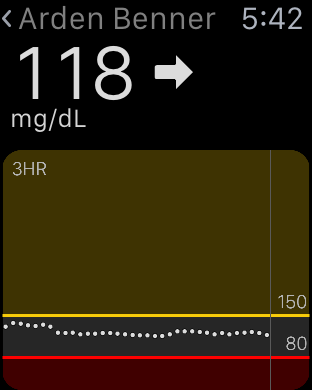
During my flight
Everything worked out as planned. I woke up early for the plane, made Arden's lunch, counted carbs and packed up her pods and insulin. My mom woke Arden up in the morning, we texted while she was getting dressed to get her BG in place for the morning. The WiFi on the plane was great but we still maintained a multi-person text message thread so Kelly could watch what was happening from London and take over if I dropped out of the thread. We bolused once or twice while Arden was at school that morning, all from 35,000 feet.
I was on the ground for Arden's lunch time pre-bolus and on a ball field when it was time to talk about her pre-bus routine. My mom cooked dinner and I pre-boluses for it. On Friday I managed Arden's BGs and mealtime insulin from my phone while Cole made the catch you'll see below. Arden changed her OmniPod during a playdate late that afternoon without incident. Kelly returned to our house around midnight and took over the diabetes stuff. I slept that night like a baby.
My Take Away...
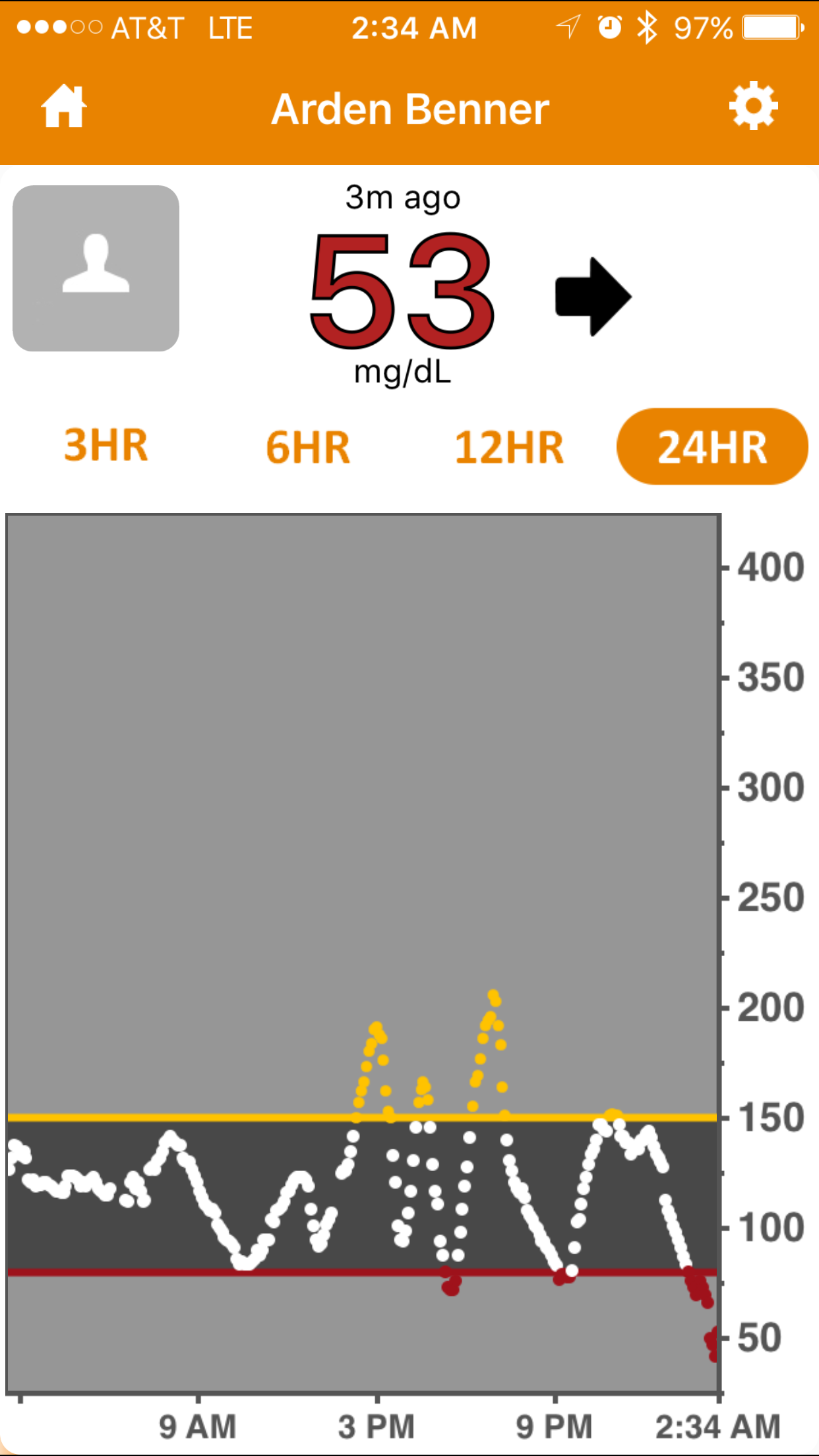
With a reasonable, but not heavy amount of pre-planning, we left our eleven year old daughter at home with a person who had almost no working knowledge of type 1 diabetes and everything was fine. Arden experienced a low BG (53 on Dex, 61 by finger stick) Thursday night around 2:30 am. My Dexcom Follow app alerted me, I called and woke up my mother who in turn woke up Arden and she drank juice as I instructed. I then waited up to make sure that the juice had the desired effect and when all was good about twenty minutes later, I went back to sleep confident that I would be alerted if something changed. In the twenty-four hour period that began at school and ended with that low, Arden's Bg was mostly stable, largely in range and only spiked to 200 twice. Two spikes and one low felt like a huge win to me.
Tomorrow night Arden goes to a sleepover at a friends house, no one in the home has the slightest idea about type 1. We will arrive ten minutes early to install the Dexcom Follow app on the mother's phone, I'll talk about how to handle emergencies and that'll be it.
Your Take Away...
Long run in centerfield. Cole saved a game while in Florida with this catch in the last inning of game 2.
I'm forever telling you that diabetes and fear do not have to go together and I wholeheartedly believe those words. Last week I put my money where my mouth is for two reasons. A. It was the right thing to do for my family and B. I wanted you to see that even in this completely odd and distant situation, things would work out.
I want to encourage you to take a chance too. Who knows, maybe you can move your life with diabetes a bit closer to where you want it to be.
I'll be talking more about this trip and other topics on next weeks episode (#34) of my podcast. If you haven't tried the Juicebox Podcast yet, it is available on this site, iTunes, Stitcher and everywhere else that podcasts are available. Subscribe today to be automatically notified when new episodes are online - It is 100% free.

Comedian Tracy Morgan Shows His Belly Exposing a Dexcom Transmitter
Tracy Morgan uses Dexcom!
Fans of comedian Tracy Morgan won't be surprised to hear that Tracy exposed his belly last week on the Emmy red carpet. But what none of us may have expected... Tracy - a type 2 diabetic - was wearing a Dexcom continuous glucose monitor.
So far I haven't found one news account that mentions his Dexcom transmitter, it seems to me that the websites are just excited to mistakenly refer to Tracy's stretch marks as, "scars from his accident". Too funny!
Added March 30, 2016: Tracey is at it again



I survived the deadliest day in Everest’s history, and I’m still surviving it
Listeners of my podcast may remember a two part conversation that I had with Elna Narula, mother of Svati Narula. Svati (a person who has type 1 diabetes) was tragically caught in an avalanche on Mount Everest and survived. Most recently Svati has published an article called, "I survived the deadliest day in Everest’s history, and I’m still surviving it" about her ordeal on Everest and I wanted to share with you.

You can read Svati's article here and listen to my conversation with her mother on the Juicebox Podcast - Part 1, Part 2.
All episodes of the podcast are at JuiceboxPodcast.com, on iTunes or your favorite podcast app.