
Floaters: Do they let kids name ailments now?
I never really talk about myself on Arden's Day. I mostly talk about the reactions, feelings and discoveries that I have related to living with type I diabetes. You may disagree and I may be wrong but either way, I'm going to talk about myself today.
I don't really get sick. I remember having bronchitis very badly once as a child, maybe around ten years old. My iron got very low once a few years ago, I ignored it forever to the point where the doctor thought I had cancer for a moment... it ended up being something very small and easily rectified. I lived for nearly a year with so little iron in my system that by the time I turned up in the doctor's office he told me, with not a tinge of joking in his voice, "I can't believe you can stand". I wasn't just standing I was getting up at all hours of the night with Arden's type 1 diabetes and still completing my tasks around the house during the day. I took the kids to sports, wrote, cleaned and did the laundry. My point is that even when my body is completely taxed... I keep going.
My experience with type 1 has taught me not to take my uncommon constitution for granted and I promised myself after the 'Iron incident' that I wouldn't ignore not feeling well ever again, if not for myself then out of respect for the lives that all of you lead.
Last week I was having a catch with Arden late in the afternoon, the sky was grey and flat and we were passing the time while Cole warmed up for his baseball game. Arden has been expanding her softball skills and she is now catching fly balls that are much higher then I imagined she'd be able to handle at her age. I noticed that when I would tilt my head up suddenly to throw the ball that translucent worm shaped images would appear in my sight and then float away. One shape looked a lot like a DNA sequence. Varied shapes, see through but visible like when they make something 'look' invisible in a sci-fi movie. I was instantly terrified. My vision has for my entire life been 20/15. I see in contrast, color and sharpness in a way that would perhaps be indefinable to a person who wears glasses. Now suddenly I was worried that I was going blind, had a tumor or ya know, cancer...
Turns out I have floaters. No, not bits of pooh that won't go down when you flush but shapes that float through your vision. The doc says that in my case they come with age (wow was that tough to hear). I know because I called and made an appointment to see him exactly fifteen minutes after I noticed the shapes. I considered ignoring it to see if it would go away but then I thought there was no way that I'd let one of my kids or Kelly ignore something like this and so I called from the baseball field.
I'm writing this long tale of basically no woe because I owe my new attitude to all of you. There may be nothing more scary then hearing bad health news about your child but you all stand up bravely and hear things far worse then floaters each and every day. I do it with my children and I wanted to take this first personal opportunity to act well on my own behalf. I must say that I was proud of myself for not turning, pardon the pun, a blind eye to my situation but I'm even prouder of each and every one of you for doing the same in far more frightening circumstances.
I don't want to link to a bunch of info that I can't substantiate as accurate but I was told that floaters can occur naturally with age or they can be a sign of something far worse and serious that can be contained if caught early enough. Please seek medical attention without delay if you experience any issues with your sight. Mine, as it is described at the bottom of this page, is never to be taken as medical advice. Always contact a doctor when your health is in question.
Now if I could just find time to sleep...











The iOS compatible iBGStar meter has arrived

Sanofi-aventis has been out in front in terms of their connection with the diabetes online community for some time now. From the DiabetesMine Design Challenge to their human presence on twitter, Sanofi is continually showing us that they are committed to being a positive part of the community.
Today with the announcement of the iBGStar blood glucose meter they've brought the first iPhone, iPad and iPod Touch compatible meter to market. Is that exciting? Damn right it is but not completely for the reasons that you may think.
I haven't used or touched the iBGStar yet so I can't tell you the first thing about how well it works but I do know two things; I believe that Sanofi is committed to helping the DOC and they would be foolish to introduce this meter before it was ready for prime time. I expect that when I do have the chance to see the meter in person, I'll be impressed.
So if I haven't used it... why I'm I writing about it?
Simple... What Sanofi has done today is bigger then a meter, what they've done is throw down the gauntlet. Much like when Apple first introduced the iPhone, the release of this product says, "no more clunky technology that looks like it's from a 1976 sci-fi movie". Prior to the iPhone our cell phones were terrible and why were they? Because the companies that manufactured them had no reason to do anything about it. We were all using our flip phones and no one was complaining. That of course didn't mean that it wasn't possible to make something better, just that it didn't make sense for the companies to put the time, money or effort into making them better. That business model worked just fine and would still be in use today if Apple didn't raise the bar.
In my mind that's what Sanofi did today, they raised the bar. In the short-term that means there is a new meter on the market that fits better into our new iPhone lives. In the long-term, well, that's where we all benefit. I'd bet that right now there are meetings going on at every device manufacturer in the country and they are all wondering what they need to do to keep up... and that's great news for all of us that live with diabetes.
If you want to read a hands-on account of the iBGStar, there are probably plenty but I'd start with Allison's over at DiabetesMine. When you finish reading her write up you'll see the names of some other great D-bloggers that were at a launch event yesterday and I bet they will have their thoughts online very soon.
If you think back to what the first smartphone looked like or even consider how much the iPhone has changed since it's launch, then you'll be as excited as I am to wonder what blood glucose testing will look like in just a few years. It's my contention that none of these advancements happen until someone goes first. So for that alone... I say, "thank you" Sanofi!
Alzheimer's and insulin resistance
This is an old article from Time Health but it raises interesting points about insulin's effect on Alzheimer's and I thought it was worth sharing.
When the body refuses to make insulin, the condition is called type 1 diabetes; when the body mismanages the hormone, it's known as type 2. Now, scientists report new evidence linking insulin to a disorder of the brain: when the brain prevents the hormone from acting properly, the ensuing chemical imbalance may help trigger Alzheimer's disease. The correlation is so strong that some researchers are calling Alzheimer's disease "type 3" diabetes.
In the body, insulin helps convert food into cellular energy. But the brain has other uses for insulin, namely as a means to learn and make new memories. Here's how it works: At synapses, the spaces across which brain cells communicate and where memories are conceived, neurons reserve special parking spots just for insulin. When the hormone pulls in, a connection is made that enables new memories to form. Since new memory formation is one of the first things to go awry in people with early stages of the disease, this insulin-initiated process may hold the key to decoding the mystery of Alzheimer's.
In August, a team of scientists at Northwestern University were the first to show why the brain's "memory function" fails in the face of an insulin shortage. The group's prior research had already pinpointed the culprit: toxic proteins called amyloid beta-derived diffusible ligands (ADDLs, for short), which are known to pile up in the brains of people with Alzheimer's. Scientists also knew that Alzheimer's patients' brains have lower levels of insulin and are insulin resistant. But what the Northwestern team discovered is the molecular mechanism behind that resistance: when ADDLs bind to neurons at synapses, they obliterate the receptors that are normally reserved for insulin. Without those parking spaces on the brain cells' surface, insulin has no place to connect, and memory fails.
"We now understand that the function of insulin at those synapses is to modulate and influence the underlying cellular structure of memories," says William Klein, professor of neurobiology and physiology at Northwestern University and a co-author of the study published online by the FASEB Journal. "What we have here is a striking phenomenon that may ultimately explain why the brains of people with Alzheimer's disease are insulin resistant and how that ties into memory."
Researchers hope these findings will help shape future research in Alzheimer's therapy — perhaps in the development of drugs that can make brain cells' insulin receptors more responsive to the hormone, or in the application of type 2 diabetes drugs, which address insulin resistance, to Alzheimer's.
The notion that Alzheimer's disease might be a neuroendocrine disorder, akin to diabetes, isn't entirely new; it first showed up in the scientific literature roughly 20 years ago, but the idea petered out. In 2005, Suzanne la Monte, a neuropathologist at Brown University Medical School, revisited the idea. Based on two of her discoveries — that the brain makes its own insulin and that Alzheimer's disease depletes insulin — she coined the disease process "type 3" diabetes.
Still, referring to Alzheimer's disease as "type 3" diabetes is controversial, especially within the diabetes community. Alzheimer's disease is a complication of diabetes, not a unique form of the disease, says Dr. Sue Kirkman, vice president of clinical affairs for the American Diabetes Association. "Nevertheless," she says, "this is primarily a semantic argument."
The terminology aside, both diseases share many traits and risk factors, including high cholesterol, high blood pressure, and metabolic disorders. So, de la Monte sees the semantic "splitting of hairs" as a good thing. "People are arguing about small parts of the bigger story," she says. "At the end of the day, these conversations will help us to better understand both diabetes and Alzheimer's disease."
Bring Your Child to Work Day 2012
My wife's company, Novartis, does an amazing job every year with Bring Your Child to Work Day, they put a lot of resources and manpower into creating an informative and fun day for the kids. This year the focus was on how products are imagined, marketed, and brought to a store near you. People from all different parts of the company spoke to the children and explained what their department did and why it was important to the process. After each "talk" the kids performed different tasks with the goal of producing a cookie that they could sell at the end of the day.
All of the proceeds from the cookie sales are being donated to our JDRF chapter so the last talk of the day was from me and Arden. We explained the difference between type I and type 2 diabetes, gave an overview of the JDRF and had a hands-on look at Arden's OmniPod insulin pump and her DexCom CGM. Insulet was kind enough to send me some non working or dummy OmniPods so that the kids could try them on if they wanted to.
The day was a wonderful success raising $1,100 for the JDRF, an amount that will be matched by Novartis 100% for a grand total of $2,200!
One of the best parts of the day was watching the kids work so hard on their cookie ideas, boxes and then seeing the hustle they all showed selling the cookies. It was while they were selling that I began to really notice all of the OmniPods on their arms and I have to admit that it was a very warming experience to see the children so enthusiastic and excepting of it. If I had enough pods I think every kid in the room would have been wearing one.
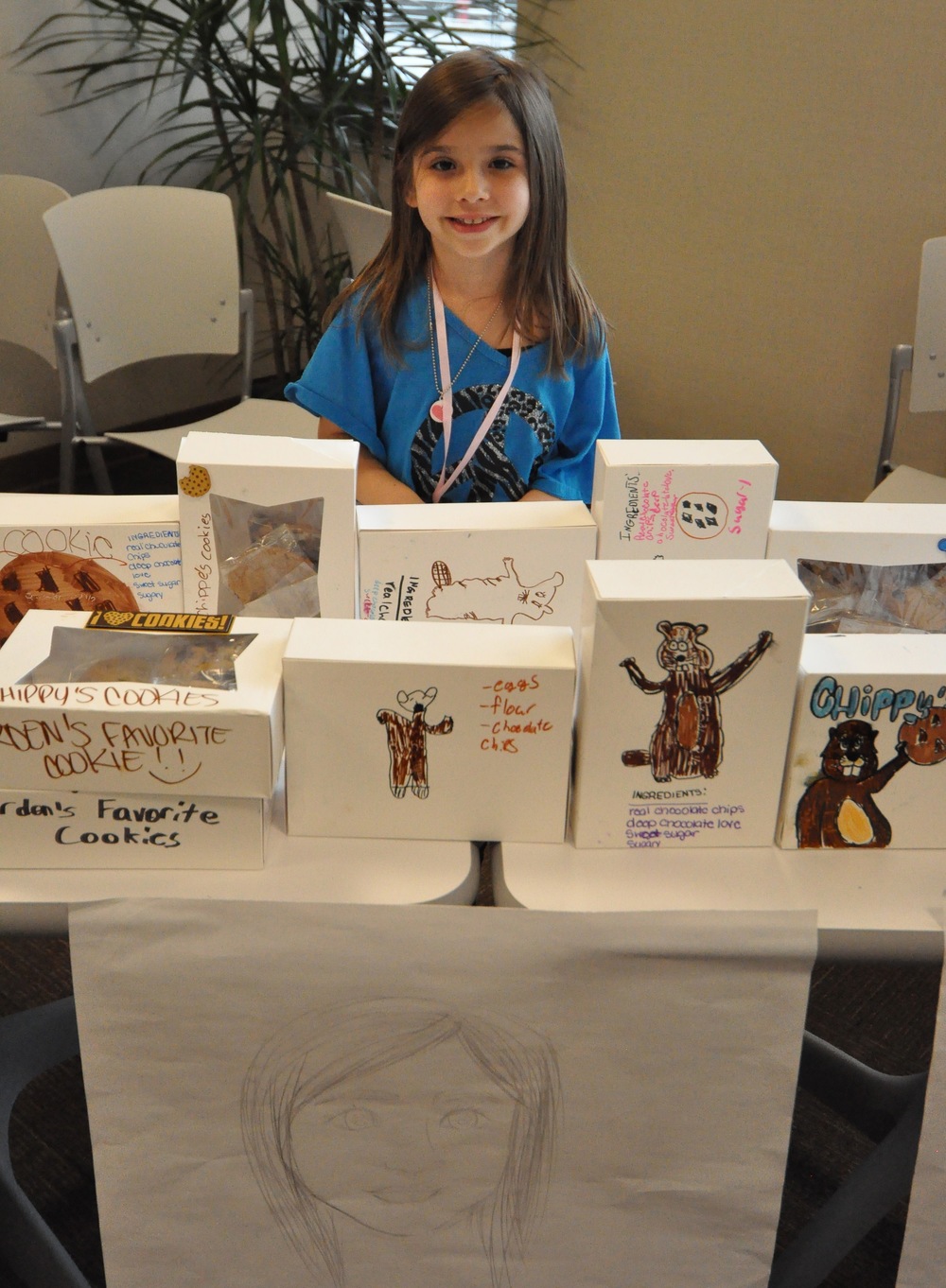
Arden and her team sold chocolate chip cookies and their marketing hook was that they had a celebrity endorsement, if you look closely at the boxes you'll see, "Arden's Favorite Cookies" on the sides.
Big thanks to Novartis, my lovely wife Kelly for suggesting that the JDRF would be a great place to send the funds collected and Insulet for sending the pods for the kids to wear.
I explained to the children that advocacy and awareness is what people with type I need the most from them and that I hoped they would tell someone about the good work that they did. I was very proud of all of them for the attention, effort and concern that they displayed throughout the day... it was a great experiance for everyone!
WDD: Hero of the week

The International Diabetes Federation is asking, "Do you know someone that is active in promoting the diabetes cause or that are engaging, motivating and leading others to take steps toward creating healthier lives". If you know someone that fits this description please nominate them at this link. There are so many "Diabetes Heroes" in the DOC, please help to get them the attention that they deserve.
I want to thank the IDF for the unbelievable pleasure that comes with being recognized by them and for the honor of being called a "Diabetes Hero". I am humbled by this distinction and I hope you can take a moment to visit their site and learn more about their amazing efforts in the diabetes community and the world.