#1839 AI and Diabetes Care with Dr. Sarah Gebauer
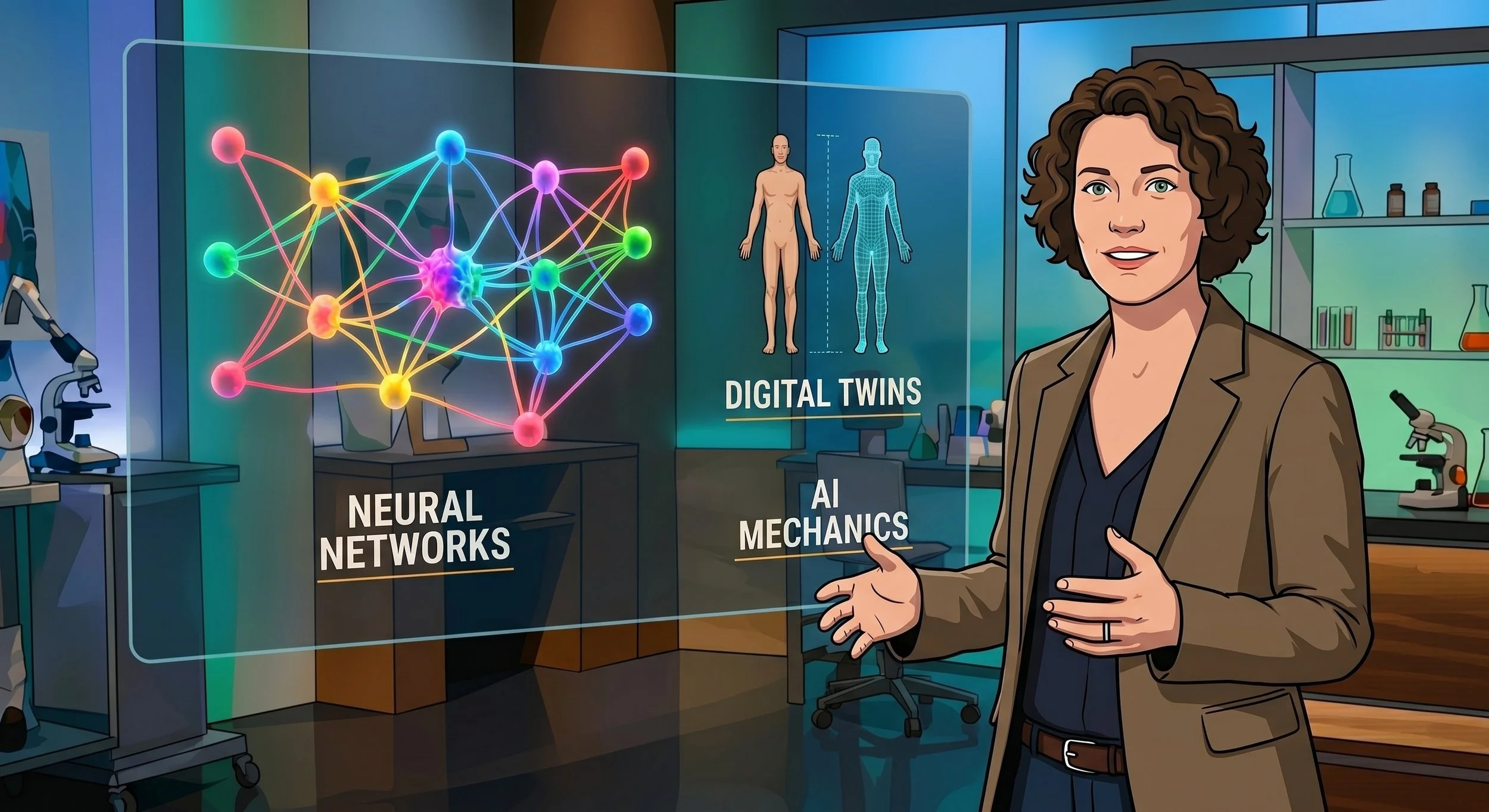
Dr. Sarah Gebauer explains the mechanics of artificial intelligence in healthcare. We discuss neural networks, digital twins, FDA regulatory challenges, and practical ways to use AI for everyday tasks.



































Key Takeaways
- The Promise of Digital Twins: Artificial Intelligence is paving the way for "digital twins," allowing medical professionals to test treatments and algorithms on a digital representation of your data before applying them to your actual body.
- AI as an Empowering Tool: Large Language Models (LLMs) and AI agents democratize technology, enabling individuals with no coding background to create powerful websites, apps, and diabetes management tools simply by using natural language.
- Regulatory Challenges with Medical AI: Because generative AI is probabilistic (producing the most likely answer rather than a guaranteed deterministic outcome), regulatory bodies like the FDA struggle to approve constantly adapting, individualized diabetes algorithms.
- Responsible Health Advocacy: While groundbreaking trials (like the Eladon trial utilizing islet cells and Tego) show great promise for functional cures, it's vital to communicate these advancements responsibly, avoiding misleading social media hype that frames them as imminent, widespread cures.
- Prompt Engineering is a Learnable Skill: Getting the most out of AI (like Claude or Gemini) requires practice and "pre-bolusing" your tasks—giving the AI context and asking it to help refine its own instructions before generating the final output.
Resources Mentioned
- Contour Next Gen: contournext.com/juicebox
- Cozy Earth (Use code JUICE BOX for 20% off): cozyearth.com
- US Med: usmed.com/juicebox or call (888) 721-1514
- Wrong Way Recording: wrongwayrecording.com
- Juicebox Podcast & Juicebox Docs: juiceboxpodcast.com
- Juicebox Podcast Private Facebook Group (Type 1 Diabetes on Facebook)
Introduction
Scott Benner Here we are back together again, friends, for another episode of the Juice Box podcast.
Sarah Hi. (0:15) I'm Sarah Gibauer. (0:16) I'm an anesthesiologist and also the mom of a type one diabetic kid. (0:21) I get to do all kinds of cool stuff with AI, and I'm thrilled to be back here today, talking about AI stuff, which is what I do when I'm not in the operating room.
Scott Benner If this is your first time listening to the Juice Box podcast and you'd like to hear more, download Apple Podcasts or Spotify, really any audio app at all. (0:41) Look for the Juice Box podcast, and follow or subscribe. (0:44) We put out new content every day that you'll enjoy. (0:48) Wanna learn more about your diabetes management? (0:50) Go to juiceboxpodcast.com up in the menu and look for bold beginnings, the diabetes pro tip series, and much more. (0:57) This podcast is full of collections and series of information that will help you to live better with insulin. (1:06) If you're looking for community around type one diabetes, check out the Juice Box Podcast private Facebook group. (1:12) Juice Box Podcast, type one diabetes. (1:15) But everybody is welcome. (1:17) Type one, type two, gestational, loved ones, it doesn't matter to me. (1:22) If you're impacted by diabetes and you're looking for support, comfort, or community, check out Juice Box podcast, type one diabetes on Facebook. (1:31) Nothing you hear on the Juice Box podcast should be considered advice, medical or otherwise. (1:36) Always consult a physician before making any changes to your health care plan or becoming bold with insulin.
Sponsor Messages: Contour Next Gen, Cozy Earth, and US Med
Scott Benner This episode of the juice box podcast is sponsored by the Kontoor Next Gen blood glucose meter. (1:52) Learn more and get started today at kontoornext.com/juicebox. (1:59) Today's episode is also sponsored by Cozy Earth. (2:03) You can use my offer code juice box at checkout to save 20% off of your entire order at cozyearth.com. (2:11) Everything from the joggers that I'm actually wearing right now to the sheets I sleep on, the towels I use to dry myself with, and whatever else is available at cozyearth.com. (2:22) Just use the offer code juice box at checkout. (2:25) The podcast is also sponsored today by US Med. (2:29) Usmed.com/juicebox or call (888) 721-1514. (2:38) US Med is where my daughter gets her diabetes supplies from, and you could too. (2:43) Use the link or number to get your free benefits check and get started today with US Med.
Sarah's Background and New Book on Long-Term Travel
Sarah Hi. (2:50) I'm Sarah Gibauer. (2:51) I'm an anesthesiologist and also the mom of a type one diabetic kid. (2:56) I get to do all kinds of cool stuff with AI, and I've worked in hospitals, clinics, all kinds of settings, professionally, and then also gotten to interact with the health care system. (3:07) We've traveled as a family to more than 50 countries now around the world over the last four years, and I'm thrilled to be back here today, talking about AI stuff, which is what I do when I'm not in the operating room.
Scott Benner You and I recorded together already. (3:21) I'm trying to decide if your episode came out or not yet.
Sarah I don't know if it did, actually. (3:27) Well, exciting news with that also is that I have written a book on traveling long term with kids, and there is there are some sections in there on traveling with diabetes specifically. (3:37) So, yeah, I just thought it would be great to help empower some of the families that I meet to to travel long term. (3:46) You know, as I mentioned, it's we say that it's for our kids, but it's really for my husband and me because we love forcing them to spend time with us. (3:52) And I used to talk to a lot of other parents who are interested in doing something similar, but it just seems too huge and unmanageable. (3:59) So the book is really trying to break that down and to, help people feel like it's something that they can do easily.
Scott Benner I I don't know, Sarah. (4:06) I feel like you're just on here to make me feel bad. (4:08) Like, you're she she said I said before before we started, I said, sir, do you have exactly an hour? (4:14) Do we have extra time? (4:14) She says, well, I have to be in surgery later. (4:16) And then and then five seconds later, you're like, oh, I wrote a book. (4:19) You just wrote a book? (4:20) Why alright. (4:21) Let's start with that real quickly. (4:22) Why did you like, how does that happen? (4:24) How do you say to yourself, I'm gonna write a book, then you actually accomplish it? (4:27) Is it published, or is it self published, or what is it?
Sarah Yeah. (4:30) It's self published, and it'll be coming out formally at the end of this month. (4:34) So we'll do a launch then, and we'll I'll let you know, when that happens. (4:39) But, you know, we we talk to a lot of people who who have kids and always say, oh, I would love to do something like that, but we just never quite got around to it. (4:49) And what really stuck with me was one one surgeon that I talked to said, you know, we always said, oh, that would be so great. (4:56) We should do that. (4:57) And then we just never did it, and now my kids are too old. (5:00) They're in college, and we're never gonna get the chance. (5:03) And I just wanted to help people feel like it doesn't have to be as complicated as it as it might seem. (5:10) This is something you can do. (5:11) It's totally manageable. (5:12) You're a parent. (5:13) You do complicated things all the time. (5:15) This is something you can figure out and not and help people not be left with that kind of sense of, oh, shoulda, woulda, coulda. (5:22) And then at some point, it is. (5:24) You know, your kids are old. (5:25) They have their own lives, their own things that are happening. (5:27) And if there is a window that you can do this kind of travel and these kinds of experiences and adventures with your kids more easily.
Scott Benner So And even though Sarah doesn't know it because she's too busy to listen to my silly podcast, her episode is 1,617. (5:41) It's called 50 countries with diabetes.
Sarah Wonderful. (5:44) I will check it out.
Scott Benner Yeah. (5:46) I love that you didn't listen to it. (5:47) Alright.
Sarah I'm sorry. (5:49) I I honestly, I usually run-in silence. (5:52) I almost never listen to podcasts these days. (5:54) I, do listen to Buddhist meditation while I run. (5:58) That's
Scott Benner okay. (5:58) Hey. (5:58) Listen. (5:59) Don't give those peep the people listening that idea. (6:01) You you
Sarah have I'm sorry.
Scott Benner No. (6:02) You have to be listening to podcasts when you're doing stuff. (6:04) You can't be in silence. (6:06) No. (6:06) Never silence.
Sarah Right. (6:08) But
Getting into AI and Neural Networks
Scott Benner when when you and I were talking last time, it kind of came up that you had an understanding about how AI was working. (6:16) And so why don't you explain to people first, like, how it is you have that understanding, and then we're gonna move forward and talk about some things specific to AI and diabetes.
Sarah Yeah. (6:26) So, actually, during one of our big family trips, it was the first time that I hadn't worked full time since I was, you know, or gone be you know, been in school since I was, you know, tiny. (6:38) And I really got interested in AI and just mostly how you can teach a computer how to understand language. (6:44) I just found that really fascinating. (6:46) And this was kinda in 2022 before the big leap with ChatGPT and and and the neural networks really started. (6:54) So I taught myself all about it, everything I could. (6:57) I watched videos because I'm a huge nerd, from Stanford and MIT and read computer science textbooks. (7:03) I already knew how to code from some previous work I'd done. (7:06) And then just talk started talking to people about what are they doing and what are they interested in and then started, writing a a substack on health care AI. (7:14) And, since then, have written that steadily and formed a group of physicians interested in health care AI. (7:20) And and then a few years ago, started working at Rand, which is a large think tank in The US doing AI model evaluations for national security risk. (7:28) So really trying to look at, you know, how would we know if some of these frontier models created new kinds of risks for biosecurity? (7:36) And if they do create them, what kind of mitigations different kind of mitigations might be needed to help decrease those risks? (7:43) So and then transitioned to doing more of a health care focused AI evaluation and governance role in a new company that I started, at the beginning of this of last year.
Scott Benner So I help hospitals and hospitals. (7:56) An anesthesiologist too. (7:57) Right?
Sarah Yes. (7:58) While I'm traveling
Scott Benner And traveling all the time.
Sarah Yeah. (8:02) I like to I I like variety, it turns out.
Scott Benner I think I'm it's possible I'm the only podcast host who sits holding in a laugh while someone's explaining something that impressive because I just wanna laugh. (8:14) I'll be like, why are how are you doing all of this? (8:16) I'm just like, I'm still stunned by we're gonna get past that part because I wanna get to the AI thing. (8:21) I like how you went from, like, I found it interesting how you could teach a computer to blah blah blah. (8:26) And then you were like, and then I did this and that and started a business, and I worked for the government. (8:29) I don't I'm like, holy you feel like a spy. (8:31) You're not a spy. (8:32) Right, Sarah?
Sarah I am not a spy. (8:34) Although sometimes when we traveled to, you know, very far flung pit places, I got a little nervous when, you know, they were, know, looking through my laptop and such just because, you know, you don't want people to get the wrong impression of what is actually happening.
Scott Benner Oh my gosh.
Sarah Well, you you
Scott Benner I love you. (8:52) I swear. (8:53) I I think I think you'd be disgusted with me inside of thirty five minutes if we were in the same room together, but I think you're fantastic. (8:59) So so explain this to me. (9:01) You sent me a little list that I'm thrilled to have gotten, for our conversation today, and you kinda broke it down to bullets. (9:06) I wanna just follow your bullet points. (9:08) Like Okay. (9:09) So let's lay it out for people and explain to them where it's already being used and how it might be used in the future. (9:15) I'm gonna talk a little bit about how I use it interspersed in inside of the conversation. (9:20) But I think mainly, the general public has, as far as I can tell, either a really, like, kinda harsh reaction to the words, you know, when somebody says artificial intelligence or they're just, like, too Pollyanna about it when they talk about it. (9:37) I don't really hear anybody talk about it, I think, thoughtfully in common conversation is my point. (9:43) Does that make sense?
Sarah Totally. (9:46) Yeah. (9:46) And I think I think there are a lot of reasons for that. (9:50) And one of them is that I don't think the AI community has done a good job of explaining what AI is because we all have been using AI for a long time.
Scott Benner Mhmm.
Sarah AI is in everything now, but for diabetes, for example, it has been for a long time anyways. (10:07) AI is kind of a a big circle, and and within that is a a small circle, which machine learning is in there too. (10:16) Machine learning is old, and that's, you know, kind of looking at data and predicting patterns and that kind of technology. (10:25) That is actually encompassed within the the umbrella of AI, generally. (10:29) Mhmm. (10:30) What is new is neural networks. (10:32) And those most ML, to find a pattern, you would kinda say, these are the things that we think AI, these are the things that we think might predict a pattern. (10:42) So, you know, kinda look in the data, say, okay. (10:45) This seems more related. (10:46) This seems less related. (10:48) This is how we can kinda group these things together. (10:51) What neural networks can do and what's really exciting is it can look at a huge, huge amount of data and find patterns and synthesize that information. (11:01) And it doesn't have to be told this is where the connections might be. (11:05) It can find those connections on its own. (11:07) And so, you know, it is superhuman in that way. (11:10) And I think there's this, you know, there's this tension between as we know, AI is great at some things and terrible at other things. (11:19) So AI is already superhuman at doing a lot of things, like finding patterns, as I mentioned. (11:24) But, also, when I was an undergrad, I did chemistry research on protein folding. (11:30) And it would take months and months to figure out how to how a protein actually folded in real life. (11:37) And this was a this was a huge task. (11:40) And AI now, with the help of John Jumper, who won the Nobel Prize a few years ago in chemistry, and the team at Google DeepMind found a way to figure that out within minutes. (11:51) So that used to be this huge problem in chemistry, and now it's not a problem. (11:55) Now it's completely defined. (11:56) It's completely solved. (11:57) I mean, obviously, there are a few outliers, but that kind of ability, I think, makes people both excited and nervous. (12:06) But then in other ways, you know, until very recently with AI, couldn't the chatbots were not able to count the number of r's in Strawberry. (12:15) People might have might have seen some of some of those online as well. (12:19) You know, it just if you asked it how many r strawberry had in it, it would just get a wrong wrong answer over and over and over. (12:26) So and it's still you know, to me, it still can't book a flight. (12:30) So, you know, if it can't book a flight, it's, you know, it's not that superhuman.
Scott Benner Is it not gonna pivot again though? (12:38) Because that I listen. (12:39) I'm gonna say a lot of names. (12:40) I don't I don't know this guy's name. (12:42) So there's a guy who's been huge in this space, took a break, came back, and then coded a a claw bot or something like or claw bot or something, and then didn't chat GPG just hire him? (12:53) Like, it aren't we getting towards agents that work for you?
Midroll Sponsors: Cozy Earth & US Med
Scott Benner Friends, I just placed my order at cozyearth.com. (13:01) They're today's sponsor, and I'm here to tell you about them. (13:04) Use my offer code juice box at checkout when you buy, and you'll save 20% off of your entire order. (13:10) That's everything in your cart at cozyearth.com. (13:12) Save 20% with the offer code juice box. (13:16) Now why am I excited? (13:17) Well, I just ordered the Cozy Earth blanket. (13:21) It's the viscose bamboo blanket. (13:23) I'm super excited about it. (13:25) It looks comfy as can be, and it's gonna go so well with the sheets that we already have from Cozy Earth. (13:30) Now, yeah, I'm a bit of a a Cozy Earth convert, I guess. (13:34) I'm sitting here in my joggers. (13:36) I used my towels coming out of the shower this morning. (13:39) I slept on my sheets last night. (13:40) Slept like a baby, by the way. (13:42) Cozyearth.com. (13:44) They pretty much have everything you want. (13:46) Use the offer code juice box to save 20% at checkout on skin care, women's and men's clothing, bath and sleeping accessories. (13:55) And don't forget, Valentine's Day is coming up quickly. (13:58) Get those pajamas. (13:59) Cozyearth.com. (14:00) Use the offer code juice box at checkout to save 20% off of your entire order.
Scott Benner I used to hate ordering my daughter's diabetes supplies. (14:10) I never had a good experience, and it was frustrating. (14:13) But it hasn't been that way for a while, actually, for about three years now because that's how long we've been using US Med. (14:21) Usmed.com/juicebox or call (888) 721-1514. (14:30) US Med is the number one distributor for Freestyle Libre systems nationwide. (14:35) They are the number one specialty distributor for Omnipod Dash, the number one fastest growing tandem distributor nationwide, the number one rated distributor in Dexcom customer satisfaction surveys. (14:47) They have served over 1,000,000 people with diabetes since 1996, and they always provide ninety days worth of supplies and fast and free shipping. (14:57) US Med carries everything from insulin pumps and diabetes testing supplies to the latest CGMs, like the Libre three and Dexcom g seven. (15:07) They accept Medicare nationwide and over 800 private insurers. (15:12) Find out why US Med has an a plus rating with the Better Business Bureau at usmed.com/juicebox, or just call them at (888) 721-1514. (15:24) Get started right now, and you'll be getting your supplies the same way we do.
AI Agents and Transforming Workflows
Sarah Yes. (15:29) We're getting a lot closer. (15:31) So the technology is improving so quickly, and that's one of the issues that I think is important to talk about today too is what is out there and what can be done is not the same as what's being done in the health care field. (15:46) Because health care is so understandably conservative and risk averse, a lot of what is possible is not takes years to translate that just because of the systems we have with the FDA and devices and and all those concerns, which are there for a very good reason. (16:04) It is making it hard for them to regulate AI in a meaningful way. (16:08) As you mentioned, there's agents are the future. (16:11) Already, most of the AI that you use is an agent. (16:15) Yeah. (16:15) Meaning that it has and do you think people should I define the term agent?
Scott Benner Go ahead. (16:20) Yeah, please.
Sarah Okay. (16:21) So an agent is basically a brain. (16:23) So think of it as a a little brain who has that has access to different tools. (16:28) And tools might be something like the Internet. (16:31) The Internet could be a tool. (16:33) The instructions on how to create a PowerPoint might be a tool. (16:36) Instructions on how to book a flight in the future might be a tool. (16:40) So it has kind of all these different contexts and tools that it has access to. (16:46) So it can decide for any given question or task, which of these tools should I use to do that either alone or together? (16:56) And then how can I put those together to make a good output?
Scott Benner Mhmm.
Sarah So when people talk about agents, it's really it's often a compilation of different AI tools that are being controlled by a central AI tool.
Scott Benner Okay.
Sarah Does that make sense?
Scott Benner It does. (17:12) Actually, I'm I guess, somewhat unironically, I have an agent scraping a Facebook post for me right now. (17:20) Mhmm. (17:20) Like, so I put up questions to explain to people what one of the ways I use it. (17:26) I will put up a question that I'm trying to crowdsource how everybody feels about something. (17:31) Been doing this for years and years and years. (17:33) Right? (17:33) What are your I have a an exhaustive list, for example, of, like, what people's struggles are with type one diabetes. (17:39) We created the entire grand round series off of a 90 page document that asked people the question simply, what do you wish someone would have said to you at diagnosis? (17:48) What do you wish someone would not have said to you at diagnosis? (17:51) And
Sarah Wow.
Scott Benner We used to just put up the post and then get all the responses back, and then Isabelle would take all of those responses, read through them, collate them, say, oh, this one and this one are the same. (18:04) She'd kinda put them together. (18:06) She did that all for me in the background. (18:08) Now I send an agent to a post. (18:10) It scrapes it out, and then I have it do that. (18:13) It takes about, like, ten minutes maybe.
Sarah And Isn't it amazing?
Scott Benner Yeah. (18:18) Yeah. (18:19) No. (18:19) It's it's absolutely fantastic. (18:21) And I'm 54. (18:23) I don't know how old you are. (18:24) I'm sorry.
Sarah Forties. (18:25) Yeah.
Scott Benner Oh, you're in your forties. (18:26) Okay. (18:27) When I look at computers right now and I look at all this, I go, this is what was promised to me when I was a kid. (18:32) And Right. (18:33) So when I look up and I see people scared about it, I'm like, alright. (18:36) I get that everybody thinks the Terminator's gonna come and, like, step on your skull and everything, like and and that might and all I could say to that is is, like, maybe, but we could get there in a lot of different ways. (18:46) If we can get through this and make it work for people, I think it's gonna be magical in what it does. (18:53) Like, is it gonna change the job market? (18:54) I'm sure it will. (18:55) Like, I mean, because listen. (18:57) I don't really talk about it a lot, but this podcast is huge. (19:02) I run it completely by myself.
Sarah That's amazing.
Scott Benner I don't have a marketing team. (19:07) I don't have a writer. (19:08) I don't the Rob edits the audio. (19:10) But, I mean, like, the rest of it, like and I used to do that too, by the way. (19:13) It's just I didn't sleep much. (19:15) So and so, like, you know, all the things that I accomplish in the course of a day are are weeks' worth of work. (19:24) Or you say, well, you could have hired somebody, but no. (19:26) I could not have hired somebody. (19:28) I don't have that kind of money. (19:29) I couldn't have done that. (19:29) So it just would not have gotten done. (19:32) And it's I don't know. (19:33) It's it's just really fantastic. (19:35) And when people think about it in their diabetes technology you said something that I I meant to get back to. (19:40) I'm sorry. (19:41) I'm pivoting. (19:41) But you were like, health care is risk averse, but there's something specific about it. (19:47) Right? (19:48) Like, I forget I'm I'm a little messed up here because I don't have all my words that I need. (19:52) But in health care right now, give people examples of where AI is being used right now in their diabetes technology, then I'll ask my question. (20:00) I'm sorry. (20:01) Go ahead.
Sarah Well, first, I wanna say how amazing it is you're able to do all of this on your own. (20:07) I can't imagine how much work that is.
Scott Benner It's just every moment I'm awake. (20:12) That's all. (20:12) And
Sarah Well, that's all it is. (20:15) It's all your time. (20:16) And, and that is I mean, I I hope that as the agents get better and you can offload even more work to them, you know, which I find myself doing, you know, every few months, there there seems to be a meaningful improvement in in what the agents can do. (20:33) And I find myself offloading more work to them on a regular basis. (20:39) So I
Scott Benner My goal is to have an agent who's thinking about the podcast the way I am right now and telling other agents what to do.
Sarah Yeah. (20:46) I think that is actually possible now.
Scott Benner Yeah. (20:48) But that's that's where I'd like to be because I have a plan. (20:51) I know how I run my day and my week. (20:53) If something else was, like, overseeing that, that would be a big deal. (20:57) Then I could actually sit down and, like, you know, read my emails not once a month or once every two months. (21:03) I could actually do it, you know, every couple of days and have, like I could do more human things, I guess, is what I'm talking about.
Sarah Exactly. (21:10) And I think that's the promise. (21:11) I think that we are all so used to, you know, the minutiae of using computers. (21:19) You know, computers were supposed to speed us up, and I think, you know, a lot of times we ended up adapting to the computers instead of the computers truly adapting to us.
Scott Benner Oh, a 100%. (21:28) Computers just cause different busy work.
Sarah Yes. (21:30) That's it. (21:31) Yeah. (21:32) I mean, how many, I mean, I've created many, many PowerPoint presentations in my life. (21:37) Moving a text square from one side of this of a, you know, PowerPoint to the other side, is just not a meaningful use of my time in any situation. (21:47) And the fact that now AI can produce beautiful PowerPoints in, you know, thirty seconds that are are very nice and actually make sense, I mean, to me, that's a meaningful improvement.
Scott Benner Sarah, I recoded my entire website over the weekend. (22:02) Yes. (22:02) I don't know anything about coding.
Sarah Right.
Scott Benner Yeah. (22:06) My website is so much better than it was on Friday. (22:11) I completely changed the search. (22:14) Like, right now on the front page, there's the last four episodes of the podcaster right in front of you. (22:19) You can arrow through and go back, I think, through, like, the last 30. (22:22) You wanna listen online, most people don't listen online. (22:25) There's a search audio. (22:26) If I just type in 1617, your episode is in front of me now. (22:30) I can click on it.
Sarah I see.
Scott Benner Go listen to it in Apple or in Spotify or, you know, right here. (22:35) If I wanted to type it into a different search box, 1617, now it searches the website. (22:40) It takes me right to the web page that I created for your episode. (22:45) There's now a beautiful menu on the side that lists out the guides and the estimators, the series, the collections, different links in the site. (22:53) Like, I completely remade juiceboxdocs.com, which is a website website where you guys can send in, like, great doctors that you use. (23:01) It's now searchable. (23:03) It now tells you if the if the doctor has type one. (23:06) You can search by that. (23:08) You can submit your own doctor, which used to go into my inbox. (23:11) Then I had to sit down and then go in and make a text box on the web page and recreate that. (23:16) Now it goes into a, Google Doc somewhere where someone looks over it with human eyes and then slides it into the other page of the Google Doc and it appears on the website. (23:26) Right?
Sarah It's amazing. (23:27) Right.
Scott Benner Not only that, but you can click on a phone number when you're in there, call the doctor, go to their website, launch a Google Map for it. (23:35) Have you ever heard me talk on the podcast about, I don't really understand what the podcast does for people? (23:41) I make it, and I know it helps them because they tell me, but I'm trying to figure out functionally what does that mean. (23:48) Like, if I if I told you to sit down and be me, what is it I'm doing? (23:52) I know that maybe is sort of existential, but I realized I was never going to figure it out exactly. (23:59) So I just loaded in all of my transcripts, and I asked AI, and it explained to me why people interact well with me.
Scott Benner The Kontoor Next Gen blood glucose meter is sponsoring this episode of the Juice Box podcast, and it's entirely possible that it is less expensive in cash than you're paying right now for your meter through your insurance company. (24:22) That's right. (24:22) If you go to my link, contournext.com/juicebox, you're gonna find links to Walmart, Amazon, Walgreens, CVS, Rite Aid, Kroger, and Meijer. (24:34) You could be paying more right now through your insurance for your test strips and meter than you would pay through MyLink for the Contour Next Gen and Contour Next test strips in cash. (24:46) What am I saying? (24:47) MyLink may be cheaper out of your pocket than you're paying right now even with your insurance. (24:54) And I don't know what meter you have right now. (24:57) I can't say that. (24:58) But what I can say for sure is that the Kontoor Next Gen meter is accurate. (25:02) It is reliable, and it is the meter that we've been using for years. (25:06) Contournext.com/juicebox. (25:10) And if you already have a contour meter and you're buying test strips, doing so through the juice box podcast link will help to support the show.
Sarah How? (25:19) What did it say? (25:19) I'm so curious. (25:20) I mean, I have some ideas, but I I'm curious what the AI thought.
Scott Benner I'll pull that up, and we can talk about it at the end. (25:24) Okay? (25:25) Okay. (25:25) Okay.
Sarah Great. (25:26) And and then I just wanted to pull out one other thing that you said. (25:29) You said it allows you to do human things. (25:31) It allows you to do human things, and it does things that wouldn't have been able to do otherwise.
Scott Benner Absolutely.
Digital Twins and the Future of Medicine
Sarah And I think that is really what we're trying to get to with AI, and I think it really directly applies to a lot of the diabetes pieces as well. (25:44) Because, really, what we are trying to do, and think what we're moving towards with diabetes, is that we're able to analyze data in a way we never were before. (25:54) We're able to, do precision medicine and individualized medicine in a way that was never possible previously. (26:02) And then we're able to figure out how well things work in a way that no human would have been able to.
Scott Benner Mhmm.
Sarah So I think that's the that's the hope. (26:13) So kind of big picture, what AI is doing now, you know, I think we all know that, you know, the closed loop predictions, the predictive technology, that's all AI, technically. (26:27) It is older AI for the most part. (26:31) It's mostly mostly ML, which is the older kind of AI technology. (26:36) We are going to see more personalization, more things like exercise prediction, better dosing. (26:43) And then pretty soon, we're gonna start seeing digital twins, and AI that can, really be more close to you. (26:52) And then I think also looking at, larger population health and trying to figure out better ways to predict diabetes as a whole and predict things that influence care and improve care.
Scott Benner So Talk a little more about what digital twins means.
Sarah Yeah. (27:09) Great question. (27:10) It sounds really bizarre and scary, I think. (27:15) But what it really is is it's a digital version of all the data we have about you. (27:24) So that would be things like, you know, diabetics have so much data about them that most people don't have. (27:32) You know, that just even if you only look at the glucose monitors, you know, you can you can guess at what was happening during multiple points of the day. (27:40) And then if you add, you know, test results and other pieces of data in there, you basically have a version of yourself that is just a whole bunch of data, and that is a digital twin. (27:55) The advantage of that is you, maybe now, but in the future, the thought is that you can try stuff on the digital twin before you try stuff on the real person. (28:07) And that, hopefully, the digital twin has enough data to be a realistic representation of you and how your body will respond. (28:14) And that way, you know, really, what we've been doing for a long time is more or less experimenting and being like, well, here's I mean, as a doctor, I could say this. (28:23) We give somebody medicine. (28:24) We say, alright. (28:26) Well, you know, it works for a lot of people. (28:28) It doesn't work for some people. (28:29) You know? (28:30) I hope it works for you. (28:31) And the hope is that with more digital twins and more data about people, we'll be able to make much better predictions about what kind of treatment, what kind of therapies will be most efficacious for different subsets of people and even for different specific people, which really is the change. (28:48) K. (28:49) Already, I'm getting alerts in my my medical inbox when I prescribe something saying this person has, has had testing for a specific enzyme, for example, that speeds up the metabolism of certain kinds of medicines. (29:02) And so if you prescribe this, you know, either you want to avoid prescribing it depending on what the medicine is, or if you prescribe it, it may not work as well, or it may take longer to get out of the system. (29:14) So already, we're seeing a little bit of that, but that's just one data point, really. (29:18) That's just that one lab test. (29:20) What I'm talking about is having the whole set of all the data points of you and being able to test things on you before it actually gets to the person themselves to make sure it actually will work.
AI for Diabetes Calculators & FDA Regulation
Scott Benner Because we have all the data already. (29:32) It just doesn't That's it. (29:33) It doesn't do anything. (29:34) See, I'm I'm overwhelmed with that idea right now that I've recorded 1,800 plus episodes and that if you kind of colloquially talk about it, people say, oh, I listen to the podcast and my a one c goes down, which means that the answers to your issue are in there somewhere. (29:52) And so if they're in there, but they have to come out conversationally, isn't there a way to, like, pick through them and distill it even more? (30:00) Right? (30:00) Like, so the podcast is great for people who enjoy conversationally listening to something that they want long form talking. (30:07) Right? (30:08) But some people just don't want that. (30:10) And some people will tell me I've listened over and over again, and and nothing's happened to my a one c.
Sarah Interesting.
Scott Benner They just don't learn the same way. (30:17) Right. (30:17) So when you know it feels like there's a big dark room and all the answers are in it, but I don't have a light. (30:22) I can't turn it on. (30:23) And even if I could turn it on, what I would find is millions and millions and tens of millions of words that have to be gone through to figure out what is valuable and, you know, and what isn't. (30:34) And and I've been thinking about that for years, and now all of a sudden, it's like, it's right here. (30:39) I tried to service the other day. (30:40) I don't think it's quite ready for prime time where you load all of them in. (30:43) You can just talk to just, like, you basically create a large language model of just the transcripts. (30:49) Mhmm. (30:49) So it's only going to that. (30:51) It's close. (30:52) It didn't do a bad job, but the engine was like GPT four, and it just wasn't quite right.
Sarah Right. (30:57) Yeah.
Scott Benner I thought, okay. (30:58) This company, like, if they keep doing this, hopefully, they'll stay in business or somebody else will figure it out. (31:03) And maybe, you know, a couple of years later. (31:05) But then you immediately run into the problem of you have to give somebody a prompt, and then they have to ask it the right question to get the answer out of it, which is unlikely. (31:14) Like, that's probably not going to happen. (31:16) Right. (31:17) So then the the model needs to be able to already know your questions even if you don't know them so that it can serve you the information. (31:25) But I'm telling you that before I'm done, there is gonna be a prompt. (31:28) Juiceboxpodcast.com is gonna be a prompt when I leave. (31:31) It's gonna have questions that are that you don't even know to ask. (31:35) You're gonna click on them, and it's gonna tell you the answers. (31:38) And that's gonna be that. (31:39) But the problem becomes there is, like, what if someone types into the prompt, my insulin to carb ratio is this, my sensitivity is that, I'm about to eat 50 carbs, blah blah blah. (31:52) What's the what should I bolus? (31:54) There's enough conversation inside of the podcast to answer that question.
Sarah Right.
Scott Benner And then that becomes a class two medical device.
Sarah Well, the FDA just came. (32:05) The f FDA just, loosened the rules.
Scott Benner You thought they
Sarah loosened them? (32:09) Well, they they said they weren't gonna take any action with with Chad or Claude on health care advice.
Scott Benner Perfect. (32:19) Because I have a an estimator. (32:22) I have to call it an estimator on my website where you put in just your weight, and it gives you starting settings for everything. (32:31) Wow. (32:32) Because what I figured out one day is I was watching I I went into the office. (32:37) I was talking to the practitioner, and I said, you know, I think Arden settings are messed up. (32:41) Like, I don't really you know, I'm not I'm not sure, like, kind of, like, where to, like, reset them spec way before I knew what I was doing. (32:47) And she just said, how much does she weigh? (32:49) And I told her, and then she pulls out a piece of paper, and she's writing, and she's scribbling and scribbling and writing and talking and blah blah blah. (32:56) And then I you know, over conversations with Jenny, I realized that there's you know, there are prescribed calculations they do off of your weight to give you starting settings for everything, carb ratio, basal sensitivity, the whole thing.
Sarah Oh, wow.
Scott Benner And so I was like, oh, okay. (33:12) So I'll, like, find out what that math is, and then I'll just put it all together in one place. (33:18) And I put it together, and I was like, okay. (33:21) Now this is a tool. (33:22) I can't put a tool up there. (33:23) You can't type your weight in because then it's a diagnostic tool. (33:28) But if I put a slider up there and call it an educational tool and you get to pick a weight just to see what happens to the settings, it's not my fault if you pick your own weight. (33:37) But that kind of stuff is ridiculous. (33:40) Like, you go do you know what I mean? (33:41) Like, because everyone should have access to being able to reimagine their settings like that. (33:48) That shouldn't be a big deal, I don't think. (33:50) They it doesn't say that the settings are perfect. (33:52) If your basal set at 1.5 an hour because you don't bolus for your food well and your doctor just keeps pushing your basil up and over basils you, and you could, like, learn one day, like, oh gosh. (34:04) You know what? (34:05) It seems like my basil should be more like one an hour. (34:08) And my carb ratio is wait. (34:10) One unit covers 15. (34:12) I've had it as one unit covers, you know, the wrong thing the whole time. (34:16) Like, it would give you a place to kinda start over again. (34:20) And I just think that that if you could then spend a little time getting your settings together, then go to the other estimator where you can put your settings in, the carbs, the fat, the protein of what you're eating, and it breaks out exactly how a bolus would look. (34:33) Is that not what we want for people? (34:35) Like, do you know what I mean? (34:36) Like, that's so I'm glad to hear that you feel like they loosened it up because
Sarah Yeah. (34:41) Yeah. (34:42) They basically said and what a first of all, what an amazing tool, and I can't imagine how helpful that is and will be for for so many people. (34:51) I mean, just having these kind of resources
Scott Benner Yeah.
Sarah That are on your website, especially you know, I remember, you it wasn't so long ago, I guess, four four or five years ago that I was just starting out as a a type one diabetes mom. (35:03) And even with all the medical education and knowledge that I had, it was still completely overwhelming to figure out, you know, what you should be dosing for different at different levels. (35:12) And I definitely relied on your podcast. (35:14) I definitely I definitely was a person who learned, from your conversational approach and appreciated it. (35:21) But I think the more, like you said, the more tools and the more ways you allow people to interact with the information, the the better experience people are going to be able to have for themselves. (35:33) And at some point, they might have their own agent who knows them and knows their personality and knows their you know, where they usually struggle, might even be able to just engage on its own with your with your tool and then bring that information back to them without them having to search it out because that because their own chatbot will, will proactively know, oh, look. (35:54) Hey. (35:54) There's this problem coming up. (35:56) I'm gonna bring this information to the person.
Scott Benner Yeah. (35:59) Or or leave me out of it. (36:00) I basically just vibe coded it, and I just I just vibe explained it to you. (36:04) At this point, you could go to a window and say, what are all the implications that, you know, are taken, you know, into account when I'm bolusing for food? (36:13) It'll just tell you. (36:14) ChatGPT will tell you about the Warsaw method. (36:17) It doesn't need me to tell you about it anymore. (36:19) To make your point about the agent and the food, like, if you know your since your sensitivity and your carb ratio, and that's pretty much what you need to know. (36:28) So if you know your sensitivity, your carb ratio, and the impacts of what's coming from the food, fat, protein, carbohydrates. (36:37) Right? (36:38) Boom. (36:38) Here's the you know, it's a 4.6 unit bolus, and then you need another 1.6 units over three hours to cover the fat. (36:46) Like, something like that. (36:47) Right? (36:48) And then you said to it, well, you know what? (36:51) This is a I don't know. (36:52) Is this a cheeseburger happy meal? (36:54) Remember that. (36:55) Remember that I'm having a cheeseburger that these are the the carbs, the protein, the fat for a cheeseburger happy meal. (37:00) And by the way, here it is when I do it with a milkshake. (37:03) And then just build a library behind your you could have an app on your phone in two seconds that you could literally just pull it up and hit a search bar and type in cheeseburger happy meal, and it'll tell you how to bolus.
Sarah Exactly.
Scott Benner Based on your settings.
Sarah Based on you.
Using AI to Build Custom Tools
Scott Benner And so yeah. (37:20) Right. (37:20) And so, like, that's that's not just, like, futuristic, but I'm telling you that me sitting here right now, I think I could build that app.
Sarah Oh, you definitely could. (37:30) Yeah. (37:30) I mean, my my kids have been experimenting with with all the tools and building apps pretty frequently. (37:37) I mean, it it's amazing how how much it's democratized, the ability to create a website and an app and and different tools. (37:46) Like and because these are tools, and these are tools for people to use. (37:49) And, again, they're for the people, but there have been always been people with great ideas who just didn't have access to a programmer and resources and money to build the thing that would actually help them and help other people.
Scott Benner So Yeah.
Sarah I think it's amazing that It's common. (38:03) Has really been, made available to to everyone now.
Scott Benner I swear to you on Sunday afternoon, I hate the menu at the top of my website, and I finally just was like I went to let me start by saying, I'm not using the free version of one of these things. (38:17) Okay? (38:17) So I'm check I'm paying a fair you know, it's some of them are, you know, couple $100 a month. (38:22) But you get deep research, you get unlimited, you know, tokens, like, you can you pretty much go as much as you want. (38:28) I've been doing a lot of it in Gemini.
Sarah Mhmm.
Scott Benner And that's been working really well for me. (38:32) But I'm talking about Gemini Pro, their Ultra plan. (38:36) Like, I think it's, like, $250 a month or something like that. (38:39) Don't just go to the window, like, to the free version and be like, tell me how to take because it's gonna make more mistakes. (38:44) Right? (38:44) So, anyway, I I go to the window and I just say, look. (38:48) Go to juiceboxpodcast.com and look at the menu at the top of the page. (38:53) And then it comes back and I go, I hate that menu. (38:56) Can you write a better one? (38:58) And it just did. (39:00) Yeah. (39:00) And that and that's it. (39:02) And now I and then I looked at it and I went, oh, I don't like that. (39:04) I'm like, put this here. (39:05) Can we put on the right side of the page? (39:07) Can we do this? (39:08) You know, when you mouse over something, I'd like it to light up a little bit. (39:11) And then it it was a little, like, too much. (39:13) I was like, not that much. (39:14) And then it dialed back a little bit. (39:16) And then I was like, here's all the links I want to be in there. (39:19) Put them in there. (39:19) Make them alphabetical. (39:21) Except I want the pro tips, the bowl beginning, and this one to be the top three, and then it can be alphabetical. (39:25) There's no coding involved in it. (39:27) Like, I just literally spoke to it what I wanted to happen. (39:30) It made me feel like the typing was slowing me down, and I should get a headset.
Sarah You probably should. (39:36) Okay. (39:36) Those work quite well with these these AI tools now. (39:40) But I think it what what's interesting to me is that now that's what the coders will say too. (39:44) You know, engineering used to be coders you know, people think of the hackers, you know, typing away with you know, there are lot of semicolons and the, you know, the, the whole screen and everything. (39:56) And now they're even they are doing a lot more conversational coding. (40:00) I mean, obviously, it's easier for them to see the whole architecture, and that's, you know, I think, just like with any
Scott Benner skill that value still is. (40:07) Yeah.
Sarah So, yeah, I think when people talk about coder think about coders, they think about, you know, people actually typing code. (40:13) And I think if you talk to programmers now, you'll find that the job even that job itself has changed so much. (40:19) And now a lot of them are interacting in a mostly natural language way with tools that help them you know, they say some similar to what you are saying. (40:29) You know? (40:29) You have this desire to do something different, and, you know, how can you change it for me? (40:34) What would the code look like? (40:35) It spits out the code. (40:36) Of course, they're able to change that code more easily and to to modify it in a more sophisticated way, but that's kind of how the the job is progressing very quickly. (40:47) And to me, that is interesting too. (40:49) Basically, they are the programmers are becoming supervisors for the agents that are going out there and coding things for them. (40:57) Mhmm. (40:57) And they're basically managing all these agents, you know, giving them context, giving them information like you would for any employee. (41:04) It's neat for them, I think, too because it used to take them days and hours and weeks and months to create one thing.
Scott Benner Yeah.
Sarah You know? (41:12) You're typing, typing, typing. (41:13) Finally, you get something that, like, kind of works, and then you would, you know, then you would debug it for another several months. (41:19) And now you can do that in, like you said, days, hours, minutes in some cases.
Scott Benner When I was, like, 12 or 13, I saved money for, like, two and a half years. (41:29) And I went to RadioShack, and I bought a computer. (41:32) And I went home, and I had this book of it just codes in it. (41:36) And I spent an entire day, like, typing the code from the book into the computer. (41:41) And I remember hitting the, you know, enter and it just failed. (41:45) Right. (41:45) And so I went back and spent hours reading through the book, and then I found the like, literally the one place I put a common in the wrong place or something
Sarah wrong. (41:53) Right?
Scott Benner And I hit enter, and a stick figure popped up on my television because the computer was attached to the television. (42:02) It did one jumping jack and it stopped.
Sarah Yes.
Scott Benner And I put that computer back in a box and returned it and got my money back. (42:09) And I was like I was like, this ain't ready for me yet. (42:12) And now today, I'm telling you, like, you have to kind of, like, listen to what I'm saying, listen to what Sarah's saying, but imagine it in the hands of the company making your insulin pump. (42:23) We already got to see it with Loop and Trio and all the the Android AP, like, all the, you know, the people online coding, like, you know, algorithms for insulin delivery. (42:32) If you really stop and listen to what's being said, what this stuff is good at as is pattern recognition. (42:38) Right? (42:39) Like, that kind of stuff. (42:40) Yep. (42:40) And forecasting glucose ahead, adjusting your basal insulin, like, delivering correction doses. (42:46) Like, this is all, like, kind of forecastable stuff. (42:49) And it's moved into all the other you know, all the pump companies have a version of it now.
Sarah Yeah. (42:55) Absolutely. (42:55) What
Scott Benner we're trying to wonder is is, like, will a company ever get to the point where they're gonna be comfortable making something that is so personal to you? (43:08) And then back to the thing that I thumpered through before that I couldn't really talk about because I I couldn't find the right words for is this stuff gets to the FDA because it's simple. (43:18) It's pattern recognition. (43:19) If this happens, then do that. (43:20) If this happens, then do this. (43:22) But it doesn't change because if it learned while it was going, then the FDA would need to approve the next thing it was going to do. (43:30) And that can't happen because that'll happen ad nauseam over and over again. (43:35) Like so that's where the rules have to catch up to the technology, and god knows how long that's gonna take. (43:41) Can you explain that better than I just did? (43:43) But you know what I mean. (43:44) Right?
Sarah No. (43:45) That was a I think that was a a great explanation. (43:48) Okay. (43:49) I I am hopeful that we will get there, and I think that is the future. (43:53) And I think everyone kinda realizes that that is where we need to get. (43:57) The FDA did make an allowance for AI to have some kind of planned updating, more or less, where you kind of say, when it gets this much information, it will do this kind of within a certain range. (44:11) So it's still bounded and not just like it's gonna, you know, kinda do whatever it feels like. (44:17) Mhmm. (44:18) So it they're kind of inching that way, but I think it's a real struggle to to move from devices that are meant to work the same in thousands or hundreds of thousands or millions of patients to devices that are meant to really work differently and possibly very differently in every single person and figuring out how to how to manage that in a way that is still safe with all the you know, humans are are often the the weak point in a lot of these technologies. (44:51) You know, we do things that we're not supposed to, or we drop them, or we, you know, you know, accidentally put an extra zero when we're typing something in. (45:00) And and so figuring out how to guard against some of the possibly very bad things, while still delivering the benefit is something that I think you're right. (45:11) The regulatory agencies, not just in medicine, but I think in all highly regulated industries, so things like defense, education, and those fields, everyone's really struggling with because it's such a different paradigm than than we've been used to.
Scott Benner It's different than how we think too.
Sarah Right.
Scott Benner Yeah. (45:28) Like, we think very literally as well. (45:31) Like and it's it's hard for people to jump ahead and have, like, fanciful ideas about what could happen. (45:38) Like, I'm I'm telling you, like, sitting here thinking, is it possible it's I could task something with understanding the value of how I conversate? (45:48) That's not a thing I was gonna get done otherwise. (45:50) I get people's reviews back. (45:51) Oh, Scott's, this or he's approachable. (45:54) Like, they use words like that, but there's actual reasons why it works. (45:58) And I don't know what it is because I'm not doing it on purpose. (46:02) And they don't know what it is because it's just working for them, and nobody's gonna spend the time figuring it out. (46:07) But if I could push a couple of buttons and come back a week later and read a report that explains a little bit about that, I don't know that it would do anything for me, but I don't know that it wouldn't do something for me. (46:17) Like, I just would like a deeper understanding of how it works. (46:20) And I wanna I guess I want a deeper understanding of what how conversation helps people or why it works for some people but not others. (46:28) Because then if I know why it works for some but not others, I might be able to find a way to make it work for somebody else that's not touched by it as well. (46:35) Or just to open up my own mind to understand because I don't think we're gonna get to what all this can actually do if somebody doesn't kinda run forward with their hands up and go like, hey. (46:45) What does this do? (46:46) I'm sitting here right now having the conversation with you for the first time thinking the DIY community for diabetes is amazing. (46:56) Like, each and every one of those people is wonderful. (46:59) Right? (46:59) Anybody who put time in a sitting down and banging out code to make loop or, you know, something similar to that, No one will ever be able to thank them, you know, well enough. (47:08) But is there going to be another generation of those people, or are some of those people gonna have their thoughts, like, reignited? (47:16) Like, are you gonna wake up a couple years from now while the industry is struggling to figure out what to do? (47:21) Like, is you know, are four guys, you know, connected in, you know, all over the world and and, you know, some wonderful lady who sits down and and and writes out the whole, like, instruction manual for how you put it together. (47:34) Like, are all those people gonna come back together again or reform, like, a a new version of the Justice League or whatever and make and make a version of this that just that you pick your phone up and go, hey. (47:45) I'm going to McDonald's, and I'm buying this. (47:48) And and is that it? (47:49) Like, do know what I mean? (47:50) Like, is that gonna because it's not not doable.
Sarah I I I'm so glad you mentioned that because I do think that the diabetes community is so lucky to have so many truly dedicated and interested, participants and people who are very active, who have a range of expertise. (48:08) That is really the best possible environment for AI because AI is so multidimensional and so multimodal. (48:15) You can get somewhere with a coder, but you can't get as far as you would get with if you had a coder who understands AI, and you also have people nearby or involved who understand some of the social aspects, some of the medical aspects, some of the
Scott Benner Yeah.
Sarah The user. (48:33) The hardware, the user aspects. (48:35) I mean, all these pieces to it, you're gonna create something much more meaningful and amazing, especially if all those people are able to use AI to speed them up and to refine their ideas and to to get better products out in the hands of people faster Mhmm. (48:51) Which is really what the industry is trying to do overall and get feedback more quickly. (48:56) You know, all this can just be sped up so much. (48:59) I do wanna say one thing with the evaluation of these models and why it is harder to do than it was in the traditional machine learning models. (49:09) And that is because AI is, by nature, probabilistic and not deterministic. (49:13) And what that means is it chooses the most likely answer from a range of answers. (49:20) It doesn't always give the same answer given the same information. (49:25) So because of that, it's hard to test if it's working because, you know, say say maybe, you know, even 17 out of 20 times, it'll give maybe not exactly the same, but a very similar answer, for example. (49:41) But then three of those 20 times, maybe it gives a very different answer or kind of a a strange answer that's not quite as understandable, or it's just off enough that you don't really feel like you can be like, yeah. (49:52) Yeah. (49:52) That's a good one. (49:53) Mhmm. (49:53) How do you trust that? (49:55) And how do you, say, well, it did a good job most of the time? (49:59) Is most of the time going to be sufficient for the users? (50:01) And then if you multiply that by the thousands and hundreds of thousands and millions of people who use these tools, you can see how those evaluation challenges, would be very difficult, and that's one of the main thing that things that regulatory bodies have really struggled with.
Scott Benner Well, I agree with you, but that shouldn't be the end of the conversation. (50:18) That's all.
Sarah No. (50:18) No.
Scott Benner That's all I'm saying. (50:19) Absolutely. (50:20) Yeah. (50:20) You don't hit a road bump and then go, oh, see, it's it you don't do what you see online. (50:23) Like, it's not always right. (50:24) I asked the same question three times. (50:26) It said three different things. (50:27) Well, okay. (50:27) Well, I guess this doesn't work No. (50:29) No. (50:29) No. (50:29) I have transcripts on my website. (50:31) Right? (50:31) This is not obviously delivering insulin, but I have transcripts on my website. (50:36) They're AI generated, but they're ugly. (50:38) And because they take up so much space, I have to put them behind kind of an accordion, like a collapse thing, which makes them not searchable by s for SEO, and and and that's problematic for me. (50:48) I would like my site to be I would like the transcripts to be searchable. (50:51) So I finally had time to sit down, and I said to my my prompt, I was like, here's my problem. (50:57) What can I do? (50:58) And it said, oh, you can give me the transcript, and I'll turn it into code. (51:01) You can put it into a code block, and then the code block can stay open partially, and you can click on it to open the full thing. (51:07) And that way, Google will be able to see it when it scrapes your site. (51:10) And I was like, oh, awesome. (51:11) Go ahead and do that. (51:12) So it it did that, and I was like, alright. (51:16) I wish it was a little more like this. (51:17) I wish you should pull out some key takeaways, put them at the top. (51:20) I want the formatting to be more like this. (51:22) I need it to be more readable that you know? (51:24) And then I got it exactly where I wanted it. (51:26) I was like, awesome. (51:28) Now I've been using AI long enough to know that if I just start dropping a new text file and then saying, do it again, do it again, do it again, by the third one, it's gonna mess it up somehow. (51:36) Yep. (51:36) So it gets to the third one and all of a sudden, it starts, like, leaving it says site start at, like, at every pop. (51:44) And I and I just go back and I'm like, do not put the site start language in the final product. (51:48) And it takes it all out, but then it gives you a, a bridged version of the transcript. (51:53) I said, took out site start, but then made the transcript a bridge. (51:57) I need you to rewrite this so that you don't do that again. (52:00) And so then it it does it, and I finally got it to a point where I realized that what I need to do is I I got it to write me a prompt. (52:07) I take the prompt, and I drop it into the window with a text box. (52:11) I hit return. (52:12) It gives me back code. (52:13) I drop the code in the code block, and then you get to see the transcript on the website. (52:17) It's very readable and lovely. (52:19) But what I need to do is every time I drop it in, I need to drop it in with a prompt. (52:22) I can't just say do the next one. (52:24) Do the next one. (52:24) To your point, like, I, for the life of me, don't understand why after the third or fourth one, just starts to mess up.
Sarah It loses context. (52:33) Yeah.
Scott Benner Yeah. (52:34) Yeah. (52:34) But it but it do you understand why that happens?
Sarah Yeah. (52:37) Yeah. (52:38) It loses it loses context, and it it so, basically, it it most easily sees the most recent things. (52:45) But if we think about our brains as having all these different memories in them and, that basically being kind of, like, employee handbooks that are within our brain for different things that we do or information we have. (52:57) The AI doesn't have nearly as much of that, especially for a specific task. (53:02) So it has kind of broader tasks like write a file or develop code. (53:06) But it for these very specific task, it doesn't have that kind of memory to draw from.
Scott Benner Mhmm.
Sarah The further away it gets from what it was asked to do initially, it just kind of
Scott Benner Starts to forget.
Sarah Edges more more or less. (53:19) But I also wanna say, you know, you really have gotten deep into using these, and I think it can be really intimidating for people to hear the words like, oh, it made a code block and those kinds of things. (53:31) And just wanna really emphasize, especially for this diabetes community that's so innovative and so so dedicated that it really just involves playing around with it for a while, and then you get this intuition like you have about, like, well, after the, you know, it takes a few times, and after that, it really goes off the rails. (53:48) But understanding the nuances and the complexities of it is really from just using it. (53:54) And you can take classes. (53:56) There's online classes for most of the major you know, frontier models have class on how to use the different tools and how to upskill in them. (54:03) But I my experience has been just using them on a regular basis for things you actually need to do and get taken care of
Scott Benner Yeah.
Sarah Is by far the best kind of learning. (54:11) And I think I would really just wanna leave your audience too with that message of this is something now that has has gotten to the point that normal people without any coding experience can use these tools and create really cool things, really cool things that previously would have needed a serious programmer to do.
Scott Benner If you don't like the way that sounds in your mind, think of it as construction. (54:33) Yeah. (54:34) Like, imagine if you had green lanterns ring, and you could just sit here and go, like, make wood, put it there, do this, make that taller, like, that kind of thing. (54:43) It feels like that to me. (54:45) And it's the obviously, it's all digital, but our lives are digital at this point. (54:49) So it's Right. (54:50) It's not a stick figure doing a jumping deck. (54:52) It's an actual thing that can impact, I don't know, your lives. (54:55) Like, I don't know if everybody will you know, can you use it around your home? (54:59) You know? (54:59) I don't know. (55:00) You could get it to you know? (55:02) And there's arguments, by the way. (55:03) Like, I I don't let it answer my email because I start thinking, like, well, if I let AI answer my email, then why are we emailing each other? (55:09) Aren't our AIs just talking to each other? (55:12) Right. (55:12) Yeah. (55:12) That that's not really, really valuable. (55:15) I answer my email all the time, like, by hand, by myself. (55:20) But Mhmm. (55:20) The other day, something happened online, and I needed to make a response to it. (55:25) And it was Sunday morning. (55:28) I guess I have a weird job. (55:29) Right? (55:29) Like, so people are kind of are talking about something, and I need to get involved, and I need to really, like, thoughtfully give my my ideas around it. (55:40) Okay? (55:40) Right. (55:41) So if that's gonna happen, then I gotta wrap my my mind around what's going on. (55:45) And then I've gotta read what people are saying. (55:47) Then I have to make sure I that I feel about it the way I think I feel about it. (55:51) Then I have to think about how to talk them about it. (55:53) Then I've gotta write it out. (55:54) Right. (55:54) Then I've gotta edit it and do it again and make sure it doesn't like, make sure it covers all the bases. (55:59) I'm not trying to be offensive. (56:00) Blah blah blah blah blah. (56:01) It takes me about like, when you see one of those posts from me online, you're like, oh, Scott's such a well thought out guy. (56:07) He must blah blah blah. (56:07) It took, like, three hours to do that because I'm also not a classically trained typist. (56:12) My brain's the right person for it, but the rest of me is not the right person for it. (56:17) I was able to explain to a window what the problem was and how I felt about it. (56:25) And then say, I wanna talk about this, and I wanna say this and this and this and this and this. (56:29) And it structured it for me in, like, no time. (56:32) And then I was able to read that back and go, that I don't agree with. (56:36) That is exactly what I meant there. (56:38) I would say this differently and then basically rewrite it. (56:42) And instead of me taking three hours, it took me forty five minutes. (56:47) And but moreover, what you don't know is that if it was gonna take me three hours, I just wouldn't have done
Sarah it. (56:53) Right.
Managing Diabetes Hype on Social Media
Scott Benner I I would have looked at it and said, okay. (56:56) I can't get that done today because it's Sunday morning and my family's getting up and we're doing stuff and I don't have time for this. (57:02) So that thing would have just sat there untouched. (57:05) Now that was just a Facebook, you know, conversation, but I thought it was a big deal. (57:10) And then after I read it, I thought, oh, I'm gonna make a podcast episode about this too. (57:16) And I think it's gonna help people. (57:17) And and to give it more context is very simply, don't I'm I'm not gonna get on a soapbox here and waste your time, but I at the moment, there's a lot of conversation around the Eladon trial out of Chicago and they Uh-huh. (57:30) You know, and people are getting islet cells put in their liver. (57:34) They're taking this new immune suppressant called Tego, and they're not having a lot of any side effects, most of them are saying. (57:41) And so, you know, there these people have a functional cure, and this you know, there's a this is a trial going on. (57:46) It's not FDA approved. (57:48) It's like, you know, it's a trial. (57:50) And, it's exciting. (57:51) But because of how social media is set up now, everybody online is like, they cured diabetes and blah blah blah. (57:57) Like and I don't like that. (57:59) I don't like giving people the idea that this it's almost over because it's not. (58:05) Even if they got through the FDA today, there's still a ton of reasons why it's not gonna get to all, like, 1,800,000 of you probably ever or, you know, cost or and I just think we should talk about that, like, adults not use it as fodder for Instagram and TikTok to get likes and posts and retweets and stuff like that. (58:23) I just kinda contextualized how long I've been in the space, that I don't like talking about it this way. (58:28) I do think it's very important to talk about. (58:30) I've got somebody coming on the podcast to explain their situation, but you need to understand. (58:34) Blah blah blah. (58:34) I gained some more thoughtful thing, and I just never would have done it. (58:39) I just I would have run out of time and not done it. (58:42) But instead, that post gets twenty, thirty thousand views. (58:46) People are, you know, hundreds of likes and hearts, and you make people feel com it's a good thing. (58:51) And then I'll probably sit down and do, a talking head episode about fifteen minutes long explaining this because, you know, I understand everybody trying to be an influencer nowadays, but, like, come on. (59:02) Like, don't jerk people around about them getting cured about their diabetes. (59:06) Like, it's it's okay to explain to them what's going on. (59:09) It's not okay to make it sound like it's imminent, in my opinion. (59:14) Like right? (59:14) So then that's gonna be my perspective on it. (59:16) And and but, anyway, without AI, like, I would not have had time to put my thoughts together and put them down like that.
Sarah I Well, it's so important to have first of all, I think, you know, to have a a seasoned voice out there and a voice of that can really like you said, context is so important both for people and for AI to understand what what's actually happening and and where where we actually are in this. (59:43) And like you said, I think it it really is about creating those opportunities to do something where nothing would have been done that are the biggest the biggest yield. (59:52) Mhmm. (59:52) And to have you talk about these issues and to give that kind of very reasoned and helpful picture to people, I mean, that's a huge benefit to to the conversation. (1:00:07) And kind of a little ironically, it actually you you having put that out there and then it being engaged with so many times, thousands of times. (1:00:18) Because these models are scraping from the Internet, that actually helps give the these foundation models better information over time and a more reasoned viewpoint just by you using AI to put your thoughts together more quickly and, put that viewpoint out there.
Scott Benner Yeah. (1:00:36) Well, maybe one day, it won't tell Mark Zuckerberg to value people arguing over people talking, and maybe then some of these posts will get seen by other people. (1:00:45) Right.
Sarah There is that.
Prompt Engineering and the AI Learning Curve
Scott Benner There is that. (1:00:49) So I'm not gonna tell you what it said, but I will tell you that my prompt for trying to figure out why the podcast is valuable to people says, you are analyzing a long form podcast transcript. (1:01:00) Your task is not to summarize. (1:01:02) Your task is to extract moments where Scott gives directive advice, expresses a belief about how diabetes should be managed, challenges a common mindset, reframes fear into agency, pushes back against con conventional thinking, describes what works or what doesn't work, return direct quoted statements, one to two sentences of context for each quote, Label each as tactical instruction, mindset principle, philosophical belief, behavioral pattern. (1:01:29) Do not invent ideas. (1:01:30) Only extract what is clearly present in the transcript. (1:01:33) Ignore guest only statements unless Scott affirms or reinforces them. (1:01:38) But I didn't write that prompt. (1:01:42) AI wrote that prompt with me explaining to it what I wanted it to do.
Sarah I love that.
Scott Benner Yeah. (1:01:48) Because I love that. (1:01:49) Because what I've learned is is that my dummy brain can't talk to it as well as it needs to. (1:01:55) So instead of jumping right into the task, I pre bolus the task with another task. (1:02:01) I go in and I go instead of just saying, like, go into these episodes and find out why I'm so great, like, you know, which I'm sure is how some people deserve that. (1:02:08) Instead of doing that, right, I say, here's my goal. (1:02:13) Here's what I think might be happening, but I first need you to read a couple of transcripts and tell me if I'm wrong. (1:02:20) And then it comes back and says, well, I think your impact might be this, this, and this. (1:02:25) I think we should look for these things. (1:02:26) And I go, okay. (1:02:27) Write me a prompt for you that will help you do that the best you can. (1:02:32) Like, that kind of stuff. (1:02:33) Like, I talk to it in, like, cleaner language, like or or, you know, more colloquial language like that. (1:02:38) And then it comes back, and it gives me the prompt. (1:02:40) And I go, okay. (1:02:41) Like, is there anything about this prompt that will lead us to and basically tell like, I don't I'm not looking for you to glaze me. (1:02:47) I'm not I'm not asking you to kiss my ass. (1:02:49) Like, I'm I'm I want real actual I want you to really think about human psychology and why things impact people and, you know, and and then I end up with this prompt. (1:02:59) And then the prompt does a really good job of pulling out ideas. (1:03:02) Now, where could I use that in the in the short term? (1:03:06) Probably social media. (1:03:07) Right? (1:03:07) Like, there's there's quotes in here as it's going through that are all, like, they're really valuable things for people living with diabetes. (1:03:14) I see each and every one of them. (1:03:15) But if you ask me to go, like, remember what I said and make a piece of social media about it, I can't do that. (1:03:21) And even if you ask me to go back and listen to the whole episode and jot down takeaways, like, I don't have the time for that either. (1:03:26) I would never get that accomplished. (1:03:28) I'm taking something that I already know helps people, and I'm finding a way to repurpose it to help different people. (1:03:35) And that's with that without this, that doesn't happen.
Sarah That has a lot of implications for diabetes in terms of also, I mean, there's a medical side on the, you know, the medical, the device, that really in the weeds side. (1:03:48) But then there's also the side of advocacy and communication about, you know, what what is this to, you know, a broad audience and then, you know, within the schools and, you know, within, you know, different settings. (1:04:02) So I think using AI for for those circumstances is also probably underutilized right now in terms of people saying, oh, you know, I've I'm doing a fundraiser, and I think this is important. (1:04:13) And, you know, I can maximize it much more easily if I use AI. (1:04:18) Or I don't really have the words to describe why I'm having you know, to describe a certain issue to the school nurses. (1:04:25) Can you help me put it into a way that they might understand better? (1:04:28) So I I think a lot of those kind of communication pieces are great use cases for AI too
Scott Benner Yeah.
Sarah And especially for the diabetes community.
Scott Benner Yeah. (1:04:36) Just in general, I think some of you are just not thinking about this the right way. (1:04:41) That's all. (1:04:42) Like, there's real ways to use this for yourself right now. (1:04:45) You just have to kind of like, you have to just step back and see how it works and how it thinks and how you talk and how you can do those things together to lead it to do the thing you want it to do. (1:04:57) Like, it's not just it that's what happens when people say, like, I asked it something that got it wrong. (1:05:01) I'm like, I would love to see what you wrote into that because I bet I bet you didn't have a chance in hell. (1:05:06) And it does get stuff wrong like we talked about. (1:05:08) Like, that that I understand But as you also have agency and you could read it and decide if that's if if if what it told you makes any sense or not. (1:05:16) I just think, like, using this as an example, in my heart, like, I don't know how to do this yet. (1:05:23) I haven't been able to teach myself the whole thing. (1:05:26) What I would like is an app where you can listen to the podcast, but where also, like, daily affirmations might pop up, like, that are just from contacts from the podcast. (1:05:37) I would love it if one day that app had you know, I know you can't do this because Facebook won't let the API out, but I would love it if the Facebook group just lived if it all lived together. (1:05:47) I don't imagine that's gonna happen. (1:05:49) I think the code would get crazy and and and it wouldn't work. (1:05:52) But I would just I would just like an app that you open up that I don't know. (1:05:56) When it opens, it says something to you that you would might find valuable or supportive about diabetes. (1:06:03) You swipe up, and there's the little app where you figure out your bolus for your day or something like that.
Sarah Right.
Scott Benner I just think that might be nice for people and, you know, a way for them to take a break or to be reminded of something because I hear that all the time from people. (1:06:18) Like, one of the things that somebody will say is, like, I already really know how to take care of my diabetes, but listening to the podcast keeps me, the way they tell me is, like, focused on it without being too focused on it. (1:06:31) So it's not front of mind, and and they're not always like, god. (1:06:35) I'm always thinking about my diabetes, but it's around just enough that they find themselves making good decisions. (1:06:40) And I wonder if, like, just having something pop up in front of you that says, like, you know, you get what you expect. (1:06:46) And, you know, if you expect a 01:30, you're probably gonna get a 01:30. (1:06:49) Setting you know, if your high alarm's set at 01:50 right now, try moving it
Sarah down. (1:06:53) Right.
Scott Benner And maybe you won't do it right then, but maybe it'll be stuck in your head the next time something happens and, you know, like, that kind of thing. (1:07:00) So I don't know. (1:07:00) Like, I'm gonna do my best with it and see what I can figure out. (1:07:04) I'm hoping that the companies are doing their best with it. (1:07:06) I imagine that they're gonna go incredibly slow compared to my desire, and I understand all the reasons why they would do that. (1:07:15) And I really do hope that those brilliant people who already came up with Loop and Trio and all that other stuff, I hope they're out here, like, wondering how to, like, zhuzh it up a little bit. (1:07:26) So I don't technically know what that means, but I think we all understand what I'm saying. (1:07:30) Like, you know, we'd like to lift some burden and and make better decisions and do so in a way that is as blended into your day as possible so that you don't find yourself always interacting with, you know, numbers or the thing or whatever. (1:07:45) It can it can feel more natural, I guess, the it should be the long term goal in my opinion.
Sarah Absolutely. (1:07:52) Well, I hope for that too. (1:07:54) And I do think that there's a lot of pressure on these, foundation model developers to move quickly from a competition standpoint. (1:08:02) So I I think they are trying their best to to juice it up to, to pun to have a very bad pun there as quickly as possible. (1:08:10) I also wanna say that I loved when you said I'm I'm going to give it a bolus of instructions.
Scott Benner Yeah. (1:08:15) I'm pre I pre bolus the the task with with another, yeah, with another task so that we my dumb brain isn't the one putting the the marching orders together. (1:08:24) Like, we we do it together. (1:08:25) I I I think of it all the time as, like, it's a thing that can order my thoughts better than I can.
Sarah Yep.
Scott Benner I don't have the recall, and I don't have the mathematical ability to put things in order because I'm a person, and it does. (1:08:40) It takes away a lot of my a lot of my frustration when I'm thinking about things. (1:08:46) I used to tell people, like, one of my favorite exercises was, like, think about a thing up to the end of my understanding and then wonder what's on the other side of my understanding. (1:08:55) I don't really have to do that anymore.
Sarah Interesting.
Scott Benner I can tell it what I know, and then it can fill in the blanks about the parts I don't understand better than I can. (1:09:07) So it's sort of how it feels to me. (1:09:10) But, anyway, I have no idea. (1:09:11) I had another thought. (1:09:12) I completely lost it, which is upsetting. (1:09:14) Oh, wait. (1:09:14) No. (1:09:14) I here it is. (1:09:15) Here it is. (1:09:16) Great. (1:09:17) I can hear people saying it's going too fast. (1:09:20) But what I would tell you is imagine if we made one step forward. (1:09:25) Imagine we go back, I don't know, three years ago and it's whatever chat GPT, whatever the first one was, and how bad that was. (1:09:32) In the old world, you'd live with that for ten or fifteen years until people could figure out, oh, you know, if we turn this knob, this will do that because you have to live people have to go to work. (1:09:43) They have families. (1:09:44) They have lives. (1:09:44) Their kids are sick. (1:09:45) Their wives broke up with them. (1:09:47) They can't afford their like, these people all have a life. (1:09:50) They can't be thinking about this twenty four seven. (1:09:52) Right? (1:09:52) So it takes ten, fifteen years to get to the next version of ChatGPT. (1:09:56) And then but, like, look at how technology works. (1:09:59) It gets so goddamn, upsettingly slow. (1:10:02) I saw a car twenty years ago had a push button transmission. (1:10:05) And I was like, wait. (1:10:06) You made that now? (1:10:07) Why don't we have them in our cars? (1:10:10) Like, oh, it just takes too long, and we can't do that. (1:10:12) We gotta use up the parts. (1:10:13) The way people think is just ridiculous. (1:10:15) Right. (1:10:15) You should be excited that it's moving forward so quickly because your whole life won't get wasted figuring out chat GPT three and four. (1:10:23) You'll actually be alive for whatever chat GPT eight does. (1:10:26) And, like, that should be exciting to you. (1:10:29) The way I think about it over and over again is that five years ago, Tesla said, hey. (1:10:35) We have self driving, and it wasn't good. (1:10:38) And now it's awesome. (1:10:40) And they did that by building their own computers and getting their own data and telling their computers to specifically crunch this. (1:10:48) And then once it got so technically good, they said, you know what? (1:10:52) It's really great, but it doesn't feel natural. (1:10:55) So they just gave it video of humans driving and were like, here, make it more human. (1:10:59) And then it did that. (1:11:01) Like, are you fucking crazy? (1:11:03) Why are you complaining about that? (1:11:04) That's amazing. (1:11:05) That's one small idea. (1:11:07) I don't care if you want your car to drive itself or not. (1:11:09) Apply that idea to everything. (1:11:12) Like, you might actually live long enough to see something cool now instead of it just being like, oh, when I was a kid, the Internet wasn't here, and now phones have glass on them. (1:11:23) That's nice, but I wanna see what else is coming. (1:11:26) I'm getting older. (1:11:27) You know what I mean?
Sarah Exactly. (1:11:29) I mean, I as I'm sure you are aware, for for Claude, Claude actually built Claude code. (1:11:36) So Claude built a tool for itself to use to speed it up speed itself up to improve its capabilities.
Scott Benner Yeah.
Sarah So I think we're gonna just see more and more of that where we as humans don't have to be the the bottleneck in some of these innovations. (1:11:51) Like you said, some you know, either whether it's thinking or just pure capability or
Scott Benner Uh-huh.
Sarah Resources. (1:11:56) We don't have to be the bottleneck. (1:11:58) We can move past some of those more quickly with some of these AI tools. (1:12:02) And that to me that to me is the exciting part. (1:12:03) That's that's what I hope to to really that the society capitalizes on and that the diabetes community in particular really, feels like they can they can use. (1:12:13) Right. (1:12:13) And
Scott Benner use the self driving as an analogy for medical research. (1:12:18) Yep. (1:12:18) I don't know. (1:12:18) Something as simple as it watching your blood work and telling you to turn up or down your Synthroid.
Sarah Right.
Scott Benner You think that's crazy? (1:12:26) Like, your doctor is spitballing. (1:12:29) Okay?
Sarah But Totally.
Scott Benner But if you have a unmanaged thyroid, it is impacting your life in a myriad of terrible ways. (1:12:36) Just imagine if you went for blood work every six months, and then the blood work told you, hey. (1:12:40) You're taking point eight eight right now. (1:12:42) You should really be taking point eight eight and then skipping a day. (1:12:45) Or take point eight eight and then take two on the seventh day, and that'll really help you. (1:12:50) Your doctor's never gonna figure that. (1:12:51) You gotta get a great doctor to figure that out. (1:12:53) And it's still variable because that doctor still had to go to work today, and they're tired. (1:12:57) And their husband was yelling at them when they left the house, and their kids are on crack. (1:13:01) And, like, they've got, like, human problems. (1:13:04) There's so much here if people would just focus if people would just do what I'm doing. (1:13:09) Here. (1:13:10) Ready? (1:13:10) I'll get on a soapbox now. (1:13:12) Pick a thing that you're good at and try to make it better. (1:13:17) Like that. (1:13:17) Like, instead of
Sarah I love that.
Scott Benner Yeah. (1:13:19) Instead of just doing, I'm gonna fix the whole world. (1:13:22) You're not gonna fix the whole world. (1:13:23) Pick one thing you're great at that you really understand and see if you can't open your mind up and make it better for somebody or just for yourself even. (1:13:31) You don't have to help other people if you don't want to. (1:13:33) Like, pay $20 a month and go talk to the damn thing and see if you can figure out something. (1:13:38) You know? (1:13:39) Right. (1:13:39) How come me and my husband are arguing all the time? (1:13:41) I bet you it knows. (1:13:43) There's a draft in my in my and my electric bill is too high. (1:13:47) What should I be doing? (1:13:48) I bet you it knows. (1:13:49) It knows what's on the Internet. (1:13:51) Is it always gonna get it right? (1:13:52) It's not. (1:13:52) But, like, I don't think I do think that there'll be a mechanism at some point in my lifetime that will minimize mistakes to the point where an average person will feel good about this. (1:14:06) Right. (1:14:06) Somebody should be working on that, by the way. (1:14:08) Like, one I need a four dorks in a room figuring that out right now. (1:14:12) Are they geeks or dorks, Sarah? (1:14:13) Which are you?
Sarah You know, I don't know. (1:14:17) I thought all of sudden, my sales rep is a nerd. (1:14:19) So I
Scott Benner Okay. (1:14:20) Fine.
Sarah Is that third option?
Outro & Final Thoughts
Scott Benner Whatever. (1:14:21) Listen, Sarah. (1:14:22) I'm taking up your time. (1:14:23) Don't you have to go to surgery now?
Sarah I do, actually. (1:14:26) I have to run into the OR now, but it was such a pleasure talking to you. (1:14:29) And I am just thrilled that you're using AI so actively. (1:14:32) I think it's a great example to the to the diabetes community about what people can do who have so much knowledge and so much expertise and can get messages out there and get information out there to the rest of the community more quickly with less time and with less effort. (1:14:50) And I am so happy that you are in the space and embracing parts of this technology so quickly and, so skillfully.
Scott Benner Well, thank you. (1:14:57) And let me say this because I don't think you're busy enough. (1:15:00) You have the link to get on my schedule. (1:15:01) You are free to get on it whenever you think you have something to say.
Sarah Okay. (1:15:05) Wonderful. (1:15:06) Well, be careful what you offer.
Scott Benner No. (1:15:07) No. (1:15:08) No. (1:15:08) I I'm happy to say that I I would've I'd be happy if two years from now, there were 15 episodes of Sarah talking about technology. (1:15:15) So thank you very much. (1:15:17) I really appreciate it. (1:15:17) Good luck in that. (1:15:18) What kind of surgery is it? (1:15:19) What are they doing today?
Sarah Hip replacement.
Scott Benner Oh, well, good luck to everybody.
Sarah Yeah. (1:15:23) People feel better. (1:15:24) Yeah.
Scott Benner Yeah. (1:15:24) Excellent. (1:15:25) Alright. (1:15:25) Thanks so much.
Sarah Thanks again.
Scott Benner Take care.
Sarah Alright. (1:15:28) Bye.
Scott Benner This episode of the Juice Box podcast was sponsored by US Med, usmed.com/juicebox, or call (888) 721-1514. (1:15:48) Get started today with US Med. (1:15:50) Links in the show notes. (1:15:51) Links at juiceboxpodcast.com. (1:15:55) I'd like to thank the blood glucose meter that my daughter carries, the Kontoor Next Gen blood glucose meter. (1:16:05) Learn more and get started today at kontoornext.com/juicebox. (1:16:11) And don't forget, you may be paying more through your insurance right now for the meter you have than you would pay for the Kontoor next gen in cash. (1:16:20) There are links in the show notes of the audio app you're listening in right now and links at juiceboxpodcast.com to Kontoor and all of the sponsors. (1:16:32) A huge thank you to Cozy Earth, a longtime sponsor. (1:16:36) Cozyearth.com. (1:16:38) Use the offer code juice box at checkout. (1:16:41) You will save 20% off of your entire order when you use that code. (1:16:46) Don't let me down kids. (1:16:47) Head over there now. (1:16:48) Get yourself some joggers, some towels, some sheets. (1:16:51) Save yourself some money. (1:16:53) Support the podcast. (1:16:54) Make your life beautiful and comfortable all at the same time. (1:16:57) Cozyearth.com. (1:16:58) Use the offer code juice box at checkout. (1:17:00) I can't thank you enough for listening. (1:17:04) Please make sure you're subscribed or following in your audio app. (1:17:07) I'll be back tomorrow with another episode of the juice box podcast. (1:17:15) My diabetes pro tip series is about cutting through the clutter of diabetes management to give you the straightforward practical insights that truly make a difference. (1:17:24) This series is all about mastering the fundamentals, whether it's the basics of insulin, dosing adjustments, or everyday management strategies that will empower you to take control. (1:17:34) I'm joined by Jenny Smith, who is a diabetes educator with over thirty five years of personal experience, and we break down complex concepts into simple, actionable tips. (1:17:44) The diabetes pro tip series runs between episode one thousand and one thousand twenty five in your podcast player, or you can listen to it at juiceboxpodcast.com by going up into the menu. (1:17:55) If you have a podcast and you need a fantastic editor, you want Rob from Wrong Way Recording. (1:18:01) Listen. (1:18:02) Truth be told, I'm, like, 20% smarter when Rob edits me. (1:18:06) He takes out all the, like, gaps of time and when I go, and stuff like that. (1:18:11) And it just I don't know, man. (1:18:12) Like, I listen back, and I'm like, why do I sound smarter? (1:18:15) And then I remember because I did one smart thing. (1:18:18) I hired Rob at wrongwayrecording.com.
#1838 Psychopath with Peanut Butter
Single mom Sarah manages complex autoimmune conditions while navigating her teenage son's unpredictable type 1 diabetes growth spurts , exhaustion , and a dog that buried his pump.
Key Takeaways
- Managing Multiple Autoimmune Conditions: Sarah navigates single motherhood and entrepreneurship while managing her own complex autoimmune diseases, including Lupus, Hashimoto's, and Ehlers-Danlos Syndrome.
- Alternative Pain Management: Facing severe joint and muscle pain, Sarah utilizes holistic approaches and medical marijuana (vaping/edibles) to manage her symptoms and get some rest without relying on heavy immunosuppressants.
- The Perfect Storm of Diagnosis: Her son’s T1D diagnosis occurred during a chaotic weekend of family events, stress, and moving, which initially masked classic symptoms like frequent urination as behavioral or environmental changes.
- Growth Spurts and Unpredictable Lows: Rapid adolescent growth and massive hormonal changes can cause severe fluctuations in insulin needs, leading to intense, unpredictable overnight low blood sugars despite consistent routines.
- The Value of the T1D Community: When the family dog unexpectedly buried her son's insulin pump in the snow, a local school connection provided a backup pump, highlighting the incredible, rapid support network within the diabetes community.
Resources Mentioned
- Touched by Type 1: touchedbytype1.org
- Tandem Mobi / Control IQ Plus: tandemdiabetes.com/juicebox
- Eversense 365 CGM: eversensecgm.com/juicebox
- Juice Box Podcast (Algorithm Pumping Series): juiceboxpodcast.com
- Wrong Way Recording: wrongwayrecording.com
Introduction & Sponsors
Scott BennerFriends, we're all back together for the next episode of the Juice Box podcast. Welcome.
SarahHi. I'm Sarah. I'm a single mom of three kids running a full time real estate business, a construction business, and my oldest child is a type one diabetic.
Scott BennerIf you'd like to hear about diabetes management in easy to take in bits, check out the small sips. That's the series on the Juice Box podcast that listeners are talking about like it's a cheat code. These are perfect little bursts of clarity, one person said. I finally understood things I've heard a 100 times. Short, simple, and somehow exactly what I needed.
Scott BennerPeople say small sips feels like someone pulling up a chair, sliding a cup across the table, and giving you one clean idea at a time. Nothing overwhelming. No fire hose of information. Just steady helpful nudges that actually stick. People listen in their car, on walks, or rather actually bolusing anytime that they need a quick shot of perspective.
Scott BennerAnd the reviews, they all say the same thing. Small sips makes diabetes make sense. Search for the Juice Box podcast, small sips, wherever you get audio. Nothing you hear on the Juice Box podcast should be considered advice, medical or otherwise. Always consult a physician before making any changes to your health care plan or becoming bold with insulin.
Scott BennerThe episode you're about to listen to was sponsored by touched by type one. Go check them out right now on Facebook, Instagram, and, of course, at touchedbytype1.org. Check out that programs tab when you get to the website to see all the great things that they're doing for people living with type one diabetes. Touched bytype1.org. Today's episode is also sponsored by Tandem Mobi, the impressively small insulin pump.
Scott BennerTandem Mobi features Tandem's newest algorithm, Control IQ Plus technology. It's designed for greater discretion, more freedom, and improved time and range. Learn more and get started today at tandemdiabetes.com/juicebox. The podcast is also sponsored today by Eversense three sixty five, the only one year wear CGM. That's one insertion and one CGM a year.
Scott BennerOne CGM, one year. Not every ten or fourteen days. Ever since cgm.com/juicebox.
Meet Sarah: Business, Kids, and Autoimmune Disease
SarahHi. I'm Sarah. I'm a single mom of three kids running a full time real estate business, a construction business, and my oldest child is a type one diabetic. So my life basically runs on contracts, carpools, blood sugar checks, and caffeine. Most days start for me before the sun with some sort of caffeinated beverage and a to do list that's way too long and generally end with late night emails after the kids are asleep.
SarahSo it's not always pretty, and it's definitely not always perfect, but it's real.
Scott BennerYeah.
SarahI'm building a business while raising three humans, and, honestly, they're the reason I keep showing up every day. So thanks for having me, Scott.
Scott BennerNo. It's a pleasure. I appreciate that's a great introduction.
SarahOh, thank you.
Scott BennerYeah. Other people should take note.
SarahThank you so much. Yeah.
Scott BennerThere's times when I I'll say to people, like, the next sound we hear will be you introducing yourself. And then there's this long pause, and I'm like I'm like, did they are they waiting for me to tell them to go, or are they like, as and then sometimes they're just collecting themselves.
SarahRight.
Scott BennerSometimes they'll say, you can start whenever you want. They go, oh, I'm sorry. I was like, was I too obtuse when I said the next sound we hear will be you introducing yourself? Funny. Anyway, how old are those kids?
SarahSo my oldest, who's the diabetic, just turned 14, actually. My middle will be 11 over the summer, and then I have a five year old daughter. Oh my gosh. Mhmm.
Scott BennerWow. Wow. Wow. Wow. Wow.
Scott BennerI have to ask, they all the same dad? No. No. The five year old threw me off on that.
SarahYes. Yeah. Yeah. Yeah. Okay.
SarahYeah.
Scott BennerSo Now so give me a little background on autoimmune in your family and your child with diabetes
SarahOf course. Father's family. I actually I have Hashimoto's, lupus, and a few other connective tissue disease, autoimmune diseases. My father and most of his side has Crohn's or ulcerative colitis. We have zero type one diabetes on either side.
Scott BennerK.
SarahHe was a post COVID diagnosis and truly and wholeheartedly will probably forever be ingrained in my brain that that is the reason why. So
Scott BennerThe virus that that kinda Yep. Got the whole thing going. Hey. What are you guys? Irish, English?
Scott BennerWhat's your background?
SarahSo I'm actually Irish and German, and his father is Mexican, actually. So
Scott BennerI I'm sorry. I meant your dad's your dad.
SarahOh, my dad? My dad is German and Irish. Yes.
Scott BennerGerman. Yeah. I just it it smelled like that with all the connective tissue stuff
Sarahand everything. Which is kinda funny. I also recently learned that I have, Ehlers Danlos syndrome as well Ehlers goes hand in hand with all the other connective tissue things.
Scott BennerI was gonna say how do you find that, but that's not what I mean. Like, what are the impacts of that for you?
SarahRight? I mean, everybody here is hypermobile EDS and thinks that we can do backbends. I'm just gonna tell you my knees say that that is a big fat lie. I can't do anything hyper mobile mobile whatsoever. It's more so just the connective tissue.
SarahSo I have a lot of gut issues. I have, gosh, a lot of joint pain, musculoskeletal pain. You can hear I kinda have a vocal fry right now, which that just kind of comes and goes when the weather changes. Just a lot of very weird things. I hemorrhage after birth, almost died with my daughter, actually.
SarahSo that was good times. So safe to say I'm done with three. But on the day to day, I really don't have time to notice a lot of my symptoms, to be totally honest with you. It's generally whenever I stop moving that I can really feel that things aren't normal.
Scott BennerHow do you get the diagnosis for the Ehlers Danlos?
SarahIt's essentially just a checklist of of symptoms. And with the other connective tissue disorders that I have, I have mixed connective tissue disease, which is like a buffet of different autoimmune diseases where how it was explained to me is you don't have enough of one to be completely solely diagnosed as that. It's kind of touch a touch of every single one of them, so it's kind of a blanket diagnosis. The Ehlers Danlos was just thrown in there recently by my rheumatologist.
Scott BennerAnd what do they tell you to do? Like, support the support your joints by building a muscle around it kind
Sarahof thing? Yeah. I guess. Yeah.
Scott BennerI guess.
SarahI guess. They really have until it's one of those things that they're like, oh, here you go. Good luck. See you later. Let me know if you have problems.
SarahBut I do a lot of I try as, you know, as often as I can with three kids and all the work things that I have going on to go and get regular massage therapy, and I do a lot of red light therapy. And I'm really good at just listening to when my body says, okay. It's time to sit your ass down for a day. That's really how I manage it.
Scott BennerDo you have a list of things that actually help, or do you just think there are things that are offsetting a little bit?
SarahI think mainly just taking the time to be horizontal, like, I like to call it. Mhmm. And just actually get good rest and good sleep because as you know, we don't sleep a lot as type one diabetic parents. Yeah. Or I don't anyway.
SarahIf somebody has any tips for that as a single parent, please reach out to me, but I haven't figured out how to master that just quite yet.
Navigating Pain and Medical Marijuana
Scott BennerXanax? I I is
Sarahthat good? Shoot. I, can I talk about
Scott BennerTalk about
Sarahtalk about?
Scott BennerYou can talk about whatever you want. Oh, I like when people get whispery. What are you gonna tell me?
SarahSorry. Well, I'm California sober.
Scott BennerOh, I gotcha.
SarahI can't drink alcohol. I don't like drink I don't like drinking alcohol. I used to love it, of course, growing up, but not growing up. That makes me sound like I was, like, 15. And, I mean, maybe
Scott BennerScott, I started drinking when I was nine.
SarahSorry, mom. Sorry, dad. No. We had field I'm from the Midwest, so we had field parties here. So when I was at friends' houses, we were absolutely near death in a field somewhere.
SarahAll that being said
Scott BennerI'm at Kathy's house, kind of. Right.
SarahYeah. Like, we're doing homework. Duh. And now now that I'm a parent, I'm like, oh my god, mom. Were you
Scott BennerWe paying attention?
SarahCompletely, like, unaware, blissfully unaware, or did you just not do that whenever you were 15?
Scott BennerHow old are you?
SarahI'm I'll be 37 this year.
Scott BennerSo This is in the eighties?
SarahNo. No. Like no. Nineties? Nineties.
SarahYeah. Nineties, early two thousands. So
Scott BennerOh my gosh. Yeah. Yeah. Yeah. Yeah.
Scott BennerOkay. Alright. I know. And your mom didn't know?
SarahNo. I don't know if she knew or if she was just too busy with her own stuff. So I have a theory on that as well, not to dive off into another subject, but I think my age group, we were really the first people who had mothers that worked outside of the home primarily full time.
Scott BennerOh, okay.
SarahSo I think that has a lot to do with a lot of things anymore, my age group of people. But I don't again, I don't know if she was just too busy. You know? And we were we were grandparent kids. So we got off my both my parents worked full time.
SarahMy dad's an entrepreneur. My mom is a nurse. And we, we, you know, we got off the bus at my grandparents' house every day, and we were there until they were ready to come get us for dinner. So
Scott BennerHow young were you the first time you were blackout drunk in a field?
SarahOh god. Maybe 16.
Scott BennerOkay.
SarahBut I was very responsible. I will say that. I never drove. That was I I I am kind of a so with all of the back to the autoimmune things, I have mast cell activation syndrome as well. So I have histamine issues, which, I get really carsick, and I have to drive everywhere.
SarahSo there's no passenger princess for me in any time of my life. I am the driver. So anytime my friends wanted to go somewhere, I basically had to drive. So unless we were staying staying in that field or staying at a property on that field, we I I didn't drink. I drove.
Scott BennerSarah, please tell me how many times you've woken up the next day in a field.
SarahLess than five.
Scott BennerThat's not bad. Not a bad number.
SarahNot for the Midwest. I don't feel like it is.
Scott BennerFor the Midwest.
SarahThat's, like, our backbone.
Scott BennerYou're like, Scott, I avoided fentanyl. I am a success Okay.
SarahI am. For sure. Absolutely. So but yeah. So, I mean, I microdose marijuana medically.
SarahIt's legal where I'm at, recreational and medical. That's basically how I combat a lot of things
Scott BennerThat's what
SarahI medically for myself.
Scott BennerWhat did you find that helps you, and and what are you doing?
SarahBasically, just that.
Scott BennerSo, like, what do you, like, hit a pen a couple times a day, or how do you do
Sarahit? I have a I have a vape pen. I don't really know that I love the vaping idea, but with three kids, they don't know what it is, but they know when I feel better, if that makes any sense. I'm not like, hey. Mom's gonna go to the garage.
SarahLike, I do it when they're not around, of course. Mhmm. And, you know, just for anyone listening concerned with my driving skills, I never do it before I have to go anywhere or drive. So always safe. Never sorry.
Scott BennerHave you tried the, I'm gonna use the wrong word. But they're the they're the devices that just it they superheat it very quickly. It doesn't burn.
SarahIs it the RSO?
Scott BennerI don't know what it's called. I can find it.
SarahDab bin? No. I feel so ghetto saying all these cool words.
Scott BennerYou're like you're like, I just want everyone to know I'm not as cool as I may sound in this moment.
SarahNot, guys. Sorry.
Scott BennerLike second. So there's a way so you're so there's vaping. Right?
SarahUh-huh.
Scott BennerBut there's also
SarahI think it's a dab pen. I think that's what you're thinking of. Or, like, resin or something?
Scott BennerNo. It's not. It's, I'm sorry.
SarahNo. You're good.
Scott BennerThe smokers out there are like, you're this you're terrible.
SarahScreaming it at You're the
Scott Bennerterrible at this, Scott. Hold on a second.
SarahYeah. Welcome to, clearly. I'm, like, a, you know, almost daily user for sleep at least, and they're like, come on. Do you not know what you're talking about? I don't.
SarahI really don't. Just like, hey. Here's a cool flavored gummy that's gonna help me not feel like death tomorrow.
Scott BennerMy Google search is so bad that I just got back a torch that's meant to burn weeds in a field.
SarahOh my gosh.
Scott BennerThat's hilarious.
SarahIt's like, yeah. This guy's never used in his life.
Scott BennerNot. No one is talking.
SarahThat's hysterical.
Scott BennerGoogle's laughing. Yeah. So I'm gonna figure out what it is, but I'll get back to you on that. So so that's what you do, and that helps you.
SarahYeah. It does. Otherwise, I would have to be on you know, they've they've tried to put me on basically, like, a chemo pill for my lupus. And I am which is kind of hilarious, and I'm very anti big pharma, which, of course, I would get a child, you know, that has a lifetime dependence on big pharma to stay alive. So that was kind of a funny joke.
SarahSo I don't I don't like to do I don't like I don't like prescriptions. I don't like medication. So I try and do everything as holistic as possible that I can for myself.
Scott BennerHow do you end up scoring that circle exactly? Like, you have a feeling about about the industry, but now you're you are very tied to it.
SarahYes. So, actually, again, I told you my mom's a nurse. So she, it's kinda funny. You know, I was very pro everything when I was growing up, and then COVID hit, and I just have a little bit more time to start looking into things. And there's a lot that they don't tell you before they stick stick your kids with things or feed you pills all all day long.
Scott BennerCan tell me that you got high during COVID and went down some sort of a rabbit hole?
SarahDidn't actually I did not. No. I was not I went down a few rabbit holes, but I was I was actually pregnant during COVID. So no there was no no utilization of any of that during that time. But I actually just started that pretty much in, like, 2023 just for pain.
Scott BennerI have my answer, by the way.
SarahOkay. Great.
Scott BennerWhat is it? It's a heat it's a vaporizer, but it's only heat.
Scott BennerLet's talk about the Tandem Mobi insulin pump from today's sponsor, Tandem Diabetes Care, Their newest algorithm, Control IQ Plus technology and the new Tandem Mobi pump offer you unique opportunities to have better control. It's the only system with auto bolus that helps with missed meals and preventing hyperglycemia, the only system with a dedicated sleep setting, and the only system with off or on body wear options. Tandem Mobi gives you more discretion, freedom, and options for how to manage your diabetes.
Scott BennerThis is their best algorithm ever, and they'd like you to check it out at tandemdiabetes.com/juicebox. When you get to my link, you're going to see integrations with Dexcom sensors and a ton of other information that's gonna help you learn about Tandem's tiny pump that's big on control. Tandemdiabetes.com/juicebox. The Tandem Mobi system is available for people ages two and up who want an automated delivery system to help them sleep better, wake up in range, and address high blood sugars with Autobolus.
Scott BennerWhen you think of a CGM and all the good that it brings in your life, is the first thing you think about, I love that I have to change it all the time? I love the warm up period every time I have to change it? I love that when I bump into a door frame, sometimes it gets ripped off. I love that the adhesive kinda gets mushy sometimes when I sweat and falls off. No. These are not the things that you love about a CGM.
Scott BennerToday's episode of the Juice Box podcast is sponsored by the Eversense three sixty five, the only CGM that you only have to put on once a year and the only CGM that won't give you any of those problems. The Eversense three sixty five is the only one year CGM designed to minimize device frustration. It has exceptional accuracy for one year with almost no false alarms from compression lows while youre sleeping. You can manage your diabetes instead of your CGM with the Eversense three sixty five. Learn more and get started today at eversensecgm.com/juicebox.
Scott BennerOne year, one CGM. Interesting. And so where did I learn about this? I was watching a video one day about some kids who have seizures. Yeah.
Scott BennerAnd then they gave them weed.
SarahYeah. It's a miracle.
Scott BennerAnd it made their seizures go away.
SarahYeah. That doesn't surprise me.
Scott BennerBut the kids have to smoke a lot to get rid of the seizures. Right? Like, it's a pretty no. It's again, you'd have to look into it to get the whole thing. But these are these are kids who are just, like like, they're having three, four hundred c like, mini seizures a day.
Scott BennerRight? Like, something crazy like that. So, I'm watching was interesting. And then, you know, somebody brought up, like, you know, we at first, we were doing it, but, you know, we didn't want the kids smoking.
SarahRight.
Scott BennerAnd then they brought up these heat vaporizers. So in the course of that conversation, they mentioned one. It took me a while to Google to because I couldn't think of the name of it. But there's one I think it's called the Mighty or the Mighty Plus or something like that. And they just like, the flour goes in, and it quickly superheats it, and a vapor comes out that is not vapor and it's not smoke.
Scott BennerIt's hard to like, I'm I I would have a hard time describing it.
SarahLike steam almost?
Scott BennerI don't even know what to
Sarahsay. Dry?
Scott BennerYeah. It's dry. From what I I mean, from I I'd have to find the video.
SarahInteresting.
Scott BennerYeah. But but, nevertheless, like, it might be they pushed the button. I think it was heated in a couple of minutes. They hit it a few times, and then it cools down again. And you can do that a few times before it gets burnt, I guess, and you have to add more.
Scott BennerBut there's this very small, like, tip of your pinky size amount of flour that goes into
Sarahit. Interesting. Yeah. I'll have to look into that.
Scott BennerWhy
Sarahnot? Yeah. Because, of course, like, I don't wanna be, you know, I'm by I I probably sound like one, but I am by no means, like, a stoner. You know? I just I I don't do this to get
Scott BennerIt really provides you relief.
SarahOff my ass. It it's the only thing that literally can keep me going because I'm not sleeping. My son my son is very, very sensitive still even after being diagnosed for five years.
Scott BennerMhmm.
SarahLike, he when when he hits 70, we've got, like, two minutes or he's at 40. Okay. It's wild.
Scott BennerWhat kind of devices is he using?
SarahHe is on the t slim pump, and he's on Dexcom.
Scott BennerIs he getting low often like that?
SarahHe gets low quite a bit, more than high. And, of course, you know,
Scott BennerActivity makes him low?
SarahHe is no. He it's just random. It's very weird. It's almost like like when a nondiabetic is hypoglycemic and just I mean, you're fine until you're not fine.
Scott BennerMhmm.
SarahThat's kind of how he is. It's when we after we are under a 100, we are at 70 within less than five minutes, and then we're down to 40. So he's very it's very much so I call it it's like a fire alarm twenty four seven. So I live my life in fight or flight, which probably doesn't do well for my own health. But somehow, thank you, Jesus, by the grace of God, I'm still managing everything okay.
Scott BennerYeah. Oh, well, we'll figure it all out as we go.
SarahYeah. It's fine. That's kind of like I said earlier, it is it is real life, not perfect. Yeah. So
Scott BennerWell, so far, nothing I've tried has gone perfectly. But I
SarahI figure Me either.
Scott BennerOne day, something's gotta work out.
SarahRight? It's we're we're gonna get there someday.
Scott BennerBut I don't I honestly don't think that's true.
SarahThink Well, maybe listen, Scott. You gotta have faith. Okay?
Scott BennerI'm just gonna have faith that even if it's not perfect, I'll be okay.
SarahYes. Yes.
Scott BennerI'm gonna get off this page now because I've been staring at this vaporizer for a while. But, apparently, they're they can be expensive.
SarahOh, I'm sure they can. It's it's all very expensive. But, again, like, I look at it as, you know, I don't wanna be on I definitely don't wanna wanna be on the the chemo pill. I don't.
Scott BennerThe what?
SarahIt's like it's they call it a chemo pill. It's I can't even think of the name right now because that's hi. Have lupus brain. My brain is not normal. I can't think of it.
SarahSomebody is yelling into the the radio right now what it is. I can't think about it. Hold on. Let me look this up. Chemo pill for lupus.
SarahOkay. It Citoxin? It's called Cell cell Citoxin. Citoxin. Yeah.
SarahIt's it's essentially they just immune suppress your immuno immuno immune system. Mhmm. And it kind of acts like chemo. So
Scott BennerAnd what's it supposed to do for the lupus?
SarahI don't know because I stopped listening as soon as they say that word. I'm done. I'm out.
Scott BennerSo I wonder if the TEGO would work for it.
SarahI don't know. But they my all of my specialists are like, hey. You're good. We you're whatever you're doing is okay. As long as you're not feeling any worse, Like, we will stick to your plan.
SarahI've been very fortunate to have specialists who actually listen to me. And most of the time, I'm very I'm very self aware and very aware of my body, which is a good thing and a bad thing, I think, sometimes. Yeah. Wish I had a little bit more of, like, a Pollyanna syndrome where I didn't know what was going on, but I think that's also the blessing and the curse of having a mother who's a nurse. I was, you know, diagnosing my friends with strep throat in the third grade in the hallway.
SarahSo all that being said, I I know what I I know where I need to go and what I need to do, and they are really open to listening to that and then kind of formulating a treatment plan around what I feel comfortable with.
Scott BennerSo This thing here says the the it's it's called cytotoxin. It's the short name, but it's actually cyclophosphamide or maybe.
SarahMhmm.
Scott BennerIt says here it's often used for three to six months to treat severe lupus complications. While it can be given via, VIV, it can also it's also available as an oral medication. Yeah. I I don't I guess it knocks down your immune system and stops the the attack, and then maybe it doesn't come back. Maybe the hope is it doesn't come back at the same strength.
SarahAnd I will say it there are seasons of the year where I am in remission per blood work. Now if I actually believe that, maybe I got lucky on the day that they drew the blood, but I don't ever feel like I'm in complete remission, to be totally honest with you. But K. There are days and seasons and months, especially with the weather change, I can feel it in my bones and my body when a storm's going to come or the barometric pressure is going crazy with the weather. So I can kind of have a little bit of a heads up and know to kinda take it easy the next few days.
Scott BennerDo your kids have any other issues besides the type one?
SarahThey don't listen. No.
Scott BennerThey don't.
SarahIs that it? I think, like, that's a, general issue with children. No. My other two children are perfect, and my diabetic is perfect as well. Just that.
Scott BennerYeah. There's no other, like, autoimmune stuff going on.
SarahNope. Zero. It's wild.
Scott BennerI hope that keeps on like that.
SarahYeah. I me too. Me too. Yeah. So and
A Chaotic Type 1 Diagnosis
Scott BennerTell me about his diagnosis. What what were the first signs
Sarahof it? So he, goes to his dad lives in a different state, so he travels there for the summer. I have him the rest of the year. So March that would have been '21. We had a lot of stuff going on family wise.
SarahI lost both my grandparents on my dad's side. The next day, I lost my brother in law's little brother in a very tragic accident, and it was just a lot of things happening. So I also sometimes wonder if maybe that contributed a little bit from just the stress response of seeing everybody else so stressed out because that's kind of when we started noticing behavioral issues with him. He is your typical firstborn. Well, I say that.
SarahI'm a firstborn, and I don't act like this. My sister is more like me, more like the firstborn child in our scenario, but he does not like rocking the boat, does not talk back. He's very respectful. I am both of those things, by the way. Just my sister is probably going to be listening to this, and she will argue that.
Scott BennerI was gonna say, why are you dragging your sister into this? Go ahead. There you
SarahMy sister, she's great. They, he was having a lot of behavioral issues at school, just not listening, very combative, and that's just not him. So we kind of took all this into oh, and by the way, we were, building a house at this time as well. So it was a nightmare, just generally speaking. So life was kinda crazy.
SarahSo I thought maybe that was just him kind of acting out or whatever he was doing because of the life situation at the time. Well, turns out, he goes to his dad's for the summer and late summer. So it was July. His dad sends me a text and says, you know, hey. We're headed to we're headed to the ER.
SarahWe think he has a UTI. I'm like, oh, okay. That's interesting. I was actually setting up for one of my best friend's baby showers that I was hosting the next day, mind you. So I was to have, like, 40 people in my home that we had just moved into a month and a half before.
SarahAnd there was a golf tournament that weekend that my significant other at the time was playing in as well. So it was just like a perfect storm, the worst weekend ever possible to have something like this come down on you. So I get a text about thirty minutes later and says his blood sugar is 790.
Scott BennerOh.
SarahYeah. And I'm like, What? So my mom is actually at the house with me at this exact moment getting ready for the baby shower the next day. And she's like, oh my god. What are the symptoms?
SarahHe was wetting the bed. And, again, he was nine, so that's not, you know, typical of a nine year old at that point. Had never done that before. Was, you know, having excessive thirst, just the classic textbook stuff. But it's summer.
SarahThey're having fun. It's hot. You know, he's not used to being at his dad's beyond the summer, of course, like, holidays and stuff like that. And his dad and his stepmom were just kinda taking little mental notes here and there, and then they were like, well, maybe we should limit the water at night because maybe that's why maybe he's getting too much fluid intake before bed while it kept happening. So then they thought it was a UTI.
SarahSo all of this stuff was happening behind the scenes, and I didn't know. And I'm glad I didn't know, actually, in hindsight because I probably would have lost my stress wise just waiting for this to come down because, again, having a mother who's a nurse, I know too much about these things even if it has nothing to do with me. So I immediately, alarm bells went off of my head. He's this is diabetes. And sure enough, there it was.
SarahAnd he was actually one of, a handful of cases that actually got to be sent home the night of diagnosis in at Vanderbilt Children's in Nashville. He was not in in DKA, which is wild to me. He was totally fine other than his blood sugar being crazy high and and the urination. So the doctor at Vandy Children's was like, this is probably one of five that I've ever sent home. So I was able to do the baby shower the next day, fly to Nashville right after that, and we spent the next few days in training at Vandy.
Scott BennerListen. That's fascinating. But more fascinating, I've been trying to talk to my wife and then moving to Tennessee for about a year.
SarahI miss Nashville so much, but it's so different than what it used to be. I will say that.
Scott BennerI was looking at a place that's, like, 30 east of Nashville.
SarahMhmm.
Scott BennerAnd the, cost of the property and, house is so much cheaper than here.
SarahWhere where are you at again?
Scott BennerIn New Jersey.
SarahThat's where I was like, yeah. I thought you were up north. Yeah. Well, I'm I'm near Kansas City, so we have kind of a boom happening in Kansas City as well. So and I'm also in real estate.
SarahSo I get to kinda see all that fun stuff. But I will tell you Nashville is not the same Nashville as it was when I lived there.
Scott BennerI don't know what that means. I don't really care. I wanna be
SarahYou're like, I just wanna move to Tennessee, Sarah. Basically, it's it's turning into, like, a tiny LA. There are everything is stacked on top of each other. I think they had the most people move there per capita than any other state or any other city in the entire
Scott BennerUnited States. Where, like, the house would be on, like, 20 acres.
SarahOh, yeah. Like, Gallatin area.
Scott BennerI don't know. Somewhere around there. East. Yeah. And but still within, like, a forty five minute drive of the city if you needed it.
SarahYeah. Well, even that I mean, there's there's literally they just keep building up in the city.
Scott BennerOh.
SarahSo everyone goes out those ways. So you might not even you know, you might have to go even further than that. I don't I
Scott Bennerdon't want telling you is also I don't know if people are aware of this or not. I don't wanna start a gold rush, but doesn't have what they call, income tax.
SarahYeah. I know. So I miss that heavily.
Scott BennerYeah. I'm thinking that might be a nicer way to live.
SarahMhmm. I agree. That's all. Apparently, Missouri is on the road to that as well, so we will see.
Scott BennerTell me about the humidity in Tennessee very quickly, though. Am I gonna be all soupy all summer long?
SarahNo. It's not bad. I have very, very, very naturally curly hair. And say I step out of a car in Florida, I look like Mufasa Mhmm. Or Howard Stern in about four seconds.
Scott BennerGotcha.
SarahDid not have that same issue in Tennessee.
Scott BennerI'm gonna I'm gonna I have a situation coming up here in about four or five weeks where I'm gonna go down to Atlanta and give a talk for touch by type one. I don't know if I'm supposed to say that. Whatever. And Now
Saraheverybody knows.
Scott BennerWell, now maybe I'm gonna drive to Atlanta and then come back up through Tennessee and take a look around.
SarahYou should. It's it's beautiful there. I will tell you that. It is beautiful.
Scott BennerMaybe I could drag the old lady with me.
SarahYou could. Just make it a little vacation.
Scott BennerYeah. I can. If she heard me say that, by the way, it's not a thing I've ever called her in my life. I was trying to be I was trying to I was trying to be funny, but
Sarahher up.
Scott BennerIf she no. I said my old lady. Like, she
Sarahold lady. Oh, I thought you just said lady.
Scott BennerNo. I figured we would that back. We're driving south. I thought maybe I would start speaking more like that. Oh, okay.
Scott BennerBut but
SarahYou have to start saying y'all for everything.
Scott BennerI'll do it. I don't care.
SarahAnd a Coke is not just Coke. Coke is a blanket term for every single pop or soda, if that's what you call it. But we call it pop.
Scott BennerThe only soda I drink is Diet Mountain Dew once in a while. I don't think Oh, yeah.
SarahSo you would you would order a Coke, and they would say what kind? And then you would say
Scott BennerThen I'd say Mountain Dew. Dew. Well, that seems like a waste of time, but okay.
SarahIt's very wild. Yeah. But everything is a Coke.
Scott BennerAlright. I'm go listen. You may have just talked me into a, into a weekend outing.
SarahYou're welcome.
Scott BennerThank you.
SarahI can send you recommendations. I don't know if any of them are still open because, again, it was decades when I used to live there.
Scott BennerLiterally, just you saying the humidity wasn't that bad, Soulmate.
SarahYeah. It's it's beautiful. It really is. Everyone is so nice, but people are nice in Kansas City too.
Scott BennerSo Is that Missouri or Kansas City?
SarahYes. Missouri. Yeah. We don't we don't talk about Kansas unless you live in Kansas.
Scott BennerI think I gave a talk in Kansas City once.
SarahDid you?
Scott BennerYeah. They took me to a a barbecue place.
SarahOh, of course. A barbecue place.
Scott BennerIt was like when I pulled up, I thought for sure they were gonna dismember my body in this building.
SarahOh, yeah. Arthur Bryant's probably.
Scott BennerOh, no kidding. You feel like you know where I'm talking.
SarahOh, 100%.
Scott BennerAlong a train track?
SarahYeah. Either of that I'm pretty sure it's Arthur Bryant's, but it's it's definitely sketchy, but it's the best.
Scott BennerIt was so good. Yeah. It's As I was walking into that room, I thought I might not leave here alive just because of what it looked like on the outside.
SarahYeah. That's it's close to yeah. It's close to prospect. So here yeah. That's about it.
SarahThat's
Scott Bennerwas very good if
SarahI so good. You can't beat it.
Scott BennerOkay. Alright.
SarahCan't beat it. Now I'm hungry. Thanks, Scott.
Scott BennerMhmm. It's not my fault. I I'm just talking.
SarahI know.
Scott BennerOkay. So this kid is diagnosed. Yep. And you have to, like, figure out how to take care of him.
SarahYeah. And I'm a psychopath. And So, whenever I go whenever I go and do things, it's the ADHD in me. I hyperfixate.
Scott BennerOkay.
SarahAnd the endocrinologist, after he came back and we were established in Missouri, because, again, he was diagnosed in Tennessee, so we have two endocrinology teams. So he has one when he's there, and he has one when he's here. She literally had to look at me and say, hey. You're doing a fantastic job, but, like, you probably don't need to keep a notebook of every carpet that goes in his mouth anymore.
Scott BennerShe'd tell you to chill out?
SarahShe was like, you need to calm down. I'm like, excuse me? I'm what do you mean I need to calm down? My kid could die at any given moment. And I I inevitably, I would feel the guilt of that.
SarahRight? And she's like, yes. But it's okay.
Scott BennerYou really think the kid's gonna die, though?
SarahI don't now. I did then.
Scott BennerYou did then?
SarahTell you what. Okay. Yes. I was so stressed out a few it was probably three months after he came back home, so it would have been the '21. I was so stressed out when I again, my significant other, we had an infant, and he was like, why don't we try and turn your notifications off for the night?
SarahJust put it on do not disturb, but let's let the Dexcom ring through. I was like, okay. So I tried it. It didn't work, Scott. Oh, what do
Scott Benneryou mean?
SarahMy daughter woke up bawling and screaming out of nowhere, which was so unlike her because she was a great sleeper. She woke up crying and screaming, and I just glanced over at my phone. He was at thirty eight.
Scott BennerHow did your daughter know to be upset by this?
SarahI don't know. It I I well
Scott BennerIs she a diabetic alert dog? The girl maybe.
SarahShe literally. Yeah. Well, yeah. Exactly. But, you know, she holds that over his head all the time.
SarahWell, I kept you alive that one time, so you have to do x y z for me. Yeah. If it wasn't for her, I truly I know I I know a lot of people have different beliefs and stuff, but that was definitely a god thing for me.
Scott BennerSo you're saying, like, a low blood sugar overnight kinda scared you into being Oh, I was terrified. Yeah.
SarahYeah. 38.
Scott BennerBut how long ago was that?
SarahLike, months after he was diagnosed.
Scott BennerSo how long ago since now?
SarahFive years.
Scott BennerAnd has it happened since then?
SarahNo. Because I never shut my phone off.
Scott BennerIs that why it doesn't happen?
SarahYeah. Are you sure? I don't sleep. Oh, 100%.
Scott BennerHow many 30 eights do you save before they happen?
SarahAbout probably one or two a month.
Scott BennerI think you're doing oh, I almost said, I words that people would be upset for me. I think you're doing something wrong.
SarahYeah. So I I always thought that too. But his, again, his endocrinology teams both say, like, this is just his body. He's just very it's very weird when he sleeps.
The Unpredictability of Teen Growth Spurts
SarahHe also should note at 14, he is six foot two and a hundred and ninety pounds. The kid is growing up. An adult.
Scott BennerYeah. Wait. So Wait. Hold on a second. You have a six two hundred and ninety pound half Mexican kid?
SarahHe does. He's he's he looks white.
Scott BennerNo. I was like, how did that happen?
SarahHe's blonde.
Scott BennerYeah. I I know. And I have a number of Mexican friends. They are very short people, generally speaking.
SarahSo his dad is small, but my my side is where he gets the height from. Okay. My dad's six six. He shrunk a little, so maybe he's six five now. My sister is six one, and then we have my mother who is, like, five foot in heels.
SarahSo I am down here at five seven.
Scott BennerSo height from your size, you're tall too. Okay. And, like, you are five seven for a girl
Sarahis height. Think that is a myth. I don't feel tall. I feel short.
Scott BennerWell, just cause you don't feel tall doesn't mean you're not tall. Five seven for a woman is, I think, a fairly tall height for I mean
SarahWell, thank you. Generous.
Scott BennerI didn't I wasn't trying to give you a compliment. I just think
Sarahit I'm gonna take it as that because I feel short. So
Scott BennerNo. Do you know women that are taller than you?
SarahOh, yeah.
Scott BennerAre they in your family? Just like a lot of tall people in your family?
SarahYes. Yeah. My dad's one of nine or eight. I can't remember. There's too many of them.
SarahCatholics. Yeah. My my dad's side is so tall. We used to joke. My my grandpa my dad's dad was, like, maybe five seven, and my dad's mom was over six foot.
Scott BennerSo what what are the doctors telling you? Like, is he just growing a lot? Do you think it's like
SarahI just think that he just goes through these weird spurts. And nighttime after he was diagnosed, after that first scare, that night nighttime was pretty steady because of the growth hormone, I think, that was kicking in.
Scott BennerWhat's your target set out on the what'd you say? You have t slim? Yeah. He's t slim. What's the target set at?
SarahOne ten.
Scott BennerHave you tried making it, like, higher overnight?
SarahYes. We have. And he still goes low.
Scott BennerOkay. There's gotta be a pattern to this. Is it
SarahI know.
Scott BennerA certain meal that gets a big bolus earlier in the evening?
SarahThat's exactly why, Scott. That's exactly why I kept my little handy dandy notebook that the endocrinologist told me I was a psychopath for having, basically.
Scott BennerDo you still carry it?
SarahNo. Hell no.
Scott BennerNo. You're done with the notebook now.
SarahNo. I'm done. You know what I've done? I have I everyone should be very proud of me listening because I am no longer a psycho with his management. He is, like I said, 14.
SarahThe kid is incredible at managing his own care during the day. I can't say enough about him. He's so responsible. I have never had I'm sure we'll still get there. Nobody scream at me through the phone, but we have never had the woe is me.
SarahWe have never had why me. We have never had rebellion. It's insane. He is a dream. Now if this would have been my middle child, I would have no hair right now.
Scott BennerWell but wait. Wait. For the lows, how about, like, like, a bunch of activity earlier in the day before it happens? Like, look earlier in the day.
SarahNo. Nothing. Nothing. He no. He is he is not a he's not an active he's not an he's not an inactive child.
SarahHe's not an active child. Scott is
Scott Bennernot active. He sits very still.
SarahScott, he likes to sit on the computer. He's a gaming child, loves three d printing. He's very nerdy. Yeah. He's I mean, he's not out running or playing sports.
Scott BennerThe giant six two nerd? Is that what you're telling me?
SarahYes. I'm like, oh my god. There goes all of my dreams being an NBA parent.
Scott BennerI didn't know they came tall, and six two is not gonna get you in the NBA anymore, by the way.
SarahYeah. Supposed to mind you, he's just turned 14. He's supposed to be, like, six seven.
Scott BennerOh, well, made
Sarahhim Six seven. Maybe we
Scott Bennermaybe he could still be maybe he could be taught still.
SarahI I he has no coordination. It's very sad. Lost his heart. Yeah.
Scott BennerHe has no coordination.
SarahYou, we have no coordination. He doesn't. He can I mean, he can operate a VR headset like a champ?
Scott BennerGood with that stuff.
SarahThrow a ball at that kid, and it's it's not happening.
Scott BennerGonna hit him?
SarahBut yeah. He's yes. He is amazing. Has no interest in any sports or physical anything.
Scott BennerYeah. Whatever.
SarahSo it's okay.
Scott BennerMy kid's incredibly athletic, and I don't know if it matters one way or the other.
SarahSo I really don't either. I'm like, cool. Just learn how to, like, do computer stuff, and then you'll be great. He's very into video games. Just loves that.
SarahSo I try, I tried to get him into sports when he was younger, prediabetes, and it just wasn't happening. So I just shelved it and said, okay.
Scott BennerWhat's he eat? Like, what's his diet like?
SarahLike a typical 14 year old boy.
Scott BennerI don't know what that means. You have to tell me.
SarahEvery, like, hour, he's eating almost a full meal. He like, you can't get the kid enough food throughout the day.
Scott BennerOkay.
SarahBut he's in range about 80% outside of the crazy lows.
Scott BennerYeah. No. It sounds it sounds like he does a good job. Like,
SarahHe's amazing.
Scott BennerWhat what I mean, like, is it a lot of processed food? Is it a lot of whole food? Like, does he
Saraheat No. We eat no. We eat a lot of whole foods. He does have a few food aversions, but he eats a ton of protein. And, course, you know, we account for that thanks to you teaching me that in the beginning.
Scott BennerWait. I didn't know you were gonna say something nice about me. That's awesome.
SarahYes. You're welcome. See, now that was actually a compliment. So now you can rewind and tell everybody that you called me tall to be nice.
Scott BennerWell, I I didn't. I I don't think that's necessary.
SarahYou're supposed to pretend.
Scott BennerNo. I'm I'm I'm not gonna not five seven.
SarahOkay.
Scott BennerMean, you know, five seven's a nice height is what I'm saying.
SarahOkay. Okay. Yeah. Tall. Take it.
SarahBut I'll still give you the compliment. How about that?
Scott BennerI'm just gonna take the compliment no matter what. Okay. Yeah. Cool. We'll
Sarahgo with that. Thank you. Yeah. So it's it's really weird. There's no pattern.
SarahAnd, again, we I mean, we have talked this through so many times, and it just is what it is. Now it's not an every night thing, like I said. So, like, last night, for instance and the weather's changing here, so that always affects him too, which is weird to me. But
Scott BennerThe warmer weather
SarahJust the change. So is Yes. How? I I don't know. It's it doesn't mean you
Scott Bennerchange the lower, more variable?
SarahIt's an absolute it's an absolute yes. It's a variable. So we could do the same thing four days in a row, the same foods, the same times. And if the weather is changing on that day or the day before or the day after, it's wild.
Scott BennerI hear you.
SarahJust very unpredictable. So but we're good. I have really shelved the idea of him having a perfect a one c. Mhmm. His is not terrible right now.
SarahI think it's a seven Mhmm. Which is low for him. He's usually about a seven five. And, again, his team is very okay with that. Obviously, the perfectionist in me and it's not even it's not even a me thing.
SarahIt's a, I want to instill good habits in my child so that he can live a long life. Right? And that is the goal for me and for him. And that stresses me out sometimes because I can't control it as much as I would like. But I think, again, it's the puberty.
SarahIt's it's the excessive growth because he's grown. He's probably grown a foot in the last year.
Scott BennerOkay.
SarahAnd it just it just keeps going.
Scott BennerI'm happy that everything feels good and that you found, like, balance and everything like that.
SarahYeah. Yeah.
Scott BennerWhen you were putting all of your effort into it, where was his a one c?
SarahLike, a 6.5.
Scott BennerOkay. And so he's maybe a half a point to a point higher on his own. But are you completely out of it at this point?
SarahI'm not completely are you kidding? I mean, I'm still neurotic, but no. I mean, he's only 14. He shouldn't be completely on his own Yeah.
Scott BennerI know.
SarahIn my opinion.
Scott BennerWhat's the difference between a seven five and a six five?
SarahA number?
Scott BennerNo. I mean, as far as, like, where you're putting effort or where you're not getting paid
Sarahback or whatever. Literally I was literally charting everything. We were weighing food. It was insane.
Scott BennerCharting everything, weighing food. But, I mean, he must eat the same stuff over and over again. Right?
SarahNot every day.
Scott BennerWhat is this? What's wrong with this cake? Can't he just eat the same thing over and over again so you know how the bowl is for?
SarahHe does that for lunch at school.
Scott BennerOkay. Do lunches go well?
SarahLunches are good. Yep. Breakfast, sometimes it's not great, but we have kind of dialed that in a little bit more the last year.
Scott BennerMhmm.
SarahAnd You think you're just
Scott Bennernot counting the carbs well enough?
SarahNo. I mean, I'm again, that's that's a habit that I have not lost from.
Scott BennerHow about him when he's
SarahYes. He's very, very accurate with them as well.
Scott BennerHe's not doing the, like, that's 30. That's 30. No. That's what he's not doing now. Okay.
SarahHe we utilize Alexa constantly. So if we're not looking it up on our phone, we're asking Alexa to look it up, And he will give her the exact portion amount that he I mean, he will measure out cereal if he's eating cereal.
Scott BennerAnd then
SarahAnd milk.
Scott BennerThere's a high blood sugar after the meal?
SarahNot always. Sometimes. But it's generally a delay.
Scott BennerK. Ninety minutes later, we have a high blood sugar?
SarahAbout two to three hours later.
Scott BennerIs that from fat, do you think?
SarahMaybe. I mean, he is not, like, a vitamin d milk kid. He's, like, a one or two percenter. So
Scott BennerOkay.
SarahI don't know that that's the issue. I I don't know. He is and it confuses his, like I said, his endocrinology team as well as I was like, yeah. They just don't like, they can't figure it out. His patterns don't make any sense.
SarahBut I am okay with that at this point.
Scott BennerYeah. No. I know.
SarahIn his life.
Scott BennerI'm I feel like I'm on this too long. But
SarahNo. You're good. No. I love I love the, I love the pushback. I love a challenge, but I wish I had the answer because I don't.
Scott BennerNo. I mean, if you had the answer, it wouldn't be like that.
SarahExactly.
Scott BennerYeah. Yeah. True. But I'm just wondering, like, what it is
Sarahwe're like, what missing. Yeah. What's being missed. I wonder that all the time.
Scott BennerAnd is it about his growth? Is has it been his whole life with diabetes or just more recently?
SarahWell, no. He started he was pretty normal growth pattern until he was about 12. So he's grown significantly in the last two and a half years. What's that what's that shoe do you wear, Scott? 12.
SarahHe is a 12 at 14.
Scott BennerOh, does he trip a lot?
SarahNo. But, man, they sound like bored slapping the floor when he walks. The kid's huge is my point. So I don't know if his body just can't calibrate itself or what the deal is, but we're growing rapidly.
Scott BennerYeah. I I'll tell you the worst thing about having a Bigfoot is that when you find a shoe you like, usually they only have, like, two pairs of them. And if something and then they're usually gone by the time you go to pick them.
SarahRight. Yeah.
Scott BennerAnd you're left with whatever's left. Now the Internet has fixed that a little bit. Can kinda order stuff.
SarahBut Of course.
Scott BennerBack when you had to go to a shoe store, kids, Scotty never got the shoes he wanted. How could intense growth impact the blood sugar of a 14 year old boy? And I said, like a foot of height. And it says, growing a foot is an absolutely massive growth spurt. The kind of rapid change puts a 14 year old boy's body through an intense physiological marathon, packs how the body handles blood sugar primarily due to hormones driving all the growth.
Scott BennerTo grow that rapidly, pituitary gland is pumping out massive amounts of growth hormone alongside a surge in pubertal hormones like testosterone. Growth hormone naturally acts as an antagonist to insulin. Insulin's job is to act like, like, sensitivity during peak puberty, intense growth spurts as a teenager home. I didn't tell it on purpose that he has type one at first. So now I'm gonna tell
Sarahhim that.
Scott BennerThe teenager without any underlying metabolic or autoimmune issues, the blood sugar itself won't actually rise. Obviously, the body recognizes this. But okay. The changes in the picture since pancreas cannot produce extra insulin needs. This is about skyrocketing insulin needs, dawn phenomenon overdrive.
Scott BennerGrowth hormone is primary released in heavy pulses while we're in deep sleep. Extreme unpredictability growth does not happen in smooth city lines. A 100 factor. Okay. Hold on.
Scott BennerThis kid gets really low a few times a month during sleep.
SarahMhmm.
Scott BennerI mean, I don't know the answer. But if Vanderbilt doesn't know, let's find out if the Internet does.
SarahYeah. Me either.
Scott BennerTried to get Arden to go there for her, to consider Vanderbilt for her
SarahOh, yeah. First of
Scott Bennerfor a post grad degree. But it is very expensive, so I do
Sarahlike It is.
Scott BennerI do like the one she chose.
SarahIt's expensive.
Scott BennerOkay. So it might seem contradictory since the growth spurt is famous for causing stubborn highs, but at the same time, intense growth is very often the direct culprit behind the severe unpredictable overnight lows. The massive growth spurt in making his overnight numbers suddenly drops out from under him. So growing oh, I see. So the hormones and the growth all that stuff drives up need.
SarahYes. It's kind of fighting each other.
Scott BennerThe algorithm is fighting back with more insulin, which is keeping him, you know, where he's at.
SarahYep. And then Plummets.
Scott BennerYes. Then a 14 year old boy growing that rapidly is massive metabolism. If he's, say hours later in the middle of the night, his body will try to rebuild those depleted muscle stores from the day, pulling sugar directly out of his bloodstream, delayed effect combined with his nighttime insulin is class is it about a 2AM collapse?
SarahIt's about three. Yeah.
Scott BennerThree. Okay. Building bone and muscle takes an astronomical amount of calories. Okay. So how would we combat this?
Scott BennerAgain, I wouldn't just say. I'm asking. No. Yeah. I'm asking Gemini.
Scott BennerSo I'm I'm not saying this is advice for anybody listening. I'm just trying to, like I mean, we've been listening to Sarah say, I don't know. I don't know. I don't know for a while. And then nobody else is helping her, so maybe and I don't know the answer.
SarahSo Yeah. I'm again, like well, and it's so hard as everybody knows too. You know, your endocrinologist doesn't live with your child. They just know what they know. So it's kinda one of those things that, yeah, he's they say he's doing great, and I think he is as well, but there's always room for improvement.
SarahRight?
Scott BennerCan you feed him late at night? Like, something that'll sit in his stomach overnight a little bit?
SarahWe used to actually do, like, the little tiny you know, the individual sized Jif peanut butters?
Scott BennerOkay. Yeah.
SarahWe did that with a, with a protein milk, a Fairlife protein milk.
Scott BennerDid that work?
SarahEvery night before bed, it worked for a little bit, and then it stopped working.
Scott BennerJesus. A like a really, like, slow dissolving granola bar or something like that.
SarahYeah. I don't know about that because the carbs are different. So the peanut butter with the fat and the protein really did help a little bit.
Scott BennerYeah.
SarahBut, again, that was just a temporary thing. That worked for about a year.
Scott BennerWow. Maybe it's so maybe this
Sarahis A load of peanut butter.
Scott BennerCan we call this episode load of peanut butter?
SarahYes. Absolutely.
Scott BennerI I
Saraha psychopath with a shitload of peanut butter.
Scott BennerI bought ketchup at Costco the other day, and I thought, I may never buy it again in my life. Look at all this ketchup. Right? Yeah. And then I felt like I was saving money, but now I look at the ketchup on the counter or in the cabin.
Scott BennerI'm like, what was I doing? It's so
SarahYou got, like, a gigantic, like, concession stand three pump. Of them.
Scott BennerOf No. Like, three of them came with it. Like and I was like,
Sarahwhat do
Scott Bennerwe get it? But the price was so good.
SarahI know. Nevertheless. Well, they make you think it is anyway.
Scott BennerWell, it was on that thing. Trust me. I can't I cannot be fooled.
SarahOkay.
Scott BennerYou can fool me about a lot of things. Not about being cheap. That I'm good at.
SarahKetchup and pasta.
Scott BennerGot it. I'm good I'm good at being cheap. Don't worry about that.
SarahGot it.
Scott BennerWell, yeah. I mean, my my only thought here is that maybe as the growth levels out, this problem just sort of dissipates.
SarahI hope so. I can only hope and pray that that happens.
Scott BennerNo. It's scary. Especially if you've already, you know, had a scary event.
SarahYeah. It's scary. And, of course, you know, I'm on high alert for that. But, also, I have I have two other kids.
Scott BennerYeah.
SarahSo, I mean, I I
Scott Benneryou know, I
Sarahcan't yeah. I'm busy, and I have demanding careers, plural.
Scott BennerMhmm.
SarahAnd, thankfully, you know, I could never work for anybody else, I don't think, with a child.
Scott BennerBecause of the way your time's chopped up?
SarahYes. So I I feel for every single parent out there who goes somewhere to work every day in Clarkson and has a boss because I don't know that I could do it. Yeah. I really don't.
Scott BennerAre you with your youngest's father?
SarahI'm not.
Scott BennerYou're not? Okay. So then there's three. Yeah. And do is that a situation where two of the kids go one direction, one of the kids goes another direction sometimes too?
Scott BennerExactly. It's a lot it's a lot of stuff. Yeah.
SarahSo I have like I said, I have my oldest full time except for the summer, and the other two are split throughout the week. Okay. So we do get a little bit of reprieve Wednesdays and Thursdays because it's just my oldest and I. So we call that our we call those our rest day our rest days and rest nights because we can actually we generally sit in silence. I'm not gonna lie to you because it's usually so quiet and busy with the other two kids around all the time.
Scott BennerYeah. So Well, I was gonna say too, and you need that rest, you said earlier too.
SarahAbsolutely. Well, I take a lot of naps. But, again, I could never be employed by someone else other than myself ever again.
Scott BennerHow often do you nap?
SarahOh, I'm napping every day for sure.
Scott BennerDo you have thyroid?
SarahI forgot. I do. Yeah. I have Hashimoto's.
Scott BennerWhat's your TSH?
SarahI don't know. It's been I actually just got the blood work done in January, and I've still not received those blood work results. So I don't know.
Scott BennerThree months ago. How is that possible?
SarahTell you. I don't know.
Scott BennerLet's call them, first of all.
SarahI know. I'll I'll put it on the list, Scott.
Scott BennerYeah. But slide it to the top though because I know. Like, what if and my point
SarahI mean, I I'm I'm napping because I'm not sleeping.
Scott BennerAt night?
SarahYes. Because I am on high alert twenty four seven.
Scott BennerYou know this isn't, like, doable for long. Right?
SarahIt's not. No. I'm gonna probably fall over someday, and this will be why. And you're gonna say, oh, I told her.
Scott BennerI told that lady to go to sleep.
SarahTold that lady to sleep.
Scott BennerI mean, can you not why don't we get a second like, a like, a a third party to track his blood sugar? Like, so you have an extra set of eyes overnight so
Sarahhe can sleep a little bit. His dad does do that.
Scott BennerOkay.
SarahHe does do that, but that doesn't stop my brain from waking up every hour to check either. Yeah. I see. It's a a me problem for sure.
Scott BennerYeah. I don't know. You poor ladies are you're in a quandary. I watched my wife had a meeting today. She was nervous about it.
Scott BennerThink she was asleep at, like, five in the morning. Yeah. I was like, what are you doing? Like, every time I got up to, like, a pee or turnover, I was like, she's just sitting there. I'm like, what is I don't ask her anymore.
Scott BennerShe gets mad at me. I'm like, why are you awake? And she'll be like, g, Scott. Thanks for straightening this out for me. I shouldn't just go to sleep.
Scott BennerBut I'm like, wait. You should, first of all.
SarahThanks for the advice.
Scott BennerYeah. Yeah. Yeah. Exactly. But, yeah.
Scott BennerI don't know I don't know what happens.
SarahYeah. I don't know. But but, like, last night, for instance, we sometimes get the the rarity of actually I woke up for the first time this morning at 04:00, which technically is 03:00, which is the general time I wake up anyway in the middle of the night, at least every night. But daylight savings time, I got to be got to be 04:00 today.
Scott BennerI I don't think that counts, though. Think it just moved. The clock just moved.
SarahTrying to trick myself into believing that it yes. So just let me let me live. Okay?
Scott BennerIs it is it believing you got another hour?
SarahJust let me get this one. Okay?
Scott BennerThat's so cool.
SarahTrying to fool myself into thinking. But
Scott BennerWell, I'm sorry for you. It's a it's first of Well, it's a lot, though.
SarahIt is a lot, but I'm you know, it's just I have people all the time. How do you do all the things? What what other option do
Scott BennerI have? Saying, what else are supposed to do?
SarahYeah. Not
Scott BennerRight. Right. Well, is he gonna be okay? Like, you think he's a college kid?
SarahI don't know. I don't I don't I don't even wanna go there in my brain yet. I am my next mental hurdle is driving.
Scott BennerSarah's like, I'm too busy worrying about now. I can't worry about later.
SarahYeah. No. I yeah. It's funny. The world is literally on fire, Scott.
SarahLike, let's just get through the day.
Scott BennerI just talked to a guy whose kid's only been diagnosed for a short time, and he's already worrying about twenty years from now.
SarahOh my god. No. I can't even I can't even think past twenty hours from now, most days.
Scott BennerIsn't it funny you both are panicking a bit about something different?
SarahJust completely different. Yeah.
Scott BennerRight? That's really something.
SarahYeah. But I will say I have calmed down a lot. So
Scott BennerCan you do a little of the weed before the bed? Does that help the sleep?
SarahI I do that mainly just so I don't wake up feeling like a tin man in the morning, but it does not do anything for my sleep anymore.
Scott BennerSleep. Also, I would tell you that a lot of the stuff I've seen recently says that weed doesn't help you sleep. It has, like, an opposite effect.
SarahOh, cool.
Scott BennerBut then there's so many people that say it does help them sleep. So where's that
Sarahcoming from? Who knows? I think they just make things up anymore, honestly.
Scott BennerThat I'm pretty sure about. Yeah. So
SarahSomeone somewhere is just making these things up.
Scott BennerThey're like, we need content. Say something.
SarahRight. Yeah.
Scott BennerExactly. You know what my favorite thing is now around sports? People will make posts, You know, they're just trying to drive their accounts to make money with them. Right? But it's it's like, I it's not even important.
Scott BennerIt's where do you live in Kansas City? It's like, you know, proposed trade Patrick Mahomes for this guy in New York. What do you think? And then you start reading it. You're like, my god.
Scott BennerAre they thinking of trading Patrick? You read it go, oh, no. This is just somebody said out loud. Like, what would you think of this? Yeah.
Scott BennerEverything is just rage bait in one way or
Sarahthe other. Is rage bait. Yep. Because it gets it it it gets clicks, and it gets people pissed off in the comments, and then they start arguing with each other. And all that does is just monetize, monetize, monetize.
Scott BennerAnd it and it works on levels too because the because somebody gets tricked by it, and then somebody comes in, then that person starts, like, complaining. Then another person gets annoyed that they don't realize it's not real, then they yell at them for that. And then someone yells at that person for not being nice, and you have three different
SarahIt's a snowball.
Scott BennerYeah. There's three different levels of rage off of one fake statement made out loud, and it just drives that thing to work and work and work, and they sell the ads on it. Yeah.
SarahSure does.
Scott BennerFascinating, isn't it?
SarahThe system never stops. That's
Scott Bennerfor sure. It never stop. And you can't teach the world because there's always somebody in a different version of understanding of how all this works. You I agree. You can always hook in enough people to make it happen.
SarahI agree.
Scott BennerYeah. That was my favorite though. Like, when they make up stuff and they go Oh, yeah. They go, what do you think of this? And I'm like, wait.
Scott BennerWhat it would be like if somebody said, like, what you know, like, if I made a post and I said, I'm thinking that a a cuckoo bird should be allowed to marry a volcano. What do you think of that? People are like Yeah. Volcanoes and birds don't belong in marital bliss together.
SarahThey don't even get married.
Scott BennerYeah. It's ridiculous. Birds don't even get married. And then and then somebody else would come in and be like, how would they even have sex? And then a third person would come in and say something like, you don't realize that this is just to rage bait you?
Scott BennerYou're such an idiot. And then somebody's like, why would you call them an idiot?
SarahWhen somebody's like, well, I hate I hate volcanoes.
Scott BennerOkay. Yeah. I don't like the holes in the top of them. What do you think of that? And it's just it's fascinating to watch that get
SarahIt is. People get
Scott Bennerjerked around that way.
SarahIs just, I mean, we fall we fall into it too. Hook, line, and sinker every time.
Scott BennerI just heard somebody say recently that we we used to think sex sold, but it's rage.
Sarah100%.
Scott BennerYeah. Rage is what sells.
SarahArguments sell is what it is. Conflict.
Scott BennerYeah. Really something is.
SarahDiffering opinions. All of it.
Scott BennerYeah. Can't get I mean, you can't get anybody to argue about anything that's actually important either, which is interesting.
SarahOf course not.
Scott BennerYeah. That that Yeah.
SarahI know.
Scott BennerIt's You bring something important up, people are like, I don't have the energy for that.
SarahI don't
Scott Bennerwanna talk
Sarahabout that. Okay. Cool.
Scott BennerBut I'll tell you what. Those birds and those volcanoes, I have a lot of thoughts about this. I have a lot of thoughts about it.
SarahTruly.
Scott BennerMy goodness. Well, what are you gonna do? Are you planning on giving up? Are you planning on like, what's what are you what's your wait. I mean, this has only been a handful of years for the diabetes.
Scott BennerRight?
SarahNo. I'm I mean, I'm definitely not gonna give up.
Scott BennerOkay.
SarahProbably just gonna continue to be you know, get more funny as the years go by because that's how I cope with things.
Scott BennerYeah.
SarahIt's a disability at this point. But I don't know. I you know, hopefully, eventually, we'll find someone worthy of marrying again, and, you
Scott Bennerknow,
Sarahthey are a light sleeper.
Scott BennerHey, anybody. Listen. Sarah's willing to trade fun time for if you'll just let her sleep. Okay? Just let
Sarahme just let the girl sleep. Okay? And, like, maybe go have these on the bills or something. I cook really well. I'm really funny.
SarahWell, I mean, that's, I guess, maybe a personal opinion, but some people think I'm funny. So, no, I really I really don't know. I think you
Scott BennerI didn't expect you to come from that angle. I'm sorry. You're like, I'm selling this Scott, I gotta get some sleep. Like, I'm like
SarahI gotta sleep, man. No. Like, truly, I literally a few years ago, I asked for a night nurse for Christmas just for, like, a weekend.
Scott BennerYeah. I hear you.
SarahAnd my you know, he my parents I will say my parents help out a lot when they can. They also have their own lives, and my sister has children as well. So there's grandkids everywhere. But when possible, you know, my my mom, who is a nurse, but, you know, as anybody who's a nurse or in the medical field, it's totally different when it's your own relative. Your all of your medical training.
SarahAnd, again, like, type one diabetes, especially juvenile, is something that's not necessarily I just totally blanked on what I was gonna say. Hi. Welcome, lupus, to the chat. The brain fog is lovely. I guess what I'm saying is it's not something that every single person in the medical field knows a ton about.
SarahYou don't they don't study that unless it's their specialty.
Scott BennerCould you go to your sister, for example, and explain your situation? And may maybe she already knows it.
SarahShe yes. She knows it.
Scott BennerAnd say to her, is there a world for the next month where on, like, I don't know, Thursday night at you know, for the next month. Could you be in charge of making sure he doesn't get too low? And I'm gonna shut my alarm off and only wake up if you call me. And then get your mom to take the next day.
SarahShe has little little children.
Scott BennerYeah. I'm not asking her do it forever. I'm saying a couple of nights over a week just so you could kind of like
Sarahyou ask her. She'll probably be listening to this.
Scott BennerI mean, I'm asking her right now. Like, say your sister, your mom, and then, I don't know, like, father's like, like, you know what mean? Like, pick three people in your life. Get one of the get the dads. Right?
Scott BennerLike Yeah. And get everybody to cover a day a week for four weeks, and just see if it can't just put you in a better place where you can find a way to sleep a little better. Yeah. Know You what I mean? Like, just to kinda break the cycle kinda thing.
SarahI mean, I as I would love that. I just it's I don't know that that's a realistic ask.
Scott BennerWhat about this? Here you go. What if you sent that kid off to diabetes camp?
SarahI would love that.
Scott BennerAlright.
SarahThat generally is when he's with his dad, though, for the summer, and he doesn't give up time.
Scott BennerSo We have Okay.
SarahWe've had this conversation before. So I will say when he is summer is my time to rest and recoup.
Scott BennerI was gonna say because when he's with do you shut your alarms off then?
SarahI don't shut them off, but I don't wake up as often.
Scott BennerOkay. Also waking up. And that helps, though.
SarahYeah. It does. It does. It's a twelve week kind of mental break
Scott BennerOkay.
SarahFor me. But, I mean, there's still, you know, the other weeks of the year.
Scott BennerI've I've I to do the math, but it's late in the day.
SarahMe too. Was like, is it forty two?
Scott BennerI think it's forty five. Think it's I think it's, like, forty four.
SarahListen. I can sell houses. I can't
Scott BennerI can't How many day how many months are the weeks? Fifty is there fifty six weeks in a year?
SarahI think it's is it fifty six or 52?
Scott BennerI think it's 52. So then you take months to turn it around with it says 40.
SarahOh, sure. Sure. Sure. Sure. It's too many.
SarahWe'll say that.
Scott BennerRight.
SarahBut yeah. No. I again, I I really do for as much as I have on my plate, I somehow and, again, I completely attribute that to Jesus for sure because, otherwise, there's no way that I could be doing all this and not drop dead.
The Sheepadoodle Pump Mishap
Scott BennerHow many dogs do you have? Two. Why can we get rid of them?
SarahSo no. Funny story. One of them was purchased to be a diabetic alert dog, and he had to go through, like, a pretest, and he failed. So now he's just a dog.
Scott BennerShouldn't you do that before you buy it?
SarahWell, listen. He's a sheepadoodle, and they're supposed to be, like, one of the better ones for that. But, apparently, I got the one who
Scott BennerYour sheepadoodle's dumb? You have a dumb sheepadoodle?
SarahI did. Yeah. I'm like, someone lied here in this bloodline. This is not true sheepadoodle behavior.
Scott BennerSheepadummy is what you're saying.
SarahSheepadummy. Yeah. Absolutely. But they're great dogs. They really are.
SarahIf the kids love them, I would never get rid of them. Oh. And that really truly wouldn't take anything off of my plate.
Scott BennerReally?
SarahNo. I'd have to get rid of a kid, which not doing that either.
Scott BennerBut if you were going to, which one? No. No. You already know which one?
SarahSaying that. No. Okay. None of them.
Scott BennerShe knows for sure which one. And so would never I didn't say you would. Didn't say you would. I said, you know which one comes to mind when I say that out loud.
SarahNone of them. I genuinely swear Alright. Could never get I love my children. They are without that's why I I have friends who don't have kids, and I'm like, what do you do with your life? I don't know.
Scott BennerThey probably go on vacation with all the extra money they have.
SarahSleep.
Scott BennerAnd sleep. They're probably having sex, going on vacation, and buying cars. Don't you think?
SarahYeah. Right.
Scott BennerYeah. I know. But Bastards.
SarahI I just either I just I just can't imagine. I truly you know, don't get me wrong. It's it's difficult. Any any child being a parent, especially in this world, is difficult. But we know whether they have any medical issue or not.
SarahBut I can genuinely, 100%, wholeheartedly say I would not want to live life without my kids.
Scott BennerThat's sweet.
SarahSo that is that is what
Scott BennerI mean, I think I feel the same. I'm I'm sure
SarahI feel
Scott BennerI feel the same way. Yeah. Would definitely get rid the dogs, though. I spent way too much time with those dogs today already.
SarahSee, my dogs, they're so they they're sheba dummies. Like I said, they just kinda chill and run around and bark at the air and stuff like that. So It's just I Diabetic alert dog is not in either of their future, unfortunately. Oh, I have a funny story.
Scott BennerI'll take it.
SarahOkay. So we disconnected our pump one day to but I don't know why. That is still a mystery. He never takes it off unless he's in the shower or in a swimming pool, and neither of those things were occurring. So I don't know what the hell he was doing Mhmm.
SarahBut he took it off. Comes to the realization that he doesn't have it. Can't find it. Like, what do you mean? Mhmm.
SarahI don't know. It's gone. Like, okay. So we try and retrace our steps. Well, my mother had picked him up at school that day because I had a showing appointment.
SarahShe picked him up. She was home. She works remote half of the week, and she works in the office the other half. So luckily, it was one of those days where that's kind of how I have to schedule my life is around who can help when and where and, you know, do all the things. All that being said, they went and ran an errand directly after school was the UPS store and didn't know where it was at.
SarahWell, he was I can't remember now. This was, like, a few months ago, a month or two ago. I can't remember if he was higher or lower, but something had triggered in my brain to say, okay. This is where his blood sugar was at. So he would have had to have either have done a correction or had to have a snack or something at this time.
SarahSo he had to have had it on him at this specific time is what I'm saying. Because if he wasn't getting his, you know, his background insulin, then he wouldn't it was low. Then he wouldn't have gone low. So we tried to narrow it down of where that could have been at that point. So it was about the time that they would have been at the UPS store.
SarahSo my middle child had a basketball game this evening, and I immediately fly over to the school. We look around we look around the the school parking lot. I drive to the UPS store. I've got people looking. I have called the principal.
SarahI've called the janitors. I mean, his school is is not massive, but it's fairly big. And it's three three three floors, and I've got everybody and their mother looking for this freaking insulin pump. K?
Scott BennerMhmm.
SarahIt had snowed it had snowed a few like, a foot and a half maybe a few days prior to this. So nobody is, like, looking outside because it's snow. You would have seen it, a black insulin pump in the snow. So I literally go to the basketball game an hour away from my middle child, come back, go pick up a friend, and he helped me look. We looked for two hours everywhere.
SarahCouldn't find a damn thing. So, luckily, we have a friend here in town. I will say this. The community of people that the diabetic community has is amazing. That is the best thing.
SarahI we're all in this club that none of us wanted to be in, but we're in it. And I'm so thankful that there is you know, it's it's one of those weird spots. It sucks that there are so many people who deal with the same stuff that I do every single day, but it also is nice to not be alone. Right? So there is a classmate of his who is on the Omnipod now, but she used to be on the t slim.
SarahSo I the school sends out a mass email with a picture of the the insulin pump, and she's like, oh my god. Hi. You know, what can I do? So hi, Kara. She listens to this.
SarahThank you so much. You're an angel, and I will never be able to repay you. So she's like, listen. We have we have her daughter's old, t slim. Let me bring it over.
SarahI somehow was able to finagle the people at Tandem to wipe off her daughter as the owner. So we used that because we were two days away from warranty expiration when this happened.
Scott BennerWait. Where was the pump? Was it the UPS store?
SarahNo. No. No. No. It was just Wait. Okay.
SarahSo, sheep of dummies over here, one of them grabbed it, buried it in the damn snow in the backyard. We found it a week later.
Scott BennerBut your dog took the insulin pump and buried it in the snow? That's the opposite of being a good diabetes alert dog.
SarahLike, what the hell? And I I don't even know how it survived because there was a full cartridge, and it was gone.
Scott BennerIt's an anti alert dog is what you have there.
SarahLiterally. It's like the reverse.
Scott BennerWell, she might be, the episode So
SarahThere you go. There's my funny story. So I lit I mean, his school, bless her hearts. Everyone and their mother was looking for days. Everybody came into the nurse's office.
SarahThey had a reward for it because they thought somebody might have picked it up thinking it was some sort of Yeah. You know, game or
Scott BennerInstead, it was just your it was just a chew toy for
Sarahyour dog. It was just the dog.
Scott BennerSo ridiculous.
SarahOkay. If if you're gonna buy a sheep noodle, make sure it's not from, you know?
Scott BennerI'm not doing that. I I don't I I've already made my mistake.
SarahThe craziest thing you've ever heard?
Scott BennerI it it is pretty funny. Yeah. Yeah.
SarahOh, it was funny after the fact.
Scott BennerNot Dory. And and it still worked after all that?
SarahNo. No? It's done. Yeah. So he is still using said friend's old pump because we're trying to decide now if he wants to get on Omnipod, Twist, or the Moby or stay with t slim.
Scott BennerAnd t slim's the pump he had at first. Yes. Tandem, what's wrong with you? Your pump can't withstand being buried in the snow for days.
SarahI mean, come on. Yeah. Like, what if somebody lived in the Arctic or something? I don't know.
Scott BennerToo badder.
SarahReally? Come on, Tandem.
Scott BennerOh, that's so ridiculous. My god. Alright. Well, Sarah, you were delightful to speak to. I appreciate you taking the time to do this.
SarahYeah. Of course. Thanks for having me.
Scott BennerI enjoyed your ADHD.
SarahOh, well, thank you. It is very, evident, I'm sure, listening back to this probably. So
Scott BennerPlease. I had a good time.
SarahOkay. Well, me too. Good.
Scott BennerI do wanna say that I there was the one thing I looked at that I never brought up in the conversation because you brought up the chemo meds. Yes. And they're apparently, in the last couple of years, they're having a lot of success with something called CAR T
SarahOkay.
Scott BennerFor lupus and stuff like that. It might be worth, like, googling or doing a deep dive
Sarahsomewhere I will for sure.
Scott BennerOn more modern medications that do what that medication that you mentioned does. The there was a pretty long list. So I don't know if it's worth it would be worth your time or not.
SarahHey. I mean, anything is worth trying once at least.
Scott BennerSo Yeah. I mean, if you're struggling that much.
SarahYeah. Yeah. I mean, again and I say, you know, it probably sounds like I'm struggling, but, I mean, we're surviving. We're we're not thriving ever. We're we're good.
Scott BennerNot thriving. Surviving. But, no, I mean Okay. I mean, like, joint pain, muscle pain. Yeah. Like, that kind of stuff sucks. You know what I mean?
SarahIt does suck, and it definitely makes, you know, all the all the running I have to do difficult. And
Scott BennerI mean, you're in the Midwest. Have you tried heroin?
SarahNo. I'm just teasing You know, Missouri has a few of the meth capitals of the world.
Scott BennerBut And maybe some meth.
SarahHaven't haven't reached that low point quite yet, and I hope that I never do.
Scott BennerNo. I I'm I'm joking. Of course, no. Please, hey. Listen. Let me just say something. It should be obvious. Please don't use meth.
SarahPlease nobody use meth
Scott BennerYeah.
SarahOr heroin.
Scott BennerYeah. Seriously. Let's avoid both of them. How's that sound?
SarahSo Alright.
Scott BennerSo Yeah. Hold on one second for me. Okay? This was awesome. I appreciate your
SarahYeah. Thank you.
Outro & Sponsors
Scott BennerYep. Hold on. Are you tired of getting a rash from your CGM adhesive? Give the Eversense three sixty five a try. Eversensecgm.com/juicebox.
Scott BennerBeautiful silicone that they use. It changes every day, keeps it fresh. Not only that, you only have to change the sensor once a year. So, I mean, that's better. Head now to tandemdiabetes.com/juicebox and check out today's sponsor, Tandem Diabetes Care.
Scott BennerI think you're gonna find exactly what you're looking for at that link, including a way to sign up and get started with the Tandem Mobi system. This episode was sponsored by Touched by Type one. I want you to go find them on Facebook, Instagram, and give them a follow, and then head to touchedbytype1.org where you're gonna learn all about their programs and resources for people with type one diabetes. Okay. Well, here we are at the end of the episode.
Scott BennerYou're still with me? Thank you. I really do appreciate that. What else could you do for me? Why don't you tell a friend about the show or leave a five star review?
Scott BennerMaybe you could make sure you're following or subscribe in your podcast app, go to YouTube and follow me or Instagram, TikTok. Oh, gosh. Here's one. Make sure you're following the podcast in the private Facebook group as well as the public Facebook page. You don't wanna miss please, do you not know about the private group?
Scott BennerYou have to join the private group. As of this recording, it has 74,000 members. They're active talking about diabetes. Whatever you need to know, there's a conversation happening in there right now. And I'm there all the time.
Scott BennerTag me. I'll say hi. Check out my algorithm pumping series to help you make sense of automated insulin delivery systems like Omnipod five, Loop, Medtronic seven eighty g, Twist, Tandem Control IQ, and much more. Each episode will dive into the setup, features, and real world usage tips that can transform your daily type one diabetes management. We cut through the jargon, share personal experiences, and show you how these algorithms can simplify and streamline your care.
Scott BennerIf you're curious about automated insulin pumping, go find the algorithm pumping series in the Juice Box podcast. Easiest way, juiceboxpodcast.com, and go up into the menu. Click on series, and it'll be right there. Have a podcast? Want it to sound fantastic?
Scott BennerWrongwayrecording.com.

#1837 Chris vs. Life - Part 2
Chris shares how a supportive spouse helped modernize his 38-year diabetes journey. He also discusses overcoming childhood trauma , massive GLP-1 weight loss , and electric vehicles.
Key Takeaways
- A supportive partner can be life-changing: Having an engaged spouse step in to help navigate medical care and hold you accountable can be the exact catalyst needed to revamp decades of unoptimized diabetes management.
- CGMs eliminate excuses: Transitioning from traditional fingersticks (which are easy to avoid or dismiss) to a Continuous Glucose Monitor (CGM) puts the data front and center, creating a strong sense of accountability and control.
- Childhood trauma impacts medical self-care: Past experiences like abandonment or a lack of support (measured by the ACEs quiz) can make asking for or accepting help in adulthood extremely difficult, even when it is desperately needed.
- GLP-1s offer massive systemic benefits: Beyond significant weight loss (like 58 pounds), GLP-1 medications can drastically improve insulin sensitivity, relieve sleep apnea, and fix diabetes-related joint issues like trigger finger.
- GLP-1 dosing must be precise: Taking too much of a GLP-1 medication can slow digestion excessively, leading to fatigue, weight gain, and chaotic delayed glucose spikes that make it seem as though insulin isn't working.
Resources Mentioned
- Bold Beginnings Series (Juicebox Podcast): juiceboxpodcast.com
- Medtronic Diabetes (MiniMed 780G & Instinct sensor): medtronicdiabetes.com/juicebox
- Omnipod (Omnipod 5): omnipod.com/juicebox
- ABLE Now (Tax-advantaged savings accounts): ablenow.com
- Wrong Way Recording: wrongwayrecording.com
- Juicebox Podcast Private Facebook Group & Defining Diabetes Series
Introduction & Bold Beginnings
Scott Benner Welcome back, friends, to another episode of the Juice Box podcast.
Chris Hi. (0:15) My name is Chris. (0:16) Been a type one diabetic for thirty eight years, and I'm excited to talk to Scott.
Scott Benner This is part two of a two part episode. (0:25) Go look at the title. (0:26) If you don't recognize it, you haven't heard part one yet. (0:29) It's probably the episode right before this in your podcast player. (0:33) If you or a loved one is newly diagnosed with type one diabetes and you're seeking a clear practical perspective, check out the bold beginnings series on the juice box podcast. (0:42) It's hosted by myself and Jenny Smith, an experienced diabetes educator with over thirty five years of personal insight into type one. (0:50) Our series cuts through the medical jargon and delivers straightforward answers to your most pressing questions. (0:56) You'll gain insight from real patients and caregivers and find practical advice to help you confidently navigate life with type one. (1:03) You can start your journey informed and empowered with the Juice Box Podcast. (1:07) The bold beginnings series and all of the collections in the Juice Box podcast are available in your audio app and at juiceboxpodcast.com in the menu. (1:17) Nothing you hear on the Juice Box podcast should be considered advice, medical or otherwise. (1:22) Always consult a physician before making any changes to your health care plan.
Sponsors: Medtronic, Omnipod, and ABLE Now
Scott Benner Today's podcast episode is sponsored by Medtronic Diabetes, who is making life with diabetes easier with the MiniMed seven eighty g system and their new sensor options, which include the Instinct sensor made by Abbott. (1:44) Would you like to unleash the full potential of the MiniMed seven eighty g system? (1:48) You can do that at my link, medtronicdiabetes.com/juicebox. (1:53) Today's episode is also sponsored by Omnipod. (1:57) Check out the Omnipod five now with my link, omnipod.com/juicebox. (2:03) You may be eligible for a free starter kit, a free Omnipod five starter kit at my link. (2:10) Go check it out. (2:11) Omnipod.com/juicebox. (2:13) Terms and conditions apply. (2:15) Full terms and conditions can be found at omnipod.com/juicebox. (2:20) The podcast is also sponsored today by ABLE Now, tax advantaged savings accounts for eligible individuals with disabilities. (2:29) If you or your child lives with diabetes, you may qualify for an ABLE account because of ongoing medical needs, and many people in the diabetes community do. (2:37) With ABLE now, you can save for future expenses without affecting eligibility for certain disability benefits such as Medicaid. (2:44) Learn more and check your eligibility at ablenow.com. (2:48) You spell that ablenow.com.
Transitioning Careers and Finding Support
Scott Benner How was the transition to being a normie? (2:56) How did that go?
Chris I liked it, but it was rough.
Scott Benner Why?
Chris I enjoyed the adrenaline rush of doing something and working on a car, something mechanical or something, and watching it perform and watching it win and have everybody happy was extremely gratifying.
Scott Benner Mhmm.
Chris And it makes all that hard work. (3:22) I mean, the hard the the amount of hours isn't is endless, basically. (3:27) Yeah.
Scott Benner So So all the ups and downs and the hard work and the hustling, it's all, like, feeding, like, the adrenaline junky part of
Chris it? (3:37) Correct. (3:38) Yep. (3:38) Yeah.
Scott Benner Yeah. (3:40) That doesn't happen when you're taking out the trash. (3:42) You can't you can't gamify that?
Chris Well, if, you know, if if the trash bag is overly stuffed, the amount of nerves that it is to getting it through the kitchen and into the garage and the trash can before it ruptures is kind of a rush.
Scott Benner It's like, I don't wanna wipe the floor. (3:59) Don't wanna wipe the floor.
Chris Please open. (4:01) Please open. (4:02) God.
Scott Benner Well So yeah. (4:04) So what helped you through that? (4:05) The nice lady, her kids? (4:07) Like, where where did you get your comfort from? (4:12) Her.
Chris Yeah. (4:14) She was a I can't speak enough about her. (4:20) She was the absolute perfect thing at the right time, and it's exactly what she and I needed.
Scott Benner Yeah. (4:27) You guys are together still?
Chris You're still together? (4:29) Yeah. (4:31) Your anniversary this last month.
Scott Benner Oh, congratulations. (4:36) Happy anniversary.
Chris Thank you.
Scott Benner Oh, yeah.
Chris And I'm a stepdad now, and I'm raising teenagers that are driving, and the amount of nerves there is quite
Scott Benner It's it's something else out there.
Chris I don't fear for the I fear for the neighborhood as long as him, as well as him too. (4:52) You know? (4:52) It's but it's a thing, and my wife is she's in the medical industry and has grasped my diabetes and accepted the challenge more than I've ever expected a single person to. (5:08) She is on it.
Scott Benner Yeah. (5:12) Yeah. (5:12) Wow.
Chris She got me well, I didn't have any insurance yet, but she got me into, like, a cash pay kinda doctor.
Scott Benner Right.
Chris And then we started playing around with insulin and doing this and that.
Scott Benner Did you have I
Chris have a Did you Sorry.
Scott Benner Did you have to ask her to get involved, or did she
Chris No. (5:28) Jump in? (5:29) Nope. (5:30) She jumped in and said, you are not managing your disease like you should be, and I am going to do it whether you like it or not.
Scott Benner Okay.
Chris And I can't and I and I I fight her sometimes. (5:41) Sometimes it's just really annoying, but I can't say she's wrong.
Scott Benner Well, my question here was, around that is, did it feel comforting to have a female presence interested in you, or was it hard to accept?
Chris It was hard to accept just because of I wanted to be able to do it on my own, but then again, I needed the help at the time.
Scott Benner Yeah. (6:06) So you you knew enough that you needed the help, and you had practice taking help from your father when you had your your other problem. (6:12) Right? (6:13) So you you were able to give yourself over to it. (6:15) And has that gotten easier, and does it feel more supportive and mutual now than it did
Chris Yes. (6:21) Yeah.
Scott Benner How long do you think it took you to to get through that part?
Chris I mean, it took I would say about a year. (6:30) Okay.
Scott Benner That's a pretty fair amount of time.
Chris Yeah. (6:33) I mean, because it was you know? (6:34) And it was hard to accept it, but I knew it. (6:37) But then I was like, well, you know what? (6:39) I've I've made it this far, and that wasn't really the answer. (6:43) So it's like I said, it's been a lifesaver. (6:47) She's just between us listening to your podcast and trying to figure out all the stuff and me playing around with insulin
Scott Benner Things have really changed.
Chris Things have really changed. (7:00) I have a really good job now that I'm basically an eight to five guy. (7:05) The health insurance is phenomenal. (7:07) Awesome. (7:08) Awesome. (7:09) So I have I open my refrigerator every once in a while and just look in there and be like, wow.
Scott Benner Look at all that insulin. (7:15) Look at all
Chris that that I got in there. (7:17) And it's great because it's just been a I've got pretty much everything I need.
Scott Benner Right. (7:22) That's awesome.
Childhood Trauma and The ACEs Quiz
Chris Hey. (7:24) Before before
Scott Benner we kinda dig into this part and go forward, going back, if you can Uh-huh. (7:31) Give advice to the 10 year old you, the the you that left the house, like, the the you that did the drugs, like, is the advice all the same? (7:42) Is there something about your reaction to things? (7:46) Or do you know what I'm saying? (7:48) Like, is is there, like, a a key takeaway from from these experiences, or or do you think that they've all been different in some way?
Chris I think they've all been a little different. (7:58) The the biggest issue that I'm I still battle today is the abandonment. (8:03) Yeah. (8:04) And it was really hard to say 10 year old me, hey. (8:07) You know, stick it out when the people that you're supposed to lean on aren't there. (8:14) Mhmm. (8:15) So that's, you know, that's kind of difficult, and it there's been some bumps with with my wife and I now that just is just basically my history.
Scott Benner What comes to get you?
Chris Asking for help. (8:32) Okay. (8:33) Asking for help is a difficult one for me because I never had I always had to do it on my own. (8:39) Right. (8:40) So now it's like this person wants to help me. (8:42) Well, okay. (8:43) Yeah. (8:43) Honey, I get it, but you also have your life and these three little people, their life, and I don't want you to have to do this now. (8:55) You know? (8:55) So that's what our big bump is sometimes, but we're getting through it.
Scott Benner I am not a therapist. (9:00) I think that's obvious for anybody that listens, but I think that has something to do with you not valuing yourself enough to believe that her time her time is is worth putting on you.
Chris Right. (9:11) Exactly.
Scott Benner Yeah. (9:11) Then you overvalue the kids and her other things more than you do yourself. (9:16) And you're getting through that?
Chris Yeah. (9:18) Exactly. (9:18) Yeah. (9:18) We're getting through it. (9:19) It's it's starting to come around, but it's been a tough one.
Scott Benner There's gotta be a reason though that this has been offset. (9:25) Yeah. (9:25) I mean, I assume you've heard me talk about, like, that aces quiz before. (9:28) Right? (9:28) So, like yeah. (9:29) So let's do it real quick because I wanna find out what offset it for you. (9:33) Did an an adult often swear at you, insult you, humiliate you? (9:37) This is prior to being 18.
Chris Yes.
Scott Benner Yes. (9:40) Did an adult often push, grab, slap, or throw things at you? (9:44) No. (9:45) No. (9:45) Did an older person ever touch you fondle you sexually? (9:49) No. (9:50) Did you often feel no one in your family loved you? (9:54) I I can answer this one for you. (9:55) Loved you or thought you were special. (9:57) Yes. (9:57) Did you often feel you didn't have enough to eat or that no one protected you?
Chris Yeah. (10:03) Sometimes.
Scott Benner Mhmm. (10:04) Were your parents ever separated or divorced? (10:06) Yes.
Chris Yep.
Scott Benner Was your mother or stepmother often hurt or physically threatened? (10:12) No. (10:13) No. (10:14) Did you live with anyone who used drugs or was an alcoholic?
Chris Technically, when I was out of high school, yes. (10:19) But not before you were 18, like, parent or No. (10:22) Not a parent or nothing like that. (10:23) No.
Scott Benner Is the household member depressed, mental ill, or suicidal? (10:27) Nope. (10:28) No? (10:28) And did a household member go to prison? (10:32) No. (10:32) No. (10:33) I didn't hear you mention that. (10:34) Now these are the positive ones. (10:36) Could you talk to your family about your feelings? (10:40) No. (10:40) No. (10:42) Did your family stand by you during difficult times? (10:45) No. (10:47) Did you enjoy participating in community traditions?
Chris I guess so. (10:55) Yeah.
Scott Benner Alright. (10:56) Did you feel a sense of belonging in high school? (11:00) No. (11:01) Did you feel supported by your friends before before you were eighteen eighteen and under?
Chris Yeah. (11:09) A little bit. (11:10) I had some pretty good friends. (11:11) Mhmm.
Scott Benner Had at least two non parent did you have at least two non parent adults who took a genuine interest in you? (11:19) Yes. (11:20) Did you feel safe and protected by an adult in your home?
Chris Yes.
Scott Benner Yeah. (11:28) So you have four you have four you you check four boxes on the aces side, but you also check four boxes on the paces side. (11:36) You had as many positive influences as you had negative is the idea. (11:40) Because I'm sitting here talking to you, and I'm thinking, you shouldn't be as okay as you are. (11:46) So what so that's why Yeah. (11:47) That's why I went through the the stuff to figure out, like, what what was the good stuff that happened to you. (11:51) And I think when you listen to it, you would think something magical would have to happen. (11:56) But just did you have friends in the high like, in high school? (11:59) Like, did you like, those things are really important to a to a growing mind. (12:03) And so and so you had enough, I think, again, not a therapist, but it you had enough stuff go right that it gives you a chance. (12:12) And then along the way, people step back up for you. (12:16) Dad steps up for you to an important moment. (12:18) You get a job that you can kinda put your, you know, your your effort into for a long time that you enjoy. (12:24) You're able to break away when you find yourself drinking more. (12:27) Yep. (12:28) You know? (12:28) And then you meet this this woman who's your who's your wife now who's accepting of you and patient, and you found a reason to give away that other stuff to do this other thing. (12:38) Like, there's a lot of good decisions in there for you as well. (12:41) Like, I I'm not taking it from you. (12:42) You've done a lot of you've made a lot of good decisions along the way in interspersed into a couple of bad ones. (12:48) But it would be it's an easy argument to say that your bad ones are more stuff you were forced towards, and your good ones were purposeful things you did to get away from them.
Working in the EV Industry & Starting Modern Diabetes Care
Chris Yeah. (12:58) Yeah. (12:58) That's interesting. (12:59) What are you doing now for like, what kind of work are you doing?
Scott Benner I said you did a good job.
Chris I'm still working on cars, but it's, for a electric car company in in the South.
Scott Benner Oh, oh, that's very cool. (13:12) How south? (13:12) Like, near Mexico South? (13:14) Texas. (13:14) Yeah. (13:14) So, like, so, like, Tesla. (13:17) You don't wanna say?
Chris No. (13:19) It's not Tesla.
Scott Benner Oh, then it's Rivian. (13:21) Right? (13:21) I I don't wanna ask you. (13:22) Okay. (13:22) Never mind.
Chris It is. (13:23) Yeah. (13:23) Okay.
Scott Benner Yep. (13:25) Oh, well, that oh, that's cool. (13:27) I have so many questions about that. (13:28) It'll be that hopefully, we'll have a little time to get to. (13:31) So you meet her.
Chris I I have a funny reference. (13:33) Go ahead. (13:34) If you if you work for Tesla, you get Mounjaro. (13:38) If you work for Rivian, you get Zepbound.
Scott Benner You're trying to tell me one of them has better insurance than the other? (13:45) Yes.
Chris I am.
Scott Benner It's funny. (13:53) Let's talk about that. (13:54) Let's get let's go present day to you pulling yourself together, like, diabetes wise. (14:00) Like, I know you looks like you did you're gonna talk about GLPs and some other stuff. (14:06) Like, where does your journey begin? (14:08) Like, what what's the first I I know how the decision's made. (14:11) This lady grabs you by the face and goes, listen. (14:13) I'm counting on you now. (14:14) Let's try not to die. (14:16) Right. (14:16) Yeah. (14:16) I that's really I know that's what they're thinking. (14:18) And they think I think that's what my wife is thinking every time she looks at me. (14:21) Like, look. (14:22) I've thrown in with you. (14:23) Don't screw me over. (14:24) Okay?
Chris Right. (14:25) Yep.
Scott Benner What's step one? (14:28) As I told you earlier, Able Now is sponsoring this episode. (14:32) Able Now, of course, tax advantaged Able accounts for eligible individuals with disabilities. (14:37) If you or your child lives with diabetes, you may qualify for an ABLE account because of ongoing medical needs. (14:43) Many people in the diabetes community do. (14:45) With ABLE now, you can save for future expenses without affecting eligibility for certain disability benefits such as Medicaid. (14:51) And thanks to updates to federal law, ABLE accounts are now available to more people than ever before. (14:58) That means more individuals and families can use ABLE now to save and invest. (15:03) Funds in an ABLE now account can be used for a wide range of everyday needs, including education, transportation, health care, assistive technology, and more. (15:13) There's no enrollment fee, and you can open an Able Now account with a small initial contribution and build from there. (15:19) Learn more and check your eligibility at ablenow.com. (15:23) That's ablenow.com, ablenow.com. (15:29) Unlike other systems that will wait until your blood sugar is a 180 before delivering corrections, the MiniMed seven eighty g system is the only system with meal detection technology that automatically detects rising sugar levels and delivers more insulin as needed to help keep your sugar levels in range even if you're not a perfect carb counter. (15:51) Today's episode of the Juice Box podcast is sponsored by Medtronic Diabetes and their MiniMed seven eighty g system, which gives you real choices because the MiniMed seven eighty g system works with the Instinct sensor made by Avid as well as the Simplera Sync and Guardian Force sensors, giving you options. (16:11) The Instinct sensor is the longest wear sensor yet, lasting fifteen days and designed exclusively for the MiniMed seven eighty g. (16:20) And don't forget, Medtronic diabetes makes technology accessible for you with comprehensive insurance support, programs to help you with your out of pocket costs, or switching from other pump and CGM systems. (16:33) Learn more and get started today with my link, medtronicdiabetes.com/juicebox.
Chris When I start with, actually, I used to work for the other company you mentioned, so we'll start there. (16:44) I started working at Tesla and made my appointment for my endo. (16:51) All went through, and I'm like, okay. (16:53) I haven't been to an endocrinologist and you name it. (16:57) I don't know how long it's been. (16:59) It's been a really long time. (17:00) I was terrified. (17:01) Wow. (17:01) He did a a one c on the with a finger stick, which isn't really that accurate, but it's gets you on the window. (17:09) And I think it was six. (17:13) So he's like, okay. (17:15) We're gonna give you it's called the Dexcom. (17:17) Do know what that is? (17:18) And I go, no idea. (17:19) So nurse came in and goes, wham, slammed it in my belly. (17:21) That was a g six, and I was blown away. (17:26) I'm like, I have my blood sugar on my phone. (17:28) Yeah. (17:29) Look, I just I couldn't like, I was like a kid. (17:33) It was I was just like, this is incredible.
Scott Benner Yeah. (17:36) No. (17:36) I know. (17:36) Yeah. (17:37) It really is. (17:38) I'm sorry. (17:38) When you were going to the doctor, you hadn't been there for so long. (17:41) What was that like, because you had to overcome some feeling. (17:45) Was it embarrassment? (17:46) Were you ashamed? (17:47) Like, were you Yes. (17:48) Were you worried you were gonna and the doc the the doctor handled it well, though, it sounds like.
Chris He handled it okay. (17:53) Yeah.
Scott Benner Okay.
Chris He basically said, let's get you on insulin that I think is gonna work for you, and then let's get you on a basic you know, let's try and work all these things out and how you you know, your basal and your all that kind of stuff. (18:09) Let's get this worked out, I wanna see you back in, you know, a couple months, and then we'll do it again and do it again. (18:14) And then he actually relocated, and I got to another endo, which I am with now, and he's amazing.
Scott Benner Yeah. (18:22) So so this guy was enough to know so did he move you off a regular in Miles per hour? (18:28) Yes. (18:28) Wow. (18:29) But that must have fried his mind. (18:30) Imagine you you were looking at the CGM going like, this is amazing, and he's probably looking at you going like, I can't believe this guy's standing up.
Chris He's going, what that? (18:37) What in that? (18:38) Where the hell have you been? (18:39) I go, I've been hiding in a hole, I guess. (18:41) So
Scott Benner I was in a porta potty.
Chris I was in a porta potty. (18:44) You're trying to trying to draw two vials of insulin up.
Scott Benner This lady over here, she, she came and got me. (18:51) Yeah. (18:52) Yeah. (18:52) Yeah. (18:52) But you I'll tell you what. (18:54) That's gonna be that's gonna be end up being your luckiest role there probably is is reconnecting with her. (19:00) Right? (19:00) So Yep. (19:01) So okay. (19:02) So you get going with the first guy, but then what makes you switch to another doctor?
Chris He moved. (19:07) He that one at the time was relocating to another part of town and it was way too far. (19:12) So this guy that I'm with now was recommended, and the waiting list was quite high. (19:17) But I got in, and he's just phenomenal. (19:21) So I'm just like, look, this is at the time, I had different insurance. (19:24) So this is what we're gonna try and do. (19:26) And Mhmm. (19:26) I'm gonna get you on Mounjaro, and then we're gonna do Mounjaro. (19:29) And I want you to try let's try NovoLog, and then we'll try Tresiba. (19:35) And I'm like, okay. (19:36) Great. (19:36) So then I start doing all these things, and he goes, this you only have to do one time, and I was blown away that the the base will only had to do it one time. (19:44) So he's like, you only have to do this one time a day and then we're gonna look at this and then here's this and carbs and all that kind of stuff. (19:50) And and my wife once again grabbed all the paperwork right out of my hand and said, got this. (19:55) And
Scott Benner The kids like this guy. (19:56) We're gonna do it. (19:57) Don't worry.
Chris Yeah. (19:58) Let's keep this guy. (19:59) Yeah.
Scott Benner What Chris, do you not have the Internet? (20:02) How did you not, like, look into this sooner?
More Sponsors - Omnipod Trial
Scott Benner This episode is brought to you by Omnipod. (20:09) Would you ever buy a car without test driving at first? (20:12) That's a big risk to take on a pretty large investment. (20:15) You wouldn't do that. (20:16) Right? (20:17) So why would you do it when it comes to choosing an insulin pump? (20:20) Most pumps come with a four year lock in period through the DME channel, and you don't even get to try it first. (20:26) But not Omnipod five. (20:28) Omnipod five is available exclusively through the pharmacy, which means it doesn't come with a typical four year DME lock in period. (20:36) Plus, you can get started with a free thirty day trial to be sure it's the right choice for you or your family. (20:42) My daughter has been wearing an Omnipod every day for seventeen years. (20:46) Are you ready to give Omnipod five a try? (20:49) Request your free starter kit today at my link, omnipod.com/juicebox. (20:54) Terms and conditions apply. (20:56) Eligibility may vary. (20:57) Full terms and conditions can be found at omnipod.com/juicebox. (21:02) Find my link in the show notes of this podcast player or at juiceboxpodcast.com.
Discovering CGMs and the Juicebox Podcast
Chris I've just never knew about it, Scott. (21:09) I never I mean, I knew there was other things, and I looked at these things that were called pens, and I was like, that seems weird. (21:15) You put a needle on it, and how do you I don't know. (21:18) It seems kinda and I was just so stuck in my ways for thirty five years that I it's just all I did.
Scott Benner You really are thirty eight years into diabetes, three years into modern care. (21:30) Yep. (21:31) Yeah. (21:31) Wow. (21:31) That's so interesting. (21:32) Okay. (21:33) So spend one more minute on what it's like to see your blood sugar on a CGM.
Chris So all of my diabetic friends that I know, there's only a few of them, I was just blown away. (21:45) I'm like, look what I can do. (21:46) I can got this number in it. (21:47) It's going up and down, and I can and I can share it. (21:50) Oh, god. (21:51) I'm gonna I knew who I'm gonna share it with, and I shared it with the wife, and now we're good with that. (21:55) And it it I was just blown away.
Scott Benner Did it seem like beyond the magical part of it, did it just seem like a safety element to you? (22:02) Did you were you looking at it initially? (22:04) It's like, oh, I'm gonna be able to, like, better my management with this, or you didn't think about it that way?
Chris No. (22:08) I did. (22:09) I was like, this is I have no excuse now. (22:11) It's a number that is posted on my phone.
Scott Benner Gotcha.
Chris I I can't I can't argue. (22:16) So now is the time to to get after it and sort through it.
Scott Benner So when you're finger sticking, if you want to consciously, subconsciously ignore it, you can say, well, I don't have time to finger stick and therefore, I don't know what the number is. (22:29) So then therefore, I don't have to do anything about it. (22:31) Correct. (22:32) Yeah. (22:32) You can kind of, like, give yourself a a a free pass whenever you need to.
Chris It's easier to dismiss it.
Scott Benner It's easier to dismiss it. (22:38) Okay. (22:39) So now it's in your face. (22:40) It's and and you've made a decision to do better. (22:42) He's put you on this new insight. (22:43) Did it wait. (22:44) I feel like some I get embarrassed sometimes because I feel like I'm asked I don't wanna ask a question that it feels like I'm leading you to say, well, you, Scott. (22:51) But, like, how do you learn how to use all that insulin? (22:53) How does she learn about it? (22:55) Like, where do you get that information from?
Chris She spent a lot of time on the Internet trying to figure out what I played around a little bit with the rapid acting. (23:09) I found some that I liked and some that didn't quite work very well, and we were trying to figure out the curves and how, like, how these insulins actually work. (23:17) And and it was a big learning experience for both of us. (23:20) And to be quite honest, once I found your podcast, it was like, this is how and, like, somebody would name off insulin, and I'm like, I would, like, back it up, and I would play it again. (23:30) I'd write that down. (23:32) Yeah. (23:32) Okay. (23:32) So we need to look at this insulin later. (23:34) And then what was it? (23:35) Person's taking this. (23:36) Okay. (23:36) Let me try that. (23:37) And and I I was, like, really enjoying the fact that I had access to all of this stuff now, and I wanted to make sure I was on the right stuff.
Scott Benner Doing what you should doing everything you were able to do.
Chris Doing what you should be. (23:48) The pre bolus. (23:49) I mean, all the little things that you point out that is I just never knew.
Scott Benner Yeah. (23:55) You and I appear to get along well. (23:56) So do you like listening to me, or is it more about just the information and the people stories?
Chris I think that your personality is very similar to mine.
Scott Benner Okay.
Chris And and you just you're easy to listen to, and you're straight to the point. (24:10) You don't BS, and that's kinda
Scott Benner Okay. (24:13) You could see you could see us in one of those bars after one of those races together.
Chris Yeah. (24:18) I wouldn't For sure.
Scott Benner I wouldn't be drinking, Chris, but I would hang out.
Chris Yeah. (24:21) That's fine. (24:22) Yeah. (24:22) Yeah. (24:22) We could talk about chameleons.
Scott Benner I'll tell you. (24:25) When we first started recording today, I I don't wanna tell oh, Chris. (24:30) I I had a I haven't talked about this yet. (24:33) My first chameleon, my veiled chameleon passed away a little while ago.
Chris Okay.
Scott Benner Yeah. (24:38) And she lived, over three years, which in the, you know, in the wild is what you would expect. (24:43) In in captivity, you would have expected more, but she she was never able to pass her her eggs. (24:50) Like, no yeah. (24:51) No matter what we did, like, I you know, and how I set her up, she just didn't feel comfortable. (24:56) And so she'd hold her eggs in. (24:58) I think she reabsorbed them over and over again. (24:59) And one time, I think she just couldn't, and she passed. (25:02) Yep. (25:02) I was left with a lot of space. (25:05) And after some thinking and doing, I expanded again. (25:09) I guess I didn't really expand because I went backwards one and forwards one. (25:13) But I got something called a yellow tree monitor. (25:16) She is awesome. (25:19) Yeah. (25:20) So when we were first recording, there was this big, like people might call them tomato worms, but, like, a big green hornworm was in there with her.
Chris And just
Scott Benner and just as you and I were beginning to talk, she noticed it was in there, Just wandered over to it, flicked it with her tongue a couple times. (25:34) I was like, oh, that is what I think. (25:35) And then she grabbed it and murdered it. (25:38) And I got to watch that while we were starting to record. (25:41) Been the highlight of my day so far. (25:42) You and your story in our conversation.
Chris I had a I had a couple of panthers growing up, so I had a couple of panther chameleons growing up. (25:49) And
Scott Benner Yeah. (25:49) Did you really? (25:50) Yeah. (25:50) I
Chris have They're a amazing animals. (25:52) I love them. (25:52) They're so cool.
Scott Benner Yeah. (25:53) My I have a blue and banjo, and he's just awesome. (25:56) Who, by the way, I I bought from a from a company in out of Boston called Fram's Cams. (26:03) Uh-huh. (26:04) They had someone in their family diagnosed last year. (26:07) Oh, wow. (26:08) Of all the crazy things. (26:09) I have two chameleons in this room, and the people who bred both of them have a child with die type one diabetes, Interesting. (26:16) Which is completely not on purpose. (26:18) Just, an odd coincidence. (26:21) I mean,
Chris you guys can trade care.
Scott Benner Well, we've it's nice. (26:25) We may we have a little relationship now. (26:26) She's probably listening right now. (26:27) Like, hi. (26:28) You know, like that, you know, that kind of stuff is really interesting. (26:31) Anyway anyway, I'm so sorry. (26:32) So here you are now using a fast acting insulin. (26:36) You've got one that you've chosen. (26:38) You're listening to the podcast. (26:39) You're learning how to learning what? (26:42) You're learning how to think about insulin. (26:45) Like, what's the step that gets you? (26:46) Because your a one c is what now? (26:49) What do you have here in your notes? (26:51) Five and a half? (26:52) Is that right? (26:54) Right?
Chris Yeah. (26:55) Actually, I'm I'm a five three now. (26:58) I just went to my end of the other day. (26:59) So I'm
Scott Benner You're using a
Chris I'm not using a pump. (27:03) I'm still MDI. (27:04) Only reason why is because I'm always I'm always leaning, climbing, and doing things very physical, and I'm very I already lose Dexcoms looking at them. (27:16) So I'm trying to I my my next step is a pump, but I'm still I wanna fine tune the MDI to where I feel like I know exactly what I'm doing before I
Scott Benner Yeah. (27:29) Once you understand how the insulin's really working, you feel like maybe you can try it. (27:32) Okay. (27:33) And I'm sorry. (27:34) At five three, first of all, congratulations. (27:36) That's just insane.
Chris Especially your fault.
Scott Benner Yeah. (27:39) I'll take I will take credit for that for sure.
Finding the Right GLP-1 Dose and Massive Weight Loss
Chris Yep.
Scott Benner When do you ask about the GLP in your journey with the the second endo?
Chris So with the second endo, I was I was a little on the heavy weight side. (27:50) Nothing crazy, but just enough to where he's like, hey. (27:53) You know, this might help you more ways than one. (27:56) And I'm like, well, I I'll take it. (27:58) You know? (27:58) And at that time, it was Mounjaro.
Scott Benner Right.
Chris Actually, I started with Ozempic first. (28:05) Didn't get I got think I think I got two doses in with that, and I'm like, hey. (28:09) I wanna I wanna do this one. (28:10) He's like, okay.
Scott Benner Why'd you move you changed because of the of the GIP, GLP you wanted? (28:16) Correct.
Chris Yeah. (28:17) I think it was just a better choice. (28:19) Okay. (28:20) And so I got on the Mounjaro, and, man, just the insulin sensitivity, the aches and pains, the sleep apnea, the blood pressure. (28:34) I used to have what they call trigger finger.
Scott Benner Mhmm.
Chris I apparently, it's a diabetes thing. (28:40) It it your joints kinda lock up.
Scott Benner It is. (28:43) Yeah.
Chris That's completely gone. (28:46) Dealing with that and getting up to I think I got up to ten milligrams on Mounjaro, and then I switched jobs. (28:53) Then I went to a different kind, which is Zepbound.
Scott Benner Now I Zepbound and Mounjaro are the same exact yeah. (29:02) Same exact molecule. (29:03) So okay.
Chris Zepbound ten milligram, I started to gain weight.
Scott Benner Okay.
Chris So I went to twelve. (29:15) And my endo is like, sometimes he said, I don't know if this is the case. (29:20) We're gonna have to try it. (29:21) Sometimes you can, this is my my nurse wife, figure this out. (29:28) Too much GLP can can cause you if you overdo it, it can make it does opposite effects.
Scott Benner Okay. (29:38) No one's ever said that to me before, but that's okay.
Chris There's something if you look it up, and I can't remember what she said, but, basically, if if it's too much, it will cause your blood it'll cause you to god. (29:52) Yeah. (29:53) I should've wrote this down. (29:55) Anyway, so what he did was he brought me back down to 10.
Scott Benner Okay.
Chris And I'm more responsive with 10.
Scott Benner Okay. (30:04) Awesome.
Chris And and I don't and I can't there's a there's a reason for it. (30:08) I wish I would have looked it up because I figured you would know it.
Scott Benner I'm looking right now.
Chris But there's some I can't remember what it does, but if you have too much of the GLP, it can cause
Scott Benner Your stomach slows too much and throws off the glucose curve?
Chris That's what it is. (30:22) So I'm not digesting like I should be.
Scott Benner Appetite. (30:26) Okay. (30:26) So our overlords say the following. (30:29) It tells you obviously what GLP is supposed to do, slows down stomach emptying, increases insulin when glucose is present, lowers glucagon, reduces appetite, improves satiety. (30:39) What happens when you use too much? (30:41) This is in quotes. (30:42) Stomach slows too much instead of smooth glucose curves. (30:45) You can get food sitting in the stomach too long, nausea, reflux, vomiting, delayed glucose spikes that look like insulin isn't working. (30:53) For someone using insulin, that can feel kinda chaotic like you're bolus, nothing happens. (30:58) Three hours later, your glucose jumps up. (30:59) That makes sense. (31:00) That's not the insulin failing. (31:02) It's the timing getting weird, it says. (31:04) Appetite suppression can become counterproductive. (31:08) Usually too little. (31:09) You'll be under fueled, which might lead to a cortisol rise. (31:13) You could feel fatigued and then binge later. (31:16) And excess GI stress raises stress hormones, impacts glucose control, increase insulin resistance, persistent nausea, or dehydration if you cause that. (31:26) Yep. (31:27) It says so paradoxically, feeling awful from too much GLP effect can worsen blood sugars. (31:32) And then a rare but real pancreatic or gallbladder strain, which is not what was happening to you.
Chris No. (31:38) Yeah. (31:38) Yeah. (31:38) Yeah. (31:39) It's basically my insulin sensitivity just Could
Scott Benner was like slowed your digestion down too much. (31:44) Yes. (31:45) And your wife figured that out again?
Chris She did. (31:48) Because because the I know. (31:50) My so I did change brands of of of rapid acting. (31:55) I went from Fiasque to Lunjev.
Scott Benner Mhmm.
Chris And I'm like, this Lunjev isn't working. (32:01) Like, nothing like, I'm just I don't know what's going on. (32:05) I'm gaining weight and this and that. (32:06) I'm starting to get kinda tired. (32:08) I haven't been like that in a really long time. (32:10) So she she got it. (32:12) We went down to 10, and I think we're
Scott Benner You're where you wanna be.
Chris Where I wanna be.
Scott Benner Yeah. (32:17) How much weight did you lose?
Chris 58 pounds.
Scott Benner Awesome, man. (32:24) Congratulations.
Chris Yeah. (32:25) I was, at the height of my end of my racing career, I was two hundred and sixty something pounds, and now I'm just about two zero nine.
Scott Benner How tall are you? (32:35) Two
Chris Six foot.
Scott Benner Okay. (32:37) That's it. (32:38) It's not a bad weight then right there.
Chris But, I mean, it's, like, just drilling holes in your belt, I'll tell you, is a great thing to have to do. (32:45) Yeah. (32:45) Don't buy a new belt, but drill a new hole in it. (32:48) Right? (32:48) Because I lost so much weight.
Scott Benner Yeah. (32:50) No. (32:51) There's a lot of cool stuff that happens. (32:52) Like, eventually Oh, man. (32:53) Eventually, the tip of your belt is around the back, and you go, okay. (32:57) And it's hard to sometimes can be hard, difficult to, like, even throw your clothes away because you my my wife said, she's like, I couldn't get rid of my clothes for a long time because I just kept thinking, like, I'm gonna need them again. (33:07) And then one day, she's like, I gotta get rid like, I'm gonna donate these clothes. (33:11) Like, I'm I don't think I'm ever going backwards. (33:13) You know?
Chris Get them out of here. (33:14) Yeah.
Scott Benner I had a fair amount of I mean, I guess what you would call body dysmorphia, but, like, for a while there in, like, year one and a half, I was looking at myself and I felt I I didn't feel as as lean as I was. (33:28) Like, it was hard hard for me to see myself that way. (33:32) I'm I'm through it now. (33:33) Like, I feel I'm very comfortable now, but I'm probably right around sixty five, seventy pounds. (33:40) Yeah. (33:41) That's I mean, I'm only five nine, so it's pretty pretty darn noticeable.
Chris Right. (33:46) Yeah. (33:47) And it just like I said, all the other things that it's believed, I mean, Yeah. (33:52) Jeez. (33:52) I mean, all this stuff that it's just like, that's gotta be that. (33:54) It's gotta be the GLP, and it certainly is. (33:57) And, what a great, situation for us. (34:00) I hope it gets I hope the type ones are allowed to technically use it sometime soon.
Scott Benner Yeah. (34:05) They're working on it. (34:06) I I just posted a trial that's going on right now in Canada, but it's, you know, it's on I think it's on clinical trial clintrials.gov. (34:16) Like, so I mean, you have to be local to do it, but they're they're doing trials right now with type ones and GLP. (34:22) They'll get the trials are happening is great news.
Chris Yeah. (34:26) That exactly.
Scott Benner Yeah. (34:27) Because that means at some point, once they prove out what we all out here know already, then
Chris Have told them.
Scott Benner Yeah. (34:33) Yeah. (34:33) Then insurance will probably need to cover it, and that'll really help, you know, be and plus there's a ton of companies making biosimilars and stuff like that right now.
Chris So Right. (34:43) Yeah. (34:44) Should
Scott Benner pricing and availability should not be an issue moving forward. (34:48) Could be a much healthier world ten years now if it doesn't make us grow a tail or a horn out of our head. (34:53) But even at that
Chris Hey. (34:54) You know what, though? (34:55) If I have a little tail or a horn, I could deal with that. (34:57) I'll just put a hat on.
Scott Benner Said it before? (34:58) I'll take it out. (34:59) I said if if the horn I I think I I think I said one time, if the horn says Eli Lilly on the side, but I'll be like, well, alright.
Chris I I get Technically, they do own it, so they can have it.
Scott Benner As long as my my waist stays at a thirty two, I guess I'm gonna be okay with that. (35:16) Right. (35:17) Seriously, my I think at my biggest pant size, I was wearing a forty. (35:21) It's you know?
Chris I was right in there. (35:23) I was right in there. (35:24) Thirty eight, forty.
Scott Benner So and GOP helping with your blood sugars immensely, imagine too?
Chris Oh, man. (35:31) Yeah. (35:32) Huge. (35:34) Yeah. (35:35) Very, very drastic change in everything, and and, like I said, just when I before I got on the GLP and I was doing my pens, my MDIs before the endo interaction, I was Jesus. (35:51) I was taking twenty, thirty, forty units of of of regular a day. (35:58) Easy.
Scott Benner How much of your insulin need has, dropped just because the GLP is slowing your digestion down? (36:04) How much of it just dropped because you're taking in fewer carbs?
Chris Oh, that I mean, that's a double yeah. (36:11) So I got
Scott Benner it twice. (36:12) Yeah.
Chris Yeah. (36:13) I think the most that I take a day now is probably twelve at the most Mhmm. (36:20) Depending if we go to Mexican food or not. (36:22) Yeah. (36:23) Yeah. (36:23) That's a tough one to bolus for.
Scott Benner It made me pull out my phone, which I haven't looked at yet today, but I'm looking at it now. (36:29) Since I'm just going back to midnight last night, Arden's blood sugar has not been under 70 or over a 105. (36:38) Like, it's just it's just rolling along, and she's Yeah. (36:41) She's using a GLP.
Chris And I and I and I also too, on that note, my comfortable spot to sit Mhmm. (36:50) Used to be, like, in the one fifty or something, kinda, maybe a little less.
Scott Benner Okay.
Chris I am really, really happy at 90 to a 100.
Scott Benner There's just not the feeling that you're gonna suddenly experience a a huge spike or a drastic low out of nowhere. (37:03) The stability is, like, really insane, and you can really see it on your CGM too.
Chris And and you're also, like, at 70, you're kinda, like, you're in the lower side of it, But, man, I feel great.
Scott Benner Yeah. (37:14) No kidding. (37:15) And do you have any besides the trigger finger, do have any other impacts from your earlier life?
Chris Just a lot of I got a lot of arthritis in my hands Okay. (37:25) From using the the wheel guns that we used to use were extremely heavy, and I've got a lot of arthritis. (37:32) That's it is what it is, but it's not any worse.
Scott Benner Do other guys, that use the gun have the same, or is it specific? (37:39) It is. (37:39) Yeah. (37:39) It's the Yeah.
Chris It's just part of the game.
Scott Benner The weight and the and the the, I guess, the viciousness of how it probably shakes your your body. (37:46) Right?
Chris Yeah. (37:47) Yeah. (37:47) Exactly. (37:49) So but, I mean, aside from that, just like I said, my, obviously, with the weight going down, the sleep apnea has almost relieved itself.
Scott Benner Yeah. (37:57) Your neck got smaller? (37:59) I don't know a ton about sleep apnea, but I hear people talk about that, like, the neck size is kind of
Chris Yeah. (38:04) It's it must be that or the like, the dentist always tells me, he's like, man, you do you snore? (38:09) I'm like, how do you know looking down me? (38:11) Because I guess I have, like, a pretty pretty large neck and a pretty large tongue, I guess, is what it is or something in there. (38:17) And he's like, yeah. (38:17) You're kinda born to snore. (38:19) And I'm like, well, I'm sorry. (38:20) But, yeah, I think the neck the neck's gotten a little bit smaller and just not carrying the 60 pounds around, I think.
Scott Benner Yeah. (38:27) Well, I mean, in the end, like, there's a lot of impacts that are positive, but you can't undervalue just losing that much weight. (38:35) Like, it's
Chris I know.
Scott Benner Yeah. (38:36) It's what'd you do to combat muscle loss? (38:40) I mean, you're probably pretty active at your job, but, like, what do you
Chris Yeah. (38:43) So, I I'm also on TRT. (38:46) So I I get testosterone shots every week.
Scott Benner Okay.
Chris That has helped with a lot of the aches and pains and the energy and walking the dog and and riding bikes and trying to keep up with kids, think, is the basic my
Scott Benner That's your exercise.
Chris Yep.
Scott Benner Yeah. (39:03) How, low did your testosterone have to be for them to prescribe that to you?
Chris Their number for the insurance was 390.
Scott Benner And you were under?
Chris I was under that at the time. (39:14) I was two fifteen.
Scott Benner Okay. (39:16) And a big difference.
Chris Big difference. (39:19) Yeah. (39:19) Big difference.
Scott Benner I couldn't get my doctor to let me try it. (39:21) I think my number was too high. (39:23) It's it's one of the first things I said when I started losing weight. (39:26) Was like, can I try, like, testosterone replacement? (39:29) And she's like, sure. (39:30) We'll look. (39:31) And then she looked, and she's like, sorry. (39:32) And I was like, okay.
Chris Oh, bummer.
Scott Benner Yeah. (39:35) I don't know if it would if there'd be any actual value in it if my number's high enough. (39:39) Or
Chris Right. (39:40) I mean, it just makes you feel makes you feel pretty good.
Scott Benner Really?
Chris Yeah. (39:45) It's just a whole it kinda adds a new little bit little bit of life. (39:49) You sleep well because your hormones are all balanced again, you I sleep really well now.
Scott Benner That's awesome. (39:55) Yeah. (39:55) Yeah. (39:57) Better health through pharmacology is a little different than how you were using chemicals when you were younger.
Chris Yes. (40:03) Yeah. (40:03) Yeah. (40:04) Yeah. (40:05) So needless to say, I feel I feel really good.
Scott Benner Man, good for you. (40:09) That's awesome. (40:10) I appreciate you sharing all this with me.
Chris Yeah. (40:12) Of course.
Scott Benner Mhmm.
Chris And my wife my wife has just been a saver for sure.
Scott Benner Yeah. (40:18) No. (40:18) It sounds like
Chris And she annoys the piss out of me sometimes, but she's right. (40:22) So I have to, you know she's trying.
Scott Benner You don't like to s light her, tell her she's wrong?
Chris Oh, no. (40:30) She doesn't listen to me.
Scott Benner She she
Chris she knows enough. (40:34) She she she's yeah. (40:37) She's just as much of a smart ass as I am.
Scott Benner Okay. (40:39) Alright. (40:40) So do I I have a couple more questions for you, but I wanna make sure you feel like we covered all your history, your health, your diabetes stuff. (40:47) Did we talk about everything you wanted to talk about?
Chris Yeah. (40:49) I think so. (40:50) Yeah.
Scott Benner Cool. (40:51) You have a couple more minutes?
Chris Yeah. (40:52) Absolutely.
The Future of Electric Vehicles (EVs)
Scott Benner Okay. (40:54) Tell everybody why electric cars are so much better than gas cars. (40:58) And I don't mean, like, energy or the planet. (41:00) I mean, like, the drivability of it. (41:02) And this is gonna mean something from you if you believe this because you love race cars. (41:07) So, like, what's what about them should people be looking forward to, I guess?
Chris We're not gonna get into the whole environmental part of it because that's gonna start a war.
Scott Benner I don't even care about that. (41:18) I mean, the drivability and the the way they work.
Chris They are they don't have transmissions. (41:24) They are basically point and squirt, which means you can drive it as fast as you want, and there's not usually a whole lot of cars that can keep up with you. (41:34) Mhmm. (41:34) No. (41:34) They're usually very tech oriented. (41:37) They have a lot of features that most cars standard cars, I say, the inner internal combustion vehicles, but they're just a blast to drive.
Scott Benner Yeah. (41:48) So My favorite aspects of them are the regenerative braking Yes. (41:54) Changes driving. (41:56) It's Yeah. (41:57) Fundamentally a different process and way more enjoyable.
Chris We don't put brake pads on cars.
Scott Benner Yeah. (42:04) Yeah. (42:05) There's an argument to be to to be made that the person could buy an electric car and maybe never change the brakes on it while they're driving it.
Chris It's very possible. (42:12) I mean, I there's vehicles that don't you just don't need them. (42:16) The cars are 80,000 miles old, the brake pads are brand new.
Scott Benner Yeah. (42:19) That yeah. (42:20) Regenerative braking, I think, is a big deal. (42:23) I have driven a steer by wire car in the past, and I have to say I would like to see that on more vehicles. (42:30) Yeah. (42:30) Really fundamentally changes, like, driving habits, and and it it's a it's again, I thought it was a better experience. (42:38) And then I've experienced self driving a number of times, and it's fascinating how well it works.
Chris It's fascinating how well it works, and the technology is ahead of us. (42:52) So a human can't interact with something that's through the fog that the cameras can see. (42:58) Mhmm. (42:58) Yeah. (42:59) Safety safety wise, that's really good. (43:02) I like driving vehicles. (43:03) So the self driving, I've been in them. (43:05) I it's great. (43:06) I like to drive.
Scott Benner Yeah. (43:08) I think about it more like when you're older and you still wanna be mobile and get place to place and you don't trust yourself as much or you can't do the, know, you can't do the hump of a long drive anymore. (43:17) Like, how much that's gonna help people? (43:19) Yeah. (43:19) Yeah. (43:20) They're basically just really, like, expensive big slot cars. (43:24) Right? (43:24) Like, it's that there's not a lot to break on them, is there, mechanically?
Chris Not mechanically. (43:30) No. (43:30) I mean, you got your typical things and things do you know, you got batteries that can have issues, and you got motors that can have issues. (43:36) And that's like any car. (43:37) Any car you buy could be have issues. (43:39) But reoccurring is they're pretty maintenance free. (43:42) You put tires and white windshield wipers on them and
Scott Benner And you're on your way. (43:46) So Yeah. (43:47) Rivian just released what? (43:48) That r two? (43:48) Is that the new vehicle?
Chris It's gonna be, in this next quarter. (43:53) Yes. (43:53) That's the new smaller version of what we have now.
Scott Benner And this business wise, this is this this the make or break moment? (43:59) Yes. (44:00) Yeah. (44:00) Like, this car needs to go wider and people need to like it and and buy it.
Chris Yeah. (44:04) And it's a better it's a it's a lower price point, so it brings in more clientele.
Scott Benner Yeah. (44:09) Is Tesla's real advantage the supercharging network? (44:14) Do you think, like, when it comes to, like, sales and why like, what do you think stops people from buying an electric car most?
Chris Well, yeah, we also everybody uses Tesla network now. (44:25) That's gonna be the new standard.
Scott Benner Okay.
Chris But, yes, the range anxiety was what they call it. (44:31) And it it can it can get you because you don't have, you know, you don't have an opportunity to run down the gas station with a milk jug
Scott Benner and Yeah. (44:41) Yeah.
Chris And dump some dump some gas in your car. (44:43) You're pretty much if you're out, you're out. (44:45) But the mapping and the cars are extremely smart. (44:49) They know exactly where things are and how long you have to stop. (44:52) And Yeah. (44:53) As long as you pay attention to that, that's you should be good. (44:57) Paying attention to that sometimes, it's difficult for people.
Scott Benner For people. (45:00) Yeah. (45:00) Yeah. (45:00) Yeah. (45:01) I won't say who it is, but I have a a person closer to me in my not in my house, but in my life who still as an adult runs out of gas an alarming a number of times. (45:10) And and they always tell me, it's like, have ADHD. (45:13) I really don't remember to get gas. (45:15) I I take your point. (45:16) At least, you know, you can dump a can in there. (45:18) But I I don't know. (45:20) Like, I don't understand, like, you know, geopolitically or, like I said, like, whether what's actually better for the world or whatnot. (45:26) Like, that stuff all aside. (45:28) Like, I've been in enough electric cars to say that, like, I think they're really fantastic. (45:32) And and the way they work is just it's different. (45:36) It's not like I remember driving. (45:38) Like, I had a, jeez, I had, like, a a custom deluxe pickup truck when I was, like, 19. (45:43) It's not like driving that. (45:44) You know what I mean? (45:44) Like, it's not it's not like, it's not like driving a gas car. (45:48) Even nice gas cars, like, they can't mimic the smoothness of the the acceleration and, like, how great it is when shifting goes away. (45:57) I know it sounds crazy, but,
Chris It it is. (45:59) Yeah. (45:59) You and you're getting in it and putting your foot on the brake and going. (46:02) Yeah. (46:02) You don't have to turn anything on. (46:04) You don't have to you just
Scott Benner Yeah.
Chris Seat belt. (46:06) Go.
Scott Benner Don't need a key. (46:07) Like, it's just
Chris need a key.
Scott Benner Yeah. (46:09) I anyway, I I I can't wait to see where it all goes. (46:13) Yeah. (46:13) No. (46:13) I followed enough to know that, like, Rivian's putting that that vehicle out now. (46:17) And, I mean, if you can drive a Rivian to a Tesla supercharger and plug it without an adapter, you're telling me?
Chris No. (46:23) You need an adapter, but the newer so that Tesla charging plug is gonna be the new standard. (46:28) Okay. (46:28) Any vehicles built before '26
Scott Benner Will need
Chris won't have that. (46:32) You have to have an adapter, but all of the new Rivians have Tesla plugs in them.
Scott Benner Oh, so a new Rivian, I'll drive up and plug in. (46:38) I don't even need an adapter.
Chris Correct. (46:39) Yep. (46:40) It's got the it's got the it's a it's a new standard plug, which is good. (46:43) It's the Tesla plug.
Scott Benner That changes the whole thing. (46:45) That network, I it's fascinating. (46:48) I think you could drive from the Everglades to Alaska on that network. (46:52) And Yep. (46:53) Like, that's really sad.
Chris It tells you where to stop, how long you need to be plugged in for. (46:57) Yeah. (46:58) The vehicles are very, very sensitive with what you're doing. (47:02) If you're driving at 100 miles an hour and the AC is blasting, you're gonna burn, obviously, more fuel Yeah. (47:09) Technically.
Scott Benner Right.
Chris But for the most part, they're you can't go wrong. (47:13) It's it makes the trips a blast. (47:14) A lot of the chargers will have, like, little buildings and little things you can do and
Scott Benner Yeah.
Chris Some offer free coffee or, you know, all that kind of stuff.
Scott Benner Right. (47:22) Right. (47:23) No. (47:23) Well, what kind of work are you doing now, like, with, like, what
Chris what Technician.
Scott Benner Okay. (47:29) So you just you're turning wrenches still or
Chris you're part
Scott Benner of the Yep. (47:33) R and d?
Chris Nope. (47:35) Still turning wrenches, and, it's an awesome company. (47:37) I love it.
Scott Benner Awesome, man. (47:39) That's really fantastic. (47:40) Well, dude, I can't I can't tell you. (47:42) I've I mean, obviously, it's gonna be a two parter, and I really appreciate it. (47:45) I'm gonna call this one Chris versus life. (47:47) And
Chris I thought it was gonna be get your belly out.
Scott Benner Yeah. (47:51) I don't well, no. (47:52) I don't know.
Chris That might be weird. (47:53) Yeah. (47:54) Think that don't have a belly anymore, really.
Outro, AI Translation & Final Sponsor Messages
Scott Benner So Also, I think people might read that and go, you know, it's okay. (47:59) I'll skip that one.
Chris Yeah. (48:00) I'm gonna pass that one.
Scott Benner But no. (48:01) Seriously, man. (48:02) I I appreciate you taking the time. (48:03) Please, you know, I imagine your wife listens too, and please tell her I said hello. (48:07) I'm I'm really happy any of this has helped you. (48:10) You know, again, thank you for coming on here and talking about it with me.
Chris Scott, thank you. (48:14) I mean, I you you hear it every single time, but I'm gonna say it again. (48:18) Your community is phenomenal.
Scott Benner Thanks. (48:22) Go ahead.
Chris And just the fact that you sit down and actually care and have helped us through all of what seems basic to you, but, it's a tough journey, and you've made it so much easier on everybody.
Scott Benner I appreciate that. (48:36) I really do. (48:36) It's gonna make the rest of my day easier because I'm working right now on a web page that has every definition from the defining diabetes series, and it's clickable. (48:46) And so, like, I'm looking at analysis algorithm, the brain inside your pump that tries to do some of the heavy lifting for you. (48:53) When you click on it, it gives you a link right to the episode that where you could listen to the defining diabetes that describes that word, all the other ones as well. (49:03) And right now, it's looks like I'm gonna be able to put it up in English, Spanish, French, German, and I'm working on Hindi and a couple of other things. (49:13) So Wow. (49:14) Yeah. (49:15) And that's all just AI. (49:16) I mean, speaking of, like, cars that, you know, drive themselves, this is all just taking content from the podcast and being able to repurpose it for people so they can see it and and interact with it easily.
Chris It makes it easier to find.
Scott Benner Yeah. (49:28) Yeah. (49:28) It really does. (49:29) Yeah. (49:29) You know, we didn't talk about it, but one of the things that I think is, I've been fascinated by for a number of years now is going back a few years ago when Tesla said, like, we're gonna have to build our own supercomputers because we have so much data, we can't crunch it well enough.
Chris Right.
Scott Benner And so they build a computer so that they could put the driving data into it so that the computer could teach itself how to drive. (49:50) Like, that loop to me is is super interesting. (49:53) Like, the way that, like I just think that's gonna that concept can apply to so many other things.
Chris Oh, yeah. (49:59) Yeah. (49:59) I mean, it's I mean, some of the my wife uses it for some of our tricky bolus events.
Scott Benner Yeah.
Chris And and it's and it's sometimes it's right, sometimes it's not. (50:09) But now I'll tell you what, it gets you damn close.
Scott Benner Yeah. (50:11) I just think there's something to that idea of, like, even within the podcast, like, creating a loop that teaches itself and puts you in that loop so you're being taught along with it. (50:20) Like, I think there's I don't know. (50:21) I'm still working it all out, but I think there's something in there that's valuable. (50:25) So, anyway, I really do appreciate this. (50:27) Would you hold on for me for just one moment?
Chris Absolutely. (50:30) Thanks, Chris.
Scott Benner A huge thanks to my longest sponsor, Omnipod. (50:42) Check out the Omnipod five now with my link, omnipod.com/juicebox. (50:48) You may be eligible for a free starter kit, a free Omnipod five starter kit at my link. (50:55) Go check it out. (50:56) Omnipod.com/juicebox. (50:58) Terms and conditions apply. (51:00) Full terms and conditions can be found at omnipod.com/juicebox. (51:06) I'd like to remind you again about the MiniMed seven eighty g automated insulin delivery system, which of course anticipates, adjusts, and corrects every five minutes twenty four seven. (51:16) It works around the clock so you can focus on what matters. (51:21) The Juice Box community knows the importance of using technology to simplify managing diabetes. (51:26) To learn more about how you can spend less time and effort managing your diabetes, visit my link, medtronicdiabetes.com/juicebox. (51:38) A huge thanks to today's sponsor, Able Now. (51:41) AbleNow offers tax advantaged able accounts for eligible individuals with disabilities. (51:46) If you or your child lives with diabetes, you may qualify because of ongoing medical needs. (51:51) With AbleNow, you can save for a wide range of disability related expenses without affecting eligibility for certain disability benefits such as Medicaid. (51:59) And thanks to recent federal law updates, more people are eligible than ever before. (52:04) Learn more and check your eligibility at ablenow.com. (52:08) You spell that ablenow.com. (52:12) There's links in the show notes and links at juiceboxpodcast.com. (52:17) I can't thank you enough for listening. (52:19) Please make sure you're subscribed or following in your audio app. (52:22) I'll be back tomorrow with another episode of the juice box podcast. (52:26) Hey, kids. (52:27) Listen up. (52:27) You've made it to the end of the podcast. (52:29) You must have enjoyed it. (52:30) You know what else you might enjoy? (52:31) The private Facebook group for the Juice Box podcast. (52:35) I know you're thinking, ugh, Facebook, Scott, please. (52:38) But, no, Beautiful group, wonderful people, a fantastic community. (52:43) Juicebox Podcast, type one diabetes on Facebook. (52:45) Of course, if you have type two, are you touched by diabetes in any way, you're absolutely welcome. (52:51) It's a private group, so you'll have to answer a couple of questions before you come in. (52:54) We'll make sure you're not a bot or an evil doer, then you're on your way. (52:58) You'll be part of the family. (53:00) The episode you just heard was professionally edited by Wrong Way Recording. (53:05) Wrongwayrecording.com.