
#1824 Insurance Let Me Down - Part 1
Discussion of type 1 diabetes , Gen X identity , and advocacy against systemic insurance technology denials.






































Key Takeaways
- Persistence in Advocacy: Even professionals face insurance denials; success often requires constant follow-ups, resubmissions, and refusing to accept "medically unnecessary" labels at face value.
- Strategic Communication: Utilizing gender-neutral or male-coded communication (like sending emails from a husband’s account or bringing a male companion to meetings) can unfortunately result in better institutional responsiveness in school and medical settings.
- Generational Confidence: The Gen X "heartiness" and self-confidence can be a powerful tool in healthcare advocacy, allowing patients to remain firm and assertive without taking system failures personally.
- Technology Evolution: Moving from older insulin regimens (NPH/Regular) to modern tools like CGMs and smart pumps (Omnipod 5) significantly improves glycemic control and can even halt the progression of complications like retinopathy.
- Insurance Strategy: For those with chronic illnesses, choosing a higher-tier Silver or Gold plan on health exchanges is typically more cost-effective long-term than low-premium, high-deductible plans.
Resources Mentioned
- Touched By Type One: touchedbytype1.org
- Omnipod 5 Starter Kit: omnipod.com/juicebox
- Eversense 365 CGM: eversensecgm.com/juicebox
- American Diabetes Association (ADA): diabetes.org
- Juicebox Podcast Resource Lists: juiceboxpodcast.com/lists
- Wrong Way Recording: wrongwayrecording.com
Introduction and Background
Scott Benner Welcome back, friends. You are listening to the Juice Box podcast.
Laura Hi. My name is Laura Keller. I am 52, so I'm dead solid into Gen X. And I spent twenty five years working in diabetes, and I live with type one diabetes. I've had type one diabetes for twenty seven years.
Scott Benner This episode of the juice box podcast is brought to you by my favorite diabetes organization, touched by type one. Please take a moment to learn more about them at touchedbytype1.org on Facebook and Instagram. Touchedbytype1.org. Check out their many programs, their annual conference, awareness campaign, their d box program, dancing for diabetes. They have a dance program for local kids, a golf night, and so much more. Touchedbytype1.org. You're looking to help or you wanna see people helping people with type one, you want touched by type1.org. While you're listening, please remember that nothing you hear on the Juice Box podcast should be considered advice, medical or otherwise. Always consult a physician before making any changes to your health care plan or becoming bold with insulin. I'm having an on body vibe alert.
Scott Benner This episode of the Juice Box podcast is sponsored by Eversense three sixty five, the only one year wear CGM. That's one insertion and one CGM a year. One CGM, one year. Not every ten or fourteen days. Ever since cgm.com/juicebox.
Scott Benner Today's episode is also sponsored by the Omnipod five. And at my link, omnipod.com/juicebox, you can get yourself a free what'd I just say? A free Omnipod five starter kit. Free. Get out of here. Go click on that link. Omnipod.com/juicebox. Check it out. Terms and conditions apply. Eligibility may vary. Full terms and conditions can be found at omnipod.com/juicebox. Links in the show notes. Links at juiceboxpodcast.com.
A Career in Diabetes Advocacy
Laura Hi. My name is Laura Keller. I am 52, so I'm dead solid into Gen X. And I spent twenty five years working in diabetes, and I live with type one diabetes. I've had type one diabetes for twenty seven years.
Scott Benner Twenty seven years. What does it mean you worked in diabetes?
Laura I worked for the American Diabetes Association for twenty five years. So I did everything you could do, basically. I did camps for kids with diabetes, family retreats, diabetes expos. I did fundraising, black tie events like our father of the year event, and I got into advocacy. So when I first got diagnosed with type one, I was 25 years old. And I was a manager of an athletic club at the time up in the sort of North Of Seattle area. Mhmm. And I got diagnosed, and I called the American Diabetes Association to volunteer, and I called JDRF, which is now beyond type one. They used to be called JDRF didn't wanna have anything to do with me because I was 25 and basically poor. Right? So they never responded, especially in Seattle because they have a really big following, and they have a lot of money, which is great. They do great work, but they weren't interested in me. The ADA, I called, and they called me back. And within about three weeks, I had a job. And so I started out as the youth program director. And in doing that for five years, I gotta do other things, fundraising, all of that. And then I started working on advocacy. And I got really into advocacy, not because I thought that was gonna be a career, but I spent about twenty years working for the ADA in advocacy. I retired from the ADA about three years ago now as the vice president of grassroots advocacy.
Scott Benner Oh, wow.
Laura So I spent my whole adult career in nonprofit work. I love nonprofit work. I do nonprofit consulting now, and I volunteer for several organizations as well in my retirement. And, yeah. So I'm very passionate about the nonprofit space.
The Gen X Perspective
Scott Benner Awesome. When you say you're firmly would you say Gen X? Is that what it is?
Laura Gen X. Yeah. Mhmm.
Scott Benner What does that mean to you?
Laura That means to me, don't piss me off. If you push me too far, I will find a way to come back and kick your ass. Ethically, of course, but I will do it. Like Ethically. I, I have those, sensibilities. I'm the the chick that is at Orangetheory working out five days a week, and I will sing and dance on the treadmill because I hate cardio, so I'll keep it going. I get the sweetest things. I get these other people in class. They're like, it's dancing, Laura. Because I don't care what you think of me. But if I need to do cardio for twenty five minutes on a treadmill, I have to do something to make it fun. And that's what I do.
Scott Benner In your mind, it's a generation of people who aren't worried what externally people think of them?
Laura I think so as a general rule. Yeah. I think it's a general rule. Obviously, there's exceptions to everything, but I think as a generation, we're a little bit more I hate to say the word hearty, but I do think so. Having raised a child, my bonus daughter, and dealt with her friends and things, I think, you know, all those things you see on the gram in social media about we really did drink from hoses, and we really did run around and do all those things. And I feel so blessed and lucky in so many ways that I didn't have to deal with social media growing up because I'm loud, and I'm tall, and I'm outspoken, and all the things I can't imagine having gone to parties and stuff with evidence.
Scott Benner Somebody pointing at Cam.
Laura These kids have no plausible deniability. They have none. It's like, you know, they think they can get away with stuff, and you're like, nope. You put it on your socials. Like, sorry. Busted. It's like you idiots.
Scott Benner My wife asked me one time. She's like, if you murdered somebody, she's like, would you ever stop saying you didn't do it? I was like, it'd be the last thing I said in the electric chair. Wasn't me. You got the wrong guy. Yeah.
Laura Right. Exactly. There'd be no evidence. Right? Because we're like, we just didn't have to deal with that stuff. So yeah. So I definitely identify with that.
Scott Benner I'm a couple years older than you, but I'm your age. And it's funny because to bring it back to the podcast for a minute, people call me direct. And, Laura, I don't know what they're talking about. Somebody will say, like, you're very direct. And I'll think, like, what does that mean? I can't wrap my head around why they would see me differently than they see themselves.
Laura That is interesting.
Scott Benner Yeah. Because I think I'm just so accustomed to living in the world where, you know, where everyone says what they think and you can agree with them or not. And, you know, and
Laura Exactly.
Scott Benner And if you don't agree with them, you just kinda quietly call them an asshole with your friends and never talk to them again. You don't have to go make sure the world knows they're wrong. You just go, oh, that guy's an asshole, and that's the end of it. And then people think that of me, I would assume. And I go, okay. When I met my wife I'm sorry. I promise we'll get the diabetes. When I met my wife mean, we've been married for a very long time now. Like, I think Mhmm. I think. I shouldn't say I think. I know for sure we'll be married this summer for thirty years.
Laura Congratulations.
Scott Benner Oh, thank you. She just didn't leave me because she wanted the kids to look the same. And then eventually, she was like, There's so much stuff in this house. Like, how could I move it all out? You know what I mean?
Laura Right.
Scott Benner When I met her, she had grown up like she's Catholic and kinda told to be quiet, like that kind of thing. Like, she you're not running around telling people. And one day, we're not dating for very long, maybe a year. And she says to me, not everyone likes you. And I said, right. She goes, does that bother you? And I swear, I said, it would bother me if everyone liked me. Yeah. I don't know. What would I be then? Like, just this kind of milk toast thing that is okay for everybody? And then, going down, you know, that rabbit hole a little bit, she started pointing out different people. And I said, well, that person over there, that person doesn't like me at all. And she's like, I know and that doesn't bother you. I said, what do you think of that person? And she said, well, he's kind of a, you know, a dick. And I was like, yeah. I said, then what would it say about me if he liked me? I was like, you don't need everybody to like you, and you shouldn't even want everyone to like you. And I and I kinda translated that into this podcast too because there are plenty of people I'm sure that have listened to this and been like, oh my god. What a horrible person. And and and plenty of people who and I have a note from this morning that if I write it to you, you and I would start crying together. Do you know what I mean? Like, it's it's just been so impactful for someone. Anyway, I appreciate that attitude of, this is who I am, and here's how I And you can like it or not, and it's cool with me, but I'm not gonna spend any time helping you parse your feelings about me. So cool. Yeah.
Laura Why give people the power over you? Right? If they don't like that's their problem, and it's never my husband always says, you have more self confidence than anybody ever I've ever met. Because I don't take stuff like that personal. It's like, why?
Scott Benner Yeah. No. I don't either.
Laura Why would I let someone else make me feel bad? I can do that all on my own if I want to, You know?
Self-Confidence and Gender in Advocacy
Scott Benner I was on a panel the other day talking to about 75 women about how to advocate for themselves in a health situation in the hospital. I said to them at some point, I said, if I could just give all of you just a little bit of my narcissism, I said, I think you'd be fine. But I don't mean narcissism, like, in a, like Yeah. What would they say now, like, a toxic way. I have an insane amount of confidence in myself. Yep. And in places where I don't you know, listen. I'm sure I overvalue myself in some places, but there's also places where I know I don't measure up, and I just say, okay. I'm not very good at that, or I I don't understand that part. And you're right. I've never once thought of that as a judgment about myself.
Laura And I think you're right about women in particular, especially when they're advocating for themselves. They have a tendency we're sort of trained from the time we're little to be nice and to be polite. And instead of being firm and just stating what you believe, it's really easy for women to feel like they can't be assertive and not in a douchebaggy way. If you advocate for yourself, people are like, she's a bit. Instead of if a man said the exact same thing
Scott Benner Yeah. They're confident or they're sticking up for themselves or something. And, know, it's funny because I think that's fairly obvious. And at the same time, said so many times, people could hear it and think like, oh, yeah. Sure. That's a thing people say now. But there's some predictors in business, for example. You know, you ask somebody to do something, and a qualified woman will decline thinking they're not qualified enough. And a man who's unqualified and realizes they're unqualified will leap forward and and say, do it.
Laura Yeah. You know? They'll fake it till they make it. Yeah. Enough women don't always do that. Here's an advocacy one that I used to do. So I used to, when I worked for the ADA, do these state advocacy presentations in the states that I covered for parents of kids with diabetes. And I would talk to them about what their five zero four rights were and what their rights were in schools and how to advocate. And in the school system and I don't care what state it was in, it could be Washington state, it could be Idaho, it could be New Mexico, didn't matter the state. In a lot of situations, school districts would assume that the mom was crazy because the mom would be emotional. This is her child. This is her baby. She's they've got type one diabetes. They're trying to figure things out. They're newly diagnosed or they don't know, and nobody in their family's ever had type one diabetes. Right? It's very traumatic. And sometimes women were a little more emotional sometimes, and they might start to cry. Well, as soon as a mom gets emotional and has a conflict with the school, they just write her off. And I used to tell people in my advocacy presentations, and this was not ADA station, but I would tell them this. If you have to, just bring a man. Even if the man is your bartender, your dad, your hairdresser, it doesn't matter. You put a man in that room. If the school has, like, labeled you as just an emotional mom, they'll take you more seriously. I also used to tell moms and parents in these advocacy trainings I would do, send the email, the same one that you sent, but from your husband's email address and let me know if you get a better response. Every single time, they would. Every single time. If they sent it from their husband's, like, work address or their husband's email address, and they put their husband's name on it, even if they wrote it, even if it was the exact same thing, they would get a better response from the school principal or the five zero four coordinator than if it was from them.
Scott Benner And would it matter if the principal, the coordinator, whatever, was male or female?
Omnipod and Eversense Sponsorship
Scott Benner Today's episode is brought to you by Omnipod. Did you know that the majority of Omnipod five users pay less than $30 per month at the pharmacy? That's less than $1 a day for tube free automated insulin delivery. And a third of Omnipod five users pay $0 per month. You heard that right. 0. That's less than your daily coffee for all of the benefits of tubeless, waterproof, automated insulin delivery. My daughter has been wearing an Omnipod every day since she was four years old. She's about to be 21. My family relies on Omnipod, and I think you'll love it. And you can try it for free right now by requesting your free starter kit today at my link, omnipod.com/juicebox. Omnipod has been an advertiser for a decade. But even if they weren't, I would tell you proudly, my daughter wears an omnipod. Omnipod.com/juicebox. Terms and conditions apply. Eligibility may vary. Why don't you get yourself that free starter kit? Full terms and conditions can be found at omnipod.com/juicebox.
Scott Benner Today's episode is sponsored by a long term CGM. It's going to help you to stay on top of your glucose readings, the Eversense three sixty five. I'm talking, of course, about the world's first and only CGM that lasts for one year. One year, one CGM. Are you tired of those other CGMs, The ones that give you all those problems that you didn't expect? Knocking them off, false alerts, not lasting as long as they're supposed to. If you're tired of those constant frustrations, use my link ever since cgm.com/juicebox, to learn more about the Eversense three sixty five. Some of you may be able to experience the Eversense three sixty five for as low as a $199 for a full year. At my link, you'll find those details and can learn about eligibility. Ever since cgm.com/juicebox. Check it out.
Universal Advocacy Truths
Laura It really wouldn't. Honestly, it really wouldn't. I would love to say that it did, but it it was just kind of a universal truth. So I I would literally would make that joke at the end of presentations. Like, hey. If you have to, bring your bartender. Bring your hairdresser. Bring your uncle. And you they don't even have to talk in the meeting. Just have a dude in the chair in the meeting with you if you're not getting good results.
Scott Benner Laura, I, I'm five nine. I'm not particularly tall. I'm taller than a lot of people I meet during the day, but, know, as soon as you see somebody taller than me, I look fairly short. Right? And then until, I don't know, three years ago when I found a GLP medication, I was overweight. But I have a deep voice, so I would try very hard to do business over the phone because over the phone, people took me more seriously. Isn't that interesting? I bought a car over the phone once because I knew I could negotiate the price better if they couldn't see me. When my son was trying to find a place to play baseball in college, after the first time of doing something in person, I realized that they couldn't meet me until they liked him because they'd look at me and then judge him. It was really like Interesting. Yeah. I I take your point about what you're talking about. People have baked in preconceptions. I don't think they're conscious even.
Laura No. Probably not.
Scott Benner And by the way, I've also given that same advice to people for probably over a decade now. I tell them all the time, like, when you find yourself explaining type one diabetes to a stranger, an outsider to diabetes, right You sound insane even when you're not. Right? Because there's so much to know and worry about and think about and preplan for. Yeah. You sound like a bipolar prepper when you're talking about diabetes. Like, there's no way two ways around it. Right? Yeah. And then if you are actually emotional on top of all that, then you really do. You sound nuts. You know, you can't let them go out on the playground by themselves without checking their blood sugar first, you know, thinking about what I've said to people prior to CGMs, like, she's gonna die out there. And they'd be like Right. What? There's been kids with type one diabetes here before. And said, well, those kids a one c's were higher, and they were keeping their blood sugars high, but we're not gonna do that. And then they go, why don't you just leave their blood sugars higher? Then I'm why didn't we and then, you know, now that road. And if you're not calm and and measured, boy, it's it'd be super simple for someone to write you off quickly. So yeah. Yeah.
Diagnosis and Family History
Scott Benner Well, okay. So you get type let's we're gonna kinda go backwards to go forwards. But you're 25 and you're diagnosed. Is there type one in your family at the time or other autoimmune?
Laura Yeah. So my father had type one diabetes. Oh. And so I grew up watching him use the sticks to figure out what his blood sugar was and all of that. And it was actually kinda cool having my dad have type one diabetes because when he thought he needed it, we'd go to Dairy Queen. And it was like, yes. Ice cream. So, like, type one diabetes was not necessarily this, like, horrible thing in my family. Mhmm. My mom was a registered nurse, and what was interesting was that when my parents went to go have kids, the doctors told them not to have kids because they would probably have a kid with type one diabetes. And my mom said, screw you, basically. And they had two, my sister and I. I'm the oldest. And when I got diagnosed at 25, I found out that my father got diagnosed at basically the same age, 24. And then his half brother also got diagnosed about the same age. So for whatever reason in my family, that's kind of the trigger point. Now I personally think knowing what I know now, I probably should have been diagnosed when I went off to college because I remember doing my college health paperwork or whatever. Like, I'm 18. I'm headed off to school. You do your last physical and all that stuff. Mhmm. And my fasting blood glucose at that point was one twenty three, which now that would have flagged something, but I very clearly remember the pediatrician that I saw, and my mother was in the appointment with me at the time. He said, you can't get diabetes now because they just didn't know. Right? Because that was, like, 1991 when I was going off to college.
Scott Benner That doctor was saying that at your age, you couldn't get type one diabetes?
Laura Yep. Yep. And they just didn't know. Right? And so, you know, you're like, okay. Fine. But yeah. So my father had type one diabetes. You know? We dealt with when he was low, bring him a Coke, whatever. But once I got diagnosed and I realized how different his diabetes management was compared to what mine was gonna be starting in 1999, like, that was just shocking to realize that he was working on old data. It's amazing that people now we have so much better technology even from when I was diagnosed twenty five years ago. You know? I was on NPH and regular, and talk about having to have snacks and all kinds of BS to carry with you and all these things. Right? It's just a completely different world. We're very lucky with the technology that we have now, but I feel, like, very blessed to have had a parent who had it. Like, if one of us would get a paper cut, we would joke. Quick. Check your blood sugar. Right? Don't waste it. Don't waste you know, like, you gotta have a sense of humor about it.
Scott Benner I'm thinking these CGMs are gonna put Dairy Queen out of business.
Laura I don't know. Because you know what? But one of the things is, I mean, I do like my treats, and that's why I go to Orangetheory and workout. So I can do that and drink wine. But I think you just got a carb for it. That's that's the key.
Scott Benner Oh, no. I'm dad got low and went to Dairy Queen. Now all these people have CGMs are probably not getting low anymore. What's gonna happen to Dairy Queen?
Laura Yeah. It's more of a choice now. Right? It's a choice to go to Dairy Queen. You gotta factor it in.
Modernizing Care for the Next Generation
Scott Benner Okay. So you're diagnosed. You noticed the difference between you and your dad. Does this help your father modernize his care?
Laura Okay. So that is exactly what happened. So he was not on even Lantus at the time or a fast acting insulin. Like, he didn't have the ability to adjust for what he was eating. There was no carb to insulin ratio. None of that.
Scott Benner Wait. I'm sorry. In '99, your dad's doing NPH and regular still?
Laura NPH and regular. Yeah. So he wasn't even on Lantus or anything. And I remember being like, what the heck? Because I at least had a sliding scale Mhmm. And was on Lantus after After about six months, I got on Lantus since maybe it a little bit longer. But I was a patient at the University of Washington in Seattle, and I was a patient there. And their diabetes endocrinology center is fantastic. I had gotten to know doctor Earl Hirsch because of working at the ADA and then being a patient there. And my father had definitely not been treated well in his endocrinology that he was seeing in Oregon. Mhmm. They weren't, like, trying to get him to modern care and and up to standards. And my father got diagnosed with a rare kind of, tumor on his adrenal glands. It is autoimmune kind of genetic tumor, but my sister and I got tested. We don't have that, which was nice. You know? One autoimmune is great.
Scott Benner I might have the word is it pheochromocytoma? Or is that it? I don't am I using the wrong words?
Laura Don't remember what it was called. Okay. But I remember they tested us because they said it was genetic. But while he was there and then going in, I kept talking to my dad. Was like, you need to have a sliding scale. You need of options because he would just take the same thing every day. And I I called it the rule of sevens. No matter what, he always just, like, took seven units. Right? And his doctor wouldn't do anything. And I got frustrated because I tried to advocate for my dad with his endocrinologist that was in Oregon. And so I was telling Earl this one day, and I said, hey. I'm gonna give my dad your book because he had a book about and it had all this, like, data and why. And my dad was an analytical business guy, and he was data minded, and he was really smart. But his doctor just wouldn't give him the information needed the way that it would work for my dad. So I gave him Earl's book, and then he was like, oh, that makes sense. So then he went to his doctor and asked for it, and his doctor still said no. So god bless Earl Hershey. I told him that. He called my dad's endocrinologist and said, look. This guy can handle and do it. I don't know. I'm not privy to that conversation. This was a while ago. My dad passed away about twelve years ago. But he did that. And when my dad had his surgery for his adrenal glands, his endocrinologist came out into the waiting room where my sister and my mom and I were waiting at Kaiser Hospital in Oregon. And he wasn't very happy because he goes, yeah. Earl Hirsch called me about your dad. We'll get him on that. And then what was so funny is this after his surgery, they got him on Lantus and more of a sliding scale with Humalog. And my dad's a one c was never above 7.5 the rest of his life.
Scott Benner Awesome. Oh, that's amazing. By the way, I blurted out the name of a tumor, but that's an adrenal gland tumor just in case. I don't want people or my dad was an adrenal gland tumor. Oh, it was. So it might have been that. It was on his adrenal glands. Yeah. So that might be it. Thiachromocytoma. Maybe. Anyway okay. Well, that's awesome. By the way, very common to type ones, I would say, especially men whose children are later diagnosed, they often upgrade their care. It's a fairly common story that I've heard. Do you have any other autoimmune?
Laura I don't. Luckily, knock on wood, I do not.
Scott Benner How about your sister?
Laura She does not either, and she was tested as part of, like, the type one testing to see if she carried the gene. She seems to be okay, so that's good. Anything else, though, like thyroid, celiac, anything like that? Well, so my sister does have some thyroid issues. I do not. Mhmm. But she doesn't have, like, Hashimoto's or anything.
Scott Benner But she's taking Synthroid? Good. I'm not sure, honestly, if she's taking Synthroid or not. You're in your fifties. I don't know if you're chatting with each other about everything all the time.
Laura Yeah. I mean, we talk almost every day. But we're pretty lucky that way. But I don't know. I'll have to ask her after this is over Mhmm. Just for curiosity's sake.
Genetic Roots and Nordic Heritage
Scott Benner And then my last little backwards question before we move forward is your dad's half brother on his mom's or his dad's side?
Laura It is on mom's side. So it was my dad's mother. What's interesting, and I don't know if this is scientifically proven or not, but I do know that some of the highest concentration of people with type one diabetes is in, like, the Nordic cultures Mhmm. And, like Sweden, Norway. And my dad's mom's family was very Swedish. When I was growing up, my mom used to yell at my dad sometimes and say he was a stubborn Swede and was always told we were Swedish. I'm actually blonde in five eleven, so I kinda have that Viking look, I guess, a little bit. But I always thought that was interesting that that sort of rang true that we had type one diabetes a little bit.
Scott Benner Yeah. I see it when I interview people, like, Nordic backgrounds, Irish, is another one where I see the Irish English Yep. Like, there. Even Nordic people kind of immigrated towards Minnesota and Wisconsin and everything, and there's clusters there of diabetes. Yep. Yeah. No. I I think it's fairly common. So it's on my mom's my grandma's on my dad's side. So it's mom. Yep. Now you get this job with the ADA. And is it overwhelmingly a positive experience, it sounds like?
Laura For me, yes. I loved working at the ADA. It was really good. I mean, you know, at the end of the day, a job's a job, and there's always gonna parts of each job that Are frustrating or great. But I had a great twenty five years, met some great people, passed some great legislation to protect people's rights in schools and jobs, access to health care, things like that during my advocacy time.
Scott Benner I was gonna say, what things do you think you saw better for people while you were there?
Laura So pass a lot of, school legislation and did some discrimination for kids in schools to a certain extent. By passing the laws, I think, you know, there's still a lot of work to be done. And, unfortunately, in advocacy, I think one of the things that is frustrating for me as a person living with type one diabetes is that things are sort of going backwards in terms of protections, cost, health insurance access, the way they can defray costs, all of those things. So that is sad and frustrating. Pick something specific you think is going backwards.
The Current State of Health Protections
Laura Okay. I'll give you something specific. Yeah. With the Department of Education federally making changes and, you know, trying to get rid of some of the protections that all kids with disabilities have in schools, that's gonna be hard. Right? Because I remember when I was a state advocacy director, and I would get calls and people wouldn't allow their kids with diabetes to play basketball because they'd have to go on a bus. And they said no one else could help them or assist them, and that's kinda scary, I think, for kids with disabilities of all kinds, some of the rollbacks and the protections they're putting in place. And, you know, they get calls and say things like, your kid is too smart. They don't need a five zero four plan, or they don't need protections. Well, the reason why they need those protections is so that they can continue to excel at school. Right? Like, you need protections in place. And so some of those kinds of things, I think, are getting rolled back from the federal level, and that sucks. From a health insurance perspective, I have been trained on diabetes advocacy. I know what to do. I used to train people on how to pick a health insurance plan in the exchange, what to look for, all of the things. And I got screwed this year, and I'm pissed about it, quite frankly, because I did everything right.
Scott Benner Yeah. Yeah. This is actually why you're on. So I feel like I don't know if you realize, like, I got your whole backstory and we had some fun, now I'm just lighting a fuse and I'm gonna let you explode.
Laura Fair enough. Yeah. This is why you wanted to come on the podcast. So lay it out for people. Yeah. So I know what I'm doing. I was a diabetes advocate for twenty years, and I trained people. I fought health insurance at the state level. I went to congress, taught advocates how to advocate for themselves. I did all the things. I'm a trained professional, and I was looking at the exchange. I had to buy an exchange this year. Mhmm. I did everything right. And so I wanted to come on to share my story so that, one, people know they're not alone. Two, kinda share so we can commiserate together, but also so that people know what to keep doing. So I went to the exchange this year, and I looked. And I had a great plan last year. My plan last year was a Aetna banner plan in the state of Arizona, and it was awesome. It covered my insulin pods. I'm on the Omnipod Mhmm. At $40 a co pay, covered my insulin, all the things. Great plan. Loved it. All the things. So they pulled out of the Arizona exchange because, obviously, things are changing. Subsidies are changing, and so they decided not to have any plans. So I get a letter that says the comparable plan now in Arizona is this Ambetter Arizona Complete plan. And I never take that stuff for face value. I know as a consumer, you have to do your due diligence. So I did. I looked at the other plans. I looked at who covers my endocrinologist, all of the things. Right? The hospitals I wanna go to, the specialists. And then I went on Ambetter's website, and I pulled their PDL, which is their list of all the medications and what tiers they cover them under and and what are the rules. And I searched for insulin. I search for insulin pumps. I search for continuous glucose monitors. I search for CGMs. I search for type one diabetes. Nothing came up. Nothing came up. And I was like, okay. So because they don't have any of those categories, and I read through that, you know, several page document Mhmm. That must mean they cover those things. Right? So then I call Ambetter, and I talked to one of their like, if you're not buying through the exchange, you're just asking them questions, the people who sell you their plans. Do you cover type one diabetes, insulin pods, and CGMs? And they all said yes. I was like, great. Then I went on the World Wide Web, and I used AI, ChatGPT, and Copilot, and I searched. And I said, does Ambetter cover insulin pods and pumps and CGMs for people with type one diabetes? Everything said yes. K?
The Insurance Nightmare: Denials and Dead Ends
Laura Then I also saw that they have these diabetes plans, then they cover these things. Right? And they covered my endocrinologist office, which is like a stand alone endocrinology office in the Scottsdale area. And so I was like, okay. All the signs are there. Right? It's all good news. All good news. Yep. And I tell my husband. I was like, okay. I can't guarantee this is the plan, but based on everything, this is what I know. And what I also know is that when you have a chronic disease, like type one diabetes, type two diabetes, any other kind of chronic disease, if you can, you should buy, like, a silver or a gold plan or higher because the cost sharing and things like that are gonna be better, and your prescription drug coverage are gonna be better. You're usually better off to pay a little bit more monthly than to have these, like, high deductible, low monthly costs because it works better if you're
Scott Benner You need your insurance. You're gonna be using your insurance. Right.
Laura Yeah. Yeah. Yeah. And so I picked a a silver plan. And nowhere on there does it say like, I don't even need referrals for my Ambetter Arizona Complete silver plan. I don't even need referrals. Okay? I picked a solid plan, but it had a $5,000 deductible. And then anything after that was 40% coinsurance, but nowhere on their website does it say they don't cover insulin pumps. So my endocrinologist fills out at the January the prior authorization for my CGM and my insulin pods, and they get denied. And the reason they got denied was because they said it wasn't medically necessary. K? That was the reason I was told Okay. By Ambetter that an insulin pump was not medically necessary. The only reason why I knew that is because I called them and asked. You can't just sit around and wait. You have to call. Yeah. K? You have to call and you have to ask. So I called and asked, like, what's going on? Because on their website, they have this section where they tell you if your claims have been denied or if they're pending or whatever in my account, but it doesn't tell you anything. It's just numbers. So you have no idea what that pending denial whatever means. Mhmm. Only the numbers. And there's no grid or anything, and you can't click on it to get more detail. It's just numbers up there. So, anyway, I was like, why aren't my pods coming through? Right? And it said they were denied when I called. And I was like, why? And they said it wasn't medically necessary. And I was like, what do you mean not medically necessary? I have type one diabetes. I'm gonna have type one diabetes for my whole life. Right? This isn't something I can control in terms of if I have it or not. And so I kinda lit up the customer service people. Now I was very direct. I was very frustrated, but I always thank them for their time and told them I know this is not your fault. This is a systemic company problem and not a them problem, but I was very direct. And they said, well, it was because they only gave three months of blood glucose information. Well, first of all, have type one diabetes. Why would you need more than three months if my endocrinologist says I need this? Like, that's ridiculous, but okay. We're gonna play the paperwork game. I go back to my endocrinology office. I ask them to resubmit. They do. K? I give it three, four days. I call them back, the Ambetter. And they go, well, your account was closed. I go, excuse me? Your appeal was closed. And at this point, I am just livid. Okay? Livid. And they go, your account's closed. And I go, what do you mean you close it? And they go, well, because they sent in the six months of data on the wrong form. And I was like, what? And there's nothing in my account online that says this. They didn't mail me a letter. And I asked them. I was like, did you tell my endocrinology office that you closed my appeal because they sent it on the wrong form? Well, no. Do you even understand type one honestly, even though I'm a trained professional and I would consider myself pretty tough, like, I'm not a quitter by any means, and clearly, I'm not because I'm still talking about this.
Scott Benner A lot, though. Right? Like, you're
Laura It is a lot. And I started crying. I started crying because I was so mad at myself. Right? I was so frustrated, and they so didn't understand what type one diabetes was. These people, even in their pharmacy that I'm talking to about this appeal Right. And they're not taking it seriously, that I started crying. And I get off the phone, and my husband's like, don't cry. You never cry. I don't like to see you cry. And I was like, know, but I just feel like an idiot.
Scott Benner Did you say I should have brought my bartender with me? This would have went better.
Laura Exactly. Seriously. Right? So then I go back to my endocrinology office, and I say, hey. I'm sorry to bother you, but I need you guys to resubmit. They need six months of data. So they go back, then they resubmit it again. Nothing happens. So then I call up a few days later. They said they never got anything. I was like, what do you mean? I mean, I'm going through all the paces. I've talked to so many people. It's ridiculous. So now we're at, like, the February. So it's been a month, and I don't have any insulin pods unless I pay out of pocket, which I did. I did call Omnipod. Shout out to Omnipod. Best customer service in the world. They've called to check-in on me to see how I'm doing. They have tried to help me and give me advice. They actually sent me a couple free pods here and there to get me so that I didn't have to spend quite as much money out of pocket, and they do have, like, a co pay card. They have a co pay card if you have insurance for secondary insurance. Mhmm. They've been great. So just know that if anybody's got the pod. Fantastic customer service.
Scott Benner Omnipod.com/juicebox if you'd like to get started today. Okay.
Laura Well, there you go. Highly recommend. So I'm dealing with all this, trying to keep this going. Just I get them on the February to send the right form because they sent it on the wrong form, I guess, the six months that they needed or whatever on the wrong form. They fax it to my endocrinologist's office, they said to me. So then I check-in the following week, which is so we're now at the February, and they said they didn't get it. I reach out to my endocrinology office, and they say, no. We sent it. We sent the information. So I called back the next day. They said they didn't get it. I was like, how is this possible? How is this possible? Like, I don't know. We didn't get it. We didn't get it. So then last week, I reached back out to my endocrinologist. I'd say, hey. They didn't get your forms. They said they're gonna fax you a new form. Friday, my endocrinologist, this is the February 13, says, yeah. We'll resend it. So then last week, same thing. They still don't have it. They didn't get it. They resent the form. I'm talking to my endocrinology office. So we're talking multiple time I'm wasting with their customer service, with their pharmacy people, you know, my own time, my endocrinology's office time. Finally, Monday of this week, they say they got the actual form, a new form or whatever, and they sent it in. And I said, hey. Just to confirm, is this the first time you've sent this information in? And they said, no. They have done this several times and that my second appeal was denied. I was like and they didn't even tell me that at Ambetter. Yeah. Like, it is horrible. And I was so frustrated when I was talking to the Ambetter people the last time. I was like, okay. If you don't like people with type one diabetes, just put it on your damn website. Just be honest. Just put it on there.
The Reality of Out-of-Pocket Costs
Scott Benner I talked to you, and I'll have to tell you when I'm done. I am not better when I speak to you. Exactly. It's true. It's true. The rigmarole is set up to try to get you to to give Yeah.
Laura Yep. Yeah. And if you don't dog them and call them and call them, that's how people give up. That's how people spend all this money out of pocket. And here is the most insane part of this. Besides the fact that they're supposed to cover this and probably eventually they will, I hope, but they don't cover your insulin comps or your CGM until you've met your deductible and you pay your max out of pocket. So even if they were approved this today, okay Or tomorrow or next week or whatever, even though it's been two months in, so they've gotten away with two months of not having to pay for my insulin pumps at all. They're going to have to charge me now 40% coinsurance. Because I was able to switch my plan to a no deductible plan because my income has changed because I'm no longer working right now. So my income changed. So I could go into the exchange and change my plan. That was really nice. I'm very lucky I could do that. Otherwise, I would have had to have reached $5,000 out of pocket and then pay 40% coinsurance. So in this plan, I pay no out of pocket, and I still have to pay 40% coinsurance. So even when they approve it, I'm still paying 40 which is several $100 For a month's worth of insulin pods. Right? And then once I get my max out of pocket, then they'll start covering it instead of just offering it as a co pay. That is ridiculous. And I was like, I was so frustrated. I was like, you also could put a statement on your plan about how you cover type one diabetes, how you cover insulin, how you cover insulin pods. And shout out to CVS because those pharmacists, like, they have been trying to help me so much, find me copay cards, find me things with CGMs. Yeah. They also won't pay for my Dexcom because you have to use the Libre. I'm not saying the Libre is not a great product, but it's not the same. The Dexcom, I'm on the g seven fifteen. I can bolus from my phone. It's one less thing that I have to carry around. And I'm already carrying around goo for low blood sugars and granola bars and extra diabetes supplies as backup.
Scott Benner Wait. I'm sorry. Are you saying because you're on Omnipod five?
Laura Yeah.
Scott Benner Well, how would they possibly be tell you that Omnipod five's okay, but the CGM that makes it work is not okay? This episode was too good to cut anything out of, but too long to make just one episode. So this is part one. Make sure you go find part two right now. It's gonna be the next episode in your feed. The conversation you just heard was sponsored by Touched by Type One. Check them out, please, at touchedbytype1.org, on Instagram, and Facebook. You're gonna love them. I love them. They're helping so many people at touchedbytype1.org.
Podcast Support and Community
Scott Benner Are you tired of getting a rash from your CGM adhesive? Give the Eversense three sixty five a try. Eversensecgm.com/juicebox. Beautiful silicone that they use. It changes every day. It keeps it fresh. Not only that, you only have to change the sensor once a year. So, I mean, that's better. This episode of the Juice Box podcast is sponsored by the Omnipod five. And at my link, omnipod.com/juicebox, you can get yourself a free what'd I just say? A free Omnipod five starter kit. Free? Get out of here. Go click on that link. Omnipod.com/juicebox. Check it out. Terms and conditions apply. Eligibility may vary. Full terms and conditions can be found at omnipod.com/juicebox. Links in the show notes. Links at juiceboxpodcast.com. Hey. Thanks for listening all the way to the end. I really appreciate your loyalty and listenership. Thank you so much for listening. I'll be back very soon with another episode of the juice box podcast. Alright. Let's get down to it. You want the management stuff from the podcast. You don't care about all this chitting and chatting with other people. Juiceboxpodcast.com/lists. They are downloadable, easy to read, every series, every episode. They're all numbered. Makes it super simple for you to go right into that search feature. In your audio app, type juice box one seven nine five to find episode one seven nine five. Juiceboxpodcast.com/lists. If you're looking for community around type one diabetes, check out the juice box podcast private Facebook group. Juice box podcast, type one diabetes. But everybody is welcome. Type one, type two, gestational, loved ones, it doesn't matter to me. If you're impacted by diabetes and you're looking for support, comfort, or community, check out Juice Box podcast, type one diabetes on Facebook. Have a podcast? Want it to sound fantastic? Wrongwayrecording.com.
#1823 Bolus 4 - Salmon Dinner
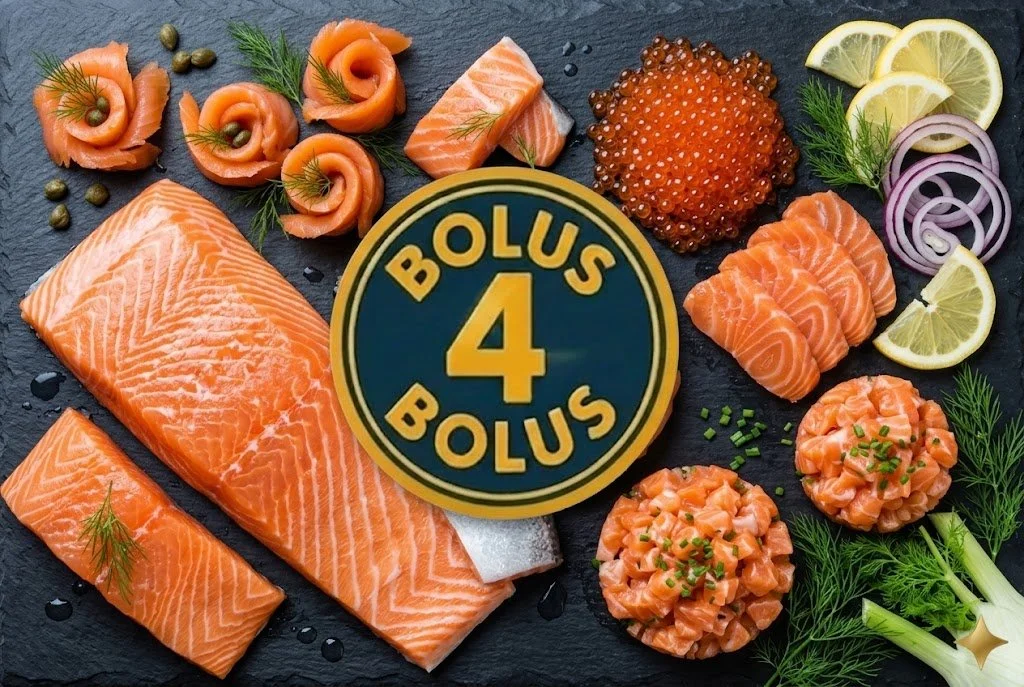
Scott and Jenny Bolus 4 salmon and the rest.
Key Takeaways
- The "Meal Bolt" Strategy: This structured approach to bolusing stands for Measure the meal, Evaluate yourself, Add the base units, Layer a correction, Build the bolus shape, Offset the timing, Look at the CGM, and Tweak for next time.
- Protein and Fat Matter: High-protein and high-fat meals (like salmon and olive oil-cooked vegetables) require insulin. These macros can be calculated as equivalent carbohydrates using Fat Protein Units (FPUs).
- Extend the Bolus: Because fat and protein digest slowly, insulin meant to cover them should be delivered as an extended bolus (often over 4 to 5 hours) to match the delayed blood sugar rise.
- Meal Sequencing: Changing the order of what you eat—starting with vegetables, moving to protein, and finishing with carbohydrates—can sometimes reduce or completely eliminate the need for a pre-bolus.
- Leveraging Technology: Tools like AI and online calculators can quickly synthesize complex nutritional data (like the Warsaw Method) to suggest actionable bolusing strategies, helping ease the cognitive load of managing Type 1 diabetes.
Resources Mentioned
- Meal Bolt Info: juiceboxpodcast.com/meal-bolt
- Warsaw Method Calculator (Wurcal): juiceboxpodcast.com/warcal
- Omnipod 5: omnipod.com/juicebox
- Contour Next Gen Meter: contournext.com/juicebox
- Paprika Recipe Manager App
- Wrong Way Recording: wrongwayrecording.com
Introduction to Meal Bolt
Scott BennerHere we are back together again, friends, for another episode of the Juice Box podcast. In every episode of bolus four, Jenny Smith and I are gonna take a few minutes to talk through how to bolus for a single item of food. Jenny and I are gonna follow a little bit of a road map called meal bolt. Measure the meal, evaluate yourself, Add the base units. Layer a correction. Build the bolus shape. Offset the timing. Look at the CGM. Tweak for next time. Having said that, these episodes are gonna be very conversational and not incredibly technical. We want you to hear how we think about it, but we also would like you to know that this is kind of the pathway we're considering while we're talking about it. So while you might not hear us say every letter of Mielbolt in every episode, we will be thinking about it while we're talking. If you wanna learn more, go to juiceboxpodcast.com/meal-bolt. But for now, we'll find out how to bowl us for today's subject. While you're listening, please remember that nothing you hear on the Juice Box podcast should be considered advice, medical or otherwise. Always consult a physician before making any changes to your health care plan or becoming bold with insulin.
Sponsor Messages
Scott BennerA huge thanks to my longest sponsor, Omnipod. Check out the Omnipod five now with my link, omnipod.com/juicebox. You may be eligible for a free starter kit, a free Omnipod five starter kit at my link. Go check it out. Omnipod.com/juicebox. Terms and conditions apply. Full terms and conditions can be found at omnipod.com/juicebox. Today's episode is also sponsored by the Kontoor Next Gen blood glucose meter. This is the meter that my daughter has on her person right now. It is incredibly accurate and waiting for you at contournext.com/juicebox.
Building a Healthy Meal
Scott BennerJenny, I mentioned, I think, the time or two before that we recorded that somebody asked me, are we gonna do anything healthy in these bolus four episodes? So I and I remarked then, and I'll tell you again. We went out to the community. I asked what you wanna hear about bolusing for. We're just doing the list. You know? I didn't sit around and think, oh, Cinnabons. I haven't had a Cinnabon in twenty years. So but I wanna do a meal, like, one healthy meal right now.
Jenny SmithOkay.
Scott BennerSo I'm gonna let you build the meal. And then, like so if you were putting together a dinner for people tonight, would you do salmon? Would you do chicken? Like, what would you do? What would you put with it?
Jenny SmithSure. Oh my gosh. A healthy meal. Salmon, definitely. We We do a lot of seafood. So salmon, grilled salmon, And I really like, let's say, a grilled asparagus.
Scott BennerOkay. For grilled salmon.
Jenny SmithAnd, like, either a baked or a grilled, like, something yummy. We're gonna go
Scott Bennerpiece by piece as we build the meal out. Okay? So, when tracking grilled salmon, the nutritional value varies slightly depending on whether it is wild caught, leaner, and high protein or farmed. Isn't that interesting? Mhmm. Do you buy one specifically?
Jenny SmithI do not buy farmed ever. Any kind of farmed fish, I do not buy. Again, totally personal preference, but the farmed often if you look at the packaging, it will have color added, especially for salmon. Mhmm. And most often, the farmed fish, not just salmon, but the farmed fish, the nutrient quality is just not there comparative to the wild Ain't that interesting? Caught.
Scott BennerSee, look at us. By doing it like this, I learn things. Six ounces is a serving, or you think it should be more or less?
Jenny SmithA typical I mean, if we're talking about a serving of what people eat, their portion, or a serving in designating, like, what a serving should be, serving is about three ounces.
Scott BennerOkay.
Jenny SmithBut nobody eats just three ounces. Usually, a portion is about six, so that was a good estimate.
Scott BennerAwesome. Okay. So here's what we're gonna learn right now by grilling the fillet. Calories, 265 k cals, 45 grams of protein, nine and a half grams of fat, no carbs. Cholesterol, 104. Sodium, 156. That is a pretty balanced thing. Okay. So we're going to keep that there. There's no carbs yet. But is there bolusing to be done for salmon, you think?
Jenny SmithIf it's and that's why I brought up portion versus serving. Right? A typical serving of any kind of protein's about three ounces as as designated by whoever designated that as the serving size eons ago, whatever. So anything more than that, and I usually explain it by, like, the size of the palm of a hand's about three ounces ish once it's cooked. So anything larger than that, yes, to answer your question. We're going to need in need insulin in order to cover the rise up later.
Scott BennerK.
Jenny SmithSo salmon or any kind of protein like that isn't gonna be an immediate effect. It's not it's gonna not gonna be the like eating grapes, for example. But you will need something to cover the larger portion of protein over time.
Scott BennerDid you say grilled broccoli? Did you say broccoli?
Jenny SmithOh, well, I like broccoli too. I said asparagus. Said asparagus? Almost done. Different.
Scott BennerAspergeras. I know how to spell it because of that. And what do you cook it with? Just the olive oil, or how do you grill it?
Jenny SmithYeah. I usually put a little bit of olive oil. Like, if it's in the oven outside in the, you know, summertime, it's just on the grill. Mhmm. But in the wintertime or whatever, in the oven just baking it, I usually use a little bit of olive oil in the pan.
Scott BennerOkay. Here we go. Grilled asparagus breakdown. I put EVO on there because I'm super, super, hip. Calories. Let's see. Serving.
Jenny SmithGood job with the acronym.
Scott BennerThank you. Grilled asparagus with extra virgin olive oil is a nutrition powerhouse. The addition of healthy fats in the oil is actually beneficial here. So six to eight spears or one cup, 55 to 70 calories, four and a half grams of fat, three grams of protein, five grams of carbs. Mhmm. Okay. So now we have five carbs. Let me get a piece of paper. Is that okay?
Jenny SmithYeah. You have to do all your math adding it all together. Right?
Scott BennerSo far, got zero and five for the for the carbs.
Jenny SmithJust for the carbs. Yep. Did you wanna do all the macros for each of them to add them all together by the end?
Scott BennerCan you do that?
Jenny SmithYou should be able to. I mean, if you're doing, you know, salmon while you have zero carbs, you do have a fair amount of protein.
Scott BennerOkay. So
Jenny SmithAnd they're in that portion should also be a certain amount of fat.
Scott BennerAlright. So let's do that. And then actually, I know what to do. Don't worry. Okay. What else are we gonna put with the food? Jenny's done eating already. She's like, that's enough. I'm good. Yeah. But what what what do you think, an average person would put? You think they put a piece of bread with it? Do you think they would do another vegetable?
Jenny SmithI think some people would do another vegetable, maybe like a side salad. But if they do want a true carbohydrate with it, they might add let's try, like, the little fingerling potatoes.
Scott BennerOh, good job.
Jenny SmithJust for fun.
Scott BennerYou caught Jenny on her on her anniversary out to eat. She's like, I'll take a potato too. I
Jenny Smithsent you a picture actually from our anniversary, didn't I?
Scott BennerThat's what made me think of it. Because when I looked at it, I was like, this is exciting for Jenny, this plate.
Jenny SmithIt was very, very yummy. Yeah.
Scott BennerI thought I thought I thought for sure. Four ounces of potatoes, three to five, small potatoes grilled with a teaspoon of extra virgin olive oil, 4.8 grams of fat, 125 to 140 calories, 2.5 protein, 22 carbs, sodium 10. Okay. So now what I'm gonna tell it to do is Go ahead.
Jenny SmithAnd I like that that portion shows that things like a potato do not have to be a steakhouse baked potato that's the size of, like, a basketball player's hand. Mhmm. Like, there's there's no reason you have to eat that much potato to enjoy a potato.
Scott BennerI love that you're now horrified. You're like, why 22 carbs of potatoes? Why couldn't it be
Jenny Smithtwo twenty two grams is a lovely little portion of these these little potatoes, and it's not gigantic.
Using AI and the Warsaw Calculator
Scott BennerOkay. And I am all I'm telling you to do is I said combine these three items and create a bolus based on and I'm dropping in the link to juiceboxpodcast.com/warcal,warcal Yep. The Warsaw calculator.
Jenny SmithThat's gonna use the FPUs Yep. And everything.
Scott BennerSo I show people, like, you don't need to understand all that to have this broken out for you by I'm using, Google Gemini today. The new version, this is pro. So I don't think I pay for it. Do I? I might pay $20 a month for this.
Jenny SmithIn Chrome, Gemini becomes like, it's an option right up in the corner. I don't know if the pro is a paid version or not. Mhmm. My Gemini just shows up as Gemini. It doesn't say Gemini pro.
Scott BennerI think I must pay $20 a month for it then. Okay. Contournext.com/juicebox. That's the link you'll use to find out more about the Contour next gen blood glucose meter. When you get there, there's a little bit at the top. You can click right on blood glucose monitoring. I'll do it with you. Go to meters. Click on any of the meters. I'll click on the next gen, and you're gonna get more information. It's easy to use and highly accurate. SmartLight provides a simple understanding of your blood glucose levels. And, of course, with second chance sampling technology, you can save money with fewer wasted test strips. As if all that wasn't enough, the Kontoor Next Gen also has a compatible app for an easy way to share and see your blood glucose results. Kontoornext.com/juicebox. And if you scroll down at that link, you're gonna see things like a buy now button. You could register your meter after you purchase it. Or what is this? Download a coupon. Oh, receive a free contour next gen blood glucose meter? Do tell. Contournext.com/juicebox. Head over there now. Get the same accurate and reliable meter that we use. This episode is brought to you by Omnipod. Would you ever buy a car without test driving it first? That's a big risk to take on a pretty large investment. You wouldn't do that. Right? So why would you do it when it comes to choosing an insulin pump? Most pumps come with a four year lock in period through the DME channel, and you don't even get to try it first. But not Omnipod five. Omnipod five is available exclusively through the pharmacy, which means it doesn't come with a typical four year DME lock in period. Plus, you can get started with a free thirty day trial to be sure it's the right choice for you or your family. My daughter has been wearing an Omnipod every day for seventeen years. Are you ready to give Omnipod five a try? Request your free starter kit today at my link, omnipod.com/juicebox. Terms and conditions apply. Eligibility may vary. Full terms and conditions can be found at omnipod.com/juicebox. Find my link in the show notes of this podcast player or at juiceboxpodcast.com.
Calculating the Final Bolus Strategy
Scott BennerTo create a bolus for this meal using the work, workout the Warsaw Method Calculator from the Juice Box podcast, we must account for both the immediate impact of the carbohydrates and the delayed impact of the fat and protein. So now by giving it that link, let me explain to people what that link has there. You and I have talked about this stuff in a number of different episodes.
Jenny SmithCorrect.
Scott BennerI've synthesized all of those conversations into what's on that website describing how to bolus for fat and protein. Plus, there's an actual calculator there that you guys could use, you know, at your own risk, please. There's a disclaimer there that helps you break this bolus out. But this is AI doing it for you. AI even wants you to know that they're not doctor. And this information is based on the podcast, which, by the way, will tell you that I'm not a doctor either. So we're all disclaimered out the butt. Let's keep going. Yes. The nutritional breakdown based on six ounces of wild caught salmon fillet, six to eight asparagus spears, and four ounces of fingerling potatoes, we're looking at 27 total carbs, 22 from the potatoes, five from the asparagus, 19 grams of fat, 10 from the salmon, nine from the vegetables and the olive oil, and the total protein, 50.5 grams. 45 of it is from the salmon, 2.5 from the potatoes, three from the asparagus. You're gonna start feeling bad about going to college in a second. Now it says step one, the bolus for the carbs. So calculate your standard carb dose using your insulin to carb ratio. So we're gonna do one to 10 just so we're gonna we're gonna pit Jenny against AI. Yeah. And to pit it against the AI. Because I'm gonna put you on this to figure this out too on your own.
Jenny SmithOkay.
Scott BennerSo 27 carbs, one to 10 ratio.
Jenny SmithTwo point seven units just for the carbs.
Scott BennerYep. And it agrees. Okay. Great. It says that, I would Scott would recommend a pre bolus between fifteen and thirty minutes before eating to ensure the insulin is active when the potatoes begin to digest. It says step two, you can use the Wurcal calculator to figure out your later dose. The Wurcal method converts fat and protein into fat and protein units, FPUs, to calculate on extra extended bolus to calculate an extend extended bolus. Calories from fat, 19 times nine equals a 171 kcals. Calories from protein, 50.5 times four is 202 kcals. Total fat and protein calories, three seventy three kcals. FPU is three seventy three divided by 100 equals 3.73 FPUs.
Jenny SmithNice.
Scott BennerOkay. The calculation carb equivalent, each one FPU is treated like 10 grams of carbs. So 3.73 FPUs times 10 grams equals 37.3 grams of equivalent carbohydrates. Now that is not a thing anybody would imagine.
Jenny SmithNo. And that's from fats and proteins.
Scott BennerYes. Extra insulin divide the equivalent carbs by your insulin to carb ratio. Example, if your insulin carb ratio is one to 10, you'll need an extra how much for 37.3?
Jenny SmithI'm sorry. Ask it again. My brain was thinking through the whole sorry.
Scott BennerSorry. 37.3 equivalent carbs at a one to 10 ratio needs how much insulin?
Jenny SmithThree point seven three. Wait. Let's say it's 3.7.
Scott BennerIt rounded the 3.7. Now Okay. Here's where it helps you. It helps you with the duration. Per the Warsaw method calculator, since you have 3.7 FPUs, the extra insulin should be delivered as an extended bolus over how would you do it? How many hours?
Jenny SmithSo this this is where sometimes the Warsaw can be too extensive in that extended piece, that extended bolus of insulin Mhmm. Most people end up finding with some experimentation that they have to shave down the extended bolus amount or time, I should say. Not the amount, but the time. Okay. My expectation would be extending this over probably four to five hours.
Scott BennerMhmm.
Jenny SmithMy expectation, Warsaw probably said six hours.
Scott BennerIt said five to eight. That's
Jenny Smithit. Okay.
Scott BennerBut it it's super interesting to listen to your to you think about it. So we're just gonna say, I'm going with you. So we'll say an extended bolus over four to five hours. Yes. Tell me if you agree. Summary bolus strategy. Upfront pre bolus 2.7 units for the 27 carbs and extend a bolus of 3.7 for the fat and protein delivered over it actually says five hours. So delivered over five hours. It says this is a pro tip from the Juice Box podcast. If you use a pump like Omnipod, you can set a dual combo type bolus if you're using MDI injections. Some listeners use a split dose or a small nudge injection two to three hours after the meal when the protein starts to rise. Mhmm. Right?
Jenny SmithI and it you know, what's also interesting is it's giving you a generalized idea for that pre bolus. Right? Maybe you're the type of person who has learned that you can get away without a pre bolus if you start the meal with the vegetables and then move to the protein and then finish off with the carbohydrates. And because of the large portion of protein and fat in this meal Yep. If you started out with that structure of intake, you maybe don't even need a pre bolus for this.
Scott BennerRight.
Jenny SmithAgain, using your CGM, using your glucose values, using a trend, these are all pieces to build in that, obviously, even an AI like this can't give you all of that complex information. You have to use your intuitive brain of how you how things work for you and what you've seen before from historical perspective
Scott BennerRight.
Jenny SmithTo actually move into and approach the bolus thing for this meal. But in terms of the dosing for it, it does a great job of telling you what to do and what to expect. And I think building in, we've thankfully in the past five years with more AID systems, we've also started to talk a lot more about protein and fat Mhmm. Thankfully. Because, you know, in the past when I was educated, my goodness, like, protein was just it was a free food. Yeah. Right? We didn't count it. There was a certain amount that I needed from a growth perspective, right, that was built into my intake, but proteins were free just like cucumbers and celery. They were free food.
Scott BennerAs much as you want. Jenny's over there eating a chicken like a caveman. Well, I'm smiling while we're doing this because, you know, I've had the conversations, and I've had some with you and some with other people about bolusing for fat and protein.
Jenny SmithMhmm.
Scott BennerBut the truth is is that in the end, like, I can give you as much detail as you want. You're either gonna understand it in that detail or you're not. I mean, for me Right. I'm always just like high fat meal. I make a secondary bolus, like,
Jenny Smithin Yep.
Scott BennerEighty or sixty to ninety minutes later.
Jenny SmithRight.
Scott BennerAnd I know that people hear this stuff and they want they want this. They want, like, do this here, do that. But Jenny pops right in to tell you that's not exactly what's gonna happen. And Right. I think that's great. The reason it makes me smile is because even if you got to that link I'm not gonna lie to you. That link is overwhelming. Mhmm. Like, understanding how the Warsaw method works and FPUs and KCALs, and I mean, I'm out already. Like, you know me long enough. Like, I start hearing that stuff. I get fuzzy. I'm like, I'm done. Right. Yeah. And so
Jenny SmithYou're like, I don't know. This meal looks like three and a half units. We're gonna give. And then it's gonna hit later. So we're just gonna do a little bit of a nudge extra here. I mean, that's great. But I do also really like that this calculator piece, once you feed it the right information yes, it has to be a little detailed information. But once it's there, it actually does the calculations. It even asks for your insulin to carb ratio. It can be very directing where you may have had no idea rather than just a wild guess before.
Scott BennerYeah. And a 100%. And I still think people need to understand though that a large part of how it came up with this so cleanly and easily is because I was able to give it the link back to all of the information. I'm not asking you to go out on the Internet and, like, just I didn't say, like, take these three things. My insulin to carb ratio is one to 10. Use the Warsaw method and figure it out. I don't know if we would have gotten this clear language if that would have happened. Maybe I maybe I would have. I don't know. But I just I saw a person online the other day scolding someone for using AI to help them with something like this. And I thought, my gosh. Aw. They were making all these arguments. And I said I said to myself, those arguments are twelve months old now around AI. And I realized it's crazy to think that, you know, twelve months ago, you know, the person said, how they put it? Like, that thing's just telling you what you want to hear. And I was like, oh, that was a year ago. It's not doing that anymore. Like, they they they whipped that right out of it already. And so this thing's gonna move so quickly, like, going forward. And if you can already accomplish this with it
Jenny SmithIt is.
Scott BennerI mean, it's pretty amazing. Without AI, I don't have that web page. Right. I could not have I I had those conversations, and I could not have sat down and synthesized all that information and put it together like that. Like, I don't have that mind.
Jenny SmithRight.
Scott BennerYou you know? So
Jenny SmithAnd because we walk around with computers in our pockets. Right? I mean, we don't have phones. We've got computers, small, little, tiny computers that we walk around in our back pocket all day long. And so with diabetes, you can use it to your advantage in today's world of technology because the information is pretty clean and pretty accurate.
Scott BennerYeah.
Jenny SmithAgain, two years ago, not so much. Your best bet was to look up the nutrition facts probably from the USDA or, you know, another website. Right? But now the nice thing is that all that data is put into AI already, then you can ask it directed questions about, hey. What do you think about this? They can give you some feedback.
The Future of Tech and Bolusing
Scott BennerIt is really, I think, valuable and gonna become more valuable to people. I sent something to Jenny recently that I've been kinda working on over here because a lot of how AI works is is the direction you give it. Right?
Jenny SmithYes.
Scott BennerSo I was I I don't think I should say Oh. I don't know. I I was working out a prompt that wasn't just a prompt. It wasn't a sentence or two. It it was it actually, like, pages of prompting Right. But that you could put in and then literally just give it a link to a recipe. Mhmm. And it would it would it would turn out a bolus on the other side. And I'm pretty close to getting it worked out. And I don't know That's awesome. I don't know shit about Jenny. And like, I can't code. I can't do anything else, but I just kept taking information and saying, no. You need to be more and do it over and over again. Make a mistake and I'll go, oh, here. You made a mistake here. Like, we need to rewrite this. Right. You can turn it into code and put it on a website where you just, like, drop a link in, push a button, and boom. That's your bolus for this. Now you still gotta think
Jenny SmithRight.
Scott BennerMaybe that's not right. I mean, I'm not saying I would blindly do it, but it gets you a hell of a lot closer than where a lot of people end up.
Jenny SmithAnd it would be lovely if, you know, an app like that would actually also take in maybe an app that somebody uses. Like, I use to keep recipes all in one place rather than having 6,000 pictures of recipes that I've looked at online. So I actually copy the link into the Paprika app
Scott BennerYep.
Jenny SmithWhich saves your recipe. It saves it in a recipe format, just not just the website view, which is awesome. And it would be great if an app that could also take that recipe and then dictate to you when you do eat this meal, This is what your bolus strategy is gonna look like. Yes. You're still gonna have to feed it things like this is my insulin to carb ratio. This is maybe my starting blood sugar. Maybe eventually you could feed it, like, the trend in your blood sugar and what you know what I mean? Like, there is there's so much that could be done the right way using technology to make the advantage for people with type one to take a little bit of that stress away.
Scott BennerYeah. The thing I'm making, which is just me, you know, I don't know if he
Jenny SmithFiddling around.
Scott BennerCall vibe coding, I guess. Yeah. The the way he can basically just talk to it into changing code and stuff like that. But what I wanted to to do is, like, go to a link, find the recipe, break down all of the ingredients, and then apply all these other ideas from, you know, from the podcast and from people's conversations and from what's, you know, well established and known in the world and come back and tell me how to bolus for this. So Mhmm. Basically, drop in the recipe, your vitals, you know, your insulin to carb ratio, stuff like that, starting blood sugar, and boom. And there's your answer. And I think that by the time I figure that out, some dorks at some pump company are gonna be feeding that into a pump somewhere. And if they're not, you guys aren't paying attention to what's possible. So at the very least, it could be an app, and, somebody should do it.
Jenny SmithWell, I think you touch on actually a really good point. You know, we we have these wonderful hardware devices with soft software that's becoming more, I guess, intelligent depending on how we interact with it. Right? It is not up to current potential like the DIY community, the open source community has. That potential has gone beyond what our typical FDA pumps. Right?
Scott BennerYes.
Jenny SmithBut somebody needs to step up in one of these companies, and they need to say, we've got this part of it. But this greater percentage of life with diabetes, what if we integrate in just the ability of somebody to say all of these pieces? And then the pump can actually do more for you, and its algorithm can do more for you. Right? Even exercise. Right? Being able to take it. Well, I'm gonna take a light yoga class versus I'm gonna go run for 10 miles.
Scott BennerMhmm.
Jenny SmithRight? The ability of the app to actually interact or, algorithm to actually interact.
Scott BennerWell, everybody's Huge. Everybody's gonna control their pumps from their phone to begin with. So I I mean, honestly, just think of it
Jenny Smithgone that way.
Scott BennerAnother screen that says, this is what I'm eating. You know? Make a make a a bolusing strategy for me. And then, you know, I I I realized the legality people listening are like, oh, we we we wouldn't put ourselves in the line like that. Make make somebody who agree to a disclaimer. You know? Right. Like, I mean, your stuff works as well as it works. It still isn't perfect. Like, so same idea. You know, I agree that this is the bolusing strategy I wanna use and let the app talk to the and just feed it over. Right. You
Jenny SmithAnd who with diabetes
Scott BennerWouldn't love that.
Jenny SmithWith type one, not only would love that, but as you just said, like, a disclaimer, really, we're given we're given a hormone that people use a 100% off the prescribed label of what to do with it.
Scott BennerAll day long.
Jenny SmithThey do all day long. You're sent off with take ten units or put this in your pump at the basal rate, and then the person goes home and they fiddle with things, and they adjust things. They take more, and they're like, nope. That's not enough. Let's take some more. Like, that's entire there's no disclaimer for that.
Scott BennerNo. No. No. No. Come on. Yeah. Yeah. I know. And they don't tell you you really get the least direction in the beginning too.
Jenny SmithOh, a 100%.
Scott BennerAnd sometimes they don't even tell you, like, if you get dizzy, maybe that was too much. But like
Jenny SmithRight. Yeah. I know.
Scott BennerSo It's awesome. Alright.
Jenny SmithI don't think there's a disclaimer needed.
Scott BennerNo. Yeah. Well, the the companies are gonna disagree with you, but maybe somebody will make an app that does that. I mean, listen. I just laid it out there for you. Steal the idea. I don't care. I'm not looking to make an app. You know, I was gonna do it for myself.
Jenny SmithRight.
Scott BennerBut anyway, I I appreciate this conversation. Thank you.
Jenny SmithNo. Thank you very much. It was great.
Closing Thoughts and Links
Scott BennerA huge thanks to my longest sponsor, Omnipod. Check out the Omnipod five now with my link, omnipod.com/juicebox. You may be eligible for a free starter kit, a free Omnipod five starter kit at my link. Go check it out. Omnipod.com/juicebox. Terms and conditions apply. Full terms and conditions can be found at omnipod.com/juicebox. Having an easy to use and accurate blood glucose meter is just one click away. Contournext.com/juicebox. That's right. Today's episode is sponsored by the Kontoor Next Gen blood glucose meter. Okay. Well, here we are at the end of the episode. You're still with me? Thank you. I really do appreciate that. What else could you do for me? Why don't you tell a friend about the show or leave a five star review? Maybe you could make sure you're following or subscribe in your podcast app, go to YouTube and follow me or Instagram, TikTok. Oh, gosh. Here's one. Make sure you're following the podcast in the private Facebook group as well as the public Facebook page. You don't wanna miss please, do you not know about the private group? You have to join the private group. As of this recording, it has 74,000 members. They're active talking about diabetes. Whatever you need to know, there's a conversation happening in there right now. And I'm there all the time. Tag me. I'll say hi. My diabetes pro tip series is about cutting through the clutter of diabetes management to give you the straightforward practical insights that truly make a difference. This series is all about mastering the fundamentals, whether it's the basics of insulin, dosing adjustments, or everyday management strategies that will empower you to take control. I'm joined by Jenny Smith, who is a diabetes educator with over thirty five years of personal experience, and we break down complex concepts into simple, actionable tips. The diabetes pro tip series runs between episode one thousand and one thousand twenty five in your podcast player, or you can listen to it at juiceboxpodcast.com by going up into the menu. Have a podcast? Want it to sound fantastic? Wrongwayrecording.com.
#1822 The Inside Track
Updates on Live events, website tools and more.
Key Takeaways
- Scott Benner announced a series of upcoming in-person appearances for 2026, including free events at Hofstra University (April 15) and Atlanta (April 18), as well as summer conferences like ADA and Friends for Life.
- The Juicebox Podcast website has been significantly overhauled with an advanced search tool that allows users to ask questions in plain English and find specific podcast episodes that address their concerns.
- New educational calculators and simulators—including A1C, Basal, Bolus, and Fat/Protein estimators—are now available to help users visualize how different variables affect insulin needs.
- The "Autoimmune Explorer" tool enables users to map symptoms to potential conditions like Graves' or Hashimoto's and generate a structured email or note to facilitate discussions with their doctors.
- For clinicians, the site now offers a "Clinician Share" tool, allowing providers to instantly text or email curated episode collections, like the Bold Beginnings series, to their patients.
Resources Mentioned
- Juicebox Podcast Website & Events: juiceboxpodcast.com/events
- Juicebox Docs (Provider Directory): juiceboxdocs.com
- Juicebox Podcast Private Facebook Group: Type One Diabetes Support Group
- Touched by Type One: touchedbytypeone.org
- SugarPixel: Secondary Display for CGM
- Beyond Type 1: Diabetes Community Resources
Introduction and Community Support
Scott BennerHello, friends, and welcome to episode 1,821 of the Juice Box podcast. I haven't said that in a while. If your loved one is newly diagnosed with type one diabetes and you're seeking a clear practical perspective, check out the bold beginnings series on the juice box podcast. It's hosted by myself and Jenny Smith, an experienced diabetes educator with over thirty five years of personal insight into type one.
Our series cuts through the medical jargon and delivers straightforward answers to your most pressing questions. You'll gain insight from real patients and caregivers and find practical advice to help you confidently navigate life with type one. You can start your journey informed and empowered with the Juice Box podcast.
The bold beginning series and all of the collections in the Juice Box podcast are available in your audio app and at juiceboxpodcast.com in the menu. If you're looking for community around type one diabetes, check out the Juice Box podcast private Facebook group. Juice Box podcast, type one diabetes. But everybody is welcome. Type one, type two, gestational, loved ones, it doesn't matter to me. If you're impacted by diabetes and you're looking for support, comfort, or community, check out Juice Box podcast, Type one Diabetes on Facebook.
Upcoming In-Person Events: New York and Atlanta
Scott BennerI am here today just for a few minutes to let you know about some in person events that I'm doing, some coming up very soon, some over the summer, and to let you know about some pretty big updates to the website, juiceboxpodcast.com. I'm gonna do the events first, then the website. If this takes me more than seven minutes, I've failed. You ready? Here we go.
Juiceboxpodcast.com. Go to the menu. The menu now is in the top right. It's three little lines on juiceboxpodcast.com. On the browser, let me see what it looks like on your phone. Same thing. Two little lines, top right. Click on that there and scroll down to events. That'll take you to juiceboxpodcast.com/events.
And there you will see that this coming Wednesday, April 15 at 04:30PM, I will be at Hofstra University giving a talk. This is the annual symposium hosted by Cohen Children's Medical Center, and tickets are absolutely free. So you can go to my link, juiceboxpodcast.com/events, click on reserve a seat, and get your free tickets right now. It's from 04:30 till 07:30. I believe there's food. Am I right about that? Yeah. Scott will share his blend of actionable insights, honest discussions. Who wrote this? Let's see. We're gonna be talking about a bunch of stuff. Let me let me get the thing. I said six minutes or seven minutes, and now I'm already lying.
But let me just look through my notes real quick. Hofstra. Interesting. Are you out on Long Island? Do you know what do you know where the Hofstra is? And I'm gonna be a few days after that, I am going to be in Atlanta, Georgia. I'll tell you about that in just a second. But I just do wanna check on yeah. It looks like 04:00, welcome and registration, 04:30 to 05:30, keynote address with me, 05:30 to six at dinner break, networking, light dinner and refreshments available, six to 06:45, breakout sessions. Guests will choose one of the following specialized sessions, nutrition with diabetes, exercising with diabetes, diabetes technology, and then from 06:50 to 07:30, diabetes research update.
It's gonna be a nice little event here, isn't it? I again, I'll be there from 04:30 to 05:30 giving a talk, then I'll be around for a little bit afterwards at dinner and everything. If you guys wanna say hi, that would be lovely. That is April, the Donald and Barbara Zucker School of Medicine at Hofstra, 500 Hofstra Boulevard, Hempstead, New York. And don't forget, gotta get those tickets to get in the door. But again, it's absolutely free. I think you're gonna love it.
Now if you're in Atlanta, Georgia, just some days later on the eighteenth, I will be at the Community Connections networking event for Touched by Type one. This is a caregiver chat with me, Scott. Join us for a day filled with meaningful conversations and genuine connection on and on and on. Again, go to my link, click on, event details. That's gonna take you to the Touched by Type one website where you can register right now, I believe, for a morning or afternoon. Is that right? Morning or afternoon? Let's see what happens if you click on this one. 9AM, Atlanta, Georgia. And then what if I click on this one? What does this one say? Yeah. And at 1PM, there's a meetup in Atlanta.
So okay. Alright. I see what this is. You would think I would know about it because I'm going, but I don't pay as much attention as you would hope. 330 Marietta Street Northwest, Atlanta, Georgia, 04/18/2026. Absolutely free to attend, but again, gotta go get the tickets at this Touched by Type one website. I'm gonna be speaking, it looks like at 10AM, And I think again, there's another time, not a 100% sure. And then there's the t one d meetup from 1PM to 4PM at the same location, 330 Marietta Street Northwest. This is exclusively for adults with type one diabetes. It's free to attend, but registration is required and space is limited. So go ahead. Head over to my website now, juiceboxpodcast.com/events, and jump on those tickets for next week.
Summer Tour: ADA, Friends for Life, and ADCES
Scott BennerNow I will be taking a little break there in May. And then June, I will be at the ADA Scientific Sessions with SugarPixel. Look for the SugarPixel Juice Box podcast booth at ADA eight in New Orleans if you're there. On June 21 to the twenty eighth, I will be on the Juice Cruise on the Celebrity Beyond. There is still time to get tickets for the Juice Cruise, though I think time is now short. And then Friends For Life, I will again be with Sugarpixel. Actually, I'll be at Sugarpixel Friends for Life, ADA, and ADCES. But Friends for Life is July. I'll be there July '10. We have a really great event coming up. I don't think I'm allowed to spoil it yet, but if you're gonna be at Friends four Life, definitely look for the juice box slash sugar pixel event. Those of you who are clinicians, ADCES annual event in Columbus, Ohio, August. I will be there again with Sugarpixel. And to round out the year, September 26 at Touched by Type one's huge, huge event in Florida. You can get all the details you need about any of this at my link juiceboxpodcast.com/events.
Major Website Updates and Search Features
Scott BennerThe website has also been really, significantly updated. So now when you go to juiceboxpodcast.com, on the main page, there's, some searching tools. Episode episode episode FAQ. If you type something in there just like in English, like, I don't know, my blood sugar is high in the morning. That's a thing that happens. When you do that, it takes you right to like, real right there. You just get dropdowns of episodes where that's discussed. It gives you the bowl beginning, seven fifteen, bowl beginning, seven fifty fee, the pro tip, l ten eleven, episode diabetes variables on stress, food quality. And if one of those doesn't look right to you, if you go, oh, I click around, I don't know if this is it. Like, so I clicked on the first one here, bold beginning seven fifteen. What you'll learn, fear of insulin causes people to run chronically high. This is a far more dangerous long term and and so there's one where your you know, what you typed in matches up with stuff that's been said in that episode. Maybe that's not the one you want. Right? Maybe it's a different one. Or maybe you go, like, you know, on the main page here, it showed me five of them. I don't think any of these are right. You can actually click on see all results. It takes you to the frequently asked questions page. And my goodness, like, this search tool for the podcast is really just awesome.
I clicked over after asking my blood sugar is high in the morning, so it stays populated and gives you, you know, different links there to different episodes. But you can do a lot at this website. So I'll clear out the search bar. If you just click in it, it gives you a ton of things that people, commonly ask for. Can my child eat cake at a party? Click on that. Boom. Bold beginning seven thirty one food choices. Can my child with type one diabetes still eat cupcakes? Sneaking food episode four seventy three. Bolus four comes up episode. Like, it it's it's really good. Trust me. Go take a look at it.
And then on the side, there's, like, things you can click on. I think there's at on the mobile, you have to go to the bottom of the page. But on the browser, on the side, you could say, oh, well, you know what? I really only wanna search, I don't know, the ask Scott and Jenny episodes. So you click on that, go back to search, you know, I don't know. I'll just type in glucagon. It's just a keyword. And it gives you everywhere that the word glucagon pops up in the ask Scott and Jennings. It's really pretty awesome. You you you have to take a look at it to really get a good feeling for what it is. But it's a it's a wonderful tool to help you find your way through your questions and link you back to episodes that might be able to help you. I'm clicking on just any episode here to show you that afterwards, can click on link online. You can jump right to Spotify to the episode, right to Apple Podcasts, or right to the entire series on the website. Tons of different ways to listen.
Interactive Estimators and the Autoimmune Explorer
Scott BennerBack to that menu top right, you wanna do an there's an a one c estimator, a basal estimator, a bolus estimator, a fat and protein estimator, and a settings simulator. You should go check all of them out. They're very interesting. There's also an autoimmune explorer. Now you click on that. It you gotta, you know, you gotta click on the the disclaimer and get in, but you can kind of choose, I don't know, things that you've been experiencing, different markers. You know, I have let's see. Heat intolerance, hair loss, let's see, nail pitting. And now you've clicked in three things. I mean, there's a ton of stuff here to pick from. But you click in some things, and then it shows you what those symptoms kind of code to.
Now it's not a diagnostic tool. Right? It's not gonna for sure tell you what's wrong with you, but it will help you to figure out maybe what's going on. For example, on the four things that I just clicked on, I got one match on each one. So there's no, you know, no oh, sorry. My phone. It's not like three of the things I clicked on went to Hashimoto's. One of them did. But, you know, I don't know. Let's say I keep going. Oh, you know what? I've I had some sexual dysfunction. Now all of sudden, there's two matches on Graves, two matches on Hashimoto's. Oh, I've had skin rashes. Oh, okay. It doesn't really help anything. You kinda click around a little more, and then it starts to come into that, oh, I have lost weight. Now all of sudden you realize there's three of these are popping up for Craves' disease. Two for Addison's, two for Hashimoto's. Craves' disease, antibodies the thyroid to produce too much hormone, that maybe does sound like me. You click on that. There's other shared traits in there. Maybe you'll notice, oh, I didn't see fatigue on there. That is me too. And I have eye protrusion. Okay. It'll tell you, like, there's some shared traits that you have. It also can tell you that there's other stuff that's frequently associated with it. With this one, it's like vitiligo and RA.
But more importantly, maybe you can type in a specific concern. So if you say, like, you know, I don't know, I also feel whatever and hit plus, that adds it into your notes. And then the notes app can actually make suggestions to you. You can click on suggestions, it's and it'll tell you like, oh, discuss managing heat intolerance or in the context of Graves. And you look at all those things, you go, okay. Those are things I'd like to talk with my doctor at. That one, I don't have. Like, click that off. You can save the note. You can copy the note, paste it somewhere, or you can generate an email to yourself so that you have an outline for the things you wanna talk about with your doctor. That's on the website.
Defining Diabetes, Clinician Tools, and Physician Directory
Scott BennerBack to that menu, interactive defining diabetes. This is like 78 definitions from the defining diabetes series. I said seven minutes, I lied. If you're still with me, you care. It doesn't matter. And that's in it's been translated by AI into English, Spanish, French, I think German, Hindi. I forget what else. Did maybe I do Japanese? I forget what I did. You'll see when you get there. Anyway and there's also, like, a chat like, a quiz. So you can click on the challenge and start a hormone co secreted with insulin that delays gastric emptying and expresses glucagon, like, by hypertrophy, amylin, intramuscular oh, I think it's amylin. You click on it. Yay. And there's, a little countdown. It's a little game. You know, you can score to the end to try to test yourself on what some of these things mean.
Back to the menu. Guides for you guys. Right? Advice for type one parents from type one adults. Caregiver burnout. The episode frequently asked questions that I told you about earlier. There's some articles about GLP and diabetes, how to build good habits. There's a guide for physicians. There is the takeaways from the grand round series if you wanna share them with your doctor. There's just, you know, thyroid stuff. There's an article on pre bolusing. There's also something called clinician share. So if you're a doctor or a clinician, this is a website that you can use to help support you when you're trying to share the podcast with other people. Go check that out because there, it's a nice simple setup. You select a series that you wanna share the Bold Beginning series to somebody, click on it. All you have to do is click print, text, or email. It generates a list for you. I'm just gonna hit text real quick. It opens up my texting app, and it gives you JuiceBox podcast bold beginnings. Listen online at the link. Gives you a link for Apple podcast for Spotify, and a list of all the episodes with the episode numbers in it. Boom. You can just text or text or email that or, of course, copy it and paste it anywhere that you'd like to see it.
What else should we do? Oh, the the search is also on that tool there too for for physicians. And there's some stuff there for clinicians themselves, takeaways from the grand round series, and the link to JuiceBox docs. So juiceboxdocs.com is, I don't know how many is in there at this point. Let me take a look. This is a directory of doctors and CDEs that that have been suggested to me by listeners. There's 225 of them in there right now, and it's very easy to, search through. If you live in Nashville, you type in Nashville. And let's see. We got two doctors in Tennessee that have been, suggested by listeners. Tells you if they're pediatric, if they're adult, if they have if the provider themselves has type one diabetes. Pretty, really cool. And if you have a doctor you love and you wanna, suggest them to me, you can click on submit provider and send in their information. Please fill it out as completely as you can so it's valuable for others.
Deep Dive: Using the Estimators and Simulators
Scott BennerWhat else do we have here? All the links to all the series. Bold beginnings, pro tips, bolus four, small sips, after dark, die defining diabetes, myths, GLP, everything. It's all there. You wanna go find the series, some lists, some site links, juice box docs, the private Facebook group, the blog, how to contact, disclaimers, merch, the sponsor page. All that's right there, right in that menu. So that's it. I kept it to fifteen minutes. That's not bad. There's a lot going on at the website. A lot of it I think you'll find interesting. These estimators that you're gonna find there, listen, they're not medical advice for certain, but they should be able to give you, like, some ideas about how to talk to your doctors or, you know, get a feeling for if your settings are really wonky or something like that.
Using example here of the settings simulator, you know, you have to it's educational simulator only. You have to click I understand and everything to get in. And then you just are you can just pick a weight just to see how it affects insulin. So, like, you know, say somebody weighed a hundred and thirty eight pounds. You might expect their total daily insulin to be around 34 and a half units. You might expect their basal to be around 17 quarter units a day or point seven two an hour. You might expect their insulin to carb ratio to be 14 and a half. You might expect their sensitivity to be 52. Like, just, you know, not saying this is exactly right, but it's the same math your doctor uses to figure stuff out, and it's something you don't know about. So maybe you go there and go, oh, hey. I'm high all the time, and this thing says I should maybe be using more insulin or less. Maybe you're low a lot, and you don't know why. It's a it gives you a good starting place to talk to your doctor.
Same with the fat and protein estimator. Again, you gotta understand this is a tool, not for medical device, blah blah blah. Just helps you understand, hey. If there's, I don't know, 15 grams of fat in a meal and, six grams of protein and an insulin to carb ratio of one to 10, then what you simulate the event, it tells you like, hey. You know, this is just a simulation, but you might need this much insulin to cover this meal. Right? Just helps you with k cals, fat and protein units, theoretical units, how much the, you know, the bolus might be, how long you might stretch it out if you're doing an extended bolus. And, you know, again, it could help you understand maybe a little better that how how bolus thing works.
There's also a bolus estimator that takes a lot more into account, insulin to carb ratio, your insulin sensitivity factor, target blood sugar that you're shooting for, and then how many carbs in what I'm eating? I'll say 45. How much fat? Five. How much protein? Four. My current BG is one twenty three. How much do I have on board? I have a a unit on board. And it it'll explain to you, like, well, you know, we might use about this much insulin here. Pre bolus time should be about this, but there's no, you know, extended needed for fat. But you can look then and change the fat to, like, well, what if there was 10 grams of fat in that? Would that change it? And it certainly does. All of a sudden, it starts talking about how the Worsaw method might indicate to you that you maybe should spread out some extra insulin over time to impact that digestion.
The Importance of Support and Sharing
Scott BennerAgain, they're just kind of visualizations for you to try to understand some of the stuff that we talk about in podcast. I find some people understand by listening, some people understand by clicking and doing. I thought this might help some of you with that. I hope you find it valuable. It's pretty much it, really. We're about to I guess I'll tell you about this right now since I have, like, a little quiz about the positive childhood experiences and negative childhood experiences, the aces and the paces. And it it kinda helps you understand if you've experienced these things in your life as a child, and it helps to show you how to create, a home environment for people who end up, generally speaking, having a better chance at positive outcomes as an adult. That's in the menu as well. And there is a series coming out on that very soon with myself and Erica Forsyth.
That is pretty much it, guys. I hope you're enjoying the show. Please I'm not a YouTuber, so I'm not really accustomed to saying this, but subscribing to the podcast is such a significant help that it is hard to put into words and sharing it as well. When you're listening to an episode and you're enjoying it, please do share it with somebody else. If you know somebody who might need the podcast, sharing it with them either with a link or a text or, hey. Check out Juice Box or whatever it is you you're comfortable doing. This podcast is in its twelfth year, and I'm telling you, it keeps going because of good word-of-mouth. It is really, the best way to keep content like this going. It's free to you guys. I, you know, I try very, very hard not to charge you for it, and I've had a lot of luck so far, knock on wood, because so many of you listen. And, of course, that makes me kind of an eligible place for advertisers to put their ads, which is how all this gets paid for.
So just a general example, the the episode of frequent asked questions page, like the search feature. I've been working on that for a couple of months now. And it's taken up, I mean, I would say probably thirty or forty hours of my time. And what it is, like, the back end of it is this. I took the top 250 most Googled questions about type one diabetes. I took the entire list of struggles, which is a list that was compiled, from listeners about things they say they struggle with with type one. Right? It's a really comprehensive I think we ended up doing, like, 70 or 80 pages of that. It got still down into, gosh, I wanna say, like, 75 items. But and I'll I'll just read a couple for you. Mental burnout, hypoglycemic fear, insulin timing, exercise and blood sugar, illness, sicknesses, stress, physical health, technology overload. Like, this goes on and on. It's a long list. So this struggles list plus the top 250 most Googled type one diabetes questions plus some other stuff, all mixed together in kind of a a secret little goo, digital goo. And then all of those questions are mapped back to content inside of the podcast.
So if you've we figured these are the I figured these are the questions that people ask and we, generally speaking, think that most of those, you know answers or, you know, associated conversations are in the podcast. So how do you find them most quickly? Right? And this has ended up how it ended up being. So, like, you know, ketones and DKA warning signs click. What is a rage bolus? Here, what is a rage bolus? What is insulin stacking? What is insulin resistance? What is insulin bolus? What does the word bolus actually mean? That that's just from, you know, what is prebolising and how long before you should eat? This is all just coming back from what is a rage bolus. It matches to conversational stuff. Is it perfect? It's not. It works really well. And I am working on it to make it better and better all the time.
So my point is there is if you share the podcast and people buy ads on the podcast, then I can spend forty hours on working on this tool for you. Or I can sit around imagining other things that I think will be helpful for you to hear on the podcast or take the time to meet people and set up shows like the one you might have heard recently about, you know, a potential core cure for type one diabetes. Like, that doctor who came on, really lovely man, doctor Wachowski, he's in episode eighteen seventeen for an example. Like, I've been working on setting up that interview with him since 2025, and we finally recorded in April. And then that recording is rushed out to an editor who is a grown up who gets paid, and I pay him. And I pay for the website to go up. And there's a lot of money that goes out the door to keeping the podcast going. I'm not crying poor. I make a living. I'm not arguing about that. What I'm saying is that supporting the podcast brings you this stuff. It allows me the time to have these conversations, do these things, go to ADA.
You know? I mean, I'm listen. I'm gonna go speak at that hospital on Wednesday. Nobody's paying me to do that. I'm gonna leave my house at noon to get somewhere in time. I'm gonna spend a number of hours there. My whole day is gonna be that. I'm gonna drive back and forth. I'm not charging a hospital for my time, but I can afford to do that on a Wednesday afternoon because you guys support the podcast. I am driving to Atlanta to speak at the touch by type one event. I am not charging touch by type one for me to be at that event. I'm sure they'll help me pay for my drive. Or if I want to fly, I'm sure they would have helped me with my my airfare, but I don't get paid on top of that. And that's a thing where I'm leaving on a Friday, and I don't come home till Saturday. I just think it's a great thing to do. I like supporting people like that. And, again, I'm able to support those people because you guys listen to the podcast. You share it. And no kidding. You're subscribed, and you're downloading episodes and listening to them. This is what keeps all this going.
Then the more social media changes, the more I need you guys because Facebook doesn't let creators get to their followers the way they used to, because Instagram doesn't do that because there is no good way to share a link with you. Because every time you share a link, Instagram, Facebook, any of social media platforms, really, they want you to stay in their platform. So if I make a post that says like, hey. You know, Tay on the podcast, you know, I put up an episode called orange Julius. It's pretty great. It's with Kelly. She opened up about raising two teens that's diagnosed type one diabetes at age six. She discusses international living, multiple miscarriages, alarm fatigue, and managing different sibling personalities. If I put that into a a post and put it in Facebook, the Facebook algorithm will not serve it to you. You will never see it because it'll also have a link that leads you out of Facebook into a podcast app. Or even the fact that the this is crazy, but even the fact that the verbiage in the post indicates that I'm trying to tell you about a podcast, Facebook's algorithm will see it as an attempt for me to get you to leave Facebook. And so, therefore, it's not gonna show it to you.
So, I mean, I could tell you to join my email list. That might help. But truth be told, it's it I need you. Like, I'm it's on you. You gotta open up your app and download some episodes. Make sure you're subscribed or you're following, you know, especially in the big apps, Apple Podcasts, Spotify, stuff like that, and just tell people about it. I really do appreciate your time and, I mean, twelve years of a fantastic support. Thank you so much for listening. I'll be back very soon with another episode of the Juice Box Podcast. And I guess I should have said at the beginning that nothing you hear on the Juice Box podcast should be considered advice, medical or otherwise. Always consult a physician before making any changes to your health care plan or becoming bold with insulin. And I only went over my seven minute estimation by twenty one minutes. It's not really bad. If this is your first time listening to the Juice Box podcast and you'd like to hear more, download Apple Podcasts or Spotify, really any audio app at all. Look for the Juice Box podcast, and follow or subscribe. We put out new content every day that you'll enjoy. Wanna learn more about your diabetes management? Go to juiceboxpodcast.com up in the menu and look for bold beginnings, the diabetes pro tip series, and much more. This podcast is full of collections and series of information that will help you to live better with insulin. I can't thank you enough for listening. Please make sure you're subscribed or following in your audio app. I'll be back with another episode of the juice box podcast.