
#1843 Two Fancy Pill Boxes - Part 2
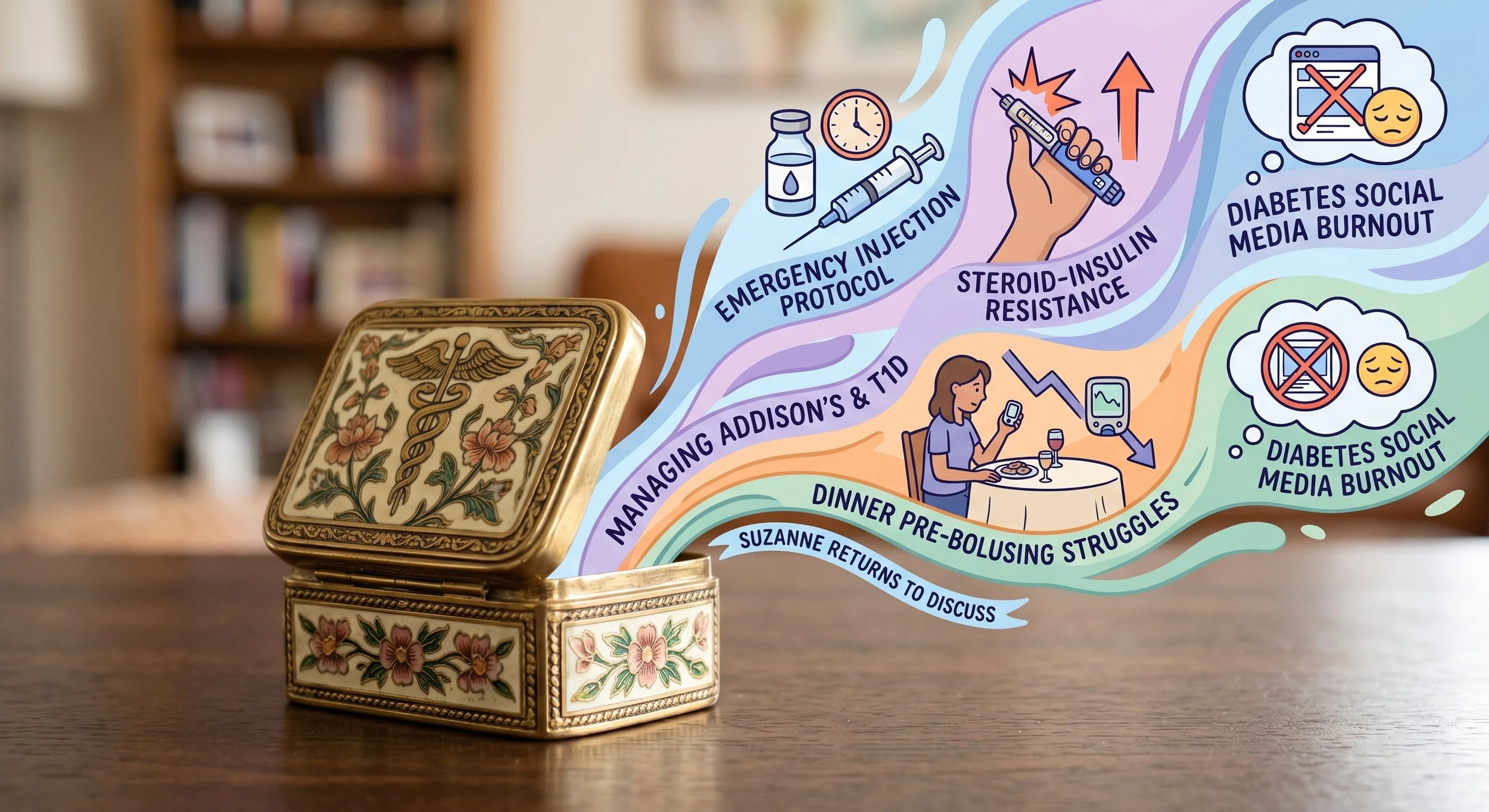
Suzanne returns to discuss managing Addison's disease and T1D, detailing emergency injection protocols and steroid-induced insulin resistance. They also tackle dinner pre-bolusing struggles and diabetes social media burnout.



























Key Takeaways
- Addison's Emergency Protocols: Severe physical stress, such as a broken bone or severe illness that prevents medication absorption, requires individuals with Addison's to administer an emergency injection of liquid cortisone to prevent a life-threatening adrenal crisis.
- Sick Day Rules & Medications: Introducing medications like GLP-1s requires caution for those with Addison's. Side effects like vomiting and diarrhea can prevent the body from absorbing crucial daily oral steroids, potentially triggering an emergency.
- Value of True Community: Navigating the oversaturation of diabetes content on social media can be draining. Finding a genuine, interactive support system—like a dedicated Facebook group—often provides deeper, more reliable support than fleeting, algorithm-driven trends.
- Dinner Pre-Bolusing Hurdles: Remembering to pre-bolus during the chaotic time of making dinner is a common challenge. Planning the specific macros (carbs, fat, and protein) for your typical meals ahead of time can reduce decision fatigue and improve post-meal numbers.
- Managing Fat and Protein: Meals heavy in fat and protein often result in a delayed blood sugar rise. Utilizing pump features like an extended bolus (on the Tandem pump) or manually staggering insulin doses can help counteract these later spikes.
Resources Mentioned
- Able Now: ablenow.com
- Contour Next Gen Blood Glucose Meter: contournext.com/juicebox
- Tandem Insulin Pump: Mentioned for its extended bolus features.
- TrialNet Study: Mentioned as a screening resource for family members of those with Type 1 Diabetes.
- Wrong Way Recording: wrongwayrecording.com
- Juice Box Podcast Website & Private Facebook Group: juiceboxpodcast.com
Introduction
Scott BennerWelcome back, friends, to another episode of the Juice Box podcast.
SuzanneHi. My name is Suzanne, and I have been a type one diabetic for fifty one years. I feel like I was diagnosed in the dark ages.
Scott BennerThis is part two of a two part episode. Go look at the title. If you don't recognize it, you haven't heard part one yet. It's probably the episode right before this in your podcast player. The podcast contains so many different series and collections of information that it can be difficult to find them in your traditional podcast app sometimes. That's why they're also collected at juiceboxpodcast.com. Go up to the top. There's a menu right there. Click on series, defining diabetes, bold beginnings, the pro tip series, small sips, Omnipod five, ask Scott and Jenny, mental wellness, fat and protein, defining thyroid, after dark, diabetes variables, grand rounds, cold win, pregnancy, type two diabetes, GLP meds, the math behind diabetes, diabetes myths, and so much more. You have to go check it out. It's all there and waiting for you, and it's absolutely free. Juiceboxpodcast.com. Nothing you hear on the Juicebox podcast should be considered advice, medical or otherwise. Always consult a physician before making any changes to your health care plan.
Sponsors: Able Now & Contour Next Gen
Scott BennerThis episode is sponsored by Able Now, tax advantaged savings accounts for eligible individuals with disabilities. If you or your child lives with diabetes, you may qualify for an ABLE account because of ongoing medical needs, and many people in the diabetes community do. With ABLE Now, you can save for future expenses without affecting eligibility for certain disability benefits such as Medicaid. Learn more and check your eligibility at ablenow.com. You spell that ablenow.com. Today's episode is also sponsored by the Kontoor Next Gen blood glucose meter. This is the meter that my daughter has on her person right now. It is incredibly accurate and waiting for you at kontoornext.com/juicebox. Why does that matter?
Addison's Disease and Emergency Protocols
SuzanneI don't know if it does. I don't know if it does. It I also am a bit scared, full disclosure, of how my body will respond. I have not been in a crisis, knock on wood Oh, since okay. The first diagnosis in that whole like, I was in a crisis when I went into the hospital both times. Right? Both hospitals.
Scott BennerYeah.
SuzanneSo I don't know how I respond. I worry about, although I know there are things you can do, but I worry about the gastro effects because you know with diarrhea and vomiting then it becomes a whole another game with the Addison's and the steroids.
Scott BennerMhmm. The the most significant danger GLP medications commonly cause nausea, vomiting, and diarrhea, especially when first starting or increasing the dose for someone with Addison's vomiting or severe diarrhea is dangerous because it can prevent the absorption of your daily oral steroids. If your body doesn't absorb these hormones, you could rapidly trigger a life threatening adrenal crisis. Oh, so you're worried it oh, so you don't know how youre gonna, like, take to them. I would Yeah. Listen. I am not the right person to ask about this, but
SuzanneBut you love them.
Scott BennerI have used them. Used them. Took it yesterday. I I hugged the pen when I was done with it. And, before I threw it in the trash, I said, thank you. I whispered in a tear. I mean, maybe you could get the endo to help you, like, like, microdose it at first to try.
SuzanneI think it's a not now. Yeah. I think I'm also still getting used to this. You know? Okay. I have look. I'm not one to try to have I've I have never been one to have my diabetes stop me from something. Addison's, I kinda feel like is a whole another game. I've decided, like, I'm not going back to paddle because if I fall and break a bone, for example K. I've gotta have that emergency injection. And then I've gotta explain to everybody, like, if I fall, I have to have this emergency injection. And let's not forget, it's not like an EpiPen. Mhmm. You've gotta mix it. Take it. It's like old days of glucagon.
Scott BennerYou have to explain this better. What those, like, your sick like, sick day rules, right, for Addison's?
SuzanneYes.
Scott BennerYeah.
SuzanneTell me. Sick day rules for Addison's. So if you break a bone, you fall, you do something like that, which is why I'm not gonna play paddle, and I I'm not gonna go skiing. Like, my family just went skiing this couple weeks ago.
Scott BennerI'm like, nope.
SuzanneI'm not doing it. No. I went, but I didn't ski. I worked out in the gym. I did other things. If something like that were to happen, you have to have this emergency injection because normally, your body would produce all of this cortisol to deal with the stress of that injury to allow for you to heal and just deal with what what's going on. I would not have that extra cortisol, so you have to take this emergency injection of of, liquid cortisone
Scott BennerOkay.
SuzanneTo prevent a crisis. Also
Scott BennerThen that changes your steroids. Right?
SuzanneSo well, it changes the steroids?
Scott BennerWould you need more steroids if you had to take the emergency injection?
SuzanneYeah. So the cortisol is the is the steroid emergency injection. It's the same thing. Depending on like like, if I'm in the hospital, say, you would I'd be on a higher dose of steroids, and then I'd have to taper down, like, after an injection most likely. Okay. You know, there's so
Scott Bennermany different like so you take them orally usually, but in a sick day crisis, it would be an injection?
SuzanneNo. No. In a sick day crisis, I would up my dose. But in an emergency situation like a broken bone, you have to have that injection.
Scott BennerThat is the injection. Okay.
SuzanneYeah. Or if it's a sick day and I cannot keep the pills down, I would have to do the emergency injection and then go to the ER.
Scott BennerAnd has that happened yet?
SuzanneKnock on wood. No.
Scott BennerYou are coasting now as far as a person with all your issues could coast, and you're very scared to upset the apple cart. Yeah. Yeah. That makes a lot of sense to me, by the way.
SuzanneI'm even like so this is I don't know. This is kinda silly. But, like, I think my biggest fear with the Addison's is, like, a car accident. Oh. Right? Because if I'm in a car accident, I have to have that injection.
Scott BennerAre you still in the city? No. No. You're out
Suzanneof Okay. Yeah. Connecticut suburbs. Yeah. So
Scott BennerAnd people in Connecticut really can't drive, so that might be a problem.
SuzanneNot drive.
Scott BennerYeah. Yeah. Horrible. Well, it's because they lived in Manhattan their whole lives. Yeah. Yeah. Then they bought a car.
SuzanneAssholes. They make assholes look good now, almost. It's so bad.
Weather and Moving South
Scott BennerWe had to go to Boston recently, and Arden goes, why are we not driving? And I was like, I do not wanna drive through Connecticut and Massachusetts. Yeah.
SuzanneYeah. It's horrible. Yeah. It's bad. So, you know, in many ways, it's I I would say I'm not fearful of the diabetes. I'm more fearful of the Addison's, and I don't know if that's because it's all new. Or, I mean, I think they're legitimate, quite frankly, legitimate reasons
Scott BennerMaybe not.
SuzanneTo be fearful of Yeah.
Scott BennerAlso, doctor knows you and no one else. So, like, you will be doing a little bit of an experiment together. Also, let me just say to the people in Massachusetts, I don't think you're assholes. I love you, and thank you for listening. Please don't unsubscribe. Yes. Yeah.
SuzanneWe have great friends
Scott Bennerfrom Massachusetts.
SuzanneI agree. I agree.
Scott BennerOh, it's just it's just so cold there. Other than that, it's
Suzanneit's fun. Anyway, snow here today.
Scott BennerYou know what? It was 82 degrees yesterday, and then my and Arden comes home and she's, did you hear it might snow today? And I went, why are we not moving? Why will no one listen to me when I tell you to move south? I'm can I tell you something? I am I just said yes to doing a one day speaking event in Atlanta for Touched by Type one
SuzanneMhmm.
Scott BennerIn April. And I would normally just jump on the plane and because I live I mean, I live in Central Jersey. I could actually despite the news that came out of Trenton the other day, I could jump on one of those quick Trenton flights to go right to Atlanta. Right?
SuzanneMhmm.
Scott BennerAnd drive fifteen minutes from my house, get on a plane, land in Atlanta, come home, $20 to park, be home fifteen minutes after the plane lands. Like, so
SuzanneThat's so crazy.
Scott BennerSo I'm like, maybe I'll do that. But then I thought, maybe I'll drive. And I still sound crazy at first because maybe I'll take a couple days on the way home and go through some of the parts of the South that I keep trying to tell my wife we should move to for weather and tax purposes. Maybe I'm gonna do that to see if it's just something I'm saying out loud that I don't mean. Like, do you know what I mean? Like, Mhmm. Mhmm. I just I wanna I wanna
SuzanneWhat parts of the South would you wanna drive through? Because I grew up in Southern Virginia.
Scott BennerI've been looking at houses east of, like, Nashville. Oh. Yeah. Because of the Tennessee That's not on your way
Suzanneto Atlanta, by the way.
Scott BennerWell, no. I I can leave Atlanta. I could drive south about three and a half hours or north north and and end up in Nashville. Yeah. Oh, and then go maybe go home through, like, the maybe I'll do the mountain. Like, it's instead of going all the way back to '95, maybe I'll go up through, you know, like, through the other pathway up north.
SuzanneOkay.
Scott BennerBut my point is is that I don't know if you know there's no income tax in Tennessee.
SuzanneI did not know.
Scott BennerYeah. But now you know and you're thinking, where's Scott? I'll meet you. We'll take a look around.
SuzanneYeah. Just tell my husband he'll be there.
Scott BennerShe's never gonna let me move. She hasn't let me do one thing I wanted to do since I met her, so I don't know why I think this is gonna work out.
SuzanneYeah. Yeah.
Scott BennerBut
SuzanneBut you know you go. Yeah. Yeah.
Scott BennerMaybe a condo. Yeah. Why do we both have to go? We've been married thirty years.
SuzanneRight. We talk about this stuff often too. And, you know, the bottom line is for us, because of me, is health care.
Scott BennerYou wanna stay close to health care. I know it is one of the it is one of the thoughts. All the Vanderbilts down there, they must know what they're doing. Right?
SuzanneThey have to know what they're doing. Yeah. Yeah. So Yeah. Know, I feel very fortunate to have the doctors that I have because it's not like this everywhere.
Scott BennerNo. No. For sure. You could be I listen. I talked to plenty of people who never get answers about anything. And Yeah. And for the struggle you're having, who knows how much less it is because of, you know, of the health care you have access to.
SuzanneAbsolutely. Yeah. Absolutely.
Scott BennerNo. I I take your point. I I really do. I the the problem here is is that I'm not wealthy because I would just live there part that you know, enough days for tax reasons and then come back here for other stuff.
SuzanneBut Right.
Scott BennerI really don't want I do hate the cold. I wanna say that. I'm very upset by the cold. And I just the you know, the last two days, walking outside was such a joy the last two days.
SuzanneSo nice.
Scott BennerYeah. So
SuzanneWhile the piles of snow are melting.
Scott BennerAre there not other people who ex enjoy that more frequently is what I'm saying? And Yeah. Couldn't I be one of them, please?
SuzanneRight. Right.
Scott BennerKelly's gonna say no. She's gonna say the kids are here. We don't know what Arden's doing yet. We can't move away. Yeah. I'll be like, just make them they they don't have money. Like, we'll just force them to come with us.
SuzanneYeah. Yeah. They can follow you.
Scott BennerYou say have no choices is what I'm saying.
SuzanneWe could just Right. They're still relying on you. We could
Scott Bennerjust strong-arm them. I mean, it wouldn't be that big of a deal. They'd get over it eventually.
SuzanneYeah.
Scott BennerI don't know.
SuzanneAnd you have the beauty if you can work from wherever you are.
Scott BennerIt doesn't matter where I'm at. As long as the Internet's good, I'm rock solid. Yeah. Yeah. Yeah. Yeah. She seems to think her biz her job would like her to be at work, and I'm like, can't we? I'm sure we could work it out. Yeah. Yeah.
SuzanneWe make flexible.
The Yellow Tree Monitor
Scott BennerBy the way, I'm not getting enough credit for this episode. What no one knows but me is that I I I think I've said this once. I'll say it one more time just so it kinda covers. My original chameleon died recently, like, few months ago.
SuzanneSorry.
Scott BennerThank you. She was lovely, and she she lived at a reasonable time and and did okay. But she left me with a bunch of space, and I did replace her not replace her, but I got something different. But I I didn't get a chameleon this time. I got a tree monitor, and she is running around in there like a crackhead.
SuzanneTree monitor?
Scott BennerYeah. It's a yellow tree monitor.
SuzanneI'm gonna Google this.
Scott BennerOh, jeez. You know what? Okay. Go ahead.
SuzanneI wish I had the camera to see them.
Scott BennerYellow tree monitor. Google that. K. You're gonna get an image. It's either gonna horrify you or delight you. It depends on your on how you feel.
SuzanneOh, kinda cute. Quince monitor.
Scott BennerShe's like, no. Not a Quince.
SuzanneYeah. Why did it come up Quince monitor?
Scott BennerNo. Those are big. I that I couldn't do. This one's smaller.
SuzanneOkay.
Scott BennerAlright. But, anyway, she has what they call the poop zoomies. So she's gone to the bathroom, so she's just thrilled. I most people know what I'm probably have this happen in
Suzannethe mix. My dogs. Yeah.
Scott BennerYeah. And she is just, like, diving around and taking laps and running up and down and flopping on the ground and then running up the wall. Like, she's just all she's like a crackhead right now.
SuzanneThat's so cute.
Scott BennerSo, anyway, she she's it's been in the corner of my eye. I'm trying not to look so that I can keep talking to you.
SuzanneI had to drug drug my dogs for this today.
Scott BennerYou had to drug your oh, you know what I've I
Suzannewas literally thinking about drugging them, but I gave them some CBD treats, and I shut them in the basement.
Scott BennerYou know what I've been wondering the whole time you're talking?
SuzanneYeah.
Scott BennerDid Jackie get a bonus?
SuzanneJackie's my life I call her my lifesaver.
Scott BennerI mean, honestly, like, the dog sitter took you to the hospital.
SuzanneYeah. Look. Jackie's amazing. She also, Scott, stayed with me till, like, one something in the morning. And I was like, Jackie, you gotta go home.
SuzanneWell, and home was to my house
Scott Bennerat that point in time. Right? Listen. You gotta go take care of the dogs. As I told you earlier, ABLE Now is sponsoring this episode. ABLE Now, of course, tax advantaged ABLE accounts for eligible individuals with disabilities. If you or your child lives with diabetes, you may qualify for an ABLE account because of ongoing medical needs. Many people in the diabetes community do. With ABLE now, you can save for future expenses without affecting eligibility for certain disability benefits such as Medicaid. And thanks to updates to federal law, ABLE accounts are now available to more people than ever before. That means more individuals and families can use ABLE now to save and invest. Funds in an ABLE now account can be used for a wide range of everyday needs, including education, transportation, health care, assistive technology, and more. There's no enrollment fee, and you can open an AbleNow account with a small initial contribution and build from there. Learn more and check your eligibility at ablenow.com. That's ablenow.com, ablenow.com.
Scott BennerContournext.com/juicebox. That's the link you'll use to find out more about the Kontoor Next Gen blood glucose meter. When you get there, there's a little bit at the top. You can click right on blood glucose monitoring. I'll do it with you. Go to meters. Click on any of the meters. I'll click on the Next Gen, and you're gonna get more information. It's easy to use and highly accurate. SmartLight provides a simple understanding of your blood glucose levels. And, of course, with second chance sampling technology, you can save money with fewer wasted test strips. As if all that wasn't enough, the Kontoor Nextgen also has a compatible app for an easy way to share and see your blood glucose results. Contournext.com/juicebox. And if you scroll down at that link, you're gonna see things like a buy now button. You could register your meter after you purchase it. Or what is this? Download a coupon. Oh, receive a free Kontoor Next Gen blood glucose meter. Do tell. Kontoornext.com/juicebox.
Scott BennerHead over there now. Get the same accurate and reliable meter that we use.
Social Media Saturation in the Diabetes Space
SuzanneJackie's amazing. I love her. And, you know, we have started this great friendship because of our diabetes. It's tied us together and obviously the love of our dogs, my dogs. But I live in this great area and yet there is such a lack of a diabetic community. It is shocking. And so I feel like Jackie and I have this great bond with the diabetes and the fact that I call her my lifesaver now. It's just the fact that we can talk to each other about things that are working, things that are not working, and introduce each other to new things. Like, I told her about the glow glucose gummies.
Scott BennerMhmm. Well, those are good.
SuzanneOr, like, I'm a I'm either those are great. And I even gave her some of my g six transmitters that I don't need anymore. You know? I'm like, here. Take these.
Scott BennerYou know, I turned down a speaking engagement in your area recently because it just wasn't deep enough. Like, the
SuzanneI I don't get it.
Scott BennerThe topic they wanted was so surface. I was like, I'm not driving all the way up there forever.
SuzanneWho was gonna do it? Who was gonna do
Scott Bennerthe talk? Wanna say. But, like, I don't wanna I don't wanna bad mouth anybody. But I got I mean, they invited me, but then the topic they wanted was just so it felt surface y. So I I I pushed and pushed back. I I offered back. I said, why don't you let me do something more like this? And I think the person calling me wanted to, but I don't think it worked out with their scheduling or how much time they had in their space and stuff like that. So maybe they'll try again next year.
SuzanneLike like, I don't get it. Like, this is this is a suburb of New York City. Right? I'm in Connecticut. Right?
SuzanneSuburb of New York City. And there have to be a ton of other diabetics.
Scott BennerYeah.
SuzanneAnd there is no that I have found, like, I've tried to Google this, there is no support group here. I I just to me, it makes no sense.
Scott BennerYeah. Well, I mean, people don't what I've learned doing what I do is that if there's not an appetite for something, then doing it is it's expensive, and and it ends up feeling like a waste of time. Yeah. I just closed down a social media thing I was doing that I think is fantastic. Yeah.
Scott BennerI think it's absolutely fantastic. It just didn't catch on with people. So I'm like, okay. Fair enough. Like, I'm not gonna beat my head against this wall. Like, I'll close it up. I'll save the money, and and I'll put the effort somewhere else. You know? But everything everything doesn't always work.
SuzanneNo. But Facebook works for
Scott BennerIt really does.
SuzanneI think it's great.
Scott BennerYeah.
SuzanneYeah.
Scott BennerYeah. No. It's awesome. It's funny. I was looking today.
Scott BennerI I started getting myself worked up this morning, and I realized if I was a different kind of I can't believe I'm gonna say content creator. But if I was a different kind of content creator, I would definitely rant and rave about this. I feel like the diabetes space online is starting to get oversaturated. That worries me because I think that ends up pushing people away. When you have too much when there's too much, I think it becomes noisy and then people just kinda run. I'm watching big organizations put up their social media, like, stuff stuff I, like you know, not only do I agree with, but, like, I'm supportive of, like, this one thing I'm thinking of. I would never out them, but, like, if this really well conceived piece of social media they put up, it's got two likes in after seven days.
SuzanneOh.
Scott BennerNo one sees this. And there's a another thing. They couldn't possibly have better production value in these videos they're making and 1,400 views on Instagram, which means, like, five people might have looked at
Suzanneit. Mhmm.
Scott BennerMhmm. You know what I mean? And it's just there's an oversaturation. Like, everybody I think you're all doing the wrong thing. But God bless you.
Scott BennerYou're gonna do it. I know you are. But, like, they're chasing social media trends, but trying to adapt it to diabetes. I don't think anybody cares. It doesn't touch me.
Scott BennerI live in a bubble as far as that stuff goes, like, the the way the podcast operates. But I feel bad because there's so much desire to do something, and I just feel like they're they're putting all that effort into the like, it would be much better to just start a like a I think, like, a group in Connecticut for people to get together and talk once a month. They would be much less expensive. It wouldn't look exciting because, you know, maybe 30 people would show up, but those 30 people would really be helped by that. Yeah.
Scott BennerAnd, you know, I don't know. Like, I'm I sound like an old man who's like saying, get off your I want you off my lawn now. You're making the same mistake that the blogging world made, like, fifteen years ago. Mhmm. They're oversaturating it.
Scott BennerThey're gonna kill it.
SuzanneAnd they spent money to figure that out too.
Scott BennerA lot. The I mean, there's a ton like, don't get me wrong. Some of it works. You have to boost it. You have to, like, pay it's gotta be paid stuff, like, stuff like that.
Scott BennerLike, just generically, like, nothing works anymore. Like Yeah. You know what I mean? Like, I don't even think of my social media social media. I think of it as a way to just connect with people who listen to me who are looking to, like, interact on those like, I'm not trying to grow on Instagram or something like that.
Scott BennerI couldn't maybe possibly care less. I don't know. Like, there's just so much effort and money being put into this stuff, and I think it's because they're all afraid not to be doing it. Like, they it's like it's like FOMO. Yeah.
Scott BennerLike, they really feel like, well, what if we I think they should all just stop. Yeah. I don't think I don't think it's doing any
Suzannesomewhere else?
Scott BennerYeah. I don't think it's doing anything. It looks like something. It's great to go on LinkedIn and pat each other on the back all the time, say, look at all the stuff we're doing. I'm like, hey.
Scott BennerYou guys are the only ones that say it, but god bless you. It's shiny. It looks great.
SuzanneNow I'm wondering what you're I'm wondering.
Scott BennerI'd be happy to tell you once we're not recording, but I just calling. I'm not
Suzanneacross my feeds.
Scott BennerI don't want I don't want people to, like, like, I'm listen. They should you know, if that's what they wanna do, they should do it. I just think if you were if you consulted with me and said, what should I do? I would say I would definitely not spend all that money on making that fancy video that four people looked at.
SuzanneRight.
Scott BennerYou know? So and by the way, I'm gonna guess you're two of them. So
SuzanneIf not four.
Scott BennerSo COVID outed everybody. Right?
SuzanneRight.
Scott BennerBecause everyone tried to pivot digital during COVID.
SuzanneMhmm.
Scott BennerAnd, like, I have said this before, so I'll say it again. Like, I knew what was gonna happen back when the JDRF tried to go live on Facebook, and, like, 11 people were watching. And I and I was one of them. And I was just going, oh my god. There's only 11 people watching this.
Scott BennerSo, like, I wasn't watching it for the content. I was watching it because it seemed like a it seemed like a car wreck to me. Right. Then then suddenly, all these institutions that would like they they looked big online because they have so many followers. Like, you don't realize they're historical followers.
SuzanneMhmm.
Scott BennerYou know what I mean? Like, oh, we have I have a 100,000 people following me. Like, no. You don't. You know what I mean?
Scott BennerLike, you've collected a 100,000 people over the last fifteen years.
SuzanneThey're following you.
Scott BennerYou're posted 20 likes. There's there's 20 people following you. Yeah. Yeah. Like, that's why I'm I'm super proud of the of our Facebook group because it does, like clockwork, between 90 is the low number, up to a 160 is the high number, daily new posts.
SuzanneThat's amazing.
Scott BennerYeah. And then likes, a a combined collection of likes, comments, hearts like that Yeah. Between eight and nine thousand a day.
SuzanneI'm so bad. I never I I I skipped the likes and the hearts and all that.
Scott BennerEven put put that into context. Yeah. Right? Like, most people don't like heart and comment. And yet
SuzanneAnd it's not that I dislike it. I just don't remember to like it.
Scott BennerWell, you you don't need like, I'm saying, like but still look at all that happens. Like like Mhmm. 8,000 a day is you're a normal person. Like, you don't know about this, but trust me. I get on a phone call with the right person.
Scott BennerThey they they're like, oh my god. How do you do this? And I'm like, I just let people talk and treat them like adults. I was like and and I don't I don't push crappy social media, like, trends at them and tell them to be upset about the islet cell problem. And, like, I just let them like, stop.
Scott BennerStop. Like, just stop using social media around diabetes like social media. Yeah. The only thing that works is outrage. I almost said something I don't wanna say here.
Scott BennerSkin and outrage is the only thing that works. And Right. And you're chasing that, some of you. It's just I mean, it's just I am not a big fan of soliciting, you know, people in bikinis to show you their devices. And but I know that's the only thing that works.
Scott BennerGo ahead and look at any company's social media. The ones where you see more skin get better likes.
SuzanneSo interesting.
Scott BennerYeah. Like and so Sad statement. Yeah. And and it just it's what it is. Right?
Scott BennerOr you you know, the influencers around diabetes who are more popular are generally female. They're generally younger, and they burn out, like, incredibly quickly. Like, so whoever
Suzannea weird concept to me, like, influencers with the diabetes.
Scott BennerYeah. I mean, I don't have a problem with it. I'm just saying that, like Yeah. What I'm telling you is that the people looking, they don't care about the diabetes piece. Yeah.
Scott BennerThey found you because you have diabetes. They're clicking or scrolling because you're pretty or you're attractive or you're handsome or whatever you are. Like, you you know what I mean? That's it. Like, it's a real I don't know.
Scott BennerArden and I just did some social media for Omnipod. It's gonna be out pretty soon. And I'm wondering if anybody will even look at it because it's just me talking or Arden Arden's doing pod fill examples, like how to fill a pod. And but I don't think anybody will care.
SuzanneI think people will.
Scott BennerOh, well, maybe.
SuzannePeople will.
Scott BennerI have no idea. But, like, my my point is is that, like, Arden's dressed in filling a pod. So I'm not not sure how that's gonna go. Yeah. Yeah.
Scott BennerYeah. No. I was I was happy about it. I don't know where any of this goes. So it's still, like, it's cure, outrage, skin, and then strife.
Scott BennerStrife.
SuzanneSee, I just think I'm too old for all that other stuff. Like, I would really be interested to see how you fill the cartridge.
Scott BennerYeah. No. Right. But once
SuzanneI have no idea.
Scott BennerBut that would but here's the point about it being social media and, like, all this money that goes into it. You'd be interested in it once. Yes. You'd look and go, oh, wow. Look at that.
Scott BennerWatch it for sixty seconds, and you'd never think about it again. You certainly wouldn't head back to see if they were doing it again next week.
SuzanneI forget to like it also.
Scott BennerAnd you forget to like it, and that would make those people so sad who worked so well on
Suzanneit. Right.
Scott BennerI mean, if you stop and look at the things that attract people over and over again, they eventually, it burns out. And I'm just saying, I'm shooting a flare up in the air, and I'm telling you all, don't burn this out because you'll lose all these people. They'll be gone. Yeah. And I could use any number of, you know, other I don't know.
Scott BennerHere, I'll I'll do this one. During COVID, people started keeping this is gonna sound crazy because this is not when I started doing it. But, like, during COVID, people started keeping reptiles much more than they used to. It was that thing you could do in your That's
Suzanneinteresting.
Scott BennerThey could be shipped to you. You could bring like, you know, the cage could be shipped to you. The animal could be shipped to you. And reptile YouTubers blew up. Oh.
Scott BennerPeople YouTubing about their bearded dragon or something like that. These people were doing half a million views on a YouTube. They they were like, oh my god. This is a job. Peep they were quitting their jobs, like, you know, doing this whole thing.
Scott BennerIt's all gone now. Like, it's just all you burned everyone out. Like, you showed them too many goddamn reptile videos, and they went, they were like, uncle, I'm done. I don't care anymore. Leave me alone.
Scott BennerAnd now there's, you know, one or two remain behind. If you're listening right now, you you know, like, there's a there's a channel called snake discovery. Like, people like that one. It it it held up. There is a guy doing these big videos that were super power like, popular forever.
Scott BennerHe's hundreds of thousands of likes or or or views on everyone. Now he does more like forty, fifty thousand views.
SuzanneOh, wow.
Scott BennerAnd do I blame people for seeing success and wanting to be a part of it? I don't. I think that's the natural way things work. But when everyone rushes in, you you saturate the market. And then once you saturate it, then you make people sick of it.
Scott BennerAnd then when they get sick of it, they're gone, and you will never get them back. And only a couple people will remain on top. And that's happening in diabetes right now, I think.
SuzanneIt's just too bad.
Scott BennerYeah.
SuzanneIt's too bad.
Scott BennerSo, anyway, I watched it happen with blogging. They oversaturated it, and it collapsed. I pivoted out of blogging fast enough to do this. I don't seem to be getting any, I don't wanna say this the wrong way. I think there are people doing cool stuff.
Scott BennerI don't dislike them at all, but they're not competing with me on downloads is probably the nicest way to say it. Do think I'm in a bubble, but eventually this bubble will burst too. It's just not gonna burst because so many people got into it. It's gonna burst because I screw it up or I run out of things to say or whatever happens.
SuzanneI think you feel a huge need. You know, think about me here in this, you know, highly populated area. There is no community. Mhmm.
Scott BennerNo. No. And you get to tell your story today about stuff that like, I guarantee you that countless people listen today and went, oh god. Do I have Addison's? That all sounds very familiar.
Scott BennerYou know what I mean? But it's gonna have like, that's how people find out about stuff. You know?
SuzanneBut people should be aware. You know? Like Yeah. Yeah. I was I mean, I think that's, you know, part of the reason why I wanted to come on here.
Family Autoimmune History and TrialNet
SuzanneYou know? I had no clue about Addison's other than the fact that JFK had had it. You know? Now Did he really? Yeah.
Scott BennerI didn't know that.
SuzanneYeah. Yeah. Okay. And that was, like, one of my attitudes in the hospital. I was like, well, if he can handle the Cuban missile crisis, I think I can handle this.
Scott BennerI can get coffee and take my dogs for a walk for sure. Exactly.
SuzanneYeah. Yeah. Exactly. Right?
Scott BennerWell Yeah. Yeah. Well, I really I wanna make sure we didn't like, I know I chatted too much at the end there, but, Susan, did we did we miss anything, or did you get everything out you were hoping to say?
SuzanneNo. I was gonna say it's funny. You always ask about autoimmune history.
Scott BennerOh, I didn't do that? Hey, Suzanne. Is there any other autoimmune in your family? Like, I don't know, like brothers, sisters, sisters, uncles all the way down the line?
SuzanneFunny. You should ask ask that, Scott. So my grandmother's sister was a type one diabetic.
Scott BennerOkay.
SuzanneAnd that's all that I thought there was in our family. And then right after the Addison's diagnosis, I was trying to find, like, paperwork from I knew I had a few pieces of paperwork from when I was younger, you know, that my parents somehow randomly given me a few of these pieces of paper about my care. And by the way, we had done genetic counseling when we were married to see about having kids, And I didn't have any of this information except for my grandmother's sister's a type one diabetic. But on my dad's side, there was hypothyroidism and then rheumatoid arthritis on both sides of the family. Oh.
SuzanneAnd I had no clue.
Scott BennerYou don't have RA, though?
SuzanneLike, no. Not yet. Yeah.
Scott BennerIt's probably you probably would know by now, I would imagine.
SuzanneI would probably know by now. Yeah. Yeah. Well Yeah. Funny how these things come to light later on.
Scott BennerHow about your kids? Are they showing signs of anything?
SuzanneKnock on wood. They're fine. My daughter would like to do the trial net study. I just need her to be home long enough to get the blood work done. My son has no interest.
SuzanneHe's younger, and he's still in high school. He has no interest in doing that, but would like for her to do that.
Scott BennerShe came to you or you came you went to her?
SuzanneYou know, when I was doing one of these studies at the hospital that I go to in the city, they were actually offering it. And she was she was definitely younger then, and she didn't wanna do it. And then, when the whole Addison's thing came up, I brought it up again, and she's like, oh, yeah. I totally wanna do that. So and and, of course, my son is like, no.
SuzanneOkay.
Scott BennerMhmm. No.
SuzanneBut I think she will do it and find out. Yeah. I think it's important to know.
Scott BennerListen. If it's a thing she wants to know, she should definitely do it. It's easy it's easy enough to accomplish. You know?
SuzanneI consider I have a brother also, and he's totally normal. I kinda consider us medical orphans now. I wish there are you know, so many questions I wish I had asked, but I'm
Scott Bennernot Oh, now there's nobody to ask. Time.
SuzanneYeah. Yeah. Now there's nobody to ask.
Scott BennerYeah. Yeah. Yeah. Your your brother's totally normal. Is that what you said?
SuzanneYep. Totally normal. In fact, that was almost a direct quote from one of these, like, forms from, like I think it was, like, Duke University or somewhere like that. You know? Brother's normal.
Scott BennerBrother's normal.
SuzanneBrother's normal.
Scott BennerGirl seems to be an issue.
SuzanneGirl's an issue, but brother's normal.
Scott BennerRight? Through all this. I'm sorry to ask you this. But, like, through your life, like, menstruation, all that, never a problem?
SuzanneYeah. That's an interesting question. I did have heavy periods. Mhmm. I did have heavy periods.
Correlations vs. Complications
SuzanneMy mom had endometriosis, so I, you know, I don't know if there's a connection there, but I I did have some heavy periods. Yeah.
Scott BennerYeah.
SuzanneAnd then I would try you know, certain kinds of birth control will help with that also.
Scott BennerYeah. That's what they I a lot of girls fight against that now. They don't wanna
Suzannedo it. Yeah. Yes.
Scott BennerArden's been offered, she's like, I I just I didn't like how it felt, and I don't wanna do it. So
SuzanneMy daughter fights with that. Yeah. What makes what made you ask that? I'm curious.
Scott BennerI just think that a lot of women in and around autoimmune seem to have heavy periods and trouble Interesting. Menstruating. Like, I don't know enough to say it out loud, but it just a lot of
SuzanneYeah.
Scott BennerMy job is weird, and I hear people, you know, who are in a bucket, basically, and they say a lot of things that are similar. That's the same way I feel about, like, anxiety and people with autoimmune seems to be just, like, rampant. I went through that phase for a couple of years where everybody had, like, a a bipolar uncle. I I was like, this is, like, you know, this is, like how many people are gonna say this to me? You you know what mean?
SuzanneThere's a lot of correlations with diabetes that are not considered complications.
Scott BennerYou just think it's autoimmune in general and and inflammation and stuff like that.
SuzanneRight. Inflammation. Like, they consider the trigger fingers to to not be a complication, but more of a correlation, was once told by a doctor.
Scott BennerIs that called Dupuytger's something?
SuzanneYeah. There's so many different things.
Scott BennerYeah.
SuzanneI thought Dupuytren's contracture was something else, but maybe that is a trigger finger.
Scott BennerI don't know.
SuzanneI know I've had trigger releases. I don't know which fingers anymore. It's hard to tell. The carpal tunnel on both hands, and then I've had also something called Dekker veins.
Scott BennerWhat's
Suzannethat? And I might be mispronouncing that. So that was when I had my daughter literally picking her up, that that action of holding a baby and picking her up was so painful.
Scott BennerAnd
Suzannegone to see an ortho who was like, oh, you'll be fine, you know, once your daughter starts walking. And she was a baby.
Scott BennerBecause you won't have to pick her up anymore?
SuzanneOkay. Right. Like, I'm like, I'm picking up this child for a very long time, and I had seen someone this was a local orthopedist, and, I went back to my doctor in the city who had done my surgeries, and he was like, oh, you've got I think it's called Dekroveins, but Dekroveins, something like that. Cannot pronounce it, as I said. And he's like, nope.
SuzanneThis is what you have. And I was like, can you fix it? And he's like, well, it's another surgery very similar to carpal tunnel. And I was like, okay. You need to do both hands, like, at once.
SuzanneLike, take care of both hand.
Scott BennerOkay. Did they do that? They usually won't do that.
SuzanneThey usually won't do that, and I convinced them to do it.
Scott BennerI just Yeah. I have to tell you. The world confuses the hell out of me sometimes. Hey. It hurts when I pick my kid up.
Scott BennerDon't worry. She'll start walking. What? What? What kind of an answer is that?
SuzanneWhat a jerk.
Scott BennerWhat kind of an answer is that?
SuzanneWhat a jerk. And, oh, I tell everyone locally, like, don't go see him. Like, horrible. Horrible bedside manner. What a jerk.
SuzanneAnd I end up having, like, bilateral surgery
Scott BennerOkay.
SuzanneTo fix it. Yeah. Right? And I did it. I insisted upon it bilateral, like, to do it all at once because I could get help from my parents to come up for, like, six weeks Mhmm.
SuzanneTo help me, because I wasn't gonna be able to lift up my child and a husband commuting to the city. So, we were helpless. I I couldn't have someone come up for twelve weeks for two different surgeries. You know? Couldn't even
Scott Bennertalk my dentist into doing a cavity on two sides of my mouth at the same time. Oh. He's like, you're gonna bite your tongue off. I'm like, what if I promise not to?
SuzanneYeah. I don't know if I do that. I have to be honest. That would wake me up.
Scott BennerI'm like, look. I'll just, can I just put something in my mouth for an hour or two and after I leave to make sure I don't bite my tongue off? Like, I'll like, I don't Yeah.
SuzanneWhat would you I mean yeah. Yeah.
Scott BennerGive me a tongue depressor. I'll I'll do it. But yeah. Like, what he's like, no. You might bite your tongue off.
Scott BennerLike, my god. Like, don't you think if I bit my tongue off, I deserve it? Do you know what I mean? Like, you don't think that's a thing I could focus on for ninety minutes? Hey, Scott.
Scott BennerDon't bite your tongue off. Right. Like, what if I put it on a sticky and held it at my hand? And so but then I gotta go back twice. I think he's just looking for money.
SuzanneWell, it yeah.
Scott BennerHe's getting ready to retire.
SuzanneYeah. You know mean? He'll pay for it.
Scott BennerProbably make a little pile here at the end. I know what's going Yeah. Yeah. I'm just kidding. I'm sure it's it sounds pretty unsafe to numb both sides of a purse, but but I've tried, like, to get them to do it, they've been like, no.
Scott BennerSo that's why I was interested they would do both your hands. Because the I mean, how did you wipe? Like, there wasn't there a lot going on there?
SuzanneI mean, my my mom had to help me. I mean, I was like an infant again. Yeah. Yeah.
Scott BennerLay on your back and pull your legs up?
SuzanneYou know? I mean, I think, like, to a certain extent of, you know, I could like, it wasn't that long till I could do that. Yeah. Yeah. But I couldn't wiping's different from picking up a child, Scott.
SuzanneMhmm. You know? But yeah. Yeah. That's interesting.
SuzanneFunny.
Scott BennerYour life is, is interesting. I appreciate you sharing it with me.
SuzanneThank you.
Scott BennerSeriously. Yeah. No. This was this was really fun. I mean, odd
SuzanneI'm just living it. I'm just living it, and that's all I can do. Right?
Scott BennerI mean, there doesn't seem to be a lot of other options as far as I can tell.
SuzanneNo. You gotta you gotta take what you're given, and and I think you have to make the make the most of it, you know, and make the best of it. It's not perfect. You know? Like, I am not a perfect diabetic right now at all.
SuzanneI can just keep working on and trying.
Scott BennerYeah.
SuzanneI'm still proud of where my a one c is. I think despite everything, I'm in a good I'm actually in a very good place. Mhmm. I just think I could do better. That's all.
Dinner Pre-Bolusing and Extended Bolus
Scott BennerWell, what would I mean, give me give me two minutes. What what would that look like? What would you have to do?
SuzanneI really suck at pre bolusing at dinnertime.
Scott BennerOkay.
SuzanneThat's hard for me. Only because I'm cooking and making dinner and, you know, we don't try to eat healthy and, you know, make dinner and things like that. So it's always it's a little bit of a mess. Right? Like, trying to cook dinner, get dinner on the table.
SuzanneLike, last night, I was trying to be so good and pre bolus, and I'm on the tandem pump. And I I don't know what I did. I I didn't click or press the button to go ahead and make it start the bolus. And I sit down to dinner, and I'm like, ugh. Are you kidding me?
SuzanneLike yeah. Stuff like that will sometimes happen or more often than not. I find dinnertime for some reason is is a mess, not just because of that, but also the just with my insulin absorption and maybe the steroids.
Scott BennerMhmm.
SuzanneI just struggle. I go higher later at dinner, so I'm trying to do a lot of prolonged bolusing, or stretch that bolus out. I'm pretty good in the morning.
Scott BennerMaybe a magnet on your refrigerator that says pre bolus.
SuzanneI yeah. Gave Something.
Scott BennerI gave all mine away or I would I would give you one.
SuzanneI need something.
Scott BennerYeah. I I don't know how it's one of those things.
SuzanneLike It's hard.
Scott BennerYeah. If you don't have somebody helping like, last night, I was cooking last night, and I texted Arden Bowles now. She was, like, eight feet from me. But she was work she was sitting at the table in the kitchen.
SuzanneShe'll respond better to a text. Right?
Scott BennerShe was studying for a French homework. And so, like, in my mind, I was like, it's ridiculous now that I think back on it. Like, I didn't wanna bother her, but I also she needed a bolus. And so, like, I thought maybe it'll just pop up in front of her, and she'll just, you know, keep moving and go. Instead, she turns out, she looks at me, she goes, I'm right here.
Scott BennerI was like, that's usually my line. That I was like, but, you know, but she's got somebody to, you know, help her remember sometimes. Yeah. And I'll I'll tell you, know it seems simple, but I have spoken to so many people. Remembering the pre bowl as a meal is is really difficult.
SuzanneIt's huge.
Scott BennerYeah. It's
Suzannehuge. But it but it and it makes such difference.
Scott BennerYeah.
SuzanneHuge impact. Right? And I think sometimes it'll give myself enough insulin at dinner too, but that's a separate issue. But
Scott BennerYou're miscounting carbs, or are you trying to
SuzanneNo. You know what I think it is, Scott? It's the magic of fat and protein.
Scott BennerOh, you're getting a rise later. Yeah.
SuzanneYeah. Yeah. I haven't figured that out yet. That's yeah. I haven't quite mastered that.
Scott BennerThere's not a lot
Suzanneof I still find it confusing despite listening to the podcast. I still find it a little complicated. But
Scott BennerBoneless for your carbs, wait forty five minutes, and bolus for the fat.
SuzanneYeah. Okay. And and if and and still do that on top of my I forget what Tandem calls it. I still sometimes speak Medtronic from years ago. Dual wave.
SuzanneSquare wave
Scott Bennerbolus. Whatever they used to call
Suzanneit for Medtronic. Extended bolus. That's what it is on Tandem.
Scott BennerYeah. I mean, you could give yourself an extended bolus on tandem. Just do that instead.
SuzanneI do. But you know what? I still think I need that bump. I think you're absolutely right. I think I need that bump later.
Scott BennerYeah.
SuzanneI think that's what I'm missing, actually.
Scott BennerThere's a little estimator on my website if you wanna look at it. Did you Awesome. Have you tried it?
SuzanneYeah. I actually
Scott BennerGood. Did it happen?
SuzanneBut, again
Scott BennerThen you gotta
Suzannemake very time chaos. Yeah.
Scott BennerYeah. Well, figure them out ahead of time. That's not that's not crazy. Right? Like, what if you
Suzannespend crazy.
Scott BennerFifteen minutes thinking about five meals that, you know, you're gonna have this week and do the carbs and the fat and the protein for them, and then write them down on a piece of paper. Then when you go to eco, this is how I'm gonna bowl this for it. And then maybe you'll just become calm. I don't know. I'm just spitballing.
SuzanneA great idea. You make it yeah. No. That's that's a really simple solution, actually. I mean, just Yeah.
Scott BennerYou know what they said when they made those sneakers for Michael Jordan? Just do it. Just do it. Yeah. Yeah.
SuzanneExactly. Yeah. You'll be Just do it. Yeah. No.
SuzanneThat's a good that's good.
Medical Alerts and Pillboxes
Scott BennerBy the way, your episode is called fancy pillbox. And Oh.
SuzanneI wish I could show it to you. I actually have two fancy pillboxes too, by the way. Do you really? I do because I carry pills. I have, like, this really nice one that I that I spent way too much money on but I was like, hey, I just got Addison's.
SuzanneLike, I'm getting all this stuff. And so I've got like, you know, these Etsy bags to keep my steroid injection stuff in it and so I have this like super fancy pillbox to go in that bag to carry pills in addition to the injectable. And then I've got my awesome Amazon one that has, like, separated four times a day. Yeah.
Scott BennerYou girls are fantastic. I got Addison's. Oh, I can buy a bag.
SuzanneWell, no. It wasn't quite like that. Let me just to
Scott Bennerbe honest. It was. You were in the doctor's office, like, does this come with something I have to carry? Because I need a No.
SuzanneI promise it wasn't quite like that. But, but I did have to get, like, two customizable bags to say, like, steroid dependent. You know, it's got my husband's number on it. And and now I think I wanna get a seat belt cover. Okay.
SuzanneBecause, again, that's my biggest fear is being in a car accident.
Scott BennerYeah. Yeah. Yeah. Yeah. Well, the seat belt cover
SuzanneMakes sense.
Scott BennerWhat I hear from EMT though is they don't know if the person driving the car is the person the seat belt cover was put on for.
SuzanneAre you kidding me? Well, then they would look at my wrist. They would look at something.
Scott BennerHopefully. Yeah. Yeah. Yeah.
SuzanneHopefully. Hopefully, they're not idiots.
Scott BennerWell, I don't know though, but imagine you're not the you know, people drive you other people's cars. Imagine if you if your husband drives your car, he drives into a wall. Oh. He's unconscious, and they are like, oh, this guy's, you know, got Addison's.
SuzanneIt wouldn't be on the seat belt. Say, I'm gonna have to take it with me.
Scott BennerLike, a towel? Forehead.
SuzanneYeah. Yeah. I'm gonna have
Scott Bennerto say, I'm gonna have to
Suzannecarry one more thing now.
Scott BennerRight? Also, I've had EMTs tell me tattoos are not a valuable way to do medical alert.
SuzanneYeah. I don't want
Scott Bennera or bracelets.
SuzanneYeah. I don't want a tattoo. Because I'm afraid when when I get older, it's gonna get all wrinkled.
Scott BennerAnd nasty. Definitely gonna happen. Yeah.
SuzanneYeah. I don't want a tattoo.
Scott BennerYeah. Okay. Well, listen. You were able to stay on long enough to get a two part episode.
SuzanneOh, really?
Scott BennerYeah. I think so. Time wide. I can't I can't do an hour and a half and a while. Is helpful to someone.
Scott BennerWell, first of all
Suzannehears it appreciates it.
Scott BennerIt's gonna be helpful. You're entertaining. I was fantastic today. You were great. I've been good lately.
SuzanneAlways.
Scott BennerCan I just say, I I'll say something that'll sound ridiculous? I've already pompously, told people to stay off of social media, just let me do it, which is not what I meant, but I'm imagining someone's gonna hear it that way. But I listened to an episode of the podcast today, which I don't do all the time called school ties when it came out, like, yesterday or today or something. Okay. And I was listening to it, and I have to tell you, I was excellent.
SuzanneWas Oh, good.
Scott BennerNo. No. I, like, listened to it. Was like, this is great.
SuzanneListen and think you're not?
Scott BennerYeah. Yeah. Sometimes. Interesting. Yeah. Sometimes I'm tired or I just the wrong like, I'll listen back sometimes and somebody will say something. And as a as the person listening, I'll go, oh, this is the follow-up question, and then that's not the one I ask. And I think, you blew it. Like, that was such a good opportunity to say this, and you didn't do it.
SuzanneThat's hindsight. That's hindsight.
Scott BennerYeah. A little bit. But I I don't know. There's just there's something about that person. That woman and I got along well.
Scott BennerHer attitude and mind meshed well. I thought your attitude and mind meshed well too. Yeah. There's sometimes I feel like I'm
Suzannefighting There's vibe.
Scott BennerYeah. Yeah. There's sometimes I think they're great episodes, but there isn't a vibe, and then it feels more interviewy, and this feels more conversational. Yeah. Like, so
SuzanneWhich you said it will. You said it would.
Scott BennerWell, yeah. I could tell. Anyway Yeah.
SuzanneThank you.
Scott BennerYou were fantastic. I really do appreciate this. I I wish you nothing but luck. I don't know a ton about Addison's other than what I've heard through, you know, a friend and a couple of people I've seen online. And I I know it's a it's a bit of a slog, so I wish you nothing but the best.
SuzanneAnd Thank you.
Scott BennerYeah. You Appreciate Scott. Very welcome. Hold on one second for me. I'll tell you about all those people who I wouldn't name on the podcast.
SuzanneThanks.
Scott BennerYep. A huge thanks to today's sponsor, AbleNow. AbleNow offers tax advantaged able accounts for eligible individuals with disabilities. If you or your child lives with diabetes, you may qualify because of ongoing medical needs. With Able Now, you can save for a wide range of disability related expenses without affecting eligibility for certain disability benefits such as Medicaid.
Scott BennerAnd thanks to recent federal law updates, more people are eligible than ever before. Learn more and check your eligibility at ablenow.com. You spell that ablenow.com. There's links in the show notes and links at juiceboxpodcast.com. I'd like to thank the blood glucose meter that my daughter carries, the Kontoor Next Gen blood glucose meter.
Scott BennerLearn more and get started today at kontoornext.com/juicebox. And don't forget, you may be paying more through your insurance right now for the meter you have than you would pay for the contour next gen in cash. There are links in the show notes of the audio app you're listening in right now and links at juiceboxpodcast.com to Contour and all of the sponsors. Thank you so much for listening. I'll be back very soon with another episode of the juice box podcast.
Scott BennerIf you're not already subscribed or following the podcast in your favorite audio app, like Spotify or Apple Podcasts, please do that now. Seriously, just to hit follow or subscribe will really help the show. If you go a little further in Apple Podcasts and set it up so that it downloads all new episodes, I'll be your best friend. And if you leave a five star review, oh, I'll probably send you a Christmas card. Would you like a Christmas card?
Scott BennerIf this is your first time listening to the Juice Box podcast and you'd like to hear more, download Apple Podcasts or Spotify, really any audio app at all. Look for the Juice Box podcast and follow or subscribe. We put out new content every day that you'll enjoy. Wanna learn more about your diabetes management? Go to juiceboxpodcast.com up in the menu and look for Bold Beginnings, the diabetes pro tip series, and much more.
Scott BennerThis podcast is full of collections and series of information that will help you to live better with insulin. If you're looking for community around type one diabetes, check out the Juice Box podcast private Facebook group. Juice Box podcast, type one diabetes. But everybody is welcome. Type one, type two, gestational, loved ones, it doesn't matter to me.
Scott BennerIf you're impacted by diabetes and you're looking for support, comfort, or community, check out Juice Box podcast, type one diabetes on Facebook. Have a podcast? Want it to sound fantastic? Wrongwayrecording.com.
#1842 Two Fancy Pill Boxes - Part 1
Diagnosed with T1D 51 years ago , Suzanne discusses her journey with autoimmune stacking. She details a terrifying adrenal crisis that ultimately led to an Addison’s disease diagnosis.
Key Takeaways
- Early Diabetes Management: Diagnosed 51 years ago at age four, Suzanne's early management relied on primitive tools like medieval-style metal lancets, basic urine tests, and limited dietary guidance, highlighting the drastic evolution of diabetes care.
- Autoimmune Disease Stacking: Suzanne's medical journey demonstrates how autoimmune diseases often cluster. She developed vitiligo and hypothyroidism (Hashimoto's) before facing a severe Addison's disease diagnosis later in life.
- Navigating T1D Burnout: Teenage years and college brought on diabetes rebellion and burnout, leading to a relaxed diet (like eating Pop-Tarts in boarding school) and less frequent testing, a common phase for many growing up with T1D.
- The Addison's Crisis: Addison's disease can present with vague symptoms like low sodium, fatigue, lightheadedness, and cramping, eventually culminating in a life-threatening adrenal crisis requiring emergency hospital and mini-ICU care.
- Steroids vs. Insulin Resistance: Managing Addison's requires daily steroid medications, which directly antagonize insulin. This causes significant insulin resistance, driving up daily insulin needs (from 28 to 40+ units) and causing unwanted weight gain.
Resources Mentioned
- Touched by Type 1: touchedbytype1.org
- Eversense 365 CGM: eversensecgm.com/juicebox
- Tandem Mobi System: tandemdiabetes.com/juicebox
- Wrong Way Recording (Rob): wrongwayrecording.com
- Juice Box Podcast Website & Bold Beginnings Series: juiceboxpodcast.com
- Juice Box Podcast Private Facebook Group (Search "Juice Box Podcast, type one diabetes" on Facebook)
Introduction & Bold Beginnings
Scott BennerWelcome back, friends. You are listening to the Juice Box podcast.
SuzanneHi, my name is Suzanne and I have been a type one diabetic for fifty one years. I feel like I was diagnosed in the dark ages.
Scott BennerIf your loved one is newly diagnosed with type one diabetes and you're seeking a clear practical perspective, check out the Bold Beginnings series on the Juice Box podcast. It's hosted by myself and Jenny Smith, an experienced diabetes educator with over thirty five years of personal insight into type one. Our series cuts through the medical jargon and delivers straightforward answers to your most pressing questions. You'll gain insight from real patients and caregivers and find practical advice to help you confidently navigate life with type one. You can start your journey informed and empowered with the Juice Box podcast.
Scott BennerThe bold beginning series and all of the collections in the Juice Box podcast are available in your audio app and at juiceboxpodcast.com in the menu. While you're listening, please remember that nothing you hear on the Juice Box podcast should be considered advice, medical or otherwise. Always consult a physician before making any changes to your health care plan or becoming bold with insulin.
Sponsors: Touched by Type 1, Eversense & Tandem
Scott BennerThis episode of the Juice Box podcast is brought to you by my favorite diabetes organization, Touched by Type one. Please take a moment to learn more about them at touchedbytype1.org on Facebook and Instagram. Touchedbytype1.org. Check out their many programs, their annual conference, awareness campaign, their d box program, dancing for diabetes. They have a dance program for local kids, a golf night, and so much more. Touchedbytype1.org. You're looking to help or you wanna see people helping people with type one, you want touched by type1.org.
Scott BennerToday's episode is also sponsored by the Eversense three sixty five, the one year wear CGM. That's one insertion a year. That's it. And here's a little bonus for you. How about there's no limit on how many friends and family you can share your data with with the Eversense Now app? No limits. Eversense. The podcast is also sponsored today by the Tandem Mobi system, which is powered by Tandem's newest algorithm, Control IQ Plus technology. Tandem Mobi has a predictive algorithm that helps prevent highs and lows and is now available for ages two and up. Learn more and get started today at tandemdiabetes.com/juicebox.
Suzanne's 51-Year T1D Journey & Autoimmune Diagnoses
SuzanneHi. My name is Suzanne, and I have been a type one diabetic for fifty one years. I feel like I was diagnosed in the dark ages. I also have several other autoimmune diseases that we will be discussing today. I'm sure that's part of the reason why I wanted to come on here.
Scott BennerYeah. I'm looking at your list here. Suzanne, you got a you got a banger here.
SuzanneI have a banger. Yeah. I do. I do. I have I was diagnosed with, well actually I was never diagnosed technically. I have vitiligo. That was the first thing after diabetes to appear and that was about twenty three years ago. I first noticed it when I was getting married actually. And then I was diagnosed with hypothyroidism when I was pregnant with my first child. I have two kids. Almost a year ago, Mother's Day weekend, I had a fabulous spa trip at the local hospital where I was diagnosed with Addison's.
Scott BennerYou had me going. I thought you were gonna have would were going to have been diagnosed during a spa trip. And then but the lovely wording, Addison's, not fun from what I understand from people.
SuzanneIt is not fun. Yeah. I'll say that was like a slap in the face. Huge slap in the face. I think it's one thing to have grown up as a diabetic, good or bad, and it's got its pluses and minuses certainly as has been discussed on this podcast, I think, many times. That's like one thing, you know, I had that. I it was under control and then the Addison's with the diabetes is not easy. I am still working on that. It is a struggle every day.
Scott BennerSusan, I have to ask you. Your camera was on when you first came on. You've had diabetes for fifty one years. What were you born with it?
SuzanneFour no. I was four years old when I was diagnosed.
Scott BennerFirst of all, you don't look like you're 55. So good for you. Yeah. Congratulations.
SuzanneThank you.
Scott BennerTake that with you.
Suzanne55? Yeah. I had COVID on my birthday this year for the time.
Scott BennerMy god. Are they after you, Suzanne? Whoever they are, what do you think?
SuzanneThey are. But I have to tell you, that was kinda nice because he basically sat in my daughter's bedroom who's in Madrid, and I watched Netflix for five days. Not gonna lie.
Scott BennerYoung people are thinking of having children and becoming real adults. The lady just said, I got COVID on my birthday. What a wonderful gift.
SuzanneYeah. Yeah.
Scott BennerYeah. Yeah. And no one bothered me, and I sat still for a while.
SuzanneYeah. The dogs hung out with me. It was it was awesome.
Scott BennerOh, wow. Okay. Let's let's figure this whole thing out. So I heard you say you have two kids.
SuzanneMhmm.
Scott BennerOne of them sounds fancy because they live in Madrid.
SuzanneWell, she doesn't live there. She's actually a semester abroad. Oh. Or actually not Madrid. I said Madrid. She's in Barcelona. My bad.
Scott BennerI sorry. Why'd you say Madrid, you think?
SuzanneSomewhere in Spain. I don't know. She's somewhere
Scott Bennerin Spain. In Spain. I was in Spain for Yeah. I'm pretty sure. Well, when the fever hits you, what's it even matter?
SuzanneExactly.
Scott BennerHow was COVID five years later? Is it like a cold, or did it hit you hard?
SuzanneYeah. You know, it was really interesting. It was just like a super congested cold. And, like on a whim, I decided to test and all of a sudden I was like positive. I was like oh my god, I finally have it. And it was super super congested. And I did go on Paxlovid because I don't think there's any scientific evidence for this, but the last thing I wanted was another autoimmune disease from a virus because they don't
Scott BennerI don't need more room for them, actually.
SuzanneYeah. I don't. And I and, you know, I know that I was headed in the Addison's direction looking back on everything, but I, you know, it's not a coincidence that the previous year right before my birthday, I got really sick also and it was not COVID. It was not flu A. It was not flu B. It was not RSV RSV. But whatever it was, you know, I had fever. I had chills, and I ended up coughing for, like, two and a half months. And I think that just pushed me over the edge with the Addison's, quite frankly. But I'm not a doctor.
Growing Up With Diabetes in the 70s
Scott BennerWell, listen. What do I know? First of that Paxlovid, what what an ad campaign. I I forget the wording, but it bounced so nicely. Something COVID packs take Paxlovid. Was like, god. Who came up with that? It's awesome. Just really I don't know if it works or not. I have no idea.
SuzanneI don't know. It it wasn't bad. I mean, you know Yeah. COVID wasn't bad. I don't think it was bad to begin with,
Scott Bennerbut yeah. Yeah. And this is the first time you got it?
SuzanneMhmm. Well, look at you dodging dodging all the raindrops.
SuzanneI know. Yeah. And my son has yet to test positive for so I don't know.
Scott BennerFirst time I got it, I, I didn't feel good. I'm gonna be I'm gonna be able to be honest with you. There's an episode of this podcast. It's about using Gvoke HypoPen, and it's with Jenny. And if you find it and listen to it, I am, like, burning up with a fever while I'm making it. And, like, when we got done recording, Jenny was looking at me and she was, are you okay? And I was like, why? And she goes, you don't look okay. And I'm like, no. No. I'm alright. And I got up and walked out the door and my son looks at me and goes, yo, you're all wet. Oh. And I was just like, my shirt was soaked and I if you listen back to that, I don't know how I held it together while I was making that actually. And then I laid in bed and, like, you know, nearly pooped myself and was just, like, feeling terrible for a week. Anyway, I'm glad you got it, later than that. But Yeah. Diabetes, four years old, fifty one years ago. Fifty one years ago was 75?
SuzanneYeah. Yeah.
Scott BennerGod. Now in time for this bicentennial. How nice. Mhmm. Mhmm. Yeah. Tell me what you remember about growing up with diabetes.
SuzanneI remember we actually had so my dad was a physician and there were obviously no blood sugar test kits but he had a blood sugar test kit that he must have gotten through work. And imagine it like some metal suitcase that had foam padding all around it and then it was this machine that looked like, I'm not sure if it's a voltmeter, ampmeter, you know, it had some you would test the blood sugar. The lancets were medieval, square, metal, you know, you'd have to jam it down into a finger. And then this this meter, which is kinda the the needle will go back and forth till it figured out where you were, and that was used for emergencies only.
Scott BennerOkay.
SuzanneYou know? And I remember my mom would have to hold me. Someone, you know, hands would be out. Someone would prick me, and then that was the way we tested. And that was not all the time. Again, emergencies only.
Scott BennerBut you remember that from being four or five years old?
SuzanneMhmm. I remember being diagnosed in the hospital. I remember being in the hospital actually There was a traumatic blood draw situation there. I remember that. I remember getting gifts in the hospital, but I do remember that. I remember advancing to, you know, the urine tests. I I really consider it I'm lucky to be alive today considering how little was known back then. Just huge voids of no information.
Scott BennerYeah. What were they doing giving you, like, one shot a day, or how were they handling it?
SuzanneI was on two shots a day. I was on regular and NPH.
Scott BennerOkay. And do you remember eating a certain way? You ever heard Jenny talk about, like, the the schedule her mom fed her on? Like, was any of that going on?
SuzanneYeah. I don't really. I mean, I remember there was some publication from the ADA that showed a very it was like it's almost like it looked like a calendar format, but, you know, it talked about the food groups and, you know, how you're supposed to have so many carbohydrates and protein and and it was basically fill a plate with, you know, half protein or I I don't know what it was. It you know, images, pictures. And it was not detailed. My parents probably didn't cook like that anyway.
Scott BennerWhat kind of physician was your dad?
SuzanneHe was a urologist.
Scott BennerOh, not not very helpful.
SuzanneNot very helpful. But but what's interesting is that he suspected that something was going on with me and he actually brought home test strips from his office to test my urine and they were faulty and showed up fine. I think not long after that know, he was having an accident and he's cleaning up the urine and he's like, this is sticky urine.
Scott BennerMhmm.
SuzanneAnd that's when we went to the hospital.
Scott BennerFigured out like that. Yeah. Yeah. People in your life, as you're getting older, do they know about diabetes or is it easier to hide when it's just two shots a day? How do how does that work?
SuzanneIt was certainly easier to hide when it was two shots a day. Yeah. I mean, people knew, but no one knew. There was no discussion of what to do, I think, of, you know, crap at the fan. I remember on my date with my husband, my first date, I was still doing multiple injections a day. And I remember kind of, like, trying to hide giving myself the shot. And it was not long after that, I started the pump.
Young Adulthood & Boarding School Rebellion
Scott BennerHow old were you in that on that date?
SuzanneOh, like, 30 years old.
Scott BennerOh, no kidding. And you were still trying to kinda keep it to yourself?
SuzanneYeah. Yeah. It's not what I wanted to reveal on the first date. Right?
Scott BennerWell, no. Yeah. I I get that. But what was his response? I guess it was a good one because you married him.
SuzanneSo Yeah. Yeah. I mean, he was accepting, you know, that I was a diabetic. He was like, okay. You know, I think he wanted to know more about it, But, yeah, he was fine with it.
Scott BennerYeah. There's someone out there for you is what I try to tell people all the time because there
SuzanneThere's a lid for every pot. That's what he says.
Scott BennerIs that what he says? Which one is he the lid or the pot? I
Suzannedon't I don't know.
Scott BennerI think it's insulting either way if you would no matter what you Exactly. What you are. Exactly.
SuzanneYeah.
Scott BennerWell, okay. Can I ask, like, getting married later in life? Was that to do with the diabetes? Did you find yourself No.
SuzanneNo? That's because I lived in New York City. That was all about meeting a guy.
Scott BennerOh, who wasn't on Coke and acting like a lytic?
SuzanneExactly. That was just living yeah. Exactly. Gotcha. Yeah.
Scott BennerBet you that took a while.
SuzanneIt did take a while, but I don't consider mean, I think for the city, that was probably average. You know?
Scott BennerMhmm. Which people are trying to build careers, make money, stuff like that, hustling around, having a good time, that kind of thing.
SuzanneRight. Right. Right. Working. Working too much.
Scott BennerFinance by any chance?
SuzanneHe's in finance. I'm not. I used to teach, and now I work very part time. I'm a tutor.
Scott BennerWhat'd you teach in the city?
SuzanneScience, AP bio, biology, chemistry.
Scott BennerWow. That's awesome. What led you into that line of work?
SuzanneYou know, I wouldn't be surprised if it's, you know, at some level due to the diabetes. I actually had wanted to go to medical school and in college, that was the goal until one day I decided I did not want that lifestyle So I went ahead and took the MCATs and I think that was the happiest day of my life when I had that chapter behind and I went ahead and took them so that if I ever wanted to go back, the door was still open. But I decided that's not what I wanted to do and I liked science so I went into teaching.
Scott BennerI remember taking my wife to the MCATs. Oh. Man, she was, like, she was young and nervous and
SuzanneOh, yeah.
Scott BennerIt was like a whole day. It felt like
SuzanneI All day. Horrible. Horrible experience, which is why it was the happiest day of my life when it was over. I was like, thank god.
Scott BennerRight? Like, I might have dropped her off and picked her up, like, six, eight hours later or something like that.
SuzanneYeah. Yeah. Very grueling.
Scott BennerYeah. Jeez. Yeah. Oh, my goodness.
SuzanneSo I think I made the right choice.
Scott BennerYeah. Has teaching been fulfilling?
Scott BennerLet's talk about the Tandem Mobi insulin pump from today's sponsor, Tandem Diabetes Care. Their newest algorithm, Control IQ Plus technology and the new Tandem Mobi pump offer you unique opportunities to have better control. It's the only system with auto bolus that helps with missed meals and preventing hyperglycemia, the only system with a dedicated sleep setting, and the only system with off or on body wear options. Tandem Mobi gives you more discretion, freedom, and options for how to manage your diabetes. This is their best algorithm ever, and they'd like you to check it out at tandemdiabetes.com/juicebox. When you get to my link, you're going to see integrations with Dexcom sensors and a ton of other information that's gonna help you learn about Tandem's tiny pump that's big on control. Tandemdiabetes.com/juicebox. The Tandem Mobi system is available for people ages two and up who want an automated delivery system to help them sleep better, wake up in range, and address high blood sugars with auto bolus.
Scott BennerThis episode of the Juice Box podcast is sponsored by Eversense three sixty five. And just as the name says, it lasts for a full year. Imagine for a second a CGM with just one sensor placement and one warm up period every year. Imagine a sensor that has exceptional accuracy over that year and is actually the most accurate CGM in the low range that you can get. What if I told you that this sensor had no risk of falling off or being knocked off? That may seem too good to be true, but I'm not even done telling you about it yet. The Eversense three sixty five has essentially no compression lows. It features incredibly gentle adhesive for its transmitter. You can take the transmitter off when you don't wanna wear your CGM and put it right back on without having to waste the sensor or go through another warm up period. The app works with iOS and Android, even Apple Watch. You can manage your diabetes instead of your CGM with the Eversense three sixty five. Learn more and get started today at eversince cgm.com/juicebox. One year, one CGM.
SuzanneCheesy has been very fulfilling, and, I quit when I had the kids. We, I was commuting into the city teaching. We had moved out to the suburbs at that point in time. And tutoring's been great for me because now I get to choose how many students I want. I still work, you know, one on one with these kids, and I really enjoy it, quite frankly. It keeps me not current too with the science.
Scott BennerOh, yeah. So you're not that person who's like, I didn't know we did math like that.
SuzanneRight.
Scott BennerYeah. You didn't fall that far behind. You know, I just realized my my sister-in-law, she tutors over Zoom with
SuzanneThat's what I do.
Scott BennerStudents in China.
SuzanneI don't teach students in China.
Scott BennerYeah. Yeah. It's a little hard because the time is weird. She's up really early doing it. Mhmm. But she's like, it's really kinda really interesting. Like, she's enjoying it. So, anyway Yeah.
SuzanneI have a student in California this year and yeah. It's it's it's great. I it it keeps me busy. You know? Yeah.
Scott BennerYeah. I like it. Very nice. Yeah. Awesome. Okay. So you've got this diabetes thing. You're growing up with it. It sounds like you were fairly well, like, regulated, meaning, like, you're not upset by it or thrown by it too much. It didn't it wasn't a big It's
Suzanneall I knew.
Scott BennerYeah. Not a big consternation in your life, really.
SuzanneNot a yeah. It it's all I knew. I think, you know, during the teenage years when I rebelled, I did rebel against my diabetes, you know, teenage years and college was definitely not the best control. I had to get buckled down later on. And, when I was living in the city and had good doctors, who could guide me in in ways to get that just to change, I guess, my attitude and how I was handling my diabetes. I think that's pretty typical.
Scott BennerYeah. Can I understand that better though? What Yeah. So there's a moment when you're out of your you're a teenager, and there's that I'm gonna fight against the world feeling. And then you choose well, not choose consciously, but you pick diabetes to fight against. What does that mean? What's your management style right then? Like, what is it you're not doing?
SuzanneHere's what it was.
Scott BennerYeah.
SuzanneI actually went to boarding school, and that was my choice. And when I was in boarding school, I think this sounds kinda silly, but you could eat anything you wanted. You know? I think I had a Pop Tart for the first time in boarding school. Like, I would never have had a Pop Tart
Scott BennerMhmm.
SuzanneGrowing up.
Scott BennerBecause your parents wouldn't have bought it?
SuzanneWe wouldn't have bought it. Not at all. I never even had boxed mac and cheese as a kid growing up. My mom would make mac and cheese but not you know nothing crazy fancy and it was just simple and in boarding school I could have boxed mac and cheese, I could have pop tarts. So I think I don't know if it was so much of a rebellion versus well, definitely it was a rebellion, but also an exploration I would say. As a result of the diet, my diabetes I think suffered.
Scott BennerHow was it tracked then at that time?
SuzanneSo it I feel I I mean, I know in college, there were definitely a one c's, but I don't know how it had been tracked with a one c's. Right?
Scott BennerI mean, you would think blood draws, like, maybe twice a year, something like that.
SuzanneYeah. Yeah.
Scott BennerAnd then your dad had to have been was your dad like involved still?
SuzanneYou know, I don't know how involved he was at that point in time actually. Yeah. You know, my mom was the one who would take me to the doctor's appointments and I went to a really good university, like medical center for my diabetes growing up. So I had great care. I went to diabetes camp, which I think was amazing, probably one of the best things my parents did. But I know that when I was in college, I had to go to, like, a different hospital system because I was, like, thirteen hours away from home. I didn't love that endocrinologist. That probably had something to do with it too, I feel like. You know, you have to I think at that age, it is important to like your doctor
Scott BennerYeah.
SuzanneBecause they have such an important impact on you.
Scott BennerHey. You just said something. I have to make a note to myself. I'm sorry. Hold on one second. I just got done giving away a bunch of spots at Camp Sweeney, And I have an offer to make all the people who weren't chose it's like really like, a really nice offer from Camp Sweeney. I I'm supposed to send an email out. I just realized I didn't do that yesterday. So, I just made a note for myself. I'm sorry. Thank you.
SuzanneDon't worry.
Scott BennerDon't worry. You reminding me. I definitely wouldn't have got that done today. So camp was valuable, but you're pushing back. Are you regular in Miles per hour in college, or are you have you moved up to something else by then?
SuzanneI might have been on seventy thirty or something else.
Scott BennerOkay. But still just you're still just taking a few shots a day. Oh, yeah. What did it look like? You just weren't doing it?
SuzanneOh, no. I did my shots. I did my shots, but I wasn't testing all the time. Okay. You know? Yeah.
Scott BennerYeah. So Yeah. Whether or not those shots were enough for the food you were eating, that was not a thing you were concerned with?
SuzanneProbably not.
Scott BennerOkay. Yeah. Got it.
SuzanneYeah. Or at least not all the time. You know, I don't remember having, you know, crazy lows or and I've never been in I've never been in, knock on wood, as I'm doing right now, I've never been in DKA. So somehow I survived all this. Like, I honestly don't know how.
Scott BennerDo you have long term complications from diabetes?
SuzanneYes. I would say some. I have been treated for diabetic retinopathy in my eyes. My eye doctor was holding off for a very long time on treating them and finally he's like, well, let's just do it and see how you respond. And then I responded beautifully, he said, and he's like, well, let's do the other eye. My eyes have been treated. I see him now once a year. I have had some trigger fingers and some and carpal tunnel surgeries for both of those. Mhmm. And knock on wood, I think that is all of my complications except for all these autoimmune diseases, which I don't consider a complication.
Autoimmune Comorbidities: Vitiligo & Hypothyroidism
Scott BennerNo. No. No. I I wouldn't either. What's the treatment for the eyes? What'd they do?
SuzanneThey just did the laser.
Scott BennerOh, the laser. How was it?
SuzanneI don't even remember, Scott. That was, like I'm trying to remember when that would have been. That would have been pre 2000. It was oh, actually, no. One eye was after. It was totally fine. You know, it's just a weird feeling having your eyes lasered. Yeah.
Scott BennerI'm I I don't know, but I imagine. Yeah. When people talk about the diddles, and they're like, you don't feel it. I'm like, I don't understand what you're saying.
SuzanneYeah. I know. They numb it and yeah. I've also had this is not because of my diabetes, an iridotomy, and that was because of the shape of my eyes. They thought the pressure was just creeping up a little bit. Mhmm. So I had that more recently, and, again, that was not bad at all.
Scott BennerOkay. So what's the next thing that comes? So you have diabetes. You're in college. Do you have something else by then, or when does this no.
SuzanneThe vitiligo is what first appeared.
Scott BennerThe vitiligo. Is it very noticeable?
SuzanneSo in the summertime, it is. But I don't think it's horrible. You know? It's you see it definitely on my hands. It's harder to protect my hands if you're washing your hands as sunscreen comes off. Mhmm. So my fingers are definitely lighter. I know I have it on my face a little bit, but if you were to see me, you wouldn't notice it at all. No one else would notice it. Know exactly where it is. And then it's also on other parts, like, weird parts of my body.
Scott BennerI liked earlier when you said it's, like you said it's not diagnosed. I was like, that's
SuzanneNo one ever told yeah. Like, I don't know when I figured out I had that.
Scott BennerI mean, I'm assuming you looked and went I think there's patches of uneven color on my skin. Right? Is that Yeah. Yeah.
SuzanneYeah. It was no big deal. Like like, it was just like, oh, yeah. You have vitiligo. Like, whenever I eventually found out about it, it was no big deal.
Scott BennerOkay.
SuzanneAnd I don't consider it a big deal. Like, this the vitiligo is the least of my concerns.
Scott BennerSo I wouldn't I mean, putting myself in your shoes, I wouldn't imagine. But at the same time, it's interesting to think, like, you have something. You're like, I don't even need somebody to tell me this officially. I I get it, and there's not nothing I can do about it. So what happens next is the is it the Hashimoto's with the pregnancy?
SuzanneExactly. Exactly. Yeah. Yeah.
Scott BennerAnd that's twenty five
Suzanneyears ago? '21 that was twenty one years ago.
Scott BennerTwenty one years ago. Mhmm. And are you taking medication for it?
SuzanneYeah. I take Synthroid, and my TSH TSH is below two. You'll be happy to
Scott Bennerhear it. I will be happy. Thank you.
SuzanneYes. You're welcome.
Scott BennerI just checked. Somebody told me the other day that they had a TSH of seven, and the doctor was like, well, it's not over 10. You're fine. And I'm like, wait. What? No. Yeah. That's not good.
SuzanneYeah. Yeah. No. And and you might find this funny. I don't even consider the hypothyroidism to be a huge deal.
Scott BennerWell, if it's not impact if you're not you're not tired of
Suzanneimpacted by it. Right.
Scott BennerYeah.
SuzanneYeah. Yeah. Yeah. Yeah. Take my pill for that. Mhmm. And that gets monitored every three to four months. Okay. So I feel like I'm that's controlled. Usually, every winter, my nails just go they're just they're just they're horrible. They just get so bad.
Scott BennerBrittle?
SuzanneBrittle, peeling, cracking. Ironically, this is the first year it hasn't happened. But yeah.
Scott BennerOkay. You know, I think that's an interesting one because if if your energy stays up, I think that's the worst impact from from Hashimoto's. I mean, there's a you could get a goiter or something, but I'm saying, like
SuzanneHere's my thing about that, Scott. Like, I'm a busy person. I'm a mom of, like, two kids. I've got two dogs. You know? My husband commutes to the city all the time. Like, life is exhausting to begin with.
Scott BennerYou think you might not notice? You might
SuzanneYes. I mean, like, so, you know, unless you're so exhausted that you're, you know, bedridden, I don't know if I would notice that.
Scott BennerI have to tell you that over the last couple years of my life having lost weight and using the GLPs and everything, I feel a a different level of good than I ever have in my life. Like, now when I'm tired, I think, oh, something's wrong with me. Yeah. Yeah. Because I'm just generally like, I feel the way I feel right now, which is to say energetic and focused and, like, all that stuff. But I was just saying to, Kelly this morning because we both lost weight, and I said, hey. She came in the I was in the shower. Actually, it would help people to know that, when I say I don't plan for the podcast that well, I was in the shower at 09:58 this morning, and this start this started at ten.
SuzanneSo Yeah. Yeah.
Scott BennerSo I'm in the shower, and Kelly's getting dressed. She's gotta go into the office, and she looked nice. She came in and I said, hey. You look great. And she's, oh, I have to go to the office. And I was like, well, at least your butt looks nice. That'll be nice for people who see you. And we were chatting like that, and then she I said, you look terrific. Then she grabs, like, a spot on her, and she's like, well, this. And I said, Kelly. I'm like, go to the grocery store next time. I said, find five pound bag of flour. Pick it up. Figure out how much weight you've lost. Divide it by five. That's how many bags of flour you got rid of. I was like, and then, like, find some perspective because you look terrific. You know?
SuzanneYeah. Yeah.
Scott BennerBut on top of all that, I feel different.
SuzanneThat's great.
The Addison's Disease Crisis
Scott BennerYeah. I mean, I've weight, but, like, it's I don't know that the weight is the greatest thing. Like, visually, it's not my biggest deal. It's it's just how I feel.
SuzanneYeah. But I have to say being well, I was gonna say being on steroids now and being diagnosed with the Addison's, I know there are people who are really struggling with Addison's. They can't get out of bed or, you know, they're so fatigued. I have to say that I feel great on the steroids now. And I don't think even when I just said a few minutes ago, like, you know, what's exhausted? You know, when you have hypothyroidism, how do you know? I do know in retrospect that I probably was a little more exhausted before that diagnosis and just didn't realize it because I just attribute it to life.
Scott BennerYeah. Well, I think when you live with autoimmune issues, if you're tired, you should maybe have your thyroid checked. Yeah. You know? Because it is I mean, in for a lot of people, it is correctable with a pill once a day. Mhmm. Do you ever find yourself not taking the pill, or do you just take it you take it religiously?
SuzanneI take it religiously. Okay.
Scott BennerYeah.
SuzanneYeah. Yeah. And now with the Addison's, I bought this fancy pill box for, you know, dividing up my pills now four times a day. I mean, it's crazy, but there's yeah.
Scott BennerYou're making getting older sound so sexy. You're don't freak. I got COVID and got to watch Netflix, and I have a fancy pillbox, Scott.
SuzanneFancy pillbox. Yeah. Love the pillbox. I love it.
Scott BennerI'm really living is what I'm saying.
SuzanneSad, but true.
Scott BennerHow does the, Addison's, like, rear its head? Like, what is the first thing you notice?
SuzanneSo that's a good story. Let me back actually, let me backtrack this. So I was diagnosed the weekend of Mother's Day. Right? The week before, like a full week plus before, I had just seen my endocrinologist, and everything was great except for my sodium level. You know, sodium is supposed to be in a very narrow range. I'm trying to think, like, the lowest is it's I don't like, one thirty five might be the lowest it's supposed to be, highest of maybe one forty five or something like that, like, it's a tiny range.
Scott BennerMhmm.
SuzanneAnd I had been flirting with low sodium for a while. I had also been on a medication called spironolactone. I don't know if you've ever heard of this one.
Scott BennerYeah. Sure. My wife used it for a while for period pain when she was younger. Okay. Yeah.
SuzanneYeah. People use it for hair loss. People go on it for acne. Yeah. Yeah. I mean, you go on it for a million and one reasons. I actually went on it for hair loss, and I had been on it for a while. It's also a diuretic. So, you know, we the first question was, you know, after my sodium
Scott BennerOh, salt. Okay. Yeah.
SuzanneYeah. Yeah. Yeah. Yeah. So make you go to the bathroom. And I wasn't even on a high dose, but, my endo was like maybe you need to go talk to your GP about this. And so I knew he was going to say go off this spironolactone and I was ready to go off it. I was like fine. So I quit that a few months before and tapered myself off. Went to see her that Wednesday, good week plus before, and my sodium's still low. But everything else is fine. Mhmm. Now in retrospect, there were a lot of other things that you don't think of telling the doctor.
Scott BennerOkay. Like
SuzanneFor example yeah. So workout three days a week when I would do a burpee. Like, if I did a proper burpee when you're down on the ground and you, you know, do the burpee thing and you stand up, I would feel lightheaded. So I had stopped doing them where I would stand up after you, you know, your legs out. You know, I'm trying to explain that. Sorry. It's hard to do that conversation. But if you know what a burpee is
Scott BennerYeah.
SuzanneYou know. So I would just stay down and do them. I also had a lot of leg and foot cramping, particularly in the summer. That had been for a couple of years. So there were these things that were probably signs, but they're so vague. How do you know? Yeah. Right? So, anyway, so then so there's that Wednesday. The following Wednesday, literally a week later oh, wait. Sorry. One more thing. One more detail. I have a frozen shoulder, and that was because I was playing paddle tennis, and I went and got, like, trying to do an overhead shot and something popped, snapped, made a noise in my shoulder. And I remember thinking, great, wonder what that was. But no pain, nothing, and then sure enough, sometime later, my shoulder starts to freeze up.
Scott BennerYeah.
SuzanneSo, you know, look, I'm a woman, menopausal. Yes, I have diabetes. I also have hypothyroidism. That, I don't even consider that necessarily a complication of diabetes. That was probably just waiting to happen. And I'd also had previously another frozen shoulder from moving, like moving all the boxes around, unpacking, all that.
Scott BennerI think frozen shoulder is a I mean, that really could be a complication of the diabetes because you've got trigger finger too. Right?
SuzanneYeah. Yeah. Yeah. It totally could be. Yeah. You know? But I think no matter what, like, I was probably destined to get that with the hypothyroidism, menopause. I mean, like, all of those reasons.
Scott BennerActually, I like your attitude around it a lot. Thank
Suzanneyou. Denial? I don't know if maybe.
Scott BennerI don't know if it's denial or if it's just like, yeah. It happened. And then It happened. Yeah. Right.
SuzanneYeah. And I knew the funny thing was I knew as soon as I had the first one, and I went to the doctor like months after it first started, I knew I'd get the second one. It was just a matter of time. And sure enough, that one stroke on the paddle court. So I had been dealing with this frozen shoulder and starting that Wednesday before I went to the doctor, following weekend I hadn't slept well and I was blaming my frozen shoulder because why not? You know it's uncomfortable at night sometimes so I wasn't feeling great. Monday I go work out and in retrospect the person I work out with and the two people I work out with they were like, Yeah, you didn't look so great. Go have lunch with my mother-in-law and she told me I didn't look so great. I was like, okay. Tuesday I have dinner or lunch with a friend, not really hungry, kind of a loss of an appetite. I decide that night just to have a peanut butter sandwich for dinner. Then Wednesday I wake up and literally my husband is walking out of the house to go to California until, I guess, Friday night.
Scott BennerOkay.
SuzanneAnd I crossed paths with him to walk into our powder room to vomit. He turns around and he looks at me and he's like, Do I need to stay? I was like, Nope. I got this. Because I don't know how many diabetics are like this, but when I vomit, there's a very good chance I'm going to get ketones.
Scott BennerOkay.
SuzanneSo I start to play what I call the ketone game where I take Zofran and I try to hydrate with electrolytes and try to keep some carbohydrates in me of some sort to prevent the ketones and to stay out of the hospital.
Scott BennerMhmm.
SuzanneSo that's that's like the normal protocol.
Scott BennerYeah.
SuzanneSo I just tell them, nope. I got this. I was fine for the rest of the day. I even picked up my son for something, drove him, went into takeout because I wasn't feeling good enough well enough to make dinner and didn't really have an appetite to eat that. And I would say by around 08:00, I'm like, yeah. I'm not really feeling well at all. And I called my dog sitter who also happens to be a type one diabetic.
Scott BennerI was like, why are you calling your dog sitter?
SuzanneWell, husband's away. I've got my son here. You
Scott Bennerknow? Okay.
SuzanneHe's gonna have school. And I called her, and I was like, are you available if I have to throw on the towel and go to the hospital? Like, I just needed to know, like, is she available?
Scott BennerYeah. Yeah.
SuzanneThat's it. She's like, yep. Any anything you need. And sure enough, by the time my son goes to bed, I get sick again. So I, like, I managed, like, twelve hours plus not getting sick. And I feel like this always hits the van at night. Right?
Scott BennerYeah.
SuzanneAnd I'm getting ready for bed, and I throw up again. And I'm like, you know what? Like, this isn't right. Like, there's something going on, and I had no ketones.
Scott BennerRight. So do you start thinking at that point maybe this isn't what I think it is?
SuzanneI didn't know what to think, Scott.
Scott BennerOkay.
SuzanneI did not feel well.
Scott BennerOkay. Well, you're starting to get dazed and not really I don't know.
SuzanneYeah. But, like, I just I didn't feel well. And I called I called Jackie up, my dog sitter, and she immediately came over. And then I'm, you know, ready to take myself to the ER and she's like, no. You're not. So she drives me and as a diabetic, you get in pretty quickly. Usually, it was I think it was also a slow night.
Scott BennerMhmm.
SuzanneBut this is, like, the local hospital and they do blood work, and they tell me that my sodium is one sixteen. And that's really low. Like Okay. That's severely low. Like, I could have confusion, seizures, coma, like, bad stuff. And they immediately sent me off for a CAT scan to make sure my brain hasn't swollen, and lucky enough, it had not. And I think oh, go ahead.
Scott BennerNo. That's just horrifying. That's all. Also, your husband's about to do a round trip over to California is what I just heard too. But
SuzanneYou did not hear that, by the way.
Scott BennerOh, he didn't come back?
SuzanneWell, we'll get to that.
Scott BennerBut Okay.
SuzanneDidn't know how bad it was, Scott.
Scott BennerOh, okay. Okay.
SuzanneYou know, so they tell me my sodium is on 16. I don't know what that really means. So I'm like, okay. I have low sodium. They do the brain scan. And then next thing I know, they're admitting me. And I didn't know they admitted me to the mini ICU, so I have no idea.
Scott BennerOkay.
SuzanneAnd I didn't know until, like, I was practically being released, the day I was being released, that I was in the mini ICU.
Scott BennerWhat's mini ICU mean? Is it are
Suzanneyou medical? Like, that's what they called it, but it's like the the wing opposite the ICU so that if they have to admit you to the ICU, it's a step up or step down from the ICU, basically. Okay. Yeah. And they wanna be there, I guess, because if they couldn't raise my sodium correctly, properly, or had any issues with it, I'd have to be in the ICU. Geez. Yeah. So they had no idea why my sodium was low either at this point in time. They just know that it's low. I think they get nephrology involved because, yes, it could be my kidneys. I didn't know all of that at the time, and I wasn't confused. Like, I was very
Scott BennerMhmm.
SuzanneCoherent. It was it's kinda weird.
Scott BennerHow long are in the hospital for?
SuzanneI was in the hospital for four days. I will say they handled the Addison's very well. Oh and another symptom that I didn't realize, my blood sugars were really low beforehand and I remember commenting on that. Was like, Gosh, I can't get them up. I wonder what's going on. And it was kind of weird that that had happened and that continued in the hospital for a few days too. But they diagnosed me with Addison's. My husband did stay in California. I didn't say come home. I had girlfriends and family who were here. Think had it been known that I was in the mini ICU and perhaps how serious it was, obviously, he would have come home.
Scott BennerYou know, like, we've been married a long time, but not that long. Yeah. Yeah.
SuzanneYeah. Yeah. Yeah. So I'm glad I listened to myself. Right?
Scott BennerLike Yeah.
SuzanneIt definitely was the right thing because I'd hate to think about what would have happened if I hadn't gone in when I did. I think my body was so used to having to work at a lower sodium level to begin with that a sodium level of one sixteen, I was not having any complications from that, which I feel very fortunate. But they didn't do such a great job with releasing me with the steroids and the meds. And within a few hours of being released from the hospital, I was not right. Oh. And there were I was confused. I was hearing noises, and my legs felt like there were weights in them, and they were pulling the weights were pulling me down to the ground. And I knew something was wrong with me. Again, like, I knew this is not right, and I knew I was confused. And the worst thing you can Google or do is Google. Right? Like, you shouldn't Google when I don't know. Maybe you should. I don't know. I did. And I think part of it is like my because, you know, I I can Google something and understand a lot of the science behind it to a certain extent. And I was convinced that they had not raised my sodium correctly, and they had caused nerve damage to me. Like You
Scott Bennerand Google figured this out together?
SuzanneYeah. We did.
Scott BennerYeah. Yeah. Yeah. Did you Google and see I I think about AI so much now, not Google. Like, I would have been like, I think I'm confused and I think AI would have been like, how do you know? Know You what I mean? And then you would have got caught in an existential conversation.
SuzanneWell, part of it I know. Part of it was that they said they would do another CT scan on my brain and make sure everything was okay and they didn't. And then I I started going down that rabbit hole. Oh. I mean, I was not right Scott.
Scott BennerYeah, no I hear you.
SuzanneI should have been this confused when I went into the hospital, not when I came out. And you know my husband knew something was not right and I was like we have to go back to the hospital. And for some reason we called my endo. I actually had her cell phone number because I've done a lot of studies with her practice in the and I had her cell phone number and she's like yeah, you need to go back to the ER. And it was like, we go to New York City or do we go to another university hospital that's close by? And we decided she thought New York would be too much of a mess in the ER, and we went to the other hospital. I thought I was having a stroke in the ER, Scott. My husband's like, you were not having a stroke. Oh, yeah. I mean, was not myself, and he's like, she's not right. I know she's not right. I was like another person, like a crazy person.
Scott BennerYeah.
SuzanneI mean, I can look back and laugh at this now.
Scott BennerBut It's scary at the time.
SuzanneAt the time, it was scary. Like, I was convinced I was having a stroke.
Scott BennerHe's too old to date. You know what I mean? He's got a there's he's got concerns as well.
SuzanneStuck with me.
Scott BennerYeah. He's like, I got this lady's gotta hang in there. I don't wanna do this again.
SuzanneExactly. He's got kids. That messes it
Scott Bennerall up. Yeah. The kids seem to like her. I don't this is bad. We gotta figure this out. God, I don't wanna do the laundry.
SuzanneRight.
Scott BennerSuzanne, wake up. But you felt like you were having a stroke?
SuzanneI did. I was convinced I'm having
Scott Bennera stroke. Okay.
SuzanneI mean, it probably didn't help that I saw the signs for stroke, like, right across from me. But, I mean, like, I, like, I felt like my mouth was getting swollen. I was having trouble swallowing, like, all this crazy stuff.
Scott BennerRight.
SuzanneSo they actually ended up doing a CT scan of me, my brain, I guess, I don't know, in the ER. And actually, that was one of the most psychedelic experiences I've ever had and that is the only way I can explain it. It was not like my first CT scan a few days prior. It was the psychedelic light show. I don't know what was going on. They ended up admitting me and this is also a little weird. I had had to transfer me to another one of their hospitals within the system just like on the And other side of my only experience with that other hospital was that I knew someone's dad who was a psychiatrist and that was his hospital. That's where he saw his patients. Okay? So that that's important because when once they got me transferred to the other hospital, and this is like late at night, by the way. Mhmm. I wake up at this this this other hospital. You know, they they set me up. There's a a woman who I'm sharing the room with who is I can't see her. The the screen is between us, but she's talking about fentanyl patches and all this stuff, and I'm like, okay. This is really interesting. And I hear screaming noises from the hallway from patients. Okay? And for a minute there, Scott, I literally thought was Mother's Day, the way.
Scott BennerPut you in a psych ward.
SuzanneYes. And I was like, I'm not crazy. Like, I was like, I'm not crazy. But how would you know if you are? Know.
Scott BennerYeah. This is the worst season of Sex and the City I've ever heard.
SuzanneI thought I'd woken up in a cyborg, and it it became very clear soon enough that, obviously, I had not. The woman next to me had she had a tumor in her pancreas. I mean, so, like, they were gonna have to do, you know, whipple and all this stuff on her. The poor woman, she was super nice. I talked with her. The screams from the hall were the patients with dementia. You know?
Scott BennerMhmm. You're like, I could give you some insulin advice, but I am tripping balls right now, so I don't think I should tell you anything.
SuzanneI was fine.
Scott BennerI was fine. By then, you were okay? Okay.
SuzanneYeah. So they actually said there were two things they said. They said one thing that they thought I was having a panic attack.
Scott BennerOkay.
SuzanneMaybe. I don't know. Probably. Could've. It could've have been
Scott Bennersteroid to me a little bit, but go ahead.
SuzanneRight. Right. So, you know, I've had one panic attack before. It was not like that at all. Mhmm. That was during COVID when I had to fly for the first time to go visit my sick parents. So that was something totally different. And then when I've been in the ER, you know, they were trying to figure out if I was in DKA, and I remember flipping out in the ER because, like, I was like, I've never been in DKA. What are you talking about? You know? Like so I don't know. It there was just a lot of confusion. I think I was in. My endo now says she thinks I was having a crisis. She had connected, unbeknownst to me behind the scenes, connected with other doctors at this hospital, and this lovely doctor came to visit me. She was pregnant with her second child on Mother's Day. I, you know, bless her for coming in that day. And she was like, you're fine. She's like, you have to eat. I think I had some ketones, but nothing crazy. She's like, you just need to eat. And she's like, you need a week, and you just need to deal with this new diagnosis. She's like, you're gonna be fine. We finally made it home for dinner. That was the beginning of Addison's except for the fact that I came home. So that's Sunday night. On Tuesday, I had a Zoom call with my end up, and I asked her if I could be readmitted. I was like, can you can we just start this all over again, please? Because at this point in time, I had two different hospitals telling me what steroids to take when. Like, it was such a mess, Scott. Yeah. And she was so amazing. Like, you know, I met with her 08:30 in the morning on Zoom. She told me what to take, and then she hooked me up few months later, it took with an adrenal specialist in her practice.
Managing Steroids, Insulin Resistance & Conclusion
Scott BennerI was gonna say, who manages the the Addison's?
SuzanneSo I see two Endos now.
Scott BennerYou have an Endo for diabetes?
SuzanneI don't know if I need to, but you know what's crazy is that I I asked my Endo. I was like, so how many other Addison's patients do you have? And she looked at me, she's like, just you.
Scott BennerIt's just you, me, and Google, baby. We're gonna get it. Don't worry.
SuzanneRight? And then I asked the adrenal specialist. I'm like I was like, so how many other type ones do you have? And she's like
Scott BennerJust you.
SuzanneYeah. Maybe one, but I mean, maybe one if you don't know is just you.
Scott BennerYeah. Right.
SuzanneAnd, you know, look, they're both in a med school university setting, so they don't see patients every day. Right? They see patients two to three times a week, then they're teaching, they're, you know, doing whatever they do behind the scenes with the research. So they don't have a full patient load, but between the two of them, it's almost a full patient load.
Scott BennerRight. Right. Right.
SuzanneAnd I was just like, I feel like the balloon popped when I heard that. I was like, oh.
Scott BennerOh, it's it's just it's just us. Have you found there's some people in the Facebook group that have Addison's have kind of
Suzannefound each actually a type one Addison's Facebook group.
Scott BennerIs there? Okay. Good. Yeah.
SuzanneFacebook has been amazing, I have to say. Yeah. You know, between
Scott BennerSomebody doesn't yell at you about your politics. It's awesome.
SuzanneNo. But, like Yeah. Yeah. Right. But it's like, you have to take everything with a grain of salt.
Scott BennerSure. And then filter through. It's a great starting point. You know what I mean? Like, people can
Suzannegreat starting
Scott Bennerpoint. Yeah.
SuzanneAnd I think early on, that was so important for me, at least with the Addison's, and there are so many adrenal insufficiency groups, and people have adrenal insufficiency for different reasons, different kinds. So that's really take everything with a grain of salt. That side of
Scott Bennermy health. How much more are you having to bolus for the steroids?
SuzanneIt kills me. Yeah. So that, I'm learning to get over. So I used to be on maybe twenty eight units a day, you know, maybe a day of a lot of eating or not a lot of exercising, maybe 32. But now it's around 40 something. And this is what I also hate. I feel like I have a belly now. Like, I was so proud of myself that with the diabetes, I was, like, making it through menopause and doing so well, and now I put on weight with the steroids, like, about 10 pounds. But I'm a short person, and so 10 pounds is a lot.
Scott BennerWell, I knew you were short because they put you in the mini ICU. It's a joke I made earlier, but you didn't hear it. I just wanted to do it one more time. That's all. I love that, by the way, before we started, you said you were nervous. You don't even need me. No. I could say, hey, everyone. This is Suzanne. She's gonna tell you about her life. I'll be back in an hour.
SuzanneSorry. I'm probably talking too much.
Scott BennerNo. You're doing great. I just like, you set me up for me having to prompt you, and then you were just you don't need that. So Thank you.
SuzanneThank you.
Scott BennerYou're not nervous now. Right? Mm-mm. Okay. Good. Good. Good. No. Chicken So what are you gonna do about the weight? Is it
SuzanneI wanna buy a treadmill, first of all.
Scott BennerI'm gonna buy some
Suzannestuff, Scott. Joking.
Scott BennerSo Are you gonna run the treadmill on your belly? How's that gonna work exactly? You do all what do you I don't know.
SuzanneI don't know. But here's the thing. Like, you know, I said I feel so much better on the steroids, and I do. And I feel so fortunate that I can still work out three days a week with my trainer. I'm still back doing pilates one day a week, so I'm really trying to work out.
Scott BennerMhmm.
SuzanneI make sure I do that in the morning after I take my biggest steroid dose. But with the insulin resistance, if I could just hop on that treadmill at night for even fifteen, twenty minutes, go for a walk, do it after lunch, I think it would make such a difference. At least it would make me feel good if nothing else.
Scott BennerRight. No. You do. You get nothing wrong with getting moving. That'd be awesome.
SuzanneNothing wrong with getting moving. Yeah. And, you know, I I often think about GLP ones because I feel like I am such a prime candidate for that now.
Scott BennerI wonder if it would lower your insulin needs if the Addison's would combat that the other way.
SuzanneNo. I think I think it would combat the Addison's because that's combating you know, the the the steroids and the insulin are fighting. Right? They're antagonistic, so they're fighting. And I think the GLP one that's what I think. But and there are Addison's type ones on GLP ones. I think it would, you know, reduce the it it would let the insulin work better. I really think it would.
Scott BennerWell, why are you not trying it then if that's what you wanna help?
SuzanneThat's a great question.
Scott BennerSo Because let me say this, Suzanne. You have a reasonably comfortable life. You there's things you wanna do. You do the things you wanna do. I'm you're not being stopped by insurance or money or anything like that is what I'm saying. So, like, why at least that's my my take from this. So, like Yeah.
SuzanneYeah. Insurance will not pay for it, and it is expensive. Money. Hey, that's why I tutor. Right? So what's stopping me is that it is another drug you're dependent upon. That's just one more.
Scott BennerRight? Why does that matter? This episode was too good to cut anything out of, but too long to make just one episode. So this is part one. Make sure you go find part two right now. It's gonna be the next episode in your feed. This episode was sponsored by Touched by Type one. I want you to go find them on Facebook, Instagram, and give them a follow, and then head to touchedbytype1.org where you're gonna learn all about their programs and resources for people with type one diabetes. Are you tired of getting a rash from your CGM adhesive? Give the Eversense three sixty five a try. Eversensecgm.com/juicebox. Beautiful silicone that they use. It changes every day. It keeps it fresh. Not only that, you only have to change the sensor once a year. So, I mean, that's better. Head now to tandemdiabetes.com/juicebox and check out today's sponsor, Tandem Diabetes Care. I think you're gonna find exactly what you're looking for at that link, including a way to sign up and get started with the Tandem Mobi system. Thank you so much for listening. I'll be back very soon with another episode of the juice box podcast. If you're not already subscribed or following the podcast in your favorite audio app, like Spotify or Apple podcasts, please do that now. Seriously, just to hit follow or subscribe will really help the show. If you go a little further in Apple Podcasts and set it up so that it downloads all new episodes, I'll be your best friend. And if you leave a five star review, oh, I'll probably send you a Christmas card. Would you like a Christmas card? If you're looking for community around type one diabetes, check out the Juice Box Podcast private Facebook group. Juice Box Podcast, type one diabetes. But everybody is welcome. Type one, type two, gestational, loved ones, it doesn't matter to me. If you're impacted by diabetes and you're looking for support, comfort, or community, check out Juice Box podcast, type one diabetes on Facebook. If you have a podcast and you need a fantastic editor, you want Rob from Wrong Way Recording. Listen. Truth be told, I'm like 20% smarter when Rob edits me. He takes out all the, like, gaps of time and when I go, and stuff like that. And it just I don't know, man. Like, I listen back and I'm like, why do I sound smarter? And then I remember because I did one smart thing. I hired Rob at wrongwayrecording.com.

#1841 Practical PACEs: Routines, Safe Spaces, and T1D Resilience
Scott and Erika explore the PACEs model, highlighting how hobbies, predictable routines, safe environments, and healthy food relationships build resilience and improve life with type 1 diabetes.
Key Takeaways
- The Promise of Digital Twins: Artificial Intelligence is paving the way for "digital twins," allowing medical professionals to test treatments and algorithms on a digital representation of your data before applying them to your actual body.
- AI as an Empowering Tool: Large Language Models (LLMs) and AI agents democratize technology, enabling individuals with no coding background to create powerful websites, apps, and diabetes management tools simply by using natural language.
- Regulatory Challenges with Medical AI: Because generative AI is probabilistic (producing the most likely answer rather than a guaranteed deterministic outcome), regulatory bodies like the FDA struggle to approve constantly adapting, individualized diabetes algorithms.
- Responsible Health Advocacy: While groundbreaking trials (like the Eladon trial utilizing islet cells and Tego) show great promise for functional cures, it's vital to communicate these advancements responsibly, avoiding misleading social media hype that frames them as imminent, widespread cures.
- Prompt Engineering is a Learnable Skill: Getting the most out of AI (like Claude or Gemini) requires practice and "pre-bolusing" your tasks—giving the AI context and asking it to help refine its own instructions before generating the final output.
Resources Mentioned
- Contour Next Gen: contournext.com/juicebox
- Cozy Earth (Use code JUICE BOX for 20% off): cozyearth.com
- US Med: usmed.com/juicebox or call (888) 721-1514
- Wrong Way Recording: wrongwayrecording.com
- Juicebox Podcast & Juicebox Docs: juiceboxpodcast.com
- Juicebox Podcast Private Facebook Group (Type 1 Diabetes on Facebook)
Introduction
Scott Benner Here we are back together again, friends, for another episode of the Juice Box podcast.
Sarah Hi. (0:15) I'm Sarah Gibauer. (0:16) I'm an anesthesiologist and also the mom of a type one diabetic kid. (0:21) I get to do all kinds of cool stuff with AI, and I'm thrilled to be back here today, talking about AI stuff, which is what I do when I'm not in the operating room.
Scott Benner If this is your first time listening to the Juice Box podcast and you'd like to hear more, download Apple Podcasts or Spotify, really any audio app at all. (0:41) Look for the Juice Box podcast, and follow or subscribe. (0:44) We put out new content every day that you'll enjoy. (0:48) Wanna learn more about your diabetes management? (0:50) Go to juiceboxpodcast.com up in the menu and look for bold beginnings, the diabetes pro tip series, and much more. (0:57) This podcast is full of collections and series of information that will help you to live better with insulin. (1:06) If you're looking for community around type one diabetes, check out the Juice Box Podcast private Facebook group. (1:12) Juice Box Podcast, type one diabetes. (1:15) But everybody is welcome. (1:17) Type one, type two, gestational, loved ones, it doesn't matter to me. (1:22) If you're impacted by diabetes and you're looking for support, comfort, or community, check out Juice Box podcast, type one diabetes on Facebook. (1:31) Nothing you hear on the Juice Box podcast should be considered advice, medical or otherwise. (1:36) Always consult a physician before making any changes to your health care plan or becoming bold with insulin.
Sponsor Messages: Contour Next Gen, Cozy Earth, and US Med
Scott Benner This episode of the juice box podcast is sponsored by the Kontoor Next Gen blood glucose meter. (1:52) Learn more and get started today at kontoornext.com/juicebox. (1:59) Today's episode is also sponsored by Cozy Earth. (2:03) You can use my offer code juice box at checkout to save 20% off of your entire order at cozyearth.com. (2:11) Everything from the joggers that I'm actually wearing right now to the sheets I sleep on, the towels I use to dry myself with, and whatever else is available at cozyearth.com. (2:22) Just use the offer code juice box at checkout. (2:25) The podcast is also sponsored today by US Med. (2:29) Usmed.com/juicebox or call (888) 721-1514. (2:38) US Med is where my daughter gets her diabetes supplies from, and you could too. (2:43) Use the link or number to get your free benefits check and get started today with US Med.
Sarah's Background and New Book on Long-Term Travel
Sarah Hi. (2:50) I'm Sarah Gibauer. (2:51) I'm an anesthesiologist and also the mom of a type one diabetic kid. (2:56) I get to do all kinds of cool stuff with AI, and I've worked in hospitals, clinics, all kinds of settings, professionally, and then also gotten to interact with the health care system. (3:07) We've traveled as a family to more than 50 countries now around the world over the last four years, and I'm thrilled to be back here today, talking about AI stuff, which is what I do when I'm not in the operating room.
Scott Benner You and I recorded together already. (3:21) I'm trying to decide if your episode came out or not yet.
Sarah I don't know if it did, actually. (3:27) Well, exciting news with that also is that I have written a book on traveling long term with kids, and there is there are some sections in there on traveling with diabetes specifically. (3:37) So, yeah, I just thought it would be great to help empower some of the families that I meet to to travel long term. (3:46) You know, as I mentioned, it's we say that it's for our kids, but it's really for my husband and me because we love forcing them to spend time with us. (3:52) And I used to talk to a lot of other parents who are interested in doing something similar, but it just seems too huge and unmanageable. (3:59) So the book is really trying to break that down and to, help people feel like it's something that they can do easily.
Scott Benner I I don't know, Sarah. (4:06) I feel like you're just on here to make me feel bad. (4:08) Like, you're she she said I said before before we started, I said, sir, do you have exactly an hour? (4:14) Do we have extra time? (4:14) She says, well, I have to be in surgery later. (4:16) And then and then five seconds later, you're like, oh, I wrote a book. (4:19) You just wrote a book? (4:20) Why alright. (4:21) Let's start with that real quickly. (4:22) Why did you like, how does that happen? (4:24) How do you say to yourself, I'm gonna write a book, then you actually accomplish it? (4:27) Is it published, or is it self published, or what is it?
Sarah Yeah. (4:30) It's self published, and it'll be coming out formally at the end of this month. (4:34) So we'll do a launch then, and we'll I'll let you know, when that happens. (4:39) But, you know, we we talk to a lot of people who who have kids and always say, oh, I would love to do something like that, but we just never quite got around to it. (4:49) And what really stuck with me was one one surgeon that I talked to said, you know, we always said, oh, that would be so great. (4:56) We should do that. (4:57) And then we just never did it, and now my kids are too old. (5:00) They're in college, and we're never gonna get the chance. (5:03) And I just wanted to help people feel like it doesn't have to be as complicated as it as it might seem. (5:10) This is something you can do. (5:11) It's totally manageable. (5:12) You're a parent. (5:13) You do complicated things all the time. (5:15) This is something you can figure out and not and help people not be left with that kind of sense of, oh, shoulda, woulda, coulda. (5:22) And then at some point, it is. (5:24) You know, your kids are old. (5:25) They have their own lives, their own things that are happening. (5:27) And if there is a window that you can do this kind of travel and these kinds of experiences and adventures with your kids more easily.
Scott Benner So And even though Sarah doesn't know it because she's too busy to listen to my silly podcast, her episode is 1,617. (5:41) It's called 50 countries with diabetes.
Sarah Wonderful. (5:44) I will check it out.
Scott Benner Yeah. (5:46) I love that you didn't listen to it. (5:47) Alright.
Sarah I'm sorry. (5:49) I I honestly, I usually run-in silence. (5:52) I almost never listen to podcasts these days. (5:54) I, do listen to Buddhist meditation while I run. (5:58) That's
Scott Benner okay. (5:58) Hey. (5:58) Listen. (5:59) Don't give those peep the people listening that idea. (6:01) You you
Sarah have I'm sorry.
Scott Benner No. (6:02) You have to be listening to podcasts when you're doing stuff. (6:04) You can't be in silence. (6:06) No. (6:06) Never silence.
Sarah Right. (6:08) But
Getting into AI and Neural Networks
Scott Benner when when you and I were talking last time, it kind of came up that you had an understanding about how AI was working. (6:16) And so why don't you explain to people first, like, how it is you have that understanding, and then we're gonna move forward and talk about some things specific to AI and diabetes.
Sarah Yeah. (6:26) So, actually, during one of our big family trips, it was the first time that I hadn't worked full time since I was, you know, or gone be you know, been in school since I was, you know, tiny. (6:38) And I really got interested in AI and just mostly how you can teach a computer how to understand language. (6:44) I just found that really fascinating. (6:46) And this was kinda in 2022 before the big leap with ChatGPT and and and the neural networks really started. (6:54) So I taught myself all about it, everything I could. (6:57) I watched videos because I'm a huge nerd, from Stanford and MIT and read computer science textbooks. (7:03) I already knew how to code from some previous work I'd done. (7:06) And then just talk started talking to people about what are they doing and what are they interested in and then started, writing a a substack on health care AI. (7:14) And, since then, have written that steadily and formed a group of physicians interested in health care AI. (7:20) And and then a few years ago, started working at Rand, which is a large think tank in The US doing AI model evaluations for national security risk. (7:28) So really trying to look at, you know, how would we know if some of these frontier models created new kinds of risks for biosecurity? (7:36) And if they do create them, what kind of mitigations different kind of mitigations might be needed to help decrease those risks? (7:43) So and then transitioned to doing more of a health care focused AI evaluation and governance role in a new company that I started, at the beginning of this of last year.
Scott Benner So I help hospitals and hospitals. (7:56) An anesthesiologist too. (7:57) Right?
Sarah Yes. (7:58) While I'm traveling
Scott Benner And traveling all the time.
Sarah Yeah. (8:02) I like to I I like variety, it turns out.
Scott Benner I think I'm it's possible I'm the only podcast host who sits holding in a laugh while someone's explaining something that impressive because I just wanna laugh. (8:14) I'll be like, why are how are you doing all of this? (8:16) I'm just like, I'm still stunned by we're gonna get past that part because I wanna get to the AI thing. (8:21) I like how you went from, like, I found it interesting how you could teach a computer to blah blah blah. (8:26) And then you were like, and then I did this and that and started a business, and I worked for the government. (8:29) I don't I'm like, holy you feel like a spy. (8:31) You're not a spy. (8:32) Right, Sarah?
Sarah I am not a spy. (8:34) Although sometimes when we traveled to, you know, very far flung pit places, I got a little nervous when, you know, they were, know, looking through my laptop and such just because, you know, you don't want people to get the wrong impression of what is actually happening.
Scott Benner Oh my gosh.
Sarah Well, you you
Scott Benner I love you. (8:52) I swear. (8:53) I I think I think you'd be disgusted with me inside of thirty five minutes if we were in the same room together, but I think you're fantastic. (8:59) So so explain this to me. (9:01) You sent me a little list that I'm thrilled to have gotten, for our conversation today, and you kinda broke it down to bullets. (9:06) I wanna just follow your bullet points. (9:08) Like Okay. (9:09) So let's lay it out for people and explain to them where it's already being used and how it might be used in the future. (9:15) I'm gonna talk a little bit about how I use it interspersed in inside of the conversation. (9:20) But I think mainly, the general public has, as far as I can tell, either a really, like, kinda harsh reaction to the words, you know, when somebody says artificial intelligence or they're just, like, too Pollyanna about it when they talk about it. (9:37) I don't really hear anybody talk about it, I think, thoughtfully in common conversation is my point. (9:43) Does that make sense?
Sarah Totally. (9:46) Yeah. (9:46) And I think I think there are a lot of reasons for that. (9:50) And one of them is that I don't think the AI community has done a good job of explaining what AI is because we all have been using AI for a long time.
Scott Benner Mhmm.
Sarah AI is in everything now, but for diabetes, for example, it has been for a long time anyways. (10:07) AI is kind of a a big circle, and and within that is a a small circle, which machine learning is in there too. (10:16) Machine learning is old, and that's, you know, kind of looking at data and predicting patterns and that kind of technology. (10:25) That is actually encompassed within the the umbrella of AI, generally. (10:29) Mhmm. (10:30) What is new is neural networks. (10:32) And those most ML, to find a pattern, you would kinda say, these are the things that we think AI, these are the things that we think might predict a pattern. (10:42) So, you know, kinda look in the data, say, okay. (10:45) This seems more related. (10:46) This seems less related. (10:48) This is how we can kinda group these things together. (10:51) What neural networks can do and what's really exciting is it can look at a huge, huge amount of data and find patterns and synthesize that information. (11:01) And it doesn't have to be told this is where the connections might be. (11:05) It can find those connections on its own. (11:07) And so, you know, it is superhuman in that way. (11:10) And I think there's this, you know, there's this tension between as we know, AI is great at some things and terrible at other things. (11:19) So AI is already superhuman at doing a lot of things, like finding patterns, as I mentioned. (11:24) But, also, when I was an undergrad, I did chemistry research on protein folding. (11:30) And it would take months and months to figure out how to how a protein actually folded in real life. (11:37) And this was a this was a huge task. (11:40) And AI now, with the help of John Jumper, who won the Nobel Prize a few years ago in chemistry, and the team at Google DeepMind found a way to figure that out within minutes. (11:51) So that used to be this huge problem in chemistry, and now it's not a problem. (11:55) Now it's completely defined. (11:56) It's completely solved. (11:57) I mean, obviously, there are a few outliers, but that kind of ability, I think, makes people both excited and nervous. (12:06) But then in other ways, you know, until very recently with AI, couldn't the chatbots were not able to count the number of r's in Strawberry. (12:15) People might have might have seen some of some of those online as well. (12:19) You know, it just if you asked it how many r strawberry had in it, it would just get a wrong wrong answer over and over and over. (12:26) So and it's still you know, to me, it still can't book a flight. (12:30) So, you know, if it can't book a flight, it's, you know, it's not that superhuman.
Scott Benner Is it not gonna pivot again though? (12:38) Because that I listen. (12:39) I'm gonna say a lot of names. (12:40) I don't I don't know this guy's name. (12:42) So there's a guy who's been huge in this space, took a break, came back, and then coded a a claw bot or something like or claw bot or something, and then didn't chat GPG just hire him? (12:53) Like, it aren't we getting towards agents that work for you?
Midroll Sponsors: Cozy Earth & US Med
Scott Benner Friends, I just placed my order at cozyearth.com. (13:01) They're today's sponsor, and I'm here to tell you about them. (13:04) Use my offer code juice box at checkout when you buy, and you'll save 20% off of your entire order. (13:10) That's everything in your cart at cozyearth.com. (13:12) Save 20% with the offer code juice box. (13:16) Now why am I excited? (13:17) Well, I just ordered the Cozy Earth blanket. (13:21) It's the viscose bamboo blanket. (13:23) I'm super excited about it. (13:25) It looks comfy as can be, and it's gonna go so well with the sheets that we already have from Cozy Earth. (13:30) Now, yeah, I'm a bit of a a Cozy Earth convert, I guess. (13:34) I'm sitting here in my joggers. (13:36) I used my towels coming out of the shower this morning. (13:39) I slept on my sheets last night. (13:40) Slept like a baby, by the way. (13:42) Cozyearth.com. (13:44) They pretty much have everything you want. (13:46) Use the offer code juice box to save 20% at checkout on skin care, women's and men's clothing, bath and sleeping accessories. (13:55) And don't forget, Valentine's Day is coming up quickly. (13:58) Get those pajamas. (13:59) Cozyearth.com. (14:00) Use the offer code juice box at checkout to save 20% off of your entire order.
Scott Benner I used to hate ordering my daughter's diabetes supplies. (14:10) I never had a good experience, and it was frustrating. (14:13) But it hasn't been that way for a while, actually, for about three years now because that's how long we've been using US Med. (14:21) Usmed.com/juicebox or call (888) 721-1514. (14:30) US Med is the number one distributor for Freestyle Libre systems nationwide. (14:35) They are the number one specialty distributor for Omnipod Dash, the number one fastest growing tandem distributor nationwide, the number one rated distributor in Dexcom customer satisfaction surveys. (14:47) They have served over 1,000,000 people with diabetes since 1996, and they always provide ninety days worth of supplies and fast and free shipping. (14:57) US Med carries everything from insulin pumps and diabetes testing supplies to the latest CGMs, like the Libre three and Dexcom g seven. (15:07) They accept Medicare nationwide and over 800 private insurers. (15:12) Find out why US Med has an a plus rating with the Better Business Bureau at usmed.com/juicebox, or just call them at (888) 721-1514. (15:24) Get started right now, and you'll be getting your supplies the same way we do.
AI Agents and Transforming Workflows
Sarah Yes. (15:29) We're getting a lot closer. (15:31) So the technology is improving so quickly, and that's one of the issues that I think is important to talk about today too is what is out there and what can be done is not the same as what's being done in the health care field. (15:46) Because health care is so understandably conservative and risk averse, a lot of what is possible is not takes years to translate that just because of the systems we have with the FDA and devices and and all those concerns, which are there for a very good reason. (16:04) It is making it hard for them to regulate AI in a meaningful way. (16:08) As you mentioned, there's agents are the future. (16:11) Already, most of the AI that you use is an agent. (16:15) Yeah. (16:15) Meaning that it has and do you think people should I define the term agent?
Scott Benner Go ahead. (16:20) Yeah, please.
Sarah Okay. (16:21) So an agent is basically a brain. (16:23) So think of it as a a little brain who has that has access to different tools. (16:28) And tools might be something like the Internet. (16:31) The Internet could be a tool. (16:33) The instructions on how to create a PowerPoint might be a tool. (16:36) Instructions on how to book a flight in the future might be a tool. (16:40) So it has kind of all these different contexts and tools that it has access to. (16:46) So it can decide for any given question or task, which of these tools should I use to do that either alone or together? (16:56) And then how can I put those together to make a good output?
Scott Benner Mhmm.
Sarah So when people talk about agents, it's really it's often a compilation of different AI tools that are being controlled by a central AI tool.
Scott Benner Okay.
Sarah Does that make sense?
Scott Benner It does. (17:12) Actually, I'm I guess, somewhat unironically, I have an agent scraping a Facebook post for me right now. (17:20) Mhmm. (17:20) Like, so I put up questions to explain to people what one of the ways I use it. (17:26) I will put up a question that I'm trying to crowdsource how everybody feels about something. (17:31) Been doing this for years and years and years. (17:33) Right? (17:33) What are your I have a an exhaustive list, for example, of, like, what people's struggles are with type one diabetes. (17:39) We created the entire grand round series off of a 90 page document that asked people the question simply, what do you wish someone would have said to you at diagnosis? (17:48) What do you wish someone would not have said to you at diagnosis? (17:51) And
Sarah Wow.
Scott Benner We used to just put up the post and then get all the responses back, and then Isabelle would take all of those responses, read through them, collate them, say, oh, this one and this one are the same. (18:04) She'd kinda put them together. (18:06) She did that all for me in the background. (18:08) Now I send an agent to a post. (18:10) It scrapes it out, and then I have it do that. (18:13) It takes about, like, ten minutes maybe.
Sarah And Isn't it amazing?
Scott Benner Yeah. (18:18) Yeah. (18:19) No. (18:19) It's it's absolutely fantastic. (18:21) And I'm 54. (18:23) I don't know how old you are. (18:24) I'm sorry.
Sarah Forties. (18:25) Yeah.
Scott Benner Oh, you're in your forties. (18:26) Okay. (18:27) When I look at computers right now and I look at all this, I go, this is what was promised to me when I was a kid. (18:32) And Right. (18:33) So when I look up and I see people scared about it, I'm like, alright. (18:36) I get that everybody thinks the Terminator's gonna come and, like, step on your skull and everything, like and and that might and all I could say to that is is, like, maybe, but we could get there in a lot of different ways. (18:46) If we can get through this and make it work for people, I think it's gonna be magical in what it does. (18:53) Like, is it gonna change the job market? (18:54) I'm sure it will. (18:55) Like, I mean, because listen. (18:57) I don't really talk about it a lot, but this podcast is huge. (19:02) I run it completely by myself.
Sarah That's amazing.
Scott Benner I don't have a marketing team. (19:07) I don't have a writer. (19:08) I don't the Rob edits the audio. (19:10) But, I mean, like, the rest of it, like and I used to do that too, by the way. (19:13) It's just I didn't sleep much. (19:15) So and so, like, you know, all the things that I accomplish in the course of a day are are weeks' worth of work. (19:24) Or you say, well, you could have hired somebody, but no. (19:26) I could not have hired somebody. (19:28) I don't have that kind of money. (19:29) I couldn't have done that. (19:29) So it just would not have gotten done. (19:32) And it's I don't know. (19:33) It's it's just really fantastic. (19:35) And when people think about it in their diabetes technology you said something that I I meant to get back to. (19:40) I'm sorry. (19:41) I'm pivoting. (19:41) But you were like, health care is risk averse, but there's something specific about it. (19:47) Right? (19:48) Like, I forget I'm I'm a little messed up here because I don't have all my words that I need. (19:52) But in health care right now, give people examples of where AI is being used right now in their diabetes technology, then I'll ask my question. (20:00) I'm sorry. (20:01) Go ahead.
Sarah Well, first, I wanna say how amazing it is you're able to do all of this on your own. (20:07) I can't imagine how much work that is.
Scott Benner It's just every moment I'm awake. (20:12) That's all. (20:12) And
Sarah Well, that's all it is. (20:15) It's all your time. (20:16) And, and that is I mean, I I hope that as the agents get better and you can offload even more work to them, you know, which I find myself doing, you know, every few months, there there seems to be a meaningful improvement in in what the agents can do. (20:33) And I find myself offloading more work to them on a regular basis. (20:39) So I
Scott Benner My goal is to have an agent who's thinking about the podcast the way I am right now and telling other agents what to do.
Sarah Yeah. (20:46) I think that is actually possible now.
Scott Benner Yeah. (20:48) But that's that's where I'd like to be because I have a plan. (20:51) I know how I run my day and my week. (20:53) If something else was, like, overseeing that, that would be a big deal. (20:57) Then I could actually sit down and, like, you know, read my emails not once a month or once every two months. (21:03) I could actually do it, you know, every couple of days and have, like I could do more human things, I guess, is what I'm talking about.
Sarah Exactly. (21:10) And I think that's the promise. (21:11) I think that we are all so used to, you know, the minutiae of using computers. (21:19) You know, computers were supposed to speed us up, and I think, you know, a lot of times we ended up adapting to the computers instead of the computers truly adapting to us.
Scott Benner Oh, a 100%. (21:28) Computers just cause different busy work.
Sarah Yes. (21:30) That's it. (21:31) Yeah. (21:32) I mean, how many, I mean, I've created many, many PowerPoint presentations in my life. (21:37) Moving a text square from one side of this of a, you know, PowerPoint to the other side, is just not a meaningful use of my time in any situation. (21:47) And the fact that now AI can produce beautiful PowerPoints in, you know, thirty seconds that are are very nice and actually make sense, I mean, to me, that's a meaningful improvement.
Scott Benner Sarah, I recoded my entire website over the weekend. (22:02) Yes. (22:02) I don't know anything about coding.
Sarah Right.
Scott Benner Yeah. (22:06) My website is so much better than it was on Friday. (22:11) I completely changed the search. (22:14) Like, right now on the front page, there's the last four episodes of the podcaster right in front of you. (22:19) You can arrow through and go back, I think, through, like, the last 30. (22:22) You wanna listen online, most people don't listen online. (22:25) There's a search audio. (22:26) If I just type in 1617, your episode is in front of me now. (22:30) I can click on it.
Sarah I see.
Scott Benner Go listen to it in Apple or in Spotify or, you know, right here. (22:35) If I wanted to type it into a different search box, 1617, now it searches the website. (22:40) It takes me right to the web page that I created for your episode. (22:45) There's now a beautiful menu on the side that lists out the guides and the estimators, the series, the collections, different links in the site. (22:53) Like, I completely remade juiceboxdocs.com, which is a website website where you guys can send in, like, great doctors that you use. (23:01) It's now searchable. (23:03) It now tells you if the if the doctor has type one. (23:06) You can search by that. (23:08) You can submit your own doctor, which used to go into my inbox. (23:11) Then I had to sit down and then go in and make a text box on the web page and recreate that. (23:16) Now it goes into a, Google Doc somewhere where someone looks over it with human eyes and then slides it into the other page of the Google Doc and it appears on the website. (23:26) Right?
Sarah It's amazing. (23:27) Right.
Scott Benner Not only that, but you can click on a phone number when you're in there, call the doctor, go to their website, launch a Google Map for it. (23:35) Have you ever heard me talk on the podcast about, I don't really understand what the podcast does for people? (23:41) I make it, and I know it helps them because they tell me, but I'm trying to figure out functionally what does that mean. (23:48) Like, if I if I told you to sit down and be me, what is it I'm doing? (23:52) I know that maybe is sort of existential, but I realized I was never going to figure it out exactly. (23:59) So I just loaded in all of my transcripts, and I asked AI, and it explained to me why people interact well with me.
Scott Benner The Kontoor Next Gen blood glucose meter is sponsoring this episode of the Juice Box podcast, and it's entirely possible that it is less expensive in cash than you're paying right now for your meter through your insurance company. (24:22) That's right. (24:22) If you go to my link, contournext.com/juicebox, you're gonna find links to Walmart, Amazon, Walgreens, CVS, Rite Aid, Kroger, and Meijer. (24:34) You could be paying more right now through your insurance for your test strips and meter than you would pay through MyLink for the Contour Next Gen and Contour Next test strips in cash. (24:46) What am I saying? (24:47) MyLink may be cheaper out of your pocket than you're paying right now even with your insurance. (24:54) And I don't know what meter you have right now. (24:57) I can't say that. (24:58) But what I can say for sure is that the Kontoor Next Gen meter is accurate. (25:02) It is reliable, and it is the meter that we've been using for years. (25:06) Contournext.com/juicebox. (25:10) And if you already have a contour meter and you're buying test strips, doing so through the juice box podcast link will help to support the show.
Sarah How? (25:19) What did it say? (25:19) I'm so curious. (25:20) I mean, I have some ideas, but I I'm curious what the AI thought.
Scott Benner I'll pull that up, and we can talk about it at the end. (25:24) Okay? (25:25) Okay. (25:25) Okay.
Sarah Great. (25:26) And and then I just wanted to pull out one other thing that you said. (25:29) You said it allows you to do human things. (25:31) It allows you to do human things, and it does things that wouldn't have been able to do otherwise.
Scott Benner Absolutely.
Digital Twins and the Future of Medicine
Sarah And I think that is really what we're trying to get to with AI, and I think it really directly applies to a lot of the diabetes pieces as well. (25:44) Because, really, what we are trying to do, and think what we're moving towards with diabetes, is that we're able to analyze data in a way we never were before. (25:54) We're able to, do precision medicine and individualized medicine in a way that was never possible previously. (26:02) And then we're able to figure out how well things work in a way that no human would have been able to.
Scott Benner Mhmm.
Sarah So I think that's the that's the hope. (26:13) So kind of big picture, what AI is doing now, you know, I think we all know that, you know, the closed loop predictions, the predictive technology, that's all AI, technically. (26:27) It is older AI for the most part. (26:31) It's mostly mostly ML, which is the older kind of AI technology. (26:36) We are going to see more personalization, more things like exercise prediction, better dosing. (26:43) And then pretty soon, we're gonna start seeing digital twins, and AI that can, really be more close to you. (26:52) And then I think also looking at, larger population health and trying to figure out better ways to predict diabetes as a whole and predict things that influence care and improve care.
Scott Benner So Talk a little more about what digital twins means.
Sarah Yeah. (27:09) Great question. (27:10) It sounds really bizarre and scary, I think. (27:15) But what it really is is it's a digital version of all the data we have about you. (27:24) So that would be things like, you know, diabetics have so much data about them that most people don't have. (27:32) You know, that just even if you only look at the glucose monitors, you know, you can you can guess at what was happening during multiple points of the day. (27:40) And then if you add, you know, test results and other pieces of data in there, you basically have a version of yourself that is just a whole bunch of data, and that is a digital twin. (27:55) The advantage of that is you, maybe now, but in the future, the thought is that you can try stuff on the digital twin before you try stuff on the real person. (28:07) And that, hopefully, the digital twin has enough data to be a realistic representation of you and how your body will respond. (28:14) And that way, you know, really, what we've been doing for a long time is more or less experimenting and being like, well, here's I mean, as a doctor, I could say this. (28:23) We give somebody medicine. (28:24) We say, alright. (28:26) Well, you know, it works for a lot of people. (28:28) It doesn't work for some people. (28:29) You know? (28:30) I hope it works for you. (28:31) And the hope is that with more digital twins and more data about people, we'll be able to make much better predictions about what kind of treatment, what kind of therapies will be most efficacious for different subsets of people and even for different specific people, which really is the change. (28:48) K. (28:49) Already, I'm getting alerts in my my medical inbox when I prescribe something saying this person has, has had testing for a specific enzyme, for example, that speeds up the metabolism of certain kinds of medicines. (29:02) And so if you prescribe this, you know, either you want to avoid prescribing it depending on what the medicine is, or if you prescribe it, it may not work as well, or it may take longer to get out of the system. (29:14) So already, we're seeing a little bit of that, but that's just one data point, really. (29:18) That's just that one lab test. (29:20) What I'm talking about is having the whole set of all the data points of you and being able to test things on you before it actually gets to the person themselves to make sure it actually will work.
AI for Diabetes Calculators & FDA Regulation
Scott Benner Because we have all the data already. (29:32) It just doesn't That's it. (29:33) It doesn't do anything. (29:34) See, I'm I'm overwhelmed with that idea right now that I've recorded 1,800 plus episodes and that if you kind of colloquially talk about it, people say, oh, I listen to the podcast and my a one c goes down, which means that the answers to your issue are in there somewhere. (29:52) And so if they're in there, but they have to come out conversationally, isn't there a way to, like, pick through them and distill it even more? (30:00) Right? (30:00) Like, so the podcast is great for people who enjoy conversationally listening to something that they want long form talking. (30:07) Right? (30:08) But some people just don't want that. (30:10) And some people will tell me I've listened over and over again, and and nothing's happened to my a one c.
Sarah Interesting.
Scott Benner They just don't learn the same way. (30:17) Right. (30:17) So when you know it feels like there's a big dark room and all the answers are in it, but I don't have a light. (30:22) I can't turn it on. (30:23) And even if I could turn it on, what I would find is millions and millions and tens of millions of words that have to be gone through to figure out what is valuable and, you know, and what isn't. (30:34) And and I've been thinking about that for years, and now all of a sudden, it's like, it's right here. (30:39) I tried to service the other day. (30:40) I don't think it's quite ready for prime time where you load all of them in. (30:43) You can just talk to just, like, you basically create a large language model of just the transcripts. (30:49) Mhmm. (30:49) So it's only going to that. (30:51) It's close. (30:52) It didn't do a bad job, but the engine was like GPT four, and it just wasn't quite right.
Sarah Right. (30:57) Yeah.
Scott Benner I thought, okay. (30:58) This company, like, if they keep doing this, hopefully, they'll stay in business or somebody else will figure it out. (31:03) And maybe, you know, a couple of years later. (31:05) But then you immediately run into the problem of you have to give somebody a prompt, and then they have to ask it the right question to get the answer out of it, which is unlikely. (31:14) Like, that's probably not going to happen. (31:16) Right. (31:17) So then the the model needs to be able to already know your questions even if you don't know them so that it can serve you the information. (31:25) But I'm telling you that before I'm done, there is gonna be a prompt. (31:28) Juiceboxpodcast.com is gonna be a prompt when I leave. (31:31) It's gonna have questions that are that you don't even know to ask. (31:35) You're gonna click on them, and it's gonna tell you the answers. (31:38) And that's gonna be that. (31:39) But the problem becomes there is, like, what if someone types into the prompt, my insulin to carb ratio is this, my sensitivity is that, I'm about to eat 50 carbs, blah blah blah. (31:52) What's the what should I bolus? (31:54) There's enough conversation inside of the podcast to answer that question.
Sarah Right.
Scott Benner And then that becomes a class two medical device.
Sarah Well, the FDA just came. (32:05) The f FDA just, loosened the rules.
Scott Benner You thought they
Sarah loosened them? (32:09) Well, they they said they weren't gonna take any action with with Chad or Claude on health care advice.
Scott Benner Perfect. (32:19) Because I have a an estimator. (32:22) I have to call it an estimator on my website where you put in just your weight, and it gives you starting settings for everything. (32:31) Wow. (32:32) Because what I figured out one day is I was watching I I went into the office. (32:37) I was talking to the practitioner, and I said, you know, I think Arden settings are messed up. (32:41) Like, I don't really you know, I'm not I'm not sure, like, kind of, like, where to, like, reset them spec way before I knew what I was doing. (32:47) And she just said, how much does she weigh? (32:49) And I told her, and then she pulls out a piece of paper, and she's writing, and she's scribbling and scribbling and writing and talking and blah blah blah. (32:56) And then I you know, over conversations with Jenny, I realized that there's you know, there are prescribed calculations they do off of your weight to give you starting settings for everything, carb ratio, basal sensitivity, the whole thing.
Sarah Oh, wow.
Scott Benner And so I was like, oh, okay. (33:12) So I'll, like, find out what that math is, and then I'll just put it all together in one place. (33:18) And I put it together, and I was like, okay. (33:21) Now this is a tool. (33:22) I can't put a tool up there. (33:23) You can't type your weight in because then it's a diagnostic tool. (33:28) But if I put a slider up there and call it an educational tool and you get to pick a weight just to see what happens to the settings, it's not my fault if you pick your own weight. (33:37) But that kind of stuff is ridiculous. (33:40) Like, you go do you know what I mean? (33:41) Like, because everyone should have access to being able to reimagine their settings like that. (33:48) That shouldn't be a big deal, I don't think. (33:50) They it doesn't say that the settings are perfect. (33:52) If your basal set at 1.5 an hour because you don't bolus for your food well and your doctor just keeps pushing your basil up and over basils you, and you could, like, learn one day, like, oh gosh. (34:04) You know what? (34:05) It seems like my basil should be more like one an hour. (34:08) And my carb ratio is wait. (34:10) One unit covers 15. (34:12) I've had it as one unit covers, you know, the wrong thing the whole time. (34:16) Like, it would give you a place to kinda start over again. (34:20) And I just think that that if you could then spend a little time getting your settings together, then go to the other estimator where you can put your settings in, the carbs, the fat, the protein of what you're eating, and it breaks out exactly how a bolus would look. (34:33) Is that not what we want for people? (34:35) Like, do you know what I mean? (34:36) Like, that's so I'm glad to hear that you feel like they loosened it up because
Sarah Yeah. (34:41) Yeah. (34:42) They basically said and what a first of all, what an amazing tool, and I can't imagine how helpful that is and will be for for so many people. (34:51) I mean, just having these kind of resources
Scott Benner Yeah.
Sarah That are on your website, especially you know, I remember, you it wasn't so long ago, I guess, four four or five years ago that I was just starting out as a a type one diabetes mom. (35:03) And even with all the medical education and knowledge that I had, it was still completely overwhelming to figure out, you know, what you should be dosing for different at different levels. (35:12) And I definitely relied on your podcast. (35:14) I definitely I definitely was a person who learned, from your conversational approach and appreciated it. (35:21) But I think the more, like you said, the more tools and the more ways you allow people to interact with the information, the the better experience people are going to be able to have for themselves. (35:33) And at some point, they might have their own agent who knows them and knows their personality and knows their you know, where they usually struggle, might even be able to just engage on its own with your with your tool and then bring that information back to them without them having to search it out because that because their own chatbot will, will proactively know, oh, look. (35:54) Hey. (35:54) There's this problem coming up. (35:56) I'm gonna bring this information to the person.
Scott Benner Yeah. (35:59) Or or leave me out of it. (36:00) I basically just vibe coded it, and I just I just vibe explained it to you. (36:04) At this point, you could go to a window and say, what are all the implications that, you know, are taken, you know, into account when I'm bolusing for food? (36:13) It'll just tell you. (36:14) ChatGPT will tell you about the Warsaw method. (36:17) It doesn't need me to tell you about it anymore. (36:19) To make your point about the agent and the food, like, if you know your since your sensitivity and your carb ratio, and that's pretty much what you need to know. (36:28) So if you know your sensitivity, your carb ratio, and the impacts of what's coming from the food, fat, protein, carbohydrates. (36:37) Right? (36:38) Boom. (36:38) Here's the you know, it's a 4.6 unit bolus, and then you need another 1.6 units over three hours to cover the fat. (36:46) Like, something like that. (36:47) Right? (36:48) And then you said to it, well, you know what? (36:51) This is a I don't know. (36:52) Is this a cheeseburger happy meal? (36:54) Remember that. (36:55) Remember that I'm having a cheeseburger that these are the the carbs, the protein, the fat for a cheeseburger happy meal. (37:00) And by the way, here it is when I do it with a milkshake. (37:03) And then just build a library behind your you could have an app on your phone in two seconds that you could literally just pull it up and hit a search bar and type in cheeseburger happy meal, and it'll tell you how to bolus.
Sarah Exactly.
Scott Benner Based on your settings.
Sarah Based on you.
Using AI to Build Custom Tools
Scott Benner And so yeah. (37:20) Right. (37:20) And so, like, that's that's not just, like, futuristic, but I'm telling you that me sitting here right now, I think I could build that app.
Sarah Oh, you definitely could. (37:30) Yeah. (37:30) I mean, my my kids have been experimenting with with all the tools and building apps pretty frequently. (37:37) I mean, it it's amazing how how much it's democratized, the ability to create a website and an app and and different tools. (37:46) Like and because these are tools, and these are tools for people to use. (37:49) And, again, they're for the people, but there have been always been people with great ideas who just didn't have access to a programmer and resources and money to build the thing that would actually help them and help other people.
Scott Benner So Yeah.
Sarah I think it's amazing that It's common. (38:03) Has really been, made available to to everyone now.
Scott Benner I swear to you on Sunday afternoon, I hate the menu at the top of my website, and I finally just was like I went to let me start by saying, I'm not using the free version of one of these things. (38:17) Okay? (38:17) So I'm check I'm paying a fair you know, it's some of them are, you know, couple $100 a month. (38:22) But you get deep research, you get unlimited, you know, tokens, like, you can you pretty much go as much as you want. (38:28) I've been doing a lot of it in Gemini.
Sarah Mhmm.
Scott Benner And that's been working really well for me. (38:32) But I'm talking about Gemini Pro, their Ultra plan. (38:36) Like, I think it's, like, $250 a month or something like that. (38:39) Don't just go to the window, like, to the free version and be like, tell me how to take because it's gonna make more mistakes. (38:44) Right? (38:44) So, anyway, I I go to the window and I just say, look. (38:48) Go to juiceboxpodcast.com and look at the menu at the top of the page. (38:53) And then it comes back and I go, I hate that menu. (38:56) Can you write a better one? (38:58) And it just did. (39:00) Yeah. (39:00) And that and that's it. (39:02) And now I and then I looked at it and I went, oh, I don't like that. (39:04) I'm like, put this here. (39:05) Can we put on the right side of the page? (39:07) Can we do this? (39:08) You know, when you mouse over something, I'd like it to light up a little bit. (39:11) And then it it was a little, like, too much. (39:13) I was like, not that much. (39:14) And then it dialed back a little bit. (39:16) And then I was like, here's all the links I want to be in there. (39:19) Put them in there. (39:19) Make them alphabetical. (39:21) Except I want the pro tips, the bowl beginning, and this one to be the top three, and then it can be alphabetical. (39:25) There's no coding involved in it. (39:27) Like, I just literally spoke to it what I wanted to happen. (39:30) It made me feel like the typing was slowing me down, and I should get a headset.
Sarah You probably should. (39:36) Okay. (39:36) Those work quite well with these these AI tools now. (39:40) But I think it what what's interesting to me is that now that's what the coders will say too. (39:44) You know, engineering used to be coders you know, people think of the hackers, you know, typing away with you know, there are lot of semicolons and the, you know, the, the whole screen and everything. (39:56) And now they're even they are doing a lot more conversational coding. (40:00) I mean, obviously, it's easier for them to see the whole architecture, and that's, you know, I think, just like with any
Scott Benner skill that value still is. (40:07) Yeah.
Sarah So, yeah, I think when people talk about coder think about coders, they think about, you know, people actually typing code. (40:13) And I think if you talk to programmers now, you'll find that the job even that job itself has changed so much. (40:19) And now a lot of them are interacting in a mostly natural language way with tools that help them you know, they say some similar to what you are saying. (40:29) You know? (40:29) You have this desire to do something different, and, you know, how can you change it for me? (40:34) What would the code look like? (40:35) It spits out the code. (40:36) Of course, they're able to change that code more easily and to to modify it in a more sophisticated way, but that's kind of how the the job is progressing very quickly. (40:47) And to me, that is interesting too. (40:49) Basically, they are the programmers are becoming supervisors for the agents that are going out there and coding things for them. (40:57) Mhmm. (40:57) And they're basically managing all these agents, you know, giving them context, giving them information like you would for any employee. (41:04) It's neat for them, I think, too because it used to take them days and hours and weeks and months to create one thing.
Scott Benner Yeah.
Sarah You know? (41:12) You're typing, typing, typing. (41:13) Finally, you get something that, like, kind of works, and then you would, you know, then you would debug it for another several months. (41:19) And now you can do that in, like you said, days, hours, minutes in some cases.
Scott Benner When I was, like, 12 or 13, I saved money for, like, two and a half years. (41:29) And I went to RadioShack, and I bought a computer. (41:32) And I went home, and I had this book of it just codes in it. (41:36) And I spent an entire day, like, typing the code from the book into the computer. (41:41) And I remember hitting the, you know, enter and it just failed. (41:45) Right. (41:45) And so I went back and spent hours reading through the book, and then I found the like, literally the one place I put a common in the wrong place or something
Sarah wrong. (41:53) Right?
Scott Benner And I hit enter, and a stick figure popped up on my television because the computer was attached to the television. (42:02) It did one jumping jack and it stopped.
Sarah Yes.
Scott Benner And I put that computer back in a box and returned it and got my money back. (42:09) And I was like I was like, this ain't ready for me yet. (42:12) And now today, I'm telling you, like, you have to kind of, like, listen to what I'm saying, listen to what Sarah's saying, but imagine it in the hands of the company making your insulin pump. (42:23) We already got to see it with Loop and Trio and all the the Android AP, like, all the, you know, the people online coding, like, you know, algorithms for insulin delivery. (42:32) If you really stop and listen to what's being said, what this stuff is good at as is pattern recognition. (42:38) Right? (42:39) Like, that kind of stuff. (42:40) Yep. (42:40) And forecasting glucose ahead, adjusting your basal insulin, like, delivering correction doses. (42:46) Like, this is all, like, kind of forecastable stuff. (42:49) And it's moved into all the other you know, all the pump companies have a version of it now.
Sarah Yeah. (42:55) Absolutely. (42:55) What
Scott Benner we're trying to wonder is is, like, will a company ever get to the point where they're gonna be comfortable making something that is so personal to you? (43:08) And then back to the thing that I thumpered through before that I couldn't really talk about because I I couldn't find the right words for is this stuff gets to the FDA because it's simple. (43:18) It's pattern recognition. (43:19) If this happens, then do that. (43:20) If this happens, then do this. (43:22) But it doesn't change because if it learned while it was going, then the FDA would need to approve the next thing it was going to do. (43:30) And that can't happen because that'll happen ad nauseam over and over again. (43:35) Like so that's where the rules have to catch up to the technology, and god knows how long that's gonna take. (43:41) Can you explain that better than I just did? (43:43) But you know what I mean. (43:44) Right?
Sarah No. (43:45) That was a I think that was a a great explanation. (43:48) Okay. (43:49) I I am hopeful that we will get there, and I think that is the future. (43:53) And I think everyone kinda realizes that that is where we need to get. (43:57) The FDA did make an allowance for AI to have some kind of planned updating, more or less, where you kind of say, when it gets this much information, it will do this kind of within a certain range. (44:11) So it's still bounded and not just like it's gonna, you know, kinda do whatever it feels like. (44:17) Mhmm. (44:18) So it they're kind of inching that way, but I think it's a real struggle to to move from devices that are meant to work the same in thousands or hundreds of thousands or millions of patients to devices that are meant to really work differently and possibly very differently in every single person and figuring out how to how to manage that in a way that is still safe with all the you know, humans are are often the the weak point in a lot of these technologies. (44:51) You know, we do things that we're not supposed to, or we drop them, or we, you know, you know, accidentally put an extra zero when we're typing something in. (45:00) And and so figuring out how to guard against some of the possibly very bad things, while still delivering the benefit is something that I think you're right. (45:11) The regulatory agencies, not just in medicine, but I think in all highly regulated industries, so things like defense, education, and those fields, everyone's really struggling with because it's such a different paradigm than than we've been used to.
Scott Benner It's different than how we think too.
Sarah Right.
Scott Benner Yeah. (45:28) Like, we think very literally as well. (45:31) Like and it's it's hard for people to jump ahead and have, like, fanciful ideas about what could happen. (45:38) Like, I'm I'm telling you, like, sitting here thinking, is it possible it's I could task something with understanding the value of how I conversate? (45:48) That's not a thing I was gonna get done otherwise. (45:50) I get people's reviews back. (45:51) Oh, Scott's, this or he's approachable. (45:54) Like, they use words like that, but there's actual reasons why it works. (45:58) And I don't know what it is because I'm not doing it on purpose. (46:02) And they don't know what it is because it's just working for them, and nobody's gonna spend the time figuring it out. (46:07) But if I could push a couple of buttons and come back a week later and read a report that explains a little bit about that, I don't know that it would do anything for me, but I don't know that it wouldn't do something for me. (46:17) Like, I just would like a deeper understanding of how it works. (46:20) And I wanna I guess I want a deeper understanding of what how conversation helps people or why it works for some people but not others. (46:28) Because then if I know why it works for some but not others, I might be able to find a way to make it work for somebody else that's not touched by it as well. (46:35) Or just to open up my own mind to understand because I don't think we're gonna get to what all this can actually do if somebody doesn't kinda run forward with their hands up and go like, hey. (46:45) What does this do? (46:46) I'm sitting here right now having the conversation with you for the first time thinking the DIY community for diabetes is amazing. (46:56) Like, each and every one of those people is wonderful. (46:59) Right? (46:59) Anybody who put time in a sitting down and banging out code to make loop or, you know, something similar to that, No one will ever be able to thank them, you know, well enough. (47:08) But is there going to be another generation of those people, or are some of those people gonna have their thoughts, like, reignited? (47:16) Like, are you gonna wake up a couple years from now while the industry is struggling to figure out what to do? (47:21) Like, is you know, are four guys, you know, connected in, you know, all over the world and and, you know, some wonderful lady who sits down and and and writes out the whole, like, instruction manual for how you put it together. (47:34) Like, are all those people gonna come back together again or reform, like, a a new version of the Justice League or whatever and make and make a version of this that just that you pick your phone up and go, hey. (47:45) I'm going to McDonald's, and I'm buying this. (47:48) And and is that it? (47:49) Like, do know what I mean? (47:50) Like, is that gonna because it's not not doable.
Sarah I I I'm so glad you mentioned that because I do think that the diabetes community is so lucky to have so many truly dedicated and interested, participants and people who are very active, who have a range of expertise. (48:08) That is really the best possible environment for AI because AI is so multidimensional and so multimodal. (48:15) You can get somewhere with a coder, but you can't get as far as you would get with if you had a coder who understands AI, and you also have people nearby or involved who understand some of the social aspects, some of the medical aspects, some of the
Scott Benner Yeah.
Sarah The user. (48:33) The hardware, the user aspects. (48:35) I mean, all these pieces to it, you're gonna create something much more meaningful and amazing, especially if all those people are able to use AI to speed them up and to refine their ideas and to to get better products out in the hands of people faster Mhmm. (48:51) Which is really what the industry is trying to do overall and get feedback more quickly. (48:56) You know, all this can just be sped up so much. (48:59) I do wanna say one thing with the evaluation of these models and why it is harder to do than it was in the traditional machine learning models. (49:09) And that is because AI is, by nature, probabilistic and not deterministic. (49:13) And what that means is it chooses the most likely answer from a range of answers. (49:20) It doesn't always give the same answer given the same information. (49:25) So because of that, it's hard to test if it's working because, you know, say say maybe, you know, even 17 out of 20 times, it'll give maybe not exactly the same, but a very similar answer, for example. (49:41) But then three of those 20 times, maybe it gives a very different answer or kind of a a strange answer that's not quite as understandable, or it's just off enough that you don't really feel like you can be like, yeah. (49:52) Yeah. (49:52) That's a good one. (49:53) Mhmm. (49:53) How do you trust that? (49:55) And how do you, say, well, it did a good job most of the time? (49:59) Is most of the time going to be sufficient for the users? (50:01) And then if you multiply that by the thousands and hundreds of thousands and millions of people who use these tools, you can see how those evaluation challenges, would be very difficult, and that's one of the main thing that things that regulatory bodies have really struggled with.
Scott Benner Well, I agree with you, but that shouldn't be the end of the conversation. (50:18) That's all.
Sarah No. (50:18) No.
Scott Benner That's all I'm saying. (50:19) Absolutely. (50:20) Yeah. (50:20) You don't hit a road bump and then go, oh, see, it's it you don't do what you see online. (50:23) Like, it's not always right. (50:24) I asked the same question three times. (50:26) It said three different things. (50:27) Well, okay. (50:27) Well, I guess this doesn't work No. (50:29) No. (50:29) No. (50:29) I have transcripts on my website. (50:31) Right? (50:31) This is not obviously delivering insulin, but I have transcripts on my website. (50:36) They're AI generated, but they're ugly. (50:38) And because they take up so much space, I have to put them behind kind of an accordion, like a collapse thing, which makes them not searchable by s for SEO, and and and that's problematic for me. (50:48) I would like my site to be I would like the transcripts to be searchable. (50:51) So I finally had time to sit down, and I said to my my prompt, I was like, here's my problem. (50:57) What can I do? (50:58) And it said, oh, you can give me the transcript, and I'll turn it into code. (51:01) You can put it into a code block, and then the code block can stay open partially, and you can click on it to open the full thing. (51:07) And that way, Google will be able to see it when it scrapes your site. (51:10) And I was like, oh, awesome. (51:11) Go ahead and do that. (51:12) So it it did that, and I was like, alright. (51:16) I wish it was a little more like this. (51:17) I wish you should pull out some key takeaways, put them at the top. (51:20) I want the formatting to be more like this. (51:22) I need it to be more readable that you know? (51:24) And then I got it exactly where I wanted it. (51:26) I was like, awesome. (51:28) Now I've been using AI long enough to know that if I just start dropping a new text file and then saying, do it again, do it again, do it again, by the third one, it's gonna mess it up somehow. (51:36) Yep. (51:36) So it gets to the third one and all of a sudden, it starts, like, leaving it says site start at, like, at every pop. (51:44) And I and I just go back and I'm like, do not put the site start language in the final product. (51:48) And it takes it all out, but then it gives you a, a bridged version of the transcript. (51:53) I said, took out site start, but then made the transcript a bridge. (51:57) I need you to rewrite this so that you don't do that again. (52:00) And so then it it does it, and I finally got it to a point where I realized that what I need to do is I I got it to write me a prompt. (52:07) I take the prompt, and I drop it into the window with a text box. (52:11) I hit return. (52:12) It gives me back code. (52:13) I drop the code in the code block, and then you get to see the transcript on the website. (52:17) It's very readable and lovely. (52:19) But what I need to do is every time I drop it in, I need to drop it in with a prompt. (52:22) I can't just say do the next one. (52:24) Do the next one. (52:24) To your point, like, I, for the life of me, don't understand why after the third or fourth one, just starts to mess up.
Sarah It loses context. (52:33) Yeah.
Scott Benner Yeah. (52:34) Yeah. (52:34) But it but it do you understand why that happens?
Sarah Yeah. (52:37) Yeah. (52:38) It loses it loses context, and it it so, basically, it it most easily sees the most recent things. (52:45) But if we think about our brains as having all these different memories in them and, that basically being kind of, like, employee handbooks that are within our brain for different things that we do or information we have. (52:57) The AI doesn't have nearly as much of that, especially for a specific task. (53:02) So it has kind of broader tasks like write a file or develop code. (53:06) But it for these very specific task, it doesn't have that kind of memory to draw from.
Scott Benner Mhmm.
Sarah The further away it gets from what it was asked to do initially, it just kind of
Scott Benner Starts to forget.
Sarah Edges more more or less. (53:19) But I also wanna say, you know, you really have gotten deep into using these, and I think it can be really intimidating for people to hear the words like, oh, it made a code block and those kinds of things. (53:31) And just wanna really emphasize, especially for this diabetes community that's so innovative and so so dedicated that it really just involves playing around with it for a while, and then you get this intuition like you have about, like, well, after the, you know, it takes a few times, and after that, it really goes off the rails. (53:48) But understanding the nuances and the complexities of it is really from just using it. (53:54) And you can take classes. (53:56) There's online classes for most of the major you know, frontier models have class on how to use the different tools and how to upskill in them. (54:03) But I my experience has been just using them on a regular basis for things you actually need to do and get taken care of
Scott Benner Yeah.
Sarah Is by far the best kind of learning. (54:11) And I think I would really just wanna leave your audience too with that message of this is something now that has has gotten to the point that normal people without any coding experience can use these tools and create really cool things, really cool things that previously would have needed a serious programmer to do.
Scott Benner If you don't like the way that sounds in your mind, think of it as construction. (54:33) Yeah. (54:34) Like, imagine if you had green lanterns ring, and you could just sit here and go, like, make wood, put it there, do this, make that taller, like, that kind of thing. (54:43) It feels like that to me. (54:45) And it's the obviously, it's all digital, but our lives are digital at this point. (54:49) So it's Right. (54:50) It's not a stick figure doing a jumping deck. (54:52) It's an actual thing that can impact, I don't know, your lives. (54:55) Like, I don't know if everybody will you know, can you use it around your home? (54:59) You know? (54:59) I don't know. (55:00) You could get it to you know? (55:02) And there's arguments, by the way. (55:03) Like, I I don't let it answer my email because I start thinking, like, well, if I let AI answer my email, then why are we emailing each other? (55:09) Aren't our AIs just talking to each other? (55:12) Right. (55:12) Yeah. (55:12) That that's not really, really valuable. (55:15) I answer my email all the time, like, by hand, by myself. (55:20) But Mhmm. (55:20) The other day, something happened online, and I needed to make a response to it. (55:25) And it was Sunday morning. (55:28) I guess I have a weird job. (55:29) Right? (55:29) Like, so people are kind of are talking about something, and I need to get involved, and I need to really, like, thoughtfully give my my ideas around it. (55:40) Okay? (55:40) Right. (55:41) So if that's gonna happen, then I gotta wrap my my mind around what's going on. (55:45) And then I've gotta read what people are saying. (55:47) Then I have to make sure I that I feel about it the way I think I feel about it. (55:51) Then I have to think about how to talk them about it. (55:53) Then I've gotta write it out. (55:54) Right. (55:54) Then I've gotta edit it and do it again and make sure it doesn't like, make sure it covers all the bases. (55:59) I'm not trying to be offensive. (56:00) Blah blah blah blah blah. (56:01) It takes me about like, when you see one of those posts from me online, you're like, oh, Scott's such a well thought out guy. (56:07) He must blah blah blah. (56:07) It took, like, three hours to do that because I'm also not a classically trained typist. (56:12) My brain's the right person for it, but the rest of me is not the right person for it. (56:17) I was able to explain to a window what the problem was and how I felt about it. (56:25) And then say, I wanna talk about this, and I wanna say this and this and this and this and this. (56:29) And it structured it for me in, like, no time. (56:32) And then I was able to read that back and go, that I don't agree with. (56:36) That is exactly what I meant there. (56:38) I would say this differently and then basically rewrite it. (56:42) And instead of me taking three hours, it took me forty five minutes. (56:47) And but moreover, what you don't know is that if it was gonna take me three hours, I just wouldn't have done
Sarah it. (56:53) Right.
Managing Diabetes Hype on Social Media
Scott Benner I I would have looked at it and said, okay. (56:56) I can't get that done today because it's Sunday morning and my family's getting up and we're doing stuff and I don't have time for this. (57:02) So that thing would have just sat there untouched. (57:05) Now that was just a Facebook, you know, conversation, but I thought it was a big deal. (57:10) And then after I read it, I thought, oh, I'm gonna make a podcast episode about this too. (57:16) And I think it's gonna help people. (57:17) And and to give it more context is very simply, don't I'm I'm not gonna get on a soapbox here and waste your time, but I at the moment, there's a lot of conversation around the Eladon trial out of Chicago and they Uh-huh. (57:30) You know, and people are getting islet cells put in their liver. (57:34) They're taking this new immune suppressant called Tego, and they're not having a lot of any side effects, most of them are saying. (57:41) And so, you know, there these people have a functional cure, and this you know, there's a this is a trial going on. (57:46) It's not FDA approved. (57:48) It's like, you know, it's a trial. (57:50) And, it's exciting. (57:51) But because of how social media is set up now, everybody online is like, they cured diabetes and blah blah blah. (57:57) Like and I don't like that. (57:59) I don't like giving people the idea that this it's almost over because it's not. (58:05) Even if they got through the FDA today, there's still a ton of reasons why it's not gonna get to all, like, 1,800,000 of you probably ever or, you know, cost or and I just think we should talk about that, like, adults not use it as fodder for Instagram and TikTok to get likes and posts and retweets and stuff like that. (58:23) I just kinda contextualized how long I've been in the space, that I don't like talking about it this way. (58:28) I do think it's very important to talk about. (58:30) I've got somebody coming on the podcast to explain their situation, but you need to understand. (58:34) Blah blah blah. (58:34) I gained some more thoughtful thing, and I just never would have done it. (58:39) I just I would have run out of time and not done it. (58:42) But instead, that post gets twenty, thirty thousand views. (58:46) People are, you know, hundreds of likes and hearts, and you make people feel com it's a good thing. (58:51) And then I'll probably sit down and do, a talking head episode about fifteen minutes long explaining this because, you know, I understand everybody trying to be an influencer nowadays, but, like, come on. (59:02) Like, don't jerk people around about them getting cured about their diabetes. (59:06) Like, it's it's okay to explain to them what's going on. (59:09) It's not okay to make it sound like it's imminent, in my opinion. (59:14) Like right? (59:14) So then that's gonna be my perspective on it. (59:16) And and but, anyway, without AI, like, I would not have had time to put my thoughts together and put them down like that.
Sarah I Well, it's so important to have first of all, I think, you know, to have a a seasoned voice out there and a voice of that can really like you said, context is so important both for people and for AI to understand what what's actually happening and and where where we actually are in this. (59:43) And like you said, I think it it really is about creating those opportunities to do something where nothing would have been done that are the biggest the biggest yield. (59:52) Mhmm. (59:52) And to have you talk about these issues and to give that kind of very reasoned and helpful picture to people, I mean, that's a huge benefit to to the conversation. (1:00:07) And kind of a little ironically, it actually you you having put that out there and then it being engaged with so many times, thousands of times. (1:00:18) Because these models are scraping from the Internet, that actually helps give the these foundation models better information over time and a more reasoned viewpoint just by you using AI to put your thoughts together more quickly and, put that viewpoint out there.
Scott Benner Yeah. (1:00:36) Well, maybe one day, it won't tell Mark Zuckerberg to value people arguing over people talking, and maybe then some of these posts will get seen by other people. (1:00:45) Right.
Sarah There is that.
Prompt Engineering and the AI Learning Curve
Scott Benner There is that. (1:00:49) So I'm not gonna tell you what it said, but I will tell you that my prompt for trying to figure out why the podcast is valuable to people says, you are analyzing a long form podcast transcript. (1:01:00) Your task is not to summarize. (1:01:02) Your task is to extract moments where Scott gives directive advice, expresses a belief about how diabetes should be managed, challenges a common mindset, reframes fear into agency, pushes back against con conventional thinking, describes what works or what doesn't work, return direct quoted statements, one to two sentences of context for each quote, Label each as tactical instruction, mindset principle, philosophical belief, behavioral pattern. (1:01:29) Do not invent ideas. (1:01:30) Only extract what is clearly present in the transcript. (1:01:33) Ignore guest only statements unless Scott affirms or reinforces them. (1:01:38) But I didn't write that prompt. (1:01:42) AI wrote that prompt with me explaining to it what I wanted it to do.
Sarah I love that.
Scott Benner Yeah. (1:01:48) Because I love that. (1:01:49) Because what I've learned is is that my dummy brain can't talk to it as well as it needs to. (1:01:55) So instead of jumping right into the task, I pre bolus the task with another task. (1:02:01) I go in and I go instead of just saying, like, go into these episodes and find out why I'm so great, like, you know, which I'm sure is how some people deserve that. (1:02:08) Instead of doing that, right, I say, here's my goal. (1:02:13) Here's what I think might be happening, but I first need you to read a couple of transcripts and tell me if I'm wrong. (1:02:20) And then it comes back and says, well, I think your impact might be this, this, and this. (1:02:25) I think we should look for these things. (1:02:26) And I go, okay. (1:02:27) Write me a prompt for you that will help you do that the best you can. (1:02:32) Like, that kind of stuff. (1:02:33) Like, I talk to it in, like, cleaner language, like or or, you know, more colloquial language like that. (1:02:38) And then it comes back, and it gives me the prompt. (1:02:40) And I go, okay. (1:02:41) Like, is there anything about this prompt that will lead us to and basically tell like, I don't I'm not looking for you to glaze me. (1:02:47) I'm not I'm not asking you to kiss my ass. (1:02:49) Like, I'm I'm I want real actual I want you to really think about human psychology and why things impact people and, you know, and and then I end up with this prompt. (1:02:59) And then the prompt does a really good job of pulling out ideas. (1:03:02) Now, where could I use that in the in the short term? (1:03:06) Probably social media. (1:03:07) Right? (1:03:07) Like, there's there's quotes in here as it's going through that are all, like, they're really valuable things for people living with diabetes. (1:03:14) I see each and every one of them. (1:03:15) But if you ask me to go, like, remember what I said and make a piece of social media about it, I can't do that. (1:03:21) And even if you ask me to go back and listen to the whole episode and jot down takeaways, like, I don't have the time for that either. (1:03:26) I would never get that accomplished. (1:03:28) I'm taking something that I already know helps people, and I'm finding a way to repurpose it to help different people. (1:03:35) And that's with that without this, that doesn't happen.
Sarah That has a lot of implications for diabetes in terms of also, I mean, there's a medical side on the, you know, the medical, the device, that really in the weeds side. (1:03:48) But then there's also the side of advocacy and communication about, you know, what what is this to, you know, a broad audience and then, you know, within the schools and, you know, within, you know, different settings. (1:04:02) So I think using AI for for those circumstances is also probably underutilized right now in terms of people saying, oh, you know, I've I'm doing a fundraiser, and I think this is important. (1:04:13) And, you know, I can maximize it much more easily if I use AI. (1:04:18) Or I don't really have the words to describe why I'm having you know, to describe a certain issue to the school nurses. (1:04:25) Can you help me put it into a way that they might understand better? (1:04:28) So I I think a lot of those kind of communication pieces are great use cases for AI too
Scott Benner Yeah.
Sarah And especially for the diabetes community.
Scott Benner Yeah. (1:04:36) Just in general, I think some of you are just not thinking about this the right way. (1:04:41) That's all. (1:04:42) Like, there's real ways to use this for yourself right now. (1:04:45) You just have to kind of like, you have to just step back and see how it works and how it thinks and how you talk and how you can do those things together to lead it to do the thing you want it to do. (1:04:57) Like, it's not just it that's what happens when people say, like, I asked it something that got it wrong. (1:05:01) I'm like, I would love to see what you wrote into that because I bet I bet you didn't have a chance in hell. (1:05:06) And it does get stuff wrong like we talked about. (1:05:08) Like, that that I understand But as you also have agency and you could read it and decide if that's if if if what it told you makes any sense or not. (1:05:16) I just think, like, using this as an example, in my heart, like, I don't know how to do this yet. (1:05:23) I haven't been able to teach myself the whole thing. (1:05:26) What I would like is an app where you can listen to the podcast, but where also, like, daily affirmations might pop up, like, that are just from contacts from the podcast. (1:05:37) I would love it if one day that app had you know, I know you can't do this because Facebook won't let the API out, but I would love it if the Facebook group just lived if it all lived together. (1:05:47) I don't imagine that's gonna happen. (1:05:49) I think the code would get crazy and and and it wouldn't work. (1:05:52) But I would just I would just like an app that you open up that I don't know. (1:05:56) When it opens, it says something to you that you would might find valuable or supportive about diabetes. (1:06:03) You swipe up, and there's the little app where you figure out your bolus for your day or something like that.
Sarah Right.
Scott Benner I just think that might be nice for people and, you know, a way for them to take a break or to be reminded of something because I hear that all the time from people. (1:06:18) Like, one of the things that somebody will say is, like, I already really know how to take care of my diabetes, but listening to the podcast keeps me, the way they tell me is, like, focused on it without being too focused on it. (1:06:31) So it's not front of mind, and and they're not always like, god. (1:06:35) I'm always thinking about my diabetes, but it's around just enough that they find themselves making good decisions. (1:06:40) And I wonder if, like, just having something pop up in front of you that says, like, you know, you get what you expect. (1:06:46) And, you know, if you expect a 01:30, you're probably gonna get a 01:30. (1:06:49) Setting you know, if your high alarm's set at 01:50 right now, try moving it
Sarah down. (1:06:53) Right.
Scott Benner And maybe you won't do it right then, but maybe it'll be stuck in your head the next time something happens and, you know, like, that kind of thing. (1:07:00) So I don't know. (1:07:00) Like, I'm gonna do my best with it and see what I can figure out. (1:07:04) I'm hoping that the companies are doing their best with it. (1:07:06) I imagine that they're gonna go incredibly slow compared to my desire, and I understand all the reasons why they would do that. (1:07:15) And I really do hope that those brilliant people who already came up with Loop and Trio and all that other stuff, I hope they're out here, like, wondering how to, like, zhuzh it up a little bit. (1:07:26) So I don't technically know what that means, but I think we all understand what I'm saying. (1:07:30) Like, you know, we'd like to lift some burden and and make better decisions and do so in a way that is as blended into your day as possible so that you don't find yourself always interacting with, you know, numbers or the thing or whatever. (1:07:45) It can it can feel more natural, I guess, the it should be the long term goal in my opinion.
Sarah Absolutely. (1:07:52) Well, I hope for that too. (1:07:54) And I do think that there's a lot of pressure on these, foundation model developers to move quickly from a competition standpoint. (1:08:02) So I I think they are trying their best to to juice it up to, to pun to have a very bad pun there as quickly as possible. (1:08:10) I also wanna say that I loved when you said I'm I'm going to give it a bolus of instructions.
Scott Benner Yeah. (1:08:15) I'm pre I pre bolus the the task with with another, yeah, with another task so that we my dumb brain isn't the one putting the the marching orders together. (1:08:24) Like, we we do it together. (1:08:25) I I I think of it all the time as, like, it's a thing that can order my thoughts better than I can.
Sarah Yep.
Scott Benner I don't have the recall, and I don't have the mathematical ability to put things in order because I'm a person, and it does. (1:08:40) It takes away a lot of my a lot of my frustration when I'm thinking about things. (1:08:46) I used to tell people, like, one of my favorite exercises was, like, think about a thing up to the end of my understanding and then wonder what's on the other side of my understanding. (1:08:55) I don't really have to do that anymore.
Sarah Interesting.
Scott Benner I can tell it what I know, and then it can fill in the blanks about the parts I don't understand better than I can. (1:09:07) So it's sort of how it feels to me. (1:09:10) But, anyway, I have no idea. (1:09:11) I had another thought. (1:09:12) I completely lost it, which is upsetting. (1:09:14) Oh, wait. (1:09:14) No. (1:09:14) I here it is. (1:09:15) Here it is. (1:09:16) Great. (1:09:17) I can hear people saying it's going too fast. (1:09:20) But what I would tell you is imagine if we made one step forward. (1:09:25) Imagine we go back, I don't know, three years ago and it's whatever chat GPT, whatever the first one was, and how bad that was. (1:09:32) In the old world, you'd live with that for ten or fifteen years until people could figure out, oh, you know, if we turn this knob, this will do that because you have to live people have to go to work. (1:09:43) They have families. (1:09:44) They have lives. (1:09:44) Their kids are sick. (1:09:45) Their wives broke up with them. (1:09:47) They can't afford their like, these people all have a life. (1:09:50) They can't be thinking about this twenty four seven. (1:09:52) Right? (1:09:52) So it takes ten, fifteen years to get to the next version of ChatGPT. (1:09:56) And then but, like, look at how technology works. (1:09:59) It gets so goddamn, upsettingly slow. (1:10:02) I saw a car twenty years ago had a push button transmission. (1:10:05) And I was like, wait. (1:10:06) You made that now? (1:10:07) Why don't we have them in our cars? (1:10:10) Like, oh, it just takes too long, and we can't do that. (1:10:12) We gotta use up the parts. (1:10:13) The way people think is just ridiculous. (1:10:15) Right. (1:10:15) You should be excited that it's moving forward so quickly because your whole life won't get wasted figuring out chat GPT three and four. (1:10:23) You'll actually be alive for whatever chat GPT eight does. (1:10:26) And, like, that should be exciting to you. (1:10:29) The way I think about it over and over again is that five years ago, Tesla said, hey. (1:10:35) We have self driving, and it wasn't good. (1:10:38) And now it's awesome. (1:10:40) And they did that by building their own computers and getting their own data and telling their computers to specifically crunch this. (1:10:48) And then once it got so technically good, they said, you know what? (1:10:52) It's really great, but it doesn't feel natural. (1:10:55) So they just gave it video of humans driving and were like, here, make it more human. (1:10:59) And then it did that. (1:11:01) Like, are you fucking crazy? (1:11:03) Why are you complaining about that? (1:11:04) That's amazing. (1:11:05) That's one small idea. (1:11:07) I don't care if you want your car to drive itself or not. (1:11:09) Apply that idea to everything. (1:11:12) Like, you might actually live long enough to see something cool now instead of it just being like, oh, when I was a kid, the Internet wasn't here, and now phones have glass on them. (1:11:23) That's nice, but I wanna see what else is coming. (1:11:26) I'm getting older. (1:11:27) You know what I mean?
Sarah Exactly. (1:11:29) I mean, I as I'm sure you are aware, for for Claude, Claude actually built Claude code. (1:11:36) So Claude built a tool for itself to use to speed it up speed itself up to improve its capabilities.
Scott Benner Yeah.
Sarah So I think we're gonna just see more and more of that where we as humans don't have to be the the bottleneck in some of these innovations. (1:11:51) Like you said, some you know, either whether it's thinking or just pure capability or
Scott Benner Uh-huh.
Sarah Resources. (1:11:56) We don't have to be the bottleneck. (1:11:58) We can move past some of those more quickly with some of these AI tools. (1:12:02) And that to me that to me is the exciting part. (1:12:03) That's that's what I hope to to really that the society capitalizes on and that the diabetes community in particular really, feels like they can they can use. (1:12:13) Right. (1:12:13) And
Scott Benner use the self driving as an analogy for medical research. (1:12:18) Yep. (1:12:18) I don't know. (1:12:18) Something as simple as it watching your blood work and telling you to turn up or down your Synthroid.
Sarah Right.
Scott Benner You think that's crazy? (1:12:26) Like, your doctor is spitballing. (1:12:29) Okay?
Sarah But Totally.
Scott Benner But if you have a unmanaged thyroid, it is impacting your life in a myriad of terrible ways. (1:12:36) Just imagine if you went for blood work every six months, and then the blood work told you, hey. (1:12:40) You're taking point eight eight right now. (1:12:42) You should really be taking point eight eight and then skipping a day. (1:12:45) Or take point eight eight and then take two on the seventh day, and that'll really help you. (1:12:50) Your doctor's never gonna figure that. (1:12:51) You gotta get a great doctor to figure that out. (1:12:53) And it's still variable because that doctor still had to go to work today, and they're tired. (1:12:57) And their husband was yelling at them when they left the house, and their kids are on crack. (1:13:01) And, like, they've got, like, human problems. (1:13:04) There's so much here if people would just focus if people would just do what I'm doing. (1:13:09) Here. (1:13:10) Ready? (1:13:10) I'll get on a soapbox now. (1:13:12) Pick a thing that you're good at and try to make it better. (1:13:17) Like that. (1:13:17) Like, instead of
Sarah I love that.
Scott Benner Yeah. (1:13:19) Instead of just doing, I'm gonna fix the whole world. (1:13:22) You're not gonna fix the whole world. (1:13:23) Pick one thing you're great at that you really understand and see if you can't open your mind up and make it better for somebody or just for yourself even. (1:13:31) You don't have to help other people if you don't want to. (1:13:33) Like, pay $20 a month and go talk to the damn thing and see if you can figure out something. (1:13:38) You know? (1:13:39) Right. (1:13:39) How come me and my husband are arguing all the time? (1:13:41) I bet you it knows. (1:13:43) There's a draft in my in my and my electric bill is too high. (1:13:47) What should I be doing? (1:13:48) I bet you it knows. (1:13:49) It knows what's on the Internet. (1:13:51) Is it always gonna get it right? (1:13:52) It's not. (1:13:52) But, like, I don't think I do think that there'll be a mechanism at some point in my lifetime that will minimize mistakes to the point where an average person will feel good about this. (1:14:06) Right. (1:14:06) Somebody should be working on that, by the way. (1:14:08) Like, one I need a four dorks in a room figuring that out right now. (1:14:12) Are they geeks or dorks, Sarah? (1:14:13) Which are you?
Sarah You know, I don't know. (1:14:17) I thought all of sudden, my sales rep is a nerd. (1:14:19) So I
Scott Benner Okay. (1:14:20) Fine.
Sarah Is that third option?
Outro & Final Thoughts
Scott Benner Whatever. (1:14:21) Listen, Sarah. (1:14:22) I'm taking up your time. (1:14:23) Don't you have to go to surgery now?
Sarah I do, actually. (1:14:26) I have to run into the OR now, but it was such a pleasure talking to you. (1:14:29) And I am just thrilled that you're using AI so actively. (1:14:32) I think it's a great example to the to the diabetes community about what people can do who have so much knowledge and so much expertise and can get messages out there and get information out there to the rest of the community more quickly with less time and with less effort. (1:14:50) And I am so happy that you are in the space and embracing parts of this technology so quickly and, so skillfully.
Scott Benner Well, thank you. (1:14:57) And let me say this because I don't think you're busy enough. (1:15:00) You have the link to get on my schedule. (1:15:01) You are free to get on it whenever you think you have something to say.
Sarah Okay. (1:15:05) Wonderful. (1:15:06) Well, be careful what you offer.
Scott Benner No. (1:15:07) No. (1:15:08) No. (1:15:08) I I'm happy to say that I I would've I'd be happy if two years from now, there were 15 episodes of Sarah talking about technology. (1:15:15) So thank you very much. (1:15:17) I really appreciate it. (1:15:17) Good luck in that. (1:15:18) What kind of surgery is it? (1:15:19) What are they doing today?
Sarah Hip replacement.
Scott Benner Oh, well, good luck to everybody.
Sarah Yeah. (1:15:23) People feel better. (1:15:24) Yeah.
Scott Benner Yeah. (1:15:24) Excellent. (1:15:25) Alright. (1:15:25) Thanks so much.
Sarah Thanks again.
Scott Benner Take care.
Sarah Alright. (1:15:28) Bye.
Scott Benner This episode of the Juice Box podcast was sponsored by US Med, usmed.com/juicebox, or call (888) 721-1514. (1:15:48) Get started today with US Med. (1:15:50) Links in the show notes. (1:15:51) Links at juiceboxpodcast.com. (1:15:55) I'd like to thank the blood glucose meter that my daughter carries, the Kontoor Next Gen blood glucose meter. (1:16:05) Learn more and get started today at kontoornext.com/juicebox. (1:16:11) And don't forget, you may be paying more through your insurance right now for the meter you have than you would pay for the Kontoor next gen in cash. (1:16:20) There are links in the show notes of the audio app you're listening in right now and links at juiceboxpodcast.com to Kontoor and all of the sponsors. (1:16:32) A huge thank you to Cozy Earth, a longtime sponsor. (1:16:36) Cozyearth.com. (1:16:38) Use the offer code juice box at checkout. (1:16:41) You will save 20% off of your entire order when you use that code. (1:16:46) Don't let me down kids. (1:16:47) Head over there now. (1:16:48) Get yourself some joggers, some towels, some sheets. (1:16:51) Save yourself some money. (1:16:53) Support the podcast. (1:16:54) Make your life beautiful and comfortable all at the same time. (1:16:57) Cozyearth.com. (1:16:58) Use the offer code juice box at checkout. (1:17:00) I can't thank you enough for listening. (1:17:04) Please make sure you're subscribed or following in your audio app. (1:17:07) I'll be back tomorrow with another episode of the juice box podcast. (1:17:15) My diabetes pro tip series is about cutting through the clutter of diabetes management to give you the straightforward practical insights that truly make a difference. (1:17:24) This series is all about mastering the fundamentals, whether it's the basics of insulin, dosing adjustments, or everyday management strategies that will empower you to take control. (1:17:34) I'm joined by Jenny Smith, who is a diabetes educator with over thirty five years of personal experience, and we break down complex concepts into simple, actionable tips. (1:17:44) The diabetes pro tip series runs between episode one thousand and one thousand twenty five in your podcast player, or you can listen to it at juiceboxpodcast.com by going up into the menu. (1:17:55) If you have a podcast and you need a fantastic editor, you want Rob from Wrong Way Recording. (1:18:01) Listen. (1:18:02) Truth be told, I'm, like, 20% smarter when Rob edits me. (1:18:06) He takes out all the, like, gaps of time and when I go, and stuff like that. (1:18:11) And it just I don't know, man. (1:18:12) Like, I listen back, and I'm like, why do I sound smarter? (1:18:15) And then I remember because I did one smart thing. (1:18:18) I hired Rob at wrongwayrecording.com.