
#1859 Weekends Left
Scott and Erika explore the psychology of wasted time, identity, and the real-world reach of diabetes advocacy.




































Key Takeaways
- Mastering Diabetes Fundamentals: Practical insights like pre-bolusing, understanding insulin action, and making proactive dosing adjustments form the basis of effective everyday diabetes management.
- The Nature of Healthcare Communication: Healthcare tracking and medical metrics are deeply tied to human interactions; individuals require a safe space to work through their emotional reactions before practical advice can truly resonate.
- The Psychology of "Wasted Time": High-achieving caretakers and professionals often struggle with an internal tension between deep focus, self-imposed expectations, and the fear of underutilizing their limited time.
- Fulfillment Through Direct Feedback: Navigating digital creation or remote advocacy highlights the vital role that real-time, human-facing feedback loops play in maintaining long-term commitment and motivation.
- Mortality and Mid-Life Introspection: Reevaluating generational shifts, parenting dynamics, and personal metrics of societal impact is a natural psychological development phase when looking toward the future.
Resources Mentioned
- Juicebox Podcast Website: juiceboxpodcast.com
- Able Now: ablenow.com
- Medtronic Diabetes (MiniMed 780G System): medtronicdiabetes.com/juicebox
- Kontoor Next Gen Blood Glucose Meter: kontoornext.com/juicebox
- Erika Forsyth Therapy & Consultation: erikaforsyth.com
- Wrong Way Recording: wrongwayrecording.com
Introduction and Deep Thoughts on Wasted Time
Scott BennerHere we are back together again, friends, for another episode of the Juice Box podcast.
Scott BennerMy diabetes pro tip series is about cutting through the clutter of diabetes management to give you the straightforward practical insights that truly make a difference.
Scott BennerThis series is all about mastering the fundamentals, whether it's the basics of insulin, dosing adjustments, or everyday management strategies that will empower you to take control.
Scott BennerI'm joined by Jenny Smith, who is a diabetes educator with over thirty five years of personal experience, and we break down complex concepts into simple, actionable tips.
Scott BennerThe diabetes pro tip series runs between episode one thousand and one thousand twenty five in your podcast player, or you can listen to it at juiceboxpodcast.com by going up into the menu.
Scott BennerNothing you hear on the juice box podcast should be considered advice, medical or otherwise.
Scott BennerAlways consult a physician before making any changes to your health care plan.
Scott BennerThis episode is sponsored by Able Now, tax advantaged savings accounts for eligible individuals with disabilities.
Scott BennerIf you or your child lives with diabetes, you may qualify for an ABLE account because of ongoing medical needs, and many people in the diabetes community do.
Scott BennerWith ABLE Now, you can save for future expenses without affecting eligibility for certain disability benefits such as Medicaid.
Scott BennerLearn more and check your eligibility at ablenow.com. You spell that ablenow.com.
Scott BennerToday's episode is also sponsored by Medtronic Diabetes, who is making life with diabetes easier with the MiniMed seven eighty g system and their new sensor options, which include the Instinct sensor made by Abbott.
Scott BennerWould you like to unleash the full potential of the MiniMed seven eighty g system? You can do that at my link, medtronicdiabetes.com/juicebox.
Scott BennerThe podcast is also sponsored today by Kontoor Next Gen blood glucose meter.
Scott BennerLearn more and get started today at kontoornext.com/juicebox. Oh, look at me. Erica's starting off laughing because I've said to her, let me tell you what I wanna talk about while you're being recorded and give you absolutely no preparation whatsoever. So, hey, Erica.
Scott BennerHow are you?
Erika ForsythThat's right. Hi. I'm well. Awesome to see you.
Scott BennerThank you. I woke up this morning around 5AM because I was warm. I'm very delicate, Eric. I I cannot sleep above a certain temperature. That's just so no.
Scott BennerI woke up because I was warm, and I don't know. I went and like, I noticed Arden's blood sugar was a little higher than I wanted it to be. So I walked into her room, pushed a couple of buttons, and I went back and got in bed. And before I could fall asleep, I started thinking about time. Before I knew it, I was writing what appears to be an essay at this point that I put online, and I kinda would like to go through it with you.
Scott BennerIt's gotten 45, like, pretty thoughtful responses back from people already on my introspective day, and I think I can tie it together with, diabetes pretty well. So okay. Okay. So you can I and this is not therapy? Erika's not I'm not asking Erica for free for free therapy.
Scott BennerAlso, it would not be right because she's not I'm not one of the states that she can help.
Erika ForsythWell, that's right. And you're not my client.
Scott BennerOh, there's a number of different reasons this would be wrong. I started off because this is a thing that happens to me kind of over and over again. I get bored pretty easily, and I have a kind of a a high drive to do things, and I work a lot. So very often, I do a lot of things behind the scenes for the podcast, and some pan out and some don't. But sometimes they're good, and I just don't have a way to deliver them to people.
Scott BennerAnd that ends up hitting me back as it feels like wasted time to me. And I know I bring this up a lot, but I really do feel like wasted time might be to me, it's, like, the biggest sin. So, anyway, I can I read you a little bit of this and then we can talk for a sec?
Erika ForsythWasted time is a—
Scott BennerIt bothers me. So you. I said I get bored sometimes, but the boredom manifests as waste because I desperately hate wasted time. Every regret I have is about time. I don't mourn not doing something, but I do despise not having done it because then the opportunity to do so is lost.
Fulfillment, Purpose, and Algorithmic Limits
Scott BennerI am not a person who feels as if every moment has to be electric. I value quiet and stillness. But once the moment has passed, I think about what I can't retrieve, which is very often time. I said when this feeling strikes me, I never see it coming, and it often arrives after a massive amount of work that I put in or effort that doesn't quite bear the fruit that I envision. And lately, I've been working on creating alternative learning environments for type one, but eventually, met with the truth that most people will never know they exist.
Scott BennerAnd even if I find a way to introduce them, an even greater percentage won't spend the time to look. And I said, that cycle can sometimes make me feel useless, but not in the my life is worthless kind of way, but more in the I'm wasting time way. And then it hit me, like, should I do more speaking events? Should I create more social media that the algorithms will like better? Do I do live chats online?
Scott BennerShould I make more content? Should I come up with new ways to say things? And I honestly don't know. So I don't know. I started wondering if I'm wasting time and people's responses this is not this is not all I wrote, but I'm gonna stop here for a second.
Scott BennerPeople's responses were very they're lovely, but they want me to know what the podcast has done for them. And I keep thinking, it matters what it's done for them. Don't get me wrong. But if it doesn't do something for the next person or if you have an idea that helps people that you can't find a a wider venue for, then I get this feeling of, like, I could be doing something else. But not I don't wanna do it outside of this space.
Scott BennerAnyway, I'm I'm gonna if if you have thoughts, you can jump in. And Mhmm. And then if not, I'll keep reading. So you tell me what you wanna do.
Erika ForsythSo I would be curious to learn more about the the space between the quiet and stillness, which you value. And then when it starts to feel like that quiet and stillness feels like that it it transitions or turns into waste or, like, you're not you're not producing anything.
Scott BennerSo I think that's a function of my I have a lot of expectation for myself. So I know I'm accomplishing something, but it's not as much as I feel like I could. Mhmm. And it's not because I don't even think it's because I'm not doing the thing. It's that the thing doesn't have a place to go afterwards.
Scott BennerLike, I almost feel like a person who would tell you, I'm a painter, but if nobody sees my paintings, then I'm not a painter. But I would be. Right? If I sat in my house and I painted and I didn't do anything else except hang it up or throw it away or whatever, I would have painted. I would have used my time in a way that I felt valuable, that I enjoyed.
Scott BennerAnd there's something that happens in the interim. I think it's because I think it's because I've seen the podcast work for so long that I know that for many people who it reaches, they all end up having a valuable outcome too, or it's very likely at least. Not reaching them used to make me feel like I was failing to reach them, but I don't feel that one anymore. Now I feel like not reaching them means I wasted the time to put the content together even though it's it's heard by a lot of people. That's that's my answer to that.
Erika ForsythNot reaching them makes you feel like you wasted the time putting the content together. Okay. What what's interesting is I I have not seen or or read this. Was this on the the, Facebook group?
Scott BennerI put it up in the private group. And I think on my website.
Erika ForsythI've not read it, but it's interesting that what you shared so far in a summary of the responses is that it seems like people are reading what you are posting and maybe thinking that you are seeking some sort of validation of how you have met their needs. Right? Like, that's but I and I hear that's not that's not the point of the post. Is that incorrect?
Scott BennerI it might be. Like, I don't I that's one of the scary things about putting, like, putting something like this out into the world. I do not mean it in a needy way, and I do not feel needy about it. But some people, after reading it, apply how they feel about how they're being valued in the world, and then you get that mirrored back to you. This is something I'm kind of accustomed to being like, working in kind of a one way medium like the way I do. Mhmm. So some people hear me and and don't understand what I'm saying or sometimes I'm not clear or sometimes they understand perfectly but take it in a different way than I feel.
Scott BennerI do not feel useless. I do not feel like I'm day to day, I I feel great. It feels like I'm wasting my time. It feels like I'm fixing your car and then you don't get to drive it. Does that make any sense? Mhmm. I'll read a little more. I said, I spend a fair amount of time reexamining the podcast for universal truths. I find them that I stop short of sharing because the methods at my disposal are designed to limit my reach. And that feeling leads me to wonder if I'm overvaluing my impact.
Scott BennerSo there's two thoughts there. The first one is is that I can make I can make a good sandwich. I don't have shelf space at the grocery store. Right? So if Facebook won't serve a post or TikTok or Instagram or even the podcast, which is everything is throttled by somebody.
Scott BennerAnd I know that's a thing that some people think creators say when they're not successful. I know from talking to people in the industry that there's only so much the algorithm lets you have. It just really is kind of the way it is. Like, it'll stop you at some point. So if I put together a great tool or an episode and then it just I don't know.
Scott BennerLike, it it doesn't reach people on the mass that it could. Not even like, I'm not even saying, like, I'm not reaching the people. Like, they're connected to me already and I still can't get it to them. That part feels I don't know. That that that that I it's really hard to put that part into words.
Scott BennerBut then the rest of it, the self confidence wavering sneaks into this is that I know how I think I impact people, and I know my intention to, but I do wonder if I'm actually having the impact that I think I am. Does that make sense? Right? Because it's easy to get confused when, the course of any day, a nurse practitioner from New York and Texas and Florida will send a note and say, hey. You know, do you have a QR code? We share this podcast so much in the office. Like, you know what I mean?
Scott BennerI wish I had a QR code. Oh, sure. I'll send it to them. And that makes it feel like everybody's listening. Mhmm. You know? But that's not everybody. And then somebody comes on the podcast, and they're, like, completely lost or unable to help themselves. And you think, well, how did that miss them? Or I had a guy on last week who's, like, 60 years old.
Scott BennerHe just found the show a year ago and had, a massive change for him. But I've been doing this for twelve years. Like so that means if he hasn't been aware of it for eleven years, then there's somebody right now that isn't aware of it that might be eleven years from now if I keep making it. Mhmm. Right? Mhmm. Mhmm.
Scott BennerThis is let me know when this gets self indulgent. So so I start to wonder if I'm actually doing anything valuable enough for it to be worth, and this is probably the rest of it. For it to be worth the 1,343 remaining weekends that the actuarial table says I have left.
Erika ForsythOh my gosh.
Analyzing Family, Trust, and Lifelong Impacts
Scott BennerI listen. I wrote this, but I'll say it to you. I've lived twenty nine thousand two hundred and nineteen days and four thousand one hundred and seventy four weekends, and there are just far fewer remaining. And I just don't wanna waste one of them doing something like this. And I work very diligently and long hours, but not in a way that makes me upset with my time.
Scott BennerBut if you saw how most of my days go, I genuinely think you'd be horrified. Like, I work—cook, take out the trash, do the dishes, work, cook, work, sleep. Like, that is really how my life goes. And it's you know, my wife has a similar work ethic, so neither of us is, like, yelling at the other one to stop. And even if we did, you don't know us, but Right. It's stopping anyway.
Scott BennerSo, you know, it's hard to do something that's valuable as reported back by the people you're doing it for and then not do it. Like, so when it comes to, like, should I watch a half hour sitcom or should I make this, I don't know, bolus estimator work better, well, then I sit and do that. Right? And then it works. And then you put it out there and you're stunned by, a, how many people are actually helped by it, but then, b, how few that number actually is.
Scott BennerAnd it just there's always that, like, thing that happens. The Kontoor Next Gen blood glucose meter is sponsoring this episode of the Juice Box podcast, and it's entirely possible that it is less expensive in cash than you're paying right now for your meter through your insurance company. That's right. If you go to my link, contournext.com/juicebox, you're gonna find links to Walmart, Amazon, Walgreens, CVS, Rite Aid, Kroger, and Meijer. You could be paying more right now through your insurance for your test strips and meter than you would pay through MyLink for the Contour Next Gen and Contour Next test strips in cash.
Scott BennerWhat am I saying? My link may be cheaper out of your pocket than you're paying right now even with your insurance. And I don't know what meter you have right now. I can't say that. But what I can say for sure is that the Kontoor Next Gen meter is accurate.
Scott BennerIt is reliable, and it is the meter that we've been using for years. Kontoornext.com/juicebox. And if you already have a Kontoor meter and you're buying test strips, doing so through the juice box podcast link will help to support the show. As I told you earlier, Able Now is sponsoring this episode. Able Now, of course, tax advantaged Able accounts for eligible individuals with disabilities.
Scott BennerIf you or your child lives with diabetes, you may qualify for an Able account because of ongoing medical needs. Many people in the diabetes community do. With ABLE now, you can save for future expenses without affecting eligibility for certain disability benefits such as Medicaid. And thanks to updates to federal law, ABLE accounts are now available to more people than ever before. That means more individuals and families can use ABLE now to save and invest.
Scott BennerFunds in an ABLE now account can be used for a wide range of everyday needs, including education, transportation, health care, assistive technology, and more. There's no enrollment fee, and you can open an Able Now account with a small initial contribution and build from there. Learn more and check your eligibility at ablenow.com. That's ablenow.com, ablenow.com. I'm gonna stop talking to him.
Erika ForsythYes. Yeah. So the themes that I am thinking about that probably most people consider in their their kind of work life balance are when where where do you find fulfillment, self worth that, you know, that value piece? Where do you feel, like, internally where you feel like I'm you're the value, self worth, fulfillment, those types of words, feelings. The other theme that's coming up as you're talking to me is, like, the sense of, like, powerlessness or feeling out of control. When you when you do feel like you're fulfilled and you're getting you feel like you're there's you're finding self worth in what you do. It is productive. It is helpful. But then what happens when there's that experience of powerlessness in the production and then the consumption?
Scott BennerYeah. No. That's exactly right. It it it's exactly right. It made me start digging into, like like, where I see value in my life. Right? My existence. And I I kinda break it down between, like, family, the planet, and and what I do, like, professionally for everybody listening. It's interesting because as far as, like, a, you know, a global citizen, I think I do a pretty good job. I love just being around my family. Like, I don't have, like, dreams of, like, going out tonight or being silly. Like, I don't I don't I like people. I love people. I love groups. But if we're not talking about something important, I zone out really quickly and wanna leave.
Scott BennerI'm not excited to I wouldn't go to a bar, I guess, is my example. Right? Small talk. Social. Wanna make small talk. Like, I wanna sit down and, like, have, like, an actual conversation about something. Right or wrong. I'd like to hear somebody think about something and say what they think and hear what I think and bounce it back and forth a little bit.
Scott BennerI cannot waste because it always feels like wasted time. Like, always, always, always. And I don't feel like the work I'm doing if I just died down, like, ten minutes from now, if you were here to tell me, Scott, you have ten more minutes. Right? I would not, for a split second, feel like I wasted my life.
Scott BennerI would stand up, find my family, and just sit with them for nine minutes. Right? Like, I don't even wouldn't necessarily wanna say anything to them or do anything. I would just kinda wanna be there. And even when we have that kind of time, that is really the kind of time that like, you you know, like, my and my kids are getting older, and it's, you know, it's clear they're not gonna be around as much, you know, pretty soon.
Scott BennerAnd so you always I always think about, like, well, what am I not doing right now to maximize what the time is left? And then I realized I wouldn't do anything differently. Like, there's this thing that I feel like we all think, like, right, like, that you you philosophize that at the end of your life, you're gonna wish you did something more or wish you did something less. I don't have feelings like that. I'm very happy with how I interact with my family.
Scott BennerThe only thing I would miss if I died is this, whatever this is. Like, you know, the time and the space and the being around each other or even just knowing that they're in the building Mhmm. Which is incredibly valuable. And you don't realize till your first one goes off to college, you do not realize that your house literally feels different with fewer people in it. It is not a thing that you can conceptualize until that person is gone for days at a time, and there is some sort of a hollowness in the air that I don't know how to explain. Right? If you said to me, well, what would we do differently, Scott, so that we don't feel like our time is wasted? My honest answer would be, I don't really wanna do anything differently. I'm happy with this. Like, this, I think, works well.
Scott BennerI talk to my kids. They know how I feel. I listen to how they feel. I'm aware of their goings ons, their concerns, and their troubles. They know about mine. We're honest with each other, you know, as much as people are, and I think that's good. Like, that's it. Am I doing enough with my time such that it can be considered not wasted when I cease to be here? The question is multifaceted, of course. How have I impacted those around me, the planet? Do I take lessons after I inevitably make a mistake? And then I I tell a little story about I said I once pulled out a chair from underneath of my mom. I did it on purpose. I was really young. And I remember her falling.
Scott BennerI remember exactly where we were. As a matter of fact, I could drive you to that place, walk into the room, and stand you where it happened because it was so horrifying. I believe it. Right? Mhmm. I remember how disappointed she was. I remember that she was hurt physically, and it felt like she was hurt spiritually. Like, she looked at me like, how did that like, how did he do that to me?
Scott BennerMhmm. Really, she I don't even think she said anything. I just knew I I knew I fucked up as soon as it happened, and I don't think I—was like, feel that. I can feel it right now. If I was five or six years old, I would've, that that's it. Right? Mhmm. And so I never did it again. Like, I screwed up. I learned. I didn't do that again. But more importantly, I remember how she felt and how me doing that thing to her made me feel. So that taught me, like to me, it's trust. Right? Like, don't revoke her trust from you. Like, that's a that's an important thing. It's it's stuck with me. Right? So then I wondered, like, is my family better off for knowing me?
Scott BennerI think they are. Do I create a better space for people I intersect? I think I do. Have I told my children enough that they will do the same as they grow up? I think I have. So, again, I don't feel wasted. Nothing like that. I feel like the podcast and the people it's helping are a second opportunity. When I think about my parenting skills, I cut my teeth on my brothers, basically, to their you know, much to their, chagrin, and I've apologized to them already. But I was like, I basically got put in front of my brothers when I was 13, and somebody was like, here, you make sure they don't die until we get home. You know? I parent practiced on them, made a lot of mistakes. I started to parent Mhmm. My own kids, then started taking in my wife's, you know, input and blended that. And since we've blended that together, I feel really good about the kind of father I've been.
Scott BennerAnd now I feel like I really just take my my perspective on the world and just apply it to diabetes and then my ability to, like, conversate and just lay it over top of that. Like, I actually think of that as my job. Mhmm. And that is nice because you all will never go to college and leave me here by myself. So Yeah. So there there will always be new people to help, which seems really important to me probably because I'm adopted. Let's not get too deep. But, like, right, like, I've been abandoned a couple of time. I'm adopted. My adoptive parents got divorced. Like, I desperately don't want people to, like, leave. I used to think that was the thing I was gonna get past. I gotta be honest with you. I think it's just part of who I am. Like, I like people to be happy and fulfilled and doing as well as they can be doing.
Scott BennerUnlike other systems that will wait until your blood sugar is a 180 before delivering corrections, The MiniMed seven eighty g system is the only system with meal detection technology that automatically detects rising sugar levels and delivers more insulin as needed to help keep your sugar levels in range even if you're not a perfect carb counter. Today's episode of the Juice Box podcast is sponsored by Medtronic Diabetes and their MiniMed seven eighty g system, which gives you real choices because the MiniMed seven eighty g system works with the Instinct sensor made by Abbott, as well as the Simplera Sync and Guardian Force sensors, giving you options. The Instinct sensor is the longest wear sensor yet, lasting fifteen days and designed exclusively for the MiniMed seven eighty g. And don't forget, Medtronic Diabetes makes technology accessible for you with comprehensive insurance support, programs to help you with your out of pocket costs, or switching from other pump and CGM systems. Learn more and get started today with my link, medtronicdiabetes.com/juicebox.
Erika ForsythAnd that's that's also driving this question of kind of how much is enough, the wasted you know, what is wasted time and wanting to serve people and not missing, like, missing that opportunity is really— That's it. Twenty one minutes after you figured it out. That is it. Yeah. Yeah. Yeah. So if I'm not if if I'm not helping as much as I could be, then I wonder if it lights up that feeling of, like, not that people are gonna leave, but that they're not gonna have the happiness that comes with—I don't know what happens when people are satisfied. And I'm talking about their physical health or their happiness or anything like that. Right. Right.
Quantifying the Reach of Diabetes Concepts
Scott BennerReally odd position. Like, this is a really new kind of job in the world. You know? Like, it is really strange that Mhmm. I I I bought a $500 microphone and taught myself how to use a couple of pieces of electronics in front of me. And now in any given month, a few 100,000 people hear what I say. Mhmm. It's a weird responsibility. Mhmm. And I feel like I'm doing a good job with it, like, as time goes forward.
Scott BennerThere's no preparation like, as a person born in the seventies before the Internet, there's no preparation for, like, living this, like, life. Like, I am picking my way through it the entire—not that everybody's not, but, like, at least if you're born with a phone in your hand and your job involves a computer, it seems kind of like Mhmm. This whole thing still seems ridiculous to me. Patently ridiculous. Right. You know what I mean? Like, on some level, I'm like, how is this what's happening? How is my version of common sense? Because that's really all this is. Like, how is it is it striking so many people? I gotta be honest. Like, I expected to, like, do this and it not to work. You know what I mean? Like, I didn't think it was gonna really work. And then once it does, you're like, oh my god.
Scott BennerPeople react to this well. And then you think, okay. That's fine. It's nice. It's just entertainment until the first person tells you their story and it's, you know, and it's I was abused as a child, and I was thinking of taking my own life, and I couldn't manage my diabetes. And then you told me how to do it, and now I'm here and I—that's a lot. You you know what I mean? Like and then it happens once and you think, that's insane. And then it happens 10 times, and you're like, well, that's weird. And then it happens a 100 times and a thousand times and to the point where you have to remind yourself to be present with them when they're telling you because they start telling the story and you think, well, I've heard this already.
Scott BennerAnd there's almost a little voice inside you that goes, get to the part where I helped you and then we can stop recording right now. I don't actually feel that way, but, like, you you kind of know. And sometimes I lead people there because I think it's funny and sometimes I think it's gonna be helpful for people who are chewing. But even if they don't get to say it when they're recording, they tell me when the recording stops. Mhmm. Like, every time. And to know it's doing that and then how do you not find more people to give it to? Right. Does that make sense?
Erika ForsythBecause you yeah. Yeah. Because you get that you're having that feedback loop of the idea you have bold with insulin. Right? If we just didn't, like—we'll just use that to summarize. Right. And then that people have a positive experience. It helps them. You hear that story. So, of course—and then from your also your—the kind of your trauma and, like, that fear, but also desire to keep people satisfied is driving. It's what's driving you. You have—you have to assess your purpose and the drive. And then the tension is when you're not doing that and feeling like you're wasted time, does that circle back to kind of, like, the identity piece of who like, well, who am I? What am I doing? Where is my purpose?
Scott BennerI live, like, in a vacuum when I make this, and I work a lot. So even for all of you that go to work, it doesn't matter what job it is. Right? Like, I mean, Erica, you interact with people constantly, and you get to see them rise or fall. You have a completed feedback loop. Mhmm. There are people who hate my guts. Like, sometimes I hear from them too. Honestly Mhmm. That's valuable too. Mhmm. I've never once thought, oh, everybody loves this. Like, I think there's a certain—a certain person in a certain situation who jives well enough with how I talk and—and—and it ends up working. I'm sure there are plenty of people who hate me. Like—and I mean, like, fundamentally, I'm fine with that. Having the ability to, like, project your thoughts onto so many people without being able to see how it's touching each one of them is—is, like, a little crazy.
Scott BennerYou have to keep trying to intellectualize it because—because I could—I could describe 25 different kinds of people that I've spoken to in the last twenty five days. Vastly different human beings who in the end or at some point in the conversation say, hey. This thing you're making really helps me. I feel like you know me pretty well. Like, I'll joke around a lot, but I do not have, a big ego about this. I don't—I—I don't think I have a lot of weird narcissistic tendencies around it. Like, I don't even—I'm not even really fueled by that part of it. Like, when they tell him like, you must—like, people must thank you. I mean, it's nice for a second, but, like, I don't walk around three inches taller afterwards for the rest of day finding other people to let know that I've helped other people. Like, it's Mhmm. It's not—do you know what I mean? Like, it's not like that. It's a little just—it's like a slow drip. It keeps me on the positive side. I think most of my days are good because I know I'm helping people. I'm not running around chest out being like, hey. Look at me. Look what I'm doing. Like, I don't feel that way. I—I—I had to go to the doctor.
Scott BennerMy doctor's moving to Paris. Her husband got some great job, and I'm losing my doctor. Yeah. She's retiring and going to Paris. I tried to talk her into divorcing him and staying. She didn't wanna do it. Apparently, they're just gonna go and live their lives, and I have to figure out what to do about that. So I go to meet—I go to meet another doctor, and five seconds into it, he says, what do you do for a living? I was like, where? What is this about? Like, you're just my doctor, but okay. I go, I make a podcast, and I just wanna leave it at that. But he doesn't wanna leave it at that. Oh, how do you do that? It makes money? That's like a—like a real job, then all the questions start. And I answer all the questions. What's the podcast about? I tell him. He looks mortified for a second, like, thinking he missed that I have type one diabetes when he was, you know—Uh-huh. And I said, it's not me. It's my daughter. Blah blah. Like, going back and forth a little bit. He's like, I gotta leave the room. I'll be back in a few minutes. He clearly went out there and, like, researched me while he was out there. Because then he came back in and knew a bunch of stuff about the podcast, and I was like, it's all just very strange because I'm not really famous. I don't even know how to con—conceptually put that together. I mean, you've seen me in public with you. I'm famous in spaces, not for real.
Erika ForsythIn type—in type one space. Yeah. Yeah. Yeah. Yeah. We go to a type one space. I'm George Clooney. Was like, I'm—they're like, I remember you from Oceans 11. I'm like, I know. It's me. And, like—but then, like, I walk out the door. I tell that story all the time. Like, in that space, I can't walk from one side of the room to the next. I walk outside of the building and somebody run me right over their car and be like, oh, I just hit a guy with my car. Like, you know, like, it's very—it—even that's odd to some degree or another. Right. Right. You know? So, anyway, I'm gonna read you a little more because then this is the—this is where I kinda talked myself into believing I was doing a good job. So I said I—it's gonna sound weird to some people, but I asked a large language model that has been fed my podcast. I asked it. I just said, which phrases, specific diabetes care ideas have I personally coined or thought of? Like, stuff that's outside of the norm. And then it gave me back its answers. Then I googled those answers to see how they popped up in the world. And I found—first thing I found was just a person on Instagram trying to raise awareness around diabetes awareness month, I think, a year or two ago. And she said, have you ever heard these two terms, rage bolusing and crush it and catch it? And then she talked about, I did some research and rage bolusing seems to have been coined by a blogger named Curry Sparling. And crush it and catch it was coined by Scott from the Juice Box podcast. And then she went on to talk about how valuable, like, that idea that I set out loud has been in her life. And I thought, okay. Well, then I guess I—that—I mean, it got to her. Like, you know what I mean? Like, has to get to other people. And I—I looked a little more, and there were people, like you said earlier, like, said it kind of, like, offhandedly, but, like bold with insulin. And that's the thing that I said that people still say ten years later, like, I did—I did that. Okay? Yeah. And so I'm like, okay. I am having a positive influence. And then you have to try to extrapolate in your head, my reach is greater than I think it is. And can I just accept that and let that tell me on days when I'm not getting feedback that things are reaching people? Can I just believe that they are?
Erika ForsythCan it be enough?
Scott BennerCan it be enough? Can I just let it be and stop thinking about it? And most days, yes. But I've been working on something for, like, the last week, like, head down eighteen hour days, and I got finished with it, and it's really good. And I thought, no one's gonna use this. Was like, I wasted all of my time. No one's gonna use this. And some people will, but not to the extent that I should have spent seventy five hours on it. Do—do you know what I mean? Like, I was like, it's not gonna get used like—
Erika ForsythThen are do you get—are you frustrated with yourself for that?
Scott BennerNo. Because that's what needed to be done for it to work as well as it works. Okay. Right? So I'm—and I'm happy it exists. I'm pissed more people aren't—and I'm literally mad that more people aren't going to get the benefit of it. Going back eight or nine years, I don't know if I've ever like, was offered—Mhmm. I—thinking thinking thinking. I was offered $3,000,000 for the podcast, like, eight or nine years ago. And I said, no. It's okay. I'm good. I was like, I can make that much money if I keep it going along enough, and I think it won't help as many people if you and your lawyers are involved in it. So I just wanna keep doing it like this. And then since then, I've been approached multiple times by companies that want to take the more valuable pieces of the podcast and turn it into—they wanna paywall it. They want to—they, you know, they wanna, turn it into a course that you have to pay for. SaaS is a word that gets thrown at me a lot. Software as—I don't even know what it means exactly.
Erika ForsythI have no idea.
Scott BennerYeah. Yeah. Yeah. Yeah. But—but we could set up a SaaS, and you'll make $5 off every person that gets—blah blah blah. I get, like, stuff that I—and I always go, no. It's okay. I'm alright. I'm—I'm okay. And as you get older, you think, like, should I just maybe one time just take it? You know, like, maybe just cash out here a little bit, and then I could just sit back and not care and just keep doing it. I so badly don't want anybody to have to pay for anything. So then I think, like, can I create this other stuff I'm creating? Like, maybe I could just put that behind, like, a paywall, like, one—like, a website that does something or something like that. And then I go, I don't know how many people are gonna do it. You know what I mean? Couple 100 people are gonna give me $10 a month. What am gonna do? Take $3 off of people? Like, I'm not doing that. You—you know what I mean? Like, it just feels dirty. And then—but then I don't have an outlet. I almost wanna do it just so I have an outlet for my thing. Does that make sense?
Erika ForsythYeah. Yeah. It's— The—the desire to—well, you—you have this product that you believe in, and you—you—I just think, yeah. As a—thinking about it as a product helps me Yeah. maybe put words to it of, you know, listen. Take the pill, and it'll help you. I promise. Right? Like—but the product is the listening and the application and the internalization to make it work for you and your family. Right?
Scott BennerI think the other problem is that I'm the product too. It's not the—
Erika Forsythwords intellectual property.
Scott BennerBut no. No. No. It's No. It's my translation of it, I think, is what works. Because I don't say anything that somebody else doesn't know. But yet, tens of thousands of people tell me, my god, you're the first person that's ever told me to pre bolus. I can't have been the first person that told them. I'm the first person that impacted them and, like, got through to them that they should do it and told them why and gave them, like, reasons and painted pictures with words and, like, that I'm not the first person that told them the bolus before they ate. Like—or maybe in some cases, I am. But because I've seen the information written down. Right? It's valuable the way it's written down. But how do you get somebody to read it? And then after they read it, how do you make sure that they understand it? And then if they don't quite understand it, like, do you get them to come back and look at—there's just—there's too many obstacles. It's why everybody wants to blame health care for everyone's not understanding their diabetes. It's not the health care's fault. It's a human problem. Like, it just is. It's like the person communicating to you and your ability to hear them and your ability to go back and forth. It's not that you don't have enough time for the doctor to tell you what to do. It's that that's not enough time to have an actual human interaction about it. It's enough time for somebody to say something at you. By the time you get done having your feelings about it, you're done already. And mostly your feelings are gonna be, hey. I'm trying my hardest. Don't pick on me. Leave me alone. This is hard. Like, all the, like, first line reaction stuff that happens. You don't ever get to the other part. So I—I make a place where people get together and talk about it long form so they have time to work through that first reaction and get to the part that helps them. I've told you before, like, anybody listening has probably heard me say before, like, the number of emails that I have that are like, you're an asshole are plentiful. And a lot of them are of a follow-up email from six months later that say, hey. I wrote you six months ago and told you you're an asshole. I really wanna apologize. I've realized that I was having a reaction. Something something something something, and I'm listening now. My a one c is going down. I just wanna let you know and thank you and blah blah blah. Like, that all—that tells me is that I don't think you can circumvent the way people learn or listen or feel, and this time is what it takes. So then the question becomes, like, can I ever stop doing it? Like, do you know what mean? Like, an obvious—I'm gonna have to. Look at me. I'm a wreck. It's almost over. Right?
Human Connections and the Longevity of Support
Scott BennerHow much longer can I possibly keep myself upright? Oh my gosh. I don't know. Like, if I made this right until I died, I'd be happy. I have no problem with that. Mhmm. I don't wanna travel for the sake of traveling. I'm not looking to own anything. If you gave me a billion dollars right now, I would not buy a yacht. You—you know what I mean? Like, I wouldn't go buy—I—I—you know, I always say I wouldn't buy a yacht. I wouldn't buy a jet. I have to tell you, I might get a jet. But I don't wanna go to the airport. And if you give me a billion dollars, then I could probably afford it. But, like, you know, like, I don't have, like—like, even about, like, we've—you know, you asked me, like, where to—how do you wanna retire? What do you wanna do when you're retired? Like, I don't know. Like, I used to think it was a problem that I didn't know, but I think it means that I'm supposed to be here doing this right now. I'll figure that out when this isn't right anymore. Does that make sense?
Erika ForsythYes. But the—the fact that you're—you're even thinking about that and the—the wasted time question, it also is a natural part of where you are in your life stage. Like, you're not—you're not there yet. Right? But, like, it's a really norm—these are normal questions and wonderings and curiosities for where you are kind of—I mean, you're still—you're still quite young.
Scott BennerBut this is when you start thinking about this stuff.
Erika ForsythIn that kind of pre—preretirement. Yeah. Mhmm.
Scott BennerI just hope this is funny to you. The next line of what I wrote says, before I go on, I thought it would amuse you to know that I'm beginning to think writing this was a waste of time. Yeah. And that's not a joke. I got into it and I started thinking, like, I do not need to be, like, picking through my stupid feelings Friday morning at 06:00 in the morning laying in bed trying to type quietly because Kelly's, like, snoozing hard still. And, like—and—and I'm, like, there tight. I got up. I left the room. I went and did it somewhere else so I could type more vigorously. And, plus I—I was in a weird angle, you know, in bed—in bed. It's gonna start hurting my elbow because I'm old. And—but—but I really did have the thought of, like, this is stupid. Like, even this feels like—but it's not that I think it's stupid to share it or that it's stupid to think it or write it down. I start thinking, how is this gonna help somebody? And if it's not, then what's the point of it? I'm even thinking about that now while I'm talking to you about it. Okay? Right. Right. As I—I—I said, and certainly after here, I—I said it—this is, at the very least, self indulgent and at its worst, about to appear boastful. And I said, so let me try to turn this ship in a direction that has some potential value for you. In 2018, about two years after I started Juice Box, I ran across a person online saying they were gonna be more bold with their insulin. It was the first time I ever felt like the podcast was reaching people. Today, people tell me the show has been valuable to them, but it can be difficult for me personally to quantify those messages. But today, as I mentioned, I looked around a little bit. I found a mother talking about nudging up a low blood sugar. That is not a word people used before I said it. A blogger, like I said to you earlier, was talking about the intention of crushing it and catching it. People say Bolton Vincent all the time. When you Google reference me about pre—when you Google pre bolus, it references my words, whether it references me or not. Their reference to tug of war at a mealtime around insulin pops up in Google searches around diabetes without attaching itself to me. I've seen references to stopping arrows using a blanket of insulin, a lot of other stuff out in the world. And I just told people, I'm like, please—I said, and still, and please don't read this as melancholy because I am not melancholy. I wonder what I am not doing that I could be doing. Not so much from—for—I said not for you so much, but for me so that I can stop feeling like I'm wasting time. And then the way I tried to bring it back to people is I said, if you wanna help me feel like my time is being spent valuably, take some of yours and learn about your diabetes in a way that gives you more—more health, more happiness, and more time. So even while I was writing this thing about me, I was two thirds of the way through it and I was like, if this can't be valuable to somebody, I'm not gonna post it anywhere. Mhmm. I'm not looking for people to tell me because I know what's gonna happen. I've been doing this a long time. Right? Like—and also even that, and I shouldn't say this out loud, even the people who are gonna come back to me to hold me up like a mother, I'll go back and answer them. I'll say, appreciate your time, like, the—your responding. I'll respond to everybody tonight. But I know in my mind that feeds the post, and it makes someone else who hasn't tried the podcast read it and think, oh, I wonder what these people are talking about. Even that is me trying to engineer finding other people to find information that will hopefully leave them happier and healthier. And then the other thing is weird, and you know me. I don't think of myself as the person I'm describing, but I clearly am. But it's not how I think of myself. Like, it's—it's how I think of myself when I do this, but you and I are doing right now or when I sit and write that. Yeah. But if you caught me offhandedly at a movie and asked me about me, I don't know that I'd ever mention any of this. That feels bipolar to me somehow. But I think it's got something to do with the disconnect of the fact that I don't have any human facing contact about what I do. I really think that might be the problem. Like, I've—no. I don't get it back. Like, do you know what I mean? Like, it—it—it's not the same to have somebody write it to you. Like, when you're at Friends for Life or you're at Touched by Type one or you do something like that or at a gas station. I've had people approach me in public. Like, do you know what I mean? Like, then you feel it. But there's so much time in the middle of those things happening that like, you know, eventually, I've been in this room for four months churning out content. And I don't—I don't even talk to anybody in a while. So much so that there are people in my life who will contact me and say, hey, today's episode, you should go listen to it. And I—I'll stop and listen. And it happened to me the other day, a gentleman from Canada who's blind. His name is Roger. There's so many valuable takeaways in his conversation. And I recorded it eight weeks ago, and as I was listening back to it, I didn't remember some of it. Like, it's like I was hearing it for the first time. Alright. I'm done. Sorry.
Erika ForsythWell, no. I—I think what is interesting that's standing out too is separating, like, the dry—like, you have this drive and purpose to wanna help people. And as you're reading your post and thinking about the feedback and people thinking, oh, is this just you looking for validation and compliments? It's— Some people are gonna think that, but it's—you're wrong if you think that. Yeah. But the dry—the drive is how can I help more people because the helping is what— It keeps me—it keeps me motivated? Yeah. Like, I can—there's a number of things. I used to just use downloads, but then Apple changed their algorithm and everybody changes how their—their content, like, counting works. And then it wasn't—this is gonna sound strange probably, but it wasn't enough to motivate me. I guess, though, I don't gamble because I couldn't possibly risk enough to win enough for it to mean something. Like, I wouldn't—I would never gamble $10 to win 20. Like, do you know what mean? Like, I—I already have $20. I would never risk $10 over that. And so the amount I need to risk to win something that would actually hit me that hard, I would never risk in my entire life so I don't gamble. And so part of that answer is that if I can't keep building and winning big, then it doesn't feel like the slot paid off. And then I have to find that somewhere else to keep making the content. Not because making it's not valuable or I don't love hearing from people. Like, all that is true. It just gets really complicated because of—for reasons that I don't think I completely understand. Right. I—I don't believe I'm actually ever gonna completely understand. It'll probably take another generation of having jobs like mine until, like, it's something we can all put our finger on. But, like, I—you know, it's—it's hard and I don't—this is weird. You know? So then I'm just thinking if people are listening, they might be wondering or questioning. So if you can't—but the only way to kind of know that you're helping people is by feedback. Yeah. I—and I don't wanna ask them. And I don't wanna ask them for it. Yeah. Right. So then is it more about, like, the belief and kind of internal affirmation and validation that you could offer yourself that you are helping. It works until the competitive part of me catches up with me. And then the competitive—but—which, by the way, is how something like this gets accomplished. I've been making a diabetes podcast for twelve years. It—that's popular and—and exists in enough downloads to carry— Well, the idea is to drive. Feel like me. Like—like, you know, there are times where you look out into the world and see, like, crazy business people, and you realize, like, it takes that lunatic right there to get that accomplished. Right? Because most of us would be like—most people listening, probably sound crazy. Like, I work all night, like, all the time, like, constantly, to be honest. I'm gonna work. I'm gonna get up tomorrow morning on Saturday. I'm gonna work. I'm get—gonna up and write something. I'm gonna make social media for something. I'm gonna think about what I'm gonna talk to you about next time. Jenny and I are putting another series together about something. I'll do notes. I'll mine old content to find different ways to talk to you guys about, like, you know, simple ideas, just looking for word ways to reword them or looking for different delivery systems for them that are outside of social media because social media won't let me deliver it to you the way, you know, it wants. There's nothing sexy about the stuff I'm talking about, so most of the algorithms don't care about it. And I don't get up and think like, oh, what a waste of time. Like, I don't—I—I think it's awesome. I can't believe I'm lucky enough to do this. Seriously, like, it—what a stroke of luck. I've had, like, real jobs before. This is way better. This is way way way better. I haven't cut myself. I'm not dirty at the end of the day. I don't smell weird when it's over. It's a lot of value in this for me, and it does mean something to me. Yeah. It's almost like a receiving line can feel. If you've ever been through, like, at a wedding or a—or a funeral or something like that. Like, the last person to shake your hand at your mom's funeral is as devastated and trying to support you as the first person was. But by the time you get to the end, you just think, where's the end of this line at? You know? Like, I gotta get out of here because the messaging is only so varied. So I'm happy for you Yeah. when your a one c is better and your variability is lower and your eyesight improved. And like all the other things that get said to me, it's—it's not lost on me, and it's certainly not like—it's not small in any way. You are also not the first person to tell me that if you're telling me today. And by the way, here's the conundrum. Please don't stop telling me that because it's the only thing that keeps me going. So it's just a very—do you see what I'm saying? Yeah. Yeah. There's no, like, balance to it. It's like all or nothing constantly. And—and—and because it's spread out oddly, I get it when it's given to me. And most of my time is just spent sitting here. But the post today, you—I'm guessing you weren't thinking, I—I need a little hit of dopamine, and I need some affirmation. So I'm gonna make this post that may land as if I'm seeking that. But, really, it's a reflection of—right. Is that right? Yeah. I just woke up, and I started thinking about wasted time. Yeah. And I saw that number recently that—like, somebody's talked about how many weekends they had left. And I was like, oh god, how many weekends do I have left? And then I looked and then you realize the actuarial table, which by the way is incredibly accurate. It says I'm only gonna live for twenty, twenty six more years, something like that. Like, so what the hell? Like, that means I'm in the last third of my life. Right? And, you know, I see how people treat people in their sixties. It isn't with a ton of respect all the time. So, like, this is, like—is this my last decade to have an impact on the world? This is my last decade to have impact on my kids? My kids are gonna stop listening to me pretty soon. They're not gonna come back and ask until it's—till I'm too old to answer. That's when they're gonna realize I'm a valuable asset. So there's all that. My wife and I have been married thirty years. Clearly, one of us is gonna kill the other one with a pillow soon. It's gonna be me.
Erika ForsythThat's actually not true, but that's right.
Scott BennerI'm not losing, Erica. I'm gonna win. I—we joke all the time. Like, if one of us dies first, the other one is gonna first think I won. Like, did I—I outlasted that son of a bitch. Oh my gosh. I've been looking at, like, moving to a southerly state that we can't move to because my wife's job is here. And I'm even one of those people, like, I go, I think I should do that. That would definitely make me happy. It's not feasible. I just won't think about it again. That's it. Like, that's fine. I just won't think about that again. Maybe it'll work out in the future. Maybe I'll die in this house. I have no idea. I won't opine it. It won't make me crazy. That's it. Like, I'm—I'm very accepting of whatever's happening around me. I'm not a person who—I don't dream very big. The only thing I dream big about is finding more people that have diabetes to give them better outcomes as much as I possibly can. Mhmm. I even at this point think I've covered the part of, like, leaving something behind for my daughter that she can benefit from. I don't really think there's much more for me to do there. Maybe some pregnancy stuff for, you know, for older people. Like, that might, you know, be valuable for down the line. But—and also it's a job now, so I can't not do it. Mhmm. You know what I mean? And—and I don't have that feeling of, oh gosh, I wish I didn't have to do this. I don't feel like that at all. I actually like it a lot. I just had somebody ask me. It was one of my daughter's friends. She's like, do you really like making that podcast? And I was like, oh, you mean? I said, yeah. I really do. Why? And she goes, every day you have to talk to somebody? And I was like, yeah. She was, ugh. Just like—I could. She's like, I wouldn't wanna do that. I said, that's the best part of my day. I said that in front of my family, and I apologize to everybody. I said, you guys are the best part of my day. But, like, like, I—the part right your workday. Yeah. The best part of my workday is talking to somebody I've never met before. Always. Every day, I love it. As a matter of fact, I did not record yesterday and the day before on purpose to, like, prep my taxes and stuff like that. Mhmm. And after two days of not recording, I was like, ugh, I miss not recording with people. Like, so Mhmm. I tell you I like hearing their stories and that's true, but then I also told you that I can't remember their stories eight weeks later. I feel like I'm a repository for people's stories sometimes and that I don't remember them in detail as much as I remember them in feeling or vibe or something. And then I think that informs better the way I answer the next person, which then leaves the conversation more valuable for people who are listening in. Like, I think that's what I'm doing, but I don't even know that for sure. You know what I mean?
Erika ForsythWell, it's a lot—it would be a lot of details to hold on to and could be also a response of your kind of nervous system in a protective way, because you do hold—you hear and hold a lot of pain and trauma as one would in a therapy space. And so I wonder too that you're—you're absorbing, you're recognizing patterns, you're remembering the feelings, and responding out of that. But the details— You gotta let go of for defensive—like, personal defensive reasons. Yeah. So I'm not overburdened with them at any point. Also, I've also learned that people listening to me have a cavalier attitude about horrible things actually helps them. Like, I get a lot of notes about that. I—I was so sure our lives were over till I heard Scott laughing about his daughter having a problem or, like, two people on the podcast jokingly talking about something that happened in the past that if it would happen to me right now, I would think was the end the world. Like, so even that is—it's not performative. I don't perform on the podcast. That's gotta be obvious to people, I would hope. If—and that's by the way, that's the other thing. Like, you can't control how people take you in. Mhmm. So there are people out there who fundamentally misunderstand me. I can't do anything about that. You know? And then there are people who get it. That's just—that's crazy. Like, that I do—have you any idea how many—how many people I talked to who I think, like, I should keep a list there in case my wife goes. This won't—this lady made a lot of sense. I have to look her up afterwards. Because you start having, like, really—like, it's almost like speed. I think I kinda do speed dating that's recorded, but about, like, a certain topic because I'm—I'm very careful not to know what we're talking about before we start. I really, really do not wanna know what we're gonna talk about before we start because I wanna be surprised by it. I wanna have a natural reaction to it, and I want the people listening to feel like they're learning this as we go to and not just hearing me regurgitate a question that I know is gonna end in a certain place. Mhmm. And I don't find that difficult. Like, I find that kind of invigorating. Do—do you—do you like that? I mean, people come in—you don't know what your day is gonna be. Right?
Erika ForsythI don't unless, you know, I've gotten to know them over weeks or months. Do you find that comfortable or uncomfortable? I think once—I guess, it just probably depends on the—the—the situation and the—and the goal and the theme of the therapy. But I think that's part of the nature of the job. You know? You don't know—even if you're working towards a goal, someone might present in a way different mood and affect one week than they do the next, and that's—that's part of the nature of the job, and I guess I like that. Yeah. I do too. I—I—I love everything about what I do, to be perfectly honest. Mhmm. I don't like Apple Podcasts. They can go to hell. I don't like Facebook and that kind of stuff. But the rest of it, I really like. Anyway, I don't know. I hope people know I'm trying to help, and I hope it's valuable to them. And I think it is for most people, like, you know Mhmm. And then those who it's not valuable for, I would expect they would just put it down and move on and try to find something else that's valuable for them. I don't even feel—I'm not—I don't even feel like I'm letting anybody down, to be perfectly honest. I don't know. Like, I'm a very competitive person. And when I am not, like, winning at the rate that I expect to win at, it makes me feel like I'm wasting my time. So, anyway— And—and then not helping. Yeah. And—and then not helping. Mhmm. And then vicious circle. As it goes again. Mhmm. Yeah. Yeah. Yeah. Yeah. Alright. Okay. Well, Erica, this is a lot about me. Erika Forsyth dot com if you felt like Erica could listen to your problems while you prattle on and—and offer a interjection that would be valuable to you. How do I finish with this? How do you know? How do we land this plane? I can take it. Do I sound like an asshole? Do I sound like—am I—do I come off as pompous or narcissistic or like—but I don't—I know how I feel. I don't know if that's how I seem. Well, I—I think since I'm—I'm not your therapist— Of course. —and I'm not your, you know, I've gotten to know you on and off screen, so to speak. Yeah. Right? And in person, and I know—I—I know you beyond what people might think how they know you. Mhmm. Right? So I could see people saying you are—you are narcissistic by even talking about yourself in this episode by posting and seeking validation, but I know what's underneath that is truly you are wanting to make sure that as many people hear and—and want to receive and integrate what you have to—to say about how to manage diabetes. Yeah. Like, that's your drive is—is to help and want people to feel successful with their lives. The drive isn't so that people can say, Scott, you're amazing. Yeah. But that's what I think what people often—yeah. Yeah. Yeah. Yeah. Yeah. Yeah. Yeah. Yeah. So that's, I guess, that's the feedback. Yeah. I appreciate it. I think that if that's how it appears to people, I—it would be odd if they were still listening an hour into this. But I would say to them that mine is a really weird position to be in. You should try it one time. I'm not being vulnerable. I actually am vulnerable. Right? Like, I wouldn't know how to do this. I'm not doing this thing in a way that I know will work. Like, this, I think it works because I only know how to do it like this. If you're gonna put yourself in this position, then these are the things you're gonna talk about to some degree or another because this is the situation. This is how I feel. You guys should know how I feel, you know, because I'm the one talking to you about other stuff too. So if you wanna know where I'm coming from, like, this is where I'm coming from mostly. Yeah. You know? Like—and so you can measure everything else I'm saying against this because when I am being silly or flippant, I'm—this is still who I am at my core even though I—as I said earlier, I don't know that this is how I would describe myself. Mhmm. But I just think that's how—I think it's just because I grew up in the seventies, to be perfectly honest with you. You—you know what I mean? Like, because I am—I am a sweet, kind, soulful person who really thinks about things way more than he should and—but not to the point of insanity. Erica will tell me a lot when we're done recording, "I love listening to you think about this stuff." Mhmm. Because not everybody sits and—and thinks about these things all the time. And it's—it's important to me to know that not only are we doing something, but it's valuable and it's being done for the right reasons. I am like a boy scout like that. Mhmm. But I would totally shoplift when I was a kid. I just want you to know. And—and—and—and there's part of me that, like—I mean, there's also a complete part of me that doesn't match any of that at all. Yeah. You—you know? But, like, this thing that I'm doing, this is me. You're getting the—when you're listening to the podcast, you're getting an odd mix of the best part of me and the most cynical part of me kinda blended together, and a lot of me is missing from this. And that's just a part of you. Yeah. Right? But that's what we or the audience, right, the listeners, the viewers, whatever— Whatever they are. —see and hear. But that's just a part of you, but it's—but it's public. Right? Wouldn't it? Yeah. But it's not the whole thing. It's not the whole thing. We are all made up of many, many parts. I don't even know that I could properly share all of who I am. I don't even know if I'd know how to do that. Like, if you told me to cut myself into a pie, I'm sure there's plenty of pieces of the pie I wouldn't be able to fill in and that I would—and if somebody came along and said, oh, you're like this, I'd be like, don't see that about me at all, but it's probably a 100% true. I'm just giving you the parts that I think lead to happier, healthier. Like, that—that's really all I'm trying to do. I just think I'm—like—again, I think I have a common sense way of thinking about stuff that people can understand, and it tends to translate well that way. Because certainly, you could figure out how to pre bolus on your own. And—and I'm also incredibly—I'm incredibly interested in how people think and why they think the way they do. Yeah. And that—that is a unique part of you that I think in—enables the podcast to be successful because you are thinking of those things, but also still really listening. Yeah. Why did— Why'd you say that? You're always thinking why. Yeah. Why'd you do that? Why did it occur to you that way? Why do you want that to happen? Like, that—the why is, like, it's so important. And, of course, like, you know, it probably take a Freudian, therapist ten minutes to figure out that I wanna know why my parents left me. Right? But, like, we're not gonna figure that out. They're dead. So, let's—let's try to figure out why you guys are making stupid silly mistakes and see if—see if you can fix them or if maybe I can. I wish for this to go on for a lot longer for a lot of reasons, but there's, like, part of me that just wants to be able to ten years from now go, hey, Erica. This is the last time you're ever gonna be on this podcast. And she'd tell me what you've noticed. Like, how did this grow? You know what I mean? Like, what do you think it did for people? And did I, you know, did I help it at all? Because it's—you know? Anyway, you're right. It's a weird thing to talk about. There are plenty of people who do not talk like this. I—I don't know if I ever said to you, but, like, recently, I've said it a bunch of the podcast. Somebody told me that I'm direct and that completely threw me for a loop. They're like, you're very direct. And I thought, no. I'm not. And then I realized to a lot of people, I'm well beyond direct. And I did—like, I just don't see the way I am as different than—than—I guess nobody else would either see themselves as different. But Mhmm. Apparently, I'm very direct, I guess. It's what they tell me. Anyway, guys, Erica's gotta go. Oh, gosh. It's late. Thank you very much. I really do appreciate your time. I know you didn't get to talk much, but thank you so much. No. It's all good. A huge thanks to today's sponsor, AbleNow. AbleNow offers tax advantaged able accounts for eligible individuals with disabilities. If you or your child lives with diabetes, you may qualify because of ongoing medical needs. With Able Now, you can save for a wide range of disability related expenses without affecting eligibility for certain disability benefits such as Medicaid. And thanks to recent federal law updates, more people are eligible than ever before. Learn more and check your eligibility at ablenow.com. You spell that ablenow.com. There's links in the show notes and links at juiceboxpodcast.com. I'd like to remind you again about the MiniMed seven eighty g automated insulin delivery system, which, of course, anticipates, adjusts, and corrects every five minutes twenty four seven. It works around the clock so you can focus on what matters. The juice box community knows the importance of using technology to simplify managing diabetes. To learn more about how you can spend less time and effort managing your diabetes, visit my link, medtronicdiabetes.com/juicebox. I'd like to thank the blood glucose meter that my daughter carries, the Kontoor Next Gen blood glucose meter. Learn more and get started today at kontoornext.com/juicebox. And don't forget, you may be paying more through your insurance right now for the meter you have than you would pay for the contour next gen in cash. There are links in the show notes of the audio app you're listening in right now and links at juiceboxpodcast.com to Kontoor and all of the sponsors. I can't thank you enough for listening. Please make sure you're subscribed or following in your audio app. I'll be back tomorrow with another episode of the juice box podcast. If you're looking for community around type one diabetes, check out the juice box podcast private Facebook group, juice box podcast, type one diabetes. But everybody is welcome. Type one, type two, gestational, loved ones, it doesn't matter to me. If you're impacted by diabetes and you're looking for support, comfort, or community, check out Juice Box podcast, type one diabetes on Facebook. Have a podcast? Want it to sound fantastic? Wrongwayrecording.com.
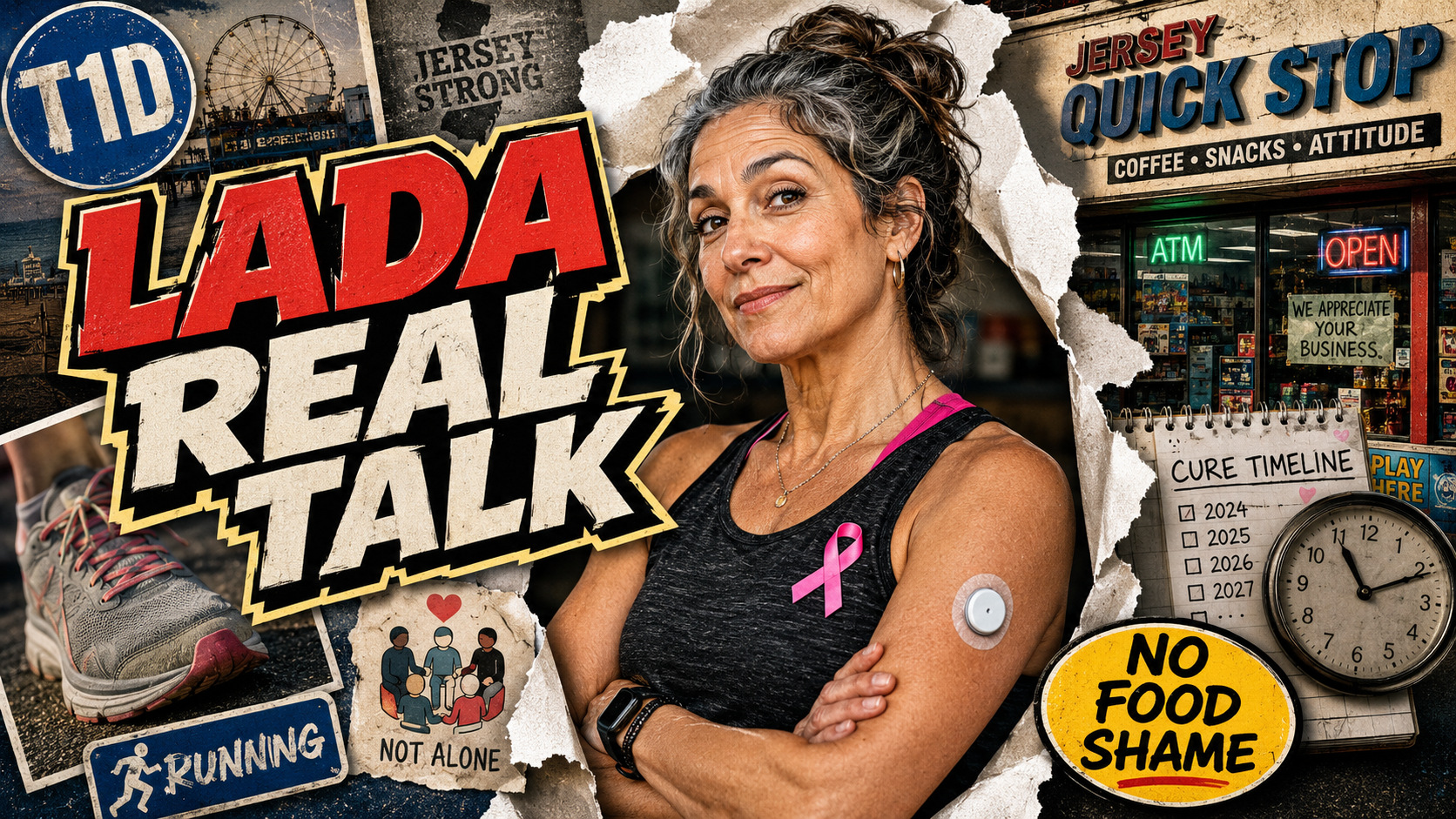
#1857 Jersey Represent
Adult-diagnosed LADA veteran and breast cancer survivor Naomi shares how cancer reframed her relationship with diabetes numbers, her strategies for running, and a realistic take on cure timelines.
Key Takeaways
- Adult-Onset Misdiagnosis: Latent Autoimmune Diabetes in Adults (LADA) is frequently misdiagnosed as Type 2 diabetes initially, demonstrating the critical importance of autoantibody testing (like GAD) for older adults presenting with elevated glucose[cite: 3296, 3297, 3301].
- Empowered Self-Advocacy: Naomi stresses that patients must heavily research and actively advocate for their treatment plans, including pushing providers for insulin therapies when remaining at baseline elevations of 140–150 mg/dL[cite: 3289, 3290, 3292].
- T1D and Running Dynamics: Managing long-distance running requires adjusting for competitive environmental triggers like "foot-to-floor" syndrome, carrying fast-acting glucose infrastructure, and tracking shifting patterns where adrenaline spikes give way to late-run crashes[cite: 3496, 3502, 3510].
- A Shifting Horizon on Perfectionism: Facing a serious alternative health challenge, such as stage 1 breast cancer, can fundamentally reset care priorities, easing obsessive anxiety over singular blood sugar fluctuations[cite: 3393, 3397, 3474].
- Transplant Realities: While experimental clinical islet cell and stem cell protocols show monumental promise, structural delivery challenges, insurance roadblocks, and the need for regular anti-rejection infusions create a prolonged timeline to general availability[cite: 3937, 3954, 4007, 4010].
Resources Mentioned
- Omnipod 5 Automated Insulin Delivery System [cite: 3275, 3489]
- US Med Supplying Delivery Fulfillment [cite: 3278, 3447]
- Breakthrough T1D (Formerly JDRF) [cite: 3517, 3888]
- Juicebox Podcast (Small Sips & Bold Beginnings Series) [cite: 3264, 4104]
- Think Like a Pancreas by Gary Scheiner [cite: 3327]
- Healthy Kick Ass Lada (Community Reference Manual) [cite: 3327]
Introduction and LADA Misdiagnosis
Scott Benner Friends, we're all back together for the next episode of the Juice Box podcast[cite: 3262]. Welcome[cite: 3262].
Naomi Hi[cite: 3262]. My name is Naomi[cite: 3263]. I am from New Jersey, and I am a type one diabetic diagnosed in 2016 as an adult[cite: 3263]. One of those lotta people[cite: 3264].
Scott Benner If you'd like to hear about diabetes management in easy to take in bits, check out the small sips[cite: 3264]. That's the series on the Juice Box podcast that listeners are talking about like it's a cheat code[cite: 3265]. These are perfect little bursts of clarity, one person said[cite: 3266]. I finally understood things I've heard a 100 times[cite: 3267]. Short, simple, and somehow exactly what I needed[cite: 3267].
Scott Benner People say small sips feels like someone pulling up a chair, sliding a cup across the table, and giving you one clean idea at a time[cite: 3268]. Nothing overwhelming, no fire hose of information, just steady helpful nudges that actually stick[cite: 3269]. People listen in their car, on walks, or rather actually bolus ing anytime that they need a quick shot of perspective[cite: 3270]. And the reviews, they all say the same thing[cite: 3271]. Small sips makes diabetes make sense[cite: 3271]. Search for the Juice Box podcast, small sips, wherever you get audio[cite: 3272].
Scott Benner Nothing you hear on the Juice Box podcast should be considered advice, medical or otherwise[cite: 3273]. Always consult physician before making any changes to your health care plan[cite: 3274]. A huge thanks to my longest sponsor, Omnipod[cite: 3275]. Check out the Omnipod five now with my link, omnipod.com/juicebox[cite: 3275]. You may be eligible for a free starter kit, a free Omnipod five starter kit at my link[cite: 3276]. Go check it out[cite: 3277]. Omnipod.com/juicebox[cite: 3277]. Terms and conditions apply[cite: 3277]. Full terms and conditions can be found at omnipod.com/juicebox[cite: 3278]. Today's episode is also sponsored by US Med[cite: 3278]. Usmed.com/juicebox or call (888) 721-1514[cite: 3279]. US Med is where my daughter gets her diabetes supplies from, and you could too[cite: 3279]. Use the link or number to get your free benefit check and get started today with US Med[cite: 3280].
Naomi Hi[cite: 3281]. My name is Naomi[cite: 3281]. I am from New Jersey, and I am a type one diabetic diagnosed in 2016 as an adult[cite: 3281]. One of those lotta people that you hear about[cite: 3282].
Scott Benner That you hear about[cite: 3282]. We hear we hear from a lotta people with lotta[cite: 3283]. You're almost up to a decade, or you hit it already[cite: 3284]?
Naomi Yes[cite: 3284]. So I'm almost coming up to a decade this summer[cite: 3285]. Wow[cite: 3285]. I didn't need insulin originally when I was first diagnosed[cite: 3286]. My my sugars were, you know, pretty pretty well controlled with low carb and exercise[cite: 3287]. And, gradually, you know, as the years went on by year five, I was realizing that my my glucose numbers were creeping up, you know, even despite a low carb, high exercise diet and and a diet of exercise as well[cite: 3288]. But at that point, I really had to push my endocrinologist for insulin[cite: 3289]. I felt as though, you know, all of the research that I had done and everything that I had read, you know, told me that being at one forty, one fifty all the time, like, wasn't really normal[cite: 3290]. I know it's, you know, within range for many people, but I knew at that point, you know, well, maybe somebody should be offering me insulin at this point, but it wasn't happening[cite: 3291]. So I I just pushed for it and advocated for it[cite: 3292]. And every time I went said, you know, I think it's time[cite: 3293]. I think it's time[cite: 3293]. I wanna try it[cite: 3294]. I think I'll be okay with it[cite: 3294]. And that that got me down to, you know, more reasonable range with fasting numbers and things like that[cite: 3295].
Scott Benner So question[cite: 3295]. When you were diagnosed originally, they told you you were type two[cite: 3296]?
Naomi Yes[cite: 3296]. Originally, I was diagnosed at first by my regular GP[cite: 3297]. He noticed that my sugar was high, one time when I went just for an average visit[cite: 3298]. I had no symptoms, felt nothing, wasn't drinking excessively, wasn't going to the bathroom a lot like you hear with a lot of other people[cite: 3299]. I'm gonna send out your blood for this antibody auto antibody test to just see if you have the antibodies for type one diabetes[cite: 3300]. I was positive for just the GAD one, but he wasn't sure[cite: 3301]. He said it was, like, borderline and potentially I could have been type two[cite: 3302]. He referred me to an endocrinologist[cite: 3303]. And I'm still with that endocrinologist today, and I really do like her a lot[cite: 3303]. But she was kind of of the school, it doesn't really matter if you're type one or type two, we're just gonna watch your numbers[cite: 3304]. And I thought that was a little you know, odd[cite: 3305]. I thought, you know, well, no[cite: 3305]. Shouldn't we know because I may eventually need insulin if I am a type one[cite: 3306]?
Scott Benner Also, what the heck[cite: 3306]? Right[cite: 3307]? Why don't we know for sure[cite: 3307]?
Naomi Yeah[cite: 3307]. I just like to know[cite: 3308]. I mean, I'm the type[cite: 3308]. I like to know everything about everything[cite: 3308]. I research everything[cite: 3308]. I read everything[cite: 3309]. So...
Managing Hypothyroidism and Breast Cancer
Scott Benner Oh, Amy, I don't think you need to be the type to wanna know that[cite: 3309]. That one's that one's pretty easy[cite: 3310]. So you I heard you stumble when you said I'm still with her[cite: 3310]. Is that the, like do you feel like I'm about to judge you for not finding a doctor who didn't misdiagnose you for five years[cite: 3311]?
Naomi I'm not I'm not so much worried about you judging me[cite: 3312]. I'm I'm worried about my own judgment of myself sometimes that I that I stick with her[cite: 3313]. I really do like her, and she's been helpful, you know, throughout the years[cite: 3314]. And, you know, I just realized that the relationship is more of, me doing the research and me advocating for myself rather than[cite: 3315]...
Scott Benner And her having access to a prescription pad[cite: 3315]?
Naomi Yes[cite: 3316]. And sometimes I feel yeah[cite: 3316]. Like, not that I know more than the endocrinologist, but I know a lot at this point[cite: 3316]. You know, obviously, as a type one diabetic, you educate yourself, and you're your own best advocate[cite: 3317]. So...
Scott Benner Yeah[cite: 3317].
Naomi I always go in there prepared with, well, what about this[cite: 3318]? And let's try this[cite: 3319]. And what about this research[cite: 3319]? And you know[cite: 3319]?
Scott Benner Well, how old were you at the original diagnosis with the GP[cite: 3320]?
Naomi I was 47[cite: 3321].
Scott Benner So 47 years old[cite: 3321]. You went to the doctor just because you were going[cite: 3321]?
Naomi It was my regular yearly physical[cite: 3322].
Scott Benner Okay[cite: 3322]. You showed up that day being like, I'm 47[cite: 3323]. I'm doing great[cite: 3323]. I have no complaints[cite: 3323]. And you left that office an hour later going, I have diabetes[cite: 3324]?
Naomi No[cite: 3325]. It was not an hour later[cite: 3325]. He said my sugar was high and, you know, we'll send we'll do this other blood work and we'll send it out[cite: 3325]. So it wasn't until, a couple weeks later that he called and I was I remember, you know, I remember the call exactly[cite: 3326]. I was in a hotel room at, like, my son's college orientation[cite: 3327]. And he he said, you know, I think that you have diabetes because you've borderline for this antibody[cite: 3328].
Scott Benner Your sugar's been elevated to [cite: 3328]
Naomi a one c[cite: 3329]. So it was kind of a shock because, you know, I was, you know, very good health[cite: 3330]. And...
Scott Benner Fair to say you left that appointment[cite: 3331]. He said we're gonna send some blood out[cite: 3331]. You didn't think about it again[cite: 3332]. You didn't think someone's [cite: 3332]
Naomi gonna in a million years would I have suspected I had diabetes[cite: 3332]. Now I had just come off of this you know, subsequently to the diagnosis, I had read that it could be triggered by a virus or an infection of some sort[cite: 3333]. So I had just come off a very, very bad infection for which I was hospitalized[cite: 3334]. So in my my endocrinologist didn't think necessarily there was that correlation, but in the back of my mind, I thought, oh, maybe that's what did trigger it[cite: 3335].
Scott Benner So you've obviously done a lot of picking around since then[cite: 3336]. And so hindsight, is there other autoimmune stuff in your extended family[cite: 3336]?
Naomi Not in my extended family at all[cite: 3337]. No[cite: 3338]. I I have thyroid issue[cite: 3338]. You know, I'm on I have is it hypothyroidism[cite: 3338]?
Scott Benner Hypo[cite: 3339]. Yeah[cite: 3339].
Naomi Yes[cite: 3339]. So I'm hypothyroidism[cite: 3339]. My dad was a type two diabetic, but that was really, I believe, diet related, and he was overweight and all of that[cite: 3340]. But no one in my family that I know of was a type one diabetic or had any autoimmune issues[cite: 3341]. So it's it was such a shock[cite: 3342]. You know[cite: 3342]?
Scott Benner No[cite: 3342]. No[cite: 3342]. No[cite: 3342]. I hear you[cite: 3342]. How long had you had the the hypothyroidism diagnosis[cite: 3343]?
Naomi That I've had for about twenty years[cite: 3343].
Scott Benner You're gonna say that's longer[cite: 3344]. Right[cite: 3344]?
Naomi Mhmm[cite: 3344].
Scott Benner Yeah[cite: 3344]. Yeah[cite: 3344]. Yeah[cite: 3344]. And nobody else in your family has that[cite: 3345]? No[cite: 3345]. Just lucky[cite: 3345].
Naomi To my knowledge, unless, you know, with my grandparents, you don't know[cite: 3346]. They're not here anymore[cite: 3346]. You know, I can't ask them[cite: 3347]. But Yeah[cite: 3347]. But it wasn't something that I was aware of or that my parents talked about my grandparents having[cite: 3348].
Anxiety and Perfectionism
Scott Benner Gotcha[cite: 3349]. Okay[cite: 3349]. Have you all you described yourself in your note as a perfectionist[cite: 3349]?
Naomi Yes[cite: 3349].
Scott Benner Has that always been the case[cite: 3350]?
Naomi You know, I've always been a little bit of sort of an overachiever and, you know, wanting everything to be perfect and in place and organized and me being on top of everything[cite: 3350]. And, that is a tough sell with diabetes because it's hard to be a perfectionist with diabetes because you can't be perfect[cite: 3351]. Yeah[cite: 3352]. So that that's tough[cite: 3352]. So in the in the beginning and and even to this day, I say, you know, I'm not as obsessive about my numbers, but I kind of really still am a little bit, and I check my my phone much more often than I think is probably healthy[cite: 3352].
Naomi Mhmm[cite: 3353]. I'm trying to get my mindset more to the place of, you know, yes[cite: 3353]. I wanna have good numbers and be in range all the time, but at the same time, I also don't want to take years off my life by stressing about the numbers and worrying about the diabetes and checking my numbers so frequently[cite: 3354].
Scott Benner That kind of personality trait[cite: 3355]. Entire life as a child and a teen in high school too[cite: 3355]? Or more as in your twenties[cite: 3356]?
Naomi At that time, I I felt that there was less to obsess about or control[cite: 3356]. Like, I didn't have control issues when I was growing up or anything like that or wanting to be in control all the time[cite: 3357]. But with the diabetes, I feel as though it almost got worse because you had this number and you have the technology where you can look at it all the time and you can manage it all the time and you can micromanage it, you know, with microdosing[cite: 3358]. And, you know, so I'm sort of in that place where I I am very on top of it[cite: 3359].
Scott Benner Yeah[cite: 3360]. Let be a little less obtuse[cite: 3360]. Okay[cite: 3360]?
Naomi K[cite: 3361].
Scott Benner Do you have anxiety, and did it start when your thyroid diagnosis came[cite: 3361]?
Naomi No[cite: 3362]. I I will say right now, no[cite: 3362]. I do not have anxiety[cite: 3362]. I have struggled with anxiety in the past, and I've been in therapy for that and everything, but not in a not in a very long time[cite: 3363]. But I think it has crept back up with the diabetes[cite: 3364].
Naomi I don't think of myself as an anxious person[cite: 3365]. I think of it as more of, you know, I wanna be in in control of my diabetes[cite: 3366]. I wanna control it rather than have it control me[cite: 3367].
Scott Benner Yeah[cite: 3367]. Yeah[cite: 3367]. Yeah[cite: 3367]. I also wanna tell people who are listening around the country and around the world that you talk faster[cite: 3368]. You probably seem anxious to them, but you're just from Jersey[cite: 3369].
Scott Benner So...
Naomi I'm from I'm from New York originally[cite: 3370].
Scott Benner I I just...
Naomi talk very fast, so I will try to slow that down[cite: 3371].
Scott Benner No[cite: 3372]. No[cite: 3372]. You're doing fine[cite: 3372]. I'm I'm slowing myself down so the two of us aren't doing it together[cite: 3372]. Okay[cite: 3373]. Because I you and I are probably very close to each other, physically[cite: 3373]. Mhmm[cite: 3373]. Yeah[cite: 3374]. Yeah[cite: 3374]. So, if I get going, you and I'll just be going at a speed that no one else will be able to listen to[cite: 3374].
Scott Benner So...
Naomi Yes[cite: 3375]. And and I especially find I talk faster when I am very interested in the topic, and I'm very invested in the topic[cite: 3375]. I tend to get a little more excited about it[cite: 3376].
Scott Benner Yeah[cite: 3376]. Sure[cite: 3376]. Hey[cite: 3376]. Listen[cite: 3376]. It took me it took me the better part of, like, six years making this podcast to learn how to slow myself down[cite: 3377].
Scott Benner So...
Naomi Wow[cite: 3378].
Scott Benner So what I was gonna say is that, like, anxiety can be a side effect of, like, a mistreated thyroid[cite: 3378]. And so my last question about your thyroid is is do you know where your TSH level sits[cite: 3379]?
Naomi I have it in my blood work[cite: 3380]. I don't know it off the top of my head, but I'm doing fine according to my endocrinologist[cite: 3380]. I am on medication for it, but I'm not it's not anything where she's had to adjust my medication because I'm too high or too low[cite: 3381]. I'm I'm within the normal range[cite: 3382]. I do know that[cite: 3382].
Scott Benner I bring this up because the normal range is pretty wide and a really a well thought out endo around thyroid will will manage your TSH under a 2.1[cite: 3383]. So do you have any other hypothyroid symptoms[cite: 3384]? Are you tired a lot, can't get rested, hair falls out, brittle nails[cite: 3384]? I'm trying to think anything like that, fatigue[cite: 3385].
Naomi You know, I I have some of that, but that's due to my my breast cancer diagnosis[cite: 3385].
Scott Benner Yeah[cite: 3386]. Well, listen[cite: 3386]. I I'm not a doctor[cite: 3386]. What I'm gonna tell you is if you dig around in that blood work at some point and realize that your TSH is, like, three and a half and she's telling you it's good, then then[cite: 3387]...
Naomi No[cite: 3387]. I just found it[cite: 3387]. I pulled it up in my you know, in the Apple Health app, you can, if you connect it to all of your health apps in your MyCharts, you can just punch in TSH in the search bar, and it it just came up[cite: 3388]. So I am 1.3[cite: 3389].
Scott Benner Oh, that's beautiful[cite: 3389]. Okay[cite: 3389]. Good[cite: 3389]. You are a perfectionist[cite: 3389]. You have your health app attached to your look at you[cite: 3390]. You're proving you're proving yourself right the whole way[cite: 3391].
Naomi I didn't do that myself[cite: 3391]. My son had to set that up for me[cite: 3392]. So...
Cancer Realities and Shifting Perceptions
Scott Benner Tell me about the cancer[cite: 3392].
Naomi Okay[cite: 3393]. So I was diagnosed with the breast cancer last summer[cite: 3393]. Also, you know, another shock because I think of myself as such a healthy person, but, you know, it can happen[cite: 3394]. It happens to one in eight women[cite: 3395]. So, again, regular mammogram[cite: 3395]. I didn't feel anything[cite: 3395]. It wasn't the mammogram that picked it up[cite: 3396]. It was the ultrasound that picked it up[cite: 3396]. They did a biopsy[cite: 3397]. I luckily, I was stage one[cite: 3397]. It had not spread to my lymph nodes, so so I am very lucky[cite: 3398].
Naomi However, anyone with breast cancer knows you they send your tumor out when they do the surgery[cite: 3399]. They send it out to some lab in California, they do something called an Oncotype DX score[cite: 3400]. And that is, a score that tells you whether or not you will benefit from chemotherapy[cite: 3401]. My score came back very high, so they did recommend chemotherapy[cite: 3402]. So I did go through the whole treatment process of chemotherapy and radiation, and, I finished radiation in February[cite: 3403].
Scott Benner Congratulations[cite: 3404].
Naomi Thank you[cite: 3404]. Thank you[cite: 3404]. So and now I'm just on the, aromatase inhibitor, which is supposed to tamp down your estrogen[cite: 3404]. I had the type of breast cancer ER positive[cite: 3405]. My cancer grew in estrogen, so they tried to block that as much as possible going forward[cite: 3406]. And and I think that does cause some you know, that causes some fatigue and all that[cite: 3407]. Also, just basically what my body has been through, you know, over the last, you know, eight months or so[cite: 3408].
Scott Benner Two things[cite: 3419]. First of all, my anxiety grows and estrogen comes from my wish and my daughter[cite: 3409].
Naomi That'll do it[cite: 3410].
Scott Benner Yeah[cite: 3411]. Yeah[cite: 3411]. Yeah[cite: 3411]. And the the second thing is you said something offhandedly a second ago that I wanna double back to[cite: 3411]. You know, I think of myself as a healthy person[cite: 3412]. And I think I'd like to point out to people that just because your your thyroid went kablooey and so did your pancreas, and and you had breast cancer, I don't know that that doesn't mean you're not a healthy person[cite: 3413, 3414]. Like, I wonder what everyone's expectation is about the process of life to death and what's supposed to, like, quotes, finger quotes, supposed to happen to you through that entire process[cite: 3415]. I think about that because I'm 54[cite: 3416]. So what am I? I'm a little older than you[cite: 3416]. Right[cite: 3417]?
Naomi You're a little younger[cite: 3417]. I'm 57[cite: 3417].
Scott Benner Oh, I'm sorry[cite: 3417]. Did the math wrong[cite: 3417]. Thank you[cite: 3418]. Finally, I'm younger[cite: 3418].
Naomi You're a baby[cite: 3418].
Scott Benner So there you are[cite: 3419]. You're 57[cite: 3419]. I'm 54[cite: 3419]. My son said to me, I don't know, a year ago, like, how many things have been wrong with you[cite: 3419]? He told me[cite: 3420]. Like, as I as I as I so, like, for instance, and I had to have my right knee cleaned out[cite: 3420]. Oddly, my the big toe on my right foot stopped bending, and, like, the guy had to go in there and, like, I don't know what he found, that he cleaned it up a little bit, did some microneedling and all this stuff[cite: 3421]. And it's been, like, a couple of years now, And I would tell you that it's odd that I'm having this conversation now because I'm not actually wearing shoes right now[cite: 3422]. But I couldn't I couldn't you know, can you make a fist with your toes[cite: 3423]? Right[cite: 3423]?
Scott Benner I couldn't do that with my right toe for, the first eighteen, twenty four months after the surgery, but I can now[cite: 3424]. Like, it was Interesting[cite: 3424]. Good idea to go get the surgery[cite: 3425]. It ended up being a great thing[cite: 3426]. Blah blah blah[cite: 3426]. Right[cite: 3427]? I've, had a carpal tunnel surgery because I injured my hand[cite: 3427]. I've you know, I use a GLP medication[cite: 3428]. I had to have, like, something, like, you know, throughout my life[cite: 3428]...
Naomi Like normal normal aging thing[cite: 3428].
Scott Benner I yeah[cite: 3429]. I had a I had a my shoulders are like, I had a motorcycle accident when I was a kid[cite: 3429]. I never got it fixed[cite: 3430]. I had to have, like, rotator cuff surgery, like, stuff like that[cite: 3430]. And my son looks at that and goes, holy hell, man[cite: 3430]. He's breaking all over the place[cite: 3431]. You know[cite: 3432]?
Naomi Yes[cite: 3432].
Scott Benner Yes[cite: 3432]. What I see is I see that, like, you're an expectation of getting to your grave without something like this going wrong in your meat sack that is rotting in front of you every day long[cite: 3432]. I just look at it as trying to stay ahead of father time[cite: 3433]. And Yes[cite: 3433]. Because if somebody said to me, are you healthy[cite: 3434]? I would say yes[cite: 3434].
Scott Benner You've probably heard me talk about US Med and how simple it is to reorder with US Med using their email system[cite: 3435]. But did you know that if you don't see the email and you're set up for this, you have to set it up[cite: 3436]. They don't just randomly call you[cite: 3437]. But I'm set up to be called if I don't respond to the email because I don't trust myself, a 100%[cite: 3437]. So one time, I didn't respond to the email and the phone rings at the house[cite: 3438]. It's like, ring, you know how it works[cite: 3439]. And I picked it up[cite: 3439]. I was like, hello[cite: 3439]? It was just the recording[cite: 3439]. It was like, US Med, doesn't actually sound like that, but you know what I'm saying[cite: 3440, 3441]. It said, hey, you're, I don't remember exactly what it says, but it's basically like, hey, your order's ready[cite: 3441]. You want us to send it[cite: 3442]? Push this button if you want us to send it[cite: 3442]. Or if you'd like to wait, I think it it lets you put it off, a couple of weeks or push this button for that[cite: 3443].
Scott Benner That's pretty much it[cite: 3444]. I push the button to send it, and a few days later, box right at my door[cite: 3444]. That's it[cite: 3445]. Usmed.com/juicebox or call (888) 721-1514[cite: 3445]. Get your free benefits checked now and get started with USmed[cite: 3445]. Dexcom, Omnipod, Tandem, Freestyle, they've got all your favorites[cite: 3446]. Even that new islet pump[cite: 3446]. Check them out now at usmed.com/juicebox or by calling (888) 721-1514[cite: 3447, 3448]. This episode is brought to you by Omnipod[cite: 3449].
Scott Benner Would you ever buy a car without test driving at first[cite: 3449]? That's a big risk to take on a pretty large investment[cite: 3450]. You wouldn't do that[cite: 3450]. Right[cite: 3450]? So why would you do it when it comes to choosing an insulin pump[cite: 3451]? Most pumps come with a four year lock in period through the DME channel, and you don't even get to try it first[cite: 3452]. But not Omnipod five[cite: 3453]. Omnipod five is available exclusively through the pharmacy, which means it doesn't come with a typical four year DME lock in period[cite: 3453]. Plus, you can get started with a free thirty day trial to be sure it's the right choice for you or your family[cite: 3454]. My daughter has been wearing an Omnipod every day for seventeen years[cite: 3455]. Are you ready to give Omnipod five a try[cite: 3456]? Request your free starter kit today at my link, omnipod.com/juicebox[cite: 3457]. Terms and conditions apply[cite: 3457]. Eligibility may vary[cite: 3457]. Full terms and conditions can be found at omnipod.com/juicebox[cite: 3458]. Find my link in the show notes of this podcast player or at juiceboxpodcast.com[cite: 3459].
Naomi You know, I'm glad you said that that because that's the perspective I'm trying to get to because I still do feel extremely healthy[cite: 3460]. I mean, I am I work out all the time[cite: 3461]. I'm a long distance runner and I'm still running, you know, and I ran through treatment[cite: 3462]. And I I part of me, 50% of me feels that I'm very healthy[cite: 3463]. I eat well, obviously, because I watch what I eat because of the diabetes[cite: 3464].
Naomi So I have that, but then I also have the fifty percent of me that's like, oh my gosh, got the thyroid issue[cite: 3465]. I have osteopenia, which many women my age get[cite: 3466]. I have breast cancer, I have diabetes, and I'm falling apart, I'm breaking down[cite: 3467]. So I go back and forth[cite: 3468]. I'm still feeling very healthy, but I do worry about the things that are happening to my body[cite: 3468]. But many people live very long fruitful lives, obviously, with type one diabetes and having survived breast cancer[cite: 3469]. So...
Scott Benner Yeah[cite: 3470]. Yeah[cite: 3470]. Well, I'm glad you're looking[cite: 3470]. I I understand your trepidation around, like, making the proclamation, but at the same time, I like that you're searching for it[cite: 3471]. I also did not mean to rhyme trepidation and proclamation[cite: 3472]. I very much apologize[cite: 3472]. I apologize to everybody for that[cite: 3473].
Naomi For a Monday morning[cite: 3473]. But I also wanted to mention that with with the diagnosis of the breast cancer, it really helped me to sort of be a little less obsessive with the diabetes numbers because I realized that as much effort as I put into managing my diabetes, here came this thing along that was so much bigger and that really was life threatening and that could could kill me[cite: 3474]. And so it really made sometimes when I hear people talk about diabetes, it's the worst possible thing that ever happened to them[cite: 3475]. Now I have this perspective of like, God, if I only just had diabetes, that would be awesome[cite: 3476]. So it is interesting how things happen in life and changes your perspective because you can you really can[cite: 3477]. If you are in control or have some, you know, good range of control with your glucose numbers, you can live well into your eighties and nineties[cite: 3478].
Insulin Administration and Running
Scott Benner You know[cite: 3479]? Yeah[cite: 3479]. There should be no issue with that[cite: 3479]. Well, okay[cite: 3479]. So you got to the point where you talked to that doctor into believing you needed insulin[cite: 3480]. And are you, like where are you in the, like, the LADA chain of command[cite: 3481]? Are you, like, in full need of insulin[cite: 3481]? Are you taking just [cite: 3482]
Naomi Oh, yeah[cite: 3482].
Scott Benner Yeah[cite: 3483]. Yeah[cite: 3483].
Naomi No[cite: 3483]. I'm I'm in full need now[cite: 3483]. In the beginning, I started with pens[cite: 3483]. You know, the first couple years, I used pens[cite: 3484]. And then I as I educated myself more, I realized, well, there's more I can be doing[cite: 3485]. You know, why don't why can't I give myself point five unit of insulin as opposed to a full unit[cite: 3486]? And then I started, you know, researching pumps and exploring the pumps[cite: 3487]. And and I knew, just given my lifestyle and activity level, I I knew that I didn't want one with a tube, although they're very successful for so many people[cite: 3488]. But I did go with the Omnipod[cite: 3489]. And, you know, I don't I don't take as much insulin as some other people because I do tend to eat a low carb diet[cite: 3489]. But there are times where, you know, I'm out to eat or wherever if I want dessert, you know, and I definitely you know[cite: 3490]? Yeah[cite: 3491]. But I typically don't have more than thirty units a day[cite: 3491].
Scott Benner Okay[cite: 3491]. Yeah[cite: 3491].
Naomi I mean Sometimes it's as low as, you know, ten units if I'm eating, you know, very low carb that day[cite: 3492].
Scott Benner How does the running affect your insulin needs[cite: 3493]?
Naomi The running is tricky because, you know, again, with diabetes, it's it's all about sort of decision, the management around, you know, okay[cite: 3494]. Well, when am I gonna do my run[cite: 3495]? Like, I typically wanna do it in the morning before I've eaten[cite: 3495]. But sometimes when I wake up in the morning, I have foot to floor syndrome or dawn phenomenon or whatever you call it that that makes me go up[cite: 3496]. So I tend to take it I might take a unit or two, when I wake up to just keep myself, you know, under one forty[cite: 3497]. But then sometimes, you know, when I go out for the run, I tend to drop lower when I run[cite: 3498]. So I wanna be you know, I'm always looking again at the number to make sure, okay[cite: 3499]. Well, I'd love to be around one twenty, one thirty when I start to go out for a run, but, you know, sometimes I'm not[cite: 3500]. Sometimes I'm sitting at 90, and then I drink some juice or I eat something[cite: 3501]. I always make sure that I have to have, I have a belt with me, that I always have snacks[cite: 3502]. I have, you know, the running pants or the running shorts where the pocket so I can always carry a juice box[cite: 3503]. You know[cite: 3504]? But, again, during a run, I do like to check my numbers because I don't, you know, I don't want one time, I I did go very, very low during a run[cite: 3504]. I just got distracted[cite: 3541]. I wasn't checking it, and I started to get that numb tingly feeling around your mouth that you get when you go very low[cite: 3505].
Scott Benner That's usually really low, right, for people too[cite: 3506].
Naomi And then I looked, and I was, like, 45 or something[cite: 3507]. And I'm like, oh my god[cite: 3507]. I can't believe I usually, I'm, you know, a little more on top of that when I'm running[cite: 3508]. So I do check it when I run because I like to make sure I'm not going low during a run[cite: 3509]. It's funny[cite: 3510]. I used to go high when I ran, and I think in the beginning, it was like my liver dumping glucose or something[cite: 3510]. I didn't know what it was[cite: 3511]. But from what I've read, you know, it could have been that[cite: 3511]. But now all the time, I tend to skew lower[cite: 3512]. So I like to try to eat something before I go or make sure I have food with me so that I can maintain, you know, a certain level[cite: 3513].
Naomi But there's, I don't know if you there's a woman I follow[cite: 3514]. I follow her on Instagram and TikTok, and she's she's a runner[cite: 3515]. And she's always, like, you know, saying what her numbers are during a run[cite: 3516]. And she I actually saw her run, and She was running in the New York City Marathon, and she was running for breakthrough t one d[cite: 3517]. And, you know, it's just inspirational that Yeah[cite: 3517]. She's able to do it, you know, with but so you can[cite: 3518]. You can do it[cite: 3519]. Well, you're doing it[cite: 3519]. Careful[cite: 3519]. Like, yeah, in marathons, when you have, like, gels and goos and things like that, I don't wanna have that because I don't wanna have to take insulin while I'm running, but I can take a little bit of it[cite: 3520]. If I'm if I'm on the lower side, you know, I can have a little bit of it[cite: 3521]. I can have, like, a sip or two of Gatorade[cite: 3522].
Scott Benner Yeah[cite: 3522]. No[cite: 3523]. I think I mean, I've interviewed a a handful of people who've done marathons[cite: 3523]. They always wanna come on the podcast, and I I always feel bad because my my inclination is always to ask them, like, why are you running so much[cite: 3524]?
Naomi I know[cite: 3525]. But but No[cite: 3525]. Again, it's like every marathon, I say, okay[cite: 3525]. This is definitely [cite: 3526]
Scott Benner the last one[cite: 3526].
Naomi I'm 57[cite: 3526]. Like, I cannot do this anymore in my body[cite: 3526]. But my kids are running it this year, and I wanted you know, just that you know, I'm so excited to do it with them and to have that opportunity[cite: 3527]. So I wanna go out on a high note running it with them[cite: 3528].
Scott Benner There was a woman on recently[cite: 3539]. Do you listen to the podcast[cite: 3541]?
Naomi Yes[cite: 3529]. Yes[cite: 3529]. Not not everyone, but, you know[cite: 3530]...
Scott Benner Well Was it [cite: 3530]
Naomi it wasn't Addy, was it[cite: 3530]?
Scott Benner Let me look[cite: 3531]. There's an [cite: 3531]
Naomi an Addy Taylor on[cite: 3531]?
Scott Benner No[cite: 3532]. Oh[cite: 3532],
Naomi she's the runner that I follow[cite: 3532].
Scott Benner I don't know why I can't seem to hook up with her, actually, because I think [cite: 3533]
Naomi Oh, she's Yeah[cite: 3533]. She's very fast too[cite: 3534]. She's I mean, she's a lot younger than I am, but she I think she runs, an eight, eight thirty pace[cite: 3534]. You know[cite: 3534]? I'm an old lady[cite: 3602]. I'm doing the old lady pace[cite: 3603].
Scott Benner Well yeah[cite: 3536]. Oh, episode seventeen thirty one[cite: 3536].
Naomi Okay[cite: 3536].
Scott Benner So let's see[cite: 3536]. Diagnosed forty nine years ago, Linda shares her philosophy on borrowed time and her incredible feat of running in seven marathons on seven continents in seven days[cite: 3537].
Naomi Oh, that's in seven days[cite: 3538]?
Scott Benner And she did it three separate times[cite: 3538].
Naomi Okay[cite: 3539]. What episode is that[cite: 3539]? Seventeen thirty one[cite: 3539]?
Scott Benner Seventeen thirty one[cite: 3539]. As you were talking, I thought, oh, I think Naomi would really like that[cite: 3540]. Yeah[cite: 3540].
Naomi Now that is impressive[cite: 3541]. That is impressive[cite: 3541]. I mean, I'm I'm a runner, but I'm not in that category of running[cite: 3541]. Because a lot of women wanted or a lot of people in general, runners, wanna run the world majors or they wanna run a marathon in every continent[cite: 3542]. But to do it in that short amount of time, I mean, I'm lucky if I can do one a year[cite: 3543]. You know[cite: 3544]?
Scott Benner Yeah[cite: 3544]. I don't listen[cite: 3544]. I've I I I jogged across the parking lot at the shop right the other day, and that was enough[cite: 3545]. I was good[cite: 3546].
Naomi K[cite: 3546]. And that's something[cite: 3546].
Scott Benner Yeah[cite: 3547]. I I was like, oh, let me get out of the way[cite: 3547]. You know[cite: 3547]?
Naomi Scott, you gotta start somewhere[cite: 3548].
Scott Benner Well, I started and stopped at the other side of the driveway[cite: 3458]. You know, I don't when when you're walking across the may I share a pet peeve[cite: 3549]? When you're walking from your car to the grocery store, please, first of all, let's not zigzag[cite: 3550]. Let's not go diagonally across where people are driving[cite: 3551]. And if your ass is in the way, hustle a little bit[cite: 3552]. You you know what I mean[cite: 3553]? Like, don't [cite: 3553]
Naomi look up pace[cite: 3553].
Scott Benner Yeah[cite: 3554]. Don't look up everybody and go, I see that I've walked in front of your car[cite: 3554]. You're all gonna have to I I I just try to I just try to pick up the pace a little bit[cite: 3555]. Yeah[cite: 3556]. Also, may I may I share[cite: 3556]?
Naomi Well, Scott, I'll give you a suggestion[cite: 3556]. Just park park further away from the entrance, and then you get more steps in[cite: 3557].
Scott Benner Park in the park[cite: 3557]. I'm not out of my mind, Naomi[cite: 3558]. No[cite: 3558]. I actually boy, I'll tell you what[cite: 3558]. I was my I'm sorry[cite: 3559]. My brother is in Wisconsin texting[cite: 3559]. It's still snowing three days later is what he just sent me[cite: 3560].
Naomi That's you know, I'm done with it[cite: 3561]. I'm over it[cite: 3561]. Me too[cite: 3561]. I'm in the Northeast too[cite: 3562]. So I we don't have snow right now, but it's chilly and cold [cite: 3562]
Scott Benner and And why did it start raining again[cite: 3562]? Like, horrible[cite: 3563].
Naomi My my son just ran the, my younger son ran the Napa Marathon, and I was out there[cite: 3563]. And I was just thinking, like, why don't I live out here[cite: 3564]? This is insane[cite: 3564].
Vigilance vs. Longevity Outlook
Scott Benner Okay[cite: 3564]. Beautiful[cite: 3565]. We'll get to that in a half a second[cite: 3565]. I just wanna share with you, I'm not sure if I'm mentally ill or I'm youthful, but I was at, I was at the grocery store recently[cite: 3566]. I can't believe I'm just gonna talk about the grocery store completely, but there were there just weren't many people in it[cite: 3567]. It was a little later at night, and I would, like kinda speed up a little bit and sort of jump up in the air and hold my body weight up on my cart and let the cart take me down the aisle[cite: 3568].
Naomi Oh, you are definitely useful then[cite: 3569].
Scott Benner And and, like and I and I'm like, oh, I and I did it[cite: 3569]. I was like, oh, that was awesome[cite: 3570]. So I do it more lately, like, when no one's in the aisle[cite: 3570]. I wanna be clear not when people are in the aisle, but when the aisle's clear[cite: 3571]. Right[cite: 3571]? And I always feel like this is, like, the secret thing I'm doing that nobody knows about[cite: 3572]. And then I realized it hit me one day[cite: 3573]. There are cameras all over that place[cite: 3573]. There is someone [cite: 3574]
Naomi Someone someone's [cite: 3574]
Scott Benner watching going, you[cite: 3574]. What is this person doing[cite: 3574]?
Naomi Yes[cite: 3574]. And you have to be careful[cite: 3575]. Right[cite: 3575]? Because you've had knee surgery and, [cite: 3575]
Scott Benner you know That'll be fine[cite: 3575]. But, like but I honestly, as I'm doing it, I thought I it actually it occurred to me later because I I went out in the parking lot[cite: 3576]. There's this, like, little dip in the parking lot[cite: 3577]. Like, you kinda go down a slight hill[cite: 3577]. And I'm like, why am I walking across the parking lot when I could ride the cart down here[cite: 3578]?
Naomi When I could [cite: 3579]
Scott Benner be So I driving[cite: 3579]. I did that[cite: 3579]. And then I got all I packed up and everything and, you know, gotten the got my car to leave[cite: 3580]. And I actually stopped for a second and thought, I wonder how many 54 year old people would do this[cite: 3581]. Like, is the and that's when it hit me[cite: 3582]. I was like, is this a positive thing about me, or is there something wrong with me[cite: 3583]? And I and I [cite: 3583]
Naomi Only little of both[cite: 3584].
Scott Benner Yeah[cite: 3584]. Right[cite: 3584]?
Naomi That's why But I but I love it because I I'm especially I mean, especially I I was always like this, but more so after a cancer diagnosis[cite: 3585]. You have to live life[cite: 3586]. You have to embrace every moment and find the joy where you can[cite: 3586]. Yeah[cite: 3587]. So why not do that[cite: 3587]? Yeah[cite: 3587]. Why not[cite: 3587]?
Scott Benner My mom passed away in her eighties from cancer, and it taught me a lot about the idea of, like, waiting till the end to do stuff[cite: 3588]. Also Right[cite: 3589]. As you bring it up, like, why are you not why don't you move to California[cite: 3589]? Why don't I I'm trying so hard to get my wish to go, like, south, like, to get it because warm[cite: 3590]. Yeah[cite: 3591]. Because it's terrible here[cite: 3591].
Naomi I know[cite: 3591].
Scott Benner Or and you have context for this[cite: 3591]. I I said okay to I'm doing this talk at Hofstra[cite: 3592]. And I gotta drive out on the island, like, on a Wednesday afternoon[cite: 3593]. And I'm just like the whole time, I'm like, why did I say yes to that[cite: 3594]?
Naomi Not fun[cite: 3034]. Not fun[cite: 3595]. Although people say the traffic in in, outside, you know, San Fran area is bad too[cite: 3595]. But, yeah, in in the metropolitan area, ugh, forget it[cite: 3596].
Scott Benner Yeah[cite: 3597]. But don't you think the weather would, like, stabilize that feeling for you[cite: 3597]?
Naomi I do[cite: 3597]. I say that to my husband all the time[cite: 3598]. You know, why don't we do this[cite: 3598]? But, you know, our kids are in New York[cite: 3599]. Wanna We be close to them[cite: 3599]. He said, you think Jersey is expensive[cite: 3600]? California is [cite: 3600]
Scott Benner Yeah[cite: 3601]. I I'm listen[cite: 3601]. I'm looking like I looked at Tennessee[cite: 3601]. First of all, Tennessee does not have income tax[cite: 3601]. That's a that's a thing[cite: 3602]. And secondly, people from Tennessee are probably like, please stay where you are[cite: 3602]. Leave us alone[cite: 3603]. But I but [cite: 3603]
Naomi I doubt that[cite: 3603].
Scott Benner But, like 45 I'm looking, like, in an hour radius, like, around, like, Nashville, for example[cite: 3604]. Property is just not nearly as expensive as it is here[cite: 3605].
Naomi Right[cite: 3605]. You [cite: 3606]
Scott Benner know, there's no way that [cite: 3606]
Naomi property tax is a lot lower[cite: 3606].
Scott Benner I you have no idea[cite: 3607]. I saw a house the other day, and I don't know what the house cost, $3,400,000[cite: 3607]. The property taxes were, like, $1,500 a year[cite: 3608].
Naomi It's crazy[cite: 3608]. My, someone that I I worked with that I talked with for many years, she moved down to she retired in New Jersey and moved down to Charleston, that area[cite: 3609]. And, her taxes are I think she pays something like $22,000 a year[cite: 3610].
Scott Benner Yeah[cite: 3610]. Yeah[cite: 3611]. If I ask people to tell you what you pay if you tell you what you pay No[cite: 3611]. People no[cite: 3611].
Naomi Don't do that[cite: 3612]. Don't do that to people[cite: 3612]. Exactly[cite: 3612].
Scott Benner Yeah[cite: 3612]. They'd pass out[cite: 3612].
Naomi Jersey, New York metropolitan area[cite: 3613]. It's really outrageous, but yet, you know, near the Jersey Shore[cite: 3613]. I'm near New York City, so I like those things[cite: 3614].
Scott Benner Yeah[cite: 3614]. I like them too, but I don't actually do any of those things[cite: 3615]. Although my kid did go to the the art museum the other day, and I did think, okay[cite: 3616]. Well, that's a good part about being here[cite: 3617]. But anyway okay[cite: 3617]. I wanna talk about your your diabetes care and your, you know Okay[cite: 3618]. Your assertion that you're, you know, very focused but found a little more leniency for yourself[cite: 3619]. So where did all that come from[cite: 3620]? Obviously, it's not coming from your endocrinologist[cite: 3620]. You did your own research[cite: 3621]. What did you go out and learn[cite: 3621, 3622]? How did learning that form and shape how you wanted to take care of yourself[cite: 3622]?
Research and Vocabulary Gap
Naomi Well, I do like to be on top of everything that's going on with my health[cite: 3240]. You know[cite: 3623]? And so I knew that I wasn't going to be a passive diabetic patient[cite: 3624]. I wanted to do everything within reason that I could do to, not have nondiabetic numbers, but to be within a healthy [cite: 3625]
Scott Benner Do your best[cite: 3301].
Naomi For for a diabetic[cite: 3626]. Right[cite: 3626]? So I started just, you know, following people on Instagram and, you know, hearing about different, like, book recommendations[cite: 3626]. Of course, you know, I read, you know, Healthy Kick Ass Lada, and I read, Think Like a Pancreas[cite: 3327]. I actually had to read that like many people do, like, two or three times because it it was very technical[cite: 3328]. And in the beginning, I didn't have the vocabulary, and I didn't really understand it until I started using insulin myself and became familiar with I was never even taught the word bolus[cite: 3329]. Didn't know what My diabetes educator never used that word[cite: 3330]. So when that kept coming up, I kept thinking, what is this bolus thing that everyone is talking about[cite: 3331]? So I had to learn all of this[cite: 3332]. And the more I learned, the more I wanted to know[cite: 3332]. And, you know, the latest research that's happening and, you know, obviously, learning about islet cell transplants and, you know, looking at clinical trials and things like that[cite: 3333].
Naomi And, you know, the latest research that's happening and, you know, obviously, learning about islet cell transplants and, you know, looking at clinical trials and things like that[cite: 3633]. So I really wanted to put myself in a position of knowledge so that I would be able to I realized early on that it wasn't going to be my endocrinologist[cite: 3634]. Like, the difference between diabetes and cancer is with cancer, I let my oncologist direct everything[cite: 3635]. She's the expert[cite: 3636]. This is cancer[cite: 3636]. This is a big deal[cite: 3636]. Whatever she tells me to do, I do[cite: 3637]. With the endocrinologist, I learned early on that I might know a little bit more than she does when it comes to dosing or the limits and the benefits of different types of pumps and things like that[cite: 3637]. I realized that early on[cite: 3638]. So I wanted to make sure that I educated myself and read everything that I could read and, you know, following certain doctors on on Twitter that are diabetes experts[cite: 3638]. You know[cite: 3639]?
Scott Benner Do you think your endo doesn't know, or do you think that the the way that the visits are set up doesn't allow for long conversation[cite: 3439]? Or [cite: 3440]
Naomi I think it's more that, that you're in and out in such a short amount of time[cite: 3640]. And she does defer to the diabetes educator in her office more so because I think that I don't know, you know, if it's her area of expertise or not, but I I I see her referring me to you know, oh, that's a question for the diabetes educator or ask the diabetes educator that, or we'll have her look at your numbers and, you know, tweak things if necessary[cite: 3641]. But but they're never the ones to tweak things[cite: 3642]. I'm always the one to tweak things[cite: 3642]. Like, I adjust my IC ratio[cite: 3643]. You know[cite: 3643]?
Scott Benner Does your educator have that knowledge[cite: 3643]? Do they seem more knowledgeable to than the endo to you[cite: 3644]?
Naomi Or Yes[cite: 3644]. I haven't[cite: 3644]. I just kind of stopped going because I feel like I'm at the point now where I do know I certainly know plenty enough to manage myself[cite: 3645]. You know, I don't know[cite: 3646]. It's hard to say, Scott[cite: 3646]. In the beginning, I don't think I got the best education from the diabetes educator[cite: 3647]. I was told to take a few units of insulin before meals[cite: 3648].
Scott Benner Mhmm[cite: 3648].
Naomi But I she didn't go into depth about insulin to carb ratio or count the carbs[cite: 3649]. And I I I literally just started taking three units of insulin with every meal regardless of what I was eating[cite: 3650]. And then I realized, wait[cite: 3651]. I'm dropping, like, really low[cite: 3651]. Like, what's and I called her, and she said, well, you have to you you know, it's based on the number of carbs you and maybe you know what[cite: 3652]? To be fair, it is possible that she did go over that with me, and I was too overwhelmed at the initial appointment to process it[cite: 3653]. So I don't wanna completely throw her under the bus[cite: 3654]. It could have been my [cite: 3654]
Scott Benner Right[cite: 3654]. Are you are you comfortable partially throwing her under the bus[cite: 3655]? Does it sound like a thing you would do, like, here that you have to count your carbs to measure your insulin and that you would ignore that[cite: 3656]?
Naomi Yeah[cite: 3657]. I don't know[cite: 3657]. And that's that's why I don't really go to her anymore because now I'm now I know enough where I can you know[cite: 3657]? Okay[cite: 3658]. Maybe I'm really not a one to 15 ratio anymore[cite: 3658]. Let me try going down to one to 12, you know, and see what that does[cite: 3659]. And I really like to I remember one podcast you talked about your daughter's management and correcting if she went above one twenty[cite: 3660].
Scott Benner Mhmm[cite: 3661].
Naomi And at at the time, I was still early on[cite: 3661]. I thought, oh my god[cite: 3661]. I would love to be at one twenty[cite: 3662]. Like, why would you correct them[cite: 3662]? But now, of course, I'll do, like, a micro correct you know, a little micro dose correction at that because I wanna stay under you know[cite: 3663]?
Scott Benner Yeah[cite: 3664].
Naomi I just you know, so I'm I'm a lot better at management[cite: 3664].
Scott Benner Are you using a manual pump[cite: 3665]? Like, are you using Omnipod dash[cite: 3665]?
Naomi I use no[cite: 3665]. I'm using Omnipod five[cite: 3666]. You are[cite: 3666]? I use it in auto mode because Jenny said to do that[cite: 3666].
Scott Benner Oh, wait[cite: 3667]. Wait[cite: 3667]. Manual[cite: 3667]?
Naomi No[cite: 3667]. Auto[cite: 3667].
Scott Benner You're letting it make its decisions[cite: 3667]?
Naomi Yes[cite: 3668]. Yes[cite: 3668]. But it doesn't it doesn't give me that much, I think, because I don't use that much insulin, like, throughout every day[cite: 3668]. It doesn't give me that much basal[cite: 3669].
Scott Benner Okay[cite: 3669].
Naomi You know, I'm mostly bolusing for it, but, like, just for fun, I'm, like, looking what I am right now[cite: 3670]. Like, I'm at 94, which is great, but I still have, like, one point five units in me from breakfast[cite: 3671]. So that's why I do like to manage it because I still have 1.5 units on board[cite: 3672].
Scott Benner You wanna pay it[cite: 3748].
Naomi I don't wanna go low, so I check it and, you know, I'll have whatever[cite: 3673].
Lifestyle Adjustments and Emotional Toll
Scott Benner Yeah[cite: 3674]. And you're the way you eat now is not different than the way you ate before diabetes, or it is[cite: 3674]?
Naomi No[cite: 3675]. No[cite: 3675]. It it's definitely different[cite: 3675]. It's definitely different[cite: 3675]. But it took me a long time to get there because I was a big pasta bread person[cite: 3676]. And and I still I do love that stuff, but I don't I definitely hardly ever eat that stuff only because for me, once in a while, if I'm at a restaurant, maybe I'll order pasta[cite: 3677]. But for me, it's just harder to dose for it because if you don't know the exact number of carbs, as you know, you know, it's just a little trickier[cite: 3678]. So I sometimes will do it[cite: 3679]. Like, I'll sometimes say, screw it[cite: 3679]. I'm just getting whatever I want[cite: 3679]. I'm gonna get the cake too for dessert[cite: 3680]. You know[cite: 3680]? And I'll estimate the the number of units or if I'm at a Mexican restaurant or something[cite: 3681]. You know[cite: 3682]? And then I end up with, like, taking twenty, twenty five units for the meal, and I'm still, like, either going low or high[cite: 3682]. And so to me, it's almost not worth the trouble because it sends me into a little bit of, like, an emotional I I don't like how I feel emotionally because I'm like, ugh[cite: 3683]. Got it[cite: 3684]. You know[cite: 3684]? I didn't get it right or something like that[cite: 3684]. So it's almost easier for me to stick to the things I know[cite: 3685]. You know[cite: 3685]? Like, always get like [cite: 3686]
Scott Benner Yeah[cite: 3686]. Naomi, you beat yourself up about it if it doesn't go [cite: 3686]
Naomi I do[cite: 3686]. I think [cite: 3687]
Scott Benner your age[cite: 3687]? You've been around a while[cite: 3687]. You don't know[cite: 3687]?
Naomi Yeah[cite: 3688]. No[cite: 3688]. I'm I'm experienced with it, and I know that it's not I know that sometimes it is a guessing game[cite: 3688]. But I think, you know, there are times where, okay, you know, pizza, you're gonna do an extended bolus[cite: 3689]. And I do the extended bolus, and sometimes it works and sometimes it doesn't work[cite: 3690]. So then I'm like, ugh[cite: 3691]. It's just easier not to eat the pizza[cite: 3691]. You know[cite: 3691]?
Scott Benner Yeah[cite: 3692]. I understand[cite: 3692]. I I just wondered, like, because you're you know, at your age, I thought maybe there'd be some more, I don't know, grace built in [cite: 3692]
Naomi Yeah[cite: 3693]. For you[cite: 3693]. Yeah[cite: 3693]. No[cite: 3693]. Well, that's that's the goal[cite: 3693]. I mean, I'm trying to do that every day[cite: 3694]. I'm trying to, like yeah[cite: 3694]. Like so some days, like, I know my range, I do a 70 to one forty range[cite: 3695]. I know that I'm not gonna be in a 100% range, like, every day all the time[cite: 3696]. Yeah[cite: 3696]. I would love to, but I don't I used to beat myself up if I was at, like, 90% in range[cite: 3697]. And now I don't do that at least[cite: 3698]. Now I'm like, 90% in range is awesome[cite: 3698]. You go, girl[cite: 3699]. You know[cite: 3699]?
Scott Benner How do you beat yourself up[cite: 3601]? Is it, like, is it unpleasant self talk[cite: 3700]? Of course in your mind[cite: 3700]? Do you [cite: 3701]
Naomi Well, it's a lot of, it's actually for me, it's more like, oh god[cite: 3701]. But, I'm so educated about this[cite: 3702]. Why didn't I get that dosing right[cite: 3702]? And then it's also even though I know this is an irrational fear, I worry about long term side effects from spiking too high even though rationally, I know that that is not gonna affect my life unless I'm high, you know, above 200 all the time [cite: 3703] Which is such a rarity[cite: 3703]. You know[cite: 3704]? So as much self talk as I do to that's negative, I'm trying to do a lot more self talk that's hey[cite: 3704]. Listen[cite: 3705]. Sometimes you hit it, and sometimes you don't, and it's okay[cite: 3705]. Yeah[cite: 3705]. I'm not gonna have long term side effects, you know, because I spiked to two fifty one day for an hour[cite: 3706].
The Parenting Journey and Adrenaline Spikes
Scott Benner My journey[cite: 3707]. My god[cite: 3707]. I just I I tried so hard to find a word that wasn't journey, by the way, just now[cite: 3707]. But but but I guess my personal journey through all this from, you know, Arden being two and newly diagnosed to her being you know, this summer will be 22[cite: 3708]. So Arden's Arden's gonna have diabetes for twenty years in July[cite: 3708]. And [cite: 3709]
Naomi And how is she doing with it[cite: 3709]?
Scott Benner You know, really well[cite: 3709].
Naomi And she she manages herself now[cite: 3710].
Scott Benner Yeah[cite: 3710]. Yeah[cite: 3710]. I mean, I I'd say, like, ninety eight percent[cite: 3711]. Like, there's times, like, I know, you there's times I'll I got a text the other day while she was running around trying to get out the door for for class, and she's I just got a text, it just said, please come fill a pod for me[cite: 3712]. And I and I was like, okay[cite: 3713]. Like, stuff like that[cite: 3713]. Or Yeah[cite: 3713]. Like, once in a while, like, she when she goes out and spends the night somewhere else, she takes just this little, like, bag she takes with her with all of her stuff in case she needs something[cite: 3714]. She's like, I need you to pack my bag or something[cite: 3715]. Yes[cite: 3715]. My point is that from it's been it's been a ride[cite: 3716]. You know what I mean[cite: 3716]? Yeah[cite: 3717]. And I don't think it I don't think it's over yet[cite: 3717]. But Yeah[cite: 3717].
Scott Benner From, like [cite: 3718]
Naomi And and it's exhausting[cite: 3718]. It's the it's the fatigue of the constant decision making really, you know, cannot be understated, I don't think[cite: 3718].
Scott Benner I have to tell you[cite: 3719]. I mean, I just I had some thoughts the other day about that[cite: 3719]. I'll share as I'm going through this[cite: 3720]. But, like, you know, from when from two years old, you're like the abject horror and shock[cite: 3720]. Right[cite: 3721]? And then they're like, oh god[cite: 3721]. I'm gonna kill her[cite: 3721]. Like, that thing[cite: 3721]. Then the recognition that, like, I don't know what's going on[cite: 3722]. Like, I say to people all the time, like, I didn't have a podcast to listen to[cite: 3723]. Like, I didn't know what was I Yeah[cite: 3724]. I didn't know what was going on[cite: 3724]. Right[cite: 3724]? And then you're looking at the higher a one c's, eight's, nine's[cite: 3725]. You look at the doctor, you realize, they don't I don't think they're gonna be helpful[cite: 3726]. You know[cite: 3727]? So then you gotta figure out on your own, you know, for me, figuring out on your own, I don't know what it says about me, but I didn't go exterior of this house figure it out[cite: 3727]. I'd I'd I'd turned to, like, you know, experimenting with things, figuring stuff out[cite: 3728]. Luckily, a CGM came, helped me along[cite: 3729]. Getting onto a pump was nice, but, like, not not exactly, like, you know, a big shift to the the care[cite: 3730]. It was more about the way you care for it[cite: 3731].
Naomi Mhmm[cite: 3731].
Scott Benner And then she starts to get older and has every, you know, concern issue that you can imagine, you know, trying to manage and, like, all the stuff that comes with growing and getting older and[cite: 3731, 3732]...
Naomi Being a teenager, being a younger girl[cite: 3732].
Scott Benner Son really or father daughter relationships, like, the whole thing[cite: 3733]. She gets hypothyroidism at some point[cite: 3733]. That adds to the problem[cite: 3734]. All the way up to, you know, in the last couple of years, she's really developed, like, an aversion to needles[cite: 3734]. So, like, like, all that stuff, like, everything from there to here and all that in between Yeah[cite: 3735]. And thinking you're doing well personally when you're not and not realizing it[cite: 3736]. So Right[cite: 3736]. I mentioned earlier, like, you know, like, a couple of my medical things, but, like, one of them is that I use a GLP med now[cite: 3737]. I probably have for nearly three years[cite: 3737]. Right[cite: 3738]?
Naomi Mhmm[cite: 3738].
Scott Benner And I've lost about I I think at my at my biggest number, lost about 70 pounds[cite: 3739]. I seem to have kinda, like, gone back to about 65[cite: 3740]. Like, it seems to be where my body is sitting at for lack of a better way of saying it[cite: 3740]. I never thought of myself as a heavy person[cite: 3741]. I I don't really know another way to explain that[cite: 3472]. And and [cite: 3472]
Naomi Mhmm[cite: 3742]. Mhmm[cite: 3742].
Scott Benner Even so much so is that when I started losing weight, I think I had lost, like, my first 15 pounds[cite: 3743]. My son was living in Atlanta at the time for his, like, first adult job[cite: 3744]. And we went to visit him, and I remember walking in the door of his apartment and just being like, I can't wait for him to look at me and go, oh my god[cite: 3745]. No[cite: 3746]. My dad's lost weight[cite: 3746]. And after, like, an hour or so realizing this was not happening, and I and I said to him, I'm like I'm like, maybe this is just a boy thing[cite: 3746]. I'm like, how am I looking[cite: 3747]?
Naomi Have you noticed anything[cite: 3747]?
Scott Benner Yeah[cite: 3747]. Yeah[cite: 3747]. Yeah[cite: 3747]. Like, it now is a good time to say that I look like I've lost weight[cite: 3748]. And he goes, oh, I have you[cite: 3748]? And then we had, like, a real conversation[cite: 3749]. He said, I don't think of you as a fat person, he said[cite: 3750].
Naomi How interesting[cite: 3750].
Scott Benner Yeah[cite: 3751]. And then I looked back at some pictures over, you know, time Mhmm [cite: 3751] and realized that I was not a person jumping in front of cameras a lot[cite: 3752]. And then my wish pulled up a photo of us, I think, at my son's, like, senior day baseball game in college, and I am so fat in that picture[cite: 3753].
Naomi Probably yeah[cite: 3754].
Scott Benner I had no idea[cite: 3754]. And and I haven't gotten the nerve up yet to ask my wife, and I hope Arden never hears this one[cite: 3754]. But I haven't gotten the nerve up yet to ask my wife, how much of what happened to us do you think is the stress from Arden's diagnosis[cite: 3755]?
Naomi Yeah[cite: 3756]. Yeah[cite: 3756].
Scott Benner And how much of it was just how we are or what we are Yes[cite: 3756]. Whatever[cite: 3757].
Naomi Right[cite: 3757]. Right[cite: 3757]. And just lifestyle lifestyle or what you eat and things like that[cite: 3457]. But I no[cite: 3758].
Scott Benner I sleeping[cite: 3758].
Naomi I think right[cite: 3758]. The diabetes and I one thing I do wanna say is it is hard enough managing this disease as an adult managing myself[cite: 3759]. I give so much credit to all the parents out there[cite: 3760]. I cannot even imagine[cite: 3760]. You know, I'm checking getting up in the middle of the night or my alarm goes off in the middle of the night[cite: 3761].
Naomi I cannot imagine, you know, having that responsibility of I give you so much credit for doing that, you know, for so many years[cite: 3762]. And I do think, like, lack of sleep, worrying about that, the decision fatigue, and all of that, and the stress, I'm sure that it has an impact in some way[cite: 3763]. I mean, you know, it probably impacts different people in different ways, but I think you had her on, what what's her name[cite: 3764]? Bain's mom[cite: 3765]? Bain[cite: 3765].
Scott Benner Yeah[cite: 3765]. Mar Marley[cite: 3765].
Naomi I love her love them[cite: 3765]. Yeah[cite: 3766]. I love them[cite: 3766]. And, like, first of all, the fact that, you know, she puts it all out there, not only does it educate in the same way that you have done[cite: 3766]. I mean, it is educating so many people and teaching so many parents, you know, what to do, how to live like this, and, you know, normalizing it to some extent[cite: 3767].
Naomi But but what she goes through and with a little baby toddler like that and what you went through and all parents who have, you know, type one kids, it is cannot be easy[cite: 3768]. You know[cite: 3769]? And [cite: 3769]
Scott Benner I'm gonna have to talk about this somewhere in more in more like [cite: 3769]
Naomi stress like, that it sounds like you're coming out of it now[cite: 3769].
Scott Benner I swear to you, like, I just I looked at that photo and I thought that can't be me[cite: 3770]. And then I realized, like, that's probably how I was a large part of the time[cite: 3771]. And I swear to you, if you would have come up to me and said, hey, Scott[cite: 3772]. Tell me you know, be be honest and tell me about your weight right now[cite: 3773]. I would have said something like, yeah[cite: 3773]. I could I should probably lose 20 pounds[cite: 3774].
Naomi Mhmm[cite: 3774].
Scott Benner And if you said, are you fat[cite: 3774]? I would have said, no[cite: 3775]. No[cite: 3776]. I'm just like, I just need I I didn't[cite: 3776]. Like, you can't see it[cite: 3776].
Naomi Did you feel unhealthy[cite: 3777]? Did you [cite: 3777]
Scott Benner feel Yeah[cite: 3777]. But you make excuses for everything[cite: 3777]. You know, like, had, what's that[cite: 3777]? I had, plantar fasciitis[cite: 3778].
Naomi Mhmm[cite: 3778].
Scott Benner Right[cite: 3778]? Really bad[cite: 3779]. Like, terrible[cite: 3779]. And you think, like, oh, what's wrong with my heel[cite: 3779]? And now I realize, like, what's wrong with my heel is that I was carrying around 70[cite: 3779].
Naomi Was it weight[cite: 3779].
Scott Benner Yeah[cite: 3781]. Yeah[cite: 3781]. Yeah[cite: 3781]. But I at the time, I didn't think about that[cite: 3781]. I wonder how much of my knee having to get cleaned out was that[cite: 3782]. All that other stuff[cite: 3782]. And, yes, my back hurt like crazy all the time[cite: 3783]. My lower back was and I just said, oh, I've my back's always hurt[cite: 3784]. And, you know, like, just all these different things[cite: 3785]. And I don't know[cite: 3785]. And then, you know, it's funny[cite: 3785].
Scott Benner I think that there's also times that my weight wasn't as whatever it was when I saw that photo[cite: 3786]. In those times, you're probably a little more active[cite: 3787]. Those are probably times where you find yourself a little more in front front of a camera[cite: 3788]. So then you remember yourself in the pictures where you look or you take a photo from a great angle, and then, like, that's how you think of yourself all the time[cite: 3789].
Naomi I think that you have a point because there's definitely this part of, you know, type one diabetes management that that people don't see where it is the you know, sort of like this overwhelming sense of, you know, you're managing stuff all the time and you're making decisions[cite: 3790]. And for a parent, you're worried about your daughter[cite: 3791]. So you're you have that sort of this, like, background noise all the time, and I I definitely think that can impact your health [cite: 3792] and weight and all that kind things[cite: 3792].
Remote Dosing, Algorithms, and the Uncoupling Phase
Scott Benner Worries not Yeah[cite: 3793]. Is boy, worry[cite: 3793].
Naomi Like, coming coming out of this now with Barden being a young adult, you know, you will be moving into a different phase where it really is her her deal and hers like, you know, will it free up, like, that mental space in your head and, you know, you'll have, you know, all of this other [cite: 3793]
Scott Benner Well, I'm gonna say no, probably[cite: 3793].
Naomi But you always worry about your kids, but the diabetes aspect is a whole other[cite: 3794].
Scott Benner Well, I I mean, it's nice to say, but let me tell you this as a great example[cite: 3794]. Right[cite: 3795]? Last night, I told you when we first got on, like, I slept in this morning because I was up in the middle of the night[cite: 3795]. So last night, I don't know, around 03:15 in the morning, I've woken up by something[cite: 3796]. I'm like, what was that[cite: 3796]? You know[cite: 3797]? And Mhmm[cite: 3797]. It's Arden's blood sugar[cite: 3797]. Mhmm[cite: 3797]. And it's going up[cite: 3798].
Scott Benner And she's at the end of a pump, and I think to myself, like, if I was when I thought it was, even at 03:15, back in the day, I never would have let her go to bed with this pump on[cite: 3798]. Right[cite: 3799]. I would've said, hey[cite: 3799]. We're gonna change your pump before you go to Right[cite: 3799]? But she's trying to ride it till the end[cite: 3800]. It's different[cite: 3801]. I'm not telling her what to do[cite: 3801]. Blah blah blah[cite: 3801]. So I [cite: 3801]
Naomi hate to waste the insulin[cite: 3801].
Scott Benner No[cite: 3802]. Trust me[cite: 3802]. I don't care about that part[cite: 3802]. I care about the control part[cite: 3802]. And it's an old site, and I I see it not working well at the very end here[cite: 3803]. And I would have swapped that pump before she went to bed, but she didn't[cite: 3804]. That's fine[cite: 3804]. It's three fifteen[cite: 3805]. I'm seeing a one forty diagonal up number[cite: 3805].
Naomi Mhmm[cite: 3805].
Scott Benner And I think, at first, I guess I'm tired[cite: 3806]. I don't think of it at all[cite: 3806]. It probably just hits me the algorithm will take care of it[cite: 3807]. But then 03:30 comes around and I realize it's one sixty five[cite: 3808]. And I go, okay[cite: 3808]. So I pick my phone up and I can still, like, remote bolus, like, because, you know, walking into her room when she's 21 is weird[cite: 3809]. You know[cite: 3810]? And I tried very hard not to do that[cite: 3810]. I looked at what the the algorithm had been doing[cite: 3811]. I reset a slightly lower target to make it more aggressive, and then I I put some insulin[cite: 3812].
Scott Benner And after I put the insulin in, I thought, I don't think that was enough[cite: 3813]. But I don't wanna be too aggressive because [cite: 3813]
Naomi Right[cite: 3814].
Scott Benner She really does take care of this on her own, and maybe I should just go wake her up and blah blah blah[cite: 3815]. But I just anyway, I put in the little bolus[cite: 3816]. Twenty minutes later, I was like, that wasn't enough[cite: 3817]. I put in a little more, and thirty minutes later, I was like, this isn't gonna do it[cite: 3818]. I made one larger bolus, like, don't know, like a unit and a half or something like that[cite: 3819]. Like, you know, larger compared to the first one[cite: 3820]. And I did get on top of it, and I did get her blood sugar back down to, 95[cite: 3821]. And then I went back to sleep at 05:30 in the morning[cite: 3821].
Scott Benner And I was, like, sitting there trying to be busy[cite: 3822]. I was actually doing stuff for the podcast[cite: 3822]. I made this great I I think I decided on a new, series to make with Jenny[cite: 3823]. Like, I was doing a bunch of stuff, but I wanted to be asleep because I'm old[cite: 3824]. I can't be up in the middle of the night like this anymore[cite: 3825]. Yeah[cite: 3825]. Right[cite: 3825]?
Scott Benner So now I'm a little lucky[cite: 3826]. I didn't I wasn't recording with you until eleven[cite: 3826]. I just opened up my phone and pushed my alarm way back, and I thought, I'll I'll make this sleep up in the morning[cite: 3827]. But most people do not have that luxury[cite: 3828]. And, you know, like, most people can't just say, well, I'm just not gonna get up in the morning[cite: 3828]. Yeah[cite: 3829]. My I have a weird job[cite: 3829]. You know[cite: 3830]? What I realized is that once I was up and I saw her blood sugar rising, I couldn't just go back to sleep and let it keep going up[cite: 3830]. Like, I wasn't gonna be able to do that[cite: 3831]. Yeah[cite: 3831]. I mean, it just seems unreasonable not to do something about it[cite: 3832]. Knowing the situation the pump was in, end of us I I this isn't Yeah[cite: 3833]. It's not gonna work[cite: 3834].
Naomi Up[cite: 3834].
Scott Benner Yeah[cite: 3834]. So she gets up this morning, and the shower lately has been making her blood sugar rise[cite: 3835]. So she gets up in the morning, and I think if I was in charge, I would definitely change that pump before she got the shower[cite: 3836]. So she was getting, like, fresh from that, and I'd put in a bolus[cite: 3837]. But she's not gonna do that, and I don't look because this is the part where she's gonna have to figure it out[cite: 3838]. She actually [cite: 3838]
Naomi said say now she's at the age where, you know, I don't know how she felt about you, you know, being on top of managing her diabetes[cite: 3839]. You know[cite: 3840]? You had to be when she was very young[cite: 3840]. But as she got older, did she did she look at it as sort of like, oh, thank goodness[cite: 3841]. Someone else is managing this for me, or was she, you know, even, like, through her teenage years, oh god[cite: 3842]. I can do this by myself, dad[cite: 3843].
Scott Benner No[cite: 3843]. She was good right up until, like she was fine with it[cite: 3843]. I would say, like, her second year of college, we started to, like, separate even more[cite: 3844]. I mean, we had been slowly separating over time, which was the plan[cite: 3845]. But a better second year of college, it was the first time I got like that[cite: 3846]. I'm an adult[cite: 3847]. And I was like, oh, okay[cite: 3847]. Yeah[cite: 3847]. Because I thought you were 19, but whatever[cite: 3848].
Naomi Right[cite: 3848]. Is that hard for you to give up the control[cite: 3849]?
Scott Benner What did Gwyneth Paltrow do to that poor man in that band[cite: 3850]? Did she thoughtfully uncouple from him or something like that[cite: 3851]?
Naomi Did Oh, right[cite: 3851].
Scott Benner When she said that, she's like, we're thoughtfully uncoupling up uncoupling[cite: 3851, 3852].
Naomi Yeah[cite: 3852]. You're thoughtfully uncoupling[cite: 3852].
Scott Benner Yeah[cite: 3853]. Yeah[cite: 3853]. Yeah[cite: 3853]. So what so we were doing that, right, you know, and have been doing that for, you know, to the point where we're not really I'm not that involved, like, the day to day anymore[cite: 3853]. But Yeah[cite: 3854]. I watched this morning go exactly the way I knew it was gonna go[cite: 3854].
Naomi Mhmm[cite: 3855].
Scott Benner And my hope is is that she is now gathering the same data that I was gathering back in the day and that she will come to the same Yes[cite: 3855]. Or or similar, you know, conclusion that I came to[cite: 3856].
Naomi She probably will because she grew up with you as her dad, and she, [cite: 3857] you know, was able to have that advantage of learning from you know[cite: 3857]?
Scott Benner Because of all that, if I don't stop her from getting high overnight, she's not gonna stop it[cite: 3858]. She isn't waking up[cite: 3859]. Yeah[cite: 3859]. And this morning, because of just because of the order she did things in this morning, her blood sugar popped up over 200[cite: 3859]. Now I've seen I can tell she's already changed the pump, and she's put in insulin, and it's gonna come back down, and she's gonna be fine and everything[cite: 3859]. But, like, those are those little things, like, I don't think she knows yet the value of stopping that 200 from ever happening[cite: 3860].
Naomi Mhmm[cite: 3861].
Scott Benner Not that it's a problem one time[cite: 3861].
Naomi Right[cite: 3861].
Scott Benner But if it's happening every three days, then there's a value in changing your structure, like, how you structure your time[cite: 3862]. I a 100% believe she's gonna do it[cite: 3863]. But Yeah[cite: 3863]. She's I'm watching her go through it right now, and it's interesting because you probably one of the reasons I asked you earlier, like, you know, you're older[cite: 3864]. Why don't you know not to not beat yourself up[cite: 3865]?
Naomi Right[cite: 3865].
Scott Benner And I look at her, and I realized that what she's doing right now is she's trying to find she's trying to find the way she does it, and she's trying to make it work within her life[cite: 3866].
Naomi Yeah[cite: 3867]. And she's still early on in being independent about it[cite: 3867].
Scott Benner So For sure[cite: 3867]. Yeah[cite: 3849]. Yeah[cite: 3849]. So I don't I'm not I'm not at all, like, I wanna And [cite: 3868]
Naomi she and she also she's at the age where she should be she has a lot of other stuff going on, and she should be living her life and not constantly thinking about diabetes like some of us[cite: 3868].
Scott Benner And that's the balance balance[cite: 3869]. That we're striking right now is that I see that listen[cite: 3869]. I'll say over and over again[cite: 3870]. In college, 21, managing it herself, somewhere between, like, a six three and a six seven usually she stays[cite: 3870]. I think that's awesome[cite: 3871]. Like, I've just I've interviewed too many too many young women in college who were like, I don't know[cite: 3871]. I was an eight or a nine or a 10 or 11[cite: 3872]. I wasn't even paying attention[cite: 3872]. I don't know[cite: 3873]. Like, I think this is a crazy win[cite: 3873]. And I do think she'll get back to it, but she called it the other day[cite: 3874]. Something was happening the other day, I was like, hey, Arden[cite: 3875]. Like, I don't mean to be in your business[cite: 3876]. I was like, but please take a look at this[cite: 3877]. You know what I mean[cite: 3877]?
Scott Benner And she said, dad, this is my health journey[cite: 3878].
Naomi Wow[cite: 3878].
Scott Benner And I was like, she's got such a sarcastic sense of humor that I couldn't tell if she was fucking with me or if she [cite: 3879]
Naomi mocking you[cite: 3879].
Scott Benner Yeah[cite: 3880]. Your yeah[cite: 3880]. Or or if she really feels that way[cite: 3880]. And what I I kind of left the moment with was thinking, I think it's a little bit of both[cite: 3881]. Like, I think she's uncomfortably making fun of it, but she does mean that[cite: 3882]. Like, she means I'm trying to figure this out[cite: 3883].
Naomi And she's learning as she goes[cite: 3883].
Scott Benner And I think she's doing terrific[cite: 3884]. Like, if she hears this as later in life, you know, Arden, I thought you'd I thought you were doing terrific the whole time you were doing it[cite: 3884]. So,劇 there's still little stuff[cite: 3885].
The Disconnect in National Guidelines
Naomi Can I, I know our time is up, but I just wanted to ask you two things because I'm so I feel so fortunate to get to talk to you[cite: 3885]? I've listened to you for so long[cite: 3886]. You've done such good in the diabetes community about just teaching people about how to manage their diabetes in a very in-depth, intentional way[cite: 3887]. So thank you for that[cite: 3888]. But I wanted to ask you, why is it that you know, the American Diabetes Association will say, you know, you're fine, between, you know, 70 and one eighty[cite: 3888]. Like, that's the range you should be aiming for[cite: 3889]. You know, 6.4, like a one c, you're okay as long as you're under seven[cite: 3890].
Naomi And other experts in the diabetes field are like, no[cite: 3891]. You should aim for nondiabetic numbers or you should be, you know, under you you should have, like, a 5.5 a one c[cite: 3892]. You know[cite: 3893]? Why why is there this, like, disconnect[cite: 3893]? You know[cite: 3893]? Because sometimes you don't know what to follow[cite: 3894]. I kinda wanna follow, you know, the guidelines of being a little more lax and and thinking, like, I've gotta live a long healthy life, but yet you have this other group contingent of peep you know, guessing contingency of people saying, you know, you've gotta be, you know, below six a one c, you know, and I don't know[cite: 3894]. What what are your thoughts on that[cite: 3895]?
Scott Benner You know[cite: 3895]? No one's invited me into a meeting to talk or to listen to what they're thinking[cite: 3896]. But my from the outside and at the risk of sounding like a, you know, a prepper who's, you know, building a coffee table out of, dried dry good foods, I don't think I'd be looking for an institution to tell me how to take good care of myself[cite: 3897].
Naomi Mhmm[cite: 3897].
Scott Benner And I don't think it's because they have bad, intentions[cite: 3898]. I think they probably make a decision that we're gonna say something that will most reasonably capture as many people as possible[cite: 3899].
Naomi Right[cite: 3900].
Scott Benner And people who are, like, consistently above 200 if you can get them below one eighty all the time[cite: 3900]. What a joy that would be for them[cite: 3901]. Yeah[cite: 3901]. Right[cite: 3901]? Right[cite: 3901]? And so they're not speaking to you one at a time[cite: 3902].
Scott Benner Mhmm[cite: 3903]. So I think they look at the technology[cite: 3903]. They probably talk to doctors[cite: 3903]. I mean, what do you see in your practice[cite: 3904]? What are people capable of[cite: 3904]? And talk and I think the problem is they're talking about us as an amalgam[cite: 3905]. Mhmm[cite: 3905]. So what can we expect the populace to do[cite: 3906]? I think they could handle 70 to one eighty[cite: 3906]. And there are gonna be people that can't handle it, and they'll they'll drift out on the high side, and their health will go the wrong way that way[cite: 3907]. And there'll be people who can handle it, who, I guess, they're hoping will do what you did and learn more about it and and go towards a lower, you know, more stable number[cite: 3908].
Naomi Mhmm[cite: 3909].
Scott Benner I just think it's a limitation of, I don't know, of of [cite: 3909]
Naomi Trying to meet the masses[cite: 3953].
Scott Benner Yeah[cite: 3910]. Yeah[cite: 3910]. Right[cite: 3910]. Just I how are you supposed to do that[cite: 3910]? And Mhmm[cite: 3910]. I do also think that it's a disservice to do that to people Mhmm [cite: 3911] because, you know, why are we least common denominating people's health, you know, and saying, look[cite: 3912]. There are gonna be some people who can't maintain a one eighty blood sugar[cite: 3913]. We don't want them to feel bad or whatever else they're concerned about there[cite: 3914]. At the expense of a person like yourself who I think pretty clearly can keep an a one c in the fives if they want to[cite: 3915].
Scott Benner Mhmm[cite: 3916]. Why put that pressure on you that maybe you're working too hard and you don't need to be[cite: 3916]?
Naomi Yeah[cite: 3917]. That's what I'm trying to figure out[cite: 3917]. Right[cite: 3917]? Like, am I working too hard[cite: 3917]?
Scott Benner Because I see those conversations online all the time[cite: 3918]. People are they'll say, well, there hasn't been any study that proves that having an a one c, a blah blah blah, this low, is it any valuable[cite: 3919]? And I'm like, well, they how are they gonna study that[cite: 3920]? Right[cite: 3920]. Like and so saying there hasn't been a study doesn't make it it doesn't make it a fact either[cite: 3921]. Like, you don't know[cite: 3922]. And I'm gonna tell you they don't know either, and no one knows[cite: 3922]. So my opinion always is if I can't substantiate it, if God can't come down himself or herself and say, if you have a 6.5 a one c your whole life, you're absolutely gonna be fine[cite: 3923]. It's not a problem[cite: 3924]. Then why would I not on the side of caution and push for a lower a one c Mhmm [cite: 3924] or more time in range or a tighter range, a lower tighter range, or whatever[cite: 3925]. Like, that's a pretty big coin flip you're taking there[cite: 3926]. Because the day you find out it's not okay, you don't get to jump in a time machine and go back and do it again[cite: 3927]. You're you're now stuck with whatever outcome comes[cite: 3928]. And so so that's, you know, much like everything else in life[cite: 3928]. You're it's a risk reward[cite: 3932]. You're you have to weigh it on your own and decide how much effort am I gonna put in, and is some of that effort gonna be wasted, or am I gonna you know, or is it gonna work out for me[cite: 3929]? Or by the way, can I keep a five five a one c and still something goes wrong[cite: 3930]?
Naomi You could get cancer[cite: 3950].
Scott Benner Well, if you're yeah[cite: 3932]. And if you're so if you're looking for if you're looking for, promises, I would say this life thing's probably not for you[cite: 3932].
Naomi Yeah[cite: 3933]. Right[cite: 3933]. That's a good perspective[cite: 3933]. Yeah[cite: 3933]. Yeah[cite: 3933]. Yeah[cite: 3934].
Clinical Trials and Technical Limitations
Naomi And then my last question is that, you know, now I'm interviewing you, but I I just am curious about your thoughts[cite: 3934]. You know, obviously, with all of this news about, you know, islet cell transplants and, talk of a cure and all of that, and I don't wanna be on the, I think a cure is around the corner if it's really not[cite: 3935]. Where do you fall on that spectrum[cite: 3936]? I mean, I'm hopeful and obviously a lot of the research out there and the clinical trials with the people that are off insulin now, you know, it's it's wonderful[cite: 3936]. But do you think that that is going to be something that's available to the masses, like, in our lifetime, around the corner[cite: 3937]? Forget about it[cite: 3938]. What are what are your thoughts about that[cite: 3938]?
Scott Benner Let me tell you a story that I think is gonna highlight how I feel about this[cite: 3939]. First, I'll tell you that, I think it's really great[cite: 3940]. I mean, it's fantastic[cite: 3940]. And I'm looking on my schedule right now to tell you that I believe where is it at[cite: 3941]? Maybe three weeks from now, I'm interviewing the lead researcher [cite: 3942] for that thing[cite: 3942].
Naomi Oh[cite: 3942].
Scott Benner For that thing[cite: 3942].
Naomi Doctor with Wittowski[cite: 3943]. Wittowski[cite: 3943]? Oh, oh, good[cite: 3943].
Scott Benner I already had Katie Hand on[cite: 3943].
Naomi Katie on[cite: 3944]. I listened to that one[cite: 3944]. Mhmm[cite: 3944].
Scott Benner And, I mean, exciting stuff about, you know, the that Tego [cite: 3945]
Naomi Tego Pruvart[cite: 3945].
Scott Benner Yeah[cite: 3945]. The immune suppressant drug and all that stuff[cite: 3946]. I think that's all very exciting[cite: 3946]. And I think for Katie and the other people, like, there's some guy, like, number eight or something like that online[cite: 3947]. He's like, hey[cite: 3948]. They just sent him back and gave him more cells, and I guess he's not using insulin[cite: 3948]. That is super exciting for him[cite: 3949]. Yeah[cite: 3949]. You you know[cite: 3949]? I also think you had to really listen to Katie when she said that she was lucky to be Part [cite: 3950]
Naomi of that trial[cite: 3950].
Scott Benner A viable candidate for that trial[cite: 3950]. So imagine how many people that said they wanted to be in it and they did some testing and went, sorry[cite: 3952]. It's not for you or at least at this time[cite: 3953]. Also, it's not FDA approved[cite: 3953]. It's not like it's I mean, it's it's they're, like, trying to it's a proof of concept at this point, and it seems Yeah[cite: 3954]. Very, very exciting[cite: 3955].
Scott Benner I agree with you[cite: 3955]. Having said that, I one day took out my recycling the way I had taken it out for years and years and years, and the truck went down the street and didn't take half of it[cite: 3956]. And I called the municipality, and I said, why in the hell did they just take some of my recycling and not all of it[cite: 3957]? We talked it through, and she said, oh, you still using that blue container[cite: 3957]? And I said, yes[cite: 3958]. She goes, we're not picking up the blue containers anymore[cite: 3959]. And I went, how was I supposed to know that[cite: 3960]?
Naomi Mhmm[cite: 3960].
Scott Benner And she says, it's on our website[cite: 3961]. And I laughed, and I said, you think I spend a lot of time on your website, do you[cite: 3961]? I said, you didn't send out a note[cite: 3962]? Call, text, email Right letter, anything[cite: 3962]? Yeah[cite: 3963]. No[cite: 3963]. We just don't do that anymore[cite: 3963]. And I said, I have to ask you[cite: 3963]. Why not[cite: 3964]? And she said, the cans are too heavy[cite: 3964]. And I said, can I ask you a question[cite: 3965]? Why won't you hire people who are strong enough to pick up the cans[cite: 3966]? Wouldn't that be weird if I hired doctors who didn't know anything about medicine or a recycling guy who can't pick up the cans[cite: 3967]? Like, I was like, what what what is going on here[cite: 3968]? Well and then she's arguing back and forth with me, and I I was like, look[cite: 3969]. I'm not trying to be difficult[cite: 3969]. I'm like, I paid $75 for that blue can[cite: 3970]. Are you gonna give me $75 back[cite: 3971]? No[cite: 3971]. But we'll give you other cans if you want[cite: 3971]. And I said, but those cans are smaller, and you only come for the recycling twice a month[cite: 3972].
Scott Benner How many little green cans am I supposed to strewn across my property[cite: 3973]? How much property do you think I have exactly[cite: 3974]? What am I in the can, you know, storage business[cite: 3974]? I'm like, what's going on here[cite: 3975]?
Naomi Don't you know I run a diabetes podcast[cite: 3976]? I'm busy[cite: 3976].
Scott Benner Time for you now[cite: 3976]. Also, the blue one held all my recycling[cite: 3977]. It was one nice can[cite: 3977]. Right[cite: 3977]? So I said, okay[cite: 3978]. I'll go dump it into the green can[cite: 3978]. Are you gonna come back and get it[cite: 3978]? She goes, no[cite: 3979]. I said, can I bring it to you[cite: 3980]? She says, no[cite: 3980]. I said, what do you want me to do with it for the next two weeks[cite: 3981]? And you know what she said[cite: 3982]? You can throw it in the trash[cite: 3982]. I said, well, then why in God's name am I recycling if I can throw it in And the you know what her answers were[cite: 3983]? Not helpful[cite: 3984]. And she was in charge[cite: 3984]. I'm gonna tell you that when institutions when this is how things work is my point Mhmm [cite: 3985, 3986] and you're telling me
Naomi Don't don't get your hopes up[cite: 3886].
Scott Benner Don't get your hopes up is my point[cite: 3987]. Yeah[cite: 3987]. Yeah[cite: 3987]. Yeah[cite: 3987]. Thank you[cite: 3987]. Okay[cite: 3988]. Okay[cite: 3988]. That thank you for taking my point out of that[cite: 3988]. I'll I'll tell you the same thing that I've been thinking for, like, fifteen years or more[cite: 3989]. I once interviewed a guy, a researcher working on I think it was Veritex back then[cite: 3990]. They were making this pouch of cells they were gonna implant under your skin, blah blah blah[cite: 3991]. Mhmm[cite: 3992]. And, it was really interesting[cite: 3992]. Certainly didn't seem as quickly successful as this one out of Chicago right now[cite: 3992]. But point was is they were having some success with it[cite: 3993]. And I asked him during the course of the interview, if you got it all together right now like I said, just say right now a bell went off and it works[cite: 3994]? Right[cite: 3995]? I said it works great[cite: 3995]. When do I get it[cite: 3995]? Mhmm[cite: 3995].
Scott Benner And then he started talking about, well, you know, we've gotta source the cells, and we've gotta you know, you gotta put infrastructure in place to build the pouches[cite: 3996]. And then there's gotta be training that's done with the doctors, and you have to find doctors that can do the procedure and, like, you know, and insurance, of course, you're gonna loop in, blah blah[cite: 3997]. And he pauses, and he goes, I don't know[cite: 3998]. Fifteen years[cite: 3998]? And I said, so even if you figured it out today and it worked for sure[cite: 3999]...
Naomi Yeah[cite: 3999].
Scott Benner You're saying fifteen years later, that's when I'll see it[cite: 4000]? And so my I think my point stands[cite: 4001]. I mean, you can see right now there's you know, I don't believe that the current law even allows for the cells to be I don't know[cite: 4001]. I'm I'm not even sure[cite: 4002]. But right now, there's legal issues with how, you know, how available the cells are gonna be, the islet cells are gonna be[cite: 4002].
Naomi Right[cite: 4003].
Scott Benner Even if you had a pile of them a mile high and 10 feet, you know, and 10 miles wide [cite: 4003]
Naomi Doesn't mean it's gonna get to the the people [cite: 4003]
Scott Benner that you're mean that how many doctors are gonna do the procedure[cite: 4003]. I'm like, I mean, there's a guy doing it right now[cite: 4004]. What's he gonna give them to what's he gonna put all 2,000,000 of you in line and do it[cite: 4005]? Like, right[cite: 4006]? Like, there's a, you know, a drug protocol afterwards where you have to go I think what did she say[cite: 4006]? She's getting a an infusion every twenty one days[cite: 4007]? Mhmm[cite: 4013]. Who's doing that[cite: 4007]? Who's paying for that[cite: 4008]? You're gonna go tell the the insurance company right now they're gonna pay for that[cite: 4008]?
Naomi And she's going flying to Chicago [cite: 4009]
Scott Benner Because they're only right now, they're only doing the infusions there[cite: 4009].
Naomi There[cite: 4010]. Right[cite: 4010].
Scott Benner My point is there are a lot of there are a lot of steps between now and then[cite: 4010]. Yeah[cite: 4011]. I also think things will change a lot between now and then[cite: 4011]. I mean Right[cite: 4011]. One of the things I would imagine and she mentioned is they'll probably try to find a way for you to give yourself the drug at home at some point[cite: 4012]. Right, instead of it being infused, or maybe they can send it to an but these are not things that happen quickly[cite: 4013]. Yeah[cite: 4014]. Right[cite: 4014]?
Social Media Traps vs. Real Community
Naomi It's hard to not be enthusiastic when all of this news is coming at you so quickly[cite: 4014]. But at the same time, I think it it like you said, you know, it's important to be realistic about [cite: 4014]
Scott Benner Here's where I'll complain[cite: 4015]. I think it's a bit I need my right word[cite: 4016]. I think it's a little unfortunate that the way social media works and the way that people keep their accounts active and popular is intersecting with this[cite: 4017]. Mhmm[cite: 4017]. Because this is all very exciting[cite: 4017]. You should know about it[cite: 4018]. It's amazing[cite: 4018]. It could very well end up being what ends up happening for people[cite: 4019]. But when you give it to people in TikToks and Mhmm [cite: 4020]
Scott Benner Instagram reels, it makes it feel like it's happening now[cite: 4021].
Naomi Tomorrow[cite: 4021].
Scott Benner Yeah[cite: 4021]. Is not happening right now[cite: 4022].
Naomi Yeah[cite: 4022].
Scott Benner Right[cite: 4023]? And so my fear becomes is that people will go, well, I don't really have to bolus that one fifty because I'm gonna get [cite: 4023]
Naomi I'm gonna be cured [cite: 4023]
Scott Benner if I treat it[cite: 4023]. Jam islets cells [cite: 4024]
Naomi islets cells[cite: 4024].
Scott Benner In my liver, and then I'm gonna take in some juice[cite: 4024]. And then I'm gonna because they only heard, you know, the TikTok version of what's going on[cite: 4025].
Naomi Right[cite: 4025].
Scott Benner And also the people who are doing a good job of sharing their story, it also makes it feel like it's everybody[cite: 4026]. So for the same reason that they'll tell you social media is bad for young women, for exact example[cite: 4027]. Right[cite: 4028]? Like, nobody holds a camera in front of themselves when they're not looking great Mhmm [cite: 4028] and doesn't and they're not at the beach or in the best part of their day or whatever[cite: 4029]. And so what happens is young girls see that, and they think my life's not that exciting[cite: 4030]. I don't always look this good[cite: 4031]. Like, blah blah blah[cite: 4031]. Makes It people feel badly[cite: 4031]. I think that that same thing of having someone stand up and constantly telling you how well their trial is going makes it feel like, oh god[cite: 4032]. That's a thing that exists right now, and I don't have it[cite: 4033]. And I don't think that's I don't think it exists right now[cite: 4034]. It exists right now for those people [cite: 4034]
Naomi Mhmm[cite: 4034].
Scott Benner Which is awesome[cite: 4035].
Naomi And it's it's really a handful of people[cite: 4036]. It's like [cite: 4036]
Scott Benner I am certainly not down on it[cite: 4036]. I think it's awesome[cite: 3955]. I just think that if [cite: 3955]
Naomi step in the right direction, but it could be years before[cite: 4037].
Scott Benner Yeah[cite: 4038]. Just keep in mind that my daughter's had diabetes for twenty years, and the Walgreens gave her the wrong test strips the other day[cite: 4038]. I've been getting them there[cite: 4039].
Naomi Never ends[cite: 4039].
Scott Benner Never ends[cite: 4039]. And you're and I'm telling you that there's an infrastructure in place that relies on people and money[cite: 4040]. Another thing[cite: 3755]! Right[cite: 3756]? 13 infusions over thirteen days[cite: 4042]. It could push off the the onset of your type one diabetes for a couple of years maybe if if you catch it in time[cite: 4042]. I've interviewed people who have done it[cite: 4043]. Right[cite: 4043]? Yeah[cite: 4043]. But they had to fly somewhere, put themselves in a hotel for thirteen days[cite: 4044]. Their insurance didn't wanna cover[cite: 4045]. They fought with insurance over and over and over again[cite: 4045]. While they were fighting with their insurance, they were losing the time they needed to get the thing[cite: 4046]. It almost didn't happen[cite: 4047]. Blah blah blah blah blah[cite: 4047]. I don't know what it actually cost in cash[cite: 4048]. I'm sure it's millions of dollars[cite: 4048]. Like, you know what I mean[cite: 4049]? Point being, like, there's not a, I don't know, a building full of Band Aids right now, and we're just trying to figure out how to get them to your house[cite: 4049]. Like, that's not what's happening right now[cite: 4050].
Naomi Yeah[cite: 4050].
Scott Benner Right[cite: 4050]? There's there's so many confusing steps that need to happen between the excitement you're seeing with these people, and I am genuinely excited by it, and you actually having access to it that I don't think my answer to your question is is that I don't think that it's time to get excited that it's coming[cite: 4051].
Naomi Okay[cite: 4052]. Yeah[cite: 4052]. Yeah[cite: 4052]. I think it's time [cite: 4052]
Naomi That's a good perspective[cite: 4110]. I mean, I'm really looking forward to listening to [cite: 4053]
Scott Benner Me too[cite: 4053].
Naomi Your interview with doctor Witowski and Yeah [cite: 4054] and see what he says about it[cite: 4054]. But yeah[cite: 4054]. I mean, I think that's people have been saying too, you know, oh, twenty years ago, they said a cure is right around the corner[cite: 4055]. Yeah[cite: 4056]. And I I'm like you[cite: 4056]. I mean, I'm I'm very excited by it, and, obviously, it is a step in the right direction[cite: 4056]. But I understand what you're saying about, you know, the process of getting from there to all type one diabetic diabetics no longer needing insulin[cite: 4057].
Scott Benner Yeah[cite: 4058]. I mean, I saw a guy on Instagram, and, you know, he got it one time, and it it lowered his insulin needs but didn't stop them[cite: 4058]. And then they had to bring him back and give him more cells[cite: 4059]. They they that's part of the process, apparently[cite: 4060]. And so this is still in the testing phase[cite: 4060]. They're trying to figure out, you know, how much to give you to get the outcome you're looking for[cite: 4061]. Like, they don't know any of I'm gonna guess that guy's gonna tell you, like, look[cite: 4062]. I've got an idea, but, you know, I'm gonna have to do this 50, a 100 more times before I even have an answer[cite: 4063].
Naomi Yes[cite: 4064]. And is it is it worth it to just delay you're, you know, you're delaying the progression, but if you're still gonna get it and need insulin anyway, you know, insulin's not a bad thing[cite: 4064].
Scott Benner I don't know that any of us know where it's gonna end[cite: 4065]. So I'm excited to talk to him because I'm gonna ask him those questions[cite: 4066]. Okay[cite: 4066]. And I try I I and quite honestly, I I almost recorded with him, like, five months ago, and then there was a scheduling problem[cite: 4067]. So, like, it took this long to fix like, to to get back around it again[cite: 4068].
Naomi And Good[cite: 4068]. And now now is probably the better time to talk to him[cite: 4069].
Scott Benner Maybe[cite: 4069]. Yeah[cite: 4069]. And hopefully[cite: 4070]. And hopefully, listen[cite: 4070]. Hopefully, it's a great conversation[cite: 4070]. The guy comes back on every six months and gives you a little update about what's happening and gives you a feeling, but I'm gonna ask him[cite: 4071]. Maybe he'll tell me differently[cite: 4072]. Maybe he'll say no, Scott[cite: 4072]. Get real excited[cite: 4072]. Like, you know what I mean[cite: 4073]?
Scott Benner I don't know what he's gonna say[cite: 4073].
Naomi Well, I'll be list I'll be listening for sure[cite: 4074]. And Thank you[cite: 4074]. Also, please thank Jenny for me because she really taught me everything I needed to know about Omnipod use[cite: 4075].
Scott Benner Oh, you're welcome[cite: 4076]. I'll I'll let her know[cite: 4076].
Naomi Appreciate that[cite: 4076].
Scott Benner Yeah[cite: 4077]. Yeah[cite: 4077]. I mean, would've it been nice if you would have ended saying how valuable the podcast was for you[cite: 4077]. But sure, Jenny[cite: 4078]. As well[cite: 4078]. No, Jenny[cite: 4078].
Naomi I mean, I think I did I think I did allude to that[cite: 4079].
Scott Benner Yeah[cite: 4079]. I know[cite: 4079]. But this was the last thing people hear[cite: 4080]. You know what mean[cite: 4080]? And this is what sticks in their head[cite: 4081]. Scott doesn't think that the cure is coming, and Jenny's better[cite: 4081]. That's what they're gonna leave this with[cite: 4082].
Naomi Scott thinks there's no heal hope, [cite: 4082]
Scott Benner and Jenny's awesome[cite: 4082]. Scott's a hopeless and Jenny's awesome[cite: 4083]. I'm very hopeful about it, and Jenny is awesome[cite: 4083]. So...
Naomi Alright[cite: 4083]. That's great[cite: 4084].
Closing and Handout Resources
Scott Benner I appreciate you doing this with me[cite: 4084]. I really do[cite: 4084].
Naomi No[cite: 4085]. Thank you so much[cite: 4085]. And, you know, just really if if it weren't for Juice Box, you know, you can really pick and choose what's right for you in terms of what you need to listen to and what's relevant for you[cite: 4085]. And you've done so much in the die world of diabetes and education[cite: 4086]. So thank you[cite: 4086].
Scott Benner Naomi, you can't say it now[cite: 4087]. It feels like I bullied you into it[cite: 4087]. You know what mean[cite: 4088]?
Naomi I didn't even remember that you told me to[cite: 4088].
Scott Benner I appreciate it very much[cite: 4089]. I actually, did something recently[cite: 4089]. I had a hospital reached out to me and said, can you please make it easier to share the podcast for us[cite: 4090]? So we've been building like a website to like Oh[cite: 4091]. Like where they can kinda go and print from or or text an image of a list of things and stuff like that[cite: 4092].
Naomi Right[cite: 4093]. Right[cite: 4093].
Scott Benner I was like, okay[cite: 4093]. Like, I think I got it about where they want it[cite: 4094]. And so I went on to the Facebook group and I was like, hey[cite: 4095]. You know, if you're like a a health care professional who suggests the podcast, could you reach out because I need to, like, share this link with you and see what you think of it[cite: 4096]? And, like, a couple of dozen people reached out in twenty four hours and they were like, oh, I Yeah[cite: 4097]. I I was like, oh, it may I was like, oh, I'm glad this is helping people[cite: 4098]. You know[cite: 4099]? So, hopefully, we'll make it a little easier on the doctors so they can, and the educators because, apparently, they're sharing, like, things they're printing out or, you know [cite: 4099]
Naomi Right[cite: 4099]. Like a hand like an old school handout or something[cite: 4100]. Yeah[cite: 4100].
Scott Benner They're they're looking at me, and they're like, could you maybe, you know, make this easier for us, please[cite: 4101]?
Naomi And, you know, a lot of people some people get their inform you know, people get their information in different ways[cite: 4102]. So for the people that like to listen and are, you know, out and about all the time and have a have earbuds in, you know, it's it's so helpful[cite: 4103]. And the Omnipod one, for sure, and, like, bold beginnings[cite: 4104]. I mean, at the beginning, I really did listen to those over and over again[cite: 4104].
Scott Benner Yeah[cite: 4105].
Naomi Because you you pick things up the second time that you missed the first time or you need it reinforced[cite: 4106]. You know[cite: 4107]? And so [cite: 4107]
Scott Benner I agree[cite: 4107]. I I I think it it's a thing that people do end up going over a number of times when they're trying to teach themselves[cite: 4107].
Naomi And it's the one thing[cite: 4108]. When when you're diagnosed as a type one diabetic, you're not specifically told this is a disease where you will have to educate yourself and do deep dives yourself[cite: 4108]. Yeah[cite: 4109]. You know, I almost wish I had been told that from the beginning so it wouldn't have been such a shock[cite: 4109]. You know[cite: 4110]?
Scott Benner Yeah[cite: 4110]. No[cite: 4110]. I hear you because it really does feel like what I really took from what you said earlier was that, like, even though you're focused on it and you're a bright person, you're trying to learn and everything, like, there is still that, like there's there's a an insecurity in your mind[cite: 4110]. Like, am I doing the right thing[cite: 4111]? Is this Right[cite: 4111]. Am I doing too much[cite: 4111]?
Naomi Feels like a guessing game[cite: 4112].
Scott Benner Yeah[cite: 4112]. Yeah[cite: 4113]. Yeah[cite: 4113]. Yeah[cite: 4113]. I I that wasn't lost to me that you said that[cite: 4113]. I thought that was really interesting[cite: 4113]. So, anyway, thank you again for doing this[cite: 4114]. Hold on one second for me[cite: 4114]. Okay[cite: 4114]?
Naomi Okay[cite: 4114].
Scott Benner A huge thanks to my longest sponsor, Omnipod[cite: 4115]. Check out the Omnipod five now with my link, omnipod.com/juicebox[cite: 4116]. You may be eligible for a free starter kit, a free Omnipod five starter kit at my link[cite: 4117]. Go check it out[cite: 4118]. Omnipod.com/juicebox[cite: 4118]. Terms and conditions apply[cite: 4118]. Full terms and conditions can be found at omnipod.com/juicebox[cite: 4119]. A huge thanks to US Med for sponsoring this episode of the juice box podcast[cite: 4120]. Don't forget, usmed.com/juicebox[cite: 4120]. This is where we get our diabetes supplies from[cite: 4121]. You can as well[cite: 4121]. Use the link or call (888) 721-1514[cite: 3279, 4122]. Use the link or call the number, get your free benefits check so that you can start getting your diabetes supplies the way we do from US Med[cite: 4122].
Scott Benner Hey, kids[cite: 4123]. Listen up[cite: 4123]. You've made it to the end of the podcast[cite: 4123]. You must have enjoyed it[cite: 4124]. You know what else you might enjoy[cite: 4124]? The private Facebook group for the juice box podcast[cite: 4125]. I know you're thinking, Facebook, Scott, please[cite: 4125]. But no[cite: 4126]. Beautiful group, wonderful people, a fantastic community[cite: 4126]. Juicebox Podcast, type one diabetes on Facebook[cite: 4126]. Of course, if you have type two, are you touched by diabetes in any way, you're absolutely welcome[cite: 4127]. It's a private group, you'll have to answer a couple of questions before you come in[cite: 4128]. We'll make you're not a bot or an evil doer, then you're on your way[cite: 4128]. You'll be part of the family[cite: 4129]. I can't thank you enough for listening[cite: 4129]. Please make sure you're subscribed or following in your audio app[cite: 4130]. I'll be back tomorrow with another episode of the Juice Box podcast[cite: 4131]. Have a podcast[cite: 4131]? Want it to sound fantastic[cite: 4131]? Wrongwayrecording.com[cite: 4132].

#1856 Beverly Hills Braun
Fifty-year type 1 veteran and health psychologist Dr. Beth Braun discusses managing diabetes burnout, overcoming food shame, and the clinical impact support groups have on lowering A1C.
Key Takeaways
- A Half-Century of Evolution: Dr. Beth Braun shares her powerful narrative of celebrating 50 years with Type 1 diabetes, highlighting the massive evolutionary leap from once-daily animal insulin injections and urine testing to modern automated delivery systems[cite: 2624, 2639, 2644, 2800].
- Remission Through Specialized Care: Beth candidly details her battle with severe diabetes burnout, retinopathy, and gastroparesis symptoms in her late twenties and thirties, demonstrating how switching to a compassionate care provider and tightening tracking frameworks put her complications into long-term control[cite: 2721, 2723, 2726, 2835].
- Unpacking Disordered Eating: As a licensed health psychologist, Dr. Braun shares that 30% to 40% of people living with Type 1 diabetes experience disordered eating or profound food shame due to historical rigid dietary restrictions, advocating heavily for shifting therapeutic vocabulary from judgmental "test results" to objective "functional data"[cite: 2974, 2980, 2981].
- The Clinical Value of Support Groups: The conversation highlights foundational clinical research showing a documented drop in A1C levels when individuals join peer support groups, illustrating that breaking isolation acts as a functional tool for diabetes health[cite: 3152, 3153, 3158].
- Physiological Echoes of Stress: Both Scott and Beth track how emotional and psychological stress manifests visually on continuous glucose monitors—with blood sugars climbing significantly during high-stakes presentations or school meetings due to involuntary hormonal and adrenaline changes[cite: 3003, 3008, 3016].
Resources Mentioned
- US Med Diabetes Supplies Fulfillment [cite: 2615]
- Tandem Mobi Pump & Control IQ Plus Technology [cite: 2619]
- Eversense 365 Long-Term Wear CGM System [cite: 2619]
- Breakthrough T1D (Formerly JDRF/JDF) [cite: 2658, 2659]
- Juicebox Docs Doctor Directory [cite: 3030]
- Dr. Beth Braun Professional Website [cite: 3213]
- Dr. Beth Braun Instagram (@DuinDiabetes) [cite: 3214]
- Wrong Way Recording Podcast Editing Services [cite: 3257, 3261]
Introduction and Sponsor Spotlight
Scott Benner Friends, we're all back together for the next episode of the Juice Box podcast. Welcome. [cite: 2602]
Beth Hello, everyone. I am doctor Beth Braun. I am a health psychologist, psychologist, and I specialize in type one and type two diabetes. [cite: 2603]
Scott Benner If you're looking for community around type one diabetes, check out the Juice Box podcast private Facebook group, Juice Box Podcast, type one diabetes. [cite: 2604] But everybody is welcome. Type one, type two, gestational, loved ones, it doesn't matter to me. [cite: 2605] If you're impacted by diabetes and you're looking for support, comfort, or community, check out Juice Box podcast, type one diabetes on Facebook. [cite: 2606] My grand rounds series was designed by listeners to tell doctors what they need, and it also helps you to understand what to ask for. [cite: 2607]
Scott Benner There's a mental wellness series that addresses the emotional side of diabetes and practical ways to stay balanced. [cite: 2608] And when we talk about GLP medications, well, we'll break down what they are, how they may help you, and if they fit into your diabetes management plan. [cite: 2609] What do these three things have in common? They're all available at juiceboxpodcast.com up in the menu. [cite: 2610] I know it can be hard to find these things in a podcast app, so we've collected them all for you at juiceboxpodcast.com. [cite: 2611]
Scott Benner Nothing you hear on the juice box podcast should be considered advice, medical or otherwise. [cite: 2612] Always consult a physician before making any changes to your health care plan. [cite: 2613] US Med is sponsoring this episode of the Juice Box podcast, and we've been getting our diabetes supplies from US Med for years. [cite: 2614] You can as well. Usmed.com/juicebox or call (888) 721-1514. [cite: 2615]
Scott Benner Use the link or the number, get your free benefits check, and get started today with US Med. [cite: 2616] Today's episode is also sponsored by the Tandem MOBI system, which is powered by Tandem's newest algorithm, Control IQ Plus technology. [cite: 2617] Tandem MOBI has a predictive algorithm that helps prevent highs and lows and is now available for ages two and up. [cite: 2618] Learn more and get started today at tandemdiabetes.com/juicebox. [cite: 2619] The podcast is also sponsored today by the Eversense three sixty five, the one year wear CGM. [cite: 2619]
Scott Benner That's one insertion a year. That's it. And here's a little bonus for you. [cite: 2620] How about there's no limit on how many friends and family you can share your data with with the Eversense Now app? [cite: 2621] No limits. [cite: 2622] Settle in. Eversense.
Fifty Years with Type 1 Diabetes
Beth Hello, everyone. I am doctor Beth Braun. [cite: 2622] I am a health psychologist, and I specialize in type one and type two diabetes. [cite: 2623] And I will be celebrating my fiftieth diiversary next month. [cite: 2624]
Scott Benner No kidding, Beth. [cite: 2624] Can I ask how old you are? [cite: 2625]
Beth Well, in my mind, I'm 36, but, obviously, I was diagnosed when I was five, so do the math. [cite: 2625]
Scott Benner Okay. Well, you and I are just about the same age, and I'll be 55 this summer. [cite: 2626] Mhmm. Were you born in [cite: 2627]
Beth Happy birthday.
Scott Benner Thank you. Born in '70? [cite: 2627]
Beth Yes, sir. [cite: 2628]
Scott Benner Look at you. Okay. So diagnosed at five. [cite: 2628] I mean, let's talk about that for a second. That's pretty interesting. [cite: 2629] So fifty years ago, diagnosed with type one diabetes meant what for your upbringing? [cite: 2630] Like, what did your parents do? [cite: 2631]
Beth Okay. You remind me in a way of my mom, and it must be the East Coast go getter. [cite: 331] I'm gonna do anything for my kid. [cite: 2632] I first of all, we figured out I was diabetic at Great Adventure at Exit 7 A or whatever it is. [cite: 2632]
Scott Benner No kidding.
Beth No. I swear I couldn't go five minutes without a drink, and they kept giving me fruit juice. [cite: 2633] Go figure. [cite: 2634]
Scott Benner So you went from the super duper double looper to diabetes? [cite: 2634]
Beth Yeah. [cite: 2634] And it was spring break. [cite: 2635] I remember because I was eating jelly beans and so on, and I was in kindergarten. [cite: 2635] And the next thing I know, my mom brings me to the doctor, and he tells her you're being a neurotic Jewish mother. [cite: 2636] And she goes, I'm not. [cite: 2637] This is not my child.
Scott Benner Something's wrong. [cite: 2637]
Beth Something is very wrong. [cite: 2638] And so they did a blood or they did a urine test back then. [cite: 2638] And for the first, I would say, five, eight years, I did urine tests. [cite: 2639] And at six years old, they shipped me off to Camp Firefly. [cite: 2640] I was the youngest camper. [cite: 2640] Uh-huh. And that it was all to gain independence. [cite: 2641] It was all to have a way of life. [cite: 2642]
Scott Benner Yeah. [cite: 2642] Well, what but what was your management like? [cite: 2643] Were you shooting, like, once or twice a day? [cite: 2643] Was that it? [cite: 2644]
Beth Oh, once a day when I started and one shot of NPH. [cite: 2644]
Scott Benner Mhmm. [cite: 2644] Okay. Jeez. All this is shocking to me, but the most shocking thing is I didn't know Jewish kids got jelly beans. [cite: 2645] I thought that was specifically for Easter. [cite: 2645] Am I out of my mind, maybe? [cite: 2646]
Beth Well, you know, we were we we tie dyed eggs and you know? [cite: 2646] Look at you. [cite: 2647]
Scott Benner Awesome. Yeah. Yeah. Yeah. Yeah. I know. [cite: 2648] It suddenly made me think, oh, are there people out there who are not getting jelly beans? [cite: 2649]
Beth No. I did until '75. [cite: 2650] You know? That was it. [cite: 2650] That was the last year of beans. [cite: 2651]
Scott Benner Your mom's like, we're gonna save a ton of money on these jelly beans now. [cite: 2651] Well, how long while sending you to camp at six, Would you have been sent to camp a different kind of camp if you were six and not having diabetes, do you think? [cite: 2652] Or is your, like, family, like, a camp family? [cite: 2653]
Beth We were a camp family, but, yes, every summer in the Poconos and things like that, but not till we were a little older. [cite: 2654] Yes. And I went to day camp. So I came home from Camp Firefly and went off to day camp. [cite: 2655]
Scott Benner Have you, ever I mean, I'm imagining your mom's not with us anymore. Am I right? [cite: 2656]
Beth Right. [cite: 2656]
Scott Benner Okay. So did you ever talk about that time in your life with her as an adult? [cite: 2657]
Beth Well, she went on we lived next door down the street from Lee Dukat who founded at the time JDF, which is now breakthrough t one d, and connected with her. [cite: 2658] She officially made me poster child of the Philadelphia JDF, and my mom worked her way up to president and then worked her way through international JDF. [cite: 2659] And in her memory, I travel all over the West Coast doing breakthrough t one d mental health talks. [cite: 2660]
Scott Benner Oh, how nice.
Beth Thank you. Yes. But she at the time, she wasn't working. [cite: 2661] She was a career mom Mhmm. [cite: 2662] and just happened to catch this while she was in between jobs. [cite: 2662]
Scott Benner How many brothers and sisters do you have?
Beth I have a brother who's four years younger. [cite: 2663]
Scott Benner Okay. Just the two of you then.
Beth Just the two of us. [cite: 2664] And within a month or two of me getting type one diabetes, he got asthma. [cite: 2665]
Scott Benner Oh. [cite: 2665] Mhmm. Are there any autoimmune issues that run through the family? [cite: 2666] People have celiac or thyroid or anything like that? [cite: 2667]
Beth All the women in my family have thyroid issues. [cite: 2667]
Scott Benner Okay.
Beth But, now I look around the holidays, and I'm like, oh, so I'm the lucky winner. [cite: 2668]
Scott Benner You got that one. Do you have other autoimmune yourself or just the type one? [cite: 2669]
Beth Oh, god. Yes. I do. Rheumatoid arthritis and hypothyroidism. [cite: 2670] So yes. [cite: 2670]
Scott Benner Yeah. [cite: 2670] How's the RA impact your life day to day?
Beth It doesn't, honestly. [cite: 2671] There are days I'll have a flare. [cite: 2671] Maybe after, you know, a wild weekend, things will hurt. [cite: 2672] There are times things hurt quite a bit when I'm under a bit of stress. [cite: 2673]
Scott Benner Okay. [cite: 2673] Beth, what's a wild weekend look like when you're 55? [cite: 2674]
Beth Well, for example, I'm speaking in Las Vegas this weekend at the breakthrough t one d. [cite: 2674]
Scott Benner Okay. [cite: 2675] So travel and eating in restaurants and and running around, not sleeping, stuff like that? [cite: 2676]
Beth Things like that or the ADA conference, but this weekend is also March madness. [cite: 2677] So once I finish speaking, I'll be watching a lot of basketball. [cite: 2678]
Scott Benner Oh, in a bar or by yourself somewhere?
Beth In the sports book. [cite: 2678]
Scott Benner Yeah. [cite: 2679] In the sports book. Oh, oh, yeah. You're gonna be in Vegas. [cite: 2680]
Beth I'll be in Vegas. [cite: 2680]
Scott Benner You know? [cite: 2681] You know, I've never been to Vegas, but my brothers and I, we just made plans to go see a concert there next year together. [cite: 2681]
Beth I hope it's at The Sphere. [cite: 2681]
Scott Benner It is. Yeah. [cite: 2682] We're gonna go to The Sphere and see a concert. [cite: 2683] Alright. [cite: 2683] Oddly enough, I I messaged my brothers. [cite: 2684]
Scott Benner I don't know how you grew up. [cite: 2684] We grew up really broke. [cite: 2685] And I was like, look. [cite: 2685] We should I said, we're I'm in my mid fifties. [cite: 2686] Brian's, you know, 50. [cite: 2687] My other brother is, you know, in his mid forties. [cite: 2688] And I'm like, we've never done anything like this before. [cite: 2688] We're really close, but we'd never do stuff like this. [cite: 2689] I was like, let's just do it. [cite: 2689] And so we worked it out, and I I I think it's gonna be a lot of fun. [cite: 2690]
Navigating Burnout and Complications
Scott Benner Nevertheless. Okay. So the RA only pops up if you exert yourself too much, that kind of stuff. [cite: 2691] Going back to when you were a kid doing the one shot a a day Mhmm. [cite: 2692] When does it change for you? [cite: 2693] Like, at what age do you remember your care modernizing, and how many times do you think it's modernized again over those fifty years? [cite: 2693]
Beth Good question. [cite: 2693] So the first modern technology I got was in middle school, my first blood tester. [cite: 2694] But the thing was huge. [cite: 2694] Absolutely huge. [cite: 2695] Mhmm. I couldn't carry it to school, and the fingerprints hurt so badly. [cite: 2696] I was also taking guitar lessons at the time, and I had to give that up because it hurt too much to do both. [cite: 2697]
Scott Benner Yeah. Okay. [cite: 2697]
Beth But we tested twice a day, and you had an idea of where things were. [cite: 2698]
Scott Benner Did you adjust off of those tests, or were they just sort of I don't know. [cite: 2699] Were they just sort of, like, oh, I it's what my blood sugar is, and then keep going. [cite: 2700] Was there something to do with that information? [cite: 2701]
Beth Well, you didn't have a sliding scale back then. [cite: 2701] You might have given a little more regular, but you weren't working off of a sliding scale. [cite: 2702] We weren't counting carbs back then. [cite: 2703]
Scott Benner No. No. No. No. Yeah. [cite: 2703] But but did it did the test make you think, okay. [cite: 2704] Well, do a little extra at dinner or tomorrow or something like that or less or more? [cite: 2705]
Beth A little bit, but you didn't go off the numbers the doctor gave you. [cite: 2706]
Scott Benner So everything was feel and vibe? [cite: 2707] Like, the doctor start started you somewhere, and then you kind of adjusted off of that? [cite: 2707]
Beth Exactly. Exactly. [cite: 2708]
Scott Benner At what age do you get do you get off of that standard and end up with, like, a short acting and a long acting? [cite: 2708]
Beth It started adjusting after college. [cite: 2709]
Scott Benner Okay. So in your twenties? [cite: 2709] Mhmm. Okay.
Beth Yes. [cite: 2709] Where you're doing I mean, I was giving more injections during college. [cite: 2710] Maybe I was up to four a day. [cite: 2711] But then after college, when I went to graduate school, I was definitely starting to count carbs [cite: 2711]
Scott Benner Okay. [cite: 2711]
Beth Which was huge. [cite: 2711] I grew up. You don't need sugar. [cite: 2712]
Scott Benner Okay. Yeah. [cite: 2712] That was just that that was over after you were diagnosed? [cite: 2713]
Beth You don't eat sugar [cite: 2713]
Scott Benner Yeah. [cite: 2713] Unless you're low. [cite: 2714] Wait. Wait. Help me on the calendar. After college is what? [cite: 2714] Mid nineties for you? [cite: 2715]
Beth Yeah. Early nineties. [cite: 2715]
Scott Benner Okay. [cite: 2715]
Beth And the doctors are like, this is how you count carbs. [cite: 2716] I thought he was crazy. [cite: 2716]
Scott Benner Really? [cite: 2716] Do you remember why it seems so out of bounds, the suggestion? [cite: 2717]
Beth I learned it one way. [cite: 2718] And why what do you mean I shouldn't eat pasta and bagels? [cite: 2718] I eat a bagel every day. [cite: 2719]
Scott Benner No sugar, though. Don't worry.
Beth No sugar. [cite: 2719] It it was I mean, you were watching things change in front of your eyes. [cite: 2720] And then when I turned 30, I I ran into some pretty bad diabetes burnout. [cite: 2721] I hate admitting that to the world. [cite: 2722] But I had these doctors that were really challenging me and judging me and telling me what a bad diabetic I was, and my parents left me to do diabetes on my own, basically [cite: 2722] Mhmm. until I turned 30, and I started getting gastroparesis symptoms. [cite: 2723] And my mom being the advocate that she was got me in with the world's greatest doctor, Ann Peters. [cite: 2724] And getting into her hands spoke to me like a person with diabetes. [cite: 2725] Instead of a bad diabetic, she got me on a pump, and she gave me the motivation to take care of myself. [cite: 2726] We're the first CGM from Medtronic. [cite: 2727]
Scott Benner What do you think your outcomes were like in those first decades there? [cite: 2727] Like, a one c's, do you know where they were? [cite: 2728] Do you have any context for [cite: 2728]
Beth No idea. [cite: 2728]
Scott Benner No idea. [cite: 2729] It wasn't a focus of care back then for you? [cite: 2729]
Beth No. No. [cite: 2730] And what was the focus? [cite: 2730]
Scott Benner Are you taking your shots? Are you testing? [cite: 2730] That's it. Right? [cite: 2731]
Beth Are you testing? Are you taking your insulin? [cite: 2731]
Scott Benner And you're standing up and talking, so you must be okay. [cite: 2732]
Beth I have all my fingers in I mean, it's a miracle I'm here, really. [cite: 2733]
Scott Benner I mean, in your opinion, is that just because that's how it was, or do you think you were getting substandard care? [cite: 2734] You've probably heard me talk about US Med and how simple it is to reorder with US Med using their email system. [cite: 2735] But did you know that if you don't see the email and you're set up for this, you have to set it up. [cite: 2736] They don't just randomly call you, but I'm set up to be called if I don't respond to the email because I don't trust myself, a 100%. [cite: 2737] So one time, I didn't respond to the email and the phone rings at the house. [cite: 2738] It's like, ring, you know how it works. [cite: 2739] And I picked it up. Was like, hello? [cite: 2739] And it was just the recording. It was like, US med, doesn't actually sound like that, but you know what I'm saying. [cite: 2740]
Scott Benner It said, hey, you're, I don't remember exactly what it says, but it's basically like, hey, your order's ready. [cite: 2741] You want us to send it? [cite: 2742] Push this button if you want us to send it. [cite: 2742] Or if you'd like to wait, I think it it lets you put it off, like, a couple of weeks or push this button for that. [cite: 2743] That's pretty much it. [cite: 2744] I push the button to send it, and a few days later, box right at my door. [cite: 2744] That's it. [cite: 2745] Usmed.com/juicebox or call (888) 721-1514. [cite: 2745] Get your free benefits checked now and get started with USmed. [cite: 2745] Dexcom, Omnipod, Tandem, Freestyle, they've got all your favorites. [cite: 2746] Even that new islet pump. [cite: 2746] Check them out now at US Med dot com slash Juice Box or by calling (888) 721-1514. [cite: 2747] There are links in the show notes of your pocket player and links at juiceboxpodcast.com to US Med and to all of the sponsors. [cite: 2748] Today's episode is sponsored by a long term CGM. [cite: 2749] It's going to help you to stay on top of your glucose readings, the Eversense three sixty five. [cite: 2750]
Scott Benner I'm talking, of course, about the world's first and only CGM that lasts for one year. [cite: 2751] One year, one CGM. [cite: 2752] Are you tired of those other CGMs? [cite: 2752] The ones that give you all those problems that you didn't expect? [cite: 2753] Knocking them off, false alerts, not lasting as long as they're supposed to. [cite: 2754] If you're tired of those constant frustrations, use my link, ever since cgm.com/juicebox, to learn more about the Eversense three sixty five. [cite: 2755] Some of you may be able to experience the Eversense three sixty five for as low as a $199 for a full year. [cite: 2756] At my link, you'll find those details and can learn about eligibility. [cite: 2757] Ever since cgm.com/juicebox. [cite: 2757] Check it out. [cite: 2758]
Beth I don't I don't think I was getting substandard care. [cite: 2758] I think we didn't have the ability to get as much information as we do now. [cite: 2759] There was no Google. [cite: 2760] There was no ChatGBT, things like that. [cite: 2760]
Scott Benner Mhmm. [cite: 2760]
Beth So the only time you got information was when you went to the once a year JDF update, or you saw an article in the paper, or when you went to your doctor every couple of months. [cite: 2761]
Scott Benner Yeah. I see. Mhmm. Yeah. Yeah. There's just nowhere to pivot from. [cite: 2762] I mean, there used to be what die was it Diabetes Forecast magazine or something like that? [cite: 2763]
Beth Right? [cite: 2763] I would get pen pals out of Diabetes Forecast magazine, and my dad would read it diligently. [cite: 2764] And since 1976, I would hear, oh, we're so close to a cure. [cite: 2765] We're so close to a cure. [cite: 2765] I waited and waited for a cure. [cite: 2766] And now in the last two, three years for the first time in my life, I believe there is a cure coming. [cite: 2767]
Scott Benner Something's out there. Right? [cite: 2768] You know, I don't know if it's a I mean, maybe it's a functional cure or or something, but I just interviewed somebody doing that the trial out of Chicago. [cite: 2768] Mhmm. I guess I'm getting ready in a week or so. [cite: 2769] In about a week, I'll be interviewing the guy running that trial. [cite: 2770] Mhmm. So yeah. I mean, that stuff's exciting, but it didn't help you in 1982 for sure. [cite: 2771] So what did? [cite: 2771] Like, how come I mean, you said you you had the onset of gastroparesis. [cite: 2772] It sounds like you might have been able to were you able to rectify that or slow it down? [cite: 2773] What did you do? [cite: 2774] Did it go away is what I'm asking you? [cite: 2774]
Beth Did it go away? [cite: 2774]
Scott Benner You know what I mean? [cite: 2775] Like, is it impacting your days? [cite: 2775]
Beth It was greatly impacting my days at the time I was just finishing my PhD. [cite: 2776] Mhmm. I was in dire pain. [cite: 2777] I was bent over in pain. [cite: 2777] My diabetes doctor compared it to stomach cancer pain, And I traveled around going to different doctors, and then I was living in LA at the time. [cite: 2778] Lo and behold, the man with the cure was right at my hospital, Cedars Sinai. [cite: 2779] And once I got to him, Mark Pimentel, he was able to cure me. [cite: 2780]
Beth And it comes back every now and then. [cite: 2781] I have a flare, but it is pretty in control now. [cite: 2781]
Scott Benner What was the thing that they did for you? [cite: 2782]
Beth I take an antibiotic daily, rifaximin, and he also got my motivated me to be even tighter in my diabetes control. [cite: 2783]
Scott Benner Yeah. [cite: 2783]
Beth and he changed my diet greatly. [cite: 2784]
Scott Benner Yeah. [cite: 2784] Yeah. So changing your diet Mhmm. [cite: 2785] Getting things better. [cite: 2785] But do we have context for what a betterment is? [cite: 2785] Like, you back then, do you know what your a one c was? [cite: 2786]
Beth Back then, I would say I was in the high sevens, but then brought it brought it down with Anne to about a seven. [cite: 2787]
Scott Benner You think the gastroparesis is from a high sevens a one c, or do you think that you were experiencing much more variability than that? [cite: 2788] Lots of high highs. [cite: 2789] Like, was that seven come to by a bunch of highs offset by a bunch of lows? [cite: 2789]
Beth Oh, it was thirty twenty five years of being out of control. [cite: 2790]
Scott Benner Okay. [cite: 2790] So you were bouncing constantly? [cite: 2791]
Beth Well, a, we didn't have technology like we do. [cite: 2791] You could you had to prick your finger to know where you were. [cite: 2792] Yeah. We didn't have these fast acting insulins, but it was long term diabetes at that point. [cite: 2793] Longer term with the lack of technology. [cite: 2794]
Scott Benner How many times in a course of a day or a week or however you wanna measure it do you think you were low and had to do something about it with food or carbs? [cite: 2794]
Beth Back then or now? [cite: 2795]
Scott Benner Back then.
Beth Oh, at least two, three times a week. [cite: 2795]
Scott Benner Okay. [cite: 2796] Two or three times a week, you were in a situation where you're like, oh, I'm low. [cite: 2796] I'm in trouble. [cite: 2797]
Beth Right. [cite: 2797]
Scott Benner Okay. [cite: 2797] I understand you didn't have the measurement tools back then. [cite: 2797] But hindsight, do you think your blood sugar was frequently over two fifty? [cite: 2798] Let's talk about the Tandem Mobi insulin pump from today's sponsor, Tandem Diabetes Care. [cite: 2799] Their newest algorithm, Control IQ Plus technology and the new Tandem Mobi pump offer you unique opportunities to have better control. [cite: 2800] I'm talking, of course, about the world's first and only CGM that lasts for one year. [cite: 2800]
Scott Benner It's the only system with auto bolus that helps with missed meals and preventing hyperglycemia, the only system with a dedicated sleep setting, and the only system with off or on body wear options. [cite: 2801] Tandem Mobi gives you more discretion, freedom, and options for how to manage your diabetes. [cite: 2802] This is their best algorithm ever, and they'd like you to check it out at tandemdiabetes.com/juicebox. [cite: 2803] When you get to my link, you're going to see integrations with Dexcom sensors and a ton of other information that's gonna help you learn about Tandem's tiny pump that's big on control. [cite: 2804] Tandemdiabetes.com/juicebox. [cite: 2805] The Tandem Mobi system is available for people ages two and up who want an automated delivery system to help them sleep better, wake up in range, and address high blood sugars with auto bolus. [cite: 2805]
Beth Not frequently, but enough. [cite: 2806]
Scott Benner Okay. [cite: 2806] And that was mainly being controlled by no sugar. [cite: 2806] How are you dealing with all the bread and everything? [cite: 2807] Like, I guess you don't know. [cite: 2807] Isn't it interesting now? [cite: 2808] Because you have now you have all the context for for these measurement ideas that we have now. [cite: 2808] Mhmm. and asking questions in reverse, you don't know the answer to them any better than I do. [cite: 2809] Like, you you just you don't I don't know. [cite: 2810] I was staying alive. [cite: 2810]
Scott Benner I did the things they told me to do. [cite: 2811] I didn't need sugar because that seemed to make sense, and then I moved up when technology moved. [cite: 2812]
Beth Exactly. [cite: 2813]
Scott Benner That's all you really could do. [cite: 2813] And then you feel, I would imagine, lucky to be where you are right now with your health. [cite: 2814]
Beth Well, part of it was my motivation changed. [cite: 2815] Suddenly, I was called doctor Beth Braun, which to me was so meaningful. [cite: 2815] And I started working in an office at Cedars with a pediatric endocrinologist. [cite: 2816] And she's referring me clients, and I'm helping kids with type one and type two diabetes. [cite: 2817] But how could I expect people to practice what I preach if I'm not practicing it? [cite: 2818]
Scott Benner I gotcha. [cite: 2819] You almost had to, like, at least live up to the the line you were drawing for them. [cite: 2819]
Beth Absolutely. [cite: 2820] Yeah. [cite: 2820] and then I started becoming much more educated in diabetes. [cite: 2820] And I think I they say the brain doesn't mature till you're 25 or fully stop growing, and I think that was part of it for me. [cite: 2821]
Scott Benner Yeah. [cite: 2822]
Beth At 25, I grew up. [cite: 2822] And at 30, I was handling patients. [cite: 2822] My first job as a therapist at Beverly Hills High, I was 26 years old. [cite: 2823] I had to grow up. [cite: 2824]
Scott Benner I wonder if it would surprise you to know how many people over the age of 25 into their thirties tell that same hindsight story. [cite: 2824]
Beth Isn't that interesting? [cite: 2825]
Scott Benner It's it's incredibly common when I talk to people all the time just like, I don't know what happened. [cite: 2401] I just I reached a spot and I decided, or it seemed different to me all of a sudden. [cite: 2826] The other thing I hear very frequently from people is for the love of another thing. [cite: 2827] So Mhmm. I met a woman who cared about me, and I wanted to get married. [cite: 2828] So I started taking better care of myself. [cite: 2829] I had a kid. [cite: 2829] My kid got diabetes. [cite: 2829] I decided I had to be a good role model. [cite: 2830] Like, there's a lot of those stories that come out in course of conversations. [cite: 2831]
Beth Yes. [cite: 2831] And I think working under this woman who was always helping me find better ways to take care of myself. [cite: 2832] Mhmm. I really admired my boss at the time. [cite: 2833] So it was great to go to conferences with her, and I was learning and learning. [cite: 2834] And then at 28, I got my first complication before the gastroparesis [cite: 2835]
Scott Benner Which was
Beth which was retinopathy. [cite: 2835]
Scott Benner Oh, no. [cite: 2836] Did you have to get the injections? [cite: 2836]
Beth Mhmm. [cite: 2836] No. They did laser back then. [cite: 2837]
Scott Benner Oh, okay.
Beth Uh-huh. And that totally straightened me out. [cite: 2837] Anything that I wasn't doing. [cite: 2838]
Scott Benner Wait. It straightened you out because it fixed your eyes or straightened you out because you thought, I don't need any more laser shot into my eyes? [cite: 2838]
Beth Both. [cite: 2839]
Scott Benner Oh, okay. [cite: 2839] You're like, well, if this is the fix, I'm gonna try to get ahead of this a little bit. [cite: 2839] So then if that happened, would you say that you previously to that had the knowledge to do better for yourself and just weren't? [cite: 2840] And then the confluence of all the things that you went through in your life and your perspective shifts, that's what got you to put those things into motion? [cite: 2841]
Beth I think in high school, I wouldn't tell anyone. [cite: 2842] I was moving around, going to different high schools. [cite: 2842] I end up at Beverly Hills High as a kid. [cite: 2843] I'm not hi, Beth. [cite: 2843] I'm the diabetic kid. [cite: 2844] I just wanted to be a popular kid. [cite: 2844] So I was embarrassed back then. [cite: 2845] In college, I had friends that knew that I could trust. [cite: 2845] But I was partying. [cite: 2846] I was carrying on. [cite: 2846] I was going to games. [cite: 2846] And then I learned because I was taking I studied behavioral health, and I was taking anatomy classes and behavioral modification classes and started experimenting on myself. [cite: 2847]
Scott Benner Oh, hold on a second. [cite: 2848] I wanna hear about that. [cite: 2848] But first, carrying on, does what does that mean? [cite: 2849] Alcohol, drugs, sex? [cite: 2849] What what do you what what does carrying on mean? [cite: 2850]
Beth I mean, I'm at University of Arizona. [cite: 2850] We're going to clubs at 18 years old and things like that. [cite: 2851] Not sleeping well, not who takes care of themself in college? [cite: 2852]
Scott Benner Yeah. I I don't know. [cite: 2852] I didn't didn't want to go to college. [cite: 2853]
Beth Okay.
Scott Benner But they were people were like, who's gonna pay for that? [cite: 2854] I went, oh. [cite: 2855]
Beth Right. [cite: 2855]
Scott Benner Okay. So you were just you were doing the college thing. [cite: 2855]
Beth I was doing I was being a college kid. [cite: 2856] Okay. [cite: 2857] I mean, I wasn't in excessive drug use or like, I didn't have an alcohol problem, but I was certainly at parties. [cite: 2857]
Scott Benner Yeah. [cite: 2858] So there was drinking and some some what do we call it? [cite: 2858] Like, drugs, weed? [cite: 2858] What are we talking about, Beth? [cite: 2859]
Beth I I Middle [cite: 2859]
Scott Benner of the eighties. Some cocaine, Beth? [cite: 2859] What are you trying to say here? [cite: 2860] No. No. [cite: 2861] No. Never. [cite: 2861] Never. Never. [cite: 2862]
Scott Benner I like that you're not gonna say what it is, but if I say something too much, you'd be like, no. [cite: 2861] That's a no. [cite: 2862] That's a hard no. [cite: 2862]
Beth No. [cite: 2863] I I ex it was the time to experiment. [cite: 2863]
Scott Benner No. I hear you. [cite: 2863]
Beth But I also knew back then that I was scared to try things because I was aware of diabetes. [cite: 2864]
Scott Benner I just had a girl on the other day. [cite: 2865] She was, like, 28, and she said, I don't drink because she's like, I don't need whatever problem that's gonna bring. [cite: 2866]
Beth Mhmm. [cite: 2867] Mhmm.
Scott Benner And but she was talking about her diabetes when when she was mentioning it. [cite: 2867]
The Psychology of T1D and Food Shame
Scott Benner Okay. Alright. So you started so you learned stuff in school. [cite: 2868] Tell people what you do. [cite: 2868] Like, what is your you said you have a PhD? [cite: 2869] Yes. [cite: 2869] What education were you getting in between them in between the dancing and the clubbing? [cite: 2870] What what education were you getting back then? [cite: 2871]
Beth You know, I'm gonna give a huge shout out to University of Arizona because I was in the psychology program, and I loved what I was learning. [cite: 2871] I loved learning about sleep psychology and sports psychology and so on and went off to grad school and studied behavioral medicine and health psychology. [cite: 2872]
Scott Benner Okay.
Beth and that gave me the opportunity to learn about holistic techniques, stress management, biofeedback, the whole brain body connection, which wasn't discussed [cite: 2873] Yeah. when we were young. [cite: 2874]
Scott Benner So then what did you do? [cite: 2874] You turn you took everything you learned, and you were like, I could probably help myself? [cite: 2875]
Beth Absolutely. [cite: 2875]
Scott Benner And so tell me how you did that. [cite: 2876]
Beth The minute I started hearing about the brain body connection, I could not believe how much that related to me. [cite: 2877] And I started taking it seriously, but, also, I could see the difference just sitting in class all day of what my lows and highs did to my study. [cite: 2878]
Scott Benner Mhmm. [cite: 2879]
Beth So I wanted to be in tighter range. [cite: 2879] So brain body connection, how any medical issue is it psychosomatic? [cite: 2880] I never heard that word before, but are these shoulder aches and headaches in my mind? [cite: 2881] Are they really there? [cite: 2882] Is my stress causing this, or am I having something muscular go on? [cite: 2882]
Scott Benner Yeah. [cite: 2883] I'm a big fan of John Sarno's books. [cite: 2883]
Beth Sure. [cite: 2883] I love him. [cite: 2884]
Scott Benner Yeah. [cite: 2884] And, they helped me throughout my life too. [cite: 2884]
Beth Good. [cite: 2884]
Scott Benner Couple things he said in one of his books that really stuck with me. [cite: 2885] If you go to work and have, a really stressful day and you come home with a headache, you don't think your brain is broken. [cite: 2886] But if you go to work, have a stressful day, you come back home and your back hurts, you think your back's broken. [cite: 2887] Mhmm. The idea, that they how did he put it? [cite: 2888] He said prior to World War the end of World War two, people didn't didn't complain about back pain that if you gave an MRI to a thousand healthy people, you'd see that, and that none of them who are complaining about back pain, you'd see slipped discs and bulging discs in, like, a large portion of them. [cite: 2889] And just the idea that you, you know, once you're upset about something and you think you're hurt, it can kind of magnify from there. [cite: 2890] You know, you pull a muscle and you go, there's something wrong. [cite: 2891] I'm hurt. [cite: 2891] And then you start to favor it, and then before you know it, it hurts more and more. [cite: 2892] I got through a a tough spot in my twenties just by telling myself quietly, not out loud, but there's nothing wrong. [cite: 2893] Your back's not broken. [cite: 2894] You're okay. [cite: 2894] And, it really did. [cite: 2894] It was a really great help to me as a younger person. [cite: 2895] So it's it's very cool that you were able to do that too. [cite: 2896]
Beth Doctor Sarnos is brilliant. [cite: 2896]
Scott Benner Yeah. [cite: 2896] A couple of his books are are are really valuable. [cite: 2897] Anyway, so you found more stuff like that. [cite: 2898] And now did you go into that field because you this is always something I'm interested in. [cite: 2898] Did you go into that field because you thought I need help, or did you not realize the connection between the help you needed and the education you were about to get? [cite: 2898]
Beth I have known I wanted to be a psychologist for diabetes since I was a teenager. [cite: 2899]
Scott Benner Okay. [cite: 2899]
Beth I was having a temper tantrum in my room and a hormonal one, and I said, when I grow up, I wanna help people be able to talk about diabetes because my mom was dragging me around as a teen to therapist, and they would have a bowl of M and M's out or a bowl of Hershey's chocolate. [cite: 2900] And I kept thinking, is this a test, or are they so dumb that they don't think to take this away Mhmm. [cite: 2901] while I'm here? [cite: 2902] And that also kicked off the strange eating patterns I was having as a young person. [cite: 2902]
Scott Benner I know that that this isn't you know, there's a big difference between an actual eating disorder and even disordered eating. [cite: 2903] Mhmm. [cite: 2904] I think there's an argument to be made that every person living with diabetes has an incredibly odd relationship with food. [cite: 2904] I don't think you can avoid it. [cite: 2905] No. You know, to be perfectly honest. [cite: 2905] And I don't and and you could be ultra low carb all the way up to just, you know, I count my carbs and I eat what I eat. [cite: 2906] Like, anywhere in between on that spectrum, like, you are having thoughts and feelings and having to make considerations around food that most people do not think about. [cite: 2907] Right. Yeah. [cite: 2908] It's really impactful.
Beth I think of it this way, and I've said this in so many of my talks. [cite: 2908] All day long, we balance our food. [cite: 2909] Can I eat this? [cite: 2909] How many carbs? [cite: 2909] How many this? [cite: 2910] Will this have fat in it that hits me in two hours? [cite: 2910] Do you know anyone else that has to do the math to eat pizza? [cite: 2911]
Scott Benner Yeah. [cite: 2911] Yeah. [cite: 2912] No. No. No. No one else thinks about it the same way. [cite: 2912] You know, even, like, you know, Thanksgiving Day, like, oh, I get so sleepy later. [cite: 2913] If you wanna grab them and go, I'd I'd love to test your blood sugar. [cite: 2914] Bet I even though you don't have diabetes, I bet your blood sugar is up in the one sixties right now. [cite: 2915] It's sitting there making you feel this way. [cite: 2916] But they know they'll take a nap or wake up, and it'll be gone. [cite: 2916] And it's not you never have to look more deeply into it than that. [cite: 2917]
Beth In the same day, food could save our lives or it can kill us. [cite: 2917]
Scott Benner Yeah. [cite: 2918] That's a weird relationship to have with something. [cite: 2919] And
Beth so look at society and how we celebrate. [cite: 2919]
Scott Benner You know? [cite: 2920]
Beth Chocolate. [cite: 2920] Oh, it's Easter. [cite: 2920] Here is your Easter candy. [cite: 2920] Oh, every holiday gets a matching Hershey's wrapper. [cite: 2921]
Scott Benner Forget the holiday. Friday, we get pizza. [cite: 2921] On Sunday, we go for Chinese. [cite: 2922] On like, you know, like, it's just everything. [cite: 2922] Constantly, you get up in the morning, and you're in a rush. [cite: 2923] I don't have time to poach an egg. [cite: 2923] I gotta do something here. [cite: 2924] Like, what, none none of your options are good, like running out the door options. [cite: 2925] None of your stop at the store, you know, in the middle of the day because I'm working. [cite: 2926] Options are valuable. [cite: 2927] It's easy to tell people, oh, just eat clean food. [cite: 2927] And I I you know, we talk about it all the time in different episodes, but where are supposed to get that from? [cite: 2928] And what about all the Mhmm. And what about all the pressure and the impact and the the hidden damage it does, being worried about it or feeling guilty about it or feeling ashamed about it or whatever else comes up in the in your head that doesn't exactly bubble up into actual words, but has an impact on your life all the time. [cite: 2929]
Beth Well, I was sneaking food as a kid. [cite: 2930] Yeah. Here, you're wondering about my partying, but I have a stash of Hershey's chocolate that [cite: 2931]
Scott Benner That's like the party is under my pillow. [cite: 2931] Okay. [cite: 2932]
Beth And I and this was food I would steal from my dad. [cite: 2932]
Scott Benner Okay. [cite: 2932]
Beth Or my brother was allowed gummy bears, and I wasn't. [cite: 2933] He could drink yoohoo and eat Entenmann's tasty cakes. [cite: 2934] I couldn't. [cite: 2934] I wasn't allowed. [cite: 2934] That's from Philly. [cite: 2935]
Scott Benner She's Yeah. [cite: 2935] She's tasty cakes. [cite: 2935] Everybody else is like, the hell she talking about? [cite: 2936] That's like
Beth Tasty cakes were the best. [cite: 2936]
Scott Benner Best tell people. [cite: 2936] A frozen crimpet, much better than a room temperature crimpet. [cite: 2937]
Beth They are the same as some of the excuse my French crap you buy in the market, a chocolate covered little cake with peanut butter. [cite: 2938] I was the chocolate peanut butter girl. [cite: 2939]
Scott Benner Okay. [cite: 2939]
Beth I would go to my best friend's house, and there'd be jars of candy everywhere. [cite: 2940] And her mother didn't. [cite: 2941] She did care what I did, but I don't think she realized [cite: 2941] how much I eating. [cite: 2942]
Scott Benner Well and what's the impact of that when you have to steal from your brother and steal from your dad? [cite: 2942] There's that's not a great feeling. [cite: 2943] Right? [cite: 2943] Because you're doing it, but you Shame. [cite: 2943]
Scott Benner Yeah. [cite: 2943] You're ashamed. [cite: 2943] Would imagine. [cite: 2944]
Beth I grew up with so much shame about food. [cite: 2944] And I'm hiding this, and you can't eat that. [cite: 2945] And that's a bad food, and that's a good food. [cite: 2946] And then I grew up to become this person that travels and lectures on let's change the language. [cite: 2947]
Scott Benner Yeah. [cite: 2948] Well, that's really what it is, isn't it? [cite: 2948] It's just the way you talk about it and the way you communicate it. [cite: 2949]
Beth Right. [cite: 2949]
Scott Benner Yeah. [cite: 2949] It's
Beth not good or bad food. [cite: 2950] It's unhealthy or healthy food. [cite: 2950]
Scott Benner Mhmm. [cite: 2950]
Beth Or I you come to my house. [cite: 2951] I have candy. [cite: 2951] I might go low. [cite: 2951] But people look at my house, and they're like, why do you have so much candy? [cite: 2952] You're diabetic. [cite: 2952]
Scott Benner You get that from people still? [cite: 2953]
Beth Oh, you now know what I do for a living, and I'll be walking down the street with a close friend taking a bite of something and say, you shouldn't eat that. [cite: 2953] You're diabetic. [cite: 2954]
Scott Benner How do you deal with that as an adult with your background? [cite: 2954] What do you do in that situation? [cite: 2955]
Beth I am not nice. [cite: 2955] I mean, I tried to be civil, but I'm like, are you kidding me? [cite: 2956] Do you know what I do for a living? [cite: 2957]
Scott Benner But they don't know. Right? [cite: 2957] Like, isn't that person trying to help you in that moment? [cite: 2958]
Beth Well, they better know what I do for [cite: 2959] a living. I mean about the food. [cite: 2959] Like, if if somebody know. If somebody's a friend of yours and they know you have diabetes, but they don't have a ton of context for it, and you, I don't know, grab something that they associate with not being for diabetics for whatever reason Right [cite: 2960] and they say that to you, Is that not a loving statement from them? [cite: 2961]
Scott Benner Like, can you eat that? Doesn't that mean, like, oh, are you gonna be okay? [cite: 2962] Should that like, I understand how you feel about it, and I don't disagree. [cite: 2963] But I'm wondering, like, do you think they're being [cite: 2963]
Beth No. No. [cite: 2964] Absolutely not. [cite: 2964] And in all honesty, I respond. [cite: 2964] I go, let me educate you a little bit. [cite: 2965]
Beth In the olden days with diabetes, we couldn't eat this unless we had low blood sugar. [cite: 2966] But now everything's based on carbohydrate. [cite: 2967] I love educating people. [cite: 2967]
Stress Spikes and Support Groups
Scott Benner Good. That's awesome. [cite: 2967] I give a lot of public talks, and I find there's things people are interested in me talking about more than others. [cite: 2968] And you kinda, like, develop kind of a niche of what you do. [cite: 2969] So when you go out and give your talks, what's your goal? [cite: 2970] People sitting in front of you, what do you want them to leave with when they leave? [cite: 2971]
Beth I want them to not feel so alone out in the world of diabetes. [cite: 2972] So if you were sitting in one of my balancing your relationship with food talks, which is one of my favorites to do Mhmm [cite: 2973] you would realize thirty to forty percent of people with type one are dealing with disordered eating, and you're not a bad person. [cite: 2974] I want people to understand that there are ways to get through it, and there are ways to build a healthier relationship with their diabetes and themselves. [cite: 2975] And some steps are so easy. [cite: 2976] For example, think about what you say to yourself all day, how you put yourself down, how you oh, I'm I'm two fifty. [cite: 2976] What did I do wrong? [cite: 2977] Well, I'm two fifty because I'm nervous about my meeting at 04:00. [cite: 2977] Or I'm dehydrated. [cite: 2978] I haven't had a sip of water all day [cite: 2978]
Scott Benner Yeah. [cite: 2978]
Beth and how to correct it. [cite: 2979] And if we can change our conscious thinking to a healthier way of speaking to ourselves and I love teaching parents as well. [cite: 2979] You know, let's change the words we use. [cite: 2980] You're not testing. [cite: 2980] You're checking. [cite: 2980] It's not a bad number. [cite: 2981] It's information to build the dose on Yeah [cite: 2981] and things like that. [cite: 2981] And people come up to me afterwards, and they ask if they can hug me, which like, sure. [cite: 2982] I could use a hug too. [cite: 2982]
Beth Yeah. [cite: 2983] But they're just so validated, and they feel so seen Mhmm [cite: 2983] when they feel so judged by the doctors. [cite: 2084] Every doctor you go to relates your diabetes. [cite: 2984] Oh, I have a bad knee, I think. [cite: 2985] Up. [cite: 2985] It's your diabetes. [cite: 2985] Yeah. No [cite: 2985] No. [cite: 2986] it's not. [cite: 2986]
Scott Benner Not everything. You know, this morning, my daughter's 21, and she's getting ready to graduate from her undergrad in psychology, actually. [cite: 2986] And I'm looking at her graph to make your point. [cite: 2987] Mhmm. [cite: 2987] So I'm gonna go all the way back to, like, 1AM last night where Arden's blood sugar's pretty much been between seventy five and eighty five. [cite: 2988] Mhmm. [cite: 2989] 2AM, three, four, five, six, seven, eight, 09:10, eleven. [cite: 2989] She has to get in her car and drive to school because she's meeting with her counselor to make sure she's graduating on time because she's switched she switched majors at one point. [cite: 2990] So she's so she goes because, a, she'd like to graduate as, you know, when she as soon as she can because she wants to move on to get a different degree. [cite: 2991] And two, because she's hoping to walk with her friends because if it doesn't Sure. [cite: 2992] If it doesn't work out, then she's like, oh, I'm not even gonna walk if I can't do it with everybody, you know, in my age group, people I know. [cite: 2993] I can watch her blood sugar go up as she approaches the meeting Mhmm [cite: 2994] and then it stays up. [cite: 2995] She hasn't eaten anything. [cite: 2995]
Scott Benner And she's on an automated system that is bolusing and working and everything, but she now has an impact from nervousness, concern, worry. [cite: 2996] I don't know. [cite: 2997] Rushing around. [cite: 2997] I have absolutely no idea what. [cite: 2997] But then so I don't know. [cite: 2997] Like, I'm kinda watching it at home as it's happening. [cite: 2998] And all I can think is, I wonder if she's getting good or bad news. [cite: 2999] Is this adrenaline? [cite: 2999] Is it, like, Yes. [cite: 3000] You know what I mean? [cite: 3000] Like, what is this that's hitting her? [cite: 3000] And she walked through the door, and she she's so happy. [cite: 3001] And she's like, guess who's gonna walk with her friends? [cite: 3001] Oh. [cite: 3002] And then she told me all about it, but now I realize and for anybody else wondering, Arden's blood sugar went from being stable between seventy five and eighty five for, like, ten hours to being at its height, one eighty. [cite: 3003]
Scott Benner Am I looking at that right? [cite: 3004]
Beth Mhmm. [cite: 3004]
Scott Benner One eighty two. [cite: 3004] Mhmm. [cite: 3004] And it's all just, like, that meeting. [cite: 3005] It's just you can watch it happen over the timeline of the meeting. [cite: 3005] That that's it. [cite: 3006] It's you know what I mean? [cite: 3006]
Beth Yeah. I have predictable highs. [cite: 3006] For example, I do a once a month support group for breakthrough t one d. [cite: 3007] Mhmm. [cite: 3007]
Beth And right before the meeting, even though I'm leading it, I created the slideshow and so on about ten minutes before it starts going up. [cite: 3008] Middle of the meeting, I am peaking high Yeah [cite: 3009] in the two hundreds. [cite: 3009] And then it takes about a half hour afterwards to come down. [cite: 3010]
Scott Benner To come back down. [cite: 3010] Do you ever bolus for it ahead of time? [cite: 3011] No. Try to get ahead of it? [cite: 3011] Why not? [cite: 3012] Tell me why not. [cite: 3012]
Beth Because I know it'll come back down, and when I did experiment and do that, I dropped. [cite: 3012]
Scott Benner What system do you use now? [cite: 3013]
Beth I'm on the Moby. [cite: 3013]
Scott Benner So you're using a Control IQ Plus? [cite: 3014]
Beth Mhmm. [cite: 3014]
Scott Benner Have you experimented with it since you've been on that pump, or did you experiment with it earlier on a manual pump? [cite: 3015]
Beth I experimented with it recently, and the drop happens afterwards when I come back down. [cite: 3016]
Scott Benner Because all the adrenaline goes away. [cite: 3017]
Beth Mhmm. Yes. [cite: 3017]
Scott Benner Okay. So yeah. [cite: 3017] I mean, that makes complete sense to me. [cite: 3018] I was just wondering what your experience was. [cite: 3018] What else do you want people to know? [cite: 3019] Why are you here? [cite: 3019]
Beth Why am I here? [cite: 3019]
Scott Benner I Not on the planet. On the podcast. [cite: 3020]
Beth Well, I think I had a friend recently say to me, you're so lucky you know your purpose, and it is to help people with type one and type two diabetes. [cite: 3021] But I want people to know that they're not alone, which I've said, but that having a good relationship with your diabetes also comes from your support system. [cite: 3022] So if you're going to an endocrinologist that does everything right according to the books but makes you feel so much shame about your diabetes, it's not a good relationship. [cite: 3023] You need to work with someone who motivates you. [cite: 3024] Having the right endo and the good relationship with your diabetes educator will be a game changer. [cite: 3025]
Scott Benner Yeah. [cite: 3026] I I wish everybody could find thoughtful doctors. [cite: 3026] Well, I actually started a website because of it. [cite: 3027] It's got, like, 230 doctors on it now from that listener sent in because it's hard sometimes to find Mhmm [cite: 3028] a person who's motivated to help, who understands you, understands diabetes, the tough mix. [cite: 3028]
Beth Mhmm. [cite: 3029]
Scott Benner So my website, if people care, it's juiceboxdocs.com. [cite: 3030] My question to you is gonna be, do you have a practice? [cite: 3030]
Beth Yes. [cite: 3031]
Scott Benner You do. [cite: 3031] How much do you see overlap between anxiety and type one diabetes? [cite: 3031] And do you see it as a symptom of having an autoimmune issue or something you can't fix, or do you think that the anxiety might also be because of the inflammation and and the autoimmune stuff? [cite: 3032] Have you thought about [cite: 3033]
Beth Yes. [cite: 3033] I think about it every day. It's twofold. [cite: 3033] When we are having fluctuating blood sugars, you then get into your brain not synapsing the same as someone without type one. [cite: 3034] And if you are at 200 and you get agitated, that is because the part of the brain that says, don't be a bitch isn't getting the message soon enough before the words come out. [cite: 3035]
Beth Mhmm. [cite: 3036] And when you are having to do an exam or something then and you're anxious about the exam, you're going high. [cite: 3036] Then you're in a bad mood. [cite: 3037] Then you're not doing as well on the exam because you're high. [cite: 3037]
Scott Benner And then that snowballs. [cite: 3038] They start impacting each other. The blood sugar impacts the anxiety. [cite: 3038] The anxiety impacts the blood sugar. [cite: 3039] You get caught in a in a in a loop. [cite: 3039]
Beth It's it's a spiral. And then there's also you know, if you look at something like depression and anxiety, it's very common in diabetes. [cite: 3040] At a time, it was one out of four people living with type one have experienced it. [cite: 3041] I don't mean they live with it constantly, but they live with it. [cite: 3042] And then I have many people come into my practice with complete burnout and diabetes distress. [cite: 3043]
Scott Benner Mhmm. [cite: 3043]
Beth And they are just exhausted from the beeping and the buzzing and I don't wanna do this, and they turn off their CGM. [cite: 3044] The depression comes when you're running high, for example, because you become insulin resistant, and then it becomes harder and harder to bring it down. [cite: 3045] You're angry at yourself. [cite: 3046] You feel ashamed. [cite: 3046] You feel hopeless or helpless, and it's also a cycle. [cite: 3046]
Scott Benner Yeah. [cite: 3047] You also have brain fog in that situation, and Mhmm [cite: 3047] there's just a lot of different impactors. [cite: 3048] What do you suggest for people? [cite: 3048] Like, do you think that stability in your blood sugar is an impactor a main impactor, and then you can address anxiety outside of diabetes? [cite: 3049]
Beth Oh, good question.
Scott Benner I'm full of these questions. Go ahead.
Beth Right. [cite: 3050] I, I think it is it would definitely help to get your numbers in order. [cite: 3051] 100% will help with your mental health. [cite: 3052] Will it cure it? [cite: 3052] No. [cite: 3053] If you're in a depressed state, you'd need to get some form of support. [cite: 3053] Talk to a therapist. [cite: 3054] Join a support group. [cite: 3054] There's all types of holistic treatments regulating your nervous system. [cite: 3055]
Scott Benner Mhmm. [cite: 3055]
Beth But you will start to feel better because you're not walking around at 02:50 or four hundred all the time. [cite: 3056] You will be thinking clearer. [cite: 3057]
Scott Benner Yeah. That's the pretty much the the, I don't know, the base of the focus I've had doing this podcast for so long, which is I think that if you can just lower your a one c by, you know, closing up your variability, try not to get too high or too low, that that leads to a lot of different successes in physical and mental health. [cite: 3057]
Beth I agree. [cite: 3058]
Scott Benner Yeah. [cite: 3058] And it's tough because when you're in a you call it a spiral, but, like, when you're when you're caught in that loop, right, it's easy to point out it's even easy to point out, like, there are five factors keeping you in this loop. [cite: 3058] Well, that's great, but it's spinning out of control, and each one of them is stopping me from impacting the other one. [cite: 2959] So how am I supposed to, like, reset and start over? [cite: 3060] And I think that the most reasonable place to start is with your blood sugar. [cite: 3061]
Scott Benner Because if somebody can help you walk through, I gotta get my basal right. [cite: 3062] I gotta make sure my insulin to carb ratio is right. [cite: 3063] Mhmm. [cite: 3063] I'm gonna make sure my sensitivity is good. [cite: 3064] Now my settings are good. [cite: 3064] Now maybe I'll have better outcomes. [cite: 3065] Maybe I'll have fewer highs, fewer lows. [cite: 3065] I won't be eating all the time to fix the lows. [cite: 3066] And then, you know, a week, a month of that, maybe it will will lead to some sort of calm. [cite: 3067] You know what I mean? [cite: 3068] Or or or just a just a space where you can exist for a minute without, like, frantically chasing these [cite: 3068] these things. [cite: 3069] And then who knows what will present itself next? [cite: 3069]
Beth Well, you're lowering the inflammation in your brain, so the neurons are firing better. [cite: 3070] You're getting better uptake of serotonin, of dopamine. [cite: 3071] You're sleeping better because you're not buzzing. [cite: 3071] So that's a big part of it. [cite: 3072] Then your self esteem goes up because you're taking care of yourself. [cite: 3072]
Scott Benner But buzzing is an interesting way to put it. [cite: 3073] I I know I know exactly what you mean. [cite: 3074] I have I there are people in my life who I I when I come in contact with them, I feel like they're vibrating. [cite: 3075] Mhmm. You you know? [cite: 3076] And when you stop and pick those people apart, sometimes they're stressed out. [cite: 3076] They're anxious. [cite: 3077] They're you know, they have other sometimes they have mental health issues or whatever, but they and they stand next to them. [cite: 3077] I feel like they're moving. [cite: 3078]
Beth Mhmm. [cite: 3078]
Scott Benner You you know? [cite: 3078] And it always makes me wonder, god, how do they feel? [cite: 3079] If I can feel it over here, what's going on inside of them? [cite: 3080]
Beth You know? Right. [cite: 3080] I meant the buzzing from the pumps. [cite: 3081]
Scott Benner Oh, well, guess what? I meant that. [cite: 3081] So I know what you Yeah. [cite: 3082] Yeah. Yeah. [cite: 3082] But you're saying smart too, but, like, I that's what it made me think of. [cite: 3083] Do you agree with what I'm saying? [cite: 3084] Like or Yes. Yeah. [cite: 3084]
Beth Absolutely. [cite: 3084] You feel their anxiety or their their toxicity almost. [cite: 3085]
Scott Benner Yeah. They're vibrating, I sometimes feel like. [cite: 3085]
Beth And then I think because the prevalence of disordered eating or an unhealthy relationship with food is so high in type one diabetes and probably type two. [cite: 3086] And I wanna say 50% of my practice right now is binge eating people. [cite: 3087]
Scott Benner Mhmm. [cite: 3087]
Beth That's a high amount. [cite: 3088] I have a full practice. [cite: 3088] It's building that healthy relationship with the food, with diabetes, and with your conscious thinking. [cite: 3089] I had a horrible day today. [cite: 3090] I'm gonna go home and invite my boyfriends over, Ben and Jerry, and maybe they'll bring their friends, Keebler elves, and it'll be okay. [cite: 3090]
Scott Benner Oh, Ben and Jerry ruined that ice cream when they sold it, but I hear what you're saying. [cite: 3091] Are GLPs helping people with this? [cite: 3092]
Beth Yes. Cutting down the food noise. [cite: 3092]
Scott Benner Yeah. [cite: 3092] Gotta be a big deal. [cite: 3093] Plus, I think it lowers inflammation, which I think is incredibly valuable for people with type one or people with autoimmune issues. [cite: 3093] I see people with type one who have insulin resistance on top of that are being helped immensely with it. [cite: 3094]
Beth Yes. [cite: 3095]
Scott Benner You know? [cite: 3095] But that's not a thing. You can't prescribe that. Right? [cite: 3095] You don't [cite: 3096]
Beth No.
Scott Benner No. You don't prescribe. [cite: 3096] And so when you see somebody who feels that way, does your word carry weight with their physician and their insurance? [cite: 3096]
Beth I give them the tools to go back to their doctor if they want to, but I am not a let's rush to medication type person. [cite: 3097] I am you have to get along with food for the rest of your life. [cite: 3098]
Scott Benner Yeah. [cite: 3098] Well, it's easier to get along with it when it's not attacking you, though. [cite: 3099]
Beth Right. [cite: 3099]
Scott Benner You know, I can just I can only tell you from my personal experience. [cite: 3100] I don't have type one diabetes. [cite: 3101] I've been using a GLP for three years, and it has fundamentally made my life better in more ways than I can kinda quantify right now for you. [cite: 3101]
Beth Oh, I it it has so many benefits. [cite: 3102] Mhmm. So many benefits. [cite: 3102] But let's say you still have to get along with the food, and you still have to be your own biggest cheerleader. [cite: 3103]
Scott Benner But, again, how do you do that if you're caught in the whirlwind? [cite: 3104] So it's it's an easy thing to say. [cite: 3105] So one thing may I please take this from from where I mean it from? [cite: 3105] I'm a big fan of therapy and talking and understanding how your mind works, and I know you're aware of the podcast. [cite: 3106] I Erica's on like, she and I are always talking about something I know. [cite: 3107] Around this. [cite: 3107] But the one thing that frustrates me about therapy is that it doesn't mean just because you understand that it's gonna happen, and life is finite. [cite: 3108] Like, don't wanna spend ten years figuring out my relationship with food when I could inject this stuff and Mhmm [cite: 3109] and me and the food could start on a level playing field right away, and then maybe I could work on it. [cite: 3110] Like, do you know what I mean? [cite: 3111]
Beth Well, I still see many of my patients on the GLPs still having unhealthy eating. [cite: 3111]
Scott Benner Oh, yeah. [cite: 3112] I don't think they don't need the therapy stuff. [cite: 3112] I don't think it's one or the other. [cite: 3113] I think, like, could it not be, I mean, a crutch to help you get going? [cite: 3113]
Beth It could be definitely be a crutch, and I don't think everyone needs to rush off and have therapy. [cite: 3114] There's so many ways to help yourself. [cite: 3115] Yes. Come to therapy, please. [cite: 3115] But there's so many other ways to help yourself. [cite: 3115] Get into a support group. [cite: 3116] Start going to diabetes events. [cite: 3117] Show up at my free education group online. [cite: 3117]
Scott Benner Yeah. [cite: 3117] Be I mean, go online and just meet other people who have diabetes. [cite: 3118] That's incredibly valuable. [cite: 3118]
Beth It it's priceless. [cite: 3119]
Scott Benner Hard to mimic in in person sometimes because it's not I mean, listen. [cite: 3119] You know those events, you you go to them and you're speaking at them. [cite: 3120] I mean, I've done every JDRF event in, like I I've probably done one in, like, 20 different states. [cite: 3121] and they're wonderful and put on really well, but you're lucky if 200 people show up at one. [cite: 3122]
Beth Right. [cite: 3123]
Scott Benner And so when there's a state full of people who need help and and that help is presented to them, and yet it only attracts 200 of them, then to me, that says that's not an answer for those peep for a lot of those people. [cite: 3123] Mhmm. Online, really. [cite: 3124] I'll probably say over and over again unless it falls apart or fails at some point, but my Facebook group is incredibly valuable for that. [cite: 3124]
Beth I love your group. [cite: 3125]
Scott Benner Yeah. [cite: 3125] Yeah. [cite: 3126] And, like, you gotta go find reasonable, lovely people like you Mhmm [cite: 3126] who have similar situations that you have going on because it may bring some of that calm. [cite: 3127] It takes some of the vibration away. [cite: 3128] Mhmm. And then again, like, you know, you make a small change for yourself and then kinda reacclimate again, and then you're surprised, I find, at the doors that open up for other change. [cite: 3129]
Beth Yes. [cite: 3130]
Scott Benner You know? [cite: 3130] I I hate to sound like a yogi, but but I feel like I almost sound ridiculous sometimes. [cite: 3130]
Beth No. [cite: 3131]
Scott Benner Because I didn't grow up this way. [cite: 3131] You understand? [cite: 3131] And and, like but it's just so obvious to me at this point. [cite: 3132] Go meet other people. [cite: 3132]
Beth Go meet there is nothing good about diabetes except for one thing, the community. [cite: 3133]
Scott Benner Yeah. [cite: 3133] Yeah. [cite: 3134] It really is lovely. [cite: 3134]
Beth It real there's nothing but you meet these people. [cite: 3134] I do these walk and talks and events for kids and just talking with the other parents and hearing their secrets and letting them voice themselves and to stand in a room. [cite: 3135] I have chills saying this. [cite: 3136] To be able to stand in a room where everyone understands the frustration of a Dexcom failure. [cite: 3136]
Scott Benner Yeah. [cite: 3137] I do touch by type one every year, and that's been growing. [cite: 3137] They had, like, 1,100 people at their event last year. [cite: 3138] It's been growing and growing and getting bigger. [cite: 3138] And I've last year, I went to Friends for Life for the first time. [cite: 3139] Mhmm. [cite: 3139] I don't really know how to explain, but when you collect a whole bunch of people together who have type one diabetes, their stillness happens. [cite: 3140]
Beth Right. [cite: 3141]
Scott Benner I watch them all relax. [cite: 3141] Mhmm. [cite: 3141] And then the space feels more relaxed. And then suddenly, it eliminates the diabetes portion of it. [cite: 3142] I did a I did a a cruise last year with, like, a 100 people. [cite: 3143]
Beth I know. [cite: 3143]
Scott Benner And it got them all together, and they just immediately all had something in common. [cite: 3144] And there you were. [cite: 3145] It was so it was a a really wonderful experience. [cite: 3145] Enough so that I did I'm like, I'm gonna do it again. [cite: 3146] Like, so we're going out again this year. [cite: 3147] I knew it was gonna happen. [cite: 3147] I knew it academically. [cite: 3148] It's different to be there while it's happening. [cite: 3148] Does that make sense? [cite: 3148]
Beth Yes. [cite: 3149] Yeah. [cite: 3149] Well, I was gonna share a quick note. [cite: 3149] First of all, I have clients going on your cruise. [cite: 3150] Oh. [cite: 3150] So there you go. [cite: 3150]
Scott Benner Hi, everybody. [cite: 3151]
Beth But how I know about this is I run a woman support group. [cite: 3151] Mhmm. [cite: 3152] And I took it over from a therapist who did research back in the eighties and nineties measuring how a one c's drop when you join a group. [cite: 3152] So does support group for type ones bring the numbers down? [cite: 3153] And her dad was a well known endocrinologist, and people were so surprised by how strong of an impact it was. [cite: 3154]
Scott Benner I can't tell you how many people have told me that listening to the podcast helps their their management. [cite: 3155]
Beth So much. [cite: 3156]
Scott Benner Yeah. [cite: 3156] And when I used to when I first heard it, I've said this so many times, but I really felt it's really impactful. [cite: 3156] The first time somebody said it to me, I said, oh, is it because I taught you how to pre bolus or account and they were like, no. [cite: 3157] I knew how to do all of that. [cite: 3158] And then it gets explained to me over and over again that there's some it's like a touch point, and the touch point keeps you grounded somehow, and the grounding leads to you Mhmm [cite: 3158]
Scott Benner taking better care of yourself without feeling overwhelmed by the effort that goes into it. [cite: 3159]
Beth Oh, it's and to see people just like you. [cite: 3160] I think another helpful thing, for younger type ones, but I recommend it. [cite: 3161] Find your role models. [cite: 3161] The fact that I watched opening weekend of March Madness and new four kids were playing with type one, or the last three years in the Super Bowl, someone or two people with type one were playing [cite: 3162] Yeah [cite: 3163] in the Super Bowl. [cite: 3163]
Scott Benner Yeah. No. It's really cool. It it really does help. [cite: 3163] I interviewed Mark Andrews' mom one time. [cite: 3164] It was so interesting just to listen to the lady who raised a kid with type one diabetes who became the tight end of the ravens. [cite: 3164]
Beth Right. [cite: 3165]
Scott Benner It was just a a really interesting, situation. [cite: 3165] I've also even my daughter who has her own group of people with type one diabetes that she, you know, kind of supports, like, a very personal small group of people. [cite: 3166] But even when she was younger, I remember seeing, gosh. Who was it? God. [cite: 3167] He's been on the podcast a couple of times. [cite: 3168] I love this guy. [cite: 3168] The, cross country skier. [cite: 3169] Why is his name alluding? [cite: 3169]
Beth Blanking on his name. [cite: 3169]
Scott Benner But he skied across the screen one day in the Olympics. [cite: 3170] I was like, I was like, hey. [cite: 3171] That guy is type one. [cite: 3171] And I watched her stop and really watched what he was doing for a minute before she walked away. [cite: 3172] And I don't think cross country skiing is on Arden's, you know, list of things she's interested in. [cite: 3173] But there it was. [cite: 3173] It just you could see like, oh, that guy. Then I said, oh, he wears an Omnipod. [cite: 3174] Mhmm. [cite: 3175] And she's like, oh. [cite: 3175] And then it just it's a little comfort point. [cite: 3176] You know? [cite: 3176] And it moves away. [cite: 3176]
Beth For me, it was Gary Clark Gary Hall junior. [cite: 3176] And he was diagnosed right before he was the in the Olympics. [cite: 3177] And everyone said, you won't be able to swim. [cite: 3178] And then he got to my endocrinologist, and she's like, we're going. [cite: 3179] Let's go. [cite: 3179] We're going to the Olympics. [cite: 3180]
Scott Benner Why can't you do that? Right? [cite: 3180]
Beth Of course, you can swim. [cite: 3181]
Scott Benner Yeah. Well, that's just that's the time or people who don't know or doctors who don't know. [cite: 3181] Mhmm. [cite: 3182] By the way, I'm sorry. Chris Freeman. [cite: 3182] I don't know how Chris' name escaped me. [cite: 3183] He's I actually, I love the way Chris I don't think he does a lot of stuff diabetes related like he used to, but he's one of those people like, he he speaks very, I think, clearly Mhmm [cite: 3183] and honestly about what it takes to take a good care of yourself. [cite: 3184] And and and I I like the way he talks about diabetes. [cite: 3185]
Scott Benner Anyway, he skied across the screen one day, and I and Arden was interested, and I felt like she got some sort of comfort out of it for a moment. [cite: 3186]
Beth Yes. I every time I see Jean Smart win an Emmy, I'm her silent cheerleader here. [cite: 3187] Like, that woman has type one, or I read the Sonia Sotomayor book. [cite: 3188] And these people are amazing. [cite: 3188] You can sit through taping a show and handle your type one when I was a little girl first diagnosed. [cite: 3189] My true role model was Mary Tyler Moore. [cite: 3190]
Scott Benner Oh, sure. Yeah. [cite: 3190] How did you guys even know back then she had diabetes? [cite: 3191] Is that, like, just was that in the Diabetes Forecast magazine? [cite: 3192]
Beth I think she was pretty open with it. [cite: 3193]
Scott Benner About
Beth people in the diabetes world knew. [cite: 3193]
Scott Benner On the flip side, how does it make you feel when you see a a person who not that anybody needs to be a role model. [cite: 3194] Right? If you're famous, it doesn't mean you have to be a role model. [cite: 3195] But when you see somebody who has type one, and then it's kind of clear they don't really understand it very well, you must have so I've yeah. You must have seen it. I've seen it too. So, like, does it make you think, oh, gosh. That's a shame or good for them that they don't they're apparently doing okay, and they're not really burdened by it or thinking about it too much? [cite: 3198]
Beth I see people that I know have type one. [cite: 3200] I see this more with men and women who will be out and about, go low, and have to go do the concessions and get something. [cite: 3201] I'm like, you don't carry anything? [cite: 3202] How do you not carry anything? [cite: 3202] Or they don't wear a CGM, or they don't wanna know the latest and greatest because they don't care. [cite: 3203] And I talk to them. [cite: 3204] I have friends like this. [cite: 3205] I have people I see out in the community, and I try to educate them a tiny little bit without being annoying. [cite: 3205] Yeah. I did I did convince one friend to go on the CGM. [cite: 3206] He said I changed his life. [cite: 3207]
Scott Benner Yeah. That's so Wonderful. [cite: 3207] I have to tell you, we're up on an hour. [cite: 3208] But, Beth, my maybe my favorite part of you is that when if I say something that you find impactful or you agree, you don't restate it. [cite: 3209] You just make a great noise that makes me know that you understand me. [cite: 3210] I said something, and you went, yeah. [cite: 3211] And I thought, oh, she got it, and we don't have to talk anymore. [cite: 3211] This is great. Mhmm. Mhmm. [cite: 3212]
Scott Benner Where can people find you? [cite: 3212]
Beth I'm all over the place. [cite: 3213] No. I am at doctorbethbraun.org. [cite: 3213] Easier to find me on Instagram at Duin Diabetes, d o I n. [cite: 3214] Or
Scott Benner No. There's other ways? Go ahead. I'm sorry.
Beth Yeah. [cite: 3216] I was gonna say if you have questions about anything I said or something that might be helpful, just shoot me an email, and it's a really simple email. [cite: 3216] Ask doctor Beth at Gmail. [cite: 3217]
Scott Benner Very cool. I appreciate you doing this. [cite: 3217] This is really, really terrific. [cite: 3218]
Beth The work you're doing, Scott, is so impactful. [cite: 3218] Every diabetes event I go to, and it's quite a bunch, everyone talks about your podcasts. [cite: 3219]
Scott Benner Oh, that's nice to know. I got yelled at on Instagram yesterday, so this is nice. [cite: 3220] Thank you. [cite: 3221]
Beth Yeah. That and whoever's yelling, whatever. [cite: 3221]
Scott Benner They don't. [cite: 3221] That person had a a very strong opinion about something I should be doing that I'm not doing. [cite: 3222] And and I was like, you should start a thing on your own and do it. [cite: 3223] Don't Oh. [cite: 3223] Yeah. Yeah. Yeah. Yeah. What what's the just a a old line in a movie I can never remember. [cite: 3225] But I I just felt like I'm like, I I'm not you. [cite: 3225] You know? [cite: 3225]
Scott Benner You're you're you and I'm doing a thing already. [cite: 3226] I'm I'm I don't have infinite time or infinite compute cycles in my brain. [cite: 3227] I'm doing the thing that I think is valuable for people. [cite: 3228] It's proving out to be so. [cite: 3228] I don't have the the bandwidth for the thing you think is important that I should be doing. [cite: 3229] I'm sorry. By the way, I agree with you on on the I I agreed about the topic and the idea and the whole thing. [cite: 3230] I just don't have it's just not possible. [cite: 3231]
Beth People just want to argue on social media. [cite: 3231]
Scott Benner That's very possible. [cite: 3232]
Beth Scott, really quickly, there is one other place. [cite: 3232] I have a wonderful re free resource, and that's my breakthrough t one d s, the therapist support groups. [cite: 3233] And I put all the info on my social media, but they are typically the last Tuesday of the month at 12:00. [cite: 3234]
Scott Benner Okay. Oh, it's lovely. So you can find that through your social media too? [cite: 3235] Absolutely. Great. [cite: 3235] Well, thank you so much for doing this. I really do appreciate your time. [cite: 3236]
Beth Thank you for having me. [cite: 3237]
Scott Benner That's a joy. It was really lovely. [cite: 3237] Hold on one second for me. Okay? [cite: 3238]
Beth Mhmm. [cite: 3238]
Scott Benner This episode is sponsored by the Tandem Mobi system, which is powered by Tandem's newest algorithm, Control IQ Plus technology. [cite: 3239] Tandem Mobi has a predictive algorithm that helps prevent highs and lows and is now available for ages two and up. [cite: 3240] Learn more and get started today at tandemdiabetes.com/juicebox. [cite: 3241] The conversation you just enjoyed was brought to you by US Med. [cite: 3241] Usmed.com/juicebox or call (888) 721-1514. [cite: 3242]
Scott Benner Get started today and get your supplies from US Med. [cite: 3242] Are you tired of getting a rash from your CGM adhesive? [cite: 3243] Give the Eversense three sixty five a try. [cite: 3244] Eversensecgm.com/juicebox. [cite: 3244] Beautiful silicone that they use. [cite: 3244]
Scott Benner It changes every day, keeps it fresh. [cite: 3245] Not only that, you only have to change the sensor once a year. [cite: 3245] So, I mean, that's better. [cite: 3245] Thank you so much for listening. [cite: 3246] I'll be back very soon with another episode of the juice box podcast. [cite: 3247] If you're not already subscribed or following the podcast in your favorite audio app, like Spotify or Apple podcasts, please do that now. [cite: 3248] Seriously, just to hit follow or subscribe will really help the show. [cite: 3249] If you go a little further in Apple podcast and set it up so that it downloads all new episodes, I'll be your best friend. [cite: 3250] And if you leave a five star review, oh, I'll probably send you a Christmas card. [cite: 3251] Would you like a Christmas card? [cite: 3252]
Scott Benner Alright. Let's get down to it. [cite: 3252] You want the management stuff from the podcast. [cite: 3253] You don't care about all this chitting and chatting with other people. [cite: 3253] Juiceboxpodcast.com/lists. [cite: 3254]
Scott Benner They are downloadable, easy to read. [cite: 3254] Every series, every episode, they're all numbered. [cite: 3254] Makes it super simple for you to go right into that search feature. [cite: 3255] In your audio app, type juice box one seven nine five to find episode one seven nine five. [cite: 3256] Juiceboxpodcast.com/lists. [cite: 3257]
Scott Benner If you have a podcast and you need a fantastic editor, you want Rob from Wrong Way Recording. [cite: 3257] Listen. [cite: 3258] Truth be told, I'm, like, 20% smarter when Rob edits me. [cite: 3258] He takes out all the, like, gaps of time and when I go, and stuff like that. [cite: 3259] And it just I don't know, man. [cite: 3260] Like, I listen back and I'm like, why do I sound smarter? [cite: 3261] And then I remember because I did one smart thing. [cite: 3261] I hired Rob at wrongwayrecording.com. [cite: 3261]