
#1872 Agency and Anxiety Part 1
Therapist Erika Forsyth joins Scott Benner to explore how building agency combats anxiety. Learn how understanding your brain's "flipped lid" can help you regain control during diabetes management challenges.






































Key Takeaways
- Anxiety vs. Agency: Anxiety is the physical and mental experience of feeling out of control or uncertain, while agency is the belief and ability to act, influence, and affect outcomes.
- Agency as a Protector: While agency does not eliminate fear, it plays a protective role by interrupting the nervous system's cycle of helplessness and reducing the escalation of a threat response.
- The "Flipped Lid": Using Dr. Dan Siegel's hand model of the brain, a "flipped lid" occurs when the emotional amygdala overrides the logical prefrontal cortex. Practicing agency helps bring the prefrontal cortex back online.
- Micro-Successes Retrain the Brain: Repeated, small successful actions in managing challenges (like diabetes) build neural pathways that replace learned helplessness with confidence and goal-directed action.
- Nervous System Regulation: Engaging your sense of agency shifts your body from a sympathetic state (fight or flight) to a parasympathetic state (calm, capable of problem-solving), mitigating feelings of panic.
Resources Mentioned
- Contour Next Gen Blood Glucose Meter: contournext.com/juicebox
- Medtronic Diabetes (MiniMed 780G, Instinct Sensor, Simplera Sync): medtronicdiabetes.com/juicebox
- Juicebox Podcast Pro Tip Series & Resources: juiceboxpodcast.com
- Wrong Way Recording: wrongwayrecording.com
- Dr. Dan Siegel: Hand Model of the Brain / The Whole-Brain Child
Introduction & Show Sponsors
Scott BennerHello, friends, and welcome back to another episode of the Juice Box podcast. Anxiety is your nervous system noticing uncertainty and feeling like it can't do anything about it. Agency is the opposite. The sense that you can act and affect what happens next. This episode is about how that one shift calms the alarm in your brain.
Scott BennerAgency doesn't erase the fear. It gives your nervous system a way through it. My diabetes pro tip series is about cutting through the clutter of diabetes management to give you the straightforward practical insights that truly make a difference. This series is all about mastering the fundamentals, whether it's the basics of insulin, dosing adjustments, or everyday management strategies that will empower you to take control. I'm joined by Jenny Smith, who is a diabetes educator with over thirty five years of personal experience, and we break down complex concepts into simple actionable tips.
Scott BennerThe diabetes pro tip series runs between episode one thousand and one thousand twenty five in your podcast player, or you can listen to it at juiceboxpodcast.com by going up into the menu. Nothing you hear on the juice box podcast should be considered advice, medical or otherwise. Always consult a physician before making any changes to your health care plan or becoming bold with insulin.
Today's episode of the juice box podcast is sponsored by the Kontoor Next Gen blood glucose meter. This is the meter that my daughter has on her person right now.
Scott BennerIt is incredibly accurate and waiting for you at kontoornext.com/juicebox. Today's episode is also sponsored by Medtronic Diabetes, who is making life with diabetes easier with the MiniMed seven eighty g system and their new sensor options, which include the Instinct sensor made by Abbott. Would you like to unleash the full potential of the MiniMed seven eighty g system? You can do that at my link, medtronicdiabetes.com/juicebox.
Erica, Erica, Erica, you have returned.
Erika ForsythHi. It's been a while.
Scott BennerYeah. Yeah. We, I don't know what happened. What did happen? Is it scheduling?
Erika ForsythThe busyness of life, scheduling.
Scott BennerYeah. I did because you looked at me and you said, I haven't seen you in a while. I thought, have not seen her in a in a hot...
Erika ForsythApril was a busy month. I that was part of it. Okay. And on my side, and you were traveling Yeah. A little bit.
Defining Agency and Anxiety
Scott BennerOh, let's get this in now before I've gotta go do the stuff I'm doing this summer, and I won't be back for a while. So what are we gonna talk about today?
Erika ForsythSo I believe and know that we have talked about anxiety in different ways in how we experience living with diabetes, and I thought we could talk about it in the context of how agency and anxiety work kind of with and against each other. It it all really ages and stages of diagnosis and also from the caregiver's perspective and also the person living with diabetes. So I thought we could just start by defining Yeah. What agency and anxiety are.
Scott BennerGo for it.
Erika ForsythOkay. So agency but you might be more familiar with the term, you know, self efficacy, but agency is often used in the way that we can have the sense or belief or thought that we can act and influence and affect outcomes. Right? So I it's often learned. That might be a whole other interesting conversation of how does one develop agency, but I think that's what we're gonna talk about throughout our conversation today.
Erika ForsythSo just the, yeah, the belief in oneself that when I do when I do x, I can anticipate that y will happen in simpler terms.
Scott BennerBecause I have to admit, I'm a little light on this definition myself. But is it just the idea that, like, I'm in charge and when I do like, I'm in I don't Like, I'm in the driver's seat? Like, I I'm not a passenger in this or, like, what's the what's the, like, real plain definition of agency? Because it's I think it's a word people throw around.
Erika ForsythYes. And often in in the kind of the mental health world, therapy world, we use it a lot. Mhmm. So the simplest way is, yes, I can act, influence, and affect outcomes. However, it also is used in a way of, like, I can choose.
Erika ForsythI have choice. I have independence. I, yeah, I'm kind of in the driver's seat, but it it comes with this, like, overall sense that you kind of have ownership in your life, and maybe not in all areas and aspects of your life. But, for example, people might use agency as, okay. Let there are some things that you are you are wanting your kids to do.
Erika ForsythRight? You have guidelines. You have expectations, but maybe you want them to experience agency tonight by saying, hey. We're gonna have dinner tonight, but do you wanna have pizza or pasta?
Scott BennerMhmm.
Erika ForsythThat's letting them experience a little bit of agency where they have choice.
Scott BennerChoice and control to some degree? Yes.
Erika ForsythYes. Okay.
Scott BennerAlright. So No. No. I I it really is one of the you know, my son...
Erika ForsythMhmm.
Scott BennerMakes fun of me all the time. He's like, you don't know what that word means. And I was like, I do. And I use it in a sentence. I go, that's correct.
Scott BennerAnd he goes, what's it mean? And sometimes I'm I think it's just the word I say. I think when you say agency, everyone gets a vibe about what that means. And I think you're getting your point across, but digging into it is, like, I I think interesting. So, like, how do you, like how does some people just have it?
Scott BennerHow do you give it to somebody? How do you go find it if you don't have it? Right? Like, that's I mean, there's a lot of questions in there, to be perfectly honest.
Erika ForsythYes.
Scott BennerOkay. But how does it go go ahead. Say that. I'm sorry.
Erika ForsythNo. I said we're we're gonna get into that. I think is it something that you just have, or is it something that evolves? Is it something and I think it the general sense would be it's something that you kind of learn. Right?
Erika ForsythAnd you also can be given if you're the child's agency, but you also can exercise it, right, in your in your own life.
Scott BennerIs it a thing that, like, could be misread? Like, I think people would say that I feel like I'm in control of, like, what I'm doing. I make decisions kind of, like, promptly, boldly. I have confidence in myself. But other people would look at that and and call that a problem.
Scott BennerSo, like, you know, like, you know, but he he thinks everything he does is right. He's a narcissist, like, that kind of thing. Like, I feel like I trust myself, but I think I trust myself because I grew up without people helping me with things. And I've made decisions, and I haven't died. So I believe that my decisions are, generally speaking, gonna move me in a good direction.
Scott BennerLike, very simply, like, I think that's how it feels.
Erika ForsythYou have the capacity to make the decision. You have the ability whether it's kind of learned over time. Mhmm. But it's not...
Scott BennerIs the capacity something someone could take?
Erika ForsythIt's capacity, but it's not like I hear you. It's not like like a right. Like, I have a right to to dictate. It's not like a dick...
Scott BennerIt just feels like so so somebody could maybe deconstructing it helps. So someone could take the capacity from you. You could have an overbearing parent that doesn't let you make any decisions, and therefore, you don't have agency.
Erika ForsythCorrect.
Scott BennerOkay. And you could also have a parent that's, you know, giving you too much freedom and maybe turning into a a little bastard. And and, like, you know, like, I just like...
Erika ForsythOr entitled.
Scott BennerEntitled. Right? But you have agency, but it maybe has gone too far. So, like, agency seems to me more like a middle ground of of I feel I feel like it's something I'm allowed to do. I'm comfortable making a decision, and I feel like it's going to go, okay.
Scott BennerI have agency, but I'm not gonna wield it in some crazy way where I'm a terrorist to people, you know, and they're and in the moment, and I don't have my head down and don't feel like I can raise my eyes up and and make a decision for myself. The middle there is agency.
Erika ForsythYes.
Scott BennerAm I getting that? Okay.
Erika ForsythYes. Having a choice and I just actually I like this definition. It's the ability to act as an effective agent for yourself. I mean, we're using the word in the definition, which is a no no, but I think...
Scott BennerWhat's blue mean? You know blue.
Erika ForsythBut it's yeah. Actually, it's interesting even as we try and define it. It is one of those words that you can just it like, it's a feeling.
Scott BennerIt's a vibe. Yeah. Yeah. It's a than a word. Right.
Scott BennerSo okay. And now let's move to anxiety because I'm I'm confused about how they're gonna intersect with each other. So
Erika ForsythOkay. So, I mean, anxiety also will probably be very it's a feeling. Right? It's it is two different things. Think if we're thinking about worry, which might feel more like the mental, exercise of anxiety, anxiety is usually more defined as the physical and mental experience of feeling uncertain, feeling like you cannot influence outcomes.
Erika ForsythSo almost the opposite...
Scott BennerMhmm.
Erika ForsythOf agency, but it's the perception that you do not have the ability to influence outcomes of kind of feeling out of control. And as a result of that feeling of being out of control, you might experience worry. You might experience symptoms of anxiety that feed each other.
Scott BennerIs anxiety the worry about a thing you don't have agency over? Because if you're thinking about something you can control, that's thinking about it. If it right? Because you get nervous when you you know what I mean? Like, if you put me at the end of a rope bridge and it was broken, and I thought I could probably fix this and get across, I'd feel a little anxious, but I wouldn't collapse.
Scott BennerI'd feel like, oh, I can do the thing and get across. But then there are sometimes that people look at something, and I always imagine that what anxiety is is when you're worrying about the unknown. Yes. Because you don't have the rest of the story, so you can't complete the circle and decide if it's a a conquerable thing or not.
Erika ForsythThat's right.
Scott BennerThat's how I think about it, but I could be wrong too. Interesting. Okay. Good. Because I have here anxiety is a false alarm in your brain.
Scott BennerA feeling that something bad is going to happen and I'm completely powerless to stop it.
Erika ForsythMhmm.
Scott BennerWhy do some people feel anxiety more than others? I guess that's a the million dollar question. Right?
Erika ForsythYes. I don't I don't think we can answer that.
Scott BennerYeah. Is this a good place for me to put in my my fishing idea about anxiety, or do want me to wait till later?
Erika ForsythYeah. Go ahead. Share share away.
Scott BennerI just I I shared with Erica before we started that I feel like if I had started a podcast on a different topic, I would not have met so many anxious people. And I can't decide if that's because they're anxious because they have diabetes or if because their child does or if anxiety is an inflammation related issue and that autoimmune maybe makes it more common among this this group of people. Or if maybe it's maybe a mixture of it or not one and maybe all the other. I'm not sure, but I I record five days a week. Three people call themselves anxious.
Scott BennerI talked to a woman the other day. She was anxious with a b word. You you know, like, she was really tortured by it. And then I spoke to another woman who felt anxious, but then after I asked her more questions, I realized she was anemic. Like, I think I diagnosed her as being anemic while I was speaking to her.
Scott BennerBut she was having, like, this crazy anxiety. Dumb. Yeah. Yeah. Yeah.
Scott BennerAnd I was like I'm like, were you ang have you always been anxious? She's like, not this much. I think she was blaming the kid's diagnosis, and I started asking a bunch of questions. Then she mentioned she had a hysterectomy, and I was like, hey. Are you anemic?
Scott BennerAnd she goes, no. Well, they did give me iron after the hysterectomy. And I went, oh, okay. She emailed me after we got done recording. They did give her iron.
Scott BennerShe had a ferritin of 14. It only moved it up to 20. She's anemic. And, like, so maybe she's an anxious person to begin with, but anemia actually makes that there's technical reasons why that I can't just pull out of my right now, but I know are there. And and there's reasons why you might seem more anxious with while you're anemic.
Scott BennerAnd, also, I meet a lot of anemic people, and I think that's also got something to do with the autoimmune autoimmune too. Like, I feel like it's all, like, you know, right church, wrong pew kind of thing. Like, I think it's it's in the building. It's just not always it's not like you have diabetes, so you're anemic. Or you have autoimmune, so you have this.
Scott BennerBut, man, I meet a lot of people who are anemic, a lot of people who have anxiety, a lot of like, I've I've mentioned before, I meet a lot of people with a bipolar relative. Just the general population doesn't know that many bipolar people, do they? Mm-mm. You you know? Like right?
Scott BennerBut, like, I talk to people with type one, and they all seem to know somebody in with with that situation. So, anyway, I think anxiety is partially I think it's partially, like, inflammation or something that, like, is nebulous to me, but it seems obvious, you know, colloquially. So, nevertheless
Erika ForsythI mean, yeah, there there could be, and it could be a result of this kind of interplay between living with a chronic illness that can increase anxiety when you don't experience a lot of agency all the time.
Scott BennerYeah. Oh my god. Well, by definition, if you don't get educated well or didn't understand your education, you have no agency with that type one. And and then on top of that, if you're experiencing, like, physical, like, input implications imagine you're a little anxious and a little anemic and don't understand the tools to take care of your diabetes with, and all the problems you have are just worry because you don't understand how to get to the end of them. I mean, that's a that's a perfect storm.
Sponsorship Break: Medtronic & Contour
Scott BennerUnlike other systems that will wait until your blood sugar is a 180 before delivering corrections, the MiniMed seven eighty g system is the only system with meal detection technology that automatically detects rising sugar levels and delivers more insulin as needed to help keep your sugar levels in range even if you're not a perfect carb counter. Today's episode of the Juice Box podcast is sponsored by Medtronic Diabetes and their MiniMed seven eighty g system, which gives you real choices because the MiniMed seven eighty g system works with the Instinct sensor made by Avid, as well as the Simplera Sync and Guardian Force sensors, giving you options. The Instinct Sensor is the longest wear sensor yet, lasting fifteen days and designed exclusively for the MiniMed seven eighty g. And don't forget, Medtronic Diabetes makes technology accessible for you with comprehensive insurance support, programs to help you with your out of pocket costs, or switching from other pump and CGM systems. Learn more and get started today with my link, medtronicdiabetes.com/juicebox.
Scott BennerThe Kontoor Next Gen blood glucose meter is sponsoring this episode of the juice box podcast, and it's entirely possible that it is less expensive in cash than you're paying right now for your meter through your insurance company. That's right. If you go to my link, contournext.com/juicebox, you're gonna find links to Walmart, Amazon, Walgreens, CVS, Rite Aid, Kroger, and Meijer. You could be paying more right now through your insurance for your test strips and meter than you would pay through MyLink for the Contour Next Gen and Contour Next test strips in cash. What am I saying?
Scott BennerMy link may be cheaper out of your pocket than you're paying right now even with your insurance. And I don't know what meter you have right now. I can't say that. But what I can say for sure is that the Kontoor Next Gen meter is accurate. It is reliable, and it is the meter that we've been using for years.
Scott BennerKontoornext.com/juicebox. And if you already have a Kontoor meter and you're buying test strips, doing so through the juice box podcast link will help to support the show.
How Agency Protects the Brain
Erika ForsythThat's yeah. It is a yes. It is a perfect storm. So what do we do with this? So what I think is really fascinating is to talk about how agency can play a protective role.
Scott BennerOkay.
Erika ForsythAgency doesn't eliminate anxiety as you were just sharing with the end of the ropes analogy. It can play a protective role, and it can help shift how you interface and interact with thoughts and feelings of anxiety. So the bullet points here that we're gonna get into is that agency can play a protective role in anxiety because it can increase your perceived control.
Scott BennerMhmm.
Erika ForsythIt can support active active coping rather than avoidance or shutdown. It can reduce the escalation of your nervous system by interrupting your cycles of helplessness, and it will help shift the nervous system from the reactive threat state to more the regulated, I can make decisions, I can affect change to a more goal directed action.
Scott BennerOkay.
Erika ForsythSo we're gonna get into those things.
Scott BennerOkay. Yeah. So you're gonna step through them?
Erika ForsythYes.
Scott BennerAwesome.
The Hand Model of the Brain
Erika ForsythBefore we do that, I thought it would be cool to talk about the brain. And as as I said before, I am not a neuro scientist. I'm not a neuropsychologist.
Scott BennerI am. No.
Erika ForsythI'm just Okay. Good. Good.
Scott BennerGood. By the way.
Erika ForsythBut yeah.
Scott BennerYou are a thing, by the way. You went to you went to college, at least.
Erika ForsythOkay. So agency, as we were saying, doesn't eliminate it, but it can change the way your nervous system reacts to the feeling of being out of control. Right? It can restore the sense of influence. So if you are familiar with doctor Dan Siegel, who has written a ton of books, he's a very well known psychiatrist and professor.
Erika ForsythHe wrote the whole brain child along with countless other books. He has created the hand model of the brain. So if you once you're done listening and you wanna go look up doctor Dan Siegel's hand model of the brain, you can do that. But quickly, we I thought I could walk you through it. So if you're holding up your hand...
Scott BennerMhmm.
Erika ForsythWith your palm up...
Scott BennerI'm doing it.
Erika ForsythOkay. Yes. Okay. So your wrist is the spinal cord
Scott BennerOkay.
Erika ForsythWhich goes up into the middle of your palm, which becomes the brain stem. So then if you fold your thumb over so you're still your your hand is open, but you're folding your thumb over. Yeah. Your thumb represents the limbic system, which houses the hippocampus, the amygdala. That's your fight or flight response.
Erika ForsythOkay? Oops. Okay. Then if you fold over your hand, that is your cortex. Okay?
Scott BennerMhmm.
Erika ForsythAnd the cortex represents the upstairs brain, and that's responsible for your logical thinking, your empathy, your emotional balance. So when your fingers are down over your thumb, which is the limbic system, he calls that that's your integrated brain. And that's what your cortex is kind of online. Right? And it's managing your limbic system.
Erika ForsythIt's leading to calm, rational behavior. When your amygdala overrides the cortex, which is your fingers, then you he's he kind of defines it as your your lid is flipped. You flipped your lid, and your fingers go up.
Scott BennerMhmm.
Erika ForsythOkay? And that basically is the example of, you know, you've your stress system, you've got have gone offline. Right? And to regain control, reactivating the prefrontal cortex, which are the prefrontal cortex are basically in this hand model of the brain, your fingertips, the, like, the first index Okay.
Erika ForsythOf your fingers. Okay.
Scott BennerYeah.
Erika ForsythFirst knuckle. Thank you. Yep. Through deep breathing, mindfulness, kind of restoring balance back into your brain. Did that that's a very, very simplified way to understand our brain.
Scott BennerI thought you could have just said, if you punch wrong, make your hand like that. That's thumb inside your finger. It's Okay.
Erika ForsythYes. Yes. Yeah. Okay. That's right.
Scott BennerDo you ever see a kid go like this? I'm like, oh, you're gonna break your thumb when you hit me.
Erika ForsythWait. So how are you supposed to punch?
Scott BennerYour your thumb should be on the outside underneath of your knuckles so that you lead with the tops of the long part of your hand like that.
Erika ForsythOkay. Yeah. Okay.
Scott BennerSo you don't want your thumb inside your hand.
Erika ForsythOkay. Good to know.
Scott BennerYeah. Well, now you know. Okay.
Erika ForsythOkay. So I think and the reason why it I think it's important and why doctor, Roy Deion Siegel has really spent a lot of time trying to educate people on the basic understanding of the brain is because he believes, you know, you you can change both the function and the structure of the brain by knowing about how the brain is structured. Or so I have an understanding, it really helps. And they teach this in schools. I bet if you're listening and you have children, I I wonder if you if they have not been taught already about the hand model of the brain.
Erika ForsythOkay. So why is that important? So as we talk about agency, as we're referencing parts of the brain, I thought that'd be interesting to know.
Scott BennerIt is. Yeah.
Erika ForsythOkay. Please. So so agency reduces the threat activity, which is the amygdala, right, which is the limbic system represented by your thumb. So when a person when you feel helpless or unsure what to do, the amygdala ramps up and you're feeling threatened, and you might you know, your lid is flipped, so to speak. Mhmm.
Erika ForsythBut when you feel like you can act and you're experiencing and have that sense of agency, the amygdala's alarm response decreases. You don't feel you're not experiencing those threat cues that something bad is about to happen. You're not entering into that fight, flight, or freeze mode, and then your body produces fewer of the stress hormone of cortisol. So why does this happen? Because if you are experiencing that perceived ability to act and influence outcomes, that situation that you're faced with is less is not as it's not threat based.
Erika ForsythIt's it's a challenge. Okay. I can problem solve. I can figure this out because I know I've learned when I do x, y happens. And I know that's very simple.
Erika ForsythAnd we're gonna talk about how this works or does not work with diabetes, but we're talking kind of in general.
When Diabetes "Flips Your Lid"
Scott BennerYeah. Can I tell you something really interesting?
Erika ForsythYes.
Scott BennerI do this with a lot of frequency. I'm very transparent with people. Like, you know, Erica tells me what she wants to talk about. Sometimes I tell her. I let her lead the conversation.
Scott BennerShe comes with notes and everything. But sometimes just to help myself, I'll I'll open up on a a chatbot somewhere and I'll be like, agency and anxiety, like, just break it down for me. And you end up doing everything and I don't really need help. But when you brought up the hand model, I didn't have context for it at all. So I said to it it I told I told the robot.
Scott BennerI told it I said. And I just typed in the doctor's name and hand brain. So it broke it down for me.
Erika ForsythMhmm.
Scott BennerAnd the question I had leaving that description was, what makes you flip your lid? So I just I swear to you, I just said, what flips the lid? And everything it gave me back, it contextualized around diabetes even though I did not mention diabetes at all in this. This LLM knows the podcast I make.
Erika ForsythYes.
Scott BennerAnd it, so I don't know. Be be be scared or be happy. I'm not sure exactly what, but it it's I it under what flips the lid, it said sudden high stakes uncertainty like a jump scare. What could that look like? A sudden double arrow down on a CGM when you're driving or an unexpected occlusion alarm in the middle of the night.
Scott BennerNumber two, cognitive exhaustion, decision fatigue. The lid flips not because a specific number is terrifying, but because the logical brain is just too tired to do the math one more time.
Erika ForsythMhmm.
Scott BennerThis is when a slightly stubborn blood sugar at APM causes a comp a complete emotional breakdown, whereas the exact same number at 10AM may have been handled with more calm. Number three, the collapse of the action response map, total loss of agency. The brain interrupts this unpredictability not as a math error, but as a total loss of agency and a profound betrayal of the body by the body. The helplessness circuit lights up and logic is abandoned because logic didn't work anyway. And the amygdala takes the wheel in a state of deep frustration or grief, which by the way is fascinating because I always say to people, like, why do you always just say, well, that's just diabetes?
Scott BennerAnd what they're saying is, I did something logical and it doesn't work. That's how diabetes goes. Like, that's so fascinating to put that together there.
Erika ForsythYes. And that's what we're gonna get into.
Scott BennerOh my god. Am I foreshadowing?
Erika ForsythYou are foreshadowing.
Scott BennerShould I do the fourth one, do you wanna leave leave me alone? She's like, why don't I just go if you're gonna do this? Yeah. Physiologically.
Erika ForsythI'll see you next week.
Scott BennerYeah. Bye, everybody. Sleep deprivation illness is this physiological vulnerability, and especially hypoglycemia. When blood sugar drops, the brain is literally starved of glucose and needs the power of their prefrontal cortex. Well, there you go, everybody.
Scott BennerGo down because I'm sorry.
Erika ForsythKnow that when your when your lid is flipped...
Scott BennerYeah.
Erika ForsythYour your cortex has gone offline. Right?
Scott BennerOkay.
Erika ForsythAnd yes. So what we want we're in kind of going through the steps, and those those are all great illustrations of what makes your lid flip. We are gonna talk through what is it in in more, some more illustrations as well is that that paradox of the agency and the anxiety.
Scott BennerOkay.
Erika ForsythAnd so agency increases, and that's what we want, is more of that prefrontal cortex engagement. Right? Because that's again, it's responsible for the planning, the decision making. It can regulate your motion, and you're constantly integrating information Mhmm. Through the prefrontal cortex, which is the part that's right behind your forehead.
Erika ForsythYep. Okay. So when agency is present, and this is it you know, the p f the prefrontal cortex comes back online, allowing you to flexible thinking, problem solving, you also are remembering prior successes, which is an important piece. Like, hey. Last time, this I did this, and this worked Mhmm.
Erika ForsythWhich, again, is interesting with diabetes. Right? Because sometimes that works, sometimes it doesn't. So you're you're shifting from reactive to intentional, and you're able to do that because you're engaging in that that prefrontal cortex is engaged.
Scott BennerSo you trust that what you know is going to happen is going to happen, and that creates, like, resonance Reinforces. The agency again.
Erika ForsythYes.
Scott BennerYeah.
Erika ForsythYes. It's a reinforcement cycle.
Sympathetic vs Parasympathetic Nervous Systems
Scott BennerOkay.
Erika ForsythSo agency shifts. We have we have the autonomic nervous system, which some people say is composed of two branches, some people say three. But the the two kind of main nervous system branches that we think about are the sympathetic and the parasympathetic. So when we have the sympathetic dominance, we might be experiencing low agency, and this is where the physical experience of anxiety lies. Right?
Erika ForsythWe have the shallow breathing. You might be feeling on edge. Your heart is racing. You might have thought racing. You might be on high alert.
Erika ForsythRight? Like that experience that you would just have the double arrow down. Yeah. That might trigger a a sympathetic response, and or you might already be there. And then you see the double arrow down, and then that reinforces that that fear response.
Erika ForsythOkay. If you have active agency, you might have more of a parasympathetic dominance, and that is the nervous system that that part of your nervous system slows down your breathing. You're able to ground yourself. You have more capacity to deliberate your decisions and and and consequences, and you have that decreased panic like sensation. So there's a reason why when we say you're experiencing that increased heart rate, the increase, the thought racing, the shakiness of anxiety, the most the most common, you know, first intervention you'll hear is to do your deep breathing
Scott BennerYeah.
Erika ForsythAnd that's to engage the parasympathetic nervous system.
Scott BennerThis is fascinating. Thank you for bringing this up. Like Okay. Yeah. Real really.
Scott BennerThen keep going, but thank you.
Erika ForsythOkay. Okay. Good. Good. Okay.
Erika ForsythSo and that's what I just said. Like, you know, that's why doing something when you but but that's the hard it's hard. Right? When you are in this panic state and maybe even experiencing a panic attack
Scott BennerMhmm.
Erika ForsythAnd people say, well, just, you know, do your deep breathing. Do your grounding exercises. It almost feels impossible to do in in a really heightened state of panic. So as you're anticipating and feeling the symptoms leading up to perhaps even a panic attack, doing something does actually feel calming, whether that's the grounding or the breathing or even making a plan or doing something and engaging with your diabetes does reduce the intensity of the sympathetic nervous system. Okay.
Erika ForsythShould I keep going?
Scott BennerI think yeah. I'm not gonna stop you. I'm having a good time. Yeah.
Erika ForsythOkay. So so agency also disrupts and it kind of interrupts this helplessness circuit. So the the formal term is neural neural circuitry. It's hard to to to define. I actually looked it up to see if I could define it well, but, basically, it's the way we learn things.
Erika ForsythAnd, you can have learned helplessness comes from that neural circuitry, unless you find no good way to describe it or define it in simple terms with neuron neuron.
Scott BennerGot beyond our, you got beyond our depth there.
Erika ForsythYes. Yeah. It did. It did. Beyond our my, pay grade here.
Erika ForsythSo when you have repeated experiences of unpredictability or failure, right, which happens a lot and and, you know, in various life's life experiences
Scott BennerMhmm.
Erika ForsythThat's how you you develop this learned helplessness. And then it you can often experience that, well, I don't I don't even wanna try. I'm not motivated. You might experience shutdown, overwhelm because of that. What agency does, or again, going back to that belief that I can influence outcomes, I can act, I can make this choice, I can do this, make this decision, it creates those micro successes that then retrain that nervous system, your neural pathways.
Erika ForsythAnd you can say, I act, I something changes. When I respond or do this, things improve. When I use my skills or my the things that I've learned, I can influence the outcome. The challenge is we wanna have all of that automatically. Right?
Erika ForsythLike, we wanna know we wanna have that that faith and trust in ourselves. The challenge is is building patience because that occurs over time. These small corrective experiences accumulate, and then that is what reshapes the the brains the the neural pathways in your brain.
Building Agency Through Micro-Successes
Scott BennerRight. It's that saying, I don't know what I I it's a it's a how do you eat? It's like a big animal. How do you eat Oh, yes. What's what's the saying?
Erika ForsythHow do you eat, like, a buffalo? It's like one bite at a time. Yeah.
Scott BennerYeah. Like, I I Yeah. That and fake it till you make it jumped into my head. So I figured when, like, when you're really when everything's a real show, just fake it until you make it because you trick yourself into believing you're succeeding. And then that's a little micro win.
Scott BennerRight?
Erika ForsythYes.
Scott BennerAnd then they build up and get bigger and bigger and bigger, and then you just take the problem in chunks that are handleable, and then you move on. And then those grow and grow and grow, and that builds your confidence. Then your confidence gives you agency, and then eventually, that's just what is this all the people mean when they're like, hey. Just do it for a while to get better. Is that really is that it?
Erika ForsythYes. But and and that's it. That's very simplified because then what gets in the way that we've talked about, I think, in other episodes or series is the cognitive distortions get in the way. Right. Right?
Erika ForsythLike, well, if I can't do all or nothing thinking or the catastrophic types of thinking, which leads to, you know, different types and experiences of anxiety Mhmm. Well, if I can't figure this all out, then I'm a failure or whatever it may be. So that's that's what interferes with that mindset.
Scott BennerThe fallibility of humans is what gets in the way at some point. Right? Like, it's it's us. At some point, we are the bottleneck for everything. You know, you get into a situation and you're making good progress, but you feel like it's not going quickly enough so you try to take a bigger chunk out.
Scott BennerThat bigger chunk makes it overwhelming and you slide back to its chutes and ladders, then you slide back to where you started. And you just have to be able to pace yourself, taking good information, get a little wind, but, you know, I I really don't I'm gonna say something out loud that I'm sure it'll be mocked by most people listening, but I don't wanna make this about me. But when I stop and think about how I've structured the podcast, I'm fascinated by how much of it is coming out of this except I've never heard about this before today when you started telling me about it. Really is like, I'm not giving myself I might be patting myself on the back, but I don't mean to be. I mean to I mean to, like, focus on the idea of, like, like, my dumb like, just took the way I got through life.
Scott BennerOh, because I grew up in a really bad situation. I've probably done all these things and I didn't realize it. Like, right, segmented myself, did one little thing at a time, didn't get out of over my skis, took my time to get to the thing, made it a little better, reset, did it again. And then I just took the common sense way that I got through that. And then I I just said this to Jenny today when we were recording earlier in the day.
Scott BennerAnd I said, all I really do, if you really listen to the podcast, I just take common sense life advice and remove a couple of words and jam diabetes words into it. And I'm like, this is a common sense way to take care of this problem. That's all I'm doing. I don't know anything about diabetes. I know about, like, problem solving.
Scott BennerI think that maybe is what I'm good at because my whole life's been a goddamn problem. Oh, yeah. That all makes sense. Okay. I'm not What do not?
Scott BennerCo pay because that would not be illegal. You are not my therapist. Keep moving.
Erika ForsythMy gosh. Okay. So agency, we we kind of have already said this maybe in the beginning, but it it thrives when our brain cannot predict the outcome. Right? And, like, what it cannot predict.
Erika ForsythThere's that sense of unknown. And what when agency thrives is when we have these patterns, these templates, and we have these internal models that we our brain just wants to know. Like, our brain we thrive. Right? We thrive in if I do this, then I know this is gonna happen.
Scott BennerOkay.
Erika ForsythAnd that feels very safe and secure. And we are always looking for that type of reliance and security. Mhmm. Okay. So, yes, so the nervous system is looking for that, and then we experience that sense of calm, and it relaxes when we know the map.
Erika ForsythRight? And even though the map isn't always going to be perfect and a 100% reliable and predictable, and that's the hard part.
Scott BennerOh, even if the end isn't gonna be great, knowing the path is relaxing. Yes. Oh. Yes. It's interesting.
Erika ForsythYes.
Scott BennerIs that why some people are scared by horror movies and some people aren't? Oh. Because, like, if you tell yourself going in, everybody's gonna get axed to death and be dead, then it's not that scary because it's coming. And you know it and you're ready for it, and it's less jarring. A person who's like, I wonder what's gonna happen next is gonna be jump scared by it more.
Scott BennerMaybe. This is a ham ham fisted Yes. Explanation, but, like, let me make it more real world.
Erika ForsythOkay.
Scott BennerA lot of stuff went wrong in my life. I expect things to go wrong. When they do, I'm like, okay. Well, you know, we'll get the soldiers out and we'll point them in the right direction and we'll overcome this. But I'm not I'm not upset by it going wrong.
Scott BennerI expect it to go wrong. And why am I not upset by it? Because I've gotten through it so many different times that I have a a healthy expectation that I'll get through whatever comes next too. And I don't know. I could take this out farther if you needed to.
Scott BennerI also am not a very religious person. I don't believe in an afterlife. So I just think you're here as long as you can be. And even when death comes, I am very like, okay. Well, this is part of it.
Scott BennerLike, you know, like, we we got as far as we could. We did well and, you know, now mom's going. And this is sad, but, like, I'm not like I I I I really don't I've been saying this out loud. I don't wanna say it the wrong way, but, like, like, my mom's death wasn't devastating to me. Like, it was it was upsetting and it's terrible and I wish she was here right now, but with a little bit of space of time, I'm okay.
Scott BennerWhereas I have friends whose parents have been gone for fifteen years and they are still as shattered as if it happened yesterday. And I and I wonder how much of that, you know, has to do with the maybe a Pollyanna way of thinking about life to some degree. Oh, Pollyanna is the right word. That might be insulting. I don't mean it that way.
Scott BennerBut, like, I expect things to go wrong. So I don't know. Maybe just having fought through it a couple of times gives you you know what I mean? Like, when the bullets start flying, why do some people duck and some people run forward? That kind of feeling.
Erika ForsythOh my gosh. You're you're asking some sick deep questions. Sorry. When you say you expect things to go wrong, I almost wanna challenge that and say it almost like but you expect you don't expect perfection.
Scott BennerYou're I was just gonna you brought that up, and I was gonna correct myself. I just don't expect everything to go perfectly. And so when it doesn't
Erika Forsythbecause it feels differently.
Scott BennerOkay. So you use my there. You use your less coarse wording. I don't expect everything to go perfectly. I expect there to be bumps and bruises along the way, and I have a good confidence that I can bring things back into toe and keep going a little bit because I've done it so many times.
Scott BennerAnd I've had bigger prop I think I've already experienced with the exception of what I would imagine would be my own death, my wife's death, or god god, I hope my children will go before me. That with the exception of those things, the worst stuff that's ever gonna happen to me has probably already happened.
Erika ForsythYes. Yes.
Scott BennerEven if life just plays out reasonably well for me, it's a win. It's way better than what I've been through already. And having that experience lets me not feel like, oh, no. What's coming next? I never feel that way.
Scott BennerI just think like, oh, what's like, it's this is only gonna fit for the people who've seen it, but, like, it's in the West Wing way of, like, you know, when, the president would go, what's the
Erika ForsythI have not I need to I need to watch it.
Scott BennerI don't West Wing? How's wrong with you?
Erika ForsythNot in its entirety. I know. I know. But all
Scott Bennerthe times after a crazy day of, like, everything going wrong and the whole world blowing up, they'd get through it and the president would look up and go, what's next? And that's kinda how I feel. Like, alright. We did that. And then maybe tomorrow will be chill.
Scott BennerAnd I gotta be honest with you, if three or four days go by and just chill, it's kinda boring. I had the night off last night and, like, by 09:00, was like, I guess I should just go to sleep. This sucks.
Erika ForsythYou you have high agency. I mean, that's
Scott BennerYou know, where the fuck where does
Erika Forsyththat come
Scott Bennerfrom now?
Erika ForsythI feel like.
Scott BennerThat's ridiculous, though. You know enough about my life. I shouldn't have that.
Erika ForsythBut you do because you have have all of these micro successes, but you also hold the flexibility that it isn't going to go perfectly, but you have enough moments over time that you can affect change.
Scott BennerLuck, isn't it, though? Like, could could a couple I'm
Erika Forsythtrying to think of it
Scott Bennerin what context of those things have just gone sideways on me, I wouldn't feel that way. You know what I mean? Like, so if that's if that was a conscious decision I made or someone made for me that moved me in the right direction, like, couldn't somebody have made a decision that put me in a wrong direction and I wouldn't have the confidence that things were gonna work out, and I'd be one of those people running around saying the sky's falling. And then every time something happens, they're like, see? See?
Scott BennerWe're all gonna die. Like like that feel instead I'm just like, oh, wow. Another problem. Something fun to fix. I like fixing problems.
Erika ForsythThere's like a balance of optimism and hope.
Wrap Up & Preparing for Part Two
Scott BennerAnd I never would have used the word agency before today. I would have said confidence that I can get through it. But now as you're talking, I realized an agency. Okay. So how do we give each other are we up to that part yet?
Scott BennerSorry.
Erika ForsythSo I think we're we're just about there. So, yes, the the nervous system I think we can pause here, like.
Scott BennerJump back in for our next another part. Where do you think?
Erika ForsythI think so. Let's we can pause here.
Scott BennerErica, put a pin in it.
Erika ForsythLet's oh my gosh. So, yes, in general, when agency is strong, anxiety is less likely to spiral into that feeling of overwhelm. I think what might be interesting for us to talk about in the next episode is, you know, applying this this concept and conversation of agency and anxiety through the lens of of living with diabetes.
Scott BennerThat sounds good. Name five things Scott would never say for $500. Put a pin in it. It's definitely one of
Erika Forsyththem. Yes. After after agency.
Scott BennerYes. I never would have said agency. I would have just said, like, I would have said something stupid like, my life's been forged in fire. Like, you know
Erika ForsythOr resilience.
Scott BennerSharpens iron, like, that kind of crap. You know what I mean? Like, something you would've heard on a bro podcast somewhere. You you know, like, who's gonna row the boat, Erica? Who?
Scott BennerI love that one. Who's gonna row the boat? You're nine feet tall. You row it. I can think I'll just ride it.
Scott BennerHow's that sound?
Erika ForsythOh. Oh my gosh.
Scott BennerBut seriously, though, like, this is really this was wonderful. Thank you.
Erika ForsythOh, good.
Scott BennerHow did we get to this? Was this your idea? This was awesome. I should listen to you more.
Erika ForsythThank you.
Scott BennerNo. Really great. I'll talk to you soon.
Erika ForsythOkay. Thanks. Bye.
Closing & Additional Resources
Scott BennerHaving an easy to use and accurate blood glucose meter is just one click away. Contournext.com/juicebox. That's right. Today's episode is sponsored by the Contour Next Gen blood glucose meter. I'd like to remind you again about the MiniMed seven eighty g automated insulin delivery system, which, of course, anticipates, adjusts, and corrects every five minutes twenty four seven.
Scott BennerIt works around the clock so you can focus on what matters. The Juice Box community knows the importance of using technology to simplify managing diabetes. To learn more about how you can spend less time and effort managing your diabetes, visit my link, medtronicdiabetes.com/juicebox. Okay. Well, here we are at the end of the episode.
Scott BennerYou're still with me? Thank you. I really do appreciate that. What else could you do for me? Why don't you tell a friend about the show or leave a five star review?
Scott BennerMaybe you could make sure you're following or subscribe in your podcast app, go to YouTube and follow me, or Instagram, TikTok. Oh, gosh. Here's one. Make sure you're following the podcast in the private Facebook group as well as the public Facebook page. You don't wanna miss please, do you not know about the private group?
Scott BennerYou have to join the private group. As of this recording, it has 74,000 members. They're active talking about diabetes. Whatever you need to know, there's a conversation happening in there right now. And I'm there all the time.
Scott BennerTag me. I'll say hi. My grand rounds series was designed by listeners to tell doctors what they need, and it also helps you to understand what to ask for. There's a mental wellness series that addresses the emotional side of diabetes and practical ways to stay balanced. And when we talk about GLP medications, well, we'll break down what they are, how they may help you, and if they fit into your diabetes management plan.
Scott BennerWhat do these three things have in common? They're all available at juiceboxpodcast.com, up in the menu. I know it can be hard to find these things in a podcast app, so we've collected them all for you at juiceboxpodcast.com. Have a podcast? Want it to sound fantastic?
Scott BennerWrong way recording.com.
#1871 Tough Love
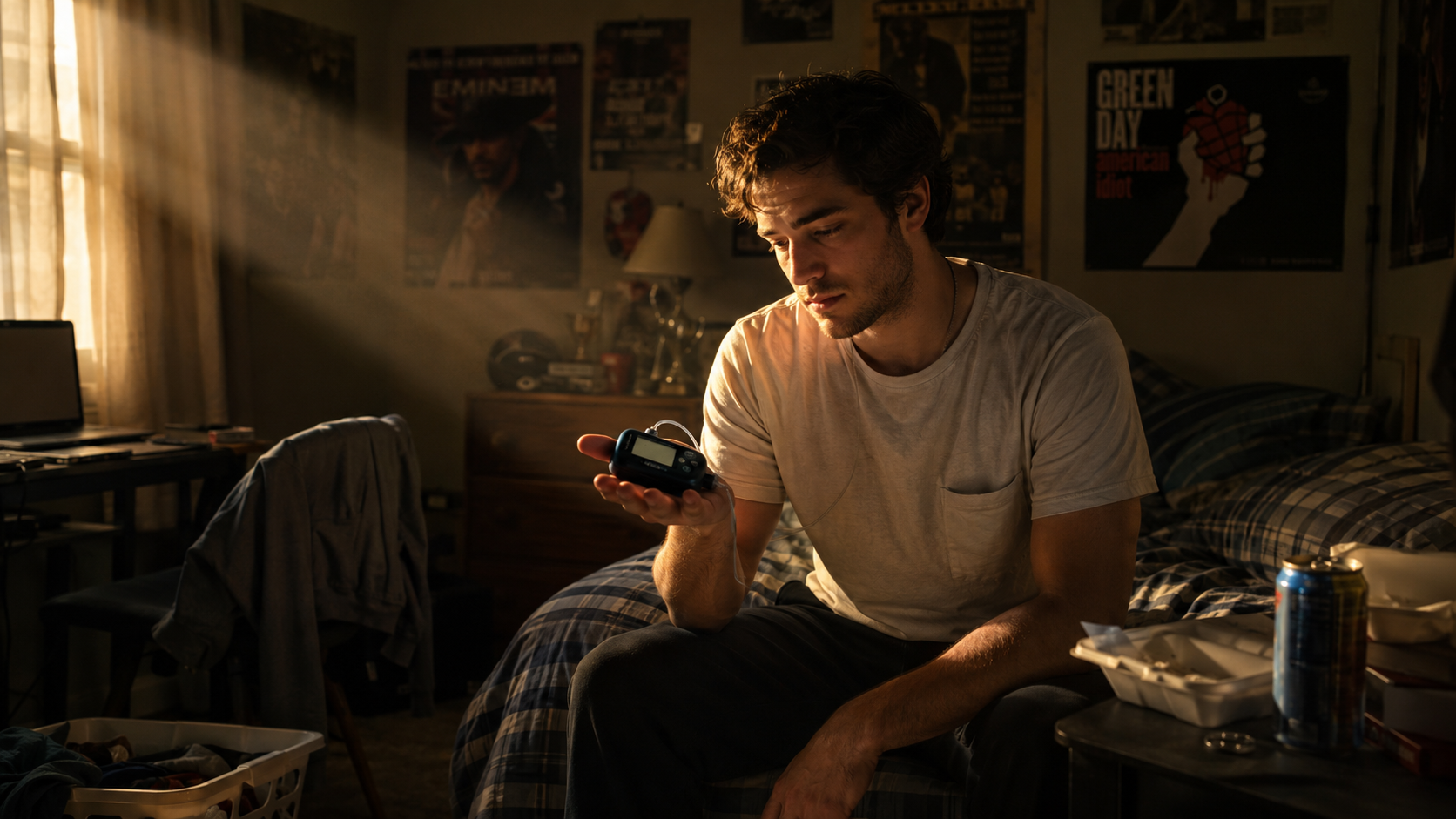
Dakota returns after switching from the iLet to the Medtronic 780G. In a tough-love session, Scott helps Dakota realize his pump isn't the problem—his habits are.
Key Takeaways
- Automated insulin delivery (AID) systems are powerful, but they still require user input; ignoring prompts or neglecting to announce meals will inevitably lead to erratic blood sugars.
- Constantly blaming the pump technology for poor outcomes often masks the real issue: avoiding the fundamental actions of diabetes management, such as pre-bolusing.
- A cycle of rebellion against diabetes—refusing to take action because you "don't want to be told what to do"—ultimately lets diabetes dictate your life through exhausting highs and lows.
- Taking proactive, offensive steps (like treating a mild low early or changing a site before bed) puts you in control, preventing much larger, more stressful problems later.
- It is essential to accept your reality and commit to consistent, small daily actions; doing the work isn't always fun, but it is the only reliable path to a healthy and happy life.
Resources Mentioned
Introduction and Sponsors
Scott BennerWelcome back, friends, to another episode of the Juice Box podcast.
DakotaI'm Dakota, back on the podcast again, to tell everyone my experience with the Medtronic seven eighty g.
Scott BennerIf you're looking for community around type one diabetes, check out the Juice Box Podcast private Facebook group.
Juice Box Podcast, type one diabetes.
But everybody is welcome.
Type one, type two, gestational, loved ones, it doesn't matter to me.
If you're impacted by diabetes and you're looking for support, comfort, or community, check out Juice Box podcast, type one diabetes on Facebook.
Scott BennerHave you tried the small sip series?
They're curated takeaways from the Juice Box podcast voted on by listeners as the most helpful insights for managing their diabetes.
These bite sized pieces of wisdom cover essential topics like insulin timing, carb management, and balancing highs and lows, making it easier for you to incorporate real life strategies into your daily routine.
Dive deep, take a sip, and discover what our community finds most valuable on the journey to better diabetes management.
For more information on small sips, go to juiceboxpodcast.com.
Scott BennerClick on the word series in the menu.
Nothing you hear on the juice box podcast should be considered advice, medical or otherwise.
Always consult a physician before making any changes to your health care plan.
The episode you're about to listen to is sponsored by Tandem Moby, the impressively small insulin pump.
Tandem Mobi features Tandem's newest algorithm, Control IQ Plus technology.
Scott BennerIt's designed for greater discretion, more freedom, and improved time and range.
Learn more and get started today at tandemdiabetes.com/juicebox.
Today's episode is also sponsored by Touched by Type one.
Go check them out right now on Facebook, Instagram, and, of course, at touchedbytype1.org.
Check out that programs tab when you get to the website to see all the great things that they're doing for people living with type one diabetes.
Scott BennerTouched bytype1.org.
The podcast is also sponsored today by the Eversense three sixty five, the one year wear CGM.
That's one insertion a year.
That's it.
And here's a little bonus for you.
Scott BennerHow about there's no limit on how many friends and family you can share your data with with the Eversense Now app?
No limits.
Eversense.
Pump Transitions: From iLet to Medtronic
DakotaI'm Dakota.
Back on the podcast again to tell everyone my experience with the Medtronic seven eighty g.
Scott BennerOkay.
Dakota, you were on before.
Do you know the episode you were on?
DakotaIt was fourteen ten, I wanna say.
Scott BennerLook at you.
I like that you know.
Thank you.
Let me see if I can pull up fourteen ten real quick.
And I will use my very own website for that.
Scott BennerSearch the archive.
Fourteen ten.
Islet user experience.
Yep.
Dakota moved from from Omnipod five to Islet, and now I guess you went from Islet to?
DakotaMini med Medtronic seven eighty g.
Scott BennerWhat precipitated your change?
DakotaI was getting lots of, rapid swings with the an unpredictability with the eyelet.
Scott BennerGive me some examples.
DakotaJust I mean, same with, like, the Omnipod that we had talked about in the last episode.
400 to 40 in the same day.
I let sometimes I was waking up with, like, 17 units on board.
I didn't know what to what to expect with it.
Like, what was it gonna do next?
Scott BennerOkay.
DakotaIt's kind of where it had gotten to.
I'd done a couple resets to try to let the algorithm relearn me.
Scott BennerMhmm.
DakotaBut it always ended up in the same place.
Scott BennerOkay.
So now you're using the seven eighty g?
DakotaYep.
Scott BennerOkay.
Has this been any different for you?
DakotaYeah.
I have more control with the seven eighty g.
Absolutely.
Yes.
Scott BennerIs it still similar to this experience you were having in the the last two iterations?
DakotaNo.
No.
But I have issues with basal rising overnight
Scott BennerOkay.
DakotaWith the seven eighty g.
Scott BennerSo if you don't mind, let's start with the islet pump, and then we'll go to this transition.
DakotaOkay.
Scott BennerOkay.
So how do you get trained for the islet pump?
DakotaI let's see.
It was a video call, between me, the trainer, and the diabetic educator at, the office Okay.
That I was being seen at.
Scott BennerAnd what's the promise of that pump when they're describing to you how it works and what you should expect?
What did you initially think was going to happen?
DakotaI wouldn't have to think about diabetes anymore.
Scott BennerOkay.
That didn't turn out to be the case?
DakotaDid it at first, and then it and then I started having to wonder what was gonna happen next.
Scott BennerOkay.
So at first, what was your so your initial experience with Ilet was what?
DakotaIt was good.
I didn't have to carb count.
I announced my meals, and it did a pretty good job of keeping me in range, between seventy and eighty percent of the time.
Scott BennerOkay.
And what range is it shooting for?
DakotaOne ten, was my target.
Scott BennerThe target was one ten.
But what what did you call low, and what would you call high?
Dakota75 to one eighty.
Scott BennerOkay.
And so you think you were 70 or 80% of the time in that range?
DakotaYes.
Scott BennerOkay.
With the islet initially.
Now when it started to change, did something change about your life?
Did your activity level change?
Did anything else?
The Real Issue: Rebellion and Routine
Scott BennerDid you the way you ate shift?
DakotaYeah.
My life changed.
Diagnosed with ADHD, forgetting to announce meals would start becoming an issue.
Okay.
My eating habits had changed.
DakotaI I still struggle with some disordered eating.
Scott BennerSo can you put that into words for me?
Describe how it impacts you?
What happens?
DakotaI don't really I try not to think about it, so I don't even really know how to, like, explain it into words.
But I want to eat what I want to eat, and I don't like having people dictate that.
And I don't like the carb count.
So I think that's where the issue comes together.
It's all eat these things, full packages of stuff sometimes, and I won't count the carbs.
DakotaAnd if the machine any machine doesn't know
Scott BennerIt's not gonna know what to do if you don't tell them.
DakotaInto your body exactly.
Scott BennerSo yep.
Let me just ask you a question.
Okay?
Yep.
You don't want anybody to tell you what to do.
Scott BennerAnd when that happens, it feels like what?
Diabetes is telling you what to do or your doctor is or your mom or like what's the vibe?
Diabetes.
Diabetes.
Okay.
Scott BennerSo diabetes wants you to do something and you're saying, fuck you.
I'm not doing what you tell me.
You're that, you're that song.
The Rage Against the Machine song.
What's it called?
DakotaIs it Bulls Against Parade?
Scott BennerIt's the other one.
I don't think it's Bulls Against Parade.
I think it's the, I think, I don't know.
That's not important.
And so, like, you you you say, fuck you.
Scott BennerI'm not I won't do what you tell me.
And and that's some sort of defiance that you think you have built in with your ADHD, or where do you think that comes from?
DakotaI feel like I've been growing up more in, like, becoming an adult.
So I think the last time we talked, I was 27.
I'm gonna be turning 29 soon.
Scott BennerMhmm.
DakotaAnd just with that comes
Scott BennerThe feeling like you're gonna have to do it?
DakotaYeah.
Scott BennerOkay.
So my question would be, all the stuff that's coming from not doing the things that you're supposed to be doing, are you happy that those they have like, is is it is it like a is it a net positive?
Like, well, I my blood sugar's high and it's low, but I didn't do what I was told by diabetes.
So it's a trade I'm willing to make or no?
DakotaSee.
And that's how I felt at first, but now I'm wanting to gain that control back.
Scott BennerOkay.
Because if you wanna do what you wanna do, then and and trust me, I'm not in your head, so I have no idea.
But then isn't this as simple as you deciding that this is what you want?
And then instead of diabetes telling you what to do, aren't you telling yourself to do that?
And then isn't that okay?
DakotaI feel guilty about doing it.
Scott BennerOkay.
How come?
DakotaBecause I know it's not the right decision.
Scott BennerWait.
So to start over, you feel guilty about doing what?
DakotaLetting my blood sugar go high.
Scott BennerYou feel guilty about letting your blood sugar go high.
So you're having this situation where you don't wanna be told what to do.
You're happy to not do it because that's you being independent or, you know, in control or whatever.
And then the outcome is the higher blood sugar, and then you feel guilt around that.
DakotaYeah.
I don't like the outcome.
Scott BennerSo you caught in a cycle?
DakotaIt feels like it.
Scott BennerOkay.
What do you think the simplest break to the cycle is?
You know what mean?
Like, you're gonna swing at that circle to try to put a put a break in it, like, what's the thing that would be easiest for you to, I don't know, make a make an agreement with?
DakotaThe easiest thing to make an agreement with.
Scott BennerBecause you've already told me you don't wanna be high.
Like, you're here telling me my blood sugar's swinging all over the place.
This isn't okay.
So that's you saying that something that impacts that
DakotaNeeds to change.
Scott BennerNeed well, it needs to change or or you need to let it change because you're I mean, honestly, you're I've talked to you now once and and again, you're a bright person.
You know what I mean?
Like, you're trying really hard for yourself.
Like, you're putting a ton of effort into all this.
You must know, like, intellectually, like, it wouldn't take this much effort to just do it right.
DakotaYeah.
Yeah.
Exactly.
And, like, sometimes I'll be at work, and I won't I'll be ignoring the fact that I'm, like, going low because I'm so busy.
Mhmm.
DakotaAnd, I'll dismiss the alarm.
You know, I'm not low low yet.
Still above 70.
Whatever.
Go on.
DakotaIt starts cutting off.
And it starts holding back the insulin, right, as the algorithms do.
And then it's time for lunch, and I haven't had any insulin flowing for a while now.
And then I go to eat, and my blood sugar skyrockets Mhmm.
Even with a pre bolus.
DakotaThat constantly happens, and then I'm thinking, well, if I would have just dealt with it in the moment, taking a couple glucose tabs, this wouldn't have happened.
Scott BennerRight.
So tell me what what's the human part of it that makes that undoable?
Is it the feeling that your body doesn't work the way it's supposed to and you don't want to you don't wanna live in a world where that's true?
Or
DakotaYeah.
Yeah.
In I I mean, I went twenty five years without having diabetes.
Scott BennerYeah.
DakotaIt's yeah.
I still remember that very well.
Scott BennerI don't wanna do this.
I don't wanna do this.
I don't wanna do this.
Yep.
Yep.
Scott BennerSo life, like, shifts.
Right?
Like, it changes.
And I realized that this is a big change that comes out of nowhere, and it's not a slow drift into something.
You're okay one day, and the next day, you need to, you know, give yourself insulin through a pump fifteen minutes before you eat.
Scott BennerAnd that's a it's not the same as, you know, a a slow kind of glacial shift that happens with a lot of things in life.
Do you believe life would be finite?
Do you think you're gonna die one day and that's gonna be it for you?
DakotaYes.
Scott BennerYou do.
Okay.
So do you see what I'm gonna say next?
You only have so much time.
DakotaYes.
Yeah.
Scott BennerWhy are you wasting it on this?
Just when you're 70, just take some sugar.
We and then all that comes after that is is dismissed.
It's gone.
It never happens.
Scott BennerLike, you have there's all this consternation about, you know, I know I'm low.
I don't wanna do what I don't wanna do.
This isn't fair.
I shouldn't have diabetes, so I don't do it.
So I get low.
Scott BennerMy system's been cutting off my insulin for a while.
Then I eat.
My blood sugar shoots high.
I fight with that for three or four hours.
I probably get low afterwards.
Scott BennerThen I go on a podcast to tell people the pump doesn't work.
Pump but pump works fine, by the way.
You're you're you're Yes.
You're not helping it.
Yeah.
Scott BennerYeah.
All all of them.
I don't know.
I mean,
Dakotayou know, and and then I'm then I'm like,
Scott Bennerwell, I'll try this pump.
By the way, this thing you're doing, super common.
I see it online all the time.
I got a tandem pump.
It sucks.
Scott BennerI got Omnipod five, but that sucks.
So I'm trying this and this sucked and that sucks and this sucks.
Do you pre bowls?
No.
Do you stop low blood sugars?
Scott BennerNo.
Do you know what just happened?
Yeah.
How come you don't do it differently?
It's the pump.
Scott BennerThe pump sucks.
It's not
Dakotathe pump.
We want the we want the pump to fix it.
Scott BennerYeah.
It's not going to.
Dakota.
Yeah.
That that's not gonna happen.
DakotaAnd for some reason, like, even when you know that, it still feels like that's the impression that they're trying to
Scott BennerWell, that's marketing.
DakotaYeah.
Yeah.
Scott BennerYeah.
Okay.
That's what's his jingle behind you?
Is there a cat behind you?
What's happening?
DakotaOh.
What was that?
Was that you or was it was it in here?
It's it's the cords on my Oh, okay.
Head's going to hit my neck.
Scott BennerI thought your I thought your cat was running through the room with a bell around its neck like it was 1947.
So, I mean, your conversation really to me is more about this.
I bet you any of these pumps would work fine for you.
And so you're looking for the one that most ignores the fact that you have diabetes and still gives you reasonable outcomes where you're not high or low?
DakotaYeah.
And works with the way I want my lifestyle to be.
Sponsor Break
Scott BennerDo you see that existing somewhere?
Peggy, maybe you're here to tell me the mini made seven eighty g fixed the whole thing.
It's all perfect.
Is that true?
No.
Scott BennerOkay.
Well, then so you want your lifestyle to be a certain way, but you're, can I talk to you like we're like, I'm your dad for a second?
But yes.
But okay.
DakotaYes, please.
To go to the consumer.
Somebody needs to.
But
Scott Bennerlook at all the time you've wasted waiting for that thing to come that might not come.
Why would you settle for changing your CGM every few weeks when you can have 365 of reliable glucose data?
Today's episode is sponsored by the Eversense three sixty five.
It is the only CGM with a tiny sensor that lasts a full year sitting comfortably under your skin with no more frequent sensor changes and essentially no compression lows for one year.
You'll get your CGM data in real time on your phone, smartwatch, Android, or iOS, even an Apple Watch.
Scott BennerPredictive high and low alerts let you know where your glucose is headed before it gets there, so there's no surprises, just confidence.
And you can instantly share that data with your health care provider or your family.
You're going to get one year of reliable data without all those sensor changes.
That's the Eversense three sixty five.
Gentle on your skin, strong for your life, one sensor a year that gives you one less thing to worry about.
Scott BennerHead now to eversensecgm.com/juicebox to get started.
Let's talk about the Tandem Mobi insulin pump from today's sponsor, Tandem Diabetes Care.
Their newest algorithm, Control IQ Plus technology and the new Tandem Mobi pump offer you unique opportunities to have better control.
It's the only system with auto bolus that helps with missed meals and preventing hyperglycemia, the only system with a dedicated sleep setting, and the only system with off or on body wear options.
Tandem Mobi gives you more discretion, freedom, and options for how to manage your diabetes.
Scott BennerThis is their best algorithm ever, and they'd like you to check it out at tandemdiabetes.com/juicebox.
When you get to my link, you're going to see integrations with Dexcom sensors and a ton of other information that's gonna help you learn about Tandem's tiny pump that's big on control.
Tandemdiabetes.com/juicebox.
The Tandem Mobi system is available for people ages two and up who want an automated delivery system to help them sleep better, wake up in range, and address high blood sugars with auto bolus.
Yeah.
Real Solutions: Taking Action and Making a Plan
Scott BennerYeah.
So if you've given away four years to, like, this isn't right.
It shouldn't be like this.
Damn it.
Like, somebody fix it.
Scott BennerI mean, yes, it's a lot of effort you would have put into it, but it wouldn't have been four years worth of effort.
I mean, I genuinely believe that when you make meaningful actions upfront, you cut out a lot of unnecessary problems in the back end that also need your your time and attention.
And then worse, put you in situations where your blood sugar's low or high.
Like, wouldn't you rather make small meaningful, like, steps a handful of times a day and then avoid those lows and those highs and eating when you don't want to and being you know what I mean?
Like, it's a psychological thing, Dakota.
Scott BennerIt's got nothing to do with diabetes or the pump or anything else.
Like, there's something inside of you that says I mean, it's well, I don't want it to be this way.
And if it's gonna be, then it's gonna be a mess, and then I'll blame diabetes afterwards.
But and maybe that's true, by the way.
Maybe diabetes did put you in this situation.
Scott BennerI'm not saying that's not the case.
What I'm saying is it doesn't change the reality or what your life is like day to day or, you know, time after time.
But by the way, time goes very quickly.
You know.
Yes.
Scott BennerLike, you know, you're gonna be 40 before you know it.
Do you really wanna be a 40 year old guy on a 70 year old guy's podcast talking about, like, I tried the the Maximus nine pump, but it didn't do it.
And I'm over here going, like, sleeping because I can barely stay awake.
I don't know how to describe to you what to do.
It's not me.
Scott BennerIf I had diabetes, I think I'd even know less.
Like, all I can tell you is that the simple principles that run a reasonable life will run a reasonable life with diabetes too.
Absolutely.
You listen to the podcast a lot.
Right?
DakotaNo.
I don't listen to any podcast as much as I used to in the past.
Scott BennerBut you have listened to this podcast a lot at some point.
Okay.
Yes.
My point is is that I only talk about diabetes and but just basically, like, a reasonable way that you would talk about anything else.
You know?
Scott BennerLike, I don't know.
Your laundry.
You can either do a little bit of laundry every couple of days or once every two weeks, look in your room and go, oh my god.
What happened?
And then spend two days doing the laundry being mad at yourself the whole time.
Scott BennerLike, that's it.
It's like pre bolus.
Don't be mad at yourself later.
Do a little laundry today.
Take it out of the dryer.
Scott BennerFold it up.
Put it away.
Do it again in three or four days.
It takes five minutes of effort to put it in the laundry machine.
It takes twenty minutes of effort to fold it up.
Scott BennerAnd three days, you don't think about your laundry.
Or spend the next ten days staring at the pile of laundry in your room loathing yourself for not doing it.
It's life.
It it applies to everything.
Change the oil in your car before your car stops working.
Scott BennerThat's all.
If you don't, the motor blows up, and then it costs you $8,000 to put a new motor in your car.
And the whole time you're driving it, you're worried.
I think the car is gonna blow up.
I don't know how to pay for the $8,000 when the motor goes.
Scott BennerI don't know where to take it to get it fixed.
I oh my god.
I can't afford this.
I might be just needing a car.
I can't afford a new car.
Scott BennerWhat did I do?
Why didn't I just change the oil?
Oh my god.
Oh my god.
Like, just don't do it.
Scott BennerIt never happens.
DakotaDeal with it now.
Scott BennerYeah.
Do it now.
When the bills come, Dakota open them.
Even if you don't have the money, open the envelope up and say, fair's fair.
I owe a $180 to the electric company.
Scott BennerAt least I know when it's out in the open.
Rather than let the the bill sit on your countertop for a month mocking you.
By the way, it could be it could be $75 this month.
You don't know.
You haven't looked at it.
DakotaExactly.
So now
Scott Benneryou're just worrying about it for no reason.
Does any of this make sense?
DakotaYes.
No.
It all makes sense.
And I even
Scott Bennerwant to grow up in the jungle.
What happened?
DakotaI had parents.
I don't know.
Scott BennerIt's tough.
Did they yell at you?
They should have yelled at you more.
I would have yelled at you.
No.
Scott BennerSo seriously, like, you're how old did you say?
DakotaI'll be 29 in a month.
You'll
Scott Bennerbe 29 in a month.
Okay.
When I was 29, I had a baby and I owned a house.
You can just jump into life and start doing it.
It doesn't get harder or easier.
Scott BennerIt's all the same.
But one way you're moving forward and one way you're sitting still waiting for everything to be perfect before you move forward.
There is no perfect and time is going to move with you even if you don't move with time.
So just get up tomorrow and do it, and you're not gonna enjoy it.
It's not fun.
Scott BennerLet me tell you some other things that aren't fun.
Watching Bear in the Big Blue House is not fun, but I have done it 500 times in my life because my six month old liked it when it was on the television in the background when he was eating.
And then he got older, then he was singing the songs.
You know, the songs to go to welcome welcome welcome to the big blue.
I know it.
Scott BennerI could sing.
DakotaI used to watch that show a lot.
Scott BennerYeah.
Yeah.
Okay.
And and you were a kid when you watched it.
I was an adult.
Scott BennerI was not interested in bearing the big blue house.
Here's other things I was not interested in, putting down a manolium floor in a kitchen.
I was not interested in buying a hot water heater for a condo that I knew I wasn't gonna live in much longer.
I wasn't interested in saving money.
I wasn't interested in buying tires.
Scott BennerI'm not interested in cutting the lawn.
I'm not interested in dusting, mopping, doing the dishes.
I'm not interested in most of the fucking things that I do.
But my life is better because I do them, and it gives me a lot of free time where I can do what I want, and I'm not busy loathing myself for not doing those things because it's going to happen one way or the other.
You either deal with it and make the best of it and not in a sad way, like, well, I'll just make the best of it.
Scott BennerLike, literally, make the have a nice life or sit here and wring your hands about it and blame other stuff and watch your life go by.
It's pretty much it.
We don't need to keep talking if you don't want to.
This is good.
But you probably should make a plan if that's what you wanna do.
DakotaYeah.
No.
I wanna start making changes for sure.
Scott BennerYeah.
And they're not changes really.
I I know it's easy to think about it that way.
I'm not a therapist, by the way.
This is very important for people to understand.
Scott BennerAnd I'm sure a therapist wouldn't talk to you like this because they probably have rules and laws and stuff like that.
You already know what to do.
Just get your shit together this afternoon.
Get your blood sugar stable.
Wake up in the morning.
Scott BennerPre bolus your meal.
And then don't get high or low afterwards.
And if you do, do something about it before it becomes a problem.
Right?
Like, you know, did you ever listen to the pro tip series?
DakotaYes.
Scott BennerYeah.
Right?
Don't go driving off the road into the weeds across the rumble strip down the hill and then decide to turn back over.
Just like, oh, I think I'm going off the road now, then just turn the wheel back a little bit.
Just small deliberate decisions that stop you from plowing through a tree and brush and everything else.
Scott BennerLike, you are the master of your domain.
Your life will go the way you want it to.
You know, mostly speaking, I can't give you more money or a different house or something like that.
But, like, where within the the ecosystem that you live in right now, it goes good or it doesn't based on the decisions you make every day.
And that's it.
Scott BennerLike, that's life, man.
See, it's not exciting and it's certainly not the way you imagined it.
You know, I don't think you and I are ever gonna be ASAP Rocky rolling up to the Met Gala with Rihanna as much as we'd like to.
I I'm only speaking for myself, I guess, at this moment, but I would love to be, with Rihanna.
And I'd like to have a big ring on my hand that looks like it costs as much as a mountain if I would, you know, if you could buy a mountain.
Scott BennerBut that's not that's not my life.
Like, my life is this.
I make this podcast.
I keep my house clean, take care of my kids.
I do the laundry.
Scott BennerI go away once in a while.
Not really as much as I want to.
And when I don't go away as much as I want to, I'm not mad at everybody.
That's just what it is.
Like, there's a simplicity in that.
Scott BennerI think you would find a lot of common, and you're young still.
Like, you could look up six months from now and be like, I can't believe I was doing all that and it could just be over.
Yeah.
You know?
Mhmm.
Scott BennerWhat are some of the things you imagine are stopping you from doing this?
Is there maybe ways we could talk about mitigating those?
DakotaYeah.
I have trouble accessing food affordably.
Scott BennerOkay.
DakotaSo that becomes an option or an issue where, try to only eat two meals a day.
Okay.
Scott BennerWhat what do you end up eating?
DakotaA large amount of protein, rice, and frozen vegetables most of the time as a meal.
Scott BennerDo you find yourself being hungry, or do you just feel like you're not eating as much as you're supposed to be?
DakotaI find myself being hungry, but I'm so busy throughout the day.
It's easy to ignore it.
Scott BennerOkay.
Alright.
So it's not you wouldn't call that a pressing issue that's stopping you from succeeding?
DakotaNo.
And yes.
Scott BennerTell me why yes.
DakotaSome of the foods I am able to get are very processed and high in carbs and not good for you.
Scott BennerMhmm.
DakotaSo sometimes that's the only option that I have at that moment.
Scott BennerBut, Dakota, are you also not pre bolusing for those foods?
DakotaAnd I don't know how many carbs are in them because they're from a bakery, like a local bakery without a label.
Scott BennerOkay.
Okay.
So then that's something to work on because the rest of it's like, the rest of it's not cool.
And if we were if this was a, you know, a social studies class and we were talking about how to make the world better, then we would dig into this.
But what I would tell you is this is your situation, so you have to figure out how to make the best of that situation.
Scott BennerYeah.
Don't don't tell me, you know, I can't be healthy because I have to shop at a bakery.
Tell me I have to shop at the bakery, so I gotta figure out what to do about that.
Right?
Like, there's there's meaningful steps to take that will help you in every aspect of life, not just in this.
Scott BennerYou know, there are plenty of people who have terrible lives and they are still alive and they're still moving.
It's not optimal and it's certainly not what they want for themselves and it may not be what society would want for them if we were looking in on them and we were like, oh gosh, I don't want that to happen.
But there, those people are anyway figuring out how to get by.
And, you know, in 2026, you have an insulin pump, you have insulin, you do have access to food, like you're eating twice a day, which is probably more than most people around the world eat.
Not to say, like, you know, because there's poor people other places that your thing's not real, but I'm saying that your thing seems manageable.
Scott BennerIt seems doable.
I would suggest to you that I don't know what it is about me that makes me feel this way, the way I grew up or experiences I had or whatever.
And I don't know how to pass this on to you, but I will pass the idea on to you.
That unless you're dead, everything should be negotiable.
You should be able to figure your way through things.
Scott BennerIt's not gonna be what you want.
It won't be what you like.
It might not be comfortable.
It might not be something that other people would be like, wow, look at this.
This is fun to look at.
Scott BennerBut it's still doable for you.
And I imagine if you put a lot of those things in order, yours your situation could rise up to begin with because you're spending a lot of time fighting against reality, and I would imagine feeling bad for yourself while you're doing it.
DakotaYes.
Scott BennerYeah.
And I'm sorry for you.
Like, I'm I'm not without compassion, and I certainly don't want you to live or anybody to live in a situation where they don't feel like they can put their hands on the right amount of food every time or that their situation sucks and, you know, you look online or, you know, out in the world and you see people driving cars you can't afford and living in houses you, you know, you don't think you're ever gonna live in.
But if you ask anybody how to be wealthy one day, they're gonna start anybody who knows how
Scott Bennerto make money is gonna tell you about compound interest.
Right?
They're gonna tell you about the value of I mean, I don't know exactly what the number is, but, like, if you put a thousand dollars away right now, thirty years from now would probably be, like, a million bucks or something like that.
Like, you you know that thing about, like, if you fold over a piece of paper a certain amount of times it goes to the moon?
Yep.
Yeah.
Yeah.
Scott BennerThat.
Okay.
So one small decision, right, can exponentially grow.
And I think that that works too with health decisions or mindset or stuff like that.
Like, I think you just start building.
Scott BennerYou just start taking that piece of paper and fold it in half.
And tomorrow, it's two times as thick as it was today, and then do it again.
Now it's four times as thick as it was on the first day.
Just keep making small good decisions.
And when you forget to fold the piece of paper in half one day, don't spend the next week and a half beating yourself up about it and doing that thing that people go, well, next Monday, we'll start folding the paper again.
Scott BennerNext Monday, it's Tuesday.
What what it it's just an excuse.
It's like, oh, I forgot.
I'm supposed to do it every day, and I didn't do it on Monday, so I don't have to do it again till next Monday.
It's it's not that's not true.
Scott BennerJust do it again at the next meal.
Just fold the damn piece of paper in half now.
You you missed a little time.
It's no big deal.
It becomes a big deal when you wait a week because then a week goes by and you think, well, I waited a week.
Scott BennerI can wait a month.
I'll start pre bolsing around.
How about after Christmas?
Ever hear somebody say that?
I'm gonna eat better after Christmas.
Scott BennerThey'll say that in August.
They're like, yeah.
I wanna get through the summer first.
And then I get through the summer.
I don't wanna start right away because Halloween, you you know, and then and then then there's Thanksgiving and then Christmas and New Year's.
Scott BennerI could probably just start after New Year's.
And then six weeks later, it's Valentine's Day.
And then it's Easter.
I I I'm gonna have candy on Easter.
I have candy on Valentine's Day.
Scott BennerWell, you know what?
You know, we'll get going in the spring.
Spring will be a good time.
Oh, I gotta take my mom out for Mother's Day.
You know, I'll probably just oh, yeah.
Scott BennerIt's summertime picnics.
Woo.
And then the next thing you know, it's like, well, maybe in the fall.
And you're doing that with your diabetes.
A lot of people are.
Scott BennerAnd you're either gonna do it or you're not.
I had an experience that I I sort of don't wanna talk about in great detail, but I was around a group of people with diabetes recently.
A lot of there was a lot of people there, and we spent a lot of time together.
And a couple of them had issues.
One with a high blood sugar, one with a low blood sugar.
Scott BennerAnd then I watched the person with the high blood sugar not know what to do about it even though they had had diabetes for, you know, more than a handful of years.
I watched the person with a low blood sugar panic about a number I wouldn't have panicked about, over treat it, then have to bolus later for it.
And then I looked around at the rest of the people in the in the area, I thought, I wonder how many of these other people are having issues that I'm just not aware of right now.
Is it some of them?
Is it all of them?
Scott BennerI wonder how many of them, if I took their graph right now, are are riding this, like, super flat line.
And how much of this is just personality?
Right?
Because in the end, if you if you took all of their diabetes care and gave it over to, you know, a third party that would make the good decision, the right decision at the right time, they would all probably be having better outcomes.
And these people seem, I know that some of these people, they're intelligent, like, they're bright people, they want well for themselves, like, why did they not do that right then and there?
Scott BennerAnd I don't know.
Like, I stood there and I I tried to decide, what leads one person in one direction and one person in another direction?
I have no idea.
All I can tell you for sure is you're paying attention to it.
You've now done 90% of the work because you're interested.
Scott BennerYou know what I mean?
Like, you wouldn't be here if you weren't interested.
DakotaRight.
Scott BennerYou agree?
DakotaYeah.
Scott BennerOkay.
So if I ask you what's in the way, it would be beneficial if you didn't
Dakotasay Yeah.
Scott BennerYeah.
If you instead of telling me that you don't have access to good food, which sounds like something you heard on CNN, you would instead say, I don't make good decisions around the food I'm eating.
And, like and sometimes it's processed, but I don't pre bolus it.
And then I blame the food.
And then I blame my situation because I had to take the food and blah blah.
Scott BennerIt's just you, man.
It's you.
Across the spectrum of your financial situation, we are all in a world of our making once we're in that world.
Now, we didn't make the world that we got put into.
You didn't give yourself diabetes, but here you are and there is no door.
Scott BennerSo you're living in this world now.
Everything that comes after that is you.
You're born broke.
You didn't want that.
It's not your fault.
Scott BennerI understand.
But here you are.
You're born with a bunch of money.
You end up being a asshole.
Same situation.
Scott BennerYou're making your own decisions.
And, you know, it's easy to look around and say, I wish things were like this or it's not fair, and you're not wrong.
I'm not gonna tell you you're wrong, that it's not fair that you have type one and other people don't.
It's could talk about it in the other direction, man.
It's insanely unfair.
Scott BennerAnd, I could cry about it with you right now if you wanted to too, and I would be I would be being a 100% honest with my feelings.
But that is just not the situation you're in, man.
You know what I mean?
You're that blonde guy.
You're up in space with that rock.
Scott BennerJust did you see the movie?
That project No.
That project.
Okay.
Well, you you you well, you opened your eyes and now you're in a tin can and you're floating through space.
Scott BennerWhat are you gonna do next?
You sit there and bitch about it or you're try to figure it out?
I mean, that's pretty much it.
Right.
You know?
Scott BennerSo I don't know, man.
What do you think?
Is it doable?
DakotaYeah.
Scott BennerHow?
Todd, put it together for me.
DakotaJust making the right decisions repeatedly.
Yeah.
Well, what does that
Scott Bennermean though, day to day?
Like, put it into put it into context.
DakotaPrebolising.
Scott BennerMhmm.
DakotaTaking care of the lows before they get too low.
Mhmm.
Scott BennerStopping a high blood sugar before it happens.
It does get
Dakotatoo high, maybe lowering my high alarm.
Scott BennerYeah.
Right.
Right.
If it does get high, don't stare at it for hours before you do something.
DakotaYep.
Pretty much.
Change change out my sight before I go to bed instead of waiting till the morning when I know the absorption is an issue.
Scott BennerThat's a great example of the bigger idea, which it's once you start going through these things, you're gonna see they're all the same thing.
It's all act first.
Right?
It's all like if you listen to that pro tip series, you heard me say at some point I used to do this when I was speaking in public.
Used to say this a lot.
Scott BennerI used to say, have you ever been in a fight?
And somebody would raise their hand.
And I'd say, okay.
Do you wanna get hit first?
Do you wanna hit them first?
Scott BennerAnd everybody who's been in the fight said, well, I would wanna hit first.
Like, yeah.
And you know why?
It's because then you dictate the pace of what happens next.
You're in charge.
Scott BennerYou made a decision and now everything follows your decision.
When you get hit, now you're following the decision that that person made your you're gonna be on defense the entire time.
Put yourself on offense.
Just say to yourself, like, I'm gonna act.
My pod's gonna expire.
Scott BennerMy set's gonna go bad at seven in the morning, but I could probably I'll probably wake up at seven.
And even if I don't like, even if it's, like, nine, it's okay.
Will only be without insulin for a couple hours.
So, like, it'll be like, don't do all that.
Just change the damn thing before you go to bed.
DakotaYeah.
Scott BennerYeah.
And, you know, because change your pod before you go to bed is the same as your blood sugar 70.
I could have just had some sugar right there.
Mhmm.
It's just deciding to do the thing that needs to be done at the right time instead of being put in a position where you're now forced to do a bunch of things at the wrong time, which ironically puts you in a much worse situation than you I wanna make sure I say this right.
Scott BennerYou said earlier, I don't wanna be told what to do.
So I'm not going to change my let me let me speak it out for you.
I'm not gonna be told I don't wanna be told what to do.
I don't wanna have to change this pump site before I go to bed.
So that's me being told what to do by diabetes.
Scott BennerSo I won't do it.
And instead, I'm gonna wake up in the morning with a high blood sugar.
I'm gonna be I'm not gonna feel well.
I'm gonna have to rush around.
But now think about that.
Scott BennerNow you're you have a high blood sugar.
Now you have to take care of the high blood sugar.
Now you have to change the pump, and you're not gonna have as easy of the time of changing the pump as you would have before.
You're now being told what to do by the problem.
Yep.
Scott BennerRight?
So there's diabetes and then the problem that comes later.
You feel like if I don't listen to diabetes, then I'll just deal with it.
But what I'm telling you is you're not listening to diabetes, so later you're just gonna have to listen to the problem.
The only control is acting before either of those things get a chance to hold power over you.
Scott BennerThat makes sense?
DakotaYes.
You can't hear me shaking my head.
Scott BennerOh, okay.
DakotaBut yeah.
I'm nodding.
Yes.
Thank God.
Scott BennerCan't hear you shaking your head, Dakota.
Can you imagine?
DakotaI was
Scott Bennerlike, what is that?
You'd like, those are the rocks in my head.
They're banging around.
You're also a very bright person.
You're a thoughtful, nice guy.
Scott BennerI've known you for a while now.
Do you know that about yourself?
DakotaYeah.
You're not the only person who said that.
Scott BennerYeah.
You're a lovely person.
So one should be lovely to yourself for a while.
DakotaI'm always about making other people happy before myself.
Scott BennerWell, Dakota, stop doing that.
DakotaI know.
And I feel like if I had, like, someone behind me, like, telling me to do these things, hey.
Change your pump.
You know?
Mhmm.
DakotaGet a glucose tablet.
I would do that for I do I would do that for
Scott Bennerfor them.
Just wouldn't do it for yourself.
DakotaYeah.
Scott BennerYeah.
Welcome to being human.
Now here's the rest of it.
Stop doing that.
DakotaI know.
Scott BennerYeah.
I I mean, there's no magic.
Like, I know people are used to listening to podcasts where they bring on these experts.
I'm making quotes with my fingers.
They give you the plan.
Scott BennerYou need a twenty one day plan to a new you, Dakota.
I mean, would that be better?
Do you wanna do you wanna buddy system?
You wanna get involved there?
Just shut up and fucking do it.
Scott BennerOkay?
Like, because the alternative is don't do it, live miserably, die.
How about do it, live happily, die?
It's a lot better.
You you know what I mean?
Scott BennerAnd and in the end, this is how it's gonna I mean, we're not and also, by the way, at your age, with the way things are going, you know, I I hate to say it like this, but a 100 be could become the new 80 in your lifetime.
You wanna be miserable for the next seventy years?
DakotaOh, no.
I don't no.
An extra an extra 20?
Scott BennerOh.
I noticed, like, 20 more.
DakotaI didn't sign up for that.
Scott BennerI can't even get through my twenties.
Now you're talking about twenty more years.
But you can.
Like, you are you are a person who is set up perfectly to be okay.
You're thoughtful.
Scott BennerYou're bright.
You're motivated.
But you you just you grew up in a time where it's just, God, I don't wanna sound like this because I don't I don't know if I mean this completely yet, but and we are just talking it out, but I don't think enough bad shit happened to you.
Like, I think that you have an expectation for life that's reasonable if nothing goes wrong, but not and by the way, you would have found a different way to be disappointed because of the way your your generation grew up.
Like like, dude alright.
Scott BennerYou ready?
DakotaYes.
Lay it out.
Scott BennerI was born, and in short order, the woman who gave birth to me gave me away to the state of Pennsylvania.
And then someone adopted me.
And then those people thirteen years later, after fighting for most of my, you know, my recollection got divorced.
I was broke the whole time I've been alive.
Okay?
Scott BennerThere is no money at all.
So my dad's yelling, smoking cigarettes, my mom's scared, doesn't wanna stick up for us.
My dad kicked the shit out of me every once in a while when he got frustrated, didn't seem like he liked the kid who, like, you know, had his own thoughts, leaves on my third on my thirteenth birthday.
Like, I'm telling you, we had dinner for my birthday and he left.
That was a lot, man.
Scott BennerThat felt like that was my fault.
Later, my mom told me, well, she didn't tell me.
She was telling a friend on the phone and I overheard her that my dad said he left because of me.
Now my dad had been cheating on my mom for twenty years and was terrible person to her, but found a way to blame me when he got to open his mouth about it.
Wasn't his fault that he they weren't married anymore.
Scott BennerIt was my fault.
So then I had to get through that.
And then I graduated from high school and I went to my high school graduation.
I came home.
My mom gave me a piece of cake, said good job, and I woke up at 05:00 in the morning and went to my full time job in a sheet metal shop that I had already been working for, like, the last three years in high school.
Scott BennerThat day, as a reward for becoming a full time employee, my pay went from $4.50 an hour to $4.75 an hour.
I eventually moved it up to 5 an hour to go to.
I didn't have a car or money, so, my uncle gave me a car that didn't run.
I got it running even though I didn't have a father or any idea how to get it running.
And then I had to get a 3,000 a year insurance policy to drive the free car, but I made $4.75 an hour.
Scott BennerSo the $3,000 was a large chunk of the money that I made every year just so I could go to work.
So you would say, well, why would you do that?
And what I would say was, I wanted to find out what was on the other side of this experience.
I was never gonna get to what was on the other side of it if I didn't figure that out.
I've never figured this out with another person before, but $4.75 an hour times eight times 20 Before taxes, I made $760 a month.
Scott BennerAnd I probably didn't pay much in taxes, so let's just call it $700.
So $7.14 $21.28.
I worked four and a half months to pay my car insurance so that I could go to work.
So that I could then have the money left over from the other, let's call it eleven months at $700.
So I worked all year for $7,700 in my pocket, and I did that for years.
Scott BennerEventually, I got a raise to $5.50 an hour.
I don't wanna Mhmm.
Tell you tell you differently.
And then one day, a friend of mine said, hey, I got this job collecting credit card debts, and it pays like I forget it was like $12 an hour.
Would you you she said to me, you talk good.
Scott BennerWould you I was like, yes.
Done.
And I quit my job, and I took all my cuts and burns and scars and bruises from working at that place.
And I put on a tie, and I went into an office, and I sat at a computer.
And for eight hours a day, I shook the life out of people who couldn't afford it to get their payments, and I hated it.
Scott BennerIt made me feel terrible.
So as soon as I did that, you know what I did?
As soon as I realized how bad it made me feel, you probably think, oh, you quit or you got another job.
Right?
No.
Scott BennerI didn't do that because I needed the money.
I kept working.
And then I went there every day and felt horrible.
And they paid me extra money, and I used that extra money and that experience to parlay that into a slightly better job where I went to a credit union to do collections for them, but it was at least it was friendly collections.
It was a credit union.
Scott BennerSo it was sort of like, hey, Dakota.
It's Scott.
Did you forget to pay your car payment?
And you'd go, I did.
Oh, I'm an idiot.
Scott BennerAnd then you'd transfer it over out of your account.
I go, thank you.
DakotaYou're telling me that's the status the credit union gets, and I've been ignoring them?
Yeah.
Scott BennerYeah.
The credit union was much like that.
Right?
And then one day, the graphic designer of the credit union quit.
And I heard somebody talking about that they were in trouble.
Scott BennerAnd I walked into the human resources department and said, hey, I'm really good with computers.
I can do that job.
I was not a graphic designer, and I had no idea what I was talking about.
And they sat me down at a computer, and I I used Adobe I forgot what it was.
Photoshop and something else.
DakotaIllustrated.
Scott BennerI illustrate I designed something for them, and I said, I need I said, this computer sucks.
I need a slightly better computer.
This piece of software, that piece of software, and if you send me to a weekend training course for that software, I can do this job for you.
And she said, why would I do that?
And I said, I will do it for far less money than somebody else will.
Scott BennerAnd she went, okay.
And then she gave me the job and then I figured out how to make the visual needs for a credit union, a pretty big credit union.
And then I did that for years and I was still not making for I think at that point, was making $25,000 a year maybe at that credit union.
And my wife was building her at that point, then we got married.
My wife was building up her thing.
Scott BennerEventually, I became a stay at home dad.
I didn't know the first thing about raising a kid.
I figured all that out too.
Those kids are in my house somewhere right now.
They've never done meth and they're employed.
Scott BennerOkay?
And then I moved on and on and on.
I didn't know how to save money.
I taught myself how to save money.
I didn't know how to eat well.
Scott BennerI taught myself how to eat well.
My life sucks, if I don't do something about it.
But instead, I just did.
And it doesn't happen as fast as you want it to, but it's 100% not gonna happen if you don't fucking do something.
You just gotta get going.
Scott BennerYep.
You know?
Just put yourself out there.
Fail.
Don't fail.
Scott BennerHave some wins.
You're never gonna even see the wins, man.
You don't see them.
You see the wins in hindsight.
The failures hit you every day in the face.
Scott BennerThe wins you see in hindsight.
So that's gonna be a thing you're gonna have to say to yourself is I'm gonna put my head down and keep going until I look up and I'm on the other side of this cloud.
And I have no expectations for how long that's gonna take or what it's gonna feel like while I'm doing it.
I'm just going to do it every day over and over again until I pop out.
And then, dude, you're gonna pop out so much sooner than you think.
Scott BennerYou know what I mean?
And then your life's gonna be completely different, and then you're probably gonna name a baby after me, and then that kid's gonna have ADHD.
And, you know, it's okay.
And then you'll figure that out with him or her.
Whatever happens, you'll just keep going and then you'll die at the end.
Scott BennerAnd right before you die, if you're lucky, you won't get hit by a car.
You'll have a couple minutes to think about it and you'll think, man, I started off in a hole and then I got diabetes and I really thought I was shot then.
And then I talked to some guy on a podcast and I started doing the right thing and like, look at me now.
I got I raised a family and I have a home and, you know, I put some money aside and I've been on a few vacations and I've got some great memories and then you're gonna shut your eyes.
That's gonna be the end of it.
Scott BennerSo if that's the truth, if that's how it ends no matter what, might as well do a good job while you're here because what the hell?
You you know what mean?
Like, what's the alternative to that?
DakotaNot trying and having the exact opposite outcome.
Scott BennerI'd rather try and fail than not try and fail.
DakotaRight.
Scott BennerYou know?
Because at least you tried and you can I'll tell you what, you build a pretty good foundation of confidence on trying, you know?
I I got out there, I swung my hands, I kicked my ass, but okay, here I am still.
And I got up and I did it again the next day.
You're gonna get knocked I mean, I don't wanna be trite, man, but you're gonna get knocked down a lot more than you're gonna win.
Scott BennerYou just gotta keep going.
It's not a movie.
Like, this is not a movie.
This is what this is.
And it can be great.
Scott BennerAnd and there's gonna be moments of just pure joy.
And there's gonna be moments where you're gonna really like look at yourself and think, man, look what I've accomplished.
And then you're gonna realize that the t shirt slogan really is true and it's not the destination, it's the journey.
And then you'll be okay.
That's it.
Scott BennerCome to my funeral, Dakota.
Would you please?
DakotaYes.
Send me an invite.
Scott BennerThank you.
Well, yeah, I'll get I'll get I'm gonna need a few of you to show up to tell the rest
Dakotaof these nunnicks that I was, valuable to you.
Scott BennerI really don't know another way to put it.
Like, life and diabetes is it's all the same thing.
Everything's the same thing.
You know how I tell you, like, it's timing and amount?
That's what diabetes is.
Scott BennerThey're using the right amount of insulin at the right time and when you really if you really distill it down, that's the truth.
Good settings, making decisions about where to put your insulin in, it's timing and amount.
Life is effort.
That's it.
Just try and have no expectations for what success looks like, and you're gonna be a happy person.
Scott BennerAnd find some people and love them and let them love you back.
There.
What else do we need to do?
This was awesome.
I'm fantastic.
DakotaThank you.
Scott BennerYeah.
Yeah.
Yeah.
Yeah.
Thank you.
Scott BennerYou have a good sense of humor.
You're already halfway there.
DakotaNo.
I, yeah.
No.
I do.
But I no.
DakotaI I feel like everything you said, I deep down, I already know that that's what I should be doing.
Scott BennerYou should just wake up every morning and think, let's can go.
Yeah.
And then just go out there and whatever that ends up being is a win.
DakotaThat's what it is.
Scott BennerThat's what it is.
Okay.
Yeah.
Now you're good.
That's what it is.
Scott BennerThen you just get up the next day and you could do it again and do it again and do it again.
And one day, won't look like that anymore.
You won't even know how to happen.
Just make good decisions, man.
Like, when some when you get an opportunity, think about it for a second and do what your gut tells you and then just keep going.
Scott BennerWhat do you where's where's the job now?
Where do you where are you working at?
Same place as last time?
DakotaYeah.
But I'm the assistant store manager now.
Scott BennerOh, so prior to the last time I spoke to you, you were not the assistant store manager.
Now you are.
DakotaYeah.
Scott BennerRight.
And one day, you'll probably manage the store.
DakotaI don't want to know.
Oh, no.
You do
Scott Bennerwant you don't listen to me.
Yes.
You do.
You want it.
Bring it on is the is what we say.
DakotaOkay.
Scott BennerYeah.
Yeah.
Yeah.
Yeah.
No.
Scott BennerYou want it.
You want responsibility.
You want something to tax you.
You wanna get out there and have to swing your hands because then you're gonna learn something else and you're gonna apply it sometimes.
You might just wake up one day and some or your friend might go to you.
Scott BennerI know you hate working at the store, but you talk good.
You wanna come collect debts with me?
And I went, get me out of here.
Let's go.
Right?
Scott BennerBecause if I don't have my head up for that and I'm not paying attention, now I'm a 54 year old guy working in a sheet metal shop.
But you wonder the funny thing about that is that sheet metal shop went under twenty years ago.
So I would have been a 34 year old guy with nowhere to work and skills that were probably outdated.
And I don't know what I would have done.
Think of this as like canoeing down a river and every time, you know, you come up to a bunch of, forks in the in the river, you that gives you a minute to think about it and you go, okay.
Scott BennerI'm gonna try this.
And if it that was the wrong thing, just keep the boat upright till you get to the next one and try again.
You just got I can I mean, I can metaphor you to death here if you want?
Just don't give up.
Keep going.
Scott BennerListen.
I I think I probably did it when I was young too.
Okay?
But I might not have had as much of an opportunity because I grew up so poorly and so broke, but you gotta stop blaming other Like, just it doesn't matter whose fault it is and you might be right, but it doesn't matter.
It doesn't change your situation.
Scott BennerIf I push you out of a plane and I tell you, don't worry, the parachute works, I checked it and you pull the cord and it doesn't open.
Well, you're still falling out of the goddamn plane.
It doesn't matter if I didn't do it right or not.
Like, this is what's happening.
You know what I mean?
Scott BennerLike, you are now in a new situation and that situation is not your fault.
It is not of your making and it doesn't matter because it's still happening to you.
So now what do you do next?
The plane thing's probably a bad example because there's not much to do.
You just you can flap your I'll tell you what, I'd flap my goddamn hands.
Scott BennerI really would.
You would watch me falling out of a plane without a a parachute and go, that's a stubborn son of a bitch up there.
He's trying to fly.
That might be your metaphor, Flap your arms.
You know what I mean?
Scott BennerLike, after it.
You've got I don't know.
So okay.
What does this look like real life?
You gotta do what?
Scott BennerI mean, I'd might make a list of I Bijou.
DakotaLet me get my pen and paper.
Scott BennerYeah.
Yeah.
I I think maybe we should write it down.
Also, for people listening, life's not that hard.
Like, life's hard, but they're doing the things.
Scott BennerNot that just do the thing.
Yep.
Just do it.
DakotaThat's what it comes down to.
Scott BennerYeah.
Yeah.
Just do it.
It doesn't matter what your situation is.
We all go to a bunch of movies, and we watch people in terrible situations.
Scott BennerWe come and we go, oh, they made the best of it.
It was so lovely.
Like, he was he was locked in that camp for thirty years, but he never gave up hope.
I and then you get in your own situation that's not nearly that dire and you give up immediately.
Unbelievable.
Scott BennerEverybody everybody
Dakotashould have had my dad kicked their under a coffee table a couple of times.
Scott BennerIt might have, like, straight.
DakotaMight have been like, I gotta keep I gotta get the fuck out of here.
Scott BennerMaybe life's not bad enough that you need to run away from it a little bit.
I don't know.
We got our paper?
DakotaYep.
Scott BennerAlright.
You want me to rattle off a few and then we'll fill in the blanks?
DakotaI started to but just do the thing.
Scott BennerYeah.
Do the thing.
That's but yeah.
Timing and amount.
Get going.
Scott BennerBy the way, my wife is coming back from a business trip.
She somehow ended up in Switzerland during the Hantavirus.
Oh, woah.
And she texted, I just landed.
My son sent a GIF of a guy spraying just like a spray in the room with yeah.
Scott BennerWith his with his his shirt over You know you know the GIF?
DakotaI feel like I do.
I don't know exactly, but I can see it.
Scott BennerIt's from the I never watched the show.
It's a bunch of super smart people.
Yeah.
It's Sheldon.
DakotaYeah.
Yeah.
Yeah.
Yeah.
The Big Bang three.
Scott BennerYeah.
Is that what you're picturing?
DakotaI think so.
Yeah.
Scott BennerOkay.
Now so okay.
Let me say this to you, Dakota.
This is the fucking problem with your generation.
I should not have been able to say there's a guy spraying an aerosol can and you knew what it was.
Scott BennerYou motherfuckers are not spending enough time on other stuff.
How did you know that?
Get to work.
DakotaIt's funny.
No.
I was showing my dad.
I was he was acting like this guy and I was I showed him this this clip, this meme and he's like, he got offended.
I like, I wasn't acting like that.
DakotaAnd I was like, no.
It's just funny because it reminded me of this video.
And that's, yeah, that's literally how my generation just
Scott BennerAll that time you spent with your dad on that, could you just pre bowl us with that time, please?
Yeah.
Okay.
Stop with the TikTok or whatever.
Pre bowl us our meals, count the carbs, understand the impact of the fat and protein.
Scott BennerYou know, you can use the estimator on my website to help you for a while until you get it up, till you get the idea together.
DakotaYeah.
I don't know much about fat and protein.
Yeah.
Well, heard on the podcast and it's hard to
Scott BennerThere's fat and protein in food and it, impacts your insulin needs.
Yeah.
So, I mean, do you drink coffee?
DakotaNo.
But I drink energy drinks.
Scott BennerYeah.
Okay.
Well, there's a lot of caffeine and energy drinks that make your blood sugar go up, and those energy drinks have sugar in them as well.
Right?
DakotaI I don't drink sugar drinks.
Scott BennerOkay.
Good.
So you're drinking but you're still drinking something with, like, eighty eight milligrams of caffeine in it or something like that.
Right?
DakotaYeah.
Yeah.
Yeah.
It's two two hundred milligrams.
Scott BennerAnd does your Jesus.
And does your blood sugar go up when you use that?
DakotaSo if I am, like, not if it's, like, first thing in the morning and I haven't hydrated first, yes.
Scott BennerDo you bolus for it?
DakotaNo.
Because it's zero and I know, like, that's wrong.
Zero carbs, obviously, it's gonna have an impact on my blood sugar because of
Scott BennerThe caffeine?
DakotaYeah.
Scott BennerI don't know.
Know what happens and it happens every day, but you don't bolus for
Dakotait.
It doesn't happen all the time.
Scott BennerAnd then you wanted to come on here and tell everybody that I let let you down.
Is that right?
DakotaYeah.
Mhmm.
I let screwed me over.
You fucked up my life.
No.
DakotaI did not.
Scott BennerListen.
You gotta do the things.
Right?
So so maybe it impacts you, maybe it doesn't.
Figure that out and then take care of that.
Scott BennerBut in the end, like, it's good for you.
It's gonna be good settings and timely decisions.
DakotaYeah.
You know what
Scott BennerI mean?
Just doing doing those things at the right time.
And if you tell me I can't because I have ADHD, I'm gonna tell you that you're talking about it.
So use the time you're talking about it to put alarms in your phone to remind you to do things.
That's it.
Scott BennerJust make an alarm that says that pops up and tells you pre bowl is for breakfast.
And then when it goes off, do it.
And if you don't want to and I'm being sincere, you're an you're an adult.
Okay?
If you don't want to, that's fine, But never fucking complain about it again because it's a decision you made.
Scott BennerDon't complain about your decisions.
Go live in it.
You wanna do heroin?
Do heroin.
Don't tell me you're sorry about it.
Scott BennerJust shoot it in your arm and sit there and die.
Have the courage of your convictions.
Do you know I mean?
Because you either don't want it to be that way or you want it to be that way.
And so make your decision to stand behind it.
Scott BennerYep.
That makes sense?
DakotaYep.
If I don't want it to be that way, do something about it.
Scott BennerYeah.
Exactly.
If that's your lot in life, if that's how you feel, I mean, just have the nerve to embrace it.
You know what I mean?
I have an example, but I don't think I can say it out loud here because I think people won't like me.
Scott BennerBut just go be the thing you're gonna be then and be happy being that thing.
Live a shorter life happily.
Don't beat yourself up over and over and over again.
Like, just say, okay.
I guess I'm not a person who's gonna live a long healthy life.
Scott BennerAt least I'm gonna live a short happy one.
Like, at least do that.
You know?
I mean, if you were my kid, that's what I'd say to you.
The people listening, I wouldn't say that to you.
Scott BennerWhat I would say to you people is please do the right thing and take good care of yourself.
But, like, you know, if if that's gonna be your situation, do it.
And if you if that turns out to be your situation and you think I don't want this, then go see therapist and have them help you figure out why it is you're doing that.
Because, you know, I don't want you to hurt yourself and I don't want you to have a poor outcome that is against your desire for yourself that you're battling with something else.
So I don't I mean, we're only talking for a little bit here.
Scott BennerI I can't possibly know all the intricacies of your life.
You you know what I mean?
Like so but in the end, like, whatever those intricacies are, the only way to get around them is through.
You what know I mean?
You just gotta put your head down and knock them over.
DakotaYeah.
Scott BennerBe persistent.
What else?
DakotaYou have the juiceboxstocks.com.
Does that have therapists on there or just endocrinologists?
Scott BennerAt the moment, it doesn't have therapists.
Where are you at?
What state are you in?
DakotaI'm in Iowa, and I am always searching around for, like, a good therapist, which I've had one in the past, but I need someone who focuses and knows more about diabetes.
Scott BennerYou could try writing a note to Erica, who's on the podcast.
She I don't think she can cover Iowa, but you could ask her if she knows where you could find somebody who would be good.
I bet you she could maybe help you.
DakotaThat would be yeah.
Scott BennerIt's a good place to Right?
Yes.
Just put yourself out there, see what you can figure out.
If you just said to her, hey.
If you said, hey.
Scott BennerMy name's Dakota.
I've been on these episodes of the podcast, and I really feel like I need a therapist for these reasons.
I know you can't do it, but is there someone you could suggest or even a network that you could point me to that would help me find somebody?
DakotaYep.
Scott BennerAnd that would be some but that's gonna be you doing something.
You know what I mean?
Yes.
And by the way, even just now when you thought about doing it, didn't you feel better?
DakotaYes.
Scott BennerYeah.
You think, oh, I could do that.
I could send Erica a note and ask her to help me, and she probably would help me, and maybe I'd end up in a better it's already your forward thinking differently than before.
And Dakota, I'm not like somebody who's like, I'm not a boo hoo per I'm not I'm not like, oh gosh, everybody just feels sorry for themselves and they don't try.
This is a terrible situation you're in.
Scott BennerI'm not telling you otherwise.
I don't think it's right.
I don't think it's fair.
If you put me in charge, I wouldn't certainly let you stay like this for five seconds, but none of that changes the reality of it.
And if you're waiting for somebody else to change the reality of your situation, you will wait indefinitely and then die.
Scott BennerIt is not no one is gonna step in and save you.
You know?
There's people who can help you, but they aren't gonna come find you.
Like, you know, you can't just sit there going, I'm a good person.
When's this gonna change for me?
Scott BennerBecause answer is gonna be never if you're just sitting there trying to explain if you're trying to explain a meme to your dad.
It's gonna be a long day.
How come I've never seen this show?
People love it.
DakotaYeah.
It's good.
And then there's like a young Sheldon, which is like
Scott BennerI saw a couple.
DakotaSpin off of his childhood.
I saw a couple of those and I was like, okay.
That's enough.
I got it.
And then there's a spin off of that show
Scott Bennertoo.
Yeah.
Yeah.
With a brother gets married to some girl or something.
Yeah.
Scott BennerI I'm not gonna watch that either.
No.
DakotaIt's too far down the rabbit hole.
Scott BennerYou know why?
I'm busy fighting life off.
That's why.
It's over here trying to kill me every day and I'm I got my hands up.
And by the way, it's funny.
Scott BennerI my life's not nearly as dire as it was at one point, but I still come from that perspective.
And I can even tell you that nowadays, that's like that's detrimental to me.
So I work against that.
Like, I build up a defense that's so thick, it's not necessary for the new world I live in.
Instead of just being a prick, I think, okay.
Scott BennerWell, let me fix this.
Gives you something to do.
I mean, you know what I mean?
Like, pick up the rock, take it to the ant hill, put it down, go get another one.
What are you busy?
Scott BennerYou know?
And seriously, look at you.
You got a phone call?
People.
Is that my house or yours?
Scott BennerHold
Dakotaon.
No.
Nothing here.
Scott BennerOh, it's here.
Sons of bitches.
It's probably just Walgreens telling us that something's not available.
That's pretty much the extent of the phone calls
Dakotawe get.
Scott BennerAlso, US med calls here.
Usmed.com/juicebox if you like to learn more.
Do you feel okay?
DakotaI feel fine.
Yeah.
I like yeah.
Scott BennerAlright.
Hey.
High high level.
How's the Medtronic seven eighty g?
DakotaNot working out too well for me.
Can you believe that?
So
Scott Bennerto to go over it, Tandem, Omnipod, Medtronic, none of them work for you?
DakotaI didn't do Tandem.
Omnipod, Eyelet, Medtronic.
Scott BennerExcuse me.
Omnipod, Islet, Medtronic.
All don't work.
What do you think you've learned during this one hour about that statement?
DakotaI'm the common denominator.
Scott BennerYeah.
Yeah.
You're the only yeah.
You it's you.
Yeah.
DakotaYeah.
Scott BennerSo, you know, apologize to the other write them a note.
DakotaThat's good.
Yep.
Scott BennerSo sorry.
I shouldn't have left you.
I mean, seriously, how many times have you seen somebody break up with somebody and then realize they're miserable and then realize I was the problem in the relationship?
DakotaYeah.
Scott BennerYeah.
That's all.
Alright.
Well, I've basically fixed everything for you in an hour.
DakotaYeah.
Yes.
Absolutely.
Scott BennerAll you have to do now is is the incredibly difficult work of doing that.
Yep.
And by the way, man, after you do it for a while, it's not hard.
You just have to give yourself over to it.
My best example to you is that at some point after I was collecting credit card debts and then became a credit union graphic designer, I, by mistake, got my wife pregnant.
Scott BennerThe baby was gonna come out no matter what in nine months.
So we started looking at daycare, and I thought, I don't wanna put my baby in daycare.
So I went to my wife and I said, you should probably quit your job and stay home with the baby.
And she laughed directly in my face because she had, like, a career and, a path.
And I was, you know, I was making, you know, handouts for a credit union.
Scott BennerAnd she said, well, you I think you'd be really good with kids and I agree with you.
I don't wanna put the baby in daycare either.
Do you think you could stay home with them?
And I thought about it for a while and it was not an easy decision.
It sounds easy like, oh, I don't work anymore, but you give up a lot of yourself when you do when you give up your work and when you give up what you feel like is dreams and and ideas of what you were gonna do and everything.
Scott BennerSo at first, I tried to play it down the middle.
Like, I I tried to be in two places at once.
Like, oh, I'm still gonna do this and I still have my eye on doing that and then I'll take care of this kid.
And about a year into it, I was like, this is unfair.
Like, I'm not putting as much effort into him as he would get if my wife was here.
Scott BennerShe would definitely be doing a better job than I am.
I need to do a better job.
I need to make raising him a thing that I get, like, real joy from.
Like, of the idea that I was gonna chase something else down and be happy when I got to that, why don't I just be happy here with him in this thing that we're doing together?
And I gave myself over to being a stay at home parent.
Scott BennerAnd I just I just anything else I thought I was gonna do with my life, thought I'll do it later.
And if I don't, I'll be happy that he's healthy and feels loved and that we spent this time together.
I gave away all my other hopes and dreams and found a way not to be upset by that.
And I made him and that task, my I'm like, this is what I have.
I I want to want what I have.
Scott BennerAnd I think that's the thing people struggle with.
I think everybody wants something they don't have and they're angry with the thing they do have.
You could just decide to want the thing you have and then just put your effort and time and skill into that.
And I did that, and he's 26 now.
He's a good person.
Scott BennerHe's out in the world.
He seems pretty healthy.
He's, you know, making good decisions.
I'm happy to watch him live in his life, and I did that to some extent.
Like, I put him in that situation.
Scott BennerThat that's what I did by making you would say, people would say some sort of a con you know, I don't know.
I I gave something away for him to be happy, but I don't see it that way because I feel completely fulfilled by what I did.
Because I decided that that's what I wanted.
You just have to want to do this.
Decide that like a stable blood sugar after a meal is a thing you care about that you want, and then you'll feel good about working towards it.
Scott BennerYou'll feel good about it when it works out.
You'll feel motivated when it doesn't.
You'll try harder the next time, and you'll feel like that ant whose job it is to take the rock and put it on the pile.
You'll feel accomplished.
I wanted to do it.
Scott BennerI did it.
I accomplished it.
It builds up your confidence, and you can move on and put that on something else afterwards.
And just do that over and over and over again till you die, and then that's it.
It's over.
Scott BennerYou did it.
DakotaNot that hard.
Scott BennerNot that hard.
It really isn't that hard.
Life's not really that hard.
Like, things make it difficult, and there could be somebody living right now who's like, I live under a rock, Scott.
Life's pretty hard.
Scott BennerYou're right.
It is.
And I would tell you, I want you out from under that rock.
But while you're there, make as many good decisions as you can because that's pretty much the only pathway out from under the rock.
No one's coming to save you.
Scott BennerThe government's not coming.
Your mom's not coming.
Some magic man in the sky is not coming.
It's you.
You and the rock.
Scott BennerMake good decisions.
Try to get on top of the rock.
Once you're on top of the rock, make better decisions.
See if can get out of the desert.
Get out of the desert, make a couple more good decisions.
Scott BennerTakes you your whole life.
Who cares?
What were you doing anyway?
You're living under a rock.
So I I think we're good.
Scott BennerI think you got this.
DakotaI think so.
Scott BennerAlright.
When are you coming back?
Let's not put a time frame on it.
I don't wanna pressure you.
But Oh.
Scott BennerBut do this now.
Don't wait till Monday.
And then, you know, make yourself a little plan.
Stick to it as best as you can.
Stay flexible with the plan.
Scott BennerIf the plan's not working, change the plan.
If you fail at the plan, do not beat yourself up.
Just go back to the plan.
Keep going.
A day is gonna turn into a week, gonna turn into a month, it's gonna turn into a year.
Scott BennerYou're gonna look back on this and not recognize yourself.
And then all the rest of you out there listening, just apply what I just said to whatever it is you have trouble with and you should probably be okay.
Just tell yourself it's not that hard.
People do it all the time.
I could be one of those people easily.
Scott BennerRight?
Yes.
Alright, Dakota.
I'm sorry.
You didn't get to say how bad the mini med seven eighty g is.
DakotaOh, I was looking forward to roasting it so much.
Scott BennerI got your email and I was like, I know how this is gonna go.
He just doesn't know.
But that's because I got to talk to you before.
So I I have a a little bit of a vibe about you.
DakotaYep.
Scott BennerYeah.
Did you meet a girl yet?
DakotaThere's been a couple.
Scott BennerOh, that's a boy.
Remember last time I gave you that good advice?
DakotaYes.
Scott BennerAnd you took it.
Are you happier?
DakotaYes.
Scott BennerYeah.
I'm not telling you I'm not telling everybody that what I told him was go get laid, but I
Dakotathat's that's to get out there and meet some people.
Scott BennerRight?
Makes you feel it makes you feel good out there meeting people, doing stuff.
Nice.
One day, Dakota.
DakotaOne day.
Scott BennerYeah.
Alright, man.
It's good to talk to you again.
Yeah.
You alright with all this?
Scott BennerBecause people are gonna say I ran you over and beat you up and
DakotaNo.
I it it it I need to hear it from someone, you know.
So I'm perfectly fine with it.
Scott BennerLittle tough love.
That's all.
DakotaYeah.
Scott BennerI do like I really care about you.
I see you on the board and we've talked before.
I have a vested interest in in your success now.
Plus, you're my emissary in the world.
If you do well, people are gonna think I'm a genius.
DakotaRight.
And I can tell them it's all because of Scott.
Scott BennerOh, well.
I mean, that would be appreciated if you did that.
Like, how great would it be if there was a podcast for you one day?
Like, he's like, my life used to suck, but now it doesn't anymore.
All I did, listen to Scott.
DakotaListen to Scott.
Scott BennerI said, I'm gonna take that review, show it to my kids, and they're gonna go, I I don't care.
I'm not listening to you.
You're an idiot.
I'm like, okay.
Fair enough.
Outro and Sponsors
Scott BennerAlright.
Give me one second.
Okay?
Hang out with me.
The conversation you just heard was sponsored by Touched by Type One.
Scott BennerCheck them out please at touchedbytype1.org on Instagram and Facebook.
You're gonna love them.
I love them.
They're helping so many people at touchedbytype1.org.
Head now to tandemdiabetes.com/juicebox and check out today's sponsor, Tandem Diabetes Care.
Scott BennerI think you're gonna find exactly what you're looking for at that link, including a way to sign up and get started with the Tandem Mobi system.
I'd like to thank the Eversense three sixty five for sponsoring this episode of the Juice Box podcast and remind you that if you want the only sensor that gets inserted once a year and not every fourteen days, you want the Eversense CGM.
Eversensecgm.com/juicebox.
One year, one cgm.
Okay.
Scott BennerWell, here we are at the end of the episode.
You're still with me?
Thank you.
I really do appreciate that.
What else could you do for me?
Scott BennerWhy don't you tell a friend about the show or leave a five star review?
Maybe you could make sure you're following or subscribe in your podcast app, go to YouTube and follow me or Instagram, TikTok.
Oh, gosh.
Here's one.
Make sure you're following the podcast in the private Facebook group as well as the public Facebook page.
Scott BennerYou don't wanna miss please, do you not know about the private group?
You have to join the private group.
As of this recording, it has 74,000 members.
They're active talking about diabetes.
Whatever you need to know, there's a conversation happening in there right now.
Scott BennerAnd I'm there all the time.
Tag me.
I'll say hi.
Hey.
What's up, everybody?
Scott BennerIf you've noticed that the podcast sounds better and you're thinking, like, how does that happen?
What you're hearing is Rob at Wrong Way Recording doing his magic to these files.
So if you want him to do his magic to you, wrongwayrecording.com.
You got a podcast?
You want somebody to edit it?
Scott BennerYou want Rob.

#1870 British, Not Funny
Misdiagnosed with Type 2 in her 40s, Claire went into DKA while taking Mounjaro and discovered she actually has Type 1 (LADA). Hear her UK healthcare journey.
Key Takeaways
- Misdiagnosis in adults is common; Claire was diagnosed with Type 2 diabetes in her 40s and took Metformin and Mounjaro before going into DKA and being correctly diagnosed with Type 1 (LADA) at age 49.
- GLP-1 medications like Mounjaro can be highly effective for insulin resistance and weight loss but might mask or delay the classic symptoms of DKA in a misdiagnosed Type 1 diabetic.
- Navigating the healthcare system (such as the NHS in the UK) often requires self-advocacy to access advanced technologies like insulin pumps and specific CGM brands.
- Late-in-life diabetes diagnoses come with their own unique emotional challenges, but finding community—whether online or locally—can alleviate feelings of isolation.
- Insulin alone does not necessarily cause weight gain; weight fluctuations are part of a complex interplay involving calorie intake, treating lows, and resolving prior conditions like DKA or unrecognized thyroid issues.
Resources Mentioned
- Eversense 365 CGM
- US Med
- Tandem Mobi System
- Juice Box Podcast Website (Defining Diabetes, Bold Beginnings, Pro Tip Series)
- Wrong Way Recording
- Omnipod 5
- Freestyle Libre 2 Plus
- Dexcom G7
- DAFNE Course (UK)
- Gousto / HelloFresh (Meal Prep Services)
Introduction and Sponsors
Scott BennerHere we are back together again, friends, for another episode of the Juice Box podcast.
ClaireOh, hi.
I'm Claire.
Scott BennerMy grand rounds series was designed by listeners to tell doctors what they need, and it also helps you to understand what to ask for.
There's a mental wellness series that addresses the emotional side of diabetes and practical ways to stay balanced.
And when we talk about GLP medications, well, we'll break down what they are, how they may help you, and if they fit into your diabetes management plan.
What do these three things have in common?
They're all available at juiceboxpodcast.com up in the menu.
Scott BennerI know it can be hard to find these things in a podcast app, so we've collected them all for you at juiceboxpodcast.com.
If you're looking for community around type one diabetes, check out the Juice Box Podcast private Facebook group.
Juice Box Podcast, type one diabetes.
But everybody is welcome.
Type one, type two, gestational, loved ones, it doesn't matter to me.
Scott BennerIf you're impacted by diabetes and you're looking for support, comfort, or community, check out Juice Box podcast, type one diabetes on Facebook.
Nothing you hear on the Juice Box podcast should be considered advice, medical or otherwise.
Always consult a physician before making any changes to your health care plan or becoming bold with insulin.
Today's episode of the Juice Box podcast is sponsored by the Eversense three sixty five, the one year wear CGM.
That's one insertion a year.
Scott BennerThat's it.
And here's a little bonus for you.
How about there's no limit on how many friends and family you can share your data with with the Eversense Now app?
No limits.
Eversense.
Scott BennerToday's episode is also sponsored by US Med.
U S Med Dot Com Slash Juice Box, or call (888) 721-1514.
US Med is where my daughter gets her diabetes supplies from, and you could too.
Use the link or number to get your free benefit check and get started today with US Med.
The podcast is also sponsored today by the Tandem MOBI system, which is powered by Tandem's newest algorithm, Control IQ Plus technology.
Scott BennerTandem Mobi has a predictive algorithm that helps prevent highs and lows and is now available for ages two and up.
Learn more and get started today at tandemdiabetes.com/juicebox.
Claire's Type 2 Misdiagnosis
ClaireOh, hi.
I'm Claire.
Scott BennerHey, Claire.
How are you?
ClaireI'm really good.
Thank you.
Awesome.
Good.
Scott BennerWhere am I talking to you from today?
Where are you at?
ClaireOh, I'm in England.
I'm in a small town in Buckinghamshire in England.
Scott BennerHow long have you had diabetes, or are you the parent of someone with type one?
ClaireNo.
I I have diabetes.
So I was I was diagnosed type two in 2018, but last year, I ended up in hospital with DKA, and I'm I'm now type one or LADA LADA Mhmm.
If you wanna put a label on it.
So, yeah, it's been a journey.
Scott BennerLabel doesn't matter, really, does it?
ClaireYeah.
I I I didn't know that at the time, but I I do now.
Yeah.
Oh.
Yeah.
Scott BennerLet's find out about how old were you in in 2018?
ClaireSo 2018 was eight years ago, so was about 42.
I just had a high well, you know, went to the doctors, had a health check, had a I'd I'd kind of drifted in and out of prediabetes for for quite some time, and then eventually sort of slipped into the range that in The UK falls into type two.
Mhmm.
I never had any further tests done, and I started metformin for type two.
And that kind of kept me quite steady for a number of years, really.
ClaireI never you know, to be honest, didn't finger prick.
You know, it's not advised here in England to as a type two, your sugar levels are just you know, you're just advised to take the medication and hope that that keeps you on an even keel, really.
Scott BennerOh, no kidding.
They don't ask you to test at any intervals or once a day or anything like that?
ClaireNo.
No.
Not not as a type two.
You just you know, I was just sort of given the medication and said, you know, see how you go.
You have a an annual blood test and an annual review.
ClaireThey check, you know, how you're doing and everything.
So I was sort of ticking along as you do until last year.
At the end of twenty twenty four, my dad passed away, and and it was quite a difficult time.
And then in February, I had a blood test.
My h b a one c was a little bit higher, and in fact, I've got my my blood results just to give you a bit of it's a strange journey, really.
ClaireSo in February 2025, my h b a one c was 58, which is seven and a half Mhmm.
Seven and a half percent for America.
So I it put me in the category that I I could actually, under the NHS, start Mounjaro as alongside metformin.
For me, that was a win.
Obviously, Mounjaro was a new drug.
ClaireI was I was overweight.
I was really thinking this is this is a great thing.
Prior to that, in July 2024, my h b a one c had been 45, so much lower, six point three percent.
So it was generally going up.
But I kind of put it down to I guess it was it was it was Christmas.
ClaireMy dad had passed away.
It was it was it was a difficult time.
Scott BennerYeah.
ClaireSo, you know, diet hadn't been at the forefront of my mind.
Started Mounjaro.
Great.
Mounjaro's you know, in The UK, it it's really hard to to to fit the criteria on the NHS.
It's really difficult.
ClaireObviously, we have such a different health care system to you guys.
I was ticking along nicely on that, you know, Mounjaro and the metformin.
I was taking a metformin tablet once a day and and taking Mounjaro until the summer.
So I then had a h b a one c done because this is really this is where it it's quite interesting.
In June 2025, so six months sort of five, six months after starting Mounjaro, and my h b a one c had dropped down from 58 to 43.
The DKA Experience
ClaireSo, you know, the manjari was doing its job.
Mhmm.
I was losing a bit of weight.
I was everything was going great, and I I was happy.
And I think I probably by the end of August, probably that was probably when the DKA started, but obviously had no idea.
ClaireBecause I remember losing three pounds one week, and I was I was a steady losing a pound a week.
I was like, oh my gosh.
I lost
Scott Bennerthree pounds.
Happening.
Yeah.
ClaireI I I I actually think I I I sort of had tears in my eyes.
Like, this is great.
You know?
This is I've lost three pounds this week.
You know?
ClaireI've not done anything differently.
And then, you know, the weight loss continued a bit like that.
So it's sort of three, two pound the following week.
And we actually went away mid September to to New Yorker.
And, you know, I look back now, and I and I'm so grateful I didn't end up in hospital.
ClaireI I ticked till I felt a bit odd at times on holiday, and but I I used to drink a lot of water because I was on Mounjaro.
And and and and everyone tells you when you're on Mounjaro, you gotta keep hydrated.
You know?
Scott BennerEat protein, stay hydrated, lift weight.
Right?
ClaireYeah.
Scott BennerYeah.
ClaireYeah.
It slows your digestion down.
You know, you must eat.
You must drink lots.
So I think I've sort of conditioned myself to drink all the time, and I guess I thought that's where the thirst was coming from.
ClaireYeah.
You know, I'm just so used to drinking a lot each day.
You know?
And I knew I was drinking more than than normal, but, again, I put it down to the Mounjaro.
And we went on holiday to Majorca for five days with friends, and at times, I did feel a bit odd.
ClaireBut I just I just thought this you know, I don't know what's going on here.
Scott BennerJust kept going.
ClaireI remember yeah.
Just kept going.
And I think one of the things I'm quite a fit person.
I walk every day with my dog, And I remember saying to the people I was on holiday with, I don't know what's happened to my fitness this holiday because I was walking up hills, getting really out of breath
Scott BennerMhmm.
ClaireLike, which which was unusual for me because normally I could hold a conversation walking up a hill and things, and I was thinking, gosh.
I'm blowing.
You know?
Anyway, we we came home.
You know?
ClaireEverything was good.
I actually work at my local doctor's surgery, which is a desirous thing as well.
So where where I'm a patient, I actually work there as well.
Just a few little things were starting to stack up a bit.
I just saw at times, I felt really odd.
ClaireAnd, you know, and then I guess I would have a meal and and, you know, it would pass, and, you know, I'd wake up the next morning and go again.
Right.
Scott BennerAnd then
Claireand then I'd have then I'd have a few odd moments, but I sort of went to see the the practice nurse at at my surgery, and she she was like, this is odd.
She'd pricked my finger, and and lo and behold, I was sort of in the twenties.
And she was like, this is bizarre.
You know?
I don't know why your blood sugars would be this high.
ClaireSo she she had a Libra in the cupboard.
They get a few Libras from from the reps from Abbott.
Right.
So she's like, let's stick let's stick one of these on you and see how you go and see what happens.
And so overnight, they were sort of heading up to sort of 28.
ClaireAnd by the following morning, my I went into work, and my ketones were four and a half, five.
They were like, you need to go to hospital.
Scott BennerSo Did no one say maybe this isn't type two diabetes?
ClaireNot at this time.
No?
At that point, I think they were just so confused.
Yeah.
I think they were so confused because I was also on Mounjaro as well.
ClaireAnd I think because I'd had good bloods in June, they were like, this this is weird.
You know?
It's it's it's a bit of an anomaly, and and I think they kind of thought my blood sugars would come down.
Scott BennerRight.
Right.
ClaireYou know, maybe I'd eat it.
And they were like, are you following a keto diet?
You know?
Oh, everybody just kinda
Scott Bennerkept thinking you ate something.
ClaireYeah.
Yeah.
Yeah.
Yeah.
Scott BennerYeah.
Something happened.
ClaireExactly.
It was it was bizarre.
So
Scott BennerWhat was the highest your blood sugar was when you had that Libre on before you went to the hospital?
ClaireThe sort of 26, 27.
Scott BennerOh, gosh.
Like, well over, like, 400.
Yeah.
Like, four fifty, maybe more.
Okay.
ClaireI gotcha.
Which I think even at that time, even I was thinking, god.
I I in my head, I thought it was the manjaro.
I was like, gosh.
What what is manjaro doing to my body?
Scott BennerYou thought it was Can it?
It was making your blood sugar go up?
ClaireYeah.
Which which I now know.
I'm I'm a little bit more educated and Right.
Right.
And the doctors and the doctors at the hospital helped me because I I just thought, god, this is terrible.
ClaireWhat what have I done?
And I came home, and it it it was bizarre.
They said, oh, you need to go to a and e here.
They they couldn't book me into the hospital because, you know, if it if it was DKA, it's it's considered a medical emergency.
Mhmm.
ClaireBut I kinda took myself home, caught myself because I in terms of what I've read, I I probably was the wellest person with DKA you've ever met.
And I kind of came home.
I was like, I'm gonna get my Kindle.
My husband runs his own business, and he was actually planning on going away the next day.
He was away to Ibiza.
ClaireAnd I thought, I don't I don't really he doesn't need to come.
You know?
No one needs to come.
I'll just get myself to hospital.
So I actually got a taxi to the hospital.
ClaireOff I popped on my own, sort of sat in got to the hospital, triaged, sat in the waiting room.
So I I got through to the the second triage because you're kind of mini triaged, and then they just moved me along to another waiting room.
By the time I got in the second triage room, I kind of had an idea when they were putting cannulas.
I think that's where they took my blood gases.
And this lovely doctor said to me, you know, you you're in something called diabetic ketoacidosis.
ClaireHe said we we need to get you around to.
And I was I was just mortified.
So I was like, what?
So, obviously, I was they offered me a wheelchair, and I was considering I've walked into the hospital, I'm quite happy to to walk around to recess.
So I felt such a fraud, you know, to be sat there, all these people rushing around me, getting me hooked up to drips and and everything.
ClaireSo I think even then, I still didn't realize the seriousness.
I didn't really know what DKA was
Scott BennerMhmm.
ClaireAt that time.
Scott BennerI
Clairewas treated, and then I was moved to a ward.
I spent two days on the ward, obviously, on a trip, and then eventually they moved me onto injections, insulin injections.
I did at that time, they didn't know still whether I was an insulin dependent type two or whether I was a type one.
Mhmm.
Or really what was going on.
ClaireSo they took antibodies at that time, but they take three weeks to come back.
Scott BennerOkay.
ClaireThe doctor, when I left the hospital, she said, you know, we don't know what's going on.
We'll we we need to wait for antibodies.
But regardless, your c peptide is is very low, which tells us your body's not producing insulin.
So for now, insulin is the right treatment, and and we'll and then we wait for the antibodies to come back because, I guess, there are insulin dependent type twos.
I think my
Scott Bennerbit Sure.
ClaireMy my biggest concern was, you know, that Mounjaro had caused all of this.
But every doctor that I spoke to, they were like, not.
You know, really, manjaro should have helped with your blood sugars.
It it it lowers.
It it's a treatment
Sponsor Break
Scott Benneron it.
I'm imagining it probably stretched out your situation.
You probably got to you probably got to DKA slower because of it.
I mean, how much weight did you lose?
I'm opening myself up for you to say stone and for me not to know what it is.
Scott BennerRight?
Go ahead.
Let's talk about the Tandem Mobi insulin pump from today's sponsor, Tandem Diabetes Care.
Their newest algorithm, Control IQ plus technology and the new Tandem Mobi pump offer you unique opportunities to have better control.
It's the only system with auto bolus that helps with missed meals and preventing hyperglycemia, the only system with a dedicated sleep setting, and the only system with off or on body wear options.
Scott BennerTandem Mobi gives you more discretion, freedom, and options for how to manage your diabetes.
This is their best algorithm ever, and they'd like you to check it out at tandemdiabetes.com/juicebox.
When you get to my link, you're going to see integrations with Dexcom sensors and a ton of other information that's gonna help you learn about Tandem's tiny pump that's big on control.
Tandemdiabetes.com/juicebox.
The Tandem Mobi system is available for people ages two and up who want an automated delivery system to help them sleep better, wake up in range, and address high blood sugars with Autobolus.
Scott BennerI used to hate ordering my daughter's diabetes supplies.
I never had a good experience, and it was frustrating.
But it hasn't been that way for a while, actually, for about three years now because that's how long we've been using US Med.
usmed.com/juicebox or call (888) 721-1514.
US Med is the number one distributor for Freestyle Libre systems nationwide.
Scott BennerThey are the number one specialty distributor for Omnipod Dash, the number one fastest growing tandem distributor nationwide, the number one rated distributor in Dexcom customer satisfaction surveys.
They have served over one million people with diabetes since 1996, and they always provide ninety days worth of supplies and fast and free shipping.
US Med carries everything from insulin pumps and diabetes testing supplies to the latest CGMs, like the Libre three and Dexcom g seven.
They accept Medicare nationwide and over 800 private insurers.
Find out why US Med has an a plus rating with the Better Business Bureau at usmed.com/juicebox, or just call them at (888) 721-1514.
Scott BennerGet started right now, and you'll be getting your supplies the same way we do.
Weight Management and UK Healthcare (NHS)
ClaireYeah.
So no.
I I I could tell you so I had lost about two stone, which is about 28 pounds.
Mhmm.
So but I previously lost two stone by myself, so I'm I'm kind of sort of full stone lighter than I was a few years back.
Scott BennerOkay.
But
ClaireManjaro just just gave me that final push, really.
Scott BennerYeah.
Are you still losing weight today?
ClaireNo.
Unfortunately not.
So I I can't take Mounjaro.
It's it's not licensed in The UK for type one diabetics.
Scott BennerThey don't have Zepbound there?
ClaireNo.
They at the moment, they're I'm I'm about to start a pump, which obviously I'll I'll get on to all of that in a minute.
So but, yeah, they won't let me have that.
They just keep saying it's it's it's not licensed.
Scott BennerFor type ones?
ClaireFor you to take mug for type ones.
It's a treatment for type twos Yeah.
But not for type ones, so not to take alongside insulin.
I think it will come.
I think reading you know, I read a lot of information about diabetes, and I know that obviously and I think there are some people in The UK that can get it, I think, privately.
ClaireMhmm.
If you wanna pay privately for it, then, you know, you can.
But you it would involve me having to pay not only pay for the drug, but also probably pay to see a consultant to be under to to obviously guide me because it's gonna change my insulin regime Right.
Which obviously.
So it's just a bit complicated.
Scott BennerYeah.
Yeah.
Yeah.
I think The UK is making it difficult because I'm looking it up right now.
So Zepbound's not available in The UK, which is, by the way, just all Zepbound is is Mounjaro.
ClaireYeah.
Yeah.
It's a tablet form.
Is that right?
Scott BennerNo.
It's also it's the same injectable.
It's just the
ClaireOkay.
Scott BennerOver here, basically, what happened was they made Mounjaro, and they were like, this is for type two diabetes.
So they push it through the FDA that way.
And the same time they're doing that, they're like, hey, everybody's losing a bunch of weight.
Why don't we put one of these through testing as a weight loss drug?
And then they have to call it something different.
Scott BennerWhy?
I have no idea.
It's stupid.
ClaireRight.
Okay.
Scott BennerYou guys just don't seem to have it.
So you No.
It says the MHRA pro products listing for tirzepatide shows Mounjaro presentations in The UK, not Zepbound branded ones.
ClaireThere's really strict criteria at the moment
Scott Bennerbecause you for You'd like it back.
Mounjaro.
Is that right?
ClaireAbsolutely.
Absolutely.
I would I would go on it again in a heartbeat now given that I think since leaving hospital at the beginning of October, I've I've put on nearly a stone, you know, which is 14 pounds.
Scott Benner14 pounds.
Yeah.
ClaireAnd I'm actually better.
I do you know what?
I was listening to one of your podcasts.
I I can't tell you which one.
Actually, it was one that's just dropped out this week, the the wandering something.
ClaireI'll think of it soon.
It was a two part episode with a young girl, and you got me thinking about thyroid function because I've been trying really hard to lose weight just recently, and I'm not losing weight at all Mhmm.
Even giving it a good shot.
And it's making me think, gosh.
I I I don't think I've ever had my thyroid checked.
Scott BennerListen.
I'll tell you what Chad GPD said.
Yes.
The UK does prescribe GLP one type medications for weight management.
The confusion is that access is real but limited, especially on the NHS.
Scott BennerIn The UK, NHS guidelines say the weight management medicine with evidence for NHS use include, oh, semaglutide, tirzepatide, another one, NHS obesity guidance specifically notes the semaglutide and tirzepatide may be prescribed through specialist weight management services when appropriate.
So it sounds like you have to go to a doctor who just handles this.
This episode of the Juice Box podcast is sponsored by the Eversense three sixty five.
Get three hundred and sixty five days of comfortable wear without having to change a sensor.
When you think of a continuous glucose monitor, you think of a CGM that lasts ten or fourteen days.
Scott BennerBut the Eversense three sixty five, it lives up to its name, lasting three hundred and sixty five days.
That's one year without having to change your CGM.
With the Eversense three sixty five, you can count on comfort and consistency 365 a year because the Eversense silicone based adhesive is designed for your skin to be gentle and to allow you to take the transmitter on and off to enjoy your shower, a trip to the pool, or an activity where you don't want your CGM on your body.
If you're looking for comfort, accuracy, and a one year wear, you are looking for Eversense three sixty five.
Go to eversensecgm.com/juicebox to learn more.
ClaireYep.
You gotta jump through hoops as well to get it.
You have to yeah.
I think that your BMI needs to be in a certain category, and then you need to have a number of other health conditions as well.
Okay.
ClaireSo if you're if you're not getting it for type two, you need to either have, a card of cardiovascular, high blood pressure, anything that obviously is also impacting your weight.
Scott BennerFor Mounjaro by the way, that's where the confusion is.
They don't sell Zepbound.
They just sell they sell Mounjaro, but they prescribe it for weight loss.
And so Yeah.
It says NICE.
Scott BennerWhat is NICE in?
ClaireNICE guidelines.
They're they're they're the guidelines that I think they're they prescribe under.
Scott BennerYeah.
Recommended for managing overweight weight and obesity in adults.
And then NHS England says it is being introduced in phases starting through NHS specialist weight management services under interim commissioning guidance.
Oh, jeez.
Yeah.
Scott BennerSo you can get it.
You're just gonna have to hustle for it somehow.
Your weight still makes you eligible, you think?
ClaireProbably not now.
I probably don't fit the criteria anymore for to have it as as weight loss
Scott BennerOkay.
ClairePossibly possibly for diabetes.
Scott BennerIt will definitely help you.
So I'll tell you what a lot of people do here is they end up with a dual diagnosis of type one diabetes and insulin resistance.
And then Right.
Then they get the GLP for the insulin resistance, which, by the way, is massively helpful for a lot of people with type one as well.
ClaireWell, so I'm still taking metformin to help with my insulin resistance.
I think that that's the consultants.
He said carry on taking.
A, it'll help you a little bit with with your weight and also with insulin resistance.
But I've been on metformin for years, and I just don't feel like it it does anything for me.
ClaireI think it possibly helps with my insulin resistance a little bit.
Yeah.
It's difficult.
It's difficult.
Scott BennerYeah.
Well, I'm sorry that's happening like that.
That sucks because I know it just when you find something that's helping you, it's
Clairejust Oh, it's massive.
Yeah.
It's mean, over here in The UK, we're we're we're probably a couple years behind, but but Mounjaro is is becoming sort of life changing for many people Yeah.
You know, at the moment.
Scott BennerI I listened.
It changed my life, and my wife just hit a, I I don't know what we would call it, like, a a goal with her weight that I don't think she thought she was ever gonna see in her life.
Yeah.
And and she's just super excited.
Like, my my wife, you know, 52 years old, she was, like, texting me, like, screenshots of her weight of her app that you know, and she was just so excited.
ClaireSo So I got down to a weight.
Obviously, unfortunately, a lot part of it was down to DKA, but, you know, the small wins.
I got down to the lightest I've been in twenty twenty six, twenty seven years.
Scott BennerYeah.
Did you feel can you talk about how differently you felt at the lower weight?
ClaireOh, amazing.
I felt I felt amazing even, you know, even though I was obviously terribly unwell at that time.
But like you say, the Mounjaro was probably slowing things down for me.
Scott BennerMhmm.
ClaireBut to be able to walk in shops and buy clothes that, you know, that I could pick up and be, this is great.
Scott BennerYeah.
Well And
Claireand then I'm just back on this battle now, which I I don't think the insulin helps with with losing weight either.
So, you know, you're fighting all the time.
Scott BennerAre you getting low a lot?
ClaireNot really.
I'm I'm kind of I'm I'm in a period of I'm actually suffering with really bad highs at the moment.
I've I've had a bit of a change over the last few days.
I'd kind of got things quite under control because I'd increased my activity, which was affecting my insulin.
So I'd reduced my insulin a little bit, and that has really helped me because I've I've sort of started eating healthier and going to the gym, which hence, I've thought, you know, to start shifting some weight, and the scales just are not moving.
ClaireI mean, I'm not putting on weight, but I'm not losing weight either.
So it's super frustrating.
I'm not suffering with massive lows, really, in that sense.
Scott BennerI mean, listen.
It's tough because, like, you know, I I never wanna tell people, like, you know, insulin causes weight gain.
I I don't I actually mostly don't think that's how it works.
I want people to take the amount of insulin they need.
Right?
ClaireYeah.
Scott BennerBut, you know, and insulin is soaring what you're eating.
So there's a couple of ways.
Like, if you're if you're taking in more calories than your body needs, and then you're gonna gain weight.
And Yeah.
And if you're getting low a lot and therefore eating a bunch more than you should be eating, you're gonna gain weight there too.
Scott BennerAnd I think sometimes Yeah.
Those situations cause people to say insulin makes me gain weight.
So, I mean, it's not lost on me that there are people with insulin resistance who gain weight, and and they're not taking in too many calories or not having a lose.
Like, it's just a very complicated hodgepodge of possibilities, you know.
But but did you say you're wondering about your thyroid too?
Scott BennerDid you go through the symptoms and and end up thinking maybe I have this as well?
ClaireYeah.
So I I mean, bizarrely yeah.
And one of the doctors did a long time ago when I first came out of hospital, and was I I was chatting to one of our GPs, and she said, oh, you know, have you ever been checked for your thyroid?
And I was like, no.
She said, oh, you know, you perhaps perhaps should do that at some point.
ClaireAnd, obviously, life's just got in the way a bit, and I've been trying to manage my diabetes.
And I've only felt this year that I'm able to start managing that the way I want to manage it and and be positive about it.
So but the trying to lose weight, you know, the fact that I've gained a few pounds and then I'm trying to lose them and I'm not losing them, which probably was gonna you know, to answer one of your questions, nobody there's no history of top pieces in my family.
Scott BennerRight.
ClaireAbsolutely none.
However, my my dad, who mentioned passed away in
Scott BennerYeah.
I'm sorry.
ClaireDecember 24, he had hyperthyroidism.
Oh.
He obviously I didn't really know much about it.
He was diagnosed in his forties, and he took, they call it thyroxine over here.
It's very similar to what to what you guys take over there.
ClaireYou call it syn Synthroid?
Or Yeah.
I googled I googled it the other day.
It's the same thing.
So, yeah, dad had that.
ClaireSo he was diagnosed in his forties.
So I it's making me now think, gosh.
It's you know?
I I don't think I've had my thyroid checked for about ten years.
Scott BennerI mean, you should, and and you should listen to the episode.
It's it's episode four It'll kinda lay out for you with a it's a doctor that I did it with a while ago, but the information's also really good.
Like, if you you don't wanna get stuck in a situation where you have thyroid symptoms, but the doctor's telling you that you're in range because many doctors will consider a a thyroid level, a t a TSH level much higher than they should as being in range.
ClaireSo Okay.
Scott BennerYeah.
So just get the you know,
Claireget see what they are.
The Emotional Impact of Late-in-Life Diagnosis
Scott BennerYeah.
But you know what?
You said something a minute ago.
I don't wanna get I don't wanna lose.
You just got to a point where you felt, would you say, comfortable or happy with how it's going?
Scott BennerLike, talk more about the emotional side of all this and and what it's like to try to hammer it all out and get it into a into a rhythm that makes sense for you.
ClaireI mean, I think after the initial shock of you know, I didn't realize that adults at at 49 I was 49.
I'm I'm 50 now.
We were diagnosed with type one diabetes.
Obviously, you know, I I I left hospital thinking, well, it's gonna be type two, and, you know, my body's not making insulin.
But, actually, I did get my antibodies and and and was was really quite strongly positive.
ClaireSo I was obviously then given the diagnosis of type one, which I think I think I was so shocked, you know, absolutely shocked.
I have no history of anyone having diabetes in my family and the emotional side.
I go from being sort of happy.
Are you still there?
Scott BennerYeah.
Yeah.
ClaireI thought I'd lost you then for
Scott BennerShould I?
About every every two sec I'll I'll make a noise in the background just in case.
That doesn't happen to you.
ClaireMy phone was was beeping slightly, and I thought, oh, gosh.
It's cut off again.
I I go from being very grateful that, you know, perhaps that I've had those forty nine years, and and I've had it much later in life because I watch, you know, a lot of people with with young children and, you know, more than one child.
And I think, gosh, the the the burden, a, being pregnant.
I've had three children.
ClaireSo you know?
And and they're all adults now.
So I don't have the burden of trying to look after
Scott BennerYou don't have the burden of looking after little kids while you're figuring all this out.
But are you trying to this might be the saddest thing anybody's ever said.
Are you like, I've I've lived a good life already.
It's okay if this happened now.
Is that where you're at?
Scott BennerI didn't wanna put words in your mouth, but it felt like you were saying that.
I wasn't sure.
ClaireI don't mean it in that sense.
Scott BennerI think
ClaireI just I've I've I've I've kind of met a few people along the way, and I and I listened to it.
I read a lot, and I've listened to a lot of podcasts, and, you know, and I think, gosh, you know, imagine trying to get through navigate your teenage years and maybe try to navigate pregnancy and giving birth with with all this going on as well.
I think I think what I'm grateful for at the moment is that I've probably had the time to just concentrate on myself.
Makes sense.
Really have anyone.
ClaireThat's what I mean, I think.
I just don't you know, I I went through a period.
2024, my dad was was really poorly and helping my mom look after him.
So, you know, that that was difficult time.
So I kinda look back on difficult times and think, gosh.
ClaireImagine trying to manage diabetes as well as that.
Yeah.
So I think I'm just grateful for that.
And, you know, I think I'm I'm getting an insulin pump next week, which, you know, six months after diagnosis, there's people that have been waiting years under the NHS for Mhmm.
But I've just sort of fallen in at the right time because the NHS, there's a plan for every every there's a five year plan, I think, that started in 2023.
ClaireK.
For every diabetic type one to be offered an insulin pump.
So I've just, at the right time, you know, had this diagnosis where tech technology just is is phenomenal.
Scott BennerOh, for certain.
Let me tell you.
I just got an email from a listener recently about a new pump that is in testing.
Should I say which one?
Let's just say it's like MiniMed.
Scott BennerOkay?
And Okay.
They are over the moon about how it works.
Like, super super excited about how it works.
I think there's a lot of stuff coming over the horizon with these algorithms and, you know, stuff to be excited about.
Meal Prep, CGMs, and Pump Choices
Scott BennerCan I ask what pump you're looking to get?
ClaireSo I'm I'm having an Omnipod.
So I had an Omnipod five.
Scott BennerOkay.
ClaireUnder the NHS, you can choose.
Mhmm.
So you you get given a choice.
So I was down to I had a choice of about four or five.
Yeah.
ClaireSo you have to choose, and whichever you choose, you are stuck with for the next four years, essentially, except for the Omnipod because, obviously, there isn't that big outlay.
Scott BennerAround here, you get it through, like, a pharmacy channel.
So then it's sort of, like, if you wanted to switch, you just could.
ClaireYeah.
Right.
Whereas it's things are a bit different.
So I've gone for the Omnipod five.
The diabetic team sort of say to me that a lot of adults my age will go for something like that.
ClaireObviously, I'm not self conscious about things on my body, really.
I'm I'm more I'm more here for the whatever works best for me.
Yeah.
You know?
But I I I do understand younger people would look at that and some you know, why they wouldn't want it.
Scott BennerBecause a lot of younger people will say, well, there's no tubes on it, I can hide it under my clothes and stuff like that.
Yeah.
Yeah.
It's interesting to listen to you go through the process that I've, you you know, just heard so many people over time with, like, you know, it's either they say, well, I don't want something on me, or they say, I just want it to work.
This must be better to have happened to you when you're older because I can imagine what it would be like if you were younger, and younger people say, well, it's better to get it when you're younger because then you don't know any better.
Scott BennerEverybody always sees the other side of it where the value would be or or how much better they might like it or not like it.
A bunch of different stuff.
Your dog okay?
ClaireYeah.
I'm so sorry.
I've just had him my guest day delivery.
Scott BennerWell, that's why was saying something that's what usually happens is something gets delivered and the dog goes crazy.
ClaireHe's not the biggest fan of did you what did you have
Scott Bennerbring in?
ClaireHappened.
I'm like, oh.
Scott BennerWhat got delivered?
ClaireIt no.
No.
It's fine.
I've just left it.
It's it's a Gusto parcel.
ClaireSo I don't know.
It's like a meal prep.
I don't know if you guys have it in America.
Sure.
We we get it.
ClaireThey deliver, like so I get everything delivered for the next four days dinners.
You have to cook it, but it's it's it's a it's a great thing here in The UK.
We have Gusto, and we have HelloFresh.
Scott BennerYeah.
Comes it comes, like, on dry ice.
Right?
You just kinda you warm it up afterwards, or you actually, you can prep it too.
Right?
Scott BennerLike, it's
ClaireYou you actually prep it.
Yeah.
It's just all the ingredients for four meals that I've I've chosen for the week.
Scott BennerSo This is exciting.
Is this a thing you can afford once all your kids leave?
Is that is that what happens?
You have, like, all of a sudden, you have money?
You're like, oh god.
ClaireThere there is a there is a degree of but there's still four of us.
So I've still got two adult children at home, only one of them slept.
Scott BennerOh, you gotta tell them to get the hell out.
That's enough already.
Yeah.
But but
Clairedo you know what?
It's a it's a great thing for when you're trying to eat healthy because myself and my husband, we're classic overeaters.
Like, we make far too much food.
Mhmm.
With with this, there's no leftovers.
ClaireSo it's literally enough food for four people, four meals, four people.
Scott BennerAnd that's it.
ClaireThere's no leftovers.
There's no more to eat.
So, you know, it stops us overeating massively.
Scott BennerI know.
That's that's great that you yeah.
That I think that's interesting that you that you found something that helps you like that.
Yeah.
Portion size is always confusing to people.
Scott BennerAnd I when I do those bolus four episodes with Jenny, she brings it up all the time.
She's just like, you know, you know, a portion.
Are we talking about what a portion is on the nutritional label?
Or are we talking about what people put on their plates?
You know?
ClaireSo Exactly.
And, yeah, massively, you know, over eaters.
Easy to just keep developing it on or going back for seconds.
Scott BennerAre you using a CGM now already?
ClaireYeah.
So I have a Freestyle Libra, the two plus.
I'm not I'm I'm I'm kind of at the moment, I'm I'm really intrigued to see how it's gonna work on with my Omnipod.
It's a massive signal failures with it recently.
I you know, I'm constantly I don't I don't know how other people get on with it because I'm constantly having to scan.
ClaireIt loses signal all the time.
Scott BennerOh, do you have Dexcoms in The UK too?
ClaireThe the the we do, but they're they're another you have to jump through hoops to get those as well.
Oh, really?
Okay.
They're they're they're not as widely available as as Freestyles unless you have unless you have a pump that only works with the Dexcom.
But I have seen you know, there's some people I've kind of watched a lot of diabetics on TikTok and things like that.
ClaireAnd, you know, lots of people not raving too highly about the g seven either.
So Yes.
I think it's just
Scott Bennerit's super interesting people's experiences with devices that are, you know, mechanical devices that are, you know, interacting with, like, human flesh.
It's like I I I say this all the time, 100% true.
My daughter puts on a g seven.
They almost never fail, and they last right up to the ten days plus the extra time.
It just Okay.
Scott BennerI don't and then other people you see, like, I never get past day six.
I never get past day seven.
Like, you know, or whatever.
Like, I'm wondering when they come to the fifteen days.
I think the fifteen days are probably gonna work for her as well.
Scott BennerYeah.
I think there's something about her and it, you know, that went together.
I do you know, Dexcom did have a couple of issues more recently, but I do know they're they're addressing them.
I think I am allowed to say, like, I'm on an advisory council right now.
Like, it's a short term advisory council for Dexcom.
Scott BennerThey are putting a pretty comprehensive plan together about, you know, dealing with a couple of topics that that we brought up, in the council and, you know, things that we thought they should be looking at.
So, we'll see.
This stuff's always
ClaireIt's interesting.
Changing.
Scott BennerYeah.
Yeah.
ClaireI think here, I can but by the time I if if I were to raise my issues with my Libra, that's how I would get a Dexcom.
Mhmm.
I just need to say, look.
This is failing all the time for me.
You know?
ClaireAnd and then I can I think my diabetic team can apply for funding for me to get a Dexcom?
So that might be a road I go down, but I think I just need to see how the the Omnipod how they get on Yeah.
Which obviously I'm massively nervous about sort of starting.
I'm just sort of getting to grips with how diabetes works, and I'm more confident with correction doses and things.
Scott BennerLet's dig into this six months with with insulin.
But first, let me just say, Libre is not a sponsor, so I don't feel any reason to play devil's advocate for what you said.
Okay.
But seriously, like, you've had so you've had this diagnosis for, like, a type one diagnosis for how long?
ClaireSix months.
Scott BennerSix months.
Okay.
Did it first of all, did just getting the diagnosis change something, or was it the is it more about the massive need for insulin suddenly striking you?
Like, did you have time to think about the psychological part of what just happened to you, or is it more about figuring out insulin, keeping yourself going, getting through all this stuff, and and trying to find firm footing?
ClaireYeah.
I think I think all of those things I think the diagnosis was was a massive shock.
I, you know, I didn't know where that had come from sort of learning, obviously, to look after myself.
My I think my husband, my kids, my middle daughter is a children's nurse, so she had a big understanding of what diabetes is.
But my husband has been absolutely amazing.
ClaireHe's, you know, he's given me the opportunity to leave my job to try and get on top of things this year.
So I left my job in February.
I'd I'd done the same job for fourteen years, but, you know, I was a bit fed up anyway.
And he was just like, do know what?
Just have a break.
ClaireJust have a break for a bit and concentrate on you.
Scott BennerYeah.
ClaireBut at times, I just I suppose I just feel a bit frustrated.
He he doesn't get it.
I don't think he really understands.
And, you know, you see all the classic memes of people saying, oh, okay.
Oh, do you need to take a shot?
ClaireYou know?
Mhmm.
People people really don't understand diabetes.
You know?
They really don't understand the difference between being high and low and the different treatments and how you're gonna manage it and the different decisions you've gotta make.
ClaireIt it's just massive.
And, you know, I think even my family, you know, my mom, bless her.
She's you know, in the early days, she was so you're gonna have to take those for the rest of your life?
Mhmm.
You know?
ClaireWhat what about that thing on your arm?
If gotta you wear that all the time.
Scott BennerYeah.
Oh, I just I by the way, just yesterday, when we were out shopping, I guess I had to use my driver's license, and the the person behind the register was like, oh my god.
Is that's you?
And I was like, yo.
Yeah.
Scott BennerYeah.
And I I was like, I've lost a lot of weight on, GLP medication.
And you look terrific.
Thank you.
Next day statement.
Scott BennerDo you have to take that forever?
Right away.
Like, that's the like, it just pops into people's heads.
Like, I'm like, yeah.
Probably.
Scott BennerAnd they're like, oh.
Then they act like that's a problem.
And I go, I'm like, no.
I'm good.
I'll I'll take it.
Scott BennerLike, I I'm I'm happy.
ClaireYeah.
I'm gonna take it.
Scott BennerYeah.
It's interesting how that pops into people's heads.
I don't think it's just about diabetes is my point.
I think anytime you tell somebody you're on a medication, the inference to them is if it's not a medication that stops at the end of ten days or something, then that seems scary or odd or whatever.
I don't even know what exactly how it hits them.
ClaireYeah.
I've had a couple of of friends say to me, the thing on your arm, if you're gonna wear that forever, and and it and it does kind of hit you then at the like, yeah.
Actually, yeah.
I I I will.
I guess forever.
ClaireYeah.
I hadn't hadn't really thought about that till you mentioned it, but, yeah, I probably will.
Scott BennerYeah.
But when I die, I'll have it on.
Yeah.
Yeah.
Like, 97 years old with my CGM.
ClaireAnd and that's a bizarre thing as well.
I so when I was 16, 17, I was my boyfriend at the time was diagnosed as a type one diabetic, and I'm going back in I'm going back in the early nineties.
So I'm going back thirty thirty two years ago.
Yeah.
He was a twin, and at the time, twin brother had been diagnosed.
ClaireAnd six months later, he was he was diagnosed.
I don't it wasn't a massive shock to his family.
Scott BennerBy that point.
But Yeah.
ClaireAt that point and and so I I kind of I do know a bit about diabetes from then, although it's been thirty years.
And I but but back then, when I look back, I mean, I'd love to bump into him one day now, but purely because I'd just like to chat to him about how the technology's moved on.
You know?
I think, god, when I look back, he he used to just finger prick at meals.
And Yeah.
ClaireObviously, injects, and then, you know, he only ever finger pricked if he felt a bit odd and and whatever outside of those times.
So I do wonder, you know, and I know there's many people he he would be a couple years older than me now that have lived with diabetes for sort of thirty, thirty five years.
Yeah.
Crazy.
Finding Community and the Podcast
Scott BennerWell, you know, it's funny.
One of the follow-up questions I had in my head for you while you were talking was, does that feel when people don't understand it, does that make you feel lonely?
But now I got my answer because you're willing to talk to a boyfriend from thirty years ago.
So you you're you're looking for you're just looking for someone who gets it to talk to.
ClaireYeah.
I I think I definitely I I need some diabetic friends.
Yeah.
Scott BennerI I bet you do, actually.
Yeah.
ClaireYou know, I'm looking forward to getting to this pump start next week.
I went I went to a pump convention, actually.
I I convention might not be the right word, but you back in January, they they had all the pumps of pump suppliers at the hospital so you could go and meet them.
And, you know, it it was humbling for somebody like me that's been diagnosed for six months because there were people there, you know, that were in their fifties and sixties that have been diabetic for years and years, you know, the excitement for them to be getting a pump.
And I I I fit the criteria under the NHS for a pump because I suffer horrendously with dawn phenomenon.
ClaireMhmm.
So of you know, they call it fit to floor syndrome.
So I'll I'll give you an example.
Like, I went to bed.
The blood sugar's at seven and eight last night.
ClaireI don't know what that equates to, but they were in range.
The that's a good range to go to bed on.
Yeah.
I I woke up this morning to that they'd risen through the night with with no rapid insulin on board to 15 Mhmm.
By the time I wake up in the morning, and that's just for me breathing in the morning.
ClaireI literally don't listening to
Scott BennerLet me tell them a seven's a seven's, like, 01:26, an eight is 01:42.
And what did you go up to overnight?
ClaireFifteen.
Scott BennerFifteen is two seventy.
ClaireOkay.
Scott BennerYeah.
Yeah.
So that's I mean, they've been meaning it more than doubled overnight.
ClaireYeah.
So I sort of doubling overnight without, you know, no food, nothing, just breathing.
And it's probably hormonal.
You know, I'm I'm a woman of a certain age, and I think that's been a a battle as well is is not knowing what's diabetes, what's hormonal, what's menopausal.
I don't really know what's going on, and I don't know whether I should be feeling the way I feel sometimes.
ClaireAnd, you know, I think I had a chat with somebody recently, and they said, gosh.
It it must be you know, because I relate everything that I feel at the moment down to the menopause.
Oh.
And I'm like, yeah.
But Yeah.
ClaireI I can't I can't I can't relate because I'm not sure whether it's diabetes or menopause.
I just have to weigh up and think, you know, I'm not sure.
Scott BennerI got yelled at online last night for not having enough menopause content.
So I I Yeah.
I promise to do some.
ClaireYeah.
Yeah.
I'm I'm I'm here for that cause it it's it would be interesting for me to listen to.
But, yeah, I don't sometimes know whether I'm feeling a certain way or whether it's hormonal or or anything like that.
But, yeah, I just my blood sugar so that that makes me fit.
ClaireEverybody's telling me that the Omnipod's gonna do wonderful things for having this rise in the morning.
Scott BennerWell, I mean, the algorithm will try to get ahead of it, and it'll, you know, notice it going up and get after it.
So, I mean, there's a ton of benefit with that.
You just I think you'll end up loving it, honestly.
ClaireI hope so.
Scott BennerYeah.
Yeah.
And you listen to and if you and if it's not right for you, there are other pumps too.
You know what I mean?
So Yeah.
Scott BennerI hope the one you wanted works, but if not, keep looking.
ClaireYeah.
Yeah.
I will.
I will.
I'm Good.
ClaireYou know, I've had I've had it all delivered at home.
It's all very exciting.
So it's all been delivered last the end of last week.
So it's all set up, and I'm just ready to I have to have a couple of appointments for the pump start now.
Scott BennerOkay.
Well, can I tell you?
I have a really great series to get you ready for it.
ClaireI've listened to it.
Oh, okay.
You're I'm I'm ahead of you.
Scott BennerOh, okay.
ClaireI've done your your bold beginnings, and last week, I I listened to all of your Omnipod five episodes.
Scott BennerOh, cool.
Did you find it helpful?
ClaireReally helpful.
Scott BennerOh, good.
Good.
Good.
ClaireYou know, I've I love I love quite a lot of your episodes.
So, you know, there's lots of things I can relate to.
So, yeah, it's it's a it's a great podcast.
Scott BennerThat's great.
My accent's not hard for you to follow?
ClaireNo.
I'm just kidding.
Scott BennerI'm teasing you.
ClaireNot at all.
I do I do like it when, you know I I love that you do English.
You know, you you come across the pond as well.
So
Scott BennerOh, yeah.
ClaireI recently listened to there was a lady you had.
She's who works for the Daphne course.
Scott BennerWasn't she great?
ClaireYeah.
So that was a great because I I'm actually doing the Daphne course in
Scott BennerJune Okay.
ClaireHere.
So that that's great.
Things like that.
It's it's just really helpful.
You know?
ClaireAnd it it's helpful to hear that sometimes that you're just not alone.
There's other people having, you know, similar similar experiences.
Scott BennerYeah.
No kidding.
I I listen.
Just on diabetes conversations, I forget the Daphne course.
I thought she was really a fantastic guest.
Scott BennerI I actually find myself wondering.
I hope she she'll come back.
Hope she'll hear this and come back sometime.
I had a good I had a really good time talking to her.
I felt like, it was a very nerdy diabetes conversation that that I enjoyed, quite a lot.
Scott BennerYeah.
I know.
Look at me.
I'm almost British.
I said quite a lot.
Scott BennerThat's right.
You're rubbing off on me.
ClaireI feel like I've just rambled for the last hour.
Scott BennerNo.
You're doing to know?
Stop it.
You're doing terrific.
Are you kidding?
Scott BennerAre you were are you nervous to do this?
ClaireOh, really nervous.
Really nervous.
Not told anybody, just my husband because I thought that way.
I'll only tell people if if when it comes out and it sounds okay.
Scott BennerYou'll listen first.
Make sure they're allowed to hear it.
ClaireWell, listen.
And then I and then I'm like, tell people.
Scott BennerI just did some I just went online last night.
I you know, sometimes I'm just sitting around at the end of my day.
And I I put up a post in my Facebook group, and I said, look.
Tell me one thing I do right, one thing you'd think I wish I'd do differently, and I'll answer a question for you.
During the course of those conversations, somebody, you know, talked about, like, you know, they wished I don't know.
Scott BennerIn one situation, I would let I would have let somebody go on longer or something like that.
And I just Okay.
ClaireYou know,
Scott BennerI ended up saying to them, like, you know, it's it it really is just I have people on who don't ever do stuff like this.
Like, some of them take to it really easily and some of them don't.
Some of them need more prompting.
Some of them don't have as big of a story as far as time goes as you think and some of them don't have a skill for telling a story.
So sometimes they get their thought out and it's very short and like, well, there's nothing cinematic about that.
Scott BennerWe're gonna have to stretch it out a little bit or we're gonna have to find another thing to talk about in it.
And in the end, like, I hope everyone realizes that, like, most of the people who come on this podcast have never done anything like this before ever.
ClaireNo.
Absolutely.
Scott BennerAnd I offer you no prep for it whatsoever.
And you you come on because you really wanna share your story or you're really looking for something or whatever.
And that's why I think the podcast ends working out so well is because Yeah.
I put you on my schedule and you need to show up.
I don't hold your hand reminding you, like, in four weeks, in three weeks.
Scott BennerAnd, like, I think it maybe pops up a week before and tells you and then, like, the day before.
And that's Yeah.
Pretty much it.
And then, from there, you know, people are coming on and and just, like, they're very nervous sometimes.
They're not practiced at this.
Scott BennerThey maybe never will do it again.
But I really appreciate it because I think I think you should let everybody hear it because I think it's really valuable for you to sit down and tell your story like that, the the way you have so far.
Yeah.
Seriously.
ClaireThank you.
Scott BennerNo.
Of course.
ClaireI I I do I do want to share.
I think I think people, you know, need need to know that, you know, diagnosis at 49, 50, it it happens.
And and and it's not the end of the world.
It's, you know, it's it's just learning to live a different on a different path, really, finding a way.
Scott BennerYeah.
What what's been the most difficult part about using insulin so far?
Was it scary?
Is it scary?
ClaireIf somebody had said to me twenty years ago, you're gonna have to inject yourself, like, six times a day, I think I probably would have gone absolutely not.
But, you know, a a Mounjaro I'd obviously was taking Mounjaro, so I was doing a weekly injection.
Because the the lady when I was in hospital, she she was showing me how to put the needles on and stuff, and she she was like, you you know how to do this?
I was like, yeah.
But I'm okay.
ClaireMhmm.
But it didn't didn't prepare me for the six times a day injections that I probably need.
Yeah.
But but I'm just you know, I'm getting on with it.
I'm I'm I'm my body looks battered and bruised in certain places.
ClaireI'm exhausting every injection site.
Just my thighs are covered in bruises all the time.
I don't know why I seem to bruise so easily.
Scott BennerYou guys don't have the sun there.
Maybe that has something to do with it.
You should get a sun.
ClaireYeah.
Yeah.
I'm sat in a darkened room at the moment because I didn't want I'd shut all the blinds so the dog wouldn't bark.
That didn't really work out for me, did it?
Scott BennerWell, hey.
Don't forget, don't forget to take vitamin d.
You know, people with autoimmune issues need, often need more vitamin d.
Listen.
I take actually, you just reminded me that I have to take my Zepbound today.
Scott BennerI was supposed to take it yesterday, I forgot.
But and I've been doing it for three years.
Right?
Certainly not as much as six times a day or what a person with type one goes through, but it still does.
Every week, I grab that needle, and there is part of you that you're just sort of like, okay.
Scott BennerI guess I'm gonna jab myself with this needle now.
You know what mean?
Like and even though, like you said, you just kinda get on with it and it's a thing you're almost accustomed to.
But still, you just as you're reaching for yourself, you're like, okay.
I don't know.
Scott BennerNine times out of 10, it doesn't even hurt.
And then the one time it pinches or, like, the the liquid goes in, like, and hits a nerve or something, you're like, god damn it.
And it always is in the back of my head no matter what, and I'm only doing it once a week.
ClaireThat yeah.
And that's the other thing as well.
I I was diagnosed, obviously, end of September, beginning of October.
So I had a whole winter of covering myself up.
So I'm about to go into a spring summer here where, you know, more t shirts, more and, you know, you see more CGMs on the show and things.
Scott BennerMhmm.
ClaireYou know, I have I've literally I've had one person ask me, what's that on your arm?
And and just to casually explain to them that I did read I watched something on social media last week that it was it was obviously very tongue in cheek, but a diabetic she somebody had asked her what it was, and she said, and they went, are you giving up smoking?
Yeah.
I'm giving up smoking.
People thinking it's an aid to help you giving up smoking, and he's just saying, I'm like, gosh.
ClaireAm I gonna get people asking me questions like that over the summer?
Scott BennerOh, yeah.
Sure.
Are you gonna give are you giving up smoking?
There is by the way, I don't know if it's in The UK, but here, Omnipod the company that makes Omnipod Insulin also makes it's a drug for after a cancer treatment.
I think it's for nausea, maybe.
Scott BennerI'm not sure.
It's like a follow-up drug after after one of the treatments.
And the kinda cool thing about it is is they used to have to, like, bring you back, but now they slap a pot on you.
It delivers the the medication, and then, like, twenty four hours later, I think you take it off.
You might get that.
Scott BennerYou might get, like you might get a lot of stuff.
Or you know what?
Maybe you're gonna get a lot of people with diabetes who come up to you and go, like, hey.
Me too.
And maybe you'll meet your friends that way.
Scott BennerYou know?
ClaireI think I think that's what I need.
Like, I I saw a young girl at the gym the other day with I could see her her Omnipod and her her Libra, and I was like, oh my gosh.
Who knew?
And I've seen her a few times at the gym, but, obviously, it's the first time I've seen her with a t shirt on.
But she she jumped in the shower before I had time to to chat to her, but, you know, this this is quite a new experience for me to start noticing it.
Scott BennerYeah.
Listen.
My daughter does not talk about diabetes very frequently at all.
And the number of times over the last few weeks that she's come back from school, she's in college, and, you guys call it university.
She comes back because she's she goes close enough to home that she comes back, you know, at the end of the day.
Scott BennerAnd she's like, dad she's like, dad, I keep seeing more and more people wearing Omnipods, and they're not people I know.
She's like, I just keep seeing new people wearing Omnipods, like, lot of them Yeah.
More than I can count.
I she's like, I I can't believe it.
You you know?
Scott BennerSo you're gonna see it.
You're gonna see CGMs on folks and, you know, I listen.
You got you can make a community somehow.
Right?
ClaireYeah.
This time last year, I wouldn't have I would I I I I did know what a CGM was, fortunately, and and I also knew what an insulin pod was.
But I would never have battered an eyelid or looked out for it.
But it's amazing the difference a year makes now because I I will be looking out for it and, you know, making that eye contact with somebody just to
Scott BennerLittle smile.
There's two
Clairegirls Yeah.
Scott BennerTwo women that came on here one time.
They met at a at a yard sale.
You know what I mean?
Like, do people do that in The UK?
Put their crap out on the front lawn and sell it?
Scott BennerRight.
Right?
What do you call what do you call it there?
ClaireWell, they could they they do call it a garage sale, but we have something called a car boot sale.
So that's where all these people put all their crap in their cars.
They drive to a field.
They pay £12 for the privilege, open your car boot, and you sell all your crap out your car boot.
Scott BennerNice.
So so anyway, like that, they were at a, they were just at a garage sale.
ClaireOkay.
Scott BennerThey noticed each other's devices, and then they started talking.
Then one of them said to the other one, hey.
Do you listen?
And she said that before she completed her sentence, the the woman went the other woman went to the Juice Box podcast.
I do.
Scott BennerAnd and she said they became friends, and now I get pictures of them out at, you know, dinner together and, like, you know, they're they're friends now.
They met at a met at a garage sale.
So it could very well happen.
You know, meet your people.
Are you in the Facebook group?
Scott BennerAre you using that at least for
Claireonline gaming?
Facebook group group.
Yeah.
I've joined the Facebook group.
And like I said, I I I love reading all all the different stories, and I listen to your podcast a lot.
ClaireI I walk.
I have to walk for an hour every day with the dog, and I listen to podcasts all the time while I walk.
So you can imagine that that, you know, that's adding up to seven, eight, nine hours a week of of podcasts just while I'm walking.
Scott BennerRight.
ClaireAnd let alone any other times that I might stick them in my ears.
So I listen to a lot.
Scott BennerI appreciate it.
Well and I hope it's I mean, it sounds like it's valuable for you, but I I'm I'm glad that you're finding it to be valuable.
Really?
I said to someone the other day, there's this question, I guess, I've been asking forever, probably because I have a hard time believing that I I make a popular podcast.
And and people I'll say, well, well, how'd you hear about it?
Scott BennerI'm sure I'm gonna ask you in a second.
Like, how'd you hear about the podcast?
And the woman goes, come on, Scott.
I heard about it because, you know, it's everywhere.
And I I thought, do I have to stop asking that question?
Scott BennerDoes it sound disingenuous when I go, how'd you hear about my little podcast?
But I feel that way still.
So when somebody says that, you know, it's been helpful for them or they go take it on their walks or anything like that or, you know, sometimes people pop on like, I'm sorry.
I'm nervous.
You're just very famous.
Scott BennerAnd I laugh.
I'm like, it's insane.
But, but, you know, it it's it's it's really lovely.
Anyway, how do you hear about it in England?
How does it how does it get to you?
ClaireSo I use Spotify platform, for all my music and my my podcasts and things, and I just searched diabetes.
I think yours comes up as one of the top.
It took me a while to get to grips, and and then obviously because I was quite newly diagnosed, and then I think you mentioned the bold beginnings.
And then I started going through your website to to to to find the series.
They're much it's much easier to navigate through your website with the the recent where you can do the drop down of the pro tip and, you know, the bold beginnings and the Omnipod that I listened to last week.
ClaireSo yeah.
So that was how I just searched diabetes.
There there was a couple of guys that did a UK one, but I think they've stopped now.
But they talked more about their personal experiences.
But Okay.
ClaireWhich was useful in itself, but yours also offers, you know, the whole bold beginnings, the Omnipod the Omnipod series, and everything like that.
Scott BennerBeen We have a little bit of everything.
You know what I mean?
Like
ClaireReally useful.
Yeah.
Scott BennerGood.
I'm glad.
Oh, I'm I'm actually I'm thrilled, actually.
Yep.
This is gonna sound crazy.
Scott BennerWe're coming up on an hour, and I wanna make sure there's nothing else you wanna say.
The part that's gonna sound crazy is that while we've been recording, my oldest dog kind of fell ill out of nowhere and was breathing really weirdly, and my wife just kinda rushed him off to the vet.
ClaireOh, no.
Scott BennerSo I have to You missed I'm gonna get off to check on him in a second.
Yeah.
Yeah.
But I don't wanna short change you.
So I need two things from you.
Scott BennerWanna make sure that we haven't missed anything that you want to talk about.
And don't feel rushed.
Just tell me if there's anything that you that you still wanted to get to.
ClaireNo.
I think I think I've I've told my story.
Scott BennerYou feel good?
Okay.
And now I I need a British ism for a title.
Oh.
Like, I watched these two kids.
Scott BennerI can't believe I'm calling them kids, but you just said the nineties were thirty years ago.
So, obviously, they're kids.
They're like these two kids in their twenties.
I think they were on TikTok, both from England.
One very southern, one northern.
Scott BennerThey're dating now.
Mhmm.
And they were bringing up, like, household things or, like, even just, like, gosh.
One of the things was, like, I don't know, like, an alleyway.
The guy was like, what do you call an alleyway?
Scott BennerAnd she called it something completely different than he called it.
So I need a British ism for what we talked about here today.
What do got for me?
ClaireI don't know.
I I can't think of of British ism at all.
I'm not I'm not witty at all.
This is where I need some help.
I'm not witty.
ClaireI can't be I love it when you think up titles.
I probably haven't said anything.
Scott BennerNo.
You said a couple of things, but I was just wondering if something popped into your head.
I might call it British, not witty.
How's that?
ClaireYeah.
That's me.
Yeah.
I am really British and not witty at all.
In fact, my husband and my kids, they call me the fun police because I'm so boring, you know.
ClaireOh.
Anyone's having a bit of fun, you know.
That that that's what they call me.
So British not witty.
They they all love that.
Scott BennerAll love well, then that'll give the people who tell me that that the titles don't aren't about what the the episode's about, that they don't like.
You know what's funny?
Again, I got feedback last night.
Equal amounts of people said, I love the titles.
Who said and and equal amounts said, these titles are not helpful.
Scott BennerI never know what's in the episode.
And I I always say to at least one person in a thread whenever this comes up, go pick a couple of episodes where it strikes you that you really liked it or you found it valuable, but the title didn't help you, and you write a better title and send it to me.
Because
ClaireOh, no.
I like the titles.
Scott BennerThank I
Clairelike them.
Scott BennerBecause it's not as easy as think.
ClaireI read what the episodes are about as well.
So I, you know, I like to look and and pick the ones out that that I that I know that I like.
Scott BennerThank you.
I've been putting more effort into that in the last two years.
So Yeah.
Although, I gotta be honest, AI really is what does it now.
So Yeah.
Scott BennerI've I've a massive process that the, after we're done, the m p three goes into it goes into AI.
It turns it into a into a simple transcript.
Then I drop that simple transcript into into a different AI that turns it into what you're seeing on the on the website now Wow.
Kind of breaks down
ClaireIt's impressive.
Scott BennerHow it looks on on there.
And then when it's done and it turns it into that for the website, the last thing it does is it gives me a, basically, a 30 word or fewer description of the episode.
Because I don't know like, you and I are talking now.
If I stopped right it's very strange.
If I stopped right now and you made me write down what we talked about, I'm sort of not in that headspace right now.
Scott BennerLike, I'm very trying very hard to be in the moment with you.
And Yeah.
If you ask me a couple of hours from now, I probably could contextualize it better, but I don't think about it a couple of hours now.
I don't think about it for weeks and weeks and weeks and sometimes months until I get it back.
And then when I get it back from the editor, I don't know what the hell it's about.
Scott BennerI could have to listen to it at that point.
It's a weird process to put, like, a title on something, and nobody's famous.
Because if if you were famous, it would just be, you know, it would be your name.
And and people would be like, oh, that's great.
You know?
Scott BennerDax Shepard's on the podcast today.
I know that guy from that Parenthood TV show, and that would be the end of it, you know, or he's isn't he married to that girl from Frozen?
That's not gonna work with your name.
Also, now I'm very self conscious because now people are like, oh, I I because somebody said last night, like, don't start telling your stories in the middle of their stories.
I'm like, am I not a part of this too?
ClaireNo.
I I agree.
I I think I I think that's what makes her, you know.
Scott BennerThank you.
ClaireLike, I would I think that's what makes the whole thing.
Scott BennerYeah.
It's interesting.
My wife got off a a work call this morning, and she said, got a note from somebody on the call that they really thought the call went well.
And I said, you know, all that means is whatever you did was what they would do.
Mhmm.
Scott BennerAnd so they think it went well.
Because what I've really noticed and I don't there's no shade about this for anybody.
But, like, when I ask people, you know, what do you like about the podcast?
What do you wish was different?
I like to get feedback from people a lot.
Scott BennerWhat you learn is the things that go the way they would do it, they like.
And the things that go the way they wouldn't do it, they think should change.
And it's Yeah.
You you know?
It's like, they don't have any actual input.
Scott BennerThey just are like, well, that doesn't seem exactly right to me.
ClaireAbsolutely.
Scott BennerOne person said, I love the way you pivot with the conversation and keep going where you think it's interesting.
And another person used the exact example to say that I ruined the flow of the conversation.
And I was like
ClaireSo you're right.
It's it's just what you what what people like to listen to.
Scott BennerYeah.
You either like me in the way I think about this or you don't.
And there's not a lot you can like, it's not me being wrong or you being wrong.
It's just it's just how things work.
You know?
Scott BennerSo, anyway alright.
We're gonna call it British, comma, not funny.
ClaireOkay.
Yeah.
Thanks for your time, Scott.
And I do hope your dog's okay.
Scott BennerNo.
He's very old.
This I mean, the truth be told, I'm not sure.
But hopefully, will be.
But hold on one second for me because I do need to talk to you before we go.
Outro and Sponsors
Scott BennerOkay?
ClaireOkay.
Scott BennerA huge thanks to US Med for sponsoring this episode of the Juice Box podcast.
Don't forget, usmed.com/juicebox.
This is where we get our diabetes supplies from.
You can as well.
Use the link or call (888) 721-1514.
Scott BennerUse the link or call the number, get your free benefits checked so that you can start getting your diabetes supplies the way we do from US Med.
The podcast episode that you just enjoyed was sponsored by Eversense CGM.
They make the Eversense three sixty five.
That thing lasts a whole year.
One insertion?
Scott BennerEvery year?
Come on.
You probably feel like I'm messing with you, but I'm not.
Eversensecgm.com/juicebox.
Today's episode of the Juice Box podcast was sponsored by the new Tandem Mobi system and Control IQ Plus technology.
Scott BennerLearn more and get started today at tandemdiabetes.com/juicebox.
Check it out.
Thank you so much for listening.
I'll be back very soon with another episode of the juice box podcast.
If you're not already subscribed or following the podcast in your favorite audio app, like Spotify or Apple podcasts, please do that now.
Scott BennerSeriously, just to hit follow or subscribe will really help the show.
If you go a little further in Apple Podcasts and set it up so that it downloads all new episodes, I'll be your best friend.
And if you leave a five star review, oh, I'll probably send you a Christmas card.
Would you like a Christmas card?
If you've ever heard a diabetes term and thought, okay, but what does that actually mean?
Scott BennerYou need the defining diabetes series from the Juice Box podcast.
Defining diabetes takes all those phrases and terms that you don't understand and makes them clear.
Quick and easy episodes.
Find out what bolus means, basal, insulin sensitivity, and all of the rest.
There has to be over 60 episodes of Defining Diabetes.
Scott BennerCheck it out now in your audio player or go to juiceboxpodcast.com and go up into the menu.
The Juice Box podcast is edited by Wrong Way Recording.
Wrongwayrecording.com.
If you'd like your podcast to sound as good as mine, check out Rob at wrongwayrecording.com.