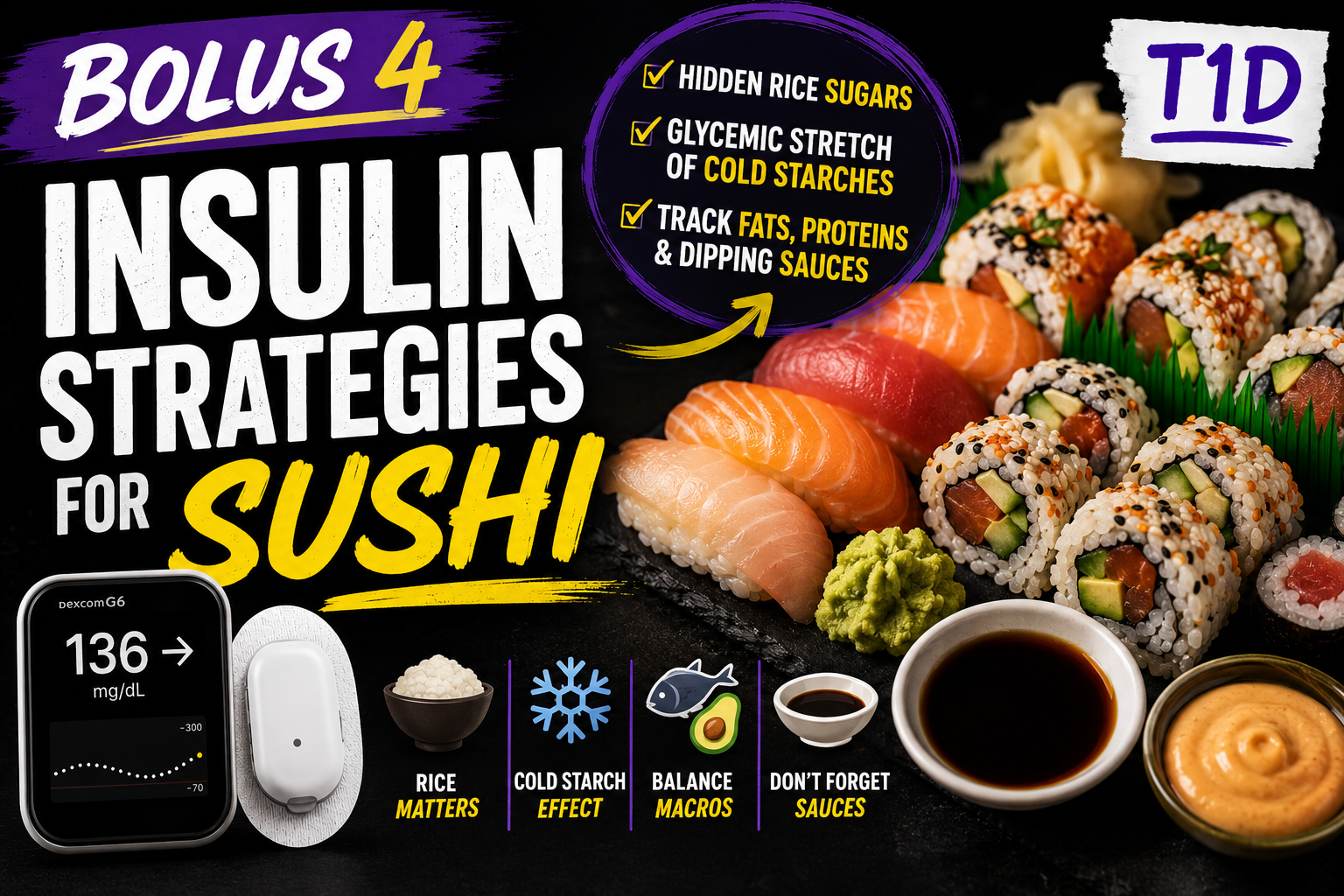
#1853 Bolus 4 Sushi
This Bolus 4 episode details insulin strategies for sushi, breaking down hidden rice sugars, the glycemic stretch effect of cold starches, and tracking fats, proteins, and dipping sauces.
































Key Takeaways
- The Meal Bolt Roadmap: Scott and Jenny utilize the "Meal Bolt" framework (Measure, Evaluate, Base units, Layer correction, Bolus shape, Offset timing, Look at CGM, Tweak) as a foundational pathway to map out insulin requirements for tricky foods.
- Hidden Sushi Carbs: Sushi rice is a short-grain, highly starchy rice. Its carbohydrate impact is further amplified by the traditional preparation process, which involves mixing the rice with a hidden sugar and vinegar blend to make it sticky.
- The Cold Rice Stretch Effect: Because sushi is served cold, the cooled starches digest differently, dragging out the glycemic impact over several hours. This unique physical property makes split bolusing and accurate timing critical.
- The Fat and Protein Factor: Popular specialty rolls feature significant amounts of protein (fish) and fat (mayonnaise-based spicy sauces, avocado, or fried components). Omitting these macros from calculations will trigger a massive, prolonged blood sugar spike hours later.
- Hidden Condiment Values: Dipping a roll into a "slurry" of soy sauce, wasabi, and pickled ginger introduces sneaky, uncounted carbohydrates and protein akin to ketchup, which can instantly disrupt an otherwise well-calculated bolus.
Resources Mentioned
Introduction and the Meal Bolt Roadmap
Scott Benner Here we are back together again, friends, for another episode of the juice box podcast. In every episode of bolus four, Jenny Smith and I are gonna take a few minutes to talk through how to bolus for a single item of food. Jenny and I are gonna follow a little bit of a road map called meal bolt. Measure the meal, evaluate yourself, add the base units, layer a correction, build the bolus shape, offset the timing, look at the CGM, tweak for next time. Having said that, these episodes are gonna be very conversational and not incredibly technical.
Scott Benner We want you to hear how we think about it, but we also would like you to know that this is kind of the pathway we're considering while we're talking about it. So while you might not hear us say every letter of Miele Bolt in every episode, we will be thinking about it while we're talking. If you wanna learn more, go to juiceboxpodcast.com/meal-bolt. But for now, we'll find out how to bowl us for today's subject. While you're listening, please remember that nothing you hear on the Juice Box podcast should be considered advice, medical or otherwise.
Scott Benner Always consult a physician before making any changes to your health care plan or becoming bold with insulin. The episode you're about to enjoy was brought to you by Dexcom, the Dexcom g seven, the same CGM that my daughter wears. You can learn more and get started today at my link, dexcom.com/juicebox. Today's episode is also sponsored by the Omnipod five. And at my link, omnipod.com/juicebox, you can get yourself a free, what I just say?
Scott Benner A free Omnipod five starter kit. Free? Get out of here. Go click on that link. Omnipod.com/juicebox. Check it out. Terms and conditions apply. Eligibility may vary. Full terms and conditions can be found at omnipod.com/juicebox. Links in the show notes. Links at juiceboxpodcast.com. Jenny, hello. We are hey. Hello. Hello. Hello. Hello.
Scott Benner Hello. Alright. We're gonna talk about a food today for bolus four that I've never eaten. Well, that's not true. I had one piece one time, but I have never had beyond that sushi in my entire life.
Jenny Smith Missing out. That's what my boys if we have something special Mhmm. A birthday, a celebration, something, which by the way, Oscar just got his black belt. He tested last Saturday and was out of 20 some testers. There were only three who actually were passed all of the pieces through, like, a four and a half hour test.
Scott Benner What a nice accomplishment.
Jenny Smith It is. So he again, getting back to sushi. You know, we were like, well, we'll go out and we'll celebrate. Right? What would you like? And I already knew. Like, he's like, the sushi place.
Scott Benner Yeah. That's awesome. That's really
Jenny Smith Sushi is the thing.
Breaking Down Sushi Macros: Rolls and Rice
Scott Benner Well, I have a specific order here lined up for us to try to work through. Spice Spicy tuna to tuna. Spicy tuna roll. It says specifically dunked in soy sauce, wasabi and ginger slurry. No idea what that means. Macchi, nigiri, sashimi. Boy, this is gonna be fun for everybody to listen to. Tamakia, impact of sushi rolls rolls, California rolls, dynamite rolls. That's that's what they're looking for. So I'm gonna let you go because I don't I mean, how do you break this stuff apart?
Scott Benner I I let you know, for context for everybody, I asked Gemini to break down the nutritional value of these things. So I have something in front of me, but I'm I'd be much more interested to hear what you think about it.
Jenny Smith Yeah. So in general, rolls rolls is the whole entire roll that you get. Mhmm. Right? You may get in a roll depending on the location somewhere between six to eight pieces in a roll. The rolls can be considered small, meaning it's the diameter. Mhmm. Medium or the large are usually more like the specialty rolls. They've got a lot more sauces. They might have crispy onions on the top or that kind.
Jenny Smith So they're much larger and they're stuffed with a lot more usually like ingredients, not necessarily a lot more rice. But as you can see, wise, as that diameter gets larger, each piece is going to be more carbohydrate.
Scott Benner Mhmm.
Jenny Smith Right? So when you talk about something like a spicy tuna roll, essentially, you've got rice, you've got the tuna, and you've got usually usually, the spicy part also has fat. It's usually mayonnaise with some type of spice to it.
Scott Benner Okay.
Jenny Smith And the interesting thing about sushi rice is that one, it's a really it's like a short grain rice, so it's much starchier. It's also the way that they make the sushi rice that increases the carbohydrate content of it.
Scott Benner Yes. Because I read a little bit about that. Like, they like, to make the rice sticky, there's like a sugar mixture Yeah. Vinegar kind of mixture or something like that. Right? Okay.
Jenny Smith Absolutely. So again, not just rice, but you've got something increasing the carbohydrate content. Mhmm. So when you look at just like a spicy tuna roll in general, let's say it's eight pieces in the roll, you're probably looking at about four grams of carb per piece.
Scott Benner Okay.
Jenny Smith Okay. So eight pieces times four grams of carb a piece is what? About, let's call it 32. That's kind of on the lower end, honestly. Okay. For a spicy tuna roll, I'll tell you what I count. I count 38 because I figured that's I figured out what works.
Scott Benner It's like that's my number.
Jenny Smith And I do it often enough that and it's also, again, based on the place that I've gone over and over, kind of the content I've I've figured out. The lower thirties were too little, and it is this is the case where it truly is. It's an estimation. It's your best estimation. Yeah. Even if you fed a picture of what was on your plate to something like an AI, this is where you could get very varying results.
Scott Benner Wildly different, probably.
Jenny Smith They could be very wildly different. Mhmm. But in general, even if you just said, okay, a roll 35 grams of of carb in something like this. Again, the middle part is all protein, and the fat is the spicy kind of mayo sauce. And then you also have the carbohydrates that essentially come from the rice.
Scott Benner Okay.
Jenny Smith Protein becomes the secondary question. Not only carbs, but it's not a little amount of protein that they're putting in an entire roll. It looks little piece by piece. Mhmm. But if you consider how much probably goes in the entire roll, you're probably looking at a couple of ounces.
Scott Benner It's funny that because the breakdown I got online, which I have no idea if it's right or not, is and it's why this conversation is so interesting around this food specifically. It's almost a one to one carbs to protein for the roll. I don't know if that's accurate or not, but they that's how Interesting. That's how it broke it down.
Jenny Smith I would expect the protein to be less grams in a roll.
Scott Benner Okay.
Jenny Smith And again, this is based on facility. Right? The restaurant.
Scott Benner This one's gonna be your point about it all being different every I mean, this is really gonna be one. You are gonna get to eat a lot of sushi while you figure out how to handle this. Right? Yes. Yeah.
Jenny Smith Absolutely. My estimate would be that a sushi roll, again, spicy tuna specifically for this one, is probably three ounces of protein.
Scott Benner Okay. For the whole roll? Six to eight?
Jenny Smith For the whole entire roll. Which is about six to eight pieces is a typical roll. Mhmm. And so, you know, with seven grams of per protein per ounce, if we're looking at three ounces, that's around 20 ish grams of protein for the entire thing. Whereas the carbs really are more. Again, if you're estimating on the lower end 35 grams
Scott Benner Mhmm.
Jenny Smith It definitely does outweigh the protein.
Scott Benner And then there's fat in that as well. But
Jenny Smith And then the fat would be again on top of the roll typically or sometimes mixed within depending on how they make estimate is usually somewhere around 10 to 15 grams because again, it's mayonnaise.
Scott Benner Okay. This thing said 11. I'm going with you with 15. And so that whole roll then you're thinking maybe 35 carbs, maybe 15 fat, maybe 20 protein.
Bolusing Strategy and the Stretch Effect
Jenny Smith Mhmm.
Scott Benner Ice you know, when we do these, I keep insulin to carb ratio at 10, sensitivity at 50, targeting a 90 blood sugar. It's saying 3.5 up front and another one point o seven, one point one over four hours. I don't know if you agree with the four hour stretch or not, but basically, the theoretical requirement here is, like, almost 4.6 units for that.
Jenny Smith Mhmm.
Scott Benner Today's episode is brought to you by Omnipod. Did you know that the majority of Omnipod five users pay less than $30 per month at the pharmacy? That's less than $1 a day for tube free automated insulin delivery. And a third of Omnipod five users pay $0 per month. You heard that right. 0. That's less than your daily coffee for all of the benefits of tubeless, waterproof, automated insulin delivery. My daughter has been wearing an Omnipod every day since she was four years old, She's about to be 21. My family relies on Omnipod, and I think you'll love it. And you can try it for free right now by requesting your free starter kit today at my link, omnipod.com/juicebox.
Scott Benner Omnipod has been an advertiser for a decade. But even if they weren't, I would tell you proudly, my daughter wears an omnipod. Omnipod.com/juicebox. Terms and conditions apply. Eligibility may vary. Why don't you get yourself that free starter kit? Full terms and conditions can be found at omnipod.com/juicebox. You can manage diabetes confidently with the powerfully simple Dexcom g seven. Dexcom.com/juicebox. The Dexcom g seven is the CGM that my daughter is wearing.
Scott Benner The g seven is a simple CGM system that delivers real time glucose numbers to your smartphone or smartwatch. The g seven is made for all types of diabetes, type one and type two, but also people experiencing gestational diabetes. The Dexcom g seven can help you spend more time in range, which is proven to lower a one c. The more time you spend in range, the better and healthier you feel. And with the Dexcom Clarity app, you can track your glucose trends, and the app will also provide you with a projected a one c in as little as two weeks.
Scott Benner If you're looking for clarity around your diabetes, you're looking for Dexcom. Dexcom.com/juicebox. When you use my link, you're supporting the podcast. Dexcom.com/juicebox. Head over there now.
Jenny Smith I do agree with the four hour in terms of, like, that extended part, mainly because sushi is interesting. If you look at it just from a rice perspective, it's a pretty quick high glycemic index. Mhmm. It could be a quick hit. So pre bolusing becomes really important here. But there's a stretch effect to sushi and how it ends up digesting. I mean, you don't eat sushi warm.
Scott Benner No. Okay.
Jenny Smith Right? Alright. So we eat sushi cold, rice, like many starchy foods, and I'm sure you've heard about the noodle idea.
Scott Benner Yep.
Jenny Smith Right? You cook the noodles, you cool them down, you reheat them, or you even eat them cold, and it reduces the glycemic hit.
Scott Benner Mhmm.
Jenny Smith But it can also stretch out the glycemic hit. Sushi is kind of similar along with the fact that it's full of protein depending on what else you're eating with this spicy tuna roll. Yeah. So you're looking at a stretch effect that can be several hours. And that's where I think it it kind of trips up a lot of people thinking, well, gosh, it's it's rice.
Scott Benner It's also so small. I know that's It's small. It sounds crazy, but it's not that big of an amount of food. Yeah. Actually, to your point, the bolus estimator that is at juiceboxpodcast.com/bolusfour, bolus, the number four, it's saying pre bolus time, and I have this set up as the current blood sugar. I didn't even put it in, but I I I just put the the BG trend as stable. It says Uh-huh. It says nine minutes would be a pre bolus.
Jenny Smith Starting place.
Scott Benner Yeah. Yeah. Yeah. If I Could
Jenny Smith could be a good
Scott Benner If I put in a a current blood sugar of one twenty, it stretches it out to, you know, twelve minutes. But it's to your point of, like, food get you know, let's put a reasonable pre bolus on here.
Jenny Smith Right.
Scott Benner But not, you know, but at the same time, not too long because this is gonna get going here.
Jenny Smith And my my sushi strategy, again, my n of one personal experience has been with many, many sushi eating experiences.
Scott Benner Many, many, many.
Jenny Smith The best of which by far was in Lima, Peru, which is very weird. It was the best sushi that I've ever ever had.
Scott Benner Didn't expect that?
Jenny Smith It was amazing. But my sushi experience has taught me that I can bolus knowing what I've ordered as soon as our order gets placed Mhmm. And knowing now about how much sushi I eat, I pre bolus. It's fifteen minutes as long as my blood sugar is in target. And even if my blood sugar is just slightly trending down, I still do the same pre bolus.
Jenny Smith Mhmm. But I don't pre bolus all of the carbs. Okay. Instead, I pre bolus about 40% of the carbs that I expect I'm going to eat of the rolls that we've ordered.
Scott Benner Mhmm.
Jenny Smith And when the meal arrives, I enter the rest of it.
Scott Benner You put the rest in. Use the classic how to pre bolus for a little kid trick on
Jenny Smith It is kind of Yeah. That exactly.
Scott Benner Yeah. Little bit going.
Jenny Smith It's more based on what I know the extensive reach of sushi for me looks like. So for you. Bowl is all upfront, I'm gonna hit a low before it starts kicking in.
Scott Benner Right.
Jenny Smith So I pre bolus enough that I catch the first digestive, if you will Mhmm. Of the initial. And then because I bolus for the rest at the beginning of starting to eat.
Accounting for Protein, Fat, and "Slurries"
Scott Benner Then you have a heavier blanket on the second burst, basically. Yes. Yeah. Yeah. Yeah. Mhmm. It's interesting. Just so people can track along, I think this why this estimator is really helpful to kinda learn from, 3.5 up front, one point o seven on the back end for those four hours. If you just take the protein out, so I don't count protein on this meal, it keeps the initial bolus at 3.5, but the the Warsaw wave now goes to three hours and comes down by, like, point four, like a half a unit. So if you're gonna get a big push later, not only have you not stretched it out long enough now just by not considering the protein, but you also, you know, you also are not, having enough insulin.
Scott Benner Again, same idea. If you don't think about the fat, if you just go like this sushi roll is 35 carbs, this goes down to a 3.5 bolus with no consideration for later, and that must be what people are seeing. Right? They're not treating they should be treating this food almost like a burger and fries as far as, like, that secondary hit.
Jenny Smith And the fancier the rolls get, again, those specialty rolls, they tend to have sometimes they have a fried component to them because the shrimp inside might be fried or you might actually have fried, like, squid or eel. Like, there might be a fried fish component that's inside as well as the mayonnaise based types of sauces or the avocado that might be inside of your, you know, California roll, for example
Scott Benner Okay.
Jenny Smith Depending on how much you're eating. And then what you might also be eating it with. Like, I know we always before our sushi even comes
Scott Benner Mhmm.
Jenny Smith We really like the edamame. Have you ever done the edamame? You probably
Scott Benner Arden loves edamame. Yeah.
Jenny Smith Yeah. So much fun to eat. Like, my boys could each eat their own bowl Mhmm. Of salty, hot edamame. So we usually share some of that ahead of time, which is actually great because it adds a fiber coating component, a protein component before the sushi actually also kinda gets digesting and rolling.
Scott Benner Right.
Jenny Smith So think about what you're doing before you eat the rolls.
Scott Benner Well, let's talk it through a little bit. So soy sauce has carbs and protein in it that I didn't expect even. Not a lot.
Jenny Smith It's more minor.
Scott Benner Yeah. A tiny little bit, but, you know, two tablespoons, two carbs, two proteins. The pickled ginger doesn't have any.
Jenny Smith Oh, the pickled ginger is so good.
Scott Benner Wasabi paste has carbs in it. Again, teaspoon of wasabi paste looks like about three grams of carbs. So that slurry you're talking about, you know, when it it's all put together and by the way, whoever said slurry, like, thought they were making that word up, it's obviously a real thing. But it's, 10 carbs, two proteins. So it's one of those things. It's it's almost like ketchup. Like, it's really easy to be like, oh, I didn't I didn't really account for that. But we go back down to this meal. If you're, you know, if you're putting I don't know what you do with that slurry, but all of a sudden, you know, there's two more proteins, 22, and there's 10 more carbs. So now it's the the roll and the slurry. It it boom. You know what I mean? Like, here we go again. It's, it's now four units up front. That went up by a half unit, and the worst all weight kinda stayed similar. But now we're up to over five units just with with that Right. That that add You
Jenny Smith You add on a good component in looking at a lot of meals that have these little saucy kinds of things with them. Right? Mhmm. I mean, ketchup is a huge offender.
Scott Benner Yeah. Oh, no. Yeah. All the time.
Jenny Smith Nobody ketchup. Right?
Scott Benner Sugar, you know, basically.
Jenny Smith It is. And then in this example, with your insulin to carb ratio standard at one to 10 for ease in calculation, if this little slurry
Scott Benner Mhmm.
Jenny Smith Great word. This little 10 grams of carb, That's a unit of insulin that you miss.
Scott Benner Yeah. Yeah. Yeah. Yeah. And that can definitely make a difference. I mean, that's a 50 if if your insulin to carbon, your correction factor are truly well calculated Yeah. Then one unit of missed insulin can also create 50 more point rise than you would expect. Just like that. Right? Would a person eat a spicy tuna roll and a California roll, or is that too much food? Oh,
Jenny Smith no. Oh, okay. Like, if you were my children, oh, the more rolls, the better.
Scott Benner Well, then I'm telling you here, I'm looking at California roll, and the again, the spicy tuna roll estimate that I'm looking at was under your estimate. It says California roll, nine protein, 38 carbs, dynamite roll, 12 protein, 45 carbs, standard maki, 15
Jenny Smith The maki is just simple.
Scott Benner Yeah. But still, it's 15 it says 15 grams of protein, 25 carbs. Like, you know, sashimi has a lot of protein in it.
Jenny Smith It is. It's really sashimi is just it's without rice entirely. It's pretty much protein though. But again, if you are the person who goes and let's say you get the steamed edamame, maybe you get the oh, what is their soup called that they have? I really like it. Now it escapes me the name of the soup. Miso soup. Okay. There we go.
Scott Benner Right.
Jenny Smith I I mean, again, pretty pretty negligible. But if you are truly just doing a big plate of sashimi, you've got a lot of protein there that you're you should be expecting a hit down the road.
Scott Benner Three to four and a half ounces of thick slices, 22 to 25 grams of protein.
Jenny Smith Right. So in a and again, then they're pieces. They're not rolls.
Scott Benner Mhmm.
Jenny Smith So per piece, usually somewhere I usually say somewhere around five to seven grams per piece
Scott Benner Okay.
Jenny Smith In general.
Real-Life Meal Simulations & Learning Tools
Scott Benner Listen. I I'm gonna tell you right now. I think this conversation will help wrap your head around it, but this is just this is just Gemini. It's just Google Gemini. I didn't do it in Chad GPT. I didn't do it in Claude. I don't know if it would come up with different things or not. Yeah. But at least it's a starting point. Like, you're telling me that this one's a science experiment for sure.
Scott Benner Mhmm. And so at least start at a a reasonable guess. And all I did was took someone's order. It's a it's a listener who sent this to me. Yeah. Spicy tuna roll dunked in soy sauce, wasabi and ginger slurry, maki read it to you already. Right? I put it in and I said, I need a nutritional breakdown for all. Be complete. Be accurate. I need fat, protein, and carbs. And it just spit it back at me. I don't know if it's right or not. I mean, what the hell does right even mean? Like, you know, if each restaurant's gonna be different and each person's gonna feel impacted differently by it and maybe your settings are right and maybe they're not, but still, like, you gotta start somewhere.
Jenny Smith Yeah. And it
Scott Benner could be fun to be perfectly honest with you. Like, sit down at the table.
Jenny Smith Absolutely.
Scott Benner Yeah. Whip open your app. Ask your ask your ask your, you know, your world dominating minion in your pocket what it what it thinks. And then
Jenny Smith more you feed it, you know, this little helpful minion as it's like that consideration, truly. As you feed it the information, you can say, okay. I'm having a California roll. It is eight pieces. Each piece looks like it's about an inch in diameter. Yeah. So the more information you can give this type of system, it doesn't have parameters for distinct rules. Right? You have to feed it the information to get back the best cumulative that it's pulling from from all sources that it's looking at. Right?
Scott Benner Yeah. And this isn't a I mean, listen, this isn't an AI conversation, but as long as it got brought up I'm using Claude now mostly.
Jenny Smith Uh-huh.
Scott Benner And they recently added, like, some memory to it. Like, you can build in skills and and Oh. So, like, you could build a I don't know what you would call it. I don't know if it's a skill if it's, it it's not important. Again, this is not a this is not a Claude lesson, but you can basically teach it things about yourself. So you could say, you know, give me the the starting points for this meal and then get down to the point where you realize, like, well, this is what it actually took. I mean, you could easily add on to this and say, is my carb ratio. These are my settings. Here's what I tried this time. Here was my end result.
Scott Benner What should we try next time? And then say you figured out, and it's it ends up being like, this meal is this many carbs and this much fat, shush out over this much time. I've added in the protein, blah blah blah. You got it worked out. You go ahead and tell it, like, that's what worked for me. Right? Yeah. So now the next time you ask it for something, it'll probably be able to, like, say, oh, you know, I know the carbs say this, but, know, the last time that happened, it ended up being more like this for you. Maybe try this. And I'm telling you, like, that's not that difficult to figure out. So especially for these sorts of things. I mean, the reason sushi comes up is because everybody seems to struggle bolusing for sushi. Like, you know what I mean? When I'm seeing people online
Jenny Smith A 100%. Unless you test it and fiddle with it and expect that it's this is, again, not specific to sushi, but this is where you make a decision to try something and you say to yourself, this is entirely an experiment. I'm gonna use all the information I have from similar foods that I've learned to navigate well, and I'm gonna put in these strategies, and I'm going to see how it hits. Yeah. And then you end up making a change.
Scott Benner Right. But it but this is so much more focused and I think simple by starting with at least a better jumping in point, really, on on the numbers. Instead of just sitting down one day and going like, I don't know. I'll try this. Eating it, having your outcome going, I'm gonna go back next Friday night give it a whirl again. Like, although, you know, I'm sure you come to the same conclusion eventually.
Jenny Smith No? Yeah. Right. Correct. So, I mean, in a real world, like you said, would you eat just one roll?
Jenny Smith Yeah. Oh. Oh, no.
Scott Benner No. No.
Jenny Smith Yeah. Like, no. No. So let's I mean, let's put together a real life scenario. Right? Right. Let's say I mean, this person fed you a whole bunch of different things, but if we did what people tend to do, maybe especially if you're eating out for lunch on your own.
Scott Benner Mhmm. Let's say we take something like two spicy tuna rolls. We'll take some of the things from what you did. Two spicy tuna rolls, and we take, we like the salmon. So how about, like the salmon nigiri or nigiri? I never know how to say it exactly right. And we say, we're gonna have, let's see, four pieces of that. Okay. Okay. So as a cumulative then, what are we looking at in terms of macros? Like, our carb count goes up considerably from one roll.
Scott Benner I've been tracking you. I got what you were saying. The two rolls and the and the fish, 76 carbs, 30 fat, 44 protein.
Jenny Smith And that's on the light side.
Scott Benner Okay.
Jenny Smith That really would be on the light side. I mean, if you're looking at the nigiri nigiri, I mean, in pieces, you're probably looking at 35 grams ish from a carbo standpoint.
Scott Benner Of that.
Jenny Smith Yeah. Yeah. Yeah. Yeah. I mean, from, two spicy tuna rolls, again, if you use average 35 for a spicy tuna roll, but two of them, that's 70 grams of carb.
Scott Benner Yeah.
Jenny Smith Like, we're looking at a large amount carb.
Scott Benner And five in that at that point.
Jenny Smith At least. Yeah. Right? And then the protein. Right? Protein for what did we count for the sushi rolls? I think it was like 30. Mhmm. 25 or 30. Right? So that's again adding up how much protein in each of the rolls. If we go on the low end twenty, twenty five per roll, that could be 40 to 50.
Scott Benner I'll put in 50. And what do you think about fat?
Jenny Smith And then fat, again, spicy tuna. Each roll being, I think, I said somewhere between ten and fifteen. So probably somewhere between 20 to 30 grams of fat. Mhmm. And then you're looking at the other, right, the other salmon containing. Salmon's a little bit of a fattier fish. It probably has more fat. It doesn't have a sauce on top of it, but you're looking at carbs, protein probably similar to this the tuna rolls.
Scott Benner Mhmm.
Jenny Smith And you're also looking at fat less for that. I would say probably 10 to 15 again, total fat for those pieces. Okay. But So you've got you've got huge macro hits here.
Scott Benner Yeah. So if you if just following along with what you're saying, a 105 carbs, 45 grams of fat, 50 grams of protein. Fat in the protein, not something most of you are counting to begin with. I'm going with a stable trend on your, you know, and let's just say you started at a 90 blood sugar, which let's you're probably not. Okay? But, like, like, let's just say that you are. That's 10 and a half units. This is a one to 10, right, with a Mhmm. Insulin sensitivity of 50. So it's 10 and a half units up front, three units over it's now saying eight hours.
Scott Benner Like like, you know, so three units stretched out over eight hours still with, a nine minute pre bolus. It's 13 and a half units for sushi.
Jenny Smith It's a a lot of insulin.
Scott Benner Yeah. Yeah. Yeah. Yeah. And, again, we're not this is not a judgment. Right? Of course. You just have to consider though that if this is your meal, you have to also from a mindset standpoint, maybe your meals are usually more like six or seven units. And you're looking at this mouth thinking, my goodness. That's gotta be wrong. Something's gotta be wrong.
Scott Benner But but are you having that meal with your six or seven units in and then going up to 300 and staying there for five hours? Like, they this is your answer, really. You know? And again, just to make the point to everybody, if I just took 10 and a half up front, three over eight hours, if I just take out the 50 protein, it changes the back end, but it doesn't change the it doesn't change the front end very much. Right. If I take out the fat and no one's teaching you to bolus for fat, the complexity of this extended bolus is completely gone.
Scott Benner Now it's just telling you this is 10 and a half units for the meal. And we just said it might be not only 10 and a half, but my god, you know, another three units and stretched out over eight hours afterwards. That's a three unit impact. You're not getting it all with the amount of insulin, right, because you're not using it. Right. And you're not addressing the timeline after the food at all either. You're just looking at your regular old Yeah. Basal or, you know, if you're injected, it's just basal. If you're on a a a, you know, a regular old pump, it's just basal. If you're on an automated system, not only is it not there, but the automated system's probably taking the basal away.
Jenny Smith It might be.
Scott Benner Right. Right. And now you have now not only do you not have the three over the time, you you also have no basal either.
Jenny Smith No basal either.
Scott Benner No basal either. You could be diff yeah. You could be different deficient significantly, and you're seeing this crazy rise. And then you get on the phone to the pump company, you go, damn, pump don't work. Yes.
Jenny Smith Something's wrong. Something's wrong. It took all my insulin away, and I was sitting high. Well, you have to understand how the algorithms work.
Scott Benner Yeah. Yeah. And you have to understand these these impacts. I'm telling you right now, this estimator is a great way to learn this. I like just throwing in numbers and seeing, like, how does not accounting for this or not accounting for that or accounting for that correctly? How does that change the amount of insulin, the time that that insulin needs to be active? I think it's a really great learning tool. I really did build it as a learning tool. Yeah. You know, if you wanna use it otherwise, I probably can't stop you, but you are gonna answer a couple of, disclaimers on the way through. Ask your doctor about it. I would I would open this up at my doctor's appointment and say, like, hey.
Jenny Smith What do you think?
Closing and Community Resources
Scott Benner How come nobody ever mentioned fat to me? Can we talk about how to do this better? Mhmm. And if you're really, like, technically interested, keep scrolling down. It explains to you how the whole page works and the Mhmm. The estimator works and everything. Really just letting yourself know about that is, is probably the the the secret to the success a lot more. I'll even under I I might even say, it might even be even more valuable than understanding exactly how many carbs and fat and protein are in the in the sushi that you're eating. So thank you for doing this. I I really do appreciate it.
Jenny Smith No. It was super fun. A a a definitely type of food that I I I really like. We don't do very often, but I really like it. So thanks.
Scott Benner Well, the next time we get together, we're gonna do Mexican and Chinese. You're gonna love it.
Jenny Smith Oh, that's fun too. Bye. Bye.
Scott Benner This episode of the Juice Box podcast is sponsored by the Omnipod five. And at my link, omnipod.com/juicebox, you can get yourself a free what'd I just say? A free Omnipod five starter kit. Free? Get out of here. Go click on that link. Omnipod.com/juicebox. Check it out. Terms and conditions apply. Eligibility may vary. Full terms and conditions can be found at omnipod.com/juicebox. Links in the show notes. Links at juiceboxpodcast.com. Dexcom sponsored this episode of the juice box podcast. Learn more about the Dexcom g seven at my link, dexcom.com/juicebox.
Scott Benner Okay. Well, here we are at the end of the episode. You're still with me? Thank you. I really do appreciate that. What else could you do for me? Why don't you tell a friend about the show or leave a five star review? Maybe you could make sure you're following or subscribe in your podcast app, go to YouTube and follow me or Instagram, TikTok. Oh, gosh. Here's one. Make sure you're following the podcast in the private Facebook group as well as the public Facebook page. You don't wanna miss please, do you not know about the private group? You have to join the private group. As of this recording, it has 74,000 members. They're active talking about diabetes. Whatever you need to know, there's a conversation happening in there right now. And I'm there all the time. Tag me. I'll say hi.
Scott Benner My diabetes pro tip series is about cutting through the clutter of diabetes management to give you the straightforward practical insights that truly make a difference. This series is all about mastering the fundamentals, whether it's the basics of insulin, dosing adjustments, or everyday management strategies that will empower you to take control. I'm joined by Jenny Smith, who is a diabetes educator with over thirty five years of personal experience, and we break down complex concepts into simple, actionable tips. The diabetes pro tip series runs between episode one thousand and one thousand twenty five in your podcast player, or you can listen to it at juiceboxpodcast.com by going up into the menu. Have a podcast? Want it to sound fantastic? Wrongwayrecording.com.

#1852 Dexcom G6 Leaving and G8 Coming?!
Dexcom G6 discontinuation and Investor Day updates , highlighting the 15-day G7 baseline , the upcoming self-adapting G8 , and future potassium monitoring.
Key Takeaways
- Dexcom G6 Discontinuation: Dexcom is officially sundowning the G6 sensor line, with manufacturing ending completely on July 1, 2026. Current users are strongly encouraged to contact their doctors immediately to transition to the G7 platform.
- G7 15-Day Wear Baseline: The 15-day version of the G7 is now fully integrated with all major US pump partners (Omnipod, Tandem) and has become Dexcom's baseline floor for all future product generations.
- Smart Basal & Smart Bolus Software: Dexcom's newly FDA-cleared "Smart Basal" system uses personalized CGM data to slash insulin titration time down from 12 weeks to under 30 days, while the upcoming "Smart Bolus" will integrate trend arrow physics directly into dosage calculations.
- Dexcom G8 Launch (2027/2028): The self-adapting, next-gen Dexcom G8 is slated for a late 2027 or early 2028 market launch, boasting a 50% smaller form factor, automated calibration updates during wear, and planned multi-analyte ketone integration.
- CGPM & Expanded CMS Coverage: Dexcom unveiled its development roadmap for CGPM (Continuous Glucose and Potassium Monitoring) to help manage kidney and cardiovascular risk. Additionally, Medicare (CMS) is projected to extend CGM coverage to all Type 2 patients by mid-2027.
Resources Mentioned
Dexcom G6 Sundowning & G7 Transition
Scott Benner Hello, friends. Listen. Before we get started, I think I should just say out of the gate, Dexcom is sundowning the g six.
Scott Benner If you haven't heard about that, the production of the g six officially ends 07/01/2026, which is just about six weeks from today when this episode drops.
Scott Benner Supply still trickle in maybe through your pharmacy and distributors for a little while after that, but Dexcom is not guaranteeing availability past July 1, and they're encouraging everyone still on the g six to talk to their doctor about upgrading to g seven or g seven fifteen day before the cutoff.
Scott Benner If you're a g six user, and I know a lot of you still are, that means that in the next few weeks, you want to be having a conversation with your endo or your prescriber about getting a new prescription written.
Scott Benner The g seven is generally covered by the same insurance that covers your g six, but you've got to actually move on it.
Scott Benner So don't wait until you're on your last sensor. Okay?
Scott Benner Now here's a few practical things if you've been holding off on switching.
Scott Benner The g seven doesn't restart off label the way the g six did.
Scott Benner If you've been getting extra days out of your g six sensors, that's not a feature that carries over, so plan for that.
Scott Benner The g seven is smaller, shorter warm up time, and the fifteen day version is what Dexcom is now calling its baseline going forward.
Scott Benner And the g six Pro, the one used in clinics for blinded readings, is also being discontinued.
Scott Benner There's no announced direct replacement for that one yet.
Scott Benner So if you've been hearing about it from your endo, that's why. Alright.
Dexcom Investor Day & The 15-Day Baseline
Scott Benner Now with that g six housekeeping out of the way, here's why I'm actually making this episode.
Scott Benner Earlier this week, Thursday, May 14, Dexcom held their Investor Day. Usually, these events are for Wall Street.
Scott Benner You know, they go over gross margins, cash flow conversions. They you know, stuff like that.
Scott Benner But this one had real product news in it, more than I expected.
Scott Benner So I listened to their presentation, and I went through the deck that they that they, you know, made available on their website. You could go see it too.
Scott Benner And, I think I can go over a few things that really matter for you here, make this kind of, easy to understand.
Scott Benner Quick disclosure before I go. Dexcom is a longtime juice box podcast sponsor.
Scott Benner This episode is not sponsored. I'm summarizing what Dexcom publicly presented to the world on Thursday, and I'm going to tell you what I think of it.
Scott Benner I'm also hoping to get Jake Leach to come on and talk more about some of this stuff.
Scott Benner So if Dexcom's listening, can we, get Jake on here?
Scott Benner Until then, g seven fifteen day this is kind of where we are now.
Scott Benner By the 2026, Dexcom expects roughly half of their US customer base to be on the fifteen day platform.
Scott Benner If you haven't switched yet and a lot of you are switching anyway because of g six sundowning, that's the wave you're joining in on.
Scott Benner Fifteen day is now live with all US pump partners.
Scott Benner So if you've been waiting on Tandem, Omnipod, any of them, that's done. The integrations are in place.
Scott Benner International rollout of fifteen day starts in the back half of this year. They didn't break out specific country timing yet.
Scott Benner And the company said something I think is worth flagging out loud.
Scott Benner Fifteen day wear is now their baseline. Everything they build going forward assumes that is the floor, which, of course, is a real shift in how the product line works.
Smart Basal and Smart Bolus Software
Scott Benner Now they talked about something called Smart Basal and Smart Bolas, so that's software because Dexcom announced two products that use CGM data to actually do something, not just show you a number.
Scott Benner The first one, they called Smart Basal.
Scott Benner This is mostly a type two thing.
Scott Benner When a doctor starts someone on basal insulin today, giving the dose dialed in, excuse me, usually takes about twelve weeks.
Scott Benner They do log reviews, dose tweaks, follow-up visits, more tweaks.
Scott Benner Dexcom is saying Smart Basal can shrink that down to under thirty days using personalized dosing recommendations driven by their CGM data.
Scott Benner And this one isn't theoretical.
Scott Benner Smart Basal actually got FDA clearance back in November 2025, and it's rolling out alongside the g seven fifteen day.
Scott Benner So it's a real product available now, not a roadmap item.
Scott Benner If you're a type one listener, which I'm assuming most of you are, and you heard basal titration and then then you tuned out, just stick with me for a second because picture this.
Scott Benner This process is happening millions of times a year across the country.
Scott Benner Faster time to a working dose means less time being high during, the figuring out period.
Scott Benner That's a real health outcome. It's gonna be good for people.
Scott Benner The second one, of course, is SMART bolus. This is gonna be more interesting to you.
Scott Benner SMART bolus uses CGM trend data to inform the bolus calculation.
Scott Benner The goal is fewer lows, fewer missed doses, and less insulin stacking.
Scott Benner It's described as under review, not currently available, but it is on the road map, and Dexcom is being public about it.
Scott Benner Here's why I think that one might matter. The trend. Right?
Scott Benner Your blood sugar rising, falling, staying flat, whatever, is something a lot of you who listen to this already have in your head. You're doing it in your head. Prebolising when you're flat, hold off when you're falling, give a little more when you're ready going up. That's pro tip stuff.
Scott Benner But the truth is most people aren't doing that math.
Scott Benner They're using a calculator that doesn't know what direction the glucose is moving.
Scott Benner So if SmartBolus works the way it's being described, it's the kind of feature that helps the person who isn't a power user, and that's a lot of people.
Scott Benner So I'm happy about that. Now the headline here, g eight.
The Next Generation: Dexcom G8
Scott Benner This is what most of you probably wanna hear Dexcom announced the g eight.
Scott Benner G eight is the next generation Dexcom sensor expected to launch in late twenty twenty seven or early twenty twenty eight, so roughly two years from now.
Scott Benner The headline feature is that g eight is self adapting. That's a quote.
Scott Benner And what that actually means is this, current CGMs, including g seven, are calibrated in the factory.
Scott Benner They go through a quality control. They get dialed in, and then they're on you. That's it.
Scott Benner Once the sensor is on your arm, it's doing its best with what it knew about itself at the moment it was made.
Scott Benner G eight adjusts during wear, so updated electronics, new algorithm, the sensor itself adapts in real time over the days you're wearing it.
Scott Benner Dexcom said this is technology they've been developing for nearly two decades.
Scott Benner They're claiming significant accuracy improvements over g seven and a reduction in those weird outlier readings.
Scott Benner They're also saying g eight is 50% smaller than g seven. That's gonna be pretty tiny.
Scott Benner And in the q and a portion of the day, they confirmed two things that didn't make the slide deck.
Scott Benner One, they expect to file g eight with FDA in 2027. That tracks with a late twenty twenty seven or early twenty twenty eight consumer launch.
Scott Benner And two, ketone monitoring is planned to be part of the g eight platform, not at launch, but it's on the road map.
Scott Benner So let me say something about why that might matter.
Scott Benner Dexcom did their own customer research, and the top two things people want from a CGM are accuracy and reliability. No surprise.
Scott Benner Above ease of use even, above customer support even, and above brand, above everything. People want accuracy and reliability.
Scott Benner And the top two reasons people stop using a CGM are both about reliability.
Scott Benner So if g eight delivers what they're describing, it's directly addressing the thing that this community has been asking for.
Scott Benner And the smaller form factor, that matters more than people give it credit for.
Scott Benner Pediatric use, lean people, athletes who are wearing the sensor on their arm, smaller equals more wearable. It's two years out, but it's a thing to put on your radar.
Continuous Glucose and Potassium Monitoring (CGPM)
Scott Benner Now here's something interesting. CGPM, glucose plus potassium. Pay attention to this.
Scott Benner This next one is, I don't know. You're gonna think it doesn't apply to you, but I I still think it's worth listening to.
Scott Benner Dexcom announced a sensor called CGPM, continuous glucose and potassium monitoring. One sensor, two analytes at the same time continuously.
Scott Benner But why potassium?
Scott Benner Well, for people with type two diabetes, about a third also have chronic kidney disease. About a third have cardiovascular disease, and in those populations, potassium imbalances are a big deal.
Scott Benner They correlate with higher ICU admissions, longer hospital stays, and higher mortality.
Scott Benner Dexcom's data says roughly twenty percent of annual costs for someone with type two plus kidney disease are tied to potassium problems. Interesting. Right?
Scott Benner So a sensor that watches both glucose and potassium in real time could change how those patients are managed entirely.
Scott Benner And here's why I'm telling you, the type one diabetes listeners. Kidney disease is a long tail risk that anyone with diabetes can develop.
Scott Benner Anyone can develop it, but, you know, it's prevalent with some people with type one. And I'm not trying to scare you or anything, but most of you are not gonna develop kidney disease.
Scott Benner But a sensor that monitors potassium continuously could end up mattering to a lot more people than you think today. Dexcom didn't give a CGM timeline. They put it on their what's next.
Scott Benner And I wanna read you a note that I got from a listener. It says, hey. Just so you know, my adrenaline and potassium related paralysis groups are over the top excited about the potassium monitoring element of g eight, and they are just grateful that it's progressed enough to be talked about and published for investors.
Scott Benner This is a tech and data that's never been available to us in real time and will be so incredibly helpful. Waiting two years isn't even phasing anyone in these groups, she says.
Scott Benner Thought it might be nice for you to hear that. I'm sure Dexcom may not have even contemplated how far beyond CKD, CVD, and even DKA this element of g eight might reach, but it's going to be incredibly impactful on a growing number of people.
Scott Benner Isn't that something? That's something you don't know about? I don't even know about, but one of our great listeners was, nice enough to reach out and tell me about.
Global Expansion and Institutional Products
Scott Benner Okay. Let's move, a little quickly through the rest of this. There's a lot of, lot of stuff divulged by Dexcom. I wanna make sure you hear it all.
Scott Benner Dexcom Flex, a new sensor specifically for type two diabetes, both basal only insulin users and non insulin users launching soon in Germany, international only for now.
Scott Benner This is part of Dexcom's tiering their product lines so different sensors fit different markets and reimbursement environments.
Scott Benner Stello is going international. Stello will be all over the, let's see. What do they got here?
Scott Benner Stello is the over the counter biosensor, no prescription required, aimed at wellness users and people with type two, not on insulin.
Scott Benner It's launching in Australia, The UK, South Korea, and New Zealand in late twenty twenty six, early twenty twenty seven.
Scott Benner I love this one. Dexcom Hospital CGM system.
Scott Benner You might remember this conversation started up around COVID, but they're planning to launch an inpatient hospital product by the 2027. And if you've ever had to fight to keep a CGM on or, like, your kid or yourself after you've been admitted with DKA or something else in the hospital, you know exactly why this matters.
Scott Benner There are roughly fourteen million dysglycemic events a year in hospitals. This could really go a long way to helping that.
Scott Benner If you don't remember around COVID, there was, a special I don't think they they were allowing people who needed their blood sugar monitored to wear CGMs at hospitals so that nurses and staff could monitor their blood sugar without going into the room. I think this is where that all got started. It's great to see that it's turning into something.
Scott Benner We also have direct EHR integration. More than 320 health systems are now live or onboarding with Dexcom's direct integration into electronic health records.
Scott Benner So in plain English, your CGM data shows up in your ENDO's chart right alongside your labs without your ENDO logging into a separate platform. That's a slow burn quality of life improvement for sure that's gonna pay off over the years.
Scott Benner Last bit, then I'll wrap up.
Scott Benner Dexcom is expecting CMS, which is, of course, is Medicare to expand CGM coverage to all people with type two diabetes, including those not on insulin by mid twenty twenty seven.
Scott Benner They expect a CMS proposal at the 2026 and final coverage by mid twenty twenty seven.
Scott Benner That single change would roughly double DexCom's US covered lives from about fifteen million today to about thirty million in 2027. Now why am I telling you this?
Scott Benner I I think, honestly, it's because that same Dexcom company that's developing g eight and CGM and hospital products is going to be a meaningfully bigger company a year from now, which hopefully will give them more resources to put into things that you and I are actually using.
Closing and Additional Podcast Resources
Scott Benner So what do you think? I think this was a real investor day. Actual products with real names on dates that aren't ten years out.
Scott Benner G eight is roughly two years away. Smart Basal already has data behind it. C g p m is further out, but it's the most interesting bet on the board.
Scott Benner The thing I keep coming back to is Dexcom said, and I'm paraphrasing here, they want to be the premier glucose sensing solution for everyone. And they paired that with a roadmap of specific products for a community that has spent a decade waiting on things, and that's worth noticing.
Scott Benner If you have questions about any of these products, send them my way. I'll do my best. You can reach out on Facebook. We can start conversations with other people. There's a contact form at juice box podcast dot com. I read everything you guys send.
Scott Benner But don't forget, if you're still on g six, please talk to your doctor now. July 1 is six weeks out, and you don't wanna be the person who's figuring this out when you're on your last sensor. Thanks so much for listening. I'll see you next time on the Juice Box podcast.
Scott Benner Nothing you hear on the Juice Box podcast should be considered advice, medical or otherwise. Always consult a physician before making any changes to your health care plan.
Scott Benner If you'd like to hear a little bit about the pro tip series or other offerings on the website, hang out. And if not, you're finished. But there'll be another episode tomorrow and five more this week and five next week and so on and so on.
Scott Benner The Juice Box podcast has over thousand episodes and has been in production continuously since January 2007. Check us out in your favorite audio app. Follow, subscribe if you're not already, and don't miss the private Facebook group.
Scott Benner If you'd like to hear about diabetes management in easy to take in bits, check out the small sips. That's the series on the Juice Box podcast that listeners are talking about like it's a cheat code.
Scott Benner These are perfect little bursts of clarity, one person said. I finally understood things I've heard a 100 times. Short, simple, and somehow exactly what I needed.
Scott Benner People say small sips feels like someone pulling up a chair, sliding a cup across the table, and giving you one clean idea at a time. Nothing overwhelming. No fire hose of information. Just steady helpful nudges that actually stick.
Scott Benner People listen in their car, on walks, or rather actually bolus ing anytime that they need a quick shot of perspective. And the reviews, they all say the same thing. Small sips makes diabetes make sense.
Scott Benner Search for the Juice Box podcast, small sips, wherever you get audio. And if you'd like to refer back to this episode, go to juiceboxpodcast.com, find the episode page for this episode, or in my blog, we have a whole breakdown of Dexcom's announcements. Just scroll to the bottom and look for the blog.

#1851 That’s So Bridget
Scott and 23-year-old Bridget discuss her college T1D diagnosis , managing Hashimoto's and ovarian cysts , using Mounjaro , and the mental hurdles of taking daily medications.
Key Takeaways
- Being diagnosed with Type 1 Diabetes as a young adult entering college requires a rapid shift to independence and self-advocacy, but it is completely possible to thrive.
- Hashimoto's thyroiditis is a common comorbidity with T1D; untreated thyroid issues can cause fatigue, brain fog, joint pain, and weight gain, making daily medication adherence crucial.
- Finding a manageable routine for daily medications (like keeping pills in the bathroom to take before a shower) can help overcome the human tendency to forget or avoid routine health tasks.
- GLP-1 medications like Mounjaro are being utilized by some T1Ds to help reduce binge eating, lower insulin needs, and drastically improve time in range.
- Pre-bolusing (taking insulin 10-15 minutes before eating) and managing insulin on board before exercise are foundational strategies that significantly improve blood sugar control.
Resources Mentioned
- Juice Box Podcast (Small Sips, Bold Beginnings, Pro Tip Series, After Dark)
- Juice Box Podcast Private Facebook Group
- US Med
- Tandem Mobi System
- Eversense 365
- Wrong Way Recording
- Function Health Test
- Mounjaro / Zepbound
- Dexcom
- Omnipod
Introduction and Resources
Scott Benner Here we are back together again, friends, for another episode of the Juice Box podcast.
Bridget Hi. I'm Bridget. I'm 23. I live in Chicago, and I've been living with type one diabetes for almost five years now.
Scott Benner If this is your first time listening to the Juice Box podcast and you'd like to hear more, download Apple Podcasts or Spotify, really any audio app at all. Look for the Juice Box podcast and follow or subscribe. We put out new content every day that you'll enjoy. Wanna learn more about your diabetes management? Go to juiceboxpodcast.com up in the menu and look for bold beginnings, the diabetes pro tip series, and much more. This podcast is full of collections and series of information that will help you to live better with insulin. If you're looking for community around type one diabetes, check out the Juice Box Podcast private Facebook group. Juice Box Podcast, type one diabetes. But everybody is welcome. Type one, type two, gestational, loved ones, it doesn't matter to me. If you're impacted by diabetes and you're looking for support, comfort, or community, check out Juice Box podcast, type one diabetes on Facebook. Nothing you hear on the Juice Box podcast should be considered advice, medical or otherwise. Always consult a physician before making any changes to your health care plan.
Scott Benner Today's podcast is sponsored by US Med. Usmed.com/juicebox. You can get your diabetes supplies from the same place that we do. And I'm talking about Dexcom, Libre, Omnipod, Tandem, and so much more. Usmed.com/juicebox or call (888) 721-1514.
Scott Benner Today's episode is also sponsored by Tandem Mobi, the impressively small insulin pump. Tandem Mobi features Tandem's newest algorithm, Control IQ Plus technology. It's designed for greater discretion, more freedom, and improved time and range. Learn more and get started today at tandemdiabetes.com/juicebox.
Scott Benner The podcast is also sponsored today by the Eversense three sixty five. The Eversense three sixty five has exceptional accuracy over one year and is the most accurate CGM in the low range that you can get. Eversensecgm.com/juicebox.
A College COVID Diagnosis
Bridget Hi. I'm Bridget. I'm 23. I live in Chicago, and I've been living with type one diabetes for almost five years now. So coming up on five years.
Scott Benner As you're graduating from high school or a little after?
Bridget So it so it was COVID.
Scott Benner Oh, good job.
Bridget I was a senior in high school when COVID hit. It was at March. And so I graduated, and I decided where I was gonna go to college. And I decided I was gonna go to Loyola, Chicago. Mhmm. And I was really excited. And then a week from move in, they called us and or they emailed us, and they told us that all of our on campus housing was canceled, and the entire semester was gonna be online.
Scott Benner Yeah.
Bridget And so I stayed that fall semester at home back in Indiana. And then I was able to go on campus in the spring, but everything was still online. And I went on spring break with my family, my sister's high school spring break, and I was just taking classes online. And then I was hospitalized. I went to urgent care and because my parents thought I had a UTI.
Scott Benner Okay.
Bridget And the rest is history. Yeah. I stayed in the children's hospital for three days over spring break, and I was 18 at the time. So they let me stay in the children's hospital, which was really nice.
Scott Benner Is this just as you imagined your freshman year of college to be?
Bridget Pretty much. I mean, I can't I can't ask for much better.
Scott Benner This is fantastic. Well, so you started college off at home, first of all. That must have been Yeah. A wet blanket.
Bridget Yeah.
Scott Benner Yeah. Nothing good about that. And then Right. I love that that was my favorite thing is when they moved them back to campus, but then made them go to school from their dorm room. I was like I know.
Scott Benner That was an interesting one.
Bridget It was crazy. Of
Scott Benner all the big ideas. Right. We'll bring them all together in one place, but then slightly quarantine them. But they're probably gonna sneak around and drink and have sex. But, maybe not. Maybe they won't drink and have sex.
Bridget And they made so they made us get COVID tested. Like, I think it was once a week or every other week.
Scott Benner Really?
Bridget And so people would just kinda drop, like like, flies. Like, you would see them in person. I don't know. You would go and get dinner with somebody, and then the next week, they were like, oops. I have COVID. And they were home. Didn't see them. Yeah.
Scott Benner Did they make them leave campus?
Bridget No. No. You just had to stay quarantined. So everybody it was all single occupancy on campus housing, and so nobody could even share bathrooms.
Scott Benner Oh.
Bridget So pretty much everybody I don't know. I mean, you could isolate pretty easily, and it worked out really well. And you just had to wear masks on campus all the time.
Scott Benner Did you did you learn a damn thing?
Bridget Actually, yeah. Because I was in I studying biochemistry at the time, and that later switched. But, honestly, I could focus a lot more on school. I feel like a lot of freshmen in college, they kinda get sidetracked by, like, social things, and I didn't have that option at all.
Scott Benner You're locked in a concrete box. It turns out eventually you think, maybe I should read this book.
Bridget Right. But so so that spring, I start like, I so I was studying biochemistry. I was in a chemistry class. I thought, gee. This homework is really boring. I don't know why I'm falling asleep in the middle of studying, and it was because I was passing out because my blood sugar was, like, 400.
Scott Benner So high. Yeah.
Bridget And I didn't know about it.
Hashimoto's Thyroiditis and Labs
Scott Benner Yeah. Is there is there anybody in your family that has type one diabetes?
Bridget No. I'm the only one.
Scott Benner Do you have any other autoimmune issues like hypothyroidism or anything like that?
Bridget Yeah. Well, so my my labs come back normal, but I have all the antibodies for Hashimoto's thyroiditis.
Scott Benner Do have any of the symptoms?
Bridget I don't know. I'm tired all the time, but that could
Scott Benner That sounds like a yes. Tell me what your labs are. Do you know?
Bridget Yeah. I
Scott Benner know they say normal. What's the number?
Bridget Wait. Let me see. I can pull them up
Scott Benner right now, actually. Everyone else can just this is my public service announcement for people don't get their thyroids managed well.
Bridget I know. Well, they okay. One second. I'm gonna put you on speaker.
Scott Benner Go ahead.
Bridget One second. I just actually got, have you heard of the function health tests?
Scott Benner Function health tests?
Bridget Yeah.
Scott Benner I don't know. Let's figure out what that is.
Bridget I don't know. It's really popular in the city. Like, a lot of my friends have gotten it. But it tests for, like, a a 160 biomarkers, I think. Like, it's kinda crazy, but they tested my thyroid. Mhmm. And so okay.
Scott Benner I'm like
Bridget thyroid peroxidase antibodies were four thirty nine, And it's supposed to be, like, nine. Less than nine is, like, in range.
Scott Benner What's your TSH?
Bridget My TSH was 2.6.
Scott Benner Yeah. It's getting higher.
Bridget Yeah. And then my t four was 1.3, and my t three was 3.3.
Scott Benner Yeah. And they told you you don't need medication?
Bridget They put me on a really low dose.
Scott Benner Okay. Good.
Bridget So yeah. So my my endocrinologist is great. She's very proactive.
Scott Benner No kidding.
Bridget So I'm on a very low dose of that. And
Scott Benner She'd be, like, point two five micrograms or something?
Bridget I think I'm on point seven five.
Scott Benner Oh, that's not that low. That's okay. Good. Good. Good. Yeah. Yeah.
Bridget I'm really bad at taking it.
The Psychology of Taking Daily Medication
Scott Benner So Bridgette. What I Bridget, I can't I can't deal with two girls your age and not being able to take this thyroid medication every day. What what tell me. You're gonna help me for a second. We'll find out about your diabetes. But what stops you from taking one tiny little pill once a day?
Bridget honestly also okay. I guess I don't take a lot of medications. Like, I've
Scott Benner That doesn't sound like you're taking any, even the ones you have, but go ahead.
Bridget I've been decently healthy. And so, like, even I'm horrible at taking vitamins, like, I just forget. But I have the little like, I have the pill right next to my coffee, but the problem is you can't drink it with the coffee. And so I'll get ready in the morning, and I'll make my cup of coffee as I do every day. And I look at my medicine, and I tell myself I should take that. And then
Scott Benner Yourself doesn't listen?
Bridget And then I'm like and then I'm like, oh, I have to wait fifteen minutes. And then by the time fifteen minutes, my memory of a goldfish forgets about it.
Scott Benner Right. Bridget, has your voice always been deeper?
Bridget I think I'm a little sick maybe.
Scott Benner It's also it can be a it can be a symptom of of Hashimoto's. Did you
Bridget know that?
Scott Benner Yeah. Yeah. Okay.
Bridget I've noticed it, like, raspier over the last few years. So
Scott Benner Let's go over them very quickly. You it's just a a simple yes or no. Fatigued? Yes. Weight gain? Yes. Feeling cold easily?
Bridget Yes.
Scott Benner Constipated? Sounds like a no. Dry Not really. Dry skin? Not really. You're like, there was a day I didn't go, but that's not is your hair getting thin or dry? Yeah. Do have any puffiness in your face?
Bridget Yeah.
Scott Benner Depression or low mood? No. Alright. Slower thinking or brain fog?
Bridget Yeah.
Scott Benner Slowed heart rate? You probably wouldn't know. No. Muscle aches, cramps, or weakness?
Bridget Yeah.
Scott Benner Joint pain?
Bridget Yeah.
Scott Benner Here's a fun one. Heavy or irregular periods? Yeah. Okay. Bridget, listen to me. Do you have a father, or was he taken tragically by your mom? Okay. Okay. Alright. No. He does he love you?
Bridget Yes.
Scott Benner Okay. What if you put him in charge of it?
Bridget Yeah. That's true.
Scott Benner He can make him call you every day at a certain time, and then say into the phone, Bridget, take that damn pill. And then you can he can hang up after may this is my, advice. After he hears you swallow it. Okay? So I don't even wanna tell you the process that we use for Arden. But it's
Bridget What do guys have to do?
Scott Benner So for first things first, she won't take it in the morning. Mhmm. She doesn't like eating or drinking anything right away when she gets up. So it's not optimal, but she takes it right before bed. It's still that her doctor said that's fine. I hope she never hears this. I really if any of you hear this and tell her, I'll come and find you. Every night before bed, I go visit her to say goodnight. I hand her a bottle of water. I take the pills out, and I stand there with them and hand them to her. Oh my gosh. If that does not happen, I don't believe she'll take them. I don't think it's through apathy. I don't think it's because she's not a bright person. I don't actually know how to put my finger on what the problem is. But I'm gonna guess that whatever happens to you is what happens to her. So can I just suggest a timer on your phone? Yeah. And pick a time that you know you haven't eaten in a while and you won't eat for a little while so that doesn't get in in in front of your situation and mess you up. And then just take it every day. And then imagine fatigue, weight gain, feeling cold, dry skin, all of it just going away. Wouldn't that be lovely?
Bridget It would be so good.
Scott Benner Imagine this. Let's take a talk about it a different way, Bridget. I'm so sorry. I'm the only one that gets to talk to you this way because if your parents said this to you, you'd be, like, out of the room by now. You'd be, like, these two will not shut up. I'm an adult. And, like, like, oh my god. I can hear it now. Right? If if I if you and I sat around right now and we gossiped about somebody on Instagram, you know how you guys do. Like, you pull up other people's accounts, check, oh my god. Look at her. Do you remember her from high school? Right? You you know what I'm talking about. Okay. Alright. Let's
Bridget We'll not admit to it.
Scott Benner No. No. No. But you okay. Let's assume you you understand what I'm saying. And I said to you, oh, and you said, look at all the stuff about about her. And I said, yeah. You know, there's a pill that'll make that all go away. She won't take it. You would spend the next twenty minutes talking about that girl. You'd be like, what an idiot. Why won't she just take the pill? This is really so explain to me really co as coherently as you can because you have brain fog. As coherently as you can, tell me why you can't commit to just that one thing.
Sponsor Break: Eversense and US Med
Scott Benner Why would you settle for changing your CGM every few weeks when you can have 365 of reliable glucose data? Today's episode is sponsored by the Eversense three sixty five. It is the only CGM with a tiny sensor that lasts a full year sitting comfortably under your skin with no more frequent sensor changes and essentially no compression lows for one year. You'll get your CGM data in real time on your phone, smartwatch, Android or iOS, even an Apple Watch. Predictive high and low alerts let you know where your glucose is headed before it gets there, so there's no surprises, just confidence. And you can instantly share that data with your health care provider or your family. You're going to get one year of reliable data without all those sensor changes. That's the Eversense three sixty five. Gentle on your skin, strong for your life, one sensor a year that gives you one less thing to worry about. Head now to evercentcgm.com/juicebox to get started.
Scott Benner Diabetes comes with a lot of things to remember, so it's nice when someone takes something off of your plate. US Med has done that for us. When it's time for Arden's supplies to be refreshed, we get an email. Rolls up and in your inbox says, hi, Arden. This is your friendly reorder email from US Med. You open up the email. It's a big button that says click here to reorder, and you're done. Finally, somebody taking away a responsibility instead of adding one. US Med has done that for us. An email arrives, we click on a link, and the next thing you know, your products are at the front door. That simple. Usmed.com/juicebox or call (888) 721-1514. I never have to wonder if Arden has enough supplies. I click on one link. I open up a box. I put the stuff in the drawer, and we're done. US Med carries everything from insulin pumps and diabetes testing supplies to the latest CGMs like the Libre three and the Dexcom g seven. They accept Medicare nationwide, over 800 private insurers, and all you have to do to get started is call (888) 721-1514, or go to my link, usmed.com/juicebox. Using that number or my link helps to support the production of the juice box podcast.
ADHD, Stubbornness, and Creating Habits
Bridget I don't I think it's just something it's just so small that I guess I just don't I think it's because it's one of those things that you don't notice the effects right away Yeah. That you're like, oh, I can go maybe one day without it, and then one day turns into three days.
Scott Benner Oh, yeah. Yeah. Yeah. Okay.
Bridget And then you're like, jeez. I can't start now because now I have to be consistent with it. And then
Scott Benner Oh, this is the part I want, Bridget. This is the part I want. This is it right here. Why can't you just start on a Wednesday? How come it turns into, like, well, I'll wait till Monday? Or or or or after my room is clean or, like, whatever, like, arbitrary thing you set up as, like, you know, once, you know, once we get the bathroom straightened out, I can start taking this medication again. Like, you have those thoughts, don't you? Yeah. Oh my god. What is wrong with all you people? Okay. Alright. Listen. How
Bridget I don't know. I think it's a human thing.
Scott Benner To who?
Bridget I don't know. Maybe it's an ADHD thing.
Scott Benner I'm not sure. ADHD?
Bridget Yes. You're funny.
Scott Benner Are you anxious? Do you have anxiety?
Bridget I don't think so. I haven't been I don't know. I'm supposed to go see a psychologist person
Scott Benner Yeah.
Bridget Soon to be psychologically evaluated, but, apparently, it takes four hours.
Scott Benner Why are you being psychologically evaluated?
Bridget I don't well, because my doctor thinks I have ADHD, and she wants to put me on the proper medicine.
Scott Benner I would like this well, listen. Not for nothing. Tell her you're not gonna take it anyway, so what's the difference? And That's true. But now I got two bottles of expensive medication I'm not taking. I'm like,
Bridget now I'm in trouble.
Scott Benner Do you listen to the podcast? Yeah. Am I reasonably famous to you?
Bridget Yeah. You're like a celebrity.
Scott Benner Okay. Well, then just listen to me then. Okay? Like, do the thing my daughter won't do. Listen. Wait. So first first things first. Is the morning bad for you? Why? You jump up and you have coffee right away?
Bridget Yeah. I just I'm I have a mess in the morning.
Scott Benner Do you not shower in the morning? Some people don't.
Bridget No. I do.
Scott Benner Okay. So do you eat before you get in the shower?
Bridget Not all the time.
Scott Benner Do you drink coffee before the shower? No. Why don't you put them in the bathroom then? And then just I don't know if you know this, but when you're showering, there's water falling from the sky. Like, put the pill in your mouth, tilt your head backwards, fill your mouth up with water, and swallow, and then wash yourself, and then get out. By the time you're dry, you can eat.
Bridget I think you're onto something there.
Scott Benner Well, I mean, what was your major?
Bridget Health care administration.
Scott Benner Alright. Are you good at it?
Bridget I think so.
Scott Benner Alright. Well, you could administer this. Okay. I mean
Bridget Oh, perfect. I'll do it. I'll do it.
Scott Benner I know you won't, you liar. What are you lying to me for?
Bridget Well, I know my mom's gonna listen to this.
Scott Benner But don't lie to her. She she's used to lying to her.
Bridget Scott told you. Yeah. She's gonna say Scott told you to take it.
Scott Benner Well, do this for me. Okay? Just commit to thirty days in a row because you will feel so much better in thirty days.
Bridget That's true.
Scott Benner I'm being serious. And if you forget it on the fifth day, wake up the sixth day and take two of them.
Bridget I can do it.
Scott Benner Okay? I'm gonna tell you a little secret that a doctor told me, and this is not medical advice, right, because I'm an idiot. And please no one ever listen to me. Read the disclaimers. But Arden Zendo said, if you're having that much trouble remembering it, just take seven of them on Sunday.
Bridget Oh, and it's fine?
Scott Benner Well, I mean, look into it because, again yep. Look at you. Kids are so smart nowadays. You're like, are you, potentially telling me that possibly that maybe you heard from somewhere? Nothing that we could pin on you, of course. That's what Arden was told. If you absolutely can't remember them day to day, which is the preferred way to do it, then take them take them once a week.
Bridget I can do it. I'll commit I'll commit to it for you.
Scott Benner Are you gonna email me in a month and tell me you did it, please?
Bridget Yes.
Scott Benner Don't don't lie to me, Bridget. I can't take another girl your age lying to me about taking pills.
Bridget I'll add it to my calendar.
Scott Benner What how's that gonna help you? Where's the alright. I parenting's hard. It is easier to parent people who aren't your children, though, because look how you're you're, like, in a good mood, so you're not mad at me or anything like that. By now in this conversation, Arden would just be like she'd look up at me and go, I'm sorry. I stopped listening. What are you saying?
Bridget I wish she admitted to it.
Scott Benner Well, I think she enjoys admitting. I think she likes hurting my feelings. I think she, like, goes, what did you just say? I wasn't listening anymore. Okay. How do you remember to take your insulin? Oh god. Do you remember to take your insulin? Let's talk about the Tandem Moby insulin pump from today's sponsor, Tandem Diabetes Care. Their newest algorithm, Control IQ Plus technology and the new Tandem Moby pump offer you unique opportunities to have better control. It's the only system with auto bolus that helps with missed meals and preventing hyperglycemia, the only system with a dedicated sleep setting, and the only system with off or on body wear options. Tandem Mobi gives you more discretion, freedom, and options for how to manage your diabetes. This is their best algorithm ever, and they'd like you to check it out at tandemdiabetes.com/juicebox. When you get to my link, you're going to see integrations with Dexcom sensors and a ton of other information that's gonna help you learn about Tandem's tiny pump that's big on control. Tandemdiabetes.com/juicebox. The Tandem Mobi system is available for people ages two and up who want an automated delivery system to help them sleep better, wake up in range, and address high blood sugars with auto bolus.
Bridget Yeah. No. Actually well, okay. Have a pump, so it makes it better. Mhmm. Honestly, when I was on a pen, it was a lot worse.
Scott Benner Were you forgetting?
Bridget Yeah. And then I would just be like I live in Chicago. I take public transit all the time. I'm always going to and from something.
Scott Benner Mhmm.
Bridget I like to keep myself pretty busy. And so most of my downtime, like, normally when I would remember to, like, take some insulin or do something, is on the train or on a bus or when I'm walking.
Scott Benner Tell me it's cold, you're covered up.
Bridget Yeah. Well, they're like I don't know. There's always there was always something, and I realized it one day on a train. I think my blood sugar was 300. I had just, like, come back from lunch with a friend, and I forgot to take my insulin. And I'm sitting here, and I'm like, it's gonna be forty minutes until I get home. I have to do something. And so that one day, I did I did I took some insulin on the red line.
Scott Benner Yeah. Well, because your blood your blood sugar was red lining. You had to do something.
Bridget Yeah. Yeah. And so that was a big step for me because, normally, I don't like doing it in public.
Scott Benner Okay. Because
Bridget just, like, at a rest at a restaurant, I'm kind of, like you know?
Scott Benner Yeah. But why
Bridget People do other weird things on the red line, and so I just don't
Scott Benner What else do you see them do on the red line?
Bridget I can't even You heard about the red line in Chicago?
Scott Benner I don't know about it. My wife took New Jersey transit into Manhattan for fourteen years, and I can't even tell you her stories. You're too young, and it would make me uncomfortable. So, like like, seriously, like, it's the train is crazy. I get you. We need you to take your insulin. Yeah. So but now you're saying you're on a pump, and why is that better?
Bridget It's so much better because I can just, you know, pop it out. It looks you're not like
Scott Benner People don't know you're doing it.
Bridget Yourself. Yeah. And it's so much better.
Scott Benner Tell me why you wouldn't want somebody to like, forget the pen part of it. Mhmm. If you had to pull out some weird device that looked like I don't know. That said, like, insulin pump on the side of it, would that stop you from pulling out and using it?
Bridget Oh, no.
Scott Benner No. You okay. It was more about using the pen.
Bridget Yeah. And, like, I don't know, being out and about
Scott Benner Mhmm.
Bridget In, like, public places and germs and thinking about, like, injecting myself
Scott Benner I hear you.
Bridget Amidst those things.
Scott Benner That part of your health you're worried about?
Bridget Yeah. But
Scott Benner Not your thyroid.
Bridget The thyroid. No. I try.
Scott Benner No. I know. Listen. First of all, you don't think I'm coming down on you. Right? That doesn't feel like No.
Bridget This is good. No.
Scott Benner No. You're gay. You're like, no. Someone should be talking to me like this, Scott. My parents gave up. When did your parents give up exactly? Do you remember how old you were? When they were like, this girl's not listening to us.
Bridget Probably when I was, oh, I don't know, 14. I tried to convince them I tried to convince them to send me to, like, a completely different high school. I was very fortunate. I went to Catholic school all my life.
Scott Benner Mhmm.
Bridget But for some reason, I think I watched too many episodes of Gossip Girl. I wanted to go to one where they wore, like, skirts, and so I tried to I tried to get them to send me to a military academy.
Scott Benner Really? Okay. Yeah.
Bridget And it did not. And I made a whole presentation, and I thought it was very persuasive.
Scott Benner And they were like, you have no idea what this cost. We're not sending you there.
Bridget Yeah. And then I was just a mess in high school. So
Scott Benner What do you mean?
Bridget I was just all over the place, like, literally running from place to place. I was student body president. I was doing research Mhmm. At the local university. I was playing tennis. Like, I was so active. I was so busy. I don't think they ever saw me.
Scott Benner Yeah. Hey. Does it And
Bridget then yeah.
Scott Benner I'm sorry. No. No. Go ahead. And then what?
Bridget And then COVID hit.
Scott Benner Okay. And then
Bridget And then Yeah. I was just pouting in my room, I think, the entire time.
Scott Benner Because you were so, like, you were doing so many things and suddenly couldn't do anything.
Bridget Yeah. It was horrible.
Scott Benner Right. Right. Any other autoimmune in your family? Your mom have thyroid too or somebody have celiac or anything like that?
Bridget Yeah. My mom and my brother both have Hashimoto's.
Scott Benner Oh, you guys are English or Irish?
Bridget Yeah.
Scott Benner Yeah. Yeah. I could smell it through the phone.
Bridget Probably.
Scott Benner No. I mean, it's it's well, because well well, because isn't it isn't Saint Patrick's Day?
Bridget Saint Patrick's Day. Yes.
Scott Benner See? How come you're not drunk? What's going on, Bridget? Is that after this?
Bridget That was this weekend.
Scott Benner Take your thyroid medicine
Bridget first. This weekend. Right.
Scott Benner Hey. How many days has it been since you took your thyroid meds?
Bridget Actually, I took it this morning.
Scott Benner Good for you. But prior to that, did you take it the day before?
Bridget No. Prior to that, I probably hadn't taken it since, like, last Thursday maybe.
Scott Benner Oh, Bridget. Okay. Well, take
Bridget a I know.
Scott Benner Take a couple. Not a doctor, not a vice, Bridget. I wouldn't listen to me if I was you. Okay?
Mounjaro and Insulin Resistance
Bridget Well, started Mounjaro
Scott Benner Oh, yeah?
Bridget Two Fridays ago.
Scott Benner No. I took my Mounjaro on Sunday. Yeah. Well, I mean, mine's called Zepbound, but you know what I mean. Same business.
Bridget Right. Same thing.
Scott Benner You're taking it for weight or or in or for blood sugar?
Bridget Blood sugar. My my endocrinologist prescribed it to me because I was having issues where I would, I guess, binge at night, and I was just explaining I don't really feel hungry. I think it's the I don't know. I'm on type one diabetes TikTok. I don't know if you've seen it. But Did
Scott Benner you fall down the the amylin rabbit hole? Yeah.
Bridget Yeah. Yeah. And so I've convinced myself that I have no
Scott Benner Ability to stop yourself if you're eating? Yeah. So TikTok told me I was hungry.
Bridget But then I have realized that, oh, maybe I am going to bed, and my blood sugar's a little high. And
Scott Benner Mhmm.
Bridget Also, I've gained some weight over the last few weeks. I was I was running a lot, and then the winter hit, Chicago winters are brutal.
Scott Benner Yeah.
Bridget So I just kinda stopped working out
Scott Benner I hear you.
Bridget And eating healthy.
Scott Benner Any I figured if I'm not gonna work out, I might as well eat the drywall.
Bridget It's a it's a lost cause at that point.
Scott Benner Just, like, tumbling down. Like, he was like, this is it. I'll be dead in a week. So so you have all so is what you're telling me, you have all the tools for success, and all that is left is for you to put that pill in your mouth every day and shoot that stuff in your ass once a week
Bridget Exactly.
Scott Benner Or wherever you're shooting it. Yeah. Do you have any weight you wanna lose?
Bridget I don't, like, I don't know. 10 pounds.
Scott Benner Okay.
Bridget I have lost a few pounds since being on it. Mhmm. But my before I went on it, my time in range according to my Dexcom was, I think, like, 50%.
Scott Benner And now it's what what what's it, like, 80 now?
Bridget Yeah. Now it's 80%.
Scott Benner Yeah. Did I get that number right?
Bridget Yeah. Which is crazy.
Scott Benner I also thought you were gonna say 14. I didn't say it fast enough. It pissed me off. Just because I don't know if everybody knows. When you're younger, you don't think this it's it's really generalizations are for a reason. Like, it's easy to figure things out. Like, so, yeah. I mean, your time range is I I imagine you're having fewer lows because you're using less insulin. Right? Mhmm. And you're fighting with less peaks after meals.
Bridget Yeah.
Scott Benner Fewer peaks. Yeah. What dose did they give you?
Bridget I think I'm on two point five.
Scott Benner Okay. And it started working right away?
Bridget I think so. It could've just been the placebo.
Scott Benner Well, the what the no. Your blood sugar does have a placebo effect. That's I'm saying, did your insulin needs drop in the first couple days after you shot it the first time?
Bridget Yeah. Well, my so my endo, she as soon as I started it, she told me to switch my basal.
Scott Benner Mhmm.
Bridget And so she lowered my basil. And then pretty much immediately, at least the next I think I took it at night. And then the next morning, I did realize that I wasn't as hungry. And so Yeah. I think I reached for a banana. Normally, a banana would bring me up to 300. And
Scott Benner Are you pre bolus in the banana?
Bridget Most of the time, yeah.
Scott Benner How long? How long are you pre bolus in a banana?
Bridget Like, right before it.
Scott Benner You can really that's not a pre bolus. That's
Bridget just a bolus.
Scott Benner No. That's bolus thing. I'm talking about ten, fifteen minutes, fifteen minutes maybe. All that sugar.
Bridget Yeah.
Scott Benner Alright. But but go ahead. But it's slowing down your digestion. You didn't spike from the banana. How far did you go up from the banana? 300.
Bridget I think it was only I mean, I since I've been a little bit more cautious of what I'm eating
Scott Benner Mhmm.
Bridget I don't know if that's directly associated with the menjaro, but at least, like, I'm pulling myself together only before
Scott Benner you don't listen. I haven't been hungry in three years. I I said that. I I know.
Bridget And so I, like, I only spiked to one seventy, I think, which was a crazy improvement for
Scott Benner me. You ate a banana without prebolising and went to one seventy?
Bridget Yeah.
Scott Benner That's pretty great. Yeah. But that's not a reason not to prebolise.
Bridget I know.
Scott Benner But but look at you're not gonna have to do as far in the future.
Bridget Right.
Scott Benner Imagine if you would have given yourself insulin, walked into the kitchen, decided on a banana, and then said, I should wash my hands or get a glass of water, or maybe I have to pee. Do something else to busy yourself for a second, and then came back and ate that banana. No bullet. No no no jump at all. It would have been beautiful.
Bridget That's true.
Long-Term Health and Ovarian Cysts
Scott Benner First of all, think I should be interviewing more people your age. I feel like, intellectually, I'm worried about it in my twenties, so this is really perfect for me. I feel like this is going really well. I don't know about you. But when you think about your health, big picture, or maybe you don't. You'll tell me if you don't. Right? But I'm not talking about just today or next week something like that, or I feel like I gained weight or, like, you know, that kind I'm talking about, like, when Bridget steps back and looks at her life and says, I've been alive for fifty years now, and my body, my health is in what position? Like, where do you see yourself, and how much of your own effort and focus do you think is gonna be responsible for getting you to the place where you are? That makes sense.
Bridget Yeah. I so funny enough, that function health test this is not an ad, I promise. That function health test that I took put me at age 30.
Scott Benner Oh, jeez. Sorry. Yeah. Yeah. Yeah.
Bridget I was like, crap. So considering that I do like and I think right now at 23, I'm definitely taking my health a lot more seriously than I was at 21.
Scott Benner I'm glad.
Bridget I've pretty much stopped drinking. I focus more on, like, walking and strength training, so I'll have muscle when I'm old. Mhmm. But mostly, I think about my fertility and my ability to have kids because I would love to have kids.
Scott Benner Really? Even after, the pain in the ass you've been for your parents, you you think
Bridget Exactly.
Scott Benner You you still think karma. You still think it would be a good idea? Can you imagine? Try to imagine a little kid, somebody who you're paying for, who, by the way, because of what they cost is the reason you're not in Turks and Caicos this summer. Okay? Like, right? Like, imagine that kid says to you, I can't remember to take my vitamin every day. You'd be like, you little son of a bitch. I have been killing myself for you, and you're not gonna take that vitamin? The only thing I ask you to do, you can't do right? Oh, can you can you write the script in your own head?
Bridget Yeah. It would be an issue.
Scott Benner Mom yell these things at you ever or no? Yeah. Why don't you listen to her? She takes her thyroid med every day, doesn't she?
Bridget No. She's actually an angel on this planet. Yeah. She takes her thyroid medicine every single day, and my brother still lives at home. Mhmm. And so they're kind of, like they're in it together. And they have, like I think they're vitamin a. It's like a thyroid, I don't know, a little drop thing that they take.
Scott Benner And Oh, I love those two people. My son listens to me about this, by the way. Every day, every vitamin I hand him, everything for his thyroid, takes it when he sees Arden, like, messing about it, but he goes, just take the stupid pill. She's like, listen. Last night, that girl asked for the vacuum cleaner. Okay? Dad, could you bring the vacuum cleaner upstairs for me? So I brought it up. I'm a decent person. And I brought it upstairs, and I put it down. I said, hey. While you're vacuuming because she's gonna vacuum her room. I said, there's a little, like, a couple dust bunnies out here in the hallway. Would you just hit those for me while you were going? She goes, I was going to, but now that you told me to, I don't want to. And I said, well, that's a mental illness. Just vacuum up the dust from She's like, if I said to Cole, like, hey. Like, there's some, like, dust out here. He just vacuumed the whole hallway. Why are boys easier about stuff like this than girls? What is it? Like, what what is it? Can you help me? Do you know?
Bridget So I actually just did the same thing.
Scott Benner You could tell me your story. Go ahead. So
Bridget well, so I live with my boyfriend. We've been together for almost three years. He's perfect. He remembers to take his vitamins. He's clean.
Scott Benner And Is that the bar we're setting for boys now? Scottie doesn't smell. I'm gonna marry him. Go ahead. He's clean. What else?
Bridget We were cleaning for Saint Patrick's Day because I have a balcony and, like, I live downtown. And so we were having a bunch of my friends over, and he was, like, steam mopping the floor, and then I was vacuuming before him. And he, like, pointed out, I think, a dust bunny. It was it was like a clump of dog hair. We have a little Australian shepherd. Mhmm. And he's like, could you vacuum that up? And I said, I'm going to, but now that you asked me to, I'm angry.
Scott Benner Yeah. So explain that to me. What is wrong with you? Like, do you know, or do you do you have any way to explain it to me? Does can anyone come on the podcast and explain it to me? Because it's a a baffling part. I was staring at Arden the other day. She goes, stop looking at me like that. I'm like, I can't. I'm like, I wanna choke you to death. I'm like, why are you not just doing where do you think that reaction comes from?
Bridget I think it's just because I was planning to do it and because somebody told me to do it. It's just, like, frustrating.
Scott Benner No. I mean, I understand what happened, but what's in when you go see that psychological psychological exam, ask him about that.
Bridget I will. Because I think it's it's also probably just being stubborn. It's definitely being stubborn, and it probably also stems from, like, when my mom would, like, ask me to clean the bathroom, and I had already done it. And then I would feel like, jeez, I shouldn't have cleaned it because she asked me so funny. I don't know. I wonder what like a little it's it's definitely an immature reaction, and I recognize that.
Scott Benner Yeah. Well, it's not gonna go by the way, it's not gonna go away. My wife still says to me sometimes, you're not my father. I'm like, your dad's dead, and I'm in my fifties. I don't think you're I'm your father. But my wife has a story though, like, in the way she was treated. Like, like and it stuck to her. Like, she my wife will tell you a story of the day her father was, like, changing a light switch and it was time to put the cover back on the switch. And, you know I mean, I don't know what you know, Bridget, but, like, it's two screws. You can't do it wrong. Right? Like, if the screws go in, you've accomplished it. There's no we you didn't do it incorrectly. She asks to help, and she takes this the cover. She puts it on. She puts the two screws in, and then she said her dad pulled both screws out, took the cover off, put it back on, put the screws back in again. They're Irish and, and and English too, case you're wondering where your crazy might come from, all of you. Yeah. Also, why why can't I just tell you that Jesus will put you in a pit of fire if you don't take your thyroid meds? Can't you just want that work on you or no?
Bridget I don't know. The pit of fire yeah. That might do it.
Scott Benner I mean, seriously, you went to Catholic school. Can't I just tell you God would be disappointed if you didn't pre bolus? Isn't that that is it not that easy or no?
Bridget No. It should be that easy because that's what they told us
Scott Benner that's so I they indoctrinate you pretty good. Why can't I just use that? Oh my goodness.
Bridget You're onto something.
Scott Benner You can
Bridget I think you're onto something there?
Scott Benner Saying that, but nothing's happening. Also, you have no idea how difficult it is to talk to you. You sound exactly like my daughter's friend, Olivia.
Bridget Oh, no.
Scott Benner Like, speech pattern Oh, insane. Yeah. Every like, you're not all the I don't think you're all the same. That's all I'm saying. But you have your voice is so similar to hers. I have to stop my I'm this close to writing a sticker on my face that says it's not I'm not talking to Liv. So Oh my gosh. And she's from, like like I think her family's, like, from Indiana too, so I think they have a little bit of that, like I mean, that's close to Chicago. Right?
Bridget Yeah. Yeah. Yeah.
Scott Benner I know geography a little bit.
Bridget Well, so Northern Indiana claims Chicago, but Southern Indiana or Central Indiana wouldn't.
Scott Benner No.
Bridget And the Central Indiana accent is crazy.
Scott Benner I don't
Bridget know if you've heard it.
Scott Benner Well, I mean, I've I've probably heard it, but I don't know it off the top of why is it crazy? Can you do it?
Bridget Mine well, so my nana has a very thick, like, Central Indiana accent, and she says, like, wash.
Scott Benner Oh, like, gonna wash the clothes?
Bridget Yeah.
Scott Benner Yeah. And my grandmother would have said that.
Bridget I'm trying to think what else. But, yeah, Northern Indiana, like, we root for the bears. We basically live in Michigan.
Scott Benner The bears were so bad for so long that a quarterback showed up with nail polish on, and you guys were like, that's fine. We're not even gonna worry about that. Yep.
Bridget But he's the I don't I don't do sports like that, but I heard he's great.
Scott Benner Yeah. I I saw him play this year. Didn't do bad. Okay. So this diabetes thing. Let's talk about being young and having diabetes. Okay?
Bridget Yeah.
Scott Benner I mean, obviously, start of college, they they whisk you away. You're sitting in the children's hospital. Can you go back to that time for me and tell me what was going through your head? And if it was, like, were you sitting there just going, like, diabetes? Like, what the hell? Or did you accept it pretty easily? Did you fight against it?
Bridget Yeah. I think I think I accepted it pretty easy. Like, I don't I didn't really know a lot of people with diabetes. And, again, like, luckily, I was at a children's hospital, and I received great care and great training, which isn't the experience for a lot of other 18 year olds or older people diagnosed with diabetes. So really fortunate with my diagnosis in general. And, I guess, transitioning, like, from being a person who was relatively healthy to suddenly having a chronic disease that I'm likely gonna have the rest of my life, you know, knock on wood. Like, that part was tricky. I I went from I don't know. Like, I have a lot of friends from high school that I still don't really know, like, how to talk about it with them.
Scott Benner Really? Okay.
Bridget I don't know. The time before diabetes just feels so fuzzy to me. Mhmm. And I was also just down a completely different path. Like, I was studying biochemistry. I thought I was gonna get a PhD and, like, work in research for the rest of my life. And then I switched because I wanted to make a better impact for people living with chronic diseases, and so I switched to health care administration so I can maybe, you know, fix the The US health care system, which is a whole issue within itself.
Scott Benner Yeah. Good luck. Go get them.
Bridget Right. And and luckily, Loyola did have a health care administration program. And so, like, my mindset just completely shifted from I'm gonna be young. I'm gonna have fun. I'm gonna I don't know. I'm gonna do everything a young person can do to I wanna live life, like, the best way possible. Mhmm. And I think for a while, I was a little angry, but I was never angry at the fact that I had diabetes. I was always just angry at, like, ugh. I have to put on an a new Dexcom and, like, I can't do this because I have to do this. And there were just a lot of take like or what's that called? Like, trade offs.
Scott Benner Yeah. A lot of new responsibilities. Yeah.
Bridget Yeah. And that was kind of hard to adapt to. And, you know, everything happened while I was in college, and so also graduating college was I was a completely different person Mhmm. Coming out of college than I was entering college.
Scott Benner Sure.
Independence and Hiking in Spain
Bridget And so that was really interesting. I ended up as soon as I graduated, I flew out, like, literally the next day. I flew out to Spain with my dad, and we backpacked El Camino De Santiago. Have you heard of it?
Scott Benner No. Tell me.
Bridget So it's like a 500 mile trail from the South Of France to the Northwest Corner of Spain.
Scott Benner Wow.
Bridget And it's beautiful. It's it's a Catholic pilgrimage, but so many people do it for so many different reasons. You stay in hostels the whole way. I was gonna do it alone, but my dad was like, heck to the no. You're a woman, and you could, like, have a low and, like, fall on the trail or something. And so he came with me, and we actually had a great time. And I think that was really therapeutic for me because I just kind of let a lot go on that. It was a month long trip in Spain.
Scott Benner Yeah. How did it help you let go of some of it?
Bridget I just think I needed some time to, like, look back and just relax.
Scott Benner Mhmm.
Bridget And thirty days in Spain, I'll do that for you. So
Scott Benner So nothing to do, and you took care your diabetes. Okay? You had some support from your father. He came to the realization, like, this is gonna be okay?
Bridget Yeah. And I think, like, at that point, I, like, let all my anger go
Scott Benner Okay.
Bridget About being diagnosed. And so that was really, yeah, I guess, therapeutic.
Scott Benner Yeah. Did you at the time, or do you now in hindsight, like, feel, like, the support from your dad, like, coming along with you like that? Or did you feel like he was, like, lording over you and wouldn't let you go do something by yourself?
Bridget No. No. He I think I think he understood, like, how I need support. Because even, like, before, my he was never super involved in my diabetes, but mostly just because I never asked him to be. Mhmm. And, like, same with my mom. My mom was a little bit more involved. Sometimes you just need help changing a site or Yeah. You're like, oh my gosh. If I look at one more piece of candy, I think I'm gonna throw up. So just, like, having somebody there to, like, see you and, like, see what you're going through, I think that
Scott Benner Was helpful.
Bridget Yeah. It was really helpful.
Scott Benner Okay. Yeah. Yeah. So support doesn't have to look like somebody doing something for you all the time. Sometimes it could just be the knowledge that they're there if you need them.
Bridget Right.
Scott Benner Right. But, also, I mean, with five years of hindsight, should 18 year old you have been put in charge of all this? How'd you do with it? Like, maybe I'm wrong. Maybe you were like, yes, Scott. I was ready for that, I took it over, it's fine. Or do you look back now and go like, I probably could've used more help?
Bridget Honestly, I've been really independent my whole life. I'm a middle child, but I'm an eldest daughter. So
Scott Benner Okay.
Bridget I don't know. I did I did, like, solo travel. At that point, I was going to all my, like, all my own doctor's appointments. Pretty much as soon as I got my license, I was really independent. Mhmm. And so I think it was just something that I knew I had to step up to and step up to the plate and really take care of myself. And luckily, I had friends who I lived with in college, like, right after I was diagnosed.
Scott Benner Yeah.
Bridget And Loyola is a a great place because almost everybody's studying to be a nurse or a doctor. Mhmm. And so I had a lot of, like, support on that end too.
Finding the Right Insulin Pump
Scott Benner What were your outcomes like? Like, so you were you're taking care of yourself. It it's on you, and you're handling it and everything. But are you like, where's your a one c? I mean, you see your time in range is like 50%. Like so it's not like, that part of it isn't paying off, but at least you feel, like, personally, I don't know, confident?
Bridget Yeah. When I was first diagnosed, my a one c was pretty low. I I think it was oh, it might have been in the sixes, like, right when I was diagnosed.
Scott Benner Pought it pretty early.
Bridget Yeah. Yeah. Well, no. No. No? My a one c was 14 when I was diagnosed.
Scott Benner Oh, okay.
Bridget Yeah. And I wasn't in DKA. Like, I wasn't about to, like, you know, fall into a coma. Mhmm. But they caught it at the perfect time, luckily. Yeah. By the I think it was, like, the next June or July. Does that even make sense? Three months after, I got it way down, but it was because I was having so many lows.
Scott Benner Oh, oh, I see. So you so your a one c wasn't actually good. It was just showing well because you were getting low a lot and staying low a lot.
Bridget Yeah. And and that was when I was on pens. I was on pens from April 2021 until August 2021. Mhmm. And then I went on Omnipod, and the Omnipod made it a lot better. And then I, like, realized I was hitting it off, and I would leave the controller, like, back at my apartment on accident. And so I'd be kind of in trouble there. And so I decided that tubing might just be better for me. So that's why I'm on tandem.
Scott Benner So you switched from the pump that you were enjoying to a different pump because it had a tube on it. You thought, well, maybe I'll stop forgetting this thing?
Bridget Yeah. And sometimes I do still forget it, but for the most part
Scott Benner Don't worry. I can still forget it, Scott. I'm good. Really good.
Bridget Yeah. But for the most part, I'm, like, really
Scott Benner You're good.
Bridget It works a lot better for me.
Scott Benner Okay. Yeah. No. I understand. I I actually I understand what you're saying. So but, I mean, it's connect it you mean, does the term she'd forget her head if it wasn't attached apply to you?
Bridget Yeah. Definitely.
Scott Benner Oh, okay. Well, then there you go. Then it's attached now.
Bridget And I have, like, different insulin pens, like, stashed in case I do forget it. Like, I have one in at work. I have one in the car. I have one pretty much everywhere. Mhmm. Like, just in case. It might not be, you know, full strength at this point because it's kinda been stashed there for a while, but it does the job if I'm in a pinch.
Scott Benner Yeah. I hear you. So you started off I don't think you started off any differently than I would expect for your age, for your situation, for the fact that you were kinda on your own a little bit doing it.
Bridget Mhmm.
Scott Benner Right? So there's some time to figure things out. You've got some lows that you you don't like. You make some adjustments, things get a little better, you make another adjustment. You know, you get hit with the the thyroid diagnosis in there somewhere. Right? Mhmm. That's still a thing you're working through. But now you added another tool with the Mounjaro. Mhmm. And you're taking your health seriously at at, I think, a really young age, which is terrific, by the way, and about where I would expect it to happen as far as, you know, maturity goes. Like, this is my like, I always kinda joke with Arden. I was like, I only have to help you with these pills for, like, two more years, and then your brain will form all the way, you'll do it yourself. Not that she's not awesome. Like, it's not my intention to say. My question would be is what pushed you towards that that health testing? Like, what was the thing that got you like, oh god. I gotta do something.
Bridget First of all, my grandma is really, really into functional medicine.
Scott Benner Okay.
Bridget She listens to this to this guy's podcast who, like, created the whole thing, the whole testing.
Scott Benner Okay.
Bridget It is backed by medical professionals. I've checked it out. But she's she offered to pay for it for Thanksgiving or for Christmas on Thanksgiving because
Scott Benner I just I I was like, oh my god. Your parent your your family just Thanksgiving gifts?
Bridget We love Thanksgiving.
Scott Benner Yeah. My god. We love it so much. It's a gift giving holiday. No. But but I understand. On Thanksgiving, you were talking about she offered to pay for it for you.
Bridget Yeah. Got it done. So yeah. So I thought
Scott Benner it's done. That come from? Where does the offer come from? Does she look over at you and go, oh, Bridget, honey, what's happening?
Bridget Well okay. So I have I've had these ovarian cysts for, like, a little over a year now. They put me in the ER the day after Christmas this year.
Scott Benner This is so painful. This to Arden too.
Bridget Yeah. Yeah. And it's not PCOS, but they like, I just have two I have one one cyst on either side, but they're, like, five centimeters big. Like, if you imagine a hair tie, that's the size of both of my cysts on either ovary.
Scott Benner Yeah.
Bridget And so I was like, oh my god. I need to figure out a way to get these out because they won't operate on them because they're not greater than, like, I think, six centimeters.
Scott Benner Arden had one removed, and Okay. And truth is is, like, others came back. Like so, like because they went in laparoscopically and took it off her, like it was right by her fallopian tube.
Bridget Yeah. Yeah. And so I was kind of asking them to just do surgery on me. I was like, I want them out. But then they kind of said that they typically come back.
Scott Benner Yeah.
Bridget And right now, I'm not on any birth control. I'm just trying to, like, you know, deal with my body. Yeah. Trying to get my body into control.
Scott Benner Yeah. You girls would have a lot to talk about if you were because she's in the same she's like, I don't wanna take birth control. Do you find I'm wondering if after time you'll find the any impact from the Mounjaro or even just losing weight or if it changes your your your periods. Even, like, lessening your your menstrual cycle might be helpful. There's another good reason to take your thyroid meds and
Bridget Yeah.
Scott Benner You know, all that stuff. Oh, I'm sorry. I've been in the I've been in the emergency room twice with Arden with that pain. Yeah. Just feels like someone's cyst stabbing me.
Bridget Oh my god. And thank goodness. I was still home for Christmas because we were, like, gonna drive to my grandparents the next day. And thank god I was, like, in my childhood bathroom, like, on the verge of passing out, like, laying on the tile floor, like, throwing up. I was like, okay. This is not normal. So I called my mom, and she, like, saved me.
Scott Benner Yeah. They give you a
Bridget never seen me in, like, that much pain. I've never felt that much pain.
Scott Benner Yeah. It's really upsetting. Yeah. Did they give you a tour at all?
Bridget Yeah. They gave well, first of all, gave me morphine, and then they gave me Toradol.
Scott Benner To to go home with. That does help.
Bridget Yeah. And then I didn't have any pain, like, the rest of my menstrual cycle. So
Scott Benner You got rid of it. How long did it take to get through from the sharp pain to getting rid of it?
Bridget It was like, oh, maybe three hours.
Scott Benner Felt better after the pain meds and the pain didn't come back?
Bridget Yeah. Okay. And they so I went back to my gynecologist, and she said that she thinks it twisted and then maybe twisted back.
Scott Benner Oh, he might have got lucky. Yeah. Yeah. Yeah.
Bridget So they did think it was appendicitis because of where the pain was coming from. And Yeah. My right cyst is bigger. And so there's just a lot of pain over there.
Scott Benner Yeah. Art Martin's had it present like classic appendicitis. She's had it present like classic gallbladder too.
Bridget Okay.
Scott Benner But it's it's neither. It's that. Yeah.
Bridget Yeah. And so they gave me anti nausea meds, and they gave me some morphine, and that did help. And then they put me through, I think, like, a CT scan, and then I got another ultrasound. And the doctor came back, and he was like, it's just your period. Yay. I was I was like, okay.
Scott Benner Awesome. Hey. This is gonna happen next month too. Right? The period? Like, that's gonna keep happening? What stops you from wanting to take the birth control pill?
Bridget I don't know. I was on it during high school, and I don't know. I it was fine. But, again, I have problems, like, remembering to take medicine. So
Scott Benner You're like, it's not gonna work. So It
Bridget just it just wasn't a good idea. And then
Scott Benner Does it make you crazy?
Bridget I thought it did.
Scott Benner Yeah.
Bridget But I was also just a high schooler. Like
Scott Benner I wonder too because Arden tried it in high school, and she's like, I don't wanna do it again. It made me crazy. And I was like, okay.
Bridget Right. And so I'm just I don't know. I'm I'm open to it. I ended up getting an IUD. Mhmm. But then they found the cyst, and so they took out the IUD.
Scott Benner Would that not have helped, though?
Bridget They said that the IUD might have caused it.
Scott Benner Really?
Bridget Yeah. Because apparently, the excess estrogen, like Oh. I don't know. Something like you get some sort of hormone that stops cyst prevention.
Scott Benner Okay.
Bridget There's like a whole a whole thing to it, but it again, they don't really do a lot of research on
Scott Benner No. They don't care. They're like, you're fine. You're a girl. We have other ones. If you're if you break, we'll have we'll have more. And, yeah, girls really do not get treated well, with their reproductive stuff. Right. Yeah.
Bridget And so I just don't think I don't think they know a lot, unfortunately.
Scott Benner Yeah. No one knows a lot. I don't wanna break your I'm sure you're still young and hopeful, Bridget, but you're gonna meet a lot of peep I started coming to the conclusion yesterday that maybe one in every five people I bumped into seems to have it together somehow. Yeah. So and god knows that we all think we're that one person, so that's why it gets sideways so easily.
Bridget God knows I am not one of those five people, but I try. I try.
Scott Benner I'm a 100% sure I am, and I'm probably not. Wow. It's a lot. Do you ever feel like do you ever have those moments where you're like, why me? Or just a lot to deal with?
Bridget I don't know. Supposedly, when I was diagnosed, you know, my whole family was there. They were all on spring break, and my brother told my dad, like, thank god it wasn't me. Yeah.
Scott Benner What a guy.
Bridget But I think he was he was coming from a good spot. Like, I'm glad it was Bridget and not, like, him or my younger sister. I think just because they knew that, like, if anybody could take it positively, it would be me.
Scott Benner You think your attitude leans more towards forgiveness on this?
Bridget Yeah. Definitely.
Scott Benner They would have been pissed?
Bridget Yeah. Definitely.
The Power of Positivity and Acceptance
Scott Benner What about you? Would you like have you always been like that?
Bridget Yeah. I'm just my my family has a thing, and they say that's so Bridgette. And it's like I don't know. When I was first diagnosed, we had all my senior, like, pic you know how you, like, put your senior picture in the front yard and
Scott Benner Yeah.
Bridget Yeah. Like, yay. This person graduated. My uncle sent me a picture, and it's, like, me smiling. It's, you know, my senior picture, and I look so happy. And he goes, that's still Bridget living with diabetes. And it's Do you like happy go lucky.
Scott Benner Yeah. Do you like that, or do you is that pressure to you?
Bridget No. I don't mind it. It's I think it's it definitely gives me I don't know. Recently, I'm taking I'm also getting my MBA right now. Mhmm. And we talk a lot about, like, identity. And so, like, saying I'm a happy person versus saying I'm happy. Like, you associate yourself with permanently, like, being happy versus, like, just a verb or an adjective just saying you're happy.
Scott Benner Okay.
Bridget And so I think, like and maybe this is crazy, but, like, other people saying, like, oh, she's such a happy person. Bridgette's so positive
Scott Benner Mhmm.
Bridget Versus, oh, she was very positive on this one day. I think that, like, helps me to an extent. And, like, people at work do it too. Like, oh, she's the happiest person or she's so positive. And I'm like, you know, I am pretty happy.
Scott Benner And but it doesn't make you feel like, oh, I'm now I'm the happy person. If I don't act happy, these people are gonna be disappointed on me. You don't have that pressure.
Bridget No. Definitely not.
Scott Benner It helps you that way. Listen. I think, you know, I mean, it's an oversimplification. Obviously, it doesn't work for everybody, but I do think a lot of how things go were really does kinda stem from your attitude about it. Mhmm. I do think you kinda get what you expect sometimes. Yeah. You know, if you expect things to go well, then you generally seem to feel like they go well.
Bridget Yeah.
Scott Benner And if you're always running around going, this sucks and why me? And it's not fair, then I think things are gonna feel that way. I mean, obviously, the die obviously, it's not fair. The thing I mean, with the cysts and the diabetes and I'm making funny about the pills, but, like, having to take a pill every day fucking sucks. You know what I mean? Like, there's nothing great about that. Yeah. You're know, you can argue it either way. Yeah. You're lucky to have the medication, have access to it and everything. You know, I could easily hit you with, like, there's plenty of people in the world who need that med. They'd be happy to take it, Bridget. But, like, I don't think I just don't think that's how things work. You know? So I don't think you're not taking it because you're you know, don't wanna be healthy or because you're not a good person or whatever somebody might think from the outside. I think it's hard to remember to take a pill every day. Yeah. You know?
Bridget Yeah. I definitely, like, approach life, you know, through a lens of it's never that important. And, like, some things are very important, and so I don't wanna, like
Scott Benner Yeah.
Bridget You know, discard that. But definitely, like, sometimes you'll have a bad day with diabetes, and you just have to say, like, jeez, that was, you know, a bad day. And I'm like, today is just not a good day.
Scott Benner Just wake up tomorrow and start over again.
Bridget Exactly.
Scott Benner Yeah. Oh, I like that. That's a good idea. I think that's a great idea.
Bridget I babysit for a family with a daughter with type one. She's, like, two. Aw. And she was diagnosed at one, and so they're, like, they're very new to it, and they're, like, kind of freaking out.
Scott Benner Yeah. I bet.
Bridget And I met them through, like, a type one diabetes, like, network kind of thing. Mhmm. And they, you know, they try to they try to be perfect. You just have to I don't know. With diabetes, you're gonna have it for so long. It's not your life, but, you know, it's a major part of your life. Mhmm. And so you just have to be good enough, and that's kind of been my perspective. And so I think them seeing me, a 23 year old year old girl who, like, decently has she has a job. She's living in Chicago. Like, she's happy. And so Yeah. Seeing that, I think it's provided a lot of hope and, like, my attitude towards diabetes. Like, that's been really helpful for them. But
Scott Benner I love it. I think no. I think I you sound like you're doing great, actually. I would I would wanna make sure to leave you with that idea that it sounds like you are really doing well. I I'm sure things are just gonna continue to morph and change over time as you get older and but already, like, I see, like, you know, you wanna be healthy for yourself. You wanna have kids. You're gonna wanna be healthy for kids. Like, you're gonna keep making good decisions as you go. Mhmm. And like you said, every day is not gonna be perfect, and every hour is not gonna be perfect. And it's hard to hard to swallow that when your two year old's running around with diabetes, and every number feels like the end of the world. And Mhmm. You certainly don't want your blood sugar to be 200. You don't want it to be two fifty. You don't want it to be 300. You don't want it to be four. You don't want those things. Right. But there's a balance between knowing that they're not optimal, working towards keeping them from happening, and not beating yourself up when they do happen if they happen. There are two different schools of, like, consideration in there. Like, yes, I don't want your blood sugar to be high. I don't want your blood sugar to be low. I also don't want you to spend a week or a day or a month, like, feeling badly about it if it happens because it's probably gonna happen. And, you know, the I think the key is to address it as quickly as possible, stop it without causing a different problem, and look at ways to hopefully help from, you know, it happening again. For you, it sounds like we know what you should be doing. Right? You should be Mhmm. Pre bolus ing a little better and probab I mean, what's your a one c right now?
Bridget I just got it back. I think it was $7.06.
Scott Benner Yeah. You pre bolus your meals, it'll be $6.06.
Bridget Mhmm.
Scott Benner Just like that. Just take your insulin fifteen minutes before you eat. It'll go down a full point, I bet.
Bridget Yeah.
Scott Benner Take your thought by the way, you're, it's also harder to control your insulin, with an unregulated thyroid problem too.
Bridget Oh, that makes sense.
Scott Benner It's all gonna help. And so don't don't let the I'm a fan of the Mounjaro, and I I'm I like that you're doing it. But don't let it mask the other things and make you ignore them.
Bridget Right.
Scott Benner That makes sense? Yeah. Take the damn pill, pre bolus your meal, shoot the Mounjaro once a week. You'd be you you probably be you probably live to be 200.
Bridget Right.
Scott Benner You know what I mean?
Bridget Right.
Scott Benner Hey. Any of those nodules on your thyroid, they say they have to come off, or they didn't mention that?
Bridget I don't think I at least I haven't noticed any. Like, it's definitely larger, but I haven't noticed any nodules.
Scott Benner You know, the the metal help with that too. Right?
Bridget Yeah. Yeah.
Scott Benner Did they palpitate it, like, with their hands, or did they give you, like, a like, did they scan you?
Bridget They just they always just feel it.
Scott Benner Feel it. Okay. And they're not feeling nodules.
Bridget Right.
Scott Benner Take them So far. Take just take them in, please. Yeah. Alright. Can you check-in with me in a month? Will you send me an email? No one ever does. You know that. Right? Whenever I'll I do it. When I say just email me in a month, tell me how it's going, no one well, some people get back to me, but not as many as I
Bridget want. Right.
Scott Benner Alright, Bridget. Is there anything that we haven't talked about that we should have, anything we skipped over, or anything you wanna yell at me about? Or if you wanna say wonderful things about me, now would be the time.
Bridget Mhmm. I just wanna say, like, I've listened to your podcast since 2021. You know, you have instilled so many, you know, very solid piece of the pieces of advice in my life. Like, I think one time I don't know when you said this, but you said, like, always stay low. Like, you'd always rather have Arden go low than go high.
Scott Benner The saying is, I would rather fight with a lower falling blood sugar. I would rather stop a lower falling blood sugar than fight with a high one. Yeah. It's just kind of a mindset more than anything else. I don't want her to be low. That's not what I'm saying. Right. Right. Don't misrepresent me, Bridget.
Bridget Right. I'm sorry.
Scott Benner I'm sorry. Okay. Go ahead.
Bridget But you you've instilled so many great, like, foundational pieces of advice that you really have made such a difference. And even, like, when I first emailed you back in, I think, October, I was training for the Chicago marathon. Mhmm. And I finished. I ran
Scott Benner Oh, good for you.
Bridget But you were interviewing another runner, and he just talked about, like, pausing his insulin or, you know, making sure there's no insulin on board when you start running. And, honestly, that made such a difference in my running journey.
Scott Benner Good for you.
Bridget Like, I was able to achieve my goals and run a marathon, and I felt like a, you know, like a normal person, I think, on marathon day.
Scott Benner Yeah.
Bridget So that made such a difference, but I just wanna say thank you. You're a celebrity in my house.
Scott Benner So that it's first of all, I'm very happy that any of this helped you. I appreciate your kind words. I would take this moment to tell you that if the thing I said about the running helped, maybe the other stuff will help too.
Bridget That's true.
Scott Benner Right?
Bridget You're always right. You should know that.
Scott Benner Hey. Listen. That's true. I do I do want that to be that should be a saying or a t shirt or something like that. Scott's always right. I will wear it around the house, and they'll throw rotten food at me. The laughing that would happen. I can hear Arden now. You don't know yourself, she would say. My my wife might say you don't know yourself. Arden would say those people don't know you. So, nevertheless, take the pill every day. Even if you even even if it if you forget it, take it at night. If you wanna take it at night instead of the morning, just do that. Just do it every day. If you forget it one day, take two the next day. Like, that that's easy. Do not whatever that thing is I'm gonna get a therapist on here to figure this out. But whatever that thing is that people go like, oh, I didn't do it. I'll have to wait till Monday. My god. Please, all of you, don't do that. That's ridiculous. You know, there's no no time like the present. Just jump back in again. You were really lovely, seriously. Yeah.
Bridget You were lovely too.
Scott Benner Oh, my
Bridget god. I told my mom I was gonna come on the podcast, she was like, what are you gonna talk about? Don't say anything in a she's a lawyer.
Scott Benner Don't say anything inappropriate. Don't
Bridget say anything crazy. And I said, I'll be good, mom.
Scott Benner Yeah. You were terrific. Was good.
Bridget Yeah. Thank you.
Scott Benner And, also, I mean, your mom and your brother are on this health journey with their thyroids. They could include you. How come we don't have a text chain?
Bridget That's true.
Scott Benner Right?
Bridget Everybody take their medicine today.
Scott Benner This is doable. Oh my god. You would yell in three seconds if your mom texted you every day. You'd be like, that is enough, lady. I don't understand the human psychology, but it's pretty funny. Alright. Hold on one second. I'm gonna say goodbye when nobody's listening. Okay?
Bridget Okay.
Outro and After Dark
Scott Benner The podcast you just enjoyed was sponsored by Tandem Diabetes Care. Learn more about Tandem's newest automated insulin delivery system, Tandem Mobi with Control IQ plus technology at tandemdiabetes.com/juicebox. There are links in the show notes and links at juiceboxpodcast.com. The podcast episode that you just enjoyed was sponsored by Eversense CGM. They make the Eversense three sixty five. That thing lasts a whole year. One insertion. Every year? Come on. You probably feel like I'm messing with you, but I'm not. Ever since cgm.com/juicebox. This episode of the Juice Box podcast was sponsored by US Med. Usmed.com/juicebox or call (888) 721-1514. Get started today with US Med. Links in the show notes. Links at juiceboxpodcast.com. Okay. Well, here we are at the end of the episode. You're still with me? Thank you. I really do appreciate that. What else could you do for me? Why don't you tell a friend about the show or leave a five star review? Maybe you could make sure you're following or subscribe in your podcast app, go to YouTube and follow me, or Instagram, TikTok. Oh, gosh. Here's one. Make sure you're following the podcast in the private Facebook group as well as the public Facebook page. You don't wanna miss please, do you not know about the private group? You have to join the private group. As of this recording, it has 74,000 members. They're active talking about diabetes. Whatever you need to know, there's a conversation happening in there right now. And I'm there all the time. Tag me. I'll say hi. If you're living with type one diabetes, the After Dark collection from the Juice Box podcast is the only place to hear the stories that no one else talks about, from drugs to depression, self harm, trauma, addiction, and so much more. Go to juiceboxpodcast.com. Up in the menu and click on after dark. There, you'll see a full list of all of the after dark episodes. If you have a podcast and you need a fantastic editor, you want Rob from Wrong Way Recording. Listen. Truth be told, I'm, like, 20% smarter when Rob edits me. He takes out all the, like, gaps of time and when I go, and stuff like that. And it just I don't know, man. Like, I listen back and I'm like, why do I sound smarter? And then I remember because I did one smart thing. I hired Rob at wrongwayrecording.com.