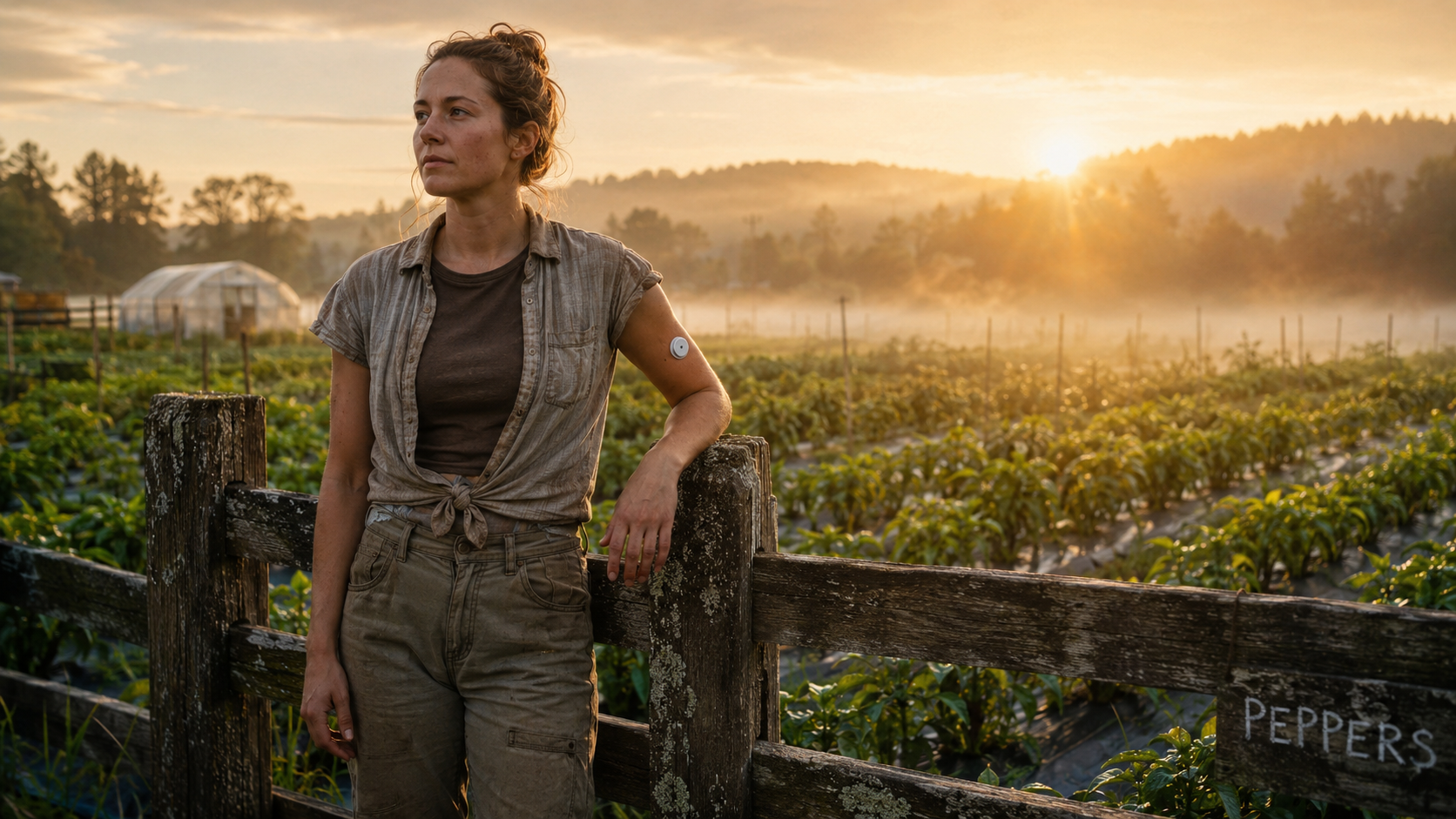
#1881 Subsistence Diabetes
Emily spent months farming in Tennessee, attributing her extreme thirst to an electrolyte imbalance. Today, she shares her grounded, "roll with it" approach to managing Type 1 diabetes.





























Key Takeaways
- A Stoic Approach to Diabetes: Emily manages her Type 1 diabetes and Hashimoto's with a practical, "roll with it" attitude learned from her mother and her life as a farmer. She doesn't let the diagnosis overwhelm her, choosing instead to handle it as just another variable in her day.
- The Trap of Self-Diagnosis: Before being officially diagnosed, Emily attributed her severe symptoms (sweating, weight loss, extreme thirst) to working on a humid farm in Tennessee, convinced she just needed electrolytes. It's a reminder of how easy it is to rationalize serious medical symptoms.
- The Importance of Community: Emily highlights how simply hearing other people's passing thoughts and relatable experiences on the podcast provided her with a profound sense of comfort and connection that she was missing in her day-to-day life.
- Farming and Insulin Management: Working intensely active, 10-hour days on an organic goat and vegetable farm requires constant adaptation. Emily uses the activity mode on her Omnipod 5 to prevent lows during strenuous tasks.
- The Psychology of Settings: Scott and Emily discuss the complex psychology behind avoiding certain diabetes tasks (like taking a GLP medication or adjusting pump settings) and how doing so can sometimes feel like "admitting defeat."
Resources Mentioned
- ABLE Now: ablenow.com
- Dexcom G7: dexcom.com/juicebox
- Omnipod 5: omnipod.com/juicebox
- Juice Box Podcast Pro Tip Series & Tools: juiceboxpodcast.com
- Wrong Way Recording: wrongwayrecording.com
Introduction & Sponsors
Scott BennerHere we are back together again, friends, for another episode of the Juice Box podcast.
EmilyI'm Emily. I'm 30 years old, diagnosed with type one diabetes three and a half years ago at 27, and I had a Hashimoto's diagnosis right after that.
Scott BennerMy diabetes pro tip series is about cutting through the clutter of diabetes management to give you the straightforward practical insights that truly make a difference. This series is all about mastering the fundamentals, whether it's the basics of insulin, dosing adjustments, or everyday management strategies that will empower you to take control. I'm joined by Jenny Smith, who is a diabetes educator with over thirty five years of personal experience, and we break down complex concepts into simple, actionable tips. The diabetes pro tip series runs between episode one thousand and one thousand twenty five in your podcast player, or you can listen to it @juiceboxpodcast.com by going up into the menu. While you're listening, please remember that nothing you hear on the juice box podcast should be considered advice, medical or otherwise.
Always consult a physician before making any changes to your health care plan or becoming bold with insulin. This episode is sponsored by Able Now, tax advantaged savings accounts for eligible individuals with disabilities. If you or your child lives with diabetes, you may qualify for an ABLE account because of ongoing medical needs, and many people in the diabetes community do. With ABLE Now, you can save for future expenses without affecting eligibility for certain disability benefits such as Medicaid. Learn more and check your eligibility at ablenow.com.
You spell that ablenow.com. Today's episode is also sponsored by the Dexcom g seven, the same CGM that my daughter wears. Check it out now at dexcom.com/juicebox. The podcast is also sponsored today by Omnipod five. Omnipod five is a tube free automated insulin delivery system that's been shown to significantly improve a one c and time and range for people with type one diabetes when they've switched from daily injections.
Learn more and get started today at omnipod.com/juicebox. At my link, you can get a free starter kit right now. Terms and conditions apply. Eligibility may vary. Full terms and conditions can be found at omnipod dot com slash juice box.
Meet Emily: Double Diagnosis
EmilyI'm Emily. I'm 30 years old, diagnosed with type one diabetes three and a half years ago at 27, and I had a Hashimoto's diagnosis right after that.
Scott BennerThose are your two things happening right now?
EmilyThose are my two things happening right now. Yeah. The Hashimoto's came after a whirlwind of the diabetes, and I wouldn't know what my symptoms were in regards to that, if any. They said take a pill once a day, and I said can do. So So
Scott Benneryou think they picked it up in regular testing after you were diagnosed with type one?
EmilyThey actually, years before, found some levels that were off and even did an ultrasound and kinda went back and forth between this is a problem, this isn't, and landed on this isn't. So never started any medication. And then right after the diabetes at the doctors, they were like, you know, this side of your thyroid eye
Scott Bennerneck Neck. Yeah.
EmilyIs is really swollen. Right? And I was I had no idea. Nope. Didn't notice that.
And did more testing, and then, yeah, we've then we found out Went down. Hashimoto's.
Scott BennerLook at you. Big fun. Let me ask you a question. This is my first time asking somebody this. I've been thinking about this today, and I thought I would try it.
What do you imagine we're gonna learn in this conversation today?
EmilyYeah. I've been thinking about that as well. I think what it's the same piece that impelled me to reach out to you, which is I gained a lot of technical insight from your podcast and your resources with the Facebook group as well. But a huge component was just being able to relate even if it was one thing out of a whole podcast that somebody said. Mhmm.
Just being to relate gave me I mean, it's not like a piece, but it's a comfort. It's some it's something that is, I guess, missing in my day to day existing that I didn't realize until I felt it.
Scott BennerOkay.
EmilySo I'm not sure I have anything groundbreaking. I know I don't have anything groundbreaking to contribute, but maybe somebody feels like, oh, I can relate to that, and it just makes them feel, I don't know, comforted, a little more
Scott BennerOkay. Well, that's a great answer.
EmilyYeah.
Scott BennerYeah. Well, so you're saying that maybe the technical stuff aside or, you know, the help that, you know, when you're like, I don't know why this is happening when I'm bolusing or something. Listening to people's conversations, inevitably, someone says something that what maybe patches a little tiny leak in your your dam, and then those patches come on more and more and more and more, and all of sudden you sort of feel better?
EmilyYeah. Yeah? Yeah. For sure.
Scott BennerOkay.
EmilyFor sure. Because when I turn on your podcast, I'm just surrounded with people who may we have totally different lived experiences and maybe even interact with diabetes differently, but there's still something it's the diabetes connecting us. And, yeah, I guess just it's pretty simple. Like, somebody's stating something about their life with it or how it's impacting them.
Scott BennerEmily. Emily, do you know those do you know those moments in a movie when the scene is taking place in front of a crowd of people like a theater or on a football field or something like that? And they do that very kind of like ham fisted hooky thing where one person starts to clap slowly and then another person goes, oh, are we clapping? And then they start clapping, and then before you know it, there's, like, a thousand people clapping and 10,000 people clapping. It goes on and on, and that feeling it gives you.
Yeah. I wonder if it's that a little bit. I wonder if it's people standing up, putting themselves out, and becoming part of a tapestry of, in this case, sound, right, and feelings. And then eventually, you feel like that tapestry turns into a blanket. Maybe I'm getting rid of my damn analogy, and I'm going to this maybe.
EmilyI love a blanket. No. I think
Scott BennerHave you ever seen Rudy?
EmilyYeah. Yeah. Yeah.
Scott BennerBut you didn't love it. Some guy drug you to it and right? Or made you watch it at home or something, and then they let
EmilyI don't have a mind for movies. I if I see them, I am I immediately they don't So take up I'm not I'm this person.
Scott BennerSo that's okay. So so Rudy walks on at Notre Dame. I think this is, like, based on a, like, a true story. Right? And I believe if I'm not wrong, Rudy is one of those guys that end up being a hobbit at some point.
And, sure that's how he'd love to be remembered. And, and at the end, I think it's, like, his last possible like, they let him on the team. He's, like, a mascot though. Like, they beat him up in practice. He never plays, etcetera.
And they eventually let him on the field. This is, you know, a thing. I cried when they let Rudy play, and I didn't give a shit about Rudy. But I think it's all part of that, like, crescendo of emotion feeling. I struggle to put a name to that.
This is maybe boring to people, but I think about that feeling all the time and what that is. Like, why does it feel so good when a group of people come together like that? But nevertheless
Emilyyeah. Okay. Powerful.
Scott BennerIt really is. Yeah. So I will tell you this. You don't have to have a special thing to say in our conversation today for that to happen for somebody else.
EmilyThat's kind of You know? Yeah. That's kind of what I've gathered from from listening. I mean, a lot of people say a lot of special things, so no doubt. But Yeah.
Yeah. Just goes back to what we're saying. I mean, there's there's a lot of magic and simplicity in somebody just saying it in a way that you've had a thought about without thinking about it in-depth where it just ends up meaning more because it's as broken down as your passing thought.
Sponsor Break
Scott BennerOh, that's that's a nice way to think of it. Okay. Well, let's find out more about you then. So you're 27, and you're feeling what? Like, how did it come on?
Today's episode is brought to you by Omnipod. We talk a lot about ways to lower your a one c on this podcast. Did you know that the Omnipod five was shown to lower a one c? That's right. Omnipod five is a tube free automated insulin delivery system.
And it was shown to significantly improve a one c and time and range for people with type one diabetes when they switched from daily injections. My daughter is about to turn 21 years old, and she has been wearing an Omnipod every day since she was four. It has been a friend to our family, and I think it could be a friend to yours. If you're ready to try Omnipod five for yourself or your family, use my link now to get started. Omnipod.com/juicebox.
Get that free Omnipod five starter kit today. Terms and conditions apply. Eligibility may vary. Full terms and conditions can be found at omnipod.com/juicebox. As I told you earlier, Able Now is sponsoring this episode.
Able Now, of course, tax advantaged Able accounts for eligible individuals with disabilities. If you or your child lives with diabetes, you may qualify for an Able account because of ongoing medical needs. Many people in the diabetes community do. With ABLE now, you can save for future expenses without affecting eligibility for certain disability benefits such as Medicaid. And thanks to updates to federal law, ABLE accounts are now available to more people than ever before.
That means more individuals and families can use ABLE now to save and invest. Funds in an ABLE now account can be used for a wide range of everyday needs, including education, transportation, health care, assistive technology, and more. There's no enrollment fee, and you can open an Able Now account with a small initial contribution and build from there. Learn more and check your eligibility at ablenow.com. That's ablenow.com, ablenow.com.
Farming in Tennessee: A Recipe for Misdiagnosis
EmilyOh my goodness. It came on. So I was diagnosed in October, and I was having symptoms since definitely May.
Scott BennerOkay.
EmilySo no. March, actually. It came on, and I I can only imagine all of these things, symptoms that I was having, are related to the diabetes because they were just nothing normal, and I couldn't place them to anything else. And then they basically just tumbleweeded into more and more drastic characteristics. So at first and this sounds so strange.
I don't know if it's related, but I was having severe shoulder pain. I couldn't move them at all for no reason. Every morning, I was, I mean, I was having I was nauseous. I was constipated. I was constant acid reflux.
I was having stomach pains, and, eventually, it comes on in into bigger and okay. So let me slow down, maybe. I was freshly on a farm in Tennessee where I hadn't ever previously lived. And so I and I had been for a year in kind of transient living conditions
Scott BennerOkay.
EmilyIn a state of settling in constantly or kind of just, like maybe not even settling in, but adapting. I'm placing all of these new things either really lightly because I'm fixated on the newness in front of me, or I'm attributing them to the new conditions that I never lived in. So I never lived in such a humid state, and I'm working outside six days a week, ten plus hours a day, living outside in the hottest summer on record and in such a humid climate. So when I start drinking x amount of water bottles a day and peeing five plus times throughout the night, I'm, you know, dehydrated.
Scott BennerCursing Tennessee. You're not thinking you're sick. Right?
EmilyNo. I'm thinking this
Scott BennerWhere'd you move from, by the way? Where were you prior to going there?
EmilyPrior to going there, I was living on the road with my partner for about three months.
Scott BennerMhmm.
EmilyPrior to that, we had come from a farm in Vermont that I had I'd only but he had been there for a season. I'd only gone to meet him after the wildfires in California where I was working kicked me out or I decided to escape Mhmm. From.
Scott BennerSo Let's take a second, Emily. Are you what they call a hippie? What's going on here? Or you just are you a farm worker or how do what is this? Explain that more.
EmilyThere's probably some crossover, but I wouldn't self identify as a hippie. Definitely a farm worker. Yeah. I've worked on farms, organic farms, that's probably for the last eight years. And so I had actually left Montana where I'm back to now to go out to a farm in California that my best friend was managing at the time.
Right before leaving Montana, I had met who's now my fiancee, and he was moving to Vermont, and I was moving to California. And so we had plans at the end of the season to meet up together. Things weren't going so hot in Vermont, so we were gonna go on this road trip. We were gonna, you know, see what we wanted to see, experience where we wanna experience whilst kind of trying to find the next place we wanted to farm together and, hope, settle in to a good fit somewhere, which Tennessee was not it.
Scott BennerYou you're breaking my heart, by the way. I'm leaving tomorrow to go to Tennessee.
EmilyOkay. Okay. Well, I mean
Scott BennerI'll find out more later. I'm actually going to give a talk in Atlanta, but I decided to drive and stop in Tennessee to see some some towns and stuff because I always I always talk to my wife about, like, I think we should move to Tennessee. And I don't I haven't been there since I was a kid, so I have no idea why I'm saying that. So I'm taking this opportunity to swing through.
EmilyNo. I think it's the best to just have a hunch about a place and wanna go because you wanna go and check it out.
Scott BennerThat's Okay.
EmilySuper exciting. And I think my experience of Tennessee is really tainted, and I try to separate that because the people I was working for were just not the right fit. And then, also, I'm suffering Yeah. For my entire experience without even without realizing it, but my body is just
Scott Bennerfully suffering. Yeah. I gotcha. Yeah. Between those two things, you could go back under a different circumstance and have a good time, you're saying.
You think?
EmilyOh, yeah.
Scott BennerYeah.
EmilyYeah. I think so.
Scott BennerBut how bad is the humidity? Like, what what are we talking about?
EmilyWow. So it was brutal. I mean, you're never not sweating. I you take a shower and granted you would probably live indoors, maybe with air conditioning.
Scott BennerMhmm.
EmilyWe didn't have that. That shower was outdoors, and then we had our living situation set up at the top of the hill above the farm. So as soon as you shower, you're hiking, and you're Sweating. Yeah. You're
Scott BennerI'm not gonna farm while I'm there probably, so that'll probably but what time of year were you there?
EmilyIt was there from March to September, October.
Scott BennerIn even in the fall and the spring, the humidity was existed?
EmilyIt did exist. Yeah. And so I live in Montana. It gets pretty darn cold. And I remember being there at the beginning of the season in March, and it was probably, like, 52 degrees out, something like that.
And I remember thinking it felt like 32 because of the humidity just made it.
Scott BennerMade it cool. Yeah.
EmilyCool. Old. It was yeah. And then yeah. Then there's no relief in the summertime.
It's just sticky and
Scott BennerWell, I think they're gonna put a thing on the moon. Maybe I'll go there.
EmilyYeah. Could that could hold
Scott BennerI don't know. I just I I so badly wanna be somewhere warmer, but not, like I also don't wanna be dripping the entire time. There's gotta anyway, I'll figure it out. Alright. Let's get back to you.
So you're you're down there suffering that's going terribly. Are you diagnosed by yourself, by a doctor? Like, how do you get to the medical help?
Sponsorship Break
Scott BennerThe Dexcom g seven is sponsoring this episode of the juice box podcast, and it features a lightning fast thirty minute warm up time. That's right. From the time you put on the Dexcom g seven till the time you're getting readings, thirty minutes. That's pretty great. It also has a twelve hour grace period, so you can swap your sensor when it's convenient for you.
All that on top of it being small, accurate, incredibly wearable, and light. These things, in my opinion, make the Dexcom g seven a no brainer. The Dexcom g seven comes with way more than just this. Up to 10 people can follow you. You can use it with type one, type two, or gestational diabetes.
It's covered by all sorts of insurances and, this might be the best part. It might be the best part. Alerts and alarms that are customizable so that you can be alerted at the levels that make sense to you. Dexcom.com/juicebox. Links in the show notes.
Links at juiceboxpodcast.com to Dexcom and all of the sponsors. When you use my links, you're supporting the production of the podcast and helping to keep it free and plentiful.
The Electrolyte Trap & Acceptance
EmilySo I have kind of, like, always tried to approach things from a I don't know. I'll I'll research my symptoms maybe leaning towards, like, more holistic or natural solutions. And so I'm sweating buckets. I'm thinking it's my electrolytes are out of whack. That concept never left me for, like, eight months.
I was gung ho. My electrolytes are out of whack, so I'm just feeding myself with things I, obviously, weren't the solution. So that was me trying trying to self diagnose.
Scott BennerYeah. What gave you the idea about the electrolytes? Was it a thing you heard, or did were you googling, or what got you to it?
EmilyYeah. I can't exactly remember. I just kind of think by the amount that I was sweating, I thought surely I'm losing nutrients and disrupting balances quicker than I can replenish them.
Scott BennerI see. Not a crazy thought, by the way.
EmilyNot a crazy thought, but it easy to lock on to that and put your blinders on to anything else. And really think
Scott Bennerthat the sixth month of trying to, impact your electrolytes is when it was gonna come together. Yeah. Right?
EmilyPrecisely. The moment of diagnosis, I 100% knew that they just needed to hook me up to some hardcore IV electrolyte situation, and I was gonna be good. I knew that's what they were gonna tell me. Of course, that's not what they told me at all. But I don't know why, but I was just so
Scott BennerIt didn't occur to you to keep looking or thinking about something else. You felt like you figured out the problem and you were trying to address it.
EmilyYeah. I mean, I'm not sure how much I believed I figured it out. I mean, because I just had all of these crazy symptoms. Like, I was losing my vision. I couldn't remember things or hold conversations.
I you know, everything that could deteriorate was deteriorating in front of me. So it's hard to think back and think that I just believed that because I fancy myself a little more intelligent than that. But I think there's an wildly powerful thing that happens maybe in the name of self preservation where this is also happening in tandem. All of these all of these symptoms are becoming my new normal, and I start to think to myself, oh, no. That's how I always am.
Yeah.
Scott BennerMhmm.
EmilyMy gums bleed and are swollen a lot.
Scott BennerThat's It happens to people, doesn't it? So you think maybe it's a little bit of the brain fog, a little bit of the I can get through this, I can do this, and a little bit of the slow kind of drip drip drip of it if it changing and you're really being able to remember where you were before it started.
EmilyRight.
Scott BennerYeah. That kind of blend of stuff. Yeah. Yeah. What's that what's that fantasy you don't know.
You're not a movie person where they all go to that bar and then they get they realize they've been there for, like, twenty years already and it feels like five minutes. Like, I feel like that's part of it. Like, that feeling of, like, you just sort of get lost, you know. Okay. Okay.
You see, you finally what do you do? You break down does somebody help you get to medical care or do you actually make the decision?
EmilyI made the decision. So we left the farm in Tennessee. We were coming back to the farm that we previously worked on in Montana. So we're on the road. My partner's going straight to Montana.
I'm going to visit my mom in Oregon first. So I head there, and here's where I also solve all of my woes. I think to myself, well, I'm not gonna be working my ass off, and she has air conditioner. So I'm gonna sit inside. I'm just gonna I'm not gonna, you know, get into all this physical activity.
I'm gonna eat food, and I'll ride it all. All it'll all fall all the pieces will fall back in. Mhmm. Gain back those 30 pounds I lost, and, we'll be good
Scott Bennerto bada boom, we're gonna be right back to good. That's it. Yeah. Yeah. Yeah.
Yeah.
EmilyYeah. So so I got there, and I'm doing all of those things. Check. Check. Check.
I'm just getting worse, though. More and more fatigued. Turns out probably because I'm not moving. I think all the activity in farming helped maybe keep my blood sugar
Scott BennerA little
Emilya little Yeah. Yeah. Lower. It functional. So that more kind of stagnation whilst heightened symptoms was when I was really hit with this isn't right.
So I just made, like, a quick appointment for the for the next day at an urgent care or some kind of clinic right around the corner from her house. And so we went there in the morning, sat me down, took a I guess they took a finger prick. So I'm there all of five minutes before they come back in the office and say that I have type one diabetes. And I don't remember if I said it out loud or just screamed it in my head, but it has just I just remember saying, that's not me.
Scott BennerYou got the wrong chart. You're looking at the wrong piece of paper there. That's somebody else.
EmilyPercent. Yeah. 100%.
Scott BennerI just need a Gatorade. Did you not?
EmilyRight. Just hook me up. I need some of that sodium, potassium Yeah. Y'all got.
Scott BennerYou need a magic trick. But I'll be alright.
EmilyExactly. Exactly. And so they go my my mom was out in the waiting room, and they were asking, you know, do you want to tell her? Do you want us to tell her? And I was just thinking to myself, like, alright.
Well, you can lie to me, but you can't lie to that woman. Yeah. Bring her in. You tell her I have type one diabetes. And yeah.
So that was real.
Scott BennerYeah. And they they they stick your in an ambulance, or did they did they let you drive?
EmilyThey
Scott Bennerbecause you had someone with you maybe. But you went right to the hospital. Right?
EmilyNo. I didn't. What'd you do? I well, I went back to my mom's house. Think, you know, when I left there, they had said, like, we're really gonna push for you to get in with an endocrinologist as soon as possible.
And so I went back to my mom's. I think either that day or the next day, somebody from their office called and said checking in on me and said I should go to the emergency room. And my mom and I kind of looked at each other and was like, that's really expensive. You know? I think it was only maybe a few days later I got in with that appointment, maybe two days later or something like that.
I got in and, yeah, I had just kind of decided, I'm well, I'm just gonna keep breathing. I'm just not I won't die.
Scott BennerWell, that's not how that works there, Emily. But, we we so had you lost a bunch of weight?
EmilyI had lost yeah. I had lost weight that I didn't really have to lose.
Scott BennerOkay.
EmilyProbably thirty thirty plus pounds.
Scott BennerHow tall are you?
EmilyYeah. Five nine.
Scott BennerAnd when someone says type one diabetes, that sounds serious. Right? And you go back home, do you and your mom go, like, let's Google this and see what this means?
EmilyYeah. So those first few days from that appointment to the endo appointment, I can't remember the timeline, how many days were in between, what I did in between. After the endo appointment, though, that's when I came home, and I'm on Google. And I find your podcast out the gate. Wow.
And I start listening to maybe some of the defining episodes, and I'm just thinking to myself, bolus. Not once did she say the word bolus to me. I was like, they're not I've never had extreme faith in relying entirely on doctors and what they say. I take it upon myself to educate as well and consider, more than just what they're saying. So that's kind of what I was looking for and also just more information.
I kinda felt like they were treating me really timidly.
Scott BennerMhmm.
EmilyAnd I could handle a lot more. And so when I found your podcast, I just was consuming it because I felt like they weren't explaining anything of import to me probably to not overwhelm me, and that probably would work really well and would be what some people need. But
Scott BennerYou'd rather have the information.
EmilyOh, yeah.
Scott BennerI imagine if you go to a doctor and they tell you something, like, big, like, you have a thing, and then you go look online and find a bunch of contacts that no one mentioned to you, you have to think, like, why is no one saying that to me? How come the guy with the podcast or the website or wherever whatever you find? Like, how come they think all this is so important and yet the doctor didn't mention it?
EmilyRight.
Scott BennerRight? Yeah. That that's gotta be, off putting, I would imagine. Were you in DKA, by the way?
EmilyI don't know.
Scott BennerEmma, what was your blood sugar? You had to be in DKA. What what was your blood sugar?
EmilyI think that morning, it was 400 something, and my a one c was 15
Scott BennerYeah. There's you had no one ever said that did they put you on IVs, keep you in the hospital for days? How did all that go?
EmilyNo. I never even went
Scott Bennerto the hospital. To the hospital.
EmilyYeah. Alright. Listen. Emily, let
Scott Bennerme ask you again. Are you a hippie? Just say yes this time. I'm sorry.
EmilyIf you asked me that, twelve years ago, yeah. Duh. 100%.
Scott BennerYeah. There's some pictures of you in overalls with a bandana over your hair somewhere?
EmilyA couple dreads shouldn't have had for sure. Yeah.
Scott BennerI think I I think I could I could paint a picture of you in my mind. By the way, when you were like, don't really trust doctors, I was like, yeah. I heard you say you were from Oregon.
EmilyI'm not from Oregon. But is? No. She's moved around a bit.
Scott BennerWell, I was gonna say your mom's a hippie too. Like right?
EmilyI should've no. No. No. No.
Scott BennerWait. No. Your mom's moved around a little bit?
EmilyYeah. She's just she's real adaptable and Listen.
Scott BennerI think it's awesome. I'm just telling you, the people who are listening are like, I don't go outside and cut my lawn. This girl's worked on 17 different farms. That's pretty cool. I think it's really cool the way you're doing things.
But okay. So when you start digging in to figure out what's going on, how long does it take you and what helps it get through to you, the seriousness of this, and the fact that you, you know, you kinda have to bear down and you can't just treat it like, oh, I got a thing. I'll do a little insulin, and I'll go on my way.
"Rolling With It" & Finding Acceptance
EmilyYeah. I think something that I think about sometimes is just how as shocking as the diagnosis was, felt like it came out of thin air, nowhere land, I took it and, for the most part, didn't look back. That was it. That was my life. I have to figure it out, do good at it, and that's it.
I think it's almost like leading all it's kind of like the whole symptom section of life, prediagnosis that, you know, this is just my life now, and I I can live like this. It's like that, but in reverse and for the better. Over on this side now, I have diabetes, and I know that's for life. So I just wanna take care of myself. And, I mean, as soon as I got on insulin or really rather quickly thereafter, I felt like I had a lease a new lease on life.
I just felt like I had my life back, my mind back, my body was coming back. I felt good, and that's where I wanted to be. And so the decisions I was gonna make and, like, the priority I was gonna make diabetes was going to be to uphold what I just got back. You know?
Scott BennerYeah. Are you a religious person, or was it a a spiritual feeling? You just kinda just gave yourself over to it right away?
EmilyIt really goes back to how I was raised by my mom who is an excellent top tier example of rolling with the punches.
Scott BennerMhmm.
EmilySome huge comes onto your plate you weren't expecting, and she doesn't stumble or falter. She matches it and lives through it without it being this, like, ground shaking. I mean, she just keeps steady through it all. So I've witnessed that, and she's lent me that ability because of that, I would say. So it doesn't really feel like so much of a choice.
It's just what I've seen, and it's the way that I react. That's not to say I didn't have several, you know, breakdowns within the first year of frustration or it feeling too big.
Scott BennerK.
EmilyBut, largely, it's just I can't undo it. The electrolytes weren't the ticket. You know? Here's the solution, and I'm not gonna get in my own way of letting it be the solution.
Scott BennerSo this has always kind of been your mom's vibe, and it Yeah. You know, came over you. Obviously, it's what helped you move around the country and do those things. Right? Like, because new stuff doesn't feel overwhelming.
It just feels like what's next. Right? This is the thing I'm doing now, and I just do the thing.
EmilyYep. Exactly.
Scott BennerOkay. Makes sense. And how do you apply that to diabetes, though? Like, do you take that feeling, that vibe, and apply it to diabetes?
EmilyWell, I think I have to kind of yeah. It's I think maybe it's just ingrained. I have to kind of tease it out to answer that question. I mean, I think in all of how do I apply it to diabetes? You have to keep educating yourself, which I think happens through the podcast naturally.
And then also if I'm going after something more educationally based in three year series. Let's see.
Scott BennerTake it. It's just you take I know it's a it's no. No. It's an out of it's a it's a weird question. It's not a thing you've thought about before.
I'm just I'm saying you grew up in a this is what we do. We just do it. It's not bad. It's not different. It's just life.
And then suddenly, hits you, but how does it hit you? Right? Like, you have to learn about stuff you've never heard of, words you've never heard before. How do they affect you? The fear of putting in that insulin.
Right? Like, all that other stuff. And even when you have a breakdown, you think, god, this is terrible. Like, how does that like, way you grew up, how does that apply to this?
EmilyIt keeps the ball rolling. I think it doesn't keep me in any one negative place too long where the rest of the things in my life still take center focus.
Scott BennerMhmm.
EmilyAnd then diabetes is this large piece that I have to tend to and keep up with, keeps following me throughout my day, so I have to mind it. But it's kind of, like, rolling rolling
Scott BennerYou just roll with it.
EmilyThe next day. And
Scott BennerHow much does knowing how to do hard work help? How much does, like, having a job that I imagine you wake up with the sun and and, you know, work until the sun's gone and you're exhausted and everything, but you don't complain, you do it again the next day? Like, how much of that, like, training do you think applies to diabetes? Maybe it doesn't.
EmilyYeah. I don't know. I don't know if it how it does. I'm sure you know, I think the hard work is a piece of the puzzle, but the nature of the work is just ingrained in very tangible things. It's just, you know, I'm working with the elements.
I'm working with animals. I'm growing food. I'm working with all real tangible things. And I don't mean to say that if you're not working with any of those, then you're not, but it's less like I don't know. I'm just I'm working with life's elements.
Scott BennerYeah. I would assume too there's a lot of variables in those elements that are beyond your control.
EmilyOnly. Yes. For the most part. Yeah.
Scott BennerProbably all of them. And then at the same time, that that can't stop you. You can't not grow the food or pick the food or process the food because it's raining or because it got too hot or too like, you just have to continue to, what, like, reassess what's happening and then apply the skills you have to that new situation, and that could probably be hourly or daily or or or so on.
EmilyRight.
Scott BennerOkay. Yeah. Alright. Well, that makes that makes a lot of sense to me, actually. So diabetes isn't the hardest thing you do in the course of a day, or is it
EmilyIt can be.
Scott BennerIt can be. Okay. So talk about that. When when that breakdown comes, is that a flooding of emotion or just it's too much? You you don't have you don't have the bandwidth for it anymore?
Is that burnout?
EmilyI don't think it's burnout. If it is, it it just lasts for the moment until that alarm stops beeping at me. I think the hard part is just considering all of my activity and insulin because I'm constantly active or maybe then we're switching gears and doing something less active. And here it's lunchtime, and I started out low. And now after lunch, I'm gonna be racing around.
And I think, honestly, it's difficult to have a thing that I have to tend to in front of other people and have potentially even if it's very minor, have a plan or a moment shift based on my need
Scott BennerMhmm.
EmilyOf, oh, to eat sugar now. Or
Scott BennerWell well, now you surprise me, Emily. Like, it's no. Seriously. Because you've got, like, a go go with it attitude. Right?
So then what about it being in front of other people is bothersome?
EmilyI just don't like the attention on me, and I don't like and I really don't think it is on me.
Scott BennerBut it feels like it is?
EmilyBut it feels like it is, and I don't like having to express that it's I don't know. I did I I had a hard time just having diabetes as something that could slow me down or impact me, and therefore, once that bleeds out into other people affecting other people.
Scott BennerDo you feel like you're intruding on other people's time?
EmilyYeah. Intruding on their time. Maybe they're seeing a vulnerable moment for me, especially if I am low and my mind is a little out of sorts, then I feel especially vulnerable in a way that I don't feel connected to and definitely don't want other people to connect me too.
Scott BennerYou don't want people to see you as being weak or out of out of control or
EmilyRight.
Scott BennerNot as smart as you normally are, all the things.
EmilyAll the things. Yeah. Yeah. Okay.
Scott BennerWell, I mean, that'll make sense to me. I'm just by the way, I'm really enjoying listening to you think through your thoughts and your life. Thank you for doing this. Appreciate it very
EmilyI really appreciate that because
Scott BennerNo. Because I know it can feel awkward when someone asks a question and you don't have, like, a rattle off answer. And you realize that I'm not gonna go away and we're still recording and you've gotta figure out what the answer is. And, like, it's interesting to hear people process that, I think.
EmilyYeah. Yeah. Yeah. Definitely. I think I would
Scott Bennerprobably have I'm sorry. You would probably what?
EmilyYeah. I'm sure the more that I thought about these things, the more would come to light. So
Scott BennerYeah. No. And it's a good opportunity to sit and think about stuff that I I believe you don't normally ruminate over. I find the podcast very helpful for that. Myself you know, for myself too.
You know, you just you're sort of you're in the moment. You're you're kinda forced to deal with whatever it is that's being asked or said, and sometimes you don't have an answer right away. And I think it's more interesting when you don't have an answer than when you do sometimes. So okay. So I
Emilyyour Yep.
Scott BennerYeah. So how long does it take you to rebound from being sick? Do you gain the weight back? Do you set up I mean, do they give you a CGM? Like, how do they get you launched off?
Managing Farming with Omnipod 5
EmilySo launch off was the pens with long acting at first, dialing that in, and then short acting and finger pokes. So they started me off slow. I was meant to kind of keep a diary of blood sugars and carbs I was eating that went on for probably two weeks. So I was advocating for a CGM. That inspiration definitely came from the podcast.
And so I got on Freestyle Libre, and then I was doing MDI for probably six months or so until getting on the Omnipod
Scott BennerOkay.
EmilyWhich I've done ever since now with Dexcom.
Scott BennerThe Omnipod five? Are you using automation?
EmilyThe Omnipod five in automation. Yes.
Scott BennerHow is that working for you? Because you're so because you're farming still. Right?
EmilyYep.
Scott BennerYeah. So how does that work with your activity?
EmilyIt works pretty well. Over the last maybe six months or so, I've been playing around with activity mode quite a bit more. Mhmm. That's definitely helpful. Definitely helpful.
Even if I'm starting to go low and notice that, I'll switch it into that. And it more often than not catches me or catches me more than had I not. So that helps helps me a lot, I think.
Scott BennerCan I ask a question about your activity? Yeah. It's occurring to me as you're talking that some people talk about, like, oh, you know, when I work out, this happens, or if I suddenly go to Target, it happens. But your activity is significant but constant. Right?
So it's not really activity as much as it is just your your baseline.
EmilyRight.
Scott BennerYeah. So what do you do you have days off? Do you like, are your days off consistent? Are they Saturday, Sunday, or they or do you not have days off? Like, how does your schedule work?
EmilyYeah. I have Saturday and Sunday off. Otherwise, for the most part of the year, it's Monday through Friday. And, yeah, I don't know. I guess the pump has generally I don't have anything too crazy about it.
I would say if I do, it's from my end of timing insulin. Kind of I touched on come lunchtime, maybe my number's sitting just right in the little lower spot. And so I bolus as I'm eating or right after I'm eating, just thinking of the rest of the day ahead.
Scott BennerLet me ask my activity question, okay, and see what happens. I would think for most people, they get low around activity, but you probably experience a high on the weekend. Right? Because the system's not giving you much insulin Monday through Friday, and then on Saturday, Sunday, you slow down. Is it more difficult?
Do you have the bolus more, or is your activity so significant that it's a stasis for your body seven days a week? Does that make sense?
EmilyYeah. I actually never considered that. I think that might be the case based on I don't I'm not fighting the Omnipod on my weekend. I'm not fighting my blood sugar on my weekend.
Scott BennerOkay.
EmilyYeah. I would say the numbers are generally the same. I have less to consider in terms of activity, so maybe I need to look at food a bit differently come the weekend time. Mhmm. But that's also the same as when I get home and have dinner and being Stopped.
Still. More still. Yeah. So it's not like, here comes the weekend. It's a foreign entity of diabetes that gets differently throughout the rest of the week.
No. I there's lots of overlap.
Scott BennerYeah. No. It just occurs to me that because of your job, I would imagine it's very consistent. Because I even hear from people who have jobs that are aggressively, you know, needy physically. Like, there's definitely better words there than that.
More active at certain times a day, but not at others, and they'll have, like, peaks and valleys during the day. But I'm imagining that your gets out of bed, hits the ground running, and you don't stop. Right? You're moving constantly, aren't you, or on your feet or not comforted? No.
You're not comfortable somewhere. You're not in a chair at any point.
EmilyYeah. No. Not in a chair. Nope. We're raising.
Oh, I work on a goat dairy slash vegetable production farm. So, yeah, right now, we're raising 40 or so kids. That's what they're called. Good kids with a herd in in the hundreds. And so, yeah, as soon as I get there, taking care of all the kiddos, attending to birds, we've got a new wave of kitting happening.
So we got a bunch of mamas having their babies. And other than that, I mean, it's springtime, so we're getting going in the fields and the greenhouses. And yeah. I mean, the spring is like a get up and go, and then the mid season is the height of the season, so it's super get up and go. And then the fall is huge harvest and tuck everything back in before the winter and
Scott BennerAnd then do the inside stuff until right? Do you fix equipment during the winter, stuff like that?
EmilyWell, actually, in the wintertime
Scott BennerI was gonna say, do you cough and and go do something else? But I don't know why. So I was gonna put it that way, but do you go off and do something else during that time?
EmilyYeah. Yeah. Yeah. A bit between, vegetable season ending and then our main kitting season that picks up in January, February time, my partner and I will go travel. We get some time off off the farm, off work, and get to go, have fun.
And then we come back in the height of winter and help birth a bunch of babies.
Scott BennerWow. That's crazy. Well, it's a is that a passion project kind of job, or does it pay more than I imagine it does? Like, is it a career you could do your whole life and take care of yourself, or is it a thing you're doing now while you're younger because it calls to you? What's that what's that like?
EmilyYeah. It's a good question. I don't necessarily have answers to all, but it is passion. Yeah. You can't do this without passion.
It's not the pay. It's just a love for for the animals, for the land, for providing quality food to people, for tending to land in a way that's respectable and can carry on a future. It's so many deep things, really. I can feel welling up inside of me more than I can verbalize. I do wonder you know, I think when you first get into farming and everybody is wondering, like, oh, you're gonna have a farm of your own one day?
And you think, surely, well, yes, of course. And then it goes on and on, and you realize more the realities of owning an organic farm in a society that does support it. Absolutely. But there's a grander where the overarching decades long putting down of the organic farmer and the small farm. So there's a battle within that.
There's a battle financially. And I think I if I'll have my own farm one day, maybe my partner and I would would love to see something like that work out, but we also get to work on a farm that we love, have roles in it that we've grown into, and help us grow. And at the end of the day, we can take off and go to Mexico for for a few weeks. Mhmm. We can live our lives without what I'd imagine would be a tremendous amount of going out on a limb for a struggle.
The Psychology of Diabetes & Avoidance
Scott BennerYeah.
EmilyBut there's that voice there.
Scott BennerAnd and does the voice win usually, or does it They
Emilythey it's a good fight.
Scott BennerIt's okay.
EmilyI'm not sure who comes out. At at the end, the voice wins, but the outcome needs to happen first for for me to like, coming on coming on here to talk to you, I you know, within the week before, I was like, I have what am I gonna say? I have what am I gonna contribute? I just started getting worked up about it. I was like, maybe I'm gonna cancel.
Another voice in my head is like, you are not going to cancel.
Scott BennerGood. I'm glad you didn't. I really enjoyed this. Actually, you know, I watch Arden do this thing sometimes where pretty simple. Right?
She has a a fairly large aversion to needles, which I know is interesting. But, like, because of that, she'll struggle to take her GLP meds sometimes. Mhmm. And, you know, she'll do it for weeks in a row and everything's great, but then sometimes she's like, oh, I can't like, she just can't bring herself to do it, and she starts to put it off. And once you put it off, it kinda it it don't stretch into weeks. You know?
And she did it again recently. And I said, hey. You're gonna have to change settings, you know, but we're gonna have to change them again in a few days and take down insulin to carb ratio, make it weaker. You're gonna have to make basal weaker. You're gonna have to make instant sensitivity weaker, like, all this stuff.
And all day yesterday, I was like, why does she keep getting low? I mean, like, she just shot that med, like, four days ago, and I know what's going on. And trust me, if you ask me, I can explain it to you pretty well. And I forgot, like, thirty, like, six hours throughout the day, like, it didn't occur to me until finally, I, like, smacked myself in the head. And I walked into her, I was like, what's going on? She's like, I'm low.
And I'm like, yeah. I'm like, your settings are all wrong.
EmilyWow.
Scott BennerWell, in that time, all we have to do to combat that is to change her settings back. She doesn't want you to put the settings back to where they need to be without the GLP. And I am forever trying to figure out the psychology behind that. And the closest I've come to it is to think that she doesn't want to admit defeat. Like, in her mind, she's going to take the GLP.
And putting the settings back is saying, no. I'm not going to. And she doesn't want to feel like or admit that it's taking the does all that make sense?
EmilySo much sense.
Scott BennerYeah. Yeah. Yeah. And and so I've been watching this go on now for a while, and I just try to support her through it the best I can. You know?
And even there's even times where, like, it'll go, you know, three days and I'll be like, hey, Arden. Listen. You know, just move your sensitivity or do this or that. She's like, no. Like, I'm gonna you know, she's like, I'm I'm no.
She doesn't even say I'm gonna do it. She just it's just no. And then no to me sounds like, if I move those goddamn settings, I've lost. And then, you know, I'll tell you, like, honestly, like, you know, I'll just sometimes just wait until she leaves the room for a second. I pop her phone open, I put her settings where they are.
And, like, so so that she, you know, her because her a one c could go from, like, a rolling average of, 5.5 up to, like, seven
EmilyJust for
Scott Bennerfor not changing those settings because it's such a significant difference. She doesn't want me to do that. But then she realizes that I've done it, and then somehow after it happens, the pressure's off of her, and then she does the shot again.
EmilyWow.
Scott BennerAnd I might be wrong. She might listen to this in the future and be like, that is not what was happening. Like right? But, like, from my perspective, that seems like what's going on.
EmilyAnd I feel like you described what, what can go on with me sometimes, like, the not wanting to admit defeat, the pressure around that, both of those things happening in regards to some decision you have to make or choice for yourself, something. Yeah. I I don't know what what you said resonates, though. And I think I need to figure out where why that resonates, where I feel that, and why something can hold a can hold so much meaning in it when really it's the click of a button on your phone.
Scott BennerYeah. Do you know why I told you the story?
EmilyBecause I
Scott Bennerheard you say something a little while ago. It I heard you say something a little while ago that made me feel like you must feel like that.
EmilyYeah. Yeah. Yeah. Don't know why some things overwhelm simple simple stuff, but there's some, yeah, there's some layers there.
Scott BennerYeah. Keep thinking about it.
EmilyYeah. No. For sure.
Scott BennerYeah. You'll you'll get the I I have a lot of a lot of good feeling about how you're gonna turn out as a person. I know you think you're old probably because you're 30, but you're just getting started. You know?
EmilyYeah. No. I appreciate that. I do.
Scott BennerThat's cool. Also, I'm super impressed with myself sometimes, and this is one of those moments.
EmilyYeah. Well
Scott BennerYou would never say something so boastful, Emily, but I'm not above it. I really just I felt like I heard you say something that fit in that vein, and I thought I'm gonna hopefully, Ardino listen to this one day and understand when I shared something about her life that, you know, she probably doesn't tell anybody else just so that because I think it's gonna be really helpful to you and to the people listening to. So I think you gave something to the conversation twice today, and this was me giving something to it as well, I hope.
EmilyYeah. Oh, 101100%. Absolutely. Cool.
Scott BennerCool. Listen. I have the greatest job. Everybody should get a podcast. We should all stop working, and we'll all starve to death and the electro will go off, but we'll all be very, very mentally healthy as we're starving to death.
Right? If we all just get a podcast and talk about how we feel.
EmilyWe can live off of that. Yeah.
Scott BennerFor a little while, Emily, and then you will die without food. So are the goats dangerous? Are they fun? Or do they have different personalities?
EmilyThey are so fun. They're mischievous. They do have different personalities. The worst that could really happen to you is you have your head in the wrong place at the wrong time and get a little concussion.
Scott BennerThey give you a little smack?
EmilySome some strong downs. But yeah. No. They're a blast. They're That's very cool.
They're sweet. They're playful. I mean yeah. I feel
Scott BennerYou feel what? I cut you off. I apologize. You feel what?
EmilyI just love having a connection to animals that respond to you. It's fun to feel like you can communicate with a herd of livestock animals. It's a
Scott BennerYou wanna say magical?
EmilyYeah. It's magical.
Scott BennerIt's okay. You can say that. Listen. I have a tree monitor, and I associate a sound and a tapping with food time. And I went in there the other day be and she was hiding in a log.
And I did the sound and the tapping, and she came out of the log and looked at me like, oh my god. Are we gonna eat? And I was like, oh my god. I taught that thing with that sound in the I was I was like, We're having a moment. I'm not a herd of goats, but I I do think I understand what you mean.
And I also, even though I kinda keep animals that are, you know, smaller and and more, you know, contained, I think that it's I'm gonna sound I'll say something to make me sound like more of a hippie than you you have the whole time. Okay. Ready? Thank Yeah. Yeah.
I thank you. Did you say thank you? I think that because I've chose to keep the animal, it's my job and and charge almost to do things that it needs to get its you know, not just its food right, but its lighting and its heat and its surroundings. Like, I it's my job to look at it and figure out what it needs and provide it that those things.
EmilyI agree.
Scott BennerYeah. And it's sort of an extension of how I think about parenting too. So I originally got a chameleon because I was like I said to my wife, I'm like, kids don't really need me anymore, and I feel sad about it. I like, I need something to, like, take care of. Now since then, I've learned those kids, they still need you.
It doesn't really matter how old they are.
EmilyYeah. That's that's good. I feel that way
Scott BennerMhmm. That month. But anyway, how much my last question is, how many acres do you need to have a nice, like, functional small farm?
EmilyOh, you could have a quarter of an acre.
Scott BennerAnd work it out.
EmilyYeah. Yeah. You could you could have a little backyard to to provide. You can grow a lot of food in a small small space.
Scott BennerInteresting. That's really cool. Well, I appreciate what you're doing, and I appreciate that you came on here and shared it all with me. I am going to get into a car very soon and go give a talk, so I gotta run. But if you hold on one second, I'll just explain to you how the rest of this works.
Okay?
EmilyOkay. Well, thank you so much.
Scott BennerNo. You were terrific. Hold on one second.
Outro & Sponsors
Scott BennerDexcom sponsored this episode of the Juice Box podcast. Learn more about the Dexcom g seven at my link, dexcom.com/juicebox. This episode of the Juice Box podcast is sponsored by Omnipod five. Omnipod five is a tube free automated insulin delivery system that's been shown to significantly improve a one c and time and range for people with type one diabetes when they've switched from daily injections. Learn more and get started today at omnipod.com/juicebox.
At my link, you can get a free starter kit right now. Terms and conditions apply. Eligibility may vary. Full terms and conditions can be found at omnipod.com/juicebox. A huge thanks to today's sponsor, AbleNow.
AbleNow offers tax advantaged Able accounts for eligible individuals with disabilities. If you or your child lives with diabetes, you may qualify because of ongoing medical needs. With Able Now, you can save for a wide range of disability related expenses without affecting eligibility for certain disability benefits such as Medicaid. And thanks to recent federal law updates, more people are eligible than ever before. Learn more and check your eligibility at ablenow.com.
You spell that ablenow.com. There's links in the show notes and links at juiceboxpodcast.com. Hey. Thanks for listening all the way to the end. I really appreciate your loyalty and listenership.
Thank you so much for listening. I'll be back very soon with another episode of the juice box podcast. If you're looking for community around type one diabetes, check out the Juice Box Podcast private Facebook group. Juice Box Podcast, type one diabetes. But everybody is welcome.
Type one, type two, gestational, loved ones, it doesn't matter to me. If you're impacted by diabetes and you're looking for support, comfort, or community, check out Juice Box podcast, type one diabetes on Facebook. If you have a podcast and you need a fantastic editor, you want Rob from Wrong Way Recording. Listen. Truth be told, I'm, like, 20% smarter when Rob edits me.
He takes out all the, like, gaps of time and when I go, and stuff like that. And it just I don't know, man. Like, I listen back and I'm like, why do I sound smarter? And then I remember because I did one smart thing. I hired Rob at wrongwayrecording.com.
You got a podcast? You want somebody to edit it? You want Rob.
#1880 After Dark: Fallout
An anonymous mom shares her journey through federal prison, a house fire, and dual Type 1 diabetes diagnoses for her and her son. A truly unforgettable After Dark episode.
Key Takeaways
- A Double Diagnosis: The guest shares the unique experience of her son being diagnosed with Type 1 diabetes at age nine, followed by her own diagnosis with Type 1 later in life when she was around 40.
- Parenting from Prison: She shares the traumatic and difficult experience of being in federal prison for a year during the time her son was diagnosed, relying on phone calls and outdated library books to learn about his condition.
- The Power of Camp Sweeney: Sending her son to Camp Sweeney was a pivotal moment. It provided him with independence, peer support, and essential diabetes education that he later used to help teach her when she was diagnosed.
- Navigating Multiple Autoimmune Conditions: In addition to Type 1 diabetes, the guest lives with Narcolepsy Type 2, Hashimoto's, and manages the complexities of these overlapping symptoms and accommodations in the workplace.
- Utilizing Juice Box Podcast Tools: The guest highlights the importance of the Juice Box Podcast tools, including the "Autoimmune Explorer" on the website, which can help listeners track symptoms and prepare for doctor visits.
Resources Mentioned
- Contour Next Gen: contournext.com/juicebox
- Medtronic Diabetes: medtronicdiabetes.com/juicebox
- Camp Sweeney: campsweeney.org
- Juice Box Podcast Autoimmune Explorer & Tools: juiceboxpodcast.com
- Juice Box Podcast - After Dark Series: juiceboxpodcast.com (Click on "After Dark")
Introduction & Sponsors
Scott BennerFriends, we're all back together for the next episode of the Juice Box podcast. Welcome.
Anonymous FemaleI have type one diabetes and so does my son. I'm I live in Texas.
Scott BennerIf you're living with type one diabetes, the After Dark collection from the Juice Box podcast is the only place to hear the stories that no one else talks about. From drugs to depression, self harm, trauma, addiction, and so much more. Go to juiceboxpodcast.com. Up in the menu and click on after dark. There, you'll see a full list of all of the after dark episodes.
If you're looking for community around type one diabetes, check out the Juice Box Podcast private Facebook group, Juice Box Podcast, type one diabetes. But everybody is welcome. Type one, type two, gestational, loved ones, it doesn't matter to me. If you're impacted by diabetes and you're looking for support, comfort, or community, check out Juice Box podcast, type one diabetes on Facebook. Nothing you hear on the Juice Box podcast should be considered advice, medical or otherwise.
Always consult a physician before making any changes to your health care plan. Today's episode of the juice box podcast is sponsored by the Kontoor Next Gen blood glucose meter. This is the meter that my daughter has on her person right now. It is incredibly accurate and waiting for you at contournext.com/juicebox. Today's episode is also sponsored by Medtronic Diabetes, who is making life with diabetes easier with the MiniMed seven eighty g system and their new sensor options, which include the Instinct sensor made by Abbott.
Would you like to unleash the full potential of the MiniMed seven eighty g system? You can do that at my link, medtronicdiabetes.com/juicebox.
Double Type 1 Diagnosis
Anonymous FemaleI have type one diabetes, and so does my son. And I live in Texas.
Scott BennerTexas. Excellent. You and your son have type one?
Anonymous FemaleYes. He was diagnosed when he was nine years old, and I wasn't diagnosed until later when I think he was 16, around 16.
Scott BennerOh.
Anonymous FemaleYeah. He was diagnosed first.
Scott BennerLet's figure this out then. First, let's ask about your extended family. Your mother, father, aunts, uncles, grandparents, anybody there have autoimmune issues or type one diabetes?
Anonymous FemaleNo. Not that I know of, but my great grandmother on my mother's side had something like 13 children, and seven of them died very, very young. And they never really figured out, you know, what it was. So I wonder sometimes.
Scott BennerWas she murdering them, you think?
Anonymous FemaleSay that again?
Scott BennerDo you think she was murdering them?
Anonymous FemaleNo. I wonder if they had maybe, autoimmune and, like, nobody knew.
Scott BennerI thought we were gonna shift this into a true crime podcast. I was like, oh, finally, we'll get some big numbers. You know what I mean?
Anonymous FemaleSome true after dark stuff. Yeah. No.
Scott BennerPeople love those true crime podcasts. By the way, if any too. Anyone's listening who has, like, a true crime story, please come on and tell it. And, you know, we'll weave your diabetes into it somehow. Don't worry.
Okay. So how about just in general, your mom and dad, healthy people?
Anonymous FemaleWell, type two Mhmm. For my parents. What's funny about my son is his dad is type one. So I never expected to also be type one. We're divorced now, but whenever we met, he was type one.
So when we had our son, it was always kind of something we would watch out for. And when he was diagnosed and, you know, I just thought, oh, well, that comes from his dad's side. That doesn't undo me. But, look, me too.
Scott BennerWell, you know, I mean, there's a crass joke to be made here, which I've made before in the podcast. I don't feel like I have to make it again, but maybe maybe his penis gives people diabetes. Is that possible?
Anonymous FemaleVery possible.
Scott BennerHave you ever thought that?
Anonymous FemaleHe injected it.
Scott BennerTrust me. Listen. Let we can we can put this on me if you want, but you've had that thought already. Right?
Anonymous FemaleNo. Actually, don't put that on me.
Scott BennerYou're like, listen. You're the lunatic in this conversation. Not me, Scott. That's not how science works. So
Anonymous FemaleBut you know what? If I hadn't gone through, you know, learning with him first, I might have thought that. Yeah. If it had happened the other way around.
Scott BennerFeel like, like,
Anonymous Femalethis is your fault.
Prison and a Child's Diagnosis
Scott BennerSo are you married when he's diagnosed?
Anonymous FemaleNo. We were divorced by then.
Scott BennerTrust me. I'm getting to a reason. Like, are you, like, amicably divorced? You guys have conversations? Like, are you good coparents, or is it a mess?
Where were you at that point?
Anonymous FemaleOh, yeah. We oh, well, actually, funny, not funny story. We are amicable. But when my son was diagnosed, I was in prison. I was in federal prison for, like, a year and some change, and it just happened to be right at the time when my son was diagnosed.
And he was with my mother, and my mom called me. And she's the one who told me. And that, of course, was devastating. I was already stressed out.
Scott BennerAnd I would imagine. Also, we're not a sound effects podcast, but if we were, you would have heard screeching breaks when you said that. So I guess we're gonna pivot for a second. You were in prison for
Anonymous FemaleI was a correctional officer. I was also in a really bad marriage, and that's not my son's dad. It's a different marriage.
Scott BennerMhmm.
Anonymous FemaleAnd he was an addict, and there was a lot going on in my life. It was a really dark time, and I got offered some bribes as a correctional officer. And I had been in corrections for about four years and had never done anything like that. But, you know, when life piles up on you and you need to pay the bills and
Scott BennerYou took one.
Anonymous FemaleYeah. I took one. I took a couple.
Scott BennerCan we get details? Like, what is it? Like, cigarettes, drugs, money? Like, where you move stuff in and out of the prison for people?
Anonymous FemaleYeah. Yeah. Mostly prescription drugs, you know, there's pill poppers.
Scott BennerMhmm. Wow.
Anonymous FemaleAnd so, yeah, I took some.
Scott BennerHow do you get caught?
Anonymous FemaleSo the way I got caught was it was actually really common in that facility. There was a lot of people who a lot of officers who were doing stuff like that. And one officer got caught, like, outright, flat out caught, and she was doing a whole lot more. And so what she did was in order to reduce her time, she told on a bunch of other officers.
Scott BennerMhmm.
Anonymous FemaleAnd what I hate to think about now is what she said about me wasn't even true. She just kinda made it up. And so whenever they came talking to me, like, you know, to follow-up on the investigation, I ended up telling them myself and yeah. That's why I got in trouble.
Scott BennerYou so they came to you with something that you could have said, I didn't do that.
Anonymous FemaleMhmm. And they would have never been able to prove it.
Scott BennerBut the pressure got to you, and you were like, I did it. And then you start and you spilled your guts?
Anonymous FemaleMhmm. Pretty much.
Scott BennerOh, no kidding. Oh, is she still in prison?
Anonymous FemaleNo. This was back, like, twenty it was more than ten years ago.
Scott BennerWas a long time ago. Yeah. About how old are you now?
Anonymous FemaleI'm 46 now.
Scott BennerOkay. It's about ten years ago. Okay. Wow. That's great.
Now as you're telling that story, does it feel like you're telling that story about yourself, or does it feel No.
Anonymous FemaleI feel like I'm not that person anymore. My life has changed so much since then. Like, even thinking about, like like, whenever I said that my life was in a really dark place at the time, it really, really was. Yeah. And I'm not in that place anymore.
Don't get me wrong. I'm going through a hard time right now, but I'm glad I'm not that person anymore. Mhmm. So, yeah, a lot has changed. A lot has gotten better.
Scott BennerWow. That's really something. That's a hell of a story. I appreciate you sharing that for context. I really do.
Anonymous FemaleYeah.
Scott BennerSo, like, so you are in the middle of being incarcerated at the time your son is diagnosed. Mhmm. You wanna talk about that from a a mother perspective, what what that was like?
Anonymous FemaleYeah. I remember calling my mom because, you know, I was in federal prison. I don't know if it's still this way, but there's a limited number of minutes you get every month to talk on the phone, and so you kinda ration them throughout the month. So I remember feeling like, oh, I just wish I could call and talk more and figure out more. But because of his dad I was married to his dad.
I did have some knowledge, but not near as much as I needed or as I do now. Mhmm. So I remember being in prison and, like, there wasn't a decent library there. Not certainly not with anything related to diabetes. It's not like I could go on the Internet and Google.
You know? Yeah. So I remember, like, we had to fill out a form to rent a book or to rent to borrow a book from the public library. So I was borrowing books from, like, nineteen eighties. They were not very current.
But, yeah, I was just trying to learn the best that I could. And, you know, a lot of worrying, a lot of prayer. I don't mean to offend anybody, but I had a different I I don't believe the way I used to back then. So I know sometimes well, when I was in prison, though, I had a lot of faith that god could heal my son. And it wasn't until I got out and I saw a Facebook post where somebody was making comments along those lines.
And, I mean, if if that's what you believe and, you know, that's great. But to me, it started to feel like blaming the person who didn't get the healing because they didn't have the faith. So
Scott BennerOkay.
Anonymous FemaleI don't subscribe to that anymore because it it was a really difficult time because, I mean, what do you mean my son is sick because of me or my son can't get healed because of me? And I I just I let that go a long time ago.
Scott BennerThe idea being, like, that your son would be okay if you just believed enough.
Anonymous FemaleYeah.
Scott BennerThat feeling. Oh, okay.
Anonymous FemaleYeah.
Scott BennerThat felt insulting to you or how did it feel?
Anonymous FemaleSo at the time of his diagnosis, no. I really hung on to that. And so I didn't realize that it was just the honeymoon whenever his insulin needs dropped. I was like, oh, it's because, you know
Scott BennerThe Lord's step in. Yeah. Yeah. Yeah. Yeah.
Scott BennerExactly. I gotcha. Yeah. I I guess the Lord's busy because I a lot of people with diabetes.
Anonymous FemaleExactly.
Scott BennerWell, okay. Oh, that's really that's really something else. That's kinda crazy. What kind of a security level prison were you in? Like, were you in a place where you were worried for yourself?
Anonymous FemaleNo. It was minimum security, so they sometimes call it club fed Mhmm. Because it's really laid back. There's a walking track, a volleyball court.
Scott BennerI've never been in such good shape. Yeah. Yeah. Exactly. No.
Anonymous FemaleI really did. I lost, like, 40 or 50 pounds when I was in prison just walking the track and yeah.
Scott BennerOh, that's kinda nice. Did you get a girlfriend, or did it not get that far?
Anonymous FemaleNo. I was not gay for this day at all. I was that's what they call it. And it happens a lot, but yeah.
Scott BennerYeah. Also, what a great episode title, not gay for this day. Oh, jeez. Wow. I really do appreciate you.
Life After Prison & New Diagnoses
Scott BennerDid you when you get back out I mean, obviously, now you can't get that kind of job. Were you able to get employed again?
Anonymous FemaleI was. And I really feel very fortunate in how much I have not really struggled getting a job because of that. Mhmm. Okay. So when I was on my way to prison, I knew I was going to prison, but I was out.
I don't remember what term it is, but I self surrendered when it was time for me to to go to prison. So I was working at a factory, and my boss there said, you know, whenever you get out, give me a call. You've got a job. So I did. That was probably one of my first phone calls whenever I hit the halfway house.
I called him, and he's like, okay. Yeah. Come out. And so I started working pretty much right away. And then from there, the only probably job that wasn't well, I don't wanna say it wasn't a good job, but because I was a waitress.
That's that's the only job that I really didn't wanna keep doing. But I waitressed for maybe three or four months. And then after that, I started working for government agency.
Scott BennerOh.
Anonymous FemaleYeah. Can I say it? The United States Postal Service. I was a mail carrier.
Scott BennerYeah. Oh, it's a cool So Did you drive one of those jeeps?
Anonymous FemaleYeah. I did. Yeah. I didn't like it though. It's too much walking.
Scott BennerToo much walking. Well, but
Anonymous FemaleAnd I didn't so much mind the walking. It was the you had to go really fast, and I'm like, I got short legs. I can't
Scott BennerBut you were in such good shape after the after the prison though.
Anonymous FemaleI And can you imagine?
Scott BennerHow many people did you bump into after it was like, my crack girl, you look fantastic. Where have you been? And you're like, oh, it's on the walking track.
Anonymous FemaleYeah. You know? I was away.
Scott BennerThree squares and a long walk. Let me tell you about it.
Anonymous FemaleI was on mandatory vacation.
Scott BennerHow do you turn yourself in? I've thought about this a million times. I feel like I would run.
Anonymous FemaleYeah. So they give you a date and a location. And I flew to the closest airport, and I had somebody that I knew drive me from the airport to the prison. I really pissed off. I don't remember the name of the officer, what her title was, but, basically, the officer that checks you in.
Mhmm. It was after hours. I didn't know. I mean, every prison I'd ever worked at was twenty four hours. I didn't know I had to be there at a certain time.
But, yeah, she was really pissed off because I got there, like, at 05:30. And it might have also been no. I was gonna blame the time zones, but, it's not.
Scott BennerYou know, how crazy it is that you're one of the few people who understands their job while you're checking. You're like, oh, I'm so sorry. I know this must be an inconvenience. I know when I had this job, I wouldn't have enjoyed this at all. Do people know what you're in for?
Anonymous FemaleI only got indication one time that people knew what I was there for because an officer said, hey. And they call me by name, and I went up to the little picket, and they talked to me for just a few seconds like I was one of them Yeah. Kind of like, so what'd you do? How'd that happen? But it was just for a few seconds because I obviously didn't really feel comfortable talking about it.
So I just said, oh, you know, a couple things, and then that was it. Then they sent me on my way and treated me like a lowly inmate from there on out. She was
Scott Bennerprobably looking for pointers so she wouldn't get caught.
Anonymous FemaleOh, maybe. Maybe.
Scott BennerThere was a great documentary recently about, like, the Alabama prison system, and what you're talking about is incredibly common. Mhmm. Yeah. So, I mean, even that's gotta be hard. Right?
Like, you're working the job and you see other people doing it and you're struggling financially and you're not doing it, it must feel like a sucker at some point.
Sponsor Break
Scott BennerUnlike other systems that will wait until your blood sugar is a 180 before delivering corrections, the MiniMed seven eighty g system is the only system with meal detection technology that automatically detects rising sugar levels and delivers more insulin as needed to help keep your sugar levels in range, even if you're not a perfect carb counter. Today's episode of the Juice Box podcast is sponsored by Medtronic Diabetes and their MiniMed seven eighty g system, which gives you real choices because the MiniMed seven eighty g system works with the Instinct sensor made by Avid, as well as the Simplera Sync and Guardian Force sensors, giving you options. The Instinct Sensor is the longest wear sensor yet, lasting fifteen days and designed exclusively for the MiniMed seven eighty g. And don't forget, Medtronic Diabetes makes technology accessible for you with comprehensive insurance support, programs to help you with your out of pocket costs, or switching from other pump and CGM systems. Learn more and get started today with my link, medtronicdiabetes.com/juicebox.
The Kontoor Next Gen blood glucose meter is sponsoring this episode of the juice box podcast, and it's entirely possible that it is less expensive in cash than you're paying right now for your meter through your insurance company. That's right. If you go to my link, contournext.com/juicebox, you're gonna find links to Walmart, Amazon, Walgreens, CVS, Rite Aid, Kroger, and Meijer. You could be paying more right now through your insurance for your test strips and meter than you would pay through MyLink for the Contour Next Gen and Contour Next test strips in cash. What am I saying?
My link may be cheaper out of your pocket than you're paying right now even with your insurance. And I don't know what meter you have right now. I can't say that. But what I can say for sure is that the Kontoor Next Gen meter is accurate. It is reliable, and it is the meter that we've been using for years.
Kontoornext.com/juicebox. And if you already have a Kontoor meter and you're buying test strips, doing so through the juice box podcast link will help to support the show.
Navigating Workplace Accommodations & Narcolepsy
Anonymous FemaleI needed accommodations, and I was given them to a certain extent. But then when I didn't meet them exactly right, I was disciplined for it. So, yeah, eventually, I got fired.
Scott BennerAccommodations for the narcolepsy or for the diabetes?
Anonymous FemaleFor the narcolepsy.
Scott BennerHow when did that start in your life?
Anonymous FemaleI think it started so there's two let me preface this. There's two types of narcolepsy. There's narcolepsy type one, and so that's where you have cataplexy, which is what you see, you know, like, in the movies where the girl is afraid to eat soup because she's afraid to drown. Mhmm. It's not really like that, but that's you know, you just basically lose your muscle tone suddenly and can fall out.
But I have type two cataplexy where I don't fall out, but I do feel very intense sleep pressure at random moments. So, also, with it so what it basically is is there's a a disagreement, so to speak, between your brain and your body. And so your brain is trying to enter REM sleep, but your body is still awake. And so it kind of forces you to feel super sleepy. And, also whenever you do fall asleep, you fall into REM pretty quickly.
I think I'm explaining that
Scott BennerOkay.
Anonymous FemaleThe best that I know. It's kinda new to me. Yeah. Hopefully, I don't get it wrong.
Scott BennerWas it happening for a long time and you didn't realize what it was and it got diagnosed, or did it come on all at once?
Anonymous FemaleIt was happening for so maybe, like, two and a half years ago, I had an incident where I woke up. I kind of think this is related, although I'm not sure.
Scott BennerMhmm.
Anonymous FemaleI woke up and for, like, five or six seconds, I didn't know who I was or where I was.
Scott BennerOkay.
Anonymous FemaleAnd I was looking around and I was like, who am I? And I was in my own house. And then suddenly, like, I woke up. I was like, okay. Cool.
I'm fine. And then it was as things progressed, I would be, like, in the middle of my day and just feel like I wasn't fully awake. Kinda kind of, like, dissociated, but more. Mhmm. More than that.
Like, I was walking around, like, I need to wake up. I need to wake up, and I couldn't really snap awake. And then, like, maybe a a couple minutes later, I just would be, oh, okay. I'm awake now. I could feel it.
Scott BennerYeah. That's crazy.
Anonymous FemaleYeah. What a
Scott Bennerblank thing to have happened to you out of nowhere. Yeah. Is it involved? Like, do they tell you that it has any connection to any other issues in your life, or is it just a a thing on an island by itself?
Anonymous FemaleI think it's a thing on an island by itself. Type one is autoimmune. Mhmm. But like I said, right now, I have type two that but it's there's still kind of a jury out on that because I'm learning that the cataplexy that I told you about where piece people just lose muscle tone Yeah. That there are other variations of that.
Although, the most common is where you just, you know, fall and, you know, fall asleep. Well, it looks like you fell asleep, but you really just lost all your muscle tone. Mhmm. There's also other variations, like maybe your eye might droop or something like that. So I I suspect that maybe I do have cataplexy, but I'm not I'm not sure.
So out of respect for those people that do for sure have type one with full cataplexy, I just I'm type two.
Scott BennerWell, this is for the people listening. Current consensus is that narcolepsy type one is the form with the strongest evidence for an autoimmune mechanism tied to a loss of orexin hyper creatine producing neurons. Narcolepsy type two is less well understood, usually has normal hyper creatine levels and no cataplexy, and is not established as an autoimmune disease.
Anonymous FemaleMhmm.
Scott BennerWell, that's interesting. Jeez.
Anonymous FemaleYeah.
Scott BennerI did ask a little more if there's any connection between type one and that. And there's a plausible autoimmune overlap between type one diabetes and narcolepsy type one because both involve immune, and narcolepsy type one is widely thought of to be autoimmune. Stanford's narcolepsy center even describes narcolepsy type one as in many ways similar to type one diabetes for that reason. But for type two, the situation is different, and the cause is still unclear, and it is not established as an autoimmune disease. But I'll tell you what.
I don't know that maybe eventually it won't be understood differently because it sounds like they're still digging through it. But that's really that's you're the first person that said I'm telling you, like, I'm 1,900 episodes in now. You're the first person that said narcolepsy, I think.
Anonymous FemaleOh.
Scott BennerInteresting. Well, congratulations on being different. Yeah. You're the first you're you're you're the first con with narcolepsy I've spoken to. I just want you to know.
Camp Sweeney and Finding Normalcy
Scott BennerI'm sorry. So going back, you come into your mom's home with your your kid reasonably freshly diagnosed in the last year. Your mom and your son have probably been managing it. Are they doing well? How long does it take you to get up to speed?
Do you ever really get involved, or are you kinda frozen out because they have a plan already? Well, how does all that work?
Anonymous FemaleThey're doing well, but my son was very independent. He was very selfish with his not selfish, like, hoardy of his you know what I mean? Like, he didn't wanna let anybody else help him. He was very in control of it.
Scott BennerOkay.
Anonymous FemaleSo even with me, he didn't tell me a whole lot. He wanted to handle it. Now looking back, I wish I had taken more control. I wish I had given him more of a relief, I guess, because he was going through so much. Mhmm.
But at the time, I just wanted to let him have his way. You know, I felt guilty about having left for prison and, you know, pay basically, the trauma that he had been through because of me. So I think I just wanted to let him, you know, decide, and I let him, you know, take care of his diabetes. And he was in he went into TKA not long after I got home, and that was his first DKA. So when he was diagnosed with my mom, she just noticed that he was really thirsty.
He was peeing a lot. So she took him to the doctor, and they diagnosed him in office. He never went to the ER or anything like that. But whenever a a little bit after I got home, he went into DKA, and we went, you know, helicopter ride and
Scott BennerOh gosh. The whole thing.
Anonymous FemaleChildren's hospital. Mhmm.
Anonymous FemaleHe was big Camp Sweeney person. He went, from age since since his first year of diagnosis until he graduated out.
Scott BennerOh, no kidding. I've Yeah. I gave away, I think, six slots at Camp Sweeney this year.
Anonymous FemaleYes. Love Camp Sweeney.
Scott BennerYeah. That was a nice thing I've been doing for a couple of years. I just I don't mean nice. Like, I'm doing something nice. I meant sorry.
That came out like, Well, you are. That's I meant. What I meant was is, it's it's nice for me because I get to see I don't know. I just you know, when it's over, the kids send notes, and they're like, you know, they send some pictures, and they're like, you know, I really appreciate it. But the truth is it's Camp Sweeney's giving it away.
They're just Yeah. You know, I'm just doing it through the podcast so that because I can, you know, I have I have pretty wide reach, so I can get a pretty wide reach. But the giving the last bunch of them away this year, I'll tell you, it just it just made you sad, like, because for everybody who didn't get one, I was like, oh, these people all deserve this. You you know what I mean? Like and it is expensive to go to camp.
So
Anonymous FemaleYeah. You know? The good thing about Sweeney is they do give you, like, payment plans, and they do give out scholarships based on your, you know, income. So his first year, I struggled to come up with the you know, there's an initial deposit amount. Yeah.
I struggled to come up with it, but I think we did a GoFundMe or something like that or some kind of fundraiser and put him through that first year. And when I picked him up, I remember thinking, I'm gonna make it my goal every year to make sure he goes back.
Scott BennerTell me why. And What about him was different?
Anonymous FemaleHe was so happy. Yeah. He and I don't know if it was me being in prison or I don't know what. I just I just for the first time, I felt like he looked like he really felt like he belonged there.
Scott BennerOkay. That's awesome.
Anonymous FemaleAnd he felt like normal. Everybody you know, he didn't he was just so happy. And I remember whenever we went to breakfast, right after I picked him up, because it's still pretty early, and we went and had breakfast, he's like, my life is so good. And that just touched me so much. Yeah.
Because as much as he had been through and he was still after campsooting, he's able to say, my life is so good or I have a good life, something like that.
Scott BennerYeah.
Anonymous FemaleAnd I was like, yeah. Yeah. I'm so glad to hear you say that. And, yeah, it really changed his life.
Scott BennerYeah. No. I mean, people should check it out. It's, campsweeney.org. It's in Texas.
Using AI to Understand Autoimmune Symptoms
Scott BennerI'm not gonna tell you that's good. I don't think it is. Do you have you're ready? Tiredness or low energy? Yes.
Scott BennerFeeling cold more easily? Yes. Weight gain, trouble losing weight? Yes. Constipation?
Scott BennerNo. Dry skin? Yes. Dry thinning No. Puffy face?
Anonymous FemaleYes.
Scott BennerMuscle aches, joint pain, or weakness.
Anonymous FemaleYes.
Scott BennerSlower heart rate. Don't think your own pulse probably. Depression or low mood?
Anonymous FemaleNo. Sometimes.
Scott BennerHeavy. Sometimes. Me too. Heavy or irregular periods?
Anonymous FemaleBut this is all you know, that this all could be related to menopause. I'm sorry. Go ahead.
Scott BennerGo ahead. Yeah. I know. Decreased sweating Mm-mm. Hoarse voice, memory, or concentration problems.
Scott BennerYes. Okay. So listen.
Anonymous FemaleBut I also have ADHD.
Scott BennerOkay. How many of these overlap with
Anonymous FemaleI probably have all the, like, four of those.
Scott BennerOh, yeah. That's a lot. By the way, by the way, we're not gonna do the ACEs list with you, but I I bet you got a couple of those too. Hold on a second. Actually, this is a good time for me to tell y'all that at juiceboxpodcast.com, if you go up in the menu, the top right side, you can click on a thing that's called autoimmune explorer, and you can click on stuff like that.
So, like, you know, back pain, belly pain, brain so you said brain fog? Mhmm. Right? Cold intolerance. You said fatigue.
You said so there's a list I'm looking at right now. Hair loss, did you say, or hair
Anonymous FemaleMm-mm. Just dry skin.
Scott BennerOkay. Heat intolerance, inflammation, itchy jaundice, jaw pain. Joint pain, you said yes to. Joint stiffness, yes. See, like so there's a ton of these on the side, like, right?
Like, so you kinda, like, go down, you check off the ones that that, you know, you have skin issues, and I'm I'm getting down through the let's see. Tremors, vision loss, weakness, weight gain. You said weight gain. Right? Okay.
So I click on
Anonymous Femalelosing weight.
Scott BennerI click six things that you had trouble with. Right? Mhmm. And it references what it could be attached to, and your top matches are Hashimoto's.
Anonymous FemaleOh, really?
Scott BennerOkay. And then, like, it also matches to it doesn't mean you have any of these things. It just it shows you overlaps. Lupus, Sjogren's, RA, there's three matches to that. There's three matches to celiac.
Like, it helps people psoriasis. Like, it helps people say, like, this is what's happening. What could it be? And it kind of narrows it down a little bit. So then once you get to something, it's like Hashimoto's as an example.
You can click on it and expand it, and then it shows you other stuff that's not on there. So, like, weakness, you said yes. Do you have any sexual dysfunction, like a goiter, inflammatory shift, depression, hair loss, and you can check off as many as you want. And then if you want, the way I have it set up, you can prep a note to the doctor. So it'll make a suggestion to you about, like, what to, like, to discuss with your doctor.
You can say, like, discuss managing brain fog or the in context, the Hashimoto's and you, like, you can, like, just kinda, like, okay, like, this is cool. And then you can say save a note, then you can copy it or email it to yourself in case you have trouble, like, kinda knowing what you wanna say when you get to the doctor's office. Sometimes people have trouble. So, like, I just generated an email and it it says reference prep for Hashimoto's, and it gives you just talking points. So when you go to the doctor, you can kinda remember what you wanted to talk
Anonymous FemaleThat is so cool.
Scott BennerYeah. I made that myself, by the
Anonymous Femaleway. What a great tool.
Scott BennerThank you. It's JuiceBox
Anonymous Femalepodcast Good job, Scott.
Scott BennerThank you. Juiceboxpodcast.com. Go up in the menu. Right now, I have it called j b p a I e x is the extension, but go in the menu and just look for it. It's not a diagnostic tool.
I'm not saying it's gonna tell you what's wrong with you. It's just gonna help you kinda quantify a lot of common ailments and where it might point to so you can go talk to your doctor about it later. Yeah. I also have a fat and protein estimator. I have a bolus estimator, a basal estimator, a one c estimator.
I have this really cool interactive defining diabetes thing where you can go learn, like, all the terms from defining diabetes. You can take a little quiz. It's like a game where you can, like, take a quick it's in English, Spanish, French, German, Hindi. I have it on a bunch of different language. I've been working hard over here.
Outro & Sponsors
Scott BennerI'd like to remind you again about the MiniMed seven eighty g automated insulin delivery system, which of course anticipates, adjusts, and corrects every five minutes twenty four seven. It works around the clock so you can focus on what matters. The juice box community knows the importance of using technology to simplify managing diabetes. To learn more about how you can spend less time and effort managing your diabetes, visit my link, metronicdiabetes.com/juicebox.
I'd like to thank the blood glucose meter that my daughter carries, the Kontoor Next Gen blood glucose meter. Learn more and get started today at kontoornext.com/juicebox. And don't forget, you may be paying more through your insurance right now for the meter you have than you would pay for the Kontoor Next Gen in cash. There are links in the show notes of the audio app you're listening in right now and links at juiceboxpodcast.com to Kontoor and all of the sponsors.
Thank you so much for listening. I'll be back very soon with another episode of the juice box podcast. If you're not already subscribed or following the podcast in your favorite audio app, like Spotify or Apple podcasts, please do that now. Seriously, just to hit follow or subscribe will really help the show. If you go a little further in Apple Podcasts and set it up so that it downloads all new episodes, I'll be your best friend.
And if you leave a five star review, oh, I'll probably send you a Christmas card. Would you like a Christmas card?
When I created the defining diabetes series, I pictured a dictionary in my mind to help you understand key terms that shape type one diabetes management. Along with Jenny Smith, who, of course, is an experienced diabetes educator, we break down concepts like basal, time and range, insulin on board, and much more. This series must have 70 short episodes in it. We have to take the jargon out of the jargon so that you can focus on what really matters, living confidently and staying healthy. You can't do these things if you don't know what they mean.
Go get your diabetes defined. Juiceboxpodcast.com. Go up in the menu and click on series. Have a podcast? Want it to sound fantastic?
Wrongwayrecording.com.
#1879 Jack Be Nimble
Jack Be Nimble
Nineteen-year-old Jack shares how he stopped ignoring his Type 1 diabetes and took control of his health to pursue his dream of becoming a professional airline pilot.
Jump to a moment
- Taking accountability. Jack, now 19, describes going from ignoring his type 1 in high school — an A1C he put in the tens — to owning his management and bringing it down to a 6.3.
- Setting ego aside. He says his ego kept him from treating high blood sugars during high school baseball games; he now argues for choosing long-term health over short-term pride.
- Embracing the diagnosis. Rather than hiding his diabetes, Jack competes in half-Ironman triathlons — his way of showing that type 1 doesn’t have to cap endurance or potential.
- Flying with type 1. He walks through the FAA medical-certificate path for a type 1 pilot, including keeping about six months of stable CGM data, with an approval wait he says can run from a few months to a couple of years.
- Self-education. Through podcasts, self-help books, and mentors he sought out, Jack says he taught himself the mindset to stop coasting and take charge of his health.
- Tandem Mobi System — Sponsor; Control-IQ+ with auto bolus, iPhone control
- Eversense 365 — Sponsor; one-year wear CGM
- US Med — Sponsor; diabetes supplies (or call (888) 721-1514)
- Omnipod 5 Starter Kit — Sponsor (confirm this read is in 1879)
- Bold Beginnings & Pro Tip Series — Foundational Juicebox series
- Wrong Way Recording — Rob edits the podcast
Every word of the conversation
Introduction & Sponsors0:00
Welcome back, friends, to another episode of the Juice Box podcast.
Hello. This is Jack. I'm a type one diabetic from Ohio, and my journey in life is to just inspire as many others to live with confidence with type one diabetes.
If this is your first time listening to the Juice Box podcast and you'd like to hear more, download Apple Podcasts or Spotify, really any audio app at all. Look for the Juice Box podcast and follow or subscribe. We put out new content every day that you'll enjoy. Wanna learn more about your diabetes management? Go to juiceboxpodcast.com up in the menu and look for bold beginnings, the diabetes pro tip series, and much more.
This podcast is full of collections and series of information that will help you to live better with insulin. If you're looking for community around type one diabetes, check out the Juice Box podcast private Facebook group. Juice Box Podcast, type one diabetes. But everybody is welcome. Type one, type two, gestational, loved ones, it doesn't matter to me.
If you're impacted by diabetes and you're looking for support, comfort, or community, check out Juice Box podcast, type one diabetes on Facebook. Nothing you hear on the Juice Box podcast should be considered advice, medical or otherwise. Always consult a physician before making any changes to your health care plan. Today's episode is sponsored by the Tandem Mobi system with Control IQ Plus technology. If you are looking for the only system with auto bolus, multiple wear options, and full control from your personal iPhone, you're looking for Tandem's newest pump and algorithm.
Use my link to support the podcast, tandemdiabetes.com/juicebox. Check it out. Today's episode is also sponsored by the Eversense three sixty five, the one year wear CGM. That's one insertion a year. That's it.
And here's a little bonus for you. How about there's no limit on how many friends and family you can share your data with with the Eversense Now app? No limits. Eversense. Podcast, and we've been getting our diabetes supplies from US Med for years.
You can as well. Usmed.com/juicebox or call (888) 721-1514. Use the link or the number, get your free benefits check, and get started today with US Med.
Meet Jack2:34
Hello. This is Jack. I'm a type one diabetic from Ohio, and I got diagnosed when I was nine years old in the fourth grade. And my passion and my journey in life is to just inspire as many others to live with confidence with type one diabetes.
Jack, how old are you now?
I am 19 years old. I actually just turned 19 not that long ago. So
birthday. What gives you this, calling? Where did this come from?
You know, it's I just feel like I came from a point in my life where I was at a point where I didn't manage my health, and I kinda let it slip. And then now I'm just kinda always trying to pursue my best self and take care of my health. And I've seen it in others that I know I can touch and reach and really help out to make them, you know, be the best that they can be and optimize their health.
Really?
Yep.
Wait a minute. What's going on here? Who raised you? Why are you such a good person? What's happening?
I'm confused. You're too young for all this.
My beautiful mother and my great dad.
Wow. Your beautiful mother. Did she pay you to say that?
Not.
That's wonderful. We're gonna learn more about you then. So what would you say? You were fourth grade when you were diagnosed?
Yeah. Yeah. Fourth grade. Yep. Fourth grade.
It was about kinda closer to summer. So, yeah, I do remember that.
I had a teacher named mister Sagola in first grade or fourth grade. He hated my guts. Really didn't like me.
Good. Yeah. Hey. Well, luckily, had a really good fourth grade teacher that actually when I got back from the hospital, when I got diagnosed, they had, like, a huge like like, they wrote, like, all thank you cards or, like, get well notes for me as soon as I got back. So, yeah, that was a special thing that
Very nice.
She did. Yep.
Well, do you have any brothers or sisters?
Yeah. I have a brother and one sister. Yep. And they're a lot older than me. I'm the young kid in the family.
Are you what they call a whoops baby or, you know the term?
Yeah. I'm familiar with it, but I I just hope I'm not.
Do your parents told you that's not what's going on? Don't worry.
No. We just No.
We just woke up ten years later and thought it would be great to have a baby again? Yep. Yeah. Yep. That's a lie.
By the way, Jack, don't let them lie to you. Okay? Right. I think your parents went to a your parents went to a wedding and probably you know what I'm saying? They came home a little tipsy, and now here you are.
Hey. God bless. Thank god you're here. Right?
Right. Yeah.
Diagnosis and a Divided Household4:55
What do you remember about being diagnosed?
So the obviously, you have, like, the early signs, like frequent, like, going to the bathroom, rapid hydration. And with that, it was I just I just felt off. Right? And it and then we noticed it. And, you know, I gained a lot of weight, also another one.
And we went to the doctors and, you know, they ran the tests and blood, and my blood sugar was, like, four hundreds, like, hype like, very hypoglycemia things. And so, you know, we went to the we got it all settled. And just like that, I was in the hospital bed and kinda remember a little bit of it because I was I mean, I was only it was a long time ago, but, you know, I remember the, you know, the having to learn everything, the charts, the tables, and, yeah, I remember all that stuff.
What are you, about nine or 10 at that age?
Yeah.
Is that right? Yeah. Okay.
So you're Alright.
Yeah. You've been doing this a decade now.
Yeah. Yeah. Yep.
Okay. Do you recall the division of labor around diabetes after it happened? Did one of your parents take charge? Did they both kinda share it? Did they give it to you?
Yeah. So my mom who I was living at the time, it was a lot to take in, and my dad stepped in a lot. But it was just yeah. Parents were hands on. They were learning anything they could, read the books.
You know, they were had all, like, the food charts that ties all the carbs and, you know, like, the portion meals. And, yeah, it was pretty hands on. We changed our diets and, yeah, it
was Okay. Jack, you were living with your mom at the time your parents are divorced?
Yes. Yes. They are.
Yeah. Is it because they had a baby, do you think, when they were, like, too old? I'm just teasing. It's not your fault. Jack, it's not your fault.
I'm I'm just joking.
No. It's not good.
It's just, you know, the way you said it, I thought, okay. They're they weren't together. And so even though they weren't together this is interesting. How long have they not been together when you were diagnosed?
I would say maybe four or five years.
Okay. Yeah. And then did their relationship change after your diagnosis? Like, did they kinda come together around this, or what was that process like?
Yeah. I mean, yeah, it kinda brought, like, it kinda brought us together because, you know, my family's never seen something like this. And, obviously, it's a very serious disease and illness to get at a young age. So they you know, we were kinda united back together, and then everything kinda clicked. And, yeah, it's also just a good thing to see.
Well, that's a very, like, nice hopeful thing, honestly. Like, I I feel warmed by that. Okay. So they come together, try to learn their best to do, you know, to do the best for you. And then are you using injections, a pump?
Yeah. What's all that look like?
Yeah. So I started out with I didn't hop on the Dexcom until maybe, well, a CGM couple years after it. But, yeah, I just started with the basic, you know, just injections, you know, all the spots and just pricking and doing all, like, the meter tests and that type of stuff. And, you know, this is like the classic carb counting where you just look at the back of the label, add it up by your all the ratios. Yeah.
It was just kinda really just trying to get a fundamental base of it at first.
Yeah. Were you thrown off by the diagnosis? Did you feel sad or worried or anything like that?
Yeah. I definitely had the anxiety, and I didn't really know what it was because I was such a young age. I was like, what, like, what's my life gonna look like for the next, you know, how however so many years. Am I gonna have to, you know, hide about this? I'm a type one diabetic.
Am I gonna have to worry about it? So there definitely was some anxiety and maybe, you know, like, why did this happen to me kinda thoughts.
Mhmm. Mhmm. Okay. Is that a thing that you handled talking to your parents, talking to friends on your own? Did you seek therapy?
What did you do for those feelings? So, I mean, that was kind of a
thing that I kinda talked to my parents about and, like, other peers and friends kinda
Mhmm.
Kinda gave me encouragement a bit. But, yeah, I mean, through the waiters, through the kinda to present and couple years back, it's just kinda just have to rely on self confidence and self talk to know that, you know, like Self talk.
Jack, where what are you? 55? Is one of your parents a therapist? Where do get self talk from?
No. I just I'm
You TikTok, baby. Is that where you heard it from? Where where'd you get that from?
No. No. It's just, just something that I really like to you know?
Jack, I like you a lot. I just don't even know where you would get that phrase at 19.
Yeah. I read a lot of books and watched a lot
of podcasts. You could or rest a lot of podcasts, you could say. Do you? What kind of reading do you enjoy?
I like a lot of, like well, obviously, like, psychological books, like self help books. Kinda just like those books, like, just, you know, the typical those type of books.
I I don't think it's that typical for most people.
Yeah.
What's your favorite book you've read in the last six months?
It's a book called, it's called Go One More. It's by, Nick Bear. He's a, like, he's like an entrepreneur. He's a founder of this, like, Derns company.
Okay.
And it's kinda just talking about, like, how you as an individual can, you know you know, where you come from or what your kind of circumstances are. You can always, you know, raise the level of your standard and just kinda go on more in life and just kinda be the one who you kinda wanna be. And Yeah. You just have to follow the principles and, yeah, you can
What do you wanna do? Are you in college right now?
Chasing an Airline Career10:23
No. So I actually graduated high school last year, and I am currently trying to become an airline pilot or a professional pilot. Okay.
You're a motivated young man. I feel like we're jumping around, but I don't care. What what got you interested in aviation?
You know, just a like, the aviation fear in general is just it's just fascinating for me because, you know, like, I just love, like, planes, to be honest. I just love to, you know, watch planes take off and land. And then, you know, I kinda kinda dug my feet into the topic, and then I started seeing things that were like, wow, man. This is something I really wanna do now.
What's the pathway to getting your pilot's license? Or maybe you have it already.
So that yeah. So that's actually a very heinous and long process for type one diabetics. So, initially, you have to go to get your exam, like, every for your medical certificate. Mhmm. And you get there, and I got there.
I was, you know, optimistic. And then they told me since I'm type one, I had to get denial, like initial denial for reconsideration. And with that, it's been a long process of you you know, you have to do a certain you have to see a cardiothoracic or or cardiovascular health for your heart, eyes, feet, and then, you know, just general controllable of type one diabetics Mhmm. To make sure that, you know, you're fit to fly, you control it well. And there's a lot of processes you have to do with the doctors.
And then also with that, you have to maintain six months of stable, like, Dexcom data or any CGM that you use, and it has to be in their, like, kinda standards and just to make sure it's controllable and you have it under control.
Okay.
But, yeah, it's a long process, but, you know, it's something I love to do and
Worth trying. Right?
Yeah. I'm I'm, yeah, I'm up for it.
Tell me that's for, like, a large, like, a jet license? Like, can you fly, like, a you can fly, like, a small plane now. Right?
Oh, yeah. Yeah. Like, like, I've already started training in, like, a smaller propeller plane.
Mhmm.
But with, like it's pretty complicated. But, like, with, like, the all the medical certificates, the one that you need to fly, like, passengers or for, like, higher or, like, the big jets, you have to get a first class or some type of like that. And with that comes, like, all the the strict mandatories for that.
There are two or there are three pilots I can think of who have been on have been on the podcast who Yeah. Yeah. And two of them have, like like, big hauler licenses. So
Right. Yeah. Right. Yeah.
Yeah. I mean, have you ever flown a a small, like, craft yourself?
Yeah. So as a as a student pilot, you can only fly a, like, a propeller plane or the plane that your instructor's with. Mhmm. So so, yeah, the only plane I flew is, a small Cessna, just pretty much the standard.
How was it? Was it exhilarating, or was it frightening the first time you did it?
The first time, I actually, like, the I, like, I fell in love with it. Like, I loved it. You know, I felt the I I liked it. And then, like, right now, I have about, like, twenty three hours of total flight time.
Okay.
So I'm pretty familiar, and, you know, it's I haven't had any problems with my blood sugars or anything like that when I was flying, which is good, and I hope it, you know, kinda stays that way.
Yeah. Yeah.
But, yeah, it's been a smooth process so far, and it's I'm really, really excited to just keep pushing for it.
How many hours do you need in total to get, like, a like, that first license for, like, the small crack?
So yeah. Right. So for your private pilot's license, the minimum is forty. So, like, after you get forty hours, you can get it whenever you want. But it's just kind of
When you're comfortable.
Right. Yeah. When you're comfortable and ready.
Right. And how long do you think it'll be? Like, how long does it take to get those hours? When do you think you'll have that license? Why would you settle for changing your CGM every few weeks when you can have three hundred and sixty five days of reliable glucose data?
Today's episode is sponsored by the Eversense three sixty five. It is the only CGM with a tiny sensor that lasts a full year sitting comfortably under your skin with no more frequent sensor changes and essentially no compression lows for one year. You'll get your CGM data in real time on your phone, smartwatch, Android or iOS, even an Apple Watch. Predictive high and low alerts let you know where your glucose is headed before it gets there, so there's no surprises, just confidence. And you can instantly share that data with your health care provider or your family.
You're going to get one year of reliable data without all those sensor changes. That's the Eversense three sixty five. Gentle on your skin, strong for your life, one sensor a year that gives you one less thing to worry about. Head now to eversincecgm.com/juicebox to get started. This episode is sponsored by Tandem Diabetes Care.
And today, I'm gonna tell you about Tandem's newest pumping algorithm, The Tandem Mobi system with Control IQ plus technology features auto bolus, which can cover missed meal boluses and help prevent hyperglycemia. It has a dedicated sleep activity setting and is controlled from your personal iPhone. Tandem will help you to check your benefits today through my link, tandemdiabetes.com/juicebox. This is going to help you to get started with Tandem's smallest pump yet that's powered by its best algorithm ever. Control IQ plus technology helps to keep blood sugars in range by predicting glucose levels thirty minutes ahead, and it adjusts insulin accordingly.
You can wear the Tandem Mobi in a number of ways. Wear it on body with a patch like adhesive sleeve that is sold separately, clip it discreetly to your clothing, or slip it into your pocket. Head now to my link, tandemdiabetes.com/juicebox, to check out your benefits and get started today.
So yeah. So with that, I I as, like, type ones, we, I have to get that medical. And without the medical, you can't solo, and you have to do a lot of soloing time, like solo cross country time. So once I get that medical back from the FAA, which can take that's another part. That could take three to four months, or that could take up to two years.
Wow. Just kinda depends on how you send it in and what everything looks good. But, yeah, it's just kind of a guessing game at this point, but it's Okay. But it's, yeah, it's all worth it,
though. So you're all in on this. There's no plan for college or you're not looking I mean, do you work otherwise? Do you have a job?
Yeah. So I'm a golf caddy. So I caddy at a a golf course and, you know, I do that and I love to be out there. So Nice. Yeah.
But, yeah. For sure. I mean, if it comes to a possibility, I would always keep my options open for, you know, new things. But as of right now, I'm all in.
Nice. Or do you play golf, or do you just like, how do you get involved in caddying?
Yeah. So I've played golf my whole life. I, I kinda just played it for fun when I was younger. I played baseball all the way to my in high school, and golf was also one of my passions, but I didn't play it competitively for school. I just, you know
Okay.
The avid golfer who plays baseball.
So so tell me how you manage golfing's a lot of walking, a lot of heat Yeah. And baseball, so ton of exertion. Yeah. So how did how did all that work? What kind of gear did you have first of all?
Like, let's go back for half a second.
Yeah. Yeah. For sure.
Baseball, Pumps, and MDI17:43
Wear a pump right now?
No. I did not wear a pump. I used to wear a pump, but it was I used to get really bad, like, skin reactions, and it would always pop in and out. I had bad rashes with the pump. I had the Omnipod.
And back in, like, kinda COVID time, and I I guess it's one of the things that just didn't work out for me, and we tried it. But, yeah, ever since, I think, maybe '6 or eight, I've had a Dexcom or had it as the g six or g seven. So
So you were in a CGM and your Yep. Your MDI, you've used pens, I imagine?
Yep. Yep. Pens. Yep. Yep.
How long did you try the pump for? How old were you when you just was like, no. I'm gonna go to MDI, and that's what I'm doing?
Yeah. So the pump was about, it was about, like, seventh grade. So if I gotta remember seventh grade, maybe it was, like, thirteen, fourteen, if that's kinda around the ballpark. But yeah. Yeah.
You've played baseball MDI on a pump and back MDI again?
Yeah.
Okay.
Yeah. And it it it was a struggle because, you know, with the thing, it sometimes it I would go really high for adrenaline or rush during baseball games, and you have that crash, and then it'd just be kinda rough to kinda tell.
What's that look like then? How did most games go? Well, first of all, let's just you were you were playing in high school or you're playing, like, travel or what were you doing?
High school, travel. Yeah. Both. Yep.
So you were playing. You're, like, starting?
Yeah.
Okay. Yeah. What what position did you play?
Pretty much, the whole outfield, and I played third base.
So Okay. And All around. Pretty much. Alright. So it's a lot of running and
Yeah.
And like you said, the adrenaline too.
Right. Yep.
You're a fairly competitive person. The games were meaningful to you?
Oh, yeah. Very.
Yeah.
Very meaningful. I'm very competitive. If it's, you know, a simple thing, I I I always just have I always got the competitive fire me along.
Yeah. I think you have to be the one of, like, jump into a a plane and fly yourself.
It's it's a Right. Exactly.
That's the thing where you feel like you can do it. Okay. So what was your management style like? So before a game Yeah. Like, because, I mean, I'm not wrong.
Right? High school, you get up in the morning, you go to school, you live through the school day, and then it's right to the gym to get changed and out on a field or onto a bus. Right?
Right. Yeah.
So how do
you Yeah.
Walk me through a day like that. You've probably heard me talk about US Med and how simple it is to reorder with US Med using their email system. But did you know that if you don't see the email and you're set up for this, you have to set it up. They don't just randomly call you. But I'm set up to be called if I don't respond to the email because I don't trust myself, a 100%.
So one time, I didn't respond to the email and the phone rings at the house. It's like, ring, you know how it works. And I picked it up. I was like, hello? And it was just the recording.
It was like, US Med. Doesn't actually sound like that, but you know what I'm saying. It said, hey, you're, I don't remember exactly what it says, but it's basically like, hey, your order's ready. You want us to send it? Push this button if you want us to send it.
Or if you'd like to wait, I think it it lets you put it off like a couple of weeks or push this button for that. That's pretty much it. I push the button to send it, and a few days later, box right at my door. That's it. Usmed.com/juicebox or call (888) 721-1514.
Get your free benefits checked now and get started with USmed. Dexcom, Omnipod, Tandem, Freestyle, they've got all your favorites. Even that new islet pump. Check them out now at usmed.com/juicebox or by calling (888) 721-1514. There are links in the show notes of your podcast player and links at juiceboxpodcast.com to US Med and to all of the sponsors.
Taking His Health for Granted21:20
So in high school, I I kinda took my health for granted, to be honest. Like, I kinda talked about it earlier in the podcast.
Yeah.
And it was to be honest, I really didn't kinda care for it sometimes. I wouldn't even check it. I would just kinda put it off to the side and just hope, honestly. Just hope I was alright. Mhmm.
And then maybe I would check-in in there. But, yeah, I but, like, a normal day, I would just kinda just kinda get to the field or get to school and just kinda turn it off and then, like, maybe check it once in a while and then do my dose for lunch. And then but, yeah, I I will have some accountability there. Yeah. It wasn't the best that I could have done.
Jack, why do you think in hindsight, why do you think that was the the path you took?
Just because I I just thought that, you know, diabetes and my health didn't matter along the road, that I could just kinda coast with it and be alright.
Hold on. What do you think your blood sugars were during the day while you were at school and when you were playing?
School, I would eat I like two hundreds, maybe even 300 sometimes. Playing, it's playing, I I would say, kinda the same thing around there. I mean, for the most part, it wasn't probably in range, but not too crazy high where it's, like, dangerous.
Did it affect your athleticism? Did it make you run slower, make you give you brain fog, anything like that?
Yeah. Yeah. Right. Exactly. Like, there was times where, like you know, especially in the morning or kinda later in the day, I kinda get that rain fog.
Like, it's like, I know what is causing this, and I'm like, oh, crap. Mhmm. And or either if it's the flip side of something, if I go low, you know, you feel it. Like, that hits you like a train and you feel it. Yeah.
And it's like, you you just kinda lose that energy, lose that kinda kinda rush.
It just lets the air out of you. Right?
Yeah. Right. Yeah. And with yeah. Exactly.
Ego, Highs, and Hiding It23:11
When you're high and you're foggy and you know you're foggy because you're high, why Mhmm. Is the next step not, oh, I'll bring my blood sugar down. What stops that from happening?
I think that was just my ego and my, like, I can stay out here and ignore that mentality. Because there is times, like for example, I'm training for I did a half Ironman, which is a triathlon in September. Mhmm. And then I'm training for another one in July. And there's times where I'm working out, and I I see my Dexcom, you know, rising.
But and it's like, okay. I need to put this workout on pause and take care of what I need to do. Because that's ultimately what matters most is, you know, staying healthy, you know, maintaining a healthy lifestyle rather than trying to push for an extra thirty minutes that could lead to something that's not what I want.
Yeah. If you don't have an answer to this, it's fine. But Yeah. Can you dig a little deeper into why that's hard to do? Like, you said your ego stopped you, which I I think I understand what you mean.
But, like Yeah. What's the mechanism? Like, is it a feeling you had? Is it, like, thoughts you had in your head? Is there anything you can share with people about, like, what actually was happening to you when you were saying to yourself, my blood sugar's two twenty.
I could easily give myself insulin for now and fix this, but I'm not going to.
Yeah. I I I think it was like you just talked about the thought of, like, you know, I feel fine, and there's maybe a point where, like, you're on the edge and you can maybe push. But I feel like if you're ever in that kind of position, just, you know, tell a coach or tell a friend like, hey. Can I just maybe sit out? And, you know, if it's, like, inning or, you know, can I get subbed out on the bench for a second, you know, just to check it and make sure it's good?
And then, you know, do a small correction or whatever you need to do that's fitting, and then then get yourself back out there. But I think that I should have really focused on not trying to push it.
But, Jack, are you telling me that what you what you were trying to avoid was other people knowing or a loss of playing time?
Yeah. Yeah. So probably other people knowing.
Okay.
It's just kinda that like, I banked it on earlier of, like, the confidence to, you know, live with type one and just to kinda embody it Yeah. Rather than trying to hide it. Because that's that's what happened a lot in my early life. I tried to hide it and just let it go.
So you don't feel that way now about other people knowing? No. No. You could use your experience today with not caring if other people know. Like, how would you talk to yourself?
Like, you talked about self talk earlier. How would you how would you talk to a younger person or yourself at a younger age and explain to them what you know now? Like, is there a way to fast forward them to where you are? Do you think it's just a thing you had to live through?
Yeah. I mean, there's definitely a way to fast forward it. I mean, you just I mean, if I'm talking to, you know, a kid who's kinda was in my same shoes, I would just kinda tell him that, you know you know, we have this disease, and it's a might call it a privilege, but, you know, we have to live with it and own it because, you know, it's something that we have a choice to take care of. And if we choose to be right, it could lead to really great things.
You think calling it a disease would throw throw off a 14 year old you or a 13 year old you? Because they're like, would the language around that slowed you down if someone came to you and said, hey, Jack. You have a disease. You have to take care of it.
Yeah. True. Yeah. Yeah.
Okay. But so the message though remains the same, which is, yeah, we have a problem, but we also have an opportunity to do something about that problem. Exactly. Yep. Per that's a privilege.
Yep. Yep.
We can live Exactly. Like everybody else if we do a couple of extra things.
Yeah. Right. Yeah. And it's and it's, yeah, it's awesome. Like like, I banked on the like, my Ironman training, it's obviously a lot of long endurance efforts.
You know? Gotta take in a lot of carbs, you know, to kinda get your glucose stable, and and it's it's a tough challenge. But I've had times where I've seen myself, you know, with living with type one diabetes, and I've been competing with people who do not have it, and I've been kinda right at their level. So it's pretty awesome to see that.
Mentors and Self-Education27:14
Okay. Alright. Well, that's good. And you came to all this on your own? Yeah.
Contextually, how old is your mom?
51.
Okay. Well, that's interesting. How old are your siblings?
My brother is 26 and my sister is 23. Well, turns 23 soon.
Oh, they're not that much older than you. Okay. Okay. I thought I I Yeah. So your parents got married a little early?
They were younger? Yeah. I gotcha. Alright. And they rolled you guys up and then I see.
I see. I I know what happened, John. Okay. So Yep. Okay.
Because I was thinking, like, maybe your mom was, like, ten, fifteen years older than I would assume for your age, but that's not that's not the case. Okay. No. Because I'm trying to figure out where the wisdom comes from.
Yeah. It's just a a lot of it I've had to, you know, kinda learn on my own and, you know, take bits and pieces from, you know, my mentors in life that, you know, share the great message. And, you know, like, a lot of it's just kinda self belief and just knowing that kind of how I treat myself and how I, you know, talk to myself is really important.
Where where do you find mentorship at?
I find mentorship with, like, know, old baseball coaches, you know, old, you know, kind of people that I like to surround myself with, like, even just a couple of people that are a little older than me. Mhmm. You know, just to get some wisdom from them, get point of views from them, and kinda bank on that. And
You put yourself around surrounded by people who you think of as aspirational or who have it together. How do you do that? Like, that that's gotta be hard, right, when you're picking from a a like, the pool of, like, high school in your town.
It's just kinda who you surround yourself with will kinda set you up. So whether that's, you know, someone who's very educated with, you know, type one diabetes and that can kinda lean on you, and that would be awesome. If there's someone, know, like that or, you know, someone who who just has really good experiences, you know, things to learn from, that's always what I kinda wanna surround myself with.
And, Jack, don't let me put words in your mouth. Okay? But, I feel like I'm getting this. So you got a lot of these ideas through, like, podcasts and books?
Yeah. Yeah.
Yeah. You're the freebie. Yeah.
Like, there's a lot of podcasts out there that, you know, if you find the right ones and you listen to them and you kinda really kinda dissect it, you can kinda implement those strategies in your life. Same with the books as well. There's a lot of great books out there.
You hear that kids? Jack took his phone. Instead of learning how to do the Dougie, he, figured out how to live his life. Yep. How about that?
Jack's the Jack's doing his own kind of Dougie.
Yeah. Right.
Nope. So okay. Because I keep I keep thinking, like, you're gonna tell me, like, you know, you know, like, my mom sat me down and explained the world to me or my but it's not you went out on your own and, like, is that Yeah. Do you think it's a little bit because your parents are divorced? Right?
Because my parents are divorced. It makes everybody a little busy. Right? They're not Right. Exactly helping you all the time.
Yeah. Right. And they do their best, but, you know, there is times where, you know, you kinda have to kinda take that self journey. Not, like, completely alone, but, like, you can rely on yourself for a little time being.
So at some point, you bump into some content somewhere, and you realize, I know more now than I did before I left or before I got here. So I'm gonna go find more stuff like this. You you by the way, you guys are gonna be, like, the first generation of people are gonna have, like, some crazy success by listening to some guy on a podcast or watching some girl, like, in a, you know, a talking head video or something like that. Explain explain, I don't know, finance to you or something like that. Like, let me ask you a question.
Do you know how much money you have to put away right now to make sure that you're financially okay when you're 60? Do you have an idea about that already or no?
Me personally, no.
Okay. So you're not up to that yet because you're making money like that yet?
No. No.
Okay. But when it comes time to learn about that, where do you think you'll go to learn about it?
Probably online Yeah. Or something like a resource like that or someone a trusted person you know.
I try to listen to something thoughtful at least once a day. It's not
Right.
Yep. It's not me. I'm not listening to myself. Right. I actually, this morning, I got up and I'm listening to a a podcast about, I mean, about taxes and finance and stuff like that.
And I'm listening to it and I'm thinking, I know this. I know that. Right. This is interesting. And I actually found myself this morning actually, I thought this morning was I'm gonna send this to both of my kids and tell them that I'm not buying them a Christmas present unless they listen to it.
Yeah. Yeah.
And because there's so much there's so much good information. Now I've also Right. Picked up a video and you start getting into like, this is bull like, there's nothing here.
Yeah. Right. Right. It's like, am I just kinda looking at something, or what am I learning here?
So when that's such a prevalent thing on YouTube, which is someone trying to sell you something by selling you the idea that they're successful and you can be successful too. How do you sniff when you're 19, how do you figure out, like, this is just this is a Ponzi scheme. Like, this is this is a pyramid scheme here. He's his success is telling me I can be successful. How do you sniff through that when you're a kid?
Yeah. I mean, you kinda just have to look at it from a kinda detach from a situation and just kinda look at it from, you know, different points of view. It's like, is he you know, where'd he come from or, you know, what was his step process? What was his journey? And kinda relate that to yours.
And not everything you see on social media is 100% true, guaranteed, but some of it is useful and helpful. But, you know, I it's just a lot of people come from different paths, whether that's just anything. So I think you just kinda have to
Pick and choose?
Yeah. Right. Yeah.
Okay.
And you just have to kinda make a kinda choose.
And you do that with me. I don't know this for a fact, but I'm guessing, like, you're 19 and you're on a podcast about type one diabetes. You must listen to this. Right? So
Yeah. Yeah. And exactly. Like, you were talking about earlier about, you know, like, coming across something, like, you know, I made a decision. Like, I wanna maybe kinda learn about more type one kinda topics.
So, you know, I went to the podcast app. I opened up that or I just typed in type one diabetes, and your show came up first. And I started listening to it, and it honestly, like, changed my thoughts on it and gave me different points of views from her life, whether that's a parent, a kid, a grandfather, or someone in the business, like a nurse.
Yeah.
And it gave me a lot of different points of views on how people, you know, have overcame things with diabetes and, you know, kinda live with it. So it's awesome.
Well, I'm happy it was helpful for you.
Yep.
Alright. That that's really great. And so Yep. From everything from your health to, like, I'm assuming when you learned how to what your the steps you're gonna have to take to get your pilot's license and everything in between, you were just, like you're just sourcing that from people sitting down and and being willing to share their thing.
Yeah. And it's That's awesome. Yeah. It's always good to hear what other people's have to say in other people's journeys because you never know. You might relate to it.
Like, it's a crazy story, but my stepbrother is also type one too.
On your mom's side or your dad's side?
My dad's side. So, yeah, that's so, yeah, that's also a kinda crazy twist too because so I had to kinda be a leader and show a full example for him as well.
Did that oh. Yeah. How old were you when he was diagnosed?
Let me see. I I think maybe 16. It was a while back too. It's it's it was kinda in the late, I think, late middle school days or maybe early high school days, but, yeah, that was a twist and turn there.
Turning It Around34:47
How old were you when you started taking your care more seriously?
I would honestly say, at the end of last year, so, like, 18. So it kinda I was up and down with it. Like, it wasn't total out of control, but, know, it could have done better. Like, my a one c at the time was, like you know, it was in the tens, and then it went to the eights. And now I've got it all the way down to a 6.3.
Oh, man. Jack, good for you, man. Congratulations.
Yeah. Thank you. So it's just kind of like a a slowly steady process of just trying to get better each visit.
I'm
trying to do that.
Well, that's wonderful. Yeah. Because I was wondering at first, did, like, you get struck with a a sudden, like, feeling that you had to be a, like, a role model for your stepbrother, but it it wasn't that. You did try to help him. But can I ask you now, in hindsight, when you were helping him, did you feel like a fraud?
Yeah. Yeah. I almost felt like kind of like yeah. Like, that identity wasn't there, but I wanted to help, but I didn't have the identity in myself.
Right. Right. He's looking for help. You're you're gonna stand up and go, I have diabetes. I can explain this to him.
But in the back of your head, you're like, well, my a one c is 10. I'm not really doing any of this stuff. Yeah. Right.
Yeah. And it's like and, like, I it's like, on the back of my head, I know, like, I know I can be better. So you're right. Right. Exactly.
This is not, like, I'm not coming down anybody.
But No worries.
What did your mom, like, say to you with a 10 a one c, and why was she not move or, like, what was happening around that that argument? I imagine it was
an argument. I got lectured a lot by the my mom and the doctors there. They were on me pretty hard, but I just kinda had, like, a stubborn and kinda, like, bad attitude about it. Like, I I was kinda just in the wrong headspace. Like, I multiple visits went by, and it was the same after another.
Just kinda, again, it laid into me, like, kinda take it serious with all the facts. And then there were times where it did get serious. But yeah.
What would have helped instead of the lecturing? What would have helped?
Maybe the doctors or whoever was there kinda just given me, like, a timeline down the road of this kinda keep continuing because that's what I kinda see myself now that how I kinda took control of it and grabbed it when I had the chance to and take the opportunity because it's something that you do not wanna have a bad relationship with a long time.
No. For sure. Jake, do are you telling me that the lecturing helped you at some point? They had to, like, bang through your thick head why this was important? Yeah.
Telling me are you telling me that the lecturing wasn't valuable and then you changed your mind? Like, be honest, like, because listen.
Yeah. No. Yeah.
Yeah. I would tell you that I don't think, like, shaming people about their health is a good idea. I don't imagine that that leads to any kind of change. Having said that Yeah. I have spoken to people who said, I would not have done better for myself had someone not thrown the stark truth in my face about what was gonna happen to me.
Yeah. Yeah. Yeah. And that's what I was trying to get at. Kind of just like the kinda like people kinda just tell me, like, it's kinda time to take some ownership.
Mhmm. You know, be better. And that does come from, you know, like, people kinda raising the the voice a little bit because that kinda gets you back in to the to the level you needed to be at.
I missed the seventies, Jack. I I think yelling at people yelling at people is underrated. Yep. I guess my question here is is when you were younger, was the focus so much on, like, oh, I have diabetes. I can do anything.
It's okay. That you didn't really understand the functionality of how to manage your insulin and the need for it and the reasons why you would wanna do it. And then at some point, it got so frustrating for your parents that your mom just started lecturing you, and it wasn't until someone actually ex like, did you not know during those lectures what the outcomes of poor control could be?
Exactly. Yeah. I just yeah. I just couldn't kinda get it in my mind. Like, these people were helping me.
They wanted the best for me, and that's truly what they wanted. And I just thought of it as, like like, oh, I can do it myself.
Kinda. These people at my so I'm gonna be okay.
Exactly. Yep. Exactly. Like, I thought it'd always be okay.
Outcomes Over Opinions39:00
All that led to was you kinda pushing it aside and not paying much attention to it.
Exactly. And just the insecurities that came with it at that time.
Can you talk about that? What are those insecurities?
Yeah. So, like, insecurities were, like, kinda grown up or at the time, like, saying I have type one, and then people always kinda misjudge it and ask, like, is that type two? And that kinda always link in the back of my mind that people would think that there's always the mix up there sometimes. Mhmm. Because not everyone knows.
Like, not everyone's perfect, but there's always that, you know, like, insecurity of, you know, pulling out a shot in the middle of public or doing a dose or pulling the meter out or
Yeah.
Having the but but, honestly, with that now, I just I live with it. It's just kind of who I am Mhmm. And I embrace it. And it's just, like, I love it. I I love kinda just taking control of my health now.
Did you learn that your outcomes and your health and your life are more important than what people think?
Yes. Yeah. Right. Right.
I I heard somebody say recently, it's the thing I've said before, but it was weird to hear somebody else. I mean, you you're in an interesting situation, Jack. You listen to a lot of content. Like, there's Yeah. Times when you start hearing people
Right.
And they're saying sort of same the same things other people are saying, maybe different words or different, like, stories to explain them. You go, oh, look. People I respect all think this thing. Yeah. You know?
And and I had a I had that experience this morning when I listened to somebody whose opinion I respect on something else Yeah. Say something that I already believe. Right?
Right.
Which is, you know, wait till you become an adult and you realize that thirty, forty years from now, all the people whose opinions I'm worried about will be dead.
Right. And Exactly.
I might be too.
Right.
What is it we're worried about exactly? Like, why would I give away my life for this nebulous idea that other people don't agree with me? Meanwhile Exactly. You know what I mean? What do you care what they think?
Yeah. And it's it's just kind of like, you can control what you can control and then what other people say and doesn't exist. Beliefs. Yeah.
Right. It doesn't exist.
You can right.
I gave my kids this advice. Things ebb and flow through society, things we care about or things we talk about or we act like are the most important thing in the world. You'll see as you get older, like, Oh. There'll be the year that, oh my god, don't say this about people. And then one day, it just goes away.
Exactly. And at this one point, it was a a lot about, like, people were talking about bullying a lot.
Yeah.
There were there were kids that were having, like, trouble, like, being bullied online. Now phones were just becoming more prevalent, and I understand how, like, a new thing pops up. But the only thing I told my kids was is that right now, there could be 10 people out in the world literally bad mouthing you to somebody else. So I'm like
Right.
Do you know that that's happening? And they're like, no. And I'm like, so just because they wrote it down and now you have access to it, doesn't actually change the reality of it. If you don't look, it's not happening.
Exactly.
Right? It doesn't matter what they think. And I'll tell you, like, making a podcast, it'll it'll teach you very quickly. Like, there are people, like, flat out don't like me, and then, that's fair. Yeah.
But, you know, if they're gonna spend their time and their energy in their circles, like, talking about me
Right.
A, I'm never gonna hear about that. And b, I mean, I'm almost sad for what that means for them. Right. You know, like, I don't spend any time talking about them, like like, or or people who I disagree with or anything like that. I it felt sad to me.
So that's what I told my kids. I was like, look, it's sad that they're out there doing that. And the only reason you know about it is because this new tool that has a, you know, a screen on it, and you have access to where they put their thoughts. If you don't look, it doesn't exist.
Right. And it's just kinda like I said earlier. It's like, you know, they have the choice to do that. And then if they do it, you have the choice to respond in a way that is the correct way, and you can only influence it. You can't change the outcome.
You can only maybe influence a little bit.
Think of all the things you could do with the time that it would take to get online and complain about another person.
It takes a lot of time, and you can probably do a lot of things. Right.
What are you accomplishing? Like, those people are bad mouthing kids at school. Like, do you accomplish? You explain to four other people you don't like Patty? Like Right.
Exactly.
Awesome. Like, okay. Now what? Just
Yep. Just keep on moving.
I say it all the time. It doesn't, yeah, it doesn't stop everybody, and I I don't imagine it ever will. But Yeah. A bad review is almost better than a good review. People see a good review, and they think like, but when somebody's complaining about me, then people go to look and see what's happening.
Interesting how people's psyche works. So the people who are out there, like, trying to knock you down end up propping you up. And my daughter had that experience where someone was talking shit about somebody. And Yeah. Instead of just believing it, one of the kids was like, you know what?
That hasn't been my experience. Like, let me look at this further. Right. Checked in with that person.
And that?
Yeah. Realized they were good friends.
And point of view.
Yeah. And then then they became friends from it. So a person somebody somebody's trying to poison another person, and instead of poisoning them, turned them into an ally of the person that they were trying to poison them against. And I'm like, just, oh my god, all that time. Like, Jack, you could learn to fly an airplane.
Exactly. And, you know, I've been in a situation where, you know, I tell people I'm gonna become a pilot, and I tell them I mentioned I'm type one. Even before they, like, can't you not and then they tell me immediately, like, that's not allowed. Like, can't you not do that? And they kinda give me the doubt.
But, know, I just kinda I I I take it in, and I understand where they're coming from.
Mhmm.
But, you know, I give them my input, and then we mutually agree. And if it goes the way that I want it to, good. If it doesn't, then you just have to accept it.
I'm pretty confident a man named John is listening to this right now, and he's a pilot. He flies big jets.
Oh, yeah. That's awesome.
Yeah. And Petra has been on here. He's, like, one of the first type ones to to get that one of those licenses.
Yeah. It's a long journey, but if you really love it, it's it's all for it. It's it's worth the wait.
Why Not College45:05
How did you make the decision not to go to college?
So yeah. So I ultimately just thought that if I just kinda focused on, you know, pilot, just kinda becoming a pilot studying, and then I always thought that the medical process wasn't as, you know, structured as it was Mhmm. And had the weight. So I didn't apply because I thought, know, I could just go in there, get my medical, and, you know, just kinda, like, walk right out. But it didn't end up like that, so I had to kinda face the new outcome and just, you know, keep studying.
And the good thing is you can still take, like, your written exams, and you can still fly. So that's the good part of it, but you just can't proceed to the next step where you wanna go.
So Okay.
It's a lot of delayed gratification there.
But there's no other thing in the world you'd like to do with like, I'm not saying you're not gonna be a pilot.
No. For sure. Yeah. I mean
I'm trying to get at, like, at your age, like you know, because listen. It's a long process to change the way people think. And twenty twenty years ago, you start hearing about, like, I don't know. Is college really necessary? And then there's a big pushback, like, no.
We should all be able to go to college. And, like and then it hurts the trades a little bit because everybody feels like they have to go to college. Now everybody's in this debt that they can't pay back.
Right.
But now I I'm seeing the conversation sway in the other direction where people are like, look. I have access to all kinds of good information online. And Yeah. There's a thing I wanna do. Excuse me.
I think I can figure out my listen. I went to a I went to a meeting with my son yesterday. Yeah. This is boring. I don't know, like, how much people care about.
But, like, my my son, is a a coder and he's got an econ degree. And I know some people who are they do investing.
Right.
He wanted to go sit sit with them and just kinda pick their brains about stuff. Yeah. So I was able to set that up, but because I was the conduit, I went along. You know what I mean?
Yep. Right.
He didn't need me, but, like, you know, I was there. Sat in the back, listened to people talk a little bit, left on the way out. And one of the things that they talked about in the room was that what my son went to college for, mean, he had an econ my son has an economics degree with a mathematics minor. I think it's a quantitative economics degree with a mathematics minor. And the guy asked him, like, what made you do that?
And Cole just said, well, I wanted to play baseball in college and I was good at math. Yeah. And but then he started explaining how, like, he really is become more of a learner since he's gotten out of college and enjoys learning more than he ever did in school. Not a 100% sure what his degree did for him other than, like, you know, put a put a school on his resume so that somebody would look at his resume when he got out of out of college.
Right.
And told the guy, I think I've taught myself more in the last year and a half than I learned in college.
Right. Yeah. And there's always different points of view on that. Right?
Yeah. No kidding. And, Amy, not for nothing, like, it's kinda
For sure.
Kinda the same thing and kinda not. But in the last three weeks, just using the newest version of Claude
Yeah.
I've completely recoded my website.
Really? Yeah.
That's The reason I didn't do it in the past is because, like, the the cheapest bill I got from somebody when I, like, went out in the world, was like, hey. I need a website. It needs to look a little better. I wanted 30 to $50,000 to make my website.
Wow.
And I was like, I'm just gonna leave it like this. Yeah. And then suddenly a few months ago, we I realized I could do it myself, and I'm wondering what that's gonna lead to for people like you. Like, what couldn't you decide to sit down today and learn about either through, you know, I don't know, some Yeah. Version of, you know, an AI Right.
YouTube video, somebody's podcast. Like, I think you could put together I think that joke in
Oh, for sure.
You know, Goodwill Hunting is true now. Ever see Goodwill Hunting?
Oh, yeah. Yep.
Yeah. Love it. He makes fun of that guy, and he's like he's like, I get what does he say? Like, I got the same education as you did for, like, the cost of a library card or something like that.
Yeah. Yeah. Yep. Had the bar scene?
Yeah. Yeah. Yeah. Exactly. Yep.
You seem like that person to me.
Yeah. And, like, you know, I've always, you know, I've always keep the options open. You know, if there's any opening life that something that I wanna pursue that I love as well Mhmm. And it's open there, I'm not gonna hold back on it because I have I'm holding on to something. I'll take the risk and jump into that.
Like, one thing that I oh, sorry.
But No. No. Go, please.
Thing that I I love too is, like, sports medicine or, like, anything as dog was involved with sports or the game of kinda like that. So, you know, that's always I've always something thought before I wanted to become a pilot is maybe jump into, like, sports management, you know, or sports medicine or something that's kinda involved with that area.
I think it's possible that in twenty years, I'm gonna learn that you're, you know, a pilot that also does three other things. And and I think good for you, by the way. Like, this time in your life, through your twenties, this is the time to be flexible. Like, you're not Right. You're not Yeah.
You're not held down by you don't you don't own a dog. You're not married. You know, you don't own a house. You could decide to go somewhere else and learn something if you wanted to. Right.
You can be flexible. You can lose you can lose the money you have and regain it and and Right. And rebound. It's is the time to figure something like this out.
Right. Yeah. And that's with me is, like, the choice. Even though I have type one diabetes, I choose to live the way I wanna be with freedom. Like, I mean, I do I choose to sign up for these ironmans and take care of my health because it just matters to me, and that's something that I wanna show to other people that, like, you can do whatever you want in your life and achieve your wildest dreams, but you can also live with yourself and be confident of what you have.
Talk about the I cut you off. End? I'm sorry. Go ahead.
That's all good. No. No. No. No.
No. You're good. How was it? Okay. Okay.
Yep.
It's still an expensive thing to deal with diabetes. Yeah. So, I mean, at the moment, I imagine you're on your mom's insurance.
And Right. And yeah. All that detail.
Take advantage of that, man. You got five more years, maybe six more years of that to go. Like, this is your time to really take a swing at something.
Yeah. You know? Just to live. Yeah. Just live.
I would say this too. I mean, if you were my kid, I would tell you, like, you know, make sure the thing you're going after is viable. Like, your passion's one thing. Right? But your passion needs to make some sort of an income for you because at some at some point, you are gonna need to take care of yourself.
So
Exactly. Right.
But the pilot's license, I mean, that's a obviously a viable job, you know, flying planes. You could absolutely make a living doing that.
Brand, it creates a if you choose a lifestyle that you want with it, it could be one of the best jobs, opinion based out there. Yeah. Kinda all
Yeah. You see the world a little bit and Yeah. Do this thing you really enjoy.
Right.
No. That's awesome, man. I I wish you a ton of luck with that. I hope that goes the way you want it. Oh, you have all the opportunity you need.
There's nothing holding you back?
Yep. And I've got yep. I've I've got everything. Everything is good, and I've had a couple mentors that, you know, kinda lead me along the way kinda already and help me out a lot.
So it's So let me ask you a question. Do you date?
No. Not not at the moment.
No. Is and because you don't want to or because it's hard to find people or what's the situation?
I mean, I I don't know. It's kind of a yeah. I just I just could say I'm just really not kinda put myself out there right now until after the summer. But
What'll happen after the summer?
Maybe I'll start to get back into it.
So this is a thing you've done and you're just not doing currently?
Yeah. Yeah. Yeah. Because I I previously dated someone, and we went our separate ways, kinda just like a mutual college thing. And then, ever since, I just kinda like the self journey.
And then when I you open that portal of life back, I will be willing to.
Okay. So you Yep. So you're with somebody in high school. Yeah. Let me just make sure I understand.
She went off to college. He went off to I'm sorry. I don't know your sexual orientation. That's not the point of this. Like, they went went off to college, and that person was like, hey.
Listen. We're gonna be kind of far apart. Like, maybe we should stop doing this. And you kind of focused on yourself after that.
Exactly. Yeah. Yep.
Heartbroken at all, Jake, when that happened, or did it feel like like, okay. That's a reasonable thing, and maybe I don't love you that way, so it's okay.
Right. Yeah. It was definitely fifty fifty between that. There was a little bit of, you know, kinda heartbroken, like, you know, sad. But then I just kinda realized, like, a lot of people go through the same thing that I went through with the separate college distance.
So I just kinda had to, you know, own it and just kinda live my life and
Good for you.
Everything went everything worked well and we went our mutual separate ways, and everything's been perfect.
I once this is a long time ago. I gave a friend a piece of advice they didn't take, and I know they probably regretted it. But there's sometimes you just gotta be by yourself
Exactly.
And figure out what it is you want and what makes you happy. Right? Right. And if you jump from relationship to relationship all the time, you might just be filling a hole.
Right.
Then sometimes when you're filling that hole, you'll fill it with anything. Right. And it maybe it's better to confront your confront yourself once in a while. Having said that, I worry about your generation and them not being as motivated by, you know, romantic stuff.
Right.
I would caution you against that. I would say go out there and find find some people.
Exactly.
Make some mistakes. Have a good time. You know what I mean?
Yeah. Yeah. You're you're totally right there.
Yeah. Yeah. What happens after high school is, like, you're either stuck in a small pool of where you live. Right. Now it's people who didn't go off to college or going to college locally or an app.
Right?
Yeah. Yeah.
Yeah. What do you think of those apps?
I've never used one. But
Is it a thing you would consider?
Maybe not. I don't know. Might have to, but, at the moment, probably not.
Yeah. I think it would be hard for me.
Yeah. Right. Because it's just can I you know, because a lot of people in our age kinda meet off a phone or an app, and some sometimes that goes well, sometimes it doesn't? I think the best scenario is to find someone to meet someone real life and engage that way.
Yeah. I do my best in face to face.
Right. Yeah. Exactly. Yeah.
Plus then people either like you or they don't. They get a vibe pretty quickly. You know what I mean?
Yeah. And then you can tell rather than trying to
Waste your time.
Figure it out
Yeah.
Over the phone.
Yeah. I'm messaging with you for six weeks, and then we finally get together, and you're like, oh, I didn't know you were that tall or Yeah. Like, you're whatever, like, you know, strikes people when they see you, like, visually for the first time.
Right. Exactly.
Yep. For me, they'd be like, my god. So handsome. I don't wanna I'll feel I'll feel I'll feel ugly next to this person.
Can't I never leave.
Yeah. Yeah. I mean, I don't wanna be the don't wanna be the second prettiest person in this relationship.
Right. Exactly.
That's what would happen, Jack.
Right.
So okay. Well, I think what, so far, I think what we figured out is you're a bright person. You did well in school. Right?
Thank you. Yeah. Yeah. I tried my best.
Yeah. No. No. I can tell. Like like so you're a bright person.
You're thoughtful. You're motivated. You're I mean, obviously out there trying to learn things and and figure stuff out. You're not scared of doing things. This how you've always been?
I mean, honestly, no. Not really. It it it kinda just kinda came to me over the couple years or so of really just trying to become the person that I wanna be and the life I wanna live. Like, for example, I have a tattoo, and it means self mastery and self improvement. And if you just, you know, take care just use a diabetes example here.
If, you know, if you take care of your health each day the best you can to your ability and you get better than the day before, it can lead to, you know, blowing your a one c to a number you never thought you could have or, you know, showing getting rid of the brain fog and the symptoms that you always experience. So that's something that I kinda live my live my experience and life by is just slowly getting better each day.
And it just happened. You just grew into this.
Yeah. Yeah. It's just I just decided I wanna make a change, and I knew I was capable of controlling it a lot better, and I just decided to go for it.
There's no, like, light switch that you can point to that made that all start?
Tough question, to be honest. Yeah. I I don't know. I just it just kinda it just clicked.
You woke up one day and you thought, what the am I doing?
Exactly. I'm like
No kidding.
I'm like, I know I can do better, but why am I not? So then I just took control of it and here I am today striving for things that I never could have thought I would have done.
You know, put that into a bottle. We could sell it a little little little, like, dab a jack behind your ears and and get you moving. Hey. Yeah. No.
No, man. You're young. Right? Like and I don't mean that pejoratively, but you're
like No.
It's But Yeah. Isn't that fascinating that you were on this path and then just through probably variables around you that you're not even aware you were seeing or things you were hearing or whatnot that just made you go, like, what am I doing? Like, I have to self correct here. And then and then you did it.
Right. Right. And it's I mean, when I you know, I talking about the ironmans and triathlons, it's when I did it, it was like, holy crap. I just went through that as a type one diabetic, and, you know, I felt it at the end, but it's just, like, realized that, like, I can do this if I just, you know, take care of it. And then I can inspire my other friends aren't type ones, but, you know, they were pretty impressed with what I did.
And, you know, they even started getting into the sport. It just kinda kinda makes me smile that, like, you know, I brought them into this, and, you know, it's just cool to see how my life changed.
Man, I I know. Like, I feel like there's just I feel like I'm not asking you the right Like, you're doing a great job. Don't get me wrong. But, like, I feel like the I feel like I'm not doing a good job of cracking you open the whole way to find out what did this for you, but it's possible you just don't know.
Yeah. I mean, it's just honestly, the answer it's just like just the choice. You know? Just yeah. Maybe there was a decision or a time.
I just can't quite remember it, but there was just a choice that just till, you know, live with the confidence of being a type one and just taking ownership of it and knowing that if I take control of it, I can be whoever I wanna be.
Reverse-Engineering the Turnaround59:29
Alright. Let's reverse engineer this a little bit. Let's just focus on the diabetes for a second. Yeah. Just trying to get to it.
Like, got you to your better care? Like, is it me? Was it the podcast? Like, I know you made the decision to go look for it, but was it just being educated about something?
Or yeah. It was there's two. It's just kinda being educated about it and just kinda, you know, learning about it and plus, like, you know, the, you know, the factors of, you know, not feeling great
Mhmm.
Being high all the time, being foggy, you know, just not having it control. And it really just hurt my health and mental health.
Sick and tired of being sick and tired, and then you
Exactly.
I don't have the right tools to fix this. I went and found tools. Yep. For whatever reason, like, jived well with how I talked about it, derived what you needed, applied it in your applied it in your life.
Exactly. Yep. There it is.
You think you did that with, some of those other podcasts and that other content around motivation and Yeah. And and, you know, confidence?
Yeah. Yeah. Exactly. Right.
That's it. Wow. So people out there were just, like, you know, talking about, like, you gotta take accountability for yourself. If you want success, you gotta go for it. And that kind of stuff just stuck to you.
Right. Yeah. And, I mean, it's not I mean and you can always lean on others in your circle to, you know, help you. And if you ever need someone, just call someone you trust, and you never know what they might do for you and help you out.
You know that because you had good friends around you, because you felt supported by your family, or because someone told you that's an okay thing to lean on?
I mean, I had great people around me, friends, peers, family members that care for me, and that's something I always lean on when, you know, times are tough.
I just
talk to family or friend or maybe
Good solid base you had.
Yeah. Exactly. And then if if that doesn't do it, maybe go online or find some video or example and try to kinda work it out there. But yeah.
Do you know why I'm asking all this?
Why?
I'm hoping that people listening who are parents realize that if they just put down a firm base like this and it's built on trust and respect and love and you have a lot of patience for people that Yep. Maybe even though it doesn't look good, if you've been set on the right path, even though you might be tripping through it at the moment, the possibility that you're gonna come out on the other side better off is far greater when you have that firm foundation.
Right. Exactly. Yep.
Than it is if you just yell at somebody. By the way, education's everything. Like, you'd need to know what you don't know so that you can make better decisions.
You know, establishing a good culture and having a good foundation can go a long way, especially if you have the right people around you.
I could use a little coach talk in there. Yeah. Was that from baseball?
Yeah. I guess. Yeah.
Did your baseball coaches talk about culture?
Oh, yeah. Big. Yep. Yep. Culture.
I mean, yep.
All that manager talk, we go about our business. We we I like the way he does this is he he plays the game, like, stuff like that. You're here for everybody, not yourself. Like, that kind of stuff helps. Yep.
Really does. Yep. Also, what did we learn? Basically, t shirt slogans are right, and if you live your life by them, you'll be fine.
Exactly. And you can have a little fun, but as long as there's balance there.
How much fun have we had, Jack?
A lot of fun.
Okay. Booze, drugs, sex. What have you been doing?
Zero.
Nothing at all. Where how do you get your fun then? Look at you. The whole world thinks that's what fun is. This is not fun.
What is fun?
Yeah. Just find it in things I love doing, whether that's, you know, playing golf, being active in sports, playing the guitar, reading, playing video games, just pretty much whatever I can just hanging around with friends, and that's kinda my thing of fun. I just kinda kinda like to get it off the right way.
That's exactly how I feel. That's exactly how I feel.
Yep.
Yeah. I don't understand people who are bored. I don't know how, like, the day feels long to anybody. Yeah. Like, I'm never without something I wanna do.
And
Yeah. I can't sit still, and that's one of my toxic traits.
If I could give a piece of advice around it, I think that passion comes sometimes from something you're good at. Exactly. And that it can be a it can be a pitfall or, you know, a trap to say, well, like, oh, I I, you know, I wanna I wanna do the thing that I love. Like, some people are have really boring jobs and they're great at them.
Right.
And then they Right. And then they're passionate about that, and then that builds up some security for them, and then they go build a life otherwise. You're all not gonna be, like, we're everyone's not gonna be an actor or a singer or something like
that. Right.
Like, you know I mean? Exactly. Right. Your passion doesn't have to be your hobby.
Exactly.
I guess. Yeah. Yeah. So you're not bored ever. Right?
Sometimes.
Do you get bored?
I mean, I get bored when I'm injured. That's the only time I get bored because I can't move, but nah.
Other than that, like, there's always something for you to do. Like, what are you gonna do the rest of the day?
I'm actually gonna go on a run after this and probably study and maybe go to the driving range.
Yeah. And at some point, you'll you'll pick up a guitar later and strum on a little bit and, like, the whole thing. Right?
And then maybe I'll go to bed if I feel like it.
You guys stay up late, your your generation. Right? What time do you go to bed usually?
I I I mean, I I try to get the best sleep I can. I usually try to go to bed between, like, ten and eleven.
Look at you.
I don't know if it's something with diabetes, but I always wake up in the morning at the same time. I don't know what I don't know what the science behind that, but I wake up, like, my body cannot sleep in past 8AM.
Okay. Yeah. Well, listen. I mean, sleep's incredibly important. Like, I just I know I know that some people get overwhelmed with the idea that there's so much content or information that's available right now.
Some people stay up very late, like, listening to things. I fall into that trap sometimes. Like, I listened to something last night. I should have been asleep. And I was interested in it, and I thought, oh, I wanna absorb this before I before I go to bed.
Yeah. Yeah. No kidding.
Yeah. We're human. It happens. Yeah.
What Keeps Him Grounded1:05:34
I I wish you were my son. You seem you seem pretty perfect.
Well, thank you. That means a lot.
I think your parents must be incredibly proud. Like, they must hear you and think, look at look what we did. Right. You
know? Yeah. It's, yeah, it's pretty cool to call on my parents because they're awesome.
How much of your success so far do you think comes from the fact that your life wasn't easy? Right? You got diabetes at a young age. Your parents are divorced already. I'm joking with you that you might have been an baby, but it sounds more like you were like, maybe if we had one more baby, we won't get divorced baby.
So, like and that you know all that. You're a bright person. Like, I yeah. Yeah. So, like Yeah.
Yeah. That kind of, like, those trials and tribulations, like, can you see their value yet, or do they just seem like trouble to you?
They are a 100% the most important things that happen because everything in life happens for a reason, and it just kinda makes you stronger whether that's, you know, spend the night in the ER. Like, talked about a couple days ago, actually, I was very sick, like food poisoning. I had to go to the ER and just had a bad day. And then, you know, it's just it's just things like a long life journey. There's always bumps and roadblocks, but
Yeah.
You'll get through it. It just builds character and strength, really. Every every mishap, every wrong step in the road.
You have to embrace it too.
Exactly. You have to embrace it and just try the best to inspires others on your stories. Because after you're done, you get through them. All you can do is really laugh and just be like, hey. I went through that.
I was watching this thing where kind of a round table of, like, fairly successful people. As they talk about their background, you realize that not one of them said, oh, my parents were wealthy.
Right.
They sent me to a good school, and I just I followed my passion, and here I like, it was every one of them had multiple twists and turns. Like, my parents were angry at me because I did this, or I messed up and Yep. You know, caused myself a problem. I was broke. My, you know, my family was a mess, like, you know, the whole thing.
I think there's a lot to learn from this stuff. If it doesn't knock you over, fair fair enough, Jack. You know what I mean? But but if you can wobble back up again and keep going
Yeah. And that's, yeah, that's 100% true because, yeah, that's a lot of things I deal with in my life, it's just I get through it, and I have the strength to get through it. And then I'm like, hey. I made it. We're good.
Listen to me. I am gonna do my best to keep this podcast going so that you can call me back in five years and do this again.
Awesome. Yeah. I would honest I would be honored.
Yeah. I would love to know where you are in five years.
Yeah. You never know.
Alright. Would would you consider that if I was around
this time? I would 100% consider it. Yeah. I'd I'm I'm already on board.
Thank you. My last question for you, and then I'm gonna make sure you don't have anything else you wanna say. But Yep. How do you avoid drugs and alcohol being 19?
I honestly just don't have a a motive to do them. I just I know it can affect now that seeing what I see it does to other people and especially with type one, I just I don't wanna play around with something like that that could lead to something that is not good. And I just kinda I just kinda take a step back and just kinda look at it like, is this gonna benefit me, or is it just gonna make it worse?
Have you considered it and then thought your way through it and not done it?
No. I've really never, to be honest, like, I've never thought of ever doing it.
Why do you think that you don't need to feel numb when other people are numbing themselves?
I just feel like I have really good internal, you know, spiritual talk and that I can just resolve it through my own and rather than relying on something that isn't worth it in the long run or just for a short term kick.
Oh, wow. Are you a religious person?
A little bit. Yeah. Yeah. I've been starting to
You're looking into religion too? Not a this is not a thing your parents brought to you. It's a thing you're looking into on your own.
Yeah. We were raised Catholic, but I've been get really trying to get into Christianity.
Okay. Well Yep. Listen, man. You're on your way. Just watch out for those scumbags on YouTube who are just selling you the idea that, like, you know, you can be successful like me, but you realize the only thing they're successful at is telling you that you could be successful.
Okay? Yeah. Avoid that stuff.
Away from the, yeah, the get rich in 10.
Would you want passive income, Jack? Would you like some passive income? Shut up. Right. Your passive passive income is getting me to watch this video where you say, would I like passive income, you son of a
bitch. Exactly. Yeah. Yeah. Yeah.
That's how it works.
I know. I'm watching. It made me so mad. I I did an episode with a therapist about it. I was like, please help me explain to people that they're being taken advantage of by some of these YouTubers Mhmm.
Who are just keeping you watching, telling you everything's gonna be okay. I mean, not fixing anything for you. We're giving you any valid ways out of it.
Right.
Yeah. There's a guy I have in mind. Such a punchable face. I think if I ever met him in person
I would know him.
But I would look at him and I go, you're a scumbag. Like, you know, just dressing your life up and making everybody feel like they could have what you have, and the only thing you're doing is teasing people along and telling them that they can have things. Right. Given the then
because we need uplifting, not people.
And then sharing the dumbest common sense with them as if it's, like, genius. You see that out in the YouTube. Right? You know what I'm talking about?
Oh, yeah. A 100%.
I mean, well, it's so easy nowadays. You all you do is open an app
and click one button and scroll for two hours.
Yeah. And take up your it really does kill your time if you don't do it well.
I am guilty, but I try to try to eliminate it sometimes.
I hear you. Good for you. Alright. Well, Jack, is there anything that you want to talk about that I have not brought up?
No. I think that's amazing. I, really appreciate for having me on and kinda talking my story and hope it reached out to some people. And yeah.
That's Well, I bet you I bet you will. I appreciate your time. Hold on one second for me. Okay?
Yep.
Closing & Sponsors1:11:36
A huge thanks to US Med for sponsoring this episode of the Juice Box podcast. Don't forget, usmed.com/juicebox. This is where we get our diabetes supplies from. You can as well. Use the link or call (888) 721-1514.
Use the link or call the number, get your free benefits checked so that you can start getting your diabetes supplies the way we do from US Med. Today's episode of the Juice Box podcast was sponsored by the new Tandem Mobi system and Control IQ Plus technology. Learn more and get started today at tandemdiabetes.com/juicebox. Check it out. The podcast episode that you just enjoyed was sponsored by Eversense CGM.
They make the Eversense three sixty five. That thing lasts a whole year. One insertion. Every year? Come on.
You probably feel like I'm messing with you, but I'm not. Eversensecgm.com/juicebox. Thank you so much for listening. I'll be back very soon with another episode of the juice box podcast. If you're not already subscribed or following the podcast in your favorite audio app, like Spotify or Apple podcasts, please do that now.
Seriously, just to hit follow or subscribe will really help the show. If you go a little further in Apple Podcasts and set it up so that it downloads all new episodes, I'll be your best friend. And if you leave a five star review, oh, I'll probably send you a Christmas card. Would you like a Christmas card? If you're looking for community around type one diabetes, check out the Juice Box Podcast private Facebook group.
Juice Box Podcast, type one diabetes. But everybody is welcome. Type one, type two, gestational, loved ones, it doesn't matter to me. If you're impacted by diabetes and you're looking for support, comfort, or community, check out Juice Box podcast, type one diabetes on Facebook. Have you tried the small sip series?
They're curated takeaways from the Juice Box podcast voted on by listeners as the most helpful insights for managing their diabetes. These bite sized pieces of wisdom cover essential topics like insulin timing, carb management, and balancing highs and lows, making it easier for you to incorporate real life strategies into your daily routine. Dive deep, take a sip, and discover what our community finds most valuable on the journey to better diabetes management. For more information on small sips, go to juiceboxpodcast.com. Click on the word series in the menu.
Hey. What's up, everybody? If you've noticed that the podcast sounds better and you're thinking, like, how does that happen? What you're hearing is Rob at Wrong Way Recording doing his magic to these files. So if you want him to do his magic to you, wrongwayrecording.com.
You got a podcast? You want somebody to edit it? You want Rob.
Read the full disclaimer
© 2007–2026 Juicebox Podcast. All rights reserved.