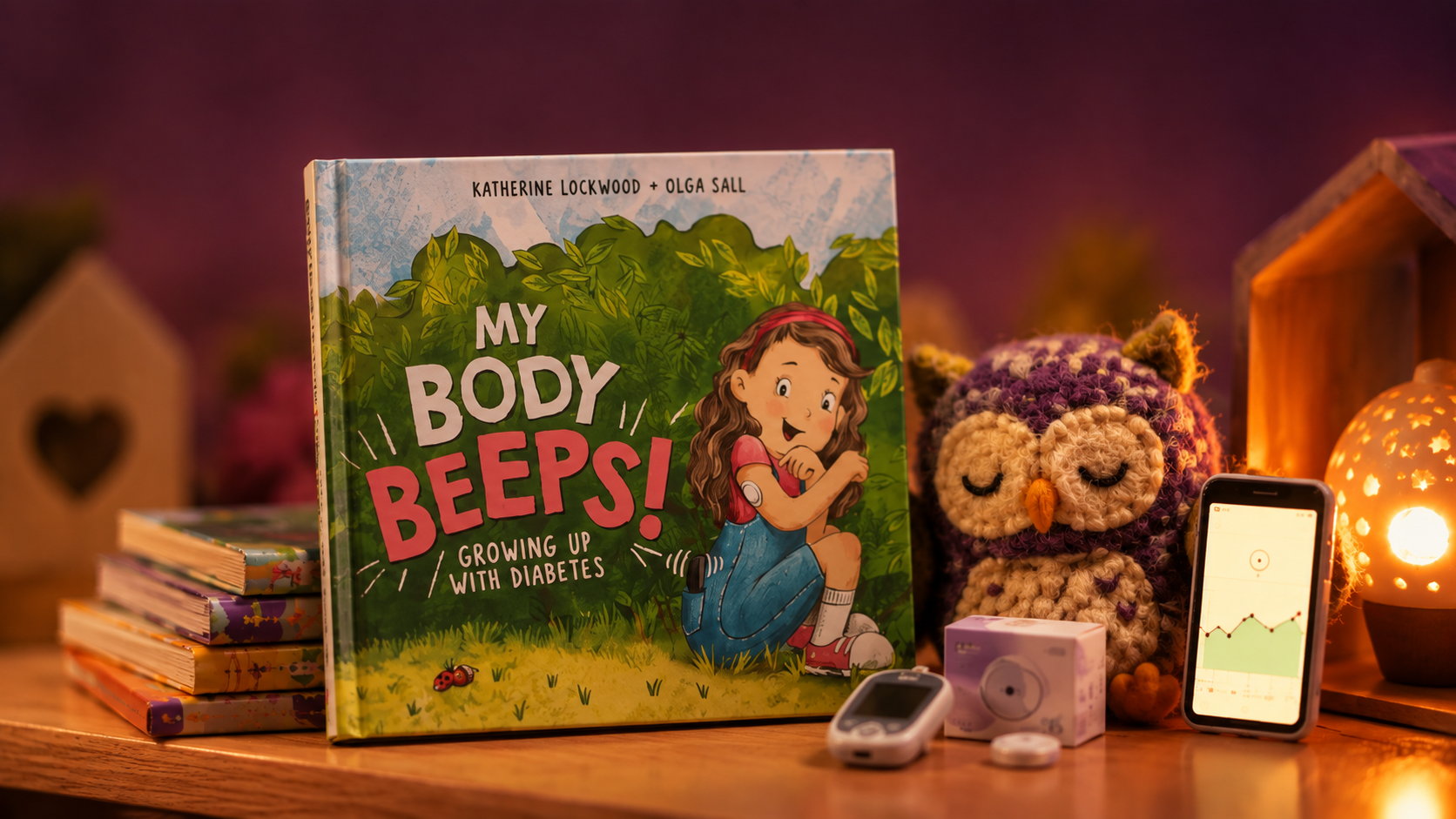
#1935 My Body Beeps
My Body Beeps
Katie Lockwood is a therapist and author with cystic fibrosis and CF-related diabetes. She writes picture books that put kids with medical conditions on the page — including one about growing up with diabetes.
Jump to a moment






- CF-related diabetes is its own thing. Katie was diagnosed with cystic fibrosis hours after birth; over time it destroyed her pancreas, so she now wears a pod and CGM. She describes CFRD as looking partly like type 2 and, in most day-to-day ways, like type 1 — though without the same ketone risk. She takes around 20 medications a day and sees many specialists.
- The old advice collided with the new diagnosis. Because people with CF often struggle to keep weight on, Katie was raised on ice cream and Chinese food — and when diabetes arrived, the early guidance was essentially “keep eating that, just add insulin.” She talks candidly about how the goals, and the life expectancy she was given, have shifted dramatically across her life; born when it was around 18, she just passed the number she grew up expecting.
- She turned her experience into books. A therapist who supports families affected by disability and illness, Katie writes picture books that give kids authentic representation. My Body Beeps is about growing up with diabetes and shows a CGM and a pod on the page; others cover surgery and rare conditions. Each runs roughly $10,000 to make; she works for free and crowdfunds so she can give many away.
- Her daughter has Mobius syndrome. Katie's older daughter was born with a mild form of Mobius — affecting the cranial nerves that move the eyes and drive facial expression. Unable to find a book about it, Katie wrote one, Why Me Mama, with an owl as the main character (owls turn their heads instead of moving their eyes). The real children she connected with became the story's other characters.
- Representation is the mission. Katie didn't grow up seeing herself in books, and wants kids dealing with “extra stuff” to see themselves on the page. She invests in professional illustration, editing, and design so self-published doesn't mean lower quality, partners with foundations and camps to distribute copies, and is now working on a sequel to My Body Beeps set at diabetes camp.
- Katie Lockwood — Acorn Cottage Press — Katie's books (My Body Beeps, Why Me Mama, My Surgery Day) and how to reach her: acorncottagepress@gmail.com.
- Bold Beginnings series — Scott and Jenny Smith for the newly diagnosed — the free starting point mentioned in the episode.
- Juice Cruise 2027 — The third annual Juicebox community cruise, booking now.
Every word of the conversation
Cold open & sponsors0:07
Hello, friends, and welcome back to the Juice Box podcast. On today's episode of the podcast, there will be nothing that you should take as advice, medical or otherwise. So please, please consult a physician before making any changes to your health care plan or becoming bold with insulin. Let me ask you two favors. Do one of them.
Do both of them. Do none of them. I'm not really in charge. T1dexchange.org/juicebox take the survey. Juiceboxpodcast.com/survey take the survey.
Mine, you just need to listen to the podcast to take. Theirs, you need to be a US resident, 18 or older, have type one diabetes, and take the survey. T1dexchange.org/juicebox. Juiceboxpodcast.com. There's a link right on the main page.
I've got two OG sponsors for you today, Omnipod five and Dexcom. That's right. The episode that you're about to enjoy was brought to you today by Dexcom and the Dexcom g seven, the same CGM that my daughter wears. You can learn more and get started today with my link, dexcom.com/juicebox. And this little slice of podcasting perfection is also brought to you today by the Omnipod five.
The Omnipod five is a tube free automated insulin delivery system that has been shown to significantly improve a one c and time and range for people with type one diabetes when they've switched from daily injections. You can learn more and get started today at my link omnipod.com/juicebox. At that link, you can get yourself a free starter kit right now. What did I just say? Free.
Terms and conditions apply. Eligibility may vary. Full terms and conditions can be found at omnipod.com/juicebox. You'll find those links in the show notes of the podcast player you're listening in right now and at juiceboxpodcast.com. Introduce yourself when you're ready.
CF, and a pancreas it destroyed2:07
Hi. I'm Katie Lockwood. I am a therapist, author, educator, and I have cystic fibrosis and diabetes.
Katie, type one.
And I'm coming from Cape Cod.
Oh my goodness. You have type one?
I have CF related diabetes.
Oh, explain.
So cystic fibrosis is a genetic condition that I was born with, and it affects all of the organs in my body. And one of the things it did was destroy my pancreas. So I now have insulin dependent as well as so I wear a pod and a CGM.
What else does it do? Is it is it out there, like, running roughshod through the neighborhood with a bat? Wait. What's going on?
For many people, it does. So I was diagnosed a couple hours after I was born because I had some GI issues. And one of the things is that my body doesn't process fats appropriately
k.
Including vitamins that are fat soluble. Mhmm. So I take about 20 different medications each day, have multiple treatments. I'm seen by many specialists. Primarily, the the biggest impacts are on the lungs and the digestive system.
Do you have any issues with your lungs?
So I'm relatively very healthy, but it is a lifelong chronic condition. And so I can get so I typically will catch colds and things a little easier than others. It will take me a little bit more to get over them and to kinda get always try to keep up to that baseline.
Are you telling me you don't worry about global warming or you just get sick more often?
I get sick more often.
Okay. Okay. Alright. I I appreciate you laughing at my fairly morbid joke
four minutes ago. I I did grow up with a chronic illness.
Oh, okay. You you
Several of them.
You know how to swing hands on this, I would imagine. Brothers and sisters?
I do. I have one younger brother. He's six years younger than me.
Does he have any issues?
No. He is very healthy and surfs and climbs and all of the things, but it was a decision that my parents had to and his parents too, I guess, had to kind of navigate through when they had me and if they were gonna continue to try to continue their family.
Yeah. They're a glutton for punishment, those people. I mean, honestly, being like, joking aside, like, can you I mean, do you do you have children?
I do.
Yeah. Can you imagine giving birth, and then they're like, where's the baby? And you're like, actually, hold on. Let me tell you a couple of things, and that's what you get told?
Yep. Yep. It's like, no. We don't have time to weigh and measure her. We're gonna ship her next door to Children's.
My goodness. Have you ever talked to your mom and dad about it?
Yeah. Yeah. Especially my mom. She raised me as such a wonderful advocate and always pushed me to kinda do everything I could possibly do
Mhmm.
But with also some slight overprotective tendencies.
Yeah. Yeah. She talked about the impact on her ever, or does she keep that from you?
I think to an extent. We've talked I'm I'm I'm a couple specialists as well in my therapy, and we have had several conversations about how much it can impact the family and the couple and kind of how that impacted her relationship with my dad.
Oh, did she have to get rid of him?
Yes. Yes. Just threw him off the boat.
I would imagine. She's just like, that's enough. I'm voting you off the island now. It's enough. How long did they make it?
They waited until my brother graduated high school.
Oh, that's very Caucasian of them.
Very, very convenient for me.
For you? Why?
Yeah. Well, they waited until I got married too, so that was helpful.
Oh, that's very nice. And then did they, like are they are they, like, in a a lifelong blood feud? Do they get along? How is org?
You know, divorce is never pretty, but they actually do an exemplary job Very nice. With at this point. They're at every holiday, every event for my children, so I really couldn't ask for more at this at this stage.
That's very nice. It it is the story that they that that the illness is I mean, how do they tell it? Are they hanging it on you, I guess, is what I'm asking? Or what what
is it?
No. Think that's more a more nuanced
Yeah.
View of it than I think that that did have an impact, though, on they had a little one with something really serious, and they had very different approaches on how they were gonna handle that
Yeah.
Or if they were able to process it. And so I think my mom took on more of the caregiving and the medical burden. Mhmm. And that that impacts you over time.
Is it difficult on you to know that that happened?
No. But I I can see as a parent now and in a very happy relationship with my husband, I can see how it easily can become that. And so it's something that I've always been really mindful of.
Okay. Very well. It's it's interesting. I appreciate you sharing that. I'm I'm assuming that's not what you thought you're gonna be talking about in the first five minutes.
But I'm
a fairly open book. So wherever you go, I'm good.
I do really appreciate that. Okay. So you grow up do you do you call yourself type one, or do you use is this feel like a you know, like, when people have three c, for example, they're like, well, I don't really have type one diabetes. I had a surgery. And then, like, how do you think about it?
CFRD: type one, with its own rules7:42
So they call it CFRD, so cystic fibrosis related diabetes. Fancy. Yeah. Yeah. My understanding is that it kind of shows up in some ways like type two and in many ways like type one.
Like, I don't seem to have an issue with ketones.
Mhmm.
But in many other areas, it it's very similar to a type one diagnosis.
Yeah. So when when you have to tell somebody, do you just say I mean, do you give them the whole thing, or what do you tell somebody in, like, casual conversation?
I think I just kinda say cystic fibrosis and diabetes.
Gives them the idea that there's been a car crash somewhere, and they go Yeah.
There's a lot going on.
Yeah. Yeah. They go, okay. And they they don't ask a lot of questions after that, I imagine.
Yep.
Yeah. Cystic fibrosis probably scares the hell out of people in general conversation. Right?
Yes. Yeah. I think we'll if they've never heard of it, it's like, are you contagious? It's the first question, which I am not. Although it is a it can be really scary, and there's certain germs that people with CF have that can transmit to other people with CF
Oh, wow.
Which is atypical, I think, in just kind of disease territory.
Mhmm. And how would you know?
You would only know if someone told you.
Yeah. I was gonna say.
Although I was at a meeting once and someone's coughed, and I said, I'm so sorry to, like, ask you a question, but is do you have this? And she had something very similar. And I was like And you locked it in fascinating. We're now Facebook friends. We try not to be in the same room.
Yeah. Can you believe the number one prescribed automated insulin delivery system is now even better? Omnipod five is now stronger than ever with algorithm updates, including a new lower one hundred milligram per deciliter target glucose option designed for more time and range and with fewer interruptions for more time in automated mode. That's right. The number one prescribed automated insulin delivery system just got better.
Request a thirty day Omnipod five trial today at omnipod.com/juicebox and experience the enhancements firsthand. Terms and conditions apply. Eligibility may vary. Full terms and conditions can be found at omnipod.com/juicebox. The Dexcom g seven is sponsoring today's episode of the podcast, and it features a lightning fast thirty minute warm up.
Whoo. Thirty minute warm up time. That's right. From the time you put on the Dexcom g seven until the time you're getting readings, thirty minutes. That's pretty great.
It also has a twelve hour grace period, so you can swap your sensor when it's convenient for you. All that on top of being small, accurate, incredibly wearable, and light. These things, in my opinion, make the Dexcom g seven a no brainer. The Dexcom g seven comes with way more than just this. Actually, up to 10 people can follow you.
You can use it with type one, type two, or gestational diabetes. It's covered by all sorts of insurances, and this might be the best part. It has alerts and alarms that are customizable so that you can be alerted at the levels that make sense to you. Dexcom.com/juicebox. Links in the show notes.
Links at juiceboxpodcast.com to Dexcom Omnipod and all the sponsors. But you can remember it. Dexcom.com/juicebox. Check it out. You can tell by their cough because it sounded like a cough you had?
Yeah.
That's fascinating.
Yeah. Yeah. It's really interesting. It's No kidding. It's also it's hard because when I was a child, they did not have the safety protocols that they do now.
The germs, and the end of CF camp11:17
Mhmm. And so I became very close to several people, and, unfortunately, most of them have passed away. So that was a a big part of my adolescence and kind of journey. But now you're not allowed to be within six feet. And so they kind of stopped a lot of the fundraisers that I grew up with that were really a joyful experience.
Yeah. I was gonna say that that puts a damper on the get togethers for sure.
It definitely does.
No camp, I guess.
Oh, yeah. That's a big one that used to exist.
Oh, no kidding. Yeah. When did they find this out? Like, what year did did what year did somebody go
I was alive Yeah. Because they had some kind of camp. I was too young to do a camp by myself. Mhmm. But I remember we went something with my parents when they had, like, activities for the kids to do together, and then the parents had different support groups.
And then something happened at an older camp where one of the bad CF germs passed over from one patient to another, and then the person who got it passed away.
Jeez. In that time, like, didn't take long for it to happen.
Yeah. It didn't take long. And so and then it was it's just too much because then the other person would did not pass away. Right? Yeah.
But that that was the end of the CF camps.
That was that. Yeah. Now we just just mail you a check. Yeah. Yeah.
We don't need to we don't need to see you. Thanks. Well, that's really that is really by the way, people should really appreciate how good I am at this. I got a lot of interesting information out of you in just a couple of minutes on something that they didn't think they were gonna learn about. Yeah.
Yeah. Yeah. Okay. So but let's let's jump to it a little bit. Growing up with diabetes, were using an insulin pump.
Did you get a CGM at any point? What do you you said you have it now, but at what point did that stuff happen?
Ice cream, insulin, and shifting goals13:07
I was a teenager.
And how old are you now? I'm sorry.
I'm 38.
38. You were a teenager. You got a pump. Did did it make things easier?
I think at that point you know, I grew up with CF, so adding the diabetes was really hard for me. And I think a lot of it is intertwined because with CF, typically, people are underweight and, you know, struggle to keep on weight, things like that. So I was raised on, like, ice cream and Chinese food.
Oh.
And then adding, you know, the the failing of my pancreas to continue kind of shifted a lot of my eating habits and kind of how I need to take care of myself.
Yeah.
But the CF community really wasn't on top of that. They kinda were still in the, no. Eat all of the ice cream still, but now give yourself insulin. So but the the goals at that stage, I think, were different than what they are now.
Uh-huh.
And the life expectancy was very different. So I'm sorry. CF goals. Complex. CF goals?
Yes. Yeah.
Oh, the goals back then were what? Like, have a bunch of ice cream die early?
Yeah. Pretty much. Like so when I was born, the life expectancy was around 18.
Get out.
And when I was a teenager, the life expectancy was 38. So I just celebrated my, like, life expectancy birthday this year.
Yeah. I guess you're done. Well, I mean
I know. And now I need to work on living to 80. So
Have they changed that number? Or is
It has. Luckily, it just keeps rising as I get older. So I figure
following you.
It's just following me, so I just have to just keep going with it.
What what is the new age?
So it changes depending on when you were born. So
I see.
Currently, maybe somewhere in the forties. But if you were born now and had axe have access to the newer medications, Mhmm. They're projecting, I think, somewhere in late forties, fifties. Oh my god. Expect that to continue to go up.
Hey. That's that's it that's the thing you live with every day.
Yes.
Yeah. How how do you deal with that?
So a few things. I think I have a pretty positive attitude.
Mhmm.
I was raised to not live like I was going to die at those ages. I was five when my mom told me that I had to go to college because I need to get good health insurance.
And so paying for this for the rest of my life, kids. Let's go.
Yeah. Yeah. And then but you know what? When I got my second master's, she was like, do I have to go to this graduation too? Like, mom.
Did this.
Not me. Yeah. Yeah. Yeah.
Yeah. This is your fault. You can buy me dinner.
I was I was planning on hanging out in a parking lot and dying when I was 18. So you're you're the one that made all this happen. Yep. That's really interesting. Do you are there any people that can found those age survival ages or not really?
That go past them?
Yeah.
Yes. Yeah. There are. There are some people in their seventies and eighties. There's also been a lot of people that are diagnosed later in life.
Okay. Especially men when they're trying to
have
children because they they are missing their band's deference. And some people are are very mild symptoms. Some people maybe struggled with, you know, asthma and, like, constant sicknesses and then just didn't have a great doctor.
It just kinda piles on a little bit. Yeah. Wow. You said did you say I think you misspoke and said vas deferens, which threw me off for a second.
Oh, what is it? Vas deferens?
It's vas. Yeah. Yeah. Like vas deferens. And I know that from eighth grade biology class.
Thank you, everybody.
That's that's good. Yes.
Last day of eighth grade biology, I stole a stapler off of my teacher's desk because I didn't like her and kept it like a trophy for many years.
You you watched the office of The Office Space?
Oh my goodness. That's I was way before that. Don't worry. Okay. They might have got that from me.
Okay? Yeah. Yeah. I yeah. Yeah.
No. I I did that in front of her, by the way. It's one of my proudest moments. She was I'm not I I wish I was joking. She she was seated at the desk, and while I was talking to her, I took it.
I've never been so proud of my life.
And you you got out with it, so that's
pretty awesome. My it's it's it's a fantastic stapler. I kept it forever and ever. It was it was literally there just to remind me that anything is possible. So my goodness.
Yeah. Yeah. Yeah. And you cannot make a baby without vas deferens. That's gonna be tough because that's that's where the little sperms go.
You know what I mean. You've got it all figured out by this point. Wow. I appreciate you explaining all that to me. I really do.
Yeah. Of course.
Yeah. Yeah. So were your outcomes with your diabetes not great a one c wise because of the way you were eating and probably how the understanding of diabetes was back then, or do you even know what your outcomes were back then?
Outcomes, and advocating off insulin18:32
You know, I should really ask my doctor. So I've had the same doctor now for about fifteen years. I'm sure it's somewhere in the records. They weren't my numbers weren't terrible because they knew that diabetes is a pretty well linked thing to CF, it was something that every time I had blood work for my CF appointments, they would check for.
There were
no big threats about that. Yeah. So there wasn't, like, a huge period of time where we didn't know.
Yeah. What was your understanding of what you were doing for your diabetes back then? Just were you counting carbs, or how were you handling it?
Yeah. I was counting carbs and then just kinda learning more about the different equipment, things like that. I think they they wanted to put me right on insulin, and I think there was a little bit of a period where I advocated to try some of the medicines because I also didn't never was really struggling with being underweight at that at that stage. So I found that their argument for not for for just kind of hopping on insulin immediately wasn't sufficient for me at the time. And I did I was able to with, I think, glipizide and something else.
You made it for a little
bit? Hone a a bit. A couple years.
Okay. When
did CGM Which gave me some time to kinda, like, process
I was gonna say, right, to get your head around the whole thing. Yeah. When did CGMs come into your life? At what age?
My early twenties.
Okay. It's just it's half your life then?
Yeah. Almost.
And and then do you become a therapist because of your situation?
I think it definitely impacted kinda my trajectory. I originally got a degree in public relations and journalism.
Mhmm.
And then I only applied to nonprofits because, apparently, I didn't wanna pay any bills. And then I went through I decided I wanted to work in the schools and work with kids. So I did teach for America and taught special ed for a couple years. And at the same time, I got a master's in counseling.
Very nice. Do you see people virtually, in person? Do you have a, like, a practice that you that you're supporting?
So I am currently I work part time for a private practice doing telehealth.
Mhmm.
And I specialize in supporting families that are impacted by disabilities and medical conditions. So I see kids with type one. I see parents that are raising children with different diagnosis. Also work for a school full time that is also remote, which is great, but I used to work in the schools in person before COVID.
Must be fulfilling. No? Yeah. Yeah. That's lovely.
Do you
feel like you're helping yourself while you're helping them?
I do. I think kind of the biggest, like, side thing that I've done that's really helped me has been writing books. Mhmm. That's really felt really like, my brain did a lot of work processing and being able to support others through that process.
Becoming a therapist who writes books21:44
Multiple books. What kind of books?
Yeah. So I write different books about differences and medical conditions. The one I think that's probably the most topical for for you is it's called My Body Beeps.
Okay.
And it's about growing up with diabetes.
Alright. And then from your is it a a children's book? Is it a
It is. Yeah. It's a picture book.
Alright. Oh, picture book. Nice. And then but you do it for other disease states as well?
Yeah. I'm working on creating a little series, but I also have released one about preparing kids to have surgery. So my surgery day.
Oh, I'm looking right now. I see MyBodyBeebs. That's your name. I I got the whole thing worked out here.
Yeah. And that's me as a cartoon.
Did you get somebody to draw it for you, or did you do it yourself?
Oh, yeah. I don't have those skills. You don't have those skills. I've I've been able to partner with some amazing illustrators.
Yeah. Oh, this is lovely. Look at you. How long have you been at this?
I started writing in '21.
Okay. Five five years or more.
Yeah. About five years.
You've been kind of prolific here.
I'm working on it.
Is this a a labor of love? Is it, like, a legitimate business? Like, do know what I mean? Like, what we kids book.
So it's it's definitely more of, a mission focused project. Yeah. Authentic representation of disabilities is not very common. And I think especially the authentic part and traditional media, we don't we don't get to see ourselves. And kids that are dealing with extra stuff really, really need to see themselves on the pages and in the world around them.
K. Do you get to hear back from people that have read the books? Are you getting any feedback about them?
Yeah. Yeah. I hear from people all around the world, and I see pic I get to see pictures of them holding, like, the doll I had made and the books. And I get clips of them bringing the books to school to read with class or sending them to the school nurse's office depending on kinda which which title it is. I typically do a, like, a crowdfunding campaign for each project because each book cost me a maybe around $10,000 to create.
So those the funds that come in help me pay the illustrator, editor, book designer. I work for free, and and then I I'm able to send people packages kinda once it's done.
What's the draw of spending the I mean, do you I guess the question is, do you make that money back, that initial investment? And if not, then what's the draw of just not keeping it online?
So for the offset print run, a lot of a lot of the expenses kind of would need to happen regardless if it's just online or not.
Mhmm.
So if I wasn't gonna do the print run, it would save me a few thousand, but it's still an over $56 investment for each one.
So mostly is that mostly artists and Yeah. Typesetters, stuff like that?
Yep. The illustrator and then editing and book design.
Yeah. Wow. That I mean, when you when you don't think you're gonna, like, you know, 10 extra money, that's a really nice thing to do. It it really so what are you getting out of it? The you must be getting something awesome out of it.
I feel like a lot of it's, like, not definable, but I didn't grow up with representation around me. Mhmm. There wasn't characters or, you know, anything that showed who I was as a kid. And then my daughter was born with her own rare diagnosis, which was a shock.
Oh, no kidding.
Yeah. And so we I looked for books because here I am, a therapist, an educator, disabled, and I couldn't find anything about her rare condition. And I was like, oh my gosh. So that's what made me do my first my first project.
Her daughter, and Mobius syndrome25:56
And this is something completely your your child, this is something completely different than what you have? Yes. Would you share?
Yeah. So she has a mild form of Mobius syndrome, which I had never heard of, but it's the impact of the sixth and seventh cranial nerves.
Oh, I thought that was a Spider Man character. So thank god you got deeper into that. Yeah.
Yeah. Yeah. I do I saw a boat recently that had that on the side. I was like, I had just, like I think there's, a graphic the graphic novel.
Like, I don't think you guys understand that word. Yeah.
Yeah.
So wait. It it seriously, explain that a little slowly. What is it now?
Okay. So to have the true definition of mobius, your sixth cranial nerve needs to be impacted. That is when we take our eyeballs and we move them left and right.
Mhmm.
That nerve, its only job is to move your eyes left and right.
Really?
She was not born with that one.
Is that like a deletion kind of thing?
They say it's not genetic, and we've done all of the testing, and they don't know why it happens. My theory has to do with, like, some kind of blood flow issue at some point, but I'm not I'm not the expert as much as I think I am.
Is it is it incredibly rare? Yes. Is it more is it
more or less than rare million.
Than CF?
Yeah. Way rarer, which is fascinating because CF is a rare disease.
Yeah. And it affects males and females equally, it says here.
Yes. And there can be up to 20 different things impacted, including limb differences, a lot of like, hypotonia, it's a low muscle tone, hearing, vision, like a whole bunch of stuff that can be a part
of it. Wow. Hey. The numbers that came back to me fibrosis excuse me. My lip literally stuck to my other lip.
Occurs in roughly one in three and a half to four thousand births in The US. It says about forty thousand Americans are currently living with it. Mhmm. And then the Mobius is one in every fifty to two hundred and fifty thousand people. Yeah.
That's really something. My goodness.
And I think there is some issues with people getting appropriate health care and getting appropriate diagnosis.
On the Mobius.
With the Mobius. Yeah. I'm sure with CF two depending on where you live.
But Sure.
They seem to be do a better job of that, at least right now. There are some other conditions that are similar to Mobius and have the same, like, I would say, emotional impacts, but are slightly different. So if your eyes can go side to side but can't go up and down, that indicates a completely different condition.
Okay. Hey. Would you do something for me? Yeah. The social emotional impacts that you just just mentioned.
A pause, and a GLP aside29:00
Would you I don't I never do this, and I apologize. Wanna I go to I I have to pee. If I got up and went to the bathroom, would you think about that? And then I'm gonna come back and hit record again. You can answer that question?
Yeah. Absolutely.
I will not be long, and thank you. You're not being recorded while you're thinking. So if you wanna you're okay. I'll be right back.
Ladies and gentlemen, hold the phone. Scott's gotta go take care of his own. Two liters of water since quarter past three. So we're pausing the show because the man's gotta pee. He's gonna pee.
He's gonna pee. Sixty seconds, then he'll be back. Don't touch that dial. Don't lose the track. But while he's gone, let's talk about you.
Type one diabetes and you don't know the way. There's a place you can start and it isn't a guess. It's bold beginnings and it's free. No
Okay. Sorry. I'm back. You're being recorded again. I for people who are interested, two things.
Yes. I wash my hands. And the second thing was that I missed my GLP by a a day or two, and I almost immediately start gaining water weight when that happens to me. And then I took it last night, and now I'm I'm losing the water weight really quickly. I I when if I don't know if you've ever heard me talk about this or not.
Maybe you have no idea who I am. That would also be valid. But when I started using a GLP, they don't put you on a what they even consider to be a very like, a therapeutic dose in the beginning. And on the lowest dose, I lost, like, 14 pounds in the first week, and it was almost all water weight. It's incredibly uncommon, and it wasn't because I stopped eating.
So I think I think my body just doesn't work very well. And so, anyway but who am I talking to? I'm not trying to take not trying to take that torch from you, Kate. Don't worry. You're like, what do you literally, you're not the right person to get in a pissing match with about something like this to bring the whole thing full circle.
What the seventh cranial nerve does31:46
But sorry about that.
No. No worries.
Yeah. Yeah. So if you could if you could fill me in a little bit about what you meant by that, I'd appreciate it.
Yeah. So kind of look at the therapist hat on, you
know,
the condition in addition to the eye difference. The seventh cranial nerve is much more complex, and it has a lot more jobs in our body.
Mhmm.
And one of them is that it provides all the innervation in our face, so all of our facial movements. So the typical presentation of someone with moebius is that they have a lack complete lack of expression
Oh.
Which would have you know, has a lot of emotional impacts and a lot of societal impacts when we talk about relationships and jobs and, you know, mental health. It's just a lot there.
Yeah. How old is your child that has it?
She's almost six.
And are you noticing those things for her?
She is real we are all really lucky that her seventh cranial nerve is not completely missing. It's shorter than typical. So she has not as robust expressions, but she has full expression. And so there's no one that has ever really called out other than a medical professional about that, which I think, terms of the social emotional impacts, is huge.
She's she can pass, so to speak.
Yeah.
Yeah. Mhmm. And does she know what's happening?
She knows that her eyes are different. And, you know, we've and her speech was a much more difficult journey Mhmm. Than perhaps it it would have been. And she also has the low tone, so she falls all the time. But she does everything, you know, from what we were leaving the NICU worried about to now.
Like, we're in, like, a very different place.
And how many kids do you have?
Two.
Two. Was she the first?
She was.
And how old was she when you knew?
Three weeks. We were we were it was during COVID, and we were at one of the NICUs in Boston and had a $100,000 MRI.
Oh.
That was a fun bill. I just laughed because what else are you gonna do?
Was it extra good? I
I think so. They do cross sections. So it's like a three t MRI with cross sections of the brain because the cranial nerves are really tiny.
Did it have any value once you got the information back?
It did because it gave us a reason for why she was struggling to eat.
Well, that's good.
Yeah. So because of that lack of the reduced innervation, she has had a really hard time sucking on a bottle or a breast. So
Gotcha.
So we ended up with a an NG, so through the nose, feeding tube for the first six months.
And you still went the way of your mom, and you were like, we'll have more kids.
Yeah. But we did we did do genetic testing to see if it was, like, a a really strange other genetic thing that
could tell you that laugh you just gave me was very telling. You you you your laugh went like this. Yeah. I don't know what's wrong with us either, Scott, but thanks for asking. Yep.
Yeah. Well, that's that's really next child's okay?
Yeah. No. She's good. She was of course, you know, she can't I would have written a book about her too, right, just for fun, but she was born premature and had hip dysplasia. So that she's the character in the surgery book.
Okay. Okay. I was gonna ask how do you like, I assume there's a book for your for your child, but you can't write a book about Mobius. So what do you do? You pick some aspect of it and make it a broader topic?
So it definitely it was my first project, and so I broke a lot of the picture book rules. So I ended up doing a character for every aspect that can be seen in Mobius. Oh, I Pixar made a
movie about that. Yeah. Yeah.
With animals.
Nice idea.
So do you know which animal doesn't move their eyes?
Okay. Hold on a second. I see what we're doing here. It's like a test. There's an animal that doesn't move its eye sharks.
No. No. And I'm saying, like, moving them side to side. They turn their head instead.
Oh, it's an animal that turns its head instead of moving its eyes. I feel like this is gonna be, like, some flamingo? No. Alright. Tell me.
An owl.
Oh, who? Who? Uh-huh. Thank you.
Yes.
I can't believe I didn't think of that, but that's okay. So you make the owl the I got you. Go ahead. What else?
So Rose in the book is it's called the book's called Why Me Mama. So if you pull up, you can check it out. And Rose is the baby owl in the story. And the story is just about her getting ready for her birthday and worried that people that won't wanna come, the other woodland creatures, because she feels different.
Mhmm.
And mom takes her around delivering invitations, and Rose sees how everybody's different. Sometimes we see it, and sometimes we don't.
Yeah. That's lovely. Good
for you. And all the characters are real children around the world that I had connected with either in the Mobius community or through the Kickstarter.
Okay. Oh, you kickstarted the book?
I did. I raised $23,000.
Get out of here.
Yeah. I had no idea what I was doing either. So
Is Kickstarter still a thing? Is it still working? I know somebody made a board game with it.
Oh, cool. Yeah. It's still there.
Yeah. Do you use it still, now you have other ways?
I'm still working on the other ways. I now do kinda, like, smaller campaigns. My my goal for this one was 6,000, and it just, like, kept going.
I see.
But it got some, like, media attention too. But now I kinda it it doesn't raise that much money.
Yeah. Because because social media changes so quickly.
Yeah. The
Why sharing got harder37:56
things that work five seconds ago and I don't even mean, like, raising money. I I always I mean, my my best example would be when I was writing a blog before I was making a podcast. I could put something on Facebook, and tens of thousands of people would see it in twenty four hours. And now that doesn't work that way anymore. Just that simple.
Like, because Facebook wants to sell ads, they don't want
Oh, yeah. Yeah. Yeah.
Right? So but then the the shift that that puts on on the your ability to share things is it it's really immense. And then there's more and more people doing the same thing, and then you can't differentiate yourself. And it's it's it's interesting how they're gonna they'll say they changed it, but I think they're ruining something.
So There's also only so much time in the day.
Yes.
And taking care of my own health, my kids' health, taking you know, working, paying bills, also trying to wash watch some trash TV occasionally.
Like Yeah. How many
things do you really the books.
Yeah. Yeah.
Up a lot of time.
Yeah. No. I I appreciate that too. It is it is listen. I don't know what's right and what's wrong and or how things will shake out.
I I can just tell you from my perspective.
It's definitely different. Yeah.
Yeah. It has really changed, and it it will stop people from sharing good good information. You're just gonna I think what you're asking for is for everybody just to bend their leg and arch their back and bounce once, and then that's what apparently, that's what it's gonna be one day. Or people or people beating each up out in the parking lot of a seven Eleven or something like that. So, anyway, I think they say you get what you deserve.
I think we're gonna end up getting the social media that we deserve. Anyway, so you're in the
middle this I try to train my algorithm to show me kittens and puppies and, you know, nice nicely renovated vacation homes. But
That's the thing. My wife my wife has so many photos of homes and, like, rooms and things like that. I'm like, what's that for? She goes, that's just stuff I like. And I was like, what are gonna do with it?
She goes, I don't know. Probably nothing. I went, oh, okay. So at least that's at least that's a nice thing. You know what I mean?
Yeah. I don't wanna complain because I'm I'm having I'm in a bad mood this week about it, so I don't wanna start talking about it. It just is I don't know. It's fascinating to me. And it's gotta really impact trying to sell a a physical book to somebody.
Yeah. It it's also hard, I think, you know, the books that I create aren't all really created with, like, an Amazon audience because I'm limited in kind of getting the word out about them. Mhmm. And I if I'm able to do, like, a craft fair or things like that, I I have just an easier time kind of sharing out about stuff.
Do you know I wrote a book?
No.
No. I wrote a book in 2013, and selling a book is maybe the most difficult thing I've ever tried to do. It is just it is just not easy.
How did it go?
I mean, not not well. I I wasn't famous, so the publisher didn't put a lot of effort behind it.
Okay.
I did a I got a lot of media for myself. Actually, one of those media things is the reason the podcast exists now.
Okay.
Because Katie Kirk told me I was good at talking to people. It's her fault if you don't like the podcast. And but but along the way, I I got myself on NPR. I got myself, like, in my hometown newspaper on Father's Day, like, stuff like that. You know?
Like, like, difficult stuff, but nothing worked as well as I've I've told this before. I'll tell it to you very short because other people have heard it already. But after the Katie Couric interview, she made either I forget if it was AOL or Yahoo, but she used to have a, I don't know, presence on one of them or, you know, I I don't know, some sort of a business agreement with one of them. And the article about my me being on her show, it blew up. And the way it blew up is that people in the the the comments were arguing as to whether or not it was a closeted homosexual or not because men don't stay home with it.
Because I was a stay at home dad. That's what the book was about.
Oh, okay.
Yeah. So while they fought about that, I actually rose to number 50 on Amazon's list.
Oh, jeez. Yeah.
It just didn't last that long.
Yep. Yep.
And so it went away, and then I, you know, I took my they never asked me for my advance back, but the truth is I don't know if I cleared it or not, to be perfectly honest.
Well, I think I I have never done a traditional deal, but my understanding is that your advance, get to keep whether or not you get anything after that.
I I was told I had to sell it, so I don't know what ended up happening. But I know nobody ever asked me for any money back.
So Okay.
Yeah. I said that yeah, I bought a McDonald's with it and a and a tank of gas.
Yeah. So But it seems like it helped lead you to the next thing.
It did. Yeah. And it was a really great experience, actually. The entirety of it was a great experience. It just you I was never gonna be able to sell the book.
Mhmm. You you know what I mean? So it it leads me to ask you, like, what do you consider, like, success when you're when you make a book?
I think, partially, my goal financially is to break even. Yeah. That's my goal. So anything more than that would be lovely. I really wanna just be able to get them into the hands of as many people as possible that really need them.
And, ideally, I'd like to be able to give them away and have them sponsored by other people. And I think I'm I have not seen any anyone else crowdfund in the way that I have more people that pledge to my campaigns for me to give the things away
Mhmm.
Than that than for them to get them.
That's interesting.
And I I think that people can buy into like, they buy into what I'm doing, and they see the value, and that's really nice. But it's it's at at such a small scale Yeah. That it's hard to kind of like, I know there's so many more kids that would benefit.
What kind of a company could you see getting behind, like, buying the books so you can give them away?
Yeah. Well, I think for, like, the that my my body beeps, like, there's the visual representation in there of the CGM Mhmm. And the Omnipod. So, like, having some kind of a relationship with something like that would be amazing. I did one nonprofit in the Midwest is collaborating with me.
They ordered 500 copies, and they're including a copy with each family package that they send out
That's lovely.
Which is really, really lovely. And that, I think, is kind of the direction I wanna go in is to be able to do more of those kinds of partnerships.
Oh, that's awesome. Good for you. Yeah. And now do you kinda have the the footing about how to do it since you've done it once?
No. Because they re they they found me. To you. And so they reached out to me and was like, you know, we didn't even budget for this, but we love it, and we really wanna include it. You know, will you do do, like, a wholesale thing?
And I was like, yeah. Absolutely. And now I kinda need to figure out how to approach other organizations. And because they do like, other organizations do do that, that they send out, you know, the different boxes or, you know, a doll and a book or things like that. But
Getting the books into hands45:40
Well, I wish you luck. I hope somebody hears this and and reaches out to you. Where would they get ahold of you for that?
Think just email. I'm at acorncottagepress@gmail.com. Okay. And I I answer my my DMs on Instagram pretty well.
Very nice. I just had a person I interviewed say to me, did you answer my email with AI? And I went, I might've. I I I have a I get a lot of emails. And and I was like, I'm not embarrassed, but, like, I I said, sometimes I sit down.
I I answer, like, 400 emails. I'm like, I don't like, I can't I can't. You know what I mean? Like, I'm trying. But that's really the way I hope somebody does reach out for you.
Somewhere in the Midwest, like, can we shout them out, give them some credit for doing it?
Yeah. Let me I'm gonna share the correct information. I believe it's Kids With Courage. Yeah. The Kids With Courage Foundation.
Nice. And that was that I'm not asking you for a number, but was it an oppressive number or was something they were able to do without you're just trying to cover the cost of the books and get them there. Right?
Yeah. So they they paid a certain amount, which was much less than retail. Mhmm. And then they covered the shipping. Awesome.
Let's get to it then. Let's get some people out there.
Yeah. And it will what's also helpful is that whenever I can sell whatever I sell, I'm able to then put into the next project. Yeah. So being able to surpass, like, the actual cost of it means that, you know, with $10,000 for each project, like, it can kinda go into the next one, which is really helpful. And so when they were did that, I was able to put the down payment on the illustrator for the next book.
This must be how you got on the podcast because I must have known enough because I I have a fairly I wouldn't call it a rule, but I don't usually talk to authors because it leads to many more authors reaching out. I don't know another way to put this exactly. Yeah. And I and I get put in a I get put in a weird situation. A, the podcast isn't a book club.
And b, that when they wanna do it on Facebook like, we don't let people sell their own stuff on on the Facebook group. It just it leads to a mass of people trying to do that. And then it leads to like, the the the page just gets overwhelmed with people trying to sell things, and then it loses its value for, you know, what it's there for. And so we have pretty strict rules about, like, self promotion, and it makes me feel terrible. I I honestly wish there was just a way to do it, people trust me.
Everyone listening right now just had an idea. I appreciate all your ideas. It doesn't work. Okay? Whatever your idea was, we thought of it.
It doesn't work. So but I but to get you on the podcast, I I I guess I must have known enough about your story to say yes. I don't know my I I don't remember my own life, so it's hard for me to say.
Yeah. No worries.
But I love your story. So, obviously, I loved it in the past too. It it just really is you have a really fascinating path. And if I'm if I'm being honest, like, the you you have a perspective on, like, the fragility of life that a lot of people don't have too.
Yeah. I think that's one of the strengths, really. Like, when we talk about resilience, you know, like, that's just what life is. And so we're talking kind of earlier on in the interview about like, I grew up with CF, so it's just part of who I was. Mhmm.
And but the diabetes actually hit really hard because I was like, I already have something. Like, why am I getting why am I getting something else?
Hi. I got minority. Thank you. This is probably this is probably for someone else.
Yep. Yep. And the same thing with, like, when my daughter was born, I always thought, like, you know, it was a big decision to have children with this unpredictability of life. Right? And I was like like, her thing to deal with was supposed to be me.
It's having something really serious. It wasn't supposed to be her own her own thing.
I see what you're saying. You're like, I was gonna have a kid, and her problem was gonna be my problem. And Yes. Then she got my problem and her problem.
Yep.
Yep. That does seem unfair. Does that make you I don't know your holdings, but does that make you less or more religious minded?
I'm I'm not religious.
Yeah. Did it take I have
a I have a really hard time with with that.
Yeah. I was just wondering if it moved you in one direction or you've just left you where you are.
Yeah. My my I was raised Catholic, but I've never really been connected to it. I I think it it creates a lot of it's my mom is more religious, and I think it really helps her and helps create, like, a foundation of I don't know so much about community, but just, like, hope.
Yeah. And
that Didn't do the same for me. It didn't do that for me. So
Yeah. Maybe maybe the most insulting thing anyone's ever said to me was, god gave ardent diabetes because they knew you'd be good at it. And I was like, I don't feel like you're selling it the way you think you are. But yeah. Yeah.
But if you only get what you can handle Yeah. That like, I know I can handle a lot. Like, I'm tired.
I I could handle a nap and a sit in the sun. How's that how's that vacate?
Yeah. Like, you wanna send me on a cruise? I can handle that.
Yeah.
Hey. I can't No more.
I can't.
No more diagnosis.
I can't send you on one, but I can recommend juice cruise 2027. Perfect. Which is booking right now at juiceboxpodcast.com/juicecruise.
Good luck.
Selling books, and working a room51:11
Thank you. You hate this part of it, the selling for the book, or do you enjoy this do you enjoy talking about it?
I'm actually really good at it. And which I think I do a better job, like, face to face than I do otherwise. Mhmm. But, like, we go to a craft fair, and my husband, when I'm like, oh, I'm gonna just, like, meander around. He's like, you need to come back.
I'm like, I cannot talk about your books the way that you can talk about your books. And and I'm like, I I wanna shop too. Yeah.
You have to, though. I did a book fair once. I was just telling somebody about this this last weekend. Why is it why was I telling them? Oh, we were at we were friends for life.
I was at the Sugarpixel booth of friends for life. Customtype1.com/juicebox. And I was just throwing all my links. And and I was and I was working with John at with Sugarpixel, and he made these really great comic books. And I would and I was just sort of this is gonna sound really strange, but I was just the pretty girl that leans on the car at the Sugarpixel booth, which I know is incredibly strange.
But trust me in that setting, works out pretty well. I'm a good I'm a I'm a good draw at the booth. And so we had done a talk together, and then I was spending the next two days with him at his booth. And I would take the comic books and just I'd grab some, and I'd walk around. And you're not not really allowed to give things out outside of your space.
So I would just kinda walk the space, make eye contact with people, chat with them, tell them about the comic books, give it to them, go get another one, do it again and again. And I was giving away, like, a lot of comic books, which was the goal. But there were plenty of other that people were giving away that people weren't walking around with. And someone asked me, like, what do you like, how'd you, like, you know, how'd you figure out what to do here in this situation? I said, I went to a book fair one time in Collingswood, New Jersey.
It's a really, really huge popular book fair that happens, like an author fair once a once a year. And there were just countless hundreds of people there who had written books. And I wasn't there for five minutes when I realized if I stand behind this table, no one's no one's buying one of these books. And I just grabbed a handful of them. I got in front of the table, I started chatting with people.
And at lunchtime, I was out of books, and I left. And everyone else looked at me like they wanted to kill me.
Yeah.
And and what I I told the guy next to me because he's like, how did you do that? I said, you're gonna have to talk to these people. They don't they don't know they they're interested in your book. And there's too many of them here. You're they're overwhelmed.
They're just they're looking at covers. It's
I think also authors or people that are traditionally
Mhmm.
Like, drawn to writing and creating are a little bit tend to be more introverted.
Yes. Yeah.
And to me, like, I've never considered myself to be a great writer. Like, I I'm an I'm an advocate, you know, more so.
Yeah.
And so, like, the the the book is, like, the vehicle for helping. It's not like, that isn't the writing piece is not my passion.
But you know how to do it well and in a way that'll help people and support them, they'll enjoy that kind of thing.
Yeah. And to do it in a way, like, with other people that are experts in their own fields. You know? Like, I don't I think a lot of times when we think, like, self published, we don't we don't see the quality come through. And that's why I think it's really important, especially when you're focusing on topics that don't have a lot out there, to do it really well.
Mhmm.
And that cost it costs money
Yeah.
To do it really well, and it it takes experts. So, like, I do an I invest in professional editing Awesome. Many layers of it and professional book design and a professional illustrator, which I think makes a big difference.
Yeah. No. For sure. And that's that's really fantastic. Yeah.
No. I I had the same experience when I was doing some of those interviews that I set up for myself. I think it was after the NPR one that I did. The the publisher contacted me, they was like, that was really good. And I said, what was?
And they're like, your interview. And I was like, thank you. And I said, why are you surprised? And they said, oh, most authors are terrible. It's terrible.
And and a lot of people don't don't stand up. They don't talk to people.
Yeah. Not me. I'm like, I got all these books. I gotta get rid of them. Yeah.
Let's go. And also, what I write it for if I'm not gonna tell you about it? Like, it's that weird idea that they're gonna come find you that throws
you off.
You know? So, anyway, I think it's great that you're doing all this and that you're out there, you know, craft fairs and wherever else you can figure out to do it.
Yeah. No. And it's hard it's hard. Right? Because I also have two kids that are four and five right now.
So there's only so much space.
Yeah. No. I don't know how you're doing any of this, to be perfectly honest with you. Do you know? Are are you some days like
doing it? I think it's, like, every spare minute of, like, when they're asleep.
When they're asleep?
Pretty much. And they're not sleep enough. I wrote
a I wrote a blog post at 04:45AM today.
Just Perfect. Yeah. I wanted to share too that I am working on a sequel to My Body Beeps.
Okay.
And I don't have a Kickstarter or anything yet, but I probably will need one unless sponsor wants to reach out to me. But I am setting it at camp, going to diabetes camp. Mhmm. And that the idea about kind of how wonderful it can be to connect with others that also share some of your lived experience.
I happen to know that the ADA is keen on talking about diabetes camp right now. Oh. You should reach out to them.
Okay. Well, if there's anyone in particular that you think I should talk to, please let me know.
Maybe I would know a person. Hold on
second. I can send you a picture of the draft cover. It's really cute.
Stop. I would tell you this. A, definitely do that. Send it to me. And b, this whole thing is contingent on this person recontacting me the way they said they were going to after I just met them in person.
But I was approached if you're by the way, they said they listened. So, hey, ADA. I was approached by somebody over there who said that we wanted to talk about camp stuff. Why don't you contact me? There.
Okay?
Yeah. No. What I what I did with the donated books from the first campaign for My Buddy Beeps was I donated them to different camps so that they could kinda each have one, like, in the nurse's office at camp, things like that. And I asked if they would wanna if people would wanna do be, like, beta readers for the the second, which I'm not ready yet to, like, send that out, but I'm excited to partner with as many people as possible.
Yeah.
And one of my clients who has type one and is currently at camp right now is helping me with story, which has been a really nice therapeutic piece too, like, to use in therapy. But I'm really excited about it. And if you remember kind of from the beginning of our talk today, I wasn't able to go to camp because I wasn't able to
You're gonna get a germ or a cough.
Completely close to other people. And that is something that people don't with type one diabetes, that is not something you have to worry about. So I think it's just such a wonderful opportunity to connect with others and
Well, let me
share, you know, share your challenges and
Yeah.
Understanding and celebrate each other's strengths.
A camp book, and an idea58:27
Can I can I I'm gonna let you go in a second so you can go back to your life, but let me float my idea?
Yeah.
Why would not why wouldn't we be able to get multiple camps and then just change one page of the book to reflect the book being about their camp?
Yeah. We absolutely could. Or put, like, at the well, the only issue would be the print runs.
Yeah. But
then Like, it depends on how many people ordered. So
Then the the amount they would need to give to you would be for the run plus the act the different page in the print. Yeah. That's very doable, I would think.
I I one of my ideas is to have community participation to help design. Like, if it remains a fictional camp, to have kids with type one design, like, the T shirt and the logo
Mhmm.
And Mhmm. Kind of crowdsource some of the creative bits. But I think that could work kind of partnering with different camps as well.
I'm saying, like, why couldn't, like like, the Clara Barton camp do one? Like, why couldn't
Oh, yeah.
Like, Sweeney do it? Why couldn't ADA do it? Like, why couldn't a number of them do it? Then they'd all have the book if they like the book. Let let's say that.
And and then they could give them away at camp to the kids that are coming.
Yeah. Absolutely.
That makes a lot of sense to me.
Alright. That's what I did with my the first project. I partnered with the Mobius Syndrome Foundation, and they helped sponsor some of the costs. And then I sent them hundreds and hundreds of books, and now they they include that with their their packages to families too.
Okay. Alright. I fixed the whole problem. We just need somebody to reach out.
We just we just need some sponsors so that I can do what I wanna do, which is just give things away.
Yeah. No kidding. How how, I'll ask you this when we're done recording. Alright. You guys should reach out to Kate if you're interested in this.
Go look at her other books and decide what you think, and then reach out to her at what was that email address again?
Acorncottagepress@gmail or on insta@acornunderscorecottageunderscorepress.
Kate, thank you for doing this. I really appreciate it.
Of course.
It's awesome. Hold on one second. I wanna ask you another question. Okay. I'm gonna hit stop.
Heck of an episode today, wouldn't you say? Let's thank Dexcom and the Omnipod five for sponsoring. That's right, my friends. We were sponsored today by the Dexcom g seven. Dexcom.com/juicebox.
Head over there right now. Look into that fifteen day Dexcom g seven. Fifteen days a long time. It's like half a month. Don't check my math, but I'm pretty sure I'm right.
And let's also thank the Omnipod five. My goodness gracious. Omnipod five tubeless. That beautiful algorithm's updated now with that new 100 target. Get in there.
Find out more about it. Omnipod.com/juicebox. You want some tubeless insulin pumping? Yeah. You do.
By any chance, have you tried the small sip series? It's curated takeaways from the juice box podcast voted on by listeners as the most helpful insights for managing their diabetes. These bite sized pieces of wisdom cover essential topics like insulin timing, carb management, and balancing highs and lows, making it easier for you to incorporate real life strategies into your daily routine. Take a deep dive, take a sip, and discover what our community finds most valuable on the journey to better diabetes management. For more information on small sips, go to juiceboxpodcast.com and then go oh, actually, we changed the website.
Let me see. Go to juiceboxpodcast.com. And from there, there's these two little lines on the right side top. That's the menu. Then click that, then click series, then there's pro there's small sips right there, pro tips top, all beginnings, bolus four, asks that.
There's a lot of them there. There's actually a little search there too. Could you just type small sips into the search? Oh, wow. That search works great.
Look at that. And then you could go right to, like, all results for small sips. Oh, and that takes you to the FAQ. You should check out the FAQ page too. I think that's juiceboxpodcast.com/jbfaq.
Seriously, that thing's amazing. Actually, the whole website is I mean, have you, like, seen it? You should you should go check out the website. The website rocks. It is a potpourri, a never ending cornucopia of support for you and your diabetes journey.
That's right. It really is. What else we got over here? Oh, I don't like the way that works. I'm gonna fix that.
Note to self. Change the change the masthead on the frequently asked questions page. Yeah. I don't like that. Fix that.
Oh, Claude. Oh, hell. I forgot to say thank you. Thank you so much for listening. I'll be back again very, very soon.
What is that noise? Stop it. Stop. Can you hear that? It's my chameleon squeaking.
Are you squeaking? What are you rubbing the branch against the don't tell people I have reptiles. They'll think I'm weird. Thanks so much for listening. I'll be back very soon with another episode of the juice box podcast.
Look at me. Get all deep in there with another episode of the juice box podcast. You can hear it. What was that? Oh, I'm getting alarms and alerts on my phone.
I was gonna get real deep and tell you about the juice box podcast.
Read the full disclaimer
© 2007–2026 Juicebox Podcast. All rights reserved.

#1934 All In It Together
All In It Together
Hannah, 19 and pre-med, has had type 1 since age 15. She talks candidly about recovery from an eating disorder, working diabetes camp, her mom's later diagnosis, and finding the right support.
Jump to a moment
- Diabetes was always just there. Diagnosed at 15 — wait, she jokes, at “15 old” — Hannah has had type 1 long enough that she has no single “first memory” of it. She took over her own care young because she wanted to, the dutiful kind of independence, not the avoidant kind.
- She speaks openly about recovering from an eating disorder. Hannah shares that a difficult period through high school and early college included an eating disorder, a hospitalization, and a long stretch of work to recover. She's candid that recovery isn't linear and that getting the right kind of specialized support — a team that understood both the ED and her life as an athlete — made the difference. She frames it as her story, not a template, and there are no methods or numbers here.
- Diabetes camp gave her something to give back to. After Googling camps near her, Hannah became a counselor and found she loves being in a group where everyone just gets it — a sense of solidarity, as Scott eventually lands on. The kids get attached, the last day is emotional, and she describes a family built in a week.
- Her mom was later diagnosed too. About two years ago, in her late fifties, Hannah's mom was diagnosed — her own biological father had type 1. Scott gently points out that her mom is likely being brave for her, and encourages Hannah to check in and let her mom lean on her experience.
- A GLP has quieted the food noise. Hannah shares that, prompted partly by the podcast and her care team, she started a GLP in January; the change she noticed first was the quieting of constant food noise. She reports feeling good on it. This is her experience with her providers, not medical advice, and any medication decision belongs with a clinician.
- National Alliance for Eating Disorders — Free support, a clinician-staffed helpline, and treatment referrals for anyone affected by an eating disorder.
- Erika Forsyth, LMFT — mental wellness episodes — The Juicebox series on the emotional side of type 1, including diabetes distress and disordered eating.
- Diabetes camps — find one near you — Hannah found her camps by searching locally; the ADA lists accredited camps across the country.
Every word of the conversation
Cold open & sponsors0:00
Hello, friends, and welcome back to the Juice Box podcast. On today's episode of the podcast, there will be nothing that you should take as advice, medical or otherwise. So please, please consult a physician before making any changes to your health care plan or becoming bold with insulin. Gonna say two things really fast. Juiceboxpodcast.com/juicecruise.
The 2027 juice cruise is on sale right now. Get in early, and, of course, take the survey at the t1dexchange, t1dexchange.org/juicebox. You need to be 18 US citizen who have type one diabetes. And, of course, go take that survey. That's all I need you to do.
T1dexchange.org/juicebox. Let's get you to the program. I've got two OG sponsors for you today, Omnipod five and Dexcom. That's right. The episode that you're about to enjoy was brought to you today by Dexcom and the Dexcom g seven, the same CGM that my daughter wears.
You can learn more and get started today with my link, dexcom.com/juicebox. And this little slice of podcasting perfection is also brought to you today by the Omnipod five. The Omnipod five is a tube free automated insulin delivery system that has been shown to significantly improve a one c and time and range for people with type one diabetes when they've switched from daily injections. You can learn more and get started today at my link omnipod.com/juicebox. At that link, you can get yourself a free starter kit right now.
What did I just say? Free. Terms and conditions apply. Eligibility may vary. Full terms and conditions can be found at omnipod.com/juicebox.
You'll find those links in the show notes of the podcast player you're listening in right now and at juiceboxpodcast.com. The next thing we hear is you introducing yourself any way you want to be known. I don't think you need your last name. I certainly wouldn't stop you if you wanted to use it.
Meet Hannah — pre-med at 192:17
Okay. Okay. Well
Go when you're ready.
Okay. Hi. My name is Hannah. And what do you need to know about me? I am I've been t one d since I was 15 old.
I am in college right now. I'll be a junior in the fall at University of Florida. And, yeah, I'm just here to talk about diabetes stuff.
15 old. You're trying to win some sort of an award or something for me?
Yeah. No. Jeez.
I spent a little time with somebody who was diagnosed when they were 16 old recently.
Yeah.
Yeah. He's an adult now. You are an adult too, though. Let's be honest.
Yeah. Kind of.
Kind of? How old are you?
I'm 19. I'll be 20 in in the fall.
Oh, I take it back. You're you're not really an
adult. No.
Yeah. Not really. You you're the kind of adult when you tell your parents you're an adult, but then when something comes up, you're like, I I don't know, Ed. Don't ask me. I'm only 19.
Yeah. Yeah. That's usually how it goes.
Yeah. Mom, leave me alone. I'm an adult. Mom, can you buy me a boba tea?
Yeah.
Mhmm. Just know your mom's in a room somewhere quietly banging her head against furniture when you do stuff like that. She's just like, why is why is this part happening? This maybe the this is the worst part. I mean, in fairness, my kids are only, like, you know, in their early to mid twenties.
So maybe there's the worst part coming, I'm just not aware of it.
No. Who knows?
What are you going to college for?
I am going to college for biology. That's my major right now. I'm thinking premed still.
Okay.
Yeah. I have a minor in nutrition. I I don't really exactly know what I wanna do with, like, premed yet. I'm thinking maybe endo. I definitely think pediatrics in some capacity
Okay.
Is in my future.
You know, it's funny. Normally, I ask people, were you thinking this before you were diagnosed, but you've been you don't really have it before. So unless you had unless you had some grand plans to be a horticulturist when you were 11 old. So Nah. Yeah.
So do you think that this this life path has been dictated a little bit about from your health and your experiences?
Yeah. Yeah. I definitely do. I wrote about that in all my college essays, and it was true. But that just be being in the doctor's office so often and, you know, I know every three, four months is, like I am very familiar with the patient side of the medical process, and so I think that I could be valuable on the other end.
Okay.
And that's kind of I know even if, ultimately, I don't end up premedical or medical in general, like, I wanna be in a profession where I'm helping people
Mhmm.
And I can interact with them. And I think health care is, like, the perfect way to do that.
Yeah. Yeah. How come you didn't go funny in those essays and just say, listen. I've developed a sincere addiction to bad music and lollipops, And, I didn't wanna have to pay for it myself, so I'm gonna become a doctor. When you keep saying if it goes that way, do you have a feeling like it might not?
Well, no. I just I have a lot of friends who started on premed and then have switched to, like, PA or PT or something else now now that we're, like, halfway through college. So
Mhmm.
I but, no, for myself, I haven't developed any other, really, interests. I still love learning about the human body and all things health care in general.
So Awesome. That's very
cool. Yeah.
Oh, that's awesome. Tell me a little bit about your first memories. How old do you think you were when you, like, when you look back now? You know what I mean? Like, what do you remember first about diabetes?
Growing up with diabetes always there6:18
About diabetes. That's weird. My first memories are not, like, diabetes related at all, but I would say it's mostly, like, during sports, probably, like, youth sports having to sit out
Mhmm.
For Lowe's. Either that or, like, middle of the night juice boxes. But to be completely honest, I don't I'm such a heavy sleeper. I, like, don't wake up to anything. So I don't know at what point my parents just stopped having to wake me up for juice boxes.
I just, like, drink them, you know, without waking up the
middle of the night. Arden can drink a juice box in her sleep. I've said this before. I wonder if people believe it. She can eat a banana in her sleep.
Oh, that's impressive.
Yeah. You just kinda, like, just sort of give it to her and say, alright. It's banana. And she takes a bite and chews it up, tells you when she's ready for the next one. Pretty pretty it's pretty functionally, like, you know, helpful, I have to be honest.
Yeah.
Yeah.
So when you think about your life, diabetes is just there. So asking you for your earliest memory of diabetes, you you don't really have one. You you just as you think about it, you think, oh, I got low while I was playing sports, but you don't have, like, a like, I remember burning myself on a sparkler on a on a birthday cake at a McDonald's for my party when and I remember my dad saying, don't touch that. And me thinking, oh, I'm gonna pull this sparkler out of the cake and hold it up. And then I burnt my fingers.
I have a very vivid memory of that. You don't have, like, one of those for diabetes. Right?
No. Not for diabetes. No. Not not really. I think my parents did a great job trying to make my life as, like, quote, unquote, nondiabetic as as possible
Okay.
As much as as they could. And I don't even remember, like, managing my own diabetes until I know I stopped going to the nurse quite as often in sixth grade. And before that, it was, you know, nurse's office at school, I guess. Maybe those are, like, earliest true memories of diabetes is, like, lunch checks and, you know, when we have a random M and M counting activity.
And you believe that McDonald's used to be so nice that people would make birthday parties there for their
kids? That's that's that's crazy.
That threw
you off. Impressive. Because you
think of McDonald's as a place where people fight and video it.
Yeah. Like, I don't ever see anybody inside anymore. It's just drive through.
Used to be a good burger. That's all I know. Alright. So sorry. I really burned my finger.
I can remember. Like and I remember how the I still remember how disappointed he was or mad. I don't know which one it was, but I remember feeling like I disappointed people while my finger was burning. And
No.
Yeah. What are you gonna do?
I don't know.
Not a lot. You know I'm saying?
My earliest memory memory, like, one that I truly know was me, was I was at a birthday party at Bounce U, which is
I know what it is.
Okay. You know what it is. Okay. Mhmm. And we were in, like, the party room, and someone was opening up presents.
And I was like, photograph this memory, Hannah. Remember it forever. You are five years old right now, and I actually didn't forget it, which is crazy.
Wow. You told yourself to remember it.
Yeah. I told myself to remember it, and I remember it. And Wait. Is there a
photo of
it? No. No. No. It's just
By the way, I know that Bounce U, the inference is supposed to be Bounce University, but it makes it makes me think of f you. I don't
Maybe that's why they went out of business.
Was that a Northeast thing? Do you live near me?
I'm in Ohio. So Okay. I don't I don't know. I just know the one near us, it was down to you. And then shortly after, it changed to, like, leap something, leapfrog something something,
and I taught. Save the company. What was you said you remember, like, switching to the nurse, like, not going to the nurse anymore at what age?
Taking it over young, on her own terms10:37
Like, sixth grade is kind of when I stopped going down for, like, lunches and all my boluses. I was able to do it on my own. And
You injecting? Do have a pump?
I had a pump. So I don't remember ever being on injections. I know my parents got me on a pump pretty early. I used to be on a Medtronic one when I was super young. Like, I have photos of me with the with the belt pouch thingamajig.
Mhmm. And then when it was available, I switched to Omnipod because I wanted tubeless so bad so I could do the monkey bars
Mhmm.
And not worry about that.
Do the monkey bars with Omnipod. Omnipod.com/juicebox. There we go.
There you go.
Yeah. I'll try to talk them into that one.
Mhmm.
Yeah. Okay. So you you knew about them. How do you know about an Omnipod when you're a kid growing up?
Oh, probably my parents.
Them showing you stuff?
Yeah. They were like, hey. We have this they or it was probably after an endo appointment. I truly don't know. I just remember sitting down one night and them being like, hey.
Do you wanna consider this other pump? It's tubeless, and it's gonna be different. But I was like, yeah.
Yeah.
Let's do it.
Is that what got you off the off the nurse's doll, like, having a pump? Can you believe the number one prescribed automated insulin delivery system is now even better? Omnipod five is now stronger than ever with algorithm updates, including a new lower one hundred milligram per deciliter target glucose option designed for more time in range and with fewer interruptions for more time in automated mode. That's right. The number one prescribed automated insulin delivery system just got better.
Request a thirty day Omnipod five trial today at omnipod.com/juicebox and experience the enhancements firsthand. Terms and conditions apply. Eligibility may vary. Full terms and conditions can be found at omnipod.com/juicebox. The Dexcom g seven is sponsoring today's episode of the podcast, and it features a lightning fast thirty minute warm up.
Whoo. Thirty minute warm up time. That's right. From the time you put on the Dexcom g seven until the time you're getting readings, thirty minutes. That's pretty great.
It also has a twelve hour grace period, you can swap your sensor when it's convenient for you. All that on top of being small, accurate, incredibly wearable, and light. These things, in my opinion, make the Dexcom g seven a no brainer. The Dexcom g seven comes with way more than just this. Actually, up to 10 people can follow you.
You can use it with type one, type two, or gestational diabetes. It's covered by all sorts of insurances, and this might be the best part. It has alerts and alarms that are customizable so that you can be alerted at the levels that make sense to you. Dexcom.com/juicebox. Links in the show notes.
Links @juiceboxpodcast.com to dexcomomnipod and all the sponsors. But you can remember it. Dexcom.com/juicebox. Check it out.
No. No. Because that was I was still in elementary school. Somewhere between first and fifth grade is when that happened.
Okay. So so my point being sorry if I'm not if I'm being obtuse, is when did you, like or maybe you had always able to count your carbs, dose your insulin, all that stuff on your
own? That is a good question. Like, I would probably still say fifth, sixth grade is when I started doing it on my own. And then definitely by junior high, like, I barely ever went to the nurse. Couldn't even tell you
what Yeah.
She was like. Like, I don't even
You have siblings?
I do. I have one younger brother. He is he'll be a freshman in the fall. Mhmm. So he just turned 18, which is weird.
And, yeah, he's great, but he doesn't have any autoimmune conditions. We tested him. He's doesn't have antibodies right now. So
What a jerk. Yeah. I
know. Right? He does have bad vision. So
No. Sorry. Sorry. I was just wondering if your parents were busy, if they were the kind of parents who said to you, like, look. This is your thing.
You gotta learn it, or were they helping you a lot more?
I was probably the one who was like, I wanna do this.
Oh, okay.
Because I'm Miss Independent.
Well, when I hear that, that makes me think that the story's gonna take a turn where things didn't go well.
Yeah. You're not wrong.
Yeah. By the way, I I can tell, but it's it's always the ones that are, like, always the ones, by the way. And I'm sorry. I'm talking to you like like like, you're not here. You know how they can be, the ones.
No. I just mean that sometimes when kids are pushing to be on their own early, it's because they're, like, dutiful, and they wanna do it. And they're just like you know, they got, like, engineering minds. You know what I mean? And sometimes it's because they wanna ignore it, not have anybody looking.
Right. Which one were you? Right.
Not the second one. The first one.
You were the first one?
Oh, yeah.
You wanted to take care of it?
Yes.
When things got hard16:10
But why did things go wrong?
Things went wrong in seventh or eighth grade when I I got uncomfortable in my in my body.
Okay.
And I thought my legs were too big, and I kind of there was also at that point, was taking health class. And they had this assignment where we were, like, tracking our food, basically, for a day.
Yeah.
And I was like, This is a cool app. I can lose weight this way. So there's not a ton of explanation that has to go on after that, but I developed an eating disorder pretty starting starting in eighth grade, I guess. And it kind of continued on through, I would say, at least junior year of high school. Pretty restrictive.
I was hospitalized in eighth grade for a week or so
Okay.
Because my heart rate was low.
From not eating?
Yeah. I mean, I was still eating, but definitely not enough because at that point, I was playing tennis at a pretty competitive level and, you know, still doing other sports. And I was, like, the you know, one of those kids who did all the sports, so I was always active and just
Yeah. I have to tell you the trigger that you brought up. That was so specific and interesting.
It Yeah. Your legs
you you looked in a mirror and thought your legs looked too big?
Well, not in the mirror. It was actually, like, just sitting down in class and being, like like, sitting in a desk.
Oh.
Looking down and be like, I don't like how this looks. And then looking at the other girls and being like, no. Of course, I don't have their perspective because, you know, like, they're beside me.
You mean like
I'm in front of me.
I'm so sorry to say it. Do you mean like the spread of your thigh when you're sitting down?
Yep. Mhmm. Yep.
And you never thought to look over their shoulder to see what their thighs look like?
No. They
probably look the same, don't you think now?
Probably. Yeah.
And but that thought got in your head?
Yes. Wow.
Wow. How do you get through that?
Well, clearly, I didn't I didn't do it well.
You're like, I'll tell you I did it, Scott, an eating disorder and then later with therapy. Is that about what happened?
Yeah. Yeah. Sorta. I still there are still remnants of the eating disorder, so it's like
How does it how does it pop up for you?
So I'm gonna give you a synopsis, and then we can go deeper into it. But I through high school, it was still restrict it was like an orthorexia thing. So, like, I wanted to eat clean, eat healthy. You know?
Mhmm.
I very often use diabetes as a cover kind of. Like, hey. I'm not gonna eat that because I'm high, or I'm not gonna eat that because it's too difficult to deal with with my blood sugar or something like that. And then in senior year, when I started running, I also started bingeing. Not sure exactly what the trigger was there.
We think it I mean, I think it's probably just my body was, like, done. It was like, I'm gonna do anything to get the food that you need in you whether you like it or not. So I started bingeing. And then I did some well, then we weren't sure if I would be able to go to college at that point because that summer before I left for college was so bad that the doctors who I was working with in an eating disorder therapy program thought they they advised against it, actually. They were like, she should probably go into a program and wait it out a semester.
Getting real support20:02
Did they let you know, like, an in house program or something from home?
No. I was doing, EQIP, which is virtual. So I had a therapist, a dietitian, and a nurse practitioner.
Okay.
I met with them all at least once a week. And that's that's what I did for almost a year. So I did that. We we decided on that because we knew I could take it down to Florida with me. So I was doing that in the dorms for the first year, And it it definitely helped.
It helped with there was still a fear of carbs in the dining hall, so we worked on that a lot and kind of helped me get rid I would say get rid of, like, the last of the restrictive parts of my eating disorder. And then what was left was
Was the binging? Binging. There's Yeah. Was there purging after the binging or just the binging?
Only in the form of exercise. Never, like,
throw a
note or anything like that.
Eat a bunch and run nine years.
Yeah. Gotcha. Something like that.
Gotcha.
Yes. And then the other thing was after I binge, you know, I'm high for a while. Mhmm. I mean, even if I counted all my carbs, that's just I was eating, oh, you know, over a 100 carbs in a sitting if I was binging.
Okay.
You know? Kind of ice cream was, like, at least 80 already. And then so so I was either, like, I would go on a really, really long walk or, you know, elliptical for a while or something like that just to get my blood sugar below 400.
Were you bolusing?
Yes. I was bolusing, but the other issue is when I'm high, I get mad and frustrated and sad. And so there was an element of I don't even care anymore. I just wanna like, it'll it'll take care of itself eventually. You know?
Mhmm. Just not wanting to deal with it. Kind of like a a mini burnout session.
Your what's your level of understanding about what's happening to you while it's happening? Like, do you are you conscious that this is going on, or are you more like, does that make sense, or are you just, like, doing it and not thinking about it?
You mean, like
All of it.
If I binge?
Yeah. Just just the entirety of the whole thing. Like, are you do you are you consciously saying I have to do this because my legs are too big? And, like
Oh, like, in the beginning. Yeah. About the restrictive part, I was I was in denial for a long time. Like, when my I I remember right before I got hospitalized, my parents had brought me in. I thought it was, like, a regular endo visit, which I still don't know if it was or not, honestly.
But, you know, they do their, like, little medical check-in before you go see the doctor, and my heart rate was, like, at the forties. And they're like, yeah. That's not safe for you. You know, we with your recent weight loss and all that, we recommend that you are hospitalized. And so that's that's what happened.
Mhmm. And then me being an athlete, it, like, took ages for my heart rate to even go above, like, 45 during the nighttime. Jeez. Yeah. Really, really low.
It's still low. Like, my resting heart rate is still low fifties, sometimes high forties. But yeah. I that was definitely like, I was so much because I was playing basketball at that point. I was, like, fastest on the team.
I was, like, Energizer Bunny. Like, you know, there's it seemed to me like there was nothing wrong with me and that I was just eating healthy. And Okay. My diabetes was very well managed. I mean, a one c was consistently below six.
It was
Now describe that same person in hindsight.
Oh, well, in hindsight, I was way too focused on it. There was a lot of things I feel like I missed out on just food wise Mhmm. Because I was scared of eating it, of having to deal with the carbs. Not that I couldn't. I just I thought I was doing great.
I thought, wow. This like, I you know, I got compliments on, like, oh, your lunch is so healthy when it was, like, a salad and tofu. Yes. And then I had
I'm having a nut.
Right.
Yeah.
No. And then I had, like, cross country practice, for example, after school. And, like, I I don't know how I survived. And then looking back on it, there was a lot of times where I was actually, I think, unsafe because I thought it was just, you know, me as a high schooler getting, like, six hours of sleep a night, which was happening occasionally. But, also, my body was so tired from not getting enough calories that I was, like, falling asleep in almost every class.
Wow.
Like, driving. I should not have been driving. There were so many times where I was, like, almost falling asleep at the wheel. Like, not good at all.
About that.
And the funny thing was I didn't I don't drink coffee, and I didn't wanna drink energy drinks. So, yeah, that that was not
I'm a little sleepy this morning. Can I tell you what happened? Sure. I was awoken at 04:30 in the morning because I was having a bad dream that Arden and I were trapped in an abandoned mall, and I couldn't get her blood sugar up. And I couldn't locate any food.
And I had some stuff with me, and it was running out, and I couldn't get her blood sugar to come back up. And then and then that woke me up. Interesting. I've been up since.
Ugh.
I'm not happy about it, I have be honest. I did get a lot of work done this morning. There's a great article on the website today because of it. Yeah. Busy.
Busy. You know? Now when you when you move forward and you you do you're doing the I mean, my god. I I'm just trying to imagine, like, a a freshman in college in her dorm room doing, like, therapy. You must have been, like, awesome.
This is going great. I can't wait for someone else to find out about this. I mean, right can I have the room for an hour, please?
Freshman year, and telling someone27:08
Well, see, what's funny is I random roomated my freshman year because I was like, ugh. I'm chill. I'm a chill person. I can handle whatever. Bad idea.
Bad idea. Because the listen. The binging was still going on. Wow. And my roommate so I I got accommodations to have a fridge in my room.
So they put me in a suite style dorm with four beds and two bedrooms. So two girls in a bedroom. And then there was one of the rooms was an RA, so she had it to herself. I didn't see her a lot. And then the other room was me and this other girl, my roommate.
And she was Jewish, so she was eating kosher
Mhmm.
And had all these kosher foods and also other foods. A lot of snack foods, basically.
Oh.
She was not in the dorm a lot. And so I was I at one time, I did I binged on her food.
On the matzo?
No. Well, it was actually on a bag of granola.
A bag of
granola. Granola and some of her she had, like, cheese in the fridge. And I I tried to hide it from her for a while.
That you ate her cheese?
That yes. And then I went to Publix. Yeah. I went to Publix, and I bought a replacement for the cheese. And it was not kosher or something.
It was the wrong cheese,
basically. Did she die?
No. She didn't die.
I'm just kidding. That's happened.
Really freaking mad at me. And that was the worst night of my freshman year of college when I was sitting at the bottom of my dorm building, and I was just I was, like, sobbing to my parents. I was like, I can't I was so scared of anybody knowing about my
Of course.
Eating disorder. And so I was like, I can't tell her. Like, I cannot tell her. And, eventually, they got me to go up there and, like I was like, I have no other option. Or my parents were like, you have no other option.
You have to tell her.
Yeah. Why you made her unclean in the eyes of the lord. Yeah. Yeah. Well, did did that Not
that she ate my cheese, but, like, why I was eating her food because that's just so weird.
Did did did that unburden you to tell somebody?
It did. It went it was a lot you know, after I did it, it was a lot better than I obviously thought it was gonna be. Yeah. She was pretty understanding. But to be honest, we didn't really talk that much after that.
No. No. No. You were done. But at least she wasn't mad at you, like, that way.
No. Yeah.
I was like, hey. I'm in therapy. I'm working on it. It's and she's like, okay. As long as you're working on it
You're and then a freshman. Right?
Yeah.
You're a freshman. What she meant was, how did I get this luck? That's what she was thinking. She's like, oh, good. You know I mean?
Yeah. Yeah. And you were thinking the same thing. Like, great. I can't believe this is my situation.
Fine because we were completely different people. Like, I am the type of person who makes my bed every day, and her clothes were, like, never in her drawer all in pile in the corner of the room. And
Yeah. Let's highlight some
she did nights, I think.
Let's highlight some stuff she did wrong.
Well, we're not using her name, right, so I can't.
No. Of course, you can. Partying?
That's not well,
I don't think that's not
college, but student. It's just I I'm not
It's not for you.
I don't it's not for me. Yeah. No.
Okay. Well, listen. I probably got you a lot of quiet. She probably stayed on her side. You stayed on yours then.
Right?
Yes. Or most nights, honestly, she wasn't in the dorm. It was actually rare. I was I would, like, text my parents. I'm like, hey.
Miriam's in the dorm tonight. Like
Oh, now you used her name.
Oh, dang it. Someone says in the dorm tonight. You have to, like, you know, don't call me, a bunch tonight or something like that.
Yeah. I'm gonna make a note here, though, so I can take that out. I I wanna get you in trouble. I got it. Okay.
I got you. Don't worry. Okay. Alright. So then does that push things to a head?
Cycling, and finding the right help31:13
I mean, where are you at? That's not that long ago. Right?
No. Two years now. Two years ago.
Have things changed significantly since then, or are you still in the same fight? Where where are we at?
Yes. I'm not roommates with her.
No. I mean, with eating disorder.
With eating disorder. Oh, yeah. Yeah.
If you were still living with her, that would
be insane.
We don't like each other, but we were great roommates, Scott, so we just kept doing this.
No. No. So, yes, with the with the ED, I still so okay. So I got through freshman year. And at the end of freshman year, it was it was a shit show.
Like, my parents were calling me pretty much every day. We were on FaceTime trying to make sure I wasn't just, like, going to eat food because the food noise was so, so loud. Okay. And so I went home for the summer. Summer was fine kind of towards the part where I was supposed to move back in.
Sophomore year, it kind of the binging ramped up again. And then I went back. And now I've gone through a couple different virtual therapists at this point. One who did not specialize in eating disorders but did specialize in diabetes. And then another one from IDS, actually, nutritionist.
She was she was great. She was helpful, but not exactly a therapist.
Right.
And I also don't think she really understood that I was also an athlete at that point, so I wanted someone who was like, could understand that I wanted to be active as well. And she was like, yeah. Like, eat these homemade something something energy bars.
And still.
And, like, don't eat before your morning workout. I'm like, I need to eat. Like, I need to fuel my workouts. That's what got me here in the first place is not
Were you on a team in school?
No. No. I just I got into cycling towards the end of my senior year of high school, and so I that's kinda, like, my main sport now, I would say, is road cycling. Mhmm. So at that point, I I had done a couple centuries and a couple but it was pretty typical for, like, me and my friends do a long ride on the weekend of, like, over 50 miles.
And
Gosh. Okay.
Yeah.
Well, that's a lot of riding.
It is.
Oh, jeez. Sorry. That threw me off. The 50 miles thing threw me off. I like, where are you going?
You're leaving around town.
Leaving the state? What's happening? Or in The States. Yeah. When you said god.
You said you talked to somebody and blah blah blah. What was I gonna say? Damn it. It my head.
An IDS?
You said you went and talked to somebody. Oh my god. I just blanked. I I blame that dream about the mall.
Are you gonna talk about Jenny?
No. Well, it wasn't Jenny, was it?
No. It wasn't.
No. Because if it was Jenny, you would have said you had a good time and it worked out. Yeah. Oh my god. This is terrible.
Because you woke up at 04:30.
I really think that's why. I apologize to everybody for me losing my thought because I I'm sure I had a really fantastic follow-up question that would have been enlightening, and you would have really enjoyed it unless you're the person who left that review the other day. And then, obviously, I'm just obnoxious and never mind. How am I doing so far? Am I obnoxious, or am I doing okay with your story
so far? Obnoxious never came to my mind
Oh. At all. I'll try harder. Are you dating during this time?
No. No. I still have never had a boyfriend.
Because?
Because I'm shy.
You're shy. Yeah. Really? So there's boys out there. You have your eye on them.
They probably would say yes. But
Yeah. But I
But yeah.
I don't know how to say anything.
I don't know if there for a second. You're like, oh, you know, I don't know. They just they don't wanna say anything to me, and I don't know. You you you turn into, like, an Amish person from Wisconsin. Are you you're I don't do you you want to date?
Yes.
There's a boy that pops to mind when I say this?
Yeah. But listen listen. It doesn't work. It doesn't work because we're at different colleges. And
Well, that works perfectly.
Million miles away. No. It doesn't.
To each other. You can just have sex once in a while. What are you talking about? It doesn't work. It's perfect.
Stop it. It doesn't work. What are you what are you trying to buy a house? What's going on? You young people.
I don't understand you at all. How far away are these other colleges? Well,
listen. I'm in Florida.
Yeah. And Well, you can make it at least 50 miles on a bike.
All my friends are from Ohio. What?
You could make it at least 50 of those miles on a bike and then meet them somewhere.
Uh-huh.
You think a boy wouldn't fly to Florida to have sex? Do you not understand the power you hold? Well, I don't understand what's going on right now, Hannah.
I don't know.
I would rule the world if
I was
a girl. I I mean, I don't I don't think I would do it ethically, but I would rule the world. And so Yeah. Like, why do you, I don't understand. Is it do you have a bad self image?
Wants to go to a coffee shop and talk.
Okay. We'll do that.
Okay. But they're not gonna fly to Florida
for
that.
You don't understand. The boys who would wanna go to a coffee shop also feel the way you feel.
Okay.
And they still wanna do the thing too. You know what I mean? They dorky, these boys? Are they, like, a little dorky, or what do you like?
A little bit.
Okay.
A little bit.
Oh my god. They would easily they'd ride a bus to do it. Are you kidding me?
Oh my gosh.
I don't know why you're I don't know why you're doubting yourself. Is is this in, like, a it's is it a body image thing?
No. No. No. One of them, I don't know if they have a girlfriend or not. I'm confused.
You know how you'll find out? When you ask them to come for coffee. And you go,
you know That's so random.
And then you pause and go, you know, coffee. And then they'll come. That'll be it. What about the apps? Are there door are there hinge for doors?
Been on the apps. I don't
There's no hinge for doors? Work. What do they call that? Is. That's probably LinkedIn, isn't it?
Is that what
that Probably. Yeah.
Yeah. Oh my god. Are you guys having sex on LinkedIn? Is that what's happening? I feel like I might have just figured something out, Hannah.
Maybe. Just a bunch of engineers hooking up on LinkedIn. I don't understand. You're a young person. You seem lovely.
Thank you. I don't sometimes I don't understand either. But
There's gotta be a boy at that Florida school.
Yeah. Maybe. Don't know. The thing is
I don't know what you're saying.
Don't think I wanna stay in Florida because I have found out that I like Ohio by being in Florida. Perfect. Not that I don't like Florida.
But Well, then and then you have what they call a test boy. There's a couple you you run a couple of tests, you know, figure out what you want, what you don't want, then you take that knowledge home to Ohio, and you make some kid buy you a house. I don't this is not difficult. So I don't understand your whole generation. I really don't.
What are you guys thinking about all day? What
am I thinking about? I don't know.
You don't know?
I've been, like, a camp counselor the whole summer.
So Well, that's not oh, camp? Have you not learned anything from that movie with the pie? The pie? American Pie. Camp is that's where you have sex at the camp.
Watch that.
But Well, if you watched it, it would be a how to, and you would know what to do.
It's another thing to add to my watch list.
What kind of camp is it?
So the first one, I do a little day camp in my hometown.
Okay.
I've run that for four weeks in the summer. That one just wrapped up the end of last week. And then now I am at another a diabetes camp. So it's, like, a week long sleepaway camp. And then in two weeks, I have another diabetes camp.
Are there not counselors there your age?
There are.
Hannah, what we want for you is for you to one day be able to start a sentence one time at diabetes camp, and then a story goes in which you have no reference for, but old people listening are laughing their asses off right now, Hannah, just so you know. K. I hear you old people, but they've seen American Pie. You haven't. Oh, actually, now I'm thinking of the rest of that line in that movie.
That's fairly inappropriate. I'm sorry. I'm still calling your episode one time at diabetes camp, though. So you you you must go find people your own age and do social things together and kiss a boy, please, this summer. I demand
Okay. There's not much time left in the summer. You know that?
It doesn't take long to interest a boy. Do do you not know how to do it? You know what to do. Right? You just look at them.
We're incredibly easy. Just look at their general direction, smile, hold your gaze for a half a second, and that's it. You win.
You know what's funny about that is
Tell me.
I can't make eye contact. I mean, I can. But
Yeah. I how do I even fight with you? Me.
No. Because my dad tries to, like we talked about this about a month ago. And now whenever we're, like, having dinner or something, he'll just, like, stare at me and be like, Hannah, look at me. I'm like, I can't do it.
Alright. I'm gonna give you a trick. Eyes. I'm gonna give you a trick. I used to not be able to look people in the eyes.
Can I get a drink before I do the trick?
Yeah. Alright.
Hold on a second. Oh my gosh. You're making me upset. How old are you again? 19.
19. Thank god I'm here. You're gonna waste your whole life without me. Center of their forehead. Just look at the center of their forehead.
But that's not their eyes.
It doesn't matter. They can't tell.
Okay.
Just have a little distance. Look them in the forehead.
Alright.
Stare at their nose.
I'll try it.
Top lip. Just pick a place that's not their eyes around their eyes. K. And just hold that gaze. You'll feel silly for a minute, but just stop.
And then eventually, you'll get used to being face to face with somebody like that. Then you realize these other dorks, they're not comfortable either. They'll look away. You win. It brings you a whole bunch of confidence.
Alright? Now you're in charge. Alright? That's how you get dinner paid for. That's the first step because I don't want you I don't want you paying for dinner.
That's ridiculous. Okay? And I don't care what all you young people I I hear people, we split the check. You're out of your mind. Okay?
That's the only yeah. Like, I not a lot of my friends date, but I the one time I the few times I've heard about it, they're like, yeah. We
No. No. Haddock, your precious lady parts are not for free. Okay? They they they require a nice meal at the very least and and a ride, and I would like somebody to be polite.
Okay?
Mhmm.
You don't just you know, please. Did your parents not explain any of this to you? Again, thank god I'm here. Okay. So I want I want you to choose two boys in your head right now that are at diabetes camp.
No. Yes. And we're gonna take a swing at both of them.
No. God. No. I can't do that right no.
Why not?
First of all. First of all.
Go ahead.
The I the ones at this camp, I don't I don't
They're not like good? They're not the ones you want? No. Alright. Well, back in school then.
One of those Florida boys, they gotta be dumb as a rock, those kids. Right? Who's who's talking right now?
There's some the dietitian team is in this room
as well. Explain to them we're busy. Okay? Don't make me have
to go. Busy. They're trying to prep snacks for a
100 and meals. Are they a podcaster? Are they that kind of important? No. Okay?
Now listen. Listen. Alright. But back to those there's gotta be a dumb boy at school that's pretty. Right?
I You're not married
in bad attracted to
I know. You're not
gonna boys. I'm attracted to boys who are smart and funny.
Okay. So there's gotta be a couple of them. Mhmm. Okay. So picture two of them in your head, and then we decide that we're gonna we're gonna do something before Halloween.
How's that sound? Is that doable?
Okay. Alright. Sure.
I wanna kiss before Halloween with somebody.
Hey.
Have you done that? Hannah. No. Oh, Hannah. Hannah.
Hannah. I wish it was the seventies. I'd I'd I think I'd I'd I'd recommend corporal punishment. I'd I'd you can't do it anymore. You can't hit people anymore.
It's it's one of the shames of of, of the society moving forward. But Yeah. What yo. Oh, Hannah, please. You're lovely.
What are you doing? I
don't know.
Get in the game. Get in the game. Be respectful of yourself. Get in the game. You know what I mean?
Be careful. But, I mean, I don't want I don't want you getting roofied by one of these little dorks. I don't know what they meanwhile, just if they get if they get flighty, you just bring up, Minecraft. Okay? Calms them right down.
You just go you you play Minecraft. They go, you can see how dorky they are from that. That's your measurement stick right there. Okay? Those boys are as easy as could be.
They can't believe you're talking to them. Do you understand? Do you not feel like you're in the power position in this scenario?
I do. I just Well,
then what is happening? I don't
know. I don't I don't know. I'm scared. I don't know.
We're gonna go extinct. I hope you're all happy.
Yeah.
You and your whole silly generation. Who's gonna take care of me when I'm old? I'm not I listen. I'm not joking. If one of your kids doesn't grow up to be an asswiper, what am I gonna do when I'm 80?
Good question.
You gotta get on this, Hannah. For me, not for you. For me. Do understand? I need a quality person working at the at the at the gas station.
I need I need I need I need to meet a nice person when I'm buying insurance later. These are your children that are gonna do that.
Well, that's true. It's true.
Alright, Hannah. Let's move on to the next subject. But, honestly, I think we should stop talking, and then you should come back once you've had a a relationship you can tell me about a little bit.
Why she works diabetes camp46:31
Probably.
You're not you're not sexually confused. Right? It's definitely boys. No. Okay.
No. It's definitely guys.
Because sometimes that could slow it down. You know what I mean?
Yeah. Yeah.
That's not your thing?
No.
Why would you not use an app? I know why I wouldn't. Tell me why you wouldn't.
Because I don't trust that people are being truthful on an app.
And if they're being truthful on purpose.
That desperate, why like, I don't want somebody who's desperate. I want somebody who actually likes me.
Mhmm. And we can picture who those people are?
I don't know if they like me.
How would you find out? Stare at their lip, hold their attention, make them a little uncomfortable. Okay. And then that makes them they get, like, butterflies. You understand how it all works?
And then and then have you never seen an after school special? Just do what you see on television. It works fine. And then and then you then you say, hey. What are you doing later?
We should blah blah blah. And if they say no, that's because there's something wrong with them, not you. And then you move to the next one. You move to the next one like a frog hopping across stones. You ever see Frogger?
You never play that game? I don't
know what Frogger is.
You do know what Frogger is?
Yes.
Alright. That's you. You're the frog. It's
like Crossy Road.
Yeah. Yeah. Just me.
Road is the modern version.
Crossy Road? Who names this stuff? What is wrong with you people? What was wrong with
the played it.
It's called Crossy Road?
Yeah. And you you get, like, different avatars. And
Yeah. Across the road.
I was really good at it. Yes. But, well, roads and lakes and Yeah. Yeah.
Crazy. Prager. But, like, my my question is is, like, who would call it Crossy Road? Did they give it to a person with a head injury and say, what do you wanna call this?
Possibly.
Let's call it Crossy Road. Okay.
Thanks, Billy. It makes well, the issue is it's not all frogs, so it's like don't know.
I like how you're thinking it through. They can't call it frogger, Scott. It's not all frogs. This is the second fantastic conversation I've had with a 19 year old this month, really proving to me that I am not very mature. Okay.
So alright. I'm looking at your list about stuff you wanna talk about. What what tell me I I do wanna know about this. Did you go to diabetes camp as a kid?
The feeling of being all in it together49:04
No. No. I didn't. Why are you working
at one? How'd that come to be?
Because I actually don't know. So last year, that's
all this happening to you. Go go ahead.
I don't know life. So last summer, I was like, I kind of feel like volunteering more. So I Nice. Looked I just Googled for, like, diabetes camps in my area, and I found one near me, Corletts, which is run by the ADA. And I went for that week in the summer, and I absolutely loved it.
Mhmm. It was so much fun. My co counselor was amazing. Docs were amazing. I just had a blast even as a counselor.
And so now the next after that, I googled, like, other diabetes camps in my area. So I found another local one, which is where I'm at right now. Mhmm. Last summer, their applications were closed by the time I looked, but I got on it this summer, and, yeah, we're on day two of six, I think. Very nice.
You like helping the kids? You like being there for yourself? Is there value for you and for them? What do
you what
do you find?
Yes. Yeah. I love being in a group of all diabetics. I can't tell you why. It's just it's a nice feeling that I get Yeah.
Just knowing that everybody's blood sugar is and we're all here surviving it together. I don't know. It's true, though. It's like, I I can see everybody's numbers on my phone, and it's, like, all over the board. But they're all having a great time, so it's it's
fun. Freeing? Does it feel freeing?
Freeing? No. It it feels more like, I don't know how to describe it. Like Inclusive? No.
Like like
I have a thesaurus here if you want me to keep going. Like,
what's Saul?
Better Call Saul?
Same team. Wait. What?
No. What? No. What are you gonna say? Say something, Hannah.
Solitary is not the word, but it's it starts with an s. It's like Solidarity. Yeah. Yeah. Yeah.
Is that the word? Yeah. I think so.
I have such a grave vocabulary for a moron. I'll tell you that right now. Like like, you're all in it together.
Yeah. Yeah.
Solidarity. A feeling of solidarity. Yeah. Thank god you're not an English major. That would be embarrassing.
I I know. Yeah.
Oh, that's nice. So I can tell you that while I do not have diabetes, I have had a number of experiences this summer and in the past watching people with type one all get together in the same place, and it is incredibly heartwarming.
Yeah.
Yeah.
Because you just went on the cruise. Right?
Juice Cruise. That's correct. Yeah. Up now for juicecruise2027 at juiceboxpodcast.com/juicecruise. Thank you, Hannah.
Well done.
Mhmm.
We're gonna be going out of the area down there near you. What is that? Port Canaveral in 2027. Oh. Yeah.
On a Norwegian line or five days. Feel free to come out.
Should.
It was a good time, honestly. And and we're gonna we're pushing to have a bigger group this year. So
Yeah. Is it just diabetics or, like, diabetics and family?
It's it's such an interesting mix. I think the youngest type one was eight. I think the oldest one was in their seventies this time. Okay. There were people there who had type one for over fifty years.
There were people who had type one for eight months. Wow. And their families, there were people in their no kidding, type ones, children, teens, people in their thirties, forties, fifties, sixties, seventies. It was such an interesting mix of people. And Yeah.
Yeah. And everyone just got along just like rain. It was beautiful. You know how they say right as rain? I don't know what right as rain means, but that's how they got along.
Instant calm, instant sense of meshing that I saw didn't take didn't take them five minutes to get used to each other and to get comfortable. And then by the end of the week, people are hugging and just having the greatest time. Mhmm. Yeah. So you're getting that at camp.
Oh, yeah. Definitely. Like, we haven't made it to the end of this week, obviously, but I remember at the end of Corlette's last year, like, the last day is always so emotional. The kids become so attached to the counselors and just there's so much love. I mean, it is like a family that you build in, like, a week, and it's it's crazy.
Yeah. It is wonderful.
I can't tell you how touching it is to be around it and how, I'll be serious for a second
k.
And how grateful I feel to be there as basically the only one there that oddly doesn't belong there, but is the only reason it's happening. I I'm in a weird position. Do you know what I mean?
Yeah.
Yeah. I've I I'm, what they call the founder of the feast, and at the same time, I don't know how to cook. So, it's a it's an interesting, little is it a paradox? Why would I ask you? You couldn't think of solidarity.
You know what I mean?
I know what a paradox is. But
Oh, oh, fine. It is
well, it's interesting because you do know how to cook. Like, you are the author of the cookbook as well. So
Aw. Thank
you. It's I don't know. It is weird. Like, I think if you got diabetes right now, you'd be fine.
Me? Yeah. I mean, I'd either either I would end up being such a poser and just, like, fall apart, or I'd think I'd be exceptionally good at it, one or the other.
No. You'd be fine. Because another story I have that people might or may not wanna hear is my mom got diagnosed two a little over two years ago
Her mom's diagnosis, sixteen years later55:09
Mhmm.
In April, which I guess is probably not surprising to you because you've talked to so many people. But she got type one, I guess, lotta. I don't really know what her classification is.
But You talk to her?
Kinda weird. What?
You talk to your mom? Are you friendly?
Oh, yeah. Yeah.
Yeah. And so she's she's diagnosed type one how many years after you? I loved it when you
said two.
When you, like, stretch out the word two, I was like, oh, I can't
believe it. Was 17. Like
You mean, like, a year old?
17. Sixteen years after me?
Yeah. Mm-mm. How old is she now?
She is in her late fifties.
Any of her brothers or sisters have, like, Hashimoto's, celiac, stuff like that?
Nope. She has one brother. He and his family seem to be fine. Her dad, her biological father, had type one. Uh-oh.
There you go. So we just assumed it, like, skipped a generation and landed on me, but apparently not. It was just waiting to to happen in her.
Like Frogger. He's just jumping all over the place.
Yeah. Yeah. Yeah. Like that.
Awesome. I bet your brother's thrilled. He's probably like, uh-oh. Oh, yeah. Don't you think?
No. Well, that's why we got him tested after my mom got diagnosed. Or my endo was like, your whole family needs to get tested. Why has this not happened yet? And he did it.
They were fine. Actually, I don't think my dad got tested still, but my brother did. He's fine.
Yeah. Your dad's like, this isn't me. This is these suckers I I hitched my wagon to. This isn't Yeah. Yeah.
Yeah. Wow. How's your mom handling it?
As far as I know, wonderfully. I mean, she had, obviously, years of experience managing it, and I got a little emotional because I was sad for her. But other than that, it was a very brief blip in, you know, the spring. And she was like, hey. I just found out I have diabetes.
And I was like, you what?
Hannah, can I share a secret with you? Okay. Your mom is being brave for you.
Yeah. Yeah. I figured that one. Isn't that nice? It is nice.
Yeah. I think she does that a lot.
You should check on her. Yeah. Let her feel like she can you're you know, she doesn't have to hide. I'm full of great advice that you won't take any of it.
No. I will. I will try.
We'll see.
I'm going to try. Mhmm.
We'll see. I have I have two things you need to get done before this summer is over. Mhmm. And one of them is talk to your mom.
Yeah.
And the other one, don't want your mom to my mom. I don't want your mom around for. Do you understand?
Right.
Okay. Keep going. What about your mom?
But I my mom is both my parents are amazing. Like, they're always my biggest supporters. We're actually after this camp ends, my mom and I are going to a Benson Moon concert. I'm so excited about that.
Is that the backflip guy?
It is the backflip guy.
That's all I know about him. Mhmm. Oh, wait. Yeah. Hey.
Hey. I want you on that one. Right? I want you. I need you.
That one
That's supposed to be
He goes like things. Yeah. Yeah. That's it. Right?
You know it. I mean, I'm not I'm not musical, but, like, at all, obviously.
Clearly.
I know how to talk to a girl. Okay? So don't mock me. Alright? Yeah.
The flippy guy. He flips off of things. Mhmm. If he didn't flip off of something, I wouldn't know it was him. Also, he's hit that terrible
mustache. Good music. You should listen to him.
I I can't be bothered.
Yeah. I'm not a fan of that. I'm not a fan of mustaches in general.
Well, not that one. That's what they call a porn stache. You understand? Have you ever heard that phrase? No.
Really? Oh, you're so young. He looks like a he looks like a seventies porn star with that stupid mustache. You don't know the phrase porn stash? Don't Google that.
I don't know what happened.
Listen. I probably most of my friends do, but I do feel like that I am not always up on my generation's culture of
That's not your generation. That's barely my generation.
Okay. Well Yeah. Yeah. Yeah. At multiple summer camps, people will talk about things.
I'm like, what's that? What's that? What's that? Check on Instagram. I don't really like, I I just don't I don't know.
My Instagram is full of nutrition and running, and it's like, I need to get a new account because
you don't listen to me right now, you're gonna be 34 when you get married. Do you understand? I feel like you want a family.
Yeah.
I can tell about you. Am I right?
K. Yeah. Yeah. I do. I have thought about like, I don't know
I mean, you know how it happens. Right?
If if people yes.
Okay. Alright.
If but, like, do I want to bring a kid into the world who might have diabetes? I don't know.
Oh, I mean, you could bring a kid in the world who might get hit by a car. Or Yeah. Yeah.
That's true.
Or whatever.
It's less likely, though.
Might look down one day and go, my thighs look weird. I mean, there's a lot of things that might happen. You can't plan for that stuff.
That's true.
Yeah. You just gotta get in the game. Start swinging hands. See what happens.
Okay.
Yeah. It's not gonna go well. Can I be clear? Sorry. Excuse me.
That's you're not help you're not convincing me.
Every no. You're missing the point. It's not gonna go well compared to your idea that it should go perfectly. Yeah. But nothing goes perfectly.
Literally nothing
That's true.
For anyone ever, ever, ever, ever. Think of the most famous person you can think of. Who is it? Say their name out loud. God, do you even know famous people at your generation anymore?
It's not somebody on Instagram who's bouncing their ass like an actual famous person. Like, not me. I can't believe people think I'm famous. That's ridiculous.
I don't know. Well, I thought of Benson Boone because we just talked to people.
I know. Well, I figured you're gonna do that. Was trying to get you to stretch, though. Like, think of an actor that's actually famous.
Oh, I don't know actor names. I'm terrible at
that. What's your favorite movie?
TV show? Games.
Wait. War games?
Hunger Games.
I thought you said war games. I'm like, you're bringing up a Matthew Broderick film from the eighties? It's happening. Was it Matthew Broderick? Shall we play a game?
I don't wait. Was that Matthew Broderick? Do know who Matthew Broderick
is? Is.
Matthew Broderick's an old man who's married to the lady from Sex and the City.
I have also never seen that show.
Carrie if I say Carrie Bradshaw, you don't know what I'm talking about?
I've heard the name, but I don't know who.
No. Do you know Devil Wears Prada?
Yes. But I've never I haven't seen it. My friends have.
You have not seen the Devil Wears Prada? No. My watch list. Films ever?
Sorry.
What have you done with your life?
Listen. I did watch I did start watching and finish New Girl because you and Arden were talking about it on those End. End? I don't understand. I loved it.
I loved it. That was so funny.
So listen to me about the other stuff. I'll get your whole life set up in ten minutes. Okay. It was Matthew Broderick. Oh, Ali Sheedy was in that.
Oh, look at the eighties coming back. Okay. Hold on a second. Alright. Now forget word names.
You liked Hunger Games, you said?
Yeah. That was good.
Alright. And what's that girl's name in the Hunger Games? That that's Hall. The the the girl.
Know her face. I just don't know her.
Are fascinating. Oh my god. I love you. Hold on. We're
I'm sorry. Don't be sorry.
You we're talking about Jennifer Lawrence.
Yes.
And she seems like she has a good life. Right?
She does.
Except, you know, one time somebody hacked her iCloud account and released videos of her having sex with a guy?
That sucks.
Right. So nothing goes well is what I'm trying to explain to you. And see how I got there, and I just put it all together for you really quickly. Mhmm. So even for somebody like her who seems awesome and, and, like, she might be having a great life, something went wrong for her along the way.
Right?
Yeah.
Yeah. So it's gonna happen to everybody. You can't plan around perfection.
K.
Find a person who's nice to you, who you love, and that you like, and that you can tolerate, and then see if they feel the same way about you. Then do it again and again, and either it works or it doesn't work, you get to have sex while you're doing it. That's the fun part. They buy you dinner. Right?
Once in a while, you say, you know what? I'll pay for my dinner myself tonight. That's fine if you wanna be what they call a modern person. I don't care. I personally take the free meal.
Okay? And and then you you you troll them around a little bit. You decide. You you break up with them. You get a different one.
You do another time. You bang bang boom around. Then all of a sudden, the the the stuff inside you lines up. You go, oh god. I gotta have a baby.
And then then you just land on whichever one you're with at the time, and that's fine. And then you make a baby. Okay? And then you're broke, and then you try to buy a house. You put down a rug that you don't know how to do, and you do a whole bunch of stuff like that, and then you die.
Like, that's the whole thing. But you gotta get in there, or you're just gonna you just get you'll just die. Do you understand?
Okay.
No. What do you want to happen? What do you think is gonna everybody thinks you're gonna be an influencer. What do you think is gonna happen?
I don't wanna be an influencer. I want nothing to do with people knowing my Instagram account.
Yeah. I gotta tell you something.
Although, I do like my Instagram account. But
I don't wanna bad mouth anybody, so I'm probably not gonna say anything. But a lot of influencers around me the other day and wasn't comfortable. So and then somebody says to me, you're an influencer. And I said, I am not take that back.
You are.
That you know. That you know. You don't know
You are an influencer in the diabetes space.
You don't know one of them that before. You don't know one of the most popular actresses of the last fifteen years, but you you know, boom, like that. There was no pause. No, it starts with s. None of that happened.
On influence, and doing it for the right reason1:05:34
Nope. I don't know how to look anybody in the eye. You're completely direct about that. Why am I an influencer? Because
you have a presence in the diabetes community, a lot of people listen to you. I think that's the only requirement is that you are online and people listen to you.
I think the word has a negative connotation. You don't, do you?
I don't, personally. I could see how people could think it does.
Yeah. Pretty old. I saw war games in that theater.
So Yeah.
I don't know. Mhmm. Remember when Matthew Broject was just a guy that hit somebody with a car in Europe, allegedly. Sorry. Allegedly, from what I heard on the Internet.
Don't look that up or do. It's up to you. Now, I don't like that idea. I really think I because I don't I because it feels like the word influencer to me feels like somebody who's trying to create something out of nothing, and it's more about them than the thing they're doing. Or the thing they're
I would say you're right about the first part and sometimes the second part. But, like, what's the difference between a dietitian who's trying to share, like, good advice on the Internet versus a, quote, unquote, nutritionist influencer, if you wanna use the negative connotation of the word, who's just spreading like keto diet.
Because I think that person in the back of their head wants to get a certain amount of clicks and sell them to TikTok or Instagram or hopes that some company will come along and do a brand deal with them.
Right.
Yeah. I don't think like that.
It just works So what do you consider yourself?
Well, thank you for asking a probing question. Let me get a drink while I think. Hold on a second. Always talk about the first part. I never think about this far.
Hold on. Contextually, I'm a guy whose kid got diagnosed with type one diabetes, didn't know what he was doing, figured it out, and then thought I should tell other people about this Mhmm. In a time where none of the things that you're talking about now existed. I I wasn't doing it thinking that, like, I'd make money or that someone would offer me a free waffle maker to say that I like their waffle maker or anything like that. As a matter of fact, the extent of which that you could make money back then with a blog was that you could put what they called a Google AdSense ad on your on your blog, and that would might make you $5 a month.
Like, it was like, it was that. Right? Nobody would have come along and, like, there's no such thing as a brand deal. Like, there were some companies back then trying to give away insulin pumps to bloggers, but you had to already be using the pump. And I've already told a story recently about the fact that that happened to me, and I turned them down because I was like, we don't need that.
Like, that's silly. Mhmm. And then the because we had insurance. And then the whole thing kept growing, and it's ruining everything, Hannah. Is the everything this I'm actually May I?
Can I go on for a second?
Mhmm.
Don't tune out, everybody. I'm gonna explain the world to you. It's okay to laugh. It's fine. So when I was blogging, when I very first started to blog, there were not many people blogging about diabetes.
As a matter of fact, there were very few.
Mhmm.
And then by the time it got to its crescendo, there were over 4,000 people writing a diabetes blog. And I remember that when that happened, I thought, oh, that's gonna ruin this whole space because now there's too many voices, too many options. People are gonna feel overwhelmed, and instead of choosing, they're not gonna read anything. And by and by the way, that happened. Okay?
Then I started making this podcast because I had to stop blogging because people stopped reading. And then there was nobody else doing it, really. And then I my recollection is I got an ad, then some other people had the bright idea to start a diabetes podcast. And so a couple other people started them. And over the years, many, many hundreds of people have started a diabetes type one diabetes podcast.
Most of them have failed. Mhmm. There are a few left. Yep. I would I would argue with you that they don't download the same rate as me.
They're I'm they're lovely people, and I'm sure they're doing great for the people that are listening to them. I would tell you that I am I am mine is heard at a at a rate that is much greater than theirs. Oh, yeah. I'm guessing.
Do listen to any other diabetes podcasts?
I have never heard another diabetes podcast. Really? Yeah. Never once.
Don't care. So interesting. Yeah. You should.
No. Why?
Because they have interesting conversations. Do you listen back to all your conversations?
No. Some of them.
Oh, okay.
Yeah.
I don't know. They're just it's interesting. Like, that's why I listen to your podcast. It's just to hear other people's stories. It might be interesting for you once in a while just to hear another conversation that you're not a part of.
No. I don't think so. No? I I I don't want I I would there's a couple things. I would never want anybody to think that I heard a thing they said and then I said it.
I know.
I have a very specific idea of what entertaining is. I would probably just get irritated and annoyed very quickly. And even if it wasn't a diabetes podcast, the thing that happens to me often when I'm listening to somebody else interview somebody is the interviewee says something, and I think of a question to ask. And then the interviewer does not ask that question, and then I just get I just get irritated.
I see.
So, also, I don't care what other people think.
Okay. I figured you might say that one.
I hope that's clear enough. It is. Yeah. Yeah. And not because they're wrong or anything like that.
I just I'm No.
You just don't care.
I'm just really not interested.
I know. I listened to your whole spiel about oh, what episode was it where you were talking about, like it was with with the therapist, and it was it was a pretty short episode. Yeah. It was with Erica. And you're you're talking about, like, why you make the podcast, and then you got this some person saying you do it for just to get attention.
And you were like, I don't think that's why I do it. And then there was this whole
Yeah. I don't I don't care
about exploration. Yeah.
I I don't I don't care about I I care about one part of this. I care about, like, people doing better. Yeah. That's that's the really genuinely the part I care about. I could tell you that it, you know, it is a business, and it does make money, and that's awesome.
I assume that'll stop one day. I do love talking, and I don't know what the hell I would do if I wasn't making a podcast. I assume my wife would literally kill me. And so, I think she just one day, she'd go, he won't stop, and then I'd be dead. That that's, I assume, how it would end.
Yeah. And and so I I like it for an outlet for myself. I enjoy thinking out loud. I I I mean, it's nice that people are entertained by it, and it's but it's nicer that they're helped by it. Yes.
I get a lot of satisfaction of knowing that one day somebody will stop listening because they don't need it anymore, and they're doing okay. It makes me it makes me happy. Mhmm. I hope that, like, my inability to sound sincere sometimes doesn't stop me from being sincere from being taken as sincere here.
No. I don't think it does. Because there are I will tell you the other diabetes podcasts that I've listened to, I I find them lacking a sense of humor, and so they get boring a little bit a little bit.
Yeah. No. I have what you might call a personality. And you can you can like it or not like it. That's fine.
But, listen. I'll tell you the same thing I I told people back during the blogging times. I used to get fascinated that somebody would sit down and write a, like, a a blog, and it was very clearly coming from someone's living room. And then they'd get a little popular, and the first thing they would do is shine it up, and all of a sudden their blog looked like a, yeah, I don't know, like a a pharma website. And then they started using different language and only saying things they thought they were supposed to say because now people were listening, and I was I don't know.
That they they're listening because of the way you were speaking before. Like, why would you change that now? That's ridiculous. But there's a pressure that comes on you when you think people are looking. Mhmm.
I am not burdened with that pressure because I really don't care. Okay? So but back to my spiel, as you said. Would you pick that up when you were eating the girl's, kosher food? That's that's that's a joke literally for one person who will later text me and say that was awesome.
So Okay. So so there's too many blogs. It kills blogging. What it really does is it stops some people who were really putting valuable stuff in the world from putting valuable stuff in the world. I am super afraid that's gonna happen with social media too.
I like Okay? You don't think it already has?
Oh, no. It's real close. I might be one of the few people holding it together. I'm not even I don't even think I'm joking. Okay?
Like, I've I've created a giant ecosystem in the diabetes community Mhmm. Made up of hundreds of thousands of people, and it's run by an adult. Sure. I don't sound like an adult. I spent twenty minutes trying to talk a 19 year old into having sex or but that's not the point.
Mhmm. Okay? I'm an actual adult who who who is not out there just trying to get somebody to give me a free waffle maker. Do understand what I'm saying? Or, like, send me lashes that I'll put on and say that I I don't know.
Whatever people do. I don't care. Okay? I'm literally trying to create a place where people can go hear an entertaining conversation where they might take a few things about their diabetes out of it. One way or the other.
It doesn't matter how that happens to me. I think that I think this is an important voice in a space. And and and that means all of your voices who come on and and add to it. And I think that I've built a megaphone that's big enough that I can draw you all in and let you tell your stories. Mhmm.
If we all get focused on a bent leg and an arched back for a click or a like or a view, you're going to ruin this the way they ruin the blogs. And I might be too old to figure out how to do it again. So be careful or it's just gonna be a bunch of bedazzled videos that people watch the first six seconds of that you go back to your boss. Now I'm speaking directly to some people that you go back to your boss and say, look. We got 10,000 views on this one.
Because I'm gonna tell you there are 10,000 meaningless numbers on the bottom of a video. Mhmm. Mhmm. Does that all make sense, Yep. Go find a boy with that level of thought and smile at him a little bit.
It can't be me. I'm much too old, and I'm married. And there's a lot of other reasons. But, like, but, seriously, you gotta you gotta you gotta save this thing. It's helping people, and we're giving it away for views.
Yeah.
The then and it's it's not it's not good. And people the people in control of can they could stop it. They could stop giving people money to bend their knee and smile and arch their back. And if they'd stopped doing that, they might actually put some content out in the world that would help somebody.
Maybe.
All I have. I that's me being old and bitchy. Okay? But when it happens Hannah, let me tell you something. Three and a half years ago, I was talking about GLPs for type ones.
Ahead of the curve, and getting yelled at1:17:32
I got I got yelled at about it. Now now today, there's a study that's about to come out. I can't say where I know about that from, and it's gonna talk all about that. Finally. Okay.
Yeah. Yeah. Yeah. There's when I started my podcast in 2015, I was talking about how to use insulin. A whole diabetes community yelled at me.
You can't you can't tell people how you manage your daughter's diabetes. You're gonna hurt somebody. Nay. Turns out I helped hundreds of thousands of people. I'm ahead of this the I'm on the what they call the tip of the spear.
You ever heard that saying? I'm out on the edge of the surfboard. I'm a little ahead. I don't know why. Okay?
And it eventually catches up to me. When it catches up to me, you know who says thank you? Not a goddamn soul. That's fine, Hannah. Okay.
You know who I saw on the Mark Hayman podcast this morning? You know that glucose goddess girl?
No. But I should.
She talks about, like, eating in a certain order to change your digestion, how it helps regular people. But I had her on to talk about it because people with type one diabetes are also regular people. I had her on three and a half years ago. This morning, I saw her on one of the most popular medical podcasts in the world. Three and a half years later.
Okay? I ask yourself, what are you hearing Scott say right now that you disagree with that that three and a half years from now, you're gonna go, I agree with that totally, but forget to come and apologize to Scott. You wanna know what the answer is, Hannah? We already know what it is. Do you know?
Keep It's AI.
Doing it.
It's AI. Oh. That's the thing that three years from now, you're gonna love that you hate me for now. No. I don't
I don't hate you for now.
Not you.
I noticed that a lot of your emails you write are chat g p t.
I don't use the chat g p t.
Yes. You you did one time. You did.
I did one time?
Yeah. When you responded to me, was, like, a while ago.
I tried a whole bunch of different stuff. Yeah. Yeah. Like, at some point, like, I like, oh, you're talking about the emails. Oh.
Oh. Oh. Oh, yeah. Yeah. I sometimes I have to answer, like, 400 emails at a time.
Yeah. Yeah. So at one point, I was like, I I I I can't do this. And so I tried that out. I don't think I've done it in a while, but No.
I would, and I don't have any trouble with it. Not for me. For you people, you should write, but I write other stuff.
I do.
This is not my point. My point is is that you are in the same situation right now personally, Hannah. Mhmm. You can either listen to me today or wait three years and realize I was right, but you'll be 23 by then. An old maid.
Do understand? It'll be too late. Your ovaries will give up. It happens very young nowadays because of the blue light from the phone. It's all very technical.
I can't explain it all to you.
Okay? ChatGPT can.
Yeah. Oh, please. Just ask the machine. Okay. What do we need to talk about about your diabetes before we give up on this?
I don't know. There's a lot of things we could talk about. I will say that I did, I am on Monroe because of your podcast mostly.
A GLP, food noise, and where she is now1:20:43
Good common sense too, Hannah. Tell people.
Mhmm. Yeah.
Tell them what it's doing.
I will. Well, you mean, like, right now?
Yeah. Do it.
Oh, well, okay. So two reasons. One was because of diabetes in general, and then the other one was because of the ED and to calm the food noise.
I was waiting for you to say that. I didn't wanna allude to it. When you said food noise, I thought she's gonna say she's on a GLP now, and it's helping. What are you gonna say? Say your thing.
Yeah. It is. That's that's the the the biggest thing. So I started on it in January. And immediate like, the first day after I took it, I was like, This is weird.
I don't wake up and immediately want to eat all of the almonds in my pantry. This is
cool. Awesome.
It's great. And that was on, like, the lowest dose, two point five,
I think. Two point five.
And then never got nauseous or anything. Like, I I've just I've had a great experience with it. Couple months later, I contacted the NP who prescribed it. I was like, hey. I it's kind of wearing off.
I'm getting used to it. You know?
Let's go to five.
And yeah. So that's that's kinda where I'm chilling at right now. It's been great. No complaints. I I do think it's helping.
I don't really know if it's helping with the diabetes. I think it probably is. My insulin needs haven't changed a ton, to be honest, because I've always been on a relatively low amount of insulin for
I would say that if you're not an insulin resistant person Yeah. Then you're not gonna see a big change in your insulin needs. Right. Right. You're probably seeing a slight change because your eating's probably changed.
Yes. Right. And your weight difference is like
Has your weight changed?
A little bit.
Okay.
It's gone down a little bit because at the end of sophomore year, I was technically in the overweight BMI category for what that's worth. And then now I'm around one forty or something, which I like
Okay.
With the amount of activity I'm doing. And
You feel like that's a good your body structure is good the way it is right now? Yeah. That's awesome. Yeah. No.
That's well, my point was if you lost a little weight, it might change your insulin needs too.
That's true. Yeah. Haven't noticed that a lot, but it
Maybe this goes.
Either way. Yeah.
What else do you think it's helping you with? Is it just the I mean, not that that wouldn't be enough, but do you are you seeing any other benefits?
No. It's mainly those two, I would say. Those are the main things.
Age pains, inflammation, anything like that?
I never had
You're not more any of that.
Really? No.
I just saw a whole thing about a whole thing. I don't wanna be too technical when I'm speaking, Hannah. But I just saw a whole thing about people with RA who are saying that the GLP is helping them.
Mhmm. That's cool. Mhmm.
And they said the the the people I saw talking about it, I think it was a Facebook group, are talking about, like, they had to get to a certain dose, and then they're having a lot of alleviation of, like, the pain they're having.
That's awesome. Yeah.
So I love that you did that, and that's because of me?
Well, you kinda started sparked the idea. Mhmm. And then there was Ginger Viera. I'm sure you know who she is.
Sure. Yeah. Yeah. Been talking about it too?
She yes. She talks about it all the time. Awesome. After and also my therapist who you've actually had on the podcast before, doctor Beth Braun. I don't know if you remember talking to her or not.
I I just talked to her a few weeks ago.
Okay. Yeah. Yeah. Yeah. I listened to her podcast too.
I like, oh, this is fun. I just found your podcast. She was like, oh, it's finally out. But, yeah, I she was also a supporter of the GLP ones, and so all of that combined. My parents reached out to the guy who does Ginger's GLP, Chris, and he was like, yeah.
Let's let's do it.
You're able to get it from somebody. Are you paying cash?
I it's mostly most of the time covered by insurance.
Oh, your parents you're still on your parents' insurance?
Yes.
Yeah. I'm used to young people having terrible insurance when they're on their own, but you're with your parents still. Yes. Yeah. My quick little checky check.
Rheumatoid arthritis appears to improve in some people taking GLP one drugs, and it may be more than just pressure on joints from weight loss. 2025 UCLA study followed people with RA and overweight or obesity. A hundred and seventy three patients who took the GLP one drug had greater improvements in RA disease activity, pain, CRP, ESR, weight, and cholesterol than forty two people who were prescribed one but never started it. Possible reasons may include reduced inflammatory signaling, including the NFKB pathway, less inflammatory activity from fat tissue, improved insulin resistance metabolic inflammation, and weight loss helped existing RA treatments work more effectively. Laboratory and animal research also suggests some anti inflammatory effects occur independently of weight loss.
It's important. But but yeah. See? One day, they'll just spray out airplanes on you. Mhmm.
Just like they do with the fields that keep the bugs off them.
Pesticides?
Yeah. I mean okay. Bad example. Bad example, Hannah. But you know what I'm saying.
I think it's gonna be more readily available one day for people for a number of different reasons. Also, they shouldn't have any trouble getting it through the FDA because Eli Lilly is now worth as much as 17 small countries. So Oh. I'm assuming they have the money to do the studies.
Yes.
Have you not seen this? No. Eli Lilly's value
bad at following news.
Yeah. Yeah. It's so their value is bigger than, like, a number of countries, GDPs. Yeah.
Okay. I'm not surprised, but that's cool.
Yeah. Well, I'm super happy it's helping you. That's awesome. Yeah. Really good for you.
Yeah. As soon as you said it a long time I didn't wanna lead you to it, but and I so I was like, oh, because I thought people would be like, he always says GLP. That's what I thought I was gonna say gonna happen, but instead you said it. Alright. Yeah.
You're awesome. Go back and and and and I know you said no boys at this camp, so it's fine. But think of think of this think of the ones think it's fine. It's fine. But, I mean, it's a long summer.
It's only July.
It's I know. But after after my second diabetes camp, it's like it's, like, couple weeks, and then they go back to Florida. I'm all over the place.
Are you in Ohio right now? I am. Where the boys at the camps
are in.
What are you doing? What do you why do you lie to me? Why do I I thought we had a better relationship while I felt like you misled me now just now. No. No.
No. No. No. What? Well, find the boy the Ohio boy.
But Brush up against him.
You just put your hand on his back. He'll melt.
Oh god. That's weird.
It's not weird. It'll melt. You just put your hand on him when you're talking to him. Look him in the face for five seconds and ask him what he's doing later. And the answer will be buying you a house, Hannah.
Okay? Like, just do it. You don't want a house? Is that the problem? When you want an apartment, ask him for an apartment then.
I'm telling you, he's gonna be within your spell at that point. Do you understand? Have you not seen a wait. I don't you haven't seen a movie.
That's probably a bad question to ask me.
Go watch 13 rom coms from the nineties, and then do one of the things they did in one of them. Okay? And then it'll be fine. You'll be you'll be all done.
K.
Your generation is going to make the planet bereft of human beings if you're not careful. Please listen to me. I was right about the diabetes blogging thing. Okay?
Okay.
Hannah, you're fantastic.
Thank you.
I paused so you could say something nice about me, but it didn't happen. That's fine. You
seem to have enough self confidence.
That's it, girl. Alright. Hold on a second. You're done, but you're coming back on the show one day. You promise?
Alright.
Alright.
When I have a boyfriend or something?
I don't wanna hear about that. That seems inappropriate. Wanna hear about that. No. No.
But I I when you have something, I don't know what. Okay. You should just come back one day.
Alright. Alright? I like your I definitely will then.
Alright. Hold on. I have to talk to you after make sure you're okay with all this.
K.
Alright. Hold on. Heck of an episode today, wouldn't you say? Let's thank Dexcom and the Omnipod five for sponsoring. That's right, my friends.
We were sponsored today by the Dexcom gseven. Dexcom.com/juicebox. Head over there right now. Look into that fifteen day Dexcom g seven. Fifteen days a long time.
It's like half a month. Don't check my math, but I'm pretty sure I'm right. And let's also thank the Omnipod five. My goodness gracious. Omnipod five tubeless.
That beautiful algorithm's updated now with that new 100 target. Get in there. Find out more about it. Omnipod.com/juicebox. You want some tubeless insulin pumping?
Yeah. You do. By any chance, have you tried the small sip series? It's curated takeaways from Juice Box podcast voted on by listeners as the most helpful insights for managing their diabetes. These bite sized pieces of wisdom cover essential topics like insulin timing, carb management, and balancing highs and lows, making it easier for you to incorporate real life strategies into your daily routine.
Take a deep dive, take a sip, and discover what our community finds most valuable on the journey to better diabetes management. For more information on small sips, go to juiceboxpodcast.com and then go oh, actually, we changed the website. Let me see. Go to juiceboxpodcast.com. And from there, there's these two little lines on the right side top.
That's the menu. Then click that, then click series, then there's pro there's small steps right there, pro tips at the top, bold beginnings, bold bolus four, asks that. There's a lot of them there. There's actually a little search there too. Could you just type small sips into the search?
Oh, wow. That search works great. Look at that. And then you could go right to, like, all results for small sips. Oh, and that takes you to the FAQ.
You should check out the FAQ page too. I think that's juiceboxpodcast.com/jbfaq. Seriously, that thing's amazing. Actually, the whole website is I mean, have you, like, seen it? You should you should go check out the website.
The website rocks. It is a potpourri, a never ending cornucopia of support for you and your diabetes journey. That's right. It really is. What else we got over here?
Oh, I don't like the way that works. I'm gonna fix that. Note to self. Change the change the masthead on the frequently asked questions page. Yeah.
I don't like that. Fix that. Oh, Claude. Oh, hell. I forgot to say thank you.
Thank you so much for listening. I'll be back again very, very soon. What is that noise? Stop it. Stop.
Can you hear that? It's my chameleon squeaking. Are you squeaking? What are you rubbing the branch against the? Don't tell people I have reptiles.
They'll think I'm weird. Thanks so much for listening. I'll be back very soon with another episode of the juice box podcast. Look at me. Get all deep in there with another episode of the juice box podcast.
You can hear it. What was that? Oh, I'm getting alarms and alerts on my phone. I was gonna get real deep and tell you about the juice box podcast.
Read the full disclaimer
© 2007–2026 Juicebox Podcast. All rights reserved.

#1933 Blinded by the Light - Part 2
Blinded by the Light, Part 2
Ryan returns after the Juice Cruise: 38 years with type 1, a vision journey through retinopathy and cataract surgery, a harrowing overdose the night before surgery, and why he now advocates hard.
Jump to a moment
- Thirty-eight years, and a hard-won turnaround. Diagnosed at 16 in 1988 on regular and NPH, Ryan describes decades with little guidance. After a pump trainer named Jordan pointed him to the podcast in late 2023, he went from a 10.7 A1c to the mid-5s — and has held there. He and Scott both note that dropping an A1c that fast can carry its own risks and should happen with a care team.
- A vision journey most people never hear about. He walks through years of diabetic retinopathy, surgeries in both eyes, a cataract, and finally a YAG procedure that cleared his sight. Scott reads a plain-language summary of what a YAG capsulotomy is; it is background, not a recommendation, and any eye care belongs to an ophthalmologist.
- The night he dosed 20 units instead of 2. Fasting before cataract surgery, half-asleep, Ryan gave ten times his intended dose and dropped hard. He used two doses of nasal glucagon, stayed in contact with a group member online, and recovered. His own stated lesson: he should have woken his wife for a second set of hands. This is a story about severe-low response, not dosing guidance.
- Advocate for yourself — loudly. An urgent care that assumed he was drunk on New Year's Eve, a motorcycle crash where no one checked his blood sugar, an ER stay for his daughter Arden where her type 1 went unaddressed for 13 hours: the throughline is that patients and caregivers often have to insist on basic diabetes care. Say it plainly, and don't leave someone with type 1 alone if you can help it.
- The “I'm fine” trap. At 22, with an A1c of 13, Ryan would have told you he was doing “not bad.” Scott connects it to survivorship bias in who finds the show, and to his own father's pride at “beating” smoking — the false security of feeling okay while the numbers say otherwise. The tools exist now; using them is what changes the outcome.
- Juice Cruise 2027 — The third annual Juicebox community cruise, on sale now — the trip where this conversation was recorded.
- Ryan's first episode: Blinded by the Light (#1415) — Ryan's original story — diagnosis, vision loss, and the turnaround — for the full backstory.
- Diabetes Pro Tip series — The management foundation — basal, pre-bolusing, and the tug-of-war framing Ryan credits for the change.
Every word of the conversation
Cold open & sponsors0:00
Welcome back my friends to the diabetes show that never ends. It's never too early to prepare to have a good time. Juice Cruise 2027 is on sale right now. Juiceboxpodcast.com/juicecruise. This is gonna be the third annual juice cruise, and you're not gonna wanna miss it.
Remember this, nothing you hear on the juice box podcast should be considered advice, medical or otherwise. Always consult a physician before making any changes to your health care plan or becoming bold with insulin. Don't forget to go to t one d exchange dot org slash juice box and complete the survey. Today's podcast is sponsored by US Med and Tandem Diabetes Care. What a pair.
I'm a poet and didn't even know it. This episode of the podcast is sponsored by the Tandem MOBI system, which is powered by Tandem's newest algorithm, Control IQ Plus technology. Tandem MOBI has a predictive algorithm that helps prevent highs and lows and is now available for ages two and up. Learn more and get started today at tandemdiabetes.com/juicebox. You can get your diabetes supplies from the same place that we do.
And I'm talking about all your favorites, Dexcom, Libre, Omnipod, Tandem, Ilet, much, much more. Go to usmed.com/juicebox or call (888) 721-1514. Get your supplies the same way we do from US Med. Ryan, welcome back. How are you?
Roommates on the Juice Cruise1:58
Doing fantastic, Scott. How are you?
Awesome. Thank you. I think we should just tell people right away that you and I just spent a week together.
Sounds good to me.
So they know. We were on the cruise, the juice cruise together, and we shared a room. So we got to we got to know each other much much differently than we would have if we certainly weren't sleeping next to each other in single beds, I just wanna say. Not that
In single beds, there was a six inch gap that they were able to put in between those beds.
It it there it wasn't much, was it?
It it really wasn't.
It wasn't much, was it? When we first got into the room, it was still a double bed. And Yeah.
Well yeah. And to be fair, we showed up, like, five hour four hours earlier than we were supposed to.
We snuck we snuck on the ship before it was our time.
Sure did.
Yeah. Yeah. And I I it's a it is, like, just a funny story because when we first got in the room, we were both, like, It's just set up for for for, like, a what is that? What do you call it? Like, a it's not a queen quite, is it?
It's a little smaller.
Yeah. I think I think it was close to a king because I think they were two, like, twin size
birds. You think it was bigger than that? Okay. Okay.
I think so.
Yeah. And so, like, we kinda both looked. It took us a minute to realize that we were supposed to get on the ship at two, and what do we walk on at, like, 10:30 or something like that?
It was, like, 10:30 or eleven. Like, it
was really early. Apparently, there's rules, but they're not that strict.
So Yeah. They don't care. Yeah.
Catching up: 38 years in, diagnosed at 163:20
Anyway, yeah, that was it. So we I you know, like I said, got to know each other better, but let's make sure people know who you are. You were on the podcast previously. Do you have any idea what episode you were on?
Episode fourteen fifteen, Blinded by the Light.
Fourteen fifteen. People should check it out. You have a really cool story. Let's just give them a little a little background. Maybe I should try to do it to prove that I was paying attention while we were talking.
You were diagnosed as a baby. Is that right? Yeah. Uh-huh. How old?
16.
Yeah. I knew that. That's a baby. That's really a baby. And you're how old today?
38. I'm 39. I'll be 40 in November.
Okay. So I was I
was given my I was given my diabetic years, not my not my age.
That's crazy, though. So you're close to 40 with type one?
Close to.
Wow. And other in your family? Anybody else have type one?
Nobody has type one. As far as I know, I don't I don't really know of either of any other autoimmunes either. Okay. I think I'm the only one.
Do you have other autoimmune?
I don't.
Yeah. I didn't see
At least not yet.
I didn't see you take a pill while we were there.
No.
Okay. Alright. So I I wanna give people a tiny bit of of background in case they have not heard fourteen fifteen. So just do the, like, the flyover. How how how did diabetes look growing up?
Where did it lead you to? How did you end up on the podcast? A quick jump through.
The flyover: pumps, no guidance, a Dexcom he quit4:49
Alright. So quick jump through. So, again, diagnosed in 1988 at 16 old on regular and Miles per hour. Lived doing that for the first, I don't know, eleven years or so. I think when I was 12 years old, got my first pump.
And terrible pump training led me into terrible lifestyle choices around not pre bolusing, just eating whatever I wanted, and not, like, even knowing how to really manage the the carbs at that point and the and the pump, the settings. There was no real guidance at
all. Mhmm.
Got a Dexcom because the enter the endo wanted to see what my blood sugar was doing, gave me no direction around that either. And I I threw I was like, I'm never using these again. Ever never gonna happen.
Retinopathy, and losing his vision5:41
How long ago do you think that was you got that Dexcom?
I think I got that Dexcom in, like, 2013.
Okay. And this was just, like, the doctor they were new back then. So the doctor's just looking for insight?
Doctor's looking for insight. The doc I was new to their practice. Mhmm. And they wanted to see why what my blood sugars were doing to try to help. I think they were wanting to help me, but they went about it the wrong way without giving me any insight of what they were doing.
Okay.
And and at least in my head. I I put the Dexcom on. My blood sugars back then were all over the place and very elevated all the time. So I would see my blood sugar go up, and now this is the first time I'm able to see all this, like, all the time because I wasn't really doing my I wasn't checking my blood sugar. I wasn't I wasn't doing what I was supposed to be doing.
So I'd see my blood sugar go up. So I said, okay. I'm gonna do insulin. And then I would die. I would free fall.
And then I would eat I would eat something to bring it up. And then I would it was just in this massive roller coaster for forever. And then I so I was just like, I'm done with this. I don't I don't wanna do this. That was in 2013, 2014.
I had my first bout of diabetic retinopathy. Popped up in my left eye first. Had the surgery for that in, like, November of thousand fourteen. It was right after my best friend's wedding in Mexico. And then, like, six months later, my right eye.
Six months later, my left eye again. And then went about eight years with vision going in and out of my left eye. My right eye stayed pretty good the whole time. Then in the end of twenty twenty three, my endo said, hey. I think let's I'd like you to try a new pump with the Dexcom again.
Explain to me, like, what was new about it, that it's better than the Guardian three sensor that Medtronic had that I had used that I also had used. Mhmm. And I said, okay. I go to the pump training. On the way to the pump training, I said to myself, this guy's gonna teach me how to put insulin in the pump, and that's it.
And I was very wrong and very happy to be wrong. Sat down. I met with Jordan. He he taught me how to use the tandem pump. He told me about the podcast.
He told me about the Facebook group. And in in my other episode, I I said that I went from a 10.7 a one c to a 5.5 in about four months.
A 10.7 to a 5.5 — maybe too fast8:08
Probably too fast, though.
Probably too fast because then it was only about nine months later or so. Woke up in the middle of the night blind in both eyes with diabetic retinopathy, hit me hit me in both eyes at the same time.
Wow. Jeez.
Now this can actually lead into like right away because when we recorded last time, I had finished both of my diabetic retinopathy surgeries.
Mhmm.
During the first one, the doctor noticed that I had a cataract that started in my right eye. So he said, you're gonna need to get that cataract fixed once you're healed from these surgeries. So our last recording happened we recorded a week before I went in for cataract surgery.
Mhmm.
So now we can do the follow-up of where
happened after that? Since then. Yeah. And and time wise, was I have always disliked ordering diabetes supplies, and I'm guessing you have as well. It hasn't been a problem for us though for the last few years because we began to use US Med back then, and you can too.
Usmed.com/juicebox or call (888) 721-1514 to get your free benefits check. US Med has served over one million people living with diabetes since 1996. They carry everything you need from CGMs to insulin pumps and diabetes testing supplies and even more than that. I'm talking about all the good ones, all your favorites, Libre three, Dexcom g seven, the pumps like Omnipod five, Tandem, and the Islet pump from Beta Bionics. They have even more than that.
You gotta go check them out because the stuff you're looking for, they have it at US Med. (888) 721-1514. Or go to usmed.com/juicebox to get started now. Use my Slink. Use my Slink.
Use my link to support the podcast. That's usmed.com/juicebox. Now let's talk about the Tandem Mobi insulin pump from today's sponsor, Tandem Diabetes Care. Their newest algorithm, Control IQ Plus technology, and the new Tandem Mobi pump offer you unique opportunities to have better control. It's the only system with auto bolus that helps with missed meals and preventing hyperglycemia.
The only system with a dedicated sleep setting and the only system with off or on body wear options. TandemObi gives you more discretion, freedom, and options for how to manage your diabetes. This is their best algorithm ever, and they'd like you to check it out at tandemdiabetes.com/juicebox. When you get to my link, you're going to see integrations with Dexcom sensors and a ton of other information that's gonna help you learn about Tandem's tiny pump that's big on control. Tandemdiabetes.com/juicebox.
The Tandem Mobi system is available for people ages two and up who want an automated delivery system to help them sleep better, wake up in range, and address high blood sugars with Autobolus. Two years?
Twenty units instead of two11:04
That was
Not two years. Not even that far. Right?
It was almost two years ago.
Okay.
It was it was, like, November 2024 is when when all this was going on. So I think my appoint so my appointment was it was, like, November 24 or something in the morning. That night I went to bed. I was like, okay. I'm I'm gonna go in.
I'm gonna get this cataract surgery. I'm gonna be good. Like, I'm fine. Like, I'm gonna be done. Went to bed.
I was exhausted, fell asleep. High blood sugar beeps, wake me up in the middle of the night. I'm dead tired, and I dose my insulin. I wake up a couple hours later, and my blood sugar is 38, like, diag or, like, 40 diagonally or down or whatever it was. I get up and I check it, and then I realized that I did twenty units of insulin instead of two.
And
and you're fasting for your for your procedure the next day.
And I'm fasting for my procedure the next day.
Which you very much wanna go to.
Which I am not gonna miss. There's there's nothing like, I'm either gonna lie to these doctors and say that I haven't eaten, or even being low, I I I was able to sit back and take a minute and say, alright. At this moment, I'm still with it enough. What can I do differently? And my wife is sleeping.
I didn't wake her up, like, which we've had that conversation since then. I should have woken her
She she mentioned maybe it would have been a good idea to have another set of hands. Yeah.
A 100%.
Yeah.
A 100%. So I I said, you know what I'm gonna do? I'm gonna I'm gonna just gonna use this glucagon. I'm gonna use my Baqsimi, shot it in my nose. I went and sat on the couch.
And I'm talking on the Internet with Cassandra, the group expert who's on the other side of the world, because she's awake at this time, and her and I are just talking. I'm telling her what's happening. And, you know, like, we're we're just having this conversation, and I I know I blacked out at some point, because I I don't remember much of much of anything for a good little bit.
Were you talking to her verbally? Just typing.
Just texting.
Just texting. Alright. Does she remember it as you disappearing for a point? Have you ever asked her?
I don't know. I don't know if I've ever asked her that.
Okay.
I wake up. My blood sugar I see my blood sugar's still very low. I looked at the chart. I had gone up and then started and then I was I was going back down again. So I said, okay.
I'm gonna use another glucagon. So I used the second a second Baqsimi, shot it. Right now, if if I had to guess, it's like four 03:30, 04:00 in the morning my time. Mhmm. And I had about an hour and a half before my kids start waking up, and I was like, I I gotta figure this out.
Like, I don't want them to see me like this. Like, I I know I was probably not gonna make sense if they're talking to me. So I I just sat there, and my blood sugar did start coming back up. And now I didn't like, I'm still I hadn't eaten anything. Like, I was like, I'm still having the surgery.
My older daughter wakes up, and she's I think she knew something was wrong. Like, I just wasn't acting like myself. Mhmm. And I, like, I still drove her to school. By the time it was time for her to go to school, I drove her to school.
I felt very confident at that point that I was okay.
Okay.
I was tired. I was, you know, I was but I was I was very okay. I would never put her I would never put my kids in jeopardy.
On
the way to school, my blood sugar, like, was a 165. It was starting to level out. I was like, okay. Like, I I made it through that. Let's get her to school.
Let's go get the baby to school, and let's go get this surgery. I did a little bit of insulin. By the time I got to the surgery, my blood sugar was, like, 98, and I rode perfect through the whole surgery. Got that done.
How long were you out for that, or were you in a twilight? What do they do for that?
I mean, it's it's a little less than a twilight. They numb you. They they they knock you out to numb your eye, and then you're awake through the whole surgery.
Okay. I was just thinking you didn't even get to rest during it. It would have been nice if it was
Not really.
If it was a ninety night thing. At least you coulda.
Yeah. No. And then I you know, like, by the by the time that by the time we go we're getting to the surgery, like, I've I've now looped, like, the rest of the group experts wake up. They see part of the probably a conversation that her and I that Cassandra and I are having, and they're, like, they're, well, as soon as you can, go eat something. Like, you need to eat to replenish your glucagon stores and your and your you know?
And I was, like, alright. Like, so, like, was I was hungry. I was ready. Got out of that surgery. That one was definitely easier than the than the retina surgeries, but it I mean, it was just
it was a couple
of days a couple of days healing. Was still a lot. It was a a long night. And once I was able to start seeing things, things weren't better. My my eye my vision wasn't better yet, which should have been.
I went to the doctor to the the cataract surgery for a follow-up, and they said that I had a mini hemorrhage still in my eye.
Okay.
So I went back to the retina doctor, and he's looking at it. My eye's a little swollen. There is a little hemorrhage in my eye. So now I'm on the shots. Then I had I had to start the shot procedure to to try to stop that from happening, get the swelling down.
That lasted for about a year. And in February of this year, I went for my or no. Was maybe December 2025. I went for a retina's follow-up. The doctor told me that my eye the swelling was down.
Okay. The bleeding was done. And now there's just a haze on the back of my lens that I just need to go back to the cataract surgeon. He'll clean it up, and then I'll be good to go. So by the time I I went I went made an appointment with the doctor.
They no longer took my insurance, so I had to find a new doctor. Went and found the new doctor. I think I was in the office for about fifteen minutes, and by the time I left, two days later, my vision is clear.
Getting his sight back16:53
Wow. It's I mean, you wear glasses. Right? But
Yeah.
But you're just you see just how would you describe it versus I I guess I guess I'd like to understand how it degrades. So, you know, go back ten years. How did you see? Go back five years. Go back before the surgery.
Like, what what's the what's it look like to you when you're looking into the world?
I mean, it I don't know. It just it just looks it looks normal. Like, for the longest time for after my first set of surgeries leading up until the second time Mhmm. It was really hard for me to focus on a computer screen because
I
had one guy one eye that was good and one eye that was not good.
Okay.
And so I would be trying to focus and and and it was very different.
Right.
And now, my prescription in my right eye after the cataract surgery is vastly different than my left eye. But the way that, I mean, the way that glasses are now and technology, like, I don't notice it. Like, I look at my screen and I can see everything. I think the different the biggest difference for me now is that when I don't have my glasses on, I can I can still see things across the room? Where before, my eyes were so bad, just my eyes were always bad, not even big just prescription wise
Mhmm.
My whole life. Where if somebody was 10 feet away from me, if I didn't know who they were, I I wasn't gonna be able to pick them out of a lineup.
Okay.
And so now I can. I can I can see things on the TV? I can see I can see my family across the room without my glasses on. But I think that's only out of my right eye because the the prescription got way way lessened with the with the new cataract.
What procedure just made your vision better in general?
It's called a YAG procedure.
Okay.
And I well, that was the last one. I think that I mean, like, the the vision getting better in my right eye was the cataract surgery because they replaced the lens that was damaged that caused your eyes to not be able to see anymore or, like, to need glasses. Mhmm. So once I get the new lens in, that that drastically changed, like, how far I can see out of my right eye.
Okay.
Eventually, I know I'll need one in my left eye because they said that the retina surgeries cause cataracts. So I'll need it there. And then once that happens, like, I'm gonna be able to see really well. And then the yag it's called a yag procedure where, like, a a cloudiness gets on the back of your lens, and they they literally they put numbing drops in my eye Mhmm. And shot a laser into my eye while I was wide awake and just cleaned up the back of my lens.
And it was, I mean, maybe forty five seconds, thirty to forty five seconds, and he was done.
And yeah. Because I'm looking here. It says, you sit in a machine like a regular eye exam. They usually dilate the eye and may use numbing drops. The doctor uses a laser to make an opening.
It's typically painless very fast. You go home the same day. Vision often improves quickly, though sometimes it takes a day or two. You may notice floaters for a while. The eye can have short term pressure spikes or inflammation, so some doctors check pressure afterwards and prescribe a drop.
Less common risks include swelling in the retina, lens movement, or retinal tear detachment, especially in high risk eyes. There is another procedure called yag laser erodotomy, which is different. That one makes a tiny hole in the iris to help fluid flow in people with narrow angles or risk of angle closure glaucoma. Man, they've really come a long way with all this.
It's and and when I go to the retina doctor
Yeah.
I'm the youngest guy in the room.
Yeah. I would imagine. Because this is more of a cataract thing. Right? Like, older people This one
is this one is a cataract thing. Yeah. But my point like, just to tie into what you said about, like, how far they've come. I like, I'm hearing all the other problems that people are having, and it's to me, it's just incredible that, like, we can fix this stuff.
Yeah. No kidding.
And and it's just yeah. I mean
A yag capsulotomy. Is that what you had?
I believe so.
Yeah. How about that? Done after cataract surgery if busy if vision gets cloudy again.
Yep. And that's I mean, that's that's what happened. So I
wonder if they could fix my vision. I I wanna be able to see so I it like, the two feet between me and, like, my hand, I wish someone would fix that. It's so frustrating. I know that's it's a it's a crazy thing for me to say to you, but but because my vision is really good other than that. But it but I'm just trying to point out that that's a very small imposition, and it's incredibly frustrating.
I can't
I'm I'm sure they can do something for you. Yeah.
Yeah. But I can't imagine, like, my wife says all the time, like, from across the room, I know it's you because we've been together for so long. Yeah. But if two people walked in here, I couldn't tell them apart. That's Yeah.
I I I would that would freak me out. I have to be honest with you. But I guess if you live with it, it's not it'd probably be different situation. Absolutely. So describe your vision now today.
Right now, my vision's great. I I I mean, I I don't I just I just had a doctor's appointment shortly before the cruise. Everything was fine. Everything is still good in my eyes. Mhmm.
No more shots. But as far as my vision goes, I don't have any issues. There's very rarely do I, like, think, like, oh, man. Like, anything's wrong. Like, if I'm tired and I wake up, like I'm not gonna lie.
There's probably a small part of me. Like, if I wake up tie if I wake up extra tired or something or, like, I work in I work with wood. And so, like, if I accidentally get something near my eye, maybe, like, it dries my eye out a little bit. My first thought is, like, oh, crap. And then I'm, like, oh, hold on a second.
Yeah. I'm good. I an eye drop, and it clears up, and then everything's good. And I'm, okay.
Like Different world.
Different world.
Where he'd be without meeting Jordan22:25
It's What do you think happens to your vision if you don't meet Jordan? So if the doctor doesn't put you on the on the pump, the pump doesn't send you a pump trainer. Dry Jordan's been on the podcast a number of times. But you don't meet Jordan and everything like, where do you think you are right now?
Well, let me tell you. I I think I know exactly where where I'd be at.
Okay.
I had a very bad doctor tell me right I mean, before before I met Jordan, before I got on the new pump, before I found the podcast, went to a doctor because I said, I I need to start taking care of my eyes. I wanna be able to see my kids grow up. And so I went to the doctor, and a doctor told me, it doesn't look like there's anything we can do for you.
Oh, gosh.
He said, I can't see into your eye. If it starts to hurt, we'll just take your eye out. And I said, well, that's not happening, doc.
My god. How long ago was this?
It was the beginning of twenty twenty three. Wow. It's Months months before I met Jordan.
Three years ago, someone said to you, hey. We might have to pop your eye out.
Yeah.
Okay.
Because he because he wasn't he it wasn't his area of expertise.
He had
no idea what he was doing. But that's but how do you just say that instead of recommending me to, like, a better doctor?
No. He would've a 100% taken out your eye.
He was ready to take I mean, he was ready to take it out that day. If if I would've said, hey, let's just do it now, why wait? He would've done it. But I think I I don't I I for sure don't think I would've ever went down that path. But I I for sure think that I would have still ended up in the same position that I was in Mhmm.
But probably I probably don't think I would have gotten my vision back Yeah. If I hadn't gotten my a one c's under control. If they did come back, it wasn't gonna last, and and I I would I would be constantly in the same position.
Okay.
The doctors have all said that since since then, since since I started listening to the podcast, my a one c has I I touched a six one time, and I've been I've been a 5.7, 5.8, 5.6, like, consistently.
So this don't make this about me. Okay? But, like, from the way you grew up, regular Miles per hour, not great control care, direction, etcetera. Three years ago, somebody says, try a pump. Well, by way, what do you you're on the Moby.
Right?
I'm on the t slim.
T slim. Excuse me. You're on the t slim. Right? So you're using the using the Control IQ plus Control IQ.
Yep. Tandemdiabetes.com/juicebox. And you're, so you're on you're using that pump. Jordan just tells you, go listen to the podcast?
Yep. 100%.
He's just, like, give you the pro tip series or something like that?
Nope. He didn't he didn't say anything
other than
just listen to the just go listen to the podcast. It will change your life. And then said.
What he mined from the podcast25:10
What did you like, I think the important part is, like, what did you mine out of it that was able to overcome what you understood or didn't understand and and set you I mean, obviously, the motivation's there because of your eyesight, but still, like, that's a lot to change.
Yeah. I just I I think I touched on this a little bit before in my in my last episode is that when I'm given information and it's something that that I'd like obviously, like, diabetes is part of my life forever. And so, like, I've always been I always I always cared about it, but I didn't know the backstory to it. Once I start learning more about it on the technical side and how things actually work, I'm the kind of guy who I'm just gonna dive head first. I'm gonna figure everything out.
Mhmm.
And the the podcast was the tool was the was the research that allowed me to do it. It was the the information I needed to hear to for me to make the changes that I did. So when I started listening to the podcast, the way that you would talk to people, and if it was you and you and some random person or if it was you and Jenny, it made it make sense in a way that I just don't think that I probably would have listened to somebody else explaining it a different way.
Okay.
For me, it it just put everything into perspective of, oh, basil is really important. Because growing up, the doctor I didn't have an endo ever explain to me how important the basil is. Mhmm. So I started messing with my basil right away. And I would I would then listen to episodes about pre bolusing and, like and now I'm getting somebody who's explaining why pre bolusing is is needed.
Not just, like because the doctors told me, like, a couple times, like I was actually thinking about this the other day. The doctors told me, do your insulin fifteen minutes before you eat. And and I now that I'm able to look back on it, I really think that in my head, I thought they were telling me to do this because of that I wasn't a good patient. I didn't think or be I wasn't I don't I don't like saying it like that. I wasn't I wasn't doing everything I was supposed to be doing.
I think that in my head, I assume that everybody else didn't have to do this and they wanted me to do it Oh. Because of the way they said it.
Oh, so what you took from it wasn't that it was a piece of advice. You took you took from it, like, well, you're so terrible at this. Like, maybe this thing that no one else does will help you.
That's I like, I
It's how it felt.
That's how it felt. That's that's how it feels now that I'm able to look back on it.
I see. Back then, you just didn't do it when they said it one way or
the I just didn't do it.
Okay.
So now that I'm listening to the way that you and Jenny described it and talk about it all the time, I was like, oh, this is something that everybody should be doing. Mhmm. And now but here's why. And, I mean, the tug of war is the perfect example of what it is. When you describe that tug of war, then it made sense to me.
And I was able to then time it better because fifteen minutes doesn't isn't I mean, fifteen minutes is just a number that they threw out, but it's it's always different.
Yeah.
I've had I've had I've had forty five minute long pre boluses because my blood sugar was high. And and I'm like I'm like when I was when I was starting to learn and I was getting into it, I was not going to eat if I wasn't if my blood sugar wasn't prepared for what I was about to go into. It didn't matter that I would wait forty five minutes to eat and my family's already done. I was like, no. I'm I need to figure this out.
Mhmm. And and I'm at that point now where my blood sugars are no longer like sure. They they they get elevated. But I know how to fix it faster, and I can and I'm and I know that if my blood sugar is still a little elevated going into a meal, I can just add a little bit of extra insulin, look at how much I have on board, and then make it all work.
Yeah. And that just comes from listening to just people talk about it more colloquially in a way that, like, sticks to you eventually.
100%.
Stories, pictures, that kind of thing.
Yep.
Yeah. That's awesome. Well, I mean I mean, I can't say enough how happy I am for you. It's really it's a it's a fantastic story. It really is.
And, you know, there's nothing wrong with me getting to feel like once in a while the podcast is really helpful. I actually had the experience this morning. I I shared it online because I was embarrassed. Somebody took you you know the two, the the Knud Knicks that climbed to the top of the, what they climbed to in
The top of
the State Building? Yeah. Yeah. And then they they
Shout out to Andy Oliver.
Yeah. Andy.
He posted it today? Andy made I think it was last night.
He takes a photo of them that that I guess the Internet is just using, like, crazy now. Right? It's them up there with this big black flag, and people are dropping stuff onto the flag and, you know, making their own flags. Yeah. And he puts up it just says Juice Box podcast forever, and it's lovely and everything.
But the the point is is that when I saw it, I I I don't know what it is about, like, when I grew up or what the Internet was like as I was, like, experiencing it growing up, but I thought that's the closest I feel to famous, that somebody would, like, make a meme about a thing I did. You you know what I mean? I was like, oh, that's right. It I've never felt so good since people started getting juice box license plates. Like, that's the other the only other two the only two things that have made me feel like, oh, this thing really reaches a lot of people is is that kind of stuff.
Because now you got
the I got I some got something on my calf that probably should make you feel
Well, you have a a yeah. You have a Juice Box podcast tattoo, which is, again, like, one of those things where I look at it and I go, wow. This thing has transcended my initial, my initial desire for it, which is fantastic. But now you've had this experience, if you don't mind pivoting. I is there a reason you're on today?
Because I or can I just take this wherever I want to? Would you
You you take it wherever you want to. I definitely wanted to give, like, a I wanted to give a follow-up.
Yeah.
We just did the cruise together.
Sharing the hard stories on purpose31:00
Mhmm.
And there were a few stories about from the past.
Okay. You broke up you just broke up for just a second. There's a few
There's a few there's a few stories that I think that I would like to talk about in a in a way that it helps me, like I don't know how to word it. I've I've been thinking about how to word this is that, like, I don't want it to be like the here's what you shouldn't do kind of thing, but more of those things of like, this these are things that I did. And because of where we are at tech with technology today
Yeah.
That you you can overcome this kind of stuff and you can get you can get around it probably a lot easier than I was able to.
Alright. So you wanna spotlight a couple of, like, remembrances from your life these
days? Remembrances, things like that and just
Go ahead. Jump in. That's fine. We'll do
it. I mean, we don't have to we can
go That's a great idea. I'll I'll pepper in the thing I was gonna do too. So go ahead.
So, you know, I mean, just, like, a couple random things that throughout my life that have happened to me that, like, as I now can look back on it, I think if I, like, if I had a CGM back in the day, and it wouldn't have mattered if it was a 100% accurate Mhmm. It would have helped me a lot. I I went to a school field trip one time, and I I tested my blood sugar, and my blood sugar read, like, 17 on the meter. Where if I had the technology we have today, would've I been able to see it falling faster, would've been able to fix it. So, like, I you know, like, these are things that I, like at any moment, at that point, I could've just passed out on that bus.
Yeah.
So, like, to me, it's like when you know, like, I get that parents worry about their kids. I worry about my kids. They're not diabetic. But knowing that we have these things in place now to help, like, I just I want to, I guess, stress the point. I say it online all the time.
But we're at a point now where, like, we have all these tools that help us to to succeed when we didn't have them in the past and we still lived. And and there's just something to be said about that anything could happen. It's not gonna you can't stop a low blood sugar from happening. Mhmm. But what you can do is have is have the tools.
So even if it's not working out perfectly for you, I think it's, you know, it's I don't I don't wanna say, like, we'll figure it out, but just
You think it's the difference
between a different one.
Yeah. It's the difference from just being alive and thriving? Is that fair?
Percent.
Right. Like 100. You you because to your point, even though you I mean, listen. You were diagnosed at 16, and you said 88. Right?
Yeah.
So around the time my buddy was diagnosed when we were, like, 18 or 19. He's not even here anymore. So he got he got your standard of care, and he didn't meet Jordan. Or he was just ten years ahead of you and in age, and so it it maybe it caught up to him or maybe he's got different, you know, lifestyle or, like, genetic factors or whatnot. But, I mean, you know, I mean, I've I've said this a million times.
Mike's talking to his wife about what to have for dinner, stands up to go in the kitchen, falls over. Just like that.
Yeah. No. It's it's crazy.
Yeah. And and and I realized that he and you were put on the same path because of the time frame of when it happened. And you probably just had more time because you were younger. And then you get lucky and somebody says try a pump. The the technology comes around.
Somebody mentions it to you. You run into a thoughtful person who knew about the podcast. The podcast actually works well for you. It intersects well with how you think or how you listen or or whatever. You you know?
And then you take it really seriously, apply, apply, apply, and get and get very quickly to where you are right now. I mean, honestly, your turnaround in three years is astonishing.
Well, thank you. I mean, I appreciate it. And I I mean, like, I I've said it a 100 times. I know that you'd like, it is, like, it's because of you. It's because of Jordan, like, getting me to the the information and, like and being able to, like the way that you the way that you describe it to people to get people to understand is just incredible.
Thank you.
And I hear that and I hear it all the time online. I hear it, like I'll talk more about that in a minute. I wanted to say something else about something something different that ties into this, but, you know, there I guess another couple stories that I wanted to just just share with
The urgent care that thought he was drunk35:10
Please.
For people Yeah. Is about advocating for yourself for things that, like, have because of things that have happened to me. Again, before my before having a CGM, there was a a New Year's Eve where my wife and I and our daughter were just sitting around by the fire. I had maybe one drink, like a glass of wine, and we were just hanging out. And all of a sudden, like, we had bad shrimp cocktail or something.
All of us are getting sick. And my blood sugar is dropping, and I can't get it to stay up. I'm struggling to get my blood sugar to stay up. Every time I try to eat something, I throw up. Eat something, throw up.
I said, I need you to take me to the urgent care right down the street. It and so, like, so
that thought you were heading you you were in a bad way.
I was in a bad way. I I didn't think I didn't think I was gonna be able to to get out of this without help.
Okay.
So we get to the urgent care. This is during COVID. So my wife can't sit in the waiting room with me. I'm wearing a mask. I walk up to the counter to the to the lady at the reception.
Said, I I can't get my blood sugar up. I need help. And I keep throwing up. And, like, she's watching me like, watched me throw up when I walked like, right when I walked through the door.
Yeah.
So I she says, okay. She gives me the paperwork to fill out. She said, we'll get you we'll we'll get you back soon. I go sit down. It very quickly occurs to me, they think I'm drunk.
Oh. They don't think that I'm diabetic. I don't like Yeah. I in her head, she's like, it's New Year's Eve.
Yeah.
This idiot's just drunk.
Drunky over there thinks he knows something about blood sugar. Yeah. You're right. Yeah.
So I'm sitting here and I'm like, every couple like, I mean, probably five minutes later, I get up and I go, I I need help. And I'm I'm I'm, like, pleading to her at this point. Mhmm. I need help. And I quickly like, my blood sugar wasn't so low that I didn't know what was going on, but I just again, like, I I didn't think I was gonna come I I wasn't gonna be able to come away from it for too much longer.
Yeah.
So I started sending myself emails because I didn't know what else to do. This time, I asked for help. No no direction. No this. Like, they I kept emailing myself because I was like, if if I pass out and something happens
Do you think maybe somebody will see this?
Somebody will see it. Who knows what I mean, who knows? But at least, like, if I pass out, then they'll probably come and get me.
Okay.
But but I'll be able to show that, like, hey, like, you guys failed at your job. Finally, it I probably sat in that waiting room for thirty minutes, forty five minutes before anybody even came to bring me back into a room. When I got back into the room, I finally looked at the nurse and I said, I need help. My blood sugar is low. And he said, okay.
We'll be back in a minute. Fifteen minutes later, the doctor finally comes into the room. And he says, what's going on tonight? I said, I need help. I yelled at this guy.
Mhmm. My blood sugar is low. He looks at the nurse. He says, has anybody tested his blood sugar? And they all said, no.
The nurse got a quick yelling at. They tested my blood sugar. Five minutes go by. I'm my blood sugar's perfect. Like, it's it it took one guy to finally listen to me.
Yeah.
And so I just, like, stick up for yourselves. Do whatever you gotta do. Like, don't let them sit like, say no. Like, and I've I've taken this I've taken this in my life with just going to the doctor, telling them what I want a prescription written for or whatever it might be, helping my wife with different things, my kids. Like, this is you have to do this for yourselves.
Yeah. I don't tell you many times. When you're telling that story, thought I wouldn't have cared if it was COVID or not. I wouldn't have sent you in there by yourself. Like, I understand that everyone was scared and you follow the rules and whatnot, but, like, I would have been like, I don't care what any of you think.
He has type one diabetes. So that's the one thing you couldn't get out of your mouth. Right? Because it's so norm
it's so normable. Diabetic at
least the first time. Oh, jeez.
At least at least the first time. But, again, Lauren was also throwing up. Like
Yeah.
So, like, we're all we're all
sick too. Yeah. Yeah. Yeah.
Okay. Sick too. You know what I mean? So, like but but her blood sugar is not crashing at the same time.
Bad shrimp.
It was our our older daughter was at home, like, who was old enough to maybe stay at home, but not old enough to stay for a long time.
Right.
So, like, Lauren needed to get back to her. Like, there's a whole lot
of things guys are in trouble. Like, there's a lot yeah. There's a lot going wrong. There's a lot
going on. Yeah. Like, I I 100% think that if it wasn't for, like, some of that other stuff, she would've stayed with me.
Okay.
But you you would think you're going into a health care place. Should take care of
you. You might be alright once you get in there.
You might be alright when once you get through the door. Do you
think forty five minutes it took them to get you
to the sure? Pretty close to that.
Yeah. Jeez.
You know? And then and then just I've had I've had experiences in the hospital. Just I I I was asked to tell this story because I've I've typed it out. Mhmm. In when was it?
The motorcycle crash nobody checked40:13
2010. I think 2010. I used to drive a motorcycle. I had a Honda CBR 600 r r, pretty quick bike. I was stupid on it.
I rode all over the place. I it was it was my daily driver. It wasn't until I was driving the speed limit that I got in an accident. I made a left hand turn leaving work one day, and another lady made a left hand turn the opposite direction. But our turns were so close to each other that I think what happened was that she looked she looked to her right or she looked to her left, and I wasn't there.
She looked to her right to see if she could make the left hand turn, and by the time she started making the turn, I had pulled up.
Mhmm.
I saw this coming, and I thought, I'm gonna die. And I and then I quickly thought, I don't want to. I swerved, and she swerved at the same time at the same direction, so we still collided. And as I hit her car, I made direct eye contact with her through my helmet as I'm flying over her car. And I ended up rolling down the street, and and I land in the middle of the road.
Just dead in the middle of the road. And now she's freaking out coming up to me. I'm I'm the one who just about died, and I'm calming her down. I'm I'm handling the situation. The ambulance gets there, and they they told me later that we had the body bag pulled out.
They said, we saw your bike. We had the body bag pulled out. And then then we go we turn around the corner. You're sitting straight up. We got the stretcher.
Now you're fine.
Yeah.
So there was not one time throughout that whole process. I mean, I had my pump on. I told every everybody knew I was diabetic. There was not one time in that hospital that anybody checked my blood sugar Yeah. That anybody asked me about my blood sugar, that anybody did anything.
Like, it's just it's wild to me that that stuff still happens. Now this is 10 this is sixteen years ago.
Well, listen. Two and a half years ago, Arden went into a Savannah hospital at college around midnight, 01:00 in the morning. She and I talked before that. I sent her to the emergency room. And then I and then I sat at my computer, got myself a ticket, drove to the airport in the middle of the night.
I think I sat there for, you know, maybe waiting for, like, a 6AM flight. I was probably to her about twelve hours after she got to the hospital, and she didn't look good at all. She was there for stomach pain, like, you know, probably, like, Arden can get a cyst sometimes, you know, on her lady bits inside. It could be incredibly painful. And they and we've talked about it before.
They confuse it for a thousand different things. And she's there. She's maybe all of, like, 20 years old. She's got two girls with her who are not, like haven't grown up with health issues, so they're not as adept at all this. You know, the girls are helping her and crying.
You know? They're more upset than Arden is. You you know what I mean? I get there twelve, thirteen hours after she's there. I walk in.
I immediately, like, take her phone and look at her blood sugar. And she says to me, I told them I have type one diabetes. No one's checked on me once. I've been here for thirteen hours. No one's I'm managing my diabetes.
Like, no one's asked about it. They haven't checked my blood sugar. Nobody's asked me if I need food or like, she's like, nothing like that's happened the entire time I was here. Yeah. And I hugged her, then she broke down because she was holding it together for that whole time.
You you you know what I mean? I that's I mean, that's that's not ten years ago. That's two years ago.
No. It's I mean, it's crazy. And I don't wanna, you know
Yeah. Yeah. No. No. I'm sure there are some great doctors out there.
I'm I'm excited to run into them one day.
Same here. Right? Like, I I have a decent doctor now. The last the last thing I'll say in another hospital visit, I had my appendix taken out. And now they have to run your blood work for that.
So they, you know, they they knew what was going on at that point. My a one c at the time was at thirteen 0.4.
Okay.
The the endo specialist at the hospital came in and was like, we're keeping you here longer than we have to because your a one c is so high. My dad looked at this lady and goes, you're keep him here for three months? Like, what are we doing? You know? Like, you're not gonna fix this.
And it's just like, I don't like, I still look back and I'm like, what? Like, what was she planning on happening?
Yeah. I mean, she's gonna gonna get you one of those loaded those those diabetic meals they give you with the chocolate cake and get you all set off.
I know.
I after you eat it.
100%. I like, the doctor said I was cleared to go because of my my surgery. I should have been out of there. Mhmm. Now she's she's holding me back.
Well, she's worried about you.
She's worried
about me. Wasn't gonna it wasn't gonna
But it wasn't gonna fix it.
What was gonna happen. Yeah. Yeah.
You know?
13, Ryan. A 13A1C.
13.
Wow. How old are you at that point, you think?
Oh, I was I was in my twenties. I was twenty twenty one, 22.
Yeah. So diabetes for twenty two years with a thirteen a one c. I I I say all the time that I think that the podcast attracts a certain motivated group of people and that we don't often get to see the totality of what everyone walking around with type one is experiencing and their outcomes and their daily their daily lives. So yeah. I mean, did you can I ask you back then if I asked you if I found you when you were 22 and I said, how are you doing with your diabetes, how do you think you would have answered?
I probably I probably would have said not bad.
Not bad.
Not bad.
Yeah. And what does that mean? It means
I don't It means I'm alive.
Yeah. I'm alive.
It means Okay. Everything else is everything else about me is healthy. Was I I mean, at at that point, like, my vision hadn't gone out yet. At that point, I was good. Like, I was it was just I was fine.
Yeah. There was nothing I couldn't do. I did I felt I've I felt invincible
Right.
Other than I had a pump strapped to my body all
the time. I wonder if it doesn't even, like, give you a false sense of security because you're not even doing the things you're supposed to do. And look. I'm still fine. Still want
A 100%.
Yeah. I still went on a walk. I still do this. I still do that. Like, I might be the one who doesn't even need to pay attention to this.
Like, look how great I am. Like A 100%. And I take again, I take that from my father who smoked two or three packs of cigarettes a day, eventually dies of, you know you know, heart failure type two injury, like a a whole mix of things in his seventies. But point is is that I remember him in his forties going to the doctor and coming back and saying, doctor said he can't even tell that I smoke. He was so proud about that.
Yeah.
Yeah. And and I realize now in hindsight what he meant was that thing where smoking kills you, that's for you suckers.
Yeah.
I'm okay. Like, I I I don't I I my body loves it. My body loves to smoke. It's see, you you don't you guys are all doing it wrong maybe, but I got it together. I'd say, kill kill them eventually.
I was fine. Yeah. I was good.
Yeah. That's interesting, isn't it? The way your brain works and tells you, you're okay. Keep going. So after you've had this experience I mean, it's a long life with diabetes.
The cruise, from both sides47:37
You have this experience meeting Jordan, finding the podcast, etcetera. And then last year, you and your family were on I wanna make sure people understand this. You and your family were on the first cruise that we did in 2025. You came back this year and helped out a little bit. Like, you, you know, took care of some back end stuff, made sure I was where I was supposed to be.
You were actually part of one of the talks. Did a great job in in one of the talks. And you were helping people, like, talk chatting with people. It was a very p like, a peer led. We we really I think we fig the first one was good.
Like, don't get me wrong. People like the first one. The second one, we learned some things from the first one. I think it it it enhanced it. And one of the things we did was, like, kind of peer led sessions.
Like, while I was talking to kids, there were people like you talking in your age group, older people. I mean, it really is fantastic, isn't it? There's there were people on that ship who had diabetes who were I mean, there's an eight year old there. Right? Is he the youngest maybe?
Think I think was but that blonde boy was probably the Right?
I think so.
He was so smart too.
I don't
if you had a chance to talk to him. He's a really interesting little kid. And then, gosh, Maureen, 60 in her sixties, but she wasn't the oldest. There were people there older than that, right, in their seventies too?
Yeah.
And then last year, Terry was in her mid seventies.
Terry's in her mid seventies. Last year, Steven was there.
Yeah. Steven was there. Like yeah. So a a mixture of people. You don't in any other walk of life, I take a 77 year old, an eight year old, a 35 year old, a 40 year old, and I put them all together.
You stare at each other and go, I don't know what I'm doing here, but this is not this ain't my club. You know what I mean? Man, these people come together in two seconds. Really, really something yeah. The diabetes part in there, and everybody's just so quickly comfortable with each other.
Really fascinating. Anyway, so you were you were there. I just I wanna just say for people, like, your your room and board was taken care of, but you flew yourself there. Right?
Yep.
Yeah. And so it's not, you know, it's not it wasn't like a paid gig. You didn't you didn't get paid for it, but the the room was, you know, covered the Wi Fi, drink package, little stuff like that. I just want people to know that. Not for nothing.
Just so they understand how you got there while you're talking about it. You've now seen it once as a a participant. You saw it another time as maybe a little bit on the other side of it. How would you describe it to me? Because I don't know how to I don't completely understand it yet.
I know it's great. I know the people really have a wonderful time. But because I'm so busy doing stuff, I I don't I don't feel like I experience it the same way. So now you've seen it from both sides. Like, how would you describe it?
Amazing.
The first time so in 2025 when we went, Cassandra was there also. And so I got to I got to we got to hang out with her. I got to hang out with Steven. We got to hang out with some of the people that I had been talking to online.
For context, for people, Ryan and a a small group of people are group experts in in my private Facebook group. And they have what might be described as a beautiful, like, relationship. Like, you guys have your own support group inside of inside of a support group.
Yeah. Absolutely.
Right. Right. So I'm sorry. So some of those people are that?
Some of those people are are there, and we're able to to just get to just talk. And everybody's diabetic or or has somebody with them that's diabetic or is impacted by it in some way or another. Now the first time we were there, I spent the majority of my time just with my family.
Mhmm.
And I would see people out on the ship that were with the with the cruise, and we would talk for a little bit, and and and it was it was a great time. This time, I because I wasn't with my family, I was able to watch everybody else and what they were doing.
Yeah.
And to me, that was awesome because I could
see
Read the full disclaimer
© 2007–2026 Juicebox Podcast. All rights reserved.