
#1932 Smooth Blood Sugar
Smooth Blood Sugar
Elias is 10, pre-boluses like a pro, runs a 6.2 A1c, and mentors other kids as a youth ambassador. A bright, funny catch-up a year after his first visit, plus a word with his mom.
Jump to a moment









- A 10-year-old who pre-boluses on purpose. Elias times insulin ahead of meals and, when he doesn't, describes the roller-coaster in his own words: a fast spike, a sharp drop, an over-correction, then a headache. His trick for waiting is simply distraction — a game, not thinking about the food. This is a kid sharing what works for him, not medical guidance.
- He splits the work with his parents, roughly fifty-fifty. He handles carb-counting and dosing; his mom handles site and cartridge changes and overnight lows, sometimes waking him to chew a snack. His clearest message for listeners: diabetes isn't an island, and needing help — with a bolus, a low snack, a rough night — is normal.
- He connects highs to his mood, and acts on it. Over about 250 and stuck, Elias notices he gets irritable, so he runs around the yard or jumps on the trampoline to bring it down before it affects how he behaves. He frames it as something he learned over time and now applies — self-awareness most adults would envy.
- He teaches other people. A Breakthrough T1D youth ambassador, Elias speaks to adults at events, ran a diabetes-awareness presentation at school, and stays in touch with friends he met at camp and Friends for Life. He wants to be an endocrinologist — partly because his mom had her thyroid removed, so he already thinks about thyroid and type 1 together.
- A 6.2 A1c, and an easy way about him. Elias reports lows a couple of times a week, carries nasal glucagon, and manages most of his school day himself. Scott spends the back half marveling at how thoughtful and kind he is — and closes with a plan to have Elias back on when he's 16.
- Bold Beginnings series — Scott and Jenny Smith for the newly diagnosed — the series Elias's mom leaned on early on.
- Diabetes Pro Tip series — The management foundation — pre-bolusing, settings, and the tug-of-war framing — with Scott and Jenny Smith.
- Breakthrough T1D — The organization (formerly JDRF) whose youth ambassador program Elias takes part in.
Every word of the conversation
Cold open & sponsors0:00
Friends, we're all back together for another episode of the Juice Box podcast. Hey. Nothing you hear on the juice box podcast should be considered advice, medical or otherwise. Always consult a physician before making any changes to your health care plan. Hey, kids.
Scotty needs you. T1exchange.org/juicebox. Head over there. Take the survey. Complete the survey.
Be a US citizen, 18 years or older, have type one diabetes. These are the things I need you to do. T1dexchange./juicebox. Thank you, and, here comes your show. This episode of the podcast is sponsored by MiniMed and the Kontoor Nextgen blood glucose meter.
MiniMed, of course, the innovators behind the MiniMed Flex system, a small, sleek, and discreet insulin automated delivery system controlled from an app. Nothing comes close to freedom you can feel. To learn more, visit minimed.com/juicebox. There is one blood glucose meter in this house, the Kontoor Next Gen blood glucose meter. That meter is on my daughter's person right now and at all times.
It is incredibly accurate and waiting for you at kontoornext.com/juicebox.
Elias is back — a year later1:42
Hi. I'm Elias, and I'm a type one diabetic. And I'm happy to be on the Juice Box podcast with Scott Benner.
Oh, Elias. That's very nice. How old are you, ma'am?
10.
10. And you and I have spoken in the past. Tell people.
Mhmm.
Where did we meet?
Florida. Friends for life.
Friends for life. And in are you going back to Friends for life?
No. Not this year. I'm going to Tennessee.
Tennessee for what?
Vacation.
Nice. Do you do you know about where in Tennessee?
We're gonna go to Dollywood, and then we're gonna stop in, like, Nashville and that stuff.
No kidding. Well, I am going back to Friends For Life in just a few days, actually. Guess less less than a week, I fly back. And Mhmm. Then after that, my wife and I are gonna go to Tennessee to look at houses.
It's fun.
That's kinda weird.
Yeah.
And you see any down there that you think I'll like, send them to me. Okay?
Good.
Alright. So we met last year because you were a tandem Moby wearer. Is that right?
Yeah.
And are you still wearing tandem?
Mhmm.
Excellent. Still have the Mobi?
Yeah.
Awesome. What do you think of it? It's a year later. You still having a good time with it? You think it works well?
Yeah. It works just fine. I no. Like, it's pretty cool having classmates just ask, like, what what is that? And I accept and I just, like, tell them all about the pump and that stuff.
They're interested? Mhmm. Is that everybody or just some people?
Just, like, most most of my class.
Most people are interested. And and and they're kind about it? Yeah. Yeah. Have you met people who have been unkind to you about the diabetes?
No.
That's awesome. How long have you had type one?
Two years.
So you were eight when you were diagnosed?
Yeah.
Okay. Back when we spoke the first time, did you did you and I have an opportunity to talk about your diagnosis, or did we go kinda fast back then? Because it was sort of a quicker interview. Right?
Yeah. We we went through it, but, like, it was, like, a five minute chat.
Yeah. So just let's hit it again for people just so they know. What happened what happened leading up to the diagnosis? You know, how did you guys know there was an issue?
Diagnosis after the flu4:02
So it started, like all the symptoms started, like, right after I had influenza a. And then I just started to like, my dad said, like, while I was sick, like, to keep drinking a lot. So when I started, like, drinking, like, a ton some tons in water, they he he was just like, yeah. He's listening to me, but they didn't know that it was, like, diabetes and that stuff.
Yeah. Are there other people in your family who have type one?
No. No. I'm the first ones.
How about well, the being the first is fun. Right?
Mhmm. Yeah.
Yeah. What about, like, in your extended family? Like, aunts, your uncles, cousins, people like that? No. Nobody?
Yes.
Do you have other autoimmune issues? Like, do you have hypothyroidism, or is anybody in your family celiac, anything like that?
Not that I'm aware of.
Okay. So you're the only one. And you have brothers and sisters?
Yeah. One sister.
Is she older or younger?
She's older. She's
She's older? Yeah. How do we like that?
She she's fun.
She's fun? Mhmm. Awesome. Well, that's great. How much older is she than you?
Eight years.
Oh my gosh. Your sister's 18?
Yeah.
Oh, nice. And she's fun. Mhmm. How is she fun?
She, like, try she asked for me the like, she wants me to come up for it, like, everywhere that she goes. And, like, she lets me get something whenever we go to a store or something with her.
Nice.
And, like, we always just have fun.
Yeah. You guys are, like, ride along buddies. You just, like Mhmm. Yeah. Yeah.
It's awesome. Does she does she drive too fast sometimes, but it's fun?
Yeah.
Yeah. Do do you tell your parents that? Or No. No. They're gonna hear this though.
You know that. Right?
They can only hear part of it.
Don't you think they'll listen to the recording one day? Probably. Yeah. So just you just wanna tell them that you were kidding and she's never gone over the speed limit before. Right?
They know.
They know. It's awesome. So alright, Eli. So you you you're drinking too much. You head to the hospital.
You go to the doctor. What do you guys do next? How do you remember much of that?
Not much, but I remember, like, when I fell asleep, it was, like, a weird dream. It was, like, I was eating a bunch of candy and, like, I was, like, dancing and, like, partying or something. I don't know what medicine they gave me, but it made me have a crazy dream.
No kidding. And you still remember it?
Yeah.
Wow. That's I mean, was it a fun dream?
Yeah.
Yeah? It was candy.
And then when I woke up, I I remember that I was in the hospital for something very serious.
Yeah. Yeah. Not a candy party.
Mhmm.
Yeah. That's nice. Your parents and you, do you share kind of the responsibilities to diabetes? Do they handle most of it? Do you handle most of it?
How do you guys do it?
Fifty-fifty: what he does, what his parents do7:17
It's, like, fifty fifty. I handle fifth 50%, and my parents handle the other 50%.
What do they do? Like, what what are the parts they do? Is it the stuff you don't wanna do or the stuff you don't know how to do, or is it just a situation where they're just kinda helping you by taking some of the work?
They could they like, with my it's, like, with my site changes. I don't know how to do that yet. Mhmm. Like, my cartridges, like, insulin changes and that stuff. But and, like, telling me that I'm low and, like, if I'm playing a game and I had I have headphones on and I can't hear my alarm.
Okay. Do you not feel it when you're low?
No. Not not until, like, I'm 60 to 50.
That's about when you start to feel it. So they do kind of the bigger stuff. They take care of the supplies. They help you with site changes. They help you change your CGM?
Yeah.
Is it a thing you could do, or you're not up to doing it yet?
Interesting that I could do the Dexcom, but I'm not fully, like, taught on the site changes.
Okay. But now are you counting carbs during the day and giving yourself insulin boluses?
Yeah. I do that.
How how how does it go normally for you? Like, I mean, is it a do you usually feel like, wow. That was pretty successful the way we did that, or do you get high or low? The Kontoor Nextgen blood glucose meter is sponsoring this episode of the juice box podcast, and it is entirely possible that it is less expensive in cash than you are paying right now for your meter through your insurance company. That's right.
If you go to my link, contournext.com/juicebox, You're gonna find links to Walmart, Amazon, Walgreens, CVS, Rite Aid, Kroger, Meijer. You could be paying more right now through your insurance for your test strips and meter than you would pay through my link for the Contour Next Gen and Contour Next Test strips in cash. What am I saying? My link may be cheaper out of your pocket than you are paying right now even with your insurance. And I don't know which meter you have on you right now.
I can't say that. But what I can say for sure is that the Contour Next Gen meter is accurate. It is reliable, and it is the meter that we've been using for years. Contour Next dot com slash juice box. And if you already have a Contour meter and you're buying test strips, doing so through my link will help support the podcast.
Let's be honest. Most of us would love to spend less time thinking about diabetes. That's exactly what MiniMed had in mind with the new MiniMed Flex system. It's small and sleek. You can control it from an app, and it uses the trusted smart guard technology that automatically adjusts insulin every five minutes.
Less juggling, less micromanaging, more freedom. That's the MiniMed Flex system available now at minimed.com/juicebox. There are links in the show notes and links at juiceboxpodcast.com to Contour, MiniMed, and to all of the sponsors. When you click on my links, you're supporting the podcast and helping to keep it free and plentiful.
A 10-year-old who pre-boluses10:22
Most of the time, if, like, I just feel less, like, at the, like, the right moment, like, fifteen minutes earlier if it's, like, high sugar and, like, no protein and that stuff.
You you
You got it.
Wait. Are you pre bolus ing?
Yeah. I do pre bolus.
Oh, I hope everybody hears this, Elias. I hope the people listening here that a 10 year old is pre and that they're out here telling me that they don't know how they can't do it. They don't they forget. They don't know they're gonna eat. How do you figure?
Like, I I want your secret. How do you handle it?
I just, like, don't think about the food. I just don't sleep in weight. Sometimes I play games, like, to distract my brain from, like, wanting to eat it.
Is it ever a problem for you? Do you ever think just, like, I don't wanna wait?
Yeah. Sometimes if I, like if I'm doing nothing and I just, like, think about it, that's when
Do you then do you eat then, or do you wait do you find a way to wait?
I find a way to wait Awesome. Most of the time. But, like, there were there's been a couple times that I have ate ate it. Like, ate this food.
Yeah. I well, I would imagine nobody's perfect. Right? Mhmm. What happens when you don't pre bolus?
I go high if it has, like, a tons of sugar. But, like, if it's protein and low sugar and, like, just high carbs, I'd probably only go to, like, the two to two twenties if I don't preach with us.
How'd you learn all this?
My mom.
Your mom taught
Yeah. I'm
You picked it up pretty quickly?
It took couple months.
Couple months?
For for everything about diabetes.
Are you a good student? Like, do you get good grades in school?
Yeah. I had all a's.
Oh, that's a good student. Yeah. Do you find school difficult or no?
No. I'm going to sixth grade.
So Sixth? Mhmm. I had a great English teacher in sixth grade.
That's nice.
Yeah. I don't remember her name, but at the end of the year, she threw a picnic at her house. We all went to her house for a picnic.
Oh, oh, that was probably fun.
It was pretty cool. They don't do stuff like that anymore.
Yeah.
Yeah. And I think now if you go to your teacher's house, it's like a we broke a law or something like that. But
Yeah.
Back in well, let's think of what year this was. So I was born in '71.
Let's do
some math real quick. So you don't go to school till you're five. I was five in kindergarten. So if it was I was born in '71. I was in kindergarten in '76?
'6.
Okay. Right. And then it took kindergarten, first, second, third, fourth, fifth, sixth, seven years for me to get to sixth grade. So '76, we had seven to that. What do we get there?
I was teasing. I already know. It's '83, but I'm not 10. Fair is fair. So 1983, in that summer, I was at my English teacher's house at a picnic.
Mhmm.
That was a great time. I still remember it. Okay. So you're in sixth grade or heading into sixth grade?
I'm heading into sixth grade.
And anything changing about your diabetes care from fifth to sixth grade, or you guys aren't gonna change anything at school? And then tell me what that's like. How do you take care of yourself during the day?
We're just gonna change my five zero four plan for, like, each in each class.
Mhmm. Why why what's what's what's changed from year to year that needs to be addressed?
I don't know.
Not a lot?
Yeah. I don't really know a lot.
A day at school, and the vanishing snack14:00
Okay. But day to day, you get up in the morning, you bolus yourself for breakfast, you you take a bus, does somebody drive you to school, do you walk?
My mom drives me to school.
Fancy. Fancy. So you drive in in what they call the drop off line. Right? Mhmm.
They they they your mom flings you out of the car. She tell you she loves you?
Yeah. But she works there. So
Oh, you guys get out of the parking lot walking together?
Yeah.
Do we like that, Elias? Is that a fun part?
Yeah.
Yeah. When does she tell you she loves you? In the parking lot or at the door?
At in, like, inside.
Oh, that's nice. That's really nice. And then, yeah, then you head off to school. And are there snacks still at your age or no? You don't eat again until lunchtime.
There were snacks in fifth grade, but there's no snacks in sixth grade.
You're going to middle school now? Is that what they call it?
Yeah.
Yeah, man. What a loss, the snack. You know what I mean? Yeah. It's a nice fifteen minute break.
Mhmm. Get to chat with people. Have a cupcake, something like that. Alright. That's fine.
You think you're have any trouble making it to lunch? No. No? Okay. So then you I'm just Go ahead.
I'm normally hungry, like, at lunch. So
Okay. So you'll be good. So you're gonna pre bolus in the class, or you're gonna pre bolus and sit in the what are you gonna do? You you, like
So so I go to the nurse, and I count the carbs before, like, a menu sheet that has all the carbs for, like, the food. Mhmm. And then you bolus, and then you could then you get the your food, and then you wait for the other people to get to lunch. And then they can eat when everybody else gets to lunch.
So you get there a little earlier than the group, and then they make
Yeah. Fifteen minutes.
And they make you sit there and wait?
Yeah. After we get the food and be bullish for it. We can start eating, like Okay. When it's close to the time.
Oh, okay. They don't make you stare at the food and wait for everybody else to get there?
No. No. You can, like, eat some of it, but, like, not, like, the high carbs.
Yeah. I see. Because you're trying to space it out for your blood sugar too.
Stay steady. Yeah.
Do you find any of this difficult or annoying?
No.
Oh, are you easy are you easy to get along with in the rest of your life too?
Yeah.
Yeah. Have you always been like that?
I don't know. I don't I can't really remember, like, before I got diagnosed.
I hear you.
Because, like, seven and six and five. Yeah.
But generally speaking, like, you're you you don't walk around upset about things or getting mad about stuff.
No. I don't walk around, like, with my arms crossed and stomping my feet.
Yeah. No. No. Well, that's awesome. Do you think you take after your mom or your dad in your personality or both?
Probably both.
They're both generally kind people? Mhmm. Yeah. And your sister is too. She's inviting you out even though you guys are, like, way way different ages.
Yeah.
This is nice. Part of the can you tell me what state you live in?
I live in Michigan.
Michigan. Alright. Well, they're doing it right up there, apparently. Do you know that you're easy to get along with? Like, is that is that a thing about your personality that you're aware of, or you just think of yourself as you?
I think that's unaware of it because I was at a diabetes camp for three days. And in, like, the first hour or two there, I made a friend.
You still friends?
Yeah. I still text them all the time.
Oh, that's awesome. Do you know other people who have type one?
Yeah. People from Friends Real Life. I still have them.
You met people last year, and you're in touch with them?
Mhmm.
And you're I guess you're in touch with me too. We just we're talking again. You know what I
mean? Yeah.
Yeah. Yeah. And I can tell you're older. You're like, and it's I mean, obviously, it's a year later, but you're answering you're answering the questions more quickly than you did there. Do you know that?
No. No? Yeah. Usually, you don't know stuff like that when you mature. Okay.
Sorry. So lunchtime at school, take care of that business. Then do you guys they they let you go outside and run around, or even that's over in sixth grade. Right?
We do. We did recess in fifth grade, like, before lunch.
Oh, okay.
We did it at ten, and then, like, we did ELA for an hour until 11:30, and then that was our lunch.
What's ELA?
English language arts.
That makes sense. I thought it was Electric Light Orchestra, but then I realized that was wrong. So yeah. It's a band from the seventies, ELO.
Oh.
Not a thing you would know. So but there are old people laughing right now if we're listening, and now they're mad that I'd call them old. But they're probably madder that you can remember to pre bolus and they can't. So probably get me off the hook. You know what I mean?
Yeah.
Yeah. Yeah. Alright. So there's no more food at school then. Like, do you make it home and without being low?
Sometimes, like, when I have gym and I come home, I'm low, but, like, that's because I've been running around. I haven't had food in a while. Mhmm. So, usually, when I come home, I usually have a snack. And if I have baseball practice, I probably have a protein snack.
Baseball, basketball, and a big sister19:24
Okay. Oh, you play baseball? Yeah. What position?
Second and center Center. Field.
Can you make the throw from center?
Yeah.
Oh, it's awesome. But you still you're on a 200 foot field. Right? The fence is 200 feet away?
200 yards, I'm pretty sure.
Oh, trust me. It's feet. But Oh, okay. Yeah. Yeah.
But oh, that's not that's a nice sized field. You get to play on that for a couple more years. Right? Till you're 12?
Yeah.
Yeah. Do you play for your town, for your school? Do you play travel?
For school.
School's nice. It's a it's a good it's a good experience. It's little usually a little lower pressure when you're younger. Right? Just a fun time?
Yeah.
Yeah. You guys win a little bit, or how does it go?
We won. We made it to the semifinals in the playoffs, and then we lost against the the one seed. No. We were the four seed.
Are they giant kids?
Half of our team was.
I know what you're saying. I do. Some of them grow faster. Usually, the Italian boys actually get bigger faster. I don't know if he's noticed that or not.
Yeah. I do.
Yeah. Right.
I have a friend that's a I have a friend that's, like, partly Italian who needs, like, five five or something.
A monster at five five. Now Mhmm. Here's the thing. Don't tell him. He probably won't grow past five five.
You'll that's sort of a Italians listening now know. It's the curse. You you grow early, but you don't sometimes continue on. Mhmm. Not always, of course, we're generalizing.
But at your age in baseball, they generally have a lot of success for that reason. Nice. Mhmm. Oh, you love baseball or you just like it?
I love baseball. I've been doing it for four years.
Oh, wow. That's awesome. I I I hope you keep playing. It's a it's a great game.
Yeah.
Any other sports?
I do basketball.
Basketball. So you got a winter sport and a summer sport at school?
Yeah.
Perfect. Perfect. Your sister do anything in school? Was she athletic?
Yeah. She did volleyball her senior year.
Oh, nice. Is she
And her freshman in middle school.
Oh, that's really nice. Did she is she off to college?
Yeah. She's going to college in August.
And is she going is she gonna live at home, or is she going away?
She's going away. She's going to Grand Rapids.
You think will you miss her?
Yeah. Probably. Yeah.
You think you'll cry when she leaves?
Probably not.
Yeah. Really? I cried when my son left. Oh. Yeah.
Like a baby.
You're you're the you're the father, so it's probably
Makes sense. Right?
Yeah.
Yeah. I appreciate you saying that. Thank you for being supportive of us.
You're welcome.
Seriously. You're a great kid.
Thanks.
No. No. It's it's a pleasure to talk to you. So okay. So we're home.
Some days, we if we have gym, maybe we're a little low, we have a snack. Heading off to baseball practice, you know, you're taking care of things the same way, but I'm interested how you how you manage baseball practice. So is it a snack first? Do you eat dinner before you play? Do you eat after?
So I kinda eat, like, a half dinner before practice. And then, like, when I'm at practice, sometimes I go low, so I have to, like, go off to the side and, like, go to the like, by the bleachers and stuff so I can, like, get some fruit snacks and eat up and get back to playing.
Mhmm. Get back in then.
Yeah.
Kids are okay with that? They're pretty supportive?
They they know they have the hypo.
Nice. And do you think your coaches understand it, or do you think they just know?
They they understand it.
Oh, wow. So they've been briefed by your mom?
Yeah. I have a coach I have a coach that's gonna coach again. He coached my 10 new teams.
Nice. So you get a little repeat. He already knows stuff.
Yeah. But this year, I didn't have the same coach because I switched to a different school.
Oh, okay.
Did you He's he's switching his because he's he switched his kid with me, but he still had his kid playing for the the old team at the other school.
Okay. And your mom got this all set up with the coaches?
Yeah. She told Good.
Elias, I cut you off. I didn't mean to. Your mom did what?
She she, like, just told them all about it after, like, the first practice or, like and, like, partly the second practice because there's a lot of stuff that you have to, like, take in.
Yeah. It's interesting, isn't it? She was really good at that. But if you just think back twenty minutes ago, how bad was she getting the computer set up?
I don't yeah.
Yeah. You're not a critical person at all. You don't even anyway, your mom was not good with the technology, and I want her to hear that so that she because she she tries harder next time. I would like her to try harder. She's like, I think it's on my watch.
Did you find any of that funny? And she was like, I I think it's or were you just nervous?
I was I was nervous, and I was and it was also funny.
Yeah.
I I I was trying not to laugh because she would probably just yell at me.
Oh, that is that how she keeps you nice? She yell at you?
Well, if I'm misbehaving, like, really bad, yes.
Yeah.
She would yell at me.
I it's I I think it's really nice that you were you paused before you said anything about even a little critical about her. It was really nice.
Yeah.
Yeah. I think you might grow up to be an excellent person. Do you have any idea what you wanna do when you're older?
Probably be a endocrinologist.
Yeah. You like do you like helping people, or is this just that you're being helped by one and you'd like to do something similar?
Well, endocrinology is the stuff, like, with type one and, like, thyroid. Because my mom got her thyroid removes removed, so I know that thyroid and type one and, like, diabetes and that stuff.
Yeah. So you might wanna do that. Mhmm. You good with science and math? Yeah.
I bet you could do it then. That'd be awesome. That's really cool. Alright. So you manage your way through school.
You manage your way through your sports. Nobody's helping you with all that, generally speaking? I mean, the nurse is helping you with the carb counts, but, like, other than that, you're pretty much staying on top of yourself.
Yeah. Basically.
It's cool. How about overnight? You get low overnight. Does your mom help you with that?
Yeah. When because usually, I'm I sleep through my alarms. So my mom has to come into my room and give me, like, snacks. Sometimes she has to wake me up so I can chew them.
Mhmm.
Because, like, if I'm not super low that I need a juice, like, she'll just give me, like, fruit snacks, and I'll have to, like, wake up, and then I'll fall back asleep after I have some.
Yeah. I gotcha. Bad parts about diabetes? Anything you can think of? You don't like slight changes or you have some
anything else? Spot the only spot that I don't really like is probably, like, the leg. Like, if if you put it on, like, the side of my leg, it, like I don't know. Like, always hits something
Mhmm.
That hurts, like, really bad.
Okay. So you just try to keep it off your thigh?
Yeah.
Okay. Fair enough. How about diabetes in general? Are you bothered by it?
No. I'm kinda used to it now.
Yeah. Used to it. Used. Alright. What is hold on a second.
What what have you been doing sorry. I I said what is and those were not the words I wanted. But I'm hearing from your mom that you've been helping other people to understand diabetes. Is that just, like, friend to friend, or is it, like, something you're doing in a bigger way?
Youth ambassador: teaching the room27:14
It's a I'm a youth ambassador, so sometimes I talk to people about it, like adults at, like, an event. And, also, I talk to my classmates about it. I did a presentation about diabetes back in November.
How did where what what was that for? Like, a school thing?
Yeah. We yeah. We do a diabetes day at our school because there's seven diabetics there.
You have seven kids with type one at your school?
Mhmm.
Wow. And so you guys do, like, a presentation?
No. I I was the only kid that did it, but there it was, like, National Diabetes Awareness Day. Yeah. And, also, it was a month, but we just did a day there.
Right. Yeah. It'd be weird if they did thirty days of diabetes awareness at your school.
Yeah.
And you'd be like, you guys are really committed to this.
Mhmm.
Yeah. Yeah. Is that back in November? It probably was.
Yeah. It was.
Yeah. Were you walking outside freezing and wondering why you live in Michigan while it was happening? Because that's probably your no brainer.
I was I I wore a blue T shirt, and I was shivering.
I bet you.
Because because you had the because, like, the theme was that you had the word blue because the blue the blue ribbon is diabetes. I I almost just said cross, but I actually
No. I understand. Like, the circle. Right?
Yeah.
Yeah. Well, that's really cool, man. And was that your idea? Did your mom help you with that?
No. That was, like, a thing that they already did, but we did that at my old school too.
Okay. Just the thing you do. How'd you get I when you said you're a youth ambassador, you mean with Breakthrough?
Yeah.
You think they appreciate that I didn't just say JD or f? Because it's still how I think about it.
Yeah.
Yeah. Yeah. They probably do. They do. So you do that for breakthrough.
And you go to their events? You go to walks?
Yeah. I did the rejection walk.
Nice. Can you explain to me I know helping other people are is is something you enjoy. But for you personally, what do you get out of being a youth ambassador or taking the time at school to explain it to kids? Is it
I feel like when I explain diabetes to people, I feel like when you explain it, it's almost like you're one step closer to, like, getting people, like, to start, like, stuff for diabetes too. And then, like, more and more people, there's, like like, to join the walks even though it's like, join a team of the walk peep kids. And then, like, every time that you explain it, more people are gonna know. Like, if someone passed out and, like, you look at the bracelet and, like, it's type one, and then, like, you look in a bag for, like, the nose spray thing, then you shoot it up. You just saved the life.
Yeah. You're just trying to make advocates and make people more aware.
Mhmm.
That's wonderful, man. You proud of yourself?
Yeah.
Yeah. No. You should be. I was just wondering if you are.
Yeah.
Yeah. It's really cool. So so you play sports. You're doing the the youth ambassador stuff. I would like to know if there's any kind of, like, emotional effects of type one.
Highs, anger, and the trampoline fix30:25
Do you ever get sad or anything like that you have to deal with?
When I go high yeah. I feel like when I'm, like, over two fifty and, like, I won't come down, that's when I, like, start feeling, like, angry and that stuff. So, like so I try to I just, like, run around my yard to get it down. So, like, I don't, like, do something
Can you bad. Can you explain that a little more? So it's not it's not you're not mad that your blood sugar is high. You're acting differently because your blood sugar is high. Is that right?
Yeah.
Yeah. And you're aware of it happening or people have to tell you?
I'm, like, half aware of it. That's why I, like, start running around and, like, jump on a trampoline.
What are some things that have happened to you when your blood sugar is higher that you didn't
know? I I kicked the ball super hard that it popped because it hit it hit the it hit my fence. Like, I have, a top the top of my fence is, like, kinda sharp, and it, like, perfectly hit the top and it popped. Mhmm. And, like
You're just kinda angry and you kicked the ball?
Yeah.
Like, the Hulk?
Yeah. Basically.
I gotcha. So you're like the yeah. I gotcha. And you don't wanna be that way? No.
Is that why
wanna be that way.
Is that why you think you worked so hard at the pre ball thing?
Yeah.
Yeah. And then is that a lesson you learned over time?
Yes.
And then you apply it now in your regular life?
Mhmm.
That's really great. Oh, man. I'd like you to I'd like you to figure out how you did that exactly. Write down instructions for people or or put it in a spray or something. Bottle it up.
Help them out.
I could I could write an essay on the computer.
Yeah? You could write an essay on pre ballistic?
Yeah.
You do that. I'll put it on my website.
Mhmm.
Alright. Deal?
Yeah.
Yeah. Just it's a it's some people find it to be a difficult thing to do. And for good reasons. Like, you know, they're busy or, you know, just kinda don't wanna have to be thinking about this stuff ahead of time. And and then often it kinda starts off that, like, chain.
So tell me what happens if you don't pre bolus. What's the chain of events that happens afterwards?
So if if I don't pre bolus and I eat something with, like, sugar and, like, high carbs, I'll start going, like, up super fast. And then, like, when I I don't know. I'm gonna, like, stay high for a while, and then I'm gonna drop sharply, and then I'm gonna go low. And then if I overcorrect, I'm just gonna go up high again, then I'm probably gonna stay high. And I'm gonna go down and just start a roller coaster.
Yeah. Then you start having that feeling you don't feel well and all that stuff.
Mhmm. Headaches.
Yeah. How about that? Alright. Well, I'm I'm interested to hear your your essay, your theories on how to accomplish this.
Okay.
Take your time. There's no pressure. You know, when you have it done, you have your mom email it to me.
Okay? Alright.
Alright. Put in a nice photo of yourself too so I can put the photo in there.
Okay.
Yeah. Yeah. Yeah. And, nope, again, if you don't wanna do it, don't I'm not making you. But if you're
might only just be a paragraph because I don't have, like, a lot of reasons.
I understand. Yeah. You don't wanna pontificate. You know what I mean? Mhmm.
Because then people leave reviews and say that your thing is full of fluff, and you don't want that.
Yeah. Because, like Good. People like, they're not if you, like, write, like, a five paragraph essay, it's probably not people are really not gonna read all of that because their brain is just gonna get bored for, like, the fifth sentence.
You think people get bored that quickly when they're reading?
If they, like, if they don't have, like, enough concentration. Yeah.
You know, man, it used to be people had to write to each other all the time. And then they'd read those letters, and they were happy to get them. I guess no more.
Yeah.
Yeah. The Internet took care of that. Mhmm. You don't even think of it as the Internet, you? You think of it as, like, your phone.
Yeah. I think well, when I'm, like, on the Internet, I think of it, like, as a database and, like, that stuff.
Wait a minute. What do you what is it you what is the Internet? Explain it to me.
So the Internet is, like, a place where, like, you can look up stuff. Like, it's an online network that you can you can, like, play games on it. You can you can watch videos, make a TikTok dance or something.
How he learned it — and the internet34:55
How does it accomplish that? Do you know the technical aspect of how they connect?
No. I haven't learned that yet.
That's okay. The Internet's just basically a thing that connects other computers out in the world so they can talk to each other. So if there's, like, a website on my computer, you can see it through the Internet. Does that make sense?
Yeah.
Yeah. Why do you know all that? Do you like coding? Are you gonna do stuff like that?
No. I've never known coding. I just, like, know this stuff.
Yeah. You just know it.
I just I don't know where I've learned it, but I just, like it's, like, memorized into my brain.
Explain Wi Fi to me. How does Wi Fi work? If you don't know, it's fine. But give me your best estimation.
Always give my my best guess. So, like, Wi Fi is, like, a network that, like, gives you, like, a connection to, like, something that's, like, across the country or something instead of, like like, if you have no Wi Fi and, like, if it says, like, you have to have Wi Fi for a game, it's like the power?
Yeah. So there's a signal. It's it's wireless Wi Fi. Right? So there's a signal in the air that your phone or maybe your computer or even your game console might pick up.
And
then that signal gives the device connection to the Internet. And then through the Internet, it goes to another server or computer to get the information that it wants. So Wi Fi is just a way to connect to the Internet without wires.
Instead of, like, having a 40 inch computer that's, like, a bunch of wires are hooked up. Like, you don't know which wire is which, and then, like, you don't accidentally unplug the wire that it's, like, the whole power system.
Yeah. Exactly. You don't wanna have to have a bunch of wires. And if your phone has access to Wi Fi, usually, that's a quicker connection. When it doesn't, it uses the cell phone signal actually to connect to a tower.
That tower, I'm gonna guess, connects to probably a satellite and Mhmm. Or to a wired system or something like that. And then that gets you to the to the to the phone company server, which gives you access to texting or phone calls and even, you know, the Internet itself
Mhmm.
For web pages and apps.
Yeah.
Yeah. And you just learn that stuff by paying attention? You think it's just something people talk about and you just pick it up?
Yeah.
Do you think you learned about the diabetes the same way, or was it more really sitting down with your mom and going over it, or is it maybe a mix?
No. It was like I saw some videos about it, and then, like, it was like my mom did it. It was, like, part like, it wasn't, like, a sit down, like, everything gone in, like, two hours sit down talk. It was, like, spacious stuff because, like, when we first got diagnosed, I would, like, listen in on what the doctor was saying. Mhmm.
Then I would learn off the doctor, and then my mom would, like, reexplain it, like, in a simpler eight year old way.
Yeah. And then you figure it out and then and then had some experiences applied it over and over again. Now you understand. Mhmm. Wow.
That's awesome, man. Do you listen to this at all? Do you ever listen to the podcast, or you just wanted to be on it?
I mean, last year when, like, we were still learning this stuff, we my mom listened to it a lot about, like, all the was, like pros
and things, stuff like that? Yeah. Yeah. Bold beginnings, those those series.
Mhmm.
Gotcha. Yeah. Yeah. Well, you guys really picked it up quickly. What do you know your a one c?
What?
Do you know what your a one c is?
It was, like, 6.2.
Man, that's freaking great. That's really wonderful. Congratulations.
Thanks.
Yeah. You're welcome. Not a lot up and down and a 6.2 a one c. How often do you think you're low where you need to, like, rescue with something, like juice or candy or something?
I'm low. Like, I'd say 15% of the time.
Oh, I didn't know you're gonna break it down to percentages. A couple times a week?
Yeah. A couple times a week, I'm low.
And not too, like, aggressive? Like, are you ever in a situation where you think you can't help yourself?
No. Not really.
But you carry glucagon just in case?
Yeah. I do.
What do you got? The the Baqsimi, the nose powder, or you got the
It's nose powder.
You got the powder? Okay. Okay. Jeez. This is a very successful story.
Yeah.
Yeah. Yeah. Yeah. You you foresee a time where your mom is not involved at all?
Probably when I'm at school, she doesn't have to worry about me.
You think college?
College. Yeah.
Yeah. When you said it's oh, when you think during the day when you're at school, she doesn't worry about you?
No. Not much. I'm not just like I text or something.
Okay.
Because I'm allowed to. So
Yeah. No. Yeah. You get to have a phone and use it because of diabetes, so it's one of the perks. Mhmm.
Yeah. Do you ever break the rules and use it for something else?
No. Never done that.
I know you don't realize. I can tell by talking to you. You're a great kid.
Yeah.
Yeah. I wish I had a 10 year old daughter. I'd wait ten years and hook you guys up. You know what I mean?
Yeah.
You like girls at all or not really?
I'm not really interested right now. I I'm gonna focus more on sports and schools.
I think that's what you should be doing at your age.
Mhmm.
Are the girls a what you call a problem, or you like them, but we're not we're not worried about, like, girlfriends and stuff like that?
Not worried about girlfriends, but most of them are drama queens right now. So
Oh, really? A lot of them. A lot of big feelings? You know what I mean?
No.
No? What what do you mean by drama queens?
They, like like they, like, start lies about somebody then, like, those lies get told to the person, then that person wants to start a fight with that with person a. And then person b, the one that got lied to, they wanna start a fight with person a. And then when they fight, they get suspended. But then when they come back, they fight again and just like a never ending fight.
Hey. I don't wanna break your heart, but some of those people grow up to be adults that do that stuff. Oh. Yeah. It's not a lot of fun.
No no wonder Eminem's raps are so good. Look what's going on in Michigan. You know what I mean? Yeah. Is Eminem, like, a cultural hero in Michigan?
He's not He's part of, like, the rap culture, but, like, not, like, Michael Jackson level.
Oh, I see. Do you listen to any Eminem songs?
I used to. It's I'm not really interested anymore.
Really? You're away from this. Now what are we listening to now?
I listen to, like like, Michael Jackson type songs.
You you know, more like classic
Pop. Yeah.
Pop pop music? Yeah? Yeah. Quickly, two of your favorite Michael Jackson songs. I have mine already.
I've pressured you. I
didn't Bad and thriller.
Thriller and bad? Mhmm. You know about black
or Yeah. I know black or white. White?
Yeah. And hold on a second. It's escaping me right now. My go to Michael Jackson song is, like, right out of my head.
I'm gonna You know what the letter it starts with?
I I like how you wanna work it through, but I'm really just gonna cheat and use the Internet. So hold on one second. Okay.
Okay.
Yeah. People are like, what's the letter? We could play 20 questions, but I think the part you're not knowing about me is that I'll never remember. I can need to see the word. I think your brain and my brain probably work a little differently.
Okay. So Michael Jackson, I'm gonna be to it in two seconds, and then I'm gonna give you where is it? Okay. So this isn't it, but I'm a fan of remember the time as well.
Mhmm. Wait. Is it from that album?
Remember the time we fell in I can't sing, but you know what I'm talking about?
Yeah. I know. That's a song.
You're with me. You said thriller.
Yeah.
Right? I like that one. That's a good one, of course. Have you ever seen the video?
Yeah. I've seen the video a bunch of times.
When I was a kid, there used to be a thing called MTV.
I don't what MTV is.
Wait. You yeah. But back when I was a kid, it it it worked differently.
Like, with DVDs?
It was just videos. Just music videos that ran over and over and over again in a line. Oh. Okay? Mhmm.
Smooth Criminal might be one of my favorite Michael Jackson songs.
Smooth Criminal is a good song.
It's a very good song. Anyway, so these these music videos would just run one after another.
Mhmm.
And then VJs, video disc jockeys, would, like, walk out once in a while and, like, you know, say a little something, and then they'd play another video. But twenty four hours a day, there were just always videos on. When thrill when thriller came out, it was it was like a cultural phenomenon.
Oh.
It was crazy. And you'd, like, leave MTV running all day on your television just in case it came on so you could stop and watch it.
Mhmm.
The world used to be a different place.
I bet it did.
Yeah. Yeah. Yeah. It's gonna be interesting for you. What Let's kinda ask you a couple of questions about how you do school.
You guys have computers?
Yeah. We use Chromebooks.
Chromebooks. Are you guys using any AI? No. No. Are older kids using it?
Christmas lists, cars, and getting older44:51
Probably.
Probably. Okay. So you're not hearing anybody talk about it. Do you use it at home in your life?
No. I don't I've never I only think I do chat DBT for is, like, Christmas Christmas wish ideas.
Oh, you you couldn't figure out what you wanted, so you asked it what you wanted?
Yeah.
Did it come up with anything you liked?
Yeah. I was told about my personality and that stuff.
You told ChatGPT about your personality and they gave you ideas of things you might want for Christmas.
Yeah.
Did you get any of those things for Christmas?
I got most of the stuff.
Did they end up being things that you enjoyed and used? Mhmm. It fair to say that ChatGPT knows you better than you know yourself?
Definitely not. I'm not.
That's that's good. But it was able to figure this stuff out. Right?
Mhmm.
That's really interesting. So when you said this was your idea, like, you said I'm gonna go ask chat GPT what I should get for Christmas?
Yeah. Because I I had I had like, it was getting close to Christmas time. Like, I still hadn't figured out, like, what, like, I should, like, get for Christmas, like, a wish list or something. Mhmm. So, like, I just don't get, like, random stuff that I didn't want, and then, like, I never use it.
Like, just a waste of time.
Yeah. Was your mom pressuring you for a list?
No. No. She was just, like, reminding me.
Okay. Like, hey. Don't forget. I gotta go Christmas shop and that kind of stuff.
Mhmm.
Alright. And you were like, I'll ask Chad GPT. Now did it ask did did you say to it, hey. What do I want for Christmas? And it said, tell me something about yourself, or did you sit down and say, let me tell you something about myself so you can figure out what I might like for Christmas?
I, like, told it about, like, the stuff that I watch and like and, like, what I'm interested in. And then, like, it, like, came up with ideas that I would, like, want.
Nice. Do you ever do it for have you ever considered using it for other stuff in your life? Learning how to hit a curveball or something like that?
No. I have watched videos of, like, how to do stuff.
Yeah. So YouTube?
Mhmm. YouTube and, like, Google.
Mhmm. That's awesome.
That stuff.
So if you needed to learn how to I don't know. If you needed to learn how to park a car, you'd think to go to YouTube.
I think probably to go to, like, somebody who knows how to drive, like, really good, and then, like, get lessons for in in person because I feel like I learn better that way.
Okay. But if those people didn't exist, I'm saying you would consider YouTube as a way to learn something. Maybe the drive is a bit okay. You think that'll continue as you get older?
I mean, unless there's a new platform that's better than YouTube. You know?
Yeah. I love that you know the word platform in your 10. Yeah. No. I would I would imagine like, I I've probably said this on here before, but when my son was learning to drive, he had to go get his test the next day.
Mhmm.
We just went out one more time to practice in this, like, parking lot.
And then
it just I was a a bad dad. I forgot that he was gonna have to park as part of the test. And I said, oh, gosh. You're gonna have to you're gonna have to back into a parking spot. Like, you're gonna have to parallel park.
And we didn't we didn't practice that at all. And then I tried to show him a little bit, he stopped me and went on YouTube, watched the video, then did it perfectly. Like, in one try.
That's crazy.
Yeah. I think it's because you guys play video games. Because he also doesn't he doesn't use the mirrors. He uses the cameras.
Oh.
But we're older and, like, I still well, I'm getting better at it now. But I watch my wife, like, look at she uses the mirrors when she backs up, but my kids never look at the mirrors. Like, I don't even think their cars need mirrors.
They don't some just in case the cameras break, you probably do need the mirrors.
I hear what you're saying, but you know what I mean. Like, the Yeah. Everything's going okay. Like, they really don't look at them.
Mhmm.
Interesting. You guys are gonna learn in a completely different way.
You never know what cars are gonna look like when I'm 16 because they they're already work there's already a flying car, but it just looks like a helicopter.
Yeah. Well, that's called a helicopter.
Yeah. I know.
I'm teasing you, but you know what I'm saying. And Yeah. Wow. When you're 16 oh god. Do you know how old I'll be when you're 60?
I shouldn't even say it. People stop listening to the podcast. When you're 16, I'll be 61.
That ain't that bad.
Yeah. You don't think so. I'd rather be 16. But fair enough. I'll be so you'll be getting your driver's license when you're 16, like your learner's permit.
Mhmm.
Some states are different ages. I got mine when I was 16. Day of my sixteenth birthday, I was in line getting my driver's license. I'll be 61.
Mhmm.
Possible I'll be getting ready to retire in a couple of years.
Oh, no.
Yeah. I know. Right? Well, don't worry. I can keep making the podcast.
That's that's fine. But, like, I mean, like, bigger stuff. You know I mean?
Oh, yeah. Like, going to like, going all the way down to Florida for friends for life.
Yeah. Right. Because I'm old. I won't be able to move around. I'll be like, I can't come because my thing hurts, whatever, my leg.
You you know? And but I could probably keep doing stuff like that. I'm just talking about, like, advertisers and, like, the work part of this. Mhmm.
Maybe we're Moving around carrying, like, heavy items to, like, a stand that you had to set up.
Yeah. Exactly. You really do understand my life. Thank you. Maybe I'll just do more like I just got back from the cruise.
That went really well. Maybe I'll do, like, more cruises and, like, some podcasts, but not as many. And I don't have to get maybe I wouldn't have to have advertisers anymore. Not that I don't love the advertisers, but it's a lot of work doing the advertising part. Yeah.
Yeah. And then yeah. It might be nice. Alright. I'll think it through.
And you'll be 16?
Yeah.
Oh, wow. You excited to be older?
I don't wanna have to deal with taxes, but, yeah, partly.
Well, you're right. I I mean, the taxes are a bad part of the whole thing. I can't believe that's what you thought of.
It's the most.
Yeah.
Because you because if you buy a house, you have to pay off, like, this stuff. The interest And then you also have to pay taxes while you're paying off the stuff.
Oh, I know, man. It's the worst. It really is bad. I think I think the government should give you one year off every ten years where you don't have to pay taxes.
Or if, like, if you, like, served in the army or something, you should get, like, a discount or something Yeah. Off of, like
That's a good idea. Have you thought about trying to be a senator?
I'm not really into, like, politics. Yeah. But I do I I have learned about it.
You do like to help people, though, don't you?
Mhmm.
Yeah. Do you have any idea why that is? Why do you see problems and want them to be better?
If I, like, see a problem, it's usually, like, when they're younger, like, seven, six, five years old.
Mhmm.
Like, you've had to, like, you have to give them, like, discipline. So, like, they're a well behaved, like, adult and kid.
Yeah. Okay.
Not physical, but, like
Understand. We're not gonna be be beating anybody up, but, like, make sure they know the rules, they stick to them, stuff like that.
Mhmm.
Yeah. Think you could do that as a senator?
Probably. But standing in, like, a crowd of, like, thousands and thousands of people, like, giving a speech or something that
That makes you nervous.
Yeah. Mhmm. And I've I've did a speech probably in front of a 100 people, but that's nowhere near, like, tens and thousands of people.
100 people is a lot of people.
Yeah.
It really is. I I think them I would say I think the most people I've ever spoken in front of was probably at Touched by Type one last year.
Oh my
I don't know.
I mean,
it was such a big room. And if I had to guess like, you know, those big round tables and, like, when at a wedding or something that hold, like, ten, twelve people?
Mhmm.
There had to have been god. I'm I'm guessing. But there there had to be, I I I would think, eight across in the room and maybe 10 or 20 10 or 15 deep maybe. And almost almost the whole thing was full. There's so many people.
Yeah. There's so many people in that room.
So, like, 6,000 people?
No. I think more like maybe 1,500, something like that. Like, 80 times ten, eighty.
Was it only you up there, or was there other people?
Sometimes it was me. And one time, I did it with a friend of mine named Jenny. We were up there at the same time. Yeah. What was funny about that?
I'm sorry.
I was just thinking about how nervous the other person was. Because if you've already, like, done it a bunch of times, you're probably not as nervous.
I wasn't nervous. I don't think Jenny was nervous. She she's she's pretty good at talking to people too. Oh. But but I was I was not I don't get nervous about stuff like that.
Get nervous about other stuff.
Mhmm.
Like like when you said earlier, I don't think my mom worries about me when I'm at school.
Mhmm.
I thought, oh, I bet you she does. But I didn't want I didn't wanna make you feel bad. But I I bet you she thinks about you all the time.
I mean, I would hope so.
Yeah. But what else is she doing? You know?
She's probably dealing with kids in the middle school and high school.
Is she a teacher?
No. She's a parrot pro.
Oh, Jesus. Kids. Are some of them a problem?
Yeah. There's a lot of kids that are a problem, like sixth grade, seventh, seventh, eighth.
A lot of unruly sixth graders?
Yeah. Seventh graders.
What are they doing? Are they are they smoking?
No.
No. Too young for the that you're not seeing the vapes or anything like that. Right?
No.
Yes. Don't do that, by the way. Okay? And
I didn't plan on doing it.
I didn't think you did. I was just just checking in. And Yeah. So was it, like, behavior, like, causing problems between each other? They fight?
Well, the boys, like, mess around, fight, but the girls, like they, like, fight over a boy. Like, in seventh grade, there's there's, like, a whole group of girls that were fighting over a boy.
They hit they don't hit each other. Right? It's more like verbal fighting?
No. They hit each other. They hit each other, then one girl, like like, pulled like, one girl had a ponytail and, like, they pulled her, like, they pulled her hair. Like, they tugged their hair and she, like, fell backwards.
Michael Jackson and the title bit55:42
Oh, I I have to tell you something, Elias. The most aggressive fistfight I was ever witnessed to in my life was between two girls.
I don't know which
They they have a lot of energy.
Mhmm.
Yeah. Yeah. I don't even wanna you're so young. It would make you upset, but that one girl just took the other girl's hair and just smacked her face on a tree. I was like, my goodness.
That's crazy. No cameras back then.
Was it over a boy?
I don't know what they were fighting about, but they weren't messing around. I'll tell you that much. It was, like, it was way before UFC, but it's what it looked like.
It
was terrible. You like that UFC fighting?
No. I've never watched UFC.
Watched it. You know, like the kickboxing and the wrestling and all that stuff.
No. I'm not very aggressive.
No. I can tell that about you. You watch any television, or you don't care about that?
I watch television sometimes, and it's mostly, like, TikTok and YouTube
That's where
you like, my phone.
Okay. Most of your video stuff back from?
Yeah.
Can I ask you a question?
Yeah.
Would you listen to a song if it was a short song about a diabetes idea? Like, just one single idea. Would that be a way that you would be able to learn an idea, or would you prefer it in a video, but a short video? Like, let's say let's pick something concrete. Let's say you didn't understand pre ballsing as well as you do.
Would you like do you think if you needed to explain to you, you'd rather have, like, a face talking to you to tell you? Do you think you'd rather have a song that explains it? Do you think you'd rather read something? What would you be your preferred way to learn that thing?
So what I would choose probably it would be, like, a video of, like, a rhyme or something. It's, like, something unrelated and, like, something related, like, to keep your brain focused on, like, the important and, like, keeping your brain, like like, funds. Like, something fun. You still like, it would keep it in your mind.
Mhmm.
And, like, you could, like, just remember it.
Ryan, could I get you to look at something on my website later and try it and tell me what you think of it?
Yeah.
Okay. Alright. I'll I'll give you I'll give you the link when we're done. Okay?
Okay.
And get your get your opinion. You're a you're a you're a thoughtful kid. I'd I'm interested in what you think. So you could be a focus group. You're a one man focus group.
You know what that is? You walk through the do they have malls anymore?
Yeah. They have malls in Michigan, but, like, only, like, big malls are, like, standing.
I gotcha. We used to do this thing in a mall where, like, a person with a clipboard would come up to you and say, like, can I ask you some questions for a survey? And then they'd pay you money to take the survey. So you'd go into this very strange little room in the side of the mall, usually down by the bathroom. And then they'd put you in a seat, ask you a bunch of questions, write down your answers, and give you a finski, you know, what a $5 is.
Right? And they throw a 5 on you, and you'd be on your way right out to the food court to get something to eat. And and then that's how they used to figure out what people thought. That's a focus like like, a one person focus group, which is what you'll be. But I will not be sending you $5, fish wonder.
Okay. Okay?
Oh, man. I really wanted it.
I know.
I'm just kidding.
No. No. It's not happening. It's not. I heard you can just ask chatty t p t for something, like, your mom gets it for you.
So I I'm not I don't think you're in a struggling situation. You don't need my phone.
That was only for that was only for Christmas.
Christmas is coming again. It'll be here in six months. Relax. You'll be yeah. Okay.
What is it you're looking for for Christmas this year?
Probably, like, get, like, some nice clothes, like, bigger clothes because I'm getting taller and pretty fast. So, like, I'm probably gonna need new clothes for, like, winter and that stuff.
Nice. Yay. Plus you wanna look nice. They say look good, feel good. Ever heard that?
Yeah. I've heard that before.
Yeah. Yeah. Yeah. I think you've heard everything before. What's your do you read?
No. I only read, like, in school.
Okay.
Like, when we're when I'm doing anything, I just started reading.
But you wouldn't pick up a book?
I mean, I would, like, if, like, there was nothing else to do. Like, no like, there was no upside or, like, no playing basketball or baseball or that stuff.
You might find it. Yeah. But you prefer TikTok what do you like on TikTok? It's is it, like, funny stuff? Is it educational?
Like, what what are you scrolling?
I'm like it's like it's like it's like a mixture of everything.
Okay.
It's like funny, like scary stuff, and then learning, and then, like, learning funny scary stuff.
You like it when people fall?
Like, fall?
Yeah. Like, videos when people fall over.
That's it's kinda classic, but, yeah, I still laugh at that.
I like that you called it classic and said I still laugh at it. I love watching people fall. I don't know why and when babies, like, curse, who doesn't love a baby cursing? You know what I mean?
Yeah.
Or, like, when they you ever see the moms, they take their daughters into or their sons into a room, like, with a mirror, and they, like, say, look. Gonna leave the room and you can say whatever you want for a minute. So if you wanna curse, you can do it now.
Yeah.
And then the kids are, like, sometimes they just say, like, the, like, cutest little things that aren't really curses, but some of the kids are, like, viciously cursing. You've seen those?
Yeah. I've seen those before.
It is funny. Right?
Mhmm.
Yeah. So this one little girl, she just gave her she just gave the finger to the mirror. She was, like, so, like, defiant about it. Very funny. You don't do that, I imagine.
No. I don't I don't even know if, like, when I was born, like, when I was a baby, I don't think we had we only had, like, a camera, like, an actual, like, camera that, like, would print the photos there.
My man. Sure. Yeah. You mean, like, like, cameras on phones didn't, like, do all this back then?
Yeah. I don't know. Because, like, my mom wanted baby photos, like, that she could keep with me.
Yeah.
Instead of me just taking a selfie and, like, posting it on Instagram, like, it like, you'll never find it again.
It is kind of great. Is she interrupting? Tell her, get get out. We're doing it. We're having fun.
We don't need her. What's going
on? No?
Tell her same same Scott said we're not done. We'll call you. So she's checking on you because it's been an hour?
No.
No? What was that noise I heard in the background?
Yeah. My AC turning off.
Oh, I thought it was your mom. Sorry.
Mhmm. It's okay.
I was having a good time with you. Yeah. Let me let me ask one last question, then I'm gonna ask you to finish up with telling me some stuff that you think people should know about diabetes. Okay? Okay.
What he wants people to know1:02:30
Summertime, lot of good movies coming out this summer. Are you interested? Do you go to the theater?
I went I went to the Michael Jackson movie in April, but that technically wasn't summer. But that was a really good movie. Mhmm. And I went to choice to revive movie. That was really good.
I do recommend watching it.
Okay. I've heard that.
And I'm a I I wanna watch the new minions movie. I don't know if it's still in theaters or it's in theaters right now.
Mhmm. Where we at is Spider Man?
Yeah. I I don't I'm not really interested in spire Spider Man, like, superhero stuff.
Okay. Okay. Okay. Do you like those, like, movies about like, do like, older movies? Like, people for like like, I don't know.
Like, aliens are coming, that kind of stuff?
Yeah. Like, I forgot its name. It was just, like, a huge alien mothership that, like it's, like, a size of, like, half of the city.
Mhmm.
I don't know what it's called.
It's a movie you've already seen or one that's coming out now?
It's a movie that I've already seen. And my dad likes it a lot, so I watched it one time with him. I really liked it.
Independence Day?
Yeah. Independence Day.
With Big Willie, Will Smith in it?
Mhmm.
Mhmm. You don't know you don't know Will Smith from the singing. Right? You know him from movies.
I know him from the Will Smith like, the slap thing.
Oh, that's how you know Will Smith? Hi, Will. That's funny. You were Big Willie style, and now you're that terrible. I couldn't believe he hit hit Chris Rock like that.
Yeah. Terrible. Right?
Yeah.
Yeah. No call for that at all.
Mhmm.
Alright. Gotta control yourself. Okay. Alright. So movies, not so much.
Now when you're at the theater, do you have any trouble bolusing for the popcorn and the candy, or you're pretty good at it?
I go high because I don't pre bolus at the movies because I'm, like, so locked in in the movie. I completely forget that I have to pre bolus, and then, like, I start eating and then, like, I just shoot up.
Yep.
And, like, the movie, I can't remember anything about it. So, like
Gotta pre bolus while you're in line getting the food.
Mhmm.
That's that's your good timing right there for that.
I'll I'll try to remember that next time I go to the movies.
I hope you do. That's awesome. You go with the fam usually? You guys all go together?
Yeah. But I I saw the Michael Jackson movie just with my sister because we're we're the only two that likes Michael Jackson in our family.
Yeah. Maybe we should call this episode smooth criminal. Right? What do you
think?
I mean, you love Michael Jackson, obviously.
Smooth blood sugar?
Smooth blood sugar? I'll get you trying to get fancy on me. Hold on a second. We should ask ChatGPT. I'll do that.
When I'm all done, I'll put this in you know what? In honor of you, I'm gonna put this I'll put this transcript into ChatGPT, and I'll say, you now know all about Elias. What Michael Jackson themed title should we call this episode? Mhmm. Alright?
Whatever it comes up with is what I'll I'll call it. Okay?
Okay.
Alright. So what I'm gonna let you go in a minute. But just if you had an opportunity to talk to people with type one diabetes, kids, adults, parents who are helping kids, anybody at all, what would you want them to know? What do you think would be valuable for them?
I would want them to know that, like, diabetes isn't just, like, a an island. Like, we need people to help us. Like, sometimes you're you're gonna need we're gonna need help, like, bolusing, low snacks. And we, like, we really, like we just need, like, some help sometimes.
Yeah. Just like the rest of life, really. Mhmm. Yeah. Some it's hard.
You know? Life's easier when you have people around you being supportive. Mhmm. And when you let those people support you too. Is it always easy to allow people to help you, or just sometimes you feel
Sometimes it's, like, almost like I'm being, like, taught again how to do it, but I'm just teaching them.
Yeah.
It's almost like
You don't mind when people are helping you. You appreciate it.
Yeah. I appreciate people helping you.
I hope all you adults are listening. The ones that I interview don't want people helping and can't find a way to prevulse. Elias is just out there kicking your ass all over the place with diabetes, just so you know. You think this is gonna be able to be sustainable, Elias? You think you'll be able to keep this going as you get older?
Yeah. Probably.
Don't see any reason why not?
Yeah. I don't see any reason why not.
Yeah. Set a nice expectation for yourself. You know? Mhmm. You're terrific.
You got any pets?
Yeah. I have two dogs that are jumping right behind me right now.
What kind of dogs?
Australian shepherd, then a border collie, and Australian shepherd mix.
Nice. Do have any smaller animals in your house?
Yeah. Have a cat.
Cat? A cat is smaller than a dog. I meant more like a fish or a gerbil or
No. No.
Nothing like that. While I'm talking to you, I'm watching four emerald tree skinks run around like little they just they're, like, little lunatics. They're the most they're just so visually interesting. Ever watch a fish tank and something's always moving around? Mhmm.
These little lizards are like that. They never stop. They just jump from place to place and run around, and they eat like crazy. I'm gonna have to go give them something to murder in a second. Okay.
I'll let you choose. Do you wanna give them super worms or crickets?
Crickets.
Crickets. Alright. Well, when I'm done here, I'm gonna give them a couple of crickets. They will saw them in half. It's, horrifying.
But, but they seem to really enjoy it.
Mhmm.
I don't the cricket seems to enjoy it less as you can probably imagine.
Mhmm.
Yeah. Alright, man. Listen. You've answered all my questions. You've given good advice to people.
You've been a really good conversationalist. How about I try to keep this thing going till I'm 61?
Mhmm.
And you when you're 16, you come back and do it again.
Yeah.
Would you do that?
Yeah. I'd do that.
Alright. I need incentive to keep going. And talking to you again would be good incentive.
Mhmm.
Do do you think your mom thinks you're as awesome as I think you are?
I would hope so, but, yeah, probably.
Probably? If I hit pause here for a second, we said goodbye, would you go grab your mom for me so I could talk to her for half a second?
Yeah. Mom, come here.
So she's gonna need the earphones, Elias. So let me say goodbye to you, man. I really appreciate your time. Thank you.
Alright. Goodbye.
Bye. This is awesome.
Alright.
Hey. Put those in. I wanna talk to you for a second.
Alright.
You okay to be recorded?
Yeah.
Okay. Tell me when you're ready.
I'm ready.
A word with Elias's mom1:09:29
Alright. So I asked Elias, after watching your mom be so bad at hooking up the computer, isn't it amazing that she's good at other stuff? He wouldn't even say anything bad about you.
I know. That's because he's a good kid.
He really is. Is the girl that good?
Yes. I'm lucky. Both my kids are good.
Are same dad? Because they're eight years apart. That's why I asked.
Nope. My daughter has a different father.
Okay. I figured that right out. Yeah. Yeah. I I nobody waits eight years and thinks, oh, we should have another second kid.
But that's not how that works at all.
Yeah.
Yeah. Yeah. So he loves her too.
Yes. They they are really close.
I asked him
For being eight years apart, they're very close.
Yeah. No. He said they, like, they they drive around. She speeds sometimes. They have a lot of fun.
That makes sense. She does drive like me. So
I asked if he thought he'd cry when she left for college, and he was like, no. Why would I? And I was like, I mean, I I cried when my son left for college. And he goes, well, you know, you're his dad. That makes sense.
He's incredibly sensible.
Yes. He is.
What do you think his IQ is? Do you think it's in the one forties?
He he I would assume it's high.
Yeah. But he's but he's also articulate and, like, he's a casual speaker too.
Yes.
He's not like He No offense to all you really smart, weird people, but he's not weird. Not that I think that's something there's any problem with that. You know what I mean? Like, he's socially, like, smooth.
Yes. No. He and he's very intelligent beyond his years. He always has been even this when he was little, though.
Be super serious, though. Are you? No. No. I mean, I heard you kinda put it
up the computer now. He's definitely smarter than you.
And then, like, what about the what about the dad, the the guy that you allowed to move into the house?
Kind of.
He he I'm taking that as a no.
Mean, like, it depends on what you're talking about. Like, sports, yes. He's very smart. Other things, not so much.
This is like when two ugly people have a hot kid.
Yes. Yes. Most definitely. Sorry. Nope.
Nope. Completely. I get it, and I agree completely.
I swear to god. I see my daughter sometimes, and I'm like, I have no idea how any of that happened. Like, I I don't think I have an unpleasant face, and my wife is certainly pretty. But my goodness. Like, Arden looks like a supermodel.
Yes. And I don't know how that happens. You you know?
I have no idea how he got he's good at sports, Andy Smart, and that is definitely not me.
If if you saw my son do anything athletic, you and then looked at me, you'd go, what did they steal that kid out of a mall or something? Like, you'd have you'd no idea. I've said mall twice now. Say that's ridiculous. But yeah.
I I don't know how that happens. But, anyway, back to him. Is it hard to parent a kid who is that thoughtful and bright, or is it just easier? Or
No. I think it's harder sometimes for sure.
Do you actually have moments when you think, shit. He might be smarter than me?
Yes. Yeah. That's He's definitely gonna be smarter than me without even a doubt.
I swear I have the same feeling when I'm talking to my kids. I'm like I'm like, what is going on? Like, are you gonna make me feel bad on top of everything else? You know what I mean? Like because Yeah.
He is.
I don't think he'd do it on purpose, but wow. I mean, he said he wanted to be a doctor, and I thought I think he could be.
Yeah. He's he's always said that he wanted to be an endocrinologist now since he was diagnosed.
Yeah. My goodness. He's awesome.
And his sister's going to be an RN.
Is she? I would, a 100%, steal him from you if I could. Like, I think I seriously, I I think he's gonna be an earner. You know what I mean? Like, I'd like to lock him up now.
Like, I'm thinking of him as, like, a low stock guy could get cheap. Think
I keep I keep trying to I'm like, people he's like, he enjoys talking to people. He's smart.
I don't know that it's crazy to do a VC, a little venture capital, like, you know, growth thing for him. May maybe have a have ten, twenty people throw in $20 on him and tell him you'll pay him back off earnings first five years. Think I think you could I think I might throw in a little money on that. He's like he really seems like a safe bet is what I'm saying.
Yeah. Wow. No. He's definitely and he does, like like, the breakthrough stuff. He's telling me.
He's he enjoys doing all of that.
He's thoughtful about it.
We're sad we couldn't go to Friends for Life this year, but it just was not in budget.
Why are you going to Tennessee?
Yes. We are.
Yeah. I know. I got the whole thing. I I mean, you know, he's my goodness. Dollywood.
We are actually not going to Dollywood.
He thinks you are, so be careful.
Yeah. No. Uh-huh. We we changed our minds. Or he might be talking.
We're gonna stop at the
Grand Ole Opry?
No. Dolly just opened up a new gas station thing
Oh, yeah. She did a Dolly Buc ee's.
Yes. Yes. And so we're gonna stop there. And, of course, we're going to Buc ee's too. That's on our list.
Oh, I mean, if you're not gonna vacation to the gas station, what are you doing, Roy? And so and then what into Nashville?
Yep. We're gonna stay a day in Nashville, and then we're going two days down to Gatlinburg. Well, we're staying in Knoxville. But
Okay. Gatlinburg. So for the mountains? Yep.
Yeah. Yep. We're gonna go drive through the mountains. We're gonna go across the bridge.
I think there's a cable car you can take to the top of one of those mountains. Pretty cool.
Yes. We're doing that, and then we're going to the the Titanic Museum.
There's a The Titanic Museum in Tennessee?
Yes. White white. It is awesome. Like, you get to feel the water of, like, what the temperature was when the Titanic went down. We went like, Elias was only, like, three or four
Going back again.
When we went the last time. So
You guys are terrific. I I hope there's more people out there like him. Sorry. Well, what's happened? Are you is there a chicken in the room?
What's that noise?
Oh, no. My dog my daughter walked in from outside.
Oh, don't be. Don't be.
And so my dog assumes that there's somebody running into our house.
Oh, I think your noise canceling headphones made it sound like a chicken. It went buck buck buck. I was like, jeez.
Nope. That was our dog.
Okay. Awesome. Like, you guys are terrific. I I I I think we should whatever you're doing, what I I think you should be in charge of making 30 more babies like him.
Oh, heck no.
Spreading them. You're like, no. It's okay. I'm good.
I'm done. Two is enough.
Hey. No autoimmune in your family?
I have thyroid issues, so that was like and then my grandma had lupus, but that's, like, the only connection to diabetes or to, like, autoimmune in our family.
Yeah. Okay. Yeah. Hey. Listen.
I told him I'll keep doing this for six more years so we can do this when he gets his driver's license again. I did tell him I'm gonna be 61 when that happens, but he seemed to be okay with it.
Yeah. He's probably like, okay. Sounds good. Whatever.
Yeah. I I I have this feeling it's on his calendar right now. What do you think of that?
Yeah. He might he he does not forget things. Do not let him fool you. He will act like he forgot something, but he does not forget anything.
I told him if I had a 10 year old daughter, I'd wait ten years and hook him up with her. But he's not interested in girls, by the way, so you know, right now.
Yeah. That's a lie too. He's had girlfriends already this year.
He said there's a lot of drama with him.
There is. He and that's why he stays away from them now because they are drama.
Yeah. I I tried, but I the the the one the one I have is lives in my house, so there's not a lot I
can do about it. You know what I mean? So
Yeah. Girls are just naturally that way.
I don't think you're supposed to say that out loud.
Well, it's I mean, it's the truth.
Boys play
Boys are just more chill. Yeah. They just, like, are like, okay.
Until they start hitting each other, and then who knows? Anyway, Alright. Listen. You guys are absolutely terrific. I'm so happy we met and that you got Elias back on so I could talk to him a little longer.
You can tell how much more mature he is even just a year later from talking to him the first time.
Yeah. And he loves doing that stuff. Like He's
really impressive little kid. Seriously.
Talking to people. And I keep trying to make them get him on Facebook, but we never had the time to make the videos. He used to do TikTok. We don't do TikTok anymore. We do Facebook and Instagram now.
Yeah. He talked to me a little bit about all that. I asked him how he would learn. I also actually asked him if he would listen to some of kids songs and tell me if he thought they were any good for learning. So and or or just I just wanted his feedback.
I was like, you're like a great focus group. I I literally wanna hear what you have to say about this.
Oh, and he'd tell you straight up. He's very honest.
Well, give him the link. Do you know what I'm talking about? Juice It's boxpodcast.com/jukebox.
Okay.
And there's songs for really little kids, and then there's songs for kinda tween kids. He I'm not asking him to listen to them all, but ask him to pop around through a couple of songs, and then tell him he can send me his thoughts. He also told me he wants to write an essay about pre ballsing for the website.
Oh, perfect.
Yeah. So give him all that stuff to do. Keep him busy.
I will. And I will have him look at listen to a couple of those songs too.
Thank you. I have no idea how you raised a 10 year old boy who doesn't care about the Spider Man movie, but I think I think maybe you might have a parenting book in you.
So Yeah. He just he's very chill.
Would your parenting book be have Elias and then it's not so hard?
Yeah. Someday. Someday. Oh, listen.
Everybody's got a moment. Anyway, Miranda, I really appreciate you doing this with me. Thank you so much. I
And thank you for having him on Oh, of course. Again.
No. He was terrific. He really was. I'm gonna put a Tandem Moby ad on this one so people can see, like, what terrific kids wear Tandem Moby.
Oh, yeah. Yeah. No. We love the MOBI too.
I know you do. Tandemdiabetes.com/juicebox. Use the link. Support the show.
Quit trying to take my headphones out. He's trying to listen still. He's hoping to try to take it out to hear what's being said. No.
No. No.
You're good. Tell him I'm gonna let you go. There's nothing left to do. Alright.
Thank you so much. You. Thank for having us. We appreciate it. Bye bye.
Bye.
Something new just arrived from MiniMed. It's the MiniMed Flex system. Think about everything people love about MiniMed technology, designed for great outcomes, helping keep you in range, and made to be easy to use. Now in a pump that's the size of two stacked vials of insulin. MiniMed Flex is fully controlled from an app, designed to stay tucked away, empowered by the proven automation that helps over six hundred thousand people manage diabetes day and night.
Order today. Minimed.com/juicebox. Having an easy to use and accurate blood glucose meter is just one click away. Contournext.com/juicebox. That's right.
Today's episode was sponsored by the Contour NextGen blood glucose meter. It's the meter my daughter uses. She has it on her right now, and you're one click away from having it too. And don't forget using juice box podcast links helps support the show. Friends, my diabetes pro tip series is about cutting through the clutter of diabetes management to give you the straightforward practical insights that truly make a difference.
This series is all about mastering the fundamentals, whether it's the basics of insulin, dosing adjustments, or everyday management strategies that will empower you to take control. I am joined by Jenny Smith, who is a diabetes educator with over thirty five years of personal experience, and we break down the complex concepts into simple actionable tips. The diabetes pro tip series runs between episode one thousand and one thousand twenty five in your podcast player, where you can listen to it at juiceboxpodcast.com by going up in the menu. If this is your first time listening to the Juice Box podcast and you'd like to hear more, download Apple Podcasts or Spotify, really any audio app at all. Look for the Juice Box podcast and follow or subscribe.
We put out new content every day that you'll enjoy. Are you tired of scrolling past clips that last five seconds? Are you an adult? Would you like to have a long conversation? Juicebox podcast is the place to be.
Follow and subscribe. I'll be here tomorrow with another episode. I hope to see you again.
Read the full disclaimer
© 2007–2026 Juicebox Podcast. All rights reserved.
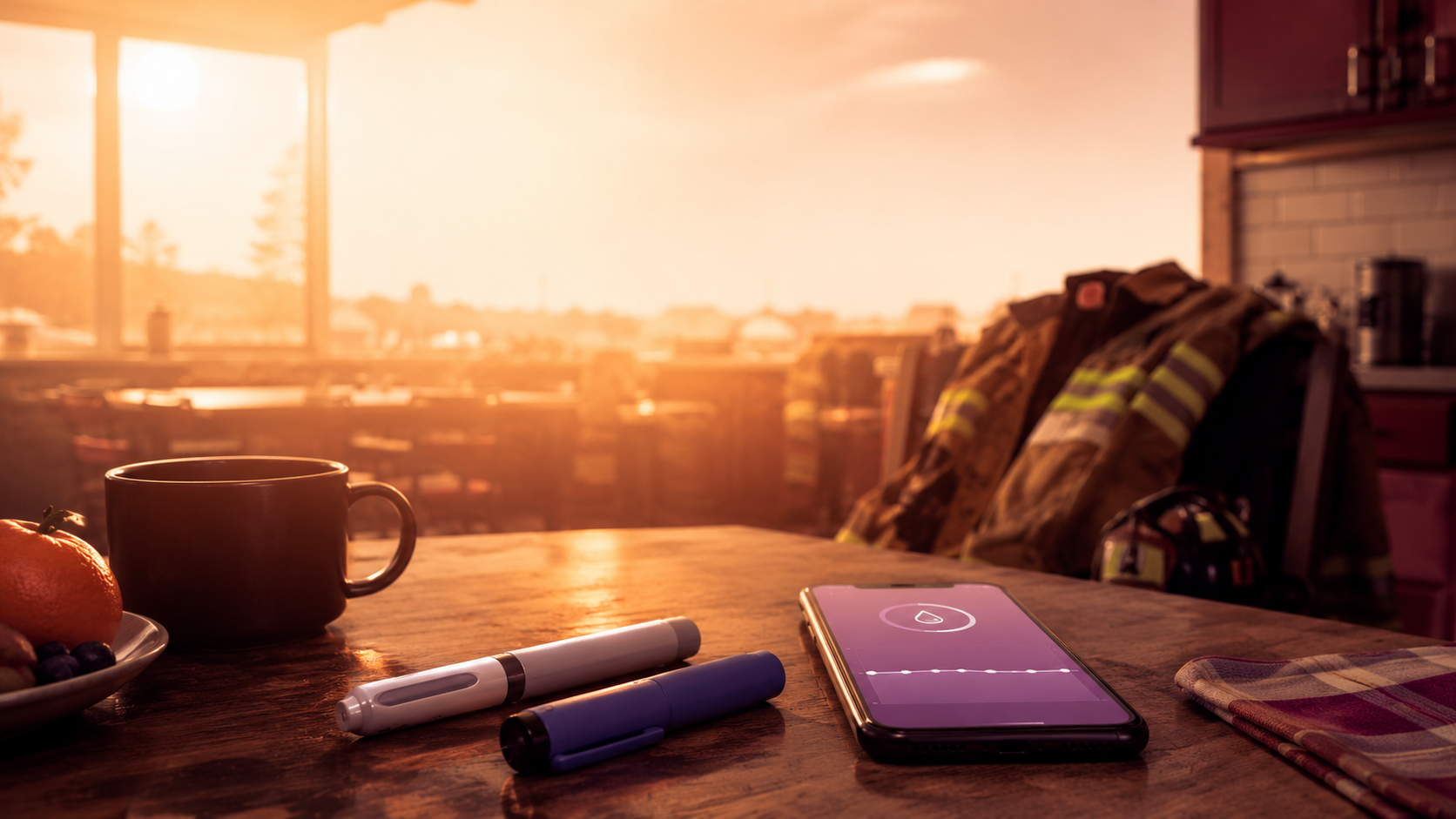
#1931 Fight Fire With Fire - Part 2
Fight Fire With Fire (Part 2)
Part 2: managing type 1 on a fire scene, a candid detour into what people get wrong about the podcast, and Nick on a GLP — half the insulin, and a firehouse-floor case against the stigma.
Jump to a moment
- On scene, he checks before he masks up. A glance at the CGM on his watch at the truck, glucose tabs or juice from his go bag if he’s trending, and a recheck during rehab. Firefighting mixes anaerobic and aerobic work, so adrenaline and effort often hold him up while the algorithm chases the rest.
- He came on partly to answer the “is Scott a jerk?” question — for himself. Nick found the show through a split-opinion thread and listened to settle it. Part 2 turns into a candid conversation about hosting, reviews from people who heard one episode, and why an unproduced show reads as more honest.
- A GLP changed his numbers. After tightening control led to some weight gain and rising insulin needs, his provider added Zepbound at the lowest dose. Nick reports losing about 20 pounds, cutting his insulin roughly in half, fewer stubborn post-meal highs, and A1cs in the mid-6s.
- He’s blunt about the stigma. Coworkers told him to just hit the gym or eat less. His answer: this is a metabolic issue, not the easy way out — the same way type 1 isn’t a choice. Scott adds the defibrillator analogy: nobody refuses the paddles to avoid “cheating.”
- Being the proof helped a family. On a call for a 13-year-old kept home for high blood sugar, Nick told the mom he has type 1 and does this job — and watched it land. His close: get comfortable with your body, get good control, and most goals are within reach.
- GLP-1 Medications series — Scott's ongoing Juicebox coverage of GLP medications and type 1 - context for Nick's experience, not medical advice.
- T1D Exchange Registry — US residents 18+ with type 1 can complete the survey and help move T1D research forward.
- Juicebox Podcast on Facebook — The private community Nick found the podcast through — 86,000 members and, as Scott puts it, the most un-Facebook-like place on Facebook.
Every word of the conversation
“You found part two”0:00
Hello, friends, and welcome back to the juice box podcast. If you don't love today's episode, you can have your money back. T1dexchange.org/juicebox. Head over there and Allan take the survey. Over 18 US resident, type one diabetes.
I think that's what you need to be. Taking the survey does not take very long, but it does do a lot to help type one diabetes research. T1dexchange.org/juicebox. Check it out. While I'm here, let me remind you that nothing you hear on the juice box podcast should be considered advice, medical or otherwise.
Always consult a physician before making any changes to your health care plan.
Hello, friends. You found part two. Scott knew you would. He believes in you. Right where he left it backed in your ears.
Let's finish the show. We're glad you're here. Part two. Part two. Scott knew you would.
Part two. Part two. You found it right where he should. Part two. You made it.
Let's get back to Scott. Wait. You haven't heard part one. Go find it now. Part two.
Part two. Part two. Part two. Knew you would. Part two.
Part two. Part two. You found it right where he should.
Today, we've got a great podcast, and it's sponsored by great advertisers. US Med, the Eversense three sixty five, and Twist. You know about Twist? It's an insulin pump. I'll tell you all about in a second.
I'm having an on body vibe alert. This episode of the juice box podcast is sponsored by the Eversense three sixty five, the only one year wear CGM. That is one insertion and one CGM a year. One CGM, one year, not every ten or fourteen days. Ever since cgm.com/juicebox.
This episode of the podcast is sponsored by the Twist AID system powered by Tidepool that features the Twist loop algorithm, which you can target to a glucose level as low as 87. Wanna learn more? Go to visit .twist.com/juicebox. That's visit.twist.com/juicebox, and twist has two i's. You understand?
Twiist.com. Visit.twist.com/juicebox. Hey. US Med is a longtime sponsor of the podcast. It's where we get our diabetes supplies from.
You could as well. Usmed.com/juicebox, or you can call (888) 721-1514. US Med, that's where my daughter gets her supplies. Use the link or the number. Get your free benefits check today and get started with US Med.
Telling the crew, staying safe on scene3:00
Then, you know, potentially have all this insulin on board with absolutely no carbs to back it up and then be in a sticky situation. You know?
Guys or did the your fellow coworkers, they treat you any differently or or they're
not really. No. This is also kind of ties into the whole reason that I'm here because when I really had first gotten the job, I had thought a lot about that and about how I didn't want people to treat me differently or think I wasn't capable of doing the job because I have type one, you know. So most of my coworkers know, all of my officers a 100% know. I've I've sat them down and and told them, hey.
You know, this is what I got. I got an insulin pump. I'm well controlled. And if I come to you and I say that I don't feel good, you know, something's really wrong, but otherwise, you know, check-in with me. Let me do my job.
I'll I'll be okay. But
Yeah.
You know, I think I think for the most part, they don't, you know, the the guys who I'm close with really don't don't treat me any different. I think I think we all have things that we come with, whether it's diabetes or somebody has asthma or somebody has other conditions. I think everybody has that thing that's happening outside of work or in their life that, you know, they just make do and mine might just be a little bit more intense or Yeah. In my face.
Might pop up out of nowhere once or twice. Has it happened? Have you ever had to go to somebody and go, I gotta tap out for a second?
No. Actually, knock knock on some serious wood. I'll go back to work tomorrow after being off. Hasn't, but not
on
a fire scene anyway. I'm I'm really good when I'm going to a fire and I get down at the truck. Like, if I'm starting to trend any certain way, I I try to look at my watch with my CGM on it or my phone really quick before I put my stuff on and just say, okay. This is my sugar. I'm at a good number.
Or, hey. I'm trending this way. I need to, you know, take a couple glucose tabs or drink a little bit of juice that I keep in my go bag on the truck Mhmm. Just just to keep myself safe. And then when I come out and, you know, we do rehab after changing out bottles and stuff, I'll recheck again.
Hey. I'm in a good spot or, no. I'm not.
Yeah.
So I I really try hard to make sure that I'm not an added issue as we're already dealing with this big, you know Right. Flaming inferno of an issue.
Oh, I wouldn't if I mean, if my recollection's correct, you're also it's a balance of anaerobic and aerobic exercise at the same time. Yes. Like, you're hustling, but you're also lifting and carrying and throwing. And and and so you are it's probably helping itself. Like, the adrenaline's probably helping keep you up.
The anaerobic part of what you're doing is probably help keeping you up. The aerobic parts probably help not letting it go too far. The pumps, these algorithms are fantastic. It's trying to stay ahead of it. Like, it's a lot of you got a lot of things on your side.
Yeah. I mean, there's it's definitely a I agree with the the anaerobic versus aerobic. I mean, it's definitely a a balancing act because, yeah, you're you're running, you know, up to it, and then you get up there. And then all of a sudden, you're now pulling ceilings or, you know, using heavy machinery like a saw or something. So, you know, you're then decreasing, you know, that that aerobic and you're starting actually moving those those muscle groups around and
Yeah.
So it it that definitely helps for sure.
Rolled hose, no socks, and the squawk box6:18
Listen. In until you've rolled up a a length of hose and turned it over your shoulder and carried it 50 yards back to a truck, you you you don't know. It's Right. It is a lot, especially after you've caught a fire for five hours. You you know what Like, there's not a different crew that comes in and cleans up when it's over.
Right. Not usually. Yeah. We might have standing here for six hours, and we're looking around, like, you know, where the hell is the backup.
Right? And Oh, we got the fire out. Now clean up. Now take this stuff back and scrub it up, and then lay it out and dry it. And, like, gee, it just doesn't it's a it's a big job.
Yeah. And then, you know, try to take a shower after doing all that. Well, guess what? You got another call. So now you gotta go you know, you're you're you're all gross, soaking wet.
You know, you you smell like smell like house fire, and now you're picking grandma up off the floor. It's like, oh my gosh. You
know? I remember one time literally crawling through a building thinking, I don't have socks on. That's all I could say. Like, we it was late at night, and it was overnight. I I I don't this is a a strange piece of little context, but I lived across the street from the firehouse that I volunteered at.
So I was frequently the first one there. Sure. And and but sometimes you'd get so yanked out of bed. Like, we used to have this thing. God.
What was the company that made this? It was like a squawk box. Right? And it didn't I I I mean, technology is so much different now. People probably can actually don't understand this.
But, like, imagine being asleep in your bed and a thing I'm gonna I'm gonna face away from the microphone for a second. A thing in your bedroom just goes wee. And like that, you're like, what the hell? Like, so you're bold upright at that point, and you can't even you can kind of hear voices. This is RF radio coming from, like, you know, 50 miles away.
Can sorta hear, like, a voice say, like, you know, engine one respond blah blah, like, to a fire and, like, know, like, okay. And one time, like, I got up and I just it's I'm you know, I get yanked out of bed. It's 02:00 in the morning, and I couldn't find socks. And I could hear them talking about what the and I just I don't know what happened. I just ran out of my house.
Yeah. And now, like, I'm now I'm in this goddamn boots, which, by the way, I wanna tell somebody a story. The last time my bunker boots got replaced, they let me keep them. I was 19 years old. I am 54 now.
I still use them to shovel snow. It's maybe one of my greatest personal, like like, possessions. Those things are they're And, like like so I still have my boots. But but you're in those boots. They're not exactly made for comfort.
My feet are just rubbing against the inside of them. We're crawling through a building, and I remember thinking, I wish I had socks on. Yeah. Oh. For sure.
You're good. But but it's just it's a it's a weird thing to do. I only did it for three years. How long have you been at at this now? Diabetes, as you know, comes with a lot of things to remember.
Cold open & sponsors9:05
So it's nice when someone takes something off of your plate. US Med has done that for us. When it's time for Arden supplies to be refreshed, we get an email. The email just rolls up in my inbox. It's like, hey.
This is, you know, time for your supply order. I don't exactly know what it says. I open the email. There's a big button. I click on it.
I reorder, and I'm done. Finally, somebody taking away a responsibility instead of adding one. And boy, oh, boy, has US Med done that for us. An email arrives, we click a link, and the next thing you know, your products are at the front door. That simple.
Usmed.com/juicebox or call (888) 721-1514. I never have to wonder if Arden has enough supplies. I click on one link. I open up a box. I put the stuff in a drawer, and we're done.
US Med carries everything from insulin pumps and diabetes testing supplies to the latest CGMs like Libre three and the Dexcom g seven. They accept Medicare nationwide, over 800 private insurers, and all you have to do to get started is call that number, (888) 721-1514, or use my link, usmed.com/juicebox. Using that number or that link helps to support the production of the juice box podcast. This episode of the juice box podcast is sponsored by the Eversense three sixty five. Get 300 and get three hundred and sixty five days of comfortable wear without having to change the sensor.
When you think of a continuous glucose monitor, you think of a CGM that last ten or fourteen days. But with the Eversense three sixty five, it lives up to its name, lasting three hundred and sixty five days. That's one year without having to change your CGM. With the Eversense three sixty five, you can count on comfort and consistency three hundred and sixty five days a year because the Eversense silicone based adhesive is designed for your skin to be gentle and to allow you to take the transmitter on and off to enjoy your shower, a trip to the pool, or any activity where you don't want your CGM on your body. If you're looking for comfort, accuracy, and a one year wear, you are looking for Eversense three sixty five.
Go to Eversense c g m dot com slash juice box to learn more.
Four years in, and buying a house11:17
So I got hired with my department in 2022. So I just hit, I just started my full fourth year.
Wow. You think you're gonna keep at it?
Yeah. Absolutely. I mean, you know, truth be told, I've when you ask kids what they wanna be when they grow up and I was, like, five and I said a firefighter, and then, you know, when I was 10, I said the same thing. And I think it's just something that I've always wanted to do. That's awesome.
So it's it's a good job. It's it's rewarding. And, honestly, from a selfish standpoint, I like doing it.
And Yeah. Is it pay okay? Is it provide a decent lifestyle for you?
Yeah. I mean, obviously, I think if you ask majority of firefighters, they're gonna tell you for the work we do and for the things we have to endure. It's not enough pay. Mhmm. But I think it's definitely enough where, you know, I can provide for my family and and be comfortable Nice.
For sure. That's awesome. Do you guys plan on having kids or getting married, the two of you?
Yeah. I mean, we we have these plans. So we actually bought a house together, this past summer.
So Congratulations.
We're doing all of the thank you. We're doing all of the the married things, you know. She's obviously got my son, which is like her stepson, but just trying to find the right time. But I I definitely think, you know, once we once we do get married, I think an another child might be in the the mix for sure.
No. Well, hey. Listen. In 2026, you figured out how to buy a house. You're you're doing pretty well.
It's the the difficult thing to accomplish nowadays.
It it was. I mean, we we were on a house hunting journey for quite a while, and we we probably looked at, like, almost 40 houses
That's crazy.
But bids on half of them and got outbidded every time. And we're we're putting, like, serious serious over asking offers in and
Yeah.
You know?
No. It's not a, it's it's it's not it's not a great time to be young and trying to buy a house. That's for sure. No. For sure.
Okay. So I feel like I okay. Is there anything I haven't asked you about that I should have? Like, this is the part where I I worry I start worrying I haven't done a good job. So anything because I have another question for you, but I wanna make sure based around your work, is there anything left?
His message: anything is possible13:22
Not really work. I just I think the the whole premise though is that, you know, I just want everybody to know who's listening. But especially, like, the younger kids, you know, or or parents who have younger kids with type one that, like, anything is possible. You know? And if if your kids grow up or you even as a person, you know, think, oh, I I can't do that because I have type one.
You know? Try again. You know? Right. Really really hunker down, get yourself under good control, get comfortable with your body, and then I think a lot of a lot of goals are really easily attainable if you, you know, put your mind to it.
So don't be discouraged.
That's a great message. I appreciate that. So I wanna I I wanna kinda not go backwards, but you you talked about meeting your your new practitioner, you know, pulling pulling settings together and everything. But then it sounds like a number of years later, maybe three years later, you found the podcast. So what led you to look for a podcast?
Did it find you, or did you find it?
It's a great question. I honestly think maybe a little bit of both. So, like, I I specifically remember just relaxing. I think I was scrolling social media, whether it be at, like, Reddit or Facebook or something. Mhmm.
And it was like a diabetes group, not your diabetes group, of course, at that point. But it was a diabetes group and somebody was, you know, either talking about something or complaining about something that had happened or whatever. But somebody had mentioned the Juice Box podcast in the comments, and I was like, this is kind of interesting. And there was a couple a little bit of discussion about it. Like, some people were super for it, some people were like, oh, you know, I'm not really sure about that.
And I was like, just kind of interested. I was like, okay. Well, what's the hype or what are they saying?
Is this guy great, or an ass?15:16
So Oh, so you're I kinda so you get in a position where you're like, either this is awesome or this guy's a prick. I'll go find out which it is.
Well right. But it was like it was so stark differences. People were like, oh my god. This is great. And they're like, no.
This guy's complete asshole.
I know. I I'm
like, like, what what's the answer here? So I almost, like, I almost kind of searched it to be like, well, damn. Now I gotta figure this out for myself.
I gotta tell you. I don't I I don't know the answer.
So so I I listened. I don't can't remember the first episode I listened to, but, like, wasn't something that was really, like, personal to me. It really didn't, like, super resonate with me. So I was like, oh, like, I I caught the vibe, you know, and I was like, okay. Like, that's kinda cool.
And then like a week later, was driving to work and I'm like, I don't really wanna listen to music. I'm like, maybe I should try it again. And I listened. Again, I don't remember what episode it was. Sure.
And I was like, wow. That that person talked about points that were, like, practical to me. They said things that I had maybe gone through. I remember having that kind of feeling listening to it.
Okay.
And then it just kinda took off from there. It's something that I listen to all the time in the morning and in the evenings when I'm going to and from work. That's when I normally listen to it. But
Can can I ask, do you find now that you're more into it that conversations that don't feel like they're for you are still valuable, or do you skip some?
For sure. I I usually at least try to listen to all of them. I feel like there's always sometimes those statistical outliers where you're like, yeah. Like, I'm I'm just having a hard time kind of getting in the in the groove with this conversation.
Yeah.
But I do think that understanding everyone's stories, even if they don't align with you, hearing just the diff the the the way that people think differently, the way people operate differently, I think it adds a lot of valuable, you know, other thoughts for yourself. Like, oh, I I never thought of that that way or wow, that's a great way to do that. You know? Yeah. Even having diabetes for thirteen years, not as long as some people have, but, like, listening to someone's story or or somebody saying, hey, this is the way I do it.
And you're like, holy cow. Like, I never thought about that. Right. You know?
I listen. I I am very interested in people. Like, so I it's not hard for me to have a conversation that doesn't jive with what I would do personally. Right. But I do wonder sometimes, like, when you have that feeling like, oh, this one's not quite right for you know, is it me or is it them?
Like, am I not doing a good job of of because, like, there are I mean, there are people I've interviewed that if I'm being honest with you, if I was listening to a podcast, I wouldn't be interested in them. Like, if if I was doing it for entertainment. But as the person making this, I think there's probably something incredibly interesting about them and I wanna hear it. But I wonder if I fall short of being as engaged sometimes. And, like and I don't know if that comes I how that comes across to somebody who's listening.
Right. I get what you're saying, but I think I think there's only like, being the host, I think, puts you in a in a interesting place. Right? Because you obviously are helping guide the conversation. You can definitely make or break it with the direction that you take that person or if you're not catching, you know, the the cues that they're setting for you to kinda take them in the right direction, you know.
But I also think that at the same time on the other side of the coin, like, you're dealt the cards that you have, you know. So if you are interviewing somebody that people for who are listening for enjoyment might not necessarily find intriguing per se, I think that can be hard to you can only shape a person so much before you're just you know, you can't really shape them anymore.
What a host can and can’t control18:55
Yeah. You see something interesting there that I think about a lot, which is, like, I can only an I can only ask the questions that occur to me. And there's times, by the way, that I'm tired or it's later in the day or I'm I'm I'm wasted for some reason or, like, I I know I'm not always at my best. Like, that's neither here nor there. Like like, but I only can think of the questions that I think of.
Right.
And and it it's never lost to me that another person would have asked a different question in that situation, and this would have gone in a completely different direction. And, normally, people are really kind about it. Because I'll ask, like, you know, you'll see. We'll get done. I'll be like, hey.
Was this okay for you and stuff like that? Because, you know, when you're not being recorded, you don't have the pressure to, like, acquiesce to me. Right. Like, then which, by the way, there's no real pressure for that, but there but I know some people feel that way. Like, I'm like, you know, I'm a voice on the other end of a thing.
You might have had a really great experience with. You might have been listening for a long time. It's probably hard to tell me no in some situations. So, like, I like to get you not being recorded and say, like, were you comfortable with all that? Like, know, that kind of stuff at the end.
And I do wonder if sometimes people don't push back because I'm the guy from the thing.
Right.
And and I and I feel badly about that, but I don't know how to I don't know how to effectuate that at all. Like, you know what I mean? Like because there are some people come on here. Like, the woman I interviewed yesterday, her name was Eden. She was awesome.
But before we started, she's like, I am really nervous. Right. And I was like, why? And she was, I I don't she's she pauses and she's like, I don't I don't I'm just really, really nervous. And some people will tell me, well, you're famous.
And I'm like, no. No. I'm not. Like, I'm in a small room in my house making a podcast. Like, you know what I mean?
Like, I'm I'm I'm Right. That's crazy. But to them, it's not. And so when I say when I ask a question, I never know. Like, sometimes I wish people would push back more or you know?
And I think you do. Like, I've said things to you today, you're like, well, actually, that I appreciate because I'm not right. I'm just doing my best to, like I don't know, keep us moving forward.
Sure. Well, I mean, it it should be a conversation. Like, I think I think if you were to not that you would ever do this, but if you were to tell people, oh, I'm not recording, I think you would actually get people who are a lot more candid. Because I do think people hear that that whole, like, recording thing.
Oh, shit, son. You have no idea. The minute I the minute it stops, there's something people's voices change.
Right. Right? And and I could see that. And that's that's what it should be. And I think, like, I was definitely when I signed up, I was like, oh my god.
I'm gonna do this. And I'm like, hold on. This is like months out. You know? I took a breath.
Mhmm. But then I realized, like, coming on the podcast, like, you don't have to do much research. You you know, that this story should usually come pretty easy because it's usually about you or something that you or a loved one has has lived through. You know?
I I tell people, I'm like, I'd be stunned if you didn't know the answers to the questions I ask you. Like, that Right. This is not a thing you're studying for. That's for
sure. Right. And it's not multiple choice, so you don't have, like, a 25% chance of getting it right. Yeah. Like, I
How do you feel?
Pretty good chance you're gonna get it right.
Yeah. Yeah. What's your feeling? Like, you by the way, some people share their feelings, and I bet you they feel differently about them later or might even say, oh, I I would have said something different. But I I periodically get emails.
By the way, when you find yourself sending me this email, just know it's not gonna go the way you expect. Here's what makes Twist different. It measures the volume of insulin delivered with every dose using Soundwave technology. That gives it the ability to recognize a blockage quickly, allowing you to step in and deal with it before things potentially get out of range. It is also the only automated insulin delivery system that can be controlled from an Apple Watch, so you can discreetly check-in, enter carbs, or deliver insulin right from your wrist.
You can also set your glucose target anywhere from 87 to 180 milligrams per deciliter and adjust it for different times of day. So if mornings, workouts, school work, or bedtime all need a little different approach, Twist can flex with that. And here's a real life example. You enter carbs, then something changes, and you do not actually eat what you planned. With Twist, you can go back and correct or remove the carb entry, and the system adjusts based on the new information because diabetes doesn't always follow the plan.
And your tech probably should not expect you to either. If you'd like to learn more, go to visit.twist.com/juicebox. That's visit.twist.com/juicebox. Don't forget, twist has two i's. When someone emails and goes, I need to do that again.
I didn't do a good job. That's not happening. Like like like, you're just you're gonna say the same things, and I'm gonna ask the same questions because you and I had a vibe together, and that's what's gonna like and some and and just take from it that someone's gonna get something from your conversation even if it's not the thing you were hoping to impart when you started. Something came from it, and that's good. You you know?
But oh, okay. That that's interesting. I I appreciate that. Does your girlfriend who would do suggested you come on, does she listen, or does she just know what it means to you?
She I don't know. She's obviously gonna listen to this episode. Yeah. When
you say that she's the most kind, beautiful woman you've ever met.
She is. Yeah. A 100%.
There you go. Good job. A 100%. Yeah. Yeah.
But we because when we bought our house, it is a 100 years old, so we've been in the process of doing a lot of remodeling and kinda bringing its charm back to it, you know, that type of thing. Yeah. So there's been plenty of times where, again, we've kinda tapped out on the music. And I said, oh, you know, I'll throw the podcast on. So she's kind of passively listened to a couple episodes.
I mean, there's been episodes where I'll come home and and talk to her about it or, you know, certain things like that. So Yeah.
She said that lady on Reddit was right. He is an asshole.
No. She hasn't said that to me yet. So at least you got you got two two two fans over here.
Well, thank you. Oh, I'll contextualize it for people listening and for you a little bit too. When I I'm not trust me. I'm not wrong. The minute I hit stop, a lot of people, their the pitch in their voice changes, the pace they speak at changes.
They they they do get a little more often. Even people who are very open get a little more open. Like, it's and and I understand that. These are not people who are used to being recorded or doing stuff like Right. It's up to me to be unguarded.
Like like that that like because I'm already grabbing people who are who are just they're not practiced at this. Right? And and I think you one, you get from them a lot of honesty because they're not even they're not media trained to, like, protect themselves. Like, you know, you get somebody on here from a company. They've been media trained for Oh, right.
Dozens of hours about things not to say and don't use this phrasing and things like that. Like, their lawyers will beat that into their heads. I I don't have that. And I could. I don't I mean, could I do it?
I probably could. Would I want to? I don't. But I also think it takes the authenticity out of the conversation. Like, so I am for people who have listened before and thought, like, oh my god.
He's a narcissistic or he's this or he thinks I hear people say, what woman told me yesterday, like, she's like, I have I know somebody whose kid also has diabetes, and she won't listen to you. She says, you think you're a doctor. And I'm like, I don't think I'm a doctor. And she goes, well, she thinks you do. And I'm like, okay.
Well, there so I gave her that impression at some point. Right? Like but I can't be worried about any of that. Like, I have to just talk, and then those people who are gonna enjoy it are the ones who are gonna benefit from it. And the ones who don't I couldn't have reached you one way or the other is is sort of how I think about it.
Reviews, disclaimers, and staying real26:23
Well, I think that's I think that's any platform, though. I mean, you look at even keeping it diabetes related, some of these other type one influencers that are out there, like, there's always the hate side. You know? There's always gonna be the negative. And, also, you know, the disclaimer obviously says it's not medical advice.
I mean You know?
Yeah. Always talk to a physician. Right?
I've been using disclaimers before disclaimers were cool, Nick. Okay? Because Right. Exactly.
Be But I mean but I mean, that's the thing. Like and I think I think the difference though too is, like, people are like, well, this this guy's an ass. Well but is it just this episode? How many have you listened to? Because if you, you know, have a a certain vibe with someone you're talking to, yeah, you might be more sarcastic or you you guys might have a
Yeah.
A more lighthearted conversation versus you're talking with somebody who's really struggling and you're trying to help them get back on their feet or get their settings right for their kid. Like, I think those are two vastly different not different Scotts, but different versions, different conversations that are being had. So
Yeah. You're all like that, by the way. I'm just the only one recording myself every day. So Right. Right.
And I would say I would listen. I I had a review at some point in the last year. This person was like, look. You know? I everybody told me this was good, and it wasn't.
And then you see as you're reading the review that they listen to one episode. I'm like, well Right. How how can that part baffles me. Like, if you don't like me, that's fine. If I turned you off enough that you don't wanna listen again, I mean, even that's fine.
Why would you write a review about it? Like, you you've listened one time to something with eighteen hundred hours of content, And now you heard forty five minutes of it, you're like, I know all about this enough such that I should go tell other people about it. I'm like, you don't know me. By the way, you could listen to all 1,800 of these. You wouldn't know me.
And it it's it's you you'll get close. I don't really I don't I don't think I hide a ton. So, like, I you're gonna get pretty close to knowing me. But but you're not gonna know everything, and it's I don't know. I find that such a weird thing.
I listen to plenty of stuff. I really am a a I listen to a lot. I'm listening to this interview now with this British doctor talking about type two diabetes. I wish he'd come on my podcast, but he's on such a big podcast now. I don't think I could I don't think I can corral him.
He's he probably probably his head's probably as big as the as a as a balloon at this point. He's on a really big show. Yeah. But, like, I'd love for him to come have this the conversation he he seems to have. Like, I would love to have it here.
But, I mean, I don't know how it would go. And maybe I'd say something silly in the middle of it or not. I don't know. Like, it just you just keep talking and something comes of it. But I I again, I don't know.
Like, I listened to him. He was talking about some things, and I thought, oh, that'll that that's gonna make people mad. And this isn't and I but I was real re respectful of the guy because he didn't care. He's like, this is how I they I've been doing this for decades. These are my takeaways.
I'm I'm sharing them here with you. You know? And Yeah. And I thought I think that's sort of what I do a little bit. Like, you're everything's not gonna come out smooth, and everything's not gonna make everybody happy.
But at least it's been said, and you can filter through it now and do what you want with it.
Oh, absolutely. Absolutely. And, I mean, I think that's also the piece that some of those particular people might forget is that, like, if you come into this and just expect this one person who's got all these podcast episodes to just, like, come in and sweep you off your feet and up one episode had all the answers to my problems. Like Yeah. Yeah.
You're you're probably gonna be let down quite a bit. Oh, yeah. But if you use your good personal judgment and you you listen to other people's stories, you you listen to the pro tips, you use these things, and then kind of cater them to how they can fit best into your lifestyle, into your treatment plan, or your kid's treatment plan, whoever, I think that's when you have the success. I think that's when it it actually comes in. I I I don't know if it's just unrealistic expectations or
Right.
What it might be. But
Also, it's not a it's not a movie. I'm not, like, I'm not as handsome as, like, you know, a mid twenties Brad Pitt, and I'm not being shot with giant cameras from 17 angles 43 times, then we pick the best one. Like, you you know, like, I'm I'm I'm that's not happening. Even, like, a lot of these video podcasts you guys are watching, they're really highly produced. Mhmm.
You know? I am not like dude, I sat down here and turned this thing on. I was like, oh, I'm late. Like, I was like, too I felt bad about that. Like, I felt like but but I was late because three minutes before that, I was at my front door talking to a guy who stopped by and wanted to sell me something.
I was like, no thanks. I gotta work. Right. And, like, you know, like and I've been up early today because somebody had to come measure for carpet in the office that I made for myself. Like, I'm not I I don't know.
I was watching this podcast the other day. This guy's he's huge. He must have 2,000,000 followers. And it's really I think it's really well done. I'm a fan of it.
But you realize, like, he's in a studio with a crew. Yeah. You you know? And, like, and lighting and scripts. And he's he's got seven producers who sit down and talk about what they're gonna talk about beforehand.
And I'm like, I'm just getting on here and going, so you're Nick? Right. Right. You know? And there's
That's kinda one of the draws, though. Right? Because it's
I hope
little more raw. I mean, at least to me, like, I've heard people cry on the podcast. I've heard people swear. I've heard people, you know, get upset and and beat their chest, you know, for lack of better words.
Right. Right.
I think that's what that keeps it real because I think there comes a point where you're, like, almost overproduced some of those
I think yeah. This the one I'm talking about is is done I think it's done well. Is it called Diary of the CEO maybe? Maybe it's gotten away from that. He's a British guy.
He's young. I don't know what the hell his name is. I also, that's I it's important for me to remember when I talk like this when I'm like, I can't believe people don't know the name of the pro tip series. Telling you about a thing I watched an hour ago, and I'm like, I don't know that. Maybe his name's Steven.
Like, I don't even know. It's weird for me to think that somebody's thinking of me that way. They're like, I don't know what his name is, but, my a one c went down.
Right. Right.
It is. It's called it's called diary of a CEO. He's like, I I don't know if he's the 30 guy, British guy. And I think he does a I think his show does a good job. Like like and he picks topics, and he talks through it.
And he's talking to this doctor named Unwin, David Unwin, and they're talking about, like, sugar and healthy eating. And I gotta tell you, for half of this conversation, I thought, they're talking about glycemic index and load. I've been trying to get people to think about that for ten years. And these two were having a conversation about it like they like like like, they just discovered it. And I'm like, oh, okay.
But I'm glad somebody's talking about it. It's awesome. Because, you know, I chose I chose when I started doing this, Nick, to to say I can't I don't think I can effectuate how people eat, but I think maybe I could affect how they think about using their insulin. Yeah.
I agree
with that. Right. Right. And then to hear somebody twelve years after I started doing this, like, having a conversation I know these conversations happen all over the Internet, and they were happening before me too, where they're talking about, like, oh, the quality of the food, and there's way more sugar in in things than you think there is. There's way more sugar in carbs than you think there is.
You know? Here's how your body breaks down a carb and turns it into glucose. And I'm like, yeah. Yeah. I've been trying to tell people that, but at the same time, I don't want them to shut off and not take care of their diabetes.
Like, I had to pick one.
Right.
Does that make sense?
Yeah.
Yeah. Yeah. And so, like, I'd like to have that conversation, but there's part of me that thinks that people will go, oh, well, I thought you told me I could eat whatever I want and just bolus for it. And I I do think you you could could do that. I also think you maybe shouldn't drink a glass of sugar.
Like, so Right. You you know, like, it's but I but I've chosen one side over the other. And then at my peril, because people who eat low carb then call me a carb pusher or an insulin pusher. And I'm like, man, you cannot win in this world.
Like like You're never going to.
Yeah. Yeah. So, anyway, I hope you all take good care of yourselves and and have great success like Nick does. Look. Nick's crawling around in a smoky building, dragging a trust me, those hoses are heavy as hell when they're charged.
Mhmm. And he's he's out there trying to help people, man. It's really cool. What did we miss though? Anything at all?
Tell me if I missed anything.
The pivot: Nick’s on a GLP34:45
I don't know if we necessarily missed anything. I just had here too since I know it's kind of been a big topic on the podcast. I actually got put on a GLP, this past year
Tell me.
As well. So I
Hey. Take By the way, Nick, you just got yourself a two part episode. Go ahead.
Oh, sweet. That's actually funny you say that not to not to segue too far, but when I was before I was coming out, was talking to my girlfriend. I'm like, what do you think? Am I gonna be interesting enough for a two part episode or are we gonna cut this short?
Nick, I'll No.
You you could do it.
Do do some of them feel like they get cut short?
No. No. No. No. I I was just saying, like, me, like, am I just gonna have nothing to say?
Like, am I just gonna have total brain fart?
You know? I'm glad you say that because there are times when, like, I have to end at an hour. So I've said this before. It's behind base it's a it's a little inside baseball. But, like, you know, there's a gentleman that, you know, has a business and he edits the podcast.
I can't I can't send him a two hour episode every day. Like, a, I can't afford to pay him, and, b, he can't he can't actually get it done. Like so, like, I need some of the episodes to clock in at an hour. And For sure. And and there are times there have been times, I I couldn't tell you which ones at the the where I I wind it down and I think, oh, I'm not done yet.
Right. But No. I get that.
Yeah. But but it it and it it hurts because I am really and I don't know if people would find it interesting. Maybe I'm being saved by my, you know, by my my better angels here and not not knowing it. But I could probably talk for a couple of hours every day to somebody.
100%.
I mean,
I I could too. But, again,
it's kind of Yeah. It's good.
Yeah. It's
good. You're you're actually a great mix, Nick. You're a guy who is you're talking like a guy, but you're effusive enough that it you don't sound shut down. And Right. Well, I appreciate that.
And you're willing to talk and you're and you're somehow a little wise beyond your years. Like, twenty eight's not I don't know what happened
to you. I've I've always been told that, like, my whole life. Yeah. They actually that's the running joke at work. Like, oh, I'm the youngest guy on shift, but yet somehow I'm like the old fart.
Listen. My favorite story from fighting fires is that at, like, you know, at a job, something was going off. It was like 01:00 in the morning and I wasn't supposed to be there because I was too young. But because I live next door and I was good at it, I just used to go and people would ignore it.
Yeah.
And so I ran a lot of calls illegally over the time. I won't tell you where it was, but I was too young to actually be out because I wasn't supposed to be out after midnight. And so they're loading up a truck to go, and I'm up front. And I'm basically, like, back then, I I I people find it hard just to believe, but the the the there was a book. It was a book with pages in it.
That was the map. That's how we gridded our way around the town.
Yeah. Yeah. Yeah. Yeah.
Yeah. And so I'm getting ready to run the book and the radio and get us there and get us to the hydrant that we need to like, I'm getting ready to do all that. And a a guy twenty years older than me comes up to the door, opens the door, looks at me, and I think they called us Probeys maybe or something like that. I forget what we were. And he's like and he said that, and he's like, out.
And he was right. Like, I I was filling the spot, and I should have left when somebody else came. And the driver reached across me, grabbed the door, pulled it closed, and goes, I'd way rather have him than you, and he drove away. Wow. And that was tough because then people did not like me as much after that.
For sure. But I But, again, that's that's that politicking thing, you know, a little bit.
You know? Yeah. Yeah. Well, that guy, the driver didn't care about the politics. He cared about the truck running right.
Right. Well, absolutely. Right. Absolutely.
But I was I've always been sort of like a like I think I code older than my age sometimes, especially when I was younger. And I actually got an opportunity to meet that guy again in the last two years. It was at a funeral, which was sad, but he was in his seventies. And I reminded him from that. And I said, I have to tell you, like, even though we don't know each other anymore, I was like, you are a huge part of my self confidence growing up.
Yeah. Like like because I was like I wasn't, like, in great I was probably chunky, like, a little short. Like, you know what I mean? Like, I I didn't fit the bill, but that guy was like, listen. You can think, and that's important.
So you come you come with me. And, anyway, I'm sorry. The the web.
That's okay.
Once I said two parter, like, my brain just reopens again.
Zepbound, and half the insulin39:09
Right. Right.
Right. On a GLP. How did that happen?
Yeah. So when I had kinda restarted getting myself better under control in, you know, handful years ago, I think that I definitely had some weight gain. Well, I don't think. I know for a fact. I had had some weight gain.
But but I had also just kinda noticed, like, I think my metabolism changed because I'm starting to get a a little bit older to that point now. And I think that since I had really gotten a lot more, not to use your phrase, but a little more bold with insulin, you know, and and really start to get things under control. I think that just kind of affected my my body more than I was actually anticipating it would.
Yeah. That's when you learn you might be taking in more calories than you think you are. You know?
Right. Yeah. And, like, you know but then I was also I feel like too with that, you also have that, like, when you're trying to hone in your settings and then you
Get lower.
Or right. Finding yourself getting low, and now you're, like, constantly, like, trying to snack, and then all of a sudden you're fighting these highs, and it's like, hang on a second, like, you know. So between that and just not being training every day, so coming out of the academy, getting really tight sugar control, trying to to navigate, you know, the highs versus the lows, trying to stay somewhere in the middle, I feel like that's kinda where things went a little little cuckoo. So
Okay.
I had talked to my provider, and she was like, well she's like, you're using more insulin because, you know, whatever reasons. You might be a little resistant at this point. And she said, you know, why don't we try a GLP? It'll help you lose a little weight. It'll keep, you know, help your cardiac function and, you know, help give you all the added benefits of having the GLP with your your heart and your kidneys and stuff.
And and she's like, I think it'll also help your a little little bit of insulin resistance. So I said, okay. So I've been on the, Zepbound, the two point five, the the lowest dose, and, I lost, like, 20 pounds, and I've cut my insulin needs in half. And it's been super big. So, like, my last a one c, a little bit higher than I wanted it to be, was a six point eight.
My one before before that was a six point five. Good hear. Mean, I've
That's awesome.
I've been super happy with that. Yeah.
Good for you. Do are you continuing to lose weight, or do you has your body kind of found a stasis?
I think my body's kind of hit a stasis. I haven't okay. So my last appointment, was supposed to go see her and I had something else come up so I had to reschedule knowing the endos and how hard they are to get into. I don't have my rescheduled appointment until September, but, I think my body's kind of hit a stasis. You know, there's obviously a lot higher of doses that I can go.
I I don't know how my provider feels about it, but I think it's definitely I mean, she's always up for discussion. She definitely is very open to things that I bring to the table. So increasing to the next dose of five might be beneficial to me.
Yeah. Do you feel like you have weight to lose?
I mean, I'm sure we all feel like we have weight to lose.
I listen. I don't know if you saw my Instagram this weekend, but, like, I had a moment this weekend where I'm down, like I I think I've lost, like, 65 pounds. I probably lost 70 and put, like, five back on or something like that. Wow. But I was I I don't wanna I probably said this somewhere else, but I was so I don't wanna go all the way into it.
But I was meeting a friend in a public place, and as I walked in, I felt like, oh god. I picked the wrong shirt. I look fat. And so much so that I went into the bathroom to look, And then as soon as I saw myself in the mirror, I was like, yep. There it is.
Look at you. Like, look look at this disaster. And then I stopped myself, and and I was like, this is crazy. Like, I don't I I this doesn't look bad at all. And, like, but why do I feel that way?
Like, why is the shirt grabbing me? Like, why do I feel like the shirt's grabbing me? Why do I like, all this stuff. And I just took a picture of myself so that I could look at it, and I'm like, I look fine. Like, I don't know what, like, what my brain's trying to tell me right now.
But, like and then I thought, bet you other people are feeling like this because a lot of us are using GLPs and not just people with diabetes, but everyone else too. And and I so I made a post about it. I I think it's been one of the more popular Instagram posts I've put up in a really long time because there's so many people like, oh my god. I feel like that too. And Right.
So yeah. So I don't know what what I'm supposed to feel like or look like. I, you know but I'm I'm asking you. Yeah.
Oh, I get what you're saying. But I also think that when you are somebody, not that I know from personal experience, but I guess relating it to my experience, like, when I was growing up, like, I was always pretty pretty thin. Like, I had a really high metabolism. And I think when that changed for me, was kinda like, wait a minute. Like, who is that in the mirror a little bit?
You you know? And you just had to kinda learn to see your body in a different light. I think when you are somebody who might have, you know, be be a little overweight or somebody who is used to seeing themselves a little heavier, even when you do lose all this weight and you make all this progress, you almost look at yourself and in an inverse way, you're like, wait a minute. Who is that?
Yeah.
Or you're always sort of guarded because now there's sort of part of you that's always like, oh my god. What would happen if I went back to that? Or Oh, no. No. People think you know what
I mean? Yeah. No. I don't wanna I definitely don't wanna go backwards. That's for sure.
For sure. Nobody does, but I think you almost kind of have trained your your brain to be guarded in that way a little bit or so I would suspect. I can't speak for you, but do you know what I mean? Like, I I think there's there's changes that happen physically, but sometimes I feel like our brains and eyes and bodies don't necessarily work together when those correlations you know, like, when those when those things happen.
Yeah. No. No. I I mean, there's there's a you know, I think it's pretty reasonable to call it, like, body dysmorphia of some point. Like, I don't see myself well.
Like, listen. I I can you promise not to tell anybody when you get done here, I think I can say this because it'll be far enough out in the future. But, like, I I filmed a a a commercial for for Omnipod recently.
And Okay. Was it the one I saw something of?
No. You saw me do a video where I explained, like, some settings and stuff like that.
I actually Okay.
I actually made a commercial with them and a lot of other people, by the way. But Cool. But yeah. You would think. But, you know, the feeling of, like, oh god.
Like, they're gonna point that camera at me, and I'm not stood on the stage. I'm not, like, go rigged up and, you know, standing perfectly the way they want me to. I'm gonna be moving around doing it. I was, like, I was pretty mortified. Like, I was like, this is gonna be terrible.
I'm gonna look horrible. I'm gonna do a bad job. Like, I was pretty sure. And I got done, and the first thing I did was, you know, I texted the person who, you know, you know, asked me to do this thing. And I said, guys, I'm so if I get you fired, I'm so sorry.
You you know, like like and and she goes, I don't I don't know what you're talking about. I'm like, I I think I did a really bad job. Like, I don't even imagine you're gonna be able to use that. And that's all that, like I don't know where all that comes from because I got done and she says, Scott, listen. We we've seen the the rough cut already.
She's like, you're fantastic in this. Like, she's like, you are so personable and, like, like, at ease and, like and she and she's like, I I genuinely don't know why you feel that way. And and she's like, I just, you know, let me be comforting and tell you that's not the case. But I I don't know that about myself. Like, I Yeah.
Like, I if you made me sit here and intellectualize about it, I could remove myself from myself and tell you the things about me that are positive. But while I'm living, I don't feel that way. Oh, right. Yeah. You know?
And so, like, it it's it was really, like, I was worried about how I was gonna look. I was worried about and I I don't wanna give away too much, but it's a kind of a a comical thing, and that part I was fine with. But, like, I I mean, like, am I gonna look old? Am I gonna look fat? Am I gonna look like like, is this gonna be embarrassing?
Like, you know, I'm sure it's going to be. And then she sent me a couple of stills, and I'm like, this is fine. Like, I wonder what I was worried about even.
Right.
I mean, it's You know?
It's easy to get in your own head, though.
Man. 100%. Two two seconds in, and it didn't stop me. I still did the thing. But I was so unsure of it that as I walked away from it, I thought, oh god.
I botched that. And then and then you hear back from them, they're like, oh, it's so natural and good and blah blah blah. I'm like, wait. Really? Like, how is that?
I so, anyway, it and I don't know if that's ever gonna go away. I should just stop doing stuff like this, and I wouldn't have to think about it, honestly. But it it it is a good growth thing to go do something you're uncomfortable with. Yeah. But, anyway, I I you know, going back to this weekend, I I left that bathroom.
I put that post up, and I thought, I hope this helps somebody. I'm not I'm actively not gonna think about this again. I'm gonna walk around and enjoy myself. And and I did, and I didn't think about it again. I did actually, when I got to my car later, I real I found myself going like, oh, I put that post up.
I wonder if anybody interacted with it. And so it was a few hours later, and I went back and looked at it. And I think it had, like, 400 likes already, and it had been viewed, like, 16,000 times, like, because I figured and I was like, oh, wow. People are, like, looking at it. I'm and they're mostly saying the same thing I'm saying right now, which is I don't know.
Would he stay on it?48:25
Anyway, do you think you'll use a GLP, like, now that you see the impacts of it on your blood sugar? Do you think you'll just you think you'll continue to use it at a low level?
I think so. I mean, even if even if I stay at this level, like, I think I've really found a good kinda happy place because it's even wait. Like I said, wait aside. I mean, just decreasing my insulin needs, it helps a lot of those post meal spikes. You know?
I've just you don't get those such stubborn highs, you know, for as long or as often on it. I mean, it's it's done a lot of good things for my body and my my type one too.
I'm a huge fan of what I'm seeing it do for people.
Like Yeah. I mean, honestly and and I'm I don't know if she wants me to share this or not, but but my girlfriend's was on a GLP. She came off because her insurance stopped covering it. She just went back on again, but, like, she saw and she's been on it longer than I have, but she saw a huge thing too. She also has, PCOS, and she noticed a huge reduction in her symptoms with it.
And then she came off of it and started having those symptoms again and then went back on it and
Oh, sure.
Getting it better. You know? So just with with all the inflammation and, obviously, her having an illness that already causes inflammation, her HAE. You know what I mean? Like, taking away all the other other inflammation and and helping all those things in her body is, like, super huge for her too.
I'm I I believe that a million percent. I I I always go back right to the, like, brightest GLPs were becoming mainstream, like, but not no. These things have been around for so long, and then people act like it just happened. But but right when it got in in the I always I always think of it as the time when people are like, is that Mindy Kaling from The Office looks awfully thin? I think that's about the time everybody started paying attention to it.
Right?
Right. Right.
And there was this this just great little, like, you know, colloquial story of, like, this group of women in a PCOS Facebook group. And they all, like these are people who are, you know, by their own account or, you know, have been having unprotected sex and not getting pregnant for a long time. Yeah. And then went on GLPs and, like, boom, babies started coming. Right.
And I don't mean, like, after they lost 50 pounds all the time. Like, I mean, like, GLP hit them and, boom, they're having babies. Like, that's that's cool stuff. Yeah. Know?
It's crazy.
Yeah. I I can't wait to see what else they learn about all of it. Yeah. One of the big one of the big pharma companies is running, like like, an AI now just looking for, like, different ways to use drugs and looking for Mhmm. Different compounds that might be helpful and everything.
And I don't know if it'll I'm I'm excited by that idea. Like, I I hope they figure something out. You you know what I mean? Like, any for p it doesn't have to be around diabetes. For anybody out there struggling, how cool would it be if a computer just, like, sat up one day and went, oh, hey.
You know what? Look what we got here.
Right.
This this and this equals you feel better. Get out of here.
Right.
You know? Awesome. But but, yeah, GLPs have been I don't know. Like, I I I I I I'd say life changing for a lot of people, but I I wanted to say something more thoughtful than that. But I just think that's what I'm saying is for the people who are there helping, they're really, really helping.
They're yeah. They are. And I it sucks because, like, there's still unfortunately, at least I've seen, there's still a little bit of that stigma about them.
The stigma, from the firehouse floor51:57
Oh, a lot.
Which because not that I, I guess, should be worried about people's stigma towards me because I'm literally on a podcast talking about all my medical problems. But the you know, even even at work, people there's been other people that are maybe not diabetic. I know of another coworker that is on it and, you know, some of the guys have been kinda like, oh, like, just get in the gym more, just eat less. I'm like, no. You don't you don't understand.
Yeah. Like, it's it it doesn't have to do with just the easy way out. It's not because people aren't making good choices. Like, people are predisposed to, like
I have a metabolic issue.
Right. A metabolic issue. I I mean, type one diabetes. People have these things that trust me. I didn't choose this.
Believe it or not. Yeah. I'd love to I'd love to go to the gym and have it work for you the way it works for you.
Or, like, hey. I just don't eat that one piece of pizza when I'm, you know, 14 years old and suddenly I just don't get type one. Yeah. That's not how that works. Right.
You know? So I that's the the the kind of shitty thing is that I think it helps a lot of people. There's a lot of good, but there's still this, like, oh, well, that whole, like, get rich quick quote unquote type thing. Oh, you wanna get thin, you wanna just take the easy way out, and it's not
just that You're mixing you're mixing two different things.
A 100%.
Yeah. They don't have much to do with each other. Listen. I was, like, somewhere recently again, I and I feel terrible saying this, but I was with a person who desperately needs a GLP medication. And I will be at this person's funeral and way and way sooner than I should.
And now that person has got to see me over the last three years and the just, you know, the transformation that's happened for me. And they I'm not doing that. I'm not cheating like you did. And I'm like, oh, okay. Okay.
Yeah. I'm like, cheating what? Cheating who? Like, who who do you think you're cheating against? Like, what's the
Right. What what's the race?
Like, like, what's the measurement we're using right now? Like, what do you it's it's not the Olympics. Like, you're you're trying to stay alive. No? You know?
And I I wonder if they even see it that way. Like, do they do they think of it as their size? And did they even see their size as their health? And what and and by the way, if if if cheating was the only way to stay alive, well, then sign me up if that's the case. Like like, what's the there's no other alternative.
Like, you don't reset and come back. Like, you know what I mean? Like, is
take Yeah.
Yeah. You don't just hit reset on your controller and give it another whirl. You're gone now. And and so even if it is cheating like, let's just take that argument away. Let's say it's cheating.
Who cares? Like, what? Like, you're trying to you're not stealing from anybody. You're not hurting anybody. It's only helping you.
And and and I mean, and even if you have a psychological go see a therapist. Sure. Yeah.
Yeah. That I mean, that's almost similar to saying, like, well, you're on an insulin pump that has an algorithm, so that's cheating. That's why you have such good numbers, and I don't be like like, that's not cheating.
Well, imagine imagine you got a guy in the rig who's in cardiac arrest. You pull the paddles out, and he goes, no. No. No. No.
I don't wanna cheat. Right. I'll live or die the way Jesus intended. You can't hit me with those paddles. I'll tell you what, Prince tried that, and now I haven't heard Purple Rang sing Rang sung live in quite some time.
Right. Yeah. Yeah. So, like, sometimes you need help. You know?
And that's I think that's also depending on who it is. Again, I don't know this person, but I think that can also be, like, an ego thing a
little bit. It definitely is.
You know?
Yeah. Yeah. Yeah.
So I think that has a lot to do with it. And especially guys, I mean, you know, trust me, there's we got a firehouse full of people Those guys? Too, but full full of guys, and it's you know, you can definitely tell the ones who got a little bit of an ego trip versus the ones that don't. I mean, we're all human. We all have our our things.
But Mhmm. You know, ego can play a lot more into things than I think people realize sometimes.
Ego, heart attacks, and staying alive55:58
He's gone now, and I imagine he'd be okay with this story helping another person. My father-in-law had a heart attack when he was 50 years old. Wow. Which is now 20 would have been twenty six years ago maybe. Has a heart attack and has numbness in his hand, so rubs Neosporin in his hand.
Mhmm. And while he's standing around his house for hours with his heart muscle dying. Mhmm. And people are trying to get him to no. No.
No. And finally, he acquiesces. He says, I'll go to the hospital, but I gotta get a shower first. Like, what are you trying to do? Beat the heart attack?
Like like Right. Of all the and I've said this to his face when he was live. So he he's I was nicer about it than I'm being now. But, like but the but but, you know, we've we've talked about it. And I again, I feel like he'd be comfortable with this helping another person.
But, like, he stood there wasting his heart muscle, and I think it's for the reason you just said. Like, ego. Like, I can beat this. You cannot beat a heart attack. You can't beat metabolic issues that are adding, you know, adipose fat to your body constantly or giving you fatty liver or the Right.
Or the, I don't know, the, you know, the the addiction you might have to process foods. Like, you're not beating that. That's not how this works. You you you know? So some things are stronger than you.
But what if you had a little friend called Gilp and you just like, would it be better if they gave it another name? Why don't we give it another name? See if that helps people. Right. I shot mine last night.
I was sitting here working, and I I my pen was on my desk, and it was my intention to make a little a episode around it and I just didn't have the time. And I thought, well, I could wait till tomorrow and shoot this and then do the recording. And I thought, no. I'm not doing that to myself. I need it today.
And Yeah. Like, today's my day and I and I stuck it in. I do think I would love for people with type one who are finding value in it to also figure out how to how to microdose it in ways that, like, help them with their blood sugar or help them with any of the metabolic issues they might be having, but don't cause them to lose a weight if they don't need to. And Right. You know, there is another side of it.
Like, it's hard to be hungry on it, and and that is it can be hard to eat for some people. So, you know, Arden's a good example She doesn't need the whole 2.5. Right. But she's got an issue where she's not comfortable, and so she has to use the auto injector. So then she spends time not eating as much or it's harder for her to eat, and I don't want that for her either.
Like, you know, I less of it would be better for her.
Right. Yeah. I remember you had said in previous episodes that she's not a huge fan of the needles.
She got she's got a real issue with needles, and, you know, it's it's a real thing.
I mean, that's that's legit. I totally understand that. But, yeah, I mean, even like you said, just if you do end up doing that kind of off brand because it's off brand now, but shooting that auto injector into a vial and then measuring out a certain percentage of it into regular syringes and injecting it to microdose it. I mean,
you know Not a doctor, not advice. Ask somebody about it, though. That's right. Do some looking.
But but but I could see that I could hope or at least when I say I could see that, I I would hope to be able to see that into the future that it's not like a a two and a half or five, you know, instead of just these offices, what we saw that worked in the trials, like, opening up. We're gonna give GLP and similar to how we do settings, we're gonna experiment where your sweet spot is. Okay. You're you're not having good outcomes. We're gonna increase it.
Okay. We did too much. Back it down. Yep.
You know what I mean? Should it should be just like insulin. It should be individualized. It should be for your need. And Right.
This is my assumption. Keeping in mind the guy who barely got through high school didn't go to one day of college. This is my assumptions and what I think. But I I I don't know that every seven days is necessary for everybody. I don't know that the full dose is necessary for everybody, but there is a sweet spot in there that would help people.
Mhmm.
And Right. And when and once we get and it is all by the way, it's all money and insurance. That's why those doses are done that way. Always. But once we get past that and they stick it into a vial and your doctor can be thoughtful about it, boom.
Like, you're gonna see like, this what you're seeing now ain't gonna be nothing. Like, it's Right. Really gonna help people. Like, imagine, listen, you know, what do they say? Like, when you're putting belly fat on, especially that's probably insulin resistance.
Right? That's how that belly fat comes. Imagine imagine that it's creeping on you slowly and it's gonna take fifteen years, and then you're gonna be a prediabetic at some point. Like, what if someone just hit you with a needle every ten days with the tiniest little bit of liquid in it, even such that that you might not even, like, feel it. Like, you it might not really change things for you except for slightly about how your digestion works and how much insulin that produces for you.
And that keeps that from happening for you. My god. Right. Like, sign me up.
But but that's also a lot of preventative. Right? So, like, I know that not to say it's necessarily political because I know it's a big no no. But, like, we talk about health care being preventative, like reactive versus proactive, and I think that that approach is a very good proactive approach. We're preventing long term complications.
We're preventing people from being full blown type two diabetic or having full blown insulin resistance later in life.
Yeah. Yeah.
You know what I mean? Like, it it's
a Listen. If you're waiting for a doctor to do that for you, you you'd probably be dead first. So you're you're gonna need to look into it for yourself. And I that's no shade for doctors. That's just not how this works.
And it's not how people think.
And I and I I agree with that too, you know, but but I I definitely would love to see those things happen instead of waiting for something to happen to to start being more proactive and
and to treat I've hearing people say that for twenty years. That's not coming anytime. It's not coming anytime soon. Like, you're you're you're it's too much. Like, you're asking too much of people.
They're in jobs. They have rules. They've been trained. Right. They're gonna do the thing they're gonna do.
So it's up to people like you having conversations with other people and and hopefully someone listens. And I would say that, you know, most people aren't going to.
No. They don't.
But some will. And those are the people you'll help and it's best you can do.
Right. I that's a great point too. I you know, talking about coming on and being able to do anything with with type one, I had had a you know, I'd I'd taken care of a a patient once, which I I can't say too much, but this patient had type one and it it was a child. And I was talking with mom and and he had been home because he you know, his sugars were so high and she's like, why just keep him home from school? I'm like, your son's 13.
I'm like, how are you keeping him home from school? Well, he has diabetes. I'm like, well, guess what? So do I. She stopped and she's like, you have diabetes?
And I'm like, like, yeah. I do. She's like, and and you do this job? And I'm like, yes. I do.
Yeah. And I'm like, this is this is proof that we should be able to help your son out tonight and proof that we can get him back into school and, like, he he can live a normal life. Like Yeah. And I and it was really nice because I think it obviously resonated with her. I don't know where they were in their journey, but and, you know, to be able to see him obviously see that, but, like, that's an example of of helping.
Mhmm. You know? But, like, you either have those those epiphany moments where you're like, holy cow. Somebody did this and we're gonna make things better or for you're just, nope. Don't do it.
Not gonna listen. And that's completely dependent on the person and the ego, again, of course.
Yeah. Human side's tough. Like Mhmm. All of it is. I mean, in every level of life, I could I've been I could stop this podcast right now and and do 1,800 episodes on just the confusing decisions we all make all the time.
Yeah. You know? So but yeah. I mean, over the the the assumptions we jump to and then you start basing an entire reality around something that's not true. And then before you know it, you've alienated yourself and someone else.
I've always said if you if you tell yourself a lie enough times, it becomes your own personal truth.
Yeah. No. It's really it it's a
You know?
Being alive is interesting. But, anyway, like, to oversimplify it, like, if you had to cheat to stay alive, then, I mean, I I don't this seems like a good idea to me. Right. Right.
Sign me up.
Yeah. Yeah. Sign me up to stay alive is is the way I would like for you to think about it. Gonna be a a really important thing for you not to die. And so and once you do, by the way, then I don't know what are you worried about after that.
Like, it's all gone. Right. So For sure. You know? And if you think and by the way, I I guess, in fairness to people who believe otherwise, you know, that's how I feel.
I don't think I don't think I'm coming back and getting another whirl at this. So Right. If you that's a hell of a risk to take, by the way, because, you know, you shut your eyes and don't open them back up again. You're gonna be like, oh, shit. Took that JLP.
Gotcha. You know, if you get if you get I that's my biggest fear that there's nothing after this except for thirty seconds where I get to know there's nothing after it. And I go, oh, jeez. Oh, I should've done a couple of other things. I didn't know it was gonna end like this.
Right.
But, anyway, you terrific, actually, Nick. I I do really appreciate you doing this with me. And please thank your girlfriend for foisting you on me like this. It's fantastic.
I will. Yeah. I mean, she definitely didn't force me, but I I was like, you know what? I should do it. So I I have to give a lot of credit to her too.
She's a she's a real saint.
So Oh, man. Tell her if she has any other people she thinks should come on the podcast to let me know because she's good at this. Okay. That's really awesome. Alright, man.
I do appreciate it. Thank you so much. Hold on one second for me. Okay?
Okay.
To learn more and see if you might be able to get Twist from the pharmacy and try it for free, head to visit.twist.com/juicebox. That's visit.twist.com/juicebox. Or give them a call at 18774. That's +1 (877) 489-4478 and tell them Scott sent you. TWIST requires a prescription and is indicated for people with type one diabetes six and older.
Arden has been getting her diabetes supplies from US Med for years. You can as well. Usmed.com/juicebox or call (888) 721-1514. Many thanks to US Med for sponsoring this episode and for being and for being longtime sponsors of the juice box podcast. There are links in the show notes and links at juiceboxpodcast.com to US Med, Twist, and today's other awesome sponsor, the Eversense CGM.
They make, of course, the Eversense three sixty five, and that thing lasts an entire year. One insertion every year. Come on. You probably feel like I'm messing with you, but I'm not. Ever since cgm.com/juicebox.
Check it out. Let's face it. Diabetes is tough, but it's easier when you have a community around you. So if you're looking for a great community around type one diabetes, check out the juice box podcast private Facebook group. Juice box podcast type one diabetes, but everyone's welcome.
Type one, type two, gestational, loved ones, it doesn't matter to me. If you're impacted by diabetes and you're looking for support, comfort, or community, check out the Juice Box podcast private Facebook group. Juice Box podcast, type one diabetes on Facebook. I promise you it is the most unfacebook like experience that you'll ever, ever find. What a great group of people.
I don't like saying this usually because it dates the ad, but right now, there are 86,000 active members. 86,000 people in there who might have your experience, know what to say, or just be a great shoulder to lean on. Don't be too proud to find a community. It really does help, and it's completely free. Juicebox podcast, type one diabetes on Facebook.
I just wanna say thank you so much for listening. I'll be back very soon with another episode of the juice box podcast. If you're not subscribed, please subscribe in a podcast app. It really helps Apple podcast, Spotify, or whatever your favorite audio app is. Like and subscribe.
You know what the kids say on the YouTube? Like and subscribe. It really does help. And if you're already subscribed, please tell a friend or your endo or somebody you think might enjoy the podcast as well. Word-of-mouth is the only way that it grows.
Once again, I've been Scott. You've been fantastic, and we'll be right back with another episode of the juice box podcast.
Read the full disclaimer
© 2007–2026 Juicebox Podcast. All rights reserved.

#1929 Fight Fire With Fire - Part 1
Fight Fire With Fire (Part 1)
Nick is 28, a professional firefighter, and has had type 1 for thirteen years. Part 1: diagnosis at almost-15, the teenage years he calls a rebellion, and how he turned it around in 2022.
Jump to a moment
- Diagnosed just before 15, with the family history to spot it. Three weeks of relentless thirst — an entire pitcher of water at dinner and still parched — until his mom saw how much weight he’d lost at a water park. An uncle with type 1 helped connect the dots fast.
- The teenage years were a stalemate. Nick describes clinic visits as being berated for numbers without being handed tools to change them — so effort and no-effort earned the same lecture, and he checked out. He’s candid that some of it was teenage pushback, too.
- 2022 was the turn. A new job he wanted, a rekindled relationship with the girlfriend he was dating when he was first diagnosed, a seven-year-old son to be present for, and an A1c he saw hit 9.4 — together they moved him from “better high than low” to actually dialing it in.
- Settings, a new pump, and a new attitude. A fresh nurse practitioner at the same practice gave him a clean slate. Scott reframes the base of it as timing, settings, and understanding food’s impact — with mindset as the thing that makes the rest possible.
- Type 1 doesn’t bar you from the firehouse. New York’s fifteen-week academy and annual physicals want stable glucose, an A1c under eight, and no severe lows — held to the same physical standards as anyone else. On shift, Nick often runs exercise mode all day and pre-boluses only a fraction, so a call never catches him with too much insulin on board.
- Hereditary Angioedema (HAE) — US HAEA — Background on the rare genetic condition Nick’s girlfriend manages, for listeners who want to understand it.
- T1D Exchange Registry — US residents 18+ with type 1 can complete the survey and help move T1D research forward.
- Diabetes Pro Tip series — The management foundation — settings, timing, and food — that underpins the changes Nick describes making.
Every word of the conversation
Cold open & sponsors0:00
Hello, friends, and welcome back to the juice box podcast. If you don't love today's episode, you can have your money back. Friends, we're back for another episode of the Juice Box podcast. This is a two parter. This is part one.
I don't forget to find part two. I think this one goes up on a Friday, so part two will be on Monday. What else I want you to know? T1dexchange.org/juicebox. Head over there now and take the survey.
Over eighteen US resident type one diabetes. I think that's what you need to be. Taking the survey does not take very long, but it does do a lot to help type one diabetes research. T1dexchange.org/juicebox. Check it out.
While I'm here, let me remind you that nothing you hear on the juice box podcast should be considered advice, medical or otherwise. Always consult a physician before making any changes to your health care plan. Today, we've got a great podcast, and it's sponsored by great advertisers. US Med, the Eversense three sixty five, and Twist. You know about Twist?
It's an insulin pump. I'll tell you all about it a second. I'm having an on body vibe alert. This episode of the juice box podcast is sponsored by the Eversense three sixty five, the only one year wear CGM. That is one insertion and one CGM a year.
One CGM, one year, not every ten or fourteen days. Ever since cgm.com/juicebox. This episode of the podcast is sponsored by the Twist AID system powered by Tidepool that features the Twist loop algorithm, which you can target to a glucose level as low as 87. Wanna learn more? Go to visit .twist.com/juicebox.
That's visit.twist.com/juicebox, and twist has two i's. Understand? Twiist.com. Visit .twist.com/juicebox. Hey.
US Med is a longtime sponsor of the podcast. It's where we get our diabetes supplies from. You could as well. Usmed.com/juicebox, or you can call (888) 721-1514. US Med, that's where my daughter gets your supplies.
Use the link or the number. Get your free benefits check today and get started with US Med. But Yeah. It's your life. So, test, test, test.
Say testing?
Testing.
You're good. Okay. I'm not gonna speak again. The next time somebody says something, it's gonna be you introducing yourself. So however long it takes you, and then just go ahead and start.
Meet Nick — firefighter, 13 years in2:47
Hi. My name is Nick. I'm 28 years old. I've had type one diabetes for thirteen years, and I am a professional firefighter.
Oh, cool. Nick, when you were 15, were diagnosed?
Actually, it was just before my fifteenth birthday.
Right there.
Not even a month before I had turned 15.
Oh, brothers or sisters?
I have two younger sisters. So I am the oldest of three.
Two younger sisters. Okay. Does anyone else have autoimmune issues in the family?
Yeah. So my mom has Hashimoto's thyroiditis. Mhmm. And her brother, my uncle, also has type one diabetes. And then we have some odd unrelated autoimmune in the family.
Like, my stepmom has MS. My step uncle actually had type one diabetes. But those are the my mom and my uncle are the big big two contending factors in the family.
Nothing on your father's son?
Not that I'm aware of. I think he has some minor psoriasis, but nothing else that really comes to mind. Okay.
Alright. Well, so let's talk about it. What made you wanna come on the podcast that I'm I usually don't start with that with people, but I get far fewer men. So I'm interested in what made you reach out.
Sure. So I actually only started listening about a year ago, I would say. And, when I started getting into it, I actually talked to my girlfriend about it and she
Nick? Nick? Hello? Nicholas? Nick.
Nick. Nick. Nick. Yep. Hey.
You started talking to your girlfriend about it, then you went blank. Sorry
about that. I must have hit something.
That's okay.
No. So I started talking to my girlfriend about listening to it and all about it. And then my birthday in March just rolled around, and she's like, so I didn't wanna do it, you know, without you asking you, of course. But she's like, I think it'd be really cool if you went on and shared your experience with how you've managed it and, you know, your job, and it's kind of a cool perspective. So
What did you think of that when she said that to you?
I was I don't wanna say really taken back. I was kind of surprised that she had thought of it that way, but at the same time, kind of not because she's actually really supportive of of me and my work and, you know, my diabetes. And she's honestly been somebody who's been in my corner with my care and making sure that, you know, I'm good about taking care of myself. And And she also lives with a chronic illness, so I think we both kind of understand the importance of being able to have space like, safe spaces to talk about these things and, you know, kind of feeling empowered to be able to function in normal society and still, you know, kinda kick butt while also dealing with all of her medical concerns.
Are you comfortable sharing her her illness?
I am. Yeah. It's funny. I actually talked to her about it before this all happened, and I'm comfortable with it. Yeah.
What what what is she dealing with?
His girlfriend’s HAE, and why he came on6:04
So she has it's a genetic illness. It's sort of rare. It's called hereditary angioedema or HAE for short. And, essentially, what that is is in most people with HAE, you have proteins in your blood. Your c one inhibitor is is the specific protein, And that essentially people with HAE have a deficiency in that protein, and it essentially causes extra fluid to leak into your tissues and it causes swelling.
Oh, yeah. Okay. And it can be anywhere. A lot of times people have it like airway swelling where it can almost mimic anaphylaxis, but it's not like an allergy based thing.
You know? You
can have it there. I mean, you can have it in your face. You can have it in your abdomen. You can honestly honestly have have it it anywhere. Anywhere.
Anywhere. Anywhere. And it's usually caused by either trauma or, like, stress or infections or things like that. So it can be sort of random sometimes, or I should say a lot of the time kind of out of their control when it happens. So it's kind of a a rarity.
Not many people have it. But
Does it impact her the same way every time? Like, you know, her abdomen, her face, or something, or is it different?
So she the way that she kind of explains it to me is that once you have a swell in a certain part of your body, you're more likely to have continuous or recurring or repeat swelling in that same area.
I see.
So she had has like, one of her tell signs is when she has a headache and she starts getting a little bit of, like, a droopy eye on her one side. And I'm like, hey. I think you might be starting to have a swell. You know? And she'll be like, okay.
And then she'll have to obviously watch it. And if it progresses, treat it.
I was gonna say what's what's what do you do for it? Is there anything? Here's what makes Twist different. It measures the volume of insulin delivered with every dose using Soundwave technology. That gives it the ability to recognize a blockage quickly, allowing you to step in and deal with it before things potentially get out of range.
It is also the only automated insulin delivery system that can be controlled from an Apple Watch so you can discreetly check-in, enter carbs, or deliver insulin right from your wrist. You can also set your glucose target anywhere from 87 to 180 and adjust it for different times of day. So if mornings, workouts, school work, or bedtime all need a little different approach, Twist can flex with that. And here's a real life example. You enter carbs then something changes and you do not actually eat what you planned.
With Twist, you can go back and correct or remove the carb entry, and the system adjusts based on the new information because diabetes doesn't always follow the plan, and your tech probably should not expect you to either. If you'd like to learn more, go to visit.twist.com/juicebox. That's visit.twist.com/juicebox. Don't forget, twist has two i's.
Yeah. So, there are prophylactic measures that she obviously takes. So depending on the patient and their severity, but she takes an injection, a subcutaneous injection once a month. It's a prophylactic, but when she does have breakthrough swells, she has different medications that are actually c one that that protein, they're like replacements.
Mhmm.
So almost think of, like, glucagon for us diabetics. Right? She can take a subcutaneous injection of that c one replacement. They also have an IV versions too that you have to go to the hospital for, but, but she can take those every so often, and that helps curb the swelling. It replaces the deficient protein, and then, you know, after some time, that swelling down.
As far as impact on her life goes, how does she describe it?
So, I mean, day to day, she does a great job. She, you know, has a busy job. She's busy, you know, helping take care of things at home. I I don't think day to day it has too much impact, but I think, obviously, when she has a swell, the day to day tasks can be, you know, very demanding because it takes a lot out of her Mhmm. Both physically and mentally.
Okay. So you think that somewhat based on her ex her health experience and she sees you interacting with the podcast and she thinks that it would be good for you to to come on and share? Do you think she thought that your story was just something other people would wanna hear? Like, do you do you see what I'm saying? Like, is she trying to help you by sending you here, or is she trying to help others by sending you here?
Honestly, I think a little bit of both, because there's been a lot of times that we've talked and, you know, she's like, you have a physical stressful job. A lot of people may or may not be comfortable managing, you know, a chronic health issue Mhmm. Working that type of job, or they might be selling themselves short because they don't necessarily feel that they could do it or might not even know that they're able to do it if they wanted to. You know? And I think kind of that whole overcoming adversity type thing for both, hey.
You know, you should be proud of yourself. You did this. But also sharing for other people, hey. If he can do this, you can do this.
Awesome. Know? Well, let's do that then. Also, I you will, at some point, undoubtedly hear me give you the tiniest bit of context that I have for the three years of volunteer firefighting I did between 16 and 19 years old. So I'm sure I'm I have my thumb on the pulse of firefighting.
I bet you. I'll know a couple of words, I guess, is what I'm saying. Okay. And and I'll I'll I'll I'll have had a few experiences.
Sure.
But okay. So let's go back to, you know, to right before your fifteenth birthday. Do you recall Mhmm. The diagnosis? And I'd like to know maybe not so much about the beginning, but what the next three or four years look like.
The three weeks before diagnosis12:17
Sure. Yeah. So, I just remember having this weird kind of new onset, you know, being 14, not really knowing too much, but, that I was, like, always thirsty and always having to, you know, pee or go to the bathroom a lot, especially at school. When I was in high school at the time, I felt like every period, I was going to the bathroom to fill my water bottle and to use the bathroom, like, once or twice in, you know, every forty five minute period. And I was just like, oh, I'm sure it's just, you know, me being dehydrated or something.
I kind of wrote it off. I really didn't think too much of it. So then at that point, it just kept kinda getting worse and worse and worse. And I remember as a family, we had gone out for dinner, and I was just beyond thirsty, you know, drinking so much water to the point where, like, everybody else was sharing pictures of, you know, drinks and water at the table. And I had my very own pitcher of water, and I drank the entire thing and was still thirsty, you know, just couldn't quench that thirst.
How long do you imagine this went on for?
Honestly, I think it had went on probably about three weeks Okay. Ballpark, if I can remember. The the tipping point to the to that story, though, is, it was February break during school, and we had went to a water park as a family because I was 14 and, you know, of course, no 14 year old wants to be around their parents all that much at that time. It was the first time that my mom had seen me, like, without a shirt on.
Mhmm.
And she had said to me, she's like, oh my god, Nick. Like, you look like you've lost so much weight. And I think once she had seen that and then started putting the other pieces together, she kinda remembered, I think, my uncle being you know, having those symptoms.
Okay.
So when we came home from the water park, we went to the pediatrician. They tested my urine and my my blood sugar, and, obviously, we were told right from there to go to the children's hospital, and I was admitted and
How is it? That. Yeah. Well, I thought you were gonna say you're at the water park and you're so thirsty you drank that terrible water.
But Oh, no. I I was thirsty, but I was that thirsty.
No one's that thirsty, Nick. Shocking. Do you remember what your reaction was to the news?
I think subconsciously, after the three weeks, I kind of knew something was up because the symptoms weren't getting better. Mhmm. I don't know if shocked was necessarily the word I would have used. I guess I was kind of surprised that it was that. Like, it wasn't necessarily on my radar.
Mhmm. But I don't remember feeling some big emotion about it. I think I was a lot more calm than people were actually thinking I was going to be, you know. I don't remember feeling, like, terribly sad or mad or upset about it. But
Did did the emotion ever come?
Maybe a little bit. You know, I I think it was more so later after the fact that it kind of came, that it kind of set in like this is a reality. Honestly, the first time I had had a true emotion after I had my hospital stay and I had come out after, you know, my my two or three days there, I remember my eyes were still adjusting from my sugar being so high. And I was so mad because I woke up in the morning, and I'm like, okay. I gotta count my carbs.
I'm learning how to do all that stuff. And I could not read the cereal box. My eyes were blurry, and I got so upset that I couldn't read the cereal box. And I remember I actually had to wear cheaters for a while until my eyes finally adjusted back to normal blood sugar levels. But that was, I think, the first time I'd actually had, like, a true heartfelt upset emotion about it.
And that's about your body not doing something you expected it to do?
Well, yeah. You know? And it was like it was almost like a like a crash out, you know, like, okay. I just got diabetes. I just got out the hospital.
Like, now my eyes don't work. Like, what the hell? You know? Again, being 14, 15 at the time, there was there was a lot of change.
Couldn’t read the cereal box16:53
Diabetes, as you know, comes with a lot of things to remember. So it's nice when someone takes something off of your plate. US Med has done that for us. When it's time for Arden's supplies to be refreshed, we get an email. Email just rolls up in my inbox.
It's like, hey. This is, you know, time for your supply order. I don't exactly know what it says. I open the email. There's a big button.
I click on it. I reorder, and I'm done. Finally, somebody taking away a responsibility instead of adding one. And boy, oh, boy, has US Med done that for us. An email arrives, we click a link, and the next thing you know, your products are at the front door.
That simple. Usmed.com/juicebox or call (888) 721-1514. I never have to wonder if Arden has enough supplies. I click on one link, I open up a box, I put the stuff in a drawer, and we're done. US Med carries everything from insulin pumps and diabetes testing supplies to the latest CGMs like Libre three and the Dexcom g seven.
They accept Medicare nationwide, over 800 private insurers, and all you have to do to get started is call that number, (888) 721-1514, or use my link, usmed.com/juicebox. Using that number or that link helps to support the production of the juice box podcast. This episode of the juice box podcast is sponsored by the Eversense three sixty five. Get 300 and get three hundred and sixty five days of comfortable wear without having to change a sensor. When you think of a continuous glucose monitor, you think of a CGM that last ten or fourteen days.
But with the Eversense three sixty five, it lives up to its name, lasting three hundred and sixty five days. That's one year without having to change your CGM. With the Eversense three sixty five, you can count on comfort and consistency three hundred and sixty five days a year because the Eversense silicone based adhesive is designed for your skin to be gentle and to allow you to take the transmitter on and off to enjoy your shower, a trip to the pool, or any activity where you don't want your CGM on your body. If you're looking for comfort, accuracy, and a one year wear, you are looking for Eversense three sixty five. Go to everensecgm.com/juicebox to learn more.
You know?
Yeah. Yeah. No kidding. So moving forward into high school, did you go to college afterwards? Did you go?
The vocational track into EMS19:16
So I did not. So I actually during high school, I didn't really love school, but I kind of knew kind of where I wanted to be, which is actually where I'm at now, which is cool. I actually went in my junior and senior year. Our high school does, like, a vocational program
Yeah.
Where half of the school day, you actually go to the vocational school and you learn the trade in which you picked. Mhmm. And then the other half of the day is, you know, standard typical high school.
We did we did two weeks on, two weeks off. It was fantastic.
Okay. Yeah. Yeah. That's that's sort of cool.
Yeah.
Because for us, it was your junior year, you went to vocational in the afternoon, and then in your senior year, you did vocational in the morning Okay. Half of your school day. So that's kinda how we split it up. So, when I was doing that, though, I was in the EMT program. We had an emergency medical technician class at our vocational school
Mhmm.
That I was interested in. So I took that, and then right out of high school between or just after my summer job of my senior year, I had, gotten employed full time, and I worked for an ambulance company a private ambulance company full time. So
Wow. That's awesome. But so going through high school, any trouble with your friends, your parents, your adjustments, your health, or was it smooth sailing, or how would you describe that time?
It was pretty smooth sailing. I actually had another sort of friend that before all this came about, we all were, like, volunteer firefighters together too. He actually had type one, so I was able to kind of see, like, oh, this is this is doable. You know? But there was a lot of other kids that knew I had it, but didn't necessarily really think anything of it.
Mhmm. And, obviously, it being around my family, like, hanging out with my cousins and stuff wasn't really a big issue. You know? But I don't think it necessarily affected too many of my friendships. I think it was more of a pain just trying to learn how to count carbs and, you know, having to take shots all the time because I was MDI back then.
Caused any issues for your I'm sorry. Did it cause any issues for your sisters? Did they feel, like, left out? Did they feel like you were getting more attention? Or did you Yeah.
That that's that's an interesting question. I remember my sisters, because they were younger, when I had gone into the hospital, I remember my mom telling me how upset they were because they thought something, like, terrible, tragic had happened. They really didn't understand. But I don't necessarily think that it affected them in that way. I think my parents actually did a pretty good job kind of keeping everybody in their own thing.
You know? Okay. Nick Nick has this, and we take care of this. But I feel like or at least I've never heard them say that they had ever felt left out because of it, you know, or or all the attention was was turned towards me.
Did you did you feel awkward because for that you had this thing and they didn't?
Not really. I mean, I also was a little bit older, so kinda being, you know, 15 years old, a teenager now, like, my parents were involved, but they definitely had a a more hands off approach, especially because I think they were well versed in it with the family history. And I don't know. I think I think it actually didn't cause as much issues because they did obviously help, especially in the beginning, but I feel like I kinda took on my own care a lot earlier than most people
in design, or do do you think you took it over yourself, or were your parents setting it up to to go that direction?
I think a little bit of both. I think my mom had knew that, you know, the only way that both her and myself were gonna overcome this, I think, was if if I kind of started leading in my own direction. I mean, don't get me wrong, 15 years old, I was not making choices that I'd be making now as an adult Mhmm. In terms of my diabetes, but, I think it was a little bit of both. I think she needed to be able to forcibly relinquish some of that to me Yeah.
So that she would have peace of mind that, hey. He's doing this. He can do it. He's gonna be okay. You know?
Berated at the clinic, no tools23:47
When when you say now that you're an adult, at what age do you think that that transformation began to happen? Do you have any idea what started it?
Yeah. So, I mean, I've always been on trying to to take care of myself, but I think I, like, truly kicked in to, like, high high gear only a handful of years ago, probably in 2022, which is when I got my current job and which is when I started dating my current girlfriend. So I think those are kind of the really big contributing factors. I mean, I've had kind of varying levels of success and varying levels of trying to keep things in line, but I think the the actual toughest, tightest that I've you know, Ben had started in '22.
Yeah. Do you have any context for what your outcomes were like fifteen, sixteen, seventeen, eighteen, nineteen, twenty? Like, do you know what your a one c's were, what your goals were, or how, you know, would how could you characterize or how would you characterize management?
Yeah. For sure. I I wish I remembered what my a one c's were, and I tried to look and I couldn't find them. My mom didn't remember either. Of course, she would take me to my appointments, but, I was MDI for a while, and I had always remembered just getting the normal talking to at the to children's clinic because we had gone to the clinic attached to the hospital for my endocrinology appointments.
And it was always, you know, you're not doing enough and, you know, your numbers look like this and like that. And admittedly, I do think that looking back, I could have done better. Mhmm. But I also think the environment wasn't really one of, like, education. They were kind of just you go in there, you know you're gonna get kind of berated for a half hour, and then it's over type thing.
You know? I didn't really particularly care for the endocrinologist that I used to see at the children's clinic either, but, so I don't think my outcomes were obviously as good as as I would like to have been or should have been. But, I mean, it definitely, you know, gets better with time and with age and, you know, practice and things like that too.
But your recollection is your recollection is going to the doctor, being berated. That's how you felt about it?
I mean, I think it was again, looking back.
Oh, Nick, you hit the button again.
Everyone's always yelling at you. Like, you know, it's always adults
first. Versus Nick, I'm stopping you because you hit the button again. You said looking you said that's okay. You said looking back, and then I didn't hear you again. So do that, though.
Like, you you should don't be sorry. Use your perspective now and tell me what you think was going on back then.
Yeah. Yeah. Definitely think it was just being a teenager, you know, it's there's always that that push against the authority. I definitely had some of that as a teenager. So I I think they were obviously trying to get me to have better control or control that they saw was better
Mhmm.
Than what I was doing. And I admit that even looking back, I remember feeling like, yeah, I know I can do better. But there was a part of it that, you know, was just kind of in that little bit of a rebellious state. You know, I knew I had to take care of it.
But So some some pushback against authority, do you think there was some shame? Like, the feeling of, like, I know I should be doing something. I'm not doing it, and then it just compounds on itself when someone points it out to you?
Yeah. For sure. I mean, especially sitting there in that office. Yeah. You know?
For sure that that feeling. You know? And there was also a lot of like, I look back though too and even even in terms of, like, adjustments, like, I don't feel like a lot of adjustments were made to my numbers. So then even when I was trying harder and I still wasn't having outcomes, they're like, well, obviously, you're not trying. And I was like, okay.
Well, I am. Mhmm. You know, I I am I'm trying, but I I feel like because they were always worried about, oh, the honeymoon this and, you know, you're still growing and all of that's very valid, but it was like, okay. I tried and still felt like I was getting the the speech, the talk. You know?
Yeah. And then I wouldn't try and I would get the same talk. So what was the point of putting in all the effort?
You know? So so you get the talk without any tools to make any changes?
For sure. Right. For sure.
And and now and and in fairness, you're not sure if you would have used those tools if you had them, but you are certain you weren't given them?
At in the beginning, absolutely.
Okay.
Yeah. Okay. Absolutely.
Alright. And then I'm sorry. You said there was a certain time a few years ago where you started to change how you how you thought of it and, I guess, how you stepped up for yourself. So do you have any idea what started that? Or is it do you think it's an age thing?
Or do you think it was meeting a girl? Or I mean, what do you think it was?
I mean, I I think it was honestly a combination of all those things. I think that I had finally grown up enough, I guess, personally, that I was like, this is kinda getting out of hand. You know? And, obviously, I had met her, which funny enough, not to backtrack, but my current girlfriend was actually my girlfriend when I was diagnosed with diabetes in high school.
The right person, the wrong time29:29
She was your 15 year old girlfriend?
Yes. So we were in high school and we you know, 15, it's nothing
Yeah.
Overly serious, but, like, we were, you know, dating in high school and I was diagnosed while dating her. So fast forward, we reconnect years later and here we are back again.
How do you reconnect years later?
Honestly, I think this was a really good case of the right person with the wrong time. Okay. I I think in high school, we definitely were just kinda hotheads and just, you know, young kids full of hormones, and I think she was definitely a good person. She comes from a great family. Mhmm.
But I just definitely think that it wasn't the right time. So we ended up kinda staying distant friends, and then down the road, we had just kinda reconnected
and again. Oh, when do the hormones stop asking for a friend?
I'm not really sure. I just feel like you wake up one morning and they're just different, I guess. I don't really know.
I know. I know. I felt like there's there's a time where you, I for me personally, like, I've had a couple of different seasons where I've woken up and thought, I'm just not as mad anymore.
Right. Right. Exactly.
You know?
Like Or or
I I just don't feel as aggressive anymore. Or Right. You know, I I don't
have to prove myself every waking moment anymore.
Yeah. Yeah. Yeah. I I I'm not I I mean, to be candid, like, I'm not spending an enormous amount of time trying to figure out how to see a boob. Like like Right.
When that goes away, man, when that goes away, it's, like, it's such it's it's such a it's such a relief. Right.
You're like, wow. That was actually low key a little crazy.
Yeah. Yeah. Yeah. Or or I'm just like, I guess I don't care that much what she thinks about me. This is awesome.
Right. She's mad. Okay. Okay. Yeah.
Got it. No. Yeah. You know, you you go through a ton. I mean, gosh.
I, it's funny because, you know, your kids always you know, like you said, there's always a pushback against authority against your parents, etcetera. Mhmm. And when it's happening on the parenting side, you're like, I don't understand why this is going on. Then then you look back and see yourself at that age, and you're like, oh, I was doing the exact same thing as that.
Right.
But what is when you're on the other side of it, man, it's like your context is way different, you're just like, this doesn't need to happen. Like, we don't really have to do this. Like, we could skip this part if you want. You know? And Right.
And that's not how it works. No. But okay. So you met each other. That's great.
How old were you when you got back together?
Jesus. I was four four years ago now.
24.
So 20.
24.
Okay. Yeah. Yep.
24. Well, that's that's nice. And I'm sorry. Before we started recording, you said something, and I don't know if it's not a thing you wanna talk about or not, but I I'd like to contextualize it if I can in this in this section of the conversation. But you have a child?
A seven-year-old son at home32:22
I do have a child. Yeah. He is, seven.
Oh, wow. Lives with you, lives with his mom?
So he lives with me. That's kind of a story in and of itself. He lives with me and my girlfriend full time.
Wow. Okay. Well, that's crazy. That's not crazy, but it's it's it's nice. Yeah.
Do you have any concerns about him, type one? Do you find yourself looking a little closer when he looks thirsty or something like that, or have you had him tested?
No. I have not had him tested, and that's not for any particular reason, honestly. I mean, I'm not for or against it per se. I really don't have any sort of kind of feeling about it. I've thought about it.
Yeah. I mean, I definitely look towards those things, you know, keep very being very vigilant if there's any, you know, signs or symptoms that he's displaying. But, hopefully hopefully, he, you know, comes out of it unscathed. But I I always think, you know, you're you're just gonna be super cognizant
Yeah.
Of it having it yourself for your kids. You know?
So it's a fine plan. You'll know what it looks like when it comes. That's for sure.
Yeah. For sure.
Do you think if he were to get it, you think it would make you feel any sort of way? Do you think you'd feel responsible? Or, like or do have you considered any of that?
A little bit. I mean, I don't know if responsible would be the way I would feel. I mean, obviously, there's a pretty good shot if he gets it, he's gonna get it from me. But I don't know if responsible's the way to feel. I mean, I would obviously feel bad because diabetes is hard enough for adults, let alone for kids to go through Yeah.
You know, especially as they grow and that kind of changes their life, you know
Certainly does. 10 years old. Yeah.
But I think the the good thing is though is that having lived it myself, I think it really gives a good perspective on what's acceptable and what's not in terms of care from doctors, even in terms of technology. But I think the technology, even since I was diagnosed thirteen years ago, has improved tenfold. It's gotten better, and we've gotten better pumps and better CGMs. And
No. I'm sorry, Nick. You're wrong. Listen to the Internet. All this stuff sucks.
Yeah. It's just horrible.
Yeah. Just doesn't work. Yeah. So, your technology that you began with back then, do you remember what you had when you were diagnosed?
Pumps, pens, and starting over34:53
When I was first diagnosed, I came out of the hospital with, you know, a a test kit, a blood glucose meter, and, insulin pens.
Mhmm.
And then I don't remember exactly how long after, but a little while later, I had started on a pump. My first one was the Medtronic. I think it was the Paradigm pump,
if I remember that correctly.
And then I had moved to, I think it was the six thirty g from Medtronic. So I'd moved through those. I didn't really they didn't really groove with me. I didn't really care for those. I especially did not care for the CGM with them.
So then after kind of falling by the wayside and, you know, not really taking perfect care of myself, kinda going back to pens again, kinda came back to it. I started on the tandem t slim, and then I even actually trialed the Omnipod
Mhmm.
For a while not long ago. I actually used your link. I got my free month trial.
Thank you.
I yeah. I then refilled the prescription. So I did it probably for about two months, but couldn't really get behind the algorithm. So I actually came back to the tandem and that's where I'm
at now. Oh, nice. I'm I'm glad you tried. Thanks. What about CGM?
What are you using for CGM?
I got the Dexcom g seven.
Seven. Okay. It's gonna go to the fifteen day, I think, soon soon enough. And then I I just listened to their investor call about the about the g eight. There's some ideas in there that are seem pretty attractive.
We'll see.
Yeah. I actually just listened to your episode that you'd put out about it the other day
Oh, thank you.
About it. Yeah. Yeah.
Appreciate it.
So So okay. It's definitely definitely cool. Yeah.
Yeah. Yeah. No. When you get to a point where you're saying to yourself, I've gotta do something here. What Mhmm.
Is it is it a one c? Is it how you feel? Is it like, what what's the thing that like, when you think something has to change, what is the thing you're thinking of that has to change?
A 9.4, and the decision to change37:04
Yeah. I mean, I think it was a combination of those things. My, you know, a one c's and before 2022 were definitely elevated. I had actually looked in, like, one of them was, like, a 9.4. And I'm like, yeah.
That that's not good. And I obviously didn't feel great because my sugars were elevated. And, you know, I had kinda just sat down between my girlfriend, Angelica, you know, talking with me about it and even reflecting myself. Like, I'm an adult. I finally got the job I want.
I have a child that I wanna be here for. I have a good relationship that I wanna be here for, and I feel like garbage. You know? Yeah. What are we gonna do to kinda fix those things?
So that's kinda when I really strapped in and
And then
really honed in.
What did you do? Because I finally get to ask this question because you already you already said that you've only been listening to the podcast for a a year, which is great because, seriously, like, a lot of times I ask this question, and I really do wanna know what people did. And then a lot of people say, well, I started listening to the podcast. But you're not gonna say that because you started listening a year ago, but you've made this change for yourself further back in time. So when you when you had this epiphany that you wanted to live and be and feel I wanna live, damn it.
When you when you when you when you had that epiphany from an eighties movie with, I imagine, Denzel Washington and a nice lady, When you have that epiphany, like, what do you what do you do? Like, how do you how do you identify the things you need to change? How do you get the tools together that you need? How do you make the decisions? Like, where do you start?
Sure. Well, I I just kinda told myself, like, enough of the bullshit. Like, it's time to be accountable for yourself. I went to my endo, and I actually had seen a new practitioner when I went back in 2022. So that kinda helped bridge the gap because I had had the same office, but I had had a new nurse practitioner in there.
So I was like, okay. New person. This is kind of a clean slate all over the board. Right?
Mhmm.
So when I just went in and said, I know. I've I've been in this situation before. You can berate me. You can say whatever you need to say, but I'm here. I wanna be accountable.
I really wanna dial in on my, you know, all my numbers. I wanna improve my a one c, my time in range. You know, I explained my job and and how that's gonna be even more important to me now. And, she had just kinda said, okay. So we'd really kinda honed in and and tuned in all my my numbers and then got me onto the the tandem not long after that.
And
Settings, a new pump, and different attitude.
Yeah. For sure. I mean, those are probably the big three things. I mean, I know people have their feelings about pumps versus MDI, but I definitely think no matter what it is you're doing, it's having the right settings. And lot of it's mindset, though.
You're never gonna be able to change something that you're not willing to change yourself.
I think it's I think it's settings, timing, and understanding the impact of the food. And, I mean, obviously, your desire to do it and, you know, that stuff. But I just mean, functionally, I think those three things are kind of the base of it. And you found a doc you found a doctor who did so you made a switch. Would you if you had this epiphany with the previous doctor, do you think it would have gone as well?
Well, I didn't necessarily switch practices. It was the same practice, but I had had a new practitioner
Oh, okay.
Inside that practice. Does that make sense?
Yeah. Yeah. Yeah.
So I don't necessarily know if it would or would have changed my outcome. I mean and depending on what I had brought home too, I might have even chewed on it and thought about it and said, hey. Maybe there's somebody in the office that I could connect with better if I was not having a good, relationship with that that specific person Sure. You know, who I was dealing with constantly. So I definitely think that could have been something, but I think it sort of worked in my favor.
And now her and I have a a really good relationship, you know, patient provider relationship, and we're really open with each other about things, and it really helps with management and making decisions.
I would imagine your follow through and success probably even emboldens her or him. Yeah. Yeah. Yeah.
I definitely think so. And, you know, there's been a lot of things in in having the the medical background because I am a paramedic, you know, I think that also helps because there's a lot of things that we can kind of talk about that aren't just scraping surface level anymore. We can kind of dive into some more, you know, probably more advanced topics than she can tell the the regular kind of layperson, you know, which is cool.
I would also imagine that, you know, when you do this all day long with people who maybe are not having success, you could probably easily get to start feeling like, you know, I can say this stuff, but it's not gonna matter. And Oh, 100%. Yeah. Yeah. And then once you see it matter, you might it maybe gives you a little more energy to say it again.
You you know? So Right. Yeah. You might you might be helping more people than yourself by doing that is my point.
Right. Kinda breaking the the cycle per se.
Yeah. A 100%. Okay. So how old were you when you just I mean, it sounds like you wanted to be a fireman for a long time. But but what's the process of so did you start out volunteering?
From cadet to career firefighter42:30
Yeah. So when I was in high school, our local area had, like, you know, the the junior firefighter cadet programs or whatever just to get high school age kids interested in it. I had wanted to do it a lot longer than that, but that's kind of where I started. So I did volunteer, and then my volunteering kind of went by the wayside after high school only because I didn't go the college route. I started working full time.
But, obviously, that experience came back to benefit me in getting the actual career, you know, firefighter role.
So I I wanna ask a question, but I don't wanna put you in a bad position.
Well, you can ask it.
Go ahead. You seem like a really bright, thoughtful person. Did you you. You're welcome. Did did you was it hard sometimes?
My my experience was that I was around a lot of good guys and a lot of solid people, but Mhmm. There weren't a lot of conversations to be had sometimes.
Is that In the in the fire service?
Yeah. Yeah. Yeah. Is that is that is that and now I've interviewed a number of firemen that have all always have been, like, really thoughtful guys. And so, like, was that your finding, or did you find a lot of people did you find a lot of similarity in personality where you I'm trying to figure out a nice way to say this.
Or or did you run into, like did you run into a problem of, like, not being able to I guess I should just say it this way. I had trouble meeting other like minded people such that it was it felt valuable to spend that much time in that scenario. Sure. Yeah.
I I can get what you're saying. I honestly, I think the biggest drawback from all that is, like, the politics side of it.
Oh, yeah.
I think that being there and having an interest in your community, I think that already kind of brings people together, I think, even different walks of life. I mean, you have a guy who works a desk job, you give an electrician, and you have a guy you know, you have all these different people in the volunteer service that bring different aspects of their lives, but you kinda come together and have this this common thing together at the firehouse.
You know? I agree.
But I think that in the volunteer side, because a lot of it's just different than in the career division and there's politics in the career side too, but I think the politicking in terms of who your friends are, who you hang out with is the group of people you're automatically associated with at the firehouse. You know? I think that's that's kind of the challenge there.
Then the running for positions and and
Right.
Chief and battalion and those sorts of things. And then suddenly, there's it it does get well, you're right. I actually I should have thought of it more like that. The politics was crazy.
Mhmm. And that's the thing. It was all about who you know or who you hang out with and not, you know, who's actually qualified and and willing and and able to perform these jobs versus when you come to the career side, you have to take a promotional exam. You have to interview. You have to have certain Mhmm.
Training classes to be able to hold, you know, leadership positions.
You know? So I would imagine as a volunteer, did you did you go to fire school? Did you or were you too young for that? Because I I think I went when I was 16.
So Yeah. So you can go when you're 16, but I didn't have a car yet. So getting to be able to go to fire school while I was in high school was kind of a challenge. So I had set up going just after, but then my parents were kinda like, listen. You didn't go to college and that's fine, but you're either gonna go college or you're gonna work full time.
Mhmm.
So I started working full time and that's kind of again where that had gone by the wayside.
I see.
But
But but my point is you had some training. Like, you had worn a pack, you'd crawl through smoke, you'd done things like that as a younger person.
Yeah. For sure. I mean, I definitely was not, you know, baptized by fire.
Guess. Right. So but you knew enough about it that when you said, like, I'm gonna become a professional firefighter, you you had context for what that meant.
Yeah. I mean, I had, you know, I had been around the the tools. I had I had worn the gear. I mean, I I had done, you know, in house trainings and stuff like that. I definitely had enough to say, like, this is something I still like.
This is something I wanna continue to do and do more of. You know?
Did you have hands on when you were volunteering, or or were you in the background?
I think I had some hands on, you know, obviously, because of my ages, at the time, I say hour because my and I had a bunch of friends with me too. But I I think being that age, you kind of do get put into the background a little bit just because you're kind of restricted as to what you can do legally. But, I mean, I tried to be as hands on as I as I could have been.
Yeah. I put out a couple of pretty cool fires when I was doing that. So, like, by my like, you know, sometimes, you know, when you're volunteering, sometimes nobody shows up. Yeah. You know, and once or twice, it's like a driver and me, and they look at you and they go, alright.
Well, let's go. And Right. Next thing you know, I'm battling a a full on car fire by myself in the middle of the highway. Right. Yeah.
Like, I was running the truck, and I'm like, I'm 18. This is insane. So but but, nevertheless, my my point is that you had some you had context for it. You decide you wanted to do it. You've got type one already.
Type 1 and the fire academy rules47:46
So when you when you say to yourself, I'm gonna do this professionally, like, what are the steps you have to take to even, like how do you even make sure that that's a thing that's okay? And then from there, you know, are there extra hoops to jump through as a type one?
Yeah. There's not a ton. I mean, every I'm sure every state and department probably has different standards. But, I mean, diabetes is not a condition that it completely excludes you from being a a professional firefighter, but there's obviously stipulations. I mean, they wanna see good, you know, glycemic control.
They wanna see that your numbers are stable. They obviously wanna make sure that you're not having frequent or super symptomatic or super severe hypoglycemic episodes.
Yeah.
And then every year to be an interior firefighter, volunteer, or career, you have to get a physical done. So they obviously recheck your a one c. And then usually, because you're diabetic, a lot of times they'll ask me to do, other tests. Like, they'll have my doctor maybe write a note that's saying, like, you know, in her standpoint, I'm cleared for duty, a stress test, like a cardiovascular stress test just to make sure that there's no underlying cardiovascular disease from the diabetes too. Mhmm.
So just kind of extra things like that, but, I mean, we're held to the same, you know, standards in terms of medical and physical standards that somebody without that condition would, would be, you know.
So when you started actually training, how long well, first of all, how long was the the the actual training?
Yeah. So where I'm from, New York State, we have a a fifteen week long fire academy. So you actually drive to the fire academy. You live there for your four days that you're training, and then you come home for a long weekend. Weekend.
Mhmm. So that's fifteen weeks that you're down there.
And what was the first thing that jumped out at you that your diabetes was gonna be in the way of or needed adjusting for, or did that never happen?
Probably not down there because, again, I'd gone to training in '22, and I was still kind of on that tail end of I was on MDI at that point, but I definitely was kind of managing it a little bit
Differently.
Less aggressively. Yeah. I mean, you know, definitely taking less insulin to account for physical activity, but not necessarily as calculated as I probably would be doing it today.
Okay. So back back then, was it better high than low?
Yeah. Oh, a 100. I mean, that was that was the mentality. A 100%, I'd rather have a high blood sugar and just not have to waste my mental space worrying about it at that point.
So were you Then you shooting for blood sugars when you were working in a certain range? Like, what was the range you cared about?
So I was kind of on and off with a CGM back then too. I mean, my range was probably, you know, one fifty, one eighty. I mean, I'm I'm sure that there was times that I was operating and exercising with blood sugars that were in excess of one eighty.
Sure. And and their their whatever their rigor was for your health, an a one c in the sevens was okay?
Yeah. So, I mean, the the fire academy went off of the department's personal physician's recommendation. So Once you got the they want you to I think the the standard is that they want you to have an a one c of under eight, if I remember correctly
Okay.
Which obviously is not, you know, necessarily the the end goal.
Yeah. But Optimal for you. But
Right. Okay for this.
Okay. Okay. Yeah. Alright. So so you managed it within the rules and and did your did your learning and got out.
Mhmm. How long does it take to get a job after that? And does anybody do you get any pushback from houses because you have type one?
Sure. So I actually the way it normally works, unless you put yourself through it, you're actually sent from your employer to the fire academy.
Oh.
So, you take your civil service exam, which is your written exam. And then depending on how high you score is wherever you fall on your list, you then have to take, you know, an oral interview with whatever hiring board that that specific department has. Then you've also have to take your physical agility test to make sure that you're physically able to perform job related duties. Once you pass all that and you get offered a job, they hire you. And then usually a couple weeks after that, once they get you kinda oriented, you are then sent down there and start your academy experience.
And then come back. Do you do you is there positions or are everyone just a firefighter? Like, I mean, you have trucks that are are, I would imagine, pumpers. Right? And you probably have a ladder.
Like, did does somebody assigned to the ladder, or can people bounce between trucks? Does it not matter?
Yeah. So I think every department kinda does it differently. I work for a department in a little bit of a smaller city. I mean, we're only, like, just under nine square miles. We have, like, 20,000 people in our city.
Everybody needs to do everything? Correct. We
a lot of bigger career departments will have specific jobs where you do the same job until you bid out of it. For us, every shift we go in, it actually rotates. Sometimes you work in the ambulance as a paramedic. Sometimes you're driving the fire engine. Sometimes you're in the back of the ladder truck.
So Mhmm. It's kind of fluid, but it's also nice because it kinda gives you the ability to do it all. You're not just stuck doing one thing. You kinda get to do all the aspects of the job.
Riding to the call — dosing for chaos53:30
Yeah. Tell people how invigorating it is to drive fast in a giant truck while the horns are blowing and a siren's going off. It really does get your adrenaline going.
It does. Yeah. Honestly, sometimes sometimes driving is is more of an adrenaline rush than getting ready in the back because
Yeah.
When you're going there, there's just there's some like, things are just moving quickly. It's loud. It's chaotic. People are screaming at each other. You know?
Yeah. It's it's definitely an adrenaline rush for sure.
It it it it is a thing that I don't know that you could explain to another person about, like, you're sort of in your gear already, but you're on your way to something and you're not really sure what's happening. And then suddenly, like, the word comes in, like, something's happening. And you're suddenly you're you're you're putting on breathers and you're, you know, you're pulling your hood on and you're like, oh, this is really happening. Like, we've gotta do this now. And you're doing it in this tight spot riding in this truck and, you know, there's giant engine just screaming.
Nobody can hear anybody. And and you know, like, at some point and often, by the way, times, you're riding backwards, so you can't see when you're there yet, which I always, like, contextually, like, I was like, are we there? Like, how much more time do I have? You know? And then you roll up, and then you hop off that thing.
And sometimes you look up, and something's on fire. And you're just like, okay. And then boom. It just turns into a dance. People just go do a thing, and it's pretty magical actually that that, you know, a bunch of a bunch of people who are who are willing to do this to begin with, pull it together, and, like, make something like that go so well afterwards.
So Right. I don't know how to another way to think of it. And when they're all volunteer too, man, it's not lost on you that a school teacher's driving the truck and some guy's grandfather is, you know, the chief on the scene and, like, these are not this is not their job. You know? Like, I we we used to have a guy like, there was an insurance salesman.
He was running most of it, and he was great at it. It was Yeah. Really something. And, you know but, obviously, different levels of professionals. But
Sure.
But but really I mean, it's in it's invigorating, man. You get there and you're at a 10. Now does your blood sugar jump when that happens?
Usually. Yeah. So, usually, it does a little bit, and then it kind of, you know, levels back out later because you got physical activity that you're doing. You know? So you're using your sensitivity for insulin goes up, and whatever glucose you got in your body is obviously getting used up.
So but definitely I mean, I've definitely looked at my graphs, like, after a fire. Mean, like, oh, yeah. That's exactly when we got sent to that. You know? If you're you're looking and it goes up and then it's coming down and you know?
Well, I mean, in a world where I can see on my daughter's graph when she's taking the test or she's arguing with a friend, like, you know what I mean? Like or something like that. Like, in a world where you can see that sometimes, I imagine this is something again, people, you have no idea that a truck is just it's a massive heavy thing, and it you are flying, and it is screaming, and people are talking. And it's it's all and you're putting on this stuff and, you know also, if you've never been inside of a burning building, it's something else. Like Yeah.
Yeah. There's it's this is another level of life you're not aware of if you've never done that before. It is intense.
Yeah. It's it's almost like sensory overload sometimes, you know, because you physically feel things, you hear things, you see things, then you're you're growing up on it, maybe you can smell it, and then you go inside and you lose half those senses. Mhmm. You know? And you come back out and you get them all back again.
So, like, even on a on a nine diabetic standpoint, just on a regular human body standpoint, like, having all of your senses come in and out at different times is is is kind of almost like a like a holy cow. Like, what did I just do?
Yeah. I had a lot of different impacts. And all of a sudden, you're climbing a ladder. You're hanging off I mean, you're half hanging off a roof, cutting holes and grooves, and, like, you're just like, what is like, man, this is this this got real, real fast.
Yep. For sure.
Or or then days can go by, I imagine, too. Like, so so how do you even balance your insulin for that? Because you don't know you're gonna get a job that day. And and Right. The rest of the day could be nothingness.
You could be riding from alarm system to alarm system all day long.
And Right. Exactly.
Right? So what do you do?
So I I mean, the best thing that I do is a lot of times I'll put my pump into exercise mode for my entire shift, just to kinda help cover the the demand. Because, again, like you said, it could be we sit around and have lunch and do some training and hang out
Mhmm.
Or we're busy taking call after call after call. Yeah. So kind of putting the pump in that that mindset of, hey. I wanna ride a little bit higher. I want you to be a little less aggressive with my basal insulin, you know Mhmm.
Is definitely, a big key contributor.
Do you ever do you ever eat and then get a call and think, oh god. I have a ton of insulin on board. Like, this is a bad time for this?
Yes and no. So that's kind of my one compromise at work is that I will still try my best to pre bolus because I know it's important, but I'll only pre bolus maybe a fraction or only take enough insulin where I, like, I know, okay. If I get a call right now, I can eat half this sandwich, let's say
Mhmm.
On my way downstairs to, you know, to go get my gear on and stuff. So I'll only take enough insulin to at least cover that so that at least I know, hey. I don't have a ton on board, and then I'll obviously finish my meal and take the rest afterwards.
Yeah.
Sometimes that works okay. Sometimes it's not as optimal as as being home and having a nice, you know, ten, fifteen, twenty minute pre bolus for food. Sure. But I would also rather be safe at work for myself and for the guys I'm working with.
Done yet.
Same app, same show, don't you fret.
Best parts come and you're not done yet.
Part two, right there in your app. Go on. We'll wait. Same app, same show, don't you fret.
The best parts come and you're done yet.
Same app, same show. Don't you fret.
The best parts come and you're not done yet.
To learn more and see if you might be able to get Twist from the pharmacy and try it for free, head to visit.twist.com/juicebox. That's visit.twist.com/juicebox. Or give them a call at 18774. That's +1 (877) 489-4478 and tell them Scott sent you. Twist requires prescription and is indicated for people with type one diabetes six and older.
Arden has been getting her diabetes supplies from US Med for years. You can as well. Usmed.com/juicebox or call (888) 721-1514. Many thanks to US Med for sponsoring this episode and for being and for being longtime sponsors of the juice box podcast. There are links in the show notes and links at juiceboxpodcast.com to US Med, Twist, and today's other awesome sponsor, the Eversense CGM.
They make, of course, the Eversense three sixty five, and that thing lasts an entire year. One insertion every year. Come on. You probably feel like I'm messing with you, but I'm not. Ever since cgm.com/juicebox.
Check it out. Let's face it. Diabetes is tough, but it's easier when you have a community around you. So if you're looking for a great community around type one diabetes, check out the juice box podcast private Facebook group. Juice box podcast type one diabetes, but everyone's welcome.
Type one, type two, gestational, loved ones, it doesn't matter to me. If you're impacted by diabetes and you're looking for support, comfort, or community, check out the Juice Box podcast private Facebook group. Juice Box podcast, type one diabetes on Facebook. I promise you it is the most unfacebook like experience that you'll ever ever find. What a great group of people.
I don't like saying this usually because it dates the ad, but right now, there are 86,000 active members. 86,000 people in there who might have your experience, know what to say, or just be a great shoulder to lean on. Don't be too proud to find a community. It really does help. And it's completely free.
Juicebox podcast, type one diabetes on Facebook. I just wanna say thank you so much for listening. I'll be back very soon with another episode of the juice box podcast. If you're not subscribed, please subscribe in a podcast app. It really helps Apple podcast, Spotify, or whatever your favorite audio app is.
Like and subscribe. You know what the kids say on the YouTube? Like and subscribe. It really does help. And if you're already subscribed, please tell a friend or your endo or somebody you think might enjoy the podcast as well.
Word-of-mouth is the only way that it grows. Once again, I've been Scott. You've been fantastic, and we'll be right back with another episode of the juice box podcast.
Read the full disclaimer
© 2007–2026 Juicebox Podcast. All rights reserved.