#1787 Cured? Patient 9 Speaks
You can always listen to the Juicebox Podcast here but the cool kids use: Apple Podcasts/iOS - Spotify - Amazon Music - Google Play/Android - iHeart Radio - Radio Public, Amazon Alexa or wherever they get audio.
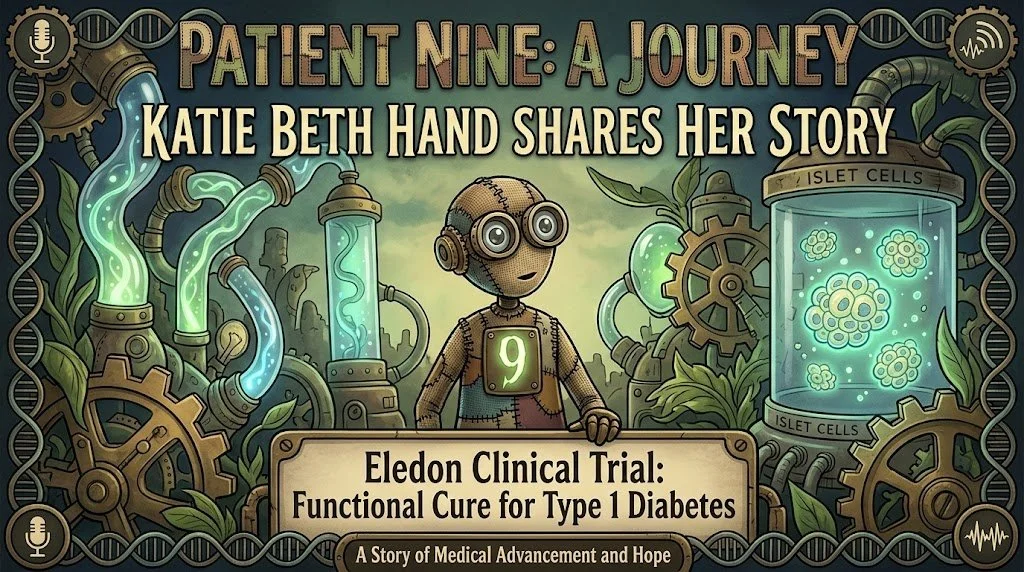
Katie Beth Hand shares her journey as Patient Nine in the Eledon clinical trial, receiving donor islet cells and a targeted immunotherapy that may functionally cure her type 1 diabetes.
Key Takeaways
- Functional Cure Breakthrough: Katie Beth Hand shares her journey as "Patient Nine" in the Eledon clinical trial, exploring a functional cure for Type 1 diabetes using donor-derived islet cell transplants into the liver.
- The Tegoprubart Advantage: This trial utilizes Tegoprubart (Tego), a targeted anti-CD40 ligand that protects transplanted cells without the systemic toxicity or kidney damage associated with traditional drugs like Tacrolimus.
- Rapid Results: Only one week post-transplant, Katie was taken off basal insulin entirely and maintains stable glucose levels without injections.
- Natural Low Prevention: By transplanting both beta and alpha cells, Katie's body now handles blood sugar regulation automatically, effectively ending exercise-induced and nighttime hypoglycemia.
- Scalable Maintenance: While currently an hour-long IV infusion every 21 days, researchers are working toward a subcutaneous version for easier at-home use.
Resources Mentioned
- • Omnipod 5: Request a Free Starter Kit
- • US Med: Get a Free Benefits Check or call (888) 721-1514
- • Research Center: University of Chicago Medical Center (Dr. Piotr Witkowski)
- • The Trial: Eledon Clinical Trial (Tegoprubart)
- • Juice Cruise 2026: Details and Booking
- • Community: Join the Facebook Group
Here we are back together again, friends, for another episode of the Juice Box podcast.
Katie Beth HandMy name is Katie Beth Hand, and I am patient nine in the Eladon trial to cure type one diabetes. It is a functional cure using donor derived islet cells and a new investigational drug called tegaprobar.
Scott BennerI created the diabetes variable series because I know that in type one diabetes management, the little things aren't that little and they really add up. In this series, we'll break down everyday factors like stress, sleep, exercise, and those other variables that impact your day more than you might think. Jenny Smith and I are gonna get straight to the point with practical advice that you can trust. So check out the diabetes variable series in your podcast player or at juiceboxpodcast.com.
Scott BennerIf you're looking for community around type one diabetes, check out the juice box podcast private Facebook group, juice box podcast, type one diabetes. But everybody is welcome. Type one, type two, gestational, loved ones, it doesn't matter to me. If you're impacted by diabetes and you're looking for support, comfort, or community, check out Juice Box podcast, type one diabetes on Facebook. Nothing you hear on the Juice Box podcast should be considered advice, medical or otherwise. Always consult a physician before making any changes to your health care plan.
Scott BennerA huge thanks to my longest sponsor, Omnipod. Check out the Omnipod five now with my link, omnipod.com/juicebox. You may be eligible for a free starter kit, a free Omnipod five starter kit at my link. Go check it out. Omnipod.com/juicebox. Terms and conditions apply. Full terms and conditions can be found at omnipod.com/juicebox. US Med is sponsoring this episode of the Juice Box podcast, and we've been getting our diabetes supplies from US Med for years. You can as well. Usmed.com/juicebox or call (888) 721-1514. Use the link or the number, get your free benefits check, and get started today with US Med.
Meet Patient Nine: Katie Beth Hand
Katie Beth HandMy name is Katie Beth Hand, and I am patient nine in the Eladon trial to cure type one diabetes. It is a functional cure using donor derived islet cells and a new investigational drug called tegaprobar. I am married. I live in Arkansas. I have four beautiful children at home, and I absolutely love to talk about my experience as a type one diabetic of thirteen years and now as a person going through this trial. And I'm so excited to be with you today.
Scott BennerWow. You've said that before, I imagine. That was awesome. Was, number nine not a movie? Like, an animated movie about a sandbag?
Scott BennerHold on a second. I know this is probably your—I didn't know this was gonna go this way. But yeah. If it was, I haven't seen it. 2,009 animated film called Nine.
Katie Beth HandI'll have to add that to my watch list.
Scott BennerI remember watching this with my kids in a theater. Alright. Alright, number 9. Let's get going.
Katie Beth HandThat's right. You can call me number 9 from here on out. Katie, don't trust me. Don't put me in that position because I might. So let's go back to the the beginning.
Katie Beth HandOkay.
Scott BennerI'm gonna start really, really beginning beginning. You, have parents, I imagine, because you're here and you're alive. Do you have siblings?
Katie Beth HandI do. I have so I have parents. They actually live like I said, I'm I am from Central Arkansas from Little Rock, and my parents actually live three doors down from us. And then I have one sibling, a brother. He is six years older than I am, and he lives in the house next door. So we created our own little family compound, and my kids—we have four kids—and they bebopped back and forth between my brother's house and my parents' house, and it's it's a great life.
Scott BennerTried to get my wife to move to Tennessee this summer, and she just ignored me. I had similar ideas. Okay. Anybody in your extended family have autoimmune issues besides you?
Katie Beth HandSo interestingly, no. Everybody always wants to be special. And in my case, this is not the type of special special you want to be, but no one in my family has any history of type one diabetes, of other autoimmune diseases, no Graves' disease, no celiac disease, none of these other things that typically go hand in hand. I am the one strange outlier with type one.
Scott BennerHow old were you when you were diagnosed?
Katie Beth HandI was 26 years old.
Scott BennerOh, okay. And now I'm sorry. You are?
Katie Beth HandAnd now I'm about to turn 40. So it's been about thirteen years since diagnosis.
The Diagnosis Story: From "Flu" to DKA
Scott BennerOkay. So just very quickly, what do you remember about your diagnosis? Let's think
Katie Beth HandDiagnosis was really, really traumatic. I went to my PCP's office because I thought I had the flu. I'm like a lifelong athlete, and I had just been so tired, too tired to work out. I remember sitting on my couch before I got diagnosed one night thinking, like, I can feel myself having to make the effort to breathe. That's how just physically exhausted I was. And I had all of the typical symptoms of t one. I just had not put them together yet.
I was exhausted. I went to the bathroom 15 times a day and was so so thirsty and hungry all the time. So I went to my doctor. It was actually March 13th. That was the day that I got my diagnosis. He actually came back in, and they had run my blood sugar. He was like, "So actually, plot twist, it's diabetes." We do have a couple of people in my family that have type two diabetes. And so that can be very genetic. And then I was older. I was 26. So even though, you know, I wasn't overweight, I didn't have some of those other things, he was like, "I'll put you on metformin. We'll take care of this thing."
So I got this tentative type two diabetes diagnosis and left the doctor's office. A couple of hours later I got the most frantic phone call from a nervous nurse. She was like, "Hey. And what do you what what are you doing? How are you feeling?" And I was like, "Well, you know, depressed, but but fine." And she was like, "Cool. So, actually, we think that you are in DKA. You need to drop everything that you're doing right now. Do not do anything else. Get your car keys. Have someone drive you to the ER. We have already called ahead there waiting for you right there."
Scott BennerKatie, she was like—she was so thrilled. You said just depressed. She was like, oh, she probably turned over her shoulder and looked at everybody in the room like, she's just depressed. It's gonna be fine. She's still alive. We didn't kill her.
Katie Beth HandShe genuinely liked the sigh of relief when I answered the phone. So I, ended up my parents drove me to the ER and was in DKA, got checked in, and, you know, it's the same story for everybody. Put me on IVs. I was so severely dehydrated. Blood sugar's through the roof. My a one c was 13.9. Ended up spending several days in the hospital, and that was really a dark time. It was a a time of grief. With type one, they just say, "Here's insulin pens. Here is a glucose meter. You'll need to use these every few hours, every single day, and all night for the entire rest of your life until you die." Alright. Hope you feel better.
Scott BennerOn your way.
Katie Beth HandSo that was our diagnosis day, and those few days after were really, really dark. A very, very hopeless time for me.
Scott BennerDid you fall back on your parents for help, or at 26, were you like, I'll do this on my own? Were you married, dating? Like, what was your structure at home like?
Katie Beth HandSo I wasn't married. I was still single. I had been—I was, like, a free spirit. I was actually working for a travel company, so I had been, like, taking tour groups overseas. I love to bike and hike and be outdoors. And so my support system was my parents. My parents were my support in, like, the emotional support getting through all of this. But really from day one of diagnosis, like, my diabetes has always been me. They've not you know, they don't help with insulin and insulin to carb ratios, and none of that was on them. That learning curve is one I took on and did myself.
Scott BennerThen what was that like? I mean, what would you tell me that from that moment until—well, maybe you'll tell me you never had it together. But, like, is there a moment where you're like, I know what I'm doing. This is going better? And how long did it take to get to that?
Katie Beth HandThere was eventually a point where I felt like I did have it as much as you can have it together with type one. Mhmm. I don't believe anybody really ever has it all together with type one. But at the beginning, I tell people getting a t one diagnosis—those first few months—the learning curve is so steep, and there's so much information. It feels like being sprayed in the face with a fire hose. After several years, I really did hit that point where it was just another part managing diabetes was just another part of my day. It wasn't all consuming. It didn't depress me. I learned how to make it as smaller part of my life as possible and keep moving. But that was multiple years before I feel like I really got to that point.
Weight Gain and the "Michael Phelps" Diet
Scott BennerTell me about your life in those multiple years. How would you describe your level of happiness? Were you active like you wanted to be? Did it hold you back in other ways?
Katie Beth HandThe impact was really severe, especially at the beginning. When I first started taking insulin, I'd been athletic, and then I'd gotten really skinny because of the diabetes. When I started taking insulin, I had been eating like Michael Phelps—probably three or 4,000 calories a day before I got diagnosed because I was hungry all the time. And it wasn't you know, I'd drink a milkshake before bed and wake up a pound lighter.
One of the things that happened that was really difficult for me as a 26 year old woman was I went through, like, a dark time physically after diagnosis because in getting my blood sugars under control, it was that constant yo yo of I would take my insulin and my blood sugar would go too low, so I'd have to eat and it'd go too high. That we had a lot of yo yoing. So I put on a lot of weight very quickly, like 30 pounds. And then on top of that, because of the weeks I had gone without really getting any nutrition, a whole bunch of my hair fell out. Not bald, but enough that for a woman, it was very significant. So I was, like, fat and bald, which was a real bummer. Fat and bald with a chronic illness. I wear these devices all day. I was scared to exercise because it kept sending me low. I felt for that first entire year for sure, like my body was not even my own. It felt so foreign and so out of control. And then eventually, I got better at it, got my first CGM, and rebuilt myself with this diagnosis in mind.
Scott BennerGot it. Hey. The weight gain was from a lot of lows, so you were eating a lot to stop lows. Was that the idea?
Katie Beth HandSo it was two—it was two factors. One was I had been eating a ton because I stayed hungry. Yeah. It didn't matter before. Right. I got it. It didn't matter before. It didn't stick. And then the other one was—so that was in combination with, I had gotten my body used to just eating all day long, eating and drinking all day long. And then on top of that, then, of course, was when I would go low, then I would have to eat something. Yeah. And I really hadn't figured out, like, a little bit of juice or glucose gummies or whatever. So those two things in combination made me put on weight very quickly those first few months after diagnosis.
Scott BennerHas that hunger stuck with you since then?
Katie Beth HandThe hunger from eating 4,000 calories a day has not. But, you know, t ones don't have the same hormones, proteins that make us feel satiated like other people do because we don't have those islet cells. Am I hungrier than other people? I don't really know how to answer that. Yeah. It's something that I watch, and it's not something that I obsess over. Once I really got back to a place where I felt confident, like, exercising, and then on top of that, figured out, like, what can I eat, making healthier choices overall, it kind of eased into a pattern.
The Eledon Clinical Trial: Functional Cure Mechanics
Scott BennerOkay. Alright. That's I appreciate you giving me that background. I'm gonna fast forward you a little bit. I'm gonna jump ahead to you telling me about the study. What is going on right now?
Scott BennerI have always disliked ordering diabetes supplies. I'm guessing you have as well. It hasn't been a problem for us for the last few years, though, because we began using US Med. You can too. Usmed.com/juicebox or call (888) 721-1514 to get your free benefits check. US Med has served over one million people living with diabetes since 1996. They carry everything you need from CGMs to insulin pumps and diabetes testing supplies. Libre three, Dexcom g seven, and pumps like Omnipod five, Omnipod Dash, Tandem, and most recently, the Islet pump from Beta Bionics. Go to usmed.com/juicebox to get started now. Today's episode is also sponsored by Omnipod. Request your free starter kit today at omnipod.com/juicebox.
Katie Beth HandSo it's a clinical trial. I had had a really hard diabetes day, a lot of highs and lows, and ended up finding a clinical trial online and applied for it. And it was the Eladon clinical trial, which is the trial that I'm in. It runs through the University of Chicago Medical Center in Chicago. Mhmm. And it is a trial that is testing taking cadaver, dead donor islet cells, and transfer them into actually the liver, not the pancreas, and then use the trial drug tegaprobar instead of the traditional drug tacrolimus. Tegaprobar is an anti c d forty ligand. So it protects those islet cells in a very, very targeted way versus suppressing your entire immune system. The Tego is what really makes this study very unique and very exciting.
Scott BennerWhy are we more excited about how this is being done than how it's been done previously?
Katie Beth HandTacrolimus has been around for about thirty years. It is a full immunosuppressant used in all sorts of transplants. But the side effects are neurotoxicity, and it's really hard on your kidneys. Ironically, it can actually be toxic to islet cells. And so long term, it is harder to do an islet cell transplant and make that last because that toxicity builds up and actually damages the very islet cells we're trying to protect. That's why islet cell transplants with tacrolimus aren't like the standard of care for diabetes. The difference between the tacrolimus and the tegaprobar is tegaprobar, while it is an immunosuppressant kind of, it is a very targeted immunosuppressant. And the other thing that makes it absolutely beautiful, not only does it not suppress my entire immune system, it also has zero side effects. I don't feel bad. I don't have headaches. I don't have any of those side effects that separates the tegaprubart Tego from the traditional drugs.
Scott BennerIs the Tego it's an IV infusion?
Katie Beth HandIt is. Getting to trade MDI for an hour-long IV infusion every twenty one days. It's a complete radical lifestyle change from the day in, day out management. They are also working on a subcutaneous version. I was one out of the first 10 patients—number nine. Eventually, will that look like a subcutaneous injection that you pull out of your fridge once a week and take? I don't know the timeline, but that's where we are. The drug itself has been proven to be effective, so now they're working on making it more lifestyle friendly.
Scott BennerHow long would it take if you missed that infusion for the new liver beta cells to drop over dead?
Katie Beth HandThey actually think there's a much longer window than the every twenty one days—probably closer to two or three months. Twenty one days is what we're doing as part of this trial, but they don't think the data is showing that it actually has to be that often. Because I Asked what happens if I can't get here? And they were like, well, just get here as soon as you can. It's not like the clock runs out at twenty one days and one minute and then your islet cells die off. But I won't volunteer to be part of figuring that out.
Scott BennerHow aware are you of the other nine?
Katie Beth HandThe TikTok algorithm is really, really good at connecting people. When I started posting and announced that I was part of this trial, it actually ended up putting me in the same algorithm with a couple of the other people that were in this exact same trial. I know probably three or four people that are in my trial. I actually had the procedure, my islet cell transplant, on January twelfth of this year. We're recording this February 17th. For the first three weeks, every Tuesday, I flew up to Chicago, did my one hour infusion, and then flew home. A week after the transplant, when I went to check out of the hospital, they went ahead and took me off basal insulin completely. It takes about three months for those islet cells to really take root in your liver and become fully functioning. Every time I go, we're weaning me down off of my insulin till I reach the point where I just won't take any at all.
Scott BennerHas that been exciting?
Katie Beth HandYes. Yeah. To come home and take my basal insulin and just, like, toss that whole pen in the trash was a very cool moment. So yes. So I'm recovering. Because the little islet cells—we're trying to let them rest. Now if I went out and ate, like, a big cheeseburger and fries, my islet cells would absolutely kick in and I would spike and then they'd come correct to that. But what we're trying to do in these early months is I'm using kind of like a protective dose of insulin so we don't stress those islet cells. I'll take it, wait till my blood sugar starts dropping, and then eat. The reason is because we're trying to keep those cells from stressing and working quite so hard. Typically, three months is like the time until they're fully mature. I just did a mixed meal tolerance test exactly one month post transplant. You eat a certain number of carbs, and then they do a blood draw every fifteen minutes for four hours. It was really cool to watch my blood sugar go up to 170 ish, then leveled off, and my islet cells pulled that back down to 81 and just sat there. I cried.
Eligibility Criteria and Testing
Scott BennerDo you have any other autoimmune issues?
Katie Beth HandNope. I do not.
Scott BennerI was wondering if this TEGO works on other stuff. I was wondering if you had eczema or anything that was inflammatory.
Katie Beth HandI think that it does. They are talking about using it for kidney patients, kids, and maybe turn off the CD40 pathway for things like RA. I don't have any other autoimmune issues or seasonal allergies. As for finding out if I was a good candidate, with every clinical trial, there are very specific criteria that you have to meet. I filled out all of this information online and then ended up doing a long, detailed phone interview. They ask all of these medical questions—how much insulin do you take? I flew up to Chicago last May and spent five straight days in the hospital. They scanned every organ of my body—EKGs, stress tests, X-rays—creating a baseline. You can't have diabetic retinopathy and do this because the radical correction of blood sugar can make it worse. You can't take over a certain amount of insulin every day. There were very specific criteria that you had to meet before I got chosen.
Scott BennerHow long was that process?
Katie Beth HandIt was about a two year process for me. I went back up this past October. Before you can go on the transplant list, you have to have a medication called thymoglobulin. It is by far the worst part of this whole process. Not horrific, just not fun. Three or four twelve hour IV drips of thymoglobulin. It's super tough on your veins and a real immunosuppressant. I went on the transplant list the week of Thanksgiving in November 2025, and then I got the call in early January. Dr. Piotr Witkowski truly is a genius. He has my Dexcom on his phone and monitors my blood sugars. He's working all the time.
Scott BennerI just make a podcast about diabetes, and there are days when I look up and go, "did I eat today?" How has it changed your life? Is there a lot of anxiety that it's just gonna stop working?
Katie Beth HandI don't have anxiety that it's going to necessarily stop working. The first patient who went through the trial has been completely off insulin for eighteen months and her numbers are still great. The Tego does a really, really good job of protecting those islets. One of the craziest, most unexpected part that I had not thought through was not having lows anymore. In an islet cell transplant, you're getting beta cells and alpha cells. A nondiabetic body is constantly doing that checks and balances. For thirteen years, I was the one doing that. When Dr. Rakowski cleared me to start exercising, he said, "If it looks like you're going low, don't do anything. Don't drink juice. Your body will fix that." For years, you see those double arrows down and you panic. But he has been right—I worked out for an hour this morning and never went low. Not going low at night has been by far the best part of the trial for me so far.
Scott BennerIs there anything about having type one diabetes that you miss?
Katie Beth HandNothing specific I would miss. They said I could stop wearing my Dexcom once I'm fully off insulin, but I told them you can have my CGM when you pry it off my cold dead body. It gives me a sense of control. Diabetes turns you into a control freak. That will be interesting to try to unwind. These are cadaver donor islet cells. I was on the national donor registry waiting for a match. They mine the islet cells out in the lab at UChicago. We use islet cells from a known source for this trial because Tego is our one variable. I think I'll finally process "I don't have diabetes anymore" once they fully take me off insulin and I leave the house without insulin pens and a glucometer in my purse.
Community Response and Cynicism
Scott BennerAlso, please don't let anything happen to you, because I—I don't want it to be like one of those bad movies where, like, a truck is coming at you through an intersection, and you're like, oh, come on. I just got rid of my diabetes.
Katie Beth HandYes. Yes. So it's funny, you know, being on social media, there—you know, I will say this. The—the type one diabetic community, we're, like, the most, like, suspicious, cynical community on the planet. I respect the cynicism because we’ve been promised a cure for years and nothing happens. I have people messaging me saying big pharma is not going to like what you're talking about. I hope I don't go missing suspiciously because we will have two million diabetics calling the FBI.
Technically speaking, they didn't cure me—they shut off the immune system and jammed some new cells inside. This is what’s called a functional cure. I am trading diabetes for taking this Tegaprubart for the rest of my life. People say, "But you have to take a medication for the rest of your life." I’m like—right, I have diabetes, so I am already going to take a medication or two for the rest of my life. I would go outside and beat up an old lady to give this to my daughter. Just the targeted immune suppressant side of it is incredibly exciting.
Scott BennerI believe that GLP medication changes things. Watch it work in people with my daughter—it turns her sensitivity from one unit moving her 40 to one unit moving her 95. Her carb ratio goes from one to 4.5 to one to 10. Basal goes from 1.1 down to point six five.
Katie Beth HandI'm a huge fan of GLPs. I think it should be standard of care for all type ones. When I was on it, the results were phenomenal. The big issue was getting insurance coverage because I wasn't type two. Everyone gets scared first—they don't want to break a rule. Then nobody dies and everyone goes, "Oh, okay." I think there will be a time when you take the Tego less frequently, or move into the subcutaneous injection. You're looking at the beginning of something that normally you don't know about till it becomes public. I look at other trials as collaborators. Maybe the eventual functional cure is that people get islet cell transplants on a massive scale because one company perfects lab grown cells and we protect them with the Tego. Diabetics live without a sense of hope. If you had asked me three years ago, I've said no. And then here I sit post islet cell transplant feeling the best I've felt in a decade and a half.
Katie Beth HandWhen you have major surgery like this, you go on myfortic, which is a lower risk immunosuppressant. I'm on an antifungal, an antibiotic, and an antiviral for about three months. Because I am taking someone else's islet cells, piece of their organ, and transplanted that into my body. I do a pill in the morning, a pill at night, and my infusion every twenty one days. I take vitamin d every day. If your body doesn't have all the supplementation it needs and we can find a way to add it pharmaceutically, who cares? My life is completely different and all for the better. We are road-mapping out what works. Dr. Witkowski is amazing. Eventually, you're all good on your way again.
The "Cure Season" and Monologue Breakdown
Scott BennerLet me be a wet blanket, for a moment for everybody because I, abhor something that I call the diabetes cure season, which is when all of the doctors and the, you know, the researchers put out their articles and get interviewed so they can point a light on what they're doing, so they can raise more money to keep doing it. And then a lot of people who have diabetes get mad like, "oh, it's almost over." And then I—I get very afraid that people aren't gonna take good care of themselves because—Mhmm. Why take care of myself? You know, this is almost—next week.
Katie Beth HandRight.
Scott BennerRight. It's not gonna be next week. Right. I'm gonna tell you all that I interviewed a researcher—I interviewed a—a scientist so long ago. I didn't have a podcast. It was from my blog. And he was talking about encapsulation. A packet, a packet, a packet, a packet, a packet full of cells that they would slip under your—
Katie Beth HandWas CERNOVA?
Scott BennerI forget which one it was. Veritex, maybe. Here's the thing. Doesn't matter because he explained the—whole—
Katie Beth Handgo anywhere?
Scott BennerYeah. Well, are you using it right now? Because it was, like, fifteen years ago. Right? So, like, maybe some ideas from it have transferred to something else, and God bless. I—everybody should be trying as hard as they can. But my point is is that he explained how it worked. They were just trying to get it into testing. It got into testing eventually. I think one of the companies went out of business. Like, oh, I don't even know. Right? But what I'm—my point is is that he told me on that day, if we had it all worked out today, if it was FDA approved, if we knew exactly how to do it, it would still take us ten years to do it en masse. Don't get too excited right now. Like, you know who should be excited? Katie. Katie and her family, they are excited that you got into a time machine and you went into the future.
Katie Beth HandRight.
Scott BennerYou know what I mean?
Katie Beth HandRight.
Scott BennerAnd but for the rest of you, you're not getting tego next week. Calm down. Keep pre bolus in your meals.
Scott BennerOkay? Change your settings. Make sure you're okay.
Katie Beth HandGo ahead and reorder your insulin pumps from the pharmacy.
Scott BennerPut your glucagon in your bag when you leave. I don't want you having a problem while you're out. You don't have something to do. Keep telling your friends how to help you if you get low. Like, you—you're gonna have diabetes for a while, but this is the most complete idea I've heard so far. And that—that's exciting.
Katie Beth HandAnyone that's been tested, Scott, in more than, like, one or—
Scott Bennertwo people. Per people. Yeah. Like, I once had a lady on who did the, the implantable pouch.
Katie Beth HandMhmm.
Scott BennerShe didn't even know if she actually had the cells or if they just—if she was, like, a placebo, which, by the way, bummer because they still cut her open and stuck the pouch inside her.
Katie Beth HandYeah. I would—that that would make me absolutely furious. Like, if you're doing a major surgery like that, so help me. You better give me the cure, man.
Scott BennerWell, not only that, but she was getting benefit from it, and then they were—she only was allowed to keep it for a certain time, then they were gonna take it away from her. Oh gosh. I can't—I can't imagine that.
Scott BennerI told her I'd get on a plane, I'd leave the country.
Katie Beth HandA 100%.
Scott BennerBut yeah. But not the point. The point is is that I've heard a lot of these things over the years, and there's pieces of them that always sound like, "oh, that part makes sense." Or, you know, like, the idea of, like, "what we can encapsulate the cells that the—the"—and I was like, I don't know if that—I—I—okay. But I don't love it. You know? But now, suddenly, this is a—the—I mean, I'm—I'm gonna make a t shirt that says, "Tego, let's go." Cause I think—I think maybe that really is the key to this whole thing as far as it sounds from your story.
The "Eyeball" Islet Trial and Closing Thoughts
Katie Beth HandYeah. Yeah. For sure. And it's been interesting because since I've—I've been talking about this, there are people that are doing other really cool trials that message me. And there—so there was a lady that I met. She's in the trial. I don't know what company's doing it. She's in a trial where they're taking islet cells and implanting them into her eyeball because, you know, your eyeball runs on a different immune system from the rest of your body.
Scott BennerGet out of here.
Katie Beth HandPlanting islets into her eyeball, and then she will take immunosuppressant drops just in that one eyeball. And it's in, like, the early phases of testing. And I was like, you can pretty much count me out on any study that's gonna play with my eyeballs, but good for you. Thanks for doing it. And if that ends up being a cure for everyone, you know, you're my hero.
Scott BennerKatie, you have my email address. Please give it to her.
Katie Beth HandLet me know how that pans out. Yeah. Yeah. Pulling—I'm pulling for you. I talked to a lady who did the porcine islet cells. She did that. It's taking, like, typically six to ten months before there's any sign of, like, glucose change. It's definitely not in the cure phase yet, but there's a lot of really cool stuff out there. The Tego, obviously, is the—you know, I've researched all of these. The Tego is the one that I think is—is closest to the forefront of actually really being a widely available functional cure for everyone. But, you know, I'm happily wrong. If somebody invents a pill tomorrow, I will cry like a baby. Yeah.
Scott BennerIt's just wonderful story to hear, and I appreciate you sharing it with me. I mean, absolutely worth an hour of time to sit and chat about this. This is the Eldon study out of the University of Chicago.
Scott BennerOkay. And say Peter's name in case I say it wrong.
Katie Beth HandK. Piotr Wachowski.
Scott BennerAgain, I don't even know his first name. I am gladly and happily here hearing your story. Sorry for all of you who know more about it than I do and think I didn't answer the right questions. You can all go start your own podcast and make it popular. Good luck. I just—I did my best here. You've piqued my curiosity. I would like you to use the link I sent you and reschedule to come back on in six months if you're interested.
Katie Beth HandOkay.
Scott BennerI'd like to hear a follow-up about how you're doing. And if you know Patient Ten, please send them my way. Wanna hear from the eyeball lady. I am happy to have all these conversations. Would—I would love to hear more. The eyeball lady, especially, just because, wow. Let me hear about that. Yeah. I think what you just said about her makes such a good point that you don't know how this is gonna end up working the day it actually works. Right? Because, again, fifteen years ago, was we're gonna make a pouch, and we're gonna put it under your skin, and it's gonna be great. And you're doing what you're doing, and she's, you know, stem cells in my eyeballs. You have no idea what's gonna happen.
Scott BennerBut as these ideas are coming together, like, if you're not paying attention to peptides like GLPs, if you're not paying attention to new immunosuppressants like Tego—I'm assuming that these researchers are now using AI to crunch their data, and it's happening much quicker than it has in the past. Wait till they start talking to each other. You don't know where this is gonna end. But it's moving in the right direction, and it's moving a lot faster than it used to.
Katie Beth HandAbsolutely. For the first time ever, I really do look at this young generation of kids, and I—I do not believe that they are a generation that will have type one diabetes their whole lives.
Scott BennerCould happen for them. You—know?
Katie Beth HandLike, yeah. I think it's gonna—and I feel—I feel very confident about that. Can I tell you exactly what that looks like or when that will be or how much that will cost? No. I can't. But these young kids getting diagnosed, you know, kids like your daughter, they will not—I—I truly don believe they'll have diabetes their entire lives.
Scott BennerHeed what Katie told you. Keep your stuff together now because if you had any number of different issues—Right. They wouldn't have done this with you. Right. Yeah. So, you know, be careful. Take good care of yourself. Do your best. You know? I think the psychological part of diabetes is still ignored. We try really hard to talk about it here, but, you know, you gotta support your mental health as well along the way. Katie said there's a lot of—a lot of stuff that she used to have to do that she's not doing anymore.
Katie Beth HandRight.
Scott BennerWait till you see—like, I imagine you're gonna have a real catharsis at some point, like a moment of when you realize the depth of effort that is not being paid anymore to diabetes. Like, I—I wonder—yeah. I think it's gonna hit you pretty deeply, and I—I can't wait to find out how—exactly. I hope it doesn't crush you, like, because it could.
Katie Beth HandYeah. It's—it's interesting to unwind things that I have done and believed and become, like, part of the core of who I am. Walking through this process and unwinding some of those has been a very interesting and unexpected—the mental piece is a very unexpected piece of this process.
Scott Benner100%. I can't—I can't imagine that we're even a tiny percentage in understanding all the impacts this is gonna have on you. For sure. Okay. Katie, thank you very, very much. I can't—I can't thank you enough for doing this. I really do appreciate your time.
Katie Beth HandAbsolutely. Thanks so much, Scott. It was a pleasure.
Scott BennerThank you. Hold on one second for me. Okay? A huge thanks to my longest sponsor, Omnipod. Check out the Omnipod five now with my link, omnipod.com/juicebox. You may be eligible for a free starter kit, a free Omnipod five starter kit at my link. Go check it out. Omnipod.com/juicebox. Terms and conditions apply. Full terms and conditions can be found at omnipod.com/juicebox. Arden has been getting her diabetes supplies from US Med for three years. You can as well. Usmed.com/juicebox or call (888) 721-1514.
My thanks to US for sponsoring this episode and for being longtime sponsors of the Juice Box Podcast. There are links in the show notes and links at juiceboxpodcast.com to US Med and all of the sponsors. Okay. Well, here we are at the end of the episode. You're still with me? Thank you. I really do appreciate that. What else could you do for me? Why don't you tell a friend about the show or leave a five star review? Maybe you could make sure you're following or subscribed in your podcast app, go to YouTube and follow me, or Instagram, TikTok.
Oh, gosh. Here's one. Make sure you're following the podcast in the private Facebook group as well as the public Facebook page. You don't wanna miss—please, do you not know about the private group? You have to join the private group. As of this recording, it has 74,000 members. They're active talking about diabetes. Whatever you need to know, there's a conversation happening in there right now. If you're looking to meet other people living with type one diabetes, head over to juiceboxpodcast.com/juicecruise because next June—that's right. 2026, June 21, the second juice cruise is happening on the Celebrity Beyond cruise ship. It's a seven night trip going to The Caribbean. We're gonna be visiting Miami, Coco Cay, Saint Thomas, and Saint Kitts. Yeah. The Virgin Islands. You're gonna love The Virgin Islands.
Sale with Scott and the Juice Box community on a week long voyage built for people and families living with type one diabetes. Enjoy tropical, luxury, practical education, and judgment free atmosphere. Perfect day at Coco Bay, Saint Kitts, Saint Thomas, five interactive workshops with me and surprise guests on type one hacks and tech, mental health, mindfulness, nutrition, exercise, personal growth, and professional development. Support groups and wellness discussions tailored for life with type one, and celebrities world class amenities, dining, entertainment. This is open from every age, you know, newborn to 99. I don't care how old you are. Come out. Check us out. You can view staterooms and prices at juiceboxpodcast.com/juicecruise. The last juice cruise just happened a couple weeks ago. A 100 of you came. It was awesome. We're looking to make it even bigger this year. I hope you can check it out. If you have a podcast and you need a fantastic editor, you want Rob from Wrong Way Recording. Listen. Truth be told, I'm, like, 20% smarter when Rob edits me. He takes out all the, like, gaps of time and when I go, "and" and stuff like that. And it just—I don't know, man. Like, I listen back and I'm like, "why do I sound smarter?" And then I remember because I did one smart thing. I hired Rob at wrongwayrecording.com.



























Please support the sponsors








The Juicebox Podcast is a free show, but if you'd like to support the podcast directly, you can make a gift here. Recent donations were used to pay for podcast hosting fees. Thank you to all who have sent 5, 10 and 20 dollars!

#1786 Best of Juicebox: Five Ways to Boost Insulin Sensitivity
You can always listen to the Juicebox Podcast here but the cool kids use: Apple Podcasts/iOS - Spotify - Amazon Music - Google Play/Android - iHeart Radio - Radio Public, Amazon Alexa or wherever they get audio.
Jordan Wagner shares five practical strategies—stress management, movement, sleep, nutrition, sunshine—to sharpen insulin sensitivity in diabetes.
Key Takeaways
- The Impact of Stress: Chronic stress elevates hormones like cortisol and adrenaline, which promote glucose release and desensitize cells to insulin, essentially acting like "rust on a lock."
- Consistent Activity: Even simple exercises can significantly improve insulin sensitivity by helping muscles utilize glucose without requiring excess insulin, an effect that can last for up to 72 hours.
- Prioritizing Sleep: Poor sleep disrupts hormones, increasing ghrelin (hunger) while decreasing leptin (satiety), which compounds insulin resistance and drives cravings for junk food.
- Nutrition Choices: Avoiding ultra-processed foods and refined seed oils is crucial, as they often contain trans fats and unbalanced omega ratios known to cause insulin resistance.
- Sunlight Exposure: Getting outside helps the body produce Vitamin D—which is linked to better insulin sensitivity—and provides full-spectrum light to balance your circadian rhythm for improved sleep.
Resources Mentioned
- • Eversense 365: eversensecgm.com/juicebox
- • Omnipod 5: omnipod.com/juicebox
- • Touched by Type One: touchedbytype1.org
- • Wrong Way Recording: wrongwayrecording.com
- • Jordan Wagner on Instagram: The Diabetic Nurse
Welcome back, friends. You are listening to the Juice Box podcast. Jordan Wagner is back. He is, of course, a nurse, a certified diabetes educator, and a person living with type one diabetes. And today, Jordan's gonna go over his top five tips for improving your insulin sensitivity. If you're looking for community around type one diabetes, check out the Juice Box Podcast private Facebook group. Juice Box Podcast, type one diabetes. But everybody is welcome. Type one, type two, gestational, loved ones, it doesn't matter to me. If you're impacted by diabetes and you're looking for support, comfort, or community, check out Juice Box podcast, type one diabetes on Facebook. Please don't forget that nothing you hear on the Juice Box podcast should be considered advice, medical or otherwise. Always consult a physician before making any changes to your health care plan or becoming bold with insulin. The show you're about to listen to is sponsored by the Eversense three sixty five. The Eversense three sixty five has exceptional accuracy over one year and is the most accurate CGM in the low range that you can get. Eversensecgm.com/juicebox. This episode of the Juice Box podcast is sponsored by the Omnipod five. And at my link, omnipod.com/juicebox, you can get yourself a free what'd I just say? A free Omnipod five starter kit. Free? Get out of here. Go click on that link. Omnipod.com/juicebox. Check it out. Terms and conditions apply. Eligibility may vary. Full terms and conditions can be found at omnipod.com/juicebox. Links in the show notes. Links at juiceboxpodcast.com. The episode you're about to listen to was sponsored by Touched by Type One. Go check them out right now on Facebook, Instagram, and, of course, at touchedbytype1.org. Check out that programs tab when you get to the website to see all the great things that they're doing for people living with type one diabetes. Touchedbytype1.org.
Jordan WagnerHey, Scott. Good to be back with you here. So I'm excited for this, you know, third episode here. But in case you guys missed the the first two episodes, you wanna go check those out. In the first episode, we had a pretty detailed discussion on diabetes management in the hospital setting, so more of the inpatient setting, what to do, what not to do, how to be successful with that. And then we, looked at pump training success and CGM success. So you've been diagnosed with diabetes, and you wanna get an insulin pump. There's definitely some things you should know before you get the pump so that when you do get to that training, you're prepared and ready to go with all that. Mhmm. And I'm really excited about this third episode here. This is a topic that probably doesn't get as much attention as it should with, especially the type one diabetes community, and that is insulin sensitivity. And I think part of that is because, you know, we're all insulin dependent with type one. So thinking about insulin sensitivity is not necessarily something we often do. It's just I I have to get the insulin. It doesn't matter. I have to have it. But there are there are certainly things that will improve your insulin sensitivity with all types of diabetes. But even with type one diabetes, improving that insulin sensitivity could mean that you're using less insulin, which overall could be a good thing for you perhaps. So I wanna go ahead and dive into that here today.
Scott BennerTell people before you start, why might it be a good thing to use less insulin?
Jordan WagnerYeah. So that's a good question. So there's there's a multiple multitude of reasons here, but one of them could just be that I often see a lot of people scared of low blood sugars.
Scott BennerMhmm.
Jordan WagnerAnd so naturally, if you're using less insulin, there's going to be a lower risk of hypoglycemia, so low blood sugars there. Two would be, insulin in and of itself doesn't make you gain weight. But if you have a bunch of insulin floating around in your system and you have excess calories in your system, that will make you gain weight. You know, using less insulin, having a little lower calorie intake, that could also help with, weight loss goals, not, you know, having a lot of excess of, weight gain, things like that. Mhmm. You know, I have heard from some people that there's a stigma behind it as well too. So let's let's say that you're taking a shot. Right? Maybe you're able to reduce your needs down to, let's say, 10 at this meal, right, versus, like, 20. You know? Maybe you're out with friends and people look at the syringe and go, oh, wow. Look how much you're taking. And so I've heard that from some people even in the hospital setting that by getting a little bit more sensitive to insulin, they could take less, and they felt less, stigma about taking insulin.
Scott BennerInteresting. Yeah.
Jordan WagnerSo there's there's different different things that could pop up for for different people. I mean, not everyone's gonna share the same sentiment, but it's, something that No. It should be considered.
Scott BennerYeah. It's funny because I as you're going over those things, I I'm I'm almost playing devil's advocate in my head on some things. Like, I spend a fair amount of time telling people you need the amount of insulin you need.
Jordan WagnerCorrect. Yeah.
Scott BennerAnd I don't want people running around with high blood sugars because they think, oh, that's a big number, or I'm definitely gonna gain weight if I do that. Because there's there's a cascading effect that comes off of all of that. Right? Like, you know, if you can't figure out a way to use less insulin and you don't want the big number, it it could be an eating disorder at some point. You could stop eating correctly or you could stop bolusing correctly. Some people do that. Some people under bolus for their food because they think the bolus, like, sounds better at a number or or, you know, somehow impacts the thing you're talking about. Right. And I don't want that. And No.
Jordan WagnerAnd I don't want that either. I mean,
Scott Bennerthat's Right.
Jordan WagnerHear me when I say I'm not I'm not telling you to take less insulin so that your sugars run higher. Like, what I want good control blood sugars for everybody, but the the point, I'm making is, like, you can get to a spot where your body is more sensitive to insulin and doesn't require the same amount.
Scott BennerExactly. So let's talk about the five things you have listed here that can Right. Can do that.
Jordan WagnerSo I'll go
Scott Bennerahead and just
Jordan WagnerYeah. List off what we have, and then we can go ahead and dive in.
Scott BennerJump in.
Jordan WagnerOne of the biggest things I see that kills insulin sensitivity is stress. Stress is gonna just the stress hormones, there's a lot that goes into that there. I see also that people are not active enough. Doesn't mean you need to be out running a marathon or doing crazy workouts, but just having activity in your life. Improving your sleep quality. So sleep is a huge time where where we repair and build back up. And if you're not sleeping well, that's gonna definitely impact your sensitivity. Your nutrition, that's a huge thing that's gonna impact sensitivity. Depending on what types of foods you're eating, you could definitely be hurting your insulin sensitivity. In today's world, a lot of us have, you know, maybe a corporate job or a desk job, and we're not getting outside. Getting natural sunlight on your skin is really beneficial, and it does help with your insulin sensitivity. There's many studies to back that. So those are the five topics just to kinda dive into there.
Scott BennerYeah. Yeah. No. So everybody gets super excited. Jordan's your mom now. She's like, get outside. Move around a little bit. Yeah. But there's a reason people have been saying stuff like that forever and ever. But let's talk about how it actually impacts your insulin sensitivity. So we'll we'll just start at the top. Like, you the first thing you mentioned was stress. Right? So Right. Hey, everybody. Be less stressed. There. Next thing. No. Exactly. Yeah. Explain to them how the stress is actually impacting them.
Jordan WagnerFor sure. The first thing I like to tell people is when it comes to stress, it's stress hormones. Those are the big things we talk about. So cortisol, epinephrine, that's adrenaline, norepinephrine, things like that. Leukagon can play a role in that as well. But those same hormones will be high in your blood if you are getting chased by a bear in the woods or if you're chronically stressed out driving home from work. Those are two different situations, but your body's gonna respond in a similar response with stress hormones. Mhmm. Why do we want those stress hormones? Well, we do want some stress hormones because it's promoting glycogen breakdown and gluconeogenesis, which basically means creating glucose from a non glucose source. That is important in times that you need energy. So, again, with that bear example, if you're in the woods trying to run away, you need extra energy to either run away or to fight that thing off. That's that fight or flight response. Right. But if you have type one diabetes or you have type two diabetes or some form of diabetes where there's some sort of dysregulation going on through your insulin, you're not gonna be able to to respond to that those excess stress hormones and increase the glucose there.
Scott BennerYou won't actually use the glucose either. Right? Like, in the You won't. No. Exactly. The bear, you're gonna burn it off really quickly running away from the bear.
Jordan WagnerBut Correct.
Scott BennerYeah. Sitting around worrying about something, it raises all this up, but then your body doesn't use it.
Jordan WagnerCorrect. And then you have a high blood sugar. Okay. Right. And so, you know, insulin's like the key. It's the key that unlocks the cells, gets the glucose inside, lets you use it for energy. But if you're, you know, chronically chronically having these high stress hormones here, it, like, desensitizes the cells, the insulin. Oh. So if you if you take example of someone with, like, type two diabetes, that's primarily insulin resistance. The response to that situation of that chronic stress is that the pancreas is going to make more insulin. So oftentimes with type two diabetes, we see people have very high insulin levels, very high C peptide levels because it's trying everything it can to get those glucose levels to come down. But, again, over time, your cells just keep getting more and more desensitized.
Scott BennerYeah. In all of these things, like, in each of these five examples, the problems build on themselves.
Jordan WagnerBig time.
Scott BennerLike yeah. Like, you start off, like, healthy, and then you have, like, one moment where you're in the car and you're like, uh-uh, everything sucks. And then all the things that are happening behind the scenes are happening. It's not like you then eventually it's gonna happen again tomorrow and the next day. So your body doesn't even have time to go backwards and, like, repair what's happened. And then it becomes incrementally more concerning. And then I'm guessing here too it also like, if you're stressed, maybe you're also not sleeping well. So you start getting compounding. Right?
Jordan WagnerIt compounds. Right. So, like, if you, just take a look at improving your sleep quality there, it's interesting because oftentimes we don't sleep well at night. And what do we all do in the morning? We go and get a big cup of coffee or an energy drink or something like that. Mhmm. But it's interesting because caffeine will bind to those adenosine receptors in your brain. And adenosine basically is building up during the daytime. And by nighttime, it it's almost aiding you to feel tired and helping you fall asleep. And so, like, I'm guilty of a big time, but, you drink coffee too late in the day because you're not sleeping well or you're stressed and you feel like it helps, well, then you get to bedtime and you're not super tired or you're tossing and turning. And so just improving the sleep quality, that's the time where your body's healing itself. It's repairing itself. Naturally, you're gonna see cortisol levels decrease during sleep and getting good rest.
Scott BennerOkay.
Jordan WagnerYou know, there's there's other hormones like ghrelin and leptin. Right? So ghrelin is gonna be one of the the hunger signaling hormones. You often see, say say you, are up late at night, right, and you get really hungry all of a sudden. What's that's ghrelin right there. That's telling you go get a snack. Right? Leptin's that satiety or I'm full hormone. Now if you're getting poor sleep quality, ghrelin tends to increase because you're so tired your body needs energy. So it's it's prompting you to want food, prompting you to want perhaps even junk food because that's a quick energy source. It's gonna decrease that leptin level, the I'm full hormone. And so you can see how, you know, the stress and the poor sleep quality, it starts to dysregulate your hormones. And as we know, like, with type one diabetes, right, it's a big thing with insulin and, glucagon. Right? Those are two big things there. But our bodies aren't it's not just that. Right? Our our bodies it's got so many mechanisms happening all the time in the background. When all of your hormones start getting dysregulated, that's when we start seeing this cascade effect of problems showing up.
Scott BennerYeah. Okay. Alright. I'm sorry. I think I cut you off before you were done with stress though. Did I?
Jordan WagnerOh, yeah. We can definitely talk about a few things there, but,
Scott BennerI wanted to lay into people's minds that this stuff's gonna start stacking up and that these things impact each other as well. You know, you might be more stressed out because, yeah, you can flip it around. You could be stressed out because you're not sleeping.
Jordan WagnerBig time. Yeah. Absolutely.
Scott BennerYeah. And you could be not sleeping because you're stressed out and etcetera and so on. And maybe you're not dealing with stress as well because your nutrition is wonky or, you know, you're not exhausted at the end of the night and sleeping when you should because you're not getting enough activity and getting your body moving. Like, this all stuff this all fits together, honestly.
Jordan WagnerIt does. Everything here is, compounding, like you said, there. And there's there's so many angles to to look at and talk about, you know. So, like, I'll I'll I'll try to stay focused right now on
Scott Bennerthis It's my fault. My fault. Go back to go back and finish up on your ideas about stress. Today's episode is brought to you by Omnipod. Did you know that the majority of Omnipod five users pay less than $30 per month at the pharmacy? That's less than $1 a day for tube free automated insulin delivery. And a third of Omnipod five users pay $0 per month. You heard that right. 0. That's less than your daily coffee for all of the benefits of tubeless, waterproof, automated insulin delivery. My daughter has been wearing an Omnipod every day since she was four years old, and she's about to be 21. My family relies on Omnipod, and I think you'll love it. And you can try it for free right now by requesting your free starter kit today at my link, omnipod.com/juicebox. Omnipod has been an advertiser for a decade. But even if they weren't, I would tell you proudly, my daughter wears an omnipod. Omnipod.com/juicebox. Terms and conditions apply. Eligibility may vary. Why don't you get yourself that free starter kit? Full terms and conditions can be found at omnipod.com/juicebox. When you think of a CGM and all the good that it brings in your life, is the first thing you think about, I love that I have to change it all the time? I love the warm up period every time I have to change it? I love that when I bump into a door frame, sometimes it gets ripped off. I love that the adhesive kinda gets mushy sometimes when I sweat and falls off. No. These are not the things that you love about a CGM. Today's episode of the Juice Box podcast is sponsored by the Eversense three sixty five, the only CGM that you only have to put on once a year, and the only CGM that won't give you any of those problems. The Eversense three sixty five is the only one year CGM designed to minimize device frustration. It has exceptional accuracy for one year with almost no false alarms from compression lows while you're sleeping. You can manage your diabetes instead of your CGM with the Eversense three sixty five. Learn more and get started today at eversensecgm.com/juicebox. One year, one CGM.
Jordan WagnerFor sure. For sure. Really, so one thing to think about with stress here's the deal. Picture your body as a bucket. Okay? Inside that bucket is gonna be water. Water is like the mineral balance inside your body. Every time you're stressed out, it's like poking a small hole in that bucket. So if you're chronically stressed, you've got a bunch of little holes. And as you can imagine, that water starts to pour out the sides of the bucket there. Well, as your mineral balance gets out of whack, your insulin sensitivity also majorly gets out of whack. So not only do we have hormones raising your glucose levels, the minerals in your body that would naturally be there to kind of help with that insulin sensitivity, making those cells receptive to insulin are now out of whack. So now these cells are not as receptive. So think of that almost like rust building up on a lock. And if insulin's that key, that key is gonna have a harder time fitting in a rusty lock compared to a lock that's completely cleaned and and nice looking. Right?
Scott BennerYeah. Yeah.
Jordan WagnerSo there's there's big things there that that stress can really impact.
Scott BennerYou know, in your professional life, when you talk to somebody about this, do you find that explaining it to them like, because saying to somebody be less stressed is
Jordan WagnerYeah.
Scott BennerYou know, I'm married. That's not a thing I would say out loud. The reason is because it's not a feeling of, like, oh, you're you're right. I'll just be less stressed. Thanks. Do you get to talk to people about ways to do that, or do you find that your idea is, like, let me just give them this idea, hopefully, they'll go back into the world and figure out how to accomplish this on their own?
Jordan WagnerYeah. So it depends on the consult and depends on the patient I'm talking with. And the reality of being working on the inpatient side of medicine, you're often seeing someone and you have thirty minutes to an hour. Basically, unload as much information as you can without overwhelming them and hoping that they take some of what you have as they as they're leaving the hospital, essentially.
Scott BennerYeah.
Jordan WagnerSome people are open. Right? They'll they'll talk about things in their life like stress. And for example, maybe they have no community. Right? So then I'll say, okay. Maybe you need to find a church community. Maybe you need to go out to a place to where you can go dancing and make some friends. Right? Get some community in your life. You know, maybe it's they're struggling with their bills. Right? And maybe we can talk briefly about, like, hey. This is how a financial planner could help you with your bills and, in turn, start lowering your stress. So there are definitely times where, like, I'm able to dive into it a little bit, but this is definitely something that needs to be ongoing. And so I think if your only conversation you're having is with me in the hospital, it's gonna be unlikely that you actually start lowering your stress levels.
Scott BennerYeah. It's funny. I find that people like you and Jenny and Erica who like coming on the podcast, I feel like it's because you always you guys always feel like it's just so difficult to get your message out, and you're just always looking for a way to reach other people, which I love. I think it's awesome.
Jordan WagnerYeah. Without a doubt. I mean, because I I tell people all the time, like, I probably get sixty, seventy percent of my consults of people who actually don't wanna talk to me. Yeah. They don't they don't care.
Scott BennerYou're like, come on, man. Like, just this guy need the insulin.
Jordan WagnerYeah. Or like, hey. I've had diabetes for forty years. I I'm not gonna learn anything from you. Just give me your spiels. I can get out of here.
Scott BennerJordan told me to go dancing. Yeah. But what you're really saying is identify your stressors and ways to try to alleviate them.
Jordan WagnerAnd Without a doubt.
Scott BennerYeah. Because this has look, the truth is these five things have impacts on people who don't have diabetes.
Jordan WagnerWithout a doubt. Yeah. I mean and that that's it. Like, we get so fixated on a number. Right? Whether it's an insulin dose or our glucose level. But I've always said my whole life, like, I am more than a number. And that goes for everyone else with that with diabetes. You are more than a number. Right? Your health is not just a glucose number. You have to look at it holistically and look at everything else going on in your life if you wanna have a a healthy long life.
Scott BennerI try really hard to think about it this way. I wish my daughter didn't have diabetes.
Jordan WagnerRight.
Scott BennerBut as long as she does and I'm being made aware of things, things that maybe I would not otherwise be made aware of because the the aging process you know, in a healthy person, you know, a person who doesn't have a chronic illness or, like, you know, other things going on, you age slowly and you'd you know, you deteriorate slowly and you don't see it coming. It's that idea of, like I think the jumping in part is I've always said this. Like, type one diabetes, it's because you can get, like, in trouble so quickly. It forces you to pay attention to it.
Jordan WagnerIt does.
Scott BennerAnd maybe that's valuable for the rest of your life. There's nobody else sitting around talking about like, you know, parents, like, go to sleep. You know? Like, calm down. Like, you you should get out and move around, but they're not talking about the why. Right. And they're not gonna see the impacts of it if they're lucky for so long that they'll think, oh, I just got older.
Jordan WagnerFor sure. And, like, there's a benefit too, like, to even my family and friends knowing that I have diabetes because it's taught me to care for my body, and I'm very open about that. And right? So then they start thinking about their own lives of, wow. I need to look at this, or maybe I do need to get a little more exercise. Mhmm. And so you can have this compounding effect of impacting a lot of different people as you take care of yourself.
Scott BennerYeah. No. A 100%. Okay. Activity. Good. Talk people into being more active. I I dare you.
Jordan WagnerFor sure. For sure. So activity is huge. Not only is that gonna make you feel better in the long term, I know, like, if I go out and take a jog, sometimes it doesn't feel the most fun during the jog, but you finish and you go, wow. I I feel great. You got that that rush of endorphins there. But, ultimately, what what's going on is, when you are using glucose for energy with exercise, some of that is able to happen with limited insulin use. Like, your muscles are able to use it without a lot of insulin.
Scott BennerOkay.
Jordan WagnerAnd so you're naturally going to lower your blood sugars without having to take a lot of insulin. Right? So let's say your blood sugar is 200, and you might be a little afraid of taking a dose to bring that down. Well, it's completely reasonable to say, why don't I go take a little walk? You know? Walk around the block. Right? I guarantee you that if you're doing that, you will likely see that blood sugar starts to drop a little bit. Of course, like, if you just ate a candy bar or something and it's 200, that's different. But, that exercise there, that little activity is gonna help there. But one of the ways I like to think about it is through analogies. Right? And I already have shared a few analogies, but there are these things called GLUT. Right? So g l u t. Those are all capital letters and stands for glucose transporters. And there's a bunch of different type of ones there. Think of those as, like, a taxi cab or like a bus, and they're dropping people off the building. The the people in the bus is the glucose. Right? Mhmm. And as you're moving around, you're getting more of those glute proteins bringing glucose to the muscles. It's dropping more off there. Right? And the different types of glute proteins get to the other destinations. You have the insulin as the key opening the door. So the point being here is that the exercise is making your body work the way it should, and we are supposed to work. Right? That is using the glucose the way it should, and it's making you more sensitive to your natural insulin without having to take excess of amount more. Now there are studies out there that will show that the effects of exercise can last for up to seventy two plus hours. So let's say you did do some exercise today, you could be benefiting this for for days. You might have been benefiting this for days.
Scott BennerI have to tell you that I've been exercising more recently. And in this past few days, I've I've been on a medication. I've been a little sick, I guess, for the past couple of days. And because I had not yet I don't know how to put this. I I had not yet built up a a real habit of doing the exercise, but I was doing Like, I I was a month strong every day doing exactly what I was supposed to be doing. And then I I got up when I slept in a little bit because I didn't feel good. And then I got up and I actually think I thought to myself, I should go do that. And I was like, oh, but the day got messed up and I was like, I'll do it tomorrow. But then I woke up the next day and I didn't feel well. And four or five days later, end of the day, 09:00 at night, I'm standing in my kitchen. I'm like, why am I so tired? Yeah. No lie that during the, like, the month of intent you know, intensively making sure that I was doing the exercise every day, not even that it was intensive exercise because it really wasn't. I would get at the end of the day, and I my thought was like, have so much energy. Like, I hope I can go to sleep. Like, it it it turned on in a week. Like, it it just felt different. And I don't think that's even a thing I would have believed had I not experienced it, I guess.
Jordan WagnerFor sure. Yeah. Yeah. And, you know, another huge benefit of consistent exercise, and I I like that you brought it up, the the consistency part there. If you're consistently exercising, having increased activity in your life, it will start to get rid of some of that visceral fat around your organs. Mhmm. That is basically the fat that just lines the organs in the body. And when when you can start getting rid rid of some of that fat there, your insulin sensitivity is going to go up. A way to perhaps think of that and this is not a perfect analogy, but it it kinda paints a picture here a little bit. Picture, a snowstorm blowing through, like, the Midwest or something like that, and you're trying to get into your house. Now before you can even get to your door to unlock it with a key, you're gonna have to get rid of that snow. And so if you're shoveling that snow away, you get to the door, you can unlock it. That's that's an analogy to kinda picture that that visceral fat there. Mhmm. Right? So the it the insulin's gonna have to work harder to get to that lock to unlock it there. There's just so many benefits to exercise. You're gonna feel better. You'll have a better outlook on life. Your glucose levels will be better controlled. It's just a win win truly to exercise. Other parts of your health are gonna thank you for that as well.
Scott BennerYeah. Yeah. I can't agree more. And I also can absolutely throw in with all the people who hear that and say, like, I don't like exercising. I don't have time for it. Or whatever you're gonna say. I said it all. I've thought it all. I've believed it all. And now, like, it's on me, you know, talking about, like, ways to, like, reduce your stress. It's on me to find a way to actually bring this to bear every day for the rest of my life. Yeah. Because this is the part where, like, it's easy to say I'm stressed. There's nothing I can do about it. Or I would like to exercise, but I don't have time. Or whatever it is you're gonna tell yourself, like, at some point, you know, you just either you have to do it or you have to live with it. You do.
Jordan WagnerAnd with a lot of these things, you do have to take some self responsibility. I understand, like, it is not ideal that any of us have diabetes, but the reality is we have diabetes.
Scott BennerMhmm.
Jordan WagnerAnd so you either come to terms with that and do what you can, or you're gonna be constantly blaming people and and not doing well. And so when it comes to exercise, you have to take some self responsibility. I firmly believe that anyone can get increased activity into in their life in a pretty easy way. Yeah. I mean, that might even just simply be, you know, every hour, you sit down and stand up ten, fifteen times in your office. Right? That's something you could do right there. Maybe it's when you're watching TV at night, you grab some exercise bands and just stretch them back and forth a bit. Use those muscles. You know, I was listening to a podcast with Andrew Huberman a while back, and he mentioned that just taking, like, thirty seconds to just run up and down the stairs at your office building, like, once or twice a day
Scott BennerWould be a big deal.
Jordan WagnerMakes a huge deal for, like, your cardiovascular health in the long term. It's not just, like, you feel good then. It's making long term impact.
Scott BennerYeah. How about when you're sitting at your desk for a while and you feel tired and just getting up and walking around is valuable?
Jordan WagnerWithout a doubt. Yeah. Right. Or even sitting at your desk. I mean, there's honestly, like, you can't make an excuse because they're you could literally be doing those. They're called soleus push ups, where you basically just sit with your legs at a 90 degree angle and raise, your ankles up and down. That soleus muscle, which is right there by the calf muscle in the back, it's like a sponge for glucose. So you
Scott BennerI I gotta tell you. You're you're gonna make me admit to something I don't wanna say out loud. Alright. Go ahead. Hold on a second. How many times am I gonna say this? But, like, don't have a podcast if you don't wanna say stuff like this. Hey. Listen. It's not the healthiest thing in the world. I'm not gonna lie to you one way or the other. But throughout the winter this year, Arden and I have been, like, once a month going to, like, a tanning salon. Like, just to, like I don't well, there's reasons why she wanted to do it that are not frivolous, but never nevertheless, she wanted to do it to try something. She wanted to see if it would help her acne. Okay? And I was like she felt weird about doing it. Was like, I'll go with you. We're signing up, and the woman's like, are you gonna do it to it? I'm like, okay. I'm in. Like, I mean, I'm already getting my eyebrows threaded with art, and I might as well do this as well. Right? So I'm using a stand my god. I'm using a stand up tanning thing.
Jordan WagnerOkay.
Scott BennerAnd now keep in mind you're in there, and you're not very dressed. But I'm, like, standing there for six minutes, and I'm like, what am I doing? I'm like, I'm just standing here. So I instead, I do body weight squats while I'm
Jordan Wagnerdoing Nice. Yes. Exactly. Yes.
Scott BennerYeah. Okay. Sorry. I didn't wanna say that. I really didn't wanna say that.
Jordan WagnerNo. I'm telling you, Scott. Like, you you can do whatever you can in life. Like, I've I've told patients. They're like, I don't have time to do this. I'm like, well, do you do you cook dinner for people in your house? They're like, well, yeah. I'm like, well, then dance while you're cooking dinner. You know, do some squats. Turn some music on. Turn it into a little time. Like, I I've done it with my boys before. It's like, we're cooking dinner, but we're having a blast. We're listening to music. We're moving around. It's it's just
Scott BennerWell, you're gonna have to. Jordan, mean, it's easy to say, well, this is the world the way the world works now. There's no time for that. But this is the way the world works now. It's not gonna work differently. You have to find a way to incorporate the things that a human body wants while you're living in the modern world. Absolutely. Absolutely. I don't wanna be like a you know, I'm not an alarmist or anything like that. But at the rate AI is picking up, y'all might be on universal income soon anyway. You'll be like, oh, I got I got much better this and much better that. Have nothing to do. No. Seriously, Jordan. Are you not worried about that? Like, what would Of course. Yeah. When you when you hear somebody say jobs might be eliminated. We might have to start paying people. Right? Like and I don't know that that's crazy that that could end up happening one day. And in your mind, like, I don't know about you, but for me, I think, oh, it's wonderful to give people an opportunity to express themselves or paint or do do the things they've always wanted to do. But I'm afraid that for some people, they're gonna what they're gonna do is nothing. And then and then this is gonna get worse. You you know what mean? Like, for for some people.
Jordan WagnerI mean, you'll maybe this is an extreme example, but, you know that movie Wall E?
Scott BennerYeah. No.
Jordan WagnerYeah. Exactly. I mean, riding around in chairs and robots do everything for you.
Scott BennerYeah. And then that and that little robot goes, Wall E. It's awesome. Yeah. And you're like, oh, I love this movie. Yeah. I just I'm saying is my real point is that, you know, technology is changing quickly. Life is changing quickly. We are not running from bears, most of us, anymore. True. But you're still gonna get this stress, and you have to find a way to manage it in the world that we actually live in, and you have to find a way to get activity in the world we actually live in. Now if you're out there listening to this right now and, you know, you're you're cutting a sewer pipe, well, then you're probably okay.
Jordan WagnerYes.
Scott BennerYeah. Absolutely. Right. So Yeah. Also, that's another thing. I guess you could you could try to get more work that does things for you that I don't know. Like, it's I I'm saying there's a lot of ways to to to
Jordan Wagnerimpact this. There's a lot of ways. It it doesn't have to be something it's that's impossible. I
Scott Bennermean Right.
Jordan WagnerAccountability is really big. Like, you know, like, you had mentioned, earlier, like, oh, I wanna exercise, but I'm gonna I'm not gonna do it right now. Like, having accountability is really important too. So, like, in the past, I've done, like, through social media, like, you know, challenges. Right? I did one where it's like a push up challenge, and it was like, okay. I'm gonna do x amount of push ups every day, and then at the end of the month, I gotta post my calendar Mhmm. So everyone can see that I did or did not do it. Right? And so there's almost like a little bit of a motivation when you have some accountability or people like, hey. Are you doing this? Are you not?
Scott BennerA lot of the things that happen on this podcast happen because I'll say them out loud so that I have to do them. Mhmm. That happens to that a lot. Like, a lot of the series you that you might love, that that's me going online going, here's what we're gonna do. Because if I don't say it, then I might not do it. Right. Jenny and I just recorded earlier today the last episode of a short nutrition series that we did together.
Jordan WagnerAwesome.
Scott BennerAnd at the very yeah. And she's so passionate about it because it's it's her background, it's just something she's actually really passionate about. She related a story at the end, where she just said, like, look, my father died in his mid sixties. Yeah. And, you know, like, basically, what she was saying was, like, I'm taking care of myself because I don't want my kids to grow up as adults without I miss my dad. I don't want my kids to miss me.
Jordan WagnerRight.
Scott BennerLike, you know, like, whatever you can find to get yourself going, like, find something that means enough to you that you're willing to put forth the effort and and be consistent with it.
Jordan WagnerAbsolutely. Yeah. Absolutely. Alright. Where are
Scott Bennerwe at on this? I'm sorry.
Jordan WagnerNo. We'll we'll jump into some of the the sleep again here. So I know I before, I mentioned a little bit about, like, the the ghrelin and the leptin and things like that there, but, just let's touch on how to promote sleep before going to bed. Mhmm. Because that, again, is gonna the insulin sensitivity. Right? But I would say one of the biggest things is a routine. Right? If you're going to bed at all different times, like, maybe at Monday night, it's 10:00. Tuesday, it's midnight. Wednesday, it's 08:00. Thursday, you're at 1AM. If you're doing stuff like that, you're naturally gonna have dysregulated sleep patterns. So you gotta have a a routine. Try to go to bed as much as you possible at the same time and wake up at similar times every day. I know that's not always possible.
Scott BennerMhmm.
Jordan WagnerBut if that is becoming a habit in your life, that will, I think, make some impact eventually there. I'm about to say something that's not gonna be feasible for everybody, but if you're able to, getting, like, a biosensing ring or, like, a watch can really help with the sleep. Right? I I myself personally wear an aura ring.
Scott BennerK.
Jordan WagnerAnd it it tracks your sleep very well. It tells you when you're hitting all the points of your sleep, if you're aligned with your your your sleep type.
Scott BennerWhat do you do with that information once you have it?
Jordan WagnerSo right now, not a whole lot because I'm up with a newborn and a two year old almost every night. So you can't really do a whole lot with that. But in the past, if I could see, like, I'm having these issues here, I would try things like not drinking the caffeine closer to bedtime. I would say, like, okay. I clearly am having an hard time unwinding at night, so maybe I read a book instead of watching TV. Mhmm. I drink some chamomile tea before bed, something like that to to relax me.
Scott BennerJordan, you have four kids. I think I know how you relax before you go to bed.
Jordan WagnerYeah. Yeah. There I just honestly hit the sheets sometimes, I'm like, holy cow. Yeah.
Scott BennerBut I meant two things there. You laughed about one of them.
Jordan WagnerYeah. I I know what you mean.
Scott BennerLook how lovely you are. You tried to pivot to, like, yeah. I'm very busy chasing those four kids around. I was like, hey. You're very busy making those four kids. That's what I'm saying.
Jordan WagnerOh, that's funny.
Scott BennerNo. No. Listen. I don't wanna put it on you, but if you listen to, you know, some of the data that's floating around now as a society, apparently, we have sex less now. Yeah. And I don't know. Nothing puts me to sleep better than that. So but I think we're in a situation where the speed of life, I think it just sped up before we could adapt to it. Yeah. Does that make sense? Like, I don't think we're adapting as well as we used to because things are changing so quickly.
Jordan WagnerAnd so Yeah. And then we're I think everyone's I mean, not to touch on these things too too much, but, like, I believe in, like, gender roles. Right? And so, like, I think we're getting away from that kind of stuff a lot. Right? And so everyone's chasing the bigger, better, next thing. Right? So it's a it's a hookup culture. And, I think that's promoting people not having good marriages, and there there's a cascade effect like we talked about from the very beginning. Right? And so, like, my wife and I have tried really hard to have have a good marriage, you know, have a a a good intimate life and things like that, and that's pay dividends to the way our family is and even things like improving sleep quality.
Scott BennerYeah. And so you found a way to make a cohesive life together, and it's impacting other things in positive ways. Stuff that you didn't plan at the time. Like, you prob listen. You probably just started off, like, with some, you know, like, either, like, cultural, religious, or family values Yeah. And said to you, like, this is how we're gonna shape our family. Right? And you didn't do that and say, hey. We're gonna get married, and then, you know, we'll have some kids. You'll stay with the kids. I'll go work, and that'll definitely make it so that we sleep better one day. You weren't thinking Right.
Jordan WagnerAbsolutely not.
Scott BennerIt just in the same way, I believe that someone's not sitting at home thinking like, you know, I work really long and I I still wanna play Call of Duty, so I'm gonna do it at 11:30. Like, they're not thinking, and then I'll ruin my sleep with that, and then my visceral fat will go up, and my insulin sensitivity will get worse. Like, no one's thinking.
Jordan WagnerRight.
Scott BennerYeah. They're just like, I just wanna play this game, or I just wanna do this. Right? Yeah.
Jordan WagnerPeople, people most of the time are just trying to find a way to unwind at night, get ready for bed. And so Right. You know, even with that example there of Call of Duty or, like, watching a TV show, there are certainly things you can do to make sure you're not destroying your sleep. Right? Have some maturity. Right? Maybe you play Call of Duty and you you, you know, you Stop yourself. You play it for an hour or so, and then you're like, that's it. I'm done for tonight. I know when I was gaming back in, like, high school and stuff, I had zero self control. Be like, yeah, I'm, like, gonna play a couple games, and then it's like, oh my gosh. It's 4AM.
Scott BennerYeah. Yeah. And if I just win five more of these games of Madden, I'll be able to draft better next year. And then I'll be like, yeah. Like, no. You listen. It it's another, like you know, look. I I I'm not gonna, like, beat a drum, but, you know, there are a lot of things in your life that are driving up that dopamine for you.
Jordan WagnerExactly. In a in a modern digital world.
Scott BennerAnd I feel very strongly about good sleep. Like, I I so important. I harp on it in my family. It's a losing battle. I'm not gonna tell you otherwise. You know? I'm not gonna tell you that last night, I didn't wake up in the middle of the night and see a light on. And I thought, like, oh, let me go shut this light off. But it was Arden. She was still awake. And she was talking to her you know, they're in a spring break at college, talking to her boyfriend, and I'm like I'm like I walked in. Was like, everyone, go to sleep. I was like, talk during the talk when the sun is up. Right. Right. I tried hard to, like, just follow that simple idea of, like, follow the sun. Like, get up with the sun, try to start shutting down when the sun goes down. I'm not
Jordan WagnerAll the way. Yeah. I'm not I'm
Scott Bennernot Amish. Like, I don't go to sleep when the sun goes down. Like, you know Yeah. But, like, I'm not trying to, like, stay up super late anymore like I used to when I was young and then, like, I was forced to before algorithms existed, and my kid had diabetes. Like, I value sleep. And at the same time, I'll say this, like, because I just shared this with my wife recently. We got in bed, and I was like, I'm so tired. Like, I I want you know, I'm excited to go to sleep. But at the same time, I said to her, like, I'm starting as I get older to get mad at having to sleep. Like and and and she's like, what what are
Jordan Wagneryou talk first of all,
Scott Bennershe doesn't wanna talk to me when she's tired. Like but she's like, oh, good. Now he's gonna have, like, some existential conversation with me? He just said he was tired. I'm tired. Blah blah blah. I said, like, I don't know. I just I feel like my life is winding down, there are things I wanna do. And that some days, it pisses me off I have to go to sleep. Mhmm. You know? And I I wonder if that's, like, a real feeling I'm having or if it's a feeling I'm getting from, like, some unnatural acceleration that I feel from the work No. I think you're
Jordan Wagneralone in that. Like Yeah. My my wife's grandfather, and, he he ended up passing away a few years ago, but he always said to my wife, if he could have a superpower, it would be that he didn't have to sleep.
Scott BennerIs there so much he wants to do?
Jordan WagnerIf you I like dreaming and stuff like that. (40:00) Right? So if you could sleep, but you didn't have to, that would be kinda cool.
Scott BennerYeah. No. I hear you. I really do. But my point is this, is that if you sleep well when the sun's down, then you can pack more into your life while the sun is up, and you're gonna improve your overall health and everything else. Let let's move on to nutrition because I I'm gonna start sounding like a hippie in a second. Don't I don't like that vibe.
Jordan WagnerWell, Scott, I I am a bit of a hippie, so it's okay. Yeah.
Scott BennerOh, no. I imagine you living in a yurt, just in case you're wondering.
Jordan WagnerThat that's exactly right. No. I'm just kidding. But yeah. Anyways, yeah, nutrition. And, I'll preface this to saying, like, I'm not, like, a nutrition expert, but these are things that I have seen that, have have impacted patients. I'm sure Jenny might be able to speak, better to some of these things here. But the idea that I wanna get across is that somebody can eat literally terribly and still have good blood sugars, but that doesn't mean that, like, you're in a good spot with your health. And that that gets back to what we touched on earlier of you could look at just the blood sugars and think you're doing great. But health is a lot more than just your blood glucose there. So we'll we'll just start with that there. But I think one of the big things to to think about with nutrition and insulin sensitivity is as much as possible avoiding ultra processed foods. Right? So that that's gonna be things like fast food, or that's gonna be things like frozen meals at the grocery store or, like, a lot of packaged goods, things like that. The reason you wanna avoid a lot of those, aside from the fact that a lot of them are really, really high in carbohydrate, there's there's trans fats in a lot of those. Mhmm. And those are those are known to cause insulin resistance.
Scott BennerYeah. I always tell people if you're looking for a reason not to have some of those oils that are available in so much of our food Yeah. One of them was developed as a a lubricant.
Jordan WagnerAnd Exactly right.
Scott BennerYeah. And then they realized, like, yo. You could eat this. And they changed it a little bit, and they took machine grease and turned it into food, and now you make cake with it. So Correct.
Jordan WagnerCorrect. And then that those are some of the seed oils that you're referencing there. And that this is a hot topic, so we don't need to dive in this one too too extensively. But the idea just think about this. Okay? If you were to eat, let's say, a peanut, you chew it in your mouth and a little bit of oil comes out of it because you're naturally just chewing it. That is so much different than having, like, a refined peanut oil coming in out out of a plastic bottle. Mhmm. Right? So, like, for example, those oils there, a lot of them are called PUFAs, polyunsaturated fatty acids. They're often touted as the healthier oil choice, which, again, without getting too too much into it, I think there's some problems there. But what you often see is that the the omega six to omega three ratio is, like, completely unbalanced. It should be somewhere along the lines of, like, four to one of omega six to omega three, and these unrefined ones I'm sorry. These refined ones are closer to, like, 20 to one. Yeah. Additionally, they're they're also, like, stripping these things not, like, intentionally, but you go through this processing. It's getting stripped of all that's natural vitamin e. Mhmm. And vitamin e is it's a really powerful antioxidant. And so that's why I think it's healthier to just eat, the nut or the seed, right, compared to having some of these oils. So not to sound like a hippie again, but, like, my wife and I will sometimes carry around little vitamin e capsules. And so if we go eat, like, at In N Out Burger or something like that, you you pop a few vitamin E's before you eat it just to help with the the antioxidant and, all that stuff.
Scott BennerI'm gonna tell you something. Like, if you I I say this all the time. If you guys knew me, like, thirty five years ago, you'd be like, I can't believe that's the guy that's talking to me right now. But I went through a whole renaissance of understanding oils a few years ago. And Jenny and I by the way, Jenny and I like, I mentioned, we made a series on nutrition. It's out now. It's called Smart Bites. I think it's maybe six episodes long. You'll you'll find it. But Jenny is a nutritionist, like, yeah, by trade, like, by by her education, who is also a a CDE. And she's incredibly passionate about this. I told her years ago, I was like, I think I'm gonna stop eating, like, oil. Like, I ate, like, canola oil, which I grew up being told was, like, a healthier oil. But, like, now I think of it as, like, healthier, a healthier oil is, like, saying, like, let me find a better way to punch myself in the face. I'm still not doing a good thing for myself. Like, is it as bad as had I hit myself with two hands? No. But it's still not something I'm looking for. We cut all those out. The only oil that's in the house right now is coconut, and we only use it to make popcorn.
Jordan WagnerOkay.
Scott BennerAnd other than that, there's a olive oil, but it's used really sparingly and only cold pressed olive oil because, like Good. Yeah. Because the way Jordan's talked about it, the way they process it sometimes either strips it of the only nutrients you were gonna get out of it or, believe it or not, heating up olive oil to process it is actually making it processed food. And processing it cold without heat takes longer, so you have to pay more money for
Jordan Wagnerit. Correct. Yeah. And not to mention even with with olive oil, it has a lower smoke point. Right? So using olive oil as a primary cooking oil, you could actually make that olive oil go rancid from overcooking it. Mhmm. And so yeah. It's a it's I I love what you said, the cold press. That's a very that's a very important thing with, you know, with oils, but especially with olive oil.
Scott BennerI have to tell you, cold pressed olive oil might be the only reason I have a Costco card.
Jordan WagnerSo That's hilarious.
Scott BennerYeah. Because they make really great cold pressed olive oil.
Jordan WagnerYeah. Yeah.
Scott BennerSo that kind of stuff, like, you know, taking vitamins, like, this is the thing I've added to my life. Like, they're right here. Like, I'm not lying. Like, they're on my desk so that I don't forget to take them every day.
Jordan WagnerYep. Yep.
Scott BennerI found that if I put them in the kitchen or somewhere near food, eventually somebody puts them away and takes it out of my mind. And so instead, it's just it's in front of me on my desk. And every day, I'd and by the way, it's not one of them. You have to read the label. You're supposed to take more than that of of the one I have. Like, so I make sure to take more. You know?
Jordan WagnerRight. Right. Ugh. Yeah. That's funny.
Scott BennerIf you really want somebody who understands nutrition, who isn't gonna talk down to you, but is going to be honest with you, I say go check out the Smart Bites series with Jenny.
Jordan WagnerThat's awesome.
Scott BennerShe did such a great job of putting together these different modules to speak about, and we just literally just literally finished recording it today.
Jordan WagnerSo That's so cool. And, like, I I truly believe that if people wanna eat Twinkies and hot dogs and hamburgers all day long, they should be able to. But they should also have the information to kinda know what potential consequences could be coming their way.
Scott BennerWell, that's where I'm at, Jordan. Let me let me I'll finish nutrition, and we can move on to getting outside and and get out of here. But, like, everything's a process. Right? Like, everything starts one place with one idea, and and if you get to keep it going long enough, you watch it grow and it morph. When I started making this podcast, I was in a place where I said, I know how to use insulin, which was revolutionary to me at that time because I spent so many years with my daughter not understanding how to use it.
Jordan WagnerRight.
Scott BennerRight? I said to my wife, I'm gonna start a podcast and tell people about how we do things because I think they might find it valuable. And that's come to pass. Like, the Pro Tip series and the Bull Beginnings and and those things are I think they're seminal in this space. And people know about them far and wide, and they've helped a lot of people understand how to use their insulin. So when I start talking about that, I am immediately met with the idea that some people are are going to eat really poorly, and I can can't stop them from doing that.
Jordan WagnerRight.
Scott BennerAnd if I say, here's the ideas I have about how to use insulin. By the way, eat right. And, like and start scolding them because that's how it's gonna feel to them. This information is not gonna get anywhere. So I started with a very basic idea of you need as much insulin as you need, and you need it where you need it, and you should use it.
Jordan WagnerYep.
Scott BennerAnd it took a a long time and a lot of years to build up a following that can be disseminated, and people share it. And to the point where, like, you know, I mean, you see the a Facebook group is huge.
Jordan WagnerRight.
Scott BennerAnd people come in, and most of what they say is my doctor told me about this.
Jordan WagnerYep. Exactly.
Scott BennerMostly how people get into the group. So now, like, we've, you know, we've got this reach. We've taught people how to use their insulin, and there's a a resource there for new people to learn how to use it. And I'm saying in all of it, bolus what you need. But at some point, I'm not saying go live unhealthily.
Jordan WagnerRight.
Scott BennerMy concern was if people don't use the amount of insulin they're supposed to use, it's either going to, like I said earlier, lead to some sort of an eating disorder, or it's gonna lead to elevated blood sugars.
Jordan WagnerExactly.
Scott BennerI thought, let's eliminate those two things first. Right? Teach them how to use insulin so that they feel free to eat, so that they don't get involved in an eating disorder. Teach them how to use insulin so they're not running around with nine and ten and eleven a one c's and eight a one c's and seven. That they can put their a one c where they want it to be, that they can have a variability that they choose. Right? Like, let's give them those tools.
Jordan WagnerExactly.
Scott BennerBut the next thing to say after that has to be, this would all be easier if you didn't eat some of these things or if you limited the amount of times you ate those things. But if I start with that, then I'm just everybody else online telling you what to do, and you're not gonna listen. And then you never know how to use your insulin, and you run around with a 10 a one c. And it it seemed to me to do it in this order was
Jordan WagnerYeah. And I agree. That that is the appropriate order to do it. Mhmm. And that's that's how I approach it too. Like, I have some of these conversations, a little bit deeper with some of the patients, but a lot of the patients that I am doing this with, they had to come back to the hospital for another reason. So we've already established rapport in in the past Yes. Of how to get them going. And now it's like, alright. You know how to use insulin for the most part. Let's start adding on top of that.
Scott BennerYep. Yes. It's just super duper important. And it's not me it's not a bait and switch for me. I still think, like, I would rather you be in a world where you have two choices about your health, your blood sugars and your variability and your nutrition. I would rather one of them be good than neither of them be good.
Jordan WagnerYeah. Without a doubt.
Scott BennerAt least let's give you that. Like, if you're gonna eat a ding dong, then by the way, that sounds so wrong. I'm gonna pick something else. If you're gonna eat a ho ho, then eat a ho ho and don't have a blood sugar spike from it. But for the other people who eat differently, you know how to use your insulin for an avocado and toast
Jordan Wagnerthing. Exactly.
Scott BennerGreat. Like, it works for everybody.
Jordan WagnerIt does.
Scott BennerAnyway, I'm and I'm not talking down to anybody. I am totally gonna have a Dorito this weekend. I just want everyone to know And Dorito is the food I use in the nutrition episode where I'm telling people, like, you know what sucks for you? Doritos. But if if I see one, I just wanna be clear, Jordan. I'm gonna eat it.
Jordan WagnerWithout a doubt. I mean, like, and that's the thing too. There's there's a balance in in all of this, like, we've been talking about the whole time. Like, I think, personally, my quality of life would be a little lower if I was like, yeah. I'm never gonna eat pizza again. I eat pizza every Friday night. Yeah. You know? And I've learned how to dose for it. I know that eating that pizza and the quantity that I eat is probably not the healthiest thing in the world, but I enjoy eating it. I enjoy spending time with my family and doing that. And so to me, that's worth it. Right? So there's there's that balance there.
Scott BennerAnd in fairness, the next series that Jenny and I do is gonna be called what am I calling it? BOLUS four. Probably the number four. I don't know why the number. We're gonna go out to the community and say, tell us all the food you can't bowl us for. And Jenny and I are gonna do short episodes where we talk through making a bolus for each one of those items. And I guarantee you most of them are gonna be Lucky Charms and stuff like that. Yeah. You know? And fair enough. No one's perfect. Life's not perfect. We can all sit here and say, don't eat the seed oil or don't do this or don't do that. But we also just said it's hard to sleep because of technology and the way life is. It's also hard to eat because of, you know, how populated the planet is and the way that we have to make food so that everybody can eat. Like, it's not a set you it's not just you're out there making a bad decision. You're out there trying to live in the you know, you're swimming in the pool somebody threw you in, basically.
Jordan WagnerSo Yeah. It it's I mean, just and and here's the thing I learned in nursing school, and you see it if you just look around, is especially in The United States, it's, like, one of the the few countries in the world where a lot of, like, lower income people have access to food, but it's, like, very low quality food. Yeah. Whereas, like, the rest of the world, they might not have access to any food at all.
Scott BennerRight. No. There's a lot of problems in the world. Like, they're really I mean, I'm not trying to say they don't exist. Also, my income is not challenged, but I grew up that way and so did my wife. Yeah. And we fight the things that were, like, bred into us as far as the way to eat. Like, my I I know my wife wouldn't like me to say this, but the my my wife will eat like a garbage person sometime. I'm like, you know, we have money. I'm like, we're not poor anymore. Like, we're not, like you know what I mean? Like, I'm I can't have a cook come in Sure. Slaughter the cow in front of me or anything like that. But, like, but we can afford it a reasonable meal, but she just grew up a different way. And, like and the things that occur to her, like, I watch her have to, like, say to herself, like and my wife's she eats well, and she no. But her first thought is always the thing from when she was a kid. Mhmm. You know? And then in she stops herself most of the times, but there's also times she doesn't. You know? So holidays are a great example. Like, my wife equates holidays and certain, like, candy, or she almost can't stop herself from going to a movie and not buying popcorn.
Jordan WagnerYes. It's at that tradition, that built in tradition almost. Yeah.
Scott BennerBut then once she buys it, I see her take a couple bites of it, and she's like, I don't want this. Like, I actually said to her at the last movie we saw, I I it was Thunderbolts, case you're all wondering. Like, she took two handfuls of popcorn, and she's like, I don't want this. And I said, hey. Next time. I was really like, I I think it was very sweet. I said, next time, let's buy a smaller one because you don't want this. And she goes, no. You're right. And I was like, okay. So, like, let's see what happens. Like, when I go see, hopefully, Mission Impossible part two, which I'm very excited to see.
Jordan WagnerYeah. Those are great movies.
Scott BennerOh my god. The last one was awesome. Like, hopefully, she'll say, like, give me a small popcorn because, like, to, you know, help the little girl and her feel like she's at the movies and, you know, cover for the fact that the adult doesn't want this popcorn at all. It's it's super interesting. Anyway, I'm sorry. And by the way, go outside. Tell them about the sun.
Jordan WagnerYes. Well, yeah, just just get outside. I mean, if you're getting outside consistently, there's a high likelihood you're also increasing your activity. So that's a huge part of it there. But one of the big things is, you know, vitamin D. Right? So vitamin D in low levels has been associated with insulin resistance, and there's even, some some theories, of diabetes diagnosis for type ones that point to the fact that vitamin D is low in a lot of type one diabetics. Mhmm. Getting outside, the sun hitting your skin helps our body to be able to make its own vitamin D. And so you don't need to go outside all day long, but, like, again, speaking to the person who, you know, works in the office, maybe you take your your lunch break and you go outside. And I I know that's not always possible, but to the best of your ability, it's just getting outside at some point during the day is gonna be it's gonna be really helpful for you.
Scott BennerRight.
Jordan WagnerThe other thing tying it all into sleep here is that when you're getting that full spectrum light coming from the sun, that helps balance your circadian rhythm, so your natural sleeping patterns. Things like blue lights, so that's gonna be lights coming from screens or, like, the the overhead lights in the office or perhaps at home. Those things can actually really mess up your, your circadian rhythm there. And the sun is a natural way to be able to balance that there. Just just as a side note, like, they do have those blue blocking glasses, that you that you can wear and block out some of the lights. You know, there's different colors. Yellow is gonna be approximately 50% or so. The the orange is gonna block out closer to a 100%. So depending on what when you're wanting to do it, those are good options too if you're stuck inside. But it is just truly best just to get outside, get get a little sun. If you're not in a sunny state, that's okay. But, like, just getting outside, you're still gonna get the benefits to an extent. It might not be as much as, like, where I'm at in Arizona. You're gonna get some benefit for sure. So
Scott BennerYou're probably avoiding the sun and still getting it.
Jordan WagnerYeah. I mean, I am in the sun all the time. If you'd ever drove past my house, you'd be like, oh, there's Jordan. He's not wearing a shirt again because I I just I always have my shirt off doing yard work and things like that.
Scott BennerYeah. Awesome. Well, Jordan, I can't I can't thank you enough for for coming on and and putting together these few episodes for me. If you have more you wanna talk about, you let me know. You could always come back.
Jordan WagnerAbsolutely. Sounds good, Scott.
Scott BennerAwesome. Thank you.
Jordan WagnerYeah. Of course.
Scott BennerThanks so much to Jordan for spending his time with us. If you're enjoying Jordan on the podcast and you'd like him to come back, go find him on Instagram, the diabetic merce, and let him know how much you enjoyed him on the show. This episode was sponsored by Touched by Type one. I want you to go find them on Facebook, Instagram, and give them a follow, and then head to touchedbytype1.org where you're gonna learn all about their programs and resources for people with type one diabetes. Are you tired of getting a rash from your CGM adhesive? Give the Eversense three sixty five a try. Eversense cgm.com/juicebox. Beautiful silicone that they use. It changes every day. Keeps it fresh. Not only that, you only have to change the sensor once a year. So, I mean, that's better. This episode of the Juice Box podcast is sponsored by the Omnipod five. And at my link, omnipod.com/juicebox, you can get yourself a free what'd I just say? A free Omnipod five starter kit. Free? Get out of here. Go click on that link. Omnipod.com/juicebox. Check it out. Terms and conditions apply. Eligibility may vary. Full terms and conditions can be found at omnipod.com/juicebox. Links in the show notes. Links at juiceboxpodcast.com. Hey. Thanks for listening all the way to the end. I really appreciate your loyalty and listenership. Thank you so much for listening. I'll be back very soon with another episode of the Juice Box podcast. When I created the defining diabetes series, I pictured a dictionary in my mind to help you understand key terms that shape type one diabetes management, Along with Jenny Smith, who, of course, is an experienced diabetes educator, we break down concepts like basal, time and range, insulin on board, and much more. This series must have 70 short episodes in it. We have to take the jargon out of the jargon so that you can focus on what really matters, living confidently and staying healthy. You can't do these things if you don't know what they mean. Go get your diabetes defined. Juiceboxpodcast.com. Go up in the menu and click on series. Hey. What's up, everybody? If you've noticed that the podcast sounds better and you're thinking, like, how does that happen? What you're hearing is Rob at Wrong Way Recording doing his magic to these files. So if you want him to do his magic to you, wrongwayrecording.com. You got a podcast? You want somebody to edit it? You want Rob.
Please support the sponsors
The Juicebox Podcast is a free show, but if you'd like to support the podcast directly, you can make a gift here. Recent donations were used to pay for podcast hosting fees. Thank you to all who have sent 5, 10 and 20 dollars!

#1785 Running From Steagles
You can always listen to the Juicebox Podcast here but the cool kids use: Apple Podcasts/iOS - Spotify - Amazon Music - Google Play/Android - iHeart Radio - Radio Public, Amazon Alexa or wherever they get audio.
Comedian Sam Morrison shares his adult T1D diagnosis, managing ADHD, dating with diabetes, and how a low blood sugar seagull attack inspired his hit solo comedy show, Sugar Daddy.
+ Click for EPISODE TRANSCRIPT
DISCLAIMER: This text is the output of AI based transcribing from an audio recording. Although the transcription is largely accurate, in some cases it is incomplete or inaccurate due to inaudible passages or transcription errors and should not be treated as an authoritative record. Nothing that you read here constitutes advice medical or otherwise. Always consult with a healthcare professional before making changes to a healthcare plan.
Scott Benner (0:0) Hello, friends, and welcome back to another episode of the Juice Box podcast.
Sam Morrison (0:13) Hi, guys. (0:14) I'm comedian Sam Morrison. (0:16) I was diagnosed with diabetes four, five years ago now. (0:20) I perform all over the country, all over the world, and my show Sugar Daddy, which is largely about my type one diabetes diagnosis, is gonna be opening in London on March 5 for about five weeks.
Scott Benner (0:32) If your loved one is newly diagnosed with type one diabetes and you're seeking a clear practical perspective, check out the bold beginnings series on the juice box podcast. (0:41) It's hosted by myself and Jenny Smith, an experienced diabetes educator with over thirty five years of personal insight into type one. (0:49) Our series cuts through the medical jargon and delivers straightforward answers to your most pressing questions. (0:55) You'll gain insight from real patients and caregivers and find practical advice to help you confidently navigate life with type one. (1:02) You can start your journey informed and empowered with the Juice Box podcast.
Scott Benner (1:06) The bold beginning series and all of the collections in the Juice Box podcast are available in your audio app and at juiceboxpodcast.com in the menu. (1:15) Please don't forget that nothing you hear on the Juice Box podcast should be considered advice, medical or otherwise. (1:21) Always consult a physician before making any changes to your health care plan or becoming bold with insulin. (1:29) Today's podcast episode is sponsored by Medtronic Diabetes, who is making life with diabetes easier with the MiniMed seven eighty g system and their new sensor options, which include the instinct sensor made by Abbott. (1:44) Would you like to unleash the full potential of the MiniMed seven eighty g system?
Scott Benner (1:48) You can do that at my link, medtronicdiabetes.com/juicebox. (1:53) Today's episode is also sponsored by the Kontoor Next Gen blood glucose meter. (1:59) This is the meter that my daughter has on her person right now. (2:03) It is incredibly accurate and waiting for you at kontoornext.com/juicebox.
Sam Morrison (2:09) Hi, guys. (2:10) I'm comedian Sam Morrison. (2:12) I was diagnosed with diabetes four, five years ago now. (2:17) I perform all over the country, all over the world. (2:20) And my show Sugar Daddy, which is largely about my type one diabetes diagnosis, is gonna be opening in London on March 5 for about five weeks.
Sam Morrison (2:28) And I I'd love
Scott Benner (2:29) to see a lot of you
Sam Morrison (2:30) guys there. (2:31) I'm so excited to be on this podcast.
Scott Benner (2:32) Oh, Sam, you're very nice, and and I'm I'm happy you reached out. (2:35) Actually, happier that the timing worked out. (2:38) You asked if I was available because, you know, you'd like to get this out, obviously, before your show. (2:44) And someone, like, the day before dropped this date, and that never happens. (2:49) So, like, it's very serendipitous.
Scott Benner (2:52) So what's
Sam Morrison (2:53) Thank you. (2:53) Yeah. (2:54) Thank you to this person. (2:55) I hope everything is okay with them, but but God bless them. (2:59) I'm so glad that this worked out.
Scott Benner (3:00) I could hear in your heart. (3:02) You're like, this is great news, but I hope they weren't hit by a car.
Sam Morrison (3:05) Yes. (3:05) No. (3:06) This is great news. (3:07) This is fantastic news that could be something terrible for somebody else, but we'll take it.
Scott Benner (3:12) Yeah. (3:12) Yeah. (3:13) Well, listen. (3:13) We'll just assume that's not what happened. (3:15) Maybe they just had a little cold.
Scott Benner (3:16) Let's figure out a little more about you, Sam. (3:18) How old are you now?
Sam Morrison (3:20) 31.
Scott Benner (3:21) Okay. (3:21) And how old were you when you were diagnosed? (3:23) You said about four or five years ago?
Sam Morrison (3:25) Great. (3:26) Fine. (3:27) I'll do math. (3:28) 2022 was when I was diagnosed about July.
Scott Benner (3:33) Okay.
Sam Morrison (3:33) So it's 2026 now. (3:35) Yeah. (3:35) But I was, like, 27. (3:37) Yeah. (3:38) I was 27.
Scott Benner (3:38) Okay. (3:39) Alright. (3:39) And prior to that, how would you have described your health?
Sam Morrison (3:44) I mean, interesting. (3:47) I don't know if anyone's ever asked me that. (3:50) I would describe it as deeply fine. (3:52) I mean, I've always been a relatively, like, sports y guy, and so I like running around. (3:58) But, like, beyond that, I didn't take care of myself or my body in any way.
Sam Morrison (4:02) Actually, when I got diagnosed, I started taking my nutrition, obviously, so much more serious. (4:08) You learn so much and you basically go to this med school to become your own nurse. (4:14) I started to take my health more seriously sort of in every aspect after diagnosis. (4:19) Yeah. (4:19) That's right.
Sam Morrison (4:19) I'd say probably below average. (4:22) Eating a lot of bad food. (4:24) There's a lot of late night pizza. (4:26) There's no sleep. (4:27) Sort of just living a, you know
Scott Benner (4:30) A young person's existence.
Sam Morrison (4:32) 20 year old boy's life.
Scott Benner (4:34) Yeah. (4:34) Yeah. (4:35) In your extended family, were there people with health issues, other autoimmune, or other stuff? (4:40) Any reason why it would be in the front of your head, or was it all pretty carefree?
Sam Morrison (4:46) Looking back, there there probably are reasons that I should have had ideas, but, god, I never thought about it. (4:53) My sister has Crohn's disease, and my grandmother on my dad's side, does have type one diabetes.
Scott Benner (5:01) Oh, okay. (5:02) So a grandmother has type one. (5:03) Your sister has Crohn's? (5:04) Yeah. (5:05) Okay.
Scott Benner (5:06) Was that a thing that your family spoke about? (5:08) Like, that you might wanna be like, you know what I'm always thinking about, like, the day my kid moves out and, like, what what are the last things I tell them? (5:16) Like, hey. (5:16) If you're peeing a lot, like, you know, we're like, did they give you any heads up, or were you just kinda sent out into the world? (5:23) I
Sam Morrison (5:26) don't wanna throw my family under the bus here, but no. (5:30) Not at all.
Scott Benner (5:31) God, I was lucky to get food. (5:33) I couldn't believe the place was warm. (5:34) Thank you very much. (5:35) Yeah.
Sam Morrison (5:36) Yeah. (5:37) Great family. (5:37) Great parents. (5:38) Nah. (5:38) Nothing.
Sam Morrison (5:39) Okay. (5:40) So there was nothing in
Scott Benner (5:42) your head, though, telling you pay attention. (5:44) You're not eating particularly well. (5:45) I mean, are you taking a vitamin even?
Sam Morrison (5:49) No. (5:49) Not even a vitamin. (5:50) I mean, Scott, it's bad. (5:52) It's it's no health.
Scott Benner (5:53) What's a nice multivitamin?
Sam Morrison (5:55) I was 27 years old. (5:57) Yeah. (5:57) I think at some point, you gotta take responsibility and say, hey, buddy. (6:00) Let's take a vitamin.
Scott Benner (6:02) Do you have any idea why that didn't occur to you prior to all this?
Sam Morrison (6:09) Type one diabetes or just, like, health in general?
Scott Benner (6:11) Health in general. (6:12) Like, at 27 years old, you know, like, do ever put a piece of piece in your mouth and think, like, this should probably be kale? (6:18) Or, like, you know, like, were you at that point? (6:21) Did you ever think, like, hey. (6:22) A vitamin.
Scott Benner (6:23) That wouldn't hurt, would it? (6:24) Like, you know what I mean?
Sam Morrison (6:26) That is such a great question. (6:28) And especially because, like, I clearly was prone to you know, like, as soon as I started to learn about nutrition, I did like, I was really interested in it. (6:37) Like, genuinely, I love learning about how this stuff affects our body and, like, how I can manage this super mysterious riddled disease. (6:47) But I never really had much interest or understood much about health. (6:52) I I probably the reason why is just because I don't know.
Sam Morrison (6:58) I I sort of never underestimate the ability of, like, a 25 year old boy's ability to just not take care of themselves
Scott Benner (7:08) Ignore this.
Sam Morrison (7:09) Pay attention to things that actually matter. (7:11) I mean, I was just like a comedian. (7:13) I mean, I was performing late at night pretty much every night. (7:17) I was eating in between gigs. (7:19) And I, you know, cared about certain things in life, but health was just, like
Scott Benner (7:24) Not one of them.
Sam Morrison (7:25) Such such an afterthought.
Scott Benner (7:26) Yeah. (7:26) It's interesting that that you realized though that, like, once you were intersected with it, you were the kind of person who was very interested by it.
Sam Morrison (7:33) Yeah. (7:34) Yeah.
Scott Benner (7:34) Yeah. (7:35) It's interesting.
Sam Morrison (7:35) Yeah. (7:35) It is.
Scott Benner (7:36) Hey. (7:36) Real quick. (7:37) Sam, I don't know if you know the phrase futzing. (7:39) It's from our Yiddish friends, but you're touching something or banging something once in a while. (7:43) Like
Sam Morrison (7:44) Yeah. (7:45) Thanks for letting
Scott Benner (7:45) me know. (7:46) Don't do that. (7:47) You'll make you'll make you'll make me crazy. (7:50) You'll be like, where's the next question? (7:51) I'll just be like, oh, I heard a tap.
Scott Benner (7:53) Yeah. (7:53) I don't want you thinking about it either.
Sam Morrison (7:54) You are, by the way, the first person in my life to ever tell me to stop futzing with something. (7:59) Can you believe that?
Scott Benner (8:00) Are you a futzer?
Sam Morrison (8:02) Oh my god. (8:03) Oh my god. (8:04) Can we talk about the intersection of ADHD and diabetes? (8:07) Because this is a trap. (8:07) This is a prison.
Sam Morrison (8:09) I I mean, I'm losing life saving medical equipment every day.
Scott Benner (8:13) You have ADHD?
Sam Morrison (8:15) Oh, yeah.
Scott Benner (8:16) How long have you known about that?
Sam Morrison (8:18) Scott, you've talked you've known me for ten minutes. (8:20) I think you knew. (8:21) I think we both knew. (8:23) I've how long have I had? (8:25) Well, you know, I as a kid, my mom took me to get diagnosed, and they were like, yeah.
Sam Morrison (8:30) He's got it, but she decided not to medicate, which was, I think, a a totally fair decision at the time.
Scott Benner (8:35) Mhmm.
Sam Morrison (8:36) So my whole life
Scott Benner (8:37) What would that have looked like? (8:38) Medication? (8:39) Like, Ritalin, or what do they do nowadays?
Sam Morrison (8:41) Now I'm on Adderall.
Scott Benner (8:42) Adderall. (8:43) Okay.
Sam Morrison (8:43) At the time, I think they just say,
Scott Benner (8:45) stop it. (8:46) Well, listen. (8:47) When my brother was little, they put him on Ritalin. (8:49) I messed him up too. (8:51) It was not a it was not a good idea.
Scott Benner (8:52) It was not a good idea. (8:54) Slowed him down. (8:54) He had such a high metabolism. (8:56) It was like this little screen like skinny, like, running around kid, and then it just put weight on him and changed his mood and everything. (9:04) It was they didn't leave him on.
Scott Benner (9:05) My mom was like, hey. (9:06) I don't think this is right. (9:07) But, you know, it hit him That's great. (9:09) Pretty hard. (9:09) How about other, like, inflammation related things in your life?
Scott Benner (9:13) Because, I mean, I know that I'm not a doctor and this is just a podcast, but a lot of people a lot of people come on here and talk about ADHD. (9:21) So I start to wonder about, like, you know, autoimmune inflammation, other things that are impacted that don't get characterized or categorized as autoimmune, but seem to really go hand in hand with a lot of people on here. (9:35) Is there anything else that you
Sam Morrison (9:36) can That's interesting.
Scott Benner (9:37) Yeah. (9:37) Anything else you can look at and think, oh, that fits that generalized box?
Sam Morrison (9:42) Of something that could be connected with autoimmune or inflammation?
Scott Benner (9:46) Yeah. (9:46) Well, less autoimmune because you you said Crohn's and, you know, you have a type one in the family. (9:50) I'm just wondering, like, do you see other people like, do you listen to the podcast with any regularity?
Sam Morrison (9:55) Yeah. (9:55) Yeah. (9:56) Definitely, like, just my podcast listening goes in in cycles. (9:59) When I was first diagnosed, I listened all the time. (10:02) And, like, truly, the series for when you're first diagnosed was, like, unbelievably helpful.
Sam Morrison (10:10) Oh, bold beginnings? (10:12) Made me, like, such a fan, and there's such a lack of resources. (10:15) So it's so important. (10:15) And, like, if, you know, if you're listening and and you don't know about that, you should absolutely go check that out.
Scott Benner (10:21) Gotcha. (10:21) No. (10:21) It's a a bold beginnings you're talking about. (10:24) That series for, like, the newly diagnosed folks?
Sam Morrison (10:26) Yes. (10:27) Yes. (10:27) Yes.
Scott Benner (10:28) Awesome. (10:28) Oh, I'm glad it was helpful for you. (10:30) I just I'm saying there's been a lot of people on here. (10:32) Like, this is as big of an example as I can make is is that I have been stunned over the years by the number of people who are like, my uncle has bipolar disorder. (10:41) I haven't spoken to that many people that that that many people should have said that to me.
Scott Benner (10:47) So it just makes me wonder, like, is is if you have a big enough family and there's autoimmune and inflammation, like, you know, are there things that pop up over and over again? (10:57) But ADHD to me is one of them. (10:59) So are you you take interesting. (11:01) Yeah. (11:01) No.
Scott Benner (11:01) I think so too.
Sam Morrison (11:02) So doesn't it just feel like everyone has ADHD now?
Scott Benner (11:04) I mean, I don't know. (11:06) I don't know. (11:06) Like, I really don't. (11:07) Like, you know? (11:08) Yeah.
Scott Benner (11:08) What how does it impact your day?
Sam Morrison (11:10) My family has all kinds. (11:11) Well, we're just a bunch of anxious Jews,
Scott Benner (11:13) so we've got it all, baby. (11:15) Wait. (11:15) No one said futzing to you?
Sam Morrison (11:18) And no one yeah. (11:19) No. (11:19) You're the first one. (11:20) Never. (11:21) No one has ever said futzing.
Sam Morrison (11:23) They say cavelling.
Scott Benner (11:25) Oh, that's nice. (11:26) Listen. (11:26) Depends on where you're from. (11:29) How does the ADHD impact your day to day life before diabetes?
Sam Morrison (11:34) Oh, I mean, again, because I wasn't diagnosed or really I I were, like, medicated, I didn't think about it very much. (11:44) You just kinda come up with solutions subconsciously, I guess, or or sort of on your own to get by. (11:50) I mean, I got by in classes, and I was able to, like, hold down a job. (11:54) So, like, it it either wasn't severe enough to, you know, do something about or I was able to, like, sort of hack it somehow.
Scott Benner (12:03) Adapt and get around it. (12:05) Yeah. (12:05) Okay.
Sam Morrison (12:06) Just sort of realize what my what my brain wants.
Scott Benner (12:09) Are there still get arounds now that you have diabetes, or there's just some things that are too big to overcome?
Sam Morrison (12:14) Yeah. (12:15) I mean, I'm constantly not only am I constantly, like, trying to come up with ways to, like, hack my ADHD brain and get me to focus and, like, sit down and be productive and not forget things and remember important things. (12:29) But, also, like, I'm just becoming even, like, more conscious and aware of what those things are at, like, 31. (12:37) It it happens all the time.
Scott Benner (12:38) Yeah.
Sam Morrison (12:39) You know, some the other day, someone told me about, like, how much people with ADHD struggle struggle with object permanence. (12:46) And I was like, of course. (12:47) Of course. (12:47) I've done that my whole and I and I I you know, for whatever reason, that had never really sunk in with me.
Scott Benner (12:55) Explain object permanence. (12:57) Explain that to me. (13:00) The Kontoor Next Gen blood glucose meter is sponsoring this episode of the Juice Box podcast, and it's entirely possible that it is less expensive in cash than you're paying right now for your meter through your insurance company. (13:15) That's right. (13:15) If you go to my link, contournext.com/juicebox, you're gonna find links to Walmart, Amazon, Walgreens, CVS, Rite Aid, Kroger, and Meijer.
Scott Benner (13:27) You could be paying more right now through your insurance for your test strips and meter than you would pay through MyLink for the Contour Next Gen and Contour Next test strips in cash. (13:39) What am I saying? (13:40) My link may be cheaper out of your pocket than you're paying right now even with your insurance. (13:47) And I don't know what meter you have right now. (13:50) I can't say that.
Scott Benner (13:51) But what I can say for sure is that the Kontoor Next Gen meter is accurate. (13:55) It is reliable, and it is the meter that we've been using for years. (13:59) Kontoornext.com/juicebox. (14:03) And if you already have a Kontoor meter and you're buying test strips, doing so through the juice box podcast link will help to support the show. (14:12) Unlike other systems that will wait until your blood sugar is a 180 before delivering corrections, the MiniMed seven eighty g system is the only system with meal detection technology that automatically detects rising sugar levels and delivers more insulin as needed to help keep your sugar levels in range even if you're not a perfect carb counter.
Scott Benner (14:33) Today's episode of the Juice Box podcast is sponsored by Medtronic Diabetes and their MiniMed seven eighty g system, which gives you real choices because the MiniMed seven eighty g system works with the Instinct sensor made by Avid, as well as the Simplera Sync and Guardian Force sensors, giving you options. (14:54) The Instinct Sensor is the longest wear sensor yet, lasting fifteen days and designed exclusively for the MiniMed seven eighty g. (15:03) And don't forget, Medtronic Diabetes makes technology accessible for you with comprehensive insurance support, programs to help you with your out of pocket costs, or switching from other pump and CGM systems. (15:16) Learn more and get started today with my link, medtronicdiabetes.com/juicebox.
Sam Morrison (15:22) It's it's basically just like we put stuff down, and we have, like, less of an ability to remember where we put stuff
Scott Benner (15:31) down No kidding.
Sam Morrison (15:34) Yeah. (15:34) If that makes sense.
Scott Benner (15:35) I mean, listen. (15:36) I try very hard to remember where I put things, and I don't know where anything is half the time. (15:41) So I am just thrilled when I get in my car and drive away and my wallet's there. (15:45) I'm like, woo
Sam Morrison (15:45) hoo. (15:45) Yeah.
Scott Benner (15:46) Because the amount of times ADHD? (15:48) I don't I mean, listen. (15:49) I'm sure people listening think I do. (15:51) I don't feel like I do. (15:53) So Mhmm.
Scott Benner (15:54) Yeah. (15:54) I don't really know how to put that. (15:56) Also, brother, just for context, I'm adopted, I'm not actually related to my brother by blood. (16:01) So so in case people were like, well, you said his brother has it. (16:04) Like, I really don't I have no trouble concentrating.
Scott Benner (16:06) I have no trouble sitting down doing what I'm supposed to do. (16:09) I just have always thought of myself as having more of, an artistic brain. (16:12) Like, I don't focus on things I don't wanna focus on.
Sam Morrison (16:16) Mhmm.
Scott Benner (16:17) But I can easily focus on anything. (16:19) And it doesn't have to be it can be as boring as, like, you know, pulling together receipts or doing, like, adult things. (16:26) Like, I have no trouble focusing on stuff. (16:28) I just I'm just good at not being burdened by things I don't wanna think about. (16:33) I don't know how to put that exactly.
Scott Benner (16:35) So I don't know. (16:36) Uh-huh. (16:36) You know, I should probably think more about it, but I probably can't because I have ADHD. (16:41) I'm just teasing. (16:43) I'd go over it, but something's stopping me, Sam.
Scott Benner (16:45) I don't know what it is. (16:46) No. (16:47) No. (16:48) I mean, I run a fairly complicated organization by myself, and I can tell you that Yeah. (16:54) Nothing's written down.
Scott Benner (16:56) Like, I don't have rules or things to follow. (16:59) I just get up in the morning. (17:00) I follow the flow, and I do what needs to be done. (17:03) I don't know how to
Sam Morrison (17:04) I don't know if that's more evidence for or against ADHD.
Scott Benner (17:07) Yeah. (17:08) I I couldn't begin to tell you. (17:09) I know that I do a I that if you followed me around for a full day, you'd be like, I cannot believe that guy's doing all this stuff by himself. (17:15) Wow.
Sam Morrison (17:15) Yeah. (17:15) I it's funny because it's like it's just this is actually more of, like, I thrive in chaos because that's where I live most of the time. (17:23) And then, you know, I procrastinate so much, and I I put things off to the last second, and then there's an emergency and, like, that twenty four hour emergency. (17:31) That's my, like, sweet spot. (17:32) That's where I get stuff done, and I have, like, my whole life.
Sam Morrison (17:35) Yeah. (17:36) But then, also, I need so much structure and, like, discipline to actually, like, do anything. (17:45) I don't know if I'm explaining this well, but, basically, they're like, does don't those seem like they're on opposite? (17:49) Like, I thrive in chaos, but also chaos is, like, the enemy.
Scott Benner (17:52) Yeah. (17:53) I have to let let's pick through this for a second and see if we can figure it out together. (17:56) So it is 1PM right now. (17:59) I opened my eyes at 7AM. (18:02) I, I visited the restroom.
Scott Benner (18:04) I took a shower. (18:06) Since then, I've done two loads of laundry, made myself breakfast, eaten breakfast, cleaned up the dishes, cleaned up the dishes from last night, cooked for my son, cleaned up his dishes. (18:18) I've had a meaningful conversation with my wife. (18:21) I've fed two dogs, taken them outside. (18:24) I've taken out the garbage, taken out the recycling, fed seven lizards.
Scott Benner (18:29) Please don't judge me. (18:31) I've made three pieces of social media for the podcast, had one conversation with an advertiser by phone, one conversation with an advertiser by text message. (18:42) I've sent over a bunch of information to somebody that I was supposed to. (18:46) I've signed two contracts, rewritten one statement of work agreement, and sat down and started to record with you.
Sam Morrison (18:54) And then you remembered all of it and recited it.
Scott Benner (18:56) So do I have ADHD?
Sam Morrison (18:58) Great. (18:58) I'm glad you came here to ask. (19:00) Welcome to my podcast where I diagnose people with ADHD. (19:03) Thanks for coming on. (19:04) No.
Sam Morrison (19:04) I I I have no idea. (19:06) Like, I can't tell you.
Scott Benner (19:07) I'm I'm with you too. (19:08) Like, is that the sign of somebody whose, like, brain is in a tornado and can just follow the tornado? (19:13) Because, also, none of those things were written down anywhere. (19:16) I just got up this morning and took care of the things I knew needed to be taken care of.
Sam Morrison (19:20) I mean, yeah, that sounds unbelievable and, like, something that you it sounds like you don't you it sounds like you're very productive person.
Scott Benner (19:26) If you have ADHD,
Sam Morrison (19:26) then you've, like, figured out a way around it. (19:28) But we need to focus on what's important here. (19:30) How the hell did you remember all of that with such specificity and recite it without a single hesitation? (19:38) This is the real talent.
Scott Benner (19:39) Isn't that my job to reach into my brain and, like, open the flow up and just let it happen?
Sam Morrison (19:44) Yeah. (19:45) It's my job too. (19:45) I'm not good at it, though. (19:46) That was that was impressive.
Scott Benner (19:49) Thank you. (19:50) Every conversation that I have with people until it gets going, when I'm having it, I think this is so choppy and uninteresting and people are gonna turn it off. (20:00) And then when I listen back to it later, I think this is better than 99% of the podcast I've ever heard in my life. (20:05) But once you get the faucet open for me, I feel like I'm performing at a different level once I start talking. (20:11) And I am not thinking about what I'm talking.
Scott Benner (20:14) I feel like there is a pathway from my mouth to my thoughts, and there's no there's no slowdown in between. (20:20) Some people would argue that's not a good idea, but
Sam Morrison (20:22) That's no. (20:23) My god. (20:24) That's the dream. (20:25) Yeah. (20:25) That's so beautiful.
Sam Morrison (20:26) You're in a flow state. (20:28) I mean, thank it's amazing that you found this. (20:31) I do this for a living. (20:32) I do this every night, and it's I'm in my head half the time. (20:36) And I'm always trying to figure out how to center myself and get into a state of mind like you're talking about.
Sam Morrison (20:41) So it comes so naturally to you that's, like, incredible.
Scott Benner (20:45) I am grateful for it. (20:46) I also I'll tell you what. (20:47) I've never tried stand up comedy, and I and I probably never would because I'd be so afraid to do it poorly that I think, you know, like I don't know. (20:57) Like, when I look out into the world, the content the content doesn't matter to me. (21:00) Like, when I look at stand up comedians, I think about people who appear like they're telling a story as if it's something they've known their entire life and yet are just making up in the moment.
Scott Benner (21:12) Like that, you know, like Dave Chappelle's very good at it. (21:15) Like, you know, just he feels like he's just talking, but then there's the part of you that realize that he's probably said this a thousand times. (21:21) I wouldn't wanna shit on the art form by by trying to do it. (21:25) Like, I think it's
Sam Morrison (21:25) Yeah.
Scott Benner (21:25) Incredibly brave for you to do. (21:27) Now I get up on stage in front of a lot of people and talk about podcasting or diabetes or stuff like that, and I have to tell you I do it with I I probably shouldn't say this out loud, zero prep. (21:39) And when people ask me, like, where are your slides? (21:42) I tell them if I needed slides, then I'm not the right person to be here. (21:47) I should be able to speak from the back of my head on this.
Scott Benner (21:50) But I don't know. (21:51) Like, what's the process of getting up on stage? (21:53) Like, is it like a one man show, or what is it you have coming up?
Sam Morrison (21:57) Well, what I have coming up is my solo show. (21:59) So, like, primarily, I'm a stand up comedian. (22:01) That's what I you know, how I make the bread and butter. (22:04) Mhmm. (22:04) That was not the phrase.
Scott Benner (22:06) That's it's either that's my bread and butter or how I make my living. (22:12) You could have gone with either.
Sam Morrison (22:14) No. (22:14) I'm gonna I'm gonna double down on it. (22:16) That's how I make my bread and butter. (22:17) It's a new phrase. (22:18) It's very Gen z.
Sam Morrison (22:19) You guys probably haven't heard of it yet. (22:21) But I'm mostly doing stand up, but then I also do these solo shows, and they're, like, more theater. (22:27) They're storytelling, and they you know, we have a whole design team in London. (22:32) Mhmm. (22:32) You know, my director, Amir Al Khadi, I'm working with, and it's been really fun.
Sam Morrison (22:38) And and we get to create something, like, a lot more meaningful. (22:42) And, yeah, it's it's it's we try to, like, combine the art forms of of stand up and theater.
Scott Benner (22:48) Yeah.
Sam Morrison (22:49) But really, you know, creating something new. (22:52) But, yeah, for the most time, I, like, get up on stage and just, like, tell jokes at a comedy club.
Scott Benner (22:56) Okay. (22:56) Yeah. (22:57) Yeah. (22:57) So is your show more like I'm trying to think of, like, side by sides, but the ones I'm coming up with, I feel like no one listening is gonna know. (23:04) Did you see Ari Shafir's Jew a couple years ago on YouTube?
Scott Benner (23:08) Is
Sam Morrison (23:08) it I haven't.
Scott Benner (23:09) No? (23:09) Or what about Neil No. (23:11) Neil
Sam Morrison (23:12) Neil Brennan.
Scott Benner (23:13) Neil Brennan's blocks. (23:14) Is it more like that? (23:15) Or
Sam Morrison (23:16) Totally. (23:17) Similar to Neil Brennan's blocks or, like do you know Mike Berbiglia?
Scott Benner (23:22) Sure. (23:23) Yeah.
Sam Morrison (23:24) Yeah. (23:24) It's it's sort of like a storytelling stand up show.
Scott Benner (23:27) Okay.
Sam Morrison (23:28) You know, this this particular show is even more theatrical. (23:32) And, yeah, it's super fun to, like, bring in those elements and yeah. (23:37) It's it's just it's so cool to you know, I've always done these solo shows sort of, like, at the I bring them to, like, the Edinburgh Fringe Festival and do them, like, in a castle with absolutely no budget and now getting to, like, work with this whole creative team and all these producers. (23:53) It's it's such a a special thing, and it's, it's really cool.
Scott Benner (23:56) Sounds exciting.
Sam Morrison (23:57) I'm really excited.
Scott Benner (23:58) Yeah. (23:58) So when when's the first time you'd you've, I imagine, showed up at an open mic night? (24:03) How old were you then?
Sam Morrison (24:04) I tried it in college, probably 19 or 20. (24:08) I just tried an open mic at, like, a nearby bar, And then I I, like, tried it a couple more times in college. (24:17) I, like, did a couple mics when I was doing, like, a summer in New York City, but then I didn't really start till I graduated, which would have been twenty seventeen.
Scott Benner (24:24) Okay. (24:25) What's the degree you graduated with?
Sam Morrison (24:27) Government and theater.
Scott Benner (24:29) Have you used any I mean, have you used any of the government since then?
Sam Morrison (24:35) Well,
Scott Benner (24:38) no. (24:39) You never got a job with your degree?
Sam Morrison (24:43) No. (24:43) Do you have any other questions?
Scott Benner (24:45) Are your parents really upset about that?
Sam Morrison (24:49) Well, I you know, yes and no. (24:53) It's a constant push and pull. (24:54) I think for a long time, they were very open that they wanted me to go to law school and were trying to push that way. (25:00) But, also, they were very, like, supportive in many ways that I'm grateful for. (25:03) So I think they've sort of had their own journey with it.
Sam Morrison (25:06) But, yeah, you know, eventually, they've they've come around, now they're very supportive. (25:12) Nice.
Scott Benner (25:12) So when you're
Sam Morrison (25:13) Yeah.
Scott Benner (25:14) I don't know again. (25:14) Are your hands moving a lot or something? (25:16) You're touching the mic or something? (25:17) Yep. (25:17) They are.
Scott Benner (25:17) Yeah. (25:17) Yeah. (25:18) So no problem.
Sam Morrison (25:18) Keep calling me out.
Scott Benner (25:19) Oh, I don't worry. (25:20) I I will.
Sam Morrison (25:20) Great.
Scott Benner (25:21) I let it go for a while just so people could enjoy it. (25:23) Like, so would people I I'm so I'm I'm so sorry, Sam. (25:27) But, like, I did it so that the people listening would be like, oh my god. (25:30) Listen. (25:30) He is moving so much now.
Scott Benner (25:32) Yep.
Sam Morrison (25:34) It it really like, we're talking about an authentic experience here.
Scott Benner (25:38) Yeah. (25:38) No. (25:38) It should be.
Sam Morrison (25:39) I want you guys to have the full experience.
Scott Benner (25:40) When you're in college, you're like, well, my major's government because that's what my parents are comfortable with, and they want me to be an attorney. (25:46) And maybe I'll do that, but I really care about this, so this is my minor theater, or did it not occur to you at that time that way?
Sam Morrison (25:53) Like, again, yes and no. (25:55) If I, like, I I also was really interested in it. (25:59) I I didn't know what I wanted to do. (26:00) I, you know, I thought maybe I'd become a a lawyer, and I was sort of interested in, like, human rights and international law and that kind of stuff.
Scott Benner (26:11) Oh, it's interesting. (26:12) But somewhere along the way, you thought no?
Sam Morrison (26:15) Yeah. (26:16) Exactly. (26:16) Somewhere mean, it was really, like, like I mean, when I moved to New York, I was like, alright. (26:19) I'll try I got, like, a, you know, an ad sales assistant job or whatever and was like, I'll just try stand up comedy for, you know, six months, maybe a year, and see what happens. (26:30) Mhmm.
Sam Morrison (26:30) And then pretty quickly, you realize that it's like an actual job. (26:33) You meet actual comedians, and you find out about different ways to make money, and it just sorta snowballs. (26:39) And then I got addicted to open mics, and then I I turned 27, and I was like, oh, I should take a vitamin.
Scott Benner (26:45) Do you while you're doing those open mics, do you have bits that you string together? (26:50) Do you have an act of some sort, or do you just stand up there and like, if you said to me right now, Scott, tell me how to pre bolus, I would tell you. (26:57) And twenty minutes from now, anybody who would heard me said it before would go, that's very reminiscent of when I heard him explain it to me. (27:04) It wouldn't have been exactly the same, but it would be pretty close. (27:07) Do you have, like like, if I said to you right now, like, start doing your act, could you just start?
Scott Benner (27:13) Or how does that you know, is is it that ingrained and practiced, or what were you doing back then, and how is it different now?
Sam Morrison (27:20) In OpenMic is really where you test out material. (27:23) So you're you usually, I go there, and it's not super prepared. (27:26) I'll have an idea. (27:27) I'll have a premise and a punch line, and I'll I'll test it out. (27:30) And if it starts to work, then I'll really, like, dig in.
Sam Morrison (27:33) I'll write it down. (27:33) I'll specify it. (27:34) I'll edit it and keep trying it over and over and over again. (27:38) Like you said, when you see a comedian, they've done this, like, a thousand times before. (27:42) And it's really the repetition process, and it's super specific, and it gets super ingrained in your body by the time, it actually, like, makes it into your act or your special or whatever, your type five or whatever you're doing.
Sam Morrison (27:56) Yeah. (27:56) Did did that answer your question? (27:58) Basically, like, you if told me to start doing my act right now, I
Scott Benner (28:00) I No. (28:00) No. (28:01) Not at all. (28:01) I'm just asking, like like, if if somebody's, like Oh, no.
Sam Morrison (28:04) I yeah. (28:05) Like,
Scott Benner (28:06) gun like, somebody walks in the room now, points a gun at you and says, do your act. (28:09) Would you just be like, hey, everybody, and then just roll right through it? (28:12) Or is it like that Is it that stuck in your head?
Sam Morrison (28:15) Yeah. (28:15) Totally. (28:16) I mean, it's I've done it a million times before. (28:18) And, you know, of course, it depends on the audience and, you know, I gather all my type one diabetes jokes for your podcast and And roll them out. (28:27) You know, if I had time to prepare, I would certainly be better, and I would have a a a more, like, conscious set list.
Sam Morrison (28:33) But if you just said start rolling through them right now,
Scott Benner (28:35) I You'd find it and find a flow to it. (28:37) What's the secret, or what have you found helpful that makes something that has been said a number of times feel natural? (28:44) Like, how do you accomplish that?
Sam Morrison (28:46) Oh, please tell me if you find out. (28:51) I don't know. (28:54) I mean, I I honestly like, I I've been really actually looking recently at, like, performance psychologists.
Scott Benner (29:01) Mhmm.
Sam Morrison (29:02) Because I I struggle with this, and I get in my head, and I'm realizing more than other comedians I get in my head. (29:07) But I think I think, like, if I'm centered before I go on, I really try to meditate before I go on, then I am sort of more able to, like, connect to myself and just have confidence in myself and let let it flow.
Scott Benner (29:23) Yeah. (29:24) Well, that's interesting. (29:25) And so it's a process to even get to that. (29:27) What makes you feel like you struggle with it? (29:29) Like, I mean, obviously, like, listen.
Scott Benner (29:31) You have this show. (29:32) Somebody must have come to you and said, hey. (29:33) We'd like to back the thing you're doing. (29:35) Right? (29:35) I don't imagine they did that because they saw you and thought, this is garbage.
Scott Benner (29:39) If you're having success, you're making a living and people are are noticing that and wanting to work with you. (29:44) What makes you feel like like, where does the uncertainty come from?
Sam Morrison (29:48) It's just that feeling when you're on stage and you're it's not like I'm bombing or it's not like I'm I'm missing punch lines or doing a terrible job. (29:58) Mhmm. (29:58) But it's it's you know, you you can feel it when you're in a flow state and you're connected to yourself.
Scott Benner (30:05) Yeah.
Sam Morrison (30:05) And you can feel it when you're in your head and you're thinking about how you sound and what you're saying.
Scott Benner (30:10) Hey. (30:11) Do you live in a diner in New Jersey by any chance?
Sam Morrison (30:18) I think that's my roommate in the bathroom.
Scott Benner (30:22) Is he busting tables? (30:24) Oh, no. (30:26) It sounds like forks going into a plastic tub to me. (30:30) That's great. (30:31) No.
Scott Benner (30:32) No. (30:32) No. (30:32) I'm I'm just teasing. (30:33) I leave it there. (30:34) I love it.
Scott Benner (30:34) I just don't say anything to them. (30:36) Just let it be. (30:37) Just once in a while, I feel like you're clearing a table and looking for your tip and, in the in the background. (30:43) Okay. (30:44) So Yeah.
Sam Morrison (30:44) I'll I'll I'll yell at the I'll yell at the staff after the show, and I'll I'll let them know.
Scott Benner (30:49) I told you to keep it quiet.
Sam Morrison (30:51) Was on the juice box podcast.
Scott Benner (30:53) Stop it. (30:53) He's gonna be like, the what? (30:55) You'll go, fair enough. (30:57) So where are you living right now?
Sam Morrison (31:01) I'm living in LA. (31:02) I moved here, about a year and a half ago.
Scott Benner (31:05) From?
Sam Morrison (31:06) From New York. (31:06) I was in New York for, like, seven, eight years, and then, I moved to LA. (31:10) Where are you based out of?
Scott Benner (31:11) I'm in New Jersey.
Sam Morrison (31:12) You're wonderful.
Scott Benner (31:13) I'm about an hour outside of Manhattan.
Sam Morrison (31:16) And, god, I would love to be in a diner in New Jersey right now. (31:19) Yeah. (31:19) I would not like to live in one.
Scott Benner (31:20) I I But I would
Sam Morrison (31:21) like to be in one.
Scott Benner (31:22) Yeah. (31:22) I actually, we still have one near here that is an honest to god train car. (31:26) So
Sam Morrison (31:27) Oh, that's so fun.
Scott Benner (31:28) Yeah. (31:28) It really is. (31:29) Although when you're sitting in it, you're like, there's a lot of air moving through the wall. (31:32) Like, are we outside?
Sam Morrison (31:34) Oh. (31:35) Oh. (31:35) Oh. (31:35) Oh, yeah. (31:36) So it's like an old authentic
Scott Benner (31:38) It really is.
Sam Morrison (31:38) Rail thin paper.
Scott Benner (31:40) Yes. (31:41) Like, you feel like you could run through the wall and be outside if you needed to be.
Sam Morrison (31:44) That's that's fun. (31:46) That's fun.
Scott Benner (31:47) What's the difference between the comedy scene in New York and LA? (31:50) Is there a vibe difference? (31:51) Is it, like Yeah. (31:53) I mean, anything? (31:53) Is the camaraderie different?
Scott Benner (31:55) Is there anything about it that that's striking?
Sam Morrison (31:58) My god. (31:59) They're so different. (32:00) I mean, they're as it's different as the cities are themselves. (32:03) You know, New York is sort of it's sort of like an old school, I guess, more like if you think of, like, a comedy club, brick and mortar, comedians in the green room busting each other's balls. (32:14) Like, I feel like that's very New York.
Sam Morrison (32:16) And you also, you can there are more comedy clubs in New York, and you can do more spots in a night just based off of the like, geographically. (32:24) So you can do the comedy seller. (32:25) You do three shows of the comedy seller. (32:27) You can walk around the street. (32:28) You can do Greenwich Village comedy club.
Sam Morrison (32:29) You can do the grizzly pair, and then you can go across town and do New York Comedy Club, and that's all in one night. (32:34) And now, you know, that joke that you did at the open mic, you have five reps on and you have so much data of audience member what they're reacting to that you can really work out a bit. (32:43) Yeah. (32:43) And so it feels like New York is like this this, like, training ground.
Scott Benner (32:48) Almost like a batting cage. (32:50) Right? (32:50) Like, you can go in, take some swings, then come back, see a different pitcher, do it again without having a bunch of gap of time in between.
Sam Morrison (32:57) Yeah. (32:57) Yeah. (32:57) Yeah. (32:58) Yeah. (32:59) It's super similar.
Scott Benner (33:00) I cut you off. (33:00) LA is?
Sam Morrison (33:01) LA is just more spread out. (33:03) And so, usually, you're doing one usually, it's just one show a night. (33:07) There's less shows. (33:08) Mhmm. (33:09) And, of course, like, writing and acting and filming is the priority here.
Sam Morrison (33:13) And so a lot of people are focusing on that, And there's a lot more casting directors at shows. (33:20) There's a lot more industry here at shows. (33:22) And so it's just it's just a totally different feel. (33:24) You know, for for better or for worse, people are are also hanging out at the shows in LA more because they're not running around the corner to do another spot. (33:32) Right.
Sam Morrison (33:32) It's it is more, I think, a more relaxed vibe, and the scene just has a slightly different feel. (33:38) It's it's yeah. (33:39) It's a it's a totally different vibe. (33:41) I don't know if I explained that the
Scott Benner (33:42) best. (33:43) Doing you're doing great. (33:44) And I have, I have a question about the the comedy goers and the comedians. (33:48) So place to place, are comedians different coast to coast? (33:53) Like, are their goals different?
Scott Benner (33:54) Is it more like again, mind, knowing nothing about this, I would think, like, New York is more like Dave Attell and LA is more like Chris Hardwick. (34:06) Like, that kind of vibe, or is it not the case? (34:09) Are there people with different sensibilities on either coast? (34:12) And if so, are they changing their act to meet the audience, or are they going with what I would probably think of as, like, the Howard Stern, like, idea when he started, you know, spreading his show across the country? (34:27) Because he I don't you're not old enough for this.
Scott Benner (34:30) But when Howard Stern, he was in New York and then they put him in Philly and then they put him in Boston and they kept simulcasting the other markets. (34:37) Yeah. (34:38) And people would come to him and say, well, you're gonna have to change your act because that won't play here in Wisconsin. (34:44) And he said, bull people are people, and he kept doing what he was doing. (34:48) Like, do you find that that's true, or do you have or can you not tell the same joke to New York that you can tell to LA vice versa?
Sam Morrison (34:55) Yeah. (34:56) Audience wise Mhmm. (34:57) Totally different. (34:58) I mean, New York and LA actually are somewhat similar just because they're such large metropolises. (35:04) Why am I saying words I've never said before
Scott Benner (35:06) this whole a couple more you don't know. (35:08) Go ahead.
Sam Morrison (35:09) Yeah. (35:09) So I was I was feeling so sardonic while I was touring last year. (35:15) No idea. (35:16) Yeah. (35:16) The audiences are so wildly different.
Sam Morrison (35:18) And based off geography, based off venue, I mean, the Edinburgh Festival, you're getting tourists from all over the world. (35:26) Sometimes they don't speak English, so then you have to change your act.
Scott Benner (35:29) You do. (35:30) So that's the question. (35:31) It's like, you give them a different joke. (35:33) Like because I know I know me. (35:35) I'd be like, screw you.
Scott Benner (35:37) This is the joke. (35:37) Like it or don't like it. (35:38) But I maybe I wouldn't make it very long doing it that way. (35:42) Like like Yeah.
Sam Morrison (35:43) You do that to, like, work on your like, sometimes I'll do that if it's you know, it depends on the gig. (35:48) It's really you gotta how much do you care about doing well at this gig and how much do you care about developing the hour that you're you're currently working on? (35:55) So sometimes I'm like, yeah. (35:56) This is the joke that I wrote last night that I'm really excited about, and I have a thing I'm taping on Friday. (36:01) I I need to try this joke even though I know it's gonna bomb in Wichita.
Scott Benner (36:06) Yeah. (36:06) Give it a shot. (36:07) How would you describe your comedy? (36:08) Like, if you were handed out leaflets in New York and you wanted me to come in and listen, like, how would you say, like, oh, Sam's here. (36:14) Like, here's what you're getting from him.
Scott Benner (36:19) Is this terrible? (36:21) Every time I do a speaking engagement, somebody's like, can you write a bio for yourself? (36:24) And I go, no. (36:26) I don't understand who I am at all.
Sam Morrison (36:27) Why am I so bad at this? (36:29) Yeah. (36:29) It's really my job is to sell myself. (36:31) It's so embarrassing that you're like, how would you describe yourself? (36:35) And I'm like,
Scott Benner (36:35) I don't know. (36:36) I'm 31. (36:37) I'm gay. (36:37) I'm diabetic. (36:39) You figure it out.
Sam Morrison (36:40) Leave me alone. (36:41) Like, it's it's yeah. (36:42) I'd say in the comedy clubs, it's like, high powered, like, or high powered. (36:49) Like, high energy, really, really sort of, like I I try to, like, write as tightly as I can and get as many punch lines as I can.
Scott Benner (36:57) Okay.
Sam Morrison (36:58) And it's, you know, it's it's, storytelling, and it's sort of, or sorry. (37:06) The the solo show is obviously more storytelling.
Scott Benner (37:08) Right.
Sam Morrison (37:09) And this probably would have become, you know, most known for. (37:13) But in my act, it's, honestly, it can be very gay. (37:18) It can be very, like, sort of irreverent, even, intellectual sometimes. (37:22) Don't know if I'm selling it well.
Scott Benner (37:23) No. (37:24) That's very awesome. (37:24) Let me act like your mom for a second.
Sam Morrison (37:26) I'm, like, pretty
Scott Benner (37:27) Sam, sit nerdy Sam,
Sam Morrison (37:28) past couple years.
Scott Benner (37:29) Sam, sit still. (37:30) Put your hands on your lap. (37:32) Okay. (37:32) Yes. (37:33) Yes, papa.
Scott Benner (37:34) Yeah. (37:34) So but so wait a minute. (37:36) So very gay, very thoughtful. (37:41) You're crossing a line. (37:42) Is that what you're saying?
Sam Morrison (37:43) Said thoughtful.
Scott Benner (37:43) Well, I mean, use the different word.
Sam Morrison (37:45) Thoughtful. (37:45) It is reckless. (37:47) It is reckless, and it is queer.
Scott Benner (37:50) Okay. (37:50) Fair enough. (37:51) Reckless and queer. (37:52) Let I mean, I'd put that right on the poster. (37:54) I don't know why your poster says anything but that, to be perfectly honest with you.
Sam Morrison (37:58) It doesn't. (37:58) It says reckless and queer. (38:00) It's me posing sexy with my glucose monitor.
Scott Benner (38:04) And do you find that there are a lot of type ones in the audience, or do you just find that the the messaging about, like, I have an invisible illness, like, resonates with people?
Sam Morrison (38:15) Now there are. (38:17) Type one diabetics have shown up.
Scott Benner (38:20) Nice.
Sam Morrison (38:20) It's awesome. (38:22) It's unbelievable, actually. (38:24) I mean, like, I never I was just, a comedian, and then this happened to me Mhmm. (38:28) In the and at 27. (38:31) So, of course, I talked about it.
Sam Morrison (38:32) I mean, it's such a funny disease. (38:34) Like, it's life threatening, but it's managed with candy. (38:37) It's like there's all these, like, contradictions of what this is, and you're just, like, constantly almost dying, and I'm, like, learning how to do all this stuff. (38:44) And, like, I also just, you know, I like to complain. (38:48) You know?
Sam Morrison (38:48) It's
Scott Benner (38:48) so cool.
Sam Morrison (38:49) I have a microphone. (38:50) Same. (38:51) And now I
Scott Benner (38:51) have My favorite thing. (38:52) That right?
Sam Morrison (38:53) Oh, my That's favorite probably why we do this.
Scott Benner (38:56) I'm not Jewish, but I could be. (38:59) And, I just I love
Sam Morrison (39:00) I'm so sorry to hear
Scott Benner (39:01) that. (39:01) I love to complain. (39:02) It's my maybe my favorite thing to do. (39:05) So
Sam Morrison (39:06) Yeah. (39:06) Right? (39:07) And, like, this is something that's hard to complain about because it's so much context and, like, you have to explain what diabetes is, and no one understands the difference between type one and type two, and no one has any idea, like, what you actually go through. (39:18) And then you go on stage, and you can, like, explain it all. (39:21) Yeah.
Sam Morrison (39:21) And, like, actually, people are,
Scott Benner (39:23) like Contextualizing.
Sam Morrison (39:24) Interested. (39:25) Yeah. (39:25) Yeah. (39:25) And you know? (39:26) And then, you know, I
Scott Benner (39:28) I'm sorry. (39:28) You just made such a great point. (39:30) Right? (39:30) You're busy telling people, like, you don't understand insulin. (39:33) Too much of this, and I'm gonna die.
Scott Benner (39:34) Too little of this, and I'm gonna die. (39:35) Like, this is, you know Right. (39:37) Life or death. (39:38) By the way, I'm in trouble right now. (39:39) Can do you have a Mike and Ike in your pocket?
Scott Benner (39:42) And, like Right. (39:43) Wait. (39:43) What? (39:44) Like right? (39:45) Like, what what a silly answer to such a serious statement.
Scott Benner (39:48) Like, I'm gonna pass out and die. (39:49) Is there any chance you have sweethearts? (39:51) Like, what? (39:52) It's Yeah. (39:53) Yeah.
Sam Morrison (39:53) It's so
Scott Benner (39:54) It does seem
Sam Morrison (39:55) silly. (39:55) You think
Scott Benner (39:56) of it like that.
Sam Morrison (39:57) It's so embarrassing. (39:57) I'm like, I'm gonna die. (39:59) Oh, thank god I have these Sour Patch Kids. (40:02) Like, is yeah.
Scott Benner (40:04) It's my stupid while you're doing it. (40:06) You feel stupid. (40:07) Right? (40:07) Ridiculous disease. (40:08) Yeah.
Scott Benner (40:08) Yeah. (40:08) It's a ridiculous
Sam Morrison (40:09) It's just like a Willy Wonka esque disease.
Scott Benner (40:13) Oh, here's a piece of chocolate. (40:15) No. (40:15) Chocolate won't work quickly enough. (40:17) I really do need Well, I never thought of it that way.
Sam Morrison (40:20) Protein content. (40:22) Yeah. (40:22) It muddies it. (40:23) And, like, you can't explain all this. (40:25) I mean, as much as you can and, like, you should, of course.
Sam Morrison (40:29) You know? (40:29) And I try as much as possible to, like, explain, you know, when I go to get low blood sugar. (40:34) But we've all been in meetings and been like, oh, no. (40:36) I'm 50 and running out of the room coming back with, like, chalky glucose tablets coming out of our mouths. (40:43) We're shaking.
Sam Morrison (40:44) Just like, keep going. (40:45) I'm fine. (40:45) Like, you just can't. (40:47) Sometimes you I don't know. (40:48) Maybe you shouldn't listen to me, and you shouldn't do that.
Sam Morrison (40:49) But, like, sometimes in life, I you know, you just don't have the ability to explain.
Scott Benner (40:53) I take your point. (40:54) I really do. (40:55) Especially, because I've seen my daughter try to, like, all of her common sense in the world when her a her when her blood sugar is eighty, ninety, a 120 would tell her, look. (41:03) If I'm 50 and I'm getting woozy here, I would not push through this. (41:06) I have to do something.
Scott Benner (41:07) But you put yourself in a in a setting, and then all of a sudden, your decision making skills aren't quite as good. (41:13) And you, yeah, heard people talk about it all the time. (41:15) You're like, no. (41:15) I can make it through this. (41:17) Even though as they're saying it later, they go, I realize I'm not actually in control of pushing through a 50 blood sugar.
Scott Benner (41:22) But it feels like in the moment, no. (41:24) I can do this, which is, you know, again, also ridiculous. (41:28) The whole you're Sam, you're right. (41:30) The whole thing is silly from a certain perspective.
Sam Morrison (41:34) I mean, at least that's yeah. (41:36) That's how is it? (41:37) But that that that is such a good point. (41:38) And, also, I've I kind of forgot I'm on a diabetes podcast. (41:42) Yeah.
Sam Morrison (41:42) You you shouldn't push through
Scott Benner (41:43) a 50 No. (41:44) No. (41:45) No. (41:45) You don't listen. (41:46) No.
Scott Benner (41:46) Sam, listen. (41:47) I think it's fairly obvious.
Sam Morrison (41:49) I know you put a disclaimer at the beginning. (41:51) But of all the episodes, this is not to be taken. (41:53) That's medical advice.
Scott Benner (41:54) No. (41:54) I think twenty minutes ago, people realized they're not listening to you about anything, but that's not really the point. (41:58) That's not why you're in their life. (42:01) You're there to make them to make them laugh and make them smile. (42:04) Can we be halfway serious for a second?
Scott Benner (42:07) No. (42:07) Of course. (42:08) What's it like dating and having diabetes? (42:11) I mean, do you decide like, is it first date? (42:15) Is it third date?
Scott Benner (42:16) Is it I like this person? (42:17) I'm gonna tell them. (42:18) Is like, when do you let them in and give them some background about what's happening to you?
Sam Morrison (42:24) Well, I mean, I'm lucky that I talk about it on stage. (42:27) And what I was actually gonna say is when the diabetics come is that when I started posting online, people were, like, so enthusiastic about it. (42:35) And then, like, you know, I just had a couple viral videos, and people started showing up like crazy. (42:41) But, unfortunately, like, yeah, if you look at my Instagram, usually, I have some video where I'm, like, making a joke about my glucose monitor. (42:50) So that part for me is you know?
Scott Benner (42:53) Oh, they kinda come preeducated that way.
Sam Morrison (42:56) They kinda come preeducated. (42:57) Yeah. (42:57) I mean, I come into the date, I'm like, girl, you know if you don't, then you need to You'll figure it out pretty quick.
Scott Benner (43:04) Yeah. (43:05) Yeah. (43:05) Also, I didn't realize you were fishing in the pond where you were working, but that makes sense too. (43:09) Right? (43:10) I mean, some
Sam Morrison (43:11) Am I doing something?
Scott Benner (43:12) No. (43:12) Like, some guys show up, and they're they think, I think Sam's funny. (43:15) I think Sam's cute. (43:16) I'm gonna take a shot at Sam later. (43:18) Right?
Scott Benner (43:18) Like, that happens too.
Sam Morrison (43:19) Oh, I hope so. (43:20) Yeah. (43:20) Oh, I mean, like
Scott Benner (43:21) That's the only reason you're doing this is what I'm saying.
Sam Morrison (43:24) Yeah. (43:24) That's what was gonna say. (43:24) I mean, that's the real reason you post online. (43:26) It's just you have the
Scott Benner (43:27) Thursday I'm not a comedian. (43:29) I just set up my own Tinder. (43:30) That's all.
Sam Morrison (43:35) Yeah. (43:35) I actually thought you were when you said the fishing comment, I thought you
Scott Benner (43:38) What did you think I meant? (43:41) You were making
Sam Morrison (43:42) I thought I was, like, playing with the the mic cord again.
Scott Benner (43:44) Oh, no. (43:45) You're definitely playing with the mic cord, but I've given up on that, Sam. (43:47) What I was saying was is that you're using the audience as a dating pool is what I
Sam Morrison (43:52) was saying. (43:52) I think I think I need to, like I think it's, like, slapping against the table when I'm just, like,
Scott Benner (43:57) Wait. (43:58) What's slapping against the table, Sam? (44:01) Scott. (44:01) See, I can be funny.
Sam Morrison (44:03) Scott. (44:04) Scott. (44:05) Scott, leave it for the DMs, please. (44:08) No. (44:09) The mic the mic cord, I think, is
Scott Benner (44:11) Oh, it's hitting the table when you're moving. (44:12) Yeah. (44:13) Yeah. (44:13) I think
Sam Morrison (44:13) it might be just hitting the table a little bit.
Scott Benner (44:15) Yeah.
Sam Morrison (44:15) Because I am, against all of my natural impulses, sitting still.
Scott Benner (44:19) Yeah. (44:19) No. (44:19) It is incredibly noisy, just so you know. (44:21) Although the silverware stopped, I assume you texted him.
Sam Morrison (44:24) I didn't. (44:25) I'm sure they just figured it out. (44:26) But, yeah, sorry. (44:27) I'll I'll I'll try to I'll try to fix this.
Scott Benner (44:29) You apologizing is not necessary. (44:31) I think this all like, I've never had a more on brand conversation than the one I'm having right now with you. (44:36) I think this is perfect. (44:37) Don't worry
Sam Morrison (44:38) about so much.
Scott Benner (44:39) Yeah. (44:39) No. (44:39) Of course. (44:39) How does someone approach you to put a show on in London? (44:43) Like, that's fascinating to me.
Sam Morrison (44:45) Yeah. (44:45) I mean, was a long journey. (44:47) From Edinburgh, I did the show at the New York Comedy Festival. (44:52) And then from there, an Off Broadway theater picked it up. (44:55) And it ran off Broadway for a little while, and, you know, it got good reviews.
Sam Morrison (44:59) And then a commercial producer picked it up, and we toured it a little bit. (45:03) And now we're going to London.
Scott Benner (45:04) That's awesome.
Sam Morrison (45:05) It's really yeah. (45:06) I mean, theater is a totally different world than stand up and one that, honestly, I do not understand.
Scott Benner (45:12) Right.
Sam Morrison (45:13) And not certainly not as well as as stand up. (45:15) But it's, it it yeah. (45:17) You you work with a commercial producer, and they raise money. (45:21) And it's it's, it's a whole machine.
Scott Benner (45:23) Yeah. (45:24) How long does it run for again? (45:25) Tell me when it starts and how long it runs.
Sam Morrison (45:27) March 5 through April 4.
Scott Benner (45:30) Okay. (45:31) And and the theater name?
Sam Morrison (45:32) Underbelly Boulevard in London. (45:35) It's called Sugar Daddy. (45:37) Yeah. (45:37) I I think those are the the basic details.
Scott Benner (45:39) I'm gonna have to ask Arden's best friend went to college in London. (45:43) She just got she just graduated and came back. (45:45) I'll have to ask her if she knows it. (45:47) Because, she went out I'm gonna, every Wednesday night, for something they called wavy Wednesday. (45:53) I don't think that that, is a thing their parents would have been happy about.
Scott Benner (45:56) But she was out in London all the time. (45:58) So I'll have to ask her if she knows the theater. (46:01) This this is very cool. (46:02) Like, let me kinda, like, pivot a little harder into the diabetes for a second. (46:06) So when you're diagnosed at 27, you're not really Mhmm.
Scott Benner (46:09) You know, paying great attention to your health, but you suddenly start. (46:13) So I guess first, what were the signs that you had type one, and what were the Mhmm. (46:18) The first couple weeks like, and where did you make a decision to, like, go, oh, wow. (46:23) This is pretty serious.
Sam Morrison (46:24) Signs were, you know, the same ones that, seems like everyone has. (46:28) I was peeing all the time, and I had this weird medley taste in my mouth, and I was just exhausted all the time. (46:33) And I'm I honestly my primary probably saved my life. (46:37) I told her that I was peeing a lot, and I don't think that you know, I didn't make a big deal out of it. (46:43) I just told her I was peeing a lot.
Sam Morrison (46:45) And and, know, it goes in these waves, which is really kind of you know, it would it would get get better because my blood sugar, for some reason, I think because I was in honeymoon, would, like, stabilize. (46:55) Then it would get worse, and I'd be like, it's better right now, but I was peeing a lot, like, a month ago. (47:00) And she was like, you don't have it? (47:02) You know? (47:03) Likely not.
Sam Morrison (47:04) There's a not a lot of, symptoms that point to it, but I'm gonna test for type one diabetes. (47:10) And then I got a call that night from the lab technician, and they actually said you might have some diabetes. (47:18) Oh, just a little. (47:19) I love I love that so much.
Scott Benner (47:22) That would agree.
Sam Morrison (47:23) They said your blood sugar is 600. (47:25) You might have some diabetes. (47:27) And, of course, I had no reference for what 600 is, so I was like, alright. (47:31) It's not so bad. (47:32) It's just six I don't know why I turned it to Trump.
Sam Morrison (47:35) I don't know. (47:35) It's not so bad. (47:36) It's just 600.
Scott Benner (47:37) Everyone agrees.
Sam Morrison (47:38) Just a little. (47:39) Yeah. (47:41) Just a little diet. (47:42) Yeah. (47:43) So I
Scott Benner (47:43) Just a little diet beads.
Sam Morrison (47:44) That big of a
Scott Benner (47:45) deal. (47:45) Yeah.
Sam Morrison (47:45) They said you have some. (47:46) They said you have some.
Scott Benner (47:47) Yeah. (47:48) I've got plenty of space where I don't have any apparently. (47:50) That's that's that's fantastic.
Sam Morrison (47:53) Congrats.
Scott Benner (47:53) What did they do? (47:54) Just your doctor just ran an a one c or a or literally just or just a blood glucose? (48:00) Do you remember?
Sam Morrison (48:00) Yeah. (48:00) Think it was just a blood glucose.
Scott Benner (48:02) Wow. (48:02) Well, 600 definitely is some. (48:04) That's some.
Sam Morrison (48:05) Yeah. (48:06) That is
Scott Benner (48:06) some. (48:06) And then what do you do? (48:07) You call the doctor? (48:08) The doctor sees the labs and goes, oh, hell. (48:10) Go to the hospital, or where where does it go from there when you're an adult?
Sam Morrison (48:13) Yeah. (48:14) I actually went back into my primary, I believe, the next day, if I'm remembering everything correctly. (48:20) I'm also trying to remember it correctly because I told this story on a different podcast, and now I'm like, oh, no. (48:26) People are going to be comparing the ER stories and be like, he was lying.
Scott Benner (48:30) I don't if that happens, Sam, you're way more famous than I thought you are. (48:34) So go ahead. (48:35) Like I
Sam Morrison (48:36) don't think so. (48:37) No. (48:38) Just just the, anxious Judaism coming up. (48:41) Yeah. (48:41) So the I think I went to my primary, and she then was like, you need to go to the ER.
Sam Morrison (48:46) Okay. (48:46) And then I went to the ER, and they, you know, did all the things at the ER, which is mostly just keep you hanging around and make sure you don't pass out. (48:54) And then eventually, a nurse comes in, and it's like, here's how you inject yourself with insulin. (48:58) And you're like, what the heck did you just say to me?
Scott Benner (49:01) Why is that happening? (49:03) Oh my gosh. (49:04) And then does does it all like, even at that age, do you call your parents, or where do you go for your support in the moment?
Sam Morrison (49:10) Unfortunately, my mom was in New York City and accompanied me to the emergency room.
Scott Benner (49:16) Oh, Sam. (49:17) That's the most Jewish thing you're gonna say today. (49:19) That's lovely.
Sam Morrison (49:20) It's truly oh my god. (49:22) No. (49:23) I mean, I'm so lucky. (49:24) My mom's my mom's catching a lot of strays here. (49:26) Not my intention.
Scott Benner (49:28) Speaking of catching strays, let's go back to your dating. (49:31) But that was
Sam Morrison (49:32) a stressful day.
Scott Benner (49:33) Oh, so you you're at the doctor's office. (49:35) You're like, hey, mom. (49:36) Listen. (49:37) Here's the situation I'm in. (49:38) Like, come with me.
Scott Benner (49:39) Or did she invite herself?
Sam Morrison (49:41) Yeah. (49:42) Certainly not come with
Scott Benner (49:43) me. (49:43) Oh.
Sam Morrison (49:43) Certainly, here's what's going on, and then she just magically poof appeared out of nowhere.
Scott Benner (49:49) Well, listen. (49:50) It's nice when people love you, isn't it?
Sam Morrison (49:52) Yeah. (49:52) No. (49:53) I
Scott Benner (49:53) mean Yeah. (49:53) Yeah.
Sam Morrison (49:54) Every every time I get a call at 3AM I think especially getting diagnosed older, you realize how lucky you are to have people calling you at 3AM as annoying. (50:02) I think if I if I was 14 dealing with this, I probably my mom and I wouldn't have a relationship. (50:08) But, you know, just feel like the angsty teenager, I just can't imagine your mom constantly monitoring your blood sugar. (50:17) It's gotta be such a difficult dynamic.
Scott Benner (50:18) Yeah. (50:19) No. (50:19) I I believe it absolutely is for a lot of people. (50:21) And then you're saying, but luckily, at an older at an older age, you can you can appreciate the value and somebody will have in your back and and willing to help you out, especially at times when they they'd rather be sleeping as well.
Sam Morrison (50:34) Absolutely. (50:35) Yeah. (50:35) Absolutely. (50:36) Well,
Scott Benner (50:36) okay. (50:37) So you get your diagnosis. (50:38) Do they give you CGMs? (50:40) Do they give you pumps? (50:41) Like, what's the context you begin your journey with?
Sam Morrison (50:45) It's so interesting. (50:46) You know, last night, my dear friend just got out of the hospital, and she was diagnosed with MS.
Scott Benner (50:55) Oh
Sam Morrison (50:55) gosh. (50:57) And she was, like, in her home for the first time. (51:00) And she's, like, the most resilient, funny person. (51:03) She's a comedian. (51:04) Kylie Mincin, check her out if you can.
Sam Morrison (51:06) It reminded me so much, not to, like of course, you cannot compare these diseases. (51:11) But it reminded me so much of when I first got diagnosed and you're sent home from the She just has, a packet. (51:18) Mhmm. (51:18) Like, a printed out packet that they send home with, like, a WebMD definition of MS. (51:24) And, like, that's what
Scott Benner (51:25) Yeah.
Sam Morrison (51:26) They give you when you leave the the emergency room with type one diabetes.
Scott Benner (51:30) Yeah.
Sam Morrison (51:30) And I didn't have a, I didn't get to see a specialist. (51:33) I I don't remember for how long. (51:35) It felt like months. (51:37) And in that time in between was, like, the most difficult. (51:40) Yeah.
Sam Morrison (51:41) And that's the time where I'm talking about, like, listening and looking for resources online and, like, I just, like, was so again, I'm using words I don't usually use, flabbergasted Mhmm. (51:51) That there wasn't more support, and that you just I I was just like, this is unreal. (51:56) I'm just, like, guessing how much insulin to give myself. (51:59) I'm injecting. (51:59) I have no idea if anything working.
Sam Morrison (52:01) I, like suddenly, I was, like, scared to eat carbs in general. (52:05) It
Scott Benner (52:05) was Yeah.
Sam Morrison (52:06) Yeah. (52:06) It's just such a scary and, like, confusing, disorienting time where you're just like one thing Kylie said, you know, last night, she it was actually really funny. (52:16) She, like, she gets a limp now, and so she has to, like, do everything different. (52:21) And she, at one point, just goes, everything feels like a trap, which was funny in the moment even though it might not sound like it. (52:29) And I remember that I was like, that's what it feels like to get diagnosed with type one diabetes with absolutely no guidance, and you're just sent home from the hospital with, like, an insulin pen, needles, and a packet.
Scott Benner (52:42) How am I supposed to sleep, eat? (52:44) Like, everything feels like a trap. (52:46) Like, everything that you start to do, you don't know how to approach it any longer. (52:51) Is that the idea? (52:51) Yeah.
Scott Benner (52:52) Yeah. (52:53) Wow.
Sam Morrison (52:53) So And also just, like, the lack of of guidance on on you you just have to learn everything new again. (53:00) Right. (53:00) You have to learn how to do everything. (53:01) Take your dog out. (53:03) Go you know, it's it's all different.
Scott Benner (53:05) Yeah. (53:05) And the second time you read through the so you have MS packet, you realize there's nothing helpful in here at all. (53:11) No. (53:12) Right.
Sam Morrison (53:13) So you have MS is Comma.
Scott Benner (53:15) You have MS. (53:16) Yeah. (53:16) Yeah.
Sam Morrison (53:16) Yeah. (53:16) The sequel to so you think you can dance? (53:18) Yeah.
Scott Benner (53:20) Those people definitely can't dance. (53:22) But I, no. (53:23) I just I I feel that a lot because I think, honestly, I think that the dynamic of how the world actually works versus how it feels like it should work has a light shown on it after people are diagnosed with stuff like this. (53:36) Because how is there not a person, an entity thing that happens next? (53:42) Like, how how would I find myself listening to a podcast to try to help myself?
Scott Benner (53:46) That seems insane.
Sam Morrison (53:48) It is insane.
Scott Benner (53:49) Really does. (53:50) Like, if you're trying to, you know, build a doorframe and you end up on YouTube, cool. (53:54) But, like, you shouldn't be there learning how to put your insulin pump on. (53:58) I know that that's how the world works now and we've all kind of accepted it, but that really is nuts. (54:03) It's nuts that a a person in a position of a, you know, authority in a medical facility called you and said, hey.
Scott Benner (54:10) It seems like you have some diabetes. (54:12) Like, how do you have a job? (54:15) Right? (54:15) Like, that that stuff is is really I find it off putting, honestly. (54:20) For me, there's no more of an adult moment than around a number of different things.
Scott Benner (54:24) This, politics, anything really, anything that, you know, is kind of bigger that you didn't understand when you were younger. (54:31) Anything that you look up one day and think to yourself, like, how are we all alive? (54:35) Is this all just held together with, like, duct tape and bailing wire? (54:40) Like, are we just lucky the Earth's not spinning off its axis right now? (54:44) Like, that's how it ends up making me feel.
Scott Benner (54:46) It's just like I think It
Sam Morrison (54:48) really is.
Scott Benner (54:49) Society is existing by mistake is what it feels like. (54:52) Is that
Sam Morrison (54:52) That's such a yeah. (54:53) That's such a good way to put it. (54:54) It does feel like it feels like we just, like, tripped and, like, got lucky that there's, like, some semblance of a health care system. (55:01) It just doesn't feel, like, intentional at all. (55:03) It feels all disconnected from each other.
Sam Morrison (55:05) It feels like we're so many people are one major health crisis away from having no money and no support, and it's just such a fickle system that's held up by, like, GoFundMe's.
Scott Benner (55:21) Same feeling I have when, like I listen. (55:23) As much as I understand this would fit in the thimble, but the Earth is only staying at the right temperature because we're a certain distance from the sun. (55:30) Right? (55:31) And they say, like, if it if it was just a little farther apart, then the Earth would just be like a frozen ball. (55:36) It wouldn't even work.
Scott Benner (55:37) Right? (55:37) I feel like that about society. (55:39) Like, are we just, like, like, one bumped thing away from zombies and fire and it all just is over? (55:47) Do I think that's gonna happen? (55:48) I kinda don't because, obviously, society's been around for, you know, a good long time and it seems to work.
Scott Benner (55:53) But what is that unseen mechanism that keeps this thing that's on, like, a razor's edge from tipping one way or the other? (56:02) Like, it just doesn't feel like it feels weird that it balanced and it works. (56:06) And then when you get into smaller situations, like, you know, your doctor's office calls you and says something completely out of pocket that just they should not say, It really is like, I don't know. (56:19) It's it's off putting to me. (56:20) Also, I used out of pocket as a send up to the girl who went to school in London.
Scott Benner (56:24) That's only for her. (56:25) She would only know that if she was listening. (56:27) So I am now doing humor for just one of the tens of thousands of people who are listening right now. (56:33) I mean, I don't wanna be, like, overly dramatic, but, like, it just feels like we're lucky the whole thing is standing half the time. (56:41) And your story makes me feel that way.
Sam Morrison (56:44) It it yeah.
Scott Benner (56:45) Yeah. (56:45) I'm sorry. (56:46) That kinda Consolidate myself. (56:47) Yeah. (56:48) I should have asked you more about gay sex or something.
Scott Benner (56:49) That would have been more fun. (56:50) But
Sam Morrison (56:51) Finally. (56:51) I mean, I've been thinking it the whole time.
Scott Benner (56:54) Sam's like
Sam Morrison (56:54) Why isn't he asking me more about gay sex? (56:57) So here's how two men have sex. (56:58) Everyone go ahead and sit down if you're listening. (57:01) The one of the men.
Scott Benner (57:03) Hope hopefully, the cuter one. (57:04) Now listen. (57:06) No. (57:06) But but how does that hit you? (57:08) Like, how does it isn't it just so strange that if you just fall on the other side of that razor, like, maybe you don't get the the information you need?
Scott Benner (57:18) Like, you could be in a completely different place today.
Sam Morrison (57:20) So, I mean, it makes you think about these big questions, I think, that we're we're thinking about or at least it does to me. (57:27) I mean, you know, I think when you face death and you realize how fickle everything is and and it all sounds just like when you were talking, was like, oh, yeah. (57:36) It's just because it's like, this is evolution. (57:38) Like, in its both basic form, I think it's just like natural selection. (57:42) And, like, that's the reason it's it's all moving forward.
Sam Morrison (57:44) It's just because, like, it's just like that's what we're wired to do. (57:47) We're wired to, like, survive, and that's kinda it. (57:50) And then we're trying to put these, like, health care systems on top to make it make sense. (57:55) And, you know, obviously, some countries have figured out health care system better than others, but it, it does feel like yeah. (58:05) I don't know what I'm saying.
Sam Morrison (58:06) But, basically, I don't know. (58:07) When you face death and when you have these things, you realize I mean, like, if I if my doctor didn't catch it there, I could have ended up in in DKA and, you know, not here today or or any of these things.
Scott Benner (58:19) Sam, it surprises me as you're saying that when I'm trying to go through my memory that I don't know how many people have accurately talked about their diagnosis as a moment right before I was going to die. (58:29) And that's a completely accurate description of it, and no one seems to think of it that way or at least articulate it that way when I'm talking to them. (58:37) Like, you I think you might be the first person who said that. (58:40) Like, I was close to death and blah blah blah. (58:44) Like, I Well, that's the whole disease, though.
Scott Benner (58:47) Yeah. (58:48) I mean, the whole time
Sam Morrison (58:48) The whole disease is, like, almost dying constantly. (58:52) Constantly.
Scott Benner (58:52) Yes. (58:53) Yes. (58:53) Yeah. (58:53) Right. (58:53) Right.
Scott Benner (58:54) It does feel like you're driving without your seat belt on on the Autobahn with one hand on the wheel and your head out the window. (58:59) And you're like, I wonder if something's gonna like, if the sign's gonna clip me in the face. (59:02) Totally do.
Sam Morrison (59:03) And then, like, the only way to fix it is, like, eating gummies. (59:06) And you're like, what? (59:08) No. (59:09) I I I it's so funny when you have that, like, low blood sugar, and I know some people experience it differently. (59:14) But, like, mine, I'm like, oh my god.
Sam Morrison (59:17) Like, I not only do I need to eat the kitchen, I'm like, I gotta I gotta I gotta get up, and I gotta, like it's, like, so intense.
Scott Benner (59:25) Right.
Sam Morrison (59:26) And it just it just feels it really feels like an emergency. (59:30) It really feels like the house is on fire. (59:32) Yeah. (59:33) Yeah. (59:34) And it's just so funny that, like, orange juice is the it's just such a, like no.
Sam Morrison (59:38) You don't do any of the things that you feel like you should do. (59:41) You just eat drink orange juice and sit down and shut up. (59:46) And you're like, this can't be right.
Scott Benner (59:48) It's funny because there are times when I've seen, like, a parent describe it as, like, a cookie saved my kid's life today. (59:55) And there's times when I've seen it told, you know, in a story where I'm like, wow. (59:59) That is accurate. (59:59) And there's times when I think people have done it to be hyperbolic, but still one way or the other. (1:00:04) It is actually true.
Scott Benner (1:00:05) Like, what an odd thing to think that a gummy bear is what saved your life. (1:00:09) But you're really spot is is this gonna be in the show? (1:00:12) Is this kind of biting, commentary gonna be in the show that I come to in London? (1:00:16) By the I've never been to London. (1:00:19) So I won't be coming is what I was saying.
Scott Benner (1:00:21) But
Sam Morrison (1:00:23) There is some there is some, I have a story about my diagnosis. (1:00:27) I, you know, I have quite a bit of material about type one diabetes, you know, a story of of one low blood sugar where I was, like, attacked by steagles.
Scott Benner (1:00:36) What'd you just say? (1:00:37) Steagles? (1:00:39) Seagulls. (1:00:39) Seagulls. (1:00:40) Oh, I thought thank god because steagulls is what?
Scott Benner (1:00:43) Oh my god, Sam. (1:00:44) This is apropos of nothing. (1:00:45) But, during one of the strikes early on in the NFL, I believe the Eagles and the Steelers came together and played as one team for a while, and I believe they called them the Seagulls. (1:00:54) I'm not sure. (1:00:55) Which is, I thought, like, what an odd reference, but you I just misheard you.
Scott Benner (1:00:59) Sorry.
Sam Morrison (1:01:00) Yeah. (1:01:01) No. (1:01:01) I went low blood sugar because I was attacked by a combination of the Philadelphia Eagles and the Pittsburgh Steelers. (1:01:06) And that was running from them,
Scott Benner (1:01:09) and I just burned up all my sugar. (1:01:11) So I think that hey. (1:01:13) It's believable. (1:01:14) Sam, listen. (1:01:15) And it would make
Sam Morrison (1:01:15) a great solo show.
Scott Benner (1:01:16) I just wanna say, and I mean this with a lot of love, I believe if the Steelers and the Eagles were chasing you, you would not run away. (1:01:22) What do you think of that?
Sam Morrison (1:01:23) If the Philodope well, it depends. (1:01:25) Is it Jason Kelsey? (1:01:26) No. (1:01:27) I'm I'm sitting down and you just do whatever you need to do. (1:01:30) You know?
Sam Morrison (1:01:31) Is he catnip? (1:01:33) Oh, catnip? (1:01:34) Scott.
Scott Benner (1:01:36) I don't know.
Sam Morrison (1:01:37) Oh, I haven't sorry. (1:01:38) I haven't heard catnip. (1:01:39) It sounds like such like a forties queer way to talk. (1:01:42) Thank I absolutely love catnip. (1:01:44) I think of, like, an old queen in a bar, like, oh, look at that catnip.
Sam Morrison (1:01:48) I need
Scott Benner (1:01:49) more people to describe me as an old queen in a bar. (1:01:52) That hasn't happened yet, but I'm hoping for that. (1:01:55) I try to explain to my daughter sometimes, and she's like she'll say, like, this guy's attractive, and I go, I will I believe you, but I don't know that to be true. (1:02:04) And I can't substantiate it at all. (1:02:06) Like, if you I just go with, like if someone says attractive man, I just say Brad Pitt because I know that women find him I know women find him attractive, so I just think, well, he must be attractive.
Scott Benner (1:02:17) I am. (1:02:18) I have no ability to, like, suss out what guys are attractive and what guys aren't. (1:02:22) And I'm always wrong, if my wife or my daughter ask me. (1:02:26) Always.
Sam Morrison (1:02:27) Yes.
Scott Benner (1:02:29) So
Sam Morrison (1:02:29) Well, it it's a skill we can work on together.
Scott Benner (1:02:31) I don't know what I'm gonna do with that skill, Sam. (1:02:33) But, but I I mean Well,
Sam Morrison (1:02:37) you go to gay bars, hang out, say things like catnip. (1:02:40) There's all there's a whole world out there.
Scott Benner (1:02:42) Do you think I should have a cigarette on a long extension while I'm saying that? (1:02:45) Like, one of those
Sam Morrison (1:02:49) Yeah. (1:02:50) I think you should actually have a cane
Scott Benner (1:02:51) that opens perhaps. (1:02:53) And, yeah. (1:02:53) Yeah. (1:02:54) Yeah. (1:02:54) I don't know where that came from either.
Scott Benner (1:02:56) Probably most of the dumb things I say are probably because the thing that occurred to me to say was wasn't appropriate for the podcast, so I had to go to something else usually. (1:03:04) Yeah. (1:03:04) Yeah. (1:03:04) Yeah. (1:03:05) Yeah.
Sam Morrison (1:03:06) Yep. (1:03:07) Jason Kelce is catnip.
Scott Benner (1:03:09) Jason Kelce is an attractive man, you're saying?
Sam Morrison (1:03:11) Yep. (1:03:12) Yep. (1:03:12) Yep. (1:03:12) Yep. (1:03:13) That's my type.
Scott Benner (1:03:13) That's your type. (1:03:14) Big, burly, the beard. (1:03:17) Is that the the whole thing? (1:03:18) Gay bears. (1:03:19) Okay.
Sam Morrison (1:03:19) I got it. (1:03:20) Expect to come onto the podcast and explain the gay bear community, but let's go for it. (1:03:24) Okay.
Scott Benner (1:03:25) I mean, what did you expect to talk about? (1:03:27) I don't know.
Sam Morrison (1:03:27) Honestly, mostly about this combination team of the Pittsburgh Steelers and the Philadelphia Eagles. (1:03:32) I'd love to get back on topic, please.
Scott Benner (1:03:33) Yeah. (1:03:34) Yeah.
Sam Morrison (1:03:34) You said they joined in 1999?
Scott Benner (1:03:36) I oh god. (1:03:37) This would have been in, like, the forties, I think. (1:03:38) And I don't think we should dig into this at all, but, I do think I might call your episode Steagles.
Sam Morrison (1:03:44) Yeah. (1:03:46) Sure.
Scott Benner (1:03:47) Sounds like whatever. (1:03:48) It doesn't matter.
Sam Morrison (1:03:49) I think I think people are probably gonna tune out from all the cord whipping going around anyway. (1:03:55) So sure. (1:03:55) Call me when you want.
Scott Benner (1:03:57) Well, not if I did a good enough job of making them think you're pantsless and it's something else because I tried to make other people think the noises were other things.
Sam Morrison (1:04:06) No. (1:04:06) Seriously. (1:04:07) Like in a New Jersey diner.
Scott Benner (1:04:08) Yeah. (1:04:08) Yeah. (1:04:08) So but anyway, I don't know how we got that. (1:04:11) Oh, the eagles were chasing you. (1:04:12) Blah blah blah blah blah.
Scott Benner (1:04:13) Okay. (1:04:13) Go back to seagull. (1:04:14) What was the story about a seagull? (1:04:16) Oh, sure. (1:04:18) Great job.
Scott Benner (1:04:19) Thank you.
Sam Morrison (1:04:19) Great job. (1:04:20) I am not easy to focus.
Scott Benner (1:04:21) I can't believe I found that, actually. (1:04:23) I was really lost about how we got to Jason Kelce for half a second.
Sam Morrison (1:04:31) Yeah. (1:04:32) The seagulls I I won't do the bed because it won't really make sense in this context. (1:04:35) But, basically, I was going low blood sugar, then I was attacked by seagulls. (1:04:38) And so, like, I had to I had to outrun these seagulls. (1:04:41) It was like, I had to then explain type one diabetes to seagulls that were attacking me, and I just had one thing.
Sam Morrison (1:04:47) It's real. (1:04:47) It's a true story. (1:04:48) I just had one little thing of glucose tablets, and they, like, really wanted it. (1:04:53) And so I had to somehow get out of this situation. (1:04:55) You'll have to come to the show to see how.
Scott Benner (1:04:57) Oh my god. (1:04:59) I am I am absolutely enchanted by that. (1:05:01) What an idea of you standing on a boardwalk I'm imagining and getting low and being like, it's okay. (1:05:07) I can save myself with this piece of candy, and then birds descend on you and try to take it from And then you're trying to whip them away with a low blood. (1:05:15) Oh my god.
Scott Benner (1:05:16) It's awesome. (1:05:17) Just, running away, which
Sam Morrison (1:05:18) makes it worse because then you of course, I'm trying to, like, manage because I don't wanna of course, running makes you go more low, and so I'm like
Scott Benner (1:05:25) And that's going through your head.
Sam Morrison (1:05:27) Exerting energy. (1:05:29) I I, like, I really was like, I'm gonna die running away from zero.
Scott Benner (1:05:34) Was that actually going through your head as you're running? (1:05:36) Like, I shouldn't exert myself?
Sam Morrison (1:05:38) Of course. (1:05:38) I was I was pan I mean, I was low blood sugar. (1:05:41) I was so anxious, and I was, like, shaking. (1:05:43) And then when I I mean, exercise also really affects me. (1:05:48) And so I knew that if I started running, it you know?
Sam Morrison (1:05:51) Yeah. (1:05:52) The insulin would combine with the exercise, and I I was terrified.
Scott Benner (1:05:57) Oh my gosh. (1:05:57) I
Sam Morrison (1:05:57) mean, I I gen it was a I mean, of course, it's a funny story now, but, like, at the time, I was genuinely terrified.
Scott Benner (1:06:04) Yeah. (1:06:04) Not in the moment. (1:06:04) It's more like now it's funny, but back then, it actually felt like the birds. (1:06:09) Like like, you you Right. (1:06:10) Yeah.
Scott Benner (1:06:10) Yeah. (1:06:11) Exactly. (1:06:11) Would you mind if when I put your episode up, I do an AI rendering of you running from seagulls in that old car from the birds movie with a a glucose tablet in your hand? (1:06:25) Is that okay?
Sam Morrison (1:06:26) As long as I can use it for every single piece of promo.
Scott Benner (1:06:30) Okay. (1:06:31) Here we go. (1:06:31) Please. (1:06:32) I'm already writing the AI prompt in my head. (1:06:35) So just think actually, I might
Sam Morrison (1:06:37) If you want, we can send you we have, like, promo materials from the show, and we did some with, like, seagulls as, like Oh.
Scott Benner (1:06:44) Well, then I would just prefer graphic style. (1:06:46) Prefer the easier route. (1:06:47) Just send me that. (1:06:48) Yes, please. (1:06:49) Okay.
Scott Benner (1:06:49) I'm not looking to work. (1:06:51) You know what I mean? (1:06:51) I love too that there's people out there, like, now going, like, is he saying that writing an AI prompt for an image generator is work? (1:06:57) Because if he is, I wanna make a podcast too. (1:07:01) Alright.
Scott Benner (1:07:02) Well, listen. (1:07:03) You were fantastic, Sam. (1:07:04) This was terrific, and I'm so happy that you reached out. (1:07:07) You're also the second person to say Jason Kelce to me in the last hour and a half, which is odd because I don't hear that name very frequently. (1:07:14) And my son came into me right before he I think he left to get his haircut, not that that matters.
Scott Benner (1:07:18) But he goes, hey. (1:07:19) You gotta check out that Kelce podcast today. (1:07:21) They interviewed the little kid who, on the way out of the Eagles playoff loss this year, like, some a cameraman caught him from, like, a local news group. (1:07:30) This is young I mean, the kid's, like, maybe 12 or 14 years old, and he is just ranting and raving. (1:07:35) Like, I wanna see this coach fired.
Scott Benner (1:07:37) He should be flipping burgers tomorrow. (1:07:39) The kid was, like, going off. (1:07:41) And the Kelceys apparently had them on their podcast and then asked him, you know, what would you like to see the new, offensive coordinator do? (1:07:49) And the kid had, like, cogent ideas about play calling and structure and stuff like that. (1:07:53) And apparently, my son's like, you have to watch it because they're staring at him.
Scott Benner (1:07:56) Like, how do you know about all this? (1:07:58) And I said to my son, was like, so wait. (1:08:00) What's happening? (1:08:01) He goes he goes, Travis Kelce. (1:08:02) He's like, do you study film, like, from football?
Scott Benner (1:08:05) Like, how do you know this? (1:08:06) And I said to my son, do you think they know it's not that difficult? (1:08:09) And the rest of us were able to figure it out pretty quickly. (1:08:11) We just don't play football. (1:08:13) He he was treating the kid apparently as if he had come up with, like, the cure for some, like, long suffering disease, and and the kid's just like, no.
Scott Benner (1:08:23) It just makes sense to, like, go that way. (1:08:26) So Yeah. (1:08:27) Yeah.
Sam Morrison (1:08:28) I mean, I'm always I never know. (1:08:30) It I I it does feel so complicated when I watch football. (1:08:34) Mhmm. (1:08:35) It does feel a little bit like wizardry.
Scott Benner (1:08:36) Yeah. (1:08:37) But at the same time, don't you sometimes think, like, well, they ran left and it worked. (1:08:40) Why do they keep running right now? (1:08:43) I think that's kinda how the kid was, like, you know, laying it out. (1:08:47) But I think the funny part is that, I guess, Travis was, like, mesmerized by his genius.
Scott Benner (1:08:52) And I thought, like, maybe Travis has bumped his head one too many times. (1:08:55) You know, like, I don't I just can't be that hard. (1:08:57) You know what I mean? (1:09:00) Anyway, all the
Sam Morrison (1:09:01) football definitely has.
Scott Benner (1:09:02) Yeah. (1:09:02) Oh, a 100%. (1:09:03) Yeah. (1:09:03) Yeah. (1:09:04) My favorite meme is Travis Kelce with his last girlfriend and with Taylor Swift in the same thing.
Scott Benner (1:09:12) And I forget what the wording is, but it's something like, in this picture, he looks like one thing. (1:09:16) And in this picture, he looks like a guy who cries after intercourse because of how his how his how his clothing has changed so drastically. (1:09:24) If you've never seen that, everyone go find that one. (1:09:26) It's hilarious.
Sam Morrison (1:09:28) Yeah. (1:09:28) Yeah.
Scott Benner (1:09:28) Yeah. (1:09:28) I'll go. (1:09:29) Sam, thank you. (1:09:30) Get out there immediately and find it. (1:09:32) Tell people about your, you've got a website again, where they can get tickets, all that, please.
Sam Morrison (1:09:37) Yep. (1:09:37) March 5, Underbelly Boulevard in London, Sugar Daddy. (1:09:40) Yo. (1:09:41) You can come check me out on, Instagram at samuel h morrison. (1:09:43) If you're not, in London, I have a tour alert, which basically just means I text you if I'm coming to your city, and I won't text you more than that.
Sam Morrison (1:09:51) I never sell people's data. (1:09:53) It's so helpful for me, as a touring comedian because it's really hard to rely on the algorithms. (1:09:59) I'm sure, Scott, you've experienced this a little bit
Scott Benner (1:10:00) Yeah.
Sam Morrison (1:10:00) To, like, get to people when I'm coming to your city. (1:10:03) And I get so many messages that are like, when are you coming to Louisville? (1:10:05) And I'm like, I was there two weekends ago. (1:10:08) And so if you sign up for this thing, you go to the link in my bio or to my website, www.samuelmorrison.com. (1:10:14) I'll text you when I'm performing in your city, and that's it.
Sam Morrison (1:10:17) And that's it. (1:10:17) That's also just a huge help for me. (1:10:19) So it takes ten seconds.
Scott Benner (1:10:21) So if Everybody, if you found Sam delightful, go find him delightful some more in, where he's putting out his stuff.
Sam Morrison (1:10:28) Thank you so much again, Scott. (1:10:29) Really, I I mean, I I don't just say that that series when I first got diagnosed, and, you know, I've I've truly been listening for years now. (1:10:36) So this was so fun and such a delight, and I'm so glad how sort of chaotic and perfect this conversation was. (1:10:44) It was a really fun time. (1:10:45) Thank you for having me.
Scott Benner (1:10:46) It's my pleasure. (1:10:47) And, actually, you just made me think. (1:10:49) I usually cut the recording off, and then people say a ton of nice stuff to me afterwards. (1:10:53) And I think, like, oh, I should've let it run for that. (1:10:55) But now, I'm I'm gonna do that because that was great.
Sam Morrison (1:10:58) Yeah. (1:10:58) I'm gonna be such a bitch to you once this turns off.
Scott Benner (1:11:00) I can't wait. (1:11:01) Well, I'm gonna hit stop now so you can yell at me. (1:11:03) Ready? (1:11:09) I'd like to remind you again about the MiniMed seven eighty g automated insulin delivery system, which of course anticipates, adjusts, and corrects every five minutes 20 four seven. (1:11:19) It works around the clock so you can focus on what matters.
Scott Benner (1:11:24) The Juice Box community knows the importance of using technology to simplify managing diabetes. (1:11:29) To learn more about how you can spend less time and effort managing your diabetes, visit my link, medtronicdiabetes.com/juicebox. (1:11:40) Having an easy to use and accurate blood glucose meter is just one click away. (1:11:47) Contournext.com/juicebox. (1:11:51) That's right.
Scott Benner (1:11:52) Today's episode is sponsored by the Contour NextGen blood glucose meter. (1:11:58) Okay. (1:11:59) Well, here we are at the end of the episode. (1:12:01) You're still with me? (1:12:02) Thank you.
Scott Benner (1:12:02) I really do appreciate that. (1:12:04) What else could you do for me? (1:12:06) Why don't you tell a friend about the show or leave a five star review? (1:12:10) Maybe you could make sure you're following or subscribed in your podcast app, go to YouTube and follow me, or Instagram, TikTok. (1:12:19) Oh, gosh.
Scott Benner (1:12:19) Here's one. (1:12:20) Make sure you're following the podcast in the private Facebook group as well as the public Facebook page. (1:12:26) You don't wanna miss please, do you not know about the private group? (1:12:30) You have to join the private group. (1:12:32) As of this recording, it has 74,000 members.
Scott Benner (1:12:35) They're active talking about diabetes. (1:12:38) Whatever you need to know, there's a conversation happening in there right now. (1:12:42) And I'm there all the time. (1:12:43) Tag me. (1:12:43) I'll say hi.
Scott Benner (1:12:50) How would you like to share a type one diabetes getaway like no other? (1:12:54) Join me on Juice Cruise 2026. (1:12:56) You may be asking, what is Juice Cruise? (1:12:58) It's a week long cruise designed specifically for people and families living with type one diabetes. (1:13:03) It's not just a vacation.
Scott Benner (1:13:05) It's a chance to relax, connect, and feel understood in a way that is hard to find elsewhere. (1:13:10) We're gonna sail out of Miami, and the cruise includes stops in CocoCay, San Juan, Saint Kitts, and Nevis aboard the stunning Celebrity Beyond. (1:13:20) This ship is chosen for its comfort, accessibility, and exceptional amenities. (1:13:25) You're gonna enjoy a welcoming environment surrounded by others who get life with type one diabetes. (1:13:31) I'm gonna host diabetes focused conversations and meetups on the days at sea.
Scott Benner (1:13:35) There's thoughtfully designed spaces, incredible dining, and modern amenities all throughout the celebrity beyond. (1:13:43) Your kids can be supervised, there's teen programs so everyone gets time to recharge. (1:13:48) Not just the the kids going on vacation, but maybe you get the kickback a little bit too. (1:13:53) There's gonna be zero judgment, real connections, and a whole lot of sun and fun on juice cruise 2026. (1:13:59) Please come with me.
Scott Benner (1:14:00) You're going to have a terrific time. (1:14:02) You can learn more or set up your deposit at juiceboxpodcast.com/juicecruise. (1:14:08) Get ahold of Suzanne at cruise planners. (1:14:10) She will take care of everything. (1:14:12) Links in the show notes.
Scott Benner (1:14:13) Links at juiceboxpodcast.com. (1:14:15) Have a podcast? (1:14:17) Want it to sound fantastic? (1:14:18) Wrongwayrecording.com.
Please support the sponsors
The Juicebox Podcast is a free show, but if you'd like to support the podcast directly, you can make a gift here. Recent donations were used to pay for podcast hosting fees. Thank you to all who have sent 5, 10 and 20 dollars!