
#1708 Bolus 4 - Sonic Tater Tots
You can always listen to the Juicebox Podcast here but the cool kids use: Apple Podcasts/iOS - Spotify - Amazon Music - Google Play/Android - iHeart Radio - Radio Public, Amazon Alexa or wherever they get audio.
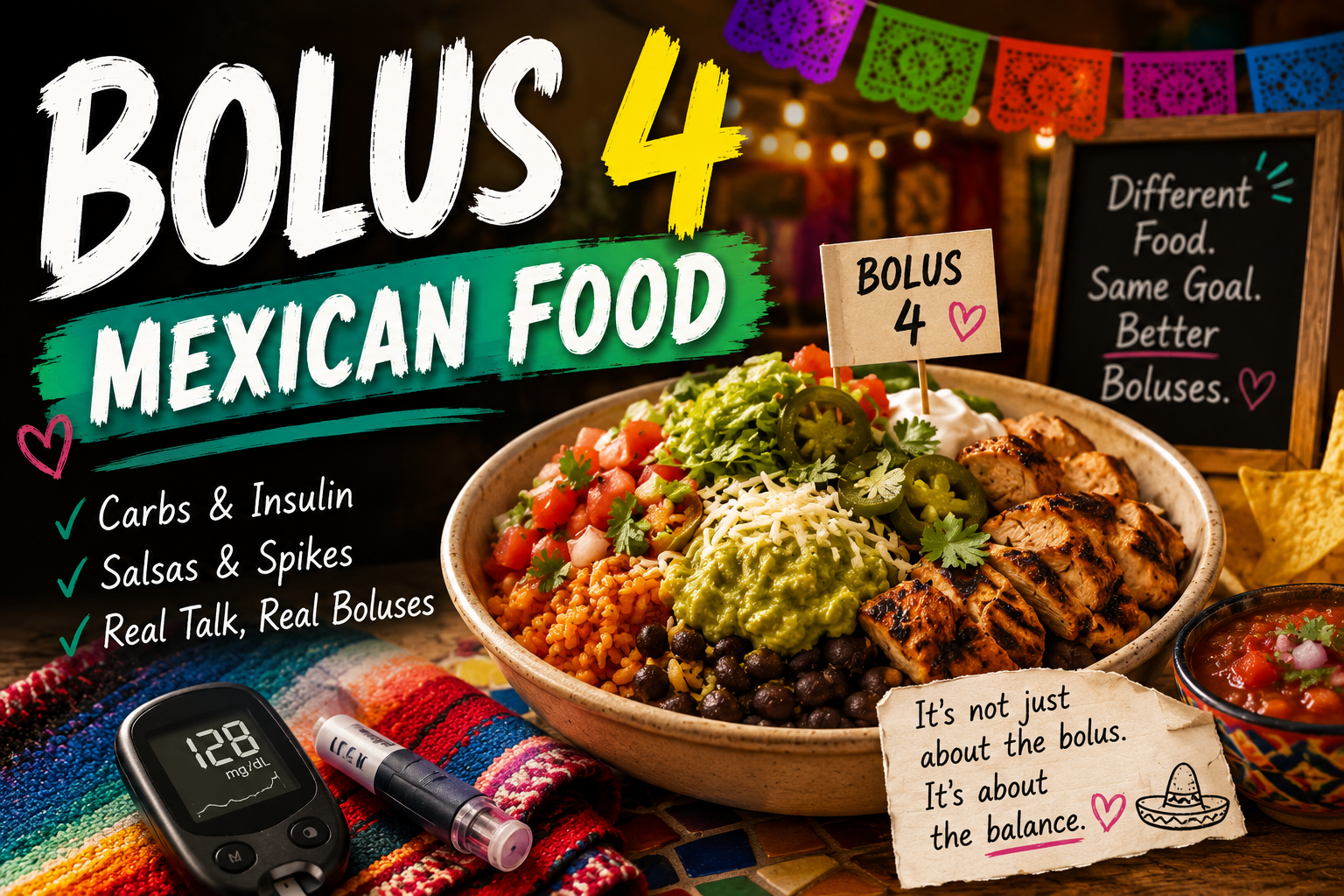
Scott and Jenny tackle Sonic Tater Tots. Learn strategies for high-fat, processed carbs using the MEAL BOLT method to keep glucose in range.
+ Click for EPISODE TRANSCRIPT
DISCLAIMER: This text is the output of AI based transcribing from an audio recording. Although the transcription is largely accurate, in some cases it is incomplete or inaccurate due to inaudible passages or transcription errors and should not be treated as an authoritative record. Nothing that you read here constitutes advice medical or otherwise. Always consult with a healthcare professional before making changes to a healthcare plan.
Scott Benner (0:00) Hello, friends, and welcome back to another episode of the Juice Box podcast. (0:14) In every episode of bolus four, Jenny Smith and I are gonna take a few minutes to talk through how to bolus for a single item of food. (0:22) Jenny and I are gonna follow a little bit of a road map called meal bolt. (0:26) Measure the meal. (0:28) Evaluate yourself.
Scott Benner (0:29) Add the base units. (0:30) Layer a correction. (0:32) Build the bolus shape. (0:33) Offset the timing. (0:34) Look at the CGM.
Scott Benner (0:36) Tweak for next time. (0:38) Having said that, these episodes are gonna be very conversational and not incredibly technical. (0:43) We want you to hear how we think about it, but we also would like you to know that this is kind of the pathway we're considering while we're talking about it. (0:51) So while you might not hear us say every letter of Miele Bolt in every episode, we will be thinking about it while we're talking. (0:58) If you wanna learn more, go to juiceboxpodcast.com/meal-bolt.
Scott Benner (1:04) But for now, we'll find out how to bowl us for today's subject. (1:10) While you're listening, please remember that nothing you hear on the Juice Box podcast should be considered advice, medical or otherwise. (1:18) Always consult a physician before making any changes to your health care plan or becoming bold with insulin. (1:30) Jenny, I put up a post on the good old Internet, and I asked people what
Jenny Smith (1:37) did I say? (1:37) Let me see what I said.
Scott Benner (1:38) Joe, very simple. (1:39) What restaurant foods give you the most trouble when you're trying to bolus? (1:43) Let's make a list. (1:44) There's some vague stuff here, but there's also people are saying, like, absolutely, like, specific restaurants.
Jenny Smith (1:51) That's why was wondering if it was just items like french fries in general or if it was specific restaurants with specific items because
Scott Benner (2:00) Well, yeah. (2:01) I mean, there's one thing I've I've learned about putting something on the Internet is that they don't know what you're thinking. (2:05) So, you know, I thought somebody would you know, I always assume people will just know what I'm thinking. (2:11) But some people are just like Chinese food, pancakes, pizza, that kind of stuff. (2:15) And I'm
Jenny Smith (2:15) like, oh, yeah.
Scott Benner (2:16) We'll Sure.
Jenny Smith (2:16) We'll get to all that anyway.
Scott Benner (2:17) Then some people got more specific. (2:19) It's chow mein. (2:20) I I really struggle with honey garlic chicken, but we've got some Panera, McDonald's, Taco Bell specific Panda Express boba.
Jenny Smith (2:34) You know what? (2:35) I have to tell you right now. (2:36) I don't understand the whole boba tea thing.
Scott Benner (2:38) I don't either.
Jenny Smith (2:38) Get it. (2:39) Yeah. (2:39) I really don't. (2:40) We have a I mean, we've got multiple places here that have it. (2:43) Oh, and then they're just to, like, look.
Jenny Smith (2:44) I'm like, I don't understand the idea of drinking something that's got, like, jellyfied weird looking bubbles at the I don't get I really just don't get it.
Scott Benner (2:52) I really don't. (2:52) Fixation with it, and I don't understand either.
Jenny Smith (2:55) So Well, I'm not alone there.
Scott Benner (2:56) Tater tots from Sonic is very specific. (3:00) And Culver's. (3:01) What's Culver's?
Jenny Smith (3:03) Oh, Culver's? (3:04) You've never that's a yeah. (3:05) Culver's. (3:06) Culver's is custard, and then it's like a burger place, but
Scott Benner (3:12) Oh, it's a Wisconsin thing. (3:13) That's why you
Jenny Smith (3:13) know what Wisconsin thing.
Scott Benner (3:14) Burger chain, frozen custard, fried cheese curds. (3:18) Fried cheese curds.
Jenny Smith (3:20) You don't know what a cheese curd is? (3:21) No. (3:21) I learned You got a brother that lives here in Wisconsin.
Scott Benner (3:24) You just do you know how Wisconsin you just got when you said come on? (3:27) You're like, come on.
Jenny Smith (3:32) Oh, entirely.
Scott Benner (3:33) Yes. (3:33) I'm gonna keep making this podcast for twenty more years just so I can know you when you're, like, 60. (3:38) That's what I want now. (3:39) I can hear you.
Jenny Smith (3:39) I will probably talk my like, my father when I'm 60. (3:42) I don't know. (3:43) He has or he had, I should say, the ultimate very Wisconsin accent.
Scott Benner (3:48) Alright. (3:49) Okay. (3:49) Well, I'll get you to do an impression one day. (3:51) But first,
Jenny Smith (3:52) I mean, let's pick one
Scott Benner (3:53) of these things. (3:53) I wanna start with the tater tots. (3:56) What was that?
Jenny Smith (3:57) Oh, tater tots.
Scott Benner (3:58) From Sonic.
Jenny Smith (3:59) Oh, Sonic. (4:00) Okay.
Scott Benner (4:01) Okay. (4:01) Hold on a second. (4:03) Sonic tater tots nutrition, I'm gonna type. (4:09) I bet I bet I'm the first person in the history of the world to type those words together. (4:12) Okay.
Scott Benner (4:12) Let's see.
Jenny Smith (4:13) I've never been to a Sonic, by the way.
Scott Benner (4:15) I have not either. (4:18) Okay. (4:18) Now this is their website.
Jenny Smith (4:20) Okay.
Scott Benner (4:21) I'll accept their cookies. (4:23) 360 calories for the tots. (4:25) Okay. (4:27) Nutritional information. (4:29) Oh, there's small, medium, and large.
Scott Benner (4:31) I'm gonna go large because I mean, I don't know. (4:34) How many is in a small and a medium and
Jenny Smith (4:36) a large? (4:36) Let's see. (4:37) Does it say? (4:40) No. (4:40) It just tells you small, medium, or large.
Scott Benner (4:43) Which one do you wanna do?
Jenny Smith (4:45) Let's do a medium.
Scott Benner (4:46) A medium? (4:47) We've shoot we're shooting the middle. (4:49) Protein in this, three grams. (4:52) Carbohydrates, Jenny, any guesses? (4:54) It's hard.
Scott Benner (4:55) You don't know how many are in there, but wanna pick a
Jenny Smith (4:57) Yeah. (4:57) In a so a medium serving. (5:01) A medium serving, I'm gonna guess 45 or 50.
Scott Benner (5:06) Okay. (5:06) 43. (5:07) You're a savant. (5:09) Total dietary fiber, four. (5:10) I'm gonna ask you in a second why you thought that for medium.
Scott Benner (5:13) Fat, 19 grams. (5:15) Saturated fat, 3.5. (5:18) They're very, very proud to tell you there's no cholesterol or trans fatty acid in it. (5:22) Oh. (5:22) Sodium, oh, eight hundred and ninety milligrams.
Scott Benner (5:26) Calories from fat, a 170. (5:28) Calcium, 19. (5:30) Vitamin a, seven. (5:31) Iron, one point four. (5:32) Vitamin c, one point four.
Jenny Smith (5:35) Okay. (5:36) Well,
Scott Benner (5:36) I don't know how to bowl this to this already because they are definitely deep fried. (5:40) Right? (5:40) So there's gonna
Jenny Smith (5:41) be Oh, a 100% deep fried.
Scott Benner (5:42) Yeah. (5:42) There there's no way there there's a baked option of this, I don't imagine.
Jenny Smith (5:45) They weren't terribly high in fat. (5:47) Right? (5:48) Well, in the medium portion. (5:49) Maybe in the small portion, it wouldn't be terribly high. (5:52) But the Small?
Scott Benner (5:53) I'll give it to you. (5:53) Is it
Jenny Smith (5:53) 20 grams?
Scott Benner (5:54) Small fat, 13. (5:56) Medium fat, 19. (5:57) Large fat, 31.
Jenny Smith (5:59) Oh.
Scott Benner (6:00) Yeah. (6:00) I wanna read this little thing from their website. (6:03) It says crispy tots fried to a golden brown and lightly seasoned with salt. (6:08) Does eight hundred and ninety milligrams of sodium sound like lightly seasoned with salty? (6:13) That's a lot, isn't it?
Jenny Smith (6:15) Nineteen hundred milligram?
Scott Benner (6:16) This is a lot. (6:17) Eight hundred and ninety milligrams.
Jenny Smith (6:19) Oh, eight hundred. (6:19) That's still almost half of what you should have in an entire day.
Scott Benner (6:23) That's what I'm saying. (6:24) But but they
Jenny Smith (6:24) That's
Scott Benner (6:25) The marketing people said lighteny lightly seasoned.
Jenny Smith (6:27) Lightly seasoned. (6:28) Yes. (6:29) Mhmm. (6:29) Just got a sprinkle on it. (6:30) You're gonna love it.
Scott Benner (6:32) Anyway, these things are probably awesome. (6:34) I just wanna say that. (6:36) They probably they probably taste like heaven. (6:39) I don't know. (6:39) Where do we start here?
Scott Benner (6:40) Let's let's say that we roll up on a Sonic, and we're not gonna get into a full meal. (6:44) We're just gonna have our tots and get on our way, and our blood sugar is nice and stable at a 120. (6:50) Let's say that. (6:51) So a 120, we're gonna wanna measure the meal. (6:56) Mhmm.
Scott Benner (6:56) I got 43 carbs. (6:58) I think you've gotta really consider the fat here, and this is gonna be the first time I think we talk about it. (7:04) So, you know, like, this to this level, evaluate yourself. (7:07) We have a little bit of a a higher blood sugar, one twenty. (7:10) I'd love to see that come down to 80, so there'll be a bolus in there for that.
Scott Benner (7:14) And, we'll do some calculations here. (7:16) So you know what I mean? (7:17) We're gonna do the old one unit covers 10 for carbs, and one unit moves us. (7:22) How have we been doing this? (7:23) One unit moves us why don't we say 50 for this one?
Jenny Smith (7:26) 50 for this one? (7:27) Sure.
Scott Benner (7:27) Let's say one unit moves Make
Jenny Smith (7:28) it nice and easy.
Scott Benner (7:29) Yeah. (7:29) Let's make it easy for us. (7:30) So about a unit for the for the one twenty in my mind. (7:35) And then your ratio is gonna tell you, what, like, 4.3 for for the carbs, which is a 5.3. (7:42) But the the pre bolus here would have to be this is interesting.
Scott Benner (7:47) Right? (7:47) Because this place is it's not at your house. (7:50) You're gonna have to drive to it. (7:52) Mhmm. (7:52) And truth be told, you're either gonna bolus while you're driving or you're gonna bolus and sit in the parking lot before you order.
Scott Benner (7:59) There's no way around it. (8:00) Right?
Jenny Smith (8:01) I mean, unless you are going inside to actually sit down, but I'll right. (8:05) I mean, most many people are doing a drive through type of thing for a fast meal restaurant.
Scott Benner (8:11) Grabbing the tots, I would think I it's an in and out situation for me. (8:14) Right. (8:15) And, Jenny, like, honestly speaking, like, how many people do you think are saying to themselves, hey. (8:20) I'm twenty minutes out from the Sonic. (8:22) I'm definitely getting tater tots.
Scott Benner (8:24) I'm gonna bolus now.
Jenny Smith (8:25) Like Not many.
Scott Benner (8:25) I don't have type one. (8:26) Like, would you make a big bolus while you were driving?
Jenny Smith (8:29) Depends where my blood sugar was and how is it how is it starting. (8:32) You know, if I'm I always have something with me.
Scott Benner (8:35) Mhmm.
Jenny Smith (8:36) And would I bolus for all of it? (8:38) No. (8:38) I would likely almost a 100% certain that I would bolus for something of it. (8:44) And then once I actually had it in hand, see what's happening with my blood sugar. (8:48) Again, this is where that evaluate your blood sugar and kind of the trend happening and go ahead and bolus for the rest of it at that point.
Jenny Smith (8:55) Or maybe see where it's going even once I get in line to make the order now that I'm there. (9:00) I'm gonna have it in hand in the next five minutes. (9:03) Yeah. (9:03) What happened with that five or ten gram bolus that I gave on the way here just to start tipping me in the direction of insulin working
Scott Benner (9:13) Mhmm.
Jenny Smith (9:14) Before I take that first bite.
Scott Benner (9:15) I think your safety is the most important thing, obviously. (9:18) Mhmm. (9:18) And I would tell you that in nineteen years of having type one diabetes, we have one time bolus in the car, and it had and it didn't work out.
Jenny Smith (9:26) Sure.
Scott Benner (9:27) And it was I I know I've told this story on the podcast before, but it was, it was it's harrowing for a minute, you know? (9:33) But mostly speaking, I I think this is a pretty honest thing to say. (9:38) If I'm thinking about it, then we bolus in the car on the way.
Jenny Smith (9:41) Correct.
Scott Benner (9:42) If I don't bring it up to Arden, she's not She's not
Jenny Smith (9:45) going to.
Scott Benner (9:45) No. (9:45) She's not gonna remember that. (9:46) But, you know, for for the sake of talking about how to successfully bolus for these sonic tater tots, I think of accurate bolus with a, you know, a significant pre bolus is gonna be the only way to get ahead of these. (9:58) Right?
Jenny Smith (9:58) Right. (9:59) Yeah. (9:59) Because, again, they're fatty, but they aren't excessive in this portion.
Scott Benner (10:04) Mhmm.
Jenny Smith (10:04) You're gonna get hit by the carb part of this sooner than the potential for what will likely be still a lingering effect maybe after you eat it because these are processed potatoes.
Scott Benner (10:17) Yeah.
Jenny Smith (10:17) Right?
Scott Benner (10:18) It's
Jenny Smith (10:18) not They are broken down. (10:19) They're smashed up. (10:20) They're precooked before they get fried. (10:22) So their glycemic impact is absolutely going to be a heavier, quicker hit.
Scott Benner (10:28) Okay.
Jenny Smith (10:28) I think what confuses people often is that they know that this is a fried food. (10:33) So they may expect it to have a slower impact on their blood sugar when really that slow impact is coming, but it's not the immediate of what they're going to see happen to their blood sugar.
Scott Benner (10:45) Okay. (10:46) So I'm using a, a fat and protein bolus calculator
Jenny Smith (10:50) Yeah.
Scott Benner (10:51) That is on my website. (10:53) Uh-huh. (10:54) It's not medical advice and use it at your own risk. (10:57) I just wanna say that.
Jenny Smith (10:57) I have one on my phone as well.
Scott Benner (10:59) There you go. (11:00) It asks me for grams of fat, grams of protein, grams for insulin to carb ratio.
Jenny Smith (11:07) Mhmm.
Scott Benner (11:08) Grams for one unit. (11:10) So I tell it 10. (11:12) And it tells me the the carbohydrate equivalent of the fat is 18 grams. (11:20) Mhmm. (11:20) That seem about right to you?
Scott Benner (11:21) Yeah. (11:22) 19 so 19 grams of fat. (11:24) So it's saying that if you're one to 10, an extra dose would be 1.8 Yeah.
Jenny Smith (11:31) Mhmm. (11:31) And it should usually I don't know if your app is the same as mine, but it'll give for those who want dosing idea or timing of dosing it. (11:38) You should give how long to
Scott Benner (11:40) It's recommended it
Jenny Smith (11:41) that bolus over.
Scott Benner (11:42) An extended bolus of four hours.
Jenny Smith (11:43) Okay.
Scott Benner (11:44) Right. (11:44) So I think that's significant for people to hear because, you know, we said at our one to 10 ratio, these tater tots are four point eight units of of insulin. (11:54) Right? (11:54) Or four point three, whatever it was. (11:56) Four point three.
Scott Benner (11:57) Two more units is, like, 40% more. (12:01) Like, it's a lot more insulin. (12:03) That Yes. (12:03) I think that, not understanding that piece, is the spot where you get into the, like, I don't know what happened. (12:08) I just had tater tots.
Scott Benner (12:09) They seem, like, benign. (12:11) Like, right? (12:11) There's probably a handful of them. (12:13) Hour or two hours later, my blood sugar's super high. (12:16) My kid's blood sugar's super high.
Scott Benner (12:17) It won't come down. (12:19) You know, I don't understand. (12:20) All my settings usually work, etcetera, so on. (12:22) Especially with these, you know, with the automated systems, they're gonna believe you that you put in the right amount of insulin and take away your basal. (12:30) And so you're gonna float up, stay up, and then how would you if you didn't understand the impacts of the fat, I believe it would be difficult to assume a 40 or 50% need over top of the original bolus.
Scott Benner (12:44) Like, that would seem, I think, significant to people who don't understand the rest
Jenny Smith (12:48) of it. (12:49) Right. (12:49) Don't you? (12:49) And where I think bringing in another piece to this consideration, a sonic meal or any fast food, many times they come in in a setting where you will also likely be sedentary after eating. (13:04) Mhmm.
Jenny Smith (13:04) Such as you're on a road trip and you're stopping quick to grab a bite along the way. (13:08) Right? (13:09) And you're getting back in the car, and now you're gonna sit for another hour or two hours. (13:13) You know, a lot of the kids that I work with are on travel athletic teams. (13:17) They're going somewhere.
Jenny Smith (13:18) They eat on the way. (13:19) They may play a sport. (13:20) They're hungry after. (13:21) They stop. (13:21) It's another hour to get home.
Jenny Smith (13:23) They're sitting in the car. (13:24) So that can have an impact. (13:26) And in terms of bringing up the fat, like we're discussing, absolutely, you may control the initial rise
Scott Benner (13:34) Mhmm.
Jenny Smith (13:34) Pretty well with the bolus just for carbs. (13:37) But later on, you may never really see that curve back down. (13:41) You may also see a little bit more of a nudge up in your blood sugar than you'd expect.
Scott Benner (13:46) I'd ask people to keep this in mind too, and I'm gonna say a couple of things very quickly. (13:50) If you didn't if you just got the tots, then I can go ahead and bowl this for, you know, about the way we talked But if you added a crispy tenders five piece to it, you'd be adding 27 carbs and 20 more grams of fat. (14:04) If you added the crispy chicken sandwich to it, you'd be adding 52 carbs and yeah. (14:12) Well, listen. (14:13) You'd be adding 52 carbs, 10 sugar, 24 fat.
Scott Benner (14:18) And by the way, another 1,500 in sodium. (14:21) Yeah. (14:21) And that's the chicken sandwich, which you're gonna definitely think like chicken. (14:25) Awesome. (14:25) Chicken's good for you.
Jenny Smith (14:26) Must be better. (14:27) Right?
Scott Benner (14:27) Let's just go to the burgers for a second. (14:29) I'm just gonna go plain sonic cheeseburger, 48 carbs, eight sugars, 35 fat. (14:37) Right? (14:38) If you get the double sonic smasher, it has pickles on it. (14:42) Jenny, it has pickles on it.
Scott Benner (14:43) I was
Jenny Smith (14:43) like, oh, you remember I like pickles?
Scott Benner (14:44) Yeah. (14:44) A lot of healthy for you in that. (14:46) Don't worry. (14:46) Pro,
Jenny Smith (14:47) carbs just ask for a side of the pickle?
Scott Benner (14:48) Just some pickles, please. (14:51) Carbs, 30. (14:52) Sugar's, eight. (14:53) Fat, 37. (14:54) 1,500 sodium.
Scott Benner (14:56) Like so there's a lot here that
Jenny Smith (14:59) There is.
Scott Benner (14:59) When you start mixing it together, especially, I think the chicken. (15:04) Because I think in people's minds, the chicken is, like, free. (15:07) It's chicken. (15:09) Chicken. (15:09) They don't think about the breading or the fat or etcetera.
Scott Benner (15:11) But just I mean, keep in mind, if you take five piece tenders, 27 carbs, and then add it to the medium tots, that's forty, fifty, sixty, seventy carbs. (15:25) It's twenty, forty, you know, 39 fat. (15:30) That's a a significant bolus. (15:32) Like and once that meal gets ahead of you, it's gonna stay ahead of you.
Jenny Smith (15:36) And this is entirely I think it's a the best example of why teaching about only carbohydrates is false information. (15:47) It is. (15:48) You're taught to just cover the carbohydrates that you're eating here. (15:52) I looked at the label. (15:54) This is what it told me.
Jenny Smith (15:55) My ratio is this. (15:56) I figured it out. (15:58) Why is this happening? (15:59) And unless somebody really steps in and says, hey. (16:02) This meal contained 50 grams of fat.
Jenny Smith (16:06) This is the reason this is happening and then proceeds to also teach you Mhmm. (16:11) How to navigate that, you're forever going to be frustrated by only counting carbohydrates.
Scott Benner (16:17) Yeah. (16:17) By the way, they also offer a variety of dipping sauces as does every I'm not picking on Sonic, but, like, there's a signature sauce, a ranch, a honey mustard, a buffalo, a barbecue. (16:26) You know, those things, I I find people don't think about that at all. (16:30) Like ketchup.
Jenny Smith (16:31) Oh, no.
Scott Benner (16:31) I think ketchup's one that, you know, people are like, oh, I have a burger and ketchup. (16:36) And, you know, there's a tablespoon or two tablespoons of ketchup later, and you're probably looking at
Jenny Smith (16:40) Or a quarter cup of it if you're I mean, honestly, come on.
Scott Benner (16:43) Seriously? (16:44) Right? (16:44) You think?
Jenny Smith (16:44) You oh, most people eat a lot of ketchup at a time. (16:48) I I mean, I think ketchup the fries or whatever they're eating with it are just a loading place to get the ketchup in for some people. (16:57) And ketchup is full of sugar.
Scott Benner (16:59) The fries are the delivery system for the ketchup?
Jenny Smith (17:01) Yes. (17:01) Thank you. (17:01) Yes.
Scott Benner (17:02) Yeah. (17:02) Yeah. (17:02) I've made fun of, somebody in my life one time. (17:04) I'm like, I think that baked potato is just a way for you to eat butter. (17:07) Uh-huh.
Scott Benner (17:09) Okay. (17:09) I think is that good for this one, do you think?
Jenny Smith (17:11) I think it is. (17:12) I think it highlights a lot of the things that need to be considered. (17:16) You know, we started with the tater tots, obviously, which I don't I don't even I think I was in, like, middle school last time I had a
Scott Benner (17:21) tater Listen. (17:22) I I think it's one of those things. (17:24) Like, I I I think it tugs at your young heartstrings. (17:27) Like, mean, tater tots at I mean, did you not have pizza in tater tot day at school?
Jenny Smith (17:31) Oh, a 100%. (17:32) Yeah. (17:32) Rectangle pizza. (17:34) It was the one day that when my mom looked at the calendar after I was diagnosed, it was the one day that we'd look at it. (17:41) She'd be like, okay.
Jenny Smith (17:41) I won't pack your I won't pack your lunch today. (17:43) You can have the pizza.
Scott Benner (17:44) Right? (17:45) The pizza, which by the way, makes an Elio's pizza look like gourmet. (17:49) And you were still excited about it. (17:50) Right?
Jenny Smith (17:51) A 100. (17:52) It was great.
Scott Benner (17:52) What piece of cardboard with, like, half ketchup on it and a handful of tater tots? (17:56) And you were like, my life is all and then people are like,
Jenny Smith (17:58) what? (17:59) Exciting.
Scott Benner (17:59) It was oh my god. (18:00) It's the best part of your life.
Jenny Smith (18:01) You know, I think was this the best part for you too? (18:03) Like, the rectangle pizza slices? (18:06) We had those plastic plastic school trays. (18:09) Yeah. (18:10) That we went through the line.
Jenny Smith (18:11) And I it was always exciting to me visually that the pizza slice fit perfectly in the rectangle that had that was on the plastic tray. (18:19) Like, that was very exciting to me that it fit perfect in that little rectangle. (18:23) Now people are gonna think
Scott Benner (18:24) that Yeah. (18:25) Jen, Don't tell people stuff like that. (18:26) Hey. (18:28) Let me tell you something here. (18:29) The original cold brew iced coffee at Sonic, there are four sizes, small, medium, large, and something called r two r t 44.
Scott Benner (18:39) What could r t 44 stand for? (18:42) Not the point. (18:43) The r t 44 size has 82 carbs in it, 58.
Jenny Smith (18:48) Is it 44 ounces?
Scott Benner (18:50) Is it?
Jenny Smith (18:51) I don't know. (18:51) I'm just asking. (18:52) Maybe there, so I'm curious if
Scott Benner (18:54) that's the size. (18:55) I'm looking.
Jenny Smith (18:56) Kinda like the slushies at seven Eleven that are, like, gigantic.
Scott Benner (19:01) I don't know. (19:02) It has 82 carbs, 58 Oh my god. (19:05) 58 grams of sugar. (19:07) Yeah. (19:07) There's 460 of salt in that.
Scott Benner (19:12) That's crazy. (19:13) Is that not crazy? (19:14) How many calories are you supposed to have a day? (19:15) Like, 2,000?
Jenny Smith (19:17) It depends on your activity level, your age, you know, all that kind of stuff. (19:21) But in general, I mean, this is, again, a big reason that drinking your calories in general shouldn't be done. (19:27) All of the drinks from any of the national brands, they're not a way to take in calories because they're not ones that register with your brain.
Scott Benner (19:36) The small has 28 carbs, 20 sugars in it. (19:39) High fat. (19:39) There's fat in coffee?
Jenny Smith (19:42) Well, probably because if it's a mixed it's No. (19:45) Probably got half and half.
Scott Benner (19:46) Yeah. (19:47) I don't know. (19:47) I don't drink coffee. (19:48) Anyway, I just want you to know that because it's it's listed as the the the breakfast coffee. (19:54) So I don't know.
Scott Benner (19:55) In my mind, it makes it sound like it's, you know, healthy. (19:58) It's for breakfast.
Jenny Smith (19:59) Healthy. (19:59) Right. (19:59) It's your breakfast coffee. (20:00) Maybe it's got some good protein or something in it.
Scott Benner (20:03) I don't know. (20:04) I'll see you.
Jenny Smith (20:05) Thanks.
Scott Benner (20:13) In each episode of the bolus four series, Jenny, Smith, and I are gonna pick one food and talk through the bolusing for that food. (20:22) We hope you find it valuable. (20:24) Generally speaking, we're gonna follow a bit of a formula, the meal bolt formula, m e a l b o l t. (20:32) You can learn more about it at juice box podcast dot com forward slash meal dash bolt. (20:38) But here's what it is.
Scott Benner (20:39) Step one, m, measure the meal, e, evaluate yourself. (20:47) A, add the base units. (20:49) L, layer a correction. (20:53) B, build the bolus shape. (20:55) O, offset the timing, l, look at the CGM, and t, tweak for next time.
Scott Benner (21:02) In a nutshell, we measure our meal, total carbohydrates, protein, fat, consider the glycemic index and the glycemic load, And then we evaluate yourself. (21:13) What's your current blood sugar? (21:14) How much insulin's on board? (21:15) And what kind of activity are you gonna be involved in or not involved in? (21:19) Do have any stress, hormones, illness?
Scott Benner (21:22) What's going on with you? (21:24) Then a, we add the base units. (21:26) Your carbs divided by insulin to carb ratio, just a simple bolus. (21:31) L, layer of correction. (21:32) Right?
Scott Benner (21:33) Do you have to add or subtract insulin based on your current blood sugar? (21:37) Build the bolus shape. (21:39) Are we gonna give it all upfront, a 100% for a fast digesting meal, or is there gonna be like a combo or a square wave bolus? (21:46) Does it have to be extended? (21:48) Offset the timing.
Scott Benner (21:49) This is about pre bolusing. (21:51) Does it take a couple of minutes this meal or maybe twenty minutes? (21:55) Are we gonna have to again consider combo square wave boluses and meals? (22:00) Figure out the timing of that meal. (22:02) And then l, look at the CGM.
Scott Benner (22:05) An hour later, was there a fast spike? (22:07) Three hours later, was there a delayed rise? (22:09) Five hours later, is there any lingering effect from fat and protein? (22:13) Tweak. (22:15) Tweak for next time, t.
Scott Benner (22:17) What did you eat? (22:18) How much insulin and when? (22:20) What did your blood sugar curve look like? (22:23) What would you do next time? (22:25) This is what we're gonna talk about in every episode of bolus four.
Scott Benner (22:30) Measure the meal, evaluate yourself, add the base units, layer a correction, build the bolus shape, offset the timing, look at the CGM, tweak for next time. (22:39) But it's not gonna be that confusing, and we're not gonna ask you to remember all of that stuff. (22:44) But that's the pathway that Jenny and I are gonna use to speak about each bolus. (22:53) The Juice Box podcast is edited by Wrong Way Recording. (22:57) Wrongwayrecording.com.
Scott Benner (23:00) If you'd like your podcast to sound as good as mine, check out Rob at Wrong Way Recording dot com.


























Please support the sponsors






The Juicebox Podcast is a free show, but if you'd like to support the podcast directly, you can make a gift here. Recent donations were used to pay for podcast hosting fees. Thank you to all who have sent 5, 10 and 20 dollars!

#1707 Triple Greased Food
You can always listen to the Juicebox Podcast here but the cool kids use: Apple Podcasts/iOS - Spotify - Amazon Music - Google Play/Android - iHeart Radio - Radio Public, Amazon Alexa or wherever they get audio.
Catherine shares a moving story from Bermuda about navigating her son's T1D diagnosis and GCSE exams while grieving the sudden loss of her husband.
+ Click for EPISODE TRANSCRIPT
DISCLAIMER: This text is the output of AI based transcribing from an audio recording. Although the transcription is largely accurate, in some cases it is incomplete or inaccurate due to inaudible passages or transcription errors and should not be treated as an authoritative record. Nothing that you read here constitutes advice medical or otherwise. Always consult with a healthcare professional before making changes to a healthcare plan.
Scott Benner (0:00) Hello, friends. (0:01) Welcome to the Juice Box podcast. (0:03) From my family to yours, I want to wish you a happy holiday.
Catherine (0:16) My name is Catherine. (0:17) I am currently in Bermuda. (0:20) I've lived here now for nineteen years. (0:23) I have two sons. (0:25) My son, Max, who is 16, who has type one diabetes, and his younger brother who is 14, who does not.
Scott Benner (0:38) If this is your first time listening to the Juice Box podcast and you'd like to hear more, download Apple Podcasts or Spotify, really any audio app at all. (0:48) Look for the Juice Box podcast and follow or subscribe. (0:51) We put out new content every day that you'll enjoy. (0:55) Wanna learn more about your diabetes management? (0:57) Go to juiceboxpodcast.com up in the menu and look for bold beginnings, the diabetes pro tip series, and much more.
Scott Benner (1:04) This podcast is full of collections and series of information that will help you to live better with insulin. (1:12) While you're listening, please remember that nothing you hear on the juice box should be considered advice, medical or otherwise. (1:20) Always consult a physician before making any changes to your health care plan or becoming bold with insulin. (1:32) I'm having an on body vibe alert. (1:34) This episode of the Juice Box podcast is sponsored by Eversense three sixty five, the only one year wear CGM.
Scott Benner (1:42) That's one insertion and one CGM a year. (1:46) One CGM, one year. (1:48) Not every ten or fourteen days. (1:50) Ever since c g m dot com slash juice box. (1:53) Today's episode is also sponsored by Touched by Type One.
Scott Benner (1:57) Go check them out right now on Facebook, Instagram, and, of course, at touchedbytype1.org. (2:04) Check out that programs tab when you get to the website to see all the great things that they're doing for people living with type one diabetes. (2:11) Touched bytype1.org. (2:13) The podcast is also sponsored today by the Tandem Mobi system, which is powered by Tandem's newest algorithm, Control IQ Plus technology. (2:22) Tandem MOBI has a predictive algorithm that helps prevent highs and lows and is now available for ages two and up.
Scott Benner (2:28) Learn more and get started today at tandemdiabetes.com/juicebox.
Catherine (2:34) My name is Katherine. (2:36) I am currently in Bermuda. (2:39) I've lived here now for nineteen years. (2:42) I have two sons. (2:44) My son, Max, who is 16, who has type one diabetes, and his younger brother who is 14, who does not.
Scott Benner (2:55) Okay. (2:55) Max is 16. (2:56) He has type one. (2:57) How old are you?
Catherine (2:58) I am 49.
Scott Benner (3:00) 49. (3:01) And you live in Bermuda?
Catherine (3:02) I do.
Scott Benner (3:03) And for the last twenty nine minutes, you and I have been trying to get set up to do this. (3:10) And whether we used your laptop or your phone or even calling from a home phone through, like, Zoom's number, you were getting an echo while you were talking. (3:20) So Yes. (3:21) So that everybody knows, I then went to my provider, my podcast provider. (3:27) This is probably a backroom thing you guys don't really know or care about, but I employ a company to host the podcast, and then they distribute it to whatever app you're listening on right now.
Scott Benner (3:38) Mhmm. (3:39) Even if you're listening on my website through the little player, it's all through this great company called Libsyn. (3:45) And they offer something called Connect where people who don't have Zoom or stuff like that can record and make a podcast. (3:51) I don't know how this is gonna sound. (3:52) I don't know anything.
Scott Benner (3:53) I apologize ahead of time. (3:55) If you don't like it, if you love it, check out Zoom or check out Libsyn. (3:59) But, Catherine, let's start because it's freaking me out a little because I can't hear myself in my ears, which I usually can do, but I'm just gonna live with that. (4:08) Like, I know that sounds strange, but I can usually hear myself while I'm talking. (4:12) Okay.
Scott Benner (4:13) But I need my headphones on to talk to you. (4:15) Yeah. (4:16) Feels like I'm underwater right now.
Catherine (4:18) Oh, no. (4:18) I'm so sorry.
Scott Benner (4:19) Don't be sorry. (4:20) It's strange. (4:21) I'll be okay. (4:22) So how old was Max when he was diagnosed?
Catherine (4:26) He was diagnosed when he was 15 years old.
Scott Benner (4:30) Since recently?
Catherine (4:31) It it is. (4:32) It's been, a whirlwind of a year with it. (4:37) He was actually away on a band trip with his school over to University of of, North Carolina Greensboro. (4:47) And it's one of those types of trips where, you know, the chaperone or if you're local, your parent drops you off, and you're on your own. (4:55) Basically, you've got resident advisers.
Catherine (4:57) It's very much like introduction to university or college life Mhmm. (5:02) Where, you know, you're responsible for choosing your own meals at the cafeteria. (5:06) You're responsible for getting to practice. (5:08) And so this is the second time he's done this camp, and he did what every teenage boy does is he lived on pizza and soda for a week.
Scott Benner (5:20) I thought you were gonna say you found a girl, but okay.
Catherine (5:22) No. (5:22) No. (5:23) No. (5:23) We wish. (5:23) We we we wish he could talk to girls, but he's still he's quite the introvert.
Catherine (5:28) He lived on pizza and soda for a week. (5:31) And then on the final night of the camp, there's always a concert. (5:34) And the chaperone that took the children from Bermuda noticed that Max got up from the concert in the middle of it and left and thought that was very, very odd. (5:45) And then all the next day coming home, he noticed that he kept going to the bathroom consistently even during the flight. (5:54) And we have a high, high rate of type two diabetes in Bermuda, So he was fairly aware of some of the signs and signals, and he pulled me aside at the airport and said, please just keep an eye.
Catherine (6:04) Something's going on. (6:06) And we got home, and we figured, well, maybe he's just tired. (6:08) We're not sure what's going on. (6:10) You know, you expect your 15 year old to be able to communicate to you if there's an issue.
Scott Benner (6:16) Yeah.
Catherine (6:17) Of course, he doesn't. (6:18) And it turns out that it's, like, 11:00 at night on that same day when he flew back, and we were getting my house ready for my parents from Canada to come stay with us for my nephew's wedding that week. (6:32) And all of a sudden, he's rushing into the bathroom urgently. (6:37) And at this point, we've realized this is absolutely just not normal.
Scott Benner (6:41) Can I ask a question? (6:42) Did you just do a zipper before rushing into the bathroom as a sound effect? (6:46) Because that was awesome if that's what you did.
Catherine (6:48) No. (6:48) No. (6:48) No. (6:49) No. (6:49) No.
Catherine (6:49) I actually just undid my hoodies, so that that's quite weird.
Scott Benner (6:54) Oh my god. (6:54) Yeah. (6:54) I was I was like, if you all are gonna start doing if you all are gonna start doing sound effects for me, I mean, that's
Catherine (7:00) really another lesson. (7:01) Definitely not that good.
Scott Benner (7:02) You're like, he rushed into the bathroom, zipped, and I was like, get out of here. (7:06) Am I gonna hear water next?
Catherine (7:19) So I said, okay. (7:21) We are going to the hospital because at this point, you know, something is definitely going on. (7:26) You either have a UTI, which is very rare in males, or you most likely have diabetes. (7:33) Something's up. (7:34) Like, the nurse case manager, risk manager in me, like, my brain is, like, already going through the diagnosis tree even before we've left the house.
Catherine (7:42) Mhmm. (7:43) So, thankfully, you know, Bermuda is very small. (7:45) We're only 21 miles by one and a half miles long. (7:49) So and our hospital is centrally located in the middle of the island. (7:53) So it's really we only have one hospital.
Catherine (7:56) It's not that far from us, so it's about a five minute drive. (8:01) So we get into the hospital, and it's, like, 11:30 at night. (8:06) And he there's, thankfully, on a Saturday night, no one in the emergency room at all. (8:10) It's completely empty. (8:12) And so he gets triaged, and the nurse does a blood sugar, and it reads off as high.
Catherine (8:17) So, automatically, we go into the back room. (8:21) They draw some proper lab work to send to the lab, and they come back and say that his blood sugars are 679, but he was not in ketoacidosis.
Scott Benner (8:33) Okay. (8:33) Well, good.
Catherine (8:34) Which was very, very good. (8:36) And his hemoglobin a one c upon entry was 10.3.
Scott Benner (8:42) It had been going on for a little bit.
Catherine (8:43) It it was. (8:44) And, you know, when I look back at it as a nurse, I should have picked up on some of the signs because his grades had started to slip in the last term of the school year. (8:57) So he had been sick in the Christmas prior to it with the virus non not COVID. (9:03) And then his grades started to slip, but I figured he's a 15 year old boy who happens to have ADHD. (9:12) And, obviously, there are just courses he doesn't really wanna focus on.
Catherine (9:18) So I was more thinking, this is just 15 year old boy. (9:23) Wasn't thinking much more about it in terms of that. (9:27) But then when I looked back in hindsight about the month before he went away to camp, my husband and I had noticed that repetitively around midnight, one of our children would be getting up and going to the bathroom, which was a new thing, and that was just an unusual item. (9:46) That led us up to there. (9:48) So I wasn't completely shocked when I looked at all this all the signs in hindsight that I just hadn't put together.
Scott Benner (9:54) Your accent is so crazy. (9:56) Is it Canadian? (9:57) Yes. (9:58) Yes. (9:59) Is that what it is?
Catherine (10:00) Yeah. (10:00) So I'm actually originally from Canada, born and raised, and then I lived in Boston for a few years as as a nurse as a nurse.
Scott Benner (10:10) There it is.
Catherine (10:10) And then I I came to Bermuda. (10:13) So it's it's definitely a little merge of different Yeah.
Scott Benner (10:18) It's it's very unique. (10:19) It is very unique. (10:20) Yeah. (10:21) Yeah. (10:21) Yeah.
Scott Benner (10:21) Cute. (10:22) What got you guys to Bermuda? (10:23) Like, I mean, besides, were you just like, why don't we go live in the sun? (10:26) That's a better idea or no?
Catherine (10:28) No. (10:29) My my husband was Bermudian. (10:31) So and he owned a company with his brother. (10:34) So it was just easier for me to relocate as a nurse here than it was for him to come to The US where I was working at the time. (10:43) Yeah.
Catherine (10:43) Because there was no way he was gonna get a visa to work in The US in his field. (10:48) So we just thought it was easier for me to relocate here. (10:52) And oddly enough, my one of my sisters had married a Bermudian and was living here already as well with her husband and family.
Scott Benner (10:59) Hold on. (11:00) Hold on. (11:00) What are your parents farming you guys out overseas or something? (11:03) What's going on exactly?
Catherine (11:04) No. (11:04) No. (11:05) No. (11:05) We still have one left in Canada. (11:07) But, yeah, it's just very, very odd that we both randomly met Bermudians
Scott Benner (11:12) Yeah.
Catherine (11:12) And and married them. (11:14) So
Scott Benner (11:14) That's really crazy. (11:15) Yeah. (11:16) How long have you been there?
Catherine (11:17) I've been here nineteen years.
Scott Benner (11:19) You live what we all assume is our dream, but is it a dream living on an island in a warm place or not really?
Catherine (11:24) We do get a little cool during winter, so it gets like a dampness cool with it. (11:30) If you're coming from overseas, you still think the weather is beautiful. (11:33) But if you live here locally, the first year you think, oh, this winter is nothing. (11:37) Every other year, you're like, oh, this is cold. (11:39) I need to find my hat.
Catherine (11:40) Like, you know, it's it's chilly out. (11:42) We need a sweater. (11:43) So
Scott Benner (11:44) There's no feeling of like, you're missing something or the weather's too similar to the rest of the day or anything like that?
Catherine (11:51) Not really. (11:52) Bramedians are known to travel, so it's not unusual. (11:56) Like, if you're missing, like, the snow at Christmas, a lot of people will just travel if they're missing that. (12:02) So we do have somewhat of seasons where it gets wet and cooler during the winter, but we never have snow. (12:10) And, honestly, it's like, you know, everyone's like, life's a beach, but we just get along our lives like anyone else does in a small community.
Catherine (12:19) You know? (12:19) Got it. (12:20) You raise your children. (12:21) You you go to work. (12:22) And it just happens that a lot of our activities outside of that surrounds, you know, either boating or beach or, you know, our our natural area here.
Catherine (12:32) You know, we spend a lot of time on the water here. (12:35) So
Scott Benner (12:36) If you go on a school trip, you get to go to North Carolina.
Catherine (12:39) Exactly.
Scott Benner (12:40) Interesting. (12:40) Well, that's really cool. (12:41) Yeah. (12:42) I appreciate you sharing that with me. (12:43) Yeah.
Scott Benner (12:44) He gets diagnosed here and Mhmm. (12:46) Sounds like you had a little bit of guilt, but, like, is that did that stick with you, or are you okay with that?
Catherine (12:50) Little bit of guilt. (12:51) It did stick with me for a little while, but I did get over it when I realized that, you know you know, unfortunately, as nurses, a lot of times, we are trained for hospital based items, which means you're being trained for the classic symptoms that are gonna come through the door. (13:07) So, you know, in working with our diabetic educator who I adore, you know, I definitely got over that guilt because there were so many signs that could have been attributed to other things.
Scott Benner (13:19) I'm glad. (13:19) I'll tell you why I say s because I thought it was amazing. (13:23) Teacher sees him go off to the bathroom, mention something to you, you get him home, take him right to the hospital. (13:28) It sounded seamless to me.
Catherine (13:29) It sounded like it was really seamless, but there when I looked in retrospect, we were like, okay.
Scott Benner (13:33) The time.
Catherine (13:34) The time. (13:34) Because we know this is an autoimmune disorder. (13:36) So we started to look back, and that's when I started to pick up some of these things that were explainable by other items as well.
Scott Benner (13:44) Other autoimmune in the family? (13:46) No. (13:47) You don't have celiac? (13:48) You don't have thyroid? (13:49) Nothing like that's happened?
Catherine (13:50) Nothing. (13:51) So
Scott Benner (13:52) Alright.
Catherine (13:53) His grandfather had type two diabetes. (13:56) His father was a BRCA two carrier, but there's no link between that and diabetes at all. (14:06) So we have no idea.
Scott Benner (14:09) His father was? (14:10) Is his father passed?
Catherine (14:11) Yeah. (14:11) His father passed this summer.
Scott Benner (14:13) Oh my gosh. (14:14) Catherine, you're were you married still?
Catherine (14:16) Yes.
Scott Benner (14:17) Oh my god. (14:18) Are you okay? (14:19) What what what happened? (14:23) This episode is sponsored by Tandem Diabetes Care. (14:26) And today, I'm gonna tell you about Tandem's newest pumping algorithm.
Scott Benner (14:30) The Tandem Mobi system with Control IQ plus technology features auto bolus, which can cover missed meal boluses and help prevent hyperglycemia. (14:40) It has a dedicated sleep activity setting and is controlled from your personal iPhone. (14:44) Tandem will help you to check your benefits today through my link, tandemdiabetes.com/juicebox. (14:52) This is going to help you to get started with Tandem's smallest pump yet that's powered by its best algorithm ever. (14:58) Control IQ plus technology helps to keep blood sugars in range by predicting glucose levels thirty minutes ahead, and it adjusts insulin accordingly.
Scott Benner (15:06) You can wear the Tandem Mobi in a number of ways. (15:09) Wear it on body with a patch like adhesive sleeve that is sold separately, clip it discreetly to your clothing, or slip it into your pocket. (15:17) Head now to my link, tandemdiabetes.com/juicebox, to check out your benefits and get started today. (15:26) Today's episode is sponsored by a long term CGM that's going to help you to stay on top of your glucose readings, the Eversense three sixty five. (15:35) I'm talking, of course, about the world's first and only CGM that lasts for one year.
Scott Benner (15:41) One year, one CGM. (15:44) Are you tired of those other CGMs? (15:46) The ones that give you all those problems that you didn't expect? (15:49) Knocking them off, false alerts, not lasting as long as they're supposed to. (15:55) If you're tired of those constant frustrations, use my link ever since cgm.com/juicebox to learn more about the Eversense three sixty five.
Scott Benner (16:04) Some of you may be able to experience the Eversense three sixty five for as low as a $199 for a full year. (16:10) At my link, you'll find those details and can learn about eligibility. (16:14) Eversensecgm.com/juicebox. (16:18) Check it out.
Catherine (16:19) Good days, bad days. (16:20) He was fine. (16:21) Like, he did everything he was doing. (16:24) He was a cub scout leader and was getting ready to physically getting ready to take kids away to a camp in two years. (16:31) That's extremely intensive physically.
Catherine (16:35) So he had been going to the gym. (16:37) He had been losing weight, cutting back on his charcuterie, cutting back on his beers with the with the the cub leaders after the children leave. (16:47) He was doing everything right. (16:49) And then he had just had had hernia surgery in May when all of his blood work was normal. (16:58) Everything was showing as normal.
Catherine (17:01) And then all of a sudden, in early June, he looks at me, comes out of the bathroom after he was shaving, says, I think my neck is swollen. (17:09) And I'm like, yeah. (17:10) That is really swollen. (17:12) We have an issue. (17:13) So that actually prompted multiple doctor's appointments and CT scans and biopsies.
Catherine (17:22) And in Bermuda, because we are so small, we actually send our pathology for cancer related items out to some of the best hospitals in the Boston area for their pathology team to manage it. (17:36) So that way we're getting the best So by the June, we knew that he had an aggressive form of cancer, but we didn't know what type. (17:47) Like, the pathology was not being nice at all or acting normally. (17:51) They were still having a lot of difficulty figuring that out. (17:56) So he actually goes to cub camp for the week like he always does to spend time with these cubs.
Catherine (18:04) And he actually I was already planned to be in the Boston area with my son and a few other children from Bermuda to take them to a well renowned diabetic camp just outside of the Boston area.
Scott Benner (18:19) Mhmm.
Catherine (18:20) And I was actually volunteering there as a nurse because I figured, well, I'm in the area. (18:25) They need someone in the country. (18:28) I'm a nurse. (18:28) I might as well volunteer. (18:30) Right?
Scott Benner (18:30) Yeah. (18:30) Yeah.
Catherine (18:31) Which was great experience to see all these different pumps that we don't even have access to in Bermuda, by the way. (18:37) Amazing. (18:38) So I was supposed to be there for two weeks. (18:40) And one weekend, I get the notice that he's coming up to Boston right away for some appointments. (18:47) And I was supposed to just go back and forth because he was gonna be okay.
Catherine (18:50) But after seeing him, we were he was admitted right away, and the pathology finally came back after three weeks that he had a very aggressive and rare form of neuroendocrine colon cancer.
Scott Benner (19:05) Oh my god.
Catherine (19:07) So yeah. (19:08) So we I'm
Scott Benner (19:09) so sorry.
Catherine (19:10) Thank you.
Scott Benner (19:10) Yeah.
Catherine (19:11) No. (19:11) It's fair. (19:12) We spent the summer in Boston, and he unfortunately passed away just ninety nine days ago. (19:21) Yeah.
Scott Benner (19:22) Oh my god. (19:23) I just as you were saying the story and you were like, June, I'm like, I that's this year.
Catherine (19:27) Yeah. (19:28) It's very recent. (19:29) So and my children kind of bounced back and forth between Boston and Bermuda for the summer because we wanted to try and give them some sort of normalcy, but we didn't want them to feel like they weren't with their father. (19:45) But the same point is being in a hospital is very stressful. (19:49) So so they kinda bounced back and forth, and they got very familiar with certain tourist attractions in Boston.
Catherine (19:56) Like, you know, we got a full membership at the science museum, and they went, like, every day.
Scott Benner (20:01) Yeah.
Catherine (20:02) So like, for a few hours. (20:03) Yeah.
Scott Benner (20:04) Wow my gosh. (20:05) Oh, and did you make this booking before this happened?
Catherine (20:08) I did.
Scott Benner (20:09) I was just gonna say, like, I oh, I found it's it's only because you said was. (20:13) That's what I'm sorry. (20:15) I shouldn't have asked.
Catherine (20:16) That's okay. (20:16) No. (20:16) That's fine. (20:17) That that's
Scott Benner (20:18) that's okay. (20:19) My head down. (20:19) I was like, oh. (20:20) No. (20:20) No.
Scott Benner (20:20) No.
Catherine (20:21) That's fine. (20:21) So but it actually it actually kind of, like, impacts Max's story because I will say this honestly. (20:29) The food in The US is horrible. (20:33) It's horrible for diabetes, especially if you are not cooking things from scratch yourself at home.
Scott Benner (20:40) So you were having trouble with managing as type one while you were in in Boston?
Catherine (20:45) Oh my god. (20:46) Horrible, horrible trouble.
Scott Benner (20:48) Oh, no kidding.
Catherine (20:49) Like, you know, so I would go from all day being at the hospital because as a nurse, I was my husband's translator for everything that was going on for him and managing all of that. (20:59) And then I would get back to the apartment, and I'd realized that my son has decided at 09:00 at night is a great time to have a cannoli from a famous pastry shop in the North End, where you can't find online any carb details about how many carbs are in that cannoli.
Scott Benner (21:16) Just assume a lot, I imagine.
Catherine (21:19) Oh, it was a bad night. (21:21) I look I looked at him afterwards, and I'm like, what are we gonna do next time? (21:27) He's like, I'm never gonna have a cannoli again. (21:29) I'm like, no. (21:29) You can have it, but can you have it at noon?
Scott Benner (21:33) Well, now if he has a baked good at home, that doesn't happen, you're saying?
Catherine (21:37) It doesn't happen because we know the foods. (21:41) Like, it's been trial and error that we know that from this place, it's, you know, it's about this carb size. (21:49) Like, our portion sizes in Bermuda are smaller. (21:54) Mhmm. (21:55) Even though a lot of our food comes from The US, We get a lot of our we get a good portion as well from The UK.
Catherine (22:05) We only have one US fast food restaurant here in Bermuda.
Scott Benner (22:12) Which one is it?
Catherine (22:14) KFC.
Scott Benner (22:15) Okay.
Catherine (22:15) Because we have an antifranchise law. (22:17) We used to have McDonald's, but when The US forces left a few decades ago, that left with them. (22:23) We do have, like, fast food areas, but it seems like that fast food is made is not made with the same type of food that you're or in the same way that is being processed in The US.
Scott Benner (22:34) I see. (22:35) So there's the KFC there, but it's really just a place that makes chicken and
Catherine (22:38) Well, no. (22:39) I mean, that is actually a proper KFC. (22:41) But if I go down the road to a different fast food place for a burger and fries, those fries are definitely not like McDonald's fries.
Scott Benner (22:49) Gotcha. (22:50) Gotcha.
Catherine (22:50) They are they're not, like, double or triple greased and everything else. (22:55) You're gonna see that release a lot sooner of the carbs than you would with fast food in The US.
Scott Benner (23:03) Okay. (23:03) It holds on longer here.
Catherine (23:05) It really does. (23:07) Yeah.
Scott Benner (23:07) Yeah. (23:07) It really does. (23:09) I'm gonna try to use the words triple greased at some point in my life. (23:12) I don't know where.
Catherine (23:13) But I don't know. (23:13) That's awesome. (23:14) And it just seems it's like because of the layer of grease along the fast food that, obviously, it takes a while for the stomach to break that down. (23:21) So next thing you know, you're spiking a lot higher. (23:25) It's almost the same concept as pizza.
Catherine (23:27) You know, you've gotta just learn how it how it works. (23:30) You know, when you're in a situation where you're in and out of hospitals, you're not really cooking great food, so you're letting your child eat whatever they want for the summer. (23:40) So it it there were some very interesting times with his blood sugars this summer.
Scott Benner (23:44) Yeah. (23:45) I have to ask you, how did your children handle, you know, your husband's passing? (23:51) Like and how do you contextualize that for them while you're busy trying to work it out for yourself when you actually have to go back to Bermuda and be by yourself too?
Catherine (23:58) So, thankfully so my children already had a therapist.
Scott Benner (24:02) Okay.
Catherine (24:03) And oddly enough, when my son was first being told that he had diabetes, one of the first messages was to his therapist to say, okay. (24:11) We need a session right now. (24:12) So his therapist was very well aware as to what was going on with my husband and what they did virtual sessions throughout the summer with both my children and then when my husband passed, and they continue to see him now. (24:27) It's very interesting because when you look at studies about grief and how teenagers react, you know, like, there's, like, almost, like, two paths that they tend to go on where one is either very, like, quiet and they don't really say a lot about it, almost like it never happened. (24:47) And then the other one is very angry and vocal, and both my children took a different path.
Scott Benner (24:54) Oh, awesome for you. (24:55) Yes. (24:56) Yeah. (24:57) So but they
Catherine (24:57) are getting through with the support of, like I mean, they've got an amazing family support here, through my husband's family and through, because my husband was a cub scout leader, and I'm a scout leader through our scouting family. (25:11) So they've got tremendous support in the community, and I guess that's one of the benefits of being from such a small place.
Scott Benner (25:19) Yeah. (25:19) What path did you take?
Catherine (25:20) I've taken the path of keeping myself as busy as possible and just realizing that I just have to get things done because I have two boys.
Scott Benner (25:29) Yeah. (25:30) Yeah. (25:30) Oh my gosh. (25:31) Yeah. (25:32) On your note here to me, it says, I wanna discuss how to deal with the stress of GCSE exams for type ones.
Scott Benner (25:40) What what what do what do you wanna talk about there?
Catherine (25:43) So GCSE exams are British exams for exiting high school. (25:49) They are two year courses that comes down to most of the courses will have two exams. (25:57) If it's a language, it might be four. (25:59) If it's a practical thing, like like shop or what we call design and tech, you know, you might have a practical part of it. (26:07) But, generally, you're studying for two years, and you have two exams, and that's your mark.
Catherine (26:13) It doesn't matter what you did through the two years. (26:16) Those test days are your days. (26:18) And if you have a bad day or a bad night with your blood sugars, we all know that you are not mentally clear for your exams, and that's it. (26:30) It's like, that is the mark that you are going to get, and there's no do overs. (26:36) The best you can do is try and get a letter from your doctor to say that, can you please give some Lee Nancy because of this situation?
Catherine (26:46) But you have to provide that on the exact same day that the exam is taking place.
Scott Benner (26:50) How do those those exam scores impact life?
Catherine (26:53) They impact how where you go next in your educational career. (26:58) So some schools, some universities, and colleges will use those to help determine entrance into into it. (27:07) So most of the children in his class go on to what's called an international baccalaureate, the IB program, which is basically pre like, junior college. (27:19) But the schools overseas will definitely look at their GCSE levels in terms of entrance for universities.
Scott Benner (27:28) It could have, like, a really big impact on the rest of your Yeah.
Catherine (27:31) Yeah. (27:31) Like, exactly. (27:33) I mean, thankfully, if you go further on with either, you know, your IB level, you can kind of try and make it up if you had a bad situation to show that you do have growth and you have the potential for it. (27:48) But it can be very it can be very stressful because there's because unlike the SATs, there's no rewrites.
Scott Benner (27:55) Yeah. (27:55) And and so this is this looms over everybody when you think about this.
Catherine (28:00) Oh, two years worth of stress where children are pulling their hair out because they know the importance of of doing well in these courses, and it literally comes down to two exams. (28:13) And are you having a good day on that exam or a bad day?
Scott Benner (28:16) What did you end up doing?
Catherine (28:18) There was a couple of days where he has some really, really bad nights, and we had to get a letter from the doctor that day to say, please give leniency because it's his diabetes that's causing mental mental fog and give him a little bit of leniency. (28:35) But there was actually one day where, his pump, because he's on an Omnipod, broke, and he didn't have any spares with him.
Scott Benner (28:47) And that was during testing?
Catherine (28:49) It was during testing. (28:50) It was so much fun because, technically, he's not allowed to have any technology on his desk. (28:57) He had put his phone on silence because he wanted to be respectful of everyone else testing.
Scott Benner (29:03) Oh.
Catherine (29:04) And he uses a PDM rather than the app because it just tends to work better in Bermuda.
Scott Benner (29:11) I see. (29:12) And so so he had a a a failure, and he didn't know it even happened?
Catherine (29:16) He didn't even know it happened. (29:18) So because he because when the invigilators, there's always a chance that an inside invigilator from The UK is gonna show up. (29:26) And if they see a phone, something that looks like a phone on a desk, that's a big problem. (29:32) And, of course, the PDM looks like an iPhone, you know, from a distance. (29:36) So that's all sitting in the back with an invigilator who has no idea what's going on.
Catherine (29:42) But, thankfully, I'm getting notifications that his sugars are climbing and climbing and climbing, and I'm like, what is going on?
Scott Benner (29:51) Mhmm. (29:52) I bet you freaked out. (29:53) I would have been like, are you kidding me?
Catherine (29:56) Oh, it was a it was a horrible day. (29:58) So I'm contacting the main receptionist, and I'm saying, okay. (30:03) He's got a spare bag with him. (30:06) I don't know what's going on right now, but his sugars are rising too much. (30:10) Get a message to him that he needs to, you know, give himself an additional bolus, and then I'll call back and see whether it worked.
Catherine (30:18) Well, that didn't work. (30:19) So then I'm like, can you grab his spare pen and tell him to give himself a dose right near the site? (30:27) Because we've gotta figure out what's going on. (30:29) Is it the site or is it the pump? (30:33) So we're working through our troubleshooting with things.
Catherine (30:36) And that did bring it down a little bit. (30:38) So we realized, okay. (30:40) This is a pump issue, and he did not have any spare pumps at school.
Scott Benner (30:46) Okay. (30:47) So does he have does he always have spare pumps now?
Catherine (30:51) He probably doesn't, to be honest. (30:54) Yeah. (30:55) He just kinda wings it a lot of time, unfortunately, as a teenager does. (31:00) He's got spare pens at at at school if he needs to, but oddly enough, he I don't think he actually has a spare pump there or a vial. (31:08) Does he keep more at school now?
Catherine (31:09) No. (31:11) Should he? (31:12) Absolutely. (31:13) Yes. (31:14) But my husband at the time, thankfully, because I was in crazy work mode that day.
Catherine (31:19) So my husband grabs some pumps, runs it down, and we're switching the pump. (31:25) He's, you know, he's allowed to leave the room for, like, two minutes to switch the pump Okay. (31:31) And get back under control. (31:34) But his sugars at that point, they were over 300.
Scott Benner (31:37) Oh gosh.
Catherine (31:38) Yeah. (31:39) It was it was definitely a very, very stressful situation. (31:43) So and it was in one of the courses that he actually really, really enjoys. (31:48) It was in his chemistry. (31:50) So it it was definitely an extremely stressful situation when you're entering those exams, and you know that this is it.
Catherine (31:59) Like, you don't get great. (32:01) You don't get a rewrite. (32:02) You don't get an opportunity to get classwork or any of the tests you did through it the last two years to count. (32:09) Like, this is it.
Scott Benner (32:11) This is just what it is.
Catherine (32:12) This is it is what it is. (32:14) So it's an extremely stressful situation. (32:16) You know? (32:17) And after that, I actually had a we learned a lot because we didn't realize what we would have to do if there was an illness or a situation like that in the middle of the test. (32:28) We didn't know what our rights were or anything, through the testing board.
Catherine (32:34) So I I sat down with the headmaster of the school. (32:37) After that happened, I said, okay. (32:39) Now we because there was definitely some communication breakdowns during it as well, because I'm handing over pretty complex medical directions
Scott Benner (32:48) Right.
Catherine (32:49) To a receptionist.
Scott Benner (32:52) Okay.
Catherine (32:54) So there was a few things that we were a little lost in translation. (32:58) We figured it out. (32:59) We figured out a plan for moving forward that, you know, we would just, like, keep things in writing as well. (33:05) Max had to learn that he cannot keep his things on silent during these exams.
Scott Benner (33:12) Okay. (33:13) Yeah. (33:13) Can I ask how was his actual performance? (33:16) Did it get did it get impacted, or did it end up not being an issue for his grading, etcetera?
Catherine (33:21) He did pretty well on that exam. (33:25) It's one of his stronger subjects. (33:27) He could have done better had he not been in a high blood sugar mental fog situation, but he did well enough to get into the higher level chemistry class that he's doing through his international baccalaureate. (33:45) So he did well enough to get in.
Scott Benner (33:47) They weren't like, oh, you're gonna be raking the beach.
Catherine (33:50) Yeah. (33:50) Exactly. (33:50) Because he want he wants to be an engineer, so he he needs to, like, have high marks in his sciences.
Scott Benner (33:56) Have his successes. (33:57) Yeah.
Catherine (33:58) Exactly. (33:59) Because when he had a brain fog in a different one, it was in his language class, which he was horrible at anyway. (34:07) So it's like, you know, not as stressful because you know he's not gonna do well.
Scott Benner (34:11) Did he does he describe what that that fog is like by any chance? (34:15) Have you talked about it?
Catherine (34:17) Yeah. (34:17) He says he just, like, he can't focus. (34:21) He it almost feels like he's swimming, like like, you know, that he's, like, underwater swimming, like nothing is making sense or being comprehended to to him. (34:32) It's almost like like that dream world or swimming, hearing things underwater sort of deal.
Scott Benner (34:38) Really? (34:39) What happens then? (34:40) Does he push through it, or does he does he step back and say, oh, I'm my blood sugar is high. (34:46) I'm in trouble. (34:47) Like, I wonder how, like like, how does that how does that mind handle that situation?
Scott Benner (34:51) You know what I mean?
Catherine (34:52) It depends on how high he was. (34:55) So if he is over about you know, if he's around over above 300, three fifty, he finds it difficult to mentally remember that, oh, this is my blood sugar. (35:07) I need to do something about it. (35:09) But if he catches it when he's still in a bed at two fifty, low 300 range, he'll be like, this is my blood sugar. (35:17) I need to make sure I dose appropriately for this.
Scott Benner (35:19) Okay. (35:20) Alright. (35:20) So
Catherine (35:21) Yeah. (35:21) So if it gets too high, he is He's not gonna think about it. (35:26) He needs intervention to help him to realize that.
Scott Benner (35:28) Course of a regular day, what's his blood sugar like?
Catherine (35:32) Much better than what it was. (35:34) So when he first got diagnosed, because I'm a nurse and we have an awesome diabetic educator and awesome endocrinologist on his team, he was actually out of the hospital within two days, and his first hemoglobin A1c went from 10.3 down to 8.3.
Scott Benner (35:51) K.
Catherine (35:52) And then this past June, before he he knew before he knew that his dad was sick, his hemoglobin AYC was down to 5.8.
Scott Benner (36:01) How did his dad's illness impact his his blood sugars?
Catherine (36:04) It ended up going up to 6.3, which I still thought was an amazing number
Scott Benner (36:10) Yeah.
Catherine (36:10) Given how bad the summer was with his blood sugars.
Scott Benner (36:14) Was it just our triple greased food, or was it other things that you think impacted?
Catherine (36:18) I definitely think, you know, you've got a teenager with hormones and growth going on, and then you impact add in all the stress of what was going on with his dad with his blood sugars. (36:31) It's definitely made it a lot harder to control. (36:37) And I was trying to explain the management of his diabetes to his aunts and uncles and grandmother to say this is how you have to do it. (36:46) And they're like, is there a list? (36:49) Like like, a prescription list?
Catherine (36:51) Like, if it's this, you do this. (36:53) I'm like, it's an art form. (36:54) Yeah. (36:55) I hate to break it to you. (36:56) It's kinda like trial and error, and it's it's more of an art form than a science.
Scott Benner (37:00) So when your husband's in Boston, how long has Max had diabetes for?
Catherine (37:06) Just one year.
Scott Benner (37:07) Oh my gosh. (37:08) Okay. (37:08) So Yeah. (37:09) Yeah. (37:09) Yeah.
Scott Benner (37:10) So you were just starting to figure it out a little bit, and then now you're having to pass it off to other people who have no context for it.
Catherine (37:16) They have none because I've been managing everything with Max, and we had done really well with getting his blood sugars under control. (37:24) You know, it's like six months into his diagnosis. (37:27) His honeymoon phase seemed to be ending, and we knew that he was going into practice exams, and he was going on a ski trip for school. (37:37) So we went ahead and we got him on a pump at that time.
Scott Benner (37:40) And devices available in Bermuda are different than in America?
Catherine (37:45) Yeah. (37:46) So we have access to the Omnipod
Scott Benner (37:49) Okay.
Catherine (37:50) And to Medtronic.
Scott Benner (37:52) Six seventy g, or do you not know which one?
Catherine (37:56) Any any of the Medtronic range we have. (37:58) We any of them. (38:00) So but those are the only ones we have access to.
Scott Benner (38:03) CGM?
Catherine (38:05) CGMs, have access to the Freestyle Libres, but most of them come from The Caribbean or from Canada. (38:12) So it's a little interesting when you're trying to set it up on your on your phone. (38:16) We have access to the g six without any issues, But the g seven, which I I know fewer and fewer people are using, they for the g seven, they actually have to take your phone to The US because of the of the fact that it is location based when you're setting it up.
Scott Benner (38:36) Okay. (38:37) You have to take your phone to The US to set up the oh, jeez.
Catherine (38:40) Yeah. (38:41) Because we tried the g seven first thinking the reviews were like, this is amazing. (38:46) It's gonna be great. (38:47) So his aunt was going to The US. (38:50) So I said, take his phone, please.
Catherine (38:52) Take it with you for the week. (38:54) We'll download the app there. (38:56) So that way when he comes home, everything works well.
Scott Benner (38:59) Jeez. (39:00) I have to tell you Yeah. (39:01) Arden's been using the g seven since it came out. (39:04) And, I mean, it's been good for us. (39:06) It's I I we've had, like, you know
Catherine (39:08) You're lucky.
Scott Benner (39:09) So I don't know how to think about that, Catherine. (39:11) Like, because I I recognize that there are people who are having trouble with the device. (39:15) I actually just saw somebody talking about Libre yesterday too. (39:18) There's been something with that. (39:21) I I don't know.
Scott Benner (39:22) Like, I I wouldn't minimize anybody having trouble with it, like, if it was five people. (39:26) Like, you know what I mean? (39:27) But I do wonder, like, how many they sell versus how many they have trouble with. (39:31) And I don't I don't know. (39:32) You know what I mean?
Catherine (39:33) That statistic would be really interesting to know, but he was just having so many issues with it.
Scott Benner (39:37) Yeah.
Catherine (39:38) And I'd have to call Dexcom all the time and say, my son is in school in Bermuda, but I'd like you to send us our replacements. (39:46) And I'd be like, to this address in The US. (39:49) And they're like, and who is that that we're sending this to? (39:51) So it it gets really interesting.
Scott Benner (39:54) Yeah. (39:54) When you're international.
Catherine (39:56) Exactly. (39:56) So we just found for us the g six was a lot more stable.
Scott Benner (40:01) So less phone calls for you.
Catherine (40:03) Oh, he's never had a failure on the g six.
Scott Benner (40:06) Yeah. (40:06) So if you have fewer phone calls, you don't have to be messing with people. (40:09) That's the that's the real value for you.
Catherine (40:11) Exactly. (40:12) It's like, you know, I I did ask him once the Omnipod app was supporting the g sevens again because that was one of the main reasons we switched to the g six. (40:21) I said, do you wanna try the g seven again? (40:23) And he's like, no. (40:24) Okay.
Catherine (40:25) Absolutely not. (40:26) He's happy with the g six. (40:28) He understands there's a two hour warm up, but he's okay with that because it means that he knows it's gonna work for the ten days.
Scott Benner (40:36) Can't wait to see where this all goes, seriously, because I have no idea. (40:41) I wanna be clear. (40:42) But I wonder how much of it is the form factor because it seems like now Libre and Dexcom are having similar issues. (40:50) So I wonder if it's something to do with manufacturing or form factor or materials. (40:55) I I I guess we'll find out eventually.
Catherine (40:57) We'll find out mean, what we find interesting, like, in Bermuda, we find most of our most people who have type two diabetics are the ones using the Labrase.
Scott Benner (41:05) Okay.
Catherine (41:06) But if you have a type one, if you're a type one, most times you are using a Dexcom product.
Scott Benner (41:13) In The Bahamas, that's your finding?
Catherine (41:15) No. (41:15) In in Bermuda.
Scott Benner (41:16) In Bermuda. (41:16) Excuse me. (41:16) What did I say Bahamas for?
Catherine (41:17) That's okay.
Scott Benner (41:19) Because I've been to The Bahamas, and it starts with a
Catherine (41:21) big It's it's it's lovely. (41:23) I've been there as well. (41:24) Yeah. (41:25) So but, yeah, so most of the most of people around here who have type one diabetes use the DexCombs, and we're such a small community that we all have those who have type one diabetes, or who have children with type one diabetes, we all kinda know each other, and we we do have events where, you know, they bring in special educators, you know, for us as well, but it's a very small community. (41:50) So here.
Scott Benner (41:51) Well, listen. (41:52) If anybody wants to fly me to a warm island to do an event, please just let me know. (41:56) I'm happy to do that. (42:00) Any warm island, honestly. (42:01) I just wanna be I just wanna be clear.
Scott Benner (42:03) Yes. (42:04) Oh, that's really something. (42:05) I you know, it's funny. (42:06) I can't, like, I I can't stop thinking about your bigger, like, family issue. (42:11) Right?
Scott Benner (42:12) Because because I just in my mind, I'm like, god. (42:14) You're you're in Bermuda. (42:16) Yes. (42:17) You have your husband's extended family. (42:19) Right?
Scott Benner (42:19) But your family's your family's not there.
Catherine (42:22) Well, I have I have a sister here.
Scott Benner (42:24) Well, oh, that oh, yeah. (42:25) I guess that's true. (42:26) Right? (42:26) Okay. (42:27) Yeah.
Scott Benner (42:27) But how often do you get to back to Canada?
Catherine (42:31) Not very often. (42:33) Generally, maybe about once or so a year depending on the year.
Scott Benner (42:37) Yeah.
Catherine (42:38) Just because, you know, when you've got limited vacation time, you wanna go different places. (42:44) So my kids tend to love the wonderful theme parks down in Orlando and, you know, and they like traveling to other places as well. (42:53) So yeah.
Scott Benner (42:54) Yeah. (42:54) You gotta move are your parents alive?
Catherine (42:56) They are.
Scott Benner (42:57) They are? (42:57) Okay. (42:58) Mhmm. (42:58) My gosh. (42:59) I guess, like, video calling and stuff makes things a little easier.
Scott Benner (43:02) Right?
Catherine (43:03) It definitely does. (43:05) During everything that was going on with Max during the summer with my husband, I mean, he had gone from being 95% of time in range down to about 40% of time in range where his basal to bolus was completely out of whack, you know, where he was like, his basal was accounting for, you know, as low as 10% of his total insulin dosing. (43:36) All of his numbers were completely, like, problematic Mhmm. (43:43) Where he would normally have been using anywhere as around twenty five units a day through his Omnipod. (43:50) All of a sudden, there were some days where most days when we were in Boston, he was using fifty units a day and then still only being in range about 40 or 50% of the time.
Scott Benner (44:01) No kidding. (44:02) Okay.
Catherine (44:02) Once we came back to Bermuda and we got settled, we sat down with our educator again, and we made some pretty drastic changes in his pump settings.
Scott Benner (44:11) Okay. (44:12) Yeah. (44:12) Well, how long had he been on Omnipod five at that point?
Catherine (44:16) So he's been on it since January.
Scott Benner (44:20) And he has he gained weight since then?
Catherine (44:23) Not really.
Scott Benner (44:26) Not even, like, five, ten pounds?
Catherine (44:28) Maybe about five or 10 pounds. (44:30) But, I mean, he's he's a pretty skinny kid.
Scott Benner (44:33) Okay. (44:33) Okay.
Catherine (44:34) Tall and lanky kid, teenager.
Scott Benner (44:37) So I just think that sometimes you just gotta reset the Omnipod five. (44:40) You know what I mean? (44:42) If you've had changes in activity or or your weight or something like that, I I just feel like it needs to change. (44:49) Is that a cat, by the way?
Catherine (44:51) It is. (44:52) I'm
Scott Benner (44:52) so be sorry. (44:53) Like, I heard you I could I could audibly hear you struggling with because you're thinking I could hear it. (44:59) But I couldn't tell if it was a I couldn't tell if it was a kid in the distance calling you or if it was a cat.
Catherine (45:03) No. (45:04) No. (45:04) It's my cat. (45:05) I'm sorry. (45:06) Don't be sorry.
Catherine (45:07) So so we made some pretty drastic changes about a month ago. (45:10) And since then, you know, we lowered his goal rate, because initially with the Omnipod, we didn't know how they were gonna react. (45:18) So they put him at a goal rate of one eighty, and then it got decreased to one fifty. (45:22) So now he's at a goal rate of one ten. (45:25) They changed his ratio.
Catherine (45:26) They also changed the lasting time for the insulin because they realized it wasn't lasting as long for him as it normally would. (45:34) So we made some pretty big changes with this educator just about a month ago, and all of a sudden, I'm sleeping through the night now, maybe five nights a week now.
Scott Benner (45:45) Oh, it's awesome.
Catherine (45:46) So we learned a lot. (45:47) And by looking at the data and to try and figure out exactly what we needed to do in order to get his numbers back back under under control with it. (45:57) But, also, what I've noticed, especially since his father's passing, is he's actually taken a more active role in his diabetes management.
Scott Benner (46:06) Oh, do you think he sees that you're struggling a little and he wants to take more on, or what do you think it is?
Catherine (46:13) I think it forced him to grow up a lot. (46:17) He's recognized the fact that for the last year like, if he was having issues during during the night, I would be he's asleep. (46:25) I'd be the one saying, okay. (46:27) Let's do some more insulin. (46:28) Let's do a finger prick.
Catherine (46:29) Oh, let me go bolus you on your pump. (46:31) That was all me. (46:32) So I think he he's realized that. (46:35) So he's getting much better. (46:38) You know?
Catherine (46:39) I don't we've almost come to an agreement now that if I get a low or a high alert, if I get one, I ignore it.
Scott Benner (46:49) Okay.
Catherine (46:49) Completely ignore it because I need to see whether or not he's gonna manage it.
Scott Benner (46:54) Okay.
Catherine (46:54) Because he doesn't I don't wanna nag him. (46:56) You know? (46:57) So and most times, he is seeing it and recognizing it with it, so which is a good thing. (47:02) So
Scott Benner (47:02) What's the low that you wouldn't ignore? (47:04) What number?
Catherine (47:06) I wouldn't ignore in the forties or lower.
Scott Benner (47:10) Okay. (47:11) So you're really gonna let him see what he can get accomplished then?
Catherine (47:14) Well well, yeah, because I also know that based off of the time of day. (47:17) He is odd in the fact that even before the pump, he would go very, very high between midnight and 3AM.
Scott Benner (47:26) Okay.
Catherine (47:27) So which is not the normal phase, probably growth. (47:32) Exactly. (47:32) So they're relating it to growth. (47:34) So and I would know that if he went to bed with a blood sugar of one fifty, I know by midnight, he's gonna be 300. (47:42) Okay.
Catherine (47:43) It's like it's like going to happen. (47:45) So a lot of times, if he looks at me before bed and says, you know, I'm I'm I'm 60, and I'm like, well, how many units do you have on board? (47:52) And if he doesn't have very many, I'm like, ignore it because I know what you're gonna climb to because of your the fact that you're a teenage boy who's growing. (48:03) I know what you're gonna climb to. (48:04) So if you start at 60, there's a very high chance that you're not gonna end up over 200.
Scott Benner (48:09) Okay.
Catherine (48:10) And so but it's it's helping him to make and learn those decisions.
Scott Benner (48:14) I see. (48:15) Yeah. (48:15) No. (48:15) That makes a lot of sense.
Catherine (48:16) Yeah. (48:17) Yeah. (48:17) If he's low and he's driving, yeah, that's not there's
Scott Benner (48:23) Then you say something?
Catherine (48:25) Oh, so so in Bermuda, you do not get a car license until you're 18. (48:31) But at 16, you can get your bike license for a 50 cc bike.
Scott Benner (48:36) Okay.
Catherine (48:37) So all these kids, they they have government projects. (48:40) They like, education courses they have to do for it. (48:43) So he has a bike. (48:46) And I looked at his blood sugars one day, and I'm like, oh, he's 50, and he hasn't responded. (48:52) And he's on his robotics program.
Catherine (48:55) Message him. (48:56) He ignores me. (48:58) Try calling him. (48:59) He ignores me. (49:01) And he ignores me because he was literally getting on his bike to come home at that point.
Scott Benner (49:08) Did you talk to him about it? (49:09) I'm wondering. (49:10) Was he thinking like, oh, I'll take care of it when I get home? (49:12) Was that his mindset?
Catherine (49:13) Yeah. (49:13) Yeah. (49:14) He didn't think it was such a big deal. (49:15) And I said, well, here's the big deal. (49:18) If you were in an accident, how would they know that you're diabetic and this was related to blood sugars?
Catherine (49:25) Because his emergency bracelet was left at home.
Scott Benner (49:27) So you think he saw all that as as thoughtful when you laid it out for him, or was he like, mom, leave me alone?
Catherine (49:34) Oh, no. (49:34) It was very like, he he took it on board, and I said to him, listen. (49:38) If it ever happens again, those bike keys belong to me.
Scott Benner (49:41) Is it an electric bike or So or gas pedal?
Catherine (49:44) No. (49:44) He he it he actually has a gear bike.
Scott Benner (49:48) Oh, it's pedal.
Catherine (49:49) No. (49:50) No. (49:51) It's a proper, like, motorcycle change the gear with your feet to, like, clutch
Scott Benner (49:55) Oh, I see.
Catherine (49:55) Bike. (49:56) So so most most kids get a a gas scooter, like, turn and go kind of what you see in, like, little mopeds in the in the movies, you know, sort of deal. (50:07) He wanted a gear bike that's got a clutch and a catalytic converter and, like, whatever that is, like, all that stuff. (50:15) So he wanted to go old school. (50:17) So it requires you to actually think and do a lot more on that bike.
Scott Benner (50:21) Yeah. (50:22) And they go they go pretty quickly too. (50:24) Right?
Catherine (50:24) They can. (50:25) So the new gas ones that they sell here are all what they call a four stroke, not a two stroke. (50:30) Mhmm. (50:30) So they don't actually have a huge amount of power to get up hills. (50:33) They're only a 50 cc bike.
Scott Benner (50:35) Okay.
Catherine (50:36) You know, our our speed limit here is 20 miles an hour.
Scott Benner (50:40) Okay.
Catherine (50:40) Like, most people will go 35 miles an hour, like, it is not super fast speeds here. (50:47) So but he can manage like, his bike is a two stroke, so it's got enough power to to get him up hills at a reasonable speed. (50:55) Like, he could go faster than what I let him go fa go at.
Scott Benner (50:59) So Gotcha. (51:00) Got and it's safe to go all over the island? (51:02) The kids do the kids do like, what'd you say? (51:03) 11 miles long?
Catherine (51:05) We're 21 miles long, but yeah.
Scott Benner (51:08) 20 I'm sorry. (51:08) I had it in my head that it was 10 miles to the center because I thought about the hospital. (51:12) Okay. (51:13) Yeah. (51:13) Yeah.
Scott Benner (51:13) So 21 miles long mile and a half wide. (51:16) They they can go wherever they want. (51:17) That's nice.
Catherine (51:18) Yeah. (51:18) Yeah. (51:19) So it's so so they're on their bike. (51:22) So there was so when he gets low and I know that he's gonna be on his bike, that's a whole different situation and a conversation with him. (51:30) You know?
Catherine (51:30) And I think that conversation, he did listen to it. (51:34) Mhmm. (51:35) You know, he but I you know, we'll see how thing things go because he's a teenage boy. (51:41) So
Scott Benner (51:42) Yeah. (51:43) Well, I hear you.
Catherine (51:44) Sometimes his emergency bag doesn't have any emergency snacks in it. (51:48) Even though
Scott Benner (51:49) Do you look into that once in a while? (51:51) Like, do you, like, pull the bag aside and check?
Catherine (51:54) I do. (51:54) Every so often, I pull it aside, and I pull out all the garbage that's in there.
Scott Benner (51:58) Mhmm.
Catherine (52:00) All the old test strips and the protein bar wrappers and the gummy wrappers. (52:06) And then I'm like, okay, dude. (52:07) You obviously need to restock.
Scott Benner (52:09) Yeah.
Catherine (52:09) So he's okay with restocking generally, but sometimes he absolutely forgets.
Scott Benner (52:15) What's the situation on the island? (52:16) Like, here, like, you know, in New Jersey? (52:19) I I would say to you that Arden might never if she's in a car, she's probably never more than a few minutes away from being able to, like, get something for herself. (52:27) But, like, is that necessarily the case there?
Catherine (52:30) Oh, yeah. (52:31) So we're so small. (52:32) It's like, you know, literally, you might be two minutes away from either a pharmacy, corner store, or gas station, someplace like that where you can grab something if you had to.
Scott Benner (52:42) Did you think he feels like he's covered, so it's okay if he doesn't have stuff with him?
Catherine (52:47) Exactly. (52:47) So when he's got his wallet with him. (52:49) But mind you, at school, we start every year by sending in, like, a bulk pack of protein bars and gummies just in case, you know, something happens and he runs out.
Scott Benner (52:59) How often do you think he needs to adjust the low blood sugar with with snacks in the course of a day?
Catherine (53:05) Not that often right now. (53:08) When we were first getting the hang of it and learning how his body reacted, definitely, there'd be, like, three or four times a day. (53:16) But now he might need a low recovery, maybe two times a week, maybe.
Scott Benner (53:23) I think he's doing well.
Catherine (53:24) Yeah. (53:24) He is doing really well with it. (53:26) So
Scott Benner (53:27) Good for you. (53:27) That's nice. (53:28) That must feel that must feel good that he's that he's got a grasp of it, and he's and he's getting better and better as time goes on.
Catherine (53:34) He is. (53:35) And it really depends on what he's doing. (53:36) Like, he's getting ready right now to go camping for the weekend for a practice journey for his duke of Edinburgh gold award, which is a massive camping trip he's gotta do in the summer where he'll be hiking in the Appalachians.
Scott Benner (53:51) Is this for is this for, scouts?
Catherine (53:54) No. (53:55) This is for another organization that's British based called the Duke of Edinburgh.
Scott Benner (53:59) Yeah. (53:59) When you said that, I did not know what that was. (54:01) B. (54:02) Okay.
Catherine (54:02) No. (54:03) So it's an award that encompasses dedication to learning as well as to an adventurous journey as they call it. (54:16) So they have to do charity charitable work. (54:19) They have to do physical recreation. (54:21) They have to learn a skill, be it, like, robotics or music or or whatever they choose, you know, for a hobby.
Catherine (54:28) But they have to show that they're working on it every week
Scott Benner (54:31) Mhmm.
Catherine (54:31) For so many weeks. (54:33) And then they have to do an adventurous journey where literally everything that they need is carried on their back between them and their teammates.
Scott Benner (54:41) That's awesome.
Catherine (54:42) And they will hike for depending on the level, you know, however many days you actually have to hike for. (54:50) So he's in the last level, which means that when he goes away this summer for his official journey with it, he has five days of hiking in the Appalachians. (55:03) So we're actually in communication with the host group that's that's managing this, in the Philadelphia area to say, okay. (55:12) Now how do we manage insulin during this time?
Scott Benner (55:16) Right. (55:17) And extra supplies and low low blood sugars and probably no cell service and a lot of other things. (55:24) Right?
Catherine (55:24) Exactly. (55:25) Exactly. (55:26) Like, how are we going to to manage this? (55:29) So so recently, I I've bought, like, I think almost every device on Amazon Sorry. (55:36) About how how to keep insulin cold.
Scott Benner (55:39) Oh, is it gonna be in the summer months? (55:40) It's be hot?
Catherine (55:41) It is. (55:42) It's gonna be hot.
Scott Benner (55:43) Yeah. (55:44) What Yeah. (55:44) What'd you land on? (55:45) What are gonna use?
Catherine (55:46) Haven't decided yet. (55:47) We're still testing them. (55:48) So we started with the, I'll say the name, the ViviCap. (55:52) Okay. (55:53) Yeah.
Catherine (55:54) Threw that one out.
Scott Benner (55:55) You didn't like that?
Catherine (55:56) No. (55:57) That one didn't do it for us. (55:59) And now we've got another container that has an ice pack that goes in it, but then you can plug it in to a battery bank, and it's got a separate fan that will also keep it cool.
Scott Benner (56:14) Have you real have you looked at the Frio bags?
Catherine (56:17) We've tried those. (56:19) We're not in love with those. (56:21) We finally couldn't get them cool enough.
Scott Benner (56:23) Yeah. (56:23) I I don't know if it's a if it's a situation where you're trying to actually keep it, like, refrigerator level or if you're just trying to the heat and the humid the heat off of it. (56:32) You know what I mean?
Catherine (56:32) Yeah. (56:33) Yeah. (56:34) We've tried those in the past. (56:35) We weren't in love with those. (56:37) So this weekend, he has a different one that's got some for camp that has some gel ice packs that will go in it.
Catherine (56:44) It actually has a digital temperature gauge on the outside of it to tell him what it is. (56:50) So and I said and I don't expect him to need to change his pod at all this weekend because he'll change it on Friday before he goes. (56:58) He's back on Sunday. (57:00) He should be fine. (57:02) But I'm more curious to see how does this work, and is it gonna work well for him?
Scott Benner (57:07) I would also listen. (57:08) I don't know if people might be mad at me for saying this. (57:10) I have no idea. (57:10) Yeah. (57:10) We'll find out in a second.
Scott Benner (57:12) But, actually, we won't find out for months. (57:13) But, nevertheless Mhmm. (57:15) I mean, it's only a a a week long trip. (57:17) Right? (57:18) Yeah.
Scott Benner (57:18) And I think as long as you can keep that insulin from, like, you know, going into the eighties and nineties Exactly. (57:25) Like, it it who cares? (57:27) Like, even if when you get it home, you just yeah. (57:29) I'm sure it'll be fine.
Catherine (57:30) Throw it out. (57:31) Alliance, I have thrown it so much insulin over the past few months because of, oh, it didn't stay cold enough in flight. (57:39) It had it gone through too many temperature shifts.
Scott Benner (57:42) And I gotta tell you.
Catherine (57:43) We would notice. (57:44) We would notice it's like, oh, the insulin's bad. (57:46) It's not working. (57:47) Yeah. (57:47) Chuck it.
Catherine (57:48) New vials. (57:49) Yeah.
Scott Benner (57:49) Hey, Catherine. (57:50) I'll tell you, like, if insulin works, it works. (57:53) The I'm good with it. (57:54) Yeah. (57:55) Yeah.
Scott Benner (57:55) If it gets exposed to something and then suddenly it doesn't work Yeah. (57:58) Then then, okay, I'm happy to get rid of it. (58:00) Yeah. (58:00) But Yeah. (58:02) If it gets warm, I don't like, Arden took a vial with her.
Scott Benner (58:06) She doesn't travel with insulin a ton. (58:08) Right? (58:08) But she took a vial with her for something last week, and I think it sat in now it's cooler here now. (58:14) Right? (58:14) So it's probably not going over, like, 50 degrees during the day.
Scott Benner (58:17) But it sat in her car. (58:19) It was in a bag. (58:20) It was, you know, a number of different places, and it came home. (58:23) And, like, I never thought, like, get rid of it. (58:25) We just kept using it.
Scott Benner (58:26) It was fine.
Catherine (58:26) Oh, no. (58:27) No. (58:27) No. (58:27) We realized when we would put some insulin in them, we're like, okay. (58:30) You're not reacting.
Scott Benner (58:31) Just not working at all.
Catherine (58:32) It's not working at all. (58:34) It's the insulin. (58:35) Check it out. (58:36) It's traveled a little too much for us. (58:38) So
Scott Benner (58:39) Will he travel will he travel with backup injectables? (58:42) Like, would he even know what to do? (58:43) He
Catherine (58:44) always does. (58:45) So whenever he travels, he has a letter from his, diabetic educator and his pediatrician, just in case there's any issues at security. (58:56) Leaving Bermuda, there's only two ways off the island. (58:58) You can sail off the island or you can fly off the island. (59:01) Mhmm.
Catherine (59:01) That's it. (59:02) So so a lot of times, he'll you know, we only fly off the island. (59:08) So he has those letters, and he will have everything he needs for at least two or three more worth time as to what he's traveling for.
Scott Benner (59:19) Okay. (59:20) But he can
Catherine (59:20) Just in case. (59:21) So
Scott Benner (59:22) He can manage without a pump if he has to?
Catherine (59:25) He can. (59:25) So so he normally travels with obviously enough spare pumps, spare insulin. (59:31) He'll also travel with Tresiba just in case. (59:36) He'll carry extra sensors. (59:37) He will carry extra strips.
Catherine (59:40) His carry on bag is is insane. (59:44) We actually switched from juice boxes to the little packages of gummy bears
Scott Benner (59:49) Mhmm.
Catherine (59:50) Because you get just as many carbs. (59:52) They don't explode in your emergency bag or in your backpack
Scott Benner (59:57) or space.
Catherine (59:57) You know? (59:58) Well, you know what kids are like? (1:00:00) They throw down their bag, and it's like, yeah. (1:00:02) They don't care. (1:00:04) Next thing you know, you've got juice everywhere.
Scott Benner (1:00:05) I have definitely thrown a box a juice box away before and thought, like, this is moments away from bursting open.
Catherine (1:00:11) So Exactly. (1:00:12) Yeah. (1:00:12) So it's like so it's like so he switched to the gummy to the gummy bears because it's the same number of carbs, and he likes them. (1:00:18) So I'm like, awesome. (1:00:20) So he will travel with so much stuff that if he's going away for, say, like, a ten day trip, which is what this trip will be for his Duke of Edinburgh gold award, he will bring enough supplies with him for thirty days.
Scott Benner (1:00:36) Wow. (1:00:36) Okay. (1:00:37) Well, he should be ready.
Catherine (1:00:38) Well and and it's also because when we go to a different country
Scott Benner (1:00:42) Yeah.
Catherine (1:00:42) We can't exactly just go into a regular pharmacy and say, this is what I need because they have no idea like, they need an order from a physician.
Scott Benner (1:00:51) Right. (1:00:52) So yeah. (1:00:52) So if you really do get in trouble, there's nowhere for you to really go once you're off the island, really.
Catherine (1:00:57) No. (1:00:57) Well, I mean, you I mean, if you're in The US or you know?
Scott Benner (1:01:00) Do your scripts work? (1:01:02) Like, can you use the script in The US that you use in the bombs?
Catherine (1:01:04) No. (1:01:05) No.
Scott Benner (1:01:06) Or the No.
Catherine (1:01:06) Bermuda? (1:01:07) No. (1:01:08) No. (1:01:08) We can't. (1:01:09) But it's like, at least his insurance has got, Teladoc, so he could call in there.
Catherine (1:01:14) We could go to an urgent care if we needed to. (1:01:17) When we were in Athens last year, that one was a little bit more you know, it's like, where would we go? (1:01:24) What language barrier would we have? (1:01:27) And could we even get the same supplies? (1:01:30) Because most of our medications here come from either Canada, The US, or The UK.
Scott Benner (1:01:36) Yeah. (1:01:36) Listen. (1:01:37) I have to tell you. (1:01:37) I Yeah. (1:01:38) I think it's pretty great how travel and adventure is a word you used earlier, like, is not being squelched at all by this diabetes thing.
Scott Benner (1:01:47) It's pretty cool.
Catherine (1:01:49) No. (1:01:49) And actually, oddly enough, the night that he was diagnosed with diabetes, that was his first question to me, was whether he could still do duke of Edinburgh. (1:01:57) Mhmm. (1:01:57) And I'm like, well, why wouldn't you? (1:02:00) Of course, you can.
Catherine (1:02:02) You just need to bring your supplies with you.
Scott Benner (1:02:05) Did you actually have any private moments where you thought, oh god. (1:02:08) Maybe he can't?
Catherine (1:02:10) No. (1:02:10) No? (1:02:11) I knew that he could. (1:02:12) You know, I've seen kids do it before. (1:02:15) I'm a scout leader.
Catherine (1:02:16) You just need to plan. (1:02:18) Now one of the, award leaders for for the award last year was like, do you want me to call you if there's an issue? (1:02:25) And I'm like, no. (1:02:28) Only if there's a big issue. (1:02:30) But, otherwise, he has everything you need.
Catherine (1:02:32) You do not need to call me to tell me what his blood sugars are periodically. (1:02:37) Because during the journeys, all tracking devices have to be off. (1:02:42) Like, parents cannot know they have to be completely cut off, electronically from the rest of the world. (1:02:48) Interesting.
Scott Benner (1:02:49) Yeah. (1:02:49) Do you think there's a world where if he was in a situation that he could not get it under control for some reason, do you think he would push through to his own detriment, or do you think that he would reach out for help if he needed it?
Catherine (1:03:02) I think he would get to a point where he would reach out for help.
Scott Benner (1:03:06) Okay. (1:03:06) That's awesome.
Catherine (1:03:07) Like, he he would he would reach out. (1:03:09) Now, obviously, he he's he's 16, so he hasn't entered the world of alcohol and how that affects blood sugars or anything like that yet. (1:03:20) So
Scott Benner (1:03:21) You're expecting that to happen?
Catherine (1:03:23) I've actually and and and okay. (1:03:25) So let's be upfront. (1:03:27) The legal drinking age in Bermuda is 18. (1:03:30) Mhmm. (1:03:30) I have actually looked at him around the table and said, do you wanna have do you wanna try a beer?
Catherine (1:03:36) He's like, do you wanna try a drink? (1:03:38) He's like, no. (1:03:39) Absolutely not. (1:03:40) Mhmm. (1:03:40) And so he's absolutely adamant.
Catherine (1:03:42) So we'll see what happens when he turns 18, whether he still has that same
Scott Benner (1:03:46) Yep. (1:03:46) He's still thinking the same way.
Catherine (1:03:48) Ex exactly. (1:03:49) Yeah. (1:03:49) So and, you know, because that's the one thing that when they go off to school and even if they're not of legal drinking age where they are, it's part of university culture in a lot of areas.
Scott Benner (1:04:01) And will he go to the Mainland for school, do you think?
Catherine (1:04:04) Yeah. (1:04:05) He's looking at schools in Canada. (1:04:06) He did actually spend some time looking at schools in the Boston area this summer. (1:04:11) He was not in love with any of them, unfortunately.
Scott Benner (1:04:15) How smart is this kid? (1:04:16) Is he looking at, like, McGill and stuff like that? (1:04:18) What's he doing?
Catherine (1:04:19) He's pretty smart when it comes to the sciences. (1:04:21) Languages? (1:04:22) No. (1:04:23) But his science is, like, that's how his brain works.
Scott Benner (1:04:27) But, Katherine, I have to tell you, this has been a bit of an adventure on its own, you and I, but I really appreciate you taking the time to do it. (1:04:33) I'm glad we got it recorded and we handled it.
Catherine (1:04:36) And Yeah. (1:04:36) I am so glad as well. (1:04:37) I was like, this has been a great experience to talk to you, and I just hope that some of the things that we went through can help other people as they face their own challenges as well.
Scott Benner (1:04:46) It is my finding that every conversation is valuable to somebody, so I'm sure that will be the case. (1:04:51) Catherine, thank you so much. (1:04:52) You really were delightful. (1:04:53) I appreciate it.
Catherine (1:04:54) No. (1:04:54) I appreciate you so much.
Scott Benner (1:05:01) The conversation you just heard was sponsored by Touched by Type One. (1:05:05) Check them out please at touchedbytype1.org on Instagram and Facebook. (1:05:10) You're gonna love them. (1:05:11) I love them. (1:05:12) They're helping so many people at touched by type one dot org.
Scott Benner (1:05:19) The podcast episode that you just enjoyed was sponsored by Eversense CGM. (1:05:24) They make the Eversense three sixty five. (1:05:26) That thing lasts a whole year. (1:05:28) One insertion. (1:05:30) Every year?
Scott Benner (1:05:31) Come on. (1:05:32) You probably feel like I'm messing with you, but I'm not. (1:05:34) Eversense c g m dot com slash juice box. (1:05:40) Head now to tandemdiabetes.com/juicebox and check out today's sponsor, Tandem Diabetes Care. (1:05:47) I think you're gonna find exactly what you're looking for at that link, including a way to sign up and get started with the Tandem Mobi system.
Scott Benner (1:05:56) Okay. (1:05:56) Well, here we are at the end of the episode. (1:05:58) You're still with me? (1:05:59) Thank you. (1:06:00) I really do appreciate that.
Scott Benner (1:06:01) What else could you do for me? (1:06:03) Why don't you tell a friend about the show or leave a five star review? (1:06:07) Maybe you could make sure you're following or subscribed in your podcast app, go to YouTube and follow me or Instagram, TikTok. (1:06:16) Oh, gosh. (1:06:17) Here's one.
Scott Benner (1:06:17) Make sure you're following the podcast in the private Facebook group as well as the public Facebook page. (1:06:24) You don't wanna miss please, do you not know about the private group? (1:06:27) You have to join the private group. (1:06:29) As of this recording, it has 74,000 members. (1:06:32) They're active talking about diabetes.
Scott Benner (1:06:35) Whatever you need to know, there's a conversation happening in there right now. (1:06:39) And I'm there all the time. (1:06:40) Tag me. (1:06:41) I'll say hi. (1:06:42) Hey.
Scott Benner (1:06:43) I'm dropping in to tell you about a small change being made to the Juice Cruise twenty twenty six schedule. (1:06:48) This adjustment was made by Celebrity Cruise Lines, not by me. (1:06:51) Anyway, we're still going out on the Celebrity Beyond cruise ship, which is awesome. (1:06:55) Check out the walkthrough video at juiceboxpodcast.com/juicecruise. (1:07:00) The ship is awesome.
Scott Benner (1:07:02) Still a seven night cruise. (1:07:04) It still leaves out of Miami on June 21. (1:07:07) Actually, most of this is the same. (1:07:08) We leave Miami June 21, head to Coco Cay in The Bahamas, but then we're going to San Juan, Puerto Rico instead of Saint Thomas. (1:07:16) After that, Bastirie, I think I'm saying that wrong, Saint Kitts And Nevis.
Scott Benner (1:07:20) This place is gorgeous. (1:07:22) Google it. (1:07:23) Mean, you're probably gonna have to go to my link to get the correct spelling because my pronunciation is so bad. (1:07:27) But once you get the Saint Kitts and you Google it, you're gonna look and see a photo that says to you, oh, I wanna go there. (1:07:34) Come meet other people living with type one diabetes from caregivers to children to adults.
Scott Benner (1:07:40) Last year, we had a 100 people on our cruise, and it was fabulous. (1:07:45) You can see pictures to get at my link juiceboxpodcast.com/juicecruise. (1:07:50) You can see those pictures from last year there. (1:07:52) The link also gives you an opportunity to register for the cruise or to contact Suzanne from Cruise Planners. (1:07:58) She takes care of all the logistics.
Scott Benner (1:08:00) I'm just excited that I might see you there. (1:08:03) It's a beautiful event for families, for singles, a wonderful opportunity to meet people, swap stories, make friendships, and learn. (1:08:13) Check out my algorithm pumping series to help you make sense of automated insulin delivery systems like Omnipod five, Loop, Medtronic seven eighty g, Twist, Tandem Control IQ, and much more. (1:08:25) Each episode will dive into the setup, features, and real world usage tips that can transform your daily type one diabetes management. (1:08:32) We cut through the jargon, share personal experiences, and show you how these algorithms can simplify and streamline your care.
Scott Benner (1:08:39) If you're curious about automated insulin pumping, go find the algorithm pumping series in the Juice Box podcast. (1:08:45) Easiest way, juiceboxpodcast.com, and go up into the menu. (1:08:48) Click on series, and it'll be right there. (1:08:51) The Juice Box podcast is edited by Wrong Way Recording. (1:08:56) Wrongwayrecording.com.
Scott Benner (1:08:59) If you'd like your podcast to sound as good as mine, check out Rob at wrongwayrecording.com.
Please support the sponsors
The Juicebox Podcast is a free show, but if you'd like to support the podcast directly, you can make a gift here. Recent donations were used to pay for podcast hosting fees. Thank you to all who have sent 5, 10 and 20 dollars!

#1706 The Classic Smash and Dash
You can always listen to the Juicebox Podcast here but the cool kids use: Apple Podcasts/iOS - Spotify - Amazon Music - Google Play/Android - iHeart Radio - Radio Public, Amazon Alexa or wherever they get audio.
Rachel shares her chaotic journey through three pregnancies misdiagnosed as Gestational Diabetes before a life-threatening DKA event revealed she has LADA (Type 1). She discusses the dangers of misdiagnosis, the "smash and dash" humor of her marriage, and managing her fourth pregnancy with the right tools.
+ Click for EPISODE TRANSCRIPT
DISCLAIMER: This text is the output of AI based transcribing from an audio recording. Although the transcription is largely accurate, in some cases it is incomplete or inaccurate due to inaudible passages or transcription errors and should not be treated as an authoritative record. Nothing that you read here constitutes advice medical or otherwise. Always consult with a healthcare professional before making changes to a healthcare plan.
Scott Benner (0:00) Hello, friends. (0:01) Welcome to the Juice Box podcast. (0:03) Happy holidays to everyone juggling carbs, cookies, and the chaos of this season.
Rachel (0:17) Hi. (0:17) I'm Rachel. (0:18) I have diabetes. (0:20) I got diagnosed at the January, the whole DKA drama as one does sometimes. (0:27) And I'm 26, so a little late in the game, one would think.
Rachel (0:31) However, we've learned so much differently now.
Scott Benner (0:35) My diabetes pro tip series is about cutting through the clutter of diabetes management to give you the straightforward practical insights that truly make a difference. (0:44) This series is all about mastering the fundamentals, whether it's the basics of insulin, dosing adjustments, or everyday management strategies that will empower you to take control. (0:54) I'm joined by Jenny Smith, who is a diabetes educator with over thirty five years of personal experience, and we break down complex concepts into simple actionable tips. (1:04) The diabetes pro tip series runs between episode one thousand and one thousand twenty five in your podcast player, or you can listen to it at juiceboxpodcast.com by going up into the menu. (1:16) Please don't forget that nothing you hear on the juice box podcast should be considered advice, medical or otherwise.
Scott Benner (1:21) Always consult a physician before making any changes to your health care plan or becoming bold with insulin. (1:32) Just in time for the holidays, Cozy Earth is back with a great offer for Juice Box podcast listeners. (1:38) That's right. (1:39) Black Friday has come early at cozyearth.com. (1:42) And right now, you can stack my code juice box on top of their site wide sale, giving you up to 40% off in savings.
Scott Benner (1:51) These deals will not last, so start your holiday shopping today by going to cozyearth.com and using the offer code juice box at checkout. (1:59) Today's podcast is sponsored by US Med, usmed.com/juicebox. (2:05) You can get your diabetes supplies from the same place that we do, and I'm talking about Dexcom, Libre, Omnipod, Tandem, and so much more. (2:14) Usmed.com/juicebox or call (888) 721-1514. (2:21) Today's episode is also sponsored by Omnipod five.
Scott Benner (2:25) Omnipod five is a tube free automated insulin delivery system that's been shown to significantly improve a one c and time and range for people with type one diabetes when they've switched from daily injections. (2:36) Learn more and get started today at omnipod.com/juicebox. (2:41) At my link, you can get a free starter kit right now. (2:43) Terms and conditions apply. (2:44) Eligibility may vary.
Scott Benner (2:46) Full terms and conditions can be found at omnipod.com/juicebox.
Rachel (2:51) Hi. (2:52) I'm Rachel.
Scott Benner (2:53) Hey, Rachel. (2:54) How are you?
Rachel (2:55) I'm good. (2:56) How are you?
Scott Benner (2:57) Excellent. (2:57) Thank you. (2:58) I'm having a good day. (2:59) What do we not know about you? (3:00) What do we need to know?
Scott Benner (3:01) You got diabetes? (3:02) You got a kid with diabetes? (3:03) You're just here because you love me? (3:04) What are we here for?
Rachel (3:05) Well, I would be here if I loved you, but I don't think you'd let me be on the podcast if that were the case. (3:09) But, no, I have diabetes. (3:11) I got diagnosed at the January, the whole DKA drama as one does sometimes. (3:18) Just
Scott Benner (3:19) ten months ago?
Rachel (3:21) Yeah.
Scott Benner (3:22) Okay.
Rachel (3:22) It was and I'm 26, so a little late in the game, one would think. (3:27) However, we've learned so much differently now.
Scott Benner (3:30) Yeah. (3:30) You have a better understanding. (3:32) What happened that that you, I guess, what led you also, let me correct you for a second. (3:37) If there's somebody out there listening who has no connection to diabetes and you're just listening to this podcast because you like it, you can a 100% be on. (3:44) If nothing else, just to tell me that.
Scott Benner (3:46) Okay?
Rachel (3:47) Interesting.
Scott Benner (3:47) I would love to know why somebody would be listening if they have no connection to diabetes.
Rachel (3:52) I'd be really curious too. (3:54) Like, if it were a doctor or something like that, just a random guy, I'm I'm really curious.
Scott Benner (3:58) No connection. (3:59) They're just out there like, I don't know. (4:00) I love this podcast. (4:01) I wanna know why.
Rachel (4:02) They're just yeah. (4:03) I'm really curious. (4:04) That would
Scott Benner (4:04) be great.
Rachel (4:04) Somebody if anybody is out there that way, please come on the podcast. (4:07) I wanna hear that.
Scott Benner (4:08) Rachel, thank you. (4:09) Appreciate this.
Rachel (4:09) Yeah. (4:09) I'd listen to that episode.
Scott Benner (4:10) Yeah. (4:11) Of course you would. (4:11) I I'd make it lovely one way or the other. (4:13) Here's what I need to know. (4:15) How did you notice something was wrong?
Scott Benner (4:17) And I wanna know if there's any other people in your life, your family connected to you that has autoimmune issues other than diabetes.
Rachel (4:23) Yeah. (4:24) This is I kinda got out, like, a timeline for you. (4:27) Oh. (4:27) It's it's a really I don't wanna say typical misdiagnosed type two story, but it kind of is. (4:34) Do you want me to just give you the timeline?
Scott Benner (4:36) I would love it.
Rachel (4:37) K. (4:37) I have, like, a little drama in my head about it, so I hope you don't mind. (4:40) Do you mind a little drama?
Scott Benner (4:41) Is it gonna be a radio play? (4:42) Do you need me to do the inserts? (4:44) Honestly? (4:45) Could jump in once in a while and go, it's about them that Rachel discovered.
Rachel (4:49) I 100%. (4:50) You need to, like, hire a whole another team for this. (4:52) Like, we need a musical production as well. (4:54) Like, we're gonna
Scott Benner (4:55) Let's see if we can do it as a one woman show first. (4:57) Go ahead.
Rachel (4:58) Yeah. (4:59) Okay. (4:59) So the timeline starts. (5:00) Like, I have this I've, like, tracked this all in my head from each memory about how I got to this point in my life
Scott Benner (5:07) Okay.
Rachel (5:08) Because it really baffled me for a while. (5:09) So, anyway, when I was, I don't know, 18 or something, I went to the doctor just for, like, a checkup and stuff. (5:16) And the doctor's like, oh, you're a sugar monster. (5:19) And I was like, well, yeah, because I have really bad sweet tooth. (5:23) He said, just, you know, eat dessert on the weekends or something.
Rachel (5:26) And I was like, okay. (5:27) So that's, like, the very first memory that Santa I was 18. (5:31) This is, like, right before I got married. (5:33) And he had told me that, and I just didn't think anything of it because I didn't know anything about diabetes. (5:38) And
Scott Benner (5:38) Rachel, pause.
Rachel (5:39) We had a sweet tooth.
Scott Benner (5:40) I have questions already.
Rachel (5:41) Questions? (5:42) Come. (5:42) Yes. (5:42) Come. (5:43) Not the questions.
Rachel (5:43) I'm ready.
Scott Benner (5:44) What would have prompted that? (5:45) Did you have a high a one c? (5:46) Were you overweight? (5:47) Was there something that got the doctor to say that?
Rachel (5:50) After I got my blood test done with
Scott Benner (5:52) them Wow.
Rachel (5:53) And he was reading the results, and that's what he said to me. (5:56) He didn't tell me what my a one c was, but I from that memory, I'm like, obviously, he saw something in my blood, obvious most likely my a one c
Scott Benner (6:04) Yeah.
Rachel (6:04) That my it was elevated. (6:06) Whether it was in range and elevated or not, I don't know. (6:09) But, like, for him not to be concerned and just to be, like, eat sugar on the weekends, I'm assuming it was higher elevated in range or something at that point.
Scott Benner (6:16) I see you're a sugar monster. (6:19) Just eat sugar on the weekends.
Rachel (6:20) Right. (6:21) And I'm like, the negligence, bro. (6:23) Come on. (6:24) Like, I okay. (6:25) I was 18.
Rachel (6:26) Okay. (6:26) Probably maybe 17, 18 probably. (6:28) Yep. (6:29) And I was, like, maybe a hundred and ten pounds
Scott Benner (6:32) Mhmm.
Rachel (6:32) And young. (6:34) And not to say, like, anybody with type two people can get type two at any weight, age, whatever. (6:38) That happens. (6:39) Okay? (6:40) But that's unlikely at that age and that weight and, like, sir, hello.
Scott Benner (6:46) And do you think because of your age and probably, you know, hadn't been through a whole lot by then that you just thought, oh, I do have a sweet tooth, and then just just wrote it off and kept going?
Rachel (6:57) A 100% because, like, that's how people like, my my person I babysat for, she's wonderful, but she always make used to make fun of me and call me cookie monster. (7:06) Because I really I, like, I really love sweets and stuff. (7:09) But
Scott Benner (7:09) listen, you're still babysitting. (7:11) You need help. (7:12) Was there a parent in the room with you when this happened?
Rachel (7:15) When I was 18? (7:16) I don't think so. (7:17) No.
Scott Benner (7:17) No? (7:18) Okay. (7:18) Alright. (7:18) Did you go home and tell anybody about this?
Rachel (7:21) No. (7:22) Probably not. (7:22) I don't know why you something I would've kept to myself because I would I don't I I never was proud of my sweet tooth, you know. (7:29) I always thought that that was not something to be proud of, really. (7:32) So I don't know why I would tell somebody that.
Rachel (7:34) I I thought the doctor thought I was eating too much sugar.
Scott Benner (7:36) My last question around this part, which by the way, this is fascinating. (7:39) You've started with such a nice thing is, did you wonder about it moving forward or did you put it out of your head?
Rachel (7:44) I had always kept it in mind, like, that he said I should watch my sugar intake. (7:50) So it's something like that I, you know, I had to keep in mind just because my I I was always scared to get become overweight and not be healthy and all that stuff. (8:00) So when he said that, I was like, oh, that's kinda scary. (8:02) So it's always been in my head. (8:03) Now that I've been, like, a super dieter or had, like, any eating disorders, but as I think any young girl is gonna have that in her mind, like, what she eats and that fear, I think.
Scott Benner (8:15) It's just such a strange thing to was it a guy or a woman, the doctor?
Rachel (8:18) It was on my end.
Scott Benner (8:19) Because I'm sitting I'm sitting here thinking, my wife and I have known each other thirty years. (8:26) I have an amazing relationship with my daughter. (8:29) And if I looked at either of them, it was like, somebody's a little sugar monster. (8:33) I mean, they put a pillow over my head while I was sleeping. (8:36) So that's a a really strange way to try to get it through to somebody.
Scott Benner (8:40) So anyway and and without context, because they could have said, you know, your a one c is elevated.
Rachel (8:46) Right. (8:46) Yeah. (8:47) And there was none of that explanation. (8:49) And I wish I had known the questions asked, but when you're 18, the doctor tells you you're a sugar monster. (8:54) You're not like, so what does that mean?
Rachel (8:55) Like, why are you why are you telling me that? (8:57) You know? (8:58) Exactly what do you think? (8:59) So you I didn't have the understanding to advocate for myself and be like, can you, tell me a little bit more about why you think that?
Scott Benner (9:04) I mean, you didn't do anything wrong. (9:06) I mean Yeah. (9:06) This is okay. (9:07) Alright. (9:07) What happens to you're 18, then what's your next touch what's your next touch point in the story?
Rachel (9:12) Yeah. (9:12) Okay. (9:13) So then I get married, and I get knocked up real quick because I love my husband. (9:18) And and, like, it was, like, my birthday, and they called me my midwife, they called me, and they're like, so you have gestational diabetes? (9:27) And I was like, no.
Rachel (9:28) That's rude. (9:29) No. (9:30) Thank you. (9:30) And I continued to eat things and stuff. (9:33) And then I go to my appointment, and they're like, this is serious.
Rachel (9:35) You need to take this seriously. (9:37) And I was like, oh gosh. (9:38) Okay. (9:40) And so, yeah, I ended up getting, and I'm saying this in air quotes because we know that's not true. (9:46) Gestational diabetes.
Rachel (9:47) I don't wanna say traumatic. (9:49) I think that's overused. (9:50) But it was really, really mentally tolling because I could not eat a lick of ketchup without my blood sugar shooting up. (9:59) I could only I would eat meat and vegetables, and my blood sugar would shoot up.
Scott Benner (10:03) Right.
Rachel (10:03) I could not eat anything without real every single day. (10:06) It was so infuriating, and I was so just upset and, like, torn every day because I tried so hard. (10:13) I exercised. (10:14) I ate so I just literally ate meat and vegetables. (10:17) And, like, I would wake up and get my fasting numbers would be off, and I would just start the day so bad.
Rachel (10:23) And I ended up because I was at a birth center, and my numbers had to be, like, perfect to be able to have a kid at a birth center. (10:31) They ended up kicking me out and which was really sad because I was like, I was, like, 19, and I didn't know anything. (10:38) And I was like, these people that I had been with my whole pregnancy had just kicked me out and I was like, what, thirty six, thirty seven weeks. (10:45) I don't know. (10:45) Thirty six, thirty five weeks, something like that.
Rachel (10:47) And so I was like, oh, I guess I'll just
Scott Benner (10:49) Wait. (10:49) Wait. (10:49) Hold on. (10:50) So you're 19 and you're a birth center. (10:52) You have to tell me what a birth center is.
Rachel (10:54) Birth center is kind of in between having a home birth and a hospital.
Scott Benner (10:58) Okay.
Rachel (10:58) I like to go a lot more natural, so I had intended to have a home birth. (11:02) But we were living with my in laws at the time, and they weren't comfortable. (11:05) So I was gonna go to a birth center instead. (11:07) So it's kind of all set up like a house and it's very like, think like a cottage feel. (11:12) So everything's very cozy and nice.
Rachel (11:14) Yeah. (11:14) Go ahead.
Scott Benner (11:15) Tell me about the day at 19. (11:17) Are you married at 19?
Rachel (11:18) Oh, yeah. (11:19) Yes. (11:19) Hot damn. (11:19) I'm I'm married really good. (11:21) Okay.
Rachel (11:21) Like, we've been married for, seven years. (11:23) We've been together for, eight years.
Scott Benner (11:24) You're 19. (11:24) I love him so much. (11:25) I I know. (11:26) You really do love that guy. (11:27) I'm gonna find out why later.
Scott Benner (11:27) I love him.
Rachel (11:28) Yeah. (11:28) Yeah. (11:28) He's amazing. (11:29) Incredible.
Scott Benner (11:30) You're 19. (11:31) You're married living with your in laws. (11:32) And you say, hey. (11:33) Can we set a baby pool up in here so I can give birth? (11:36) And I just wanna know what they said.
Rachel (11:37) Well, listen. (11:39) I'm not okay. (11:40) Maybe I shouldn't say this. (11:41) You said okay. (11:41) Never mind.
Rachel (11:42) Let's just say, yeah, they weren't comfortable with that because that's not how their culture is.
Scott Benner (11:46) Okay.
Rachel (11:47) And my culture, my mom has had well, she we I my family is blended, but we have 10 they have 10 kids in total. (11:55) So and all four of them, I think, she's had at home.
Scott Benner (11:59) So Is this just a thing that you grew up with. (12:01) You wanted to keep doing it. (12:02) It was different for them. (12:03) They were like, no. (12:04) Thank you.
Scott Benner (12:05) You somehow found a cottage to give birth in.
Rachel (12:08) And When you say it like that, sounds really, like, fairy tale like Disney.
Scott Benner (12:11) I mean, you used the word.
Rachel (12:13) I did.
Scott Benner (12:13) And then the this group says no to you because why? (12:18) Do you become riskier because of this gestational? (12:21) I'm making quotes now, so I used to hate ordering my daughter's diabetes supplies. (12:27) I never had a good experience and it was frustrating. (12:31) But it hasn't been that way for a while, actually, for about three years now because that's how long we've been using US Med.
Scott Benner (12:38) Usmed.com/juicebox or call (888) 721-1514. (12:47) US Med is the number one distributor for Freestyle Libre systems nationwide. (12:52) They are the number one specialty distributor for Omnipod Dash, the number one fastest growing tandem distributor nationwide, the number one rated distributor in Dexcom customer satisfaction surveys. (13:04) They have served over one million people with diabetes since 1996, and they always provide ninety days worth of supplies and fast and free shipping. (13:14) US Med carries everything from insulin pumps and diabetes testing supplies to the latest CGMs, like the Libre three and Dexcom g seven.
Scott Benner (13:24) They accept Medicare nationwide and over 800 private insurers. (13:30) Find out why US Med has an a plus rating with the Better Business Bureau at usmed.com/juicebox, or just call them at (888) 721-1514. (13:41) Get started right now, and you'll be getting your supplies the same way we do. (13:47) Perhaps the best gift that you can give to yourself or to a loved one is that of comfort. (13:53) And this holiday season, if you use the offer code juice box at checkout at cozyearth.com, You won't just be getting something that's comfortable.
Scott Benner (14:01) You'll also be doing it at quite a discount. (14:04) We can talk about that in just a moment. (14:06) Right now, I wanna tell you that I use Cozy Earth towels every day when I get out of the shower. (14:11) I sleep on Cozy Earth sheets every night when I get into bed. (14:15) I'm recording right now in a pair of Cozy Earth sweatpants.
Scott Benner (14:19) I love their joggers, their hoodies, their shirts. (14:22) My wife has their pajamas. (14:24) And I know you're thinking, oh, yeah, Scott. (14:25) Well, because they sent you a bunch of it for free. (14:27) They did send me some for free, but I've also bought a lot on my own.
Scott Benner (14:31) So like I said earlier, Black Friday has come early at Cozy Earth. (14:35) And right now, you can stack my code JuiceBox on top of their site wide sale, giving you up to 40% off in savings. (14:43) These deals are definitely not gonna last. (14:45) Get your shopping done now or get yourself something terrific at cozyearth.com. (14:49) Do not forget to use that offer code juice box at checkout.
Scott Benner (14:53) You will not be sorry.
Rachel (14:55) Yes. (14:55) Yeah. (14:55) Well, because, yeah, if your blood sugar isn't well, you know, you've talked to Jenny. (14:59) If your blood sugar is in range, then it's not safe to you know, there's risks. (15:03) You need
Scott Benner (15:04) to have a bigger baby. (15:05) Right.
Rachel (15:05) All the things. (15:06) Yeah. (15:06) So for having that birth at a birth center, it's just not their liability is at risk. (15:12) Okay. (15:13) All that.
Rachel (15:13) Yep. (15:13) Whatever.
Scott Benner (15:14) I got it. (15:14) Keep going. (15:14) Thank you.
Rachel (15:16) Yes. (15:16) Of course. (15:16) Yeah. (15:16) So I end up having the baby at the hospital. (15:18) Everything's fine.
Rachel (15:19) She's healthy. (15:20) She's super awesome. (15:21) So I had, like, such a bad experience with the gestational that I just completely ignore everything. (15:26) They I think they did do that three after you have a baby, if you have gestational, do the they'll do, like, a three month I think it was a one c check. (15:33) They'll do an a one c check.
Rachel (15:34) They said it was fine
Scott Benner (15:35) Mhmm.
Rachel (15:36) At that point, and then I just completely ignored it because it was so not fun. (15:40) And then I got pregnant again with my son. (15:45) I totally expected to have the gestational. (15:48) And I this is funny. (15:49) I remember, like, walking into the doctor's office, getting a blood test done, or having bringing her my fasting, I think it was.
Rachel (15:57) And she was like, oh my gosh. (15:58) You're sick. (15:59) And I was like, yeah. (16:00) I know. (16:01) Isn't that great?
Rachel (16:02) I totally expected this. (16:03) And I was, like, actually psychotic on and she finally looked at me like I was crazy because I was just there so happy to be pregnant. (16:09) And she's like, you're sick. (16:10) And I'm like, isn't it great? (16:11) But yeah.
Rachel (16:13) So, anyway, that happens. (16:16) And so I know exactly what to expect, exactly what I need to do. (16:19) I put off treating it because, basically, you treat gestational like a type two, you know, exercise, eating well. (16:25) So I kinda put it off because, like, I swear, when I was eating with my first one, it was just meat and veggies. (16:31) It was so hard.
Rachel (16:32) I'm just not cool like that. (16:33) Well, whoever the people who do that, they're really cool, but it was really hard. (16:36) Okay. (16:36) When I'm when you're young, you like you like eating things, and I you know? (16:41) Mhmm.
Rachel (16:41) I put it off for a while, but I found my midwife here and in Arizona because We used to live in Washington,
Scott Benner (16:48) so we
Rachel (16:48) live in Arizona now. (16:49) And she was really great. (16:50) She actually has type two, and so she was willing to help me through the gestational. (16:56) And she was, like, so wonderful. (16:57) She taught me so much and helped me so much more than that other place had ever in at all.
Rachel (17:03) It was really fantastic experience. (17:05) So I actually got to do a home birth with him. (17:07) And then, of course, again, like I said, I was really this whole experience, being pregnant and and having gestational supposedly, was really difficult. (17:17) And so I just, like, put off put off getting tested, and I never got tested. (17:22) And I actually accidentally got pregnant again, like, nine months later, whoopsies, with my third my third kid.
Rachel (17:32) And, of course, expected the gestational, did the whole thing. (17:36) It was the toughest one yet. (17:37) I had to exercise until I literally the, like, the day before I popped, I was exercising every single day. (17:45) No breaks because it was that hard to keep my blood sugar under control
Scott Benner (17:49) Okay.
Rachel (17:49) Just to even keep it somewhat in range, like having that fasting or meals was vital. (17:55) So I exercised every single day. (17:57) I ate only meat and vegetables and, like, no carbs whatsoever. (18:01) Absolutely done.
Scott Benner (18:01) How do you measure blood sugar? (18:03) Do like, I mean, the first time, they must give you a meter. (18:06) Right? (18:06) But does the second time get you to a CGM or the third time?
Rachel (18:09) Well, I think because it even though it was only six years ago, a lot of things have changed in the medical area for CGMs and devices and things like that. (18:20) Yeah. (18:20) So when I had my first one, it was still a little old school, I think, and it was all finger pokes, and that was it. (18:27) So which is kind of refreshing because I wonder if I had CGM. (18:30) Like, they could have seen that I was doing a lot better because all they see is those spikes and the fasting, and, like, they didn't see anything in between, which I think could have shown a lot better.
Scott Benner (18:38) Might have helped something. (18:39) Yeah.
Rachel (18:39) Probably. (18:41) That's fine. (18:41) Then the third one, it was closer to the end. (18:43) I got a Libre, and that was the best thing in the entire world. (18:47) It helped so so much.
Rachel (18:49) Sure. (18:49) It was incredible. (18:51) And I was so spoiled. (18:52) I was like, if I ever have to have any more babies, I'm getting CGM. (18:56) And that was when I thought I still had whatever type I don't know.
Rachel (19:01) Whatever that was.
Scott Benner (19:01) What did you think by then? (19:03) Like, you're three pregnancies into this. (19:04) It's happened to you each time. (19:06) Right? (19:06) In between, you don't know what's happening because you're kinda not looking on purpose.
Scott Benner (19:09) Also Yeah. (19:10) Speaking of kinda not looking on purpose, does that third baby, like what do you mean you got pregnant by mistake? (19:14) What does that mean?
Rachel (19:16) Well, it means I really love my husband, Scott. (19:18) K. (19:19) It really I just love him so much. (19:21) Well, actually so I hadn't hadn't got my period back yet, and and you ovulate, you know, before you have your period. (19:28) And I'm a say it was the Lord.
Rachel (19:30) The Lord just
Scott Benner (19:31) Rachel, when he makes that face, you can just kinda push with your hands, you know, just
Rachel (19:37) that's not fun. (19:38) It's more fun, you know. (19:39) Anyway, I'm okay. (19:41) Scott, you're gonna really love this. (19:43) I'm pregnant again.
Scott Benner (19:44) Of course, you are.
Rachel (19:46) I'm pregnant right now as we speak.
Scott Benner (19:48) How pregnant are you?
Rachel (19:50) Only six weeks, but I did get the bible, pregnancy with type one d diabetes by Ginger Viera and Jennifer c Smith. (19:57) I have it right next to me.
Scott Benner (19:58) Awesome.
Rachel (19:59) So we're reading that. (20:01) Thank you, Jenny. (20:02) If you're listening, which you're probably not, but thank you. (20:04) Hey. (20:04) Love
Scott Benner (20:04) you. (20:04) She listens sometimes. (20:06) Alright. (20:06) Hold on a second. (20:07) So this during the third pregnancy, are you seeing numbers that are different than before, or are they pretty consistent with the other pregnancies?
Rachel (20:16) Oh, no. (20:16) It I think it was I don't wanna say it was different, but I was working a lot harder.
Scott Benner (20:25) Okay.
Rachel (20:25) I had to work a lot harder. (20:27) And I had the CGM, and that yes. (20:30) You know, it's, incredible device, so that helped so much. (20:34) It's funny. (20:34) My midwife, she was really cool.
Rachel (20:35) She was like, hey. (20:36) Wake up. (20:36) I'll set your alarm for, like, 3AM. (20:38) Take those good numbers. (20:40) If there's fasting at 3AM and it's good number, take that shit.
Rachel (20:43) Because, you know, I really wanted a home birth, and you have to be at a certain in a certain range.
Scott Benner (20:48) Yeah. (20:48) Your third pregnancy, this is happening again. (20:51) Is your expectation that you have a larger medical issue or just that you're a person who gets gestational diabetes? (21:00) Today's episode is brought to you by Omnipod. (21:03) We talk a lot about ways to lower your a one c on this podcast.
Scott Benner (21:07) Did you know that the Omnipod five was shown to lower a one c? (21:11) That's right. (21:11) Omnipod five is a tube free automated insulin delivery system, and it was shown to significantly improve a one c end time and range for people with type one diabetes when they switched from daily injections. (21:23) My daughter is about to turn 21 years old, and she has been wearing an Omnipod every day since she was four. (21:30) It has been a friend to our family, and I think it could be a friend to yours.
Scott Benner (21:34) If you're ready to try Omnipod five for yourself or your family, use my link now to get started. (21:40) Omnipod.com/juicebox. (21:43) Get that free Omnipod five starter kit today. (21:46) Terms and conditions apply. (21:47) Eligibility may vary.
Scott Benner (21:49) Full terms and conditions can be found at omnipod.com/juicebox.
Rachel (21:53) I thought I was just a person that got gestational diabetes k. (21:57) Because I didn't wanna look in between. (22:00) I know I needed to look in between, but, honestly, the diabetes during pregnancy was so stressful and so difficult. (22:06) As we know, we know why now. (22:08) Spike was closing my eyes to it and just Yeah.
Rachel (22:10) I'm just the person that gets gestational blah blah blah blah blah, you know, being stupid, of course.
Scott Benner (22:14) You believe there was a bigger issue, but you didn't have the the nerve to look into it.
Rachel (22:18) Yeah. (22:19) A 100%. (22:19) Okay. (22:20) Yeah. (22:20) That's you're right.
Scott Benner (22:21) So then what's the issue? (22:22) I mean, listen. (22:23) Yeah. (22:23) I'm not calling you out. (22:24) You're telling a good story.
Scott Benner (22:25) We all hear it. (22:26) Yeah. (22:26) What's the expectation that you would find if you looked?
Rachel (22:30) Crap.
Scott Benner (22:33) You just thought you'd get bad news?
Rachel (22:35) I thought I would get bad news. (22:36) Yeah.
Scott Benner (22:36) You didn't Google it or ask a friend or anything?
Rachel (22:41) No. (22:42) Okay. (22:43) I knew. (22:43) I knew, and I just didn't wanna know.
Scott Benner (22:45) Okay.
Rachel (22:45) You
Scott Benner (22:45) know? (22:46) Alright. (22:46) I hear you. (22:46) Okay. (22:47) I'm sorry.
Scott Benner (22:47) Go ahead. (22:48) How does the third birth go?
Rachel (22:51) So everything went great. (22:52) Beautifully perfect. (22:54) Yeah. (22:54) It was great. (22:55) So go no.
Rachel (22:56) So that was my second home birth. (22:58) It was wonderful. (22:59) I actually was kinda fun, but that's besides the point.
Scott Benner (23:03) Last question. (23:03) Do you buy your own pool because you figure, gotta stop renting these? (23:07) I'm gonna be using this a lot?
Rachel (23:08) Honestly, Scott, I just lay down like a cow and just let baby come out.
Scott Benner (23:12) Wait. (23:13) On your hands and knees?
Rachel (23:14) No. (23:15) Just lay down, like, on my I just, like, get my Squishmallows, put a pillow over my head, and have a baby.
Scott Benner (23:20) I have to tell you, there's there's a type one who's also a doula who I must have, like, must have followed me on Instagram at some point. (23:29) And I I liked a couple of her posts and now I get a lot of them. (23:32) And you can and you can it's not really handy for me because I I will never have a baby, and, I think Kelly is, is pretty past that.
Rachel (23:41) I was gonna say, Kelly's probably a little bit
Scott Benner (23:44) Yeah.
Rachel (23:44) Done with that.
Scott Benner (23:45) She's a little too ripe going back to the Bulls for Banana episode. (23:48) And so she's got little brown spots on her now. (23:50) She can't have any more babies.
Rachel (23:51) I don't I hope she doesn't she doesn't listen to these. (23:52) Right? (23:53) You know? (23:53) She's not gonna listen
Scott Benner (23:54) I mean, I don't even think she knows I do this. (23:57) I get her in my feed sometimes. (23:59) Right? (23:59) And, basically, I only have a I have an Instagram feed of, like, people who follow me and people with diabetes. (24:05) Like, I don't, like, pretty much use Instagram for anything else.
Scott Benner (24:08) I I've learned through this that you can have a baby in a number of different positions that I did not expect. (24:13) You can. (24:14) Yeah. (24:15) Like, some I see people on their hands and knees. (24:17) I see people, like, half standing in a chair, like, squatting.
Scott Benner (24:21) There's all kinds of is it just whatever's comfortable for you? (24:24) Like, what puts you in the best comfort position, you think?
Rachel (24:27) For me, yeah. (24:27) But some people it just depends on the baby too. (24:30) Like, what's what's the baby up to? (24:31) If they need a little bit of help, then a a different position might help the baby come out.
Scott Benner (24:36) Little gravity? (24:37) Maybe throw some gravity on the whole thing?
Rachel (24:39) Exactly. (24:40) Yeah. (24:40) Okay. (24:40) That's right. (24:41) And it also, like, the biggest thing too is being relaxed.
Rachel (24:44) And I know that's hard to
Scott Benner (24:45) It's hard to relax.
Rachel (24:46) Imagine when you're in labor. (24:48) But, yeah, the biggest thing is being relaxed because, that's how my mom my mom taught me how to give birth. (24:53) So it's it's I know it's called it's kinda funny. (24:55) It's called the Bradley method, but, basically, you just start relaxing your body head to toe, and that's kinda what you're thinking about as you're going through labor. (25:02) You're just, like, going up your body.
Rachel (25:04) Like, are my toes relaxed? (25:05) Are my eyebrows relaxed? (25:06) Is my my arms, my fingers, everything relaxed? (25:09) Yeah. (25:09) And that just gets the baby right out.
Rachel (25:10) Just lad right out.
Scott Benner (25:11) Nice. (25:12) Kinda like an awake meditation almost.
Rachel (25:14) Uh-huh. (25:14) It's probably I haven't looked into it much, but it sounds similar to hypnobirthing. (25:18) I I imagine that's what it's like. (25:19) You kinda just, like, meditating almost and and just, like yeah. (25:23) It's it's cool.
Rachel (25:24) I actually almost fell asleep at the end of my last one. (25:26) I was about to fall asleep, and then the midwife was like, hey. (25:28) You was about to come out. (25:29) Was like, dang it. (25:29) I was about to fall asleep, bro.
Scott Benner (25:31) That would be a baller move to fall asleep like that. (25:34) Just be like, I'll just nappy through this.
Rachel (25:36) Yeah. (25:36) Right? (25:37) Yeah. (25:37) It's hard work.
Scott Benner (25:38) I feel like a king when I fall asleep during, like, a root canal or something like that. (25:42) I'm like, I'm so unbothered by this. (25:44) I'm gonna take a nap.
Rachel (25:45) Yeah. (25:45) That's incredible. (25:47) Love that for you.
Scott Benner (25:48) Thank you. (25:48) How big were the babies? (25:49) Like, were they reasonably sized? (25:51) Were they larger than you were hoping?
Rachel (25:53) This might not be interesting to you, but I think it's kinda interesting.
Scott Benner (25:56) Mhmm.
Rachel (25:56) My first one, she so I didn't start, oh, I didn't know until I was in the third trimester that I had, in air quotes again, gestational. (26:04) So she was six pounds six ounces. (26:07) And then my second, I started taking care of that a little sooner, probably more towards the middle of the second trimester, maybe the second trimester ish. (26:14) And he was, like, six pounds three ounces maybe. (26:18) But this last one, which is really interesting because I worked my butt off, like I said, literally every day, he was five pounds.
Scott Benner (26:27) Are these full term, all of them?
Rachel (26:29) Full term. (26:30) Well, I have my babies a little early. (26:32) I cook them fast about thirty seven weeks. (26:34) My my longest one was thirty eight weeks. (26:36) So they just come right out.
Rachel (26:37) Yeah. (26:37) They just come on right out.
Scott Benner (26:38) But they come out when Jesus wants them. (26:39) It's not like you you're not getting, what's the word? (26:42) Where they make you go sooner.
Rachel (26:44) No. (26:44) No. (26:45) No. (26:45) I don't I never have gotten induced.
Scott Benner (26:46) Yeah. (26:46) Okay. (26:47) Yeah.
Rachel (26:47) They just my water broke in this morning.
Scott Benner (26:49) How about your did your mom have small kids?
Rachel (26:52) Not super big. (26:53) I think, like, her biggest one probably was eight pounds or something.
Scott Benner (26:56) But but larger than yours, though.
Rachel (26:59) Yeah. (26:59) Interesting. (27:00) But she's a bigger woman. (27:01) She's she's, like, decently tall.
Scott Benner (27:04) So Okay. (27:04) Alright. (27:05) I hear it. (27:05) Do you know how big your husband was when he came out?
Rachel (27:08) I don't know, but my husband is kind he's, like, five nine. (27:14) Okay. (27:15) A little on the shorter side. (27:16) Okay.
Scott Benner (27:16) Alright. (27:17) This is interesting. (27:17) Okay. (27:18) So third one zips out. (27:21) Is this when you talk yourself into checking your blood sugar and talking to a doctor again?
Rachel (27:25) Yes. (27:25) Because I knew it was yeah. (27:27) I knew I needed to take care it. (27:29) It was it was very obvious, especially because, you know, after if you have gestational diabetes, after you give birth, your blood sugar should go right back to normal essentially a couple hours after at the very most. (27:40) Yeah.
Rachel (27:40) Maybe, I think, maybe a week, but I think that's I'm not sure about that. (27:44) Don't quote me. (27:45) And I had a well, again, a reminder, labor is really hard work, but I ate an entire chicken bake in one sitting, and that my blood sugar was funny. (27:56) My alarm, like, thirty minutes later, was like, and I was like, oh, shoot. (28:01) That's not a good sign.
Rachel (28:02) It was, like, 300 or 200 or something. (28:04) And I was like, we'll just ignore that. (28:07) Let's just turn that off. (28:08) We don't need to worry about that right now. (28:10) I'm taking care of a baby.
Scott Benner (28:12) What pushed you to do it, though? (28:14) Like, what pushed you to go ask?
Rachel (28:16) Oh, I don't know. (28:17) I just knew I needed to. (28:18) It was just it was just like it'd been, like you said, three times, and I just knew my blood sugar wasn't getting better after the birth. (28:26) Like, I think I checked it, a week or two after as well, and it was still elevated. (28:30) So I just knew I needed to.
Scott Benner (28:32) Okay. (28:33) And you're today, you're 26 years old? (28:36) Yeah. (28:37) Okay. (28:37) So you've had three kids, one on the way.
Scott Benner (28:41) By the time you're 27, you'll have had four kids.
Rachel (28:44) Yes, sir.
Scott Benner (28:45) We done, That's pretty I mean, listen. (28:48) It's very efficient.
Rachel (28:50) Thank you. (28:50) I have tried. (28:51) Like, I was like, sir, we need to get on this. (28:54) He had me take, like, a three year break between the first two, and I was like, this is I don't know about this man.
Scott Benner (28:58) He's probably trying to save money. (28:59) Don't you think?
Rachel (29:00) Yeah. (29:01) I he's he's way smarter than me. (29:03) He's, like, actually financially responsible and, like
Scott Benner (29:05) Maybe we ought to try to figure out how to pay for these kids.
Rachel (29:08) He that is a good point. (29:11) Okay? (29:12) Listen, the biological clock is a real thing. (29:15) And also, I'm a diabetic, so I need to get these babies out because it ain't gonna get easier.
Scott Benner (29:19) How many more how many more do we need?
Rachel (29:21) Okay. (29:21) Listen, honestly, if if we have any more, my husband might go get the milk one day and not come back. (29:26) So I don't he's threatening to get snipped.
Scott Benner (29:29) So four. (29:30) Four is our number.
Rachel (29:31) That's what he says.
Scott Benner (29:33) Okay.
Rachel (29:33) I'm I'm just saying I'm leaving my heart open for if the Lord wants to bless us. (29:38) No. (29:39) Okay. (29:40) He's maybe not leaving his self open.
Scott Benner (29:42) No. (29:42) No. (29:42) It sounds it sounds like he's gonna he's gonna he's gonna take a rock and smash his penis is what it sounds like he's gonna do. (29:49) My accent. (29:50) He might
Rachel (29:51) he's like, I don't need this anymore.
Scott Benner (29:52) So enough of this. (29:55) You go to a doctor? (29:55) Do you go to an urgent care? (29:57) How do you how do you get your whole thing going?
Rachel (29:59) Oh, Scott. (30:00) I hate this. (30:01) This is the worst part of the story because it drives me insane. (30:04) I wanna beat my head against the wall. (30:05) Okay.
Rachel (30:06) So very classic type two story. (30:08) This is where the classic part comes in. (30:09) Okay. (30:10) Three months postpartum, I go to the doctor and be like, sir, I have problems. (30:14) Please test my body.
Rachel (30:15) And they do testing, and they're like, yeah. (30:18) Stuff is elevated. (30:19) And I was like, okay. (30:20) I'll try and eat better, exercise better, blah blah blah blah blah. (30:23) So I do that.
Rachel (30:24) Things look a little bit better. (30:27) As I think I went in at five point eight maybe. (30:29) Yeah. (30:30) And then I think I got it I think I might have got it down a teensy bit, so I thought, okay. (30:34) Maybe this is working.
Rachel (30:36) And then at the holidays, it went all to poop. (30:40) This is when I believe my pancreas said, I'm not doing this anymore. (30:44) I'm done with you. (30:45) Holidays, absolute poop. (30:47) And I went into the doctor, like, twice in that time being like, I don't understand what's going on.
Rachel (30:52) I do not eat McDonald's every day. (30:53) I don't sit on my butt all day long. (30:55) I exercise. (30:56) I eat well. (30:56) I just don't understand.
Rachel (30:57) Like, I'm trying so hard to take care of myself, and I don't get this. (31:01) And so I'm, like, literally crying because my surely, blood sugar is insane and my hormones are going crazy. (31:07) And so they put me oh, this makes me so bad. (31:10) Instead of just testing my secret antibodies like a normal person should, like a doctor should immediately do, they give me metformin.
Scott Benner (31:19) Okay.
Rachel (31:19) So annoyed. (31:20) Well It's like, bro.
Scott Benner (31:21) Don't you think that makes sense though for what they were saying
Rachel (31:23) or no? (31:24) No. (31:25) Because if somebody is fairly young listen. (31:29) They had also tested my blood. (31:30) My thyroid was a little off.
Rachel (31:32) My vitamin d was a little off. (31:33) Mhmm. (31:33) My blood sugars were insane. (31:35) I'm young. (31:35) I'm healthy.
Rachel (31:36) Generally, besides that, I have a good weight. (31:38) Scott, you could have looked at me and told me I had diabetes. (31:42) You you are not I know you're not a doctor, but you could have looked at me. (31:46) A person that has had diabetes for a single year, not just myself, ten months, I could have looked at me and I could have said you you have diabetes.
Scott Benner (31:53) Have diabetes. (31:54) Bit of hindsight, you can see what they didn't see.
Rachel (31:56) And I'm not a doctor. (31:58) Like, this is what drives me. (31:59) So every podcast you talk about this, I'm like, you are so right because why can somebody who's had diabetes for, like, two seconds see type one diabetes and a doctor who's been doing doctor stuff for a while not see it? (32:10) And it's, like, a common disease.
Scott Benner (32:12) Is this the same doctor that said you what did he say about the the sugar?
Rachel (32:16) The sugar monster. (32:17) No. (32:17) That was
Scott Benner (32:18) That's not the sugar is it the same area?
Rachel (32:20) Like No. (32:21) I'm in Arizona. (32:21) That was in Washington.
Scott Benner (32:22) Okay. (32:23) So there was a it's not like you're in the same place. (32:26) No. (32:26) Okay. (32:27) You are you paying for your health care with, like, I don't know.
Scott Benner (32:29) Are you trading for vegetables? (32:31) Do you like, how are you is it a real is it a hospital?
Rachel (32:34) This is a real doctor in my town. (32:36) We live in a small town, so I don't know if that makes that shouldn't matter. (32:40) But
Scott Benner (32:40) Yeah. (32:40) You wouldn't think. (32:41) Well, you would hope, I guess.
Rachel (32:42) Yeah. (32:43) You would hope. (32:43) But yeah. (32:44) So it just really frustrates me because there's all these signs. (32:47) And if they had just tested my antibodies, it's not that hard to test your you take some blood.
Rachel (32:53) That's it. (32:54) It's not that. (32:54) And I even asked for it, and they did it. (32:57) And they never got the results back to me.
Scott Benner (32:59) Where did you wait. (33:00) Wait. (33:01) Wait. (33:01) Where did you find out that that was the thing you could ask for? (33:03) Did you finally, go to the Internet?
Rachel (33:06) In this process, because my doctor was saying that we were when I had first got in, we were trying to figure out what I had, if I had type two or not or whatever. (33:17) I wanted to find a little bit of support, so I went on Facebook and I was like, hey. (33:20) Any other moms with diabetes in this area? (33:23) And so there was actually several moms who had type one, and they thankfully welcomed me into their arms. (33:29) We had, like, a little Facebook chat.
Rachel (33:31) And one of the moms, she's, I I don't know, probably 30, and she got diagnosed, I think it was five or six years ago. (33:38) And, also, they thought she had type two. (33:41) Mhmm. (33:41) And she's like, hey, girl. (33:43) You should just get your antibodies tested and get this, Scott.
Rachel (33:45) You know what I said to her? (33:47) I said, wouldn't I be suffering more if I had type one diabetes?
Scott Benner (33:51) She didn't know about Lada.
Rachel (33:54) Probably not. (33:55) Well, she I mean, I don't know if she knew about because she had it. (33:58) So
Scott Benner (33:59) Yeah. (33:59) I mean, maybe. (34:00) Who knows? (34:01) Right? (34:01) Yeah.
Scott Benner (34:01) And so why did you think that?
Rachel (34:02) Don't
Scott Benner (34:03) know. (34:03) What was your back then before you knew feeling about, like, oh, no. (34:07) If I had type one, I'd be somehow worse off?
Rachel (34:10) Well, it's that stigma. (34:11) Like, it's kids. (34:11) It's always kids that get type one. (34:13) You never hear about adults. (34:15) And so I and they're, like, on their deathbed, and they're, like, sick and, you know, and
Scott Benner (34:20) That's how they get diagnosed.
Rachel (34:22) Right. (34:22) Exactly. (34:23) And I So
Scott Benner (34:23) that you knew about.
Rachel (34:24) Leading up to it because Latta is so slow, and I think that's what I've had this whole time, obviously, even when I was 18. (34:30) I think that was in the first or second stage. (34:33) So it's just been slowly going. (34:34) And, you know, probably each pregnancy, my pancreas has been like, help me. (34:38) You know?
Rachel (34:40) And, yeah, here I just died. (34:42) And so I was but I was doing okay. (34:44) I was feeling fine until they put me on the metformin. (34:47) And the metformin, since it's meant for type two, it supposedly can really mess up a type one, and it messed me up so bad. (34:53) I was so, so sick.
Rachel (34:55) Like, I had lost I was, like, a hundred and twenty five, and I was down to a hundred pounds when I was admitted. (35:01) And I could barely move. (35:03) I could barely get up every day. (35:05) I could I was so tired.
Scott Benner (35:07) I'll stop you there, Ray. (35:08) I don't think that's the metformin. (35:09) I think that's the your pancreas doing less and less work because there are there are plenty of type ones that take metformin for insulin resistance. (35:17) So there are some people that take metformin prophylactically for reasons that I don't even know are are real. (35:23) I'm not sure if they're even real or not.
Scott Benner (35:24) So that's a fairly well tolerated drug. (35:27) I think you were just slipping further and further closer and closer to probably you know, you're probably working your way very slowly towards DKA is what I would expect.
Rachel (35:36) I hear you on that. (35:37) Yeah. (35:37) And my theory is just that since I've heard that metformin can mess up a type one, my theory is that before I I swear, before I got in that metformin, I felt okay. (35:47) Like, I was fine. (35:48) And then, like, immediately when I got on it is when I started feeling really, really sick, and, like, I couldn't eat in that
Scott Benner (35:55) I was gonna say, did did it mess with your stomach and you weren't able to eat?
Rachel (35:59) Yeah. (35:59) I couldn't eat, and it was refreshing because, like, all I could tolerate was, like, toast. (36:02) And I was like, this is not helping me with my diabetes because all I could eat is toast or nothing.
Scott Benner (36:07) Got it. (36:08) I take that back then. (36:09) Then that makes more that makes sense that way. (36:11) I misunderstood you, I guess, thing. (36:12) But go ahead.
Rachel (36:13) And you're probably right. (36:14) You're probably I'm sure I think I've heard some type ones use it, so maybe it's different people, but I think it just messed with me. (36:21) Maybe you're right. (36:21) So sorry. (36:21) I just get really passionate about it because No.
Rachel (36:24) It's fine. (36:24) Passionate about diabetes. (36:26) That's why I asked to do the interview with you when you said there was an opening because I just love to talk about diabetes. (36:32) I love to help like, if I can help people, I wanna help them. (36:35) Like, even when I got pregnant the first time after I had my daughter, I didn't feel like I'd gotten the help I needed.
Rachel (36:40) I've always had in mind someday that I would get involved helping moms with type with type one or I was gestational or whatever. (36:49) Just diabetes. (36:50) Like, wanna help other people with diabetes because I didn't feel like I got the help.
Scott Benner (36:54) I wanna tell you. (36:54) I think in general, you seem passionate about a lot of different things.
Rachel (36:58) Oh, like what? (36:58) Like my husband?
Scott Benner (36:59) About being a mom, about your your husband. (37:01) You said more nice things about your husband in the last, forty five minutes than my wife said about me in my entire life. (37:06) I mean, babies, being a mom. (37:08) Right?
Rachel (37:09) Like I love you.
Scott Benner (37:10) Yeah. (37:10) You seem you seem, like, aggressively passionate about a number of different things.
Rachel (37:13) You know, when you say the word aggressively passionate, that doesn't give me good energy, but I know I think you have good energy behind it, so I'll take it.
Scott Benner (37:19) No. (37:20) I mean it that way. (37:20) I mean, like, you just feel, like, you really feel, like, positive.
Rachel (37:24) Yeah. (37:24) So I'm very so, yeah, I am very passionate about that. (37:26) I I really I love my family. (37:28) I love my kids. (37:29) I love being a mother.
Rachel (37:30) I I go to bed every night. (37:32) Thank god that I have these beautiful kids. (37:34) And I I'm I know. (37:36) Sorry. (37:36) It's not super religious podcast or anything like that, but I do feel like the lord blessed me in not getting that type one right away, like, having that lad that I was able to have these three beautiful kids first Yeah.
Rachel (37:46) And have the home birth and everything. (37:48) And here we are now with this fourth one, and this is gonna be a whole new adventure. (37:52) It's gonna be hard, but it's gonna if I am gonna help people in the future, this is gonna really add to that experience too and be able to help more moms. (37:59) Like, I love what Jenny does. (38:01) I feel like she's really an inspiration, and you're an inspiration too.
Rachel (38:03) And I just you guys that's why I love the podcast because it's, what I wanna do some days is help people. (38:10) I love it. (38:10) He's so fantastic.
Scott Benner (38:11) You don't have to apologize for telling me about your religion. (38:14) That's Okay. (38:15) Yeah. (38:15) I don't I I listen. (38:16) I interviewed Noah Gray recently.
Scott Benner (38:18) He talked about it every eighteen seconds. (38:21) I thought it was him sharing his story. (38:24) I had the same thing I think think about you or anybody else. (38:26) I don't I have I ever come across in the podcast, like, I didn't want somebody to talk about their religion?
Rachel (38:30) No. (38:31) I just don't wanna I just wanna make sure that you're comfortable to post this and it's not gonna step on advice to us.
Scott Benner (38:37) Yeah. (38:37) No. (38:37) I'm comfortable with it. (38:38) I've said in the past, and I know you haven't been listening that long. (38:41) Maybe you haven't gotten to it yet.
Scott Benner (38:43) Is that I I used to be like, a number of years ago, I was perplexed by how many deeply religious people like the podcast because I don't I'm not a religious person. (38:53) I'm outwardly honest about that. (38:56) I always just wondered, like, what is the vibe about like, because I'm like, something about the podcast is attractive to people who have, like, really, like, firmly held religious beliefs. (39:07) I've always been, like, not confused by it. (39:09) I think it's lovely.
Scott Benner (39:09) I just I don't I don't understand it.
Rachel (39:12) That's really interesting.
Scott Benner (39:13) Yeah. (39:13) I thought you'd be I thought they wouldn't like me is what I was saying.
Rachel (39:16) I think you're great. (39:17) You're really funny, and it's it's fantastic. (39:20) I love listening to you, and you're just here to help people and tell your experiences, and I think I think it's great.
Scott Benner (39:24) I stopped wondering about it a while ago.
Rachel (39:26) Oh, okay. (39:27) Well, never mind. (39:27) I won't talk about it anymore. (39:28) Thanks.
Scott Benner (39:28) Yeah. (39:28) Also, I'm huge in the Mormon community. (39:30) Hey, Mormons. (39:31) What's up?
Rachel (39:31) Oh, interesting. (39:32) LGS.
Scott Benner (39:32) What's going on? (39:34) They love me out there.
Rachel (39:35) Love that.
Scott Benner (39:35) And I take Why why they won't have me out for a talk? (39:37) I don't know. (39:38) I've never been approached. (39:39) Actually, that's not fair. (39:40) There I now know that there's somebody listening right now who's like, I've asked you to come out here and speak.
Rachel (39:44) Oh, no. (39:45) You're gonna get emails now. (39:46) Your inbox is filling up as we speak.
Scott Benner (39:48) What I meant was, you put an event together and then I come to it. (39:52) Not that I have to come and make the event. (39:53) I don't have that kind of juice. (39:54) You know what I mean?
Rachel (39:55) Yeah. (39:56) Yeah. (39:56) It's
Scott Benner (39:56) not fair. (39:57) I actually made the, I made the cruise happen. (40:00) I guess I could maybe I don't have that kind I don't have that kind of energy maybe is what we're talking about. (40:03) I don't have infrastructure is what I don't have, Rachel. (40:06) If there was a
Rachel (40:06) Oh, look at a cruise is pretty cool. (40:08) Like, that's That was a little bit different.
Scott Benner (40:10) But I didn't do the grunt work on that. (40:12) Somebody else did. (40:13) Suzanne did that. (40:15) Like, I guess if if somebody could, like, set up a bunch of, like, in person meetings, I'd show up and do a business. (40:20) Like, I'd do a thing.
Scott Benner (40:21) I have business So to talk.
Rachel (40:22) What you need is an unpaid intern to do all the legwork.
Scott Benner (40:25) Hey. (40:26) That's what
Rachel (40:26) I'm hearing.
Scott Benner (40:26) Actually, now the people who are listening to help with the Facebook group and other stuff are laughing. (40:30) Like, I am an unpaid intern. (40:32) Thanks. (40:33) No. (40:33) I just I think I'm at I'm at the edge of my ability to add more stuff to my day.
Rachel (40:39) Oh, yeah. (40:40) I can't imagine how busy you are. (40:41) Yeah.
Scott Benner (40:41) I think I could do other stuff if I wasn't doing a lot of the back end stuff. (40:45) But I don't think that a podcast about type one diabetes is ever gonna get to the size where it supports a staff of paid people. (40:54) You know what I mean? (40:55) Like, the the editor is is an expense, but I can swing that. (40:59) But I if you if you told me, like, I had to hire Rachel and, like, give her, you know, benefits and so I'd be like, I don't make that kind of money.
Scott Benner (41:06) So Mm-mm. (41:07) Yeah. (41:08) It's alright. (41:08) It's okay.
Rachel (41:09) The benefits that we would get from you is, like, Juicebox from Costco.
Scott Benner (41:13) Yeah. (41:13) But if you if you worked for me, you'd ex also expect medical benefits and and other stuff like that.
Rachel (41:19) Honestly, Apple juice should be a medical benefit at this point.
Scott Benner (41:22) It should be. (41:23) Right? (41:24) I've made that argument a couple of times, like, accountants and people like that. (41:28) I'm like, why can't we write off, like, our cell phones? (41:30) And, like and then I think I finally have done that.
Scott Benner (41:32) I think my I think I finally found somebody who was like, look. (41:34) That's a medical device. (41:35) I was like, yeah. (41:36) Right on. (41:36) Like, you just write off the cost of it, which is to say it's really the truth is is you don't really save much.
Scott Benner (41:43) But, you know, I think stuff like that counts. (41:45) Like, if the CGM is on there and the pump's on there, then there's an argument to be made that I I wouldn't need a phone if it wasn't for this. (41:52) So Mhmm. (41:53) I don't know. (41:54) I'm beginning of the tax code now, which is another thing I don't know anything about.
Scott Benner (41:57) Okay. (41:57) So where are we at? (41:59) Baby metformin? (42:01) I
Rachel (42:02) was just yeah. (42:04) So oh, go ahead.
Scott Benner (42:05) Wait. (42:05) When do you figure out it's not type two?
Rachel (42:08) Ugh. (42:09) Okay. (42:09) Anyway, so, basically, I'm struggling a bunch. (42:13) I can't even get up from a diaper change without using all my mental willpower. (42:17) So I go back to the doctor and I say, I need to get off of this medication because this is making me really, really sick.
Rachel (42:23) Because I thought this whole time I was on it for three weeks, I think. (42:25) I thought the whole time it was the medication that was making me that sick. (42:28) So I'm apparently really dumb. (42:30) And so they had me come in. (42:33) I think he did a blood test, but then I go home.
Rachel (42:36) And the next day, he calls me, and he's like, you need to go to the hospital. (42:38) I think you're in DKA. (42:40) And I was like, okay. (42:41) And he's like, that's where your blood is turning acidic. (42:43) And I'm like, oh, okay.
Rachel (42:45) That sounds scary. (42:47) So I go to the hospital, and so I get admitted and and all that fun stuff like that. (42:53) And the the whole time too, nobody wanted to test me for type one diabetes. (42:57) The whole time that I was, like, thinking, well, I think I just got diagnosed with type two, and they're like, okay. (43:02) Just accepting that.
Rachel (43:03) So it's all over my charts too, and I'm like, that's dumb. (43:06) But, yeah, they the whole time, they're like, giving me an insulin drip. (43:10) They think I'm type two so. (43:12) And went to the ICU. (43:14) Is there, like, overnight and then went to a regular room.
Rachel (43:18) And they were going to discharge me thinking again as a type two, only having me take home Lantus. (43:27) The doctor wanted the nurse how to show me wanted the nurse to show me how to use, a syringe to do it. (43:33) And she's like, hey. (43:34) I'm not really comfortable with this. (43:36) I feel like you need to see the diabetic educator.
Rachel (43:39) And the doctor was just gonna discharge me. (43:41) And but the nurse is like, no. (43:43) I think you really need to see the diabetic educator and stuff. (43:45) So she actually the nurse, I'm gonna say the nurse saved my life, basically, and and it helped me not get back into the hospital again by making sure I saw a diabetic educator and got that help from her. (43:57) So I stayed for, like, a whole another day to wait to see the diabetic educator.
Rachel (44:01) Mhmm. (44:02) And they brought her in. (44:03) She talked to me for, like, an hour and a half just like this lady was incredible. (44:08) Like, to so much information. (44:09) Just information dumped everything.
Rachel (44:11) And she looked at me, and she was like, you are ninety nine percent a type one diabetic. (44:17) I can almost guarantee it. (44:19) Like, if you're type two, I would be very surprised. (44:21) There's a small chance, but she looked at me and she's like, you're type one. (44:24) Yeah.
Rachel (44:24) And I looked I just, like, cried because it it just made sense, and I didn't understand because this whole time I've worked really hard and I I tried my best. (44:34) And then for her to tell me that is a was a relief in a way because it wasn't my fault. (44:41) And I'm so sorry to any type who I I don't wanna say it's your fault because sometimes it's not. (44:44) But, like, I had to end my mind this whole time because of the way I I thought maybe it was the way I had eaten when I was younger. (44:51) Like, it's my fault.
Rachel (44:52) And I just couldn't get that out of my head. (44:55) So when she told me that, it was such a relief. (44:57) It wasn't my fault.
Scott Benner (44:58) Yeah. (44:59) I would think not just that too, but all the effort you're putting into eating and exercising and everything like that probably felt like you were failing at that as well. (45:05) And now you see that that really wasn't, you know, gonna take care of things.
Rachel (45:10) Yeah. (45:10) It was it wasn't my fault. (45:12) You know?
Scott Benner (45:12) How long does the relief last, and when does it turn into, oh, crap. (45:15) I have type one diabetes?
Rachel (45:18) I think, in a way, it still is a relief because it's everybody's gonna be kill me if I say this. (45:29) But, honestly, Scott, this is easier in a way than having type two and not having the medication. (45:35) Because I was treating during my pregnancies, after my pregnancies, I was trying so, so hard. (45:41) I worked so hard, and that was so tiring mentally, physically, emotionally. (45:45) And now I have the right medicine I need, and I feel good, and I can exercise.
Rachel (45:49) I can eat pizza. (45:50) I can have cake. (45:51) Like, I can do these things and not feel guilty. (45:53) I can live my life and not feel guilty. (45:56) You could eat and not feel guilty.
Rachel (45:57) Sometimes it's getting a little bit harder now. (45:59) I think, you know, the relief maybe is wearing off a little bit, but it right now, it's just life, and I just feel blessed that I'm alive sometimes they think, wow, I should be dead. (46:09) This were a hundred plus years ago, I would be dead. (46:11) If I had these kids, I would have my husband wouldn't have me anymore. (46:14) Like
Scott Benner (46:15) I was wondering what he did just for the night you were in the ICU with those three kids.
Rachel (46:19) Oh, I don't know. (46:20) I don't know what they were. (46:21) Oh, it's oh, it's really sad. (46:22) Was my son's first birthday. (46:24) Was really sad.
Rachel (46:26) The day I went in.
Scott Benner (46:27) Are you a stay at home mom or do you work?
Rachel (46:29) I am a stay at home mom. (46:30) Praise Jesus.
Scott Benner (46:31) Well, no. (46:31) I mean, like, because that's what I was trying to say. (46:33) Was, like, you know, he might not have a whole lot of experience with those three small kids. (46:38) Right?
Rachel (46:39) Maybe. (46:41) My mom probably took it. (46:43) I think my mom took care
Scott Benner (46:43) of them.
Rachel (46:43) He was with me most of the time.
Scott Benner (46:45) You think your mom took care of him?
Rachel (46:47) Yeah. (46:47) She's really great. (46:48) We she lives three minutes away. (46:49) I hang out with her all the time.
Scott Benner (46:50) Okay. (46:51) Alright. (46:51) So his job is just basically to get your pregnant and pay for stuff?
Rachel (46:54) A 100%. (46:55) I call it smash and dash.
Scott Benner (46:58) Do you really call it that?
Rachel (47:00) I do. (47:01) I've told my friends about it. (47:02) I have another friend whose husband is only home on the weekends, and he as well does the smash and dash. (47:07) Classic smash and dash.
Scott Benner (47:08) The classic smash and dash.
Rachel (47:10) No. (47:11) I think everybody knows how much I love my husband. (47:13) I'm very open about that.
Scott Benner (47:14) You think your mom thinks you've had sex four times and each time you've gotten pregnant?
Rachel (47:18) No. (47:18) No. (47:19) My mom would never think that. (47:20) But she's she's special. (47:22) She's real special.
Rachel (47:22) She's she's very she's more open about sex than anybody in my entire life.
Scott Benner (47:25) Well, she's got like, you said it's a blended family, but how many kids did your mom have?
Rachel (47:29) She has six.
Scott Benner (47:30) Okay. (47:30) And she and she found a guy with four?
Rachel (47:33) Yep. (47:33) My dad had four before they got married.
Scott Benner (47:35) Oh. (47:35) Oh, you're you're her I see. (47:38) Your father had four before he met your mom.
Rachel (47:41) Mhmm. (47:41) And my mom had one, and then they got together and they didn't hit us.
Scott Benner (47:45) And they made Mars. (47:45) I gotcha. (47:46) Yeah. (47:46) Did they have pets when they got together?
Rachel (47:49) Oh, I don't know. (47:50) But they had pets when I was growing up.
Scott Benner (47:51) My god. (47:52) Where do people get the energy?
Rachel (47:54) I don't know.
Scott Benner (47:55) And my mom I don't understand the energy and the money. (47:58) While you're talking, none of it make sense to me.
Rachel (48:00) Listen, Scott, like you said, you're not religious, but it's gotta be the lord. (48:04) That's all I can say. (48:05) That's the only explanation we have in this world.
Scott Benner (48:07) Yeah. (48:08) I don't know. (48:08) I can have another explanation. (48:10) But I I
Rachel (48:12) Okay. (48:12) Robbery.
Scott Benner (48:14) I don't know. (48:14) I don't I don't know what you're doing over there. (48:16) Okay. (48:17) Alright. (48:17) So trying to put my head around it.
Scott Benner (48:20) So you have Lada, but they give you insulin. (48:22) They give you Lantus at first. (48:23) And then Yes. (48:24) She helps you by hooking you up with the educator who says, like, hey. (48:28) That was all wrong.
Scott Benner (48:30) Gets you go in the right direction. (48:31) Do you leave with fast acting insulin with a better understanding? (48:34) Like, how do you launch into the world? (48:36) And and, again, this is ten months ago. (48:38) Right?
Rachel (48:38) Oh, yes. (48:39) It was. (48:39) Yeah. (48:39) Okay.
Scott Benner (48:40) Mhmm.
Rachel (48:40) So really great. (48:41) She she made them give get me the antibody test and because they didn't do that. (48:45) The whole entire hospital did not run an antibody test. (48:48) And then she got me that PASACTA and the Lantus. (48:51) So I was on NovoLog and Lantus, did MDI for a while.
Rachel (48:54) I think I got a CGM pretty much right away and then the pump probably, like, three months after. (48:59) I'm on Omnipod and Dex.
Scott Benner (49:01) Okay. (49:02) How long did they keep you in the hospital then?
Rachel (49:05) Three days? (49:06) Two days?
Scott Benner (49:06) Okay. (49:06) So you left with some training, not a ton.
Rachel (49:09) Yeah. (49:09) Literally, that hour and a half with the educator was all I got, and the rest of it was from your podcast on I'm not even kidding you.
Scott Benner (49:16) Really?
Rachel (49:16) And my I'm not even kidding you. (49:18) My a one c last time I got it was five point five, and I was admitted at a thirteen.
Scott Benner (49:24) My goodness. (49:24) Good job.
Rachel (49:25) Thank you, sir.
Scott Benner (49:26) You think you're honeymooning, or do you think that's or not? (49:29) I
Rachel (49:30) don't think I don't see. (49:31) I don't even know if I had a honeymoon. (49:32) I don't know if it's a Lada. (49:33) Like, it punched in, it punched out. (49:35) I think that's what happened.
Scott Benner (49:36) So you think the slow progression is going all the way back to your eighteen till ten months ago, but ten months ago, you were, like, full blown, let's go type one.
Rachel (49:44) I think so. (49:44) And if there was a honeymoon, it was possibly for, like, two seconds. (49:49) And, yeah, I don't think so anymore.
Scott Benner (49:50) Okay.
Rachel (49:51) Because everything is really consistent, and I have a lot of ups and downs.
Scott Benner (49:55) I see. (49:56) So I see. (49:57) Okay. (49:57) Listen. (49:58) This is apropos of nothing, but you seem to have a lot of answers.
Scott Benner (50:01) Do you think I should get Botox? (50:02) I have some wrinkles around my eyes and on my forehead. (50:04) And I was looking the other day, and I thought, could I get rid of these? (50:08) Botox didn't occur to me. (50:10) But then I was in a restaurant Saturday night, and we were joking around.
Scott Benner (50:13) My wife and I were talking to actually, I was diagnosing someone with a thyroid issue, my waitress, which by the way, I was right about. (50:22) And as soon soon I brought it up, she was like, I've been wondering that about myself too. (50:26) I was like, uh-huh. (50:27) So I got her all set up with how to take care of that. (50:30) And we were joking around about something.
Scott Benner (50:32) I think she looks looks younger than she is or something or I forget what the vibe was. (50:37) And and I said, don't know. (50:39) I look at my wrinkles. (50:40) I'm thinking of getting Botox. (50:42) And she goes, I do it.
Scott Benner (50:44) And I was like, wait. (50:45) What? (50:45) She's, like, really young. (50:47) And I was like, what do you mean you do it? (50:48) She goes, well, I have a family member who does it, you know, so I I don't really pay the whole cost.
Rachel (50:53) Oh my gosh.
Scott Benner (50:53) I do it prophylactically. (50:55) She she didn't use that word, but that's what she meant. (50:57) She meant, like by the way, prophylactic can mean to stop something from happening. (51:01) I know you would have no idea about this. (51:03) It's also could mean a condom.
Scott Benner (51:04) It's another thing I don't think you've ever seen in your life.
Rachel (51:06) Thought it was, but you're right. (51:08) I have there is, a bag of condoms that are untouched in this house.
Scott Benner (51:12) Oh, I bet they're dry rotted somewhere.
Rachel (51:14) Probably. (51:15) They're expired, certainly.
Scott Benner (51:17) And she's like, it would really work. (51:18) And I thought, oh, would I do that? (51:20) And then I thought, maybe I would. (51:22) What do you think?
Rachel (51:23) If you can't afford to hire a staff, can you afford Botox?
Scott Benner (51:28) I don't know what it cost. (51:29) That's the one thing she didn't know. (51:30) I asked her. (51:30) Was like, well, what's it cost? (51:31) She's like, I don't really know.
Scott Benner (51:32) I don't pay the real price. (51:33) And I was like, oh, okay.
Rachel (51:35) What was the did she tell you what the not real price was?
Scott Benner (51:38) Because that
Rachel (51:38) might give you a good idea.
Scott Benner (51:39) It sounded like it sounded like her aunt does it for her. (51:42) I just thought of just saying to her, I was like, why you just get your aunt to help me out a little bit? (51:45) I just helped you with your thyroid thing.
Rachel (51:47) Yeah. (51:47) Right?
Scott Benner (51:48) But I didn't say that. (51:49) Why why don't we find out just very quickly before we get back to your story?
Rachel (51:53) Yeah. (51:53) Please. (51:53) Look it up. (51:54) This is really, really important.
Scott Benner (51:55) I think
Rachel (51:55) it is look at this right now.
Scott Benner (51:57) Right around my eyes and my forehead, how much?
Rachel (52:01) I am looking at a picture of you right now, and I'm not gonna say anything else.
Scott Benner (52:05) Yeah. (52:05) I look old.
Rachel (52:07) I don't say old, but you do look like you have had some time in this world.
Scott Benner (52:11) I've been in the sun. (52:12) Right? (52:13) How much is what we just call it Botox for my forehead.
Rachel (52:19) I wonder if insurance would touch that at
Scott Benner (52:21) all. (52:21) Around my eyes. (52:22) Can you imagine if I was like, listen. (52:24) I have a podcast, so this is a medical thing.
Rachel (52:27) You Okay. (52:28) Can maybe go to a dermatologist. (52:29) Maybe it'll be covered if you could do it under that.
Scott Benner (52:31) Oh, woah. (52:32) Hold on. (52:32) Botox is often priced per unit. (52:34) Typically, it's a range of 10 to $20 or more per unit in The US. (52:38) A session treating your forehead might require, oh, ten to thirty units or more.
Scott Benner (52:42) Okay.
Rachel (52:43) Imagine if that were in insulin, like, ten to thirty units to the forehead.
Scott Benner (52:47) Wow. (52:48) Yeah. (52:48) Wait. (52:49) You definitely you would definitely get low from that. (52:50) There are areas around your eyes like crow's feet that could take ten to twenty four units.
Scott Benner (52:53) So what I'm hearing here is I might need somewhere between twenty and fifty five units, depending on my anatomy and my goals. (53:02) For the forehead, you might expect the cost to be somewhere between a $106,100 dollars. (53:06) Well, for the areas around the eyes, 50 150 to 400. (53:11) If I treat them okay. (53:12) Well, how how long does it last for?
Scott Benner (53:14) Typical timeline. (53:15) Results appear within three to seven days. (53:17) I could look younger in seven days. (53:19) Full effects around two weeks. (53:21) Peak effectiveness, two to eight weeks.
Scott Benner (53:24) Fading, three three months.
Rachel (53:27) Wow.
Scott Benner (53:28) I'm looking at $3 a year to keep my face smooth?
Rachel (53:31) That's the that's what I'm telling you now.
Scott Benner (53:33) For that.
Rachel (53:34) Paid intern instead. (53:35) Paid intern.
Scott Benner (53:35) I'm 54 now. (53:36) If I live twenty more years, you're telling me about three no. (53:39) Alright. (53:40) $60,000 of Botox? (53:42) I can't do it.
Scott Benner (53:43) Alright. (53:44) I guess I'll just look like this. (53:45) Now, by the way
Rachel (53:46) There goes your retirement.
Scott Benner (53:47) Now if next year I show up at some event and people are like, where are all your wrinkles? (53:50) They'll be like, that guy, he spent that money on that Botox.
Rachel (53:53) He spent his retirement on Botox.
Scott Benner (53:56) I wonder if I could get, like, an advertiser to pay for it. (53:59) Oh. (54:00) Hey, Omnipod. (54:00) Do you wanna pay for my Botox? (54:04) I'll look younger at events when I'm there.
Scott Benner (54:06) Right?
Rachel (54:07) Mhmm. (54:08) Yep. (54:08) Prettier prettier people sell things. (54:11) Right?
Scott Benner (54:11) No. (54:11) Tandem had me to friends for diabetes. (54:13) Wouldn't you like me to look younger next year at friends for diabetes tandem? (54:16) Just
Rachel (54:17) like the people, like, who come into the doctor's office, they drop off the samples. (54:21) So there's your argument. (54:23) I need to look like the sample people.
Scott Benner (54:25) I have to say, as much as I would like it to just last forever if I'm paying for it, the other side of me thinks, like, I'm glad it wouldn't last forever because what if I didn't like it? (54:33) You know what I mean?
Rachel (54:34) True.
Scott Benner (54:35) Like, at what at least it would go away.
Rachel (54:37) What if Kelly likes to, though?
Scott Benner (54:38) Kelly.
Rachel (54:39) She's kinda your sugar mama. (54:40) Right? (54:40) She'll pay for it.
Scott Benner (54:41) I don't think she looks me in the eye. (54:42) How would she see my eyes? (54:43) She's so tight. (54:45) That girl works so hard. (54:46) You have no idea.
Scott Benner (54:46) Cool. (54:47) Yeah. (54:48) Just seriously, I don't talk about it enough. (54:50) It's quite a feat, how much how much she works, actually. (54:54) Very good at her job.
Scott Benner (54:55) Very type a. (54:56) Tough job. (54:57) She really digs deep. (54:58) Does a good job for people. (54:59) So
Rachel (55:00) Does she still work with the the pharmaceutical company? (55:03) Because I'm way back.
Scott Benner (55:04) Yeah. (55:04) No. (55:04) She does drug safety. (55:05) Yeah. (55:05) She's, she's the one who tries to make sure that the stuff is safe and effective and that reporting is done correctly and all the stuff you hope somebody's doing at a pharmaceutical company.
Scott Benner (55:15) So
Rachel (55:16) Oh, I thank her for her service then because, you know, we need that stuff.
Scott Benner (55:19) She hustles. (55:20) She really does. (55:21) Okay. (55:22) Now that we've gotten past my Botox, which is not I mean, is it gonna happen? (55:28) What if I could I just do one eye for couldn't that be crazy if I got no wrinkles on one side?
Rachel (55:32) I was
Scott Benner (55:33) like, let me just see if this
Rachel (55:33) is the truck drivers, you know, how one side of their face is, like, totally wrinkled and then the other side is nice.
Scott Benner (55:39) Oh, I do know that. (55:41) Yeah. (55:42) Well, they probably get off cheaper when they do Botox then.
Rachel (55:45) That's hilarious.
Scott Benner (55:46) You think you think truck drivers get cheaper Botox?
Rachel (55:49) PSA to all the truck drivers out there. (55:52) Half price Botox.
Scott Benner (55:53) Yeah. (55:53) But what should they do? (55:54) Like, maybe get a sun shade, you think?
Rachel (55:56) I have no idea. (55:57) I I don't know.
Scott Benner (55:59) They should do sun I don't
Rachel (55:59) know if anyone maybe just slather sunscreen on one side every morning.
Scott Benner (56:03) Mine is from the baseball and softball fields, which Mhmm. (56:06) You know, is awesome because neither of my kids play baseball or softball anymore, and I still look like I've been outside my whole life. (56:12) Also, I probably could have, like, you know, worn a hat or, you know, done something.
Rachel (56:17) That's okay. (56:18) You had other stuff on your mind.
Scott Benner (56:19) I yeah, I was thinking about all that stuff.
Rachel (56:22) Yeah. (56:22) I mean, that's crazy with trying to exercise and diabetes is.
Scott Benner (56:26) How are you gonna do this with your kids? (56:27) They're so close in age. (56:28) What if they wanna play soccer or something? (56:30) How are you even gonna, like, do that?
Rachel (56:33) Oh, I don't know. (56:34) I don't know.
Scott Benner (56:35) Seriously, you're not gonna be able to. (56:36) Like, you have to buy one of those, like, t shirt cannons and just shoot them towards the different fields because you won't have time to run them to each one of them. (56:43) It's gonna be a problem for you. (56:44) Maybe just release them into the park and tell them to run-in the general direction of where their practice is.
Rachel (56:49) Yeah. (56:49) That's what I'll do.
Scott Benner (56:50) Do you enjoy the sports, or do you think your kids won't do that?
Rachel (56:53) I hope they don't. (56:54) I don't wanna do any sports. (56:56) I don't like sports.
Scott Benner (56:56) You didn't sports at all as a child?
Rachel (56:58) No. (56:59) I wanted to, but again, I'm the big family. (57:01) Didn't really have money. (57:02) My brothers did football though. (57:04) Hello.
Rachel (57:04) Prioritize the son.
Scott Benner (57:06) My bad. (57:07) There. (57:07) Yeah. (57:07) Calling you out right there. (57:08) How about that boy?
Rachel (57:09) Called them out. (57:10) I was like, you guys no. (57:11) I'm kidding.
Scott Benner (57:12) How about that boy that you let up marry you? (57:13) Does he, did he like sports?
Rachel (57:15) He likes basketball, but he's actually a jujitsu instructor. (57:19) He's really awesome. (57:21) And he my daughter does jujitsu too. (57:23) So we're gonna raise them up in the martial arts. (57:26) And Oh, that's nice.
Rachel (57:27) Hopefully, it'll all just be one dojo, and that'll be a lot easier.
Scott Benner (57:29) Yeah. (57:30) Okay. (57:30) Well, that's nice. (57:31) Plus, he can show them, and he'll know a little bit about it. (57:33) We're gonna finish up with why your husband's so awesome right after we finish up with your diabetes.
Scott Benner (57:37) This is these are our last two topics right now.
Rachel (57:39) So Okay.
Scott Benner (57:40) Today, are you using a pump or are you still MDI?
Rachel (57:43) I am using a pump.
Scott Benner (57:44) No. (57:45) You said Omnipod.
Rachel (57:46) Yeah. (57:46) I'm on the Omnipod. (57:47) And I was I thought you might be interested to know. (57:50) I'm actually using manual mode. (57:51) I was in automated, but it was driving me nuts.
Rachel (57:54) So I switched to manual because I want to I think I'm a little bit of a control freak.
Scott Benner (57:58) No. (57:59) Stop. (58:00) Sorry. (58:00) That was a joke because you're making all these babies. (58:02) It feels like you are trying to control things is what I'm saying.
Rachel (58:04) Oh, no. (58:05) Dang. (58:05) That's rough. (58:06) Oh, I'll say that's gonna take some reflection. (58:08) I'm gonna have to think about it.
Scott Benner (58:09) Well, do that on your own time.
Rachel (58:11) Okay. (58:12) You did the Botox on your on our time here, so I don't know.
Scott Benner (58:15) It's my podcast. (58:15) If you wanna talk about your thing, make your own damn podcast. (58:18) Invite me on. (58:19) And then tell me and then tell me I would like to reflect, and I'll sit and listen.
Rachel (58:23) I'm gonna I actually had a, like, a mini short podcast I was sending only to my brothers and sisters. (58:27) I believe it was Jesus and titties, because, like, type one diabetes titties. (58:32) So I would I would do my, like, bible devotions, and then I would talk to them about that and then talk to them about sometimes diabetes on the treadmill. (58:40) So sometimes Jesus and titties on the treadmill.
Scott Benner (58:42) Wait. (58:42) I don't understand. (58:43) And now you're gonna make me say titties, but titties is the diabetes?
Rachel (58:47) Think think about it. (58:48) T one d, titties.
Scott Benner (58:50) Am I understanding this right? (58:51) In your mini podcast that you were only sharing with your siblings, that's what you had? (58:55) Yes. (58:55) Boy, I'll tell you what. (58:56) Look out for my brothers.
Scott Benner (58:57) I'm gonna start I'm gonna start recording audio and send it to you. (59:00) They're like, oh my god. (59:01) Don't do that. (59:03) See, you didn't actually talk about breasts in the podcast.
Rachel (59:06) There could have been, but probably not.
Scott Benner (59:07) You could have been. (59:08) Did you breastfeed those three kids?
Rachel (59:10) Oh, yeah.
Scott Benner (59:10) Oh, no kidding. (59:11) You do the fourth one too?
Rachel (59:13) Oh, I will be.
Scott Benner (59:14) And what about when you trick that boy into fifth one? (59:16) Do you think it was with that one too?
Rachel (59:18) Of course.
Scott Benner (59:18) Of course.
Rachel (59:19) Maybe the maybe the eighth one as well.
Scott Benner (59:21) I swear to god. (59:22) If you only have four kids, I'll eat my hat. (59:24) There's no way that's gonna happen.
Rachel (59:26) Gosh. (59:27) If I have more than four kids, I don't know. (59:29) My husband don't know if he's got this might. (59:32) Thing. (59:34) He really might.
Rachel (59:35) He might he might take away my my wiener rights. (59:39) We'll say that.
Scott Benner (59:39) He might have to get you into a throuple so somebody else has to pay for some of this.
Rachel (59:43) No. (59:43) Scott, don't say that. (59:44) Oh. (59:44) We're we're about the lord over here. (59:46) No throuples.
Scott Benner (59:46) You just said wiener rights.
Rachel (59:49) So? (59:50) The lord the lord made sex, my guy.
Scott Benner (59:52) You don't think he made throuples? (59:54) No. (59:55) Alright. (59:55) Well, you
Rachel (59:56) draw not biblical. (59:57) That is not biblical.
Scott Benner (59:58) Drawn your line. (59:59) I understand. (1:00:00) Yeah. (1:00:00) So wait. (1:00:01) So you're using Omnipod five in manual?
Scott Benner (1:00:03) My transitions are apoplectic at this point, but I apologize
Rachel (1:00:09) this for that. (1:00:10) Podcast. (1:00:11) We're gonna have a time.
Scott Benner (1:00:12) So why are you not using automated?
Rachel (1:00:14) Well, so it has this goal. (1:00:16) You know, the goal is one ten, and I really want to be a normal person in range because as you know, we're not a fan of birth control over here.
Scott Benner (1:00:24) Mhmm.
Rachel (1:00:24) And when you're pregnant, you have to be in between seventy and one twenty. (1:00:28) And, also, I just wanna live my life like that. (1:00:30) I wanna be normal and healthy as long as I can.
Scott Benner (1:00:32) Okay.
Rachel (1:00:32) So I just wanna stay in that range. (1:00:34) So I like your your idea of floating in the eighties. (1:00:37) So as always, my goal is to float in the eighties, and I have my ranges set between seventy and one thirty. (1:00:42) I have my alarm set at 01:20, and I'm usually between 80 to 88% in range in between that.
Scott Benner (1:00:49) You're awesome at this. (1:00:50) I taught you all this?
Rachel (1:00:52) You did, sir, and the endocrinologist was 0% helpful. (1:00:55) Crap. (1:00:55) Did not go back them. (1:00:56) I'm not seeing them. (1:00:58) I have my drug dealer now as my primary care doctor.
Rachel (1:01:01) So so sorry, endocrinologist. (1:01:03) I don't mean to be mean, but it's true. (1:01:04) They were not helpful at all. (1:01:05) They told me not to correct. (1:01:07) Okay?
Scott Benner (1:01:07) Just stay higher? (1:01:08) They wouldn't just stay higher?
Rachel (1:01:10) Yeah. (1:01:10) They told me he told me not to correct. (1:01:11) He told me to just go on a walk or or drink some water. (1:01:14) And I was like
Scott Benner (1:01:15) Wait. (1:01:15) Your blood sugar's high? (1:01:16) Should have a drink of water?
Rachel (1:01:18) Drink yeah. (1:01:18) Go on a walk and go on a walk and or drink water.
Scott Benner (1:01:21) That was the endocrinologist.
Rachel (1:01:22) That was the endocrinologist.
Scott Benner (1:01:24) Okay. (1:01:25) Alright.
Rachel (1:01:25) Oh, I don't see them anymore. (1:01:27) I see them.
Scott Benner (1:01:27) Thank god for me.
Rachel (1:01:28) I I yeah. (1:01:30) Can you
Scott Benner (1:01:31) imagine if I meant that?
Rachel (1:01:32) I don't have an endocrinologist because I my I feel comfortable taking care of myself because of your podcast.
Scott Benner (1:01:38) Well, I'm I'm genuinely happy about that. (1:01:40) I know we've been joking around a lot, but I I really do appreciate that knowing that, and I'm glad that you feel that way and you're having those outcomes. (1:01:46) That's really awesome.
Rachel (1:01:47) Thank you. (1:01:47) And I I mean, that's, again, why I wanted to come on here and tell people. (1:01:50) And I I hope they hear this because this podcast has changed my life, has has helped me so much. (1:01:57) It's been a valuable resource, and I tell everybody I know. (1:02:00) I've told all the diabetics that I know about it.
Rachel (1:02:02) One little lady, she's been a die I just met at the gym. (1:02:05) She's been a diabetic since she was 15, and she just started listening to your podcast and has already helped her some. (1:02:10) And so I just feel like this has been so helpful, and I am so thankful.
Scott Benner (1:02:15) So Jeez. (1:02:15) I yeah. (1:02:16) It almost made me Thank you. (1:02:17) Almost made me cry.
Rachel (1:02:18) It's I it's true. (1:02:19) It's good.
Scott Benner (1:02:20) That's lovely.
Rachel (1:02:20) I tell everybody.
Scott Benner (1:02:21) I'm so happy. (1:02:22) That's that's really wonderful. (1:02:23) Isn't it interesting that we have found a way to take this somehow religious, stupid, tiny bit prerogative conversation and and do all these things with it. (1:02:35) And yet somehow, through listening to this thing, you you're having those health outcomes.
Rachel (1:02:40) Yeah. (1:02:41) I I'm very grateful.
Scott Benner (1:02:42) Oh, you're very nice. (1:02:43) You don't have to are you thanking me? (1:02:45) You don't need to thank me. (1:02:46) What I'm saying is that this is how people learn. (1:02:50) Mhmm.
Scott Benner (1:02:51) You know, I guess what what's got it in my head is that I've been compiling a list for a while, and I've got it down. (1:02:57) It's pretty close to done. (1:02:58) I think I'm gonna float it one more time out to the to the listenership and make sure I haven't missed anything. (1:03:04) But it's a list of things that people struggle with. (1:03:08) I started off by getting a list of things that people struggle with, then we kinda, like, let people upvote it so you could see, like, you know, it's not just one person who said this thing.
Scott Benner (1:03:16) There's 300 people agreed that that was a problem. (1:03:19) I'm looking at that and then I've kinda reverse engineered about how to put that list into the podcast in ways that will actually help you. (1:03:29) Mhmm. (1:03:30) Not make it cold or not make it, I don't know, clinical. (1:03:37) People don't like that.
Scott Benner (1:03:39) It's not how people learn. (1:03:40) And I think the conversational is better. (1:03:43) You know, it does it open it up to every once in a while somebody says something like, oh, I wish I wouldn't have said it that way. (1:03:48) Yeah. (1:03:48) But I I trust adults to be adults and listen through and make their own decisions and everything.
Scott Benner (1:03:55) And and I just think that having made the podcast for this long gives me the opportunity to do stuff like that. (1:04:02) You have to really be around this for a long time and absorb a lot of different aspects and hear 2,000 conversations from other people. (1:04:11) And Mhmm. (1:04:11) You watch, you know, a Facebook group with I mean, I don't even know what's in it anymore. (1:04:16) 75,000 members, maybe.
Scott Benner (1:04:18) Right? (1:04:19) And watch what what's torturing them, what's working for them, what they need, you know, and be able to kinda coalesce it all together and then put it back out in a way that is, you know, I don't know, I think easy to absorb and understand. (1:04:36) I was thinking about this because I have to go give a talk next week where I'm gonna try to explain to people how they could be helpful to other people too. (1:04:46) I kept coming back to the idea of how grateful I was that this thing actually became like, I'm actually I I I to say because I think it's obvious, but, like, I'm a podcaster. (1:04:56) Like, I do that professionally.
Scott Benner (1:04:58) And if I wasn't doing it like this with this singular focus of trying to help people and if I was not continuing to focus on this one aspect of it, I don't think that I'd have the opportunity to continue to hear things, absorb them, put them back out again, clarify them, re clarify them, that kind of stuff like that. (1:05:21) That just wouldn't exist.
Rachel (1:05:22) Mhmm.
Scott Benner (1:05:23) I I think this is just a thing that doesn't happen in a lot of walks of life.
Rachel (1:05:28) Yeah. (1:05:28) That's
Scott Benner (1:05:29) true. (1:05:29) And yeah. (1:05:30) I'm just really happy that it that it I mean, because to hear that you went through all the stuff that you went through, right, and ten months ago, had a 13 a one c, somebody who didn't help you, and ten months later would you say you're a five five, did you say?
Rachel (1:05:46) Yes. (1:05:46) And I I'm coming up on another one soon, I think going in manual mode because that was in auto mode. (1:05:52) Going in manual mode. (1:05:53) Have high hopes that will be even lower. (1:05:55) That was like
Scott Benner (1:05:56) You were doing a five five in auto?
Rachel (1:05:58) Yes, sir.
Scott Benner (1:05:59) Okay. (1:05:59) That's awesome too. (1:06:01) So Thank you. (1:06:02) Yeah. (1:06:02) No.
Scott Benner (1:06:02) You're welcome. (1:06:03) How did you find the time to listen to the podcast, get the information, put it into practice? (1:06:08) And you have three kids, and I'm assuming are cooking or having sex with all of your other time. (1:06:13) Right?
Rachel (1:06:14) At the same time.
Scott Benner (1:06:15) At the same time.
Rachel (1:06:17) I'm kidding.
Scott Benner (1:06:18) Well, I don't know if you're kidding, first of all, but that's fine. (1:06:20) And secondly, I'm trying to say, like, I hear a lot of people online tell me, I don't have time. (1:06:26) What are the ages of your kids?
Rachel (1:06:28) Six to a year and a half ish.
Scott Benner (1:06:31) Uh-huh. (1:06:32) Alright. (1:06:32) I don't think I wanna hear that excuse from people anymore. (1:06:34) You sound busy is what I'm saying.
Rachel (1:06:36) Yes. (1:06:37) And if it helps, and not to brag, but I do homeschool. (1:06:40) So
Scott Benner (1:06:41) Well, you're homeschooling the kids on top of all that?
Rachel (1:06:44) Yeah. (1:06:44) My my homeschool, my daughter, she's six. (1:06:46) My other one is three, so he's not doing anything yet.
Scott Benner (1:06:49) And you found time to, like, go dive into a podcast and learn a bit? (1:06:53) You didn't even you started at the beginning. (1:06:54) Right?
Rachel (1:06:55) I started with the pro tip series Okay. (1:06:57) And then started it back at the beginning and just kinda listening here and there to what I needed. (1:07:02) So, like, I pop back in at, you know, how to use auto mode or Yeah. (1:07:08) Yeah. (1:07:08) Whatever whatever area I needed to go in our Next one, I'm obviously gonna be doing pregnancy.
Rachel (1:07:13) I gotta check-in on that one.
Scott Benner (1:07:14) Good for you. (1:07:14) Yeah. (1:07:14) We have a lot of pregnancy episodes. (1:07:17) Oh, my last question for you. (1:07:19) Do you have anything for me before I ask you my last question?
Rachel (1:07:21) Oh, well, you asked how I have the time. (1:07:24) So I just do it I just listen while I'm doing chores or cooking. (1:07:27) That's that's it. (1:07:28) I just listen during the day as I'm doing stuff, but that doesn't need my brain.
Scott Benner (1:07:33) You live you live in the headphones or you have it out out loud in the house?
Rachel (1:07:36) I live in my headphones, honestly. (1:07:38) Yeah. (1:07:39) I I just, you know, pause it if my daughter talks to me or something or Sure. (1:07:42) If I need to yell at somebody.
Scott Benner (1:07:43) Sometimes I get yelled at because my headphones are noise cancelling.
Rachel (1:07:46) Mhmm. (1:07:47) Yeah. (1:07:47) Mine are noise cancelling, but my kids are louder, so it's fine.
Scott Benner (1:07:50) I can still hear them. (1:07:51) Alright. (1:07:51) So being serious, like, don't just be, like, Pollyanna. (1:07:56) What's so special about that boy? (1:07:58) How did you, like, lock him down early?
Scott Benner (1:08:00) Like, how did you even figure out when you were how old did you marry him at?
Rachel (1:08:04) I married him when I was 19. (1:08:06) We, started dating when I was 18. (1:08:08) We were friends when I was 17. (1:08:10) Sorry.
Scott Benner (1:08:11) Yeah. (1:08:11) But how do you figure that out? (1:08:13) Like like, how do you at 18, how do you say that kid is gonna come through? (1:08:19) He's not gonna flake. (1:08:21) Like, how did you how did you know?
Rachel (1:08:23) I just knew he was a really good man. (1:08:25) And I've always said this to him, and I've said it to others that even if I didn't love him, I think I still would have married him because he's such a good man. (1:08:33) And I know he would provide for me and take care of my family, and he's just a man of God and he yeah. (1:08:40) He's just really a really good man.
Scott Benner (1:08:42) Wow. (1:08:43) Even if you weren't attracted to him and didn't love him, you think he'd still be the best choice?
Rachel (1:08:47) I honestly think so because somebody can be the most beautiful person. (1:08:51) You can have all the feelings for them, but they can still end up being garbage. (1:08:54) And my husband, after eight years, is wonderful and amazing and a treasure.
Scott Benner (1:08:59) No kidding. (1:09:00) Good for him. (1:09:01) Woah. (1:09:01) Woah. (1:09:01) How'd that happen?
Scott Benner (1:09:03) Like, did he was he raised well? (1:09:05) Like, what what do you think it was?
Rachel (1:09:07) He's Vietnamese. (1:09:07) His parents are, you know, classic Asian, so they're very strict. (1:09:10) And he always had a good work ethic that he learned from his family. (1:09:14) And, you know, it's always been about god, family, and working hard. (1:09:18) And so he's just had these really great qualities that his parents have imparted on him.
Rachel (1:09:23) And that, think, also, like, naturally, been a part of his character. (1:09:29) And I could just tell that. (1:09:31) And I know it's really a cliche, but when you know, you know. (1:09:33) And I knew immediately that I wanted to marry him, and he knew he wanted to marry me. (1:09:37) And I think it's going pretty well.
Rachel (1:09:39) I mean, it's been eight years, so that's pretty good. (1:09:41) A lot of people don't make it that far. (1:09:43) And we have three kids, and we're still in love. (1:09:45) And we just wanna spend our time together as much as we can. (1:09:48) He actually works two jobs, so it's a little bit hard.
Rachel (1:09:51) He works two jobs so I can stay home. (1:09:52) So I feel very blessed that he like I like I said, he's a really good provider. (1:09:57) So he he works two jobs like, stay home and take care of these kids and homeschool and, you know, smash and dash, all that good stuff.
Scott Benner (1:10:03) How lovely.
Rachel (1:10:05) And He's really amazing.
Scott Benner (1:10:06) Yeah. (1:10:07) You I that that that's really nice. (1:10:09) That's a lovely way to end this. (1:10:10) I I appreciate you telling me that. (1:10:12) That is that is really terrific.
Scott Benner (1:10:13) I hope that the podcast continues to be valuable for you, and I really appreciate you taking the time to share this all with me. (1:10:19) Can I ask you, like, one last question even though I said I wasn't going to?
Rachel (1:10:22) Of course.
Scott Benner (1:10:23) Do you think you'll have your kids tested for antibodies ever?
Rachel (1:10:26) I have already.
Scott Benner (1:10:28) Okay.
Rachel (1:10:29) Yeah. (1:10:29) But my youngest is still too little, but the other two, all clear so far.
Scott Benner (1:10:33) Okay. (1:10:34) And, I I never got to, is there any other autoimmune for you or in your family line on your your side?
Rachel (1:10:42) No diabetes, except my my grandma has type two. (1:10:45) Classic, again. (1:10:46) My brother has a thyroid problem, and my mom has fibromyalgia. (1:10:51) Mhmm. (1:10:51) So I don't know if that has any played it, but other than that, no diabetes.
Rachel (1:10:54) No type one.
Scott Benner (1:10:55) Okay. (1:10:56) How were you raised? (1:10:57) What genre are you?
Rachel (1:11:00) Like What do you mean?
Scott Benner (1:11:01) Have, like, like, you're religious. (1:11:02) Like, what religious background are you?
Rachel (1:11:03) Oh, Christian.
Scott Benner (1:11:05) Just just a, like, a classic vanilla Christian background.
Rachel (1:11:08) I mean, I guess you could say vanilla. (1:11:10) Sure.
Scott Benner (1:11:10) But I mean, does does it does it lean Catholic or Baptist or something like that, I mean?
Rachel (1:11:14) No. (1:11:15) I don't I don't prefer to say dominant denominational. (1:11:17) I don't really believe in that.
Scott Benner (1:11:18) Gotcha. (1:11:19) Okay.
Rachel (1:11:20) We I would say, I don't even know what the all the denomination names are. (1:11:24) I just love the Lord and I believe in the Lord and that's where I'm at. (1:11:27) Alright.
Scott Benner (1:11:27) I'll leave it there. (1:11:28) That was awesome. (1:11:29) Okay. (1:11:29) Give me one second. (1:11:30) I'm don't leave.
Scott Benner (1:11:31) Thank you so much for doing this. (1:11:38) This episode of the Juice Box podcast is sponsored by Omnipod five. (1:11:43) Omnipod five is a tube free automated insulin delivery system that's been shown to significantly improve a one c and time and range for people with type one diabetes when they've switched from daily injections. (1:11:54) Learn more and get started today at omnipod.com/juicebox. (1:11:59) At my link, you can get a free starter kit right now.
Scott Benner (1:12:01) Terms and conditions apply. (1:12:02) Eligibility may vary. (1:12:04) Full terms and conditions can be found at omnipod.com/juicebox. (1:12:10) A huge thanks to Cozy Earth for sponsoring this episode. (1:12:13) Don't forget Black Friday has come early at cozyearth.com.
Scott Benner (1:12:17) Right now, you can stack my code juice box on top of their site wide sale. (1:12:21) This is gonna give you up to 40% off in savings, and these deals are definitely not gonna last. (1:12:26) I'm talking about sheets, towels, clothing, everything they have. (1:12:29) Get that holiday shopping going right now today. (1:12:32) Do it.
Scott Benner (1:12:32) Do it. (1:12:33) Do it. (1:12:33) Cozyearth.com. (1:12:34) Use the offer code juice box. (1:12:36) The conversation you just enjoyed was brought to you by US Med.
Scott Benner (1:12:40) Usmed.com/juicebox or call (888) 721-1514. (1:12:46) Get started today and get your supplies from US Med. (1:12:51) As the holidays approach, I wanna thank all of my good friends for coming back to the Juice Box podcast over and over again. (1:12:58) It means the world to me. (1:12:59) It's the greatest gift you could give me.
Scott Benner (1:13:01) Thank you so very much. (1:13:03) Unless, of course, you wanna share the show with someone else, then that would be an awesome gift too or a five star review. (1:13:07) I don't know. (1:13:08) You don't really owe me a gift, but, I mean, if you're looking for something to do. (1:13:11) You know, subscribe and follow, tell a friend, etcetera.
Scott Benner (1:13:14) Thank you. (1:13:14) Merry Christmas. (1:13:20) If you're new to type one diabetes, begin with the bold beginnings series from the podcast. (1:13:25) Don't take my word for it. (1:13:26) Listen to what reviewers have said.
Scott Benner (1:13:28) Bold beginnings is the best first step. (1:13:31) I learned more in those episodes than anywhere else. (1:13:34) This is when everything finally clicked. (1:13:36) People say it takes the stress out of the early days and replaces it with clarity. (1:13:40) They tell me this should come with the diagnosis packet that I got at the hospital.
Scott Benner (1:13:44) And after they listen, they recommend it to everyone who's struggling. (1:13:48) It's straightforward, practical, and easy to listen to. (1:13:51) Bold Beginnings gives you the basics in a way that actually makes sense. (1:13:56) If you're looking for community around type one diabetes, check out the Juice Box podcast private Facebook group. (1:14:02) Juice Box podcast, type one diabetes.
Scott Benner (1:14:05) But everybody is welcome. (1:14:06) Type one, type two, gestational, loved ones, it doesn't matter to me. (1:14:11) If you're impacted by diabetes and you're looking for support, comfort, or community, check out Juice Box podcast, type one diabetes on Facebook. (1:14:20) Have a podcast? (1:14:21) Want it to sound fantastic?
Scott Benner (1:14:23) Wrongwayrecording.com.
Please support the sponsors
The Juicebox Podcast is a free show, but if you'd like to support the podcast directly, you can make a gift here. Recent donations were used to pay for podcast hosting fees. Thank you to all who have sent 5, 10 and 20 dollars!