
#553 T1D Mom is a CDCES
Drew is a D-Mom who has become a CDCES.

You can always listen to the Juicebox Podcast here but the cool kids use: Apple Podcasts/iOS - Spotify - Amazon Music - Google Play/Android - iHeart Radio - Radio Public, Amazon Alexa or wherever they get audio.
+ Click for EPISODE TRANSCRIPT
DISCLAIMER: This text is the output of AI based transcribing from an audio recording. Although the transcription is largely accurate, in some cases it is incomplete or inaccurate due to inaudible passages or transcription errors and should not be treated as an authoritative record. Nothing that you read here constitutes advice medical or otherwise. Always consult with a healthcare professional before making changes to a healthcare plan.
Scott Benner 0:00
Hello friends, and welcome to Episode 553 of the Juicebox Podcast.
Today we're gonna be talking with Drew. She has a newly minted CDC he acid the end of her name. She's a mom of three, and the mother of a child with Type One Diabetes. You're gonna enjoy our conversation if you don't, for money back guarantee. While you're listening, please remember that nothing you hear on the Juicebox Podcast should be considered advice, medical or otherwise, always consult a physician before making any changes to your healthcare plan. or becoming bold with insulin.
I'm way ahead of the music here. Oh, jeez, way ahead. I need to fill this time. Yeah, Hey, take the survey for the T one D exchange please if you're a US citizen, or a US citizen who is the caregiver of a child with type one. Anyway, if you have type one diabetes, and you're from America, T one d exchange.org. Ford slash juice box, fill out the survey help people living with type one diabetes, and support the podcast. That's it. I'm gonna tell you about the advertisers here in a second, and then we're gonna get right to drew
this episode of The Juicebox Podcast is sponsored by the Dexcom g six continuous glucose monitor. Head over to dexcom.com Ford slash juice box to learn more where to get started today. The podcast is also sponsored by Omni pod makers of the Omni pod dash, you may be eligible for a free 30 day trial of the Omni pod dash. Go over and find out at Omni pod.com forward slash juicebox.
Drew 2:01
Hi, everyone, my name is Drew. I'm married. I have three boys. It's my oldest son, that is my type one. I work as a nurse practitioner in a busy maternal fetal medicine clinic. And I'm newly certified as a CDE or now known as CDC. He is a certified Diabetes Care and Education Specialist.
Scott Benner 2:28
Oh, I don't understand why they make things more difficult. But that's interesting enough. I mean, honestly, what did you just say? A c, d c e s?
Drew 2:37
Yes. That's now the term instead of CTE CTE is now the old lingo. But I still use it because I like simplicity as well.
Scott Benner 2:47
Yeah. I told Jenny that one day and she's like, I'm a CD. And I was like, Okay. I could argue with it. I so Okay, so I, before we started recording, I told you that I had the worst time trying to find our correspondence and didn't do well, finding it. But as you're saying what you're saying it's coming back to me. So let's start with reminding the host why you came on the show?
Drew 3:11
Yes. So on your Facebook site, you had asked for people to message you if they were working on getting their CDE or had just obtained it, remember and wanted someone on the show. And so my husband is the one that emailed posing as me saying yes, I'll come on. I'm a new CD. So that's why I'm here.
Scott Benner 3:39
Drew, how many people do you think I'm corresponding with who aren't really who they say they are?
Drew 3:44
Oh, maybe if they're like, my husband,
Scott Benner 3:48
was he? Was he just like, Did he say Joseph jewel definitely want to do this? I'll just send this out there, or was he trying to prod you into doing it?
Drew 3:58
No, he said to himself, Oh, she definitely needs to do this. I'm gonna sign her up. She'll do it. And I don't like public speaking or speaking in group. So he probably knew I wouldn't do it on my own. But with a nudge and backed in a corner, I would
Scott Benner 4:16
love that. I love that you're here. I'm not certain how I feel about your husband's manipulation. And but I but at the moment, you're just talking to one person, so you're doing really well. Okay, thank you. Yeah, it's like we're on the phone. You and I are girlfriends. And now we're going to talk about what it was like to do everything. So let's get a little background first. So you're a D Mom, how long have you been How old was your oldest son when he was diagnosed?
Drew 4:42
He was diagnosed two years ago at 11. And now he's 13.
Scott Benner 4:47
Okay. And two years ago when he was 11 What did you do for a living?
Drew 4:53
I was a nurse practitioner. I have always worked in a ob Jen clinics. But at that time two years ago, I was in an anesthesia pre op clinic so I was still touching diabetics. I'm not as in as big a way as I do now. But if people would come in for surgery, I would tell them what to do with their devices or what they needed to do to change their insulin to be ready for surgery day. Okay, so that's what I was doing. When my son was diagnosed. Gotcha.
Scott Benner 5:29
not to get too far off the topic real quickly. But as you're talking I'm realizing besides Drew Barrymore, I don't think I know another woman named drew except for you now. Is it? Okay good. I feel special. Yeah, well, yeah. Is there is it a name that I'm just I don't recognize as like are there like a lot of famous Drew's that I would know when I just don't know. We're not really.
Drew 5:51
Um, I have never met another girl named Drew. So I always say, My name is Drew like Drew Barrymore. And everyone wants me to say, is that short for for Drusilla? Or another name, which Drusilla sounds horrible. So thankfully, it's not as
Scott Benner 6:08
true. So
Drew 6:11
yeah, that's a name. But it's not mine. So we're good.
Scott Benner 6:15
I don't want to come down on any drusillas but that makes me think of Godzilla, just in case you're looking for an insight into my mind there. Yeah, Drew's not so was it? Is it like one of those like Arden's and androgynous named like there are only that when we named Arden we looked on the registry for the United States there were only nine slightly over 9000 people named Arden in the US, and well over half of them were men. So Wow, I feel like drew might be a similar name like that.
Drew 6:47
I like unique names.
Scott Benner 6:50
My dear. Okay, I'm a I'm a fan okay. So you and I are going to get along swimmingly. So your, your, your son's diagnosed, he told me a little bit about the diagnosis and how it went.
Drew 7:03
Yes. This is one of my like, biggest regrets that I feel like I'm still trying to heal over okay, because, um, leading up to his diagnosis, he's 11. He's independent. I'm not watching him get his own water or go to the bathroom, right? And his complaints are abdominal pain. That's all he could say My stomach hurts. My stomach hurts. And I was watching him lose weight, but he was also active. So I felt like I was brushing that off looking back to easily brushing that off. And then it got bad, quick, right as he's going into DK a. It was the week of Christmas. And there are lots of activities at school, and he was so excited for them. And one morning before school, he comes to me crying, and he hadn't cried before over his stomach. And he's like, My stomach's really bad today. And he's crying. And I hugged him. And I felt like I was hugging a skeleton. And I my son's name is Ethan. And I said, Ethan, you're so skinny, what's happening? And I had him get on my scale, before I even realized that he lost 20 pounds, which is crazy. He went from 86 to 66 pounds. And he said, but I'm okay. I really want to go to school because there's activities at school for Christmas week. And holiday week. And so stupid Moo, let him go to school. I went to work. I call this doctor right away. And he said, Oh, yeah, get him into me. And I said, Great. So my husband is the one that picked him up from school and took him to the doctor because I'm at work. And the doctor didn't know what it was. And I wasn't using my brain either, I guess, and did labs and said, Okay, these labs will come back tomorrow. Is it there overnight, and so I get home from work that day. And I just, of course, feel sick about it. Like, he's going into DK he's very sick, right? I so I keep asking my husband over and over What did the doctor say? And my husband just kept repeating. He doesn't know we got to wait for the labs tomorrow. We've got to wait till tomorrow. I'm like, okay, and I just remember I didn't sleep. I stared at him all night. We sent him to bed and I was like, wait, I don't feel good about that. So I made him sleep with me. My 11 year old son slept with me. And I watched him go to the bathroom seven times that night. And I was like, What in the world And I knew right then I was like he has diabetes.
Scott Benner 10:03
I and as I'm getting older, I've got to be losing testosterone because you almost made me cry twice while you were saying that and I've heard these stories so many times I thought I was immune to it. Oh, my God, you. I'm sorry. That's terrible.
Drew 10:18
hugging a skeleton was like the worst thing
Scott Benner 10:21
ever. It was just not me. You told me how much he lost him. My eyes filled up and I was like, Am I gonna cry? Like we've only been doing this for nine minutes. And Drew's got a boy's name. I should be okay. But I wasn't. It's not a boy's name. You're gonna make me cry. It's just gonna happen again during this hour. Be careful.
Drew 10:40
I hope it's happy from here on out. Oh, my gosh, in the morning,
Scott Benner 10:45
I'm bed wash Good God, you you made it overnight? Or did you just like take him right then in there?
Drew 10:50
No, so still stupid me. I I we wait until the morning. And essentially, we take him in the morning. And of course, he has type one. And I remember getting there and like watching him come to life with just IV fluids, right? Because he's so massively dehydrated, and then keep coming to life with insulin. But I remember the doctors coming because you know, in my brain, I've already figured it out. I figured it out last night watching and pee a million times. The doctors come in, and they're like, you know, I'm sorry, this is what's going on. He has type one. And I remember smiling and saying like, thank God, like, there's, I'm familiar with this disease. And I know he can live with it and thrive with it still, and he's gonna make it like he doesn't have cancer. And a death sentence is where I was in that moment. So yeah, I was thrilled. And they're like, looking at me, like, do you really understand what we're saying? And I'm like, I do I do. And I'm, thank you.
Scott Benner 12:00
No kidding. Well, I guess good that, you know, right? Like, because to be, this is gonna sound strange, I guess it's good that you need to be grateful that it could have been other things. You know, because that does give you some instant perspective, that, that some people might lack in that moment. Okay, so I'm gonna, I want to say first, and I'm certainly not in charge of making you feel better. But you know, these things, they happen so gradually, that even people who understand what's happening, don't say it. And, you know, you have to really think back to when, you know, a friend or yourself is lost 10 pounds, and they come up to you, and they're like, hey, and they're gonna stand in front of you, like, waiting for you to say, Wow, you look great. You know, and nobody ever notices. And nobody ever notices when you live with somebody, they don't notice, if you gain weight, they don't notice if you lose weight, they, you know, I've had, you know, I had trouble with iron that that made me, you know, just my personality completely changed. And the people around me could finally see it. But it had to get pretty obvious first, and I couldn't tell what was happening. It's that it's that incremental change, like when it happens quickly, you're like, Oh, I just broke my arm. This is obvious. But the rest of the stuff, just your body does such a good job of trying to keep you alive while it's slipping away from its whenever it's balanced point is that, you know, it's just really difficult to see. So I hope you don't torture yourself much longer over this. Although is the torture? Did it make you want to help other people with diabetes? Like how did you At what point in this process do you say to yourself, I'm going to go back to school, get more education become a CDE that is now a CD and a couple of other letters?
Drew 13:56
Absolutely, my son played a big part in that. And I ended up transferring to another department a month after he was diagnosed, which is where I am right now, in maternal fetal medicine. So we do very high risk pregnancies. Everybody's coming in with a diagnosis. And because it's so high risk, at least half of my population has some form of diabetes. So yes, that with work and my son, I knew I needed to have I couldn't get enough education. I wanted more education to be able to take care of everyone better.
Scott Benner 14:47
Are you just a caregiver at heart? Have you always sort of felt like that?
Drew 14:53
Yes, I knew from a very young age that I wanted to go into nursing. So it's a good fit.
Scott Benner 14:58
Yeah, even personally. Though like, do you find yourself? Are you consumed with making sure everybody's Okay, not just health wise, but I have that it's a burden sometimes, like, somebody looks unhappy, or, you know, they're having an issue and it feels like my issue that I'm pretty sure I'm going to die soon from the stress. But But I don't know. I'm not sure if that, do you feel like that like somebody has a problem at school and now that's in the back of your head, and someone else has a problem with a friend, and that's the back of your head and you kind of just you're keeping track of everyone's level of, I don't know, contentment?
Drew 15:36
Yes, I do have that caregiver role in and burden sometimes Yes,
Scott Benner 15:40
it sucks. I mean, it's nice for them, but they don't appreciate it. That's the part that sucks worse. Like, at least at least, at least if you do it you like you think once in a while, someone might look up and go, Hey, thank you. But that doesn't never almost ever happen. And not that I'm doing it for somebody to say thank you to me. But it would make it easier if I thought someone was noticing it. But I guess that's sort of the job, right? Is the you just sort of quietly nudging people in the right direction and saying things that make them kind of pay attention to the stuff you think like, oh, like, look over here, this is important to maybe that is just the job. And then you get to sit around the rest of your life when you're really old and be bitter, or happy? I guess no. I mean, you're gonna pick one, like, I'm going for happy, I'm going for Look how well everyone's doing. I had a hand in this, that makes me happy. But I've met a couple of ladies, and I have to throw myself in this because I'm basically a mom, that, you know, they just they're like, ah, they spend their older years just like now I'm by myself. And that kid's got the fruits of all my labor. I'm trying not to be that person. I don't think I am. But I've seen it happen. Okay, so you're a lovely person who's trying to help people. Now, don't you 100% Welcome. You're on the show, because a lot of people contacted me and said that they wanted to know what the pathway was like to becoming a CD. And I didn't really know. And you are uniquely qualified to take us through that journey. A because you've done it but more maybe because you've done it more recently, too. So at that moment, you're in your nurse practitioner, and you decide I want to be a CD because you back then you thought that's what they were called. And what did you do next? Like what are the steps you had to take?
Drew 17:24
So I looked at the website to see if I was qualified. And it did show that it it's somewhat easier to get qualified if you're already a nurse or a dietitian. That's usually the easiest pathway. There's other qualifiers there's even a unique qualifiers pathway, which I don't really know anything about that. But me being a nurse already made it very easy. Okay, especially with having diabetes experience.
Scott Benner 17:57
So your your initial education and work life made you a good candidate, and what and what was your initial? Like, what did you do? Like, what did you go to college for? And how did you pull your career together?
Drew 18:14
I have my bachelor's degree in nursing, and then I also got my master's degree. So that's how I'm a nurse practitioner. And the qualifications, if I'm remembering correctly, correctly, we're having a bachelor's degree, and then being a nurse or a dietitian or a list of other things, but those those two are the most common. And then you also it's not simply having that you also have to prove that you've been involved in diabetes education, and then also have continuing education and diabetes.
Scott Benner 18:54
And so alright, so if I'm coming out of like high school, and I'm going to college and I want to do this, become a dietitian, is one way and yeah, and then after that, get involved in diabetes care. And be very involved in don't just like blow past somebody with diabetes one time to go, Hey, you have diabetes, I've touched you. That's not enough. Like you have to be involved in diabetes care. And then you had to get into a program to become a CDE. And how long are those programs?
Drew 19:30
So I took a nine week class to prep me for the CDE exam. So that's the only thing I lacked in order to qualify to take the exam, okay, because I had the the bachelor's degree, I had the diabetes education. So it was a nine week class, which I did welcome because I had experience on type one. I had experience and gestational diabetes, but I really lacked a lot of the type two. So I felt like I needed that to really be able to pass this exam. So it was a valuable and eye opening class.
Scott Benner 20:15
Okay, so yeah, and I'm googling so it looks like there's something called. Well, there's diabetes educator.org, there's cbdc e.org. There's a couple things that pop up when you Google, a CDE exam. And the practice tests and so yeah, you say you took a nine week. So you basically, for a CD, you had an IU and an MCAT coming up. And you you took a crash course a nine week course to take that test? Correct? Yes. And that was really valuable for you.
Drew 20:48
It was valuable in helping me with the type two stuff that I was lacking. But the other value piece in it was being able to participate with other classmates and discussion posts every week, and seeing the absurd things they posted. About like type one, and just the misunderstandings that you and I are already familiar with.
Scott Benner 21:17
Let me ask you a question. And I'm not looking for smoke to be blown anywhere. I genuinely want to use this as a measuring stick. I barely got through high school. I have no college to speak of. If I took the CD, E, E, C, D, E, what do they call it now? c d, e e s, right? If I took the CD? What? If I took the damn test? Obviously, I'm How would I do on it? Do you think you listen to the podcast? How would I make out?
Drew 21:54
I think you would do well.
Scott Benner 21:56
Like pass it. Maybe Really? Keep in mind, I can't remember what they call it anymore. And you've told me five times. So it's possible I have the recollection of a gnat. But I mean, like, Is it is it basically like stuff that you learn? Taking care of someone with diabetes? Or having it? And then there's that extra level of nursing stuff that I would obviously not know anything about? I don't think but is that the mix? Or is it more just like diabetes related facts?
Drew 22:33
You know, a lot. And if you're a good test taker, you would probably pass just using simple that action. But it's, it's insulin, right? What we already know, it's nutrition, and counting carbs and exercise and behavior techniques. And there's type two stuff in there, like the oral medications that I really had to brush up on gotcha,
Scott Benner 23:02
I want to be clear, I have no intention of becoming a nurse, a dietitian or a CDC in a couple of extra letters. That's not going to happen. But I just was wondering, like the level of what was in the test, like I'm not obviously asking you to tell everybody what's in the test. But I was just curious that if it's something that's like super technical that even like a person like me would just get in there be like, I don't know any of this, or if it is more nuts and bolts stuff about diabetes, and you answer that question. So thank you very much. So now Okay, so you take the test, you pass, which congratulations. And then what's next is to find a job.
Drew 23:40
No, I stayed in my role. So I'm still in the same role. I'm still functioning as a nurse practitioner in my maternal fetal medicine clinic. Because our clinic is so high risk, we have different champions in our clinic. So some specialize in cancer related to pregnancies, some in blood disorders, and we also have a diabetes champion. So the results already a physician that was considered a diabetes champion, so I've kind of come on board as a diabetes champion in my clinic.
Scott Benner 24:23
Okay, and now that gives you time with people with diabetes to so now you're touching more people with diabetes? Do you have to build up hours then? What do you just have to keep a certain number of hours like every year, how does that all work?
Drew 24:37
To maintain my certification? Yes. I have to continue to touch diabetes, like providing education, and I have to continue to get continuing education hours so with at least half of my patients having diabetes I'm I'm eating Like getting that requirement.
Scott Benner 25:02
And it's not. It's gonna sound crazy, but you can't get like bonus points for having a kid with type one, right?
Drew 25:12
Sometimes I use that to my advantage. I feel like more of an expert when I live with it day and night,
Unknown Speaker 25:18
I would think that you would
Scott Benner 25:21
be more immersed at home. But I don't know. But it's just the way I imagined when you run into people in a work environment. You're seeing them for how long? Right? A few minutes, half hour? If you're lucky,
Drew 25:34
and minutes, Max.
Scott Benner 25:37
Okay. So what's the um, so knowing what it's like at home, and knowing what it's like in a work environment? what's lacking in the work environment? Like Where could that be improved for people? I know that's not a question you might have been ready for.
Drew 26:01
I feel like overall, I work in an educational institution. So I work with very smart people. But even the smart people I work with, don't understand the full scope of type one, because it's so big. And like we all talk about, unless you're an endocrinologist, you get one paragraph on type one diabetes in school. Right? And so I can come home every day, and tell my husband, can you believe this happened? Can you believe that habit, I can complain about at least one thing every day, even in saying that, I still think I work in a pretty good place. And so I take those little instances of Oh, my gosh, I can't believe this happened. And I'm trying to make change in my work environment, like providing more education to the staff, to the patients, to the community to just improve care and improve awareness. Yeah,
Scott Benner 27:13
I would imagine I'm sorry, I would think that, um, the issue would be that even if you, even if you do that, if you just find better and better ways of helping people, it still happens in a room with the door closed and nobody else sees it. So the only thing that's going to happen is you become the popular CD. Because people it gets around that, you know, it goes well with you. But But the people you work with don't get to know why. And that's, I don't know, like I realized that you can't it just feels frustrating. I don't know if I'm misunderstanding, but I just yeah, you don't I mean, like if you do great, that's amazing. You do great with the people who you are with, but that that message doesn't expand for some reason.
Drew 27:58
I'm trying to work on that expansion. So for example, this month, I am giving a lecture to my fellow nurse practitioners that I work with on something simple, like CGM. I'm doing CGM. And so I'm trying to get them more comfortable with it, with reading it with understanding it. So they can be more comfortable with then recommending it, reading it giving recommendations having discussions with patients. So I'm trying to, to broaden my knowledge. I'm trying to give it to other people.
Scott Benner 28:38
Yeah, well, that's lovely. I just, you know, the other day, I had to run out to pick something up. And I got a message from a person through social media person I didn't know they asked me a question. And I found myself thinking, I have a 10 minute ride home. I can talk to this person for nine minutes, right? So I get on the phone, I asked her a couple of quick questions, we have a nice chat. At the end of the chat. The person says to me, this is the most comfortable I've been talking to anybody about Type One Diabetes since my kids been diagnosed. And they were talking about their doctors like, and I just got off the phone. Like I was grateful that he felt good about it. And I'm hopeful that I said something that might be valuable to him. But as I got off the phone, I think how can that be true? Like how can a 10 minute conversation with a person leave you for the first time feeling good? Because I didn't tell him that much. I explained a couple of simple ideas and some things to look for. And they kind of gave him a pat on the button. I was like, you know, go get them that kind of thing. Like how is it possible like a physician can't do that? Is it just that they don't live with it? And therefore there's some aspect of it that's lost still to clinical.
Drew 29:55
I agree with that. It is really clinical To them, even the thought of more than just food impacts blood sugar is lost to the majority of providers. Really? Yes,
Scott Benner 30:14
that's terrible. I, I just I get too many notes from people were like, you know, we got diagnosed, and my CD told me to listen to the podcast. And I'm like, imagine if I was a mechanic, okay. And I made my living being a mechanic and you came into me, and you're like, hey, my car doesn't run, right? And I said to you, yeah, I could fix that for you. But instead, why don't you go listen to this podcast that will explain it? That's not even a good idea personally, for the doctors like why why would the doctor not want to be the, the center of where you get great information from? Like, why would they want to farm it out to somebody, like try to imagine being a doctor. And the best option you have for a person is to tell them to go to another source, other than you, but you should be the source. And and how that doesn't make you as the physician go, Oh, hell, I should stop sending them to listen to the podcast, maybe I should listen to it like, well, I don't know why that doesn't. That is just seems counterintuitive, just on a professional level to me, like diabetes aside of it, like I would want to make myself the kind of mechanic where you were like, you know what, I could probably figure this out on my own. But I'd rather go to Scott, he's the best mechanic I've ever heard in my life. Like, I don't even I can't. Do you understand what I'm saying? And do you have any insight on why that would be?
Drew 31:34
Um, I appreciate having several different lenses and my provider lens is, we have so little time to spend with patients. So why not give these tools for your tool belt? That you can go home and do and spend as much time on as you want to?
Scott Benner 31:54
Okay, I don't I don't not understand that I do. I've just been able to, I don't know, like it's it doesn't take that long to explain it to most people, is the thing that throws me off. I think I think in a 20 minute, I believe that in 20 minutes, if you came into a room, and 20 minutes later, I could let you leave with enough information where you'd feel a little emboldened. And you could kind of safely make some changes for yourself and find a better place. But but that's the truth is is that that doesn't exist is overtly why the podcast has the popularity that it has, like if that existed for most people, I'd be talking to myself, because no one would need this, they wouldn't come here. And I don't know that I don't I'm not trying to put myself out of business. But I guess I kind of am like I would write I'd rather see people feel well, and confident and actually be healthy than to be lost. So much so that they're looking for I mean, really think about what we're saying through a podcast, like, imagine a health scenario where you're like, Well, let me go hunt down a stranger who has access to the internet and a microphone like that. So it's a pretty big drop, don't you think? Or at least it should be. But apparently it's an elevation and even That's weird. And for the providers listening in at this point. There are a lot of providers listening to this podcast, I know because I can, because of how much correspondence I get from people are like, hey, my doctor told me to listen to this, they listened to it, or the notes that, you know, I just got one the other day that said, the doctor kind of like looked at me and said, You listened anything to help you with this. It was like that. And the person goes, Yeah, maybe podcast, the guy goes juice box. And then the patient says, Yeah, and then doctors I listened to I mean, what are we doing? Like, you know, like, at some point like install like stop pretending and just get in on it. Like if you're a provider, and you're listening to this tell people this stuff, don't send them well. Let me stop myself send them back to me Still I need the downloads, but like you could be telling them to and you know, and a lot more people than I could reach. So I don't know it's the whole thing is very frustrating to me. And I don't want to get you in trouble with where you work because it sounds like you work at a great place. But those were frustrations kind of exist everywhere. No matter the level of quality institution that you reach. It seems like unless you get that special endo or that special CD who has it and knows how to talk about it.
Drew 34:37
True.
Scott Benner 34:40
This is this. I don't know you told me you're
Drew 34:42
the same frustration.
Scott Benner 34:43
You told me you weren't gonna make me sad anymore.
Drew 34:48
Well, I'm trying to make a difference where I
Scott Benner 34:50
live. Okay, so So let's do that for people then. What do you think? The answer is on the patient side do they need They come in armed with the correct questions, or do you think they really do need to go find other tools, and the doctor is a place where they check your blood work and write your prescriptions.
Hey guys, I'm here today to tell you about the Omni pod promise and about the Omni pod dash. And it's pretty good news for you. Either way you look at it. First of all, you may be eligible for a free 30 day trial of the Omni pod dash. All you have to do is go to Omni pod comm forward slash juice box to find out if you're eligible, you're using an insulin pump for free for one month, that in itself would be enough, right? We could call that a great ad and be done with it. Except the Omni pod promise applies to Well, some pretty big stuff that's coming. What do I mean? Well, with the Omni pod promise, you can upgrade to Omni pods latest technologies for no additional cost. As soon as they're available to you and covered by insurance. Of course terms and conditions apply. But that's on the pods promise, you want to get a dash today. And maybe they come out with something you want, you know, later on next month or you know a little while later, you can upgrade, no trouble, they promise on the pod.com forward slash juice box. Don't wait around for the next big thing. Get going right now. You can take care of your health and leave your options open on the pod.com forward slash juice box. Today, the show is also sponsored by the Dexcom g six continuous glucose monitor. And I want to take a moment to tell you a little bit about it and leave it up to you as to whether or not you want to find out more. My daughter's wearing a Dexcom right now, right now, earlier today, she had pancakes for lunch, didn't get quite enough of a Pre-Bolus drove her blood sugar up. We had to make a pretty, you know aggressive correction to get it back down again. And we knew that later in the day. That might mean a lower blood sugar. And it did. But it didn't come up out of nowhere and scare us or you know, take us by surprise. Because the Dexcom let us know when she reached a certain point. How does it do that? Well, it's telling you your blood sugar in real time, constantly. And we have alarm set at different thresholds. So when Arden starts falling at a certain speed, if she reaches a certain level, it lets us know and then we're able to act sooner. Actually, that's how we figured out we messed up the pancakes and we were able to get in there and be kind of aggressive too. You'll find your own way to use the Dexcom. But the way we use it helps every day, every meal, every decision, because we can see the speed and direction of my daughter's blood sugar, speed and direction right here on my iPhone right now. We went from that pancake debacle to the fix right into a slice of pizza and a salad. And Arden's blood sugar is 72 and steady right now. And I just pulled my phone out and check that Apple iPhone. And you can do that on an iPhone or an Android. You got to look into it. It's amazing dexcom.com forward slash juicebox there are links in the show notes of your podcast player or at Juicebox Podcast comm that you can follow if you can't remember dexcom.com forward slash juicebox. And while I'm saying these looky loos let me just tell you one more time omnipod.com forward slash juice box and why not remind you T one d exchange.org forward slash juice box here comes true she's gonna answer that question and a lot more.
And I don't mean that in a bad way actually. No, that might sound like I do but I don't like
Drew 39:28
I cannot be all the above. Yeah, I feel like you can make diabetes simple, right? Give them the basic tools, but it can also really be vast, there's a lot of it and I feel like diabetes humbles me every day because I'm learning something new. Like there's so much it has so many legs and arms. So I think both like for the basics At the very least those questions and need should hopefully be fulfilled by the provider. But there's also great tools like your podcast where you go into so many different things. And I love even beyond the treatment and management that you engineered cover just speaking with individual people and hearing the different perspectives, because even that is valuable, too.
Scott Benner 40:34
Yeah. And that's obviously something you can't get from a provider that I think is a big piece of this. I'm not coming down on people, like I just it is, it's obviously the way it is. And I'm trying to figure out if it just has to be this way, and outside tools or just an obvious need. Or if there's a way that a provider can be more like, let me use an example from a conversation I had recently that was private, right? I'll just keep everyone's details out of it. How can a provider of type one diabetes care? Look at a Dexcom graph and see that every night, around 11 o'clock, there's a high blood sugar that results in a low blood sugar at 1.1 am and come to the conclusion that the answer is to lower the basil rate at 1am. Like how can that happen? How could someone not say, Well, obviously, what we need to do is stop that initial spike so that you don't make a correction so that you're not low later at one. How can they say we're going to let all these problems happen in the past, that lead to the spike that lead to the crash. And the only thing we're going to do about it is put a band aid over the crash site so you don't crash too hard. And then that low basil rate causes another high blood sugar overnight. And it just perpetuates and goes on, like how many times do you have to look at that graph before your bank? That's not the answer. Like is it? Is that asking too much of some people?
Drew 42:00
Apparently, because I see that a lot, too. Okay, but that's what I'm hoping to fix.
Scott Benner 42:05
I appreciate that. Are you telling me that it's possible? I'm smarter than I think I am that? Because I think of myself as a moron. Like, maybe that's the problem. Maybe it's my self esteem that's making this problem? I'm sorry, if people are laughing right now. But like, honestly, like, I have that thing inside of me. Like if I can figure this out? I can't imagine who couldn't figure this out. Because it just seems obvious, but maybe it just seems obvious to me. And it's not obvious to people, maybe I need to rethink the way I think about that. Because I just don't, I don't know, you know, it just feels like somebody comes to my house every night throws matches on my patio. And the way I handle it is by having a bucket of water by the front door, instead of putting up a fence. It's a weird analogy, but like, that's how it seems to me, like we're constantly trying to medicate the the end result instead of trying to figure out how to not to get to that result. And that to me is, I mean, if you're a physician, and you're listening to this, and that's what you're telling people like, please stop doing that. Because these people live in just abject anxiety, their entire lives, just waiting for the next bad thing to come instead of feeling empowered to stop the next bad thing from ever happening. And I don't know, it makes me upset now I'm upset. And you're so nice. Dammit. Sorry. No. She's so alright, so are you seeing it? Are you? Are you able to make those kinds of impacts for people? Or do you need to find a new job where you can do it? Are you able to do it where you're at right now.
Drew 43:40
I'm able to do it where I'm at right now. I feel very supported in my role and making an impact. I'm also on committees and hospital wide. So we work on educating patients more and even in the community like school nurses. So I'm in a good role. I am very blessed to be where I'm at.
Scott Benner 44:07
So you brought that up twice now. So institutionally, that is the path to change. Correct? Being a thought leader? Yes. Okay. And how does that happen like you, but how do you go to somebody and say, I think I understand this on a deeper level than the institution does. And I want to be the one to talk to people do you have to prove it first and then do people come find you or do you have to go find them?
Drew 44:35
I'm well supported by my bosses, and they support evidence based practice. So I have to use, of course, ADA and jdrf and a cog and other governing bodies to see what they say but they allow me to make an impact.
Scott Benner 45:00
Are there things you do management Wise With Your son that you can't talk about at work?
Unknown Speaker 45:10
Sometimes,
Drew 45:13
sometimes I bite my tongue, I'm trying to think of a good situation. A lot of times I don't though. One of the most frequent things I see if somebody is low, like, low is in 65. We freak out, and we give them like 45 carbs or something insane. And every time I'm like, What are you guys doing? Oh my gosh, stop giving them a buffet of food.
Scott Benner 45:44
See, I say 65. Drew. And I think that's 15 points from being perfect.
Unknown Speaker 45:50
Like, right, that's how I
Drew 45:51
see five and stable. I'm like, well, who?
Scott Benner 45:55
Even that right, you're like, oh, man, I'll just nudge this up a little bit and get back to work. I will. Obviously that's we're in agreement about that. But it's, it's how it strikes people. That's the problem. They see it and they can't diagnosis, diagnose it as Look, this is a stable 65. This is not an emergency, but then they treat it like it's an emergency. Like, if you were 65, and your CGM had an arrow down, I'd be all for eating 45 carbs, because I wouldn't know what to do either in that scenario, but till, especially with the technology to be able to look at it and go, Well, this is a very stable blood sugar. I mean, the first thing I would do is just I would double check it with a finger stick. And then I'd be like, Alright, you know, really is 65 maybe have four carbs here. Let's see if we can't just turn this into a 75 and stable. But I was just wondering if there was actual rules, I guess is the word I'm just simple word I'm looking for that would stop you from saying something like this, somebody like is they're just like, Look, you're 65 feed them. That's what we do here. And but then why not explain the rest of them the difference between stable and falling? And I don't get why that that next sentence, like I find that most problems in life, is because we don't talk about what comes next. We don't say okay, well, this is 65. But it was 65 and following. So you treat it this way versus 65 and stable that you would treat this way. Like why not just go to that little extra effort? Is it because they don't know it? Because it's not laziness, right? Like, there's not a CD standing in front of me that goes, I understand this. Just don't feel like telling it to you. That's not the case. Right?
Drew 47:31
Right. In those moments I'm educating. It's like, Okay, now we're going to have some rebound. hyperglycemia Are you going to be around when she's 250? after this? It's just, I guess, hard to educate everybody unless you're getting them all together. And it's a more formal event. Because just because I tell Mary Sue, doesn't mean Mary Beth over here is going to realize it and she'll do it again, the next person that comes across so.
Scott Benner 48:04
So where do you make the line between the people who are never going to get it, and the people who don't have the opportunity to get it because nobody will explain it to them. Like, I've been very clear on the podcast, I don't think that like least common denominator teachings a good idea. I don't understand. In a classroom of 20 people with two kids who are going to struggle no matter what three kids, we're gonna need a lot of extra help, you know, 510 kids in the middle, we're pretty average, we're gonna do average, and then there's these five or 10, these five at the top who are getting, like we're ready for, like deeper understanding, and we never delivered to them for the fear of leaving the bottom five behind, I'm not into that I, I think you can help everybody, I think there's a way to give the top of the class, the information that they can absorb while helping the bottom, you know, who might take it up more slowly or not understand everything that's being said, there's a way to help everybody. But I feel like that everything gets just least common denominator. And that leaves a lot of people in confusion. And though and the way I see that confusion, when I talk to people is that they can imagine there something else they should be doing. But because the information they're getting is limiting. It feels like they're breaking some sort of a rule if they even try to follow their own common sense. I know I'm asking a lot of questions that don't have answers, but I'm interested in what you think.
Drew 49:33
I feel like I need to become an educator. Next. I need some more education on educating. Yes, that's really tricky. Tell me the answer to that. How do you educate everybody that when they're all on a different level,
Scott Benner 49:53
I think you have to be so my personal experience by talking from talking to people privately They think you have to be a great HR person, you have to have that like that immediate feel for like the person I'm talking to can take middle ground information, the person I'm talking to can take high end information, the person I can talk to is going to do a little more hand holding. And I make no judgments about any of those people. It's just that they all deserve a different entree into the information. So you as the person who understands it, need to understand who you're talking to quickly, and you can, you can kind of ascertain that by asking some questions, getting a vibe for the response, seeing you know, where, where their level is, sometimes people's frustration is a great way to measure them. So if they're frustrated that they believe there's more, they are more high performers who are looking for better information. And if they're frustrated, because everything feels random, and it's out of control, then those are people who don't even have this simple tools down the understanding of having a good basil rate, how to Pre-Bolus how to understand the impacts of different foods, like the simple stuff that once you get creates the ability, once you create stability, things seem less random, when they seem less random, you can feel more in control of them. So on and so forth, then it builds. So I think it's up to you to accurately and kind of quickly figure out who it is you're talking to.
Drew 51:29
Yes. And it's that's easy to do when talking to patients, and you're one on one, for sure. A harder to do on a larger scale when you're worried about educating all the nurses on this unit,
Scott Benner 51:43
right? To be able to talk the same way to everybody. Yes. So like in my, in my dream situation around this. I don't know where you work. And we're certainly not asking, but I would, I would love to come and talk to the educators and say to them, this is how I've reached people with this information. And this may be something here would help you. Because I would be amazing, right. And I think that's a great idea. Because for whatever reason, there's something about my tone, and tenor and vibe that it seems to work across levels. And I think that's where if you're looking for like, like deep down, things I'm proud of about the podcast, it's that it's that I didn't have to pick a certain person, a certain type of person go, I'm only going to help these people here. Like what I'm going to say is only going to be valuable for these people. Like I wanted to find a way to say it. So it was valuable for everybody. And even the people that you might think of as higher performers in this scenario. They benefit from having basic information that's tangible and easy to digest and understand and put back into practice. It just gives everybody needs that easy basis to start from. You don't have to start with the big words. And you know, like, for instance, this is a great example. You think this podcast is pretty helpful. I can't Okay, I can't pronounce that word that means after meal spike, what is it post? prade?
Unknown Speaker 53:09
postpresidential?
Scott Benner 53:10
Yeah, I don't know that word.
Drew 53:16
That's in my basic vocab?
Scott Benner 53:18
Yeah, I don't know, nor do I care about that word. It doesn't matter to me, like making things seem fancy or, or like they fit in a business setting. I don't I don't do I don't give a shit about that stuff. Like, I think that there's a simple way to understand this. And everyone can build on that simple understanding whether you're no matter where you are in that class, nobody has to be left behind in this scenario. And the truth is, is that when you start with a very basic concept that's easy to grasp the you know that some people just take it and run with it. And some people just come up to speed gently with it. I've seen it happen for everybody. And it's it's not, it's not attached to intellect either. Because I've seen nurses have children with diabetes, and they can't figure this out. And it's something about the nursing brain, I don't understand completely, but there's like it feels like there's rules and you follow the rules and the rules do the thing. And that's nursing to some level and then you get into diabetes, you're like well sometimes this sometimes that is the 65 stable or is the 65 following you have to get into that minutia. And they're like no, no 65 This is the rule for 65 and it takes them a while to break free of that but they do and so I don't know that anybody can't do it. It just has to has to be delivered in a certain way I had you on to talk myself into believing that this could be done and now I just all I did is talk myself into believing that you need other avenues to get the information from drew Alright. Let's not talk people out of being CDs. You feel like you're helping everyone Do you feel that like, this is a valuable use of your time? And you're happy you did this?
Drew 55:05
Yes, definitely. I'm happy. Well, it
Scott Benner 55:08
sounds to me like you're the exact kind of like foot soldier, we need to put in these scenarios. Seriously. Like, we need more people like you who have a grasp of it, and are coming in motivated, because you don't see this as a job as it's a calling for you. Is that right?
Drew 55:24
Absolutely. Yes. Otherwise, I don't know if I could do diabetes. 24. Seven, but it's, it's my life and passion. And it's, it's a good fit.
Scott Benner 55:34
Let's go. I'm glad of that. Do you ever get home and you've talked about it so much in a day, that you neglect things at home? Because you're tired or?
Unknown Speaker 55:45
Um
Drew 55:47
Yeah, I sometimes I get to that point. But I'm blessed with a good husband, that is an engineer, even though he didn't know anything about healthcare going into this or let alone diabetes. He loves numbers. He loves figuring things out. He likes research. He likes fighting with insurance companies. So he's a good partner in crime, and my son being 13 and lifts his weight as well. So even if I'm exhausted, and I take a timeout from diabetes for the night, my son's going to be fine.
Scott Benner 56:27
That's cool. That's excellent. I mean, I can't imagine that you could do it 24 hours a day, every day. Like at some point, you must be like, no one, say the word Bolus again, I couldn't go into another room. Oh, my God. Yeah, I just I would, I would definitely imagine you need some time away from it for your own sanity. And I was wondering when you say you give talks and stuff like that you talk to other people, when you talk to them afterwards, when you're mingling with people? Does it? Is it striking them? Like do you think it's, you think it's landing? And they're, and they're holding on to it? And what do you think they take from it? What do you think? I guess my question is a person who's doing the job by the book, who comes in and hears from somebody who's like, no, I really think you got to think about this, this and this. Do you think that they can go back and put that into practice? Or do you think it just lays on them as like, oh, there's something I should be doing that I don't know how to do.
Drew 57:24
I think I'm changing the way they practice, what, and mingling with people or talking with them after I give a talk. The response surprises me that they weren't even aware of what I would consider basic information. So I keep having to go back and think, okay, really start with a good foundation. Before I try to go into anything more detailed.
Scott Benner 57:56
In Do you think that's because I think the one aspect of medicine that that laymen don't understand is that medicine is basically built on a foundation of? Well, it might be this, it's most commonly your problem most commonly might be this, let's rule that out. Oh, it wasn't that well, then its next most commonly might be this, we'll try to rule that out. Oh, that was a great answer. You leave. Oh, that wasn't it? Let's go to the next, the third most less likely thing. And that that's all medicine is really is ruling out? What statistically could be the problem based on your symptoms? And yeah, yeah, right. And I don't know that that's something that people understand. I think people think they go to a doctor. And there's an all knowing all seeing shaman sitting in front of them, and you're like, Hey, here's what's up, my belly button looks like this. And I got a gray hair on my left side and look at my pinky stone. And that guy goes, Oh, that's this. And this is how that gets fixed. And that is just not how it works. And that model is not intuitive to managing diabetes. But those are the people that you're sent to. And that is the way they're trained. And so you're looking for those people to either flex, figure it out and learn how to talk to you about it. Or you have to come to the you have to come to the understanding on your own, that there's more information out there, I have to go find it for myself, this is a very well meaning person who's going to give me my prescriptions and check my blood work and tell me where my ranges are. And I think that even though I might have sounded differently a half an hour ago, I guess that the people, the doctors, the windows, were telling you, Hey, this is good information, go find this information. That is really a kindness because maybe maybe you're asking too much for them to fundamentally change how they've been taught. And what they do. I guess that might be fair. There it is. All right. Yeah. Drew what Do I make you I put you in charge, you get a magic wand? You're in charge. What happens? This seems so outside of your personality, you're pregnant pauses are fantastic. But I put you in charge, what's the first thing you do?
Drew 1:00:22
I'm in charge, where I work of the world,
Scott Benner 1:00:24
I put you in charge of the world, you fix the happiness. You fixed all
Drew 1:00:28
that, you're like that I want to be in charge of the world.
Scott Benner 1:00:32
Well, you fix the other stuff, you're down to diabetes in a clinical setting. Like, I think I know what my first step is, what's your first step?
Drew 1:00:39
my foundation would be more time. I think that truly is what limits providers, there's not enough time to sit down with a person and really do the investigation that you were referring to of how did we arrive at this number? How can we fix this? Because that requires time and talking and investigation. So time is the fundamental issue, I think,
Scott Benner 1:01:02
even for providers who, if they had the time wouldn't know what to do?
Drew 1:01:08
Well, my gosh, they should have some education. Maybe with time, though, though, they'll have more education. And no, I don't know,
Scott Benner 1:01:17
I'm hearing a little Midwestern hope in your voice. Am I right about this?
Drew 1:01:21
I'm in the south. Oh, okay.
Scott Benner 1:01:23
That's close enough. You know what I mean? Like that hopefulness that you got to come up to some of my East Coast, like, there's no way anybody's figuring this out, we're gonna tell them what to do. So my first step would be if you put me in charge, my first step would be, I would, I would take a person who could explain it. And I really do mean the basics, the keys to initial success. And I would go to each provider and give them one on one attention, give them the same exact talk, and have them mimic it back to me parrot it back to me. And then they need to sit with a person who understands it. Watch the advice be given and watch the result happen so that they can believe in it. And then you send them off to try it on their own. And I think then
Drew 1:02:09
thankless of medical school, learn one do one, teach one?
Scott Benner 1:02:14
Did I just make something up that I already know?
Drew 1:02:17
Yes, you know how medical school operates? Now, learn one, do one, teach one. That's what you just said.
Scott Benner 1:02:24
I got to be honest with you. I know that from Grey's Anatomy. But that's not where it came from out of my head just now I just, I really thought like, what would I do if I wanted to make a clone? Like, if I wanted to, if I wanted to make another me in the world, what would I do, I would assume that the person I'm talking to doesn't believe that what I'm saying is going to work. So I would explain it to them, then I would show it to them. And then when they could believe in it, I'd like to see them do it once. And then once they get the result back, then it's the same as the person with diabetes, you just need to build up trust in the process. You know, the you need to build up trust the idea that your basil has to be right, here's how you can make it right, you have to Pre-Bolus your meals most of the time, here's how to know 10 carbs, this isn't equal to 10 carbs that don't stare at a high blood sugar. You know, it really is I gave a talk the other maybe two weeks ago online for touch by type one. There's like 125 people in there. And the responses coming back are over and over and over again, the same from people. Which means makes me think that the information strikes people similarly, and all these people are sending graphs, they're like, look how much better things got. And I was like, it's like, there's the part of me it's like, Yeah, well, you know, we put the insulin in the right place and you're doing what you need to do. And then you get what you expect. And now you're on your way. I think that's the process. I just need one anyone listening, I need one hospital to have me come in and talk to everybody. I want to do a pilot program with somebody and prove it out.
Drew 1:03:57
Anybody I'll fly any that will be amazing continental
Scott Benner 1:04:01
United States I don't want to leave the country. Okay. Imagine I'm in like the Czech Republic. talking through through someone is like, you know, taking my words and like I here's what he's talking I have somewhere where people can understand me, I want to try it first day, no one's gonna take me up on it.
Drew 1:04:21
But why I'm gonna I'm gonna work on this
Scott Benner 1:04:24
because I don't know how to say post press
Drew 1:04:28
pranjal
Scott Benner 1:04:29
and I can't remember when the CD turned in. Like, I don't seem like the person you would ask. But I feel I feel an immense amount of confidence around it. Like I would I would love to. I would love to do that. I would love to even like it doesn't have to be everybody in the practice. Like just pick two people and talk to them, get them doing it in a certain way and then watch over six months watch a one sees for their patients over six months. Like I think that would be fascinating and wouldn't say anything, you know, crazy, it's not like I'd be like, Alright, listen, ground up your cinnamon, and then get your essential oils diffuser out, it wouldn't be like that, it would just be like, you know, here's where you use the insulin. And I think this will be valuable and then let people because the truth is, is that people need to see it so they can believe in it so they can build on their own which ends up being the real value of it, which is there at home making decisions that are valuable because as diabetes keeps flexing and changing, you have to know how to move with it, or it'll just overwhelm you again, I mean, I have a hormonal 1617 year old daughter, and I'm going to tell you that if I could go back and talk to the Scott I was five years ago, I'd be whispering in his ear every day, wait until the hormones come. Like I just every day I'd be telling that guy that like Don't, don't sleep on those hormones. It's it's gonna change everything and the only thing that keeps Arden's agency where it is which is now for seven years in the fives is the ability to stay flexible when the impacts change. So
Drew 1:06:06
absolutely that is our life right now. Ethan has grown like six inches in the last year and so we have fun basil names for pump and one of them is growth spurt and we have other stuff so we're constantly changing between basil rates to keep up with what he's going to do that day.
Scott Benner 1:06:26
No kidding No kidding I don't this I don't I could never imagine that that's not the truth. I swear to you It feels sometimes day to day here and you but but it's not I know that might sound crazy to people like oh my god it's gonna change every day I can't do this but you can if you know how to if you know how to look up see what's happening and go okay more basil you know a little more little more push on the meal insulin here like it's and then you see it go back the other way like okay, I'll take the Basal back to where it needs to be it's actually not it's actually very intuitive after a while for me and it's not that intensive with my time or my thought as I thought it was going to be when it started happening you just have to learn to see it as another it's just another variable it's just one you don't see happen because you don't eat the variable that it comes from inside. Right drew? I talked way too much on this one. People are gonna bitch at me like feel it coming.
Drew 1:07:24
I enjoyed talking with you.
Scott Benner 1:07:25
Did you thank you tell the people to leave me alone.
Drew 1:07:30
Oh, no, they're fine. Everyone loves you. True.
Scott Benner 1:07:33
I love I don't know why you're so nice. If I would have booked my wife on a podcast without telling her she would have punched me with an ashtray and we don't even have an ashtray she would have gone back to 1975 gotten a big glass ashtray and come back I hit me you were sweet. Why are you so nice? Let's take my
Drew 1:07:53
chin and visit me at my hospital I'm going to work on this
Scott Benner 1:07:57
Alright, well we'll do that you if you get it, I'll do it. I'm up just you know, but when we stop recording you'll tell me where you're at. But, but first you have to ask me You have to answer my question.
Unknown Speaker 1:08:07
Why are you so nice? I don't know. No, you can't be that nice to say I don't know. pleasant to be nice.
Scott Benner 1:08:17
No, that's not what I mean. Like are you holding a rage inside that you won't let out? And is that through good grooming? like have you were you raised to hold it in? Or do you not feel the rage? Which is it? That's my first question. Do you hold it in or do you not feel it?
Drew 1:08:34
Um, if I'm upset exercises is my outlet. So
Scott Benner 1:08:42
that's a fair statement. I'm gonna pick some were raised to not show anger to people
Drew 1:08:56
that's fair. My mom was always my mom is a very pleasant person. It would never be unhappy in public so I think I got some of that
Scott Benner 1:09:05
but you're not like privately like a raging lunatic like you don't like you won't get off of this and like start kicking your dog or something like that to let it out? Not that anybody should kick their dog no no no no she's not feeling like that burning not at all like I definitely would not kick a dog but the burning like there's no burning like you're like I'm irritated now. Like not at you at the world like these conversations always get me riled up like and so I get I get like oh like I want to do something about it like if you told me right now Scott pack a bag and come here I'm gonna let you talk to these people. I just walked downstairs and be like, I gotta go get like, I don't Yeah, but but but if you got me three days from now and you're like, hey, that I'd be like oh I don't know I don't like traveling. I don't really put right now you've got me. I'm actually warmer now than I was when we started this.
Drew 1:09:58
I saw the first A year after Ethan was diagnosed, I felt like I lived with a grudge on my shoulders. Because when people wouldn't know how to properly treat type ones, it upset me and I would be short with them or correct them in a not so great attitude that I realized that no one's going to come to me asking for better education, I'm not going to impact people, if I get if I live with that, and are so sensitive and upset, because I was very sensitive and was easily accessible for the first year. But now, after that first year, like people don't know they're lacking knowledge, and I need to keep a good attitude so they can really hear me and respect me and be able to come to me, if they have more questions,
Scott Benner 1:10:56
you're the right kind of person or this message that's for certain anyone listening who finds themselves to be like Drew, first of all, congratulations. Secondly, if you're in a position of teaching people with diabetes, I would say this have the nerve to speak up and try to make an impact like if you're in a job right now where you're watching something happen and you just know it's not right but you don't feel like you have a voice there. You know, try try try something to help people because I get to see the other side of it. And when they go home and they leave that practice with no answers, it's a struggle for them 24 hours a day, and it's um, it becomes as impactful emotionally as it is physically and it's just not needed. It's not fair and it's it doesn't need to be that way. So if you have the voice go ahead and speak up. Like drew is and I'm going to keep ranting and raving about it here until until until I get a doctor that comes along and goes I just tell people get your basil right do this do that do this and I tell them how to do it and don't be like God I want that I'm gonna retire done with this alright, Drew I really appreciate you doing this You're very kind
Drew 1:12:07
if you can hold on Thank you for having me on.
Scott Benner 1:12:10
No I was really my pleasure. I didn't know how much I was going to enjoy this talk like I really even that is a weirdness about me like I'm all agitated but I really had a good time talking to you. I don't think people think of things like that mostly but I had a great time even though I'm I'm all jacked up. A huge thank you to drew for coming on the show and sharing her story answering all my questions. Thanks also to Omni pod makers of the AMI pod dash and the Omni pod promise check them out at Omni pod comm forward slash juice box you may be eligible for a free 30 day supply of the Omni pod dash and the Dexcom g six let's not forget them. Dexcom comm forward slash juice box find out the speed and direction that your blood sugar is going see it right there on your phone if you want or using a receiver. Don't forget to fill out that survey at T one d exchange.org. forward slash juicebox. support people with type one diabetes support the Juicebox Podcast.
Thank you so much for listening. I'll be back soon with another episode of the Juicebox Podcast. Hey, don't forget to check out the private Facebook page for the podcast absolutely free to be in 15,000 plus people in it now talking about type one diabetes, management of insulin, all kinds of stuff. You'll find it online on the Facebook. It's Juicebox Podcast, Type One Diabetes








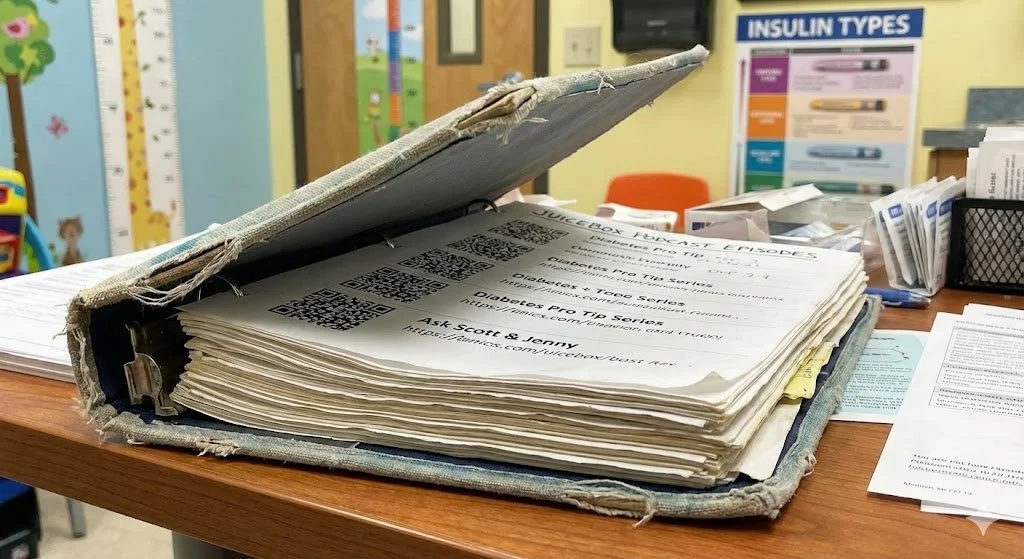













Please support the sponsors


The Juicebox Podcast is a free show, but if you'd like to support the podcast directly, you can make a gift here. Recent donations were used to pay for podcast hosting fees. Thank you to all who have sent 5, 10 and 20 dollars!

#551 Lucky Number Six
Melanie's husband and son have type 1 diabetes.
You can always listen to the Juicebox Podcast here but the cool kids use: Apple Podcasts/iOS - Spotify - Amazon Music - Google Play/Android - iHeart Radio - Radio Public, Amazon Alexa or wherever they get audio.
+ Click for EPISODE TRANSCRIPT
DISCLAIMER: This text is the output of AI based transcribing from an audio recording. Although the transcription is largely accurate, in some cases it is incomplete or inaccurate due to inaudible passages or transcription errors and should not be treated as an authoritative record. Nothing that you read here constitutes advice medical or otherwise. Always consult with a healthcare professional before making changes to a healthcare plan.
Scott Benner 0:00
Hello friends, and welcome to Episode 551 of the Juicebox Podcast. Do you guys like this opening? Or should I go to something else? Friends Hello, hello people. Yo, what's up? It's got now
on today's show, Melanie is here. Melanie has a husband with Type One Diabetes and a child with Type One Diabetes. And we are going to talk all about it. Please remember while you're listening that nothing you hear on the Juicebox Podcast should be considered advice, medical or otherwise, always consult a physician before making any changes to your healthcare plan or becoming bold with insulin. There's a little bit of music left here. So I want to remind you that there's a private Facebook page for the podcast. It's called Juicebox Podcast type one diabetes. It's private so that you can go in there and chat with people about life with Type One Diabetes without prying eyes. There are over 15,000 members right now. And it is an incredibly active page. So if you're just looking for camaraderie, or answers, there's plenty of people in there who might be able to help and they're just like you, they're listeners of the podcast Juicebox Podcast, type one diabetes. There's also a public page called bold with insulin, and I'm on Instagram at Juicebox Podcast.
Today, the podcast is sponsored by Omni pod makers of the Omni pod dash and the Omni pod promise, which I will tell you about a little later. But let's just say this, you may be eligible for a free 30 day trial of the on the pod dash find out it on the pod.com forward slash juice box. The show is also brought to you today by the Dexcom g six continuous glucose monitor. And that you'll learn more about and get started with@dexcom.com forward slash juicebox I don't know which one of my URLs is the favorite to say, but I do like the way dexcom.com Oh, my voice just grabbed there. We'll do it again. dexcom.com forward slash I the way it bounces back and forth. dexcom.com forward slash I think it's the calm, calm thing. And I'm overly simplistic. So, but I mean, there's nothing wrong with omnipod.com forward slash juicebox. I'm just saying Dexcom calm Anyway, here we go. Melanie.
Melanie 2:42
I'm Melanie. I live in Utah, but I was born and raised in Virginia. I have a husband and a son that are type one.
Scott Benner 2:52
Right? You didn't say your last name, which you don't need to but I'm just gonna say that whenever I see your name pop up on my schedule. It feels like you were named by like Stanley or a Marvel writers.
Melanie 3:04
Well, I mean, I married into the name so my maiden name is Jones which is really easy and plain but yes I am when I started dating my husband and he said his last name was Mellon teen I was like, Oh, this is not going to be great. This guy
Scott Benner 3:19
you could easily be spider man's girlfriend with a name like that. That's all I'm saying. I'll take it that way. Do you like that? Boy? That's the spider man now.
Melanie 3:27
Um, no, I like Joey Maguire like the original one.
Scott Benner 3:33
Oh, Tobey Maguire.
Melanie 3:34
Tobey Maguire all the way.
Scott Benner 3:35
Don't worry. Yeah. Could you shy right? Anybody under 20 just now. She's so wrong.
Melanie 3:42
I know. Oh, and all of my children. I'm so wrong about that, too. But yeah,
Scott Benner 3:47
I stood in a line with art and a couple of years ago for hours, so she could meet the kid who's Spider Man right now.
Melanie 3:56
Which I wish I could say his name, but I can't remember top
Scott Benner 4:00
my head. It's slipping for me off the top of my head. But I'm gonna just tell you that the countless 1000s of girls that were there for that it was in a giant auditorium. And the line just snaked around forever. And it was like you were next. You went in got next to him through your best pose on he was like, thank you and you were like, shoved right out the back of the thing. It was fascinating. And she was still like, overwhelmed with all the things she thought she said and didn't say and I was like, the whole thing took eight seconds. Like what are you talking? Anyway, at one point during this conversation, his name will pop into my head.
Melanie 4:42
Yeah, or maybe mine. My kids are gonna be super disappointed in me,
Scott Benner 4:45
but you can think of it off the bat. I can picture him. I know he's British. That's where I that's where I'm stuck. It'll come to me. Anyway. Um, so you don't have type one. Is it just the three person families that you Your child, your husband, are there more kids?
Melanie 5:03
There's a bunch more. Okay. So,
Scott Benner 5:06
did you come to me through the secret underground railroad? that I have in Utah?
Melanie 5:12
Yeah, I must have.
Scott Benner 5:15
The show is so incredibly popular in Utah and I, I don't understand. But uh, okay, so who was? Well, I guess let's start here. How long did you get married?
Melanie 5:31
I've been married 27 years.
Scott Benner 5:34
27 years. And when was your husband diagnosed?
Melanie 5:40
- So just barely. Like, we're, he was diagnosed when he was 48.
Scott Benner 5:47
She got remarried like 25 years before he was diagnosed. Yeah.
Melanie 5:50
Which I'm not sure you've interviewed a wife yet? Who? Yeah, was married so long. And then had their husband?
Scott Benner 6:00
Yeah, yeah. That's, it's really interesting. Because I assume that after 25 years, you feel like you're on the back nine already. Like you just sort of feel like you're gonna, your kids are gonna get a little older and you'll retire. Yeah,
Melanie 6:14
yeah. I mean, we had a lot of teenagers at the time. I mean, we we still have a lot of team and they just keep coming. So I have seven children a lot. So um, yeah, so we had a lot. We were in like, while we still are the hard part, I would say, of raising kids and being married. And then, um, yeah, he had all of the classic diabetes symptoms, but nowhere ran in any way. I mean, it runs in my family huge. I have an uncle who has it. And I had a cousin who has had it, and then it's on my dad's side, too. So but never, that was never really on our radar. And then the typical story, he was diagnosed with Type two, wrongly, four or five years ago, and then change his diet started exercising lost weight. And then when he went back to the doctor, they were like, you're done with diabetes. Like, you're good, you're healthy. And then he went just to a random appointment, like, Why can I think of the name of like a GP, your general? Right? Yeah, just check out my oldest son wanted to go. And so he was like, well, let's make an appointment, we'll go together. And he went, and he would, he had was concerned enough about the fact that he'd been pre diabetic before. And type two or whatever, that he went in fasting and said, I want to glucose number. And they ran it. And it called him and said, So did you eat a box of doughnuts on the way here? And he said, No, I just, I actually came in fasting because I wanted an accurate number. This can't be right. Let's, why don't you come in again, and make sure you're fasting. And when they when he went out? Again? I think he was over 500. And they called him and said, how sick are you? Like, are you so sick right now? Do you need to go to the ER, right? And he was like, What are you talking about? I feel great. I feel like I do every day.
Scott Benner 8:39
So it seems like First of all, I have to say I would not be a good doctor, because I found myself thinking I would have just asked if his pancreas was tired because you have seven kids. But seriously, I but just in general, I'd be like, oh, maybe you're just tired. But if he came in type two, four or five years ago, did he have weight to lose?
Melanie 9:01
So I would say then he did maybe a little have a little bit of any wasn't super fit, he wasn't really exercising a lot and he hits so he had just changed jobs and his stress level was off the charts at that time too. So there were lots of things going on with him when that happened. And so this was a different doctor that he saw the second time that maybe the first doctor would have put it together but there was never even a follow up and it was probably at least three years between those two like when he'd seen a doctor last and then saw this doctor
Scott Benner 9:41
when you say he changed jobs. Did you mean he? I'm sorry. I feel like his job is having sex with you and then watching you have a baby. But no, I'm so
Melanie 9:52
trying to think how old our youngest was then. But yeah, no, he Yeah. changed his his job.
Scott Benner 10:00
There's a lot going on in his life. And this happens. He diets down a little bit and then the doctor is like, Hey, you your blood sugar was high. I said to you, you should lose weight. You lost weight. This is over now, but he was probably just honeymooning on and off. I went.
Melanie 10:15
Oh, yeah, for sure. And he, I mean, he went mostly keto, which wasn't called that then. But what whatever.
Scott Benner 10:22
They call that low carb back then. Yeah, right. Just
Melanie 10:24
meat. Right. Atkins probably was more
Scott Benner 10:29
low carb for people who don't like broccoli is how I always thought.
Melanie 10:33
Right? Yeah. So he, I mean, I probably because he changed his diet, and he was honeymooning, it all just kind of
Scott Benner 10:42
blurred together. Yeah. And he felt Okay.
Melanie 10:46
Yes, he took my foreman for probably six months. He has an iron stomach, he can eat anything. So where Metformin normally makes people really sick and not feel? Well, he was fine on it. And I'm sure that helped to I guess, I mean, I don't know there's differing opinions on that right on other Metformin will actually help anyone with type one?
Scott Benner 11:11
Well, why not? What I do know is that Metformin is used off label for weight loss by some doctor. Oh, so there's that, I guess, value there if he was looking to lose weight. Okay, so So after that happens after he's kind of given a clean bill of health from his type two diabetes, how long does it take for him to realize he's not okay.
Melanie 11:32
I, he really didn't see a doctor again for probably three years. And to be 100% honest, he didn't go because he didn't feel good. He went because my son wanted to go. And he was like, Well, I can get him and if I go,
Scott Benner 11:45
Yeah, he was just so
Melanie 11:47
he just went, yeah, yeah. And so yeah, and that's funny, because I would say that I said to him before he went, you're going to be diabetic again. And he thought I was crazy. And I said, you're drinking a ton. And not alcohol, but always drinking liquid. Like he would sit at a dinner and drink an entire two liter bottle.
Scott Benner 12:12
Because he was so and he didn't notice that as odd.
Melanie 12:15
No, he just thinks that social for him. And he he he is a big drinker in general. Like he drinks a lot of liquid in a day. Gotcha. More than most, but you saw it. Yeah, it was, it was an extreme that I thought, and I'm now looking back, I can see all of the type one symptoms. But I didn't know then that that's why he was acting the way that he was acting. So if that makes sense. It
Scott Benner 12:48
does. But I want to know how he was acting.
Melanie 12:51
Okay, so well. Yeah. I mean, I think it's important. It's an important story, actually. And we do need to talk about how the doctor almost killed him when they were when he was diagnosed. But it was hard. marriage was hard, right that like for probably, really, for two years. But I could I can even pin it back to when he was diagnosed with Type two. And then kind of back and forth. And, and we had older kids and teenagers that were doing things that were stressful and hard. So marriage was hard, then anyway, but um, some of those classic symptoms of just not being able to remember in your brain being foggy, and you just not not really being all the way there. I mean, they really do say, when your blood sugar's high, or when your blood sugar's low, that it's like you're drunk, like your brain doesn't work the same way. Is it the same way? Right. It's it's,
Scott Benner 13:57
we are altered. Well, I mean, have you ever heard me say, Have you ever heard me say that I think that one of the one of the very important reasons that you should work on keeping your blood sugar in a stable lower range is because you get to then be who you're supposed to be, you know, if you don't recognize that, hey, that's why I shared with people how out of whack I was when my iron was really low. Because I was difficult to be around. Like I just I was very short tempered. And things that just don't make a person upset would make me upset is the tiniest thing. And I was just like 100 miles an hour in one direction. Like it was the most important thing in the world. And we had to get it fixed then you know, or whatever it was, or I just was, it was unbalanced. And you could come off like an asshole. Like you really could like for somebody just from the outside. They could just look at you and go, Oh, interesting. Melanie's husband's sort of turned into a jerk. And then that's, you know, and you don't recognize it because it's happening to you. It happens to you in the beginning slowly enough that you don't see it. It's not like breaking a bone. You can't just go, Wow, My arm hurts now something must be wrong. It just happens so slowly, you know.
Melanie 15:06
But yeah, and I would say, I mean, I think he had his jerk moments like, but I would say more it was that he was foggy all the time. So he couldn't remember that there was an appointment, or he couldn't remember what he was supposed to do that day to help me with the kids or he couldn't. And, and I would have to remind him over and over and over again about things and he would get so mad at me like when he would keep asking, and I would keep answering. I'm like, Why do I have to tell him so many times? And he just thought it was normal, like, well, I'm working, I work full time. And I we have all these kids. And I just can't remember. But I was like, we've been married a long time. And you, you could remember before now, I felt like I could count on you before now. And right now I feel like I can't count on you. Which, when you have that many kids and are going through all that. You need to feel that way. Yeah, right.
Scott Benner 16:02
I don't believe this is germane to the story. But just because like it keeps coming up in my head. What are the age ranges of your children? Like what's your youngest and oldest right now?
Melanie 16:09
So right now my youngest is nine, and my oldest will be 22 in June. So he's 21.
Scott Benner 16:15
That's not even that big of a gap.
Melanie 16:18
Yeah, they're all two years apart, except I have a set of twins that are number two and three. And then the last two are four years apart. So
Scott Benner 16:28
so the nine talents then there's 913, some twins, the middle, the older ones. I gotcha. All right. I think I didn't count two of them when I was just doing that. But there's that's cool. And you're okay, make your uterus didn't fall out or anything like that. Everything's fine on your
Melanie 16:42
own. Everything is fine. on my end, I'm very healthy.
Scott Benner 16:45
I also want people to listening to know that I didn't say on your end as upon, it just came out.
Sorry. Okay. So he's like that, blah, blah, blah. You notice it, but you notice that his behavior?
Melanie 17:03
Yeah, I didn't. I didn't. I definitely didn't connect it. Right.
Scott Benner 17:06
There's no reason you would, right. Yeah. But yeah, but now you're saying hindsight, knowing more about type one diabetes, it's all completely obvious.
Melanie 17:15
Yeah. Well, and how how much he changed after diagnosis, and then getting his blood sugar in a reasonable range?
Scott Benner 17:25
Yeah, not foggy anymore. able to keep up?
Melanie 17:28
Yeah, just Yeah, like more reasonable, like more like my partner like he was before.
Scott Benner 17:34
So now if he doesn't do something that you expect him to do, you can just yell at him?
Melanie 17:38
Well, I do often question his blood sugar.
Scott Benner 17:43
You find yourself in the same position as a parent does. Where I know I have said to Arden in the past, we're going to test your blood sugar. And if it's not lower, high, you're in trouble.
Melanie 17:54
A little bit. There's a little bit of that. Yeah. Like, are you acting like this? Because your blood sugar's sunny or just not really mad? Are you really Yeah.
Scott Benner 18:03
Well, it's interesting, too. Because after I can tell you from my own personal experiences that after this, something like this happens to you, and then it's found out and understood. The next time you actually are legitimately upset or tired, then people look at you like, Oh, is this the thing again? Or, you know, or is he just tired? Or, like, there's sometimes like, I'll like, raise my voice. I'm like, I want everyone to know, I'm fine. This is just anger. It brings everything into question for a while. So he's diagnosed for for certain 2019
Melanie 18:39
is July of 2019. Yes, but well, so he was diagnosed in type two, but they looked at it and said, You don't look like a type two, because this time, he lost weight. Okay, so he did the typical like, he so he lost probably 15 pounds before he went in, but he had started working out so he attributed it to this. Great, yeah, yeah, lifting weights that he was doing. And I was like, that was really fast. Wait.
Scott Benner 19:13
No one gets into shape in seven days.
Melanie 19:16
Men do have an easier time, I will say but I was like, that is really fast,
Scott Benner 19:20
right? Even too fast for that. Okay. So 2019 he goes back to the doctor with a problem. They hit him with the type two again.
Melanie 19:29
Yeah, but they looked at him and said, we really probably don't think you're type two. Let's do the test to see if you're type one.
Scott Benner 19:36
So they say it just like it's a knee jerk reaction, but at least they followed through with the antibody testing.
Melanie 19:42
Yeah, they did. And he, he went to an endocrinologist but in the meantime, they prescribed Lantus for him a long acting, okay. And they send him well, so they prescribed it. But she said to him, I usually have a sample pack. needle here, but I don't have one today. So basically, it's like a pen and you put a needle on the end and you grab your stomach. And I mean, really, honestly, that was the most he was taught how to give himself a shot. Wow. Was this random? And, and then she prescribed 40 units of long acting insulin for him to give to himself at night before he went to bed.
Scott Benner 20:26
Let's hold on a second. Yeah,
Melanie 20:28
uh huh.
Scott Benner 20:31
Does he weigh like 250 pounds?
Melanie 20:34
Um, no, no, I'm pretty sure he didn't even wait 200 pounds at a time. And so I think he, he ordered a meter. I mean, it was all very like scattered supposed to do this. But we didn't really, I mean, the most I really knew about diabetes was my uncle had it, that no one ever gets it when they're that old. So he kept saying, I think I must be type one. They're testing me for it. And I kept rolling my eyes and saying, You're not type one. No one gets diagnosed with type one this late in life. Like that doesn't make sense. And I mean, now I can look back and go Yeah, with that number. Of course you were and with. But anyway, oh,
Scott Benner 21:15
yeah. No, I mean, unless you have my job. Like I've, I believe I've interviewed someone at every age range, probably up to like, 64. Yeah, they've been diagnosed with type one. So crazy. Now, it just, you know, it's not what, it's not thought of the same anymore. But it really does. marketing works, I guess, you know, calling it juvenile diabetes for so long. Has it etched into the minds of a number of generations like it's going to take, it's going to take more generations for people to grow up with like, Oh, I remember that, like my mom was diagnosed at 48. And then no one will think of it that way anymore. But it'll take a lot of time. So yeah. So he went home and gave himself 40 years before he went to bed. Well, so he
Melanie 21:57
was kind of slow about the whole thing, because I think his test results haven't come back yet to say for sure he was type one. And so he kind of thought I can just change my diet. And it will fix it. Yeah. But he was testing his blood sugar. And it wasn't fixing it. And so he went and picked up the prescription brought it home. And it probably been a week, maybe since she prescribed it. And of course, he's taking Metformin and all the things that they prescribe for type twos and and he's standing in the bathroom about ready to give himself the shot. And I'm like, Kate, I don't understand insulin at all. What What if I mean, and you just have these vague understandings, right. So I'm like, I think you can pass out and have a seizure, like, what if I, what if something happens? And he was like, we can just give me juice? And I'm like, we don't have juice we don't? And how do I know when and how much and, and I have a sister who's a nurse, and my best friend is a surgical PA. And I said to him, we can call one or the other of those women and ask them. One, whether 40 units seems right, because the pen only holds 200 or something. And I was like that is a lot of that pin up giving yourself at one time.
Scott Benner 23:23
It's an interesting feeling like yeah, like what this penalty last five days like that. Yeah. Is that how that works,
Melanie 23:29
and you've never taken insulin ever in your life. And that's the amount that you're supposed to take, like, all those things just seemed.
Scott Benner 23:38
So I want to pick this apart for a second. So just for context, is your husband the kind of guy that would jump off a zip line, go bungee jumping or try heroin for fun? Is he any?
Melanie 23:48
Probably got the heroin, but he Yes. He's been bungee jumping. He's done all yeah.
Scott Benner 23:53
So there's no mechanism in his brain to go, don't do this. Somebody said it. So it'll work like, you know, when you like when you get to the rain forest and the zip lines going through. I'm a person who looks at that and goes, Well, I'm not getting on that. Because I don't know anything about the people who put this up or what if I fall here and like, I don't do that. I go, No, no, thank you or I watch 1000 people do it first and then I go, Okay, now I'll try it. So he had that vibe. You were you were women listening or just like saying men would just be dead without us. And it's a you were smart enough. They got to pick through the details of it. But I think what's most important is that I don't believe this is an incredibly uncommon story.
Melanie 24:36
No, I don't, I don't think it is, either.
Scott Benner 24:39
I don't and now knowing as much as you know about type one diabetes, it is a fascinating statement that someone was like, here's this thing, vaguely This is how it works. Let me just randomly pick a number out of the air go give this out to yourself before you go to bed. So something happens while you're sleeping you could just drift off and
Melanie 24:58
well I definitely would have woken up to My husband, I don't think there's any way I wouldn't have 40 units he takes 13.
Scott Benner 25:04
I was gonna say that was my question, how much does he actually need? Cuz
Melanie 25:08
I was 13. Now. So when he started, he really probably needed about nine.
Scott Benner 25:13
Yeah, who even knows? Right? Like it just, you would think that there would have been some sort of, I can't believe that anybody use the mathematical equation to come up with 40 for him at that weight? Like, I honestly think, and this is random. And please, I'm not a doctor. And this is not a mathematical equation. But I would think if you were going to say 40. Like, if if it occurred to me to tell an adult to use 40 units of Lantus the first time, I would have to think that their blood sugar's were in the No, no, eight hundreds, and they weighed in excess of 250 pounds maybe. And that's just like random thinking about it, like I would think, is a guy around 180 200. I think maybe we maybe will land around 1.5 units an hour, like if he's on a pump. So I, then I'd be around 24 to 30. And I'd still probably end up saying, why don't we try 15 to start, like in this specific scenario, you know, it doesn't.
Melanie 26:13
But that's an endo. Right. So this is just a general practitioner, who probably knows very little about any of it. Right? Really?
Scott Benner 26:23
Look what I have.
Melanie 26:25
Right? I mean, I'm in nursing school, and I will tell you, they just taught us how to mix NPH and regular insulin. When I was like, No one does this anymore. This isn't even a thing. But so they just teach you. Not enough, right? So she didn't know enough. I don't know if she googled, like someone who has an average blood sugar of 500. How much long acting insulin would the I have no idea.
Scott Benner 26:53
And that's funny. He was even say, he was really elevated, his blood sugar was super high. The 40 might not have got him the first day. But once his blood sugar came down, the next day, it was gonna be a huge mistake. Like, you know what I mean? Like maybe the basil would have. I mean, obviously, if you use way too much basil, and some will drop your blood sugar. So maybe it would have but I don't know, and you don't even have a meter Really? Like there's no context for any of it.
Melanie 27:18
No, it was. Yeah. So. Um, so we, I think we called my sister who's a nurse. And she was like, yeah, that seems like a lot. I mean, she works in an emergency department. So she doesn't know what time but she was like, that does seem like a lot. And so I think we decided to do 10. Okay. We're like, let's just do a fourth of it. So we did 10. And I want to say that it that it worked. Okay, I think he's built up to 13. And I think there's been times that he's been under 10. Yeah, I would imagine that. But he's MDI, still, and he actually only takes long acting. He doesn't still owe lists for males. Um, yeah.
Scott Benner 28:07
Does he not need to? Or does he not do it? Because your face is telling me? He shouldn't. He doesn't. But you got you got seven kids, and you need to get them all through college. So you're just gonna like, what is it? You're saying? Well,
Melanie 28:18
okay, so, I mean, we could you're married. Yeah. So you can't really tell them what what you think they Well, you can kind of tell them what they you think maybe they should do. But they get to do whatever they want to do. And his blood sugar's good. Don't get me wrong. It's good. He mostly eats meat.
Scott Benner 28:41
So he's decided to do it this way.
Melanie 28:43
Well, I yes. I think he read some things that said that you can slow it down if you if you don't tax it.
Scott Benner 28:52
The pancreas he's trying to hold on to his honeymoon a little bit. Yeah.
Melanie 28:56
Which I think mostly is working. It's but it is going like we're watching it slowly go. And he's watched he has a Libra. So he, he is aware of his blood sugar. But Libras Do you have to scan. They don't just it's not constant feed. So, but he does scan all the time, like all day, he knows where he's at. Overnight is different. But um, which is it's stressful for me as a wife, because I have a son who I'm who has a Dexcom so I get his alarms.
Scott Benner 29:32
I think it's interesting that if I had your husband on this show to tell this exact same story, he'd be like, yeah, yeah, they thought I had type two and then I went on a diet and then it was type one. And now I use him the I would probably be the whole story, right? Like it takes an ounce Actually,
Melanie 29:47
he really likes to drag those stories. Oh, he would
Scott Benner 29:51
a chat. Oh, yeah. Well, yeah. But he might have told the story. Nobody cared about you. So like, for sure. There would have been a lot of details for you. Like I don't understand why it's important that it was at 1230 It was cloudy outside. But no, I think it takes. I mean, honestly, like, you know, I I'm not going to denigrate. I'm obviously a male who's a caregiver. And I'm pretty good at it. But most guys are just like, it didn't kill me. It's good. Like, you know what I mean? Like that. That's the the level of concern. We I'm watching my son deal with something he's never dealt with before. And he explained the details to him, and then asked him an hour later, and he's like, I don't know, I wasn't listening. I was like, great. Yeah, it is really, it is really kind of super interesting. So he's managing MDI with a Libra? How? I have a lot of questions, how, hmm. How long after his diagnosis? Does your child and which one of your kids is it? Let's do like this. Let's call the 22. year old number one, and then nine year old number seven. Which number kid has diabetes? Six? Wow, look at how quickly you did that. So the 14 year old, right?
Melanie 31:00
He is. He'll be 13 1313.
Scott Benner 31:03
All right. And he got it not long after your husband.
Melanie 31:09
So three months? That is not long after your husband? No.
Scott Benner 31:13
Was there like any moment where you're like, is this contagious?
Melanie 31:17
Well, that's actually a funny story, because then three other kids in our neighborhood were diagnosed within a year. So there was a lot of like,
Scott Benner 31:25
what people thought, Oh, you know, it's funny when you sent that in your note, my thought was like, from a reasonable macro perspective, that there are a handful of people who live in your area who have the markers for type one diabetes, who were likely to get it at some point in their life, and then maybe some sort of a virus or something went through the town, and then it, it kicked it in for these people.
Melanie 31:48
Yeah, that's my take, too. But I think some of the moms, of course, tried to really dig in and see if they could find a cause somewhere would you do? Because this is grief? Right? Yeah. And so and that's the first thing is figure out the why try and find the why. And I think I'm sure I did that, too, at the beginning. But at some point, you're just like, it doesn't actually matter. Yeah, why you got to do
Scott Benner 32:15
this. It's not 5g. And even if I could figure it out, it doesn't matter. And I can't move. That's the other thing. I think, too. Like, I can't just move. Like, imagine if there was something that was happening around your house, that once everyone knew, and all the houses went up for sale, like you don't I mean, like, what would you really do? Like you are kind of stuck a little bit where you live, like, once you're an established family, it would be hard. I mean, if I if you told me I had to bug out of here, and I had to sell my house because I don't have the money to go buying another house without this house being sold. I don't know. It could probably take me years to leave here. Like if I you know what I mean? So not that you would just and I do agree with the idea of you have to come up with? You don't have to, but it hits you so strongly that you want to know why it happened. Oh, for sure. And I don't know why, like, what do you do with that information? Once you learn? You know? Is it just to make yourself feel like you didn't do it? Like, it's not your fault? Yeah. Like I wonder about that sometimes, though. Because I felt like that a little bit. There was a long time, where I actually found myself wondering, were you always washing your hands before you were cooking for Arden? Like, like, and I do. And I'm sure there have been times that I haven't. But that's how ridiculous that thing happened to me. Like, I need to figure out what happened. I'm sure I did this to her. You know what, like, how do I do? Because she was really little. So you know, yeah, it
Melanie 33:41
is a little helpful that my husband was diagnosed before my son because I for sure would have blamed me. And that because it's I have so much of it on my side of the family. So I'm like, Well, I mean, I guess it could still be for me for him, but I couldn't have given it to my husband. So right.
Scott Benner 33:57
Just like there's enough doubt in here to make me feel better about this. Right? I watch it happen to my wife, because there's so much different autoimmune stuff on my wife's side of the family and that she feels badly, like somehow, it's her fault, which is ridiculous to you know, can't prevent it. Yeah. And even at that.
I'm just gonna come out and say it that was a weird place for an ad break. I just couldn't find the right spot. And I was like, I just got to pick a place. I pride myself usually on doing a better job. Alright, I'll just do a great job on the ads then and make up for it. Ready? Omni pod.com forward slash juice box. You go there and you find out if you're eligible for a free 30 day trial of the on the pod dash. This is a free use of an insulin pump for 30 days. What am I saying here? Am I saying something crazy? Maybe, but it's real. Go find out if you're eligible. Are you thinking to yourself? Oh, I would Scott, but I heard on the pods got some other stuff coming and I want to wait for that. Well, I hear it. I understand how you may feel. But understand this Omni pod has the Omni pod promise. Oh, what is that you want to know? Well, here's what it says super simple. The Omni pod promise, says this. If you're waiting for that next big thing you don't have to because with the Omni pod promise, you can upgrade to Omni pods latest technologies for no additional cost as soon as they're available to you and covered by insurance terms and conditions apply. But you can find out all the details at Omni pod.com forward slash juice box. So if you're a person who's sitting there thinking I'm gonna wait a little longer, I want to see what the next thing is. You don't have to do that. The pod.com forward slash juice box. Just go now. You're all covered. Speaking of covered Australia, y'all just got covered with our new pod as well. On the pod.com Ford slash juicebox. A you to get started. That's for Australians. You guys got your own link. pretty special. Speaking of special, look at me, I'm just boom, boom, boom, you can't stop me. I'm selling baby Dexcom gs six continuous glucose monitor. Why do you want it? Well, should be obvious by now. But in case it isn't, let me go over it with you. rate and direction. That's right. How fast and in what direction? rate and direction? Is my blood sugar rising? Is it falling? Is it rising two points per minute, one point per minute. More Dexcom will tell you that. That's valuable information to have. It also gives you the number of your blood sugar actually artists blood sugar right now is 160. She was out driving. She's a licensed driver now. And she started getting a little low. Right? Her blood sugar started to drift down. So she got an alarm. And she ate some fruit snacks. Then her friend stopped to get a little fro yo. She didn't do a great job of bolusing because she didn't think to cover the fruit snacks. So she got a little rise right now. So as soon as we saw that rise going up, I texted her and I said Hey, what's going on? She said I just had frozen yogurt. And I was like, Okay, did you Bolus for the fruit snacks for your low blood sugar? And she went my didn't? I said, Okay, we'll do that now. Put that insulin in, stop the rise in level off, and now it's coming back. Do you think you could have figured that out without the Dexcom? g six? No, I don't think I could have nobody could have. I mean, what do I do? I just got to tell the future. I can't. But Dexcom can show you what's happening. dexcom.com forward slash juicebox. You'll want to know how I've kept my daughter's a one C in the fives for like seven years. While she's eating Frodo shouldn't be much of a surprise to you. It's on the pod. It's Dexcom. It's accurate meters. It's the stuff you hear about on the podcast, links in the show notes, links at Juicebox Podcast comm Please support the sponsors.
I sometimes look at my kids and I think Am I ever going to like pull them aside and tell them hey, you know, if you have kids, there's going to be a higher likelihood that they have an autoimmune disease, right? Like Am I let me get my put that in their head? Or not? And like it seems wrong to say it to them? And it seems like bad parenting not to say it to them. I don't know if that makes sense or not.
Melanie 38:49
Kids are pretty smart. I mean, I would assume that connect it at some point. But we kind of had to connect that because I did try on that with all the rest of my kids. Because at that point I'm like, okay, there are seven of you. If we're doing statistics wise, at least one more of you will have
Scott Benner 39:06
it right. I gotta start selling furniture and saving money. If it's all seven over you're gonna get what did you find out in town that
Melanie 39:14
none of them have the markers? No,
Scott Benner 39:17
just just lucky 14 are lucky. lucky number sex excuse me,
Melanie 39:21
his name is Marcus. Well, you can call Marcus or number six.
Scott Benner 39:24
I was I was gonna call this episode lucky number six, but we'll say.
Melanie 39:29
So I want to I have to pick a teeny bone with you about that. So when you first made the show, you would say you would threaten or say like, that's gonna be the name. And then it was never the name. Never. But lately, I'd say like 50% of the time. It's the name.
Scott Benner 39:45
Yeah. So what ends up happening is while I'm recording, it strikes me like, oh, that might be a good title for the episode. And then when I go back and edit, I find something that I like better or, and this is true. And I've said this already. If the title is Have a great title comes up too early in the episode. I don't use it. Because I'm so afraid like it 15 minutes in, you'll be like, Oh, that's why they named it this. I don't need to listen to the rest of it.
Melanie 40:12
I've never wanted to stop listening. I will tell you.
Scott Benner 40:15
Thank you. I have a very weird thing. theories about how to make the podcast popular. So
Melanie 40:21
have you made it yet? Because I would say it's probably really popular. Yeah.
Scott Benner 40:26
So yeah, it is. But I'm, so if you can kind of separate these things, I met a person who is incredibly interested in helping people with type one diabetes, like genuinely and sincerely. I'm also competitive. And with myself, and with the classic interpretation of success, so I'm trying to do better for myself, I'm trying to be better than the masses. And I won't do I won't chase those things if it hurts helping people with diabetes. So I'm trying to find a way to help people with type one diabetes, and have a massive podcast in the global sense. And always feel like I'm doing better. So the this? Yeah. So. So this month, this month, there was 150 times more downloads than there was the first month of the podcast. But then I see that number, and it immediately feels like well, why can't I just get to this number then? Like, like white, so that you just that's how it works for me. And, and I and I treat this podcast very seriously. Like, to me, it's a business, and it's a public trust at the same time, like in my mind, so
Melanie 41:45
you're doing a lot of good and for sure. Thank you an awesome thing.
Scott Benner 41:48
I appreciate it. Sure. It is. Yeah, I'll be happy when everyone who has a cell phone in America at UK, Australia, New Zealand and a couple of other places in Europe, all are listening to the podcast, whether they have diabetes or not like I want people to be like, I don't have type one. But I love that
Melanie 42:07
case, funny. Yeah, I don't really get out. I have a brother who runs a podcast and I'm always like, you should really I know, there's no one like, you're not interested in diabetes, but you should listen, because Scott's really good at this.
Scott Benner 42:20
I appreciate that. I like talking to people. And I like Moreover, I think that I think that everyone has a great story. You just have to be willing to not judge them and listen for it. And not pre judge them. Like it's fun to joke that you have seven kids. I mean, because I mean, how are you not going to if you're a person who meets a person with seven children and doesn't look at them and go, Holy Christ, are you okay? Like I don't I don't know what you're thinking. But it but it can't be the it can't be the focus of the whole thing you can't decide. You know, again, the reason the titles of the show are so kind of wonky is because not one of these episodes is about anything specific. Except the pro tips and the defining diabetes, they're specifically about them. And still, sometimes they're, we drift away a little bit to have to have a real conversation, not just feel like somebody is reading through bullet points that anyone can learn on the internet, if they wanted to, you know, so there's something about how you deliver I think, but that's a lot of high minded talk about podcasting that nobody cared about. Okay, so. Okay, Marcus, I was gonna say number six, but I see what you're doing is diagnosed. And now you're in charge instead of your husband's in charge. super interesting. Why did how did how did that go differently?
Melanie 43:48
Actually, is really interesting. So he he classic symptoms, lost a bunch of weight, peeing all the time, super sick. He plays football. So I'll be honest, I have a lot of kids, I don't weigh them and pay attention to their weight, really like would be enough to notice you've lost a significant you know, I bet he had weigh ins for football. And then, six weeks later, he weighed himself in my bathroom and he's like, ah, I've lost 15 pounds. And I'm like, No, you're 12 or actually was 11 at the time and and he's like, no, my my I for sure did because I had weigh ins. So I really did weigh that much. And he had been sick and lethargic. But still playing football still going to practice every day. So it's one of those where you're like, hey, you're tired, but you're doing this and he we're we're big eaters and big carb eaters. He had a huge plate of pancakes before a football game one day and he went to the football game. And he threw up the entire football game, you can play really well you play and then you come out and he throw up a bunch. And then I can do it. And I wasn't at the game. My husband was there. And he was like, Marcus is really not doing well. He's doesn't, he's sick. And so thought he had the flu, he came home, slept. The rest of the day, we got up the next day, he kind of felt like eating, which, when your kids have the flu, and then they feel like eating, you put carbs in them, like bread, juice. So he had bread and juice. And I think my mother in law, sent home the apple juice container with us. And it was like, half a gallon apple juice container summit. And I think he drank the entire thing and got so sick, that I finally just looked at my husband like, I'm just I'm taking him to the ER, I don't know, maybe. And he's had bowel issues in his life. And we've kind of tried to figure out allergy problems. For a minute, we thought he was lactose intolerant, we took them off dairy for a while. And he he was kind of a random throw a rapper anyway, like he would just randomly throw up. And so I, I was like that maybe, I don't know, maybe as a bad stretch. And I called my friends who have medical people and they're like, I appendicitis maybe I don't know. So I took him in. The weight loss was concerning to the nurse practitioner, I think that was talking to us.
Scott Benner 46:32
God, I was gonna say to you, when you said 15 pounds, it's clear you have more experienced raising children than I do. Because I would have went in a private room locked the door and thought Marcus has cancer. Like, like, seriously, that's how it would have hit me right away, I would have been like, like kids that age don't lose 15 pounds, we're in trouble. But you you stayed pretty steady through it for a little bit like looking for reasonable because, you know, yes, people get cancer as children, but it's fairly unlikely. So but my brain would have jumped right to it. So
Melanie 47:01
I will say the day before, when my husband brought him home and he slept the rest of the day, he slept in my bed and I was kind of with him in and out and I i will say I'm spiritual. I'm a spiritual person. And I'm assuming you've assumed by now that I'm a Mormon,
Scott Benner 47:17
I have to be you have all markers. If there was a trial net for being a Mormon, I already found your test. I know, I'm good. Don't worry. And that's what I meant in the beginning. The podcast is incredibly popular in the Mormon church, and I
Melanie 47:30
will tell you my theory about that. That's at the end. Okay, so, um, I had a pretty strong impression, feeling, whatever you want to call it, that he was very, very sick. And for me, I did actually go to cancer. So that's interesting that you brought that up, because that kind of brought that memory back for me. But um, yeah, so when I took him, I had already made a doctor's appointment for him earlier in the week, but it wasn't until the next Monday. So this was Sunday. And I was like, I can't wait until Monday. I just, I we need to go right now. And so I took in weight loss, but they ordered like an ultrasound and all these things to look at his bowel. And I am told, actually, the nurse practitioner told us that the minute the doctor on call, walked in and saw lost weight. He said, he has diabetes. And she was like, no. And she had asked me if there was diabetes in the family. And I said yes, Dad was just barely diagnosed. And so but I'm not sure I said type one. I probably just said he was just diagnosed to which everyone's gonna go, Oh, well, his dad was diagnosed type two then which doesn't matter for the kid. Right? Or whatever. But so yeah, so they dipped his urine. And he was 866. So, yeah,
Scott Benner 49:01
okay. Um, but then you. You put it as you leave the hospital on MDI, how does he leave the hospital?
Melanie 49:09
Um, he did leave the hospital, MDI, we were, we were in an ambulance. Within about 10 minutes from the hospital, we were in up to a primary, primary children's to Children's Hospital. But my one Funny thing is my husband, I called him and I'm like, he has type one diabetes. And he was like, Okay, I'm on my way. And he came, and he showed up. And they're wheeling him out to wheel him into the ambulance. And he's like, Where are they? Where are you going? And I'm like, we're going to the primary to the Children's Hospital. And he said, Well, now that we know he has type one, we know what to do.
Scott Benner 49:43
Yeah, let's just give him 40 units Atlanta.
Melanie 49:48
Like, you know, they don't do that. You spend a couple days in the hospital and they educate you. And that is really where we got all the education for diabetes and
Scott Benner 50:00
Yeah, maybe not like for your husband? Was he sitting there thinking, oh, wow, there's a lot to this I didn't understand I should be concerned with or
Melanie 50:08
Yes, yeah. And really had not been given any sort of real good. He knew high was bad. So he was mostly trying to keep his blood sugar between I think 60 and 80. So even after he was diagnosed, he was low all the time didn't feel good. But he's like, well, they say that, at first, you don't feel good. But he didn't even really understand the ranges, like the healthy ranges, I think, at that point. Wow. And was living super low, which was also not good for
Scott Benner 50:47
me either. Yeah. No, that's interesting, though, the way he thought about it was, he probably was like, I'm dizzy under 60. And a person who doesn't have type one diabetes, blood sugar sits around 80 fasting. So that was his goal was thing right there. That's, I'll tell you, I'm pretty good at this. And I don't think I could keep somebody's blood sugar between 60 and 80. without causing a lot of lows. Like that's, you know, I think he had a lot of luck. Yeah, that's, uh, that's something else I, but if he's thinking at his top line than 120, must have seemed like, crazy to him. I would imagine. Yeah,
Melanie 51:23
I think it was fairly easy for him to stay pretty stable low. At that point. I think he was still honeymooning, really strong. And just on the long acting, and probably taking maybe a little too much long acting because there are times when he eats to feed the insulin. We talk about it. Yeah. On occasion. Yeah,
Scott Benner 51:42
don't feed the insulin. That's not a good plan, either. So your son gets his education, which starts, which really just begins to educate your husband and you because you know, what's going on? Why is someone calling me a spam risk? Get out of here. Let the phone if the phone knows it's a spam risk. Why does it send me the call?
Melanie 52:06
I've never tried it on to and my dad would really like to know that. Yes. They complain about
Scott Benner 52:10
me just block it. If it's a spammer. Why does it make it to me? So so the education is coming? Everyone's really being educated? Yeah. How long does it take for you to put a pump on your son?
Melanie 52:23
So we had a CGM. 30 days, okay, Nikki, wait, 30. And we, I think it was 30 days. I think it was on his arm by 31. And then I started fighting for a pump. Maybe at three months. I was already listening to your podcast. So I knew I wanted one. And I knew what they did and what I wanted to do. And so I started fighting, then they're very particular, like, they have their standard. It's six months. And I said, that's fine. It can be six months, but I'm putting a pump on my kid at six months. I'm not starting the stuff at six months. So I think I took the class at four got approved, you know, anyway, so the pump was delivered to our house. The day my son turned 12. So he was October. He was diagnosed in October, and March 10. I think it showed up at my house. Wow. So but then, of course, so this is like COVID. Right? Like COVID starting within a week, maybe? So then, oh, well, we can't train you because you can't come into the office and whatever. And I don't know maybe the pump magically made it onto his arm without training. Maybe it didn't. really sure. I don't know if when we were doing the training. We already had been using the pump for a few little while. And you know, I don't
Scott Benner 53:55
know. I don't know how I got pregnant. Yeah. I'm not sure what happened. We would do a movie I swear.
Melanie 54:03
A lot of YouTube videos on how to set up pumps and how to figure all that out. We haven't Omnipod Yeah, so that's what we do. We actually loop
Scott Benner 54:10
so yeah, okay. Well, I'll tell you the, it's interesting to see people's different people's perspectives on this, like, you'll see someone who's got some information and they're like, we can figure this out. And you'll see other people who don't have any information or like, Oh, my God, don't do anything that the doctor didn't tell you to do. It's so it's so like, it's very, very, I don't want to just reuse the word interesting, but I'm fascinated by watching people's different reactions to ideas like that. Like, you know, you went to you got the pump, it's here in the house. It's a thing that delivers insulin. Just like the needles are a thing that delivers insulin like there's really no
Melanie 54:49
one it was like the most perfect time of any time to start a pump on a kid. You were still day. Yeah, I'm managing everything. And, you know, we just kept saying like what could honestly what could go wrong? Right? And I couldn't find anything that could.
Scott Benner 55:06
Well, you're stuck over there, that's for sure. We have you been a nurse your whole time?
Melanie 55:11
Or no, no. So I'm in nursing school right now. Yeah. So it's
Scott Benner 55:15
not like you were a nurse and decided to shift the diabetes like you decided to be a nurse. Is it from this from the kids and the husband and everything, so
Melanie 55:23
I only have four left at home, which I'm sure for you probably feels like a lot. But for me, I'm like,
Scott Benner 55:32
forced, that's a bad man. But,
Melanie 55:34
um, I think I've always wanted to be a nurse. I wanted to be a labor and delivery nurse. And then this, and I was like, No, I want to be a nurse. I what I want to be is is certified diabetes educator, which now has a new name. Yeah, but I can't remember what it is really long. And you have to either be an RN or a what? geneious.
Scott Benner 56:00
Jenny's a lot of things. Jenny's had a mess. Yeah. Yeah. It's funny, I say it a lot. But I read it every time I say it. Just like every time I introduce Jenny, in an episode, I pull this thing up. And I'm like, Oh, that's what she is. Yeah, well, that's how far into that are you?
Melanie 56:20
I'm in my ninth week. Wow, you just started? Yes, I'm in my first semester, I'm doing an accelerated program. So it's 20 months for my Rn, and then another year for my bachelor's, and then to be a CV. I want to say it's 10,000 hours working with diabetics, before you can even test for the
Scott Benner 56:43
certification, see 10,000 hours in a clinic or in an endo setting or something like that, which is where I want
Melanie 56:49
to be anyway. And I, my understanding is I'll be doing the same thing, I just won't have the certification. Yeah. And then I'll get it hopefully,
Scott Benner 56:57
I got a note recently from another listener, who said that they're switching their focus, they are a nurse, and they're becoming a CD. And she said it was because of the show. So one day, a couple of years from now, there will be an episode called I made a CD in case you wonder, because I'm very excited that that someone did that, based on listening to the podcast, I think that's really cool. So you said you were listening to the show up front, which is how you knew to get the Dexcom in the army pod? When? How do you find it?
Melanie 57:25
I actually was trying to remember and figure out how I found it. I think it must have been online. And I mean, I was googling books, write books to read or whatever. And I think some and now I am a podcast listener though. So I probably searched it and found it that way.
Scott Benner 57:46
Yeah. Interesting that you don't even remember because it was probably such a throwaway thought Do you know make podcasts I found that I that I haven't listened to like, I'm like, Oh, I want to listen that and I never did. I would if you said to me right now, how did you find that podcast? I would have no idea.
Melanie 58:01
But I don't think anyone told me about it. I've told a ton of people about it. Who will say my found out about it from Melanie, but I don't think but I didn't really know anyone to talk to if I had been the second or the third, or the fourth, or the fifth person in my neighborhood. I might have found out from them. We know right? I was the first so. So I got to be the one that shares it. But
Scott Benner 58:25
how closely does the podcast mimic what you heard in the hospital for your son? Or does it not
Melanie 58:32
know it? Of course it doesn't. I mean, it doesn't, I'm actually writing a read, I have to write a research paper for my, for nursing school, and I'm writing about the fear of hypoglycemia that they that they instill in all of us, to the point that we do not shoot for healthy blood sugars, period. And, and what a problem that is, because
Scott Benner 58:58
yeah, I hear you. Now how much of that of what you figured out makes it to your husband? Or doesn't it? like are they two separate people with diabetes? And they don't intersect? Or is one kind of in, you know, like changing the other or not like what's the dynamic like,
Melanie 59:21
I mean, obviously, I managed my son's like, he's involved, but I manage it. So everything that I learned here, I, I use with him. And I sprinkle things in here or there or there'll be a really good episode that I think would relate to him better. all the episodes are really good. Just one that might that he might really resonate with. And I'll say, hey, you should listen to this one. I mean, he's listened to the loop ones because he helped me set up the loop and he understand. I mean, he's helped he, he helps with the care as well, but I I probably am really the Primary diabetes caregiver for my son, which is I think a little bit interesting, because he has it, but um, actually, you've interviewed a couple other moms. It works the same way.
Scott Benner 1:00:13
Yeah. What what are? What's your husband's versus your son's a onesies? Are they close to each other?
Melanie 1:00:20
So I don't know. I'm my son's is like 5.6. Um, and I would I think the last time my husband went, it was in the sixes, but he hasn't seen anyone since before. COVID.
Scott Benner 1:00:33
Ah, so I thought you were gonna be like, I go, hey, guess what we got his agency back is 5.6. And he goes, Uh huh. And walks away from me and doesn't share?
Melanie 1:00:42
No, no, his his his is usually good.
Scott Benner 1:00:45
Yeah, I was gonna say because this is not a race. But if it was, that would mean you're winning. Just so you know? Well, you're in a really interesting situation. Cuz you said something earlier about, like, you know, your marriage, you know, you can't tell people what to do. Like the worst, the best you can do is I don't know how other people do it. I wait for a moment, that seems like this is the moment that would least lead to some sort of a disagreement. And then I drop in what I think and run away. And, and hope that a couple of days later, it resonated and stuck with somebody. And I'll tell you, I've been married a long time, not as long as you but pretty close. Actually, I think I'm 25 years. This summer, maybe? I guess I should find that out. But, uh, but a pretty long time. And I just think one of the things I've learned is you don't get to tell other people how to think. And even when they're kids, it only works till they're maybe 12 or 13. And then they just pretend to listen to you for the last six or seven years. And then they're like, they take your money for college, and then they run away. That's it. Right? Yeah.
Melanie 1:01:49
Yeah. You're talking about, about raising adult children a little bit? In that episode I was listening to recently and I thought, yep, that's about what it is that they're they're not their brains are not fully developed. But they, they think they are Yeah,
Scott Benner 1:02:07
they don't know it. It's like asking an unstable person. Are you unstable? They're gonna go, No, of course not. I've got this. Listen, the internet is full of people who think they're making sense. You can see it happen right in front of you. And that's for it goes for anybody really, you just growing up is super interesting, because I try to tell my kids right now, in this moment, you are as smart and as strong as you've ever been in your entire life. And it is completely impossible for you to believe that there's more for you to learn. And next year, you will look back on this person who you are now and go, Oh, that guy was an idiot. You know, but you're an idiot now, too. You just need to live another year to find out. So
Melanie 1:02:51
so that's a really good perspective. Yeah, yeah, good way to look at it. It's just and there's
Scott Benner 1:02:55
no way to tell anybody that and honestly, I don't know if you'd want someone to know that because they can strip away all their self confidence. You don't want somebody standing around going, I'm dumb. And I don't know what's going on. And in a year, I'll prove that because then that's like, you don't mean that then that you're? I don't know. Do you ever meet somebody who's like, I don't know, like, pretty, but doesn't think they are? Or, you know, you know, or somebody who's been told that they need to lose weight, but they don't they spend their whole life thinking I have to do this thing. I have to do this thing before. You know what, it's the end of your life. And you just missed everything, you know. So it brings up problems, but at the same time, it's a it's the way things work. So you've got your son for a little while longer to put him in a, you know, in a frame of mind. And then then you're just trying to keep the tiger from getting out of the cage before he leaves the house? I would think right?
Melanie 1:03:44
Yeah. Yeah, managing a 13 year old 1213. Year is. It is hard, though. Like, I got a little perspective when he was first diagnosed, of what it's like before they just before they're before their numbers are just crazy. And puberty and all that. It's It is unbelievable how unpredictable it is every day. Yeah.
Scott Benner 1:04:10
And it's diabetes. And to be honest, if it you know, because you have 1000 kids, if it wasn't diabetes, everything's unpredictable and difficult to call. And I stood at a baseball field eight months ago, where he was trying to figure out this little thing about his swing. And I was saying one thing, and he was certain it wasn't that and you might have thought we were fighting over global dominance. Like do you mean like it was just, it was it was the most intense conversation I've ever had in my life with the person over when his foot was landing. Like that literally is what we were talking about, like is your foot coming down later than you think it is? They've had equal conversations with the UN about human rights. And you're and you're standing there and there is that person inside of you is like I have more like pretty perspective. And so you can kind of like step back from it a little bit, but you're like, there's no way to infer this to them. And COVID really taught me that too. Because here's the thing about this year COVID is terrible. And it appears to be killing specific people who got it. And I'm a big proponent of the idea that we need to vaccinate, population and move forward and everything. And I think it's 1,000,000% scary and real and all that stuff. None of that changes the fact that two years from now, you're going to be gone, like remember COVID you know what I mean? And, and kids don't have that perspective. So they're stuck in this time, or someone told them stay inside, you're gonna kill your grandmother, stay inside, or you're gonna get sick? Do you want to grow a unicorn horn three years from now? Because that could happen? We don't know. And, and the ones who take it seriously are, it's overwhelming, that gets seriously overwhelming because they, when you're younger, you lack that piece in your brain that goes, alright, I'll do these things. And this will be over at some point. Like, I'm watching. I'm watching people younger people think this is the rest of life. Like, I'm gonna live in my bedroom for the rest of time. And I'm like, that's not what's happening. You know?
Melanie 1:06:10
Yeah. For sure. perspective, yes, I will say my kids have been in school and out of school and in school and at school. So in Utah, we went back in the fall. And we don't go on Fridays. And there's a, there's a percentage of kids, if the certain percentage is reached, then they send all the kids home for two weeks. And they do online school for two weeks. And then they go back, right. So that's how it started anyway, in the fall, now they actually test to stay is what they call it, where they test them. They test the whole school, all the faculty, everyone in one day, and anyone who's positive goes home. And then they can reset the number to zero because they know that there are zero people that have COVID in the school that day, and then they start collecting numbers again, of kids who have it and then the number goes up. But I can't remember, oh, this is why I was saying it. So I think my older kids are mostly pretty adjusted. They're not super afraid of COVID. We know a lot of people who have had it, and one my daughter had it. But my nine year old anytime he hears that someone has it, it's this. Like, Oh, no, it's a he's terrified. And we have to sit down and say, okay, it's not terrifying. People, you know, people that have had it. Everyone you know, is doing okay, we are we are lucky that we don't. I don't know anyone personally, who's died from COVID. But I do think perspective wise, especially these little like elementary kids who go to school and masks all day. Yeah, they're going to have some PTSD a little from that this.
Scott Benner 1:08:03
Yeah, it's a shame. Because, I mean, first of all, it's obvious that everyone's life is equally important. It just obvious that's obvious, right? But we stopped saying, you know, overwhelmingly, here are the groups that it's impacting, because I guess that felt? I don't know, it's, it seemed to feel wrong. Like I remember the first time so I heard someone say out loud, oh, it's okay. Because it's only affecting these groups. I was like, Oh, that's not right. Like, don't say that. And it's in so in, I think, in a way to protect anyone from having those thoughts. Because I also see how that could go wrong. You know what I mean? Like, I can also see how like a whole group of 20 3040 year olds would be like, hey, guess what, it's not for not gonna hurt me. So, and then it hurts everybody, like I get the whole global versus personal perspectives. But yeah, I just think that in an unavoidable scenario, which this obviously is, some people just didn't have the tools to get through it. And it's not just kids, there's some adults who don't have the, the tools to get through it. Like, I mean, I told my son the other day, I'm like, here's one thing I know, for certain, this is going to end. And could you get COVID? Still, you could but you know, the same way I think about everything else, like I get die in a car accident, but I still drive my car, and I'm sure that there's a place I could live where the air would be cleaner. And there's, I mean, there's some risk that comes with being alive and you just mitigate the best you can and you go live your life, you know, and if you are the 29 year old guy who gets COVID and, and you know, and it kills you. That's really terrible. But it's just as bad as if you were to me it's not much worse than sitting in the house the whole life being scared. So I mean, I don't know what kind of life that is either. You got to take a chance sometimes. And and I think we're getting that I think the vaccine is going to build up. It's funny. This will go out Long after it happens, but my personal thought is, it's March now. They're going to ship a ton of vaccine in the next 30 days, it's going to get delivered pretty quickly. I thinking spring is when you see things kind of begin to open back up again. And I hope so yeah, that seems to be the vibe of me. But we'll see mom
Melanie 1:10:21
has the vaccine. So I she, my mom as well. And my dad's doing the Johnson and Johnson trial. So he's had the one but he doesn't know if it was real or not. But I she is finally like, maybe we could get together as a family now. So
Scott Benner 1:10:35
yeah, well, JJ is just got emergency approval the other day. That's great. Yeah. So your dad needs to call it that site and say, Hey, do I have it or not? Do I have it? By the way? If I don't, I helped you out. Where's mine? Yeah, for sure. I'm not sure if that's how it works, but it should, if it doesn't. Alright, so um, couple last things, and I won't keep you too much longer. Your son's doing well, you're managing Well, you listen to podcasts, you're probably aggressive and you know, changing your settings and stuff like that. But I still want to know, like, what, what are the tools that led to me, your son's got a great eight, one say? So what are the tools that led to that? What do you think's The most important thing about managing insulin?
Melanie 1:11:19
Well, understanding how it works. And that's what what you say, right? Not being afraid of hypose. And, and we go back and forth here, because his settings change so often, just two weeks ago, he went really high when I after pizza up in the three hundreds was really hardly ever happens. And I mean, we fought and fought and fought to get that down and couldn't and so the next day, it was still way higher than it normally is. And so I I made a override called double down and literally put in 200% insulin, so he's getting 100% more basil all the time than he would need. And I'm thinking there's no way that but let's just I don't know. And so I did it. And he needed that much insulin for four days. 100% what he had needed before
Scott Benner 1:12:12
that, and then he didn't change too lately. So there's different
Melanie 1:12:16
Yeah, well, we so we changed the pod at the beginning of it, because I thought, well, maybe it's just that and but yeah, even through it was very strange. And that and he never got sick, like maybe I'm like, maybe you're sick, maybe. And then it went down. And then maybe two days ago, he started writing really high again, and we did it again. And he has needed that much insulin for the last two days.
Scott Benner 1:12:44
Wow. Again, actually, I've recently been using that, that looping trick to to like crush a high I've started to notice like sticky blood sugar and like the 161 80 range. If you do an override and just double it for not long either. Like I felt like a half an hour can can cut like, like a quick 60 points out of it. That's a lot of different ways to manipulate insulin to get it to do what you want. Yeah, it's so
Melanie 1:13:12
you're are you using? Am I allowed to ask you about this? Yeah. Okay. Are you you're using Auto Bolus? Is that right? Yeah, you use it. 100% of the time. You switch back and forth?
Scott Benner 1:13:24
No, it's always on. And I guess technically, we're not using a loop anymore. We're using that other version of it. Which is APS. Oh, yeah. Yeah. Okay. So that's the I think there's two I don't know, I literally just like Kenny, tell me what to do. Right. Yeah, that's like which so
Melanie 1:13:41
I we Auto Bolus, but usually, if his numbers are really good when he's going to bed, I'll swap it over to auto Basal for the night. Okay, while he's sleeping. And it tends to keep him just a little more steady Auto Bolus, because it's a little more aggressive. He'll kind of pop up and down a little, the range will be a little bit bigger.
Scott Benner 1:14:04
Yeah, I don't know if that's settings or not Arden's like super stable overnight. So, like last night, there was a guy that we use, we had Pete I made homemade pizza. So I made pizza. And earlier in the day, she had something else with a lot of carbs in it. And then she had a compression low. So we're sitting around at the end of the night, I've got her blood sugar at 90 after pizza and I was like I went and then like it's starting to go down and ice and she's like, well, I'm getting low. She goes Don't worry. I'd be happy to get an ice cream cone and she starts walking through the house. I'm like, I think this is a compression I don't really think you're low and she goes too late. Okay, so I got a little behind the ice cream cone because there was no Pre-Bolus which caught us up into like that 165 range and I had to push it back down. It took me a couple of hours to to overcome not Pre-Bolus in the ice cream.
Melanie 1:15:00
Okay, so that was one of my friends that I mentor talk to whatever about it. She's like, hey, I need an accurate picture here. So when you say a couple hours to fight that, because you miss the Pre-Bolus, what do her numbers look like in that range?
Scott Benner 1:15:15
Yeah, so I'm gonna think i think is about three hours in total. And it went from 90. I stayed ahead of it for a little while, then the food overwhelmed not having a Pre-Bolus she was up in the 175 range. That came back to 165. I looked at it for a second realize this isn't going to work. did an override and then brought it back down again? Like that's what happened in that like three hour three
Melanie 1:15:44
or four? And it took a three, four hour period. Okay. Yeah. Yeah. I mean, that's kind of how it worked over here. But I always wonder, like, is it faster for him? Or, you know, I, you just wonder, no.
Scott Benner 1:15:59
Go ahead. I was just gonna say like, I did it the way I did it, because it was bedtime. If it was in the middle of the day, I might have opened the loop and, like, crushed her and then caught it again. But the time of day had something to do with why I did what I did. Because I wanted to go to sleep.
Melanie 1:16:14
Yeah, yeah, I don't often loop often. Um, but I have started to think recently, like, you, you need to use that tool a little bit
Scott Benner 1:16:22
more. Yeah. During the day, I would have done it like that, because I was trying to go to sleep, like what I wanted to be sure of was that her blood sugar was going to go down, and that I was gonna go to sleep. Those are the two things that I was working on. And I can pull it up and look to see. Oh, no, you're sitting here. Come on. Yeah, so she came down. The Fall took it took a little longer than I thought to be perfectly honest. So the process that I went through took three or four hours, it still took another hour or so for it to come down the old all the way. And then overnight, she was you know, 106 ish. And then this morning, decided she wanted hot cocoa, which is like, crushes her. And she likes it to be extra chocolate Li so it's a packet and a half of hot cocoa in like this much water. And then she's like, it gets too hot. So then she dumps milk into it. So it's milk, a packet of half of hot cocoa. And she's running around like in between classes, like I need this now. So there's not nearly enough Pre-Bolus so we the cocoa took her to 150. But we used enough in the Bolus, so it didn't have to be redirected to took care of it on its own. She's 83 now, but that's all happened over about the last two hours. So that's awesome. Yeah, I think she might have chased a couple of potato chips with that cocoa to probably some very weird eater.
Melanie 1:17:47
I fought a cinnamon roll last night for a few hours. Yeah.
Scott Benner 1:17:51
Like you're an old 1980s Arnold Schwarzenegger movie trying to kill a dragon or something. I fought a cinnamon roll. See that title for your episode?
Melanie 1:18:03
Okay, here's my other question. One more, okay, cuz it's, it's an Omnipod question. So we have found and I've read a bunch of stuff that if when I give really a lot of insulin at once, then I get occlusions. So, like, we limit to three, but I want it to be more than that. What do you limit it? Yeah, like at a time.
Scott Benner 1:18:29
I mean, Arden's Bolus for the hot cocoa was 12. I think.
Melanie 1:18:33
And you put it all, at once. illusion problems.
Scott Benner 1:18:38
Yeah, yeah, we don't see a lot of I mean, you have to be careful because there's a lot of anecdotal information floating around in the world. Yeah, you know, like this happened to me. So this must be what happened. I try so hard to just say like, you know, somebody puts a pencil in their pocket robs a bank. Some people see that and say pencils, cause bank robbery, like it just is how people like mines work. They're like, it's so the place you see it more frequently than not is people who go from MDI to a pump. Don't use nearly enough Basal insulin during the switch, mostly probably because the doctor dialed it back on them, their blood sugar goes up. And the first thing they think is the pump doesn't work. Not that we didn't use an offense on fat, it gets fat. It's just how people's minds work. So I'm not saying that it can't happen that some people don't keep their Bolus as lower. But I've seen people say that and then I've seen people not said So the interesting thing about being around one space in the internet for so many years, what you learn to realize is that there are no there's no ebbs and flows. It's just it happens to somebody somebody says it out loud. That question gets taken seriously online, and then all of a sudden, there's 100 people who believe that that's some sort of a role. Like do you ever see people who get online and say, Hey, is anyone else's Dexcom server down? Oh, all the time. I'm like, that's not that's not what this is. Like. You just you know, something happened on your end. But it's amazing that the thought is like, Well, my I don't have a signal the rest of the world must not have one either.
Melanie 1:20:06
Yeah, well, it did happen that one time, one time. And it just happened to be, I think, like two weeks after we started the Dexcom. And so we were completely confused and loss and did the whole delete off your phone and then had it go be gone for longer?
Scott Benner 1:20:21
The point is, is that prior to that one thing happening, no one in the history of Dexcom ever asked that question out loud online. And now it's constant, the minute they lose their signal for a second, they're like the server's down and like it happened Dexcom has gotten has been a company for a decade now. It happened one time, and they're like, this is the rule. This is what happens. I'm like, ah, they just happen to be online that day and had been brutally impacted by it. So now it's one of the things they think of first. You told me you have a theory on why I might be
Melanie 1:20:53
why there's so many Mormons, Mormons that listen. Um, well, my theory is, and it's probably not right, but so do you have the next door app? Do you have that we ever heard of that? No idea what that is. So people have an app. It's called next door and it like connects you with the people that live in your neighborhood. And they'll write things like, what's that really loud noise or my truck got broken into last night, everybody watched your car, or whatever like that. It connects people with the neighborhood, it gives them a forum to spread, spread information, okay. So, as a Mormon, we have small congregations, not like, I mean, I grew up in Virginia, almost all my friends were Catholic, I would go to Mass with them. And they didn't know the other people at Mass, right? It was just people that come to mass at the same time, we go with a specific group of people to church every Sunday. It's different with COVID. But so we have like a built in community and anywhere you live in the world. So in Virginia, I had one in Utah, there's a gajillion of them. And they're really a small area where where I lived in Virginia was a bigger area, to have enough Mormons in that area to make up what we call a ward or a congregation. So we have access to disseminating information. Because we, we have close knit groups of people, and then those groups then have a bigger subgroup that all meet together, twice a year or whatever. So in that way we just have so I knew immediately when these four women in my neighborhood had diagnosis, because I know them intimately because they are in my congregation. Gotcha. Then they know people in other congregations who also have it and then disseminate that information. So we do we have a little bit. We have a community, a built in community a little bit more than maybe other people. Okay, that's my theory. All right.
Scott Benner 1:23:08
I'm good with that. I just like I don't know if the first time I was like, that's cool. The third time I was like, Huh, the 10th time I thought, What is happening? I there's a there's a moment when it is and I said recently, I'm sure that there's been as many, you know, Baptists on the show, as you know, Mormons, except there's no way to like when a Baptist tells you that how many kids they have, you can't go Hey, what did you say seven? And like, so there's no like, there's no lead into the idea. It's, you know, so now I've just become like comically, or comedically focused on the idea that, I wonder when this all ends, what the number will be that I get to eventually
Melanie 1:23:50
when I tried to Google like, Are there more diabetics in Utah, all those things for you to figure it out better, and
Scott Benner 1:23:57
it's just communication. Some person said recently, too, that I was talking to that the community is just generally focused on helping other people too. So she said to me, your podcast clearly does that. So it kind of follows the vibe, and which is hilarious, not hilarious, but it's interesting because I'm not religious, or even particularly spiritual. But it's interesting how being nice to people and caring about them. Must be so uncommon that appeals very, like spiritual I don't know, I get to me, it just seems obvious like to help other people. I that that seems very obvious to me. I did something on Friday night, that took up my Friday evening, and I helped a small group of maybe 120 people online, and I felt like invigorated by it. Like it felt good to me. You know, I don't know. So everybody, if you want to feel better, like do something nice for somebody else. Don't ask anything in return. don't give a crap. If they're The same political leaning as you or anything like that, like, just go do something nice for somebody. There are some times people come into like the private Facebook group, and I'll see them. Yeah, he can kind of see their life on Facebook in a split second. And I think, oh my god of this person, like, like, we couldn't possibly be any more different. You know what I mean? And then they get in there and wrapped around diabetes, it doesn't matter. It just doesn't matter. So. Alright, well, thank you. Sure. I appreciate that. Did we miss anything that you want to talk about? That I didn't bring up? I don't think so. Right. Okay. Cool. Yeah. All right. I want to wish you luck with your nursing program. It's very cool that it's accelerated. I'm assuming I just imagining like, hungry people all over your house because you're busy now.
Melanie 1:25:47
Well, I mean, I like I said, I only have four left and two are in high school, and then one in middle school and one in elementary. They
Scott Benner 1:25:54
can feed themselves, mostly they can feed themselves. My son told me very famously in my house, when I wrote a book about being a stay at home dad that ironically, I had never been a worse father than I was the year I was writing a book about being he said, you just ignored us and I was like, it's hard to write a book is wasn't easy. Making a podcast is much easier. Anyway, thank you very much. Can you hold on one second for me? Yeah, thanks. Yeah, just gonna hit.
First, of course, a huge thank you to double M's sub Melanie. Thanks for coming on the show. I'd also like to thank on the pod makers of the Omni pod dash and the Omni pod promise and remind you that you may be eligible for a free 30 day trial the on the pod dash right now head over to Omni pod.com forward slash juice box. I also would like to thank the Dexcom g six continuous glucose monitor for all the things that it does for my daughter, and for sponsoring this episode of the Juicebox Podcast dexcom.com forward slash juice box support the sponsors support the show, support your health.
Thank you so much for listening. I'll be back soon with another episode of the Juicebox Podcast.
Please support the sponsors
The Juicebox Podcast is a free show, but if you'd like to support the podcast directly, you can make a gift here. Recent donations were used to pay for podcast hosting fees. Thank you to all who have sent 5, 10 and 20 dollars!

#550 Is Nina Willing to Change?
Nina and her daughter have type 1 diabetes.
You can always listen to the Juicebox Podcast here but the cool kids use: Apple Podcasts/iOS - Spotify - Amazon Music - Google Play/Android - iHeart Radio - Radio Public, Amazon Alexa or wherever they get audio.
+ Click for EPISODE TRANSCRIPT
DISCLAIMER: This text is the output of AI based transcribing from an audio recording. Although the transcription is largely accurate, in some cases it is incomplete or inaccurate due to inaudible passages or transcription errors and should not be treated as an authoritative record. Nothing that you read here constitutes advice medical or otherwise. Always consult with a healthcare professional before making changes to a healthcare plan.
Scott Benner 0:00
Hello friends and welcome to Ooh, look at that, huh? And welcome to Episode 550 of the Juicebox Podcast. That number took me by surprise for some reason.
On today's episode, I'll be speaking with Nina who has type one, and so do other people in her family. So there's a lot going on here. It's incredibly interesting. And of course, you're going to love it. While you're loving it. Remember that nothing you hear on the Juicebox Podcast should be considered advice, medical or otherwise, always consult a physician before making any changes to your healthcare plan, or becoming bold with insulin. That I love that partner. Always consult a physician that comes out of my mouth like 123. Scott, what's your name? My name is Scott. Scott, what do you say in the middle of thing, always consult a physician, always consult a physician? It just I can't not say it. Always consult a physician. I might have to edit that out. That was terrible. No, you know what I'm leaving it. Always consult a physician. It's a lot about breathing. Like. Always consult a physician. It's almost like it's one word. Always consult a physician before making any changes to your healthcare. You see it, it's just boom, boom, boom rolls out. Alright. podcast Here comes.
This show is sponsored today by the glucagon that my daughter carries. g vo hypo Penn. Find out more at G Vogue glucagon.com forward slash juice box. You can support Type One Diabetes Research and the Juicebox Podcast, all you have to do is go to T one d exchange.org. forward slash juicebox. They're looking for type one adults and type one caregivers who are from the United States to participate in a quick survey that can be completed in just a few minutes, right there from your phone or your computer. You can do it just sitting on your sofa. It's super easy to do. I did it in about seven or eight minutes for Arden. And you can too. It's completely HIPAA compliant, absolutely anonymous. And you'll be helping people with type one diabetes, just by giving them simple answers to simple questions, questions about living with type one. So if you've ever thought about supporting people with type one through research, this is an incredibly easy way for you to do it. You don't have to go to a site or see a doctor. And the questions are shockingly simple. I was actually surprised when I took the survey, it's not going to take you a lot of time and they're not doing any deep diving or probing questions that you're gonna think Oh, that's too personal. I don't want to share that. T one d exchange.org. forward slash juicebox. support people living with type one and support the podcast all in just under 10 minutes.
Nina Eizikovitz 3:02
Hi, Scott, Nina, which I have been type one diabetic since I'm 17 years old. So that let you do some math here. 23 years. And I also have a type one diabetic daughter who was diagnosed about a year and a half ago. So you're 40 I am 40 look at that seven
Scott Benner 3:22
in three years. 10. Two and one is three. And he carry the one and you get a four. There you go. Thank you. I wish I wish it just does it. Like just pop into other people's heads. Do other people here like 23 and 17 and just go that's
Nina Eizikovitz 3:38
40 hands on what your what you do like what your life is like? Like I'm a realtor. So numbers are much you know, I do that all day long, I guess.
Scott Benner 3:46
Yeah. I was listening to you talk right and consciously deciding to add up your, your these two numbers. And I could see a whiteboard in my head. And it was like 2317 730 I got like, Oh my god, I'm I'm probably a moron. I did it. Look look over celebrating. Plus now talking about it has made me completely forget the salient details of it. So you've had diabetes, since you were 17? Correct. So for 23 years. Gotcha. And I have to tell you, I ran my eyes. I began to run my eyes over your email last night before I went to bed and stopped myself. Because I was like, You know what, let's just do this while we're recording. So you've had type one since you were 17. Your daughter was just diagnosed.
Nina Eizikovitz 4:37
She was diagnosed in October 2019. Okay, a
Scott Benner 4:41
year and a half ish. Yes. But I
Nina Eizikovitz 4:43
also have a type one Father, type one brother type one nice. Those that say it doesn't run in the family. Come meet me.
Scott Benner 4:51
I don't know who says that.
Nina Eizikovitz 4:54
Heard it. I've definitely heard people say that. You find not genetic. I'm like really? I think too. differ.
Scott Benner 5:01
It's hard to wrap your head around the idea that it's not. I always want I always thought people just said that. So you felt comfortable. Like, I don't know, like your daughter's diagnosed and they get Don't worry, it's not. Right. But as you're looking at your other seven kids behind you thinking, oh my god, oh my god. Oh my god. I don't know. I mean, I'm sure there's a doctor that could come on and tell me the real skinny but I type one. Forget type one autoimmune issues appear to travel in family lines. That seems obvious to me that everyone in your family ended up with type one is fascinating. Are there other autoimmune or just type one? Oh,
Nina Eizikovitz 5:37
I have thyroid issues. hypothyroidism, I have a different daughter who also develop that. I have a niece with celiac. You know, there's stuff
Scott Benner 5:49
there's definitely stuff you have hashimotos or do you have?
Nina Eizikovitz 5:53
No so my daughter does it not?
Scott Benner 5:55
Interesting. So you have hypothyroidism? She has? hashimotos? How old's the hashimotos? Daughter? 1515. How old was ultegra? With type one, nine? Do you have any other kids?
Unknown Speaker 6:09
I have two other kids?
Scott Benner 6:11
Are they like themselves?
Nina Eizikovitz 6:14
You know, I think that like we just take one day at a time here and everything is doable. Like everything that we're dealing with is manageable. So we'll take it part of it, but we'll take what we have.
Scott Benner 6:25
I know plus, I'm starting to feel like if thyroid medication ever becomes incredibly valuable, I'm gonna be wealthy, because I'll just start a black market where I sell to listen to people. Which I wouldn't do in case anyone's listening in that please. I'm just saying. Okay, so daughter, you know what? I gotta tell you, Nina. I'm gonna need a couple of I'm gonna need a notepad for you. I just realized, I don't have a clean sheet of paper here. I'm about to get behind. Nine. Type 1/5 rain hashimotos you're 40 type one. hypothyroidism, your dad. type one. type one. Who else?
Nina Eizikovitz 7:12
I have two brothers. One is type one other type and his daughter is type one.
Scott Benner 7:18
Or type one. Okay. That's it. 12345 type ones. 123 thyroids. Good times. Well, you're getting close to like a christmas countdown song.
Nina Eizikovitz 7:36
Yeah, it's a little bit crazy. Kidding. Okay,
Scott Benner 7:39
so give me a second. People are like Scott just knows the questions asked not when there are this many questions. Scott doesn't know what question to ask next.
Nina Eizikovitz 7:51
I'm ready. We're ready. Go for it. I'm
Scott Benner 7:53
gonna start with what made you want to be on the podcast, I guess.
Nina Eizikovitz 7:57
So I have to say when my daughter was diagnosed, and we can kind of get to that whenever you're ready. I don't want to jump in. But I it was a different was on the other side of it. As much as I knew a lot and honestly knew more than everyone in the hospital was trying to teach us and educate us. I was like, Just get me out of here. I know more than you're telling me. But I didn't know what it was like to be a parent of a child with Taiwan. And I think I was on I must have been on a Facebook group and I saw something about Juicebox Podcast, I quickly went to, you know, look what it was. And I started listening. And I, I guess I know you've had other type one parents on before, but I felt it as like, I was learning about Taiwan from the other side of it, and things that I was already doing. Like I never from day one. I never counted carbs. I was never hospitalized when I was diagnosed. So I kind of just did my own thing. Like I had a brother who was diagnosed years before me. So I basically diagnosed myself I was 17 years old. I was going to the bathroom a lot. I was like, Oh, this isn't normal. I took blood, his blood check machine, change the needle, clean my finger. I was like, Oh, I don't remember. I was probably 353 80 something like that. I was like, okay, when to find my parents. I was like, Yeah, I think I have diabetes, guys.
Scott Benner 9:17
That's fine. We already have a drawer for that. So Exactly.
Nina Eizikovitz 9:20
And I remember they call the pediatrician and he said, like, you know, let's just start on a little bit of insulin, but there's no need to go to the hospital. Like you guys know what you're doing and we don't need to you know, I wasn't I wasn't in DK. I like I must have caught it somewhat early. And so I never really got that education, which I guess in some ways might have been better because I'm not the type of person that could have handled counting carbs like I just, I was on shots for years like needles and not even pens, but needles and vials for years. I don't remember when I made the switch to pens. I don't even think it was for like a good amount of time. I think I really was on needles. And vials for a long time. And the pens only I used occasionally like travel. I don't know why it was like, a luxury. I'm not sure if it was an insurance thing or just I was used. I was very comfortable. Like I never. This is what I know this works for me. I don't need to go on a pump. I'm not interested like this is years ago.
Scott Benner 10:19
Can I ask? Yeah, because it seems just when you're talking, like if I had to guess you're more of a, like a self starter than no waiting for somebody to tell you what to do. 100% and when a problem comes in your face, you think we can do it not Oh my god, we're gonna die.
Nina Eizikovitz 10:37
Yeah, I think that's always been my attitude, like, okay, like, this is not fun, but I'll deal with it. And
Scott Benner 10:44
I'm incredibly interested always in the small aspect of people that one person can hear something and think, and they and they shrink. And they're like, Oh, no, like, who will help me with this? Where do I hide? How do I get away from this? And some people hear that thing. And they're like, I'm gonna get on a horse and point a sword at people and run forward and see what happens. It's super interesting. The different responses that can come in, I don't
Nina Eizikovitz 11:10
think you have a choice sometimes. Like also, I guess it wasn't like, Wait, what? What is type one? What is diabetes? What is it like it was in my family? I knew I grew up with a brother who had it. So it wasn't like, I can't live with this. What am I going to do? It was like, Okay, how are we going to figure this out now? Yeah, I'm sorry.
Scott Benner 11:28
I was just gonna say it's just fascinating, cuz I just kind of literally last week finished a conversation with somebody, and we never really dug into their sibling, but their sibling got type one, two, and just didn't handle it. Like they were in the exact same situation as you were meaning they had an older sibling who had had type one diabetes, they were diagnosed, and they just, they just did the exact opposite of you. And it's not like the person's like, I'm sure, you know, they're like, kind, nice, educated, you know what I mean? Like, thoughtful. They just, that first reaction seems to be so important about different personalities, I guess it just is. It's that simple, I think but it's it's just fascinating to hear that. I mean, you really just, I mean, listen to what you did. You diagnosed yourself. You didn't go to the hospital, and you just figure it out. What did figure it out mean? Because that's 23 years ago. What was your measurements for success and health.
Nina Eizikovitz 12:21
So I mean, I was in I was a senior in high school. So I was not the one thing I said from the beginning was like, my close friends will know. But this is not something I'm like shouting from the rooftops like, I don't want everyone to take pity on me. I hated the like, Oh, I have a sugar free Piece of cake for you while you're coming. I was like, please don't like I don't want that. I don't need that it is not actually sugar free does not do anything different than that chocolate cake that's sitting right there. Um, and I just didn't want that conversation. I was very private about it. Yeah, I also was planning to go abroad to study my freshman year of college. So that was like something my parents I know were like, okay, like, it's, I think I was diagnosed October. And I was going away that like following school year, so we had like, just under a year to kind of get everything into place, because that was clearly happening still. And somehow we did, like, we just made it work. You know, I, I at the very beginning, I remember taking like, oh brand pills. My pediatrician, I think also had either type two or something. And he was very, he was experimenting with these old brand pills, and I was swallowing so many pills before I put anything in my mouth. And for like, a couple days I was doing it. And the truth is, maybe it was helping. Maybe I was honeymooning, who knows. But I think the like the thought was that the old brand would dissolve.
Scott Benner 13:44
It's like like, it sounds like if you met this guy today, he'd be like, I'm gonna get you a diffuser. And we're gonna say
Nina Eizikovitz 13:50
exactly wonderful. And at one point, I looked at my parents, and I'm like, I'd rather just stick myself like this is ridiculous. Like, I'm not even hungry for food after as well. These are the bills. Yeah, so I just it was like, it was a couple of weeks. Couple of days. I don't remember. But I remember carrying around like little Ziploc bags of pills. And I said, this is not working for me. Like, I'll just inject and
Scott Benner 14:12
be done with it. And we use regular mph. I was
Nina Eizikovitz 14:16
using Yeah, I was I believe it was nnr. Okay, um, and I remember my mother was very into like, different businesses did different things. And at one point, it must have been after I was diagnosed, I could be wrong. I don't remember so much. But we had my father we had my brother and we had me so we had all these glass vials of insulin around and it made her crazy because they were constantly falling out of the fridge. And she's practical and said like there's got to be something that we can you know make to go around these bottles that protects them. And she developed the thing she called it the insula, leave in suspense asleep and delete something. It's funny because it never really like she sold a few of them. I mean, this is way before eBay and internet shops and Etsy. years ago, she sold a few of them. I don't even know how word of mouth I guess and then fizzled out. But like, I remember like a few years ago looking and I'm like, look at this, like all of these products and all of these diabetes stores. It's unbelievable.
Scott Benner 15:14
Yeah, I'm interested by all that too. Like, we're very minimalistic around here about stuff like that. So, like I have a small, like, I don't know, it's probably six or seven inches long, four or five inches wide and tall enough that an insulin vial can stand up in it. And we just wrap a rubber band around Arden's insulin vials and put it in that and shove it in the back of the refrigerator. Right. Then, everyone we use just comes forward and it gets jammed in with the butter. And if it looks like it has butter on it, somebody wipes it off.
Nina Eizikovitz 15:46
I feel like also now the the active vial that we're using sits out on a dresser because we're constantly doing pump changes now years ago, I kept it in the fridge you needed to inject you went to the fridge take it took it out, it fell out. There's less in and out of a fridge, I would say so let's
Scott Benner 16:01
Yeah, I have no trouble with opening a vial and leaving it out in like in an air in an air conditioned environment. I don't worry about it. To be honest, during the winter, it's not like we're heating the place to freeze. You know, it's a it's usually about 68 or maybe 70 in here. Yeah, I just I don't know. Like I don't see as long as you don't have it out for more than a month. I've never really seen any big deal with it. Work. Yeah.
Nina Eizikovitz 16:25
So I just feel like the way I've started using insulin over the years just developed into like, Okay, sit out for a while, you know,
Scott Benner 16:31
do you not think that some people just like to buy? What would you call them like charges? Yeah, stuff. Right. Right. So
Nina Eizikovitz 16:38
I might admit to being one of those people for certain things, especially when my daughter was diagnosed, I felt like I had to buy everything and anything that would make her excited or happy and, you know, the pump peel stickers and the Dexcom patches and whatever it was, and she used them for a bid and now that like you know, she went from seven to nine. It's like, okay, like once in a while she'll change the sticker on her pumper. But I did whatever I needed to do to make her excited about this.
Scott Benner 17:08
Yeah, I don't not get that I just think some people lean into the most recent example I have is Kelly got me like this little drone. So you just fly it up in the air. And I joined a Facebook group to try to learn about it. And before you know it people are like I've bought a different color prop I bought a sticker to put on it. I bought this to do it. I'm gonna get this and like what it goes up in the air. You can't see it anymore. Right? I don't understand the point of this. It could literally look like a giant turd and 100 feet up in the air you wouldn't know and it wouldn't matter. I don't understand why it matters. Everything's a business. Yeah, I people just get really wrapped up in. You know, I mean, I can think all the way back to when I was a little kid you could buy like, you could buy tips for your shoe laces to make them different colors. I bet people do that. And I'd be like, wait, why? Why do you care? When's the last time you looked at your shoe lace? I don't understand any of this. Anyway, is pretty fascinating. Okay, so back on track. You've got diabetes for a long time you come through that RNN process, which, you know, I've had enough conversation with the people now to know that it's fairly laid back. Meaning you'd get up in the morning, give yourself some insulin, go about your day. And your goal was basically like what don't get dizzy.
Nina Eizikovitz 18:21
Yeah, you know, I don't remember. I definitely remember checking my blood sugar throughout the day. But I was incoming. I was finishing high school. I started college. I definitely did not walk around with a meter in my bag, like for sure not. I wasn't wearing a glucose monitor at the time. I checked. I at that point in my life. I felt when I was low. I had symptoms. I knew I treated I moved on. Was I 70? Was I 40? I don't know when I got shaky, sweaty whatever the symptom was that year because it has changed over time. Yeah. I treated and I would check. I definitely didn't check before every meal. I mean, like I really did the bare minimum but my a onesies were fabulous.
Scott Benner 19:02
Well, that Oh, that that insulin was very like blanketed, it just you ate at certain times to keep yourself from getting low is basically how that worked. Yeah, yeah, it was like, and it worked.
Nina Eizikovitz 19:13
And it was fine. Right? And at some point, I must have made this switch over to L. Like, I guess Atlantis or something like, I don't even remember.
Scott Benner 19:22
I love that you've had it so long. You don't know.
Nina Eizikovitz 19:24
I really I don't it just became something that I did. I didn't really think about it. And looking back sometimes I'm like, how did I make it through a year abroad? Like how did I do these things? I did.
Scott Benner 19:38
Do you think if we had a giant macro view of you if we had if we had a god drone and we put it up in the air and followed you around for the last 23 years, we would see you just barely missing dying a couple of days.
Nina Eizikovitz 19:48
It was definitely one time when I was walking around. I was in Israel for the year and I remember like walking I was walking a lot and I remember my legs like feeling shaky and I was like oh, I walked a lot Well, you know, that's and then at one point, I was like, Oh, my blood sugars probably low, I should probably eat something like it took a while for me to even realize like, that's why I was feeling the way I was feeling. Yeah.
Scott Benner 20:09
Now, definitely moments like that for people listening who were modern day managing. Can you please tell them that if they were using novolog and lantis? They could not have lived like that?
Nina Eizikovitz 20:19
Oh, yeah, no, definitely not. Right. A different lifetime. Yeah. And I will tell you now I have a pump and I have a Dexcom. And much and it's funny because I didn't get a pump until my first daughter was born in 2005. And I, I was I think I had never had like a low episode was never hospitalized from, you know, passing out. But there was one time my husband couldn't wake me up. Like he, the morning whatever it was, went to trial, and I wasn't waking up, but I remember like, feeling covered in juice. And he was shoving juice boxes in my mouth. And I finally came to, so we didn't have to, like go anywhere hospitalization, ambulance, anything, but I remember I was pregnant with my first daughter at that time. And I remember Actually, I looked back to check my emails, I have an email to my doctor. And I wrote to her like, Okay, I think I'm ready to start talking about a pump. And she was like, well, you're pregnant, not the best time to start. Now. Let's talk after that was like, what I finally said, I'm ready. He's like, we have to do this now. But she didn't want to start it in the middle of pregnancy. So I waited till right after I delivered. So it was I've been on a pump since probably 2005. Right. So my daughter was born November 2005.
Scott Benner 21:34
She didn't have an opportunity to have any babies on a pump. That was your last one.
Nina Eizikovitz 21:37
No, that was she was my first she was your first so you had three other kids. I was on a pump for all of them. Okay,
Scott Benner 21:43
was there a big difference?
Nina Eizikovitz 21:45
Um, I think given Yes, the answer is yes. I was definitely easier to control. I think I was. I'm very you couldn't tell yet type a very, like, I need to know I'm in control personality. So I made sure even I definitely was checking more during my first pregnancy. I was you know, I actually found some blood sugar logs that I had scanned in an email to my doctor. Like, I was like, I've never logged my numbers ever. But when I was pregnant, I was diligent. I wrote everything down. I wrote down what I was eating, how much insulin I was taking, you know, change the doses as needed. But once I was on a pump, it was much easier.
Scott Benner 22:22
Hmm. Do you want a second it is hard to give yourself some insulin. Go for it. Add 20 carbs to last meal. That's some loop stuff right there. Okay. Okay. So, I find this interesting because you are very proactive and like do it myself do it yourself. But before I move forward, I understand you know what your agency's worth or your 20s
de veau hypo pan has no visible needle, and it's the first pre mixed autoinjector of glucagon for very low blood sugar and adults and kids with diabetes ages two and above. Not only is chivo hypo pen simple to administer, but it's simple to learn more about. All you have to do is go to G evoke glucagon.com forward slash juicebox. g Volk shouldn't be used in patients with insulin, Noma or pheochromocytoma. Visit g Vogue glucagon.com slash risk.
Alright guys, I have a personal goal between now and the end of diabetes Awareness Month. I want to be personally responsible for adding 2000 new survey responses to the T one D exchange, I need you to help me t one d exchange.org. forward slash juicebox. you head over there. You fill out the survey and you're done HIPAA compliant, completely anonymous, super simple answers, and you're going to help people living with Type One Diabetes. Past participants have helped bring increased coverage for test trips. Medicare coverage for CGM changes in the ADA guidelines for pediatric agency goals. And there's more coming, I have a meeting coming up with them sooner, they're going to tell me more stuff that's been happening. You can help. They're not going to ask you difficult questions. They're not incredibly probing or too personal for just about living with Type One Diabetes. Now all you have to be is a type one who lives in the United States, or a caregiver of a type one who lives in the United States. And you're on your way, T one d exchange.org. forward slash juice box, use that link. Answer the questions. And just like that you've helped to make the lives of people with type one diabetes much Much easier. And you've supported the podcast. So if you're enjoying the podcast or you want to help, or a combination of the two, or just one, say you don't want to help, but you want to help the podcast, go ahead and do it. Say you don't really like the podcast, but you want to help. And go do it for that reason. Now, if you love me, and you love people with type one, no brainer, T one d exchange.org, forward slash juicebox. Get in there. Take the survey. Please, please, please, please, please. Thank you. Thank you. Thank you. 2000. I want 2000 by the end of November, I think we can do it. By way, mostly, I mean, you listening because I've already done it.
Nina Eizikovitz 25:55
So I am telling you, I checked my emails last night because I wanted to see what information I could pull out for you. And I have one email in 2013. When we discussed the CGM for the first time and my doctor had emailed the one of the nurse practitioners and said, a one c 5.7. wants to talk about glucose monitor.
Scott Benner 26:14
They were probably like, Oh, this lady.
Nina Eizikovitz 26:17
I mean, I've been pretty well controlled. But I will tell you a lot of that was because I was I ran low. I was both I was bowled with insulin before both insulin was a thing. We're
Scott Benner 26:27
smart because you didn't know what was happening. Right? So you were just you're basically I just think of that as tricking the a one c test. Like you're throwing off the the way it comes to that number if you have a bug Yes,
Nina Eizikovitz 26:39
in a way, but I don't remember ever being like 350 like I didn't I didn't run high. Yeah, occasionally, if I had a bagel if I had a bowl of pasta, and I didn't know how much to Bolus for, like, I just like I said, I never counted carbs. So it was like, Alright, I'm eating this. Let me like think that to do with art. And also this, this this. Alright, that looks like 50. Let's go with that. Right. And if I was a little high after, okay, I took a correction. Like, no big deal.
Scott Benner 27:05
It's interesting. The words you use, though, because back then, because I'm wondering how they compare with the words you use now? Oh, because you're just like, you know, I was harder to control that day. Like, you know, to me, like there are times when it was harder to control. Like you said it during pregnancy, which I understand like, but right. At this point now, I'm guessing you and I have not had this conversation. It's not in your text in your email, nothing like that. If your blood sugar's 150. for more than an hour, you're probably irritated by that and trying to get it down. Right?
Nina Eizikovitz 27:35
So yes and no. Okay, because I am I have a crazy busy schedule. Well, Sunday through I mean, basically six days a week, Sunday through Friday, usually I don't work Saturdays. But I'm a realtor. I'm busy all day long. So a lot of times I'll see it. I mean, I have a Dexcom. It's beeping, I also wear a headset. So every text reads in my ear, it beeps in my ear. Like
Scott Benner 28:02
It's horrifying, isn't it? How loud is it? I don't know, because I've never used the follow up. Or I've never used the actual Dexcom app because it's with Arden. But the follow app runs through your earphones so loud
Nina Eizikovitz 28:15
it is it is loud. And I keep trying to get these companies to have a volume control. Maybe you can speak to somebody, I get it, I get it. It needs to be loud for some people. But if not some people there needs to be an option. And the truth is, I'm still I'm not as private as I was when I was first diagnosed, obviously, especially once my daughter was diagnosed, I was a lot more open about me being type one. But I don't want my phone beeping all day long. Like I didn't want that. So I wear a headset for work purposes. But it's the added benefit that it beeps in my ear and it's not yet and my daughter's numbers beep in my ear. I mean, I could be beeping all day long. But alerts are going off. All
Scott Benner 28:57
I know is if I have my phone up loud because I'm listening to something and I stopped listening to it. And then that alert comes through. I think I freeze up like a cartoon character from the 60s. I'm like, oh, like you want to run from it. And you can't it's it's drilling through
Nina Eizikovitz 29:12
time. It's like to answer your question. There's some times where I'm like 151 60. And I'm like, oh, quick, let me just Bolus quickly and other times where I'm like, okay, I can't deal with that. Now. I'll deal with it later. Okay, um, so yes or no,
Scott Benner 29:23
that's interesting. It really is. It's, um, it's interesting to see how you kind of morphed because I think you made a good transition from the old days to now where I've seen people not be able to do it, just like this is how I do it. Nevermind, I can't do this or they're there. They don't understand the impact of these newer, more quick acting insulins and stuff they were using 20 years ago, and they're constantly making themselves like definitely low all the time. But it sounds like you made a pretty clear transfer to it. Now what I also
Nina Eizikovitz 29:53
I was not a fan like I never wanted to go on a pump. I never wanted to go on a CGM. I was like I don't want to be a robot. I don't want to have things that Catch to me. And then once I decided to go on a pump, I like looked at my doctor and said, like, how do people live without this? Like, what was I thinking all these years? Why don't you make me do this?
Scott Benner 30:12
later? Yeah, tell me to shut up. It's like, we're just the, you know, it's the it's the insurance piece of it too. Because Hold on one second. I'm dying here. Give me a half a second. I apologize. It's the insurance piece of it, I think. Because if it was free to try, and then there was no obligation, you could just be like, ah, didn't work for me. I think people will try it. But it's the idea of like, you have to go through this whole process, get on your insurance, and then you're on it. Like, can you imagine going through that for three months and call the insurance company back up in a month and going, Oh, funny story. I don't want to do that. You know, I think if you could make that, and some companies do it. I don't know. Like
Nina Eizikovitz 30:51
the learning curve. It just it was overwhelming to me. Like I don't want to learn something new. This works for me if my agencies would have been 1211, whatever, I would have probably been pushed earlier on. But my agencies were fine. So it was like, why do I Why do I need this but anyone out there listening? Get on a pump. Get on a CGM.
Scott Benner 31:10
No one back then was talking to you about variability either keeping your blood sugar more like stability. That kind of stuff wasn't Yeah, and I remember, I don't imagine. Yeah. Okay. So how do you I mean, you've diagnosed yourself, I'm assuming you were able to diagnose your daughter pretty quickly. But how did that go?
Nina Eizikovitz 31:26
So we were actually away for the weekend. And she went to bed, and which was very out of character for her. And I noticed like, I didn't say anything, I just like set like, in my, in my gut, like, I knew something was up. And then I was watching her all day, and she's jumping on the trampoline, and she's coming in for water. And she's back on the trampoline, and she's coming in for more water. And I like, gave my husband this look and like stop, relax, you know, whatever. And then that was Saturday. And I actually had a birthday party with friends Saturday night, and I like, I didn't want to take her blood sugar. I said, like, I need one more night of normalcy, looking back on it. And I'm like, she could have been in a coma. But it all worked out on Sunday morning. First thing I said, let's just check, no, check your blood sugar, let's just see, you know, I feel like something's up. So she was very good about it. We checked and she was like, 333 50, something like that. I called the pediatrician and I said, Hey, what do I do? Do we have to go to the hospital, because my older daughter and her hashimotos were already seeing an endocrinologist in the local hospital. So I almost feel like it was like, set up like that, like, Oh, I had this relationship already with this doctor. So my pediatrician also has a relationship with her. He's like, I'm gonna call her Let me see what she wants you to do. Gotcha. I said, okay, but please, like if I have to go to the hospital with her, like one night Promise me not more than one night. And basically, I mean, we were I think we were there for two nights. But it was a smooth process. I mean, my daughter was a rock star. She was obviously scared and had no idea what was flying. But she was great. And I think it's easier when I can, you know, show her that I do it. We call my niece and you know, they check their blood sugar's together and introduced to a whole world of people, some neighbors, like friends, people in the community that she'd never even would have known.
Scott Benner 33:19
So how available is your I cannot clear my throat. This is the end of me right here, right here. I'm so sorry. I have no idea why this happens. Like twice a year, twice a year. I'm like, I can not get my throat there. How? How available is the knowledge that you have diabetes in the house prior to her diagnosis? Like, are you like, you're not private? Or are you?
Nina Eizikovitz 33:48
So I was it for a few years. Not purposely just like, you know, when I pulled my pump out to Bolus I didn't like do it at the dining table. Like I got up, I went to the bathroom, I went to my room sit in the hallway did my thing. I rarely checked my blood sugar in the past, you know, since 2013. Like my kids were little now they're older. But really, since I got my CGM I rarely checked. Even when I was supposed to calibrate with the old Dexcom. I never really did that. So it was very rare that they saw like, I didn't have strips lying out on the counter, and little vials and machines everywhere. Like I was very contained about it. And I remember at one point, I don't know how many years ago it was. But my endo said to me, you know, like, if one of your kids ever gets diagnosed and like you've been keeping this secret from them, they're gonna think it's something that they should be ashamed of. And like, it really resonated with me. And I said, You're right, like, You're totally right. And at that point, my kids were like, probably old enough to understand or the older two or three were probably old enough to understand at that point, and I didn't like make an announcement, but I was a little bit more like, Oh, look, here's my pump and like, Oh, what's that? Mommy, what do you do with that? And we just we spoke about it a little bit. Yeah. became a little bit more public. They knew that it wasn't like shout for them from the rooftops, like when each of them learned about in science class in middle school, and I would always comes up, you know, carbohydrates, diabetes. So one of my kids would always say, Oh, yeah, my mom has diabetes, and they come home and tell me, I'd be like, Oh, great, but they knew that I didn't really care. It's just like, I didn't like want to be that, you know. I don't know what the word is, like that said case that everyone was like the pity case.
Scott Benner 35:27
I hear that I understand that. People feel all different kinds of ways about it. I get that you felt that way. I was wondering how long had her cousin had it before she before her?
Nina Eizikovitz 35:38
Um, I would say about four or five years. Okay, so
Scott Benner 35:41
that was commonplace in her life.
Nina Eizikovitz 35:44
Correct. They live out of town like they're in Florida. And we're in Jersey,
Scott Benner 35:46
but still, like it's a thing they're aware of? Okay,
Nina Eizikovitz 35:50
correct. Definitely. And we spent like holidays together, we were together and they definitely knew about it. So I think that was like a little bit of a comforting thing. I guess the adjustment was easier.
Scott Benner 36:00
Is your daughter ever around your father? Yeah, we
Nina Eizikovitz 36:03
live in we live near each other. So definitely. And you know, it was at the beginning tried to make it fun. like everyone's pulling out their pumps and saying, oh, you're going to get a pump soon. And actually, in my own community within like a few block radius there. We found like a whatsapp group. And there's a bunch of kids your age and, you know, we get them together, I guess pre COVID more than now, but really try to like, just show that it's normal. Like there's another kid in her school. And actually, one was just recently diagnosed. So that made it a lot easier. We have a really good set up with the nurses. So like she feels like even today. She was packing up her bag, and I said, like, make sure you have snack. Oh, I don't need snack. We're having a candy party today. Oh, yay. And she's like, and you're gonna let me eat whatever I want. Right? Of course, whatever you want. Just, you know, send me the pictures and we'll figure it out.
Scott Benner 36:50
What's your dad's vibe about management?
Nina Eizikovitz 36:53
Um, it he has a palm?
Scott Benner 36:58
I don't know. Marble in your voice just now you're like,
Nina Eizikovitz 37:02
Yeah, um, I feel like he's probably not as on top of things as he should be, I think is a Wednesdays are fine. I think like also, it gets busy. You know, like, the pump will be more like your low your Yeah, yeah, I'll get there. I'll get there. Like, I'm the same way sometimes. So I kind of feel like I can't fault him. But I also feel like because of the Dexcom it's like, Alright, I'm only 65 or I'm only 50. But I'm straight. It's okay. I've been 35 and I'm walking around. It's all good. It's all right. now's a good time to say nothing you hear on?
Scott Benner 37:38
Yeah, yeah. I think none of us are saying that being 35 is okay.
Nina Eizikovitz 37:42
No, it's not okay. It's definitely not okay. But I get times where you know, the pre Dexcom where I'm like, Oh, I feel a little low. Let me check. I'm like, Oh, look, I'm 35. I'm still stalking. Unbelievable. But I do not recommend it. You're
Scott Benner 37:55
fascinated by it while you're dealing with it. Exactly. I know. I already got into the like, into the mid 50s the other day. And I was like, Hey, you know, if you do something right now you can do it with food. I said, if you wait any longer, you're gonna have to do it with juice. I was like that. Those are your decisions right there, you know? And she's like, okay, and, but she's like, Alright, well, in a minute, I'm doing something. She wasn't, like panicked by it or anything like that. And she felt she said she felt fine. But I wonder what that means.
Nina Eizikovitz 38:25
Right? Well, the craziest thing is when like, even though I'm type one, and I know what a 50 or 65 is, when my daughter was first diagnosed, and she was 68. I was like, panic. Oh my gosh, oh, my gosh, she needs something Hurry up, hurry up. And I was like, Okay, wait a second. Like, I know what 68 is like, it's okay. She can use a juice box. She's gonna be fine.
Scott Benner 38:46
So that, yeah, that is really where I want to go. Next. I want to understand what the differences between having it and caring about somebody that has it.
Nina Eizikovitz 38:56
Yeah, it's a learning curve. It's definitely a learning curve. I couldn't get out of the hospital fast enough, because I just felt like they were trying to teach it. And the truth is, I will say I did because I never counted carbs before. I didn't need that learning because she went on a pump right away. Like even with my pump. I don't put carbs in. I just say two units, three units, five units, six units, whatever. Like so I've never did that part of it. So I did need that education, which would have taken me an hour probably to learn. They insisted on training classes outside hospital. And at one point I looked at them and I said we're done here like I don't have time for this, which is under control. I'll make you a deal for a one fee goes up after the next visit. I will come back and everyone agreed and we have not been back
Scott Benner 39:43
on either. They can't bill you for seven different specialties. They're just going to flip the package over and go see here were some carbohydrates.
Nina Eizikovitz 39:50
Exactly, exactly. As servings.
I like I couldn't anymore. I said I cannot sit here I don't have time for this and like I felt bad for my daughter. She wanted to get back to school. She was missing school. It was hard. And yeah, so that's how we handled that. But it's it's a different role like it's even when she goes low in school. We have a great setup with the nurses like I know people have spoken about this before. But we have a whatsapp group. The nurses have her blood sugar up on their computer screen all day. They're using nightscout. I believe my husband I get like he's a little bit of a techie. So he has set up different things. But they have it up on the computer screen. They'll leave you know, at the beginning, let last year and I'll two years ago, I was diagnosed 2019 Yeah, last school year, whatever school year they had last year before we live shut down. We started off where she went to the nurse to even though not to check because she had the Dexcom. But to right away like to Bolus What's her snack, bring it. And that's what we did for the whole school year in person last year. And it was fine. Like she was little I didn't want her putting things into the pump by herself. But we had a whatsapp group, we would always, you know, chat and text. And then this year, we decided because the truth is she was home with us a lot. So she the benefit, I guess of COVID of any benefit came out of it was that we she learned a lot because we were with her all day. So she was able to she's so quick on that pump. Sometimes I'm like Slow down, slow down and get to make sure you're not making a mistake. Like
Scott Benner 41:16
I watched Arden text the other day. And I just was mesmerized by watching her thumb fly around her phone. So honestly, those kids have skills. I don't know if they're marketable or not. But they're fascinating. Yeah, I can, I can definitely see your daughter like blowing through her pump room
Nina Eizikovitz 41:36
crazy. So the nurses were hesitant. I said, Look, we have a whatsapp group. My husband and I are very much on top of like the chat all day again, like my text pop up in my ear. So I know when she has a question or she's sending me. And what she does is she sent me a picture of the snack even though I usually know what it is because we've packed it but sends me a picture of the snack sends me a picture of what the pump looks like after she puts in the carbs. She waits for us to say okay, and she takes it. There have been one or two times where I kind of forget. And she like question mark, question mark. I'm like, sorry, sorry, you're good. You're good. But we all and it's been working, she feels that independence. Occasionally, you know, she'll start dipping down and she has this narrow straight down and the nurses get panicked. And I say guys like it's okay, like she just had a juice box, give it give you 10 minutes, like she's gonna come back up. And if she does it, she'll have another half a juice box. I don't want her to be 300 because we're overtreating. And they're very, very good about it. And the communication is great. Like, I just feel like WhatsApp groups are a lifesaver sometimes. And other times super annoying. But
Scott Benner 42:35
so is this group just your family? Or is it other people at the school?
Nina Eizikovitz 42:39
No. So it's that we actually have a few different groups have my daughter because she we she has a phone. So she we set up WhatsApp for her on her phone, my husband, myself and the two school nurses. Last year, we had the teachers on it. But this year, we felt like we didn't need to bother them with that, like if we needed them, we have other ways to reach them. So we have that whatsapp group. And then there's one with just my husband and myself and the nurses in case we have to talk behind my daughter's back about something that like is going on that she doesn't want to do or whatever. And we have that one lot of different groups going on. But for the most part, like everyone's very much on top of it. And you know, she's managing very well,
Scott Benner 43:16
I would imagine that part of the success to that is people being able to like, vibe with it, like not get too crazy or be too involved. But just realize that being able to see you say to her, Hey, what are you eating and her saying this and use it and agreeing on insulin and the nurse being able to just kind of look over her shoulder and go, okay, it's one o'clock, and she just had insulin. I don't need to be involved in this. It's good that I know. And then that's the
Nina Eizikovitz 43:41
exactly even like, sometimes, like after breakfast, you know, we try to reduce that spike, but sometimes she'll ends up trending low. So like she'll see 79, diagonal down, the nurse will What's up, should you take something and I said give her give her a minute watch. And then she hits 70, it starts beeping and she writes taking something. I'm like thumbs up great. Like she's on it. And I want to give her that independence. I don't want to hit it off at 79 let her get to 70. Because sometimes she straightens out at 77 and then ticks back up to 85. Right? Yeah, so he's like, we got to just watch it, like let it ride a little bit. I
Scott Benner 44:12
as much as I think this might not be demonstrative of a statement for some people. I think for a lot of people it is like you just have to know how to hang. And exactly, really, whether it's, you know, at a social setting or with diabetes, he needs to know like, when to speak up, window. Wait a minute, you know when to just lay back and see what's going to happen. There's a whole science that is in the science behind that around diabetes, and
Nina Eizikovitz 44:39
it changes every day. I always say like, just because it worked this way today, doesn't mean tomorrow is going to be the same thing, right? Just kind of everyday is new.
Scott Benner 44:47
I think years ago on the podcast. I used to say a lot like you have to have the balls to wait sometimes. Like right, yeah, just to kind of wait a second to see what's going to happen.
Nina Eizikovitz 44:56
So I think at the beginning that was very hard for me like I was like oh my gosh She's in the 50s Oh my gosh, oh my gosh. But now, if she has sugar in her eye, you have to give it a minute to hit like, you have to just wait it out of it. Yeah. So I've gotten a little bit more comfortable with that.
Scott Benner 45:14
I think that's a big leap for you, honestly. Because right away, like, the difference between you having diabetes, and her is you've never like you described yourself pretty clearly you were never concerned about your own safety. Right? Right. You always thought you were just okay. in control. Yeah. And but the minute I was trying to explain this to my son the other day, the minute you have a baby, the something like for some people, like a switch, get thrown in your head. And now you're just like, I am just here on this planet, to make sure that person doesn't get hurt, right, you know, and is happy. And those are my goals. I like my goals used to be so much more, but now it's just don't let that kid get hurt. Don't let them not be happy. And and it's different, isn't it? Well, there's active insulin in another person. And it isn't.
Nina Eizikovitz 46:03
When their actions are not predictable. Like she's a kid. She's like, I want to go to the trampoline. Now. I'm okay. And she, you know, slowly but surely, she knows Oh, I should probably have something before or I just had lunch and took insulin and wasn't planning on going in the trampoline. Maybe I should have a snack. Yeah, that's probably a good idea. Like certain activities, and she's learning and she needs to learn. But that
Scott Benner 46:23
unpredictable nature of it made you like anxious,
Nina Eizikovitz 46:28
not anxious, it's it goes along with it. I just feel like it goes hand in hand. You can't do anything about it. You just have to learn to live with it. It's just the truth. Yeah, it's just what it is. And even if she jumped on the trampoline for an hour today, and she went down, whatever, tomorrow, she could jump for the same hour and not move like it's just whatever she ate before. However insulin she has on board. It's all going to be different every day and Mary's right.
Scott Benner 46:54
And there are some foods that fight off the trampoline. And there are some that don't. Right. Yeah, that's fun. Yeah,
Nina Eizikovitz 47:00
there's other ones. One other thing I wanted to just mention, I don't know, I, I will say I have listened to almost all of the episodes. I'm a little bit behind.
Scott Benner 47:08
Thank you. But
Nina Eizikovitz 47:10
I'm getting there. And we're we're Orthodox Jews. So we have like a Thanksgiving meal. Well, really to every Friday night, and every Saturday lunch. So in addition to all the Jewish holidays, so I felt like that was like a something I wanted to just discuss, and mentioned how you know, people go crazy about Thanksgiving and Christmas and all those things. And I'm like, we do it every week, twice. And it's it's a lot. It's a lot of food. It's a lot of unpredictability, it's we you know, again, pre COVID we were at other people's houses, I didn't know what they were serving. You don't know what's coming out next. You kind of have to just roll with it,
Scott Benner 47:51
huh? Well, is there I am going to go backwards. Before I do anything. Is there any through line with heritage and type one?
Nina Eizikovitz 48:02
Like? I think so. Not that anyone's ever mentioned here,
Scott Benner 48:06
because I've been googling while you've been talking over the last hour, and I don't see it anywhere. And I wasn't sure of your
Nina Eizikovitz 48:16
like there's Ashkenazi Jewish like genetic testing that people do sometimes before they get married and things like that. I don't think that's mean. I'm 99% sure that's not part of it. So I don't think that's something that would come up.
Scott Benner 48:27
I tried Hasidic. And I tried orthodox. And I don't see any Google searches that put the two together. Before you before you said you were orthodox, I was just going through my like, my Jewish Rolodex in my trying to like, think of all the groups that I can think of. And there's there's no tie that I can find that that says that. So I was just wondering of it. But it's
Nina Eizikovitz 48:49
amazing. The resources like even like Passover is coming up. And there is a lot of matzah, carbs, wine, grape juice, like as part of the meal in addition to all the other food that's consumed in that like two to three hour period. And there's groups, there's WhatsApp groups, there's websites that break down the carbs and give alternatives and like the resources that are out there today are unbelievable.
Scott Benner 49:12
That's excellent. And so it's a big meal. A big carby meal twice a week. Yeah. And you don't have any trouble at all.
Nina Eizikovitz 49:22
I mean, again, does it have to be a big carb meal? No, you choose what you put in your mouth. But you're sitting down for basically two Thanksgiving dinners twice a week, or dinner and lunch. And it's just it's just a lot. I mean, again, you learn how to deal with it. Like I said, I don't count carbs. So like, I'll sit down and I'm like seven units like that's what I need. And sometimes it works and sometimes I think it works and then an hour or two later I there's a spike and and honestly those are things that I learned from my daughter, like protein spike, what is that about? And I hear you and Jenny talk about it. And I'm like, I've been doing this for 23 years. I I eat string cheese. I Turkey never thought twice about it. And I don't know that it always makes me rise. I'm pretty sure that there were times in my life where I've had, like I was on no carb diets, and I barely took any insulin. Yeah. But for some reason, at some times, there is a little bit of a spike.
Scott Benner 50:14
Well, and even if you're on a low carb regimen, the spike, you know, you should make quotes around like might not be 300 like you
Nina Eizikovitz 50:23
can I still have that Basal going. So it could be that the basil is just covering whatever spike there is,
Scott Benner 50:27
could be I you know, you don't see it all the I will say there are some things that without fail, I see an art and like French fries, from certain places, going to make her blood sugar go up like an hour, an hour and a half later, like, just going to that happens over and over again. But you know, the same potato not fried? I don't have as much trouble with,
Nina Eizikovitz 50:51
right, I know, we've learned I feel like you know, Dunkin Donuts, we've learned you want a bagel and you want a donut, no problem, we have this, this is what you need before, this is what you need during this is what you need when you finish. And like for the most part, we have it covered.
Scott Benner 51:02
You figured it out. It's trial and error. Yeah, listen, if you're not willing to take a couple of swings and Miss, you're not going to figure out a number of these things. It's, it's why you'll always hear me tell people you know, the the most common question that I get is either How much? Or how long? Everyone wants a number? How long should I do that? For? How much should I do? I don't know, like, try, you know, like, try a number when it works. go, Wow, I can't believe I got it the first time. Or if it doesn't work, make an adjustment and do it again. And that is incredibly difficult for so many people because they just are not empowered. And I hate to use like a cliche word like I feel like I'm about to say think outside of the box. But most people are not empowered to make decisions about their diabetes. And therefore they stick with this very basic, like whatever they got told first. And then when it doesn't work, they go, Oh, wow, diabetes is really unpredictable, isn't it.
Nina Eizikovitz 52:01
But even with the knowledge that I have, when my daughter was first put on the pump, and they put in her, you know, doses and everything, I was not I wasn't touching that. And I'm super confident in the care for her and what I do for myself, and I'll change my basil and my Bolus is constantly but with her, I was like, I'm not touching that. And then really, at one point, I'm like, this is ridiculous. What am I waiting to talk to the nurse for? Like, let me just so I took a screenshot of what her current regimen was like what the current setup was. And then I said, I'll play with it. Worst case, I put it back tomorrow. Let's see what happens. Yeah. And wouldn't you know, it fixed the problem that we were having. And like, once I did it once and I got comfortable with it. I don't have a problem playing with those things within reason. Just to kind of Oh, she's spiking from between two and 3am. Okay, let me raise her basil at midnight, like whatever it is. I'll play with those things a little bit to get it better. And if not, you ask for help. That's why those doctors exist besides the prescriptions that we need to get.
Scott Benner 53:00
I just did. While while we've been recording. I did a bump of like, you know, I talked about bumping and nudging for me but I just did it like Arden had something to eat. I was unaware of. She took care of it. I saw the insulin go in. And I thought, Oh, she must have eaten something was just my thought. And about an hour less than 45 minutes later, she started to drift up. I said, Did you eat something? And she said, Yes, you did a good job with it. I said, I think maybe it needs a little more. So we pushed down a little more. It didn't work. It tried to keep going back up. So we just, you know, we put more on it and it's leveling off and we'll come back now. I don't I don't think we are where we are without those little ideas. And I just think that those little things that you can do that stop you from staring at a blood sugar that it's climbing 121 4160 and you're just like, oh, maybe it'll stop like it ain't stopping. You know, you know? Yeah, when you do something about those little things. That's where Arden's a once he hits, like I'm waiting for people who are listening to realize that there's nothing magical going on in this house that has Arden's a one c steadily in the fives I think for like seven years now. Wow. You know, and so it's just, it's just we're meeting the need your body. Your body's telling you if you have a CGM it's telling you that you do not have enough insulin here
Nina Eizikovitz 54:30
it's not a set it and forget it type of situation never you can set it but you can never forget it and you have to constantly be adjusting for the needs. You know, as she grows the hormones all those things like I know we're gonna have to be on top of it. Sometimes it's like we have two or three nights where steady line straight as can be. And then the next night I'm like, what, where did that 200 come from? Like, we were just 118 out of nowhere, but then the next night we're
Scott Benner 54:57
all the hormone stuff stocks. It's so terrible. It's just so much extra work. And I swear to you, I have a boy and a girl. Hormones hit boys. Definitely it makes them Superman in their minds. They're just like, I don't know if you have any boys, but three girls and a boy. Yeah. How old is the boy? Almost 14. It's just about starting to happen now. And like, but it gets to like, I know everything I can do everything, you can't stop me. I'm like a locomotive like that feeling from them. And that's the hormone thing. And then there's, with the girls are just, it's more of like, it's not like the emotional stuff. And the and the, you know, the stuff that you see in blood sugar that you wouldn't see if they didn't have type one. But, you know, when somebody's blood sugar is low, and they're feeling emotional. And you're like, Hey, you know what I think we should do? And they're in the middle of wanting to feel more independent. They're not like, Oh, no, please tell me what is it? You think we should? It doesn't work that way. Don't leave me alone. Oh, okay. Great. Hold on. Yeah, I don't know, which I prefer. Because both sucks. Like, if somebody if listened to laying out parenting could be done very simply, I would tell you like, right until they start turning into adults. It's kind of great. And then it's almost like you have to live through this part to get to the part where they stop, like getting, you know, a barrage with all those hormones. I can't wait to see if I still like them when they get old. Or if they like me. Yeah, the best parts in the beginning, we should all just like, like, take in, like a homeless kid. And then get them to the hormones and then give them that I don't know, give Is there someone to give it back to I don't know, I'm just saying there's a great time for children. And it's from when they're born until whenever that thing starts. And then my God, here it comes. But and then it impacts the blood sugars in the same way. But your sound like you're doing really well with your daughter at the moment like, and
Nina Eizikovitz 57:00
your last day when she was six. I'm pretty happy with that. And I also like as much as I'm a control freak, in many ways. Okay, if she rises to 200, she's not there for an hour, she's never sit mean, we don't like her to be sitting at 200 at 180, whatever, or even higher for a long period of time. But sometimes you're like, you know, you just gave her insulin, you know, she's eating and like, she's gonna come down. And if I touch it, she's gonna drop. So sometimes I let it ride for a little bit. And then I'm like, okay, not moving. Let's go. We got to bring this down. Yeah.
Scott Benner 57:33
And that that comes with that comes with experience to like being able to see the difference between like, if I let this go for a little it's going to, you know, there's enough insulin in there to take care of it. I'll turn around right where when you let it go and realize that your pumps site is going bad. You didn't realize it?
Nina Eizikovitz 57:48
Oh, Weiss was amazing. One night last week. She was like totally like 95 before bed. She had had a snack. And I said okay, like, let's see if she took enough. Let's see what happens. straightline amazing. And then she's 125 diagonal up, she goes to 144 straight up. I'm like, what is going on, like out of nowhere. So I go to and she has she's on control IQ. And we do not use sleep mode for the most part. So it does Auto Bolus does auto you know, increase the basil. But at the same time, I sometimes will have to go down and still do my own thing a little bit. So went down to my bedrooms upstairs, she's downstairs, I go down. I'm like, Okay, let me the pump gave her point to five. Let me give a little bit more, give her more. Come back up. And I have this is one also a great tip. I'll just interrupt myself. We have in our bedroom, like a computer screen that we have with our number up all night long, like through night scout. So sugar mate, night Scout, I think at night scout. And that way, like I roll over in the middle of the night, I don't have to pick up my phone, it makes noise and it's like this big bright number. I find that very helpful. So I see that her number is still going up. And now she's like 202 hours up and like also on half asleep at this point. It's like one o'clock in the morning, two o'clock in the morning. I'm like, forget it. I'm just changing her pump like it was fine all day, something must have happened. She must have rolled over on it. So I prepare the cartridge, bring it downstairs. And like I rolled her over and I'm like, what, what her pump was not connected. I must have disconnected it somehow. And I'm like, Are you kidding me? So I've been bolusing the insulin drop dripping off onto her bed. Oh, okay. So I was happy. I didn't have to wake her up because she would never want me to change it while she's sleeping. That was a deal we made. I will never fingerprick or change pump unless I wake her first. So I was happy that I caught it. I was like, how did that happen? And then of course in the morning I'm like, did you put it back on after you shower like we're going through this whole thing and you know, she probably just disconnected in her sleep.
Scott Benner 59:52
Yeah, I have to say that if it wasn't so late in the episode, I would stop right here and do an ad for Omnipod
Nina Eizikovitz 59:57
Omnipod. I know
Scott Benner 1:00:02
Well, it's you know, what you just described is what some like lifers will tell you the reason why they don't want to pump because if that thing gets disconnected, I'm going to go into DK, which is exactly what would happen to her if you didn't if you weren't watching her.
Nina Eizikovitz 1:00:14
Honestly, I feel like worst case scenario, if it would have gone the whole night like that, I don't know that she would have been 400. Like she had insulin in her. Again, I don't know. I just feel like by morning, we would have realized her she got up to go to the bathroom in the middle of the night, she would have seen whatever it is, but to me, there's always a reason. Like, if it's not working, either the site is bad, or it's disconnected or the insulin is bad. So after a little bit of like, there's always a certain like limit where I say, okay, we've Bolus a couple times the arrows aren't moving. She's not budging. We got to change the site. And if we change the site, does that like take the site off? And I'm like, it's perfectly straight. It's not bad, like, great. Is it the insula Now, let's change the insulin out.
Scott Benner 1:01:01
So I've come to think of it as is the insulin doing what I expect it to do? Like, am I getting the response that I that I expect based on my history, like I Bolus here for this number in this situation? Here's what I expect to happen next. If that's not happening, then I start thinking is the site okay? I have to be honest, I never really think is the insulin okay. Like, I know, I know, people are like, my insulin went bad. But that seems so like. I don't know, that seems like the last thing I
Nina Eizikovitz 1:01:33
know, I never had like, before my daughter was diagnosed, I don't think I ever would have thought of that. But now I feel like you're grasping at straws. You're trying to figure out a reason like, well, if it's not this, it's not this must be this, it must be the insulin then like, and sometimes I'll change it all. And then before I even like, click it back in, double arrow down, I'm like, go see it was working and just needed another 15 minutes.
Scott Benner 1:01:56
I feel like I'd love to be a therapist right now. And just ask you, Nina, why do you love her more than you love yourself? It is fascinating. I, this podcast has taught me a lot over the years. And one of the things I have learned that I think is absolute rock solid, I will never, you'll never be able to tell me differently is that when people feel like they're doing things for other people, it often makes it I don't know, it makes it resonate for them. It makes it important for them. It makes them prioritize things differently. The amount of like young girls who come on here, and they're like, Oh, 1718 2023, I didn't really take care of it. And then I met someone and I started thinking about having a family and then I got my agency together. Or I got married and then you know, I didn't want this girl to have to worry about me. It's I had a baby, you know, and I wanted to do it. It's fascinating how, like, I don't like I was kind of joking. I don't think we all need to go to therapy. I just think it seems to be a very human thing, that when it's for you, you know, you'll keep yourself alive. But when it's for someone else, it just ratchets things up. It's very fascinating. It happened to you.
Nina Eizikovitz 1:03:16
Yeah, I mean, look, I think I was always in control. But I wasn't like obsessive about it.
Scott Benner 1:03:22
And you went from the lady walking around Israel with rubbery legs to the lady with a computer screen in a room that has your daughter's blood sugar on? Well, I guess from your perspective. When you say it like that, yeah. Well, you mean like when I'm paying attention all the details? Yeah.
Nina Eizikovitz 1:03:37
I also but but that's what I'm saying. I learned more about how to care for myself. Because of how I'm caring for my daughter. Like, I have changed a few things. Like instead of me letting like my, my low is at 70 my highest now I think at 180. And again, there were times maybe my high used to be a 200. But there were times where I just like it was beeping, I'm hot. Yeah, okay, fine. I'm not low, I'm not gonna pass out. It's fine. It's fine. I'll deal with it later. But now I try not to do that. I really try. One of the reasons that I haven't switched on the Medtronic pump is because I can do a remote Bolus to me that is I would love for and I know Omnipod is all remote Bolus, I think from what I understand.
Scott Benner 1:04:18
By just like, you don't have to actually pull the pump out to do it correct.
Nina Eizikovitz 1:04:20
Like you don't have to pull out a device. It actually the Contour. Next One meter is also the remote. Really, it links up. It's very cool. Um, it links up with the Medtronic pump, and you Bolus right from the meter.
Scott Benner 1:04:34
Okay, so on the pod right now, in March of 2021 has like a little, like PDM thing that's not connected to anything and it's like a looks like a little cell phone and you pull it out, right? Just do the thing. I think that most of the companies are trying to get to a cell phone control, right?
Nina Eizikovitz 1:04:53
I'm waiting for that day. Yeah, just newer devices, fewer things. Hopefully less noise guys, listen to me, please.
Scott Benner 1:05:01
The FDA is not gonna let them take the beeps away, I don't think. But I hear you like, sometimes you're like, Yes, I heard it.
Nina Eizikovitz 1:05:07
Just Options, Options for a little bit of a lesser despoil, maybe like something,
Scott Benner 1:05:12
I always talk to them about, like, I always bring up like all the companies that I talked to. I'm like, you know, if you ever use like Photoshop Elements is a good example. Yeah, you open it up at the top, across the top, it says something like beginner intermediate expert, like that. That's amazing. And that would be awesome. And when you click on one of the other, it simplifies the app, beginners get a more simplified app medium gets a little more tools expert gets full control,
Nina Eizikovitz 1:05:39
you're a beginner, you need loud noises, I'm all for that.
Scott Benner 1:05:43
You know, they have again, the FAA is not gonna let them. But I hear what you're saying, Well, you can't tell you can't tell somebody, this thing is gonna tell you if your blood sugar gets too low, except you can shut it off. Right,
Nina Eizikovitz 1:05:53
I get it, I get it. Yeah, you
Scott Benner 1:05:55
can stop wanting that.
Nina Eizikovitz 1:05:59
That remote Bolus feature is a huge plus for me, because I just two seconds. Again, because I'm not so public about it, I'm not going to just pull my pump out and start Bolus in or even pull out a PDM and start Bolus. And this is literally like, you know, the size of the meter. It's a little rectangle, it's nothing.
Scott Benner 1:06:15
There's like a little remote control for it. Yeah. And it's
Nina Eizikovitz 1:06:19
just like, no, very discreet. No one knows what I'm doing, you know, two seconds, and I'm done. So I can bring that 180 back down pretty fast. But you know, assuming that I'm not doing 10 other things at the same time,
Scott Benner 1:06:29
but that Medtronic pumps, not a loop. So you're using a Dexcom. With that. It's not a
Nina Eizikovitz 1:06:33
it is a loop. But I wouldn't give up the Dexcom for anything. Okay, it doesn't work with Dexcom. It has its own sensor that I was my daughter and I were never a fan of. So I am not looping and my daughter is looping. And I'm kind of jealous of her looping because I see what it does. And I'm like, that would be amazing if I didn't have to think about my 170 because it's being attacked on its own.
Scott Benner 1:06:55
So your daughter's using control IQ with tandem. Why don't you just switch that?
Nina Eizikovitz 1:06:58
Because tandem doesn't have a remote Bolus feature. So tandem when you're ready for that? I'm on board,
Scott Benner 1:07:04
you are very fickle.
Nina Eizikovitz 1:07:07
I am. Yeah. You know what, though, it works for me. This is what I keep saying because my doctor also keeps pushing me go on tandem. And at one point I had an insurance issue when they only cover the Medtronic and I when my daughter was diagnosed, I fought for nine months to get the tandem covered. We finally won. And three days later, that insurance company covered tandem. You kidding me
Scott Benner 1:07:30
before we move on? Because I have another question for you. I know we're up on time. But I have one more question for you. But redo Can I make an observation, please? Okay. You told me that you fought getting a pump forever. And then you had your reasons why, then someone you did it. And then you thought, why did I never do this before? And now you're telling me because of the way the thing you pull out of your pocket to give yourself insulin, you don't want to move to an algorithm. I just want to say this seems like a repeat of the last thing. You are 1,000% correct. That's why the podcast is great people 1,000% correct. But again,
Nina Eizikovitz 1:08:07
there's a there's a limit to everything. And there's only so much I'm willing to change. But it does come down to the noises like it's not just about taking the pump out that tandem pump beeps a lot constantly. Like because I guess because I'm not looping. I guess if I was looping with the Medtronic, it would also be blocked.
Scott Benner 1:08:27
I don't know why. I'm trying to figure out why the beat I don't I've never like used the tandem pumps on that
Nina Eizikovitz 1:08:33
way maybe because the way we have my daughter settings if she's going hi beeps that she's going look I want her to know in school like she's not pulling it out to check every day. She only knows she's low when it beeps. I
Scott Benner 1:08:43
don't know if that's the pump that maybe that's her settings. What's her high alarm at?
Nina Eizikovitz 1:08:47
Right. So I'm saying maybe that's why she's beeping so much. She's also at 180
Scott Benner 1:08:51
Hmm, oh, Arden's high alarm set at 120 on my phone.
Nina Eizikovitz 1:08:54
Yeah, I know, I know, Scott, we all can't be like you.
Scott Benner 1:08:57
Well, what do you mean, there's nothing to be like. It's the same thing. And one ad is 120 the cell
Nina Eizikovitz 1:09:02
but honestly, like if she was her high alarm was at 120 she would be alerting all day long. Like I can't have a nine year old and third grade like he's dead on top of it. As she gets older, I think we'll we'll change those things and try to have a little bit of tighter control. But at some point, like I my feeling is you got to let a kid be a kid within a certain range.
Scott Benner 1:09:20
So I want to say that I agree with everything you said, except for the idea that a lower threshold means it'll be forever I think a lower threshold changes your actions. And then those actions stop you from reaching the threshold. So it doesn't, it doesn't be forever it beeps until your it beeps until you start
Nina Eizikovitz 1:09:44
with 120 or one at the point
Scott Benner 1:09:47
it's not even that it's more like you, you Pre-Bolus a little better or you cover the meal a little better. Like once you once you learn like it's not learn like cognitively learn. It's the idea of If I do this at a meal, I never get the 130. So I'll just make sure I do this the meal, then I don't get a beep. And then that becomes commonplace for you. And then before you know it, there's no beeping, and there's no rising.
Nina Eizikovitz 1:10:13
Well, then I need a one on one. I need some more coaching, then
Scott Benner 1:10:17
I'm busy noon, I cannot
Nina Eizikovitz 1:10:20
get enough on your
Scott Benner 1:10:21
plate. Leave me alone. Okay. Now I know what I wanted to. I wanted to ask you. Because you kind of like said it. And we never got back to it. I just want to understand at the end, it's kind of helpful for me. How did you find the podcast? You just searched for it? Or somebody told you
Nina Eizikovitz 1:10:36
I think I started looking for parent groups on Facebook. Like while I was sitting in the hospital that first night. And I was just like, trying to find something to like, you know, calm my fears and like some normalcy and like other people out there. And I'm one of the threads someone mentioned Juicebox Podcast and I said like Juicebox Podcast, what is that? And I'm also what a cute name. Thank you. I loved it. And right away, I found your Facebook page. I didn't start listening to the podcast probably for a while after just because I needed like, I didn't have free time. Every one of my free minutes was busy on you know, doctor's appointments and learning and regimen and everything. But I think once she was back in school, I started listening. And I remember like, every my kids would make fun of me, you know, bumping nudge. Okay, bold with insulin. Okay, stop. We know that with your podcast, we know. But I really tried like i was i was i was it gave me the confidence to be bolder, even though I did it to myself, I always did that I had no problem. Big deal. So if I go a little low, I'll take some juice, I'll eat some sugar, big deal. Like I'd rather be a little on the lower side than be high. But I don't think I would have had the courage to do it. If I didn't listen to the podcast and hear everything you say and your guests say and it just gave me the competence to say okay, and I actually had my daughter on a Dexcom immediately because I had an extra Luckily, I had an extra transmitter and sensor in my house. Yeah. And I was like, I was I was afraid to put it on her. Like I said to the doctor, like this is okay. Right? Like, I could just do it. Nothing is good. Even though I know you put one on like, of course, you could just do it. But I just I was afraid to make a move without a doctor telling me it was okay. I
Scott Benner 1:12:14
wonder if you realize how valuable this conversation has been to just to hear you Dr. Jekyll and Mr. Hyde through the entire thing. Like and I don't mean that in like a funny way. Like, I really think for people listening, I'm happy. Yeah, it's incredibly valuable. Like you have this kind of bold I can do it. This is not a problem better low than high attitude for yourself, then your daughter gets it. And you're the incredibly, you're incredibly opposite of that just at
Nina Eizikovitz 1:12:41
the beginning. Yeah, I just needed that like adjustment period. And honestly, I'm putting it out there like, um, feel free to share my contact information. Like I love talking to parents who need that, like, just diagnosed like, Is life ever gonna get back to normal? Because like, I've been there you have it as a kid. And as a parent,
Scott Benner 1:12:59
I feel like you're undervaluing the reach of this podcast, we're not going to share your contact information.
Nina Eizikovitz 1:13:03
Well, I'm not saying share it right now.
Scott Benner 1:13:04
But But anybody reach out?
Nina Eizikovitz 1:13:06
I really am happy. I'm not a nurse. I'm not a doctor. I'm not giving medical advice. But I just I know what it's like to be there.
Scott Benner 1:13:12
Are you in the private Facebook group or just the public one? I'm not sure we'd love the private one.
Nina Eizikovitz 1:13:19
Oh, well,
Scott Benner 1:13:20
then it's Juicebox Podcast, type one diabetes, you have to answer a couple of questions to get into prove your one that one that one's kicking. It's like up to 10,000.
Nina Eizikovitz 1:13:29
I'll double check. I think I am in the private one. Next. I do remember answering questions like are you a parent Do you have and I was like, I don't know if there was an option for both. And I was like, which one? Do I
Scott Benner 1:13:38
pick? Yeah, go there. That Yeah. Right. And my parents were more
Nina Eizikovitz 1:13:42
personal type. But I think I picked a kid for that one. Because that's what I discovered it.
Scott Benner 1:13:46
Can I be both? Right? I didn't realize I had to put that in as I'm not so active
Nina Eizikovitz 1:13:50
on it. Like I really my My days are consumed with working.
Scott Benner 1:13:55
If you want to meet people there that that that is an incredibly active page.
Nina Eizikovitz 1:14:00
Right. All right. I'm happy to be of help if I can't anybody. Been there, done that.
Scott Benner 1:14:03
I appreciate that. So the podcast just kind of gave you confidence.
Nina Eizikovitz 1:14:07
Yeah, it really just made me feel like it was someone whispering in my ear. It's okay. But only when I had the Dexcom. Like, I never would have done anything without being able to see that number. Like there when that Dexcom outage happened. I was like, paralyzed. I was how are you going to sleep tonight? What are we going to do? And then I started thinking like, How did my mother do this? Like my brother was diagnosed almost at the same age. How did she send them on the school bus? Yeah,
Scott Benner 1:14:32
they didn't. He didn't know anything was and she's the older and so on.
Nina Eizikovitz 1:14:35
Yeah, like I just was like, how do you that CGM is just a lifesaver in my mind. And anyone who has the ability to get one who doesn't is really just missing out? I think that you don't know what you're missing until you get it
Scott Benner 1:14:48
says the lady who won't move to an algorithm because
Nina Eizikovitz 1:14:52
I'm ready to move. I just need them to tweak things. Listen, I've spoken to the pump companies. They don't want to listen to me, but I told them What I need if
Scott Benner 1:15:00
these large corporations would just do what you asked them to do, you could loop no problem. I'm I'm fascinated how the word loop has become like Kleenex. Yeah, because your daughter's using control IQ, somebody who's going to be using by the time this comes out people will be using on the pod five. These are just different algorithms made by different companies. But somehow the word loop has become synonymous with using an algorithm based system. It's it's very, very interesting how but
Nina Eizikovitz 1:15:31
I do remember years ago, like someone telling me you can hack your pump. And you could make it this is before anyone really came out with an official loop? And I was like, What? Why would I want to mess with that? Like, I'm good. Everything was good.
Scott Benner 1:15:43
I can't tell you how well it works. It's really, it really works great. It just really does. I'm,
Nina Eizikovitz 1:15:50
I'll get there. Yeah,
Scott Benner 1:15:51
I've I think there's a time where people will hear this conversation. And it won't be that far in the future. And every major company is going to have an algorithm based system that's going to make adjustments to your blood sugar. And forward to that time, and most people I think, who can get their settings? Right? in those systems are gonna see a one season the six is probably with very little trouble.
Nina Eizikovitz 1:16:20
Right? It's amazing. I mean, technology has come far.
Scott Benner 1:16:24
That's my guess. I don't know if I'm right or not. But that that is my guess. And I'm excited to say it. That's for certain because even your daughter who, you know, like, let's be honest, she's only had diabetes for a year and a half. She's 15. Like she's got her nine. She's me nine. She's got her. She's got her agency at a at a six. You know, you take that algorithm from her. I bet you she's not a six. Do you think? Oh, for sure not? Yeah. So this is this is a super exciting time for people using insulin. It really is. I'm thrilled you did this. You were terrific. Oh, thanks so much. I felt like you had you knew what you wanted to say. And you're in control of it. And it makes it easier for me. So thank you for having no I really, I can't tell you this is a it's easier to talk to people from New Jersey for me, because you're talking fast. I'm talking fast. Nobody's like, please don't tell me to slow down. I was trying so hard. No, no, I don't mean fast in a bad way. Like, like, we're if I had something to say, and you were still talking. So it's a really interesting kind of East Coast thing, right? If you're talking, you're going along, making a point. And I feel like oh, here's where I'm going to say what I'm going to say right, this fits, and I'm wrong. You just keep talking people which is great, because I do the same thing. People from like, other parts of the country stop. And they're like, Oh, I'm sorry. I'm like, I might, in the back of my head. I'm thinking to just keep talking. Like, like I was wrong. Let's get past it. Like I tried to jump in at the wrong spot at school, but they'll stop that like, Oh, I'm so sorry. I'm like, No, it's okay. Go ahead. Then they're polite. They're like, No, you go and I'm like, What the hell? Like, the roll together? Yeah, you couldn't make it three blocks in Manhattan. What do you think of that? Just steamroll, keep going, you got a thought Keep it up. I screwed up. And and then I feel bad when I do it. Like when, you know, like when I'm talking and I don't stop for a second. Some people don't have the ability to jump in. And I see conversation is like a very like, like fluid back and forth thing. But there are some people who think of it as like, you talk until you're completely finished talking. And then I'll talk until I'm completely finished talking and I'm like, Oh, geez, I don't know. Like, I like the I liked the banter. So thank you. I thought it was terrific. My pleasure.
I knew I was going to enjoy talking to Nina from the very first sentence that she spoke. She gave me her birthdate or something and left the math up in the air and she goes, I'm gonna let you do the math. And without pausing, she then told me the answer and I thought this is gonna be fun, and she did not disappoint. Thank you very much, Nina. I'd also like to extend a huge thank you to one of today's sponsors. g Vogue glucagon. Find out more about chivo Kibo pen at G Vogue glucagon.com Ford slash juice box, you spell that? g VOKEGL Uc ag o n.com. forward slash juice box.
If you're enjoying the Juicebox Podcast, please take time to share it with someone else who you think may also enjoy it.
Please support the sponsors
The Juicebox Podcast is a free show, but if you'd like to support the podcast directly, you can make a gift here. Recent donations were used to pay for podcast hosting fees. Thank you to all who have sent 5, 10 and 20 dollars!