
#560 Diabetes Variables: Sleep
Diabetes Variables: Sleep
Scott and Jenny Smith, CDE share insights on type 1 diabetes care

You can always listen to the Juicebox Podcast here but the cool kids use: Apple Podcasts/iOS - Spotify - Amazon Music - Google Play/Android - iHeart Radio - Radio Public, Amazon Alexa or wherever they get audio.
+ Click for EPISODE TRANSCRIPT
DISCLAIMER: This text is the output of AI based transcribing from an audio recording. Although the transcription is largely accurate, in some cases it is incomplete or inaccurate due to inaudible passages or transcription errors and should not be treated as an authoritative record. Nothing that you read here constitutes advice medical or otherwise. Always consult with a healthcare professional before making changes to a healthcare plan.
Scott Benner 0:00
This is Episode 560 of the Juicebox Podcast. I am. I'm impressed with myself if you all knew me personally, you would be amazed that I've done this, honestly, that I didn't like, you know, get like five minutes into it was like it was a lot of work. Oddly not like me, but maybe it is now. Who knows, live learn, right? Grow change, etc.
Friends Today I'm back with another episode of the diabetes variable series with Jenny Smith. Today's topic, as you saw in your podcast player is sleep, Jenny and I will talk all about sleep and how that is a variable for your type one diabetes management. While we're doing that, you'll remember that nothing you hear on the Juicebox Podcast should be considered advice, medical or otherwise. And further, you'll remember to consult a physician before making any changes to your health care plan, or becoming bold with insulin. Jenny Smith is a guest on the podcast but she has a real job at integrated diabetes comm where she helps people with their diabetes in exchange for funds and goods as capitalism works. Integrated diabetes.com ask for Jenny. Now that I'm thinking about what I just said, I don't think you can exchange goods for services with Jenny. But I mean you could ask offer a sofa, see if she'll help you with your Basal insulin. Are you a US citizen who has type one diabetes or a US citizen who is the caregiver of someone with type one, please if you are, go to T one d exchange.org forward slash juicebox take the quick survey help the podcast help people living with Type One Diabetes. I want to put the ad right here because I don't like splitting up shorter episodes. But that's not what Contour Next One paid for. But I feel like they'd be okay with it if you guys promise just to listen to the ad, okay. All right, you promise to listen. And I'll do this so that you get an interrupt an inner, inner inner I was gonna say an interrupted, I meant an uninterrupted episode. with Jenny and I know this is this. It's a clunky start. But watch how I finish the Contour. Next One blood glucose meter is top shelf to understand it is super duper accurate, incredibly easy to use, and easy to hold and transport. This means if it's in your pocket, if it's in your purse, anywhere you need to keep your gear, the Contour Next One slides right in and doesn't get in the way. It also has an incredibly bright light for you know, when you're sleeping, and it's dark. room it lights up like thing from a movie that we can't say because I think it's copyright infringement. And it allows the room to glow. It's as if heavenly light has shone down upon your finger. You strike it with a lance click, blood comes out. You take the Contour Next One meter, put in the strip, touch the strip to the blood. Oh, is it not enough blood, no big deal, this trip has a second chance to feature just get a little more blood, squeeze, squeeze, squeeze and go back and hit it again. You have not ruined the test trip by doing that. Or ruin the accuracy of the test. Second Chance test trips from the Contour Next One blood glucose meter. I mean, what will they think of next. Also, the screen is incredibly easy to read. And if you would like to pair your meter to a rockin who is sending me got text matches the middle of what? Hold on. Alright, I'm back. Sorry about that. If you want to pair the meter to an app Contour Next One has a really terrific app too. So you can use it with or without the app. Last thing I want to say is that well you know i want to say two last things. So last thing like let's call it one I want to say is that I'm always afraid that when I talk about Second Chance test strips that you'll think oh this thing must need so much blood but it doesn't it needs a very little bit it's not a big blood drop that you need. I'm just saying that if for some reason you don't get quite enough, you can go back and get more. Okay last part go to contour next comm forward slash juicebox there's like zero sincerely, I'm not just trying to drive you to a link What am I really want you to go to the link but that's not the point. There's a lot of information at the link. So if you really want understand all this Contour Next one.com forward slash juicebox and I'm just going to finish with this. There are a lot of you walking around with subpar meters. It's not necessary. You're already paying the money. You're paying the money for the meter, you're paying the money for the strips, you might as well get a good one Contour Next one.com forward slash juice box. Get yourself a blood glucose meter. That equals your effort. You're trying right you need good information back from your gear. Jenny Campbell Do sleep as a variable for managing insulin. I don't know, I don't have a lot of feeling about this, honestly, it's not one of the things that I've noticed. But maybe I'm not looking hard enough. And when people sent in variables for the list, sleep, sleep deprivation, getting good sleep versus getting bad sleep, like broken and unbroken. Everybody sent that in as a variable. So I don't understand why that would impact anything.
Jennifer Smith, CDE 5:35
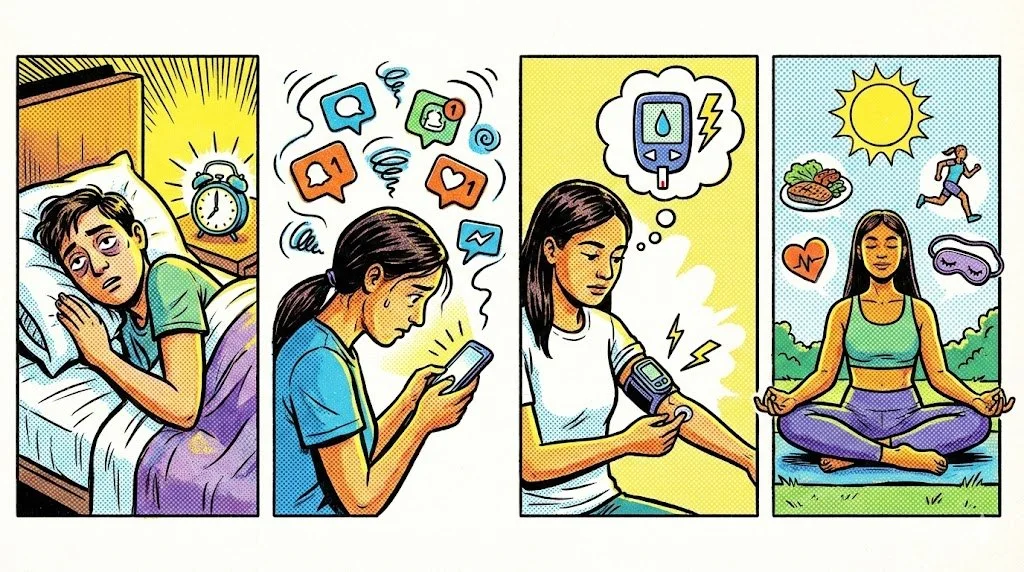
Well, you know, overall, sleep provides a lot in terms of recovery, and build of like cellular sort of restructuring and whatnot in the overnight time period, right? That's, we're supposed to get these waves of light sleep, deep sleep, etc, that help our body to actually then recoup and be ready for another day. When it comes in terms of type one management, that's one of the biggest things that most people say is, I just want better sleep, the daytime, I can struggle through manage through if I've had good sleep overnight, I can deal with the daytime management. So from one, sleep deprivation can lead to poor overall management, because you don't have as much with all that we have to manage in today's world beyond our diabetes, that's another layer that we have to consider. And if you haven't slept well, you're not going to be thinking as clearly, right. on another level, though. There are a lot of different hormones that are regulated through the sleep cycle that have relation to appetite, and the turn on the turn off of appetite during the daytime. And so for someone, again, managing diabetes, if you are not sleeping well, it is very likely that some of those hormones that are supposed to be being managed for then transitioning into what you're craving, unable to manage in terms of your intake through the course of the day, those are not going to be regulated the right way either. So there's a lot to sleep, that does translate into diabetes management, right.
Scott Benner 7:31
So the one, the one thing that popped into my head, when I saw this as a variable was that I thought I for sure had heard that shift work could be bad for people in a way that I never expected that he could make you more, the way I looked it up it's a shift work can have an adverse effect on type two diabetes, it can also put a person at higher risk of developing type two type two in the first place shift work, particularly that involving overnight and varying shifts can make it more difficult to manage glucose levels. It doesn't it doesn't really go on but I really I just remembered hearing that that there's something about the is that this circadian rhythms, the
Jennifer Smith, CDE 8:12
circadian rhythm really. And I it's interesting, because I just attended the ADA scientific sessions with our virtual conference. But some of the sessions that I did attend were specific to the circadian rhythm, and sleep and appetite and weight management, which does relate to much more into type two. But it's also a realm of something that many people with type one try to manage really well to write. So in terms of what they found is those who had a much more stable daytime structured schedule, and they slept overnight, even if the sleep was not as good but they had their normal sleep time in the overnight time where typical circadian rhythm kind of is meant to be. They found that people had better weight management and had better glucose control. The other piece to it was that with shift work in the picture, schedules are often very disrupted with shift work. It's not often that people have consistent enough schedule with a shift like I think of many of the nurses that I've worked with, who have some shifts and some weeks that are an overnight shift, and then they've got several days off and then they go to a daytime shift, then they've got several days off and then they go back to like the evening or the overnight shift, right? That's a complete disruption to what your body is even trying to set as a some type of stables schedule. It just it doesn't happen. So in terms of like all management It's really hard to then get a grasp on insulin doses and or even use of medication. And food intake gets disrupted, now you're eating at two o'clock in the morning because that's technically your lunch hour went in four days from now, your lunch is going to be back at 12 or one o'clock. And I know
Scott Benner 10:19
I remember we've talked about that before, too, that that actually still impacts things like feet on the floor and stuff like that, too. Like if you wake up at three o'clock in the morning, suddenly that feet on the floor impact is happening at that time of the day. Absolutely all that other stuff that's really fascinating.
Jennifer Smith, CDE 10:34
I mean, I in terms of that, I even remember noticing that myself if I would get up overnight for more than just a tuck a kid back in bed and then go back to bed myself five minutes, I didn't get that impact. But if I was up with a foster child or for nursing overnight or something like that, and I was up for enough of a period of time, I definitely saw that happen when otherwise overnights were flat.
Scott Benner 11:00
You know, I was just thinking about you ever been like gotten sick or exhausted and you fall asleep in the middle of the day? And the sun's up? And you're in a deep sleep Lee, when does that happen? Back to had to have happened to at one point, and you wake up at seven o'clock at night. And it's dark. And it's the kind of dark where you're like, it could be midnight it could be 2am I don't know what time it is. And you can't it gives you that really horrible strange feeling of like you don't know where you are. It feels very disorienting, right? Yes. And the only time the only way to fix it is to go back to sleep and wake up with the sun again. Yeah, yeah, it's a I have it here just us is it circadian circadian circadian rhythm or circadian cycle is a natural internal process that regulates the sleep wake cycle and repeats roughly every 24 hours. It can refer to any process that originates with an organism, okay, we don't care about that part. But the other thing there. And the only way I can relate to this, and I've had someone on recently to talk about it, is that I am very steadfastly eating within a an intermittent fasting schedule, is really made a vast improvement on how I feel. You know, when I spoke to Jen Stevens about it on the podcast, she was talking about, you know, just pick a she talked about is in the eating window, not as like, she didn't think of it as fasting as much. And so I'm just pretty much sticking to an eight hour window. Yep. She told me if I take my window down to fewer hours, I'll start losing weight. And I haven't gotten to that part yet. I was waiting for the kids to go back to school. So we're getting up to that. Now I'm going to shorten the window up a little bit. But basically, basically, I'm not eating after the sun goes down. I'm 11 to seven ish. I'm trying to eat around in that situation. And one of the things she talked about is how, why does that work for people for weight loss, and she said it. it lessens your need for insulin. So your body goes through big portions of the day where you're not your body's not calling for insulin, like it's the opposite of the idea of like, eat small snacks all day long. She's like, I don't like that idea because your body is always using insulin. Now she was talking about, you know, people who don't have diabetes or type twos, how that could affect them. But then I realized Arden's a person who doesn't eat breakfast. So over like most of the time, like on a regular school day, so overall, Arden's eating in an intermittent fasting window. And she can fast with a stable blood sugar, like no one I've ever seen in my life. Like, you know, now that you're on the algorithm, and you can see it Arden, if Arden doesn't eat for 12 hours Arden's blood sugar is just he just is. And so I don't know that all those things fit together. But I think all the ideas fit in here somehow, you know, the idea of being on that cycle, and that your body works better in cycles, and that it needs time off and time to do things. I mean, I'm obviously no expert, but all that makes sense to me somehow.
Jennifer Smith, CDE 14:15
Yeah, absolutely. I mean, the, they're seeing their circadian rhythm, the hormone component and the overnight time period. I mean, they are all kind of tied in along with the intermittent fasting idea. In fact, one of the other ones that I listened into was all about, like those who did the best weight management wise, kind of from short term analysis to long term like a year out from having lost weight, and then what's the maintenance of that in terms of their ability to maintain and some of them were doing intermittent fasting, but they did it. I also don't really like the fasting component because you're fasting in a given time period, but you're not Really just not eating, right? I mean, people think of fasting as like 24 hours, you're just not eating anything really you just containing the time period. And they found that people that did intermittent fasting with breakfast being the bigger of the meal, lunch being a bit lighter and the last meal of that time period, especially when it's eaten, I think it was before, like 7pm did the best with overall loss, and then maintaining that loss, compared to people who just shifted that eating timeframe by about, I think it was a three hour chunk of time forward, and eight later into the evening, but still within a time block. That was an intermittent fasting, like I only eat within the six hour eight hour time period. So the later eating tended to increase the risk of gaining weight back and or just not losing as much weight, which was interesting to
Scott Benner 16:00
the reason I brought it all up is because if you're if you're sleeping on a pretty consistent schedule, then it makes sense that you'll be able to eat on a pretty consistent scale. Yes, right.
Jennifer Smith, CDE 16:10
Exactly.
Scott Benner 16:11
I and I mirror what you said in what I'm seeing that. First of all, it's easier to eat bigger in the beginning of the day, because you've come out of a window where you haven't eaten for a while. That is the time I am the hungry. It's like I don't want to you know, I don't I don't wake up like I haven't eaten yet. It's 1151. And I'm not hungry. So but I will go eat now when you and I are finished. Sure. And I will eat probably my larger meal of the day. Yeah,
Jennifer Smith, CDE 16:41
and it's in the day. Yeah, you're not putting it in the evening, when you're less likely to be up and moving and going about your business, you're not going to bed on a really full stomach that your body then has to do something, digestion specifically, in a time period that is not meant to be doing that, which
Scott Benner 16:58
I was gonna say can affect your sleep, which Yes, talking about and we've talked about it in a number of other episodes, leaves your body with a task of having to work on food, and digest food at a time when it's trying to take away that process to do other things. So yeah, you're basically asking your body to do something when it was getting ready to shut down that function and do other things. Right? So don't go to bed on a full stomach.
Jennifer Smith, CDE 17:24
Yes, yeah. That's it. Easy, easy statement to say harbor?
Scott Benner 17:32
Pizza much better and even. It's just obvious. Okay, um, can we do pump site placement? Sure. Alright. So it's always feels weird to start over when we do these strings. Because I come back to them and edit it. I hear myself go, Hey, Jenny, today, can we talk about pumps?
Jennifer Smith, CDE 18:02
We've really been talking for like, 45 minutes. We've been talking forever.
Scott Benner 18:05
We've done like a bunch of these like, and I feel silly. But anyway, hey, Jenny, can we talk about pump side placement today? Absolutely. Excellent. Yeah, we just leave all that in so people know why I'm laughing. So it doesn't matter, right? If it's injected, or pumps, there are just going to be places on a person's body that I don't know what to say, does it absorb the insulin better? Does it use the insulin more efficiently? Like how do we think about it?
Jennifer Smith, CDE 18:36
I think they're both kind of the right way to say it. Because honestly, underneath the skin, I mean, the goal is to have insulin absorb right and to get used in an efficient like, pattern of in, gets used goes out is finished working. I mean, many people on pumps, I think more than people using injections will start to notice places on their body that definitely absorb the best. And other places that they get good use out of, but they might actually have to have a secondary Basal profile that's notched up a little bit more, because they just don't quite meet the same glucose targets with the same basil from let's say, a stomach site versus a butt site or, you know, whatever it is. And then there are some people who can't use certain sites at all. I mean, I personally cannot use my leg. It just it just doesn't work for me. I either get occlusion alarms, or the sight hurts. And I've also noticed with that then it's just not getting absorbed. Back early enough, I guess is the easiest way to kind of explain it. It's it's much less consistent absorption there. So I just I just don't use my legs.
Scott Benner 20:09
Do you think that's because do you think there's a reason to point to do you have like a stronger leg? Is that muscular?
Jennifer Smith, CDE 20:15
For me? I truly believe it's because I just have pretty much just muscular legs. I mean, I've done biking and dance, and lots and lots of things over the years. And I continue to run and do yoga and bike and yeah, I think it's that now the interesting thing is that I can wear a sensor on my leg. No, I just can't put a pump site with insulin there.
Scott Benner 20:42
Okay, is there anything about like, I've heard people say over the years, and I've never understood if it was true, or not, like, I can't put my pump near like the, you know, muscle in my thigh or towards a larger muscle because the muscles, they feel like, you know, the way they say it is that the muscles burning up the insulin, but I don't know, I don't know, imagine that that. Isn't it just that there's not enough like fatty tissue there to move it around? Or no? Well,
Jennifer Smith, CDE 21:06
you know, muscles are, they've got a basketball nature to them, right? So they've got lots and lots of vessels that contribute to keeping the muscles doing what they're supposed to be doing and supplying nutrients and everything into the tissue, right? Whereas fat is just I mean, you've probably seen pictures of like fat blobs, right? Fat balls, right? Imagine Yes, imagine a styrofoam ball, that's a good idea. So when you have insulin infusing pretty close to a muscle, let's say and this is kind of general, you would expect potentially, that you are going to get if you haven't gotten occlusion from nicking a vessel and getting kind of a clot at the end of the canula. And then the muscle because of the nature of vessels, you may actually get faster absorption in an area. Like I've in particular, noticed if I've ever had a site that has bled after I've taken the site out. But it wasn't really, like it wasn't painful. There was no reason to change it prior, but it just was one of those like, gushers that you like, pull out. And then I look back at the couple last days, and I'll be like, yeah, my blood sugar look pretty perfect. Like, it was almost like, I didn't have diabetes, like it was just all working like so beautifully that I felt like, this is just it. I'm just at like this beautiful like point, right? And then I see Oh, well, there's the reason right next to my bud spy,
Scott Benner 22:44
you think he said that it's almost like you're in a very tiny way mainlining the insulin a little bit.
Jennifer Smith, CDE 22:51
And that's what I guess yeah. And it's actually just closer to the absorption line. You know, because when we put a pump site or even inject insulin, you're supposed to be sub sub cute, right? underlying tissue, which is mostly your like, it's like your thermal layer of protection for your body, right, that's where we're supposed to be absorbing insulin through and thus the timeline and the absorption for the trend in rapid insulin, regular insulin, long term insulin. It's all based on how it's supposed to get absorbed in us through that timeframe. Okay, through that tissue.
Scott Benner 23:27
And so I think it's important here to mention that when you buy a pump, any pump, it's going to give you some instructions and tell you here the places you can where your pump all that means is that those are the places that the company who made the pump had the time and money test to test so that they could prove to the FDA that these places worked it and I assure that on the pod probably isn't thrilled if I'm saying this but I you can put your pump somewhere else. Yes, yes, you could try other places I've seen from Chris Freeman where it on his chest, you know when he's in the middle of you know, in the Olympics and that I mean, I've said it before the guys like I don't know what his real body fat is, but he doesn't appear to have any. And you know, and it's on us, it's on his pack. I've seen ladies wear them in their on their breast I've seen people wear them on their hips, their thighs, their calves. I watched somebody do it on their forearm once is like a test, you know, there's no place. I don't think there's any place where it isn't reasonable for you to try based on what I've seen from the community and from people in general. But you are going to find places that work better but then I think that leads us into talking about you can't have too much of our favorite place because you'll ruin it.
Jennifer Smith, CDE 24:44
You have to rotate Yes, very important to rotate
Scott Benner 24:48
have to have to look at your sights and see for Arden they get a little like if she's using them too much I can start seeing them a little vascular maybe like a little red on top like that's the first like sign for And then you can start rubbing your, your you can rub your hand over top of it, if it gets bad, you can feel like it'll get lumpy or hard. Yes, right, that kind of a thing. So yeah, you have to have a place to go. And it is going to change them. Like Jenny said it could possibly change how much insulating Arden just went off the side of her thigh to the top of her thigh. And I had to increase everything by about 20% for that just from the social side of the top of her thigh. So and I think too, for little kids. As long as we're talking about sites for a second, here's probably a good place to talk about when you start doing things with little kids or you know, sometimes adults. They build rules in their head. So that's where my pump goes. It can't go there because it goes there. I always wear it here kind of becomes a psychological thing at some points too. You know, and then you'll see kids will fight against it. Like I can't put it on my arm. It goes on my leg. Yeah, right I Arden 17. And I think she has it. I think she believes her her CGM goes on her hips. Because that's because that's where she likes it where she likes it and it works fine and everything. And if I ever say to her, Hey, why don't you try putting your pot on the back of your arm. It's a flat No. And it's only because in my opinion, she remembers it being there in a softball game one day and we didn't think about it and she threw and then the pod like yanked on her arm as she was as she came across, she had a bad memory of it and now even years later that she's not throwing a softball anymore years later she's has an aversion to putting it on arm you know so sure if there's like
Jennifer Smith, CDE 26:41
an associated kind of experience there
Scott Benner 26:45
Yeah, and then it comes out as this is where it goes and I will fight to the death to keep it here and then you run into a problem where you don't have ways to to rotate sites yes and then you're going to run into a problem and the way I've always put it the Arden is look you keep putting it there and one day you're not going to be able to use that spot at all. And that's that's the thing that helps her move around now I think the other good thing to talk about about that is you know I really have experienced with the Omni pod but sometimes it's just as simple as turning it 180 degrees like you really like it on your abdomen great, have it point towards your belly button this time and have a point towards your side the next time Yes, you know, those are still
Jennifer Smith, CDE 27:23
when I do the same thing you know, especially for backs of the arms which for many little kids because especially for tiny little kids who really don't have a lot of tissue or are very very averse to having it on their abdomen for some reason you know, then that back of the arm like you said it's essentially just turning the pod with that viewing window facing up versus the next time turning it with the viewing window facing down to technically then even have two sights on the back of each little arm that you could potentially use which makes for places between two arms at assumably three days per site. It's a fair amount of these before you get back to site number one on the first or
Scott Benner 28:10
do you think specifically on on the pod? You use it vertically? On limbs right?
Jennifer Smith, CDE 28:17
Correct yeah perpendicular up and down with the viewing window either facing the sky or facing the floor on limbs exactly and then on like your torso region or your upper but you would use it in sort of a horizontal fashion
Scott Benner 28:33
is that because of just the nature of the shape of the pod?
Jennifer Smith, CDE 28:37
Yeah that's from what I know it's nice it's based on the wear comfort wear of the pod itself Yes
Scott Benner 28:45
Do you know a second ago because I didn't want to look stupid I just checked it vertical up and down. Like I googled it right before I said it and then it made me feel so much better because the rest of the world doesn't know either. It's it's a very popularly Google thing is horizontal left and right is vertical up and down. What is vertical? What does a vertical line look?
Jennifer Smith, CDE 29:08
Pretty funny is that paid closer
Scott Benner 29:09
attention in school. Anything about this that we didn't cover?
Jennifer Smith, CDE 29:14
Um, I don't think so. I think in terms of site you covered you know, all the places that are approved versus the ones that people are trying that necessarily approved. So
Scott Benner 29:28
yes, but it's a variable because you are going to get it in your head that these are my settings, and then you're going to move the site somewhere else. And then you start I love it, people immediately go this pump doesn't work. That's always my favorite reaction to everything.
Jennifer Smith, CDE 29:41
Right? And I've got a number I mean as a secondary to that site to site going to number of people, myself included before using, you know the system that I actually use. I actually just had separate basil profiles that I would use from one site to the next more specifically, all Body sights on me work pretty much the same except for my upper but my upper but just seem to need more insulin whenever I used it. So I had a profile that was specific to that. So do you
Scott Benner 30:12
think that and then I'll let you go. But do you think that the advent of g7 Dexcom. Like when it changes form factor? I keep thinking people are going to start trying like a lot of different places because it's going to be easier to put in different places all
Jennifer Smith, CDE 30:27
this probably, I would expect. Yes. I mean, as it is, a lot of people are wearing their CGM is on places that I would honestly like they're, I've seen it on their forearms. I've seen it like, places I would never think of popping it in. But I think getting accurate results. I
Scott Benner 30:46
guess I have to admit, there are times I see those pictures, and this is exactly what I think and I'm just gonna have to bleep this out. I think, man, skateboard, huh? I wonder if we can make it work here. I'm gonna
Jennifer Smith, CDE 30:59
I know I don't even have like, I don't it's all muscle there. I don't know where it would sit under my skin. I would hit something and it would be immediate pain or blood. I
Scott Benner 31:10
I just think of those people as they're they're explorers. They just like I wonder what will happen if I walk across Antarctica? You know?
Unknown Speaker 31:18
Right, exactly. Go find out exactly. I'm
Scott Benner 31:20
not doing it but whatever. Okay, thank you very much. First, I'm gonna thank the Contour Next One blood glucose meter remind you to go to Contour Next one.com forward slash juicebox. There are also links in the show notes of your podcast player, and links at Juicebox. Podcast calm. Thank you very much for visiting with the sponsors. I appreciate it. Thanks, also to Jenny for being here. Thank you so much, Jenny. We love talking to you. At least I do. I think I'm speaking for everyone else. But in fairness, some people might hate your guts. I have no idea. Is it possible that anyone doesn't like Jenny? I don't think so. Thank you so much for listening. There are way more variables, go check them out at Juicebox Podcast comm or right there in your podcast player. Really appreciate your listening and supporting the Juicebox Podcast. Tell a friend. That is my least favorite part of making the podcast asking you to like tell somebody else. Don't forget to subscribe and your app like it's, I feel like oh, I feel like an idiot having to say that. It's like I see a YouTube video, you know, and they're like, hit the bell do the thing. And I'm like, Oh, this is so sad. And then I come here and I have to do it here and it just it's hard to get people to listen to things and and subscribe and you know, it takes so much for them to learn that the contents there and that it really might be valuable for them. So then I end up saying like, just please tell someone who else you know and just, I don't it makes me feel weird. I don't like it, but I do it because it is important. So thank you so much for listening for supporting the show. If you know somebody else who you think might enjoy the show, also please share it with them, show them how to start listening. podcasts are not intuitive for everyone. Subscribe in your apps people. I just did it. I was like hit the bell thing. You know what I haven't mentioned this in a little bit. The Facebook page is really great. No joking. Juicebox Podcast Type One Diabetes on Facebook. It's a private group with I think it's got like 16,000 people and now everyone's talking about diabetes to really on Facebook like experience. So that is to say it's a good experience with a lot of great people. Check it out.











Please support the sponsors


The Juicebox Podcast is a free show, but if you'd like to support the podcast directly, you can make a gift here. Recent donations were used to pay for podcast hosting fees. Thank you to all who have sent 5, 10 and 20 dollars!

#559 LVH T1D Camping
L.V.H. is a new type 1 who loves camping.
You can always listen to the Juicebox Podcast here but the cool kids use: Apple Podcasts/iOS - Spotify - Amazon Music - Google Play/Android - iHeart Radio - Radio Public, Amazon Alexa or wherever they get audio.
+ Click for EPISODE TRANSCRIPT
DISCLAIMER: This text is the output of AI based transcribing from an audio recording. Although the transcription is largely accurate, in some cases it is incomplete or inaccurate due to inaudible passages or transcription errors and should not be treated as an authoritative record. Nothing that you read here constitutes advice medical or otherwise. Always consult with a healthcare professional before making changes to a healthcare plan.
Scott Benner 0:00
Hello friends and welcome to Episode 559 of the Juicebox Podcast. I'm glad you're here.
Today we're going to be talking with a type one who's in her mid 20s. Who loves to camp. Also, there's a lot of great stories in here. So it's about camping. ish. I mean, you guys know the podcast this point, if you think this is an hour about camping, you've got the wrong show. But there's some camping stories and some ideas about camping. It's not a how to about camping with diabetes. I honestly don't know how to make an hour long entertaining podcasts about a how to about anything, so I found you some lvh and she loves to camp, and she's got a tight bond, and she's gonna tell you about how she was diagnosed, and how she went camping. It's gonna be terrific. Don't make me explain it to you here. While you're listening though, please remember that nothing you hear on the Juicebox Podcast should be considered advice, medical or otherwise, always consult a physician before making any changes to your health care plan or becoming bold with insulin. Just a reminder, go take that survey, p one d exchange.org. forward slash juice box trying to get to 2000 surveys before the end of diabetes Awareness Month.
This show is sponsored today by the glucagon that my daughter carries. g vo hypo pan. Find out more at G Vogue glucagon.com forward slash Juicebox. Podcast is also sponsored today by trial net trial that offers free type one diabetes, Risk Screening and much more. Go find out about it at trial net.org forward slash juicebox when the web page asks you how you found out about trial net, make sure you say Juicebox Podcast.
L.V.H. 2:05
I'm lvh. I've been type one diabetic since June of 2019. And I am poor 26 years. Nope, I'm not 26 I'm 27 years old.
Scott Benner 2:18
I don't care how old you are. You have a mom, you have a moniker. How does that happen? Don't tell me your name. I mean, I know it's your initials. But like how does that come to pass? Like how does somebody decide? They're gonna call you by your initials.
L.V.H. 2:35
I probably because I'm a twin. So it just became lvh and avh. Just to make things easier. Oh, that's cool. And I played sports my entire life. So it was a quick nickname to do on the field.
Scott Benner 2:47
Nice. I love that. I just saw that. No one's ever like looked at me and been like, SB right? Because I would think I would find that cool. So this has been your whole life.
L.V.H. 2:59
Pretty much. Yeah, so I've had a couple of nicknames. Another nickname would be bond, even though that's has nothing to do with my last name. But they thought someone on my lacrosse team thought that the first part of my last name was bond. So they started calling me bond. And then I was like, you know, it's bad.
Scott Benner 3:18
just stuck. Yeah. Well, in the real world, lvh stands for left ventricular hypertrophy. Which is Yeah,
L.V.H. 3:31
there we go. But
Scott Benner 3:32
not nearly as fun as as it being anyway. I love that. So are you lvh?
L.V.H. 3:38
Yeah, you can call me I'll be. I'm gonna see if
Scott Benner 3:40
I can work that out. I'm gonna do my best here. I've never called anybody by a moniker before. I'm excited. You're 27? Did you just turn 27?
L.V.H. 3:50
And July of 2020 Oh, so no, no, no, I'm on was 28 I just put a life mate can't remember how old I am ever.
Scott Benner 4:00
I never can as well. And that's why I was. I just thought other people have a grasp on their age. But you clearly you clearly don't either, which now makes me feel better. It's like, Oh, that was Yeah, she's, she forgot that she was an age that she turned eight months ago. I've had it go both ways. For me. I've mentioned it before on the podcast. I lived an entire year thinking I was a year older than I was, which was an amazing surprise on my birthday. Because I technically, on my mind, that's funny. Yeah, but then I made up for it later by believing that I was younger than I should. I don't know how that happened twice to me in one lifetime. But my wife my wife said to me at one point she goes for the last couple of months I've been hearing you say how old you are and you're wrong. And I haven't said anything wondering what would happen. Like, is that how bored you are like these are the psychological mind games that are being played. Anyway. Tell me about it. How old were you when you were diagnosed?
L.V.H. 5:03
I was 25. And I was less than a month away from turning 26. So that when I do remember,
Scott Benner 5:10
oh, this hasn't been long, okay, okay.
L.V.H. 5:13
Yeah. So I've only had Type One Diabetes for a year and a half, plus some. Okay, this June will be two years.
Scott Benner 5:22
So you made it all through high school. Sounds like you played sports. Did you play sports in college?
L.V.H. 5:27
I did. I played lacrosse in college. Okay, so you
Scott Benner 5:30
did that all good. You're off in your life. things feel Yeah, you're going you probably by 25. Year like, I'm gonna be alright.
L.V.H. 5:38
Yeah, I had already lived in two cities. Like, besides the city I grew up in. I had just moved to a new city, I guess. And lived there for a year. And then called my parents in the hospital and was like, guess what? I have type one diabetes.
Scott Benner 5:57
lvh one day. Yeah. SOS ASAP. Yeah. Did they come to help you?
L.V.H. 6:08
They did, my dad flew out. I tried to convince him not to because I was like, Oh, I'm going to leave here in a day. And then fly to Kansas City for a beer festival was my grand idea thinking at the time, and I convinced all the nurses and doctors. I have to be on next flight on Thursday. Is it possible? And I never told them where or why I was going out of town. And they were like, Yeah, sure. Until they discharged me and they're like, where are you going back home to Kansas City. And I was like, No, I don't live in Kansas City.
Scott Benner 6:43
Here is I just have to go. Yeah,
L.V.H. 6:45
my dad was like, she's going nowhere. As of right now. I was like, oh, man,
Scott Benner 6:50
I I agree with your father. I would have been there before you hung up the phone. So yeah, well, isn't it interesting to no matter what the illness is? Whether it's a short term thing or a lifelong thing? When you first get the news of it, you're like, no, this won't touch me the way it touches other people. Like I won't be impacted by this. Even if you got the flu. And you had plans in three days. You hear people do that all the time. Like I'm going on vacation next week. The flu is not going to stop me. Oh, sure. It will.
L.V.H. 7:20
Yeah, I think it probably didn't help that my co worker at a time had type one diabetes, and she was I think 12 or 13. And when I called her being like, hey, my a one C is 13.5. And I'm going to the hospital right now Can I still go to Kansas City? She was like Yeah, sure. Definitely then that helped the situation in terms of like, egging me on to like still take this trip to Kansas City. Yeah, well, that happened
Scott Benner 7:48
well her perspective right like if if her knowledge was in your body you probably could have gone to Kansas City. But yeah, brand new diagnosed person's not gonna know did you ever make it like the following year? Did you go to the festival? Where was that co
L.V.H. 8:02
because the following are my friend who was going to visit and Kansas City for that festival she moved like that October back to the Midwest. I don't even know if Kansas City is considered the Midwest. No, probably not. I
Scott Benner 8:20
don't think so. But is it Kansas City Missouri or Kansas City isn't there in Kansas City Missouri and Kansas City in Kansas?
L.V.H. 8:29
So it's the it's like the same city it just is right on the border
Scott Benner 8:35
Really? Yeah, I've been there and like oh yeah, I remember this oh my god I just pull up a map and I'm like oh my god yeah, I remember
L.V.H. 8:46
on the border like the street that was the border so she was Missouri but the hospital across the street was Kansas City Kansas.
Scott Benner 8:54
Okay, I remember being that this this whole like, Am I wrong about this? I also remember being in Ohio and feeling incredibly close to Kentucky which seemed odd to a person
L.V.H. 9:08
now you are lucky and depending on what part of Ohio you were in Yeah,
Scott Benner 9:14
I don't understand all this. I would like more specific delineations between states
L.V.H. 9:21
or not Cleveland Cincinnati, it would be the closest big city to Kentucky because it's the there's like three big cities. It's the one that's Southern ish. Okay, and Ohio.
Scott Benner 9:33
Alright, so so what was our original question? are we calling that part of the country the Midwest?
L.V.H. 9:38
The Kansas City are we calling Kansas City part of the Midwest?
Scott Benner 9:43
No, I guess you can't it looks like it looks like the Mideast which is Yeah, I hear people say and then what's what's what's like the between Denver and K in like Wichita is that like the mid I don't think there's
L.V.H. 9:57
a central I don't know. All right,
Scott Benner 10:00
I'll tell you what you tell me about your diagnosis, I'm going to find out what delineates the Midwest. So how did you end up in the hospital?
L.V.H. 10:12
So I had like all the symptoms of diabetes, pretty much the tire school year, early some Christmas break until end of the school year and beginning of June cheer a teacher. Yeah, I'm a teacher. And at the time, I was completing my, like student teaching. And my friend who is doing it with this student teaching at the same school as me, jokes several times, like, you know, maybe you're, maybe you're diabetic, and we sort of just joked it off. And finally, because I lost so much weight, and was constantly thirsty, and all those other symptoms, I just scheduled a normal doctor's appointment. And I was like this run any blood tests you want to run. These are like my symptoms. And then I left that doctor's appointment, oddly enough, went to the Apple Store, because my phone was not working. So I could only speak to people on speaker, and they call them they're like, can you talk and I was like, Well, I'm talking to you through my watch right now my phone is being fixed. So they're like, great, we're gonna call back and leave a voicemail. And all they said to me was like, what my Awan fee was and if you have these symptoms can go to the hospital. I was like, I have no idea what and I want to see is I do have those symptoms. Say Google, you know, what you're not supposed to do is Google Health stuff. googled a Wednesday and the only thing I could come up with was type one diabetes related stuff. So I called my friend being like, What do I do? Should I go or should I not go? I don't have great insurance. Will it cost me a fortune? And she's like, No, you have to go. So I went and picked up another friend. My friend Rick diabetes was like, on your way to the hospital stop and get a Diet Coke or not a normal coke. And drink it. That way you get admitted right away. And you don't have to sit in the ER waiting room. And I was like, Okay, and now when you look back on it, everyone's like, why did you drink that coke on your way over to the hospital when you knew your blood sugar was already super high? Probably super high. But I had also been like running around and biking around all day. So maybe it was low and all I know is when I got to the hospital. My blood sugar's 600 something. I don't remember the exact number.
Scott Benner 12:56
Did you have to wait?
L.V.H. 12:58
Now I was like, they took like blood pressure and then like sent me back into the ER and gave me a bed to sit in for a while until they took me out to the ICU.
Scott Benner 13:10
Your friend sorta had some good that was I mean, that's not a health wise a good tip, but it was a decent tip for not waiting around.
L.V.H. 13:18
Yeah, I guess so. Her older sister is a diabetic too. And that's when she was being diagnosed. My friend. The older sisters under chronologist told the family to do that.
Scott Benner 13:33
That's insane. By the way, yeah. Not as insane as this. The Midwest is defined by the federal government as this here are the states ready? It's gonna freak you out. Illinois, Indiana, Iowa, Kansas, Michigan, Minnesota, Missouri, Nebraska, North Dakota, Ohio, South Dakota and Wisconsin are all considered to be in the Midwest. I mean, that's 1-234-567-8910 1112 13 states that's all the states.
L.V.H. 14:02
Wow. Yeah. All central part of the country. It's
Scott Benner 14:06
a big chunk of them. And it's also northy like for some reason mid makes me think middle. But then Texas takes up such a big chunk of the lower portion of the mid part of the country. That there Yeah, very north to begin with, I guess. I guess they
L.V.H. 14:22
include Texas in the Midwest. No, no, I guess I guess. I guess. I live there. That's not the Midwest.
Scott Benner 14:29
I guess the Midwest doesn't promise. height as far as the map goes. Yeah, I guess it's Central. I'm thinking of it doesn't matter. But what matters is Yes, you were in the Midwest.
L.V.H. 14:44
Okay, there we go. I can't believe you
Scott Benner 14:47
haven't gotten to go to a beer festival yet.
L.V.H. 14:50
So I've been to that beer at that same Beer Festival. I had gone the year before or prior Yeah. So and there's They've been out in Denver, there's tons of beer fest. Well, pre COVID, there was tons of beer festivals three going to.
Scott Benner 15:06
So how do you leave the hospital? Is it? Like? Do you feel like you understand what's going on? And you have a bunch of technology? Or is it a little scattered? Did they just give you some needles? How does it go?
L.V.H. 15:19
It was a little scattered, I would say, I left with a box of needles, and a vial of insulin. And this piece of paper that said, like, here's how you're going to give yourself insulin at mealtime based on your blood sugar reading. And I think, at minimum, I was always given. Like, if I was between, I would say 80. And 120, probably, it was like, you're gonna give yourself three units of insulin. And anything after that, it sort of like, jumped up by one unit. And I was in between moving apartments to so I like did not have food at my house or my apartment that I was moving to. So my dad and I ate out almost every meal, like for that first couple of weeks. And I just would walk around town with these like, orange oranges and like, pull them out at the, like, middle of the restaurant and be like, let me just give myself some insulin right now. I felt like, so weird. And then, my friend was trying to they didn't like the hospital I was at, they were like, Oh, you can see our endocrinologist team. And like three months, I was like, that seems ridiculous. So then I started calling around different places, they suggested another one. And I, honestly, I'm so thankful I ended up where I ended up with the endocrinologist because I got put on the Dexcom. Like, immediately, because my endocrinologist is like, oh, you're going to be living alone. You You need some sort of glucose monitor. That's not the fingerprinting system. And he's like, I'm going to suggest a Dexcom because that will send the alarms to your parents if they need to wake you up. Or like a friend nearby if they need a call and wake you up.
Scott Benner 17:33
up to 10 followers.
L.V.H. 17:35
Yeah, I only have two. Well, when we go get into like the camping part, when I do go camping, my friends hook up to it. But when we're just in Denver, I'm not having them follow my blood sugar on a daily basis. Right.
Scott Benner 17:51
So yeah, that is how you ended up on the show. Right? Is that you? You do a fair amount of camping? Yeah. Okay. And that came up came up online. And a lot of people were interested in it. I have to admit it's a it's a space that misses me in that I don't think I've been camping since I was like a little kid. And my parents were, you know, bought a trailer and decided that's how we were going to spend weekends sometimes. I don't have particularly bad or good memories of it. I actually don't know that I have any memories of it. But I don't camp. So when people start asking questions about it. I always get confused about why anyone's even nervous to go camping. Like To me, it seems like going to a hotel, but being outside. Right? Yeah,
L.V.H. 18:37
I would. I would agree with that. It's fairly easy to ease people's mind. It's fairly easy to camp with Type One Diabetes. Okay, excellent. So like, management and everything stays the same. For the most part,
Scott Benner 18:53
you just have to have supplies with you and have a way to keep the things that need to be cool. Cool. And I would imagine Yeah, pretty much it right. Yeah. All right. So what what draws you to camping? Have you always been a camper?
L.V.H. 19:06
Um, I guess no, just given where I grew up? Not really, I mean, we did what is like, I don't even know if they still have it. It was called Indian princesses as and that name is so politically incorrect at this point. But when I was younger, it wasn't. And we would go camping with that group, but it was like, you go and you stay in a cabin. You're not like pitching a tent anywhere. I went camping at a country music festival once in college. But then when I I've always just enjoyed the outdoors and loved being outdoors that I knew it was one time moved up to Denver. I knew it was something I wanted to start doing sort of right away. Once I got here and I fell into the right group of friends that also wanted to be doing campaign and living outside in the wilderness for a week. So it just sort of fell into place. Cool.
Scott Benner 20:12
I have to tell you that the YMCA in certain parts of the country still calls their program Indian princesses.
L.V.H. 20:18
Okay, there we go.
Scott Benner 20:23
There's their slogan is for
L.V.H. 20:24
the I shouldn't talk bad about the name.
Scott Benner 20:28
It's a program. programs are for dads who want to quality plan one on one time with their daughters.
L.V.H. 20:35
Yeah, yep. Our dad went with us. No, dad, my dad.
Scott Benner 20:40
Our dad. Whose do you have? Do you have sisters? I have a twin sister. So yeah, so yeah, so you and Avi is avh. Right. ABH? Yeah. Remember, you guys went together? Yes. When your father called you, did he say a and lvh? Or did he say six of the letters all together?
L.V.H. 21:03
No, he said our names. Our parents always called us by our first name. It's more just like friends that caught us. I'll be HIV. Ah,
Scott Benner 21:11
I say because I was watching cricket. I just feel like that would get confusing. So you do some camping with your dad when you were younger, and then not really again. And now as an adult. You get into the Denver area and this is something that seems like you want to get involved in and are you pretty heavily involved at this point.
L.V.H. 21:31
At this point, yeah. I do a couple of camping trips a year. Our biggest camping trip is always around the Fourth of July 3 of July. Just that week was I have a birthday of my best friend out here has a birthday so we just do a big week long camping trip and then we have we both teach and we do a camping trip over our fall break down to the great Sand Dunes National Park and then I'll drive to Utah camp. A lot of it is has been local to Colorado but we're in the midst of planning a lot of bigger trips this summer now that COVID is sort of dying down a little bit and there's not an we're vaccinated so we feel more comfortable this summer camping then we did last summer we last time I was a down sort of year we only did one or two trips right?
Scott Benner 22:41
Howdy this great Dunes National Park thing is beautiful.
L.V.H. 22:46
Yeah, it's so fun. Okay, so what's like a giant sandbox?
Scott Benner 22:52
What if it's actually what it looks like? is if you had to sell camping to me if you were you know I we were friends and you're like Scott I'm going camping then the next thing would happen is I would say oh have a good time and then you said no no I want you to come with me because what is great about it because people who love it love it and I want to understand more why that is
L.V.H. 23:18
because you get that opportunity to just like leave the city whatever even if the big city small city whatever city it is and not sort of be in the real world for a while like you don't have to have your newspaper your or your television paying the news 24 seven you don't have internet to access so you're not like oh I have to get on my work email and check my emails. It's just like such a good way to relax and like not thinking about your day to day life. Ah besides the fact that I do think about day to day life in terms of managing my diabetes while I'm out there but that's like a different part of my day to day life.
Scott Benner 24:08
I have to say I'm not there right now but these pictures are relaxing. So I imagine being there must be incredibly soothing. But she you just from where you end up camping to wherever you park your car. Do you hike a little bit to where you camp.
L.V.H. 24:27
Um, typically no we, I can I can. And I will get into that but a lot of camping sites you can if you're like, I'll call it car camping. Because you have your car right there. You're still sleeping in a tent, but like, you don't have to worry about bear boxes. And that you just sort of hide your food and your trunk of your car overnight. So we do a lot like at the great sand dunes we did that. The other smaller ones, that's what we've done surfing but you can do like backpacking, where you have like a bag full of stuff your pants is at the bottom of your backpack. And then you hike into you just go Where are you gonna pitch your tent? Yeah,
Scott Benner 25:30
but you more more frequently you have access to your vehicle is that is that does that have anything to do with your diabetes are just in general, that's just where your comfort level is.
L.V.H. 25:41
Where are where my comfort level is and where the supplies I have. I'm still sort of working my way to like, have all this fun camping gear that's necessary to do trips like backpacking and things like that. But right now I'm just sort of building the base of I have my pet I have like the stuff I need to cook and I have my sleeping bag and pillow. And then from there, it's nice. Yeah. Yeah, well, you
Scott Benner 26:18
might have Solvay we'll see So wait, but are there bears here at this Sand Dunes National Park thing
L.V.H. 26:25
um Yeah, yeah, not so not in the national park but our first year when we camp there the there was a bear sighting. So the camp host who is like a forest he works for the US Forest Service people service Thank you. He will come around and say like, hey, there's been a bear sighting this week. We thought Tuesday we haven't seen it since but at night make sure all your food is packed up in your car or hidden and they have most depending on the campsite or type of campsite you go to they will have like a bear box storage that you can use right there on your campsite. If it's one that you reserve but or I can pull up to any sort of national forest that allows campaign or just forest in general and just pitch a tent wherever I want to. So there's all different types of camping and how you pick where you're going to stay and all that if
Scott Benner 27:40
you bring me I'm sleeping in the car with the food just so you know. There's there's something about the thinness of attend. That would preclude me from laying it out. Yeah. Do you ever feel exposed?
L.V.H. 28:00
Um, no. I think it's the equipment. Right I have in terms of laying on the ground like I have a sleeping pad it's this thin pad that you roll it up when you're packing it but then when you get to the campsite, all you have to do is like blow some air in it as if you're like blowing up a balloon or something and then it's this nice pad that you get to sleep on and so you don't be able to rock so the ground too much. Gotcha. And then the tent and this because you're like tight in your sleeping bag. I feel like that keeps you one warm but to like nestled in a way where you're like oh I'm not like exposed to like everything going on around me.
Scott Benner 28:55
So what do you bring with you besides your personal comfort? Like what do you bring with you for diabetes?
g vo hypo pan has no visible needle, and it's the first pre mixed autoinjector of glucagon for very low blood sugar in adults and kids with diabetes ages two and above. Not only is chivo hypo pen simple to administer, but it's simple to learn more about. All you have to do is go to G evoke glucagon.com forward slash juicebox g vo shouldn't be used in patients with insulin Noma or pheochromocytoma. Visit g Vogue glucagon.com slash risk.
Did you know that T 1d family members are at a 15 times greater risk to develop Type One Diabetes than the general population. T one D Risk Screening through trial net will detect if you are in the early stages of type one diabetes. Now if you're identified as at risk trial net will be there for you. If your screening results show that you are in early stages of type one diabetes, you may be eligible to join a prevention study that is testing the ways to slow or stop the disease progression trial that also has ongoing monitoring by top tier one D researchers. And if you develop Type One Diabetes being monitored in a clinical research study like trial that decreases your chances of decay from 30% to 3%. On top of all that, a future with Type One Diabetes begins with you because research can only advance with participants. So this is something that will help you and help everyone. Oh, and by the way, it's completely free to trial net.org forward slash juicebox when you get there, make sure you let trialnet know that you heard about them through the Juicebox Podcast, and then just complete the process. Wouldn't you rather know? Maybe there's something you can do about it. Trial net.org forward slash juicebox links to trial net g vo Kibo pen and all of the sponsors are right there in the shownotes of your podcast player. And at Juicebox podcast.com. When you support the sponsors, you are supporting the show.
L.V.H. 31:25
I bring when the first time I went camping I brought in some pens, and just the pen caps that go with it. I don't and this was probably bad. I don't think I brought extra insulin. I think I just brought like the pen that I happen to be using both the lantis and humalog. One at the time, and I was like, well I won't run out because I don't know how to use this in general. But that was less than a month into being diagnosed was that first camping trip. And then since then, the first time we went to great sand dunes was the day after I got my tea slim. So now I bring whatever vial of insulin I'm using at the time and at least an extra one depending on how long I'm camping for. depending on the weather situation, I have different ways I store them. What I bring Smarties is what I use as Hello snack. So I my hiking backpack. Always just has a bag of Smarties in it. What else do I bring?
Scott Benner 32:43
Well, so the first time you go you don't really know a ton about diabetes. And you just brown like hey, here's my insulin, I'll bring it along. You didn't think about having a backup? You didn't. You didn't and you made How long were you there that first time because you made out all right, obviously.
L.V.H. 32:59
I was there. We were there for about a week, five days.
Scott Benner 33:04
There you go. You made in the week with some insulin pens in your hand, basically. Yes. Yeah. I think that's good for people to hear honestly. Not that not that you wouldn't want to be prepared for something going wrong because you know, you could do that five times in a row and one of those times you're going to lose the pan or something like that's gonna happen. Yeah. But still, it's good for people not to be scared and to realize that that that you did that I think is really cool. But you, as times passed, have become a little more thoughtful about what you've brought with you. How do you how do you keep cold
L.V.H. 33:42
so if I'm camping in the summer, I have a cooler bag that has a pocket on the outside. So that keep it cold during the day. We always make sure that bag is somewhere in the shade, but not in the trunk of the car because the trunk heats up faster. And then I put the input on the outside of that bag. That way it's not in the ice water. Because I smell like ice water. That's what I do during the summer like hot month. When we camp in October, I really don't have to worry about the cold as much because the daytime and nighttime is cold and it's how do I keep it from not freezing overnight. And I sleep with it with me and my sleeping bag to get body heat on it.
Scott Benner 34:41
It's interesting. So in the warmer weather you have to keep it cold in the colder weather. You might have to keep it warm. Yes. How cold does it get out there?
L.V.H. 34:52
In October it was below freezing below 32 overnight
Scott Benner 34:57
now you've lost me so you were outside when it was cold. Freezing and yet you slept outside the tent Yeah, how warm is it in the tent in that scenario
L.V.H. 35:07
um well your I guess it's the tent keeps your body heat and whoever else is in that tent with you but the real way that you stay warm is the sleeping bags are made I think mine is for up to 20 degrees so it's made to keep you warm and every sleeping bag has a different temperature range and rating Yeah,
Scott Benner 35:35
but when you're in the sleeping bag Are you cold?
L.V.H. 35:39
Typically no Wow. The first when I first started camping I was still using my sleeping bag from that Indian princesses so like I said North Face sleeping bag and I had had it since I was in like fourth grade and it was not like one that was heavy curated. So there is a pretty funny photo of me like it's like five jackets on like two hats like trying to fit my 20 what I was probably 26 at the time like body in this like sleeping bag meant for a fourth grader so that was not the best experience I upped my sleep bag game since
Scott Benner 36:23
I would imagine none of your friends tried to like cut you off and say hey you you're using a child sleeping bag.
L.V.H. 36:32
I think I just went with what I had and people were like, what and I was like well, I'm gonna get a new one soon. Just gotta
Scott Benner 36:40
be better friends.
I have a picture in my head of you in like a three foot long pink sleeping bag with seven minutes. I have to be honest with you if if the ceiling fan in my bedroom catches my bare shoulder while I'm sleeping I'm very unhappy I don't know if I'm cut out for this is what I'm getting at. Although it sounds like lovely like explain the day like you wake up in the morning when you're out like doing something like that. You just what do you do?
L.V.H. 37:15
First thing the morning is very, it's early, because the sunrise is early so you're up along with the sun most of the time. And it's still I don't know if this fact is true, but I'm gonna say it because I like to believe it. The coldest time of the day in the state of Colorado is that hour between seven or yes seven and eight o'clock. Which you would think it would be like overnight when it's like dark out. But that's the coldest time so we're always the coffee drinkers make their coffee on the camping stove. And then I heat up some water drink some tea. We throw breakfast on the stove, which is typically a eggs. My friend over COVID got really into baking bread along with everyone else in the world and sourdough bread so now that's in the realm of things and I'm still learning how to eat that bread in the morning because it's so good but my insulin is if I carbee things in the morning I spiked higher than I would like to so I'm still working on that piece in terms of how am I managing this but I could eat that same bread for lunch and not have as big of an effect
Scott Benner 38:47
you're getting some sort of like a feed on the floor or like raw yeah being alive and waking up and feeling you know that your needs and exam anxiety about being alive and everything like that is giving you the chance
L.V.H. 39:00
to get eaten by the bears last night.
Scott Benner 39:04
Right now I don't understand at all what you're saying like give a gun you know bear spray?
L.V.H. 39:13
Yeah. All right. Typically has it
Scott Benner 39:16
someone that would be me I don't know I would have my hand It would be my hand.
L.V.H. 39:22
It's in one of the cars that we are bags.
Scott Benner 39:29
Put in your hand with your thumb on the duct tape yourself though. It's so that even if you wake up in the middle of the night, you're prepared to bear spray something I might not be rugged. I think it's
L.V.H. 39:40
now a lot of the people I grew up with when they come out to visit they're like we can do like outdoor things but we're not going to go camp with you but we can stay in like a cabin or something. like okay, that's that's fine. Something outdoors.
Scott Benner 39:58
No I did. I did a cabin once. There was a bear near the cabin and I was like we should leave. This bears that we're in the bears house. It doesn't like it we have. It seems upset. Meanwhile, probably that bear was nice to them. three dogs I've owned in my life. It just wandered around gently. Nobody bothered it. It didn't bother anybody else. The people who were local seem to not even be concerned that it was there. And I was like, Oh, I just didn't want to eat a kid. Although looking back now it could have eaten one of them would have made my life easier. I'm not saying Yeah, but there is one thing. Now No, I'm joking. But so this is kind of really interesting, because you got diabetes, sort of as you found camping, and yet it hasn't. You're learning new things together. How did you find the podcast?
L.V.H. 40:52
Um, I was looking for. I was having a really hard time. That first ball that I had diabetes, working out and not going low or not going high, depending on what type of workout I was doing. And one day, I used to carpool to work with my neighbor, who worked at the same school. And she was like, Oh, I need like, 15 more minutes. But I was already in my car. So I was like, oh, I'll just look up like podcasts that I can listen to you later. And I was never a big podcast person before. Really, before finding the Juicebox Podcast, I had never listened to a lot of podcasts. And I found another one and the guys were just like boring. And then I think I found your Is it a pro tip? Where you talk about exercise? Yeah. Yeah, so I found that one. And then sometime, like, maybe I like listened to it. And it was still on my back my mind. And I would listen to it again, still trying to figure this out. And then at some point, I found the episode, the after dark episode about drinking, like, Oh, this is the right podcast for me now that I have mastered this diabetes. Working out which actually I should not say mastered, diabetes been working out. That's far from true. But I've grown with it. And then I was like, Oh, I'm not the only diabetic drinking. And like, still trying to enjoy that part of what my life was before diabetes, and things I enjoyed. So I was like, oh, and then from there, I just sort of started listening on my way to work or way home if I wasn't carpooling with the other teacher that was like across the street from me. Yeah. And then it's just when we weren't remote, I would listen during my lunch break.
Scott Benner 43:04
Thank you. Thank you. Oh, you know, my is a mom now from the drinking edition of rock. Yeah, she was in Episode 274. And that was the first afterdark that I ever did it to tell you something that I've never said to anybody before. I'm a little bothered that I had to call them after dark. not make sense. Yeah. not bothered, like, I got, you know, I don't opine over often. But there is just part of me that thinks that these are just topics that people who are alive deal with. And I hate that I have to like, say like, Oh, this might be a little too risque or sexy for you. Like, be careful. But in the end, I don't want anybody to trip into an episode. You know, that's about psychedelics. And not know.
L.V.H. 43:56
She was, yeah.
Scott Benner 43:59
But but but so they, so they're branded that way. So that nobody, I don't want people to get triggered and be upset that they heard something that's upsetting, like I and I don't have a good perspective for that, because I just love people's stories. And I don't care what their story is. I don't I don't feel judgment about them. I just, I feel like I'm reporting on it. Like I'm just trying to understand it. So I can have a conversation with somebody who's talking about being bipolar. And I don't feel like the, you know, I don't I don't get upset, like it's hard for me to. I want to make sure I'm clear. I understand why people get upset by upsetting things. But they don't make me upset. So I'm a bad judge of that. So that's why I just call them after dark so that people can know hey, there's something here that maybe you should you know, maybe you want to tread lightly to it. Yeah. Meanwhile, I think there's some of the best conversations in the podcast.
L.V.H. 44:56
I would agree. Yeah. So now proves that like You're This is the teacher side of me coming out like a good listener. Like you can listen to people's stories and hear them for the truth and not be like, Oh, well maybe that's not how you should live your life.
Scott Benner 45:14
Yeah, I mean, I can only tell people how it occurs to me like using the latest one, the psychedelic one as an example, almost everything she said, in my brain, I thought that seems like a bad idea. But what I realized is like, to me, that's a bad idea. But it's a good idea for her and I don't like what do I care you don't I mean, there's a lot of people doing a lot of things in the world, they're not all the same things I'm comfortable with. And I'm glad you like them, I really am I want to do, I'm gonna do more, I'm not gonna, you know, I'm not gonna shy away from it, it's I keep thinking that there'll be an end to them, but there just isn't. You know, and you really have to thank the people who are on the podcast, because like Episode 399, is about heroin addiction. And the and the person who was on and and was that honest for hours about their life was, if I'm remembering correctly, the fourth person who has been addicted to heroin to contact me the first three, four reasons that each one were very good couldn't follow through with recording. Some of them were like legal reasons. Some of them weren't one person thought they'd be put in jail back in jail if they if they said some of the things they were gonna say. So it took me four. And it's not that easy to meet someone who has type one diabetes, uses abuses, or has been injured by heroin, and is willing to talk about a lot of podcasts like finding someone to do that. That's not an easy haul like that. Yeah. You know what I mean? So anyway, and then it all falls on like, like, what if I'm in like a sleepy mode or something like that, that day, and I mess it up. And I'm always worried about messing up the conversations, but I'm glad that you like them. And that you found it. But anyway, my point is, if I had a point, is that you're new to diag, you're new to diabetes. You're young, but you're not young, you're older, but you're not older. You don't need me. And, and you're figuring out type one, it sounds like with, you know, not a lot of help through the medical side. And so far your type one friend is only told you to drink a soda to get through the ER fast. Be there, no offense. And, and so you're you're kind of figuring this out by yourself and at the same time, not limiting what a mid 20s lvh wants to do. Get an Amen. Yeah, that's brave, you know, it's brave, or does it not feel like that while you're doing it?
L.V.H. 47:54
I don't think it feels like that while I'm doing it. And I think because, yeah, I have lived 25 years of my life without diabetes. And then I got it right before this camping trip. And I was like, Well, whatever, like, I'll just figure out the both at the same time, and I just went with it. And I think if I hadn't just gone on that first camping trip after being diagnosed, I don't think I would have continued camping. I think it would have been something where it's like, oh, I have diabetes, I can't do that. Which is not true at all. Like, I can do whatever I want to do with my diabetes, and I'm just going to find a way to make it work.
Scott Benner 48:42
So had you not tried this new thing before you had before you started really understanding the diabetes, but before you really understood it, like I I want to point out that when you're diagnosed, you know nothing. And that as you start gathering information, you still don't know anything. You're just scared because you hear more words, and you have more things in your head that you think are going to happen. And then you figure it out as time goes on. So you were lucky enough to just go on that camping trip before you even knew that that might not be a good idea.
L.V.H. 49:18
Yeah, and my because my dad was still out in Colorado with me at the time. Up until like two days before this camping trip. Hey, just like one request from my family was like, you can go as long as you have the Dexcom like he wasn't gonna leave the state of Colorado until I had a Dexcom and I wasn't allowed to go camping until I had a Dexcom which thinking back on it is probably the smarter way to do things. And I'm thankful I had it because it gave me a little bit more sense of mind of like, all my blood sugar's not 300 like I'm under 182 Majority of my first trip other than, like, randomly at night, but I found out that because I didn't know how to dose for eating handful on handholds and chips at at once, and I didn't know what Pre-Bolus thing was, but
Scott Benner 50:18
but you had that safeguard there. Yeah. Which by the way was doing more for you than that tent would have if a bear came. Also, fair point. Luckily, you obviously have come up against no diabetic bears, because nothing's trying to take your own.
L.V.H. 50:33
Yeah. Yeah, they have not imagined
Scott Benner 50:38
just came up to you and was it took your pen and left, like,
L.V.H. 50:43
smelled it and was like, nope, doesn't smell like something I want to have?
Scott Benner 50:47
I don't know. I'm thinking maybe the bear needs to bears get diabetes. Right? I don't know. We'll figure that out too. Well, so your father understood the gravity at least have a low blood sugar. That's the part that stuck to him during the time you were in the hospital, obviously.
L.V.H. 51:04
Yeah. And I think at my first endocrinologist appointment, I think my endocrinologist made it clear of like, you need to have some way to know while you're sleeping in your apartment alone or in camping world, that your blood sugar is not low, and you need to be woken up somehow.
Scott Benner 51:28
It's nice. It's nice that he figured that out. And I like to that even though you're in your mid 20s. He's like, Listen, I probably stopped telling you what to do a couple of years ago, but on this thing here, this is what I want, or you're not going outside like this. Yeah. Good for you. And he said, we'll talk about the diabetes, or have you ever expanded on that?
L.V.H. 51:49
Me and my dad? Yeah. Yeah. Partially because he, this past November sort of became learned how to manage my pump a little bit for me, and small pieces and just learn more about the punk because I was, I had a liver surgery in the fall. So he came out for that. And he sort of been like my medical guy and comes out to Colorado when I have something medical going on. As much as my mom would my mom, there's just a side note I would have loved and wanted to be there for this surgery. But your COVID and due to her own health was not allowed to travel. And the reason he came out the first time instead of her was she had just left Colorado the day before I was diagnosed. So like she was out visiting. Left, I went to the doctors call them later that night and was like, Hey, I'm going up to the ICU and I didn't even call them before I went to the hospital. I was like we're just gonna figure everything out. And then and then he I was like, Oh, I should call my mom and the nurse was like No, there's really nothing to tell them right now. Like wait until we at least take you up to the ICU and then I'll explain why you're going to ICU because it's not that you're like kind of die I see you but like those are the nurses trained to run the insulin.
Scott Benner 53:29
Do you think there's two different sides of the ICU that you're gonna die side? No.
L.V.H. 53:34
I wasn't like super sick. It was like you just need this infant and this is where you're gonna get
Scott Benner 53:40
it. No kidding. Hey, do you know if you go to a browser and type do bears get right? It's do bear that stung by bees rabies cold up during hibernation period. Somebody wants to know if a bear gets a period but if you hit a spacebar, and then just the D. Do bears get what do you think the first return is? diabetes, diabetes? Do bears get diabetes, then it's do bears get drunk? Do bears get depressed? Do bears get drunk on honey? Do bears get dandelions? bears? Good? So real quick. I want to find out if bears get drunk on dandy lions first. And then they get diabetes. Can a bear good? What is this? There are many videos purporting that shows Apple drunk bears. Here's a and well that's not a dandy line. Why would someone think dandy line and then there'd be no returns on it?
L.V.H. 54:35
Even NPR has had an article Why's that? Grizzlies don't get diabetes like we do. I really do bear I guess in 2014 what people
Scott Benner 54:47
Google is fascinating. Do bears get drunk on diarrhea? Why would someone Google that? Does alcohol cause loose stools? Well, yes it does. But what's that got to do with gone down a strange rabbit hole very quickly. Oh my god, I but we do need to find out if bears get diabetes. Some bears can have their cake and eat it too grizzly bears become diabetic during hibernation and then recover when they awake. Well, that's interesting. I'm gonna have to bear have a bear on one time and ask this question. There we go. I don't think that's gonna work. how fat nasty grizzly bears that are overweight, avoid type like type two diabetes. That's really interesting. Okay, that is not why you're on though. Because that bear Let me tell you this elevation. I'm being serious. Whether the bear has diabetes doesn't have diabetes has diarrhea or doesn't it'll rip you open like a sack of potatoes and kill you. Yeah, that's why I'm not going camping. You have no fear of that whatsoever.
L.V.H. 55:53
I don't, but I'm, you're not the only one. There's so many people that are like, nope, there's animals and bears and things out there. I'm not going to go near it.
Scott Benner 56:04
Snakes on the way.
L.V.H. 56:08
Yeah. We had a pet snake growing up. I
Scott Benner 56:11
don't care. That was in a fish tank.
L.V.H. 56:16
Right? Yeah, yeah, I was in Florida, some tank guy. And one time we clean the cage. I somehow let it out. And it slithered into the bathroom. But hey, it went right to the bathtub. So what kind of snake was it? I think gardener state. That seems reason my brother's pet.
Scott Benner 56:35
I'm just thinking yeah, I don't want to wake up in the morning with a snake in my sleeping bag. Because it's like, oh, it's warm in here.
L.V.H. 56:41
We got to make sure you set the tent up.
Scott Benner 56:45
I'm counting on a zipper to keep a snake away from me.
L.V.H. 56:49
I guess so. Yeah.
Scott Benner 56:50
Do you burn a fire? 24 seven when you're out camping? it's cooler.
L.V.H. 56:56
Yeah, well, yes. But it goes back to the what type of campsite you're at, especially in Colorado because of forest fires.
Unknown Speaker 57:08
Okay.
L.V.H. 57:09
And during the summer, especially this past summer, there's, you have to know what the fire band is, before you build that fire. But most of the time at, if you're at a campsite that you've reserved, they have like a fire. It's like a ring. And it has to be within there. And then, but if you're doing what they call this first campaign where you just pull up to anywhere, and you just pull over and camp, then you probably can't be having that fire. Depending on what the fire band is at the time, but this whole past summer we were at the highest fire band because like Fort Collins was pretty much like, engulfed in flames. Rocky Mountain National Park. I went there the last weekend before it closed down because the fire took part of it. So you just have to be careful. But there's signs everywhere that say like, this is the fire band.
Scott Benner 58:22
Okay. I have to tell you. I am I looked up like more like luxury camping. And it's really expensive.
L.V.H. 58:33
Yeah, yeah. glamping is
Scott Benner 58:35
that what they call it?
L.V.H. 58:36
Yeah,
Scott Benner 58:37
go glamping glamping. What's the g4?
L.V.H. 58:41
glorious. I think really? I don't know, there's a place. I may have just made that up. But we'll
Scott Benner 58:47
find out. But there's a place in Montana where I could I could spend 11 $150 a night to go to be in a tent. Why would I Why would I do that? Oh then you see the view. Look at the view. Oh my god. Maybe I would know if I had 11 $100 maybe I would spend it that's really something. Yeah, I listen.
L.V.H. 59:12
I am a risk camping glamorous.
Scott Benner 59:14
What did you say the first
L.V.H. 59:16
big. I think I said glorious. I don't know why I said that.
Scott Benner 59:19
It was pretty. Pretty nice. Glorious to learn with a G. At least you got a j Can you imagine if you were like if I said what's that g stand for and you said fantastic camping? Yeah, then that'd be embarrassing. Oh, so I have to I have to be honest with you. And maybe you can help me through this a little bit. And then I want to get back before I let you go about about like all the supplies that you bring in things that you're thinking of in the in the beginning, if for the future, but I really like everything about the outdoors. With the exception of dying at the hands of an animal or freezing seems really like glorious to me. I'll use your And so I want that like there's part of me that thinks I want to live in a in a, you know, in a rustic house in Montana in the summer and then get the hell out of there before it gets cold. But I don't know you know, obviously that seems like it's something a wealthy person does like has a summer and a winter home, which I don't think I'd be able to accomplish. But uh, but I mean there's something about it that I find incredibly attractive, I think it would be lightning for my soul and just better for my health and, and just for my visual, you know, I saw myself on a video call this morning with someone and I realized I don't think my face has been in the sun in like a year. And I didn't recognize when I was getting pale, you know what I mean? Like, I want I want to be outside, I don't want to die in the in the pursuit of it. And I don't want to be sticky from humidity, these are my goals. But I wonder if there's a place like that, where I could actually test it out and give it a shot. So
L.V.H. 1:01:04
it would be there's sites that like there's sites where you can find camping sites, ground. But then there are sites that are sort of like Airbnb, but for for like, cabins, okay? That are like, in the wilderness,
Scott Benner 1:01:25
I'm going to look into it because I feel like I could pretty cheaply fly somewhere, you get to think that when COVID is done, air travel is going to be free. So yeah, right out though, I'll be able to fly somewhere. And then do this instead of going to some sort of like a hotel and then just finding the sights like just stay outside instead. Alright, I'm gonna try it. But I'm I'm bringing bear spray is all I'm saying.
L.V.H. 1:01:49
Yeah. Don't do what I do. Oh, my God. Yeah, somewhere.
Scott Benner 1:01:54
I just picture you wandering around outside completely unsafe with one needle with one vial of insulin and you're, and that's it. So
L.V.H. 1:02:05
I'm not the best at packing things. It was just probably why. I was like, Oh, I have my diabetes stuff. That's like the one thing I know I always have. And then past that, it's like, well, I hope it made it in the car. Like I'm in Vail this weekend, or this week. I'm doing a bunch of snowshoeing. I was halfway to Vail on the phone with my sister. And I was like, Oh my god, I forgot my hiking boots. And she was like, What? How that's the one thing you need this weekend, Laura. And I was like, I was like, I just, I don't know, they're always in my car. And I wasn't the last one to drive to the hiking trip. So they're in my house now. So here I am, I bought a pair of boots on my way out here. I was gonna say I was like, I'm not turning around.
Scott Benner 1:03:02
Yeah, my son showed up at a baseball tournament one time without spikes. That was interesting. And he had to borrow somebody else's shoes and play in somebody else's shoes for he literally found approached the game, saw a friend of his playing in the game pre happened previous to his and stop, said I need shoes and Turkish shoes from him. But listen, joking aside, there's something about that freeness in you that I find delightful. And I mean, when I was younger, you describe the way I lived my life. Like I didn't plan a whole lot. I would leave my house without things and have to buy something along the way. And I think there's something kind of there's something kind of great about that. There really is. So and I think Moreover, stressful that way. Whatever. Yeah, cuz you don't have to remember anything. I mean, as long as you can afford boots, I guess it's okay. But so my bigger point is that when I see people online, and they're like, you know, we want to go camping, but my kid was just diagnosed, it feels like they want rules. Like they want someone to tell them. Here's the diabetes camping checklist. Here's the diabetes basketball checklist. Here's and I don't think any of that exists. And yet I want to have the conversation about it. Like I didn't know what you were gonna say, and I never met you before. I mean, you might have been, you could have come on here and been an incredibly type A, I've got a list that tells me you could have a list of lists. I wouldn't have known who you be when you got here, you know, and instead we meet somebody who's recently diagnosed, who is embarking on new, you know, adventures. They're not next to a refrigerator in their house, and you're still doing great and I think in the end that that's a really good thing for people to hear that even you a person who might Forget your shoes, goes camping and doesn't kill themselves. You don't I mean?
L.V.H. 1:05:06
Yeah, I think I see that, too. Yeah, I'm a part of your Facebook group. And everyone, anytime I see a post about camping, I'll chime in. And it's probably the only thing I chime in about. or altitude is the other thing I throw in knowledge about Yeah. But everyone who responds to that post has a different experience and different way they manage their blood sugar's while campaign, just like we all have different ways. managing our blood sugar's when we're not campaign, that it's like, okay, just that reassurance of like, I can do whatever I know best. And I'm not going to nothing bad is gonna happen.
Scott Benner 1:05:53
Yeah, that's what I appreciate about this conversation, really. And I'm, I'm thrilled that it went the way it did. Because in my heart, that is how I feel about all this. I don't think that there's rules for every different kind of person that exists. And, but but in the beginning, for a lot of people, it can really feel that way. Like, you know, we're gonna go on vacation, tell me what to do. I always like the one with like, we're gonna fly for the first time with an insulin pump. What do we have to do? And I always think, like, Well, what do you think other people within Sometimes though, they go to the gate, and they say, they get somebody's attention to go, Hey, we're in an insulin pump. And then they want you and send you through, like I didn't, that doesn't need a podcast episode or a blog post, or you don't I mean, like I, I get confused by the things that people think or content, like, if you step back from this podcast, you have to realize, like by now, if you're not listening, you have to, like really pay attention that in the first 20 minutes of most conversations, I'm learning about people and getting them comfortable. You were kind of nervous, I could tell in the beginning of this, but you like, loosened up. And I feel like I helped you get that right. So yeah, so there's that part of it. And then it's up to me to build a conversation after that. And, and that's, that's kind of my job. But the podcast has never once been, here's a list. Or, you know, I mean, every once in a while, there'll be a Facebook post, it's so valuable, that I'll actually add an extra podcast episode, and I'll be like, Look, here it comes in 20 minutes, I'm gonna read you all these people's responses around this one thing, because it was so thoughtful. And you know, and I think the informations valuable for people, but in general, I want people to kind of understand that there's no, there's just no rules. Like, you got to have your insulin. And you need to take care of yourself. It doesn't matter if you're outside, in a tent, in your house at school. That's what this is. Right? Like, it's going to be wherever you are going to be, you know, are there some thing you know, could I tell you how I keep insulin cold in the summer, I could, but you could figure it out. Like I did. Like, I'm not the standard bearer for how to keep insulin cold in the summertime. I figured something out based on the stuff that was in my house. And it works fine. And so that's how we do it. That doesn't make it a rule. It just makes it what it is. You know what I mean? So I appreciate this a lot. Well, so how are you? Can I ask you the I know I'm gonna keep you a couple extra minutes. I hope you don't mind.
L.V.H. 1:08:38
That's right. I do have to run off eventually to go.
Scott Benner 1:08:41
couple minutes. I promise. I go.
L.V.H. 1:08:44
What am I doing? country scheme? Are you really? Yeah. So very first time, just see
Scott Benner 1:08:51
that and how, Okay, forget that. Forget what I was asking. How did you plan for cross country skiing for the first time.
L.V.H. 1:08:58
So I'm in Vail because my brother and his girlfriend are out from the east coast. And they had enough room for me to stay with them and they're skiing all day, every day and I've had to ACL surgery, so I'm like, I'm not gonna see and tear another ACL. And everyone's like, you should cross country ski. So I figured, hey, while I'm out here, and they have these great like Nordic tracks where they groom this snow specifically for cross country here. Now, Mike, that I'm gonna do one thing that I missed in this break. That's not snowshoeing, because I know how to snowshoe. It's hiking with funny things on your feet. So I was like, I'm gonna buy myself a group lesson on how to cross country as he and that's great and died there. I'm partially taking care of their dog while they ski but they're like, nope. You got to do cross country skiing. You do your podcast. We're going to put the dog in doggy daycare for the day.
Scott Benner 1:10:03
So, Episode 26 and 138 of the podcasts are both with Chris Freeman. He was an Olympic cross country skier who has type one diabetes.
L.V.H. 1:10:12
Oh, I should look into that. Yeah, I don't think I have
Scott Benner 1:10:15
his and I love the way Chris talks about managing type one. He's very Matter of fact, and not, but not mean. Yeah. And so I I've always enjoyed how he's talked about diabetes, but that's not the point. The point is, you're going to go do something that's incredibly vigorous for the first time you're not scared. What do you have with you? What do you got a Dexcom insulin pen and a little bit of fast acting glucose?
L.V.H. 1:10:38
Yeah. Dexcom tandem pump and Smarties thing of water
Scott Benner 1:10:45
down. I like you. Alright, lvh. You rock. You're amazing. What do you would you share with me what you teach? You don't have to tell me where but like, like,
L.V.H. 1:10:56
seventh grade math. Well, math, middle school math, I guess I'll say the last couple of years have been seventh grade
Scott Benner 1:11:03
for you. You like teaching? Yeah, yeah. You look forward to getting back to the building.
L.V.H. 1:11:11
Yes, I am. I'm dying to get back to hell. I joke that like, I am a pretty good online teacher. I've like mastered that. I'll say I'm a mediocre in the building teacher. But just because my very first year of teaching on my own was last year where the last, like, right when you're getting comfortable teaching me like I got this classroom management stuff down, and I now know what I'm doing. And now we're going to get COVID and send Edwin remote. Well, at least I'm young and know technology. Well, well enough.
Scott Benner 1:11:55
So yeah, the kids know you have diabetes.
L.V.H. 1:11:59
They do. I tell them partially because they see the Dexcom I like to wear the desktop on my arm. So I told them right away, like, Hey, I have diabetes. You'll see this. This is what it is. When I'm in the classroom, what I did last year was it I went low and had to have Smarties. They all got a jolly rancher just for fun.
Scott Benner 1:12:26
Nice. Listen, they're probably they're probably rooting for you to get low.
L.V.H. 1:12:31
Right. And one of my students this year, neither her or I are in the building, but she also has type one diabetes, and it's the one thing that we've been able to like connect on. Right away. I was like, I have type one diabetes, and she messaged me individually and was like, me too. Like, you've probably had it longer than I have. But I know more than me.
Scott Benner 1:12:55
How do you handle pizza? Yeah, really funny. Right now for a little kid. Right? All right. Well, I hope you have a great day. I really appreciate you taking the time to do this. I know you have a really wonderful spirit. I appreciate adding it to the show. Thank
L.V.H. 1:13:12
you.
Scott Benner 1:13:15
A huge thank you to one of today's sponsors, g Vogue glucagon, find out more about chivo hypo pan at G Vogue glucagon.com Ford slash juicebox. you spell that GVOKEGL Uc ag o n.com. forward slash juice box. I also want to thank trial net and remind you that trial that is absolutely free to you. Find out if you or someone you love has the markers for type one diabetes, and see if you can't do something about it. Trial net.org forward slash juice box. Tell them the Juicebox Podcast sent you.
Oh geez, I almost forgot. Thank you to lvh for coming on the show. lvh I love talking to you. I wish I had a moniker I'd be SRB it's not as good as lvh What would your moniker be? I feel like this is like when I say like what's the name of the street you grew up on and the name of your first pet? That's your stripper name. Again, like what would your moniker I don't know. I'm having a stroke. Goodbye.
Please support the sponsors
The Juicebox Podcast is a free show, but if you'd like to support the podcast directly, you can make a gift here. Recent donations were used to pay for podcast hosting fees. Thank you to all who have sent 5, 10 and 20 dollars!

#558 After Dark: Life Struggles
Madi is a young type 1, a mother and more.
You can always listen to the Juicebox Podcast here but the cool kids use: Apple Podcasts/iOS - Spotify - Amazon Music - Google Play/Android - iHeart Radio - Radio Public, Amazon Alexa or wherever they get audio.
+ Click for EPISODE TRANSCRIPT
DISCLAIMER: This text is the output of AI based transcribing from an audio recording. Although the transcription is largely accurate, in some cases it is incomplete or inaccurate due to inaudible passages or transcription errors and should not be treated as an authoritative record. Nothing that you read here constitutes advice medical or otherwise. Always consult with a healthcare professional before making changes to a healthcare plan.
Scott Benner 0:00
Friends, this is Episode 558 of the Juicebox Podcast.
I don't want to give too much away but we're going to be talking to Madi today. Madi is in her mid to early 20s she has type one diabetes. She's a mother, and there's a lot of things going on in her life. I didn't expect this episode to become an afterdark but it is, and I think I'm gonna call it afterdark life struggles. Please remember while you're listening that nothing you hear on the Juicebox Podcast should be considered advice, medical or otherwise, please always consult a physician before making any changes to your health care plan. or becoming bold with insulin.
I guess now we're recording so don't curse or do anything weird. And
Madi 1:05
I'm from LA that's that's hard.
Scott Benner 1:09
Which is hard not being weird or not cursing.
Madi 1:12
Oh, yes is both I mean I can manage
Scott Benner 1:20
Don't forget to take that T one D exchange survey at T one d exchange.org. forward slash juicebox.
This episode of The Juicebox Podcast is sponsored by the Omni pod dash you may be eligible for a free 30 day trial of the Omni pod dash. Go find out right now at Omni pod comm forward slash Juicebox Podcast is also sponsored by the Dexcom g six continuous glucose monitor you can get started today. or learn more@dexcom.com forward slash juicebox trust me you want a Dexcom
Madi 2:01
My name is Madi. I live in Utah. I was born and raised in Los Angeles. I just turned 24 on Friday. Wow.
Scott Benner 2:15
Happy birthday. Thank you. So tell me I feel bad I was just downstairs getting a drink and my wife said what are you doing? I said I'm recording with a girl named Maddie and I can't remember why she's coming on I can't find any of my notes on it. So I feel bad about that. But let's just start with how this happened. Why are you here?
Madi 2:39
Okay, so I had found your podcast last year Oh gosh, it was probably in like June or July and I just I became obsessed I was like oh my gosh like warehouse suspending I actually like haven't really been a huge podcast person until then. I was like just getting into it. And I was like, this is like, this is amazing. Like this is something that like I've needed. My boyfriend at the time was like you're always listening to this.
Scott Benner 3:11
Wait your boyfriend at the time. loves that your boyfriend at the time. Did I break you up?
Madi 3:17
No, you know, you didn't break.
Scott Benner 3:24
broken up because he was a jerk.
Madi 3:26
No. So I mean he had a son back in Ohio. No, he were trying to work things out. So he was able to have his son out here half the time and that wasn't going as planned. So he went back to be with the son. We decided you know was obviously for the best.
Scott Benner 3:47
Well, that's sad. I'm sorry.
Madi 3:51
I'm sorry. Life happens. That's Yeah, so I found your podcast and I had just been diagnosed with a kind of a semi rare medical condition called epi or exocrine. Pancreatic insufficiency. I've also been type one diabetic for the end of this year will be 17 years. All right,
Scott Benner 4:16
hold on. Maddie. let's not let's not blow through that first thing again. What was the the new diagnosis
Madi 4:23
exocrine pancreatic insufficiency.
Scott Benner 4:30
You should see me typing.
Madi 4:34
It's not It wasn't me spelling out. No,
Scott Benner 4:36
no. I got it. But there was a pause. The pause you heard was me going. Exit crime. Pancreatic insufficiency epi is a condition characterized by deficiency of the exocrine pancreatic enzymes resulting in the inability to digest food properly or mal digestion. That's right. So but that's not that's interesting. That's, that's
Madi 5:05
no, I've got a I've got like, backstory to how I got that
Scott Benner 5:09
you Okay, all right, hold on let's start slow. You were diagnosed you said like 17 years ago. Yeah. How old were you then?
Madi 5:19
So is seven
Scott Benner 5:20
years old. Any memories from that that are worthless.
Madi 5:24
Yeah, all I remember is. So I mean, at that time, I was in soccer. So I was like losing a lot of weight, I was kind of a bigger kid, I was losing a lot of weight, I was drinking a lot of water. My stepfather, like noticed that he actually used to be kind of in the medical field, you know, using EMT stuff like that. And like if he knew love things, but like, you notice like something was going on. He was like, not like, She's fine. So just like losing your like more way, you know, like wetting the bed, constantly thirsty, eating like crazy. But I was just dropping all this weight. And then. So my stepfather, he raised me and my sister and my brother. Our mother died when we were younger. So it was just him until he's working. And like getting really sick at this point. And that had been going on for a couple weeks. And my sister was you know, like trying to take care of me she has a funny thing is is that she actually like laid me on the living room floor. Put a white sheet over Wi Fi calls are usually
Scott Benner 6:41
your voice just went away. And I don't know why are you farther away from where the mic?
Madi 6:46
I'm actually wearing a headset.
Scott Benner 6:49
Oh, you're wearing a headset? Can you hear me through it?
Madi 6:52
No. You're coming through my speaker on the PC. Yeah, I
Scott Benner 6:56
don't know what happened there. I'm sorry. I think because we have like a weird setup. It's possible that when I'm talking and it's coming out of your speakers that your microphones hearing it like you're talking and then we think there's some sound canceling going on so I'm gonna try really hard not to like, haha, you or ask you questions in the middle. I think that might be it. But I did have a question. Like, let me let me ask a couple and then you can get back into the story. So your I'm sorry, your mom passed away when you were younger? How long were your mom and your stepfather together before she passed? You're completely gone. Your voice is completely gone. Shoot. Maddie, I can't hear you at all. Maddie, you know, yeah, now you're back. I don't know what happened there. Anything you said before? Hello? I didn't hear. Shoot, shoot, shoot. Can we try taking the Alright, here's an idea. Do you have an iPhone?
Madi 7:58
I do that.
Scott Benner 7:59
Okay. Do Can we try it without the headset for a minute and see if the mic in the computer? Because the mic sounds great. And then all of a sudden you're just gone for stretches. Okay, yeah, let's try that. I'm gonna unplug it right now. Sorry. Okay, can you hear me? Yeah, it's really unplugged. Yeah. Let's do this. Okay. I think my my voice might rattle a little bit, but I'll just, if we just talk in, we take turns it'll be okay. And you just be cognizant while you're talking a little bit that, that I'm going to try not to interrupt you, but I might have questions. So I'm going to start again and just ask you again. Your seven year diagnosed You said your mom passed early. I was wondering how long your stepfather and mother were together before she passed
Madi 8:50
was about seven years old. My mother actually passed away the same year that I was diagnosed.
Scott Benner 8:56
Oh No kidding. Was it unexpected?
Madi 9:00
No, it was kind of sorta so my mother I'm not sure which hepatitis she had. But she had one of the forms and he got a transplant liver transplant but at that time, they only lasted four years. So after the four years they gave her another transplant actually but her body had rejected it so she unfortunately passed away
Scott Benner 9:31
sorry and I'm not wrong and I that that's something that's treatable now is Yeah, it is actually is that I'm sorry, I know this isn't why you're on the podcast, but does that make any sense? Does that make you mad? That they figured out how to fix a problem your mom had after it was too late for her
Madi 9:49
it's definitely you know like something I do think about you know, just because you know like now there are so many like medical advancements it's like all we could have had that back then you know, like There's so much greater, oh, my life would be completely different. You know,
Scott Benner 10:05
how how do you think? What do you think some of the main ways your life is different? And I'm, I'm stunned that you're that all this happened and your stepfather took care of you and your two sisters. Is that right?
Madi 10:19
As my older sister and a younger brother younger
Scott Benner 10:22
brother, that's lovely. But I want to pick through it a little more. So I'm sorry. So your your stepfather is recently lost his wife, your mom? And then you're diagnosed? Do you feel like at that time looking back? Did Did you did you and your sister your brother feel like his kids? To Him? Do you think what do you think this whole thing brought guys together?
Madi 10:49
So. So our family tree is kind of crazy. So my stepfather? No, my younger brother. That's his biological son. And then me and my older sister. No, we're not, you know, his blood. So he did have to, like adopt us. You know, after my mom passed away by Mike, he basically raised us our money. He did raise us, you know, so we know we did have that connection. Um, unfortunately, you know, he, he was kind of abusive. So that's the reason I actually moved to Utah when I was 18. I moved in with my biological father. And things have been pretty good. Since then. I don't really talk to my stepfather as much anymore. We might actually blocked him on stuff.
Scott Benner 11:48
I'm sorry. I just I hear stories that I just don't expect to hear.
Madi 11:53
I know. Yeah, my life's been pretty crazy. I was gonna say,
Scott Benner 11:57
you need a break. So what was that like growing up then with diabetes with a stepfather? who wasn't the greatest? Oh, it was
Madi 12:08
awful. I was constantly in the hospital. And I you know, there was a got to a point where he wouldn't even see me in the hospital. He just dropped me off at the ER, I'd be admitted. And I'd call him when I was ready to be picked up.
Scott Benner 12:28
Wow. Oh, that's terrible. Okay. Um, oh, okay. Tell me how you ended up in the hospital. And that time, a lot of DK like, I mean, I'm assuming it was hard as a seven year old to take care of your blood sugar. Were you on your own? Was he trying to help you with it at all? Um, after I was first diagnosed, your any of those times through there?
Madi 12:53
Um, oh, I guess like my diagnosis, we finish that, but um, and my sister ended up calling him was like, hey, like, mad, he's really sick. Like, something's wrong. He, like, rushed into the hospital, you know, it's like blue in the face. And they like check my blood sugar. And I was like, 700 something. And they're like, yeah, like, She's like, she has type one diabetes? No, it is like him, you know, having, you know, some medical knowledge feels like, you know, was like, why'd Why didn't I see this? You know, like, I know, all the signs like this. So I mean, after that, like, my diabetes was watched pretty well, like after my diagnosis, like my initial diagnosis. Because also at that time, since my mother had passed away, and me and my sister weren't, are obviously like our father's daughter. We were going through a custody battle. So my biological father and like his family, and, you know, obviously, my family is my stepfather. You know, like, we're all like, you know, pitching in, you know, taking care of me, especially with you know, like the schedule of, you know, like sharing me during that time or so, I mean, it was very well watched in the beginning, and then they're granted, you know, custody to my stepfather. So after all of that was finalized, my biological father and his family moved out to Utah. And
Scott Benner 14:34
that's so he he fought to keep you but then didn't treat you particularly well once he had you.
Madi 14:41
Well, I mean, like, it was my mother's you know, dying wish, you know, for the three of us to stay together. is you know, obviously if my biological father would have wanted me would have been split up. So they thought it was in their best interest to keep us with our stepfather. Obviously they didn't know that he was going to turn out the way he did. Yeah, unfortunately.
Scott Benner 15:06
I'm sorry to hear all that. That's literally terrible. And I don't know another thing to say, other than That's terrible. And I'm really sorry, but you're young. And it sounds like you're in a different position. Now. Did you have a pump all that time when you were younger? We're using MD Oh,
Madi 15:22
so the weird thing is so yeah, I was just doing the MD, our MBA, multiple daily injections. He was actually like, he instilled a fear in me about the pump. Like he was like, someone's gonna like hack into it, or like, the tubing is gonna get kinked and you're gonna go to DK like, instantly and like you're gonna die. Unless that so I always stayed away from the pump.
Scott Benner 15:52
I wonder if it was just too expensive and didn't want you to have it?
Madi 15:55
Well, it was honestly like, it wasn't even that like we could, like I don't want to say but like, we could afford it like he, he made we had really good insurance. But um,
Scott Benner 16:06
it was just scared of it.
Madi 16:08
Yeah, and it's like, um, now that like, you know, like I'm older and you know, like hearing stories from my family and stuff like that. They're like, yeah, like, he kind of wanted to like stay away from technology. It was kind of like weird about it sometimes with certain things and I was like, What?
Scott Benner 16:26
Oh, maybe not just around diabetes. Maybe he's just the cook. Is that what you're saying?
Madi 16:31
Yeah, yeah, he kind of lives Yeah, he's a little psycho easy way to say it.
Scott Benner 16:43
Oh my god, hold on one second.
My mom is trying to tell me something and I'm like totally Mila my friend. Leave me alone. I have a podcast mom. Imagine I'm 49 so stupid. So okay, so you're out in Utah now? And I'm being serious like, like I asked you But first of all, I've enjoyed everything you've said so far, but it didn't answer why you were on the podcast. I know you love that you found that you loved it but what made you reach out to be on it?
Madi 17:27
Oh yeah, that's right. I say get sidetracked and I already took my Adderall this morning. What's wrong with me?
Scott Benner 17:36
I have to tell you the whole podcast is one sidetracked So yeah, that's fine.
Madi 17:42
Um, yes, I found your podcast you know, fell in love with it. And I had noticed that you didn't have an episode on the epi and so I had actually messaged you on Instagram I was like hey Lena, like introduce myself. I was like, I noticed you know like you don't have an episode on there. So I was like, I was recently diagnosed with it like I'd love to talk about it with you. And you're like well, he's like you're like I'm pretty booked out like till April. Um, he was like it was probably it'll probably be best to who talked about it after you've lived with it for some time.
Scott Benner 18:16
Right? And so how long have you How long have you had it now?
Madi 18:26
May June. So it's been over half a year
Scott Benner 18:32
yeah, you get up on like nine months now?
Madi 18:34
Yeah, nine months?
Scott Benner 18:36
Well, let's before we get to it describe how you're just you're type one care was prior to that where you're a one sees how are you managing? How are things going.
Madi 18:46
So before I was actually diagnosed with epi, it was I had my management. It was not good. Um, so like, my last year, it was probably like, before I was diagnosed with the EPA, I was like, in the fourteens is pretty bad. And then my, he's not a he's a nurse practitioner. he's a he's a PA in my PA, physician's assistant on he actually gave me freestyle Liberty sensor. And at the time, I was like, also, like, diagnosed like with the epi. And he's like, yo, like, try this. I'll see you in like a month and see how that's going like with you as well. And I was like, oh, like okay, and after I got the sensor like, my life, or my diabetes management did a complete 180 on my last day when she was eight, so from 14 to eight And I hadn't been in the single digits for my England see since my pregnancy I congratulate he's almost four
Scott Benner 20:10
oh congratulations That's amazing. How did you get to 14? Listen I'm not judging you but I want to have the conversation so 1414 seems like you're trying to not do well and like what has to happen for an agency to be in the 14 like what do you have to not do?
Madi 20:29
Um, obviously I wasn't taking insulin or like I wouldn't on top of my diabetes ny also you know sometimes struggles and you know, eating disorders that I believe Yeah, I actually went to rehab for diabetes diabetes aimia and you 1016 Yeah, yeah, I was like you know, like I I want to be thin I want to be attractive I want to sing You know, like I would pretty so I would omit my insulin you know, I let my blood sugar and high and once I'd feel that you know, like I was like getting into like a bad deal here like I was like getting really sick almost to the point of no return. You know, like I take a whole bunch insulin and you know, like drink electrolytes No, chill out. To try to fix myself enough to a point where I couldn't function. And you know, continue to do that.
Scott Benner 21:33
I didn't realize that you I didn't realize that you had Diab Lamia, or that you had been in treatment for it. And I just the number just made me feel like something had to be there. I didn't realize that was going to be it. So are you did the treatment for the dib Lamia help you or are you still struggling with it? How does that go?
Madi 21:55
It actually definitely did help um, unfortunately not at that time I was I was a couple years younger and kind of stupid. So I actually left against medical advice from the rehab facility um after about like a month or a month and a half or so I was like I'm done you know being stuck in here like I don't want to get out um, but after I like less they're a notice that it actually did help me because my parents ended up giving me an ultimatum when I got home that night they're like either you will follow our rules you know take out all the piercings out of your face you know stop coloring your hair this and that you know have a curfew on or you know, if you're not gonna follow our rules you're gonna have to move out or like find another place to stay. I was like I'm gonna find another place to stay. I actually moved in with my friend that night and being on my own actually helped me a lot it would make me realize you know, like my family's not going to be here you know at the house if something happens to me and take me to the hospital like it's going to be just me like I'm going to be dead you know if I don't if I don't step up a little bit. Um, so I feel like the rehab and moving out after actually did help me be more stable. Um, but then after that, after you know, I had my son and stuff like that. And unfortunately, me and my, my son's father aren't together anymore after No, we had split. Guys thought back into the thought of you know, like, I want to be I want to be pretty for others like I want I want to be attractive to other people. So I did slip back in to that where I wasn't taking care of myself and running my blood sugar, you know, on the higher ends, like lose weight.
Scott Benner 23:59
Is that where you are now? Or are you now now you're doing better?
Madi 24:04
Now I'm doing better like I said, my last day once you ate me to get the recheck. I've been doing a lot better. Like I'm in love. I'm in love with the freestyle dancer. Yeah, it's been a huge, huge help. To me.
Scott Benner 24:19
So Maddie, I am not a professional, anything. I'm seriously like, keep that in mind as we're talking. But you've it's so interesting that you were like, I want to come on the podcast because I have epi and nobody's talked about it yet. Meanwhile, there are like seven other things that are incredibly interesting about you.
Unknown Speaker 24:41
I'm a very interesting person.
Scott Benner 24:44
Yes, you are 100%. But my first question is if I searched your name, your full name, which we're not saying here on Facebook, and I come up with a picture of somebody on a horse is that you
Madi 24:56
know, no, okay. All right. Definitely not definitely no Wouldn't be my full name, it would just be my Maddy. And then my last name.
Scott Benner 25:04
Gotcha. All right. So I'm just trying to get a feeling for who I was talking to. But so So a couple of things, the wanting to look good for other people thing. That's, that that seems to be the driving force behind a number of your issues. Oh yeah, you feel that? And And is there any way like to go to counseling for something like that to get past that because now I have found you when you are adorable, and I don't know why you feel like it's hard to it's hard to look at you, as an outsider in this picture and think that this person feels that way, the way you described. And I can't imagine that it's not to do you know, in no small part to how you grew up. Like, I can't imagine that how you grew up must have been incredibly difficult. And has I would imagine a lot of impacts that you might not even understand or that I understand. It does sound like your father, your birth father, and I guess his wife. It sounds like when they had enough of you. And they and you had enough of them. And you kind of split up then you started seeing the more the realities of your life. I guess that makes sense. Yeah. Okay. And and then the leap Ray did what for you, it showed you trends and where your blood sugars were? Did it help you do better with the insulin? Or did it put a picture to what was going on in your body? And it scare you?
Madi 26:42
Oh, it did a lot. I mean, obviously, you know, like, I saw the trends, and I started kind of becoming like, hyper focused on it. I was like, oh, like, you know, if I change how much time I take, now we're like, you know, just like Pre-Bolus thing, and then, you know, watching what I'm eating and then like watching the spike and know, like everything like that. And it was just like, I became like an obsession.
Scott Benner 27:15
So you focus yourself on your healthy situation, instead of focusing on these, I mean, I really, I really don't know anything about anything, but I and I've never had that feeling in myself. Like, I don't look right for people. And I can't imagine how, how impactful that must be on you when that's the overwhelming feeling in your head. But do you like hyper focus on things and you just hyper focused on your blood sugar this time.
Madi 27:44
And I mean, there's, there's a lot of focus, I mean, like, obviously, you know, there's my blood sugar. Um, and like, it's, you know, obviously, like, doing much, much better now. But it's like, now that I'm not using my, or using my diabetes, specifically, to lose weight. I've been finding other ways, unfortunately. So it's like, I know that my diabetes is an order. But now that I've discovered I have this epi, I have found a new way.
Scott Benner 28:24
So this is gonna sound disconnected from the disorder of diabetes aimia. And I want everybody listening to remember that I don't, I've never had it, and I have no, like, perspective on it. But I can see your pictures. And I don't there, you don't have weight to lose. Is that because you're manipulating it? Or is or do you just feel like you do? And it doesn't? Like, would it not matter how small you got? You would feel like you needed to lose weight.
Madi 28:57
I'm not sure because I mean, there was like a point where I was like, Oh, I think I might be thin enough. And it's very hard for me because yeah, I mean, obviously if you will get my picture you know, I'm not like a bigger person. Um, and you know, I A lot of people are like, oh, like, you're small, you're tiny, you know, like I fit in size, small clothing. You know, I wear size small medium. Um, we're, I think it's just like, physically, I know I look okay, but it's the number on the scale. Because I'm actually a very dense person. So usually I'm like, I'm pretty small. You know, I'm five, six. Like I said, we're so small, but I'm like, I'm like 150 pounds and people were like, there's no way like you weigh that much. I'm like, Yeah, like I'm just I'm super dense. And it's like, I was just seeing that number eight, like, I'm like, I like I want to be smaller. And then it's also you know, I've seen like how I see myself, I feel like people will, you know, accept you more love me more, you know, treat me better, if I'm prettier if I'm more attractive, and that does come, that does obviously, like stem from my childhood. And like the abuse and neglect where, you know, it wasn't being taken care of. And there actually was a point, you know, like I said, I was a bigger kid a little bit. Um, my stepfather, you know, would comment on that, and would force me to work out and he had like, told me like before work, sometimes he's like, you're too fat to go to work. I'm not taking you.
Scott Benner 30:42
I'm sorry.
Madi 30:43
That like, that still affects me to this day.
Scott Benner 30:47
So I mean, I think if there was a therapist here, they would tell you that you should go to therapy and talk about that. Oh, yeah. For sure, that's something you
Madi 30:58
could do. Um, it is, it definitely is. The I like to put on my big girl pants and forget that joke. I was awful. Um, I'm like, oh, like I can I can take care of this.
Scott Benner 31:17
Yeah, I would say Maddie that somebody put you in such a deep hole to start your life that I don't see how you could possibly take care of this by yourself. Like, I think you really need somebody to, to help you with it. Because there's, you have a number of different things going on. Right? So you're somebody's Mom, you're a young person who grew up in an abusive way. Obviously, I think the dyeable emia is because you had the ability to manipulate insulin, but had you not had type one diabetes, I don't know that you wouldn't have ended up with an eating disorder just all the same. Based on how you're telling me he spoke to you, and I mean, that's, you're too fat to go to work is is a level of horrible that I did not expect. You know what I mean? And I think it's possible that when you grow up like that, that starts feeling like, like, that's how people talk to each other. Except I have to tell you, like nobody else. Nobody talks to people like that. Yeah. And if you and if you had been spoken, like, Listen, I don't I don't mean to like, like, rip down to the end of your soul. But you're okay, your mom died when you were seven. That's if just that would have happened. I think I would tell you, you should go to therapy at me, and then you get type one diabetes, if just that happened, I think I might tell you to go to therapy. And you grew up with an abusive stepdad, if just that happened, and somebody was shaming you for your body. And it probably it's not even it's not even based in reality, which can be which I imagine could be even more confusing like somebody's calling you you know, it's like somebody it's like if somebody was calling you blonde and you were a brunette, like you'd be like, I'm not blonde. And and but they kept saying it. Like I don't know how confusing that would be like you're seriously. And then you got another issue another medical issue your five things into reasons why I think you should go talk to a therapist,
Madi 33:20
guys and it gets worse. It gets worse.
Scott Benner 33:25
It gets worse I'm gonna need to take a deep breath so hold on what's actually I'm gonna take a drink Hold on one second.
One Don't we all take a second to talk about Dexcom, makers of the Dexcom g six continuous glucose monitor and why you may want to run right to Dexcom comm forward slash juice box and find out how to get started. I'm just going to tell you what's happening today around here. Arden is sick. She has what I am affectionately calling kennel cough after going back to high school with a bunch of kids who have not seen each other for 18 months. They've all kind of got this cough. They're not particularly sick, maybe a little congested. It's hanging on them. It's not COVID it's just this. I don't know is this cough right? It's been impacting her blood sugar's pretty significantly Arden's needed much more basil, more aggressive boluses her insulin to carb ratio has changed a lot is happening during this illness. So I had her good and stable overnight. She got up went to school this morning, and out of nowhere at about 9am her blood sugar just went from super stable and like 116 to rocketing straight up. We were able, within 45 minutes to stop an arrow straight up that's Dexcom telling you Oh my God, your blood sugar is rising very quickly. She went from 116 to 170 to 183. We were able to cut it off in the 190s and she's 139. Now, two hours later. Now, just imagine If I didn't have the Dexcom g sex, just imagine if it wasn't able to share from Arden to me. No one would have ever known that we would have known for three hours until we tested for a meal that Arden's blood sugar had jumped up like that. But because of the Dexcom, we knew right away, we were able to make an informed decision about how to manage insulin. And we were able to stop that spike without causing a low later in the middle of an illness that is significantly impacting her blood sugar. Don't feel like I should have to say anything else. Go to dexcom.com forward slash juicebox Get started today, you will not be disappointed. You know when we got that information from Dexcom art and made those adjustments to our insulin through her Omni pod, the insulin pump that she's been using, since she's four years old, and right now she's a senior in high school. Anyway, we needed to make a Bolus we needed to increase her basil. And Arden was able to do that with a few clicks of a button. She didn't have to go to the nurse. She didn't have to pull out a syringe. She just click click click here we go on our way. And when we saw that Bolus work, we took the basil away right away. So we did a Temp Basal increase, then took it away temp and took it back and put it where we needed it. Understand instantaneously no walking to the nurse's office. You know you can't do that on MDI because once you've injected your Basal insulin, it's in there but we were able to use Arden's Basal insulin in conjunction with a Bolus to manipulate the situation. You could do that as well with the Omni pod, which is a tubeless insulin pump, a tubeless insulin pump that you can swim with or bathe with without taking off you know people are like oh, it's not a big deal to take something off while I take a shower. But what if this thing that happened to Arden today happened while she was in the shower, and she wasn't receiving any insulin at all? I think it's important to stay connected to your insulin and within the pod you can here's the last thing on the pod has going that I want to tell you about it's the Omni pod promise and this is how it works there's no need to wait for the next big thing from Omni pod because with the Omni pod promise you can upgrade to Omni pods latest technologies for no additional cost as soon as they're available to you and covered by your insurance terms and conditions apply but you'll be able to find the details at Omni pod comm forward slash juicebox Oh and if you're from Australia hold on for one second let me say one more thing that we're going to get back to Maddie Australians on the pod is now available for you learn more at Omni pod comm forward slash juice box a you the examples used here are from my daughter. Your results may vary. I didn't know this was an after dark episode when when you booked it but it is so that epi is the least interesting thing about you just so you know. But, but at the end, we will go over it so that we can understand it. But we're gonna get through this first. Because I'm right now feeling this happens to me sometimes when I'm doing these episodes like I am now feeling parental towards you, which is reasonable, but one of us is going to get you to therapy today and it's going to be me where I'm gonna. I'm gonna feel like I screwed up before it's over. Okay. But holy, what else is there going on that we don't know about?
Madi 38:26
Um, so, you know, obviously, like, I know, I stopped with the Dibley man and I started using my epi to lose weight. Um, but you know, during that era, I guess like 20 2020 was a crazy year for everyone.
Scott Benner 38:48
But how do you use epi to lose weight
Madi 38:52
so with the epi, um, I'm not able to process digest a lot of facts, facts. So I do so the epi basically is that my pancreas has been so damaged that I no longer release the enzymes to break down foods. And so if I don't take what they call them purtz on pancreatic exit or creating a cane or no pancreatic enzyme Replacement Therapy on so if the physically take pills that are filled with enzymes right before I eat in order to be able to absorb all of the fat and like the nutrition and you know, carbohydrates, proteins like that. So if I don't take them on before I eat, I'm not absorbing everything. So I don't gain as much weight. And I'm like mouth nutrition and it actually makes you know obviously my insulin sensitivity in Same you know, like I barely have to take any insulin because I'm hardly absorbing anything which I in my head I think that's fantastic, but I'm also like losing weight on top of that, which so I mean it's an awful awful thing. Another thing, just manipulating. Um
Scott Benner 40:15
Yeah, I think that's a hell of an insight from you really is that you're very busy in so many different times in your life just trying to manipulate reality to do something where there's a way to live in reality and those things happen as well. You know what I mean? You don't need because it must be exhausting is it not to constantly be thinking about this stuff?
Madi 40:40
Oh, it is. It definitely is. I have a million things on my mind all the time. You know, I'm obviously like my diabetes management on me. Oh, sorry. I was like hiccup on my other, you know, medical conditions. Um, you know, my, my son, you know, My son, you know, me and my son's father aren't together but you know, I do have them half a week and my son actually is in remission for cancer right now. So I mean, it's a lot
Scott Benner 41:14
she's you're gonna kill me Hold on a sec.
Madi 41:17
2020 was a crazy year. Yeah, he was diagnosed March 5 of last year with vitamin COVID. Hit what kind of cancer? Um, he has stage four. rhabdo Myo sarcoma cold is he? He's three and a half right now.
Scott Benner 41:32
Oh, my gosh, I'm sorry. What? What? And he's in remission right now.
Madi 41:37
Yeah, so he has about like four months left of maintenance chemo, and he should be able to ring that bell. So things are good.
Scott Benner 41:46
That's really cool that his prognosis is four more months of chemo and then he gets to call himself in remission or he gets to what
Madi 41:53
is like technically he is and remission now. His PET scans are showing that he's you know, technically cancer free but he does have to finish the maintenance chemo. And then we do some more scans to kind of make it official. I
Scott Benner 42:10
just found a picture of him. He looks just like you.
Madi 42:13
Oh, I wish I wish I could show you a picture of us. And we both have hair as toddlers. We fear doppelgangers.
Scott Benner 42:22
We had this face. And now I'm understanding. I think I'm understanding better why you shaved your head at some point to was
Madi 42:28
Yeah, yeah, it's been almost a year Exactly. I think, well, since we shaved their heads.
Scott Benner 42:35
Maddie, do you? I I'm at the point now where I I want somebody to give you a hug. So you know, it's funny. 20 minutes ago, I thought, wow, this girl's not doing great. And now I think it's possible. You're doing really well, considering everything is happening to you. No, seriously good for you. And I think you are like, I mean, I don't know how you. It's a lot. I just don't know another way to say that. That's your 24 gesture and 24. That's just way too much to have to do in the first 24 years of your life. So how do we? I mean, what do you have a plan for moving forward? Like do you have a goal for yourself?
Madi 43:29
I mean, my, my ultimate dream would be to live off my art. I've always loved art doing ever since like November, pre COVID. I was a tattoo apprentice for a while that was fun.
Scott Benner 43:48
She, you want to do you want to be a tattoo artist?
Madi 43:52
Possibly. I mean, since you know I stepped away for COVID because of COVID and my son. Um, I've just actually just recently gotten back into making art and selling it. And I think I want to take a minute to kind of explore my own style and make my own pieces and then possibly go back to tattooing.
Scott Benner 44:14
So do you are you drawing or what kind of media
Madi 44:18
so I do a lot of I'm mainly draw, but I'm trying to get into painting right now. I was thinking about taking a class on my local art shop. That would be really cool.
Scott Benner 44:30
Okay, how about your How about your mental health stuff? What's the play for that? Like? I don't, I don't think you can just hope that it's going to, oh,
Madi 44:43
I actually I actually had an appointment. I set up an appointment with my therapist on Monday, but I was in California this past weekend to visit my sister for my birthday. So I was supposed to come back on Sunday and then go to my appointment Monday and then she convinced me to stay another day. Um, so I missed my appointment. So I have to reschedule that.
Scott Benner 45:03
This is a startup appointment.
Madi 45:06
Yeah, it's a new startup. Okay. I mean, I've seen the guy before, but it's been so long that I have to do like another new patient appointment.
Scott Benner 45:15
Yeah. What if I asked you to promise me to just go every week? Would you do that?
Madi 45:21
Yeah, I actually used to go see him weekly. And then we started spacing it out.
Scott Benner 45:25
wasn't helping.
Madi 45:27
But was Yeah.
Scott Benner 45:28
Okay. I don't know you have, you have things that I don't have any perspective on, other than from the podcast. And I don't know, I feel like I'm supposed to say something here. And I don't know what to say. And I'm a little I'm you, you've made me feel lost. You didn't do anything wrong. But But, but the conversation has made me feel like a little lost. I feel like, if you were my daughter, I would, I would want to encourage you to take your enzyme pills before you eat. And use your insulin. Get your a one C as low as you can get your blood sugar's as stable as possible. You know, take nutrition and that your body needs. And try to believe that you're perfect the way you are, and don't need to look any different than however you look. I don't know how I would do that for you. But that is what I would want to do for you. See, welcome. Are you gonna cry yourself, swear to God, if you cry, Maddie, I'm gonna cry.
Oh, my God, I am, I am incredibly sad that you didn't get someone to care about you like that when you were little. But I don't think that that means that somebody isn't going to care about you like that, or that. At the very least, you shouldn't care about yourself like that. So maybe instead of looking for other people, to make you feel how you want to feel, maybe just the confidence that you are those things could come from yourself. I don't know if that's too much to ask. But I don't see that there's anything wrong with you that needs to be fixed from talking to you, or from looking at your life and photographs, you know, I realized that's a pretty removed thing still, but you don't have much going on that couldn't be that couldn't be made much better. And if you're having trouble doing it for yourself right now, maybe do it for your son, and then work into doing it for yourself, right? Because he's going to need you for a long time. And you don't want to make him. You don't want to do something inadvertently. That's going to have him 24 years old somewhere telling somebody Yeah, I have an eating disorder. I grew up watching my mom do that. And it's stuck to me. Because that could happen. You know? Yeah. Oh my god, I'm so sorry. I don't know. After all that. You're you must have sat in a room and thought cancer. Are you serious? Like, do you scream at the at this? Oh, yeah.
Madi 48:18
Oh, yeah. like you wouldn't believe. My sister, you know, that I grew up with him. He's like, my number one, you know, um, you know, I called her and told her that night that, you know, we heard and she flew out the next morning, and it was hard because, you know, like, at the, you know, I did you know, like, step out, and I was just, like, cursing the heavens, you know, like, Oh, good. There'll be one more thing, you know, like, just really, really? And she like, No, just like, looked me in the face. And she was like, you know, obviously, like, I tell her everything. She knows everything I've gone through and she's like, I'm so sorry Maddie. Like, it hurt me seeing how hurt she was that I have been so hurt. You know? I'm so sorry. Like, like, everything.
Scott Benner 49:14
A lot of pain. And it's too it's too much for Listen, if you were 24 and raised by the two greatest parents on the face of the planet, I don't know how you'd be ready for this. Seriously, I I don't I would just feel like it would be too much. When you said there's more and it's worse. I thought how she's foolish. Like how is it going to be worse than this? You know. And there it is. It it is but it doesn't change it so there's a there's got to be a delineation between how sad This is and how unfair This is. And the fact that it is like this, and they like it or not. You're the mom and you're you're the one who's got the ability. To guide this ship in the right direction, do you don't mean like there's no one else? Like you're you know, you're not with your, your son's father?
Madi 50:08
You mean he's still like in his life? Oh, that's, that's good. Okay, yeah.
Scott Benner 50:16
But still, as you get older, you know, your son's probably going to gravitate towards being with his mom. And you know, you're going to make a lot of big decisions, and you're going to do things that are going to shape his existence and yours. And you have so much time, like, for all the I mean, that's, I think the really good news and all this is that for all the bad things that have happened, you're only 24. Now that might be confusing to you, because you're as old as you've ever been before. And so you feel like you're really old. But you're, you're barely starting, like life has literally just begun for you, your brains not even done forming yet. I don't know if you realize, okay, so you have, you have, you know, decades ahead of you way more time ahead of you than you have behind you. And there could possibly be a day in the future, where you don't remember your life, the way you're talking about it now, where you've built a new life. That is, is a celebration, and a joy. And that's how you think of life. And that's how your son will think of life. Like I think that's like really important to remember that just because all this stuff happened doesn't mean this is who you are, you could easily be somebody else starting right now. And I mean, look how easy it is you take your enzyme pill and take care of your blood sugar, and you've just eliminated some really big problems. You know what I mean? Yeah, and then talk to the therapist. And I would probably go out in the middle of the night and run in the desert and scream a little bit too. That sounds like a good idea. But don't because you'll run into a cactus and be killed by a hill a monster, you don't have any. Okay, stay inside.
Madi 51:59
It's actually really out there.
Scott Benner 52:03
Trust me, You never listen until you until you right what's going on here I would be, I would be worried that anything that like if you ever walk outside and they complain, it's gonna fall on your head. Because I feel like I feel like you know, a mountain is gonna fall over on me or something right now, like, that's my leg. saying, like, you'll just like if you if you went, if you went to the Grand Canyon, it would eat you get an amen, like you should stay away from all kinds of falls in class, wrap yourself up a little bit. I know that I I know that. So not to keeping in mind, I'm not a therapist, and I'm just a person chatting with you. I want to give you a little perspective on my side a little bit. And this is the one thing that no matter how many people I talked to, who have some sort of an eating disorder, I know that I know what it is like I understand that just your brain just does not see yourself the way you are. Right and that it's it pushes all this on you but being able to see your pictures, it makes it really shocking on my end, that you feel the way you described. And I think that that's a good indication that it's something that was caused by something else and that therapy really could help you untangle it and separate the pain you felt as a child from how you see yourself now that is my guess. Like i would i would i would really lean into therapy and i would i would really lean into how you see yourself and that eating disorder in that therapy seriously because you're not the person you think you are.
Madi 53:50
I know like logically I know
Scott Benner 53:53
no i and I'm sorry to even say it because I know you know and I know that's not the point but i think i think that that's a good jumping in spot to try to help yourself because that's it's just I don't know it's terrible that you're spending so much time and effort and thought on something that's just really a bullshit dia that some jackass put in your head when you were a kid. You know what I mean? Yeah, yeah. All right. Holy Should we take a break or go for a walk or I feel like I should smoke a cigarette I don't even I don't even certain what to do here is their I guess you probably want to tell all those people who say that I'm the proud owner of useless pancreas that their pancreas is not that useless, right? It doesn't
Madi 54:43
really mines like at most 5% functioning right now. So
Scott Benner 54:49
you know how people would type one or like my pancreas doesn't work and it still does a lot of things. Like help you digest your food. So I mean, like it would be I wish people knew that I know it's just a joke but you know it's not a useless pancreas it's just a seriously diminished pancreas it's not really the pancreas anyway, it's the beta cells but let's not get too technical it'll, it'll ruin everybody's t shirts. Alright, do you have any questions for me? Is there anything you want to talk about that we haven't?
Madi 55:23
Um I guess like really quickly I can just go over like how my mismanagement my diabetes led to me EPA, please say hello obviously, like I said, You know, I was diagnosed when I was seven. I wasn't, you know, taking care of, at all early on, I was kind of just know, I left to take care of it. By myself, you know, like, after all the custody battles and stuff and after that, you know, always in and out of hospital, like probably like every three months. And I moved here to Utah, and I was, you know, like, things are all everything is gonna be fixed everything for me better, you know, obviously, that wasn't the case, I was still you know, in my bad habits. Um, you know, I got really bad to the point and December of 2015, actually went into a coma because of that. And I, I survived, and I started, I went to rehab after that. And then, you know, I started taking care of myself a little bit better, I ended up you know, getting pregnant and I took care of myself then. Then after that, I just, like, slowly started like, declining, like back into my old ways. And then now after, you know, me and my son's father, that's what you know, I had gotten a little worse, a little worse, and I started going to the hospital again. And then I got the freestyle and like, everything started getting better. But then I noticed I started having like, really, really terrible stomach issues. And like, it got to a point where I was like, this is affecting, like my daily living like the quality of my daily life, like I have to get it checked out, something's wrong. Anyway, they did the tests and stuff and they took an ultrasound like they put a camera down, or an ultrasound machine, whatever you want to call it down my throat and take ultrasound of my pancreas. And they're like, you definitely have chronic pancreatitis. Like your pancreas is riddled with calcifications. Because of all of your mismanagement, like you, obviously, like never, basically never taken care of yourself for like a very, very long period of time. Like, oh, like over a year, like, it's just like you like, Bad. Bad days. But yeah, so they're like, you know, with all the other tests we've ran on you, you also have exocrine pancreatic insufficiency, you're gonna have to take these enzymes right before you eat every time for the rest of your life as well. Sounds like awesome. Awesome.
Scott Benner 58:14
Okay. Can I ask you after all this? Have you? avoided like anesthetizing yourself through like hard drugs and drinking? Do you not do that stuff? Now? How did you avoid all that? Cuz, you know, I just like, there's a moment while we were talking when I realized, like, this girl doesn't get high and she doesn't drink but I don't know how you didn't like fall into that.
Madi 58:43
I mean, like, you know, like I smoke like weed here and there, you know, I'll socially drink. Actually, I can't drink now because of my epi. Um, but before you know I go like socially drink but I've never gone like really hard into it.
Scott Benner 58:59
Yeah, let's face it. I mean, it's, it's, I'm happy for you, but it's kind of fascinating. Like it feels like the kind of story that that ends with, you know, a drumroll at the end and they're like, and so I've been off heroin for three weeks. Like it just felt like it was heading that way and then I realized it wasn't and I was like, I think it's possible you're the strongest 24 year old person I've ever met in my life. Like that's what I've come up with that many. Yeah, now that is what I've come up with. And I think that if you I think that if you can get on top of some of this other stuff, you might see a lot of success from that strength. You know, like imagine where it might take you if it wasn't so busy fighting all this crap.
Madi 59:41
It's been like besides like, like I saw like, my diabetes is doing like well now on like, it's just pretty much my epi that I'm not managing. Besides that, you know, everything else in my life is going pretty good. You know, like I said, like, I'm a single mom. And I'm like I said, his He hasn't had the time. You know, I have my own apartment. I pay my car payment. I have the dog. I'm living life on my own little bit.
Scott Benner 1:00:13
Yeah, that's amazing. I think that I'm sorry my voice is echoing it confused me for a second. I think it sounds like you're doing terrific and it sounds like you're moving in the right direction. I just don't think you should be hard headed about taking help about it. Because I think you can probably get where you're going more efficiently and probably more quickly. Oh, yeah. You know, with with somebody says assistance.
Madi 1:00:37
I'm very stubborn, unfortunately. And I know it.
Scott Benner 1:00:41
Stop that. Okay. Please. Holy crap is there I want to make sure is there anything else you missed anything?
Madi 1:00:51
I think that might be it, I think. Okay. All right. If you want to part two, we can do a part two. Just keep on going.
Scott Benner 1:00:59
I don't know I don't see how you don't get to come back on every year for as long as I do this podcast. There's a couple of people. I'm telling you there are a couple of people I've said that too and you are definitely we're gonna stop the recording and I'm going to make that offer to you 100%. First, a huge thank you to Maddie for coming on the show and sharing her life with us. And also need to thank and I also want to thank Dexcom, makers of the Dexcom g six continuous glucose monitor you can find out more@dexcom.com forward slash juice box there's also links in the show notes of your podcast player and links to all the advertisers at Juicebox Podcast comm when you click the links you're hoping to show and don't forget to find out about that on the pod on the pod.com forward slash juice box and of course for you Australians on the pod.com forward slash juice box a you check into that free 30 day trial the Omni pod dash you may be eligible. And don't forget about the Omni pod promise.
There are many series inside of the Juicebox Podcast This one is after dark. Other after dark episodes include eating disorders, diabetes, complications, being the child of divorce, living with bipolar disorder, sexual assault and PTSD using psychedelics heroin addiction, Ballymena and depression, divorce and co parenting having sex from both a male and female perspective when you have type one diabetes, depression and self harm trauma, addiction, drinking and smoking weed check them out at Juicebox Podcast comm you can just scroll down a little bit till the after dark then you'll see all the series actually algorithm pumping, how we eat all different kinds of ways that people eat when they have diabetes. The variable series which is a new and I dare I say fun series short episodes talking about different variables that impact your blood sugar's, there's the finding diabetes, which is the series that defines the terms that you use every day and may not understand. And of course the diabetes pro tip episodes. I'm very very proud of them. I think you should give them a try. Okay, well, that was sort of anticlimactic at the end. So let me like ramped the energy back up and say thanks so much again for listening. I appreciate it when you guys share the show with other people show is doing incredibly well because of you because you're sharing it. If you're enjoying it, please leave a beautiful rating and review wherever you listen. But most of all, tell someone about the show. It's how it grows. I'll be back very soon with another episode of the Juicebox Podcast. I appreciate you guys.
Please support the sponsors
The Juicebox Podcast is a free show, but if you'd like to support the podcast directly, you can make a gift here. Recent donations were used to pay for podcast hosting fees. Thank you to all who have sent 5, 10 and 20 dollars!