
#1770 Pivot to Health
You can always listen to the Juicebox Podcast here but the cool kids use: Apple Podcasts/iOS - Spotify - Amazon Music - Google Play/Android - iHeart Radio - Radio Public, Amazon Alexa or wherever they get audio.
Corporate lawyer and Diabetes Canada board chair Sonya Young discusses her age-50 T1D misdiagnosis, overcoming career stress, and the daily "186 decisions" required to manage life with type 1.
Key Takeaways
- Late-Onset Misdiagnosis: Sonya shares her experience of being diagnosed with Type 1 diabetes at age 50, highlighting the common hurdle of being initially misdiagnosed and treated for Type 2 due to her age.
- The Weight of T1D Decisions: Sonya and Scott discuss the mental exhaustion of making 186+ extra daily decisions, and how diabetes creates an ever-present, underlying hum of anxiety, especially when traveling.
- The Catalyst for Change: A severe DKA episode while traveling in the Canadian Rockies forced Sonya to evaluate her high-stress career as a corporate finance lawyer, ultimately leading her to retire and prioritize her health.
- Advocacy Through Leadership: Seeking to find meaning in her diagnosis, Sonya became the Board Chair of Diabetes Canada, offering her a unique view into diabetes research, advocacy, and clinical guidelines.
- The Power of the Loop: Transitioning to a DIY looping system (Omnipod Dash + Loop) allowed Sonya to sleep through the night for the first time in years, dramatically improving her overall quality of life.
Resources Mentioned
- • US Med: Free Benefits Check or call (888) 721-1514
- • Omnipod 5: Request a Free Starter Kit
- • Juice Cruise 2026: Book Your Getaway
- • Community Support: Find Calculators, ASL Guides, and Facebook Links
Friends, we're all back together for the next episode of the Juice Box podcast. Welcome.
SonyaMy name is Sonya Young. I live in Toronto. I am the board chair of Diabetes Canada. That came about because I wanted to join the board after I was diagnosed at the age of 50. That's five o, not one five, with type one diabetes.
Scott BennerHey. Do you need support? I have some stuff for you. It's all free. Juiceboxpodcast.com. Click on support in the menu. Let's see what you get there. A one c and blood glucose calculator. People love that. That's actually, I think, the most popular page on the website some months.
Scott BennerA list of great endocrinologists from listeners. That's from all over the country. There's a link to the private Facebook group, to the Circle community, and we have a a fantastic thing there, American Sign Language. There's a great sign language interpreter who did the entire bold beginning series in ASL. So if you know anybody who would benefit from that, please send them that way.
Scott BennerJust go to juiceboxpodcast.com and click on support. While you're there, check out the guides like the prebolising guide, fat and protein insulin calculator, oh gosh, thyroid, GLP, caregiver burnout. You should go to the website. Click around a little bit on those menus. It really there's a lot more there than you think.
Scott BennerNothing you hear on the Juice Box podcast should be considered advice, medical or otherwise. Always consult a physician before making any changes to your health care plan. The episode you're listening to is sponsored by US Med. Usmed.com/juicebox or call (888) 721-1514. You can get your diabetes testing supplies the same way we do from US Med.
Scott BennerA huge thanks to my longest sponsor, Omnipod. Check out the Omnipod five now with my link, omnipod.com/juicebox. You may be eligible for a free starter kit, a free Omnipod five starter kit at my link. Go check it out. Omnipod.com/juicebox. Terms and conditions apply. Full terms and conditions can be found at omnipod.com/juicebox.
Misdiagnosed at 50
SonyaMy name is Sonya Young. I live in Toronto. I am the board chair of Diabetes Canada. That came about because I wanted to join the board after I was diagnosed at the age of 50, that's five o, not one five, with type one diabetes. And that was after being misdiagnosed with type two.
SonyaThis happened back in 2017. So I gather misdiagnosis at at my age is not an uncommon thing.
Scott BennerNine so about nine years you've been living with diabetes?
SonyaYeah. Yeah. Yep.
Scott BennerDoes it seem like does it seem that long?
SonyaIt some days, it feels like forever, and some days, it's it's like this just happened, and and how did it turn my life so upside down? So
Scott BennerWhat do you think impacts how it feels? Like, what makes it feel like it's forever?
SonyaI think it's the the whole exhaustion from dealing with the extra 186 decisions a day when I'm fighting with the loop and when the sensors are crashing out, and it's it's just the the general diabetes distress, I think, that a lot of people go through, and it's just a slog, or it's, like, ten at night, and I just wanna go to bed, and my pod goes, hey. It's expired. And it's just that extra bit packing for a trip. I used to go on business trips with a carry on suitcase for two weeks all over the world. Now I have a carry on suitcase with just the extra diabetes supplies, and I'm forced to check luggage in, which annoys me greatly.
SonyaSo the only advantage to that is though I can get just about any liquid through through security at the airport.
Scott BennerArden just left the house, like, twenty minutes ago, and she's, helping a friend today. So, her friend is in fashion, and Arden's gonna go model a bunch of clothing for her and just stand there and, I guess, look pretty while they she gets her picture taken. And, you know, she left with so much clothing. Like, she actually she looks like she's moving back to college. Right?
Scott BennerAnd, you know, her the car is packed. It's there's lights in it and cameras and clothing and all this other stuff. And then this little bag that has extra low snacks, it has insulin, two pumps, two CGMs because she's driving, you know, about an hour and a half from the house.
SonyaRight.
Scott BennerAnd I I swear it's I take your point because most days I think nothing of it. I'm like, here's the bag. Go ahead and go. Right? Yep. Yep. But there are sometimes I see her leave with that bag. Like, she's gonna go out, I don't know, with friends for the evening. And I see that bag go in the back of her car and I do feel terrible. She has to carry it with her.
Scott BennerYeah. So I can't imagine actually being the person who thinks like if I don't bring this bag, then you know something's gonna go wrong, and then I'm gonna have to whatever. It's gonna interfere with my day. So I take your point.
SonyaYeah. And and what drives me crazy is because I switched between a knapsack and a purse and and my luggage. And inevitably, the one thing I need is the one thing that's not in the bag.
Scott BennerDidn't make didn't make the transfer.
SonyaNo. It didn't. Somewhere along the line, my insulin pen vanished, and and suddenly my pod had crapped out. Or or I didn't bring enough low snacks, and and it's just, yeah, it's just not good.
The Invisible Weight of Diabetes Decisions
Scott BennerI'll share something here. And if Arden hears it, I hope she takes it in the spirit of me sharing with other people and not complaining. But my wife and I went on a cruise last week, and we did three excursions, Dominican, Puerto Rico, and Tortola. We went and did three different things. And my every time we got done at the end of the day, one of my takeaways from the day was this was so much easier because Arden wasn't here.
SonyaYes.
Scott BennerAnd I did I felt terrible about that. And I also thought that like, we got done doing this this thing. It was beautiful actually. It was a system of it was a cave system on the shore of the ocean, but it wasn't actually a cave. It was fallen boulders that created the cave system.
Scott BennerThat makes sense. Right? It was very, very cool. And it was a lot of walking and climbing and and traversing. And we got done and went to, like, you know, a little beach where there was, you know, some people selling stuff.
Scott BennerAnd my wife was as soon as we got there, I I found the food, and I assessed how long the line was. And I thought, why did I just do that? Because I'm not hungry.
SonyaYeah.
Scott BennerAnd then I realized, like, I I would I would have already been prepping to make sure Arden had food if she needed it after we did this exercise thing. And then instead, we sat down and screwed around and bought a t shirt and talked to a vendor and messed around before we left. I came out of that thing, saw saw daylight, looked around, saw food, and my first thought was how long is that line? If I needed to get to food, how long would it take me? So, anyway
SonyaIt adds an entire layer on top of everything else. It it's it sucks up a lot of brain space sometimes.
Scott BennerYeah. I think it's important for me to share that not just maybe not even for the people listening, but for myself because I have to admit that when I hear that line about, like, people with diabetes make know, there's everybody makes up a different number. A 186, 300, 400, different decisions every day. Yeah. There is part of me that feels like that's just social media, and I have to remind myself that number might be right.
Scott BennerIt might be low. You know? It might be you know what I mean? Like, how it feels Yeah. It almost feels like it's just somebody's tagline to make their meme pop or something like that.
Scott BennerBut it's a real thing, it happens to me, and I don't even realize it.
SonyaYeah. Yeah. It it just becomes a it just becomes a reflex.
Scott BennerYeah. I'm telling you. I just I saw I saw the area, looked around, found food, looked at the line, how long would it take me to get it, started I I felt myself, like, wondering where my wallet was, like, that whole thing. Like, because you know that if Arden was with us, that it's possible that ten minutes after we stopped, we would've heard beep beep beep, you know, and oh gosh, maybe she's low from the activity. Anyway, that was terribly depressing.
Scott BennerWhy are we talking about this? What what else should we what else should we talk about?
SonyaI I can make it even more depressing. We actually
Scott BennerGet to it, Sonya.
SonyaCool. We actually went on a trip in in the fall, and we went to the rocky through the Rockies. So we took the we took the train from Vancouver up to Jasper and then picked up a car and drove down the highway down to Banff. And and so one of the hikes we did was the Valley Of The 10 Peaks. Now doing a hike when you don't usually do that much exercise and you're trying to figure out how much food you should bring along is a bit of a challenge.
SonyaMy sensor kept crapping out. I accidentally pulled off my pod. We had to put a new one on in the parking lot. I don't think I did it right. We ended up in Edmonton that night having dinner with my cousins at some place that was just carb loaded.
SonyaAll that to say I ended up in severe DKA that night Oh. And ended up in the ER. No. Really? And, yeah, that was the fun eighteen hours of of of the end of our trip.
SonyaSo and it was just because there were so many new inputs, I think I just and a perfect storm with my tech failing because tech is great until it isn't. Mhmm. I had never been in severe DKA. Like, when I got diagnosed, it was just the usual I'm really thirsty and and got sent for blood tests, and my a one c was eleven type of thing. But this was this was full blown, and and I thought, oh, man.
SonyaWhen people have kids that get diagnosed that way, it just must be so terrifying.
Scott BennerYeah. Well, it it definitely I mean, just their stories. You know, forgetting that I even have my own personal story about that happening to a child. Hearing other people's, it's it's frightening sometimes.
SonyaYeah. I like, I didn't think it was that big of a deal until I got back, and and a friend of mine said, oh, yeah. She she knew somebody whose daughter was six when she was diagnosed and ended up in the ICU for three days. Mhmm. And I thought, holy crap.
SonyaThat's nice.
Scott BennerIt's It's because because I didn't
SonyaI got out of there in eighteen hours. I mean, I do I was doing pretty good.
Scott BennerYeah. And you think it was just because you maybe just didn't get the new pump on correctly?
SonyaI think I well, I have a frozen shoulder, so I had to put it on a new spot. So I asked my husband to put my it's a it's an Omnipod. Dash, so to put it on. And I think he was so tentative that it was it stuck to me, but I don't think it was it was on securely enough for the cannula to have gone in.
Scott BennerSure.
SonyaAnd then when I went to because I had been hiking and we finally ended up at dinner and I was pretty low, I threw in a bolus for a bunch of food because this was one of those Brazilian steakhouses with the side dishes that all had carbs in them. And and then I accidentally did it twice.
Scott BennerNo kidding.
SonyaSo, like, yeah, I double bullsed on myself for some reason or another. Anyway, so, yeah, it all it all it's fine. I'm fine now, but it was not a fun experience. And and it's never fun when you're doing it and you're not anywhere near your home either. So
Scott BennerI wanna know more about that, but let me tell you this. I don't think Arden would mind me sharing. The other night, we had food brought in, and then Kelly was like, it's gonna take forever. Like, can you go get it to speed it up? And I was like, yeah.
Scott BennerSure. So I, you know, picked the food up, and, again, I did the same thing I always do. I texted Arden. I'll be home in five minutes with the food. Like,
Sonyajust Right.
Scott BennerIt's kind of like my, hey. If you haven't pre bolus, this is your reminder that it's already too late. And that was it. You know? And a couple hours couple two hours later, she starts to get to get like, we're sitting around and she starts to get low.
Scott BennerAnd I look over at her when the beeping happens, and you could see the confused look on her face like, I shouldn't be low. What's happening? Right.
SonyaYeah.
Scott BennerSo I didn't, like, interfere. Right? But I I did open my app and look, and I thought, oh, that's weird. She bolus. And then it then she bolus again, like, like, five or ten minutes, like, later.
SonyaRight.
Scott BennerI said, Arden, did you eat enough to cover the 50 carbs? And she said, I bolus 20. And I was like, no. You bolus 20 and then 30. And she and then you could see her and she went, no.
Scott BennerDid I?
SonyaYeah.
Scott BennerShe really didn't know. You know, we fixed it. It wasn't, like, a big deal, but I think this really goes towards what you were talking about. Like, I mean, she's adept at this. This is not not her first day.
Scott BennerAnd just maybe there were people around. We were all talking. People were running to get food. It's a couple days before Christmas, and she just, you know, bolus. Five minutes later thought, like, who knows?
Scott BennerMaybe I texted her and said, hey. You know, I'm on my way home with the food, she thought, oh, I have to bolus, forgetting that she just did. You know?
SonyaYeah. And and sometimes you just hit the wrong number. Like, even last night, I thought I bolus for sixty grams. I turned out I only bolus for thirty grams because, apparently, I'm dyslexic when it comes to three, sixes, and eights. And then and then after a couple hours after dinner, I was like, why the hell am I 16?
SonyaBut, you know, so MMOs. But it it happens. Although sometimes if you are running low, it it can get you out of the lineup at a restaurant, so I have done that.
Scott BennerYo. I gotta eat right now. You don't want the I yeah.
SonyaI wave at the what? At the hostess, and it's in the red. It's like, lady, I need a table now. And she's like, oh my god. Okay.
SonyaAnd, you know, then I just, get a table. So, you know, make it work for you if you can.
Scott BennerYeah. Yeah. Yeah. And all you weirdos out there that are thinking you're gonna make yourself low to get a seat faster, please don't do that.
SonyaYeah. No. Don't do that. I don't recommend it.
Scott BennerWell oh, gosh. I said I wanted to hear more about something from you, and then I thought after I say this, then I forgot. Do you remember what it was gonna what you were talking about?
SonyaDKA ing in the ER. So
Scott BennerYeah. Yeah. I'm sorry. I'd like to know a little bit about that experience in the ER. Did you feel like they knew what they were doing?
Scott BennerDid you even have enough energy or wherewithal to care? How much does your husband understand it to help?
Sponsor Break: Omnipod and US Med
Scott BennerThis episode is brought to you by Omnipod. Would you ever buy a car without test driving at first? That's a big risk to take on a pretty large investment.
Scott BennerYou wouldn't do that. Right? So why would you do it when it comes to choosing an insulin pump? Most pumps come with a four year lock in period through the DME channel, and you don't even get to try it first. But not Omnipod five.
Scott BennerOmnipod five is available exclusively through the pharmacy, which means it doesn't come with a typical four year DME lock in period. Plus, you can get started with a free thirty day trial to be sure it's the right choice for you or your family. My daughter has been wearing an Omnipod every day for seventeen years. Are you ready to give Omnipod five a try? Request your free starter kit today at my link, omnipod.com/juicebox.
Scott BennerTerms and conditions apply. Eligibility may vary. Full terms and conditions can be found at omnipod.com/juicebox. Find my link in the show notes of this podcast player or at juiceboxpodcast.com. I have always disliked ordering diabetes supplies.
Scott BennerI'm guessing you have as well. It hasn't been a problem for us for the last few years though because we began using US Med. You can too. Usmed.com/juicebox or call (888) 721-1514 to get your free benefits check. USmed has served over one million people living with diabetes since 1996.
Scott BennerThey carry everything you need from CGMs to insulin pumps and diabetes testing supplies and more. I'm talking about all the good ones, all your favorites. Libre three, Dexcom g seven, and pumps like Omnipod five, Omnipod Dash, Tandem, and most recently, the Islet pump from Beta Bionics. The stuff you're looking for, they have it at US Med. 8887211514, or go to usmed.com/juicebox to get started now.
Scott BennerUse my link to support the podcast. That's usmed.com/juicebox, or call (888) 721-1514.
Handling DKA at the Hospital
SonyaMy husband understood enough that if I gave him instructions, he followed them to the letter. And he was very good, and the poor man sat there while I threw up nine times. So and didn't flinch once. So I'll give him credit on on that one. The problem I found was they were they were very nice people.
SonyaThey were great. The triage nurse was fabulous. But and when I got in there, my heart was pounding at that point. And but then it settled down. He took my blood sugar.
SonyaIt was it was high, but it wasn't it wasn't outrageously outrageously high.
Scott BennerMhmm.
SonyaAnd I was coherent. So I was probably less coherent than I normally am, but I can I can fake coherent pretty good? I sat there for five hours, and I had packed everything on that trip except my ketone meter. So that will never happen again. I finally broke down because it was at a university hospital, and I knew the director of the diabetes institute there.
SonyaAnd so I actually emailed him at five in the morning, and he replied twelve minutes later, told me to take some insulin. I got in there, and I had an endo resident looking at me going, yeah. So I got this phone call and got called out of bed at quarter to six in the morning, and he's looking at me like, who the hell are you? And and that's how I ended up getting the help. And they were fabulous.
SonyaLike, they knew what they were doing. They, you know, pushed the IV fluids. They they got me back up to where I needed to be so that I could actually get on a plane the next day and go home. So they were amazing.
Scott BennerWell, that's great. I'm happy when anybody has where was that again?
SonyaIt was in, in Edmonton. So Alberta.
Scott BennerYeah. Is that outside of your province?
SonyaYes.
SonyaI'm in Ontario. I'm actually in Toronto, but and, and we were in Edmonton visiting my cousins, it was just it was literally the last dinner before we were going home the next day.
Scott BennerYeah.
SonyaSo yeah.
Scott BennerIt's it's really something. So I wanna go back to you getting diagnosed. So were you misdiagnosed in the beginning?
SonyaI was.
Scott BennerYeah. How did that happen? What was that process like for you?
SonyaSo I had been you know, I I'm a I was a lawyer. I'm semi retired now, but I was a corporate finance lawyer for a global law firm. And so I was traveling a lot, and I developed, like, the crappy late nights, no weekends, bad eating habits, chronic stress habits. And and my eyesight was getting worse, and I thought, oh my gosh. You know, that optician screwed up my new prescription.
SonyaI'd like, I didn't recognize the signs for what they were until I sort of looked back on it. And and so I thought I was just, you know, severe jet lag because I've been traveling. I went from London to Brussels to Beijing to Hong Kong and home again in the space of two weeks, and I was cranky and tired. I happened to go for my annual physical and told my family doctor that my eyesight was getting kinda blurry. So she sent me to my optometrist who actually said, you either have cataracts or diabetes.
SonyaAnd since it's both your eyes, I'm pretty sure it's diabetes and sent me back to my GP. She sent me for lab work. That's when we figured out an a one c of 11. So it was the, I think, the knee jerk reaction of your Asian, you are in your, you know, you're in your late forties, early fifties. You must have type two.
SonyaShe prescribed metformin, told me to get a blood glucose meter, but then she referred me to an endocrinologist. That's was the assumption then was I had type two. Like, I showed up with a report from my GP saying she probably has type two. So that's what they tried treating first, and nothing was working. I mean, it worked for a little bit because I think I was still honeymooning
Scott BennerMhmm.
SonyaAfter about seven months of me having turned my entire life upside down from diet to exercise and and whatever and getting increasingly frustrated, and he put me on a long like, on a basal insulin, which I thought I was a failure at this because now I have to make you know, I've started to have to take injections. And then he finally looked up one day and sort of went, did we ever test you for type one? Like, they never did the antibody test, and so they did. And that's when we figured out it was actually type one.
Scott BennerLong did you live like that?
SonyaAbout seven, eight months.
Scott BennerSeven or eight months. Did things change pretty drastically when you have the type one diagnosis? Or
SonyaIt did because I I think here's the thing, and and this sort of goes to the whole diabetes stigma thing, is he's he phones me and he says, you have type one. And the first thing I felt was a sense of relief that it wasn't type two because that meant it wasn't my fault.
Scott BennerReally?
SonyaYeah. And which is a completely asinine attitude, but I think not uncommon, which is why I think a lot of people tend not to admit they have diabetes because of the reactions and the circumstances Sure. And the misconceptions. And and I think those feelings of failure are probably pretty common. So Well it's it's Yeah.
Scott BennerI mean, I think it feels even more universal after you describe what your job was, to be perfectly I know I don't know how that sounds to other people, but, like, you come off as a bright, thoughtful, like, you know, well intended person. And and I would imagine being an attorney, it sounds like you're moving around the world dealing with a lot of people making a lot of decisions. I I have to admit, like, I was like, oh, I can't believe she had that feeling too, but I guess it is just a human reaction to anything.
SonyaYeah. I think so. And and I'm a bit of a control freak. Right?
Scott BennerNo. Stop. But it
Sonyawas funny because he he he call when he called me with the type one diagnosis, it was a day before I was supposed to fly to Austin, Texas actually for meetings. So I convinced them all that I was a responsible person. I had read all the relevant chapters of the, you know, using insulin by John Walsh. I could manage with insulin pens. I promised to show up for an appointment when I got back.
SonyaAnd long story short, it didn't go well, and I ended up coming home early. So and it because I don't think I, at that point, recognized what kind of change it was gonna make to my day to day living. So and getting the type one diagnosis, I think, was easier to manage in terms of, okay. I can now do something, and I'm actually seeing results. I'm not I haven't got that frustration going on.
SonyaYeah. I got my a one c down to, like, a decent I'm I run it usually around a six. I you know, I'm more or less in range when I as, you know, 85% of the time. Christmas is a different story. But, I also just listened to the bowls for Christmas snacks, and I really wanna try Puppy Chow now.
SonyaAnyway, I never heard of it either.
Scott BennerI did not know what anyone was talking about when they said that. I it's funny. Visually, I understood understood it. It. Like like, I know I've seen it in a bowl somewhere, but I didn't I had no idea anybody would have called it that or or I didn't have any context for how popular it was with people.
Scott BennerNope. Your parents have type two? Anybody in your extended family?
SonyaNo. A couple of my cousins have type two. My grandfather, my mom's side, actually, we think he had type one, but this was back in Hong Kong in, I don't know, like, the twenties and thirties. And so, a, Asian culture, you don't talk about these things. And then, b, I think it was just he just by the time I knew him, he had was pretty much legally blind from diabetic retinopathy.
SonyaHe was on insulin from the age of about 53 onwards, And so that's where I think it sort of came through that that side of the family.
Scott BennerGot it. Okay. Is there any other autoimmune, or would you not know? How about like, do you have anything else? The thyroid or anything like that?
SonyaNo. No. This this is the only thing. I have another cousin who's allergic to just about everything on the planet, but other than that, yeah, no.
Scott BennerHow long have you been married?
SonyaOh gosh. Twenty four years.
Scott BennerOkay. Okay. And kids? No kids?
SonyaNo kids. Dog.
Scott BennerDog. And that's too much.
SonyaDog is my kid. He's an eight he's 80 pounds of enthusiastic Belgian Shepherd.
Scott BennerSo Oh my gosh.
SonyaIt's enough.
Scott BennerYeah. It really is enough. I was gonna say, like, you're married for a fairly long time. Right? And and I didn't ask you how old you are.
Scott BennerDo you mind if I do?
SonyaI'm so I think just slightly older than you, which I therefore, I get all your cultural references. I am 58.
Scott BennerOh, okay. Okay. So you're 58. You've been married for twenty oh, you you were busy making a little life for yourself, and then you found yeah. That Then you found that boy.
Scott BennerRight?
SonyaYep.
Scott BennerYeah. Okay. Then okay. But you've married a long time. So when something like this happens, I mean, obviously, it's not a thing that's gonna, like, fracture your marriage or anything like that, but it must change it somehow.
Scott BennerRight? Like, is there not a part of you that feels like you don't wanna put this on him? Is there not a part of him that wonders how much of this is yours, how much he belongs in it? Like, can you give me some context for that dynamic?
SonyaI'm fairly independent. So this was mine. I am managing it. He doesn't even follow me. Nobody follows me.
SonyaIf there's a beeping sound of any source in our house, then he his first things out of his mouth is, do you need juice? And I'll go, no. That's the microwave. I think he recognizes us there. He will do whatever I ask him to do, but he won't interfere.
Scott BennerOkay.
SonyaAnd then he just recently, I think it was last year or so, got diagnosed with type two. Oh. So
Scott Benneryeah. Couldn't just let you have your own thing.
SonyaOf course not. Had to have his own. And I looked at him, and I said, yeah. Your doctor's gonna give you metformin, probably recommend something like Jardiance, and then tell you to go on Ozempic. And he's like, okay.
SonyaAnd he goes goes to his doctor. He comes back. I was like, what did you say? He said, well, here's a prescription for metformin. You probably should go on Jardiance and think about going on Ozempic.
SonyaSo thank you very much.
Scott BennerAwesome. Yeah.
SonyaAnd he's on a Freestyle Libre two. I'm on Dexcom. We sort of have a little bit of a contest of whose system's better, whose a one c is better, nauseous me being competitive.
Scott BennerInteresting. Does he want your help? No. No.
SonyaHe will let no. Well, to be fair, he did ask questions, especially when he was initially diagnosed. He did ask questions because he's trying to understand things. And I think diet wise, we've probably already adjusted quite a bit because of my diagnosis. So we use Dreamfields pasta.
SonyaWe use you know, it's parboiled rice, more more vegetables and and less carbs if if possible type of thing. Yeah. And he was never one for sweets. And as long as we don't keep the potato chips in the house, I'm good. The
Scott BennerSonia, you and I have that in common. Oh my gosh. My wife she will not take my word for this. If she didn't buy a potato chip, I'd never eat a potato chip again in my life.
SonyaRight?
Scott BennerBut if you put one in the house, I am sure as hell gonna eat it. Yep. And I said that to her, she was, you're blaming me for your lack of self control. I'm like, I am not. I'm just telling you how it is.
Scott BennerI ran out yesterday to do a little last minute Christmas shopping. And on my way home, I was hungry. And everybody's running around. Arden and Kelly are Christmas shopping. Cole's working.
Scott BennerAnd I'm like, I want a piece of grilled chicken. And so I stopped at the grocery store. I grabbed grilled chicken as I was I grabbed chicken to grill. As I was walking out, I realized that I had only seen a couple of eggs that morning when I made my eggs. So I grabbed a dozen eggs, and I stood in the line with the eggs and the chicken under my arm.
Scott BennerAnd I thought, oh, if I live by myself, this is what shopping would look like. I would just eat chicken every day. Every once in a while, I might be like, I might have a steak. And then that would, like and that would be the end of it. But no no lie.
Scott BennerYou bring chips in here. Is Scotty gonna eat the chips?
SonyaHeck yeah.
Scott BennerYeah. Yeah. Ain't that something? Oh, I I've I've never heard somebody else say it like that, like, the way I think about it before. Thank you.
Scott BennerThank you for I don't know what you just did for me, but you made me feel
SonyaValidating your your chip addiction? I don't know.
Scott BennerIt's something. Validating is definitely the right word. I don't know what we validated exactly.
SonyaI'm not sure either. Yeah.
Scott BennerOkay. So you're using it. He's on did he by the way, I don't mean to jump off of you, but, like, did he end up on a GLP?
SonyaYes. He just started it.
Scott BennerJust. So Okay. Does he have weight to lose, or is this just it's about blood sugar?
SonyaNo. It's about blood sugar.
Scott BennerOkay. I'm so interested. I'm so interested about how dosing's gonna change over the next few years for this stuff too. Because right now, those doses are set up just, you know, to get like, so they could get through the FDA and say this works. This works.
Scott BennerThis works for, you know, for weight loss, which is where they, you know, kinda you know, even for for blood sugar control. But there's definitely people who are taking more than they need, and it's impacting their hunger when it doesn't need to. And I I I think there's gonna be some definite changes about how it gets Yeah. Yeah. You know, dosing.
SonyaI well, I admit, I'm I'm a little bit concerned, I'm kinda keeping an eye on him because he doesn't have the weight to lose. So if he's on whatever dosage is recommended and he's gonna start losing weight because he's not hungry anymore, we're that's that's gonna be an issue. Right? So and and I he's not the only one, I'm sure, who's type two and doesn't need the weight loss necessarily.
Scott BennerSo No. I'm sure.
SonyaPoint.
Scott BennerYou just have to remember to eat. I mean and I have to say, I'm I don't know if I'm close to three years now, but I'm well over two years. And I have come to a really interesting place where I don't wanna say eat through it. I can't overeat. I eat, and then I'm full, and then I stop.
Scott BennerBut I do have the ability to eat more. Not a lot more, but a little more right there, which I would have told you at the very beginning I could not have done. Like, once I was full, I had to stop. Now I can kinda go a little farther. So, like, you know, if I need more protein, I can eat a little more chicken.
Scott BennerI can have a little more beef, like, like, that kind of thing.
SonyaRight.
Scott BennerI always wonder, like, where people's lines are because the enjoyment factor for food is different now. And not bad, but it's different. You know? So
SonyaYeah. That's interesting. Like, I'm a foodie. He's not. He's so but it it'll be interesting to see.
Scott BennerYeah. What happens to him? Yeah. Yep. Do you have any insulin resistance?
SonyaNo. I don't. I'm actually my my basal rates are actually relatively low, I think.
Scott BennerSo Okay. Alright. Awesome.
SonyaI'm usually fine. I just usually well, and they again, Christmas snacks, and I came to I had become to Jesus moment when Jenny said, like, a cookie was 30 grams of carbs, and I was trying to delude myself into thinking they were 10 or 12.
Scott BennerSo I don't know why I'm always high.
SonyaYeah. It's like, why with the shortbread?
Scott BennerI think we undervalue carbs a lot when we're counting. You know?
SonyaOh, hugely. Yeah. And I suck at pre bolusing. So
Scott BennerYes. So that said so that's a double whammy then. So you talk about the podcast, like, in in loving tone. Like, how long ago did you find it?
SonyaI found it at the beginning because I would okay. I'm in was a corporate finance lawyer, and I do diligence, and I was diving all into onto I went down that Google rabbit hole like nobody's business.
Scott BennerMhmm.
SonyaAnd then I actually heard your podcast mentioned on another diabetes podcast, and so I gave it a try. And it's really listening to the pro tips and the bold beginning. Well, back then, was before the bold beginnings. You know, just getting started on it, it it I didn't know the difference between a basal and bolus, to be honest. Why would I?
SonyaI never had any raisin to. And and then, you know, listen to I love the Ask God and Jenny because it was like, yeah. That is a question I want an answer to. Mhmm. I joined the Facebook group when it was only, like, what, 10,000 people?
SonyaNope. Kidding. Yeah. Yeah.
Scott BennerYou've been around for a long time. That's awesome. I've been
Sonyaaround for a while. I actually when I've had other people get diagnosed, I said, go listen to Juicebox podcast.
Scott BennerThank you.
SonyaWe are the senior VP of mission at Diabetes Canada. He he's relatively new. Shout out to Shane. And I sent him to your podcast.
Scott BennerOh, oh, I love that. Thank you. I just got, an email from somebody. I found it in my junk folder. It's such a funny email.
Scott BennerLike, she is telling me how much the podcast has helped her. She's been listening for, like, almost five years. Like, just effusively nice about it, but sprinkles in about every three sentences that she doesn't like me. I spent the morning I was looking at my wife, and my wife's like, what's the face? And I was like, I'm reading something.
Scott BennerHold on a second. And I got done reading, and I said, why would you send somebody fan mail and tell them that you don't like them in the same thing? And she goes, you know that happens all the time, do you? And I was like, I know. I'm like, I just I don't know why you would do it is all I that's the part I'm confused about.
Scott BennerI mean, honestly, it's like if I walked up to you and went, oh, hi. I love your top. And you went, thank you. And and I said, your face is terrible, but I really do love that shirt. And you said, awesome.
Scott BennerThanks. And you said, it's no problem. Your pants is great too. And you go, oh, I really appreciate it. So why is your hair like that, though?
Scott BennerAnd, like, it was oh, I had such a good time this morning with that.
SonyaOh, that's funny.
Scott BennerThank God I dug through my junk mail. I never go in there. I usually just delete it. But I was like, I went through and I was like, oh, look. This is an email.
Scott BennerLet me find it. Let this person shoot on me two days before Christmas. I don't know. I want someone to explain it to me. So if you're one of those people and you hate me, but you listen, please come on.
Scott BennerI'd love to understand that part. So it's really I don't listen to one thing I don't like. Do you? Right?
SonyaWell, right. Because it's well and I usually do the podcast while I'm walking the dog. So and and I will occasionally talk back at it while I'm walking the dog. But, yeah, if you don't if I don't like the person, that podcast is not on my list.
Scott BennerWhat a weird thing. Like, I four four I think she said four and a half years she's been listening. I was like, oh, I appreciate it. I hope everybody I don't care if you like me or not. I just you keep listening.
Scott BennerIt was on the heels of a post yesterday where a new listener said, oh, I tried the my first episode, and I found him to be condescending. And I was like, awesome. Welcome. And then one lady who I know really, like, listens a lot or or is very connected to the show, she jumps in. I'm used to her.
Scott BennerShe's a little cantankerous, so I I'm okay. She jumped in to say what a horrible ego I have, but I was like, what is happening? Anyway, it was it was, like, the best part of my week. Really, really cool. So you found it oh, by the way, whoever, like, whoever's podcast said my name, like, what a mistake.
Scott BennerShe probably didn't go back to yours.
SonyaWell, to be fair, I did.
Scott BennerOh, you just oh, okay. Well, then then hey. Then you should look look. It doesn't hurt anything to pump me up, so continue that.
SonyaNo. Okay. Yeah. No. I listened to a few.
SonyaI yeah. I listened. I I need to know these things. I need to I need to understand what's going on, which is great. What because I as I said, I'm on the board of Diabetes Canada, which is basically the Canadian equivalent of the ADA.
Scott BennerYeah.
SonyaSo I was at the professional conference last month. I got to sit in on on the on the meetings and and listen to to, you know, sort of the latest and greatest in in clinical practice and and meet some of the researchers. So it's been it's been amazingly fun, actually.
Scott BennerHow long will you do that? How long will you be like, because you're a volunteer. How how long does that go for?
SonyaSo I joined the board in 2021, which and then which was during the pandemic, which made it interesting. And it's two, three year terms, and I will be chair until April 2027.
Scott BennerNice. What does that mean? Like, do you oversee things? You help events come together?
SonyaNo. I basically chair the board meetings, and then I I keep in touch with the with the CEO and sort of, you know, act as a bit of a sounding board or just, just to be there if they need to and just basically to to, you know, go to the conference or go to events and say thank you when for coming out and thank you for supporting the organization because it invests in in research.
SonyaIt provides all sorts of services. It owns the clinical practice guidelines. Like, it's it's everywhere. So
Scott BennerHow do you find the the machine's ability to stay current with what's happening? Is it by nature always gonna be a little behind the curve?
SonyaSorry. What do mean?
Scott BennerWhat do I mean?
SonyaThe machine?
Scott BennerI yeah. Yeah. The professional diabetes space. Like
SonyaYeah.
Scott BennerVersus what people are on the ground are doing, I guess, for their health.
SonyaI find it's always gonna be behind for the reason that they need empirical evidence before they will endorse or support a position, which is fair. Right? Because we we're all doing it going, hey. If I do this, this works, and I've got absolutely no reason for telling you why. It just does for me.
SonyaAnd different hacks will work for different people. With them, it's the well, does AID work? We need to see the research. We need to see the data. We need to see the results.
SonyaAnd by then, you know, we've all DIYed. Yeah. So they're always gonna necessarily, I think, for safety reasons, if nothing else, be a a step behind.
Scott BennerI mean, as it should be, but I'm wondering, like, from your perspective, it's interesting. Right? Because you have a professional perspective for their perspective, and you have your personal perspective. Do you wear two hats on that? Do you find yourself frustrated by it but understand why, or does it not frustrate you to see I have two great examples from the last handful of years.
Scott BennerOne, I've shared a number of times. Really well respected doctor makes this big announcement a couple of, I don't know, maybe a year and a half ago. And he, I mean, he made such a big deal out of it. And, he said that if you lower your CGM target, your a one c will come down. And I was like and he said he was like, we've done ten years of research.
Scott BennerAnd I was like, awesome. I I figured that out, like, ten years ago. I figured it out, and then I said, oh, that's right. And then it worked, I told somebody else that would happen for me too. And I went, awesome.
Scott BennerWe've got a rule. Let's move. Then the more recent one is these organizations right now sending out their newsletters like GLP one medications just came out yesterday. Yeah. Yeah.
Scott BennerAnd they're they're, oh my god. This new thing, have you heard about it? And I'm like, again, three years I've been using it. And other people have been using it longer than that going back to Rybelsus and, you know, Jardiance and that kind of stuff too. I get frustrated by that because I think they're not really surprised by the impact of GOPs.
Scott BennerI know some of these people. They're very bright people. They've been paying attention for years, which means that they've gotten up every morning and sent out another newsletter that said some bull that isn't gonna help anybody when they knew they could say something that would help them. And five years later, they go, here it is. And I don't I find that frustrating.
Scott BennerI really do. So, anyway, I don't mean to drag you into it.
SonyaNo. No. But it but it's interesting. So the the ENDOs and the certified diabetes educators, they're pretty on top of things for the most part in some cases, but they don't not all of them live with it on a day to day basis.
Scott BennerYeah.
SonyaSo I think, for example, at Diabetes Canada, a lot of the staff actually live with type one or type two or have kids that that live with type one. So they're they're they're super invested. Like, this is not just a job. It's a passion. It's it's really, you know, something like that.
SonyaBut then you have people that it's interesting from a from a more of a scientific research career perspective, and then you have the GPs that, you know, have to diagnose everything under the sun and don't really understand diabetes necessarily.
Scott BennerYeah. Well, is is Canada similar? Like so here, ADA kinda, like, lays out their rules. They just they just sprung them on us again the other day. Again, like, you know, they wrote another one.
Scott BennerLike, these GLPs, they're magical. Like, awesome. Thanks for thanks for getting on board. But is it the same way there? Like, you know, because the GPs don't move if the if the rules if the rule book doesn't say so, most GPs aren't gonna say it out loud even if they know it.
Scott BennerSo does that happen in Canada too? I mean, I would think there's part of me that believes you're gonna tell me it's probably more strict there than it is here.
SonyaSo there as I said, there are the clinical practice guidelines in that Canada has, which is similar to what the ADA puts out in terms of rules. And so the latest one was that everybody should be offered everybody with type one should be offered the option of an automated insulin delivery system.
Scott BennerOkay.
SonyaIt was like, well, duh.
Scott BennerGreat.
SonyaSo yeah. Right?
Scott BennerThanks.
SonyaBut that was after the empirical research and whatever whatever. The the problem is you can stick them in the guidelines, but if that GP's not reading that those guidelines, it's really not gonna help anybody Yeah. In that respect. So my best friend, whose name is Patty, and shout out to Patty, her data type one, her sister just got diagnosed, went to the GP in the small town who basically gave her a prescription for insulin and Ozempic and sent her on her way.
SonyaAnd and it's like, what was she supposed to do with that?
Scott BennerYeah. Thanks for all the input. Like, I I I now you've got tools and no idea that the hammer's for the nails.
SonyaNo. And you have no idea what you're doing with it. Right. So and it's been a struggle to find the proper health care provider that can actually give her the the tools and the education that she necessarily needs. Like, I'm I'm doing it with the, oh, hey.
SonyaThat just sounds wrong, and go get a CGM. Like you know? But that's that's just me based on my life experience.
Scott BennerHey. When we set this recording up before we hit play, I'd I say the same thing to everybody I I interview. Like, so much so that I could probably record it and not know the difference. And when I tell people, like, you guys listening don't know this, but I'll say to them, like, look, you know, just make a decision upfront about using people's names.
SonyaMhmm.
Scott BennerDon't tell me your neighbor Patty six times and then, you know, later email me and say, oh, I shouldn't have said Patty's name. I should've I should've just said my neighbor. When I said that, did you think, oh my god. My best friend's name is Patty?
Sonya100%. And I was totally gonna use her name, and it's Patty with an I, not a y.
Scott BennerI just thought that must have freaked you out. You must have been like, this guy's clairvoyant. This is insane.
SonyaI know.
Scott BennerAnd I don't know why I use that name, by the way. Have no clue. I my mother in law's name is Pat. And other than that, I don't know a person on the planet named Pat. And and yet that I every day, I that's what I say to people.
Scott BennerThat's great.
SonyaThere you go.
Scott BennerOh my gosh. Alright. Well, look at me. I wonder what else I know that I don't know I know. Yep.
SonyaIt's a little frightening, isn't it?
Scott BennerI mean, I've been frightened for a while. So yeah. What made you wanna come on the podcast? I mean, after listening for so long.
SonyaI think I wanted to to basically I think I have had a unique experience in terms of getting the misdiagnosis than the diagnosis at my age. I couldn't, you know, just have a midlife crisis and go buy a sports car. No. I had to get a chronic disease. And just my experience being a little bit closer to the organizations, the health care providers, and I and I think learning a lot about just I didn't realize how stigmatizing diabetes actually was.
SonyaI think because I'm at the age where I don't really care what people think about me anymore.
Scott BennerYeah. What a great time to be a part of our life, Yeah. By the
SonyaYeah. And and then I've learned to use, you know, my t one d is kind of a tool when I lean into, like, as I was saying, if I go through security at airports, if I'm trying to jump the line like, I just I lean into it. I'm happy to admit. And plus, I, after private practice, I I retired from the firm because you cannot manage type one as a newbie and try to run a a full time transactional practice. And I joined one of my clients, which is an investment bank that specializes in health care.
SonyaSo, you know, I don't nobody cares that I have diabetes. In fact, they use me as sort of the guinea pig when people like, startups come and say, hey. We've got this great diabetes kind of solution, and they send it to me. And I look at it going, what's this? One and two other people there have type two and Modi.
SonyaSo it's it was never a big deal. I keep insulin in the fridge at at their office. But there are people and when when I looked at we the Diabetes Canada did a a survey, a stigma survey. And so there are people who won't admit to their employers that they have diabetes because they are afraid it's going to impact their job.
Scott BennerAnd it does sometimes.
SonyaAnd it does.
Scott BennerYeah.
SonyaAnd I think the stats were something like ninety percent of people living with with t one d and seventy percent of people living with type two have experienced some sort of shame and blame for having diabetes.
Scott BennerYeah. I believe that. I'm of two minds there. Like, there's part of me that thinks it's funny. I I think it's the podcaster part of me thinks, like, go out there.
Scott BennerDon't be afraid. Tell people. Shine. That whole thing. But then I realized if you were my kid, I might be like, hey.
Scott BennerWhy don't you try not bringing that up until you get the job? Yeah. Yeah. And then once you get the job, be ready because somebody's going to treat you differently. I'd be talking out of two sides of my mouth if I talked about that.
Scott BennerI really do think you should tell everybody and not be ashamed. I think you should inject at the table, blah blah blah, but I also wouldn't tell a soul at a job interview. That's interesting, isn't it? From a lawyer's perspective, if somebody's treating you differently, obviously, there's there's avenues to take, but you have to understand the minute you do that, you you now have an adversarial relationship. You almost have to take it if you wanna keep working.
Scott BennerRight? I mean, I mean, you can say that people can't retaliate if you, you know, if you, I don't bring a charge or go to HR or something like that, and you're right. But that's it's not how people work. It's still gonna come back at you, I would think.
SonyaNo. I mean, I think the second you go to HR with a complaint or you go to the Human Rights Commission and file a complaint, you you to your point, you change the relationship. You're you're not you've you turned it into an adversarial relationship as opposed to a, you know, I'm part of the team type of of Yeah. Environment.
Scott BennerSo Even though they did it, but still Yeah. It's not how it you're not the machine they are. So Right. You know. Right.
Scott BennerYou're the grist in the mill. They're the mill. And Exactly.
SonyaThey're gonna grind you down.
Scott BennerYeah. Exact yeah. You're not you're not winning that. I when I see people do that, I'm like, they I'm like, oh, that's not gonna end well for you. I could think of it more of a from a social thing.
Scott BennerLike, I'm happy that there are people out there swinging hands and doing what's right and everything. But, you know, at the very end, I don't think you can expect to have the same relationship afterwards. No.
SonyaNo. I don't think so either.
Scott BennerTough one. So when you say in your note that turned it into something meaningful, did you mean with your work, with your advocacy work, or was there something else that you think has been impacted by your diabetes?
SonyaI think a couple of things. I think I think actually being diagnosed with diabetes probably saved my life because if I hadn't had this chronic disease that was turning my life upside down, I probably would have kept working at the law firm and probably keeled over at my desk at some point from just stress and all the bad habits that came with my life. Yeah. This really forced me to take stock of, well, what do you what do you really wanna do? What can you do that's that's gonna allow you to manage this disease so you can actually live well?
SonyaAnd when I finished when I retired from private practice that first week, my my blood sugar levels improved by, like, 15%.
Scott BennerI bet.
SonyaBecause the the back the background chronic stress was gone because I had done that, and then I saw the posting for the the board vacancy at Diabetes Canada. I thought, hey. I was the board chair for another organization here in Toronto, which is an anti poverty organization. I was coming off of that board anyways, and I was looking for probably for another volunteer position. And this popped up, and I thought, well, that's serendipity.
SonyaBeing able to volunteer and to see how much work they do and how many how many things, you know, in terms of programs just for people living with diabetes, the type they run camps for the, you know, type one kids. They do the clinical practice guidelines. They're running advocacy programs all the time. They're it's and being able to and being able to get close to the researchers too, and I've been able to tour a couple labs. So you had doctor Peter Thompson on from Winnipeg.
Scott BennerYes.
SonyaAnd I actually met him in his lab because I was I was there able to do a bit of a tour. Like, things like that, I would have never the opportunity if I hadn't volunteered. So and it was and he's a lovely, lovely guy. But having that opportunity was was really cool.
Scott BennerYeah. That's awesome. Don't give me any numbers. I'm not asking for specifics. Okay?
SonyaMhmm.
Scott BennerPrior to being diagnosed, could you have afforded to change careers? And if so, what kept you doing that thing that was so stressful?
SonyaYes. I could have. And I think inertia. You know, oh, I'll just do one more deal, then I'll go. Oh, I'll just do one more.
SonyaWhatever. I'm gonna I'll do I'll do this until I turn whatever age. I think I and so it it's an all encompassing career, and most of your life is spent at the law firm or or somehow involved in that. It's not a nine to five, Monday to Friday type of job. So to pull yourself out of that is takes I think it it took a little bit of something kicking me out the door.
SonyaMhmm.
Scott BennerAnd there's no downside to the change you made? No. Monetarily, your lifestyle, anything like that?
SonyaNo. Okay. I mean, because, again, we've been married. We don't have kids. And kids are expensive.
SonyaI'm sure you as you are well aware.
Scott BennerOh my god. We just talked about this. My wife and I were standing in the airport, and I said, can you imagine how much money we'd have if those kids weren't in our life? Right. Yeah.
Scott BennerYeah.
SonyaSo no kids. It was it's a lot easier to do. It's something that I was lucky in terms of I had health care coverage when I went in house with one of my clients. They had just started covering CGMs back then. It was kind of interesting when the insurance company asked me for proof that I still had type one diabetes the following year, and I said, oh my gosh.
SonyaYou guys found a cure. That's awesome. Let me know what it is.
Scott BennerYeah. Why why are hiding it from me?
SonyaYeah. Why are you hiding it from everybody? So they never asked me for proof from a doctor ever again after that. It led me to make meaningful sustainable changes to my lifestyle, and and I don't think I could have done it while running a pretty busy practice because at the time, I was I was running the corporate group in the Toronto office. It was I was pretty involved in terms of just the North American practice group.
SonyaIt you kinda you get sucked in there, and it's hard to pull yourself out without a darn good reason other than I'm just really tired now.
Scott BennerYeah. My wife has a job that feels a lot like that feels when you describe it. And, you know, we're constantly talking about, like, how long can you possibly do this for? Right. And, you know, and we went away.
Scott BennerLike, I she and I just went on our basically, there's I have that juice cruise coming up in June. The cruise ship had me out so that I could experience the ship so I could come back and, you know, tell you guys about it and hopefully entice you to come over. So I got not a free trip, but I had to pay my taxes and still, you know, I had to pay, you know, airfare and that kind of stuff. But it was much cheaper than it would have been. I didn't have to pay for the the stateroom.
Scott BennerAnd so Kelly and I, you know, we went. We we don't go away enough. And I said, look. We have this opportunity. You know, it's something I'm going to do for work, so you can come along.
Scott BennerAnd she came. And Mhmm. I would say that for maybe three weeks before we left, she was upset that we were going away.
SonyaReally?
Scott BennerBecause work, what am I gonna do? Like, that whole thing. Like, there's gonna be a gap of time. And then Yep. Then she does the, I'm not even gonna turn my phone on, like, the the big declarative, like, it's not gonna happen.
Scott BennerAnd, like, that's it. I I have a clean, you know, clean break. But for two days, I look over at her, she's just rubbing her clavicle, like, like, the top of her chest. And I'm like, I wonder when this stress is gonna stop. You know what I mean?
Scott BennerAnd maybe took four days, and then she was relaxed. Just like that. And then on the flight home, I saw her open up her phone and get tense. And she was like, yeah. She's got work to do.
Scott BennerAnd Yeah. And we're only working for a couple of days, and then it's gonna be Christmas. And she's gonna have off a few more days, but it doesn't matter. It came right back. And for somebody who doesn't have a job like that, I don't know that they can completely understand it.
Scott BennerI mean, the weight of the world is a great way to put it. You know?
SonyaOh, a 100%. I I used to travel with a laptop. I would sit in the of tour buses on conference calls. I would
Scott BennerMhmm.
SonyaYou know, I remember standing somewhere in San Juan. I think it was the old Ford or whatever. Again, on a call, I would hang out, sit in the hotel room, and draft things. It it was it it turns your life upside down.
Scott BennerYeah.
SonyaSo, I mean, I'm I'm lucky living with this. There at this point, there's a bunch of, you know, significant advancements. I don't think I could have coped before, you know, CGMs and hybrid closed loop systems and rapid acting insulin and all that stuff. Right. But I'm very lucky.
SonyaI think the general lack of awareness, access, and affordability is is a huge barrier for people, and and it puts and in turn, it puts, like, incredible pressure on the health care system. Right? So
Scott BennerWell, see, I think it's very commendable whether you've got forced into the change or not that you didn't fight it, and you and you did the thing that you thought was better for you.
SonyaYeah. Because it's all about me.
Scott BennerYeah. Let me tell you why, Scott. It's because I'm most important. Okay.
SonyaI'm most important in my life. Yes.
Scott BennerDon't give me one wish from a genie. You're not getting world peace. But no. But seriously, it's it's a it's a leap to make. Like, I there's something to having a meaningful job where you're in control and you feel powerful and just to, like, you know, give it away is it can be tough, especially when you feel like other people are counting on you.
Scott BennerAnd I'm assuming you're one of those people who has knowledge in their head that everybody else doesn't exactly have in the organization. And, you know, that that
SonyaYeah. And it and it took a while to let go. And I remember the first week after I finished private practice because, you know, attorneys bill by every six minute, like, six minute increments. And and I realized that for the first time in my life, nobody cared what I did all day. So I didn't have to justify my time to anybody, and it was a little disconcerting.
SonyaYeah. Like, I was like, I was just kinda cut adrift.
Scott BennerYeah. Like like, during COVID when you didn't know what day it was.
SonyaYeah.
Scott BennerAnd you were you were sort of like, does it matter that it's Wednesday? I'm not sure. I say this a lot, but it's been really impactful on me. I'm not happy that COVID happened. But that piece of it, I really found beneficial.
Scott BennerLike, caring that the week is starting, the week is ending. This is the middle of the week. This is the weekend. I don't have any concern about that anymore, and I find it I find it very invigorating, actually. Yeah.
Scott BennerI just think of myself as being alive. I don't care what day it is. And and it really I don't know. It's helped me a lot. I I don't know why exactly.
Scott BennerI haven't really examined it. I just know that I feel better not feeling the pressure of, this constantly starting and ending cycle.
SonyaYeah. And and I and I kinda and I said, I I knew I would know when I'm fully retired, I don't think I'm quite there yet, when a weekend is no longer a weekend to your point.
Scott BennerYeah. Yeah. It's just the day. And then you can get bored and start complaining about it and go back to work. It'll be awesome.
Scott BennerYeah. Exactly. I'm just gonna consult.
SonyaNot consulting. Well, okay. To be fair, I did my best friend Patty with an I, and I actually started a a little side business. I mean, nobody's retirement is gonna gonna, like, profit off of it, but it just for fun. And yeah.
SonyaYeah. So because I can't do nothing. So
Scott BennerI feel like I'm lucky because the thing I do is it's so playful to begin with, really. Do know what I mean? Like, it's it's not I don't really feel like I'm working. It doesn't mean that I don't I don't give a lot of hours to something, and there are times when I wish I could like, I do feel like I can't walk away from it. To your point, it's not the same as, you know, writing a brief on the back of a tour bus or something, but, you know, I'm I'm on a walking tour of Puerto Rico the other day, and I'm managing the Facebook group at the same time.
SonyaRight.
Scott BennerYou know? Or, you know, somebody's like, oh, you put there's an episode and there's something wrong with the description. I'm like, okay. Or I'm I'm scheduling recordings with people for, you know, weeks from now and stuff like that or companies or like, I'm getting ready to go do something for Omnipod at their at their headquarters. And, like, you know, I had a lot of conversations during my vacation about that.
Scott BennerAnd so, you know, it's not the same. I don't know. It's almost fun. You know what I mean? Like, I'm Yeah.
Scott BennerI'm, like, famous adjacent, so it's kind of fun. You know? So but and I so I feel like I could do this, you know, for as long as people are interested in me doing it, honestly. Nevertheless. Okay.
Scott BennerSo you are managing with I mean, it sounds like you're using a DIY. Are you wearing Omnipod with, like, Loop? Are you doing?
SonyaI am. So, you know, I was listening to listening to you and Kenny Fox talk about it and and sort of going, oh, that's what's happening there. I'm a little bit terrified because I'm pushing 60, and I have an Apple developer certificate. Like, I don't what the hell I'm doing. But the Loop and Learn group has got amazing videos and and documentation, so I managed to build it and managed to to it's on my phone and my watch.
SonyaAnd
Scott BennerIt works.
SonyaIt it works. And and you know what? The the one thing it did is it let me sleep through the night.
Scott BennerAwesome. Isn't it?
SonyaOh my god. The first time I went through, like, the solid eight hours, and then it was just yeah. I I For if nothing else.
Scott BennerYeah. I'll say I don't care if you're using a DIY system, if you use Omnipod five, Medtronic seven eighty g, if you use Twist, if you use Tandem Control IQ, wait till you see how you how much better you get to sleep. It's just really fantastic. So. Yeah.
Scott BennerAnd and a much bigger deal. Like, I don't get to talk about it enough anymore because it doesn't happen to me any longer. But in the beginning of the podcast, like, I was sleep deprived in a really terrible way. And it it had incredibly terrible impacts on my health. I try to remind people all the time, I didn't know it was happening.
Scott BennerThat a health decline happens so slowly that you just sort of slip, slip, slip and never realize that you've moved. And that's where I was with sleep until one day. Like, I was just laying in bed in the middle of the night and, you know, I think something woke Kelly up and she's like, what's going on? And I'm like, Kelly, I'm gonna have a heart attack. Like, I was sitting there and, like, my chest was just thumping.
Scott BennerAnd she's like, what's wrong? I'm like, I'm so tired. And I I just I'm so goddamn tired. And I just I feel like I'm gonna die. And, you know, not too long later, some nice lady comes on the podcast and says, you should try this.
Scott BennerAnd I tried it, and I was like, oh, and then I slept. So and now, a completely different person. So it's, it's pretty I've been able to put so many things in my life in order since the advent of of an algorithm based insulin pumping system. It it it really has just freed me up to pay attention to a lot of other things.
SonyaThat's great.
Scott BennerYeah. It's awesome. I'm not telling you you need it or you have to have it or whatever, but try it. See if I'm not right. If you don't agree, then whatever.
Scott BennerGive it back or I don't know. Throw it out the window, but it I think it's worth a shot. And it seems like, Sonia agrees. So Yep. Are you looking forward to anything with your diabetes, or do you feel like you've got it in a place now where you're like, okay.
Scott BennerThis is stasis. This works well, kinda just running in the background now, or do you still have ceiling above you?
SonyaNo. I'm I'm still because I'm a total control freak. I spent the first six months with the loop fighting it. And then I well, you know, it was like it it's like when you talk back to the GPS system in your car, it's like, no. I'm not turning that way.
SonyaAnd then and then it does that, you know, recalculating and that disapproving tone of voice. Like, been fighting it and just, I think, learning aspects of it. As I said, it it's great when I'm not trying to bolus for something, but I take the Zen approach to bolusing and and just sort of go, that looks like 60 carbs. Mhmm. You know?
SonyaIt's so and sometimes I'm right, and sometimes I'm wrong. Just trying to get and plus, I'm just a perfectionist in in some respects, and and I wanna be, you know, I wanna be 95% time in range. And my endo looks at me and goes, yeah. Or you could actually have a life. Right?
SonyaAnd so it's it's things like that. Just I'm trying to get a little bit more control on on the numbers. So so
Scott BennerI find it's funny. When the doctors talk like that, I get the intent, and I don't disagree with it. But I also don't think it's completely an honest statement. I think you can have your 95% range and have a life too. I just think that there's you have to put the work up front.
Scott BennerLike, the work or you'll chase it all the time. And that to me is the thing. Like, it's one of the things I still like, I think people have the most difficulty wrapping their head around. Even when I'm talking to Arden sometimes, like, I don't know how many times I can say to somebody, it's not just about diabetes. Like, this is a life rule.
Scott BennerWork in the beginning makes less work later. If you ignore something and then try to engage it once it's tumbling, that's gonna take more time and more effort and give you more failure than if you just get ahead, stay ahead. Yeah. Yeah. And it's so much it gives you so much more freedom.
Scott BennerSo I don't disagree with the doctor, but I would love to take a doctor that said that and make them listen to the pro tip series and then see if they'd still have the same exact intent when they said it. Like, that's not just your doctor. I I just think that in general. Like, I'd like it if they understood a little better about how to address things before their problems.
SonyaYeah. And I think sometimes giving somebody or giving yourself permission to slide a little is a is a pretty dangerous slippery slope because how how far are you gonna let yourself slide?
Scott BennerIt's it's possible that yeah. I I tell you, I learned eight, nine years ago from an episode where this woman, the way she put it to me, they told me that, you know, 70 to one twenty was okay. And when I got to one thirty, I thought, oh, that's so close to one twenty. And then before she knew it, she apologized away, and then she had herself in a position where she was like, what's just 200? Yep.
Scott BennerAnd I said to her, I was like, but you're at blood sugar right now. She's talking about taking care of her son if I remember. Right? And I said, but your blood sugar right now is probably 80. She's like, yeah.
Scott BennerI'm like, well, 200 is a 120 points more. It's over a 100% more than that. And I think it was that conversation that it hit her, but it also hit me. Like, that idea of, like, again, that slow drift away from something you don't realize is happening. And I take your point, but at the same time, I also take a doctor's point who says, or you could live your life.
Scott BennerYep. I believe there's a way to live your life and not give away your health. I think there's a balance in there if you have the right tools and the right the right ideas. So I
SonyaI think so. You can you can work yourself up into a frenzy if you're trying to hit perfection, and and you've gotta and you can't. I mean, you you're you're you're the 47 factors and whatever, however many, and and your own body and just going through life and changes and and whatever are are all you're always gonna be on the losing end of that. But I think it comes down to as well is just looking at the numbers and and recognizing that it's just data, and you can react and tweak and do whatever in response to the data. But the data shouldn't make you feel bad about yourself.
Scott BennerHow much about your job do you think, and and that you're imagining good at your job? Like, how do I mean this? I have a friend who's a cop. And in the beginning, he always thought he was right about everything because the rules were on his side. And I wonder if that does that not apply to being a lawyer where you there's rules, then you just have to figure out how to position yourself around the rules to make them work for you.
Scott BennerAnd if that's a feeling of, like, that's the thing I do. I can do that. Then how how frustrating must that be when diabetes tells you it has rules in the beginning, but then clearly doesn't?
SonyaIt's a completely see it's the secret rules. I spent thirty years trying to head off all the potential, I guess, bad results for a client yet like, the goal is to protect the client, to make sure that nothing was gonna go wrong with their deal, that you'd covered every possibility. I spent a lot of time imagining the worst case scenario so that I can head them off at the past. Yeah. And which causes a lot of anxiety when you kind of stop being a lawyer and you're just living your life, and all of a sudden, you you know, you've got no outlet for that.
SonyaYeah. It was it it's it's necessarily having to take the conscious decision of, I can't control this a 100%, but I can do the best I can so I can, like, lead a a decent life and not end up with diabetes related complications later in life because that's the other dangerous. You can let it slide now because there's no immediate consequence. Mhmm. It's gonna be ten years from now when you're suddenly you can't see out of your right eye.
SonyaYou know?
Scott BennerIt's a big it's a big sticking point for me too. I I all I I come at it from the perspective of why is there such a robust type one community online, but not such a robust type two community. And I I think that really is it. That right there. The the person with type one does not have time to ignore something.
Scott BennerRight. They're gonna have a a pretty, you know, a pretty terrible impact pretty quickly if they use insulin wrong. And there's and they are still open to that long term issue, whereas a type two might not, again, might be in that slow drift and not see it the same Are you just using lawyer to be colloquial with me colloquial with me? Aren't you a barrister or a solicitor or something like that?
SonyaWell, in Canada, you're both a barrister and a solicitor.
Scott BennerMhmm.
SonyaSo it's in England where they actually split the two.
Scott BennerOh, okay. But that's how you if you introduce yourself at home and somebody said, what do you do for a living? You'd say
SonyaI'm a lawyer.
Scott BennerOh, you would say that. Okay.
SonyaYep. Alright.
Scott BennerYep. That's Canadian stuff going right out the window.
SonyaI will never say an immaturnee.
Scott BennerHave you ever been in a room with somebody in a powdered wig?
SonyaThat would be England. But the royal the but they do do the robes when they go to court. I don't go to court because I'm I'm more of a solicitor end of things as opposed to barrister. But, yeah, the litigators will will show up in court in robes. Just they don't have to wear the weird wig.
Scott BennerThey don't have to wear the weird wig.
SonyaWhich I'm sure must be really hot and itchy. But
Scott BennerI mean, how could it not be? Exactly. That's awesome. Okay. I'm having a nice time, but I have we talked about everything that we're supposed to talk about?
Scott BennerDo you have other stuff? I wanna make sure I don't miss anything because you are probably, like, about a 100 times smarter than me. So I'm assuming you have stuff in your head all lined up in order.
SonyaNo. I think we covered just about everything. I think I think diabetes is just such a huge problem. You've built a good community around around the type one community here, and and just I think thank you for that. No.
SonyaThank you. And thank you to Jenny as well. I think I've learned more from Jenny than any CDE because I listen to you guys every week as opposed to my every six months appointment. Yeah. I think it's important that everybody just I think the whole goal is to just, you know, keep your quality of life on a good level and optimal health, you know, supportive systems, and and part of that, and I think a large part of that is a community.
SonyaSo
Scott BennerOh, I appreciate that. I was you thanked me. I was getting ready to thank you. That was that's lovely. I I'm trying very hard to do exactly that, and I'm I'm thrilled that it's working.
Scott BennerI could say every day, but I I see people helped about every 30 minutes. It's just awesome. Like, it just you used the word inertia earlier in kind of a bad way. Like, you know, what kept me in that job might have been, you know, just inertia. But, like, I feel like the same inertia keeps this thing moving.
Scott BennerIt feeds it. It it it, you allows me to go away for a couple days, not look at it as closely. It still works well. There's a lot of people at help in the background that you don't see, but a group experts and admins and stuff like that on the Facebook side. There are days I feel like I've put it in such a place that if I just said, hey, guys.
Scott BennerIt's yours. I'll be back in a month. Like, I think it would be okay. You know? It's yeah.
SonyaOh, no. 100%. And and I think so for example, the Facebook group. I actually went on there when I was on the g six and not the g sevens, and I said, I I keep putting in sensors, I keep blowing them. And and so I put the, what am I doing wrong on the Facebook group?
SonyaAnd twenty minutes later, somebody said you have to wait at least six to eleven minutes before you put in the next sensor. Is people helping people? Yeah. Kind of all in it together.
Scott BennerReally cool. It really is. You called it you said diabetes is a problem. You fumfered around a little bit trying to explain what you were saying, but, like, was there more to that, or did you just start inarticulately?
SonyaA little bit inarticulately, but I I think that it is way more widespread, I think, than people realize. So, like, I think there's, like, over four million people diagnosed with diabetes just in Canada.
Scott BennerYeah.
SonyaThere's disproportionate impacts on on radic on racial groups and in in in in Canada and indigenous communities. And if we don't give people the preventative treatment and catch them early, you're gonna crush the health care system.
Scott BennerYeah. Yeah.
SonyaSo
Scott BennerI wish we meant it when we said that the health care system needs to be preventative and not reactionary, but we don't actually mean that. We just say it. And Yeah. Yeah. By we, I mean the people making the rules and the money and all that stuff.
Scott BennerYeah. It's it's the thing they say. Oh, it's just, you know, we're always chasing it. Like, if we were just trying to get ahead of it, yeah, we'll go ahead and get ahead of it. Oh, we can't.
Scott BennerThe rules keeps I can't bill for that. Like, you know, it's not how it's set up. It's all just kind of, BS, I think. Sonya, I'm afraid to keep talking to you because you bring out, like, the more articulate side of me, and I think people are listening now, and they're gonna be like, did he say that she started her conversation inarticulately?
Scott BennerI thought he was a big dumbass.
Scott BennerSo I am. I'm a big dumbass. It's okay. I'm so stupid. Let's go.
Scott BennerBut, yeah, I think if I talk to you much longer, I'm gonna out myself as maybe having more thoughts than I,
Sonyak. Well, I'll try to keep your secret except you just told everybody that.
Scott BennerOh, shit. I I hopefully, they give honestly, the ideas if they can't figure it out, I I don't know. They're probably not listening to begin with. So You're really you're lovely. I the one thing I didn't dig into, if if you don't mind, if I can take five seconds, your Chinese background.
Scott BennerIs that right?
SonyaThat's right.
Scott BennerYeah. And so you talked about, like, type two being kind of a cultural issue. Like, I'm very accustomed to and I've had a number of conversations with people from India. But, again, that's still it's Asian still, but I never I guess I didn't think of Chinese as having the same issue, but is it similar?
SonyaYeah. I think Chinese, South Asian, black communities, they all have, I think, up to twice the prevalence than than your white Caucasian population.
Scott BennerMhmm. Jeez.
SonyaAnd it's cultures where you don't talk about these things.
Scott BennerYeah. That's the thing you said. Now now I'm remembering. So culturally, like, if you have an illness, you don't tell people why because they'll think
SonyaI don't know. It's it's just in families. Right? They don't even talk about it. Like, I never knew that my grandfather went on insulin when he was 50 until my aunt told me two years ago.
SonyaAnd it would just happen to be a conversation, and then and it just kind of came out. So they don't like, trying to learn your medical history is kinda tough.
Scott BennerYeah. I just had something, happen in there were a person that I that I know where somebody in their family got very sick and no one told him. Yeah. They were keeping it from him on purpose for no reason that I can I I mean, I listened to the story backwards and forwards? I can't understand why they would have done that.
Scott BennerLike, why on a phone call? How's everything? Like, if I got on the phone with you and I just said, hey. How's your husband? And the answer was he was hanging from his feet over a cliff, and you went, he's good.
Scott BennerIt was like that. And it went on for weeks, and I thought, like, what is that familial? Is it cultural? Like, what the hell is that? But it it freaked me out.
Scott BennerIf there's something wrong with me, I'll tell you in three seconds. Wait till you listen. Wait till you hear the first month of next year. Wait till you hear the crazy thing that I I, for some reason, admitted to. You're gonna be like, oh, Scott, you found the line.
Scott BennerWhy did you tell people that? Why
Sonyadid you cross it?
Scott BennerOh, well, I'd have kept that to my you might be going like, oh, my family might have a point. Maybe something should be kept to yourself. Anyway okay. Well, I mean, that's a difficult thing to deal with. And you don't have kids, so you're not gonna be able to break that chain.
Scott BennerNo. No. Yeah. Well, you'll find another way. You'll you'll do it through your your advocacy.
SonyaI tell everybody everything that's wrong with my dog to the point where my husband thinks it's hilarious. So, you know, every I
Scott Bennerdon't know what's wrong with my dog, but I think it's a mental thing. I gotta tell you. Just watch him fly all over the place today. I was like, just stand there for a second. Like, oh my god.
Scott BennerNevertheless. Okay. Well, I hope you have a very happy holiday. Thank you so much for doing this with me. And I really do appreciate I didn't come right out and say it, but I really do appreciate the the length of time that you've put into listening to the show and that you you know, it it's culminating here with you coming on and sharing your story.
Scott BennerI hope it continues to do whatever the show does for you, I hope it continues to do it for you. And I think your conversation will help that to happen for somebody else. So I really appreciate your time.
SonyaGreat. Thanks a lot, Scott.
Scott BennerIt's a pleasure. Hold on one second for me. Okay?
SonyaSure. Yep.
Scott BennerArden has been getting her diabetes supplies from US Med for three years. You can as well. Usmed.com/juicebox or Paul, (888) 721-1514. My thanks to US Med for sponsoring this episode and for being longtime sponsors of the Juice Box Podcast. There are links in the show notes and links at juiceboxpodcast.com to US Med and all of the sponsors.
Scott BennerA huge thanks to my longest sponsor, Omnipod. Check out the Omnipod five now with my link, omnipod.com/juicebox. You may be eligible for a free starter kit, a free Omnipod five starter kit at my link. Go check it out. Omnipod.com/juicebox.
Scott BennerTerms and conditions apply. Full terms and conditions can be found at omnipod.com/juicebox. Okay. Well, here we are at the end of the episode. You're still with me?
Scott BennerThank you. I really do appreciate that. What else could you do for me? Why don't you tell a friend about the show or leave a five star review? Maybe you could make sure you're following or subscribe in your podcast app, go to YouTube and follow me or Instagram, TikTok.
Scott BennerOh, gosh. Here's one. Make sure you're following the podcast in the private Facebook group as well as the public Facebook page. You don't wanna miss please, do you not know about the private group? You have to join the private group.
Scott BennerAs of this recording, it has 74,000 members. They're active talking about diabetes. Whatever you need to know, there's a conversation happening in there right now. And I'm there all the time. Tag me.
Scott BennerI'll say hi. Hey. I'm dropping in to tell you about a small change being made to the Juice Cruise twenty twenty six schedule. This adjustment was made by Celebrity Cruise Lines, not by me. Anyway, we're still going out on the Celebrity Beyond cruise ship, which is awesome.
Scott BennerCheck out the walkthrough video at juiceboxpodcast.com/juicecruise. The ship is awesome. Still a seven night cruise. It still leaves out of Miami on June 21. Actually, most of this is the same.
Scott BennerWe leave Miami June 21, head to Coco Cay in The Bahamas, but then we're going to San Juan, Puerto Rico instead of Saint Thomas. After that, Bastille, I think I'm saying that wrong, Saint Kitts And Nevis. This place is gorgeous. Google it. I mean, you're probably gonna have to go to my link to get the correct spelling because my pronunciation is so bad.
Scott BennerBut once you get the Saint Kitts and you Google it, you're gonna look and see a photo that says to you, oh, I wanna go there. Come meet other people living with type one diabetes from caregivers to children to adults. Last year, we had a 100 people on our cruise, and it was fabulous. You can see pictures to get at my link juiceboxpodcast.com/juicecruise. You can see those pictures from last year there.
Scott BennerThe link also gives you an opportunity to register for the cruise or to contact Suzanne from Cruise Planners. She takes care of all the logistics. I'm just excited that I might see you there. It's a beautiful event for families, for singles, a wonderful opportunity to meet people, swap stories, make friendships, and learn. Have a podcast?
Scott BennerWant it to sound fantastic? Wrongwayrecording.com.





























Please support the sponsors








The Juicebox Podcast is a free show, but if you'd like to support the podcast directly, you can make a gift here. Recent donations were used to pay for podcast hosting fees. Thank you to all who have sent 5, 10 and 20 dollars!

#1769 Top Dog
You can always listen to the Juicebox Podcast here but the cool kids use: Apple Podcasts/iOS - Spotify - Amazon Music - Google Play/Android - iHeart Radio - Radio Public, Amazon Alexa or wherever they get audio.
Kathleen discusses her 24-year journey using Type 1 tools for Type 2 management. She covers Mounjaro success, evolving tech, and why CGMs now beat alert dogs.
+ Click for EPISODE TRANSCRIPT
DISCLAIMER: This text is the output of AI based transcribing from an audio recording. Although the transcription is largely accurate, in some cases it is incomplete or inaccurate due to inaudible passages or transcription errors and should not be treated as an authoritative record. Nothing that you read here constitutes advice medical or otherwise. Always consult with a healthcare professional before making changes to a healthcare plan.
Scott Benner (0:0) Here we are back together again, friends, for another episode of the Juice Box podcast.
Kathleen (0:15) Okay. (0:16) I'm Kathleen. (0:18) I am a type two diabetic who has been treated as a type one diabetic since 2005.
Scott Benner (0:29) I am here to tell you about Juice Cruise 2026. (0:33) We will be departing from Miami on 06/21/2026 for a seven night trip going to The Caribbean. (0:40) That's right. (0:41) We're gonna leave Miami and then stop at Coco Cay in The Bahamas. (0:45) After that, it's on to Saint Kitts, Saint Thomas, and a beautiful cruise through the Virgin Islands.
Scott Benner (0:51) The first juice cruise was awesome. (0:53) The second one's gonna be bigger, better, and bolder. (0:57) This is your opportunity to relax while making lifelong friends who have type one diabetes. (1:03) Expand your community and your knowledge on juice cruise twenty twenty six. (1:07) Learn more right now at juiceboxpodcast.com/juicecruise.
Scott Benner (1:12) At that link, you'll also find photographs from the first cruise. (1:17) Nothing you hear on the juice box podcast should be considered advice, medical or otherwise. (1:22) Always consult a physician before making any changes to your health care plan. (1:30) US Med is sponsoring this episode of the juice box podcast, and we've been getting our diabetes supplies from US Med for years. (1:38) You can as well.
Scott Benner (1:40) Usmed.com/juicebox or call (888) 721-1514. (1:47) Use the link or the number, get your free benefits check, and get started today with US Med. (1:52) Today's episode is also sponsored by Eversense three sixty five, the only one year wear CGM. (2:00) That's one insertion and one CGM a year. (2:04) One CGM, one year.
Scott Benner (2:06) Not every ten or fourteen days. (2:08) Ever since cgm.com/juicebox. (2:12) The podcast is also sponsored today by Tandem Mobi, the impressively small insulin pump. (2:18) Tandem Mobi features Tandem's newest algorithm, Control IQ Plus technology. (2:23) It's designed for greater discretion, more freedom, and improved time and range.
Scott Benner (2:27) Learn more and get started today @tandemdiabetes.comslashjuicebox.
Kathleen (2:32) Okay. (2:33) I'm Kathleen. (2:35) I am a type two diabetic who has been treated as a type one diabetic since 2005. (2:45) I was diagnosed in 2002. (2:48) Doing the type two thing didn't work for me, and so I did the type one.
Kathleen (2:53) I'm a dog trainer, and I have had I have two diabetes alert dogs, and I had a third.
Scott Benner (3:02) Oh, well, Kathleen, let's go back to the beginning here. (3:04) So tell me how old you are today.
Kathleen (3:07) 66.
Scott Benner (3:08) 66. (3:09) And how long ago did somebody diagnose you with diabetes?
Kathleen (3:12) I was diagnosed in 2002. (3:15) I was 42
Scott Benner (3:17) Okay.
Kathleen (3:17) Which is the same age that my father was diagnosed.
Scott Benner (3:21) And as a
Kathleen (3:21) type died.
Scott Benner (3:23) Go ahead. (3:23) I'm sorry.
Kathleen (3:24) Okay. (3:24) He died at 48.
Scott Benner (3:26) Oh my gosh.
Kathleen (3:27) I was diagnosed at four zero two, 42 with this thing that killed my father.
Scott Benner (3:33) And
Kathleen (3:35) I am a computer scientist. (3:37) I have taught it for over thirty years. (3:40) So you know what? (3:41) I initially I didn't start using technology for two years, and I didn't go to an endocrinologist for another two. (3:50) And I'm actually the oldest living diabetic blogger.
Scott Benner (3:55) Oh, hold on a second, Kathleen. (3:57) Wait. (3:57) There's too much to unpack here. (3:58) So let's let's start slow. (3:59) Your your dad's diagnosed at 42 type two, but died six years later from diabetes or for something else?
Kathleen (4:06) From diet well, complications of diabetes. (4:09) He had congestive heart failure for three years.
Scott Benner (4:11) Okay. (4:12) And then you're diagnosed at the same age many years later with type two diabetes as well. (4:18) And do you feel like that means, oh gosh, I'll be dead soon when that initially happens to you, or do you not think like that?
Kathleen (4:25) Oh, yeah. (4:26) I did.
Scott Benner (4:27) Oh, okay.
Kathleen (4:27) My mother did. (4:28) Everybody in my family thought I was gonna die like my dad did.
Scott Benner (4:33) Did you think that?
Kathleen (4:35) Yeah.
Scott Benner (4:36) Okay. (4:36) And what did you mean by you didn't touch technology for two years? (4:40) And and also, what did you mean that you're you're being treated like a type one? (4:43) You just mean that you went to injectable insulin?
Kathleen (4:46) Oh, I'm on an insulin pump. (4:48) I'm on the Omnipod five with the Dexcom g seven.
Scott Benner (4:51) Okay.
Kathleen (4:51) I was on loop for a while, but I kept going low, and I didn't like the politics.
Scott Benner (4:56) You didn't like the politics.
Kathleen (4:57) We won't go into there.
Scott Benner (4:59) So okay. (5:01) Taking you back to your diagnosis, though. (5:03) You have a type two diagnosis, and you are you telling me right now you have type two diabetes?
Kathleen (5:07) Well, my endocrinologist is driving me a little bit nuts. (5:12) Now to start with, I'm at least three generation diabetes. (5:16) My grand my father's parents also died of complications of diabetes. (5:21) So both his parents died of complications of diabetes. (5:24) Okay.
Kathleen (5:25) And then my mother also has diabetes.
Scott Benner (5:27) Type two.
Kathleen (5:28) But I type two. (5:30) And they gave me metformin. (5:33) I was a classroom teacher at the time, high school. (5:37) Fortunately, the restroom was three doors away, but you can't just leave a group of high school students to go to the restroom. (5:45) And especially five or six or seven times a day.
Kathleen (5:49) You can't do that.
Scott Benner (5:50) Wow.
Kathleen (5:50) And so I had to go to another method. (5:56) And my cousin at the time was a teaching pharmacist, and she worked with the VA, and she had a lot of people on insulin. (6:07) And she said, why don't you just go on insulin? (6:10) You're not gonna have the side effects. (6:11) So I went to my primary care physician and said, you know, this medication isn't working for me.
Kathleen (6:17) Here's my co who my cousin is. (6:19) She's published. (6:22) She wants she suggested to go on insulin. (6:24) He says, great. (6:25) That's the gold standard.
Kathleen (6:27) And he hooked me up with, oh my god. (6:29) Don't do this. (6:31) Lily, thirty seventy insulin. (6:34) It was awful because you have to time your meals around it, and it just doesn't work well. (6:39) And it certainly didn't work well for me.
Kathleen (6:40) So I'm researching stuff, and I had been blogging, and I still have my blog's still out there.
Scott Benner (6:46) Well, Kathleen, are you telling me that initially he gave you something, like, similar to regular Miles per hour or something like that?
Kathleen (6:53) Well, it was they still make it. (6:55) It's Lily's $30.70 or $70.30. (6:59) $70.70 70.
Scott Benner (7:01) Okay. (7:01) Because when you said 7, I didn't so $70.30 they started you with?
Kathleen (7:05) Yeah. (7:06) They Okay. (7:06) The first insulin I was on was seventy thirty. (7:09) So I'm struggling with this, gaining weight, and working out, and passing out, and it's just lovely. (7:16) And so I tell him all the problems I'm having, and he says, you're a technologist.
Kathleen (7:23) Go research insulin pumps. (7:26) So Medtronic was not interested in dealing with the type two at all, but Animas was. (7:33) So I went on the Animas pump, and things went a whole lot better. (7:39) And was able to work out, was able to teach, was able to do everything I needed to do on the Animus pump. (7:47) Mhmm.
Kathleen (7:47) And I was on it for I was on several permutations in the Animus pump. (7:52) I did go to Medtronic for a while because that's all my insurance would cover, and Medtronic still didn't like it. (8:00) And they had started doing the an automated stuff, and I lost my endocrinologist tired, and he switched me to another endocrinologist. (8:12) My insurance didn't wanna cover him. (8:15) It was a mess.
Kathleen (8:16) So And then I
Scott Benner (8:17) Let me make sure I'm understanding because you're going quickly, and we're jumping through. (8:22) Mhmm. (8:22) The metformin, lot of pooping can't do that. (8:25) So somebody says, try insulin, but they put you on seventy thirty, which is that premix. (8:30) It's like, you know, it's 70%, like, long acting, 30% short acting, and then you've kinda gotta, like, time your food around it.
Scott Benner (8:39) That doesn't work. (8:40) You're getting low. (8:40) You're passing out. (8:41) Bad stuff's happening there. (8:42) Yep.
Scott Benner (8:43) And this is all happening through a GP. (8:45) That GP says, hey. (8:46) You understand technology. (8:48) Why don't you look into an insulin pump? (8:49) You get yourself an insulin pump.
Scott Benner (8:50) Things get better. (8:51) How long is that process from, I have diabetes, I poop in myself, I've got an insulin pump. (8:57) How long does it take you to get to that pump?
Kathleen (8:59) Two years.
Scott Benner (9:00) Two years. (9:01) Okay. (9:01) And then you're 44 at that point? (9:04) Right. (9:05) Okay.
Scott Benner (9:06) And do you ever get checked? (9:07) Like, do they ever do a c peptide on you or anything like that?
Kathleen (9:11) Yes. (9:12) And they said I was type two.
Scott Benner (9:16) Okay. (9:17) Type two. (9:17) But you're type two, but you have a a pretty big insulin need, so better just to do it this way.
Kathleen (9:23) Now Right. (9:24) I was I was doing about eighty to a hundred units a day.
Scott Benner (9:28) Okay. (9:30) And that's been for a long time now. (9:32) You've been you've been managing like that?
Kathleen (9:34) Yeah.
Scott Benner (9:35) Okay. (9:35) In the last handful of years, have they given you anything else? (9:41) Have they did they try to get you back on metformin or do anything to try to get your insulin needs lower?
Kathleen (9:47) Yeah. (9:49) Now the endocrinologist knows that I don't tolerate metformin, and so she doesn't ask me to put she didn't ask me to go on to that. (10:00) Now I have a male endocrinologist, and he's never brought it up either. (10:06) They do have me on Farxiga. (10:09) I've actually been on the doctor that disappeared, my insurance wouldn't cover.
Kathleen (10:16) He had me on Victoza, and that helped a lot because after with being on insulin for so long and on I started getting a low unawareness. (10:30) And I've been on all of the CGMs from the first Dexcom, and they weren't great.
Scott Benner (10:39) In the beginning?
Kathleen (10:40) And yeah. (10:42) They weren't great. (10:44) And so I've been managing all this time, and a friend of mine gave me a little beagle, and her name was Sweet Temptation. (10:55) Hess just heard Sweet Temptation. (10:57) And I called her dulce because we had some dulce in my class.
Kathleen (11:02) And such dog was every time someone gives me a a dog or beagle, they give me a worse one than the one before. (11:10) She's bouncing off the walls. (11:11) And one day I said, Dulce, you need a job. (11:16) And it just hit me that I've been training dogs forever. (11:23) And I had trained drug dogs.
Kathleen (11:25) Why couldn't I train a dog to recognize my looks? (11:30) So I researched it, and I did it. (11:34) And my endocrinologist at the time, this is the one that retired, he fell in love with her, and he liked corgis. (11:47) And so he wrote a letter, and she started going to school with me. (11:51) You know, it's so ironic that she had a sweet face and the breeder named her sweet temptation, and I named her Dulce.
Kathleen (11:59) You know, logically, she should be a diabetes alert dog, and she was really good at it. (12:05) She always told me way before the Dexcom did I've always been on Dexcoms. (12:12) And she went everywhere with me, and she was tiny. (12:17) She was 15 pounds beagle, and she was perfect. (12:22) In fact, one night, I went to the gym without her.
Kathleen (12:26) And the next day, they said, don't you ever come to this gym again without the dog.
Scott Benner (12:31) Did they miss the dog, or they were afraid you were gonna get low?
Kathleen (12:34) I think I went low. (12:35) Because I have a friend who is a dog trainer, and we would go to the dog show where she lives. (12:44) And we go out to dinner with her, and she would go low, and she would deny that she'd ever go low. (12:51) She did not remember that she had gone low. (12:55) So that makes you wonder when you see somebody else do that.
Kathleen (12:58) How many times have you gone low and you didn't know it?
Scott Benner (13:00) Happens to you maybe. (13:01) The Victoza, are you still on that?
Kathleen (13:04) No. (13:04) I'm on Mounjaro now. (13:06) That's a whole fun story to that in itself.
Scott Benner (13:08) I mean, it just makes a ton of sense for you to be on that. (13:11) So how long did they leave you on the Victoza for? (13:15) When did you switch over to the GLP with Mounjaro? (13:21) Let's talk about the Tandem Mobi insulin pump from today's sponsor, Tandem Diabetes Care. (13:26) Their newest algorithm, Control IQ plus technology and the new Tandem Mobi pump offer you unique opportunities to have better control.
Scott Benner (13:34) It's the only system with auto bolus that helps with missed meals and preventing hyperglycemia, the only system with a dedicated sleep setting, and the only system with off or on body wear options. (13:47) Tandem Mobi gives you more discretion, freedom, and options for how to manage your diabetes. (13:52) This is their best algorithm ever, and they'd like you to check it out at tandemdiabetes.com/juicebox. (14:01) When you get to my link, you're going to see integrations with Dexcom sensors and a ton of other information that's gonna help you learn about Tandem's tiny pump that's big on control. (14:12) Tandemdiabetes.com/juicebox.
Scott Benner (14:15) The Tandem Mobi system is available for people ages two and up who want an automated delivery system to help them sleep better, wake up in range, and address high blood sugars with Autobolus. (14:28) Diabetes comes with a lot of things to remember, so it's nice when someone takes something off of your plate. (14:35) US Med has done that for us. (14:37) When it's time for Arden's supplies to be refreshed, we get an email. (14:41) Rolls up and in your inbox says, hi, Arden.
Scott Benner (14:44) This is your friendly reorder email from US Med. (14:47) You open up the email. (14:48) It's a big button that says click here to reorder, and you're done. (14:52) Finally, somebody taking away a responsibility instead of adding one. (14:56) US Med has done that for us.
Scott Benner (14:58) An email arrives, we click on a link, and the next thing you know, your products are at the front door. (15:04) That simple. (15:05) Usmed.com/juicebox or call (888) 721-1514. (15:14) I never have to wonder if Arden has enough supplies. (15:17) I click on one link, I open up a box, I put the stuff in the drawer, and we're done.
Scott Benner (15:22) US Med carries everything from insulin pumps and diabetes testing supplies to the latest CGMs like the Libre three and the Dexcom g seven. (15:32) They accept Medicare nationwide, over 800 private insurers, and all you have to do to get started is call (888) 721-1514, or go to my link, usmed.com/juicebox. (15:46) Using that number or my link helps to support the production of the juice box podcast.
Kathleen (15:50) That that's a long story. (15:52) So I was on Victoza. (15:54) I don't remember exactly how long, but that gave me my, low awareness back. (16:00) And it controlled my blood sugar, but it didn't help me lose weight.
Scott Benner (16:04) Okay.
Kathleen (16:05) And so when Ozempic came out by a different endocrinologist, this is a female only female one, she put me on Ozempic. (16:16) Mhmm. (16:16) And I gained weight on Ozempic. (16:21) Isn't that crazy?
Scott Benner (16:22) Can I ask you, do you think it's diet related, exercise? (16:25) What what do you
Kathleen (16:26) It's two things. (16:28) It's sleep apnea, and I have a binge eating disorder.
Scott Benner (16:33) Okay.
Kathleen (16:34) And so it's those two things because teaching high school is kinda stressful.
Scott Benner (16:39) I don't
Kathleen (16:40) know if you've ever figured that out or anybody else has.
Scott Benner (16:42) I was very nice to those high school teachers. (16:44) I don't know what you're talking about.
Kathleen (16:50) I was actually really good with all the die I only had two diabetic in my 25 of teaching public school, and I only had two diabetics in my classroom. (17:01) And I was really good to them. (17:03) They could keep whatever they wanted in my room. (17:05) Everybody I had to teach computer science. (17:08) I had have room for 28 computers.
Kathleen (17:10) I had storage. (17:12) So if you wanted to store your lacrosse equipment in my room, go right ahead. (17:17) If you want to store snacks and stuff, if you wanna put something in my refrigerator, go right ahead, but you gotta ask me because it's locked.
Scott Benner (17:25) Tell me something. (17:26) When you go on the Ozempic, you said you gained weight. (17:28) What was the dose of Ozempic they gave you?
Kathleen (17:31) Well, I could I I don't remember what the dosage on Ozempic is, but I could never get a therapeutic dose. (17:37) The pharmacist the pharmacy would never let me was never able to get me a higher dose.
Scott Benner (17:45) Because why?
Kathleen (17:47) Oh, there was an Ozempic shortage.
Scott Benner (17:49) Because of the shortage.
Kathleen (17:50) Okay. (17:50) So you were using it, but of the shortage.
Scott Benner (17:52) You were using it, but you weren't using enough?
Kathleen (17:55) I was not I never could never get enough.
Scott Benner (17:57) Okay.
Kathleen (17:58) Because they I think I was only on the second dose. (18:01) They could get you you know, you you try to rate up, and I think I was only on the second dose of the Ozempic. (18:09) Mhmm. (18:09) And every time we tried to increase it, the pharmacy literally couldn't get it and had to give me the other dose. (18:17) So that was infuriating that so many people were getting it, and I couldn't.
Kathleen (18:22) But my doctor all along had wanted me on Montero, but my insurance wouldn't cover it. (18:27) Well, when I turned 65, it was covered. (18:31) Mhmm. (18:31) The insurance changed. (18:34) And not a lot, but it changed, and everything's covered with my insurance
Scott Benner (18:39) Okay.
Kathleen (18:39) Right now. (18:40) I mean, literally everything. (18:41) I was looking up some things today, and I can get a Medtronic pump through the pharmacy.
Scott Benner (18:46) Awesome. (18:46) Well, okay. (18:47) So how long have you been on the Mounjaro then?
Kathleen (18:50) I've been on Mounjaro for two years.
Scott Benner (18:52) Okay. (18:52) Oh, okay.
Kathleen (18:53) And I am at the lowest weight I've ever been. (18:55) So my highest weight and this drives me nuts. (18:58) At my highest weight, I weighed three hundred and twenty pounds, and I was running three dogs in agility. (19:04) And that's about 40,000 steps a day.
Scott Benner (19:08) Mhmm. (19:09) Three hundred and twenty pounds. (19:10) How tall?
Kathleen (19:11) Five four.
Scott Benner (19:12) Five four?
Kathleen (19:12) Five three.
Scott Benner (19:13) Okay. (19:13) And so I mean, significantly overweight.
Kathleen (19:17) Oh, god. (19:17) Yes.
Scott Benner (19:17) Yeah. (19:18) Yeah. (19:18) Okay. (19:19) You go on two years ago at three twenty. (19:22) Can you tell me what you weigh now?
Kathleen (19:24) Well, I wasn't at three twenty then. (19:26) I had a lap band done about twelve years ago.
Scott Benner (19:30) Okay.
Kathleen (19:31) And that was that was not and that was not good. (19:35) It it helped. (19:37) And my set point where my body wants to be down with the LAP BAND is two hundred and sixty. (19:43) And, oh, what did they tell you about the LAP BAND? (19:46) You'll lose 60 pounds on it.
Kathleen (19:48) So I've been stuck at two sixty for a lot while. (19:52) I'll go on Chitty Craig, or I'll do there was something called Profile, which honestly was the no food diet. (20:01) It was low no carb, low fat, low protein. (20:07) I mean, literally, no food diet.
Scott Benner (20:09) Kathleen, tell me And What's your dose of Mounjaro?
Kathleen (20:14) Twelve point five.
Scott Benner (20:14) You're at twelve point five. (20:16) And you are you I mean, listen. (20:19) Are you eating through it? (20:20) Are you able to get calories in even though you're on it? (20:25) When you think of a CGM and all the good that it brings in your life, is the first thing you think about, I love that I have to change it all the time.
Scott Benner (20:32) I love the warm up period every time I have to change it. (20:35) I love that when I bump into a door frame, sometimes it gets ripped off. (20:39) I love that the adhesive kinda gets mushy sometimes when I sweat and falls off. (20:43) No. (20:43) These are not the things that you love about a CGM.
Scott Benner (20:47) Today's episode of the Juice Box podcast is sponsored by the Eversense three sixty five, the only CGM that you only have to put on once a year and the only CGM that won't give you any of those problems. (20:59) The Eversense three sixty five is the only one year CGM designed to minimize device frustration. (21:06) It has exceptional accuracy for one year with almost no false alarms from compression lows while you're sleeping. (21:12) You can manage your diabetes instead of your CGM with the Eversense three sixty five. (21:18) Learn more and get started today at eversensecgm.com/juicebox.
Scott Benner (21:24) One year, one CGM.
Kathleen (21:26) Oh, yeah. (21:28) So right now, I'm at just below two twenty, and this is the lowest I've weighed probably since I was diabetic.
Scott Benner (21:38) Okay.
Kathleen (21:39) And I go to a big gym. (21:42) I go to a lifetime. (21:43) It's a huge gym. (21:45) Everybody that works there knows my name. (21:48) Everybody who goes to the and I've been there since it opened almost two years ago.
Kathleen (21:54) Someone on the way out that works there says, do you live here? (21:58) And I said, yeah. (21:59) I do. (22:00) And I go to the gym six days a week. (22:03) Since I've been teaching, I've gone to a gym, and I have worked out.
Kathleen (22:08) Now there have been times that teaching got a little too busy, and I missed weeks, But I've always had a gym membership. (22:15) I've always worked out. (22:16) I mean, I've ran dog agility with three dogs. (22:20) So at three hundred and twenty pounds. (22:23) And so I'm athletic.
Kathleen (22:26) It's just a lot of me. (22:28) And I've been doing Arnold Schwarzenegger's pump club for a hundred and thirteen weeks. (22:35) I finished a 113 yesterday.
Scott Benner (22:37) Amazing. (22:38) But you've lost a 100 pounds in two years.
Kathleen (22:40) No. (22:41) I started when they put me on I was
Scott Benner (22:43) From the lap band till now?
Kathleen (22:44) I lost 60 pounds from the lap band.
Scott Benner (22:47) Okay. (22:47) Then another 40 from the Monjaro.
Kathleen (22:49) Then I've lost another 40 on Monjaro.
Scott Benner (22:51) And that's been two years you've been on that?
Kathleen (22:54) Yeah.
Scott Benner (22:55) And so but tell me in the course of a day, do you know how many calories you're taking in daily?
Kathleen (23:01) No. (23:02) I use Arnold's FUBAR diet, and I never meet any of his targets. (23:08) I don't eat enough protein according to him. (23:11) I don't eat enough carbs according to him. (23:14) I don't eat enough fat.
Scott Benner (23:15) Now listen. (23:16) He had a pretty massive heart attack in his fifties. (23:18) So
Kathleen (23:19) I'm actually doing the exact same workout he does today, and it is six days a week. (23:28) Right now, I'm at five sets of 20 reps, six exercises. (23:34) I get in. (23:35) I get out.
Scott Benner (23:35) Wait. (23:36) But you're doing those exercises six days a week. (23:38) You're on 12 and a half of Mounjaro, and you tell me that seven days will go by and your weight won't change?
Kathleen (23:44) I'm losing a pound or two a month Okay. (23:48) According to my which is okay. (23:51) I can live with that.
Scott Benner (23:52) Yeah.
Kathleen (23:52) This is what's so much fun. (23:54) My endocrinologist is like, oh, this is great. (23:57) You're doing great. (23:58) Just keep doing what you're doing. (24:00) Do you have food noise?
Kathleen (24:01) Do you wanna go up on the Montreal? (24:03) And I'm like, no. (24:04) I don't have food noise. (24:05) I don't eat and all this other stuff. (24:09) And then a week later, I go to my primary care physician.
Kathleen (24:14) You're not losing enough weight. (24:17) And I'm like, please people. (24:20) Get on the same page. (24:22) And I like the endocrinologist. (24:24) Well, I like the endocrinologist page better than I do my primary care physician.
Scott Benner (24:29) Well well, listen. (24:30) If a year from now, you're 24 lighter than you are today, I think that's fantastic. (24:37) I also why would you not move up to the 15 on the Mounjaro?
Kathleen (24:41) I don't need it. (24:42) I'm not eating enough food as it is. (24:44) Okay. (24:45) Okay. (24:46) So I there was there was a diagnosis in there you kinda missed.
Kathleen (24:51) Sleep apnea.
Scott Benner (24:53) That hasn't gotten any better with the 100 pounds going?
Kathleen (24:56) Oh, no. (24:57) Because of the reason I have sleep apnea.
Scott Benner (25:01) Which is?
Kathleen (25:01) When I was 20, I got hit by a car.
Scott Benner (25:06) In the mouth?
Kathleen (25:07) I went through his windshield.
Scott Benner (25:08) Oh my god. (25:09) Oh, tell me more. (25:10) Were you were were you walking?
Kathleen (25:11) So no. (25:13) I was riding a bike. (25:14) So and then this was they hadn't even thought about e bikes yet. (25:18) But but they also didn't think about helmets. (25:20) So, anyway, when I was in college, I lived several miles from campus, and I had a car, but gas was more expensive than it is right now, literally.
Kathleen (25:31) And because I just paid $1.99 for gas the other day. (25:35) And I was paying 3 to $4 a gallon back then, and that car had no fuel efficiency. (25:41) No car did. (25:42) So I was running a bike everywhere. (25:44) And I even rode bike from Hattiesburg to Jackson and back on a weekend.
Kathleen (25:49) I'm drive riding my bike home one day, and a car hits me, and I go through his windshield. (25:55) I broke my jaw. (25:56) But there wasn't anything at the time that they I'm not even sure they knew I broke my jaw for another year, but there was nothing they could do to fix it. (26:04) But they also didn't realize I had sleep apnea. (26:08) And I wasn't diagnosed with sleep apnea until I was teaching math because I'd fall asleep while I was waiting for the kids to give me the answer.
Scott Benner (26:20) I was Listen. (26:20) I used to fall asleep in math class too. (26:22) So
Kathleen (26:23) No. (26:23) I was standing at a board.
Scott Benner (26:25) Oh. (26:26) You know? (26:26) That's different. (26:27) I don't know if I could have done it standing
Kathleen (26:28) up. (26:28) I was a teacher standing at the board writing a problem and waiting for the heads to come up with an answer and I'd fall asleep.
Scott Benner (26:37) No. (26:37) That's a different skill. (26:38) I don't know if I have that one.
Kathleen (26:39) Well, it's not a skill. (26:40) Let me tell you. (26:40) It's not something you wanna do.
Scott Benner (26:42) Yeah.
Kathleen (26:42) Yeah. (26:42) And I I mean, I would wake up fairly quickly, but I'd also fall asleep at lights driving. (26:48) So that was no fun. (26:49) So I got into him. (26:52) I still see that doctor, but and he thinks I'll always have sleep apnea because of the broken jaw, and I drive dentist crazy because of the jaw.
Kathleen (27:00) So that's a lot of the weight problems is I've been really struggling with sleep lately, and I've been working hard at that, and I do see a specialist.
Scott Benner (27:12) Kathleen, do have ADHD?
Kathleen (27:13) I don't think so.
Scott Benner (27:14) No? (27:14) Anything else going on? (27:16) Like, any other thing in your life happening of medical stuff besides this? (27:22) No. (27:22) No.
Scott Benner (27:23) Okay. (27:24) Alright. (27:24) So you're doing the exercise. (27:25) You're losing the weight. (27:26) You're doing the thing.
Scott Benner (27:27) Can I pivot for a second? (27:28) Before we started recording, you said, I've known about you for twenty years. (27:32) What did you mean by that?
Kathleen (27:34) Well, I'm the first living diabetic blogger.
Scott Benner (27:38) So you were blogging twenty years ago?
Kathleen (27:41) Well, no.
Scott Benner (27:42) No? (27:43) How long ago?
Kathleen (27:43) I was blogging in 2004.
Scott Benner (27:47) 2004. (27:48) And you were writing a type two blog?
Kathleen (27:49) Yeah.
Scott Benner (27:50) Yeah.
Kathleen (27:51) And it's still there.
Scott Benner (27:52) Is it? (27:53) What's it called?
Kathleen (27:53) I still post it. (27:55) Well, it's kweaver.org, kweaver.org.
Scott Benner (27:59) Okay. (28:00) Nice. (28:00) You knew me as a blogger?
Kathleen (28:03) Yeah. (28:03) Oh. (28:04) I've read your book.
Scott Benner (28:05) Have you really? (28:06) Thank you.
Kathleen (28:07) Yeah. (28:08) I bought a copy of it and read it.
Scott Benner (28:10) It's very nice of you. (28:10) I appreciate that.
Kathleen (28:11) I think I put I think I put it in the school library.
Scott Benner (28:14) Oh, that's
Kathleen (28:16) Anytime I read something that's kind of interesting and is appropriate for teenagers when I get done with it, I put I would put it in a school library.
Scott Benner (28:25) Yeah. (28:26) Oh, yeah. (28:27) Here's your blog. (28:28) Look at that. (28:28) I'm looking at your blog.
Kathleen (28:30) Cool. (28:30) Yeah. (28:31) There's some other blogs that I kinda I have to have a technology blog link to it. (28:36) And
Scott Benner (28:37) I see.
Kathleen (28:37) Anytime I get into a problem, I document it so I can go back and don't have to research it again.
Scott Benner (28:43) Figure it again.
Kathleen (28:44) And then I do some dog training stuff every once in a while.
Scott Benner (28:47) Nice. (28:47) Oh, that's really cool. (28:48) Wow. (28:49) So you've been blogging forever. (28:50) What made you start doing that?
Scott Benner (28:52) I mean, type two blogging was not common.
Kathleen (28:55) Well, it never was. (28:56) Yeah. (28:57) When I was researching diabetes, I ran across the doctor who Cantor. (29:03) Mhmm. (29:04) Robert Cantor.
Kathleen (29:06) I ran across his blog when I was researching insulin pumps, and I started when I was researching insulin pumps, I kinda dived into the medical blogging world. (29:17) There was a pediatrician over in Fort Worth that was blogging. (29:23) And then did you know the story of the flea?
Scott Benner (29:25) The flea?
Kathleen (29:27) Yeah. (29:27) He was a pediatrician.
Scott Benner (29:29) Oh, I thought he was a
Kathleen (29:29) guy that played his stuff. (29:31) No. (29:32) He he was a pediatrician, and he blocked us the flea. (29:35) And his practice got sued because they killed a diabetic child.
Scott Benner (29:40) His practice got sued? (29:41) Oh, jeez. (29:42) I thought you meant the guitar player from Red Hot Chili Peppers.
Kathleen (29:45) No. (29:46) No. (29:46) This was before Red Hot Chili Peppers, I think.
Scott Benner (29:49) Really? (29:50) That's crazy.
Kathleen (29:51) So there was a guy there was a pediatrician that blogged us the flea, and his practice got sued because one of their patients was an undiagnosed diabetic, and he is in court. (30:08) And the defense attorney asked him if he was the flea, and he said he had to say yes. (30:14) He couldn't lie. (30:16) And they immediately won the course and went the the case. (30:20) And the problem was is this this fancy pediatrician clinic had all seen these kids' labs and nobody ran a blood sugar.
Scott Benner (30:29) I'm trying to find anything about this online. (30:31) Hold on a second. (30:32) So the flea the flea was a was a, I don't know, a diabetologist? (30:41) He was an endo?
Kathleen (30:42) No. (30:43) He was a pit pediatrician. (30:44) It was a pediatrician practice that missed this type one diagnosis, and the kid died.
Scott Benner (30:51) I don't think you can sue people for that, can you?
Kathleen (30:54) Well, they did, they won because he had been blogging about the court case.
Scott Benner (30:58) Oh, crazy.
Kathleen (31:01) Yeah.
Scott Benner (31:02) The mid twenty a Boston pediatrician, Robert Lindeman, logged under the pseudonym flea. (31:08) He wrote candidly online about medical topics eventually about his own medical malpractice trial involving the death of a diabetic child. (31:14) During the trial, opposing counsel exposed him as the flea.
Kathleen (31:18) Mhmm. (31:19) And that's when they lost the case.
Scott Benner (31:21) How about that? (31:22) The story of the flea is often mentioned in legal and blogging circles as a cautionary tale about physicians blogging and anonymity. (31:28) How about that? (31:29) Oh, that's interesting. (31:31) But why did you tell me about that?
Scott Benner (31:32) I'm sorry. (31:32) I got lost in what it was and forgot
Kathleen (31:34) what Because all of those medical blocks is what got me
Scott Benner (31:40) Thinking about it.
Kathleen (31:40) Blogging about type two diabetes.
Scott Benner (31:42) Okay.
Kathleen (31:43) And if you you go back, I mean, there's posts from 2005 because I'm a computer scientist. (31:50) Anytime I do research, I sit down and write it down, and it was really handy to put it in a blog. (31:56) So like I said, it I mean, that's part of being a computer scientist. (32:00) Haven't took bachelor's degree in computer science. (32:02) I have a master's degree on how to teach it.
Kathleen (32:05) And that's part of being a computer scientist is that you write down I mean, write down what you did.
Scott Benner (32:10) Yeah. (32:10) You document it.
Kathleen (32:11) If you don't write it down, you didn't do it.
Scott Benner (32:13) Do you think the blog helped you? (32:15) Do you know how many readers it had, or was it something that was more like a I don't know. (32:19) Just a journal for yourself?
Kathleen (32:20) Well, it was mostly a journal for myself, and I figured that, you know, if anybody found it, they wouldn't have to go down the same rabbit holes I did. (32:29) Mhmm. (32:30) And so I was blogging anonymously. (32:33) My name wasn't in my I don't remember. (32:38) Oh, I used TypePad.
Scott Benner (32:39) Are you blog like a dork, Kathleen? (32:41) You're just over there coding yourself.
Kathleen (32:43) Excuse me. (32:44) I'm not a dork. (32:45) I'm a nerd. (32:46) Nerds make money being nerdy. (32:50) Torks don't.
Kathleen (32:50) That was what I always told my student. (32:54) I am a nerd. (32:54) In fact, the government knows I'm a nerd because my ham radio plate is a E5TN teaches nerds.
Scott Benner (33:05) Well, I looked a little bit here. (33:07) It says kweaver.org host post from Kathleen Weaver. (33:10) It's, and one of her entries discusses how she developed type two diabetes after under undiagnosed sleep apnea from a head injury. (33:18) Her writing is personal reflective rather than dedicated advice. (33:22) It's part memoir diary style content.
Scott Benner (33:24) Does that seem,
Kathleen (33:25) Is that what AI told you?
Scott Benner (33:27) That's what AI told me about you.
Kathleen (33:29) Okay.
Scott Benner (33:29) That's not bad. (33:30) Do you agree with AI?
Kathleen (33:32) Yeah. (33:32) That's pretty close to But yeah.
Scott Benner (33:35) Weird to hear yourself synopsized like that.
Kathleen (33:37) I was outed by it was an online newspaper for oh, what's the radio service that probably Trump shut down that we used to propagandize Europe and all?
Scott Benner (33:52) I mean, that's a lot of political stuff I'm not sure about. (33:55) But do you mean NPR?
Kathleen (33:56) No. (33:56) No? (33:57) It's different than NPR.
Scott Benner (33:59) I don't know. (33:59) But you were But
Kathleen (34:00) NPR is left and what I'm thinking about is government. (34:05) And one of the to save money, somebody shut it down and probably Elon.
Scott Benner (34:09) I have no idea. (34:10) What what are you saying to me though? (34:11) How can you be outed? (34:12) Were you listen. (34:13) In fairness, you're writing a blog.
Scott Benner (34:14) Not a lot of people are reading. (34:15) Right? (34:16) So, like, how do
Kathleen (34:17) you Well, apparently, somebody did because there was was an article. (34:21) I got a phone call at school. (34:24) They left a message and you know, because that's how you call teachers is you leave a message with the front office. (34:29) Mhmm. (34:29) And even though we had cell phones, he didn't know my cell phone number.
Kathleen (34:33) We had cell phones real easy early because it was easier to give us cheap cell phones. (34:37) So that's a whole fun story. (34:39) It was easier to give us cheap cell phones than it was to put landlines in our room, and most of the the I'm in North Texas, and most of the school districts did that for people. (34:48) It was easier to give us a cell phone than it was to put a landline in our room. (34:52) There's this radio service.
Kathleen (34:54) It's like in Europe and all that says nice things about America, and they found my blog, and they wrote an article about it. (35:03) And they called me up at school to find out well, Weaver's a pretty common last name. (35:09) Okay. (35:10) And I just had I've never referred to myself in by my name. (35:14) But, anyway, they found me, and they wrote an article about me.
Kathleen (35:17) So I've I've gotten some publicity. (35:21) I've gotten some money for the blog every few years. (35:25) I haven't in a while. (35:26) Yeah. (35:27) But you know?
Scott Benner (35:28) How'd you get paid to blog? (35:29) I don't think I ever made a nickel blogging.
Kathleen (35:31) AstraZeneca put any ad on there.
Scott Benner (35:34) Really? (35:35) Bastards. (35:36) Nobody called me.
Kathleen (35:37) Well, they didn't call me. (35:38) They emailed me. (35:38) Did you read all your emails?
Scott Benner (35:40) You're telling me I've there's a treasure trove of fifteen year old emails in there that I haven't found?
Kathleen (35:47) Apparently. (35:48) Because that's how I got mine as they emailed me. (35:51) Yeah. (35:51) I would get ads every once in a while. (35:53) I never, you know, pursued it because, you know, the the technology blog is existing too.
Kathleen (36:01) And no one ever wanted to advertise on it, but, you know, like I said, anytime I research something, I put it there. (36:09) So if somebody does a search, they'll find it.
Scott Benner (36:11) Have you ever heard from people that read your blog? (36:14) Or Oh,
Kathleen (36:15) yeah. (36:15) Yeah. (36:15) Diabetes Mind and I corresponded in email quite a bit. (36:20) I was several years before her, and I gave her some advice, and I told her how some of the technology worked.
Scott Benner (36:28) That's Amy. (36:29) Right?
Kathleen (36:29) Yeah. (36:30) Amy.
Scott Benner (36:31) She sold that, I think, to Healthline.
Kathleen (36:33) Yes. (36:33) She did. (36:34) She did. (36:34) Yeah. (36:35) No one wanted to buy my blog.
Kathleen (36:39) I just wanna put ads on it.
Scott Benner (36:40) Somebody offered to buy my podcast once.
Kathleen (36:43) Yeah. (36:44) You I've heard that on your podcast.
Scott Benner (36:46) I think I did the right thing saying that.
Kathleen (36:48) Yeah. (36:48) I've you're one of the die diabetes Scott. (36:52) So, like, Scott Johnson and Scott oh, he's on LinkedIn all the time and does politics.
Scott Benner (36:57) Shermel. (36:58) Shermel. (36:58) He's yeah. (36:59) He's been on the show.
Kathleen (37:00) Yeah. (37:01) I know.
Scott Benner (37:01) Yeah. (37:01) Scott Johnson works for Blue Circle Health now.
Kathleen (37:04) Right. (37:05) Yeah. (37:05) And then yeah. (37:07) And this is see, I knew them. (37:09) I was blogging before any of them, and I knew them when, you know, when they started their blogs.
Kathleen (37:13) I
Scott Benner (37:13) linked to
Kathleen (37:14) them all.
Scott Benner (37:14) That's crazy because Scott started pretty early, Johnson. (37:17) Like, make
Kathleen (37:17) Well, I right. (37:19) He did, but I I was blogging before he was. (37:21) I've met him in person, and he met Dulce.
Scott Benner (37:24) No kidding. (37:25) Yeah. (37:25) I mean, the way I always thought of the beginning was Carrie Sparling whose husband
Kathleen (37:32) That was before her.
Scott Benner (37:32) Whose husband wrote the Greenland and Greenland two movie. (37:36) And Well, George
Kathleen (37:38) He's written a bunch.
Scott Benner (37:39) He's done more than that, but there's the ones people I think would know. (37:42) And then Okay. (37:42) George Simmons who wrote about type two diabetes. (37:45) You must know, George.
Kathleen (37:46) I've met George.
Scott Benner (37:47) Yeah. (37:47) George is lovely. (37:48) And, not that they're all not lovely, but because now I
Kathleen (37:51) Every one of them is lovely.
Scott Benner (37:52) Now I said George is lovely. (37:53) They'll be like, he doesn't think the other two are lovely. (37:55) They're all lovely, really. (37:56) And But they really are. (37:57) And Scott, but those three were the first three I was aware of.
Kathleen (38:01) Well and I was confused this morning because I got an ad or this week because I've gotten an ad for Pump Feals, and apparently, the guy who runs it, Scott.
Scott Benner (38:10) I don't know about that. (38:11) I barely know about me. (38:12) I got a lot of stuff going on here.
Kathleen (38:13) Because I they had a birthday sale, and it was Scott's birthday. (38:17) And I thought, well, is it you? (38:19) And I looked and no. (38:20) It was
Scott Benner (38:21) not me. (38:22) I don't do anything
Kathleen (38:23) with pump pills.
Scott Benner (38:23) I don't do anything with pump pills. (38:25) Not that I wouldn't. (38:25) I did just recently finish up ads with Skin Grip that went pretty well. (38:29) Oh, good. (38:29) So had you ever been to any of those blogging conferences?
Scott Benner (38:31) Have you and I ever been in the same place?
Kathleen (38:33) You and I have never been in the same place.
Scott Benner (38:35) No? (38:36) Okay.
Kathleen (38:36) You would know because I woulda had a beagle with me.
Scott Benner (38:39) You woulda a beagle with you. (38:40) Alright. (38:41) Listen. (38:41) I appreciate that you think I would know because of that. (38:43) I don't remember three days ago.
Scott Benner (38:45) So
Kathleen (38:45) No. (38:45) No. (38:46) You would remember everybody who's ever met Dulce remembers her.
Scott Benner (38:50) Okay. (38:51) Well, you don't know me very well.
Kathleen (38:52) At Astra Ven at at Astra
Scott Benner (38:55) Zeneca?
Kathleen (38:55) Can't say it now. (38:57) Yeah. (38:57) They invited me and paid for me to come to a thing that they invited a whole bunch of social media people to.
Scott Benner (39:05) Okay.
Kathleen (39:05) And there's a picture of Dulce in the somewhere on the Internet. (39:10) Because a lot of people like to fake service dog, spot her.
Scott Benner (39:15) When you think back on that time you spent doing all that, whether five people read it or 500 or 5,000, not not really mattering, what do you think that the process of blogging did for you? (39:27) Do do you have positive takeaways from it?
Kathleen (39:30) Oh, yeah. (39:30) I mean, it's like I said, I'm a computer scientist. (39:34) You didn't do any research if you don't write it down. (39:37) So I wrote it down, and you have to put it somewhere where other people can find it. (39:40) That's part of being the computer scientist that I am.
Scott Benner (39:45) Do you think it benefited your health or your psychological wellness, or is there anything you can point to and say that by writing or sharing this, I felt did experience something?
Kathleen (39:57) Meeting all those different people. (39:59) Oh, here's another Scott, Hanselman. (40:02) I've met him. (40:03) He's met the dog.
Scott Benner (40:05) That name. (40:06) I can picture an an avatar, but that's about it.
Kathleen (40:08) Works for Microsoft, and he wrote the first diabetes blog for the PalmPilot.
Scott Benner (40:15) Oh, no kidding. (40:16) Yeah. (40:16) I mean, I know that name for sure. (40:18) I feel
Kathleen (40:19) like He's a Scott. (40:20) He's another one of the diabetes Scotts, and he's blogged a bit. (40:23) He blogs. (40:24) He blogs to this day as part of his job with Microsoft.
Scott Benner (40:27) Oh, am I a diabetes Scott?
Kathleen (40:30) Yes.
Scott Benner (40:30) Oh, in your mind, you I am. (40:32) How about that?
Kathleen (40:33) Well, the whole that whole people in that were blogging at that time, you were one of the Scotts.
Scott Benner (40:40) So I did a thing where listen. (40:45) I just started to write. (40:46) I wasn't aware of a community or an idea. (40:50) Like, I've said this before. (40:51) I'm embarrassed enough to say it again, but I'm I'm embarrassed, but I'll say it again.
Scott Benner (40:55) When I found out someone else was writing a diabetes blog, I was shocked. (40:59) I thought for certain I was the only person doing it, is such an odd thing, and I understand all that. (41:04) But, like, meaning that I just started doing it, I was unaware of the rest of the world being involved in any of it. (41:09) Blogging was very early on. (41:11) It was not an even an easy thing to get a blog set up.
Kathleen (41:14) Well, I had to download the software and compile and and put it on a machine and the whole bit.
Scott Benner (41:21) Yeah. (41:21) No. (41:21) I mean, that's crazy. (41:22) I used iWeb.
Kathleen (41:23) But I'm a computer scientist. (41:25) It was like lunch.
Scott Benner (41:26) Well, for you, I used iWeb. (41:29) I thought it was crazy. (41:30) And when I finally realized someone else was writing a, like, write doing this, I I wouldn't even call myself a blogger. (41:37) I didn't know I was doing that even. (41:39) When I realized that I was like, oh, that felt so strange to me.
Scott Benner (41:42) Like, I for sure thought, like, I was, you know, like, I just landed on the new world. (41:46) I'm like, I'm here first. (41:47) And then everybody's like, no. (41:48) There's a few of us over here already. (41:50) I was like, oh, okay.
Kathleen (41:51) And there's Kathleen here somewhere.
Scott Benner (41:52) Yeah. (41:53) No kidding. (41:53) And then so then I realized, oh, obviously, more people are doing it than me. (41:57) And I felt silly for a second, but whatever. (41:59) Then I started seeing people arguing with each other about stealing each other's ideas and stuff like that.
Scott Benner (42:05) And I just thought, am not gonna pay a lick of attention to anybody else because I don't want anybody saying I took their idea. (42:12) So I'm not gonna read anything anybody writes. (42:14) I don't give a crap what happens. (42:16) I isolated myself in that situation. (42:19) Also, it would be easy to think of it as, like, a community or a club that I was meaningfully staying out of, but it didn't really exist that way in my mind.
Scott Benner (42:27) So when they were having blogging conferences, I was unaware of them. (42:32) Nobody would invite me to them. (42:33) I didn't I was outside of that completely. (42:37) And I think that's what helped my thing grow so well. (42:40) It grew outside of the bubble that everybody else existed in because I wasn't trying to get the same thousand people that read their blog to read mine too.
Scott Benner (42:49) Mine just grew by word-of-mouth.
Kathleen (42:52) And see, I never cared. (42:54) I mean, I literally I mean, I joined some diabetes rings, and I did promote other people's stuff.
Scott Benner (43:02) Mhmm.
Kathleen (43:02) Like, I did promoted you know, said things about Carrie's, and I said things about Scott Johnson. (43:09) And and, you know, if they asked me technical questions, I'd answer them and because that's my niche. (43:16) So I I knew I was first, and I didn't care.
Scott Benner (43:20) It never really even so I didn't even have a counter on my website. (43:23) I was completely unaware of
Kathleen (43:25) Oh, no. (43:25) I didn't have either. (43:26) Yeah. (43:27) I I didn't. (43:28) I literally didn't care if anybody ever read it because what it the whole purpose of it was is so that chat GPT later could go read my blog and give people the answers on the research that I did.
Scott Benner (43:41) Very nice idea. (43:41) Yeah. (43:42) A company who was it? (43:44) Sanofi. (43:45) Until Sanofi came to me and asked me to come in for a meeting, I didn't really recognize, like, anything about it.
Scott Benner (43:52) So try to imagine, like, I got a phone call from, like, a pharma company, like, would you like to come in and talk about blogging with us? (43:59) And I was like, sure. (44:01) And so I thought, well, I'll take the lunch. (44:02) You know what I mean? (44:03) So I went to lunch, sat down.
Scott Benner (44:05) This wonderful woman named Laura sat in front of me, and she dropped what looked it was it it felt like six reams of paper in front of me, like, you know, and she's like, you know, would it surprise you to know that you have might get the number wrong here, but I think she said, would it surprise you to know that you have the thirty sixth most popular diabetes blog in the world? (44:26) And I said I laughed and I said, that would only not surprise me if there were only 37 diabetes blogs in the whole world. (44:34) And and she goes, well, there's over 4,000. (44:38) And I was like, really? (44:40) And so that's when she told me they had found over 4,000 diabetes blogs and that mine was number 36, like, on the planet.
Scott Benner (44:49) And I said, that's insane. (44:52) And she goes, how many downloads do you have? (44:53) And I said, I don't know. (44:55) I was like, how do you know that? (44:57) And she goes, wait.
Scott Benner (44:58) There could be, like, a counter on your website. (45:00) I was like, no. (45:01) I don't have that. (45:02) And that was the first time I recognized how far the thing was reaching. (45:05) Because I would get emails from people, but it's hard to gauge from that.
Scott Benner (45:08) You know?
Kathleen (45:09) But but you were different than everybody else, and you reached an audience that no one else had.
Scott Benner (45:15) You think?
Kathleen (45:16) Because you had a very young child who was diagnosed with diabetes, and you were helping other and you have always helped parents with children with diabetes.
Scott Benner (45:31) I don't even see any of it that way. (45:33) It's funny. (45:33) Like, because it wasn't my goal. (45:35) Have.
Kathleen (45:35) Yeah. (45:35) And it's a really good thing. (45:37) I get I I have no patience for parents. (45:41) I have plenty of patience for kids, but I have absolutely no patience for parents.
Scott Benner (45:45) So I might
Kathleen (45:46) come and be
Scott Benner (45:46) a teacher. (45:47) Right?
Kathleen (45:48) Oh, yeah. (45:49) Yeah. (45:51) But those acorns don't fall far from those trees. (45:53) Let me tell you.
Scott Benner (45:55) Oh, you hit them with your lawn mower. (45:57) They they get broken up. (45:57) Don't worry. (45:58) It's fine.
Kathleen (45:59) Oh, the squirrels ate them at my house.
Scott Benner (46:03) Well, I just it's nice of you to say, and and it was my intention to help people, but I didn't have any idea of scope or scale. (46:09) I didn't I and I wasn't I genuinely wasn't focused on it. (46:12) And, like, it's easy to say I didn't make any money at it. (46:15) There was no way to make money at it. (46:16) Like, you know, like so people would put, like, a Google AdSense ad on their front page and it would make them $50 a month or something like that.
Scott Benner (46:24) But I used actually, what I told my wife asked me one day, are you gonna do that? (46:27) And I said, why put an ad on here just to make an amount of money that's not gonna make any difference to anybody? (46:32) Like, you know what I mean? (46:33) Like, I just I'm not doing that. (46:35) And then I started meeting other people who blogged.
Scott Benner (46:38) There's a person that sticks on my mind. (46:39) Would never say their name, but they wrote a good blog. (46:42) People liked it. (46:44) I asked one time about some plans they might have have in the future for it and they were like, honestly, I don't even like doing this. (46:50) I just do it because it brings in, like, $400 a month in these, like, Google AdSense ads.
Scott Benner (46:56) And and that, like, kinda broke my heart a little bit. (46:59) Like, they were done with it already, but they just they wanted the $400. (47:03) So they kept doing it, and that didn't listen. (47:05) I understood, and I have no problem with people making a living. (47:09) But anyway, they feel like they can do it as long as it's not hurting anybody.
Scott Benner (47:12) And the and the blog certainly wasn't hurting anybody. (47:13) It was really valuable, But it was just that the person was just like, if I had my choice, I would not do this. (47:20) And I was like, oh, okay. (47:21) I'm like, I like doing it.
Kathleen (47:23) I really like doing it too. (47:25) Yeah. (47:26) I just haven't had as much to say. (47:29) Things haven't. (47:30) I haven't had to research as you know, like I did.
Scott Benner (47:33) Because the way you do it. (47:34) Yeah.
Kathleen (47:34) Because of the way I do it, and it's it's working for me.
Scott Benner (47:38) Well, I just found that the podcast reach people faster.
Kathleen (47:41) Oh, yeah.
Scott Benner (47:42) Yeah. (47:42) And it and it lends better to how my brain works too because when I have to write, like, first, I have to vomit it all out and then I have to go back and make sense of it and then put it back together in a way that people can read. (47:54) It's just it's arduous and people don't read much anymore to begin with. (47:57) So truth be told now, I just you know, I I put stuff on the blog when it you know, when I'm like, oh, that's interesting or somebody might wanna know about that or something like that. (48:06) Or if I just think that
Kathleen (48:08) That's what I do now is Yeah. (48:10) You know? (48:10) Like I said, when I I had a I've taken some classes at the local community college, and I was having trouble with textbook platform. (48:19) And I had to, like, go through back doors and stuff, I wrote all that down. (48:23) Yep.
Kathleen (48:24) Might have to do that again.
Scott Benner (48:25) One of my blog pages that's incredibly popular right now is just the fat and protein calculator and a description of how that works. (48:32) And that thing gets pretty pretty crazy downloads.
Kathleen (48:35) Yep.
Scott Benner (48:35) The a one c calculator of all the bizarre things, like, boom. (48:40) Like, I I guess everybody who hears that doesn't have one on their website is gonna be doing it now. (48:44) But, like, I get crazy traffic from an a one c calculator, and then the podcast basically brings in the rest of the of the traffic. (48:51) I mean, I I do like writing. (48:53) I miss it a little bit because now when I write, it's it's done more I mean, in in total honesty, like, when I write now, I sit down, I write out what I mean.
Scott Benner (49:03) You know? (49:04) And then if it has something to do with a an episode of the podcast, then I'll I'll just feed what I wrote and the podcast episode into chat GPT or something like that or Gemini or whatever and say, like, look. (49:16) This is what I wrote. (49:17) It's referring to this. (49:19) Can you put a blog post together about it?
Scott Benner (49:21) And then it just kinda hammers it together in my voice and, you know, truth be told, people seem to like that much better than they like it when I just write. (49:28) So which I find it's a happy coincidence because I don't have time to write like that anymore, and, apparently, people like it better. (49:35) So
Kathleen (49:36) Well, I don't work that hard at writing, but I was trained to technical write when I was in college. (49:45) And, you know, anytime we turn things in, we had to write documentation for it. (49:52) And I make kids do that. (49:53) It's so funny because any of the college professors at any of the universities in Texas know my students as soon as they see their first assignment. (50:04) It was like, you had wavered in here.
Kathleen (50:06) Like, yep.
Scott Benner (50:07) Well, you know, Kathleen, I get for years, people complain to me about the, the descriptions of the podcast episodes because my descriptions are like, Kathleen has type two diabetes. (50:18) Like, that's what I that's what I would write after you and I recorded together. (50:23) And it's for a couple of reasons. (50:24) It's a, because I sit down and do it much later after the recording, so it's kinda out of my head. (50:29) But b, I'm an audio person, so I don't give the the description is meaningless to me.
Scott Benner (50:34) I listen to podcasts. (50:35) I've never once read the description for any of them. (50:37) Like, it's just I like the host or, you know, the vibe or whatever. (50:41) Like, I'll put it on and I'll see what I think. (50:43) You know, I don't need you to tell me what it's about, but also because a description can only be so long.
Scott Benner (50:48) So, like, is my description for you, Kathleen, diagnosed twenty years ago as a type two, you know, manages herself now as a type, you know, with insulin and technology and GLP medications. (51:02) So that's not that's Dogs. (51:03) Yeah. (51:03) And then dog and
Kathleen (51:04) she's got beagles.
Scott Benner (51:05) Dogs. (51:05) She got dogs.
Kathleen (51:05) I'm a because we haven't gotten to the main point of why I wanted to be on your podcast.
Scott Benner (51:11) Give me one second. (51:12) We'll jump right to it. (51:13) Alright. (51:13) Great. (51:13) And then what do I add then?
Scott Benner (51:14) Like and she asked, also, she was a blogger who knew Scott twenty years ago and that's not a description. (51:19) That's a synopsis. (51:20) Right. (51:20) That I have two sentences to put a description in your thing. (51:23) So, you know, people complain, they complain, they complain.
Scott Benner (51:26) I get all the time, like, make a better description. (51:28) I'm like, leave me alone. (51:30) And then one day, I was like, why am I fighting with these people? (51:32) I take the transcript, I drop it into Gemini, and I say, need a 30 word or fewer description for a podcast. (51:40) And it spits it out.
Scott Benner (51:41) And by the way, everyone loves them. (51:42) And as I look at it, I think I could have never written that. (51:45) I don't know enough about the the you know, two months later, I don't know enough about the the episode to even do that. (51:50) And I can't sit and listen to it and take notes and make a disc you know, where most of you probably don't look at it anyway except the ones who are really bothered by it. (51:57) And so it's just been it's a I don't know.
Scott Benner (52:00) Like, it's the podcast is more popular today than it was yesterday. (52:05) And it continues to just grow and get bigger and the feedback gets wider and wider from people who find it valuable. (52:14) And I just I really like doing it. (52:16) Like, so I just you know, I keep going. (52:18) What made you wanna come on the podcast?
Scott Benner (52:20) Let's button up with that. (52:21) Like, what is the thing that got you here?
Kathleen (52:23) People should not get diabetes alert, docs.
Scott Benner (52:26) Oh, I thought you were gonna say people should not get diabetes. (52:28) I was like, you're goddamn right, Kathleen. (52:30) You figured it out. (52:32) Wait. (52:32) Why should they get because they can make their own.
Kathleen (52:35) Well, no. (52:36) Their dogs are expensive.
Scott Benner (52:38) Okay.
Kathleen (52:38) I just took Obi, my male beagle, to my vet for his annual, and 360 later. (52:47) And I've gotta take another one tomorrow, and it'll be another $360.
Scott Benner (52:52) So you're just saying the dogs are nice, but they're really expensive? (52:57) Yeah. (52:58) Yeah. (52:58) And get a CGM? (53:00) Is that your message?
Kathleen (53:01) Yeah. (53:02) They play CGMs work just as well as the dogs do now. (53:06) When I got Dulce, that was she died two years ago at 15.
Scott Benner (53:11) I'm sorry.
Kathleen (53:11) And beagles, she lived the best life
Scott Benner (53:15) Awesome.
Kathleen (53:15) Any dog could have.
Scott Benner (53:17) That's awesome.
Kathleen (53:17) I have had told people tell me when they die, they wanna be reincarnated as one of my dogs.
Scott Benner (53:23) Oh, that's a nice compliment.
Kathleen (53:26) Well and people give me dogs. (53:28) I have Lola right now, and she is not gonna be trained as a diabetes alert I did not train Obi as a diabetes alert dog.
Scott Benner (53:37) Is his full name Obi Wan Kenobi, by the way?
Kathleen (53:41) No. (53:41) That's use the force. (53:42) Oh. (53:44) It's a whole bunch of people's names use the force. (53:46) His daddy is Anakin, and Anakin is one of the top beagles ever.
Scott Benner (53:51) No kidding. (53:52) How do you know that?
Kathleen (53:53) Well, I know Anakin.
Scott Benner (53:55) But, I mean, is he rated on some, like, beagle list or
Kathleen (53:57) something? (53:58) Fish.
Scott Benner (53:59) Because I'm because it it's that easy, Kathleen. (54:01) I'm one of the top rated podcasters ever. (54:03) I just wanna say that now.
Kathleen (54:03) No. (54:04) No. (54:04) You have to win the national specialty, and you have to have at least gotten award of merit at Westminster. (54:13) Mhmm. (54:14) He shows in Europe.
Scott Benner (54:16) Oh my gosh.
Kathleen (54:16) So, yeah, so Anakin is one of and he has lots of really good puppies. (54:23) And one of the measures of a top beagle or a top dog is how many champion offspring do you have, and that's where the free dogs come in. (54:32) And then there's quotes around the free. (54:35) Because when someone gives me a dog, I take care of all the expenses I show them. (54:41) And I've been working on Lola for a while.
Kathleen (54:44) Obi's an interesting story because I had my diabetes completely under control. (54:50) Anyone see prob below 6.5. (54:52) Mhmm. (54:53) And he had never seen a low blood sugar. (54:55) And we go drive to Boston because you don't wanna really fly with a dog, especially go to a dog show because you have more dog luggage than you have people luggage.
Kathleen (55:04) So we're driving to Boston, and I go to sleep in a hotel, and he wakes up. (55:12) And he wakes me up, and he's in a crate. (55:15) So I'm like, okay. (55:16) Obi needs to go out. (55:17) But I'm a good diabetic, and the first thing I do is I check my blood sugar.
Kathleen (55:20) Oh, my blood sugar's dropping, and he caught it twenty minutes before the CGM. (55:25) I ate a lifesaver. (55:26) He curled up and went back to sleep. (55:29) Same thing happens again the next night. (55:31) Of course, my activity level is lower because I'm driving all day.
Kathleen (55:36) I'm literally driving all day. (55:38) Mhmm. (55:38) So I have too much insulin in my system. (55:41) I had to get ahold of my endocrinologist anyway, and we did some adjustments. (55:47) And I'd forgotten that my Dexcom transmitter was expired, so I picked one up in Boston while I was up there.
Kathleen (55:55) And she had to write the prescription. (55:57) That's why I called her in the first place. (55:58) I did not go low the rest of the trip. (56:01) The dog did not wake me up in the middle of the night. (56:03) And by the way, both times, when I ate a lifesaver, he curled up and went back to sleep.
Scott Benner (56:08) Well, first of all, when somebody gives you a dog, why don't you make them give you money too? (56:12) Why don't you say, hey. (56:12) That's nice, but let's give Kathleen a little cash to
Kathleen (56:15) take over the is no money in dogs.
Scott Benner (56:17) Well, then there's no dogs in my house then. (56:19) I I can't take Well,
Kathleen (56:20) that's why you you don't have
Scott Benner (56:21) a dog. (56:22) Well, listen. (56:23) I have two dogs, but I hear what you're saying.
Kathleen (56:24) Beagle. (56:25) Any one of the ones that I have right now would go if you bought a beagle, I don't know what the going price is right now. (56:32) It's probably gone up. (56:34) We're talking 3 or $4,000.
Scott Benner (56:36) For sale. (56:37) Right now, slap a for sale sign right on all those people.
Kathleen (56:39) Puppy. (56:40) Well, we need puppies are worth more money than adult dogs unless they've proven themselves. (56:46) There's a lady down in Florida who is leasing and placing dogs because she has to move. (56:54) And I don't know how much money you have to give her, but I'm sure it's quite a bit. (56:58) So Obie was not supposed to be the pick of the litter, but he's the only one in the litter who has a championship.
Scott Benner (57:05) How about that? (57:06) Hey. (57:06) Listen. (57:07) Are you Woodstock, or are you Charlie in this scenario? (57:12) Right?
Scott Benner (57:13) Snoopy's not beagle. (57:14) Are you the bird or the boy? (57:16) I'm neither. (57:17) You're neither. (57:18) Which one?
Scott Benner (57:18) Who are you in this scenario?
Kathleen (57:19) My kids asked me if I was the dog whisperer Mhmm. (57:24) When I was because they knew well, one of the extra credit questions on any test was a random one of my dogs. (57:30) You get five points For remembering something. (57:32) If he remembered my one of my and there was a specific doc. (57:36) There was a specific thing you had to remember about that doc.
Scott Benner (57:39) Hey. (57:39) How old are your kids?
Kathleen (57:40) I have no children.
Scott Benner (57:41) Oh, I thought you said my kid. (57:42) You oh, you meant the kids at school. (57:44) Okay. (57:44) Okay.
Kathleen (57:44) Alright. (57:45) Yeah. (57:45) My oldest child Mhmm. (57:47) Who actually calls me mom is probably 50 now.
Scott Benner (57:51) Oh, jeez. (57:52) You've been doing a long time.
Kathleen (57:54) Yeah. (57:54) I've taught high school for well, I've taught computer science for over thirty years. (57:58) I'm still listed as an instructor with Johns Hopkins. (58:02) I just don't have students right now. (58:03) It's Johns Hopkins University Center for Talented Youth.
Scott Benner (58:07) I I should have been sent there.
Kathleen (58:09) And
Scott Benner (58:10) Sorry. (58:10) I'm just joking. (58:11) I don't think I was a talented youth. (58:13) Oh god.
Kathleen (58:14) You have to pass a test to take my class.
Scott Benner (58:16) No. (58:16) I wasn't gonna be doing that.
Kathleen (58:17) No. (58:17) No. (58:18) I really seriously. (58:19) Yeah. (58:20) And then I've done that the last eleven years.
Scott Benner (58:23) Okay.
Kathleen (58:24) They cut my classes on my tenth anniversary. (58:27) They for everybody that it was websites.
Scott Benner (58:30) Yeah. (58:30) Not just you.
Kathleen (58:31) Not just me, but it just happened to be.
Scott Benner (58:34) Kathleen, let me pivot you around a little bit here. (58:36) So on your health, like, what are your goals? (58:39) Like, are you trying to lose more weight? (58:41) Are you I I didn't ask your a one c. (58:43) I would like to know what your a one c is.
Scott Benner (58:44) Like, what are you trying to accomplish here, you know, in the next handful of years?
Kathleen (58:50) Well, my a one c is 5.9. (58:52) I just wanna live longer than my father, and I've managed to do that.
Scott Benner (58:55) Oh, you gotta get a new goal then.
Kathleen (58:57) And then my other goal is I wanna run agility again. (59:00) I've got three two and a half dogs well, Lola's not really trained. (59:06) I have two dogs trained to run agility trials. (59:09) So I've had the top obedience beagle in the country for, like, eight years.
Scott Benner (59:17) And you like to
Kathleen (59:18) be out of the obedience show? (59:19) Beagle, you have to qualify a certain number of times, and they accumulate points based on that. (59:26) And they give you award at the National Beagle Specialty each year. (59:29) And she got that eight times.
Scott Benner (59:30) Yeah.
Kathleen (59:32) So I'm a very I'm a not only a very talented teacher, but I'm also a very talented dog trainer. (59:38) And it was dog training that got me into teaching.
Scott Benner (59:41) Wait. (59:41) The dog thing is like, don't people do that either, like, as a hobby or as a an outlet to sell puppies. (59:48) Right? (59:48) Like but you're not doing you're not selling anything. (59:51) So are you just No.
Scott Benner (59:52) You just enjoy doing it?
Kathleen (59:53) It's I enjoy the people that go there.
Scott Benner (59:57) Yeah.
Kathleen (59:58) I I actually enjoy showing dogs. (1:00:02) If I'm sitting at a dog show, you know, waiting for my turn, somebody will come up to me and, hey, Kathleen. (1:00:09) I have an extra dog. (1:00:09) Will you take it in the ring for me? (1:00:11) And I'll take the dog in the ring.
Kathleen (1:00:13) Now I'm supposed to be wearing a huge l on my forehead when I take a dog into the ring, but that doesn't always happen. (1:00:20) The National Beagle Specialty was up here in North Texas. (1:00:23) I was down near Austin at a dog show, and she knows me pretty well. (1:00:29) We've been at National Specialties before and all this other stuff. (1:00:32) And she handed me a brand new puppy that had never been in the ring before.
Kathleen (1:00:36) And she said, Kathleen, you don't have too many dogs. (1:00:38) Will you take my puppy yet? (1:00:40) This dog didn't know how to walk on a leash. (1:00:43) And by the time the weekend was done, I had this dog showing to where it could win. (1:00:51) And she was able to sell it at the national specialty for more money because I had trained her dog for I guess it was two weekends I
Scott Benner (1:00:59) should done. (1:01:00) Taste of that then? (1:01:01) What's it? (1:01:01) Where does Kathleen make her money on that situation?
Kathleen (1:01:04) There's no money in it. (1:01:06) There are professional handlers.
Scott Benner (1:01:08) You say, look. (1:01:08) I'll walk your dog and get it straight for you, but, I get to wet my beak afterwards. (1:01:12) That's what you say, wet my beak. (1:01:14) And then they they they they know that you're in for 10%. (1:01:17) You know what I mean?
Kathleen (1:01:17) Well, no. (1:01:18) No. (1:01:18) No. (1:01:19) I I'm like the okay. (1:01:20) So my
Scott Benner (1:01:21) Why did that make you giggle, Kathleen? (1:01:23) What what happened there?
Kathleen (1:01:24) I I'm not in it for money.
Scott Benner (1:01:26) No. (1:01:26) But I mean, you did
Kathleen (1:01:27) the work. (1:01:27) Anything anything for money.
Scott Benner (1:01:28) No. (1:01:29) But but you've trained up the dog, and she sold it for more money. (1:01:32) Fair's fair.
Kathleen (1:01:33) I know. (1:01:33) But I'm like, Carrie, you know well, let's so I get a the next dog for free.
Scott Benner (1:01:38) Well, yeah, but that dog just cost you more money.
Kathleen (1:01:40) And so I don't have to pay. (1:01:41) No. (1:01:42) That dog didn't cost me anymore.
Scott Benner (1:01:43) It will. (1:01:44) You gotta feed the damn thing and take it to the doctor.
Kathleen (1:01:46) Yeah. (1:01:47) The the dog that lives at my house, I I spend money on. (1:01:52) So all three dogs in my house, co own. (1:01:55) Dulce, I did give him her money, but it was just so her no. (1:02:01) Her her name what?
Kathleen (1:02:03) No. (1:02:03) Her name was not on the paper. (1:02:05) I didn't want her I mean, she's on the papers for as a breeder. (1:02:09) But Dulce, I was doing agility with, but she had issues.
Scott Benner (1:02:13) I'm not okay with this. (1:02:14) The next person hands you a dog better also be handing you some money. (1:02:17) That's what I want. (1:02:18) No. (1:02:18) No, Kathleen.
Scott Benner (1:02:19) I'm gonna just pick up for you. (1:02:20) You call me. (1:02:20) You call me next time. (1:02:21) I'll do the talking. (1:02:22) Don't worry.
Scott Benner (1:02:23) Get you.
Kathleen (1:02:24) Well, I think just to give me a dog, I don't have to spend two years training before I can get it in a ring.
Scott Benner (1:02:30) Sounds like that other one. (1:02:31) Two weeks, you put up their price. (1:02:33) In two weeks.
Kathleen (1:02:34) I know.
Scott Benner (1:02:35) I want Kathleen enjoying profit sharing on that. (1:02:38) That's all I'm saying. (1:02:39) Kathleen, this
Kathleen (1:02:39) is There's did did I have people who make money and dogs, so the professional handlers? (1:02:44) And I don't wanna be one of those people.
Scott Benner (1:02:46) No. (1:02:46) You don't have to have a whole business. (1:02:48) I'm just saying if somebody hands you a dog that doesn't look like it's ever seen a leash before and two weeks later, they're selling it at a profit, you should get a little bit of that money. (1:02:57) You giggled again. (1:02:59) Why are you so delightful?
Scott Benner (1:03:00) Why did you giggle again?
Kathleen (1:03:02) Well, that's just because I'm a nice person.
Scott Benner (1:03:04) No. (1:03:05) Bullshit. (1:03:05) I want that. (1:03:06) I want I want
Kathleen (1:03:07) because you I'm a nice person. (1:03:09) But the funny thing is is when they needed somebody to get kids to settle down, they go and get me.
Scott Benner (1:03:15) Yeah. (1:03:15) Exactly. (1:03:16) And you walk those kids around on a leash till they calm down too. (1:03:18) And then someone else and then someone else then someone else takes them in their class and teaches them for something. (1:03:24) I don't I percent, Kathleen.
Scott Benner (1:03:26) 10%. (1:03:27) I don't touch a dog.
Kathleen (1:03:28) Yeah. (1:03:29) 10% of nothing is nothing.
Scott Benner (1:03:31) Yeah. (1:03:31) When they sell
Kathleen (1:03:32) that dog make any money. (1:03:33) She first of all, she didn't make any money off that puppy. (1:03:35) She had to import the I think that one was one of her imports.
Scott Benner (1:03:38) I don't care. (1:03:39) She would have made less if it wasn't for you. (1:03:41) What do you think of that?
Kathleen (1:03:42) Well, that's true, but I don't care.
Scott Benner (1:03:44) I I alright. (1:03:44) You're a lovely person.
Kathleen (1:03:45) Known as a nice person.
Scott Benner (1:03:47) Alright. (1:03:48) Listen. (1:03:48) I do a lot of things for free too. (1:03:49) I I I don't I don't not understand what you're saying.
Kathleen (1:03:52) Back to the dog thing, they're very expensive. (1:03:55) CGMs are a lot cheaper. (1:03:57) And now it's 2,026. (1:03:59) I have a 5.9 a one c, and I run an Omnipod and Dexcom g seven.
Scott Benner (1:04:05) Yeah.
Kathleen (1:04:06) And I never calibrate.
Scott Benner (1:04:08) Yeah. (1:04:08) And tell them that Dexcom's never your floor once. (1:04:10) Right?
Kathleen (1:04:12) Exactly.
Scott Benner (1:04:13) Leave it at that, Kathleen.
Kathleen (1:04:14) They've never thrown up.
Scott Benner (1:04:16) Exactly. (1:04:17) Never once never once lifted its leg on your sofa.
Kathleen (1:04:21) Oh, no. (1:04:22) They Obi lifts his leg on me. (1:04:24) He gets very upset when I and you'll love this. (1:04:27) He gets very bothered when I'm at a dog show talking to another male human, or I think male dogs do it too. (1:04:37) And while I'm talking to a male human, he'll just calmly lift his leg and pee on me.
Scott Benner (1:04:42) Oh my god. (1:04:42) I'm laughing the whole time. (1:04:44) That's ridiculous. (1:04:45) I was gonna Kathleen, I have to go because I have a a a life, and I gotta work. (1:04:52) But this has been really nice catching up with you.
Scott Benner (1:04:54) I'm sorry we didn't know each other back in the day when you were writing blogs, but it was been really nice to
Kathleen (1:04:57) to get to know
Scott Benner (1:04:58) you now.
Kathleen (1:04:58) You just didn't know who I was and I didn't care.
Scott Benner (1:05:01) Oh, okay. (1:05:02) Again, the same beautiful attitude. (1:05:04) I I was very busy sitting here in my underwear writing a blog. (1:05:08) And by the way, if you read that old blog, just remember, I was in my underwear while I was writing it. (1:05:13) Usually, it was like late at night and I was like, oh, let me just
Kathleen (1:05:16) And get the book too?
Scott Benner (1:05:17) The book I the book I treated as a job. (1:05:19) I got up every morning, and I wrote all day long when I wrote the book. (1:05:24) I did it for six months.
Kathleen (1:05:26) So That might be what I need to do to write a book.
Scott Benner (1:05:28) Yeah. (1:05:28) I mean, the truth be told, like, I made the money that they paid me to write it and never a dollar after that. (1:05:34) And, you know, if you're talking about, like, you know, the juice and the squeeze, then there's there's none there. (1:05:41) I made, you know, I made 2¢ an hour, you know, to write the book. (1:05:45) Once it's written, you're not famous, so it's not actually gonna sell.
Scott Benner (1:05:48) And then you have to publish publicize it yourself because then the publisher is not going to help you with it either. (1:05:54) The one thing I learned long after I wrote the book was that when offered to me, it was offered to me because the publishing house needed another book that fit that category and they didn't have one lined up for the season. (1:06:10) And they met me because I wrote a sidebar for Leanne Callantine's book. (1:06:17) There's a name I would never use except with you because you you probably know that name. (1:06:21) And so I I wrote a sidebar for her book.
Scott Benner (1:06:24) The publisher came to me and said they like the sidebar. (1:06:27) And would I like to write my own book about diabetes? (1:06:30) I said no, but I would like to write a book about being a stay at home dad. (1:06:33) And then that's how that happened. (1:06:35) And what I realized later is that when it got done, they were pleasantly surprised that it was any good and that they didn't really care in the interim if it was good or not.
Scott Benner (1:06:46) They needed the book. (1:06:47) And so for a low price, they got a first time author to write for them then they had the book. (1:06:52) When it got done, the publisher came to me and they were like, hey. (1:06:56) Bonus. (1:06:56) This thing's actually good.
Scott Benner (1:06:58) Thank you. (1:06:59) And that was the they were, like, pleasantly surprised. (1:07:02) But still, they didn't put any effort into publicity. (1:07:04) Anything you saw me doing back then, whether like, from blog talk radio show to the Katie Couric show, and I was on NPR in Philly. (1:07:13) Like, I did a lot of stuff to publicize the book, but I made all of that stuff happen myself.
Scott Benner (1:07:18) They didn't help with that at all. (1:07:19) This is the hardest $5,000 I've ever made in my life. (1:07:25) And it definitely was not worth monetarily not worth the effort that was put into it because it was I mean, honestly, six months, you know, to write $5,000, I probably could have, like, made french fries.
Kathleen (1:07:39) Yeah. (1:07:39) You lost money. (1:07:40) Yeah.
Scott Benner (1:07:40) I I could have made I could have done the fries at McDonald's.
Kathleen (1:07:42) Even as a teacher, I make more money in six months.
Scott Benner (1:07:45) And you're like, and that's terrible. (1:07:47) And then on top of all that, then the publicity of it went on for another six, twelve months getting yourself to Philly to be on the radio or, you know, being at some location to get interviewed or that kind of for a, you know, a newspaper article or whatever. (1:08:03) But I will tell you, you know, I I don't know if I ever said this out loud, but one of the, nicest things that came from writing the book is that on Father's Day, my mom got to open a section of her local newspaper in Philadelphia, and I was on the front page of it.
Kathleen (1:08:19) Oh, that's cool.
Scott Benner (1:08:20) And she I remember how excited she was to, like, flip through the paper that day and then and see me there. (1:08:26) So it might have all been worth that. (1:08:28) I'm not sure. (1:08:28) Anyway
Kathleen (1:08:29) One of my dogs was in the Dallas Morning Games.
Scott Benner (1:08:31) Are you comparing me to your dogs? (1:08:33) Is that what's happening right now?
Kathleen (1:08:34) Yes.
Scott Benner (1:08:35) Yeah. (1:08:35) Kathleen, this interview is over. (1:08:38) Seriously, I really do
Kathleen (1:08:39) appreciate you. (1:08:40) Are a lot cuter than you are.
Scott Benner (1:08:41) Hey. (1:08:42) Hey. (1:08:42) You haven't seen a recent photo. (1:08:44) You don't know. (1:08:45) I've been on the GLP too.
Kathleen (1:08:48) Yeah. (1:08:48) I know. (1:08:49) I've I've listened to that. (1:08:50) I've listened to quite a bit of your podcast insulin. (1:08:53) Well, the Omnipod series, I'm always posting for people, and that really helped me a lot.
Scott Benner (1:08:58) Yeah. (1:08:59) No. (1:08:59) I'm glad. (1:08:59) I'm glad it it it it's been I think that series has been valuable too. (1:09:03) I mean, you have no idea.
Scott Benner (1:09:05) Hundreds and hundreds. (1:09:07) I'm not saying hundreds of thousands like it was a 101,000. (1:09:10) Hundreds and hundreds and hundreds of thousands of people have listened to that Omnipod five series. (1:09:14) Pretty cool how many people have been, been able to to get something out of it.
Kathleen (1:09:19) Well, it's amazing and the number of people that don't know how it works.
Scott Benner (1:09:23) Yeah. (1:09:23) Well, hopefully, it's gonna start working a little differently too because they're in the middle of updating the algorithm right now. (1:09:30) So be cool if it even jumped up a little bit, you know, in in its value for people. (1:09:36) But, Kathleen, I do actually have to go. (1:09:37) I'm sorry.
Scott Benner (1:09:38) I'm gonna cut you off.
Kathleen (1:09:38) Yeah. (1:09:38) I do too.
Scott Benner (1:09:39) Yep. (1:09:39) This is gonna be this
Kathleen (1:09:40) is it.
Scott Benner (1:09:41) Thank you. (1:09:41) This is gonna be out in about two months. (1:09:43) Okay?
Kathleen (1:09:43) Okay.
Scott Benner (1:09:44) Alright. (1:09:44) Awesome. (1:09:44) Thank you. (1:09:45) Take care.
Kathleen (1:09:46) You too.
Scott Benner (1:09:47) Bye bye. (1:09:55) Are you tired of getting a rash from your CGM adhesive? (1:09:58) Give the Eversense three sixty five a try. (1:10:01) Eversensecgm.com/juicebox. (1:10:04) Beautiful silicone that they use.
Scott Benner (1:10:06) It changes every day. (1:10:07) Keeps it fresh. (1:10:08) Not only that, you only have to change the sensor once a year. (1:10:11) So, I mean, that's better. (1:10:15) Head now to tandemdiabetes.com/juicebox and check out today's sponsor, Tandem Diabetes Care.
Scott Benner (1:10:22) I think you're gonna find exactly what you're looking for at that link, including a way to sign up and get started with the Tandem Mobi system. (1:10:30) The conversation you just enjoyed was brought to you by US Med. (1:10:34) Usmed.com/juicebox or call (888) 721-1514. (1:10:41) Get started today and get your supplies from US Med. (1:10:46) Okay.
Scott Benner (1:10:46) Well, here we are at the end of the episode. (1:10:48) You're still with me? (1:10:49) Thank you. (1:10:50) I really do appreciate that. (1:10:52) What else could you do for me?
Scott Benner (1:10:54) Why don't you tell a friend about the show or leave a five star review? (1:10:57) Maybe you could make sure you're following or subscribe in your podcast app, go to YouTube and follow me or Instagram, TikTok. (1:11:06) Oh, gosh. (1:11:07) Here's one. (1:11:08) Make sure you're following the podcast in the private Facebook group as well as the public Facebook page.
Scott Benner (1:11:14) You don't wanna miss please, do you not know about the private group? (1:11:18) You have to join the private group. (1:11:19) As of this recording, it has 74,000 members. (1:11:23) They're active talking about diabetes. (1:11:26) Whatever you need to know, there's a conversation happening in there right now.
Scott Benner (1:11:29) And I'm there all the time. (1:11:30) Tag me. (1:11:31) I'll say hi. (1:11:34) If you're new to type one diabetes, begin with the bold beginning series from the podcast. (1:11:39) Don't take my word for it.
Scott Benner (1:11:41) Listen to what reviewers have said. (1:11:43) Bold beginnings is the best first step. (1:11:45) I learned more in those episodes than anywhere else. (1:11:48) This is when everything finally clicked. (1:11:50) People say it takes the stress out of the early days and replaces it with clarity.
Scott Benner (1:11:54) They tell me this should come with the diagnosis packet that I got at the hospital. (1:11:58) And after they listen, they recommend it to everyone who's struggling. (1:12:02) It's straightforward, practical, and easy to listen to. (1:12:05) Bold Beginnings gives you the basics in a way that actually makes sense. (1:12:10) If you'd like to hear about diabetes management in easy to take in bits, check out the Small Sips.
Scott Benner (1:12:16) That's the series on the Juice Box podcast that listeners are talking about like it's a cheat code. (1:12:22) These are perfect little bursts of clarity, one person said. (1:12:25) I finally understood things I've heard a 100 times. (1:12:28) Short, simple, and somehow exactly what I needed. (1:12:31) People say small sips feels like someone pulling up a chair, sliding a cup across the table, and giving you one clean idea at a time.
Scott Benner (1:12:39) Nothing overwhelming, no fire hose of information, just steady helpful nudges that actually stick. (1:12:45) People listen in their car, on walks, or rather actually bolus ing anytime that they need a quick shot of perspective. (1:12:52) And the reviews, they all say the same thing. (1:12:55) Small sips makes diabetes make sense. (1:12:58) Search for the Juice Box podcast, small sips, wherever you get audio.
Scott Benner (1:13:03) If you have a podcast and you need a fantastic editor, you want Rob from Wrong Way Recording. (1:13:09) Listen. (1:13:10) Truth be told, I'm, like, 20 smarter when Rob edits me. (1:13:13) He takes out all the, like, gaps of time and when I go, and stuff like that. (1:13:19) And it just I don't know, man.
Scott Benner (1:13:20) Like, I listen back and I'm like, why do I sound smarter? (1:13:23) And then I remember because I did one smart thing. (1:13:26) I hired Rob at wrongwayrecording.com.
Please support the sponsors
The Juicebox Podcast is a free show, but if you'd like to support the podcast directly, you can make a gift here. Recent donations were used to pay for podcast hosting fees. Thank you to all who have sent 5, 10 and 20 dollars!
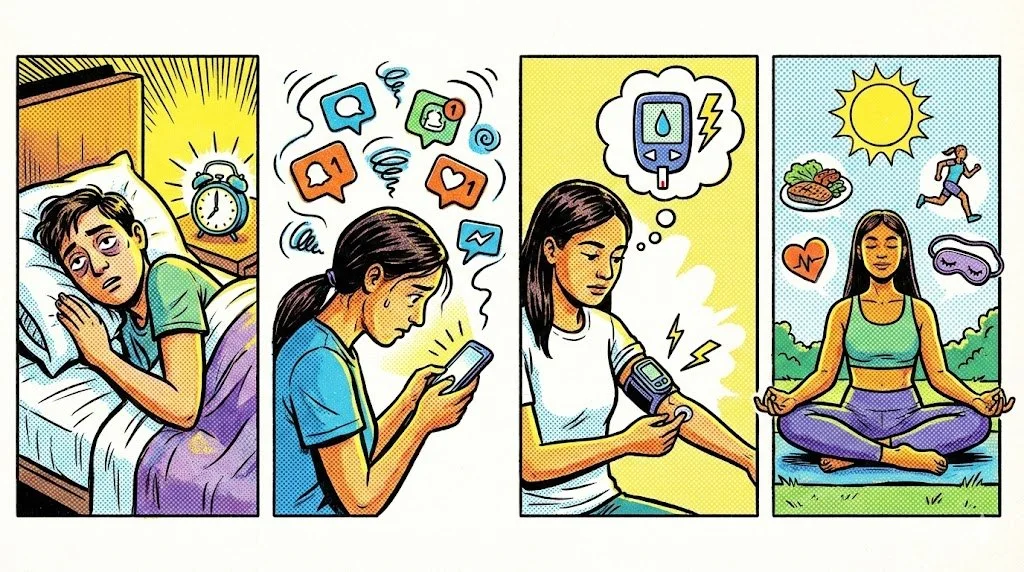
#1768 Break the Cycle
You can always listen to the Juicebox Podcast here but the cool kids use: Apple Podcasts/iOS - Spotify - Amazon Music - Google Play/Android - iHeart Radio - Radio Public, Amazon Alexa or wherever they get audio.
Dr. Ernie Fernandez discusses how sleep, social media, and T1D stress impact mental health, offering strategies to build resilience and break the cycle of generalized anxiety.
+ Click for EPISODE TRANSCRIPT
DISCLAIMER: This text is the output of AI based transcribing from an audio recording. Although the transcription is largely accurate, in some cases it is incomplete or inaccurate due to inaudible passages or transcription errors and should not be treated as an authoritative record. Nothing that you read here constitutes advice medical or otherwise. Always consult with a healthcare professional before making changes to a healthcare plan.
Scott Benner (0:0) Welcome back, friends, to another episode of the Juice Box podcast. (0:12) Ernie Fernandez is not just a doctor. (0:13) He's not just an endocrinologist. (0:15) He's also the person in charge at Camp Sweeney, and we are giving away two slots today at Camp Sweeney. (0:23) But first, Ernie's gonna tell you a little bit about sleep, stress, anxiety, and how your cell phones might be messing with you.
Scott Benner (0:31) So we're gonna talk a little bit about that, then we're gonna pull the winners from the contest, and we're still gonna give away four more places at Camp Sweeney in 2026. (0:39) So don't stop entering at juiceboxpodcast.com/giveaways. (0:45) Get in there. (0:45) It's super simple to start. (0:47) It's super simple to enter.
Scott Benner (0:49) You don't have to do anything, and you'll get a chance. (0:52) And by the way, everybody who doesn't win today, everybody who's already entered, I'm leaving your name in for the next drawing. (0:57) What do you think of that? (0:59) Nothing you hear on the Juice Box podcast should be considered advice, medical or otherwise. (1:04) Always consult a physician before making any changes to your health care plan or becoming bold with insulin.
Scott Benner (1:14) The episode you're about to listen to was sponsored by Touched by Type one. (1:19) Go check them out right now on Facebook, Instagram, and, of course, at touchedbytype1.org. (1:25) Check out that programs tab when you get to the website to see all the great things that they're doing for people living with type one diabetes. (1:32) Touched bytype1.org. (1:34) Today's episode is also sponsored by Tandem Moby, the impressively small insulin pump.
Scott Benner (1:40) The podcast is also sponsored today by Plus Technology. (1:45) It's designed for greater discretion, more freedom, and improved time and range. (1:49) Learn more and get started today at tandemdiabetes.com/juicebox. (1:55) The podcast is also sponsored today by the Eversense three sixty five. (2:00) The Eversense three sixty five has exceptional accuracy over one year and is the most accurate CGM in the low range that you can get.
Scott Benner (2:08) Ever since cgm.com/juicebox.
Ernie Fernandez (2:12) Thanks, Scott. (2:12) Thanks for having me on again. (2:14) Once again, I'm doctor Ernie Fernandez. (2:16) I'm the camp director at Camp Sweeney here in Northern Texas, and I've been blessed to be working with these children with type one diabetes for the 42 here at Camp Sweeney. (2:25) And I know, Scott, we had spoken a couple of months ago about one of the issues that's coming up a lot more and more, especially with the way much of the media has kinda changed in kids with type one and with the kids in general in dealing with stress and anxiety and and especially how it relates to our patients with type one.
Ernie Fernandez (2:46) And I was gonna just spend a few minutes talking a little bit about sort of the normal physiology behind that and ways that parents can can work with their kids, in helping them deal with some of those issues.
Scott Benner (2:57) Okay. (2:58) Yeah. (2:58) Are you seeing that in practice? (3:00) Are you seeing it at camp? (3:01) Or is it something that you feel like you're you're seeing coming from a lot of different perspectives?
Ernie Fernandez (3:07) I see it from a lot of perspectives. (3:09) I see it a lot in practice, not just with with patients with type one, but just in many of our younger and older teens and our young adults. (3:18) Social media has kind of fed into that quite a bit. (3:22) But with our patients with type one, it has really been something that has been magnified. (3:26) And and it it makes sense because when you think about how this starts to develop in these kids, you you know, the normal brain physiology of most children as they enter adolescence and late adolescence and young adulthood is that their that their higher functions of their brain start to develop rapidly.
Ernie Fernandez (3:45) You know, kids when they're 10 or 11 think like kids in a very linear way. (3:49) Know, You kids that are 21, 22 years of age think more like an adult in a very abstract way, and that brings the abilities for them to deal with many, many things. (3:58) But as that part of the brain develops quickly, the two hemispheres, the the need for that part of the brain to be to to be well fueled with neurotransmitters also increases. (4:09) And just in a normal situation with any child and young adult, that always lags. (4:14) You know, the brain's ability to make the neurotransmitter always lags the development of what's being needed.
Ernie Fernandez (4:21) And many things have kinda shifted in our world a little bit that don't make that as fruitful as it used to be in years past. (4:30) Part of that has to do with the fact that you only make those neurotransmitters during your deep stages of sleep, you know, during sort of the the the higher quality sleep. (4:39) And we don't live sort of in a society that kind of promotes that as much as it used to. (4:44) You know? (4:44) Kids of different ages need different amounts of sleeps.
Ernie Fernandez (4:47) Younger kids need more sleep. (4:48) They need, you know, nine to ten hours at night, while young adults need less sleep. (4:53) But it's not just the quantity, it's the quality of sleep and how they enter sleep and how they go through REM into deep stages of sleep. (5:01) And the problem is that many of our youth and even our adults have difficulty adopting patterns to get that kind of sleep. (5:11) You know, so many things are on people's plates, you know, whether it's sports or school or or things that involve them in social ways with their their colleagues.
Ernie Fernandez (5:22) But probably the biggest one that that seems to to be in the forefront is the amount of time that that we all spend on our screens and the addictions that sometimes these algorithms, you know, pull all of us into our screen time. (5:36) And that tends to excite our brain and makes it difficult for them to settle down and to get into deep sleep. (5:44) Now that's in anybody, whether they have type one or not. (5:46) Right. (5:47) And so people tend to go through times, you know, especially during these years where they need the most rest, not getting the kind of rest.
Ernie Fernandez (5:56) And what that leads to, of course, are are decompensation. (6:00) You know, these these wonderful young adults and, yeah, and adolescents will often just kinda run out of juice throughout the day. (6:07) You know, their their higher functions kind of decompensate, they become much more primal, and their anxieties kinda kinda take over, and they become sort of like they were when they were two or three. (6:17) You know? (6:18) They get unfocused.
Ernie Fernandez (6:19) They get very, you know, upset easy. (6:22) They and they have difficulty, you know, dealing with with many of the challenges that are posed to them. (6:28) But what happens in kids with type one is that they have a whole different level of issues that that decrease that normal physiologic sleep that they they should be getting. (6:40) You know, when you have type one diabetes, as of you know, Scott, you as a parent of a child know this. (6:45) It's it's sort of a hidden world that no one realized.
Ernie Fernandez (6:48) You know, these kids and these parents have a full time job that no one knows is happening. (6:53) You know, it's like, you know, when somebody hurts their foot and their foot is killing them and all they can do is think about their foot, and everything in their life revolves around that. (7:02) Well, you know, when you get type one diabetes, that's kinda like having something like that. (7:07) You know, even as you learn and you adopt to all these wonderful technologies and and pretty prudent protocols we teach our patients, it's still a full time management position. (7:18) And the problem with it is that no matter how, you know, how well you use your technologies, how well you follow your protocols, there's always some uncertainty with the outcomes outcomes each day.
Ernie Fernandez (7:29) Mhmm. (7:30) Because there's so many variables, as you well know, that affect diabetes, and that causes people when you have uncertain outcomes, all that does is it increases that excitability of your brain, the stress of your brain, which then makes it harder for these these kids and quite quite frankly their parents as well to have that deeper sleep because they're always concerned, okay. (7:53) Am I gonna go a little high? (7:54) Am I gonna go low? (7:55) Did I do the right thing here and there?
Ernie Fernandez (7:57) And then that causes them to de deplete themselves a little bit more and and allows them to decompensate into some of these these larger forms of anxiety that, as I said, all kids, but especially kids with type one are much more susceptible to. (8:12) And that's that's really what you know, I spend a lot of my my day talking to patients with you know, yes, I talk to them about, you know, the newest pump and and the newest things that we can be doing. (8:23) But most of the time, I'm talking to them about, you know, how to take care of themselves and and be able to be successful, basically, with their two full time jobs that they now have, which is living their normal lives that they were living in, of course, you know, dealing with with the type one that very few people relate to outside of their their own little world. (8:43) And so that's really what makes kids with type one so much more susceptible to to this kind of stress and anxiety, and there's many ways to to to work with that. (8:55) And one of the things that I'll give as a disclaimer at the very beginning is that it's very important, whether you're a parent or you're a health care provider, that you're looking closely at the big picture because what you sometimes miss in a child who's going through the normal stresses of type one or a family that's working with a child is that some kids will get themselves really in a hole.
Ernie Fernandez (9:18) They they drain themselves so much of of their neurotransmitters that they they don't just go from having anxiety, which all kids with type one have in one way or another, but they go into what's called generalized anxiety disorder where they never surface. (9:34) No matter what they do, they they they never get the rest, and and they get themselves into a bit of a of a cycle that that's hard for them to break. (9:42) And those kids, besides the normal things that we use to to decrease and and to inspire kids to deal with the anxieties, you know, sometimes need additional help. (9:52) They they need to come see somebody, you know, like a professional like myself, a physician that works with kids with this that, you know, they may need somebody to help them with with some specific skills with counseling. (10:02) And and sometimes these kids also, you know, need medication because they've gotten themselves into into such a a hole that that it's hard to get out of.
Ernie Fernandez (10:12) You know, our goal today is just to talk about some of the things that help kids from, you know, putting themselves in into that hole.
Scott Benner (10:18) Are there ways to impact it? (10:20) Because, Ernie, I I you know, I've interviewed thousands of people and I had to stop myself at one point along the way from believing that the whole world was just anxiety ridden. (10:29) But I started to see that I think it's possible that people living with autoimmune issues maybe have a higher prevalence of of anxiety for a number of different, you know, reasons. (10:39) Cortisol, I don't know, gut health, like, kinds of different ideas. (10:42) Right?
Ernie Fernandez (10:43) There's so many components to
Scott Benner (10:45) it. (10:45) Yeah.
Ernie Fernandez (10:46) But at the end of the day, you know, you go from anxiety that everyone has, which is not good or bad. (10:51) I mean, anxiety pushes people to do things. (10:53) And so anxiety is almost, you know, something that that in many ways, you know, pushes us to do well with our things to where you cross over to where you actually have an, you know, an anxiety disorder where you can't see yourself coming out of that. (11:08) Mhmm. (11:08) In other words, you've drained your neurotransmitters to a point, and they they could drain for a variety of reasons.
Ernie Fernandez (11:13) Sometimes it's poor gut health that they're not absorbing the omegas that they need for that development. (11:20) But most of the time, if you look back and you look at all the current data that's come out post COVID, you know, it comes from the lack of the normal sleep cycles that many kids put themselves out of, and it's because people can't settle themselves down. (11:34) They become so rightfully so obsessed on on doing all the little things in their life, not only the normal things in their lives, but also the things that are t one d, then when it's time to go to bed, their brain's going a million miles per hour, and it's very hard to slow it down to allow us to go into natural sleep. (11:52) And then you add you layer on that, you know, being on a a device before you go to bed. (11:57) And many times, know, kids of type one have devices right on them because they're using them, obviously, to monitor their things.
Ernie Fernandez (12:02) And they pick it up, and they're starting they look at their device, and then suddenly they're looking at apps, and suddenly they're looking at social media. (12:08) And so the prefrontal cortex gets more wound up, and when they fall asleep, they end their sleep sort of in the wrong order. (12:14) They start REM sleep and and sort of going into the stage sleep. (12:18) And then the next day, they're back with a low gas tank again, and and it leads to the uncontrolled anxiety.
Scott Benner (12:24) Right.
Ernie Fernandez (12:24) And so, you know, part of that is, you know, teaching skills, you know, basic mental health skills, having nighttime routines, you know, that get people in in you know, away from their devices an hour before bed, you know, locking down their devices to just have their pump functions or their CGM functions. (12:42) You know, I even recommend some of those devices, you know, like the Pixel device that you can have where you don't have to have your device so close to you. (12:50) You have that to go off if if you need it to go off. (12:53) You go through teaching, you know, kids how how to do things at night that don't require screens, reading things that slow the brain down.
Scott Benner (13:01) Mhmm.
Ernie Fernandez (13:01) But, you know, at the end of the day, it's all about how you deal. (13:05) We have the decompensations. (13:07) You know, how do you deal when you think you have everything put together and the next day something happens and, you know, your your pump has been bad and your your blood sugar is 400 and you're having to deal with that stress. (13:19) And part of that is creating environments that parents you know, and parents do this. (13:25) You know, parents, you know, are very devoted to their kids.
Ernie Fernandez (13:29) My patients, and I'm sure the ones you work with, and I'm you work with thousands yourself, you know, are always wanting the best for their children. (13:36) And, you know, it's all about trying to get kids to deal with the decompensations and to basically get resilience because it's gonna happen. (13:46) You know, they're gonna decompensate for a number of reasons, not just from their diabetes, but other things that go through that. (13:53) And, you know, resilience is the perseverance of getting through something that's tough and being able to start over again, and you start over again. (14:00) And it sounds easy to say.
Ernie Fernandez (14:02) It's difficult to do. (14:04) And so what you have to do is you have to create, you know, situations where the successes are so sweet for these kids that they have that desire to push themselves up. (14:18) You know? (14:18) Many times, you know, we all fall many times every day in our lives, not just with diabetes, but that falls can either lead to the biggest enemy, which is discouragement, which keeps you from wanting to get back up, to falling and saying, I know what it felt like when I was doing great, Mhmm. (14:37) And I want that feeling again, and I long for that feeling.
Ernie Fernandez (14:40) And that's what gives so many of these kids that strength to to make that happen. (14:44) Because the alternative is, of course, is that discouragement and the loss of hope, And then kids just all the king's horses, all the king's men can't get that that kid back up again. (14:55) And so that's what is a key to that.
Scott Benner (14:58) Yeah. (14:58) Where do you think is the easiest spot to break the cycle? (15:01) Because if it starts with, I don't know, poor sleep, and then you wake up the next day and you have diabetes and that's hard and, like, you know, I'm reading about stuff here while you're talking. (15:11) A cytokine storm, when an autoimmune flare occurs, the body releases inflammatory proteins called cytokines. (15:16) These don't just stay in the joints or your thyroid, for example.
Scott Benner (15:19) They can cross the blood brain barrier. (15:21) Once they're there, they disrupt neurotransmitters, specifically lowering serotonin. (15:24) Like, when that's also happening to you and everything else, then at the end of the day, once you've lived through that horrible day and you and you're laying down in bed, I don't know if you've ever tried TikTok or any. (15:35) It's awesome. (15:36) Like, so, like, when you so when you have
Ernie Fernandez (15:38) Flex you right into it.
Scott Benner (15:39) When that's the way you're trying to calm down, relax, you know, turn your brain off, whatever it is, like, where in that cycle because you're gonna have to pick a spot to jump in and say, this is the thing we're gonna do to see if it loosens up the nut for the next thing so that we can try to get this all working better. (15:57) Where do you see people having more success, or is it variable person to person? (16:02) This episode of the Juice Box podcast is sponsored by Eversense three sixty five. (16:08) And just as the name says, it lasts for a full year. (16:12) Imagine for a second a CGM with just one sensor placement and one warm up period every year.
Scott Benner (16:19) Imagine a sensor that has exceptional accuracy over that year and is actually the most accurate CGM in the low range that you can get. (16:27) What if I told you that this sensor had no risk of falling off or being knocked off? (16:32) That may seem too good to be true, but I'm not even done telling you about it yet. (16:36) The Eversense three sixty five has essentially no compression lows. (16:40) It features incredibly gentle adhesive for its transmitter.
Scott Benner (16:43) You can take the transmitter off when you don't wanna wear your CGM and put it right back on without having to waste the sensor or go through another warm up period. (16:51) The app works with iOS and Android, even Apple Watch. (16:56) You can manage your diabetes instead of your CGM with the Eversense three sixty five. (17:01) Learn more and get started today at eversincecgm.com/juicebox. (17:07) One year, one CGM.
Scott Benner (17:10) Let's talk about the Tandem Mobi insulin pump from today's sponsor, Tandem Diabetes Care, Their newest algorithm, Control IQ Plus technology and the new Tandem Mobi pump offer you unique opportunities to have better control. (17:24) It's the only system with auto bolus that helps with missed meals and preventing hyperglycemia, the only system with a dedicated sleep setting, and the only system with off or on body wear options. (17:37) Tandem Mobi gives you more discretion, freedom, and options for how to manage your diabetes. (17:42) This is their best algorithm ever, and they'd like you to check it out at tandemdiabetes.com/juicebox. (17:50) When you get to my link, you're going to see integrations with Dexcom sensors and a ton of other information that's gonna help you learn about Tandem's tiny pump that's big on control.
Scott Benner (18:02) Tandemdiabetes.com/juicebox. (18:05) The Tandem Mobi system is available for people ages two and up who want an automated delivery system to help them sleep better, wake up in range, and address high blood sugars with Autobolus.
Ernie Fernandez (18:16) You have to do it in lots of spots. (18:18) You can't just say, I'm gonna fix it in one spot, it's gonna do it all. (18:21) Okay. (18:21) So you start with the sleep first. (18:23) You know, you you do the the conducive thing.
Ernie Fernandez (18:26) You know, people say, what about supplements? (18:27) What supplements help with this? (18:29) Well, you know, a lot of good work has been done on on magnesium and using a small amount of magnesium before bed. (18:35) It's very safe to use the the gluconide of that, you know, for most young adults, adolescents, two to four hundred milligrams, is a great way to help them, you know, have that unwinding. (18:48) Every person reaches for a device to try to unwind because they think if they do this enough, you know, scroll enough
Scott Benner (18:54) Yeah.
Ernie Fernandez (18:54) That that's gonna make them get numb and wanna fall asleep when, obviously, it does just the opposite because the algorithms are so driven to go keeping you there from fifteen minutes to thirty to forty five minutes.
Scott Benner (19:06) Yeah. (19:06) Yeah.
Ernie Fernandez (19:06) Yeah. (19:06) It's And at the same time, it it uses up so much neurotransmitter to decipher the video that it just takes you off. (19:14) So, you know, putting those away from you as much as you can without losing connection to your devices is a critical element. (19:21) But, really, it's a bigger picture item. (19:23) You know, from a parent's point of view, it's about making sure kids have things that they that they can succeed in each day, whether it has to do with diabetes or not, whether it's, you know, something, you know, athletic, something that's, you know, in the theater, something that's wherever it is, creating an environment that they can taste success is critical.
Ernie Fernandez (19:46) Mhmm. (19:46) You know, we talked last fall a lot about Camp Sweeney and the four pillars and how that all works. (19:51) And part of that, of course, is creating environments where there's something for every child to touch that success, whether it's something they've never done in their life, something they're trying to do. (20:00) Because once you get that feeling of of sort of glory in you
Scott Benner (20:05) Yeah.
Ernie Fernandez (20:05) You wanna strive for that every time. (20:08) And people that's what makes people want to to break the cycle because you have to have the desire to want to break the cycle. (20:15) Nobody wants to put their phone away. (20:17) Nobody wants to do that. (20:18) But if you know that putting the phone away makes you feel that great feeling, that euphoria the next day, you can start breaking that cycle, and and you have to because it's all interconnected.
Ernie Fernandez (20:31) Yeah. (20:31) You know? (20:32) If you can get more neurotransmitter in your brain, you can make a little bit more serotonin without having to take an SRI. (20:38) That changes everything. (20:40) That changes your ability to compensate with so many things that you produce less stress hormone, and so you make less cortisol.
Ernie Fernandez (20:47) So you have less in you know, you have less of those things that causes to to get back in that hole. (20:53) And so creating those environment of successes is great. (20:56) I work with many, many families, and I think, okay. (20:59) What's the one thing your child, you know, strive can can strive in? (21:02) And you try to put them in those things, you know, whether it is soccer, tennis, or basketball.
Ernie Fernandez (21:08) That's what you know, as I don't wanna go into this right now, but, you know, that's what camp swinging has been driven to do for the last seventy six years is to find things for every child that allows them to just shine.
Scott Benner (21:21) Right.
Ernie Fernandez (21:22) And then you create this community. (21:24) You expand the scope, and you put them in a community that all has that second job, that all has those tough time, and they all celebrate each other's successes. (21:35) That's what allows them to retain the hope. (21:38) I am like you. (21:40) You talk to thousands of people.
Ernie Fernandez (21:41) I've been doing this forty two years, and so I don't talk to thousands of people, but, boy, especially during the holidays. (21:46) I talk to people of all ages with diabetes in their thirties, their forties, their fifties. (21:52) I don't wanna age myself here. (21:54) But everybody talks about you know, they struggle with certain things, and god forbid, you know, when we lose a precious one, we all come together and we struggle. (22:04) But everybody talks about the resilience they have because everybody comes together as part of their community.
Ernie Fernandez (22:11) You know, whether it be the Sweeney community that's tens of thousands of big, but other communities with type one where people are so connected that they care about each other. (22:20) Just recently, and I I won't say this name, I I I heard from a a beautiful young man who was in Sweeney for eight years. (22:26) Last year, he was 28. (22:28) And he's a wonderful guy. (22:29) He's got kids.
Ernie Fernandez (22:30) He's grown. (22:30) He's done volunteer work around the world, and I'm so proud of him. (22:34) But he's had some difficulties with with other health issues that have just hit him hard, but the community riles around them. (22:43) And that's what gives them hope. (22:44) That's what gives them the inspiration.
Ernie Fernandez (22:46) Yeah. (22:46) And that's really what you try to do. (22:49) You try to create every little bit of it that that matters, not just the successes, but the community around it. (22:56) You know, our the Camps Wee PFC life, which, you know, the perseverance, faith, courage, life nights that we do, you know, two, three times a week throughout the country. (23:04) That's all part of that is trying to connect those communities.
Ernie Fernandez (23:07) Right. (23:07) Because that's that's what keeps these kids, you know, going and keeps them from the getting into that cycle. (23:16) But I will say, I do treat so many patients that have true GAD, generalized anxiety disorder, and you have to know when other things are needed. (23:25) You have to know when counseling of this particular type is helpful, and you need to be aware of when an SSRI is needed. (23:33) You know, people say, oh, I don't wanna get on any kind of medication.
Ernie Fernandez (23:36) That would just be terrible. (23:37) But sometimes you have to break the cycle somehow. (23:41) Mhmm. (23:41) Even if it's a short term thing that you do for ninety days or you do for a hundred and twenty days, the cycle has to be broken so that the person has the chance to get back on top and get that resilience, get that push to wanna succeed. (23:55) And that's that's really an important thing.
Ernie Fernandez (23:58) And I I don't I don't want people to think, oh, you know, I should never look for those things. (24:03) There are times when you you need to do that. (24:05) I actually, since the pandemic, I've had to treat more patients with medication than I've had in my entire career. (24:12) And I think a lot of it is because people are using this as a tool to try to break the cycle as opposed to to doing the things that that make more sense and healthy for people.
Scott Benner (24:22) Do you think there are people in better positions to deal with this than others and but yet, do you see it, I guess, across all of those levels? (24:30) Like, I was just having this conversation with someone this morning about, like, work level. (24:35) And today, you and I are it's the day after Christmas, Ernie. (24:38) There are not a lot of people working today. (24:39) Right?
Ernie Fernandez (24:40) Mhmm.
Scott Benner (24:40) And so, like, you and I are working. (24:41) I don't think anything of it. (24:43) I was up this morning. (24:45) I had at some point this morning, I had three devices in front of me. (24:49) On one of them, I was learning audio about something that I like to do for myself recreationally.
Scott Benner (24:55) I had a computer in front of me where I was coding something to put on the website to help people bolus better. (25:01) And on the third device, I was trying to learn about a mattress that my daughter and I are going out to get this afternoon for her. (25:07) And I was talking to a friend of mine at the same time who was helping me moderate the Facebook group, and we were talking about somebody they knew who said, oh, they they needed a break. (25:17) And she laughed, she's like, I I haven't had a break in so long, but I don't even know what I would do with it. (25:22) And so for someone like her or someone like me or maybe you too, I don't really want a break.
Scott Benner (25:27) I like doing things. (25:28) I like going. (25:29) I was just sharing with her today. (25:31) This is almost apropos of nothing and yet fits right in here. (25:34) I created something that works really well.
Scott Benner (25:38) It's a physical thing in my house. (25:40) And all I've been thinking about for the past three months and what any free time I've had is doing it better and throwing out the old one and trying again. (25:48) So I don't feel that way. (25:49) But there are other people whose brains are just not wired like that. (25:52) And they also have autoimmune issues and stress and they live through COVID and they're 10 and somebody's making fun of them.
Scott Benner (25:58) Like, all that other stuff is going to. (26:00) My question is is could someone wired like me fall into this? (26:04) I believe yes. (26:06) And could someone not wired like me fall into this? (26:09) I also believe yes.
Scott Benner (26:10) Is the path pathway out the same for both of us? (26:12) Do we both have the same chance of breaking the cycle and starting over, do you think?
Ernie Fernandez (26:16) Absolutely. (26:17) But Yeah. (26:17) Don't get me wrong. (26:19) Doing nothing doesn't help anyone. (26:21) It just increases people people's anxiety.
Scott Benner (26:24) Yeah.
Ernie Fernandez (26:24) You know, doing the things you're good at. (26:26) Like, I have multiple jobs. (26:28) I'm here in my office right now seeing pediatric patients start back in about twenty minutes.
Scott Benner (26:31) Mhmm.
Ernie Fernandez (26:32) You know, I work at Children's Health, and I'm taking care of kids with diabetes once a a week. (26:36) And then, of course, I run Camp Sweeney, which is a year round thing that I spend every night where I probably spend sixty, seventy hours a week in addition to these two jobs doing Cam Sweeney. (26:45) Yeah. (26:45) And you're thinking, how are you preaching, you know, normal, good mental health? (26:49) Well, that's good mental health because I'm doing things that that fulfill things that that that I I'm passionate about.
Ernie Fernandez (26:56) I'm passionate about, you know, trying to make sure the kids with with type one, for example, have tremendous opportunities to be able to get out of these threats. (27:05) Not just when they're kids, but, like, as adults, you know, when they they fall many, many times.
Scott Benner (27:10) Right.
Ernie Fernandez (27:10) You know? (27:11) I like, a young man just called me about three months ago. (27:14) He's 32 years old. (27:15) Okay? (27:16) And he yeah.
Ernie Fernandez (27:17) I haven't seen him in fourteen, fifteen years. (27:20) And he just said, doctor Ernie, I just called. (27:22) He just because I just have one question. (27:24) Does it ever get any easier? (27:26) And I said, what do you mean by that?
Ernie Fernandez (27:28) And he goes, well, you know, my diabetes. (27:29) And I said, well, you know, it doesn't get easier. (27:34) You just learn how to do hard better. (27:36) Mhmm. (27:36) Because people of type one, as you well know, are pretty much stronger than most anyone else.
Ernie Fernandez (27:42) You know, they have the super strength to take something and just, you know, and do a great job with it. (27:51) Yeah. (27:51) But the problem is they all can run into the pitfalls of the little pit that we were just talking about, where suddenly that word that I can't stand, d, comes in, discouragement. (28:02) They just get discouraged for one reason. (28:04) They forget what it felt like, you know, in that time of success, in that time of this, and that's what leads the you know, sadly, with many of our older patients, sometimes a loss of hope.
Ernie Fernandez (28:15) And all the stuff I've been talking about here this afternoon, how do you avoid those pitfalls? (28:20) We're all gonna hit them. (28:21) We're all gonna get discouraged sometime in our lives. (28:23) I mean, that just happens because just the fact of how our lives go. (28:29) But how do you steer away from them?
Ernie Fernandez (28:31) How do you overcome that? (28:32) How do you get that resilience? (28:34) Well, part of it is the adversity. (28:35) I mean, just the adversity itself makes you stronger. (28:38) But what keeps you on top of it is that longing of what what it feels like to be on the other side.
Ernie Fernandez (28:45) Yeah. (28:45) And that's what I I remind every person, you know, what they have. (28:50) You know, I I know this it is Christmas time, and you always think about, you know, these these movies like, you know, it's a wonderful life and, you know, the the the poor man who got you know, was so discouraged by all the things in his life, but he he forgot those things on the other side. (29:04) And that's how it is with type one. (29:06) Everybody does have a different path.
Ernie Fernandez (29:09) It all comes down to having the strength to get back up. (29:13) And, you know, last year, I had a long podcast where you're talking about the four pillars of how camp Sweeney works. (29:18) And every one of those pillars is designed to and I I believe me. (29:23) I've spent my entire life obsessing on how to kindly adjust those and adjust those and adjust those year after year to try to get people to have that not when they're 15, but, like, when they're 35. (29:37) And when they're 45, they can fall back on something that that's that bedrock for them to push back up on because that's what it's really about with type one.
Ernie Fernandez (29:47) Yes. (29:47) The technologies are gonna change. (29:49) You probably your podcasts are wonderful. (29:50) You're talking about this and that and all this wonderful stuff. (29:54) But at the end of the day, it's just the same thing.
Ernie Fernandez (29:58) Type one is type one. (29:59) And the the challenges are gonna be there whether you have the most sophisticated system or the simplest of systems. (30:07) And the real challenge is avoiding the discouragement and and pushing oneself through these these things I mentioned that that help you produce more serotonin, trying to get the deeper sleep, you know, trying to avoid the pitfalls of getting sucked into those algorithms. (30:23) You know, you say you use screens all day. (30:25) I use screens all day too.
Ernie Fernandez (30:26) I walk around with this laptop right over here from room to room constantly. (30:30) But, you know, they did a good neat little study back in the COVID days when people were were co, you know, co learning on on screen. (30:37) When you're just using the screen as a tool, you're not sucked into it. (30:41) You're not so focused that you're looking at all the pixels that it's draining the heck out of your brain. (30:45) Right.
Ernie Fernandez (30:45) What makes you get sucked into screens are things that you're having to constantly interact with, like a video game or or these algorithmic things that are on all of these these social media things where suddenly time just stops where you go from ten minutes to an hour, and you've been staring at one little screen as opposed to using your your screens because you're writing on a chart or you're working on coding this or you're working on looking for this. (31:09) That's a totally different level of engagement with your brain and the screen, and that's not harmful. (31:14) And and that's why kids that have the screens on their on their the buy on themselves, where they use them for their CGM, where they use them, you know, obviously, for their pumps or whatnot, that doesn't drain them because they just use it as a quick little tool. (31:25) Their brain doesn't have to engage and try to de decipher what's happening on the screen. (31:30) So there is different levels there.
Scott Benner (31:31) Right. (31:32) Yeah.
Ernie Fernandez (31:32) And, you
Scott Benner (31:33) know You basically have been given a slot machine, which is, you know, been designed decades ago to put you down and and in in a seat, make you not wanna move, and somehow dull you enough that as you're losing money to it, you think, no. (31:49) This is still a good idea. (31:51) Right? (31:51) There's going to be there's something's going to happen. (31:54) I don't know if anybody's ever noticed this.
Scott Benner (31:56) Online gambling is very prevalent at this point. (31:58) Right? (31:59) But if you've ever sat in front of a machine or done something on like that, you can put a dollar into something, lose 80¢, and the noises and the sounds make you feel like you're you won something. (32:09) It'll say you won 20¢. (32:11) It'd be like, no.
Scott Benner (32:11) I put a dollar in there. (32:13) I lost 80¢, but it doesn't feel like that. (32:15) TikTok does the same thing. (32:17) Right? (32:18) Like, all the apps are designed that way.
Scott Benner (32:20) There's a great documentary. (32:21) I don't know the name of it. (32:23) Go find it. (32:23) It's by one of the people who who designed what do they call it? (32:27) Like, forever scrolling.
Scott Benner (32:29) Like, do you remember you used to scroll to the bottom of something and eventually would say, you're out
Ernie Fernandez (32:32) of Stop.
Scott Benner (32:32) Yeah. (32:33) You're out of content now. (32:34) Now it just it just uses what it what you paused on the longest. (32:39) So the thing that you're more likely to look at again, it just regenerates and gives you more. (32:43) You know, people call it doom scrolling colloquially, but there there's an actual name for it.
Scott Benner (32:48) And it's so devastating, Ernie, that the man who designed it has publicly apologized for it. (32:54) Yeah.
Ernie Fernandez (32:55) And and I know we're we're out of time, but I will tell you that it is not just what it's doing to your brain and draining your neurotransmitters. (33:02) It's also like we talked about last year, you know, when we talked about the four pillars. (33:06) It it's teaching people what to value. (33:09) Mhmm. (33:10) It insidiously tells you that if you're like this person, you're valuable in society.
Ernie Fernandez (33:16) If you're like this person and you're taking this substance abuse substance or you're following this thing or you're good at at hurting yourself in this way or tearing other people down, that's valuable. (33:28) Mhmm. (33:28) And so people lose their own value. (33:31) I mean, that they devalue them. (33:32) So that's why the third pillar of Sweeney is all about, you know, what we possess or what we truly possess, you know, the true virtues we have.
Ernie Fernandez (33:39) Because you get to believe what's on that scroll. (33:42) I mean, you believe what's on that scroll like it's it's it's truth. (33:46) And as a result, kids devalue themselves tremendously, and that leads once again to them to not having a want to get back up, and it leads to that discouragement again, which is the biggest enemy I think kids with type one have in in my opinion. (34:02) It's not just the pump side going bad. (34:04) It's something much greater.
Ernie Fernandez (34:06) And so that's that's really what I spend my year doing is trying to to empower these kids.
Scott Benner (34:12) Right. (34:12) Well, I appreciate you coming on to talk about it. (34:14) You're actually also here because we are gonna pick winners. (34:18) So Ernie and I are giving away six spots at Camp Sweeney in 2026. (34:25) And I have the first, I think, 50 people have put in their their entries.
Scott Benner (34:30) By the way, you can enter it juiceboxpodcast.com/giveaways. (34:34) Now I wanna tell everybody that everybody who doesn't win today, we're gonna pull two today. (34:38) Everybody who doesn't win, their name stays in for the next drawing where we're gonna pull two more, and then we're gonna pull two again so that it we've given a total of six spots away at camp, before the twenty twenty six season starts. (34:50) We'll be doing that through the winter here in 2026. (34:54) But, Ernie, they do have to pay something.
Scott Benner (34:56) Right? (34:56) So not only do they have to get themselves there. (34:58) So travel's not included, but there's a $500. (35:01) Can you explain that part?
Ernie Fernandez (35:03) That's that's the deposit. (35:04) And, you know, it, you know, it costs $6,100 for us to have somebody go to Camp Sweeney. (35:09) We're we ask families to to to pay 4,900 of it, and I we we fundraise the rest. (35:15) And then we have we do have scholarships for kids that that are financially need as well. (35:19) About half of our kids come on something.
Ernie Fernandez (35:22) But for the people on this giveaway, we have them pay the $500 deposit. (35:27) And the reason we do that, Scott, is simply because it's occupying a spot. (35:31) Yeah. (35:32) And sometimes when people get something for free, they'll occupy a spot that someone else could have had Mhmm. (35:37) And then it doesn't mean anything to them.
Ernie Fernandez (35:39) And so we asked for the deposit because of the fact that it it's secure you know, we're not turning someone else away Sure. (35:47) From it. (35:48) And so we feel it's a small amount of the entire value that they get from from going to Sweeney. (35:54) This year, it's magnificent summer twenty twenty six, and I'm more excited this summer than you know, I I keep saying this every year. (36:01) You know, it's my forty second year.
Ernie Fernandez (36:03) Every year is a totally different thing at Sweeney because we you have no idea how purpose driven we are. (36:09) You know, our group of program directors meet every Monday night for a couple of hours from September through through May to constantly titrate how these pillars work and how we make that better for each child. (36:23) And every Tuesday, our medical directors meet constantly working on the algorithms and the data. (36:28) It's unbelievable, the data that they did this year. (36:31) We had a big conference in December where they took hundreds of thousands of blood sugars from the summer, and they looked at every modality, whether it was an Omnipod five or it was a Moby or whatever it was for every age and gender, and looked at every aspect of all eighteen days that the kids are at camp.
Ernie Fernandez (36:48) If there were a 12 year old boy on the sixth day in the morning, how did a Moby do compared to an Omnipod five? (36:55) How did it do compared to a Medtronic device? (36:57) And they constantly are changing our internal protocol so that we can maximize the time on control. (37:03) Because our first pillar is getting the kids to feel normal while they're at camp. (37:06) And I am very proud to say that if you take the entire aggregate of all the kids that went to Camp Sweeney in the 2025, no matter if they were on shots or MDIs, whether they were on any kind of modality, and you look at all of their blood sugars for the summer, and you look at what their time and range is as an aggregate, remember, this is people from all over the world, all over the country that have hemoglobin a one c's that are either in their fives or unfortunately pretty high, our time and range was close to 69% Look at that.
Ernie Fernandez (37:34) Which is unbelievable. (37:35) I mean, not for one person, you think, well, that's a pretty low time and rate. (37:39) But when you take an aggregate get and you put people through a program like this with all these different modalities and you can accomplish that, let me tell you, it takes an entire year of work to make sure that you're ready for that for the next summer to try to enhance the best you can with those kids. (37:54) And so we have a lot of wonderful things in in 2026, and I'm excited to have two two people coming on board here today.
Scott Benner (38:02) Alright. (38:02) We're gonna pick their name, but let me agree with you for a second. (38:04) I think surrounding yourself with people who are all have a common goal of, you know, living a healthier life is the secret to this. (38:12) You have to have good tools. (38:13) You need to know what you're doing, but you do need to be supported all the time.
Scott Benner (38:17) I'll share with you this morning. (38:19) I got a little frustrated. (38:20) I saw someone post something in my Facebook group. (38:22) My Facebook group has 78,000 members as of today. (38:26) And someone said, hey.
Scott Benner (38:28) Did you know look at this. (38:30) This is crazy. (38:31) If you cool pasta off and eat it reheated, it doesn't impact your blood sugar as much. (38:35) And I thought and I I almost drove my head through the countertop because I've said that about a thousand times in that podcast. (38:41) And all I could think was, if you were listening to the podcast, you would already know this.
Scott Benner (38:45) And I but I don't feel like don't get me wrong, like, Ernie. (38:48) I'm like, I don't feel snarky about it. (38:49) It's just it's hard as a person who puts it out there all the time just goes watch somebody's realize that they've been struggling unnecessarily, and they've made their way all the way to the place, didn't take the last step of the podcast. (39:00) So I made a post about it just saying, hey. (39:03) Listen.
Scott Benner (39:03) Imagine what else might be in that podcast that you don't know. (39:06) Get together. (39:06) And people started coming and talking about it. (39:08) This one guy named Matt, I'm gonna use his first name, because he comes on and said something that just indicated to me that he was a listener. (39:16) It wasn't even anything deep.
Scott Benner (39:17) And I responded back, and I said, Matt said something in his reply that indicates to me that he listened to the podcast. (39:22) I don't know who Matt is, but I'm gonna guess right now that he's got an a one c between 55 and six 5. (39:28) Right? (39:28) And he came back on and said, oh my god. (39:30) My my a one c is 55.
Scott Benner (39:33) I was diagnosed at 13. (39:34) I found the podcast. (39:35) It's 55 now. (39:36) And that to me, I was like, look, guys. (39:38) There.
Scott Benner (39:38) There's your review. (39:39) Surround yourself with people trying to do good for themselves. (39:43) Good will come for you. (39:44) You know? (39:45) Anyway, we have two winners.
Scott Benner (39:47) The first two winners, you're gonna have to pay the $500 deposit, get yourself to Texas, and get yourself home. (39:52) And this is an interesting split, Ernie. (39:53) We have somebody who has been to your camp for three years and loves it. (39:57) So Hampton Madison Madison, excuse me. (40:00) Congratulations.
Scott Benner (40:01) Your child, Cooper, is going. (40:04) Contact me. (40:04) Cooper has attended Camp Sweeney for three years. (40:07) The family flies all the way. (40:08) Boy, talk about a review.
Scott Benner (40:09) The family flies from Colorado Springs to Texas for it. (40:13) That's how much they love it. (40:15) Talks about the immense relief of the eighteen day break, that that they experienced. (40:19) That's the other thing. (40:20) Ernie, you're you're inviting those kids out for nearly three weeks.
Scott Benner (40:22) It's not a not a short thing. (40:24) The second winner, Michael Gambrell. (40:27) Congratulations. (40:28) Your daughter, Newt, has won. (40:30) Michael wants to experience a deep sense of belonging and community that Sweeney offers.
Scott Benner (40:34) So, thank you so much. (40:35) Everybody else, keep going to that link, juiceboxpodcast.com/giveaways. (40:40) It's super simple to enter, and we'll pick two more. (40:43) Yeah. (40:44) I I won't drag Ernie out for the next one, but we'll pick two more maybe in a month or so and do it again a month after that.
Scott Benner (40:49) And six of you will, will have a great story to tell sometime later this summer.
Ernie Fernandez (40:53) And I I will mention to to Scott that people that live far away, if if they don't want especially if their kids already come to camp once or twice, you know, we we offer a service called point to point. (41:03) They pay an additional fee, and they can just we have if they take a direct flight from Boston or from wherever they're coming from, Florida, wherever they're coming from, we our medical staff meets them at at DFW Airport, picks them up, brings them up on a charter bus, and and gets them enrolled so the family doesn't actually have to make the trip both ways. (41:22) Basically, there's a one way or both ways, sometimes they'll bring them down to meet all the staff, but then we send them back on point to point Mhmm. (41:29) So they don't have to come all the way down to Texas. (41:31) To that.
Scott Benner (41:31) Ernie will FedEx your
Ernie Fernandez (41:32) families use that.
Scott Benner (41:33) Ernie will FedEx your kid to camp. (41:35) Look at that. (41:36) Yeah. (41:37) Get him in a nice box. (41:38) It'll be comfortable.
Scott Benner (41:38) They'll be fine. (41:40) You do amazing work, Ernie. (41:41) I appreciate you sharing this with me. (41:43) I don't know if there is an answer that's strong enough to break how awesome Instagram Reels is or whatever, but I can tell you this, and I hope you you find this to be helpful. (41:52) As a person who makes content, I'm seeing it all shift again.
Scott Benner (41:57) So for a number of years, the algorithm's been beating on my head. (42:01) Make your stuff shorter. (42:02) Make it simpler. (42:03) Make it fancier. (42:04) And I've avoided that.
Scott Benner (42:05) I've ignored it, and I haven't done it. (42:07) And right now, I'm actually seeing some of those algorithms. (42:11) I think they've depleted how much they think they can ring out of people twenty seconds at a time, and longer form content is starting to come back. (42:18) So hopefully, maybe more thoughtful ways of sharing things will be coming through people's screens in the future.
Ernie Fernandez (42:24) That is wonderful.
Scott Benner (42:25) I got
Ernie Fernandez (42:25) my fingers great work, Scott. (42:27) Thank you.
Scott Benner (42:27) You're welcome. (42:28) You're awesome. (42:29) Happy New Year. (42:29) Merry Christmas. (42:30) It's it's lovely to see you.
Ernie Fernandez (42:32) Thank you. (42:32) Yep.
Scott Benner (42:40) Okay. (42:41) Head over now to juiceboxpodcast.com/giveaways and enter your child in the drawing to win one of those remaining four slots at Camp Sweeney. (42:50) You're not gonna wanna miss it. (42:51) Check it out at campsweeney.org too if you don't know what Camp Sweeney is, but you gotta join the giveaway to have a chance to win. (43:00) The podcast you just enjoyed was sponsored by Tandem Diabetes Care.
Scott Benner (43:05) Learn more about Tandem's newest automated insulin delivery system, Tandem Mobi with Control IQ plus technology at tandemdiabetes.com/juicebox. (43:15) There are links in the show notes and links at juiceboxpodcast.com. (43:21) Are you tired of getting a rash from your CGM adhesive? (43:25) Give the Eversense three sixty five a try. (43:27) Eversense cgm.com/juicebox.
Scott Benner (43:31) Beautiful silicone that they use. (43:32) It changes every day. (43:33) Keeps it fresh. (43:35) Not only that, you only have to change the sensor once a year. (43:38) So, I mean, that's better.
Scott Benner (43:42) Touched by Type one sponsored this episode of the Juice Box podcast. (43:46) Check them out at touchedbytype1.org on Instagram and Facebook. (43:51) Give them a follow. (43:52) Go check out what they're doing. (43:54) They are helping people with type one diabetes in ways you just can't imagine.
Scott Benner (44:00) Thank you so much for listening. (44:02) I'll be back very soon with another episode of the juice box podcast. (44:05) If you're not already subscribed or following the podcast in your favorite audio app, like Spotify or Apple Podcasts, please do that now. (44:13) Seriously, just to hit follow or subscribe will really help the show. (44:17) If you go a little further in Apple Podcasts and set it up so that it downloads all new episodes, I'll be your best friend.
Scott Benner (44:24) And if you leave a five star review, oh, I'll probably send you a Christmas card. (44:28) Would you like a Christmas card? (44:40) If you're looking for community around type one diabetes, check out the Juice Box Podcast private Facebook group. (44:47) Juice Box Podcast, type one diabetes. (44:50) But everybody is welcome.
Scott Benner (44:51) Type one, type two, gestational, loved ones, it doesn't matter to me. (44:56) If you're impacted by diabetes and you're looking for support, comfort, or community, check out Juice Box podcast, Type one Diabetes on Facebook. (45:05) I created the diabetes variable series because I know that in type one diabetes management, the little things aren't that little, and they really add up. (45:13) In this series, we'll break down everyday factors like stress, sleep, exercise, and those other variables that impact your day more than you might think. (45:21) Jenny Smith and I are gonna get straight to the point with practical advice that you can trust.
Scott Benner (45:26) So check out the diabetes variable series in your podcast player or at juiceboxpodcast.com. (45:33) If you have a podcast and you need a fantastic editor, you want Rob from Wrong Way Recording. (45:39) Listen. (45:39) Truth be told, I'm, like, 20% smarter when Rob edits me. (45:43) He takes out all the, like, gaps of time and when I go, and stuff like that.
Scott Benner (45:48) And it just I don't know, man. (45:50) Like, I listen back and I'm like, why do I sound smarter? (45:53) And then I remember because I did one smart thing. (45:55) I hired Rob at wrongwayrecording.com.
Please support the sponsors
The Juicebox Podcast is a free show, but if you'd like to support the podcast directly, you can make a gift here. Recent donations were used to pay for podcast hosting fees. Thank you to all who have sent 5, 10 and 20 dollars!