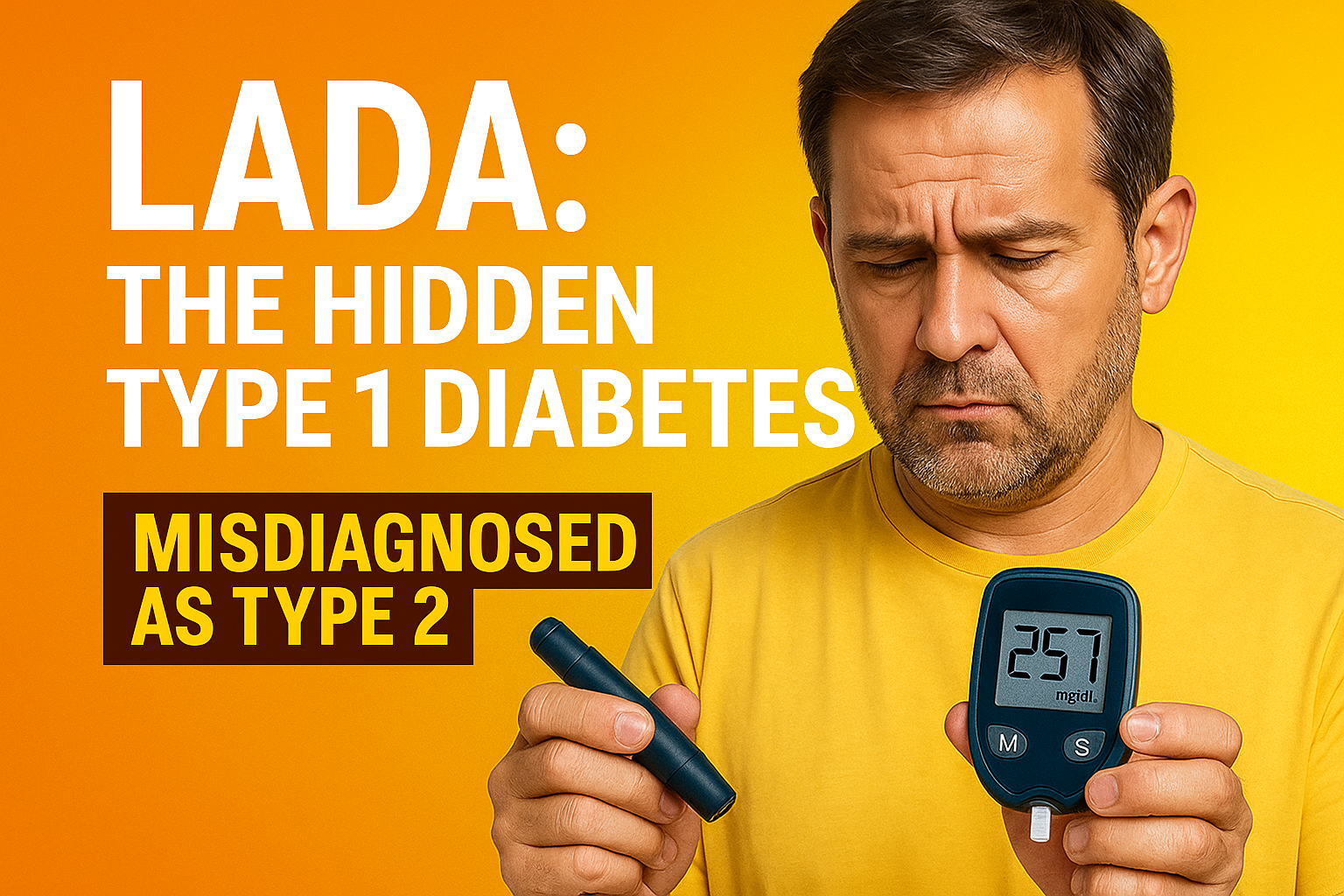
“Type 2” That Wasn’t: Catching LADA Before It Catches You
Curtis drove a brown delivery truck through the Texas heat. He worked long days, ate clean, and still watched his glucose climb. Metformin didn’t fix it. Ozempic didn’t move the scale. Mornings ran high; days off ran higher. Something wasn’t adding up.
When Type 2 Doesn’t Behave Like Type 2
LADA—latent autoimmune diabetes in adults—is an adult-onset autoimmune diabetes that can masquerade as type 2 early on. It’s defined by islet autoantibodies with a slower progression to insulin dependence than classic type 1 and may account for ~2–12% of adult-onset diabetes. researchportal.helsinki.fi
The Red Flags
If your story sounds like Curtis’s, watch for these patterns that often prompt testing for autoimmune diabetes in adults:
You’re active and eating intentionally, but glucose still trends up.
Morning highs (“dawn phenomenon”) that don’t budge with lifestyle tweaks.
Therapies that usually help in type 2 underperform or stall.
A GLP-1 may help parts of the picture, but you ultimately feel better on insulin.
(Clinically, the ADA’s Standards of Care recommend considering autoimmune testing in adults when the presentation suggests type 1 diabetes rather than straightforward type 2.) Diabetes Journals
The Tests That Tell the Truth
Ask for two things—both are standard in the literature and consensus guidance:
Autoantibodies: GAD65, IA-2, and ZnT8 (± IAA). Positive results indicate autoimmune diabetes (including LADA) rather than type 2. researchportal.helsinki.fi
C-peptide WITH a simultaneous glucose value. C-peptide reflects your own insulin secretion, but the number only makes sense in the context of current glycemia; many guidelines recommend measuring it alongside glucose (often after a carb-containing meal or stimulus). DiabetesontheNet
Treatment Nuance: Why Getting the Label Right Matters
Once antibodies confirmed Curtis had LADA, insulin made sense—and he felt human again. Early, appropriate insulincan improve control and symptoms in LADA; however, preserving β-cell function with early insulin is not proven. In the randomized BALAD study, bedtime insulin did not preserve C-peptide better than sitagliptin over ~21 months. (Practical implication: choose therapy for metabolic control and safety; don’t count on insulin alone to “save” C-peptide.) Frontiers
Expert summaries for primary care echo this nuance: insulin is effective and safe; avoid sulfonylureas (they may accelerate β-cell loss), and tailor therapy to phenotype and C-peptide. AAFP+1
Hear Curtis tell how he pushed for the right labs—and what changed next in episode 1667 →
🧾 LADA Self-Advocacy Checklist (Print/Bring to Your Visit)
✅ Ask: “Could this be LADA (adult-onset autoimmune diabetes)?”
✅ Order antibodies: GAD65, IA-2, ZnT8 (± IAA) to assess autoimmunity. researchportal.helsinki.fi
✅ Order C-peptide with glucose (fasting or stimulated) so results are interpretable. DiabetesontheNet
✅ Bring data: CGM or meter downloads, highlighting morning highs and days-off patterns.
✅ Document history: weight/activity trends; what helped vs. didn’t.
✅ Ask for an endocrinology referral if results are equivocal or treatment is stalling.
✅ Discuss therapy goals: practical glucose control now; understand that β-cell “preservation” evidence in LADA is mixed, and avoid sulfonylureas. AAFP
✅ Follow the science, not the label: If you feel better on insulin (or your data say so), that’s valid even if you were first told “type 2.” (ADA supports antibody testing when adult presentation suggests autoimmune disease.) Diabetes Journals
Bottom line: If your “type 2” doesn’t act like type 2, test for autoimmunity and interpret C-peptide correctly. Getting the diagnosis right is what unlocked Curtis’s progress—and it can unlock yours, too.































What Is Type 1 Diabetes? Understanding the Condition, One Small Step at a Time
What Is Type 1 Diabetes?
Finding out that you — or your child — has type 1 diabetes (T1D) can feel like the ground drops out from under you. Suddenly, there’s talk of insulin, carb ratios, blood sugar numbers, and alarms you didn’t even know existed yesterday. It’s overwhelming, and that’s okay.
Let’s take a deep breath and start where it all begins: understanding what type 1 diabetes actually is — and how you can live well with it.
What Type 1 Diabetes Really Means
Type 1 diabetes is an autoimmune condition — meaning your immune system mistakenly attacks the beta cells in your pancreas that make insulin.
Insulin is the hormone that helps move glucose (sugar) from your blood into your cells, where it’s used for energy. Without insulin, sugar builds up in your bloodstream. That’s why people with T1D must take insulin through injections or an insulin pump to live — it replaces what the body no longer makes.
It’s important to know: nothing you did caused this.
Type 1 diabetes isn’t about eating too much sugar or not exercising enough. It’s about your immune system misfiring. It can happen to anyone — at any age — and it’s no one’s fault.
The First Days: Start with Bold Beginnings
Those first weeks after diagnosis are emotional, confusing, and full of information you’re expected to master overnight. That’s exactly why the Bold Beginnings series exists — to help you take your first confident steps.
In Bold Beginnings, you’ll hear real conversations about:
What insulin really does and how to use it safely
The truth about “highs” and “lows”
How to dose for carbs without fear
Why small wins matter more than perfection
You’ll learn how other families and adults have navigated those same early, sleepless nights and slowly built a sense of normalcy again. It’s a series designed to replace panic with perspective.
Living the Day-to-Day: Small Sips Make Big Change
Once you’re past the initial shock, you’ll start to realize something: type 1 diabetes doesn’t have a finish line. It’s a rhythm. It’s trial, error, and adjustment.
That’s the heart of the Small Sips series — because lasting progress doesn’t happen all at once. It happens in small, steady improvements that add up over time.
In these episodes, you’ll learn things like:
How to time your pre-bolus for smoother numbers
What to look for in CGM patterns (and when to ignore the noise)
How food, activity, hormones, and stress all shift your needs
The small habits that make big differences
When you focus on just one “sip” at a time — one idea, one pattern, one tweak — diabetes becomes a puzzle you can actually solve.
Taking Control: Pro Tips for the Next Level
After you’ve found your footing, you’ll start craving more understanding — not just what to do, but why. That’s when the Pro Tip series becomes your secret weapon.
These episodes dive into the advanced strategies that make blood sugars more predictable and less stressful, including:
How to calculate your insulin-to-carb ratio more accurately
What fat and protein really do to your blood sugar
When to adjust basal rates or correction factors
How to think ahead for exercise, hormones, and illness
Pro Tips are the kind of lessons most people learn the hard way — years in — but you can start mastering them now.
The Juicebox Podcast is the world’s most-listened-to type 1 diabetes podcast — trusted by hundreds of thousands of people living with T1D and the caregivers who love them. Every episode is free and built around real conversations that make diabetes management feel understandable and doable. Listen on your Apple devices, Spotify or your favorite audio app.
The show’s companion Facebook community is also completely free — a supportive space where listeners share experiences, ask questions, and learn from one another. Whether you’re newly diagnosed or decades in, you’ll find real help, real stories, and zero judgment.
The Good News: You Can Live Fully with Type 1 Diabetes
Here’s the truth: diabetes management is constant work, but it’s completely possible to live a healthy, flexible, normal life.
Technology like continuous glucose monitors (CGMs), smart insulin pumps, and new insulin formulations have made blood sugar management easier and safer than ever before. Add the right education and mindset, and you’ll find stability sooner than you think.
If you or your child is newly diagnosed, remember this:
You’re not behind — everyone starts here.
You don’t have to be perfect — you just have to learn.
You’re not alone — there’s a community waiting to help.
Start with Bold Beginnings, keep learning through Small Sips, and empower yourself with Pro Tips. The more you understand, the calmer and more confident you’ll feel.
Because living well with type 1 diabetes isn’t about chasing perfect numbers. It’s about building the skills — and trust in yourself — to manage whatever comes next.
✅ Fact Sources

No More Surprise Spikes: Pre-Bolusing, Extended Boluses & Other Insulin Tricks Made Simple
Scenario you’ve lived: You bolus, eat pizza, stay flat for a while…and then hours later your glucose creeps up and sticks. Or you go bun-less to “avoid carbs” and still see a late rise from the protein. These aren’t personal failures or “random diabetes.” They’re predictable effects of fat and protein—and you can plan for them.
This post turns the key ideas from Diabetes Pro Tip JBP1012 (Fat & Protein) into clear, step-by-step tactics anyone can try, even if you’re new to these concepts. As always, nothing here is medical advice—work with your clinician before changing settings or doses.
Why the spike shows up late (even when carbs were “right”)
Fat slows digestion and can make insulin work less effectively for a while. That’s why pizza or fried food can look “perfect” early and climb later.
Protein can convert to glucose when carbs are low or when protein is large, causing a slow rise ~2–4 hours after eating.
Result: If you only dose for carbs upfront, you may go low early (too much insulin too soon) and high later (not enough insulin when fat/protein hit).
Quick-start cheat sheet
Pre-bolus: Start insulin before eating so it’s already active when carbs absorb (many people find 10–20 minutes helpful; adjust to your reality).
Protein coverage: For low-carb or very high-protein meals, consider an extended bolus (pump) or a small follow-up dose (MDI) timed later.
High-fat meals (pizza, fried, cheesy): Plan more insulin delivered gradually (e.g., a temp basal increase for hours, or a dual/extended bolus).
Tune ratios over time: If a dose consistently misses, adjust next time (small, deliberate changes), rather than repeating what didn’t work.
Guiding idea from Juicebox: it’s usually easier to stop a gentle low than to fight a stubborn high later—so time insulin to meet the food where it is.
The playbook (pump & MDI versions)
1) Pre-bolus: give insulin a head start
Problem: Spike hits fast because insulin started after the carbs.
How to do it
Pump or MDI: Begin with a 10–20 minute pre-bolus for typical/medium-GI meals.
If you’re nervous (or timing is unpredictable), try partial pre-bolus: give ~50–75% early, the rest when food arrives.
Always have fast carbs nearby in case the meal is delayed.
CGM users: Some wait until the trend arrow nudges down before taking the first bite. If on fingersticks, use a timer.
Goal: Your insulin and your carbs become active together, softening the early peak.
2) Protein coverage: handle the slow burn
When to consider it
Low-carb meals (≈ under ~15–20g carb) with a normal protein portion.
High-protein meals even when carbs are present (e.g., steak-heavy dinners).
Pump approach (extended bolus)
Bolus normally for carbs.
Add a separate extended bolus for protein: a common starting pattern is 0% now / 100% over ~3 hours.
How much? Start conservatively and learn from your data. Many people find covering a portion of protein grams helpful (e.g., roughly ~40–60% of protein grams translated into “carb-equivalent” per your settings). You’ll refine this for your physiology.
MDI approach (follow-up dose)
Dose normally for carbs at mealtime.
Plan a small follow-up dose ~1–2 hours after eating to meet the protein’s delayed effect. Start low, track your pattern, and adjust on the next occurrence of a similar meal.
Tip: Set a reminder so the “second wave” dose isn’t forgotten.
3) High-fat meals: tame the pizza/fried-food spike
What fat does: It can delay carb absorption for hours and reduce apparent insulin effect for a stretch—hence the deceptively “flat early, high later” pattern.
Pump strategies
Temp basal increase: For a very fatty meal, many start with around +50% basal for ~6–8 hours, then adjust based on CGM response.
Dual/extended bolus: Give a portion upfront for carbs and extend the rest over 4–6+ hours for the fat tail.
MDI strategies
Split dose: Take part of the meal insulin upfront, then one or two smaller doses later (e.g., at ~2 and ~4 hours) to match the delayed impact.
Use small “bumps” sooner if you see a steady climb—nudging beats a late big correction.
Why this is safer than it seems: You can cancel remaining extended insulin (pump) or skip a planned follow-up dose(MDI) if you start to drift low. It’s generally easier to stop a small downward move than to unwind a long, sticky high.
4) Adjust doses & ratios when reality says so
If the same dose misses in the same way (e.g., breakfast always high, or dinner always low), that’s a settings signal—not a personal failure.
How to adjust safely
Change one thing at a time and re-check for a few days.
Example: If breakfast is always high, make the I:C ratio there more aggressive (e.g., from 1:10 to 1:9 or 1:8), then test.
Basal fit matters: If you rise nightly, overnight basal may be low; if you dip at 3 a.m., it may be high. Pumps allow time-of-day basal tweaks; on MDI, speak with your clinician about options (timing, splitting, or dose changes).
Trust repeated patterns: If 6 units never covers that dinner for you, next time try 7–8 units (with appropriate caution). Use your own data to iterate.
Practical examples (tie it to real life)
Low-carb lunch (chicken + salad)
Pump: Pre-bolus for any carbs. Add an extended bolus for protein: try 0% now / 100% over 3 hours; amount based on your prior protein experience.
MDI: Dose for the carbs at mealtime; set a small follow-up dose ~1–2 hours later.
Pizza night
Pump: Pre-bolus for ~half the counted carbs; extend the remainder over 4–6 hours. Add a temp basal +~50% for 6–8 hours as a starting framework.
MDI: Take a partial upfront dose with food; plan small follow-ups at ~2 and ~4 hours. Use CGM nudges to prevent the late climb.
Breakfast always spikes
Try a longer pre-bolus (or partial pre-bolus). If still high, make your breakfast I:C ratio stronger (e.g., 1:10 → 1:8), evaluate for several days, and fine-tune.
Guardrails & safety notes
Individual variability is real. Start conservatively, watch trends closely, and iterate.
Insulin stacking vs. needed insulin: Additional doses are reasonable when glucose is still rising and prior insulin was insufficient—but always track insulin on board (IOB) and use small, spaced “bumps.”
Kids, pregnancy, illness, steroids: These scenarios can change insulin needs dramatically. Coordinate changes with your care team.
Hypoglycemia preparedness: Always keep rapid carbs handy. If you extend or split insulin and start drifting low, stop the extension (pump) or skip the follow-up dose (MDI).
Work with your clinician before altering long-acting insulin or pump basal profiles.
Mindset that makes this work
Be curious, not rigid. Ratios and timing are starting points, not commandments.
Learn from your graph. Every “weird” curve is information you can use next time.
Small changes win. One tweak (like a 15-minute pre-bolus) can transform a meal.
Progress > perfection. The aim is fewer spikes/lows and more calm, not 100% flat lines.
“Trust that what you know is going to happen, is going to happen.” Use your lived patterns to plan insulin that meets the food where it is.
One last thing
These tools—pre-bolus, extended/split dosing, temp basals, ratio tuning—are the difference between spending hours chasing glucose and spending hours living your life. Start with the meal that annoys you most (breakfast spikes? pizza nights?) and test one change. Note what happens, refine, repeat. That’s how you turn “mystery highs” into boringly predictable results.
You’ve got this. 💪
Educational content inspired by Diabetes Pro Tip JBP1012 (Fat & Protein) from the Juicebox Podcast with Scott Benner and Jennifer Smith, RD, CDCES. Always consult your healthcare provider before changing your diabetes care plan.

Exercise and Blood Sugar: What They Didn’t Tell You at Diagnosis
You were told about carbs and insulin. Maybe even ratios. But exercise? Probably not.
Episode 755 of The Juicebox Podcast digs into what every person with type 1 diabetes discovers too late — that moving your body doesn’t follow one rule, and that the right kind of movement can send your blood sugar up or down depending on the type.
The Lesson No One Gives You
When you’re newly diagnosed, the list of “don’ts” is long. Exercise barely makes the list.
Doctors say, “Be careful.” But careful doesn’t mean informed.
Certified Diabetes Care and Education Specialist Jennifer Smith joins Scott Benner to explain why understanding exercise is as important as understanding insulin.
“It’s a neglected topic,” Jenny says. “You’re so busy learning everything else that movement ends up at the bottom of the list.”
And yet, it affects everything — timing, insulin needs, and safety.
Two Kinds of Exercise, Two Very Different Results
Scott jokes about “aerobic” versus “anaerobic” — running versus lifting — and Jenny laughs, but the truth behind it matters.
Aerobic (cardio) — running, biking, swimming, jumping on a trampoline — uses oxygen and tends to lower blood sugar.
Anaerobic (resistance) — weight training, sprints, heavy effort — triggers adrenaline and can raise blood sugar.
“The heavier the load,” Jenny explains, “the more adrenaline. That’s often what pushes numbers up.”Bold Beginnings 755
And real life rarely fits neatly into one category.
Your kid runs up and down the stairs 40 times after dinner — that’s aerobic.
But what if they also lift a heavy backpack? Now it’s both.
The Surprising Everyday Triggers
Exercise isn’t just the gym. It’s mowing the lawn, cleaning the house, chasing your dog, or walking through Target. Anything that raises your activity above baseline changes how your body uses insulin.
Scott sums it up:
“Your insulin settings are made for sitting at work or school — not for chasing kids or cleaning the garage.”Bold Beginnings 755
That means a “normal” day can suddenly become an exercise day — and if there’s active insulin on board, lows can hit fast.
Why Some Activities Make You Drop
Aerobic activity speeds up insulin use. If there’s a lot of active insulin, your body pulls glucose out of your blood faster — what Scott calls a “pull,” not a “drop.”Bold Beginnings 755
Fifteen to twenty minutes into cardio is the danger window. You might be fine at first, then suddenly sliding.
Jenny puts it simply:
“If you haven’t planned for it — no carb, no insulin adjustment — around 15 minutes is when it starts to nudge down.”Bold Beginnings 755
The Role of Adrenaline and Emotion
Here’s the twist: not all activity lowers blood sugar.
Competition and intensity can raise it.
A baseball game might spike you, while practice keeps you steady.
Why? Adrenaline.
“Games trigger excitement,” Jenny says. “That rush pushes glucose up.”Bold Beginnings 755
It’s not unpredictable — it’s physiology.
What Happens When Nobody Explains It
One listener wrote:
“My son was in baseball and swimming when he was diagnosed. The doctor told us he’d have to rethink his sports. I thought he couldn’t live a normal life.”Bold Beginnings 755
That kind of advice sticks — and it’s wrong.
People with type 1 diabetes run marathons, play in the NFL, and lift competitively.
Exercise isn’t off-limits. It just requires awareness.
Five Things That Make Exercise Work With Diabetes
Avoid aerobic exercise with active insulin on board.
If you just ate, wait. Active insulin + movement = rapid lows.Carry carbs — always.
Even quick, unplanned activity (like chasing kids) burns glucose fast.Plan for planned movement.
Lower basal before workouts or reduce meal boluses ahead of time.Expect adrenaline spikes.
Sports, lifting, or competition may raise glucose — you might even need a small bolus.Know your pattern, not just your number.
CGMs reveal whether you’re falling or steady; your response should match your trend.
What It Really Means
Exercise shouldn’t feel dangerous.
When you understand what’s happening — that movement changes how insulin behaves — you can stop guessing and start planning.
The goal isn’t avoiding activity; it’s owning it.
Listen to Bold Beginnings: Exercise (Episode 755) wherever you get podcasts, and learn how to make movement part of your diabetes toolkit — not something to fear.
References
Riddell MC et al. Exercise Management in Type 1 Diabetes: A Consensus Statement. Lancet Diabetes Endocrinol, 2017.
American Diabetes Association. Standards of Care in Diabetes 2025: Physical Activity.
Yardley JE et al. Managing Exercise in Type 1 Diabetes: Practical Strategies for the Real World. Diabetes Spectrum, 2020.

Misdiagnosed: Why So Many Adults Start Type 1 Diabetes With the Wrong Map
When adults are diagnosed with type 1 diabetes, the story too often starts in the wrong chapter.
They walk into a doctor’s office tired, thirsty, and scared, and walk out with a metformin prescription and a “Welcome to type 2” packet. Months—sometimes years—later, they discover they never had type 2 at all. They had type 1 the whole time.
I’ve heard this story more times than I can count on the Juicebox Podcast. Smart, responsible people, doing everything right, following the plan—and still running numbers so high you could fry an egg on them. They’re told they’re “non-compliant,” when in reality, they were never given the right tools for the job.
The Quiet Epidemic No One Talks About
Here’s what the research says: nearly than half of all new type 1 diagnoses actually happen in adults.¹ In some studies, as many as 4 in 10 adults with type 1 are first told they have type 2.²
That means thousands of people spend months chasing an answer that insulin could’ve solved on day one. Blood sugars climb, energy disappears, and people blame themselves for “failing” a treatment plan that was never meant for them.
Jenny Smith, CDE—my partner in the Bold Beginnings series—put it perfectly: adults with new-onset type 1 don’t get the same structured education kids do. There’s no hospital crash-course in carb ratios and correction factors. Most adults get a pamphlet and a pat on the back.
So they start managing diabetes with the wrong diagnosis, the wrong meds, and zero guidance. It’s like being handed a map of Spain when you’re trying to drive through Nebraska.
Why It Keeps Happening
Age Bias If you’re over 25, many doctors assume type 2 by default. They look at your birth date, not your antibodies.
Testing Gaps Most adults never get the GAD or C-peptide tests that prove autoimmunity. Without them, the diagnosis is guesswork.
Treatment Inertia Providers “start with metformin” even when insulin is clearly needed. Every extra month on the wrong med is another month of damage.
Language Barrier People hear words like basal, bolus, glycemic load, and think they’ve fallen into medical Scrabble.
And then there’s the human side. Imagine watching your blood sugar skyrocket after eating an apple, calling your doctor, and hearing, “You just need more exercise.” It’s maddening. By the time someone finally runs the right tests, the patient is exhausted, frustrated, and convinced they’re bad at this.
What Misdiagnosis Costs
It’s not just numbers on a meter—it’s trust.
Physically, prolonged high glucose levels can fast-track complications. Emotionally, it’s like fighting a battle blindfolded. Many people describe a period of guilt, of feeling “broken.” They weren’t. They were just holding the wrong instructions.
Even after the correct diagnosis, there’s fallout. People become wary of their doctors. They hesitate to ask questions. They second-guess every bit of advice. Rebuilding confidence takes time—and that’s where education comes in.
Fixing the System (and Yourself)
You can’t change how the healthcare system works overnight, but you can arm yourself with the right expectations.
1. Ask for Antibody Testing Immediately
If you’re newly diagnosed and things aren’t adding up, request these tests:
GAD65, IA-2, and ZnT8 antibody panels
C-peptide to measure natural insulin production
If your provider balks, remind them the ADA encourages clinicians to consider islet-autoantibody testing — especially in adults whose presentation doesn’t fit the usual type 2 pattern..
2. Question Age-Based Assumptions
Type 1 doesn’t “age out.” The immune system can flip at 8, 38, or 68. If your treatment isn’t working, it might not be you—it might be your diagnosis.
3. Get the Education You Deserve
Kids with new-onset diabetes get hours of training, dietitians, and nurses who walk them through every beep of a pump. Adults get a handshake.
That gap is why we built Bold Beginnings—to give grown-ups the same foundation kids get, just without the hospital gown.
4. Find Your Language
Understanding terms like basal, bolus, correction factor, and time in range isn’t about memorizing jargon—it’s about speaking the language of your own care. Once you can name what’s happening, you can manage it. (And if those words still sound foreign, you’ll love our next piece: Foundations—Learning the Language of Diabetes.)
5. Don’t Be Afraid to Start Over
Getting re-diagnosed as type 1 can feel like failure. It’s not. It’s the moment the fog lifts.
The day insulin enters the story is usually the day the story starts making sense.
What It Really Means
Every week, more adults are diagnosed with autoimmune diabetes. Some will get the right answer quickly; many won’t.
But here’s the truth: you can’t manage what you don’t understand—and you can’t understand what you’ve never been taught.
That’s what Bold Beginnings is for. It’s the foundation class everyone should get on day one. It’s where Jenny and I break down the big words, the scary numbers, and the guilt that sneaks in between them.
If you’re newly diagnosed—or newly correctly diagnosed—start there.
Because once you have the right map, the road ahead may still twist and turn, but at least you’ll know where you’re going.
References
Thomas NJ et al. The Diabetologia Study on Adult-Onset Type 1 Diabetes Misclassification. 2020.
Davis AK et al. Clinical Features and Diagnosis of Latent Autoimmune Diabetes in Adults (LADA). Diabetes Care, 2019.
American Diabetes Association. Standards of Care in Diabetes – 2025.