
#1757 Tandem Kids: Kate
You can always listen to the Juicebox Podcast here but the cool kids use: Apple Podcasts/iOS - Spotify - Amazon Music - Google Play/Android - iHeart Radio - Radio Public, Amazon Alexa or wherever they get audio.
Scott Benner interviews 15-year-old Kate, who discusses managing Type 1 diabetes while playing lacrosse and field hockey, using the Tandem t:slim pump, and her experience growing up in a family where multiple members have the condition.
+ Click for EPISODE TRANSCRIPT
DISCLAIMER: This text is the output of AI based transcribing from an audio recording. Although the transcription is largely accurate, in some cases it is incomplete or inaccurate due to inaudible passages or transcription errors and should not be treated as an authoritative record. Nothing that you read here constitutes advice medical or otherwise. Always consult with a healthcare professional before making changes to a healthcare plan.
Scott Benner (0:00) I attended my first ever Friends for Life conference in July 2025. (0:05) And while I was there, I interviewed eight children of various ages, all who wear a Tandem pump. (0:10) I wanna thank Tandem Diabetes for sponsoring this short episode of the Juice Box podcast. (0:16) Check them out at tandemdiabetes.com/juicebox. (0:22) Nothing you hear on the Juice Box podcast should be considered advice, medical or otherwise.
Scott Benner (0:28) Always consult a physician before making any changes to your health care plan. (0:35) The episode you're about to listen to is sponsored by Tandem Moby, the impressively small insulin pump. (0:41) Tandem Moby features Tandem's newest algorithm, Control IQ Plus technology. (0:46) It's designed for greater discretion, more freedom, and improved time and range. (0:50) Learn more and get started today at tandemdiabetes.com/juicebox.
Scott Benner (1:06) Hey. (1:07) How are you?
Kate (1:07) Good. (1:08) How are you?
Scott Benner (1:08) Excellent. (1:09) Thank you. (1:09) What's your name?
Kate (1:10) Kate. (1:11) Kate.
Scott Benner (1:11) How old are you? (1:12) 15. (1:12) 15. (1:13) How long have you got type one diabetes?
Kate (1:15) Since I was three, so twelve years.
Scott Benner (1:17) Three. (1:17) I like that you did the math for me. (1:19) I didn't have to do it. (1:20) Thank you. (1:21) Twelve years.
Scott Benner (1:22) Does it feel like it's been that long?
Kate (1:25) No. (1:25) I kinda just feel like I've had it my whole life because I don't remember, like, what it is without.
Scott Benner (1:29) Yeah. (1:30) Do you remember anything about being diagnosed?
Kate (1:32) No. (1:33) I don't.
Scott Benner (1:33) Not at all. (1:34) Do do people tell you about it?
Kate (1:36) My mom told me I was in Target when I figured out, like, I got being, like, I had to pee a lot. (1:42) I was very thirsty. (1:43) And then she was, like, kinda figured out.
Scott Benner (1:45) So your mom figured it out at Target?
Kate (1:47) Yeah.
Scott Benner (1:47) Right. (1:48) So you're, like did she tell you how? (1:50) Does she know other people that have type one?
Kate (1:52) Well, she had it. (1:53) She's had I don't know how long she's had it, but she has it and so is my brother.
Scott Benner (1:57) Oh, so your mom has type one? (1:58) Yeah. (1:59) Your brother is how old?
Kate (2:00) He's 13.
Scott Benner (2:01) How long has he had it for?
Kate (2:03) He's had antibodies since three, but he was diagnosed
Scott Benner (2:09) Recently?
Kate (2:09) Yeah. (2:10) Like, a couple years.
Scott Benner (2:11) Okay.
Kate (2:11) Like, maybe four.
Scott Benner (2:12) You don't know how old your mom was when she was diagnosed?
Kate (2:14) She was in her twenties or late teens.
Scott Benner (2:17) And how old does she now? (2:19) Interesting. (2:20) And your grandmother's phone number? (2:22) Okay. (2:23) Alright.
Scott Benner (2:24) So you don't your mom is probably in her late teens or twenties.
Kate (2:28) Yes.
Scott Benner (2:29) Right? (2:29) And you don't know how old she is now? (2:31) No. (2:31) No. (2:32) Is she in her forties, her fifties?
Kate (2:34) She's in her forties. (2:35) You sure? (2:36) Yes. (2:37) 43.
Scott Benner (2:39) Yeah. (2:39) I mean, are you asking me or are you telling me? (2:42) She's 43. (2:43) You're definitely 15, though. (2:45) Right?
Scott Benner (2:45) Yes. (2:45) How can you be certain? (2:47) Do you know your phone number?
Kate (2:49) Yes.
Scott Benner (2:49) Okay. (2:49) Alright.
Kate (2:50) Yes. (2:50) Alright.
Scott Benner (2:50) Well, okay. (2:51) So you don't remember anything about being diagnosed?
Kate (2:53) No.
Scott Benner (2:53) Alright. (2:54) That's fair. (2:55) Do you do any activities at school or sports or anything
Kate (2:57) like that? (2:58) Yes. (2:58) I've been playing field hockey and lacrosse. (3:00) I've played lacrosse since COVID, and then field hockey, I just started two years ago.
Scott Benner (3:04) Okay. (3:04) Lacrosse? (3:06) Yes. (3:06) Field hockey? (3:07) Yes.
Scott Benner (3:08) Can I ask a question?
Kate (3:09) Yeah.
Scott Benner (3:10) Wouldn't it be easier if they made the stick longer?
Kate (3:12) Yeah. (3:13) I'm too tall for field hockey.
Scott Benner (3:14) Why? (3:15) I don't understand. (3:16) Because it's always like this. (3:18) Right? (3:18) Yeah.
Scott Benner (3:19) Does it I mean, right, everybody? (3:22) Like, why is the field hockey stick not longer?
Kate (3:25) It hurts my back. (3:26) Right.
Scott Benner (3:27) But have you ever gotten whacked with a ball?
Kate (3:30) I I mean, like, on my shins and stuff, but I have shin guards.
Scott Benner (3:33) So But it would hurt otherwise? (3:35) Yes. (3:35) You ever see anybody take one in the head?
Kate (3:36) Yes. (3:37) That, like, just happened, like, three weeks ago. (3:39) She got hit right here and she had go get stitches.
Scott Benner (3:41) Unless they're crying?
Kate (3:42) Yes.
Scott Benner (3:42) Did you cry?
Kate (3:43) I would
Scott Benner (3:43) have cried. (3:43) No. (3:44) No. (3:44) I would have been like, well, there's so much. (3:45) Please stop.
Scott Benner (3:46) What's it like playing with type one? (3:48) What do you have to do to get through the game?
Kate (3:50) It's hard. (3:51) I hate when I go low because I don't really take the initiative to go out because, like, especially when we're running as a team because we're, like, for a consequence, I'm always like, oh, if I go out then, like, I'm like, I should be running because it's a consequence for the team. (4:03) So if I go out, like, I think it looks bad on me.
Scott Benner (4:06) Okay.
Kate (4:06) So sometimes
Scott Benner (4:07) So you're not taking care of your lows because you're afraid No.
Kate (4:09) No. (4:10) No. (4:10) I do.
Scott Benner (4:10) I just But but but it's you you're not as in like, you don't wanna go off the field.
Kate (4:14) Yeah. (4:14) I don't wanna.
Scott Benner (4:15) Okay.
Kate (4:15) But I do.
Scott Benner (4:16) How often does do does that happen, though, while you're playing? (4:18) It's a lot of running. (4:19) Right?
Kate (4:20) Yeah. (4:21) That's like the whole game. (4:23) I don't go low, like, a lot, but when I do, I don't like to come out.
Scott Benner (4:27) Okay. (4:27) Alright. (4:28) So what do you do?
Kate (4:30) Well, I just, like, signal my coaches and they know. (4:32) So I just come off. (4:33) I eat a pack of gummies, and I try to go back in as soon as possible.
Scott Benner (4:36) You can't, like, run down the sideline and grab something? (4:38) Like, one of runners are doing the thing.
Kate (4:40) I wish.
Scott Benner (4:41) Does your mom come to the games?
Kate (4:42) Yeah. (4:42) She comes.
Scott Benner (4:43) She's screaming and yell? (4:44) Like, happy, screaming
Kate (4:45) and yelling. (4:46) She's cheering?
Scott Benner (4:46) Yeah. (4:46) Like, she's not yelling at you. (4:47) No. (4:48) No. (4:48) No.
Scott Benner (4:48) She's better, Kate. (4:49) It's not like that. (4:50) Right? (4:50) No. (4:50) She's like, yay, Kate.
Scott Benner (4:52) What what what pump are you using?
Kate (4:54) T slim.
Scott Benner (4:54) T slim. (4:55) What made you get it?
Kate (4:57) I I thought, like, having the tube would look cool, to be honest.
Scott Benner (5:02) Really? (5:02) Yes. (5:03) Alright. (5:03) Okay.
Kate (5:04) So that was, like, the first thing. (5:05) And then I also loved having, like, my blood sugar on me while playing because I used to not have that because I was on loop. (5:11) So I would just have to feel low. (5:12) And when for me to feel low, I get into the low fifties or forties.
Scott Benner (5:16) Okay.
Kate (5:16) So I wanna catch that before that.
Scott Benner (5:18) So you like the feedback on the screen?
Kate (5:20) Yes. (5:20) I love it. (5:21) Awesome.
Scott Benner (5:21) You love it?
Kate (5:22) Yes. (5:22) Alright.
Scott Benner (5:23) Awesome. (5:23) But but going back to the other thing, you thought the tubing would look cool?
Kate (5:26) Yes.
Scott Benner (5:28) Please walk me through that.
Kate (5:29) I don't know. (5:30) I was like, I like showing it off.
Scott Benner (5:32) You do?
Kate (5:33) Yes. (5:33) How cool? (5:34) I used to not, actually.
Scott Benner (5:35) How how what do you think changed that? (5:37) So at one point, you didn't want people to know your your stuff, but now you want them to know. (5:41) What do you think changed?
Kate (5:44) I like I don't know. (5:45) I feel like just embracing it so people know because there's, like, there's all those stereotypes. (5:50) So when people ask me questions, it kinda clarifies to them, like, what type one really is and not just what they think it is.
Scott Benner (5:56) So it's important for you that other people understand the reality of it. (6:00) Mhmm. (6:00) Why do you think that's important to you?
Kate (6:03) Because I've had the stereotype said, oh, you get it from eating too much sugar, this and this. (6:08) And like, I don't let it affect me, at the end of the day, it hurts because it's not the truth. (6:12) Yeah. (6:12) So like, when I tell them that, they get clarification of what it really is. (6:16) So hopefully, they can stop saying those things.
Scott Benner (6:18) Nice. (6:18) Do you have a lot of friends? (6:19) Yes. (6:20) Did they all know about your diabetes? (6:21) Yes.
Scott Benner (6:21) Yeah. (6:22) If somebody isn't interested in your diabetes, are you not interested in being their friend or does it not
Kate (6:27) I mean It's okay. (6:31) Mean, I don't like I don't want them to say anything bad about diabetes, but like if, like, a lot of my friends just don't they don't care that I have it. (6:40) Like, not not in the bad way, just in the good way. (6:42) They're not just like, oh, like, can you eat this? (6:44) Like, they're not worried about me.
Kate (6:45) Like, when I'm low, they are worried about me, but, like, it's not like it's not in between the friendship, if that makes sense.
Scott Benner (6:51) So you like that your friends understand it, that they're interested
Kate (6:54) Yeah.
Scott Benner (6:54) And that the people who maybe are not, like, super interested are still cool about it.
Kate (6:59) Yeah. (6:59) Like, my close friends, they all understand what it is and, like, I've told them how to use my nasal spray if I ever pass out, so they all know how to use it. (7:07) When I'm low, they're very, like, Kate, stop. (7:09) Like, stop what you're doing. (7:10) Take a break even when I don't wanna do that.
Scott Benner (7:12) Do you get giddy or weird? (7:13) Do they how do they know you're low?
Kate (7:16) They it beeps, so they hear that. (7:18) And then when I'm super low, I can get kinda rude. (7:21) So
Scott Benner (7:22) You get rude? (7:23) Yeah. (7:23) Do you curse at people? (7:24) No. (7:25) No?
Scott Benner (7:25) But you're rude.
Kate (7:26) I can be. (7:26) I can just have a little chip on my shoulder.
Scott Benner (7:28) Yeah. (7:28) Yeah. (7:29) Do you know what's happening when it's happening?
Kate (7:31) I can feel when I'm low, but like
Scott Benner (7:33) But you know what I'm saying? (7:34) Like, right now, you seem very pleasant. (7:36) Yeah. (7:36) You're generally a pleasant person?
Kate (7:37) Yeah.
Scott Benner (7:37) Right. (7:38) So you're not being rude to me right now? (7:39) No. (7:39) If you started being rude to me, you would know.
Kate (7:42) I mean, it's only to my family, to be honest. (7:44) Oh. (7:44) It's only to my family.
Scott Benner (7:45) You love. (7:46) Yeah. (7:46) Yeah. (7:47) But do but while you're saying the words, do you know it's happening? (7:50) Like, are you, like, I am being rude now or is
Kate (7:52) it No. (7:52) My mom's like, Kate, you're low. (7:54) Like, take a break.
Scott Benner (7:56) We used to tell my daughter, we're gonna test your blood sugar. (7:58) And if you're not low, you're in trouble. (8:02) Yeah. (8:03) You know what I mean? (8:03) Because I get the difference between it and Yeah.
Scott Benner (8:05) Just being a jerk. (8:06) Right. (8:07) Right. (8:08) Okay. (8:08) So you play a ton of sports.
Scott Benner (8:10) T Slim helps you with that a lot.
Kate (8:11) Yes. (8:12) A lot.
Scott Benner (8:12) That's awesome. (8:13) Okay. (8:14) Do you have any other things? (8:15) Every kid that's been here has played an instrument. (8:17) Do you play an instrument?
Kate (8:18) No. (8:18) I don't. (8:18) I used to in fifth grade, though.
Scott Benner (8:20) What'd you play?
Kate (8:21) The violin, maybe? (8:22) The violet? (8:23) One of those two.
Scott Benner (8:24) The violin, maybe?
Kate (8:25) Or the violet. (8:26) I we're but it's one they're, like, twins. (8:29) I don't know which one.
Scott Benner (8:30) I mean, I don't know. (8:31) I don't
Kate (8:32) It's the one that's deeper. (8:33) I don't know which one that is.
Scott Benner (8:35) Was it, like, the last instrument left when you were kicking?
Kate (8:38) Probably. (8:39) She
Scott Benner (8:39) gets stuck with it, like, your acoustic cage doesn't look serious about this? (8:42) Probably. (8:43) Did you hate playing it?
Kate (8:44) Yes. (8:44) I really did.
Scott Benner (8:46) Did you hate the playing it? (8:47) Did you hate the
Kate (8:47) I just hated everything
Scott Benner (8:48) about it. (8:49) Everything about playing the violet Yes. (8:51) Which I don't think is real. (8:52) I feel like you've made that up. (8:53) But, like, can someone look?
Scott Benner (8:55) Is a violet a real thing? (8:56) It's like no. (8:57) Violet looks incredibly embarrassed. (8:59) Oh, looks like calm.
Kate (9:01) Viola? (9:01) Maybe it's
Scott Benner (9:02) The viola? (9:04) The violet? (9:05) No. (9:05) There's two of them. (9:06) What's your grandmother's phone number?
Scott Benner (9:08) Yeah. (9:08) Okay. (9:09) Alright. (9:09) Alright. (9:10) Alright.
Scott Benner (9:10) Do you know any famous people have type one diabetes that you look up to?
Kate (9:15) I mean, no. (9:19) I mean, I know Charlotte, the gymnastics person.
Scott Benner (9:21) I've talked to I've interviewed Charlotte. (9:23) She's awesome.
Kate (9:23) Yeah. (9:24) Yeah. (9:24) I I mean, I look up to her.
Scott Benner (9:26) She was wasn't she trampoline? (9:28) Yeah. (9:28) I remember interviewing her and saying, like, you were in the Olympics for trampoline? (9:32) Like, that's a thing? (9:33) It was, actually.
Kate (9:34) Yes.
Scott Benner (9:35) Yeah. (9:35) She's awesome.
Kate (9:36) Yeah. (9:36) She seemed really cool.
Scott Benner (9:37) I spent a lot of time after I interviewed her, when we were done recording, talking to her and her girlfriend. (9:44) Her girlfriend's, like, famous too. (9:45) Right? (9:46) Like, she's like a gymnast that's why you said gymnastics. (9:49) I think it's she's she's a I think she's an Olympic gymnast.
Kate (9:52) Oh. (9:52) Yeah.
Scott Benner (9:53) Yeah. (9:53) So
Kate (9:53) Well, I used to I had her merch when she was in the in the Olympics.
Scott Benner (9:57) You had a what? (9:58) Her
Kate (9:58) merch. (9:58) She had, like
Scott Benner (9:59) Oh, she had bling and you were Yes.
Kate (10:01) You were I was rocking
Scott Benner (10:02) you were repping it? (10:02) Yeah. (10:02) Yeah. (10:03) Yeah. (10:03) What made you so before tandem, did you use a different pump?
Kate (10:06) Yeah. (10:06) I used lube.
Scott Benner (10:07) You were looping? (10:08) Mhmm. (10:09) Why did you switch, do you think?
Kate (10:14) It took a lot to switch, I think. (10:15) I I really liked Loop, but then I think I want something new. (10:20) I didn't really know much about t slim at the time. (10:22) Okay. (10:22) So I was just like, why not give it a shot?
Kate (10:24) And right before t slim, I was actually gonna go on Islet. (10:27) And I was on that for a week and absolutely hated it because my blood sugar was, 300 the whole time.
Scott Benner (10:33) You didn't like islet, but you were look so you were just looking for something different. (10:36) Yeah. (10:37) And then you tried something, didn't like it
Kate (10:39) Yeah.
Scott Benner (10:40) Tried again. (10:41) You're just very open.
Kate (10:42) Yeah.
Scott Benner (10:42) This was this was your mom doing this? (10:44) Like, I'm stumbling on my words. (10:45) Did your mom make this decision or was it you?
Kate (10:48) It was kind of like both of us. (10:49) My mom wants the best for me and she she knows a lot about all the pumps, so she's not gonna put me on some pump that she knows won't work for me, so she kinda let me trial them. (10:58) Okay. (10:58) And if I liked them and she thought it was good for me, we kinda both agreed on that.
Scott Benner (11:01) Nice. (11:02) Well, that's interesting. (11:03) Do you think did you, like, look at what other people were doing? (11:05) Just look online?
Kate (11:07) I think my mom just threw the idea out, and I was just like, sure. (11:10) Why not?
Scott Benner (11:10) Yeah. (11:11) So Look at why do you have such a good personality? (11:13) Like, why are you so friendly? (11:14) What's going on? (11:15) Did were you raised well?
Kate (11:17) Yes.
Scott Benner (11:18) Do you think that that's what just what she wants you to say, or do you really feel like you've you've been raised well? (11:22) No.
Kate (11:23) I have been raised well.
Scott Benner (11:24) Oh, okay. (11:24) Because you were very, like, like, engaging and, like, fresh. (11:28) You're, like, making a lot of eye contact with me.
Kate (11:30) I'm shocked I am. (11:31) I'm really bad at eye contact.
Scott Benner (11:33) No kidding. (11:33) Me too. (11:34) Did you say you had brothers and sisters or did I not ask?
Kate (11:36) Yes. (11:37) I do.
Scott Benner (11:37) Any and and brother has type one, mom has type one. (11:41) Any other autoimmune stuff in your family? (11:43) Somebody got a thyroid thing or celiac or anything like that?
Kate (11:46) So my brother, Ryan, he he would his blood well, wait. (11:52) I forget how it goes. (11:54) He he was gluten free, but he wasn't diagnosed with celiac. (11:57) His, blood test came back really high. (12:00) So we just had him, like, be on celiac, but he wasn't, like, actually diagnosed.
Kate (12:07) So he is gonna get scoped, I think, in a couple months and don't make sure it's, like, for sure. (12:13) So
Scott Benner (12:13) Does he have actual like, they they have what they call silent celiac where, like, he doesn't have any symptoms or does he have symptoms?
Kate (12:18) He doesn't have symptoms. (12:19) Apart from his blood sugar, like, in his mood. (12:22) You can see it in his mood when he has gluten. (12:24) Really? (12:24) Yeah.
Kate (12:25) Sometimes.
Scott Benner (12:25) So if you're low and he's had gluten, we're fighting. (12:29) Right?
Kate (12:29) Or if we're both low. (12:31) Yeah. (12:31) Not a good space.
Scott Benner (12:32) Oh, no kidding. (12:33) Yeah. (12:33) How do you I'm so sorry, mom. (12:35) If they're both low, how do you decide which one to go to first? (12:38) Does one of whoever's
Kate (12:40) the lowest.
Scott Benner (12:41) Is it whoever's lowest or do you trust one of them over the other ones so go to the
Kate (12:44) I actually have had twice in their lives where I treated them on the kid. (12:48) Have you actually? (12:49) Yeah. (12:50) Have I wait. (12:50) Do you do you think I'm do you think I'm moody when I'm low?
Kate (12:53) Okay. (12:54) I was making sure I'm
Scott Benner (12:54) So you're telling me that there's been a time where you've gone into Kate's room, jammed a juice box in her face, and then realized her brother was low, not her. (13:01) That's an awesome story. (13:03) That's where you can come on the podcast whenever you want. (13:06) That's awesome. (13:07) Oh my god.
Scott Benner (13:08) So and then she gets so now you're treating him, then you gotta come back in and give her insulin, and you're up for three hours after that, just beating yourself up the whole time. (13:17) While are you married? (13:18) Yeah. (13:18) While your husband's sound asleep? (13:20) Yeah.
Scott Benner (13:20) Yeah.
Kate (13:20) Yeah. (13:20) Yeah. (13:21) Yeah.
Scott Benner (13:21) I gotcha. (13:22) I know how this all works. (13:23) Awesome. (13:24) You're very friendly.
Kate (13:25) Thanks.
Scott Benner (13:27) Do people like her? (13:28) They do. (13:29) Right? (13:30) Yeah. (13:30) You're very likable.
Scott Benner (13:31) Do you know that about yourself?
Kate (13:33) I mean, I hope so.
Scott Benner (13:34) No. (13:35) No. (13:35) No. (13:35) Stop it. (13:36) Do you know that about yourself?
Kate (13:37) I don't know.
Scott Benner (13:38) Wait. (13:38) Stop. (13:39) Like, forget what you think people think. (13:41) Like, when you think of yourself in the world, do you think I'm a friendly person, people like me? (13:45) Yeah.
Scott Benner (13:45) Yeah. (13:45) You like that about yourself?
Kate (13:47) Yeah. (13:47) Of course.
Scott Benner (13:47) Okay. (13:48) Do you take this attitude into your diabetes? (13:51) Like, do you, like, gleefully pre bolus your meals without being
Kate (13:54) No.
Scott Benner (13:54) No. (13:55) Does she yell at you all day long? (13:57) Pre bolus. (13:58) You have to pre bolus.
Kate (13:59) I'll I'll, like, eat, like, dinner or lunch or something, and I'll, like, go up high. (14:03) And she's like, okay. (14:04) Did you cover ten minutes before? (14:05) I'm like, I covered while I was eating.
Scott Benner (14:06) While you were eating? (14:08) But do you pre bolus? (14:10) No. (14:10) Of course not. (14:10) Nobody does.
Scott Benner (14:11) It's very hard to for nobody to do it. (14:12) Yes. (14:12) But so she doesn't pre bolus and she tells you to do
Kate (14:14) it. (14:15) Basically.
Scott Benner (14:15) They call it hypocrisy. (14:17) You know that. (14:17) Right?
Kate (14:18) Yes.
Scott Benner (14:18) Yeah. (14:18) Do you ever throw it back in her face?
Kate (14:20) No. (14:20) Because I I thought she actually prebolist.
Scott Benner (14:22) Oh, we've learned something today. (14:24) Hey. (14:24) Listen. (14:24) The last kid's getting a puppy out of me, so just be happy. (14:27) This is all that's happening right now.
Scott Benner (14:29) Like, two kids ago. (14:30) Alright. (14:31) Let's slow down a second. (14:32) We're having too much fun. (14:33) Do you understand?
Scott Benner (14:34) We're not getting to other questions. (14:37) You don't have a hero with diabetes, but you've met but you yeah. (14:40) You have
Kate (14:41) strong hero.
Scott Benner (14:42) But you're look at you. (14:44) Do you mean that?
Kate (14:45) I swear.
Scott Benner (14:45) Say it again. (14:46) Who's your your hero? (14:47) My mom. (14:48) Why?
Kate (14:48) Because she has diabetes, she always has my back, and she's just, like, a bigger role model, and I just always look up to her.
Scott Benner (14:54) Oh, you're trying to make me cry? (14:57) Well, I'm misty now. (15:00) My family tells me that if one tear comes out, it's crying. (15:02) I say it's getting welled up, but apparently, that's not a a great stuff, but you really just made me feel very emotional. (15:10) Aw.
Scott Benner (15:10) Aw. (15:11) Do you think it made your mom feel emotional? (15:13) Aw.
Kate (15:13) You know that.
Scott Benner (15:15) Do you know? (15:16) Yeah? (15:17) Aw. (15:18) Look at this. (15:18) This is so nice.
Scott Benner (15:19) I'm warm now. (15:23) These are all the things that when I make the podcast, nobody sees where I'm, like, visually fanning myself, trying not to cry and stuff like that. (15:29) She was so nice. (15:31) Have you ever told her that before?
Kate (15:33) Yeah. (15:33) I mean, when people ask me, like, in school and stuff, they're like, oh, write someone to, like, mister Herrera. (15:39) I was like, write to her.
Scott Benner (15:40) Oh, that's really lovely. (15:41) Yeah. (15:42) You've made my day. (15:43) Thank you. (15:44) Are you doing here at at the event?
Scott Benner (15:46) Are you, like I I it's called Friends for Life. (15:49) Do you come often or is this your first time?
Kate (15:51) So I've been to, Florida last year, and then before that, I've been to, like, their mini conferences, like like, around where they have them.
Scott Benner (15:59) Yeah. (15:59) Where are you from?
Kate (16:00) Pennsylvania.
Scott Benner (16:01) Oh, stop. (16:02) This is why we're getting along so well. (16:04) Where where like, I'm from Philly.
Kate (16:05) I'm near the Hershey area in Harrisburg.
Scott Benner (16:07) No kidding.
Kate (16:08) In that area.
Scott Benner (16:09) My son went to college out that way.
Kate (16:10) Oh.
Scott Benner (16:10) Yeah. (16:11) I don't want you all to know where my son went to college, but, like, yeah, right out there. (16:15) So this is interesting. (16:17) You're right in the middle.
Kate (16:18) Yeah.
Scott Benner (16:19) Eagles, Steelers.
Kate (16:21) What if I told you Ravens?
Scott Benner (16:23) It's fine with me. (16:24) It's right there. (16:25) Right?
Kate (16:25) Yeah.
Scott Benner (16:26) Pirates, Phillies?
Kate (16:27) I don't not really. (16:29) Yeah.
Scott Benner (16:30) Alright. (16:30) Do you wanna go to college and take that stick and hit girls in college with it?
Kate (16:33) Lacrosse. (16:34) Yes. (16:34) Yeah. (16:35) I I look to do that Yeah. (16:37) Hopefully.
Scott Benner (16:38) So we don't hit
Kate (16:40) We don't hit them. (16:41) We hit the goalie.
Scott Benner (16:41) Do you you whack, like, a little bit, though. (16:43) Right? (16:43) I
Kate (16:44) can. (16:44) I can hit their stick
Scott Benner (16:45) Yeah.
Kate (16:45) As long as they have it low enough.
Scott Benner (16:47) Do you love it? (16:47) Like, do you love, like, the hitting?
Kate (16:49) I mean, it's like the accomplishment of smacking the ball out of their stick and my coach cheering. (16:53) So Yeah. (16:54) That's what keeps me going.
Scott Benner (16:55) That's oh, so you're very competitive. (16:58) No? (16:58) Does your blood sugar go up while you're playing? (17:00) Like
Kate (17:01) Yeah. (17:01) Yeah.
Scott Benner (17:01) Because your adrenaline gets going?
Kate (17:02) I I see that a lot, actually.
Scott Benner (17:04) Right. (17:04) After the game, do you get a big drop off afterwards or does the
Kate (17:08) After a little bit, like, feel like right after the game, I'm like double up and it's like, really? (17:12) Wow. (17:13) But then I do come spiking down once I go to sleep.
Scott Benner (17:15) So you are like competitive. (17:18) Yeah. (17:18) That's how we figured out my daughter was. (17:20) We used to when we, we learned that we had to bolus before a sporting event if she felt competitive.
Kate (17:26) Had she felt fit?
Scott Benner (17:27) So here's what would happen. (17:29) We learned this during basketball when she was, like, young. (17:32) We'd show up at this, like, wreck basketball game And some days, her blood sugar would shoot up and some days, it wouldn't.
Kate (17:37) Mhmm.
Scott Benner (17:37) And so we finally figured out, like, a lot of trial and error. (17:41) Like, eventually, the first thing we did was we just bolus no matter what.
Kate (17:45) Yeah.
Scott Benner (17:45) And then if she started to get low, we just basically, we'd bolus the equivalent of a juice box. (17:50) That would stop the spike. (17:52) But if she didn't need it, then we just like, it was like pre bolus in the juice box in Allstate. (17:57) Then we figured out one day that she was super competitive and if she got there and the girls on the other team looked like little killers, that she got ramped up. (18:07) But if she thought she was gonna run them over, her blood sugar didn't go up.
Kate (18:10) That's crazy.
Scott Benner (18:10) Like, that literally worked out. (18:12) So then we'd show up. (18:13) I feel bad saying this. (18:14) We'd show up at the game, look at the other team. (18:16) If they look like marshmallows, we didn't bowl us.
Scott Benner (18:18) And if they look like killers, we'd give her insulin. (18:20) And that actually worked.
Kate (18:22) That's cool, though.
Scott Benner (18:23) Yeah. (18:23) Yeah. (18:23) Yeah. (18:23) Marshmallow is marshmallows the way to say, like, soft, I guess. (18:26) Right?
Scott Benner (18:26) They just didn't look like they were gonna put up a You know? (18:29) And they they like, their parents drug them to basketball.
Kate (18:31) Yeah. (18:31) And they didn't I get what that looks like.
Scott Benner (18:33) Yeah. (18:33) What what kind what do you wanna do in college?
Kate (18:36) It's so hard to say. (18:37) Like, I'm like I was looking at, like, I love kids. (18:40) I love I have two younger brothers. (18:42) One's four and one's two.
Scott Benner (18:43) Yeah.
Kate (18:43) And I just love working with kids, but then it's I I volunteered at preschool and I've seen how hard that is. (18:51) I'm just like Yeah. (18:51) Straining.
Scott Benner (18:52) Yeah.
Kate (18:52) And it just kinda put a new perspective, like, through my eyes. (18:55) I'm like, do I really wanna work with kids in the water?
Scott Benner (18:57) You ever have a puppy?
Kate (18:58) I've had one. (18:59) I mean, he's older now.
Scott Benner (19:00) It's hard too. (19:01) Right? (19:01) Yeah. (19:01) Kids are, like, a thousand times harder than that, and they yell at you sometimes. (19:05) Oh, yeah.
Scott Benner (19:05) Yeah. (19:05) Yeah. (19:06) Yeah. (19:06) It's hard.
Kate (19:06) I get that with my brother. (19:07) Yeah? (19:08) Yes. (19:08) It's like it's like arguing with, like, a 15 year old kid.
Scott Benner (19:11) How old is he?
Kate (19:12) He's four.
Scott Benner (19:13) Why is it, like, arguing with a 15 year old? (19:16) Because he doesn't give up?
Kate (19:16) First of all, he always gets his way. (19:20) Mom.
Scott Benner (19:21) Go ahead.
Kate (19:23) And Your
Scott Benner (19:24) mom's just tired. (19:24) You know that. (19:25) Right?
Kate (19:26) Well, she's like, you're the bigger person. (19:28) Why are you arguing with a four year old kid? (19:30) And I'm like
Scott Benner (19:32) Anytime she says something from now on, you should go, why don't you pre bolus? (19:36) I'm going to. (19:37) There you are.
Kate (19:38) He just, like, he just steps on my toes. (19:39) It's like, he just messes with me.
Scott Benner (19:42) Yeah. (19:42) On purpose. (19:43) Yeah. (19:43) Yeah. (19:44) Yeah.
Scott Benner (19:44) They have a lot of energy. (19:45) Like puppies.
Kate (19:46) I love them, though.
Scott Benner (19:46) Yeah? (19:47) Yes. (19:47) That's nice to hear.
Kate (19:48) Yes. (19:48) I I swear. (19:49) I love all my brothers.
Scott Benner (19:50) You're the only girl?
Kate (19:51) Yes.
Scott Benner (19:52) Is that how do you feel like more of, like, because there's all boys around you, is it make is it does it do you wish you had a sister, I guess?
Kate (20:00) No. (20:01) No. (20:01) So when there's a big age gap, obviously. (20:04) So when my mom told us she was pregnant with the with Leith, my four year old brother, I was like, oh, I wanted to be a girl. (20:10) Like, come on, like, girl, but it wasn't.
Kate (20:12) Yeah. (20:12) And then when Zayd came around, the two year old, I was like, no girl.
Scott Benner (20:16) No girl.
Kate (20:16) I was like, I just wanna I like being a only girl. (20:19) Yeah. (20:19) It's like it's a special connection with my mom
Scott Benner (20:21) Oh.
Kate (20:21) That I get to share.
Scott Benner (20:22) That's nice. (20:23) Do you you mean that? (20:23) You're not just trying to
Kate (20:24) I swear I'm your I swear.
Scott Benner (20:25) Oh, that's lovely. (20:26) I feel like you have this thing. (20:27) Yeah. (20:28) Okay. (20:29) If you so you have three people in your house have type one.
Scott Benner (20:32) What's a great piece of advice for another kid with type one diabetes?
Kate (20:36) Don't let it, like, take too much of your life. (20:39) Like, live your life how you, like, want to. (20:42) Don't let it be such a block in it. (20:44) Yes. (20:44) It's hard to do that, but I sometimes just try to, like, not ignore it, but just, like, do things I really wanna do without it getting in my way.
Scott Benner (20:53) You want it be in the background.
Kate (20:54) Kinda.
Scott Benner (20:55) But you need to so how do you keep the balance? (20:57) Like, because you have to be focused on it to some degree, but you don't wanna be overwhelmed by it. (21:01) Yeah. (21:01) How do you find the balance?
Kate (21:03) Wait. (21:03) Hold on.
Scott Benner (21:04) You understand the question? (21:05) Alright.
Kate (21:06) Yeah. (21:06) I get I gotta find the balance.
Scott Benner (21:08) Like, I
Kate (21:12) think it's just like
Scott Benner (21:15) I don't know
Kate (21:16) how to answer that.
Scott Benner (21:16) I know it's hard. (21:17) I don't think there's an answer. (21:18) I think it's, I think your personality does it. (21:22) Yeah. (21:22) Right?
Scott Benner (21:22) Like like, what I've noticed when I'm talking to people is that some people are a little more drugged down by it and some people are a little less. (21:30) I don't think it's up to them. (21:31) I don't don't think it's a decision they make. (21:33) I just think sometimes your personality just sees it as like, I can do this and you kinda stay lighthearted about it.
Kate (21:39) Yeah. (21:39) Right? (21:40) Well, like, if my blood sugar is, like, good, then I just, like, like, push it behind. (21:44) Like, don't worry about it.
Scott Benner (21:45) Yeah.
Kate (21:45) But if it's high or low, I obviously have to worry about. (21:48) So I'll keep my own eye on it until it gets, like, in the good range and then I can just ignore it.
Scott Benner (21:53) I tell people that I think one of the ways that my family deals well with it is that we wake up every day hopeful.
Kate (22:00) Yes.
Scott Benner (22:00) Like, we just kinda start over again. (22:02) Mhmm. (22:02) You know what I mean? (22:02) Like, some days are great. (22:03) Some days you don't even think about it.
Scott Benner (22:05) Some days you're just like
Kate (22:07) Draining.
Scott Benner (22:07) This was terrible. (22:08) Like, it just takes it completely out of you, but you can't take the bad experience and drag it into the next day. (22:13) Yeah. (22:13) Probably a good piece of life advice though.
Kate (22:15) Yes. (22:15) It is.
Scott Benner (22:15) Yeah. (22:16) So earlier you mentioned that you wanted tubing on your pump.
Kate (22:19) Mhmm.
Scott Benner (22:20) A lot of people would say, I don't want tubing, but why do you think that's not a problem?
Kate (22:26) I honestly think it depends on the age because I totally get the feeling I'm just wanting to hide it. (22:31) I like, when I was little, I but I didn't want anyone to know that I had diabetes. (22:35) I didn't even want the question to be brought up about it. (22:37) And now I just have it and I embrace it. (22:40) I see, like, when I'm at the pool, can just and I'm wearing, I can just everyone looks at it.
Kate (22:45) Right. (22:46) It's obvious. (22:47) So it's just I like embracing it so people can ask me questions about it and they know I have it because I, like, I don't wanna hide it anymore.
Scott Benner (22:54) So do you think this was, like, like, a coming out kind of a thing? (22:57) Do you think, like, I wanted this tubing. (22:59) I want people to see this. (23:00) I want this conversation now. (23:01) Yeah.
Scott Benner (23:02) And when you were younger, you didn't want it. (23:03) Yeah. (23:03) So it's not functional. (23:04) It doesn't stop you lacrosse or life wise. (23:08) Like, you know, some people are like, oh, how do you sleep with it if it has a tubing?
Scott Benner (23:12) None of that's a problem for you.
Kate (23:13) No. (23:13) I mean, doesn't get caught on things and that really hurts, but But that's my own fault because I'm not putting I'm not, like, tucking it in. (23:19) I just, like, sometimes just let it out.
Scott Benner (23:20) Sometimes you just forget to do it. (23:21) Yeah. (23:22) Okay. (23:23) But this is really interesting. (23:24) We should talk for fifteen minutes about this, but I don't think we have the time.
Scott Benner (23:27) Like, you got to how old were you when you decided I want people to see this?
Kate (23:31) I think it was, like, right when I got, like, t slim. (23:33) I think it was in, like maybe when I was, like, 12. (23:37) I just kinda was, you know what? (23:38) It's part of me. (23:39) Like, I can't just keep ignoring it
Scott Benner (23:41) Yeah.
Kate (23:41) And letting people just not realize I had it.
Scott Benner (23:43) You got the t slim and then you just you became braver.
Kate (23:46) Kinda.
Scott Benner (23:46) Wow. (23:47) That's awesome.
Kate (23:48) Yeah.
Scott Benner (23:48) Seriously. (23:49) What does your mom wear the same pump?
Kate (23:51) No. (23:51) She wears eyelet.
Scott Benner (23:52) Oh.
Kate (23:52) That's why I was gonna go on that one originally. (23:54) Oh, I Wait. (23:55) No. (23:55) You're not on eyelet anymore. (23:56) You just swept.
Kate (23:57) Just kidding. (23:57) She's on loop now.
Scott Benner (23:58) Oh, you're looping with an Omnipod? (24:01) Mhmm. (24:01) Yeah. (24:02) What about your son? (24:03) Tandem.
Scott Benner (24:04) So your brother wears? (24:06) Mhmm. (24:06) Does he wear the Moby or does he wear
Kate (24:08) He wears the the one I have.
Scott Benner (24:09) Yeah.
Kate (24:10) T Slim. (24:10) He just he I got it first and then he got it. (24:13) He was like, actually, now I want it. (24:14) I'm like
Scott Benner (24:15) Oh, that's how it works apparently. (24:17) Yeah. (24:17) Yeah. (24:17) You get He
Kate (24:18) likes copying me.
Scott Benner (24:19) I get a T Slim. (24:19) You get a T Slim. (24:20) We all get a T Slim. (24:21) Yeah. (24:21) Like
Kate (24:21) Your turn, mom.
Scott Benner (24:22) Yeah. (24:22) Yeah. (24:23) Did you wanna ask me anything? (24:27) No. (24:27) Okay.
Scott Benner (24:28) That's fair enough.
Kate (24:29) And I have any questions.
Scott Benner (24:30) Do you think we've talked about everything? (24:32) Like, if you walk away right now where you think, oh, I wish people would have known this and I didn't say it?
Kate (24:37) No. (24:37) I think you added everything.
Scott Benner (24:38) Awesome. (24:38) That was great. (24:39) Thank you so much.
Kate (24:40) Thank you.
Scott Benner (24:40) This was lovely. (24:41) The podcast you just enjoyed was sponsored by Tandem Diabetes Care. (24:45) Learn more about Tandem's newest automated insulin delivery system, Tandem Mobi with Control IQ plus technology at tandemdiabetes.com/juicebox. (24:55) There are links in the show notes and links at juiceboxpodcast.com. (24:59) If you'd like to hear about diabetes management in easy to take in bits, check out the small sips.
Scott Benner (25:06) That's the series on the Juice Box podcast that listeners are talking about like it's a cheat code. (25:11) These are perfect little bursts of clarity, one person said. (25:14) I finally understood things I've heard a 100 times. (25:17) Short, simple, and somehow exactly what I needed. (25:20) People say small sips feels like someone pulling up a chair, sliding a cup across the table, and giving you one clean idea at a time.
Scott Benner (25:28) Nothing overwhelming. (25:30) No fire hose of information. (25:31) Just steady helpful nudges that actually stick. (25:34) People listen in their car, on walks, or rather actually bolus ing anytime that they need a quick shot of perspective. (25:41) And the reviews, they all say the same thing.
Scott Benner (25:44) Small sips makes diabetes make sense. (25:47) Search for the Juice Box podcast, small sips, wherever you get audio.


























Please support the sponsors

The Juicebox Podcast is a free show, but if you'd like to support the podcast directly, you can make a gift here. Recent donations were used to pay for podcast hosting fees. Thank you to all who have sent 5, 10 and 20 dollars!
#1756 Tandem Kids: Connor
You can always listen to the Juicebox Podcast here but the cool kids use: Apple Podcasts/iOS - Spotify - Amazon Music - Google Play/Android - iHeart Radio - Radio Public, Amazon Alexa or wherever they get audio.
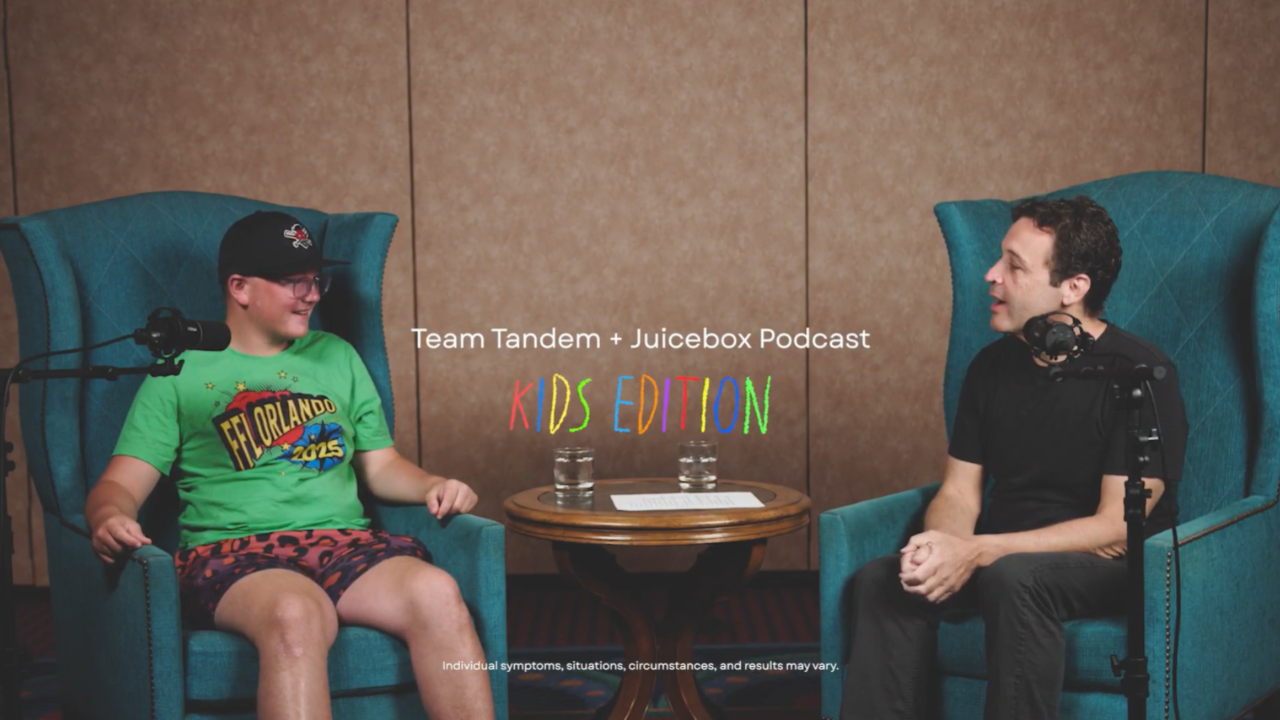
Scott interviews 13-year-old Connor about managing Type 1 diabetes while playing sports, using the Tandem Mobi pump, and his experience at the Friends for Life conference.
+ Click for EPISODE TRANSCRIPT
DISCLAIMER: This text is the output of AI based transcribing from an audio recording. Although the transcription is largely accurate, in some cases it is incomplete or inaccurate due to inaudible passages or transcription errors and should not be treated as an authoritative record. Nothing that you read here constitutes advice medical or otherwise. Always consult with a healthcare professional before making changes to a healthcare plan.
Scott Benner (0:00) I attended my first ever Friends for Life conference in July 2025. (0:05) And while I was there, I interviewed eight children of various ages, all who wear a Tandem pump. (0:10) I wanna thank Tandem Diabetes for sponsoring this short episode of the Juice Box podcast. (0:16) Check them out at tandemdiabetes.com/juicebox. (0:22) Nothing you hear on the Juice Box podcast should be considered advice, medical or otherwise.
Scott Benner (0:28) Always consult a physician before making any changes to your health care plan. (0:35) The episode you're about to listen to is sponsored by Tandem Moby, the impressively small insulin pump. (0:41) Tandem Moby features Tandem's newest algorithm, Control IQ Plus technology. (0:46) It's designed for greater discretion, more freedom, and improved time and range. (0:50) Learn more and get started today at tandemdiabetes.com/juicebox.
Scott Benner (1:08) Are we relaxed now? (1:09) We're good?
Connor (1:10) Yeah. (1:10) I'm good. (1:10) What's your name? (1:11) Connor. (1:12) Connor.
Connor (1:12) How old
Scott Benner (1:12) are you? (1:13) 13. (1:13) 13. (1:14) How long have you had type one?
Connor (1:16) Since I was three for ten years.
Scott Benner (1:18) Three? (1:19) Wow. (1:19) Mhmm. (1:20) The last person I talked to had it since they were two and they were 13. (1:23) Wow.
Scott Benner (1:24) You got him, he's got you by a little bit. (1:27) You don't remember anything about being diagnosed, I imagine?
Connor (1:30) I know a little bit. (1:31) So we were actually in Daytona for a vacation, and we were getting ice cream. (1:40) So we did that. (1:42) And once we were done, we went to the car, and I remember I had to go to the bathroom a lot.
Scott Benner (1:47) Yeah.
Connor (1:47) And then I also remember throwing up a lot, and then I just passed out. (1:52) Really?
Scott Benner (1:53) Mhmm. (1:53) You recall that at three from being three?
Connor (1:55) Mhmm.
Scott Benner (1:55) That's something. (1:56) How does your when your parents retell that story, do they sound scared when they talk about it? (2:01) Yeah.
Connor (2:01) Definitely a little
Scott Benner (2:02) bit scared. (2:03) Yeah. (2:03) Are you the oldest of your how many siblings?
Connor (2:05) Three.
Scott Benner (2:06) Three. (2:06) You the oldest?
Connor (2:07) Mhmm.
Scott Benner (2:07) You are. (2:07) Anybody else have type one? (2:09) No. (2:09) No. (2:09) How about in your extended family?
Connor (2:12) Aunts, uncles, cousins? (2:15) My aunt's husband has diabetes.
Scott Benner (2:18) Okay. (2:19) Do you guys ever talk about it?
Connor (2:20) Mhmm. (2:21) Yeah. (2:21) We talk about it all the time.
Scott Benner (2:23) Do you? (2:23) Mhmm. (2:23) Yeah. (2:24) Does he use a pump?
Connor (2:26) No. (2:26) He just does the insulin shots.
Scott Benner (2:28) He does shots, but you do. (2:29) What pump do you have? (2:31) Tandem. (2:31) Do you use Control IQ?
Connor (2:32) Yeah.
Scott Benner (2:33) Yeah. (2:33) Did you update it recently to the new software?
Connor (2:36) Yes.
Scott Benner (2:36) You like it? (2:37) Mhmm.
Connor (2:37) Yeah. (2:38) Yeah.
Scott Benner (2:38) What does it do something that, that helps you?
Connor (2:43) I just stay in range a little bit more.
Scott Benner (2:46) It it so the new update helps you stay in range even better? (2:49) Yeah. (2:49) It's awesome. (2:50) Was it doing well before that?
Connor (2:52) Yeah.
Scott Benner (2:52) Yeah. (2:52) Just a little bit of an upgrade.
Connor (2:54) Yeah.
Scott Benner (2:54) I'll take that. (2:55) Alright. (2:56) What's your favorite little snack when you get low? (2:58) What do you like to use? (2:59) Probably cheese crackers or a strawberry wafer bar.
Scott Benner (3:03) Strawberry oh, so the, like, the vanilla wafers with the strawberry cream in between? (3:07) Yeah. (3:08) I prefer the vanilla, but I'm I'm with you on that. (3:10) And they help you how many do have to eat to, like, stop a low?
Connor (3:15) Usually, I just do one. (3:16) Really? (3:17) Mhmm.
Scott Benner (3:17) It's a unique answer. (3:18) Most people are like you know what most people say. (3:20) Right? (3:20) Like, Fruit Roll Ups, gummy bears Oh, yeah. (3:23) Like, Smarties, stuff like that.
Scott Benner (3:24) Skittles, people say all the time. (3:26) Mhmm. (3:26) I've
Connor (3:26) just I don't go for, like, super high carbs, so I don't rise a lot.
Scott Benner (3:31) So you're trying to stop the low without causing a rebound? (3:34) Yeah. (3:34) Smart. (3:35) You had diabetes long enough, you know you don't wanna start the fight over again. (3:38) Right?
Scott Benner (3:38) Yeah. (3:39) So you're wearing a hat today.
Connor (3:41) What who's the hat from? (3:42) My dad's baseball league.
Scott Benner (3:45) Oh, no kidding. (3:45) Do you play?
Connor (3:46) Uh-huh. (3:46) Yeah.
Scott Benner (3:47) Yeah. (3:47) You play at school or you play, like
Connor (3:49) So our middle school doesn't do really any baseball, but our town does a huge baseball league. (3:56) Yeah.
Scott Benner (3:57) Where are you from?
Connor (3:58) Lowell, Indiana.
Scott Benner (3:59) Indiana. (4:00) Nice. (4:00) You where you play first base?
Connor (4:03) No. (4:04) Catcher You catch in third.
Scott Benner (4:05) Catcher in third. (4:06) I played third when I was younger. (4:08) Yeah. (4:08) If the ball comes at you so incredibly fast at
Connor (4:12) third base. (4:12) Right?
Scott Benner (4:12) It's insane, isn't it? (4:14) Yeah. (4:14) I'll tell you later about it. (4:15) My son played all the way through college. (4:17) It was a lot of fun.
Scott Benner (4:19) I'll tell you about how I cried after his last game. (4:22) For a while, I was very upset. (4:25) Do you love it? (4:25) Do you love baseball?
Connor (4:26) Yes. (4:26) I love baseball.
Scott Benner (4:27) Yeah. (4:27) You play anything else?
Connor (4:28) Mhmm. (4:29) Football and basketball.
Scott Benner (4:30) Oh, no kidding.
Connor (4:31) Mhmm. (4:31) And I like to fish.
Scott Benner (4:32) Is there any special stuff you have to do while you're playing sports or doing any
Connor (4:36) of your activities? (4:37) So for football and baseball, I usually just keep my pump on because, usually, when I'm, like, super active and stuff, the adrenaline gets to me, so I go a little bit high. (4:49) Yeah. (4:50) So I just keep that on just in case I go amazing.
Scott Benner (4:54) Are you very competitive? (4:55) Yes. (4:55) You wanna win? (4:56) Yeah. (4:56) And it drives your blood sugar up.
Scott Benner (4:57) Right? (4:58) Yeah. (4:58) So the pump's with you all the time Mhmm. (5:00) Fixing it. (5:01) Do you get low while you're playing?
Connor (5:04) Usually, for football, I get a little bit low. (5:07) Baseball, I don't really get that low.
Scott Benner (5:10) Mhmm.
Connor (5:10) I'm usually one twenty to one forty.
Scott Benner (5:14) Yeah. (5:14) But in football, there's more running? (5:16) Mhmm. (5:16) Where do you play on the field?
Connor (5:18) Center and, d end.
Scott Benner (5:20) Oh, so you're either exploding or fighting.
Connor (5:23) Yeah.
Scott Benner (5:23) Right? (5:24) And those are both take a lot out of you. (5:25) So do you prep? (5:27) Like, I I interviewed Noah Gray recently, and he told me how he preps for games. (5:31) Do you have, like, a thing you eat before you play?
Connor (5:34) Usually, I just get, like, a few protein bars, some subways.
Scott Benner (5:40) Yeah. (5:41) Stuff that kinda stays with you for a little bit. (5:43) And then after football, you gotta eat right away?
Connor (5:46) No. (5:46) I usually just, drink a lot of water because usually around after the games, I'm super dehydrated. (5:53) Yeah. (5:54) So I drink water, probably just check my numbers, see how I'm doing. (5:59) If I'm low, I just do a quick snack or juice.
Connor (6:03) And then, if I'm high, I just wait a little bit. (6:06) Yeah.
Scott Benner (6:07) Do you find it bothersome, or is it just kinda part of your life? (6:11) You don't think about it?
Connor (6:12) It's kinda part of my life now.
Scott Benner (6:13) Yeah. (6:14) What do hope to do when you grow up?
Connor (6:16) I me, personally, I want to golf or play basketball.
Scott Benner (6:22) Yeah? (6:23) How tall are you hoping to be? (6:25) Hopefully, like, six foot three, six four. (6:29) Alright. (6:29) So wait.
Scott Benner (6:30) How tall are you now?
Connor (6:31) Five eight, I think.
Scott Benner (6:32) You do have legs. (6:33) Your dad or mom, like, super tall? (6:35) My
Connor (6:36) my mom's not really that tall.
Scott Benner (6:38) No?
Connor (6:39) But my dad's up there a little bit.
Scott Benner (6:43) So you think it's gonna be your mom's fault if you can't play professional basketball one day? (6:47) She's holding you back.
Connor (6:48) No. (6:49) I never really try and blame my parents for anything. (6:51) Yeah. (6:51) Nice you are. (6:52) Probably genetic genetics from the family tree.
Connor (6:56) Yeah. (6:56) Yeah.
Scott Benner (6:56) I hear you. (6:56) My son blames me for not being able to play baseball longer. (6:59) I can tell you that much. (7:01) I know he does, actually. (7:04) Do you think about diabetes at school?
Scott Benner (7:08) Are there other kids you know who have type one? (7:10) Do you guys talk about it, or do you not know other people?
Connor (7:14) So actually, two of my friends got diabetes at different times. (7:20) In first grade, one of my buddies got diabetes, and, like, they were their family and their him were just super confused on, like, how to control it. (7:33) Yeah. (7:33) So, like, we just give them supplies and, like, try and just help them Yeah. (7:42) Be supportive.
Connor (7:42) Understand. (7:43) Yeah.
Scott Benner (7:43) Yeah. (7:44) You share with your friends about your diabetes?
Connor (7:47) Yeah. (7:48) They they're all pretty supportive about me. (7:50) They always check up on me to make sure I'm doing okay. (7:54) Yeah. (7:55) And, yeah, they just check on me.
Scott Benner (7:57) Would they know what to do if you got low and you couldn't help yourself?
Connor (8:00) Yeah. (8:00) They're they always come up to me during sports like, Connor, Connor, do you need a juice? (8:04) Do you need this? (8:05) Are you okay? (8:05) Yeah.
Scott Benner (8:06) Does it get annoying after a while? (8:07) Or are are you happy for it?
Connor (8:09) I think it's kinda nice Yeah. (8:11) Having supportive friends and caring friends.
Scott Benner (8:14) Yeah. (8:15) Me too. (8:15) That's awesome. (8:16) How did you meet how did you make good friends like that?
Connor (8:19) Really just like sports and just mostly being communicative about things.
Scott Benner (8:26) I agree. (8:27) You've ever have you ever done anything with your diabetes that you were, like, proud of? (8:31) Like, you're like, wow. (8:31) I I got that on my own. (8:32) Like, is there a a great bolus that you remember that you were just like, this really
Connor (8:36) worked? (8:37) Well, something that I'm really proud of is what I was talking about, like, my buddies out who had diabetes, like, telling them what they need to do.
Scott Benner (8:47) Yeah. (8:47) That's awesome. (8:48) Do you think, like, do you know what your a one c is?
Connor (8:52) My average is probably about, like, seven point o.
Scott Benner (8:56) Good for you. (8:56) That's awesome. (8:57) Good for you. (8:57) It's a lot of hard work.
Connor (8:58) Yeah.
Scott Benner (8:59) Yeah. (8:59) No kidding. (8:59) Do you remember to pre bolus your meals?
Connor (9:01) Yes.
Scott Benner (9:01) Do you? (9:02) Yeah. (9:02) Does your mom bug you about it all the time?
Connor (9:04) Yes. (9:04) A lot. (9:05) Does she
Scott Benner (9:05) listen to my podcast?
Connor (9:07) Yeah. (9:07) On the way here, we actually listen to most of them.
Scott Benner (9:09) Oh, awesome. (9:10) That's cool. (9:10) I'm glad, because I know that I think pre ball is saying, not just for kids, by the way. (9:17) Like, my daughter's 21. (9:18) She's had diabetes since she was two, but at the same time, I've interviewed people at literally every age up to, like, I think the oldest person with type one I ever interviewed was 80.
Scott Benner (9:29) And Wow. (9:29) Everyone will say the same thing. (9:31) It's really hard to remember to pre bolus my meals. (9:33) And so I don't think it's a thing that's gonna get easier, but if you're getting that accomplished, that's really awesome. (9:39) Also, like you said, like, you're five eight already, I mean, you're 13, right, so you're probably eating a lot during the day, so it's a great accomplishment to do what you're doing.
Scott Benner (9:47) Mhmm. (9:47) Yeah. (9:48) I'm I'm proud of you. (9:49) Thank That's awesome. (9:50) No.
Scott Benner (9:50) I know I know how hard the work is. (9:51) Do you have any diabetes heroes? (9:53) Anybody, like sports figures, people out in the world?
Connor (9:55) Yes. (9:56) Mark Andrews. (9:57) Oh, from the Ravens? (9:58) Yep. (9:59) Yeah.
Connor (9:59) He's really cool. (10:00) I really like him.
Scott Benner (10:01) Nice.
Connor (10:02) He inspires me to, like, keep pushing, keep doing what I'm doing, to not have diabetes stop me from what I like to do and my hobbies, and to keep my pump on during, like, my games.
Scott Benner (10:15) Yeah. (10:15) What's your favorite sport of the ones you play?
Connor (10:17) Basketball. (10:18) 100%.
Scott Benner (10:19) I love it. (10:20) That's the way you're best at?
Connor (10:21) Yeah.
Scott Benner (10:22) It's not just because you're obviously so much taller than other 13 year olds right now? (10:25) No. (10:26) Because you are. (10:26) Right? (10:27) Well,
Connor (10:28) I I would hope.
Scott Benner (10:29) Yeah. (10:30) Yeah. (10:30) Yeah. (10:30) You ever just go, like, move and then, you know what I mean? (10:33) Yeah.
Scott Benner (10:33) I just box out and make your move. (10:35) That's it.
Connor (10:35) Yeah. (10:36) I just put, like, 75% of my time into basketball. (10:40) I love that.
Scott Benner (10:41) You love the most? (10:42) Is it that time is about shooting? (10:44) Like, you just out there shooting all the time?
Connor (10:46) That's what I like. (10:47) That's that's what I'm better at. (10:50) Right. (10:51) But I I need to work on defense. (10:56) Yeah.
Connor (10:56) I'm slow. (10:57) Tandem pump.
Scott Benner (10:58) Right? (10:58) Mhmm. (10:59) Use it with a Dexcom?
Connor (11:01) Yeah. (11:01) Okay.
Scott Benner (11:02) Tell me what you like about it the most.
Connor (11:04) If you were gonna tell another person with diabetes, I I think you should try this pump. (11:08) Why? (11:09) Mostly because of Control IQ. (11:12) I also like the, the feature on, like, I can go on my phone and I can go through the app on my phone
Scott Benner (11:20) Yeah.
Connor (11:20) And I can just check on there.
Scott Benner (11:22) Do you find your parents to be supportive and helpful?
Connor (11:25) Absolutely. (11:26) 100%. (11:27) Yeah. (11:27) They're with me 100% of the time supporting me, guiding me through everything I need to do. (11:34) Yeah.
Connor (11:34) And I think that's really
Scott Benner (11:37) You feel lucky? (11:38) Yeah. (11:38) Yeah. (11:39) Do you find being here with so many people who have
Connor (11:41) type one at Friends for Life? (11:43) It definitely makes me feel safer being around people who is going through the same thing as me and definitely is nice.
Scott Benner (11:54) Safer is an interesting word. (11:55) How does it make you feel safer?
Connor (11:57) Not really, like, safer, but, like, comfortable.
Scott Benner (12:00) Yeah. (12:02) Well, comfort is safety. (12:03) Mhmm. (12:03) Yeah. (12:04) So you so you are, like, being here just what does it do?
Scott Benner (12:07) Does it take off? (12:09) Like, I mean, is there, like, a level of anxiety or, like, what what something's lifted.
Connor (12:14) Right? (12:14) Like, usually, when I'm at, like, a water park, not here, like, around my house, and people look at me weird for having, like, my sensors on and stuff. (12:26) So, yeah, it's definite and then
Scott Benner (12:29) No one's gonna look at you like that here. (12:30) Yeah. (12:31) That's pretty awesome. (12:32) Does your mom, like, track you all the time?
Connor (12:34) She's got the Follow app too. (12:36) So Yeah. (12:36) She she's definitely on me about it a lot, like, especially at sleepovers. (12:41) Did you give yourself insulin? (12:43) Did you check your number every thirty minutes?
Scott Benner (12:47) And you feel but that feels supportive to you. (12:49) Yeah. (12:50) Alright. (12:50) Listen. (12:50) Do something for me.
Scott Benner (12:51) As you get older, hold on to that feeling. (12:53) Okay? (12:53) Because you're gonna get older and think, oh, eventually, it's gonna feel like I can do it. (12:58) Do ever do you ever text back, I'm fine or I got it? (13:03) Have you ever said I'm fine or I got it in the text?
Connor (13:05) Yeah. (13:06) Most of the time, it's okay or yeah. (13:08) I got it.
Scott Benner (13:09) I'm alright. (13:09) If I open my text up with my daughter right now, it just says, I'm fine. (13:13) I got it. (13:13) I know. (13:14) Like, it's one of those three.
Scott Benner (13:15) Yeah. (13:16) Yeah. (13:16) It's nice that you know that it's because she cares and everything.
Connor (13:20) Yeah.
Scott Benner (13:20) It's gonna help you long term too, you know. (13:22) You'll probably get older. (13:23) You go you think you'll go to college?
Connor (13:25) Yeah. (13:26) I'm planning on going to Purdue.
Scott Benner (13:28) Okay. (13:28) Well, that's awesome. (13:30) And your mom's gonna be texting you then. (13:32) You'll be, like, 20 years old in a little, like, little room. (13:35) She's gonna be like, did you take a gummy bear?
Scott Benner (13:37) It's gonna be lovely when she does it too. (13:40) Do you have any questions for me?
Connor (13:43) How long has your daughter had had diabetes?
Scott Benner (13:46) Okay. (13:46) She's gonna be 21 in a couple weeks, and she was diagnosed just after her second birthday, so I think that's nineteen years, right?
Connor (13:53) Wow, that's a long time.
Scott Benner (13:55) Yeah, it's a really long time. (13:57) She's doing awesome. (13:58) That's good. (13:59) Yeah, so she does everything everybody else does. (14:03) She's in college right now.
Scott Benner (14:04) You have such a great attitude about this.
Connor (14:06) Thank you.
Scott Benner (14:06) Seriously, you're awesome to talk to.
Connor (14:08) Thank you.
Scott Benner (14:08) What why why are you awesome? (14:10) Your parents, like, are they seriously, why are you so nice? (14:13) You have a really good way about you. (14:15) Is it like, did they teach you to be that way? (14:17) Are you under duress right now?
Scott Benner (14:19) Is she, like, like, she's off on the side. (14:22) Are you scared that if you say something crazy, you're gonna get in trouble?
Connor (14:24) No. (14:25) No? (14:25) No. (14:25) They just taught me the right way. (14:28) I always live by treat others how you wanna be treated.
Scott Benner (14:32) Right on, man.
Connor (14:33) It really means something to me. (14:34) Wow.
Scott Benner (14:35) This is awesome. (14:36) Hey. (14:36) Listen. (14:36) If you have problems with them, I'll adopt you. (14:38) Alright?
Scott Benner (14:39) Because you seem like you'd be easy to handle. (14:41) You know what I mean? (14:41) Like, I don't think I'd have too much trouble with you. (14:43) You seem are your brothers and sisters a problem? (14:46) Is it just you that's great?
Scott Benner (14:47) Like, what's going on here?
Connor (14:48) No. (14:48) My brothers are all the same way. (14:50) They love to be nice.
Scott Benner (14:52) Good job, mom. (14:53) Was it the dad too, or you took care of it yourself?
Connor (14:56) I mean, 97.
Scott Benner (14:57) Yeah. (14:57) Yeah. (14:58) I gotcha. (14:58) Yeah. (14:59) Your dad just goes hunting.
Scott Benner (15:00) Right? (15:01) That's pretty much it.
Connor (15:01) He's a big talker. (15:03) He loves to talk.
Scott Benner (15:04) He loves to talk? (15:05) Yes. (15:06) He ever get going and you're like, yeah. (15:07) We heard the story already.
Connor (15:08) Yeah. (15:09) He could, like, say one thing to someone and that conversation can go on for, like, forty five minutes.
Scott Benner (15:14) Your dad and I might get along. (15:16) You know? (15:17) I can I can go for a while myself? (15:19) So before before you were using Tandem, what were you doing?
Connor (15:22) So, originally, we were on shots, like, for the first couple years, and then we moved to Omnipod, which really didn't work out well because I had two seizures for with Omnipod.
Scott Benner (15:37) You got too low?
Connor (15:39) Or no. (15:40) It wasn't too actually, one of them were. (15:42) The first one was, severe, like, a pretty bad seizure. (15:48) Yeah. (15:49) The second one was actually on the way here to Friends for Life, and, obviously, it wasn't that bad.
Scott Benner (15:55) Previous previous year or this year?
Connor (15:58) The first year. (15:58) The first year you came here? (16:00) Mhmm.
Scott Benner (16:00) And so you you got you got very low. (16:02) You you actually had, like, a seizure.
Connor (16:04) Yeah.
Scott Benner (16:04) Do you know how they handled it? (16:05) Did you use glucagon, or did you use gel or food? (16:09) How did you manage it?
Connor (16:10) So we used it was some short sort of shot shot. (16:18) Yeah. (16:19) And, for the first one, because we didn't really have anything for the second one because we were in Georgia at a hotel.
Scott Benner (16:27) Yeah.
Connor (16:28) So we kinda just ate breakfast at the hotel. (16:30) They were giving me stuff. (16:32) What did do you remember anything about it? (16:36) The first one was just, like, both of them were, like it was like if I was in a dream or something. (16:42) It like, I didn't know what was going on.
Connor (16:45) I wasn't myself. (16:46) Yeah. (16:47) I was scared. (16:48) I didn't really know what was going on.
Scott Benner (16:50) This has happened to my daughter. (16:51) This has happened to my daughter, and she described that it felt it felt like she was jumping. (16:57) So she's like so she's like, I felt like I was on one side of the room, and then the next thing I knew, I was 10 feet ahead. (17:03) Yeah. (17:03) And then, like, so, like, she, like, in and out of, like, consciousness kind of thing, but she she she described it specific as, like, it felt like I was jumping through time.
Scott Benner (17:11) Did you have that experience?
Connor (17:13) Yeah. (17:13) So it was kinda when, like, we were walking out of the hotel room, and next thing I know, we're in, like, the elevator. (17:23) Yeah. (17:23) And it was weird.
Scott Benner (17:25) Really weird. (17:25) Did you actually seize? (17:26) Did were you, like like, convulsing, shaking, or you just bruised your blood sugar super, super low?
Connor (17:32) For the first one, I think I was. (17:34) I was, like, really low, and I was, like, unconscious too for a little bit.
Scott Benner (17:41) After that happens, is it is it scary to do the normal things that you're supposed to do? (17:46) Like, how long does it take for you to get past the the memory of that?
Connor (17:50) It definitely definitely scares me, like, from now going to, like, the rest of my life. (17:57) Yeah. (17:58) But, I think it's kinda my fault because I get my I probably didn't carb count correct and Gave yourself so much insulin.
Scott Benner (18:10) Yeah. (18:10) Yeah. (18:10) And now you're better with that? (18:12) Mhmm.
Connor (18:13) Yeah. (18:13) Definitely more, like, comfortable. (18:16) And switching to tandem, I've been amazing. (18:19) Like, my control has been so much better.
Scott Benner (18:23) I usually tell people when I speak to them that you can kind of tell when people are gonna be successful. (18:28) Mhmm. (18:28) And I find the two indicators for being successful is being interested and paying attention. (18:34) Like, just like every day putting a little bit of effort into it and actually caring how it goes. (18:39) Like, do know I mean?
Scott Benner (18:40) They almost seem like the same idea, but they're not quite. (18:42) And so, like, if you're interested, you're paying attention, you want this to go well, generally speaking, can. (18:49) You know, you have great technology, you've got, you know, you've got your tandem pump, you've got your CGM, you got good people around you, you're interested in doing it, you're gonna be really successful that way, think.
Connor (18:59) Yep. (18:59) That's that's the plan. (19:00) Thank you.
Scott Benner (19:01) So you weren't having a lot of luck with Omnipod and you wanted to switch to another pump. (19:04) What made you choose Tandem?
Connor (19:06) It wasn't really my idea. (19:08) It was my mom's. (19:09) She just wanted to try a new pump and see how it went.
Scott Benner (19:12) Sounds like your mom talked to a lot of people with diabetes, got a consensus, and came back to you and told you, you're getting a tandem pump. (19:18) Is that what happened?
Connor (19:19) Yeah.
Scott Benner (19:19) And you were like, thank you, mom. (19:22) And you've liked it so far. (19:23) Right? (19:23) Mhmm. (19:23) Yeah.
Scott Benner (19:24) It's been great. (19:24) It's awesome. (19:25) And you and you wear it through all your sports. (19:27) You told me earlier, but you don't disconnect for like, you wear playing basketball?
Connor (19:31) Not really.
Scott Benner (19:32) Not for basketball? (19:33) No. (19:33) Do you bolus a little bit extra before you play, or do you take do you just check and, like, do clip back in? (19:38) How do you handle it?
Connor (19:38) Yeah. (19:39) I usually bolus before a game. (19:41) And then when I, like during a timeout or, like, we come off the court for a minute, I go and check my pump and see how I'm doing.
Scott Benner (19:51) Yeah.
Connor (19:51) If I'm high, just do a small little bolus and then just get back on the court.
Scott Benner (19:57) So you just clip in, give yourself some insulin, take it off again, go back and play again. (20:00) And then Feel smooth? (20:02) Mhmm. (20:02) Yeah.
Connor (20:02) Yeah. (20:03) And then when I'm low, every single sport I do this, I bring this little, like, small fanny pack
Scott Benner (20:10) Yeah.
Connor (20:10) And I pack, like, two juice boxes and then, like, some fruit snacks in it just in case I go low.
Scott Benner (20:18) Every kid that I see that has carrying a bag, I'm like, oh, they have diabetes. (20:21) Like, you know, I I saw this one kid moving in. (20:23) He had these little boxes he was carrying to his room, I was like, those are definitely his supplies in that box. (20:28) You got a box like that?
Connor (20:29) Oh, yeah.
Scott Benner (20:30) Drawer at home or something?
Connor (20:31) Yeah. (20:31) Yeah.
Scott Benner (20:31) My man, thanks, man. (20:32) That was awesome. (20:33) You
Connor (20:33) were
Scott Benner (20:33) very Thank you so much. (20:34) The podcast you just enjoyed was sponsored by Tandem Diabetes Care. (20:39) Learn more about Tandem's newest automated insulin delivery system, Tandem Mobi with Control IQ plus technology at tandemdiabetes.com/juicebox. (20:49) There are links in the show notes and links at juiceboxpodcast.com. (20:53) If you'd like to hear about diabetes management in easy to take in bits, check out the small sips.
Scott Benner (20:59) That's the series on the juice box podcast that listeners are talking about like it's a cheat code. (21:04) These are perfect little bursts of clarity, one person said. (21:08) I finally understood things I've heard a 100 times. (21:11) Short, simple, and somehow exactly what I needed. (21:14) People say small sips feels like someone pulling up a chair, sliding a cup across the table, and giving you one clean idea at a time.
Scott Benner (21:22) Nothing overwhelming. (21:23) No fire hose of information. (21:25) Just steady helpful nudges that actually stick. (21:28) People listen in their car, on walks, or rather actually bolus ing anytime that they need a quick shot of perspective. (21:35) And the reviews, they all say the same thing.
Scott Benner (21:38) Small sips makes diabetes make sense. (21:40) Search for the Juice Box podcast, small sips, wherever you get audio.
Please support the sponsors
The Juicebox Podcast is a free show, but if you'd like to support the podcast directly, you can make a gift here. Recent donations were used to pay for podcast hosting fees. Thank you to all who have sent 5, 10 and 20 dollars!
#1755 Defining Diabetes: Lantus Lows
You can always listen to the Juicebox Podcast here but the cool kids use: Apple Podcasts/iOS - Spotify - Amazon Music - Google Play/Android - iHeart Radio - Radio Public, Amazon Alexa or wherever they get audio.
Scott and Jenny define "Lantus Lows" in this Defining Diabetes episode.
+ Click for EPISODE TRANSCRIPT
DISCLAIMER: This text is the output of AI based transcribing from an audio recording. Although the transcription is largely accurate, in some cases it is incomplete or inaccurate due to inaudible passages or transcription errors and should not be treated as an authoritative record. Nothing that you read here constitutes advice medical or otherwise. Always consult with a healthcare professional before making changes to a healthcare plan.
Scott Benner (0:0) Welcome back, friends, to another episode of the Juice Box podcast. (0:15) Managing diabetes is difficult, but trying to do it when you don't understand the lingo, that's almost impossible. (0:22) The defining diabetes series began in 2019, and today we're adding to it. (0:26) Go to juiceboxpodcast.com up in the menu, click on defining diabetes, and you'll see a complete list of all the terms that we've defined so far. (0:37) If this is your first time listening to the Juice Box podcast and you'd like to hear more, download Apple Podcasts or Spotify, really any audio app at all.
Scott Benner (0:46) Look for the Juice Box podcast and follow or subscribe. (0:49) We put out new content every day that you'll enjoy. (0:53) Wanna learn more about your diabetes management? (0:55) Go to juiceboxpodcast.com up in the menu and look for bold beginnings, the diabetes pro tip series, and much more. (1:02) This podcast is full of collections and series of information that will help you to live better with insulin.
Scott Benner (1:11) While you're listening, please remember that nothing you hear on the Juice Box podcast should be considered advice, medical or otherwise. (1:19) Always consult a physician before making any changes to your health care plan or becoming bold with insulin. (1:30) Jenny, is the term Lantus Low a common thing that you hear?
Jenny Smith (1:35) Lantus Low.
Scott Benner (1:36) Lantus Low. (1:37) This is one of the things people want to find. (1:40) So what do they mean? (1:41) Are they talking about, like, their blood sugars just kept getting keep getting dragged down by basal?
Jenny Smith (1:46) That's what I would expect would be the definition because you can't you know, Lantus being a long acting insulin, it's dosed typically once a day. (1:58) It's supposed to be a twenty four hour acting insulin. (2:00) Mhmm. (2:01) Of the previous types of intermediate acting insulins, Lantus was huge because it had a much more plateaued effect for twenty four hours compared compared to the cloudy intermediates, which had a peak and a drop. (2:16) Right?
Jenny Smith (2:16) But Lantus low, I would expect, could come from two places. (2:22) Usually, we would do basal evaluation to note whether the dose is right or not by looking at overnight.
Scott Benner (2:28) Okay.
Jenny Smith (2:29) So regardless of whether you dose your basal Lantus in the morning or the evening, we would evaluate the overnight to determine if the dose is too heavy, if it's pulling your blood sugar down, a Lantus low, in an environment where there's no IOB from rapid insulin or food intake or whatever, then the dose would need to be adjusted because the basal's job isn't to pull you down.
Scott Benner (2:52) Yeah.
Jenny Smith (2:52) Right? (2:53) Daytime too, you know, if you ever skipped a meal or whatever on MDI, having basal as dialed in with Lantus or any of the basal injectables is beneficial because, sure, it could drop your blood sugar if the dose is not right. (3:09) But Lantus low, that's interesting. (3:11) I've I guess I've never heard it put together as a term.
Scott Benner (3:14) Yeah. (3:14) I haven't either, but it was it was brought up by enough people that it made it on the list. (3:18) And I saw some examples of, I went low overnight for my basil. (3:23) Somebody said Lantus is peaking. (3:25) Do they does it maybe burn a little brighter sometimes, or do they think it's stronger in the beginning than at the end maybe?
Scott Benner (3:32) Is that maybe how they're thinking of it?
Jenny Smith (3:33) Yes. (3:34) In terms of it's supposed to be a plateau type of basal insulin.
Scott Benner (3:38) Yeah.
Jenny Smith (3:39) But, again, person to person, we all know things work a little bit differently. (3:44) For me, I mean, I Lantus was my transition to a long acting basil coming off of that cloudy intermediate. (3:52) And for me, I can say that had I not adjusted it and also always had a nighttime snack
Scott Benner (4:01) Mhmm.
Jenny Smith (4:02) I would have been consistently low during the overnight time. (4:07) Okay. (4:08) So is there a peaking time? (4:11) Not like the intermediate insulins, but there could be a time period where it seems to really work heavier.
Scott Benner (4:19) Yeah.
Jenny Smith (4:19) I do know that another piece to Lantus is that while being a twenty four hour acting insulin, for some people, it peters out at the very end hours. (4:30) Like, it only lasts really about twenty hours, not truly twenty four hours Yeah. (4:34) Which isn't a low issue, but could be where you might adjust, and then you end up having lows to beat the end.
Scott Benner (4:42) I don't know. (4:42) What if you had a very sedentary job and you're active on the weekends, but you shot the same amount every day? (4:47) Like, maybe that would feel like and I guess it would be true. (4:50) Right? (4:51) Like, during the activity, it'd be like, oh, the basils.
Scott Benner (4:54) Would be easy for somebody to say my basal insulin's pulling me down instead of thinking my activity is making me lower. (4:59) Like, you could see you know what I mean?
Jenny Smith (5:01) Yeah. (5:01) And for women during cycle time, I know when I was on Lantus, I had two doses.
Scott Benner (5:08) Mhmm.
Jenny Smith (5:09) I had a dose for the time period after my period started and up until kind of mid cycle or until, like, that week before my next cycle was expected to start. (5:20) I had a dose that, in general
Scott Benner (5:22) Yeah.
Jenny Smith (5:22) Worked as well as it could. (5:24) Right? (5:24) And then I had a dose for that week before that was three units higher.
Scott Benner (5:29) Okay.
Jenny Smith (5:30) I still remember the doses because
Scott Benner (5:33) It's like
Jenny Smith (5:33) kinda funny how you remember
Scott Benner (5:34) those things. (5:35) Right? (5:35) My mind. (5:36) So okay. (5:36) I guess if you're seeing somebody use this online, this is one of the things they're trying to convey.
Scott Benner (5:41) They had a low overnight. (5:42) They think it's basal related. (5:44) I would probably try to ask those people to maybe zoom out a little more and see the other things that are affecting them. (5:51) I think it's possible if you don't find yourself blaming the basal insulin, you might find the The variables that are variables
Jenny Smith (5:58) that creating.
Scott Benner (5:59) That are at hand. (5:59) Yes. (6:00) Anyway Mhmm. (6:00) Well, there's one I never heard before. (6:01) So
Jenny Smith (6:01) thanks Great. (6:02) For Me either. (6:02) Thank you.
Scott Benner (6:03) I don't know if we defined it, but I think we tried to figure it out. (6:12) Okay. (6:12) Well, here we are at the end of the episode. (6:14) You're still with me? (6:15) Thank you.
Scott Benner (6:16) I really do appreciate that. (6:17) What else could you do for me? (6:19) Why don't you tell a friend about the show or leave a five star review? (6:23) Maybe you could make sure you're following or subscribe in your podcast app, go to YouTube and follow me, or Instagram, TikTok. (6:32) Oh, gosh.
Scott Benner (6:33) Here's one. (6:34) Make sure you're following the podcast in the private Facebook group as well as the public Facebook page. (6:40) You don't wanna miss please, do you not know about the private group? (6:43) You have to join the private group. (6:45) As of this recording, it has 74,000 members.
Scott Benner (6:48) They're active talking about diabetes. (6:51) Whatever you need to know, there's a conversation happening in there right now. (6:55) And I'm there all the time. (6:56) Tag me. (6:57) I'll say hi.
Scott Benner (6:59) If you've ever heard a diabetes term and thought, okay. (7:02) But what does that actually mean? (7:04) You need the defining diabetes series from the Juice Box podcast. (7:07) Defining diabetes takes all those phrases and terms that you don't understand and makes them clear. (7:13) Quick and easy episodes.
Scott Benner (7:15) Find out what bolus means, basal, insulin sensitivity, and all of the rest. (7:19) There has to be over 60 episodes of Defining Diabetes. (7:22) Check it out now in your audio player or go to juiceboxpodcast.com and go up into the menu. (7:28) Have a podcast? (7:29) Want it to sound fantastic?
Scott Benner (7:30) Wrong way recording.com.
Please support the sponsors






The Juicebox Podcast is a free show, but if you'd like to support the podcast directly, you can make a gift here. Recent donations were used to pay for podcast hosting fees. Thank you to all who have sent 5, 10 and 20 dollars!