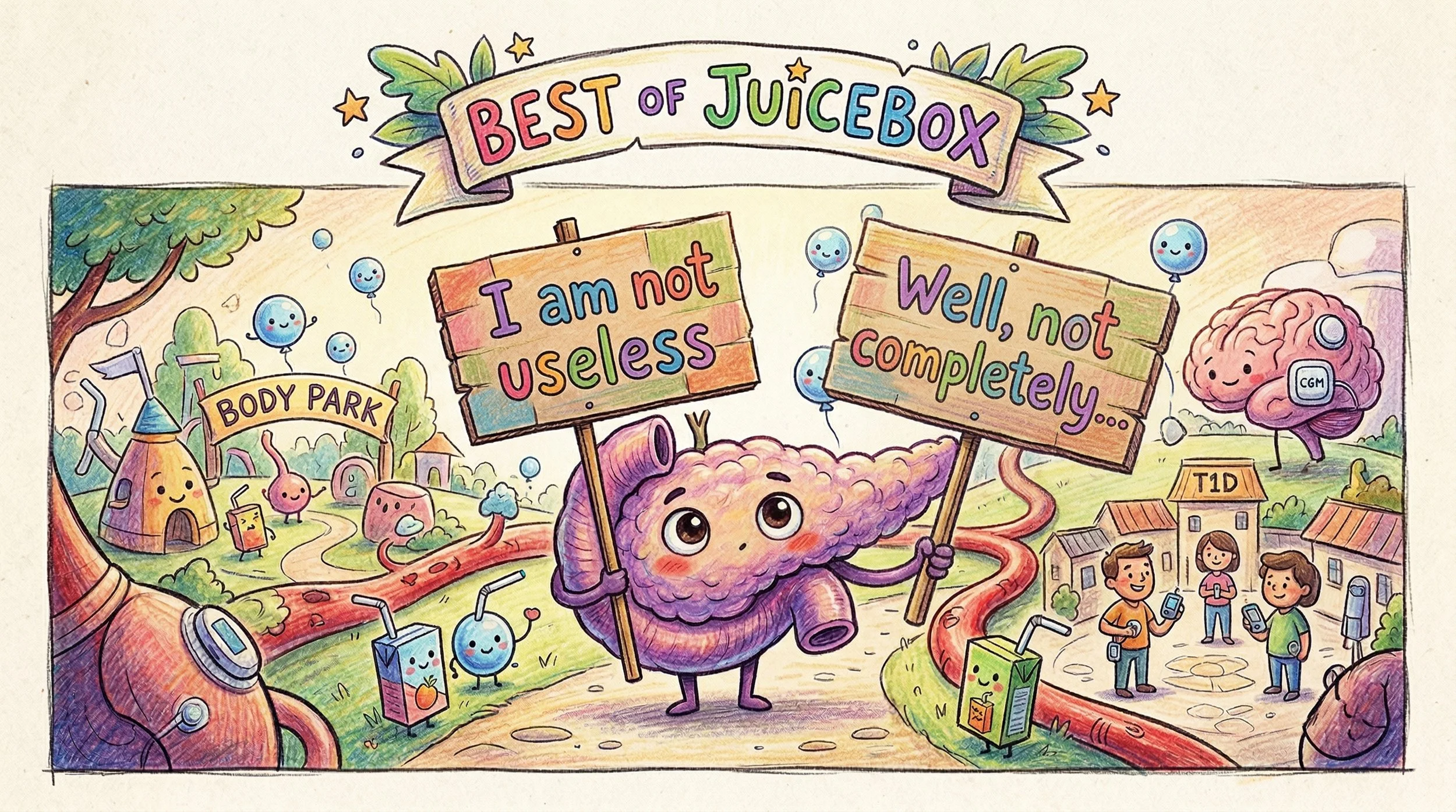
#1810 Best of Juicebox: Owner of a Useless Pancreas
Your pancreas isn't dead. It actually still does some important stuff. Today Jenny and Scott explain what your pancreas does and what it may be struggling with that isn't insulin related.


























Companies that Support Juicebox









Key Takeaways
- The Pancreas Does More Than Make Insulin: While Type 1 diabetes halts the pancreas's endocrine function (making insulin), its exocrine function (producing digestive enzymes) can also be impaired. Poor digestion might not be "just a stomach ache"—it could be an enzyme deficiency.
- Digestive Enzymes as a Missing Link: If you or your child with T1D experience chronic constipation, severe stomach pain, or slow-digesting meals that mess up your bolus timing, over-the-counter digestive enzymes (like lipase, amylase, and protease) might offer significant relief.
- Don't Accept "In-Range" for Thyroid or Iron if You Have Symptoms: If you're experiencing extreme fatigue, an "in-range" Ferritin level under 70 or a TSH over 2.0 might still be the culprit. Push your doctor for therapeutic treatments (like an iron infusion or thyroid meds) rather than accepting a technical "in-range" dismissal.
- Treat the Root Cause, Not the Symptom: Doctors often prescribe medications to cover up symptoms (like pain pills for stomach aches) rather than investigating the root cause (like poor digestion or absorption issues). Advocate for comprehensive testing.
- Gut Health Impacts Overall Autoimmune Health: A compromised digestive system can increase systemic inflammation and trigger or worsen other autoimmune conditions (like celiac or thyroid issues). Maintaining a healthy gut is a crucial part of managing T1D.
Resources Mentioned
- T1D Exchange Survey: t1dexchange.org/juicebox
- Dexcom G6: dexcom.com/juicebox
- Omnipod (Dash and 5): omnipod.com/juicebox
- Integrated Diabetes Services: integrateddiabetes.com
- Figwee App
- Juice Box Podcast Episode 767: Arden's Supplements
- Juice Box Podcast Episode 413: Thyroid Symptoms Explained
Introduction and the Role of the Pancreas
Scott BennerHello, friends, and welcome to episode 792 of the juice box podcast. Do you wanna know what it's about? I'll tell you in just a second. It is likely that you've seen a t shirt that says owner of a dead pancreas, owner of a useless pancreas, my pancreas quit on me, or, you know, any number of variations of that theme. Well, yeah, I hear what you're saying. Feels like that. Right? Won't make you any insulin, but maybe you didn't know that the pancreas does more than that. So even if it's not making insulin for you, it's still helping you with something else that's very important. But for some people, it doesn't do that thing perfectly. Just listen. We're gonna go over the whole thing. It's very important that you understand what your pancreas does and what it might not be doing. And if you're seeing symptoms of that, how you can help yourself. You're gonna love it. And, of course, Jenny's here. So, I mean, even if I suck, Jenny's amazing. Nothing you hear on the juice box podcast should be considered advice, medical or otherwise. Always consult a physician before making any changes to your health care plan or becoming bold with insulin. That's pretty much it. Except, hey. Don't forget to go to the t1dexchange and take the survey. T1dexchange.org/juicebox. Today's episode of the podcast is sponsored by two longtime advertisers. Dexcom, makers of the Dexcom g six continuous glucose monitor, and Omnipod, the insulin pump that my daughter has been wearing since she was four years old. To learn more about the Dexcom g six and to get started today, go to dexcom.com/juicebox. And if you're interested in the Omnipod five or the Omnipod dash, you can find out about both of them at omnipod.com/juicebox. Now we get to the show. And Jenny, who by the way works at integrateddiabetes.com. Hey. Hold on. Yeah. What's up?
Jenny SmithHow are you feeling?
Scott BennerMy head's a little swimmy, but I can breathe.
Jenny SmithThat's not good. I was gonna actually see if you wanted if you were okay to do this this morning or if you wanted to sleep until noon.
Scott BennerWell, what I thought was if I could do this, then I could do the thing later. Because if this doesn't go well, I gotta make a phone call.
Jenny SmithGotcha.
Scott BennerBut, hey, I was cold all night, like, kind of like
Jenny SmithI can't get warm, like, insert.
Scott BennerOh my god. Why won't I warm up? Then you but I don't know. It's it's super strange. I have no restriction in my lungs whatsoever. But if I start to cough on purpose, then it feels like something's happening. So, hopefully, that won't get worse. Jenny, you have no idea. I am
Jenny SmithI'm sorry.
Scott BennerI don't get sick.
Jenny SmithThanks. I know you told me that the last time we talked. You're like, I'm fine. I don't get sick.
Scott BennerAnd I blew right through.
Jenny SmithNothing ever happens to be cough on me.
Scott BennerIt'll be fine. This thing, I texted my buddy yesterday. He's a doctor. And I said, what's going around that isn't COVID?
Jenny SmithHe
Scott BennerRSV. Goes Is that what it is? Yeah. Yeah. Because he's
Jenny Smithlike I've had so many kids, so many parents. Like, I'm home with my kids. I hope you don't mind. They're screaming in the backyard. They all have or in the background while we talk. They all have RSV. One lady, actually, their whole daycare shut down because three quarters of the daycare had r s RSV. So yeah. You know?
Scott BennerYeah. He's like, it's gonna be head, chest, tired, could last ten days or more, he said. I was like, oh, good. So as I'm asking him that, my son comes home from a place he went. He's like, I'm not okay. And I was like, alright. I was like, get in bed, loaded him up with some Advil, cold and sinus, which seems to clear the head thing. So, anyway, we just need to be better because I'm gonna find a way to go to the World Series. And I I know
Jenny SmithYou are.
Scott BennerI mean, if I can. I'm gonna figure it out if I can. Alright.
Jenny SmithWell, you know plenty of people. I'm quite sure that somebody would probably be very happy to give you tickets, Scott.
Scott BennerI've already floated that on the Internet to see what might happen. So I was like I said, how would you like your kid to have amazing blood sugar?
Jenny SmithYes. Kind of like runs with Jenny. Right?
Scott BennerRuns with Jenny. Oh my god. Yes. She did. What so tell me but we'll leave this all in. Tell me what happened yesterday.
Jenny SmithOh, yeah. It was it's just I it's just funny. I call it diabetes in the wild. Right? Where you, like, you find people or you see their tubing or you see something on someone, you know, whatever. So, yeah, I had a half marathon yesterday running, running, running. It was, like, mile five ish, I think. Mhmm. And I hear like, I always run with only one earbud in
Scott BennerYeah.
Jenny SmithBecause I I I don't like complete, like
Scott BennerMhmm.
Jenny SmithNot being able to pay attention. Anyway, I hear this, like, really stompy feet coming. They could be high, and somebody's, like, breathing heavy to the to the point that I knew that they were running quickly. And this woman, like, speeds up next to me, and she's like, I was trying to catch you. I saw your Dexcom on your arm. And I was like, oh, yeah. She's like, I have a little girl who's, had type one a long time, and she did yes. It was like a two day sort of event. Yesterday was like the five k, the five k dog, jog, and that kind of stuff. And then the day yesterday was the half marathon, and then the kids, like, fun run.
Scott BennerMhmm.
Jenny SmithSo her daughter had done the five k the day before on Saturday. And she's like, you know, I thought we're we're all good, and then she's like, double arrowing down at the end of the event. She's like, I just wanted to know how do you prevent low blood sugars while you're running, she said. And this is a half marathon, not a five k. So we got to talking and, you know, it was just it's always fun to to, like, be able to share and whatnot. And I said, well, I said, to be honest, I've been doing this a long time. And two, I'm a diabetes educator. And three, you should really listen to this super awesome podcast.
Scott BennerJenny's out there selling. I like that.
Jenny SmithBut, yeah, we got to talking and just like some ideas. She's her daughter's also just a couple of days into Omnipod five. Mhmm. So, like, lots of variables in the picture there for this race, that's you know, she's like, we've been doing this a number I her daughter had had type one already for six years. They're not like newbies by any means, but just new technology and everything in the picture and just trying to figure things out.
Scott BennerNew algorithm Yeah. And three days later on a marathon.
Jenny SmithYeah. Yeah.
Scott BennerLook at you out there in the world. It was it
Jenny Smithwas it's always it's always fun. Excellent. You know? We
Scott Benneralright. Cool. So here's what we're gonna do today because just in case I don't leave in the explanation, I have the illness upon me. And I'm going to see I'm gonna keep the one topic today because I think jumping around might get me. I'm gonna stick the one thing.
Jenny SmithSo Now people are gonna think, well, what kind of illness does Scott had? Because all you said was the illness. Yes.
Scott BennerI know it's
Jenny SmithIt could be a random whatever is going around. Right?
Scott BennerHere it is. It it's a I was sleeping in bed on my side and I was I woke up and I'm like, oh, I'm very tired. I should text Jenny and tell her no. I'm like, no. I'm not gonna do that. I'm gonna get up. I'm gonna take a shower. I'll take the dogs out. I can do this. My voice is there. I'm gonna be okay. And I got up and I was like, oh, I'm freezing.
Jenny SmithLet's get back in bed.
Scott BennerI put all my clothes on. I had my hood up to take the dogs outside. I came back upstairs. I I I'm not a person who prepares before a shower. That might be a thing that women don't understand, but I usually get out of the shower and then look for my clothes. But this time, I got all my clothes together because I'm like, I'm not getting out and being cold.
Jenny SmithRight.
Scott BennerI finished my shower. I opened the shower curtain, and I did not get a towel.
Jenny SmithOh, no. So I was like,
Scott Bennerdamn it. Damn it. And I got a towel, and now I'm freezing and threw the clothes on. And then I just did something I never do. I I had fifteen minutes till we had to do this. I just sat down. I was like, I'm just I'm not I'm just gonna sit here. So I'm wearing a sweatshirt right now. By the time we're done, I could be in a tank top. I have no idea how this is gonna go. But what we're going to do today
Jenny SmithYeah.
Scott BennerWe are going to debunk the classic diabetes phrase, owner of go ahead, Jenny. Finish it.
Jenny SmithA dead pancreas.
Scott BennerThat's right. It is time to debunk owner of a dead pancreas. And it there's so I've got my Google. Foo is all done because I don't wanna be wrong. And I but I have a lot of anecdotal information about this.
Jenny SmithOh, good.
Scott BennerSo let's start here. The Cleveland Clinic, a reputable organization.
Jenny SmithYes. Very reputable.
Scott BennerI mean, it would I was gonna say it would have to be great to be in Cleveland, but let's not do that. The pancreas is an pancreas is an organ in the back of your abdomen. It is part of your digestive system. Oh. Mhmm. The pancreas is an organ and a gland. Glands are organs that produce and release substances in the body. Mhmm. The pancreas performs two main functions, an exocrine function, which produces substances, enzymes that help with digestion.
Jenny SmithYou just had lots and lots of enzymes talking about Arden in her supplements. So, yes.
Scott BennerAnd it so I'm gonna there's one more thing here. Let me finish this. It says the endocrine function sends out hormones that control the amount of sugar in your bloodstream. So let's tell people what's in the exocrine system. Oh, Jesus. Tear glands, mammary glands, mucous membranes, your prostate, your salivary glands. I don't know this one. Sebaceous glands?
Jenny SmithSebaceous.
Scott BennerSebaceous oil, sweet glands. And then what is in the endocrine system? Adrenal glands, uh-oh, hypothalamus, ovaries and testes, parathyroid and thyroid gland, pineal gland, pituitary gland, thymus.
Jenny SmithMhmm.
Scott BennerOh, I did really well with the pronunciations, didn't I?
Jenny SmithExcept you called them sweet glands instead of sweat glands. Oh my god. I'm gonna I was totally chuckling. Like, you're like, yeah. You have a fever, I think. Well,
Scott Bennerfirst of all, I do. And but for a person who's, you know, trying to sit up and keep his head still, I thought I did okay there. Okay.
Jenny SmithYou did perfect.
The Gut and Digestive Issues in T1D
Scott BennerYeah. Thank you, sweat glands. Alright. Now the extent that I've seen this in the diabetes community is just this. People have t shirts that say proud owner of a useless pancreas, proud owner of a dead pancreas. And then someone else will come up to them and say, your pancreas does more than make insulin. And then it never goes anywhere from there.
Jenny SmithRight.
Scott BennerBut I've heard that conversation for the better part of the entire time that Arden's had diabetes. And yet, when Arden had problems with digestion, we looked at every other possibility in the world about why her stomach might hurt except for digestion. And she suffered for a couple of years.
Jenny SmithYeah. Yeah. You looked at her digestive system without looking at the pieces that help digestion. Right? It's it's like looking at just the part or giving, which is very common. I have to say it. Oftentimes, you go in with a symptom and you get a medication to take care of the symptom, but the problem is never addressed.
Scott BennerYes. Right? And I can for sure say that because by the time we broke down, and I wanna give my wife credit, my wife tried to get me to take her for a endoscopy for like a year. Mhmm. And I was so certain because of the joint pain and that other stuff, I thought I was so certain it can't be that. But now I'm here to tell you that I am I am fully down the hippie rabbit hole about your gut health. And we're gonna talk about that now too. So I I it's one don't you think it's one of those things most people hear? And they're like, yeah. Yeah. Yeah. My problem is that.
Jenny SmithYeah. It's very it is. I mean, you say hippie. It's kind of earthy, crunchy, sort of whatever. But truly, I mean, your digestive system is an enormous part of your immune system.
Scott BennerMhmm.
Jenny SmithIt's an enormous part of you think you think digestion and you think about poop. At least my boys do. Right? Like, they're little kids, so whatever. But if you think about what your digestive system is really supposed to be doing, it's breaking down the food that you've eaten into macronutrients, fats, proteins, carbs
Scott BennerMhmm.
Jenny SmithAnd then it helps to absorb them the right way and put them back into the body, at least the ones that you hope go back into your body.
Scott BennerYeah.
Jenny SmithRight? So if the breakdown isn't happening the right way, you're gonna end up with a lot of digestive issues possibly first or later on. And you're also gonna have a lot of other things in your body that aren't functioning the way that they're supposed to be functioning. But there again, it comes off as a symptom. You may feel the joint pain. You may have an off monthly cycle, or you might have this or that, but it never comes back to, well, gosh. Is it an absorptive issue? Is it another problem with another, like, you know, the the pancreas? Is it something else? So
Scott BennerAlso, while your stomach is basically acting as I'm gonna just say something terrible here, a cesspool for food because it is not going through you quickly enough. Right? It just stuff is sitting in there and it's festering. It is not a healthy environment. The bad bacteria overwhelms the good bacteria. And then you slide down like a it's just an endless shoot. But the problem is, this is crazy. If you look back over the 700 and some episodes of this podcast, we've hit every idea around this except the idea of digestion. We have episodes two sixty three, fat and protein, four seventy one, bolus insulin for fat. And there you go. Like, right, what do most people see? A spike after a meal, and it's probably because their digestion has slowed down. Right? The insulin don't you know, that's how I start thinking about it. Like, if you if it takes longer to digest fat, then your insulin gets in and it's gone while the fat still remains behind and the carbs holding up your blood sugar. And then we attack that from a bolusing standpoint, which makes sense. And then low carb people come in yelling, it's because you eat bad food and they're probably not wrong, but it doesn't get us to the answer.
Jenny SmithIt doesn't and and it also doesn't get to the mean point which, you know, you have long and we've emphasized when we've talked together, it is about a timing thing and understanding insulin. Right? So if you it's it's a multi piece thing that you have to put together. Right? You have to understand, and that's why we've talked about bolus strategizing for fats and proteins versus carbohydrates and the timing of it and what it should look like. But if you've got some other things that are going on digestively that are based on how your enzymes are working with the food, some of that may also be playing in. Mhmm. And, I mean, again, it sort of leads you into this rabbit hole of consideration.
Scott BennerYeah. Well, here's the rabbit hole. We Arden goes finally to get an end what am I saying? Endoscopy. And the doctor first, I'm gonna read you first, I'm gonna read you a a definition. Then we're gonna talk about
Jenny Smiththe doctor. Okay.
Scott BennerGastroparesis is a condition that affects the normal spontaneous movement of the muscles or motility in your stomach. Ordinarily, strong muscular contractions propel food through your digestive tract. You'll notice that the definition for gastroparesis never mentions the word diabetes. Because in a normal person who doesn't have diabetes, if you had slow digestion, they would say to you, oh, you're digesting your food slowly. It's called gastroparesis. When we hear the word gastroparesis, we think, oh my god, here it comes. Right? Diabetes has gotten us and and and here it is. So we we do the we go to the we go to the doctor. He doesn't know Arden. We tell him her blood sugars are very well controlled. Here's the range it's in. And then I realized, he probably doesn't believe us. Didn't ask to see it. And then he goes in, looks in her stomach, and finds food from the night before. He's like, there's lettuce in Arden's stomach from twelve hours ago. She has gastroparesis. Mhmm. So my wife and I are like, woah. Woah. Like, it it hit you like a ton of bricks. You know? Yeah. And and I was like, what what? And then my wife started saying, I think he's just he it's and and we're just doing that, going back and forth and back and forth. And we talked about it. I talked about it. I did a standalone episode seven sixty seven called Arden supplements. But just for thirty seconds here, we went home. I called Jenny. We talked about how to get Arden on a, on a, what is it, a gastroparesis diet. Right? That's what they call it?
Jenny SmithThat's yeah. For lack of a better word. Yes.
Scott BennerRight. Yeah. And all of a sudden, Arden couldn't eat anything with skin on it. She couldn't you know, had to avoid protein. She anything that was difficult to digest well.
Jenny SmithAnd and even I said and now I am not a gastroenterologist. I have don't claim to be one. But I even told you, I was like, she doesn't have gastroparesis.
Scott BennerMhmm.
Jenny SmithI said she's got something else going on that's causing this, and it's been a long term thing that she's I mean, you guys have been dealing with this or had been dealing with this for for a while knowing something was not right. She was constantly complaining of stomachaches and, you know, whatever. I was like, this this isn't classic gastroparesis that just doesn't even sound like gastroparesis. But again, I am not a gastroenterologist.
Scott BennerWell, listen. I'm her I'm her father. And for the year or so prior to that, every time somebody would be like, is it this? I think I've talked to so many people who have gastroparesis, and Arden's boluses don't mimic what gastroparesis does. No. So anyway, because of that kind of anecdotal information, we kept ignoring it. And I wanna make sure I I say this in case my wife ever hears this. I kept ignoring it. I kept saying, no. No. No. It's gotta be something else. And even Arden started, you know, with her kung fu googling and she's like, I've got fibromyalgia. I've got this. Like, my knees hurt, like, everything. Right? So anyway, so we go home and Arden starts eating this incredibly restrictive diet, which by the way does not make her stomach feel any better. And about a week into it, she says, I would rather my stomach just hurt. And it was just the saddest thing. You know, like, I thought, oh god, her stomach's gonna hurt for her whole life. You know, she's been constipated since she was a little kid. She would have I look back now, she'd do this thing where, like, she wouldn't go for days, then diarrhea, and then not go for days, then diarrhea, and pain up in the top of her stomach to the point where she had us, like, like, no lie, like, pushing down with all of our might at the top of her stomach. And and when you got pushed down hard enough, the pain would go away for a minute.
Jenny SmithMhmm.
Scott BennerAnd she was, just do
Jenny SmithAlmost like reflux sort of.
Scott BennerJenny. We would do it for hours sometimes. You know? Like, she'd lay on the floor and have you put your her your heel in her stomach, like stuff like that. And so this week's going on. I'm watching her. The diet is not doing anything. And she says to me out of nowhere, I want you to realize that at this point, I still don't think digestion. Okay?
Jenny SmithRight.
Scott BennerOkay. She says, I wanna go to Five Guys. I'm getting a cheeseburger. I'm getting fries. And I'm getting a milkshake. And I don't care what happens next. And I was like, okay. Like, I don't know what to do. Right? So I said, well, first, do this thing with me. I'll take you to Five Guys. You I'm gonna stop first at a health food store. I heard somebody say something about a digestive enzyme. That's it. I don't know where I heard it online. I saw it written down somewhere through Googling. I have no idea. I'm like, we're gonna get those. You take them while you eat. She was like, I'm gonna be honest with you. She was like, whatever. Like, she was she I'll do it, but I don't believe in this. I don't believe in anything. It had been long enough she'd given up on the idea. So we get them and I we get home. I'm like, here. Take two of them because the lovely crunchy lady at the health food store said take two if it's a high fat meal. She takes two. Her blood sugar never spikes the way it would. It didn't need nearly the insulin it would have needed, and it stayed really flat. And I was like, oh my god. We did it. Except then the next day, was like, have you pooped since you ate the cheeseburger? And she goes, no. There are two things that I would tell you to look at first if you have diabetes. First one I'm gonna tell you about is the Dexcom g six continuous glucose monitor. This little device shows you on the receiver that comes with it or on your cell phone your blood sugar's number, direction, and speed constantly. Like, it's always there when you look at it. And you can set alarms. So, like, say, you don't want your blood sugar to go over, I don't know, one fifty. You make an alarm at 01:50, and when it gets to 01:50, it goes, Beep beep, baby. We're at 01:50. It doesn't say it exactly like that, but there's beeping. Then you look and see the one fifty and say, oh, I might have missed on my bolus. Let me do what I'm gonna do. Or you set an alarm for a lower number. Say you don't wanna know let's say you wanna know when your blood sugar's 85. Beep beep beep. I'm 85. Oh, I hear beep beep beep. I take a look. Oh, 85. And then I take a little I do what I'm gonna do. Whatever you're gonna do, you do it then. You can keep in this range. Seriously, when you when you're aware of the range your blood sugar's in, it's easier to stay in it. It's easier not to ping pong all over the place. Roller coaster. I mean, listen. We talk about it all the time in the podcast. You can check the podcast out later. But this Dexcom g six is at the core. Right? I mean, for that for that management stuff, a 100% needed. But also for safety, security, convenience, how about that up to 10 people can follow someone? So say your kid's at school, you could see their blood sugar on your phone, and so could nine other people of your choosing or not. Whatever you wanna do. Dexcom.com/juicebox. Please head over there today and check it out. You may be eligible for a free ten day trial of the Dexcom g six. You'll only find that out on my site, so hit the link. Guys, you're also gonna wanna get yourself the and, you're also gonna wanna get yourself the Omnipod. It's a tubeless insulin pump. It's really terrific. A tiny little device, fill it up with insulin, put it on, no tubing. Understand you're not connected to anything. You just wear it, and then there's a handheld controller that you say, like, I'm having 12 grams of carbs, and it tells you because you put in settings, it tells you, well, this is how much insulin you'll need for those 12. Push the button, whole thing happens wirelessly. You're not connected to the controller. There's no tubing. You have an insulin pump that you can swim with, that you can bathe with, that you can play your sports with, and sleep comfortably with. No tubing, no controller attached to you. Now that's for the Omnipod five, which is an automated insulin pump system or for the Omnipod dash. Both of them are tubeless. Both of them give you that freedom. Now the Omnipod five is the only tubeless automated insulin delivery system that integrates with the Dexcom g six CGM, and it uses smart adjust technology to automatically adjust your insulin delivery every five minutes, helping to protect against highs and lows without multiple daily injections. That's the Omnipod five, tubeless and automated. Omnipod dash, tubeless, not automated. Still an amazing system. So whether you want an automated system or a system that you kinda take the reins on, one way or the other, you want tubeless, you want the omnipod. Omnipod.com/juicebox. For full safety, risk information, and free trial terms and conditions, you can also visit omnipod.com/juicebox. I know what you just thought. Free trial terms and conditions? You didn't mention a free trial. Well, how about this? You may be eligible for a free thirty day trial of the Omnipod dash. Go find out at my link, omnipod.com/juicebox.
Solving the Digestive Puzzle
Scott BennerHave you pooped since you ate the cheeseburger? And she goes, no. So now it's days that go by. She's taking them under duress because we're making her, but her stomach still hurts and all this stuff. And finally, said to my wife, I'm seeing something with her insulin. I know this is working, but there's gotta be another component to it. I go back to the health food store, explain it to the crunchy lady. And by way, the crunchy lady has a Russian accent, so the whole thing is a ton of fun. Right? And she's like, it's like I'm telling you, it's out of, like, a Rocky and Bullwinkle movie. She's like moose and squirrel. You know what I mean? Like, just like that. Right. And, and so I tell her what goes on. She, walks across the room, grabs this big jug. She says, magnesium oxide. This will make her go. And I was like, right on. Yep. And she goes, here. And take this probiotic too. So I went home. Arden had noticed enough improvement that she took the other stuff. And, like, for three days, I'm like, have you pooped? Have you pooped? She actually once said to me, please stop asking me if I've gone to the bathroom. I don't I don't wanna tell you. And I kept asking
Jenny SmithI am 18, dad. Please don't ask if I have pooped. Well,
Scott Bennerone day I asked her and she smiled and she goes, oh, you idiot. I went days ago and I was like, ugh, why are you doing this to me? So, then her that cycle started happening with with frequency. Eat. Mhmm. Then I I shared it in episode seven sixty seven where I go over the supplements that Arden's taking, but Kelly and Arden were leaving to go to a restaurant one day. They left the house. I thought they were gone. Arden came back in the house. I forgot something, she says. Goes in the kitchen and she grabs the digestive enzymes. And I was like, holy hell, it worked. Because there's no way she would have come back for it if not. Like, just the way, you know. So it's such a cheap and easy attempt. Right? Like, if you have digestion issues or you're not pooping, these are two very safe, very simple supplements that you could give a shot to. Am I wrong?
Jenny SmithYou could. No. You you certainly could give a shot to them. And, again, in terms of, like, long term effects, the the build, especially of the digestive enzymes, if you truly do have some type of digestive enzyme issue, whether it's an absorption issue with them or it is a release of them in the right way in your body, you should notice some definite benefit from using them.
Scott BennerRight.
Jenny SmithBut if you don't, clearly, it's not something you just keep taking to see if it's going to work.
Scott BennerNo. Arden saw an improvement really quickly.
Jenny SmithRight.
Scott BennerLike, a a week. And I Right. And you were like, okay. Well, this is working. Yeah. You know, something else is wrong. Something else is wrong. But now as the weeks have gone by and she's building up what I'm assuming is a healthier gut because there's no, like, rotted food sitting in her stomach for days. Right? Right. And now the probiotics are having a chance to work. I have not now she's at college. And fair is She could be down there right now going, god, my knee hurts. But she has not said anything. And she's on
Jenny SmithAnd she's pretty honest with you about things, it seems.
Scott BennerWell, there's also this there's this look that goes over her once the medical stuff has, like, beaten her down, and you can see it. Like, you can see the, like, I I give up on her face. And it's now she's walking to classes. She's, you know, getting on buses, going somewhere, walking up and down stairs more than usual. I've not heard a word from her about it. And I don't know. I mean, hopefully, it keeps working, but your pancreas does more than make insulin, so this makes sense. So, does it do anything else or just those it just has basically those two functions?
Jenny SmithIt has those two. Right? I mean, essentially, the exocrine, the endocrine. I mean, if you think about it, you go to an endocrinologist. An endocrinologist, especially by people with diabetes, are specifically thought of as being, like, the diabetes doctor. But there are some endos who don't even do diabetes at all. Yeah. Like they are specifically thyroid endocrine physicians. Right? Some are very much just the, you know, the ones that deal with like the ovaries and those kinds of things, that aspect. And they may not know very much at all about diabetes because that's not really what they've gone into.
Scott BennerSo
Jenny Smiththat, again, those are the primary functions. But again, it would be better for the T shirts to actually say proud owner of, like, dead islet cells or dead beta cells. You know? And even that isn't a 100% the truth because we still know that betas still have some little little bit of action even if it doesn't really look like they're doing much of anything. People who have had diabetes for a numbers of years can still have minor output from some of the betas that are still left. So nothing's technically dead.
Scott BennerWell, so the idea I've heard in the past is that those cells are so overwhelmed with inflammation that they can't move and function. Right? And Yep. That's the other part of, like, you're still, like if you're listening, you're like, Scott, don't understand why did her knees stop hurting because you fixed your stomach. Inflammation. Your stomach is is again, it's a cesspool. Nothing's flowing through you. It's rotten in there, and it is. And the bacteria is now off balance. So even throwing in a a probiotic, which, by the way, we tried, like, a year and a half before that, when people are like, oh, it's her stomach. Here, give her all these probiotics and stuff like that. And she kept taking them, and she's like, these are not doing anything because we were throwing them into a pit of vileness. That's why.
Jenny SmithRight.
Scott BennerYeah. It's like throwing an air freshener into a cesspool. That's what we were doing. We were
Jenny Smithlike Yeah.
Scott BennerYeah. So once you got the food moving through her and this is how it went in my head. I'll get the food moving, and then I'll address the bacteria in her stomach. And, I mean, the
Jenny Smithand It seems to be a good combination.
Scott BennerYeah. I mean, so far, I should knock on all the wood in the house. But yeah. I mean, you know, I don't jump on the podcast and say stuff till I've seen it work for a while. You know? What So
Jenny SmithAnd to be true, you know, when we're talking about the comparison of the supplement that she takes or these digestive enzyme supplements, the majority of the kind of ingredients in them are to supplement what should be some of the enzymes that are being put out by the pancreas Mhmm. To again deal with your macronutrients being fats and proteins and carbohydrates. Right?
Scott BennerYep.
Jenny SmithEven the saliva in your mouth does contain some of a carbohydrate based digestive enzyme. So, you know, digestion to some degree starts in your mouth mainly of carbohydrates. As you move further down the digestive system, those other enzymes that are supposed to be coming from your pancreas, like lipase and amylase, and pro protease. Yes. Mhmm. Think of the third one. You'll look on the digestive enzyme label for the ingredients, and those should be within there if you're getting a true digestive enzyme. Because what you're what you're doing is replacing them into the body for whatever reason. Your pancreas isn't doing enough of the job or your body's just not using it right, whatever.
Scott BennerMhmm. So here's a Google search. What can poor gut health lead to? When your body doesn't have enough good bacteria, bad bacteria can thrive. The following can be signs of gut bacteria imbalance, autoimmune problems such as thyroid issues, rheumatoid arthritis, a type one diabetes, digestive issues such as irritable bowel syndrome, constipation, diarrhea, heartburn, or bloating. Now I'm gonna tell you this. After I watched this work with Arden for a week or two, I thought, you know, I have most of the problems Arden has. I've, like, powered through it my whole life, but I I have. Right? And I've got checked for celiac, and I don't have celiac. But even as a child, I can remember my uncle and aunt used to like to take us to a pizza joint near where they worked, on Friday nights. And we'd eat at the pizza place and have a fifteen minute ride home, and I would have to make them stop at the business they owned halfway through so I could go to the bathroom.
Jenny SmithGo to bathroom. Yeah.
Scott BennerMhmm. And even when I was like six or eight years old. And I can remember being in the bathroom and people like, why is Scott in the bathroom for so long? And I wanted to yell because I'm in agonizing pain. Thank you for asking.
Jenny SmithBecause I ate the pizza. Yeah.
Scott BennerBut it was, like, 1979 and
Jenny SmithMy body doesn't like the pizza.
Scott BennerYeah. Stop taking me for pizza, please. So so I said to Kelly, I'm like, I'm gonna take these enzymes, you know, because I've been doing, fiber supplements for years to get ahead of the problem. I I it always felt like what you talked about before. It was like a Band Aid. It was helping, but it wasn't nothing was stopping. You know what I mean? Like, everything got through easier, but it's still like, if I would forget the fiber one day, I'd wake up in the morning and think, oh god. I didn't take the fiber yesterday. Like, uh-oh. Here goes my day. You know? So I start taking the enzymes and the magnesium and the probiotic, and voila, I don't need the fiber anymore. I get up every morning just like the rest of you and take a nice poopy and then live my life. That did not used to happen for me. So and I don't mind sharing it here where more people are gonna hear it than I'd like to imagine right now. But but I want you all to know because when I went into the Facebook group and I said, here's the episode about Arden's supplements, the amount of people who came in and were like, hey, my kid's stomach hurts all the time. My kid's always constipated. This is since diabetes, blah blah blah, adults. But, like, I got a note from a woman in her fifties. She's like, you she's like, you saved me. So I I just wanna tell people. That's all. And I'm trying to draw them in with the the title proud owner of a dead pancreas. I think I can Yes. I think I can get them into the episode of that.
Jenny SmithThat could be. Well, and I think there are a lot of I mean, even if you look at some of the research that's been done on the digestive system in terms of and I I absolutely I hate the term, like, leaky gut. I think it's too it's too broadly used, and it's not it doesn't give any definition to what might actually be going on. But for people that are more predisposed to autoimmune conditions, the potential that their gut may be sort of like, let's call it, you know, like Swiss cheese, if you will. And there are more holes that allow things to get back into the body that should have been being held in the digestive system and then passed out. Right? So if some of these things that are irritants, if you will, get back into the body, they can create enough problem that your immune system sort of goes haywire. Right? Autoimmune disorder. And whether it's thyroid or celiac or type one or the other autoimmune disorders, the the gut is heavily studied in terms of autoimmune conditions.
Scott BennerYeah.
Jenny SmithSo if you can keep a healthy gut while you know that you already have an autoimmune condition, you may be able to potentially hold down or prevent other autoimmune conditions as well.
Medical Frustrations and the Value of Testing
Scott BennerWhy is this not a mainstream idea? Why did that doctor give Arden a medication for pain, a medication for something else. He gave her three meds and a diet that a 90 year old person would be like, I don't wanna eat this. Like, it was it was a it was a restrictive diet. Why didn't he just say, hey. Go to the health food store and buy a handful of digestive enzymes, and let's give that a whirl and see what happens. Like, how did he not know that? I didn't go to medical school, Jenny. It took me two years, but I figured it out. Right?
Jenny SmithYeah. Did you really you wanna really dive into that? That's a big hot topic in terms of what get again, I think the best thing to say is that there are a lot of Band Aids that are being given.
Scott BennerMhmm. Yeah. Instead of
Jenny SmithAnd instead of let's really let's really study and figure out. Let me listen to all of your symptoms, and let's figure this out from the standpoint of actually attacking the true problem. And I've encountered that in terms of, you know, like, my own health stuff. I was amazed when I first started seeing a naturopathic physician.
Scott BennerMhmm.
Jenny SmithSomeone who had gone to medical school and then had gone back after getting her MD, to focus on women's health and many of the things that are very specific to females versus males.
Scott BennerYeah.
Jenny SmithAnd, you know, she's like, well, all these things, you know, why why wasn't this tried, or why wasn't this looked at? Or let's get a check to make sure that all of these types of things in your body are actually at the right level. And there were a number of things. I mean, even just vitamin d. Mhmm. She's the she's the one that got my vitamin d level back up by simply telling me to take a drop that went under my tongue instead of a supplemental tablet that went into my my digestive system and it didn't get absorbed.
Scott BennerYeah. Some people can absorb it, some people can't. And now Correct. Let us let us go back. Everyone knows that I have trouble absorbing iron. Oh. Mhmm. Isn't that interesting? So, you know, I can't so even if I take an iron supplement, it doesn't move my iron level up. I have to take it with ascorbic acid or vitamin like vitamin c. I don't know why that makes the gut lining pull it up better, but it does. And it's it's a similar thing. And when you start putting the pieces together and drawing lines from a to b, Arden has diabetes. And, you know, she was we thought she was fine, but she was young. Who knows? Maybe her stomach's been hurting forever, and she just didn't know to say anything. My stomach hurt when I was a kid. And so even that, like, when that happens, you think, oh, maybe it's just genetic. Like, my stomach hurts. Her stomach hurts. I guess this is what we get. And then you just start putting everything together. Now one of the other things that made this difficult to figure out was Arden's hormonal issues. Mhmm. So incredibly long period, eleven to fourteen days. It would restart after two or three days, go back to eleven or fourteen days. Like, it just she was constantly bleeding. She would get a vicious nosebleed once a month, like, on on, like, clockwork. Her acne, a couple of years ago, just out of nowhere, just it was really terrible. Like, she's tried everything that you can think of to fix your acne. Right? And we had gone through so many things. And doctor Benito, who did the thyroid episode with me, she said, well, I think Arden's going to need metformin. And I was like, okay. And she goes, I think it's gonna be an insulin resistant thing. I think she's gonna need metformin. But before we try that, would you go buy this supplement called
Jenny SmithMhmm.
Scott BennerAvacetol? And when I said that to Jenny to kinda check things, Jenny's like, oh, yeah. People use that all the time. And I was like, oh, hell. So Avacetol, a little powder, you melt it in the water. You boom boom boom, you drink it, you can't taste it. And I don't know how long it took, not long, a month or two, and her period started regulating. The the nosebleed stopped. Her acne started going away. I mean, jeez, you know, Girl poor girls. You guys, it's and then you gotta live with boys. Who
Jenny Smithhave no clue.
Scott BennerIt's too much.
Jenny SmithSo sorry to all you boys, but really like
Scott BennerI think it's right. I think it's too much. All this happens and then there are boys there who are like, Sunday, I'm watching football.
Jenny SmithRight. Yeah. Yes.
Scott BennerOr whatever they do. So, anyway, so that's it. Alright. Alright. So are we missing anything around gut health, what the pancreas does, or any of the issues that you know Arden went through? Did I miss anything?
Jenny SmithI don't think so. I mean, if you really wanted to dig deeper into each of those little pieces or enzymes, you certainly could, but, you know, that's what Google's for. Yeah. Right?
Scott BennerI'm not here to tell you what to do. I'm here to tell you what happened. You can figure it out. Right. You know? Right.
Jenny SmithBut to let people know that clearly your your pancreas has a lot of other definitely good things that it should be doing. Mhmm. And if you're noticing anything digestively, it could be a piece of maybe some of that quote, unquote dead pancreas that isn't quite working the way that it's supposed to.
Scott BennerI'll tell you this is interesting because I don't think many people I think a lot of people who have, like, constipation problems will be like, I heard to take magnesium. But there are, three different kinds of magnesium, maybe more. I have no idea. And I remember somebody telling us to give Arden magnesium, and we gave her the wrong kind. So a year and a half ago, we coulda had this right. But instead of magnesium oxide, we gave her hold on a second. I'll tell you what it was.
Jenny SmithAnd now I'm like, I don't know what her supplement magnesium citrate maybe?
Scott BennerWe gave her magnesium citrate or glycinate. So no kidding. There's glycinate, citrate, and oxide. We tried glycinate and citrate. And when it didn't work, Arden's like, I'm not taking these things anymore. We have one more to go.
Jenny SmithWell, and many people actually with diabetes are low in a number of different things, magnesium being one of them. Mhmm. Sometimes zinc is also on the lower end. I always recommend if you're considering some symptoms and some of the things that again I mean, Google's great, but it is a rabbit hole of information that you can really get into and not quite you end up coming out thinking you got 50 more things than you've thought you had.
Scott BennerYeah.
Jenny SmithRight? So a simple I mean, blood test will tell you where these levels are
Scott BennerMhmm.
Jenny SmithTo be able to start at the right place. Because obviously, if you're not low in something or whatnot, there's really not a need for you to go crazy on supplements.
Scott BennerWhat about though in the case of, like, when Addy came on and talked about thyroid, she also talked about ferritin levels. And she said she said, I don't care what those tests say. If you're a woman of menstruating age, your ferritin needs to be above 70. But the but the test won't say that. But this is from her own practice and anecdotal, you know, experiences. So Right. That's the other problem because we see it happen with thyroid all the time. They're like, I have all these thyroid systems. They're like, oh, labs are in range. And then no and then that's it.
Jenny SmithRight. But the labs a good example is vitamin d for a second one. Mhmm. I mean, labs typically have you in target as long as you're between 30 and a 100. And optimal truly I got this from my naturopathic doctor. She's like, optimal is much tighter. It's actually 50 to 70. That's where you wanna sit. Mhmm. So, I mean, when I started out, mine was 18. My doctor thought that had to completely be wrong. He's like, let's do the test again. Oh, no. It came back at eighteen. And I was like, oh, well, look at that.
Scott BennerWhat did you experience when you got the level up?
Jenny SmithWhen I got the level up, I can definitely say that insulin and this was years ago, but I can definitely say that my insulin sensitivity, I guess, for lack of a a better word Mhmm. Was more stable. Because, of course, vitamin d works on a cellular level in terms of how it responds to glucose as well as insulin. So I just know that if I keep in target, if I keep in range, I notice more consistency just in overall, like, glucose and insulin sensitivity.
Scott BennerOkay.
Jenny SmithThat's Great. So that's big thing that I noticed.
Closing Thoughts and Poop Talk
Scott BennerAlright. So I wanna say this at the end because we are finished. I wanna tell people, notice here at the end, I'm not trying to sell you something. Jenny's not telling you to go to a link to get more information. There are no clickable links when you buy magnesium oxide that I make money. Nothing like that. Just here to tell you what happened to Arden because it was it was it was really horrible. And it was daily and she was held down by it. It I think emotionally and I was too. And I started feeling like I am definitely failing her on this because there must be some sort of an answer. And and then when I see everybody talking about it online, I can't believe how many people jumped up and said, what what's that? Magnesium what? What's the what's the enzyme? Tell me about that. I don't digest food well. I'm constipated. But yeah. All the time. Like and sometimes sometimes I hear people say it almost like it's a badge of honor. I poop once a week. Like it's like it's almost like it's dainty. Do you know what I mean?
Jenny SmithRight.
Scott BennerMhmm. Not dainty. How many times do wanna poop, Jenny?
Jenny SmithDaily.
Scott BennerYeah.
Jenny SmithAbsolutely daily. In fact, I thought it was the weirdest question when I first started taking my my first child to the to the pediatrician. He was like, well, how many times a week does he go into the bathroom? I'm like, my kid goes to the bathroom every day. People are supposed to poop every day. Your body is supposed to transit things in and move on out. That's the and at lee I mean, honestly, good good digestion is at least twice a day. And if you go even further to the more earthy crunchy, you should be pooping after every single meal.
Scott BennerTrue. Because the new food comes in and pushes the old stuff out.
Jenny SmithThat's right. You gotta clean bacteria. It's moving it in. It's getting it out. It's doing what it's supposed to be doing.
Scott BennerThat's a healthy thing. And that's the thing we make fun of people for, by the way.
Jenny SmithOh, absolutely. Yeah. Yes. And I mean, this should be well formed poop. I mean, if you wanna get in-depth about it. Right?
Scott BennerI do, Jenny.
Jenny SmithIt shouldn't be it shouldn't be disgusting. It shouldn't be, like, liquidy, whatever. This good poop couple times a day should be well formed. It should come out easily. You should not have the strain to go to the bathroom. Mhmm. Yeah.
Scott BennerIt shouldn't be stuck under the toilet seat when you're over?
Jenny SmithNo. It should not.
Scott BennerThose those are moments reserved for days of drinking and then what happens at the end or illness. When you really Or illness. Think about having a virus or something like that, what happens as you're getting better from the virus? You, like, evacuate because your body is like, there's a lot of badness in here. Let's throw it out.
Jenny SmithLet's move it on out. That's exactly right.
Scott BennerYeah. Alright. We've done it. Jenny, we've saved lives here.
Jenny SmithI think she called this like the pooping episode or something.
Scott BennerProud owner of a dead pancreas that though, I don't know. There's nothing there. It's too
Jenny SmithThere's nothing there. No.
Scott BennerAnyway, I I really I I have to say, I almost feel like I wanna apologize to the people listening for not figuring it out sooner. Like, that that terrible feeling I had watching Arden struggle, when you start getting the emails and the notes online, I actually, for a second thought, like, oh, I let all those people down too. I really felt like that for a minute. You know?
Jenny SmithWell, I think this goes a level further in terms of I mean, you shouldn't have to apologize, and I don't think anybody obviously I mean, they're probably listening thinking, oh my gosh. Like, please don't apologize for something that you should you had nothing to do with. Right? I think it goes again to a deeper level of overall medical evaluation. And, I mean, it truly takes it into the you mentioned metformin before. Right? As a potential thing that a doctor was recommending for Arden. Well, I've even worked with a number of women who actually I knew from all of their issues that they probably had PCOS. Right? Polycystic ovarian syndrome. I could I knew insulin resistance, all the things that they were having. I was like, just get a prescription for metformin. Just get one. And I had a couple doctors tell them, there's no reason for you to use this. I don't know why this would have been recommended. So, you know, I think from an overall, sometimes you end up having to be your best you do end up having to be your best advocate, but you also have to have an idea of where to start.
Scott BennerYeah.
Jenny SmithAnd when you can say like you did, but this medicine is just a Band Aid.
Scott BennerMhmm.
Jenny SmithIt's something that's gonna cover up a symptom. I wanna know why the symptom is here. Let's dig deeper. I wanna find the reason that I'm having this or these symptoms and take care of the reason so I don't have to take six other things.
Scott BennerYeah. Well, I I still don't know where Arden's path is gonna lead on this. Like, maybe she'll
Jenny SmithRight.
Scott BennerEnd up on metformin because maybe she has PCOS because that's one of the things that we I mean, we looked into a PCOS clinic down south where they do a they do a, like, a surgery to try to correct it. And, I mean, like, that's how bad things were. Like, they go in there and, like, just it's crazy. You know what I mean? And but that's how far down the rabbit hole we were. We were like, you know, this pain is not stopping. Like, what's she gonna So maybe maybe I have to say doctor Benino still said we wanna give the ovacetol more time on Arden's acne. But if it doesn't clear up the entire way, I don't think we're done yet. So Sure. We'll have to wait and see. Yeah. Anyway
Jenny SmithHas her insulin since the enzymes especially, has her have her insulin needs gone down? And I know you've adjusted those
Scott Bennera bit. Did, and then she went to college. And now she's now she's eating, I think, Styrofoam sprinkled with high fructose corn syrup. So all the
Jenny SmithYeah.
Scott BennerLittle things that we adjusted out of Arden's diet, like dream field pasta instead of regular pasta or low fat, you know, I don't know, sauce that goes on something. It's it's everything's frozen pizza and french fries, and so I have no idea. It took us weeks to, like, get on top of it because she kept saying, I can do this. Like, I can do it. But her blood sugars were going two twenty after meals. They weren't coming down. So finally, a little while ago, I I I called her up and I said, hey, Arden. Listen. We need to talk for a minute. And she's like, okay. So we got on FaceTime, and I said, I know you're trying. I don't think you're not trying, but bolusing for this food is it's hard. So why Yeah. Why don't you let me help you a little bit? So we did Jenny's, post date with Loop, which worked really well. So big, big bolus up front for this whatever this disaster is they're feeding her. And then about 60 to I don't know. About an hour to hour and a half later, about a 15 or 20 carb bolus that the
Jenny SmithEntry.
Scott BennerTo give the loop some autonomy to make harsher More Yeah. Adjustments. Yeah. I don't think that's not something you can do with any other algorithm. Right?
Jenny SmithIt is not. Yeah. No. The easiest, I think, is you can't you can't forward stamp anything in any other in any other system.
Scott BennerMhmm.
Jenny SmithI think the closest would be knowing that something's coming, the ability to potentially start an extended bolus with Control IQ
Scott BennerYeah.
Jenny SmithTo hit out further. But even with that, it's only a two hour extension, and there's no visual to absorption of of food. Right?
Scott BennerYeah.
Jenny SmithThat's where, you know, the looping types of systems are very unique in that they truly do allow the system to still pay attention to why is this blood sugar where it is? There's still food in the system.
Scott BennerMhmm.
Jenny SmithLet's take care of this completely, not just attack a blood sugar because the blood sugar is here. There's a reason behind it.
Scott BennerCan you see her graph? This is twenty four hours. So we're back to it now. Right? Mhmm. But before, oh my god. Like, I I was like, we we don't know. It's it's the food. It took you a couple of days to figure it out because our settings because she had because of all these adjustments, she was using significantly less insulin all of a sudden. Then she started eating there and then I was like, oh my god. We've gotta move everything back again. But I wasn't with her and it seemed like a lot to move it because what if it goes wrong? Like, you know what I mean? So we moved it really slowly over a couple of weeks which I I'll tell you, I don't think back in the day I could have done it like that, but now I have a little more of a, like, a long view. I'm like, it sucks that her blood sugar's high, but I'm not gonna
Jenny SmithRight.
Scott BennerI'm not gonna have her pass out walking to class because we're we move things too quickly.
Jenny SmithNo. Not at all. I mean, I you know, college, I had none of the technology. I mean, I was on injections in college and I had a glucometer that I carried around with me. So I didn't have any of the information. But even I found out really quickly what the difference between going to, like, the burger joint, which wasn't it was a veggie burger. So wasn't really a real burger, but the the burger joint on campus versus going just to the cafeteria. I figured out pretty quickly that I just ended up living mostly on salads
Scott BennerYeah.
Jenny SmithAt school a lot of the time because they seem to work out better from a standpoint of what I was finding on my next finger sticks.
Scott BennerWell, as I Google the words freshman 15, college students have been warned about the dreaded freshman 15, the extra 15 pounds that so often accompany the first year of college. It turns out, from our experience, it's because the food is terrible.
Jenny SmithOh, it's bad.
Scott BennerYeah. You're all making enough money to give the kids real food. It shouldn't be that hard. Right? And it's presented so nicely, Jenny
Jenny SmithOh, yes.
Scott BennerThat you go through like, Arden looks like she's getting lunch at, you know, at at the Taj Mahal. Yeah. Yeah.
Jenny SmithFoo foo place. Yeah. Yes.
Scott BennerThen she sits down. She's like, this food is terrible. I'm like, okay. And then I you know, finally, I'm like, send me pictures so I can help you with the thing. And I think at first, I think she's eating a lot of french fries when she was like like, when she first got there, I think she was a little, had problems that I don't wanna talk about on here with a with a roommate. Yeah. But there was a lot of, anxiety in the first couple of weeks, and I think she was I think she was treating the anxiety with the french fries.
Jenny SmithWith food? Yeah. And then Probably.
Scott BennerAnd then when I told her, I'm like, need to see what you're eating, she wouldn't answer me. That's the first time that's ever happened. Arden, show me your plate. Like, not no. She just didn't answer.
Jenny SmithShe just didn't answer you.
Scott BennerYeah. And I was like, okay. Let's hopefully
Jenny SmithDoes she do a lot I mean, the food on campus, I'm curious if it even has any nutrition facts or is she mostly estimating?
Scott BennerWell, she's estimating. But she just she realized just a lot is the measurement she needs. So we we so far have not given have not found a way to give her too much insulin for a meal.
Jenny SmithFor a meal. Yeah.
Scott BennerSo
Jenny SmithAnd I wonder if I mean, you know, whether she'd use it or not depends on the person. But there are some really good visual apps like the Figui app is really nice from a visual standpoint because you can adjust. Like, you type french fries in, for example, it shows you, like, a portion of french fries on a plate. Mhmm. And then you can adjust the portion. There's a little slide rule below the picture. Oh. You can make the portion on the plate look smaller, or you can make the pile of fries look larger. And right below it are all the nutrition facts. Carbs, proteins, fats, salt, everything.
Scott BennerWhat's it called?
Jenny SmithFigwe, f I g w e e. It's a great app. It's really sweet because instead of looking through like, Calorie King is the long term used one Mhmm. But it's just a list. And it might tell you three ounces or four pieces or whatever. And a lot of people, they don't know what three ounces looks like or even what a half a cup looks like anymore. So if you're looking through a list, you're gonna get annoyed and irritated, and most teens and college students are not gonna use that. Yeah. But this being a visual, it's it's really kinda sweet.
Scott BennerI'm looking. It's pretty cool. Right. We have no connection to that unless Jenny's making money and I don't know it.
Jenny SmithNo. Absolutely not. No. I've used it for a number of years, actually. I found it at a conference probably five or six years ago.
Scott BennerAlright. I'm gonna say one last thing. Here on the podcast, I am and on the Facebook group and anywhere you've ever heard me talk about diabetes, I say, I don't care what you eat. It's not my business. I just want you to know how to bolus for it. But if you don't think that every once in a while, I don't go, you guys, like, what are you doing? Like like, you can't you can't eat every terrible thing and then say, I don't know what's happening. Like like Right. You know, you can't put a cupcake on a piece of pizza and wash it down with a soda and go, can you believe my blood sugar went up? I'm bullish. Like, it's there are times when I when I wanna just say, come on. Like, please and this happened that feeling ended up being how we sort of figured out Arden's thing. Right? Like Mhmm. Fats are sitting in her too long. Stuff like this is happening. Blah blah blah. She's not digesting it. And keeping in mind that the doctor wanted to give her a pill that he said would numb her stomach so it wouldn't hurt anymore.
Jenny SmithSee, again, covering a symptom.
Scott BennerYeah. He didn't
Jenny Smithwanna cover up a symptom.
Scott BennerHe didn't wanna help her. He just and by the way, on our first visit, before the the look down her stomach, he handed us samples in the room.
Jenny SmithOf course.
Scott BennerI was like, this sucks. You know what I mean?
Jenny SmithAnd that that could be a whole episode all about would go there.
Scott BennerHighly recommended by a number of physicians that I know in the area.
Jenny SmithOh, sure.
Scott BennerThat's how we ended up there. So anyway. Alright. Jenny, thank you so much for doing this with me.
Jenny SmithAbsolutely. Yes. Always. Cool.
Closing and Sponsor Messages
Scott BennerI'm gonna thank Dexcom, makers of Dexcom g six, and remind you that you may be eligible for a free ten day trial. Find out more at dexcom.com/juicebox. And, of course, maybe you'll want a thirty day free trial of the dash, and you're eligible. Could be. Maybe you're gonna wanna find out about the Omnipod five automated system. Either way, the link you want is omnipod.com/juicebox. I know it's the end of the year and people are like, it's the holidays. I'll wait till. Don't wait. Just don't wait. Just jump in. Get going. If it's what you want, there's no time like the president. Not the president. The present. There's no time like the present. Omnipod.com/juicebox. Links in the show notes. Links at juiceboxpodcast.com. I'd like to thank you so much for listening, remind you that the private Facebook group is an amazing place to be. Juice box podcast type one diabetes, completely free Facebook group. Everything about the podcast is free. Thank you to the sponsors. That's why that's why I don't have to charge you for episodes and stuff's not behind paywalls or how come I don't do, a a fifteen minute episode where I kinda tickle your ass with a feather but don't give you all the information then drive you back to my website where I'm like, sign up for coaching. I don't do that crap. I'm not up for that. I don't like it. Everything everything I offer is free. Go go use the Facebook page, meet the people, build a community for yourself. I'll I'll make sure it's there for you, and it's it's a nice place to be. You go ahead and take advantage of it. Same with the podcast. All the episodes, absolutely free. I I my pleasure to make them, seriously. Anyway, what am I supposed to say here? Thanks so much for listening. Come back soon. There'll be more episodes of the juice box podcast. Please subscribe or follow in your podcast app. If you're not listening in a podcast app or an audio app, please check them out. Spotify, Apple podcast, Amazon music are some of the most popular ones. They work great. They're free. I think that's it, friends? Alright. I'll talk to you soon.
#1809 Gremlins
Valerie shares her LADA journey—misdiagnosed at 39, now thriving on the iLet—and how positive experiences helped her overcome a childhood marked by foster care and adversity.
Companies that Support Juicebox
Key Takeaways
- LADA (Latent Autoimmune Diabetes in Adults) is often misdiagnosed as type 2 diabetes initially—Valerie lived with a type 2 diagnosis for 1.5 years before a dermatologist's lab work led to the correct type 1 diagnosis.
- High ACE (Adverse Childhood Experiences) scores can be counterbalanced by positive childhood experiences (PACEs)—Valerie scored 4 on ACEs but 7 on PACEs, which she credits with helping her thrive despite a traumatic childhood.
- The iLet bionic pancreas pump appeals to those seeking less daily management involvement—users simply announce meals as "usual," "more than usual," or "less" without carb counting, though you can still "fake carb" to add insulin when needed.
- Living alone can significantly influence insulin dosing decisions—fear of severe lows without someone to help may lead to more conservative approaches, even at the cost of slightly higher blood sugars.
- Self-advocacy in healthcare is crucial—Valerie found her own endocrinologist after being referred to retired or non-responsive offices, and manages her diabetes largely independently while using her endo primarily for prescriptions.
Resources Mentioned
- Juice Cruise 2026 - Week-long cruise for people and families living with type 1 diabetes, sailing from Miami
- Contour Next Gen Blood Glucose Meter - Highly accurate meter with SmartLight technology and second-chance sampling
- Medtronic MiniMed 780G System - Automated insulin delivery system with meal detection technology and multiple sensor options
- Omnipod 5 - Tubeless insulin pump system with automated insulin delivery
- iLet Bionic Pancreas - Simplified insulin pump requiring only meal size announcements (usual/more/less)
- Dexcom CGM - Continuous glucose monitoring system, including the upcoming 15-day sensor
- Tandem Mobi - Compact tubed insulin pump
- ACEs/PACEs Assessment - Adverse Childhood Experiences and Protective and Compensatory Experiences questionnaires (tool being developed for juiceboxpodcast.com)
- Juice Box Podcast Facebook Group - Community support for those impacted by diabetes
- Small Sips Series - Curated takeaways from the Juice Box Podcast voted on by listeners
- Wrong Way Recording - Podcast editing services
Introduction
Scott BennerHere we are back together again, friends, for another episode of the Juice Box podcast.
ValerieHi. I'm Valerie. I'm here to represent the LADA group of people who get diagnosed with type one in the later onset of their life.
Juice Cruise 2026
Scott BennerHow would you like to share a type one diabetes getaway like no other? Join me on Juice Cruise 2026. You may be asking, what is Juice Cruise? It's a week long cruise designed specifically for people and families living with type one diabetes. It's not just a vacation.
It's a chance to relax, connect, and feel understood in a way that is hard to find elsewhere. We're gonna sail out of Miami, and the cruise includes stops in CocoCay, San Juan, Saint Kitts, Nevis aboard the stunning Celebrity Beyond. This ship is chosen for its comfort, accessibility, and exceptional amenities. You're gonna enjoy a welcoming environment surrounded by others who get life with type one diabetes. I'm gonna host diabetes focused conversations and meetups on the days at sea.
There's thoughtfully designed spaces, incredible dining, and modern amenities all throughout the celebrity beyond. Your kids can be supervised, and there's teen programs so everyone gets time to recharge. Not just the the kids going on vacation, but maybe you get to kick back a little bit too. There's gonna be zero judgment, real connections, and a whole lot of sun and fun on Juice Cruise twenty twenty six. Please come with me.
You're going to have a terrific time. You can learn more or set up your deposit at juiceboxpodcast.com/juicecruise. Get ahold of Suzanne at cruise planners. She will take care of everything. Link's in the show notes.
Link's at juiceboxpodcast.com. If you're looking for community around type one diabetes, check out the juice box podcast private Facebook group. Juice box podcast, type one diabetes. But everybody is welcome. Type one, type two, gestational, loved ones, it doesn't matter to me.
If you're impacted by diabetes and you're looking for support, comfort, or community, check out Juice Box Podcast, type one diabetes on Facebook. Please don't forget that nothing you hear on the Juice Box podcast should be considered advice, medical or otherwise. Always consult a physician before making any changes to your health care plan or becoming bold with insulin. Today's episode of the juice box podcast is sponsored by the Kontoor Next Gen blood glucose meter. This is the meter that my daughter has on her person right now.
It is incredibly accurate and waiting for you at kontoornext.com/juicebox. Today's episode is also sponsored by Medtronic Diabetes, who is making life with diabetes easier with the MiniMed seven eighty g system and their new sensor options, which include the Instinct sensor made by Abbott. Would you like to unleash the full potential of the MiniMed seven eighty g system? You can do that at my link, medtronic diabetes dot com slash juice box.
Meeting Valerie: LADA Diagnosis Story
ValerieOkay. Hi. I'm Valerie. I'm here to represent the LADA group of people who get diagnosed with type one in the later onset of their life. I got this diagnosis.
You know, most people get the type two first, and then I got the correct diagnosis.
Scott BennerHow long ago was this?
ValerieExactly twelve years ago, and it was the same time of month, February. Because I remember I was working on the cruise ship in the medical department, and it was, like, the cruise from hell because that particular cruise had a norovirus outbreak.
Scott BennerOh gosh.
ValerieYeah. And I would only come on and fill in as the secretary. I would relieve the person for their vacation time, so I'd only be on for, like, eight weeks. But every time I walked on ship, I knew that there could be an outbreak. I was just always prepared for if it was gonna happen, just you had to deal with it.
Scott BennerAre you in the industry still?
ValerieI'm not the cruise. I'm still in medical. I've been in medical for decades, like admin, yeah, roles. I'm now back at the hospital where I used to work for. Then I went to work for the cruise line, but I worked in the corporate office, and then I ended up just filling in on the ship for the secretary. So I've worked for the cruise line for, like, fifteen years.
Scott BennerI wonder what they've changed about cruises that the those outbreaks don't seem to happen like that as much anymore.
ValerieThey're very vigilant on the washi washi of your hands. The people who walk on board, they know that if they present with symptoms, they're so hopefully supposed to report them and, you know, get the treatment. Don't, like, go to the buffet and spread your love, I would hope.
Scott BennerWell, you know, though, I I think you're you're onto something, though, because outside I've been on a few cruises recently, and outside of the restaurants are hand washing stations. On some cruises, there's a person there looking at you going,
ValerieWashing. Washing. Get those hands.
Scott BennerWash your hands. Don't walk past this. And and I actually noticed that on an it's funny. On a less expensive ship, there's someone there telling you to wash your hands. And on a more expensive ship, what I noticed is nobody doesn't wash their hands.
Everybody just sort of does it. And, you know, it's interesting. Okay. So twelve you say twelve years ago?
ValerieYeah. Twenty oh, I was '39.
Scott BennerYou were '39. Okay. So you're Yeah. '51 now?
ValerieMhmm.
Scott BennerOkay. Twelve years ago, do you have any people in your life who have type one diabetes, people you're related to? No. Nothing. What were your first symptoms?
How do you recall the whole thing happening?
ValerieI was only tired and thin because when you work on the cruise ship, it's, like, ten hour days. Like, I'm medical staff, but I don't you know, I'm not treating the patients. I'm just doing all the coordination of the paperwork. If they're gonna stay on board, not stay on board. That's all.
Yeah. I mean, I have family history of other diagnosis that I was worried that maybe it would yeah. But I didn't think I would yeah. I didn't know. And then all the years that I've reviewed medical records, it was rare that I ever saw a type one diagnosis.
Scott BennerHey, Valerie. What other family things were you worried about getting?
ValerieOh, the epilepsy. The one time I worked on a ship, this nurse came down and was, like, yelling at the doctor. And I'm like, why is she yelling at the doc? Like but she had to go deal with a medical emergency on board because someone had a seizure.
And then when the person woke up, got alert, oriented, she's like, oh, I took the amount of insulin that my doctor told me, and then the food didn't come out on time, and she ended up having a seizure. Oh. So I saw that before I even, like, got, you know, the wrong to right diagnosis. So I was afraid that I would, I don't know, have seizures or I don't know.
Scott BennerDid you mean family? Like, the other other medical issues inside of your family?
ValerieYeah. So the my father's already passed away, but he had the epilepsy.
Scott BennerOkay.
ValerieAnd then my mother has a mental, but now she's Alzheimer's. My mother had schizophrenia.
Scott BennerOh, your mom was schizophrenic. And but she's she's still alive now. She's how old is she?
ValerieYeah. She's early eighties, but, you know, in dementia state. I moved her back to Thailand.
Scott BennerOh. Oh, is that where you're from originally or they're from?
ValerieI was born in America, but I'm half Thai and half, like, Greek.
Scott BennerGotcha. Well, there's probably a story in there about growing up with your mom.
ValerieYeah. Yeah. Yeah. I'm I'm one of those I I lived with my parents.
I'm fortunate to have, you know, the people see something, say something.
I was removed by CPS.
Scott BennerOh, no kidding. Yeah. At what age?
ValerieI thought it was eight, but it was seven.
Scott BennerSeven. Interesting. Okay. In the years leading up to your diagnosis, any medical issues that made you as an adult think like, oh, one day something's gonna happen?
ValerieNo. You just have, like, a little bit yeah. I guess normal level of anxiety. Like, I don't want to go see the doctor even though I work with doctors. You know what I mean?
So Okay. That's funny. That's I I think that's about it. Like, I just and then the cost. You get a medical condition and it's very expensive, or what I've had seen working in the roles that I had.
Scott BennerYeah. That's the kind of stuff you're worried about. Yeah. Initially diagnosed with diabetes, and you're just you're just run down and you're thin. Is that happening on the ship or is that happening on land?
ValerieOh, it happened on ship.
Scott BennerOkay.
ValerieAnd it was toward the end of the contract because I would only come on for, like, eight weeks. And then I would go home and I would get I would have another land job.
Scott BennerOkay. And then how how long did you stay on land before you went back to the ship?
ValerieFour months. So it, like, yeah, it would be two months on ship, four months off.
Scott BennerOkay. I was just talking to a guy that works on I was just on a cruise, and I was talking to one of the guys that works on a cruise, and he he was in the middle of, like, a six like, a five month thing.
ValerieOh, yeah. So most of the contracts are a lot longer.
Scott BennerYeah. Yeah. He was at the end of it, and he's like, we've had a couple of people I forgot what he said, but he was like, I'm thinking of signing on for an extra month. And I was like, so you'll be on this for
ValerieI would say no because you're so run down, and they would do that too. We would see that, but then they would just yeah. It's it's hard work every day. You're yeah. Sharing space.
Like, you don't really have any Yeah. Alone time because you're always
Scott BennerOn top of
Valeriesomething. Working or busy. Yeah.
Scott BennerCan I ask you, do you ever forget you're on a giant floating thing?
ValerieA little bit.
Scott BennerYeah. You ever walk through a door and go, oh, the ocean's there. I forgot about that.
ValerieNo. No. Not like that. I like, I had a inside cabin. It's not like I had, like, you know, a balcony or even a porthole.
Scott BennerThey didn't let me look outside, Scott.
ValerieYeah. No. Okay.
The Wrong Diagnosis: Type 2 Misdiagnosis
Scott BennerSo what again, first symptoms are tired, losing weight, you're on the ship. Do you get so sick you go talk to somebody, or does somebody say something to you?
ValerieNo. So I had a urinary tract infection Yep. And then I did the two courses of the antibiotic. And then when they repeated the urine after the second, there was sugar in my urine. Oh, gosh.
That's how they got the type two diagnosis.
Scott BennerI see. What do you think made them jump to type two?
ValerieBecause of my age. Uh-huh. And then they're like, oh, you know, there's, you know, medicines that's treat. Like like, I was I'm oh, I hate pills. So, like, it took a couple days and the doc is like, okay.
Then I'm like, fine. Write me the script. I'll go and get the medicine. But I don't, you know, I don't believe this diagnosis. Like, they did a lab draw.
We could do labs onboard. So when I saw the labs that put me into that kinda, like, pre diabetic diabetes stages, you know, and I was like, okay. Now I guess I believe I have diabetes, but I don't understand how I have diabetes.
Scott BennerHow long did you live with a type two diagnosis?
ValerieA year and a half. I would have always kinda, like, dermatological kinda stuff, and so how I got the specialist and the right diagnosis was the dermatologist. Because I would be like, okay. I'm not sure what's going on. He did labs.
Some of the labs were kinda off, and he's like, you should see an endocrinologist. I'm like, okay. Great. The people I worked with on the ship at the time, one of the nurses is like, oh, you should get an endocrinologist. I knew the doctor that I was particularly working with on board.
He would never write me that specialist, you know, because he's like, oh, no. You just take this med and that that's fine. You know? So I'm just lucky that I already had established dermatologist that did labs and I got the right diagnosis.
Scott BennerWhat dermatology issues did you have that that you were seeing a dermatologist that much?
ValerieIt would be acne. I would sometimes have eczema, but I I don't think I saw him for eczema. I would go, like, urgent care if I had a little, like, little bit of a flare up.
Scott BennerOkay.
ValerieAnd I always had great skin, and then I'm like, oh, this like or something. I and then that particular time I had, like, it's all over my back. Like, it's just these weird spottches, but it wasn't acne. Like, it's just like you're there's something off. I you know, I'm like, okay.
This is something's not right. Let's can I don't know? What is this? Tell me. Do I need to be on a med?
Scott BennerWas that a thing that happened only after the type two diagnosis?
ValerieYeah. I say so. Yeah.
Scott BennerOkay. Okay. Yeah. And then he got you to an endo?
ValerieMhmm.
Scott BennerThat and that's a year and a half later?
ValerieYes. Oh, no. So well, a year and a half later from the type two is when I got the referral to see Endo. And then that was a problem because he's like, oh, you know, like, he referred me to someone who had already, like, just recently retired.
The other two offices, no one sorry. No one worked in those offices or they never called me back. So because I would walk on the ship, and then in my role, I would help with the crew referrals. So I, like, I already knew how to advocate for myself or call the offices, be like, you know, I have these labs. It says I can see an endocrinologist.
Are you taking new patients? So I ended up finding an endocrinologist on a different island that I live on because no one in the offices on the island that has more endocrinologists had appointments or people even worked in their office. I don't know.
Scott BennerWait. An an island you lived on. Where were you living?
ValerieOh, so I live in Hawaii, and I yeah. There's a bunch of different islands I lived on. I live on the main island that has the majority of the people.
Scott BennerAnd where are you now? You still there?
ValerieYeah. Mhmm. Oahu.
Scott BennerTell people what time it is.
ValerieOh, it's yeah. 04:16 in the morning.
Scott BennerI mean, we could have, like, done this later in my day, which would have been later in your day. Why are we doing it at this time of day?
Sponsor: Medtronic MiniMed 780G and Contour Next Gen
Scott BennerUnlike other systems that will wait until your blood sugar is a 180 before delivering corrections, the MiniMed seven eighty g system is the only system with meal detection technology that automatically detects rising sugar levels and delivers more insulin as needed to help keep your sugar levels in range even if you're not a perfect carb counter. Today's episode of the Juice Box podcast is sponsored by Medtronic Diabetes and their MiniMed seven eighty g system, which gives you real choices because the MiniMed seven eighty g system works with the Instinct sensor made by Avid, as well as the Simplera Sync and Guardian Force sensors, giving you options. The Instinct Sensor is the longest wear sensor yet, lasting fifteen days and designed exclusively for the MiniMed seven eighty g.
And don't forget, Medtronic Diabetes makes technology accessible for you with comprehensive insurance support, programs to help you with your out of pocket costs, or switching from other pump and CGM systems. Learn more and get started today with my link, medtronicdiabetes.com/juicebox. Contournext.com/juicebox. That's the link you'll use to find out more about the Contour next gen blood glucose meter. When you get there, there's a little bit at the top.
You can click right on blood glucose monitoring. I'll do it with you. Go to meters. Click on any of the meters. I'll click on the next gen, and you're gonna get more information.
It's easy to use and highly accurate. SmartLight provides a simple understanding of your blood glucose levels. And, of course, with second chance sampling technology, you can save money with fewer wasted test strips. As if all that wasn't enough, the Kontoor Next Gen also has a compatible app for an easy way to share and see your blood glucose results. Kontoornext.com/juicebox.
And if you scroll down at that link, you're gonna see things like a buy now button. You could register your meter after you purchase it. Or what is this? Download a coupon. Oh, receive a free Kontoor Next Gen blood glucose meter.
Do tell. Kontoornext.com/juicebox. Head over there now. Get the same accurate and reliable meter that we use.
Early Morning Recording and Hospital Work
ValerieOh, because it's before work and it's less noisy. Because I live somewhere where the yeah. I live in town and the noise starts early. The fire station is two blocks away. Like, at some point, it is so noisy, like and I don't have, like, a quiet room.
Scott BennerI see. So that's why we're doing it this early.
Scott BennerAnd have you been to sleep?
ValerieI have. Yeah. I did. I only probably got, like, five hours asleep.
Scott BennerOh my gosh. What time do you leave for work?
ValerieI leave for work at six. Wow. I come in at 06:30 when the nurses are about to change over.
Scott BennerAnd you're still doing, like, clerical, psychotropic, that kind of thing? Yes. How has that changed with computers over the last ten like, how has your job morphed?
ValerieIt's the same, but now the role I'm in sitting at a nursing station, I'm constantly interrupted. Before, I'd have my own office or a cubicle. I'm constantly, like like, it you know, is it a facility thing I gotta report? Is it a IT thing I gotta report? Like, the, you know, computer on wheels is not working so the nurse can't administer meds?
Is it a biomed issue? Depending on what device ain't working? I gotta put in a biomed. You know? So it's
Scott BennerActually Yeah. You're also making me think about I was at the at the hematologist recently getting an iron infusion. And it's a office I've gone to for, like, many years. And all of their staff, the ones who were, like, parked at a computer a lot of the times, they are just in cutouts in the wall, basically.
Like there's no doors, and there's usually two or three of them in a fairly tight space. Yeah. Is that what you're talking about?
ValerieNo. I'm at a nursing station where it's wide open.
Scott BennerLike an island almost.
ValerieYeah. I Okay. Yeah. I sit in an island. Gotcha.
Okay. Where people walk behind me, they walk in front of me, they stare at me, and I'm on the phone.
Scott BennerWell, also, you're on an island on an island.
ValerieSo Yeah. Exactly.
Getting the Correct Type 1 Diagnosis
Scott BennerGet you one more. You might be floating. Okay. When you get the type one diagnosis, do you remember feeling any certain way about it? Was it disappointing, or was it
ValerieI do. I remember going I for some reason, I knew that my a one c had to be under seven. He told me that you don't need to be on insulin now, but sometime in the next five years, you will need to be on insulin. So I'm like, okay. So what are we waiting for?
So so I do remember that. And then I knew there was also a level of stress because he had to fill out paperwork that said that I can go back to work on the cruise ship.
Scott BennerMhmm.
ValerieSo I was just like, okay. Because that's a role I had before working for them is reviewing the records. Like, if you get ill on the ship as a crew, you have to get, like, a fit for duty, no restrictions, then you can go back to work on the ship.
Scott BennerSure.
ValerieSo I knew I was like, oh god. Can I go back to work? Like, I'm fine. Like yeah. Like
Scott BennerYou just wanted you wanted to get back to start making money.
ValerieYeah. Exactly. Like, it's that's, like, my insurance. You know, it's, like, pays my rent. Like, I'm like, oh, yeah.
No. No. No. Like, hopefully and then I'm like, okay.
Scott BennerAnd so your biggest concern was getting back to work. But, what I'm hearing that's interesting is that you get a type one diagnosis, but it tells you
Valerieyou On the LADA. It's the LADA. It's type one, but, like, it's a slower the slower Sure.
Scott BennerOh, no. No. I understand. What I'm saying is he was saying that he thought that onset would last five years?
ValerieYeah. I started insulin maybe a year later.
Scott BennerI was gonna say it didn't make it five years. Right?
ValerieYeah. No. No. No. No.
So I don't know. I did there's this group that would come here and do conferences. So I did, like, the type two track one year.
Scott BennerMhmm.
ValerieAnd then when I got the right diagnosis, I did the type one track. And then I'm like, okay. Well, if we're watching, like, I wanna do the Dexcom thing. So I paid for my own Dexcom before I started insulin because I'm like, what are we watching for? Like, I just I don't it's still to this day, my big concerns is that, you know, I don't wanna be a patient in the hospital with DKA, so that hasn't happened.
And I don't wanna have a seizure or have someone have to use glucagon on me. Okay. Those were my big kinda, like, concerns now, you know, having the right diagnosis.
Scott BennerHow did you know to get a CGM when they were like, hey. We're looking for stuff to happen. How did you figure to do it?
ValerieIt's because I went to one of the conferences, and this is go this type is a little different. That that's how I knew.
Scott BennerOkay.
ValerieBecause and then I was like, I don't like, I didn't mind finger sticking myself, but finger sticking myself, like, before meals, after meals, like, I could do it, but it was like, it just seemed torturous and why, like Okay. Yeah. Yeah. No.
Scott BennerOkay. Yeah. No. I mean, CGMs are fantastic. When diabetes shows up in full force
And it becomes what it is, you know is there a big shift from LOTA, or does it feel like it's such a slow progression that you kind of understand it slowly and so when it gets there I
ValerieI think it's still low. I went many years without lows and then a little bit more like, more. But still not too bad. But, you know, you treat it, it goes up. I've been on about the same amount of insulin from the beginning, so it must definitely be your body weight.
And it's just the timing of insulin, how much you're gonna eat, and trying to stay in range. And then I I'm like the opposite. Like, I'm not bold with insulin. I had always started giving myself, like, I don't know. I've always given myself, like, the least amount or enough to keep myself in range, but, like, I was just always afraid that I'll give myself too much.
Scott BennerDo you live alone?
ValerieI do. I do live alone.
Scott BennerIs that part of the decision?
ValerieA little bit. Yeah. Because I yeah. I would say so. Yes.
Scott BennerHow much more aggressive do you think you would have been or maybe still would be if you had somebody else around?
ValerieMaybe. Just because then someone would get me I'm just afraid of passing out one of the nurses. Like, did you ever go down? I'm like, no. Like yeah.
So yeah. Just if I yeah.
Scott BennerI understand. What what's your a one c right now?
ValerieOh, I just had labs, but I'm not gonna look at them until Wednesday. Like, now like, I've never cared for that. It was the last one was 6.4. Okay. Most of them were under five.
I did have a 5.2, and I had zero lows. So I've always gone by, like, the fluctuations in my blood sugar number, not the actual number.
Scott BennerValerie, how much how much more aggressive could you get with a mid six to a a five? Yeah. Seriously, what what do you mean by, like, I didn't I'm not more aggressive? Like, well, how would you be more aggressive?
Scott BennerYou know I mean?
ValerieYeah. True. I guess not. I just you know, after I eat, if it goes up, I, like, watch it.
I just look at the arrow.
Scott BennerI see.
ValerieI just you know what I mean? Like No. I do. I wanna understand.
If my blood sugar is in the low two hundreds as long as I have insulin on board, and then within that three hours, it slowly comes back down.
Scott BennerSee.
ValerieI'm okay with that.
Scott BennerWhat number do you go, no. I'm gonna have to do something right now?
ValerieOver 200. If the air like, yeah. If it's over 200 and the arrow is going up, I would consider announcing a little bit more. Because now I'm on the islet. I I changed pumps.
Scott BennerKnow what We're get we're getting to that. Don't worry. Yeah.
ValerieYeah. Okay.
Scott BennerSo yeah. Don't don't worry. We got the whole thing covered. So over 200 rising, you would have been a little more aggressive.
We're talking about after a meal?
ValerieMhmm. Yeah. I might looking at what my onboard insulin is, like, I have a certain number that I'm like, four is usually what I would want after a meal to continue, like, a stable
Scott Benneryou were thinking about it. Okay.
ValerieYeah. Or that you know, it's always been two to four for meals, maybe six in the morning. I think yeah.
From Pens to Pump: The Omnipod Years
Scott BennerWhen you're first diagnosed, I imagine you're using pens, but then do you get to a
ValerieOh, no.
Scott BennerYes. Right? And then to a pump, what was your first pump? The
ValerieOmnipod. And then I wanted to point out something because I've listened to you for a while. It seemed like most people were starting on that basal insulin. From the beginning, my endocrinologist had charted that. We're gonna watch her, and then we're gonna start her on mealtime insulin.
Insulin. So I had saw that because I would review records, and I made sure I got a copy of my record.
Scott BennerMhmm.
ValerieI started on the mealtime insulin, then I went to the Omnipod, and then I then I tried the basal bolus thing. That's my progression of trying
Scott BennerWait. Okay. Wait. So you started on just mealtime insulin?
ValerieMhmm.
Scott BennerAnd then they put you on a pump?
ValerieMhmm. Oh, I asked to be on the pump because I was against the pump in the beginning because I didn't want two devices on my body. But then I realized, like, the only way you can get insulin in your body is through the injections. And then I have to do this for the rest of my life, so I might as well get an infusion set to rotate.
It's either I'm rotating my injections or I have to rotate an infusions thing.
Scott BennerAnd you just figured, like, let's get a pump. Okay.
ValerieMhmm.
Scott BennerAlright. And how long do you use Omnipod for?
ValerieProbably, like, about ten years.
Scott BennerOkay. Alright. Yeah. So you're on a pump pretty quickly.
You've used it for a long time. And now and so Eyelet's a a recent switch?
ValerieYeah. So I've been on it about a year, and for me, it was just for me, it's always been about mealtime insulin dosing, and so that's and then I, you know, I I would count carbs, but I've I can only eat a certain amount of food in a setting. I've never been able to eat and eat and eat. So I wanted to see what that algorithm did and also see if I can get more days out of the infusion set because Omnipod is only that
Scott BennerThree days.
ValerieYou know, hard three day, eight hours.
Scott BennerSo Yeah. Two of your concerns are you'd like to wear a a set longer.
ValerieMhmm.
Scott BennerIt's not about your effort. Like, did you
ValerieIt is. It's like like every time you eat, you have to announce. Every time I eat, I have to inject, basically. So, like, what can give me less input? You know what?
Or, like, what I have to
Scott Bennerto be less involved at this point?
ValerieYes. Exactly. Okay. I want less involvement.
Switching to the iLet Bionic Pancreas
Scott BennerOkay. And so you see I let and you're like, well, this thing says I say small meal I I I I tell me. What are the three choices?
ValerieOh, yeah. So it is here, I'll look at it. It's usual, more than usual, and then less.
Scott BennerHow long have you been using it?
ValerieAbout a year.
Scott BennerAbout a Okay.
ValerieSo, like, yeah. I I'm getting my shipment this week.
Scott BennerYou might say breakfast more than usual if you're gonna have
ValerieMhmm.
Scott BennerA bigger breakfast or breakfast usual and same thing, lunch, dinner, that's it. Now and you're wearing your CGM, so you're seeing your outcomes.
ValerieMhmm.
Scott BennerOkay.
ValerieYeah.
Scott BennerSo now I don't know if people understand, but with an eyelet pump, like, you cannot make an adjustment. Right? You can't say I'm 200 and I'm I'm going up Nope. And I want more insulin. So But
ValerieI I've learned how to add more insulin. You just announce again. I I figured it out. I've you know, I file I was compliant the first three months. Now I do what I want.
Scott BennerYou're fake carving as they say?
ValerieYes. But it's not because yeah. My endocrinologist said that too, but I look at the I know how to look what the insulin on board is and I've always gone on what is the insulin on board and what does my CGM tell me.
Scott BennerOkay. So when you first get this pump and they tell you, like, announce your thing and don't touch it
ValerieMhmm.
Scott BennerWhat were your outcomes like after that?
ValerieI say it was pretty good. It couldn't figure out certain foods like sticky rice, but I did I I just let it go high, but then it would slowly bring it down and not like, definitely this one, less lows. Not like I had too many lows before, but I would have them. So the outcomes, I'd say, pretty good. They would be kinda high, and I would just kinda, like, let it be because it would come down.
But now I'm, I know what to announce to bring it down faster without having a crash.
Scott BennerI gotcha. What do you mean how how did you have fewer lows when you weren't having that many lows to begin with? Is it because it's going up and staying higher more more this time?
ValerieYeah. I don't know. I wouldn't have like, when I I don't know how I wanna go about this.
Scott BennerTake your time.
ValerieYeah. So I would have more lows when I was menstruating before. I would have, like, that one week where no matter what I did, it was just, like, all over the damn place. But and I would have to, you know, do something to
Scott BennerIs that the week you need more insulin, or the week you magically seem like you don't need very much at all?
ValerieMore. Right before would be more, and then after would be kinda it would stabilize and I wouldn't you know, I I would have less input or less, like, I have to fix this or less, like, why is it higher than usual and it shouldn't be that high?
Scott BennerOkay. Yeah. So you had when you were having a hormonal impact that was needing more insulin you were finding
ValerieAnd more fluctuations where it would be like, and then yeah.
Scott BennerYeah. And you were finding the islet more difficult then?
ValerieOh, no. So I started the islet after the, like that's when I was on Omnipod.
Scott BennerOh, when you were on Omnipod, that's how you had you were having trouble during that week. I see. And the islet's handling that better, worse, different, same?
ValerieI it's better. It's definitely better. I'm, like, less input, less, like, having to treat a low and be stable.
Scott BennerValerie, when you were on Omnipod, was it Omnipod five, or were you just using Dash and making decisions on your own?
ValerieOh, you know, Omnipod five, and I I would use it in manual mode.
Scott BennerOkay. So you weren't using the algorithm. You were you were making decisions.
ValerieI did a little bit. I tried it, but it just the meals, it yeah. I couldn't figure out the meals.
Self-Management and Endo Relationships
Scott BennerYou couldn't figure out helps you when you need help? Is it an endocrinologist office? Do you have a community around you?
ValerieSo, no, I have a endocrinologist, but they don't really help me. I'm the one that does everything.
Scott BennerYeah.
ValerieI just basically go in, like, I need these scripts. You can talk about my graph all you want, but I I don't I yeah. I've pretty much from the beginning, I've been doing it myself.
Scott BennerSo even when you're having difficulty
ValerieMhmm.
Scott BennerYou find their input less valuable than just guessing into the wind?
ValerieYes. Okay. I do.
Scott BennerNow you work you work around medical people. What do you take from that when you do you think you're I mean, what's the reasoning? Are they are they not valuable or do you work around medical people and realize they're just people too so you don't see them as special? Or, like, what's the
ValerieOh, what yeah. That's interesting. Maybe because what I see at the hospital where the two nurses have to sign off on the insulin, or maybe because my doctor was on another island and I just, yeah, I I just never wanted the input.
Scott BennerThe endo you have, if you if you went in if you went in tomorrow and sat down and said, hey. Look. I'm having a problem. I don't have any idea what's wrong. You tell me what to do.
Do you think they'd get you to a solution?
ValerieI guess so.
Scott BennerYeah? Yeah. But do you think it would take more than one visit or more than six months or what, like, what would your fear be?
ValerieI don't know. Maybe because of how like, I started the insulin. I don't yeah. I don't know. I don't I don't maybe because I had feedback from one of the they're like, oh, no.
You don't have to worry. But I I don't know. Yeah. I just
Scott BennerNo. It's interest it's just interesting you don't, like, you know, that something's not not leaping to mind. Okay.
ValerieMhmm. No. I just like I I know I have to do this for the rest of my life as long as no one's calling 911 on me and, like, they're not doing a wellness check, I think I'm okay.
Scott BennerThat's how it feel. Okay. I get no. That's what I'm looking for. It's like, how does your day to day I don't know.
Why are you laughing, Valerie? What are you laughing for?
ValerieI don't know.
Scott BennerBecause it's 04:30 in the morning?
ValerieYeah. Guess so. Yeah.
Scott BennerSo it's more about getting along, not passing out not having something horrible happen that's, you know, getting you out of here too soon. You're just trying to stay down the middle as much as you can without putting too much effort into it.
ValerieYes.
Scott BennerOkay. Yes. Are you dating? Do you date?
ValerieNot really. No. But I I am seeing someone that we've been friends for a while.
Scott BennerMhmm.
ValerieSo yeah.
Scott BennerDid you date more before the diabetes or no?
ValerieNo. No. I didn't even then. Yeah.
Scott BennerYou don't like people?
ValerieI have no. I I like people. I have friends. It's yeah. It's just yeah.
Not I have a good friend network. I just it's yeah.
Scott BennerYeah? Not You're not looking for it?
ValerieNo. Not really.
Scott BennerYou think it's because of the dynamic you saw between your parents?
ValerieProbably a little bit. I wish my mother had divorced him, but she stayed with him until he So, yeah, definitely. It's definitely the dynamics that I saw my, yeah, biological parents. Yeah.
Childhood Trauma and Resilience
Scott BennerValerie, you just shocked me a little bit. You're telling me that if if I put you in a room with your schizophrenic mom and your dad.
ValerieUh-huh.
Scott BennerYou'd boot your dad out first?
ValerieYes.
Scott BennerThat's a hell of a statement, isn't it?
ValerieDefinitely. That's
Scott Bennera hell of a statement. My goodness. What was his deal? Was he a drinker?
ValerieI don't know, but the adoptive mother made a comment that maybe he was, but I I don't ever remember that.
Scott BennerYoung. Yeah.
ValerieNo. I was young. And I knew he worked as an accountant in a liquor store. There was never any alcohol at home. I yeah.
Because I was so young, so he could have been, but I don't remember.
Scott BennerWhy were you so harsh about him when you thought about him? He hit you?
ValerieOh, it's yes. Yes. That's how I got removed from them was the abuse. Like, people saw it, and that's how I yeah.
Scott BennerThat's how I
ValerieIt's alright. I'm it it is what it is.
Scott BennerTime ago. I understand, but still.
ValerieYeah. Mhmm.
Scott BennerDid he hit your mom?
ValerieYes. I used to, like, kinda, like, intervene. Oh. I'd be like, no. Yeah.
I don't yeah. I'm that young, and I was like, yeah. No. That's not right.
Scott BennerOther, siblings or just you?
ValerieI have a younger sister.
Scott BennerDid they remove her?
ValerieThey did not. She stayed with them until both their medical and things got worse, and then she ended up, like, with a guardian, like, high school.
Scott BennerIt's interesting. You had a younger sister when you were seven or eight years old. CPS removed you and left her. What? Because they didn't hit her?
ValerieI think so. Yeah.
Scott BennerWhat a bizarre thing. And then where where they put you? Did you stay there your whole life or did you bounce?
ValerieI, unfortunately, bounced. I would've stayed with the first one, but she broke her back, and then that's what started the multiple homes after.
Scott BennerHow many homes do you think you were in till you were 18?
ValerieAbout 14. But I I the last one did legally adopt me. Oh. So I got, like you know, before I would be kicked out of the system, I the family adopted me.
Scott BennerDid they do that for you for to help you with insurance, or do you think it was a a love situation?
ValerieIt it was a love situation, but for me, like, because of what I went through, I I can't bond.
Scott BennerYeah.
ValerieI don't know. I bond, but I bond in my own way, if that makes sense.
Scott BennerOh, no. I I completely understand. I'm actually, reasonably fascinated with this and have been I'm making a series with Erica right now about the ACEs and PACEs testing.
ValerieOh, yeah. Adverse childhood experiences.
Scott BennerYeah. I was gonna say you probably know that acronym.
ValerieOh, I know. I I got a high ACE score.
Scott BennerI did.
ValerieI'm not
Scott BennerI was gonna say I bet you would ace the ACEs.
ValerieOh, yeah. I would.
Scott BennerYeah. Yeah. We, we just put together well, we're in the middle of putting together a series on it, and I'm building an online tool that people can use to take the quiz so that they can kind of
ValerieInteresting.
Scott BennerYeah. See where they are. Probably outside of the more mental health stuff that I do in the podcast, I don't talk about it as much in, like, conversations like this, but I am endlessly fascinated by what people do and why they do it.
ValerieMhmm. Oh, yeah. Yeah. Yeah. Yeah.
I'm I'm amazed I'm not a psychopath for what I've been through.
Scott BennerHey. Valerie, it's not too late. Don't worry. You still
ValerieYeah. I still get well. I see at the hospital on a daily basis, I'm like, I'm doing well. You do it?
Scott BennerIs that something
ValerieI'm doing real well.
Scott BennerYou look at other people and you're like, I guess I'm not doing that badly. Yeah.
ValerieExactly.
Scott BennerThese poor sons of bitches. Yeah. Well, no. No. No.
I hear what you're saying. You know, I'm I'm working on something now. I I I really I'm gonna put it on the website pretty soon. I think it's interesting how accurately for some people that quiz can kind of guess at what your future issues might be.
ValerieOh, I would like to yeah. Because I everyone has issues. You know I mean? So yeah. No one's perfect.
Scott BennerDo you find that beyond, like, you know, having trouble, like, forming bonds, do you have other issues as well? And how many of them impact your diabetes care, do you think?
ValerieOh, I don't know. Oh, maybe I don't think it impacts I maybe obsess over, like, food and nutrition. It doesn't it's just yeah. I'll spend too much time or I'll, like, I'll eat this and maybe not eat that or yeah.
Scott BennerOkay. You you said your mom is in Thailand?
ValerieMhmm.
Scott BennerYes. Was your father Thai as well?
ValerieNo. He, like a Greek European mix.
Scott BennerOkay. Where did they meet? Do you know?
ValerieMhmm. Yeah. My mother was a nurse in a hospital. They lived in the same apartment building, and I got from my younger sister.
Scott BennerYeah.
ValerieOr not that or just the backstory. So he was going to maybe marry someone else, but then he got my mother pregnant. So he ended up having to marry my mother.
Scott BennerOh, he's he's do you think he was angry at you then?
ValerieMan, I had no oh, so no. I I know he grew up abused. So when I got legally adopted they gave the family, like, social service records and stuff, and that's how I learned my mother's diagnosis and that my father was, like, one of five kids and the only one that survived out of the five. Then, like, how like, the abuse that he put on me was something that he had already saw.
He thought that was normal child rearing, I guess.
Scott BennerReally? Yeah. No. I I I'm not surprised. Listen.
I'm not surprised by that at all. That's what that's what all the that's what all the studies say.
ValerieRead that, I was like, oh, that's probably why she didn't leave him or, like, she has a mental illness. That's the reason why she stayed or Mhmm. Yeah. I don't I don't know.
Scott BennerYeah. She probably felt like she needed the help too. Right?
ValerieMhmm.
Scott BennerEven if it wasn't great help, it was probably better than I'm gonna guess how she felt by herself.
ValerieYeah. I think so.
Scott BennerIs it hard for you not to really I mean, what's it like to have known them and then been taken from them?
ValerieOkay. I would like, when I felt when I got older, I would kinda go visit occasionally. When I was younger and I had these forced visits, I would get really, like, sick. Like, after the visit, I would be, like, projectile vomiting or, like, why do I have to do this?
Scott BennerI don't upset.
ValerieYeah. Yeah. It was just it's too traumatizing, like, having to but I would have to go do these, like, visits.
Taking the ACEs and PACEs Assessment
Scott BennerYeah. Hey. Can I get your input on my on the website I'm making?
ValerieSure.
Scott BennerYeah. So it it puts up a question in front of you. You answer yes or no, but there's a small icon at the bottom that if you get overwhelmed, you can click on it and do a grounding exercise. Do you think that's a good idea?
ValerieYeah. Yeah. Definitely.
Scott BennerWould you answer the questions with me for a second? Sure.
ValerieYeah.
Scott BennerAre you sure?
ValerieYeah. Positive.
Scott BennerDid an adult often swear at you, insult you, or humiliate you? No. No. Yeah. Did an adult often push, grab, slap, or throw things at you?
ValerieYes. Yes.
Scott BennerDid an older person ever touch or fondle you sexually? No. No. Did you often feel no one in your family loved you or thought you were special?
ValerieI'm gonna say no.
Scott BennerInteresting. Did you feel often you didn't have enough to eat or no one to protect you?
ValerieYes.
Scott BennerWere your parents ever separated or divorced? No. Was your mother or stepmother offer often hurt or physically threatened? Anyone who used drugs or was an alcoholic? You're not sure.
Right?
ValerieI'm not sure.
Scott BennerWe'll say no.
ValerieBecause I lived in different families. They smoked, but they didn't really drink too much, like, the multiple families I lived with. So and if they did, they would only have one, you know, after dinner. We'll say wasn't like a like a habitual thing. So I'm gonna say no.
Scott BennerBut I'm gonna ask a question. Are some of these answers coming from other families, not your
ValerieNo. Most of them are coming from the biological families. But I'm kinda like, you know, the drinking one, I'm trying to like
Scott BennerThink through the rest of them.
ValerieYeah. Think think through the rest.
Scott BennerAlright. Yeah. Two, two more, in the set. Was a household member depressed, mentally ill, or suicidal? We got a yes there.
ValerieYes. Yeah. Yes. Definitely.
Scott BennerDid a house member go to prison? No. No. Okay. So now that's the 10 aces questions.
And then you can the way it's set up then, you'll continue on to what they call the paces. These are positive things that can kind of counterbalance stuff like that. So could you talk to your family about your feelings? Yes. Did your family stand by you during difficult times?
ValerieI'm gonna say yes.
Scott BennerMhmm. Did you enjoy participating in community traditions?
ValerieOh, yes. Definitely.
Scott BennerDid you feel a sense of belonging in high school?
ValerieYes.
Scott BennerDid you feel supported by your friends?
ValerieYes.
Scott BennerDid you have at least two non parent adults who took a genuine interest in you?
ValerieYes.
Scott BennerDid you feel safe and protected by an adult in your home?
ValerieYes.
Scott BennerSo this is interesting because you have, an ACE score of four, so four of the the first set, but you have a seven on the positive side.
ValerieMhmm.
Scott BennerSo it your capacity to, like, you know, is greater to maybe have success after. It's it's tough to use the words because words are tough, like, find but find happiness.
ValerieThrive. I am better at thriving. Maybe that's the word.
Scott BennerYou weren't you literally answered yes to every positive childhood experience.
ValerieMhmm. Even though I had, like, not such a great one.
Scott BennerExactly.
ValerieYou know what I mean? Like but I still yeah. I don't yeah.
Scott BennerYep. It gives you some things to kinda carry forward.
ValerieSo Mhmm. Oh, definitely.
Scott BennerYeah. You're no kidding. Actually, the website does too. And it indicates to you a couple of things that might happen to you. So if you see like a sharper kind of ambiguous tone in a text message
ValerieMhmm.
Scott BennerDo you have, like, do you have any kind of feeling towards that? Does it make you feel like extra vigilant?
ValerieYou know what? Right now, it depends on my mood and where I'm at in my blood sugar. That's what I've noticed in this progression of this
Scott BennerOkay.
ValerieDisease. I'm gonna say, I am good, but if I'm yeah. And maybe higher than usual or low like, yeah. I do notice that Yeah.
Scott BennerIt's more
ValerieMost of time, I'm good and grounded, but I do notice that sometimes I'll get a little bit more, I don't know, anxious or, like like yeah.
Scott BennerWell
ValerieMy my demeanor will be a little bit different.
Scott BennerIt's interesting. It really is. When you get constructive feedback at work, do you have, like, a or do you have, like, a defensive feeling about it? You're good about it. Boy, that
ValerieI'm pretty good, like, most of the time. I'm not a morning person even though I'm up this early talking just because that when that phone start ringing at, like, six I'm there at 06:30 and then the extra noises, I'm I get kinda irritated really fast.
Scott BennerSally, your story is really kinda uplifting. Really? Yeah. Well well, because if a outsider's from my perspective
ValerieMhmm.
Scott BennerHard to say otherwise, you had a pretty start.
ValerieMhmm. Definitely.
Scott BennerAnd that that bouncing probably took ten years to, you know
ValerieYeah.
Scott BennerOf that. But talking to you as an adult, you're a mostly positive person.
ValerieI am. I am. I don't dwell it's it's I think it's a waste of energy. And I I don't have depression, luckily.
Yeah. I just I, yeah. I do my best to move forward. I just I try not to dwell on.
Scott BennerDo you think that the experiences you had growing up after you were removed from the home were such that the positivity of them and the support that came from them was able to kinda counterbalance your beginning?
ValerieI think so. Definitely.
Scott BennerYeah. People's people saved you. Yeah. That's something.
ValerieYeah. Definitely.
Scott BennerAre you in touch with any of those people, like, along the way?
ValerieNo. It was interesting when I was still living in the Chicago area. I had one of the kids in one of the schools ended up in the school that I was in, so we kinda kept in touch then. But no. And I did try to go back when I still like, it was decades ago.
I've been out here, like, twenty six years now.
Scott BennerYeah.
ValerieThat the first family, I'd like I would've stayed with them if she didn't break her back. So I did try to reach out back to them because I knew where to find where they lived and you know? Yeah. But they had probably already moved to where they had, like, a farm up in Minnesota, so they probably had that was their retirement plan, so they're probably yeah. So I did try.
Scott BennerSo had she not gotten injured, you think that would have been your kind of forever family?
ValerieMhmm. Yeah. They would have been my forever family.
Scott BennerWow. How old were you when you were separated from them?
ValerieI think I was only there for a year, so eight or nine.
Scott BennerBut you still remember it kinda fondly?
ValerieMhmm. Oh, definitely.
Scott BennerYeah. Do you go to therapy or have you?
ValerieI do. It's mainly more for documentation purposes slash a sounding board when, like, my insurance ain't gonna cover something or yeah. So, yes, I do. I talk to someone once a month as yeah.
Scott BennerWhat do you mean when your insurance doesn't cover something?
ValerieOh, so yeah. Like, during the pandemic, I had to switch insurances to the other company, and then they were covering my Omnipod, and then they stopped covering my Omnipod. They were like you know, I used to it went from, like, a reasonable co pay to no co pay to, like, oh, if you want this device, it's now a thousand dollars. And I'm like, what? You know, like, certain times a year, the formulary or whatnot.
So I went maybe a year without the Omnipod, which is fine. Like, I can do injections. It's for me documenting stuff like that.
Scott BennerBut how does a mental health therapist help you with that? I'm missing something.
ValerieSounding board, it's there. Maybe if I did get more sick because I didn't have my device or whatnot, it's
Scott BennerOkay.
ValerieSomething that will hold up in a court of law. I don't know. Maybe because I used to do depositions. I don't know. It's
Scott BennerAnd do you find it help do you find therapy just helpful in general just to be able to kinda unload on somebody?
ValerieYeah. It's it's another viewpoint into whatever it is that I might have problems with or yeah. Mhmm. Yeah.
Scott BennerWow. That's really great. You are I mean, for how things started for you, you were an incredibly together person.
ValerieI am. I'm amazed.
Scott BennerYou never killed a bunny rabbit or pulled the wings off of flies or anything like that?
ValerieNo. What could No. I recently did kill a spider.
Scott BennerWhy? No. I'm just kidding. Because was it trying to murder you in your home?
ValerieNo. It was just like, yeah. Don't do a web here. Yeah. It's not very Buddhist of me, but I did recently kill a yeah.
Scott BennerYou were like, listen. I'd let you live if you weren't messing up the corner of my room.
ValerieSometimes I'll just scoop it up and stick it in the toilet and, like, you can have a watery grave, but Listen.
Scott BennerIf you can live through this and get to the other side, then god bless you on your way.
ValerieYeah. Definitely.
Scott BennerGod prayed Buddhist love the art.
ValerieI'll say a prayer for you. Okay. Go.
Scott BennerAre you Buddhist? Is that your religion?
ValerieNo. But that's because my mom from Thailand, like, I like their ritual and cultural stuff the most. Like, because I lived in different families. They did have different traditions. I did live with a Jewish family for a while, so we would have so every culture has their own kinda traditions to, you know And you gotta see
Scott Bennera lot
Valeriemothers the most, but I I don't claim any religion.
Scott BennerListen. I was gonna say, speaking to you, if if you told me you were religious, I would say that would have shocked me.
ValerieSo Yeah. No. I know. Yeah. No. No. No. No. No. No.
Lessons from Foster Care: Different Families, Different Perspectives
Scott BennerI'm assuming you gave up on asking into the darkness a while ago. Yeah. So 10 you're years old, you're like, you broke her back? Are you kidding me? Yeah.
Yeah. Yeah. I know. My goodness. Yeah.
Oh, gosh. Yep. What have you taken away from being around so many different people? Like, is there something valuable from having kind of absorbed the way others see the world in so many different settings?
ValerieI guess so. Like, it's just to have a open mind and
Scott BennerValerie, can I tell you? Because I'm adopted. Right? Mhmm. But I was adopted as a baby.
Yeah. But the entirety of my life growing up with my family, what I would notice is that if something happened or there was, like, a decision to be made or people got upset or happy, Like, my response to a lot of things was never the same as theirs. So I had my response, but I was also able to see their response, which was often different Yeah. From mine. And I have brothers who I have brothers who are natural to my my adopted parents.
So, like, the four of them would almost react similarly. And I was over there going, like, I don't think this is the takeaway from this. But Yeah. But I found it, like, it's interesting to not feel like you have to adhere to something.
ValerieOh, yeah. Definitely.
Scott BennerYou know what There's, I like, family traditions or religious traditions or something like that. And you I was always able to kinda stand slightly off to the side of it and go, like, well, I'm just here because you you you rented me. Yeah. And I I never felt stuck to one thing because that and I felt like that gave me the opportunity to sample a lot of different people's ideas and I found that really helpful.
ValerieMhmm.
Scott BennerBut I was wondering if you were too busy being horrifyingly shipped around from person to person to appreciate that or if you took something from
ValerieI was okay with it because the families were good. They were trying to, like, do, like, adoption placements. Like, I had two, and those didn't come out as well. Maybe because they wanted another kid, but then their dynamics, they needed to work on stuff.
They and they thought maybe having an a child would help their dynamic, but then I was like, yeah. And then the last family, it just worked out. Like, I don't know. I was like, I wasn't planning or wanting to be adopted, but I'm like, okay. Like, this yeah.
Scott BennerWere you getting older at that point?
ValerieMhmm. Yeah. I was getting older, and I always did well in school and, you know yeah. And I was like, okay. This this could be the forever home.
Scott BennerDid some people have more difficulty being loving towards you than others, and did some not try at all?
ValerieWell, some overdid it a little bit. Oh. Yeah. Like, I don't know. Like, I was just like, where is this coming from?
Yeah. Yeah. No. And then some were, and then yeah. I just remember one, it was it was yeah.
I yeah. Yeah. Not good. Maybe I'm just wasn't accepting to the over of loveness. I don't know.
Scott BennerOh, they were trying really hard and you weren't open to it.
ValerieYes. Yeah.
Scott BennerI gotcha.
ValerieI'd say that's that that would be it.
Scott BennerYeah. Makes sense. I mean, as I'm listening and and after hearing you, like, answer those questions, like, I'm struck by how lucky you are that, you know, through that whole thing, like, nobody touched you inappropriately.
ValerieLike Yeah. No. Yeah.
Scott BennerSo lucky. When I You know what
ValerieI mean? Occasionally, I talk my sister would like, biological one. We talk, but we're still a little bit estranged.
Scott BennerMhmm.
ValerieAnd she has a different autoimmune. She has that PCOS, and then she's had multiple surgeries. And and then I try to get, like, feedback of what she remembers living with them for, like, the medical issues and that sort of stuff. Wait. What does she have?
Remember her saying that because she goes to therapy. She's like, oh, they think that, you know, that he touched us or whatnot. But I don't ever remember any sort of that going on at all.
Scott BennerCould have been after you left even. Yeah. Yeah.
ValerieYeah. So I you know, I'm pretty certain that didn't happen.
Scott BennerWhat autoimmune issue does your sister have?
ValerieOh, that polycystic ovarian syndrome.
Scott BennerShe has PCOS?
ValerieYeah. Oh, and And then, you know, they they get gross and then they have to have a surgery, and I think she's had at least two surgeries. And then she would get sick a lot. Like, I'm amazed that I don't really get ill very often. I would just have dermatology stuff.
Scott BennerYeah. Did those surgeries help her?
ValerieI think so. Yeah. Because they they get the growths off. But then, you know, few years later, then she has to
Scott BennerDo it again. Yeah. Yeah. That sucks. What would she have?
Like, real heavy irregular periods, pain?
ValerieYes. Exactly. Yes.
Scott BennerRight.
ValerieYes.
Scott BennerYou've had some skin how do have you ever had your thyroid tested?
ValerieYeah. Yeah. Yeah. I I think when I first got that diabetes diagnosis, like, got the labs. I have an internist.
I've seen him for a long time. And I'm like, are we sure that I like, I have diabetes? And then he redid the labs, and then he made a comment. He's like, oh, look.
It was, like, a little less than the labs that I brought in.
Scott BennerOkay.
ValerieAnd he's like, oh, look. You don't even have diabetes. But then I was like, oh, can we check other stuff? So and then the endocrinologist, he adds that on the labs. Yeah.
But, you know, for most medical things, unless you complain about a symptom, they're not gonna check it.
Scott BennerNo. Of course.
ValerieYeah. Do
Scott Benneryou still have, skin issues to this day, or are they something that's stopped?
ValerieOh, if they're kind of resolved, but, yes, I say, yeah, it does happen, but not too often. But it does happen.
Scott BennerOn your back mostly?
ValerieBack. Oh, yeah. Now recently, I have stuff all over my chest. It's like they're skin tags, and my dermatologist said it's like, oh, it's just like you're getting older. I'm like, great.
This is Awesome. Yeah. Mhmm. Great news. I'm gonna have to see you more regularly.
This is what happens when you get old. Like, I have to come see you more often. I don't wanna come see you.
Scott BennerI started to get, like, age spots in some places, and I was like, oh gosh. Maybe I should just give up.
ValerieYeah. No. I thought they were warts, but they're not warts because of where they're lying on my chest.
Scott BennerOkay.
ValerieThey're warts when they're on, like, your hands, but they're very similar to the stuff that were, you know, around my pinky. So I thought they were warts. They're not warts. They're skin tags that have to be burned off. Yeah.
Scott BennerDo you get them removed?
ValerieI am. Yes. I have another there's so many of them. It's ridiculous. It used to be just a little spot, and I'm not sure how they all multiplied.
Scott BennerMaybe they're like gremlins. You're not getting them wet after midnight, are you?
ValerieExactly. So I'm like, he did. He's like, I already done about 30. I'm like, yeah. The I don't have any expectation you're gonna get all of these, so just do whatever, and I'll see you in the next appointment.
Scott BennerDo they freeze them until they fall off?
ValerieNo. It's he's burning them. It's I don't think it's freezing. It's, yeah, it's a whatever device and
Scott BennerOh my gosh. And you said wait. 30 have been they at some points?
ValerieYeah. Mhmm. I have so much more. Like, I have my appointment next month. So Mhmm.
So he's not gonna get all of them. It's just that, hopefully, the skin will will renew and it will, I don't know, look better.
Scott BennerWhen you think about dating, do you does that concern you, or are you old enough you don't give a crap about stuff like that?
ValerieOh, yeah. I'm old enough. I don't give yeah. I don't care. Yeah.
Me at the nursing station, like, the docs come and, like, the nurse have to drop everything. They're juggling, like, four patients. They gotta drop everything, go deal with whatever at the bedside. I'm just like, yeah. You can wait.
Scott BennerMy gosh. Listen, we're getting
ValerieThey don't wanna deal with me. I'm like, no. You can wait. Do you see how this person running around? I'm like, mm-mm.
You can wait.
Scott BennerHer blood sugar might be high. She gets, a little surly out here.
ValerieYeah.
iLet Pump Review: Pros and Cons
Scott BennerSo let I wanna hear a little more. This is you know, we're getting up on an hour, but, like tell me any of your takeaways from using the Islet pump. What have you enjoyed? What have you not enjoyed?
Like, how would you explain it to other people?
ValerieI enjoy it. It is the algorithm, I say, I like better than the Omnipod. And if you do want to give yourself more insulin that you think you're too high, you can. You just have to announce again. But I say it it it is pretty good.
It just it can't figure out the carb count because you can't put a carb count in there, but it is yeah. It is pretty good.
Scott BennerGive me some becauses. I like it better than Omnipod because
ValerieOh, number one, it's the infusion set. I can get the three to four days out of it.
Scott BennerOkay.
ValerieAnd then it's always been around the flexibility about the mealtime dosing. I still sort of do, like, the pre bolus where I'll announce, and then I'll wait, and then I'll eat. But I know I don't have to, but I've just always had that kinda like, I know the insulin, it takes a half hour or more to peak that I rather you know, I have my food. I know what I'm gonna eat.
I just am patient and wait for the data to change and then eat. But I know I don't need to do it, but it's just already a habit that I do that.
Scott BennerWhy do you say you don't need to do it? Because they tell you not to?
ValerieNo. I'd say when I did the three months, I I wasn't pre bolusing, or I was just like, and it it did it did do well. You know?
Scott BennerSo If you don't prebolise with the islet in the first three months, where does your blood sugar go after you've eaten? And then
ValerieIt it'll go it would do the low two hundreds, but come down and no lows. This one, like, I never had my blood sugar up in the three hundreds. The islet occasionally would get it up there. But then I would just kinda like, I have no symptoms.
I'll just let let's see what the algorithm does, and it did, you know, bring me down.
Scott BennerBut if you wanted to avoid peaks in the two hundreds at meals, the pre bolus thing helped?
ValerieYes.
Scott BennerGotcha. Alright. Finish this sentence. I miss about Omnipod. What do you miss about Omnipod?
ValerieOh, that I could wear more dresses. This pump, I find I I have to clip it on. I yeah. The dressing part. Like, I I still wear dresses, but I it's I liked that I could yeah.
Scott BennerOmnipod was aesthetically easier for you?
ValerieYes. Aesthetically and just clothing. Here, like, I have to, like, make sure I dress this in a certain order of what I put on. Mhmm. Yeah.
Scott BennerHey. If, how long does the infusion set on the eyelet work for?
ValerieI can get three to four days because it's the amount of insulin that's left in the device, and then it'll remind you that it's you should change it out. But now I'm like, I still have 30 units and that will last me the two meals for today. Because I during work, I don't eat breakfast because as soon as I walk into the hospital, it's it's crazy.
Scott BennerYou're not getting that much more out of it time wise in the Omnipod?
ValerieNo. No. But do you like
Scott Bennerhaving extra time with it?
ValerieYes. Yeah.
Scott BennerOkay.
ValerieIt's just you know, you're like, yeah. It's I like I can't wait to get that fifteen day Dexcom. That's my appointment on
Scott BennerI see.
ValerieYou know, this Wednesday. Yeah. His domain he's like, oh, no. It's just gonna be a system upgrade. I'm like, no, dummy.
You need to write me another script. Mhmm. So yeah.
Scott BennerThat dummy.
ValerieYeah. Well No. Because he's, like, he's so, like, yeah. No. It's just gonna be, like yeah.
You yeah. Yeah. You're clueless. Like
Scott BennerWhat I around the diabetes, what I've taken from our conversation is that what's most important to you is ease of use, fewer touches on diabetes, less thinking about it.
ValerieYes. Yeah. Exactly. And that's that that was the marketing of the eyelet. So that's I'm like, okay.
Let's try this.
Scott BennerIt spoke to you on that on that level.
ValerieTo me. I'm like, I need I need less. I already gotta do so much in my daily life.
Scott BennerYeah. Yeah. Yeah. No. I hear that.
What's interesting is, like because a lot of people come on here and talk about, like, oh, I'm trying to get this number here. I'm trying to be specific about this. You're like
ValerieFor me? Yeah. Yeah. I I don't look at my a one c. I look, okay.
And then I remember one appointment I was just like, what a one c do you want? Because I'm not trying. I'm just trying not to end up in the hospital and
Scott BennerMhmm.
ValerieNot have Lowe's. That that those were always my goals from the beginning. Interesting. Yeah.
Scott BennerNo. I mean, everybody's got different goals. And, you know, it's interesting to hear your progression, your life, and where I think you're
ValerieLike, I I wanna see in ten years from now because progression. Like, I'm not really having many issues besides dermatology issues. So, like, yeah, I wanna see I don't know. Yeah.
Scott BennerDo you have any worries or concerns for the future? Not really.
ValerieWhat I see in the hospital is kinda disturbing. So, yeah, we'll see. I don't yeah. I wanna lose a part of my body. I yeah.
Scott BennerYou do see that that will
Valeriehappen, but, you know, I yeah.
Scott BennerBack of your head, you're thinking about it.
ValerieMhmm. Yeah.
Scott BennerWhat would make you change pumps? What would somebody have to
Valeriepresent smaller. I saw someone with that, the Mobi, and it's littler. I'm like, can you run that, like, on manual? Or yeah. I don't know.
ValerieIt was I liked it because it was smaller. And then you can, like, attach it to yourself kinda like the Omnipod.
Scott BennerValerie, I'm confused about one thing. Yeah. You are using a pump right now, Islet, that is so hands off. You have no control over it really other than to say Mhmm. It's breakfast, lunch, it's dinner, this is big, medium, small.
But you didn't run the Omnipod five in automation. And when you think about the Mobi, you wonder if you can run it manually.
ValerieYes. Yes.
Scott BennerWhat's wrong with you? Why can't Control. You
ValerieIt's just the control. Like like yeah. I want control, but then I want less. Like
Scott BennerOr none.
ValerieOr none.
Scott BennerYeah. I would talk to my therapist about that if I was you.
ValerieOkay. Okay. Sounds good.
Scott BennerYeah. Yeah.
ValerieWell, I did try the Omnipod and the algorithm, but I just didn't yeah.
Scott BennerDidn't what? Yeah. You do that sometimes, Valerie. You don't finish your thought. You didn't what?
ValerieI I didn't like it. I don't I it it just would get too high, and I'm like, why isn't it changing the arrow when I know I can intervene and
Scott BennerWhy didn't you intervene?
ValerieChange that arrow. Because I thought the algorithm would do it. I guess I could have, but then I'm like yeah.
Scott BennerAnd when you got to the islet and it also wasn't stopping high blood sugars, you're like, oh, I'm gonna intervene.
ValerieAt some point, I finally did.
Scott BennerYeah. So this might have less to do with the system and more to do with your
ValerieYeah. I I agree. I agree.
Closing Thoughts
Scott BennerHave we missed anything that you wanted to talk about or anything that we, you know, anything I didn't remember to ask you about?
ValerieWe covered everything. Yeah.
Scott BennerYou happy that you did this?
ValerieI am. I am. Good. Yeah.
Scott BennerWhen you said you've been listening for a long time, contextually, is that years?
ValerieYes. Years. So as soon as I got the right diagnosis, I made sure to find the community and then just yeah. So I've been listening to you for, yeah, years and years.
Scott BennerYou've been listening to this for, like, nine, ten years?
ValerieYeah. I'd say so.
Scott BennerOh, wow. Thank you. Mhmm.
ValerieThat's very nice. Definitely.
Scott BennerIt's lovely to hear. Thank you very much.
ValerieEpisode. I just kinda come on and I look and I'm like, okay. Let's listen to this one. Yeah. No.
It's good to hear other people talk about how they're managing it and yeah.
Scott BennerNo. It makes me happy that it's there for you when you need
ValerieMhmm. Yeah. Definitely.
Scott BennerReally awesome. Well, Valerie, I appreciate this. I go ahead to work.
ValerieOkay.
Scott BennerLive your life as you will.
ValerieMhmm. I will.
Scott BennerI really do appreciate you doing this. Your story is gonna add to the podcast wonderfully. Yes. If you hold on for one second, I'll just tell you a couple things before we go.
ValerieOkay. Sounds good.
Sponsor Messages and Outro
Scott BennerThank you. I'd like to thank the blood glucose meter that my daughter carries, the Kontoor Next Gen blood glucose meter. Learn more and get started today at kontoornext.com/juicebox. And don't forget, you may be paying more through your insurance right now for the meter you have than you would pay for the contour next gen in cash. There are links in the show notes of the audio app you're listening in right now and links at juiceboxpodcast.com to Kontoor and all of the sponsors.
I'd like to remind you again about the MiniMed seven eighty g automated insulin delivery system, which, of course, anticipates, adjusts, and corrects every five minutes 20 four seven. It works around the clock so you can focus on what matters. The Juice Box community knows the importance of using technology to simplify managing diabetes. To learn more about how you can spend less time and effort managing your diabetes, visit my link, medtronicdiabetes.com/juicebox. Thank you so much for listening.
I'll be back very soon with another episode of the juice box podcast. If you're not already subscribed or following the podcast in your favorite audio app, like Spotify or Apple podcasts, please do that now. Seriously, just to hit follow or subscribe will really help the show. If you go a little further in Apple Podcasts and set it up so that it downloads all new episodes, I'll be your best friend. And if you leave a five star review, oh, I'll probably send you a Christmas card.
Would you like a Christmas card? Have you tried the small sip series? They're curated takeaways from the Juice Box podcast, voted on by listeners as the most helpful insights for managing their diabetes. These bite sized pieces of wisdom cover essential topics like insulin timing, carb management, and balancing highs and lows, making it easier for you to incorporate real life strategies into your daily routine. Dive deep, take a sip, and discover what our community finds most valuable on the journey to better diabetes management.
For more information on small sips, go to juiceboxpodcast.com. Click on the word series in the menu. If you have a podcast and you need a fantastic editor, you want Rob from Wrong Way Recording. Listen. Truth be told, I'm, like, 20% smarter when Rob edits me.
He takes out all the, like, gaps of time and when I go, and stuff like that. And it just I don't know, man. Like, I listen back and I'm like, why do I sound smarter? And then I remember because I did one smart thing. I hired Rob at wrongwayrecording.com.

#1808 After Dark: Brain Fog
Raheem opens up about his unbelievable Type 1 diabetes journey, surviving severe childhood trauma, decades of deep burnout, and how his love for bowling ultimately motivated his health turnaround.
Companies that Support Juicebox
Key Takeaways
- Trauma Can Block Out Timelines: Raheem experienced so much early childhood trauma (including being raised in a drug-dealing household) that he actually blocked out the specific years and timeline of his T1D diagnosis.
- The Dangers of High Blood Sugars and Apathy: Long-term, severely high blood sugars (like Raheem's 400-500mg/dL levels) cause extreme brain fog, memory gaps, mood swings, and a physical inability to focus, which can easily be misdiagnosed or dismissed by doctors as mere "noncompliance."
- Burnout as a Slow Form of Giving Up: Sometimes, ignoring diabetes isn't born from a lack of education, but rather from deep depression and resentment toward the constant, relentless nature of the disease.
- Motivation Often Follows Fear: For Raheem, the turning point in taking his health seriously wasn't a doctor's lecture; it was the terrifying realization that his bowling performance was dropping because his eyesight was actively failing.
- The Power of Community and Forgiveness: Overcoming years of neglected health requires self-forgiveness. Waking up with the simple goal of "I'm just gonna try a little bit better today" is a crucial step in moving past the guilt of wasted years.
Resources Mentioned
- US Med: usmed.com/juicebox or call (888) 721-1514
- Omnipod 5: omnipod.com/juicebox
- Tandem Diabetes Care (Tandem Mobi): tandemdiabetes.com/juicebox
- Juice Box Podcast - Small Sips Series
- Juice Cruise 2026: juiceboxpodcast.com/juicecruise
- Juice Box Podcast Support & Calculators: juiceboxpodcast.com/support
- Wrong Way Recording: wrongwayrecording.com
Introduction and Early Diagnosis
Scott BennerHere we are back together again, friends, for another episode of the Juice Box podcast.
RaheemHey, Scott. So I'm Raheem. I'm a type one diabetic as most of the people that are on are on this show, and I just can't really wait to tell my story and, you know, share some of my wild things that I've gone through in the years that I've been diabetic.
Scott BennerIf you'd like to hear about diabetes management in easy to take in bits, check out the small sips. That's the series on the Juice Box podcast that listeners are talking about like it's a cheat code. These are perfect little bursts of clarity, one person said. I finally understood things I've heard a 100 times. Short, simple, and somehow exactly what I needed. People say small sips feels like someone pulling up a chair, sliding a cup across the table, and giving you one clean idea at a time. Nothing overwhelming, no fire hose of information, just steady helpful nudges that actually stick. People listen in their car, on walks, or rather actually bolusing anytime that they need a quick shot of perspective. And the reviews, they all say the same thing. Small sips makes diabetes make sense. Search for the Juice Box podcast, small sips, wherever you get audio. Nothing you hear on the Juice Box podcast should be considered advice, medical or otherwise. Always consult a physician before making any changes to your health care plan.
Sponsor Break
Scott BennerThe episode you're listening to is sponsored by US Med, usmed.com/juicebox, or call (888) 721-1514. You can get your diabetes testing supplies the same way we do from US Med. Today's episode is also sponsored by Omnipod. Check out the Omnipod five now with my link, omnipod.com/juicebox. You may be eligible for a free starter kit, a free Omnipod five starter kit at my link. Go check it out. Omnipod.com/juicebox. Terms and conditions apply. Full terms and conditions can be found at omnipod.com/juicebox.
Memory Gaps and Childhood Trauma
RaheemHey, Scott. So I'm Raheem. I'm a type one diabetic as most of the people that are on are on this show, and I just can't really wait to tell my story and, you know, share some of my wild things that I've gone through in the years that I've been diabetic.
Scott BennerWell, your note just says, like, hey. This might be an after dark. So I was like, okay. We'll we'll find out. Now we've met a couple of times. Right?
RaheemWe have. Yeah. So you've come down to Orlando a few times, back when I well, I think you came to, like, the Disney parks actually for the conventions and things like that. And I just so happened to work at Universal at the time, and I was like, oh, I kinda know who this guy is. Like, I'll go check it out because it's, like, right in my backyard. So I was like, let's just see what this is about. And, yeah, that's how we actually met the very first time. Yeah.
Scott BennerVery cool. So how long have you had type one when were you diagnosed?
RaheemYou know, that's a that's a good question. And I know again, I I I've listened to your shows the show quite a bit as well. I know I was diagnosed. My first memory of diabetes is probably, like, seventh grade. I'm sure I was diabetic a little bit before that. I'm guessing fifth grade, and I know that I was born in '89. So how old you are in those ages and things, I'm not sure, but fifth grade, seventh grade, right around there.
Scott BennerI can't believe you just told me you were born that you're a graduated from high school. Hey. Hard to find.
RaheemThings.
Scott BennerBut okay. Wait. But what's with your life that you're not a 100% sure when you were diagnosed?
RaheemI think it was a little bit of, like, childhood trauma and things that I went through where I just kind of blocked out a lot of my life. And then even, like, early stage diabetes, I found that, like, I wasn't taking care of myself. So I found that my blood sugars were just, like, hanging out in, like, the 400, 500 range, like, constantly. And then I just have, like, a little bit of, like, memory fog of all that, like, piecing some of the stories together. Like, even when I was prepping for, like, this podcast and being on the show, I was like I was like doing a timeline, and I was like, this is a huge gap of where I have no idea what happened. So I think it's, I think it just, you know, just had to piece it together, and I was like, I don't really know what happened for twenty years of my life and sometimes.
Scott BennerWell, maybe we have to understand your family structure a little better because if you're like, even if you were diagnosed, you know, around a certain grade, you know, fifth, sixth, seventh, who care? Like, in there, did you not have people helping you? What was your family structure? Were you living at home? Did you I feel like there's gotta be a story there.
RaheemThere's a whole bunch of story. So, strap in. So I have to start. It all started out, you know, probably about thirty some odd years ago. It's just a itch in my dad's pants. That's just how it started. You know? But we actually got to once we got to, like, the diabetes part, like, my mom was actually a CNA, and, like, this spans until, like, the when I first remembered diabetes and everything. My mom was, a certified nurse's assistant, so she kinda saw the signs. The only thing I remember is that it was around the Thanksgiving holiday. Everybody was like, oh, yeah. You know, we're gonna have all this ham, turkey, you know, mashed potatoes, the whole nine yards. And I was like, I'll take some Sprite. Yeah. Sprite sounds good for Thanksgiving. And then as, you know, everyone's eating and everything, I'm like, I gotta go to the bathroom. And, again, I'm I'm young at this time, so I'm not really sure what's going on. I'm like, I like to eat. You know, I'm a big guy, all things considered. Mhmm. I like to eat. But out that day, I was just like, no. So it is all day for me today. So then my mom was like, yeah. That's kind of a weird symptom, and my grandmother was diabetic. I think she was type two, but, again, back then, you know, they didn't they knew what was going on, but they kinda gave her shots and gave her pills at the same time.
Scott BennerYeah.
RaheemSo she kinda threw a couple red flags. She was like, you know, if he's peeing a lot, it's kinda the symptoms that I go through too. You know, we should go get him checked out. So I remember February, actually, it was. So after Thanksgiving, all that stuff went by. We went to, like, the primary care. Were probably like, you know, figure it out. Yeah. We'll do some testing, things like that. And then they ended up sending us to the Shands Hospital in, like, Gainesville. I'm from Florida, as you know. And then when we went to Gainesville, they were just like, you know, it's it's definitely type one diabetes. You know, he's been yearning a lot. He's been going to the bathroom. He just has all these signs. So just like every other endo, they gave me my last meal, which I clear as they remember was Golden Corral. And, I remember that day. I I I do very vividly remember that day because, you know, back in the day when Golden Corral was, like, this huge you know, it was, like, the place to be as a kid. I just remember just stuff in my face. And I remember seeing my mom, and she was just always, like she's, like, kinda, like, sad. And I was like, what are you talking about? This is the best day ever. Like, we're at Golden Corral. We just did this doctor's appointment that, like, I didn't know what was going on, but I got the food, so we're good. And then so, you know, after that, they really just brought in the needle, showed me the the old school teddy bears, all the the vials at NPH, and that's just kind of how it's been. It's just I don't have much memories of it, you know, per se.
Scott BennerBut are you in charge of your insulin, or is your are your parents helping you with it?
RaheemThey were back then in the start of it. Like I said, I I I remember when I when I first be when I first when they first, like, introduced me to, like, the syringes and things like that, I was like, this is no big deal. I can do this. Like, I clearly remember my dad even you know, we're all in the office with the endos and the the nurse practitioners and everything, and we're shooting the teddy bear, everything like that. And I'm like, you know, this is fine. No big deal. And my dad just again, I don't know if this was a dream or if this is real life. I just remember him dropping pants already at the Indos office and being like, alright. Cool. You've done it with the banana. You've done it with the teddy bear. You shoot it in me, and it's, know, like the saline back then. Mhmm. So I was like, alright. Cool. Let's do it. I poked him with it. He jumped, and I was like, man, this is crazy. I don't think that, like, this is for me or whatever. But then after, you know, talking to the Indos and everything like that, they were like, you you know, you gotta give yourself shots. And I was like, I thought this little bottle of insulin, I thought this was something that I was gonna, you know, drink, parsley. Like, you you mean I gotta inject this? And they were like, yeah. You know, this is what you gotta do for probably the rest of your life. And I'm, you know, a little kid. I was like, yeah. That's the worst of our day. Not that bad. I just injected my dad. I've been injecting this teddy bear for thirty minutes. Like, no big deal. So in the beginning, I was giving myself my own injections as as as at that age and stuff like that. No problems at all. But then about a year into my diabetes, like, maybe this first, second year, back then, I'm I'm sure you remember, those needles seemed to be so thick and long, and and it was just the weirdest thing. One day, remember injecting in the arm, and I remember pulling the needle out and, like, it was bent. And, like, from that moment, I was like, I can't do this. My mom's a CNA. Like, she can inject me. My dad can figure it out. You know, they they can inject me from here on in. So, I mean, as a family, we definitely, all gathered around the diabetes, but it was more a thing that they told me it was my autoimmune disease, something that I'm gonna have to figure out. Because as an adult, once I get to that adulthood, you know, they may not be around or whatever the case may be. So, yeah, in the beginning, they definitely were there to help me, but it was more of a self managed once I got things going. You know? Mhmm.
Scott BennerYeah. Okay. Because when you're first talking, you're you're talking about, like, not really remembering a chunk of time with diabetes because you think of high blood sugars. So do you really think your blood sugars were in the four hundreds often, or do you even have an ability to to know what they were back then? Was the doctor tracking them?
RaheemOh, yeah. I remember at the beginning when I was first, like, going in for the diagnosis, I was diagnosed at a five zero six. Why do I remember that number? I don't know. But I remember seeing those huge, you know, glucometers and seeing five zero six. And then, again, you know, the first couple of months, you know, we were testing. I was probably in range for a while. I was probably, like, one forties, two hundreds because, you know, back then, the range was a little bit wider. So I probably was, like, in the range. But then as I got a little bit older and I realized, you know, I kinda feel how my body's going, I stopped testing, and then that's when I think that the super hyperglycemia happened, and I had I was just okay with it. Guess maybe it was almost like a stage of, like, a depression because I was just getting overwhelmed with it from it never going away. If I wanted to go on vacation, diabetes was there. If I wanted to hang out with my friends, diabetes was there. If I wanted to go bowling, diabetes came with me. I was like, does this does this thing ever take a break? So I think that's where you know, during those teenage years is when I was really, like, combatting against it. Yeah. I just didn't wanna do it anymore. So I took the insulin every once in a while and kept going about my day.
The Family Business
Scott BennerTook it once in a while. Were you regular an Miles per hour in '89? How did they start you?
RaheemOh, yeah. Yep. The regular, the Miles per hour mixing them and and things of that nature. And then I know as we go along this story, there was even a time where my mom kind of I wouldn't say, like, gave up on me and, like, taking care of me, but she needed help, per se. So she actually sent me to the it was called the Diabetic Project Unit in Gainesville where they held, like, us as middle schoolers, and they taught us about diabetes. So I remember I I clear as they remember maybe 2000, maybe 2000 and yeah. Actually, the program ended in 2001, so I'd probably say 2000. They really taught us like, they really drilled, like, carb counting, protein counting, fat counting, and and really had us exercising a lot. So, like, at an early age, I still knew how to do that, but I didn't think that because, you know, back then, they were like, oh, yeah. We're gonna find a cure in twenty years, and I knew. I think I understood at a young age. I was like, I don't think that they're gonna figure this one out because I gotta travel with this everywhere I go where my friends, you know, wear glasses when they want to or whatever the case may be. But I was like, this this is I don't think this one's going anywhere anytime soon. So
Scott BennerYeah. Okay. So are you are you telling me that through your young life that insulin was more about, like, shooting a couple of times a day? There wasn't really a lot of testing. You're going to the doctor once in a while, and you're seeing your your outcomes are not awesome, but you're alive and you're moving. And it's a lot of pressure on you, and you're not exactly excited about being involved with it all the time. But can I ask you, like, when you see those outcomes, like, looking back now as an adult, why do your parents not jump in and say, hey? This is out of hand. We have to fix this.
RaheemIt's where it gets a little dark, actually. They were busy. What's the best word you could put here? Hustling.
Scott BennerHustling? Yeah. What were they hustling?
RaheemThe good stuff. The stuff that they they definitely how do you say? Underground pharmacies. How do how do you They
Scott Bennerwere running a a social experiment. Blah blah blah. So your parents sold drugs?
RaheemYeah.
Scott BennerYeah. Yeah. Okay. So they were out working?
RaheemYeah. They they definitely had to to make sure that there was, food on the table and things like that. So, yes, they they made sure that the house was taken care of, any means that they needed to. Yes.
Scott BennerWere they using the product?
RaheemNo. Not early stage. No. A little bit later down in life, I believe so. But during the beginning stages or what I remember, no. It was really just a business to keep the lights on, to keep food on the table, to keep life in check. Yeah.
Scott BennerDid you have a feeling as a kid that that's what was happening? Did you understand the family business, I guess?
Sponsor Break
Scott BennerThis episode is brought to you by Omnipod. Would you ever buy a car without test driving at first? That's a big risk to take on a pretty large investment. You wouldn't do that. Right? So why would you do it when it comes to choosing an insulin pump? Most pumps come with a four year lock in period through the DME channel, and you don't even get to try it first. But not Omnipod five. Omnipod five is available exclusively through the pharmacy, which means it doesn't come with a typical four year DME lock in period. Plus, you can get started with a free thirty day trial to be sure it's the right choice for you or your family. My daughter has been wearing an Omnipod every day for seventeen years. Are you ready to give Omnipod five a try? Request your free starter kit today at my link, omnipod.com/juicebox. Terms and conditions apply. Eligibility may vary. Full terms and conditions can be found at omnipod.com/juicebox. Find my link in the show notes of this podcast player or at juiceboxpodcast.com. I have always disliked ordering diabetes supplies. I'm guessing you have as well. It hasn't been a problem for us for the last few years though because we began using US Med. You can too. Usmed.com/juicebox or call (888) 721-1514 to get your free benefits check. US Med has served over 1,000,000 people living with diabetes since 1996. They carry everything you need from CGMs to insulin pumps and diabetes testing supplies and more. I'm talking about all the good ones, all your favorites. Libre three, Dexcom g seven, and pumps like Omnipod five, Omnipod dash, Tandem, and most recently, the Islet pump from Beta Bionics. The stuff you're looking for, they have it at US Med. (888) 721-1514, or go to usmed.com/juicebox to get started now. Use my link to support the podcast. That's usmed.com/juicebox, or call (888) 721-1514.
Left at the Zoo
RaheemI understood it. Yes. To an extent. So that actually brings me into another story, was before the diabetes thing, if I could share. Please. I was in kindergarten, And I knew that my mom and my teacher didn't get along. Why? Couldn't tell you. But I remember this field trip. We went to the to the zoo, actually, not too far away, maybe thirty minutes, whatever the case may be. I remember at the zoo, every you know, I'm kind of, like, getting away from the crowd. Like, we had chaperones. You know, this is pre pandemic, pre '9 eleven, pre you know, when the world was a little different. I remember the zoo, it's getting dark outside, and I'm like, you know, where's everybody at? Like, something's going on here. Come to find out, this teacher left me at the zoo. So you're like, woah. This wouldn't fly in today's world. But back then, a little bit different. Comes to find out, I actually just spoke with my mom not too long ago, a couple months ago, and I asked. And I was like, do you remember this story? She's like, yeah. I remember that individual. She's like, yeah. She left you at the stew because she owed me money, and she didn't wanna pay, and so she left you behind. And I was like, what are you talking about? I was like, it was
Scott BennerThe teacher was the client.
RaheemI believe so. Now she what was she a client of? Maybe she was just buying a little weed on the side. I don't know. But it was to in a point where I got left behind.
Scott BennerHey. I wanted to ask you before you moved on. Was it just weed, or did it go farther than that?
RaheemIt got a little bit further. I can't deny that one to you, but a lot of weed is what I saw. Yeah.
Scott BennerLots of weed. But then what what's next? Coke?
RaheemYeah. A little bit of Coke, couple pills. Yeah. Yeah. Crack, I'm sure.
RaheemI don't know. I don't know. Yeah.
Scott BennerIt was an expansive project.
RaheemYeah. Yeah. Kitchen was always hot.
Scott BennerAnd you and Jesus. Were you in a meth house? You weren't, were you?
RaheemNo. Not in a meth house. Not not that crazy.
Scott BennerScott, that's insane. What are you saying? Yeah. Yeah. Alright. So that's an awesome story. I hope every Here's Go ahead.
RaheemHere's where it gets a little crazier as well. So, again, this is where the timeline I don't know if it makes sense because I don't know how old I was, parsing in kindergarten. But I remember after, like, that spilled over maybe a month or two later until, like, the school year. I don't know. Call me crazy, but I sure remember a lot of DARE officers being around and asking me a lot of questions. And this is when my brain even as in kindergarten, my brain was like, you know, something's going on here. And I still remember to this day my mom being like, look. If any officers at the school talk to you, you don't know anything. So I that's how I kinda knew that she was drilling something into me, you know, a way to speak to individuals because, again, I know the DARE thing kind of had its own, how do you say, bad side of it where they were trying to, know, get the kids to talk about things that were going at home so they could use them later.
Scott BennerYeah.
RaheemMight be one of my weird conspiracy theories, but, yeah, it just it was just odd after that incident happened that all these officers started asking me questions. So I think that's when I kinda realized that, like, something was going on.
Scott BennerSomething was going on. Boy boy, that's really that's but now listen. How old are you now today?
RaheemBorn in '89. I don't know. 30, 30 Carrie the seventh. '36, I think.
Scott BennerOkay. Looking back, do you see that as insane? You don't have children. Right?
RaheemI don't have children. No.
Scott BennerBut if you had children, do you under do you see that of, like, pulling them aside in kindergarten and going, listen. If the man shows up, you don't know nothing.
RaheemYeah. In hindsight now, I'm like, oh, wow. That's that's you know, it's it's wild because, like, now as a as a grown man, you know, I understand because I I dabble a little bit into the marijuana because it is, medically acceptable in Florida now. So, know, you I do dabble into it now. But, Naya, now that I see it, I'm like, the way that she was speaking to me, there was a lot going on, but, like, she knew that, you know, kids would say the weirdest things. I'm sure you see the TikToks and things of, like, these things that parents hear or the teachers hear
Scott BennerRight.
RaheemThat they say in the schools and things. So I'm sure that my mom was like, I don't want this little kid to, you know, say some wild things of what's going on and mess up something. So
Scott BennerMy mom says we're not moving enough product this week. And
RaheemYeah. So so Oof.
Scott BennerMiss teacher lady, you better, you better pay up before you have to Don't make us send the guy around. Okay? No. Jesus. Goodness. Oh my gosh. Alright. Okay. So now I understand a little better about how your your diabetes care went. So, basically, there was no one putting, you know, leave at the beaver level effort into your health.
RaheemCorrect. Okay. Okay.
The Consequences of Apathy
Scott BennerAnd so then what does that lead to? Like, explain to me from a diabetes perspective what your time was like growing up, and when the I guess I'd like to know right now, where are you at right now with your care?
RaheemYeah. So right now with my care, with my current girlfriend, she's a nurse actually, so she is, like, on top of my diabetes. Like, my a one c's are probably about a six, maybe a six two or so.
Scott BennerMhmm.
RaheemSo as of right now, we've been on top of things. If you were to ask me where my a one c was three, four years ago right after pandemic kind of hit, I was probably hanging around the nine and ten area zone.
Scott BennerSo then, basically, from the time you were diagnosed I love how you also didn't know how old you are. From the time you were diagnosed until just a little post pandemic, You don't really know. Your a one c's were higher. Were you seeing a doctor yearly, quarterly? How did you manage on that side?
RaheemAfter I turned 18, after I was an adult, I'd probably say I'd saw a doctor, like the endo or the nurse practitioner, maybe once a year, And that was just to fill the medicine. Yep. That was it. And I still remember going into the office, and she's like, oh, how's your feet? How's your how's your, you know, how's everything feeling on the inside? And I was like, you know, respectfully, ma'am, just can you do the insulin so I can keep going about my day? Can you just fill the strip the strips? Which I had 1,000,000,000 of them at home because I wasn't testing, but I still wanted them to be filled because if things did hit the fan, I knew I was like, ah, I got a little stockpile just in case if I actually had to use it, yeah, to end those appointments. I think that they kinda gave up on me at one point, I'm sure, because I remember probably mid twenties or so. They were just giving me the, what was it, the $70.30, and they were like, look. Just try to do this twice a day. We know your a one c is out of control. Like, this is just gonna at least keep you alive as long as they possibly could. And, again, I I respect those that are on the seventy thirty. I respect those that are on the fast acting and the pumps and the x, y, and z things. But, yeah, I was I was kind of a a dead case to them, I feel.
Scott BennerWell, yeah, I mean, you can almost tell by she's just asking about your feet. She's wondering when you're gonna get to the next part. And Exactly. Yeah. And so oh, okay. So this part I'd like to dig into for a while because you're older there and you have better recollection of that. Why weren't you trying to take care of yourself? Did you understand the the ramifications of not doing so?
RaheemOh, a 100%. I don't know if this is gonna get bleeped out or anything, but, I still remember, like, going to some of the Endo's appointments, and they're being like, listen. Do you wanna have sex when you're older? And I was like, yeah. Of course. And they were like, listen. If you don't get your diabetes under control, it's not gonna work. Like, it's not you're not gonna be able to do that. And I'm like, okay. Well, we'll see what happens. Like, when that when that day comes, I'll cross that path then. So they definitely told me about it, but I was just
Scott BennerDid you believe it?
RaheemIn the spot. Yeah. I just I didn't care. I I think I was I think I was going through some type of depression where I just didn't care. I didn't want to be diabetic anymore. I just didn't wanna do it. I knew how. I just didn't want to.
Scott BennerAnd you weren't I mean, do it it's not like you were doing a whole lot to begin with. Right? Like, you just wanted you wanted to be just disconnected from it completely, not may not it made easier or better or something like that. Like so is that a suicidal feeling, or do you not think of it that way? Like, I listen. Because, obviously, if you take if someone takes their own life, it happens pretty instantaneously. By saying I'm not gonna take care of my blood sugar, and I know that there's gonna be bad outcomes years down the line, it's just a very slow suicide. So but do but do you think about it that way?
RaheemI don't believe so. Now, again, once once you guys, like once everyone sees who I am and can structure me as a person, I know you we've actually crossed paths, like, face to face and things. In our household, we don't believe, I guess, is the right way that that should be an option. Mhmm. So that never crossed my mind that way, but did I know that that was what that's what was happening? Yeah. I thought that's what the outcome would have ultimately been. But I was always like, hey. I'll take just enough insulin to keep it going, just enough to get by, not enough to live happy and healthy, but just enough to see the next morning. You know?
Scott BennerIt's interesting to know that you you understood the the long term ramifications. But did you think I'll turn this ship around before it's too late? Like, I'll just ride out this low effort as long as I can, and then I'll just stop? Or did you have a plan at the end for how to stop it from ending your life or hurting you so so much so that you kinda couldn't rebound from it?
RaheemYeah. So, again, when I was in, like, the the project unit in Gainesville, they taught us they they really rammed how to, like, count carbs, the proteins, the fat. They even had, like, mental health doctors come in and talk to us.
Scott BennerMhmm.
RaheemSo it's it's I knew how to take care of myself. Yeah. Yeah. I just didn't want to. So I thought, yeah, I do believe that at some point, I was like, you know, as long as I can get by another day, like, I'll be fine. And then, you know, next month, I'll I'll start taking care of myself. Next month, I'll I'll actually test maybe once or twice this week. You know? And it was kind of at that point. It was I would say it was what you may call, like, a suicidal thought, but not a suicidal idea.
Scott BennerWell, I understand. So what stopped next month from coming? When you're like, oh, I'll pull it together next month. How come next month came and you were like, maybe next month? Like, how did like, what do you know what that was?
RaheemYeah. I was probably just smoking weed and then I forgot.
Scott BennerBecause I got high? Because I got high? Because I got high? I was gonna
Raheemclean my room and then I was like, you know, I could just hang out here for a little while. Like, everything seems
Scott Bennerto fine. What a great song that was, by the way.
RaheemIt was. I wish I could go back to the '2 thousand sometimes. I
Scott Bennerwas gonna clean my room, then I got a okay. Well, that makes sense. Was there a lady in your life at that point?
RaheemYeah. I so my turnaround point. Right?
Scott BennerYeah. That's what I'm finding. That's what I'm looking for.
The Turning Point and Making a Change
RaheemWas probably about let's see. 2014, 2013. Okay? That was probably the turnaround point because I did meet a a young lady, a very nice young lady. I thought I was gonna get married. I thought everything was going great. And then, you know, you heard the word thought there. So, obviously, I'm not with said lady anymore. Some things happened. We went our different ways. So at that time frame when we were together and things weren't going good, I was like, you know, maybe I should get things under control. You know? Maybe I do wanna have a family. Maybe I do want to, you know, give to this to this to this lady, to this family that we could potentially grow. Mhmm. I was like, you know, maybe this a one c thing, maybe this diabetes thing, I do need to get it under control. And she was totally on board, which is kinda how I figured out about the podcast. I don't remember exactly when you started recording or so, but I remember her being like, oh, yeah. I found this podcast, and I was like, hey. This guy excuse me for what I say here, but this is how I found you. This is why I do this. My girlfriend with the girlfriend at the time was like, you know, this podcast guy kinda seems what he's going through. His daughter's been diabetic for basically her whole life. And I was like, yeah. Yeah. Yeah. I was like, yeah. It's probably just some, like, some gimmick or, you know, just just some fake stuff. And I was like, you know, I'll give it an episode. And so I don't remember which episode I listened to, and I was like, you know, he's really just chilling in about how his daughter's a one c has been under, you know, six for, like, ever. And I was like, I could do that, but I don't want to right now. Mhmm. So that was right around the time I had an endo appointment. I'm starting to get my life back in track, and the endo was like, yeah. You want a Dexcom or no. You want an Omnipod? I'll give it to you. No problem. Put the Omnipod on, and I actually test my blood sugar, and I was, you know, two ten. And I was like, you know, it's not bad because three hours ago, I was probably about four hundred because I could feel it in the eyes. I could feel it in the body.
Scott BennerYou could feel it in your eyes. Explain that to people.
RaheemOh, goodness. So I'm a I'm a bowler as well. So that's how I got through, like, my college as well as I call it, bowling paid for my college. When I say I can feel it in my eyes, of course, I have a little bit of what is it called neuropathy retinopathy. Mhmm. So I do see, like, the little flurries here and there. Sometimes whenever I go bowling, I I I'm aiming, you know, because you gotta aim. You can't just throw it to the left side. Whenever I'm aiming, I see some of these flurries. And whenever they get a little larger, I'm like, oh, man. My blood sugar is extremely high right now. And then, again, that's kinda what taught me. I was like, I don't wanna go blind because I wanna see the world. So I was like, yeah. Now we're at that point where we really need to start, fixing our life before those complications that I was told about when I was younger. Now I'm starting to see them happening, and I'm like, okay. It it's time.
Scott BennerI wanna make sure I understand the timeline better. So I've been this is the twelfth year of the podcast. We're recording now in January 2026, and I started making it the very beginning of 2015. Do you think you've been aware of the podcast for ten years, or are you just mixing are you mixing up the timeline a little bit?
RaheemNo. It's been about no. I I was there about from the start.
Scott BennerOkay.
RaheemYeah.
Scott BennerOkay.
RaheemI knew about it.
Scott BennerYou knew Oh, no. Yeah. Yeah. This girl told you about it, you were like, I don't know. And so, like and that and that's fine. Because you're not right. It doesn't matter. If you're not ready, you're not gonna you're not gonna listen to it. You start worrying about your eyes. How long ago do you think you started worrying about your eyes?
RaheemI knew my eyes were a problem when I was very young because my dad used to take me bowling. And, I mean, this is, again, how I kinda realized that I was a good bowler. When you're throwing a ball and my dad's like, you know, aim at, you know, the game of bowling, aim at that middle arrow. I was like, what middle arrow? And now that I understand the game, that middle arrow is only, I think, 13 feet away. I had no idea what he was talking about. I was like, I don't see any arrows. I see just some little white fuzzy pen down there, but I don't know what you're talking about, man.
Scott BennerAnd that's you as a kid. But when as an adult, like, who's gonna change the way they take care of themselves? Were you like, oh, I'm gonna lose my sight. I gotta do something. Do you have any idea how long ago that was?
RaheemYeah. That was probably right around that 2014, 2015.
Scott BennerOkay. You're thinking about it then. Yeah. And then but even if you have that thought then, so it's a slow matriculation into a different lifestyle. Doesn't happen overnight. Right? Like, you have to kinda get into it slowly?
RaheemExactly. Yeah.
Scott BennerOkay. And and what's that process look like? Like, is it she brings it up, you think about it a little more, you notice your eyesight, you don't want it to go bad, but then you don't pull together fast enough. She breaks up with you, you realize, oh, I'm gonna like like, give me that, like, whatever happened in there.
RaheemI started noticing a couple other problems. I don't know if this one was really, like, diabetes related, but, like, at night, I was just sweating for no reason, like, just a puddle of water. Like, it was wild. I started noticing some, like, even mental health changes. Like, I was like, oh, you know, my blood sugar's, like, dropping really fast, and I'm noticing that I'm getting mood swings. Of course, I'm very expressive where I'm like, hey. Let's talk this out. Let's see why I'm feeling this way. I was like, I don't think I'm supposed to be swinging moods like this. So at that point, I was like, something's gotta give. And I was like, you know, I was I was bowling a little bit, seeing the eyes were not doing well, sawing that my legs were not the muscles just couldn't really hold me up per se. So I was like, you know, I think it's time now to make a change to see if I can't get a couple of years back of my life after probably damaging every cell almost in my body.
Scott BennerYeah. So what does that mean then? Does it mean testing more frequently, making sure to give yourself insulin on a better schedule? Like, what were your first steps that got you to where you are now?
RaheemYeah. So the first steps really were testing once in a while because I did have the Omnipod on my body with no Dexcom. Okay?
Scott BennerMhmm.
RaheemSo I would just you know, I was like, oh, yeah. I knew how to carb count. So, you know, the the training classes that they gave you, I was like, this is kind of a joke. I was like, I did this, like, twenty years ago. Like, I can do or fifteen years ago, I can do this. No problem. But I I really noticed that the turnaround spot happened when when the eyes were going, when everything was kind of just blanking out onto me. And then my girlfriend at the time was like, you know, hey. Look. I wanna have kids. And, you know, I looked online, and they say that if you're diabetic, then you may not be able to do that. And I was like, oh, okay. So, yeah, I'll test, you know, once a week now. And then I was getting these weird lows, like, in the middle of the afternoon probably because the endo had set my, what you call the the basal Mhmm. At a higher rate because she knew I wasn't gonna do anything. So she probably just set it a little bit too high, and I was just bottoming it out in the afternoon. So I was like, okay. I was like, I will start testing. I will start listening to this to your podcast and a couple other podcasters as well. And then from there, I was just smooth sailing because, again, at that young age when they taught me how to carve down then, I don't know. I went back to 2001, I was like, oh, man. I know exactly how to do all this stuff. Like, this is not that harsh.
Scott BennerWhen that happened, did you have a moment where you said to yourself, why did I not do this sooner?
RaheemOh, yeah. I had a couple of moments. There's there's actually a couple of countless nights where I just couldn't sleep because I was like, wow. I wasted countless years of my life. And, I mean, there there's just so much time spent that I was just trying to push diabetes off and, you know, just when I could've when I knew what was going on, I knew how to take care of everything. I knew what I needed to do. But for some reason, I don't know if it was just my young man, adult brain just not listening or what it was. But, yeah, I I wish if I if there was ever a time machine, oh, I would go back and just absolutely slap the you know what out of myself.
Scott BennerIs the realization so much so like, is it powerful enough to make you depressed? Or how do you get through that when how do you get through that when you realize that your health has slipped and it was something that you could have prevented?
RaheemThat's a tough one. So I just wake up the next day and I'm like, hey. Look. We're just gonna try a little bit better today. You know? Yeah. That's pretty much it. What happened in the past is in the past. Today is a new day. We're just gonna try to do better today.
Scott BennerThat's really good for you, man. Because, like, a lot of people could get stuck in the in that cycle of blaming themselves, feeling bad, not moving on.
RaheemWow.
Scott BennerYeah. But you were able to do that. And then why did it not end up working out with that girl? Was it about your health or did what did it end up being something different?
RaheemIt was something completely different. I hope you know, she's part of your, Facebook group, which is, you know, an awesome support system. So I hope she actually doesn't listen to this, but she got caught cheating.
Scott BennerOh, okay.
RaheemI see.
Scott BennerOh, alright.
RaheemWell You weren't ready for that one. That's real. Curveball right there.
Scott BennerYou do sound like kind of a pain in the ass if I'm being honest.
RaheemSo Yeah. I totally get it. I totally get it. So, yeah. So I I kind of just figured that out, and I was like, yeah. This is kind of weird. So you know?
Scott BennerDo you think she didn't wanna lock in with you totally because she wasn't sure if you were gonna pull together?
RaheemI don't believe so. I believe that, the way that we communicated and the way that we were, she could clear as they see that I was on a new path of getting better and handling myself. So I was actually I feel that I was on the upslope of, like Mhmm. Getting my life together. So I thought that she would have thought that that was pretty impressive, actually. I don't really know. We don't, yeah, we don't talk about it too much because, like, we are wouldn't I say we're, like, best of friends or anything like that. But, yeah, I we don't we just it's
Scott BennerAnd she remains a part of my group, but she doesn't have any connection to diabetes at this point?
RaheemNo. I don't believe so. I know maybe her grandparents are type twos or something of that nature, but now she doesn't have any connections.
Scott BennerI mean, in fairness, she might just think I'm awesome and just wanna listen if I'm
RaheemShe could, but I mean, you do have a good phone voice. And like I said, we both, used to work for a major theme park in Orlando. So, like, maybe it is your voice.
Scott BennerYeah. It's just like, I don't know. This is very soothing. Okay. Well, whatever. I don't care as long as she's downloading and subscribed. Alright. So what's the gap of time then between, like, your, you know, relationship dissolves and today? How long has that been?
RaheemLet's see. We broke up. It was after see, it's this is such a weird thing. This is how I, like, remember things is I I put, like, the big like, what happened big, and I'm like, oh, COVID was here. Oh, you know, this happened at this time. Like, the big anything that happens. I'm like, yeah. This is we broke up here. So let's see. Probably 2022. 2022, I would say we broke up, and and it's why we went our separate ways.
Scott BennerBut there's somebody else now is my point.
RaheemYes. There is. It's, it's crazy. It's actually one of my high school sweethearts. Well, in high school, we didn't really know each other like that. She was very, I know she will hear this, actually. She was very nerdy, but she was very intelligent where I was more, what do you call it, the jock of the school. I played the sports. I went I did the bowling thing, which it's it's a sport. Bowling is a sport. We do drink our beer, but bowling is a sport. Yeah. And then I I met her, and she's a nurse. And it's been it's been awesome ever since. And I can't wait to, yes, spend the rest of my days with this one. She's awesome.
The Impact of Clarity
Scott BennerThat's well, listen, Raheem. That's wonderful, first of all. But tell me the difference between starting a relationship with your blood sugars all over the place and starting your relationship the way you are now. Like, what has that changed for you? How has it made things better?
RaheemYeah. I'm more coherent now. I'm actually, like people can talk to me, and I can respond where before I was just like, oh, you asked me a question, and it would just dilute in my brain. I would just be like you'd be like, oh, how's the weather today? And I'll be like, yeah. I think there's 13 pieces of peanut butter in the drawer. It just didn't make sense. Like, now I actually feel like I can handle a conversation with the person. And, again, growing with my partner now, she's just showing me that, like, look. If you can keep your blood sugars at this, you know, 80 to one ten range, like, your mental capacity is just gonna go through the roof. We're trying to do, like, the YouTube thing because, again, I do do a lot of bowling. I'm actually top 20 in the state of Florida as far as the bowler, so that's pretty awesome there. So we're trying to do, like, this YouTube thing in our daily lives and things like that so I can be present into it as opposed to being, like, you know, I don't feel good today or whatever the case may be. I can live my life.
Scott BennerWhat you're saying is making me think that maybe we haven't dove deep enough yet into what brain fog means. You you know, like, because it's easy to say, like, I felt foggy or I experienced brain fog because those are words that doctors use, like, to, you know, describe high blood sugars. But you're telling me that, like, you could hear something and your response might be disconnected from the question?
RaheemOh, a 100%. And And then I would even touch in. Like, I would touch in with the like, my partner at the time or whatever. I'd be like, why did they say that to me? And then she would be like, what are you talking about? That's not what they said. And I'm like, that's what I heard, and there's even been times where she's recorded me. And she's like, what did you hear? And I'm like, I heard her say this, and she's pulled up the tape. I'm like, that's not what she said at all, is it? And I'm like, what did I hear?
Scott BennerYou're just all over the place. And that does not happen to you any longer?
RaheemVery rarely. Every once in a while, I do like to go on, like, my little wild tangents once in a while where I do just talk and don't listen, but, very rarely, I would say no.
Scott BennerBut you don't think it it when it happens, it's not coming from high blood sugars?
RaheemI could feel it starting to rise. Like, I I do feel that, like, if it's, like, post meal and I'm I didn't bolus correctly or we didn't bolus correctly, then yeah. I mean, when I do feel the spikes coming, I I can feel the fogginess come a little bit. Mhmm. But it's now to a point where I'm like, oh, I feel this way. Either I need to go smoke some of that weed. No. I'm just kidding. Or I need to, you know, figure out the blood sugar so I don't get to that point where I can't function.
Scott BennerYeah. Your note's really simple. It says, I don't remember high school, college, drugs, sex. My current girlfriend is a nurse, and I really wanna be honest about how I feel about the podcast and how I'd like to be more involved with the community. Do you remember writing that?
RaheemNo.
Scott BennerYou don't remember it? You don't
RaheemWell, the only thing the only reason that I do remember is because I just read it maybe two hours ago. But when I read it, I was like, I don't remember when I sent this. And I remember I actually sent you another email as well like, a couple years ago when I was, like, in a darker spot. I was like, there's no way I sent that. I was like, there there's just no way.
Scott BennerSo your don't remember. Your interactions with me like that, I I always took as strange. Like like, I'm in person, you're lovely. Like, so I wasn't scared. I wasn't scared. But, like, I your emails were weird. Like, it like, a little bit. And Oh, yes. They were. Yeah. Yeah. Yeah. And to me, it points out that you've been on a pretty significant journey from a from a dark place to where you are now. I I just think it should be celebrated that you've, you know, that you persevered this long through so many different health issues and personal situations, and you actually got to the spot that you meant to be at. I I think that should be uplifting to people, to be perfectly honest, because it was not it's not a linear, like, I made a decision to do better and then better just happened, and now here I am. Or, you know, like, I listened to the pro tip series, and three months later, I understood how to bolus, and now I'm good. This is more I mean, a lot of fits and starts and probably, I would imagine, like, you know, two steps forward, three steps back situations along the way.
RaheemExactly. Yeah. It's definitely been a roller coaster. I can't deny that one at all. Yeah. Now that I've been going down the right path and everything, like, again, this the daily life is just so much so much clearer now. It's it's it's unbelievable. And I do think, you know, that's actually a really good idea. Maybe I should celebrate this one because, you know, now that we're entering into the New Years and things like that, it's a new year, new me. So maybe that maybe one that I touch with my partner now and see if we can put this onto the table as far as a celebration because I think that would be nice because I have been through a lot.
Scott BennerYeah. No. I I think it's a I think it's obvious, honestly, to me from my perspective that it's even though it took years and, again, it it wasn't it wasn't a perfect straight line to where you were going, but not giving up is meaningful. And so how do you not give up? Was that you personally? Do you think that's the people around you, a mixture? I I mean, are your parents alive or involved? Like, where are getting your support from?
RaheemYeah. Yeah. So my my father has actually passed away. He, at some point again, this may be where the fogginess comes in. At some point, he was diagnosed with type two, but he wasn't, like, a big guy or anything like that. They said it was more of, like, stress induced, what I can recall. And then he smoked a lot of cigarettes, he had, like, lung cancer, so he passed away.
Scott BennerOh, I'm sorry.
RaheemThat it happens. But my mom, she lives in a different state. She lives in Mississippi, and she's just kinda doing her thing now, just living her days with her father who is I I I think my grandfather's, like, 92 years old, and I kid you not. I'm not sure what's up with this man, but he just actually stopped cutting his grass. And, I mean, they live in Mississippi. A lot of it lot of land. He actually just stopped cutting his grass about three, four months ago now. So, like, I see that his health is finally starting to turn, but, you know, I'm glad that they're all getting long and stuff that I need to go visit. Yeah. Can't find
Scott Bennermom moving weed in Mississippi, or has she moved on to something else?
RaheemYou'd be surprised what they do in Mississippi. You think us Floridians are crazy. The Mississippians are the ones you gotta watch out for. I don't think so. I think that's a thing of the past now for her. I think now that she's I don't know. I don't wanna sound like a weird TV show, like, build up an empire or anything like that. Now she's just on the second path of, like, her journey or anything. But, no, that was, I guess, a thing back in the eighties and when it was cool, I guess.
Scott BennerShe worked a job after that as an adult?
RaheemCouple odd jobs here and there. Nothing like, huge, but, yeah, a couple odd jobs here and there. Like I said, she was a CNA at times. She was I think she take takes care of some, like, older people as well, and she's, getting up there in AIDS. Yeah.
Scott BennerIf I gave you an opportunity to tell me what the podcast has meant to you, would you are you able to, like, articulate it?
RaheemWhat the podcast means to me?
Scott BennerI mean, in your note, you said I want to be I I wanna be honest about how I feel about the podcast. When you wrote that, what do you think you meant?
RaheemI felt a few ways about the podcast. Like so honesty is our best policy here. I thought it was absolutely crazy that somebody could record their voice and get such a following of so many people, to listen in to your message. And then, again, after I started listening, I was like, you know, this guy actually does know what he's talking about. So I was like, you know, that's kinda cool. And, I mean, like, the community part of it, I really wanted to, like, make friends. I wanted some diabetes friends because even growing up, like I said, like, my school I mean, I'm sure everyone will eventually find me, but my school was not very large. I was one of maybe 12 African American kids into the school. Mhmm. So there wasn't very many of us, and there definitely wasn't any diabetics back then. So growing up, I went to, like, the summer camps, I was always, you know, around the diabetics. I was like, you know, I want friends that are like this. And then when I went to went off to college, I was like, I don't see any around me. Left college. I was like, I rarely see them around me. So I was like, I want, like, just diabetes friends. And then, again, like I said, we're doing this the blog thing and stuff like that. So, like, I thought it would be cool just to have some friends, and it's so weird because, like, even YouTube. Right? YouTube has such a weird algorithm that you can't speak about COVID on YouTube Mhmm. And you can't speak about diabetes. They will literally almost deep end your channel. It's the weirdest thing. Oh, goodness. My high alert's going off. What's that? 01:49. We're okay.
Scott BennerSo are you telling me that in the beginning, you were just like, how does somebody, like, make something popular about type one?
RaheemYeah. That's exactly it.
Scott BennerOkay. Like, you're like, I can't believe that there's an appreciable number of people listening to this so much so that he's got a popular podcast that it had nothing to do with me or anything else. Just the idea that you didn't think that could even exist.
RaheemYeah. Because there's been times in my life where I'm like, you know, I'm gonna put two hours of, like, mental thoughtness into, like, how I can come up with a don't speak numbers or, like, a really cool idea that's going to, you know, go on Shark Tank or something like that. And I I remember when podcasts were first, like, coming out and things like that, I was like, I could talk about diabetes on a podcast. I know I could. And then three years, four years later, you beat me too. And I was like, at least I had the idea. But, I applaud everything that you do for the community. I applaud it all because you're awesome at what you do. But I was like, I could have done this, I think.
Scott BennerWell, it it would have been cool if you tried. I would have enjoyed beating you. Sending you home crying. Okay. No. I think
RaheemThat's what I do to people in the bowling alley is when they see me, they're like, oh, yeah. You know, this kid, he he doesn't look like a bowler. Then I shoot two fifty eight on him and they're like, oh, I just lost $200. And I'm like, yeah.
Scott BennerGuess I gotta go ahead.
RaheemMy lights.
The Fight at Diabetes Camp
Scott BennerMy gosh. So do you think you and this new girl will, get married, Ever?
RaheemVery soon.
Scott BennerOh, you will? You think yes?
RaheemOh, yeah. Oh. 100%.
Scott BennerIs the plan to have kids, or is the plan we're a little older now, we're just gonna do some different stuff?
RaheemShe has a child. She has a teenager, actually, but she can't have any more children because she's had cervical cancer, so she can't have kids.
Scott BennerOh, I'm sorry.
RaheemYeah. Again.
Scott BennerYou got the three of you live together or no? Not yet?
RaheemWe do live together. Yes. Her her son's still in school back at our home county. Mhmm. Because, again, we went to high school, like, grade school together. He's living with his father, and he's finishing up high school. That was his decision.
Scott BennerHave you ever had to be, like, a step parent?
RaheemNot so much. Every once in a while, like, I will throw in my 2¢, but, you know, coming into a teenager's life, you know, especially one that's, like, 16 Yeah. It's it's difficult. You know? It's it's difficult just to step into someone's
Scott Bennerlife like that.
RaheemSo I mean, every once in a while, I'll throw my 2¢ in. I don't mind that, but, you know
Scott BennerYou gotta stay out of it a little bit unless somebody asks you.
RaheemYep. Exactly. Yeah.
Scott BennerDo you have any brothers or sisters?
RaheemYeah. I have two sisters. They're both in New York still, but, yeah, I have two sisters. And, again, I'm not very into, like, the family thing per se. But, yeah, I mean, I still talk to them on Facebook once in a while, but I kinda just do my own thing. I'm kind of my own, what do call, lone wolf.
Scott BennerDo you know if they have any autoimmune issues, or do you have any beyond type one?
RaheemWhat is it? Hyper high blood pressure, no celiac, my sisters. No. They don't really have too much. Maybe a couple of, like, mental health issues. But, again, if you were raised in the lifestyle that we were raised, I think mental health is something that we have to go through. But Yeah. I don't think that they have very much. I know, like I said, my my father was diagnosed diabetic at some point in his time, and I know my grandmother on my mom's side was type two as well, but, well, I think I got the lucky straw there.
Scott BennerDo you have any other medical issues that are not, you know, related to diabetes?
RaheemI think I'm a little crazy. What
Scott Bennerkind of crazy are you?
RaheemYeah. Level four. You know? I'm up there. You know? I'm living in Florida. I hear all the all the Florida jokes, you know, a couple of podcasts that I've I've heard in in your past as well where you drop those little Florida jokes and things like that. I'm like, yes. That is the ideal Florida situation. I don't I don't think I have too much other health concerns going on. Just mostly, like, the diabetes things with, like, the eyes. Yeah. I don't I don't yeah.
Scott BennerWere you being serious about the mental health stuff, or were you joking for yourself?
RaheemI think it was more of a joke. I mean, I do believe that I have a little bit of a I'm sure I could talk to a therapist more about the way that I feel about things, but, I mean, it's more of a I wouldn't say, like, a a joke, but it is, a joke. You know? Something that you can laugh off, but still know that there's a underlying tone there somewhere.
Scott BennerAre you seeing a therapist now, just not frequently?
RaheemNot currently. No? Yeah. The last time I actually saw my therapist was probably 2020.
Scott BennerWhat were you talking about when you like, what led you just to seek therapy out at that point?
RaheemI believe what led me to find a therapist was I was trying to get my diabetes under control, and I was still, like, resenting it myself. So I was like, why am I feeling like I wanna do it, but I don't wanna do it? And then, again, 2020 with everything that was going on in the world. And, again, I clear as they remember, like, on the news, them being like, if you're African American, if you have high blood pressure, if you have type one diabetes, stay your ass inside. And I was like, I meet all those requirements, so I think I need to go talk to somebody. Like, I thought I was in jeopardy of, like, you know
Scott BennerThis thing was coming for you directly.
RaheemYeah. I I thought either that or there was gonna be, like, a a little alien that was gonna come out of the sky, and he's like, oh, yeah. You meet these requirements, we're taking you. And I was like, I don't know how I can deal with that. Yeah. I think that's when I first started the therapy thing.
Scott BennerRaheem, if I told you that, like, almost every one of your answers starts with I believe or I think or maybe, is that something you you're aware of about yourself? Like, you you have not answered one question definitively. It's always been, my best recollection. I don't remember that time or anything like that. Like, is that pretty common for you throughout your life, or is that for just in this conversation, you feel pinned down on details?
RaheemNo. It's pretty common. Honestly, it is pretty common. So, like, when I used to work for, Universal Mhmm. And I used to do a lot of, like, phone sales and things like that. And they always would teach us, like, yes. You have to know the answer, but it's always like, you suspect. You know? It's like, I'm not sure. So it's always that's just always a thing that I've I would, like, put into my brain because I can never be, like, incorrect about anything as opposed to being like, oh, I did this on September 19, you know, 2017. I can be like, yeah. I think it was around this time.
Scott BennerKeep it vague so that you're not wrong ever?
RaheemExactly. So then, you know, you just get the the gist of the story.
Scott BennerI gotcha. That's simple. That's really what what would you want people I mean, you've had this very unique experience. Right? You're diagnosed young. You've got high blood sugars for a a pretty big part of your life. I'd probably say twenty more maybe more than twenty years. I'm a twenty twenty five years. Right? Like, living with higher blood sugars, not a lot of support from your family, and, you know, going through not wanting to be involved with diabetes, wishing you didn't have it, ignoring it, having high blood sugar so you're not really able to make great decisions to begin with. And, you know, you find your way through it, you know, luckily, and then you stick to that path once you once it's in front of you and you see it. Is there messaging for other people in your situation? Because, you know, a lot of people listen to this podcast are just gonna hear your story and be like, that's insane. You know what I mean? Like, because they didn't go through what you went through. But there are also far more people living your life than I think others would imagine. So, I mean, is there a message, you know, from the past through you and your experience that would be valuable for those people?
RaheemYeah. The biggest thing that I could tell anybody is just keep fighting. Like, you're gonna have some bad days. You're gonna feel like absolute crap some days. But if you just keep fighting, there is a light at the end of the tunnel. Because, again, I'm one that's definitely gone through all the highs and lows, all of the trials and tribulations, not all of them, but a good majority of them.
Scott BennerRight.
RaheemI've seen quite a bit in my time on this planet. Like, it's it's definitely, just wanna just gotta keep pushing through. You know? There's even been there's even been stories, and I'm sure not very many people are gonna be able to tell you this one. I got kicked out of diabetes camp.
Scott BennerWait. Wait. Wait a minute. As a kid?
RaheemAs a kid, I got kicked out of a diabetes camp. Yeah.
Scott BennerHow old do you think you are?
RaheemIt had to be, like, very early diabetes. Let's see. It had to be before. I would probably say 2,000. Probably 2,000.
Scott BennerWere you selling crack? What happened?
RaheemHey. Listen. Hey. He he didn't have the money. Okay? So he got the product and then, you know, he so things just had to be done. That's I'm joking. I think this kinda stems where my mental health things, like, started, and I realized that it was a problem. But I remember, like, there was this there was this kid. He was picking on me, and I just didn't understand it. Like, you know, I told the counselors. I told the supervisors or whoever it was. I was like, yo. I don't know what this kid's problem is. I don't know if it's because I'm faster than him because I was very competitive. That's one thing that, like, people will know about me. I'd love to win in sports, and I was just dusting this kid. That's just facts of the matter. And then one day, he was like, hey. I'm gonna hit you. And I was like, dude, I don't think that's gonna be a good idea. And I still remember, you know, the the day that my dad told me. He's like, hey, man. If anyone hits you first, wail on them. I'm not saying that anyone should do that. If I had kids, I would never support that. But I was like, hey, man. I was like, if you hit me, I was like, I don't think you're gonna be in a good shape afterwards. So he swung, missed, swung the second time, hit me maybe in my shoulder, and all hell broke loose. Again, that's when I knew I was, like, seeing red, and I was just this poor kid. I mean, I felt bad for him. In the moment, I even had, like, this moment. I had, like, this whole out of body moment. Like, I was floating above the camp, and I was like, Raheem, you should really stop. He's like, man, but that was a good right hook. Maybe he just takes one more. That's fine. So, yeah, they ultimately had to call my parents and come pick me up from diabetes camp because kid wanted to talk stuff.
Scott BennerDo you think that your blood sugars were so out of whack at that point that you had a difficult time? Like, because you've described, right, like, people saying things and you hearing something different. Do you think you were actually having a problem with that kid, or do you think that you were having a problem hearing him?
RaheemNo. I think I was having a problem with this kid because, you know, at the diabetes camps again, this is before the the Dexcoms, the omni well, omni Dexcoms may have been a thing then, but not prevalent. But at the camp, they they really had our blood sugars in test. Even though I wasn't all about the testing, if they wanted to test, like, five times a day, I was like, okay. Cool. Prick the finger. Let's keep going. Like, whatever. I know my blood sugars were in great shape because, you know, I knew how to do the log books, all that good stuff. I knew that that was perfectly fine. He was just talking way too much smack and he found out.
Scott BennerRaheem, I don't know what to say about you.
RaheemI felt bad because No.
Scott BennerNo. Not about this. You perplexed me in general. I feel like I'm of I'll tell
Raheemyou a good story after this one, though.
Scott BennerGive me a second. I'm of two minds on you. Okay? There's part of me that thinks this is a a great explanation of why you want your blood sugars lower and stable and why you wanna stay on top of your diabetes because look at all the confusion that can cause in your life. Right? And I mean, like, aside of health, like, physical health stuff, I'm talking a lot about just clarity, you know, understanding the world around you, interacting with people as things are. Like, that stuff is I mean, it's been really impactful on you. And then there's half of me that like, there's and I know this isn't the case because you've been around this whole thing for so long. Right? But there's half of me that thinks that there's some people listening right now that are just like, this guy's full of shit. And, like, he's making this up because sometimes your timelines are off and stuff like that. And but I don't think that's what's happening. Like, I don't think you're on here just spinning a tail. Like, I think this is your best recollection of how how your life has gone. Can you Yeah. I'm right, right, on the second part.
RaheemNo. You're spot on. Absolutely. I couldn't I couldn't deny that a 100% because if if someone were to tell me this exact same story, I'd go home and I'd be like, that dude is just full of crap. Like, there's there's just no possible way. But then when I say I lived it, I believe it, this is my story or what I remember of it Mhmm. This is what it is.
Scott BennerSo then help me understand that in the last handful of years when your your a one since c has been more like six and your variability, I'm assuming, is much much less. Right? You're not bouncing to four or 500 anymore, stuff like that.
RaheemNah. No. Not at all.
Scott BennerSo if I would have just asked you questions about the last twenty four months, would you have sounded different?
RaheemOh, a 100%. It would have probably been very boring and no no high points, no low points. It would have been a very
Scott BennerNo crime, and you would have and you would have remembered, like, moments more clearly.
RaheemYeah. Oh, a 100%.
Scott BennerAin't that something? I think that what happened to you and the way you're recounting it right now, I don't believe we pay close enough attention to as a society, as, you know, when doctors like, you know what I mean? Like, you I think about, like, think about you with, like, out of control blood sugar, super high blood sugars for a long time. You know, people are talking to you. You're not even hearing what they're saying. And then a doctor looks at you one day and makes the decision, like, well, this guy's not taking care of himself. So I'm just gonna ask him about his feet when he comes in. And you know what? If he pushes back, screw him. Here's your script. Don't die. Good luck. But, like, no one's addressing the fact that you're not in the right headspace, the right state of mind that your that your body chemistry is not such that you're in a position to even hear what's being said to you. And that's still ignoring all of the very real human feelings you have about being diagnosed with something that is a lifelong illness. So it just feels on it just feels unfair, and I wish there was a mechanism in place that could help. But then, you know, the other side of that, of course, is I'm gonna talk myself right out of it. But the other side of of course, is that you're a human being in The United States Of America, and no one's got the right to pin you down and make you do something. But if you were out of your mind, right, the government the the local municipality can put you on a hold and try to get you stabilized again. And I'm not calling for, you know, people with diabetes who have wildly high blood sugars to be, you know, put on a hold, but they're in there. There is some sort of a there's a problem in there that doesn't have an answer because we have you and your autonomy, and then we have mixed in with it, your blood sugars are super high and your inability to reason with yourself because so then my question is, now you today, do you wish somebody would have taken control of you back then and gotten your blood sugars down and stable so you would have been able to understand what was going on better, or are you happy with the way this played out?
RaheemI'm actually quite happy with the way things played out. Like, again, just all the trials and tribulations that I've gone through, I feel that it's just really given me reason to keep fighting to see those bad days, to understand that they're a thing of the past and that we can move forward from because you know? Have you used my name at all?
Scott BennerI mean, I think I've said your name a couple times.
RaheemYeah. Okay. So, again, I don't like pulling up these cards per se, But as we all know, what happened in 2,001 in September, you know, if you're in seventh grade and you go to school the next day and those kids are like, hey. Your name's Rahim. We don't like you anymore because of, you know, what happened after that. Mhmm. That took a huge mental effect on me even as a seventh grader. Like, I didn't understand what was going on. I could even take you back kinda to that day when it was all happening. I remember the low blood sugar that was happening. Again, it may be a little off a little bit. Yeah. But I can remember that low blood sugar. I can remember I was in the hospital at the time. The hospital was being shut down. And, again, maybe it's the Truman Show that's always watching me. I don't know. But I just like the dare the dare project when I was in kindergarten after the two thousand one incident happened, there was a lot of agents that were questioning me. And, again, I lived in the hospital. The hospital shut down, but all these agents wanted to come talk to me. There was other people of color, I guess, is the best way I could say that Mhmm. That were there. No questions asked. But why they wanna question me so much? So I think over time, like, I was just always in a weird spot. Like, I was always, like, on edge, and then 2020 hit. And I was like, oh, man. No one came and talked to me then. You know, they probably gave up on me. Were like, oh, we got the wrong guy. Keep going. But, yeah, I was like, this is just so weird how how all these weird things are happening, and, like, it feels like it's all circled around me. Is it? No. Not at all. But, yeah, would I change any of it? Absolutely not. I don't want to have that normal lifestyle. I think that that's kinda strange. I wanna have a story to, I guess, tell my girlfriend's kid because I don't wanna have my own children. But, yeah, I think that that's cool to be able to share stories like that and Okay. Go over the things that I thought.
Scott BennerI'm glad to share I'm glad you were able to share that. And so, Raheem, just for context for people, you're a black man, but you're Muslim?
RaheemI'm not Muslim. My father practiced the belief, and I just landed on that name.
Scott BennerOkay. Okay. So your even your dad well, your dad wasn't Muslim, he just kinda leaned into it. Is that what you're telling me?
RaheemYeah. He just kinda leaned into it, and I don't mind dropping this one. His name's Robert. My mom's name is Deborah, and then they landed on Raheem for me. And I was like, what the hell were y'all smoking?
Scott BennerBob and Debbie got together and decided on Raheem, did they?
RaheemYeah. I was like, man, you guys must have been smoking that weird, like, Middle East and opium stuff or something. I don't know. But how did how did you two individuals land on this one? Whatever. Bob
Scott Bennerand Debbie's little boy, Raheem. That's that's really funny, actually.
RaheemThing.
Scott BennerYeah. That's awesome. Well, okay. So you you're not disappointed with your journey then?
RaheemNo. Not at all. I am a little bit disappointed with my journey because, again, after I got kicked out of that that diabetes camp, it was probably two, three years ago, I was going to go apply to be a camp counselor because I was like, oh, that was so long ago. Maybe they, like, forgot about it because of my anxiety or whatever it was. I never actually put the application in, but, I was like, you know, that would be kinda cool to be a camp counselor because I know some of these kids may be in kind of the same, what what do you call it, the same
Scott BennerSituation.
RaheemUpbringing that I was in. Yeah. So maybe I could help somebody out or maybe I could, you know, teach a kid how to throw a bowling ball like I do because I'm really good at that. I circle back to that quite often.
Scott BennerHey. We didn't talk about this, but you just brought up anxiety a little bit. There are only a handful of people who have taken as much time as it's taken you to record. You've been, like, off and on the idea that you were gonna you were gonna be on the podcast. I I mean, I'm guessing now because I don't listen. I I don't remember exactly, but, I mean, have you and I been at this for a couple of years now?
RaheemYeah. It's definitely been years. Oh, yeah. Because I get I get these really high points where I'm like, oh, I can do it. I can conquer the world. I'm gonna message this guy. I'm gonna do it. And then the next week, I'm like, I don't wanna do this anymore. I don't think this is gonna be good. I don't want people to hear this story. Like, I don't know what I'm gonna talk about. So then I just go ghost for a little while, and then, again, I have that high point coming again. Oh, I can do this. I can do this. I know I can talk to them. I can talk about this. I can talk about that. Two weeks later, I'm like, I probably shouldn't.
Scott BennerYeah. I should tell people that when I sat down this morning and flipped this on so I open up a file that, you know, I'm gonna record your my voice into in a piece of software. So I get that open. I name it for you. I get it saved. I get it ready to go. I open up Zoom, which is what I use to connect for the audio. And even if you're in the waiting room, it takes about thirty to forty seconds for Zoom to, like, deliver you to me where I can hit admit. Right? And let and let the person in. And in that time, what I normally do is, like, I'll answer an email or I'll, like, you know, get my stuff together or whatever I'm doing clear off my desk, get my drinking. With you, I clicked that button and I stared at that screen because I thought it's a coin flip if he's here or not. I would not have been surprised if it just never gave me the opportunity to admit somebody because you weren't there. And when you were there, I thought, good for you, man, and then I clicked the button because I really didn't I wasn't sure you were gonna be here or not.
RaheemYeah. And I do know I have a little bit of, like I chime in to the Facebook group every once in a while when I'm on those high points, then, like, I see the messages and I see the the notifications going off. And, like, that really puts me onto that high level, and I'm like, wow. People are actually responsive to me. Like, they will respond. Mhmm. So, like, I was just you know, my girlfriend is kinda who talked me into it. She was like, look. You've already signed up for it. Like, you have to do it. And truth be told, I remember if you look at the first email let me see. I think you said in the email, you're like, I have October available. And I was like, no. I'm not doing that. I'm gonna set mine for January because I need time to get my, like, stress levels under control. So I was like, I'm not doing October because that's only in, like, two weeks. Like, that that doesn't work for me.
Scott BennerI've listen. I'm proud of you. I think this is awesome that you that you followed through and you did it. I mean, you were terrific. Like, do you feel good about what we did? I mean, we're done. But, like, do you feel good about it?
RaheemI feel really good about it. If I could tell you one last thing, and this is gonna be about, miss miss miss Jenny Smith.
Scott BennerOh, about Jenny? Okay.
RaheemYeah. I don't know if she's gonna recall or not. I don't know if she listens to all the episodes either. I don't know when it was when you came to Orlando. I just wanna paint this little picture. If you guys, you know, come to the the Touched by Type one. I did a little bit of work with Touched by Type one and the other organization that's in Orlando as well. They're really cool people. They they host the best events. They really do. But, we were at Rose and no. Not Rose And Shingle Creek. Which was the other one that you did at the Disney property?
Scott BennerThey bounced around between a couple different ones. I'm not sure which one it would have been.
RaheemEither way. You're at the Disney property. It's, like, probably the first time that we met, and I still remember I was just getting off of work. I don't know if you recall the picture. I was in my suit, blue suit, nice red tie, looking fresh. You know? I remember sitting down with this kid, this random worker at at the lunch table because, you know, you guys are feeding us. And I'm just asking this kid questions. Hey. How long have you been working here? How long have been doing this? He stops me right then. He's like, my man. He's like, how much money do you make? And I'm like, what are you talking about? I was like, I probably don't make much more money than you. He's like, dude. He's like, you're so, you know, looking all dapper and looking all fresh. He's like, you easily make 150, $200,000 a year. I was like, man, I work for Universal. Like, we're in the same pool here. Alright? He was like, wow. I never would have thought that. Cool. He goes about his business, whatever. So I'm sitting at the big circle table all by myself, having a great time. Right? I hear this lady talking to me. She's like, oh, do you mind if me and my family sitting with you? And I was like, yeah. Yeah. Come on. Sit down. Have fun. I'm not sure if she was just trying to be a marketer or if she just saw how dressed up I was, but that was the first time I met Jenny because I was kinda late getting to the conference because I had to work. So she's like, oh, she's like you know, she's just striking up all these conversations, and I'm like, wait a minute. I was like, I recognize your voice. And she's like, I'm Jenny. Jenny Smith. And I was like, get the heck out of here. I was like, you know, you're always on the podcast and stuff like that. Was like, I'm a huge listener. I love Jenny Tadesh. The way she can articulate her words, absolutely amazing. But I swear, in that moment, I think she saw something in me that she was like, this kid's not high profile at all. I don't think he's gonna be able to I don't know if they take, like, donations or whatever it was, but then the whole conversation shift. It was just the coolest thing. You could see it all in her face. I think I ended up helping her getting her express passes for yeah, express
Scott Bennerpass Jenny doesn't have anything to do with the actual organization. I I can't imagine she would have been trying to get a donation from you. Like, that's not a thing she does, but the rest of it sounds nice. I she definitely would not be hitting you up for a donation. Are you sure it was her for sure? Not like somebody from the org?
RaheemOh, a 100%. Yeah. She gave her a business card, I did, like, text her because I helped her out with, like, express passes or whatever it was. But, yeah, definitely. I have a business card somewhere floating around.
Scott BennerWell, listen. Trust me. She wasn't trying to get a donation from you. She's just there doing a job like everybody else.
RaheemA 100%.
Scott BennerTalk. Yeah. Yeah.
RaheemAnd I didn't you know, again, I listened to a few episodes here and there, and I know she's talking about the the boys and things like that. And, like, as I'm eating, I'm just, you know, scrolling on TikTok or Facebook, whatever it was. And, again, in my head, in my perspective, you could just see, like, this this change in her. And, again, that's not probably what happened. That's just the way I saw it, per se. But I I that was probably just one of the most funniest things I I'd ever seen in my life, especially because, like, my girlfriend, again, she's a nurse, and sometimes she does have, I guess, like, sell a product or whatever. But she's a nurse, so she's like, I can take care of people. I may not be able to sell something per se. So then, like, you know, now that I look back onto it, I'm like, I wonder what Jenny Smith was doing back then. I know that wasn't the case. I know that. But
Scott BennerYeah. You would surprise me. Jenny's not a salesperson. That's for sure.
RaheemAnyway probably just sitting by myself, and every other table was full. So she was like, I need to buy suit with this kid or I'm about to sit on the floor.
Scott BennerOh, maybe she liked your suit. Yeah. Alright. Raheem, this was really lovely. I I'm I'm very happy for you that things are going in different direction, and I'm very pleased that you were able to actually come on today and share, and answer questions and and make your story a part of the podcast. So thank you very much for your time. I can't I can't thank you enough, actually.
RaheemYou are very welcome. And then next time, we'll see how we're going with the wedding plans, we'll have our next update.
Scott BennerAbsolutely. It's been a pleasure. Good for you. Hold on one second for me. I will, let me talk to you after I hit stop.
Closing Out
Scott BennerThe conversation you just enjoyed was brought to you by US Med. Usmed.com/juicebox or call (888) 721-1514. Get started today and get your supplies from US Med. A huge thanks to my longest sponsor, Omnipod. Check out the Omnipod five now with my link, omnipod.com/juicebox. You may be eligible for a free starter kit, a free Omnipod five starter kit at my link. Go check it out. Omnipod.com/juicebox. Terms and conditions apply. Full terms and conditions can be found at omnipod.com/juicebox. Hey. Do you need support? I have some stuff for you. It's all free. Juiceboxpodcast.com. Click on support in the menu. Let's see what you get there. A one c and blood glucose calculator. People love that. That's actually, I think, the most popular page on the website some months. A list of great endocrinologists from listeners, that's from all over the country. There's a link to the private Facebook group, to the Circle community, and we have a a fantastic thing there, American Sign Language. There's a great sign language interpreter who did the entire bold beginning series in ASL. So if you know anybody who would benefit from that, please send them that way. Just go to juiceboxpodcast.com and click on support. While you're there, check out the guides like the pre bolusing guide, fat and protein insulin calculator, oh gosh, thyroid, GLP, caregiver burnout. You should go to the website. Click around a little bit on those menus. It really there's a lot more there than you think. Hey, kids. Listen up. You've made it to the end of the podcast. You must have enjoyed it. You know what else you might enjoy? The private Facebook group for the Juice Box podcast. I know you're thinking, ugh, Facebook, Scott, please. But no. Beautiful group, wonderful people, a fantastic community. Juice Box podcast, type one diabetes on Facebook. Of course, if you have type two, are you touched by diabetes in any way, you're absolutely welcome. It's a private group, so you'll have to answer a couple of questions before you come in. We'll make sure you're not a bot or an evil doer, then you're on your way. You'll be part of the family. How would you like to share a type one diabetes getaway like no other? Join me on Juice Cruise 2026. You may be asking, what is Juice Cruise? It's a week long cruise designed specifically for people and families living with type one diabetes. It's not just a vacation. It's a chance to relax, connect, and feel understood in a way that is hard to find elsewhere. We're gonna sail out of Miami, and the cruise includes stops in CocoCay, San Juan, Saint Kitts, Nevis aboard the stunning Celebrity Beyond. This ship is chosen for its comfort, accessibility, and exceptional amenities. You're gonna enjoy a welcoming environment surrounded by others who get life with type one diabetes. I'm gonna host diabetes focused conversations and meetups on the days at sea. There's thoughtfully designed spaces, incredible dining, and modern amenities all throughout the celebrity beyond. Your kids can be supervised and there's teen programs so everyone gets time to recharge. Not just the the kids going on vacation, but maybe you get to kick back a little bit too. There's gonna be zero judgment, real connections, and a whole lot of sun and fun on Juice Cruise twenty twenty six. Please come with me. You're going to have a terrific time. You can learn more or set up your deposit at juiceboxpodcast.com/juicecruise. Get ahold of Suzanne at cruise planners. She will take care of everything. Links in the show notes. Links at juiceboxpodcast.com. Have a podcast? Want it to sound fantastic? Wrong way recording.com.