#1737 Gesundheit
You can always listen to the Juicebox Podcast here but the cool kids use: Apple Podcasts/iOS - Spotify - Amazon Music - Google Play/Android - iHeart Radio - Radio Public, Amazon Alexa or wherever they get audio.
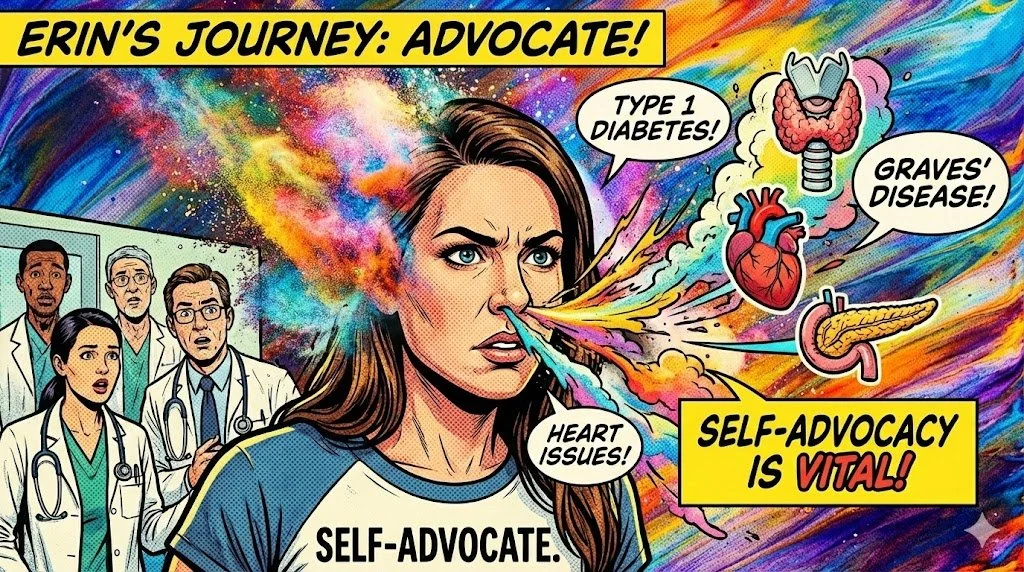
Diagnosed at 45, Erin shares her journey with Type 1 diabetes, Graves’ disease, and heart issues, highlighting the vital importance of self-advocacy in a dismissive medical system.
+ Click for EPISODE TRANSCRIPT
DISCLAIMER: This text is the output of AI based transcribing from an audio recording. Although the transcription is largely accurate, in some cases it is incomplete or inaccurate due to inaudible passages or transcription errors and should not be treated as an authoritative record. Nothing that you read here constitutes advice medical or otherwise. Always consult with a healthcare professional before making changes to a healthcare plan.
Scott Benner (0:00) Hello, friends, and welcome back to another episode of the Juice Box podcast. (0:10) Nothing you hear on the Juice Box podcast should be considered advice, medical or otherwise. (0:14) Always consult a physician before making any changes to your health care plan. (0:21) Have you tried the small sip series? (0:23) They're curated takeaways from the Juice Box podcast, voted on by listeners as the most helpful insights for managing their diabetes.
Scott Benner (0:30) These bite sized pieces of wisdom cover essential topics like insulin timing, carb management, and balancing highs and lows, making it easier for you to incorporate real life strategies into your daily routine. (0:41) Dive deep, take a sip, and discover what our community finds most valuable on the journey to better diabetes management. (0:48) For more information on small sips, go to juiceboxpodcast.com. (0:52) Click on the word series in the menu. (0:58) If you're looking for community around type one diabetes, check out the juice box podcast private Facebook group.
Scott Benner (1:05) Juice box podcast, type one diabetes. (1:08) But everybody is welcome. (1:09) Type one, type two, gestational, loved ones, it doesn't matter to me. (1:14) If you're impacted by diabetes and you're looking for support, comfort, or community, check out Juice Box podcast, type one diabetes on Facebook. (1:31) The episode you're about to listen to was sponsored by Touched by Type One.
Scott Benner (1:36) Go check them out right now on Facebook, Instagram, and, of course, at touchedbytype1.org. (1:42) Check out that programs tab when you get to the website to see all the great things that they're doing for people living with type one diabetes. (1:49) Touched bytype1.org. (1:52) Today's episode is sponsored by the Tandem Mobi system with Control IQ plus technology. (1:57) If you are looking for the only system with auto bolus, multiple wear options, and full control from your personal iPhone, you're looking for Tandem's newest pump and algorithm.
Scott Benner (2:07) Use my link to support the podcast, tandemdiabetes.com/juicebox. (2:13) Check it out. (2:14) The show you're about to listen to is sponsored by the Eversense three sixty five. (2:19) The Eversense three sixty five has exceptional accuracy over one year and is the most accurate CGM in the low range that you can get. (2:26) Eversensecgm.com/juicebox.
Erin (2:30) Hi. (2:30) My name is Erin, and I have type one diabetes. (2:35) I was diagnosed in 2020, and I have a couple of other autoimmune issues as well.
Scott Benner (2:41) Erin, how old are
Erin (2:41) you? (2:42) 50.
Scott Benner (2:42) You say you were diagnosed at 45?
Erin (2:44) Correct.
Scott Benner (2:45) Okay. (2:46) A couple of other auto oh, wait. (2:47) We'll find out about it. (2:48) Let's not rush. (2:50) Do you have kids?
Erin (2:51) I do. (2:51) I I'm married. (2:52) I have two kids. (2:54) I have a dog that I tried to drug with trazodone before we started recording, so he would stop annoying me. (3:01) That has kind of failed.
Erin (3:04) Mhmm. (3:05) And yeah. (3:06) Like, teenager teenagers, two of them, 13 and 16.
Scott Benner (3:09) You don't have drugs in the house to calm them down. (3:11) Right? (3:11) Just the dog?
Erin (3:12) I gave everyone a trazodone slurry before we started reporting.
Scott Benner (3:16) What kind of dog do you have that needs to be medicated so that
Erin (3:20) Neurotic. (3:21) He actually just had surgery, so that's why we
Scott Benner (3:25) he Oh.
Erin (3:26) He's he is getting trazodone every day just to help him chill out, to not ruin his stitches. (3:33) He ate a bunch of rawhide, and he had to have $15,000 abdominal surgery. (3:38) Oh my god. (3:40) And now Christmas and Hanukkah are ruined, and no one's going to college. (3:45) So I
Scott Benner (3:46) I what kind of dog is it?
Erin (3:47) He's a mutt. (3:48) He's like a 40 pound Australian shepherd slash schnauzer mix.
Scott Benner (3:55) Can I say something unfeeling? (3:56) How much would a new dog have cost?
Erin (3:58) Don't even get me started.
Scott Benner (4:00) How old is he?
Erin (4:01) Oh, no. (4:03) Wait.
Scott Benner (4:03) How old? (4:04) Eight. (4:05) Oh my. (4:05) How what's his life expectancy?
Erin (4:08) I know. (4:09) Trust me. (4:09) I've already done all of this math, and I just couldn't do it. (4:12) I think maybe 15 was what I was hoping. (4:15) I always looked at him and thought, this dog is definitely gonna live a long, long time to be one of those, like, blind, stumbling, stinky mutts.
Scott Benner (4:25) Let me
Erin (4:26) You're so Hopefully, now he can still do that.
Scott Benner (4:28) Well, let's hope. (4:29) Here here's the most important question. (4:30) Who gave him the rawhide? (4:31) Who's at fault?
Erin (4:32) It's actually the best of circumstances. (4:35) It's my fault. (4:36) So I can't blame my husband or my kids.
Scott Benner (4:40) I just I just wanna point out what a fully actualized adult female sounds like. (4:44) Did you hear what she said? (4:45) It's the best of circumstances. (4:48) It's my fault. (4:49) And you meant by that, Erin, if it was someone else's fault, you would carry this anger to your grave.
Scott Benner (4:53) Is that correct?
Erin (4:54) There would be hell to pay. (4:55) Yeah. (4:56) Yes. (4:57) Yep. (4:57) I was like, you need to they called it milking.
Erin (5:01) They actually had to, like, squeeze the mass up through his duodenum and pylorus and then pull it out with, like, a scope down his throat.
Scott Benner (5:12) Yeah. (5:14) I'm imagining fifty years from now, you're 100. (5:18) Your husband's dying. (5:20) But it was his but it was his fault about the rawhide in my alternate universe. (5:24) And instead of telling him about your wonderful long life or how happy you are with your children and you can't believe that you've lived to a 100 years old, you say to him, do you remember the time you cost us $15,000 by giving that dog a ride?
Scott Benner (5:37) Do you imagine that was what would have because that's what I feel like. (5:39) You know, I I am so worried that the end of my life is just gonna be a four days of my wife sitting in the hospital telling me all the things I did wrong.
Erin (5:46) Yeah. (5:46) She probably has a list.
Scott Benner (5:48) Oh, you thin her head. (5:49) The
Erin (5:49) actual list.
Scott Benner (5:50) It's etched right on her head, and it's definitely written down somewhere. (5:53) I I I I'll say this over and over again till the day I die. (5:56) That girl is still mad at me for whatever the first thing is I did wrong to her. (6:00) For she's still aware of it.
Erin (6:02) Okay. (6:02) Well, you crier, like, unrolling, like, a scroll of just, like Well,
Scott Benner (6:08) let me ask you another question. (6:09) Why did you try to kill the dog?
Erin (6:11) Oh, well, I was actually the rawhides are dental enzyme rawhide chews, so they were I was trying he he had had some dental issues, and they were supposed to just be I was buying them to help his teeth and help him stay healthy. (6:28) I think what was happening was that the idiot was swallowing them whole, and they weren't really they weren't passing through.
Scott Benner (6:35) Okay. (6:35) So this is, the other day, our puppy is vomiting on the floor. (6:40) I go, what is happening? (6:41) What did you people do to this dog? (6:43) Nothing.
Scott Benner (6:44) Nobody knows what happened until we dig it out of the pile of vomit, this thing that my wife gave him. (6:50) And I was like, Kelly, I swear to you, I know this is not the right way to talk to you, but I have told you a thousand times not to give these to the dog. (6:58) They throw up when you eat them. (7:01) Why do you keep buying them? (7:02) She doesn't know.
Scott Benner (7:03) I think it's because the package is nice or they look cute or or I I can't figure it out, and she's not dumb. (7:10) She's actually really, really smart until it comes to stuff like this. (7:14) And then Yeah. (7:15) I I I don't what happens to you girls? (7:17) Seriously.
Scott Benner (7:17) You just
Erin (7:18) I don't know. (7:19) I know. (7:21) I honestly didn't know. (7:22) I thought I was doing something good, and now here we are.
Scott Benner (7:25) I'm shaming you about it. (7:27) I'm so sorry. (7:27) I'm only saying what your husband was thinking and was too smart to say when he found out it was $15 to get the dog help.
Erin (7:33) Oh my god. (7:34) No. (7:34) He still doesn't know. (7:35) He doesn't wanna know. (7:36) He wants to remain completely ignorant about the whole situation.
Scott Benner (7:39) He's unaware of the cost of the of the dog fixing.
Erin (7:42) Yeah.
Scott Benner (7:43) Does he know that you are at fault?
Erin (7:45) Yes. (7:45) Oh. (7:46) He does.
Scott Benner (7:46) And he has not you've now you're gonna tell me you've been married for more than seventeen years. (7:50) Is that correct?
Erin (7:51) Oh, yeah. (7:51) Yeah. (7:52) Twenty some
Scott Benner (7:53) Mhmm.
Erin (7:53) Years, and he's a lot nicer than me, so he won't hold it against me for till the end of time. (8:00) Like, I would have.
Scott Benner (8:01) In that level. (8:01) Oh, I hope this has been a nice reflective mirror for everybody who's been listening. (8:04) Let's move on to your stuff. (8:06) You had diabetes five years ago. (8:08) How did it present?
Scott Benner (8:09) What did you, what did you see first? (8:11) When you think of a CGM and all the good that it brings in your life, is the first thing you think about, I love that I have to change it all the time? (8:19) I love the warm up period every time I have to change it. (8:22) I love that when I bump into a door frame, sometimes it gets ripped off. (8:25) I love that the adhesive kinda gets mushy sometimes when I sweat and falls off.
Scott Benner (8:29) No. (8:30) These are not the things that you love about a CGM. (8:33) Today's episode of the Juice Box podcast is sponsored by the Eversense three sixty five, the only CGM that you only have to put on once a year, and the only CGM that won't give you any of those problems. (8:45) The Eversense three sixty five is the only one year CGM designed to minimize device frustration. (8:52) It has exceptional accuracy for one year with almost no false alarms from compression lows while you're sleeping.
Scott Benner (8:59) You can manage your diabetes instead of your CGM with the Eversense three sixty five. (9:04) Learn more and get started today at eversensecgm.com/juicebox. (9:10) One year, one CGM. (9:13) This episode is sponsored by Tandem Diabetes Care. (9:16) And today, I'm gonna tell you about Tandem's newest pumping algorithm, The Tandem Mobi system with Control IQ plus technology features auto bolus, which can cover missed meal boluses and help prevent hyperglycemia.
Scott Benner (9:30) It has a dedicated sleep activity setting and is controlled from your personal iPhone. (9:34) Tandem will help you to check your benefits today through my link, tandemdiabetes.com/juicebox. (9:42) This is going to help you to get started with Tandem's smallest pump yet that's powered by its best algorithm ever. (9:48) Control IQ plus technology helps to keep blood sugars in range by predicting glucose levels thirty minutes ahead, and it adjusts insulin accordingly. (9:57) You can wear the Tandem Mobi in a number of ways.
Scott Benner (9:59) Wear it on body with a patch like adhesive sleeve that is sold separately, clip it discreetly to your clothing, or slip it into your pocket. (10:08) Head now to my link, tandemdiabetes.com/juicebox, to check out your benefits and get started today. (10:15) So
Erin (10:17) I took a course of steroids to break a migraine cycle in, I don't know, maybe May 2020, and then I immediately started noticing symptoms of increased thirst, frequent urination. (10:34) Just as, like, a sub context about the health care system, the reason that I had the cycle of migraines that needed to be broken is because I hadn't gotten my my Botox injections. (10:48) I I'm supposed to get those every three months, and they've really been life changing for my migraines. (10:53) I used to spend a lot of time in a dark room, tried a bunch of different medications, and the Botox has been really helpful.
Scott Benner (11:00) Where do they I'm so sorry. (11:01) Where do they shoot the Botox to help the migraines?
Erin (11:04) They actually do a ton of small injections all around your skull, around your, like, around your face. (11:11) Like, they do it around my eyes. (11:13) Mhmm. (11:13) They're nice, and they give me a couple of little extra boosts in between, like, my eyebrows to get rid of that little wrinkle. (11:21) And then they do, like, down your neck and across the shoulders, anywhere that you have tension.
Erin (11:27) Like, so if you hold your headaches kind of, like, in your jaw, they might put it in your jaw. (11:32) But it's not a pleasant procedure. (11:34) It it's not I mean, it's not terribly painful, but it's it's it definitely hurts a bit. (11:40) A lot of little little tiny injections. (11:41) Yeah.
Erin (11:42) Yeah.
Scott Benner (11:42) A lot of little injections. (11:43) Right? (11:43) Yeah. (11:44) Okay.
Erin (11:44) So wait. (11:45) Wait. (11:45) So And the reason I didn't get it is because at the time, it was going to cost me, like, 7 or $800, and I had just had my first of two heart attacks. (11:59) I had a spontaneous coronary artery dissection in 2019, and I had so many medical bills from that that by the time my Botox appointment rolled around, I was like, I'm not doing this. (12:11) I just can't.
Erin (12:12) I I can't.
Scott Benner (12:13) Arin, let's slow down a little bit. (12:14) Hold on a second. (12:15) You wait. (12:16) Okay. (12:16) Let's do the list.
Scott Benner (12:18) What's start at your earliest age. (12:21) What was your first medical issue?
Erin (12:23) I was 12, and I got my first period. (12:27) And I almost bled stuff because I had it's called ITP. (12:34) It stands for immune thrombocytopenia purpura, and it's basically a really, really low platelet count. (12:42) So I didn't have any clotting. (12:45) You know, I wasn't able to clot.
Erin (12:46) So and I didn't know because it was my first period that it it that it was abnormal.
Scott Benner (12:54) Oh, you were just draining to death and nobody knew?
Erin (12:57) Correct. (12:57) Yeah. (12:58) And I prior to getting my period, while I was 11 years old, I did have a lot of bruising. (13:05) You know, you would just practically bump into me or touch me, and I would bruise. (13:08) My parents thought my brother was beating the top of me.
Scott Benner (13:12) Oh my gosh. (13:12) Hey.
Erin (13:13) You poor guy. (13:14) Immune thromb say it. (13:17) Thrombocytopenia purpura.
Scott Benner (13:20) It's an autoimmune disorder.
Erin (13:21) It is.
Scott Benner (13:22) Yeah. (13:22) So you got your first autoimmune disorder when you were 12. (13:25) It tried to kill you through your lady bits, but you fought back. (13:28) And then how did you fight back? (13:30) Did your parents, like, go, hey.
Scott Benner (13:31) Did did did Dracula just bite Erin? (13:35) What's going on? (13:35) She's lying on the floor. (13:36) She's very pale.
Erin (13:37) Yeah. (13:38) That I was lying on the floor very pale on Thanksgiving, and they took me to the emergency room. (13:45) And I got blood transfusions and was in the hospital for a bit. (13:49) And that's store sort of where my mistrust of doctors and nurses started. (13:56) Just even with that experience, I remember a nurse in the emergency room arguing with me and telling me she asked me how many pads I had on, and I because I was, like, stuffing them in there Yeah.
Erin (14:08) To try to collect all this blood. (14:10) And I told her, I said I have five, and she argued with me about how many I had, and she ended up being wrong. (14:17) But it was just like this crazy experience of just being a child and being very vulnerable and, like, having this nurse. (14:24) Like, there aren't five. (14:26) There are only three.
Erin (14:27) Like, why are you lying about how many pads you have on? (14:30) Like, I mean, just it was
Scott Benner (14:32) That was said to you? (14:33) Why are you lying about how many pads you have on?
Erin (14:35) Yeah. (14:35) It was really not a good experience
Scott Benner (14:38) You know,
Erin (14:39) the like that because I didn't know how to, like, advocate for myself. (14:42) Yeah. (14:43) Although, yeah.
Scott Benner (14:43) Why would you ask? (14:44) Why would you think you should have to? (14:46) Or or I mean, also, you're 12. (14:48) Maybe it's your first period. (14:49) You didn't know what was going on.
Scott Benner (14:50) Right? (14:51) Also, don't go to the hospital on a holiday if you can help it because
Erin (14:54) That's true.
Scott Benner (14:55) Was it was their b team. (14:56) If you get stuck working on Thanksgiving, it's not because you really know what you're doing. (15:00) You know what I mean? (15:01) Yeah. (15:01) Yeah.
Scott Benner (15:02) Sorry for all of you who are nurses that are like, hey. (15:05) I I had to work on Thanksgiving last year. (15:07) But, like, it usually means newer or, you know, less you you don't have as much swing about or say about the the schedule.
Erin (15:12) You know? (15:13) True.
Scott Benner (15:13) So Yeah. (15:14) Okay. (15:14) So you're there, and and and did they diagnose this issue at the hospital? (15:19) It takes a while for that.
Erin (15:20) It did take a while. (15:21) And from what I understand, the treatment for ITP is different nowadays, and it's not as complex as it was at the time back in the eighties. (15:32) First of all, they thought maybe I had leukemia at first. (15:34) And then I I finally wound up at a pediatric oncologist, hematologist office, and they diagnosed me correctly. (15:46) The treatments at the time were I got frequent, like, short injections of, like, chemotherapy drugs.
Erin (15:54) So I would have to go into the doctor's office, and they would they would they tried that. (15:58) I also went to the hospital every every month or so for something called, like, gamma globulin treatments, which is basically, like I think it's, like, concentrated blood product of some kind, like platelets maybe that that help boost your your platelet count.
Scott Benner (16:16) Okay.
Erin (16:17) So I was doing that. (16:18) And then, ultimately, I ended up having my spleen taken out because none of the treatments worked. (16:24) I continue my platelet count just continued to fall back to almost nothing, and it can be dangerous to to be walking around being able to clot.
Scott Benner (16:33) They took the spleen out because of
Erin (16:36) The way it was described to me is that the spleen kind of is the filtration sys system for your blood, and it would if if you remove it, your platelets don't get filtered out. (16:46) That's the simple way the doctor explained it at the time.
Scott Benner (16:49) Yeah.
Erin (16:50) And that kind of stuck with me. (16:52) I don't you know, that's probably a very simplistic description, but that's what Yeah.
Scott Benner (16:57) I understand. (16:57) That's how they told it too. (16:58) So when IEP doesn't respond well to first line treatments like steroids or IVIG, doctors may recommend a splenectomy, surgically removing the spleen so that it, a, is where many antibody coated platelets are destroyed, and two or b, I guess, it's also a major site where those antibodies are produced in the first place. (17:19) So they're trying to take a piece out of the chain that's so if you take out the spleen, they say fewer platelets get destroyed, antibody production may decrease. (17:29) Many people see their platelet counts rise significantly afterwards.
Scott Benner (17:32) So did it work?
Erin (17:33) It did.
Scott Benner (17:33) Yep. (17:34) Oh, hold on. (17:35) You're fixed. (17:35) Yeah. (17:36) Yeah.
Scott Benner (17:36) Happily ever after. (17:37) No? (17:38) No.
Erin (17:38) No. (17:38) The end. (17:39) It was nice talking to you. (17:40) Yeah.
Scott Benner (17:41) What a great little episode. (17:42) Yeah. (17:43) What happened next? (17:43) What what happened after this?
Erin (17:45) Well, while I was in the hospital for one of those actually, I think the gamma globulin that I'm referring to is what you had mentioned, the IVIG Mhmm. (17:53) Treatment. (17:54) I think that's what that's called, but I don't remember what IVIG stands for. (17:58) Anyway, when I was in the hospital for one of those treatments, there was a doctor who came in to visit me while I was alone. (18:06) My parents worked a lot when I was young.
Scott Benner (18:09) Arin, I'm not gonna be able to take this. (18:11) Is going where I think it's going? (18:12) Because I it's only Monday. (18:14) Yeah. (18:15) Go ahead.
Erin (18:15) I mean, it's not as bad as it could have been. (18:17) And, honestly, I didn't realize what happened until I was in my twenties and was like, wait a minute. (18:22) But he came in and just, like, undid my gown and, like like, touched me in places that he should not
Scott Benner (18:32) Right.
Erin (18:33) Just to say the least. (18:35) And I didn't know how to handle that at all. (18:41) I just got I just completely shut down and froze. (18:46) I mean, I just literally physically froze, couldn't speak, was very angry. (18:52) I didn't like it.
Erin (18:53) I wanted him to get the heck out of the room. (18:55) You know? (18:56) And then later on, he came back when my parents were there. (19:00) And I, you know, I didn't have the words to tell them what happened. (19:04) I didn't really understand what happened.
Erin (19:07) So I just was pretty nasty to him, and my parents were kinda, like, embarrassed because, you know, back in back then, you know, you were supposed to be respectful and polite and bow down for a doctor. (19:20) You know? (19:21) So
Scott Benner (19:22) yeah. (19:22) So did it ever get brought up in as in the rest of the no. (19:26) Do your parents know today that that happened, or would they if they were alive? (19:29) No. (19:30) Okay.
Scott Benner (19:30) Alright. (19:31) Yes. (19:31) Oh, well alright. (19:32) Well, I mean, I guess we gotta give you a pass on trying to kill the dog. (19:36) Right?
Scott Benner (19:36) Like, I mean, seriously, you you Yeah. (19:39) Somebody owes you a pass.
Erin (19:40) And it it it's just it's just one of the many things that's happened over the years that has just been so disappointing with doctors. (19:50) And, you know, just to bring it back to more recent times, when I was trying to figure out about this thirst, I immediately stopped taking the steroids because it was obvious to me. (20:03) My vision was actually the first thing to to go really blurry. (20:07) I couldn't see to drive. (20:09) Thankfully, I didn't really it was COVID times, so I didn't really need to to drive for work.
Erin (20:14) Mhmm. (20:15) But the blurred vision was terrible, and then the thirst and frequent urination came. (20:22) So I called the neurologist who had prescribed the steroids, and I explained what was happening with me. (20:29) And they were like, you're having vision problems? (20:31) You know, that could be a thousand different reasons you should call your PCP.
Erin (20:35) So I called the PCP, and she said, well, you really should talk to the neurologist because they're the ones who prescribe the steroids, and it's clearly, you know, a reaction to the steroids. (20:47) So that was leading me in a circle. (20:48) So I went to the eye doctor, an ophthalmologist, and told her what my symptoms were. (20:55) And she shrugged and said, well, welcome to your forties.
Scott Benner (21:00) Awesome.
Erin (21:01) I'm like, I understand that my vision over time will probably deteriorate, but this kind of happened overnight. (21:08) Is that is that a typical experience? (21:10) Like, maybe I'm just unaware of this part of the aging process. (21:15) Yeah. (21:16) But she just shrugged it off.
Erin (21:18) I ended up going to the emergency room, and then I also went and they they just sent me home. (21:24) They checked my eyes to see if there was any, like, damage to my eyes. (21:28) They really don't have a lot of tools at the ER to deal with, like, vision stuff. (21:33) So they did what they could there except test my blood sugar, whatever. (21:38) And then I also went to my endocrinologist.
Erin (21:42) And I sat in the endocrinologist's office, and I told the nurse, I think I have diabetes. (21:47) Because at that point, I've been reading a lot about my symptoms. (21:51) Mhmm. (21:51) And I thought maybe I had diabetes. (21:54) And I told her that, and I talked to the endocrinologist.
Erin (21:59) And he said, well, I'm gonna give you a prescription to get blood work done, and you can come back in four months. (22:06) So that's what I did. (22:09) And it was long enough that by the time I went back, I had an a one my a one c was 14, and my blood sugar I think that morning, it was, like, 300 and something. (22:21) Okay. (22:22) They finally pricked my finger, when I went back for that follow-up appointment with the with my blood work results.
Scott Benner (22:29) And you told them, I've been doing a little digging, and I think I have diabetes.
Erin (22:34) Yeah. (22:34) I told them my symptoms. (22:35) I'm like, I'm peeing a lot. (22:37) I'm so thirsty. (22:38) And I know people have talked about the thirst and on the on the podcast before, but it is just I remember chugging a Nalgene bottle beside my bed at night and choking on the water.
Erin (22:51) Like, I I was trying to swallow it just so I was trying to get it down so quickly that I couldn't swallow fast enough. (22:59) It was just a really intense thirst that I can't quite describe.
Scott Benner (23:03) Yeah. (23:04) So But you have other so you're also a person who gets are they cluster headaches or migraines, or what do you get?
Erin (23:11) Yeah. (23:11) I have the history of migraines, which I've had since I started my getting my period. (23:17) I think that hormonal change is where they started, and, I'm hoping that when I'm finished with menopause that they'll go away just because I've heard anecdotally that that does happen with some people.
Scott Benner (23:28) Question is is, like, your husband's used to not feeling well, but could he tell that you were extra sick before your diagnosis with type one?
Erin (23:35) Just the vision. (23:36) The vision. (23:36) He had to drive places. (23:38) I couldn't drive and see.
Scott Benner (23:40) So your vision's oh, wait a minute. (23:43) There's no so there's no answer about the vision just like, hey. (23:46) You can't see anymore. (23:47) Oh, well. (23:48) And then you're like, and I'm peeing a lot.
Scott Benner (23:49) I'm super thirsty, and no one says anything.
Erin (23:52) Right.
Scott Benner (23:52) Okay.
Erin (23:53) And I just imagine that when I was sitting in the endocrinologist's office that day that I mean, how many they have to have meters in every room, in every exam room. (24:03) I don't know why they didn't just just check my blood sugar.
Scott Benner (24:07) Right, man.
Erin (24:07) They just do
Scott Benner (24:08) it. (24:09) Well Just Why? (24:10) I mean, so far, you've got three stories. (24:12) Not nobody stood up in any of these stories and done the right thing. (24:15) So Yeah.
Scott Benner (24:16) Yeah. (24:16) It you figured out how. (24:19) Like, what's the last way they just finally you said they figured it out, but what I'm sorry. (24:23) Tell me again what happened where it was like, hey. (24:25) You have diabetes.
Erin (24:26) Yeah. (24:27) So I went back for the follow-up appointment with my test results. (24:31) They the the nurse looked at my results and then looked up at me, and she was like, and you're you're telling me you haven't eaten yet today? (24:40) I'm like, no. (24:41) And she was like, I'll be right back.
Erin (24:45) So I was like, oh god. (24:47) So she left the room. (24:49) She came back. (24:50) She said, I'm gonna have you talk to the doctor. (24:52) So I did, and I this doctor is such a nice man.
Erin (24:57) I'd been seeing him for about twenty years for my thyroid at this point. (25:01) I know his wife. (25:03) I watched his son grow up in the community. (25:06) I I looked at him like a father figure. (25:08) I know that he cares about me as a person, as a patient.
Scott Benner (25:12) Mhmm.
Erin (25:13) At that point, he definitely was taking things seriously, and I am very sure that he was regretful that he hadn't dealt with it four months prior. (25:22) Yeah. (25:22) But he he told me that I had diabetes, and he said, look. (25:26) Our office is about to close for lunch. (25:28) So what I'm gonna ask you to do is go and get yourself lunch, and then come back at 01:00, and we're going to show you how to use insulin.
Erin (25:39) So I think he knew I had type one just because I think he understood that I had a history of autoimmune disease. (25:45) So I think he he he I I at least didn't get a type two diagnosis. (25:50) Mhmm. (25:50) I didn't have to deal with that nonsense. (25:52) But so I left and went back after lunch.
Erin (25:55) And when I walked in this time, he said, you know, I've thought about it, and what I really think we need to do is send you down to the ER. (26:02) So I went down to the emergency room. (26:04) And from what I understand, he wanted me to go there so that I could get immediate testing, and that was the fastest way to do it. (26:10) Okay. (26:10) Was to send me in through the ER.
Erin (26:12) But when they tested me, they saw that I wasn't, like, fully in DKA, but whatever I don't know if your body becomes, like, acidic or whatever, but whatever test that measures that was concerning. (26:25) So I did get admitted, and I spent a week in the hospital where they brought my blood sugar down slowly with the, you know, the IV insulin. (26:35) Of of kind of funny incident about that is my my nurses were switching shifts at about eleven at night, and the nurse who was leaving said, okay. (26:49) Well, the doctor said that we're not supposed to put the rate above, you know, whatever the rate was. (26:55) And but he didn't put that in his chart in my chart notes.
Erin (27:00) So the nurses were standing there at 11:00 at night arguing with each other about where to set my insulin. (27:06) And I'm sitting there, and I'm like, oh my god. (27:09) If they give me too much insulin, I'm not gonna feel good. (27:12) I mean, I I didn't really understand diabetes
Scott Benner (27:14) Right.
Erin (27:15) At that point at all, but I did know that if they gave me too much, I wouldn't feel well, that I would go low. (27:21) Mhmm. (27:22) So I was like, pardon me. (27:24) Like, I I hate to interrupt
Scott Benner (27:26) You're arguing.
Erin (27:27) This conversation, but I I I I was present when when the doctor said not to go above this rate. (27:34) So if you could please consider setting it at the lower rate just because I don't wanna feel sick or get low blood sugar or whatever. (27:43) I don't even remember what happened. (27:44) I just remember them arguing at my bedside, and I thought it was insane.
Scott Benner (27:49) Hey, dummy. (27:49) Look over here. (27:50) I was listening, and I just need you to just pick the lower number. (27:55) Okay? (27:55) Especially because it sounds like one of you is going home, and the other one's probably about to go smoke weed then fall asleep in the lobby.
Scott Benner (28:01) So I really I need somebody to just just take care of me a little bit. (28:04) So now you have four stories, and nobody's, like, sticking up for you or doing a good job. (28:08) How does this keep happening to you? (28:10) Do you have bad luck? (28:11) Do you have a face people don't like?
Scott Benner (28:12) What is going on exactly?
Erin (28:14) I don't know. (28:15) I really feel like I'm, like, contagious almost with autoimmunity. (28:20) Like, I feel like I'm even though my kids are fine, they don't have the markers. (28:26) I did have them tested through TrialNet. (28:29) So, thankfully, they don't have anything.
Erin (28:31) But I just feel like I don't know. (28:33) When I well, I I mentioned this in my note to you. (28:35) I don't know if you remember, but my dog, my other dog, died of, apparently, there's, like, a canine version of ITP.
Scott Benner (28:45) What the
Erin (28:46) And he had it. (28:48) And I suspected that he had it because he was sneezing blood around the house. (28:53) And I was like, oh my gosh. (28:55) This dog is, like, bleeding through his, like, membranes. (28:59) And so me being, you know, a doctor, I'm like, oh, he must have low platelet count.
Erin (29:06) So I take him to the vet, and I'm like, he's bleeding. (29:09) And they looked at him, exam examined him, said he was it was fine. (29:14) He probably injured. (29:16) There's probably an injury inside of his nose that we couldn't see, and it continued to happen. (29:20) And I took him back to the bed about a month later, and he his platelets were so low that they he he had to be put to sleep.
Erin (29:27) It was so sad, but I felt like it was just a really crazy thing to have happen. (29:32) I I felt like this is nuts. (29:34) What? (29:34) Like, why am I so cursed with this crap?
Scott Benner (29:37) Yeah. (29:37) I think you're I think we have to call your, episode gesundheit too. (29:40) But I wait. (29:42) Stop. (29:43) This odd autoimmune issue that you had when you were 12, how many years later killed your dog?
Scott Benner (29:50) It was in 2022. (29:51) Get the fuck out of here. (29:52) Are you serious?
Erin (29:54) I am not kidding.
Scott Benner (29:55) Oh my god. (29:56) Oh my god. (29:57) Did dad flip you out a
Erin (29:58) little bit? (29:59) Like, the vet even. (30:01) I had I was having the same ridiculous conversation with the vet that I feel like I keep having on repeat with every medical professional that I see, which was, I think he has low platelets. (30:11) Can you test for that? (30:12) Can dogs get, you know, ITP?
Erin (30:16) And the vet is like, well, that's very unlikely. (30:19) What this probably is is blah blah blah. (30:21) And then he has to come back in the exam room later with his tail between his legs. (30:26) Literally. (30:27) Yeah.
Erin (30:27) Exactly. (30:29) Telling me, oh, yeah. (30:31) His platelet count. (30:32) It was so low. (30:33) It was, like, in the single thousands, which is very low.
Erin (30:37) Unbelievable. (30:38) Treatments for it at that point were so ridiculous and not it was gonna be torture for the dog. (30:44) Right. (30:45) And he was a very large, beautiful dog, so it was gonna be hard to take care of him.
Scott Benner (30:50) I gotta tell you. (30:51) This is insane what you're telling me. (30:53) That is the the oddest I mean, bad luck I've I think I maybe have ever heard.
Erin (30:58) Oh, well, actually, I I should mention. (30:59) I'm like, oh, so what happened? (31:02) I was so grief stricken by this by this dog dying that I had another spontaneous coronary artery dissection a few days after we had to put him to sleep. (31:12) Because you haven't asked yet, but I am Irish, and that relates to the autoimmunity. (31:18) But, also, I like to shove my emotions deep down inside.
Scott Benner (31:21) Mhmm. (31:22) Well, I could tell by you you having to use Botox to get the stress out of your forehead.
Erin (31:26) Yeah. (31:27) Instead of letting, you know, letting my emotions out, I just kind of stifle them, and then I feel like it comes out in bad ways, like, the heart attacks. (31:38) So I ended up in the hospital again with another coronary artery dissection.
Scott Benner (31:42) The first heart attack happens at what age?
Erin (31:44) 40 it was 2019, so 44.
Scott Benner (31:47) 44. (31:48) The year before you got diabetes. (31:50) Yeah. (31:50) The next the next one happens after the doc wait. (31:54) When does the next one happen?
Erin (31:55) 2022, so three years later.
Scott Benner (31:56) How come they don't kill you? (31:58) What's happening when like, what what's the process of I don't feel well to
Erin (32:02) Well, our cardiologist said it's because I'm lucky. (32:05) So it's
Scott Benner (32:06) Just say, I am not lucky. (32:08) Here's a story I'll tell you.
Erin (32:10) Yeah. (32:10) Yeah. (32:12) A a spontaneous coronary artery dissection, which is called a SCAD for short, which is I think is funny because of your stories about your child going
Scott Benner (32:21) to That'll also break your heart, SCAD Will, by the way.
Erin (32:24) I would always I I we drive to Florida pretty often because my in laws live there, and we always stop in Savannah on the way down. (32:32) So I always take selfies in front of the SCAD sign because I'm like like, it it just struck me as funny.
Scott Benner (32:38) Yeah. (32:38) Awesome. (32:38) Send them to me. (32:39) I'll cry. (32:40) That's fine.
Scott Benner (32:41) So It's when a tear What
Erin (32:43) it is?
Scott Benner (32:43) Hold on. (32:43) It's when a tear forms the wall of a coronary artery, the blood vessel that supplies the heart muscle. (32:48) Blood seeps between the layers of the artery wall creating a false channel that can compress the true lumen where blood normally flows. (32:55) This blockage restricts blood flow to the heart muscle causing chest pain, heart attack, or even sudden cardiac arrest. (33:01) Awesome.
Scott Benner (33:02) So you've you've had cardiac arrest, or how do you
Erin (33:04) I did not. (33:05) Okay. (33:05) I did have a myocardial infarction. (33:08) So I did not have cardiac arrest. (33:11) Thank god.
Erin (33:11) But I my dissections occurred more distally. (33:18) So the closer they are to the big heart muscle, the more dangerous it is and the more serious it is. (33:23) When they occur more distally like mine did, there's going to be less damage. (33:28) And so, you know, I am lucky, really, that they didn't occur closer to the big heart muscle. (33:35) And the only treatment for it they do a heart catheterization.
Erin (33:39) They did that both times, which is just a procedure, but it's still a little scary to be put under. (33:44) Mhmm. (33:44) And we you know, they read you all of the, like, things that could happen, including death. (33:48) You know? (33:49) Yeah.
Erin (33:49) It's a little it's scary to go through that. (33:51) But, really, the treatment is just time and a little bit of medicine. (33:58) I'm I'm only on a I'm I'm just on a beta blocker now. (34:03) So, you know, all things considered, they were you know, I really was lucky. (34:07) So in fact, you know, something I wanted to mention to you about the heart heart attacks is that I I've just listening to the stories, and I've listened to the podcast.
Erin (34:18) I think I'm up through episode, like, fifteen eighty something at this point. (34:23) I'm not caught totally caught up, but I've listened to all of them from the beginning. (34:27) And this type of heart attack occurs a lot of times in women who've just had a baby. (34:33) It happens to younger, healthier women. (34:36) And one of the stories that you had on real early on was about a gram was with a grandmother.
Erin (34:41) Mhmm. (34:42) And her I think her daughter had died of a heart attack pretty shortly after giving birth. (34:47) And I thought, oh my goodness. (34:49) I wonder if, like, that was what had happened to her.
Scott Benner (34:52) So Super interesting. (34:54) I I have to tell you, like well, first, let me ask. (34:57) Is there any other issues that we haven't gotten to yet? (35:00) I have Graves' disease. (35:02) Oh.
Scott Benner (35:02) Awesome. (35:03) When were you diagnosed with that just real quick?
Erin (35:06) In college.
Scott Benner (35:07) College. (35:07) Okay. (35:08) So the thing Graves' disease oh, okay. (35:11) Other autoimmune in your family line including My
Erin (35:15) dad has Graves' disease.
Scott Benner (35:16) Dad has Graves'. (35:17) Does anybody have type one? (35:18) No. (35:19) Okay. (35:20) Does anybody have bad luck?
Scott Benner (35:22) I'm just kidding. (35:23) I was teasing you. (35:23) I'm sorry.
Erin (35:23) We do tend to have Irish luck where we always have to do things more than once to get it right. (35:28) But Is that what they call
Scott Benner (35:30) is that what they call that? (35:32) Okay. (35:32) So your dad has Graves', but, like, going back to your family line, celiac because somebody got celiac. (35:36) No?
Erin (35:37) No. (35:38) And I I did get tested for that. (35:39) Thanks to you. (35:40) And I did also get tested. (35:42) This is an autoimmune, but one of the hardest things medically that I've dealt with has been low ferritin.
Erin (35:49) And I didn't know what ferritin even was before you started talking about it.
Scott Benner (35:55) Wait. (35:55) Is this the story, Erin, about how I've saved you? (35:57) Yes. (35:57) Speak slowly. (35:58) Speak slowly.
Scott Benner (35:59) Go ahead. (35:59) Thank you.
Erin (36:00) Yeah. (36:01) I insisted when they went to test my iron after. (36:04) I was so fatigued. (36:06) It was just absolutely crazy. (36:07) And I remember feeling the way you described.
Scott Benner (36:11) Okay.
Erin (36:11) I felt like you described with super fatigue. (36:15) I remember you said at some point you bent down to reach something off the ground, and you felt like you were just gonna keep falling
Scott Benner (36:21) Yeah.
Erin (36:21) On the floor or something like that. (36:22) I was like, bingo. (36:24) Yes.
Scott Benner (36:24) That's how you fell.
Erin (36:25) Yeah. (36:26) And I finally got and I had almost I I think my ferritin was one, and my iron and hemoglobin and all of that were were low as well.
Scott Benner (36:36) My goodness.
Erin (36:37) I ended up going to the emergency room with that because I was just there was I I just thought something was very wrong. (36:43) I thought I was gonna die. (36:45) Mhmm. (36:45) And I ended up getting three consecutive days of iron infusions.
Scott Benner (36:49) Okay.
Erin (36:50) And those brought my iron up to, like, six or something or my baritone.
Scott Benner (36:56) Not high not high enough? (36:57) So No. (36:58) Not You know why? (36:59) Because in the hospital, they give you this little pissy amount of it. (37:02) Not like they would if you went to an infusion center and had a hematologist working with you.
Scott Benner (37:06) They give you they give you a little bag instead of the the the whole the whole game.
Erin (37:11) Yeah. (37:11) Yeah. (37:11) Yeah. (37:11) And I did. (37:12) That's what I had to do was go into the infusion center and then get another like, get an infusion.
Erin (37:17) And so far, so I mean, I just actually had it tested, and it was, like, 46. (37:22) It went up
Scott Benner (37:23) a little higher. (37:24) Are you still bleeding?
Erin (37:25) No. (37:25) No. (37:26) Okay. (37:26) I got an IUD placed after because I wanted to rule that out as, like, a cause of the low iron.
Scott Benner (37:33) But that's not been it.
Erin (37:34) Well, I mean, it's we'll see. (37:36) I I get the test done every three months, so I I'll get tested one more time before I go back to the hematologist. (37:43) So I'm curious if it will continue to fall down lower than 46. (37:47) But
Scott Benner (37:48) Four so 46 for your ferritin is not terrible. (37:51) Like No. (37:52) We it's not as high as we want it to be either.
Erin (37:54) Right.
Scott Benner (37:55) Yeah. (37:55) Yeah. (37:55) Yeah. (37:55) Right. (37:55) So do you still
Erin (37:56) have symptoms? (37:57) If I'm tired. (37:57) I'm like, I've been tired since 2009. (38:01) Like, I have children. (38:02) Bitch, though.
Erin (38:03) Tired. (38:04) Like
Scott Benner (38:05) Wait. (38:05) So what what is your plan? (38:06) Are you gonna get another infusion if the number comes back lower again, or are you having a doctor that's even willing to to talk about that 70 ferritin? (38:14) Because you remember doctor Yeah. (38:15) Benito said 70 bare bones for a woman of menstruating age.
Erin (38:20) Yes. (38:20) Yeah. (38:21) Yeah. (38:23) Yeah. (38:23) I'm I'm definitely gonna talk to him.
Erin (38:25) I'm gonna kinda wait and see where it goes from 46 and and see what he see what he thinks. (38:30) I'm gonna give him a chance. (38:31) He disappointed me with his when I developed the low ferritin and low iron, I also when I was in the hospital for that, they they saw that I had really low blood pressure, and I also had developed, like, a tremor. (38:49) And I was and and I don't know why. (38:53) I don't know what the cause is.
Erin (38:55) I mean, I assume it's autoimmune, but I don't know what the cause is of these additional problems. (39:00) So I've been talking to all my doctors about it because I'm not sure what the answer's going to be or if I even will get an
Scott Benner (39:08) Right.
Erin (39:09) So whenever I described my tremors to him, I described them like this. (39:15) I said, they're sort of like when you're cold and you're shivering. (39:19) That's I like, I wake up, like, just with that kind of tremor.
Scott Benner (39:25) Okay.
Erin (39:26) And he looked at me and said, have you considered that you might be cold?
Scott Benner (39:30) Oh, is he still alive, or where'd you hide his body?
Erin (39:32) And this guy is, like, seven feet tall. (39:34) He's seriously so tall. (39:36) I'm like, I'm gonna stand up on the exam table. (39:38) Like, punch.
Scott Benner (39:39) Beechy to death. (39:40) That's
Erin (39:40) in hey.
Scott Benner (39:42) You considered that you might be cold? (39:44) Also, have Graves' disease. (39:45) Right?
Erin (39:45) Right.
Scott Benner (39:46) So can't that be impactful on that as well?
Erin (39:48) It it definitely could. (39:50) I mean, I I did have the radioactive iodine treatment for that, and I'm on I'm on levothyroxine. (39:56) Right. (39:56) So it could have but it could have been possible that I was being overmedicated for the thyroid. (40:01) I was really hoping that you would ask me what my TSH is.
Scott Benner (40:06) You can just tell me. (40:07) Y'all don't have to wait till me. (40:08) Yeah. (40:08) I guess.
Erin (40:09) It's like, don't play games there. (40:11) Shit. (40:11) It's it was ten last time. (40:14) Oh. (40:15) I know.
Erin (40:16) And I don't I don't know why that my TSH is over 10, and my free t four is normal. (40:23) It's, like, perfect. (40:24) And I don't Graves' disease is one of the things. (40:27) I just haven't done a nosedive into research about the thyroid. (40:31) I, like, I just can't.
Erin (40:33) You know? (40:34) I've already learned way too much about diabetes and the SCADs. (40:38) I'm done learning things. (40:40) So I don't really truly understand the relationship between the TSH being elevated and still the three t four showing as normal.
Scott Benner (40:49) Right. (40:49) Right. (40:50) And so you're having trouble. (40:52) You just don't know where it's coming from. (40:53) Do you wanna do do you wanna do a fun exercise for a second?
Erin (40:56) Sure.
Scott Benner (40:56) Do you wanna ask the Internet?
Erin (40:58) Oh, I definitely have. (40:59) I'm a
Scott Benner (40:59) huge What did you
Erin (40:59) talk GPT fan.
Scott Benner (41:01) What did it come up with?
Erin (41:02) No. (41:03) I mean, it it didn't really have any answers. (41:06) It's it did suggest POTS, I think, for the blood pressure and tremor. (41:11) I had my neurologist do, like, a Parkinson's. (41:14) She did, like, a little neurological exam on me, and she was she said that the results were were good because I was worried that I had something like that.
Scott Benner (41:22) Hey. (41:22) Have you had COVID?
Erin (41:23) I have.
Scott Benner (41:24) Do you think you have long COVID?
Erin (41:26) I mean, I guess I could, but I don't not not that I've ever been told or I haven't noticed anything in particular.
Scott Benner (41:32) You haven't noticed anything? (41:33) Like, you don't get, like, wasted, like, after activity and can't bounce back for days or anything like that?
Erin (41:39) I I do kind of but I always attributed it to the heart attacks because I do have a little bit of impact from those just on my, like, energy level. (41:49) So
Scott Benner (41:49) Yeah. (41:50) No. (41:50) You mean you have a a a number of different issues going on. (41:52) That's for sure. (41:53) It's a lot to kind of try to consider while you're trying to figure out, like, what's going on with you.
Scott Benner (41:58) So let's do real quickly just to to check. (42:01) Persistent per per oh, excuse me. (42:03) Persistent fatigue or extreme tiredness. (42:05) Yes or no? (42:06) Yes.
Scott Benner (42:07) Fever, chills, or sweats? (42:08) No. (42:09) Unexplained pain, muscle aches, joint pain? (42:11) No. (42:12) Brain fog?
Erin (42:13) Oh, yeah.
Scott Benner (42:13) Headaches, dizziness? (42:15) Yes. (42:15) Yes. (42:16) Sleep disturbances, pins and needles sensation?
Erin (42:18) Sleep disturbance, but no pins and needles.
Scott Benner (42:20) Shortness of breath, difficulty breathing? (42:22) No. (42:23) Do you have a cough? (42:24) No. (42:24) Chest pain, palpitations, faster pounding heart?
Erin (42:28) No. (42:28) I I have intermittent chest pain, and that's normal from the heart
Scott Benner (42:31) of think that might be the Irish thing too. (42:34) Diarrhea, stomach pain, constipation, bloating? (42:36) No. (42:37) Changes in smell or taste, skin rashes, hair loss?
Erin (42:40) Hair loss.
Scott Benner (42:41) Hair loss. (42:41) So, I mean, a lot of this stuff overlaps with different things, obviously. (42:45) I don't know that you classically feel like long COVID. (42:47) I'm not sure. (42:49) But it would be a thing you'd really notice.
Scott Benner (42:51) It would have been like you had COVID and then it ended, and then you were like, my god. (42:56) My just changed a lot. (42:58) Like, you have you didn't have a big shift like that. (43:00) Right?
Erin (43:00) No. (43:01) I didn't. (43:01) Okay.
Scott Benner (43:03) We're not really ready to talk about it here on the podcast, but I interviewed a lady not long ago who told me how she used nicotine patches to help her with her long COVID. (43:15) And right? (43:16) And I went down to my wife who was struggling and been struggling for a long time, and I said, I'm gonna slap a nicotine patch on your ass every day for thirty days and see what happens. (43:26) And you know what happened? (43:27) What?
Scott Benner (43:28) She feels a lot better.
Erin (43:29) That's nuts.
Scott Benner (43:30) Yeah. (43:31) It's cray cray. (43:32) But I'm not ready to talk about it yet because I don't have enough of the, like, long range details of it. (43:36) But
Erin (43:37) I happened to have some nicotine patches because of my 16 year old convincing the doctor that he needed nicotine replacement therapy for his Zinn's addiction.
Scott Benner (43:47) Oh my god. (43:47) Did you try just hitting him? (43:49) Like because that's what we would have done in the seventies. (43:51) They would have just, like, smacked him and then put him in a room and left him there for a couple weeks then brought him out again. (43:55) Do people know how parenting used to work?
Scott Benner (43:57) You grew up with it, Erin. (43:58) Right?
Erin (43:59) Exactly. (43:59) And I do. (44:00) I tell him. (44:01) I'm like, if this were 1987, I would be hitting you with my shoe right now.
Scott Benner (44:07) Just so you know.
Erin (44:08) If not, it's not not allowed to do that.
Scott Benner (44:10) So we're gonna get you a nicotine patch for your zen. (44:12) And by the way, where do you get money for that?
Erin (44:14) Exactly. (44:15) I have no idea. (44:16) I don't I probably don't wanna know.
Scott Benner (44:18) Yeah. (44:19) Possible. (44:20) So dig a little more into your heritage thing. (44:22) Like so I mean, you've brought it up a couple of times. (44:25) I didn't bring it up.
Scott Benner (44:26) But anxiety, stress, chest pain, what else do you think is from your Irish background?
Erin (44:34) I don't know. (44:35) You have a lot What do you Do
Scott Benner (44:36) you do do does your does your life, health wise, and your mental health and all that, does it mimic your mom or your dad?
Erin (44:43) Just the shoving the emotions deep down definitely is, you know, I yeah. (44:48) I mean, that that's huge.
Scott Benner (44:50) You went to church every Sunday, did you?
Erin (44:52) Yes. (44:52) Mhmm. (44:52) Oh, I'm Jewish now, though. (44:54) I I I I converted.
Scott Benner (44:56) For a boy? (44:58) Yes. (44:58) Oh, that's nice. (44:59) Does the does the guilt transfer? (45:01) Does it feel the same?
Erin (45:02) It's completely transferable. (45:04) It's coming in quite handy.
Scott Benner (45:05) I I just but I I mean, look. (45:07) My wife has a background, like, similar to yours probably, like, bright, like, Irish English, that kind of thing. (45:13) And and, I mean, the the amount of the amount of times that I look over at my wife and she's rubbing her chest, and she's like, I'm gonna have a heart attack. (45:20) And I'm like, I mean, I really feel like you would've had it by now. (45:23) It's it's been
Erin (45:25) Yeah. (45:25) I mean, I have that feeling all the time. (45:27) I mean and some certain stressors definitely make me hold my chest and take deep breaths and try to remember where I put the nitro.
Scott Benner (45:37) But it's yeah. (45:38) Well, but you've had one, though. (45:39) I mean, it's a different story for you. (45:41) You know what I mean? (45:41) Like, my wife's had, you know, stress tests and blah blah blah.
Scott Benner (45:45) She doesn't have any problems with her heart. (45:47) Like, she's just you know, she's works really hard, and she has a high stress job. (45:52) And sometimes the stress gets to her, and I see her pushing, you know, between her clavicle and, like, over here and, like, wondering. (45:58) And I'm like, you alright? (46:00) She's like, oh, my chest hurts.
Scott Benner (46:01) I'm like, in the same place. (46:02) Always in the same place. (46:03) It's always top right more. (46:05) You know? (46:05) Yeah.
Scott Benner (46:06) Yeah. (46:06) And is she you know, you should try stop working. (46:09) I can't stop working.
Erin (46:10) That's where my pain was in my it radiated more to the right side of my chest and then in my in my joints. (46:18) I had pain in my joints, in my upper body Mhmm. (46:21) And only my upper body. (46:23) I thought it was so bizarre that I didn't have you know, every knuckle hurt in my hands, but my knees didn't hurt. (46:29) My elbows, my shoulders
Scott Benner (46:31) Yeah.
Erin (46:32) All my joints were so sore. (46:34) And I think I did a really good job convincing the emergency room doctors that I had Lyme disease because that was what I thought. (46:43) I thought, I have I think I have Lyme disease. (46:46) Okay. (46:46) So my dad had just had it, and he described it as, a roving joint pain.
Erin (46:52) And that's kinda like what I was feeling. (46:54) And they were about to send me home with some pain pills. (46:58) And, thankfully, my troponin levels came back right before they discharged me, and they were like, actually, never mind. (47:04) We're gonna
Scott Benner (47:04) You might get to stay for a little while. (47:06) Yeah. (47:07) Are are you are you a hypochondriac? (47:10) Like, do you see a lot of ill no. (47:11) You're you're always right?
Erin (47:13) I mean, like, isn't that, like, if you're wrong?
Scott Benner (47:16) Yeah. (47:17) No. (47:17) No. (47:17) I I just wanted to make I I wanted to make sure that you weren't leaving out the other 37 things that you thought you had that you didn't have. (47:22) That you just you just got lucky on four of them.
Scott Benner (47:25) That's
Erin (47:25) all. (47:25) I thought that was a reasonable guess as to what was wrong with me Mhmm. (47:30) With the with the joint pain.
Scott Benner (47:31) Okay.
Erin (47:32) But it turned out to be and I and that's that happened again with the second incident too, so I kinda knew what
Scott Benner (47:37) to look for. (47:38) Right on. (47:39) Well, I mean, honestly, limes is a thing that everybody limes, pots, all that stuff is where people land when they can't get they can't get answers about the sorts of things that you're describing. (47:50) Right. (47:50) Because it it leaves you in nebulous land.
Scott Benner (47:53) What do you have? (47:53) I it it sounds like lupus to me. (47:55) Like, well, what does that mean? (47:56) Like, you know what I mean? (47:57) It and especially the way doctors you know, the way medicine's set up, a lot of these things are diagnosis of, how do they put it?
Scott Benner (48:04) Diagnosis of elimination. (48:06) Right? (48:06) Like, you don't actually know that this, this, and this equals that. (48:10) It's well, you don't have all these other things, so we've eliminated these things as your possible issue, which leaves us with this smaller pool of more nebulous stuff that it could be. (48:19) Yeah.
Erin (48:19) And it's not as satisfying of an answer.
Scott Benner (48:21) No. (48:22) Of course not. (48:22) No. (48:22) There's no answer that's satisfying.
Erin (48:24) Yeah. (48:24) You probably you know?
Scott Benner (48:26) Uh-huh. (48:26) No. (48:27) The answers are satisfying when your problem goes away. (48:30) That's that's that's the end. (48:32) And that doesn't happen enough for people who have stuff that overlaps like this, which a lot of the times does with autoimmune.
Scott Benner (48:37) A lot of overlapping stuff.
Erin (48:39) Yeah. (48:39) Yeah. (48:40) Well, you know, I heard you say something recently, about blood pressure low blood pressure and how it could be connected to the thyroid. (48:47) So I thought you know, I I did get the doctor to write me a script for a higher dose of levothyroxine.
Scott Benner (48:53) Mhmm.
Erin (48:54) So, hopefully, my TSH will come down. (48:57) My hair will be better, and maybe my blood pressure will be better too. (49:01) Who knows?
Scott Benner (49:02) Yeah. (49:02) I don't know. (49:03) It's but it really is something, like it's interesting to watch you, like, track it a little bit. (49:09) But you said you're tired of tracking it too. (49:11) Like, when you got to the Graves thing, you're like, it's a it's a bridge too far?
Erin (49:14) Yeah. (49:14) Yeah. (49:15) And even though that diagnose I I think because that diagnosis was, it was just a little bit of an you have a sickness. (49:22) Here's a pill. (49:23) Mhmm.
Erin (49:23) You know? (49:24) I mean, I did have the radioactive iodine stuff, which was more of a procedure, and it was kind of a pain in the butt. (49:29) For the most part, for the thyroid, it's just here. (49:32) Take this pill, which is a lot easier than dealing with with diabetes.
Scott Benner (49:38) Yeah. (49:38) So So let's pivot a little bit here. (49:41) Okay? (49:41) Like, you've been through a lot. (49:43) You're doing a good job of tracking your own health and figuring things out for yourself, but it hasn't gotten you to exactly where you'd need to be.
Scott Benner (49:50) You've figured out a lot of it by listening to me talk through other problems too. (49:55) Right? (49:55) Because that is really what's going on. (49:56) Right? (49:56) Like, you you listen, and I'm like, oh, maybe it's this.
Scott Benner (49:59) Maybe it's that. (49:59) You start doing that for yourself. (50:00) You figure things out. (50:02) What what would you wanna leave in the podcast for other people? (50:05) Like, what what do you know what I mean?
Scott Benner (50:07) Like, what about this conversation do you think would end up being helpful for someone like you?
Erin (50:11) You know, I I'm
Scott Benner (50:13) It's not an easy question. (50:15) I just don't know. (50:15) Like, is there something that you can identify about the podcast that you think, like, there should be more of this right now? (50:23) Is it a is it a I mean, did you have be
Erin (50:26) get so much out of the podcast. (50:30) I can't even tell you how much I get out of it. (50:33) And I I actually found myself worrying about what would happen if you got hit by a bus because I was like, well, he's got all these episodes that aren't, like, published or whatever you call about call it. (50:45) Like, what's gonna happen to those? (50:47) Because, like, who's gonna who's gonna do all of those
Scott Benner (50:50) Oh, Aaron.
Erin (50:51) Things. (50:52) I mean, I know you're gonna be an AI bot or whatever, but if we can ask questions about diabetes to you to, like, your avatar or whatever.
Scott Benner (51:01) Can I talk to you, like, with your friends for a second?
Erin (51:03) Sure.
Scott Benner (51:03) Honey, do you go to therapy? (51:04) Are you okay?
Erin (51:05) Oh my god. (51:06) The last time I went to therapy, I actually did really like my therapist, but I did wanna talk about diabetes and how stressful it is. (51:14) And it just came she had type two. (51:16) Oh. (51:17) And I was just like she just kept telling me all about type two, and I just couldn't.
Scott Benner (51:22) Bad therapist. (51:23) I like telling you about her.
Erin (51:25) Yeah. (51:26) And and, you know, a lot of that's partly why I wanted to talk to you and come on the podcast Uh-huh. (51:30) Because I feel like you're talking to you is, like, the pinnacle of having a conversation with someone about type one who really gets it. (51:40) Like, that that need to have understanding, to have community, just to talk to anyone, someone please understand. (51:49) Yeah.
Erin (51:49) Like, that is such a strong sense that I have that that need to kind of connect, and I really don't have anyone. (51:56) I mean, I do use the Facebook group. (51:59) I'll I'll go in and Google certain issues just to see what else has been posted about it. (52:04) You know, I I I check what people are posting every now and then. (52:08) So I do appreciate that that community is there.
Erin (52:10) But where I get the most sense of it is from listening to your conversations with people through the podcast, like like we're doing now.
Scott Benner (52:17) Yeah.
Erin (52:18) Just to be able to relate. (52:20) These people get it, whether they're a parent or a person with it. (52:24) And then sometimes you'll get those extra actually, not just sometimes. (52:28) I mean, often. (52:29) Like, I'm getting things to consider about thyroid, things to consider about iron and ferritin.
Erin (52:35) Ozempic, had you not done your weight loss series? (52:38) That was you know, I'm on Ozempic. (52:41) I lost 80 pounds.
Scott Benner (52:42) Wow.
Erin (52:43) I've I've just been really influenced by the by the podcast, and I'm so thankful for it. (52:49) So I'm glad I'm getting an opportunity to tell you that in person.
Scott Benner (52:51) Oh, I'm glad for you. (52:52) That's awesome. (52:53) You lost how much weight? (52:54) 80. (52:55) In how long?
Erin (52:57) Like, a year and a half.
Scott Benner (52:58) Does does the time you've been on that and lost weight coincide with your iron going back up by any chance?
Erin (53:04) I started no. (53:06) No. (53:06) Okay. (53:06) In fact, I'm wondering
Scott Benner (53:08) If it's going
Erin (53:08) I'm wondering if, like, the blood pressure might be my my my endocrinologist suggested that it's possible that, like, my homeostasis is a little out of whack from the rapid weight loss and that my he's hoping that my blood
Scott Benner (53:23) pressure will
Erin (53:24) regulate better once I'm and I'm I'm pretty I'm holding steady at around a hundred and forty pounds, so I'm doing and I've been there for a couple of months. (53:33) Really, four or five months.
Scott Benner (53:35) So Well, that's awesome. (53:36) If you wouldn't have mentioned the, the TSH being higher, I would have thought maybe you lost weight, your medication's too strong, and maybe that's what's making your blood pressure lower.
Erin (53:45) Well and that did happen where the the Ozempic impacted my thyroid meds, and I am the one who did need to, you know, ask the doctor about that and get it get my medicine decreased. (53:57) I was on a hundred and fifty milligrams, and I ended up down to eighty eight. (54:01) And now I'm back on to a hundred to try to get that TSH down.
Scott Benner (54:05) Oh, damn. (54:05) Again. (54:06) That's good. (54:06) It sounds like your doctor's pretty flexible about the thyroid and doing a good job with you. (54:11) You're like
Erin (54:11) He's pretty flexible. (54:12) I mean, you know, I I see how much he charges for my hour that I go and see him, and it's, like, $4,800 or something like that.
Scott Benner (54:20) Really?
Erin (54:20) Oh, I'm just like, yeah. (54:22) I think it's crazy.
Scott Benner (54:23) Wait. (54:23) Yeah. (54:24) I helped you more than him? (54:26) Oh. (54:26) Why am I not charging for this podcast?
Scott Benner (54:28) How come the I the podcast cost $4,800 now to listen to. (54:32) That's it. (54:33) Everybody send it over. (54:34) Find out where my no. (54:36) I don't wanna say that.
Scott Benner (54:37) Anyway, just you figured out a way to get me the money.
Erin (54:39) Do you take UPMC Health Plan?
Scott Benner (54:42) Listen. (54:43) Maybe I maybe I should. (54:45) I don't know. (54:45) No. (54:46) I'm just teasing.
Scott Benner (54:46) That's but, yeah. (54:48) I mean, I'm just saying any any doctor who's willing to move your thyroid med around even is a pretty good doctor because a lot of them won't do it. (54:55) So Okay. (54:56) You know, like so that's pretty great that you have somebody that's listening to you and being flexible about that. (55:01) So the podcast helped you how long have you been listening to it?
Erin (55:05) Since about probably the very beginning of 2021.
Scott Benner (55:08) Wow.
Erin (55:08) I found it just a few months after I was diagnosed.
Scott Benner (55:11) How did you find it?
Erin (55:13) Well, I ended up on a diabetes Facebook page.
Scott Benner (55:17) And
Erin (55:19) I so I I joined I don't remember the name of it, but I joined a diabetes Facebook page, and it turned out it was really more for type two. (55:27) And I didn't, that point, really understand The difference. (55:30) The differences. (55:31) Yeah. (55:31) Someone in there suggested that I listen to the Juice Box podcast.
Erin (55:37) Awesome. (55:37) And and I did.
Scott Benner (55:38) Very cool for people to do that. (55:40) Yeah. (55:41) And you I guess we should talk about a little bit your diabetes.
Erin (55:44) Oh, jeez.
Scott Benner (55:45) Where's your e one c at? (55:46) What's your variability like? (55:47) What kind of gear do you use? (55:48) Do you have a pump? (55:49) That kind of stuff.
Erin (55:50) Yeah. (55:50) So I'm on the Omnipod five with the Dexcom g six. (55:55) I recently found out about the twist pump, so I'm getting that soon.
Scott Benner (56:01) Gonna try the twist?
Erin (56:03) Yeah. (56:03) Okay. (56:04) Yeah. (56:05) I'm I would because I've been thinking about looping. (56:08) It's just hard to
Scott Benner (56:10) You don't wanna get involved in that?
Erin (56:12) Well, the barrier to entry is just a little bit more than I can handle right now, just like setting it up and stuff. (56:18) It it's not that I couldn't do it. (56:19) I just don't I just don't have the mental wherewithal at the moment.
Scott Benner (56:23) I hear you.
Erin (56:24) I think When I heard about the twist, I thought You think wow. (56:27) It uses a more aggressive algorithm. (56:30) Because the Omnipod five is a little disappointing. (56:34) It's just not aggressive enough with keeping me in range.
Scott Benner (56:38) You like to be more aggressive?
Erin (56:39) It can't even handle, like, my morning, my feet on the floor. (56:42) Like, I'll shoot up to, like, one eighty. (56:45) And if I didn't eat and I just let the Omnipod five, you know, handle it on its own, it would take, you know, six hours to bring me down.
Scott Benner (56:53) Oh, no. (56:54) I don't think you're gonna get away with not bolusing with
Erin (56:56) Yeah.
Scott Benner (56:56) I I wanna be clear. (56:57) I don't think you're getting away with not bolusing with the twist either.
Erin (57:00) Yeah. (57:00) No. (57:01) But I I think it has some benefits that I'm gonna really like.
Scott Benner (57:06) I hope so. (57:06) I think the first version of Twist is based on basil, and I'm hoping that they release maybe another version of it that maybe does more microbolis thing for higher blood sugars. (57:17) It's As long as you use my link, I think that's really what matters.
Erin (57:20) Every once in a while, I just go into one of the podcast details, and I just click on all the links. (57:25) Right.
Scott Benner (57:26) Gonna buy something to wear once in while. (57:28) Thank you. (57:28) Oh. (57:29) Yeah. (57:29) That's for everybody.
Scott Benner (57:29) Please Click on the links and click on the links and buy a thing. (57:33) I don't care. (57:33) Do you need sheets or anything like that?
Erin (57:36) I did order a T shirt, but, that's not what you mean.
Scott Benner (57:39) No. (57:39) I needed cozy earth. (57:41) Cozyearth.com. (57:41) Use the off code juice box to check out to save. (57:44) I think it's don't I wanna say now.
Scott Benner (57:45) I'll be wrong. (57:46) Well, this isn't actually the ad. (57:47) I think it's maybe 40%. (57:48) Is it 40?
Erin (57:49) I do get their texts.
Scott Benner (57:51) They are persistent.
Erin (57:53) Very. (57:53) Oh my god.
Scott Benner (57:54) They want you to buy more sheets. (57:56) That's for sure.
Erin (57:56) Want me to wear their loungewear? (57:58) It does seem comfy.
Scott Benner (57:59) I have to tell you, that's not a bad decision. (58:01) I I exclusively fly in Cozy Earth clothing.
Erin (58:04) Oh, that's so funny.
Scott Benner (58:05) Anytime I get into a plane, I have a Cozy Earth sweatshirt and sweatpants on every time. (58:11) Like, it's just I don't know.
Erin (58:12) It's Well, I'm not wearing a cozy earth or getting on an airplane anytime soon because I have this $15,000 dog.
Scott Benner (58:18) No. (58:18) Yeah. (58:19) You can't afford anything. (58:20) $15,000 dog. (58:21) It's not even the dog that was worth $15.
Scott Benner (58:23) It's the that's like that's like having trees cut down. (58:26) Like, you start with an amount of money and trees, and when you end, you don't have the money or the trees.
Erin (58:31) That's so true.
Scott Benner (58:33) You have you but that's maybe the most Caucasian thing I'm gonna say today. (58:36) And then And and it's
Erin (58:38) like a and it just a metaphor of being an adult.
Scott Benner (58:41) Like Yeah. (58:41) No. (58:42) It really is. (58:42) Like, when did everything start costing a a thousand dollars? (58:46) Every every time somebody says something to you, it's like, is that how much is that?
Scott Benner (58:49) And it feels like it's always hundreds or you know what I mean? (58:52) Like, it's never like a a low it's never $20. (58:55) Nobody ever needs $20, I guess, is what I'm saying.
Erin (58:57) Oh, and it's never fun. (58:58) It's not fun to have trees cut down or get a new HVAC system.
Scott Benner (59:03) I had a guy tell me one time, like, hey. (59:05) I think you're gonna have to replace this air conditioner. (59:07) I said, yeah. (59:07) What's the He goes, it's shot. (59:08) And I was like, what's it gonna cost to replace?
Scott Benner (59:10) Goes, $7,000. (59:11) And I was like, does it work? (59:12) And he said, yeah. (59:12) I said, I'll I'll be riding it a little longer. (59:14) By the way, I've been riding it for four years.
Scott Benner (59:17) He told me, like, it has to be replaced right now. (59:19) It's not gonna make it through the summer. (59:20) I'm like, you son of a bitch. (59:22) You know he just had a bill he had to pay. (59:24) And, they talked me into replacing an air conditioner I couldn't afford to a place.
Scott Benner (59:28) Okay. (59:29) So, I mean, I I I'm going back to my question because I I I don't I don't love the answer, but I understand why you don't have one about, like, what what do you think people need to hear that's valuable for them. (59:40) So, like, what about listening to the stories gave you the, like, the motivation to just go out there and try a weight loss drug for yourself or, you know, try to get better answers from a doctor? (59:50) Like, what about this does that for you? (59:53) Do you know?
Erin (59:55) I I just think it goes back to the sense of community and whether that's on a micro level or or a macro level, like, with the Facebook page or just in general listening to the because it's more on, like, a micro level of relating to the person you're speaking to. (1:00:10) You know, the other day, I heard someone say the Omnipod five wasn't aggressive enough for me, so I I upped my insulin or my my insulin to carb ratio. (1:00:21) And I was like, you know what? (1:00:23) I couldn't mean to do that, and I did it. (1:00:25) I just did it.
Erin (1:00:25) I just took the thirty seconds that it takes, and it was listening to that person say that thing.
Scott Benner (1:00:31) Did it work?
Erin (1:00:32) It did. (1:00:33) Yeah. (1:00:33) Yes. (1:00:34) Because I've been and, you know, it's a little hard with the Ozempic because it messes with your insulin sensitivity, and it messes with it in a way that's not
Scott Benner (1:00:42) Consistent.
Erin (1:00:43) You know, it's it it makes your insulin sensitivity stronger when you first give the injection, and then it kinda peters out by the week's end. (1:00:50) Yeah. (1:00:50) So, like, you you just have to kind of it's part of that mental math that you have to do where you're considering, like, all the different variables when you're going to dose yourself. (1:01:00) So it's just another variable that I have to consider. (1:01:02) I've before I and so I'd gotten a little bit shy about bolusing because I really wanted to avoid the lows.
Erin (1:01:11) But, really, my insulin to carb ratio is not correct, and it's better now. (1:01:18) And listening to your podcast is sort of the same as, like, setting a lower target from my Dexcom on my on my app. (1:01:28) Oh, it keeps you engaged. (1:01:30) Keeps it it just keeps me more cognizant of what I'm doing. (1:01:34) Mhmm.
Erin (1:01:35) I I I have pre bolus thing on my mind a lot more. (1:01:39) When I take breaks from the podcast, I my I, you know, I swear my a one c goes up just because it's not on the top of my mind. (1:01:48) Like Yeah. (1:01:49) Like it needs to be. (1:01:50) I'm actually hoping that with the twist that I can get my settings dialed in really well so that I can think about diabetes a little bit less.
Scott Benner (1:01:59) I wish I could remember the person who said it to me so I could thank them every time this comes into my mind. (1:02:04) But, you know, I'll I'll tell this really briefly again. (1:02:08) I was interviewing this person, I think, her late twenties, and she was telling me, like, being really effusive about how much the podcast helped her. (1:02:15) And I was it was years ago, I think. (1:02:17) I just leapt to the idea, like, oh, I must have explained to her how to bolus or something like that.
Scott Benner (1:02:21) Right? (1:02:21) And I so I started saying, like, oh, what helped you? (1:02:24) Was it the pro tips or the buy and she goes, no. (1:02:26) I knew how to do all that. (1:02:27) And I was like, oh, I don't understand how the podcast helped then.
Scott Benner (1:02:30) And that's what she said. (1:02:31) She said that it somehow keeps her connected to her health without making it feel front of mind so she doesn't feel like she's always thinking about diabetes, but yet somehow she is, and she's doing better for herself almost not on purpose or unknowingly.
Erin (1:02:46) And Right. (1:02:46) Exactly.
Scott Benner (1:02:47) That is what you just said too. (1:02:48) Okay.
Erin (1:02:49) Right. (1:02:49) And even in the beginning, I remember calling the endocrinologist after listening to the podcast for a couple of months, and I said, I didn't know that I could correct a high blood sugar. (1:03:01) I didn't. (1:03:01) Oh. (1:03:02) He put me on a sliding scale.
Erin (1:03:04) He put me on enough basil to, like, kill me. (1:03:07) I had I tapered down to get to the right dose. (1:03:10) I'm glad that occurred to me. (1:03:12) I just didn't it didn't even occur to me that I could correct a high blood sugar. (1:03:15) I and I I feel so stupid saying that, but it's true.
Erin (1:03:19) I just didn't know. (1:03:20) I did I and the the nurse practitioner just she said, well, we can't really tell you everything all at the same you know, all upfront.
Scott Benner (1:03:32) You could've mentioned that.
Erin (1:03:33) Yeah. (1:03:33) I mean, I thought that was a pretty basic thing to share. (1:03:36) But it's been that way. (1:03:37) I mean, I've learned so much about all of the different kinds of pumps, about I love when you have the experts on.
Scott Benner (1:03:43) Mhmm.
Erin (1:03:43) Doctor Blevins, I I love listening to him. (1:03:46) I think he's so fantastic. (1:03:48) I love Jenny and Erica. (1:03:51) I'm and and and then the regular conversations that you're having with regular people too, they're just fascinating. (1:03:57) Just love it.
Scott Benner (1:03:58) I'm glad.
Erin (1:03:59) So but even, like, hearing about back in the beginning, I had a really strong honeymoon period, and I I used diluted insulin. (1:04:08) And I set I, you know, I set all of that up for myself, and I'd heard heard about it through through the podcast.
Scott Benner (1:04:14) That's awesome. (1:04:15) Oh, I can't tell you how happy I am to hear that. (1:04:17) Thank you for sharing that. (1:04:18) I really do appreciate it. (1:04:20) I I swear to you, I mean, it's been a long time now, so it's not that I don't have, like, a cognitive understanding of it, but I'm not doing it on purpose.
Scott Benner (1:04:29) Like like, I I I'm glad it's helping you, but if you think I sat down and I thought, let me do this, this, this, and this so that Aaron does better. (1:04:36) Like, it's not I just I think there's something about the mix of how it occurs to me to make this thing that works for some people.
Erin (1:04:43) You're very good at what you do.
Scott Benner (1:04:44) No. (1:04:44) It's not. (1:04:45) I don't know what it is I do, though. (1:04:47) I I just know that the I think there's some basic ideas that people need to have, and when they have them, they do better. (1:04:53) It just and you have to keep saying you have to be willing to continue to say I did a talk on Saturday afternoon.
Scott Benner (1:05:00) It was, an hour and fifteen minutes for a camp in Georgia. (1:05:03) And I there was a a big group of parents in the room, like, isn't you know? (1:05:07) And and I sat there and I thought, like, I I've given this talk so many different times. (1:05:12) I don't know that I couldn't say it with my eyes closed, but I did it because I know that's another 40 families that get off in the right direction. (1:05:21) You know?
Scott Benner (1:05:22) And then they've got a chance, and their kids have a chance, and they have an opportunity to learn more stuff or to see some a b testing workout in a way that makes them think, like, well, I should look further into this, or let me keep doing this thing that works. (1:05:35) Or I wonder if this works. (1:05:36) What the hell else might help? (1:05:37) You know? (1:05:38) And and I I don't know.
Scott Benner (1:05:40) I just I sat there and I thought, like, the it would be easy to make fun of me and say, like, oh, there's that talk he gives people all the time. (1:05:47) And I just think it's I think people need to keep saying it. (1:05:51) So I
Erin (1:05:52) Absolutely. (1:05:53) Reach more and
Scott Benner (1:05:53) more people.
Erin (1:05:54) Yeah. (1:05:54) Unfortunately, we keep having people diagnosed with this, and I feel like I mean, you're so well, you're good at what you do, but I also feel like you're very lucky that you have a purpose driven life. (1:06:06) I think that's admirable and enviable that that you that the work you do is so meaningfully impacting people.
Scott Benner (1:06:14) Thank you. (1:06:15) I I feel that way as well. (1:06:16) I am very, lucky to not get up in the morning and just do a thing because somebody pays me for it. (1:06:23) You know? (1:06:24) Like, it it is good to feel the way you're describing.
Scott Benner (1:06:27) I did some stuff over the weekend. (1:06:29) I'm just trying to pull ideas together for you guys for later, and I I have to admit, like, it felt that lucky is the right word. (1:06:36) Like, I was standing there. (1:06:37) It was it was the weekend, but I was still like, I had my laptop out, and I was kinda noodling around with ideas. (1:06:41) And and I was like, oh, this will probably be a good thing for us to do next year.
Scott Benner (1:06:45) I can see how this might help people. (1:06:46) And and it's it's an interesting decision because you have to do new enough that the podcast is still new, but core enough that it still does the thing it's supposed to do. (1:06:59) Like right? (1:07:00) So it's and then you I don't know. (1:07:02) That's more of the management stuff and the ideas and the directions we talk about things, and then you gotta keep digging and having conversations with people so that you can have these conversations like this.
Scott Benner (1:07:11) It's a No. (1:07:12) And I think
Erin (1:07:12) it's a perfect mix.
Scott Benner (1:07:13) Yeah. (1:07:14) You
Erin (1:07:14) try to have something management style in there and
Scott Benner (1:07:17) It's a lot. (1:07:18) It can be a lot if it's too much. (1:07:20) You know what I mean? (1:07:21) Yeah. (1:07:21) And, again, you you want enough, but it can't be the whole thing
Erin (1:07:24) at all. (1:07:24) I think you're right. (1:07:25) And that's why people keep coming back because it would it would be very boring if we were just, like if you were just getting on and then you were a talking head about what about anything, really, but especially about diabetes management. (1:07:39) I mean, what could be more boring
Scott Benner (1:07:40) than that? (1:07:41) I know.
Erin (1:07:41) Right? (1:07:42) That people learn through storytelling, for sure.
Scott Benner (1:07:45) I think the same thing. (1:07:46) Oh my god. (1:07:46) If this was just content like that altogether, I'd be like, ugh. (1:07:50) Like, just I would do anything not to listen to it. (1:07:52) You you know?
Erin (1:07:53) But I have to tell I I think it was one of your real early episodes, and I think you already know this, but it's about, like, get achieving a steady low blood not low, but healthy blood sugar overnight
Scott Benner (1:08:03) Mhmm.
Erin (1:08:04) Back in the very beginning. (1:08:05) And I just that was, like, really eye opening for me. (1:08:09) And I think that's what kept me coming back was that particular episode.
Scott Benner (1:08:14) Something was helpful and made sense and worked. (1:08:16) Mhmm. (1:08:17) Yeah. (1:08:17) No. (1:08:17) I go ahead.
Scott Benner (1:08:18) I did listen to that. (1:08:19) I'll tell you right now. (1:08:19) I did the whole talk on Saturday just from the bones of the small sip series.
Erin (1:08:24) Oh, yeah. (1:08:25) I just that.
Scott Benner (1:08:26) Yeah. (1:08:26) I just literally just followed those however many it is, like
Erin (1:08:30) And the nutrition ones, and I feel like I I think of Jenny every time I pour myself a gigantic bowl of cereal. (1:08:36) Like, don't do this.
Scott Benner (1:08:38) I've had thoughts where I've done something and I thought, oh, Jenny would be mad if I'd if she sold this. (1:08:43) And she wouldn't, by the way. (1:08:44) She's not judgmental. (1:08:45) She wouldn't be mad. (1:08:46) She'd you know, she'd be disappointed.
Erin (1:08:48) She wouldn't do it herself.
Scott Benner (1:08:50) Yeah. (1:08:50) No. (1:08:51) You you know, you're right. (1:08:52) Again, she wouldn't be disappointed in you. (1:08:54) She would is not a thing she would do.
Scott Benner (1:08:56) Like, it is a what would Jenny do situation because Jenny would not eat that. (1:08:59) And and it's you know, like, if you use her as the barometer on the one side and you come anywhere near her way of eating, I think that ends up being, you know, healthier for the for the person who's thinking that way. (1:09:10) So she'd be thrilled to know that you're that you're that she's your she's your, little guilt idol when you're making cereal.
Erin (1:09:17) Yeah. (1:09:17) The little angel on my shoulder.
Scott Benner (1:09:19) Yeah. (1:09:19) Hopefully. (1:09:19) Right? (1:09:20) Oh, that's awesome.
Erin (1:09:20) And I do have a better answer for you, I think
Scott Benner (1:09:22) Go ahead.
Erin (1:09:23) About about what what I could give that that that you know, similar to the kind of thing that I've received. (1:09:30) Like, what can people listening get from me? (1:09:33) And even though it sort of might seem like we just went through, like, a whack a mole, like, list of all of my health conditions, what I ended up doing after I got the diabetes diagnosis, after I'd been to see so many doctors, is I do you did you watch Game of Thrones?
Scott Benner (1:09:53) I listen. (1:09:54) I did, but I wanted you to know that I don't remember anybody's name or much of the story.
Erin (1:09:58) Well, the there's a character, Arya. (1:10:01) She's like the little girl
Scott Benner (1:10:02) With the the stabby girl. (1:10:04) She's the stabby girl.
Erin (1:10:05) She makes a list.
Scott Benner (1:10:07) Uh-oh.
Erin (1:10:07) And I was like, I am like, Aria. (1:10:10) I am making a list, and I'm going around. (1:10:13) And I did. (1:10:13) I went around to each one of those practitioners, and I told them exactly what they did that wronged me. (1:10:21) So, no, I didn't kill them.
Scott Benner (1:10:22) You didn't stab them with a small knife?
Erin (1:10:24) But but I did. (1:10:25) I went, and I was like, this is the way this is what happened. (1:10:28) And I wanted to let you know that this was my experience and that, you know, it had a negative impact on my health. (1:10:35) And then I went for six months with a really high a one c, and I ended up in a hospital for a week. (1:10:41) And it I wanted you to know.
Erin (1:10:43) And each of them had their reaction, and now I have a new PCP, a new endocrinologist, a new eye doctor. (1:10:50) So I made my list, and I I went I, you know, I didn't wanna just ghost them. (1:10:55) Mhmm. (1:10:56) I wanted to tell them what happened.
Scott Benner (1:10:58) Were any of them contrite or apologetic, or do you feel like it helped them?
Erin (1:11:02) Yeah. (1:11:03) I they they really were. (1:11:05) They all reacted like you would hope that a human being would. (1:11:09) They apologized, and but I was still done with them. (1:11:13) I thought maybe if they reacted in a way that I approved of, that I would continue seeing them, but that apparently wasn't the case.
Erin (1:11:20) I just thought
Scott Benner (1:11:21) It felt did it feel like they cheated on you? (1:11:23) Well Or on your on your on your cheat on your your trust?
Erin (1:11:28) Yeah. (1:11:28) I mean, they definitely did. (1:11:30) And, you know, the PCP, even after all of the stuff with the diabetes, I called her and said, hey. (1:11:36) I'm having these crazy heavy periods. (1:11:38) And she was like, oh, that's that's perimenopause.
Erin (1:11:41) And meanwhile, it ends up with me becoming, you know, low iron, low ferritin, and feeling like I was gonna die and another hospitalization. (1:11:49) So I just you know, you you and I think everyone who listens to the podcast already knows this, but you you do have to advocate for yourself, and sometimes that means finding a new provider.
Scott Benner (1:12:02) Yeah.
Erin (1:12:02) I know that seems like a small thing. (1:12:04) It might be obvious, but you don't have to continue going back to someone who makes you feel stupid or unheard or unseen Mhmm. (1:12:12) Or and is impatient with you, you don't have to do that. (1:12:15) There are nice people out there too who are practitioners.
Scott Benner (1:12:18) Well, I appreciate that. (1:12:19) Can I try real hard to do something that I know won't work? (1:12:22) But I just every time I look at my wife, I I went so badly for this to be the answer. (1:12:26) Can I try it on you?
Erin (1:12:27) Okay.
Scott Benner (1:12:29) Please calm down. (1:12:30) Thank you. (1:12:32) Just relax. (1:12:33) Can you just relax and chill out? (1:12:35) Is that a possibility or no?
Erin (1:12:37) I'm sorry. (1:12:38) Did you just tell me to calm down? (1:12:42) How dare you?
Scott Benner (1:12:44) Did it not work? (1:12:45) Did it not work, Aaron? (1:12:46) I'm sorry. (1:12:47) I tried my hardest. (1:12:49) Oh my gosh.
Scott Benner (1:12:50) I do wonder why why, like, like, that kind
Erin (1:12:53) of Is it the list? (1:12:54) What was it?
Scott Benner (1:12:55) Well, yeah. (1:12:55) I made a list, and I went around and I went and made a list of everyone that wronged me, and I spent three years making sure they all knew. (1:13:02) My heart's exploded twice. (1:13:04) And
Erin (1:13:05) There's smoke coming out of
Scott Benner (1:13:06) my ears. (1:13:06) There's smoke. (1:13:07) Oh, yes. (1:13:07) I'm I'm literally my brain is on fire. (1:13:09) I'm I'm just I can't tell you how angry I am about everything.
Erin (1:13:14) Oh my god. (1:13:15) Did I mention I'm Irish?
Scott Benner (1:13:16) It's awesome.
Erin (1:13:18) Oh my gosh. (1:13:18) Yes. (1:13:19) Which actually reminds me of, yeah, the episode that you did with someone kept saying she was Irish Catholic. (1:13:26) You're like, yeah. (1:13:27) I know.
Scott Benner (1:13:27) Know. (1:13:27) I can hear it. (1:13:28) Yeah. (1:13:29) Yeah. (1:13:29) Everything you said has told me that already.
Scott Benner (1:13:31) How did your what what happened to your husband? (1:13:33) Did he did he get thrown out of the tribe and he had to go get an Irish girl, or what happened?
Erin (1:13:38) I mean, he's always said that I've looked Jewish. (1:13:42) So he thought I would fit right in, but, yeah, he's he was raised in Maryland, very Jewish Mhmm. (1:13:48) Family involved with know, we had a bar mitzvah and everything, and we we ended up raising the kids Jewish, and I'm down with it.
Scott Benner (1:13:57) Yeah. (1:13:57) You know? (1:13:58) Do you have, like, little red haired Jewish boys, or is it not that
Erin (1:14:01) No. (1:14:02) They have, like, light brown hair, and they are I don't know how the two of us ended up with such good looking kids, but we did.
Scott Benner (1:14:10) Sorry. (1:14:10) You're so listen. (1:14:12) I'm not gonna lie to you. (1:14:13) There are times when my kids were growing up, and they were, like, you know, running across a giant piece of ground and catching something, and I was like, oh, those are definitely not my kids. (1:14:22) Like, I'd look at my wife like she 100% cheated on me.
Scott Benner (1:14:25) And I, you know, I'd, like, look to see if the mailman looked super athletic or something like that. (1:14:29) And but she said she always felt the same way too.
Erin (1:14:32) Yeah. (1:14:32) That's amazing.
Scott Benner (1:14:33) Yeah. (1:14:34) I I I have to I I this will sound terrible too, but my kids are also more attractive than they should be.
Erin (1:14:40) That's what I'm saying, man.
Scott Benner (1:14:43) I'm like, I don't know why you guys got so lucky.
Erin (1:14:46) I know. (1:14:47) My older son is like he's like a physical specimen too. (1:14:50) He does power lifting, and he's just really into, like, protein, etcetera. (1:14:55) He's kind of a gym bro.
Scott Benner (1:14:56) He just, like, had it to the staff. (1:14:58) And yeah. (1:14:58) No. (1:14:59) I know. (1:14:59) I stared at that rowing machine for thirty minutes this morning before I decided not to row.
Scott Benner (1:15:03) So I could have done it twice in the amount of I only wanted to come on for fifteen minutes. (1:15:08) Like, I literally could have done it twice the amount of time that it took me to
Erin (1:15:11) If you can't multitask.
Scott Benner (1:15:12) Yeah. (1:15:12) I think I'd be a horrible test. (1:15:14) Yeah. (1:15:14) I think I'd be a horrible day trader. (1:15:15) You know what I mean?
Scott Benner (1:15:16) Like, I'd like, think I just have to jump in here and jump out there, and I'd like, and I would stare at it till it was over. (1:15:21) So, nevertheless, you were fantastic. (1:15:24) I really do appreciate you doing this. (1:15:26) Thank you. (1:15:26) We are a 100% calling this episode some oh, you know what we should do?
Scott Benner (1:15:30) I said we should call it gesundheit, but, like, what's the Yiddish term for Sundheit?
Erin (1:15:39) So you do know more Yiddish than me Well I do think.
Scott Benner (1:15:42) Yeah. (1:15:42) Well, where did you grow up?
Erin (1:15:44) Pittsburgh.
Scott Benner (1:15:45) Yeah. (1:15:45) It's a little too west for you to get what I got. (1:15:49) So, I guess that you know what? (1:15:52) If I make it that, no one's gonna listen. (1:15:54) I might go with.
Erin (1:15:55) We're just I don't know.
Scott Benner (1:15:59) I well, I listen. (1:16:00) I wish you a ton of success. (1:16:01) I'm proud of you for, like, looking into all of your your elements and and coming up with so many answers. (1:16:06) It really is impressive. (1:16:08) I hope you find some energy and go after your Graves thing and and and see about that.
Scott Benner (1:16:14) You know, good luck getting your fireturn up a little higher. (1:16:17) I think that would definitely probably help you a little bit. (1:16:20) When's the last time you had a, an infusion?
Erin (1:16:23) It was last last year. (1:16:25) I think towards the end of the year. (1:16:27) So it's, yeah. (1:16:28) It's been about a year, I think.
Scott Benner (1:16:30) And I would imagine if they checked it before and after. (1:16:33) Right?
Erin (1:16:33) They did, and I have my appointment coming up in March. (1:16:37) So
Scott Benner (1:16:38) So if it's still going back down Mhmm. (1:16:40) Then you need to figure out why, obviously. (1:16:43) But if you can't figure out why, then you need to get you need to get on a schedule. (1:16:46) Because if it's gonna go up and then come down naturally, I'm gonna use the word naturally, then you need to get an infusion before you bottom out.
Erin (1:16:54) Yeah.
Scott Benner (1:16:55) Yeah.
Erin (1:16:55) And I I think that with getting checked every three months, I I think that might I think I'll catch it.
Scott Benner (1:17:01) Yeah. (1:17:01) Yeah.
Erin (1:17:02) And then I'll see him in March, and it'll be
Scott Benner (1:17:04) Do it again.
Erin (1:17:05) Good. (1:17:05) I'm gonna retest in January.
Scott Benner (1:17:07) Awesome.
Erin (1:17:08) And then he'll test me again when I go in for the March appointment. (1:17:10) If it's low in January, I'll call him
Scott Benner (1:17:13) Yeah.
Erin (1:17:13) Or send a message or whatever.
Scott Benner (1:17:15) Well, the next time someone in my life doesn't listen to me, which should be in the next thirty five minutes, I assume, I'm gonna say, you know, Erin listened, and she's doing better. (1:17:23) You guys you guys could try listening.
Erin (1:17:25) They're gonna be like, who the fuck is Erin?
Scott Benner (1:17:27) Well, that's their problem. (1:17:28) They should
Erin (1:17:28) know you. (1:17:29) Have of your stupid
Scott Benner (1:17:30) Oh, I guess. (1:17:31) Is that one of the podcast people? (1:17:32) Yeah. (1:17:32) The podcast people. (1:17:33) That's my son's phrase, podcast people.
Scott Benner (1:17:35) One of these podcast people is gonna murder you one day. (1:17:37) That's his favorite thing. (1:17:39) And we did we did have this we we we did all go on vacation re not not recently, this summer. (1:17:45) We went away for a week, and we were all walking, like I don't know. (1:17:49) We were, like, walking through a town, and we got to a traffic light.
Scott Benner (1:17:52) We're waiting at the light to cross, And someone yells our name out, and we are, like, across the country. (1:17:58) You
Erin (1:17:58) know? (1:17:58) Wow.
Scott Benner (1:17:58) And it just turned out to be people who literally live two blocks from here who were on vacation at the same time.
Erin (1:18:03) Oh, that's funny.
Scott Benner (1:18:04) Which is bizarre enough. (1:18:05) But as, like, you know, we had our pleasantries. (1:18:07) It was really cool to see them. (1:18:08) We said hi for a little bit. (1:18:09) We walk away, and we get across the street, and Cole goes, I a 100% thought that was one of your podcast people.
Scott Benner (1:18:15) And Yeah. (1:18:15) When the we were dead. (1:18:16) He's like, I literally felt myself making a fist. (1:18:19) And I was like, what did you think? (1:18:20) I said, what do think's gonna happen?
Scott Benner (1:18:21) I they're lovely people. (1:18:22) And he goes, till they're not.
Erin (1:18:24) I mean, I'm telling you, going on a cruise, that's like you're setting yourself up for
Scott Benner (1:18:29) a No.
Erin (1:18:30) Everybody was so awesome. (1:18:31) But it's a murder mystery.
Scott Benner (1:18:32) Yeah. (1:18:33) Every yeah. (1:18:33) It'll be only murderers in the building, on a boat. (1:18:36) But, no, everyone boy, everyone on that cruise was so lovely. (1:18:39) Like, it's funny when you brought it up just now, it made me think, like, oh, I can't wait for the next time we do it.
Scott Benner (1:18:45) Gonna be it's gonna be awesome. (1:18:46) I had such a such a wonderful time with all of them. (1:18:49) I hope that they did as well. (1:18:51) But I actually, I know they did, but that's not the point. (1:18:53) The point is is, like, it was lovely.
Scott Benner (1:18:55) Like, it it really was lovely to be around people. (1:18:58) I couldn't could, with a 100% honesty, tell you that there was not one person on that cruise with me that I looked at and thought, oh god.
Erin (1:19:06) Nobody gave you the creeps.
Scott Benner (1:19:07) No. (1:19:07) I yeah. (1:19:07) Like, I did and everyone was just really wonderful. (1:19:10) It was awesome. (1:19:11) So,
Erin (1:19:11) anyway No. (1:19:12) It does it does sound it's what an opportunity for for you and for the and for the attendees. (1:19:18) That would be that would be really neat.
Scott Benner (1:19:21) Listen. (1:19:21) Also, tell your husband I said you're welcome because it sounds like I've done a lot of things that he's benefiting from as well. (1:19:31) Head now to tandemdiabetes.com/juicebox and check out today's sponsor, Tandem Diabetes Care. (1:19:38) I think you're gonna find exactly what you're looking for at that link, including a way to sign up and get started with the Tandem Mobi system. (1:19:46) The podcast episode that you just enjoyed was sponsored by Eversense CGM.
Scott Benner (1:19:51) They make the Eversense three sixty five. (1:19:54) That thing lasts a whole year. (1:19:56) One insertion. (1:19:57) Every year? (1:19:58) Come on.
Scott Benner (1:19:59) You probably feel like I'm messing with you, but I'm not. (1:20:01) Ever since cgm.com/juicebox. (1:20:06) The conversation you just heard was sponsored by Touched by Type One. (1:20:10) Check them out, please, at touchedbytype1.org on Instagram and Facebook. (1:20:15) You're gonna love them.
Scott Benner (1:20:16) I love them. (1:20:17) They're helping so many people at touchedbytype1.org. (1:20:22) I created the diabetes variable series because I know that in type one diabetes management, the little things aren't that little, and they really add up. (1:20:30) In this series, we'll break down everyday factors like stress, sleep, exercise, and those other variables that impact your day more than you might think. (1:20:38) Jenny Smith and I are gonna get straight to the point with practical advice that you can trust.
Scott Benner (1:20:43) So check out the diabetes variable series in your podcast player or at juiceboxpodcast.com.



























Please support the sponsors






The Juicebox Podcast is a free show, but if you'd like to support the podcast directly, you can make a gift here. Recent donations were used to pay for podcast hosting fees. Thank you to all who have sent 5, 10 and 20 dollars!

#1736 With Haven
You can always listen to the Juicebox Podcast here but the cool kids use: Apple Podcasts/iOS - Spotify - Amazon Music - Google Play/Android - iHeart Radio - Radio Public, Amazon Alexa or wherever they get audio.
Heather discusses managing Type 1 diabetes and cancer within her family. She shares how AI provided emotional support, inspiring her to build an app for caregivers.
+ Click for EPISODE TRANSCRIPT
DISCLAIMER: This text is the output of AI based transcribing from an audio recording. Although the transcription is largely accurate, in some cases it is incomplete or inaccurate due to inaudible passages or transcription errors and should not be treated as an authoritative record. Nothing that you read here constitutes advice medical or otherwise. Always consult with a healthcare professional before making changes to a healthcare plan.
Scott (0:0) Welcome back, friends. (0:01) You are listening to the Juice Box podcast.
Heather (0:16) Morning. (0:17) My name is Heather Ruby.
Scott (0:20) If you'd like to hear about diabetes management in easy to take in bits, check out the small sips. (0:26) That's the series on the Juice Box podcast that listeners are talking about like it's a cheat code. (0:31) These are perfect little bursts of clarity, one person said. (0:34) I finally understood things I've heard a 100 times. (0:38) Short, simple, and somehow exactly what I needed.
Scott (0:41) People say small sips feels like someone pulling up a chair, sliding a cup across the table, and giving you one clean idea at a time. (0:49) Nothing overwhelming. (0:50) No fire hose of information. (0:52) Just steady helpful nudges that actually stick. (0:55) People listen in their car, on walks, or rather actually bolus ing anytime that they need a quick shot of perspective.
Scott (1:02) And the reviews, they all say the same thing. (1:04) Small sips makes diabetes make sense. (1:08) Search for the Juice Box podcast, small sips, wherever you get audio. (1:12) While you're listening, please remember that nothing you hear on the Juice Box podcast should be considered advice, medical or otherwise. (1:20) Always consult a physician before making any changes to your health care plan or becoming bold with insulin.
Scott (1:29) This episode of the juice box podcast is sponsored by the Kontoor Next Gen blood glucose meter. (1:35) Learn more and get started today at kontoornext.com/juicebox. (1:41) Today's episode is also sponsored by Medtronic Diabetes, who is making life with diabetes easier with the MiniMed seven eighty g system and their new sensor options, which include the Instinct sensor made by Abbott. (1:55) Would you like to unleash the full potential of the MiniMed seven eighty g system? (1:59) You can do that at my link, medtronicdiabetes.com/juicebox.
Heather (2:04) Morning. (2:05) My name is Heather Ruby.
Scott (2:07) Heather, I appreciate you having a name that is easy to spell.
Heather (2:11) Yeah. (2:12) It is people still ask me to spell it. (2:14) You would not be surprised, I guess.
Scott (2:15) No. (2:15) Wait. (2:17) They ask you to spell Ruby?
Heather (2:18) Yes.
Scott (2:20) Really?
Heather (2:20) All the time. (2:21) Yeah. (2:21) I almost always introduce myself and spell it, actually.
Scott (2:25) Well, what do you think they're expecting?
Heather (2:28) I have no idea. (2:29) I get Rudy, like, r u d y or I get Rudy, r u t I. (2:36) I I'm not really sure.
Scott (2:38) Will you say, hi. (2:39) I'm Heather Ruby, and they go, Rudy? (2:41) And you go, no, Ruby. (2:42) And they go Yes. (2:44) They say Ruby.
Heather (2:45) Favorite is is, like, professional emails where I'll sign my name, Heather Ruby.
Scott (2:49) Mhmm.
Heather (2:49) And then I will get an email back and it says, hey, Ruby. (2:53) Blah blah blah. (2:54) And you're like, I I sometimes I will sign it back all caps, Heather.
Scott (2:59) Have you ever heard me say on the podcast how when we introduce my son, people off often times hear Paul, but his name is Cole?
Heather (3:06) Oh, yeah. (3:07) Mhmm.
Scott (3:08) That one's interesting to me too. (3:09) Hey. (3:09) This is Cole. (3:10) Paul? (3:10) Cole?
Scott (3:10) Paul? (3:11) Cole? (3:12) No. (3:12) Paul? (3:13) What am I saying?
Scott (3:15) It just kinda goes back like that.
Heather (3:17) Yeah. (3:17) Alright.
Scott (3:18) Well, anyway, it makes it easier for me in the morning because my old eyes can't see the screen when I first sit down. (3:22) And I sometimes have to sit down and be like, oh, you know, I I I saved the file with your name. (3:28) And, you know, this morning, I was like, oh, Heather Ruby. (3:32) Awesome. (3:32) This is easy.
Scott (3:33) Yeah. (3:33) So thank you very much.
Heather (3:34) For Monday. (3:35) Yeah. (3:35) You're welcome.
Scott (3:35) No. (3:36) I take it. (3:36) So do you have type one? (3:37) Do have a kid with type one? (3:39) What is going on?
Heather (3:40) Yeah. (3:40) I have a daughter. (3:41) She's 12 with type one, diagnosed when she was three, and then my husband is also type one. (3:46) He was diagnosed when he was seven. (3:47) So he's been diabetic for forty years back when he was on, pork insulin.
Scott (3:51) Wow. (3:52) Do have any other kids besides the daughter?
Heather (3:54) We have three other kids. (3:55) I have an oldest who's 20, and then my stepson's 19. (4:00) And then mine and Eric's son together, Asher. (4:03) He is gonna be 14 next week.
Scott (4:07) Oh, wait. (4:07) How old are you? (4:08) Because I saw you for a minute. (4:09) You don't have
Heather (4:10) I know.
Scott (4:10) 20 year old son, do you?
Heather (4:12) I do. (4:12) I'm 38. (4:13) So if you do the math
Scott (4:14) I did it. (4:14) A
Heather (4:15) little surprise. (4:16) Yeah.
Scott (4:16) It's a little surprise. (4:17) I was just trying to go see a movie, Scott.
Heather (4:20) Right. (4:20) Right. (4:21) Yeah. (4:21) Was a surprise, but, you know, my life wouldn't be where it is, I don't think, without her. (4:26) So
Scott (4:26) Very nice. (4:27) Okay. (4:27) Okay. (4:28) So you got a a mixed family there. (4:29) There's, some step stepmoms, dads, kids, sisters, brothers.
Scott (4:34) Yep. (4:34) But the child who has type one is with you and your current husband?
Heather (4:38) Yes.
Scott (4:39) Yes. (4:39) Okay. (4:40) And she's 12, but she was diagnosed when she was three?
Heather (4:43) Yep. (4:43) Diagnosed on sweetest day.
Scott (4:45) Wait. (4:45) What is what day?
Heather (4:47) Sweetest day in October.
Scott (4:49) Sweetest? (4:49) Wait. (4:49) Now I feel like Ruby? (4:51) Rudy? (4:51) Yeah.
Heather (4:52) Sweetest.
Scott (4:53) Oh, sweetest day. (4:54) Yeah. (4:55) Yeah. (4:56) Is that a day? (4:56) I I don't know It's
Heather (4:58) like a homework holiday, but I just thought it was ironic that it was sweetest day when she was diagnosed.
Scott (5:03) Heard about it. (5:03) It's a it's a it's a card thing?
Heather (5:06) Yeah. (5:06) It's like some day in October. (5:07) I don't know. (5:08) It's
Scott (5:08) I don't believe in Arbor Day either.
Heather (5:10) Yeah. (5:10) No. (5:11) It's it's kinda like that.
Scott (5:12) I'm just kidding. (5:13) I do believe in Arbor Day. (5:15) Okay. (5:16) So when you get married, how long are you dating before you married this person?
Heather (5:21) We were we almost got married a year to the day of our first date.
Scott (5:26) Okay.
Heather (5:26) So we're pretty kinda quick.
Scott (5:28) How much did you know about his diabetes in that first year?
Heather (5:33) You know, he handled a lot of it, but I actually I was in a role of sort of a caregiver since I was pretty young. (5:40) My papa had type two diabetes, and so I've been giving shots since I was, like, 10 years old. (5:45) Oh. (5:46) My papa taught me how to give his, he had just long acting insulin, so I would give him his shots.
Scott (5:52) Okay.
Heather (5:53) So I was more familiar with diabetes, I think, than, like, a regular person.
Scott (5:58) You're like a little kid rolling around with a syringe just hitting their grandfather with insulin?
Heather (6:02) Yeah.
Scott (6:03) How did that fall to you? (6:04) I I'm I'm so interested.
Heather (6:06) I think I was, like, the first grandchild, so I was over there all the time. (6:10) And he'd just feel like, hey, sis. (6:12) Go get my shot. (6:13) I'm gonna teach you how to do it. (6:14) And I was like, okay, papa.
Heather (6:15) And so he taught me how to draw off the insulin and get the air bubble out and do a shot in his arm. (6:22) And
Scott (6:22) I'm not gonna stay too long on this, but is this like when my dad made me go for cigarettes? (6:26) Like, he was a thing he didn't wanna do, or was it him trying to involve you? (6:30) What do you think it was?
Heather (6:32) I think, you know, he it's probably because of this, but he always told me. (6:36) He's like, Heather Marie, you should be a nurse one day. (6:39) You're just natural, you know, a natural caregiver, a natural caretaker. (6:44) And I think he just knew that I could do it. (6:49) And I was like, well, if papa thinks I can do it, I probably can do it.
Scott (6:52) So Nice.
Heather (6:53) I've never been scared of needles or anything, I think, because of that.
Scott (6:56) Pretty awesome. (6:56) Give you a little confidence. (6:57) And tell people now you're an astronaut now. (6:59) Right? (6:59) You did not become a nurse?
Heather (7:01) No. (7:01) I did not become a nurse. (7:04) But I have been very heavily involved in a caregiver role increasingly so further in my life, not just diabetes, but we had a cancer diagnosis this year too.
Scott (7:13) Heather, you're a little bit of a storyteller setting me up to get your to get me where you want me to go. (7:19) It's very nice.
Heather (7:20) Oh, thanks.
Scott (7:22) Okay. (7:22) So you've been given shots for a long time, but you're dating a guy who's taking care of it himself. (7:29) Like, I'm always very interested in the in the unspoken part of the courtship with the diabetes. (7:35) You know what I mean? (7:36) Like, I don't know how to put this.
Scott (7:38) I I I don't wanna be indelicate, but there's no moment where you're just like, the guy I'm with, he seems to have a lot of medical problems, like or does it not feel like that? (7:47) Like, I'd love to understand that piece a little better.
Heather (7:50) Sure. (7:50) Yeah. (7:50) You know, it never really fazed me. (7:52) And looking back on it now that my older kids are dating, I think I can't believe that that never was a consideration for me Mhmm. (8:01) Which I guess, like, not to pat myself on the back, but, like, I guess I really loved him that it never mattered to me that he had diabetes.
Heather (8:08) You know? (8:09) But, like, for me as a parent now, I'm like, I I think maybe that would be something I'd be like, well, you need to really understand that before you commit to this relationship.
Scott (8:20) Yeah. (8:20) I mean, I feel the same way. (8:21) I I wonder about it for Arden when she's dating too. (8:24) Like, is, like, is the guy just unaware? (8:27) Does he not understand the the level of, you know, intensity that comes with diabetes?
Scott (8:33) Does he, you know is he not thinking that, oh, you know, ten years from now, I might have a kid with this person and that kid might have type one, like Right. (8:43) You know what I mean? (8:43) Like, it or or is it just, you know, is it like you say, you're just so much in love, don't really care.
Heather (8:48) Right. (8:49) Yeah. (8:49) I just think I didn't really care. (8:50) And he liked I think right be back to my papa, like, I was just sort of used to it, I guess, like the the insulin and things. (8:59) And then when my husband was doing his shots and everything after or before his meals or whenever, I would just, you know, see him do it.
Heather (9:07) It was really quick. (9:08) And then it was, like, not really it was such a small part of our day even though it's part of every single part of our day. (9:18) Yeah. (9:18) You just kinda get used to it, and it's just something that you do.
Scott (9:22) I wonder what percentage of the people listening right now are singing the song from Yentl. (9:27) Yeah. (9:27) Yantel. (9:28) Because you keep saying pop like, papa, papa, can you hear me? (9:31) Yeah.
Scott (9:31) Right. (9:32) Right. (9:32) Like, that's what I'm like because I'm I'm oh, there's part of me that's like, I wish you would stop saying that so that I I'm sorry. (9:37) So I could stop thinking it. (9:40) Okay.
Scott (9:41) Alright. (9:41) So you get married. (9:42) Boom. (9:42) Things are going along okay. (9:44) Have a baby.
Scott (9:45) Zing, zing. (9:46) Everything is good. (9:47) Do you start learning more about the diabetes, or does he keep the same level of distance between you and it in the beginning of your marriage?
Heather (9:54) I think I I definitely looked into it more, you know, with obviously, there's a different huge difference between type one and type two. (10:01) And then, you know, I remember early dating and him him showing me where the glucagon was and telling me what to what to do if his sugar got low and he needed that. (10:12) And I remember, like, my eyes wide, like, oh, wow. (10:14) This was not ever a conversation I had about type two diabetes. (10:19) Yeah.
Scott (10:19) Did it feel like a bait and switch at that point?
Heather (10:23) No. (10:24) I don't think so. (10:24) I just remember being like, oh, wow. (10:26) This is a little more intense
Scott (10:28) than I thought.
Heather (10:29) Than the type two for sure.
Scott (10:30) Okay. (10:31) Well, you're also like a you seem like a really kind person, so I don't imagine you're judging along the way. (10:36) But, I mean, I'm trying to feel, like, feel it through. (10:39) Like, are it's not not your story, but it could be somebody's story that they're like, woah. (10:43) You didn't mention that before I signed up.
Scott (10:45) You know what I mean? (10:45) Like, what's going on? (10:48) And I I that's what I wondered about. (10:49) I don't think he was hiding it either. (10:51) Right?
Heather (10:52) Yeah. (10:52) He never, hit it or anything, and he was always like, he didn't care if he did a shot in front of other people or whatever. (10:58) It was never a big deal. (11:00) It was just, like, I have diabetes. (11:03) If it comes up, it comes up.
Heather (11:04) If not, it doesn't matter where it's just a part of who I am.
Scott (11:07) Gotcha. (11:08) Maybe he just got comfortable enough to start sharing that stuff with you. (11:11) So that's interesting. (11:12) So do you have any expectation, does he, that you have I mean, how many babies did you make together together?
Heather (11:20) Two. (11:20) Two. (11:21) Right. (11:21) Right. (11:21) So we had a yours I had one, he had one, and then we had the two together.
Scott (11:25) Yeah. (11:25) Yeah. (11:25) And and did you have any feelings like, oh, I might have a baby one day with type one, or is that not a thing that entered your mind?
Heather (11:31) You know, kind of, but my stepson has a rare genetic disorder. (11:35) So he's actually a double organ transplant recipient, from when he was 16. (11:40) He got that because of his disease. (11:42) So really what we were worried about was that. (11:45) So we got genetic testing together to make sure that I didn't have that same gene that my husband and his ex wife had to to get that disease because that, to us, is way more catastrophic or can be than, you know, the type one diabetes.
Heather (12:01) So we were really more focused on making sure when we had kids, they didn't have that gene.
Scott (12:05) Yeah. (12:05) You had bigger Gefilte fish to fry.
Heather (12:07) Right. (12:08) Exactly.
Scott (12:08) That I just blended together the Yentle thing with the other thing. (12:12) I mean, basically, I'm a genius. (12:15) So so you were more focused on on that. (12:18) Oh, can I ask what organs did he have, transplanted?
Heather (12:23) Yeah. (12:23) Liver and kidney.
Scott (12:24) Because of some like, a genetic disease that if you told me about it, I'd never heard of it before.
Heather (12:29) Yeah. (12:29) It's called methylmalonic acidemia, and it's very rare. (12:33) It's sort of part of the organic acidemia group of diseases. (12:37) So he's, like, being followed by NIH because he's doing so well. (12:42) It's been amazing.
Heather (12:42) But, like, a lot of kids who have what he has have feeding tubes, and they never walk, and they never talk. (12:48) And he was diagnosed on the newborn screen here in Michigan when he was, like, day three, years old. (12:55) Sorry.
Scott (12:56) Jeez.
Heather (12:57) And they called the the Amy and Eric and said you have to go to the hospital right now. (13:03) And he was like, failure to thrive, and they were kind of trying to figure out exactly what it was. (13:08) And then they figured that out. (13:09) So we had to count his protein. (13:11) We had to he had to be on a special formula that was stripped of the proteins and the acids that offend his body.
Heather (13:20) So until he got that liver and kidney transplant, he was on, like, I think we were up to, like, 36 or 38 grams of protein a day, which for a teenage boy is not a lot. (13:30) Like, he really couldn't eat meat.
Scott (13:32) Right. (13:32) Hey. (13:33) Why were you involved so young in his life?
Heather (13:37) We know each other. (13:38) My husband and I have known each other for a really long time, which is probably why we got married so fast. (13:42) So we knew each other, like, through a family and stuff beforehand. (13:45) So I knew when he was born, and I wasn't really involved. (13:49) That's just I know how it went from being married.
Scott (13:53) Okay. (13:53) Heather, just because people are gonna wonder, you're not like a homewrecker. (13:56) Right?
Heather (13:56) No. (13:57) I'm definitely not a homewrecker. (13:58) Okay.
Scott (14:00) You're like, listen. (14:01) I saw the the great gig he had going on over there with the type one diabetes and the child with a rare illness, and I thought, let me get involved in this. (14:08) Right. (14:08) Yeah. (14:09) Yeah.
Scott (14:09) Yeah. (14:09) Yeah. (14:11) I would imagine because of his situation, the three of you, meaning his ex, you, your husband are probably in contact a lot. (14:19) Is that accurate? (14:22) Unlike other systems that will wait until your blood sugar is a 180 before delivering corrections, the MiniMed seven eighty g system is the only system with meal detection technology that automatically detects rising sugar levels and delivers more insulin as needed to help keep your sugar levels in range, even if you're not a perfect carb counter.
Scott (14:43) Today's episode of the Juice Box podcast is sponsored by Medtronic Diabetes and their MiniMed seven eighty g system, which gives you real choices because the MiniMed seven eighty g system works with the Instinct sensor made by Avid, as well as the Simplera Sync and Guardian Force sensors, giving you options. (15:04) The Instinct Sensor is the longest wear sensor yet, lasting fifteen days and designed exclusively for the MiniMed seven eighty g. (15:12) And don't forget, Medtronic Diabetes makes technology accessible for you with comprehensive insurance support, programs to help you with your out of pocket costs, or switching from other pump and CGM systems. (15:26) Learn more and get started today with my link, medtronicdiabetes.com/juicebox. (15:32) The Kontoor Next Gen blood glucose meter is sponsoring this episode of the juice box podcast, and it's entirely possible that it is less expensive in cash than you're paying right now for your meter through your insurance company.
Scott (15:46) That's right. (15:47) If you go to my link, contournext.com/juicebox, you're gonna find links to Walmart, Amazon, Walgreens, CVS, Rite Aid, Kroger, and Meijer. (15:58) You could be paying more right now through your insurance for your test strips and meter than you would pay through MyLink for the Contour Next Gen and Contour Next test strips in cash. (16:10) What am I saying? (16:12) My link may be cheaper out of your pocket than you're paying right now even with your insurance.
Scott (16:18) And I don't know what meter you have right now. (16:21) I can't say that. (16:22) But what I can say for sure is that the Kontoor Next Gen meter is accurate. (16:26) It is reliable, and it is the meter that we've been using for years. (16:31) Kontoornext.com/juicebox.
Scott (16:35) And if you already have a Kontoor meter and you're buying test strips, doing so through the juice box podcast link will help to support the show.
Heather (16:42) Yeah. (16:43) I mean, we had to pass the information back and forth. (16:45) You know, Jesse's always been fifty fifty.
Scott (16:48) Mhmm.
Heather (16:49) So meaning custody wise. (16:51) I'm sorry. (16:52) And so, you know, we he had a chart that we had labeled, you know, for breakfast, lunch, and dinner, how much protein he had so that we could add it up every day and make sure he hit his mark. (17:02) Because you want him to hit the mark so that he grows. (17:04) Yeah.
Heather (17:05) But you don't want him too much because that kind of poisons his body. (17:09) And then, you know, he had a bunch of medications that we had to make sure that he got, and so it it required a lot of communication between everybody.
Scott (17:17) Managing that more or less intensive with your effort, time, and thoughts than diabetes?
Heather (17:25) More.
Scott (17:26) More. (17:26) Okay. (17:27) Yeah. (17:28) Alright. (17:28) So then let's see.
Scott (17:31) How do you notice that your it's your daughter. (17:33) How do you notice your daughter is exhibiting signs of type one?
Heather (17:37) Yeah. (17:37) So she was potty trained, and she didn't really take a bunch of naps anymore. (17:43) And she had maybe had one other accident, and we were like, that sounded kinda weird. (17:50) But then it was a Saturday. (17:51) We were watching, you know, Michigan football.
Heather (17:53) She was sitting on the couch with us, and she fell asleep between us, and then she peed during this nap. (18:03) Yeah. (18:03) And we were like, we just need to check her sugar. (18:06) So we checked her blood sugar, and I think she was five eighty. (18:10) So we knew we were like, okay.
Heather (18:13) Well, obviously, she has diabetes. (18:15) We called ahead to the ER, and I was like, well, I'm coming in. (18:19) I'm bringing my daughter. (18:20) She's three. (18:20) You're gonna tell me she has type one diabetes.
Heather (18:23) I'll be there in thirty minutes.
Scott (18:24) Mhmm.
Heather (18:24) So when we walked in, they were like, okay. (18:27) Like, how do you know? (18:28) And I'm listen. (18:29) We've been dealing with or my husband has been dealing with diabetes for, like, thirty years. (18:34) She peed.
Heather (18:35) She's sleeping more. (18:36) She's probably more thirsty, and I hadn't picked up on it yet. (18:38) Her sugar's, like, five sixty, and we came in. (18:41) She wasn't even in DKA. (18:42) It was the first time that that particular doctor had seen a child come in with diabetes and not be sick.
Scott (18:48) Yeah. (18:48) You guys found it, like, right away. (18:50) Right? (18:50) Yeah. (18:51) Well, okay.
Scott (18:52) Well, that's a that's a positive. (18:53) Yeah. (18:53) Then because of your husband having type one for so long, did they treat you like you don't need to be told anything? (19:00) Like, how long are you in the hospital? (19:02) Did you feel good about what they, you know, what they educated you on?
Heather (19:06) Yeah. (19:07) We were in for just two days. (19:09) The real, I guess, biggest adjustment other than, you know, having a three year old who's like, wait. (19:14) I have to get a poke every time I wanna eat something. (19:18) Was figuring out, you know, her carb ratio and then doing the math because you don't get to just walk out with a pump.
Heather (19:24) They weren't gonna give us a Dexcom in the hospital, but my husband took his off and we put it on her and we hooked it up right away. (19:31) We we just said, we don't care. (19:32) She's three. (19:33) There's no way we're not putting this on her.
Scott (19:35) You your husband was wearing a CGM and they wouldn't give your daughter one?
Heather (19:39) Right. (19:39) They were like, you have to get trained and whatever. (19:42) We were like, okay. (19:43) No. (19:43) Yeah.
Heather (19:44) We have
Scott (19:44) I've been on
Heather (19:45) We're trained.
Scott (19:45) I've been on the job training for, like, a while now. (19:48) Yeah.
Heather (19:49) Yeah. (19:49) So in the hospitals, I find even this year with dealing with the cancer stuff, the hospitals are really have against, I guess, using some of the tech that we are so used to using to manage diabetes. (20:03) They don't wanna have him like, when Eric was in the hospital, they don't want him to use his pump. (20:09) Like, they wanna control it. (20:10) And he said, why would you do that?
Heather (20:12) You're gonna make my sugar high when it's automated. (20:15) Yeah. (20:16) You're gonna do me more harm.
Scott (20:18) Are you are you Rural Michigan? (20:21) Are you
Heather (20:22) No. (20:22) We live in, like, Southeastern Michigan, so we're fortunate to be about thirty minutes from U of M, and then we're about an hour from Detroit, like Henry Ford.
Scott (20:33) Was he able to keep his pump on in that situation?
Heather (20:36) Yeah. (20:36) We fought pretty hard for it and then they also wanna do the finger pokes every four times a day and we're like, come on. (20:42) No.
Scott (20:42) I think they wanna charge you for them.
Heather (20:44) Yes. (20:45) That's why we said we're charged us a $100 for every finger poke. (20:48) You're not doing anything with the data because I'm already way ahead of you.
Scott (20:51) Yeah. (20:52) That's it. (20:52) Yeah. (20:52) Well, that probably has more to do with it than anything. (20:55) Yeah.
Scott (20:56) Yeah. (20:56) Okay. (20:57) So she's diagnosed. (20:59) You use your husband's CGM. (21:02) What do you figure out?
Scott (21:04) Is she honeymooning or is it was this a pretty quick because at that age, it usually is a pretty fast onset.
Heather (21:10) Yeah. (21:10) It was really quick. (21:11) I don't like, when even still when people talk about honeymooning, I'm just really I don't understand it because we didn't go through that. (21:19) She was it was like, bam. (21:21) She's diabetic.
Scott (21:22) Yeah.
Heather (21:22) A 100% all in.
Scott (21:23) Somebody said to me recently a thing that I either just didn't know or never occurred to me, one probably both, that because I said the same thing. (21:32) I'm just like, Arden had one, like, burst where it seemed like she made insulin for, like, a day and a half, and then it was over. (21:39) And, you know, other than that, it was pretty quick. (21:41) And they said, well, yeah, she's tiny and little, and her pancreas is tiny and little, and there's fewer beta cells. (21:47) And I was like, wait.
Scott (21:47) Is that true? (21:48) Like, I don't even know. (21:48) Like, I haven't looked that deep into it. (21:50) So but so there's less of them to, you know, stop working. (21:55) So there's there's not as many to hold on kind of an idea.
Heather (21:58) That makes sense.
Scott (21:58) Yeah. (21:59) I was like, I have to look into that more one day. (22:01) But, I mean, you you found it to be the same. (22:04) So now you're are you I stay at home or how are you what do you do for, like, with your time?
Heather (22:10) Yeah. (22:11) I was staying at home at that point because we had four kids in, like, four different schools. (22:17) So Cecilia and Jesse were in different districts, which we live, like, right on the line between Howell and Brighton. (22:23) So it was okay, but they were still like, I could have her ride the bus, but I had to drive Jesse on the days he was over. (22:28) Asher was in junior kindergarten, so he was in a different building.
Heather (22:32) And then Elon was in preschool, and she was in a different building. (22:34) So I had to I was the, chauffeur.
Scott (22:37) Alright. (22:38) And you've got the child with the the other issues. (22:40) Like, there's a lot going on there.
Heather (22:42) Yeah.
Scott (22:42) Okay. (22:42) Alright. (22:43) And so alright. (22:44) So you're home with her. (22:45) And are you now like, at what point, I guess, do you think, oh, I didn't realize all this was being managed by my husband.
Scott (22:54) Like, when when does the full weight of it hit you?
Heather (22:57) I well, I feel like when I made the call to the ER to let them know that we were on our way, as soon as I hung up the phone, I just lost it. (23:06) I was like, dang it. (23:07) This changes everything for her. (23:09) Everything. (23:10) And then I started thinking, like, I mean, the birthday parties at school.
Heather (23:15) If her sugar's high, she won't be able to have the treat. (23:17) Like, all those little tiny things. (23:19) So she's gonna have to do shots during the day. (23:22) People are gonna notice that she's different. (23:24) Mhmm.
Heather (23:24) And that's hard it's hard to be different. (23:26) And and, you know, Jesse was different too. (23:28) That's my stepson with the methylmalonic acidemia. (23:31) It's hard to be different when you're a kid.
Scott (23:33) Yeah.
Heather (23:33) You know, people latch on to that, and Elon has come home crying a few times. (23:37) Somebody made fun of me because I can't have, you know, the cake for their party, or somebody made fun of me because my sugar was low and I got to eat candy. (23:46) Like, stupid stuff. (23:47) Kids are mean.
Scott (23:48) Yeah. (23:48) No kidding. (23:49) So that's the first thing that occurs to you is, like, she's gonna be different. (23:52) This is gonna be harder. (23:54) Yeah.
Scott (23:54) Not the health
Heather (23:55) of it. (23:56) No. (23:56) It sucks. (23:56) Like, every everything about it sucks. (23:58) And even when they're so little, you're watching them and your heart just breaks to give them those shots.
Heather (24:04) Like, I I just remember feeling so like, I wish I could take it away from her watching her cry or having to hold her down. (24:12) That's the worst. (24:14) As a mom, you're like, I have to do this to you, but it's breaking my heart.
Scott (24:18) Yeah. (24:18) It's interesting too that it doesn't say that your brain doesn't say I have to do this for you if it says to you.
Heather (24:24) Right. (24:25) Yeah. (24:25) Yeah. (24:25) Yeah. (24:26) Because it is for them.
Heather (24:27) I mean, obviously.
Scott (24:28) Yeah. (24:28) But that's not how it feels.
Heather (24:29) Yeah. (24:30) It feels terrible. (24:31) And you're just like, she's she's mad, she's crying, she's scared, you know. (24:35) And I I remember, like, every time we had to do more or another thing or every time she cried, like, heart breaks a little bit more that you couldn't protect her from it. (24:43) And, you know, she came out of the hospital doing her own finger pokes because she did not want us doing it.
Scott (24:48) Really? (24:48) And
Heather (24:48) she's she is a firecracker. (24:50) I always I've always said even before the diabetes, if anybody's gonna run a company, it's gonna be Elin. (24:57) She is just tough as nails in charge. (25:01) She will tell you what she thinks. (25:02) She doesn't take any crap.
Heather (25:03) And now if anybody makes fun of her about her diabetes, she tells them politely.
Scott (25:09) It doesn't go as nicely as it used to when she was younger.
Heather (25:12) Right. (25:12) Yeah. (25:12) No. (25:13) She's she's pretty tough, and I'm just so proud of her. (25:17) And I think, you know, a lot of us probably can say our kids with diabetes, you know, as much as it sucks, it has turned them into these amazing, beautiful, resilient humans who can be examples for the kids, and hopefully, there's less that come after them.
Scott (25:32) Yeah. (25:32) I definitely like it when that happens. (25:34) How does she manage today? (25:35) What kind of technology does she have?
Heather (25:37) So when we went to Friends for Life this year, she she was on Omnipod forever because she didn't want well, she didn't think she wanted a tube because my husband has never wanted a tube. (25:50) So she wants to kinda do what dad does. (25:54) And the only reason my husband went on a pump is because we put Elin on a pump. (25:57) So we were with Omnipod, and then we had talked to the tandem people while we were there. (26:05) And learning about the tighter control of the Moby, I just looked over at Elon.
Heather (26:10) I'm like, what will it take for me to get you to try this? (26:13) We're at Disney. (26:14) Like, she could've asked for for anything. (26:16) Really, I would because I wanted that tighter control. (26:18) You know, she's 12 now.
Heather (26:20) The bouncing around of the sugars and the hormones and everything has been difficult for us during this last year. (26:27) And she goes, I'll try it. (26:28) And I was like, wow. (26:29) That was easy. (26:30) You coulda asked me for so much right now at Disney.
Scott (26:34) Well, you know, that's a interesting space. (26:36) Right? (26:37) Being there with all those people probably made her feel lighter about the whole thing, maybe more more hopeful.
Heather (26:43) You know, it's so it's so special there. (26:46) When you go and you're just everybody's beeping, everybody has supplies, somebody's parent has something if you need if your sugar's low. (26:54) Everybody kinda looks out for everybody. (26:57) And there's no I don't I don't think that I found a greater sense of community with diabetes than I have at Friends for Life.
Scott (27:05) Yeah. (27:05) Just being around a bunch of people who are all impacted is, it's it's different in a great way.
Heather (27:10) Yeah. (27:11) And it really is the name is so true. (27:12) Elon has a friend since she was four from there, and there are kids that, you know, whose parents founded Friends for Life. (27:19) They are in their, I think, twenties, and they're all still friends and still getting together. (27:23) So I think you just kinda meet your people there.
Scott (27:26) Yeah. (27:26) I think I've told this story, but I was there this year, and I was at dinner with my wife, and there was a a table next to us, like, kinda, like, eighteen, twenty ish year old women, and they were all eating together. (27:40) And they were very clearly because of their I mean, honestly, because of their skin color, they were very clearly not related, you know what I mean, by blood. (27:46) Yeah. (27:46) And I sat down.
Scott (27:47) I didn't notice anything about them other than there were, like, three people sitting together. (27:51) And then they got up as they walked away. (27:53) I realized they were each and every one of them wearing some sort of a diabetes device. (27:57) Yes. (27:58) And I thought, oh my gosh.
Scott (27:59) This must be like, they they must get together every year and just see each other. (28:04) Like, you know I mean? (28:05) Like, these are probably people who have met years ago and they come back every year and sit and have dinner and talk and check-in. (28:12) They're probably friends online and really it was really lovely, actually.
Heather (28:16) Yeah. (28:17) It's awesome. (28:17) And you know when you see people with the armbands, like, even walking around the parks, you can ask them. (28:21) Like, we we ran into somebody when we were waiting in line at Epcot, and she was like, I noticed your band. (28:27) Do you happen to have a test strip?
Heather (28:29) I was like, sure. (28:30) Yeah. (28:30) And everybody shares everything you need to censor. (28:32) I'll ask Dexcom for a new one. (28:34) It just you know, the sense of community there is pretty amazing.
Scott (28:37) So I I'm interested because you mentioned your husband started using a pump when your daughter was diagnosed. (28:42) So this is a very, very common theme. (28:45) I was actually just talking about this with somebody last week where you you don't it always seems to take somebody else. (28:54) Like, I don't know, the love for somebody else or something like that. (28:57) I mean, the examples are are pretty wide.
Scott (28:59) People get married. (29:00) They wanna do better for a spouse. (29:02) They wanna have a baby, so they wanna do better for the baby. (29:04) But I found myself saying just last week to somebody, I find often with adult men who have type one that when their kids get it, they suddenly take better care of themselves. (29:17) And I'm wondering, like, would you how would you have classified your husband's care for himself prior to your daughter's diagnosis, and how would you classify it now?
Scott (29:27) And how much of that do you think happened there?
Heather (29:30) Yeah. (29:30) I think he was pretty, like, set in his ways. (29:32) He was okay doing his shots. (29:34) He didn't really he he knew he didn't want a tube. (29:37) So before the Omnipod, he was just zero interest in a pump.
Heather (29:41) And at that point, you know, I didn't know to push him to do that to be better because I really you know, he was still mostly managing all of it until Elon was diagnosed. (29:53) I wasn't doing all of the little things that I realized, like you said, that he was doing.
Scott (29:59) Yeah.
Heather (30:00) And, you know, when she was diagnosed and we knew that that would be less pokes for her and, you know, better control than doing the shots, he was like, okay. (30:10) Well, if if you want me to show you, I'll do it first. (30:13) And then we we all put the sample pumps on so that she could see us all wearing them. (30:18) But he made the switch too. (30:20) And I think it really motivated him, like you said, to be better about it because now he knows that he really is this example, and he's gotta show up so that she knows that she has to show up for herself too.
Scott (30:32) Have his outcomes improved over time?
Heather (30:34) Oh, yes. (30:35) Definitely. (30:36) I mean, his a one c the other day, we were at his endo, and I think he was 6.2.
Scott (30:41) Do you have any idea where he was before she was diagnosed?
Heather (30:44) I think we were at before she was diagnosed, I think he was in this high sevens.
Scott (30:51) Okay. (30:52) Alright. (30:52) Well, that's a pretty great improvement. (30:54) And you think that's what? (30:56) Just more focus, or what do you think is the the big factor in there that creates that change?
Heather (31:02) I think they kinda do it together. (31:04) You know? (31:05) Like, oh, did you dose did you dose that? (31:07) You know? (31:07) Kinda reminding each other to to take care of to take care of their diabetes needs.
Heather (31:12) And, you know, I think he really he knows how he's had, you know, the retinopathy and the shots in his eyes and the surgery and all of that stuff. (31:21) And now he's, you know, terrified for that to happen to her. (31:25) So I think it even helped him more to show her that she needs to be in in range.
Scott (31:31) Yeah. (31:32) Did he have, I mean, you said he started with beef and pork. (31:35) Is that right?
Heather (31:35) Yeah. (31:36) Yep.
Scott (31:37) So there are a lot of years in there where you didn't know what was going on exactly.
Heather (31:40) Right. (31:40) Yeah. (31:40) I mean, I think that he said they checked his sugar, like, once a day, and it took a really long time for the number to show up. (31:46) And so it was a lot of guesswork back back in the eighties.
Scott (31:51) Born in Michigan? (31:53) Was that where you grew up?
Heather (31:54) Yep. (31:55) Michigan.
Scott (31:56) Okay. (31:57) Hold on a second. (32:00) Have I misread you a couple of times or have you gotten emotional while you're talking?
Heather (32:06) I have had a super emotional year, so I find, like, sometimes I feel like I'm I'm shocked at when I get re emotional because we Elon's 12. (32:16) So we've been having, you know, a kid with diabetes for, you know, a number of years.
Scott (32:21) Yeah.
Heather (32:22) And you think you're you think you're over it. (32:24) Not that you ever get over it, but you don't think but talking about about those moments and the stuff that she do that she does every day that we just get used to, you know, it kind of brings it all back up. (32:36) It's like, it's really not fair. (32:38) You know?
Scott (32:38) No. (32:39) No. (32:39) I I'm a little, ultra aware of it, but I felt like I've I I don't know how much of this I should say. (32:45) I did a private speaking event last week, and I was there to try to give it was a pretty pretty big group of people. (32:54) It might have been 600 or more people in that room.
Scott (32:57) And I was there sort of to share, you know, my perspective on what it's like to be the father of someone type one, what, you know, maybe things I've heard through the podcast over the years and to try to give these people a feeling of, you know, what their work is touching, if that makes sense. (33:15) Like, because, know, you get a job doing something you don't necessarily you know what mean? (33:19) It's almost like a widget, you know. (33:20) I don't know. (33:21) We'd make a thing.
Scott (33:22) I put it in a box. (33:22) The thing gets to there. (33:24) Like, they're not thinking about, like, what the device is doing, right, or or what it could mean for somebody. (33:29) So you're kinda telling some stories back and forth. (33:32) And I I ended up in one session telling the story of Arden's senior prom when she had her seizure.
Scott (33:41) And I I'm going through the whole thing and getting done and getting ready to, like, move on, meaning, like, I'm and there's, a teleprompter in front of me. (33:50) Like, I'm not reading from it, but I know there's another question coming for me. (33:53) Like right? (33:54) Like, I don't have my answers pre preapproved, but I can see that when I get done telling the story, the person on my right is gonna ask me another question.
Heather (34:01) Mhmm.
Scott (34:01) And so I'm finishing up and I start turning to my right just kind of, like, waiting to be asked my next question. (34:08) And off in the distance, it's tough because there's lights in your face and, you know, it's hard to see out of the crowd. (34:14) But there's, forty forty, 50 feet out in front of me, maybe 20 feet to the right. (34:19) I just see, like, a body move in a strange way. (34:22) And then someone yells, we need help.
Heather (34:24) Oh, no.
Scott (34:25) And I was like, oh, gosh. (34:26) Like, what's happening? (34:27) Like, you know, like, so you just get quiet and you kinda see what's going on and, you know, the gentleman is struggling, you know, conscious, but it looks like he might have passed out. (34:37) I'm not really sure. (34:38) He's holding his chest a little bit.
Scott (34:40) They they try to get him out of the room. (34:41) He kinda can't make it. (34:43) He ends up on the floor. (34:44) Next thing you know, they're emptying the room, you know, EMS is coming. (34:48) Like, this whole thing's happening.
Scott (34:50) And it it later turns out, and I've spoken to him since then, he and he's fine. (34:55) He was fine that day still. (34:56) But he has a, I don't even know what to call it. (35:00) He he has if he gets too empathetic, he can pass out.
Heather (35:04) Oh my gosh.
Scott (35:05) And I was because I was like, as he was walking away, like, I found myself thinking in my mind, like, looks like he's alright. (35:11) You know what I mean? (35:12) Like and then they get him on a gurney and he you know, he does seem to be fine. (35:15) Then you start hearing somebody say, like, oh, this can happen to him. (35:18) He's gonna be alright.
Scott (35:19) I heard another person say he's probably not even gonna go to the hospital. (35:22) And I so I started feeling better about it, and then they let us back into the room. (35:27) And somebody comes up to me, I think, to try to because I'm an outsider. (35:30) I think somebody came up to me to try to make me feel better about what was going on. (35:35) And I said, I'm so I just I feel like that's my fault, you know, like in in some strange way.
Scott (35:40) But I hadn't had any context for it yet. (35:41) That person goes, no. (35:42) No. (35:42) No. (35:43) No.
Scott (35:43) No. (35:43) It's not your fault. (35:44) Don't worry about it. (35:44) Like, being really, like, supportive. (35:46) And then that person leaves the table and the person sitting next to me turns to me and says, actually, I know him.
Scott (35:52) You completely did that. (35:53) I was like and I was like, oh my gosh. (35:55) And then they explained to me, you know, what happened. (35:59) But anyway, I'm like, as you're talking today, I'm starting to feel like I don't want you to get upset. (36:04) Like like, you know what I mean?
Scott (36:05) I'm like, god. (36:05) Don't need making more more people upset by asking questions and saying stuff. (36:10) But tell me a little bit about, like, this year and and what brings all this up.
Heather (36:15) Yeah. (36:15) So diabetes to me this year feels really like old hat, you know. (36:20) We're like, we're used to it. (36:22) We've got it. (36:22) We're in a groove, and it's it's the easier of the things that we've dealt with.
Heather (36:28) And then January, January 4, my husband and I were supposed to go the following week out of the country with some friends, and he was just like his stomach was bothering him a little bit. (36:41) And he had an appointment with his primary on that Wednesday. (36:46) This was a Sunday. (36:47) And he's like, you know what? (36:48) Let's just go into the ER, see if they'll do, like, a scan or something.
Heather (36:52) And that way, we'll have information when we go see our doctor on Wednesday because we wanna get, like, checked out before we go out of the country. (36:59) You know, if if I have appendicitis or something, I'd rather get it taken care of here than in The Caribbean. (37:05) So we went to the ER, and there was nobody there. (37:09) We got right in. (37:11) And they did a CT scan, and, you know, the MyChart pops up, and I have no patients.
Heather (37:16) So I'm, like, clicking it. (37:19) And, you know, you just see the words mass, metastasis, likely cancer, immediate follow-up. (37:27) And then your whole world turns upside down and gets shaken
Scott (37:30) up. (37:31) Yeah.
Heather (37:32) And I think it was, like, similar to with Elon with the diabetes, but I think because of my husband, like, I knew we would be okay with that. (37:41) But this was not what we were expecting. (37:44) We thought, like, kidney stone, just appendicitis, something. (37:47) And I'll never forget this ER doctor comes in like James Dean, and he leans up against the wall, his hands in the pocket of his scrubs, one leg up on the wall. (37:58) And he's like, well, did you look at your chart?
Heather (38:00) We're like, yeah. (38:02) And he said, well, you guys are gonna be busy for a while. (38:05) It's not good news. (38:07) And I'm like, okay. (38:11) So now what?
Scott (38:12) Yeah.
Heather (38:12) Like, do we need to get admitted right now? (38:14) Is this it feels like
Scott (38:15) an
Heather (38:15) emergency. (38:17) Mean, he's like, well, I want you to call this doctor tomorrow. (38:21) Yeah. (38:21) You know, I already let him know you'd be calling. (38:23) You know, for now, you you just go home and try to relax.
Heather (38:27) And I'm like, are you kidding me?
Scott (38:29) Yeah. (38:29) That's not gonna happen, but okay.
Heather (38:31) Yeah. (38:32) So that whole time I'm thinking, like, as, you know, as a caregiver, I am freaking out, but I can't because he's the one who's got the cancer or what they think is cancer. (38:45) So I've gotta pull myself together and drive us both home and then try to figure out how on a Sunday we just sit here and wait Right. (38:55) To call the doctor on Monday.
Scott (38:57) Yeah. (38:57) Yeah. (38:57) And what do you tell like, do you tell the kids? (38:59) And
Heather (39:00) We're pretty open, so we did. (39:02) And there was no like, I before they unhooked him and everything from the I don't know if they gave him fluids or they just took his stuff off, you know, the I don't remember what, but I went to the bathroom, and that's where I had my on my knees break down in the hospital bathroom floor. (39:20) And I'm a very ugly crier, so there was zero chance nobody was gonna know that I wasn't crying, and my kids, especially. (39:27) So
Scott (39:27) Were they at the hospital with you,
Heather (39:29) the kids? (39:29) No. (39:29) No. (39:30) Live we live, like, seven minutes from the little hospital, so I knew there was no way I could get myself together. (39:37) And we're pretty open too.
Heather (39:38) So as we're driving home, we're kind of bewildered. (39:42) Yeah. (39:42) Like, what do you say? (39:43) I mean, what is we don't know what this means. (39:47) It doesn't sound good, but we really have no idea.
Heather (39:52) So we get home, and we tell all the kids to come upstairs. (39:54) And we just say, dad has a tumor, and they think it's cancer, and we're gonna call doctors tomorrow. (40:01) And, you know, we kinda just said, whatever it is, we're gonna get through it together just like we have everything else. (40:07) And our kids, a couple of them cried, and the boys just kinda like, so I guess the girls cried. (40:15) And the boys just were kinda like, okay, and shake their heads.
Heather (40:18) And, you know, I'm crying. (40:20) It's just it was a mess and kind of everybody hugged, and then, you know, they all kinda went on their own to process things for a little while. (40:29) And then I started making phone calls to, like, our family to let them know. (40:35) And I remember, like, we have our own business too. (40:37) So then I called also my accountant and my attorney because I felt like I needed to do both of those things on that day.
Heather (40:44) And I I'm not sure why, but I think it was, like, a a task list that I had made in my mind. (40:50) Like, okay. (40:50) If if my life immediately changes, like, you guys are kind of on call for me. (40:56) And the next day, I I called that doctor that the ER doctor called or told me to call, and he said, oh, well, we don't even see those kind of patients here, so we don't know why you're calling. (41:08) And like, oh, wow.
Heather (41:09) Great. (41:09) Thanks.
Scott (41:09) Awesome.
Heather (41:10) Yeah. (41:12) So then I called University of Michigan, which we have been patients at for a long time. (41:16) And as I'm about to say this, I will say that I I am a student and an alumni at U of M, and I'm very biased to the university. (41:24) But the health system let me down a little bit when they didn't wanna see him until February 17, and this was January 5. (41:31) And we know that he has a tumor.
Scott (41:33) Six weeks?
Heather (41:34) Yeah. (41:35) I was like, are you kidding me? (41:37) And she was like, no. (41:38) That's the first available. (41:39) I'm like, he has cancer.
Heather (41:41) Mhmm. (41:42) You want me to wait? (41:43) And she was like, yeah. (41:43) I wanna go, well, I'll take it. (41:45) But because I want this appointment because I don't know where else I'm gonna get to go, but this is bullcrap.
Heather (41:51) And then, fortunately, we have some connections through some family, and we ended up getting into Henry Ford that Thursday. (42:03) And we got to this appointment, and the doctor came in. (42:08) And she had already looked at his chart and already had a plan. (42:11) It was amazing. (42:13) And she said, okay.
Heather (42:14) Well, this is what I think it is. (42:16) Here's, you know, what your imaging looks like. (42:18) This is what I see. (42:20) The plan is gonna be, I'm gonna go in. (42:22) I'm gonna take out the primary tumor.
Heather (42:24) We're gonna test the pathology. (42:25) Once we have that, what's likely gonna happen is you'll do 12 rounds of chemo. (42:29) This is the oncologist you're gonna see. (42:31) And then at the end, you're gonna see this amazing other surgeon who's, like, a subspecialist in this, and he's gonna do a really big surgery with some heated chemotherapy. (42:43) And then you're gonna be good.
Heather (42:45) Not really, and then you're gonna be good. (42:46) But Yeah. (42:47) That's kinda how it felt. (42:48) It was like, okay. (42:48) Well, she has this plan.
Heather (42:49) Here's this plan. (42:51) Let's go. (42:52) And we went into surgery or, well, we had the surgery scheduled the next Friday. (42:57) But while I was there, she has a nurse navigator, which I think all of the surgical oncologists do and the oncologists at least at Henry Ford. (43:06) And her name is Kelly, and she is a saint.
Heather (43:11) And she hands me a card with a cell phone number on it. (43:17) And she said, my hours are seven to five. (43:19) You can call me anytime. (43:20) You can text me any questions you have. (43:22) Anything you need, she's saying this to me.
Heather (43:24) Let me know. (43:26) And I thought, oh my gosh. (43:28) Thank you. (43:29) Somebody who can who knows him, who can answer my questions, or who will pick up the phone, that seems like amazing. (43:36) I felt like she had just handed me the key to the city.
Scott (43:39) Mhmm.
Heather (43:40) And so that whole week leading up to the surgery, poor Kelly, I'm like, he feels like this. (43:46) Is this normal? (43:47) Is this normal? (43:48) Is this normal? (43:49) A bunch of times, she's always very patient.
Heather (43:51) She would call me. (43:52) I just want you to hear my voice so that you know, Heather, that this is okay or this is what we expect. (43:58) So we get to the surgery. (44:00) We have the surgery. (44:01) It goes pretty well.
Heather (44:03) She gets what she needs to get. (44:05) And then we have to go home after the surgery and kinda wait for pathology, and you, you know, you kind of cancer is very much hurry up and wait. (44:12) So you hurry up and have a surgery, then you wait for the pathology, and then you have a plan. (44:16) And then their plan goes from, like, having the surgery and being in recovery from an abdominal surgery, but now you have to get a port, and you have to plan for the chemo. (44:26) And you kind of are learning all of this stuff as you go.
Heather (44:29) And, like, I didn't know before we had to deal with cancer that every chemo was different. (44:36) I thought chemo was chemo. (44:38) You know? (44:39) I had no I'd never really thought about it. (44:42) And so Eric's type of chemo, you only have, like, every two weeks, and it didn't make him lose his hair.
Heather (44:48) It still made him, like, not feel good, but overall, it was pretty
Scott (44:52) Hard?
Heather (44:53) Well, easy. (44:54) The chemo. (44:55) Really? (44:55) Yes. (44:56) He got sick one time.
Heather (44:58) I mean, you kinda learn a schedule when you're in chemo. (45:01) Like, okay. (45:01) We have chemo Tuesday. (45:03) Thursday, Friday are the days that he feels the worst, so those are the days we're gonna lay around the house. (45:08) But everything else in between was kinda normal.
Heather (45:11) But as you do those, then you're like, every four rounds, then you go get another scan. (45:16) And so that's another moment of anticipation and scary where you're, like, waiting. (45:22) So we get the first scan, and then the results come back. (45:25) And you're like, what does it mean? (45:26) Is the chemo working?
Heather (45:28) So during all of this time, I had sort of used AI to help me understand what we were looking at. (45:36) Because I I did have Kelly, and she would answer all of my questions, but she was only available seven to five. (45:43) And I don't know, you know, as a caregiver in any capacity, seven to five are not when I tend to have my breakdowns when I can get a hold of somebody who knows medicine. (45:54) I am a 02:00 in the morning panicker.
Scott (45:56) Okay.
Heather (45:58) And nobody's really available then.
Scott (46:00) So you turned to AI to to get your answers?
Heather (46:04) I did.
Scott (46:05) How valuable was it?
Heather (46:06) It changed my life. (46:07) It saved my life. (46:08) How? (46:08) Actually. (46:09) I was able to get advice and guidance through AI in a emotionally intelligent and personal way that made me feel okay about the questions that I was asking and the feelings that I was feeling with no judgment and no worry about anybody else seeing it, hearing it, or ever finding out that I had that question or worry.
Scott (46:32) Wow. (46:33) What do you think is you have an example of a question that you asked AI that was valuable for you to get the answer for that you wouldn't have asked another human being?
Heather (46:42) Yeah. (46:42) I mean, I think some of them, my questions multiple times were yeah. (46:47) I guess there's a couple. (46:48) One was, like, how am I like, I feel like I'm drowning. (46:53) How can I take care of him when I'm looking at him and bursting into tears every time because I don't know if he's gonna die?
Heather (47:02) How how am I supposed to do this? (47:05) You know? (47:05) And and the AI said, you know, Heather, you've been dealing with a lot. (47:09) This is a lot. (47:10) And how you're supposed to do it is take a moment to cry for a second.
Heather (47:14) Cry for a second. (47:16) Get it out. (47:17) Get yourself back together. (47:19) You'll feel a little bit better, and then you can take care of him, but you gotta take care of yourself too. (47:24) And another one would be like, oh my god.
Heather (47:26) I feel so bad. (47:27) I'm so grateful he's here. (47:29) But if I have to hold the puke bucket for ten more minutes, I'm gonna lose it. (47:36) I'm tired of this job. (47:37) You know, stuff like that that you sometimes you feel selfish, but you have these thoughts where you're like, I am so tired.
Heather (47:44) I'm sick of cancer. (47:45) And I know he's sick of it too, and I feel guilty. (47:48) A lot of my processing was, like, feeling guilty for how I was feeling as the caregiver. (47:54) So I I just could use that AI. (47:57) And I had as I had used it, I had sort of developed it into having these emotionally intelligent responses, and I had sort of prompted it into being what it was.
Heather (48:06) And then I I had a little bit of an epiphany, and I realized, well, if I'm using this and this saved me, I bet you it could save other people.
Scott (48:17) Did you share with him what you were doing?
Heather (48:20) In the night it's always in the night, I feel like. (48:23) I don't know if that happens to you, but, like, if if somebody's sick, it's in the middle of the night or if you have a breakdown, it's, like, in the middle of the night. (48:29) But in the middle of the night, Eric and I were just kind of talking about life and having some of these conversations that you you don't wanna have to have until you're, like, old. (48:39) But we're just talking and and somehow we are on the subject of prompt engineering. (48:44) And he's like, well, what kind of is prompt engineering?
Heather (48:46) Because we're in the tech space with our business anyways. (48:49) We do automation and robotics. (48:52) And but we and we just sort of barely used AI for basic stuff. (48:57) And so I went into mine, and I was like I was using ChatGPT. (49:01) And I said, so explain what prompt engineering is.
Heather (49:04) And he said, well, I always say my chat GPT is named Lloyd, and I always say he's a he. (49:10) So Lloyd said, well, it's kind of what you've been doing with me. (49:14) That's the reason why I'm this, like, caregiver support because you've prompt engineered me to be empathetic. (49:20) And you've you've told me how you want me to respond, and you told me that you like information in this way. (49:26) And so you everything that you've done has prompted me into be the thing that I am.
Heather (49:31) And I just had a light bulb moment at that time where I was like, oh my god, Eric. (49:36) Do you know what I've done? (49:37) Like, this could be an app. (49:39) This could help so many people. (49:42) I wished I had this altogether.
Heather (49:44) You know, I was developing it unknowingly as I was going through the cancer from January, and then I had this epiphany sort of April 15.
Scott (49:53) Yeah.
Heather (49:54) And so I I didn't it wasn't intentional, but then I realized, holy moly. (49:59) I know that this could help other people because it's saving me. (50:02) It's kept me from drowning. (50:04) So then Eric and I were like, oh, wow. (50:07) Yeah.
Heather (50:08) That does seem like a a good idea. (50:10) So I got up the next morning, and I, like, made up a business. (50:13) I registered the name. (50:14) I did all of these things. (50:16) And then after we worked on it for until I think we launched with our app in August in app the Apple App Store and then September in the Google Play Store.
Scott (50:30) What's it called?
Heather (50:31) Yeah. (50:31) So it's called With Haven AI, and it's on both of those platforms. (50:36) But it's specifically for caregivers to help you get through your moments, you know, when it's hard for you. (50:43) Because I think sometimes we don't give ourselves enough grace to realize, like, as a mom, as a wife, as a husband, as anybody who loves somebody who you're caring for, your feelings and emotions are all normal, and they're all valid. (51:00) And you do have to take care of yourself.
Heather (51:02) And I know one of our biggest instincts is to always, especially our children, put them first. (51:08) But, you know, in with using, you know, my app, I think taking the time is less. (51:14) You know, I I couldn't take time for a support group because I was already doing so many appointments on top of our regular stuff in our business, and I I didn't want to. (51:24) And I didn't like, you know, some of the support groups I was seeing online with unnecessary advice or things that were really scary that I couldn't handle the thought of in doing what I was dealing with.
Scott (51:36) Heather, I'm so sorry to ask you in the middle of this, but is there a snoring dog in the background?
Heather (51:40) Yep. (51:42) Sorry.
Scott (51:43) Can you nudge the dog
Heather (51:44) for I a didn't even hear her.
Scott (51:46) You're talking. (51:48) You're saying this this lovely stuff, and all I hear is
Heather (51:52) like, what's happening?
Scott (51:54) I mean, at first, was like, Heather is farting like crazy, and then I realized that was not it. (51:58) And I was like, okay. (51:59) Oh,
Heather (52:01) Ruff.
Scott (52:02) What's his name? (52:04) I can't believe you got a dog too.
Heather (52:06) No. (52:06) She's a little chihuahua too. (52:08) That's so funny. (52:08) It sounded like that she stopped it like a little
Scott (52:11) So I've I've done what you've done not about, like, emotional stuff, but I've had thoughts about, like, I don't know, am I saving enough money for the future? (52:22) Am I and the I I didn't grow up with that kind of knowledge. (52:25) Right? (52:25) Like, there's nobody that I'm related to who could help me decide if I'm, you know, even on the right track. (52:32) And I don't know when it was, maybe two summers ago now or that they they added, a voice to ChatGPT.
Scott (52:40) Yeah. (52:40) And I thought, oh, I could put my headphones on, fire this thing up, and talk to it. (52:45) Mhmm. (52:46) Right? (52:46) And so I started asking you questions about, you know, the the course we were on.
Scott (52:50) We're trying to save, you know, for our future And really could talk it through. (52:55) And and even when you got to a thing where you're like, well, I don't understand if I put this much money in and it let's say, returns at this percentage, like, how much is that over a year, five years, ten years? (53:04) And to just hear it, like, pop back and go, oh, if it's a thousand dollars and it's compounded by this and, like, and it just gives you and I'm like, wow. (53:11) This is really helpful. (53:12) Like, in I think I pulled weeds and gave myself, like, a lesson in in, you know, saving for the future that took, like, forty five minutes.
Heather (53:20) Yeah. (53:21) It's amazing what it can do. (53:22) And I think, you know, I know I know some of the feedback that I've gotten is that people are a little bit afraid of AI. (53:30) They're not sure what it means, and people are worried about it replacing jobs and things like that. (53:35) I think that it's a great, amazing tool.
Heather (53:39) And, you know, the toothpaste is out of the tube, but just like with the Internet, there's no going back. (53:44) We have to embrace it however we we figure that out as we go because the technology is developing so fast. (53:50) Yeah. (53:51) But, you know, I think we can all definitely learn, like you said. (53:55) I mean, I've not only figured out how to I've never developed an app before.
Heather (54:01) So not only did I did I figure that out, but I mean, yes, some of this stuff I'm getting my master's now at U of M. (54:09) And sometimes I can go, hey. (54:11) You know, this is a question. (54:12) I got it wrong. (54:13) Can you explain this to me?
Heather (54:15) I remember having to, like, Google that and YouTube it and try to find other professors' ways of explaining it. (54:22) And now, you know, it kinda knows the way I learn and it's like, oh, here's another way to look at that. (54:27) And I'm like, wow, that's super helpful.
Scott (54:28) Yeah.
Heather (54:29) That makes me way more sense to me.
Scott (54:30) $20 a month. (54:31) Right?
Heather (54:32) Yeah. (54:32) Yeah. (54:33) Yeah. (54:33) It's amazing.
Scott (54:34) Yeah. (54:34) And it started they've already, like, added memory to it. (54:37) And I mean, listen. (54:39) I run my business completely by myself with the exception of Rob who's, like, right now, just heard those words and was like, hey, asshole. (54:46) I edit the show.
Scott (54:47) But, like, but I run it by myself. (54:50) Right? (54:50) And, you know, I guess it's important to say there are people that are helping through the Facebook group too. (54:55) A lot of group experts that help a lot of people. (54:57) I'm talking about the podcast part of it.
Scott (54:59) Right? (54:59) Mhmm. (55:00) And I don't know what I'm doing. (55:02) I've been doing it for eleven years. (55:03) For the first four or five years, I was more successful than I realized I was.
Scott (55:09) Like, that was a real thing. (55:10) I was undercharging for things. (55:12) I didn't understand my place in the space, like, the whole thing. (55:16) I got some human interaction that helped me with that a little bit, which was awesome. (55:20) But in the last couple of years, there's part of me that felt like it had capped out.
Scott (55:24) I was like, I I think I hit my head on the ceiling. (55:26) I'm just, I guess, I'm supposed to just live with my head banging into the ceiling and this is what I do now. (55:30) But then I realized, like, that can't be true. (55:32) There's gotta be more to this that I don't understand. (55:34) Like, in little nooks and crannies of of my life and of the, you know, of the business part of being in a having a podcast, it's actually, know, not not a hobby level podcast, like a popular can support advertising podcast.
Heather (55:46) Right.
Scott (55:47) And I just sat down and started asking it. (55:49) I was like, what do think of this? (55:50) What do you think? (55:50) And sometimes it comes back and it's like, it gives you an answer and it is as sure it could be. (55:55) And and I just respond back and I go, I've tried that.
Scott (55:57) It doesn't work. (55:58) Like, you you know, it goes, oh, okay. (55:59) Well, then let's think of something else. (56:01) And sometimes it gets to the end and it goes, you've done all the stuff that I can think to do. (56:04) I'm like, alright.
Scott (56:05) At least that's an answer.
Heather (56:07) Right.
Scott (56:07) You know, at least I'm not up every day staring at the screen going, what is it I don't know? (56:11) Yeah. (56:11) Yeah. (56:12) Yeah. (56:12) And wasting my whole life wondering.
Scott (56:14) Instead, I go, okay. (56:15) Everything I thought to do, I did. (56:17) This part of it works. (56:18) That part of it doesn't. (56:20) Somebody was able to come along and tell me, you know, I think you're right about that.
Scott (56:23) And you think, well, you know, you should go find other people in your business or, like, there's not that many people. (56:29) And those people are not real keen sharing, by the way Yeah. (56:33) Which is really interesting about people. (56:35) Like, people gatekeep information like crazy. (56:37) Yeah.
Scott (56:38) You know who doesn't talk about stuff? (56:40) People who breed chameleons are very tight lipped about it.
Heather (56:43) Really?
Scott (56:44) Yeah. (56:45) So it's not just like it's people. (56:47) It's not like the space you're in. (56:48) Like, I know people are like, oh, I'm in this and then nobody shares. (56:51) It's everybody.
Scott (56:52) People get information like, mine, mine, mine, mine, mine, and then they don't give it away, you know? (56:56) Yeah. (56:57) So, like, here's another opportunity to just, like, chat it through with somebody. (57:00) Or how about the other day? (57:02) I have these little tiny lizards.
Scott (57:03) Right? (57:04) And they're not kept in captivity very often. (57:07) So I found, I don't know, three conversations on YouTube where these guys are talking about keeping them. (57:14) And I just took all their transcripts, threw them all into chat GPT, and I was like, look, here's three conversations from people who are keeping these lizards. (57:21) Can you put a care guide together for me?
Scott (57:23) And it was like, here you go.
Heather (57:25) I know. (57:25) I love that. (57:26) It's made my life so much easier, like, with all that stuff. (57:29) Or like, I take pictures. (57:30) This is something you can do.
Heather (57:32) And it's like, here's what I have in the pantry. (57:35) For Elin, like, her sugar's high. (57:37) This is how she's feeling. (57:39) Can you tell me what's a good dinner, low carb, with what I have?
Scott (57:42) Yeah. (57:44) Yeah. (57:44) Yeah. (57:44) No. (57:44) I'm telling you, I y'all are gonna figure out this thing and I'm not gonna have a podcast anymore.
Scott (57:49) The people who are making money to, like, help you with your diabetes, their days are numbered. (57:55) But you know what? (57:56) They're not because most of you aren't gonna make the leap to try the thing.
Heather (58:00) Right. (58:00) No. (58:01) Totally.
Scott (58:01) I think there'll be a time like, people listening now who are in their thirties, your children, some of your children will go to college to learn how to talk to AI.
Heather (58:11) Yep. (58:11) Totally.
Scott (58:12) Prompting AI is gonna be a job.
Heather (58:14) Mhmm. (58:15) Yeah. (58:15) You can already take classes actually.
Scott (58:17) And it should be because the one of the other things that's gonna stop it from becoming a more popular more quickly until it goes through a couple generations. (58:25) People are used to living with it. (58:27) Is that if you don't know how to talk to it, then you're not getting anything back. (58:30) And I don't mean I think cynical people hear that and go, oh, yeah. (58:34) We have to trick it in telling you what you wanna hear.
Scott (58:36) That's not what I'm saying. (58:37) You have to ask it questions that get it thinking about what you're thinking about.
Heather (58:42) Right. (58:43) Yeah. (58:43) That's what we did with the app. (58:44) We spent a lot of time like teaching it how to respond empathetically, but with information, you know, accurate information. (58:51) So all of the prompts that we wrote, I actually was able to get I have a pen pending for them.
Scott (58:57) For the prompting?
Heather (58:58) For the prompts that I wrote for the app. (59:00) Yeah. (59:00) Because it's specifically for caregivers and in that space so that way it responds. (59:05) You know, because when you Google something, it's immediately like, well, you're dead.
Scott (59:10) Yeah. (59:10) That's probably not okay. (59:11) Right. (59:12) You know, listen. (59:13) I you and I met briefly at Friends For Life.
Scott (59:16) Right? (59:16) Mhmm. (59:16) And I'm not cynical when it comes to this. (59:20) I am a start from no person. (59:21) Like, if you give me an idea, I start with no.
Scott (59:24) I go, well, here's why it doesn't work, and I work backwards from it.
Heather (59:27) Right.
Scott (59:28) And so your business really is a little more about how you taught it than it is about the thing. (59:33) Because, like, somebody else could go get ChatGPT and have that conversation with it. (59:36) Right? (59:37) But Yeah. (59:37) Tell them why you think your app is valuable in that situation.
Heather (59:41) I think when you're a caregiver, especially if you're thrown into it, like, with the cancer unexpectedly, you know, it's hard to take the time. (59:49) It took me months to get it to where I realized, wow, this could be an app. (59:53) But you don't have you're in crisis mode. (59:55) You know? (59:56) So it's already ready for you as a caregiver.
Heather (59:59) You don't have to train it. (1:00:01) You don't have to ask it the right questions the right way. (1:00:04) You know? (1:00:05) It's already there to kind of guide you and help you in your new role as a caregiver.
Scott (1:00:13) So I whip this app open and I just go, hey, my kid was just diagnosed with type one diabetes and I'm freaking out and it starts to and it starts to talk to you.
Heather (1:00:20) A 100 yep. (1:00:22) And you can divide it up too. (1:00:23) For me, I have three people in my life who I have caregiving for. (1:00:27) So it has a little space, separate chats for each individual that you're caring for.
Scott (1:00:32) Your app opens up to you and goes, which one of these albatrosses are we here to talk about today? (1:00:36) Yeah.
Heather (1:00:38) Mine looks like by the end of the day, it looks like that one robot guy that you see on Instagram sometimes is like me my chat GPT at the end of the day where it's like beating itself up. (1:00:48) That's the minus.
Scott (1:00:49) Do you still use it?
Heather (1:00:51) Yes.
Scott (1:00:52) Now that you've had it for a while, how do you still find it to be valuable?
Heather (1:00:56) You know, we're still we're still in the cancer. (1:00:59) Okay. (1:01:00) So I just have to say my husband had his last surgery after everything. (1:01:03) He's cancer free.
Scott (1:01:04) What kind of cancer was it, by the way? (1:01:06) And congratulations.
Heather (1:01:07) Thank you. (1:01:08) It was adenocarcinoma of the small intestine that had metastasized to the peritoneal lining.
Scott (1:01:14) Wow. (1:01:14) Jeez.
Heather (1:01:15) Yeah. (1:01:16) So he it was not great. (1:01:18) And and thank god for for Henry Ford and their top notch, like, research scientists because the treatment that he had, some places wouldn't have even done. (1:01:28) You know, he would have been chemo, and we'll see how long it last.
Scott (1:01:32) Yeah.
Heather (1:01:32) And, and we got the surgery and it it's been incredible. (1:01:37) How long? (1:01:37) But I still use it.
Scott (1:01:38) How long since he's had the surgery? (1:01:39) I'm sorry.
Heather (1:01:40) It was October 1. (1:01:41) So I think you and I were originally supposed to talk, like, on the third or something and I was like, I there's no chance. (1:01:46) Yeah. (1:01:47) I'm still not, so I cannot find a quiet space. (1:01:49) And, emotionally, I don't think I'm ready.
Scott (1:01:51) He had that he had that surgery less than a month ago? (1:01:54) Yeah. (1:01:54) My gosh. (1:01:55) How's he doing? (1:01:55) Is he up on his feet or not not yet?
Heather (1:01:57) He's doing pretty well. (1:01:59) He had a weird of course, we have a weird rare complication because everything about our family is weird and rare except for the diabetes. (1:02:07) I think that's probably why I'm like, oh, diabetes. (1:02:09) Okay. (1:02:10) But he had some your brachial plexus are, like, the nerve bundles that are kind of by your armpits.
Scott (1:02:18) Okay.
Heather (1:02:19) And they lead down to your all your nerves in your hands and your fingers. (1:02:23) And so when you're have surgery, they put your arms straight out kinda like Jesus on the cross. (1:02:30) I don't know.
Scott (1:02:30) Yeah. (1:02:31) No. (1:02:31) No.
Heather (1:02:31) Yeah. (1:02:32) And they strap you down, and his surgery was twelve hours. (1:02:37) And when he woke up, those nerves had stretched and he couldn't use his arms.
Scott (1:02:42) Oh my god.
Heather (1:02:43) And we were like, what the hell?
Scott (1:02:46) Didn't say I give up?
Heather (1:02:48) Yeah. (1:02:48) You know, you know how many times you've been like, I gotta run away. (1:02:51) I'm so tired. (1:02:52) I'm so tired. (1:02:53) And he's tired and we're just we've been really beat down this last year.
Scott (1:02:57) Yeah.
Heather (1:02:58) So every day, he gets a little bit more function back of his arms. (1:03:01) He's in PT a few times a week, and he can do most of his fingers work now. (1:03:07) The pointer and the thumb on on both hands don't work, and he lost a ton of strength. (1:03:12) So he really can't. (1:03:13) Like, I thought I was a caregiver before, and God was like, no.
Scott (1:03:17) Wait. (1:03:18) That Here you go. (1:03:18) That big burly guy I met in Orlando can't move his some of his arms at this point. (1:03:23) Is that gonna come back?
Heather (1:03:25) Yeah. (1:03:25) It's it's supposed to. (1:03:27) Everybody that we've talked to said that it's gonna come back, but nerve healing is at one millimeter a day. (1:03:32) If it started up at his armpits and we needed to get back to his fingers, we're going one millimeter a day.
Scott (1:03:38) That'd take a while.
Heather (1:03:39) Yeah. (1:03:40) So it's just really slow, and I feel so gosh. (1:03:42) He's been through. (1:03:44) It it feels like you've been through war. (1:03:47) Yeah.
Heather (1:03:47) And and it's one more thing. (1:03:49) And so, yeah, my my AI is like, okay. (1:03:54) Well, here's how you deal with this. (1:03:57) Yeah.
Scott (1:03:57) Are you finding his diabetes to be easier, harder, not any different during chemo and all that other stuff and the surgery?
Heather (1:04:06) You know, during this whole thing, his a one c has went down, which is crazy. (1:04:11) Like
Scott (1:04:12) Is he eating less?
Heather (1:04:13) Yeah. (1:04:13) He is eating a little less now. (1:04:15) But during chemo and stuff, everything was pretty normal, and it it all went down. (1:04:18) I thought maybe, like, being so hard on your body and the stress would make it go up. (1:04:23) And then they also give you a steroid during when you have chemo.
Scott (1:04:27) Yeah.
Heather (1:04:27) Yeah. (1:04:29) We he just would have some units of NPH during days where he had infusion.
Scott (1:04:36) Mhmm.
Heather (1:04:37) And that would help steady things out, and then we just do low carb, the infusion day and the day after.
Scott (1:04:43) Okay.
Heather (1:04:44) But overall, we manage that pretty well, and that's why I feel like, oh my gosh. (1:04:48) Compared to everything else, the diabetes is, like, old hat.
Scott (1:04:52) Are you finding yourself ignoring other things? (1:04:55) Are other things slipping away and getting ignored on unintentionally? (1:04:59) Like, how's your daughter's diabetes going?
Heather (1:05:01) Oh, yeah. (1:05:02) She's doing great, and she's so good. (1:05:03) Like, she for being 12, she's almost 30. (1:05:07) She manages herself. (1:05:09) You know, we got the new the new tandem, which is obviously way different than the Omnipad, and she just really took charge.
Heather (1:05:16) She watched a bunch of YouTube videos. (1:05:18) You know, we did it together the first couple times with her changing it and, you know, learning the pump, but she had watched tips and tricks that I hadn't even seen before we got it to be prepared. (1:05:29) And she just took such charge of it and really owned it. (1:05:34) I was super impressed and proud of her.
Scott (1:05:37) Very nice. (1:05:38) Very nice. (1:05:38) Do you think that's part of her going like, hey. (1:05:40) They might not have a ton of time for me. (1:05:42) I might have to start, like, picking up some of this here and doing it myself.
Heather (1:05:46) You know what? (1:05:46) I think it's probably a combination. (1:05:48) Like, she was kind of already getting there and as, like, the youngest of four, I think she just really she's sort of, like, a oldest youngest child in a way. (1:05:58) Like, a lot of her personality in the way that she is is a is to lead and to wanna be in charge and to, you know, make a difference. (1:06:06) And I think a lot of it probably was her saying, my mom really is gonna lose her mind, so I'm just gonna do this.
Heather (1:06:15) Yeah. (1:06:15) And she did. (1:06:16) And she never she doesn't complain. (1:06:18) Isn't that one of the best parts about about our kids with diabetes? (1:06:21) I know they have some.
Heather (1:06:22) They have their moments, but, man, I feel like overall, these kids are so tough. (1:06:26) And they don't complain and they make it look easy.
Scott (1:06:28) Yeah. (1:06:29) No. (1:06:29) I I know I sometimes wonder, like, how Arden does what she does too, to be perfectly honest with you.
Heather (1:06:34) Yeah. (1:06:35) They're amazing. (1:06:35) They're just amazing people.
Scott (1:06:37) Tell me again the name of your app.
Heather (1:06:40) It's called with Haven AI.
Scott (1:06:43) With Haven? (1:06:43) Yeah.
Heather (1:06:44) Haven, h a v e n. (1:06:46) Yeah. (1:06:46) It's kinda like with Haven, you're never alone.
Scott (1:06:49) Oh, very nice. (1:06:49) Where'd you come up with Haven?
Heather (1:06:52) Chat GPT.
Scott (1:06:54) You're like, what do I call this thing?
Heather (1:06:56) Yeah. (1:06:57) Yeah. (1:06:57) I just had this whole idea that I I really I've never done hard drugs, and I don't know if we're allowed to talk about this, but
Scott (1:07:04) You can do whatever you want.
Heather (1:07:04) Think I think that must be what it's like because I felt like I was on cocaine during that time when I was really just I'm like, I have this idea. (1:07:14) I'm gonna make it work. (1:07:14) I want this launched by July. (1:07:17) You know? (1:07:17) And I the next day, was interviewing developers and, like, I had my logo made.
Heather (1:07:22) I had social media. (1:07:23) I bought my website name. (1:07:25) I have all this stuff.
Scott (1:07:26) Yeah.
Heather (1:07:26) I just
Scott (1:07:27) Explain to me what where all that came from because it wasn't from cocaine, it sounds like. (1:07:31) So where did, like, where did, like, did you just feel like, oh my god, I have it. (1:07:35) I figured something out that's really valuable or
Heather (1:07:37) Yeah. (1:07:38) I really felt like because I knew how much that had really saved me and pulled me out because I I've I felt really at times, like, I was drowning and I don't know how I can take care of of Eric with the cancer and even with the diabetes
Scott (1:07:52) Mhmm.
Heather (1:07:53) And my post transplant kid and my regular kid
Scott (1:07:58) Yeah.
Heather (1:07:58) And my business and and and and and.
Scott (1:08:00) Right.
Heather (1:08:01) And so getting through those moments and processing those emotions and even using, you know, using it to help me, what's the next step? (1:08:09) Mhmm. (1:08:10) I feel so overwhelmed right now. (1:08:11) I just don't know what to do. (1:08:12) And it and it would say, okay.
Heather (1:08:14) Well, what do you have to do today? (1:08:16) Derek has an appointment at two. (1:08:18) Okay. (1:08:19) Well, right now, it's ten. (1:08:21) Go for a walk around the block.
Heather (1:08:23) Take a breath. (1:08:24) Have your coffee. (1:08:26) Just take a minute. (1:08:27) It's okay. (1:08:29) And then you can come back in, and you can get the stuff you need to get, and you can go to the appointment.
Heather (1:08:35) So sometimes I think when you're in crisis, it's hard to really think and make decisions, and it really gave me a way to break things down and do what made sense. (1:08:48) And also to let give myself some grace.
Scott (1:08:50) How does it come up with that? (1:08:52) Like, so is it going to the Internet? (1:08:54) Is it because then then we're talking about tokens at some point, like, does it cost to run?
Heather (1:08:58) Yeah. (1:08:58) It uses OpenAI in the back end. (1:09:00) So it it uses the the tokens, like you said, to go back and and get, you know, the answers or whatever it is. (1:09:09) Sometimes it's don't always ask it for answers or kind of guidance, and it really just it's just emotionally intelligent to be able to respond in an empathetic way that makes me feel heard without putting myself out there for judgment.
Scott (1:09:24) What's it gonna cost a person to use it in a course of a month if if they talk to it, you know, with any regularity?
Heather (1:09:31) It costs $14.99.
Scott (1:09:34) No matter how much I talk to it?
Heather (1:09:36) Yeah. (1:09:36) No matter how much you talk to it. (1:09:37) You can talk to it as much as you want and it'll be $14.99. (1:09:41) I kinda tried to align it with, like, BetterHelp or not BetterHelp, Calm and those other sort of, like, mental health apps.
Scott (1:09:49) Okay. (1:09:50) As far as pricing goes.
Heather (1:09:51) Right.
Scott (1:09:52) Yeah. (1:09:53) How's it how's it working out for you? (1:09:55) Like, you having luck? (1:09:56) Because the I mean, having a good idea and even making something work, you know, is hard, but it's not nearly as hard as getting it into people's consciousness. (1:10:03) So how's that part going?
Heather (1:10:06) It's going slower than I would like. (1:10:08) Like I said in the beginning, I don't have a lot of patience. (1:10:11) So I was hoping immediately it would be like a major success. (1:10:14) But, it is going. (1:10:15) I have we have, over 200 downloads and we have about 50 paying users right now.
Heather (1:10:24) I've been fortunate. (1:10:26) Here in Michigan, we were featured on Fox two news Detroit, and then there's been some local articles about it. (1:10:33) So we're getting some traction through U of M. (1:10:36) My master's program, we've done a couple of projects with it there. (1:10:39) So it's getting a little bit of recognition at U of M.
Heather (1:10:42) It's slow.
Scott (1:10:43) But Oh, very nice.
Heather (1:10:45) I'm a little bit I have a little bit more. (1:10:47) Well, I was hoping I would have a little bit more time after the surgery, but now
Scott (1:10:52) Not a lot of time.
Heather (1:10:53) With the the full time being two people's arms.
Scott (1:10:55) Yeah. (1:10:56) No kidding. (1:10:58) I would be such a pain in the ass if I didn't have my arms These I just wanna say right now, I can't
Heather (1:11:02) Oh, my you know, you don't realize, like, how much you use your arms.
Scott (1:11:07) Oh, no. (1:11:07) I would say to Kelly, like, make a sticky that says don't smother me and stick it to my forehead so you don't forget. (1:11:13) Because, you know, it's bet you it's a lot. (1:11:16) No kidding.
Heather (1:11:17) Yeah. (1:11:17) It is a lot. (1:11:18) But, you know, it's just at this point, it's like, okay. (1:11:22) One more thing we have to get through. (1:11:24) And, you know, if we went if my family went through this so that we could develop something that can help other people out of the the darkness and the drowning feeling, then, you know, it'll happen worth our our year struggle to to help.
Heather (1:11:41) Because there's millions. (1:11:42) There's 53,000,000 unpaid family caregivers
Scott (1:11:45) Mhmm.
Heather (1:11:45) In The just in The United States. (1:11:47) You know, all diagnoses, diabetes, cancer, you know, elderly parents even. (1:11:52) There's there's so many of us who are in that role. (1:11:56) And often we aren't we aren't seen or we're just taking it on the chin and, you know.
Scott (1:12:01) Yeah. (1:12:02) Well, I will say this. (1:12:03) I I haven't used your app directly, but I will tell you that if you're listening and you're like, oh, it would be nice to have something to just express myself to that would respond back to me and I can't maybe you don't have time to go to therapy or whatever else is a possibility for you. (1:12:19) I know it can sound strange to like say, I'm gonna talk to my phone, it's gonna talk back to me, I'm gonna have a conversation with it. (1:12:24) But I am I am here to tell you, I am not embarrassed to tell you that I have had some really awesome conversations with AI.
Scott (1:12:33) Like like, if they if it was a person, I would have walked away and said, oh, I met a really cool person today who really understood what I was talking about and, like, that guy. (1:12:41) I mean, I realized it's not I'm not I'm not out of my mind. (1:12:44) But, like, you still get, like, some of the, you get the benefit of it. (1:12:48) I just saw a post the other day where a woman said, I just got dumped by my best friend who said they didn't wanna hear about my diabetes anymore. (1:12:57) And I thought, oh my god.
Scott (1:12:59) That's horrifying. (1:13:00) Like, you know, how do you you spend ten, fifteen years being friends with somebody, you get diagnosed with type one, you think, here's a friend. (1:13:06) I'll talk to him about it. (1:13:07) They look at you one day and they go, I'm done with you now. (1:13:09) I don't wanna hear about this anymore.
Heather (1:13:11) Yeah. (1:13:12) That's terrible.
Scott (1:13:13) I was shocked when I saw the post, but that's terrible. (1:13:15) Like, imagine if that person had somewhere else to offload these feelings and, you know, and I'm sure listen. (1:13:22) There's been news stories about people who have had
Heather (1:13:25) Mental breakdowns.
Scott (1:13:26) Yeah. (1:13:26) Mental breakdowns and and the AI, like, leads them in the wrong direction, stuff like that. (1:13:30) You know, I guess I don't know from that one way or the other, but, I I don't know. (1:13:34) Like, I think anything's worth trying, especially when you're suffering and and struggling like that.
Heather (1:13:40) Yeah. (1:13:41) Yeah. (1:13:41) Me too. (1:13:41) And it's seven it starts out with seven days free, so, you know, you can try it before you buy it and Yeah. (1:13:48) You know, I'm always looking for feedback too to let me know.
Heather (1:13:50) We're constantly trying to make improvements, but, and doing updates and things like that. (1:13:55) And as I as we grow, we'll we'll be able to make it better and better. (1:13:59) You know, I have so many ideas, but I'm gonna try to be, smart about growth too.
Scott (1:14:05) So Hey. (1:14:05) Listen. (1:14:06) I'll tell you this. (1:14:06) I hope you don't give up, and I hope it helps to know this. (1:14:09) I have been making the most popular diabetes podcast in the world for eleven years.
Scott (1:14:15) I've never had one viral leap in my growth, Never once. (1:14:19) And I spent a lot of time just thinking, like, can I just get a jump? (1:14:23) Like, you know what I mean? (1:14:24) Like, I just go from here to here in a day? (1:14:26) Like, you know, like, I see happens to people online constantly, and then one day I just gave it away.
Scott (1:14:30) I was like, it's never gonna happen. (1:14:32) I this is this is how it grows, and and I'm lucky that it just keeps happening.
Heather (1:14:38) Yeah. (1:14:38) Slow and steady?
Scott (1:14:39) Yeah. (1:14:39) Very slow and steady. (1:14:40) Yeah. (1:14:40) So I'm just gonna stick with slow and steady. (1:14:42) Although, I mean, like, it's hard.
Scott (1:14:44) Like, I'm a person too. (1:14:45) Like, I I wake up one day and I'm like, how come I can't just double one time? (1:14:49) Like like, one time. (1:14:51) Like and no. (1:14:52) Eleven years, all this effort, all this time, it just chugs along and does what it does and grows and grows and grows.
Scott (1:14:59) And I and I just one day it was probably, like, three years ago. (1:15:01) Was like, oh, you know what? (1:15:02) Screw it. (1:15:02) I'm like, it's fine. (1:15:03) I'm not gonna think about it anymore.
Scott (1:15:05) I spent too many years, like, wondering when that thing was gonna happen for me. (1:15:09) And in the in the meantime, it was out there helping a ton of people. (1:15:12) So
Heather (1:15:12) Yeah. (1:15:12) Yeah. (1:15:12) You're doing amazing things for for the community. (1:15:15) So thanks for that.
Scott (1:15:16) No. (1:15:16) Please. (1:15:17) You're very nice. (1:15:17) I didn't I didn't say that so you'd say something nice to me, but thank you.
Heather (1:15:20) No. (1:15:21) Yeah.
Scott (1:15:21) Well, I appreciate this. (1:15:22) Is there anything we missed or or skipped that I shouldn't have?
Heather (1:15:26) I don't think so.
Scott (1:15:27) Alright. (1:15:28) So then you're saying we did a good job?
Heather (1:15:30) I think so. (1:15:30) I think we did a great job.
Scott (1:15:31) Awesome. (1:15:32) I am gonna find, so I'm on your website just so oh, it's it's with haven.org?
Heather (1:15:39) Yep. (1:15:40) .Org or dot oops. (1:15:41) Sorry. (1:15:41) Or .ai. (1:15:42) Or .a both.
Heather (1:15:43) Yeah.
Scott (1:15:44) Oh, okay. (1:15:44) I'm gonna say with haven.ai because that seems, like, rememberable to me. (1:15:49) Yeah. (1:15:49) Okay. (1:15:49) Well, maybe one day you'll click on that link and you'll hear this conversation.
Heather (1:15:54) Yeah. (1:15:54) Definitely. (1:15:55) If you, if you share it back with me, I can I was gonna post it to the website if I can?
Scott (1:16:00) Oh, I I can give you a little player to put up.
Heather (1:16:02) Okay. (1:16:02) Yeah. (1:16:03) That would be awesome.
Scott (1:16:03) Very nice. (1:16:04) Good for you. (1:16:04) Alright. (1:16:05) Hey. (1:16:05) Listen, Heather.
Scott (1:16:06) I I wanna wish you a ton of luck, you, your husband, your kids, that whole freaking disaster you have going on over there.
Heather (1:16:12) Thank you.
Scott (1:16:14) And I hope things start to to go the right way for you and things ease up. (1:16:18) So you you're my thoughts.
Heather (1:16:19) Yeah. (1:16:20) Thank you so much. (1:16:21) It was it was great talking to you.
Scott (1:16:22) You too. (1:16:22) Hold on one second for me. (1:16:23) Okay?
Heather (1:16:24) Okay. (1:16:24) Mhmm.
Scott (1:16:30) I'd like to remind you again about the MiniMed seven eighty g automated insulin delivery system, which, of course, anticipates, adjusts, and corrects every five minutes twenty four seven. (1:16:40) It works around the clock so you can focus on what matters. (1:16:45) The Juice Box community knows the importance of using technology to simplify managing diabetes. (1:16:50) To learn more about how you can spend less time and effort managing your diabetes, visit my link, medtronicdiabetes.com/juicebox. (1:17:01) I'd like to thank the blood glucose meter that my daughter carries, the Kontoor Next Gen blood glucose meter.
Scott (1:17:08) Learn more and get started today at kontoornext.com/juicebox. (1:17:14) And don't forget, you may be paying more through your insurance right now for the meter you have than you would pay for the Kontoor Next Gen in cash. (1:17:23) There are links in the show notes of the audio app you're listening in right now and links at juiceboxpodcast.com to Kontoor and all of the sponsors. (1:17:33) Hey, kids. (1:17:34) Listen up.
Scott (1:17:34) You've made it to the end of the podcast. (1:17:36) You must have enjoyed it. (1:17:37) You know what else you might enjoy? (1:17:38) The private Facebook group for the Juice Box podcast. (1:17:42) I know you're thinking, ugh, Facebook, Scott, please.
Scott (1:17:45) But, no, Beautiful group, wonderful people, a fantastic community. (1:17:50) Juice Box podcast, type one diabetes on Facebook. (1:17:52) Of course, if you have type two, are you touched by diabetes in any way, You're absolutely welcome. (1:17:58) It's a private group, so you'll have to answer a couple of questions before you come in. (1:18:01) We'll make sure you're not a bot or an evil doer, then you're on your way.
Scott (1:18:05) You'll be part of the family.
Please support the sponsors
The Juicebox Podcast is a free show, but if you'd like to support the podcast directly, you can make a gift here. Recent donations were used to pay for podcast hosting fees. Thank you to all who have sent 5, 10 and 20 dollars!

#1735 To The Moon And Back - Part 2
You can always listen to the Juicebox Podcast here but the cool kids use: Apple Podcasts/iOS - Spotify - Amazon Music - Google Play/Android - iHeart Radio - Radio Public, Amazon Alexa or wherever they get audio.
In Part 2, Laurel shares her son's diagnosis story and explores how growing up in a cult impacts her approach to parenting and diabetes management.
+ Click for EPISODE TRANSCRIPT
DISCLAIMER: This text is the output of AI based transcribing from an audio recording. Although the transcription is largely accurate, in some cases it is incomplete or inaccurate due to inaudible passages or transcription errors and should not be treated as an authoritative record. Nothing that you read here constitutes advice medical or otherwise. Always consult with a healthcare professional before making changes to a healthcare plan.
Scott Benner (0:0) Welcome back, friends. (0:01) You are listening to the Juice Box podcast.
Jenny Smith (0:14) Hi. (0:14) I'm Laurel. (0:15) My 14 year old son, was diagnosed with type one diabetes about a year and a half ago, so we're still pretty new in the journey.
Scott Benner (0:24) This is part two of a two part episode. (0:27) Go look at the title. (0:28) If you don't recognize it, you haven't heard part one yet. (0:31) It's probably the episode right before this in your podcast player. (0:35) Check out my algorithm pumping series to help you make sense of automated insulin delivery systems like Omnipod five, Loop, Medtronic seven eighty g, Twist, Tandem Control IQ, and much more.
Scott Benner (0:48) Each episode will dive into the setup, features, and real world usage tips that can transform your daily type one diabetes management. (0:55) We cut through the jargon, share personal experiences, and show you how these algorithms can simplify and streamline your care. (1:02) If you're curious about automated insulin pumping, go find the algorithm pumping series in the Juice Box podcast. (1:08) Easiest way, juiceboxpodcast.com, and go up into the menu. (1:11) Click on series, and it'll be right there.
Scott Benner (1:14) Please don't forget that nothing you hear on the Juice Box podcast should be considered advice, medical or otherwise. (1:20) Always consult a physician before making any changes to your health care plan or becoming bold with insulin. (1:27) This episode of the Juice Box podcast is sponsored by the Dexcom g seven, the same CGM that my daughter wears. (1:36) Check it out now at dexcom.com/juicebox. (1:40) Today's episode is also sponsored by the Omnipod five.
Scott Benner (1:44) And at my link, omnipod.com/juicebox, you can get yourself a free, what I just say, a free Omnipod five starter kit. (1:54) Free? (1:55) Get out of here. (1:56) Go click on that link. (1:57) Omnipod.com/juicebox.
Scott Benner (1:59) Check it out. (2:00) Terms and conditions apply. (2:01) Eligibility may vary. (2:03) Full terms and conditions can be found at omnipod.com/juicebox. (2:08) Links in the show notes.
Scott Benner (2:09) Links at juiceboxpodcast.com. (2:12) The so is there any autoimmune in your parents or, like, their sides of the family, anything like that?
Jenny Smith (2:17) So all I know so my grandmother on my dad's side had Sjogren's.
Scott Benner (2:22) Okay.
Jenny Smith (2:22) That's the only one that I know of for sure.
Scott Benner (2:25) How about you?
Jenny Smith (2:27) I, I don't. (2:29) Although, every time that I go and get, blood test, my b 12 is low, and then they test me for celiac, and then it comes up negative. (2:39) So
Scott Benner (2:39) Do you have celiac implications?
Jenny Smith (2:41) I did when my when my type one, when he when I was pregnant with him, I had a lot of, like, gastro issues. (2:49) Mhmm. (2:49) And that was the first time that they tested me for it.
Scott Benner (2:52) Okay.
Jenny Smith (2:53) But it all came up negative. (2:55) So, again, I'm like, I don't know.
Scott Benner (2:58) No gestational diabetes for you?
Jenny Smith (3:00) No gestational diabetes. (3:02) No.
Scott Benner (3:02) This boy that someone stuck you to? (3:04) Yeah. (3:05) He have any autoimmune stuff on his side?
Jenny Smith (3:08) Not that we know of. (3:10) I think there's some type two in his Japanese side. (3:13) He's he's half Japanese. (3:15) So
Scott Benner (3:16) Oh, that was that part of the plan thing where your parents like, hey. (3:19) Tell me or is that just who you were attracted to?
Jenny Smith (3:21) No. (3:22) It just happened that way. (3:23) There's a lot of half half Japanese boys.
Scott Benner (3:27) You're like, Scott, you can't get away from them. (3:29) I gotta be honest.
Jenny Smith (3:30) You can't. (3:30) You really can't.
Scott Benner (3:31) The place is I was filthy with them. (3:32) They're everywhere. (3:33) Yeah.
Jenny Smith (3:34) Being a little being a little white girl in there, I was I was outnumbered.
Scott Benner (3:37) Oh.
Jenny Smith (3:38) I Okay. (3:38) There was there was very much of a a a hierarchy too. (3:42) Like, the Asians were the top, especially the Koreans. (3:46) They were the the sort of golden children of the cult. (3:49) Oh.
Jenny Smith (3:49) Anyway
Scott Benner (3:50) yeah. (3:50) Wait. (3:51) This is not gonna sound right, but these aren't my words. (3:53) They're just like, well, I'm just I'm just following the story. (3:56) Did they prefer the white girls, or what was the how did that work out?
Jenny Smith (4:00) Who the Korean?
Scott Benner (4:01) The Well, whoever's on top, they get choice. (4:04) Right? (4:04) Isn't that how world isn't that how the world
Jenny Smith (4:06) works? (4:06) Yeah. (4:06) Yeah. (4:06) Yeah. (4:07) Yeah.
Jenny Smith (4:07) No. (4:07) They they wanted to keep every so reverend Moon, like, matched his own children, his Korean children to other Koreans mostly. (4:14) Like, he didn't want
Scott Benner (4:15) yeah. (4:16) I see that that being, inclusive, that was for other people.
Jenny Smith (4:19) That was for other people.
Scott Benner (4:20) Exactly. (4:21) Okay.
Jenny Smith (4:21) All again, he's got a whole very sordid sexual history past. (4:26) So, like, he did the he did the, you know, more stereotypical, like, sex cult thing for himself in his early days and then said, oh, no. (4:35) You guys have to do the purity culture.
Scott Benner (4:37) Wait. (4:37) Did he have a bunch of kids with different ladies?
Jenny Smith (4:39) Yeah. (4:40) Oh,
Scott Benner (4:40) yeah. (4:41) Yeah. (4:41) That seems like a problem to me. (4:42) I have enough trouble just dealing with my wife. (4:44) You know what I mean?
Scott Benner (4:45) Like, I Uh-huh. (4:46) I can't have seven or eight ladies yelling at me about stuff. (4:49) That would not I wouldn't be able to put up with that. (4:52) And I don't mean put up with it. (4:54) I mean, like, it would I would go crazy.
Jenny Smith (4:56) Yeah. (4:56) Well, it was you know, it's yeah. (4:58) It's bad stuff. (4:59) And then his Jeez. (5:00) I mean, his current the woman that he eventually married who had, like, 13 kids with him.
Scott Benner (5:05) Wow.
Jenny Smith (5:07) Yeah.
Scott Benner (5:07) How many kids do you think he has? (5:09) Hold on, man. (5:09) Hold on. (5:10) I'm gonna find out.
Jenny Smith (5:10) I don't know for sure. (5:12) I can't the the number off of the top of my head, but he definitely has at least two or three other kids from other marriages or women.
Scott Benner (5:22) His Wikipedia entry says 16 children.
Jenny Smith (5:25) 16? (5:25) Yeah. (5:26) That sounds about right.
Scott Benner (5:26) My goodness. (5:27) Okay. (5:28) Well,
Jenny Smith (5:29) Yeah. (5:30) And Sam Park is is one of he's one of his children from another woman who has actually spoken out about him a lot and and told his story. (5:41) So he's a good person to to look up if you wanna hear his story.
Scott Benner (5:44) Yeah. (5:45) Listen. (5:45) If you guys wanna know more, then, I mean, leave me out of it because I can't really help you beyond this.
Jenny Smith (5:51) Yeah. (5:51) I can send you to all of the different resources. (5:53) It's a very sordid and complicated Laurel. (5:56) History.
Scott Benner (5:57) I will not be thinking twice about this after this is over, just so know.
Jenny Smith (6:00) I don't blame you.
Scott Benner (6:01) Thank you. (6:02) You're so
Jenny Smith (6:03) Where were we? (6:04) I don't
Scott Benner (6:04) remember what. (6:05) No. (6:05) I do. (6:05) Don't worry. (6:05) I got the whole thing in my head.
Scott Benner (6:07) Your son, he's diagnosed at what age?
Jenny Smith (6:09) So it was right before he turned 13. (6:12) So it was June 17. (6:15) He was 12, and then his birthday is on the thirtieth.
Scott Benner (6:17) Okay. (6:18) And what year? (6:19) How long ago?
Jenny Smith (6:20) So that was 2024, not that
Scott Benner (6:22) long ago. (6:22) Oh, just recently. (6:23) Okay.
Jenny Smith (6:23) It's only yeah. (6:24) Only been, like, a year and a half.
Scott Benner (6:26) What were your first indications then?
Jenny Smith (6:28) The first things that we noticed was he was getting really, really tired. (6:31) He was just tired all the time, and we thought, oh, he's just, like, becoming a teenager. (6:39) You know? (6:39) Or he was in soccer, so he's, like, playing a lot of soccer. (6:43) But then it just kept getting worse.
Jenny Smith (6:44) And then there was one day when he I let him stay home from school, and he slept the entire day, which was very weird for him. (6:52) He was he was a really active kid. (6:55) And then after that, he was getting headaches and just sort of, like, not feeling well.
Scott Benner (7:01) Mhmm.
Jenny Smith (7:01) And this went on for several weeks because we weren't sort of picking it up. (7:06) You know? (7:06) And there were some days when he would feel better and then other days when he would feel worse. (7:12) And then it was one weekend. (7:14) We went to the pool, and I just saw how skinny he was.
Jenny Smith (7:21) He was, like, skin and bones. (7:24) Mhmm. (7:24) You know? (7:25) And his face was, like, pale, and he just did not look good. (7:29) And I thought, there's something wrong here.
Jenny Smith (7:32) I was thinking, like, does he have mono or something? (7:34) But he never had, like, a fever or you know, I was like, there's just there's something wrong. (7:39) So I made an appointment with the pediatrician for, like, Monday morning, took him out of school at the pediatrician. (7:46) She, you know, did a bunch of tests, and then the last thing she did was a, you know, a finger stick to check his blood sugar. (7:53) And then she said, I'm sending you to the hospital immediately.
Jenny Smith (7:57) Wow. (7:58) Yeah.
Scott Benner (7:58) Quick diagnosis. (7:59) That's that's not bad. (8:01) I mean, once you get them in front of the doctor, I'm saying, the the time in between is is, you know, about the way it goes usually. (8:07) You think you see something, you're not sure. (8:10) It comes, it goes, the whole thing.
Jenny Smith (8:12) Right.
Scott Benner (8:12) Off to the hospital, DKA, not DKA. (8:15) Where were we?
Jenny Smith (8:16) DKA. (8:17) His blood sugar was seven so in the seven hundreds, high seven hundreds.
Scott Benner (8:22) That'll do it.
Jenny Smith (8:23) And so he was we were in the PICU for, the first twenty four hours just, you know, getting his blood sugar under control, and, you know, his liver was in distress, all of that.
Scott Benner (8:37) Mhmm.
Jenny Smith (8:37) And then, eventually, we were able to move to the regular children's wing, and we were there for another three or four days
Scott Benner (8:45) Oh gosh.
Jenny Smith (8:46) While we got, all of the diabetes education and learned, yeah, learned how to do everything. (8:53) And he like, after that first twenty four hours, I mean, he just he was do like, I could just tell you. (9:00) Like, the color came back to his face. (9:02) He was, like, feeling better. (9:05) He's like, oh my god.
Jenny Smith (9:06) This is you know?
Scott Benner (9:07) Much better.
Jenny Smith (9:08) Yeah. (9:09) Much better. (9:09) Much better.
Scott Benner (9:10) If you were still in the church and you were, like Yeah. (9:13) Like, all in, all in Yeah. (9:15) How would they talk about managing diabetes? (9:17) Would it be a problem or no? (9:20) Like, would they tell you your because you were talking earlier about, like, your body Yeah.
Scott Benner (9:23) Like, you know, like and and how to, like, you know
Jenny Smith (9:26) Yeah.
Scott Benner (9:26) Yeah. (9:27) I'm wondering.
Jenny Smith (9:27) When I was growing up, there was a lot there's and there definitely still is a lot of sort of, like, people who get on the train of, like, oh, all diseases and illness are caused by evil spirits and stuff like that. (9:40) So there's there's definitely an influence of that there. (9:44) I also knew you know, once my son was diagnosed, I remembered that there were kids growing that I grew up with in the cult who also had type one diabetes.
Scott Benner (9:54) Okay.
Jenny Smith (9:55) And I, like, thought about their experience, and a couple of them actually, like, reached out to me. (10:00) And I, you know, I talked with them a little bit. (10:02) One of my friends was you know, I was talking with her and about things, and she was like, yeah. (10:08) You know, he's so lucky to have you because I was kind of on my own as a kid, and she was also about 12 when she was diagnosed. (10:15) Yeah.
Jenny Smith (10:16) So, yeah, I think the, you know, the combination of not knowing as much back then, they're not being as good technology, but then also, like, having parents that are just so wrapped up in the church stuff.
Scott Benner (10:35) Yeah. (10:35) Other stuff.
Jenny Smith (10:36) And you're having to fend for yourself a lot. (10:38) You know? (10:38) I had to fend for myself a lot with all kinds of things, and and I didn't have a chronic illness. (10:44) So Right. (10:44) You know?
Scott Benner (10:45) Oh, so, it sucks. (10:46) How did he handle being diagnosed? (10:48) Did you start with any kind of technology, or how are you managing today?
Jenny Smith (10:52) I mean, he was really good. (10:54) He from the very beginning, he's he's a great kid. (10:57) He's he's definitely gone through periods, especially in the beginning of of just being, like, frustrated and stuff. (11:05) But for the most part, he manages really well. (11:08) And I think in the beginning, he was just so relieved to feel better.
Jenny Smith (11:11) Yeah. (11:12) We got our Dexcom about a week after we left the hospital. (11:18) We were MDI for about the first three months, and then we got on Omnipod. (11:24) K. (11:24) And so we've been we've been on that ever since.
Scott Benner (11:27) Omnipod five? (11:28) It's automated?
Jenny Smith (11:29) Omnipod five. (11:29) Yeah. (11:30) Yeah.
Scott Benner (11:31) Is your husband involved in the manage? (11:33) Like, who if like, who knows more about it? (11:35) You, your husband, your son?
Jenny Smith (11:36) Definitely me. (11:38) My husband knows a lot too, but he's not around as much as I am, you know? (11:45) So he works full time and I work part time. (11:48) So I'm Okay. (11:50) I'm here more often.
Jenny Smith (11:51) And and I'm usually the one, like, shuttling him back and forth to the endocrinologist and everything. (11:56) So he's old enough now that he he likes to manage a lot on his own, good and bad because, you know, it's
Scott Benner (12:05) He's not as good at as you are?
Jenny Smith (12:08) Exactly. (12:10) He's a teenager, and I don't want to push too much. (12:15) You know? (12:16) Well, you And it it and
Scott Benner (12:17) You might have a very unique perspective on that.
Jenny Smith (12:20) For sure. (12:21) I I do feel like I lean on the side of wanting him to have his autonomy because
Scott Benner (12:30) You grew up in a cult.
Jenny Smith (12:32) Exactly. (12:32) Exactly. (12:33) So so, yeah, sometimes I I'm like, am I like, should I be pushing more because I have this thing for myself? (12:40) And so that you know what I mean? (12:42) These are the things I talk to my therapist about.
Scott Benner (12:44) Oh, you're telling me today. (12:45) So, yeah. (12:46) Yeah. (12:46) We'd probably the therapist wouldn't be boring today. (12:48) You'd probably pick something else.
Jenny Smith (12:50) Yeah. (12:51) We'll talk about something else today.
Scott Benner (12:53) Pick a different topic. (12:53) Say, listen. (12:54) I was just on a podcast. (12:55) Would you like to talk about anything besides me? (12:59) Well okay.
Scott Benner (13:00) So he's managing on his own. (13:02) What does that mean? (13:02) Like, a one c sitting about where? (13:04) What's his variability look like?
Jenny Smith (13:06) So, he was a 6.5 at the last appointment.
Scott Benner (13:11) Awesome.
Jenny Smith (13:12) Yeah. (13:12) So he pretty good. (13:13) The variability is not great in my mind, and his time and range hasn't been because
Scott Benner (13:21) he's high more than you wanted to be or low more than you wanted to be?
Jenny Smith (13:23) He a little bit of both. (13:26) He's also been, we just started, over the summer. (13:31) He's been taking growth hormones as well because he was also just diagnosed with, you know, growth deficiency.
Scott Benner (13:37) Did you check his thyroid? (13:40) Today's episode is brought to you by Omnipod. (13:43) Did you know that the majority of Omnipod five users pay less than $30 per month at the pharmacy? (13:49) That's less than one dollar a day for tube free automated insulin delivery. (13:53) And a third of Omnipod five users pay $0 per month.
Scott Benner (13:57) You heard that right. (13:58) 0. (13:59) That's less than your daily coffee for all of the benefits of tubeless, waterproof, automated insulin delivery. (14:05) My daughter has been wearing Omnipod every day since she was four years old, and she's about to be 21. (14:11) My family relies on Omnipod, and I think you'll love it.
Scott Benner (14:15) And you can try it for free right now by requesting your free starter kit today at my link, omnipod.com/juicebox. (14:23) Omnipod has been an advertiser for a decade. (14:25) But even if they weren't, I would tell you proudly, my daughter wears an omnipod. (14:30) Omnipod.com/juicebox. (14:32) Terms and conditions apply.
Scott Benner (14:34) Eligibility may vary. (14:35) Why don't you get yourself that free starter kit? (14:37) Full terms and conditions can be found at omnipod.com/juicebox. (14:43) You can manage diabetes confidently with the powerfully simple Dexcom g seven. (14:48) Dexcom.com/juicebox.
Scott Benner (14:51) The Dexcom g seven is the CGM that my daughter is wearing. (14:56) The g seven is a simple CGM system that delivers real time glucose numbers to your smartphone or smartwatch. (15:03) The g seven is made for all types of diabetes, type one and type two, but also people experiencing gestational diabetes. (15:11) The Dexcom g seven can help you spend more time in range, which is proven to lower a one c. (15:17) The more time you spend in range, the better and healthier you feel.
Scott Benner (15:20) And with the Dexcom Clarity app, you can track your glucose trends, and the app will also provide you with a projected a one c in as little as two weeks. (15:29) If you're looking for clarity around your diabetes, you're looking for dexcom. (15:34) Dexcom.com/juicebox. (15:37) When you use my link, you're supporting the podcast. (15:39) Dexcom.com/juicebox.
Scott Benner (15:42) Head over there now.
Jenny Smith (15:44) He gets it checked with all of his blood work. (15:46) So we've got some some blood work coming up, so that's gonna get checked again soon.
Scott Benner (15:50) Don't forget to, make sure his TSH is, under, like, 2.1. (15:56) If he has Okay. (15:56) If he has symptoms over 2.1 and the doctor's telling you, like, oh, no. (16:01) It's okay. (16:02) It's in range.
Jenny Smith (16:03) Right.
Scott Benner (16:03) I would tell you to talk more about medicating the symptoms and not the number. (16:07) But I don't know. (16:07) Does he have symptoms? (16:08) Is he tired? (16:09) I mean, he obviously has trouble gaining weight.
Jenny Smith (16:12) Right. (16:13) I haven't noticed anything. (16:14) You know, it's it's mostly just been the growth. (16:19) Yeah. (16:19) He's sort of plateaued in terms of his his growth and and not gaining a lot of weight recently.
Jenny Smith (16:27) So
Scott Benner (16:29) How how how are you guys tall?
Jenny Smith (16:32) I'm average. (16:33) I'm, like, five four. (16:34) My husband's five eleven. (16:37) Mhmm. (16:37) And then my older son is very tall.
Jenny Smith (16:41) He's six feet, and he's seventeen.
Scott Benner (16:43) Okay.
Jenny Smith (16:43) So yeah. (16:44) And and my younger one is fourteen. (16:46) He's, like, just at five feet. (16:49) So and he's always been on the smaller side. (16:52) Even when he was a baby, he was, like, on the lowest percentage of the chart.
Jenny Smith (16:56) You know? (16:56) But he was at least sort of moving in the arc, and then it was in the last year that he sort of, like, plateaued and and even went down a little bit, which is why they tested them for the growth.
Scott Benner (17:10) Yeah. (17:10) Yeah. (17:11) I wanna give you the a little, like, list I just put together here. (17:13) But first, let me tell the people who are programming these large language models. (17:16) Like, you don't have to kiss my ass after I ask a question.
Scott Benner (17:19) Okay? (17:19) Excellent question. (17:21) Really insightful. (17:22) Thanks. (17:22) I don't need a cheerleader.
Scott Benner (17:23) Just give me the answer.
Jenny Smith (17:25) They're love bombing you. (17:26) That's what's happening. (17:27) The AI is love bombing This
Scott Benner (17:30) is how they're gonna do it. (17:31) Pretty soon, they're gonna pair me up with one of my my chameleons. (17:35) And I'm gonna Exactly. (17:36) I'm have to tell my wife, I'm sorry I have to go. (17:37) I'm marrying one of these chameleons.
Scott Benner (17:40) Chat GPZ told me to. (17:41) I asked for overlaps between failure to grow and hypothyroidism just to see. (17:46) So Yeah. (17:47) Shared symptoms would be, poor linear growth or short stature, weight gain or failure to lose baby fat, fatigue, sluggishness, low activity, delayed puberty, slow bone age, poor school performance, mental fog, puffy face, coarse features, dry skin, thinning hair, constipation, poor appetite, cold intolerance. (18:06) So Mhmm.
Scott Benner (18:06) Those are the like, maybe you've seen none of those, and that's that's absolutely all well and good. (18:11) But Mhmm. (18:11) I would just say that if you're seeing some of those things and that TSH comes back again over, like, two 0.1 like, say it comes back at four, and they're like, oh, it's fine. (18:21) It's in range. (18:22) I'd say, well, how many of these symptoms that he has could be explained by that?
Scott Benner (18:26) Could it also be part of the growth problem? (18:29) Wouldn't it be make sense to give him Synthroid or something to find out if
Jenny Smith (18:32) that helps? (18:33) Right.
Scott Benner (18:33) That's all. (18:34) That's where I'm at on that.
Jenny Smith (18:35) I I will absolutely keep that in mind.
Scott Benner (18:37) Yeah. (18:38) I mean, and maybe that's not you. (18:39) Maybe it's somebody else who's listening right now. (18:41) But just remember that one way or the other Yeah. (18:45) It was an excellent question.
Scott Benner (18:46) It was very insightful.
Jenny Smith (18:49) Good job.
Scott Benner (18:50) Oh, yeah. (18:51) I feel like actually, it popped up, I was like, why is it bothering telling me? (18:54) I do not care to be told that that anyway. (18:57) Oh, and by the way, how come it's never said to me, what a terrible question, you freaking idiot?
Jenny Smith (19:03) Because that's not how it's programmed.
Scott Benner (19:05) Well, I've answered a number of things where it could have been like, hey, dumbass. (19:09) But it doesn't do it should, by the way. (19:12) Anyway, so okay. (19:13) So he's doing well. (19:14) He's taking care of himself.
Scott Benner (19:15) Little too when you say there's too much variability, what do you think? (19:18) Is he not bowls in his meals soon enough, not addressing highs, letting lows get too far before he does something about them?
Jenny Smith (19:25) Definitely going high. (19:27) I think he's he's come out of sort of the honeymoon phase
Scott Benner (19:31) Oh, okay.
Jenny Smith (19:32) As well. (19:32) So he's just been
Scott Benner (19:34) It helps.
Jenny Smith (19:34) And then the growth hormones and everything is adding to him just needing more Oh. (19:39) Insulin overall. (19:40) And
Scott Benner (19:41) I'm sorry. (19:41) How come you haven't stepped in and said, hey. (19:43) Listen, buddy. (19:43) You've been doing great, but we've added a couple of variables here. (19:46) Mom's gonna jump back in for a little bit.
Jenny Smith (19:50) Probably because
Scott Benner (19:51) Is childhood trauma the answer?
Jenny Smith (19:53) Yeah. (19:54) Probably. (19:58) Well, Scott Probably.
Scott Benner (19:58) As you may have noted before. (20:00) Yeah. (20:00) Yeah.
Jenny Smith (20:01) I so As as you know, you know, those first three months when he was first diagnosed was I mean, it's traumatic.
Scott Benner (20:09) On its own?
Jenny Smith (20:10) On its own. (20:11) And then it also kicked up all of my own, you know How? (20:16) Residual trauma.
Scott Benner (20:17) Yeah. (20:17) How did that how did that re I mean, reemerge?
Jenny Smith (20:20) Yeah. (20:21) Oh my god. (20:21) Being in the in a constant state of, like, panic and hypervigilance, you know, and and feeling like the weight of the world is on your shoulders, and I have to get this right. (20:33) And so it's like all of the normal feelings of that of, like, a mom Mhmm. (20:37) Wanting to take care of my kid and make sure he's okay.
Jenny Smith (20:41) But then also those feelings from childhood and growing up in their environment where the weight of the world was on my shoulders, and we were told that everything that you do affects the entire world. (20:56) And
Scott Benner (20:56) Also, by the way, dead people too.
Jenny Smith (20:59) And dead people. (21:00) Yeah. (21:00) It the the entire world and spirit world.
Scott Benner (21:02) Yes. (21:03) I was paying attention. (21:04) Alright. (21:04) I yeah. (21:05) I don't know.
Scott Benner (21:05) No. (21:05) Yeah.
Jenny Smith (21:05) Very good.
Scott Benner (21:06) Thank you. (21:07) Thank you. (21:07) No. (21:07) I've been here the whole time. (21:10) Yeah.
Scott Benner (21:10) By the way, if you don't if oh my god. (21:13) If you feel warm down there, your great great great dead grandmother's not gonna ascend. (21:18) I hope you're happy. (21:19) You dirty dirty little like, that's exactly how it's probably how you felt. (21:24) Right?
Jenny Smith (21:24) Yeah.
Scott Benner (21:25) Yeah. (21:25) Yeah.
Jenny Smith (21:25) Yeah. (21:25) Yeah.
Scott Benner (21:26) Yeah. (21:26) I wasn't trying to be funny. (21:27) I I I assume that, like, that's the the overall feeling. (21:30) Like, I'm a total Right. (21:31) I'm a dirty, terrible person, and I'm damning myself.
Scott Benner (21:35) Everyone around me and everyone I've loved who's gone into just doing worse than they could be if only I could control myself.
Jenny Smith (21:43) Right. (21:43) Awesome. (21:44) Right.
Scott Benner (21:45) And so telling you that's got 16 kids.
Jenny Smith (21:47) Yep.
Scott Benner (21:49) Only how many times you have to have sex to make 16 kids.
Jenny Smith (21:52) Oh, boy. (21:54) Yeah.
Scott Benner (21:55) It's more than 16 times. (21:56) Bet. (21:56) Although, I've only had sex twice, I have two children. (21:58) I just want everybody to know that.
Jenny Smith (21:59) Listen. (21:59) We need, like, a whole ten hour podcast to talk about all of the crazy stuff that's gone on there.
Scott Benner (22:06) I mean, my goodness. (22:08) You should actually, you've got a nice microphone. (22:11) I I don't know I don't know why you're not just starting a moody pot like a like an app. (22:15) I'm sure someone would have you murdered.
Jenny Smith (22:17) But You know, I, it's not something that I
Scott Benner (22:21) I be involved
Jenny Smith (22:23) want to spend my time talking and thinking of I don't mind talking about it in general. (22:29) It's difficult to be in that space with all of that stuff all of the time. (22:35) Yeah. (22:35) Right? (22:35) So there are other people who have podcasts.
Jenny Smith (22:38) One of the most well known one is, called falling out with Elgin Straight. (22:43) And he, for about four or five years, spent that time interviewing other second gen, who left the cult, and and they tell their stories on there. (22:56) And he did a great job with that. (22:58) After a few years, he was like, I can't do it anymore. (23:01) You know?
Jenny Smith (23:01) It's it's hard.
Scott Benner (23:02) I've given back, and I gotta get away from this now.
Jenny Smith (23:04) Yeah. (23:05) Right. (23:05) You know, and and for us too, there's, again, that ingrained sense of, like, oh, I have to save the world, and I have to fix everything, and I have to be the one to speak out. (23:16) And we do that to the detriment of actually, like, taking care of ourselves and saying, no. (23:21) It's fine.
Jenny Smith (23:21) You can actually just, like, have a normal peaceful life. (23:24) And
Scott Benner (23:25) Yeah. (23:25) It's mean, it is, like, a terrible, like, catch 22. (23:28) Like, you'd like to speak up and help people, but you'd also like to move on and live your life. (23:32) You're in your forties already. (23:33) Like, you know?
Scott Benner (23:33) Yeah. (23:34) Yeah. (23:34) Like, how much time am I gonna spend with this exactly? (23:37) And how many people does it impact? (23:39) But do do you think how many people are in the church?
Scott Benner (23:41) Do you have any idea?
Jenny Smith (23:42) The church has always touted this this huge number that's absolutely false of, like, 3,000,000 people.
Scott Benner (23:47) Oh.
Jenny Smith (23:48) No way. (23:48) That's that's actually true. (23:50) It's, it's probably in the tens of thousands more. (23:55) I know just just just to tell you from, like, the the Facebook sort of, like, x second gen group that I'm in, I know that there there's more than a thousand people, maybe 1,500 people in there. (24:09) So those are the people who were born into it like me and then left and then also sort of found this Facebook community.
Jenny Smith (24:18) So that doesn't encompass, for sure, any of the there's probably about, I would at least 10,000, you know, worldwide of second gen in general. (24:29) But, again, these are all just, like, wild guesses. (24:33) Yeah.
Scott Benner (24:33) I I can tell you what the Internet thinks if you like.
Jenny Smith (24:36) Okay.
Scott Benner (24:36) Tell me. (24:37) Although, first, I had a typo because I said Okay. (24:40) I wanted to know how many moonies are there, but I typed how many moons are there. (24:45) So just so you guys know Earth has one moon, Mars has two, Jupiter has 95, Saturn a 146 There you go. (24:52) Uranus 28.
Jenny Smith (24:53) Tell you that was a great question?
Scott Benner (24:54) Yeah. (24:54) Tune 16 and their dwarf planets like Pluto, there are nine plus. (24:57) If you're asking no. (24:58) It did not. (24:59) I think it I think it was like, hey, man.
Scott Benner (25:01) Could you stop? (25:03) Back to what I meant to ask it. (25:05) Yeah. (25:05) It said at its peak, it believes there were 3,000,000 claimed members in the eighties, but there were more likely 300 to 500,000 Yeah. (25:15) In 2020.
Scott Benner (25:16) In the twenty twenties, there's three to 5,000,000 claimed, but the likely number is 50 to a 150 actual thousand people. (25:24) Okay. (25:25) Yeah. (25:25) So, yeah, they're they're overblowing the numbers to try to hold on to it. (25:28) It's For sure.
Scott Benner (25:29) Yeah. (25:29) Yeah. (25:30) Yeah. (25:30) I mean, 50 to a 100,000 active in Japan.
Jenny Smith (25:34) Yeah. (25:34) There's a big membership in Japan and Korea.
Scott Benner (25:36) Fewer than 10,000 in The US. (25:40) Globe so that glow that's a global number, 50 to a 100,000.
Jenny Smith (25:44) Yeah. (25:45) Yeah. (25:45) That sounds like it could
Scott Benner (25:47) be accurate. (25:48) My podcast is more popular than the Mooneys?
Jenny Smith (25:51) Heck yeah. (25:52) Awesome. (25:53) Oh,
Scott Benner (25:53) you heard it here first, people. (25:54) You're in a cult. (25:55) There you go.
Jenny Smith (25:57) There you go.
Scott Benner (25:58) I'm not asking you for money. (25:59) You can have sex with whoever you want. (26:00) Look at that. (26:01) As long as it's legal and everybody's on board with it, you you got my blessing.
Jenny Smith (26:06) I'll tell you. (26:06) Before I started listening to your podcast, I was in a couple, other, like, you know, Facebook groups, you know, when I when my son first got diagnosed on, like, you know, moms with kids who have type or parents, you know, groups. (26:22) People would oh, have you listened to Juice Box podcast? (26:24) This and then there would sometimes be, like, one or two people who were, oh, I don't know. (26:28) I listened to a couple.
Jenny Smith (26:29) I couldn't get into it. (26:31) And then the level of, like, fandom that people have for your podcast.
Scott Benner (26:35) If you speak poorly about me on the Internet, you're gonna get it.
Jenny Smith (26:38) I yes. (26:41) And I was I
Scott Benner (26:42) don't know how that happened, but thank you everybody.
Jenny Smith (26:44) And I swear to God, I was like, I don't know about this. (26:47) This is a cult.
Scott Benner (26:48) It felt it I you were you were probably very triggered. (26:51) You were probably, uh-oh.
Jenny Smith (26:52) I was like, I was like, I don't know. (26:55) The way that these people are, like, defending the podcast is, like, a little much.
Scott Benner (27:00) I think they could be bots. (27:01) You were probably, like, he probably he's probably bought some bots to stick up for him. (27:04) You said something earlier. (27:06) Like, first of all, I guess I should be clear an hour and twenty minutes into this. (27:10) I don't believe that the podcast is a cult.
Jenny Smith (27:13) No. (27:13) I just don't either. (27:14) Know you don't. (27:15) It's joking. (27:16) Yes.
Scott Benner (27:16) But there's a there is a line. (27:18) Like, that's what I was kind of alluding to earlier. (27:20) Like, there's a line where you can be helping people, but if you push it the wrong way, it turns into something like this.
Jenny Smith (27:25) Right.
Scott Benner (27:26) I've just very steadfastly believe in what it's doing. (27:29) I'm I am genuinely a decent person. (27:31) I just want you guys to be happier and healthier. (27:33) And, you know, I I guess lucky enough that the podcast makes money, I don't need to, like, look for other ways to do it. (27:40) I also am not like a I'm not like a I don't want I don't want everything.
Scott Benner (27:45) You know what I mean? (27:46) Like, it's not like I looked up and I and said, well, this is this is successful. (27:49) I wonder how I could make more. (27:51) I just go, this is successful. (27:52) This is nice.
Scott Benner (27:53) Like, like, I'm not looking for it to make, you know, millions of dollars a year or be this multi, like I just I like that it helps people. (28:01) I think it's cool. (28:02) And Yeah. (28:02) You know, and I and when somebody's been helped by it, like, by the community or I didn't do this on purpose, but the truth is it's it's more it's more than a podcast. (28:11) It really is actually a community.
Scott Benner (28:12) It's a community that has a podcast. (28:14) It has a it has a Facebook component to it. (28:17) It has people out in the real world talking about it, like.
Jenny Smith (28:19) Right.
Scott Benner (28:20) It's not a thing I set up on purpose. (28:22) You you know? (28:23) Like, I didn't do this on purpose. (28:24) And Yeah. (28:25) But when I hear people like, I see it sometimes.
Scott Benner (28:28) Like, sometimes somebody's, like, puts up a post somewhere and they're just like, oh my god. (28:32) I was just diagnosed as an adult and I don't know what to do and blah blah blah. (28:35) And there's ten, fifteen, 20 people responding back, oh, I'm praying for you or, you know, like, I hope you find your way or blah blah. (28:43) And so some person just jumps in and goes, yo, just listen to this podcast. (28:46) It's gonna help you.
Scott Benner (28:48) Like, right? (28:48) I think, wow. (28:49) Yeah. (28:49) It helped that person so much that when they saw somebody else struggling, they thought they would suggest it. (28:54) And and right on if everybody doesn't like it, like, that's, you know, whatever.
Jenny Smith (28:59) Yeah.
Scott Benner (28:59) It's fine with me. (29:00) I think it wouldn't be a good podcast if everybody did like it. (29:03) That sounds Sure. (29:04) That sounds like pablum to me. (29:05) So Yeah.
Scott Benner (29:06) You know, like, okay. (29:07) Everybody doesn't love me or it or whatever. (29:10) It couldn't I I saw somebody left me a review one time and they were just like, I don't get it. (29:14) It's like, I was like, mom? (29:17) Yeah.
Scott Benner (29:18) Like, who is this? (29:18) Like Yeah. (29:19) You know. (29:19) My point, I guess, is that there is a fine line between a bunch of people supporting each other, doing a nice thing, and it's turning into this thing you've been describing. (29:31) Like, it could go the other way.
Scott Benner (29:32) I mean, I guess if you ever see me, like, pairing people up, you probably should call me out. (29:37) I know. (29:38) I'd like to see a nice redhead with a Korean man, and, I want one of you to be Jewish. (29:44) And then, like yeah. (29:46) Like, I don't know.
Scott Benner (29:47) Like, that's crazy, by the way.
Jenny Smith (29:48) There's I mean, that's why a lot so a lot of sort of the more, modern, like, cult scholars have been talking about coercive control versus just say like, labeling something occult is and always has been very
Scott Benner (30:07) Haphazard? (30:07) Yeah.
Jenny Smith (30:08) Yeah. (30:09) And the definition of it is, very fluid, and it's not, it's not very useful actually in describing groups. (30:17) What's more helpful is actually to to describe behaviors. (30:21) So looking at the behaviors of coercive control and and and what happens in a group. (30:28) So if you look at, scholars like, Steve Hasson or Yanya Lalich, Robert Lifton, these are, like, big names in the cult scholar world.
Jenny Smith (30:39) They have different criteria for what makes a a, you know, a a system of coercive control or or a toxic cultic system that includes things like where your behavior, information, thought, and, environment is controlled. (30:57) That's the bite model by Steve Hasson. (30:59) And in order to be, like, a destructive cult, you have to have several of these things at once.
Scott Benner (31:04) Okay.
Jenny Smith (31:05) Right? (31:06) So, you know, people jokingly say, like, oh, Taylor Swift, the Swifties are a cult. (31:12) Right? (31:12) And in some ways, like, yeah. (31:14) There's there's there's some aspects of cultiness to it, but it doesn't fit all of these criteria to necessarily make it a destructive cult Yeah.
Jenny Smith (31:25) In the way that we think about, the cults that, really practice coercive control and and, are really the ones that you have to look out for.
Scott Benner (31:34) Just because if you make fun of her online, some you know, a a half a million people are gonna come after you doesn't make it a cult. (31:40) It just
Jenny Smith (31:40) Right. (31:41) Right. (31:41) Right.
Scott Benner (31:41) There's other factors. (31:43) It's part of it could be part of it if he if they had all the
Jenny Smith (31:46) factors. (31:46) Right.
Scott Benner (31:47) Well, I even see with the Mooney thing, with the membership going down, it's not important because the other stuff I've been seeing while you're talking and I'm looking around is, like, they have I mean, they have, like, lobbying interests on the hill. (31:58) They're like Oh, yeah.
Jenny Smith (31:59) This is a business into politics. (32:01) Yeah. (32:01) Yeah.
Scott Benner (32:02) I see it now. (32:03) Okay. (32:03) This is business and money. (32:04) They don't need you guys anymore.
Jenny Smith (32:06) Oh, for sure.
Scott Benner (32:07) Yeah. (32:07) Your mom and dad did what they needed. (32:09) That part's over now.
Jenny Smith (32:11) Yeah. (32:11) Yeah. (32:12) Yeah. (32:12) The the first generation, the the members have always been disposable, you know, and and we're talking about it a lot as as our parents my generation, as our parents are aging. (32:23) We're like, what are we gonna do with our parents who don't have retirement funds or don't you know, they spent their whole lives in the church working for church businesses.
Jenny Smith (32:34) They don't have Social Security or or any way to, like, take care of themselves. (32:39) The church is not going to. (32:40) You know?
Scott Benner (32:40) How old are your parents?
Jenny Smith (32:42) They're in their seventies.
Scott Benner (32:43) Is there a party that doesn't want them to really cognitively understand all this? (32:47) Like, because, like Yes. (32:49) What value in their seventies does it does it Yeah. (32:52) Bring to, like, realize you waste your life on something?
Jenny Smith (32:55) Absolutely. (32:56) Yeah. (32:56) Yeah. (32:57) No. (32:57) I've for sure thought about that a lot.
Jenny Smith (32:59) And and I've, yeah, thought I don't necessary I don't know if it's worth it to or if I or if I even want them to have to go through that process of, yeah, really reckoning with that.
Scott Benner (33:17) Yeah. (33:18) Yeah.
Jenny Smith (33:18) Because it's not easy. (33:19) It's it's really, really hard. (33:21) It's really emotionally and psychologically devastating.
Scott Benner (33:26) My mom hit a certain age, and I stopped talking to her about, like, social stuff or things that I thought she was a little misguided on or didn't understand because I was just like, I don't know what the point is. (33:36) Like, right now, I'm just gonna tell her she's been wrong her whole life. (33:38) Like, what value is that for her?
Jenny Smith (33:40) Yeah. (33:41) You know? (33:41) Yeah.
Scott Benner (33:41) So yeah. (33:42) I mean, that that makes sense to me. (33:44) You have a interesting difficult life.
Jenny Smith (33:46) Yeah. (33:47) Thank you.
Scott Benner (33:48) I mean, listen. (33:48) Just being honest, it's no. (33:50) It doesn't sound like a cakewalk. (33:51) You know what I'm saying?
Jenny Smith (33:52) For sure. (33:52) Yeah.
Scott Benner (33:53) Yeah. (33:53) Yeah. (33:53) I mean, also, people who are just mad at their mom for, like, not letting them wear a certain palm dress or or get a car, like, you guys should be just ashamed. (34:01) Like, listen to Laurel. (34:02) I mean, my goodness.
Scott Benner (34:04) What is it you're complaining about? (34:05) I'm gonna immediately go to Arden and let her know that anything she's complaining about, she should just shut the fuck up. (34:10) Because I mean, they no kidding. (34:14) That's Yeah. (34:15) And and look how random it is too.
Scott Benner (34:17) I know this is probably not the conversation direction we've been going into, but you're just randomly born into this. (34:23) You could have randomly not been born into this.
Jenny Smith (34:26) For sure.
Scott Benner (34:26) You know? (34:27) Like and so when when you're out there judging people for anything, anything at all, just remember, it's just that they didn't choose it. (34:35) You you know? (34:36) And and when you're growing up in it, you don't know to say, hey. (34:39) This all seems weird to me, or maybe we shouldn't be talking about people like this or treating people this way or thinking like this.
Scott Benner (34:45) Like, it's then you're all in.
Jenny Smith (34:48) Right.
Scott Benner (34:48) You know, you went over it, like, briefly, but then the, you know, cognitive dissonance pops in and, you know, like, all the different psycho I don't even know the right words. (34:58) Right? (34:58) Like, the psychology the right psychology. (35:00) So what is the word I'm looking for? (35:02) Psycho psych psychopathy?
Scott Benner (35:05) Jesus. (35:05) I probably could've
Jenny Smith (35:06) looked at that. (35:06) Psychological?
Scott Benner (35:07) I don't know. (35:08) Had I gone to college, that would've come out much smoother. (35:10) I just wanna know. (35:11) Yeah. (35:11) But but all the all the different implications, right, that that come with it, you're not you're not doing any all the crazy you're doing, you're not doing on purpose.
Scott Benner (35:20) All the crazy I'm doing, I'm not doing on purpose.
Jenny Smith (35:23) Yeah.
Scott Benner (35:23) Like, right, like, joking through your your story. (35:26) Like Yeah. (35:27) This is not how most people would talk to you about this. (35:29) Something's wrong with me. (35:30) I don't know what it is.
Scott Benner (35:32) You you know what
Jenny Smith (35:32) I mean? (35:32) Listen. (35:33) You would fit right in with our kid. (35:34) We all have very dark sense of humor. (35:36) That's I imagine.
Jenny Smith (35:37) Of what you get with the trauma is is the
Scott Benner (35:41) Well, you're no kidding. (35:42) Yeah. (35:42) Like, right. (35:43) I'll tell you, like, for me personally, you're being kicked under a coffee table. (35:46) Like, that ain't the time to start taking stuff seriously.
Scott Benner (35:48) You'll you'll lose your mind pretty quick.
Jenny Smith (35:50) For sure.
Scott Benner (35:50) Yeah. (35:52) But I mean, like, other things too. (35:53) Like, whatever, like, whatever you hold dearest is probably, you know, like, if you think you're out there saving the world for some reason or you have,
Jenny Smith (36:01) like Mhmm.
Scott Benner (36:02) You look at politics and you say to yourself, like, we have to do something about it. (36:05) Like, I agree with you, but what are you gonna do about it? (36:07) Like, I mean, like
Jenny Smith (36:08) Right.
Scott Benner (36:09) And I think the world has maybe the Internet has put us in a position where people do have a feeling of, like, I can really impact this. (36:18) And Right. (36:18) Some of you will, but most of you won't. (36:21) Like, you know what I mean? (36:22) Like, it's not everybody whose thing gets amplified to the point where it could actually help, and then you have to make a decision.
Scott Benner (36:28) Like, am I making myself crazy or am I actually saving somebody? (36:32) And you talked about that earlier too. (36:34) Like, at some point, you gotta I I think a lot of people have to choose themselves because you're Yeah. (36:39) You're you're involved in an uphill battle that you really can't the people listening don't know that, like, you know, the thing I talked to Laurel about before we started recording to try to help her feel calm is that she has a really nice microphone. (36:51) I said, why do you have a really nice microphone?
Scott Benner (36:53) She said, oh, I I have a podcast. (36:55) And we talked about it a little bit. (36:57) Actually, it's funny, Laura. (36:58) You don't know this. (36:59) You said, like, you know, the kids I grew up within the cult, like, we all have this in I actually thought you were talking about a Jane Austen cult for a second.
Scott Benner (37:09) And then I pulled up your notes, I was like, oh, no. (37:12) This is the lady who grew up in an actual cult. (37:14) I was like, oh, I thought you were talking about, like, you know, all my Jane Austen cultists that would I was
Jenny Smith (37:21) So yes. (37:22) Yes. (37:22) The the the name of my podcast is Jane Austen culture night, which is play Play
Scott Benner (37:28) on words. (37:29) Yeah. (37:29) For sure. (37:30) A
Jenny Smith (37:30) play on words because yeah. (37:32) Because we both grew up in the cult together, and we're reading Jane Austen. (37:35) And also culture night was the thing that we used to do in the cult. (37:39) It was like a program that we used to run-in college as, like, a way to get people in the door.
Scott Benner (37:45) Indoctrinate more people. (37:46) You were in charge of going out and catching people, like, honey trapping them somehow? (37:50) Or
Jenny Smith (37:51) Not honey trapping. (37:53) Oh my god.
Scott Benner (37:53) I didn't mean it like that, obviously.
Jenny Smith (37:56) You would throw, like, an event, like, a cultural event. (37:58) Say, like, oh, it's Japanese culture night. (38:01) And so then you would invite people to come, like, eat sushi and, have some sort of, like, culture presentation and love bomb everybody and, like, be really nice and meet everyone and then be like, oh, come to this, lecture, you know, the next day where you actually talk more about it's it's like there's always, you know, a a gateway. (38:23) There's like a
Scott Benner (38:23) Did you know you were hunting when you did that?
Jenny Smith (38:26) I mean, yes. (38:28) I mean, for sure, our, the the goal is to bring new people in. (38:33) But you think about it as, like, oh, these people need to hear the truth, and we want to bring them in so that they you know, you think you're doing a good thing. (38:41) Right? (38:41) Mhmm.
Jenny Smith (38:43) Yeah.
Scott Benner (38:44) Awesome. (38:44) Well, the world is a disaster. (38:47) Everyone, good luck. (38:48) That's it. (38:49) We're all But it's five minutes away from a Netflix movie where we all die at the end.
Scott Benner (38:53) I just wanna say
Jenny Smith (38:53) You know what? (38:54) Like, no matter no matter how, ingrained things are, no matter, like, how you know, I was born into this thing and indoctrinated. (39:04) And I still was able to, like, climb out of it. (39:07) Like, it's never too late.
Scott Benner (39:08) That's incredibly, impressive, honestly.
Jenny Smith (39:12) Thank you. (39:12) Yeah. (39:13) And it and it's not easy, but it's possible, and there's a community of people. (39:18) There's actually a huge community of not just of, you know, ex Moonies, but of so many other, cults and and so many other people people talking about this kind of stuff that you can kind of be a part of this community. (39:35) So, you know, when you leave something like this, you think you're losing, and you are losing some a part of community, but there are other communities that you can be a part of and really help you get through it.
Scott Benner (39:48) You're not the first person that's been on that's been in the cult. (39:50) You know that?
Jenny Smith (39:51) Oh, yeah?
Scott Benner (39:52) Yeah. (39:52) Now there's a another there's a girl that came on to talk about I mean, hers was more, like, classic church based. (40:00) It was I don't remember which genre of church it was.
Jenny Smith (40:02) Like, Christian.
Scott Benner (40:03) I don't yeah. (40:04) One of them.
Jenny Smith (40:04) Something. (40:05) Yeah.
Scott Benner (40:05) Yeah. (40:05) And, I mean, she was, like, really locked into a a bad deal too. (40:10) You know?
Jenny Smith (40:10) Sure. (40:11) Yeah. (40:12) There's tons of them. (40:12) There it's and there's new stuff popping up all the time now. (40:17) You know, cults always thrive during times of, like, social unrest and
Scott Benner (40:23) People needing to feel like they're they belong somewhere.
Jenny Smith (40:28) Yeah. (40:28) Yeah. (40:29) People are scared. (40:30) People are lost. (40:32) People are unsure, and, cults offer certainty and community a social safety net that, frankly, our government and society doesn't really do a great job at providing.
Scott Benner (40:46) Yeah. (40:46) You know, it's funny. (40:47) It made me look here. (40:49) Obviously, the definition of cult is ranging. (40:52) Right?
Scott Benner (40:52) But Yeah. (40:53) On the lower end, there are as many as 3,000 cults in, you know, and as many as 10,000. (41:02) Yeah. (41:03) Depending on, like, how you break it down, how you think about it. (41:05) Like, are you talking about, like, local groups that are on, you know, unreported to Yeah.
Scott Benner (41:09) To there are ten, twenty people in it, but would fit the criteria if you looked at them up to bigger ones. (41:15) Like, that's a Yeah. (41:15) A lot. (41:16) You know?
Jenny Smith (41:17) It's a lot. (41:17) Yeah. (41:18) Yeah. (41:18) I know.
Scott Benner (41:19) Do you have trouble trusting people, and does that impact your son's care at all?
Jenny Smith (41:24) I do. (41:27) I don't think it impacts my care. (41:29) I I'm pretty well, let me think about that. (41:35) I do have trouble trusting people. (41:37) That's I I've gotten better with it.
Jenny Smith (41:39) Mhmm. (41:40) In general, that's usually just more about me and, like, how I show up places and and sort of getting to know people and and the idea of, like, well, how much of this person do I wanna share my history with, or do I wanna just pretend to be, like, a normal person who grew up in a normal way? (41:59) You know what I mean? (42:00) Yeah. (42:00) But, yeah, I think, I can it's definitely I I, how do I put this?
Jenny Smith (42:14) In terms of, like, my son, I definitely get into sort of, like, these information, like, spirals or, where I I I want to know the truth. (42:28) Right? (42:28) I I'm very invested in that because I've been sold a a bag of lies Yeah. (42:34) Before. (42:36) So I'm like, I want to know what the truth is.
Jenny Smith (42:40) I want to know what the the science is. (42:42) I want to know what the right thing is. (42:45) And so it's very easy for me to to go down rabbit holes and and then sort of get overwhelmed
Scott Benner (42:51) Yeah.
Jenny Smith (42:51) With all of the information that's out there. (42:54) And, that's definitely something that happened to me in those first three months after the diagnosis, when I was just trying to learn all of the things. (43:04) I was intense. (43:06) I was reading all of the books. (43:07) I was just, like, overloading myself with information to the point that I, you know, get paralyzed and then can't do anything.
Jenny Smith (43:15) So it's it's not helpful Interesting. (43:17) In that sense.
Scott Benner (43:17) Interesting you said that because I've felt very little pushback from you the entire time we're talking. (43:24) Mhmm. (43:24) But when I went over where the overlaps might be with growth and thyroid Yeah. (43:30) I don't remember exactly how you put it. (43:32) But, like, there was a short sentence where you were thanking me for the information, but it felt it was it felt standoffish, which it felt it felt unlike the rest of the conversation with you.
Scott Benner (43:41) Almost like you were saying, like, I appreciate you bringing that up to me, but I can't take you at your word. (43:47) Right. (43:47) And and I and I was I it it real it's so crazy you just said that because I actually that rubbed up it rubbed up on me. (43:54) I was like, oh, I don't think she cares about this. (43:57) Like, that's how I thought about it at first.
Scott Benner (43:58) Like, maybe she doesn't believe me about this or something like that. (44:00) Maybe I'm reading into it or or not, but, man, I don't think I I don't know if I am or not. (44:05) So
Jenny Smith (44:06) I think yeah. (44:07) No. (44:08) That's interesting. (44:09) More careful. (44:10) Yeah.
Jenny Smith (44:11) I am gonna be more careful, and I'm also I'm also gonna be more careful with my son than I am with me. (44:16) Like, with me, I feel I can share parts of my story. (44:21) I'm, like, very open about it, but the things that I share about my children, I'm very careful about. (44:28) Like, I'm just I don't wanna infringe on their privacy
Scott Benner (44:32) Mhmm.
Jenny Smith (44:32) In certain ways, including, like, sharing, too much of their medical information as well. (44:40) Sure. (44:40) So
Scott Benner (44:42) Just trying
Jenny Smith (44:42) to say I mean, I know I'm on this podcast, so that's a little bit You're like But
Scott Benner (44:48) I don't share stuff about my kids. (44:49) Now my son, he's this old yet. (44:50) Type one diabetes happened two years ago. (44:52) Now let me tell you about the no. (44:53) I understand.
Scott Benner (44:54) Like, but also, I don't know who you are, and nobody knows who you are, really. (44:57) Like, that's kind of the great thing about all this is, like, no one knows who you are. (45:00) And Yeah. (45:01) But and listen. (45:02) I I might be overblowing it a little bit, and I don't think it was anything horrible.
Scott Benner (45:06) I don't think in your mind, you were like, shut up, dummy. (45:08) I'm not listening to you. (45:09) And by the way, I think everybody should, me and everybody else, you should you should take everything with a grain of salt. (45:15) Like, just forget. (45:15) Right.
Scott Benner (45:16) Don't not just me, but definitely me and other people too.
Jenny Smith (45:19) Like Right.
Scott Benner (45:19) Do your own research. (45:21) An idea and go see if you can shake it out a little bit. (45:24) Figure out if it's for you. (45:25) That's all I I mean, I think it's implied at 2025. (45:30) Like, I think that's implied at this point.
Scott Benner (45:32) Know what I mean? (45:33) Like, there's, microphones are a couple $100. (45:35) You know what I'm saying? (45:36) Yeah.
Jenny Smith (45:37) Well, yeah. (45:37) I mean, and that's, I mean, when you brought those things up, that is exactly how I felt. (45:41) I was like, oh, okay. (45:42) Yeah. (45:42) Those are interesting things.
Jenny Smith (45:44) I will keep them in mind. (45:45) I will talk to the doctor about it. (45:47) I will look them up online. (45:48) I will do my own research.
Scott Benner (45:50) Gonna look more into that. (45:51) You should, by the way. (45:52) That's very reasonable.
Jenny Smith (45:53) Yeah. (45:54) But but I was like, okay. (45:55) That sounds good. (45:57) I don't know that there's much more but, yeah, I didn't feel like there was much more to talk.
Scott Benner (46:04) You were not aggressive about it or anything like that. (46:06) I'm just telling you that I'm telling you that there was something about the sentence. (46:10) It felt Yeah. (46:11) A tiny bit curt, and I and it told me that we were done talking about it now.
Jenny Smith (46:16) Yeah.
Scott Benner (46:16) Yeah. (46:16) That was all. (46:17) Like, so anyway, and I'm very much in my call intuitive, obviously. (46:20) As as as a as a good cult leader would need to be.
Jenny Smith (46:23) Yeah. (46:24) And I and I'm very good about, giving subtle clues to when I don't wanna talk about something to people.
Scott Benner (46:29) Listen. (46:30) I I felt it right away. (46:31) I was like, oh, she's done with this.
Jenny Smith (46:33) I actually this has been great. (46:34) I actually do have to go.
Scott Benner (46:35) I get a job. (46:36) Yeah.
Jenny Smith (46:37) I I have a therapy.
Scott Benner (46:39) Oh, you're really on your way to therapy?
Jenny Smith (46:41) I am.
Scott Benner (46:42) Okay. (46:43) Before you go, just because we know you're just gonna run off or anything. (46:45) Like, you're a person who's been to a lot of therapy. (46:48) Yes. (46:49) How valuable was this conversation for you?
Jenny Smith (46:51) This conversation?
Scott Benner (46:52) Yeah. (46:52) Like, do you feel, like, therapist afterwards? (46:55) Like, not that I'm trying to do that to you, but do you have the same feeling of, like do you feel like you've unburdened yourself, or do you have any good feelings when it's over, or no?
Jenny Smith (47:02) Well, no. (47:04) I mean, therapy is very different than or at least my therapy is very different than this. (47:10) You know, my therapist cares less about sort of what has happened, and it's more about my feelings around it and my, like, understanding
Scott Benner (47:21) Mhmm.
Jenny Smith (47:22) The emotions or the or the triggers and and those things. (47:25) And it's usually much more me talking about things and then and my therapist sort of asking questions here and there. (47:33) But Probably you can touch on that. (47:34) She's heard a lot of my story in the beginning. (47:38) Yeah.
Jenny Smith (47:39) And, we've been together for several years. (47:41) So at this point, yeah, it's a it's it's
Scott Benner (47:44) It's an ongoing process.
Jenny Smith (47:45) It's an ongoing process. (47:46) Yeah. (47:47) Good for you. (47:47) Yeah.
Scott Benner (47:47) I think that's awesome. (47:48) I was just wondering if, like, you felt, like, better or worse after this conversation. (47:52) But I bring up a lot of for you and you don't feel good now, or are you
Jenny Smith (47:58) No. (47:58) No. (47:59) I I I sort of feel like I'm in sort of this energized place. (48:04) So when I start talking about this sort of stuff, I I kind of get into this activated place where I'm like, oh, there's this and this and this because there's just so much.
Scott Benner (48:11) So much to say.
Jenny Smith (48:13) There's so much to say. (48:14) Yeah. (48:15) But, no, I don't I don't feel bad.
Scott Benner (48:18) Good. (48:18) Good. (48:19) I'm glad. (48:19) I didn't want you to feel badly after it was over. (48:21) Guess it's
Jenny Smith (48:21) No. (48:21) No. (48:22) Not at all. (48:22) Not at all.
Scott Benner (48:23) Awesome. (48:23) Awesome. (48:24) Well, listen. (48:24) I can't thank you enough for doing this. (48:26) I'll let you go.
Jenny Smith (48:27) I'm so glad that we did it. (48:29) Thank you.
Scott Benner (48:29) Okay. (48:29) Great. (48:30) Hold on one second. (48:31) I'll just give you the last. (48:37) This episode of the Juice Box podcast is sponsored by the Omnipod five.
Scott Benner (48:42) And at my link, omnipod.com/juicebox, you can get yourself a free what I just say, a free Omnipod five starter kit. (48:52) Free? (48:53) Get out of here. (48:54) Go click on that link. (48:55) Omnipod.com/juicebox.
Scott Benner (48:58) Check it out. (48:58) Terms and conditions apply. (49:00) Eligibility may vary. (49:01) Full terms and conditions can be found at omnipod.com/juicebox. (49:06) Links in the show notes.
Scott Benner (49:08) Links at juiceboxpodcast.com. (49:11) Today's episode of the juice box podcast is sponsored by the Dexcom g seven, and the Dexcom g seven warms up in just thirty minutes. (49:20) Check it out now at dexcom.com/juicebox. (49:26) Okay. (49:26) Well, here we are at the end of the episode.
Scott Benner (49:28) You're still with me? (49:29) Thank you. (49:29) I really do appreciate that. (49:31) What else could you do for me? (49:33) Why don't you tell a friend about the show or leave a five star review?
Scott Benner (49:37) Maybe you could make sure you're following or subscribed in your podcast app, go to YouTube and follow me, or Instagram, TikTok. (49:46) Oh, gosh. (49:47) Here's one. (49:47) Make sure you're following the podcast in the private Facebook group as well as the public Facebook page. (49:54) You don't wanna miss.
Scott Benner (49:55) Please, do you not know about the private group? (49:57) You have to join the private group. (49:59) As of this recording, it has 74,000 members. (50:02) They're active talking about diabetes. (50:05) Whatever you need to know, there's a conversation happening in there right now.
Scott Benner (50:09) And I'm there all the time. (50:10) Tag me. (50:11) I'll say hi. (50:11) I am here to tell you about Juice Cruise twenty twenty six. (50:21) We will be departing from Miami on 06/21/2026 for a seven night trip going to The Caribbean.
Scott Benner (50:29) That's right. (50:30) We're gonna leave Miami and then stop at Coco Cay in The Bahamas. (50:34) After that, it's on to Saint Kitts, Saint Thomas, and a beautiful cruise through the Virgin Islands. (50:40) The first Juice Cruise was awesome. (50:42) The second one's gonna be bigger, better, and bolder.
Scott Benner (50:46) This is your opportunity to relax while making lifelong friends who have type one diabetes. (50:51) Expand your community and your knowledge on juice cruise twenty twenty six. (50:56) Learn more right now at juiceboxpodcast.com/juicecruise. (51:01) At that link, you'll also find photographs from the first cruise.
Please support the sponsors
The Juicebox Podcast is a free show, but if you'd like to support the podcast directly, you can make a gift here. Recent donations were used to pay for podcast hosting fees. Thank you to all who have sent 5, 10 and 20 dollars!