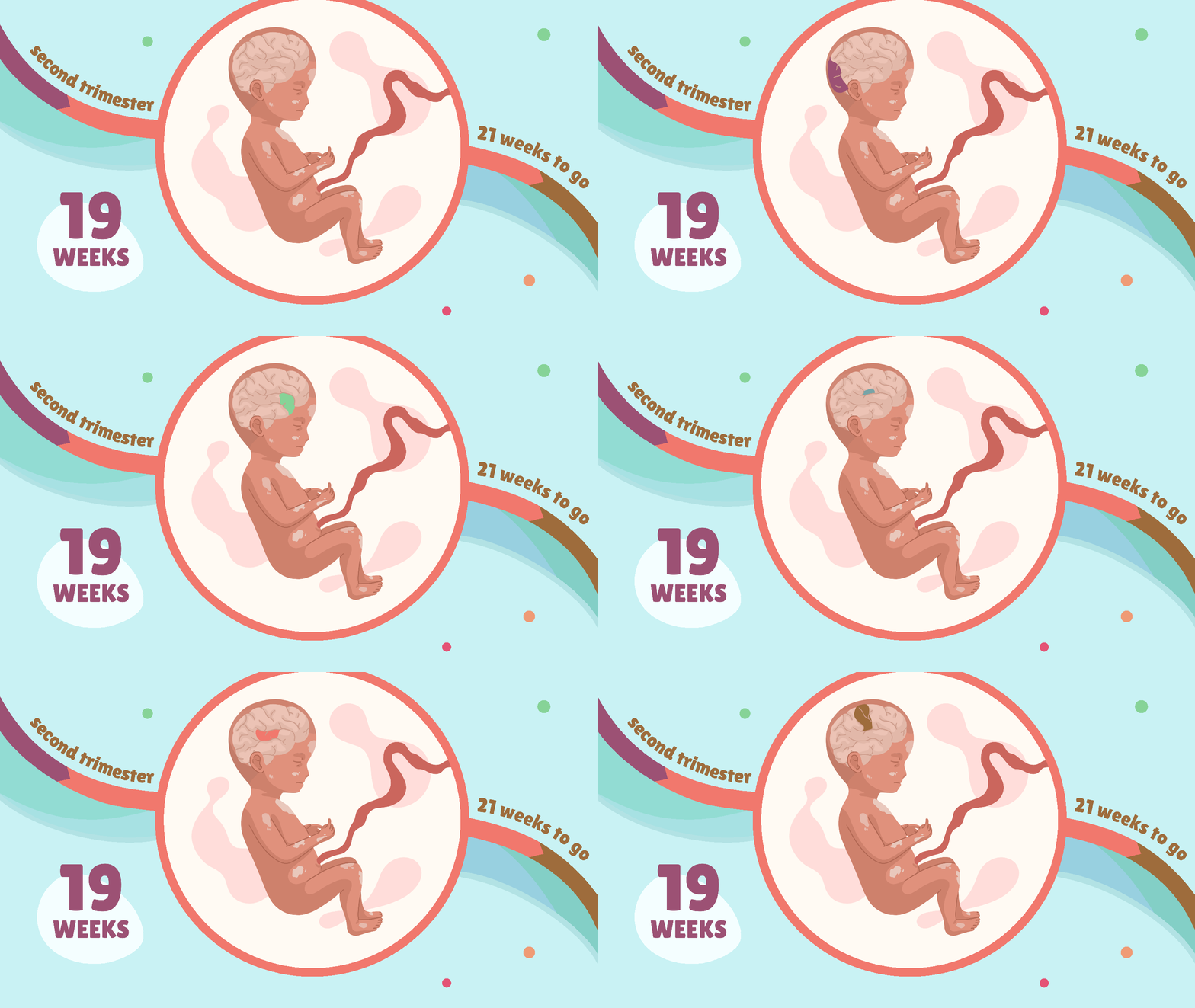
#469 Week 19
Lisa discusses her son’s life with type 1 diabetes.

You can always listen to the Juicebox Podcast here but the cool kids use: Apple Podcasts/iOS - Spotify - Amazon Music - Google Play/Android - iHeart Radio - Radio Public, Amazon Alexa or their favorite podcast app.
+ Click for EPISODE TRANSCRIPT
DISCLAIMER: This text is the output of AI based transcribing from an audio recording. Although the transcription is largely accurate, in some cases it is incomplete or inaccurate due to inaudible passages or transcription errors and should not be treated as an authoritative record. Nothing that you read here constitutes advice medical or otherwise. Always consult with a healthcare professional before making changes to a healthcare plan.
Scott Benner 0:00
Hello friends and welcome to Episode 469 of the Juicebox Podcast.
On today's show, Lisa is going to visit us all the way from Sweden and tell us a rather remarkable story about her son, who among other things, has type one diabetes.
While you're listening today, please remember that nothing you hear on the Juicebox Podcast should be considered advice, medical or otherwise. Always consult a physician before making any changes to your health care plan, or becoming bold with insulin.
If you're here looking for the diabetes pro tip episodes, they begin at Episode 210 and are also listed at Juicebox Podcast comm you just go to the top and click on diabetes pro tip or you can go to diabetes pro tip.com. But I wouldn't do that until after you hear this conversation with Lisa, because I think you're going to love it.
This episode of The Juicebox Podcast is sponsored today by the Omnipod tubeless insulin pump. By the Dexcom g six continuous glucose monitor and touched by type one you can find touched by type one on Facebook or Instagram were touched by type one.org. You can learn more about the possibility of a free 30 day trial of the Omni pod dash tubeless insulin pump at Omni pod comm forward slash juice box. And you can get started today with the Dexcom g six continuous glucose monitor@dexcom.com forward slash juicebox. There are links in the show notes of your podcast player and links at Juicebox podcast.com.
Lisa 2:16
My name is Lisa and I live in Sweden. And I probably don't sound so Swedish. And that's because I was raised in Northern California.
Scott Benner 2:25
I was gonna say your middle name, which I'm assuming is your maiden name. Is that is that your is?
Unknown Speaker 2:31
Oh, that's that's a long story.
Unknown Speaker 2:34
Like we don't have time for that, buddy.
Lisa 2:37
We don't have time for that one. But you're correct. My my. My second name is the name in Sweden, right? My Swedish married name correct. And I am I've lived in Sweden since 1988. I came here with a tech company and I have two boys and a husband and boy dogs. So maybe four boys and I am the mother to a 15 year old who was diagnosed with Type One Diabetes 11 months ago.
Scott Benner 3:09
Okay, so within this year, correct, gotcha. Okay, so within a calendar year, your 15 year old was diagnosed. Was that out of the blue? is there other? It was okay. You've I have some background here on you, which I you know, I'm just happy to tell people that I'm looking at and I think we should probably just pick slowly through everything I'm seeing here is your type one's life. Right? Correct. Okay, so did the issues begin? Before he was even born? How did that? Yes.
Lisa 3:44
So the second ultrasound week 19 showed a fluid filled cysts in the abdomen of the baby I was carrying. And so that's when it all started was week 19 of the pregnancy and it was some quite severe damage to the intestinal area, primarily the liver and the intestine. So they took him out early and did nine hours of surgery actually. The surgeons actually said they had to lay him on the table and call Japan to get some help so so he's kind of a miracle. And it's just kind of been a long story since then. I want to start off by saying he's a great joy and I call him my sunshine. He's very happy and great young, young person. But he has medical issues in his abdomen, so that would include liver intestines, and now even kidneys. He has we did some investigations. I didn't really know what was happening. And I did suspect maybe behavioral disorder autism spectrum, but it turned out to be a severe hearing loss and then also a mild to moderate cognitive disability, which the two together kind of mimic, he didn't hear what we were saying and didn't know what to do about it. And then some motors, motor impairment, and then 11 months ago with diabetes diagnosis from nowhere, do you. Okay,
Scott Benner 5:33
I have a couple of questions. Yeah. One of them's just gonna sound silly. And I don't mean to, but after the surgery, they don't put them back, right. You know, when you're making a cake, sometimes you need some work, and then you put it back in. But it wasn't like that, right? No, no. So he,
Lisa 5:52
they did they did this is arion, five weeks early. So we tried to manage it in utero. And I had really great medical care. Of course, again, I'm living in Sweden, and living near the capital of Stockholm, right outside, actually. And so really the highest quality medical universities and kind of in Northern Europe and maybe around the world, or 10 minutes from my house with both pediatric care and even like the diabetes care now and all the specialists and even when I was pregnant with him, so yeah, so I was really fortunate to live where I live, what's happening.
Scott Benner 6:35
So he, they perform this nine hour surgery, he's in an incubator for a while, I imagine.
Lisa 6:41
Um, yeah. He was in intensive care for a while. And then we that did the hospital for we came home to visit for the first time after about five weeks. And my father had come over from California to stay in our home with our older child who was turning four at the time.
Scott Benner 7:09
Gotcha. See, Lisa, if you're gonna know what I'm going to ask you before I asked you, then you can just get I get, I'm gonna go have breakfast.
Unknown Speaker 7:15
And you can tell me,
Scott Benner 7:16
I'm just getting ready to be like, How old were your other kids? And were they Yeah. But but so you lived in the hospital for weeks upon weeks? And then he came home eventually with you? Or you will when he's
Lisa 7:28
a kid? No, no, they never separate parents and children here, so and so we were put up there, they have parent apartments and in the Children's Hospital here, so we lived there. And we came home with him briefly for a visit just he was maybe five or six weeks after his birth, and then kind of back and forth. And then he got really sick at home. Another long story. Another long story, but he he got something called necrotizing enterocolitis. You guys call it neck NAC which is basically it can cause sepsis in the body. And so we had to go back in the hospital for quite a long time to try to see if he could repair that through not eating. So he was on IV foods for a while. So we were we were in and out with multiple surgeries and, and and attention for the first you know, year. And then he was Yeah, and then he was going blue at home. So I was given a mouth to mouth when we came home. So again, it's a lot of life and death early on. For us with him.
Scott Benner 8:43
Yeah, what is? Do you feel like you're a completely different person now than you were a year ago? Did you know so many things that you didn't know, prior? Like, how does it impact you? I guess.
Lisa 8:56
So I think that for me personally, you know, sometimes when you go through traumas, and you know heartbreaks and challenges in your life, or, you know, you you're impacted by them, and I had worked really hard to heal from some of those. I mean, I've had a lot of support through our medical system here with therapy. And I think when, when, when we get hit with the diabetes diagnosis, it sure didn't take much to crack the egg, if you know what I mean it I think I don't know whether I took it harder or easier than somebody who had never had a trauma before with a child. But we had gone through so much and we had worked so hard to you know, to get him healthy and to adjust our life and to give him all the tools and resources. I mean, even for the cognitive side and the hearing side and special schools and we really we're getting somewhere and then to have this hit us the last the last 11 has, I think in some ways tougher than the first time we went through the medical challenges? Well, you've listed a number of things, I think any of which, on their own would be
Scott Benner 10:14
a significant hill to climb, you know, and then there's just one on top of it. Other ones have another do each of these. And I'm assuming, like, each of these things, when they need attention from a physician, it's a, it's a separate visit somewhere, like is much of your time spent. Seeing doctors.
Lisa 10:35
Yeah, that's a really astute kind of understanding that you get that I don't think a lot of people do understand is that when you have so many very rare issues to deal with, and such a number of them, and there's no known profile, then yeah, they're there. Everything's pretty separate. I mean, and and what it does on top of it is that a lot it, it makes the responsibility for keeping it all together on me and on our family. So I'll give me an example. And I might be getting ahead of this. But we had for the first time ever, an infection at a pump site last week. And I, of course, who do you contact for an infection in the pump site, and I sort through all these Facebook groups and internet forums, and I think, okay, it's our primary doctor. So I contacted our primary family doctor, and and she said, Well, maybe you should contact the diabetes nursery or doctor, and then if they think it's okay, all right out the antibiotic. And then I remembered, oh, gosh, antibiotics deliver specialists, they don't want us to give them these three antibiotics. But this one's okay. And in the end, I had to take the responsibility to tell our doctor, I want you to write out the prescription and the weekends coming, it was actually just a few days ago. And if it gets worse, I'm going to give it to them. But if not, I'm not going to so a lot of the responsibility ends up being here at home with us. Yeah,
Scott Benner 12:12
I would imagine that each of these things is sort of like diabetes, in that they give you some information, and then you have to make on the fly adjustments with it. And I just was thinking about the, you know, I mean, we're trying to manage our way through things with Arden that are obviously not nearly as significant or severe as what you're talking about, in many cases here. But it's one doctor over here, you know, and one doctor over here, and then the third one in the middle, and they don't really talk to each other, they'll send like their notes to each other. But you know, I don't know what that means. Exactly. And then, you know, at some point, like they give you some kind of marching orders. And then the rest of it, it's inferred. It never gets said out loud. But it's always like, okay, you take care of this, figure out what you're seeing and report back to me. And then we'll take the next step, which which heartbreakingly is often not the step that gets you to where you want to be. It's, it's like, I don't know, it's like, you're absolutely in the dark, and someone throws a flashlight on the floor, and you're just feeling around one hand printed at a time trying to figure out where the flashlight is, and and then you find it, the batteries don't work is to
Lisa 13:26
figure out what's causing what's causing the symptom or what's causing this not to work the way it should work. And, and it's, it's like a medical mystery every day. And then, you know, you said something smart about, it might be like diabetes. And I would say that diabetes is today's management of diabetes and how we're managing diabetes with the CGM and the pump and the data and, and the knowledge. It's actually quite unique. I would say the other conditions that we deal with are maybe like how diabetes was managed. Before CGM. So we're kind of blind as to how is this medicine helping the health of his liver? Like I can't I can't track that every five minutes at home. So. So diabetes is somewhat unique with with what we have now.
Scott Benner 14:16
There's so many like user tools that don't exist with other issues. Yeah, right. Do you see a lot of ghosts meaning while you're trying to figure things out, you find yourself I find sometimes that I spend three, four or five weeks chasing down a thing and you get to the end, you're like, oh, that was nothing. And you're just like, Oh, my God. And then I do this. I here's something I end up doing, and I'll ask you about it. Sometimes I just reset for a minute. Me personally, I stopped thinking about it, even though we haven't found the answer. And then that makes me feel guilty.
Unknown Speaker 14:55
Yeah,
Lisa 14:56
yeah. I am so honored. On top of the diabetes management that I ended up in, in the cardiac intensive three weeks after his diagnosis, so I'm chasing, I thought I could control an uncontrollable disease because I was used to being able to control math. And I work in in medical technology products. And so I put myself in the hospital with no underlying cardiac conditions. So I, you know, at a pretty young age in pretty good shape and, and so now, what you say is, as I'm chasing what's going on, I am getting better right now is 11 months in, I am sometimes saying, screw it, I'm going to bed now. Like, I'm going to live with that value. For now, you know, I just like so I'm getting better kind of saying, you just also have to live through this.
Scott Benner 15:57
We say your special kind of type A, aren't you?
Lisa 16:01
When it comes to math? Yeah. I mean, when it comes when it comes to algorithms, and I mean, that's, that's my background. And so watching trends and seeing curves, and, you know, the sugar surfing protocols, and all those types of things. And that's really interesting to me if it wasn't my kid that's like, this is like my dream job is being an artificial pancreas.
Scott Benner 16:23
Yeah, until it's for your kids. And it's not my kid. Yeah. No, I You should hear me talk to people privately. I'm so loose. I'm just like, do that. Try this. Why don't you do that? Why just think that they're like, what I'm like, No, there's part of me, that's just trying to imply that you have to chill out a little bit, you know, because it just isn't going to come together as quickly as you want it to end when you get so tight. And I think to micro you know, with your vision, then you miss other things that are happening that are valuable, you're always kind of hitting yourself hard saying, Oh, I messed this up, or I didn't figure something out or something happened again, that went wrong. It's too much for a person to take. You really, you really can't do you can't sustain it. I mean, you didn't make it three months, it sounds like
Lisa 17:13
no three weeks, I ended up in the hospital three and a half weeks after the diagnosis. And it's called the takotsubo. It's a stress induced heart failure. So there's so many the adrenaline and the cortisone and they're called catecholamines. In the body, it was a surge of stress hormones, and it basically paralyzed my left ventricle. And it's a rare condition. And you know, typically it happens people that have been married for 60 years, and they're both on their deathbed holding each other hands and one passes away, and then the other passes away, like 10 minutes later, right? That's generally when a takotsubo happens. That's in general, when people get them,
Scott Benner 17:55
we start to tell people not to marry men from Sweden, is this.
Lisa 18:01
What I want to go back to you said about you telling people like, try this and try that. And I, I think that's really what made a difference for me, Scott, is I that that I want to go back to that because I want to tell you what your podcast and that attitude did for me. But before I do, so, do you think we start out like that, because the medical professionals scare us into not daring to take take testing. And to like, try out things? Do you? Have you thought about that? I mean,
Scott Benner 18:36
have I thought about it? I've thought about it a lot. I I find myself wondering if it isn't just the nature of people to want to follow a rule or to be on a team. You know, I'm team low carb I'm team you know, keto, I do vegan. I you know, we love the I pump pumping is very important. Oh, no. MDI, like, everyone's got it. They want to be on a team, right? Like having a jersey on makes you feel good, because then there's other people, and you're not alone, this whole thing. But then there's the rules. The rules are the rules. People want there to be rules. And if you really step back and really look at society in general, there aren't many rules beyond a couple, right? Like, you know, you don't treat people poorly, you don't kill people hurt people steal things. You know, that's pretty much it right? The rest of it's just common sense and calm. And when you think your life is moving the way that it's supposed to you stay calm. And you follow these couple of basic rules. And for the most part, things work out about the way you expect. And that's what people seem to be able to handle and you throw them into this. This medical situation where nothing they're seeing is making sense and they want the rules. so badly. So then the doctors give you the rules.
Lisa 20:02
And the doctor in this society is not to be questioned often by people or they feel that they don't have the knowledge necessary to question the doctor. Whereas we're the ones that know our children and ourselves the best. And that's what I learned through all the other challenges all the other medical challenges over the past 1516 years is, I have always questioned what the doctor says.
Scott Benner 20:29
And when people do find time to challenge like they, they kind of get the nerve to challenge something very frequently, at least in this space. As far as I can tell, they pick the wrong hills to die on, they challenge the wrong things, they, because they're seeing, they're seeing so many ghosts in their diabetes care, they can't make sense of everything.
Lisa 20:51
I want to give you an example.
Scott Benner 20:53
I had one, but I want to hear you.
Lisa 20:55
Because I so I learned to be aggressive and bold with insulin, you know, through the podcast tonight. And I and I back it up with math. And so I feel, you know, quite confident in what I'm trying to do. And I generally take like a concrete situation. And I'll like back it up, for example, in the evenings when our son falls asleep, we fight rises, and I've come to determine it's a combination of growth hormones, and also late digestion of dinner. He's a huge eater. I mean, he he eats massive amounts of food every day. And so I was trying to adjust, you know, that from 9pm to midnight type timeframe and am I don't ask for much help from the Diabetes Center. And but I really wanted to get aggressive and I thought, Oh, can I really do that? Like I wanted to almost like double his basil, you know, those three hours and, and I called the nurse. And I literally shocked her because I said, I think I want to double his basil rate for three hours. And she says, Oh, well, we we recommend only doing 10% changes at a time and then waiting three days. And I was like, Thank you Bye, click.
Scott Benner 22:05
So the thing that I most frequently say to people that that they just can't wrap their head around is here's the scenario right? There, Basil is too low, they don't know it. And they miss on their meal insulin, so their blood sugar shoot up. So they have a lot of spikes a lot of highs then later they crash low. And then they put in food and they spike and they're on this, you know, it's never ending. It's a roller coaster. And so I'll get ahold of somebody and say, there's like we haven't, we're having a lot of lows, what would you do here? And I say you need more basil. And so now I've said more insulin, right? And they're like, No, no, like, it can't possibly be more insulin because the blood sugar keeps getting low. And that would indicate too much insulin. I'm like, no, that indicates poorly timed insulin. And that now your three steps into this situation. And I haven't said this on the podcast a lot. But you get much more past three levels of thinking. And you begin to lose people. There's there's a lot of balls up in the air. And you have to remember how they're all impacting each other. And I'm not saying that you could put me into a different scenario. And I'd be some great thinker. I'm just telling you that around diabetes, I can see all the balls up in the air like diabetes, to me feels like the end of the matrix. When Kiana figures out how to slow the bullets down.
Lisa 23:33
Yeah, and your daughter is very fortunate to have someone who gets that and I feel the same way about our son. But what I often feel is I feel so bad for those kids who have parents that don't understand the all of these complex factors together and they're getting this very traditional direction from their diabetes, you know, resources on I just, I see these curves. I know I've heard you before Scott, you're like, oh, man, I just couldn't not say anything. Like when you see something and you're, you're like, I just couldn't not say anything. And I don't ever say anything to anybody because I don't have the energy to spare beyond brushing my teeth right now.
Scott Benner 24:21
Are you sure you would get the tacos to be again, or whatever it's called?
Unknown Speaker 24:25
Yeah.
Lisa 24:27
Do you know that's the Japanese name for a device they use in Japan for catching octopuses. It's the shape of this almost like a it's like a vase. It's like a it's an octopus catcher. It's called a takotsubo. And it's the shape that the heart gets when it has this left ventricle failure.
Scott Benner 24:46
Okay, so at some point, a doctor saw this on an image and thought that it looks like the thing that catches the octopus.
Lisa 24:52
I mean, whoever that was, must have been catching some octopus.
Scott Benner 24:57
So I don't want to get away from what you're saying. And I have something I want to get by as well, but first of all it a long time ago, I came, you know, to the conclusion, as we all probably should, that you cannot just go out into the world and fix everybody or help everybody and is really sad to see someone struggling and walk away. And I will tell you that for me, it feels like, it feels like I came up on a car accident. And I could get them out. But I just decide not to. And I leave. And so when I say you
Lisa 25:30
wait for the paramedics to get there, and then you leave
Scott Benner 25:32
well, but but the point is, is that I wouldn't leave a car accident, but at some point, with my life being intersected with social media, which by the way, I don't particularly enjoy. And and somebody new comes every five minutes, and I look and I think I could fix that. And I don't have time. And and
Lisa 25:53
around the corner last night and there was this old man in a wheelchair outside and he and he was like trying to push himself up a hill. And I said to my husband, oh, I want to get out and push him. And he looked at me like I was crazy. I said, I want to get out and push him and he said Lisa, you know, you can't get out and push every single person that goes by in a wheelchair.
Scott Benner 26:12
Yeah, your life, your life would literally become about constantly about other people. And, and so listen to me this podcast, if I'm wrong, I'm wrong. But I think if you listen to this podcast, you'll understand how to take care of diabetes when it's over.
Lisa 26:26
I totally agree with you, Scott. And if you can actually take it in, I mean, sure. But yeah, I agree. And it changed it for me too. You know, it did, I had I had read in the hospital, we were only in the hospital two days with the diagnosis and I had already read through the whole sugar surfing, you know, website and I had ordered things like a pancreas and pumping insulin. And then I just met, you know, just child through all of that ended up in the hospital and started listening to the podcast. And, and as I was afraid this, you know, around three, four or five months into it, when I had this horrible fear. You really changed it I you know, I you really made me feel bold. So thanks.
Scott Benner 27:20
If you're interested in the insulin pump that my daughter has been wearing for ever since she was four years old, or the glucose monitor that she's been wearing for ever, since she was six, maybe a long time, then you're gonna want to know about the Omnipod tubeless insulin pump, and the Dexcom g six continuous glucose monitor. Let's start with the Dexcom. The Dexcom g six is a glucose monitor that gives you readings and data in real time. You can get them on a receiver or right there on your iPhone or Android phone. This is beyond exciting. And if you're not excited by it, then you don't understand what it does. Try to imagine seeing your or a loved one's blood sugar in real time. And not just the number not just she's 89 or 53 or 120. But what direction is that blood sugar moving? Or is it stable? And if it's moving in a direction? How quickly is it moving? That's the kind of information that is next level. That's how you make ninja level decisions about using insulin and type one diabetes. At least that's how I do it. And I think you could check it out@dexcom.com forward slash juice box. You can get started right there or just getting more information but one way or the other. You need to start looking. I just opened my phone. My daughter's blood sugar is 104. There's a little boy named Dominic. I'm watching his blood sugar today. This is 106 both are stable. not crazy. You could do that too. You could do it for a husband and a wife, a friend, mother, a daughter, a son, anybody you care about. Think about the possibilities. A school nurse could watch if you want it or not. It's completely up to you. And how do we give my daughter the insulin that made that 104 blood sugar? Well, we do it through the Omni pod tubeless insulin pump. It is tube less. I know that might be like if you don't have a pump right now like does that matter? But it does. Other pumps have tubing. So there's an infusion set on other pumps that goes into your skin followed by a long tube that has to snake through your clothing or whatever and then goes to a controller where the insulin is and where the buttons are. With on the pod. Everything is in one small pot. You put it on and then you tell the pod what to do from a wireless tubeless controller. It is very small, sort of like a cell phone. The great news here is that some of you will be eligible for a free 30 day trial of the Omni pod dash and that is available at Omni pod dot COMM forward slash juice box, go and check it out free 30 days of using an insulin pump with no strings attached and no tubing attached, but you don't have to buy it. If you do the thing in I mean, you could do the 30 days and be like I don't want it. That's not a problem. There's other stuff at that site too. You could also get a free no obligation demo pod, which would just be one nonfunctioning pod for try on and where just see if you dig it or not. So maybe you'll start slow with a nonfunctioning demo, and then move up to the on the pod dash trial. Who knows, there's only one way to find out on the pod.com, forward slash juicebox. And please don't forget, touched by type one.org. and define touch by type one on Instagram and Facebook. They do amazing things for people living with Type One Diabetes, they're a great org. And I hope you check them out. There are links to these and all the sponsors in the show notes of your podcast player, or at Juicebox. Podcast calm, please remember, when you click on the links, you're supporting the show. So I'm not saying just click on them. But if you're looking for a pumper CGM, or to help an org or glucagon that comes in a hypo pen, or the most accurate blood glucose meter I've ever seen in my life, I'd appreciate it if you did it through my links. Thank you very much. Let's get back to Lisa.
You're very welcome. And I'm super happy about that. I have to tell you, you named a number of things that I know people really like. Think Like a pancreas, that book is incredibly popular. Pumping insulin. I know some people really love sugar surfing, I've had Dr. ponder on the show. Yeah, I know. I've listened to it. But I've never read any of those books. And if I read those books, not those books, forget those books for a second. If I read a book, I just know how my brain works. If you told me Hey, the answer to diabetes is in these books, I would think oh, well, I'm never gonna figure this out. I'm just not it doesn't work that way for me. And I don't think this podcast is for everyone. I think there are plenty of people who can and will read think like a pancreas. And they'll just be like, Oh, that's it. Great. You know, but I think that the thing about the podcast is that it's alive. You know? And so when people ask me, can you write a book about diabetes, which people ask me constantly about, I'm like, that's a waste of time. The podcast is the right way to do it. Like conversations with the right way to do it. hearing things, explained multiple ways by different people. Until the thing that gets to you gets to you. And you're like, Oh, that's it. I understand. Now, this to me is the way but once you write something down, it's static. And then something changes, you start wrote
Lisa 32:32
down, if you wrote down the things that are being said in this podcast, you probably get sued.
Scott Benner 32:39
Well, you know, hey, not for nothing, too. I'm not a doctor. All three of those books are written by people with degrees. Yeah. And so you know, and not even just that, I think, but if I wrote it all down, it would either be a million pages of text, or it would be too, because there's part of me is like, really believes when I tell you like this is all timing and amount. That's it, you just have to use the right amount of insulin at the right time. There's no nothing else to it. There's Don't get me wrong, there's a bazillion other variables. But as you start experiencing them, them, you eventually just figure out Oh, this is potato chips. I get this now. And this is when they're playing ice hockey, I understand now. And you just you grow into it. I would tell you that if it wasn't for this podcast, I don't think I would. I don't think the word diabetes would come into my head maybe once a day. Because it's just easy at this point.
Lisa 33:39
And I think you guys are looping still, right? You're still
Scott Benner 33:42
Yeah, it but I felt that way prior to that as well. And, and the loop just kind of tightened everything down a little more takes out some of the, you know, you know, when you're just looking at a 97 blood sugar, you're like, this is great. And then all of a sudden, it's 130. And you're like, Huh, what happened? Like those, those kind of moments go away. You know, I
Lisa 34:04
ordered I ordered them rightly links from the US that have arrived and I was gonna build and I decided to postpone it now because number one, our son who has you know, a learning disability and, and all the other issues and he's actually getting pretty good at like, using the PDM 80 style PDM you know, on the old on the old Omnipod. Now, the people around him during the day are also you know, understanding when I tell them I mean I'm managing diabetes by SMS to adults that that are around him and he is gaining some self I wouldn't say not self care, but but he's able to understand like, Oh, this is what I'm supposed to do when she says you know, put a tent Bissau lawn and so I decided to postpone it primarily because of that, but also because I I feel like I've got such tight control right now that I'm going to have to go through a period of relearning and re testing all of the factors. And so I haven't done it yet.
Scott Benner 35:09
Yeah, you don't seem like the kind of person who should pick up a hobby. You know, I'm gonna try woodworking, or you know, and I'm looking at our graph, and it's great, you obviously know what you're doing. And it Listen, honestly, had one person not badgered me so harshly to try this algorithm, I had no reason to do it, I was never going to do it. And it just was, she said, like, I really think that people in general would benefit if you understood how to use this. And I agree
Lisa 35:42
with that. And I and I had planned to do it. And then I chose to at least postpone for for different reasons. And, but I do manage his diabetes quite a bit like Luke does, I am using temp bisol, you know, a lot. And I use that a lot as a big tool, kind of as loop is adjusting the bisol a lot. So. So I do I,
Scott Benner 36:05
I was I was an algorithm for many years on my own. And it just helped me, it helped me understand like, it's now like, when I when people ask me, like, how do you excuse me, when you you see a high blood sugar with loop? Like, how do you get it back down? Because the the algorithm does not want to come down quickly. Right?
Unknown Speaker 36:27
I know you open it, don't you?
Scott Benner 36:28
Yeah. So I basically tell the loop. Okay, you go away now. And then I
Unknown Speaker 36:32
carb sign I
Scott Benner 36:32
do. I don't even fake carb. I just put in a bunch of insulin. And I and I know where in the drop to close the loop. So that levels off? Yep. And if you think that's something magical, it's not I just did it a bunch of times till I figured it out. And people are like, Well, you know, they would ask them, well let what number do you turn it back on? I think it would be different for every person. What I'm saying is, is that I did it. I watched the graph. Yep. And one day, I was like, Okay, here. And when I say here, again, I'm not saying a number. It's a visual. Like I look at the line.
Lisa 37:08
That is so interesting, because that's exactly what I'm looking at every, every moment with, with the diabetes management. It's not about the number for me, like I've never had, like, I don't like have a number goal. What I have is I want it to be as little variation is possible.
Scott Benner 37:26
Yeah, you're just flying an airplane, and you want it to be smooth. You want it to go up smoothly and level out smoothly and come down smoothly and level out smoothly. Excuse me, let me take a drink for a second. At one point, Dexcom sort of changed their graphics on the follow up. And I had them on one day and I was like, don't do that. Like don't make it look different. I know what this looks like. And I was in a panic for a second. But you know what? I see it the way it is now too. They could change as much as they want. I could keep figuring it out. It doesn't matter.
Lisa 38:00
I don't use follow a nearly at all.
Scott Benner 38:03
Are you using sugar mate? Sugar, mate? Okay, yeah, and I have that as well. And I don't look at that as I need. I like Dexcom follow for the line. I like sugar mate for kind of the information that's on the front page of it a lot. I'm actually getting ready to do something that I think I might be, I might be doing something with sugar mate coming up. Which will probably happen before they put this out. So I'll tell you, I'm going to wear a G six and broadcast my blood sugar's live on my blog. And then I'm going to tell people when I'm eating and what I'm eating so they can see how a pancreas handles the different situations. Because I think that information will help them understand their kids and themselves.
Lisa 38:51
Do you know we use we use candy called Mentos if if if we have to treat kind of an aggressive following blood glucose, we don't have lows, but but essentially physical activity and then you know, trending down and we don't use. We don't use glucose tablets. So Mentos has glucose in it. That's the Skittles, what have you and and so I decided we came home from summer vacation and there was a half a package of this Mentos candy left. And I was kind of I don't usually eat candy, but I just thought well, I like to have those and I so I ate half of a role. And then I was just I had this like epiphany. So I went and I got the band tested my blood sugar. And I mean, I was super high. I was like what's that in? 8.8 times eight.
Scott Benner 39:39
I have my finger right here. So you were 8.8 by 8.8. This is a team Xbox 160 Yep, I have it at 158 there's a beautiful I don't know if you saw it but a listener built this. This calculator that does a one C and blood glucose. So like I I'm on. How do you say it? Is it mimeo? How do you guys say MMO? l do millimole millimoles. Okay, so I just put in 8.8, it immediately told me that that's in America 158. And it tells me that if your average blood sugar is a point A, it will come to an A one C of 7.1. And that was
Lisa 40:22
after a half, half a package, like maybe about double what I would use to treat it, you know, drop with him,
Scott Benner 40:28
right. And your functioning pancreas is in there fighting off those Mentos. Right,
Lisa 40:33
I test 5.1 Exactly. All the time. Like, whenever I test, I'm just at 5.1, whenever I see, well, is 91.8.
Scott Benner 40:44
And that gives you in that situation, I'm assuming gave you a real idea of Oh, that's why Mentos stopped drops so well. Like they're really fighting
Unknown Speaker 40:55
rocket fuel, fuel.
Scott Benner 40:57
It's funny how everybody just thinks of it differently like, but in my mind, it's sort of just like these opposing forces. It feels like a cartoon to me like fire like a flame thrower on one side and a flame thrower on the other side, and they're just blasting at each other. And they kind of meet in the middle and dissolve and like, that's how I think of the sugar coming in to press against the insulin that's pushing down, and then it pushes back up until they kind of you know, they both go off. And hopefully you're left about where you mean to be. I don't know. I can't imagine. There's What do I want to say there are not many other places in my life where the way my weird brain works about things, or people are like, Oh, this is very interesting. And I should listen, I can't believe it worked out for diabetes, of all the bizarre things I honestly can tell you that that this is my podcast still confounds me. Like, it doesn't seem like I should be the person doing this to me even. But
Lisa 41:51
thank you revisit, you're a visual learner and are like a picture learner. And I am a person who I have to draw when I have to circle and move. I just recently went to law school, you know, it's free here to go to university. So I'm an engineer, but I just went to law school right before this, this diagnosis and all the young kids, you know, they're like typing in a computer. And I hand wrote on paper, because that's the way I learned and your way of learning and communicating works really well in this kind of visual interpretation of the blood glucose trends and levels on so I get it. I'm also very visual. And I think that's why it works well for me, too.
Scott Benner 42:30
Yeah, it's crazy. You know, every time you mentioned Sweden, I think of the chef from the Muppets. I'm like,
Unknown Speaker 42:34
Oh, that's funny.
Scott Benner 42:35
I'm like a seven year old, like, I can hear it in the back of my head doing like, I'm trying to keep up with our conversation and overwhelmed, doing be doing in that's going on. And
Unknown Speaker 42:46
I don't even love The Muppets.
Unknown Speaker 42:49
Anyway, back
Lisa 42:50
to Sweden, I was thinking, when I was preparing, just kind of where I'm at with diabetes management, I thought to myself, because I had to relive this a bit just kind of thinking about talking to you. And I thought, wow, I couldn't imagine going through what we've been going through the past 11 months and having on top of it the financial pressure of insurance questions and insulin costs and things like that. I I really thought hard about that today that I couldn't imagine feeling any worse than I felt going through this, this first, you know, adaptation to life with a child with diabetes and, and just the thought of people, you know, not taking insulin they need or not having access to the medical technology they need, or being afraid of losing your job. First, in the first hand, in the second hand, you lose your insurance on top of it during these times. And it's like it's inhuman. I mean, we it doesn't cost anything, nothing related to our son's medical care. And especially with diabetes. I mean, nothing is a cost for us straight out of the pocket. So I don't have to pull insulin out of a pump that goes bad or there's no insurance.
Scott Benner 44:14
You'd have to fight comm or anything like that.
Lisa 44:17
Oh, no. I have the G six on him two weeks after diagnosis in the Omni pod about seven weeks after diagnosis. Terrific.
Scott Benner 44:25
It really is. What kind of insulin does he use?
Lisa 44:29
He uses he uses what would you guys call it as it called Nova log. It's nobody there.
Scott Benner 44:38
So it's no is it? No volin there or novo novo? No, you call it something completely different? Yeah.
Lisa 44:44
He in the beginning he had you know the when he was on MDI, he had I think you call it a basketball or we call it a basketball. So we had basaglar and novolog. And now he just has of course no vlog.
Scott Benner 44:57
Yeah, that's amazing.
Well, how is I don't want to make you upset, I guess. Are you okay? Like, how did you? How did you get to okay?
Lisa 45:14
What's a lot of support? I so, you know, I think the first few weeks for the first month was I can control this, I can handle this, just like I've handled everything else that's come our way. And I was somewhat, you know, like magical about it about reading and I wanted to know everything there was about diabetes, everything there was to learn. And that was my, that was my mode, that put me into the hospital. And then I was forced to chill out and ask for help. And then I ended up referring myself to psychiatry care. over the phone, I call them said, I'm concerned about my mental health. And I got help. So I a combination of just having, you know, therapist contact me twice a week, and some medication and some help asleep. And then with time, so they tied mostly with something called adjustment disorder, like and I remember the doctor saying that the psychiatric doctor saying, Okay, well, Lisa, you're going to feel better in about nine months, you just like the body has a great ability to adjust again, and we're gonna do all these things to get you there. But you will feel better. And I, I could, I never thought I would. But I did, we did have summer vacation. And I think just going from diagnosis to putting him into an environment with other people that didn't understand what was happening, and then trying to manage his diabetes remotely. And he goes to a special school in another area of the city. He rides in a taxi three times a day to special schools and care programs. And so I was having to, like take care of him, but I couldn't see him and I couldn't touch him. And I couldn't see the food I had to. I had to like use the pictures they were sending me and the weights they were sending me. And so that was just like this intense demand on me both workload wise, emotionally brain capacity. And then once he was on summer vacation, and I kept saying, why don't you just stay home with us when school was out? No, I want to go to my after school program, he wants to go and be with, you know, friends and, and with these, these mentors that lead them and when he got home, and when I got six weeks with him 24 hours a day. I just think I just healed me. I just got to share with him some more. And when I sent him back to school, when school started the end of August, I just I felt calmer. And he understood a bit more from his time with me and with us. together and I just so far. So, so far, it's only been what, five or six weeks since school started in this kind of like, energy. I got refilled during the summer. I mean, it's still lasting. So I'm feeling better. But it was it was touching go there for a while. I was concerned about myself. I was shaking, most of the time.
Scott Benner 48:21
Yeah. I told my son recently that with us all kind of living on top of each other because of COVID. And him being here instead of being a college, I said, Look, I realize how much you're missing. And I'm sorry that this is your experience right now with college. He's now in his bedroom, taking classes. But I said I'm going to look back over this time and be so thrilled to have this extra time with you. And and I I feel better when he's here. Yeah, I don't really know another way to say it. Like I just eat seems right that he's here. Now I'm
Lisa 48:57
going to start crying our older son just left for the university, just
Unknown Speaker 49:03
trying to learn things.
Lisa 49:05
No, I mean, he he just left and moved to the other side of Sweden to a university. And so this is the first time our older son has ever really lived someplace else for a period of time. So so now that your son's home, our oldest son left no,
Scott Benner 49:21
he'll be going again soon. He'll be out of here pretty soon there. He was talking to his coach the other day and he's like, I think you guys will be back in the spring and you know, so I feel like after the holidays he'll he'll be out of here. But how far did your did your child go to?
Lisa 49:37
Let's see Sweden is the same size as California length and width. And so if you imagine we live on the very east, east side of Sweden, and he moved to the very west side so that distance from you know one edge of the California State to the other edge, it's it's about five hours by fast train, or car, I think Yeah.
Scott Benner 50:06
Do you feel like you'll be able to visit him at all? When he's there is that is there a reason to?
Lisa 50:11
Well, my husband, you know, helped move him and his, his girlfriend there. But with, with how life is right now here with our younger son, I haven't been there to visit yet I just basically got brave enough to start kind of being in other environments with our son that has diabetes that it took me this summer, it took me about a half a year for me to actually grab up all my diabetes supplies that I have pretty good control of at home, and take them to what we call our summer house, which is another home that we own. It took me about a half a year just to just to do that.
Scott Benner 50:59
So I want to dig into this if you could, yeah, so here's why. Because I couldn't get in my car and drive to the store for the first year. Because I was like, What if something happens while we're in the car? You know, and that's kind of where I'm at. But it's funny to hear you say it. Because for 14 years, you've been in charge of all of these special needs. Right. And and obviously your son's, you know, going to school and taking taxis and he has friends and all that's going as I would I don't want to say as well as can be expected. It sounds like it's going really, really great considering
Lisa 51:34
absolutely doing he's doing really well. But I did feel like that also in the beginning. Yeah. When things happened, and know when different things happen.
Scott Benner 51:43
So did your experience with all of the stuff that happened at birth, it wasn't able to inform you enough for you to ignore similar feelings around diabetes. Sorry, I
Lisa 51:57
think I think it's actually opposite of what you just said. I think it made it more catastrophic that when your body goes into like, like, with a post trauma diagnosis, what happens is like you're living kind of always the flight or fight mode is what you're trying to reason yourself through, right? And when the body just consistently is like, do I fight? Or do I take flight? Or how do I handle this, this emergency that's happening? You know, you're on standby, you're on high alert. And it takes a lot of work. And I had done a lot of work to try to not overreact to things that weren't life threatening. But when the diabetes happened, my body biologically just hopped really fast, right back into that, that's why I landed in the hospital.
Scott Benner 52:51
So instead of my hope or assertion that being through something terrible, makes you ready for it the next time, all I did was show you the path to terrible quick,
Lisa 53:03
logically, I think I think it's and I think logically, I was calmer than maybe a lot of people would have been that, that the doctors in the hospital when we had the diagnosis, like they saw me as someone who was really on it really competent, already reading everything totally at ease, like adjusting well. So on the outside, I was logically well suited to fight, but on the inside, I was weak. I was like weakened from all that I've
Scott Benner 53:32
already cuz you know what it feels like to be punched in the face. And so you're, you know, it's coming, that kind of a feeling.
Lisa 53:38
It's just the body's response mechanism. I mean, it's it's just, it's innate in us. So you're saying it's happened fast? You know,
Scott Benner 53:48
your statement? Is that it to me the definitive answer on this podcast about whether or not you should tell people Oh, you're the right person for this to happen. Right? Yeah. No one, no one's the right person for this to happen.
Lisa 54:00
And I used to always say, before this happened, you know, my people that know enough about us and that have seen some of my doctor, doctor friends. I mean, I'm surrounded by some brilliant, empathetic, lovely, especially women in my life here in Sweden, that and you know, really fabulous people, and some of them understand what we've gone through. And, you know, I'll say to them, they'll say, Wow, I'm so sorry to complain about this, because you guys have it so much worse. And I said, you know, we're all kind of dealing with a mean person that has a child with a fever and a cough and it can't get to see a doctor. I mean, they're stressing over it. It's not just because I've had more severe experiences doesn't mean that they feel any better than me when they're dealing with, you know, issues. But I think the thing with diabetes, I think, where I'm at right now, again, 11 months in I'm almost getting upset because I, I feel that people have this misperception really smart people have this misperception that they say, oh, but he has a pump now. Why? Why are you Why aren't you sleeping at night? Right?
Scott Benner 55:16
Yeah, the pump. But no,
Unknown Speaker 55:19
I mean,
Lisa 55:20
no one I literally I'm a person who was very rarely angry. I really don't feel anger on, you know, at all very much. But I really wanted like punch somebody in the face with a say that because they don't get it and I don't want them to have to get it. But it's like, diabetes is the most I'm thinking of the Swedish word for it. See, but what is that? It's the most unpredictable but it he knows all these factors and what what works today with that food and that time, tomorrow at the same time, and the same food is not going to work and be one day when he has physical education class. Maybe he doesn't drop the next day the same. Maybe he drops. It's just like it's so it's such a constant. constantly moving target.
Unknown Speaker 56:14
Yeah. What was the Swedish word? You were thinking?
Unknown Speaker 56:17
Oh, no, I don't need to.
Unknown Speaker 56:21
Do you don't want to say
Lisa 56:23
I don't want Swedes to hear me say no, I was speaking Swedish in my head.
Unknown Speaker 56:27
Don't say I hear you don't want people to hear you're terrible. Like, like,
Lisa 56:32
Swedish. Yeah, no, I'm still in Swedish. I just I just took a law degree in Swedish.
Scott Benner 56:37
I understood why you won't say it out loud. I don't care if you don't tell me why.
Lisa 56:41
Damn. And I said, all we're for rootsy bar. It was just a word that was non predictable. And it was just sometimes I think in different languages in my head and I don't know which
Scott Benner 56:53
I'm asking you to spell because I'm very possibly putting that in the title of the episode is
Unknown Speaker 57:00
unpredictable.
Unknown Speaker 57:03
What what? Can you spell it? Do you know it? Yeah. Oh,
Lisa 57:06
my gosh, I have to spell it with the sweet but the English pronunciation of the Swedish
Scott Benner 57:10
I'm googling just give it to me.
Lisa 57:12
Yeah. Oh, F. Oh, four. c? CFR. It's a it's a Swedish letter with two dots over it. I'll have to send it to you.
Scott Benner 57:25
Okay, perfect. Seriously, it's totally ending up in the title of this episode. So I just I heard you slip into your like, into like the back of your voice and you were like working through a word to another language. And I was like, This is amazing. Well, you know, I guess that as we're looking here, I'm looking in front of me. You know, your son's born he has all these different operations like right out of the womb, issues with his liver, his intestines, all this gastrointestinal stuff. hearing disability, I'm interested, does he wear something to help him? Yeah, he
Lisa 58:00
has a severe hearing loss. So he wears hearing aids.
Scott Benner 58:04
Do you sign with them at all? Or is that not? Yes,
Lisa 58:06
he went, he went to a sign language school up until fifth grade. Okay, so he's essentially Deaf when he when he doesn't have them on. So there's an issue like when he's sleeping? He can't hear a pump alarm? Sure. So I've had to go buy another baby monitor so I can hear pump alarms in the night from his bedroom. And so if he you know, showers or is in the hot tub or what have you and takes out his hearing aids, then we use sinus support. Yeah, so we had him in assigning school.
Scott Benner 58:34
So then I guess I, it's you told me he has an intellectual disability as well. But I'm, it's funny how my brain stops me from believing that because you understand sign language. But I know, it's just it's a you don't I mean, like, it's a weird, like,
Lisa 58:50
let me let me translate the disability, very concrete is that he'll never he can't, he'll never be able to rack the call. He drove to he'll never be able to calculate carbohydrates will never be able to, he doesn't really understand numbers. And if you ask him, you know, a basic question about x plus y he he's guessing. He doesn't know. So, but he's a super social. He's got great. You know, he's a super social open person who?
Unknown Speaker 59:27
Yeah, yeah,
Unknown Speaker 59:29
well, what and you also Yeah, good. No, no, no,
Scott Benner 59:31
don't be I'm wondering what's your what's your hope like, for his life? And does he think about that? Or is it just still with you? I mean, my 15 year old doesn't didn't think about what they're expecting for the life I'm not sure.
Lisa 59:46
Generally speaking, the lower the intelligence level kind of the more here and now you are so you don't worry as much and that's interesting with diabetes. You know, people talk about the dawn effect and the feet on the floor syndrome. I've heard you know, people talk About that, and his his ex, and that's because people wake up and they get stressed out about what's going to happen during the day, right? Like that's kind of like I woke up now all of a sudden my adrenaline's going, Correct, yeah. He's opposite. He doesn't worry. He wakes up and he starts moving around so his blood sugar actually drops. He doesn't have any feet on the floor effect at all.
Scott Benner 1:00:21
So what Lisa just told all of you, if you calmed down enough, your blood sugar will not go. How calm Do you think they need to get Lisa, do you think everybody needs to wake up stoned or what?
Unknown Speaker 1:00:34
Probably Yeah. Probably.
Unknown Speaker 1:00:37
Right now, I got a lot of cortisol going on over here in America. Just so you know.
Lisa 1:00:41
I do. I don't. It's not being American overseas. I can tell you is it is a it's a show. Sorry. I can't say that on this show. We can
Unknown Speaker 1:00:49
probably bout it's fine. You
Lisa 1:00:51
can see it now. So that's all I can say it to you and I just voted Oh, I just voted from here. So yeah, I'm not we're not going to go down that rabbit hole right now.
Scott Benner 1:01:01
No, there's nothing about diabetes in that. I'm just saying that I'm at a heightened sense.
Unknown Speaker 1:01:06
I know. I know. Me too. Me too.
Scott Benner 1:01:08
I'm not accustomed to talking about this stuff every day.
Lisa 1:01:11
Now. I don't I don't like to talk about all this stuff anymore.
Unknown Speaker 1:01:16
Unless I'm happy that your son doesn't think about it. I seriously.
Lisa 1:01:19
You know what you asked about what my hope is for his future? Yeah, if you forgot what you asked me. And I can tell you that that's probably been the number one one of probably the number one reason why I haven't felt well. It wasn't because I couldn't handle the diet, the management of diabetes, that the problem is what happens when I'm not managing it.
Scott Benner 1:01:45
What does happen?
Lisa 1:01:47
You know what happens, like who's going to who's going to keep his blood sugar healthy, like, Who's How is he's never, he doesn't have the motor skills to put on a pump himself. He doesn't have the motor skills to inject himself. And there's all sorts of help available here for home health. They, like elderly people who have diabetes here in Sweden, I mean, they don't move into facilities, they have home care that comes eight times every day. So someone comes to your home here, as part of you know, the community service and they make your food and they give you your medicines. And so there is that kind of base level of care here that you wouldn't maybe have access to in the US, but they're certainly not going to employ the methodologies that I do. And they're not going to be on hand. 24. Seven to, you know, I mean, I'm up at night and giving him a Korean What do you guys call it when you're correct? the correct direction? Not good. Not a court hearing you guys
Scott Benner 1:02:46
from California, Lisa? Good.
Lisa 1:02:48
I know. Like, like, I start my evening, I start giving him corrections. Once he hits about 7.5. That's once he hits about 135. After he's gone to bed, I start smashing it. And, you know, because I know, I know that once he starts rising, and it's just going to get harder to keep them there. So then they're not going to do that. There's nobody else is going to do that for him. When if I'm not around. So. So, you know, I, it's that's what that's what's hurting me.
Scott Benner 1:03:20
Actually, while I'm on, it sounds like you get to live forever. So that's perfect. Right? Yeah.
Lisa 1:03:25
Can you arrange that? Scott?
Scott Benner 1:03:26
I'll work on it. I'll call the podcast Council and put my powers before us here. Excuse me? Oh, sorry. I'm sorry. I just I don't know what happened. I was just talking. And suddenly, I didn't have a voice.
Lisa 1:03:42
live forever. You know, one of my, one of the other parents in some of the groups I'm with, I'm on the board of an association for people with intellectual disabilities. And she the parents are older, they're in their 70s. And she wrote this book, and she said, and the title of the book, which has been really hard for me is I hope I die first. I hope she dies. First was the name of the book. I was like, wow. Sorry, that was wrong. That they hoped that their child died before them because they weren't going to be around to take care of them. So it is it's hard. You know, it's hard. Like, I mean, your daughter's gonna be able to manage her diabetes on her own as she's an adult and our son won't. And so that's, that's what's hard.
Scott Benner 1:04:30
I can't tell you that. I understand that I understand it intellectually what you just said, but on a feeling level. I don't I don't know how to wrap my head around that other than I mean, either other than to say I can understand the sentiment and because I mean, I don't I'm not trying to make you upset, but there You're right. No one's gonna care the way you know. No, yeah.
Lisa 1:04:50
And maybe but now I'm trying to say well, maybe if I get him maybe if I take good care of myself and I get him to, you know, 15 if I get him to 50 or 60 with really Excellent, you know, diabetes management, maybe we've avoided you know, that the a lot of the damage that can happen and then six, you know, 5060 plus with just kind of like the old style static diabetes management, maybe he'll be okay. I mean, you know, people, you know people manage like that. So the other
Scott Benner 1:05:17
side of that thought is that 35 years from now, I would imagine, I would imagine things are much different than they are right now
Unknown Speaker 1:05:23
in 10 years. I
Unknown Speaker 1:05:24
agree with you,
Lisa 1:05:25
I agree with you. We'll have commercial systems that'll that'll loop. And that'll do good enough, right. It'll be good enough, even if the highs take longer to bring down on a on a loop system, and they're not as aggressive. It'll be good enough.
Scott Benner 1:05:39
Yeah, I think Well, listen, artists, we tried fasp different insulin.
Unknown Speaker 1:05:44
Yeah, I saw that I
Lisa 1:05:45
haven't, I haven't seen what you thought after just the initial,
Scott Benner 1:05:49
I don't imagine we're going to be able to keep up and keep using it not it's working terrific. But it burns every time she gets it. And so it's irritating to just to wear the pump because it's always in the same spot. And she's always getting basil. She's got this background irritation that she says is not pleasant. We're trying to get through to vials to see if it if our body somehow builds a, you know, a way to help it. But I'm afraid if the body builds a resistance to the burning, it's also going to build a resistance to how the insulin works. I'm not I'm not I'm not sure. But she's toughing it out to try it. But we had to give her like a 15 unit Bolus the other day. And the entire time the Bolus went and she just held her arm and she was like this is not good. And so she's really being a trooper to get through it. Having said that, it works more quickly. And she has fewer lows, and she wasn't having that many lows to begin with. So it works really well. And at the same time, I don't know that we're going to be able to keep doing it. Which is
Lisa 1:06:51
nice. It's nice. She lets you use her as her personal Guinea guinea pig.
Scott Benner 1:06:54
I told her I was like this is you know, it's the real reason we tried first was because she has these muscle aches and joint pain sometimes. Right? And I just we're down to like what we were talking about the beginning of the episode, we're down to like picking through the minutiae, trying to find something that helps her. And so I just said, Look, there's probably preservatives in a pizza that don't exist in fiasco. Why don't we try and see what happens. And it hasn't really helped her in that vein at all. Which is why we're trying to wait a little longer. I the blood sugar control aspect was a bonus. We weren't, I love a feature and how feature works. So I wasn't switching away from it because of the insulin. So we'll say, but I imagine she'll be switching back with our next pump, actually. But I don't I mean, you were really nice to come on and do this. And I didn't we didn't talk much about diabetes. Do you have a couple extra minutes?
Unknown Speaker 1:07:52
Yeah, of course. Cool.
Scott Benner 1:07:55
So what's your I mean, obviously, you're texting with adults. So you have this ability to, like I do, and a lot of other people who like I always think of it as like tech support for computer. Like I don't need to be in front of the computer to fix it. And, and so I can kind of see diabetes in my head, and the numbers and just my understanding of what she's been doing. And even now, to be honest with Dexcom follow, I don't even need to know what she's doing. I can infer from the, you know, from the what's happening get
Lisa 1:08:25
crazy when I when I when I write and I say Hey, are you guys out taking a walk or something? And they're like, yeah, and I'm like, okay, just wanted to make sure that was why it was dropping, you know, for sure. See everything they do freak out a little doesn't graph.
Scott Benner 1:08:38
We have a, I have a thermostat in my bedroom and has a motion sensor on it. But I never told anybody. So my wife and I went to a baseball game with my son one day, and we were gone for, you know, a while and I texted Arden and I was like, Are you awake? And she goes, Yeah, I just woke up. I said, Are you in my bedroom? And she was freaked out for like hours. She's like, No, I'm like, I just had a feeling. And I teased her for a while about it, you know, and she couldn't figure it out. But I imagined something similar. Yeah, I just saw I see it. And I infer and I know what's going on. So you're doing that when he's away from you. But the one thing
Lisa 1:09:18
and even with him a little bit even when he's in the same house as us I'm trying to practice with him so that I'm acting like I'm you know that I'm not in the same house with him. So when he gets home and I'm preparing dinner, and he's in his up in his room, instead of me doing all like text him and so I'm trying to teach him that way too.
Scott Benner 1:09:39
I'm a huge fan of that. I really think it what what better time to practice distance care than when if something goes wrong. You can just walk into another room and go Okay, well I mess that up. Yeah, essentially
Lisa 1:09:49
I did that all summer and it's made a big difference in me feeling like he he understands a little bit more than what he did before. So it's just Kind of that's really important for me to try to help him and that we also implemented for that. We always do a split Bolus. So this was before this a long story, but I wanted to implement a routine that would, that would work for him most of the time, because I wanted to Pre-Bolus the lunch at school. And we didn't know what he would be eating or how much and so we started at school with doing just a standard amount every time as a Pre-Bolus. And as I saw it working, we just did that for every meal. And so every time is going to eat, we do the same Pre-Bolus amount against 50 grams of carbohydrates. He eats like 400 grams of carbohydrates a day, healthy carbs, if there's such thing but and so we Pre-Bolus for 50 grams of carbohydrates before every meal, breakfast, lunch and dinner. And that's really helped us actually to avoid kind of like the spikes and the dips. And I don't even use the extended Bolus function on the pump because I love the split Bolus demand a manual split Bolus. So you're
Scott Benner 1:11:01
doing basically when you hear me say, just get some going get some insulin on your side. That's what you're doing.
Lisa 1:11:07
Yeah, every time before, it's, we always give him that and then, and then he can take what he wants. And we don't have to like measure everything out, given the incident before you can eat it. He takes the Pre-Bolus for 50 grams of carbohydrates and then under under the meal at some point, we'll you know, figure it all out. And then we'll give them what's left. And if he didn't eat 50, which isn't very often then we'll supplement it with the you know, something else.
Scott Benner 1:11:32
That's amazing. That's brilliant. actually good for you, I think works really well for us. Yeah, that's excellent. I listen, I think that, again, the way that you use insulin is the whole game, like I just pulled up Arden's blood sugar to look at it. And I'm following other people too. So right now it's 10am, where all these people are all these, these, there's an 18 year old in here and a 16 to 16 year olds, right. Two of them are girls, I happen to know they both have their periods. And I got blood sugars here. 9994 95 are Arden's at school, the other girls still asleep, this, the kids at work, and they all have the exact same three hour graph. And it's just because it's just because I have
Lisa 1:12:21
the right amount of insulin at the right
Unknown Speaker 1:12:23
time. That's it. That's it.
Lisa 1:12:24
That's all it is, you know, you know, his our son's graph, when you don't introduce food into the picture, it's just flat. It's just, you know, once my only issue in the evening is to is to smash that rise, and not smash it hard enough to where I you know, push them too low. And I get you know, I rage Bolus, like you've talked about I definitely rage Bolus. And I've you know, I've upped his insulin sensitivity factor from one to six to one to two for three hours, because I was just kind of like reverse in reality, so I'm just giving him like, like massive amounts of insulin, I just need to make sure I don't push them too low. But once I have them stable, then I know he's gonna ride there. And he can wait to eat until like, 10 in the morning. It doesn't matter what seven or 10 he just writes flat. Okay. The whole time.
Scott Benner 1:13:12
Yeah. Beautiful. All right, listen, you got it, you figured the whole thing out? You're doing I mean, with the amount of carbs you said, well, seriously with the amount of carbs that you said he uses? Yeah. And and where his range is and where you're keeping him and how you're doing it with you know, being aggressive and thoughtful at the same time with insulin. I'm sure you'll get things you know, honed over time, but you're doing incredibly well. Aside of all the other stuff for being 11 months into diabetes. Seriously, you you leapt forward very quickly.
Lisa 1:13:49
Yeah, no, I know. And I mean, I that's I thank you for you know, for saying that.
Scott Benner 1:13:54
Well, it's true if he wasn't sure I would have said something different there.
Unknown Speaker 1:13:57
No, no, no, no.
Lisa 1:13:57
I mean, I know that. I mean, and that's not really like I'm, that's like, that wasn't ever my concern. My you know, like I said, my concerns are other things. And I just, I wish I wish them every parent kind of like got it like this and was able to help their child you know, stay calm what their blood glucose and and it's, I feel good, because I don't want it you know, his other organs are already damaged. He is sorry, was that mine or something was mine. And, you know, his, his livers already damaged his kidneys already damaged is you know, I mean, there's other his heart I mean, there's his other organs are already impacted by other diseases. And so, um, you know, the least I can do is try not to get them more damaged. And, you know, he hasn't had I mean, and this other part, you know, I'm terrified of lows because he doesn't feel anything and so I'm, it's, it's my next challenge. As you know, I hold him between five and seven, four and six is Correct. So five and seven, five would be 90 and seven would be 126. So I don't let him get down to four. I don't let him get down to 70. And I start treating him like bump him up a touch already, when he starts going down there, and he hasn't had a single blood value under for under 70. Ever, ever. Yeah, well,
Scott Benner 1:15:28
he's got so many cards, he's got so many carbs in them too, that it's probably seriously it's probably a little easier to manage. you're managing up instead of managing down the insulin. Is that the way I mean that?
Lisa 1:15:40
Yeah. I think I've listened to you before and and I, you know, you've said something to the fact that if you can hold them steady at 120, you can hold them steady at 90. And then you've said something to that before. And I know, I know that I can if I can hold him study at 100 or 110. I can hold him study at 80. But I'm too afraid to do it because he's not near me. And I'm not. So I tend to err on the higher side I my favorite number. If somebody said to me now, you know when you're a kid, they say what's your favorite number? At least I'd have all these different numbers. My favorite number 6.3. When he's 6.3 6.3 and when he's 113. I can I just I relax. It doesn't matter. Like in sleep like that. To me. That's like nothing bad can happen because I can catch it. If he's low and I can catch it. If he starts going up.
Scott Benner 1:16:32
We say your math is really tight before I could type that into the calculator you have the answer. Like all find out for Well, listen, then do those. If you want to try to go lower, just do it when he's with you on weekends or days. We do we try it right?
Lisa 1:16:49
We do. I just also don't want to give him I think you asked me earlier just now on the podcast, you know, is he worried and I gave you this feed on the floor analogy. But it's interesting because he he looked very thoughtful at dinner two nights ago. And I asked him what was wrong. I said, you know, what are you thinking about and a lot of stuff happened about a year ago at this time, we had several losses in our family and then of course the diabetes happened and and he didn't tell me and and he's not allowed to have Facebook and stuff. But he does have an Instagram post with with seven female followers. He only likes women. He only likes girls. He likes women. More so than girls.
Unknown Speaker 1:17:28
He's right. Yeah, no that way. I'm
Lisa 1:17:31
funny. Like all of my girlfriends is our his like, anyway, he posted a picture of himself two nights ago and I'm gonna do this translation direct from Swedish picture of himself in the mirror and he writes your attic. Lord, I am happy. In my new life. I have had a young big, I've had a I've had a job big, hard. I've had a hard year, the last year. It's been very tough the last year, but now I'm very happy in my new life. I hope you understand that. And he put that on Instagram. Whereas he's never been able to really express to us that I'm worried about diabetes or that I feel bad. And I mean, when we discovered diabetes had a blood sugar of he was outside working in the yard for eight hours with my husband like raking leaves and outside in the rain. And he and I took a Jacuzzi outside and not we walked in I just had this epiphany and I said, Oh, crap. He has diabetes, because he had like, peed the bed and was really thirsty. And he had a blood glucose of let's see, it was 30 he had a blood glucose of 540. And literally I'd asked him all day long. Are you okay? Are you feeling sick? And he's like, Nope, I'm going back out to work again. So he never complains he never like tells you that he's unhappy. Yeah. But I think he does feel the stress and I don't want to add to it by panicking when I see him dip and under under 79
Unknown Speaker 1:19:05
smile. I
Lisa 1:19:06
just want him to feel like hey, we've got all the time in the world. Hey, you want to eat three Skittles? You know, I mean, you notice these micro micro adjustments. But I'll get there someday.
Scott Benner 1:19:18
I know if needed. I think there's pretty damn close now to be perfectly honest. So I don't see what you could be doing that that would be that much better. I understand that. There's always better I'm not saying that. I'm just you're doing so well. I think if you're not if you're not really proud of yourself and somewhat satisfied.
Unknown Speaker 1:19:39
I am Yeah. Yeah.
Lisa 1:19:42
I'm worried about I worry about him. I love him a lot. So I yeah, just trying to, you know, melted in with with, you know, with what, what else we're dealing with and I just, you know, I want to keep them safe and healthy. That's really all I want.
Scott Benner 1:20:01
It really sounds like you're going through? Well, let me let me tell you this. And I actually, I have to go in a minute. But I talked to a lot of people like this. And I talked to many people privately. And I can tell when they're going to be okay. And I kind of boiled it down to desire and concern. And when people have the desire, and they have a reason to want to get to a place, they most often do. Yeah, you know, I don't see why you would be any different, you're obviously bright enough. And you're, you're paying attention to it, you're seeing aspects of it 11 months in, that I spend hundreds of hours trying to artfully beat into people's heads. And so you're, you know, you're, you've got it, and I don't see how there's anywhere to go but up, honestly, you know, yep,
Lisa 1:20:56
I just need to moderate, you know, the attention to it as well. And like you, like you've said a few times, or more than a few times, you've said, I don't think that much about diabetes in the day. And I can tell you like that's kind of all I think about and that'll be my next goal is to think about other things.
Scott Benner 1:21:12
Yep, you set those alarms, and you just wait for them to beep. And if they're not beeping, you don't think about them, you just trust that what you know is going to happen is going to happen.
Unknown Speaker 1:21:21
That's it. Yep.
Unknown Speaker 1:21:23
I really appreciate you doing this. Thank you so much,
Lisa 1:21:25
Scott, no great talking to you. I feel you know, really enjoy just chatting with you. And you're doing a great service for for this community. And you know, I, it needs more of this. The community, the parents, and the people need to have access to more modern thinking on how you do this, and I, you know, advocate for that
Scott Benner 1:21:52
all the time. I appreciate that. And let me just have hardly say, and with a little bit of just in my voice. They don't really need more podcasts. They just need to hear this one. I don't want I don't need What are you trying to do? Give me a bunch of competition. Somebody's gonna hear this and think I should start a podcast. You people don't need a podcast.
Unknown Speaker 1:22:06
I have one. Only one pod. Yeah,
Scott Benner 1:22:09
go do something else. You're fine. Find a hobby.
Unknown Speaker 1:22:12
I was actually thinking more in the hospitals. I was thinking more newly diagnosed. No, listen, I, I
Scott Benner 1:22:20
I'm sorry, you faded away for saying I couldn't hear you. But
Lisa 1:22:22
it's a pity, it's a pity that people aren't getting access to more knowledge earlier on. And they have to go find this on their own.
Scott Benner 1:22:29
I don't know how I think about this quite a lot. And I don't know how you're gonna make me upset. Because the way you feel about your son getting older, I feel about myself getting older. Because I'm my, my last goal is to do something that persists beyond me, for people with type one. And I'm I, to this point, do not know how you can take all of this and squeeze it down and tell it to somebody while they or their child is being diagnosed in a hospital. I don't know if you can maybe maybe that's why they don't maybe it's just impossible. I'm not sure.
Lisa 1:23:11
I think you and I should talk offline about
Scott Benner 1:23:14
that idea. Yeah, well, listen, what we need here, Helmsley, we just need some people to throw some some, some support behind some things. Because I do think that there are a dozen 20 or so episodes of this podcast that could be handed to you on a thumb drive. And that would really would zoom you right along. So I agree. There's definitely ways but again, if you're looking, here's the conundrum before we go, right. People have had diabetes for a very, very long time. And there are people who are good at speaking about that aren't me, I'm not saying that. I'm the only one I'm certainly not saying that. But for whatever reason, the mix of my experiences, and my the way I talk to people resonates with a lot of people who hear it, but I don't have any medical degree. So it doesn't matter if this podcast was 100% going to help everyone who heard it, let's just say somehow that was true. They still wouldn't hand it to you. Because I'm not a doctor. liability. Yeah. So it just wouldn't happen. And that
Lisa 1:24:21
we just then we just need to spread your podcast crazily and trying
Scott Benner 1:24:25
to tell people this and it's by the way, it's spreading so
Lisa 1:24:30
modulations Yeah, great, great metrics, Scott,
Scott Benner 1:24:32
people doing this really everybody who helps by telling someone else is helping beyond and I didn't mean to sound all like, I don't know how that sounded just now. But I, I, I worry about the day I can't make the podcast anymore. Like I get too old or, you know, whatever happens. I don't want this information to disappear and I don't want you know, because, think about it. Your son's diagnosed, you find the podcast, you're okay. 11 months later, the podcast does They exist. I don't know where you are right now. And I don't know where all of those other people are either. And I don't want to be a band aid in the world. Do you know what I mean? Like, I don't just want there to be a swath of time where I was valuable, where this information was valuable. And then suddenly it's gone. Like it needs to persist. And, and that's what I'm trying to figure out. So I appreciate you coming on and helping me add to the add to the lore of the show, and somebody is going to hear stuff that you said today, it's going to help them so I appreciate
Lisa 1:25:30
that. Thanks for having me. And thanks for thanks for the podcast.
Scott Benner 1:25:33
Have a great, it's really it's my pleasure. What time is it there, as I'm saying
Lisa 1:25:37
is almost 430 in the afternoon.
Scott Benner 1:25:40
Very nice. I am going to go hit a baseball with my son for a while and try to have a nice day. I hope you do as well stay
Lisa 1:25:47
safe and stay sane.
Scott Benner 1:25:49
I wear a mask. wearing masks, although I have to tell you last night 8pm not tired. completely out of things to do. I actually thought maybe I should just restart the next workday now. like should I sit down and just edit a show? I was out of things to do. And that doesn't normally happen. But apparently if you lock me in my house long enough I run out of stuff to do Yeah,
Lisa 1:26:13
yeah, I was gonna say I don't really wear a mask cuz I don't meet anybody.
Unknown Speaker 1:26:19
Away from people
Scott Benner 1:26:20
be in the house here. No, I it really is an odd, odd time. Just like there's nothing to do I couldn't I in a normal situation I would. You know, I've got a list of things I'd like to do that not the least of which is you know, go visit my mother and other things like that. Yeah. But instead, I'm just standing here going. It'll be time to go to sleep soon. I guess. You know,
Lisa 1:26:44
I lost my father a lot of COVID this spring. Oh, I'm so sorry. Yeah, I know. It's sorry. It's strange times.
Scott Benner 1:26:55
First, I'd like to thank the Dexcom g six continuous glucose monitor the Omnipod tubeless insulin pump, and touched by type one for supporting the show today. Touched by type one.org for Facebook and Instagram. The Dexcom g six is dexcom.com forward slash juicebox. And you can learn more about those free trials that you may be eligible for. And the demo pod that you're definitely eligible for@omnipod.com forward slash juicebox. And of course, I want to thank Lisa, for the really fun, thoughtful, emotional, and entertaining conversation that we had. I'm working on a pretty cool giveaway for you and if everything works out, I'll be able to tell you about it very soon. Keep listening. Please subscribe in your podcast players. Tell somebody else about the show. If you love the show, leave an amazing review wherever you listen. And of course, thank you. Thank you very much for listening. I'll be back very soon with another episode.
















Please support the sponsors


The Juicebox Podcast is a free show, but if you'd like to support the podcast directly, you can make a gift here. Recent donations were used to pay for podcast hosting fees. Thank you to all who have sent 5, 10 and 20 dollars!

#468 Two for One
Megan is the mother of two children living with type 1 diabetes.
You can always listen to the Juicebox Podcast here but the cool kids use: Apple Podcasts/iOS - Spotify - Amazon Music - Google Play/Android - iHeart Radio - Radio Public, Amazon Alexa or their favorite podcast app.
+ Click for EPISODE TRANSCRIPT
DISCLAIMER: This text is the output of AI based transcribing from an audio recording. Although the transcription is largely accurate, in some cases it is incomplete or inaccurate due to inaudible passages or transcription errors and should not be treated as an authoritative record. Nothing that you read here constitutes advice medical or otherwise. Always consult with a healthcare professional before making changes to a healthcare plan.
Scott Benner 0:00
Hello, everybody. Hold on. Hello, everybody and welcome to Episode 468 of the Juicebox Podcast. I don't know why my voice got that high. Sorry about that. Today, let me tell you about the show Megan's on. She's the mom of two kids with Type One Diabetes. She's gonna tell you a story. It's going to be delightful. That's how this is gonna go.
This one doesn't need a big preamble. It's a great conversation with Megan. Like I said earlier, she's got a couple of kids with type one. I really enjoyed speaking with her. While you listen to me speak to Megan, I need you to remember that nothing that you hear Megan or I say on the Juicebox Podcast should be considered advice, medical or otherwise. Please always consult a physician before making any changes to your health care plan, or becoming bold with insulin. A
couple of quick things, check out the Facebook group for the podcast. It's Juicebox Podcast type one diabetes, it's a private group just have to prove that you're a real person. And then you can get in and talk about type one with over 10,000 other listeners. If you're looking for the diabetes, pro tip, or defining diabetes episodes there in your podcast player, right, you can find them there or you can find them at Juicebox podcast.com. Or more specifically, at diabetes pro tip.com. There'll be a tiny bit more music. We'll thank the sponsors and get started.
This show is sponsored today by the glucagon that my daughter carries g vo hypo Penn. Find out more at G Vogue glucagon.com forward slash juicebox. This episode is also sponsored by the Contour Next One blood glucose meter. You can find out more at Contour Next one.com forward slash juicebox. Check out the meter art and uses it is the most accurate and easy to use meter that I've ever seen. honest, I'm holding up my hand like you do before a court hearing where you're like I swear to tell the truth, the whole truth and nothing but the truth. That's exactly what I'm doing right now. Because that meter rocks Contour Next One comm forward slash juicebox just introduce yourself.
Unknown Speaker 2:31
Guess as much pressure. Okay, so hold on, hold
Scott Benner 2:34
on. I'm gonna stop you. Does it really feel like pressure because there's this? Everyone like stops for a minute. I'm like, just just introduce yourself and then we'll start talking and they go out and some people get very formal. They're like, Hi, I'm Scott Benner. I've, you know, this, it's like, it's like, it's like their their x, their exit interview with a job. And then there's the HR guy and like, Oh, we've never met before. I'm Scott Benner leaving the company today. And I want to leave you some parting thoughts about, you know, my time here. And some people are just like, Hey, I'm Megan. My kids got diabetes, and they're done. I'm like, I never know what anyone's gonna say. Are you nervous?
Megan 3:13
The small little synopsis? I'm a little nervous.
Scott Benner 3:15
Are you really? It's just a podcast right?
Unknown Speaker 3:18
Now.
Unknown Speaker 3:18
This isn't. I know, I'm
Megan 3:20
gonna hear my voice later and be like, Oh, that sounds horrible.
Scott Benner 3:24
Well, I will tell you the same thing. I tell everyone else that says that no one knows what you sound like. So you sound to them, like however you sound and they'll have no thoughts about it at all.
Unknown Speaker 3:34
All right, well, I'll
Unknown Speaker 3:35
give it a go. So
Megan 3:36
hi, my name is Megan. My husband and I have three boys. And our oldest two both have type one diabetes. They were diagnosed at the same time. And they're diagnosed about 19 months ago. So currently, they are now seven, four. And then our youngest is three, the one without diabetes.
Scott Benner 4:00
So the two that first of all, the youngest one who doesn't have diabetes. I'm sorry for him because this is probably the last time we're gonna mention him. And the other two, when you said they were both diagnosed at the same time it my heart right away goes, Oh, they're twins, but they're not even close in age. Nope. You just Yeah. Are you like sitting on top of a diabetes bomb or something like that? Like me?
Megan 4:24
Yeah. Then we're a first for the doctor and all the nurses in the clinic. Everyone's like we've had siblings, but never two at the same time. And they're always really thrown off by the fact that they're three years apart in age and the and there was no you know, clear onset. They're like, were they both sick at the same time? Nope, not at all. They were very healthy that entire winter. So okay, I have no idea why the timing was like that. I'm sure we you know, we were looking back at it and we're like, I'm sure they didn't start with it at the same time. We just saw the symptoms at the same time. Okay.
Scott Benner 4:57
I want to pick into this for a second because that's what I was gonna May I ask So, okay, so seven and four, is that right? Correct. Okay, and how long ago were they diagnosed?
Megan 5:07
That was February of 2019.
Scott Benner 5:10
That tells me that they were six and three at the time.
Megan 5:13
Yeah, our oldest was just a little bit shy of his sixth birthday. Oh, five.
Scott Benner 5:18
Okay. So which. So first of all, do you have any inclination about what diabetes is? Like? What was your first thing that?
Unknown Speaker 5:24
Yeah, so
Megan 5:25
we we have type one in our family. On my husband's side, he has two half siblings that have type one diabetes, one was diagnosed, I think he was about 11. But then his sister only was diagnosed a couple years ago in her 20s. have siblings on his father's side?
Scott Benner 5:44
Yes. Don't know why characters, just double check. I
Megan 5:46
don't know. Does that matter? Is there research that goes with that? That'd be interesting. Just imagine if I didn't, on his father's side. And then it's very distant in my family. But my mom has two first cousins who are siblings that both have it, but it's pretty distant.
Unknown Speaker 6:03
That third four years look nervous. Is he just walking around going hard? Can I see where this is headed?
Megan 6:11
No, I, you know, honestly, I don't think was ever on our radar that our kids would ever have it. Especially since you know, I think when we had our, actually, when we had all of our children, there was just the one family member, his half brother. And his sister got diagnosed later, just probably about a year before our children really. So it wasn't really something we thought of much. And then actually, by coincidence, I'm not blood related. But my brother's wife is also a type one diabetic. So we're pretty familiar. As much as anyone could be familiar when they're not living with it day to day. I also work in health care. I'm a speech therapist at an acute care hospital. So I am more educated on type two diabetes, because I work a lot with stroke populations. So I know the symptoms, you know, I know that I know what normal blood sugars are. So there's just a day where it suddenly clicked with me. And I just knew it.
Scott Benner 7:05
Which which kids? Did you see it in first? Or did you see it at the same time?
Megan 7:08
So our middle son, he had just turned three. And I think what was hard for us for a while is since both the two oldest, you know, our youngest at the time was only 18 months. So like, you know, he he's still eating and behaving more like a baby. The other ones, they were doing the same thing. So it was easy to just kind of ignore it and be like, Oh, that's normal child behavior. They're always drinking water. They always want more water, they are always saying they're hungry. They want another snack. You know, that's just what our kids are doing. I guess they're growing boys. Right? So we explained it away for quite a while. But then our middle. There was one day in particular, I was at work and my mom had sent me a message saying like, he is like begging for water. I was like, Okay, well, we have the pediatrician. His three year appointment is next week, you know, I'll bring it up and everything. And then that evening, you know, he was still, you know, talking about water all evening and everything. And then all of a sudden, it just clicked with me. I had remembered that a little bit after his birthday party. He came up to me in the morning. And he said Where's pull ups at night. And I remember saying, You smell so sweet. It must be all those brownies you ate at the party or something. And then all of a sudden, it clicked with me that evening. I was like, Oh my gosh, when he smelled sweet to me, that was sweet smelling urine. And I just we were about to put the kids to bed and I told my husband I was like I just I don't feel right. He shouldn't go to bed. I think he has diabetes and bring him to urgent care. So I go to urgent care with my super happy, delightful sweet kid. And they I'm sure rolled their eyes at me when I was like, I think he has type one diabetes like sure lady, whatever.
Unknown Speaker 8:42
Like get some sleep drink.
Scott Benner 8:46
Like they're probably like, get some sleep and stop drinking after dinner. You know, like calm down a little bit.
Unknown Speaker 8:53
I wasn't sure they thought I was
Scott Benner 8:54
nuts. I wonder how often it happens. That there's nothing wrong that it starts to seep into people's minds that people overreact. Does that make sense? Like I wonder how Yeah, how many times they have to look at people and go, Oh my god, there's nothing wrong with you get out of here. And then until they start thinking that that way, by the way, I just want to take a detour for a half a second. Anyone who doesn't have children yet? Who wants a good reason not to have them Megan just told you that she smelled urine and thought Oh, that's nice, my baby. That could be your life too. If you make a baby or could just you know put some effort in yourself and get a condo. So anyway, if you want to think if you think urine is gonna be a big part of your happiness later. It's going to be if if Anyway, I'm sorry, Megan. So there you are. You are rolling to the Roland to Urgent Care lady. What and what what do they do there? They just did they do like a urine dip.
Megan 9:52
Um, they did a finger prick and he was 530 something I think 535 so we instantly knew I guess even at that point, I guess I still thought because I knew he wasn't like acutely sick that he wasn't NDK. Like, there was no signs of that. So I just thought we were would be going home, and we'd be following up with the pediatrician or whatever, you know, get referred on, I guess I didn't really think this was gonna turn into a whole hospitalization and everything. So the next thing I know, we're in an ambulance to my hospital that I work at, which is not a pediatric hospital. So that annoyed me because I knew they were just going to, you know, do stuff there and then send us out to the pediatric hospital. So we took two ambulance rides that night. So by my other son, so I went to school the next day, and when he got home from school, I was talking with my parents were like, you know, saw the same symptoms as a Can you bring him to the pediatrician and have him checked right now. Right? So they went and checked him. And then Luckily, that one was just a direct admit from the pediatrician to the hospital. So he was there. In less than 24 hours from when we were admitted with our middle
Scott Benner 10:57
you remember his blood sugar?
Megan 10:59
His was for something
Scott Benner 11:01
pikeur Okay,
Megan 11:02
I just remember being on the phone when my dad gave me the call and my the nurses standing there, and I just start sobbing. And that nurse was so sweet. She had no idea what was going on. It was like my other sons coming here now.
Unknown Speaker 11:13
Like, what are you talking?
Megan 11:15
She was wonderful. So yeah, we kind of took over the floor for a while.
Scott Benner 11:18
You didn't consider asking your dad, like just put all the kids in the garage in the car, and I'll be home in a second. We're gonna get I mean, that's crazy. Like, no, no kidding. that's legit nuts.
Unknown Speaker 11:29
That just it was very nice.
Unknown Speaker 11:30
Oh my god. It's like getting hit by a car and standing up in a plane crashing and be
Unknown Speaker 11:37
like that analogy. I
Unknown Speaker 11:38
felt.
Scott Benner 11:40
Just like I can't believe I live to this car accident. I feel very dizzy. And I think my arms falling off, but I'm alive. And then. And then as you're dying on the ground, pinned onto the plane, a raccoon starts eating your feet, and you're aware of it. That's all this is picking your toes. At first. It's like, Oh,
Megan 11:58
yeah, I guess that's kind of how we felt we were waiting for the third way we kept on being so worried about our youngest son. So you know, a couple weeks later, is when we start doing the trialnet testing and all that for him. And so far, everything's fine. But like, that's still how we feel. We're like, well, When is that going to happen? Oh, it does. But it's always what we're kind of just waiting for.
Scott Benner 12:16
You must have PTSD. Seriously, right. Like, you just must walk around. Like, I seriously I'm like thinking like if someone breaks into your home that the rest of your life you walk around the house thinking like someone's gonna come through the windows, I'm just gonna come like you just probably can't shake it, you know? Wow, that's and there's no reason like, not that anybody would know. But no one's offered an idea or just, it's just random that they both. Got it. Alright, so hindsight, hold on a
Megan 12:45
second. Yeah, in hindsight, I think our oldest his son, his symptoms were always a lot more mild than our middle so i can i can trace it back over a longer period of time when I saw that. So I'm thinking he probably actually had it a lot longer and it just wasn't as significant. You know, he was honeymooning a lot longer. Because even now I'm like through the whole honeymoon period. He honeymooned way longer than our middle. And even now, he still I'd have to double check it. But I still think he uses less insulin mostly on a daily basis than our middle does. So okay, something I don't know. Somehow it just like attacked our middle a little bit harder, I guess. So I think his symptoms just came on. So suddenly, and were much more significant. So we noticed it. But I don't I highly doubt they got it at the same time.
Scott Benner 13:40
Yeah, I'm not saying that someone threw a switch on the side of your house and gave everybody
Megan 13:45
but it did. I mean, those thoughts went through our head as we start researching where it came from, or like, Is there something environmental in our home or like, you know, all that stuff comes to you like, oh, should we be moving out of our house? And like, you know, some diabetes trigger, but it's I mean, I think it's all just a crazy coincidence.
Scott Benner 13:59
Yeah. Well, yeah, I think you you outlined it pretty pretty well there. Your your middle son symptoms came on more rapidly, you notice them, and then while it was fresh in your head, you were like, Oh, God, the other kids been doing that too, but not exactly drastically. And so it might have taken him. I wonder how long it might have taken him had your middle son not been diagnosed? How long until you would have figured out your your older son had it?
Megan 14:22
Yeah, I think that's what was emotional about it for me, too. Is he at this, you know, and around the same time, he was having more, you know, like, meltdowns, just like, you know, Qmr behavior problems and changes. And so I think so much of like, what was happening, we just kind of attributed to that, like, Oh, that's just him being dramatic or him Do you know, and like, then I felt horrible being like, Oh, my gosh, those are medical symptoms, too. Yeah. For a while, probably,
Scott Benner 14:51
I'll tell you, for people who don't have children, it's maybe difficult to understand, but I can give you an example. That's once You would think we'd be on such a smaller scale, but almost hit me exactly the same way. When my son was just a few years old, we noticed, you know, over months and months and months that he seemed a little hard of hearing, you know, and he was just sort of like, you'd always repeat yourself to Him, and it wasn't ever drastic. And just one day, I said to Kelly, I'm like, I'm gonna take him to the doctor and have his hearing check, because it's kind of crazy, you know, and the doctor looks in his ear. My friend, Adam looks in his ear, and he goes, his ears completely blocked with wax. And I'm like, really? Like, that's a thing. Okay. You know, like, I just had my first kid, I didn't know, you know, we were still like, figuring out how to, like, pay the bills on time. And, you know, stuff like that. And so we were pretty young. And he says, I like to have the nurses do this, because I don't like the kids to hate me. And I'm like, Wait, what? So he leaves the room. And the nurse comes in. And you know, she takes this lavosh it's just this water the Jets through this tiny little nozzle so that it makes like this, you know, like laser thin line of water. And I guess she's basically drilling a hole through this wax to fill his ear behind it to throw the plug of wax out of his ear. Anyway, I didn't need to describe all that. But the, although it is kind of fascinating, isn't it? And into the wax comes flopping out on to like a little towel. And she dabs off his ear. And somebody says, hey, how's that coal? And we start talking, and he stops us and says, Why is everybody shouting? Yeah. And then it made me cry. Because of exactly what you just said. I thought how do I not help him sooner? Yeah, you know,
Megan 16:38
oh, we went through the same thing with my oldest two, he had tubes put in his ear as he's had wax problems for years. So same thing, like we thought we were past it. You know, he had all that when he was really young, kindergarten comes around. And actually, this was a few months after he got diagnosed with Type One Diabetes. The school nurse is like, oh, by the way, he also failed his hearing screening. And I was like, Sure, I was so distracted by all this. I kind of forgot about his ears. Like, we haven't been to the end and a while. And sure enough, I look and he's got like, you know, he's got impacted earwax. Again. I was like, Oh, great. So I let your hearing go. Because we're so distracted by diabetes. You know, I'm gonna feel horrible. Yeah, parenting is just, like a whole big game of guilt.
Scott Benner 17:22
It's terrible. And listen, I'm gonna say something after I say this, but I'm gonna take interviewing credit for bringing up the your thing, because it brought out your story, even though I had no way to know, but I'm still taking credit for it. But you know, it's just listen, the truth is, it feels like a cliche, right. But you know, from the minute you're born, you're dying. You know, like, it's just you're on some sort of a slow path to deterioration, it's hard to think about, but it's, it's true. And when you have something kind of chronic come up or something that's, you know, quote, unquote, outside the norm. It feels so crazy, like, Oh, my gosh, my kid has this and this and this, and I stop and think about the things that are wrong with me and my wife, and then everyone I know. And then you come to realize that this no one escapes this. You don't mean like this, something like this is happening to everyone constantly. You don't know. You know what it is, but it's happening to somebody. And, and it could be something that's real obvious or something that makes your pancreas stop working, or like I have plantar fasciitis, like I walk around, like some days of the month, and it just feels like someone's constantly stabbing me in the heel. You know, I don't tell anybody about it. But it sucks, and my life would definitely be better if it didn't happen. You know, so, but everyone's dealing with something the person who is born and dies 95 warm in their bed without ever being sick probably doesn't exist, you know? But isn't it what you think's gonna happen when you make a baby? Yeah,
Unknown Speaker 18:52
he wish Yeah,
Scott Benner 18:53
right. Everybody thinks that like, Oh, it's gonna be great. isn't gonna be great. It's gonna suck.
Megan 19:00
Especially when you've been home for months on end and doing e learning. Oh, yeah.
Scott Benner 19:04
You're learning English. At the foot of your parents bed on a tiny sofa that we drag into our bedroom so that Arden could do her, you know, be closer to the Wi Fi signal. Like that's what High School is. And my son's getting a degree down the hall in his bedroom. It's all going really great, you know? But But no, seriously, it's just it shouldn't be a bummer. It really should be enlightening. Like, something's going to happen for most people, you know, varying levels. And I think that a lot of people have something go wrong. And then they think oh, luck. See, now life's not perfect the way it's supposed to be. Except I think life's not supposed to be perfect. I think it's supposed to be the other way. Just
Unknown Speaker 19:43
Exactly.
Megan 19:44
Yeah, I think that's one thing that's helped me through all this is my professional experience and helping people overcome stroke and brain injury and various health crisis sees that they don't see coming and it comes out of nowhere and you have to deal with your new life. If you're new normal afterwards, and you don't choose it, but it's choose to make the best of it. And, you know, so I think in running and I used to run support groups for them and everything. So having that experience has helped me get through this. And like, this is just our obstacle, this is what we need to do we have no choice, we can dwell over it and you know, just kind of feel sorry. Or we can just move on and say, Okay, how are we going to get this, you know, life out of this and everything and make it work for everybody. So that's what we do. So
Scott Benner 20:33
best time in the history of mankind to be alive. If this was happening to you, while you're on a wagon, going out west trying to find California, when they went around a little curve on a hill or a mountain or something, they just would have pushed you off the wagon, you know, they mean, that's all they would have been like, hey, grandma doesn't hear well anymore. clunk. She fell. That's the end of it. Like nobody, they leave you in the desert sleeping, and everybody just kind of goes away quietly, and you freeze to death in a coyote. That's that used to be the world.
Unknown Speaker 21:01
That's just so sad.
Megan 21:03
I've been reading the book, I'm totally what's it called breakthrough, or I can't remember, it's called the book about like, the history of insulin, okay. And it's just fascinating. And then you just oh my gosh, your heart just breaks like reading and thinking about how these parents dealt with his with these kids before insulin. It's just, it's just horrific. So Oh, my gosh, I think every day that we have
Scott Benner 21:26
all the tools that we have, it's amazing. I try to remind myself all the time that prior to you know, 1920, or whatever it was, my daughter would have died when she was two. That's all and then she's in the other room. I think learning English. So you know, it's amazing. I it's the same thing that when you hear people like complain about their technology around diabetes, I always think like, really, like, it's not perfect. It's like two years old. Like they just thought it up like five seconds ago. You know, like it's, look what it's doing for you. And I know it Listen, we should always push towards better. But you know, I don't know what is made perfectly the first time and you know, when so? Just take the little. Everything's got pros and cons. You know what I mean? So, you got to take the cons in stride. Because if not, like, what are you doing? You know, you're gonna
Megan 22:17
play I agree to having, you know, I'd rather have the stuff out to me faster and have a few glitches happen, and have to be waiting for it to be perfect.
Scott Benner 22:27
Because by the time they get it, you know, somewhere near perfect, they'll come up with a different idea. And then they'll start trying to get that thing to be perfect. And you'll never see any of this stuff. And again, you could be just shoved off a hill in 1850. Billy looks tired. He's always asking for water. Whoops. You don't like like what do you
Unknown Speaker 22:47
think happened? wanted to go around?
Scott Benner 22:48
Yeah, we let him play with the wolves. That's all fine now. It just like you know, it's things are so great right now. Now listen, not to not to minimize the fact that two of your three children got diabetes on the same day, because that and I've just bleep this out later is terrible. It's really, really, really horrendous. And I'm sorry for you. But how are you guys doing with it all?
De veau hypo pan has no visible needle, and it's the first pre mixed autoinjector of glucagon for very low blood sugar in adults and kids with diabetes ages two and above. Not only is chivo hypo pen simple to administer, but it's simple to learn more about. All you have to do is go to G evoke glucagon.com forward slash juicebox g vo shouldn't be used in patients with insulin, Noma or pheochromocytoma. Visit g Vogue glucagon.com slash brisk.
Unknown Speaker 24:00
You use a blood glucose meter every day, every day, and you count on it.
Scott Benner 24:08
But have you ever wondered if the meter you're counting on is accurate? Two pretty important question, right? Well, I can point you towards an accurate blood glucose meter. And it's not just accurate, it's easy to use and it has some other stuff about it that I love. I'll tell you about it in a second. But for now, let me just tell you the name the Contour Next One blood glucose meter. This thing is accuracy personified. So good. It's in fact the most accurate meter Arden has ever used as we come up on her Oh my gosh. 15th year of diabetes maybe I don't know if she got it when she was two and she's gonna be 17 Yeah, 15 years. Best meter I've ever seen. It's easy to carry, easy to use has a nice bright light, a nice bright screen and it has Second Chance test strips meaning you can go in hit the blood not get enough, go back, get more without changing the accuracy of the test and you don't waste the test trip. Contour Next one.com forward slash juice box head over. It is a website full of information, you know, when you go to a website, like there's nothing here, there's so much at Contour Next one.com forward slash juicebox that if I start listing it all here, it's gonna boggle your mind. So I just have to leave you with this great meter, you can find out more about the website, they also have a test trip program, and you may be eligible for a free Contour Next One blood glucose meter, that should be enough to get you over there to check it out. Please use the links in your podcast player or the links at Juicebox Podcast comm if you can't remember the URL, the URL, the contour next comm forward slash juicebox I'm going to quickly remind you to visit T one d exchange.org. forward slash juice box fill out that survey help other people living with Type One Diabetes. While you benefit the podcast must be a United States citizen who has type one diabetes, or is the caregiver of someone with type one.
Megan 26:21
Oh, I think we're doing pretty good. You know, I literally the very first night in the hospital is when I found your podcasts. I've been a listener for a long time. I'm a big podcast listener to begin with. So one of the first things I did is I'm up all night and can't sleep is what kind of resources can I find online? What Facebook groups can I join I had an I had actually stopped using Facebook for a while because I hate Facebook. But those groups are so helpful. So I I joined again to get back into those groups. I joined some of those I started looking for podcasts about type one diabetes. And so I just started immediately learning as much as I possibly could. And we went home from the hospital already on Dexcom. And we had pumps within a few weeks. And that's where we've been. Yeah, that's cool.
Scott Benner 27:03
So you're proactiveness really got you like leapt you forward quickly.
Megan 27:08
I think I think so yeah, I think we kind of dove right in. And our entire family is incredibly supportive and wants to learn and we had the support of my my sister in law coming and helping us right away coming in organizing the cabinet full of diabetes things and we color coded everything in the beginning just so we wouldn't mix things up. And everyone kind of helped us and we got hit the ground running.
Scott Benner 27:32
I'm gonna ask about that in a second. But I want to just ask like, like, do they both use the same meter or the same glucose monitor that kind of stuff? Yes, currently,
Megan 27:40
we're using everything the same. Currently, they both have Omni pod and Dexcom. And we're looping on auto Bolus. So we're doing all everything's the same. Right now we have had a few times where we've done things differently for a while, like my middle we tried. We used to be on Medtronic, and we tried auto mode for him. And we tried the Medtronic CGM for him do the auto mode. So for a while they run different setups, which wasn't too bad. But we try as best we can to keep it the same. As long as it's working for them. And it's not drastically, you know, obviously, if one child really needed something different we change it. Otherwise, we since get good results. We're trying to keep it easy on all the caregivers
Scott Benner 28:22
read it for like simplicity sake, right?
Unknown Speaker 28:24
Oh, yeah. Yeah, for my
Megan 28:25
own sanity,
Scott Benner 28:27
giant ordering and
Megan 28:28
the organizing and the replacing. And I just it's it's a lot
Scott Benner 28:32
to imagine if Arden supplies came double. I don't even know where I would put them.
Megan 28:36
We have a big cabinet.
Scott Benner 28:39
drawer, but a drawer would not wouldn't do it for two kids. That's great. Oh, that's really interesting. How did they handle it? And are they Is there like a kinship between them over it or not? Really?
Megan 28:51
Yeah. So they're they handled it really well. Our oldest is very mature about it, and he loves, like math and everything. So I think he took to it pretty quickly. He started bolusing for himself. You know, he was diagnosed at the end of kindergarten. So he didn't he didn't it was half day. So he didn't eat at school. So we never had to worry about that in kindergarten. But by first grade he was doing his totally independent at lunchtime, he would Bolus his own meals. He's learned you know a lot about percentages and fractions because of how much food he ate and you know, different percent overrides and all that so he learned a lot that way and he just thought it was interesting. So I think that's how we engaged him in diabetes. And I think he kind of liked showing his brother that it was okay that you know like this is how I stay calm during my pod changes and things like that. So they share kind of little tips on this is you know how I make it better. And like my our middle he already doesn't remember life before diabetes I asked him about and like you really don't remember like even being in the hospital. He doesn't remember any of it anymore, because he had just turned three. So I think this is all he really knows. And because this is so much of our life, like even our youngest, like, he knows everything he knows how to fingerprint he'll set everything up and you know, to fingerprint his brother and he eyes whole asked for, you know, the same like a tape covering, you know, on his arm so you can look like his brothers. And he knows, like, the alarms will be like, oh, sounds I was low, and, you know, so that it's just kind of part of our everyday life. So I don't know. It's just,
Scott Benner 30:35
that's amazing. I mean, it's, it's, it's what you would hope to hear, right? Are they ever? Like, like, is every one of them ever just like competitive with the other one? Like, oh, my number or anything like that? They? Is there any of that going on? Any brotherly jiving? I guess? Little ones? Probably little No,
Megan 30:52
actually, I don't think that really comes up very much. No,
Scott Benner 30:55
that's cool. I want to understand a little more about your older one. And the the math are you? Did he learn these kind of concepts through doing? What did you actually sit down
Megan 31:05
with? I mean, he just he loves, loves, loves math, like he is in second grade. And he asked me for algebra problems. He's got a math brain. But I think just early on, it would be like, Okay, well, you're, you only ate half of the sandwich. And so you know, we talked about the his carb ratio, and how much then he should get. And, you know, we kind of just introduced it that way. So, I don't know, it's just I think it was just a really real life way for him to engage in something he was already interested in. So he just I feel like he just accelerated really fast. That's lucky because of that.
Scott Benner 31:44
That's just incredibly lucky, right? That it's it hit him in his wheelhouse for the lack of exactly.
Megan 31:50
He's always liked being able to control the pump and do things on it. He thinks it's really interesting. And now he's kind of starting to learn about we talk about the different absorption times for different foods. So he's been learning a little bit about that and try some, he memorizes he knows more carb numbers, and I do I'll be like, enter what's the snack again? And he'll be like, Oh, yeah. You know, so we'll bring up certain things that like we already we forget it, like something he hasn't had in three months. And I'll remember how much it was. I'm like, Alright, I'll trust you
Scott Benner 32:22
Arden's more aggressive than I am sometimes. Oh, yeah, I'll be like, how many carbs? You think that is, right? Your how much insulin you want to use here. And she's always a little stronger than I am. And I'm always like, I try that, then. You know, like, I don't know how other people think about it. But I used to take the Omni pod PDM. And, you know, there's, if when you're really trying to, like roll up insulin, like because I wasn't, you know, when I counted carbs, let me think about how to put this. So people who have a pump and you push a button up in the, you know, the numbers going 123, I would just push the button and look at the plate and think five 710 1525 38 and I look over and I stopped at like, you know, 48 and I'm like, that's fine. And just, like, get it going. Because I realized I was every time I tried to be specific about it. I was always too light. So I just thought like, Alright, more, you know, like Moore's fine, more works. And I didn't, I wasn't thinking back then about, you know, the different impacts that food has, I wasn't thinking oh, well, the glycemic load of this food is probably greater than the carb count. Like I think about that now, a little bit, but back then I was just like, stop it. You know, it was like, it was like, literally, like I was on the prices right? And came within $10. I was like, Good enough. I'm gonna stick with that. Bob, let's go with 48. And it's it's really interesting to hear that somebody can think of it so much more specifically, and still have really good luck. Are they both having good success?
Megan 34:01
Yeah, you know, the getting on loop has been a huge learning curve. I think it's gotten much better in the last couple weeks, and we're definitely going to stick with it. But it's been a big learning curve. So we've had a lot more highs recently than normal. But I mean, even even with that a month ago, or maybe five weeks ago, our middle happened to have an A one c done just because he was having other labs done. And he was 6.0. I do think there were probably a few more lows mixed in there too. So I don't know if that was the best indicator because, you know, some of the other stats aren't exactly where we want them to be. But in general, we've always been between probably like 6.0 and 6.7 on a one sees the whole time since diagnosis pretty much Um, so I think our goals are like, our goal is just more stability, like a lower standard deviation. You know, less, less intervention needed from us and the other caregivers. So that's kind of our goal with loop. And we're just still trying to learn exactly how to get there. But we're making strides each time. So yeah, I know, we're still fighting that like, rise, right? When they fall asleep, we're still fighting it like crazy. We do like everything. So that's a big one we're working on?
Scott Benner 35:19
Well, I have to say, I agree with you. And I think of it in a very similar way. I don't think about obtaining an A one C, I think about stability, stability, and a lower number Pre-Bolus, saying, you know, doing the things that I know, lead to success, and then the a one c number just sort of, is a byproduct of that. You know, like, like, if you do these things, you're a one c turns out to be in this spot. If you do the more aggressively it ends up being lower. You know, if you do it too much, you end up with a problem. So you just kind of stay fluid and bring it back again, I think that's an incredibly healthy way of thinking about it. Instead of just thinking about the numbers. Think about doing the thing. Yeah, I don't. Yeah,
Megan 36:04
I don't really yeah, the number of course, we want good numbers, but I really just want them more stable. And I feel like once we see more stability and more predictability, then we can kind of lower our target a little bit from there. Yeah. Right now, it's like, part of our problem is not just learning loop and all that. It's, it's that like, we get these wild card days, I feel like they're thrown in there. And it's like, oh, well, this are the pods, just currently, this one's not working. And we have a lot of those problems with our middle, like, we have to change every two days. And sometimes even that the second day, it's like it's hardly working. You're just like pouring more insulin in and it's like not doing anything. So I feel like there's a lot more variants with him a lot more like, I wonder, Is this a pod? Is it something else? Is he suddenly growing? Like there's, we're constantly trying to figure out? What is the big change because everything will be exactly the same, and love drastically different numbers. So we're trying to figure that out. So sometimes, so
Scott Benner 37:00
does that work better than others?
Unknown Speaker 37:03
Does he have sites? Or sites that
Scott Benner 37:05
work better than Yeah.
Megan 37:08
I wanted to say yes, but I feel like there's still not even really a good pattern to that. Right now we're we seem to be getting the best success on his arms. He is so thin. All my kids are just Third thing. So we don't have a lot of fatty spots to put things.
Scott Benner 37:24
I'm just hard to keep them hydrated with just water.
Megan 37:28
Not really, they drink water throughout the day. And a lot they actually drink a lot when they go to bed for some reason. Everyone likes to drink water while they're listening stories. Yeah, I think everyone stays hydrated pretty well in the family.
Scott Benner 37:41
That's cool. I mean, you know, just trying to think through different reasons why insulin would do what you want it to do or not, is really how I think about it. I just think about, you know, is the water do it. Excuse me, I just got a text from Arden that took my mind off of what I was saying. I asked her to Bolus 10 carbs, and I didn't get a response. So I just put like a little like exclamation on it. You know, you can do that too with accent and then I got oh my god stop in return. And if later I tried to explain to her that if I didn't do that she wouldn't see it. Then she'll just stop listening to me while I'm explaining it to her. So anyway,
Megan 38:15
I did it. We we have the same kind of situation just like you know, if I'm at work, and I'm trying to look and be like, Did somebody do this? Like I want to be like a nag to whoever's with the kids. I'm like, Did you do this or not? So I you know, I just learned how in nightscout you could put different notes and everything. So I'm gonna teach everybody like, here's how you can enter like, extra information so that I can see it and then I won't have to like nag you and be like, was that john? Because I don't want to sound like a nag. I'd rather be able to just look at the info and be like, Oh, great. They just did a finger prick. That's good. Oh, great. They just Bolus extra here. And you know,
Scott Benner 38:44
I don't think I would nag. I don't think of it even as nagging. But I think the thing that bothers me and I think might resonate with people, is that when I text you, Hey, is the house on fire the entire time between after I hit Send and when you respond to me as to whether or not the house is on fire. I'm standing perfectly still, like wasting my life. That's how I feel about it right there. I feel like I'm like I'm standing here waiting for someone to respond to me. I'm not talking to Megan, I'm not doing what I'm supposed to be doing. Sometimes you're in a grocery store, standing perfectly still waiting for someone to respond to you or you're you know, you get in your car and you go to drive away. You're like, hey, real quick, can you Bolus to half the unit, and then they don't respond. Now I'm sitting in a dry like in a parking lot in my car, waiting for someone to respond. I just I've explained to her a million times. I'm like, Look, I'm not bothering you. But try to put yourself in my shoes. You've put my life in status. I just paused. You know, like I'm paused waiting to hear back from you. And I was like and after 30 seconds it starts feeling like what am I doing? With my time you know, like I'm standing here waiting for someone to respond to me. And so I'm not trying to bug her. I just want to make sure she sees it and you know at Anyway, I'm sure every parent in the world had has had that thought at some point. I just that's the part of it that bothers me. It's the, it's the wasted time. I'm just sitting there going. Okay. And then by the way, what if she didn't say it?
Unknown Speaker 40:11
exact so
Scott Benner 40:12
now I'm like, then I text again. Hey, and then she'll say, Oh my god, like, or I didn't see the first one. It's good thing you sent me the next one. Oh my gosh. Yeah, it's a it's a harsh show. But yeah, I don't like standing there. It just makes me it just bothers me. You know, for the the wasted time and just the pausing. It's just
Megan 40:33
like, yeah, I feel bad. So um, my husband sleeps through absolutely every alarm and alarm will never ever wake him up. So you know, I'm the one that wakes up to the alarm. So as a backup just in case, my dad still has like the urgent low alarm on his. So anytime there's like any sort of urgent low or anything at night. My dad is just sends a an email, like, Is he okay? And I have to respond back like, yeah, I'm on am awake, you know, otherwise. So like, the plan is like, if I don't respond within like 30 seconds or a minute he calls me. Today, I think of my poor dad, I guess quickly. Like, I think even before I go do any treatment, I'm just like, yes, I'm up. I'm up. It's okay. Like, I always just try to make sure because I know you must be sitting there in the middle of the night being like terrified. He doesn't know what's going on, you
Scott Benner 41:18
know, that compassion that you have for your father is really all I'm asking for. And by the way, you said he emails you is does he not have his fax machine handy? No, I
Megan 41:31
think they i don't i guess i don't know why we don't text I think originally Well, part of is because like, he doesn't know for sure if I'm, if it's still my husband's duty time, or if it's my duty time, like so a text message wakes me up like it has a, you know, I have an auditory sound, audible sound, where's my email? I don't. So I think he's trying to make sure he doesn't wake me up. If I don't need to be woken up. If my husband's in charge at that time, you know, so it's just don't respond to me, then we get a phone call. So it's more just like to make sure I'm sleeping.
Scott Benner 42:04
It's a very weird bounce. Also not to give your husband life advice, but never let your father in law complete something for you. It's not good. Just makes her feel like our dad is better at this than you are. So just, you know, I know what to do. And that's never like Kelly's father be the knight in shining armor anymore. That's it. I gotta, you gotta fix that.
Megan 42:24
And I think he's happy to take over some of that my dad's a retired engineer. So you know, he has a mind for looking at diabetes graphs and everything too. So I think he's happy to be like, okay, the more good eyes on this, the better.
Scott Benner 42:37
Sounds like you might have given that to your son to
Unknown Speaker 42:40
that. Yeah, that's my math mindset.
Scott Benner 42:43
Yeah, it's very cool. Well, I'm going back to do you want to talk about the loop for a little bit? Or do you have something else you want to talk about? Yeah.
Unknown Speaker 42:52
I'll talk about anything.
Scott Benner 42:53
So what's like, whatever I'm here now. I mean, I stopped my kid from learning for this. So we might as
Megan 43:00
what happened, I don't know. I'm trusting that he's another room learning who knows.
Scott Benner 43:04
He's not
Megan 43:07
Luckily, he goes in person on Monday. So I'm like, we just got to get through a few more days of this.
Scott Benner 43:11
It's interesting to me that they go some days but not other days. I don't mind
Megan 43:15
this is a we've been all virtual. And then we're going all in person starting Monday, so we'll see. Yeah,
Scott Benner 43:21
well, you my brother's kids schools just you know, they were like we're going it's fine. And then yesterday, he texted me He's like, yeah, they're all home now.
Megan 43:30
Oh, yeah, I'm just waiting for that that email on Friday afternoon saying nevermind, but
Scott Benner 43:35
Coronavirus is a little bit like being in a fistfight. And let me explain my thought here. And I'm not saying that everyone should go back to school or shouldn't I'm not a, you know, I'm not a specialist on how germs spread and how disease proliferates. I'm just saying. Don't hit me if you don't want to get your face knocked in. And so like unless you're willing to stand and fight to the death don't start. And so like I don't understand sending a whole group of people back to school and then the minute someone gets Coronavirus, sending them all home again. Meaning Did you not know that wasn't gonna happen? Exactly.
Megan 44:10
Yeah. will be some cases. Yes.
Scott Benner 44:13
And didn't you say like, did you say to yourself, Well, if it happens, we're gonna send everyone home was this just like, Well, I hope it doesn't happen. It was that like, Is that what you were doing? Where you're five years old going? Maybe it won't be us lets everyone cross our fingers. Either. either send them all in there and give everybody Coronavirus because that's what's gonna happen eventually. Or don't go back but like, though, the whole hoping that germs aren't going to spread in a school doesn't seem like a plan to me. Yeah, either do it or don't. But, you know, once you start swinging hands, you can't stop in the middle and go please stop beating me. I want to give up now. That's not how a fight works. So anyway, I don't know it just it seems like a ridiculous notion to me either do it or don't do it but you know, don't do it. imagining that like you know, the laws of Physics and science aren't going to apply to your situation. Very strange. I'm just gonna jump out of this plane without a parachute. If I feel like I'm not stopping, I'll just call do over. I guess it's not gonna. I don't know, I think it's a fascinating way I understand people wanting to go back to school and their lives and everything else. But either, you know, I don't know. It's just it seems like a lack of pre planning domain or common sense. One of the other. So you said some days on loop, there's good days and bad days. So are you is that wrapped around types of food sometimes is it when you don't Pre-Bolus is that we win the loop gets away really
Megan 45:39
tricky. So I even have like one of them an amazing, one of the loop mentors from the group and everything helping me out. And there are days where we are just scratching our heads, I think because I, we can do the exact same food exact same quantity of the food at the exact same time with the exact same level of activity for a couple days in a row and still see big differences, like big differences. So I don't know. No, and at some point, I just have to be like, I can't understand it all. Let's just look at the head. Now. Let's look at the trends as best we can and go from there and just assume that some days are going to be just really confusing. And we have no idea what the differences
Scott Benner 46:22
are put in more. I don't even know.
Megan 46:25
Yeah, I don't know. So sometimes when people talk about all this, like stability, or like, Oh, well, I'm sick, I just do 110% override, and then I'm fine. I'm like, I just like that doesn't make any sense in my world at all. There's no, there's we've never had that much consistency ever. I don't think you ever have one week is totally different from the next week and day to day is totally different. It's like I don't know if it's just the growing children or what and definitely our middle is more variable than our oldest. But
Scott Benner 46:52
yeah, I have to tell you try your best. rides never worked for me. Yeah, like that idea of like, you know, there's, I mean, for people who don't use loop, there's basically a slider that's just like, more, like, turn everything up. 10% 20% 50% like everything down, you know, 30, whatever, you just slide it. And it's, it's in my understanding impacts like basil, and insulin sensitivity. And you know, and all this stuff, and I just don't see it. It doesn't work like a Bolus marks, in my opinion. And I would say that when when loop becomes untenable to me, I just treat it like a tantruming child, and it sits on the sofa for a while. So I just open the loop. And then I act like I normally act and I put it back to where I want it and then close the loop up again. That's it, I have given up on trying to make everything perfect all the time.
Megan 47:45
That's exactly what we've done on the days where we just have like these highs that aren't coming down and loops, not, you know, getting them down.
Scott Benner 47:52
I'm just like, we give up, we are opening the loop, we're bringing it down, and then eventually we'll close it back up. Because it's just it's not worth it. Because in my opinion, if your settings are working for days in a row and then suddenly don't work. I mean, it seems like madness to me to try to pin down why it didn't work on Thursday. And to and even if you could figure it out, how are you going to make a change for that because like you said, there's variability that you you can't figure out, you don't know what the variability is. So when variability hits and causes, you know, the need for more insulin, I always just say just meet the need, just give yourself the insulin your body's asking for I know that becomes difficult for people because they say then how much because they're scared to do too much. But I you know, I'm always just like, I'd rather do too much than too little. So I'm always just sort of on the aggressive side of that. But
Megan 48:41
we try to do to like, especially those early night. Hold on one second. Thanks. Sorry.
Scott Benner 48:52
One of the kids. Yeah,
Megan 48:54
you know, my husband has he's actually still in the house. He hadn't left yet for work. So I was like, Oh, go take care of this. One kids dropping just a little bit. But um, yeah, we definitely are more of the mindset of, I'd rather give a bigger Bolus and catch it on the you know, if we overdid it, catch it as they're falling. Yeah. And then waiting it out.
Scott Benner 49:17
Well, you would definitely think that because you found the podcast on day one. So I must be like, in your ear. When you're thinking about it. It's
Megan 49:24
not totally I know, when people are like, Oh, well, it totally changed my life. I'm like, well, it did change my life. Except this is all I like knew. I never I never had those months of bad advice. You know, I'm very fortunately, we got good advice from day one kind of things. I can like unlearn stuff.
Scott Benner 49:39
Yeah, we can't take the podcast knowledge from your first few months of that you can really appreciate it. Although I really believe that, that finding it early is a big deal because I'm helping. I've helped two different people in the last number of weeks, right. And the one person's kid, excuse me, I got a little dry there. The one person's kid had Diabetes for years, and they get built up fears and misconceptions. And so telling them the right thing to do was hard for them to accept. But then I started with another person who hasn't had diabetes very long at all, and they're just willing to listen. And it's so much easier to get them to a good place than it is to get somebody who's got preconceived notions of things into a good place takes those people longer to break bad habits, I guess, or, or give up on the ideas that they thought were true. And that ended up not being true. You know what I mean? Like I love people are like, my, no, my basil has to be lower right here. Oh, I get low every night at 1130. And I'm like, Yeah, I don't think that's right. You know, I think you're getting low at 1130. Because you're super bad at dinner. And you know, like, like, I, I'm looking at your graph, and you, you screw dinner up every time and then it, then you correct it, and then it makes you low at 1130. And then you've got your Basal super low, and then you correct and there's nothing to stop the correction, you should back up again, like, you know, it's very often has nothing to do with what you're looking at in the moment. And a newly diagnosed person will hear that and go, okay. And somebody who's had diabetes for seven years has been living with for seven years, like, No, no, you're wrong. I get every day at this time. My basil has to be lower right here, like, okay, so it's a hard, it's a hard sell to tell somebody to turn their basil up to stop below. You know what I mean? Which is around about
Megan 51:28
at some point, I mean, you're just so nice to do all that I would be like, then why are you coming to me for help? If you're really frustrated me, I'd be like, well, then just keep doing it your way.
Scott Benner 51:39
I am more direct than that. But especially in person I did. I did say to somebody recently, I was like, Look, you know, do whatever you want, but it's gonna go wrong. And when it goes wrong, I don't have enough time to talk to you about it the rest of the afternoon. And so they did it and it went wrong. And then the next time I spoke to the person I was like, so, you know, like, I can unfollow now if you don't want to do this? And they're like, No, no, I'm sorry. I'm like, Don't be sorry, just you know, and it's fine for them to have to go through their process. I'm not trying to push anybody. You don't I mean, like, the worst thing you could do is? Well, I don't know, I was gonna say the worst thing you could do is make them do something they don't want to do. But I mean, if it works, then you'd think they would accept that, but I've actually seen people watch it work, and still reject it. And that's how bad the fear can be sometimes. You know, they're like, no, that they actually think that when it went right, it went right by mistake. Like, no, we did this. We made this happen. You know, like I had somebody say to me that they're gonna rise now after the meal. I'm like, No, they're not. This is what they always rise after the meal. I'm like, yeah, that was when you were doing it. I'm like, when I'm doing it, they're not going to rise after the meal. And trust that and for the next three hours, they just, they're on pins and needles. You know, and then you'll get a tax like, I can't believe you didn't go up. And I'm like, I haven't thought about it once. Just so you know. I, I saw the Bolus work two hours ago. I haven't thought about it since then. But then they get to it, which is really gratifying and nice. And in honesty, Megan helping other people sharpens my skills for talking about on the podcast, too. So I get something out of it, too. You know, it's good. Yeah. It's not completely altruistic. Oh, my gosh, but yeah, it sounds like you It sounds like you're very fluid. I like I really like that.
Unknown Speaker 53:23
Okay, yeah, I try to be
Scott Benner 53:25
what do you ever? Is it always one or the other? Or do they ever both work? Well, at the same time?
Megan 53:32
Oh, gosh, I don't know, there's a few days where we have like, really good days. They're just like, you're like afraid to even look at the numbers. Like, if I look at them, something's gonna go wrong. But yeah, you know, it's been, like I said, in 19 months, and up until maybe two months ago, I think I had probably had maybe five full nights of sleep. Um, you know, because there's always something with one of them, you know, when you have two of them, you're just up all the time, just even between the blood sugar issues, but then the technology issues like, we went through long periods of times where we just had so many signal losses on Dexcom. And things like that are all the compression loads. Something's always keeping you up. And now I have been getting much better sleep since sleep although again, we're we are higher than where I want to be at night. But I'm right now our goal is again to get a little bit more stable, even if it's a little bit higher, and then bring it back down. So I'll take it for now. And we'll get there. Then I feel really guilty on the days where I'm like, Oh my gosh, I slept all night and then I look I'm like oh it's because they say hi or shoot because I feel kind of bad. But I'm like you know I need that sleep or I can't look at these graphs and make any sense amongst my brain won't work.
Scott Benner 54:50
Yeah, no. Are you so when you're trying to bring this stability to a lower number? Are you doing it with insulin sensitivity? Are you making the insulin sensitivity more powerful?
Megan 55:00
Most of what we've been playing with at night has been Yeah, the sensitivity.
Scott Benner 55:05
Yeah, well, I so Arden, you know, because Arden's older, and she has a period, she's basically three different people every month. And with loop, I've figured out that it's a small increase, or decrease of basil, in conjunction with a small increase or decrease of insulin sensitivity. So whatever way it's moving, if she's needs more insulin, then I make the sensitivity stronger, and turn the basil up a little bit. And that seems to do it. And then you know, when she's super stable, there's that week where she's terrific. And then you just turn it down to the lower edge of, you know, basically this range that I have. And for everybody listening who's like, say, the range, what percent, it doesn't matter what I do for my kid, I'm just, you know, like, you're gonna have to find the range for yourself. But it's just, I found, I basically figured her out three different ways. This is who she is, in week two, this is who she is. And week three, and it's who she is. And week four. And then as we roll through week, the week, as soon as you see the telltale signs of it, you just make the change in the settings and everything's fine again. It's really, it's about stepping back, in my opinion, and not looking too micro at everything. You gotta have to see the bigger picture sometimes, you know,
Megan 56:22
and that's where like, when we see these big differences that will last for a few days at a time, I just can't help but think there has to be something with them being growing children, that is a hormone based change, too. And so that's why I wish that was like a pattern. I wish it was like, oh, for this week, they're like this, and for this week, they're like this, because I feel like we're just guessing every time there's a new change, like oh, okay, well just go with the swing. And yeah, figure out like, why they suddenly swung high, or, you know,
Scott Benner 56:55
I don't care about the y as much like, I would just feel like like, this is my stronger settings. And this is my weaker settings. And yeah, when they start getting higher, I just flipped right into the stronger settings. And then I
Megan 57:05
used to have that when we first switched to Omni pod, I had different basil settings, and they did work pretty well for a while. And it would be like, I had my, they were labeled weak, strong and stronger, or something where my my basil profiles based on like, what they seemed like they needed that day nice. And they actually worked pretty well. But it's kind of funny when like the endosome. She's like, so, which is you like looking at the names of trying to make sense of it. Like, um, she's like, we I look at this now and you're you're stronger is actually weaker than you're, you're weak or something. I was like, Yeah, I know, over time they've morphed. The names don't make any sense anymore. But it makes sense to
Scott Benner 57:46
stop looking for clarity.
Megan 57:48
If I should have named them that way.
Scott Benner 57:51
One, two, and three, guide it. I think that also, as they morph and you start changing, changing, changing, there is a time where you have to just there bastardize too much, you almost have to throw them away and start over again. Now, if that makes sense or not. But that's what we did. That's why we were like, well
Megan 58:11
just go to loop insert.
Scott Benner 58:13
So many dials so many times that you've lost the thread of common sense. And you just have to start over and I do that and then I'll just I pick one basil rate and I start over again. And then I adjust the off of it. And I'm going to tell you that the other day Arden switch to fiasco, we're trying something we really like a Peter, but we're we're just trying to be asked for you know, doesn't matter why right now. But we're trying it. And I have her switched successfully from one insulin to another in six hours. And I hear people are like, Oh my god, it's gonna take forever again, will it? Or will I just turn this a little bit and then this a little bit and then it'll all work again. In the end? I've come to think of these the insulin doing what I mean for it to do, or is it not? Like, I don't think about the rest of it. I'm just like, is it doing what I want? I put the insulin in here. Here's my expectation did that not happen? If it didn't happen? It's not enough, or it's too much, or I didn't do it for long enough for short enough. It's just I wanted to do what I wanted to do. And when it doesn't, I try something different. I just don't stare and I don't you know, I don't whip it around, like you know, 100 100% higher. But I also don't move so incrementally slow that it takes days to get to it. You know what I mean? By then then something changes by that and you're like, then you don't know what happened again. You need to be in that like in that space. Like when I talk about I'd rather see you do something first. So the next thing happens, you know you have made happen so that you can change it, you know, like so you can see Oh, I did this and then that happened. I should have done a little more, a little less, a little sooner, a little later. But once you do something at eight o'clock and then try to figure out the next day at 9am what happened like There's no cause and effect left. You can't make decisions about stuff like that. So it's micro for some things macro for other things. And all I can say is you get good at it at some point. Or at least I did, and a lot of people who follow the show do so I think it's
Unknown Speaker 1:00:16
helping
Megan 1:00:17
me so much. Better. Just not I wouldn't say.
Unknown Speaker 1:00:20
Yeah, I also,
Megan 1:00:22
can I just take a break for like two minutes. The youngest has been running around the house stealing Mommy, mommy.
Scott Benner 1:00:28
No, listen, we can just we're almost at an hour. We can stop here. Like, let's not have the kid out there. Thinking you abandoned him.
Unknown Speaker 1:00:34
I feel like that's gonna be in the background.
Scott Benner 1:00:37
In the background, I let it go because it's fun. Is he younger? Is he the littlest one?
Megan 1:00:41
Yeah, so he's three now he
Scott Benner 1:00:43
can handle himself. Now. Just kidding.
Megan 1:00:46
I thought maybe, you know, it's only been a whole 10 minutes. He's been alone where my husband is left for work, but somehow you still out there be like, oh
Unknown Speaker 1:00:53
my gosh.
Unknown Speaker 1:00:55
They left this. They left us. This is it.
Megan 1:00:59
We had a long talk beforehand. Mommy's gonna be in the office.
Unknown Speaker 1:01:03
A little bit of time.
Scott Benner 1:01:05
Just telling your oldest right now. I hope you know how to use the stove man. Cuz I can't drive. We're dead man. We're dead. They're gone.
Megan 1:01:13
We could do that. Like he comes down. He he's stealing food from like the highest shelf and all time. That's why we're always like, oh, gosh, please don't ever get diabetes. Because if you do, like I don't. Can't stop you from eating this good. Just as is stealing food. This was me. He's here now.
Scott Benner 1:01:27
Yeah. Hey, what's it? We don't wanna say anybody's name. That's all right. But yeah, like that's, it's totally cool. Listen, there's a really nice conversation. I don't know if we talked about anything, but I had a good time. I felt like we did. So that's good enough.
Megan 1:01:38
Thanks for having me. It's really fun.
Scott Benner 1:01:40
I'm glad. That's excellent. I appreciate wanting to do this.
Unknown Speaker 1:01:42
Yeah. Thanks for having me.
Scott Benner 1:01:49
A huge thank you to one of today's sponsors. Je Vogue glucagon. Find out more about chivo Kibo pen at G Vogue glucagon.com Ford slash juice box, you spell that GVOKEGL Uc ag o n.com. forward slash juice box. Thanks also to the Contour Next One blood glucose meter, you can find that meter at Contour Next one.com forward slash juice box. Also look into the test trip saving program and the possibility that you may be eligible for a free meter contour next comm forward slash juice box. I have a couple more seconds for you after this.
I want to thank Megan for coming on and sharing her story. And I want to leave you with the couple of minutes that happened right before we started recording because they made me laugh.
Unknown Speaker 1:02:46
Let's see. I could turn the volume down a little bit to
Scott Benner 1:02:49
sound pretty good like that. All right, actually, there's something in the background of television or something like that. That's coming through loud and clear.
Megan 1:02:57
Hmm. All right. Let me go see that might be my kid on his elearning out in the
Scott Benner 1:03:01
home. There's no school today. Okay, let's
Unknown Speaker 1:03:03
go move them to another.
Unknown Speaker 1:03:06
Alright, hold on one sec.
Scott Benner 1:03:26
people's kids are such a trouble. Children always want things neat things always making noise. need to go to school.
Unknown Speaker 1:03:39
School of all things.
Unknown Speaker 1:03:49
Okay, I'm back. You didn't
Scott Benner 1:03:50
have to hit him. I'm just kidding. If you're still here, I appreciate you listening to the end, please support the sponsors using the links and don't forget the T one D exchange. Super simple to do to help people with type one diabetes. It also supports the show T one d exchange.org. Ford slash juice box fill out the survey. It only takes a few minutes. It's 100% HIPAA compliant. 1,000,000% anonymous, and you're definitely going to help people with type one diabetes. If you take the time to answer the questions. And those questions are not that difficult. They're not hard. They're easy. You know the answers to them already. They're not overtly personal. It's just the kind of data that they use to help people with type one. Thanks so much. I'll talk to you soon.
Please support the sponsors
The Juicebox Podcast is a free show, but if you'd like to support the podcast directly, you can make a gift here. Recent donations were used to pay for podcast hosting fees. Thank you to all who have sent 5, 10 and 20 dollars!

#467 Come Together
Nicole, Amaia and Kylah found each other
You can always listen to the Juicebox Podcast here but the cool kids use: Apple Podcasts/iOS - Spotify - Amazon Music - Google Play/Android - iHeart Radio - Radio Public, Amazon Alexa or their favorite podcast app.
+ Click for EPISODE TRANSCRIPT
**DISCLAIMER: This text is the output of AI based transcribing from an audio recording. Although the transcription is largely accurate, in some cases it is incomplete or inaccurate due to inaudible passages or transcription errors and should not be treated as an authoritative record. Nothing that you read here constitutes advice medical or otherwise. Always consult with a healthcare professional before making changes to a healthcare plan.
Scott Benner 0:10
Hello, friends, welcome to Episode 467 of the Juicebox Podcast.
Nicole 0:16
Today's show is going to be a little different you'll see how in just a moment. But for those of you who are always asking for kids to beyond so that you know, my kids want to listen to other kids on the show, gotcha covered here. What do you say? As you're listening, please remember that nothing you'll hear on the Juicebox Podcast should be considered advice, medical or otherwise, always consult a physician before making any changes to your health care plan. We're becoming bold with insulin. I'm going to take advantage of this extra music to remind you that the diabetes pro tip episodes are available right here in your podcast player. They begin in Episode 210, as are the defining diabetes episodes, and so much more after dark, and all the other episodes. If you're listening in a podcast player, please hit subscribe. tell a friend about the show. And if you're confused about any of that, you can figure it out at Juicebox podcast.com.
I'm gonna push record to nobody curse. Okay.
Unknown Speaker 1:29
Okay.
Nicole 1:32
One of you was going to curse which was the most likely one day?
Unknown Speaker 1:36
Ah,
Unknown Speaker 1:38
probably a Maya.
Nicole 1:45
That's a fair statement. Okay, so listen, there's going to be one thing here that we're going to have to be careful about while we're doing this. I've never done this with this many people before. But you're young so I can explain it to you. And unlike old people who'd be like, wait, what you'll understand, okay, so I'm recording all three of your voices on one audio track. So that means if you talk over each other, it's just gonna sound like a lot of voices, and I won't be able to fix it later. So that's why I was thinking, let's put the video on so we can see each other so we don't talk over each other. Now, okay. Inevitably, if I say something hilarious, and we all laugh, that's fine. Okay. But just don't talk over each other. If we're gonna be good, unless he gets crazy and you don't I mean, don't stifle yourself, but that's it. Okay, so. Alright, let me try to figure out what the hell's going on here. Which one of you email?
Unknown Speaker 2:36
Me?
Unknown Speaker 2:38
Nicole emailed?
Nicole 2:40
Nicole. Me? Yeah, you're the one that emailed? Yes. All right. And what's that on your arm? Is that an omni pod?
Unknown Speaker 2:48
Yeah, okay,
Unknown Speaker 2:49
we all have Omni pod. So all Yeah, mine's on my leg.
Nicole 2:53
Hang on a second. All three of you have diabetes.
Unknown Speaker 2:57
Yeah. Okay. Yeah.
Nicole 3:01
Let's do this. Okay, jeez. All right. Let's introduce everybody. First, Nicole, you go first because you sent the email. If you're a US resident who has type one diabetes, where us resident who is the caregiver of someone with Type One Diabetes, you can support T one D research and the Juicebox Podcast right there from your phone. The T one D exchange wants you to participate in their quick survey that can be completed in just a few minutes. After you're finished with the questions, and they are really simple. I've done it myself, it probably took like seven or eight minutes. And the information that you provide helps people living with Type One Diabetes. This is 100% anonymous, completely HIPAA compliant and does not require you to ever see a doctor or go to a remote site. Every time someone completes the process using the link in my bio, the podcast benefits as two people living with Type One Diabetes. So if you've been looking for a way to help T one D research, this podcast or both, nothing could be easier or more beneficial. So one last time just go to T one d exchange.org. forward slash juicebox. Click on join our registry now and answer this simple survey questions past participants just like you have helped to increase insurance coverage for blood glucose meter strips impacted changes in the American Diabetes Association's guidelines for pediatric Awan Siegel's helped for the FDA to expand CGM labeling to include finger stick replacements and Medicare coverage of CGM devices T one d exchange.org, Ford slash juicebox.
My name is Nicole aka chelski. And I'm 15. My family's originally from Poland but we moved to the United States and then we moved to the Cayman Islands. And Kyla Anna Maya are in the same high school, but I'm going to be moving to that high school next year as well.
Unknown Speaker 4:58
So we'll all be together.
Unknown Speaker 5:01
And we all love to play instruments. So I play the violin and the piano.
Nicole 5:06
Let's go a Maya next. Tell me about you.
Amaia 5:11
Okay. Um, so I'm the oldest and 17. And I'm the newest to Cayman Islands. I moved here about a year and a half ago. And my parents are teachers. My mom is Ecuadorian, and my dad's on the phone. And I lived in Ecuador before I moved here. And also I also play instruments. I also play the violin and the cats.
Nicole 5:38
Okay. All right. Ready? I'm just trying to keep this on my head. So Kyla, who the heck are you?
Unknown Speaker 5:46
Yeah,
Unknown Speaker 5:47
um,
Unknown Speaker 5:48
well, I'll be I'll be 13 in nine days. So I'm the youngest of the group.
Kylah 5:55
I'm like, I don't know. I'm kind of like their little sister.
Unknown Speaker 6:00
And I was born in California. And my parents are both teachers might well, my dad's a principal. And then my mom is a teacher. And we moved to the Cayman Islands when I was five. And I've been here. So I've been here for, like, eight years. And um, yeah, they moved here because they wanted to teach it at a national and international school. And, yeah, we all met playing. We all met kind of through different ways, but mainly through orchestra. We all are in Cayman Youth Orchestra and I played the flute.
Nicole 6:39
Okay, Nicole, did you say how old you were? I forget.
Unknown Speaker 6:42
Yeah, I'm 15. Right.
Nicole 6:44
So you guys are 1715 and 13? Yeah. Oh, live. You live on the Cayman Islands. Let's start with us. Let's be honest, for a second, your parents are just hippies that want to live on it. Right?
Unknown Speaker 6:56
I mean, I guess
Nicole 7:03
every adult says to themselves, you know what I'm gonna do, I'm just going to move to a really sunny, tropical place, I'm going to live there, I'm going to do a job and I'm gonna live there my whole life. And then we all chickened out, but your parents actually all did it. And
Unknown Speaker 7:18
yeah,
Nicole 7:19
so I'm gonna say you guys probably have the coolest sets of parents around. Here's what I still don't understand. How do you know about the podcast? Cuz you guys know, you mean together? Let's be serious for a second 1715 and 13. I haven't done the math yet. But seven and three is we know is 10. You add five, you've got 15. And you carry the one now we're at 45. I'm 49 years old. So collectively, you guys are still not as old as I am. by four years. How does this happen? Like I was really stunned to get Nicole's note who wants to tell me?
Unknown Speaker 7:55
Well, I, I kind of introduced both of them to the podcast.
Unknown Speaker 8:01
I
Unknown Speaker 8:04
my mom was like, Oh, you should listen to this podcast. And then I was like, Oh, that sounds cool. Because she's part of all these Facebook groups. And you know, your podcast gets shared all over everything ever. And so my mom was like, Oh, you should listen to this. And I was like, I'm like about diabetes. And I don't really want to like, center my life around that more diabetes. And then she was like, it's really good. And then one day, I was at my brother's baseball games, and I was listening to I was like, listening to music. And I was like, I wanna listen to podcasts. So I listened to your podcast, and I loved it. And I listened to the loop episode. And I got my mom. Like, I convinced her to get Lupe and then I told my aunt Nicole, I was like, you have to listen to this podcast. It's so great. It's like it helped me so much. And then yeah,
Nicole 8:52
you're freaking me out. So are you telling me Okay, Kyla, so what you're telling me is, you were so bored at a baseball game, you were willing to listen to a podcast about diabetes?
Unknown Speaker 9:01
I mean,
Unknown Speaker 9:04
I know your son plays baseball, so I'm not like bashing baseball or anything. We're like, but
Nicole 9:10
yeah. Do you want to know what Arden looks like it when it goes baseball games, she looks like she's going to kill herself. Just so you know. She says, Why am I here? I thought it would be nice if you came in. She's like, it's not. So okay. So now, it's interesting, because I guess your your group is so like, smaller because of where you're at, because normally a 17 year old a 13 year old wouldn't know each other. So is that? Yeah. Am I Is that something to do with like, where you live?
Unknown Speaker 9:39
Um, well, sort of, I guess you could say that. I'm kind of the one who brought the group together because I'm the one who put Thailand Nicole in my house. It was like, we're all diabetic. So we should be friends and then I start playing the game and see how it would work out. Okay. Both. Yeah,
Nicole 9:57
so am I You're like a diabetes to work. Then you were Like actually amazed and excited that they had diabetes toe.
nodding like yeah, she's a big dork. Okay. How long have you been there from Poland? You said Poland, right?
Unknown Speaker 10:14
Oh yeah, so I wasn't I'm the only one in my family that wasn't born in Poland. Like we visited every year when there wasn't COVID. But I was born in the States. And then we moved to K Man when I was one. So I would call K Man, my first home. And then America and Poland are like tied as my second. I guess.
Nicole 10:34
You've lived there for 14 of the 15 years you've been alive. The sound Yeah, really, really lovely. Okay, so we're gonna have to do some things we don't normally do. And I'm just going to go by age. So let's start this time at the oldest and then we'll go to the youngest, then we'll jump around a little bit. So Maya, how old were you when you were diagnosed? and What do you remember about it?
Amaia 10:55
Oh, I'm I was seven. When I was diagnosed, I we were all diagnosed in different places. I was diagnosed in Ecuador. And I do remember a lot I remember going to the hospital. I was diagnosed on Mother's Day. And also on the election day for us what are and I remember going to hospital and the doctors were telling me that I was diabetic. And I didn't really understand what's going on. I understood. So I had to have injections, but I didn't really like center on me what was going on. And then I didn't have the best education when I was diagnosed, because people often confuse type one and type two. So I didn't have a problem till like about a year ago, I got the Dexcom like five years after I was diagnosed, I didn't know about carb counting. My ANC was like crazy for the first four years that I had lifelong. And, and then it started like progressing after I went to like this conference, and that's where I got Dexcom. Okay, and then I moved here and then I met these girls, and then yeah, let me let me ask you a question. So when you're diagnosed? Are you diagnosed? I this is gonna sound funny, but I don't mean to be funny. were you diagnosed in English? Or were the doctors?
Nicole 12:16
Were the doctors English speaking?
Unknown Speaker 12:20
No, they were Spanish speaking is there I learned the vocabulary in Spanish first, and then
Nicole 12:27
is it easier in one language than the other easier? For reasons that I
Unknown Speaker 12:32
want? And I know English better.
Nicole 12:35
Okay. So it's easier in English because you know, English better. Okay, all right. Yes, I understand. Nicole, how old were you when you were diagnosed?
Unknown Speaker 12:45
I was diagnosed at 10 years old a month before my birthday.
Nicole 12:50
Okay. So about four years and five years ago. Yeah, okay.
Unknown Speaker 12:57
Yeah, exactly. Five.
Unknown Speaker 13:00
And
Unknown Speaker 13:02
what I remember is that it was actually sports day. And the day was over. And when I got back to school, I couldn't get up the stairs to get to my bag. And I was like, okay, maybe I was just tired from Sports Day. So I went home. And did you know, just everything normally. And through the night, I just kept going to the bathroom eating to drink so much. Like I drank the most I've ever drank in my life. And I was eating a lot. And my parents were like, We need to take you to the clinic, like first thing in the morning. So that's what happened. And they did, like, every test possible on me, except for the blood glucose test. So as you were driving home, we got a call and they're like, you have to come back right now. We need to test your blood glucose. And so when I did, it was 680. And it's actually the same number that a Maya had. Yeah. And they took me to the hospital. And that's where I learned everything. And I was diagnosed and came out here.
Nicole 14:07
Okay. She you guys both had the same exact blood sugar when you were diagnosed. That's crazy. Kyle. What was your blood sugar when you were diagnosed? You know?
Unknown Speaker 14:18
Me? Yeah.
Unknown Speaker 14:19
I was
Unknown Speaker 14:20
like the 400. So it wasn't as bad
Nicole 14:22
like she doesn't know exactly. It's not like you guys. exact number. It's okay. How old were you? When it happened?
Unknown Speaker 14:28
I was seven. So I was diagnosed like five years ago. And I remember, like, I remember so we we went back to California for the summer. Because we go back every summer. Obviously this year, we couldn't go back. But that's like, that's where all of our family all of our friends are. So we went back to California and we've been there for like this all the summer break and then my dad had left like a couple days before because since he's the principal he had to come back or Really, he's a high school principal at our school. And so he had to come back early to start work again. And then my mom and the end, the rest of us could go back like a week or two later. And I might. So when I was diagnosed, my dad wasn't there. And that was kind of like, I don't know, it was just, it was different. And so my grandma went, and I remember for like all of our seminars and stuff, she took all like, a bunch of notes. And my mom and I were just freaking out. And she took a bunch of notes. And then she gave them all to my mom later. And so we were we were educated really well, in California, we were educated at a pretty big hospital. And so we knew all about like carb counting, we need the basic information that they give you. And I thought that was like basic and like stuff that everyone learns. But then, obviously, like listening to your podcast, and even hearing just like a Maya story, like, it's, it's really different where you're diagnosed. And yeah, so it was, it was crazy. And obviously, I was a seven year old, so my brain capacity was not sick.
Nicole 16:07
So let's get this out of the way right now. I don't really know where you are. So my geography is terrible. If I had to guess, and this would be a guess. I think you're closer to the equator, sort of St. JOHN St. Barts, but lower. Am I right? Everyone's nodding. Yes. Oh, it works. Nicole, you got to say a word.
Unknown Speaker 16:30
We're live right next to? Yeah, we're like near Cuba and Jamaica.
Unknown Speaker 16:36
Okay.
Unknown Speaker 16:37
Yeah, we're this cute little tiny island with, like, 29 miles long.
Nicole 16:43
At the coldest part of the year
Unknown Speaker 16:47
of our island.
Unknown Speaker 16:50
78.
Unknown Speaker 16:51
See, that seems
Nicole 16:54
you guys need anybody to come there and give like a diabetes talk or anything like that? Because I could do that. Just just you know, just get me there. Because that sounds right. Seven days the coldest. It gets all your Do you ever have storms that are scary?
Unknown Speaker 17:07
Oh, yeah. We had a very bad hurricane in 2004. I was actually a year before I came. But it was Hurricane Ivan. And the actual reason why my parents found this place was because my dad's boss has a business here. And they were like, Oh, you should come and help with relief and see this island. And so my dad did come here. And we actually have photos of like all the buildings and the rubble. And it's probably the worst natural disaster that we've had recently.
Nicole 17:44
My Did you see it? 1004 were you there on the island when it happened? I
Unknown Speaker 17:53
mean, No, I wasn't. No.
Nicole 17:55
Have you ever seen bad? Well, I
Unknown Speaker 17:56
only came like a year and a half ago. So okay, you
Nicole 17:59
just gotcha. All right. Geez, this is weird, because now I have questions for all of you. And yet I don't know what to do. So first of all, I think it's obvious. Kyle is the chattiest of the three of you, right?
Unknown Speaker 18:12
Yeah. Okay,
Unknown Speaker 18:14
definitely.
Nicole 18:15
I really wish I knew you guys played instruments, because I would have made your brain dumb. I don't know why. But I would have enjoyed that for some reason. Let's, let's ask a couple of questions. So we'll do it by hands and then I'll fill it in. Does everyone have an insulin pump? Yeah, yes, yes. Okay. Everyone's got an insulin pump. Is everyone wearing a CGM?
Unknown Speaker 18:38
Yep, yes,
Unknown Speaker 18:39
yeah. Yep.
Nicole 18:40
Everybody got Dexcom. You have some different
Unknown Speaker 18:42
Dexcom. But I don't. Yeah, I had libri for about two or three years. And then I got Dexcom at the end of last year.
Nicole 18:52
Okay. And do you have a preference?
Unknown Speaker 18:55
Yeah, I would have to say Dexcom. Why would you like the alarms? It's it. Yeah, the alarms are very useful.
Nicole 19:03
Yeah, no kidding. Okay. All right. So that makes sense. A pump. I see one Omni pod to you guys all wearing army pods.
Unknown Speaker 19:09
Yeah, I have mine saw my
Nicole 19:13
pilot show me her. Like I said, Okay. How do you get them there? Are they for sale there or your parents like black market trading them or something like that.
Unknown Speaker 19:22
They, they used to not be and so I would like my grandparents. They bring them every year and then this year, they couldn't bring them so we were like low on stock. And the pharmacy that it's kind of like near our school. I mean, everything's near school because our island so small, but there's this like one pharmacy that started carrying a Dexcom. And then like recently, like, a month or two ago, they started carrying the only pods so
Nicole 19:47
so you see the islands like I'm sorry, am I do you say what you're gonna say?
Unknown Speaker 19:52
No, I was just gonna say that. My dad's part of the reason why they started carrying on the plus here and because they had Dexcom. So my dad's like, if you can CGM He might as well just carry the pump. So you can
Nicole 20:03
bring down the pot here too. And he was from Ecuador. So they were scared of him because they thought it was like, Okay, we'll do it. Is that right? I don't know. Am I just making a joke? Or is it? No? Is it okay? All right. So that's okay. So your dad kind of went to bat and he got them to start carrying the assault pumps for you guys.
Unknown Speaker 20:25
Yeah, because before, we have to get everything shipped from America through like, shipping companies, and they'd have to send them here. And like, if anything got lost, or like anything happened, you'd be like, without an insulin pump. We're kind of glad that the pharmacy sell them here now.
Unknown Speaker 20:44
Also.
Unknown Speaker 20:46
Oh, I was just gonna say like we are, we don't have like a target on this island. We got Starbucks like a year ago. We don't have like the same things that they have in the US. It's, um, we're owned by the UK, like our island is owned by the UK. So we have a lot of like, we don't have the same things that the US has, like on the island,
Nicole 21:07
right? Do you guys have a bigger stock of insulin pumps than we do? Because I guess you're paying cash for them. Right? Are you? or Are you American? Like, don't I mean, I'm confused a little bit. Like, do you have just three months worth at any time? Or do you have like, way more?
Unknown Speaker 21:24
Ah, yeah. Um, I think Kyla has like a year supply. I usually have about six months or something. I don't know. It depends on like, how much your insurance allows you to have at a time. Gotcha. Yeah, you just get it. And
Nicole 21:42
do you think any of your parents are like, secretly spies or anything cool like that?
Unknown Speaker 21:47
I wish. I know, we really love to have like, everything stocked up just in case, you know, a hurricane. Oh, we recently had an earthquake. It was such a surprise because, yeah, everybody here has, like, a lot of people have recently came like our population is only 60,000. And a lot of people have come in like the past 10 years. And there has not been a single earthquake until January of like, 2020. We had a 7.7. And a lot of aftershocks. And it was like the biggest surprise, it was really crazy. Yeah, but thankfully, there was like, no tragedies or anything. Yeah. Did you have like an like, from what I don't? I think it's like July to like November or like early October is our hurricane season. And so we get like a bunch of we get like rain like almost every day it like pours. And we get tropical storms. Like I wouldn't say like it's it's like, not surprising if we get a tropical storm just like happens on a weekend or like, this past year, school was canceled for what we thought was going to be another hurricane. So it was kind of scary. But it happens like hurricane seasons every year so people know how to prepare for it and stuff. So
Nicole 23:11
So when there's hard rains like that you just live your life, right? You're not you don't like I would hide inside. I just came in and it got really nice. I stayed inside. So that wouldn't happen to you though. You just go about your business.
Unknown Speaker 23:23
Yeah, people are used to it like the island is so flat. The biggest mountain is what we locals called mountain trash. It's our landfill. And there's like no natural mountains. And so every time that pours the port and like all of the coast gets like kind of flooded even when there's like a big storm the whole port can be just covered in water and we're just like, no, we're used to it's just another day.
Nicole 23:54
Feeling like there's nowhere to run. Like Like if something like imagine Godzilla came for a second. Okay. You're being aware like you couldn't get in a car and run away. What did you say the whole islands like 29 miles across?
Unknown Speaker 24:05
Yeah, something Yeah, I
Unknown Speaker 24:06
think Yeah.
Nicole 24:08
Did that Yeah, I freaking you out or is that the first time you ever thought about it? But like, you can't really just get away if you want to.
Unknown Speaker 24:15
I guess we do have like, since the last hurricane. A lot of our buildings have been made of concrete. And they're a lot more condos than houses probably. So it would be kind of easy to get up high. Like I remember after the earthquake, there's a tsunami warning and everyone instantly went to the highest place of the schools and everything because we were actually everybody was at school. It was kind of like the middle of the day. So we were like, just find the highest place of the school. It's okay.
Nicole 24:45
That's how you would escape Godzilla. I'm talking about what if you really got to go You don't need to
Unknown Speaker 24:51
get on a boat. I don't you have a
Nicole 24:53
speedboat available that you could just and and how far are you from the next Island
Unknown Speaker 25:00
Well, the next Island is small. So there are three islands that are like in our, in the Cayman Islands. So we have Grand Cayman, which is the one we live on, which is the biggest since like 2927 29 miles long. And then there's Cayman Brac, which I believe is 11 miles long. And then this little came in, which is like four miles long. So I mean, it could go to the next time they do pretty useless. So yeah, I guess
Nicole 25:26
before COVID before COVID what Nicole
Unknown Speaker 25:30
I guess before COVID when we got like, some days, we got like 10 cruise ships at the port, so probably be enough to get people out.
Nicole 25:39
Okay, now I'm gonna ask Maya this question, because she's the oldest okay?
Unknown Speaker 25:44
Do you date?
Nicole 25:48
Who do you date? There's like five people there, right? Seriously, Nicole, have you like i'd up like a 35 year old guy who doesn't look trashy because he's the best you can figure are there boys? Yeah.
Unknown Speaker 26:04
I'd say we're probably focusing on school right? Now when
Nicole 26:09
you get older. Like, you're gonna want to date somebody, boy girl, something like that. Right? So like, where do you find one from like, yeah, cuz
Unknown Speaker 26:18
you don't? Well, I
Unknown Speaker 26:19
probably.
Unknown Speaker 26:22
Yeah.
Unknown Speaker 26:25
Everybody knows each other here. Like, yes, it's a small world is literally used so much here you see, like half of your class at the supermarket every week. It's crazy. Okay, there are kids in my class who they're so they're like a couple names on the island that are like the original people that came to the island. I have kids in my class, whose last name is like, it's like one of those names. And they're places named after. So like, there's like Eden rock, like on the island and a kid. Last name is Eden, right? It's like that small like we have locals just like in
Nicole 27:04
town I grew up in there were these six streets. They're just these small side streets. They all had just very simple like people's names. And then I realized that there's a family that was literally just the names of the kids and the mother and the father was just the first names. You've been here? Oh, yeah. But okay, but this doesn't answer my question. So are you going to go to college somewhere else like, or is there like a Cayman college? Like, how long can you stay there as my point?
Unknown Speaker 27:31
I'm afraid to have a few colleges. Like we have the UCC II, which is the University College of Cayman Islands. And we have a Truman bot in law school that a lot of people go to which is well known for law. But usually lots of people go back to like bigger countries and things where they have a lot more opportunities for like the certain professions that are like more specific than law or engineering and
Unknown Speaker 28:01
broader things.
Nicole 28:02
So do you guys think about that ever? Like, do you ever think like, well, I live here my whole life? Or am I gonna go somewhere else? Do you ever consider that?
Unknown Speaker 28:11
Yeah, well, for me and Kyla, we have lived here a lot longer than a Maya. So it is like a bit of a bigger change for us. But I would say that since we also have family in America, it's not as bad like we could come back and visit if there's no COVID. Next time I
Nicole 28:31
understand. So I mean, you understand most people don't leave their town very often to begin with who just came in to call or you need you need me to call 911 is something going on? Did someone just come in the room? It's okay, fine. I want to describe to people like how much you guys wanted to do this. You're at your school right now. In three different rooms on three different laptops so that we can talk?
Unknown Speaker 28:52
Yeah, I can see Yeah,
Unknown Speaker 28:55
very nice. Yeah, I'm in the chemistry lab.
Nicole 28:58
I know I saw the periodic table behind you. But But I'm going to go around the horn here a little bit. I'm going to start with my like, do you think you're going to stay there forever? Do you think you're going to leave?
Unknown Speaker 29:10
Well, I'm a junior in high school. So I've been thinking about college a while I'm not. I'm very indecisive. So I'm not exactly sure where I'm going to go. But I know that I'll definitely leave the island. Okay. Well, you're
Nicole 29:23
the same age as artists like Arden is going to be 17 in a couple of months. And she's a junior in high school, too. Like she wants to go to college in New York. So she's bugging out of here as soon as she can, I think but but my point is, is that she can do that. Like she can just say I'm going to go to New York and then get on a train or in a car and then eventually be in New York. Whereas I don't know if I make Am I making more of this than it is Do you not think of yourselves as living in a remote place?
Unknown Speaker 29:50
I mean, we do but also it's it's really like common for people to just like hop on a plane and go to like, like some people Like hop on a plane and go to Miami for the weekend if we have like a three day weekend, because it's like, it's it's like an hour flight and it's it's not really a big deal. People don't really like, take a boat off the island because Jason do long but I mean,
Nicole 30:15
I'm looking at a map. Obviously Florida is like you just you're just you're hopping over Cuba and you're in Florida. And that's that. Where do you vacation? Yeah, it's about one hour about one hour, Nicole, okay. Because you understand, like, when I go on vacation, I go to where you live. But what do you do when you live in the place where people vacation? Don't go to
Unknown Speaker 30:40
I guess for my family. For my family, I guess we'd go to
Unknown Speaker 30:49
our other family like my grandparents, my aunt and uncle's because I have family in both the US and in Europe. And then also I've been on like school trips to France and Spain because I have French and Spanish class. And we just like I think Europe is popular. And also America because we do have like quite expensive clothing and things here and people usually save up to go to America just to buy all the clothes and like things that they need instead of in Kamen, because it's usually cheaper to buy as many clothes as you want in America than in Cayman
Nicole 31:35
are more expensive on the island.
Unknown Speaker 31:37
Yeah, prices can be redeemed. Here. It's because everything has to be shipped. We don't really, like it's such a small island. We don't really have like the proper soil to actually grow things here. Or, like we can't really raise livestock so everything gets imported, like all of our stuff. So you can't really like you can kind of stop by farmer's markets, but it's going to be stuff like you're going to get some fresh coconut water instead of like getting some pick strawberries. Okay. Yeah, the Yeah, we do have a few local things, but it's only like mango coconuts. I don't know that's there's only a few
Unknown Speaker 32:19
the mangoes are really good here though. I
Nicole 32:20
would imagine they are. did do you think of my I got bored and left?
Unknown Speaker 32:25
I think I think she's trying to get by she's trying to get back on.
Nicole 32:28
She said she got kicked out. Not by me. She's Hold on. I'm gonna let her back in. Okay, so your island is so small that on the analytics for the podcast, it doesn't even it's not even listed. Like said that you guys are listening. Yeah. isn't even being counted. Like at least it's
Unknown Speaker 32:50
most probably like just
Unknown Speaker 32:54
like us three and then like my mom and my mom and maybe Nicole's parents. Probably it.
Nicole 33:01
I welcome back. Can you hear me? Did you have to go to the bathroom? What happened?
Unknown Speaker 33:08
No, I think it kicked me out. I don't know something have with my internet. Gotcha. No
Nicole 33:13
problem. So do you all three, listen to the podcast now. Yeah, I want to know how I'm gonna kind of go through everybody. But I want to I really do want to start with the Maya because you said that your care wasn't really great for the first four years or so? What did that mean? Like a one see wise?
What did that mean? Like a one c wise.
Unknown Speaker 33:54
And I've got all the education was a very well, I mean, I didn't know about carb counting what the doctor basically told us was clear there and put like 14 units for breakfast, 14 units for lunch, 14 units for dinner. Doesn't matter what you eat. That's just what you do. And my own sees. I don't remember very well that they were that I think they were around like 10 or 11 for most of the time. And I remember my parents like asking me at school, like at the end of the day, they were like, I have blood sugar. That'd be like, they are in the two hundreds and three hundreds and they just be like, Oh, my God.
Nicole 34:32
So you got a Dexcom first. So then what did you make adjustments then? Or were you just looking at it going? Oh my God, my blood sugar sucks. Like, what did the Dexcom do for you? Because you didn't have very much education to go with it.
Unknown Speaker 34:47
Um, well what happened is I was the only diabetic on my school back then. And then a new family came and my best friend her little brother was diabetic and so that family basis Time that changed my life because they showed us lots of things as diabetes that we didn't know. And then thanks to them, I later went to a conference. And that's where I got my Dexcom. That's where I learned about like carb counting and all this other stuff about diabetes. I had no idea about
Scott Benner 35:17
was that conference on Ecuador?
Unknown Speaker 35:20
No, it was in Florida. It was. Oh, my God, I'm blanking on the names for life.
Nicole 35:29
You went to France for life. Okay. And then there you learnt? How old were you when that happened? Do you think
Unknown Speaker 35:36
I was about 11?
Nicole 35:38
Were you old enough to get there and think, Oh, my God, we don't know what we're doing. Like, was it weird? to like, hear everything?
Unknown Speaker 35:48
Yeah, like when my best friend when her mother was like seeing how we were handling. She was like, Oh, my God. And then my parents were like, there's no glueless we don't know what's going on. And then we went to the conference, and I saw so many people. And I was like, wow, look, all this technology. It was one of the first times that I had ever heard of the pump. So I didn't know what that was either. And then we my parents asked a bunch of people, they're like, shall we get the pump or the Dexcom? And then most people say, Get Dexcom first, because that's, like better to have when you're just getting started.
Nicole 36:21
You just see everything. That's really kind of incredible. Did you feel like it I guess how long did it take you to get your blood sugar's kind of stabilized? And did you notice feeling different than?
Unknown Speaker 36:35
Um, I think they do. I think it took a couple years after I got that score for me to learn how to have that over. And then I like switched a bunch of doctors to so that helps, okay.
Nicole 36:49
I just told our to add 10 carbs to her last meal, who's using a loop who understands what I just said,
Unknown Speaker 36:54
I'm using me and Nicole are both looping.
Nicole 36:58
So Arden Arden came from Chinese food in tune into nachos today. She has so so we were doing some like major league bolusing coming through the afternoon and everything.
Unknown Speaker 37:16
That's a lot of calculations.
Nicole 37:21
She's like, 135 now and I'm like, cool. Let's fix that. So okay, so now, uh, Maya, how are things like? Do you know you're a one See, how often do you guys go to clinics or doctors and do follow ups?
Unknown Speaker 37:36
About every three months, and my last agency was 6.7. Wow, that's
Nicole 37:41
really good. Congratulations. Thank you. So what do you think the biggest difference is between a 6.7? I can't say in the 10. Because I think the biggest difference is you used insulin, so but what I'm, what really is, like, if I told you, you only could like do one thing a day, like, what's the biggest secret? Do you think?
Unknown Speaker 38:09
Um, I think the biggest secret. And this is kind of what I struggled with going into like middle school and high school is that I would avoid putting in play when I went I like, I'd hear the beeping. And I just shut off and like, put it aside. Because I, this was back when I was using pins. And I didn't want to give myself injections. So then when I got the pump, and I started listening to your podcast, and I learned about like, Pre-Bolus thing. And so when I was like, Okay, I really have to try hard to get my agency down. So I tried really hard and I would make sure that I was always looking at my numbers and not being afraid of being bold with insulin.
Nicole 38:49
Yeah, that's really cool. Okay, Nicole, you seem like you're gonna be the most honest, there's something about like that European side of you where you're like real matter. Am I famous to you?
Unknown Speaker 39:05
I mean,
Unknown Speaker 39:06
I would say yes. Because a lot of people around the world have been like, really appreciate all of your episodes and how much that you tell them.
Nicole 39:20
To you. Like, are you? Is this weird for you? Like beyond the fact Yeah, like an old man and you're not like, Is it weird?
Unknown Speaker 39:30
In my opinion, I think
Unknown Speaker 39:32
it's very cool to have this opportunity.
Nicole 39:35
So whose mom Have I been? Whose name is Amy? Amy's who's my my mom. Okay. She said like, I think there was a little there wasn't confusion, but I think she had at the time was a little confused and so I messaged with her a little bit this week, and she's like they would be heartbroken if this didn't work out. Would you have been heartbroken if this didn't work out or she just being dry.
Unknown Speaker 39:59
probably would have said she was
Unknown Speaker 40:02
Yeah, I probably would have been.
Nicole 40:05
Nicole would have been fine to call. You've got that whole, like, Eastern Bloc thing going on where you just like, whatever if I come my comment if I don't doesn't really matter to me. Like, I'm just kidding. You're fine.
Unknown Speaker 40:17
me you're kind of famous. Okay.
Unknown Speaker 40:20
Yeah. Kyla has
Unknown Speaker 40:22
the longest the longest. Yeah.
Unknown Speaker 40:23
I told like my friends. I was like, yeah, I'm recording a podcast today. They're like,
Unknown Speaker 40:27
Oh my gosh, that's
Unknown Speaker 40:28
so cool. They're like, make sure you mentioned me.
Nicole 40:32
In fairness to your friend, anything is cool, because you're in a very tidy place. Like what?
Unknown Speaker 40:42
opportunity? It's like, it's like a big thing. Everyone knows.
Nicole 40:46
Like, if you said, If you said you were going to ride a ferris wheel, they'd be like, Oh my god, it's like you're going to Mars. Because
Unknown Speaker 40:53
we don't even have like a theme park here. So one time when there was a theme park that came like, during the summer or spring break or something, the whole island knew about it. And everybody went, it's like, news spreads really fast here. Yeah. Something happens at like, one place, like the rest of the island knows within like, ah, like, I don't know, an hour or two. Everyone knows anything ever.
Nicole 41:19
Right? So if I was like, if I, if I was like, hey, like, in your mind right now. Don't say it out loud. But think of a mom, you know, is cheating. You know who it is?
Unknown Speaker 41:32
I guess so. I mean,
Unknown Speaker 41:36
there's a lot of different schools here. And like, every single school has its own, like gossip. And like, everybody knows everything about each other. But you do also know a bunch of people from different schools and you talk to them too. So like, news can spread around through friends or through parents or like, even on Facebook, like everybody that knows each other on this island has each other on Facebook, I would imagine. Yeah. It's like, like, everyone, like we were, I've been to a lot of like sports tournaments, like for basketball, volleyball, like, whatever. They, like, I I walk in. And I know, like everyone, because it's so close. I either know them from like, I know them from just anything, school doing other activities, or from like, youth group at church or whatever it is, like, I just know, you walk in and you know, everyone,
Nicole 42:30
yeah, I would I would really imagine. Okay, so are there other type ones there? And you guys are just the three coolest ones? Or are you like,
Unknown Speaker 42:40
um, that I remember that when I was diagnosed? My doctor said that there was 24 other diabetics on the like, in the entire entirety of the Cayman Islands. And I would have, I would assume that that's increased since then, because that was like five years ago, five ish, so yeah, but I'm not sure if she meant, like, including type two or just type one. Because to be honest, I'm pretty sure like most of them are actually adults. And, like, if there are diabetics, like around teenage we would all know each other. Right? Yeah. So I know, like the three of us. Sorry, there's the three of us that are diabetics that are like, kind of in the boys. Yeah. And there are a couple other boys that are diabetics. There's one that goes to high school, who's I think in it and Nikolas grade? And yeah, yeah. And so yeah, we've I mean, we don't really know him as well, like the three of us have kind of become just closer because different circumstances and
Nicole 43:53
head nod or anything like when you see him, Nikolas he like you and me we have it. Like when you walk by either you don't know each other is just sort of like a
Unknown Speaker 44:03
well, actually, I don't go to the same school yet. I go to a Catholic school and next year, I'll be transferring to the International School. Gotcha.
Nicole 44:15
Okay. All right. What I want to know, hold on a second. This is harder when it's three people I feel less good at this right. Because there's like little roads to go down with each of you, but I don't want to get too far away from any of you. And does that make sense? And plus, it feels wrong to kind of like she's super chatty, and you know, she'll take over so yeah,
Unknown Speaker 44:46
I mean, it probably would,
Nicole 44:47
but we're gonna go we're gonna go to you anyway though, because I am really interested in how someone your age here's like, what's the first episode you heard that made you think I like this and what about it? Did you like
Unknown Speaker 45:00
Fox in the loop house, I was freshman I heard. And I loved it because it was something I'd never heard of. And I knew, like, I was kind of I was in like fifth grade, I was going into middle school. And that was like, I kind of want to, like, do something different. I don't want to I don't want because before that my mom was a teacher. So she didn't have to, like I could go into her classroom every day before lunch, and get and she would give me insulin. And I was like, kind of at that age, going into middle school. And I was like, I want to do this on my own because I, like I don't want to be in middle school, and then take time to have to go to her room. Like to me, I was like, I was like a younger kid. I was like, that's not cool. That's not something people do. And I didn't want to do that. So I listened to your podcast. And I heard about looping. And that was like seeing something that was like, independent. And that also I was like, then my mom could give me a bit more independence. And she would have to worry about me. And because like, I didn't want her to worry. And she obviously didn't want to worry either. And I was like, this is really cool, because then I can convince her to do something that will help me and help her. And it'd be great. And then And then also, like your podcast was was very, it's just it's like it's funny, but also like real. And it's just a good mixture of both. So it's fun to be able to go to I don't know, it's kind of like talking about diabetes, but not in a way where you're thinking about it all the time. So I like that,
Nicole 46:38
like boring and stuff and like doesn't feel like oh, yeah, telling you stuff about things aren't fun, right? It's like an old person telling you fun things about stuff. That's not fun. Now, Nicole, when she comes to you, are you the next one? Does she come to you and go Hey, I found a podcast.
Unknown Speaker 46:55
I don't really know who she told first I guess I kind of just found out because we do meet like so often despite like, all of us not going to the same school except a Maya and Kyla do, but I don't. So I would have thought that like I only saw them once a month or something. But as time has gone by, we're practically seeing each other like, once a week, sometimes twice a week. And yeah, like even like around just like out in the open. We run into each other and like, even like a few weeks ago, I remember just finding a Maya with her other friends. And I was like, Oh, hey,
Unknown Speaker 47:34
how's it going? Is
Nicole 47:35
it weird when she's with people? who aren't the two of you? Are you like I didn't realize you had other friends?
Unknown Speaker 47:41
No, I
Unknown Speaker 47:42
think everybody knows everybody. Like when I met a Maya's friends. And I actually know Carla's friends. through dance. Yeah, we all are just friends. It's just
Nicole 47:53
yeah, it's very, it's super interesting that you guys are like, farther apart in age. Do you think if it wasn't for the diabetes, you wouldn't know each other?
Unknown Speaker 48:00
Probably not. I think that's kind of, well, Nina Maya. So, um, our parents like work together. But then we also met kind of, through babysitting. So we were both babysitting for our school for other teacher kids. And so we met through that, but we kind of had like, I feel like we had a bond because we were both diabetics. And I remember like, this one kid asked who's like what's on your leg? And we're like, oh, there's stickers. And he was like, that doesn't look like a sticker. And you're like, yeah, it's stickers for really cool people.
Unknown Speaker 48:32
And so
Unknown Speaker 48:34
we made a joke out of it, and we became like, friends.
Nicole 48:37
So you bonded over mocking a child who couldn't understand that your pod was 3d. Is that right? Yep. Yeah, is it creepy or funny when something kind of sexual or weird comes up on the podcast and you can hear me getting uncomfortable? And then I say I know there are children listening. My first creepier funny.
Unknown Speaker 49:04
I usually don't think much of it. I just like wave it off and be like, it's just Hi, Nicola. I'd say the same thing.
Nicole 49:13
Yeah, you just go by it. Alright, so. All right, Kyle, is it creepy or funny?
Unknown Speaker 49:18
I mean, I don't know. It's not like it's not funny, but I'm with them. Like, it's like, Okay, and then I can move on?
Unknown Speaker 49:26
I don't know. I wouldn't. I wouldn't.
Unknown Speaker 49:29
I wouldn't say it's like, I don't know.
Nicole 49:33
Like, here's why I'm saying this afternoon. My son's like, why is there something on your calendar late tonight? And I said, Oh, you know, I just talked about you guys and how we had to do it a different time than I usually do it. And he goes, he talked to a bunch of 15 year old girls and I was like, he goes that's weird, man. It's gonna be fun. And he goes now it's pretty weird and he walked away from me. So I was like, I just want to see what you thought because I it happens. It's a very strange thing for me, you want to hear about me for a second? Sure, why not? Normally people make a thing and it, it kind of gravitates towards a group. Like there are not a lot of podcasts that a 13 year old and a 65 year old listen to. Do you know what I mean? The diabetes is like a weird tie together. And, like, I think most people think that parents have kids listen to the show. But that's not true. Like I can see who listens. Like there's as many adults living with type one as there is. Parents, I would say there's probably pure children. But I interviewed a girl a few days ago, you'll hear it in months from now. But she's like, 14, she lives in Russia. And she just found the podcast and loves it. And I was talking to her and I'm like, it's so strange to me that you listen to this guy, just because of her age more than anything else. But I guess the topic is, is binding enough that it really doesn't matter. So like if there was like a Yeah. Does that make sense? Is that right?
Unknown Speaker 51:04
Yeah, I would say that the one good thing about diabetes is it has brought people together and like, I wouldn't have met a Maya if she wouldn't have seen my Freesat leave right on my arm and she wouldn't have said, Oh, is that what I think it is? Like? Are you diabetic, and then I wouldn't have met Kyla, and all of this wouldn't have happened. Yeah. And like I went to a diabetes camp. And it's like the same thing. Like, there are all these people that like I'm really close friends with now, but I would never have met them otherwise, because we live in different parts of the world. Like I live on this tiny little island and they're like, living up in like, I don't know, different places across the US.
Nicole 51:45
Right now. I mean, like Arden's friends seem to like me, but I can't tell. And she's only got like, she's got like a pretty tight friend group. This is interesting. Are are you guys in other friend groups that don't include the other two?
Unknown Speaker 52:00
Yeah,
Unknown Speaker 52:01
I mean, yeah. Or any especially for me since I'm in a different school. Yeah.
Nicole 52:06
Yeah. Any of you in a friend group with one of the other of the three of you that doesn't include the third one. Now, trying to get you into a fight not know.
Unknown Speaker 52:18
I call him a liar. Or they're closer in age. So they have like, friends that are like, Oh, yeah, in their grade, like, I'm the I'm the youngest one. So all of my friends are like, fellow seventh graders.
Nicole 52:32
Well, you're incredibly mature. Like for me? For being 13? You're You're You don't seem any different than Are you guys like in a? In a text chat? Like just a group chat? just the three of you. Yeah, yeah.
Unknown Speaker 52:48
The dead pancreas?
Unknown Speaker 52:49
Yeah.
Nicole 52:51
You know, some people are gonna hear that and say there, your pancreas has other function. It's not dead. It's just not making I don't care. Like listen to the name of our group.
Unknown Speaker 53:07
We found it on Pinterest, because one of our favorite things to do together is actually paint on the pods because, like, we've actually found that we get these small brushes. And we've gotten so good at painting whatever we want on ami pods. That's the thing about ami pods because they have like such a blank canvas and like they don't have tubes. And we were like, why don't we just paint on them? And so that's what happened. Yeah, and we found dead pancreas gang on Pinterest. We were like, We should make that the name of our whatsapp group.
Nicole 53:36
It's possible that I'm contractually obligated to remind you that it's not okay to paint the arm the pots. But between you and I don't worry about it. I think you're okay. I think the FDA says you're not supposed to or something like that. You ever notice if you can get their suntan lotion kind of cracks the plastic, you have to be careful about that. Oh, so
Unknown Speaker 54:00
what we do is we have this sealant so that it's basically just like another layer of plastic ish. So it's kind of like sealing it with glue that dries out and it's waterproof and everything's fine. Like Kyle has had the insulin pump for the longest and she's also painted it for the longest and like nothing related to the paint has gone wrong. It's always just like, the it running out of insulin or something. Normally, you know,
Nicole 54:24
Nikolas, you notice when you started talking about Pinterest that Kylie laughed like you guys were 45 year old Single Ladies with cat. She was
Unknown Speaker 54:34
just
Nicole 54:36
she laughed really hard. Like Please don't tell people we're on Pinterest. Pretty funny. All right. If I said right now who's the cutest boy in school? The same kid pop into your head? Where's it age thing?
Unknown Speaker 54:51
I think yeah.
Unknown Speaker 54:55
I don't know. Okay.
Nicole 54:57
Is there any good
Unknown Speaker 55:00
Like I have, like, you know, a 13 year old bank do which is different from like, a 17 year olds?
Nicole 55:08
What if I said, Who's the biggest jerk at school? Does that?
Unknown Speaker 55:12
We could think of like, a lot of them.
Nicole 55:14
How can he could there be? I mean, there's like 60,000
Unknown Speaker 55:19
I don't know, we know like
Nicole 55:27
flooding your head with people that are not desirable for your situation. What is it? What's in what's a day like with the doesn't include school? Like you're not at the beach constantly, right? Is that where like, visitors go? Or do you guys go there to
Unknown Speaker 55:46
know people? beaches are public? But yeah, like, on the beach a lot? Yeah. I like if you go to a birthday party, it's like, pretty likely, they're going to say like, oh, we'll just hang out on the beach. Or sometimes they'll go to like a hotel restaurant, because which that sounds kind of weird. But um, although like, the really nice hotels here, they have, they have kind of like a beach like area where they have the of cabanas that you can rent out. So people will rent out a cabana for their birthday party or whatever. And it's like normal. You guys
Scott Benner 56:23
need to drive like another example. God, I'm sorry. I didn't know.
Unknown Speaker 56:29
I was thinking like another example is that everybody knows like the same cinema. We all go to this one cinema and this ceiling. And this Yeah, it's this place called command a bay and they have like stores, their restaurants, like people usually go on Saturday and walk around and then see movies. And yeah, you see all your friends around? Yeah,
Nicole 56:52
there's no COVID on your island, right? No, and there hasn't been
Unknown Speaker 56:58
there. I think we
Unknown Speaker 57:02
I think we had 101 cases, you
Nicole 57:04
guys just put those in total water. It's just like it just shoved them into the ocean.
Unknown Speaker 57:09
We made them if you were
Unknown Speaker 57:13
if you had COVID you tested positive then you had to be in quarantine for 14 days. And if you come into our island, you have to be in quarantine for 14 days before you've tested and you're tested on 15th day. And like there's a pretty big, like, it was all over the news. This one girl broke quarantine. There's all over the US News because that never happened. And she was fined 1000s 10s of 1000s of dollars and put in prison. It was a big deal because we're we're COVID free, right? And if someone gets it, they spread it to everyone else and we kind of broke. So yeah, I was pretty serious. Because the way it came here was an Italian man came on a cruise ship and that's how it all started spreading because he went to the hospital. Unfortunately, he passed away and then all the doctors got it and then it spread to the population. But thankfully, it's like pretty much gone for now.
Nicole 58:07
I wish he didn't tell me that he passed away cuz you ruin my joke that I was gonna say. Anyway, most of your problems girls are gonna start with an Italian guy just so you know. Okay. Like any story that starts with I met an Italian guy or I met a guy, let's be perfectly honest, is gonna end with and I was crying at the end. So just be very careful. Okay. parents tell you not like they turned the lights off on him. I
Unknown Speaker 58:33
know. I know.
Unknown Speaker 58:35
Oh, I think they're like automatic or automatic.
Unknown Speaker 58:38
Yeah, wave your hands.
Unknown Speaker 58:42
Okay, yeah, my dad.
Nicole 58:44
Tyler's moved Kyle show me outside. Oh, is it?
Unknown Speaker 58:48
The sun sets at like six? So it's already dark outside? Yeah, look, this is. That's my legs.
Nicole 58:57
Is everybody hoping she trips like me? Or am I the only one thinking this? running around with their laptop? Even? Yeah, it still looks nicer than where I am. Thank you.
Unknown Speaker 59:08
Yeah.
Nicole 59:11
So is it what I was going to ask her earlier is is, is the lack of places to go? Does it feel limiting living there? Or it probably doesn't, but I'm just asking because like, I'm trying to imagine back to when I was your age. Like before I could drive like, Am I can you drive?
Unknown Speaker 59:31
Um, technically, I could get my learner's permit. And I'm trying to convince my parents to let me get that. Why don't they let you
Unknown Speaker 59:42
learn how to drive so you could
Nicole 59:44
so like, before I could drive, I didn't go very far. I went wherever I could walk to or if like somebody's mom like you guys live in a time where like, parents are nice to kids. But when I was young, it didn't work that way. Like no one I knew his parents ever drove us anywhere. Like that was just like they were ignored. Basically like homeless cat, okay, like they just think we'd go to school come home, fend for ourselves for food, get yelled out a little bit, and then go to bed like that was life basically in the 80s for me and most other people, but like now like I see my, my, my daughter's like, friend's parents will come pick them up and date them. So I'm like, why is everybody so nice, but they're very nice now. So you can get around like that. But other than that you're kind of stuck to to where you can walk to and what you can do. So it doesn't matter. I guess if your worlds 29 miles longer. 4000 miles long, right? There's only so far you can go to begin with. Or am I wrong? Yeah.
Unknown Speaker 1:00:37
Well, I mean, there are there really isn't like a place on this island that I haven't been. I've lived here I think I already mentioned I've lived here for eight years. So I've seen a lot of change. There have been things built, but like we don't really have. There aren't really like things really to do except for like the classic like, you can go to the turtle farm or you can go see the sting rays or play with the dolphins or like go to the beach like those are Island things but we don't really like you can't go to the mall on the weekend that doesn't exist here.
Nicole 1:01:12
We don't have malls if you go to a movie, you're all seeing the same movie. Doesn't matter what you want to see. Yeah, right.
Unknown Speaker 1:01:17
Yeah. And we'll get everything like two weeks later. Oh,
Nicole 1:01:21
like, do you get like the big stuff? Do you get like, end game came there? Stuff like that?
Unknown Speaker 1:01:26
Yeah. Oh, yeah. That was very popular. Yeah, let me just get it late. We get it later than like the US. Okay.
Nicole 1:01:33
Yeah. So by the time you're watching it, you're like Robert Downey is gonna die. And you've heard it.
Unknown Speaker 1:01:39
Yeah, one of my teachers actually saw it in the US before she came here. And she was like, if you guys don't shut up, I'm gonna spoil endgame for you.
Nicole 1:01:49
Arden came like she was like banging through the house of the day. She was so mad. Something in one division, one of her friends put on Instagram. Like before, she's like, I can't watch it this early in the day. She was very, I was like, why are you on the internet? She's like, I
Unknown Speaker 1:02:04
don't know.
Nicole 1:02:09
But she's very upset that somebody ruined it for. So do you guys all use the same kind of insulin are there? What do you use different ones?
Unknown Speaker 1:02:18
No, no. I use homologue that's just what I that's just what they had. I was diagnosed in California and that's just what they have.
Nicole 1:02:28
And Nicole, what about you?
Unknown Speaker 1:02:32
Um, so at the hospital, they had like novolog and Nova rapid so I use those especially after like, because my cousin is also diabetic. Me and my dad were like, I mean, my dad's brother and him. Were on the phone like for probably a whole day right after I got diagnosed, just talking and talking. And he was like, Yeah, my son uses Nova rapid so he's like, okay, we'll try Nova rapid. So that's how it all played out?
Nicole 1:03:03
And am I How about you? What do you use?
Unknown Speaker 1:03:07
Um, well, when I was first diagnosed, they put me with a Piedra and Lance's and then there was a time, I think it was like two years after I was diagnosed or something like that, where we couldn't actually find so then sometimes. So that's the first time that we got Hume along. And then when we came to the island, I don't think they have a Phaedra here. So it just stuck with him alone. Okay,
Nicole 1:03:29
I was wondering if there's like one thing that's more readily available. But anyway, how about other diabetes in your family, other type one or other endocrine issues? Like how about you guys? First? Does anybody have hypothyroidism? No, nothing like that.
Unknown Speaker 1:03:47
I have a little bit you got you have an interesting story to tell.
Nicole 1:03:53
My I want to hear I want to hear any story that starts with I got a little hypothyroid.
Unknown Speaker 1:04:00
We have a lot of crazy stories. I
Nicole 1:04:02
don't think that's how it works. But go ahead. By the way, we're just no way. We're finishing this in an hour. Just so let's just keep talking to my What do you got? What about that?
Unknown Speaker 1:04:10
Oh, so I don't I'm not sure how many years? This was. But my doctor, I guess. Yeah, I don't know. We did love tests or something. And she was like, Oh, you have hyperthyroidism. And I have to take this medication. I was like, okay, so I started doing it. And then we got here and my doctor did more blood tests when we first arrived to the island and then she was like, you don't have it. You were taking that medication when you didn't really need to, because apparently, it's a bit like on the low side, but it's not enough for me to be medicated. So I basically the medication that I had was kind of useless.
Nicole 1:04:50
So my I want you to make sure you hear that episode about thyroid disease. Okay, because they'll talk the doctor that's on it. She's going to talk about how some of the Testing levels, what they call in range. It doesn't matter if you have symptoms. So if you have hypothyroid symptoms, but your tests are technically in range, that doesn't matter, you should still take the medication. So, yeah, here's
Unknown Speaker 1:05:14
why do you have anything I never actually had symptoms. They just like, I don't feel anything. Gotcha. So
Nicole 1:05:21
if you ever do though, if you ever feel tired, or, you know, stuff like that your hair starts falling out, or, you know, start looking in weird directions, which is not a symptom of hypothyroidism. But like, if you ever start getting a thyroid, don't let just the numbers dictated always make sure they treat your symptoms. Okay. How about in the family? Does anybody have type one in their family?
Unknown Speaker 1:05:44
Yeah.
Unknown Speaker 1:05:46
Nicole, so you have a I have?
Unknown Speaker 1:05:48
Yeah, I have an older cousin.
Unknown Speaker 1:05:51
We've actually always just known he's been diabetic, because we lived across the street from him and Pennsylvania, where I'm from. And he was like, very, very close, best friends with my older brother, Patrick. And they always like came across the street to our house to play video games. And as a toddler, I just went in there and like, I got to know him. And he's always been really close to us. And so when I got diabetes, we were like, Oh, my gosh, we should talk to them.
Unknown Speaker 1:06:24
We were all like, just like back and forth texting, like, what should we do? What should we do? She's going
Nicole 1:06:30
there trying to help you. It wasn't any help. Because other people some people manage in such, like, vastly different ways. It's sometimes one person's help, you would just be like, like, imagine if a Maya tried to help you five or six years ago, you'd be like, wait, why'd just just take 14 units and have dinner? That's it. You'd be like, No, I don't think. By the way, we'll bleep all this out in the cold but we're in Pennsylvania. Um,
Unknown Speaker 1:06:56
I was born in hospital. Yeah. Are you laughing? Because no, we had a conversation before. This.
Unknown Speaker 1:07:10
We're talking about like, Where were you from? And we all know, but we're, and then she was like, I was born. And then she like we went in. It was Yeah.
Nicole 1:07:18
Cool. Were you born in a manger? By any chance or anything like that? Or?
Unknown Speaker 1:07:22
No, nobody brought you pletely natural or anything?
Unknown Speaker 1:07:26
Yeah.
Nicole 1:07:28
I lived very close to there most of my life. Because I'm from Pennsylvania to I'm from right outside of Philadelphia.
Unknown Speaker 1:07:37
Oh, cool.
Unknown Speaker 1:07:38
I would go to the mall there.
Nicole 1:07:41
Did you go to Franklin Mills mall? Did you
Unknown Speaker 1:07:45
I mean, I was really little, but I have the photos.
Unknown Speaker 1:07:48
Wait a minute, you took pictures. That's exciting.
Unknown Speaker 1:07:54
Like, you know, when there's like the little things you put pennies in and then you ride them as a little kid. And then your parents take photos and they're like,
Nicole 1:08:03
What are you saying? I'm not supposed to be writing those things anymore.
Unknown Speaker 1:08:10
I mean, it's your choice. It's a free country.
Nicole 1:08:13
Country. We'll say. You say you just said a second ago. We have a ton of stories. So if I said to each of you, tell me your weirdest story. That's slamet that's diabetes related. Like Kylie You go first. But would it be?
Unknown Speaker 1:08:32
Um,
Nicole 1:08:34
Was that good?
Unknown Speaker 1:08:36
No. One time in my text at like 2am and it was complete gibberish it didn't like nothing. And
Unknown Speaker 1:08:48
we were all like, what does this mean? And Nicole texted in the morning? She was like, What are you trying to say? And I was like, I don't remember texting you and she was like,
Unknown Speaker 1:08:57
Oh 2am I
Unknown Speaker 1:08:58
was low.
Unknown Speaker 1:09:01
Without knowing it was like he was like, you know the recommended words at the top? Yeah. Like it was like she had clicks them and it was like this
Unknown Speaker 1:09:12
is great.
Nicole 1:09:13
My Do you remember anything about this except the next day?
Unknown Speaker 1:09:17
Yeah, I remember. I remember picking up my phone. When I was low. I was really well I don't know. I was really I remember picking it up but I don't actually remember texting and I remember waking up for school in the morning Allison I texted I was like, What the heck did I send them and I looked at the time was like two o'clock in the morning and then they're going counter like what and I was like, oh shoot guys. I was low. I'm sorry.
Nicole 1:09:42
told me the other day that she calculated her kids carbs then type them into her microwave.
Unknown Speaker 1:09:49
Great.
Nicole 1:09:51
She's like one Wait a minute. All right. So okay, so Maya has drunk texted although I drink You know, nobody's drinking, right? Like, no, we're all being reasonable people. Okay,
Unknown Speaker 1:10:07
the drinking age is 18. Of course, driving and drinking age is 18. You live on a party.
Unknown Speaker 1:10:17
We live on an island where they have a Tortuga rum like factory. Yeah. rum cake is their specialty and like all the tourists come and get it. Yeah.
Nicole 1:10:27
Do they make the rum right on the island?
Unknown Speaker 1:10:30
I think some of it gets made here and some is imported from Jamaica.
Nicole 1:10:35
Gotcha. You are very close to Jamaica, right? Yeah.
Unknown Speaker 1:10:39
Yeah. Alcohol is like, free of duty on planes like,
Nicole 1:10:48
like it would ruin the economy of Cayman Islands if they tax you for the alcohol, right? Yeah. I say, is anyone looking forward to drinking? Or do you think you won't?
Unknown Speaker 1:11:01
Hmm.
Unknown Speaker 1:11:02
I don't think so. I wouldn't drink responsibly if I ever do decide to because you know, diabetes and drinking don't mix.
Nicole 1:11:13
This even though you guys are all under age, but your mom said it was okay that I talked to you. So this is her fault. Really? Is weed more popular with kids now than drinking?
Unknown Speaker 1:11:25
Yeah, no.
Nicole 1:11:28
copping to anything. I've never even heard of weed. I don't know what you're saying right now?
Unknown Speaker 1:11:33
I think I think, I don't know. Well, again, from my viewpoint, as a 13 year old, yes. Because I think this is gonna sound kind of weird, but I think it's a bit more easily accessible to a younger kid than like alcohol would be, which I don't think that's how it should be. But I like that. I think it's easier for a kid to get.
Nicole 1:12:01
Yeah, like if I gave you $20 right now and I said, Go buy weed or alcohol, you and you'll win money. If you bring back one of them. You'd be like I could get Wheaties here.
Unknown Speaker 1:12:11
Ah,
Unknown Speaker 1:12:12
not necessarily. Okay. Not necessarily me. But some people because our islands so small people have like connections. So it's like, there's a guy. Yeah.
Nicole 1:12:23
Well, I first of all, very smart to say not necessarily me. You don't have to answer every question like that. I'm not assuming that you guys are like, like, bake all the time. You look like very reasonable kids. Okay, but I'm just asking you like from a general perspective, if that's the vibe, like it's, like, do people smoke before they drink? Oh,
Unknown Speaker 1:12:43
I think so. Yeah, I would say vape is like very Yeah, like much more common than like regular cigarettes for the youth here. Because like, a lot of older I mean, young adults do make a business of it here and sell it and they get away with it. So and also like at my own school, there has been instances of my classmates vaping in restaurants and yeah, but they also have like our islands pretty safe in general. So nothing I don't think here is really a big problem and like at schools they have like smoke detectors that can detect vapes and and weed and stuff like that and like like they're definitely people because our island so small you can make connections like go to the same guy if you're like a teenage kid you can have them buy you stuff but it's not it's not like as common because our island is like again because our islands also so small like if you do do any of these things someone's gonna everybody will know that Yeah, everyone will know but yeah, but the thing is like the crime light rate the crime rate is actually pretty low compared to other islands.
Unknown Speaker 1:14:01
Yeah, they're all scared and like
Unknown Speaker 1:14:03
Yeah, yeah, like the biggest problem here is probably the amount of car crashes there are everyday honestly because they're everybody hear drives a car like maybe like two cars per family or something. And like on the way to school, you might see a car crash every day and like people aren't really good drivers here are flowing
Nicole 1:14:27
with with cars not a lot of space. And where do you Yeah, are there any highways on the island? No,
Unknown Speaker 1:14:35
there are like I wouldn't call them highways compared to America but we call them highways. Yeah, but yeah, that's how important lane roads but that's the max for Yeah, like we we they just put in like on some of these like really common streets like when I first got here, they were like, one one road each map like it's just like certain things of like, just been put in because I growing. And yeah,
Nicole 1:15:02
Kyla, when you fly back to California, do you go into LA x? Where do you fly into? Yeah,
Unknown Speaker 1:15:07
so you know what usually find? Pardon?
Nicole 1:15:10
I'm just gonna say, you know what the highways look like around la then.
Unknown Speaker 1:15:14
Okay, I lived probably like an hour away from LA. So it was like, I go to I've definitely used to like the LA area and stuff. Okay.
Unknown Speaker 1:15:26
Yeah, good. Yeah, it's like
Unknown Speaker 1:15:30
there has been like so many changes since like, the last few years like, I know since being here like my whole life and the district called West Bay, there's still some roads that like barely a single car can fit through, like, into neighborhoods. And like, you can only go like one way you got to wait for the other car to get out of your way. Now there's like highways that are pretty big for Caymanians and like, it's getting pretty industrialized here pretty quickly.
Nicole 1:15:59
You know, I was just thinking as I was looking at my wife, while Nicole was talking, that my son said, I, my wife's like, is this gonna work having three voices on I was like, it'll work because one person will talk more, one person will take a while to warm up. And a third person will just sit back and it's so interesting to see. Like, are you comfortable with your level of involvement? Are you just like these girls will not shut up. So I have to be quiet like which is sorry, don't be sorry.
Unknown Speaker 1:16:28
To my
Nicole 1:16:30
toes Really? Come on in the last 10 minutes. Like she's warmed up.
Unknown Speaker 1:16:35
When I get to know people I just do.
Nicole 1:16:37
You're not nervous anymore. Kinda hasn't been nervous since she was six. And I want to make sure that I as much as scared that her zooms gonna kick her off again, if she talks. I'm not sure what she's writing about.
Unknown Speaker 1:16:54
Well, I'm used to be Nicole and Kyler pretty crazy. I'd say so myself. This is gonna be a zoom call. And like technology always doesn't work very well. So I knew that they were going to talk over each other. So I just knew in my head that I could just quiet down and that they'd be fine.
Unknown Speaker 1:17:14
Yeah, good. What else?
Unknown Speaker 1:17:16
We also went over the bag before this that, um, I was introverted. I was extroverted.
Unknown Speaker 1:17:24
I'm like an ambivert.
Nicole 1:17:26
You're like the coals right? Where like people hope their kids are. And
Unknown Speaker 1:17:32
I'm like overinvolved over excited over. Like, in your face.
Nicole 1:17:38
Do you ever notice your parents looking at you thinking like, and they have a look on their face? Like, oh my god, she's not gonna stop. Like, or do you think?
Unknown Speaker 1:17:48
I'm
Unknown Speaker 1:17:50
like my family. We're pretty talkative,
Nicole 1:17:53
like the chatty in general, because I'm super chatty, but, but my wife and my son aren't. And Arden is when she's like feeling it. But Arden's also, like when she's quiet, she's quiet. But I talk constantly.
Unknown Speaker 1:18:06
Yeah, like my mom. I would say she's probably a bit more chatty than like my dad. Like, if she sees someone she knows it's gonna be like a while before you leave. And
Unknown Speaker 1:18:19
that's a very polite way of putting it.
Unknown Speaker 1:18:22
But yeah, my dad is my my dad's like, chatty, but he's not as like. chatty is my mom and my eldest brother. He's a senior. He's the quieter one. And then I have a brother in ninth grade.
Nicole 1:18:40
Maybe your brother doesn't have a chance. Maybe he's like, maybe he's like, my, it's just like, I'm never gonna be able to talk.
Unknown Speaker 1:18:46
When he was like younger. He wasn't like fifth grade. He was like so talkative, like, more talkative than me which is hard to believe but
Nicole 1:18:55
and I know what you like the podcast cuz you were probably like, Oh my God, this guy talks more than I did. That's amazing. Do you guys help each other with your blood sugar's ever? Like, do you ever get stuck on something and ask the other one?
Unknown Speaker 1:19:08
Yeah, all the time.
Unknown Speaker 1:19:12
Yeah, like just recently, I only started loop and Kyla helped me through it all pretty much. And uh, Maya's gonna start pretty soon and yeah, we can both help.
Unknown Speaker 1:19:22
Hopefully, I'm trying to convince my parents to like, buy everything, because they're not very convinced that I'm trying to convince them Well,
Nicole 1:19:30
I think Omnipod five is going to be out pretty soon. So you'll be able to get an algorithm right from Omni pod pretty soon. Yeah, so I think there's that if you if your parents are scared of the whole Do It Yourself thing, which I would understand. But if they were then I think you're gonna be able to get one from Omni pod pretty soon. I mean, it's March now. I don't know anything. Officially. I really don't like no one's told me a real date. Although if I'm being honest, I know a lot more than I'm allowed to say. Like, I've signed a lot of non disclosure agreements with a lot of different companies, but but but, but I would say on the part five is gonna be out pretty soon. So maybe you can, you know, but but like, I mean, is it that easy? Like when you guys are together? Do you ever like hold up food and go? Like, how many cars is this?
Unknown Speaker 1:20:20
Sometimes, like one or two each other's houses which it like, as Nicole said, it's like, almost every week, we hang out every weekend, and then you see each other orchestra but will like, one of the moms will say like, Oh, you know, it's 50 carbs or whatever. And then she'll tell us to Pre-Bolus and they all do together, which is kind of fun. But our carb ratios are so different. That it's like
Nicole 1:20:45
they are okay, so Hold on. Let me see if I can figure these out. Alright, so Maya 17. How tall are you?
Unknown Speaker 1:20:53
I am like five, four. I'm actually shorter than Nicole. Nicole. Yeah, I'm the tallest. Right? It's kind of
Nicole 1:21:02
your five four. Nicole. You're like, I mean, are you like?
Unknown Speaker 1:21:07
Like, no, I'm
Unknown Speaker 1:21:08
not really tall. But I mean, I'm 5758 I don't really know. Exactly.
Nicole 1:21:16
Okay. And you're like 5253? Like 533. Okay, so Nicole, I'm gonna start with you. What's your basil rate? Like? 1.1? Point two an hour ish. Right in there. One 1.2?
Unknown Speaker 1:21:29
No, actually, my highest is like 0.95.
Nicole 1:21:33
You're like point nine five. Okay. Gotcha. And how about my, what's your highest Basal rate?
Unknown Speaker 1:21:40
I think it's 0.9. Right now.
Nicole 1:21:43
Do you guys, are you ready to talk about this? You're gonna be able to do this. Did they fluctuate around your periods and stuff like that?
Unknown Speaker 1:21:50
Yeah, I'd say I need more in my period.
Scott Benner 1:21:53
Yeah. Okay. Is it
Unknown Speaker 1:21:55
started my period?
Nicole 1:21:59
bragging, right. She's like, I don't have to be bothered with that.
Unknown Speaker 1:22:05
You're so lucky. You don't?
Unknown Speaker 1:22:08
I'm like a holding out as long as I can. I feel like I'm on borrowed time.
Nicole 1:22:12
Yeah, I don't feel like it's up to you. Exactly. But I hear what you're saying. Like you're holding out as long as you can. Say No, when you notice it? Like, what is the?
Unknown Speaker 1:22:23
No, I'm just like crossing my fingers.
Nicole 1:22:26
Do you see what they're going through with the other two are going through and you're like, Oh, that's gonna happen.
Unknown Speaker 1:22:31
Yeah, and I also know, like, just from, like, relatives and like, I know, I'm gonna, like, I know what I'm gonna get probably like headaches, and I won't so much get the nauseous thing. But like, and so I have a feeling one. Okay, I also wear like, I'm wearing a contact now. And that gives me a headache. And then when I get a headache, it messes with my blood sugar. And so I get it's kind of wack. So I'm nervous for that.
Nicole 1:23:02
You know? Yeah. Today, Arden asked me, she put my hand on her stomach. And she's like, now push. A little more, hold it right there. And I went okay, and she's like, so it doesn't look fun to be a girl is what I'm saying. From the caller, when you look at the other two, and you see that they have other challenges with their insulin around that. Do you could you see patterns? Like are you around them enough to notice or?
Unknown Speaker 1:23:33
Kind of night? Yeah, I mean, not anything really like them? Like they don't really like change? But I'm not.
Nicole 1:23:42
I know, like that, huh? Not to you know, they're very mean, they're very mean to their parents, probably right
Unknown Speaker 1:23:49
away to our parents.
Unknown Speaker 1:23:54
But I noticed like, I noticed, like, both of their blood sugar's I mean, correct me if I'm wrong, but I think they go both kind of higher, and you need different base rates and stuff. So
Nicole 1:24:05
she just had to be more aggressive girls then at that time with boluses and stuff.
Unknown Speaker 1:24:10
Yeah, and I find that like Pre-Bolus saying, like, need more time sometimes depending on the food. Yeah. My
Unknown Speaker 1:24:21
Oh, yeah, I pretty much agree. Like, my whole like, my Basal schedule changes completely. Well, all my periods.
Nicole 1:24:30
And that's it's really crazy that it's, but it's you have to get you have to just make yourself okay with it and just go with I see too many people who are just, they're bothered by it all the time, instead of just saying like, this is how it works. And like, why don't we just be okay with it? Do you think that you guys have a different view of diabetes because you were born in a time with technology? And like, Oh, yeah, how do you think that'll be different for you as you're getting older?
Unknown Speaker 1:25:00
I know like when I was diagnosed, I got to CGM, like three months after I was diagnosed. So that was like, that's really different from like a lot of people. That's not necessarily normal. I was diagnosed in the summer. And then by October break, I had a CGM. And I had a pump by z next summer. So that is like, I know that that isn't necessarily normal. And so I'm always kind of like up on that. Like, I want to be up on the new technology and stuff. So I got four Omnipod, when Omnipod loop came out. I got it really soon afterwards, because I have listened to your podcast, and I really wanted to, like I really wanted to do it, because yeah, it helps a lot. I
Nicole 1:25:49
just want to be clear to people, you're using the Do It Yourself loop algorithm, right? Yes. I my favorite part of this hour, there's a lot of things I'm enjoying. And it's like an hour and a half now. But my favorite thing is that when a question gets asked, um, I get to look at her face like, I'm not gonna get to answer this. But she has an answer.
Unknown Speaker 1:26:10
I'm not looping. So I don't know why.
Nicole 1:26:13
And Nicole has like a bit of a governor on her like she stops for a second. But I think there's nothing that you couldn't pose as a question that Kyla would not have an answer for like a split second. Like really quick, like, what's the best backstreet boy like she has an answer already. Who is it? No. Okay. That's because I picked older but
Unknown Speaker 1:26:33
she's more into the Beatles. Yeah.
Unknown Speaker 1:26:36
diehard Beatles fan?
Scott Benner 1:26:39
Are you really?
Unknown Speaker 1:26:40
Yeah,
Nicole 1:26:40
I am, too. How did that happen? What happens to your parents get you into it?
Unknown Speaker 1:26:44
No, my, my brother, my eldest brother, Jake. He went through a phase of like rock so well, he plays like war instruments or something. And he's really musical and he played he he went through this like rock phase. And then
Unknown Speaker 1:27:00
he introduced me to
Unknown Speaker 1:27:04
the Beatles, and then I became obsessed actually.
Nicole 1:27:07
What does that oh you have the Beatles Beatles? Do you like them more poppy Beatles stuff or the more rock and roll stuff?
Unknown Speaker 1:27:17
Like all of it for
Scott Benner 1:27:20
me love pardon see on a hill or Can't Buy Me Love.
Unknown Speaker 1:27:27
It's hard
Nicole 1:27:28
went really old kind of feeling with filling a hole to see what you would say. Oh,
Unknown Speaker 1:27:32
that's hard.
Unknown Speaker 1:27:33
I don't know. Like for that specific song I would say can't find the love but like, I'm also a big fan of like, some of their older songs like Twist and Shout is one of their older songs as well. And I love that song.
Nicole 1:27:48
That's excellent. Nicole What kind of music do you like?
Unknown Speaker 1:27:52
I also do like but I also recently got into BTS it's a Korean pop band in a minor obsessed with it.
Nicole 1:28:03
Am I is like not just obsessed she's giggling
Unknown Speaker 1:28:07
Yeah, she's known them for way longer
Nicole 1:28:10
Yeah, music that exists what is that the best that exists? BTS
Unknown Speaker 1:28:18
Oh, according to me probably listening to them for a long time and I'm very into this and then Nicole the sudden got into it. So I'm like yeah, now we can obsess about it together.
Nicole 1:28:31
Or no I'm I'm figuring in Maya for no for not liking the Beatles. I'm right, right.
Unknown Speaker 1:28:44
Oh my god.
Unknown Speaker 1:28:47
Well, I do like the Beatles, but I don't like know all their songs. The way Kyla does.
Nicole 1:28:52
Let me make I'm going to make a bet with you guys right now. I won't be alive to collect on the bat. But when you're all 50 you'll still know Beatles music. It'll still be life but you won't remember what BTS was. That's my that's my thought. Or your parents like giving you like Hey, what's going on situation now? They wanted to they Well, it was the
Unknown Speaker 1:29:13
lysiak
Unknown Speaker 1:29:15
they're not turning on I understand. Okay, they're on the coals wandering around.
Nicole 1:29:19
I have the same feeling I had when Khalid walked around. I was like, Oh, I wonder if she'll fall I imagine you guys would just like Kylie would laugh even if she fell but I think if
Unknown Speaker 1:29:31
I would
Scott Benner 1:29:33
if Nicole fell she'd probably die and fall right off
Unknown Speaker 1:29:38
like right over the edge. Oh, the rooms are like right here is this a doorway? I feel like even if
Nicole 1:29:42
she fell on my I would still feel like oh my god. I'm never gonna get to talk while we're doing
Unknown Speaker 1:29:46
Yeah. Like, right Oh
Nicole 1:29:52
yeah, right now like did you break into do this or?
Unknown Speaker 1:29:57
No, um, so since my day As the principal he like has a key. And he has an office there. So it's kind of like, and this is like my second home. So
Unknown Speaker 1:30:07
yeah, I don't really feel here.
Nicole 1:30:11
I gotcha. So you've Alright, so your mom was like the girls need to place with Wi Fi to do this thing you did. I was like, whatever, okay, like something like that.
Unknown Speaker 1:30:19
She was kind of like they're doing it in high school.
Unknown Speaker 1:30:22
And he was like, that's fine.
Nicole 1:30:24
I don't want to hear it. So I'm just gonna say yes to this. Okay. I'm gonna go to my advisor. If there's one thing that you wanted to definitely talk about while you were on today, but we haven't talked about it yet. What would it be?
Unknown Speaker 1:30:43
I think mostly talks about everything that I had in mind. And I didn't really have anything planned out. But I think we've talked about everything.
Nicole 1:30:51
I didn't plan anything, either. Like there was a part of me. I wonder how this is gonna go. Like, I was like, could you imagine if you guys were just like giggling and I was just sitting here going, Oh, my God. I don't know why I did this. But you were really? You guys were terrific. I
Unknown Speaker 1:31:06
know how you feel?
Nicole 1:31:07
No, I feel good about this. Are you kidding me? I'm almost 16 in my head. So this is perfect for me. I would just, I would have abandoned the diabetes stuff a long time ago. And we'd be talking about whether or not it's appropriate to watch the Marvel movies in chronological order in movie order by now. So,
Unknown Speaker 1:31:26
Nicole, Nicole can answer that way.
Unknown Speaker 1:31:29
Oh, yeah.
Unknown Speaker 1:31:31
We've watched all of the movies.
Scott Benner 1:31:33
Do you guys love the Tom Holland boy like my daughter does?
Unknown Speaker 1:31:37
Yeah.
Unknown Speaker 1:31:40
We think he's the best Spider Man.
Nicole 1:31:43
Still one time. That's the one time I didn't wait to be polite to talk. She was like, Yes. 100% It's the Tom Holland. But his other movies. Let's be honest. They suck. Right? He's just Spider Man. Like you didn't watch cherry or anything like that. Right?
Unknown Speaker 1:31:57
I don't know. I don't think of watched his other way.
Nicole 1:32:01
I see what you're saying. I see what you're saying. Nicole, is there anything we didn't talk about that you hoped we would talk about?
Unknown Speaker 1:32:10
Ah, no, we covered a lot. Yeah, anything is? Yeah.
Nicole 1:32:18
Kylie, if I said you and I were going to talk for two more hours, would that be okay?
Unknown Speaker 1:32:23
I can probably do it.
Nicole 1:32:28
I think you absolutely could do. Like, like, Am I it's like, I can go now. This was fun. And then Nicole's, like, you know, she's like, I got excited. And I talked for a while it's pretty much over. But right now, like, I could get like a topic list from Kyle. And I think she would talk forever. Which by the way, I'm not making fun of you because I could do it. So I'm just sitting here the whole time. Arden made sugar cookies. And I am just waiting to get on to eat sugar cookie. Like I'm like, Oh, she's really good at making them. They're like, fluffy, crunchy on the outside and soft on the inside.
Unknown Speaker 1:33:00
We love to bake together. Yeah, some make sugar
Unknown Speaker 1:33:02
cookies and things. Okay. Oh my god. Yes.
Unknown Speaker 1:33:08
Right.
Unknown Speaker 1:33:10
No, one time we tried to make these cookies and I didn't put in enough flour. And they were like, weird.
Unknown Speaker 1:33:21
And it was. It was like grossest thing. It was like it hasn't happened since then.
Nicole 1:33:27
figured it out.
Unknown Speaker 1:33:29
I like it. Yeah.
Nicole 1:33:30
When I make them they end up Really? Like flat. I'm not good at making them. But Arden just makes them. They're amazing. I don't know how she does it. I told her to tell me but she said she wasn't going to. Do you guys hear that? She might on the podcast at some point. Like, is that something as listeners that you're like, Oh, I hope she does this.
Unknown Speaker 1:33:47
Yeah, yeah. Yeah. Okay.
Nicole 1:33:51
I told her earlier, I was like, you know, I bet you if you just popped on and said, my dad can't do this tonight. I'm gonna do it. instead. I was like, I bet you they would like that. And she can't imagine that. Like she doesn't understand. Like, you know what I mean? Like the you know, who she is, is a weird thing for her probably. So. So that's a good question. I guess if, if, if, if I was your father, would you be bothered that there was a podcast about you?
Unknown Speaker 1:34:20
I mean,
Nicole 1:34:23
I think Maya cares, but I want to hear what Nicole says first.
Unknown Speaker 1:34:29
If If I were to listen to it a lot and like, hear the stories from other diabetics and people like you've talked to as well I would kind of want in on it. Like, I want to talk to people like that too. I
Nicole 1:34:41
guess I don't think Arden beyond the fact that she knows I do this. I don't believe she's ever heard it before. It's a weird thing when you're in the middle of it. Like, like, I'm excited that she's gonna come on because I don't even know how it's gonna go.
Unknown Speaker 1:34:56
She should listen to this one as you think
Unknown Speaker 1:34:58
Yeah.
Nicole 1:35:02
She'll be like, leave me alone. And that'll be the end. I think. I think if it if it was the same, it would be the same. Like, I'm not listening to my dad's podcast. Like, it would seem weird. Because I mean, honestly, I'm like, I'm almost like a, like a senior citizen. I'm very close to like collecting like that, like, started getting a check from the government every month. And so, you know, thinking about it this way. Do you listen to other podcasts? Or when it's the thing that mixes people your age? Really? Right? Like you watch a ton of like YouTube videos, right? Not even
Unknown Speaker 1:35:39
Yeah.
Unknown Speaker 1:35:41
Yeah, it's like, well, maybe
Unknown Speaker 1:35:42
like Netflix more Netflix? You guys?
Unknown Speaker 1:35:48
No, no,
Unknown Speaker 1:35:50
not really. You kind of see them like on other social media gets kind of annoying. Yeah. Yeah,
Unknown Speaker 1:35:57
I'm not a bit like, I'm not really big on like social media or anything to begin with. That sounds super geeky, but I'd rather like read Harry Potter.
Nicole 1:36:08
It doesn't sound good here. That sounds great. I'm happy that you would rather do something like that. It is very interesting. The three of you met each other because you seem very close. And your interests are aligned up I think, well beyond diabetes, it seems like it's just very, it's very neat that you guys found each other like this. If another person with diabetes popped up? What would they have to be to be allowed in the group?
Unknown Speaker 1:36:34
I don't know. Just be themselves, you know, get to know us say
Nicole 1:36:38
the right thing to call like, just tell me like, Is there a kind of lead in where you'd be like, I don't know. would have to be a girl.
Unknown Speaker 1:36:49
I get like, I
Unknown Speaker 1:36:53
don't know. I think it would be weird if it was a guy because we're like, That's weird.
Nicole 1:36:59
That was the first time your ages that was the first time your ages popped up. Because Kylie was like, No, no boys. And um, I was like, I don't know, maybe a boy.
Unknown Speaker 1:37:09
I feel like,
Unknown Speaker 1:37:10
I feel like our like, ages would play a factor in that, because we're so different in age that like, who would take it different ways
Nicole 1:37:19
right now, I think. I was just wondering, but so it's possible that another cool kid could come along with diabetes and be allowed into the gang?
Unknown Speaker 1:37:28
I mean, sure.
Nicole 1:37:30
As long as they can
Unknown Speaker 1:37:31
be very picky about it. Yeah, like, as long as they're nice, like, want to be your friends then we can be there.
Nicole 1:37:41
Yeah. Nicole's very nice. Like, I don't know, there's rules.
Unknown Speaker 1:37:47
I feel like we're
Unknown Speaker 1:37:47
already super close that for someone to like kind of jump in. It would feel like almost like,
Unknown Speaker 1:37:53
yeah, there'd be like a
Unknown Speaker 1:37:55
movie. It's different.
Nicole 1:37:57
I watched Yeah, I watched artists type friend group, bring in an X a new person. It took a long time to like, integrate her in to where it felt very, very, very normal. But she but you still, you still know that she's the kid that came into the group last you can see it somehow when they're together. It's very interesting. I think you guys should keep it to three. I like this the way it is. Seriously.
Unknown Speaker 1:38:22
I mean, it's so small. I don't think
Nicole 1:38:26
it'd be great if I got a vote. Like if you met another girl with diabetes, you're like we have to. Scott gets to break the tie here. Like if Nicole's a yes. Amazing. Oh, Kelsey. Yes. Now. Let's see what Scott says first, that'd be amazing. If you get that kind of thing. I don't think you're gonna let me have any real control over your life. Okay, so do I want to come there to vacation?
Unknown Speaker 1:38:46
Yes.
Unknown Speaker 1:38:47
Is it incredible when you can
Nicole 1:38:50
get expensive? Yeah. Like I say last one coin. Pardon? I gotta save some real money up to get there.
Unknown Speaker 1:39:02
Um, I wouldn't necessarily say like, you're gonna have to save up a ton of money but like our island just for like some
Unknown Speaker 1:39:10
perspective. I
Unknown Speaker 1:39:11
guess. It's ranked always next to like Switzerland. Oh, really? Like just above Switzerland. So yeah.
Nicole 1:39:18
Are you girls like rich and I don't realize that what's going on here?
Unknown Speaker 1:39:23
I mean, really,
Unknown Speaker 1:39:25
I would say like, sorry, you go, No, no, go ahead.
Unknown Speaker 1:39:32
I guess the wages here probably also different because like, depending on how much you get paid is probably how expensive things are and like it differs and
Unknown Speaker 1:39:41
also like people
Unknown Speaker 1:39:42
don't really like immediately go to buy clothes here. It's usually like Oh, you want to go to get like lobster at this restaurant instead of just go to get past or something because like, food is a lot more like I want to spend money on food instead of like clothing or You could just go to America or something. Yeah. What's also good? Oh, well, I was just gonna say our islands also a tax haven. We don't have taxes here. So that kind of contributes to the the richer, I guess, a general population.
Nicole 1:40:19
Yeah, I mean, I knew that which is why I tease the Maya about her dad being a gun runner. I mean, earlier, that is what I was saying is that, and she hasn't been. Have you noticed? You guys worry? Is it really funny? Because dad like this very nice, man. And you're just like, this is got nothing to do with who he is. Or
Unknown Speaker 1:40:37
he's super nice. Nice. Yeah, he's
Unknown Speaker 1:40:39
cute. Yeah.
Nicole 1:40:42
That's all I would. I'm just I only know what I know from 1980s action films, so you can't really hold me accountable for anything that I say. That's how I say this. Alright, so what would be? We're gonna say goodbye, but you guys are happy with us?
Unknown Speaker 1:41:00
Yeah,
Unknown Speaker 1:41:02
you think so?
Unknown Speaker 1:41:03
definite? Yes. Good.
Nicole 1:41:05
So everything like I don't I feel like I don't want to let you down now because I knew you would be excited. Like, I feel like I let you down. No,
Unknown Speaker 1:41:15
I'm really nervous for it. I was kind of nervous to
Nicole 1:41:19
wait. Kylie, you were nervous. When Nicole, Kyle was I Was she a she talking more or less Nicole than she usually does right now. We're the same
Unknown Speaker 1:41:32
honestly.
Unknown Speaker 1:41:39
He does so many plays. Right? She knows how to handle her nerves. And she does it. Like, slightly less like this is her normal level. This is her like,
Unknown Speaker 1:41:48
I'm on recording and stage level. You know,
Nicole 1:41:52
we've learned that you were dialing it back today. Just slightly. Behind you got a that's not probably good. Okay. And then, um, I like you. Have you been nervous the whole time.
Unknown Speaker 1:42:05
I get nervous pretty easily. I'm not really good at like talking on the camera. But talking about like diabetes in our life is making me pretty comfortable. pretty comfortable. And
Nicole 1:42:15
for the record, your father is not a gun runner. Is that right?
Unknown Speaker 1:42:20
He's a Spanish teacher.
Nicole 1:42:21
But let's be honest, if he was do you think he would tell you? Where do you think he'll be a Spanish teacher?
Unknown Speaker 1:42:31
I said I'm saying
Unknown Speaker 1:42:34
my brother's teachers. Okay, what are
Nicole 1:42:37
your brother's teachers? Hey, you can know Spanish and break a law by the way. And Nicole's? Nicole, you were you were nervous. But you weren't into it. Right? You were okay now?
Unknown Speaker 1:42:48
Yeah, I'd say so. Yeah.
Nicole 1:42:50
It's gonna be possible that like five years from now, I might keep the podcast going forever. Just so five years from now the three of you can do this again. Because I think that probably interest Yeah.
Unknown Speaker 1:43:03
Like, I'm gonna be like this quiet low.
Unknown Speaker 1:43:08
That'd be hilarious.
Nicole 1:43:09
No, you won't. Like what? I've learned one thing tonight for sure. I know. You're not going to be a quiet little thing five years from now that I figured out Okay. Anything we didn't say? Are we good?
Unknown Speaker 1:43:22
We're good.
Nicole 1:43:23
Excellent. This is very cool. It's your mom
Unknown Speaker 1:43:25
that we love your podcast?
Nicole 1:43:26
Pardon? Wait, am I was saying something nice about me. Quiet down. Say it again.
Unknown Speaker 1:43:34
We really love your podcast.
Nicole 1:43:36
Thank you. Yeah, I am to be super sincere. I'm incredibly touched that you guys listen to it, and that it's helpful to you at all. It really is very strange for me to sit here and think that they're three of you even met each other but that you met each other and listen to this thing that I do so far away from where you are, and then it's helpful to you is it's kind of overwhelming if I talked about it for real, I'd get really sappy. So I don't want to do that. But it's really very gratifying that you like it and that it's valuable. So thank you very much for saying that. And Maya for being the only one to think to say you're now my favorite just so you know that over the other two heads. Do you want me to rank you in the in the the way I like you or? No, that was?
Unknown Speaker 1:44:29
I think it would be a Maya Nicole me.
Scott Benner 1:44:31
Why do you think
Unknown Speaker 1:44:34
too much?
Unknown Speaker 1:44:36
I know about myself like if
Unknown Speaker 1:44:40
I pretend that it's not like I know I talked to you.
Nicole 1:44:43
Don't talk too much. This is a podcast if nobody talked it would be horrible. And I and I don't have an order that I like you. And I think the three of you were actually really delightful and together you're you're kind of amazing. So I'm super happy that you met each other Hold on tight to each other. Don't want to Let like dating get in between you. Okay? And look out. Seriously, can you look out for each other?
Unknown Speaker 1:45:09
Yeah, yeah.
Nicole 1:45:11
Nicole is the tallest so we'll make her the muscle like Nicola some shit down. Could you take care of it? Or what do you think? Can you throw some hands or
Unknown Speaker 1:45:25
they both play basketball. And I'm more like,
Unknown Speaker 1:45:30
volleyball and i don't i don't have really good.
Nicole 1:45:34
You play basketball. Do they bring the neck down for you?
Unknown Speaker 1:45:38
Well, I play basketball and volleyball and like, we use the same net
Nicole 1:45:46
that I am just using you because I'm short. In volleyball. You have to play the back line though. Right? You're in the back line.
Unknown Speaker 1:45:55
Actually. Yeah,
Unknown Speaker 1:45:59
like an inch taller than me. So,
Nicole 1:46:02
ball in volleyball, right? They let you play. You get to use your hands and everything, right?
Unknown Speaker 1:46:07
Yeah.
Nicole 1:46:09
I love Kylie. The one thing that's interesting about you is you're a little too young for my sarcasm. It misses you a little bit. It's interesting. I enjoy it. Maya gets it but she can't bring herself to say anything. And Nicole says having way too good of a time. I don't know what's happening. I'm having a hard time saying goodbye to you, girl. Alright. Thank you very much. Hey, girl, thank you so much for coming on the show and sharing your experiences with everyone. If you guys want to see a photo that the girls took together, after they were done recording, it's at Juicebox Podcast calm on the page. For this specific episode. They sent me a group photo and their blood sugars, which I found heartwarming. And you'll see why when you see the picture. I reminded you at the beginning about the T one D exchange. I'm going to do it again here. T one d exchange.org. forward slash juicebox. type one adults type one caregivers who are us residents head over take the survey. It does not take long. It is not incredibly personal. The information is not like it's like oh that was Billy like it's not like that. It's there just general questions that go a long way towards helping people with type one and it benefits the podcast T one d exchange.org. forward slash juicebox. And even though there were no sponsors on today's show, why not just say this, I love the sponsors the Dexcom g sex the Contour Next One blood glucose meter, the Omni pod tubeless insulin pump, g voeg hypo pen and touched by type one. There are links to all the sponsors right on the front page of Juicebox Podcast comm if you ever need the world's greatest CGM, the best blood sugar meter I've ever used the bomb diggity in insulin pumps, the glucagon that my daughter carries or support for people with type one diabetes, you go to Juicebox Podcast comm scroll down to sponsors and click there. I'm not saying you have to go check out meters but if you're going to support the podcast, that's all understand and Omni pod is doing like a free 30 day trial of the anomaly pod dash. You have to find out if you're eligible but it's worth checking out at Omni pod comm forward slash juicebox contours got a test trip saving program and I think some people are eligible for free meters that's Contour Next One comm Ford slash juice box you can get started with the Dexcom G six@dexcom.com Ford slash Juicebox Podcast check out the glucagon that my daughter carries g Vogue glucagon comm forward slash juice box and of course touched by type one is out there helping people with type one diabetes, and they're touched by type one.org. And on Facebook, and Instagram. The diabetes pro tip episodes are right there in your podcast player or at diabetes pro tip comm links to everything are in the show notes of your podcast player. Thanks so much for leaving amazing reviews for the show where you listen, thank you for rating the show, given it the five stars and then leaving some amazing words. That's huge. Of course, the thing that helps the show the most is when you share it with other people. So anytime you've told another person Hey, check out the Juicebox Podcast. That goes a long way. And I really appreciate it. For those of you who are looking for more in person, community you can check out the Facebook page for the show. It's private, and you can feel comfortable talking in there. Juicebox Podcast Type One Diabetes on Facebook. There's a bold with insulin page. That's the public page but the private page is called Juicebox Podcast Alright, that's it. It's Friday I'm going outside. I have a bush to replace bought a bush last year and it died. Just like turn brown and it's gone. So I'm replacing it. Now you know my excitement. I hope you have a good weekend as well.
Please support the sponsors
The Juicebox Podcast is a free show, but if you'd like to support the podcast directly, you can make a gift here. Recent donations were used to pay for podcast hosting fees. Thank you to all who have sent 5, 10 and 20 dollars!