Kris Freeman: Men's 15km Classic

Photo Credit: FasterSkier.com - Used with permission.
Kris competed earlier today in the Men's 15km Classic, his second of four scheduled Olympic events. Reports indicate that the course for today's 9+ mile race, were less than optimal. The snow was apparently "slushy" and the temperatures warm. American Erik Bjornsen finished 38th today, Fasterskier.com quotes him as saying, "It was harder than I was expecting".
Kris had this to say after he finished 52nd in a field of 92.

“It was one of the hardest courses I think I’ve ever raced on. It’s really slow and tons of elevation, and there’s that 3-minute sustained climb there… I was racing really cautiously because you can go right off the edge so easily… I was trying not to put the hurt on myself today”
I was hoping to wake up this morning and read about Kris having the race of his life, that didn't happen, but here's what I love about the interview quotes from Kris that I read on Faster Skier. Kris never mentions his diabetes - Representing the United States in Sochi as one of the best cross country skiers in the world, Kris's successes and shortcomings are never tied to type I diabetes. He's is just an athlete competing on a world stage. It's completely invigorating, as the parent of a child with type I, to see how little of an effect diabetes has on his skiing. There is no better message to pass on to our children then the one that says, diabetes can't stop you from achieving at your highest potential and it is never an excuse for moments that don't end as you'd hope.
Kris races again soon, his schedule is on Arden's Day, link below, I can't wait to watch with Arden and cheer him on.
VIDEO: Kris Freeman on NBC's Olympic Zone
This piece begins with host Sibila Vargas saying, "For American cross country skier Kris Freeman, Sochi represents his fourth career Olympics where he'll not be only representing the United States, but also diabetic athletes everywhere."
Immediately after Sibila finished, Arden exclaimed, "That's me!"

Originally aired on NBC's 'The Olympic Zone', Feb 10, 2014 - Channel 4 NY
After the interview, Arden told us that she shared with her class today that she knew someone who was competing in the Olympics. Arden explained to her friends that the man she knew had type I diabetes and that he wore the same insulin pump and CGM as she.
I can't thank Kris enough for the example that he is setting for my daughter, and for everyone whose life is touched by type I diabetes. If I had a gold medal Kris... I'd give it to you.
Thank you to NBC for this interview, it means so much... to so many.


Worried your child is too lean for an insulin pump or CGM
I saw this picture on four time Olympian Kris Freeman's twitter feed this weekend and smiled. It instantly caused me to remember the days that I spent worrying that Arden was too lean to wear an OmniPod insulin pump and Dexcom continuous glucose monitor (CGM).
Apparently, that was time that I could have spent on other concerns...

Photo by Kris Freeman. Used with permission. Also pictured, Kikkan Randall.
I met Kris last year at the Lilly Diabetes blogger summit so I sent him an email to ask if I could use his picture on Arden's Day. I told him that I wanted to illustrate to all of the concerned parents that their children aren't too lean to wear these devices. I've admittedly had that concern in the past, and it is one of the most often asked question when I hear from parents like you.
In my opinion Kris's body is an extreme example and thus why I wanted to show you his picture. Being lean doesn't mean that a person can't use an insulin pump or CGM, even if that person has almost no body fat. Kris told me that he can hit a muscle because of how lean he is, but that it is, "worth it" to be able to use the devices. It is my finding that Arden has plenty of body fat even at just over fifty pounds and in five years we've never hit a muscle.
My child is so active, I'm worried that a pump will get in the way.
The other concern that I hear most from parents who are considering an insulin pump or CGM, that their child plays a competitive sport and they worry that the devices will be an impediment. If you've ever had that concern, please take a look at this next picture from Kris's Twitter feed... Be sure to read the caption to put that concern out of your mind.
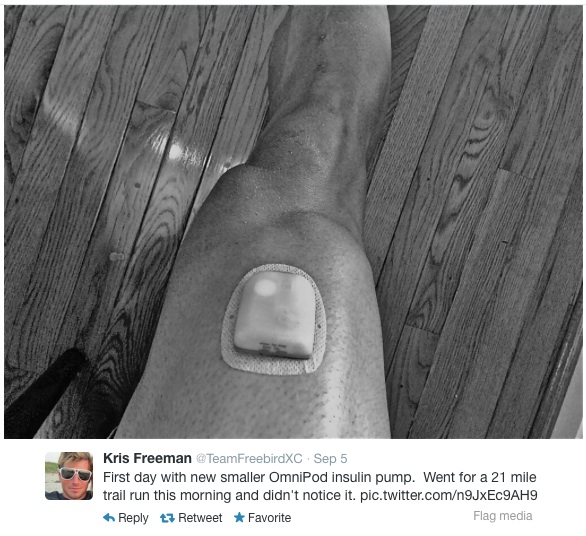
"Went for a 21 mile trail run..."
Kris is competing in Sochi with an insulin pump and a CGM, I watched his first event yesterday and it's safe to say that he is an inspiration to any person who lives with type I diabetes. Watching Kris ski makes me even more certain that Arden will be able to reach for whatever dream she can imagine. Knowing that he endures such physical rigors while managing his BGs is a great comfort to me, and I hope to all of you.
I'll be speaking with Kris again soon and reporting back. In the meantime here's a list of his remaining events in Sochi.
Good luck Kris, we are all cheering for you... I'm off to do a sit up.

















FDA approves pediatric use of Dexcom’s G4 Platinum continuous glucose monitoring system

“The U.S. Food and Drug Administration today approved the expanded use of the Dexcom G4 Platinum Continuous Monitoring System for patients with diabetes ages 2 to 17 years.”

“We are thrilled with the FDA’s approval of our Dexcom G4 PLATINUM System in the pediatric population. Daily management is relentless, and parents can now have greater peace of mind that a child’s diabetes is under control, whether the child is at home, away at school, or participating in activities or sports.”
Update: via email from DexCom: 2-4-14
The G4 PLATINUM (Pediatric) receiver works with the existing G4 PLATINUM sensor and transmitter. No need to order different sensors or transmitters. The components of the receiver are the same. It has the same settings, alerts and it calculates and displays your sensor glucose readings the same way as the receiver you have now. The Dexcom G4 PLATINUM (Pediatric) Receiver has two additional screens at the ‘Start Sensor’ and ‘Low Alert’ Menu options. These screens are reminders that you should use your blood glucose meter for any treatment decisions and not rely on CGM only to detect hypoglycemia.
Links

Helping Children With Diabetes Gain Independence
Part 5: Taking It One Moment at a Time
The word independence literally means, “Freedom from outside control or support.” But when we use it to describe a child who lives with type 1 diabetes, the word takes on a much deeper meaning.

I wanted to say, “Children struggle,” but in all honesty, all people struggle to be themselves every day. We are influenced by so many outside pressures that I often wonder if any of us are really being who we are. On any given day I can feel too short, too fat, too old or just not smart enough. I worry that my affections won’t be reciprocated, that I am not being a good parent, husband and son. In the past, my concern about loved ones’ reactions have stopped me from telling them how I truly feel. Yet if you asked me to describe myself and the level of independence that I felt during that time in my life, I would have told you that I was not bothered by what other people thought of me, that I didn’t feel the pressure – but of course I did.
As I sit here and write to you, I realize that I felt all of those things when I was younger and I wasn’t wearing an insulin pump or a continuous glucose monitor. I didn’t have to stop and check my blood glucose all day, people never felt obliged to tell me what to eat and I never once thought that I may pass out from not paying attention to my moment-to-moment health. Young Scott was living a pretty easy life, and yet he still felt the proverbial weight of the world.
So how the heck are we going to teach our children with diabetes to feel independent? I think the answer to that question is, one moment at a time.
I could have written a series of blog posts about helping children with diabetes gain independence through any number of experiences. I believe that people, young and old, have potential and that all they need is patient loving people to surround them with quiet strength and support. Sure, sometimes it feels good to be told that someone has your back, but often it feels better to just know. Then when life happens, alone or together, we have the inner strength to shoulder what’s coming our way. In time, with maturity and practice, we begin to believe in ourselves the way that our loved ones believe in us.
So does technology help to build independence for children with type 1 diabetes? Absolutely it does! Does it do it overnight or over the course of a single year? No. Independence is a form of maturity and the process towards becoming a fully realized person is a long one. That kind of firm base is built one experience at a time and not every step taken is a step in the correct direction. Each blood glucose check in public will build confidence. Every low blood glucose conquered is a step in the right direction. There will be moments that don’t go as planned, but don’t think of them as failures, think of them as perspective for the successes. You can’t appreciate success without knowing failure, at least not to the degree that it requires to build maturity, and none of this can happen if we are being sheltered. I know as well as you do that having a child with type 1 diabetes is different and at times scary. That’s why I added technology to our daily routine; so I could give Arden the personal space that she needs to grow while protecting, as best as the situation allows, her health and safety.
This post is part of a six part series that I originally wrote for the Suite D Blog, which is operated by Insulet. Insulet is the company responsible for Arden's insulin pump, the Omnipod. Please know that I was compensated for my writing in an amount that would be considered standard for freelance blogging. My family pays for Arden's Omnipods with insurance and out of pocket cash. My writing for Insulet has no impact on my opinions or the information that I share here or anywhere online.