
#1692 Bolus 4 - Thanksgiving
You can always listen to the Juicebox Podcast here but the cool kids use: Apple Podcasts/iOS - Spotify - Amazon Music - Google Play/Android - iHeart Radio - Radio Public, Amazon Alexa or wherever they get audio.
Scott and Jenny talk about bolusing for Thanksgiving dinner.
+ Click for EPISODE TRANSCRIPT
DISCLAIMER: This text is the output of AI based transcribing from an audio recording. Although the transcription is largely accurate, in some cases it is incomplete or inaccurate due to inaudible passages or transcription errors and should not be treated as an authoritative record. Nothing that you read here constitutes advice medical or otherwise. Always consult with a healthcare professional before making changes to a healthcare plan.
Scott Benner 0:00
Hello friends and welcome to the Juicebox podcast. I hope your Thanksgiving is calm and your boluses were spot on
in every episode of Bolus for Jenny Smith and I are going to take a few minutes to talk through how to Bolus for a single item of food. Jenny and I are going to follow a little bit of a roadmap called meal bolt. Measure the meal, evaluate yourself, add the base units, layer a correction. Build the Bolus shape, offset the timing. Look at the CGM tweak for next time. Having said that these episodes are going to be very conversational and not incredibly technical, we want you to hear how we think about it, but we also would like you to know that this is kind of the pathway we're considering while we're talking about it. So while you might not hear us say every letter of meal bolt in every episode, we will be thinking about it while we're talking. If you want to learn more, go to Juicebox podcast.com. Forward slash, meal, dash, bolt. But for now, we'll find out how to Bolus for today's subject while you're listening, please remember that nothing you hear on the Juicebox podcast should be considered advice medical or otherwise, always consult a physician before making any changes to your health care plan or becoming bold with insulin. Today's episode of The Juicebox podcast is sponsored by the contour next gen blood glucose meter. This is the meter that my daughter has on her person right now. It is incredibly accurate and waiting for you at contour next.com/juicebox I drug Jenny onto the podcast when she wasn't supposed to record today. Hi, Jenny. Hi. How are you? I'm good. Thank you. My lack of planning made me two weeks before Thanksgiving say, oh, shouldn't we have done something for Bolus for for Thanksgiving? That would have been smart. That's fun. Yeah. So I went out to the to the peeps, and I said, like, you know, tell me some of the things that you guys are going to eat on Thanksgiving. I got, like, a little comprehensive list. I'm going to roll through it with you just very quickly. Okay, people eat roast turkey or ham. They seem to have stuffing in a couple of different ways, corn bread, stuffing, regular bread, stuffing, sausage and oyster, stuffing, four separate ones. Oh, mashed potatoes. They have gravy. They have sweet potato casserole. Many of them appear to put marshmallows on top of it, yes. Green bean casserole, cranberry sauce, mac and cheese is was a big one. Dinner Rolls, roasted Brussels sprouts, roasted root vegetables, carrots. You know, that's that thing you might know more about. People have salads. Apparently, I would never eat a salad on Thanksgiving, not when all those other food that's fine. I mean, what am I gonna waste time with salad? Them? Pumpkin, Apple, pecan, sweet potato, cherry pie and cheesecake. These are the things that were given to me as as a list. Great. I tried to break them down into context for myself. Like, I basically said, like, what's a what do you think the carbs are in a serving of and I kind of have a list in front of me, and I'm interested to see, I'm interested to see if it matches how you would think of it off the top of your head. And then when I walk them through how to Bolus for the whole day.
Okay, makes sense? Sure. Okay, Turkey does not have carbs in it. You agree?
Jennifer Smith, CDE 3:38
Turkey does not have carbs in it unless it was cooked a specific way to have carbs in it. Okay? Yes, it doesn't have
Scott Benner 3:45
carbs. I roast the turkey, I'm not going to see carbs, a little bit of fat, maybe. It says maybe four grams for a typical serving,
bread stuffing, 40 grams of carbs for a cup. What would you say? You said bread pudding, no
bread stuffing, just regular stuffing. You know what stuffing is. Would you eat stuffing? I
Jennifer Smith, CDE 4:03
hate stuffing. Okay, like you said, all the stuffing options, I was like, nothing there would ever enter, like I wouldn't even pick the spoon up my eyeballs. Bypass that, because wet bread is disgusting.
Scott Benner 4:14
I knew you were gonna say wet bread, by the way.
Jennifer Smith, CDE 4:18
Yeah, I'm so sorry all the people who love stuffing. I mean, my parents like stuffing. My mom still makes stuffing. If I'm eat carbs, I may eat something that I want and I don't like stuffing, but yes, that sounds approximately correct for a serving of stuffing.
Scott Benner 4:33
Okay? And now we do know that, and I'm going to bring this up a couple times today, just make sure if you make stuffing. The way I make stuffing, so, Jenny, the way I make it is, I will bake bread this week. I'll make some wheat, I'll make some white I'll make a number of different loaves of bread, a little rye, and then I will cut it up into little cubes and spread it out into big trays and let it get a little stiff. Right? Yeah. Yeah, then I throw it into the oven to crisp them up. I make stuffing like that. In that stuffing goes turkey stock from the morning of. I make my stuffing on the morning of, I take the neck and the heart and the liver, and I boil it in water with butter and seasoning, and then I use that water to flavor the stuffing. Right? That stuffing will have a different impact on blood sugar than stove top out of a box, right? Because of the process nature of it. Yes, yes. Correct, it will same thing if I make scalped potatoes out of potatoes, or if I make scalped potatoes out of a box, we're going to see the stuff coming out of a box being a little more difficult. Correct, okay, I just want to keep that in people's minds, okay,
Jennifer Smith, CDE 5:41
well, I think also a little bit more little bit more difficult, because the box stuff, again, as we've gone over this before, has a lot more processed or packaging, type of preservatives in that can have an impact in one way or another, whereas Scalloped Potatoes, that you Do all yourself, and you know all the ingredients, because you know all the ingredients. I think there's something to seeing what you put into an item that makes you also understand better how to navigate coverage. When we're talking about something like insulin and managing and timing and all that kind of stuff, there just is, yep. So I
Scott Benner 6:19
just want people to keep that in mind. If you're making these things fresh, it's going to be, you know, maybe one impact. And if you're making them from Box stuff, they might be a little more difficult because of the process nature of the box food. So stuffing, you're okay with about 40 carbs. Now that's for a cup. How about sides? I've got 35 for a cup of mashed potatoes. That sound about right,
Jennifer Smith, CDE 6:39
that's about right. And easy eyeball is, you know, again, nobody gets out unless you're my mother. When I was little and had all the serving spoons that were taken wherever we went for holidays, it is what it is. I'm alive today because of my
Speaker 1 6:54
mother. I'm imagining your mom just like, you know, like when in one of those, one of those movies where someone shows up to, like, shoot somebody from a distance, like, I imagine your mom, like, unfurling her tools in the kitchen. Yeah, entirely, yes.
Jennifer Smith, CDE 7:07
An easier one is a female fist, or a smaller size, like, even, like a teen sized or, you know, a woman's fist is about a one cup portion, so it's a really nice thing that you're carrying around with you. You don't have to get the serving spoons, yeah.
Scott Benner 7:23
So a fist of mashed potatoes. About 35 cars, 35 grams. A fist of corn stuffing, or stuffing, about 40. About 40, okay, sweet potato casserole, I have between 55 and 60 grams for a cup. And an indicator here that there's going to be a big, like, glycemic hit right
away, a lot of sugar,
Jennifer Smith, CDE 7:45
a lot of sugar, both from the way that the sweet potatoes were cooked to begin with, as well as the marshmallows. There's usually extra, whether it's maple syrup or brown sugar that's added to it. I mean, it's like, sugar on top of sugar on
Scott Benner 7:58
sugar. Yeah, and then yeah, green bean casserole, a cup, 12 grams, approximately any,
Jennifer Smith, CDE 8:04
any 12 grams. I mean, again, that differs in making
Scott Benner 8:10
the recipe I had here had, like it was used a soup mix and onion. So there's some hidden carbs in the onions in the soup mix,
Jennifer Smith, CDE 8:15
yeah. But on average, I usually say that's an easy one, a fist again, is like 15, okay, it's probably easiest,
Scott Benner 8:22
okay, cranberry sauce has a quarter of a cup of canned cranberry sauce. Oh, it's 22 grams of carbs, which is of that is 21 grams of sugar. It's all sugar,
Jennifer Smith, CDE 8:32
huh? It's all it's all sugar. I mean, cranberries themselves, they really are nothing. They're really tart, yeah, but it's all the I mean, there's nothing cranberry in it, except for the flavor and the juice that came out. And then you just put sugar in it and make it into like jelly.
Scott Benner 8:48
So before we get to the mac and cheese, which I didn't realize was such a big thing for people, although my son said to me, like, Is there gonna be macaroni and cheese at Thanksgiving this year?
Jennifer Smith, CDE 8:56
We've never had mac and cheese. Never been a Thanksgiving, ever. I didn't think of that
Scott Benner 9:00
either, but it was a big thing that people brought up. But wrote up. But I'm just want to
point out that we've got the turkey
so far. We've got the potatoes. We haven't even said gravy yet. So potatoes, sweet potato casserole, green beans, cranberry sauce, we're not even to the macaroni and cheese yet. If you had a serving of each of these, you're looking at 3590 100 105 my gosh, dead, 120 plus the turkey, like you're already up at like, 130 carbs, right, right for for this stuff on your plate. And I don't think this is crazy to think that people might put a cup of potatoes and this and that, even if it was half like, think about it like, even if you went half a cup of potatoes, half a cup of this, half a cup of that, you're still, you know, 6070, 80 carbs, right? And
Jennifer Smith, CDE 9:51
you didn't even get into, you know, sometimes it's the meal, I know which you said I'd never have salad for Thanksgiving, but you add, maybe that's the beginning of the meal. Before the other major entrees and what often comes with a salad are some type of roll, or cornbread rolls, or something like that, that also adds into, well, now I'm actually sitting down for the meal. Yeah,
Scott Benner 10:12
it's a good point. Cornbread roll, 26 grams for a square down, about right?
Jennifer Smith, CDE 10:17
They're pretty yes, they're, they're, in fact, a little bit more carby than like, those tinier rolls that are more often served at a gathering like this, like just bread rolls, they're more like 20. They're like 20. Yeah.
Scott Benner 10:29
Okay. Now, if you're gonna go crazy and have vegetables on top of that, don't forget something like Brussels sprouts, 12 grams for a cup cream corn, 15 grams for a half a cup. Glazed carrots, 18 grams for a half a cup. Does that sound right? Jenny's not gonna eat cream corn anytime soon. But am I right about that? Yeah, okay.
Unknown Speaker 10:48
No, no cream corn. To
Scott Benner 10:50
take all this stuff together and say, These Bolus four episodes have been great because we've been breaking down like, Hey, here's, you know, one food like, you're at the mall, you have a Cinnabon. Here's how you Bolus for a Cinnabon. But what we're talking about here is between four and eight different foods all mixed up in your gullet at the same time. Do they all have different impacts, or does it just turn into one big impact that we like? Is it really just like are we really thinking about the foods individually, or are we thinking about them together? The contour next gen blood glucose meter is sponsoring this episode of The Juicebox podcast, and it's entirely possible that it is less expensive in cash than you're paying right now for your meter through your insurance company. That's right if you go to my link, contour next.com/juicebox you're going to find links to Walmart, Amazon, Walgreens, CVS, Rite, aid, Kroger and Meijer. You could be paying more right now through your insurance for your test strips in meter than you would pay through my link for the contour next gen and contour next test strips in cash. What am I saying? My link may be cheaper out of your pocket than you're paying right now, even with your insurance, and I don't know what meter you have right now. I can't say that, but what I can say for sure is that the contour next gen meter is accurate. It is reliable, and it is the meter that we've been using for years. Contour next.com/juicebox and if you already have a contour meter and you're buying test strips, doing so through the Juicebox podcast link will help to support the show
Jennifer Smith, CDE 12:35
at a meal like this, you would have to think about their impact together, because I think about the way that one of my uncles, when we had meals together, especially Thanksgiving, he would take, you know, like a roll, and he'd put Turkey in it. Sometimes he'd like, dip it in his mashed potatoes and gravy, and, like, take a bite full of it. And all of the observations of a child, think back to the funny things that you watched happen at a dinner table, right? But if I think about it that way, all of that is going into as you funny, funny said the gullet, right? They're all going down at one time, and they all have a different impact. The bun is high glycemic because it's so just a processed thing. And then you've got turkey, which is all protein, pretty low fat, depending on how you cooked it, or what's on it, right, the gravy, which is depending, again, how you made it a lower impact, and then you throw into it mashed potatoes, and maybe the cranberry sauce went on the roll before the right, you Do. It's a great i It's a great question, because you would want to think about all of them individually, as we often do, but a meal like this that is often also a very drawn out meal. You're eating a little bit of this, a little bit of that, maybe you're forking it all together and putting it in so we really have to consider it as a full effect meal,
Scott Benner 14:01
yeah, so it's gonna hit fast and long, correct, right? Yes, no matter what you do, like, I'm actually while you're talking, and if people are like, it'd be nice if you were prepared before you started, Scott, but I'm putting together. I'm basically putting a plate together right now of this stuff, right? I'm gonna put a dinner roll in there, and I'm going to put some vegetables in there. Watch what I do here. I'm going to do, let's see, let's do glaze carrots. And people love putting sugar on carrots. Okay, so I'm going to say, give me a total for all carbs. So I put in glazed carrots, I put in a roll, I put in mac and cheese in the way we just talked about it. I put in green beans, sweet potatoes, gravy, mashed potatoes, stuffing and Turkey, okay? And I gave it all of its carb and all of its. That and everything else, right? So the total carbs for that plate, the way we broke it down, right? You want to guess. I'll give you a range to guess. Inside of
Jennifer Smith, CDE 15:09
my guess would be somewhere between 150 and 202
Scott Benner 15:14
it says 218, to 236 that is the maximum, okay?
Jennifer Smith, CDE 15:18
And it really missed something that was on that plate?
Scott Benner 15:21
Well, it was roast turkey, three ounces bread, stuffing at 40 carbs, mashed potatoes at 35 I have six grams for the gravy at a quarter a cup of gravy, which, by the way, a quarter a cup of gravy, please. And then I have sweet potato casserole between 55 and 60 for a cup. Green bean casserole, 12, mac and cheese, 32 to 45 dinner roll, 20. Glazed carrots, 18, right? Yeah, I think it was the glazed
Jennifer Smith, CDE 15:47
carrots that I didn't I didn't add in all the other ones I was adding in my head.
Scott Benner 15:52
You're also, you're really awesome at this, by the way, people should know. I don't give Jenny any help while we're making this at all. I don't let her see anything she doesn't know the numbers I'm talking about. I'm turning her into your avatar. It's what I'm trying to do while we're talking Yeah, so I've got that, and then I'm just gonna say to it this, right? Watch this. I'm gonna tell it to go to Juicebox podcast.com/meal,
bolt, meal dash, bolt, and apply that to this meal,
Speaker 1 16:25
because you guys could do this too. Is my point. I'm just gonna let chat G P to do that while i i fill some people in on another thing that chat G P, T and other large language models like, I don't care which one of these algorithms or which one of these, my God, why can't I think of
Scott Benner 16:40
the word all of a sudden? What it's gonna really ruin the world? Jenny, what's going to ruin the world?
All right, so watch this. All right. No matter which one of these models you use, I'm just going to type in algorithm, yes. Sweet potato recipe with Marshmallow, because I don't have one, I'm just going to grab one from the interwebs. I have never made that. I'm going to use the one from candied sweet potatoes from all recipes I'm going to click on, I'm going to click on print so I can just do a drag up on the ingredients. Four pounds of sweet potatoes quartered, three cups of miniature marshmallows divided a cup and a half of butter, a cup and a quarter of brown sugar. Got a cup and a half of butter. I'm just telling you, when I break, hold on a second. I'm gonna put that in here, and I'm gonna say to it this, please give me a nutritional breakdown. Okay, and so it's gonna, it's going to take those, you know, quarter cup of this, cup of that, whatever it is, it's gonna tell you there's this many carbs in this much sugar in it, blah, blah, blah. Because you guys like, I mean, this is pretty I don't know how many people are gonna do this. I think you could probably just go from a cheat sheet that says, which, by the way, I'm gonna put the cheat sheet up. Look for the cheat sheet on the Facebook group and on the on the website today for Thanksgiving, if you're listening to this on Thanksgiving. But I want you to know that you could head out to one of these and have it break it down for you, and it'll give you some pretty, pretty reasonable places to start, right. So the so the Thanksgiving bolt formula that came back, it said, right. If your BG is 90 to 120 when it starts, it'd like to see a Pre-Bolus 20 minutes, dosing about 60 to 70% up front and doing extended or split drag, the remaining 30 to 40% over the next two to three hours. Does that sound reasonable? Too? Sounds reasonable? Okay, it should, because we're the ones that made the meal bowl. Yes. If your BG is rising, you can try before the meal. Pre-Bolus a little longer, 25 to 30 minutes for and maybe add 10 to 20% to the total dose. So if you're Rising before the meal, get ahead of it a little further. Try to stop it from going up before you eat, or
Jennifer Smith, CDE 18:52
within that just a secondary would be at a corrective without any food consideration, so that you actually get that to turn around, especially if you're at a meal where you're not quite sure exactly what you're going to sit down to and what you're going to eat first, then just correct what's going on. Perfect. If your
Scott Benner 19:10
blood sugar is falling before the meal, you could start eating sooner or only give 50% up front, deliver the rest over maybe two hours. Use the natural fall that you're experiencing if you are experiencing one as part of your Pre-Bolus. Now it says, if you're grazing for hours, increase your basal by 10 to 20% you do do a basal increase for Thanksgiving
Jennifer Smith, CDE 19:31
when pre current algorithm that I use, and actually with the algorithm, just called something different, right? My Thanksgiving and we celebrate Christmas. So my Christmas, when we were getting together, family, lots of stuff, my day was coded by 25% okay, so I did a basal increase of 25% and that helped me navigate. Because what we're also i. Kind of hinting around here, while you can do a good job of looking things up with today's technology, thankfully, when I was there, there wasn't as much information to be able to look up, and it was a lot more imprecise estimation. And even today, I think a lot more people end up doing, oh, it looks about like this, right? So I found that that 25% increase not only helped because of the grazing nature and the long duration of intake, but it was because I was absolutely not weighing and measuring things. It was all an estimated guess, and it looks like 30 grams. Looks like 20 grams,
Scott Benner 20:37
a little more, a little I always say, go heavier, but that's me. What about people who say that? Like, I try to give myself more insulin, but I always end up low later. What do you think is happening to them? Like, colloquially, like, I obviously we're not with them, but what are you doing if you're ending up low later in the day?
Jennifer Smith, CDE 20:53
Depends on when later, right? It could be that one, the amount of extra you gave was just too much, or you were more in the category of over over, calculating the amount of insulin, not the amount of insulin, but the number of carbs, and so then you were getting more insulin that you needed. The other consideration in it could be that maybe you are also the one hosting the gathering, and you're on your feet and you're busy and you're moving and you're lifting things and, you know, in and out, and whatever it might be, it could be that what you've experienced in the past, not hosting now you're on your feet, and you didn't need as much, right? So, I mean, it could be a bunch of variables, but in general, if you're getting low, there's too much insulin and there wasn't enough food to cover it. I mean, that's the base.
Scott Benner 21:39
So I'm gonna go back here to this sweet potato breakdown. First of all, the breakdown is extensive. You don't obviously need this much information that it gives back. But if you really wanted to understand nutritionally, what's in that sweet potato thing, my goodness, it like really, it really gave me a return here it tells me the sweet potatoes, the net carbs for the sweet potatoes, glycemic index, glycemic impact for the marshmallows, the brown sugar, the butter, the whole thing tells you the total estimated glycemic load for the whole pan for serving. It's really, really lovely for the whole pan. If you ate the whole pan of sweet potatoes from that recipe, you'd have a glycemic load of 463 Oh, there's 12 servings in the pan per serving. It's 39 glycemic load per serving, which is, you know, so and that is high glycemic load, very high. That is, I mean, the context, low is under 10. Medium is 11 to 19. High is above 20. Now keep in mind, like Jenny knows this because she went to school for it, and she's smart. I don't know any of this. I just typed it into the machine, and it's giving it right back to me, like so it's it's valuable, and I
Jennifer Smith, CDE 22:49
know that we did define glycemic load versus glycemic index, right? This nice little chat thing is giving you a little bit of both. It's a high glycemic index, but when you break it down and you say, Okay, it's high glycemic index. But, Gosh, I really just want to taste it. Maybe I'll have a tablespoon of this. Then the glycemic load is absolutely much lower than over 20.
Scott Benner 23:15
It's also telling me here that, like, if you were going to eat this by yourself, like, just have the sweet potato thing. You'd need a maybe up to a 30 minute Pre-Bolus for this. So now, absolutely right. So now, all of a sudden, if that's mixed in with the rest of your meal, the 10 to 20 minute Pre-Bolus for food isn't really going to help. And by the way, you all know what's about to happen. You're going to be running around putting stuff on the table, and as you're walking towards the table, one of you is going to yell across the room, Billy, did you give yourself insulin too late? It's already too late. Everything's a bum puzzle at that point. Now you're a half an hour late. If you're going to have the sweet potatoes, and then the Spike's going to happen, you're going to go crazy trying to knock the spike back down, or you're going to live with it. It's going to ruin your day. It's going to you're going to be upset. I'm telling you. For me, it's funny, Jenny and I talked about this, we're like, are we going to talk about it with numbers? Or I think of this, I think you get up in the morning, you get ahead, and you stay ahead, right? You use increased temp basal, you make sure to Pre-Bolus the first couple things that you're eating, and then after that, you just cover stuff as you're eating it. And you should have the insulin the way I think of it, like on your side, on the momentum side for you. And then you just got to have the kind of wherewithal to realize when to shut that basal off and not make yourself low afterwards. And if you're going to have a dessert later in the day, it's going to be high glycemic index. You need a nice, long Pre-Bolus for it. That's it, I mean. And then don't go to bed and sleep too sound. Turn all your turn all your alarms
Jennifer Smith, CDE 24:46
up. And it may be a night that you turn your alarms up in terms of the low alert, right? You have your low alert set for 65 or 70, and you're not quite sure exactly what the lingering effects of this meal are going to. Look like. Then set your low alarm much higher, so you can catch it faster, right? Or the high alarms. Set your high alarm a little bit lower so you can catch it and you can again, catching something on a rise, versus waking up with a 200 plus blood sugar. Because your alarm was set for 200 it saves you time to navigate adding more insulin when it's needed sooner than later.
Scott Benner 25:25
Yeah. So I'm gonna point out, before I move on from this, that doing that chat, GPT breakdown of that recipe per serving. It assumes 12 servings, right? But you're getting 433, kcals, calories from it, 64 carbs from a serving, five grams of fiber, 39 grams of sugar, net carbs, 59 protein, three and a half fat, 19.5 saturated fat, 12 mono saturated five, polyunsaturated point seven. Cholesterol, 51 milligrams sodium, 220 milligrams potassium, 750 calcium, 77 iron, 1.2 that is from taking that recipe, dropping it in there, and going, Hey, break this down for me. Nutrition this, right? So when you're find yourself listening to these other Bolus for episodes, and you're like, Oh, this is interesting, because I'm getting a lot of good feedback from them. People are interested in, like, that's chatting through, like, how to Bolus for something. Just realize, like, there's way more impact from this stuff than you think. Now we picked, I picked, you know, something with a ton of sugar the
Jennifer Smith, CDE 26:22
hardest. Yeah, right. And actually, it makes me think of going back even in just a bit ago, you know, like Billy, or whatever his name was, Bolus, and he's already sitting in like the meal is coming, right. Well, what could you do if Billy is so willing to do it? Start with the turkey. Then right start with the so you can give the Bolus. You can let Billy decide what he wants on the table. Start with the turkey, or the proteins, if it's ham, or whatever your protein source might be, because that's going to have a very low glycemic hit. And you then at least build in a little bit of time that the insulin is going to have to get moving before you have your sweet potatoes with marshmallow.
Scott Benner 27:06
Try to put the sugar at the back. If you can put the sugar at the
Unknown Speaker 27:09
back exactly, yes, I tell you
Scott Benner 27:12
that this is, I mean, there's part of me that wants to break each one of them down. I wish you guys could have heard us talking before we started. Like, there is a way to break down. Like mashed potatoes. Like, this is how I Bolus for mashed potatoes. But once you start mixing stuff together, in the end, it's a it's a lot about the impact. It's about how quick it's going to hit you and for how long it's going to hit you. It's about Pre-Bolus things staying ahead of it. And I, you know, for me, again, with the, you know, temp basal, which a lot of your algorithms, it's, it's kind of a catch 22 on Thanksgiving, right? Because everybody's going to be on their automated their automated systems, you can't just tell it to, like, more, yeah, it's not going to want to do that. I don't know, like, what I would do in that situation.
Jennifer Smith, CDE 27:52
Another piece to this too, would be, what do we follow up the main meal with? We follow it up with, you know, if we're going to break anything down, some type of a dessert or a sweet treat ends up coming in at the end of the meal. Now, what precedes this? A load of insulin is already there. You have maybe coated it with whether it's an extended Bolus or a temporary basal increase or some type of override that your system allows you to utilize. And now you may be coming into a dessert time thinking, well, that looked pretty sweet, like look at the great job that I did, but you still have a load of fat that's loading that food down from completely clearing through and having a completed impact before you eat your let's Call it pecan pie. Okay, so I think there's consideration for what do you do with the dessert at the end, right? And it does go back to where. Where are you sitting? What does it look like is happening to your blood sugar? What's the direction you nice and stable? Are you stable, but just starting to kind of edge up? Are you stable but starting to nose down? Are you low already from whatever you know was miscalculated, because it is what it is. So I think it's another place to consider how you distribute that dessert type of a Bolus and the timing around it. Yeah,
Scott Benner 29:14
pies are, I guess, a good example, right? Like, so there's filling, like, pumpkin like, I'm looking at a pumpkin pie here. I guess we could break one down to like to see what's in it, right? Hold on a
Jennifer Smith, CDE 29:25
second. I mean, the most common are what pumpkin and apple pie? Those are the ones that we've always had at mine, pecan pie. We've never had it my Thanksgiving. It's a huge Thanksgiving thing, but I don't even ever think I've ever had pecan pie in my life.
Scott Benner 29:42
My grandmother was Pennsylvania Dutch. They used to eat something called shoe fly pie. Which fly pie molasses, right? Yeah.
Speaker 2 29:49
Again, all sugar, yeah.
Scott Benner 29:52
Also, she had type two diabetes, I would just want to point out, so yeah, I'm looking back, and that might not have been so hard to figure out why that happened. Okay, so I have right now, there's not a lot in pie dough. I hope you're all making your own pie dough. I make mine. It's easy to make. It's not that hard, really. Okay, so I am. I've gotten a breakdown here for Oh, hold on a second. It'd be nice if the if the website didn't launch a video on me. What is that ridiculous? By the way, all these recipe websites are just scams to get you to ads. Oh, of course, that's, that's all it is. Like, it's so hard to find the actual recipe. It's almost insane. You like pick you have to hit the, by the way, you hit the print button. That's what I do. Okay, so here is the pumpkin pie filling. I gave it here. I'll give it to you. The recipe is three quarters of a cup of granulated sugar, a teaspoon of ground cinnamon, quarter teaspoon of salt, quarter teaspoon of ground ginger, half a quarter teaspoon of cloves, two eggs, 15 ounce can of pumpkin or fresh pump and puree, and 12 ounces of evaporated milk. It parsed down the this way, granulated sugar, 150 grams for three quarters a cup, there's negotiable in cinnamon, sodium, of course, ginger, cloves, blah, blah, 100 grams in the eggs. 425 grams in the puree. 354, grams in the evaporated milk. Makes an eight palm piece serving. So let's see whole batch per serving, per slice. 149 calories, 27 carbs, 20 Oh, that's light on the carb. 23 sugar. It doesn't include the crust.
Jennifer Smith, CDE 31:37
Oh, I was gonna say gosh, because that seems awfully light on the car.
Scott Benner 31:41
This is just the filling. Now, I'm gonna let it do the crust for you. Okay, it takes a second. I mean, here it comes. Well, technology is amazing. I don't know why we're all arguing about it. So what if it blows up the earth? I mean, look, quickly it broke this down. All right, so nutritional breakdown for the crust, which, by the way, was two and a half cups of all purpose flour, a half a tablespoon of sugar, salt, half a pound of cold on salted butter, some ice water. The entire concoction is looks like 300 for the flour, six for the sugar. And moving on here, let's see as far as, okay, hold on, total carbs for the entire pie crust, 219 per serving. 27 for the crust, net carbs, 26 protein, four. So yeah, it's basically 27 for the cross 26 for the filling. It's over 50 for a slice of pie?
Jennifer Smith, CDE 32:41
Yeah, I was gonna say the average is about 5050. Grams, if you're just wanting a nice round number, 50 grams for an eighth of a piece of pie.
Scott Benner 32:49
Could do all this, or just ask Jenny, and she would have told you, I want people to be able to go do it for themselves
Jennifer Smith, CDE 32:55
afterwards. Yeah, no, it's a fantastic way to be able to do it and get the direct information. If
Scott Benner 33:02
Jenny can't live in your pocket and jump out and go, that's pi 50.
Jenny in your pocket. Oh, there, there you go. Wait, we could sell that. Break your different pies down this way. Listen, is this exactly how your pie is going to be or how your potato it's not, but it should give you enough right of a jumping in space for the carb total and the sugar understanding should get you close, right, like that. That's my hope for you, is to be close again. Get ahead, stay ahead and be ready for a low later. That's pretty much my whole Thanksgiving theory,
Jennifer Smith, CDE 33:40
and this, as I brought it up, at the end of a long duration meal. That's a really heavy meal. This also brings in the consideration of not only the Bolus, but the timing of the delivery of the Bolus. It may be a time when you actually do despite it being pie, it's sitting on top of butter and gravy and creamy stuff and fat in a heavy meal. So you may actually use 100% extended Bolus for something like this, depending on where you're starting with your CGM value and the trend. Would you normally do this if you just sat down to a piece of pumpkin pie? No, in and of itself, by itself, absolutely, you would need Pre-Bolus, and you would write, but because of the end result of meal on top of this, in your belly,
Scott Benner 34:30
I say make a blanket of insulin over top of the timeline of the meal. That's kind of how I think about it. Like, seriously, like a weighted blanket for, you know, people with, you know, people like weighted blankets. I just put a blanket of like insulin over top of the series, pulling up some other things that people might find interesting. Regular Budweiser has 10 and a half grams.
Jennifer Smith, CDE 34:51
That's a great one to bring up. A lot of people don't cover drinks.
Scott Benner 34:56
And a Bud Light has 6.6 I just randomly picked up beer. I don't drink beer, so I didn't know what to do there. And please, you know, if you want this to be easier, don't drink sugared soda. Don't drink juice cider. I mean, do people do apple cider still I would expect so yes, you know what I mean, apple cider has got to be crazy.
Jennifer Smith, CDE 35:17
It's pretty high carb, usually, depending on the brand, it could for a cup somewhere between 30 to 40 grams of carb just for a cup of apple cider.
Scott Benner 35:27
Yeah? And, I mean, so I don't know, like, good luck, I guess, get out there and start
Speaker 3 35:33
swinging. Yeah. Have a great time. Thankful for all we have.
Scott Benner 35:37
Jenny, let me ask you one question, yeah, I'm sitting here now. It's not me and you. It's me and some newly diagnosed family, right? Sure, and they've never Bolus this much in their entire life. They're gonna sit there. I know what they're gonna do. I've done it, right? They're gonna err on the side of caution. The kid's gonna get high. They're gonna have a whole like, look what happened. We ruined Thanksgiving. How do you find the nerve to make a an 80 gram Bolus when you've never done that before. What do you you know what I mean, it's, it's a ballsy move. It really is. Is there a way to, like, go into it slowly? Can you,
Jennifer Smith, CDE 36:12
well, I think with technology being the way that it is, you add it up, you've done the math, and you look at it six times, and you're like, Gosh, 80 grams. Like, we never Bolus for this much. Like you said you could do a an extended Bolus, because then you're not getting the load of it, despite good counting that you know that this is how much it actually is do an extended Bolus, and when you see that it's been working, but now, gosh, my blood sugar clearly is going up. You can always cancel an extended Bolus and take that as a normal Bolus. So that's one step wise approach. Is it likely that your blood sugar might end up getting low later? It is. But again, with so much food around and so much quick carb this would be the time to drink the apple cider.
Scott Benner 36:59
Yeah, right, right? I mean, the other high side of all this is, if you're too aggressive, there's 1000 ways to fix it, and it's all right there too, right? Yeah.
Jennifer Smith, CDE 37:08
But I think getting up the nerve it does depending on the type of person personality you have, and if it's yourself versus you navigating a child, I think they're very different considerations. Yeah,
Scott Benner 37:21
no, for sure, I'd like to also bring up to people, please, like, put the tiniest bit of effort into making sure that you're not in the last three hours of your CGM on Thanksgiving, or that this isn't the last six hours of your pump site, like, that kind of stuff. Like, I, I would love you not to have a brand new pump site and not an old pump site on Thanksgiving. I think that gives you a lot better chance, you know, just kind of be ahead of your tack a little
Jennifer Smith, CDE 37:43
bit. I would like to add a note as well to try to start your day with some exercise, because it can really help. Okay, Jenny, everybody, come on. Don't watch the parade. I haven't watched the parade in a long let
Scott Benner 38:01
me tell you how my wife ruins the holidays with her. She's got some old family tradition where they eat these. I'm sorry if she hears this, like these, these garbage II, like cinnamon icing, rolls, like Jenny, okay. Yeah. No, no. Hold on. So right away in the like, Do you know what I'm talking
Jennifer Smith, CDE 38:21
about? A can where you pop them open and they Yes, okay, I know you're talking
Scott Benner 38:25
about, you know what I'm talking about? Yeah, I had to learn. But also it helped me because, like, because for my wife, Christmas morning is like these, I'm not gonna say what I almost said, but she it started with these cinnamon rolls that were not, you know, they're not homemade, they're not from a they're not even from a bakery. They're, they're, you know, out of a can, processed, like, blah, blah, blah. And, you know, it's come downstairs make these things. You know, Arden is just awake and they're gonna eat cinnamon rolls. So, like, while everybody else is, like, running down the steps and, like, oh, it's Christmas. I'm like, Bolus, we need insulin. I'm Pre-Bolus, thing for the rolls, right? And so she, and that's a every holiday like that. They would do those in the morning. And I think people have all kinds of stuff like that, like so, you know, it's your other idea too. Is like, if you're getting up on Thanksgiving and you're going to be at your aunt and uncles to watch the melee at two, and you know, that's when lunch starts. I wouldn't start the day with a bowl of Captain Crunch, right? Give yourself a shot. Is what I think, what I'm saying, and just don't get behind. I know that this sounds overly simple, but get ahead. Stay Ahead is such a great idea for days like this. You know, I really find it is No, it's great. Okay, apple cider, yeah, 30 grams of sugar, 32 carbs for a cup hard apple cider. Don't forget that with alcohol in it can be there. Try not to drink your carbs, please. That'll help. Drink water, lots of water. That water is terrible. Get some sparkling water tastes like water. I think is the problem.
Jennifer Smith, CDE 39:56
Tastes like water, yeah, add some, I don't know, add some lemon. Juice to it, or some lime,
Scott Benner 40:01
or nice idea, yeah, some mixed berries in there. Something, right?
Jennifer Smith, CDE 40:06
You know, squeeze and squeeze a couple slices of orange into it. It's not going to add anything you have to Bolus for, but it adds a little flavor.
Scott Benner 40:13
Also, don't forget, when you do your leftovers after Thanksgiving, the cold potatoes will hit differently than the hot potatoes hit. That's
a good point. Yes, thank you. Look at us. We're like little fairies, just dripping,
dripping knowledge, knowledge every which way. Thank you for doing this. Jennifer, Happy Thanksgiving. You too. Thank you.
I'd like to thank the blood glucose meter that my daughter carries, the contour next gen blood glucose meter. Learn more and get started today at contour next.com/juicebox and don't forget, you may be paying more through your insurance right now for the meter you have than you would pay for the contour next gen in cash. There are links in the show notes of the audio app you're listening in right now, and links at Juicebox podcast.com, to contour and
all of the sponsors
in each episode of The Bolus four series, Jenny Smith and I are going to pick one food and talk through the Bolus thing for that food. We hope you find it valuable. Generally speaking, we're going to follow a bit of a formula, the meal bolt. Formula, M, E, A, l, B, O, L, T. You can learn more about it at Juicebox podcast.com, forward slash, meal, dash, bolt. But here's what it is. Step 1m. Measure the meal
E, evaluate yourself. A, add the base units, l, layer a, correction.
B, build the Bolus shape, O, offset the timing. L, look at the CGM and T, tweak for next time. In a nutshell, we measure our meal, total carbohydrates, protein, fat, consider the glycemic index and the glycemic load, and then we evaluate yourself. What's your current blood sugar? How much insulin is on board, and what kind of activity are you going to be involved in or not involved in? You have any stress, hormones, illness, what's going on with you? Then a we add the base units your carbs divided by insulin to carb ratio, just a simple Bolus l layer of correction, right? Do you have to add or subtract insulin based on your current blood sugar? Build the Bolus shape. Are we going to give it all up front, 100% for a fast digesting meal, or is there going to be like a combo or a square wave Bolus? Does it have to be extended? I'll set the timing. This is about pre bolusing. Does it take a couple of minutes this meal, or maybe 20 minutes? Are we going to have to, again, consider combo square wave boluses and meals, figure out the timing of that meal, and then l look at the CGM an hour later, was there a fast spike? Three hours later, was there a delayed rise? Five hours later, is there any lingering effect from fat and protein tweak for next time, tea, what did you eat? How much insulin and when? What did your blood sugar curve look like? What would you do next time? This is what we're going to talk about in every episode of Bolus for measure the meal, evaluate yourself, add the base units, layer a correction, build the Bolus shape, offset the timing. Look at the CGM tweak for next time. But it's not going to be that confusing, and we're not going to ask you to remember all of that stuff, but that's the pathway that Jenny and I are going to use to speak about each Bolus. Have a podcast. Want it to sound fantastic. Wrongwayrecording.com.





















Please support the sponsors



The Juicebox Podcast is a free show, but if you'd like to support the podcast directly, you can make a gift here. Recent donations were used to pay for podcast hosting fees. Thank you to all who have sent 5, 10 and 20 dollars!
#1691 Autumn Needs an Answer - Part 2
You can always listen to the Juicebox Podcast here but the cool kids use: Apple Podcasts/iOS - Spotify - Amazon Music - Google Play/Android - iHeart Radio - Radio Public, Amazon Alexa or wherever they get audio.
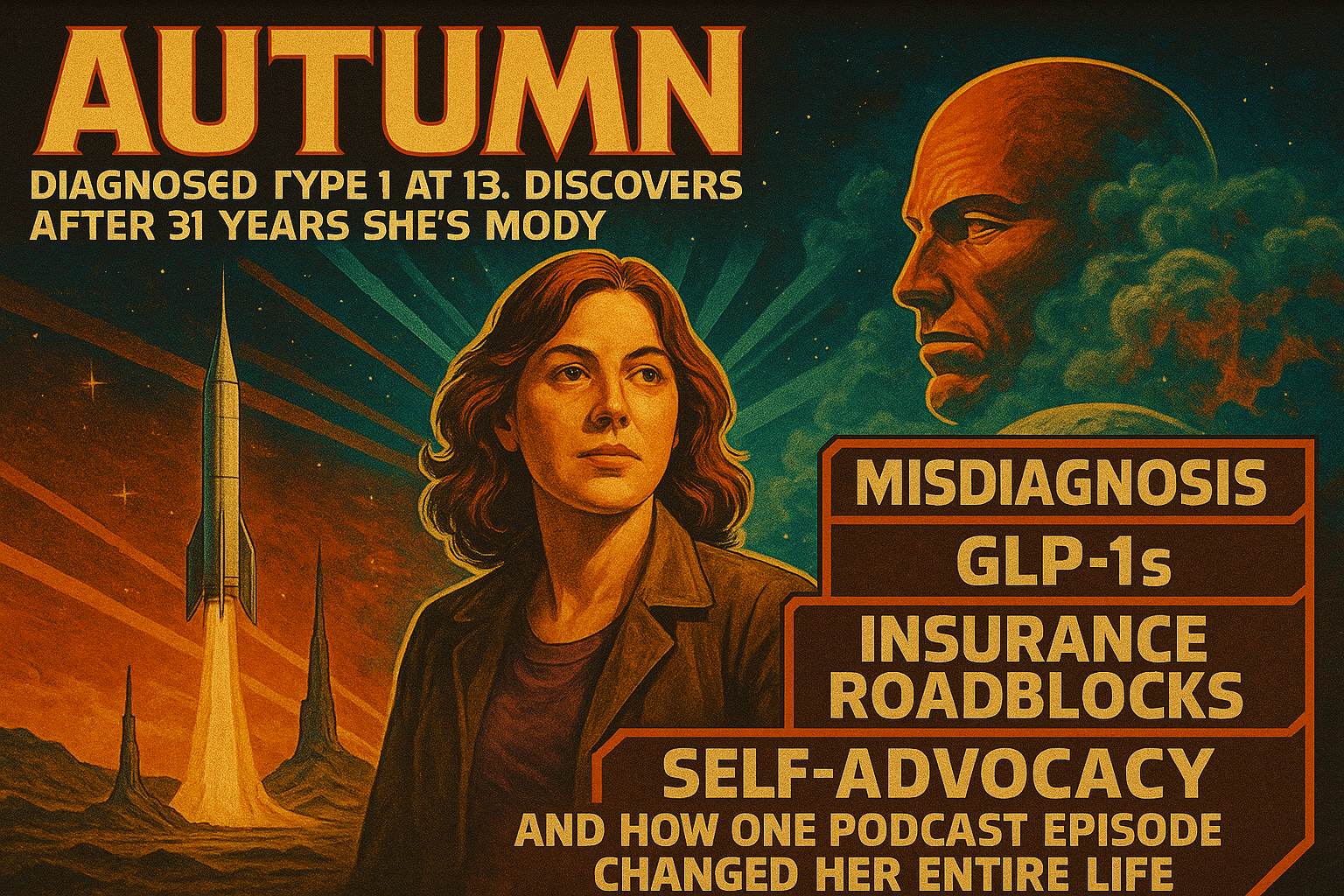
Autumn, diagnosed type 1 at 13, discovers after 31 years she’s MODY. We unpack misdiagnosis, GLP-1s, insurance roadblocks, self-advocacy, and how one podcast episode changed her entire life. Part 2 of 2.
+ Click for EPISODE TRANSCRIPT
DISCLAIMER: This text is the output of AI based transcribing from an audio recording. Although the transcription is largely accurate, in some cases it is incomplete or inaccurate due to inaudible passages or transcription errors and should not be treated as an authoritative record. Nothing that you read here constitutes advice medical or otherwise. Always consult with a healthcare professional before making changes to a healthcare plan.
Scott Benner 0:00
Welcome back, friends to another episode of The Juicebox podcast.
Autumn 0:15
Good morning. My name is Autumn. I am a 44 year old female who was diagnosed with type one diabetes in 1994 at the age of 13.
Scott Benner 0:26
This is part two of a two part episode. Go look at the title if you don't recognize it. You haven't heard part one yet. It's probably the episode right before this in your podcast player, when I created the defining diabetes series, I pictured a dictionary in my mind to help you understand key terms that shape type one diabetes management. Along with Jenny Smith, who, of course, is an experienced diabetes educator, we break down concepts like basal, time and range, insulin on board and much more. This series must have 70 short episodes in it. We have to take the jargon out of the jargon so that you can focus on what really matters, living confidently and staying healthy. You can't do these things if you don't know what they mean. Go get your diabetes to find Juicebox podcast.com, go up in the menu and click on series. Please don't forget that nothing you hear on the Juicebox podcast should be considered advice medical or otherwise, always consult a physician before making any changes to your healthcare plan or becoming bold with insulin. Just in time for the holidays, cozy Earth is back with a great offer for Juicebox podcast listeners. That's right, Black Friday has come early at cozy earth.com and right now you can stack my code Juicebox on top of their site wide sale, giving you up to 40% off in savings. These deals will not last, so start your holiday shopping today by going to cozy earth.com and using the offer code Juicebox at checkout. This episode of The Juicebox podcast is sponsored by us, med, us. Med.com/juicebox, or call 888-721-1514, get your supplies the same way we do from us. Med, the episode you're about to listen to is sponsored by tandem Moby, the impressively small insulin pump. Tandem. Moby features tandems newest algorithm control, iq plus technology, it's designed for greater discretion, more freedom and improved time and range. Learn more and get started today at tandem diabetes.com/juicebox,
Autumn 2:31
I went through a total identity crisis, and when all of this was happening to me, I'm like, well, if I'm not type one, what am I like? What do you mean? Like, I have all of this medical history, and it just fits right here. And you know, he, he was with me through all of it. I honestly didn't start to share my story until this year, until I got the answer. Nobody in my family knew this was happening, other than my husband and a very, very close friend, no kidding, yeah. And part of it was, you know, candidly, that the societal criticisms of, oh, you're using a GLP, Well, no wonder that's why you lost weight, or no wonder that's why you feel better. And it's like I struggled with my identity, and then also with the fear that you you mentioned for people, where it's like, you want me to take my insulin pump off, but what do you mean? You how? But then it was like, I had to listen to that, you know, little inner voice that you have that's like, what do you have to lose? You take the insulin pump off. You get sick. Okay, put the damn thing back on. But if you don't try, how will you know? And I don't ever want to live my life thinking I should have, could have, would have, type thing like, no regrets. So here we are.
Scott Benner 3:42
Well, I mean, the doctor tells you to do it, you easily could have just put it back on again. Like, it's not sure, yeah. I mean, you didn't have to sit there and just slowly die over the next couple of days, right? Right? Like, yeah, you could pay attention to what was going on. I mean, you were doing it with the doctors overseeing it sounds like you did it the right way. And, yeah, for sure. And I think that Moreover, don't be just happy sitting there and withering or being sick all the time like try something. The examples are endless. I interviewed a woman yesterday who clearly has thyroid issues, and her TSH, in my mind, is elevated, and her doctor's mind isn't. And she's 10 years at it, 10 years just suffering along. And when I said to her, why don't you try the medication, she goes, Well, the the numbers, right? I'm like, Yeah, but that shouldn't make any sense. And meanwhile, she's telling a story about how she's advocating for her kid, but not for herself. And like, you know what? I'm just like, this happens constantly with people forever, and you know, at some point, you either get to a doctor who understands the bigger picture, or you get to a doctor who says, Hey, I'm sorry, but the thing in the box says, No, so you don't get it right,
Autumn 4:50
right? Well, and like how I mentioned earlier, thankfully, my mom taught me a long time ago to advocate for myself, because I can remember going to endocrinologist that they would just dismiss me. Or, you know? Well, this is what it was. I'm like, You know what? You're fired. I'm going to go find an endocrinologist that works for me. I'm going to find somebody that listens to what's going on, and they're not just looking at, you know what? The their again, their checklist says, Okay, this is how we treat this symptom. This is how we take care of that ailment. Like no health care has to be personalized to the individual's needs. And I don't give a rat's ass what your book says, or how many years you went to school. Yeah, I know how I feel right now. And I've never felt this good in my entire
Scott Benner 5:28
life. Tell people what your weight was when you started what it is now.
Autumn 5:33
Gosh, it was 238 at that initial appointment back in November of 2022 and right now I weigh 160 Wow. Good for you. And, like, seriously, the last 40 pounds, as soon as I took that insulin pump off, it just came off like water. And I can't even tell you how mind blowing that was for me, you know, like I had said that identity crisis, I also spent a little bit of time, like angry, like, mad. Like, how could I have been? I just felt like it was a disservice by the healthcare system to
Scott Benner 6:08
gone that long. Yeah, tell me more about that please. Yeah,
Autumn 6:10
I just because, you know, I think back to that endocrinologist, and I'm like, hey, something doesn't seem right. I'm using all this insulin, and it's like, you're type one, it's in your head. You need to get over it. Like, really? Like, how, how is that? Or, you know, I had even gone to her before, like, how do you even know I'm a type one diabetic? And it always went back to, well, it's in your head, or it's just because you've been diabetic so long, and all of these things. Like, I feel like I got robbed of the prime of my life, like times when I wouldn't want to play with my son because I didn't feel good, or because I was, you know, just just tired, exhausted, fatigued, because I just wasn't healthy. And, you know, now I look back and like, I could have had more kids, Scott, yeah, and I didn't, because of, you know, the doctor, oh, your diabetes. It's like, okay,
Scott Benner 7:04
then I guess that's not, not what's supposed to happen for me. And now it's and now it's gone. Like, I'm not trying to make you upset, but that it's over, like, that part passed, yeah, yeah, my wife and I went out the other day. It was Friday night, so we worked all day. And I mean, this is kind of boring, but, like she she travels for work a lot, and so she wanted to get Global Entry on her passport so she wouldn't have to stand in line coming back from other countries. But she had to make an appointment at the airport at 8pm on a Friday night to finish the process. And we drove about an hour, and we decided to do some shopping at this place that's near the airport that we don't get to very often. Let me just say what it is, because I think it adds levity. I really love IKEA's dish brushes for this for the kitchen. They're $2.99 They're awesome. Okay, it's black. It has a suction cup on the end. Buy them. They're absolutely awesome. Okay, and I've been using mine way too long, because I don't want to drive an hour towards the airport to buy a brush and but as soon as she said, I have to go to the airport, I was like, Oh my god. Can we go? Like, right? I was like, I need a dish brush and so, so we, we left early. Now this is the end of a day. Do you understand what I'm saying? Like, I like, I've been, I've been I'm old, I've been up, I've been working, I've been thinking, I've been talking, I've been sitting in this room, I've been typing, I've been letting people online yell at me. I've been helping. Like, you know, I've been I had a full day already. I drove an hour in traffic on the New Jersey Turnpike. If you've never been here, you don't know what I'm talking about. It ain't great. Okay, we walked around IKEA for a while. Because you're there, what are you gonna do? You go look at the hernkum burger and stuff like that. You see what else they got. And like we did the whole walk, I bought, I bought seven dish brushes, like
Autumn 9:00
you're not going back to that airport for a while.
Scott Benner 9:02
I was trying to minimize my travel, and so I spent the 14 and and then we went over to the Newark Airport, if you've ever been there, also not awesome. And eight o'clock, she has her meeting. She does her thing. We get done. She's like, are you hungry? I said, Man, I am a little hungry. Ted. I don't think I've eaten much today. I think I should eat. We drove all the way home, another hour through traffic, went to a restaurant, sat and ate, did all this stuff. It's like 1030 at night now, and we're sitting there and we're talking, and I said to her, I don't think we could have done this before the GLP medication. And she's like, what? I'm like, You really think we could have worked a whole week and then a whole Friday and then gone out and walked around for an hour and a half and then run across and then still, gone to dinner and been sitting here and talking to each other as bright eyed as we are right now. And I know people will be like, Well, yeah, you lost weight. Okay, like, I'm not gonna argue with that at all. But. So I'm telling you that without that, whatever the hell is in that stuff, and that really is I whatever GLP is, whatever that I don't even know and I don't care and like, but whatever it is, I think it has fundamentally changed how my body works. Absolutely, yeah, yes. I don't know how to quantify it, really, but I can tell you for sure that I wouldn't have done any of the things on Friday that I did. And then I started thinking about all the times that we'd walk around somewhere because Kelly be like, hey, you know, we need a chair, or we need then she'd take me out, and I'd walk around thinking the whole time like, I hate this, like I can't wait to get home. I'm so tired, I like and I don't realize I never going to be able to honestly quantify how much I was probably lying to myself about what my appearance meant to me in public. Sure, like, because I'll like, I'm you're going to hear me on this recording and in my personal life, I don't care what people think of me. I'm not my body, I'm my thoughts. And I really do believe all that, but I still believe, the farther I go forward, the GLP, that that's not completely accurate, because I saw a photo of myself the other day that somebody took candidly, and I thought, I'm okay if people see that. And before, I would have been like, Hey, can you delete that please? Like, you know what I mean, like, like, it was just at a weird angle and everything, and I didn't even care. And then I started doing the rest of the math. Like, I wonder what I didn't do with my kids or my wife or with my life, because I was belt held back by the amount of energy I had, or you talked about your elimination. I had that problem too, right? Like I didn't eliminate? Well, my iron was low all the time. My iron is not low anymore. That had its own impacts. Blah, blah, blah, blah, blah, and I'm going to go back to what I said earlier. I don't think we know where we're at with this medication yet, or what it's doing for people. And I'm happy to say because you brought it up, the pressure of knowing that if you tell somebody you're doing this, that some person who doesn't have the benefit of all this information and all this perspective and all these experiences is just going to go like, Oh yeah, you cheated and took that medicine. This episode is sponsored by tandem Diabetes Care, and today I'm going to tell you about tandems, newest pumping algorithm, the tandem mobi system with control iq plus technology features auto Bolus, which can cover missed meal boluses and help prevent hyperglycemia. It has a dedicated sleep activity setting and is controlled from your personal iPhone. Tandem will help you to check your benefits today through my link, tandem diabetes.com/juicebox, this is going to help you to get started with tandems, smallest pump yet that's powered by its best algorithm ever control iq plus technology helps to keep blood sugars in range by predicting glucose levels 30 minutes ahead, and it adjusts insulin accordingly. You can wear the tandem mobi in a number of ways. Wear it on body with a patch like adhesive sleeve that is sold separately. Clip it discreetly to your clothing or slip it into your pocket head now to my link, tandem diabetes.com/juicebox, to check out your benefits and get started today, perhaps the best gift that you can give to yourself or to a loved one is that of comfort. And this holiday season, if you use the offer code Juicebox at checkout at cozy earth.com, you won't just be getting something that's comfortable. You'll also be doing it at quite a discount. We can talk about that in just a moment. Right now, I want to tell you that I use cozy Earth towels every day, when I get out of the shower, I sleep on cozy Earth sheets. Every night, when I get into bed, I'm recording right now in a pair of cozy Earth sweatpants. I love their joggers, their hoodies, their shirts, my wife has their pajamas. And I know you're thinking, oh yeah, Scott. Well, because they sent you a bunch of it for free, they did send me some for free, but I've also bought a lot on my own. So like I said earlier, Black Friday has come early at cozy Earth, and right now you can stack my code Juicebox on top of their site wide sale giving you up to 40% off in savings. These deals are definitely not going to last. Get your shopping done now or get yourself something terrific at cozy earth.com Do not forget to use that offer code Juicebox at checkout. You will not be sorry.
Autumn 14:25
Yeah, yeah. And like little do they know how much freaking work it is actually to take that medication, especially it's like you're titrating the dose up. And you don't always feel the greatest when that happens. But then you you have to change so many things about your life, the way that you eat, your relationship with food. I mean, the food noise completely gone after starting that medication was like a complete game changer in my life, like on top of all of the wins and the discoveries with my diabetes like that going away like, holy smokes. Anybody that wants. This medicine that their body can tolerate it, in my opinion, should be given to them freely, just like you could get birth control for free at a health
Scott Benner 15:06
department. Isn't it funny how we've sat around see older people are going to know this, younger people aren't going to know it as well. But I grew up through a time where people just sat back and they ruminated. They're like, one day science is going to find a way to stop this epidemic that we have of people's weight. I grew up through a media that talked about that it's gonna happen. We're gonna figure it out. And then, by the way, this all connects, whether it's the vaccine story I told about the online thing or the person telling me not to do the thing, this all connects. If you're not paying it, got to pay attention, okay? But like, back there the it's gonna happen. We're gonna fix it, we're gonna we're gonna move forward. We're gonna find better ways. And then we did that as a society, and then everyone just moved the goal post when you're a cheater, like, oh my god, you motherfckers. Like, like, it took some dork in a lab 30 years to figure this out, and he figured it out. And your hot take on it was, oh, you're gonna cheat like that. For the last 30 years, you've been saying, no matter how much I diet and exercise, nothing's working for me. The food's not right. Monsanto sprayed something on my corn. You guys have 1000 different reasons why you're being held down by something, and someone figures out your way around it, and then you become the thing holding the person down. Oh, my God, you're all stupid. Sometimes, me too, by the way, we're all stupid sometimes. But like, it's crazy, how it like, it's that goal post moving. Yeah, it's like, not good enough. You didn't do it good enough. But I tell you about before we started recording here, I got two people ranting and rave at me on Instagram. I can't believe you're using Instagram images. Do you know how much electricity that uses? Well, guess what? I didn't know how much electricity it used, so I looked it up, and then you know what else? I looked up how much electricity Instagram uses. Turns out the person who used Instagram to yell at me used way more electricity than I did to make the picture. And I was just like, none of us are perfect. That's all I came down to. Like, there is no perfect way to get through life. Like, so if you think railing about me using an AI image is a good use of your time, then God bless you. Like, go for it, right? And if you think yelling at poor autumn here for cheating is a good use of your time, and go for it, but she's off living a better life while you're busy telling her what she's doing wrong, right? And you
Autumn 17:30
know, what that person can do, they can grade off.
Scott Benner 17:35
But at the same time, like, that's, you know, in my personal life, like I explained to you earlier, like, you know, the way I responded to the person on Instagram, I was like, well, listen, I'm doing my best here, and I'm trying to I really do mean all that, and it's all, it's all sincere, but if it was just me in a room with them, I would 100% say, oh, you should go yourself and like, because I am like, I've said this before on the podcast, so I don't want to belabor it, but like, because it's not an apples to apples comparison. But every time something like this happens, I think of the line from and I can never remember the name of the movie, and you reminded me of it. The name of the movie is, oh, a few good men. Few Good Men. Where, at the end the bad, I mean, he's a bad guy, like, I'm not the, not the bad guy in this, but the way he feels, I understand, where he just says, at one point, like, I appreciate it, if you would just say thank you and move on. And it's the feeling that he has that, like I am out here putting my whole effort into something, I'm doing it for you, and you're over here telling me how I'm doing it wrong. And you know, in that scenario, in the movie, again, my analogy doesn't hold up, because he's actually doing something wrong, but like, but the way he felt, I can seriously dig into this deeper, the way he felt. From his perspective, he doesn't see it that way, and like, and that's the thing that you all need to understand about this, is that let's just for a second, just put ourselves in an alternate universe where Autumn's use of a GLP is wrong. She doesn't feel that way. She's having a different experience than you're having. So yelling at her that she's doing it wrong, even if she is doing it wrong, is not an answer to the bigger issue. Right and and I'm here to tell you I don't think you did anything wrong. I don't think I did anything wrong. I'm telling you that modern medicine came up with a way for me not to have low iron, not go to the bathroom on any particular schedule, be carrying fat in places that I don't understand, being tired all the time, you know, not being able to be myself in my own mind because I'm cloudy and all the other things we all run around all the time, inflammation. We got to get rid of it. We got to get rid of it. Somebody came up a way to get rid of it. And they went, Oh, you can't do that. God damn it. And then, oh, my god, autumn. You know what just happened there? I said, God damn it. Now some people are gonna send me an email and say, Oh, I love this podcast, but then use the Lord's name in vain, and I can't listen anymore. Y'all got to stop setting up guardrails and rules about how we can all. Talk to each other where no one's gonna say anything, and Autumn's not gonna find out that she could have been healthier. I've made my point now, autumn, tell the rest of your story. Thank you. Diabetes comes with a lot of things to remember, so it's nice when someone takes something off of your plate. US med has done that for us. When it's time for Arden supplies to be refreshed. We get an email rolls up and in your inbox says, Hi, Arden. This is your friendly reorder email from us. Med. You open up the email. It's a big button that says, Click here to reorder, and you're done. Finally, somebody taking away a responsibility instead of adding one us. Med has done that for us, an email arrives, we click on a link, and the next thing you know, your products are at the front door. That simple, us, med.com/juicebox, or call, 888-721-1514, I never have to wonder if Arden has enough supplies. I click on one link, I open up a box, I put the stuff in the drawer, and we're done. Us. Med carries everything from insulin pumps and diabetes testing supplies to the latest CGM like the libre three and the Dexcom g7 they accept Medicare nationwide over 800 private insurers, and all you have to do to get started is called 888-721-1514, or go to my link, us, med.com/juicebox, using that number or my link helps to support the production of the Juicebox podcast.
Autumn 21:35
I just, you know I really, really enjoy you, but you're a great, great, great, great guy. There's no doubt about
Scott Benner 21:41
that Autumn, I'm awesome. That's not why we're here.
Autumn 21:45
You did say something there, though about that, that experience with your wife at the airport and like the medication giving you the energy to be able to do that. But it just made me think, especially about the photo piece with I think about from the time I started on my insulin pump. Because that's the other thing I didn't mention before. I started on the insulin pump. Like, I never had a weight problem. I mean, I'm five nine. I've always weighed between, like, 161 70, and it was like, I put that insulin pump on and Damn, did that weight come? And it came for me, and it was, like, 30 pounds within a matter of, I don't know, two, three months and like, What in the hell is going on? Like, I eat healthy. I barely eat carbs. Like, why am I using all of this insulin? There are so few photos of me with my family, with my son, with my husband. And, of course, the ones that we do have, you know, I had to make sure that they they were okay. Like, okay. I don't look like a complete cow in that picture. Like, yep, we can share that one kind of thing. And now I'm over here where people will, oh, my God, you look really great. And I'm almost like, I don't, I don't want you to, I don't want to talk about it, because I want to skirt over the fact that, how did I get here? Because I don't want to deal with their judgments or their their bullshit when it comes to, you know, what they think I should have done with my life, but I do know that that medication led me to one removing the pump, to finding out that I'm a type two diabetic, that it's actually Modi for the 1% of the 1% and I told my husband, we met me like I'm a special unicorn. Not sure if you're aware of that, but
Scott Benner 23:17
this test actually proved it for Yeah, you didn't realize how right you are right.
Autumn 23:21
I know right, right, but it's just like, people are nicer to you when you don't wait when you're not overweight. I didn't realize that before, because I just try to be nice to everybody. Like, I'm a big advocate of, like, human kindness, regardless of what's going on. Like, just be kind to people. I've had more people offer to help me. Like, I'm at the gas station with a flat tire, just a random guy, like, Hey, do you need any help? And I'm like, Are you talking to me? Like, why are you trying to help me? That would have never happened, you know, 80 pounds ago. I'm sorry. It just would not have happened.
Scott Benner 23:51
That's crazy. Yeah, I don't this. I don't, I don't imagine you're wrong. I just it's, it really is insane. I do feel the same like I don't. I wouldn't understand treating somebody differently for how they appear, but also maybe I have a perspective of a person who appeared that way, so at some point, yeah, I wouldn't have judged myself for it. So maybe I wouldn't have judged other people for it.
Autumn 24:13
It's like, that's the thing, like, I guess I just, I don't know, let people be who they are, let them do what they do. And you know, sharing stories helps. I mean, that's part of how we get through society, is by sharing our stories and by learning from each other. And when you want to shut it down because you don't agree with me, like you don't have to agree with me, that's fine, but it's still my reality. I'm still going to share the fact that this is how I got here to this new diagnosis and this new life where, you know, I feel great and I have energy and I want to do things, and, you know, I'm not trying to nap constantly because I'm exhausted all the time. Yeah, I
Scott Benner 24:44
also think it's important to like, you know, another thing that people used to talk about when I was younger, before the world got so complicated, is that, you know, people learn as they go, and you don't judge them on what they thought before, you praise them for what they figured out. Right? And so, you know, because there's a certain, I can hear people in my mind like there's a certain, by the way, that's not because I'm schizophrenic. I just, I know what's gonna happen. I can hear people saying, Oh, sure, well, he used to think this, but now he says this. He's a hypocrite. I'm not a hypocrite. I'm a human being who learns something, and now I'm continuing to share. And by the way, if you would have gone back 10 years ago and heard me say something. I probably say it more clearly now, but if I hadn't said it, then I wouldn't know how to say it more clearly now, you have to let the process. You have to trust the process of being alive and learning and growing and and not not want to hold people accountable for things that they thought or did in the past that they understand are different now, this happens to everybody. Yeah, it's not. It's not a thing that happens to just bad people, or people were dumb and then they weren't. Or like it's it's happening, if you think that it's happening to you right now and you don't know it, because 10 years from now, you'll look back on this moment ago, I shouldn't have judged those people that way, and by then it's too late, because you already ran around telling people they cheated or they're bad, or, you know, blah, blah, blah, blah, blah, like, whatever it is that you thought you were fixing the world with today. That's not how I'm going to say this over and over again. I say it in the Facebook group all the time. Telling people they're wrong is not a good way to get them to know they're wrong. Like, that's not how you do it. They say something. And maybe you have a different perspective. Maybe you're a little older, a little wiser. Maybe you've been through another thing that they haven't been through yet. Maybe you've just seen a part of the path they haven't seen yet. You just share your perspective with them, and one day they'll see it. It's not going to be that day. It's not going to be that moment in my life. I have never disagreed with somebody and talked them out of it, but you could give them ideas and walk away and let them go live their life and see if it doesn't come back around for them in a way that makes them figure it out right? Exactly? Yeah, I told on them before we started today. I think I told you about like the the emails I get emails sometimes from people, and they, they, they tell me how awful I am, and then, and then a lot of them will write back six months a year later. Some of them don't go to the trouble of telling me how awful I am. Some, some of them just write the second email. And I got one of those the other day, and I mentioned it the other day. I won't say the person's name again, but I again, but I thank the person because they started listening and really didn't like me for a number of different reasons. They hated me, but persevered, kept listening, and now are doing really well, and they took the time to write an email to apologize for a thing that I didn't even know they were doing, which I found to be incredibly kind. Yeah, and I'm not saying that. I'm always right, and you'll figure it out one day. I'm saying that some of the things you hear you don't intersect with, well at some points, and then maybe later, when you have more information, you'll intersect with it differently. And that isn't to say that some of you just don't hate me and not and have really good, great reasons for it. I'm sure you do right on like, you know what I mean? Like, I there are people I don't like to I don't know what to tell you, and I don't have the time or the inclination to figure out why, but in the light of what's going on in the world right now, as a person who makes content, I'd like to point out to you that it's incredibly unhealthy. If you keep listening to me and you don't like me, you should really stop. Yeah,
Autumn 28:31
but scroll past, yeah. Keep
Scott Benner 28:34
moving right. Think of me as something you can scroll past and and head off, although, let me say this, you know, again, as a timestamp, I am not an avatar. I'm a real person, okay, like you ranting and raving about me, or, you know, showing up somewhere where I am, which hasn't happened to me gleefully, but is happening to other people. And like you're not down voting me on Reddit, right? I'm not a thing you disagree with that you get to put a check mark on, or a thumbs up or a thumbs down or a sad face on. I'm an actual person, and if you don't know that, I mean, I'm not a person who just randomly says, Go touch grass. But you probably should put your device down for five seconds because, yeah, because I am not a pretend thing on the other side of your screen. And you're not either, by the way. And if we intersect in real in the real world, one day, your misunderstanding of what it is when you think of somebody digitally, but then meet them personally, most people just, you know, say, Hey, what's up? But every once in a while, a person who's too far down a path does something crazy, and it's not man, it's not cool, and all that's going to lead to is people not sharing their perspectives and stories not being told, and people not taking a lifetime to learn and move forward and coming to a better decision. And we're not going to move forward if you stop people from talking absolutely and I think that a part of that is to see that I'm not I'm not an avatar, I'm an actual person. I'm not always right, I'm not always wrong. You're not always going to agree with me. Sometimes I'm going to be doing things you don't understand, and sometimes I'm going to be doing things I don't understand. So, yeah, I don't know what the answer is, other than be nice and keep your hands to yourself. Yeah,
Autumn 30:29
exactly. Just be kind. Yeah, keep your hands to yourself and be kind. That's all we got.
Scott Benner 30:34
You know, all the stuff you tell a five year old, like, just do that. Anyway. What have you not talked about that you wanted to although this episode, I love this episode,
Autumn 30:45
so I'm glad, I'm glad. I am so thankful to be able to share this story. You know, for me personally, next steps, like I mentioned, I'm going to meet with my endocrinologist from the University of Michigan atypical Diabetes Program this coming Monday, and we're going to hash out that sulfur Ariana, probably not saying that 100% correctly, but it's close enough. And essentially, you know, the medication, it allows your pancreas to secrete more insulin. You know that the mixed message, kind of from the two doctors in the same department, one saying you make enough insulin your body doesn't secrete. The other one saying, Hey, I'm concerned, if we, you know, put you on this medication, it's going to push all the B cells that you do have left that are healthy, and you might end up back on insulin. And for me, I'm not scared of that, Scott, because I took insulin for 31 years. We're still taking insulin.
Scott Benner 31:35
You're willing to try it like that's yes, it occurs to me, while you're talking, that you're not likely to find one doctor that has all the answers. You're likely to find a few people that understand certain parts of this, and then you're going to conduct a science experiment on yourself and try to figure it out. And you're telling me that that's better than living the way you did before.
Autumn 31:54
Absolutely, yeah, absolutely. There's no doubt. And you know, the other piece that I'm really excited about is both my parents are still living and they are going to have their genetic testing done so that hopefully we can help more people, you know, with Modi and figuring out, you know, early diagnosis, so that there are children in the world that don't spend the 31 years on an insulin pump when they never really even needed the medication in the first place. So I'm excited. It's kind of like my pay it forward, I guess, like, I want to give back in a way, and lovely, and if that means you throw me in a lab and do all the tests and sign me up because I, again, I have nothing to lose, and helping somebody else is really my goal at the end of
Scott Benner 32:32
the day. That's lovely. That really is great. I will tell you this. I used to make ads for Jibo hypo pen, and I might again in the future, but I don't at the moment, but when I started making them, I had to say, sulfano Uriah, and there you go. I don't know what I was saying, but they would send back the audio and go, you're not saying that correctly. And so I wish I would have recorded it, because I basically sat here. They sent me a clip of it being said correctly, and I would like, sit here with my eyes closed, hit play the clip. Would say, so final urea. I'd go, so final urea. And then it was just, it was just me going, so, final urea. So final urea. So until it felt like it flowed, because I had to say it in a sentence, and I couldn't stop to think about it while I was saying it, because it needed to flow out and sound like it's not the first time I had heard the word right, and I got it all done. I was super excited. I sent it back to him. They're like, you're
Autumn 33:27
not saying it right, okay. But
Scott Benner 33:29
anyway, I don't know if I'm saying it right now or not, but definitely don't judge yourself on it, because Scott spent two hours on it and he's not sure.
Autumn 33:38
Listen, I'll be candid when the doctor first said it to me. I'm like, is sulfur Uranus? What do you what? I have no idea what you're talking about. And then I couldn't pronounce it, so that's what I would refer to. It to my husband, like, you know, the sulfur Uranus medication they want you to me to try. And he's like, is it really what it's called? Like, no butcher the way that it said. And this helps me remember, so
Scott Benner 33:57
you gotta do beating my hand on my thigh. Now, wondering, can we call this episode sulfur Uranus?
Autumn 34:04
I'm totally fine with that. Go for it. That was the piece. Sulfur Uranus. Here we go. Let's see if that's the next thing to change my life, other than everything I've gotten to this far.
Scott Benner 34:17
So I just imagine people listening, hearing your whole story, hearing me rant and rave, and thinking like, when does the part where you put the sulfur on your anus come in and
Autumn 34:30
that that will be, it'll be interesting to see how Monday goes. And then, you know, I'll shoot you an email to let you know the piece that that there is one other thing I wanted to it's, it's not about me. It's actually about my father. I had mentioned to you about him having that heart attack back in May, and he spent 18 days in the hospital, and he's type he's a type two diabetic. Can I tell you how disturbing it is the medical professionals in this hospital that have no clue how to treat diabetes? Days, whether it's type one, type two, they're giving this man insulin, crashing him, bringing him all the way up to 500 crashed him again. I'm like, can you stop? It got to the point where I just simply was like, we refuse the treatment. Like we can't do that. Mike, actually, I can. It's my right. We're refusing the treatment because you keep bringing him up, crashing him down. Just stop. We're telling you what he needs, and you don't want to listen, because it's not what your freaking book says. Take your book, throw it out the window and listen to what I'm telling you. Yeah, it's just, it's a shock to me how uneducated they are and how unwilling they are to listen.
Scott Benner 35:33
Yeah. I mean, I'm shocked by that pretty regularly, and at the same time, I've had enough conversations with people that I don't blame them the same way that I used to. Yeah, there's something about the process that of leading people to into that into that life, that doesn't allow them to, like, fully understand everything that they need to understand and the limits of humans in general. Like, you know, you can't, yeah, you're not. You're not a limitless, I, you know, thought machine, and then the pressure that goes with it, and, you know, the long shifts and so many people, and I'm sure the hospital is telling you to go faster and do this, and blah, blah. And, you know, like, there's just, I think it's like everything else. I think there's just too much to tackle. And, and may I also say autumn that I know that it's probably attractive to just blame something and say, well, it's the reason of this, but I don't think that's the case anymore. Like, I think it's possible that we've just been here so long, and society just has so many nooks and crannies, right? That this is what it looks like at this point. Like it's we can't, I don't know. It's like a bunch of extension cords wrapped around each other, like we're not going to be able to, like, untwist them all sure this is just how it works now. And would it be great if you could go back to simple and start over? Sounds simple, but it would eventually get convoluted again. And I don't know what the answer is going to be like. I'll tell you. Like, there is part of me that thinks that the answer is going to be, I know people will hate this, but like, the computers being able to, like, just sort through things and to take away the stuff that you can't possibly know and make it readily available so that you don't need to be able to access it through your, you know, the meat thing inside of your skull. Like, it'll actually somebody can just say to you, like, look, this is the real answer, because then your dad blood sugar doesn't get jerked around while he's in the hospital, right? Yeah. And
Autumn 37:45
I, I, I would agree with that piece. And I feel like, you know, there's just so many if I put myself in a medical professional shoes, and I went to school, I read this book. It tells me this is what I'm supposed to do. It goes back to that point of healthcare not being personalized, but also they're just doing what they were taught and what they think is right. And I don't think they're willing to take the risk just for the random guy laying in the hospital bed. You know what I mean? Like, they might be more willing to take the risk if it was their loved one, like I was willing to take the risk and advocate for my dad or advocate for myself. They have too much to lose. It's their livelihood. It's their license. I get those things, but it's so freaking frustrating. Of
Scott Benner 38:24
course, yes, terrible, yeah, you're just autumn. Like, like, there might be, like, look, I went to nursing school. I've been doing this for six years. I report to three doctors. This is a hospital I'm in. Like, you know what I mean? And you're telling me, I got to listen to autumn, right? You know, I don't know you. And so I take, I mean, I take their perspective. I understand where they're at, but it doesn't stop that thing is happening to your father, exactly, and it doesn't stop you, by the way, you know how you now have a new perspective, like you've leveled up your perspective, because you talked about wasted time. And I have that perspective from years ago, not through my own life, but through a conversation I've had that I've commented on here a number of times, somebody online just needed help. Like, back before, I had this kind of whole ecosystem really set up where, you know, you could go to the Facebook group somebody might help you. You can go find an episode that'll help you, like, it'll help you, like, it'll lead you to other ideas you can kind of get through it on your own. Like, it's a little more self service now than it used to be, sure, and right? So people used to say, like, Oh, that guy, Scott, could probably help you. And then somebody would message me, and then I'd get on the phone with them, which I know I've said in the past, is probably, like, the part of how the podcast got started. Because I was like, Oh, I talked to this person for an hour, and now they're okay, yeah. What if more people heard that? And so have this, you know, experience with a woman in her 40s, if I'm remembering correctly, she had a lot of kids, if I'm remembering correctly, but you guys have all heard me on here, and I think more than two is a lot, so I don't remember exactly how many she had, but she had a lot of kids and diabetes for over. Very long time, and I basically just chatted her up for 45 minutes or an hour, and didn't do anything different than I'm going to do it to touch by type one event on Saturday, like, I'm just going to stand up on a stage for an hour and be like, Hey, listen, diabetes. Here's how I think about it. Go off see if it helps you. And, you know, and I did that with her, and then she contacted me back a day or so later, and was thanking me, and this was all private. It wasn't on the podcast. And then she starts crying, and really crying, and all she could say was, Why did no one tell me this? I've been living this way for decades? Oh yes, yes. And that that lost, that feeling of Lost Time stuck with me so deeply when she was talking about it, when she was talking about like it's possible that my health has progressed to a place that I can't get it back again, and I have small children, and I lost all this time, and it was so overwhelming to her, she couldn't, almost, in the moment, enjoy the fact that she'd figured out the answer. And so I said to her, I'm like, Look, I don't know what. I don't know what to tell you here, other than to say, you know now, so just move forward, cross your fingers and try to enjoy your life, you know, like, because I don't, yeah, what else am I gonna say, really, but the conversation, I never forget her. I don't know her name, I don't know all of her details. I know that. I know the agony in her voice when she realized that there was an actual answer. She didn't have it, and the days and hours and weeks and months and years of her life had passed by that she won't get back again. That part really hit me, and it hit me just as hard when you said
Autumn 41:38
it too, like, that's the thing Scott like again. January 2022 is when I started listening to your podcast. And I had been diabetic for many, many years. At that point, I learned more from listening to your podcast about bumping and nudging, things I could do, about being bold with insulin, all of the tips and tricks that you put out there and like it was mind blowing to me to think like, why isn't this information more readily available? Why isn't there? You know, you get your little kit to go home with when you leave the hospital because you're diabetic now, but you know, where is the link to the podcast? To say, hey, this can help you. It doesn't mean that it's it's correct or it's going to work for you, but just listen, because there's things that you can apply to your specific situation. And I use those all along until, of course, I got to the point where, hey, let me try this for my insulin resistance. Let me keep pushing. Let me keep advocating. Like I said, I feel like I was done a disservice, you know, from the health care system because I had a problem with insulin resistance. And instead of the doctor saying, hey, there's something that we could try, you know, they said, no, these still fit over here in that box, and I'll always go back to that the healthcare meeting to be personalized and for people to advocate for what they need, because the time is lost and I can't get it back, but I am trying to, like I said, pay it forward. How can I take what I've been through to help somebody else that maybe gets diagnosed? I'm glad that 13, you
Scott Benner 43:00
know, you know, I'm so I'm so happy for you, you know, I'm just thrilled that you found this place. And I hope that you can, you know, hope that in some time, you can, you know, do what I said and to that other person, which is just, you know, kind of draw a line and start over again. Yep, don't think about what was lost, you know. Think about what you've got left and and how much better. Yeah, I really do. I hope that for you. Yeah, and I agree with you about the personalization of healthcare. I also think that, as you were explaining that it made me think of my stupid analogy about the electrical cords and maybe the podcast is just the outlet extender at the end of that whole thing. Like, you know what I mean, like, maybe it's just, it's it fits in that, in that whole mess, because that's what the mess is, and this is what it needs. Like, like, I've said this on the podcast a number of times, and I genuinely, at this moment, believe this, and I don't know where I'll be five years from now on, okay, or what the implications are that I don't understand, but I think someone should develop an app that you just tell your medical problems to and I think it should be run by an AI that can collate everything you've said and give you back suggestions about what you should look into, because I can't figure out, as we're talking, exactly what it is about you, like, what is the stew of you that allows you To make your way through this. And what do other people not have in their stew that won't let them get through your same prompt? Because there are plenty of people we could have dropped in your same situation that
Autumn 44:30
would not have come out the other side of this. Oh, for sure, right? I could not agree more with that. Yep. And that's
Scott Benner 44:34
random, and lucky for you. Yeah, right. And so we can't go finding other people and telling them, like, go do the right thing. You'll get an answer. Like, they might not have that ability or time or research or whatever, like, they just might not be able to get to it. But wouldn't it be awesome? Everyone's got a phone at this point. Like, wouldn't it be awesome if you just sat down with your phone and told it all of your little problems and then at the end, had its. Say to you, like, you know, this is crazy, but sound like you're Modi four, right? Yeah, and that's a real like, unicorn thing, but like, I'd go say this. Go show this to like, let's print out a one page here. Take that to the doctor, see if they maybe wouldn't see our sense on this, and look into it for you, right? I don't think that's crazy at all, by the way, and I and in my mind, it's the only way you're going to accomplish it for the largest group of people, because otherwise you're counting on the doctor knowing you, seeing you, being able to communicate it correctly, them being able to hear it correctly, them having the knowledge and the perspective and having heard enough stories where they'll be able to like, you know, two plus two is four at the whole thing, and I just think that's not gonna work. It hasn't worked so far. You know what I mean, like, so anyway, that's my hope. My hope is that because I've done it here. Have you ever heard me do it on the podcast with somebody?
Autumn 45:52
Yeah, I actually have where they've explained to you what they're thinking and you say, Oh, I think it could be this, yeah, but, or have you checked into
Scott Benner 45:59
that? Well, there's also, well, yeah, you've heard me do it, but that's just me working off my database of what I've heard. Not, you know, I didn't go to college and listen, or anything like that. I'm talking about. There's a couple of episodes where somebody had like, all these things wrong, and we just sat together and put it into, like, chat, G, P, T, and at the end, it was like, I think this. And I'm like, huh, that sounds right. And then they took it to a doctor, and they're doing better now. Like, that's amazing. Yeah, actually did that with somebody very recently. So anyway, but then, yeah, again, you'll say that, and then everybody's gonna be like, it's using a lot of
Autumn 46:33
electricity. You're killing everybody, and we let the AI go. We got to get back into reality over here,
Scott Benner 46:38
ruining the world. And like, I'm okay, all right. Anyway, you're awesome.
Autumn 46:44
Autumn. Thank you. I appreciate that. And like I said, I am a special unicorn. I just didn't really realize that I was the 1% of the 1% out here. And I will say, I feel like my doctors at the University of Michigan and the geneticists and everybody, I feel like they're always really happy when they see me, because I get to just add more to their case studies.
Scott Benner 47:06
I did hear you a number of times say things that made me think, Oh, she did eventually run into some really good doctors. I
Autumn 47:12
did. I am so blessed to have found them. There's no doubt about that. And you know, the genetic specialist, when we were going through the Modi testing, they actually thought I was going to be Modi three, because I do have some renal cysts on my kidneys. And they're like, oh, yeah, this is you. And they told me it would take probably four or six weeks for those results to come back, and it was within maybe five days. And I'm like, Why are they calling me? They were so excited. They were like, you, you're really special. Like, you have Modi four. And I'm like, what does that mean? Like, like, this is just really rare, and you're the 21st case that we have in our registry. And I'm like, holy, 21st Yeah,
Scott Benner 47:48
all right. How does this work for me? Can I get this fixed? Like, I see you're excited, and that's awesome. But like, yeah, yeah. All that means an answer, yeah.
Autumn 47:56
And when do I start taking this all for Uranus? Because
Scott Benner 48:00
I have to tell you, just so you all know how my mind really works. I'm down to wanting to call the episode unicorns anus, but it's probably going to be autumn needs an answer. That is true, yeah, I mean, but if I had my druthers, just no unicorn anus would definitely be the episode title,
Autumn 48:20
you know, Autumn needs an answer. Unicorn, anus, that's it right there.
Scott Benner 48:25
Put a colon in it. No pun intended on the colon thing I meant, I meant, I meant semicolon. Did I mean semicond? I meant colon. Autumn needs colon. Autumn needs an answer. Colon. Yeah. Anyway, sorry, I don't know my punctuation.
Autumn 48:44
That's okay. You'll figure it out. And if not, you have AI, they'll help you, not in this
Scott Benner 48:49
lifetime, not if you not. If you saw my English scores when I was in school, you wouldn't say, go figure it out. You'd say, How come that guy doesn't know where a comma goes?
Autumn 48:57
Well, you know you are from New Jersey, so we have to forgive you. Look at you
Scott Benner 49:01
coming around on me making fun of Michigan an hour and a half ago. Very nice. Oh, you're awesome. All right, autumn, hold on one second for me. Okay.
US, med sponsored this episode of The Juicebox podcast. Check them out at us. Med.com/juicebox, or by calling 888-721-1514, get your free benefits. Check and get started today with us. Med, the podcast you just enjoyed was sponsored by tandem diabetes care. Learn more about tandems, newest automated insulin delivery system, tandem Moby with control iq plus technology at tandem diabetes.com/juicebox there are links in the show notes and links at Juicebox podcast.com a huge thanks to cozy Earth for sponsoring this episode. Don't forget, Black Friday has come early at cozy earth.com right now. You can stack my code Juicebox on top of their site wide sale. This is going to give you up to 40% off in savings. And these deals are definitely not going to last. I'm talking about sheets, towels, clothing, everything they have. Get that holiday shopping going right now today. Do it? Do it. Do it. Cozy earth.com. Use the off code Juicebox. Thank you so much for listening. I'll be back very soon with another episode of The Juicebox podcast. If you're not already subscribed or following the podcast in your favorite audio app, like Spotify or Apple podcasts, please do that now. Seriously, just to hit follow or subscribe will really help the show. If you go a little further in Apple podcasts and set it up so that it downloads all new episodes. I'll be your best friend, and if you leave a five star review, ooh, I'll probably send you a Christmas card. Would you like a Christmas card?
Check out my algorithm pumping series to help you make sense of automated insulin delivery systems like Omnipod, five loop, Medtronic, 780, G twist tandem control IQ and much more. Each episode will dive into the setup, features and real world usage tips that can transform your daily type one diabetes management. We cut through the jargon, share personal experiences and show you how these algorithms can simplify and streamline your care. If you're curious about automated insulin pumping, go find the algorithm pumping series in the Juicebox podcast, easiest way. Juicebox podcast.com, and go up into the menu, click on series, and it'll be right there. If you're looking for community around type one diabetes, check out the Juicebox podcast. Private Facebook group Juicebox podcast type one diabetes. But everybody is welcome. Type one type two gestational loved ones. It doesn't matter to me, if you're impacted by diabetes and you're looking for support, comfort or community, check out Juicebox podcast type one diabetes on Facebook. The episode you just heard was professionally edited by wrong way recording, wrong way recording.com,
Please support the sponsors
The Juicebox Podcast is a free show, but if you'd like to support the podcast directly, you can make a gift here. Recent donations were used to pay for podcast hosting fees. Thank you to all who have sent 5, 10 and 20 dollars!
#1690 Autumn Needs an Answer - Part 1
You can always listen to the Juicebox Podcast here but the cool kids use: Apple Podcasts/iOS - Spotify - Amazon Music - Google Play/Android - iHeart Radio - Radio Public, Amazon Alexa or wherever they get audio.
Autumn, diagnosed type 1 at 13, discovers after 31 years she’s MODY. We unpack misdiagnosis, GLP-1s, insurance roadblocks, self-advocacy, and how one podcast episode changed her entire life.
+ Click for EPISODE TRANSCRIPT
DISCLAIMER: This text is the output of AI based transcribing from an audio recording. Although the transcription is largely accurate, in some cases it is incomplete or inaccurate due to inaudible passages or transcription errors and should not be treated as an authoritative record. Nothing that you read here constitutes advice medical or otherwise. Always consult with a healthcare professional before making changes to a healthcare plan.
Scott Benner 0:00
Welcome back, friends. You are listening to the Juicebox podcast.
Autumn 0:15
Hi, good morning. My name is Autumn. I am a 44 year old female who was diagnosed with type one diabetes in 1994 at the age of 13.
Scott Benner 0:24
If this is your first time listening to the Juicebox podcast and you'd like to hear more, download Apple podcasts or Spotify, really, any audio app at all, look for the Juicebox podcast and follow or subscribe. We put out new content every day that you'll enjoy. Want to learn more about your diabetes management. Go to Juicebox podcast.com. Up in the menu and look for bold Beginnings The Diabetes Pro Tip series and much more. This podcast is full of collections and series of information that will help you to live better with insulin. Nothing you hear on the Juicebox podcast should be considered advice medical or otherwise, always consult a physician before making any changes to your health care plan. This episode of The Juicebox podcast is sponsored by the Omnipod five and at my link, omnipod.com/juicebox you can get yourself a free, what I just say, a free Omnipod five starter kit, free, get out of here. Go click on that link, omnipod.com/juicebox check it out. Terms and Conditions apply. Eligibility may vary. Full terms and conditions can be found at omnipod.com/juicebox. Links in the show notes. Links at Juicebox podcast.com. I'm having an on body vibe alert. This episode of The Juicebox podcast is sponsored by ever since 365 the only one year wear CGM that's one insertion and one CGM a year, one CGM, one year, not every 10 or 14 days ever since cgm.com/juicebox us med is sponsoring this episode of The Juicebox podcast, and we've been getting our diabetes supplies from us med for years. You can as well us med.com/juicebox or call 888-721-1514, use the link or the number get your free benefits check and get started today with us. Med,
Autumn 2:31
Hi. Good morning. My name is Autumn. I am a 44 year old female who was diagnosed with type one diabetes in 1994 at the age of 13,
Scott Benner 2:41
auto is most people's favorite part of the year. Don't you think?
Autumn 2:46
You know, I do enjoy the fall. However, I could skip winter and go right back to spring, because here in Michigan, winter is quite brutal. Oh,
Scott Benner 2:54
Michigan, yes, yeah, it's basically Canada. It's not good. No, no, I hear you. My brother's up there in the Wisconsin. I don't know what he's doing. He says it's more it's easier for him.
Autumn 3:07
No, I tell my husband regularly, like we are adults. Why do we choose to live in a state where our face freezes off in the middle of winter? Like, what are we doing here?
Scott Benner 3:15
Isn't that interesting? Can we take a sidebar before we even begin? Absolutely awesome everyone says that, but no one does anything about it,
Autumn 3:25
right? Those damn kids get in the way. You can't just leave them.
Scott Benner 3:29
It's what it is, right? Like, because I'm in the same position, like, nothing would make me happier than getting out of here, like, and only about the weather, actually, like the place. I like the people, like, I'm good with all that. I would prefer we did a little traveling this this summer, and I got a chance to see San Diego for the first time. Okay? I might rather be living outdoors in San Diego than in my house in New Jersey, right? It's so nice there the weather, but I won't actually, first of all, it's bad example, because I and most other people can't afford to live in San Diego. But like, that part, yeah, there's that part, but that's that part. Aside for a second. If I could, I wouldn't go, yeah, and it's the end. It is about my kids, Partially, partially. But it's also about, like, I don't know, there's that thing hanging on the wall over there. Like, how the hell am I getting that down? Won't it just be easier to die and make my kids take care of this? You know what? I mean?
Autumn 4:25
Yes, yes. And then you'd be painting every bedroom or room in the house instead of just one. So
Scott Benner 4:30
yeah, Autumn unfairly knows that we're painting our living room, which was before we were recording but nevertheless, so if it's money or help or I don't know what it is, it slows people down. But it's interesting that so many people have that. Like, I really wish I could go hear desire, but so few people actually do
Autumn 4:48
it. Yeah, I mean, I moved around quite a bit growing up, and it was important for me, once we had my son, that he had a place, that he had roots, where he could say, I grew up with these kids. You know, I wore diapers with. Med daycare, and then proceeded to go to elementary, middle school, high school with them. And my husband and I have talked a lot recently, like, what happens when he's done with school? Because if he doesn't choose to stay here, you know, what's really keeping us here? It's just him and I. We have very little family. So you know, do we relocate? Do we look to the sunny, sunshine state of Florida? Is it somewhere down south. I mean, I don't know, but possibilities are endless.
Scott Benner 5:23
Yeah, they really are. But you'll die in Michigan.
Unknown Speaker 5:26
I know you're 100% right.
Scott Benner 5:29
If you moved around a lot as a young person, how did you end up in Michigan? No offense to people in
Autumn 5:33
Michigan. Yeah, no. So I actually was born here in Michigan, and Port Huron and we took a turn down to Missouri for a few years, came back to Michigan and landed on the west side of the state, which is where I was diagnosed with the diabetes, came back to the east side of the state, went to university down in Ypsilanti, which is where Eastern Michigan is, and just kept my life down here after I had started a career and friends and family and yeah, but I mean through that time, I had four different high schools. My dad in automotive, he's an automotive engineer, so just constantly moving with the job. And you know, you just go where your parents go, obviously, until you're an adult. So yeah,
Scott Benner 6:12
did you ever get a chance to speak with your father? Do you think he was, Do you think he was, in retrospect, happy that he moved around for his job? Or do you think he wished he would have laid down roots.
Autumn 6:21
But you know, that's interesting that you ask that. So I'm fortunate. My dad is still here. He suffered a major heart attack back in May, the quadruple bypass like his kidneys failed, like the whole kit and caboodle, by the way, he's also diabetic, which we'll obviously get into a little bit further. But one thing I hear from my dad a lot now is that he wishes he had never left Fort Huron. He wishes that he had stayed there. He had, you know, laid the roots that he had grown up with all of his friends that you know, he had known since grade school. So,
Scott Benner 6:50
yeah, interesting. So you're telling me that no matter what I do, I'm going to regret it later.
Autumn 6:55
Pretty much awesome. Are you crying? Did I make
Scott Benner 6:57
you cry on him?
Autumn 6:58
No, but I am a crier. So there will be a point today where I'm going to be like, I got to grab a tissue. So, you know, like, I'm not a crier. We're like, Oh, boo hoo. Like, I'm just a very passionate individual. So like, that'll come out. You'll you'll definitely get to hear that. And if you could see me, you would know my nose is like, bright red, like Rudolph the Reindeer, and like, I can never hide that I've been crying in any way, shape or form. I wish you
Scott Benner 7:19
could see me in my regular life, but I'm like, I'm not yelling. I'm just really passionate,
Autumn 7:24
right, right? Exactly.
Scott Benner 7:26
I really do feel that way. I just really, like, generally, you know, when that happens, I'm either very excited or sad. You know, it's not usually anger, like, it's just like, I get louder when I'm talking and I'm motivated about something, and other people who don't know that are just like, what's wrong? And I'm like, you know, it's funny, because I'm adopted, so I don't really know my background, but I did that 23andme thing because I wanted the Chinese to be able to control me or whatever it is, right? And I now found out I'm like, mostly Italian, oh, and I want to be like, if it's because I'm passionate, because I'm Italian, but am I like because I didn't grow up with it? You know what I mean?
Autumn 8:08
Like, sure, sure, nature versus nurture. It's just the part of you. I
Scott Benner 8:12
Maybe I don't know. I'm just saying it's not my fault. Okay, so you were how old when you're diagnosed? Did you say 13 or 14? I was 1313. Look at me. Remember things, good work, any memory of the time? Yeah.
Autumn 8:25
So it's kind of what led me into, you know, where I am now, when I started listening to the Juicebox podcast, book, I can't even speak. I'm just kidding.
Scott Benner 8:38
I really have never been to Michigan. I'm sure it's lovely,
Autumn 8:42
you know, they do say a lot of great things about this date. But anyway, I digress. So, yeah, I started listening to your podcast back in January of 22 and I mean, I had been diabetic for pretty much my whole life at this point, and I'm learning so many new things. And people will always bring up their diagnosis, and like, you know, they were typically, you know, very ill DKA, you know, the sudden weight loss, all of these things. And I'm thinking back to my own diagnosis, and like, gosh, I don't, I don't remember that. Like, I remember having migraine headaches all the time that I constantly needed something to drink. And it was always like, Mom, I gotta go pee. Like, I can you pull over. Like, we need to go to the gas station. I gotta go. The migraines got to the point where, you know, my mom just like, something's not right. We need to get you checked out. Ended up in the emergency room. You know, my blood sugar is over 500 and immediately, at that point, they're just like, oh yeah, she's a type one diabetic. And we're going to send you over to the department where they're going to teach you how to shoot insulin into an orange. And this is just going to be your life as you move
Scott Benner 9:40
forward, the Department of orange shooting, yes, yes.
Autumn 9:44
You know, I don't know why they pick an orange. It's not like you can really pinch that up so you can get under the muscle, into the fat. But hey, whatever it worked in 94 I'm sure it still works today.
Scott Benner 9:53
I've heard other people say bananas. It seems like whatever fruit is is a little old in the cafeteria, is what you get. Maybe. Yeah. Wouldn't that be something if there's like, an entire group of people who think about it like it's some rule, like, you inject into an apple or an orange to learn how to do injections. But really the answer is that it's just whatever fruit is going bad in the cafeteria.
Autumn 10:13
Yeah? Exactly. They don't want to have to waste it, so they got to use it somehow. Yeah,
Scott Benner 10:17
here, use these. Yeah. So you're on your way. Did you Your dad has diabetes type one or two,
Autumn 10:22
so he was diagnosed as a type two. He was probably 3536 at the time. And then his mother, also diabetic type two. And then his great grandmother, diabetic type two. They weren't diagnosed until, you know, their 60s, so we never really thought too much about them, because, you know, you get older and obviously you become diabetic. But the one thing that really sticks out for me about, you know, my grandma and my great grandma is that, like, they weren't unhealthy, they weren't overweight, they didn't they weren't the typical things that you might think of a type two diabetic that, oh, you're just not eating well and you don't exercise enough, like they checked all the boxes of Healthy People, so them being diabetic doesn't make sense to me now, and you know, that's part of why I've been on this journey to figure out what actually is wrong with me. Yeah, I
Scott Benner 11:10
hope I live long enough to see a number of things. But one of the things I'm interested in, it's more specific to the podcast thinking about what you just talked about. My dad had type two diabetes. My grandmother, his mom did his brother. Did? You know my grandmother grew up farming, you know what I mean, like she ate fresh vegetables, fresh livestock, and moved constantly, and still had type two diabetes, and my dad had that hard belly. You know what I mean? So did his brother. I'm just wondering, like, at what point are they going to take those injectable glps, turn them into pills, and you're going to just go to the doctor one day and somebody's going to go, like, look, trust this. You're going to have type two diabetes one day. And get ahead of it. And I wonder, I wonder for how many people will that perhaps make it so that it never occurs? Or how many people would make it so that if it occurs, it's muted to the degree where it doesn't shorten their life or create strokes, which is what killed my grandmother, or heart attacks, which killed my uncle, or, like, you know, you know, like, etc, I wonder.
Autumn 12:20
Anyway, you know, I wonder this all the time, because, you know the GLP medication, I'm on a tricepetide Now, the mangiorno, 15 milligrams a week, and I can tell you, hands down, this medication completely changed my life. Sorry, this is where you might get some of the tears. No,
Scott Benner 12:36
you're gonna make me cry, because I think it changed my life too. But go and we're gonna sound like two diabetes that are like, going like, gops are awesome, but go ahead. Like,
Autumn 12:44
I mean, they just, they really are, Scott, I mean, you know, like I said, I started listening to your podcast, and I'm learning more and more. And you know, insulin resistance had become a really big problem for me, and I had gone to my endocrinologist, and she's like, well, you're on a pump, so we can't do anything really with metformin, because it can cause DKA, and this, that and the other. And I'm like, Okay, at this point, I've been diabetic. 2728 years. I've never had DKA once. I'm not scared of it. Like, can we please try it? No, no, no, no. She comes back to me probably six months later, like, oh, they changed. The FDA said, you can. I don't know all the medical bullshit that they try to throw it.
Scott Benner 13:20
I gotta jump in. Hold your thought. Yeah. What an indicator from your provider that they don't know what they think about anything. They just know that it was written down somewhere, and so they're not gonna do it. Yeah,
Autumn 13:30
exactly, exactly.
Scott Benner 13:34
You've probably heard me talk about us Med and how simple it is to reorder with us med using their email system. But did you know that if you don't see the email and you're set up for this, you have to set it up. They don't just randomly call you, but I'm set up to be called if I don't respond to the email, because I don't trust myself 100% so one time I didn't respond to the email, and the phone rings the house. It's like, ring. You know how it works? And I picked it up. I was like, hello, and it was just the recording was like, us. Med doesn't actually sound like that, but you know what I'm saying. It said, Hey, you're I don't remember exactly what it says, but it's basically like, Hey, your order's ready. You want us to send it? Push this button if you want us to send it, or if you'd like to wait. I think it lets you put it off, like, a couple of weeks, or push this button for that. That's pretty much it. I pushed the button to send it, and a few days later, box right at my door. That's it. Us. Med.com/juicebox, or call 888-721-1514, get your free benefits. Check now and get started with us. Med, Dexcom, Omnipod, tandem freestyle, they've got all your favorites, even that new eyelet pump. Check them out now at us, med.com/juicebox, or by calling 888-721-1514, there are links in the show notes of your podcast player and links at Juicebox podcast.com to us, med and all the sponsors. Today's episode is brought to you by Omnipod. Did you know. Showed that the majority of Omnipod five users pay less than $30 per month at the pharmacy. That's less than $1 a day for tube free automated insulin delivery, and a third of Omnipod five users pay $0 per month. You heard that right? Zero. That's less than your daily coffee for all of the benefits of tubeless, waterproof, automated insulin delivery. My daughter has been wearing an Omnipod every day since she was four years old, and she's about to be 21 my family relies on Omnipod, and I think you'll love it, and you can try it for free right now by requesting your free Starter Kit today at my link, omnipod.com/juicebox Omnipod has been an advertiser for a decade. But even if they weren't, I would tell you proudly, my daughter wears an Omnipod, omnipod.com/juicebox Terms and Conditions apply. Eligibility may vary. Why don't you get yourself that free starter kit, full terms and conditions can be found at omnipod.com/juicebox
Autumn 15:59
so she comes back, and she's like, Hey, you know, like, we can give this Metformin a go if you want to try it. And I'm like, hey, you know, I don't have anything to lose. Let's go. It destroyed my guts, like I already was, like, a, not a everyday pooper, like I was every three to five day. And like, I always had problems where I'm like, why am I constipated? Why is it like, oh, I can go and that. Here goes the I always compare it to like a champagne bottle. There goes the cork, and just all the flow, right? So anyway, take the Metformin. It destroys me. I'm like, Nope, that's not going to work, so I just grin and bear it like I'm insulin resistant. It's because of how long I've been taking medication, according to my doctor, blah, blah, blah, blah, blah. So then, of course, we start hearing all of these things about this lovely drug called ozempic, and how it's helping people with type one diabetes. And you know, going back to the same endocrinologist who had been with for 17 years, who helped, got me on the pump, helped me through my pregnancy, all of the things, you know, she's like, Nope, I can't provide that to your type one diabetic. Like, okay, but it's going to help me with the insulin resistance. Wouldn't budge. She's like, you know, why don't you go talk to your primary care, see if they'll help you? Great. Go to my primary care. And thankfully, an amazing, amazing doctor. She was like, you know, what if we think it's going to help your insulin resistance, let's do that. And immediately I'm like, Thank God, somebody is going to help me here. And I think at the time, I was using probably anywhere from 180 to 200 units a day through my Omnipod. It didn't make sense, obviously, which is why I'm like pushing to find something to help, right? Couldn't lose weight, couldn't do any of the things. And I start taking the ozempic in the fall of 22 and I didn't see any really immediate impact. I mean, obviously, as you know, that really small dose isn't necessarily doing a whole lot, but you know, what I did notice is that I was starting to feel better, like I was starting to feel a little bit less inflamed or puffy, if that makes sense, it does, yeah. And then I'm like, Oh, that's interesting. Like, I'm not using 180 to 200 units anymore. I'm using like, 160 to 180 and as my dose kept titrating up, my insulin needs started going down. So we get about six months into the journey, and then the insurance company finally figures out she's not in the right box. She doesn't check the type two box. She's a type one. You can't have the medication any longer. Like, okay, well, that's extremely up, because here I am getting better, but you're telling me I can't have a medication because your black and white box doesn't fit for me. Like, make that make sense? How does that even make any sense to anyone in this world? So thankfully, my insurance company, they cover it for weight loss. And I was like, You know what? Write it for weight loss. Put me on set bound. If that's what it needs to be, then I will go that route with
Scott Benner 18:51
it. A whole generation of people autumn who refine themselves saying something they thought they'd never say, Well, the good news is, I'm fat.
Speaker 1 18:58
So right, exactly thing.
Scott Benner 19:01
You never thought you'd be, like, gleefully telling somebody, but here you are. You're like, oh, wait, I yeah, I make it under this one, awesome, yeah, geez,
Autumn 19:10
oh, that diagnosis on my chart, and my chart, that's Oh, class one, drug induced. And BC, oh yeah, that's me. Okay, yep, I can go ahead and take that for for the weight loss,
Scott Benner 19:18
whatever box makes this work, and let's go, yeah, yeah.
Autumn 19:22
So, you know, I'm taking the medication, and everything is going well, I'm down to, like, I don't know, maybe 60 units a day at this point. And here comes the insurance company. Hey, we're no longer going to cover this medication for weight loss. We don't cover any more medications for weight loss. And, you know, starting August of 2024, that's when we're no longer going to write your prescription. And it wasn't just me, it was everybody on the plan. And I'm like, Okay, what are we going to do here? Because I never in my life had felt this good. I mean, the insulin needs were down. I did lose weight. It wasn't immediate for me, like, you know, it took probably that first full year before I even saw the scale. Move 2530 pounds, but it happened over the course of time, and obviously a huge benefit for me, it was the fact that I felt good. I was having better bowel movements. You know, the inflammation was gone. I had never felt this healthy in my life. So I'm just racking my brain with like, How in the hell am I going to afford to keep this medication if I have to pay for it out of pocket. Would have figured it out if it meant taking a second job, or, you know, or whatever it meant, like I was going to figure it out because I knew I could not live without this medicine any longer. Yeah, so you can, I know.
Scott Benner 20:33
I just want to give you a second to take a breath. And this story is so common and literally just happened with a person in my personal life that I was I almost had counseling, but it makes me feel like I'm a youth pastor, but I was talking to a friend of mine, and they were going through the exact same thing, being told by a physician that if they could just get their a 1c up a little bit so that they have type two diabetes, then we could get you this medication. This episode of The Juicebox podcast is sponsored by the ever since 365 get 365 days of comfortable wear without having to change a sensor. When you think of a continuous glucose monitor. You think of a CGM that lasts 10 or 14 days, but the ever since 365 it lives up to its name, lasting 365 days. That's one year without having to change your CGM with the ever since 365 you can count on comfort and consistency, 365, days a year, because the ever since silicone based adhesive is designed for your skin to be gentle and to allow you to take the transmitter on and off, to enjoy your shower, a trip to the pool or an activity where you don't want your CGM on Your body, if you're looking for comfort, accuracy, and a one year wear you are looking for ever since 365 go to ever since cgm.com/juicebox
Autumn 22:11
To learn more, right? So in like, that's the that's the craziest part. It's like, I literally have a doctor telling me, okay, if we can't get the medicine, what can we do to stretch the medicine as long as possible, until we figure out a solution? Like, you're a medical doctor who knows what I need to help me to be healthy, but yet, because an insurance company says they don't fit in that box, I'm going to have to manipulate this drug and stretch it out 1012, days so that way I can continue to be healthy. Like, what in the world is happening here? You know?
Scott Benner 22:40
Well, and it comes down. Listen, we could dig into it, and I don't understand that enough to, like, really pick it apart. But it's also about pricing from the pharma company and and the insurance company's unwillingness to pay for it like they're having a back room. It's kind of like commiserate to when your cable company sends you an email that tells you that you should go yell at Fox, or you're not going to get football anymore, you know what I mean, right?
Autumn 23:03
Yeah, exactly, exactly. Anyway, yeah. So again, that you your podcast completely changed my life, because in July of 2024, I am listening to an episode about Jim, and Jim is a type one diabetic who doesn't take insulin and only uses, you know, the tricepatide or the semaglutide. I don't recall which one I believe he was on Manjaro. Okay, Manjaro, so Jim talked about his antibodies and how, you know, he had the antibodies. So technically, he fit the box for type one. And I'm like, holy, I don't ever remember anybody in my life saying, Hey, you are type one, and here are the antibodies that prove it, or or anything like that. And I'm like, All right, Hey, Doc, I think I have an answer or a solution to help us get to next steps. Can you test my antibodies? And she's like, I love it. Yes. Let's run the test. You can't even imagine how mind blown I was as over the course of three, four weeks, these test results start coming back, and I don't have not one, not one antibody. Ironically enough, I have C peptide. I had a score of 1.1 and when I went back to the original endocrinologist, who wouldn't prescribe the ozempic For me, she said that C peptide is still too low. It's too low you're a type one diabetic. This is in your head. You need to accept it, and you need to move on. And I'm like, wait a second. Do you not see all of the improvements my blood work? Do not see all of the improvements. And wait, do not see these things. And she just refused to help. So at that point, I was like, let's find a new endocrinologist. So I did some research and found a lovely lady up at the University of Michigan who oversees their atypical diabetes department. And I purposely waited another six months just to see her, because I felt like if there's anybody that's going to be able to help me, it's going to be the lady in charge of the whole department, right? So I. I went and saw her in March. I want to say it was, yeah, it was the very beginning of March, and she went through everything with me, and she was like, Well, you know, I don't know if you're Lada, I don't know if you are Modi, I don't know what you are, but I know you're not a type one, and we're going to prove it by re running your CPEP CDE. Like, okay, how do we go about doing that? Because this was the score last time she said, Well, your previous endocrinologist failed to see that your blood sugar was only 106, when you took that test. So I want you to get your blood sugar up to 200 and take the test and see what it comes back as, like. That's going to be kind of difficult, because even if I were to go and eat a bunch of candy, have a Coke, whatever it is, the mongiorno or at that time it was the Zeb bound is keeping my blood sugar in such good control, I don't even know if I can get it to that point right. And, oh, by the way, I'm only using 20 units of insulin at this point. Like we'll give it a try. So I go take the test. She calls me, hey, come into the office, and my C peptide score at that point, with a blood sugar of 170 was up to 2.4 so she said, You are a type two diabetic. You are not a type one diabetic, misdiagnosed. You know, we see this all of the time, unfortunately, and as we've gotten smarter with testing, you know, we're hoping to do a better job as we go forward. So she kind of went back to Lada, and I was like, that doesn't make sense to me. I don't think I can be lotta if I was diagnosed at 13. And she said, Well, what do you think about possibly Modi? We went through my family history, with my dad, with his mother, with my grandma, great grandma, and she's like, I think that we should investigate this more. Like, all right, cool. It's like, but in the meantime, would you be willing to take your pump off? And I'm like, why don't I don't know, because I have my primary care over here saying, hey, the reason you're so healthy is because the pump is working with the Z bound and that it all has to work together for you to stay this healthy. And, like, kind of nervous about it. I haven't went MDI in 17 years at this point, like, what? What's going to happen to me? And just like, well, you just got to have a little bit of trust. And I'm like, okay, so I took off my insulin pump on March 24 of this year. My a 1c was a 7.5 at the time when I just went for my checkup here in July, not only had I lost 40 pounds, but my aim 1c was at a 6.1
Scott Benner 27:27
and you're not using insulin. I am
Autumn 27:29
currently using 14 units of Lantus a day, and then my once weekly shot of mangiorno with the 15 milligrams. But what we discovered through the genetic testing is that I am actually Modi four, which is like the 1% of the 1% of all Modi patients. So it's the PDX one gene that has the mutation in it. The way that I'm understanding it is that during the developmental phase in the embryo, the pancreas either doesn't develop, which is where you get the neonatal diabetes, or your pancreas just isn't, I guess, like, the right size, like it's smaller than what it should be, so you don't have as many B cells in there. And I'm kind of in a spot right now where the lady that helped me get to this point is telling me, hey, let's stay the course with insulin. We'll try to get off of it. But you know, you're doing really well. I don't think we should change anything. And I have a new doctor that I have recently connected with through the registry of Modi at the University of Michigan, who's telling me, I think that you could get off of insulin completely, and you could take sulforanoria In addition to the tricepatide, and you'll be good to go. So I meet with my doctor this Monday to find out, hey, what do we got to do to try this? Because she's concerned that it will force me to have lows, that, you know, it could cause some issues with me eventually needing insulin again. And like, well, I don't really think I have anything to lose. I mean, I took off the pump and I trusted it, and here I am. I want to try this new medication to see if it really means I no longer have to take insulin, but I can tell you that if I use any type of noble log or rapid acting insulin, it's because I chose to get a really cheap meal full of carbs or over indulged in something which doesn't really happen, just because the tricepatide keeps you from wanting that, as you know. But yeah, I'll use maybe two or three units of rapid acting here and there, but pretty much it's just that 14 units Atlantis and my once a week. So like I said, my life completely changed because of you, your show, Jim, and those antibodies, and just basically saying you to the insurance company, because if it were up to them, they would have just kept me in that one box and kept me sick. I didn't meet the they didn't want to personalize my health care. And I think that's the travesty in this world.
Scott Benner 29:46
Oh, my God, autumn, that's an insane story, yeah. How did you figure, like, where did you get the fortitude to fight through all this and the knowledge, or did it just kind of. Lay in front of you like a path, and it just started to make sense as you dug deeper, like I'm trying to figure out how you got through all of it,
Autumn 30:06
you know, I was, I was fortunate growing up that my mom always had taught me to advocate for myself. And if something didn't make sense, when a doctor, you know, said, Hey, this is what it is that just because they went to school for all those years and they wear a white coat. It doesn't mean that they know everything and that you should ask questions and you should push back. And I mean, as I was on this journey, and when I would ask the questions, if it didn't make sense, I would have to stop and say, okay, logically speaking, remove all of the insurance companies and remove all of this, what would be the best thing? And it always kept coming back to taking that tricepatide And just keep pushing forward, getting more answers. And once I learned what Modi was, I just I couldn't stop Scott. I was like, I have to know, I have to know if this is what I have, because I've gone 31 years of my life not knowing, and here we are. I mean, like through my adolescence, it was just the random, rapid acting insulin that you would need here and there. And then it became 7030 and then when 7030 did not work any longer, it was like, Oh, here's your Lantus. And I'm talking obscene amounts of insulin. It's like, you know, like the doctor said, like your body just didn't know what to do with it. You need the tricepatide to unlock those two things so that way, your body can put everything to use the way that it's supposed to be put to
Scott Benner 31:22
use. I don't think I've ever been happier making this podcast than I am right now. I'm being serious,
Autumn 31:29
yeah, I just, you know, and I had emailed you probably it was about this time last year, and I'm like, you know, my doctor's telling me I need to keep the Omnipod, but I also need this. And you know, what would you tell your daughter to do? And you know you have gotten back to me and like I tell her to say, Screw the insurance company, and who cares what their spreadsheet looks like, and keep pushing. So you know you also helped encourage me to keep going and to find the answers to get where I am
Scott Benner 31:53
now. Oh no, I'm so sorry to tell you that I don't remember that, but I'm glad, I'm glad, I'm glad to know that I did the right thing. You did. You did. Wow, I appreciate you sharing this. I'm not I'm not ending the conversation, but I really appreciate you sharing this with me. Thank you so much. Yeah, I'm so happy for you. Me too. Yeah? I mean, I don't want to make this about me, but I will for a half a second please. When I started talking about this stuff, there were people out there that really just took the light in, heating up a sharp stick and shoving it up my you know, and in the same feeling of, like, whoa, you can't take Metformin because it'll cause the eka that's written down somewhere now, you know. Or and then it became, well, you can't do a GLP, one that's not for type one diabetes, that's for this, and it'll cause DKA. And I'm like, and I understand the study, I understand where people are concerned. I think what ends up happening is, you do some studies on a thing you don't completely understand yet, and you know, glps are just the core of your conversation, you know, today. But I think this goes for a lot of things. We see something new. We start to try to figure it out. People identify the scary parts and the exciting parts. And some people's brains flow towards, I want to be excited about the exciting stuff. And some people's brains flow to, I want to be scared about the scary stuff. And and then these things get written down. And then everyone in the middle, all the people who are rule followers, start saying, No, there's a rule. You can't do this. You have to, it's written down. It's got to be true. And everything about you was written down somewhere, and most of it wasn't right, right, yeah, right. And, yeah, yeah. And you were willing to, like, be in the part that just says, like, I want to be excited by this and see what it does, because why not? Right? And I think there's a lesson in that for everybody, hopefully. But then, you know, moving forward, I said, I'm seeing a lot of things happening here that don't quite make sense, but look positive, I'm gonna just keep doing what I always do, which is let people tell their stories. Like if you think, if anybody thinks that I ran around finding Jim to be on the podcast so that he could come on and tell his story about how someone told him he had type one diabetes. He's got antibodies. He used mangiarno, and he had to, and he stopped using insulin. Like that was not an easy thing for him to tell me, because he knew people were going to come after him. It wasn't an easy thing for me to put on the podcast, because I knew people were going to come after me, and I didn't track him down. He found me right. Like, I'm not out here setting up a narrative. I'm just talking to the people who are interested in talking it's really what I do right? And then to think that I stop and think about the arguments that I watched happen around that episode after it came out, and the pressure that I got from people. You have to take that down. It's dangerous. You're gonna hurt somebody. Blah blah blah blah blah blah blah, I don't know how people. Telling their story is just dangerous. I can't wrap my head around people who think that way. But nevertheless, there they were. So to those people, if you're listening right now, I want you to know that if I would have listened to you, Autumn would still be sick 100% yeah, that's all I'm saying. Like, just keep talking. Yes.
Autumn 35:20
That's Yes, and it was just by happenstance that I picked that that up. I'm driving back from from Ohio, dropping my son off, and he's going out on a boat trip with his friends, and I've got an hour drive. And I'm like, You know what? Let me see what the what the podcast is going today, and it was the episode of the day. And I'm like, holy, my entire life is going to change because of this man, and because of Jim, and because of that story. And I can remember being on the website, or I'm sorry, your Facebook page and and people going back and forth about, well, it's impossible, and you're wrong, and Jim this and Jim that, and it was like, Is Jim really wrong? Or Jim's just sharing what his reality is because that was Jim's reality, and there's nothing inappropriate about sharing that it clearly saved my life.
Scott Benner 36:06
Yeah, it's ironically enough. There's a couple of ironies here. One, of course, is I don't really know who anybody is when I start recording with them, so I'm actually hearing your story as you're telling it, which is on purpose. But I also didn't know that this is what you were going to talk about. And before we started recording, I oftentimes chat with people for a couple of minutes to help them get rid of their nervousness, so that we don't waste the first 10 minutes of the episode, you know, with you getting rid of your nervousness. And I chose to tell you about my you know, it's through with the day du jour and, and it was, it was that someone posted in the Facebook group, you know, how did you get diabetes? You know, I don't or, you know, should I get it doesn't matter. It always leads to the same place. How did you get diabetes? Or would you use the flu shot one way or the other? You're going to get the people arguing about vaccines. So, yeah, like, so that's always going to happen, right? But the but what I'll tell you is that, overwhelmingly, the conversation is good, and that I think there's a ton of value in letting people have it. And there's always going to be a couple of nerd nicks that decide to like argue, and they always come from a crazy perspective. And I want you to know I don't think that a pro or con vaccine perspective is what makes you crazy. I think what makes you crazy is the feeling that if you don't suppress someone else's thoughts, the whole world's going to explode right when you're doing that, just so you know, that's when Scott draws a line and says, Uh oh, you need to visit a mental health professional and but I don't treat you that way. I still say, Look, I got good points here. I'm not telling you you're wrong. I'm just saying you've said what you think. They've said what they think. Now everybody can see both things. Let people decide for their own. And it's always no, you can't let them talk. You can't let them say within me, you're now, I'm hurting somebody. Now somebody's sharing their opinion, and now it's my fault, and that's the part where I always laugh, because it makes me think of when Isabelle started helping me with the Facebook group. At one point, I shared something with her. I said, you're going to realize that one day, in the end, I'm always the bad guy. I said, when stuff goes wrong at the end of it, someone will blame me. They won't blame covid. They won't blame, you know, their mental health. They won't blame the myriad of other things that are involved in their reaction to this. It will be the person who stood up and just said, Hey, could you just let everybody talk, please? Right, and we'll see where this goes. And they never see their part in it. The only thing I can I ever come down to like, that's my takeaway, is that what stops them from just letting those conversations happen without them making them like out of their minds sometimes, is that they don't they never quite see their own perspective clearly. And I'm not saying that I see the whole world completely clearly. I'm just saying that in this moment, I really don't have a dog in the fight, a horse in the race, or, you know, whatever those sayings are, sure, sure. I just want people to, like, harmoniously, say what they think, and then let somebody else say what they think. Yeah.
Autumn 39:20
And, I mean, I feel like if the question was, how did you come down with the diabetes, or how do you think you came into it? Like, isn't that just again, everyone sharing their story? Yes. Like, why does that have to be a right or wrong? It was my story. My story is not wrong. It's amazing, in my opinion, that I have the story I have, but it doesn't mean that I'm wrong for having that right.
Scott Benner 39:39
And to be more candid, like this person was told by their doctor that they thought that the kids vaccine triggered an immune response that might have led to their type one. That's what the person's doctor told them. That's what they've been living with for years, that knowledge that they were given. Then another person starts like, your doctor's an idiot, and they don't know what they're doing. And this is and I'm like, listen, maybe you. Right. Maybe, maybe you're right. Maybe her doctor's right. Maybe something else is right. What I'm telling you, that Autumn story proves to you, is you don't know. We don't know. Humanity is just a constant learning process. Every six months, you can look back at something you were saying six months ago and go, Oh, bad take. You know what I mean? Like, like, great. But instead of then in the present, saying what I'm saying right now is likely a bad take, why don't I just like, since I can't know for sure, why don't I just like, I can't believe I use this phrase. It's not a phrase I ever thought of you. We just offer everyone a little grace, and let's see where this goes, right? Yeah, because if, if you would have, you know, it's funny, because I'm using the gym story to say that if somebody would have shut me down on that, you may not have, you may have turned on your podcast app that day and found a different episode, right, right, right. But I'll go back to 2015 when I started the podcast, and I don't want to give a lot of details, because I'm not trying to. I don't want the person to feel badly, and I don't want them to get crap from people. That's not my goal, but, but someone came to me, not I don't know, felt like it was about a few months after I started my podcast, and they wanted to start their own podcast and asked me for help explain what I've learned, etc, microphones, blah, blah, blah. I was very, I thought, kind. And I, you know, took time out of my day to talk to a person I didn't know that well, if at all, to be perfectly honest with you. And, you know, set the whole thing up and explained how I did it, and wish them luck. And the very end of the conversation, the person said, Well, I'm gonna do it differently than you. You do it wrong. And I was like, What just happened after I gave up an hour of my life? Like, wait what? And the person went on to tell me that I should not be sharing how I manage my daughter's diabetes. That was dangerous and I was going to kill somebody. Oh, my. And I was like, Awesome. Well, good luck, and thanks. And on my way, and I people are going to misunderstand what you're saying, and what that person was really saying was, don't tell people your story. Don't tell them your perspective. Don't tell them about your experiences. Just feed them banal gruel, just verbal bull, right? It'll keep them connected so that you can do what you want to do. That's what I'm going to do. I'm going to go make a podcast. It doesn't say anything, but it'll, you know, and that's what I heard. Now, maybe that's not what they meant. That's what I heard. That's how I feel about it. I feel like if you're not going to honestly share what's happening with yourself, and maybe you're right, maybe you're wrong, maybe you're misinterpreting it, maybe you're over interpreting it, I don't know, but we don't get to the answers if nobody says any of it out loud, that's all. I couldn't agree more. Thank you. That's all. I just want you to know that I believed genuinely, that a decision I made in, gosh, in the, in the 2000s these, you know, when I started writing my blog, and my wife came to me at first, and she's like, Is this okay? Like, just saying what we like? And I was like, I'm like, we're having all this success with Arden. I was like, she's having outcomes that are so much more, more or less variable and lower and like you know better for our health, and we're figuring out all this other stuff. And my response back to my wife is, I said I'm not comfortable knowing how to do this and not telling people about it, right? Because I'm going to spend the rest of my life walking around thinking, well, that kids, a 1c, is high, and I think I could help, but I'm just not going to, because I'm worried about that, and I know that this is a it will seem like a stretch to some people, but that reaction, by the way, it's not a high minded thing for me. I'm not like some like Machiavellian genius, that was just my response in that moment, right? Like the world was telling me Don't say out loud what you do. And I was saying, No, I think that's a good idea in 2007 when I started that blog. And then again, somebody tried to shut me down in 2015 and then two years ago, somebody tried to shut me down again on Jim's story and blah, blah, blah, blah, blah. And I just want you to go back and think if someone stops that guy from saying what he thinks, Autumn's not okay, and there is a ripple effect to things that you do. And I just think that if you're well intended and transparent, that we have to trust adults to be adults and sift through that information. That's all I want to say. I'm done now.
Autumn 44:39
You're absolutely correct, because the reality is, if it hadn't been for you having that perseverance to push through and basically say, I don't care what you think I'm going to do, what I think is right, you wouldn't have helped all the people you've helped. I wouldn't be here right now talking to you and that my husband's like, why is it so important for you to get on this podcast and like, because the. Man's podcast changed my life, but I want to help change somebody else's life, because the reality is, I sat for 31 years misdiagnosed when it happens so often, because people don't know what questions to ask. They don't know to say, You know what, shooting the insulin in that orange is not going to be the answer for my child. I want to know about antibodies. I want to know about C peptide. I want to know more than just what your black and white checklist says you have to tell me,
Scott Benner 45:24
right? And I shouldn't have to follow up your statement with some disclaimer that where I go. Like, no, listen, if you have type one diabetes, you'd obviously have to take insulin and you're gonna die, of course, like no one's would, no one would say no to that, like no one's saying otherwise. But there's a certain brain that hears what you just said and goes, that's dangerous. People are gonna stop taking their insulin and they're gonna die like No, like autumn didn't just stop taking her insulin. She talked to 17 doctors and persevered through a ton of misnomers and kept pressing until she got to a safe, protected place where she could try this thing for herself, like she didn't just randomly go home and be like, I don't need this insulin. And then somehow that'll get missed, trust me, because eventually this goes out, and someone's going to be like, Oh my god, Scott's, you know, got a lady on it says you don't have to take insulin if you have diabetes. I'm like, Okay, well, that's not what anybody said. But here we are, internet, right? Yeah, great, right, yeah. Well, I appreciate that you're that you're doing this. Tell your husband to shut up. I mean, what's he doing? You don't know about the power of podcasting.
This episode was too good to cut anything out of but too long to make just one episode. So this is part one. Make sure you go find part two. Right now it's going to be the next episode in your feed. Are you tired of getting a rash from your CGM adhesive? Give the ever since 365 a try. Ever since cgm.com/juicebox beautiful silicone that they use. It changes every day keeps it fresh. Not only that, you only have to change the sensor once a year. So I mean, that's better. Arden has been getting her diabetes supplies from us med for three years. You can as well us med.com/juicebox, or call 888-721-1514, my thanks to us, med, for sponsoring this episode and for being longtime sponsors of the Juicebox podcast. There are links in the show notes and links at Juicebox podcast.com to us, med and all the sponsors. This episode of The Juicebox podcast is sponsored by the Omnipod five. And at my link, omnipod.com/juicebox you can get yourself a free, what'd I just say, a free Omnipod five starter kit, free. Get out of here. Go click on that link, omnipod.com/juicebox check it out. Terms and Conditions apply. Eligibility may vary. Full terms and conditions can be found at omnipod.com/juicebox links in the show notes. Links at Juicebox podcast.com. Thank you so much for listening. I'll be back very soon with another episode of The Juicebox podcast. If you're not already subscribed or following the podcast in your favorite audio app, like Spotify or Apple podcasts, please do that now. Seriously, just to hit follow or subscribe will really help the show. If you go a little further in Apple podcast and set it up so that it downloads all new episodes, I'll be your best friend, and if you leave a five star review, ooh, I'll probably send you a Christmas card. Would you like a Christmas card? Hey, kids, listen up. You've made it to the end of the podcast. You must have enjoyed it. You know what else you might enjoy, the private Facebook group for the Juicebox podcast. I know you're thinking, uh, Facebook, Scott, please. But no. Beautiful group, wonderful people, a fantastic community. Juicebox podcast. Type one diabetes on Facebook. Of course, if you have type two, are you touched by diabetes in any way? You're absolutely welcome. It's a private group, so you'll have to answer a couple of questions. Couple of questions before you come in, but make sure you're not a bot or an evildoer. Then you're on your way. You'll be part of the family. The podcast contains so many different series and collections of information that it can be difficult to find them in your traditional podcast app. Sometimes. That's why they're also collected at Juicebox podcast.com, go up to the top. There's a menu right there. Click on series, defining diabetes. Bold beginnings, the Pro Tip series, small sips, Omnipod, five ask Scott and Jenny. Mental wellness, fat and protein, defining thyroid, after dark, diabetes, variables, Grand Rounds, cold, wind, pregnancy, type two, diabetes, GLP, meds, the math behind diabetes, diabetes myths and so much more. You have to go check it out. It's all there. I'm waiting for you, and it's absolutely free. Juicebox podcast.com, Hey, what's up, everybody? If you've noticed that the podcast sounds better and you're thinking like, how does that happen? What you're hearing is Rob. That wrong way. Recording, doing his magic to these files. So if you want him to do his magic to you, wrong way. Recording.com, you got a podcast? You want somebody to edit it? You want rob you?
Please support the sponsors
The Juicebox Podcast is a free show, but if you'd like to support the podcast directly, you can make a gift here. Recent donations were used to pay for podcast hosting fees. Thank you to all who have sent 5, 10 and 20 dollars!