
The Wegovy Pill Arrives and Ignites the Next Phase of the Obesity Treatment Wars
For the past few years, the cultural conversation around obesity has been dominated by a weekly ritual: the injection. Drugs like Ozempic, Wegovy, Mounjaro, and Zepbound have fundamentally shifted how we treat chronic weight management, offering efficacy previously only seen with bariatric surgery. But for millions of people, the barrier of a weekly needle—no matter how small—remained significant.
That barrier just crumbled.
In a watershed moment for metabolic medicine, the FDA has approved Novo Nordisk’s Wegovy® pill, the first-ever high-dose oral GLP-1 specifically for weight loss in adults. This isn't just a new delivery method; it's the opening salvo in a fierce, forward-looking battle between pharma giants Novo Nordisk and Eli Lilly to define the future of metabolic health.
Here is a look at the new pill, and why it’s just the beginning of an intense innovation race over the next few years.
The Wegovy Pill: Matching the Shot without the Sting
The holy grail of GLP-1 research has long been creating a pill that works as well as the injections. The stomach is a hostile environment for complex biological drugs like semaglutide (the active ingredient in Wegovy and Ozempic), making oral delivery notoriously difficult.
According to the data supporting its approval, Novo Nordisk has cracked the code.
The FDA approval was based on the pivotal OASIS 4 phase 3 trial. The results showed that the once-daily Wegovy pill is not a watered-down version of its injectable counterpart. It is a powerhouse on its own.
The Data: In the trial, adults taking the Wegovy pill achieved an average weight loss of approximately 14%regardless of adherence. For those who stayed on the treatment consistently, the average loss was nearly 17% over 64 weeks.
The Comparison: These numbers are strikingly similar to the results seen in the original clinical trials for the weekly Wegovy injection.
The Timeline: Novo Nordisk has moved quickly, with the pill launching in the US in early January 2026.
For patients, this means the choice between an injection and a pill is no longer about sacrificing efficacy for convenience. They are now functionally equivalent options.
The Future Outlook: The Arms Race Heats Up
While the Wegovy pill is a massive victory for Novo Nordisk today, the landscape of 2026 and beyond is advancing rapidly. Both Novo Nordisk and its main rival, Eli Lilly, are deep into late-stage testing of next-generation therapies designed to be even more potent or easier to take.
The goal for both companies is clear: move beyond just GLP-1 and target multiple hormone receptors simultaneously to supercharge metabolism and improve glucose control.
Novo Nordisk’s Next Moves: Doubling Down
Novo Nordisk is seeking to defend its lead by maximizing the potential of semaglutide and introducing powerful combination therapies.
1. High-Dose Oral Semaglutide for Diabetes (Trial Phase: Late Stage) While the new Wegovy pill is for obesity, Novo is actively testing these higher oral doses for type 2 diabetes. Current oral semaglutide for diabetes (Rybelsus) is effective but lower dose. The success of the Wegovy pill suggests a high-dose diabetes pill is likely on the near-term horizon, offering diabetes patients unprecedented oral blood sugar control and weight loss benefits.
2. CagriSema: The Combination Punch (Trial Phase: Phase 3) The most anticipated drug in Novo’s immediate pipeline is CagriSema. This is a weekly injection that combines semaglutide with a new drug called cagrilintide (an amylin analogue).
The Goal: Early data suggests CagriSema could offer even greater weight loss than current Wegovy injections, potentially exceeding the 20% threshold, and may offer a faster onset of action.
Timeline: Crucial Phase 3 data is expected soon, positioning it as the potential successor to the current injectable throne.
Eli Lilly’s Counterattack: Convenience and Power
Eli Lilly, riding high on the success of tirzepatide (Mounjaro/Zepbound), has perhaps the most diverse and aggressive pipeline in the industry. They are attacking on two fronts: ultimate convenience and ultimate power.
1. Orforglipron: The "Easy" Pill (Trial Phase: Phase 3) This is perhaps the biggest threat to Novo's new oral dominance. The current oral semaglutide technology has a catch: it must be taken on an empty stomach with no food or drink for 30 minutes afterward, or it doesn't work well.
The Goal: Lilly’s orforglipron is a different type of molecule ("small molecule") designed to be taken daily withoutstrict food or water restrictions. If successful in its ongoing Phase 3 trials, it could become the preferred oral option due to ease of use.
Timeline: Lilly has signaled plans to submit this for approval potentially in 2026.
2. Retatrutide: The "Triple G" Heavyweight (Trial Phase: Phase 3) If current drugs are double-receptors, Retatrutide is the triple threat. It targets GLP-1, GIP, and glucagon receptors.
The Goal: Phase 2 data was astonishing, showing weight loss approaching an average of 24%. This level of efficacy is beginning to rival the very best outcomes of invasive bariatric surgery. It is also showing profound effects on liver fat.
Timeline: Massive Phase 3 trials are underway, with results eagerly anticipated in the next couple of years.
A New Era of Options
The approval of the oral Wegovy pill is a celebratory moment for patient access. It democratizes a powerful therapy that was previously restricted to those willing to inject.
However, in the grand scheme of metabolic medicine, today is just the starting gun for the next lap. With Novo Nordisk pushing combination therapies and Lilly aiming for unrestricted pills and triple-agonist powerhouses, patients with obesity and diabetes will soon have an arsenal of highly customized tools to manage their chronic conditions.
Sources and Further Reading
The Approval of Oral Wegovy:PR Newswire:FDA approves Novo Nordisk's Wegovy® pill, the first and only oral GLP-1 for weight loss in adults
Novo Nordisk Pipeline Information:Novo Nordisk Corporate Website:R&D Pipeline and Clinical Trials Overview (Information regarding CagriSema and high-dose oral semaglutide trials).
Eli Lilly Pipeline Information:Eli Lilly and Company Corporate Website:Lilly's Clinical Development Pipeline(Information regarding Orforglipron and Retatrutide phase 3 status).
Clinical Trial Data Registries:ClinicalTrials.gov:A Study of Tirzepatide (LY3298176) in Participants With Obesity or Overweight (SURMOUNT-1) (Providing context for current injectable efficacy standards).ClinicalTrials.gov:Efficacy and Safety of Retatrutide in Participants With Obesity or Overweight (TRIUMPH-1)(Ongoing Phase 3 trial for Lilly's triple agonist).

Nationwide Omnipod Recycling Program
Hello Friends!
The Omnipod Recycling Program is Going Nationwide! ♻️🌍
I have some absolutely fantastic news to share with you all today. If you’ve been listening to the podcast or following the T1D tech world for a while, you know that one of the biggest questions we always ask is: "But what do we do with all the plastic?"
Well, Insulet has heard us loud and clear. 🎉
As of today, the Omnipod Recycling Program has officially expanded nationwide across the U.S.! This is a huge step forward for our community and for the planet. We are talking about diverting millions of Pods from landfills and turning them into something new.
Why This is a Big Deal ✨
We all love the freedom of tubeless pumping, but looking at that pile of used Pods can sometimes feel a little heavy on the conscience. This expansion means that whether you are in Miami, Seattle, or anywhere in between, you now have a direct, free way to dispose of your Pods responsibly.
Insulet isn’t just tossing them in a different bin, either. They are partnering with specialized recyclers to decontaminate the Pods and reclaim the materials (like batteries and metals) to be reused. It’s a massive win for sustainability in the diabetes space.
How It Works (It’s Super Simple!) 👇
They have made the process incredibly easy for us. Here is the lowdown:
Request a Kit: Head over to the Omnipod website and request your free recycling kit.
Fill It Up: The kit comes with a prepaid shipping label and a box that holds up to 60 Pods. That is roughly 6 months of supplies!
Send It Back: Once your box is full, just seal it up and drop it off at FedEx or USPS. That’s it!
Let’s Do This Together 🤝
I am so excited to see a major player like Insulet taking responsibility and giving us the tools to be more eco-friendly. It’s one less thing to worry about and one more way we can take care of the world while we take care of ourselves.
So, go grab your kit, tell your dia-buddies, and let’s start filling those boxes!
Check out the full details and grab your kit here: https://www.omnipod.com/pod-recycling-pilot
Why Your Carb Ratio Stopped Working (And Why It’s Not Your Fault)
You count the carbs perfectly. You weigh the food. You punch the numbers into your pump or calculate the dose for your pen exactly as your doctor taught you. The math is perfect.
And then, 45 minutes later, you watch your Dexcom arrow shoot straight up. You hit 250 mg/dL. You stay there for two hours, frustrated and exhausted, before crashing back down.
You assume the problem is the math. You think, "My insulin-to-carb ratio must be wrong. I need more insulin."
Here is the trap: If you change your ratio, you will likely go low next time. The problem isn't the amount of insulin. It’s the timing.
The "Right Amount" at the "Wrong Time" is Still a High
Standard medical advice teaches us to "Bolus and Eat." But this advice ignores the laws of physics.
The Reality: Standard rapid-acting insulin takes 15–20 minutes to begin working and 60–90 minutes to peak.
The Problem: Modern processed food (even "healthy" carbs) hits your bloodstream in minutes.
If you bolus and eat immediately, the food wins the race. It spikes your blood sugar before the insulin even wakes up. By the time the insulin starts working, it’s too late—you are already chasing a high.
The Solution: The "Tug-of-War"
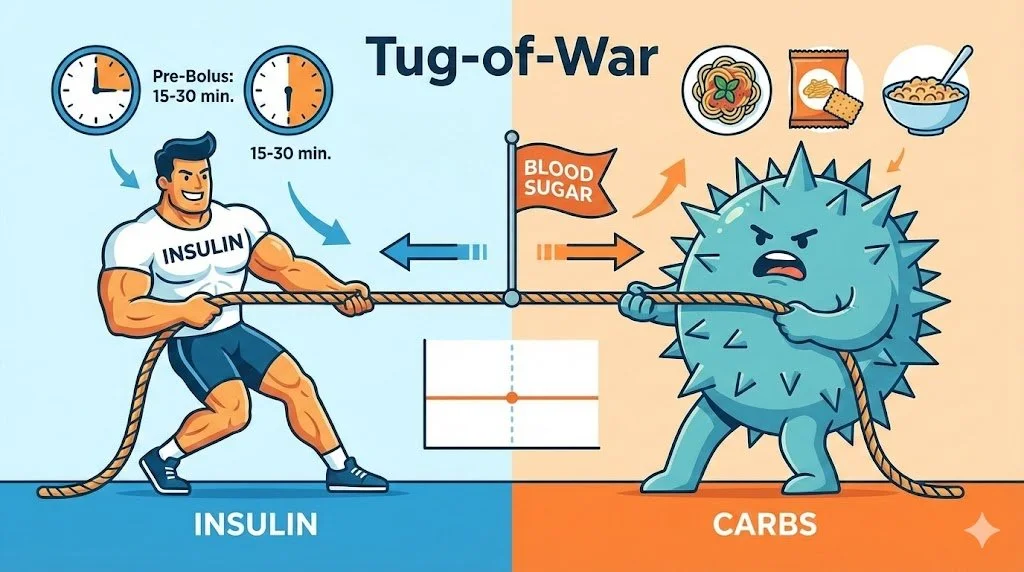
Imagine your blood sugar is a flag in the middle of a tug-of-war rope. On one side is Insulin (pulling down). On the other side are Carbs (pulling up).
If you let the Carbs start pulling 20 minutes before the Insulin shows up, the flag flies into the sky (a spike).
To win, you must give the insulin a "head start." This is called a Pre-Bolus. By dosing 15, 20, or even 30 minutes before you eat, you allow the insulin to start pulling down just as the food starts pulling up. The forces cancel each other out, and the flag (your blood sugar) stays in the middle.
⚠️ The Safety Check (Read Before You Bolus)
Pre-bolusing is a power tool, but you must respect the current data. Context is King.
Never Pre-Bolus a Low: If your blood sugar is low (e.g., under 70 mg/dL) or your arrow is trending down, do not wait. Eat immediately. The "Tug-of-War" is already lost; you need the carbs to pull up instantly.
The "Pizza Effect": High-fat/high-protein meals digest much slower than standard carbs. If you pre-bolus a heavy meal (like pizza or steak) by 20 minutes, you may crash before the food digests. These meals often require an extended bolus or different timing.
Know Your Insulin: If you use ultra-rapid insulin (like Fiasp or Lyumjev), your wait times will be much shorter.
Stop Chasing the Ghost
You don’t need to change your ratio yet. You need to change your timing. You need to understand that "Timing and Amount" are equal partners. Even the perfect amount of insulin will fail if it arrives late to the party.
Ready to stop the spikes?
You don’t have to live on a rollercoaster. We break down exactly how to time your insulin safely, how to handle high-fat foods, and how to test your Pre-Bolus timing in the Diabetes Pro Tip Series.
Start Here:
🎧 Episode 1003: Pre-Bolus (The strategy that changes everything) - Apple Device, Spotify
🎧 Episode 1002: All About Insulin (Understanding how your tool actually works) - Apple Device, Spotify
🎧 Episode 1428: Small Sips Tug of War (The visual that makes it click) - Apple Device, Spotify
Stop blaming yourself for "bad numbers." It’s just data. And now you have the data to fix it.

How Hypothyroidism Alters Life with Type 1 Diabetes
Type 1 Diabetes × Hypothyroidism: what really changes (and how to manage it)
Why these two travel together
Both T1D and autoimmune thyroid disease are common autoimmune partners. Meta-analyses and reviews consistently show higher thyroid autoimmunity and thyroid dysfunction in people with T1D than in the general population—often antibody-positive first, with a subset progressing to overt hypo- or hyperthyroidism. Routine thyroid screening is recommended in standards of care for people with T1D. American Diabetes Association+3OUP Academic+3Frontiers+3
How hypothyroidism alters glucose control (two competing effects)
1) The “more resistant” pattern (often daytime) — supported, but variable
Low thyroid hormone can increase peripheral insulin resistance, particularly in muscle and adipose tissue. Clinically this can look like higher basal needs and post-meal spikes despite familiar carbs. Several human studies and reviews—especially in subclinical hypothyroidism—report worsened insulin resistance indices. Magnitude varies, and results aren’t uniform across all populations. OUP Academic+3BMJ Open+3BioMed Central+3
2) The “more sensitive (and lower dose)” pattern (often overnight/fasted) — supported in T1D case series/reviews
In T1D, untreated hypothyroidism can also reduce insulin clearance and slow gastric emptying, raising the risk of unpredictable hypoglycemia and lower insulin requirements (sometimes markedly) until euthyroid. This is described in ADA-family journals and case series; in practice it shows up as frequent lows and a need to step basal/bolus down while thyroid therapy is optimized. Diabetes Journals
What this means in the real world: some people with T1D + hypothyroidism see higher doses and more spikes; others see lower doses and more lows; many cycle between both as meals, activity, and gastric timing change. Expect pattern volatility until thyroid levels stabilize. (Mechanistic synthesis from sources above.)
Day-to-day signals that your thyroid may be off
Your settings stop making sense: post-meal spikes despite careful counting or a run of unexplained lows—especially with fatigue, cold intolerance, dry skin/hair, or weight change.
Basal “creep” or sudden drop: rising basals over weeks or the opposite—needing 10–30% less insulin with more lows, particularly overnight. Diabetes Journals
Carpal tunnel/neuropathy, cramps, stiffness grow as glucose variability worsens. (Common with hypothyroid; can complicate device use and manual dexterity.) Diabetes Journals
Screening & monitoring (what guidelines say)
Screen at diagnosis and repeat periodically: ADA Standards call out the increased autoimmune burden in T1D and endorse ongoing screening for thyroid disease (TSH ± free T4; antibodies when indicated). Pediatric and primary-care abridged resources and update decks explicitly note initial and repeat thyroid screening at regular intervals for T1D. Frequency is individualized (e.g., annually or if symptomatic/antibodies positive/pregnancy planning). Diabetes Journals+2Diabetes Journals+2
Kids/teens with T1D: pediatric standards and ISPAD materials reinforce periodic thyroid checks given higher autoimmune clustering in youth. ISPAD+1
Suspected (needs more precision): exact “best” interval (e.g., every 1 vs 2 years) isn’t identical across guidelines and often depends on antibodies, symptoms, and prior results. (Guideline synthesis.) Diabetes Journals
Adjusting insulin and tech while hypothyroid is treated
Expect a moving target for 6–8 weeks after any levothyroxine change—the time it takes for TSH to re-equilibrate. Re-review basals, ISF, and I:C after each thyroid dose change or major lab shift. Diabetes Journals
If lows predominate (esp. fasting/overnight), first cut basal 10–20% and watch CGM overnight trends; consider more conservative correction factors until euthyroid. Diabetes Journals
If spikes dominate (esp. post-meal), review I:C and pre-bolus timing; consider modest basal increases only if nocturnal/fasting is also drifting up. (Balances the resistance vs clearance effects described above.) BMJ Open
Closed-loop/automation: expect algorithm “thrash” (over-correction, then suspends). Tighter alerts and shorter insulin-on-board assumptions can help during thyroid dose titration. (Practice inference based on mechanisms above.)
Suspected: we don’t have RCT-level data tying specific percentage changes in pump settings to degrees of hypothyroidism—the adjustments above are principle-driven and should be individualized. OUP Academic
Lipids, heart, kidneys: double-checking the “silent risks” in T1D
Hypothyroidism worsens LDL/TG and can add bradycardia/low output—stacking CV risk on top of T1D. Treating the thyroid state typically improves lipids; re-check the lipid panel after euthyroid is achieved before escalating statin therapy. Diabetes Journals
Overt hypothyroidism can lower eGFR and raise creatinine; kidney measures often improve after thyroid replacement—helpful context when interpreting microalbumin trends in T1D.
Suspected: CV event reduction with treating subclinical hypothyroidism is debated and likely age/TSH-dependent. Paloma Health
Pregnancy planning with T1D: thyroid gets a front-row seat
Untreated or undertreated maternal hypothyroidism increases risks (miscarriage, pre-eclampsia, low birth weight, neurodevelopmental effects). In T1D—where pregnancy is already high-touch—dose adjustments and tighter thyroid targets are standard; check early and often, including pre-conception. OUP Academic
Suspected: universal treatment thresholds for subclinical hypothyroidism in pregnancy still vary by guideline (TSH cutoffs, antibody status). Discuss individualized targets. Paloma Health
Quick checklist for people with T1D
Ask for labs when your settings go sideways: TSH + free T4 (and TPO antibodies if not known). Diabetes Journals
Stay consistent with levothyroxine (empty stomach, same time daily; separate from iron/calcium/PPIs). Re-test 6–8 weeks after any change. Diabetes Journals
Expect insulin changes during thyroid titration—log basal/bolus moves and CGM patterns; adjust gradually. Diabetes Journals
Re-check lipids and kidney labs once euthyroid before making big therapy jumps. Diabetes Journals
If pregnant/trying: loop in endocrine + OB early; monitor thyroid more frequently than usual. OUP Academic
Bottom line for T1D
Hypothyroidism changes the rules of insulin math through two opposite forces—a tendency toward peripheral resistance and a tendency toward lower insulin clearance and delayed gastric emptying. Which one dominates differs by person and even time-of-day. Screen regularly, treat to euthyroid, and expect to adjust insulin settings more than once on the way there. Once the thyroid is steady, your CGM and pump behave more predictably again. BMJ Open+1
Read more about the type 1 diabetes impacts.
🎧 Hear an Endocrinologist Break It Down
If you want to hear this topic straight from a specialist who lives it every day, listen to Episode 413 of the Juicebox Podcast featuring Dr. Adi Benito, an endocrinologist who explains how thyroid disorders and Type 1 diabetes constantly influence each other.
In this conversation, Dr. Benito and Scott unpack:
Why thyroid problems are so common in people with Type 1 diabetes
How low thyroid levels quietly distort insulin sensitivity, digestion, and weight
What “normal” thyroid labs can miss — and when to push for deeper testing
How treating hypothyroidism can smooth out blood-sugar swings and energy levels
It’s a practical, myth-busting talk that connects the science to real-world management — exactly the kind of clarity you wish every endo visit had.
👉 Listen to Juicebox Podcast Episode 413 — Dr. Adi Benito on Thyroid and Type 1 Diabetes
🔬 Understanding Your Thyroid Test Results — The Real-World Breakdown
1. “Normal” vs. “Optimal”
Reference range for TSH: ~0.45 – 4.5 mIU/L
Optimal range for most people: ~0.5 – 2.5 mIU/L
A “normal” result doesn’t always mean your thyroid is working optimally for you. Many people still experience fatigue, weight gain, brain fog, or glucose swings even when their numbers look fine.
2. Why “In-Range” Doesn’t Always Mean Healthy
TSH is a pituitary signal, not a direct measure of thyroid hormone activity in your cells. You can have “normal” TSH and still feel hypothyroid because of issues downstream—like how your body converts, absorbs, or uses those hormones.
You can have normal labs and still struggle with:
Poor conversion of T4 → T3 (the active hormone)
Iron, selenium, or B12 deficiency affecting hormone use
Autoimmune gastritis or celiac disease blocking absorption
Early Hashimoto’s, where antibodies are active but the gland isn’t fully failing yet
3. When to Treat
Treatment decisions aren’t just about numbers—they’re about patterns, context, and how you actually feel.
Guideline-based starting points:
TSH > 6–7 mIU/L (especially under age 65): raises cardiovascular and stroke risk → treat.
TSH > 2.5 mIU/L in women trying to conceive or pregnant → treat.
Goiter + positive antibodies → treat, even if TSH is still “normal.”
Symptom-driven care:
If symptoms of hypothyroidism persist—fatigue, brain fog, cold intolerance, slow recovery from lows, brittle hair, joint pain—you still deserve investigation.
In select cases, clinicians may trial low-dose therapy or adjust medication based on symptoms, even with “borderline” or “normal” labs, after ruling out other causes.
The goal: treat the person, not the paper. Labs confirm the story; they shouldn’t silence it.
4. Beyond TSH: Tests That Tell the Full Story
Ask for a more complete panel when something feels off:
Free T4 and Free T3 — show active hormone levels
Thyroid peroxidase (TPO) and thyroglobulin antibodies (TgAb) — detect Hashimoto’s
Ferritin and vitamin B12 — deficiencies mimic hypothyroid fatigue
Vitamin D — supports immune and thyroid function
Reverse T3 (if symptoms persist) — shows blocked hormone conversion
5. Symptoms That Should Prompt a Re-Check
Fatigue, sluggishness, or mental fog
Feeling cold easily
Weight changes without reason
Joint or muscle pain
Hair loss, dry skin, or brittle nails
Constipation
Irregular or heavy periods
Repeated low blood sugars or insulin resistance swings
In kids: slowed growth or delayed puberty
6. Frequency of Monitoring
Every 6–12 months if stable
Every 6–8 weeks after a dose change or when symptoms return
More often if pregnant, switching meds, or changing insulin regimens (for people with T1D)
7. Medication Realities
Consistency is everything: stay with the same brand/manufacturer—shape and color matter.
Take on an empty stomach, 30–60 minutes before breakfast; avoid coffee, calcium, iron, and magnesium nearby.
Missed dose? Take two the next day — levothyroxine is long-acting.
Birth-control pills can bind thyroid hormone → recheck labs after 4–6 weeks.
Tirosint (liquid capsule) helps if you have celiac, gastritis, or take acid reducers.
8. Evidence-Based Supplement Support
Selenium (80 µg daily) — lowers antibodies, supports gland health
Myo-inositol + selenium — improves TSH balance and well-being
Vitamin D — modulates immune activity
Nigella sativa (black cumin seed) — can help normalize TSH and weight
Ashwagandha — sometimes supports mild hypothyroid symptoms
Iron (+ vitamin C) — low ferritin (< 50 µg/L) worsens fatigue
⚠️ Avoid “thyroid support” blends or excess iodine — they can backfire on autoimmune thyroid disease.
9. T3 Add-On Therapy
For some people who stay symptomatic even with normal labs on T4:
Adding T3 (liothyronine) can help if the body struggles to convert T4 → T3.
Not for use in pregnancy or in those with heart rhythm disorders.
Should be a carefully supervised trial, never a DIY experiment.
10. Consequences of Ignoring It
Untreated or undertreated hypothyroidism can lead to:
Elevated cholesterol and cardiovascular disease
Fatty liver and metabolic slowdown
Insulin resistance or poor glucose control
Infertility, miscarriage risk, and irregular cycles
Depression, brain fog, low libido
Hair thinning, brittle nails, and skin changes
Cognitive decline and memory problems over time
💡 Bottom Line
“Normal” numbers can still hide a sluggish thyroid. The best clinicians look at the whole person—symptoms, labs, and response to treatment—to find balance. Don’t settle for being told “you’re fine” when your body says otherwise. The goal isn’t just to normalize TSH—it’s to feel well, think clearly, and live fully.
Always consult your healthcare provider before making medical decisions. Read the full disclaimer.

Untreated (or Undertreated) Hypothyroidism: The Full Picture
Why this matters
Thyroid hormone sets the body’s idle speed. When it’s too low, multiple systems slow: metabolism, heart and vessels, nerves, muscles and tendons, mood and cognition, fertility and pregnancy physiology. Most complications are preventable or reversible with correct diagnosis and consistent treatment. Cleveland Clinic
Metabolism, Weight, Skin & Gut
Supported
Slowed metabolic rate → fatigue and weight gain; cold intolerance; dry skin/hair; constipation from reduced gut motility. Cleveland Clinic
Suspected / needs more evidence
Specific thresholds of thyroid deficiency that predict which patients will gain weight vs. stay stable are not firmly established. (Individual variability is high.) (Inference from broad clinical sources.)
Cardiovascular & Lipids
Supported
Atherogenic dyslipidemia (↑ LDL and triglycerides) and higher cardiovascular risk with overt hypothyroidism; risk improves with appropriate therapy. JAMA Network+2Frontiers+2
Potential for bradycardia, reduced cardiac output; with long-standing severe disease, heart failure can occur. JAMA Network
Suspected / needs more evidence
In subclinical hypothyroidism, the benefit of routine treatment to prevent hard CV outcomes remains debated; data are mixed and age-dependent. Frontiers+1
Neurologic, Cognitive & Mood
Supported
Cognitive slowing/“brain fog” and depressed mood commonly accompany untreated disease and tend to improve when euthyroid. (General endocrine reviews.) Clinical Knowledge Summaries
Peripheral neuropathy can occur in chronic disease; carpal tunnel appears more often in people with hypothyroidism. Cleveland Clinic+1
Suspected / needs more evidence
Direct causation of dementia by hypothyroidism in older adults remains uncertain; association ≠ causation. (Mixed epidemiology.) (Inference from guideline tone.) Clinical Knowledge Summaries
Muscles, Tendons & Joints
Supported
Hypothyroid myopathy: proximal muscle weakness, cramps, delayed relaxation; CK may be elevated and normalizes with treatment. Rarely rhabdomyolysis. Cleveland Clinic
Entrapment neuropathies—especially carpal tunnel syndrome—are more frequent. Cleveland Clinic
Joint stiffness and non-inflammatory effusions can occur. (Guideline/background reviews.) Clinical Knowledge Summaries
Suspected / needs more evidence
A higher rate of frozen shoulder and generalized tendinopathy in hypothyroidism is frequently reported clinically, but high-quality causality data are limited; associations are plausible via matrix/glycosaminoglycan changes. (Mechanistic inference + mixed clinical studies.)
If You Live With Type 1 Diabetes (T1D)
Supported
Autoimmune thyroid disease is the most common autoimmune comorbidity in T1D, occurring in roughly 17–30% (often antibody-positive first; a smaller fraction develop clinical hypothyroidism). Annual TSH screening is recommended. Diabetes Journals+2Diabetes Journals+2
Untreated hypothyroidism can worsen insulin resistance and glycemic variability in diabetes. JAMA Network+1
Suspected / needs more evidence
The exact magnitude by which hypothyroidism changes bolus ratios/basal needs in T1D varies and is not pinned to uniform dose multipliers in the literature—clinically observed, but individualized. (Mechanistic plausibility + clinical experience.)
When Type 1 Meets Thyroid: The Hidden Tug-of-War
For people living with Type 1 diabetes, thyroid health isn’t just a side note—it’s a key part of blood-sugar control. This in-depth (but plain-spoken) guide unpacks how low thyroid hormone levels can throw off insulin sensitivity, meal timing, and pump settings, why patterns get erratic, and what to do about it.
You’ll learn:
Why thyroid disease is so common alongside Type 1
How hypothyroidism can make you both more resistant and more sensitive to insulin
What lab work and dose changes to ask for
Practical steps to keep your tech, dosing, and thyroid meds working together
Read the full deep dive → How Hypothyroidism Alters Life with Type 1 Diabetes
Hematologic, Renal & Fluids
Supported
Anemia occurs more often in hypothyroid states. (Guideline background.) Clinical Knowledge Summaries
Severe disease can reduce glomerular filtration and contribute to fluid retention; function improves with treatment. (Reviews.) Europe PMC
Suspected / needs more evidence
The exact prevalence and reversibility of mild kidney impairment in subclinical disease are not well defined. Europe PMC
Fertility, Pregnancy & Child Development
Supported
Untreated/undertreated maternal hypothyroidism is linked to miscarriage, pre-eclampsia, anemia, placental issues, postpartum hemorrhage, congestive heart failure (rare), and low birth weight; timely treatment mitigates risk. The American Thyroid Association+2The American Thyroid Association+2
Thyroid hormone requirements increase early in pregnancy; many patients need dose adjustments and close TSH/free T4 monitoring. The American Thyroid Association
Suspected / needs more evidence
Universal treatment of subclinical hypothyroidism in pregnancy improves all meaningful outcomes—guidelines recommend treatment in many scenarios, but some outcome data are still evolving. The American Thyroid Association+1
Thyroid Gland & Endocrine Context
Supported
Goiter may develop from chronic TSH stimulation in untreated disease. (Guideline background.) Clinical Knowledge Summaries
Autoimmune hypothyroidism (Hashimoto’s) is the most common cause in iodine-replete settings. Cleveland Clinic
Suspected / needs more evidence
The pace at which antibody-positive individuals progress to overt hypothyroidism varies widely and is hard to predict at the individual level. (Long-term natural-history uncertainty.)
What to do (accurate, guideline-consistent)
Test and (re)test appropriately: TSH and free T4 for diagnosis; in T1D, screen yearly or with new symptoms. Adjust dose and re-check labs ~6–8 weeks after any change. Clinical Knowledge Summaries+1
Treat consistently: Levothyroxine on an empty stomach, same time daily; separate from iron, calcium, and PPIs by several hours. Aim for euthyroid targets individualized to age, pregnancy status, and comorbidities. Clinical Knowledge Summaries
Escalate promptly in pregnancy: Increase monitoring and dosing early; coordinate endocrine–OB care. Clinical Knowledge Su
Downstream Issues: What Happens When Hypothyroidism Lingers Too Long
When thyroid hormones stay low for months or years, the effects move from symptoms to multisystem complications. Many are reversible with proper treatment; some become entrenched if delays are long.
🫀 Cardiovascular Consequences
Supported
Overt hypothyroidism drives atherogenic dyslipidemia (↑LDL, ↑triglycerides) and contributes to atherosclerosis/heart disease; lipid abnormalities generally improve with levothyroxine. BioMed Central
Can cause bradycardia and reduced cardiac output; severe, prolonged cases may develop heart failure. JAMA Network
Pericardial effusion is a recognized complication, occasionally progressing to tamponade; typically improves after thyroid replacement. Heart+1
Suspected (needs qualification)
In subclinical hypothyroidism, excess CV event risk and benefit of treatment remain debated and appear to vary by age, baseline risk, and TSH level. OUP Academic+1
🧠 Neurologic & Cognitive
Supported
Cognitive slowing, memory complaints, and depressed mood are common in untreated hypothyroidism and often improve with euthyroidism. JAMA Network
Peripheral neuropathy and carpal tunnel syndrome (CTS) occur more often in hypothyroid patients; proposed mechanisms include mucopolysaccharide deposition and nerve entrapment. MDPI
Suspected
Association with dementia in older adults is reported but causality and effect size remain uncertain across studies. ScienceDirect+1
🦴 Musculoskeletal
Supported
Hypothyroid myopathy: proximal weakness, cramps, delayed relaxation; CK elevation is common and typically falls with treatment. Rhabdomyolysis is rare but documented in severe/compounded cases (e.g., with statins). JAMA Network+1
Non-inflammatory joint effusions (highly viscous) can occur, especially in knees/wrists/hands. ScienceDirect
CTS risk is increased in hypothyroidism. MDPI
Suspected
Higher rates of frozen shoulder and broader tendinopathy are reported; newer Mendelian-randomization and clinical outcome data suggest association, but causality and magnitude remain under study. BioMed Central+1
Direct bone fragility/osteoporosis from hypothyroidism isn’t strongly supported; alterations in bone turnover are described, whereas osteoporosis is classically linked to hyperthyroidism. (Synthesis of reviews.) JAMA Network
🩸 Hematologic, Renal & Electrolytes
Supported
Anemia (often normocytic or macrocytic) is more prevalent with low thyroid function. OUP Academic
Renal effects: overt hypothyroidism can reduce GFR and raise creatinine; kidney function often improves after levothyroxine. SpringerLink
Suspected
Hyponatremia is described, but robust data suggest it’s uncommon and mainly a feature of severehypothyroidism/myxedema; in milder disease, look hard for other causes. OUP Academic+2BioMed Central+2
The prevalence and reversibility of subtle kidney changes in subclinical hypothyroidism are not well defined. BioMed Central
👶 Fertility, Pregnancy & Child Development
Supported
Untreated maternal hypothyroidism increases risks such as miscarriage, pre-eclampsia, low birth weight and adverse neurodevelopmental outcomes; dose adjustment and close monitoring early in pregnancy are standard of care (ATA 2017). Liebert Online+2JAMA Network+2
Suspected
Universal treatment of subclinical hypothyroidism in pregnancy is still debated; recommendations depend on TSH level, antibodies, and local guidelines. JAMA Network
🧬 Autoimmune & Endocrine Overlap (incl. Type 1 Diabetes)
Supported
Autoimmune thyroid disease is the most frequent autoimmune comorbidity in type 1 diabetes; hypothyroidism can worsen insulin resistance and glycemic variability. JAMA Network
Suspected
The quantitative impact of correcting hypothyroidism on long-term glycemic outcomes (e.g., A1C trajectories) in T1D is plausible but not precisely defined across populations. JAMA Network
☠️ Rare but Severe: Myxedema (Decompensated Hypothyroidism)
Supported
A life-threatening state of severe, untreated/undertreated hypothyroidism with high mortality; presents with hypothermia, bradycardia, altered mental status, and multisystem failure—emergency treatment required. Reported mortality ranges widely. Endotext+2UpToDate+2
🎧 Hear an Endocrinologist Break It Down
If you want to hear this topic straight from a specialist who lives it every day, listen to Episode 413 of the Juicebox Podcast featuring Dr. Adi Benito, an endocrinologist who explains how thyroid disorders and Type 1 diabetes constantly influence each other.
In this conversation, Dr. Benito and Scott unpack:
Why thyroid problems are so common in people with Type 1 diabetes
How low thyroid levels quietly distort insulin sensitivity, digestion, and weight
What “normal” thyroid labs can miss — and when to push for deeper testing
How treating hypothyroidism can smooth out blood-sugar swings and energy levels
It’s a practical, myth-busting talk that connects the science to real-world management — exactly the kind of clarity you wish every endo visit had.
👉 Listen to Juicebox Podcast Episode 413 — Dr. Adi Benito on Thyroid and Type 1 Diabetes
Always consult your healthcare provider before making medical decisions. Read the full disclaimer.