
Book Review and Giveaway: Dealing with Diabetes Burnout
Dealing with Diabetes Burnout: How to Recharge and Get Back on Track When You Feel Frustrated and Overwhelmed Living with Diabetes - A new book from Ginger Vieira
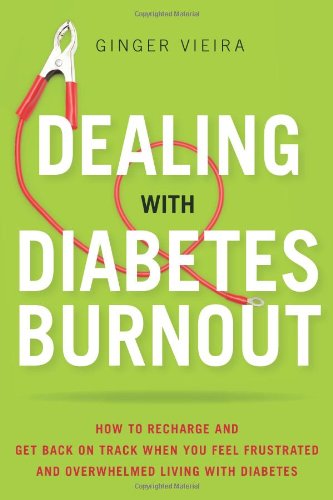
Ginger Vieira's latest book is geared mostly toward adults living with diabetes, but I found it to be a wonderful resource just the same. As the parent of a child living with type I diabetes, I often find myself wondering what it feels like to live with the disease. I do my best to imagine what Arden is thinking, feeling and experiencing, but I know that I'll never be able to fully comprehend. I'm happy to tell you that after reading 'Dealing with Diabetes Burnout' I'm closer to understanding than ever before.
The book is very well written and presented, Ginger's voice, humor and wisdom is apparent throughout. There's a wonderful section that offers advice to D-parents that I found helpful and tons of contributors from all over the diabetes community.
We can work, hope and pray that our children don't go through bouts of burnout, but lets face it, they probably will. Ginger's book helps to prepare you for those moments and gives sound advice on how to combat and live well through them.
You can enter below to win a copy from Arden's Day or if you can't wait... pick one up today in stores or online.
Winner of the book will be chosen at random. Book will be shipped directly from Ginger's publisher, DemosHEALTH. There are many ways to enter, just login to the Raffelcopter app for details (It's super easy). -- Buying through my link will help to support Arden's Day.
iHealth to launch smaller glucometer, drop test strip price
Interesting...
From: http://mobihealthnews.com
iHealth Labs, a San Francisco-based subsidiary of China’s Andon Health, has received FDA clearance for iHealth Align, a new smaller, smartphone-enabled glucometer. iHealth announced the product along with a new pricing strategy for diabetes care, dubbed Simple Savings.
Of course, the real cost to consumers for at-home blood glucose monitoring is in the test strips that must be continuously reordered. Under its Simple Savings program, iHealth will drop the cost of its test strips for both devices to $12.50 for a box of 50 strips ($0.25 a piece), about a quarter of the price of many name brand strips.
“It’s probably more of a known secret in the marketplace that the real margins is within the strips,” Lin said. “We just felt like, we want to pass on all that savings to the end users. It’s got to be simple to understand. You don’t have to go through all these issues for reimbursement. We brought it down to pretty much co-pay.”
Read the entire story here...

Interview: University of Alabama Catcher and Type I Diabetic, Molly Fichtner
I asked Molly if there is one trait that everyone who makes it as far as she has possesses, and after some consideration she answered, “Shear determination”.
University of Alabama’s catcher Molly Fichtner is someone whose story needs to be told for a number of reasons. You may be interested in hearing about a young woman who has been working at her sport since childhood, others will want to know how a type I diabetic balances playing at the very top of a grueling hot weather sport with the insulin and carbohydrates that are required for her to live. I think that many who read this will be impressed at how Molly left UT-San Antonio so that she could chase a dream.
Though these are all good reasons to Interview Molly, none are why I tracked her down. I wanted to speak with Molly because she possess a will to succeed that is not often seen.
Molly began her journey to the 2014 NCAA Woman’s College World Series by playing Little League baseball with the boys and she said that she, “threw a fit” when her parents told her that she needed to switch to softball. Seems like her parents knew what they were talking about…
Molly really dove headfirst into softball when she was twelve years old. At that time she was playing on an 18u team (18 years old and under) and found herself asking her dad to hit her ground balls even after she would arrived home from day long summer practices, “that’s when my parents began to understand how much I wanted it”. Molly continued to work hard into high school, “I think I started peaking between my freshman and sophomore year and I thought, hey I could play in college”. She hit the gym, adding strength to her 5’ 2” frame and power to her swing, “I like being the underdog, I am 5’ 2” but my goal was to play like I was six feet tall”.
The winter after Molly first played with the older girls, at age twelve, she was diagnosed with type I diabetes during her Christmas break, Molly lost over ten pounds in a month and experienced other tell-tale signs of type I diabetes; like frequent urination, an insatiable thirst and generally feeling terrible. Those symptoms prompted Molly’s grandmother (a type 2 diabetic) to suggest that the family use her blood glucose meter on Molly. That’s the first time anyone would strike a hole in Molly’s finger to test her blood, her blood sugar was so high on Christmas Day that her grandmother’s meter couldn’t offer a number, it only said, “HI”.
Today Molly has a plan for handling every aspect of her type I diabetes in her life and when she plays softball. Her trainers test her blood sugar every thirty minutes during games and practices. She told me that regimen works the best for her but noted that during particularly intense games her adrenaline can spike, sending her blood glucose value climbing. She also knows that her blood sugar tends to get low after night games and so she makes adjustments to her food and insulin that help avoid them. Type I diabetes is certainly a challenge, it’s impact on the body can not be denied but, Molly doesn’t let that get in her way in her daily life and it didn’t stop her from becoming UT-San Antonio’s catcher.
In two years at UT-San Antonio Molly started in over one hundred games, she was receiving accolades and having success, “but I didn’t feel like I was being pushed to see how far I could actually go”. Her parents sat Molly down and asked if she wanted to transfer. “It wasn’t about the playing, it wasn’t about anything (softball related), it was about having the experience”.
Follow Molly on Twitter.
What Molly told me next is where her story lies. “When I arrived at Alabama I didn’t even know if I was going to play and it didn’t matter to me”. What Molly wanted was a chance to push herself, she wanted to be surrounded by the best to see if she could measure up, to have the opportunity to learn from the best; she wanted more and somehow at the age of twenty had the courage to give up a sure thing to get the chance to breath rarified air. I tried to tell Molly that I thought that what she did was incredibly brave but I don’t think that she saw it that way and after talking to her for a little longer, I started to see why. I think Molly just didn’t want to stop growing. What I saw initially as bravery, I soon began to think of as perspective. I told Molly that many of the people that I’ve met who have type I diabetes seem to have a very clear perspective on life and that I thought that clarity comes partially from living with a chronic illness.
During her freshman year at UT-San Antonio Molly played in a tournament against the Crimson Tide. “I got to see them firsthand. I looked at the players; the camaraderie… there was something different about the program. I was catching so I could hear them in their dugout”. That day Molly went 2 for 2 with two home runs and she threw out one of Alabama’s fastest runners trying to steal. She thinks that her performance in that game helped her when she called Coach Murphy to inquire about playing for the Crimson Tide.
Before Molly could make the call to Tuscaloosa, she had to ask UT-San Antonio to release her because NCAA rules prohibit players and schools from talking about such things while they are signed with another institution. She had to be released from the UTSA Softball Program and cleared by the NCAA prior to contacting Coach Murphy.
You can see why I thought Molly was brave; she told me that she was scared when she asked for her release, “They pulled my scholarship right away… I had no where to go”. Molly gave up a full scholarship and guaranteed playing time to have the chance to find out what she was made of. Molly Fichtner is a person who understands that life is more than just succeeding, it’s about being motivated and fearless, life is about wondering what you don’t know and having the audacity to try and find out.
I asked Molly if there is one trait that everyone who makes it as far as she has possesses, and after some consideration she answered, “Shear determination”.
Her advice to kids who have aspirations of playing at a higher level was simple but profound. “A lot of kids, when they think they’re good - they stop working. The determination to be the best you can be and to keep working and to not be satisfied, that’s what’s going to separate you in the long run. Be determined to take your ability as far as it can go”.
Last week Alabama fell short of winning the Woman’s College World Series in Molly’s senior year, losing to Florida in the championship round, but when she spoke about the experience all I heard was a positive attitude. She talked about wanting to have an impact on kids playing softball and being a part of helping them to fulfill their dreams through coaching by getting her Master’s Degree and continuing to try to find the parts of herself that have yet to be challenged.
I described to Molly that I often tell my children, who both play competitive baseball and softball respectively, that I don’t care about the end result... I care about how they do what they're doing.
Molly interjected, “At Alabama we call that process over outcome”.
I think that phrase perfectly describes Molly’s life and her success. In fact, I can’t think of a better message for people living with diabetes, children who dream of playing a sport on the world’s stage or the little girls who will grow up to be the next generation of woman; so I’m going to stop writing - even though I could go on all day about how impressed I was with Molly Fichtner.
Listen to Molly on the Juicebox Podcast







Living Between the (Diabetes) Lines
Three questions that every person living with diabetes asks themselves...
How high is too high? How low is too low? How do I find the balance between long-term complications and having a seizure.
Each of us has been given a range to aspire to. When Arden was first diagnosed, the doctor told us that we should be trying to keep her blood glucose value between 110 and 200 - "let's try to keep her A1C under 8.5", they said.
And so that became my goal.
Then one day they told us that we should lower the high range value to 190, at our next visit we agreed to try 185. The low range number was never touched. I understood what was happening even though it was never articulated to me, our BG goals were adjusting based on the vibe that our Endo got from us at each visit. She was evaluating our ability to handle spikes, lows, meals and overnights. I was being lovingly manipulated.
Then one day we discovered CGM technology and that little screen gave me something that I never had before, a visual representation of our goal. Now there was a line that I was trying not to cross. In the past when our goal was 190, 210 didn't seem like a huge miss and on the low end... even though we were trying for 120, 100 seemed so perfect that we didn't mind being a little low; besides many people, who don't have diabetes, regularly have a BG of 85 - of course they don't have man-made insulin in their system that doesn't know when to stop removing sugar from their blood.
I was living between the lines but I think the lines were holding me back...
I say holding me back because Arden's BGs were, for the most part, existing between them. I'm not talking about unforeseen spikes or unexpected lows. Highs and lows happen, you correct and move on, but you don't let them impact your impression of the graph. A few blips don't discount the rest of the day. Look at how the BGs are when you are blousing correctly, counting carbs accurately, when your basal rate is properly set. In those hours I was content if the graph line was mostly stable and in between 180 and 120.
It took me quite some time to figure this fact out, but the comfort that I felt when we achieved BGs that were between those lines, was holding me back from trying to do better. I had been lulled into a state of acceptance.
The lines were also providing a false sense of security. Even though they were arbitrarily set by a person that I only see four times a year, I was treating them like gospel. Finally I wondered, "if I can successfully keep a BG under 180 why could't I keep it under 170? Hell, why couldn't I shoot for 140?".
So I moved the line and do you know what happened?
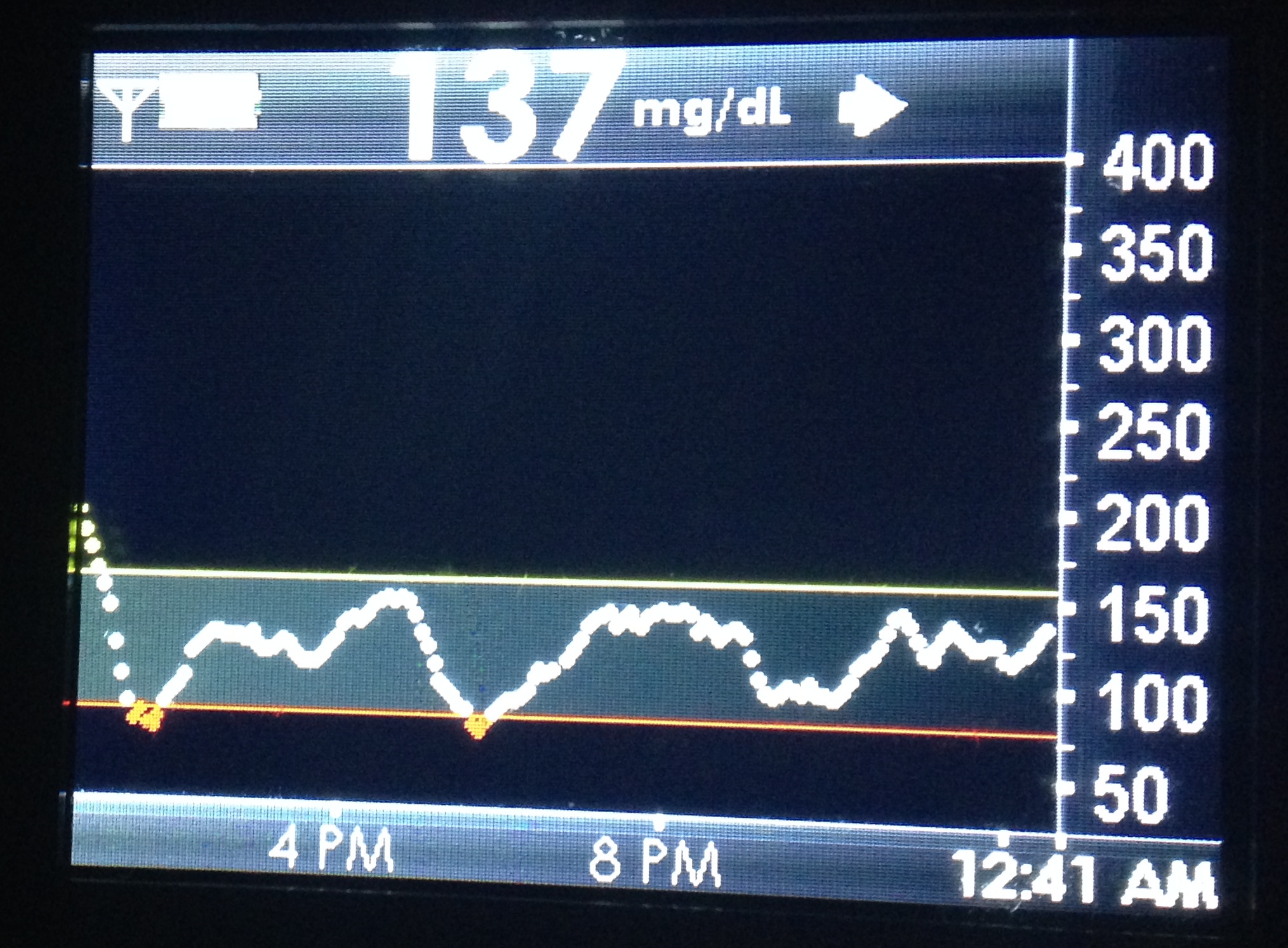
I kept her BG under 160. Then I got brave and moved her low threshold to 100. Today, Arden's low alert sounds at 85 and her high is set at 160, but this summer I'm going to move that to 150.
All of this doesn't work if you punish yourself for going outside of the lines. I am telling you, do not do this if you can't handle seeing the graph climb above, or below those lines - don't add stress to your already stressful day. Before you attempt to move the lines you must find peace with being on the other side of them, you have to come to grips with the idea that nothing in life is controllable to that degree. Here's how I found my peace with that truth.
I was happy if Arden's BG was 180 all day because someone told me that number was okay. Her BG still spiked, it still got low but for most hours of each day her BG was 180. Today, most hours of the day come with a BG of around 140. She still has spikes and still gets low but most hours are spent in our new range. It took me a while, but now I can see, there is no difference in how I manage or what I do; the only thing that has changed is my expectations and the way that I react to them.
When I expected 180, I got 180. When I expect 140, I get 140. I'm learning to except 90... one day I'll learn to expect it.
When you're ready, move those lines... the ones on your CGM or in your log book, and the ones in your mind and heart. Expect what you want, except what you achieve and never stop moving the lines that life sets. Define your own reality.
Don't forget to read my disclaimer, I am not a medical professional and I am not dispensing advice... just telling stories on the Internets, the WWW, the information highway - you get what I'm saying. Please also don't forget that high and low ranges are never one-size-fits all. While Arden feels fine when her BG is 85, you or your child may not.
Ganémosle la carrera a la diabetes (Lets Beat Diabetes Race)
I'll be speaking in Santo Domingo, D.N. this weekend at the Ganémosle la carrera a la diabetes.

One goal, inspire and support people living with diabetes! @DOCIRL